


Abstract
Solid-state sodium batteries based on polymer electrolytes offer a sustainable solution to overcome current and near-future needs regarding the growing energy and transport electrification issues. In this work, we propose the development of solvent-free polymer electrolytes based on an unsaturated polyether, which, once cross-linked, leads to an amorphous structure at room temperature that favors ionic transport towards reliable and robust solid-state sodium batteries operative at moderate temperatures. Using NaClO4 and NaPF6 as sodium salts, the best polymer electrolyte reaches an ionic conductivity in the range of 0.02 mS·cm−1 (30 °C)–0.90 mS·cm−1 (100 °C) with a lifetime superior to 2000 h after plating and stripping. Regarding electrochemical performance, a maximum specific capacity of 110.2 mAh·g−1 (C/20) is obtained for the polymer electrolyte including NaClO4, using Na and C/FePO4 as anode and cathode, respectively, which represents about 65% of the theoretical value expected for FePO4. In view of more sustainable energy storage devices, a life cycle assessment is also applied. While the polymer matrix is identified as the main environmental hotspot, the choice of Na salt significantly affects the overall impact, with NaClO4 exhibiting lower climate change and particulate matter impacts than NaPF6.
1. Introduction
Since Wright reported his pioneering research on sodium salts-based polymer electrolytes (PE) in 1973 [1], solvent-free polymer electrolytes (SPEs) are considered a very promising alternative to conventional liquid electrolytes for the development of safer solid-state sodium batteries. SPEs present several advantages [2,3,4,5], including simple processing, low cost and a flexibility that not only promotes intimate electrode/electrolyte surface contact, but also allows accommodating the electrodes’ volume changes, all contributing to more reliable and safer energy storage devices. Polymers used for SPE formulation should meet a series of properties: (i) high dissolution ability regarding different sodium salts, (ii) high solvation capacity against cations (high donor number), (iii) low glass transition temperature to promote segmental motion of the polymeric network and (iv) mechanical stability in a wide temperature range [6,7,8,9]. Despite polyethylene oxide (PEO) being the polymer of reference in the field of SPEs [10,11,12,13,14], its semi-crystalline nature leads to competitive ionic conductivities only when exceeding the melting temperature of the PEO-salt complexes, which dramatically affects the mechanical properties, jeopardizing battery safety. There are different strategies reported in the literature focused on improving both the ionic conductivity and the mechanical properties of polymer electrolytes by reducing their crystallinity. Some approaches include the synthesis of cross-linked polymers, the synthesis of copolymers, the production of polymer blends and the addition of plasticizers or inorganic particles (SiO2, Al2O3, TiO2, etc.) [14,15,16,17]. Among them, the development of cross-linked polymers into three-dimensional networks with enhanced electrochemical and mechanical properties, especially in terms of structural stability and flexibility, has received special attention in the scientific community [16,18,19]. Although the addition of liquid electrolytes or solvents (e.g., carbonate- or ether-based electrolytes) significantly increases ionic conductivity at room temperature, the resulting swelled polymer electrolytes typically exhibit reduced mechanical strength and dimensional stability, which compromise the safety of the battery and prevent the obtaining of thin films, to the detriment of ionic conductance [7,16]. Given their non-flammability, low vapor pressure and high electrochemical and thermal stability, ionic liquids (ILs) also stand out as interesting plasticizers, although they are discouraged for application due to their high costs [16,20] and the lithium migration in the “wrong” direction, as reported by Schmidt et al. [21]. Some authors propose the development of cross-linked polymers and ionic liquids towards single ion conductor polymer electrolytes [22,23].
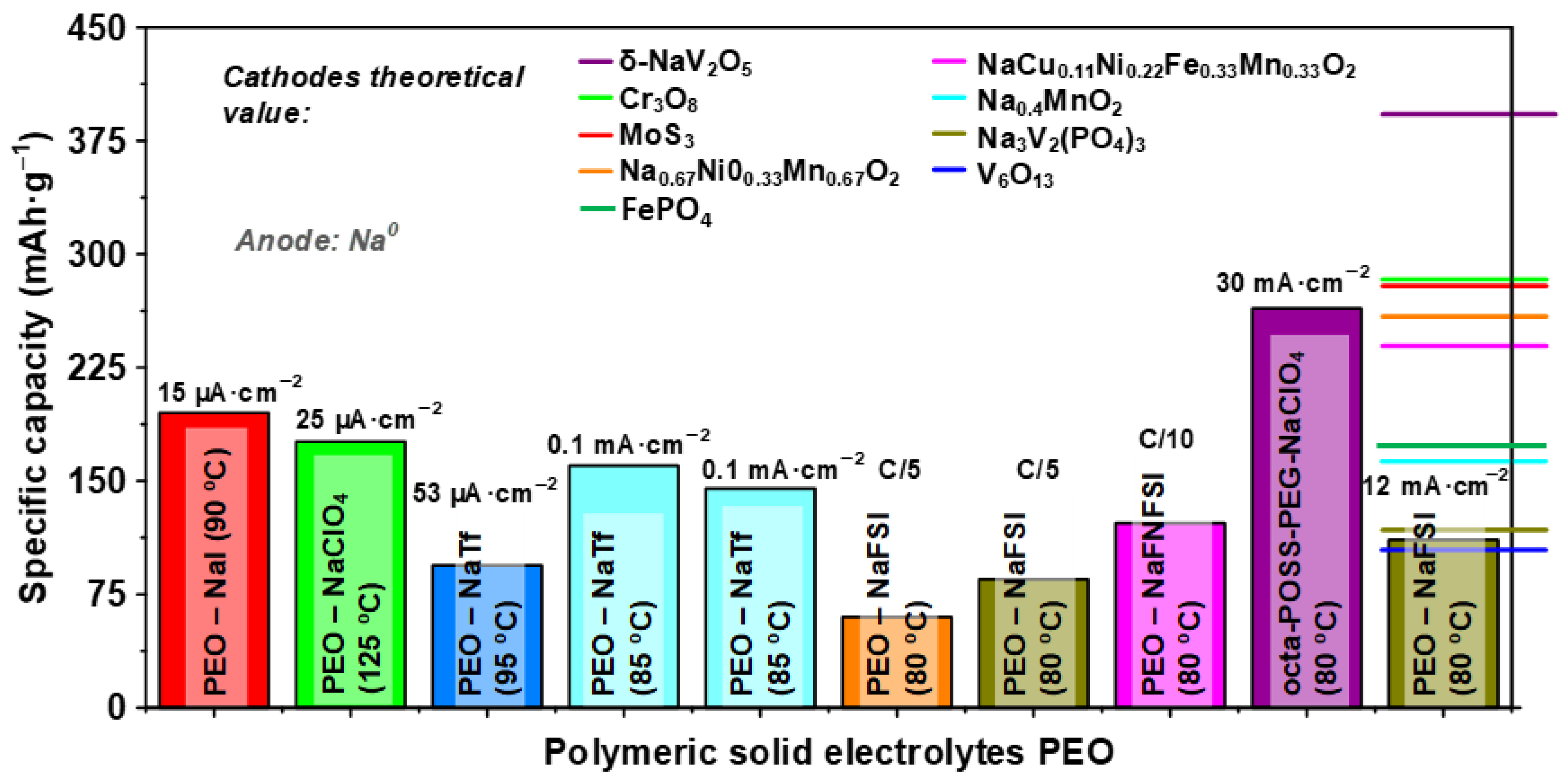
Solid-state sodium batteries based on polymer electrolytes offer not only a safer but also a more sustainable solution (abundance of sodium in sea water vs. lithium ore scarcity) to the growing problems of energy and electrification of transport compared to liquid electrolytes. Figure 1 presents the specific capacity reported in the literature for a series of solid-state sodium batteries based on different polymer electrolytes, highlighting their potential application in energy storage systems. We selected as host polymers networks gathering the solvating ability and segmental motion of PEO while suppressing its crystallinity and avoiding its creeping at temperatures exceeding its Tm. In a non-exhaustive review, the cross-linkable materials that exhibit the previous characteristics and are potentially up scalable are limited, e.g., polyether–urethane [24], polyether–amide [25] and poly(oxyethylene-co-allylglycidyl ether [26]. The first two are synthesized via polycondensation, whereas the third is obtained through ring-opening copolymerization. Although reference [24] is a study from four decades ago focused on NaBPh4 networked electrolytes, and references [25,26] primarily addresses lithium-ion transport, their inclusion is relevant as they meet requirements in terms of solvation, mobility and mechanical stability. Furthermore, their ionic conductivities are comparable to Li+, Na+ and K+. A recent study reported the networking of a PGMA (polyglycidylmethacrylate)-based polymer electrolyte as a host polymer for NaFSI [27]. The cross-linking was achieved by reacting a PEG-diamine (6,000 g/mole) with the epoxy groups, providing the network with both flexibility and solvating ability. Nonetheless, this networked electrolyte has been used both as an electrolyte and as a binder for NNMO cathodes, a highly challenging positive that requires an electrolyte with anodic stability.
In this work, we explore solvent-free polymer electrolytes based on previously reported cross-linked polymer matrixes, incorporating alternative sodium salts to investigate their ionic and electrochemical performance as solid-state electrolytes. The polymer electrolytes are amorphous from roughly ambient temperature, which favors ionic conductivity and, therefore, electrochemical performance. To investigate the influence of sodium salt, NaClO4 and NaPF6 are dissolved in the polymer network in a ratio of O/Na = 20. Both polymer electrolytes are characterized in terms of thermal, microstructural and electrical properties. Their electrochemical performance is evaluated in coin cell configuration by using sodium metal and C/FePO4 as anode and cathode, respectively. Moreover, the environmental impact assessment of the sodium-based polymer electrolytes developed in this work has been carried out using the Life Cycle Assessment (LCA) framework established by ISO 14044:2006 [28,29], which evaluates inputs, outputs and potential environmental impacts throughout their life cycle.
Figure 1.
Discharge specific capacities reported for different solid-state sodium-ion batteries with polymer electrolytes based on PEO and different sodium salts [7,19,30,31,32,33,34,35,36,37,38]. Horizontal lines on the right-side axis represent theoretical specific capacity.
2. Materials and Methods
Synthesis of the pre-polymer (PC1000)
The pre-polymer used to formulate the proposed polymer electrolytes was synthesized by polycondensation of polyethylene glycol (Mw = 1000 g·mol−1; PEG1000) and 3-chloro-2-chloro-methyl-1-propene (CCMP), following the procedure previously reported [8,39]. Following this approach, a pre-polymer (PC1000) with a polystyrene-equivalent molecular weight of Mw = 20,000 g·mol−1 (Mn = 17,600 g·mol−1), determined by size exclusion chromatography (SEC), was obtained.
Preparation of cross-linked polymer electrolytes (NPC1000)
Sodium polymer electrolytes, labeled as NPC1000, were prepared in the form of films using conventional casting. Therefore, specific amounts of the corresponding Na-salts (NaClO4 and NaPF6), with an O/Na ratio of 20, were dissolved in PC1000 using acetonitrile as solvent and 5 wt.% benzoyl peroxide as thermal initiator of the cross-linking reaction. The cross-linking was thermally induced at 90 °C under vacuum conditions for 12 h. Afterwards, the 150–170 μm thick cross-linked films obtained were dried under vacuum at 60 °C overnight and stored in an argon-filled glovebox (H2O, O2 < 0.1 ppm) until used to prevent moisture absorption.
Thermal and mechanical characterization
Differential scanning calorimetry (DSC) measurements were carried out using a DSC822e (Mettler Toledo, Greifensee, Switzerland) under a 50 mL·min−1 constant N2 (g) flow for ~10 mg samples. Crystallinity was estimated as the area under the melting peak using expression (1), where ΔHm is the experimental melting enthalpy obtained by DSC measurements and ΔH0m is the theoretical value for PEO 100% crystalline (213.7 J g−1 [40]).
Thermogravimetric analysis (TGA) of the samples (~10–30 mg) was carried out using a Pyris1 TGA (Perkin Elmer, Shelton, CT, USA) thermogravimetric analyzer. For this purpose, the samples were heated in the range of 30–700 °C (10 °C·min−1) in N2 atmosphere using a platinum crucible. Onset temperature (Tonset) was estimated using the intersection point of the baseline with the tangent line drawn from the point of greatest slope (derivative of the TGA pattern).
Mechanical properties of the polymer electrolytes were characterized using a tailor-made uniaxial tensile test system (DT/005/FR, MicroTest, Madrid, Spain), which measured elongation and load at a constant deformation rate of 0.05 min−1 in this case. Measurements were carried out by quintupling at room temperature in accordance with ASTM D882-10 [41].
Electrochemical impedance spectroscopy (EIS)
Ionic conductivity of the proposed polymer electrolytes was evaluated by electrochemical impedance spectroscopy (EIS) using an Impedance/Gain-Phase Analyzer SI1260 (Solartron, Berkshire, UK) by applying a 10 mV amplitude signal in the 0.1 Hz–10 MHz frequency range as a function of temperature (30–100 °C). For this purpose, a coin cell (CR2032) was assembled in argon atmosphere using ion-blocking electrodes of stainless steel.
Cationic transference number
The cationic transference number (tNa+) was investigated on symmetric cells (Na│PE│Na) assembled in argon atmosphere. was calculated using expression (2), in accordance with the Evans–Bruce method [42], where, I0, R0, ISS and RSS are the current and interface resistance of the cell before and after polarization (steady state). Measurements were performed at 80 °C with a 10 mV applied polarization.
Electrochemical performance
Linear sweep voltammetry (LSV) was used to investigate the electrochemical stability window (ESW) using the Na│PE│SS (stainless steel) configuration in a coin cell (CR2032) assembled in argon atmosphere. For this purpose, voltage was linearly controlled from 0 to 4 V (0.1 mV·s−1). To study the complete electrochemical behavior of the proposed polymer electrolytes, coin cells with the configuration Na┃PE┃C/FePO4 were tested at 80 °C by adding a small amount of liquid electrolyte (10 μL, 1 M NaClO4/NaPF6 in diglyme) to improve the electrode/electrolyte interfacial contact. Strictly speaking, the presence of this small amount of liquid phase makes the tested configuration closer to a hybrid or quasi-solid-state system rather than a fully all-solid-state battery. Nevertheless, this procedure is commonly used in solid electrolytes [43] to reduce interfacial resistance. In this case, cycling was carried out at different current rates (C-rates) in a voltage range, according to ESW, from 1.5 V to 4 V, using a BTS-4000 (Neware Technology, Shenzhen, China) battery tester. C/FePO4 was used as a model cathode material to evaluate the electrolyte performance under consistent conditions.
To study the evolution of the electrode/electrolyte interface, the variation of the interfacial resistance as a function of time was analyzed at 80 °C, using cells with the Na│PE │Na configuration. For this purpose, EIS measurements were taken every 24 h for 10 days. Finally, plating and stripping were evaluated by galvanostatic cycling at 80 °C by applying a current density of 0.05 mA·cm−2 for 1 h, using 14 mm diameter sodium electrodes in the Na│PE│Na cell configuration.
LCA Methodology
In accordance with ISO standards, the first step consists of (i) defining the goal and scope of the assessment. The present LCA aims to quantify the environmental burdens associated with the synthesis of one individual sodium polymer electrolyte unit, defined as a single circular membrane fragment (15 mm diameter) cut from a cast and cross-linked film from which twelve units were produced, following the methodology established for calcium electrolytes in [44]. Focusing solely on the electrolyte film enables isolating the impacts attributable to material production, as recommended in earlier LCA studies on emerging battery materials [45]. The system boundary includes the synthesis of the PC1000 pre-polymer, the modeling or production of the sodium salt, solvent use, cross-linking under vacuum and the subsequent cutting into discrete electrolyte units. Downstream stages (including cell assembly, cycling, transport and end-of-life) are excluded, as the emphasis is placed on laboratory-scale material development. (ii) The Life Cycle Inventory (LCI) is reported for the entire batch of twelve electrolyte disks obtained from each polymer membrane; however, the environmental impacts are subsequently calculated and presented for one single electrolyte unit, which constitutes the functional unit of the study. Table 1 summarizes the inventory for the two sodium-based electrolytes, including the amount of each component and the corresponding Ecoinvent datasets employed. As shown, PC1000 is incorporated at 60 mg per batch and is modeled following the polycondensation route of PEG1000, as described in [44], given the absence of a dedicated dataset in Ecoinvent. Acetonitrile and the sodium salts (NaClO4 and NaPF6) are represented using their Ecoinvent datasets.
Table 1.
Life Cycle Inventory of the two proposed polymer electrolytes.
(iii) The Life Cycle Impact Assessment (LCIA) is performed using SimaPro 10.2 and the Product Environmental Footprint (PEF) 3.0 impact method developed by the European Commission. PEF is a harmonized LCIA methodology designed to provide a science-based, policy-aligned assessment of environmental performance across multiple midpoint categories [46]. Three PEF impact categories are selected: Climate Change (CC), Particulate Matter (PM) and Ozone Depletion (OD). These categories receive the highest recommendation level (Level I) within PEF due to their robustness, policy relevance and high methodological maturity. Finally, (iv) the interpretation phase adheres to ISO requirements by analyzing contribution patterns, identifying environmental hotspots within each electrolyte formulation, and evaluating consistency and completeness.
3. Results
3.1. Microstructural Characterization
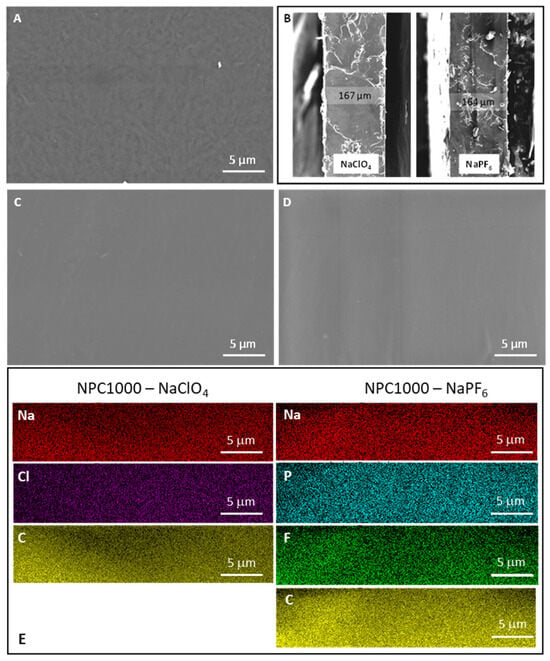
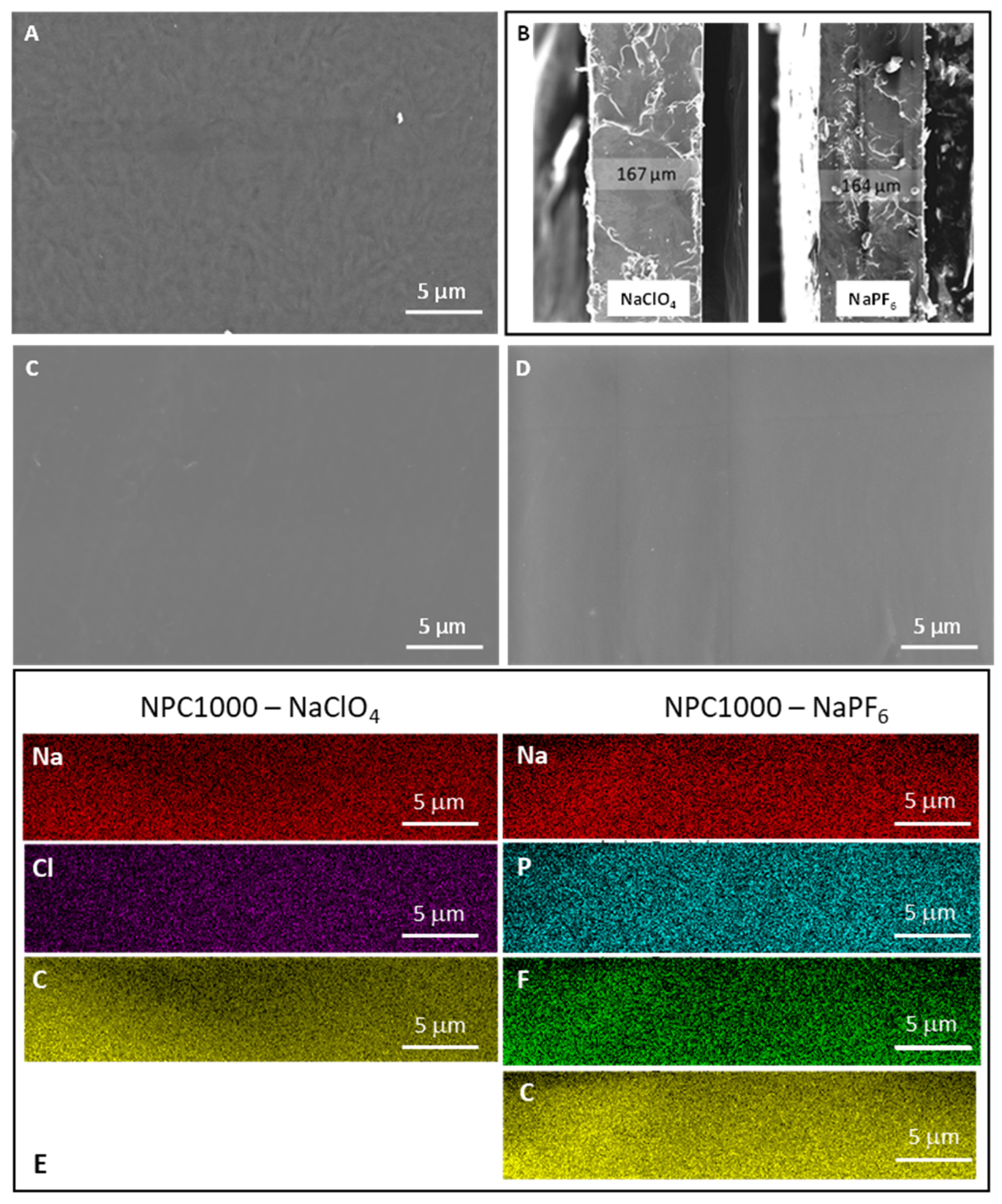
Figure S1 in the Supplementary Materials presents the 1H NMR spectrum obtained for the synthesized pre-polymer (PC1000) when using DMF-d7 (N, N-dimethylformamide-d7) as the solvent. Figure 2 shows the surface and cross-section of both polymer electrolytes once cross-linked, including a salt-free NPC1000 film as a reference, obtained by scanning electron microscopy (SEM).
Figure 2.
SEM images showing the surface of the salt-free NPC1000 film (A) and polymer electrolytes containing NaClO4 (C) and NaPF6 (D). (B) Cross-section of both polymer electrolytes. (E) X-ray mapping showing the distribution of the different constituent elements through the cross-section of NPC1000-NaClO4 and NPC1000-NaPF6.
In general, a smooth and defect-free surface is observed in all cases, regardless of whether the sodium salt is used. Additional multi-elemental EDS mappings were performed to further evaluate the spatial distribution of the polymer matrix and sodium salts within the electrolyte membranes. Besides Na, the elemental distributions of C, Cl, P, and F were analyzed for the NaClO4- and NaPF6-based electrolytes. In all cases, the elements exhibited a homogeneous distribution throughout the analyzed regions, without evidence of significant salt agglomeration or phase separation. The combined homogeneous distribution of Na and the corresponding anionic species indicates an effective dispersion of the sodium salts within the polymer network. Semicrystalline polymers typically exhibit characteristic structures such as spherulites, associated with crystalline domains. In this case, the absence of such features suggests a predominantly amorphous morphology, likely resulting from both the post-curing cross-linking of polymer chains and the incorporation of sodium salts, which interfere with polymer crystallization [47].
3.2. Thermal and Mechanical Characterization
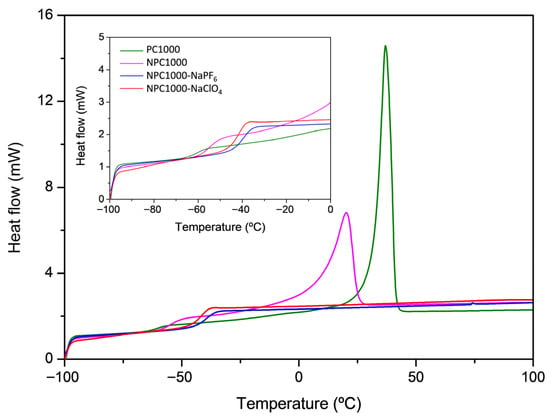
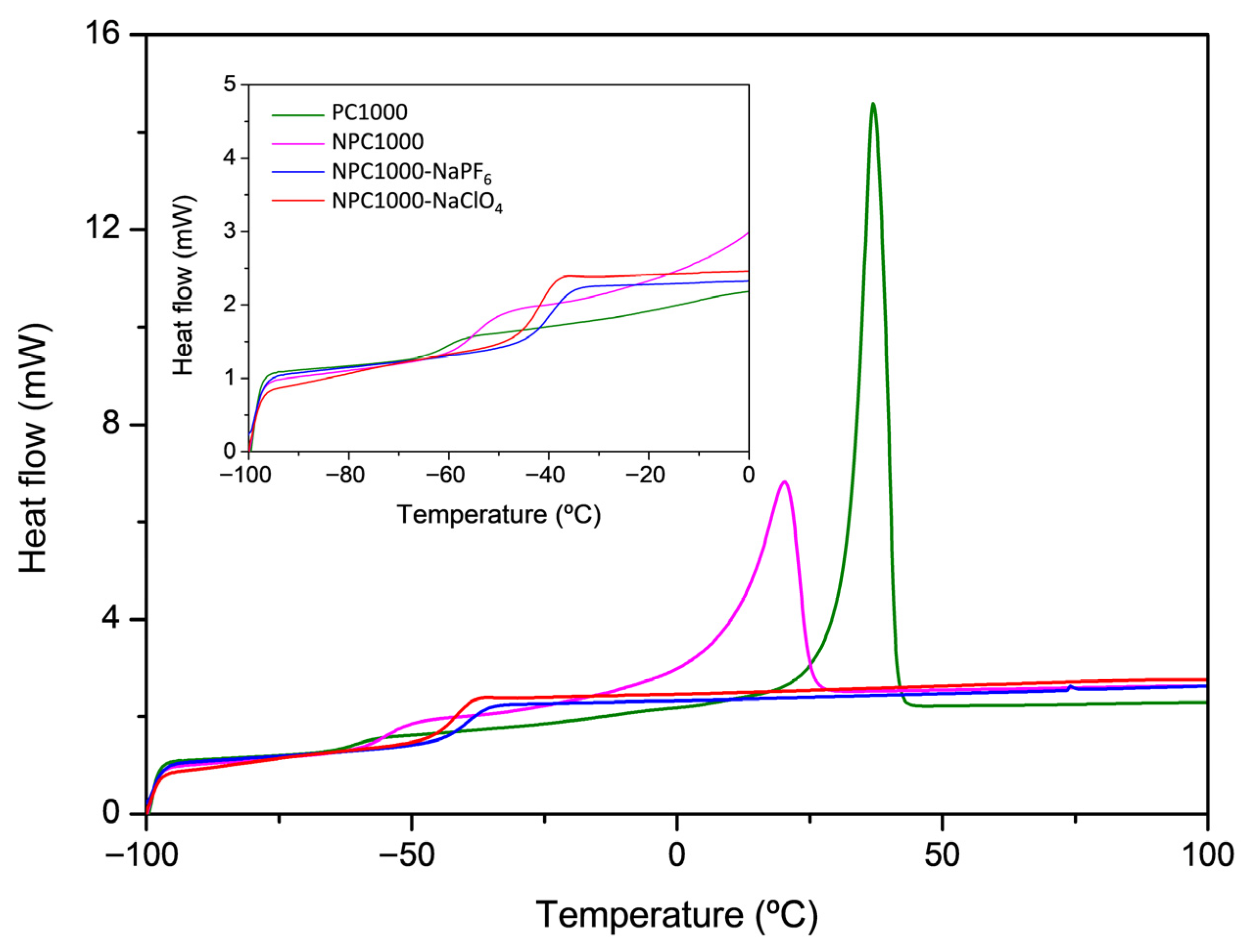
According to DSC measurements, only PC1000 and NPC1000 exhibit endothermic peaks, whose maximum corresponds to the melting temperature. As seen in Figure 3, the melting temperature shifts to lower values as a consequence of the cross-linking reaction, going from 37 °C to 20 °C for PC1000 and NPC1000, respectively. Moreover, the disruption probably induced by the cross-linking reaction, affecting the chain stacking in the polymer network, leads to a significant decrease in crystallinity, which goes from 34.5% to 23.2% for pristine PC1000 and salt-free cross-linked NPC1000, respectively. On the other hand, the absence of endothermic peaks in both polymer electrolytes (NPC1000-NaClO4 and NPC1000-NaPF6) suggests a fully amorphous structure. Regarding glass transition temperature (Tg), it increases as a consequence of the cross-linking reaction, going from −64 °C to −51 °C for the pristine PC1000 and the cross-linked NPC1000, respectively. Moreover, Tg shifts to higher values in both polymer electrolytes once the sodium salt is added, with values of about −39 °C and −42 °C for NPC1000-NaPF6 and NPC1000-NaClO4, respectively. This is a significant asset, since a fully amorphous structure is expected to favor ionic conductivity, given that the disorder induced in the polymer network facilitates cationic transference.
Figure 3.
DSC curves of PC1000, a salt-free cross-linked NPC1000 membrane and both cross-linked polymer electrolytes (NPC1000-NaClO4 and NPC1000-NaPF6). The inset corresponds to the region where Tg is estimated.
To evaluate the thermal stability of the proposed polymer electrolytes, thermogravimetric analysis (TGA) is performed in nitrogen, as shown in Figure S2. In both cases, a first, although small (<1%), weight loss is observed below 100 °C, probably associated with humidity absorbed by samples during manipulation. Two more weight losses are observed for both polymer electrolytes at Tonset of about 193 °C and 249 °C for NPC1000-NaClO4, and 185 °C and 284 °C for NPC1000-NaPF6. Such weight losses are associated with the volatilization of degradation products, likely resulting from chain scission processes [8,48]. Although TGA suggests thermal stability up to ~185–284 °C, these values should be interpreted with caution, as TGA under an inert atmosphere mainly detects mass loss and may not capture early chain scission processes that may occur at lower temperatures. Due to their coordination chemistry, hexafluorophosphate anions (PF6−) can readily disproportionate into the strong Lewis acid PF5 and F− [49], the acid likely inducing scission of the polymer network. Finally, as reported by Yang et al. [50], once disproportionated, hexafluorophosphate salts undergo thermal degradation in a dry atmosphere starting at ~107 °C.
Moreover, it is worth mentioning that both polymer electrolytes exhibit thermal stability high enough to safely operate below the melting point of sodium metal negative electrodes, i.e., 92–98 °C.
The mechanical behavior of polymer electrolytes is a critical parameter not only during battery assembly but also while cycling, as it accommodates volume changes in electrodes and provides efficient restriction against dendritic growth, thereby enhancing both the lifetime and safety of the device. Figure S3 gathers average stress-strain curves, obtained from 5 samples (n = 5), for both polymer electrolytes (NPC1000-NaClO4 and NPC1000-NaPF6), including the salt-free NPC1000 as a reference. Given the semi-crystalline structure of salt-free NPC1000 at room temperature, as demonstrated by DSC, it exhibits a higher modulus of elasticity, with values up to 12.1 ± 1.6 MPa (n = 5). On the other hand, adding sodium salts to NPC1000 leads to a higher glass transition temperature, resulting in a fully amorphous structure, which in turn penalizes mechanical performance by slightly decreasing the modulus of elasticity to values of about 8.9 ± 0.9 MPa (n = 5) and 10.8 ± 0.9 MPa (n = 5) for NPC1000-NaClO4 and NPC1000-NaPF6, respectively. This is a significant asset in battery systems, where flexibility allows not only for accommodating volume changes experienced by electrodes during cycling but also for enhancing impact resistance during battery assembly and electrode/electrolyte contact surfaces.
3.3. Electrochemical Impedance Spectroscopy (EIS)
Figure S4 presents the typical impedance data set for both sodium-based polymer electrolytes at 80 °C. In both cases, the Nyquist impedance diagram (Z’’ vs. Z’) reflects one partially defined semicircle in the high-frequency region, which can be attributed to the bulk response of the electrolyte, and ends with a typical spike-shaped tail at the low frequency zone, indicative of the capacitive behavior related to charge accumulation at the electrode interface. According to the admittance diagrams, blocking of mobile ions, linked to the capacitive response of the blocking electrodes, occurs in the low-frequency region, where a dispersive regime is observed. Subsequently, a well-defined and wide plateau is observed in the high frequency zone, corresponding to the bulk ionic conductivity. This combined behavior confirms that the material is predominantly ionically conductive, with a bulk resistance that can be estimated from the high-frequency intercept of the semicircle in the Nyquist plot.
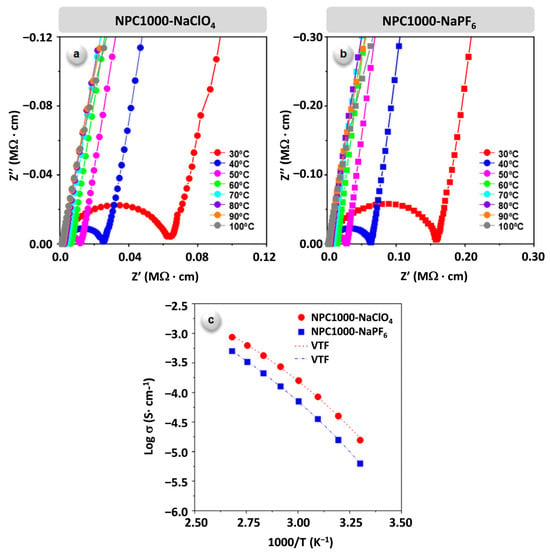
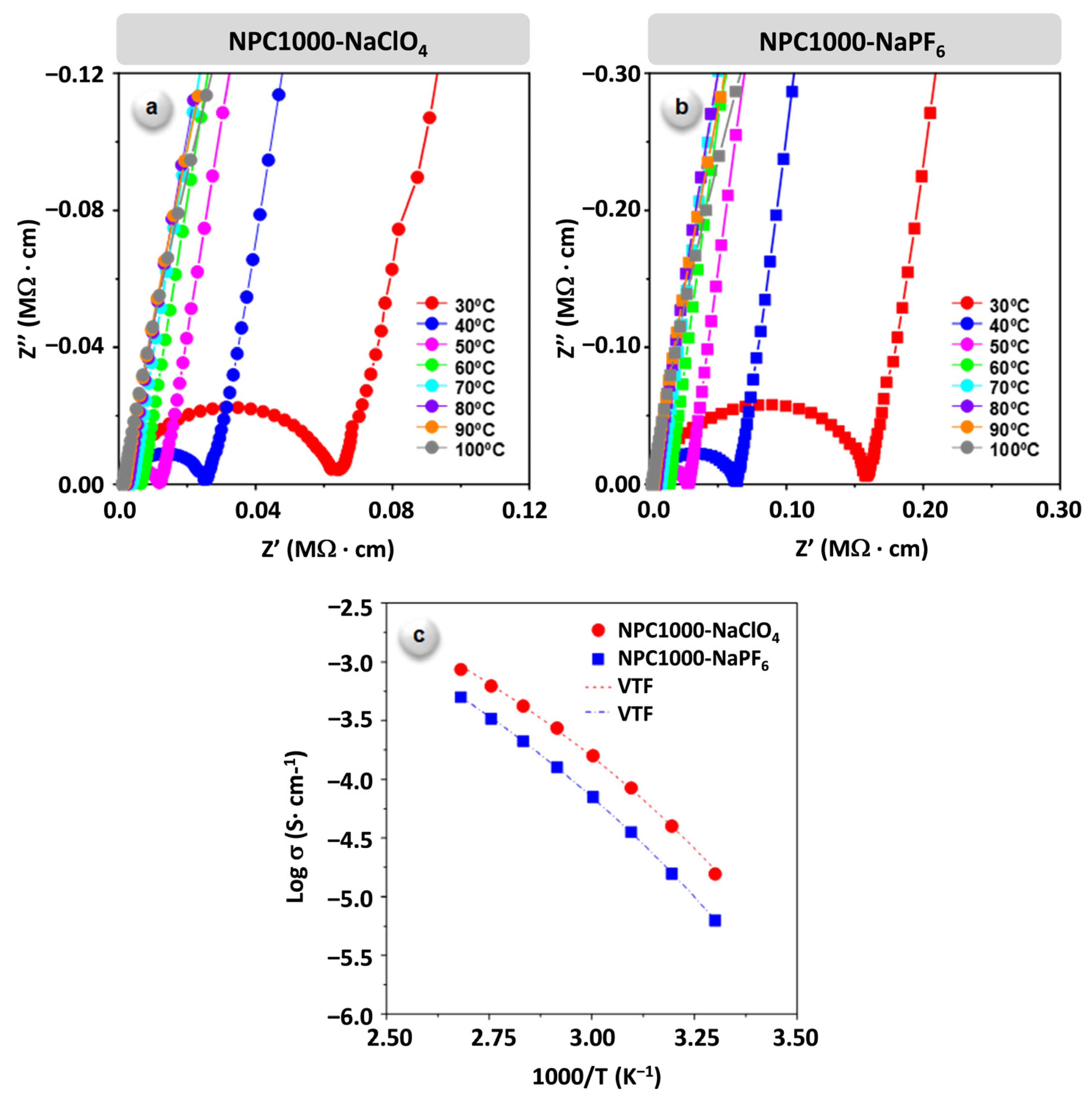
As shown in Figure 4, the total ionic conductivity of both polymer electrolytes increases with temperature. This behavior is commonly attributed to the thermally activated segmental motion of the polymer chains, which enhances the free volume within the amorphous matrix, facilitating the migration of cations between different coordination sites [51,52]. Ionic conductivity presents slightly higher values in the case of NPC1000-NaClO4, with values of 0.02 mS·cm−1 (30 °C) and 0.90 mS·cm−1 (100 °C) compared to NPC1000-NaPF6, which has values of about 6.28 × 10⁻³ mS·cm−1 (30 °C) and 0.50 mS·cm−1 (100 °C). This slightly higher conductivity in the NaClO4-based electrolytes is in agreement with its lower glass transition temperature (as determined by DSC), indicating enhanced segmental motion of the polymer chains and, consequently, more efficient ion transport within the cross-linked NPC1000 network. In general, the amorphous nature of both polymer electrolytes leads to higher ionic conductivity values when compared to equivalent polymer electrolytes obtained from linear POE, with values above 0.01 mS·cm−1 [53]. As expected for amorphous polymer electrolytes, the temperature dependence of ionic conductivity in both cases follows the Vogel–Tamman–Fulcher (VTF) Equation (3), where A is the pre-exponential factor related to the number of charge carriers, Ea corresponds to the pseudo-activation energy for the Na+ ion, kB is the Boltzmann constant, and T0 is the Vogel temperature, which is related to the ideal glass transition temperature.
Figure 4.
Electrochemical impedance spectroscopy characterization as a function of temperature for both polymer electrolytes: NPC1000-NaClO4 (left) and NPC1000-NaPF6 (right); (a) and (b) refer to the complex impedance plot, whereas (c) represents the total ionic conductivity as a function of temperature, including VTF fitting.
Table 2 gathers VTF fitting parameters for both polymer electrolytes. The slightly lower Ea value obtained for NPC1000-NaClO4 corresponds with the higher ionic conductivity exhibited by this polymer electrolyte over the whole temperature range compared with NPC1000-NaPF6. On the other hand, the negligible differences in the preexponential factor, A, suggest that both systems share a similar ion transport mechanism and that the conductivity differences are mainly governed by energetic factors. In this context, the lower Eₐ associated with NaClO4 likely reflects a more favorable Na+ transport, potentially arising from a higher degree of salt dissociation and/or reduced ionic association, as well as a Na+-anion/polymer coordination environment that penalizes ion hopping to a lesser extent than in the NaPF6-based electrolyte. Although NPC1000-NaClO4 exhibits a slightly lower Tg than NPC1000-NaPF6 (−42 °C vs. −39 °C), the fitted T0 values from the VTF equation show the opposite trend (T0 = −80 °C and −85 °C, respectively). This difference could be ascribed to the fact that Tg results from an experimental measurement, while T0 results from an extrapolation. According to Figure 4c, and as expected, no traces of creep are noticed, which is consistent with the three-dimensional nature of both polymer electrolytes. This is a significant asset regarding POE-based polymer electrolytes [54,55,56], which exhibit competitive ionic conductivities only above their melting temperature, at which point creep jeopardizes battery safety.
Table 2.
Data fitting of VTF parameters.
The interfacial resistance values are determined from the Nyquist diagrams represented in Figure S5 for both polymer electrolytes (NPC1000-NaClO4 and NPC1000-NaPF6), where two semicircles are observed. The first one, in the high-frequency region (R1), is associated with the diffusion of sodium ions through the electrolyte, reflecting its ionic conductivity, whereas the second one, in the low-frequency region (R2), is related to the charge transfer processes taking place at the electrode/electrolyte interface [8,57]. Both systems display remarkably similar spectral shapes, demonstrating that the interfacial mechanisms are comparable. The time evolution of R1 and R2 reveals a similar trend for both polymer electrolytes. No new resistive contributions appear over time, confirming the absence of severe degradation. The initial evolution of R2 in both electrolytes suggests that the morphology of the passivation film evolves during the first days, developing a more stable and robust structure [58]. The final R2 values are considered suitable for the application of the polymeric electrolytes NPC1000-NaClO4 and NPC1000-NaPF6 in sodium ion batteries [57,58].
3.4. Cationic Transference Number (tNa+) and Cationic Conductivities
Figure S6 shows the variation of the polarization current as a function of time and EIS before and after polarization for both polymer electrolytes (NPC1000-NaClO4 and NPC1000-NaPF6) at 80 °C. According to experimental data, the cationic transference numbers are estimated to be 0.65 and 0.50 for NPC1000-NaClO4 and NPC1000-NaPF6, respectively. In both cases, the tNa+ obtained lies in the upper range of values reported for equivalent polymer electrolytes based on the use of the same sodium salt hosted in POE-type backbones [8,57,59,60,61,62,63]. This is a significant asset, since high transference numbers can mitigate concentration polarization in solid-state electrolytes during charge–discharge processes, thereby sustaining high power density. While obtaining a high ionic conductivity of the electrolyte is essential to minimize internal resistance, cationic conductivity (σ+ = σ·T+) allows anticipating the battery performance of the electrolyte. Table 3 gathers the cationic transference number and the cationic conductivity for both polymer electrolytes (NPC1000-NaClO4 and NPC1000-NaPF6) at 30 °C and 100 °C.
Table 3.
Cationic transference number and cationic conductivity at 30 °C and 100 °C for both polymer electrolytes.
The distinct gap between the raw ionic conductivities of the two electrolytes is further amplified at the level of the cationic conductivities. The conductivity depends both on ion-pair dissociation and on the mobility of anions, cations and possible aggregates. Given that both salts are hosted in the same macromolecular solvating polymer, endowed with low dielectric constant, ion-pair dissociation depends on anion stabilization, i.e., the low basicity of the anions. NaPF6 should therefore lead to better dissociation, as PF6− is the conjugate base of a superacid, while HClO4 is not identified as a superacid but rather as borderline. The low basicity of perchlorate and hexafluorophosphate anions results from the electron-withdrawing atoms surrounding the central atom, O and F, respectively. Regarding PF6−, the electron-withdrawing effect is of inductive type, resulting from the high difference in electronegativity between fluorine and phosphorus; whereas this difference is much lower between Cl and O in ClO4−. For the perchlorate anion, charge delocalization is mainly of resonance type, the negative charge, calculated by ab initio, being shared between the four oxygen atoms [64]. A recent study, carried out on a series of anilinyl-perfluorosulfonamide lithium salts, has proven the predominance of resonance over the inductive effect in anion stabilization [65]. Beyond the conductivity gap between the two polymer electrolytes, we must highlight the high cationic conductivity of NPC1000-NaClO4, roughly triple that of the NPC1000-LiClO4 one [66]. Yet a comparative study of MTFSI salts (M+ = Li+, Na+, K+) hosted by NPC1000 shows that conductivity decreases from Li+ to K+ [67]. But raw conductivities being the sum of the negative and positive conductivities, σ+ and σ−, excessive anionic mobility can mask efficient transport of M+. Previous studies on NPC1000 ionomers (single cation-conducting polymer electrolytes) have shown cationic conductivities decreasing according to K+ > Na+ > Li+ [68], in agreement with the hardness decrease of alkaline cations from Li+ to Cs+. To conclude, the high cationic conductivities of NPC1000-NaClO4 with regard to its lithium homolog can be explained by (i) the large delocalization of the negative charge, (ii) the increased ion-pair dissociation with the cation size, together with its decreased hardness and (iii) the lesser trapping of Na+ vs. Li+ by the host polymer.
3.5. Electrochemical Performance
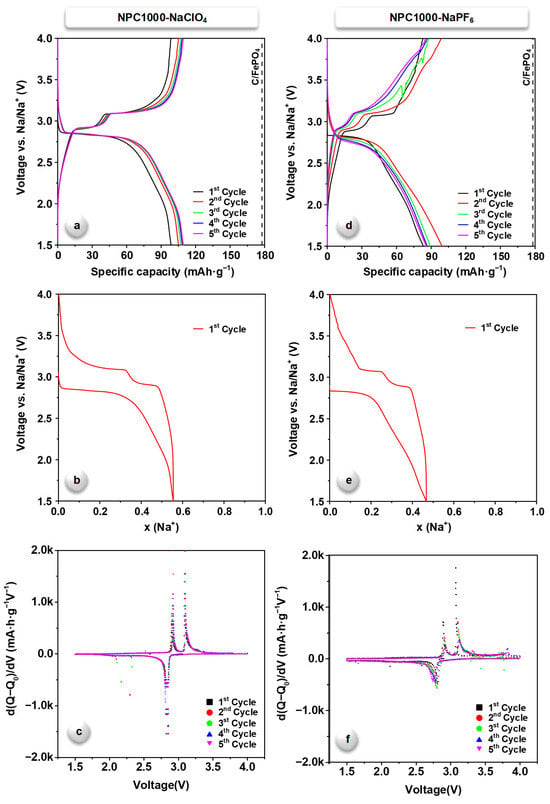
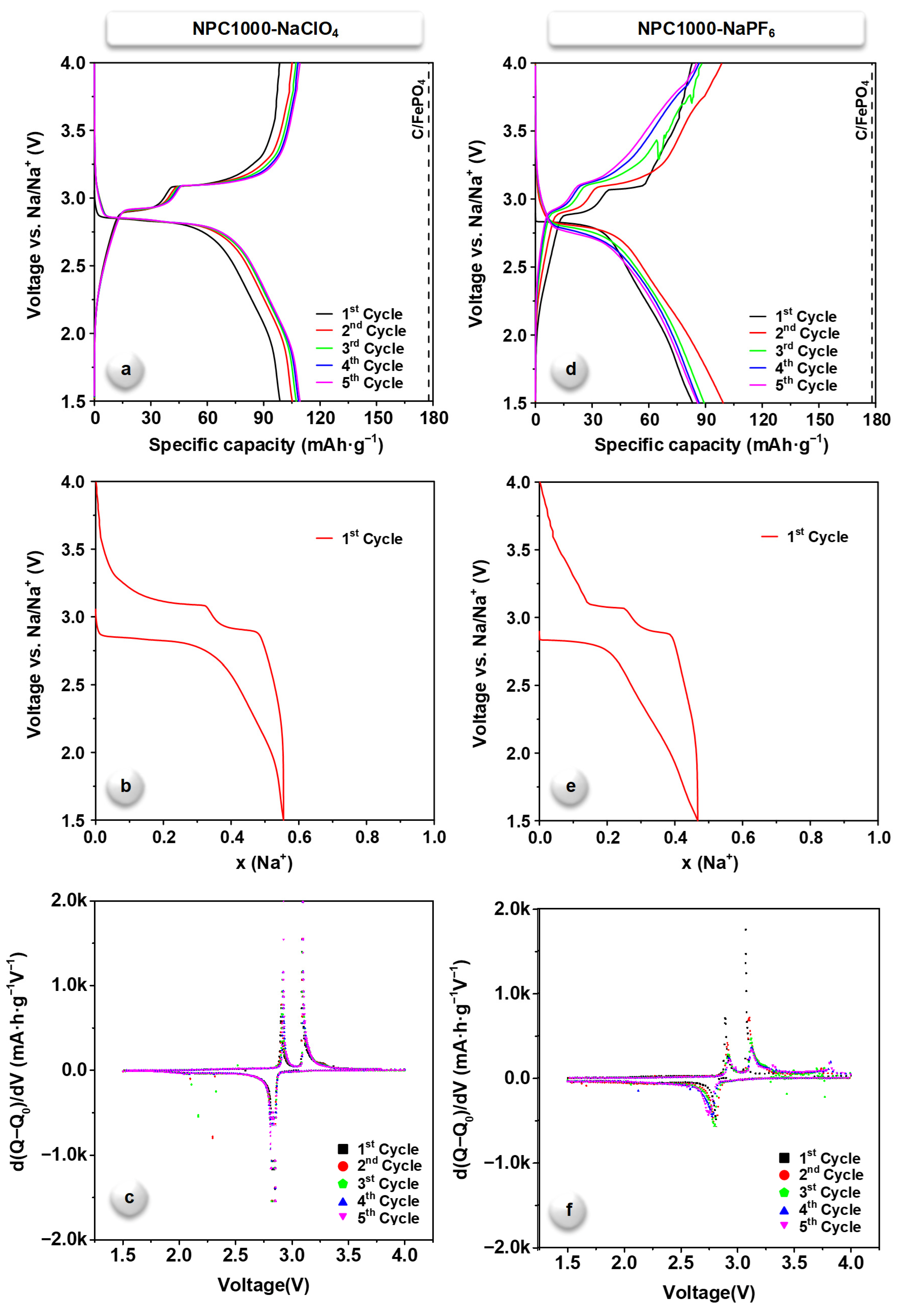
According to LSV measurements shown in Figure S7, the NPC1000-NaClO4 polymer electrolyte is electrochemically stable in the range of 1.2 V– 4 V vs. Na/Na+, while the NPC1000-NaPF6 polymer electrolyte exhibits electrochemical stability from 1.5 V to 4 V vs. Na/Na+. Figure 5 presents the specific capacity of both cells during the first five charge/discharge cycles at C/20. The specific capacity reaches maximum values of about 110.2 mAh·g−1 and 99.4 mAh·g−1 for NPC1000-NaClO4 and NPC1000-NaPF6, respectively.
Figure 5.
Galvanostatic cycling at 80 °C of Na│NPC1000-NaClO4│C/FePO4 (left) and Na│NPC1000-NaPF6│C/FePO4 (right) cells at C/20: (a,d) Galvanostatic charge/discharge profiles; (b,e) Sodiation/de-sodiation curves; (c,f) Derivative of energy density.
These values correspond to about 65% (NPC1000-NaClO4) and 56% (NPC1000-NaPF6) of the theoretical value (177.7 mAh·g−1) [69], with a Coulombic efficiency close to 100% in both cases. According to Figure 5b,e, such capacity values correspond to the intercalation of 0.55 and 0.47 Na+ ions per formula of C/FePO4, respectively. This is in agreement with the higher ionic conductivity of the NPC1000-NaClO4 electrolyte, which would improve the charge transfer kinetics. The redox behavior during galvanostatic cycling is further analyzed through differential capacity plots (dQ/dV) shown in Figure 5c (NPC1000-NaClO4) and Figure 5f (NPC1000-NaPF6), which depict the first five cycles. In both electrolytes, the dQ/dV peaks, corresponding to the Na+ sodiation/de-sodiation, remain at the same potential value, suggesting good electrochemical stability and reversibility of the oxidation and reduction processes [70].
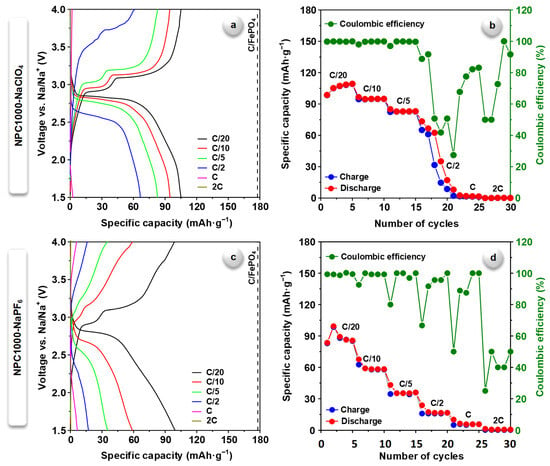
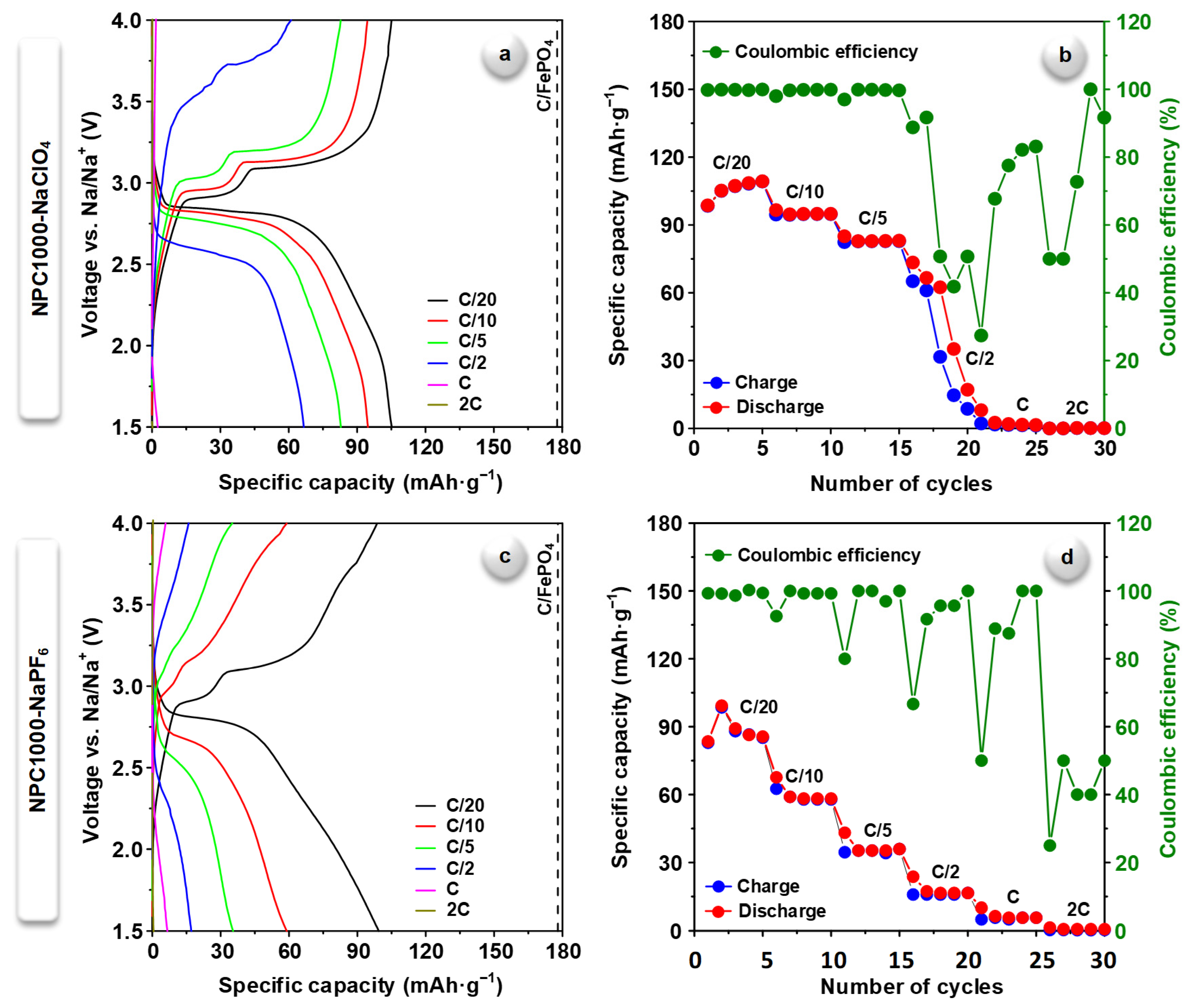
Figure 6 gathers the charge/discharge profiles at different current rates, ranging from C/20 to 2C (1C = 177.6 mAh·g−1) for Na┃NPC1000-NaClO4┃C/FePO4 and Na┃NPC1000-NaPF6┃C/FePO4. In general, the polarization phenomena at the electrode/electrolyte interface and the intrinsic kinetic limitations lead to a decrease in specific capacity as the current rate increases [47,59]. Cells based on NPC1000-NaClO4 present higher specific capacity than those based on NPC1000-NaPF6, which agrees with the results obtained in the ionic conductivity study previously presented. Regarding coulombic efficiency, in both cases it approximates 100% from the first cycle for C/20, C/10 and C/5. It is worth mentioning that specific capacity values achieved at low C-rates are comparable to those obtained in previous studies using a NASICON-type NaTi2(PO4)3 cathode with a liquid electrolyte (1 M NaClO4/PC) [71]. Nevertheless, upon reaching a current rate of C/2, a progressive decrease in specific capacity is observed during cycling, reaching negligible values at C and 2C, which suggests more limited Na+ diffusion through the polymer electrolyte.
Figure 6.
Galvanostatic cycling at 80 °C of Na│NPC1000-NaClO4│C/FePO4 (top) and Na│NPC1000-NaPF6│C/FePO4 (bottom) cells at different c-rates: (a,c) Galvanostatic charge/discharge profiles; (b,d) Performance at different charge/discharge rates.
For comparison purposes, additional electrochemical results obtained using equivalent liquid-electrolyte-based cells are provided in Figure S8 of the Supplementary Materials. Although the liquid-electrolyte systems exhibit improved long-term capacity retention, the proposed NPC1000-based polymer electrolytes still deliver competitive initial specific capacities, together with the intrinsic advantages associated with solvent-free polymer electrolytes, including improved safety and reduced leakage risk.
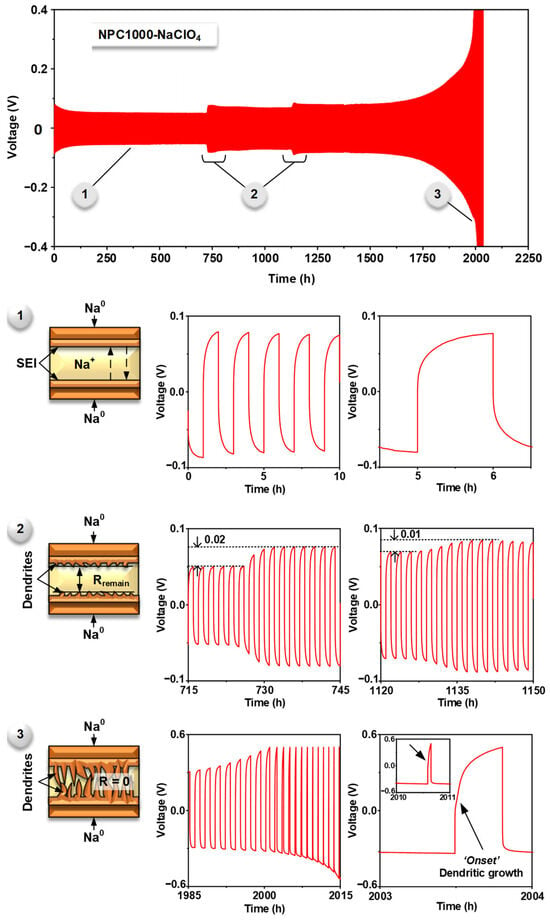
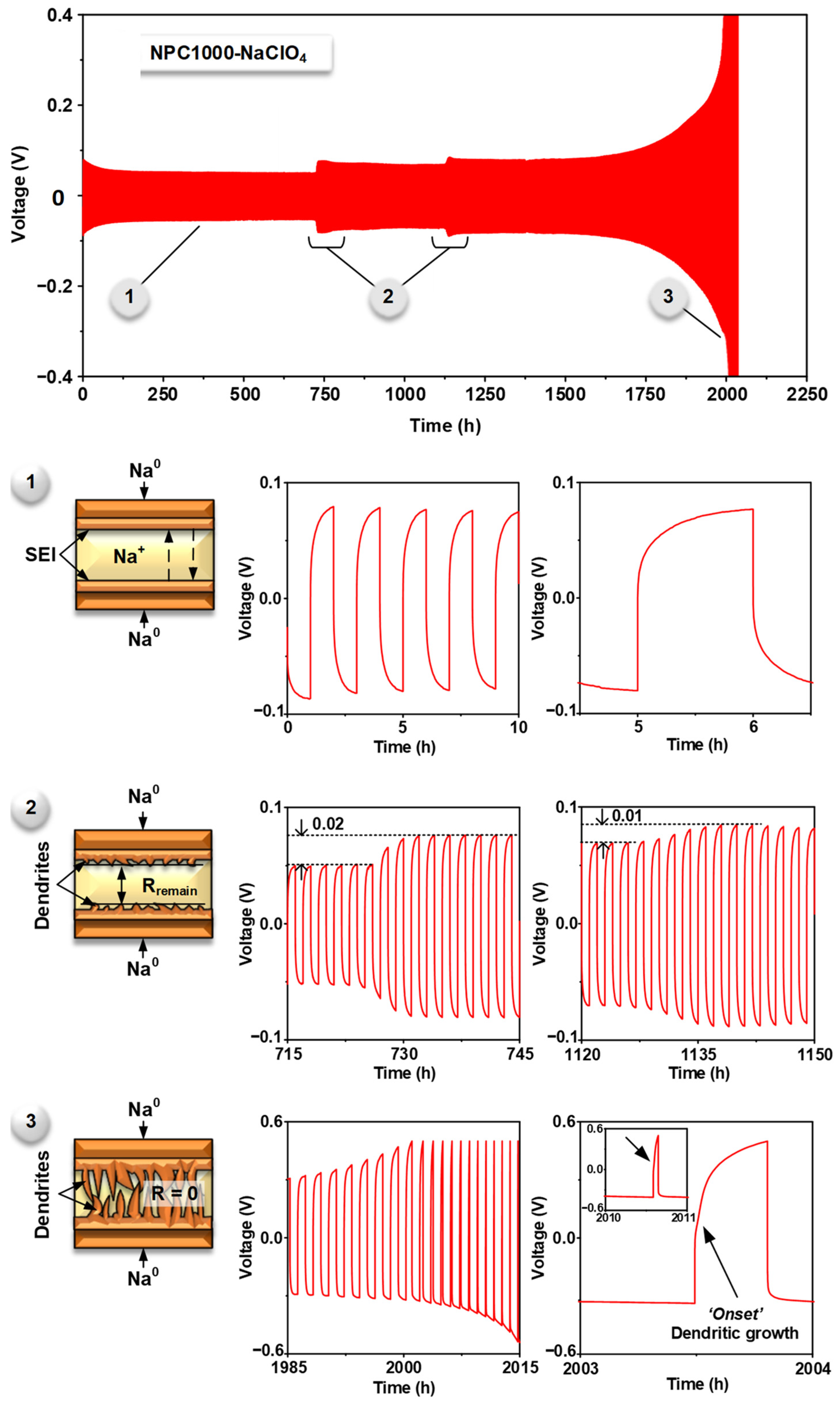
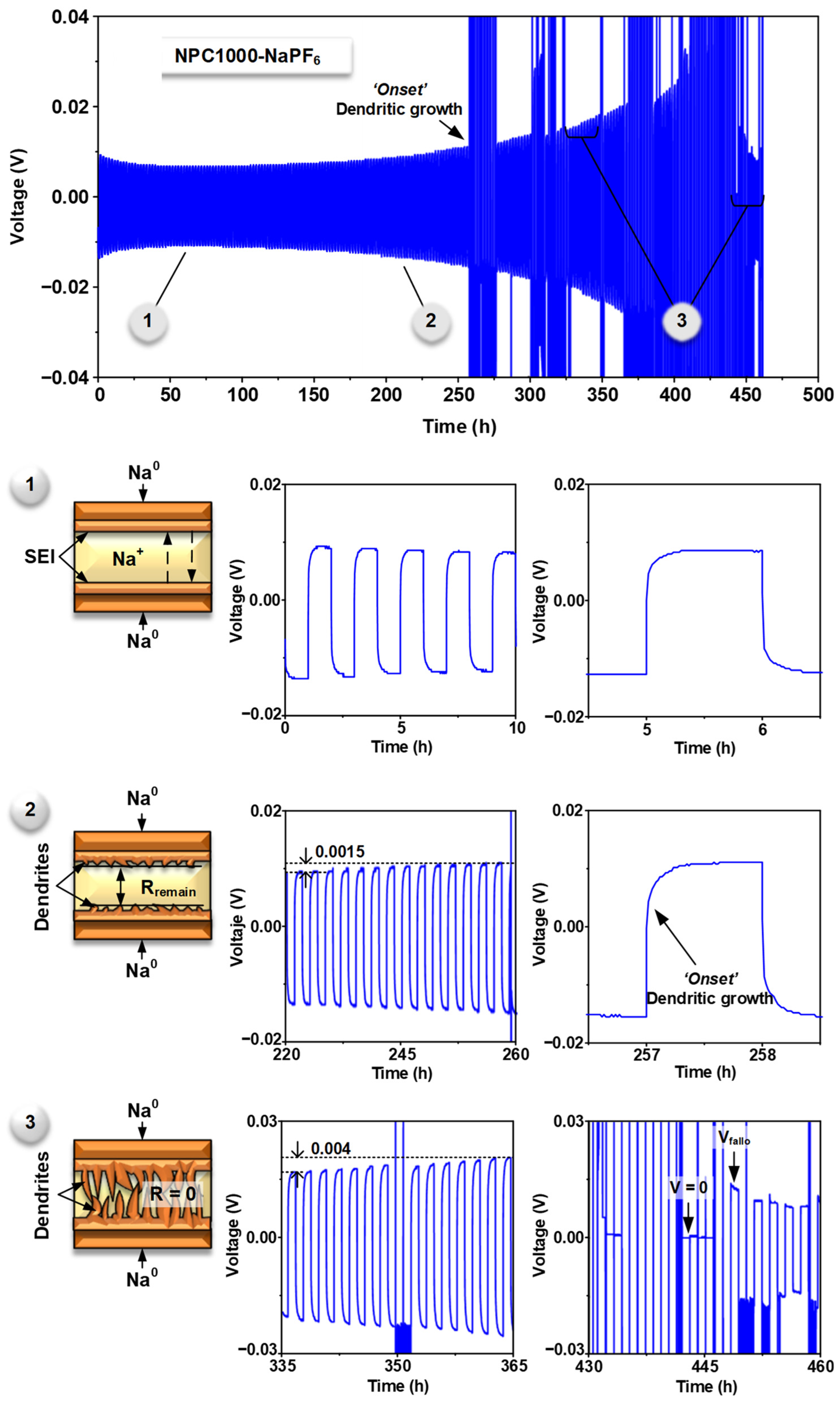
Figure 7 and Figure 8 show plating/stripping at 0.05 mA·cm−2 for both cell configurations. In the case of NPC1000-NaClO4 (Figure 7), the cell remains stable for over 2000 h before failure. During this period, the voltage profiles of the first 700 h are stable, with a voltage hysteresis of about 0.1 V. Afterwards, two increases in the cell voltage, followed by stabilization periods, are observed after 750 h and 1125 h, respectively. During these stages, metallic sodium deposits may penetrate the polymer electrolyte without completely traversing it, reducing the effective distance between the Na electrodes without causing a full short circuit [60,72]. These voltage changes also suggest that secondary reactions may lead to slight passivation at the electrode-electrolyte interface. The inflection in the voltage curve, indicated in Figure 7, occurs after about 2000 h and corresponds to the onset of uncontrolled dendrite growth [73]. Beyond this point, the voltage hysteresis increases faster and asymmetrically, consistent with deep dendritic intrusion into the electrolyte [19,74]. Finally, cell failure occurs after about 2010 h. Additional post-mortem SEM characterization of the Na metal electrode after cycling is provided in Figure S9. The images reveal significant interfacial evolution, including heterogeneous surface morphologies and filament-like structures associated with non-uniform sodium deposition during cycling. Regarding NPC1000-NaPF6 (Figure 8), stability is reduced when compared to NPC1000-NaClO4 (Figure 7), reaching about 425 h before failure. In this case, a gradual increase in the cell voltage is observed until about 255 h, where sudden variations start to appear, suggesting the onset of dendritic growth. Similar to NPC1000-NaClO4, the growth of metallic sodium deposits leads to an increase in polarization. The voltage hysteresis continues to grow gradually until a sudden voltage drop suggests cell failure after 450 cycling hours [19,74]. According to similar polymer electrolytes reported in the literature [19,60,75], the NPC1000-NaClO4 polymer electrolyte exhibits outstanding electrochemical stability, only surpassed by a POSS: PEG-NaClO4 system, which reports a failure delay due to dendritic growth after 5150 h [19]. However, it is worth mentioning that the electrolyte proposed in that work mixes PEO with Octa-POSS (Poly (ethylene glycol) bis(3-aminopropyl)) functionalized with epoxy groups to promote mechanical resistance and chemical stability. In contrast, our electrolyte is solely based on a cross-linked polymer derived from PEG, without the structural and mechanical contributions provided by POSS. On the other hand, the more discrete electrochemical behavior of the NPC1000-NaPF6 polymer electrolyte during plating/stripping should be related to the use of NaPF6 as a sodium source, since its performance is in line with that reported for other polymer electrolytes based on the use of the same sodium salt [47,60,61]. Similar behavior has been widely reported in NaPF6-based sodium polymer electrolytes, where long-term cycling stability strongly depends on the formation of a homogeneous and mechanically stable SEI at the Na/electrolyte interface. Several studies have shown that partial interfacial decomposition of PF6−-based species at elevated temperatures may induce continuous SEI reconstruction, heterogeneous Na+ flux, and non-uniform sodium deposition, progressively increasing polarization and promoting dendritic growth during cycling [76,77]. Nevertheless, the NPC1000-NaPF6 electrolyte still enables reversible Na plating/stripping for several hundred hours, suggesting that the main limitation is associated with interfacial stabilization rather than with insufficient bulk ionic conductivity of the polymer electrolyte itself.
Figure 7.
Plating/stripping at 80 °C and a current density of 0.05 mA·cm−2 for the Na│NPC1000-NaClO4│Na cell configuration. (1) Formation and stabilization of the solid-electrolyte interface (SEI); (2) dendritic growth; (3) failure.
Figure 8.
Plating/stripping at 80 °C and a current density of 0.05 mA·cm−2 for the Na│NPC1000-NaPF6│Na cell configuration. (1) Formation and stabilization of the solid-electrolyte interface (SEI); (2) dendritic growth; (3) failure.
To better contextualize the electrochemical performance of the developed polymer electrolytes, a comparative analysis with previously reported PEO-based sodium polymer electrolytes was carried out (Tables S1–S4 in the Supplementary Materials). The comparison includes ionic conductivity, activation energy, operating temperature, specific discharge capacity, and cycling retention for systems based on NaClO4 and NaPF6 salts. The results obtained indicate that the NPC1000-based electrolytes developed in this work exhibit ionic conductivity values comparable to other solvent-free PEO-based systems while maintaining competitive electrochemical performance in sodium metal cells. These comparisons further support the suitability of the proposed cross-linked polymer electrolytes for sodium solid-state battery applications.
3.6. LCA Results
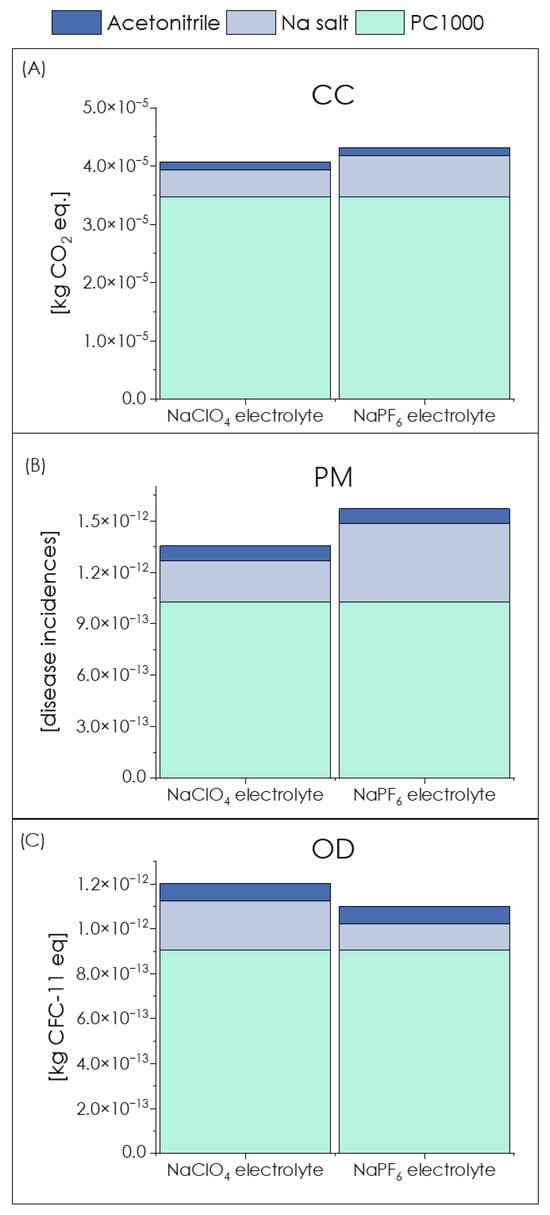
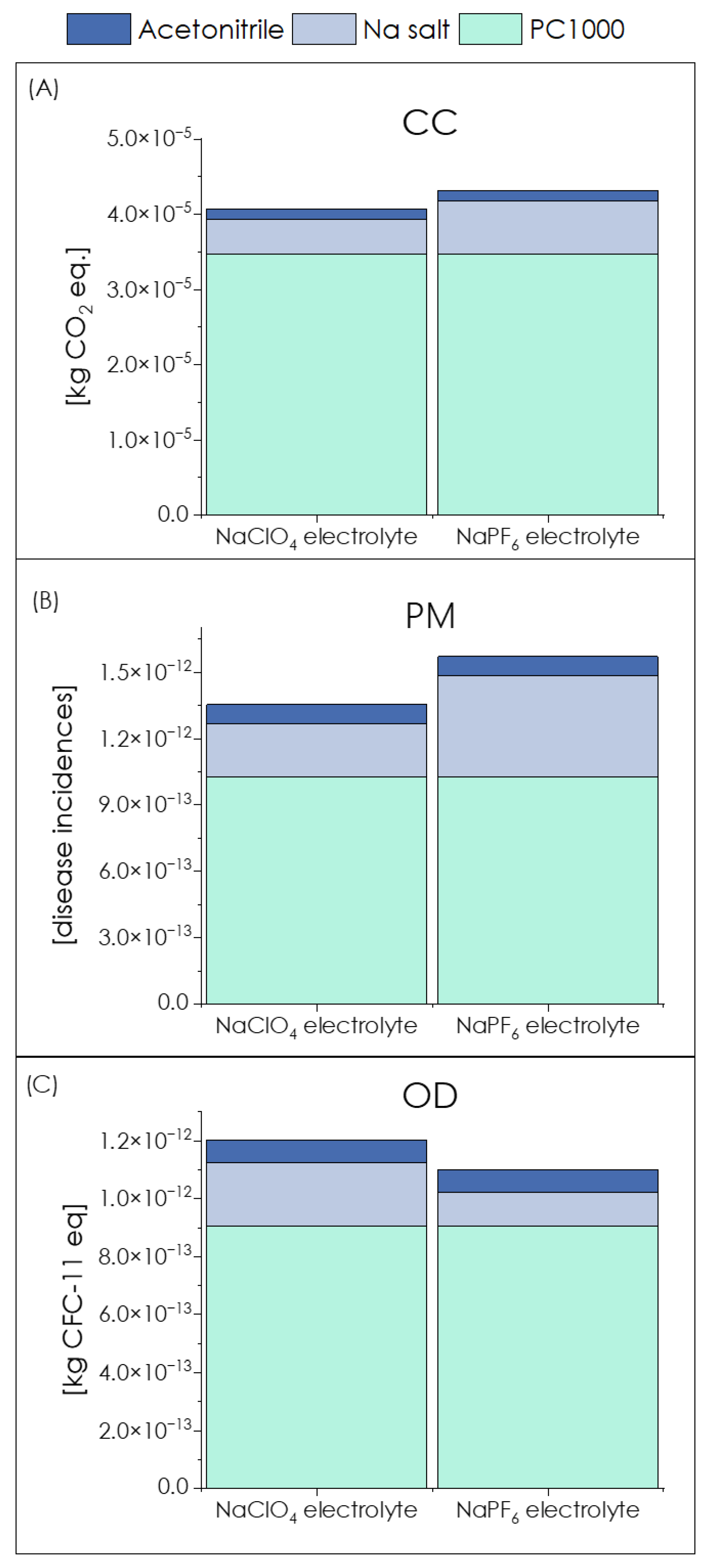
Figure 9 presents LCA results for the two sodium-based polymer electrolytes, highlighting both the magnitude of the impacts for CC, PM and OD, as well as the relative contribution of each component (PC1000, sodium salt and acetonitrile) to the total environmental burden.
Figure 9.
LCA results regarding CC (A), PM (B) and OD (C) for the two sodium-based polymer electrolytes. The figure expresses total values and the contributions.
Across all categories, the polymer matrix PC1000 emerges as the principal contributor, followed by the sodium salt and, finally, acetonitrile, whose contribution remains consistently minor. Regarding CC (Figure 9A), PC1000 accounts for the majority of greenhouse gas emissions in both sodium systems, followed by the sodium salt. Acetonitrile contributes only marginally (<5%). Between the two electrolytes, NaPF6 exhibits a higher CC impact than NaClO4, attributable to the more energy-intensive production pathways associated with PF6−-containing salts. A similar pattern is observed for PM (Figure 9B). PC1000 remains the principal contributor, whereas the sodium salt contributes around 25–35% and acetonitrile again plays a very minor role. Comparing both electrolytes, NaPF6 again shows higher PM impacts than NaClO4, consistent with the higher PM-precursor emissions associated with fluorinated salt manufacturing. The OD impact (Figure 9C) displays a different trend. While PC1000 still contributes substantially, the relative difference between the two electrolytes changes direction compared to CC and PM. The NaClO4-based electrolyte presents higher OD impacts than the NaPF6-based one, with differences on the order of 10%, suggesting that the production route of NaClO4 entails larger emissions of ozone-depleting substances than the PF6− one.
It was expected that the fluorinated salt (NaPF6) would lead to higher impacts across all categories due to its more complex synthesis. However, ozone depletion (OD) is driven by trace emissions of high-ODP substances in the background supply chain rather than by overall process complexity or energy demand. In chlorine-based industrial value chains, inadvertent emissions of carbon tetrachloride (CCl) have been identified as a relevant source of OD, and such contributions can propagate into upstream datasets used to model perchlorate-related chemicals. Therefore, the ~10% higher OD obtained for the NaClO4-based electrolyte should be interpreted as a category-specific trade-off that is sensitive to background inventory assumptions and the presence of low-mass, high-ODP emissions [78].
The environmental behavior observed for the sodium-based electrolytes contrasts significantly with that previously reported for calcium-based polymer electrolytes, where the salt dominated all impact categories due to the precursor-intensive synthesis of fluorinated anions such as TFSI− and CF3SO3−. In the sodium system, however, PC1000 becomes the main environmental hotspot, and the salt plays a secondary role.
This shift is mainly attributed to the production of PC1000, whose environmental profile is largely driven by the upstream synthesis of its petrochemical-based monomers. In polymeric materials, the monomer production typically dominates the life cycle impacts since the polymer production step constitutes the most important impact [79]. As a result, in the sodium-based electrolyte, the overall environmental burden is governed by the polymer matrix, while the influence of the sodium salt becomes comparatively less relevant across most impact categories.
Overall, for an equivalent functional unit (one electrolyte disc), the sodium-based systems evaluated here exhibit lower impacts than the calcium-based electrolytes in [44], indicating that sodium polymer electrolytes may offer a more favorable starting point from an environmental perspective. These results also align with broader findings on electrolyte environmental performance in lithium-ion systems, where polymer matrices and carbonate solvents often dominate environmental burdens unless highly fluorinated salts such as LiPF6 or LiTFSI are used [80]. In this context, the sodium-based results highlight an interesting contrast: NaClO4 outperforms NaPF6 in CC and PM while offering better electrochemical behavior, whereas NaPF6 performs slightly better in OD. Such category-dependent trade-offs mirror observations in Li-based studies, where no single salt performs best across all indicators [81].
4. Conclusions
In this experimental work, solvent-free polymer electrolytes were developed using a cross-linked polycondensed polymer matrix (NPC1000) incorporating either NaClO4 or NaPF6 salts at an O/Na ratio of 20. Both electrolytes exhibit a fully amorphous structure at room temperature, as confirmed by DSC, and smooth, defect-free morphologies with homogeneous sodium distribution, indicating full salt dissolution within the polymer network. The non-crystalline nature of the polymer electrolytes enables the achievement of ionic conductivities within the ranges of 1.56 × 10⁻² mS·cm−1 (30 °C)–0.86 mS·cm−1 (100 °C) and 6.28 × 10⁻³ mS·cm−1 (30 °C)–0.50 mS·cm−1 (100 °C) for NPC1000-NaClO4 and NPC1000-NaPF6, respectively. These values are among the highest reported for similar polymer electrolytes [48,51,82,83], promoting their potential application to solid-state sodium batteries operating at temperatures below the Na melting point.
Regarding electrochemical stability, extended cycling lifetimes of up to 2000 and 425 h, under symmetric plating/stripping tests, are achieved for NPC1000-NaClO4 and NPC1000-NaPF6, respectively. SEI resistance values of 19.7 kΩ (NPC1000-NaClO4) and 12.8 kΩ (NPC1000-NaPF6) confirm stable interfacial behavior suitable for solid-state operation. When tested in full cell configuration (Na│Polymer electrolyte│C/FePO4), the polymer electrolytes delivered specific capacities of 105.2 mAh·g−1 (NPC1000-NaClO4) and 98.5 mAh·g−1 (NPC1000-NaPF6) at C/20, corresponding to 65% and 58% of the theoretical capacity of FePO4 [69]. These values rank among the best reported for similar polymer-based systems and validate the potential of NPC1000-based electrolytes for safe, efficient, and sustainable solid-state sodium batteries [47,57,58,59,60,61,84]. Overall, the LCA results reinforce the electrochemical conclusions by showing that the NaClO4-based electrolyte is the most balanced option. The impact analysis further reveals that the polymer matrix PC1000 is the principal contributor to the overall environmental footprint, followed by the sodium salt, while acetonitrile consistently exhibits a minor contribution. The NaClO4 system presents lower climate change and particulate matter impacts than the NaPF6-based electrolyte, with only a slight increase in ozone depletion, and remains substantially less impactful than calcium-based equivalent polymer electrolytes. Despite the potential risk involved in using perchlorate salts, the use of such small quantities in polymer electrolyte formulation justifies the use of NPC1000–NaClO4 as the most sustainable and efficient formulation among the systems evaluated.
Supplementary Materials
The following supporting information can be downloaded at: https://www.mdpi.com/article/10.3390/batteries12050177/s1, Figure S1. 1H NMR spectrum obtained for the prepolymer (PC1000) using DMF as solvent. Figure S2. TGA curves obtained for both polymer electrolytes: NPC1000-NaClO4 and NPC1000-NaPF6. A salt-free NPC1000 membrane is included as reference. Figure S3. Stress-strain curves obtained for both polymer electrolytes (NPC1000-NaClO4 and NPC1000-NaPF6), including NPC1000 as reference. Figure S4. Impedance dataset of both polymer electrolytes NPC1000-NaClO4 (left) and NPC1000-NaPF6 (right) at 80 °C: (a,d) Nyquist impedance plot; (b,e) Real component of ionic conductivity; (c,f) Real component of capacity. Figure S5. Evolution of the interfacial resistance in both polymer electrolytes: (a,b) Impedance Nyquist plot; (c,d) Variation of the resistance as a function of time. Figure S6. DC polarization dataset of NPC1000-NaClO4 and NPC1000-NaPF6: (a,c) Polarization current as a function of time; (b,d) Nyquist diagrams obtained by EIS before and after polarization. Figure S7. Linear sweep voltammetry profile of the polymeric electrolytes at 80 °C: (a) NPC1000-NaClO4; (b) NPC1000-NaPF6. Figure S8. Specific capacity and coulombic efficiency at C/10 as a function of cycle number. of the solid-state cells Na│PC1000-NaClO4│C/FePO4 and Na│PC1000-NaPF6│C/FePO4 at 80 °C, and of the liquid-electrolyte-based cells (Diglyme-NaPF6 and CP-NaClO4, both 1 M) at room temperature. Figure S9. Post-mortem SEM images of the Na metal electrode after electrochemical cycling. The images reveal significant interfacial evolution, including the presence of a relatively homogeneous surface layer with darker contrast, attributed to the polymer electrolyte remaining in contact with the Na electrode. In addition, irregular filament-like structures can be observed penetrating through the surface layer, suggesting non-uniform sodium deposition and possible dendritic growth during cycling. Table S1. Ionic conductivity and activation energy of different polymer electrolytes based on the PEO polymer and the NaClO4 salt at 80 °C. Table S2. Ionic conductivity and activation energy of different polymer electrolytes based on the PEO polymer and the NaPF6 salt at 80 °C. Table S3. Specific capacity of the 1st discharge cycle (Ced), percentage of capacity achieved with respect to the theoretical specific capacity of the active material (Cet) and percentage of retention after prolonged galvanostatic cycling at a constant C-rate (% Ret.) in cells assembled with polymer electrolytes based on the PEO polymer and the sodium salt NaClO4. Table S4. Specific capacity of the 1st discharge cycle (Ced), percentage of capacity achieved with respect to the theoretical specific capacity of the active material (Cet) and percentage of retention after prolonged galvanostatic cycling at a constant C-rate (% Ret.) in cells assembled with different polymeric electrolytes based on the PEO polymer and the sodium salt NaPF6. References [85,86,87,88,89,90,91] are cited in the supplementary materials.
Author Contributions
Conceptualization, A.V., J.-Y.S., C.S.M.-C. and B.L.; methodology, J.M.N.-B., E.B., B.P. and C.S.M.-C.; validation, J.M.N.-B. and B.P.; formal analysis, J.M.N.-B., E.B., B.P. and C.S.M.-C.; investigation, J.M.N.-B., E.B., B.P. and C.S.M.-C.; resources, A.V., B.L. and B.P.; data curation, J.M.N.-B., E.B., B.P. and C.S.M.-C.; writing—original draft preparation, J.M.N.-B., E.B. and B.P.; writing—review and editing, A.V., J.-Y.S., C.S.M.-C., B.L. and B.P.; visualization, J.M.N.-B., E.B. and A.V.; supervision, C.S.M.-C. and A.V.; project administration, B.L. and A.V.; funding acquisition, B.P., B.L. and A.V. All authors have read and agreed to the published version of the manuscript.
Funding
This research was funded by Agencia Estatal de Investigación (Spain)/Fondo Europeo de Desarrollo Regional (FEDER/European Union) MCIN/AEI/10.13039/501100011033, grant number/project number: PID2022-140373OB-I00. Bidhan Pandit acknowledges the Iberdrola Foundation under Marie Skłodowska-Curie Grant Agreement No. 101034297.
Data Availability Statement
Data Availability Statements are available under request.
Conflicts of Interest
The authors declare no conflict of interest.
References
- Fenton, D.E.; Parker, J.M.; Wright, P.V. Complexes of Alkali Metal Ions with Poly(Ethylene Oxide). Polymer 1973, 14, 589. [Google Scholar] [CrossRef] [Scilit]
- Malunavar, S.S. Solid-State Polymer Electrolytes for Sodium Ion Battery Technology. Doctoral Dissertation, Deakin University, Melbourne, Australia, 2022. [Google Scholar]
- Wu, F.; Zhang, K.; Liu, Y.; Gao, H.; Bai, Y.; Wang, X.; Wu, C. Polymer Electrolytes and Interfaces toward Solid-State Batteries: Recent Advances and Prospects. Energy Storage Mater. 2020, 33, 26–54. [Google Scholar] [CrossRef] [Scilit]
- Agrawal, R.C.; Pandey, G.P. Solid Polymer Electrolytes: Materials Designing and All-Solid-State Battery Applications: An Overview. J. Phys. D Appl. Phys. 2008, 41, 223001. [Google Scholar] [CrossRef] [Scilit]
- Chai, S.; He, Q.; Zhou, J.; Chang, Z.; Pan, A.; Zhou, H. Solid-State Electrolytes and Electrode/Electrolyte Interfaces in Rechargeable Batteries. ChemSusChem 2024, 17, e202301268. [Google Scholar] [CrossRef] [Scilit]
- Gebert, F.; Knott, J.; Gorkin, R.; Chou, S.L.; Dou, S.X. Polymer Electrolytes for Sodium-Ion Batteries. Energy Storage Mater. 2021, 36, 10–30. [Google Scholar] [CrossRef] [Scilit]
- Qiao, L.; Judez, X.; Rojo, T.; Armand, M.; Zhang, H. Review-Polymer Electrolytes for Sodium Batteries. J. Electrochem. Soc. 2020, 167, 7. [Google Scholar] [CrossRef] [Scilit]
- Martinez-Cisneros, C.S.; Pandit, B.; Levenfeld, B.; Varez, A.; Sanchez, J.Y. Flexible Solvent-Free Polymer Electrolytes for Solid-State Na Batteries. J. Power Sources 2023, 559, 232644. [Google Scholar] [CrossRef] [Scilit]
- Su, G.; Zhang, X.; Xiao, M.; Wang, S.; Huang, S.; Han, D.; Meng, Y. Polymeric Electrolytes for Solid-state Lithium Ion Batteries: Structure Design, Electrochemical Properties and Cell Performances. ChemSusChem 2024, 17, e202300293. [Google Scholar] [CrossRef] [Scilit]
- Yang, J.; Zhang, H.; Zhou, Q.; Qu, H.; Dong, T.; Zhang, M.; Tang, B.; Zhang, J.; Cui, G. Safety-Enhanced Polymer Electrolytes for Sodium Batteries: Recent Progress and Perspectives. ACS Appl. Mater. Interfaces 2019, 11, 17109–17127. [Google Scholar] [CrossRef] [Scilit] [PubMed]
- Kargari, A.; Rezaeinia, S. State-of-the-Art Modification of Polymeric Membranes by PEO and PEG for Carbon Dioxide Separation: A Review of the Current Status and Future Perspectives. J. Ind. Eng. Chem. 2020, 84, 1–22. [Google Scholar] [CrossRef] [Scilit]
- Lee, C.C.; Wright, P.V. Order-Disorder Transformations in Ionic Complexes of Poly (Ethylene Oxide). Polymer 1978, 19, 234–235. [Google Scholar] [CrossRef] [Scilit]
- Li, Z.; Fu, J.; Zhou, X.; Gui, S.; Wei, L.; Yang, H.; Li, H.; Guo, X. Ionic Conduction in Polymer-Based Solid Electrolytes. Adv. Sci. 2023, 10, 2201718. [Google Scholar] [CrossRef] [Scilit] [PubMed]
- Ngai, K.S.; Ramesh, S.; Ramesh, K.; Juan, J.C. A Review of Polymer Electrolytes: Fundamental, Approaches and Applications. Ionics 2016, 22, 1259–1279. [Google Scholar] [CrossRef] [Scilit]
- Zhao, L.; Hou, M.; Zhang, D.; Zhou, Y.; Xie, Z.; Liang, F. Poly(Ethylene Oxide)-Based Solid Polymer Electrolytes for Solid-State Sodium Ion Batteries. Prog. Chem. 2023, 35, 1625–1637. [Google Scholar] [CrossRef]
- Roscher, D.; Kim, Y.; Stepien, D.; Zarrabeitia, M.; Passerini, S. Solvent-Free Ternary Polymer Electrolytes with High Ionic Conductivity for Stable Sodium-Based Batteries at Room Temperature. Batter. Supercaps 2023, 6, e202300092. [Google Scholar] [CrossRef] [Scilit]
- Zhao, Q.; Stalin, S.; Zhao, C.Z.; Archer, L.A. Designing Solid-State Electrolytes for Safe, Energy-Dense Batteries. Nat. Rev. Mater. 2020, 5, 229–252. [Google Scholar] [CrossRef] [Scilit]
- Johari, S.N.A.M.; Tajuddin, N.A.; Hanibah, H.; Deraman, S.K. A Review: Ionic Conductivity of Solid Polymer Electrolyte Based Polyethylene Oxide. Int. J. Electrochem. Sci. 2021, 16, 211049. [Google Scholar] [CrossRef] [Scilit]
- Zheng, Y.; Pan, Q.; Clites, M.; Byles, B.W.; Pomerantseva, E.; Li, C.Y. High-Capacity All-Solid-State Sodium Metal Battery with Hybrid Polymer Electrolytes. Adv. Energy Mater. 2018, 8, 1801885. [Google Scholar] [CrossRef] [Scilit]
- Boschin, A.; Johansson, P. Plasticization of NaX-PEO Solid Polymer Electrolytes by Pyr13X Ionic Liquids. Electrochim. Acta 2016, 211, 1006–1015. [Google Scholar] [CrossRef] [Scilit]
- Schmidt, F.; Pugliese, A.; Santini, C.C.; Castiglione, F.; Schönhoff, M. Spectral Deconvolution in Electrophoretic NMR to Investigate the Migration of Neutral Molecules in Electrolytes. Magn. Reson. Chem. 2020, 58, 271–279. [Google Scholar] [CrossRef] [Scilit] [PubMed]
- Kainat, J.; Hagos, K.H.; Saleem, A.; Zhu, J.; Lan, J.; Yu, Y.; Yang, X. Synergistic Study of Crosslinking and Filler Effect in Composite Solid Polymer Electrolytes for High-Performance Lithium Metal Batteries. ChemSusChem 2026, 19, e202502054. [Google Scholar] [CrossRef] [Scilit]
- Zhang, S.; Long, T.; Zhang, H.; Zhao, Q.; Zhang, F.; Wu, X.; Zeng, X. Electrolytes for Multivalent Metal-Ion Batteries: Current Status and Future Prospect. ChemSusChem 2022, 15, e202200999. [Google Scholar] [CrossRef] [Scilit]
- Killis, A.; LeNest, J.; Cheradame, H.; Gandini, A. Ionic Conductivity of Polyether-polyurethane Networks Containing NaBPh 4: A Free Volume Analysis. Die Makromol. Chem. 1982, 183, 2835–2845. [Google Scholar] [CrossRef]
- Benrabah, D.; Sanchez, J.Y.; Armand, M. New Polyamide-Ether Electrolytes. Electrochim. Acta 1992, 37, 1737–1741. [Google Scholar] [CrossRef] [Scilit]
- Alloin, F.; Sanchez, J.-Y. New Solvating Polyether Networks. Electrochim. Acta 1995, 40, 2269–2276. [Google Scholar] [CrossRef] [Scilit]
- Fullerton, W.R.; Liu, H.; Agyeman-Budu, D.N.; Fu, J.; Hassan, M.H.; Staub, M.C.; Detsi, E.; Nelson Weker, J.; Li, C.Y. A Comb-Chain Cross-Linker-Based Network Solid Polymer Electrolyte for All-Solid-State Sodium-Metal Batteries. ACS Appl. Energy Mater. 2025, 8, 13959–13969. [Google Scholar] [CrossRef] [Scilit]
- T.C. 207/SC5, ISO 14044:2006; Environmental Management—Life Cycle Assessment—Requirements and Guidelines. ISO: Geneva, Switzerland, 2006.
- T.C. 207/SC5, ISO 14040:2006; Environmental Management—Life Cycle Assessment—Principles and Framework. ISO: Geneva, Switzerland, 2006.
- Doeff, M.M.; Ferry, A.; Ma, Y.; Ding, L.; De Jonghe, L.C. Effect of Electrolyte Composition on the Performance of Sodium/Polymer Cells. J. Electrochem. Soc. 1997, 144, L20–L22. [Google Scholar] [CrossRef] [Scilit]
- West, K.; Zachau-Christiansen, B.; Jacobsen, T.; Atlung, S. A Rechargeable All-Solid-State Sodium Cell with Polymer Electrolyte. J. Electrochem. Soc. 1985, 132, 3061–3062. [Google Scholar] [CrossRef] [Scilit]
- Koksbang, R.; Yde-Andersen, S.; West, K.; Zachau-Christiansen, B.; Skaarup, S. Lithium and Sodium Insertion in Ternary Chromium Oxides. Solid State Ion. 1988, 28–30, 868–872. [Google Scholar] [CrossRef] [Scilit]
- Munshi, M.; Gilmour, A.; Smyrl, W.H.; Owens, B.B. Sodium / V6O13 Polymer Electrolyte Cells. J. Electrochem. Soc. 1989, 136, 1847. [Google Scholar] [CrossRef] [Scilit]
- Doeff, M.M.; Peng, M.Y.; Ma, Y.; De Jonghe, L.C. Orthorhombic Na x MnO2 as a Cathode Material for Secondary Sodium and Lithium Polymer Batteries. J. Electrochem. Soc. 1994, 141, L145–L147. [Google Scholar] [CrossRef] [Scilit]
- Zhang, C.; Gamble, S.; Ainsworth, D.; Slawin, A.M.Z.; Andreev, Y.G.; Bruce, P.G. Alkali Metal Crystalline Polymer Electrolytes. Nat. Mater. 2009, 8, 580–584. [Google Scholar] [CrossRef] [Scilit]
- Qi, X.; Ma, Q.; Liu, L.; Hu, Y.S.; Li, H.; Zhou, Z.; Huang, X.; Chen, L. Sodium Bis(Fluorosulfonyl)Imide/Poly(Ethylene Oxide) Polymer Electrolytes for Sodium-Ion Batteries. ChemElectroChem 2016, 3, 1741–1745. [Google Scholar] [CrossRef] [Scilit]
- Ma, Q.; Liu, J.; Qi, X.; Rong, X.; Shao, Y.; Feng, W.; Nie, J.; Hu, Y.S.; Li, H.; Huang, X.; et al. A New Na[(FSO2)(n-C4F9SO2)N]-Based Polymer Electrolyte for Solid-State Sodium Batteries. J. Mater. Chem. A Mater. 2017, 5, 7738–7743. [Google Scholar] [CrossRef] [Scilit]
- Zhao, C.; Liu, L.; Lu, Y.; Wagemaker, M.; Chen, L.; Hu, Y.S. Revealing an Interconnected Interfacial Layer in Solid-State Polymer Sodium Batteries. Angew. Chem. Int. Ed. 2019, 58, 17026–17032. [Google Scholar] [CrossRef] [Scilit]
- Alloin, F.; Sanchez, J.-Y.; Armand, M. Electrochemical Behavior of Lithium Electrolytes Based on New Polyether Networks. J. Electrochem. Soc. 1994, 141, 1915–1920. [Google Scholar] [CrossRef] [Scilit]
- Aminah, S.; Mohd Noor, B.; Ahmad, A.; Yusri, M.; Rahman, A.; Talib, I.A. Solid Polymeric Electrolyte of Poly(Ethylene)Oxide-50% Epoxidized Natural Rubber-Lithium Triflate (PEO-ENR50-LiCF3SO3). Nat. Sci. 2010, 2, 190–196. [Google Scholar] [CrossRef]
- ASTM D882-10; Standard Test Method for Tensile Properties of Thin Plastic Sheeting. ASTM International: West Conshohocken, PA, USA, 2010.
- Evans, J.; Vincent, C.A.; Bruce, P.G. Electrochemical Measurement of Transference Numbers in Polymer Electrolytes. Polymer 1987, 28, 2324–2328. [Google Scholar] [CrossRef] [Scilit]
- He, S.; Xu, Y.; Chen, Y.; Ma, X. Enhanced Ionic Conductivity of an F−-Assisted Na3Zr2Si2PO12 Solid Electrolyte for Solid-State Sodium Batteries. J. Mater. Chem. A Mater. 2020, 8, 12594–12602. [Google Scholar] [CrossRef] [Scilit]
- Batuecas, E.; Sanchez, J.-Y.; Varez, A.; Martinez-Cisneros, C.S. Environmental Assessment and Conductivity Performance of Calcium-Based Polymer Electrolytes for the next Generation of Solid-State Batteries. J. Clean. Prod. 2025, 489, 144710. [Google Scholar] [CrossRef] [Scilit]
- Arshad, F.; Lin, J.; Manurkar, N.; Fan, E.; Ahmad, A.; Tariq, M.-N.; Wu, F.; Chen, R.; Li, L. Life Cycle Assessment of Lithium-Ion Batteries: A Critical Review. Resour. Conserv. Recycl. 2022, 180, 106164. [Google Scholar] [CrossRef] [Scilit]
- Fazio, S.; Biganzoli, F.; De, L.V.; Zampori, L.; Sala, S.; Diaconu, E. Supporting Information to the Characterisation Factors of Recommended EF Life Cycle Impact Assessment Methods; Publications Office of the European Union: Ispra, Italy, 2018. [Google Scholar]
- Peta, G.; Bublil, S.; Alon-Yehezkel, H.; Breuer, O.; Elias, Y.; Shpigel, N.; Fayena-Greenstein, M.; Golodnitsky, D.; Aurbach, D. Toward High Performance All Solid-State Na Batteries: Investigation of Electrolytes Comprising NaPF6, Poly(Ethylene Oxide) and TiO2. J. Electrochem. Soc. 2021, 168, 110553. [Google Scholar] [CrossRef] [Scilit]
- Martinez-Cisneros, C.S.; Levenfeld, B.; Varez, A.; Sanchez, J.Y. Development of Sodium-Conducting Polymer Electrolytes: Comparison between Film-Casting and Films Obtained via Green Processes. Electrochim. Acta 2016, 192, 456–466. [Google Scholar] [CrossRef] [Scilit]
- Shao, Y.; Hourdin, L.; Sanchez, J.-Y.; Iojoiu, C. Fluorinated Materials in Electrochemical Storage and Conversion Devices: Assessment of Advantages and Disadvantages. Comptes Rendus. Chim. 2025, 28, 523–541. [Google Scholar] [CrossRef] [Scilit]
- Yang, H.; Zhuang, G.V.; Ross, P.N. Thermal Stability of LiPF6 Salt and Li-Ion Battery Electrolytes Containing LiPF6. J. Power Sources 2006, 161, 573–579. [Google Scholar] [CrossRef] [Scilit]
- Pritam; Arya, A.; Sharma, A.L. Selection of Best Composition of Na+ Ion Conducting PEO-PEI Blend Solid Polymer Electrolyte Based on Structural, Electrical, and Dielectric Spectroscopic Analysis. Ionics 2020, 26, 745–766. [Google Scholar] [CrossRef] [Scilit]
- Naveen Kumar, P.; Sasikala, U.; Sharma, K.A. Investigations on Conductivity and Discharge Profiles of Novel (Peo+Pema) Polymer Blend Electrolyte. Int. J. Innov. Res. Sci. Eng. Technol. 2013, 2, 3575–3582. [Google Scholar]
- Fu, G.; Kyu, T. Effect of Side-Chain Branching on Enhancement of Ionic Conductivity and Capacity Retention of a Solid Copolymer Electrolyte Membrane. Langmuir 2017, 33, 13973–13981. [Google Scholar] [CrossRef] [Scilit] [PubMed]
- Zhang, D.; Li, L.; Wu, X.; Wang, J.; Li, Q.; Pan, K.; He, J. Research Progress and Application of PEO-Based Solid State Polymer Composite Electrolytes. Front. Energy Res. 2021, 9, 726738. [Google Scholar] [CrossRef] [Scilit]
- Mindemark, J.; Lacey, M.J.; Bowden, T.; Brandell, D. Beyond PEO—Alternative Host Materials for Li+-Conducting Solid Polymer Electrolytes. Prog. Polym. Sci. 2018, 81, 114–143. [Google Scholar] [CrossRef] [Scilit]
- Feng, J.; Wang, L.; Chen, Y.; Wang, P.; Zhang, H.; He, X. PEO Based Polymer-Ceramic Hybrid Solid Electrolytes: A Review. Nano Converg. 2021, 8, 2. [Google Scholar] [CrossRef] [Scilit] [PubMed]
- Colò, F.; Bella, F.; Nair, J.R.; Gerbaldi, C. Light-Cured Polymer Electrolytes for Safe, Low-Cost and Sustainable Sodium-Ion Batteries. J. Power Sources 2017, 365, 293–302. [Google Scholar] [CrossRef] [Scilit]
- Colò, F.; Bella, F.; Nair, J.R.; Destro, M.; Gerbaldi, C. Cellulose-Based Novel Hybrid Polymer Electrolytes for Green and Efficient Na-Ion Batteries. Electrochim. Acta 2015, 174, 185–190. [Google Scholar] [CrossRef] [Scilit]
- Guzmán-Torres, J.; Sánchez-Valdez, A.G.; Garza-Tovar, L.L.; Torres-González, L.C.; González-Juárez, E.; González-Martinez, I.; Espinosa-Roa, A.; Sánchez-Cervantes, E.M. Solid Polymer Electrolyte Membranes of Trimethylsulfonium Bis(Trifluoromethylsulfonyl)Imide/NaClO4/PEO for Na-Ion Batteries. Polym. Bull. 2024, 81, 2465–2480. [Google Scholar] [CrossRef] [Scilit]
- Peta, G.; Alon-Yehezkel, H.; Bublil, S.; Penki, T.R.; Breuer, O.; Elias, Y.; Fayena-Greenstein, M.; Aurbach, D. Influence of Salt Anions on the Reactivity of Polymer Electrolytes in All-Solid-State Sodium Batteries. J. Electrochem. Soc. 2022, 169, 070530. [Google Scholar] [CrossRef] [Scilit]
- Zhang, Q.; Lu, Y.; Yu, H.; Yang, G.; Liu, Q.; Wang, Z.; Chen, L.; Hu, Y.-S. PEO-NaPF6 Blended Polymer Electrolyte for Solid State Sodium Battery. J. Electrochem. Soc. 2020, 167, 070523. [Google Scholar] [CrossRef] [Scilit]
- Hashmi, S.A.; Chandra, S. Experimental Investigations on a Sodium-Ion-Conducting Polymer Electrolyte Based on Poly(Ethylene Oxide) Complexed with NaPF6. Mater. Sci. Eng. B 1995, 34, 18–26. [Google Scholar] [CrossRef] [Scilit]
- Ravn Sørensen, P.; Jacobsen, T. Conductivity, Charge Transfer and Transport Number—An Ac-Investigation of the Polymer Electrolyte LiSCN-Poly(Ethyleneoxide). Electrochim. Acta 1982, 27, 1671–1675. [Google Scholar] [CrossRef] [Scilit]
- Klassen, B.; Aroca, R.; Nazri, G.A. Lithium Perchlorate: Ab Initio Study of the Structural and Spectral Changes Associated with Ion Pairing. J. Phys. Chem. 1996, 100, 9334–9338. [Google Scholar] [CrossRef] [Scilit]
- Thiam, A.; Iojoiu, C.; Leprêtre, J.-C.; Sanchez, J.-Y. Lithium Salts Based on a Series of New Anilinyl-Perfluorosulfonamide Salts and Their Polymer Electrolytes. J. Power Sources 2017, 364, 138–147. [Google Scholar] [CrossRef] [Scilit]
- Alloin, F.; Benrabah, D.; Sanchez, J.-Y. Comparative Ion Transport in Several Polymer Electrolytes. J. Power Sources 1997, 68, 372–376. [Google Scholar] [CrossRef] [Scilit]
- Alloin, F.; Sanchez, J.-Y.; Armand, M. New Solvating Cross-Linked Polyether for Lithium Batteries. J. Power Sources 1995, 54, 34–39. [Google Scholar] [CrossRef] [Scilit]
- Duclot, M. New Alkali Ionomers: Transport Mechanism from Temperature and Pressure Conductivity Measurements. Solid State Ion. 2000, 136–137, 1153–1160. [Google Scholar] [CrossRef] [Scilit]
- Shiratsuchi, T.; Okada, S.; Yamaki, J.; Nishida, T. FePO4 Cathode Properties for Li and Na Secondary Cells. J. Power Sources 2006, 159, 268–271. [Google Scholar] [CrossRef] [Scilit]
- Casas-Cabanas, M.; Roddatis, V.V.; Saurel, D.; Kubiak, P.; Carretero-González, J.; Palomares, V.; Serras, P.; Rojo, T. Crystal Chemistry of Na Insertion/Deinsertion in FePO4–NaFePO4. J. Mater. Chem. 2012, 22, 17421. [Google Scholar] [CrossRef] [Scilit]
- Pandit, B.; Johansen, M.; Andersen, B.P.; Martínez-Cisneros, C.S.; Levenfeld, B.; Ravnsbæk, D.B.; Varez, A. All-Solid-State Sodium-Ion Batteries Operating at Room Temperature Based on NASICON-Type NaTi2(PO4)3 Cathode and Ceramic NASICON Solid Electrolyte: A Complete in Situ Synchrotron X-Ray Study. Chem. Eng. J. 2023, 472, 144509. [Google Scholar] [CrossRef] [Scilit]
- Deng, K.; Qin, J.; Wang, S.; Ren, S.; Han, D.; Xiao, M.; Meng, Y. Effective Suppression of Lithium Dendrite Growth Using a Flexible Single-Ion Conducting Polymer Electrolyte. Small 2018, 14, 1801420. [Google Scholar] [CrossRef] [Scilit]
- Brissot, C.; Rosso, M.; Chazalviel, J.N.; Lascaud, S. Dendritic Growth Mechanisms in Lithium/Polymer Cells. J. Power Sources 1999, 81–82, 925–929. [Google Scholar] [CrossRef] [Scilit]
- Luo, W.; Lin, C.-F.; Zhao, O.; Noked, M.; Zhang, Y.; Rubloff, G.W.; Hu, L. Ultrathin Surface Coating Enables the Stable Sodium Metal Anode. Adv. Energy Mater. 2017, 7, 1601526. [Google Scholar] [CrossRef] [Scilit]
- Kuang, J.; Li, X.; Li, Y.; Zhong, Y.; Gu, C.; Xia, X.; Wang, X.; Tu, J. Robust Polymer Electrolyte with Enhanced Ionic Conductivity Realized by the Incorporation of Electrospun MgAl2O4 Nanofibers. J. Solid State Electrochem. 2023, 27, 3315–3324. [Google Scholar] [CrossRef] [Scilit]
- Wang, M.; Zhong, Q.; Wang, Y.; Liu, X.; Zhang, D.; Ding, S. Interfacial Failure Mechanisms and Design Principles in Solid-State Sodium Batteries. Chem. Sci. 2026, 17, 4881–4907. [Google Scholar] [CrossRef] [Scilit]
- Oh, Y.; Zhang, Y.; Baek, J.; Kim, M.; Lee, S. Fast-Charging Sodium Metal Anodes: Challenges, Degradation Mechanisms, and Interphase Engineering Strategies. RSC Appl. Interfaces 2026, 3, 214–241. [Google Scholar] [CrossRef] [Scilit]
- World Meteorological Organization (WMO). Scientific Assessment of Ozone Depletion: 2022; GAW Report No. 278; WMO: Geneva, Switzerland, 2022. [Google Scholar]
- David, G.; Croxatto Vega, G.; Sohn, J.; Nilsson, A.E.; Hélias, A.; Gontard, N.; Angellier-Coussy, H. Using Life Cycle Assessment to Quantify the Environmental Benefit of Upcycling Vine Shoots as Fillers in Biocomposite Packaging Materials. Int. J. Life Cycle Assess. 2021, 26, 738–752. [Google Scholar] [CrossRef] [Scilit]
- Philippot, M.L. Life Cycle Sustainability Assessment of Batteries for Electric Vehicles. Ph.D. Thesis, Vrije Universiteit Brussel, Brussel, Belgium, 2024. [Google Scholar]
- Zhang, S. Life Cycle Assessment of Emerging Batteries. In Acta Universitatis Agriculturae Sueciae; Swedish University of Agricultural Sciences: Uppsala, Sweden, 2024. [Google Scholar]
- Ramamohan, K.; Achari, V.B.S.; Sharma, A.K.; Xiuyang, L. Electrical and Structural Characterization of PVA/PEG Polymer Blend Electrolyte Films Doped with NaClO4. Ionics 2015, 21, 1333–1340. [Google Scholar] [CrossRef] [Scilit]
- Ravi Varma, I.S.; Kumar Ganta, K.; Ramana Jeedi, V.; Ramesh, S. Investigating Ion Conduction Mechanism and Dielectric Characteristics of Sodium-Based PEO + PVDF-HFP Solid Polymer Electrolyte Membranes. J. Phys. Conf. Ser. 2024, 2778, 012008. [Google Scholar] [CrossRef] [Scilit]
- Niu, W.; Chen, L.; Liu, Y.; Fan, L.Z. All-Solid-State Sodium Batteries Enabled by Flexible Composite Electrolytes and Plastic-Crystal Interphase. Chem. Eng. J. 2020, 384, 123233. [Google Scholar] [CrossRef] [Scilit]
- Ni’mah, Y.L.; Saputra, M.A.E.; Suprapto, S.; Fansuri, H.; Suwarta, P.; Subhan, A.; Pradanawati, S.A. The Fabrication of Solid Polymer Electrolyte from CS/PEO/NaClO4/Fly Ash Composite. Polymers 2022, 14, 4792. [Google Scholar] [CrossRef] [Scilit]
- Peta, G.; Samala, N.R.; Fayena-Greenstein, M.; Elias, Y.; Aurbach, D. High Performance of All-Solid-State Batteries with PEO:NaTFSI at 40 °C. J. Electrochem. Soc. 2024, 171, 120516. [Google Scholar] [CrossRef] [Scilit]
- Iyer, V.; Petersen, J.; Geier, S.; Wierach, P. Design and Characterization of Poly(ethylene oxide)-Based Multifunctional Composites with Succinonitrile Fillers for Ambient-Temperature Structural Sodium-Ion Batteries. Polymers 2024, 16, 2806. [Google Scholar] [CrossRef] [Scilit]
- Kunteppa, H.; Roy, A.S.; Koppalkar, A.R.; Prasad, M.V.N.A. Synthesis and morphological change in poly(ethylene oxide)–sodium chlorate based polymer electrolyte complex with polyaniline. Phys. B Condens. Matter 2011, 406, 3997–4000. [Google Scholar] [CrossRef] [Scilit]
- Chandra, A.; Chandra, A.; Thakur, K. Synthesis and characterization of hot pressed ion conducting solid polymer electrolytes: (1 – x) PEO: X NaClO4. Eur. Phys. J. Appl. Phys. 2015, 69, 20901. [Google Scholar] [CrossRef] [Scilit]
- Arya, A.; Sharma, A.L. Optimization of salt concentration and explanation of two peak percolation in blend solid polymer nanocomposite films. J. Solid State Electrochem. 2018, 22, 2725–2745. [Google Scholar] [CrossRef] [Scilit]
- Arya, A.; Sharma, A.L. Structural, electrical properties and dielectric relaxations in Na+-ion-conducting solid polymer electrolyte. J. Phys. Condens. Matter 2018, 30, 165402. [Google Scholar] [CrossRef] [Scilit] [PubMed]

Disclaimer/Publisher’s Note: The statements, opinions and data contained in all publications are solely those of the individual author(s) and contributor(s) and not of MDPI and/or the editor(s). MDPI and/or the editor(s) disclaim responsibility for any injury to people or property resulting from any ideas, methods, instructions or products referred to in the content. |
© 2026 by the authors. Licensee MDPI, Basel, Switzerland. This article is an open access article distributed under the terms and conditions of the Creative Commons Attribution (CC BY) license.