Review

Challenges and Issues in Using Coated and Uncoated Graphitic Anodes in Lithium-Ion Batteries

by
Keerthan Nagendra
,
Koorosh Nikgoftar
,
Anil Kumar Madikere Raghunatha Reddy
,
Jitendrasingh Rajpurohit
,
Jeremy I. G. Dawkins
,
Thiago M. Guimaraes Selva
and
Karim Zaghib
*
Department of Chemical and Materials Engineering, Concordia University, 1455 De Maisonneuve Blvd. West, Montreal, QC H3G 1M8, Canada
*
Author to whom correspondence should be addressed.
Batteries 2026, 12(5), 154; https://doi.org/10.3390/batteries12050154
Submission received: 10 March 2026 / Revised: 15 April 2026 / Accepted: 20 April 2026 / Published: 25 April 2026

Abstract

Graphite remains the predominant negative electrode material in commercial lithium-ion batteries (LIBs); however, its practical performance is increasingly limited by interface-driven degradation rather than bulk intercalation. This review examines the interconnected electrochemical, mechanical, and safety challenges associated with uncoated and coated graphite, with particular focus on how solid electrolyte interphase (SEI) formation and evolution deplete cyclable lithium, increase interfacial resistance, and induce polarization that leads to lithium plating and dendritic growth during rapid charging and low-temperature operation. Electrolyte and solvation engineering are highlighted as coating-free strategies to mitigate these issues by reducing Li+ desolvation barriers and directing interphase chemistry toward thinner, more ion-conductive, fluorinated SEI films that inhibit plating while maintaining high-rate capability. Coated graphite approaches are compared, including carbon, inorganic, and polymer coatings that function as artificial SEI layers to minimize direct electrolyte contact, stabilize interphase composition, and enhance mechanical durability. Key trade-offs are discussed, including decreased first-cycle coulombic efficiency (FCCE) due to increased surface area, transport limitations arising from excessively thick coatings, nonuniform coverage leading to local current hotspots, and side reactions induced by the coatings. The discussion is further extended to sodium and potassium systems, explaining how larger ion sizes, unfavorable thermodynamics, and significant lattice expansion hinder their insertion into graphite, and summarizing strategies such as interlayer expansion and alternative carbon architectures that improve reversibility for larger ions. This review concludes that achieving durable, safe, and fast-charging graphite electrodes requires an integrated interfacial design that combines optimized graphite morphology, electrode architecture, and electrolyte chemistry.

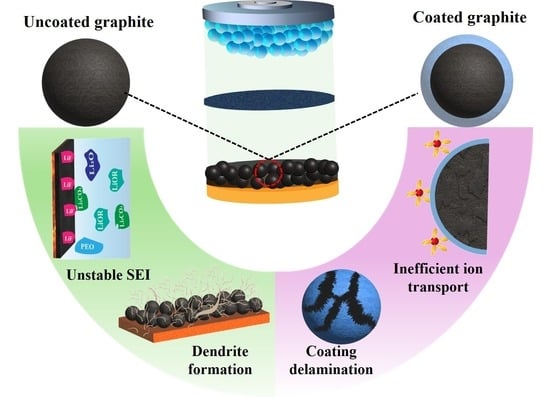
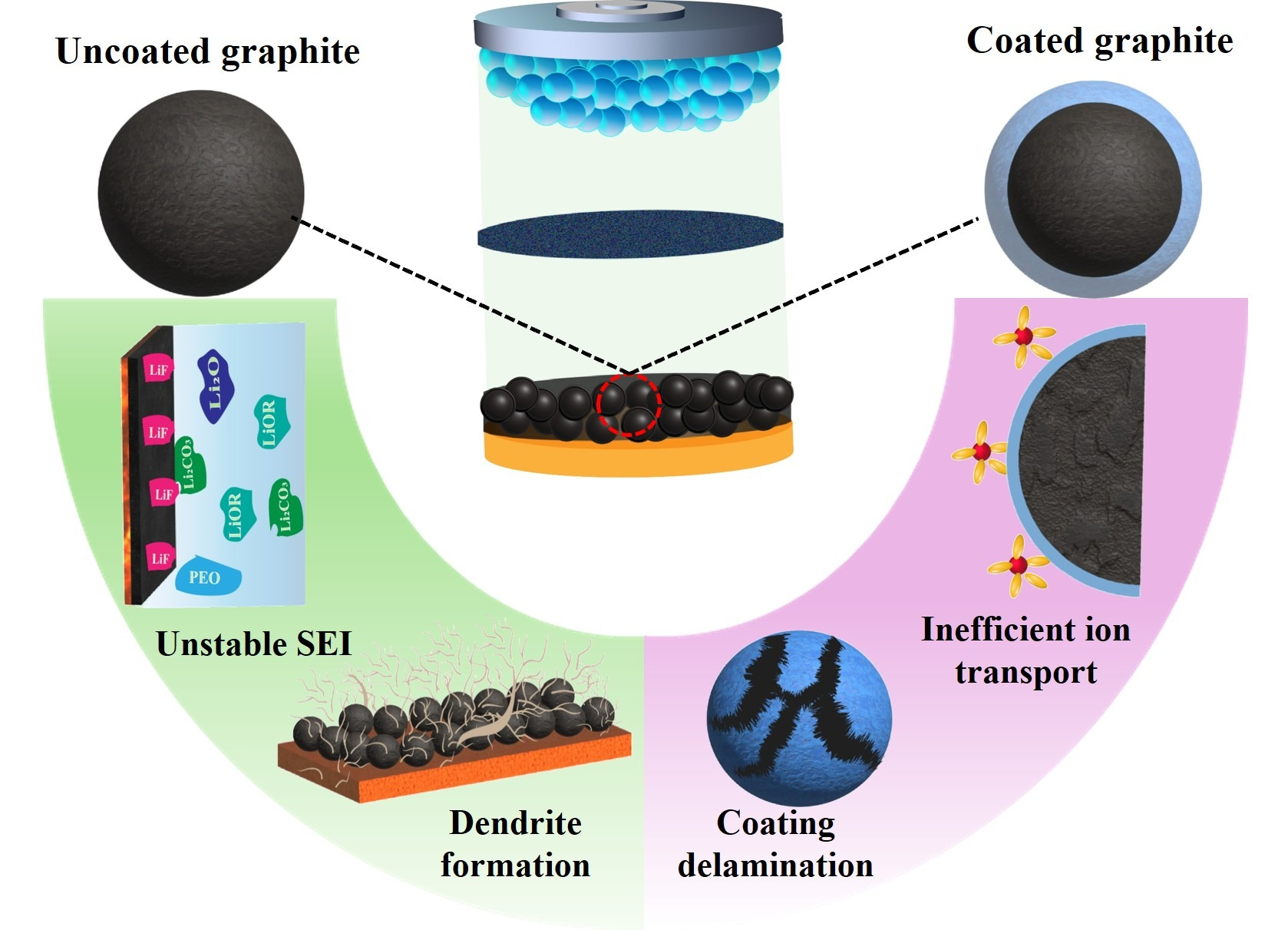
Graphical Abstract

1. Introduction

1.1. Overview of Lithium-Ion Batteries

The demand for longer-range electric vehicles, more durable consumer devices, and more affordable stationary storage solutions continues to push the boundaries of cell-level energy density. While conventional lithium-ion batteries have steadily improved and advanced, their anodes, mainly graphite or Si–graphite blends, are constrained by their capacities and operating potentials, limiting how far current designs can evolve without significant compromises. In this landscape, lithium metal has re-emerged as a key material for next-generation batteries, including lithium–sulfur, lithium–oxygen (theoretically), and high-voltage lithium-metal cells combined with advanced intercalation cathodes [1,2,3,4,5].
Rechargeable LIBs became the leading electrochemical energy-storage technology soon after their commercial introduction, with Sony’s 1991 launch often regarded as a turning point. Their intercalation-based chemistry sets them apart from earlier rechargeable batteries, delivering higher energy density, longer life, and no “memory effect” [6]. Over the following decade, steady advances in electrolytes, electrode materials, and cell design further improved performance. Because of these strengths, LIBs have become the preferred power source for portable electronics. They are increasingly central to electric transportation (HEVs, PHEVs, and EVs) and to stationary or grid-scale storage areas where energy density and long cycle life are especially important [7]. More broadly, energy storage (primarily LIBs) is widely regarded as essential for integrating renewable power and shifting demand, as it helps mitigate the intermittency of solar and wind. That role continues to drive LIB deployment and material innovation [6,8].
Research suggests LIBs may be nearing their practical, system-level energy-density ceiling. This is driving major effort in two directions: advancing today’s LIB materials with higher-energy electrodes (such as high-nickel layered oxides, silicon, or lithium-metal anodes) [9,10], and exploring “beyond-LIB” options (such as lithium–sulfur, lithium–oxygen, and multivalent-ion systems). These alternatives can offer much higher theoretical energy density, but they still face major hurdles—especially around stability, safety, and long-term performance. This tension—strong commercial success on one hand, and rising demands from new applications on the other—sets the stage for why LIB design, operation, degradation, and next-generation development have become such active areas of study. A conventional LIB cell is described as comprising (i) a negative electrode (anode); (ii) a positive electrode (cathode), where electrode materials have reversible intercalation; (iii) a separator; (iv) an electrolyte; and (v) two current collectors, arranged to allow ionic transport through the electrolyte/separator while forcing electrons through the external circuit [11].
The “classic” lithium intercalation mechanisms, particularly the combination of a graphite anode with a lithium-containing cathode, have been central to the success and widespread adoption of LIBs. In this design, graphite has remained the preferred negative-electrode material, typically described as the dominant anode chemistry for roughly the past two decades. It works by inserting lithium ions between the graphene layers during charging and releasing them during discharge [11]. This long-running dominance is not accidental: graphite is often framed as a key building block of modern LIB anodes. It is compatible with the vast majority of commercial cathode materials. This makes it a practical cornerstone of real-world LIB manufacturing and deployment [12]. At the same time, the very features that make graphite so appealing, lithium intercalation at low voltage and highly reversible cycling when the interphase is well-controlled, also put it at the heart of ongoing performance and safety limits, especially under demanding operating conditions. These issues tend to manifest most clearly during fast charging, at low temperatures, and when paired with higher-energy cathodes or when pushed to higher voltages.
As a result, choosing between coated and uncoated graphite is not just a matter of preference in electrode design. It is closely tied to recurring interfacial and mechanistic failure pathways that can degrade performance or increase risk. This is not limited to conventional LIBs. Many next-generation storage concepts still rely on graphite, including dual-ion or dual-graphite systems, solid-state designs that retain graphite, and hybrid approaches that combine lithium-ion and lithium-metal behavior. The same interface-driven challenges continue to matter there as well [13].
Although lithium-ion battery chemistry has advanced significantly, commercial negative electrodes are still predominantly graphite-based due to graphite’s low lithiation potential, adequate theoretical capacity, affordability, and well-established manufacturing processes. Nevertheless, graphite’s practical limitations stem primarily from the graphite/electrolyte interface rather than from the bulk intercalation process itself [6]. During the first charge, electrolyte reduction forms the solid electrolyte interphase (SEI), which is crucial for electrode passivation but also irreversibly consumes lithium, reducing the initial coulombic efficiency [9,10]. Under conditions such as fast charging, low temperatures, or increased polarization, instability at this interface leads to higher impedance and an increased risk of lithium plating. Thus, precise interfacial control is essential to ensure the safety, longevity, and high-rate performance of graphite anodes [14].

1.2. Importance of Graphite as an Anode Material

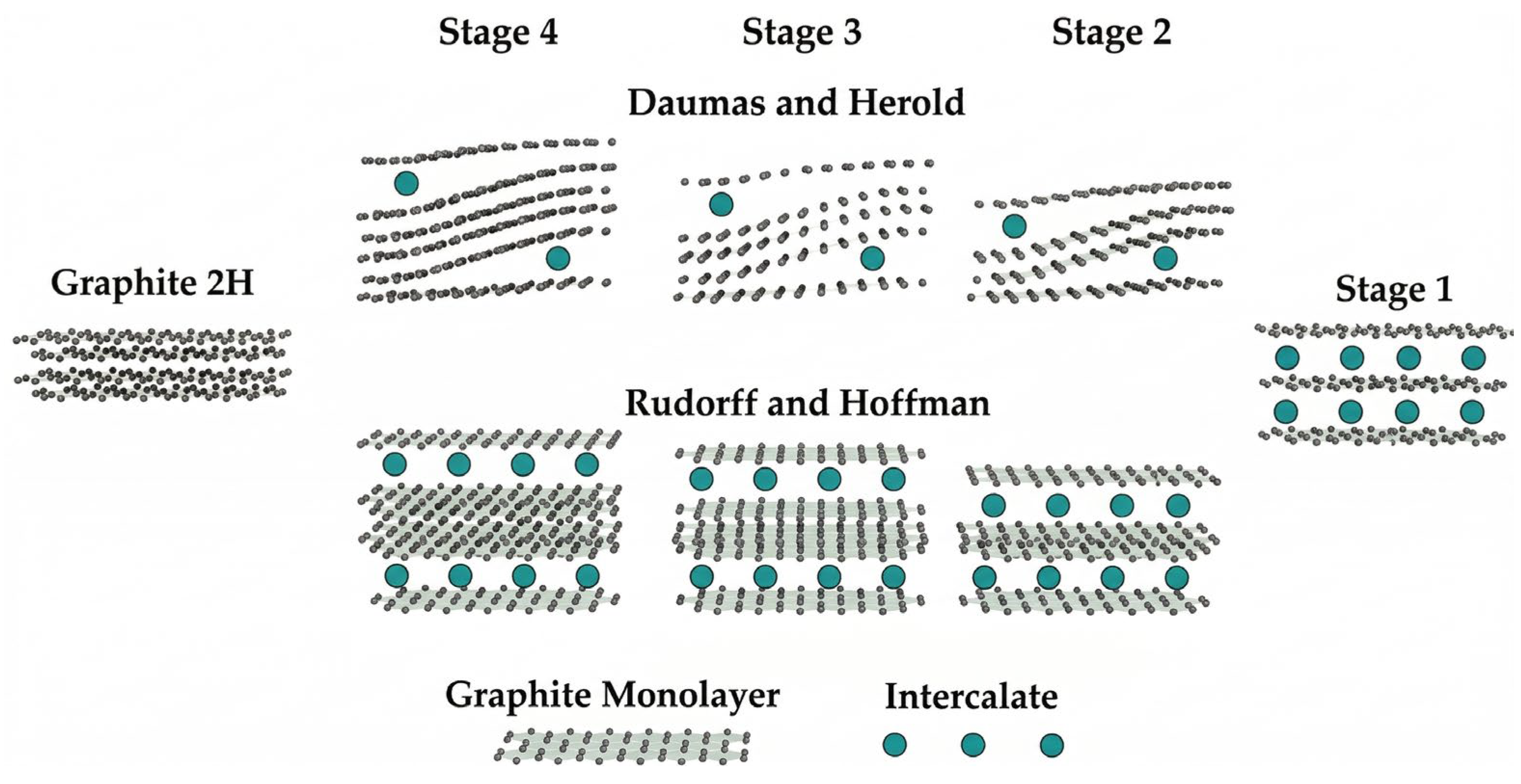
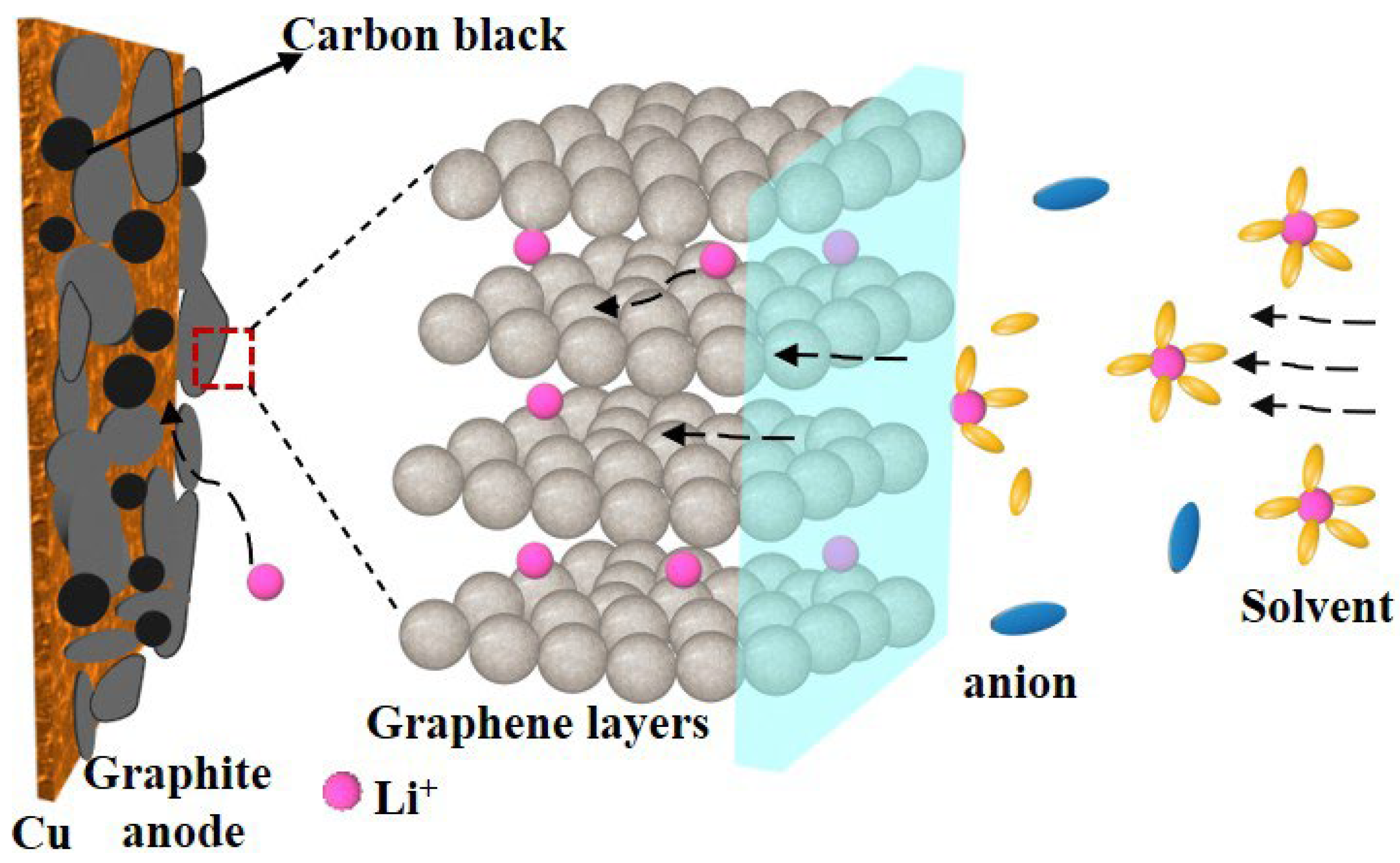
Graphite is widely regarded as the default negative electrode in contemporary LIBs, with many considering the “typical” Li-ion cell as being a pairing between a transition-metal oxide cathode and a graphite anode in a carbonate-based electrolyte [11]. This long-standing dominance is also evident in foundational discussions of anode development, which note that graphite has remained the dominant Li-ion anode for decades through lithium intercalation between graphene layers (Figure 1), even as many alternative anodes have been investigated to surpass its capacity [15]. Because graphite is deployed at scale and under diverse duty cycles, it functions not only as a commercial mainstay but also as a scientific benchmark: a large fraction of mechanistic studies on interphase formation, transport limits, safety events, and fast-charge aging are formulated around graphite electrodes, reflecting its centrality in both practical engineering and fundamental electrochemistry [16].
At the mechanistic level, graphite exhibits multistage lithium intercalation behavior, and the intercalation process in real batteries occurs in the presence of an SEI, making graphite a canonical system for studying coupled intercalation–interphase phenomena rather than “pure” host–guest thermodynamics [17]. Graphite is also important because it is compatible with scalable composite-electrode manufacturing and exhibits strong, engineerable process–property linkages. For example, systematic studies of natural graphite anodes show that electrode compression (and thus density) measurably affects anode performance, matrix conductivity, SEI formation, and cyclability, establishing graphite as a material in which industrially relevant parameters (calendaring/compression) directly translate into electrochemical outcomes [18]. Related electrode-engineering observations connect transport and polarization to electrode structure: limitations in high-areal-capacity electrodes are associated with electrolyte transport constraints and polarization effects, with lithium plating in the graphite electrode during charge explicitly identified as an outcome of these coupled limitations [19]. Consequently, graphite’s importance is reinforced by its role as the primary platform on which manufacturing choices (compression/density, thickness/areal loading, and architecture) are systematically mapped to kinetics, degradation, and safety-critical failure modes, enabling both optimization and mechanistic understanding at the electrode scale [20].
Additionally, graphite structural disordering and surface degradation are implicated in irreversible capacity. Studies that induce surface disorder in graphite (e.g., via argon-ion sputtering) link surface structural damage to irreversible capacity mechanisms, and cycling-induced surface disordering has been linked to specific potential windows (low lithium concentrations) that promote disorder formation [21]. These results collectively explain why graphite remains the archetypal system for studying coupled electrochemical–mechanical aging in LIBs and why coatings/interphase engineering are repeatedly pursued to suppress SEI cracking and attendant side reactions [22].
Graphite is central to LIB fast-charging research because lithium plating on graphite is widely recognized as a key safety risk and compromises cycle life at fast-charging rates. As such, fast charging of most commercial LIBs is constrained by the risk of lithium plating on the graphite anode and its safety consequences [23]. Quantitative analysis of the graphite anode after rapid charging explicitly measures inactive lithium and SEI species on graphite, underscoring that fast-charge operation drives lithium-inventory loss and interphase growth that directly translate into capacity loss and risk [20]. Systematic electrolyte studies further state that unwanted lithium plating on graphite reduces cycle life and threatens safety (e.g., via dendrite formation and separator piercing), and identify conditions that increase plating propensity [15]. Mechanistic perspectives extend this by analyzing lithium nucleation at graphite anodes and proposing mitigation strategies, which underscores that the graphite surface is not merely a passive host but an active site where nucleation barriers, interfacial transport, and local overpotentials govern whether lithium intercalates or deposits as metal [24]. In aggregate, graphite’s importance in modern LIBs is inseparable from the fact that many system-level design targets (≤15 min charging) are often graphite-limited, thereby motivating coated graphite and interface-controlled graphite as enabling solutions [23].
The intensity of coating research itself is evidence of graphite’s importance: because graphite is simultaneously high-value and failure-sensitive (SEI, plating, solvent compatibility), surface modification is repeatedly used as a lever to tune interfacial kinetics and interphase chemistry without replacing the bulk host. For fast charging, studies demonstrate that modifying graphite interfaces (including engineered SEI/SEI-like layers) is a direct strategy to mitigate plating and capacity fade under high-rate conditions. In contrast, electrolyte-engineering approaches have targeted the reversibility of lithium plating on graphite through localized high-concentration electrolyte concepts [25,26]. At the molecular scale, grafted self-assembled monolayers on graphite have been reported to induce LiF-dominated inorganic SEI layers intended for fast charging, explicitly linking graphite rate performance to SEI composition and interfacial Li+ kinetics [27]. Coating strategies also target FCCE and early SEI formation: pre-electroplated metals and graphene on graphite are investigated to improve initial coulombic efficiency (ICE) by altering SEI formation and irreversible reactions on graphite surfaces [28].
Graphite’s relevance in practical batteries is further amplified by safety concerns associated with its lithiated phases and interfacial layers. In situ studies of thermally induced degradation in lithiated graphite show that SEI breakdown, lithium leaching, and gas evolution occur along its thermal degradation pathway, underscoring that graphite’s safety performance is largely dictated by interphase chemistry and the heat-driven reactivity of lithiated graphite [29]. Because both fast charging and low temperatures promote lithium plating on graphite, raising the risk of hazardous metallic lithium microstructures, graphite is a key focus of safety-by-design strategies aimed at preventing deposition-induced shorting and the onset of thermal runaway [30].
Therefore, graphite remains indispensable in LIBs not only as a capacity-bearing host but also as a material whose interphase evolution, lithium-plating tendency, and thermal response define the practical operating limits of commercial cells, thereby driving continued focus on graphite-specific coatings, formation strategies, and electrolyte designs [29].
This review focuses on the difference between uncoated and coated graphitic anodes. Uncoated graphite relies on the natural formation of the SEI at the graphite–electrolyte interface, meaning its properties are affected by factors like defect density, the reactivity of basal and edge planes, electrolyte makeup, and formation methods [25,26]. In contrast, coated graphite has a deliberately applied layer of a carbon-based, inorganic, or polymeric material that serves as an artificial SEI. This coating can reduce direct electrolyte attack, control Li+ transport, improve mechanical stability, and prevent lithium plating during fast charging [28]. However, coatings may also lower initial coulombic efficiency, increase transport resistance if they are too thick, cause local current issues when coverage is uneven, and lead to new side reactions at the coating–electrolyte boundary [22]. Therefore, comparing coated and uncoated graphite in terms of SEI formation, irreversible lithium loss, fast-charging capability, mechanical strength, and safety forms the core of this review.

2. Graphite

There are two types of graphite based on morphology, prismatic (flake-derived) graphite and spherical natural graphite, which are primarily used in LIB anodes. They differ primarily in particle shape and in the resulting interfacial properties. The angular, blocky particles that make up prismatic graphite have a high percentage of exposed edge planes and defects. This increases surface reactivity, which usually results in higher interfacial resistance during cycling, lower ICE, and greater SEI formation. Spherical graphite, on the other hand, is made by spheroidizing natural flake graphite, which results in rounded particles with more uniformly curved basal-plane surfaces. Particle packing and tap density are enhanced, reactive edge exposure is decreased, a thinner and more uniform SEI is formed, and a more uniform current distribution is made possible at high charge rates thanks to this morphology. Consequently, spherical graphite typically shows higher ICE, reduced polarization, and better rate capability and fast-charging durability than prismatic graphite, which is more susceptible to localized polarization and lithium plating under aggressive operating conditions [31].
A defining feature of graphite operation in conventional carbonate electrolytes is the formation of the SEI during initial charging. The SEI forms via the reductive decomposition of electrolyte components at potentials at which graphite begins to intercalate lithium, and it is essential for long-term cycling by passivating the surface and suppressing ongoing solvent reduction [32]. However, SEI formation is also responsible for a substantial fraction of first-cycle irreversible capacity loss, and its subsequent growth contributes to impedance rise and capacity fade. A widely cited estimate is that roughly 10% of initial capacity can be consumed in irreversible processes associated with first-cycle SEI formation (cell-dependent), directly lowering ICE [15].

2.1. Structure and Properties of Graphite
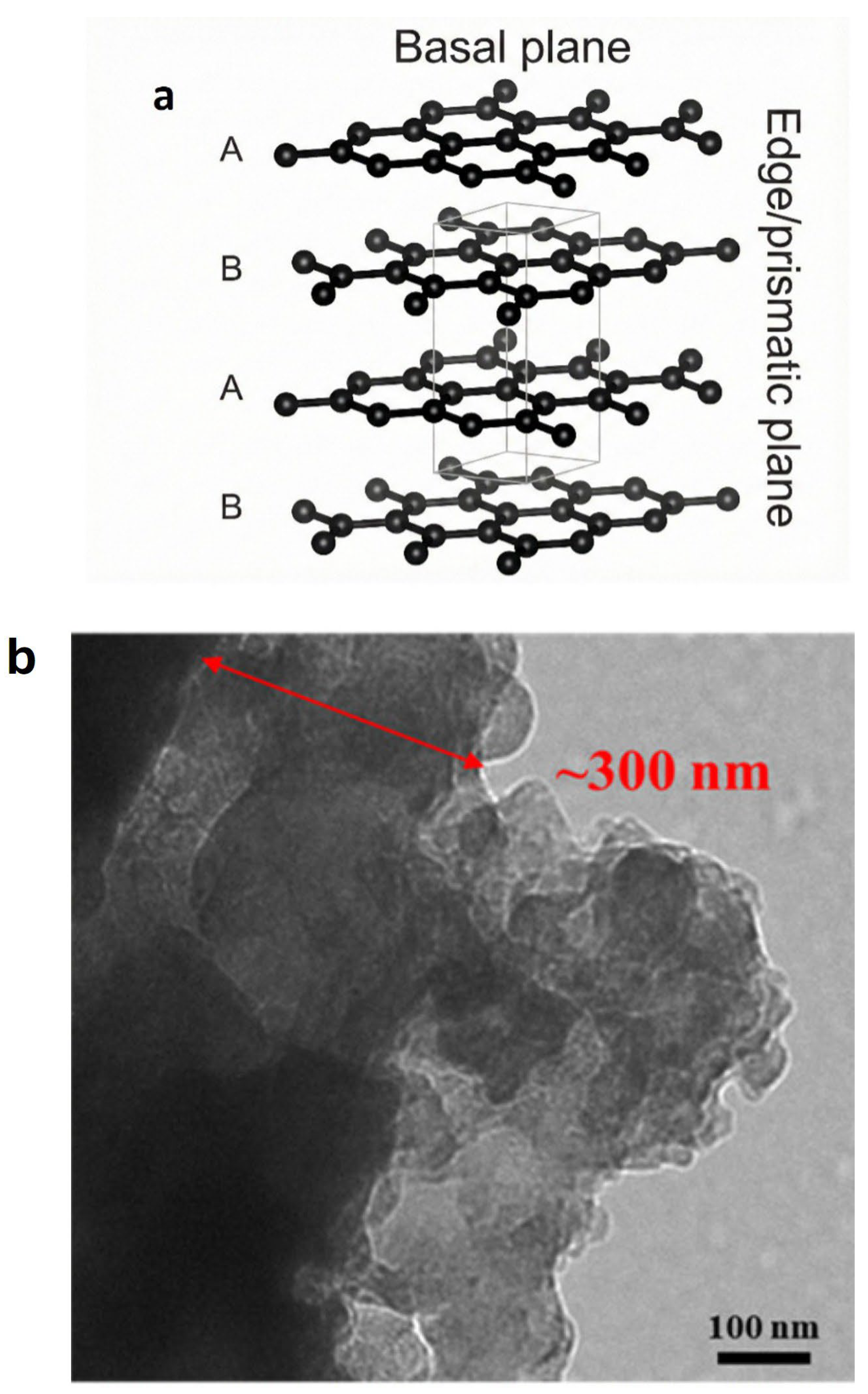
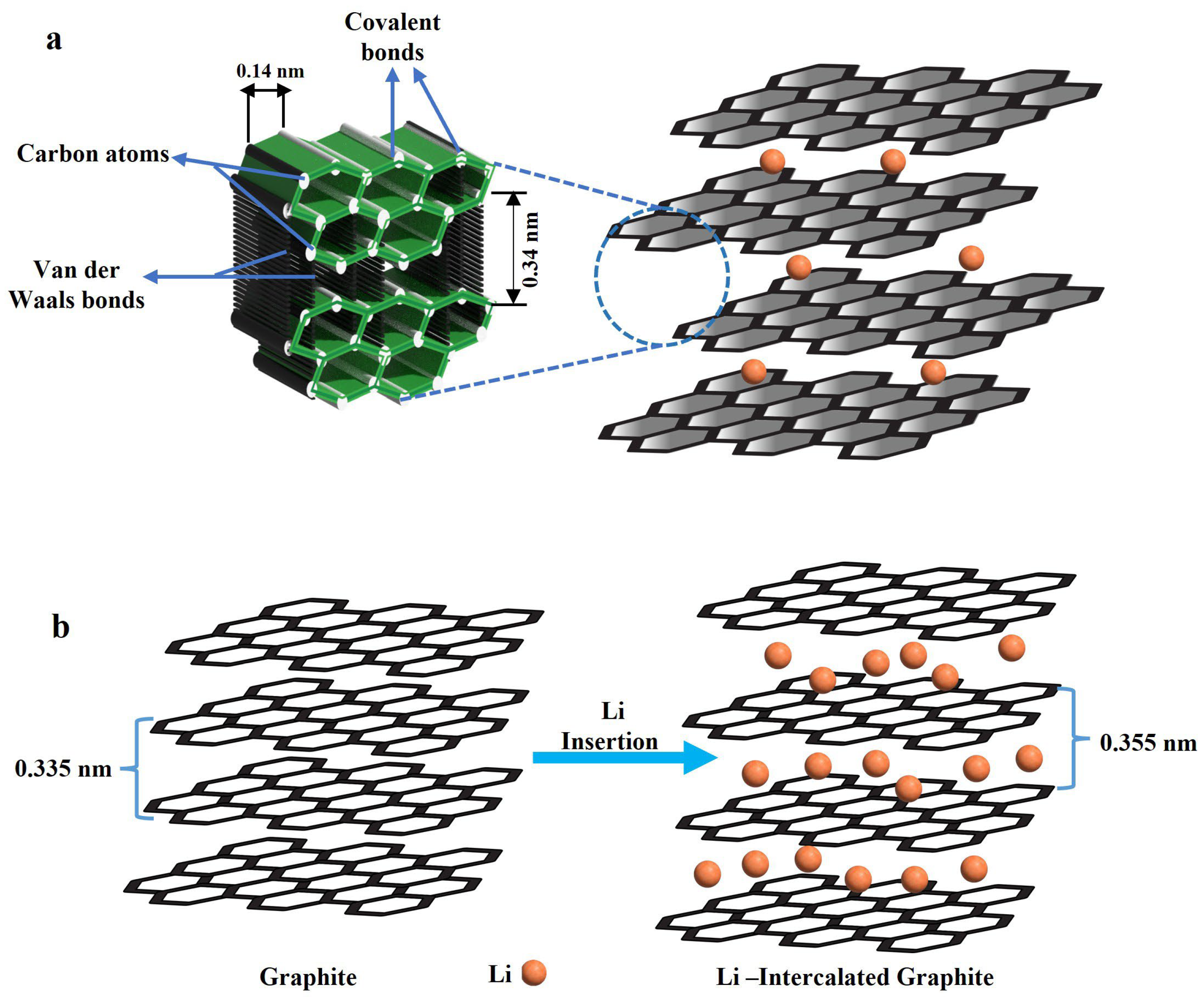
Graphite consists of hexagonal layers of graphene stacked and linked by weak Van der Waals forces and π-π interactions (Figure 2a), in which the carbon atoms are in sp2 hybridization. The ABAB sequence is predominantly seen in natural graphite due to its relatively high thermal stability [33]. The electronic structure of graphite is characterized by π-electrons that are delocalized across the graphene layers. These delocalized electrons account for the material’s high electrical conductivity within the plane of the layers [34]. Graphite exhibits significant anisotropy in electrical conductivity, with much higher conductivity within the graphene planes than in the perpendicular direction. This phenomenon is attributed to strong covalent bonding within the planes and weak interactions between the layers [35,36]. The graphite has an interlayer spacing of 0.335 nm, which is crucial for lithium-ion intercalation. In the study by Yamamoto et al. [37], an increase in d-spacing is observed during lithium insertion to about 0.355 nm (Figure 2b), subsequently reverting to 0.344 nm upon lithium removal. The layered stacking of graphite results in two distinct orientations: the basal plane, which is parallel to the graphene sheets, and the edge planes, which are perpendicular to the graphene layers (Figure 3a) [11].
Furthermore, the basal plane is less reactive than its edge counterparts, as it offers fewer sites for chemical interaction. In contrast, edge planes generally exhibit increased reactivity where oxygen groups are present [38,39]. The stability of the basal plane towards electrolyte decomposition is due to the formation of a stable SEI layer that prevents further electrolyte decomposition [40], and also makes it less prone to degradation at elevated temperatures [41]. The activity of the edge plane is significantly higher than that of the basal plane because of the presence of unsaturated carbon atoms [42], which provides a favorable site for lithium intercalation and facilitates faster Li+ diffusion compared to the basal planes. Still, the high reactivity of the edge plane leads to the formation of an unstable SEI layer, which is prone to side reactions with the electrolyte (Figure 3b) [43,44]. The structural anisotropy of graphite significantly affects Li+ ion transport in the LIB, which occurs through both intra- and interlayer pathways. The morphology and particle size of the graphite have a significant role in the performance of the LIB [45]. Recent research suggested that the spherical graphite showed an enhanced delithiation capacity, due to a shorter diffusion distance and the availability of a greater contact area between the electrode material and electrolyte [46]. The lithium-ion diffusion and mechanical stability of graphite are influenced by Stone–Wales and vacancy defects, which create new diffusion paths and increase the number of lithium storage sites [47].
Figure 3. (a) Illustration of the basal and edge plane. Adapted with permission [48]. Copyright 2021, Wiley. (b) Nonuniform SEI layer on edge plane [49].
Batteries 12 00154 g003

2.2. Lithium Intercalation and Deintercalation

Lithium intercalation and deintercalation are key processes in which lithium ions are inserted and extracted from the graphite structure during charging and discharging. During these steps, lithium ions enter the graphite, which consists of graphene layers, thereby forming graphite intercalation compounds [50]. However, this process occurs simultaneously with electrochemical reactions on the graphite anode, including interface charge transfer and lithium diffusion within the graphite structure [51]. Lithium-ion intercalation in graphite is essential for the operation of LIBs. The formation of staged compounds occurs when Li+ ions intercalate into the graphene layers, and in LiC6, the lithiated stage offers a capacity of 372 mAh g−1 [52].
In 1938, Rudorff and Hofmann introduced the concept of the staging mechanism and explained how concentration-dependent interactions occur between inserted ions and the host material, and described the formation of graphite intercalated compounds. The Daumas–Hérold model explains that elastic interactions between intercalant atoms lead to the formation of two-dimensional intercalant islands within the graphitic layers. These islands interact over distances comparable to their own size, creating coherence strains that strongly affect the staging process (Figure 4) [53]. The stage refers to the number of graphene layers between lithium-ion planes, and the transition from stage 4 to stage 1 shifts the structure from one with more graphene layers to one with fewer layers, thereby forming a fully intercalated state. The transition of stages is thermodynamically favored but kinetically hindered, especially from LiC12 to LiC6 [54]. The thermodynamic stability of different lithium intercalation stages in graphite is a critical factor. The formation of stable phases, such as stage 2 and stage 3, is driven by interlayer interactions and affects the equilibrium potential and lithium diffusion [55]. The intercalation and deintercalation processes are affected by the lithium-ion stacking sequence and by the presence of edge sites at high concentrations; surface effects result in strong lithium binding at edge sites. The zig-zag edge initially inhibits lithiation, which decreases with further lithiation [56]. The particle size plays a crucial role in the reversible intercalation capacity of the graphite, as the smallest particle shows the highest reversible capacity [57]. The rate of lithium intercalation in graphite anodes is influenced by the charge-transfer resistance and exchange current densities, which vary with electrolyte composition. For instance, the intercalation charge-transfer resistance ranges from 11 to 28 Ω cm2, and exchange current densities range from 1.0 to 2.3 mA cm−2, depending on the electrolyte solution [58].

2.3. Influence of Electrolyte Composition

The composition of the electrolyte plays a significant role in the stability of the graphite anode by forming a crucial layer called the SEI, a protective, thin-film layer that forms on the graphite during the initial charging cycle. The initial decomposition of the electrolyte forms these layers during the first charge or discharge cycle. The SEI layer comprises both organic and inorganic molecular species. To achieve high performance, a robust SEI layer is crucial, as it enables efficient lithium-ion transport and controls side reactions. However, it can also be formed by coating the graphite with suitable coating compounds. Electrolyte salts such as LiPF6, LiBF4, and LiFSI play an effective role in the formation of the SEI layer. The most used lithium salt in commercial LIB is LiPF6, owing to its high ionic conductivity and temperature stability. Nie et al. [60] studied the effectiveness of LiPF6 in propylene carbonate (PC) electrolyte with a graphite anode under different concentrations. At a low electrolyte concentration (1.2 M), electrolyte decomposition was greater, with the primary product being lithium propylene dicarbonate (LPDC), which does not form a passivating layer. Meanwhile, at higher concentrations, the major reduced product of the LiPF6 electrolyte was lithium fluoride (LiF), which formed a stable SEI. The decomposition of solvents plays a major role in the formation of the SEI layer. For example, in the use of ϒ-butyrolactone as an electrolyte, decomposition leads to high impedance and poor SEI layer formation due to its stronger binding to Li+, which can be mitigated by introducing a film-forming electrolyte additive with a more negative reduction potential [53].
Additionally, organic additives play an important role in SEI chemistry by mitigating lithium-ion mobility. Vinylene carbonate (VC) and fluoroethylene carbonate (FEC), the film-forming additives, will tend to reduce at a higher potential than the base solvent, leading to the formation of the inorganic-rich SEI layer [61]. Specifically, FEC is known to increase the LiF concentration in the SEI and to improve low-temperature performance when used with a suitable solvent [62]. The introduction of the additive 1,3,6-hexanetrinitrile, combined with FEC at an optimal 5:4 ratio, resulted in a significant improvement by forming a uniform SEI layer on graphite [63]. The operating temperature strongly determines the kinetics of SEI formation. At low temperatures, lithium ion mobility is low, which increases electrolyte viscosity, significantly increases polarization, and leads to denser SEI formation that consumes a large number of Li+ ions in the first cycle, potentially causing capacity fade [64]. Table 1 shows that the electrochemical performance is affected by the type and composition of the electrolyte.

3. Uncoated Electrode

In the context of an uncoated graphite anode (i.e., graphite without deliberate protective surface coatings such as carbon/inorganic oxide/polymer layers), the electrode relies primarily on the native graphite surface and electrolyte formulation to establish a stable interphase. This makes early-cycle interfacial reactions and the resulting SEI composition especially important, because surface functional groups, defect density, and edge-to-basal-plane ratios can influence SEI chemistry and morphology. Modeling and experimental reviews also emphasize that SEI growth on graphite can account for a large share of long-term capacity loss in well-engineered Li-ion cells, underscoring how strongly interphase evolution governs lifetime even for “stable” graphite systems [76].

3.1. Key Challenge Analysis

Although graphite is often considered the rate-limiting anode for fast charging because of polarization, sluggish Li+ intercalation/desolvation kinetics, and lithium-plating risk, recent advances show that its rate capability can be significantly improved through targeted engineering of the interface and electrode architecture. Beyond electrolyte/interphase optimization, studies on fast-charging graphite have also highlighted approaches such as surface coatings, three-dimensional electrode structuring, and graphite-based hybrid configurations that reduce transport limitations and improve high-rate performance. In addition, commercially relevant lithium-ion capacitor systems employing graphite-based negative electrodes further demonstrate that graphite can be adapted for high-power operation when electrode balancing and cell design are properly optimized [77].
Uncoated graphite anodes are appealing because they are affordable and highly reversible under moderate conditions. However, their performance is limited by interfacial and transport issues that worsen during fast charging, at low temperatures, and over long periods. The first obstacle is the unavoidable formation of the SEI layer during initial charging. Since SEI comes from electrolyte decomposition, it consumes cyclable lithium and reduces ICE, creating an ongoing inventory deficit. The second obstacle is the continuous evolution of the SEI during cycling, which increases impedance and accelerates degradation when high current densities induce interfacial polarization. The third issue is lithium plating on graphite during aggressive charging, such as high C-rates and low temperatures, which is a major barrier to ultra-fast charging and poses safety and performance risks in graphite-based LIBs [78].
Recent studies show that these problems can be substantially mitigated when the electrolyte is engineered to reduce polarization and to form a more ionically conductive, stable SEI without applying a physical coating to graphite. For example, Lee et al. [25] demonstrated that a linear-carbonate, LiPF6-concentrated electrolyte combined with FEC can enable graphite∥NMC622 full cells (areal capacity ≈ 3.0 mAh cm−2) to retain 94.3% capacity over 500 cycles under a 10 min charging condition, indicating strong suppression of fast-charge-induced fade. In the same work, a 1.2 Ah pouch cell achieved 87% capacity retention after 200 cycles with 10 min charging, compared to 15.6% for a conventional electrolyte, illustrating that the dominant limitation was interfacial polarization/SEI behavior rather than graphite’s intrinsic storage mechanism.
Similarly, Kim et al. [79] introduced an additive Isosorbide 2,5-dimethanesulfonate (ISDMS) that alters Li+ solvation and promotes the formation of ionically favorable interphases. In NCM811/graphite full cells, the ISDMS electrolyte improved ICE to 89.2% (vs. 77.6% baseline) and improved fast-charge cycling at 3 C charge/1 C discharge to 76.7% retention (vs. 62.8% baseline) while delivering 141.8 mAh g−1 discharge capacity. These data collectively indicate that the key challenges of uncoated graphite are increasingly addressed through electrolyte/solvation/interphase engineering, enabling major improvements in fast-charge durability without modifying the bulk graphite host.

3.2. Solid Electrolyte Interphase Formation and Evolution

SEI formation on graphite begins when the anode potential enters a regime in which carbonate electrolytes are reduced at the surface, especially during early charging cycles. The SEI must satisfy two competing requirements: (i) block electron transport to suppress continued electrolyte decomposition, while (ii) remaining sufficiently permeable to Li+ to avoid excessive polarization. In practice, the graphite SEI is not a static layer created “once” during formation; it is a dynamic interphase whose chemical composition, thickness, and ionic resistance evolve under operating stressors (temperature, rate, voltage window), continuously influencing both performance and aging trajectories [19].
A core finding across recent fast-charging studies is that SEI evolution is strongly governed by Li+ solvation and desolvation kinetics, which control charge-transfer resistance and local overpotential at the graphite surface. In the LiPF6 concentrated linear-carbonate electrolyte study, the authors explicitly linked improved extreme fast charging (XFC) to reduced Li+ desolvation barriers and formation of a thin, fluorinated SEI enabled by FEC, which in turn lowered polarization and suppressed plating under 10 min charging [80]. This emphasizes that SEI “quality” is inseparable from the electrolyte’s solvation structure.
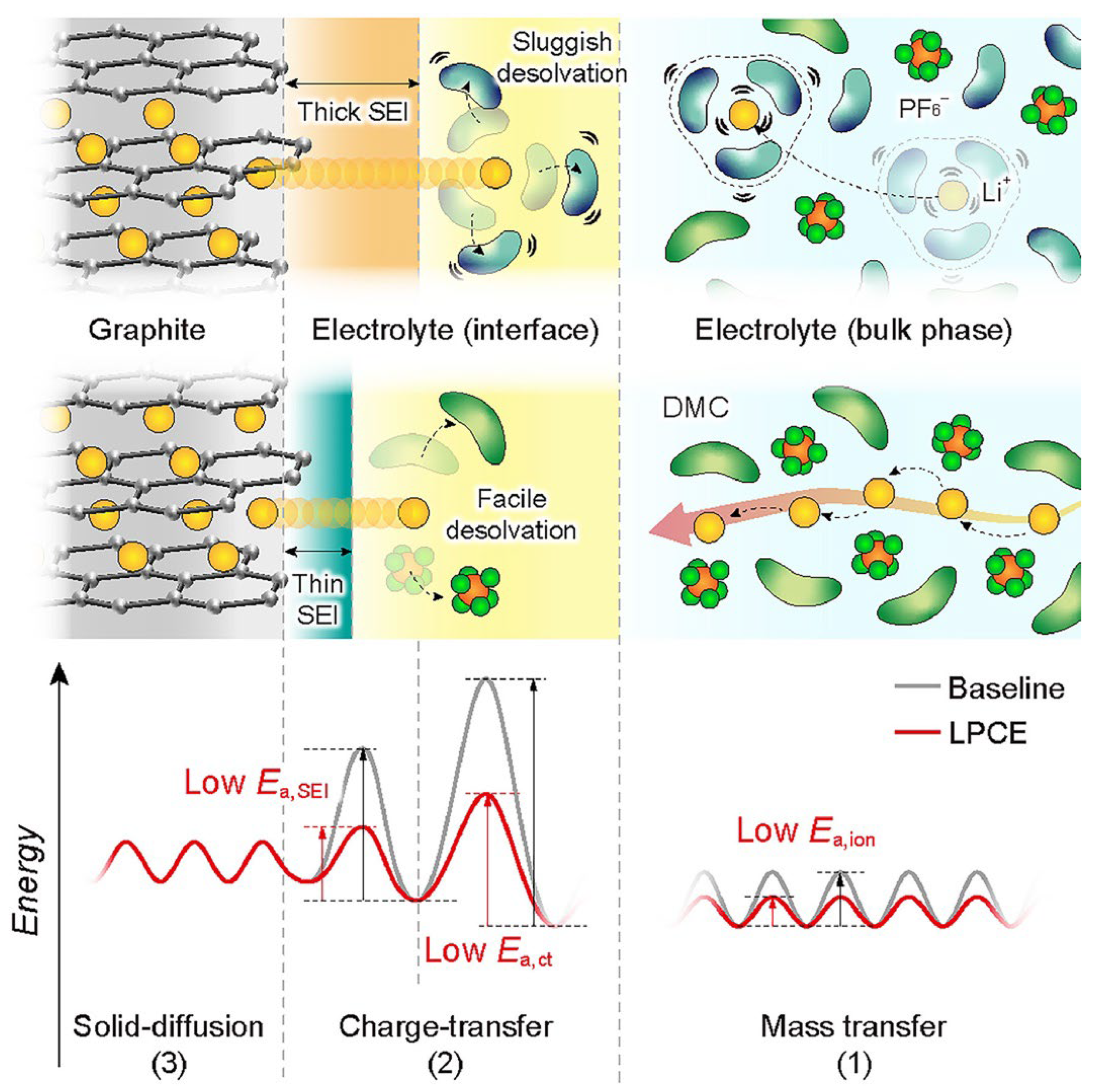
Localized high-concentration electrolyte (LHCE) concepts similarly aim to shift interphase chemistry toward inorganic-rich products (often LiF-rich), which tend to be more mechanically/chemically robust and can reduce ongoing parasitic consumption. In a 2023 LHCE study, the solvation sheath was designed so that anions migrate to the graphite surface and decompose preferentially, forming a LiF-rich SEI. The Li∥C system achieved 124 mAh g−1 at 5 C and maintained ~99.8% average coulombic efficiency, with 73% retention after 150 cycles (reported at 0.1 C). Although this example is not a full-cell validation, it quantitatively supports the mechanism: stabilizing SEI chemistry through solvation control can improve both rate capability and cycling stability [81]. Finally, SEI evolution on graphite interacts strongly with plating risk. As SEI thickens or becomes more resistive, the graphite surface potential becomes more negative under high current, increasing the probability of plating; once plated lithium appears, it can further react with the electrolyte and exacerbate SEI growth. Recent fast-charging full-cell demonstrations that maintain high retention at 10 min charge strongly imply that SEI stability and low interfacial resistance are prerequisites for plating-free operation at high power [82]. The SEI formed on graphite in carbonate electrolytes is widely characterized as a heterogeneous, nanometer-scale composite containing inorganic and organic domains. Rather than being a single uniform compound, its chemistry reflects multiple competing reduction pathways involving the solvent, salt anions, and additives, each of which is sensitive to the solvation environment and to the early-cycle potential history. Recent studies increasingly treat SEI composition as an engineerable outcome of electrolyte design, especially through additives and high-concentration/LHCE strategies [83]. It should also be noted that SEI growth and related parasitic reactions on graphite are not strictly confined to the outer electrode surface throughout cycling [84]. While interphase formation is generally initiated at the graphite/electrolyte interface, continued cycling can progressively drive reaction products and degradation processes into the porous electrode structure, extending toward both the separator and current-collector sides. This spatial evolution may contribute to pore narrowing or clogging, increased tortuosity, and nonuniform Li+ transport, thereby amplifying polarization and local plating risk. Such effects may differ between coated and uncoated graphite, since surface coatings can alter not only the initial interphase chemistry but also the extent to which degradation propagates through the electrode thickness [85]. Figure 5 schematically summarizes how electrolyte design can lessen fast-charge polarization at a graphite anode by lowering kinetic barriers at the interface. In a typical electrolyte, a thicker, more resistive SEI and slower Li+ desolvation increase the effective energy barriers to mass transport and charge transfer, leading to increased overpotential at high current densities. Conversely, localized high-concentration electrolytes and LPCE/LHCE-style formulations promote a thinner, more conductive interphase and easier desolvation, thereby lowering charge-transfer and ion-transport barriers. By limiting interfacial resistance buildup and polarization during rapid charging, these interphase and solvation improvements help prevent conditions that cause lithium plating on graphite.

3.2.1. Impact of SEI on Coulombic Efficiency and Cycle Life

SEI impacts graphite performance through two measurable macroscopic quantities: coulombic efficiency (CE) and capacity retention (cycle life). During formation, irreversible electrolyte reduction lowers ICE by diverting charge from reversible intercalation. Subsequent cycling reflects a competition between (i) stable passivation that suppresses further parasitic and (ii) transport limitation from a resistive SEI that raises polarization and can trigger plating at high charge rates [86].
Recent full-cell studies provide unusually clear, quantitative evidence that SEI engineering can directly increase both CE and long-term retention. Kim et al. [79] reported that incorporating ISDMS increased the ICE of NCM811/graphite full cells to 89.2%, compared with 77.6% for the baseline electrolyte, an improvement consistent with reduced parasitic consumption of lithium and electrons during early interphase formation. Under fast-charge cycling (3 C charge, 1 C discharge at 25 °C), the ISDMS electrolyte achieved 76.7% capacity retention and 141.8 mAhg−1 discharge capacity, compared with 62.8% retention for baseline electrolyte cells. At a very high charge rate (10 C), the ISDMS system improved the “charge-rate performance” retention metric from 27% (VC electrolyte) to 34.8%, indicating improved utilization under extreme polarization.
Electrolyte solvation/SEI control can also enable step-changes in fast-charge durability at practical areal capacities. In a study of a linear-carbonate LiPF6-concentrated electrolyte, graphite∥NMC622 full cells achieved 94.3% capacity retention over 500 cycles while operating under a 10 min charge condition, which is unusually high retention for XFC cycling at meaningful loading. The 1.2 Ah pouch-cell validation retained 87% after 200 cycles (10 min charge), versus 15.6% for a traditional electrolyte, strongly implicating SEI/charge-transfer polarization as the main failure mechanism in the baseline case [87].
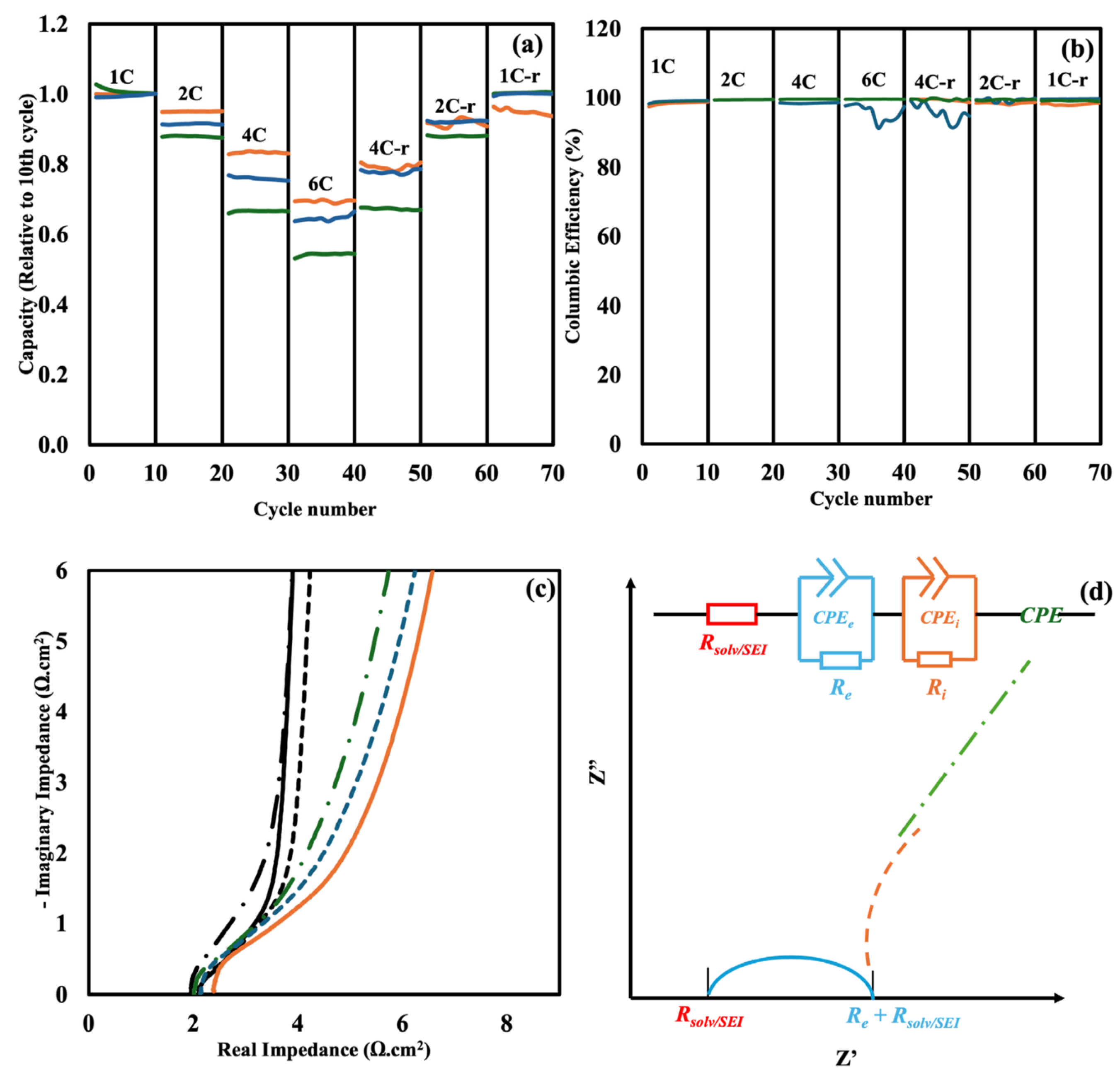
Figure 6 depicts how electrolyte solvation and SEI engineering directly enhance fast-charging durability at a practical cell scale. The concentrated electrolyte with linear carbonate and LiPF6 maintains capacity during 10 min charges in both coin and pouch cells, unlike the rapid failure seen with traditional electrolytes. The significant difference in cycling stability, despite similar bulk electrolyte properties, suggests that degradation mainly results from interfacial polarization and unstable SEI growth. By creating a thinner, more conductive interphase and reducing charge-transfer resistance, the optimized electrolyte prevents lithium plating and conserves lithium inventory, supporting high-rate charging without severe capacity loss.
Even in graphite-focused half-cell/limited configurations, SEI stabilization is evidenced by a high average CE and improved rate capability. A study on LHCE reported an average CE of 99.8%, supporting the interpretation that reduced ongoing electrolyte decomposition (slower SEI growth) contributes to improved cycle stability and high-rate performance [88].

3.2.2. Irreversible Lithium Loss

In graphite-based LIBs, irreversible lithium loss primarily results from the loss of cyclable lithium inventory (LLI)—lithium permanently removed from the reversible exchange between electrodes. In full cells, since the lithium reservoir (mainly supplied by the cathode) is limited, any lithium consumed by parasitic reactions at the graphite anode directly reduces the available capacity and accelerates battery aging. For uncoated graphite, LLI is mainly caused by interfacial reactions, as the surface is passivated only by a self-formed SEI, which gradually consumes lithium during formation and evolution [89,90,91]. The first source of LLI is SEI formation and growth; during initial cycles, electrolyte reduction creates Li-containing inorganic and organic compounds that immobilize Li+ in the SEI. Even after formation, the SEI can continue to grow or repair itself, particularly under elevated temperatures, high SOC levels, or the presence of impurities/crossover species that destabilize the interphase. This ongoing growth consumes lithium and increases anode impedance, resulting in greater anode polarization during charging. This makes conditions favorable for lithium plating, thus linking SEI-driven LLI to the second pathway. The second pathway involves lithium plating on graphite (and inactive lithium formation). During fast charging or low temperatures, intercalation becomes rate-limiting, causing metallic lithium to deposit on the graphite surface. Plated lithium contributes to LLI by reacting with the electrolyte to form additional SEI (consuming lithium), and some of it can become electrically isolated during stripping, becoming inactive lithium [92]. Several studies on commercial cells cycled at sub-zero temperatures have reported that lithium deposits cause rapid capacity loss and reduced thermal stability, highlighting that plating-driven LLI negatively affects performance and safety. Recent advances have shown that reducing LLI is possible without graphite coatings by engineering solvation and interphase chemistry to suppress parasitic reactions and plating [93,94]. Wu et al. [95] systematically screened several functional electrolyte additives (VC, VEC, LiDFP, LiDFOB, LiTFOxP, and LiDFBOP) in NMC811∥Si full cells to identify designs that enable robust interphase formation on silicon anodes. They found that LiDFBOP (a lithium salt additive containing two oxalate groups) outperformed all other additives, delivering the best capacity retention after 300 cycles in NMC811∥Si full cells. Mechanistically, multi-modal post-characterization (FTIR, SEM, and XPS) indicated that LiDFBOP’s superior cycling stability arises from its ability to form a more stable and protective SEI on the Si anode, consistent with reduced continuous side reactions and improved interfacial robustness. The authors interpret this as a successful “integrative additive design,” where LiDFBOP’s molecular structure combines beneficial motifs found across other additives into a single compound that more effectively stabilizes the Si–electrolyte interface. Additionally, electrolyte designs aiming for lower polarization and a thinner, less resistive SEI also contribute to reduced LLI. Das et al. [96] reported that a linear-carbonate, LiPF6-based electrolyte with FEC formed a thin SEI and enabled graphite∥NMC622 full cells to retain 94.3% capacity over 500 cycles at a 10 min charge rate, explicitly associating fast-charge durability with minimized plating and interphase resistance (which limits LLI growth). In summary, recent research agrees that LLI in uncoated graphite is not unavoidable at high levels; it can be significantly minimized through interfacial engineering that (i) increases ICE, (ii) slows SEI growth, and (iii) prevents lithium plating by reducing polarization and enhancing Li+ transport and desolvation at the graphite interface.

3.3. Volume Expansion/Contraction During Cycling

Although graphite is often described as a “mechanically stable” intercalation anode, it still undergoes repeated, state-of-charge-dependent dimensional changes during lithiation/delithiation that can drive long-term mechanical degradation. At the material level, full lithiation to LiC6 corresponds to an overall graphite volume expansion on the order of ~10%, which is modest compared with alloying anodes but still large enough to generate stress when particles are embedded in a constrained composite electrode [97]. Importantly, graphite expansion is anisotropic: lithiation increases the interlayer spacing (c-axis) far more than the in-plane lattice dimensions. A recent operando multiprobe study reported that graphite exhibits a ~14% increase along the c-axis thickness at 100% SOC, and that this anisotropic lattice expansion produces a largely unidirectional thickness change at the electrode scale. This means that even “small” particle-level volume changes can translate into measurable electrode swelling (“breathing”), especially in high-loading electrodes where porosity and binder compliance are limited [45].

3.3.1. Mechanical Stress

During cycling, electrode expansion/contraction is mechanically constrained by the copper current collector, particle–particle contacts, the carbon-binder domain, and stack pressure in practical cells. Confinement converts reversible chemical strain into internal stress, which accumulates with cycling and can progressively damage the microstructure. The electro-chemo-mechanics framework is supported by both classical understanding (strain-fatigue under repeated volume change) and by recent operando studies that directly link graphite state of charge to measurable mechanical property changes [98].
A key recent insight is that lithiation can change not only the electrode dimensions but also its mechanical properties, potentially shifting the failure mode over time. Kong et al. [99] experimentally showed that graphite electrode coatings (graphite + CMC/SBR, immersed in electrolyte) undergo significant elastic–plastic deformation and become simultaneously stronger and more brittle during lithiation: at full lithiation, the coating exhibited about a 2-fold increase in ultimate stress and elastic modulus, a ~4-fold increase in microhardness, and a 60% decrease in fracture elongation. Mechanistically, they attributed embrittlement to active particle hardening and to a decrease in porosity during lithiation. In practical terms, this implies that repeated cycling can progressively reduce the electrode’s tolerance to strain mismatch, making it more vulnerable to cracking, debonding, and local loss of contact, especially under high-rate cycling, where lithiation gradients amplify local strain. The degradation consequence is not only structural: mechanical damage feeds back into electrochemistry by increasing tortuosity, disrupting percolation pathways, and creating local current hotspots. Modern degradation frameworks increasingly treat mechanical effects as coupled to interfacial aging (SEI growth, plating), because mechanically damaged regions tend to develop higher impedance and therefore sustain higher overpotentials under load.

3.3.2. Particle Cracking and Electrical Isolation

Particle cracking in graphite is less dramatic than in Si-rich anodes, but it is still observed, particularly after prolonged cycling, aggressive operation, or when particles contain internal defects/heterogeneous domains. Cracking matters because it can (i) expose fresh graphite surface area to electrolyte, (ii) accelerate additional SEI formation on the newly created surfaces, and (iii) break electronic/ionic pathways so that some graphite becomes electrically isolated and no longer contributes to capacity. A pouch-cell aging explicitly identified graphite crack formation (along with transition-metal contamination in the SEI) as a driver that induces further electrolyte decomposition and SEI growth on graphite edges and basal planes during long-term cycling. This provides a direct linkage from mechanical cracking to renewed parasitic chemistry and then to capacity fade [32].
At the electrode-network level, the most important failure outcome is often loss of electronic connectivity rather than the mere presence of cracks. When cracks or interfacial debonding disrupt the carbon black–binder network around active particles, portions of the electrode can become electronically disconnected, effectively creating “inactive” graphite. Nanoscale imaging studies have shown that detachment of the conductive/binder domain from active particles can be visualized and quantified, and that this detachment leads to capacity loss via electrical isolation mechanisms. While this study used composite electrodes as a model system, the underlying mechanism of mechanically driven separation between active material and the conductive/binder matrix applies broadly to composite electrodes subjected to repeated breathing strains. Finally, recent coupled-degradation analyses emphasize that particle cracking is rarely an isolated degradation mode: cracks increase reactive surface area, which accelerates SEI growth; SEI thickening increases polarization; and higher polarization increases the risk of further localized damage (including plating under fast charge). Therefore, for uncoated graphite, managing volume-change-induced stress is not merely a mechanical durability issue; it is a pathway to slowing interfacial aging, preserving electrical connectivity, and sustaining long-term capacity and power [100].

3.4. Dendrite Formation (Especially at High Current Densities)

In graphite-based lithium-ion batteries, “dendrite formation” usually does not mean graphite itself growing filaments but refers to metallic lithium dendrites that form when lithium deposits onto the graphite surface instead of intercalating. Normally, during charging, Li+ ions intercalate into the graphite galleries, but at high current density, low temperature, or with increased interfacial or transport resistances (such as a thick SEI or an aged electrode), the anode can become polarization-limited. When the supply of near-surface Li+ ions cannot keep up with the current, the local electrolyte Li+ concentration near the graphite decreases, the interfacial overpotential rises, and the reaction can shift toward lithium metal deposition. The literature on fast charging highlights these Li+ transport bottlenecks, including electrolyte transport, interfacial kinetics, and solid-state diffusion, as the main causes of lithium plating on graphite anodes and their associated risks. Once plating starts, the growth pattern depends heavily on current distribution heterogeneity and SEI nonuniformity. Small impedance variations, like thicker SEI layers, poorer wetting, or contact loss at the particle scale, create local “hot spots” of high current density, promoting uneven deposition. This uneven growth increases surface roughness and concentrates electric fields, thereby forming a positive feedback loop that promotes whisker-like or dendritic growth during rapid charging [101]. Consequently, plating can shift from smooth films to high-surface-area structures under demanding conditions and becomes more problematic as cells age and resistance rises. Studies clearly link irreversible lithium plating to dendrite formation and emphasize its key role as a limiting factor for fast charging of graphite-based LIBs [102,103].

3.4.1. Safety Concerns

The primary safety concern is that lithium dendrites (or dense metallic deposits) can mechanically penetrate or locally damage the separator, enabling internal short circuits (ISCs). ISCs are widely recognized as among the most dangerous battery failure modes because they can range from mild, self-limited shorts to catastrophic events that trigger thermal runaway. Even when a hard short does not immediately occur, plated lithium significantly increases hazard risk because metallic Li is highly reductive and can react exothermically with electrolyte and SEI components [40]. This effect has been quantified in recent thermal-safety studies. For example, Abbas et al. [104] investigated a 64.6 Ah high-energy pouch cell chemistry (graphite-SiO/NMC) with deliberately induced lithium plating and reported that the first venting temperature was reduced to 112 °C for the plated cell, compared with 130 °C (fresh) and 134 °C (real-life aged), attributing earlier venting to reactions between plated metallic lithium and the electrolyte. This demonstrates a practical safety impact of plating: it can shift early failure/venting behavior to lower temperatures even before full thermal runaway develops.
Complementary evidence comes from Kirchner-Burles et al. [94], who cycled cells at sub-zero temperatures and showed that the plating behavior becomes more dangerous as temperature decreases and as aging progresses: cells cycled at −10 °C exhibited more reversible plating initially, whereas cells cycled at −20 °C plated irreversibly, and plating at −10 °C tended to become more irreversible with progressive aging. They further reported that aged cells containing more metallic lithium exhibited lower onset temperatures for self-heating and thermal runaway and a higher potential for projectiles during failure, based on accelerated rate calorimetry. Together, these findings support a central safety conclusion: lithium plating (and especially dendritic/inhomogeneous deposition) increases the likelihood of ISC and can also reduce the thermal margin by introducing highly reactive lithium within the cell.

3.4.2. Performance Degradation

From a performance standpoint, dendrite-associated lithium plating drives degradation through three coupled pathways: (i) LLI, (ii) impedance growth, and (iii) heterogeneous aging. First, plated lithium is only partially reversible: some can be stripped, but a meaningful fraction reacts to form additional SEI or becomes electrically isolated (“inactive” or “dead” lithium), reducing the cyclable lithium inventory and thus reducing capacity. Second, both the plated lithium and the additional SEI it generates increase interfacial resistance, thereby increasing polarization and limiting usable capacity at high rates. The fast-charging perspective literature emphasizes that lithium plating on graphite “causes severe degradation of electrochemical performance,” including capacity loss and increased internal resistance, and explicitly links irreversible plating to dendrite formation and accelerated capacity fading [57].
Third, plating is often spatially nonuniform, so degradation becomes inhomogeneous: regions that plate more heavily develop thicker interphases, higher resistance, and larger overpotentials, which further concentrate current and promote additional plating in subsequent fast-charge events. This feedback loop is particularly relevant for uncoated graphite because the interface is governed entirely by the native surface and SEI; once local interfacial quality diverges (e.g., after partial drying, local binder detachment, or uneven wetting), the risk of plating increases locally, accelerating nonuniform aging.
Recent evidence from sub-zero cycling illustrates how quickly this can escalate. Kirchner-Burles et al. [94] linked the transition from reversible to irreversible plating (e.g., at −10 °C with age, and more strongly at −20 °C) with measurable electrochemical signatures, including changes in CE and impedance growth (via EIS), consistent with increasing lithium loss and interphase resistance. In other words, dendrite-associated lithium plating is not merely a rare “abuse” phenomenon; it is a practical performance limiter that can emerge under realistic fast-charge/low-temperature conditions and then self-accelerate through rising resistance and increasing interfacial heterogeneity.
In summary, for uncoated graphite anodes, dendrite formation is best framed as the morphological extreme of lithium plating under high current density: it arises from transport/kinetic limitations and interfacial nonuniformity, it threatens safety primarily through separator breach and ISCs, and it degrades performance through lithium inventory loss and rapidly increasing impedance, often in a spatially heterogeneous manner.

4. Coated Graphite

Graphite coating is a key process in which a thin protective layer is applied to graphite in LIBs. Coating the graphite helps reduce the formation of the SEI layer, minimizes unwanted side reactions, and improves the system’s rate capability. Optimizing the thickness of coated graphite in LIB electrodes is essential for improving electrochemical performance. The optimal coating thickness is typically ultrathin, ranging from approximately 4 to 5 nm. A conformal layer within this range effectively passivates defect and edge sites, stabilizes interfacial chemistry, and minimizes both transport resistance and the inactive mass penalty associated with thicker shells. For example, application of a thickness-controllable nano-carbon layer (1.5–20 nm) to graphite–mesocarbon microbeads (MCMB) revealed that a coating of approximately 4 nm provided the best compromise between kinetics and capacity, increasing the reversible specific capacity from 295 to 347 mAh g−1 at 0.1 C and reducing Li+ diffusion resistance [105]. Table 2 provides a quantitative comparison of representative coated graphitic anodes. It gives a brief account of the effects of different coating materials on the electrochemical performance of graphite while also considering coating thickness, graphite type, and electrolyte system. The findings demonstrate that surface coatings improve the interfacial stability and electrochemical performance of graphite anodes, although the extent of enhancement depends significantly on the coating chemistry and structural design.

4.1. Carbon Coating

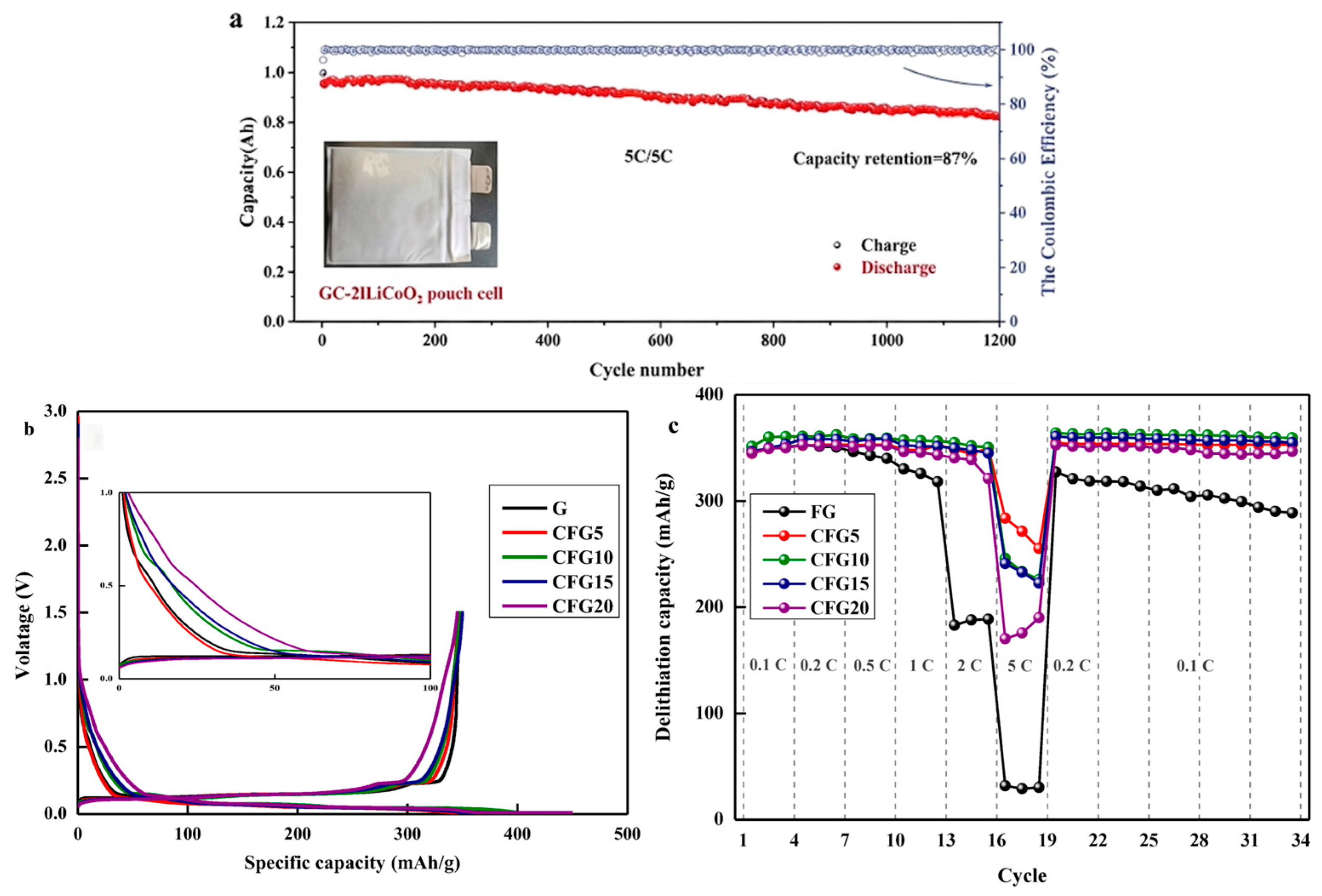
Carbon coating is commonly applied to graphite anodes in lithium-ion batteries (LIBs) to stabilize the graphite surface and enhance interfacial electrochemical performance. The primary advantage lies in the protective function of the carbon layer, which shields graphite from electrolyte attack, limits side reactions, and supports the formation of a stable solid electrolyte interphase (SEI). Consequently, carbon-coated graphite typically demonstrates greater cycling stability, higher reversible capacity, and improved coulombic efficiency [111]. Carbon coatings modify the graphite structure, thereby facilitating lithium-ion transport. For example, aluminum-doped carbon nanocages (CNCs) lower the energy barrier to lithium-ion insertion, thereby enhancing rate capacity and accelerating charging [112]. Adding defects and increasing the spacing between graphite layers with carbon coatings creates channels that facilitate rapid lithium-ion transport. This effect is observed in microcrystalline graphite modified with oxidant intercalators and carbon layers [113]. Chemical vapor deposition (CVD) and the wet coating method are prominent techniques for carbon coating [114]. Xiao et al. [115] applied amorphous carbon onto graphite through the CVD method and reported that when it was assembled with a LiCoO2 cathode pouch cell, it showed 87% of specific capacity after 1200 cycles at a rate of 5 C (Figure 7a), and it needs to be noted that the introduced CVD method ensured the graphite structural stability. Yuan et al. [116] investigated the addition of phenolic resin (PF) and mesophase pitch (MP) into graphite (G) through the wet coating method. MP@G and PF@G showed a smooth morphology rather than pristine graphite. It was observed that 7.8 nm and 8.9 nm thin layers of PF and MP formed on the graphite, which helped reduce defects and formed a stable electrolyte–electrode interphase; a comparative study was conducted. At a current rate of 5 C, PF@G showed a reversible specific capacity of 112.6 mAhg−1, exceeding that of MP@G, which showed a specific capacity of 86.1 mAh g−1. Furthermore, MP@G exhibited a higher initial CE of 89% than PF@G and graphite. Structural damage was observed after 500 cycles at a current density of 5C.
Kim et al. [117] investigated pitch-coated graphite synthesized by adding petroleum pitch to flake graphite, followed by hot pressing and heat treatment at 900 °C. The uniformly coated sample (CFG5) exhibited a more spherical shape and a smoother, more homogeneous surface compared to pristine graphite. In contrast, excessive pitch addition resulted in aggregation and a rough, nonuniform morphology. The uniform-pitch coating reduced the specific surface area and suppressed electrolyte side reactions, thereby improving the initial coulombic efficiency. CFG5 exhibited a higher initial coulombic efficiency (CE) of 84.07% compared to 80.49% for FG. In contrast, excessive pitch addition reduced the initial coulombic efficiency to 80.16%, 78.47%, and 76.88% for CFG10, CFG15, and CFG20, respectively (Figure 7b). CFG5 also demonstrated superior rate performance, achieving capacity retentions of 98.93% at 2 C and 80.58% at 5 C relative to 0.2 C. These values significantly exceed those of pristine graphite, which retained only 51.90% at 2 C and 9.07% at 5 C (Figure 7c).

4.2. Inorganic Coating

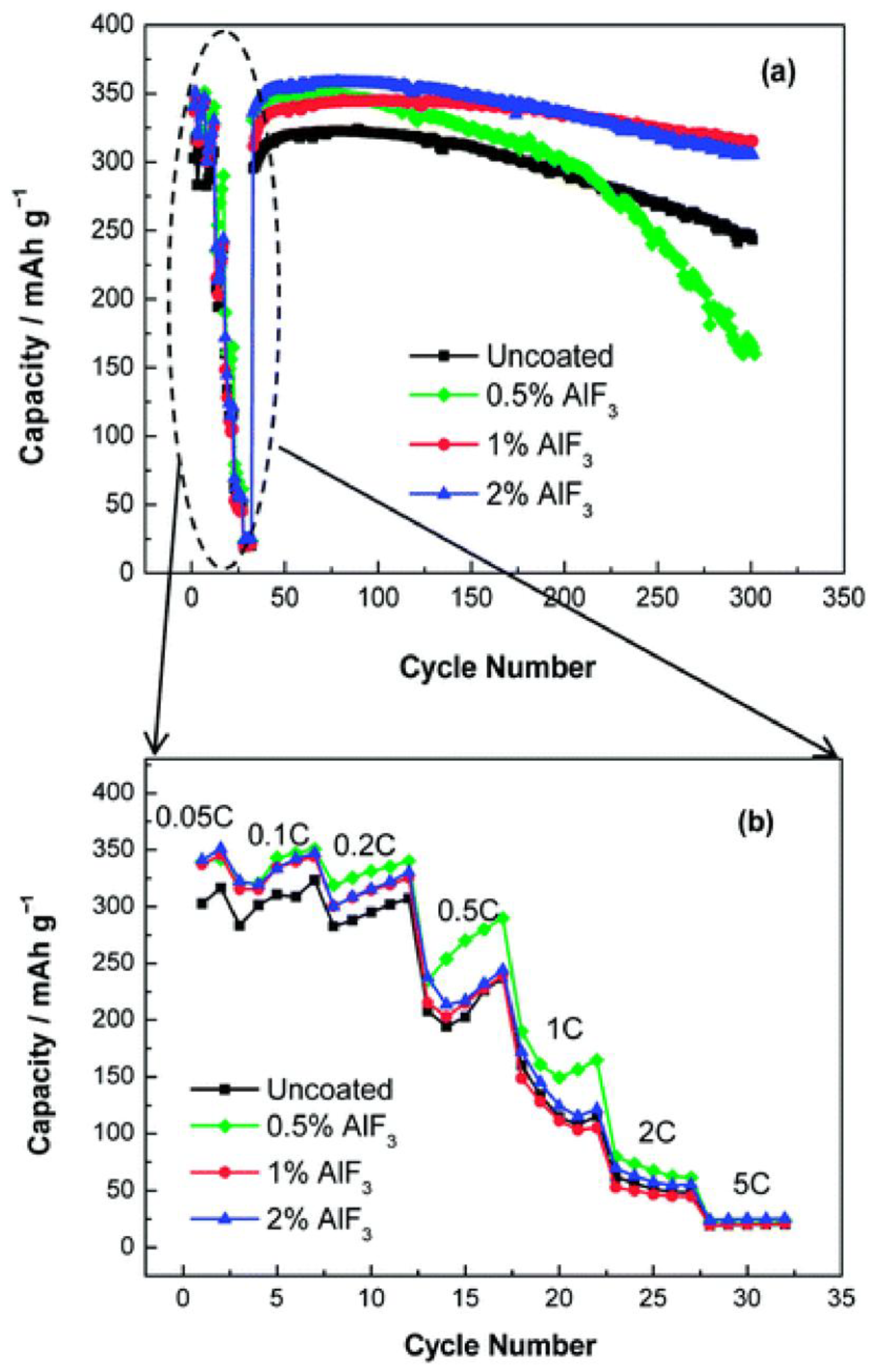
Inorganic coatings provide moderate mechanical strength compared to other coating types. However, they form a stable, durable SEI layer that helps suppress undesirable side reactions. The main challenge is to achieve a uniform coating and a consistent material density on the graphite [22]. A study by Ding et al. [106] demonstrates coating of AlF3 onto a graphite surface using the co-precipitation method, introducing 2 wt% of AlF3. There was no significant change in the bulk structure. The EIS analysis showed that the modified graphite electrode exhibited more consistent cell impedance, whereas fluctuations were observed in the uncoated part. This suggests that a stable SEI formed on the graphite layer. However, the initial capacity of 0.5 wt% AlF3 was higher than that of the uncoated sample, but it rapidly declined after approximately 200 cycles (Figure 8a). This suggests that early rate capability is achieved at lower coating levels and may fail to provide long-term mechanical protection to the graphite (Figure 8b). Yang et al. [118] synthesized a SiO2-modified graphite electrode by coating SiO2 with Tetraethyl Orthosilicate using the sol–gel method, along with heat treatment in an argon atmosphere. The modified graphite exhibited a high initial charge capacity of 366 mAh g−1, surpassing that of natural graphite. It exhibited a capacity retention of 99.55% after 40 cycles, outperforming natural graphite, which retained only 83.04%. The CE was 89.23%, slightly lower than that of natural graphite due to greater lithium-ion loss. In a study by Xu et al. [119], Al2O3 was deposited on graphite via the sol–gel method, yielding a CE of 93.5%.
Additionally, capacity retention was 84.95% after 200 cycles at 1 C. In a study of the solvothermal synthesis of Li3BO3 by Sonomura et al. [120], its coating on graphite powder resulted in notable improvements in the mechanical properties. The Li3BO3-coated sample showed a crystalline layer on the graphite surface and achieved a high crush strength of 56.96 MPa, compared to 21.45 MPa for the bare graphite. This enhancement is attributed to the coated layer’s ability to reduce stress concentration on the graphite surface and minimize anisotropic deformation.

4.3. Polymer Coating

Polymer coatings are promising because they function as an artificial SEI, providing mechanical flexibility and maintaining stable passivation on graphite. The thin films formed on the graphite may modify volume without damaging structural and chemical integrity during cycles [121]. Seo et al. [107] employed polydopamine (PD) on graphite with the wet coating method, where it acts as a protective layer by direct contact with the graphite and electrolyte solution because of its Lewis basicity. The study compared two methods: electrode-scale polydopamine (E-PD), in which PD is coated on the graphite electrode, and powder-scale graphite anode (G-PD), in which PD is directly applied to the graphite powder. The G-PD showed better performance. The G-PD electrode demonstrated strong performance, retaining 84% of its capacity after 300 cycles, indicating a longer lifespan. Furthermore, the G-PD exhibited a lower ohmic resistance of 1.9 Ω compared to the pristine graphite, as the PD layer helps facilitate electron transport. In another study by Guo et al. [122], a novel method was developed by encapsulating polyacrylonitrile in situ on the graphite surface via radiation-initiated polymerization. In the CV analysis, it is noted that the cathodic peaks were drastically reduced in the modified graphite, indicating that there was a substantial reduction in the irreversible capacity loss due to the SEI layer formation and solvated Li+ ion co-intercalation. Heng et al. [123] applied 4-vinyl benzoic acid (4-VBA) on a graphite surface, creating a stable bond on the graphite through a dehydration reaction involving -COOH functional groups. This helped preserve the structural integrity of the graphite anode. The first CE of 4-VBA-coated natural graphite was 95.3%, an improvement over that of natural graphite, due to the reduced electrolyte decomposition. The EIS analysis showed the development of a thinner, more stable SEI layer. Polymer-coated graphite anodes enhance cycling stability, minimize side reactions, and increase battery safety. However, these coatings can reduce initial capacity and complicate manufacturing processes, potentially increasing costs [Vu]. Table 3 depicts the variation in electrochemical performance with different polymer coating materials.

5. Challenges in Coated Graphite Electrodes

5.1. First-Cycle Coulombic Efficiency

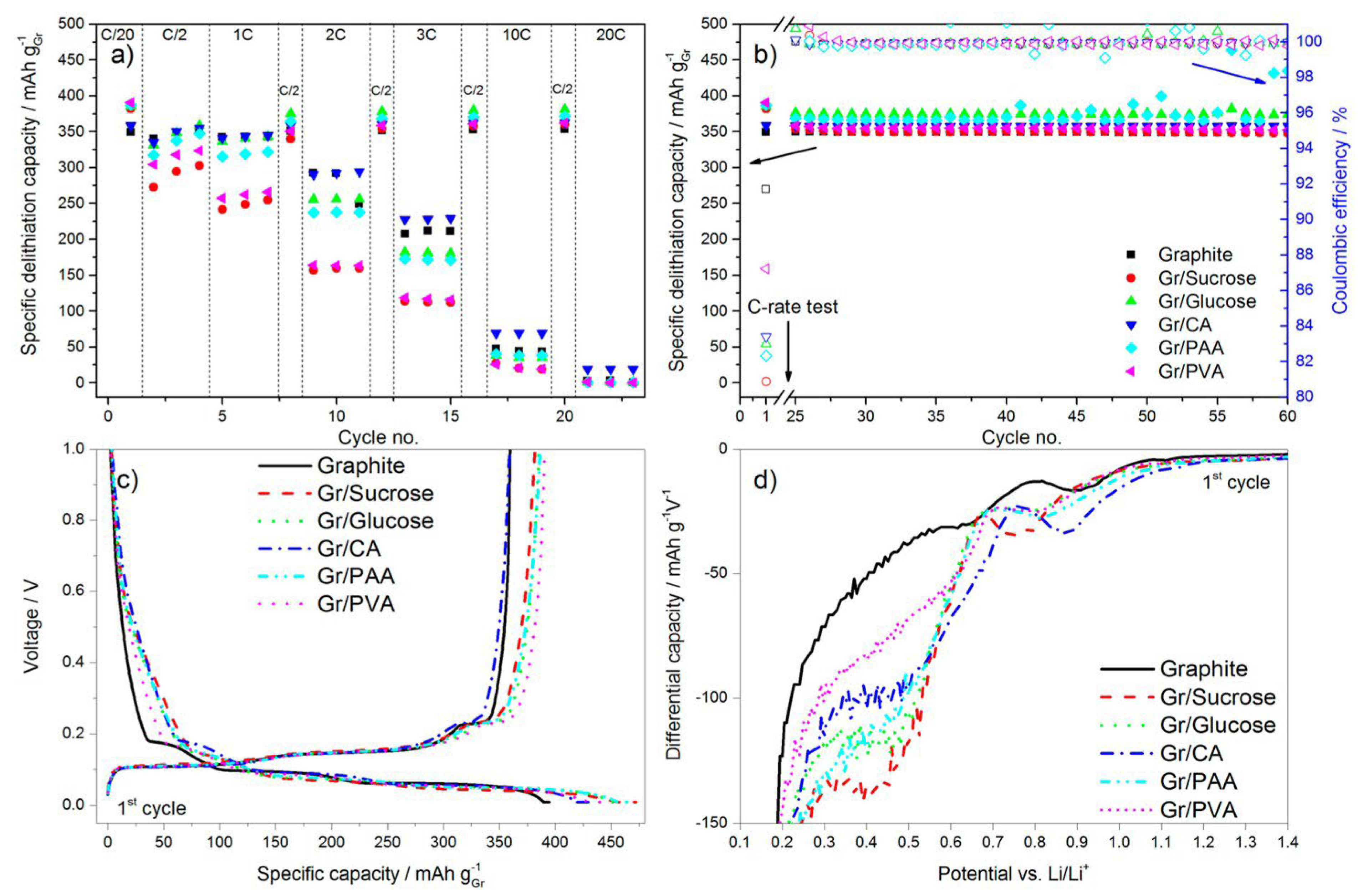
The FCCE is a key indicator of LIB anode performance, as it reflects the reversible intercalation of lithium ions during the initial charge–discharge cycle. Achieving high FCCE is crucial for the energy density, cost efficiency, and cycle life of LIBs. Higher FCCE ensures that a large proportion of lithium ions are available for reversible cycling [130]. The surface coating of the graphite electrode may influence the FCCE. Coating the graphite can increase the number of active sites by altering the surface chemistry and suppressing the active edge sites on the graphite [131]. A study by Sharova et al. [90] highlights that coating carbon onto the graphite reduced FCCE by 3–10% compared to the pristine graphite. This is primarily due to the increased electrode surface area, which, in turn, enhances electrolyte decomposition. Analysis showed that citric acid, as a carbon source for coating from 2 wt% to 5 wt%, improved the FCCE from 83.4% to 88.6% and showed a specific delithiation capacity of 228 mAh g−1 at 3 C, which is higher than the 211 mAh g−1 of uncoated graphite. The voltage profile provides insight into the SEI formation process. Decomposition of FEC occurs below 1.0 V vs. Gr/Li+ and this phenomenon is more pronounced in carbon-coated materials. The electrolyte reduction peak, which typically appears around 0.7 V vs. Gr/Li+ for graphite, shifts to a lower voltage (approximately 0.5 V vs. Gr/Li+) and exhibits greater intensity in carbon-coated samples with larger surface areas. However, this was achieved at a lower rate of capability (Figure 9). Moreover, in a study by Wan et al. [132], the coating thickness of 2.5 µm of carbonaceous mesophase showed an increased coulombic efficiency of 95% due to the reduction in the specific surface area after coating. The cracks in the electrode and the nonuniformity in the coating result in an irregular distribution of lithium ions, which further induces localized lithium plating. The lithium ion tends to deposit on the bare copper surface rather than intercalating into the graphite, leading to irreversible capacity loss [133].

5.2. Potential for New Side Reactions at the Coated Graphite Interface

Coatings on the graphite surface are primarily designed to suppress electrolyte decomposition and form a stable SEI layer. Still, in certain cases, they can undergo reactions with the electrolyte during the electrochemical process. These reactions primarily arise from the decomposition of the electrolyte components, as the anode potential falls below the electrolyte reduction potential during the initial charge cycles [15]. These coating–electrolyte interfaces create a complex environment that adversely affects the cell’s long-term stability. For instance, a coated graphite anode, upon exposure to ethylene carbonate and propylene carbonate, undergoes a reaction that leads to the evolution of ethylene and propylene [134]. LiPF6 salt decomposes in the presence of lithium carbonate in the early stages of SEI, resulting in the evolution of PF5, HF, CO2, POF3, and LiF, which result in the capacity loss and SEI degradation [135]. A high concentration of HF can lead to fluoride intercalation into the graphite structure and, potentially, to the trapping of fluoride ions, thereby altering the performance of the anode material [136].
Meanwhile, PF5 is a strong Lewis acid that can react with inorganic and organic components of the SEI, thereby oxidizing the electrode [137]. Additives such as FEC and VC decomposition may lead to H2 formation, which in turn results in dead lithium that is no longer available for cycling [138]. Lithium plating is a significant side reaction in which lithium ions deposit onto graphite as lithium metal rather than intercalate. This is common during rapid charging or in cold conditions, resulting in major capacity loss and dendrite formation [139,140]. In a study by Xiong et al. [85], at high overpotential, lithium ions were found to reduce directly to metallic lithium on the graphite surface at a voltage plateau of −0.4 V vs. Li/Li+, corresponding to lithium plating. This leads to the inactivation of the graphite intercalation compound and accelerates electrolyte consumption.

6. Comparative Analysis of Coated and Uncoated Graphite Electrodes

6.1. Electrochemical Performance

Coated vs. uncoated graphite significantly influences the electrochemical performance of LIBs. Coated graphite electrodes generally demonstrate better performance in terms of cycling stability than uncoated ones, mainly because of stable SEI formation and the lack of direct contact between the electrolyte and the graphite. Moreover, in uncoated graphite, the electrode–electrolyte interface exhibits higher resistance, which hinders efficient ion transport and charge transfer, resulting in low CE and reversible capacity [141]. Zhao et al. [142] investigated the electrochemical performance of uncoated graphite and graphite with different weight-percent alumina coatings. The 1% alumina coating retained 94.97% of its capacity after 100 cycles, with the ICE increasing from 81.47% to 97.39% in the first cycle.
Meanwhile, the uncoated electrode showed the capacity retention of 91.74% after 100 cycles, with an ICE of 81.47%. In another study by Vu et al. [143], carbon-coated spherical graphite (cSG) showed a cycle stability of 360 mAh g−1 and maintained this level for 450 cycles. In contrast, uncoated graphite exhibited considerable capacity degradation after 100 cycles. It is to be noted that the uncoated graphite showed a rise in interfacial side reaction when compared to the carbon-coated counterpart. Ultrathin metal-coated electrodes have been shown to suppress lithium plating effectively during extremely fast charging, thereby increasing the overpotential for lithium deposition and making it less favorable for plating on the graphite surface. This showed a 9% improvement in capacity retention after 500 fast charge cycles compared to uncoated electrodes [144]. The uncoated electrodes are more susceptible to lithium plating under extreme conditions, when the electrode potential drops below 0 V vs. Li/Li+, making lithium plating thermodynamically favorable [65]. In a study by Elomari et al. [145], the silicon-coated graphite electrode showed a discharge capacity of 248 mAh g−1, which was higher than the 85 mAh g−1 of uncoated graphite at a current rate of 4 C.

6.2. Mechanical Stability

The mechanical and thermal stability of the graphite electrode plays a crucial role in the performance and safety of the LIB. The bare graphite undergoes mechanical degradation during cycling due to volume changes during lithium intercalation. Coated graphite electrodes experience less mechanical degradation compared to their uncoated counterparts, mainly due to reduced volume contraction/expansion during (de)lithiation [146]. Yoshio et al. [147] examined the mechanical stability of graphite electrodes by studying the electrode integrity in propylene carbonate electrolytes. The study finds that bare graphite undergoes exfoliation and significant electrode deterioration as PC is reduced at the surface during the first cycle. Furthermore, the carbon coating via the thermal vapor decomposition (TVD) method maintains particle morphology, reduces irreversible exfoliation, and yields normal intercalation and deintercalation plateaus below approximately 0.2 V vs. Li/Li+ with measurable capacity in PC electrolyte. Coated graphite electrodes typically demonstrate greater mechanical strength than uncoated electrodes. For instance, the bending strengths of oxidation-resistant SiC/C compositionally graded graphite materials and chemical vapor deposition (CVD) SiC-coated graphite are approximately double those of uncoated graphite. This enhancement results from the intrinsic strength of the CVD SiC layer and the smooth surface it imparts [148]. Amartya et al. [149] studied the stress generated in the graphite electrode during the first cycles. It was reported that the uncoated graphite developed a significant compressive stress during the initial lithiation, and this stress was largely unrecovered during subsequent delithiation. When the voltage is held constant at 0.4 V vs. Gr/Li+, the compressive stress continues to increase despite a decrease in current. This indicates that SEI growth persists and is likely responsible for the irreversible stress. In contrast, when graphite is coated with 0.5 nm of Al2O3, the stress induced at 0.4V vs. Gr/Li+ is suppressed, whereas a noticeable stress is observed at 0.25 V vs. Gr/Li+, which corresponds to Li intercalation.

7. Challenges of Graphite Anodes Beyond Lithium-Ion Batteries

Graphite anodes face several electrochemical challenges when used beyond LIB systems. The principal challenges in sodium-ion batteries (SIBs) arise from the larger ionic radius of sodium ions, which impedes intercalation and diminishes anode electrochemical performance. The larger ionic radius of sodium ions (1.07 Å) relative to lithium ions (0.76 Å) hinders their intercalation into the graphite structure. This size inequality results in low capacity and thermodynamically unfavorable conditions for sodium ion intercalation in graphite [150]. Similarly to Li-ion batteries, the formation of a stable SEI is essential for the optimal performance of SIBs. However, graphite anodes in SIBs face challenges with SEI formation, leading to increased electrolyte consumption and diminished capacity [151]. Graphite anodes in SIBs typically demonstrate lower capacities and reduced cycling stability compared to LIBs. However, Wen et al. [152] synthesized expanded graphite that exhibited an interlayer spacing of 4.3 Å, allowing effective reversible insertion and extraction of Na ions, which substantially increases its capacity as an anode material for SIBs relative to pristine graphite. Expanded graphite exhibits a high reversible capacity of 284 mAh g−1 at a current density of 20 mA g−1, maintains 184 mAh g−1 at 100 mA g−1, and retains 73.92% of its capacity after 2000 cycles, in which the capacity is mainly limited by ion diffusion. Similarly, the primary challenge for graphite anodes in potassium-ion batteries (KIBs) is the large ionic radius of potassium ions, which leads to volume expansion, slow reaction kinetics, and poor cyclic stability. The larger ionic radius of K+ relative to Li+ and Na+ leads to considerable volume expansion during the potassiation process. This expansion induces structural instability and mechanical degradation in the graphite anode, thereby reducing cycle stability and shortening battery lifespan [153,154]. Wang et al. [154], identified that the repeated lattice expansion and contraction of graphite during potassiation and depotassiation are a primary cause of volume expansion and structural instability in KIBs and introduced amorphous ordered mesoporous carbon (OMC) anodes. The unique layered structure and increased interlayer spacing in OMC facilitate the intercalation of additional potassium ions, thereby enhancing battery performance. The OMC anode exhibits high capacity, excellent rate capability, and extended cycle life. Specifically, it achieves a potassiation capacity of 257.4 mAh g−1 over 100 cycles at a low current density (0.05 A g−1). It maintains a reversible storage capacity of 146.5 mAh g−1 over 1000 cycles at a high current density (1.0 A g−1). The average interlayer spacing of amorphous OMC measures approximately 5.21 Å, significantly exceeding the 3.35 Å spacing observed in graphite. This increased spacing is essential for accommodating the larger potassium ions. In contrast, graphite undergoes a 59.7% increase in interlayer distance at full potassiation, which can result in the collapse of the interlayer structure after repeated cycling. The structure of OMC, however, exhibits greater flexibility, more effectively accommodating volume changes and preserving structural integrity.

8. Conclusions

Graphite remains the most common anode material for Li-ion batteries, but its performance remains limited by interface-driven failure mechanisms rather than bulk intercalation. In uncoated graphite, the formation and evolution of the SEI consume cyclable lithium and increase impedance, which raises polarization during fast charging and at low temperatures. This increases the risk of lithium plating and dendrite formation, reducing cell life and posing safety risks such as internal short circuits and lower thermal stability under stress or aging. Significant performance gains are possible without coatings by engineering the electrolyte or solvation chemistry to create a thinner, more conductive interphase and reduce interfacial polarization. This approach suppresses lithium plating and improves fast-charging durability. Coated graphite offers an additional mitigation strategy. Carbon, inorganic, and polymer coatings can act as artificial SEI layers, reducing direct electrolyte contact, stabilizing interphase chemistry, and improving rate capability and mechanical strength. Studies show that coatings, such as alumina, can increase ICE and capacity retention compared to uncoated graphite, highlighting the importance of interfacial stabilization. However, coatings are not always beneficial. They can lower first-cycle efficiency by increasing surface area and promoting electrolyte decomposition. Nonuniform coatings may cause current hotspots and increase plating risk. Coated interfaces can also introduce new side reactions, emphasizing the need for compatible coating and electrolyte chemistries and careful optimization of coating thickness and coverage. In sodium-ion and potassium-ion systems, graphite faces additional challenges due to larger ion sizes, less favorable intercalation, and greater volume changes.
Therefore, future research on graphite anodes is expected to prioritize the integrated design of electrolytes and coatings to achieve improved interphase composition and transport. Additional priorities include the development of scalable ultrathin coatings with tunable ionic and electronic pathways that maintain strong adhesion during electrode expansion and contraction, as well as the precise measurement and management of interfacial heterogeneities, such as those between edge and basal planes, between particles, and across the electrode, which influence plating behavior. Advancements in these areas will enable graphite to overcome current limitations and facilitate safe, durable fast charging in next-generation lithium-ion cells and in emerging sodium and potassium battery chemistries.

Author Contributions

K.N. (Keerthan Nagendra) wrote the review manuscript and conceptualized and produced the graphics. K.N. (Koorosh Nikgoftar) wrote and edited the review manuscript. A.K.M.R.R. was responsible for graphic design, review and editing. J.R. was responsible for review and editing. J.I.G.D. was responsible for review and editing. T.M.G.S. was responsible for review and editing. K.Z. supervised, conceptualized, and designed the structure of the review, collected the papers related to the topic of the evaluation, and completed the language corrections, with all authors contributing equally. All authors have read and agreed to the published version of the manuscript.

Funding

The authors would like to thank Nouveau Monde Graphite (NMG) in Quebec, Canada, Alliance-CNRC (Canadian government), and Prima (Quebec government) for their financial support.

Data Availability Statement

No new data were created or analyzed in this study.

Conflicts of Interest

The authors declare that they have no conflicts of interest.

Abbreviations

4-VBA4-vinyl benzoic acidID/IGRaman D-band to G-band intensity ratio
CECoulombic efficiencyISC Internal short circuit
CVCyclic voltammetryKIB Potassium-ion battery
CVDChemical vapor depositionLHCELocalized high-concentration electrolyte
DECDiethyl carbonate LIB(s)Lithium-ion battery(s)
DMCDimethyl carbonate LiBF4Lithium tetrafluoroborate
DOL1,3-dioxolane LiFSILithium bis-fluor sulfonyl imide
PFPNEthoxy (pentafluro) cyclotriphosphazeneLiPF6Lithium hexafluorophosphate
LHCELocalized highly concentrated electrolyteLLILoss of lithium inventory
[PP13] [FSI]N-methyl-N-propyl piperidinium bis(flurosulphonyl)imidePFMpoly(9,9-dioctylfluorene-co-fluorenone-co-methylbenzoic ester)
[HFE]1,1,2,2-tetrafluroethyl-2,2,3,3-tetrafluropropyletherLPDCLithium propylene dicarbonate
CPMECyclopentyl methyl etherMPMesophase pitch
TTEE1,1,2,2, tetrafluropropyl-2,2,2 trifluroethyl etherMP@GMesophase-pitch-coated graphite
EISElectrochemical impedance spectroscopyOMCamorphous ordered mesoporous carbon
EMCEthyl methyl carbonate (electrolyte solvent)PANPolyacrylonitrile
EV Electric vehiclePCPropylene carbonate
FANFluor acetonitrile (as written in the document)PDPolydopamine
FECFluoroethylene carbonatePFPhenolic resin
GGraphitePF@GPhenolic-resin-coated graphite
HEV(s)Hybrid electric vehicle(s)PHEVPlug-in hybrid electric vehicle
ICEInitial coulombic efficiencyPVAPolyvinyl alcohol
SOCState of chargePVDFPolyvinylidene fluoride
TVDThermal vapor decompositionSEISolid electrolyte interphase
VCVinylene carbonateSIB(s)Sodium-ion battery(s)
XFCExtreme fast chargingSiCSilicon carbide
XPSX-ray photoelectron spectroscopy

References

  1. Xu, X.; Han, X.; Lu, L.; Wang, F.; Yang, M.; Liu, X.; Wu, Y.; Tang, S.; Hou, Y.; Hou, J.; et al. Challenges and Opportunities toward Long-Life Lithium-Ion Batteries. J. Power Sources 2024, 603, 234445. [Google Scholar] [CrossRef]
  2. Zheng, Y.; Che, Y.; Hu, X.; Sui, X.; Stroe, D.-I.; Teodorescu, R. Thermal State Monitoring of Lithium-Ion Batteries: Progress, Challenges, and Opportunities. Prog. Energy Combust. Sci. 2024, 100, 101120. [Google Scholar] [CrossRef]
  3. Aghili Mehrizi, A.; Yeganehdoust, F.; Madikere Raghunatha Reddy, A.K.; Zaghib, K. Challenges and Issues Facing Ultrafast-Charging Lithium-Ion Batteries. Batteries 2025, 11, 209. [Google Scholar] [CrossRef]
  4. Nikgoftar, K.; Madikere Raghunatha Reddy, A.K.; Reddy, M.V.; Zaghib, K. Carbonaceous Materials as Anodes for Lithium-Ion and Sodium-Ion Batteries. Batteries 2025, 11, 123. [Google Scholar] [CrossRef]
  5. Dorri, M.; MR, A.K.; Zaghib, K. In Operando and in Situ Characterization Tools for Advanced Rechargeable Batteries: Effects of Electrode Origin and Electrolyte. J. Power Sources 2025, 658, 238188. [Google Scholar] [CrossRef]
  6. Tarascon, J.-M.; Armand, M. Issues and Challenges Facing Rechargeable Lithium Batteries. Nature 2001, 414, 359–367. [Google Scholar] [CrossRef]
  7. Nitta, N.; Wu, F.; Lee, J.T.; Yushin, G. Li-Ion Battery Materials: Present and Future. Mater. Today 2015, 18, 252–264. [Google Scholar] [CrossRef]
  8. Adams, R.A.; Varma, A.; Pol, V.G. Carbon Anodes for Nonaqueous Alkali Metal-Ion Batteries and Their Thermal Safety Aspects. Adv. Energy Mater. 2019, 9, 1900550. [Google Scholar] [CrossRef]
  9. Xie, J.; Lu, Y.-C. A Retrospective on Lithium-Ion Batteries. Nat. Commun. 2020, 11, 2499. [Google Scholar] [CrossRef]
  10. Goodenough, J.B.; Park, K.-S. The Li-Ion Rechargeable Battery: A Perspective. J. Am. Chem. Soc. 2013, 135, 1167–1176. [Google Scholar] [CrossRef]
  11. Asenbauer, J.; Eisenmann, T.; Kuenzel, M.; Kazzazi, A.; Chen, Z.; Bresser, D. The Success Story of Graphite as a Lithium-Ion Anode Material—Fundamentals, Remaining Challenges, and Recent Developments Including Silicon (Oxide) Composites. Sustain. Energy Fuels 2020, 4, 5387–5416. [Google Scholar] [CrossRef]
  12. Sung, J.H.; Kim, T.; Kim, S.; Hasan, F.; Mohanty, S.K.; Srinivasa, M.K.; Reddy, S.C.; Yoo, H.D. Li3PO4-Coated Graphite Anode for Thermo-Electrochemically Stable Lithium-Ion Batteries. Energies 2023, 16, 6141. [Google Scholar] [CrossRef]
  13. Yang, S.; Yamamoto, K.; Mei, X.; Sakuda, A.; Uchiyama, T.; Watanabe, T.; Takami, T.; Hayashi, A.; Tatsumisago, M.; Uchimoto, Y. High Rate Capability from a Graphite Anode through Surface Modification with Lithium Iodide for All-Solid-State Batteries. ACS Appl. Energy Mater. 2022, 5, 667–673. [Google Scholar] [CrossRef]
  14. Cai, W.; Yan, C.; Yao, Y.; Xu, L.; Chen, X.; Huang, J.; Zhang, Q. The Boundary of Lithium Plating in Graphite Electrode for Safe Lithium-Ion Batteries. Angew. Chem. Int. Ed. 2021, 60, 13007–13012. [Google Scholar] [CrossRef]
  15. An, S.J.; Li, J.; Daniel, C.; Mohanty, D.; Nagpure, S.; Wood, D.L. The State of Understanding of the Lithium-Ion-Battery Graphite Solid Electrolyte Interphase (SEI) and Its Relationship to Formation Cycling. Carbon 2016, 105, 52–76. [Google Scholar] [CrossRef]
  16. Cresce, A.V.; Russell, S.M.; Baker, D.R.; Gaskell, K.J.; Xu, K. In Situ and Quantitative Characterization of Solid Electrolyte Interphases. Nano Lett. 2014, 14, 1405–1412. [Google Scholar] [CrossRef]
  17. Dinkelacker, F.; Marzak, P.; Yun, J.; Liang, Y.; Bandarenka, A.S. Multistage Mechanism of Lithium Intercalation into Graphite Anodes in the Presence of the Solid Electrolyte Interface. ACS Appl. Mater. Interfaces 2018, 10, 14063–14069. [Google Scholar] [CrossRef]
  18. Striebel, K.A.; Sierra, A.; Shim, J.; Wang, C.-W.; Sastry, A.M. The Effect of Compression on Natural Graphite Anode Performance and Matrix Conductivity. J. Power Sources 2004, 134, 241–251. [Google Scholar] [CrossRef]
  19. Wang, Y.; Ji, Y.; Yin, Z.; Sheng, T.; Cao, A.; Zhao, W.; Huang, Y.; Li, J.; Pan, F.; Yang, L. Tuning Rate-Limiting Factors for Graphite Anodes in Fast-Charging Li-Ion Batteries. Adv. Funct. Mater. 2024, 34, 2401515. [Google Scholar] [CrossRef]
  20. Yang, Z.; Tanim, T.R.; Liu, H.; Bloom, I.; Dufek, E.J.; Key, B.; Ingram, B.J. Quantitative Analysis of Origin of Lithium Inventory Loss and Interface Evolution over Extended Fast Charge Aging in Li Ion Batteries. ACS Appl. Mater. Interfaces 2023, 15, 37410–37421. [Google Scholar] [CrossRef] [PubMed]
  21. Hardwick, L.J.; Marcinek, M.; Beer, L.; Kerr, J.B.; Kostecki, R. An Investigation of the Effect of Graphite Degradation on Irreversible Capacity in Lithium-Ion Cells. J. Electrochem. Soc. 2008, 155, A442–A447. [Google Scholar] [CrossRef]
  22. Zhu, X.; Cao, B.; Yan, C.; Tang, C.; Chen, A.; Zhang, Q. Advances in Coating Strategies for Graphite Anodes in Lithium-Ion Batteries. Acta Phys.-Chim. Sin. 2025, 41, 100096. [Google Scholar] [CrossRef]
  23. Konz, Z.M.; Wirtz, B.M.; Verma, A.; Huang, T.-Y.; Bergstrom, H.K.; Crafton, M.J.; Brown, D.E.; McShane, E.J.; Colclasure, A.M.; McCloskey, B.D. High-Throughput Li Plating Quantification for Fast-Charging Battery Design. Nat. Energy 2023, 8, 450–461. [Google Scholar] [CrossRef]
  24. Peng, C.; Bhandari, A.; Dziedzic, J.; Owen, J.R.; Skylaris, C.-K.; Kramer, D. Mechanism of Li Nucleation at Graphite Anodes and Mitigation Strategies. J. Mater. Chem. A 2021, 9, 16798–16804. [Google Scholar] [CrossRef]
  25. Lee, H.; An, H.; Chang, H.; Lee, M.; Park, S.; Lee, S.; Kang, J.; Byon, S.; Koo, B.; Lee, H.; et al. Boosting Interfacial Kinetics in Extremely Fast Rechargeable Li-Ion Batteries with Linear Carbonate-Based, LiPF6-Concentrated Electrolyte. Energy Storage Mater. 2023, 63, 102995. [Google Scholar] [CrossRef]
  26. Kazyak, E.; Chen, K.; Chen, Y.; Cho, T.H.; Dasgupta, N.P. Enabling 4C Fast Charging of Lithium-Ion Batteries by Coating Graphite with a Solid-State Electrolyte. Adv. Energy Mater. 2022, 12, 2102618. [Google Scholar] [CrossRef]
  27. Zhong, M.; Bai, M.; Shen, W.; Zhang, J.; Guo, S. Fluorine-Terminated Self-Assembled Monolayers Grafted Graphite Anode Inducing a LiF-Dominated SEI Inorganic Layer for Fast-Charging Lithium-Ion Batteries. ACS Appl. Mater. Interfaces 2024, 16, 5813–5822. [Google Scholar] [CrossRef]
  28. Shen, W.; Ding, H.; Zhang, J.; Zhong, M.; Guo, S. Effects of Pre-Electroplated Metal or/and Graphene on the Initial Coulombic Efficiency of Graphite Anode. ChemElectroChem 2021, 8, 3651–3657. [Google Scholar] [CrossRef]
  29. Liu, X.; Yin, L.; Ren, D.; Wang, L.; Ren, Y.; Xu, W.; Lapidus, S.; Wang, H.; He, X.; Chen, Z.; et al. In Situ Observation of Thermal-Driven Degradation and Safety Concerns of Lithiated Graphite Anode. Nat. Commun. 2021, 12, 4235. [Google Scholar] [CrossRef]
  30. Liu, Q.Q.; Petibon, R.; Du, C.Y.; Dahn, J.R. Effects of Electrolyte Additives and Solvents on Unwanted Lithium Plating in Lithium-Ion Cells. J. Electrochem. Soc. 2017, 164, A1173–A1183. [Google Scholar] [CrossRef]
  31. Mancini, M.; Martin, J.; Ruggeri, I.; Drewett, N.; Axmann, P.; Wohlfahrt-Mehrens, M. Enabling Fast-Charging Lithium-Ion Battery Anodes: Influence of Spheroidization on Natural Graphite. Batter. Supercaps 2022, 5, e202200109. [Google Scholar] [CrossRef]
  32. He, L.; Wei, S.; Zhang, X.; Wang, S.; Xia, Y.; Ni, Z.; Li, C.; Dong, W.; Shen, D.; Yang, S. Research Progress on High-Rate Graphite Anode Materials for Lithium-Ion Batteries. J. Energy Storage 2025, 111, 115426. [Google Scholar] [CrossRef]
  33. Zhao, W.; Zhao, C.; Wu, H.; Li, L.; Zhang, C. Progress, Challenge and Perspective of Graphite-Based Anode Materials for Lithium Batteries: A Review. J. Energy Storage 2024, 81, 110409. [Google Scholar] [CrossRef]
  34. Enoki, T.; Endo, M.; Suzuki, M. Electronic Structures. In Graphite Intercalation Compounds and Applications; Oxford University Press: Oxford, UK, 2003; ISBN 978-0-19-512827-7. [Google Scholar]
  35. Howe, J.P. Properties of Graphite. J. Am. Ceram. Soc. 1952, 35, 275–283. [Google Scholar] [CrossRef]
  36. Krishnan, K.S.; Ganguli, N. Large Anisotropy of the Electrical Conductivity of Graphite. Nature 1939, 144, 667. [Google Scholar] [CrossRef]
  37. Yamamoto, S.; Sakakibara, R.; Shima, S.; Matsuura, S.; Yajima, T.; Motoyama, M.; Norimatsu, W.; Kimura, Y.; Amezawa, K.; Iriyama, Y. Electrochemical Lithium-Ion Insertion/Extraction Reactions of Multilayered Graphene with Random Twist Angles. Chem. Commun. 2024, 60, 14790–14793. [Google Scholar] [CrossRef]
  38. Rustam, S.; Intan, N.N.; Pfaendtner, J. Effect of Graphitic Anode Surface Functionalization on the Structure and Dynamics of Electrolytes at the Interface. J. Chem. Phys. 2021, 155, 134702. [Google Scholar] [CrossRef]
  39. Velický, M.; Toth, P.S.; Woods, C.R.; Novoselov, K.S.; Dryfe, R.A. Electrochemistry of the Basal Plane versus Edge Plane of Graphite Revisited. J. Phys. Chem. C 2019, 123, 11677–11685. [Google Scholar] [CrossRef]
  40. Li, C.; Deng, Y.; Wang, K.; Li, S.; Meng, X.; Chen, M.; Liao, Y.; Xing, L.; Xu, M.Q.; Li, W. Insight into the Enforced Stability of the Solid Electrolyte Interphase on the Graphite Anode by Prelithiation. J. Phys. Chem. Lett. 2024, 15, 9105–9112. [Google Scholar] [CrossRef] [PubMed]
  41. Rodrigues, M.-T.F.; Sayed, F.N.; Gullapalli, H.; Ajayan, P.M. High-Temperature Solid Electrolyte Interphases (SEI) in Graphite Electrodes. J. Power Sources 2018, 381, 107–115. [Google Scholar] [CrossRef]
  42. Khan, M.A.; Crapnell, R.D.; Bernalte, E.; Riehl, B.L.; Rowley-Neale, S.J.; Banks, C.E. Exploring the Use of Different Carbon Materials Within Additive Manufactured Electrodes: The Sensing of Carbendazim. Electroanalysis 2025, 37, e70016. [Google Scholar] [CrossRef]
  43. Angarita-Gomez, S.; Balbuena, P.B. Lithium-Ion Transport through Complex Interphases in Lithium Metal Batteries. ACS Appl. Mater. Interfaces 2022, 14, 56758–56766. [Google Scholar] [CrossRef] [PubMed]
  44. Gialampouki, M.A.; Hashemi, J.; Peterson, A.A. The Electrochemical Mechanisms of Solid–Electrolyte Interphase Formation in Lithium-Based Batteries. J. Phys. Chem. C 2019, 123, 20084–20092. [Google Scholar] [CrossRef]
  45. Bai, Z.; Gao, X.; Liu, Z.; Chao, D.; Wang, Y.; Yin, J.; Jiang, C.; Yang, W.; Ma, J.; Chen, Y. Direct Observation of the Anisotropic Transport Behavior of Li+ in Graphite Anodes and Thermal Runaway Induced by the Interlayer Polarization. ACS Appl. Mater. Interfaces 2023, 15, 23623–23630. [Google Scholar] [CrossRef]
  46. Shi, M.; Tai, Z.; Li, N.; Zou, K.; Chen, Y.; Sun, J.; Liu, Y. Spherical Graphite Produced from Waste Semi-Coke with Enhanced Properties as an Anode Material for Li-Ion Batteries. Sustain. Energy Fuels 2019, 3, 3116–3127. [Google Scholar] [CrossRef]
  47. Ren, Z.; Shen, D.; Ji, Y.; Wei, S.; Ma, Y.; Li, N.; Yang, Y.; Dong, W.; Tang, S. Exploring Lithium-Ion Diffusion and Electronic Properties in Defective Graphite via Molecular Dynamics and Density Functional Theory. J. Chem. Phys. 2025, 163, 064704. [Google Scholar] [CrossRef]
  48. Andersen, H.L.; Djuandhi, L.; Mittal, U.; Sharma, N. Strategies for the Analysis of Graphite Electrode Function. Adv. Energy Mater. 2021, 11, 2102693. [Google Scholar] [CrossRef]
  49. Zhao, Y.; Wang, Y.; Liang, R.; Zhu, G.; Xiong, W.; Zheng, H. Building Polymeric Framework Layer for Stable Solid Electrolyte Interphase on Natural Graphite Anode. Molecules 2022, 27, 7827. [Google Scholar] [CrossRef]
  50. Zhang, H.; Yang, Y.; Ren, D.; Wang, L.; He, X. Graphite as Anode Materials: Fundamental Mechanism, Recent Progress and Advances. Energy Storage Mater. 2021, 36, 147–170. [Google Scholar] [CrossRef]
  51. Rahman, M.M.; Dixit, M.; Amin, R.; Abouimrane, A.; Kweon, C.M.; Belharouak, I. Distinct Dynamics of Lithium Intercalation and Plating on Graphite Anode for Li-Ion Batteries in eVTOL Applications. Adv. Energy Mater. 2025, 15, e02538. [Google Scholar] [CrossRef]
  52. Fujimoto, H.; Takagi, S.; Shimoda, K.; Kiuchi, H.; Okazaki, K.; Murata, T.; Ogumi, Z.; Abe, T. Analysis of Intercalation/De-Intercalation of Li Ions into/from Graphite at 0 °C via Operando Synchrotron X-Ray Diffraction. J. Electrochem. Soc. 2021, 168, 090515. [Google Scholar] [CrossRef]
  53. Song, H.-Y.; Fukutsuka, T.; Miyazaki, K.; Abe, T. Solid Electrolyte Interphase Formation in Propylene Carbonate-Based Electrolyte Solutions for Lithium-Ion Batteries Based on the Lewis Basicity of the Co-Solvent and Counter Anion. J. Appl. Electrochem. 2016, 46, 1099–1107. [Google Scholar] [CrossRef]
  54. Liu, Q.; Li, S.; Wang, S.; Zhang, X.; Zhou, S.; Bai, Y.; Zheng, J.; Lu, X. Kinetically Determined Phase Transition from Stage II (LiC12) to Stage I (LiC6) in a Graphite Anode for Li-Ion Batteries. J. Phys. Chem. Lett. 2018, 9, 5567–5573. [Google Scholar] [CrossRef]
  55. Cordoba, A.; Chandesris, M.; Plapp, M. Intercalation Pathway in Graphite Particles Analyzed with a Multi-Layer Phase Field Model. ECS Meet. Abstr. 2023, MA2023-02, 889. [Google Scholar] [CrossRef]
  56. Peng, C.; Mercer, M.P.; Skylaris, C.-K.; Kramer, D. Lithium Intercalation Edge Effects and Doping Implications for Graphite Anodes. J. Mater. Chem. A 2020, 8, 7947–7955. [Google Scholar] [CrossRef]
  57. Zaghib, K.; Brochu, F.; Guerfi, A.; Kinoshita, K. Effect of Particle Size on Lithium Intercalation Rates in Natural Graphite. J. Power Sources 2001, 103, 140–146. [Google Scholar] [CrossRef]
  58. Chang, Y.-C.; Jong, J.-H.; Fey, G.T.-K. Kinetic Characterization of the Electrochemical Intercalation of Lithium Ions into Graphite Electrodes. J. Electrochem. Soc. 2000, 147, 2033. [Google Scholar] [CrossRef]
  59. Shulyak, V.A.; Morozov, N.S.; Makhina, V.S.; Klyukova, K.E.; Gracheva, A.V.; Chebotarev, S.N.; Avdeev, V.V. Intercalation of Large Flake Graphite with Fuming Nitric Acid. C 2024, 10, 108. [Google Scholar] [CrossRef]
  60. Nie, M.; Chalasani, D.; Abraham, D.P.; Chen, Y.; Bose, A.; Lucht, B.L. Lithium Ion Battery Graphite Solid Electrolyte Interphase Revealed by Microscopy and Spectroscopy. J. Phys. Chem. C 2013, 117, 1257–1267. [Google Scholar] [CrossRef]
  61. Lee, J.; Jeong, J.-Y.; Ha, J.; Kim, Y.-T.; Choi, J. Understanding Solid Electrolyte Interface Formation on Graphite and Silicon Anodes in Lithium-Ion Batteries: Exploring the Role of Fluoroethylene Carbonate. Electrochem. Commun. 2024, 163, 107708. [Google Scholar] [CrossRef]
  62. Kim, C.-G.; Jekal, S.; Kim, J.; Kim, H.-Y.; Park, G.-S.; Ra, Y.-H.; Noh, J.; Yoon, C.-M. Ester-Based Electrolytes for Graphite Solid Electrolyte Interface Layer Stabilization and Low-Temperature Performance in Lithium-Ion Batteries. Carbon Lett. 2024, 34, 2113–2125. [Google Scholar] [CrossRef]
  63. Liu, H.; Wang, L.; Cao, Y.; Ma, Y.; Wang, S.; Wang, J.; Liu, H. Rational Design of Electrolyte Additives for Improved Solid Electrolyte Interphase Formation on Graphite Anodes: A Study of 1,3,6-Hexanetrinitrile. Energies 2024, 17, 3331. [Google Scholar] [CrossRef]
  64. Dong, H.; Wang, J.; Wang, P.; Ding, H.; Song, R.; Zhang, N.-S.; Zhao, D.-N.; Zhang, L.-J.; Li, S.-Y. Effect of Temperature on Formation and Evolution of Solid Electrolyte Interphase on Si@Graphite@C Anodes. J. Energy Chem. 2022, 64, 190–200. [Google Scholar] [CrossRef]
  65. Sun, C.; Ji, X.; Weng, S.; Li, R.; Huang, X.; Zhu, C.; Xiao, X.; Deng, T.; Fan, L.; Chen, L.; et al. 50C Fast-Charge Li-Ion Batteries Using a Graphite Anode. Adv. Mater. 2022, 34, 2206020. [Google Scholar] [CrossRef]
  66. Hernández, G.; Naylor, A.J.; Chien, Y.C.; Brandell, D.; Mindemark, J.; Edström, K. Elimination of Fluorination: The Influence of Fluorine-Free Electrolytes on the Performance of LiNi1/3Mn1/3Co1/3O2/Silicon–Graphite Li-Ion Battery Cells. ACS Sustain. Chem. Eng. 2020, 8, 10041–10052. Available online: https://pubs-acs-org.lib-ezproxy.concordia.ca/doi/10.1021/acssuschemeng.0c01733 (accessed on 31 March 2026). [CrossRef]
  67. Kong, X.; Zhou, R.; Wang, J.; Zhao, J. An Effective Electrolyte Strategy to Improve the High-Voltage Performance of LiCoO2 Cathode Materials. ACS Appl. Energy Mater. 2019, 2, 4683–4691. [Google Scholar] [CrossRef]
  68. Xia, D.; Kamphaus, E.P.; Hu, A.; Hwang, S.; Tao, L.; Sainio, S.; Nordlund, D.; Fu, Y.; Huang, H.; Cheng, L.; et al. Design Criteria of Dilute Ether Electrolytes toward Reversible and Fast Intercalation Chemistry of Graphite Anode in Li-Ion Batteries. ACS Energy Lett. 2023, 8, 1379–1389. [Google Scholar] [CrossRef]
  69. Long, J.; Huang, J.; Miao, Y.; Huang, H.; Chen, X.; Wu, J.; Li, X.; Chen, Y. A Multi-Functional Electrolyte Additive for Fast-Charging and Flame-Retardant Lithium-Ion Batteries. J. Mater. Chem. A 2024, 12, 17306–17314. [Google Scholar] [CrossRef]
  70. Wang, Z.; Zhang, H.; Han, R.; Xu, J.; Pan, A.; Zhang, F.; Huang, D.; Wei, Y.; Wang, L.; Song, H.; et al. Establish an Advanced Electrolyte/Graphite Interphase by an Ionic Liquid-Based Localized Highly Concentrated Electrolyte for Low-Temperature and Rapid-Charging Li-Ion Batteries. ACS Sustain. Chem. Eng. 2022, 10, 12023–12029. [Google Scholar] [CrossRef]
  71. Wang, Z.; Han, R.; Huang, D.; Wei, Y.; Song, H.; Liu, Y.; Xue, J.; Zhang, H.; Zhang, F.; Liu, L.; et al. Co-Intercalation-Free Ether-Based Weakly Solvating Electrolytes Enable Fast-Charging and Wide-Temperature Lithium-Ion Batteries. ACS Nano 2023, 17, 18103–18113. [Google Scholar] [CrossRef]
  72. Ober, S.; Manthiram, A. Design of Localized High Concentration Electrolytes for Fast-Charging Lithium-Ion Batteries. Small 2024, 20, 2405731. [Google Scholar] [CrossRef]
  73. Xia, D.; Jeong, H.; Hou, D.; Tao, L.; Li, T.; Knight, K.; Hu, A.; Kamphaus, E.P.; Nordlund, D.; Sainio, S.; et al. Self-Terminating, Heterogeneous Solid–Electrolyte Interphase Enables Reversible Li–Ether Cointercalation in Graphite Anodes. Proc. Natl. Acad. Sci. USA 2024, 121, e2313096121. [Google Scholar] [CrossRef]
  74. Duncan, H.; Salem, N.; Abu-Lebdeh, Y. Electrolyte Formulations Based on Dinitrile Solvents for High Voltage Li-Ion Batteries. J. Electrochem. Soc. 2013, 160, A838. [Google Scholar] [CrossRef]
  75. Ein-Eli, Y.; Thomas, S.R.; Chadha, R.; Blakley, T.J.; Koch, V.R. Li-Ion Battery Electrolyte Formulated for Low-Temperature Applications. J. Electrochem. Soc. 1997, 144, 823–829. Available online: https://iopscience-iop-org.lib-ezproxy.concordia.ca/article/10.1149/1.1837495 (accessed on 2 April 2026). [CrossRef]
  76. Wang, A.; Kadam, S.; Li, H.; Shi, S.; Qi, Y. Review on Modeling of the Anode Solid Electrolyte Interphase (SEI) for Lithium-Ion Batteries. Npj Comput. Mater. 2018, 4, 15. [Google Scholar] [CrossRef]
  77. Dong, Y.; Liu, C.; Rui, M.; Zhang, X.; Guan, Y.; Chen, L.; Huang, Q.; Wang, M.; Su, Y.; Wu, F.; et al. Review on Graphite Anodes for Fast-Charging Lithium-Ion Batteries: Mechanism, Modification and Characterizations. Adv. Funct. Mater. 2025, 35, 2506190. [Google Scholar] [CrossRef]
  78. Yao, Y.-X.; Xu, L.; Yan, C.; Zhang, Q. Principles and Trends in Extreme Fast Charging Lithium-Ion Batteries. EES Batter. 2025, 1, 9–22. [Google Scholar] [CrossRef]
  79. Kim, S.; Park, S.; Kim, M.; Cho, Y.; Kang, G.; Ko, S.; Yoon, D.; Hong, S.; Choi, N. Improving Fast-Charging Performance of Lithium-Ion Batteries through Electrode–Electrolyte Interfacial Engineering. Adv. Sci. 2025, 12, 2411466. [Google Scholar] [CrossRef]
  80. Rao, Y.; Li, X.; Zhao, S.; Liu, P.; Wu, F.; Liu, X.; Zhou, N.; Fang, S.; Passerini, S. Fluorinated Electrolyte Formulations Design Enabling High-Voltage and Long-Life Lithium Metal Batteries. Nano Energy 2024, 123, 109362. [Google Scholar] [CrossRef]
  81. Yang, J.; Shi, X.; Wang, W.; Liu, Z.; Shen, C. Localized High-Concentration Electrolyte (LHCE) for Fast Charging Lithium-Ion Batteries. Batteries 2023, 9, 155. [Google Scholar] [CrossRef]
  82. Liu, H.; Zhao, L.; Ye, Y.; Yang, X.; Zhang, Y.; Li, Q.; Li, R.; Liu, H.; Huang, B.; Wu, F.; et al. Extremely Fast-Charging Batteries: Principle, Strategies, Detection, and Prediction. Chem. Rev. 2025, 125, 9553–9678. [Google Scholar] [CrossRef]
  83. Gu, Y.; Du, J.; Ein-Eli, Y.; Hyun, W.J. Boosting Rate Capability and Cycling Stability of Lithium-Ion Batteries with High-Mass-Loading Electrodes via Printable Graphene on Separators. J. Power Sources 2025, 645, 237210. [Google Scholar] [CrossRef]
  84. Son, Y.; Lee, T.; Wen, B.; Ma, J.; Jo, C.; Cho, Y.-G.; Boies, A.; Cho, J.; Volder, M.D. High Energy Density Anodes Using Hybrid Li Intercalation and Plating Mechanisms on Natural Graphite. Energy Environ. Sci. 2020, 13, 3723–3731. [Google Scholar] [CrossRef]
  85. Xiong, Y.; Liu, Y.; Chen, L.; Zhang, S.; Zhu, X.; Shen, T.; Ren, D.; He, X.; Qiu, J.; Wang, L.; et al. New Insight on Graphite Anode Degradation Induced by Li-Plating. Energy Environ. Mater. 2022, 5, 872–876. [Google Scholar] [CrossRef]
  86. Beheshti, S.H.; Javanbakht, M.; Omidvar, H.; Hosen, M.S.; Hubin, A.; Van Mierlo, J.; Berecibar, M. Development, Retainment, and Assessment of the Graphite-Electrolyte Interphase in Li-Ion Batteries Regarding the Functionality of SEI-Forming Additives. iScience 2022, 25, 103862. [Google Scholar] [CrossRef]
  87. Rahbariasl, S.; Rangom, Y. Facile SEI Improvement in the Artificial Graphite/LFP Li-Ion System: Via NaPF6 and KPF6 Electrolyte Additives. Energies 2025, 18, 4058. [Google Scholar] [CrossRef]
  88. Wu, Z.-Y.; Deng, L.; Li, J.-T.; Zanna, S.; Seyeux, A.; Huang, L.; Sun, S.-G.; Marcus, P.; Światowska, J. Solid Electrolyte Interphase Layer Formation on the Si-Based Electrodes with and without Binder Studied by XPS and ToF-SIMS Analysis. Batteries 2022, 8, 271. [Google Scholar] [CrossRef]
  89. Yuqin, C.; Hong, L.; Lie, W.; Tianhong, L. Irreversible Capacity Loss of Graphite Electrode in Lithium-Ion Batteries. J. Power Sources 1997, 68, 187–190. [Google Scholar] [CrossRef]
  90. Sharova, V.; Moretti, A.; Giffin, G.; Carvalho, D.; Passerini, S. Evaluation of Carbon-Coated Graphite as a Negative Electrode Material for Li-Ion Batteries. C 2017, 3, 22. [Google Scholar] [CrossRef]
  91. Zhang, Y.; Wang, X.; Huang, L.; Bie, C.; Gao, B.; Xu, K. The Mechanism of Capacity Decay in LiFePO4/Graphite Batteries at Different State of Health. Renewables 2025, 3, 346–356. [Google Scholar] [CrossRef]
  92. Gao, T.; Han, Y.; Fraggedakis, D.; Das, S.; Zhou, T.; Yeh, C.-N.; Xu, S.; Chueh, W.C.; Li, J.; Bazant, M.Z. Interplay of Lithium Intercalation and Plating on a Single Graphite Particle. Joule 2021, 5, 393–414. [Google Scholar] [CrossRef]
  93. Recoskie, S.; MacNeil, D.D.; Darcovich, K.; Perron, J.; Pedroso, S. Low-Temperature Performance and Durability of Electric Vehicle Battery Cells Under Isothermal Conditions. Energies 2025, 18, 2028. [Google Scholar] [CrossRef]
  94. Kirchner-Burles, C.; Fordham, A.; Reid, H.T.; Johnson, M.; Buckwell, M.; Iacoviello, F.; Coke, K.; Jervis, R.; Hinds, G.; Shearing, P.R.; et al. Safety and Performance Implications of Lithium Plating Induced by Sub-Zero Temperature Cycling of Lithium-Ion Batteries. J. Power Sources 2025, 660, 238565. [Google Scholar] [CrossRef]
  95. Wu, X.; Li, X.; Yang, Z.; Ingram, B.J.; Li, M.; Su, C.-C.; Amine, K. Integrative Additive Design for Robust SEI Formation in NMC811||Silicon Batteries. ACS Appl. Mater. Interfaces 2026, 18, 3714–3722. [Google Scholar] [CrossRef] [PubMed]
  96. Das, D.; Manna, S.; Puravankara, S. Electrolytes, Additives and Binders for NMC Cathodes in Li-Ion Batteries—A Review. Batteries 2023, 9, 193. [Google Scholar] [CrossRef]
  97. Chen, Y.; Yang, L.; Guo, F.; Liu, D.; Wang, H.; Lu, J.; Zheng, J.; Yu, X.; Li, H. Mechanical-Electrochemical Modeling of Silicon-Graphite Composite Anode for Lithium-Ion Batteries. J. Power Sources 2022, 527, 231178. [Google Scholar] [CrossRef]
  98. Xu, R.; Zhao, K. Electrochemomechanics of Electrodes in Li-Ion Batteries: A Review. J. Electrochem. Energy Convers. Storage 2016, 13, 030803. [Google Scholar] [CrossRef]
  99. Kong, D.; Fu, L.; Yang, Q.; He, Y.; Hu, H. Revealing the Mechanical Behaviour and Material Micro-Structure of Graphite Electrode Coatings in Lithium-Ion Batteries during Lithiation. Phys. Chem. Chem. Phys. 2025, 27, 6179–6192. [Google Scholar] [CrossRef]
  100. An, K.; Barai, P.; Smith, K.; Mukherjee, P.P. Probing the Thermal Implications in Mechanical Degradation of Lithium-Ion Battery Electrodes. J. Electrochem. Soc. 2014, 161, A1058–A1070. [Google Scholar] [CrossRef]
  101. Xu, R.; Yang, Y.; Yin, F.; Liu, P.; Cloetens, P.; Liu, Y.; Lin, F.; Zhao, K. Heterogeneous Damage in Li-Ion Batteries: Experimental Analysis and Theoretical Modeling. J. Mech. Phys. Solids 2019, 129, 160–183. [Google Scholar] [CrossRef]
  102. Ahmed, S.; Ningaraju, G.N.; Srivastava, M.; Bouguern, M.D.; MR, A.K.; Selva, T.M.; Dawkins, J.I.; Reddy, M.V.; Brassard, M.; Zaghib, K. Electrode Balancing as a Key Factor in Lithium-Ion Batteries: From Fundamentals to Ultrafast Charging. J. Power Sources 2026, 667, 239188. [Google Scholar] [CrossRef]
  103. Westover, A.S.; Dudney, N.J.; Sacci, R.L.; Kalnaus, S. Deposition and Confinement of Li Metal along an Artificial Lipon–Lipon Interface. ACS Energy Lett. 2019, 4, 651–655. [Google Scholar] [CrossRef]
  104. Abbas, S.M.; Gstrein, G.; Golubkov, A.W.; Korak, O.; Erker, S.; Ellersdorfer, C. Influence of Lithium Plating on the Thermal Properties of Automotive High Energy Pouch Batteries. Batteries 2025, 11, 338. [Google Scholar] [CrossRef]
  105. Lin, J.-H.; Chen, C.-Y. Thickness-Controllable Coating on Graphite Surface as Anode Materials Using Glucose-Based Suspending Solutions for Lithium-Ion Battery. Surf. Coat. Technol. 2022, 436, 128270. [Google Scholar] [CrossRef]
  106. Ding, F.; Xu, W.; Choi, D.; Wang, W.; Li, X.; Engelhard, M.H.; Chen, X.; Yang, Z.; Zhang, J.-G. Enhanced Performance of Graphite Anode Materials by AlF3 Coating for Lithium-Ion Batteries. J. Mater. Chem. 2012, 22, 12745–12751. [Google Scholar] [CrossRef]
  107. Seo, J.; Hyun, S.; Moon, J.; Lee, J.Y.; Kim, C. High Performance of a Polydopamine-Coated Graphite Anode with a Stable SEI Layer. ACS Appl. Energy Mater. 2022, 5, 5610–5616. [Google Scholar] [CrossRef]
  108. Helaley, A.; Yu, H.; Liang, X. Graphite Particles Modified by ZnO Atomic Layer Deposition for Li-Ion Battery Anodes. Energy Adv. 2025, 4, 249–261. [Google Scholar] [CrossRef]
  109. Zhang, H.-L.; Liu, S.-H.; Li, F.; Bai, S.; Liu, C.; Tan, J.; Cheng, H.-M. Electrochemical Performance of Pyrolytic Carbon-Coated Natural Graphite Spheres. Carbon 2006, 44, 2212–2218. [Google Scholar] [CrossRef]
  110. Hossen, S.; Rahman, M.M.; Rahman, M.T.; Sarkar, B.; Bhuiyan, N.H.; Jung, Y.; Shim, J.S. Laser-Induced Graphite-Graphene Matrix with Pre-Lithiation for High-Performance Lithium-Ion Battery. J. Power Sources 2025, 654, 237824. [Google Scholar] [CrossRef]
  111. Wang, J.; Cao, Y.; Obrovac, M.N. Hydrothermally Deposited Carbon Coatings for Li-Ion Battery Active Materials. J. Electrochem. Soc. 2023, 170, 080518. [Google Scholar] [CrossRef]
  112. Yu, X.; Xiang, J.; Shi, Q.; Li, L.; Wang, J.; Liu, X.; Zhang, C.; Wang, Z.; Zhang, J.; Hu, H.; et al. Tailoring the Li+ Intercalation Energy of Carbon Nanocage Anodes via Atomic Al-Doping for High-Performance Lithium-Ion Batteries. Small 2024, 20, 2406309. [Google Scholar] [CrossRef]
  113. Peng, J.; Tan, H.; Wu, Z.; Tang, Y.; Liu, P.; He, L.; Yang, J.; Hu, S.; Wang, S.; Wang, X. Improving Natural Microcrystalline Graphite Performances by a Dual Modification Strategy toward Practical Application of Lithium Ion Batteries. ACS Appl. Mater. Interfaces 2023, 15, 59552–59560. [Google Scholar] [CrossRef] [PubMed]
  114. Mekdour, K.; Reddy, A.K.M.R.; Dawkins, J.I.G.; Selva, T.M.G.; Zaghib, K. Comparative Analysis of Cell Design: Form Factor and Electrode Architectures in Advanced Lithium-Ion Batteries. Batteries 2025, 11, 450. [Google Scholar] [CrossRef]
  115. Xiao, P.; Wang, Z.; Long, K.; Yang, J.; Liu, X.; Ling, C.; Chen, L.; Mei, L. Stable Cycling and Low-Temperature Operation Utilizing Amorphous Carbon-Coated Graphite Anodes for Lithium-Ion Batteries. RSC Adv. 2024, 14, 13277–13285. [Google Scholar] [CrossRef] [PubMed]
  116. Yuan, W.; Li, X.; Li, J.; Zhang, X.; Lin, S.; Xu, X.; Wang, X.; Li, A.; Chen, X.; Song, H. Influences of Carbon Coating Precursors on the Electrochemical Performance of Graphite Anodes in Lithium-Ion Batteries. J. Power Sources 2025, 654, 237816. [Google Scholar] [CrossRef]
  117. Kim, B.-R.; Kim, J.-H.; Im, J.-S. Effect and Mechanism of Pitch Coating on the Rate Performance Improvement of Lithium-Ion Batteries. Materials 2022, 15, 4713. [Google Scholar] [CrossRef]
  118. Yang, Y.; Peng, W.; Guo, H.; Wang, Z.; Li, X.; Zhou, Y.; Liu, Y. Effects of Modification on Performance of Natural Graphite Coated by SiO2 for Anode of Lithium Ion Batteries. Trans. Nonferrous Met. Soc. China 2007, 17, 1339–1342. [Google Scholar] [CrossRef]
  119. Xu, T.; Zhou, C.; Zhou, H.; Wang, Z.; Ren, J. Synthesis of Alumina-Coated Natural Graphite for Highly Cycling Stability and Safety of Li-Ion Batteries. Chin. J. Chem. 2019, 37, 342–346. [Google Scholar] [CrossRef]
  120. Sonomura, H.; Ozaki, T.; Hasegawa, Y.; Sakurai, Y.; Chiku, M. Solvothermal Synthesis of Li3BO3-Coated Graphite Powder as an Anode Material for All-Solid-State Lithium Batteries. J. Ceram. Soc. Jpn. 2023, 131, 877–881. [Google Scholar] [CrossRef]
  121. Abdollahifar, M.; Molaiyan, P.; Perovic, M.; Kwade, A. Insights into Enhancing Electrochemical Performance of Li-Ion Battery Anodes via Polymer Coating. Energies 2022, 15, 8791. [Google Scholar] [CrossRef]
  122. Guo, K. Poly(Acrylonitrile) Encapsulated Graphite as Anode Materials for Lithium Ion Batteries. J. Power Sources 2002, 111, 350–356. [Google Scholar] [CrossRef]
  123. Heng, S.; Cao, Z.; Wang, Y.; Qu, Q.; Zhu, G.; Shen, M.; Zheng, H. In Situ Transformed Solid Electrolyte Interphase by Implanting a 4-Vinylbenzoic Acid Nanolayer on the Natural Graphite Surface. ACS Appl. Mater. Interfaces 2020, 12, 33408–33420. [Google Scholar] [CrossRef]
  124. Pan, Q.; Guo, K.; Wang, L.; Fang, S. Ionic Conductive Copolymer Encapsulated Graphite as an Anode Material for Lithium Ion Batteries. Solid State Ion. 2002, 149, 193–200. [Google Scholar] [CrossRef]
  125. Lee, T.; An, J.; Chung, W.J.; Kim, H.; Cho, Y.; Song, H.; Lee, H.; Kang, J.H.; Choi, J.W. Non-Electroconductive Polymer Coating on Graphite Mitigating Electrochemical Degradation of PTFE for a Dry-Processed Lithium-Ion Battery Anode. ACS Appl. Mater. Interfaces 2024, 16, 8930–8938. [Google Scholar] [CrossRef]
  126. Miao, Q.; Jin, X.; Zhu, T.; Fang, C.; Huang, D.; Tong, W.; Liu, G. Enhancing the Cycle Life of Recycled Graphite Materials from Spent Lithium-Ion Batteries via Conductive Polymer Coating. J. Power Sources 2025, 629, 235864. [Google Scholar] [CrossRef]
  127. Wang, L.; Zhao, Y.; Sun, J.; Li, Y.; Qu, Q.; Zheng, H. Artificially Regulated Interphase on Natural Graphite Realizes Rapid Charge and Durable High-Temperature Cycling of Li-Ion Batteries. Carbon 2024, 230, 119656. [Google Scholar] [CrossRef]
  128. Da, H.; Pan, S.; Li, J.; Huang, J.; Yuan, X.; Dong, H.; Liu, J.; Zhang, H. Greatly Recovered Electrochemical Performances of Regenerated Graphite Anode Enabled by an Artificial PMMA Solid Electrolyte Interphase Layer. Energy Storage Mater. 2023, 56, 457–467. [Google Scholar] [CrossRef]
  129. Cai, K.; Xiang, C.; Wang, X.; Zhang, X.; Zhang, D.; Zheng, Z.; Jin, H.; Li, X.; Li, L. In-Situ Polymerization of p-Sulfonated Allyl Phenyl Ether Coated Graphite Electrode for Lithium Ion Battery. J. Energy Storage 2024, 84, 110805. [Google Scholar] [CrossRef]
  130. Cao, S.; Zhu, Z.; Zhang, W.; Xia, H.; Zeng, Y.; Yuan, S.; Ge, X.; Lv, Z.; Wei, J.; Liu, L.; et al. Boosting Solid-State Reconversion Reactivity to Mitigate Lithium Trapping for High Initial Coulombic Efficiency. Adv. Mater. 2024, 36, 2304900. [Google Scholar] [CrossRef] [PubMed]
  131. Oka, H.; Ikawa, T.; Takahashi, N.T.; Kadoura, H. Edge Structure and Formation of a Solid Electrolyte Interphase Film in Amorphous Carbon-Coated Spheroidized Graphite. ACS Appl. Energy Mater. 2024, 7, 1539–1549. [Google Scholar] [CrossRef]
  132. Wan, C.; Li, H.; Wu, M.; Zhao, C. Spherical Natural Graphite Coated by a Thick Layer of Carbonaceous Mesophase for Use as an Anode Material in Lithium Ion Batteries. J. Appl. Electrochem. 2009, 39, 1081–1086. [Google Scholar] [CrossRef]
  133. Li, W.; Yanyachi, A.; Sun, T.; Wu, D.; Banis, M.N.; Liu, Z.; Zhou, J.; Kuppan, S.; Ezekoye, O.; Liu, Y. Multimodal Characterization of Coating Defects in Graphite Electrodes for Lithium-Ion Batteries. J. Electrochem. Soc. 2025, 172, 080523. [Google Scholar] [CrossRef]
  134. Wagner, M.R.; Raimann, P.R.; Trifonova, A.; Moeller, K.-C.; Besenhard, J.O.; Winter, M. Electrolyte Decomposition Reactions on Tin- and Graphite-Based Anodes Are Different. Electrochem. Solid-State Lett. 2004, 7, A201–A205. [Google Scholar] [CrossRef]
  135. Spotte-Smith, E.W.C.; Petrocelli, T.B.; Patel, H.D.; Blau, S.M.; Persson, K.A. Elementary Decomposition Mechanisms of Lithium Hexafluorophosphate in Battery Electrolytes and Interphases. ACS Energy Lett. 2023, 8, 347–355. [Google Scholar] [CrossRef]
  136. Inoo, A.; Inamoto, J.; Matsuo, Y. Electrochemical Introduction/Extraction of Fluoride Ions into/from Graphene-like Graphite for Positive Electrode Materials of Fluoride-Ion Shuttle Batteries. ACS Appl. Mater. Interfaces 2022, 14, 56678–56684. [Google Scholar] [CrossRef]
  137. Kim, J.; Kim, H.; Lee, J.G.; Jeong, H.; Ryu, J.H.; Oh, S.M. Communication—A Phosphorus Pentafluoride Scavenger to Suppress Solid Electrolyte Interphase Damage at Moderately Elevated Temperature. J. Electrochem. Soc. 2017, 164, A3699–A3701. [Google Scholar] [CrossRef]
  138. Zhang, H.; Chen, J.; Zeng, G.; Wu, X.; Wang, J.; Xue, J.; Hong, Y.; Qiao, Y.; Sun, S.-G. Quantifying the Influence of Li Plating on a Graphite Anode by Mass Spectrometry. Nano Lett. 2023, 23, 3565–3572. [Google Scholar] [CrossRef] [PubMed]
  139. Bhandari, A.; Dziedzic, J.; Owen, J.R.; Kramer, D.; Skylaris, C.-K. Mechanisms of Li Deposition on Graphite Anodes: Surface Coverage and Cluster Growth. J. Mater. Chem. A 2024, 12, 30073–30081. [Google Scholar] [CrossRef]
  140. Nikgoftar, K.; Vishweswariah, K.; Ningappa, N.G.; MR, A.K.; Zaghib, K. Advanced Additive Engineering for High-Electrochemical-Performance Lithium-Ion Batteries. Nano Energy 2026, 152, 111887. [Google Scholar] [CrossRef]
  141. Sun, Y. Research Progress in Modified Graphite Negative Electrode Materials for Lithium-Ion Batteries. Highlights Sci. Eng. Technol. 2024, 83, 649–654. [Google Scholar] [CrossRef]
  142. Zhao, P.-Y.; Choy, K.-L.; Song, Y.; Zhang, S.; Ma, R. Enhanced Electrochemical Performance by Alumina-Coated Graphite Anodes via Spray Coating. Energy Adv. 2025, 4, 244–248. [Google Scholar] [CrossRef]
  143. Vu, T.T.; Le, L.V.; Pham, T.K.; Le, T.H.; Nguyen, T.H.; Thi, H.P.N.; Dang, T.; La, D.D. Enhancing Li-Ion Battery Anode Performance Through Carbon-Coated Spherical Graphite: Influence of Synthesis Parameters on Electrochemical Behavior. ChemistrySelect 2025, 10, e00868. [Google Scholar] [CrossRef]
  144. Takeuchi, E.; Marschilok, A.; Takeuchi, K.; Bock, D. Enabling Extreme Fast Charging Through Control of Li Deposition Overpotential on Graphite Electrodes; Stony Brook University: Stony Brook, NY, USA, 2022; p. 1869405. [Google Scholar]
  145. Elomari, G.; Hdidou, L.; Larhlimi, H.; Aqil, M.; Makha, M.; Alami, J.; Dahbi, M. Sputtered Silicon-Coated Graphite Electrodes as High Cycling Stability and Improved Kinetics Anodes for Lithium Ion Batteries. ACS Appl. Mater. Interfaces 2024, 16, 2193–2203. [Google Scholar] [CrossRef]
  146. Marin-Montin, J.; Zurita-Gotor, M.; Montero-Chacón, F. A Numerical Study of Mechanical Degradation of Carbon-Coated Graphite Active Particles in Li-Ion Battery Anodes. J. Electrochem. Soc. 2022, 169, 070528. [Google Scholar] [CrossRef]
  147. Yoshio, M.; Wang, H.; Fukuda, K.; Hara, Y.; Adachi, Y. Effect of Carbon Coating on Electrochemical Performance of Treated Natural Graphite as Lithium-Ion Battery Anode Material. J. Electrochem. Soc. 2000, 147, 1245–1250. [Google Scholar] [CrossRef]
  148. Nakano, J.; Fujii, K.; Yamada, R. Mechanical Properties of Oxidation-Resistant SiC/C Compositionally Graded Graphite Materials. J. Am. Ceram. Soc. 1997, 80, 2897–2902. [Google Scholar] [CrossRef]
  149. Mukhopadhyay, A.; Tokranov, A.; Xiao, X.; Sheldon, B.W. Stress Development Due to Surface Processes in Graphite Electrodes for Li-Ion Batteries: A First Report. Electrochim. Acta 2012, 66, 28–37. [Google Scholar] [CrossRef]
  150. Qiao, S.; Zhou, Q.; Ma, M.; Liu, H.K.; Dou, S.X.; Chong, S. Advanced Anode Materials for Rechargeable Sodium-Ion Batteries. ACS Nano 2023, 17, 11220–11252. [Google Scholar] [CrossRef]
  151. Sarkar, S.; Roy, S.; Hou, Y.; Sun, S.; Zhang, J.; Zhao, Y. Recent Progress in Amorphous Carbon-Based Materials for Anodes of Sodium-Ion Batteries: Synthesis Strategies, Mechanisms, and Performance. ChemSusChem 2021, 14, 3693–3723. [Google Scholar] [CrossRef]
  152. Wen, Y.; He, K.; Zhu, Y.; Han, F.; Xu, Y.; Matsuda, I.; Ishii, Y.; Cumings, J.; Wang, C. Expanded Graphite as Superior Anode for Sodium-Ion Batteries. Nat. Commun. 2014, 5, 4033. [Google Scholar] [CrossRef]
  153. Yu, J.; Jiang, M.; Zhang, W.; Li, G.; Soomro, R.A.; Sun, N.; Xu, B. Advancements and Prospects of Graphite Anode for Potassium-Ion Batteries. Small Methods 2023, 7, 2300708. [Google Scholar] [CrossRef] [PubMed]
  154. Wang, W.; Zhou, J.; Wang, Z.; Zhao, L.; Li, P.; Yang, Y.; Yang, C.; Huang, H.; Guo, S. Short-Range Order in Mesoporous Carbon Boosts Potassium-Ion Battery Performance. Adv. Energy Mater. 2018, 8, 1701648. [Google Scholar] [CrossRef]
Figure 1. Intercalation of lithium ions into the graphite host.
Batteries 12 00154 g001
Figure 2. (a) Molecular structure of graphite; (b) expansion of graphite during intercalation.
Batteries 12 00154 g002
Figure 4. Schematic representation of Rudorff–Hofmann and Daumas–Hérold models [59].
Batteries 12 00154 g004
Figure 5. Electrolyte/SEI effects on fast-charge graphite kinetics: baseline electrolytes form a thicker, resistive SEI that raises polarization and plating risk, while LPCE/LHCE promotes a thinner, more conductive interphase and faster Li+ desolvation, reducing barriers and suppressing plating. Adapted with permission [25]. Copyright 2025, Elsevier.
Batteries 12 00154 g005
Figure 6. Cycle-rate performance of graphite half-cells using three electrolytes (1.22 M LiPF6, 1.0 M LiPF6 + 0.22 M NaPF6, and 1.0 M LiPF6 + 0.02 M KPF6) with SEI pre-formed at 0.1 C: (a) corresponding capacity retention, (b) CE vs. C-rate, (c) EIS with/without SEI (black), and (d) equivalent-circuit fit [87].
Batteries 12 00154 g006
Figure 7. (a) Electrochemical performance of GC-2‖LiCoO2 pouch cell at 5 C. Adapted with permission [115]. Copyright 2024, Royal Society of Chemistry. (b) First-cycle galvanostatic charge/discharge profiles of pristine and pitch-coated graphite. (c) Rate and cycling performance of pristine and pitch-coated graphite [117].
Batteries 12 00154 g007
Figure 8. Cycle stability and rate capability of uncoated and coated samples (AlF3) (a) Cycling profiles demonstrating extended stability at a current rate of 0.5 C; (b) enlarged view highlighting rate performance over a range of current densities from 0.05 C to 5 C. Adapted with permission [106]. Copyright 2012, Royal Society of Chemistry.
Batteries 12 00154 g008
Figure 9. Electrochemical comparison of pristine and carbon-coated graphite electrodes: (a) rate capability, (b) C/2 cycling with delithiation capacity (filled symbols) and coulombic efficiency (open symbols), (c) first-cycle voltage profiles, and (d) enlarged first-cycle dQ/dV features [90].
Batteries 12 00154 g009
Table 1. Effect of electrolyte on the electrochemical performance of graphite.
Electrolyte CompositionInitial Discharge Specific Capacity (mAhg−1)C RatesVoltage Range (V)Retention Capacity %@CyclesCoulombic Efficiency
(CE %)
Reference
1.8 m LiFSI in DOL31520C1.0–0.080@400099.99[65]
1 M LiPF6 in EC/EMC144C/23.0–4.278.5@30099.76[66]
1 M LiPF6 in DMC/FEC/HFE198.71C2.75–4.5574.9@30099.7[67]
1 M LiFSI in DOL3301C0.01–1.596@30099.9[68]
1 M LiFSI in DOL + PFPN314.220C<0.380.3@100099.9[69]
Ionic-liquid-based LHCE: LiFSI + [PP13] [FSI] ionic liquid + HFE diluent1903C0.05–0.370@300-[70]
1 M LiFSI in FEC/CPME3191C0–0.280@100099.9[71]
1.5 M LiFSI in FEC:DMC:TTEE = 1:19:27.41605C2.50–4.2084@20099.8[72]
1 M LiBF4 in 1,2-dimethoxyethane-20C0.01–296@400100[73]
1 M LiBF4 + 0.1 M LiBOB in EC:DMC:ADN101C/123.5–4.986.1@5060[74]
1 M LiAsF6 in MF:EC364.6C/200.002–1.598@572.6[75]
Table 2. Influence of coating strategies on the performance of graphitic anodes.
Coating MaterialCoating ThicknessType of Graphite UsedElectrolyte TypeSpecific Capacity (mAh g−1)First-Cycle Coulombic Efficiency (%)Battery Cycle Life
%@Cycles
Reference
AlF32 nmCommercial graphite1 M LiPF6 in EC/EMC (3:7)33785.892@300[106]
Polydopamine (PD)-Spherical graphite1.2 M LiPF6 in EC/EMC (3:7 wt%) in 10% FEC14885.584@300[107]
Li3PO4 (LPO)-Artificial graphite1.2 M LiPF6 in EC/EMC (3:7)260.4-67.8@300[12]
ZnO2.6 nmGraphite1 M LiPF6 in EMC/EC(1:1)4839287@500[108]
Pyrolytic carbon250 nmNatural graphite1 M LiPF6 in EC/DMC32088-[109]
LIGGM (laser-induced graphite–graphene matrix)10 μmSpherical natural graphite1 M LiPF6 in EC/DMC with 10% FEC7029284@250[110]
Table 3. Electrochemical performance of different polymer material-coated graphite.
Polymer Coating MaterialType of Graphite UsedElectrolyte SystemDischarge Specific Capacity (mAh g−1)Coulombic Efficiency
(%)
Capacity Retention (%@Cycle)Ref
poly (AN-MHSLi) ion-conductive polymer coatingNatural graphite1 M LiPF6 in EC/DEC/PC318.286.297@30[124]
Poly(ethylene oxide) (PEO)Artificial graphite1 M LiPF6 in
EC/DEC/FEC
185.179.1-[125]
Poly(acrylic acid-N,N′-methylenebisacrylamide) (PAA-MBAA)Natural graphite1 M LiPF6 in EC/EMC/DMC178.082.3582.75@500[49]
HOS-PFMRecycled graphite1.2 M LiPF6 in EC/EMC (3:7)35399.7986.6@200[126]
CSAA (Chitosan and acrylic acid)Natural graphite1 M LiPF6 in EC/EMC/DMC (1:1:1)254.094.180.3%@500[127]
PMMA(Polymethyl methacrylate)Regenerated graphite1 M LiPF6 in EC/DMC/EMC149.084.386.7@500[128]
p-Sulfonated polyallyl phenyl ether (SPAPE)Artificial graphite1 M LiPF6 in EC/DMC (1:1)358.093.361.5%@296 cycles[129]
Disclaimer/Publisher’s Note: The statements, opinions and data contained in all publications are solely those of the individual author(s) and contributor(s) and not of MDPI and/or the editor(s). MDPI and/or the editor(s) disclaim responsibility for any injury to people or property resulting from any ideas, methods, instructions or products referred to in the content.