Article

PIDNN: A Hybrid Intelligent Prediction Model for UAV Battery Degradation

1
Institute of Intelligent Transportation, Anhui Sanlian University, Hefei 230601, China
2
Anhui Provincial Key Laboratory of Transportation Information and Safety, Anhui Sanlian University, Hefei 230601, China
3
Intelligent Transportation Modern Industry College, Anhui Sanlian University, Hefei 230601, China
*
Author to whom correspondence should be addressed.
Batteries 2026, 12(4), 124; https://doi.org/10.3390/batteries12040124
Submission received: 2 March 2026 / Revised: 20 March 2026 / Accepted: 25 March 2026 / Published: 1 April 2026

Abstract

The operational safety and endurance of unmanned aerial vehicles (UAVs) are strongly affected by lithium-ion battery degradation under extreme thermal environments. However, conventional physics-based models often rely on simplified assumptions, whereas purely data-driven methods usually lack physical interpretability and robust generalization. To address these limitations, this study proposes a Physics-Informed Deep Neural Network (PIDNN) for predicting UAV battery degradation under complex environmental conditions. The proposed framework integrates thermodynamic and fluid dynamic principles with deep neural networks by incorporating physical constraints derived from heat generation, heat conduction, and convective heat transfer into the loss function. This design enables the model to capture nonlinear degradation patterns while maintaining consistency with fundamental physical laws. Comprehensive simulation-based experiments were conducted under high-temperature (45 °C), low-temperature (−20 °C), and room-temperature (25 °C) conditions, together with varying discharge rates, humidity levels, wind speeds, and multi-factor coupled scenarios. The results show that the proposed PIDNN consistently outperforms conventional physics-based models and several representative data-driven methods, including SVM, LSTM, and GAN-based approaches. It achieves lower prediction errors across all evaluated conditions, as reflected by reduced mean absolute error and root mean square error. By providing physically consistent predictions of capacity fade, internal resistance growth, and remaining useful life, the proposed framework supports degradation-aware monitoring and early warning for intelligent battery management systems. These findings provide a robust methodological basis for improving the reliability, safety, and service life of UAV power systems operating in complex climatic environments.

1. Introduction

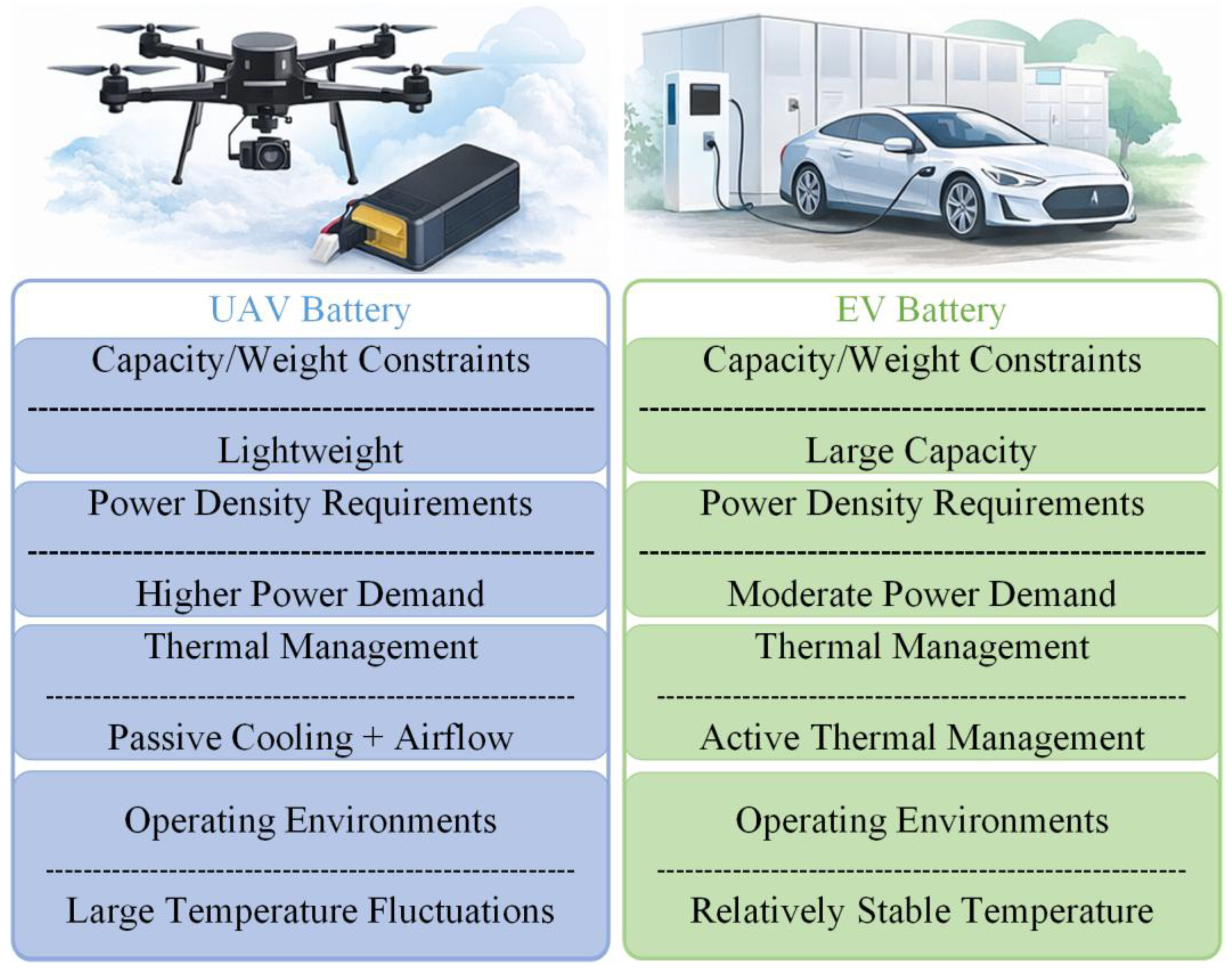
The rapid development of unmanned aerial vehicles (UAV) has made them an integral part of modern technology and industry, with applications spanning agriculture, logistics, environmental monitoring, and more [1]. However, the endurance and flight efficiency of UAV are constrained by battery performance and reliability, particularly under extreme weather conditions [2]. Environmental factors such as high and low temperatures and strong winds not only affect battery charging and discharging efficiency but also accelerate degradation, potentially leading to unstable performance and compromising UAV safety and lifespan [3]. For instance, excessive temperatures may cause battery overheating or thermal runaway, while low-temperature environments increase internal resistance and significantly reduce discharge capacity [4]. These issues underscore the critical need for accurate battery prediction and effective management in complex environments [5]. Current research on UAV battery degradation primarily focuses on accumulating experimental data and analyzing single factors, yet the multidimensional impact of climate change on battery performance remains underexplored [6]. Traditional battery management systems often fail to account for the complex reactions of batteries under different climate conditions, resulting in unstable UAV operation in extreme weather and potential battery damage [7,8]. As shown in Figure 1, compared with batteries used in electric vehicles (EV), UAV batteries are subject to stricter mass constraints and generally higher power demand while relying on limited thermal management and operating under more variable environmental conditions. These differences lead to degradation behaviors that are more sensitive to thermal and environmental disturbances and are not fully captured by models primarily developed for EV batteries.
This study addresses an important gap in battery degradation research by examining the coupled degradation behavior of UAV lithium-ion batteries under extreme climatic conditions, including high and low temperatures, varying humidity, and changing wind speeds. An interdisciplinary framework combining thermodynamic and fluid dynamic modeling is established to describe the interactions among electrochemical reactions, heat generation and conduction, and convective heat transfer in harsh operating environments. On this basis, a Physics-Informed Deep Neural Network (PIDNN) is developed by incorporating governing physical equations for heat generation, conduction, and convection into the loss function as regularization constraints. This framework enables accurate prediction of capacity fade, internal resistance growth, and remaining useful life (RUL) while preserving physical interpretability. The study contributes to the development of physics-informed machine learning for energy systems and provides practical value for improving battery management system (BMS) reliability, extending service life, and enhancing flight safety in complex environments.
The principal innovations of this work are threefold:
  • Thermodynamic-fluid dynamic coupling for UAV battery degradation modeling: Unlike conventional models mainly developed for electric vehicle batteries, the proposed framework is tailored to UAV operating conditions, such as high power density, limited thermal management, and direct exposure to airflow. By coupling heat generation and convective heat transfer, it describes temperature evolution and its effect on electrochemical degradation under extreme thermal conditions.
  • Physics-informed neural network with embedded physical constraints: A PIDNN framework is developed by incorporating energy balance, heat conduction, and convective heat transfer equations into the training loss. This design improves physical consistency and generalization while preserving the ability of deep learning to capture nonlinear degradation behavior.
  • Comprehensive Multi-Factor Experimental Validation and BMS Integration: Extensive simulation-based experiments are used to evaluate the model across diverse operational scenarios, including discharge C-rate variations (0.5C–2.5C), humidity levels (30–95%), wind speed dynamics (0–12 m/s), and multi-factor coupling conditions (temperature-C-rate-humidity-wind interactions). The results show that the proposed method is more robust than standalone physics-based, SVM, LSTM, and GAN-based models. The framework also shows potential for real-time degradation monitoring and thermal management support in UAV battery management systems.

2. Related Work

The degradation of lithium-ion batteries in UAVs mainly results from electrochemical instability and environmental stress. During repeated charge–discharge cycles, electrode materials undergo structural changes, including particle cracking, lithium plating, and solid electrolyte interphase (SEI) film formation. These changes gradually lead to capacity fade and increased internal resistance [9,10]. High-temperature environments further intensify degradation by accelerating chemical reactions and gas generation, which may even trigger thermal runaway [11,12]. In contrast, low temperatures increase internal resistance and reduce discharge efficiency. Humidity may also indirectly increase degradation risk through condensation, corrosion at exposed interfaces, and long-term moisture-related stress [13,14].
Although many existing studies focus on individual electrochemical processes or thermal effects, few provide a comprehensive analysis of how extreme environmental factors, such as temperature, humidity, and wind, jointly affect degradation trajectories [15,16,17]. Increasing evidence suggests that predictive models should account for the dynamic coupling between external environmental stimuli and internal electrochemical responses in order to improve battery reliability in real-world UAV applications [18,19,20].
Early original studies have established the basis for understanding the electrochemical and thermal behavior of lithium-ion batteries under charge–discharge conditions. In particular, Onda et al. [21] experimentally investigated heat-generation behavior, while Srinivasan and Wang [22] analyzed the coupled electrochemical and thermal characteristics of Li-ion cells. Building on these foundations, more recent review studies have further summarized the roles of Joule heating, entropic heat, and thermal transport in battery degradation and thermal management [23,24].
Meanwhile, fluid dynamics contributes by modeling airflow distribution and convective cooling around battery surfaces, which directly affects temperature gradients and reaction stability [25,26]. Air velocity, direction, and ambient humidity significantly influence heat dissipation efficiency and localized overheating risks [27,28].
The combination of thermodynamic and fluid dynamic modeling provides a physically grounded framework for analyzing UAV battery degradation in complex environments. When coupled with machine learning techniques, such models can enhance predictive accuracy and generalizability under diverse climatic scenarios [29].
Building on physics-based thermodynamic and fluid dynamic modeling, an increasing number of studies have explored the use of machine learning and deep learning to improve battery degradation prediction under complex operating conditions [30]. In these hybrid approaches, physical models are commonly used to describe heat generation, temperature evolution, and transport processes. Data-driven models are then used to learn the nonlinear relationships among environmental conditions, operating states, and electrochemical degradation indicators [31].
For example, some studies have incorporated temperature-related features derived from thermal models into neural networks for battery temperature prediction. These methods have shown greater robustness under different ambient temperature conditions [32]. Other studies have adopted physics-informed learning strategies by embedding governing equations, such as heat balance equations or electrochemical aging laws, into the training objective as regularization terms. This design constrains neural network predictions to physically reasonable regimes [33]. Such hybrid physics–machine learning models have been reported to outperform purely data-driven methods, especially when applied to unseen climatic conditions or extreme operating environments. Recent review studies, including Fu et al. [34], further support this view and suggest that the deep integration of artificial intelligence with physical mechanisms is an important direction for next-generation intelligent battery management systems.
Overall, existing research indicates that coupling thermodynamic and fluid dynamic modeling with machine learning provides a promising pathway for achieving both high predictive accuracy and physical consistency. However, most current studies focus on either simplified thermal coupling or single environmental factors, and fully integrated frameworks that jointly consider dynamic environmental stimuli and internal electrochemical responses in UAV battery applications remain limited. This gap motivates the hybrid physics-informed deep learning framework proposed in this study.

3. Methods

3.1. Construction of Thermodynamic and Fluid Dynamic Models for Battery Performance Degradation

Under extreme weather conditions, the performance degradation of UAV batteries is primarily influenced by thermal management systems. Battery lifetime and temperature distribution are determined by the conduction and dissipation of heat released by internal electrochemical processes. To accurately forecast battery degradation, a thermodynamic model incorporating internal reaction heat effects and external environmental influences is established. By analyzing the thermodynamic state equation of the battery, the impact of different temperatures, discharge power, and environmental conditions on battery thermal behavior can be revealed.
Firstly, heat generation within the battery due to electrochemical reactions can be expressed as:
Q chem = η I 2 R int
where η is the energy conversion efficiency R int of the battery, I is the discharge current of the battery, and is the internal resistance of the battery. When current passes through the battery cell, internal resistance causes heat to be generated within the cell, which accumulates over time and affects the cell temperature. The generated heat may increase sharply, particularly when the discharge current or power output is high, thereby accelerating battery deterioration.
Secondly, the thermal behavior of the battery cell can be described by the heat conduction equation, which characterizes the temperature distribution within the cell:
q = k T
where q is heat flux density, k is thermal conductivity, and T is the temperature gradient. This equation indicates that heat conduction within the battery cell occurs through the thermal conductivity of the cell materials. Heat will be transferred to the battery’s surface and eventually released into the environment through the battery casing when the internal temperature of the battery rises.
Under extreme weather conditions, the performance degradation of the UAV battery is closely related to its thermal management. The fluid dynamic model can effectively describe the heat exchange process between the battery surface and air flow and reveal the effect of air flow on the temperature distribution and performance degradation of the battery. The heat exchange of the battery is mainly carried out through the convection process, and the air velocity, direction, humidity, and the shape and roughness of the battery surface affect the heat exchange efficiency.
In the hydrodynamic model, the heat exchange between the battery and the surrounding air is usually modeled by the following thermal convection equation:
Q conv = h ( v ) A T s T
where Q c o n v is the convective heat transfer rate, h ( v ) is the flow-dependent convective heat transfer coefficient, and v is the relative airflow velocity around the battery surface, which is affected by UAV motion and ambient wind conditions. A is the battery surface area, T s is the battery surface temperature, and T is the ambient air temperature. In the present simulations, this airflow effect is represented by the external wind speed. Therefore, stronger airflow enhances convective heat dissipation at the battery surface.
Furthermore, the characteristics of airflow around the battery or within the battery pack enclosure also affect the convective heat transfer behavior at the battery surface. These effects are incorporated into the model through external convective boundary conditions.
On this basis, combined with the intra-cell heat conduction process, the temperature distribution of the battery cell can be described by the following classical heat conduction equation widely used in lithium-ion battery thermal modeling [35]:
ρ c p T t = k T + Q gen
where ρ is the density of the battery material, c p is the specific heat capacity, k is the thermal conductivity, and Q gen is the electrochemical heat generated within the battery cell. This equation captures the coupled effects of internal heat generation and thermal conduction and provides a physically grounded description of the battery’s thermal behavior under varying environmental and operational conditions.
In this study, the physical model used for comparison is formulated as a simplified lumped-parameter thermodynamic-electrical model rather than a high-fidelity electrochemical pseudo-two-dimensional (P2D) model. The thermal behavior of the lithium-ion battery is described using a non-isothermal energy balance framework, which captures electrochemical heat generation, internal heat conduction, and convective heat dissipation to the surrounding environment, as expressed in Equations (1)–(4). Based on the thermal state, the electrical behavior of the battery is modeled using a first-order equivalent circuit consisting of an open-circuit voltage source and an ohmic internal resistance. This simplified formulation is adopted to balance physical interpretability and computational efficiency while providing a physically informed baseline for simulation and comparison under varying environmental conditions.
Based on the thermal state, the electrical behavior of the battery is modeled using a first-order equivalent circuit consisting of an open-circuit voltage source and an effective internal resistance under discharge conditions. The terminal voltage is computed as:
V ( t ) = U O C V ( S O C , T ) I R i n t ( D , T , I )
where U O C V is the open-circuit voltage as a function of state of charge and temperature, I is the discharge current, and R i n t ( D , T , I ) denotes the effective internal resistance under discharge conditions. In the present study, this resistance is treated as a state-dependent quantity influenced by degradation, temperature, and current level. U O C V is obtained from a predefined OCV–SOC relationship implemented in the MATLAB/Simulink R2023b battery model. Specifically, the open-circuit voltage is determined as a lookup-table function of state of charge, with temperature dependence incorporated through the corresponding thermal input in the simulation framework. At each simulation step, SOC is updated from the available capacity state, and the corresponding U O C V value is obtained by interpolation from the predefined OCV–SOC–temperature relationship.
The physical model assumes spatially lumped temperature (non-isothermal but without spatial resolution) and constant current discharge within each simulation interval and neglects detailed electrochemical diffusion dynamics. All thermal and electrical parameters are initialized based on manufacturer specifications and representative values reported in the literature, and the model outputs are obtained through physics-based simulation rather than data-driven fitting. These assumptions were introduced to maintain a balance between physical interpretability and computational efficiency. Compared with high-fidelity electrochemical models, the lumped-parameter formulation substantially reduces modeling complexity and facilitates its integration into the physics-informed learning framework. This is particularly relevant for UAV applications, where rapid prediction and limited onboard computational resources favor lightweight hybrid models over computationally intensive full-order simulations.
These thermodynamic and convection-related thermal models establish a physically grounded description of lithium-ion battery thermal behavior under varying environmental and operational conditions. Beyond serving as a theoretical characterization, the constructed governing equations play an active functional role in the proposed framework. Specifically, they provide physically meaningful constraints that define admissible temperature evolution and degradation trajectories, and they also support the generation of high-fidelity simulation data under controlled scenarios. In the following section, these physical models are further leveraged as physics-informed constraints embedded into the learning objective of the deep neural network, enabling a tight integration between physical laws and data-driven degradation prediction.

3.2. Physics-Informed Deep Neural Network for Battery Performance Degradation Prediction

This study constructs a hybrid battery performance degradation prediction model by integrating a DNN with physics-informed constraints derived from thermodynamic principles. The coupling between the physical model and the DNN is not implemented as a simple direct transfer of a complete physical-model prediction sequence into the neural network. Instead, the two components are integrated through simulation-variable generation, physics-informed regularization, and physics-consistent post-processing.
Specifically, under prescribed environmental and operating conditions, the physical model provides simulation-generated battery state and environmental variables, including terminal voltage, capacity, internal resistance, temperature, wind speed, and ambient humidity. These quantities are represented as scalar input variables and organized into the DNN input vector after standardization and preprocessing. The resulting DNN input is composed of standardized simulation-generated features. Specifically, the input vector comprises three battery-state variables (voltage, capacity, and internal resistance) and three environmental boundary-condition variables (temperature, wind speed, and ambient humidity).
In parallel, the governing equations of heat generation, heat conduction, and convective heat transfer are incorporated into the training objective as a physics-informed loss term. In this way, the physical model guides the DNN toward physically consistent predictions during optimization, rather than serving only as an external preprocessor. It should also be noted that the proposed physics-informed deep neural network does not directly output terminal voltage. Accordingly, terminal voltage is not treated as a primary degradation indicator in this study but only as a reconstructed response variable derived from the predicted degradation states. Instead, the network directly predicts two degradation-related indicators, namely capacity change and internal resistance change. In this study, battery degradation is represented jointly by capacity-related and resistance-related changes. Specifically, BCR is used as the capacity-based SOH indicator, whereas BIRCR is used as a complementary indicator of internal aging severity. Remaining useful life (RUL) is subsequently derived from the predicted capacity degradation trajectory according to the predefined end-of-life criterion.
The terminal voltage is subsequently derived through a physics-consistent post-processing step, using the same equivalent circuit formulation as the physical baseline model described in Section 3.1. Specifically, the predicted internal resistance and capacity (via the corresponding state-of-charge evolution) are substituted into the voltage equation:
V p r e d ( t ) = U O C V ( S O C p r e d , T ) I ( t ) R p r e d ( t )
where Vpred (t) denotes the reconstructed terminal voltage; UOCV (⋅) is the open-circuit voltage as a function of state of charge and temperature; S O C p r e d is the state of charge inferred from the predicted available capacity; T is the battery temperature; I ( t ) is the discharge current; and R p r e d ( t ) is the internal resistance predicted by the model. The same predefined U O C V –SOC–temperature relationship is used in the voltage reconstruction step for the proposed PIDNN so that both the physical baseline and the hybrid model rely on an identical open-circuit voltage formulation.
The predicted capacity and internal resistance jointly determine the voltage evolution through this equivalent circuit formulation. Based on the predicted capacity evolution, RUL is calculated as the remaining number of time steps (or operating cycles) required for the available capacity to reach the end-of-life threshold.
This strategy ensures physical consistency and enables a fair comparison between the physical model and the proposed hybrid model, as both approaches rely on identical voltage reconstruction equations while differing only in how degradation-related parameters are obtained.
To incorporate physical knowledge into the learning process, the training objective is formulated as a hybrid loss function that combines a data-driven loss term with a physics-informed penalty term. The total loss function is defined as:
L total ( θ ) = L data ( θ ) + λ L physics ( θ )
where θ denotes the network parameters and λ is a weighting coefficient that balances data fitting and physical consistency.
The data-driven loss term measures the discrepancy between the predicted degradation values and the corresponding observed data and is defined as the mean squared error:
L θ = 1 N i = 1 N y i y ^ i 2
where y i denotes the measured battery degradation data, y ^ i represents the degradation value predicted by the neural network, and N is the number of training samples.
To ensure that the model predictions remain physically admissible, a physics-informed loss term is constructed based on the transient heat balance equation governing lithium-ion battery thermal behavior, as introduced in Section 3.1. This equation describes the relationship between electrochemical heat generation, heat conduction, and temperature evolution within the battery. The physics-informed loss is defined as the mean squared residual of the governing thermal equation:
L physics ( θ ) = 1 N i = 1 N ρ c p T ^ i t k T ^ i η I i 2 R int , i
where T ^ i denotes the differentiable thermal state (implemented here in surrogate/lumped form) associated with sample i , ρ is the battery material density, c p is the specific heat capacity, k is the thermal conductivity, η is the electrochemical energy conversion efficiency, I i is the discharge current, and R int , i is the internal resistance. For each training sample, the network predicts the degradation-related state variables, and the predicted internal resistance is further used to compute the heat-generation term in the governing equation. These predicted quantities are substituted into the transient heat-balance equation to form a physical residual that quantifies the mismatch between the two sides of the governing law. The temporal derivative and gradient-related terms are evaluated using automatic differentiation within the computational graph during training. Because the residual is fully differentiable, its squared value can be incorporated directly into the loss function and jointly optimized with the data-driven term through backpropagation. In this way, the network is trained not only to fit the observed degradation data but also to satisfy the underlying thermodynamic constraint during optimization.
The weighting coefficient λ controls the relative contribution of the physics-informed loss in the total objective function. Its final value was determined through validation-based sensitivity analysis, as reported in Section 4.3. Candidate values were compared under identical training settings using predictive-error metrics, while physical consistency was enforced through the physics-informed residual term defined in Equation (9). Based on the overall validation results, λ = 0.5 was selected and used in all subsequent experiments.
By jointly optimizing data fidelity and physical consistency, the proposed PIDNN improves the representation of battery degradation trajectories, which are characterized in this study by capacity retention and internal resistance increase. This hybrid modeling strategy significantly enhances robustness, generalization capability, and interpretability, particularly under extreme environmental conditions, making it well suited for intelligent battery management systems in UAV applications.

3.3. Framework Design of the Physics-Driven Deep Neural Network Model

To effectively capture the complex degradation behavior of UAV batteries under changing environmental conditions, it is necessary to combine data-driven learning with physically meaningful modeling. Purely data-driven models often show limited generalization when applied to operating conditions beyond the training data. In contrast, physics-based models alone may not fully capture highly nonlinear degradation dynamics. Therefore, this study adopts a hybrid framework that combines physical modeling with deep neural networks. This design leverages the strengths of both approaches, enabling accurate prediction while preserving physical consistency.
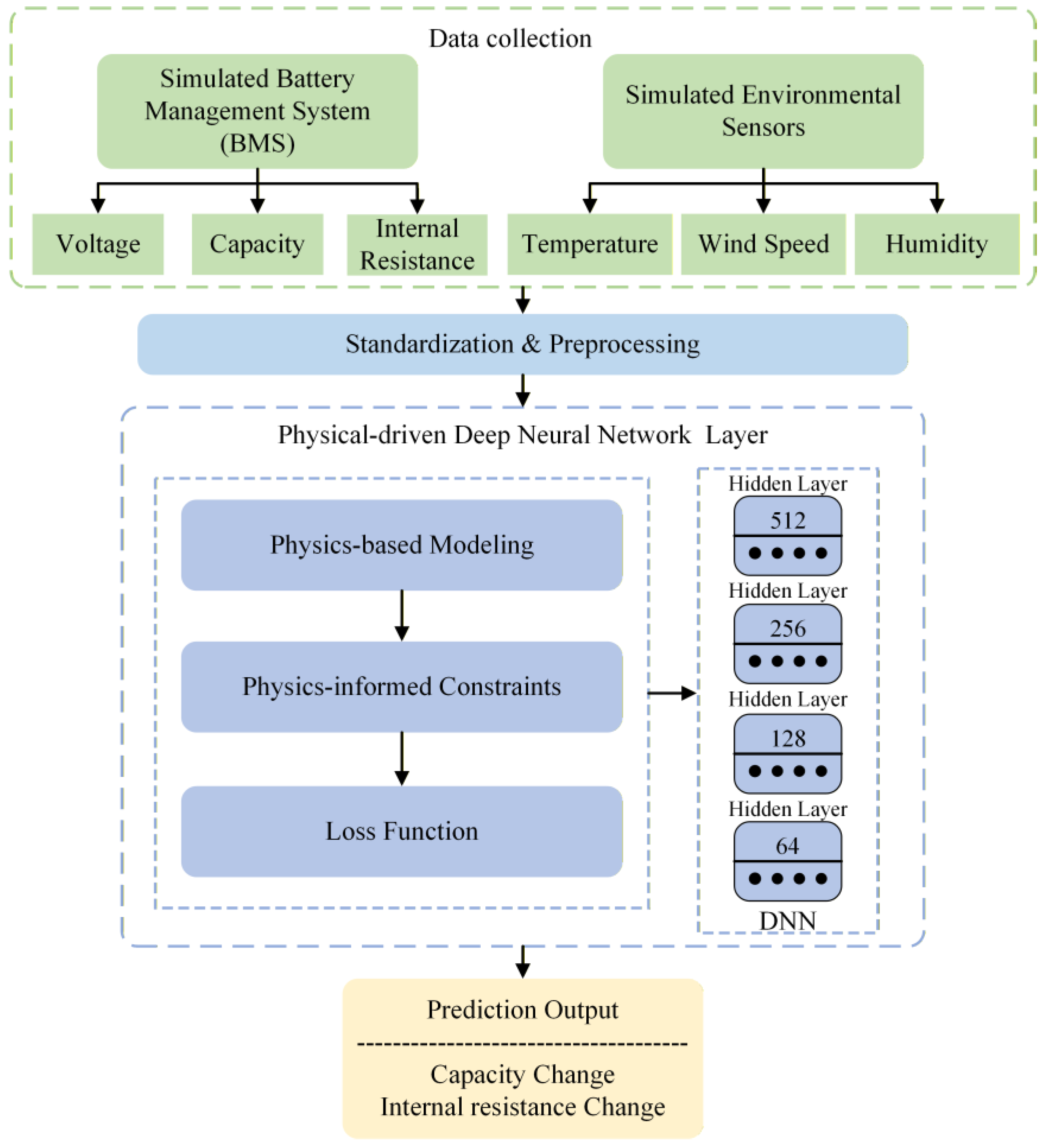
Figure 2 presents the hybrid architecture of the proposed physics-driven deep neural network model for battery performance degradation prediction. The definitions and dimensions of the DNN input variables are summarized in Table 1.
As shown in Figure 2, the proposed intelligent prediction model adopts a hybrid architecture that integrates DNN with physics-based modeling to predict battery performance degradation under varying environmental conditions. The model receives simulation-generated battery state variables from a simulated battery management system (BMS) and environmental operating variables from simulated environmental sensors, including voltage, capacity, internal resistance, temperature, wind speed, and ambient humidity. These variables are represented as six scalar input features. After standardization and preprocessing, they are organized into the input vector and fed into the physics–deep neural network coupling layer.
Within this coupling layer, physics-based modeling is incorporated in the form of physics-informed constraints embedded in the loss function, which guides the training of the neural network and enforces physically meaningful behavior. The DNN consists of four fully connected hidden layers with 512, 256, 128, and 64 neurons, enabling hierarchical feature extraction and nonlinear mapping between operating conditions and degradation indicators. The layer sizes [512, 256, 128, 64] refer only to the four hidden layers and do not include the input or output layers. The input layer has a dimension of 6, corresponding to the six scalar input variables listed in Table 1, while the output layer has a dimension of 2, corresponding to capacity change and internal resistance change.
ReLU activation functions are employed in the hidden layers to capture complex nonlinear relationships. Finally, the output layer generates predictions of battery capacity change and internal resistance change, providing quantitative indicators of battery performance degradation under different environmental and operational conditions. In addition, the equivalent-circuit relationship is used after prediction to reconstruct terminal voltage from the predicted degradation states.
During the training process, the model uses the backpropagation algorithm and Adam optimizer to continuously adjust the weights of the neural network by minimizing the loss function, in order to improve prediction accuracy. In addition, the model innovatively combines physical modeling of thermodynamics and fluid dynamics, utilizing these physical mechanisms to improve the interpretability of deep learning and make the model more adaptable. This method of combining physical modeling with deep learning allows the model to not only consider the direct impact of environmental factors when dealing with battery degradation but also optimize predictions through adaptive learning, thereby providing real-time battery status monitoring and warning functions, greatly improving the accuracy and reliability of battery management.
Based on the above physical model and deep learning prediction method, this intelligent prediction model can monitor the state changes in the battery in real time, predict its performance degradation under different environmental conditions, and provide warnings. This provides a scientific basis for battery management of UAV, which helps optimize battery usage strategies, thereby extending battery life and improving the reliability and efficiency of UAV systems.
To provide a clear overview of the hybrid intelligent prediction model for battery performance degradation, we abstract the core computational process into the following pseudocode (Algorithm 1). This pseudocode integrates thermodynamic and fluid dynamic equations with a deep neural network architecture, illustrating the end-to-end workflow from feature acquisition to performance prediction and optimization.
Algorithm 1: Intelligent Battery Performance Degradation Prediction Model
# Step 1: Initialize model parameters and constants
initialize_physical_constants ()
initialize_DNN_structure (layers = [512, 256, 128, 64], activation = ‘ReLU’)
set_optimizer (optimizer = ‘Adam’, learning_rate = 0.001)
# Step 2: Define physical models (thermodynamics and fluid dynamics)
function compute_internal_heat (I, R, η):
  # Equation (1): Electrochemical heat generation
  Q_gen = η  I^2  R
  return Q_gen
function compute_heat_conduction (k, ∇T):
  # Equation (2): Fourier heat conduction
  q = −k  ∇T
  return q
function compute_convection_heat (h, A, T_surface, T_env):
  # Equation (3): Convective heat loss
  Q_conv = h  A  (T_surface − T_env)
  return Q_conv
function compute_temperature_distribution (ρ, Cp, k, Q_gen):
  # Equation (4): Heat balance in battery
  return solve_heat_distribution (ρ, Cp, k, Q_gen)
# Step 3: Data input and preprocessing
data = load_sensor_data () # voltage, capacity, internal resistance, temperature, wind speed, humidity
X = normalize_features (data.input) # real-time environmental and operational features
Y = data.labels  # actual degradation values (capacity loss, resistance increase, etc.)
# Step 4: Construct hybrid model loss function
function loss_function (Y_true, Y_pred, physical_constraint):
  # Equation (7): Regularized loss
  loss_data = mean_squared_error (Y_true, Y_pred)
  loss_physics = constraint_violation_penalty (physical_constraint)
  return loss_data + λ  loss_physics
# Step 5: Train the hybrid prediction model
for epoch in range (num_epochs):
  for batch_X, batch_Y in get_batches (X, Y):
    # Forward pass
    prediction = DNN.forward (batch_X)
    # Compute loss
    loss = loss_function (batch_Y, prediction, physical_model_constraints)
    # Backpropagation
    DNN.backward (loss)
    update_weights (optimizer)
# Step 6: Make predictions
new_input = get_real_time_data ()
processed_input = normalize (new_input)
final_prediction = DNN.predict (processed_input)
# Step 7: Output results
output_results (final_prediction)
visualize_metrics (PA, MAE, RMSE, BCR, BIRCR)

4. Experimental Simulation

4.1. Simulation Experiment Design for Battery Degradation Prediction

This study created a series of experimental simulations using MATLAB R2023b to represent the battery degradation process under various harsh weather conditions, in order to confirm the effectiveness of the proposed battery degradation prediction model. All battery degradation data used in this study are generated through physics-based simulations rather than directly obtained from experimental measurements or existing public datasets. The simulation parameters, including nominal voltage, rated capacity, internal resistance, and environmental conditions, are explicitly specified to ensure physical consistency and engineering relevance. This simulation-based framework provides a controlled and physically consistent environment for systematically evaluating the proposed physics-informed prediction model under extreme temperature conditions.
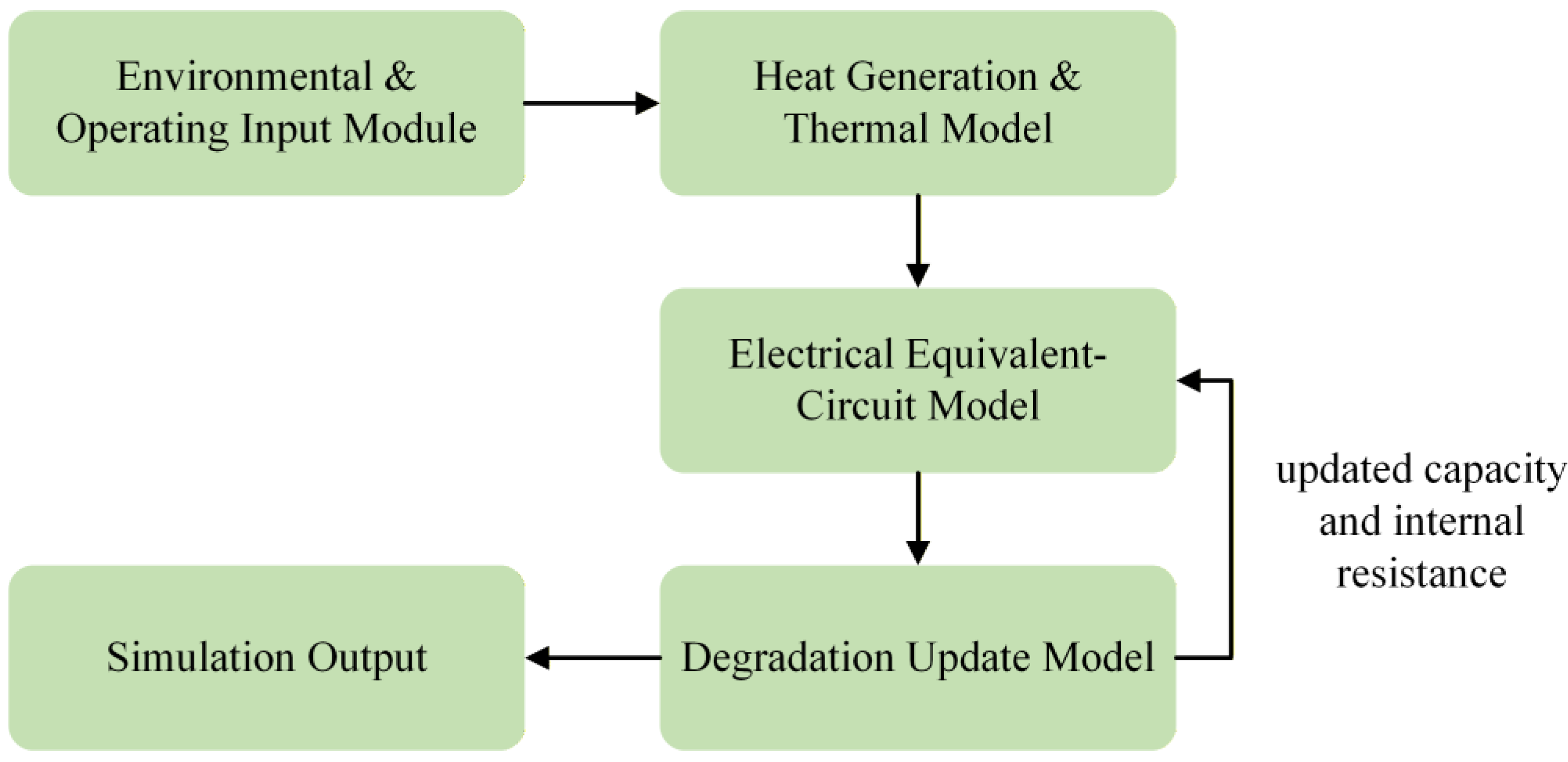
The battery aging simulation was implemented in MATLAB/Simulink R2023b using a modular lumped-parameter thermodynamic–electrical framework. The simulation model consists of four main components:
(1)
an environmental and operating input component, which specifies ambient temperature, wind speed, humidity, discharge C-rate, and simulation duration;
(2)
a thermal dynamic component, which computes electrochemical heat generation, heat conduction, and convective heat transfer according to Equations (1)–(4);
(3)
an electrical equivalent-circuit component, which updates the terminal voltage based on the open-circuit voltage and internal resistance relationship described in Equation (5); and
(4)
a degradation state update component, which recursively updates battery capacity fade and internal resistance growth over time.
During each simulation step, the environmental input component first imposes the operating conditions. These inputs are then used in the thermal dynamic component to calculate the battery temperature evolution and heat dissipation behavior. The updated thermal state is subsequently passed to the equivalent-circuit component to compute the terminal voltage. Based on the combined thermal and electrical states, the degradation state update component calculates the incremental changes in battery capacity and internal resistance. The updated degradation states are then fed back into the next simulation step, thereby forming a closed-loop aging simulation process over the entire operating horizon.
In the present simulation framework, degradation is introduced through the recursive update of battery capacity and internal resistance states, rather than by directly prescribing BCR or BIRCR as independent simulation variables. The corresponding degradation indicators, namely battery capacity retention (BCR) and battery internal resistance change rate (BIRCR), are calculated from the updated capacity and resistance states, and their definitions are given in Section 4.2.
The simulation outputs include terminal voltage, battery capacity, internal resistance, temperature, wind speed, and ambient humidity. These simulation-generated variables are sampled and organized into the dataset used for training and evaluating the proposed PIDNN model. Figure 3 illustrates the overall structure of the MATLAB/Simulink battery aging simulation model, including the feedback of updated capacity and internal resistance to the equivalent-circuit module in the next simulation step.
To evaluate the degradation behavior of UAV batteries under different environmental conditions, three representative thermal scenarios were selected for simulation: high temperature (45 °C), low temperature (−20 °C), and room temperature (25 °C). These conditions reflect typical climate extremes encountered in real-world UAV operations. The key initial parameters of each simulation group, including temperature, duration, and baseline battery characteristics, are summarized in Table 2.
As shown in Table 2, all simulations were conducted over a consistent duration of 400 h, with identical initial battery specifications across all temperature conditions—namely, a starting voltage of 3.7 V, capacity of 2.0 Ah, and internal resistance of 0.02 Ω. This ensures that the only variable affecting degradation trends is the environmental temperature. The high-temperature condition simulates thermally stressful environments that may accelerate chemical aging, while the low-temperature condition captures reduced ion mobility and slower degradation. The room-temperature environment serves as a baseline for comparison. This experimental setup provides a controlled yet comprehensive basis for evaluating the predictive performance of both physical and intelligent models presented in subsequent sections.

4.2. Evaluation Indicator Design

In the performance evaluation of battery degradation prediction models, this paper designs a series of comprehensive indicators to comprehensively evaluate the accuracy and reliability of the model under different climatic conditions. The following are the main evaluation indicators and their calculation formulas for the design:
(1)
Prediction Accuracy (PA): The prediction accuracy reflects the degree of agreement between the model’s predicted values and actual values, usually expressed as a percentage. The calculation formula is:
PA = 1 N i = 1 N 1 y i y ^ i y i × 100 %
Here, y i is the actual value, y ^ i is the predicted value, and N is the sample size. The higher the indicator, the more accurate the model prediction.
(2)
Mean Absolute Error (MAE): MAE is used to measure the average difference between predicted and actual values, reflecting the degree of deviation in the model’s predictions. The calculation formula is:
MAE = 1 N i = 1 N y i y ^ i
Here, | y i y ^ i | represents the absolute difference between each predicted value and the actual value. The smaller the MAE, the smaller the model prediction error and the higher the accuracy.
(3)
Root Mean Square Error (RMSE): RMSE is a standardized way to measure prediction error, which can highlight the impact of larger errors. The calculation formula is:
RMSE = 1 N i = 1 N y i y ^ i 2
This indicator is more sensitive to large errors, and the smaller the value, the stronger the model’s predictive ability.
(4)
Battery Capacity Retention (BCR): The battery capacity retention rate is used to measure the degree of capacity degradation of a battery over a certain period of time and is an important indicator of battery degradation. In the present study, BCR is also used as the capacity-based state-of-health (SOH) indicator. The calculation formula is:
BCR = C final C initial × 100 %
where C i n i t i a l denotes the initial rated capacity of the battery before degradation, and C f i n a l represents the remaining battery capacity after a specified period of operation or aging. A higher BCR value indicates a lower degree of capacity degradation and better capacity retention performance of the battery.
(5)
Battery Internal Resistance Change Rate (BIRCR): The increase in internal resistance of a battery is an important indicator of battery degradation, which is usually closely related to the charging and discharging efficiency and thermal management of the battery. The formula for calculating the internal resistance change rate is:
BIRCR = R final R initial R initial × 100 %
where R final is the internal resistance of the battery after degradation, and R initial is the initial internal resistance of the battery. The higher the BIRCR value, the more significant the increase in battery internal resistance and the more severe the performance degradation.

4.3. Sensitivity Analysis of the Weighting Coefficient

To determine an appropriate value of the weighting coefficient λ and to examine its influence on model performance, a validation-based sensitivity analysis was conducted by varying λ over a representative range. Specifically, λ was set to {0, 0.1, 0.2, 0.5, 1, 2, 5, 10}, where λ = 0 corresponds to a purely data-driven model without any physics-informed constraint. All experiments were performed under identical training settings to ensure a fair comparison. Table 3 summarizes the predictive performance under different values of λ, evaluated using the MAE and RMSE. These metrics are used here to assess prediction accuracy, while the role of λ in promoting physical consistency is reflected by the inclusion of the physics-informed residual term in the training objective.
As shown in Table 3, when λ = 0, the model relies solely on data fitting and exhibits relatively higher prediction errors, indicating limited generalization capability without physical guidance. As λ increases from 0 to 0.5, both MAE and RMSE decrease consistently, demonstrating that incorporating moderate physics-informed constraints effectively enhances prediction accuracy by suppressing physically implausible degradation patterns.
The best performance is achieved at λ = 0.5, where the lowest MAE (0.064) and RMSE (0.088) are observed. This result suggests that an appropriate balance between data-driven learning and physical consistency leads to more robust and accurate degradation predictions. However, when λ is further increased beyond this value, prediction accuracy gradually deteriorates. In particular, larger λ values (e.g., λ ≥ 2) result in increasing MAE and RMSE, indicating that overly strong physical constraints may over-restrict the model’s flexibility and hinder its ability to capture complex nonlinear degradation behaviors present in the data.
Overall, the sensitivity analysis shows that moderate physical regularization improves prediction accuracy, whereas excessively small or large λ values lead to suboptimal results. This finding suggests that an appropriate balance between data fitting and physics-informed constraint is beneficial for model performance. Moderate values of λ improve model performance, whereas excessively small or large values lead to suboptimal results. Based on this analysis, λ = 0.5 is selected as the optimal weighting coefficient and is adopted in all subsequent experiments.

4.4. Experimental Simulation Results and Analysis

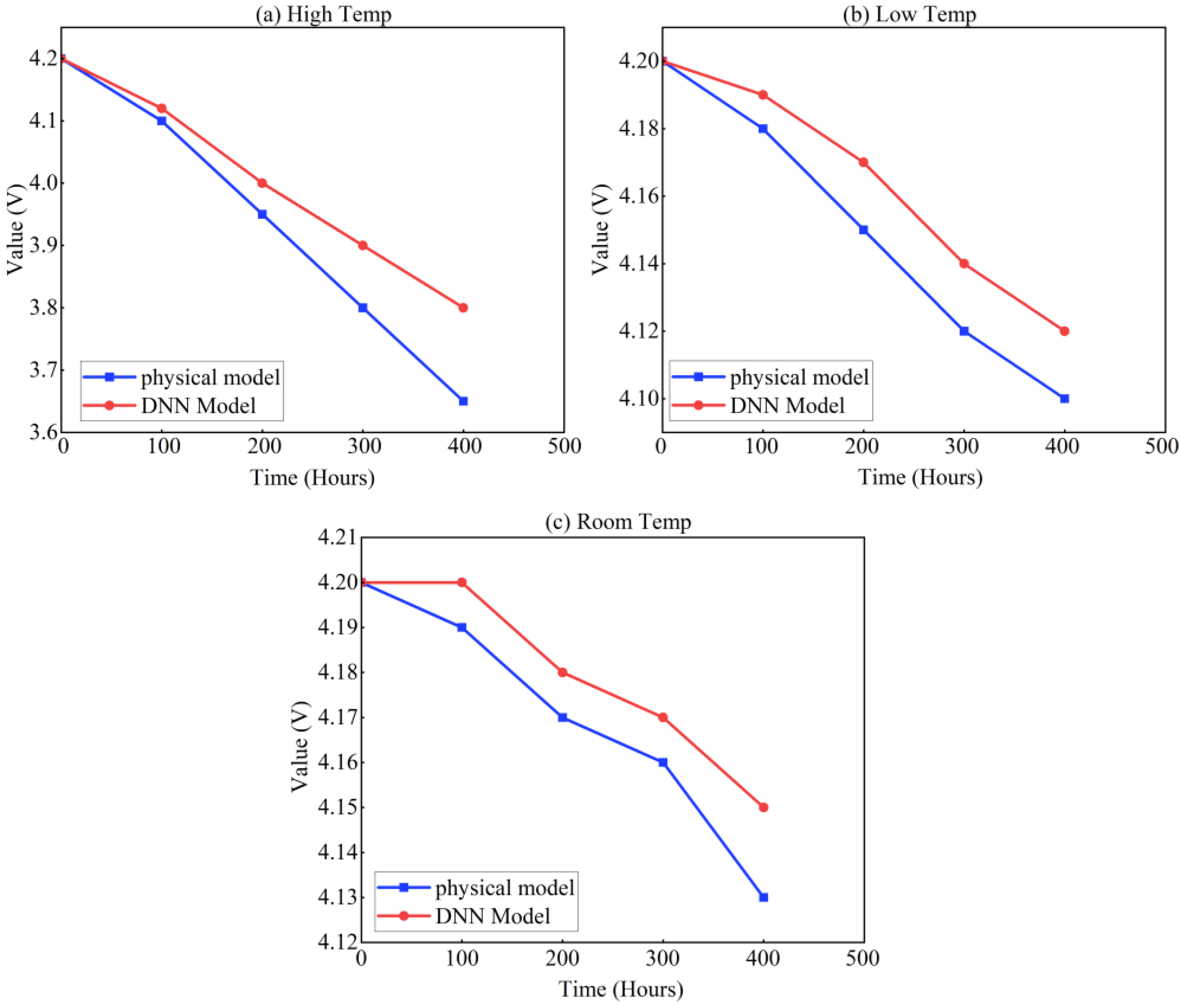
To illustrate the effect of predicted degradation states on terminal voltage response, a comparative analysis was conducted under three representative temperature conditions: high temperature (45 °C), low temperature (−20 °C), and room temperature (25 °C). Table 4 and Figure 4 compare the reconstructed terminal voltage evolution at representative aging time points based on the degradation parameters predicted by the physical model and the DNN-based model under different temperature conditions.
As presented in Table 4 and Figure 4, the reconstructed terminal voltage responses derived from the predicted degradation states remain consistently higher than those obtained from the physical baseline model over the 400 h aging horizon. Under high-temperature conditions, the reconstructed voltage decreases from 4.20 V to 3.80 V in the hybrid model, compared with 3.65 V in the physical model. Similar trends are observed under low- and room-temperature conditions, with the hybrid model showing a less pronounced decline in reconstructed terminal voltage response at the sampled aging time points. These results indicate that the hybrid model corresponds to a less pronounced degradation trend than the physical baseline model under the same environmental conditions. Since the principal degradation indicators in this study are capacity fade, internal resistance growth, and remaining useful life (RUL), the reconstructed terminal voltage responses are used here as supplementary outputs for comparing the degradation trends inferred by the two models.
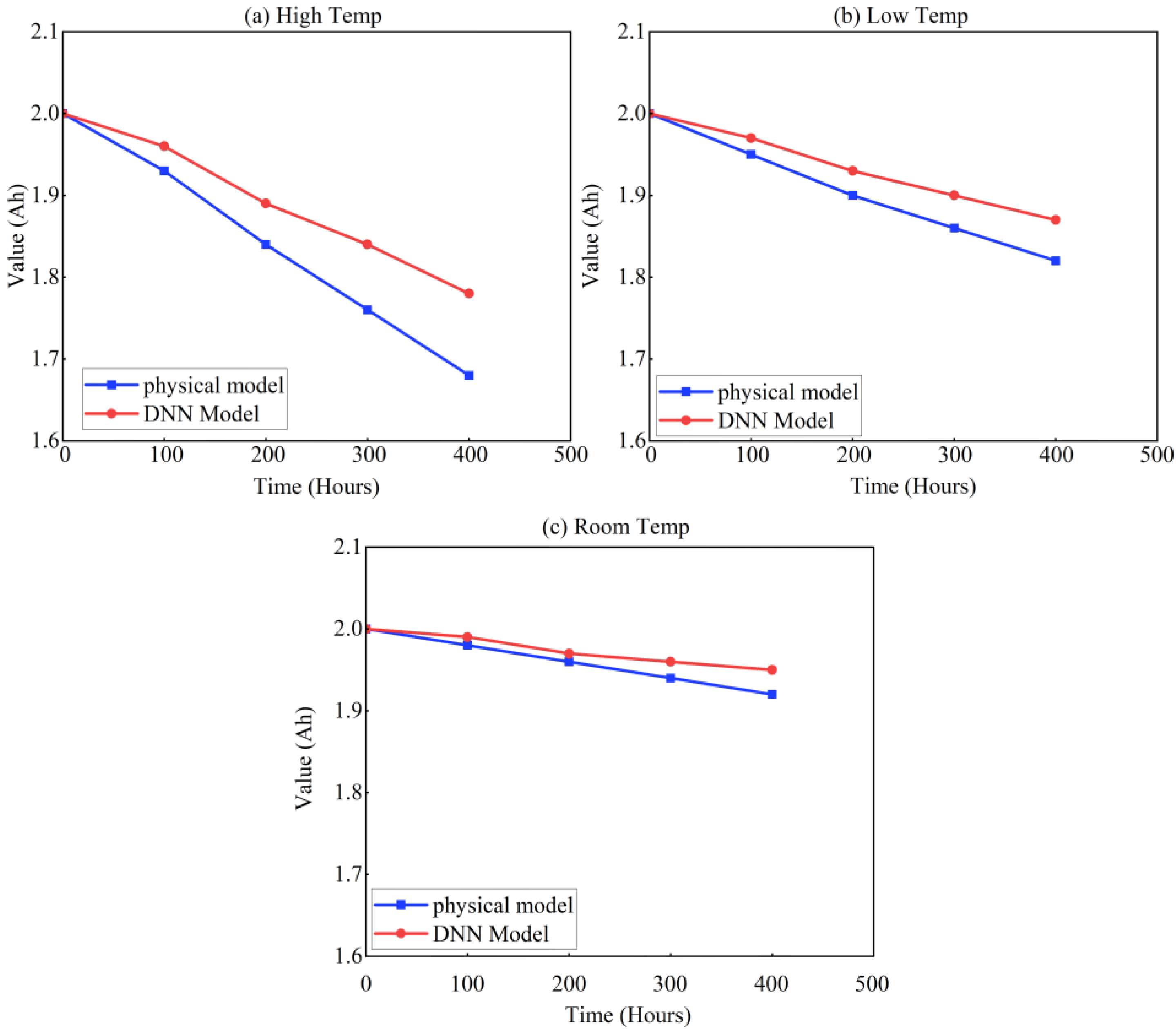
To further assess the predictive accuracy of the proposed model, the capacity degradation trends under different temperature were compared. Table 5 and Figure 5 summarize the predicted battery capacity values at every 100 h interval for both the physical model and the DNN model, all starting from an initial capacity of 2.0 Ah.
As shown in Table 5 and Figure 5, the DNN model exhibited consistently higher capacity values than the physical model across all environmental conditions. For example, at 400 h under high temperature, the DNN model predicted a remaining capacity of 1.78 Ah, compared to 1.68 Ah from the physical model. Similarly, under low-temperature conditions, the DNN model predicted 1.87 Ah, compared with 1.82 Ah from the physical model, while under room temperature the corresponding values were 1.95 Ah and 1.92 Ah, respectively. These results indicate that high temperature caused the largest capacity decline, room temperature provided the most favorable condition for capacity retention, and low temperature produced an intermediate but still noticeable reduction in capacity. This low temperature reduction is physically reasonable, because reduced temperature suppresses electrochemical reaction kinetics, decreases ion mobility, and increases internal resistance, thereby lowering discharge efficiency and usable capacity relative to room-temperature operation. Overall, these findings suggest that the DNN model provides a more stable estimate of long-term capacity decline, particularly under extreme conditions. By integrating physical laws into the learning process, the model better captures temperature-dependent variations in battery degradation behavior under different simulated environmental conditions.
BCR is a key indicator of long-term battery health. To evaluate how well each model forecasts this metric, Table 6 presents the BCR trends under high-, low-, and room-temperature conditions over a 400 h cycle.
As shown in Table 6, the DNN model yielded consistently higher retention estimates than the physical model across the sampled aging time points. Under high-temperature conditions, the DNN model maintained a BCR of 89.0%, compared to 84.0% from the physical model. For low temperatures, the DNN model predicted 93.5%, outperforming the physical model’s 91.0%. At room temperature, the DNN reached 97.0% versus the physical model’s 96.0%.
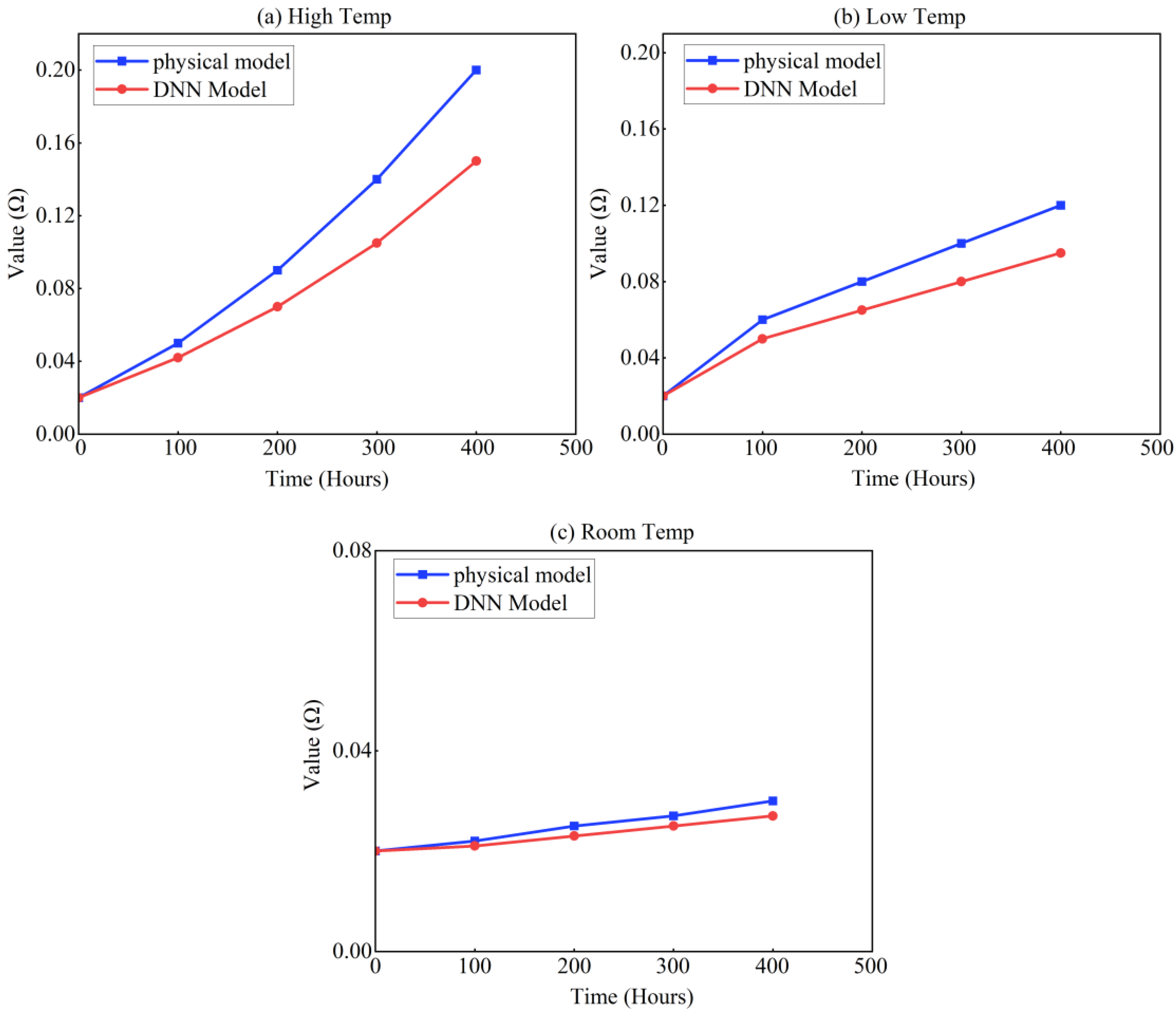
To further examine the degradation trends inferred by the proposed model, this study compared the internal resistance growth under different temperature environments. Table 7 and Figure 6 present results values of battery internal resistance (Ω) at five times intervals (0–400 h), as generated by both the physical model and the DNN model.
As shown in Table 7 and Figure 6, the results clearly show that the DNN model consistently predicted lower resistance values compared to the physical model. For instance, under high-temperature conditions, the resistance increased from 0.020 Ω to 0.200 Ω in the physical model, while the DNN model limited this rise to 0.150 Ω. Similarly, in low-temperature scenarios, the DNN predicted a final resistance of 0.095 Ω versus 0.120 Ω in the physical model. Under room temperature, resistance remained lowest across both models, with the DNN predicting only a minor increase to 0.027 Ω.
These results suggest that the DNN model is more effective in capturing the degradation patterns caused by thermal and environmental stress, enabling more precise prediction of internal electrochemical deterioration.
To quantify the rate of the resistance increase over time, Table 8 presents the BIRCR across different temperature environments. This metric is critical for assessing battery efficiency loss, especially under high discharge and temperature stress.
As shown in Table 8, The DNN model shows significantly slower growth in BIRCR values than the physical model. Under high-temperature conditions, the DNN reduced the change rate from 900% (physical model) to 650%. At low temperatures, the DNN’s prediction was 375%, compared to 500% in the physical model. At room temperature, BIRCR remained minimal, with the DNN reporting only a 35% increase versus 50% from the physical model.
This highlights the effectiveness of the DNN model in suppressing overestimated resistance growth and better aligning with realistic operational profiles. The hybrid model’s integration of thermodynamic and fluid dynamic constraints contributes to its superior accuracy in modeling resistance behavior under varying climate scenarios.

5. Comparison Experiments and Results Analysis

To verify the effectiveness of the proposed PIDNN (DNN + Physics), the study conducted a series of comparative experiments with two widely used methods: the traditional physics-based degradation prediction model and the pure data-driven machine learning prediction method. These experiments aim to evaluate the accuracy and stability of each method in predicting key battery performance indicators.

5.1. Experimental Setup

In this study, we compared three degradation prediction methods:
(1)
Physics-Based Model [36]: This method uses thermodynamic and fluid dynamic models to calculate the battery degradation under different environmental conditions, such as temperature. While this method offers a theoretical foundation, it relies on simplifying assumptions and does not account for the complex nonlinear interactions between environmental factors and battery performance.
(2)
Pure Data-Driven Machine Learning Model [37]: The study used Support Vector Machines (SVM), a machine learning algorithm, to predict battery degradation based on historical data. The model can handle nonlinear relationships, but it lacks an understanding of the underlying physical processes of battery degradation.
(3)
Proposed PIDNN: This method integrates deep neural networks with physics-based degradation models. The PIDNN captures the nonlinear relationships between environmental factors and battery performance, while the physical models provide insight into the thermodynamic and electrochemical processes of battery degradation, offering a more robust and accurate prediction.
(4)
LSTM-based Models [38]: LSTM networks are popular for time series prediction tasks, particularly in battery performance forecasting due to their ability to model temporal dependencies in data. The study implemented a comparative analysis using a state-of-the-art LSTM-based model, which was trained on a dataset from similar extreme environmental conditions.
(5)
GAN-integrated Hybrid Models: Recent research has explored hybrid approaches that combine GANs with deep learning techniques for generating more accurate battery degradation predictions by simulating new degradation paths from historical data.

5.2. Experimental Results and Analysis

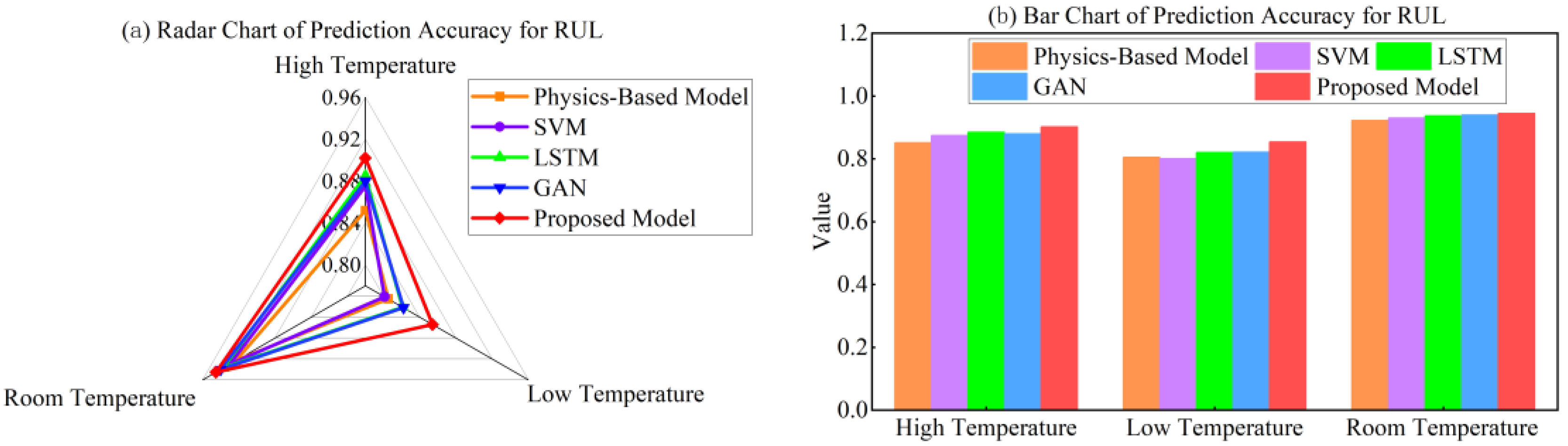
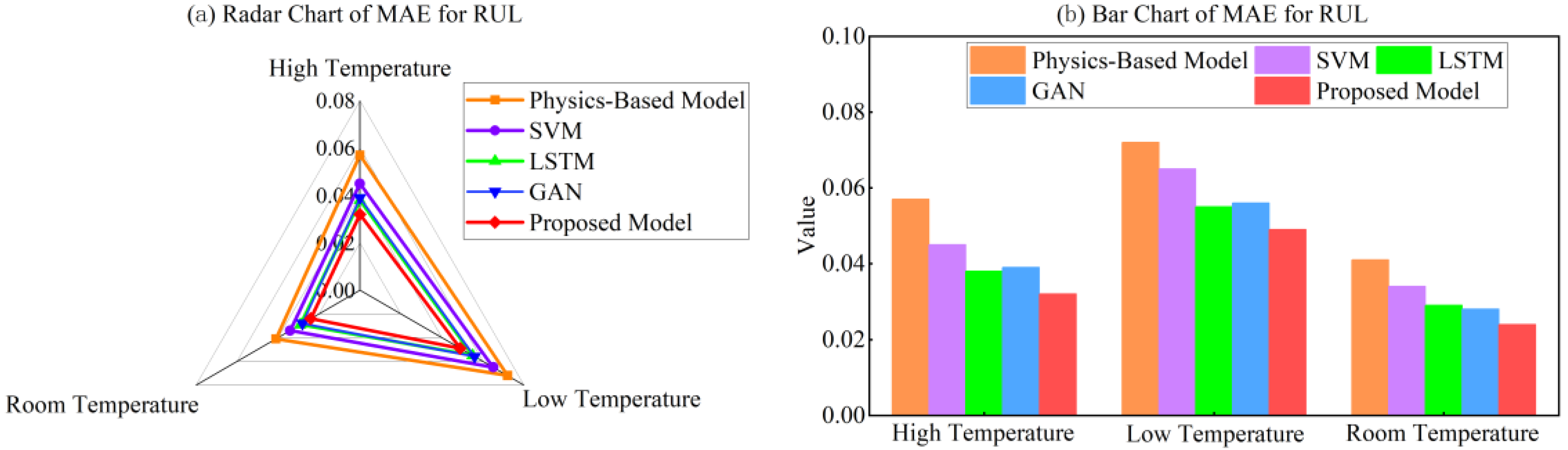
To provide a comprehensive evaluation of the model’s robustness, Table 9, Table 10 and Table 11 and Figure 7, Figure 8 and Figure 9 present the results of PA, MAE, and RMSE, respectively, across three typical environmental scenarios: high temperature (45 °C), low temperature (−20 °C), and room temperature (25 °C). These indicators quantitatively reflect the model’s capability in accurately predicting battery Remaining Useful Life (RUL) under different stress conditions.
As summarized in Table 9 and illustrated in Figure 7, the proposed PIDNN model consistently achieves the highest prediction accuracy across all environmental conditions. Specifically:
Under high temperature, the hybrid model attains 90.20%, compared to 85.20% (Physics-Based), 87.50% (SVM), 88.50% (LSTM), and 88.00% (GAN). At low temperature, its accuracy reaches 85.40%, outperforming other models such as LSTM (82.10%) and GAN (82.20%). At room temperature, the hybrid model performs best with 94.50%, slightly higher than GAN (94.00%) and LSTM (93.70%). These results demonstrate that the PIDNN model possesses strong generalization capabilities and maintains high prediction precision under both extreme and stable environmental scenarios. Its performance advantage is especially pronounced in low-temperature environments, where electrochemical behavior becomes more nonlinear and harder to model accurately without physical priors.
Table 10 and Figure 8 show the MAE values, reflecting the average deviation between predicted and actual RUL values: The PIDNN achieves the lowest MAE across the board: 0.032 (high temp), 0.049 (low temp), and 0.024 (room temp). Compared to the Physics-Based model, which shows larger errors (0.057, 0.072, and 0.041, respectively), the proposed model reduces absolute prediction error by approximately 30–45% depending on the condition. Even when compared to advanced deep learning models such as LSTM and GAN, the proposed method consistently produces smaller errors, indicating that the integration of physical constraints not only improves the fitting ability but also enhances the error suppression capability.
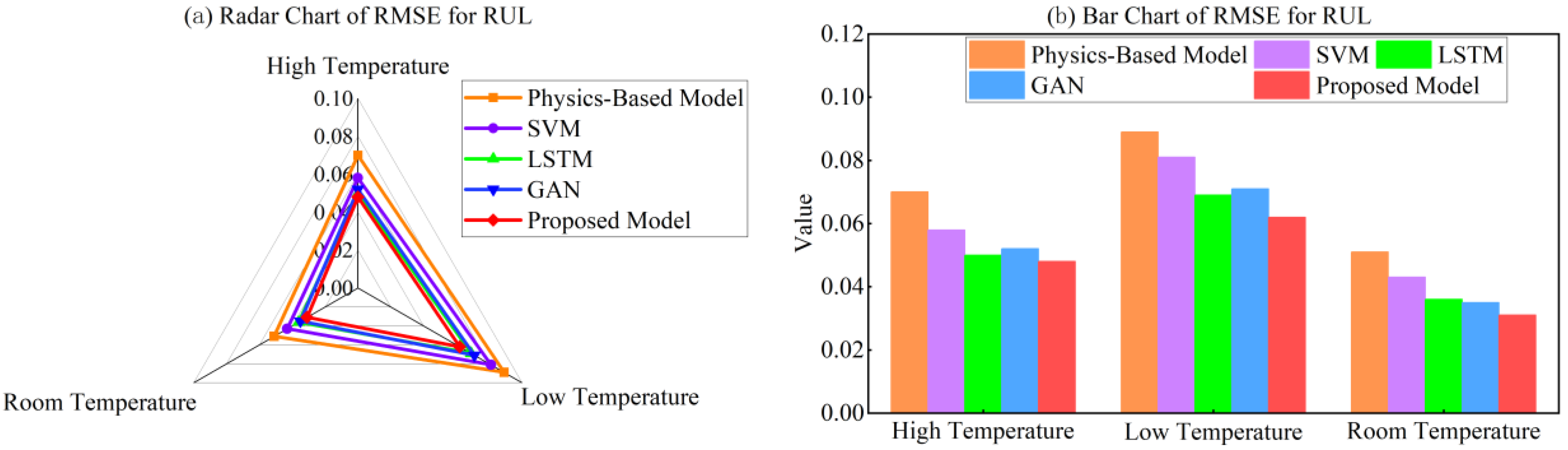
Table 11 and Figure 9 present the RMSE results for RUL prediction under different environmental conditions, highlighting each model’s sensitivity to larger prediction errors. Overall, RMSE values are consistently higher than the corresponding MAE results, which is expected and confirms the rationality of the evaluation. Across all temperature scenarios, the proposed PIDNN model achieves the lowest RMSE, indicating stronger robustness against large deviation errors and more stable RUL estimation performance.
Under high-temperature conditions, the proposed model reduces RMSE to 0.048, compared with 0.070 for the physics-based model and 0.050–0.052 for the data-driven baselines, demonstrating improved resistance to thermally accelerated degradation uncertainty. In low-temperature environments, where battery behavior becomes more nonlinear, the proposed model maintains a lower RMSE of 0.062, outperforming LSTM and GAN models. At room temperature, prediction errors decrease for all methods; nevertheless, the proposed approach still yields the minimum RMSE of 0.031, confirming its consistent accuracy and reliability across diverse environmental conditions.
The combination of prediction accuracy, MAE, and RMSE evaluations across different environmental conditions paints a clear picture:
The Physics-Based Model is limited by simplifications and cannot fully adapt to diverse, nonlinear degradation processes. Traditional machine learning (e.g., SVM) lacks physical interpretability and struggles with extreme or boundary conditions. Even advanced models like LSTM and GAN, while strong in capturing data trends, still fall short in extreme conditions due to their lack of embedded physical knowledge.
In contrast, the PIDNN model achieves the best performance across all three key indicators, demonstrating accurate, consistent, and physically plausible predictions. This makes it particularly valuable for deployment in real-world UAV systems, where both prediction precision and model transparency are crucial for safety and efficiency.

5.3. Discharge C-Rate Variation Experiments

To evaluate the robustness of the proposed model under varying operational loads, a series of experiments were conducted with different discharge C-rates ranging from 0.5C to 2.5C. The discharge C-rate represents the rate at which a battery is discharged relative to its nominal capacity, and it significantly influences the thermal behavior and degradation trajectory of lithium-ion batteries. Higher C-rates typically accelerate heat generation and exacerbate capacity fade due to increased internal resistance and electrochemical stress.
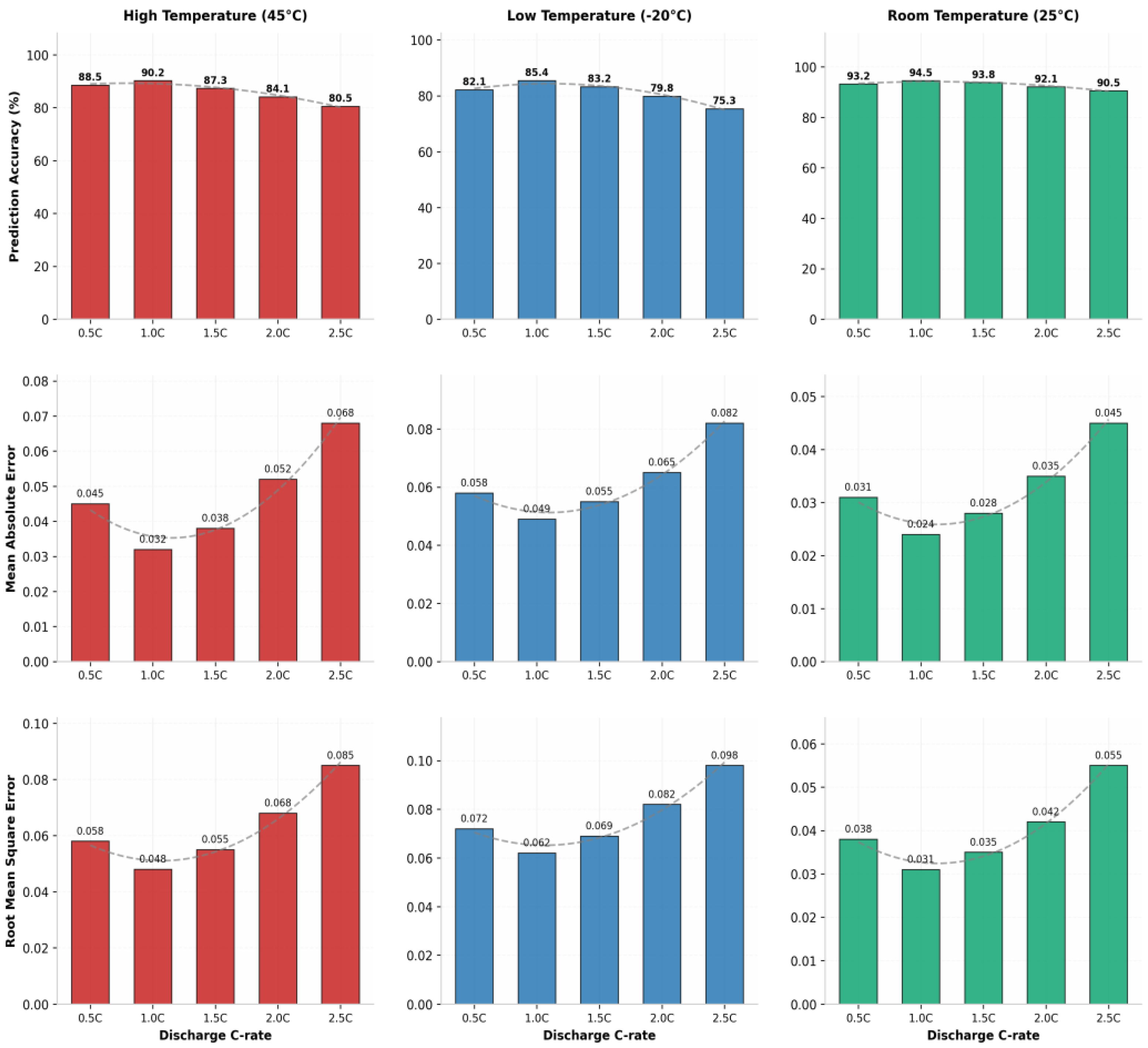
Table 12 presents the prediction accuracy (PA), mean absolute error (MAE), and root mean square error (RMSE) of the proposed PIDNN model under different discharge C-rates across three temperature conditions. As the discharge rate increases from 0.5C to 2.5C, the prediction accuracy gradually decreases under all temperature scenarios, indicating that higher operational loads introduce more complex nonlinear behaviors that challenge the predictive capability. Notably, the model maintains relatively stable performance at moderate C-rates (0.5C to 1.5C), with PA values above 87% even under high-temperature conditions.
Figure 10 illustrates the comprehensive nine-panel analysis of the model performance across different C-rates. The visualization reveals distinct patterns: under high-temperature conditions, the MAE increases from 0.032 at 1.0C to 0.068 at 2.5C, representing a 112.5% error magnification. Similarly, the RMSE exhibits a rising trend from 0.048 to 0.085, confirming the model’s sensitivity to high-rate discharge scenarios. The low-temperature environment shows even more pronounced degradation in prediction accuracy, dropping from 85.4% at 1.0C to 75.3% at 2.5C, which can be attributed to the combined effects of reduced ion mobility at low temperatures and increased electrochemical stress from high discharge rates.

5.4. Humidity Condition Experiments

Environmental humidity represents an important external operating condition for UAV battery systems in outdoor environments. For a sealed lithium-ion cell, ambient humidity does not directly and immediately alter the internal electrochemical state under normal conditions. However, humidity can still affect battery-system behavior indirectly by modifying surface heat dissipation and condensation conditions, and by increasing corrosion or contact degradation risks at externally exposed components such as terminals, connectors, and BMS-related interfaces. In this study, humidity is therefore treated as an environmental boundary-condition variable at the system level rather than a direct intrinsic electrochemical variable of an intact sealed cell. To investigate the model’s adaptability under varying humidity conditions, experiments were designed with relative humidity levels ranging from 30% to 95%, covering typical operational scenarios from arid to highly humid environments.
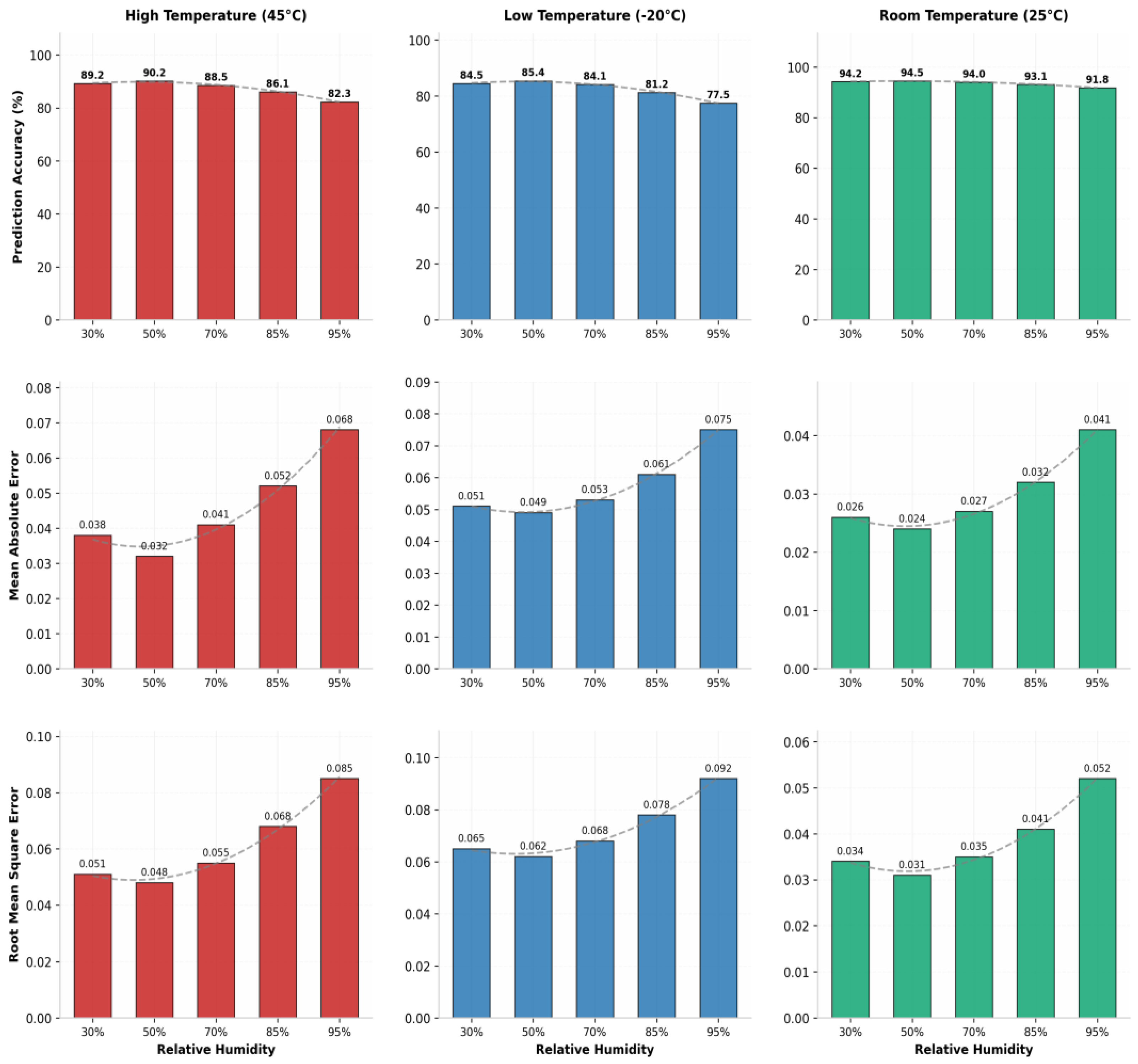
Table 13 summarizes the model performance metrics across different humidity levels. The results demonstrate that moderate humidity (50%) yields optimal prediction accuracy, with PA values of 90.2%, 85.4%, and 94.5% under high-, low-, and room-temperature conditions respectively. As humidity increases beyond 70%, a gradual decline in prediction accuracy is observed, particularly pronounced under high-temperature conditions where the PA drops from 90.2% at 50% humidity to 82.3% at 95% humidity.
Figure 11 presents the nine-panel visualization of model performance under varying humidity conditions. The analysis reveals that humidity effects are most significant in high-temperature environments, where elevated moisture levels combined with thermal stress create complex degradation patterns. The MAE increases from 0.032 at 50% humidity to 0.068 at 95% humidity under high-temperature conditions, while the corresponding RMSE rises from 0.048 to 0.085. These findings highlight the importance of incorporating humidity as a relevant environmental boundary-condition variable in UAV battery degradation prediction.

5.5. Wind Speed Variation Experiments

Airflow velocity significantly influences the convective heat transfer characteristics of UAV batteries, directly affecting surface temperature distribution and thermal management efficiency. To assess the model’s performance under varying wind conditions, experiments were conducted with wind speeds ranging from 0 m/s (static air) to 12 m/s, representing scenarios from enclosed battery compartments to high-speed flight conditions.
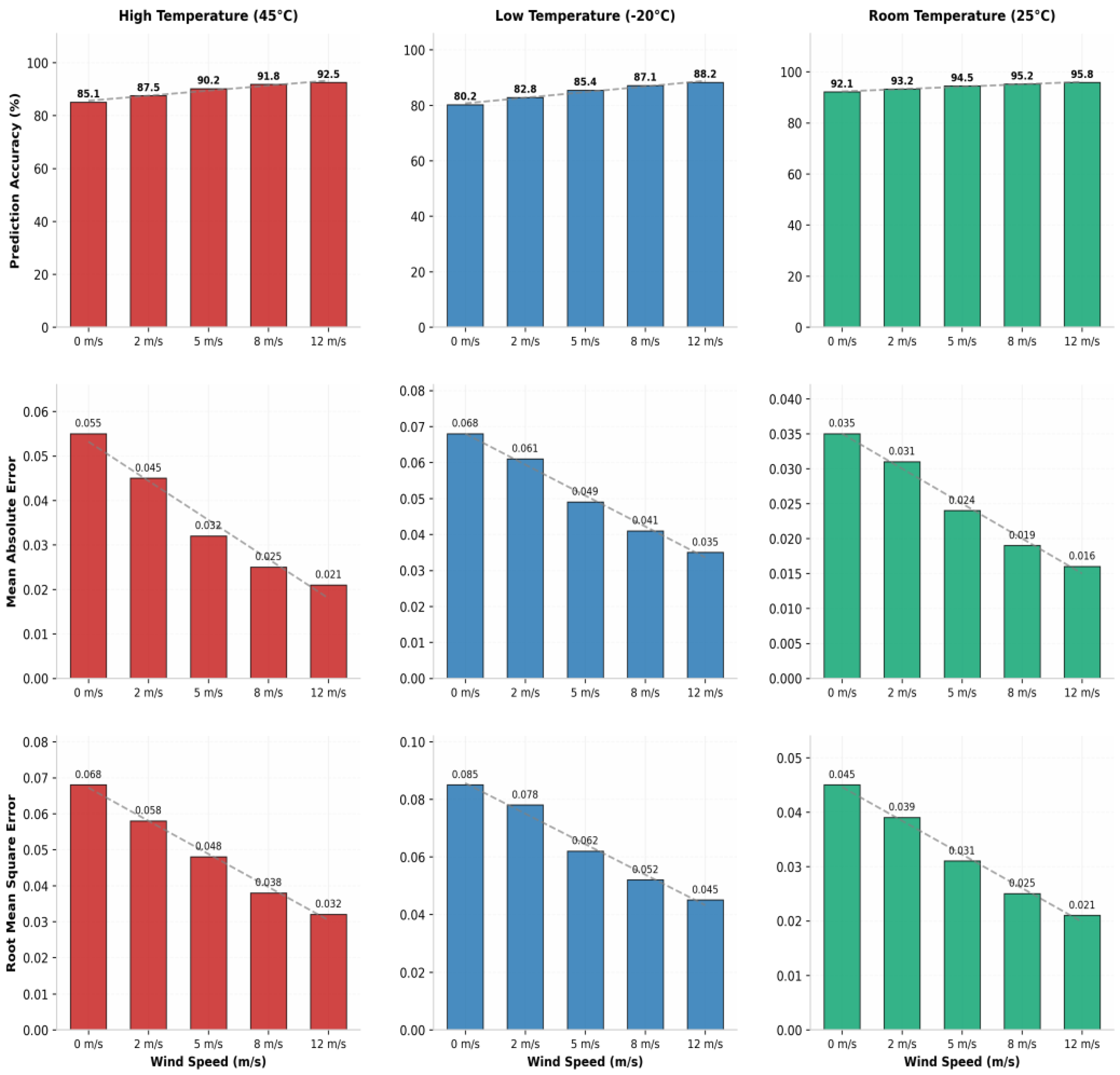
Table 14 presents the comprehensive evaluation results across different wind speed conditions. The findings reveal a clear positive correlation between wind speed and prediction accuracy. Under high-temperature conditions, the PA improves substantially from 85.1% at 0 m/s to 92.5% at 12 m/s, demonstrating that enhanced convective cooling stabilizes battery thermal behavior and facilitates more accurate degradation prediction. Similarly, the MAE decreases from 0.055 to 0.021, and the RMSE reduces from 0.068 to 0.032, confirming the model’s enhanced reliability under improved cooling conditions.
Figure 12 provides the nine-panel analysis illustrating the wind speed effects on model performance. The visualization clearly demonstrates that increased wind speed consistently improves prediction accuracy across all temperature conditions. Notably, the improvement is most significant when wind speed increases from 0 m/s to 5 m/s, with diminishing returns at higher velocities. This saturation effect suggests that beyond a certain threshold, additional airflow provides marginal benefits to prediction accuracy, which has important implications for UAV thermal management system design.

5.6. Multi-Factor Coupling Experiments

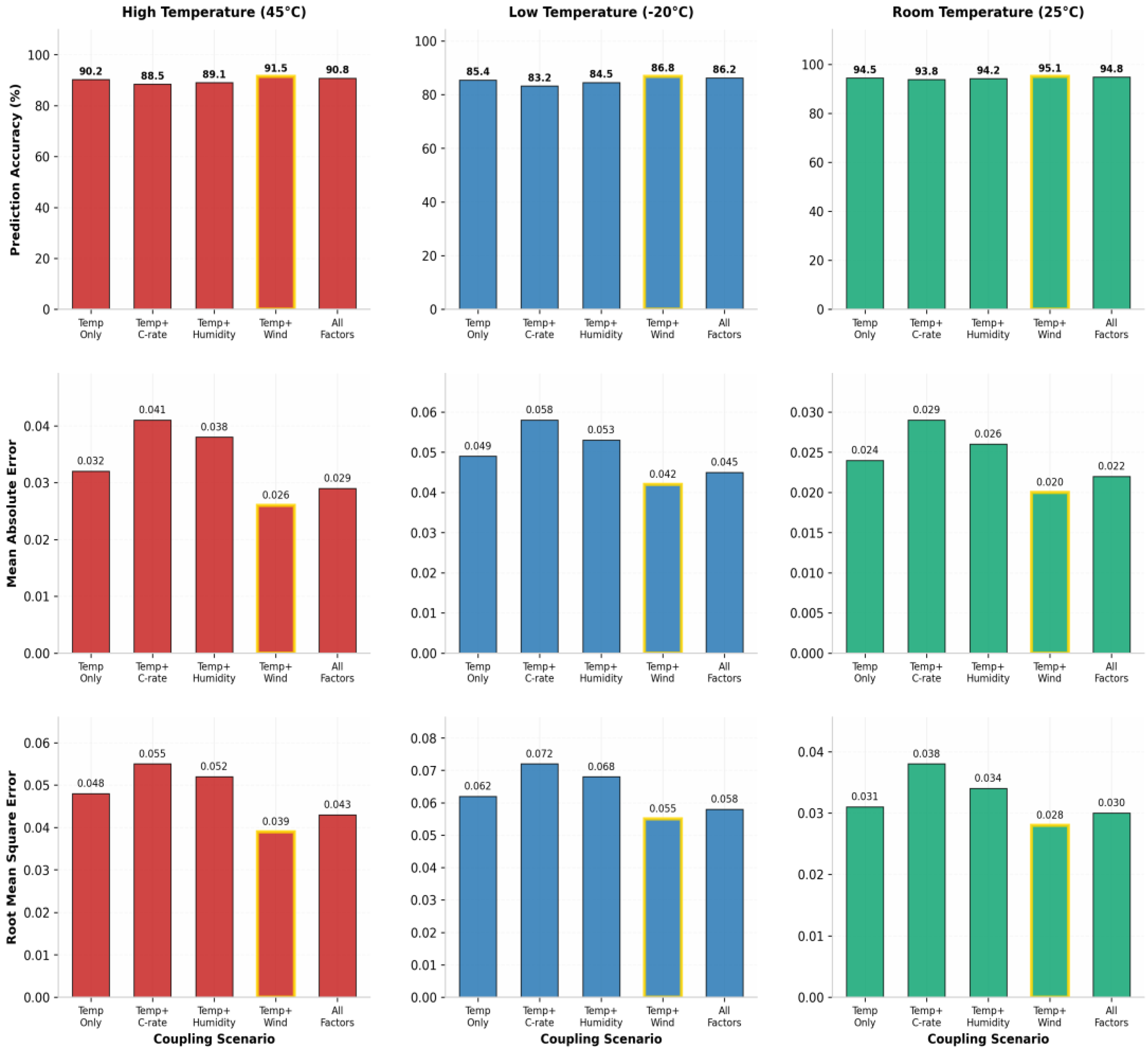
Real-world UAV operations involve simultaneous exposure to multiple environmental stressors, including temperature variations, discharge load fluctuations, humidity changes, and airflow dynamics. To validate the model’s capability in handling complex multi-factor coupling scenarios, comprehensive experiments were designed combining different environmental parameters. Five representative coupling scenarios were evaluated: temperature-only baseline, temperature with C-rate variation, temperature with humidity variation, temperature with wind speed variation, and full-factor coupling incorporating all parameters.
Table 15 presents the model performance under different coupling scenarios. The results indicate that the proposed PIDNN model maintains robust performance across various coupling configurations. Interestingly, the temperature-plus-wind-speed scenario achieves the highest prediction accuracy, with PA values of 91.5%, 86.8%, and 95.1% under high-, low-, and room-temperature conditions respectively. This superior performance can be attributed to the stabilizing effect of convective cooling, which mitigates thermal-induced degradation uncertainty. The full-factor coupling scenario demonstrates competitive performance with PA values of 90.8%, 86.2%, and 94.8%, confirming the model’s capability in handling complex multi-dimensional degradation patterns.
Figure 13 illustrates the nine-panel analysis of multi-factor coupling effects. The visualization reveals that coupling scenarios involving wind speed consistently outperform other configurations, highlighting the critical role of thermal management in battery degradation prediction. The MAE values for the temperature-plus-wind scenario are 0.026, 0.042, and 0.020 under high-, low-, and room-temperature conditions respectively, representing improvements of 18.8%, 14.3%, and 16.7% compared to the temperature-only baseline. These findings underscore the importance of incorporating comprehensive environmental parameters and their interactions into battery degradation prediction frameworks.

6. Discussion

6.1. Interpretation of Key Findings

The experimental results show that, under the present simulation setting, the proposed PIDNN framework achieves lower prediction errors than the compared pure physics-based and standalone data-driven models. Relative to the simplified physical baseline, the PIDNN improves prediction accuracy by approximately 2–5 percentage points across the tested temperature scenarios. This result suggests that the embedded thermodynamic and fluid-dynamic constraints help guide the neural network toward physically plausible degradation trajectories, while the magnitude of improvement remains moderate rather than dramatic.
Under low-temperature conditions (−20 °C), the PIDNN achieved a prediction accuracy of 85.4%, compared with 82.1% for LSTM and 80.5% for the simplified physics-based model. Although the improvement is moderate, it is accompanied by consistent reductions in MAE and RMSE under the same condition. These results suggest that the hybrid framework provides a more stable representation of degradation behavior in low-temperature environments.
The sensitivity analysis of the weighting coefficient λ provides an additional insight. The results show that predictive performance depends on a balance between data fidelity and physical consistency. When λ becomes too large (e.g., λ ≥ 2 in Table 3), the model performance deteriorates. This finding suggests that overly strong physical regularization may restrict the model’s ability to learn degradation patterns that depart from simplified physical assumptions. Therefore, the results support the use of a moderate regularization level (λ = 0.5) in the present study.

6.2. Implications for UAV Battery Management

Beyond the reported prediction metrics, the PIDNN framework may offer practical value for intelligent Battery Management Systems (BMS). The model provides physically guided predictions of capacity fade, internal resistance growth, and remaining useful life (RUL). This capability may support degradation-aware monitoring beyond simple threshold-based warning strategies. It may also help distinguish, to some extent, between thermally induced short-term performance variation and longer-term electrochemical aging. Such information could support adaptive thermal management strategies, such as discharge derating or cooling control under changing environmental conditions.
The proposed network adopts a relatively compact fully connected architecture with four hidden layers (512–256–128–64 neurons). However, compared with the simplified lumped physical baseline, the hybrid model still introduces additional computational cost during model training and parameter optimization. Therefore, its practical value should be understood as depending on a trade-off between predictive performance and computational efficiency. In onboard UAV applications, this trade-off is important because embedded platforms often have limited computing resources. In this regard, the present framework should be viewed as a compact hybrid prediction model with potential for integration into battery management or edge-assisted monitoring systems, rather than as a universally deployable onboard solution for all UAV platforms. Its practical suitability will depend on the required inference frequency, available computing resources, and system-level constraints of the target UAV platform.
The analyses under different discharge rates, wind speeds, and coupled operating conditions further suggest that the framework may be useful for mission-oriented battery assessment. For example, it may help estimate battery endurance under different flight profiles, such as high-speed travel, hovering, or operation in humid environments. Nevertheless, these implications should still be viewed as preliminary until they are validated with real UAV battery data.

6.3. Limitations and Future Work

Several limitations of the present study should be acknowledged. First, the validation is based mainly on physics-based simulation data rather than empirical flight measurements or publicly available UAV battery datasets. Although the MATLAB/Simulink framework provides physically consistent and well-controlled conditions, simulated environments cannot fully reproduce real operating conditions. Factors such as atmospheric turbulence, solar radiation, mission-dependent load variation, and platform-specific control behavior may affect model generalization.
Second, the physical modeling component adopts a lumped-parameter thermodynamic–electrical formulation combined with a simplified equivalent-circuit representation. This formulation assumes a spatially lumped thermal state and simplified electrical behavior. In particular, it does not explicitly capture transient polarization dynamics through one- or two-time-constant RC subnetworks, and may therefore be less accurate in representing short-term voltage relaxation and load-transition behavior than higher-order equivalent-circuit models. It also does not explicitly resolve internal spatial nonuniformity or detailed electrochemical transport processes. These simplifications improve computational efficiency and facilitate integration with the physics-informed learning framework. However, they may also reduce physical fidelity under complex UAV operating conditions, such as rapid load fluctuations, localized heat accumulation, pack-level thermal coupling, airflow nonuniformity, vibration, and altitude-related environmental changes. Therefore, the present framework should be regarded as a computationally efficient and physically guided approximation rather than a high-fidelity description of all internal battery processes.
In addition, this study does not yet provide a systematic quantitative benchmark of computational demand for the simplified physical baseline and the proposed PIDNN. Metrics such as training time, inference latency, memory footprint, and energy consumption were not compared in a dedicated manner. Therefore, the current results should be interpreted mainly in terms of predictive performance under a controlled simulation setting, and the accuracy–efficiency trade-off between the two approaches still needs to be evaluated more rigorously in future work. From a deployment perspective, the present study also does not quantify the hardware burden associated with potential onboard implementation, such as processor requirements, added payload, auxiliary power consumption, or thermal-management overhead. These system-level factors are particularly important for UAV applications and should be assessed in future deployment-oriented studies.
Third, although the study considers multi-factor coupling, several relevant factors are still not explicitly modeled. These include mechanical vibration, atmospheric pressure variation, and long-term calendar aging. These factors may be important in high-altitude, long-endurance, or industrial inspection missions. In addition, the simulation assumes constant material properties, such as thermal conductivity and specific heat capacity, across the operating temperature range. In real batteries, these properties may vary with temperature and state of aging.
Future work will focus on extending the validation of the proposed PIDNN framework from simulation-based scenarios to real-world data sources. Specifically, we plan to conduct controlled laboratory battery cycling experiments under different thermal and load conditions to collect empirical degradation data, including capacity fade, internal resistance evolution, and temperature responses. In addition, we aim to incorporate operational UAV battery datasets obtained from onboard monitoring systems during practical missions, so that the model can be further evaluated under realistic flight profiles, environmental disturbances, and mission-dependent duty cycles. Such real-world validation will be essential for assessing the generalization, robustness, and deployment potential of the proposed method in practical UAV applications.

7. Conclusions

This study proposed a Physics-Informed Deep Neural Network (PIDNN) framework for predicting UAV lithium-ion battery degradation under complex environmental conditions. By integrating thermodynamic and fluid-dynamic constraints into the training process, the model combines the strengths of data-driven learning and physics-based modeling. This design enables the framework to capture nonlinear degradation behavior while maintaining physical consistency.
Simulation results showed that the proposed PIDNN achieved better predictive performance than the compared physics-based and conventional machine learning models under high-temperature, low-temperature, and room-temperature conditions. The model also remained effective across different discharge rates, humidity levels, wind speeds, and coupled environmental scenarios. These results indicate that embedding physical knowledge into neural networks can improve degradation prediction under complex climatic stresses.
In addition to prediction accuracy, the proposed framework provides physically guided estimates of capacity fade, internal resistance growth, and remaining useful life, which may support degradation-aware monitoring and decision-making in UAV battery management systems. Overall, this study provides a useful methodological reference for developing physically consistent and intelligent battery prognostics for UAV applications in challenging environments.

Author Contributions

M.D.: Writing—Original Draft, Validation, Supervision, Funding Acquisition, Visualization; M.L.: Conceptualization, Methodology, Validation, Supervision, Funding Acquisition, Visualization, Review and Editing; H.J.: Validation, Supervision, Visualization, Review and Editing. All authors reviewed the manuscript. All authors have read and agreed to the published version of the manuscript.

Funding

This work was supported by the Postdoctoral Research Program of the Anhui Provincial Department of Human Resources and Social Security (2025B1094); Major Natural Science Projects of the Anhui Provincial Department of Education (2025AHGXZK20038); and Road Traffic Safety Research and Innovation Team (2023AH010064); Anhui Sanlian University Special Fund Project (ZXYJ2023001).

Data Availability Statement

The data are available from the corresponding author on reasonable request.

Conflicts of Interest

The authors declare that they have no known competing financial interests or personal relationships that could have appeared to influence the work reported in the study.

References

  1. Emimi, M.; Khaleel, M.; Alkrash, A. The current opportunities and challenges in drone technology. Int. J. Electr. Eng. Sustain. 2023, 1, 74–89. [Google Scholar] [CrossRef]
  2. Li, N.; Liu, X.; Yu, B.; Li, L.; Xu, J.; Tan, Q. Study on the environmental adaptability of lithium-ion battery powered UAV under extreme temperature conditions. Energy 2021, 219, 119481. [Google Scholar] [CrossRef]
  3. Apribowo, C.H.B.; Sarjiya, S.; Hadi, S.P.; Wijaya, F.D. Optimal planning of battery energy storage systems by considering battery degradation due to ambient temperature: A review, challenges, and new perspective. Batteries 2022, 8, 290. [Google Scholar] [CrossRef]
  4. Razi, M.F.I.M.; Daud, Z.H.C.; Asus, Z.; Mazali, I.I.; Ardani, M.I.; Hamid, M.K.A. A review of internal resistance and temperature relationship, state of health and thermal runaway for lithium-ion battery beyond normal operating condition. J. Adv. Res. Fluid Mech. Therm. Sci. 2021, 88, 123–132. [Google Scholar] [CrossRef]
  5. Wang, L.; Qiu, Y.; Yuan, W.; Tian, Y.; Zhou, Z. Next-generation battery safety management: Machine learning assisted life-time prediction and performance enhancement. J. Energy Chem. 2025, 109, 726–739. [Google Scholar] [CrossRef]
  6. Sudarshan, M.; Serov, A.; Jones, C.; Ayalasomayajula, S.M.; García, R.E.; Tomar, V. Data-driven autoencoder neural network for onboard BMS lithium-ion battery degradation prediction. J. Energy Storage 2024, 82, 110575. [Google Scholar] [CrossRef]
  7. Jiao, S.; Zhang, G.; Zhou, M.; Li, G. A comprehensive review of research hotspots on battery management systems for UAVs. IEEE Access 2023, 11, 84636–84650. [Google Scholar] [CrossRef]
  8. Xie, S.; Sun, J.; Chen, X.; He, Y. Thermal runaway behavior of lithium-ion batteries in different charging states under low pressure. Int. J. Energy Res. 2021, 45, 5795–5805. [Google Scholar] [CrossRef]
  9. Adenusi, H.; Chass, G.A.; Passerini, S.; Tian, K.V.; Chen, G. Lithium batteries and the solid electrolyte interphase (SEI)—Progress and outlook. Adv. Energy Mater. 2023, 13, 2203307. [Google Scholar] [CrossRef]
  10. Deshpande, R.D.; Bernardi, D.M. Modeling solid-electrolyte interphase (SEI) fracture: Coupled mechanical/chemical degradation of the lithium ion battery. J. Electrochem. Soc. 2017, 164, A461. [Google Scholar] [CrossRef]
  11. Wei, G.; Huang, R.; Zhang, G.; Jiang, B.; Zhu, J.; Guo, Y.; Dai, H. A comprehensive insight into the thermal runaway issues in the view of lithium-ion battery intrinsic safety performance and venting gas explosion hazards. Appl. Energy 2023, 349, 121651. [Google Scholar] [CrossRef]
  12. Xiao, Y.; Liu, M.; Lu, H.; Gao, Z.; Wang, D.; Yang, F.; Yuan, Q. The impact of thermal damage accumulation on thermal runaway behavior of lithium-ion batteries. Energy 2025, 338, 138812. [Google Scholar] [CrossRef]
  13. He, X.; Ling, Y.; Wu, Y.; Lei, Y.; Cao, D.; Zhang, C. Research progress of electrolytes and electrodes for lithium- and sodium-ion batteries at extreme temperatures. Small 2025, 21, 2412817. [Google Scholar] [CrossRef] [PubMed]
  14. Liu, C.; Sheng, L.; Jiang, L. Research on performance constraints and electrolyte optimization strategies for lithium-ion batteries at low temperatures. RSC Adv. 2025, 15, 7995–8018. [Google Scholar] [CrossRef]
  15. Ercan, H.; Ayaz, F.A.; Ulucan, H. Effect of temperature, pressure and humidity on battery consumption in unmanned aerial vehicles. J. Aviat. 2025, 9, 5–12. [Google Scholar] [CrossRef]
  16. Zhao, T.; Zhang, Y.; Wang, M.; Feng, W.; Cao, S.; Wang, G. A critical review on the battery system reliability of drone systems. Drones 2025, 9, 539. [Google Scholar] [CrossRef]
  17. Xiao, C.; Wang, B.; Zhao, D.; Wang, C. Comprehensive investigation on lithium batteries for electric and hybrid-electric unmanned aerial vehicle applications. Therm. Sci. Eng. Prog. 2023, 38, 101677. [Google Scholar] [CrossRef]
  18. Zhao, J.; Qu, X.; Wu, Y.; Fowler, M.; Burke, A.F. Artificial intelligence-driven real-world battery diagnostics. Energy AI 2024, 18, 100419. [Google Scholar] [CrossRef]
  19. Li, D.; Nan, J.; Burke, A.F.; Zhao, J. Battery prognostics and health management: AI and big data. World Electr. Veh. J. 2024, 16, 10. [Google Scholar] [CrossRef]
  20. Tao, J.; Wang, S.; Cao, W.; Fernandez, C.; Blaabjerg, F. A comprehensive review of multiple physical and data-driven model fusion methods for accurate lithium-ion battery inner state factor estimation. Batteries 2024, 10, 442. [Google Scholar] [CrossRef]
  21. Onda, K.; Kameyama, H.; Hanamoto, T.; Ito, K. Experimental study on heat generation behavior of small lithium-ion secondary batteries. J. Electrochem. Soc. 2003, 150, A285–A291. [Google Scholar] [CrossRef]
  22. Srinivasan, V.; Wang, C.Y. Analysis of electrochemical and thermal behavior of Li-ion cells. J. Electrochem. Soc. 2003, 150, A98–A106. [Google Scholar] [CrossRef]
  23. Fayaz, H.; Afzal, A.; Samee, A.M.; Soudagar, M.E.M.; Akram, N.; Mujtaba, M.A.; Saleel, C.A. Optimization of thermal and structural design in lithium-ion batteries to obtain energy efficient battery thermal management system: A critical review. Arch. Comput. Methods Eng. 2022, 29, 129–194. [Google Scholar] [CrossRef] [PubMed]
  24. Maher, K.; Boumaiza, A.; Amin, R. Understanding the heat generation mechanisms and the interplay between joule heat and entropy effects as a function of state of charge in lithium-ion batteries. J. Power Sources 2024, 623, 235504. [Google Scholar] [CrossRef]
  25. Tang, M.; Wu, C.; Peng, W.; Han, R.; Zhang, S.; Wang, D. Numerical simulation study on the impact of convective heat transfer on lithium battery air cooling thermal model. Appl. Therm. Eng. 2024, 257, 124220. [Google Scholar] [CrossRef]
  26. Argade, S.; De, A. Optimization study of a Z-type airflow cooling system of a lithium-ion battery pack. Phys. Fluids 2024, 36, 067119. [Google Scholar] [CrossRef]
  27. Mei, J.; Shi, G.; Chen, M.; Li, Q.; Liu, H.; Liu, S.; Zhang, L. Investigation of thermal runaway characteristics of lithium-ion battery in confined space under the influence of ventilation and humidity. Appl. Therm. Eng. 2024, 257, 124188. [Google Scholar] [CrossRef]
  28. Lou, Z.; Huang, J.; Su, Z.; Zhang, D.; Wei, X.; Yao, H. Effects of ventilation conditions on thermal runaway of lithium-ion batteries packs in an energy-storage cabin. Process Saf. Environ. Prot. 2025, 196, 106899. [Google Scholar] [CrossRef]
  29. Wang, Y.; Chen, X.; Li, C.; Yu, Y.; Zhou, G.; Wang, C.; Zhao, W. Temperature prediction of lithium-ion battery based on artificial neural network model. Appl. Therm. Eng. 2023, 228, 120482. [Google Scholar] [CrossRef]
  30. Wang, Y.; Xiong, C.; Wang, Y.; Xu, P.; Ju, C.; Shi, J.; Chu, J. Temperature state prediction for lithium-ion batteries based on improved physics-informed neural networks. J. Energy Storage 2023, 73, 108863. [Google Scholar] [CrossRef]
  31. Wang, F.; Zhai, Z.; Zhao, Z.; Di, Y.; Chen, X. Physics-informed neural network for lithium-ion battery degradation stable modeling and prognosis. Nat. Commun. 2024, 15, 4332. [Google Scholar] [CrossRef] [PubMed]
  32. Yi, Y.; Xia, C.; Feng, C.; Zhang, W.; Fu, C.; Qian, L.; Chen, S. Digital twin–long short-term memory neural network based real-time temperature prediction and degradation model analysis for lithium-ion battery. J. Energy Storage 2023, 64, 107203. [Google Scholar] [CrossRef]
  33. Du, Z.; Lu, R. Physics-informed neural networks for advanced thermal management in electronics and battery systems: A review of recent developments and future prospects. Batteries 2025, 11, 204. [Google Scholar] [CrossRef]
  34. Fu, J.; Song, Z.; Meng, J.; Guo, J.; Yang, K.; Liu, W.; Huan, L. AI-augmented electrochemical model for lithium-ion battery: Recent advances and perspectives. J. Energy Chem. 2026, 113, 1056–1080. [Google Scholar] [CrossRef]
  35. Gu, W.B.; Wang, C.Y. Thermal-electrochemical modeling of battery systems. J. Electrochem. Soc. 2000, 147, 2910–2922. [Google Scholar] [CrossRef]
  36. Kim, H.K.; Lee, K.J. Scale-up of physics-based models for predicting degradation of large lithium-ion batteries. Sustainability 2020, 12, 8544. [Google Scholar] [CrossRef]
  37. Wang, Y.; Ni, Y.; Lu, S.; Wang, J.; Zhang, X. Remaining useful life prediction of lithium-ion batteries using support vector regression optimized by artificial bee colony. IEEE Trans. Veh. Technol. 2019, 68, 9543–9553. [Google Scholar] [CrossRef]
  38. Hussein, H.M.; Esoofally, M.; Donekal, A.; Rafin, S.S.H.; Mohammed, O. Comparative study-based data-driven models for lithium-ion battery state-of-charge estimation. Batteries 2024, 10, 89. [Google Scholar] [CrossRef]
Figure 1. Schematic comparison of application characteristics between UAV and EV batteries.
Batteries 12 00124 g001
Figure 2. Hybrid architecture of the physics-driven deep neural network model.
Batteries 12 00124 g002
Figure 3. MATLAB/Simulink battery aging simulation model.
Batteries 12 00124 g003
Figure 4. Comparison of voltage responses under different temperature conditions.
Batteries 12 00124 g004
Figure 5. Battery capacity decline comparison under different temperatures.
Batteries 12 00124 g005
Figure 6. Internal resistance growth trends under different temperatures.
Batteries 12 00124 g006
Figure 7. Comparison of prediction accuracy results of five models.
Batteries 12 00124 g007
Figure 8. Comparison of MAE results of five models.
Batteries 12 00124 g008
Figure 9. Comparison of RMSE results of five models.
Batteries 12 00124 g009
Figure 10. Nine-panel analysis of model performance under varying discharge C-rates.
Batteries 12 00124 g010
Figure 11. Nine-panel analysis of model performance under varying humidity conditions.
Batteries 12 00124 g011
Figure 12. Nine-panel analysis of model performance under varying wind speed conditions.
Batteries 12 00124 g012
Figure 13. Nine-panel analysis of model performance under multi-factor coupling scenarios.
Batteries 12 00124 g013
Table 1. Detailed definitions and dimensions of the DNN input variables.
Input VariableDescriptionDimension
VoltageSimulated battery terminal voltage1
CapacitySimulated battery capacity1
Internal resistanceSimulated battery internal resistance1
TemperatureSimulated temperature1
Wind speedSimulated wind speed1
HumiditySimulated ambient humidity1
Total input dimension 6
Table 2. Environmental parameter settings for battery degradation prediction simulation experiment.
Experimental GroupTemperature (°C)Experiment Duration (Hours)Battery Voltage (V)Battery Capacity (Ah)Internal Resistance of Battery (Ω)
High Temperature 454003.72.00.02
Low Temperature −204003.72.00.02
Room Temperature254003.72.00.02
Table 3. Validation-based sensitivity analysis of the weighting coefficient λ.
λMAERMSE
00.0840.112
0.10.0710.096
0.20.0680.092
0.50.0640.088
10.0660.09
20.070.095
50.0780.104
100.0910.121
Table 4. Reconstructed terminal voltage responses under different temperature conditions.
Time
(Hours)
Voltage (High Temp, V)Voltage (Low Temp, V)Voltage (Room Temp, V)
Physical ModelDNN ModelPhysical ModelDNN ModelPhysical ModelDNN Model
04.204.204.204.204.204.20
1004.104.124.184.194.194.20
2003.954.004.154.174.174.18
3003.83.94.124.144.164.17
4003.653.84.14.124.134.15
Note: The voltage values are not directly predicted by the DNN. They are reconstructed from the predicted degradation states using the equivalent-circuit formulation described in Section 3.1 and Section 3.2.
Table 5. Battery capacity under different temperature conditions.
Time
(Hours)
Capacity (High Temp, Ah)Capacity (Low Temp, Ah)Capacity (Room Temp, Ah)
Physical ModelDNN ModelPhysical ModelDNN ModelPhysical ModelDNN Model
0222222
1001.931.961.951.971.981.99
2001.841.891.901.931.961.97
3001.761.841.861.901.941.96
4001.681.781.821.871.921.95
Table 6. Battery capacity retention under different temperature conditions.
Time
(Hours)
BCR (High Temp, %)BCR (Low Temp, %)BCR (Room Temp, %)
Physical ModelDNN ModelPhysical ModelDNN ModelPhysical ModelDNN Model
0100100100100100100
10096.598.097.598.599.099.5
20092.095.095.597.098.098.5
30088.092.093.095.097.097.5
40084.089.091.093.596.097.0
Table 7. Battery internal resistance under different temperature conditions.
Time
(Hours)
Resistance (High Temp, Ω)Resistance (Low Temp, Ω)Resistance (Room Temp, Ω)
Physical ModelDNN ModelPhysical ModelDNN ModelPhysical ModelDNN Model
00.020.020.020.020.020.02
1000.050.0420.060.050.0220.021
2000.090.070.080.0650.0250.023
3000.140.1050.10.080.0270.025
4000.20.150.120.0950.030.027
Table 8. Battery internal resistance change rate under different temperature conditions.
Time
(Hours)
BIRCR (High Temp, %)BIRCR (Low Temp, %)BIRCR (Room Temp, %)
Physical ModelDNN ModelPhysical ModelDNN ModelPhysical ModelDNN Model
0000000
100150110200150105
2003502503002252515
3006004254003003525
4009006505003755035
Table 9. Prediction accuracy for RUL under different environmental conditions.
Environmental ConditionPhysics-Based Model
(%)
SVM
(%)
LSTM
(%)
GAN
(%)
Proposed Model (PIDNN)
(%)
High Temperature85.20%87.50%88.50%88.00%90.20%
Low Temperature80.50%80.10%82.10%82.20%85.40%
Room Temperature92.30%93.00%93.70%94.00%94.50%
Table 10. MAE for RUL under different environmental conditions.
Environmental ConditionPhysics-Based ModelSVMLSTMGANProposed Model (PIDNN)
High Temperature 0.0570.0450.0380.0390.032
Low Temperature 0.0720.0650.0550.0560.049
Room Temperature0.0410.0340.0290.0280.024
Table 11. RMSE for RUL under different environmental conditions.
Environmental ConditionPhysics-Based ModelSVMLSTMGANProposed Model (PIDNN)
High Temperature 0.0700.0580.0500.0520.048
Low Temperature 0.0890.0810.0690.0710.062
Room Temperature0.0510.0430.0360.0350.031
Table 12. Experimental results under different discharge C-rates.
C-RateHigh Temp PA (%)Low Temp PA (%)Room Temp PA (%)
0.5C88.582.193.2
1.0C90.285.494.5
1.5C87.383.293.8
2.0C84.179.892.1
2.5C80.575.390.5
Table 13. Experimental results under different humidity conditions.
HumidityHigh Temp PA (%)Low Temp PA (%)Room Temp PA (%)
30%89.284.594.2
50%90.285.494.5
70%88.584.194.0
85%86.181.293.1
95%82.377.591.8
Table 14. Experimental results under different wind speed conditions.
Wind SpeedHigh Temp PA (%)Low Temp PA (%)Room Temp PA (%)
0 m/s85.180.292.1
2 m/s87.582.893.2
5 m/s90.285.494.5
8 m/s91.887.195.2
12 m/s92.588.295.8
Table 15. Experimental results under different multi-factor coupling scenarios.
ScenarioHigh Temp PA (%)Low Temp PA (%)Room Temp PA (%)
Temp Only90.285.494.5
Temp + C-rate88.583.293.8
Temp + Humidity89.184.594.2
Temp + Wind91.586.895.1
All Factors90.886.294.8
Disclaimer/Publisher’s Note: The statements, opinions and data contained in all publications are solely those of the individual author(s) and contributor(s) and not of MDPI and/or the editor(s). MDPI and/or the editor(s) disclaim responsibility for any injury to people or property resulting from any ideas, methods, instructions or products referred to in the content.