
Review

A Comprehensive Review on the Rapid Development of Silicon/MXene Nanocomposites for Lithium-Ion Battery Applications

by
Narasimharao Kitchamsetti
1,*,
Sungwook Mhin
2,* and
HyukSu Han
3,*
1
Department of Microsystems, University of South-Eastern Norway, Campus Vestfold, Raveien 215, 3184 Borre, Norway
2
Department of Energy and Materials Engineering, Dongguk University, Seoul 04620, Republic of Korea
3
Division of Materials Science and Engineering, Hanyang University, Seoul 04763, Republic of Korea
*
Authors to whom correspondence should be addressed.
Batteries 2026, 12(3), 79; https://doi.org/10.3390/batteries12030079
Submission received: 19 January 2026 / Revised: 19 February 2026 / Accepted: 20 February 2026 / Published: 24 February 2026

Abstract

Silicon (Si) has attracted extensive attention as a promising anode material for next-generation lithium-ion batteries (LIBs) due to its ultra-high theoretical capacity, low lithiation potential, and economic advantages. However, drastic volume expansion during cycling and slow reaction kinetics severely compromise its structural stability and practical application. Recently, two-dimensional (2D) MXenes have been explored as effective functional components in Si-based electrodes because of their excellent electrical conductivity, high specific surface area, adjustable surface terminations, and mechanical robustness. When integrated with Si, MXenes serve as conductive matrices that alleviate volumetric stress, enhance charge transport, and accelerate electron/ion diffusion. Consequently, Si/MXene nanocomposites (NCs) exhibit significantly improved lithium (Li) storage performance. This review outlines recent advances in Si/MXene NCs, covering fabrication strategies, structural engineering, and various configurations, including particulate materials, three-dimensional (3D) architectures, films, and fibrous systems, and establishes the relationship between structural design and electrochemical behavior. Remaining challenges and prospective research directions are also discussed to guide the development of high-energy-density LIB anodes.

1. Introduction

Heavy dependence on traditional fossil fuels has led to severe environmental degradation and escalating energy shortages, prompting rapid expansion of sustainable renewable resources such as solar, wind, and tidal energy [1,2,3,4,5,6,7]. However, the fluctuating and intermittent nature of these energy sources necessitates efficient energy storage (ES) technologies capable of supplying reliable and regulated power for applications including electric vehicles, portable electronics, and grid-scale storage systems [8,9,10,11,12,13,14]. Among existing ES technologies, lithium-ion batteries (LIBs) are particularly attractive because of their high energy and power densities, extended cycling stability, and absence of memory effect [15,16,17,18]. Nevertheless, increasing demands for higher energy density and longer operational lifespan have exposed the intrinsic limitations of graphite anodes, whose theoretical capacity of 372 mAh/g is insufficient for next-generation requirements.
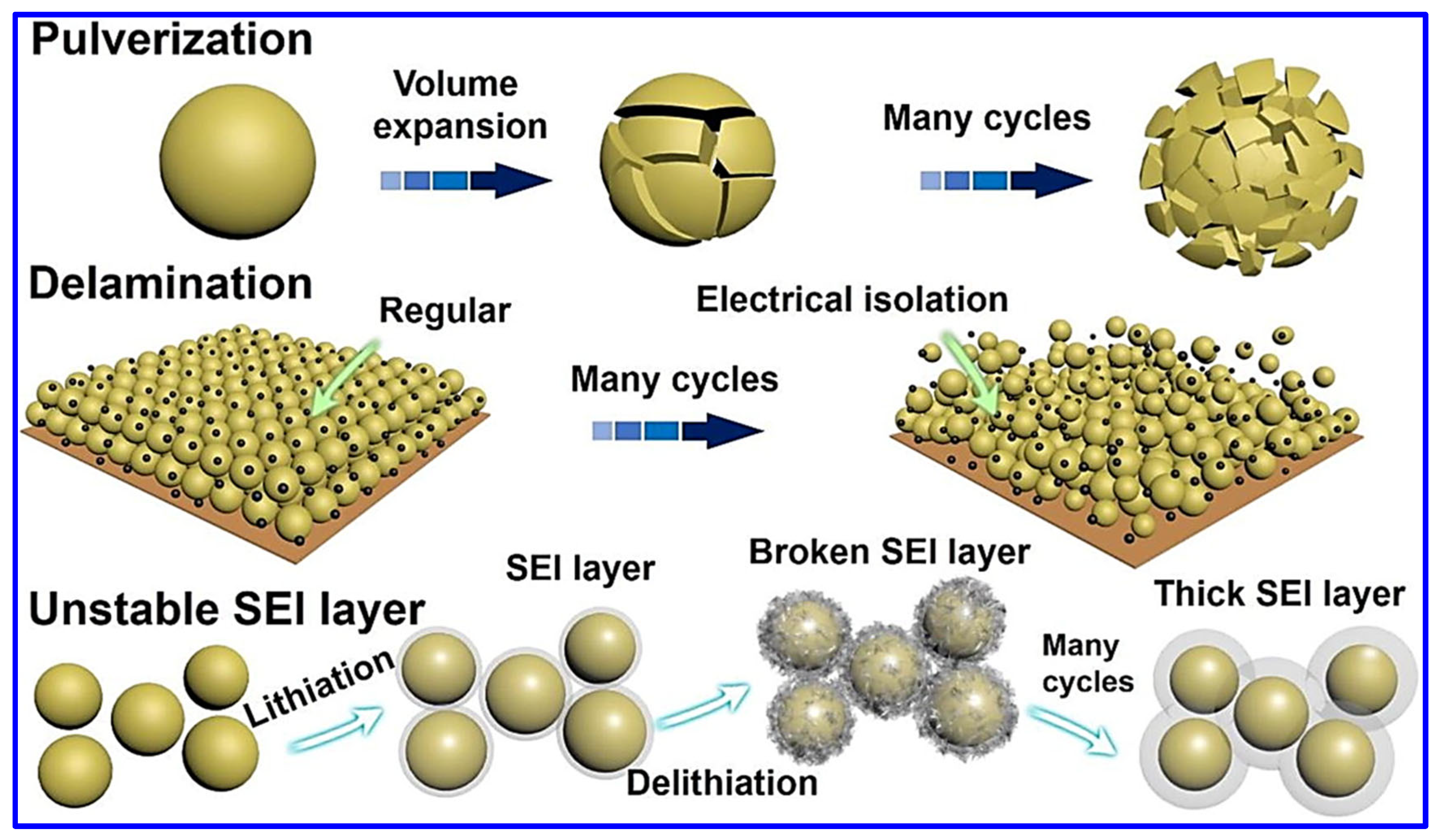
Among potential anode materials for LIBs, silicon (Si) stands out as a leading candidate for next-generation high-energy storage. Its advantages include: (i) an ultrahigh theoretical capacity of ~4200 mAh/g via full lithiation to Li22Si4, exceeding that of graphite by more than an order of magnitude; (ii) a relatively low lithiation plateau (~0.3 V vs. Li/Li+), which allows a broad operating voltage window and suppresses Li dendrite growth [19,20,21]; and (iii) high natural abundance, low toxicity, and environmental compatibility, supporting scalable and cost-efficient deployment [22,23,24]. Despite these merits, severe volume expansion (~360%) during alloying with Li induces particle pulverization, unstable solid electrolyte interphase (SEI) formation, and mechanical degradation, ultimately leading to rapid capacity fading and poor cycling durability (Figure 1). Furthermore, the intrinsically low electrical conductivity of Si (~10−3 S/cm) restricts charge-transfer kinetics [22,25,26]. To mitigate these issues, Si suboxides (SiOx, 0 < x ≤ 2) have been investigated as alternative anodes, offering high theoretical capacities (2200–3850 mAh/g) with reduced volume variation (~200%) [27,28]. Nevertheless, SiOx still struggles to achieve stable and fast Li storage performance.
Conductive carbon (C) materials, including graphite [29], graphene [30] and C nanotubes (CNTs) [31], have long been integrated into Si anodes to mitigate volume expansion and improve electrical conductivity. However, their contribution is primarily confined to forming passive conductive frameworks and mechanical reinforcement. In comparison, MXenes possess several intrinsic characteristics that differentiate them from traditional C allotropes. They exhibit metallic-level conductivity without the need for high-temperature graphitization and contain abundant surface terminations (-O, -OH, -F, -Cl) that promote strong interfacial interactions, including possible covalent bonding (e.g., Ti-O-Si and Ti-Si linkages), thereby enhancing structural stability during cycling [32,33,34]. Furthermore, the hydrophilic nature and excellent aqueous dispersibility of MXenes enable homogeneous integration with Si particles without complicated surface treatments. Their flexible layered structure allows them to serve multiple roles simultaneously, such as conductive frameworks, mechanical buffers, binders, and even lightweight current collectors. Additionally, adjustable interlayer spacing and surface chemistry facilitate Li-ion transport and help regulate SEI formation by minimizing direct contact between Si and the electrolyte. These combined advantages position MXenes as multifunctional components rather than simple conductive additives, highlighting the significance of Si/MXene NCs beyond conventional Si/C systems [35].
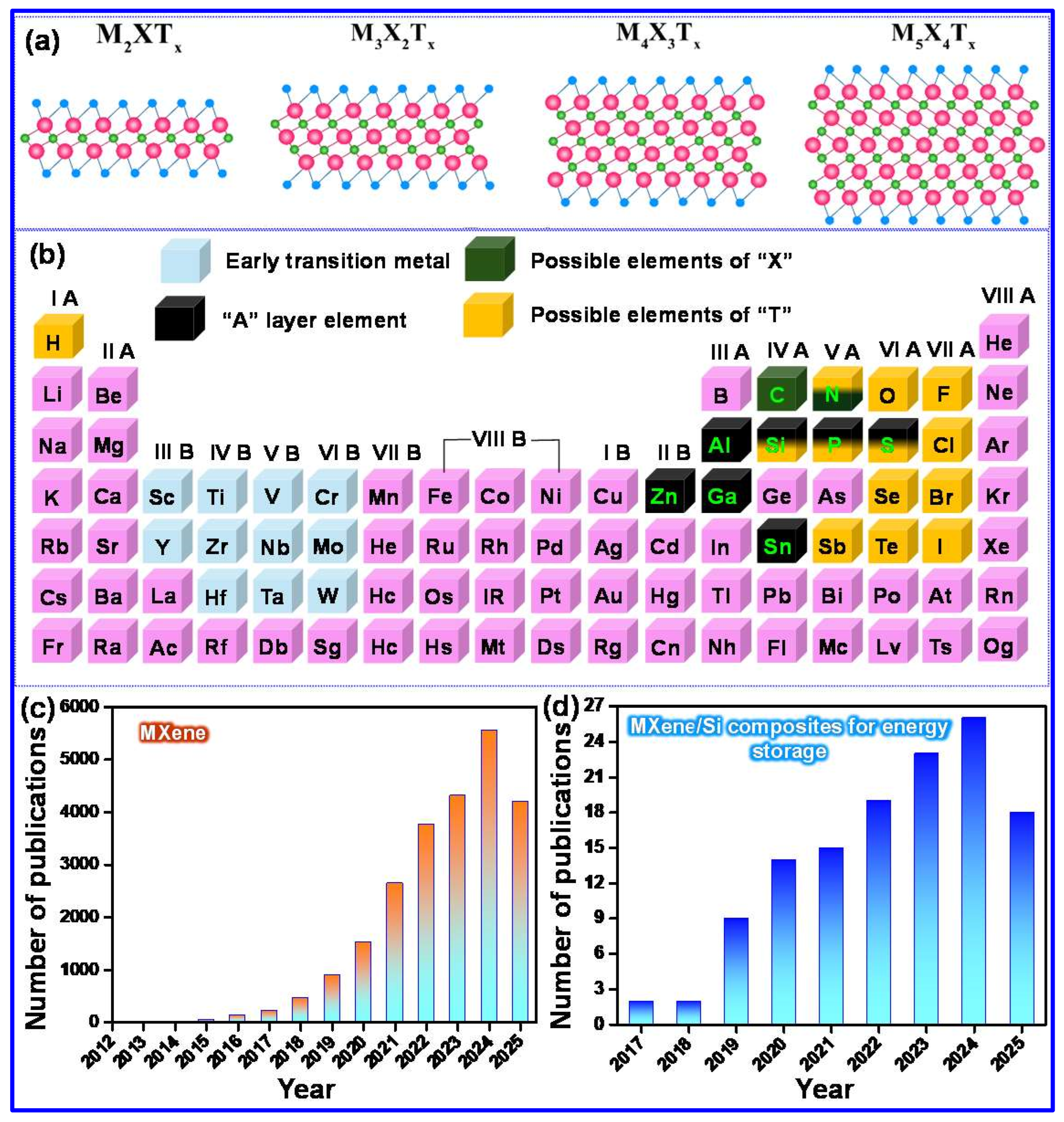
MXenes are typically produced through selective removal of the A-layer elements (primarily group IIIA and IVA elements) from their parent MAX phases, resulting in two-dimensional (2D) compounds with the general formula Mn+1XnTx. In this structure, M represents an early transition metal (such as Ti, V, Mo, or Nb), X refers to carbon and/or nitrogen, n ranges from 1 to 4, and Tx denotes surface terminations (e.g., -O, -Cl, -S) (Figure 2a,b) [32,33,34]. Various synthesis routes have been developed for MXene preparation. Conventional approaches include fluorine (F)-containing etchants such as HF [35], LiF/HCl [36], NH4HF2 [37] and SF6 [38], as well as F-free methods like Lewis acidic molten-salt etching [39]. For example, treatment of Ti3AlC2 in molten ZnCl2 at elevated temperatures (~550 °C) selectively removes Al layers, followed by vacuum distillation to eliminate Zn by-products, yielding Cl-terminated Ti3C2Clx [40]. Similar molten-salt strategies have been extended to other MAX precursors, including Nb2AlC, Nb2AlN, and Nb4AlC3. More recently, chemical vapor deposition (CVD) techniques employing CH4 and titanium chlorides (TiCl4 [41] or TiCl3 [42]) have enabled direct synthesis of Cl-terminated Ti2C MXene, offering potential for scalable production. To date, more than 50 MXene compositions have been reported, with projections exceeding 100 when accounting for solid-solution systems and varied surface terminations [43]. Owing to their layered morphology, MXenes exhibit adjustable electrical conductivity, abundant functional groups, high mechanical strength, and structural flexibility, making them promising materials for energy storage [44], catalysis [45], sensing [46], and electromagnetic interference shielding [47].
In addition to improving electrical conductivity, MXenes significantly alleviate the extreme volume variation in Si anodes during repeated lithiation and delithiation. Their mechanically robust and flexible 2D architecture enables MXene sheets to function as conductive frameworks that physically restrain Si nanoparticles (NPs) while accommodating their expansion and contraction [40]. The rich surface terminations (-O, -OH, -F, -Cl) further promote strong interfacial coupling or even covalent bonding (e.g., Ti-O-Si and Ti-Si), which enhances structural cohesion and preserves electrical connectivity during cycling [24,44]. Meanwhile, MXene layers can partially isolate Si from direct electrolyte exposure, facilitating the formation of a uniform and stable SEI and suppressing parasitic side reactions. Through these combined effects, MXene-based composites effectively relieve mechanical stress, maintain electrode integrity, and improve long-term cycling performance [21]. The increasing volume of related publications highlights the growing attention toward MXenes as emerging 2D materials (Figure 2c). In energy storage systems, they serve as versatile conductive matrices for hybridization with Si and other active phases such as metal oxides and sulfides. Since the initial demonstration of Si@Ti3C2 prepared via ultrasonic assembly [48], diverse Si/MXene configurations, including spherical [49], fibrous [50], film-like [51] and powder forms [52], have been developed for Li storage applications.
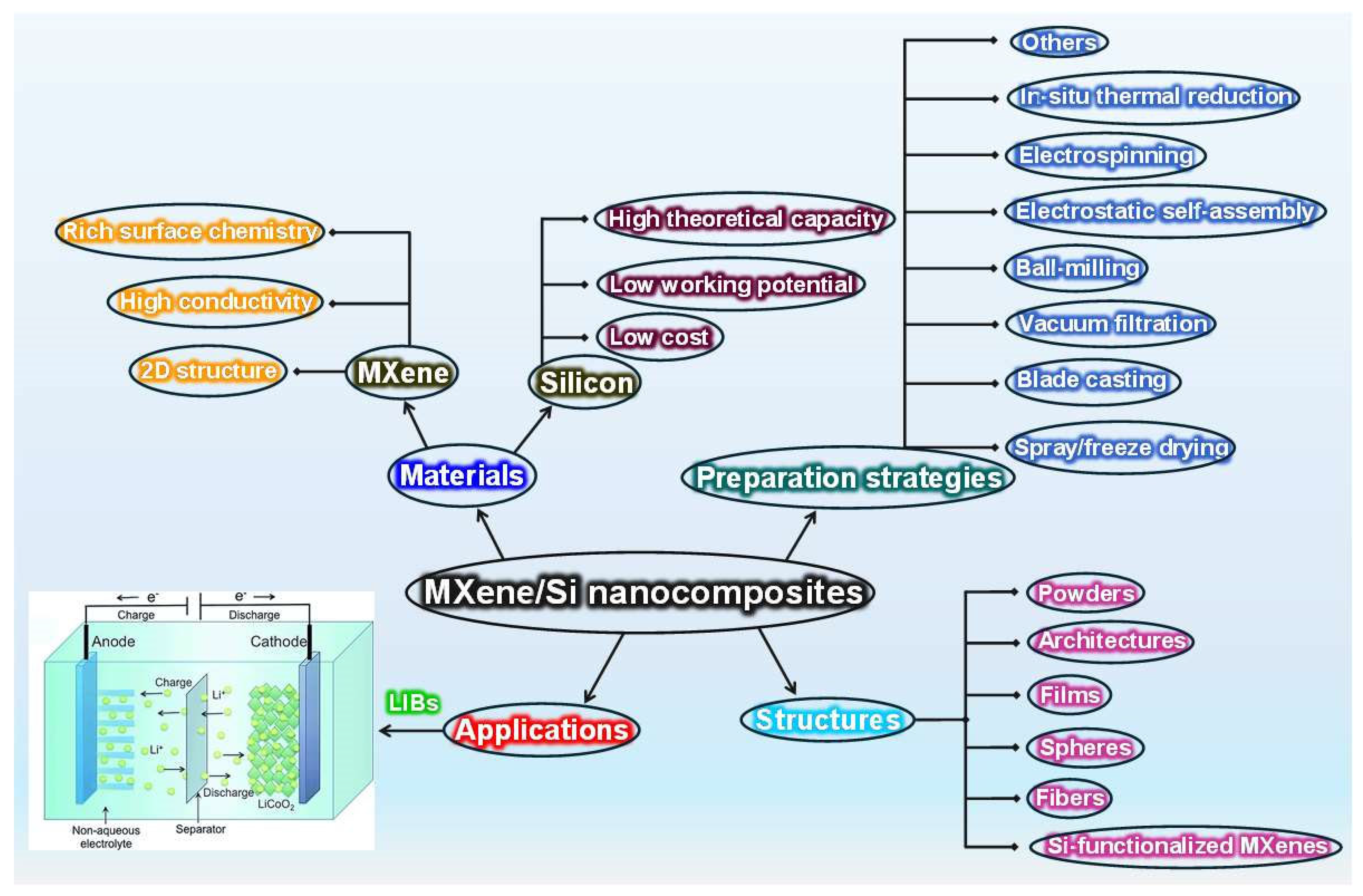
While numerous review papers have addressed Si-based anodes, MXene materials for energy storage, and Si/C composite systems (Figure 2d), a comprehensive review specifically centered on Si/MXene NCs remains absent. Most existing literature discusses MXenes and Si separately or briefly mentions Si/MXene hybrids within broader material classifications, without systematically linking synthesis methods, interfacial interactions, structural design, and electrochemical behavior. Furthermore, insufficient attention has been devoted to understanding how different fabrication strategies influence the multifunctional roles of MXenes, such as conductive frameworks, mechanical buffers, binders, and even current collectors in Si electrodes. To address this research gap, this review presents a systematic and critical overview of Si/MXene NCs, categorized according to their synthesis routes and structural forms, including powders, thin films, 3D porous frameworks, and fibrous structures (Figure 3). By establishing clear relationships among fabrication strategies, interfacial interactions, microstructural evolution, and Li-storage performance, this work aims to clarify the fundamental design principles for high-efficiency Si/MXene anodes. In addition, the strengths, drawbacks, and scalability of various preparation methods are comparatively evaluated from both scientific and practical viewpoints. The review concludes by identifying key challenges and proposing future research directions to advance next-generation Si/MXene electrodes for high-energy LIBs.
In recent years, several review articles have addressed related topics from different perspectives. Reviews on Si-based anodes mainly focus on strategies to mitigate volume expansion through nanostructuring, alloying, and composite design, but typically emphasize general performance improvements without systematically comparing practical metrics such as initial Coulombic efficiency (ICE), mass loading, or areal capacity [23,26]. Reviews on MXenes for energy storage primarily discuss synthesis methods, surface chemistry, and their applications in various electrochemical systems, while the role of MXenes in stabilizing high-capacity alloy-type anodes is often only briefly mentioned [32,34]. In addition, numerous reviews on Si/C composites summarize conductive buffering strategies but rarely consider the unique interfacial chemistry introduced by MXene surface terminations [54,55]. A few recent reports have mentioned Si/MXene hybrid systems [51,56]; however, these discussions are generally descriptive and lack consistent evaluation criteria, particularly regarding cycling duration, electrode mass loading, and cell configuration (half-cell vs. full-cell), which are critical for assessing practical relevance. Therefore, a comprehensive and critical analysis specifically focused on Si/MXene NCs remains necessary. In this review, we aim to fill this gap by systematically comparing reported Si/MXene systems using practical performance indicators (ICE, capacity retention, mass loading, areal capacity, and testing duration), while emphasizing structure–interface–performance relationships and identifying design principles for balancing capacity, stability, and scalability.

2. Preparation of Si/MXene NCs

2.1. Electrostatic Self-Assembly

Electrostatic self-assembly is an ex situ fabrication technique that constructs hybrid structures by attracting oppositely charged species at their interface. In aqueous environments, MXene sheets carry negative surface charges due to their high aspect ratio and abundant oxygen (O)-containing functional groups, making them well-suited for this method. Beyond structural integration, MXenes function as conductive backbones, facilitating efficient electron transfer across the heterointerfaces of the assembled NCs [57].
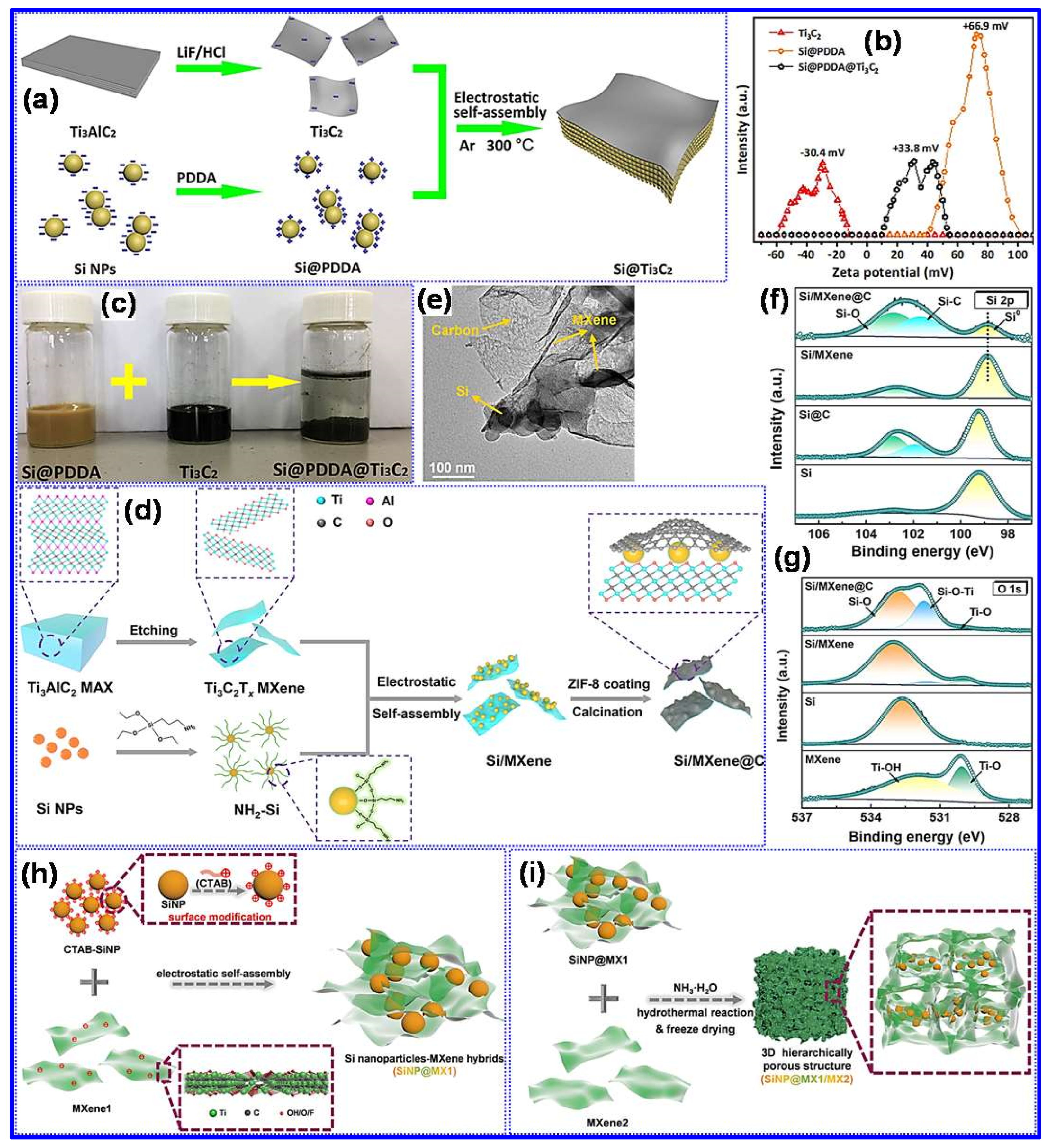
To achieve electrostatic interaction with negatively charged MXene sheets, Si NPs must first acquire a positive surface charge through appropriate functionalization. This is commonly accomplished using cationic surfactants, which introduce positively charged groups onto the Si surface. For example, poly(diallyldimethylammonium chloride) (PDDA) can be deposited onto Si NPs via a simple solution-mixing process, resulting in a pronounced positive zeta potential of +66.9 mV (Figure 4a,b) [58]. This surface modification enhances both the positive charge density and aqueous dispersibility of Si particles. Upon mixing PDDA-treated Si with MXene dispersions, electrostatic attraction drives the attachment of Si@PDDA onto negatively charged MXene sheets, partially neutralizing their surface charge. The interaction leads to the formation of large aggregates that settle with a transparent supernatant (Figure 4c). The assembled Si@PDDA@MXene composite exhibits an intermediate zeta potential of +33.8 mV, confirming successful electrostatic coupling. Besides PDDA, other cationic agents, including cetyltrimethylammonium bromide (CTAB) [59], (3-aminopropyl) triethoxylsilane (APTES) [60] and iodine-acetone systems [61] have also been employed to endow Si with positive surface charges.
The C coating has been applied either before or after electrostatic self-assembly to enhance the mechanical integrity of Si/MXene NCs. For instance, ZIF-8 can be grown on amino-modified Si/Ti3C2Tx assembled through electrostatic interactions; subsequent pyrolysis generates an in situ C layer that encapsulates the Si/Ti3C2Tx structures, forming a 3D sandwiched Si/Ti3C2Tx@C composite (Figure 4d,e) [60]. In this architecture, Ti-O-Si bonds are established between the MXene substrate and Si NPs, while the outer C shell forms Si-C bonds, jointly improving structural durability and electrochemical stability during repeated lithiation/delithiation (Figure 4f,g). Alternatively, Si spheres can be C-coated prior to PDDA functionalization [62]. This C layer supplies additional adsorption sites for surfactants, thereby promoting electrostatic assembly with MXene and yielding a MXene-Si@C hybrid with a continuous conductive network and internal void space capable of accommodating volume expansion.
Polymethyl methacrylate (PMMA) carries plentiful positive surface charges due to the incorporation of cationic surfactants as stabilizers and comonomers during dispersion polymerization. This characteristic allows PMMA to serve as an alternative interfacial mediator that promotes self-assembly between MXene nanosheets (NSs) and Si NPs. For instance, Xia et al. [49] coated porous Si nanospheres (Si p-NS) with a PMMA layer, enabling subsequent electrostatic assembly with Ti3C2Tx NSs. After pyrolysis, the PMMA decomposed, resulting in a Si/Ti3C2Tx core–shell structure with improved interfacial coupling. Electrostatic assembly can also be combined with additional synthetic methods. In one example, CTAB-modified Si NPs were electrostatically anchored onto MXene NSs to form MXene-encapsulated Si hybrids (SiNP@MX1) [63]. These hybrids were then incorporated into a 3D MXene scaffold through hydrothermal processing and freeze-drying, producing a hierarchical porous electrode with dual MXene protection (Figure 4h,i). In another study, Liu’s group [64] prepared a Si@Ti3C2Tx@graphene monolith via a multistep process involving electrostatic self-assembly, solvothermal treatment, air drying, and annealing. Initially, Si@Ti3C2Tx hybrids formed through electrostatic attraction and were subsequently embedded into a graphene hydrogel under solvothermal conditions. During drying and annealing, the hydrogel shrank into a dense monolith, yielding a composite with a density of 1.5 g/cm3 and an electrical conductivity of 151 S/cm.
Electrostatic self-assembly is a simple and efficient strategy for fabricating Si/MXene NCs with strong interfacial interactions between their constituents. However, this method generally necessitates surface functionalization of Si to enable electrostatic attraction. The incorporation of surfactant molecules introduces bulky organic groups that may hinder electron transport and consequently lower the electrical conductivity of the composites. To address this limitation and improve electrochemical performance, a post-synthesis thermal treatment is commonly applied to remove residual surfactants.

2.2. Ball-Milling

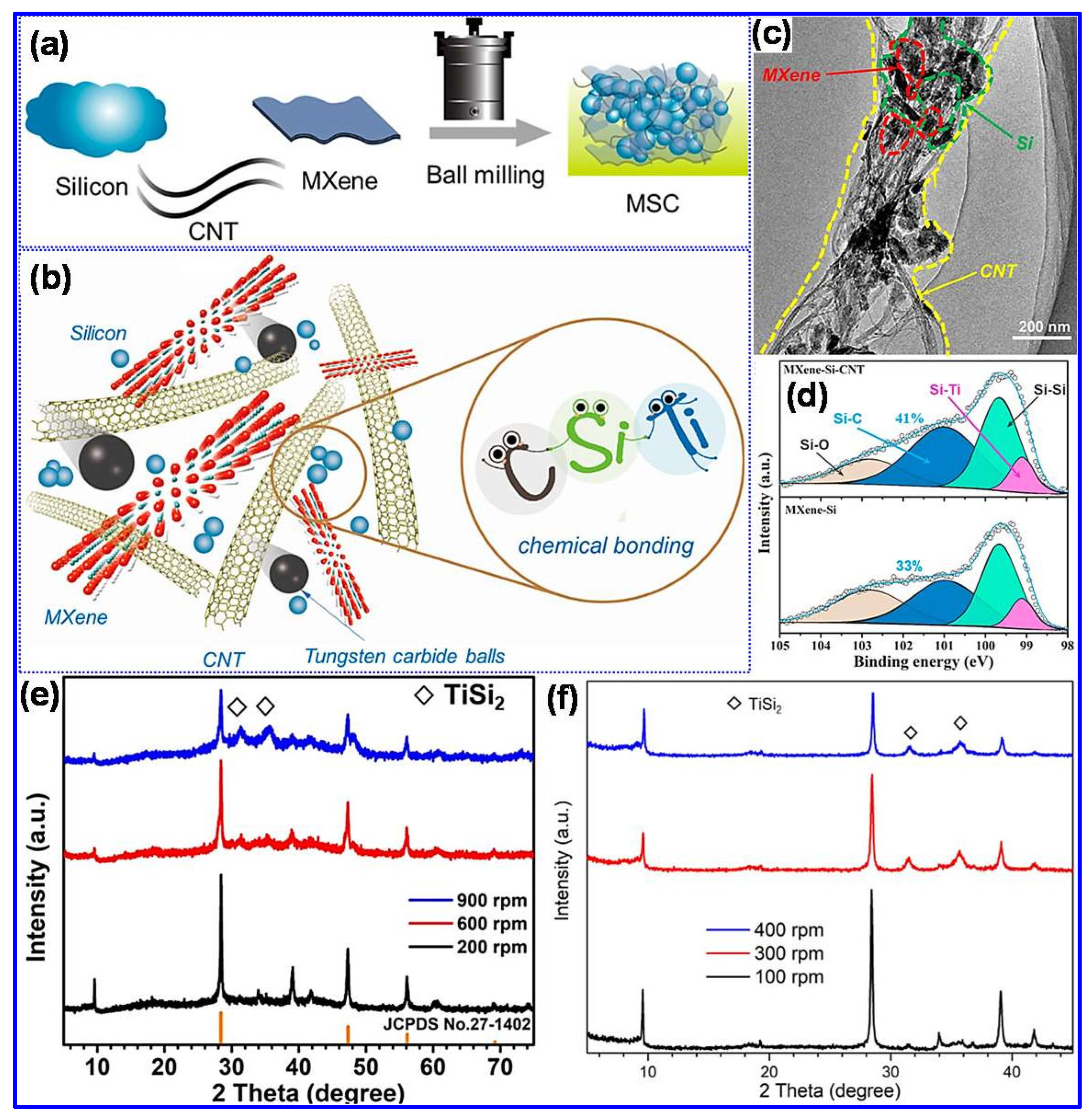
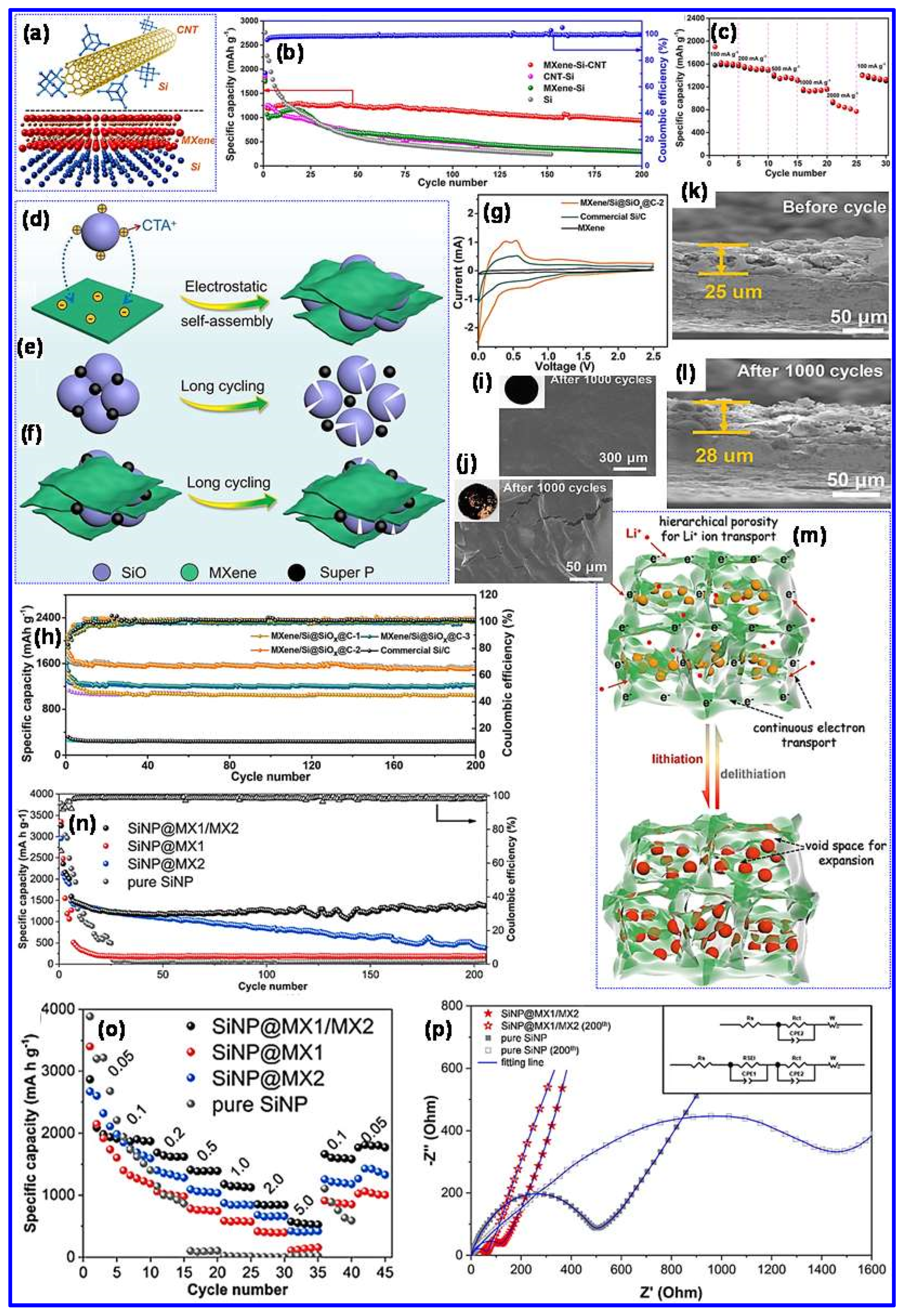
Ball-milling is a commonly used ex situ technique for integrating MXene with Si-based materials. In a typical process, Si NPs are mixed with MXene in a sealed vial and subjected to high-speed milling. The strong shear forces generated by the rapid motion of the milling balls provide sufficient energy to induce robust interfacial bonding between the two components, thereby forming stable NCs [65,66]. Nevertheless, the high-energy environment may also trigger oxidation and structural degradation of MXene owing to its intrinsic instability. To alleviate this problem, ball-milling is usually performed under an inert atmosphere, and the incorporation of a third component can further reduce shear stress while acting as an interfacial bridge between MXene and Si. For example, ternary Ti3C2Tx-Si-CNT NCs were produced by milling MXene and Si in the presence of 2 wt % CNTs, which enhanced structural robustness (Figure 5a–c) [65]. During the milling process, reactive Si NPs form Ti-Si bonds with MXene and C-Si bonds with CNTs (Figure 5d), both of which are essential for stabilizing the composite framework for energy-storage applications. The milling speed critically influences the structural integrity of the Ti3C2Tx-Si-CNT NCs composites. At a low speed of 100 rpm, the obtained materials show poor structural homogeneity, whereas increasing the speed to 300 rpm leads to the formation of an electrochemically inactive TiSi2 phase (Figure 5e,f), as revealed by XRD analysis. The presence of this phase hinders lithiation/delithiation processes and consequently deteriorates the electrochemical performance.
Ball-milling can be employed to fabricate Si-P nanohybrids with a core–shell architecture, offering a high theoretical Li-storage capacity of approximately 2900 mAh/g. Building on this strategy, Tang et al. [67] integrated the Si-P nanohybrid with Ti3C2Tx, yielding a Si-P/Ti3C2Tx composite in which Ti3C2Tx served as an outer coating layer. In this configuration, the red phosphorus (red-P) shell functioned as an intermediate layer that enabled the formation of stable Si-P-Ti bonds, thereby maintaining close interfacial contact and structural coherence among Si, red-P, and Ti3C2Tx. In a related study, SiOx was combined with multilayer Ti3C2Tx via ball-milling [68]. Melamine was introduced as a third component because of its low adsorption energy on Ti3C2Tx surfaces, arising from its amino and triazine groups. These interactions promoted melamine intercalation into MXene interlayers, and under strong shear forces, facilitated exfoliation of MXene into crumpled flakes that attached to SiOx through strong Ti-O-Si bonds. After annealing, melamine was removed, while residual N-atoms remained doped within the MXene matrix, improving its electrochemical performance.
Due to its operational simplicity and high efficiency, ball-milling presents significant promise for the scalable production of Si/MXene NCs for energy-storage applications. However, the structural characteristics and electrochemical performance of the resulting composites are highly sensitive to several key parameters, such as the particle size and content of Si, the type of added guest species, and the milling speed and time. Therefore, systematic optimization of these variables is crucial for promoting the practical deployment of ball-milled Si/MXene NCs.

2.3. Vacuum Filtration

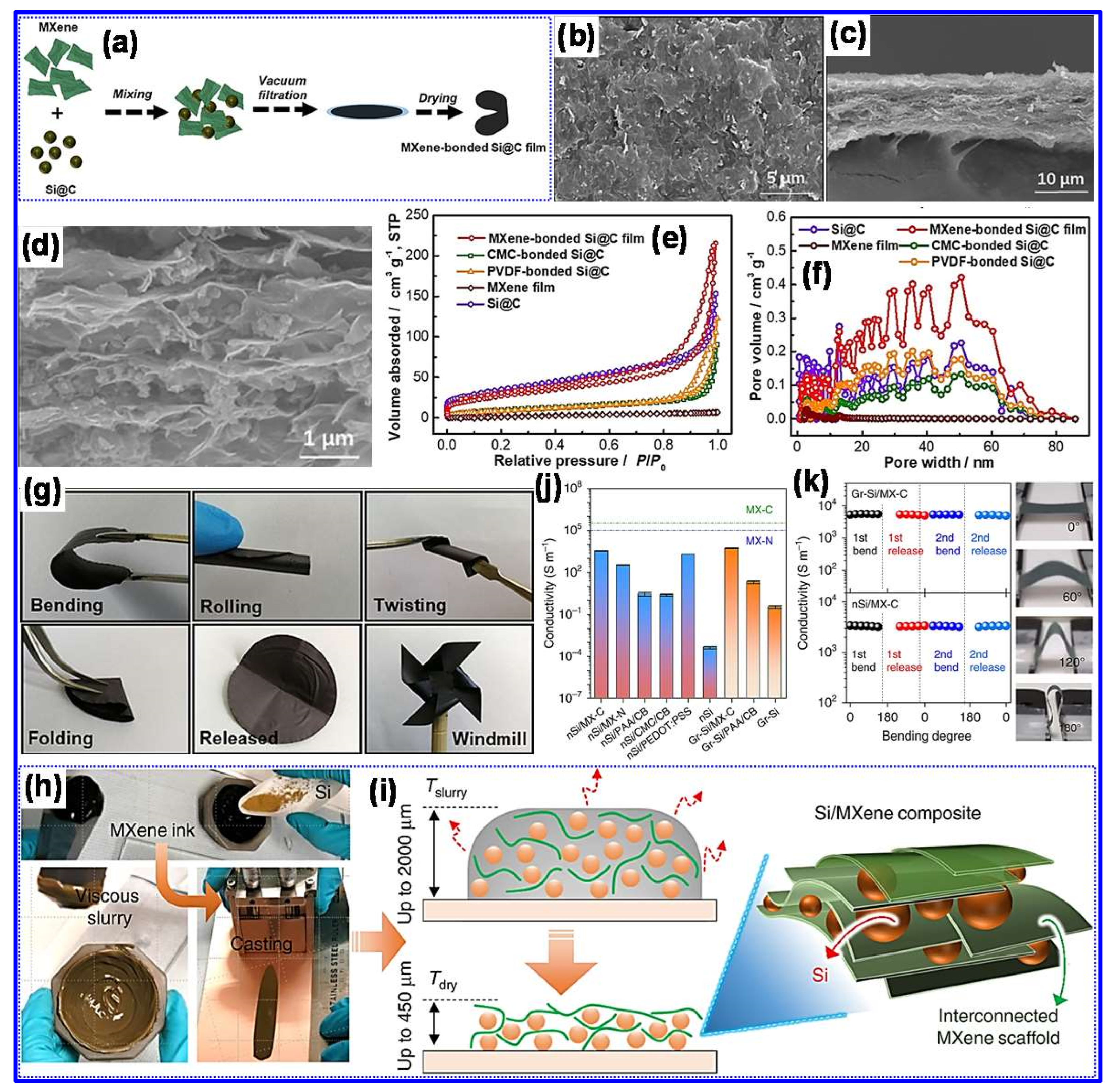
Vacuum filtration is an efficient separation method that allows rapid recovery of solids from liquid suspensions by utilizing a pressure differential across the filter membrane. Due to their 2D lamellar structure, MXene NSs are particularly suitable for assembling films via vacuum filtration of mixed dispersions containing MXene and various active materials, including graphene [69], CNTs [70], transition-metal oxides [71] and Si [72,73]. During filtration, MXene NSs tend to align parallel to the filter surface, thereby embedding the active components within flexible and free-standing nanostructured films. To ensure uniform dispersion, especially for Si in aqueous systems, ultrasonication or continuous stirring is typically employed. For example, a MXene-Si@C hybrid film can be fabricated by mixing dispersions of MXene and Si@C followed by vacuum filtration (Figure 6a) [73]. In this configuration, MXene functions simultaneously as a conductive pathway, binder, flexible scaffold, and buffering matrix for Si. SEM observations indicate that interconnected MXene flakes form a cross-linked porous network, enabling uniform distribution of Si@C within the MXene matrix (Figure 6b–d). The resulting porous framework enhances active surface exposure and establishes a well-developed mesoporous structure (Figure 6e,f), which helps alleviate Si volume expansion during lithiation while facilitating rapid electron and ion transport. Furthermore, the lamellar 2D architecture of MXene endows the film with excellent mechanical flexibility, allowing it to withstand bending, twisting, rolling, and folding. Notably, the film can be folded into intricate shapes such as a windmill (Figure 6g), demonstrating its promise for flexible and wearable electronics.
Vacuum filtration is widely considered an effective approach for fabricating MXene/Si film electrodes. However, their electrochemical performance is highly dependent on several key parameters, such as the lateral size of MXene sheets, the particle size of Si, and the overall Si content. Larger MXene flakes can enhance the mechanical strength and flexibility of the composite film, yet they tend to orient perpendicular to the electrode surface, which lengthen electron and ion diffusion pathways and thus restrict rate capability. Likewise, the size of Si particles critically affects the pore structure, specific surface area, and mechanical stability of the electrode. In addition, excessive Si loading may cause mechanical degradation and poor cycling durability due to its substantial volume expansion during lithiation, whereas too little Si results in underutilization of active sites because of compact MXene stacking. Therefore, rational structural design of MXene/Si films is necessary to balance mechanical robustness, flexibility, pore architecture, and electrochemical performance.

2.4. Blade Casting

Blade casting provides an effective approach for achieving ordered alignment of MXene NSs embedded with Si NPs. In contrast to vacuum filtration, this technique requires the formulation of a concentrated MXene slurry and is typically conducted on conductive substrates such as Cu foil commonly used in LIBs. In a representative study, Zhang et al. [74] utilized a Ti3C2Tx dispersion (25 mg/mL) as a conductive binder for Si-based electrodes. Nanosized Si or Si/graphene composites were milled directly in the MXene ink to form homogeneous slurries, which were then cast onto Cu foil and vacuum-dried to produce MXene-coated nSi or Gr-Si electrodes (Figure 6h,i). Electrodes encapsulated with Ti3C2Tx containing 30 wt % MXene exhibited high electrical conductivities of 3448 S/m for nSi and 5333 S/m for Gr-Si, while also retaining mechanical stability during repeated bending (Figure 6j,k). The electrode properties were strongly influenced by the concentration of the Ti3C2Tx ink; a concentration of 25 mg/mL enabled uniform coating on Cu foil and imparted favorable rheological properties, including high viscosity, storage modulus, and loss modulus, allowing the fabrication of thick films up to 650 µm for nSi and 2100 µm for Gr-Si electrodes. Moreover, the Ti3C2Tx-encapsulated Gr-Si electrode exhibited a critical cracking thickness of 351 µm, substantially higher than that of Gr-Si electrodes prepared with conventional binders (<100 µm), highlighting the mechanical robustness of MXene inks for practical Si electrode design.
In addition to employing highly concentrated MXene inks, MXene flakes have also been utilized as conductive additives in the fabrication of Si-based electrodes. For example, sodium alginate (SA) can be integrated with Ti3C2Tx to form a hybrid conductive binder. When Si particles are mixed with the SA/Ti3C2Tx system, blade casting of the viscous slurry onto Cu foil yields Si electrodes [75]. The abundant surface functional groups on Ti3C2Tx facilitate strong interactions with both Si and SA, thereby enhancing interfacial adhesion and ensuring stable long-term electrochemical performance. Using Si/graphite (Si/G) composite electrodes as a model system, Mao et al. [76] investigated the influence of Ti3C2 MXene additives on lithiation-induced stress through the Halpin–Tsai empirical model. The results indicated that even at low loading levels, Ti3C2 significantly increased the elastic modulus of the active layer, with more pronounced reinforcement observed for higher aspect ratios and thinner flakes. In bilayer Si/G electrodes, Ti3C2 effectively mitigated tensile stress in the current collector and compressive stress within the active layer; however, when its content exceeded 0.76%, the effect reversed due to an increased stiffness mismatch between the layers. Consequently, incorporating an optimized amount of high-aspect-ratio Ti3C2 is beneficial for improving both mechanical robustness and electrochemical performance of Si-based LIB electrodes.
An N-doped C (N-C) interfacial layer was incorporated between MXene and Si to enhance the durability of Si-based anodes [77]. The electrode was prepared by blade-casting a slurry composed of 50 wt % Si, 40 wt % polyacrylonitrile (PAN), and 10 wt % MXene onto copper foil, forming a precursor film. After heat treatment at 700 °C under an Ar/H2 atmosphere, PAN was transformed into amorphous N-C, which chemically anchored to both Si and MXene through Si-N and N-MXene bonds. This interfacial bonding improved adhesion and reinforced the mechanical stability of the Si-N-MXene electrode. Beyond serving as conductive additives, vacuum-filtered MXene films, with their excellent flexibility, electrical conductivity, lightweight nature, and mechanical robustness, have also been utilized as current collectors [78]. When porous Si, poly(acrylic acid) (PAA), and Super P carbon were coated onto these MXene films, the resulting active layer exhibited stronger adhesion compared with conventional copper collectors. This improvement was attributed to the rich surface terminations of MXene, which enhanced electrical connectivity and structural stability during Li storage.
Blade casting represents a simple and economically viable approach for producing Si/MXene electrodes, offering strong potential for scalable manufacturing. However, similar to vacuum filtration methods, the layered configuration may generate electrochemically inactive (“dead”) regions within the electrode. To overcome this limitation, introducing supplementary structural agents such as CNTs, nanocellulose, or conductive C is advantageous. These components can generate internal porosity to increase accessible active sites and simultaneously bridge the Si and MXene networks, thereby alleviating volume expansion during lithiation.

2.5. Spray/Freeze Drying

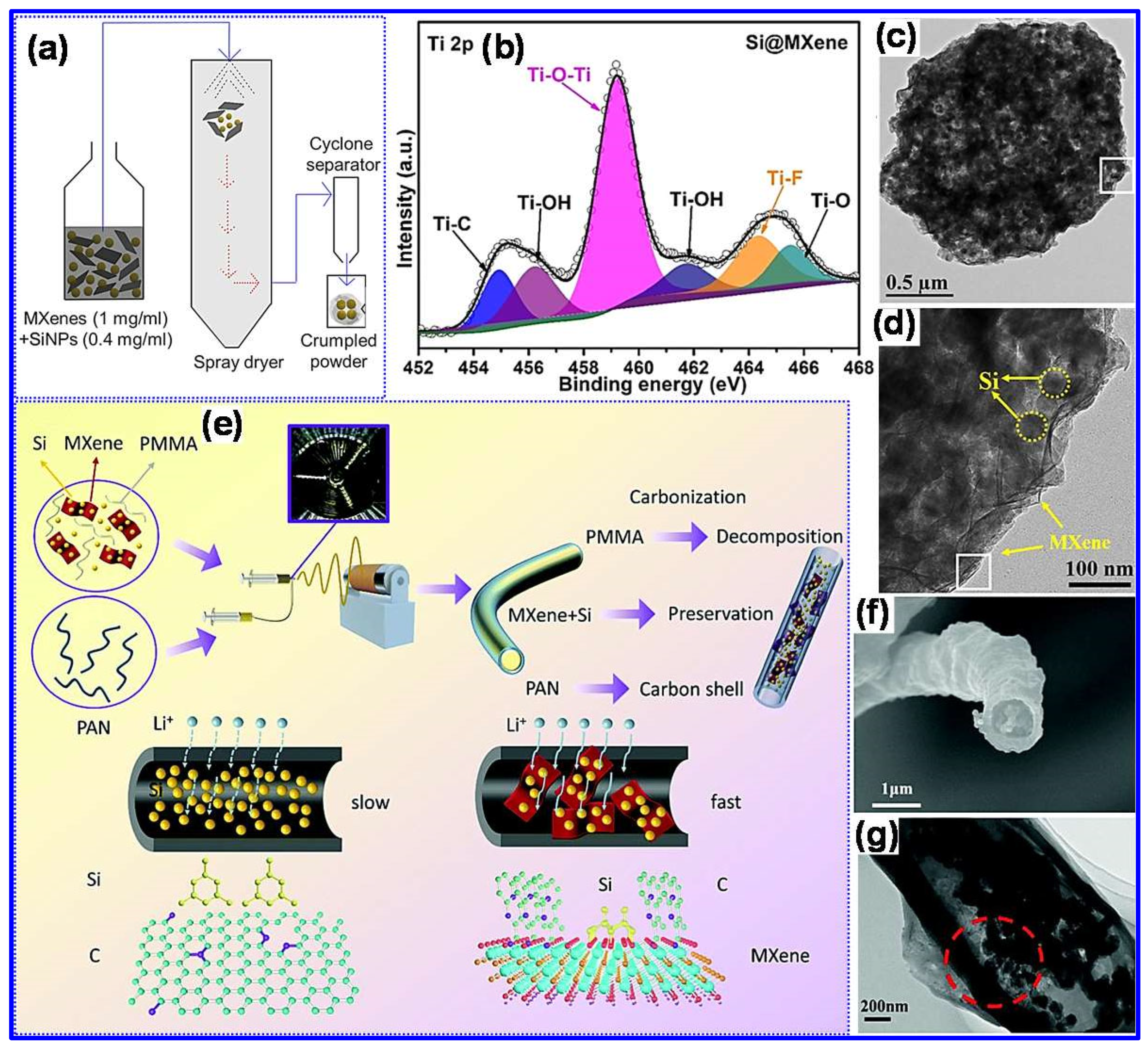
Spray drying involves atomizing a homogeneous emulsion or suspension into a heated chamber, where rapid solvent evaporation transforms the droplets into solid NPs. The precursor solution generally contains both core and shell components subjected to appropriate pretreatment, and the surface tension of the shrinking droplets promotes the formation of quasi-spherical particles [79]. For instance, Si@Ti3C2Tx MXene microspheres were prepared by blending dispersions of Si and Ti3C2Tx, followed by spray drying (Figure 7a) [80,81]. During solvent removal, MXene NSs self-crosslinked via covalent Ti-O-Ti bonds, forming a continuous and mechanically stable MXene network, as confirmed by Ti 2p XPS analysis (Figure 7b). Si NPs were homogeneously confined within the crumpled MXene scaffold, yielding a pomegranate-like architecture with plentiful internal voids (Figure 7c,d). Importantly, the resulting microstructure is highly sensitive to processing variables, including droplet size, feed rate, inlet temperature, gas pressure, and drying gas flow rate, which must be carefully optimized to maximize electrochemical performance.
Unlike spray- or vacuum-drying, freeze-drying involves first solidifying the Si/MXene aqueous dispersion through freezing. During the subsequent sublimation process, the ice crystals act as sacrificial templates, leading to the formation of a highly porous Si/MXene framework. For example, rapid freezing of a Si/MXene suspension using liquid nitrogen produced a solid monolith [82]. Vacuum drying at −50 °C under 10 Pa then facilitated ice sublimation, during which MXene NSs curled and folded due to capillary forces, resulting in a lightweight and porous structure with homogeneously distributed Si NPs. In another study, adjusting the pH of a Si/Ti3C2Tx mixture to 10 prior to freeze-drying promoted the self-assembly of MXene NSs into scroll-like morphologies. These structures encapsulated Si NPs within internal cavities, yielding a pea-shaped composite architecture [83]. Although such porous configurations improve ion/electron transport and accommodate Si volume expansion, the absence of strong chemical bonding at the Si-MXene interface, due to simple physical mixing, may weaken structural integrity during long-term cycling.

2.6. Electrospinning

Electrospinning is a versatile technique for producing ultrafine one-dimensional (1D) nanofibers (NFs), 2D nonwoven membranes, and even three-dimensional (3D) structures. In general, polymers can be mixed with Si NPs and MXene NSs in appropriate solvents to form a homogeneous precursor solution. Under a high electric field, the charged polymer jet is elongated into continuous fibers through the combined influence of electrostatic forces, Coulombic repulsion, viscoelastic effects, and surface tension [84,85]. For example, electrospinning a DMF-based suspension containing PAN, Si NPs, and Ti3C2Tx flakes yields a composite fibrous membrane [86]. Thermal stabilization at 240 °C followed by carbonization at 600 °C converts PAN into C, producing a flexible Si/MXene@C composite. Yang et al. [87] further compared the effects of various conductive additives, including MXene, graphene oxide (GO), and CNTs on Si@C NFs. The results demonstrated that each additive contributed distinct benefits: MXene enhanced cycling durability and capacity retention, CNTs improved rate performance by lowering charge-transfer resistance, and GO increased reversible Li storage capacity.
Furthermore, the composite NFs were designed with a core–shell architecture by selecting PAN as the shell precursor and Si@Ti3C2Tx MXene as the core component (Figure 7e) [50]. This structure was fabricated via coaxial electrospinning, in which the shell and core solutions were delivered separately through the outer and inner channels of a dual-capillary spinneret. After electrospinning, followed by stabilization and carbonization, core–shell NFs were obtained, featuring a carbonaceous shell and a Si@Ti3C2Tx MXene-confined core. This process resulted in carbon nanofiber (CNF)-encapsulated Si@Ti3C2Tx MXene structures (Figure 7f,g). Additionally, incorporating PMMA into the core precursor allowed it to decompose during carbonization, generating internal voids within the fibers that effectively accommodate the volumetric changes in Si during repeated lithiation and delithiation.

2.7. In Situ Thermal Reduction

Thermal reduction is an in situ approach for transforming silica precursors into Si nanostructures through reactions with reducing agents at elevated temperatures. Traditional carbothermal reduction typically operates at temperatures ≥2000 °C, which surpasses the melting point of Si and thus restricts its practical application. In contrast, the magnesiothermal reduction reaction (MRR) has emerged as a more feasible alternative. In this process, Mg reduces silica within a temperature range of 500–950 °C, producing Si and MgO (Reaction 1) [88]. The MgO by-product can subsequently be removed by HCl treatment, leaving behind a porous Si framework.
SiO2 + 2 Mg → Si + 2 MgO
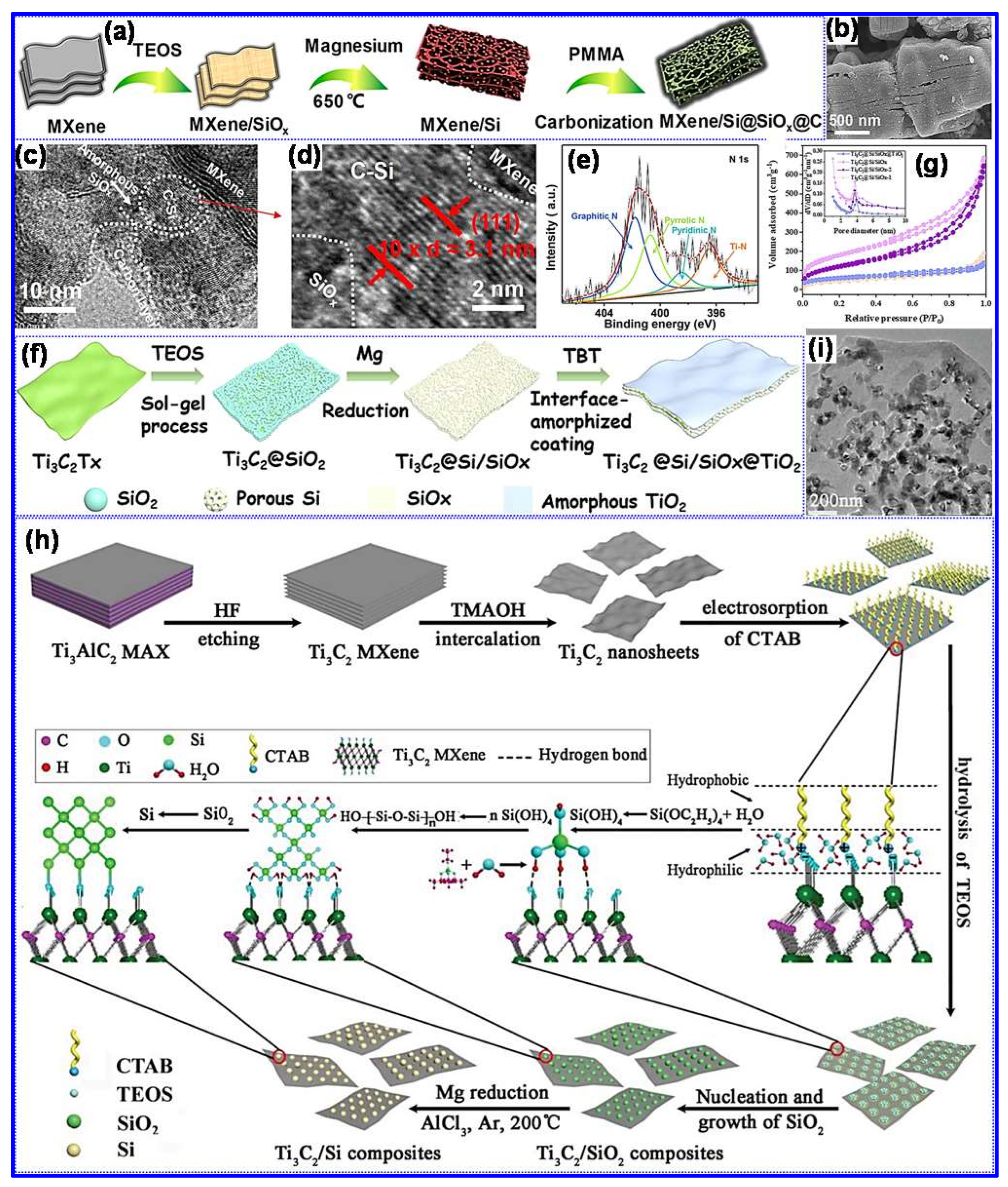
Zhang’s team [52] demonstrated the construction of a Ti3C2 MXene/Si composite through a MRR strategy (Figure 8). In their procedure, silica was initially deposited onto layered Ti3C2 MXene via the Stöber process using tetraethoxysilane (TEOS) as the silica precursor. The obtained SiO2-coated Ti3C2 MXene was then subjected to Mg vapor reduction at 650 °C under a 4% H2/Ar atmosphere, forming a Ti3C2 MXene/Si hybrid structure. To improve structural robustness, PMMA was grafted onto the hybrid surface, with urea acting as a N-source. Subsequent pyrolysis generated a C coating along with partial SiOx formation, resulting in a 3D sandwich-like Ti3C2 MXene/Si@SiOx@C superstructure (Figure 8a–d). The Si loading could be regulated by adjusting the TEOS hydrolysis time, reaching 64.8%, 72.8%, and 78.7% after 3, 4, and 5 h, respectively. Furthermore, urea-derived pyrolysis introduced pyridinic, pyrrolic, and graphitic N species into the C layer and formed N-Ti bonds within the MXene framework (Figure 8e), strengthening the heterointerface and enhancing the cycling stability of the electrode.
A comparable MRR strategy has been extended to single-layer Ti3C2Tx flakes. For example, a Ti3C2@Si/SiOx hybrid was synthesized by reducing silica-coated Ti3C2Tx at 650 °C in a H2/Ar atmosphere (Figure 8f) [89]. The SiO2 layer was deposited through TEOS hydrolysis assisted by CTAB and NaOH, where NaOH served both as a catalyst and as a surface modifier, introducing additional -OH groups onto Ti3C2Tx. This surface functionalization facilitated the formation of strong Ti-O-Si bonds at the Si/SiOx-Ti3C2Tx interface. Owing to the large aspect ratio of Ti3C2Tx NSs, the resulting Ti3C2@Si/SiOx composite delivered a high specific surface area (655.8 m2/g) and a well-developed porous architecture at a Si content of 46.7%, thereby improving electrolyte penetration and charge-transfer kinetics (Figure 8g). In addition, an amorphous TiO2 shell was introduced via a sol–gel method using tetrabutyl titanate as the Ti precursor, leading to a sandwich-structured Ti3C2@Si/SiOx@TiO2 composite composed of a Ti3C2Tx core, a Si/SiOx intermediate layer, and an outer TiO2 coating.
Although the MRR strategy allows Si to be anchored onto MXene sheets, the high processing temperature (around 650 °C) can lead to structural deterioration of MXene. To mitigate this problem, molten AlCl3 has been introduced as a liquid-phase reaction medium for silica reduction [90]. In this system, Mg reacts synergistically with AlCl3, producing AlOCl and MgAl2Cl8 as side products (Reaction 2). This cooperative pathway reduces the reaction temperature dramatically, lowering it to roughly 200 °C.
Figure 8. Preparation of Si/MXene NCs via thermal reduction strategies. (a) Schematic representation, (b) SEM, (c,d) TEM micrographs and (e) N 1s XPS spectrum of Ti3C2 MXene/Si@SiOx@C NCs. Adapted from [52]. Copyright 2019, American Chemical Society. (f) Schematic diagram and (g) N2 adsorption–desorption curves of Ti3C2@Si/SiOx@TiO2 NCs with inset showing corresponding pore-size distribution. Adapted from [89]. Copyright 2020, American Chemical Society. (h) Schematic diagram and (i) TEM micrograph of Ti3C2/Si NCs obtained through low-temperature MRR strategy. Adapted from [91]. Copyright 2019, Wiley-VCH.
Batteries 12 00079 g008
2 Mg + 6 AlCl3 + SiO2 → 2 MgAl2Cl8 + 2 AlOCl + Si
2 AlCl3 + 3 SiO2 + 4 Al → 6 AlOCl + 3 Si
For instance, SiO2/Ti3C2 NCs were mixed with Mg and AlCl3 powders and sealed in a stainless-steel autoclave under an Ar atmosphere. Performing MRR at 200 °C produced Si/Ti3C2 NCs (Figure 8h) [91]. The obtained materials displayed a lamellar porous structure with homogeneously dispersed Si NPs. Notably, the formation of interfacial Si-O-Ti covalent bonds between Si and Ti3C2 significantly reinforced structural integrity (Figure 8i). In a related strategy, Al can function as a reductant in the low-temperature aluminothermic reduction of SiO2 (LTARR, Reaction 3). Following this approach, Wu et al. [92] synthesized Si/Ti3C2Tx NCs by mechanically blending Al, AlCl3, Ti3C2Tx, and commercial SiO2 powders in an Ar-filled autoclave, followed by reduction at 250 °C.
Thermal reduction represents an economical and effective route for fabricating Si/MXene NCs, producing strong interfacial interactions along with micro- and meso-porous structures. However, this approach faces several drawbacks, including limited Si yield, the requirement for post-synthesis purification to remove by-products and residual silica, and the risk of MXene structural damage at high temperatures.

2.8. Others

Besides conventional approaches, techniques such as ultrasonication, immersion treatment, and TEOS hydrolysis have been employed to combine Si-based materials with MXenes. In the ultrasonication-assisted route, Si NPs can be partially intercalated into the interlayer spaces of multilayer MXene sheets, forming Si/MXene NCs. Because Si NPs exhibit poor affinity toward aqueous media, ethanol is commonly used as the solvent. In this configuration, MXene sheets function as conductive scaffolds that accommodate Si NPs and facilitate charge transport. However, the lack of strong chemical bonding results in Si being physically attached to the MXene surface and interlayers, which necessitates a high MXene fraction to mitigate Si volume expansion. For example, Si/Ti3C2Tx and Si/V2CTx composites containing approximately 83.3% MXene display relatively limited Li-storage capacities compared with other Si/MXene systems [93].
In situ fabrication of Si-based materials generally proceeds through two stages: hydrolysis of TEOS to form SiO2, followed by high-temperature reduction to produce Si. Alternatively, employing SiO2 directly as the anode circumvents the energy-intensive reduction step, offering a simpler and more economical pathway. For example, a laminated MXene-SiO2-MXene architecture was constructed by incorporating SiO2 NPs into multilayered MXene sheets using the Stöber process [94]. Spray-drying subsequently converted the composites into microspherical SiO2/MXene structures, where SiO2 NPs were uniformly confined within MXene shells. Although MXenes are electrochemically active, severe layer restacking reduces accessible surface sites and impedes charge and ion transport. Bimb et al. [95] demonstrated that immersing Mo2TiC2 in a TEOS–dodecylamine solution enabled intercalation of both TEOS and amine molecules between adjacent layers. Subsequent hydrolysis in water and calcination removed the amine template and generated a SiO2-pillared MXene framework. The resulting structure exhibited an expanded interlayer spacing and a specific surface area of 202 m2/g, far exceeding that of pristine Mo2TiC2 (8 m2/g), highlighting the effectiveness of SiO2 pillaring in preventing restacking and improving electrochemical performance.
Soaking represents a practical approach for depositing MXene sheets onto diverse porous substrates, such as C foam [96], Ni foam [97], cotton textile [98] and C cloth [99]. For example, a polyvinylpyrrolidone (PVP)-functionalized Si@melamine foam was first prepared by immersing melamine foam into a Si/PVP solution, followed by thermal treatment to carbonize the melamine framework and generate Si@N-C foam [100]. Subsequent dipping of this foam into a Ti3C2Tx suspension allowed MXene sheets to uniformly coat the surface, forming a 3D, hollow, and conductive MXene@Si@N-C network. A comprehensive comparison of the fabrication approaches described above is provided in Table 1, which outlines their main characteristics, benefits, drawbacks, and scalability.

3. Li-Storage Characteristics of Si/MXene NCs

It is important to note that the electrochemical performance reported for Si/MXene NCs in the literature is strongly influenced by experimental conditions, including current density normalization, Si loading, electrode thickness, electrolyte composition, and cell configuration. Therefore, rather than directly comparing absolute capacity values, this section focuses on identifying consistent performance trends and correlating structural design with Li-storage behavior. This approach provides more meaningful insight into the design principles of effective Si/MXene electrodes.
Silicon-based materials, such as elemental Si [101], SiOx [102] and silica [94], have attracted considerable interest as high-capacity anodes for LIBs due to their ability to alloy with Li. Nevertheless, their practical implementation is limited by intrinsically low electronic conductivity and substantial volume expansion during lithiation. To overcome these drawbacks, MXenes have been widely adopted as conductive matrices to fabricate various Si/MXene nanostructures, including powders [93], 3D architectures [60,63], films [73,103], spherical assemblies [49,80] and NFs [50]. These engineered hybrids markedly improve the Li-storage performance of Si-based systems. This section summarizes recent developments in Si/MXene NCs, focusing on electrochemical characteristics and structure–property relationships to facilitate the advancement of Si-based anodes.

3.1. Powders

Si@Ti3C2 NCs were prepared by ultrasonically blending Si NPs with multilayer MXene powders [48]. In the resulting structure, Si NPs were partially agglomerated and randomly dispersed on MXene surfaces and within interlayer spaces. Despite a relatively low Si content (~16.7%), the composite achieved a reversible capacity of 879 mAh/g at 0.2 A/g. However, the lack of strong interfacial bonding and limited structural confinement led to poor cycling durability, with capacity retention dropping to 21.4% (188 mAh/g) after 150 cycles. A similar ultrasonication strategy was employed for Si@V2C composites [93]. Although the reversible capacity was lower (691 mAh/g), the cycling stability improved significantly, maintaining 62.2% of the initial capacity over 150 cycles.
High-energy ball milling generates strong shear forces that facilitate the chemical coupling of Si with MXene. During this process, Si forms interfacial Ti-Si bonds with MXene and C-Si bonds with CNTs (Figure 9a) [65]. These dual interactions effectively anchor Si NPs within the conductive matrix, resulting in a MXene-Si-CNT composite that delivers ~1000 mAh/g after 200 cycles with ~80% capacity retention (Figure 9b). The multidimensional conductive network further accelerates electron transport, enabling a rate capacity of 841 mAh/g at 2 A/g (Figure 9c). Similarly, ball milling has been employed to couple SiO with N-doped Ti3C2Tx NSs (NTS) through Si-O-Ti interfacial bonding [68]. The resulting SiO@NTS electrode achieves discharge capacities of 1302.7 and 596.4 mAh/g at 0.1 and 5 A/g, respectively, while maintaining 1141.3 mAh/g after 200 cycles at 0.5 A/g. Beyond mechanical activation, electrostatic self-assembly offers an alternative strategy for interfacial integration. For example, CTAB-modified SiO adheres strongly to crumpled MXene sheets due to electrostatic attraction (Figure 9d) [59]. Unlike bare SiO electrodes that undergo severe pulverization and delamination upon volume expansion (Figure 9e), the SiO@MXene composite benefits from MXene’s high conductivity, large specific surface area, structural flexibility, and low Li+ diffusion barrier (0.07 eV). As a result, it exhibits superior electrochemical performance (Figure 9f), delivering ~1350 mAh/g at 0.1 A/g, 85.8% retention after 100 cycles at 0.5 A/g, and 712.9 mAh/g at 2 A/g. Collectively, these results highlight the importance of chemically bonded MXene frameworks in improving Si-based anodes.
Beyond ex situ approaches, in situ Si growth on MXene supports has also been reported to enable stable Li storage. Hui’s group [91] prepared Si/Ti3C2 NCs using a low-temperature MRR process, in which Si NPs were strongly immobilized on MXene NSs through Ti-O-Si interfacial bonding. The Ti3C2 framework promoted efficient Li+ and electron transport while simultaneously mitigating Si volume expansion, thereby improving electrochemical performance. Consequently, the Si/Ti3C2 composite delivered an initial reversible capacity of 2145.1 mAh/g at 100 mA/g and retained 1475 mAh/g after 200 cycles, exhibiting minimal capacity fading beyond the tenth cycle. In a separate work, PMMA pyrolysis on MRR-derived MXene/Si composites produced a hierarchical MXene/Si@SiOx@C architecture [52]. This heterostructure combines silicon’s high theoretical capacity with the mechanical buffering effects of MXene, SiOx, and an N-C shell, while robust Ti-N interfacial bonding further enhances structural integrity. Cyclic voltammetry revealed reduction peaks at 0.01–0.4 V and oxidation peaks near 0.4 and 0.53 V, corresponding to Li-Si alloy formation and subsequent Li extraction from LixSi (Figure 9g). Compared with commercial Si/C, the composite exhibited stronger redox responses and reduced polarization, indicating faster reaction kinetics. The electrode delivered capacities of 1674 mAh/g at 0.2 C and 398 mAh/g at 10 C (Figure 9h). Even after 1000 cycles at 10 C, it maintained 76.4% capacity with only 12% electrode swelling and no observable structural failure, unlike pure Si electrodes (Figure 9i–l). When assembled with a Li[Ni0.6Co0.2Mn0.2]O2 cathode, the flexible pouch cell achieved an energy density of 485 Wh/kg and demonstrated stable operation under repeated bending.

3.2. Architectures

Constructing 3D porous architectures is an effective strategy to mitigate the large volume changes in Si during cycling by providing internal void space, while simultaneously enabling rapid ion and electron transport pathways that improve Li storage performance. A simple freeze-drying approach has been used to fabricate sandwich-structured Si/MXene composites, where ice crystals act as temporary templates and generate abundant pores after sublimation [82,104]. In this configuration, Si NPs are uniformly embedded within the conductive MXene network, delivering a reversible capacity of 1137.6 mAh/g after 200 cycles at 0.5 A/g with 63.6% retention, and maintaining 890 mAh/g at 2 A/g [104]. The facile synthesis process combined with favorable electrochemical properties highlights its strong potential for practical applications.
Zhou’s group [105] prepared Si@MXene NCs through electrostatic self-assembly between APS-functionalized Si NPs and Ti3C2Tx NSs. The electrostatic interaction between positively charged Si particles and negatively charged MXene layers triggered the restacking of the 2D sheets into a porous framework, enabling uniform encapsulation of Si within the conductive matrix. This structure effectively accommodated Si volume expansion during lithiation, while the MXene coating suppressed direct contact between Si and the electrolyte, facilitating stable SEI formation. As a result, the initial Coulombic efficiency (ICE) increased from 62.3% for pure Si to 71.3% at 0.2 A/g. After 100 cycles, the Si@MXene electrode retained approximately 981 mAh/g with about 94% capacity retention, significantly outperforming bare Si. Further coating with a C shell [60] produced a cross-linked 3D porous Si/MXene@C framework, where strong Ti-O-Si and Si-C bonds enhanced the stability of Si anchoring. This composite delivered a reversible capacity of 862.9 mAh/g and maintained 85.7% of its capacity after 150 cycles.
Beyond C coating, Si/Ti3C2Tx NCs (SiNP@MX1) obtained through electrostatic self-assembly can be further integrated into a 3D MXene framework via hydrothermal treatment followed by freeze-drying [63]. This strategy yields a hierarchical porous Si-based structure featuring dual MXene encapsulation (SiNP@MX1/MX2). In this configuration, the inner MXene layer anchored on Si NPs prevents particle aggregation, while the outer MXene network provides continuous pathways for ion and electron transport (Figure 9m). Moreover, the dual-shell architecture effectively buffers electrode volume variation and reduces direct exposure of Si to the electrolyte, thereby stabilizing SEI formation. Consequently, the composite exhibits a reversible capacity of 1422 mAh/g at 0.5 A/g after 200 cycles, along with excellent rate capability and long-term cycling stability (Figure 9n,o). Electrochemical impedance spectroscopy further reveals lower interfacial resistance and enhanced Li-ion diffusion compared with bare Si electrodes (Figure 9p). After extended cycling, the SiNP@MX1/MX2 electrode shows a significantly reduced RSEI of 4.5 Ω relative to 1061 Ω for pure SiNP, indicating the formation of a thin and stable SEI layer.

3.3. Films

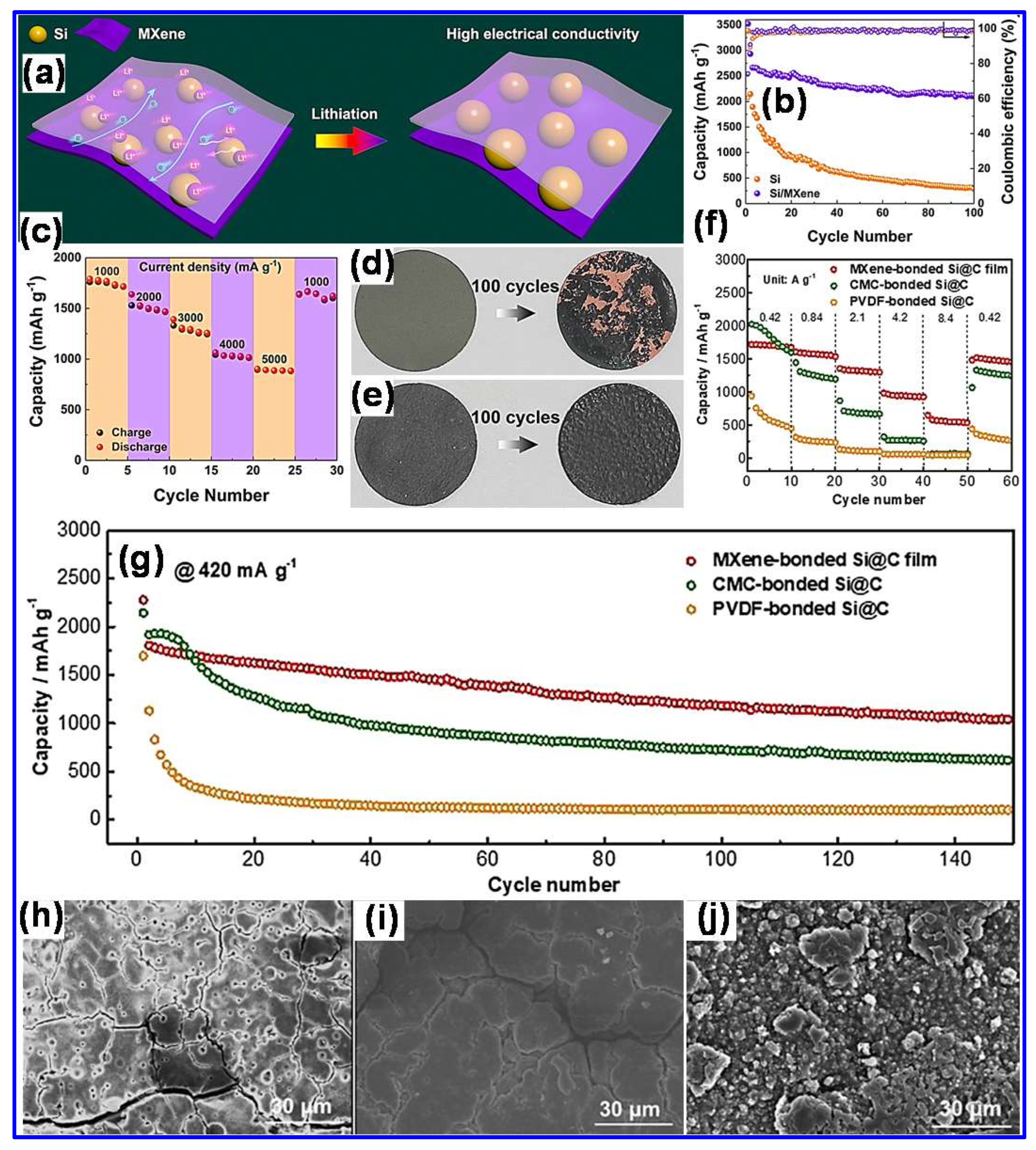
The Si NPs can be incorporated into layered MXene NSs through vacuum filtration to form flexible, binder-free composite films that can be directly used as LIB anodes [103]. In this architecture, the interconnected MXene network effectively restrains Si particles, mitigating volume expansion while improving electrical conductivity, providing additional active sites, and enabling rapid ion transport (Figure 10a). Consequently, the Si/MXene electrode demonstrates markedly enhanced cycling stability, delivering a capacity of 2118 mAh/g at 0.2 A/g after 100 cycles, significantly higher than that of pure Si (Figure 10b). Even at a high current density of 5 A/g, the electrode maintains 890 mAh/g (Figure 10c). Post-cycling observations further confirm that the MXene-confined composite retains structural integrity, whereas the bare Si electrode undergoes severe cracking and pulverization (Figure 10d,e). Xu et al. [73] further showed that MXene can act as a multifunctional conductive binder for Si@C electrodes. Upon stacking, MXene forms a porous and continuous framework that uniformly encapsulates Si@C NPs, simultaneously serving as a binder, conductive network, mechanical support, and buffer for volume changes. The MXene-bonded Si@C film exhibits a high electrical conductivity of 208.7 S/cm, far exceeding those of CMC- and PVDF-based electrodes. This structure achieves a reversible capacity of 1040.7 mAh/g after 150 cycles and retains 553 mAh/g even at an ultrahigh current density of 8.4 A/g (Figure 10f,g). SEM analysis reveals that the MXene-based film remains intact without cracks or delamination, unlike electrodes fabricated with conventional binders, demonstrating the advantages of MXene in constructing flexible, high-performance Si anodes (Figure 10h–j).
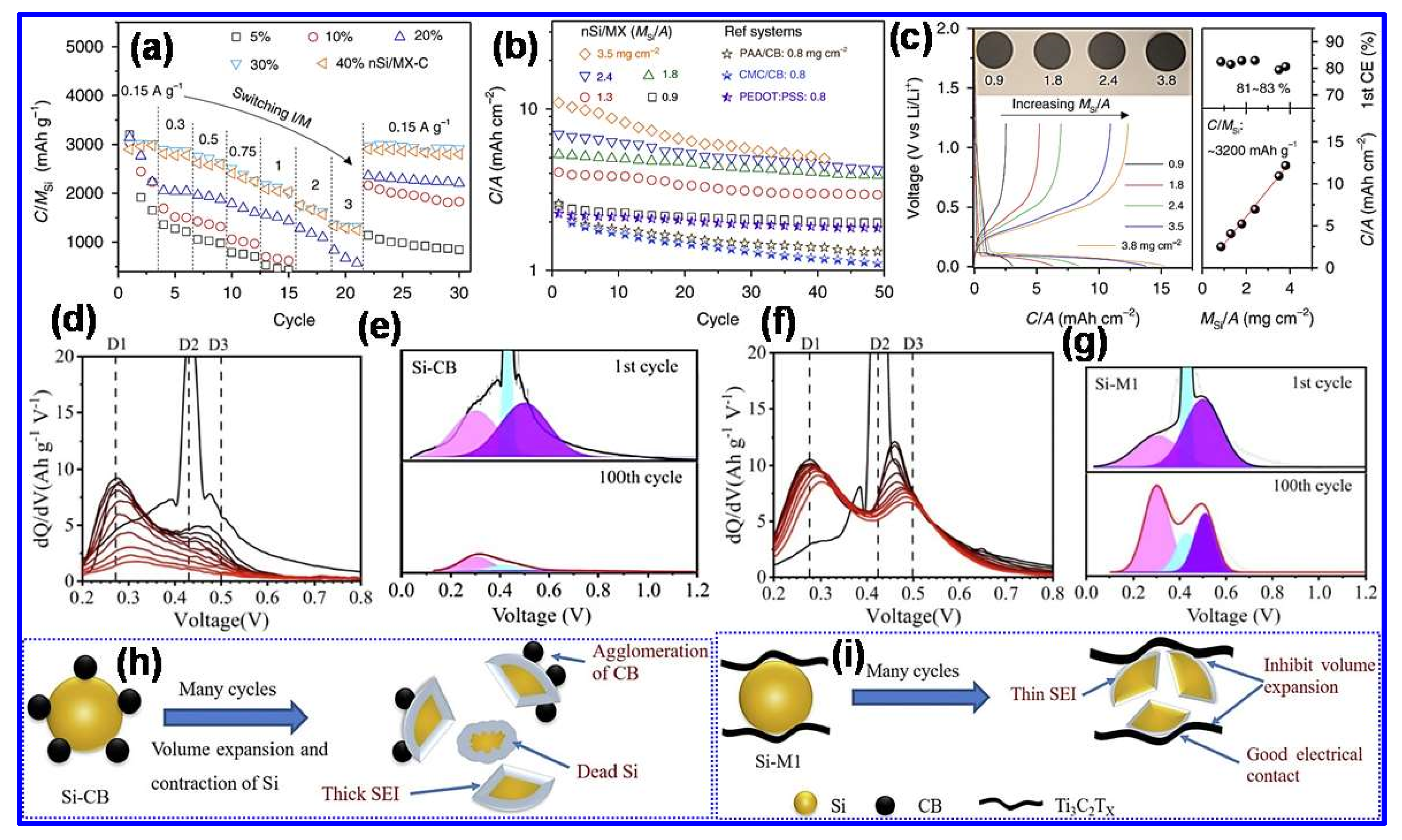
In addition to vacuum filtration, blade casting has emerged as an effective technique for uniformly incorporating Si NPs into layered MXene frameworks. In a representative study, Zhang’s group [74] fabricated MXene-bonded Si electrodes by mixing concentrated Ti3C2Tx (MX-C) or Ti3CNTx (MX-N) inks with either nanosized Si or graphene-Si particles, followed by blade casting. Compared with conventional polymer-bonded systems, such as nSi/PAA/CB electrodes, the MXene-based architecture demonstrated markedly higher electronic conductivity and mechanical durability, even under repeated bending. As shown in Figure 11a, the nSi/MX-C electrode containing 30 wt % MXene exhibited significantly improved rate capability, approaching its theoretical capacity. With a mass loading of approximately 0.9 mg/cm2, the electrode maintained superior cycling stability relative to polymer-based counterparts, retaining 84% of its initial capacity after 50 cycles at 0.15 A/g (Figure 11b). Although performance decreased at higher loadings, substantial areal capacity was still preserved over extended cycling. Moreover, Gr-Si/MX-C electrodes displayed excellent electrochemical performance under ultrahigh mass loading conditions (13 mg/cm2, Figure 11c), achieving ICEs of 81–83% and nearly linear scaling of areal capacity, with specific capacities reaching 1850 mAh/g.
In an alternative strategy, Ti3C2Tx was integrated with sodium alginate (SA) to form a hybrid conductive binder capable of firmly anchoring Si NPs onto the copper current collector [75]. Comparative studies indicated that Ti3C2Tx offered significantly stronger interfacial stabilization than C black (CB) in conventional Si-CB electrodes. Differential capacity (dQ/dV) analysis (Figure 11d–g) revealed three typical delithiation peaks for both systems, corresponding to the phase transitions a-Li3.5Si → a-Li2Si (D1), c-Li3.75Si → a-Li1.1Si (D2), and a-Li2Si → a-LiSi (D3). The pronounced D2 peak suggested that most Si participated in reversible alloying reactions to form crystalline Li3.75Si. However, capacity partition analysis showed severe degradation in the Si-CB electrode after 100 cycles. In contrast, the Si-MXene electrode maintained strong D1-D3 peak intensities, indicating improved electrical continuity, stable SEI formation, and reduced loss of active Si (Figure 11h,i). These findings demonstrate the promise of MXene-based binders for scalable blade-casting fabrication of high-performance Si anodes.

3.4. Spheres

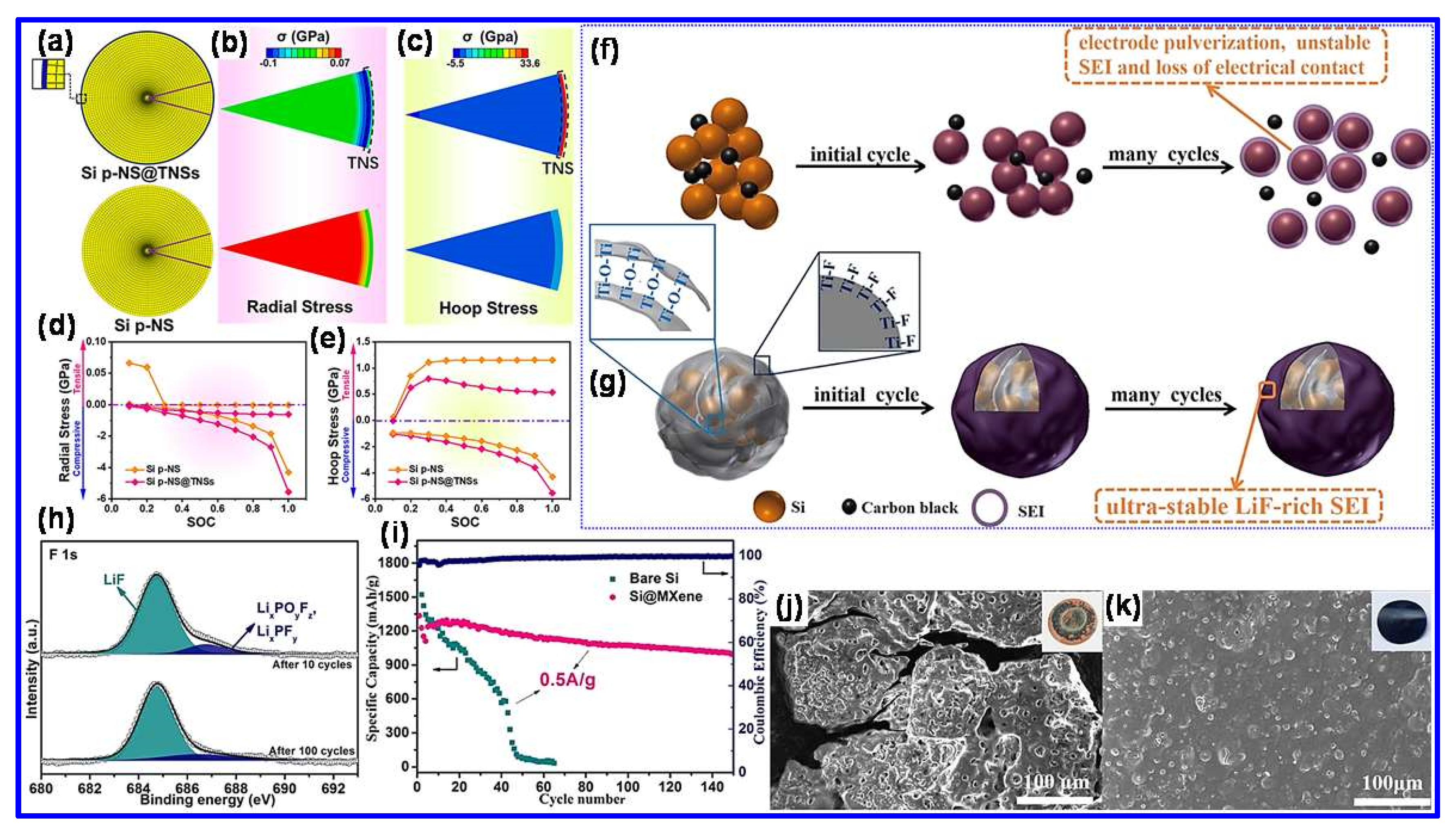
Ti3C2Tx NSs (TNSs) were uniformly attached to porous Si nanospheres (Si p-NSs) through electrostatic interactions mediated by a PMMA interlayer. After pyrolysis removed the PMMA, core–shell Si p-NS@TNS composite spheres were obtained [49]. The conformal MXene coating enhanced electrical conductivity and provided structural reinforcement against particle pulverization. Mechanical simulations indicated that both radial and circumferential stresses decayed more rapidly from the Si/TNS interface toward the particle interior than in uncoated Si p-NSs (Figure 12a–c). Stress evaluations at different states of charge further (Figure 12d,e) confirmed reduced internal stress in the coated structure, demonstrating effective accommodation of volume expansion. As a result, the composite delivered a reversible capacity of 1154 mAh/g at 0.2 A/g, along with outstanding cycling stability, exhibiting only 0.026% capacity decay per cycle over 2000 cycles, and excellent rate capability. When assembled into a full cell with a LiFePO4 cathode, the device achieved 138 mAh/g after 80 cycles, significantly outperforming the counterpart based on uncoated Si. The energy density reached 385 Wh/kg in the initial cycle and increased to 405 Wh/kg after prolonged cycling.
Spherical Si/MXene NCs were fabricated through a spray-drying process driven by capillary compression forces [80]. In this structure, Si NPs were uniformly confined within wrinkled MXene microspheres, where adjacent MXene NSs were interconnected through Ti-O-Ti covalent linkages, strengthening the overall framework. As shown in Figure 12f–h, the abundant F terminations on MXene facilitated the in situ formation of a LiF-rich SEI layer via conversion reactions, producing a dense and mechanically stable interphase. This protective layer effectively suppressed parasitic reactions between Si and the electrolyte while improving structural stability during repeated cycling. Consequently, the electrode delivered a high reversible capacity of 1791.9 mAh/g at 0.2 A/g with an ICE of 74.7%. The robust architecture also supported stable long-term cycling, maintaining 1003.6 mAh/g at 0.5 A/g with 81% capacity retention after 150 cycles (Figure 12i). Post-cycling SEM observations confirmed superior structural integrity compared with bare Si, highlighting the important role of MXene F-terminations in stabilizing Si-based anodes (Figure 12j,k).
SiO2 has also been investigated as a synergistic component with MXene to enhance Li-storage performance. By combining the Stöber method with spray-drying techniques, Mu et al. [94] synthesized microspherical SiO2/MXene hybrid structures. This integrated architecture effectively incorporated Si NPs within a conductive MXene framework, enabling improved electron and ion transport, preventing aggregation of both Si and MXene, minimizing parasitic reactions, and providing sufficient internal space to accommodate mechanical stress during cycling. Consequently, the hybrid delivered reversible capacities of 820 mAh/g and 798 mAh/g in the first and 100th cycles at 0.2 A/g, corresponding to a high-capacity retention of 97%. Even at elevated current densities up to 3 A/g, the electrode maintained a substantial capacity of 517 mAh/g, indicating favorable reaction kinetics.

3.5. Fibers

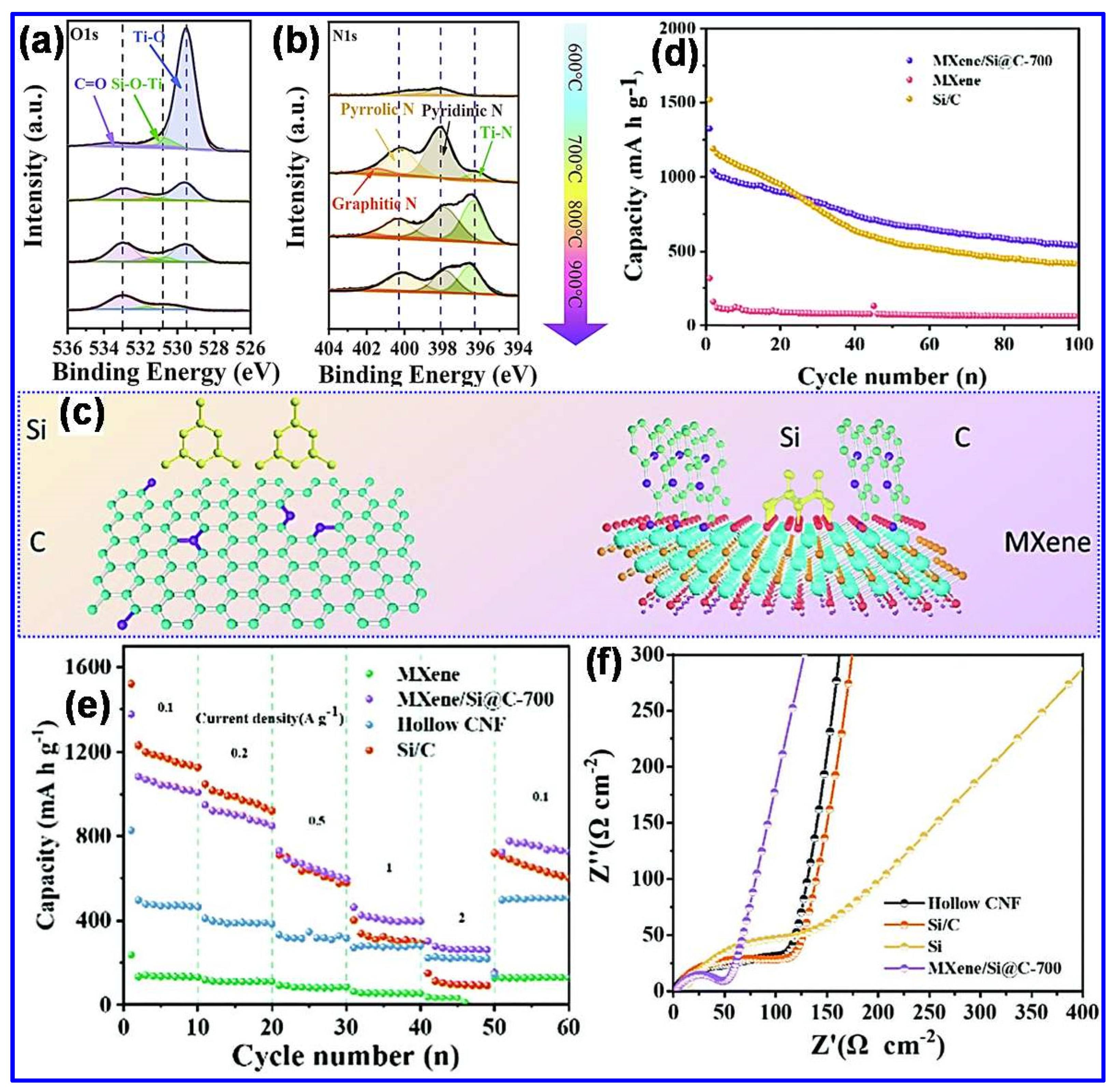
Electrospinning is widely employed to fabricate fiber-like, self-supporting Si@C NCs. However, insufficient interfacial adhesion and limited electrical connectivity between Si NPs and the C matrix often hinder their Li-storage performance. To address these issues, Jiang’s group [50] introduced MXene NSs into a coaxial electrospinning process. In this design, MXene sheets acted as substrates for anchoring Si NPs, which were subsequently coated with a C shell, forming core–shell structured MXene/Si@C NFs. XPS results verified the presence of Ti-N and Ti-O-Si bonds among MXene, Si, and C (Figure 13a–c), indicating that MXene served as a conductive interfacial bridge that enhanced both electron transport and structural stability. The resulting MXene/Si@C NFs delivered a reversible capacity of 1080.4 mAh/g at 0.1 A/g with an ICE of 78.4%. In addition, they demonstrated enhanced electrochemical kinetics, including excellent rate performance (301.1 mAh/g at 2 A/g) and lower charge-transfer resistance compared with Si/C, CNF, and pristine Si electrodes (Figure 13d–f), highlighting their potential in flexible LIBs.

3.6. Si-Functionalized/Doped MXenes

Unlike Si/MXene NCs, where Si serves as a distinct active phase for Li storage, theoretical studies indicate that Si can also function as a surface termination or dopant in MXenes to enhance their storage capability. First-principles calculations reveal that Li can remove -F and -OH groups from Ti2C and V2C MXenes, whereas Si remains a stable termination, retaining metallic conductivity [106]. The Li+ diffusion barriers in Si-terminated MXenes are 0.29 (Ti2CSi2) and 0.23 eV (V2CSi2), comparable to Ti2CF2 (0.3 eV) and V2CF2 (0.28 eV). With this structure, theoretical capacities of 1767 (Ti2CSi2) and 1592 mAh/g (V2CSi2) are achievable. These systems also show promising Na and K storage, delivering 327/327 and 315/236 mAh/g, respectively. In another study, a (3 × 3) Ti2C supercell was modeled, where Ti atoms bond covalently with C atoms [107]. Substitution of one or two C sites with Si preserves metallicity even after Li adsorption. The maximum Li adsorption energies were −2.02 eV (Si@Ti2C) and −1.98 eV (2Si@Ti2C), close to pristine Ti2C (−2.03 eV). Theoretical capacities increased from 331.6 mAh/g (pristine) to 439.4 and 428 mAh/g for Si@Ti2C and 2Si@Ti2C, respectively, highlighting the beneficial role of Si doping in MXene anodes.
Powdered Si/MXene NCs are straightforward to prepare and suitable for large-scale production; however, they frequently exhibit poor structural robustness and unstable SEI formation. The 3D porous architectures can effectively buffer Si volume changes and promote ion/electron transport, thereby improving cycling durability. Nevertheless, their complicated fabrication processes and relatively low tap densities may restrict practical deployment. Film-type configurations offer high electrical conductivity, mechanical flexibility, and binder-free electrode integration. Yet, restacking of MXene layers and limited electrolyte accessibility may hinder full utilization of active materials, particularly at high mass loadings. Spherical Si/MXene composites, especially core–shell or yolk-shell designs, enable uniform stress distribution and stable SEI development, delivering a favorable balance between capacity and longevity, although precise morphological engineering is required. NFs-based systems provide interconnected conductive networks and flexibility, but the presence of polymer-derived C matrices and complex processing routes can compromise volumetric energy density. In summary, selecting an optimal Si/MXene configuration depends on balancing electrochemical performance, mechanical integrity, and scalability, with future progress likely emerging from hybrid structural strategies (Table 2).

4. Conclusions and Future Perspectives

Thanks to their metallic conductivity, versatile surface chemistry, mechanical robustness, and flexibility, MXenes have attracted significant interest for integration with Si-based materials in advanced anodes for LIBs. This review highlights progress in Si/MXene NCs as negative electrodes. Structurally, MXenes serve as hosts to stabilize Si NPs, suppress aggregation, mitigate severe volume fluctuations during lithiation, and promote rapid electron/ion transport, thereby enhancing Li-storage performance, including long cycle life and high rate capability. Functionally, MXene coatings protect Si from direct electrolyte contact, promote the formation of stable LiF-rich SEI layers, and minimize side reactions; when arranged in stacked configurations with Si inclusions, they also provide flexibility, making them attractive for wearable energy devices. Various fabrication techniques, such as in situ thermal reduction, electrostatic self-assembly, vacuum filtration, blade casting, and ball milling, have been employed to design Si/MXene structures in diverse forms, including powders, films, fibers, 3D architectures, and spheres. Their electrochemical behaviors were systematically analyzed, with structure–performance relationships and key parameters (composition, synthesis, and capacities) summarized in Table 3.
It is important to note that direct comparison of electrochemical performance across different Si/MXene systems must be treated with caution. Reported capacities and cycling stability are strongly influenced by variations in (i) current density, (ii) Si mass loading, (iii) electrode composition and binder type, (iv) electrolyte formulation and additives, (v) potential window, and (vi) cell configuration (half-cell vs. full-cell). In many reports, high specific capacities are obtained at relatively low mass loading (<1 mg cm−2) and moderate current densities, which may overestimate practical applicability. Comparisons are most meaningful when studies use similar testing conditions, particularly comparable current densities and mass loadings. Therefore, in the following discussion and in Table 3, performance trends are interpreted primarily within comparable experimental ranges rather than based solely on absolute capacity values.
Based on the comparative analysis of reported studies, several relatively consistent trends emerge:
Trend 1—Interfacial anchoring improves ICE and stability: Composites where Si is chemically anchored to MXene surfaces (e.g., via surface functional groups or in situ growth) generally exhibit improved ICE and reduced early-cycle capacity loss compared to simple physical mixtures. Stronger interfacial bonding suppresses unstable SEI formation.
Trend 2—Encapsulation or 3D frameworks enhance cycling stability: Architectures in which Si is confined within MXene-derived networks or sandwiched between layers show more stable long-term cycling due to mechanical buffering and maintained electrical connectivity.
Trend 3—Trade-off between high capacity and structural robustness: Systems with very high Si content often deliver higher initial capacity but suffer from faster capacity decay, indicating a compromise between energy density and mechanical integrity.
Trend 4—Mass loading critically affects performance interpretation: Many high-capacity reports are obtained at low mass loading. When tested at higher loadings, capacity retention and rate capability often decline, highlighting the importance of structural optimization for practical implementation.
Trend 5—Surface chemistry of MXenes plays a decisive role: The nature of surface terminations influences electronic conductivity, wettability, and interfacial stability, thereby affecting both ICE and long-term cycling behavior.
Some studies report that oxygen-terminated MXenes enhance interfacial stability and Li-ion transport, whereas others suggest that excessive oxidation reduces conductivity and accelerates degradation. These apparently contradictory observations likely arise from differences in oxidation degree and structural integrity. Mild surface oxidation may improve interfacial compatibility, while severe oxidation compromises electronic transport. Additionally, several reports describe capacity “activation” during initial cycles. While this is sometimes attributed to gradual electrolyte penetration and improved electrode wetting, it may also reflect progressive structural rearrangement or delayed SEI stabilization. From a practical perspective, activation behavior should be interpreted cautiously, as stable performance without prolonged activation is more desirable for real applications.
Despite recent advances, Si/MXene NCs still face challenges for practical application in energy storage. Their cycling stability generally falls short of commercial graphite and Li4Ti5O12 anodes, even at relatively low Si loadings. Structural optimization is therefore essential to achieve both high Si content and stable cycling. Strategies such as in situ thermal reduction, electrostatic self-assembly, and ball milling can introduce interfacial bonding to reinforce structural integrity. Designing 3D porous architectures effectively buffers Si volume changes and accelerates ion/electron transport, thereby improving cycling and rate performance. However, these open structures, while delivering high capacity, often suffer from low CE due to excessive SSA and SEI accumulation in large pores, which impedes ion movement. Hence, careful control of pore morphology is required. Additionally, molecular dynamics simulations provide valuable insights into internal stress evolution, offering guidance for developing fiber-, film-, and sphere-like Si/MXene configurations.
Thanks to their layered architecture, MXene flakes can be assembled via vacuum filtration with Si NPs uniformly dispersed within, producing flexible Si/MXene NCs suitable for wearable energy-storage devices. Nevertheless, stacked MXene frameworks may lengthen electron/ion transport pathways, and the incorporation of Si NPs can reduce the mechanical integrity of the films. For high-performance wearable applications, parameters including MXene flake size, Si loading, toughness, porosity, bending conductivity, film thickness, and scalability must be carefully optimized.
Currently, Ti3C2Tx is the most commonly employed MXene as a conductive host for Si-based NCs. Other compositions, such as Nb2CTx, Ti2NTx and Mo2CTx, with distinct physicochemical properties, also warrant investigation for Si/MXene NC fabrication. Surface terminations, particularly -F groups, assist in forming stable LiF-rich SEI layers, yet they may also react with Li+ during cycling, causing irreversible capacity loss. Thus, the surface chemistry of MXenes has a critical impact on electrochemical behavior, highlighting the need for advanced synthesis strategies to produce MXenes with tunable terminations. In addition, MXenes are susceptible to oxidation under harsh conditions, which diminishes their conductivity and interfacial compatibility with Si, thereby impairing electrochemical performance. To address this, improvements are required across MAX-phase design, MXene etching processes, and composite fabrication to mitigate oxygen-induced degradation.
Given the high potential of Si-based candidates for next-generation LIBs, assessing Si/MXene NCs as anodes in full-cell systems is of critical importance. Although some studies have tested Si/MXene NCs with various cathodes (e.g., LiFePO4, LiNi0.8Co0.1Mn0.1O2, and LiNi0.5Mn1.5O4), further investigations are needed on parameters such as energy density, cycling stability, performance under flexible packaging, temperature tolerance, and scalability. With growing global interest in this field, Si/MXene NCs show strong promise for energy storage. This review is expected to provide a foundation for advancing their design, synthesis, and application in high-performance systems.

Author Contributions

Conceptualization, N.K.; formal analysis, N.K.; investigation, N.K.; resources, H.H. and S.M.; data curation, N.K., H.H. and S.M.; writing-original draft preparation, N.K.; writing-review and editing, N.K., H.H. and S.M.; visualization, N.K.; supervision, N.K., H.H. and S.M.; project administration, H.H. and S.M.; funding acquisition, H.H. and S.M. All authors have read and agreed to the published version of the manuscript.

Funding

The authors acknowledge the financial support from the National Research Foundation of Korea (NRF) funded by the Ministry of Science and ICT (RS-2024-00433118). This research was supported by the Nano and Material Technology Development Program through the National Research Foundation (NRF) of Korea funded by the Ministry of Science and ICT (RS-2024-00449682).

Data Availability Statement

No new data were created or analyzed in this study.

Conflicts of Interest

The authors declare that they have no known competing financial interests or personal relationships that could have appeared to influence the work reported in this paper.

References

  1. Liu, H.; Liu, X.; Li, W.; Guo, X.; Wang, Y.; Wang, G.; Zhao, D. Porous Carbon Composites for Next Generation Rechargeable Lithium Batteries. Adv. Energy Mater. 2017, 7, 1700283. [Google Scholar] [CrossRef]
  2. Nazir, M.A.; Ullah, S.; Jamil, A.; Shaaban, I.A.; Gurbanova, L.; Khan, K.; Shah, S.S.A.; Bao, S.-J. Advances in metal–organic framework-based materials for sustainable energy solutions. J. Mater. Chem. A 2025, 13, 25258–25303. [Google Scholar] [CrossRef]
  3. Kitchamsetti, N.; de Barros, A.L.F.; Mhin, S. Transition Metal Nitrides: Multifunctional Catalysts and Energy Materials with Tailorable Architectures. Small Sci. 2025, 5, 2500331. [Google Scholar] [CrossRef]
  4. Kızılaslan, A.; Kızılaslan, R.; Miura, A.; Tadanaga, K. Mixed ion-electron conductive materials: A path to higher energy density all-solid-state lithium-ion batteries. Nano Today 2025, 60, 102556. [Google Scholar] [CrossRef]
  5. Kitchamsetti, N.; Kim, K.; Han, H.S.; Mhin, S. Biomass-Derived Hard Carbon Anodes for Sodium-Ion Batteries: Recent Advances in Synthesis Strategies. Nanomaterials 2025, 15, 1554. [Google Scholar] [CrossRef]
  6. Kitchamsetti, N.; Mhin, S. Advances and Prospects of Lignin-Derived Hard Carbons for Next-Generation Sodium-Ion Batteries. Polymers 2025, 17, 2801. [Google Scholar] [CrossRef]
  7. Kitchamsetti, N.; de Barros, A.L.F.; Han, H.; Mhin, S. Recycling of Spent Cathode Carbon from Aluminum Electrolysis: Detoxification Approaches, Resource Utilization, and Environmental Perspectives. ChemElectroChem 2026, 13, e202500353. [Google Scholar] [CrossRef]
  8. Xiao, M. Research progress of prussian blue analogues for cathode of sodium ion batteries. J. Alloy. Compd. 2025, 1036, 182014. [Google Scholar] [CrossRef]
  9. Kitchamsetti, N.; de Barros, A.L.F.; Han, H.; Mhin, S. Unveiling MBenes: A New Class of 2D Materials Shaping the Future of Energy. Adv. Sustain. Syst. 2025, 9, e00581. [Google Scholar] [CrossRef]
  10. Kitchamsetti, N.; Mannem, C.K. A review on preparation of metal tellurides and their utilization as an electrode for supercapacitors, rechargeable batteries and electrocatalysis. J. Alloy. Compd. 2025, 1027, 180664. [Google Scholar] [CrossRef]
  11. Kitchamsetti, N.; Han, H.; Mhin, S. MXenes and MXene-Based Composites: Preparation, Characteristics, Theoretical Investigations, and Application in Developing Sulfur Cathodes, Lithium Anodes, and Functional Separators for Lithium–Sulfur Batteries. Batteries 2025, 11, 206. [Google Scholar] [CrossRef]
  12. Kitchamsetti, N.; Mhin, S. Engineering cathodes and separators with zeolitic imidazolate frameworks-derived materials for advanced lithium-sulfur batteries. J. Alloy. Compd. 2025, 1046, 184742. [Google Scholar] [CrossRef]
  13. Kitchamsetti, N.; de Barros, A.L.F.; Han, H.; Mhin, S. Shaping the future of energy storage with single-atom materials. J. Alloy. Compd. 2025, 1044, 184389. [Google Scholar] [CrossRef]
  14. Kitchamsetti, N.; Kim, K.; Han, H.; Mhin, S. Unveiling K-storage mechanisms in Te-based electrodes for potassium-ion batteries. J. Energy Storage 2026, 144, 119817. [Google Scholar] [CrossRef]
  15. Pimta, K.; Autthawong, T.; Yodying, W.; Phromma, C.; Haruta, M.; Kurata, H.; Sarakonsri, T.; Chimupala, Y. Development of Bronze Phase Titanium Dioxide Nanorods for Use as Fast-Charging Anode Materials in Lithium-Ion Batteries. ACS Omega 2023, 8, 15360–15370. [Google Scholar] [CrossRef] [PubMed]
  16. Kitchamsetti, N.; Mannem, C.K.; Narsimulu, D.; Chakra, C.S.; de Barros, A.L.F. CoFe-PBA templated PDA derived C coated (Co,Fe)O nanoparticles encapsulated with in the porous hollow nanocages as anodes for long-lasting and high-rate lithium-ion batteries and hybrid supercapacitors. Chem. Eng. J. 2025, 505, 159354. [Google Scholar] [CrossRef]
  17. Kitchamsetti, N.; Narsimulu, D.; Payyavula, S.; Chakra, C.S.; de Barros, A.L.F. V-MOF derived porous nanorods comprising polydopamine-derived C coated VN quantum dots composited with graphitic C as electrodes for long-lasting and high-rate lithium-ion batteries and hybrid supercapacitors. J. Energy Storage 2025, 109, 115144. [Google Scholar] [CrossRef]
  18. Jin, Q.; Gao, S.; Du, H.; Liu, J.; Wang, Y.; Qin, Z. A “two cooking with one fish” strategy for modulating both polyaniline cathode and zinc anode towards enhanced kinetics and cycling stability for aqueous zinc ion batteries. Carbon 2024, 226, 119219. [Google Scholar] [CrossRef]
  19. Choi, J.W.; Aurbach, D. Promise and reality of post-lithium-ion batteries with high energy densities. Nat. Rev. Mater. 2016, 1, 16013. [Google Scholar] [CrossRef]
  20. Ji, Y.; You, Y.; Xu, G.; Yang, X.; Liu, Y. Engineering metal organic framework (MOF)@MXene based electrodes for hybrid supercapacitors—A review. Chem. Eng. J. 2024, 483, 149365. [Google Scholar] [CrossRef]
  21. Yun, J.; Kim, S.; Jo, H.; Mun, S.; Park, S.; Ryu, H.S.; Lee, J.-W.; Lim, H.-D. Cryogenic liquid sculpting of vertically aligned architectures for high-rate silicon anodes. Chem. Eng. J. 2025, 526, 170582. [Google Scholar] [CrossRef]
  22. Liu, Q.; Ji, Y.; Yin, X.; Li, J.; Liu, Y.; Hu, X.; Wen, Z. Magnesiothermic reduction improved route to high-yield synthesis of interconnected porous Si@C networks anode of lithium ions batteries. Energy Storage Mater. 2022, 46, 384–393. [Google Scholar] [CrossRef]
  23. Zhang, C.; Wang, F.; Han, J.; Bai, S.; Tan, J.; Liu, J.; Li, F. Challenges and Recent Progress on Silicon-Based Anode Materials for Next-Generation Lithium-Ion Batteries. Small Struct. 2021, 2, 2100009. [Google Scholar] [CrossRef]
  24. Zhao, X.; Wang, Z.; Jia, Z.; Kong, X.; Zhao, Y.; Han, T.; He, F.; Sun, Q.; Yang, D.; Yang, C.; et al. Unlocking Exceptionally Fast and Large-Capacity Na+ Storage of Fe2SSe via Coupling Multicore-in-Multishell Design and Vacancy Engineering. Adv. Funct. Mater. 2025, e18989. [Google Scholar] [CrossRef]
  25. Liu, L.; Cai, Y.; Zhao, Z.; Ma, C.; Li, C.; Mu, D. A succinonitrile-infiltrated silica aerogel synergistically-reinforced hybrid solid electrolyte for durable solid-state lithium metal batteries. Mater. Chem. Front. 2022, 6, 430–439. [Google Scholar] [CrossRef]
  26. Zhang, Y.; Wu, B.; Mu, G.; Ma, C.; Mu, D.; Wu, F. Recent progress and perspectives on silicon anode: Synthesis and prelithiation for LIBs energy storage. J. Energy Chem. 2022, 64, 615–650. [Google Scholar] [CrossRef]
  27. Ge, J.; Shen, H.; Zhou, F.; Li, Y.; Yuan, N.; Yang, W.; Zhou, H.; Xu, B.; Guo, R.; Xu, P. Oxygen-tailoring in SiOX/C with a covalent interface for high-performance lithium storage. J. Mater. Chem. A 2022, 10, 1928–1939. [Google Scholar] [CrossRef]
  28. Wang, Z.; Kong, L.; Guo, Z.; Zhang, X.; Wang, X.; Zhang, X. Bamboo-like SiOx/C nanotubes with carbon coating as a durable and high-performance anode for lithium-ion battery. Chem. Eng. J. 2022, 428, 131060. [Google Scholar] [CrossRef]
  29. Kim, J.Y.; Jung, S.; Kang, S.H.; Park, J.; Lee, M.J.; Jin, D.; Shin, D.O.; Lee, Y.-G.; Lee, Y.M. Graphite–Silicon Diffusion-Dependent Electrode with Short Effective Diffusion Length for High-Performance All-Solid-State Batteries. Adv. Energy Mater. 2022, 12, 2103108. [Google Scholar] [CrossRef]
  30. Joshi, Y.; Umasankaran, A.; Klaassen, C.; AlAmer, M.; Joo, Y.L. Critical roles of reduced graphene oxide in the electrochemical performance of silicon/reduced graphene oxide hybrids for high rate capable lithium-ion battery anodes. Electrochim. Acta 2022, 404, 139753. [Google Scholar] [CrossRef]
  31. Ren, Y.; Yin, X.; Xiao, R.; Mu, T.; Huo, H.; Zuo, P.; Ma, Y.; Cheng, X.; Gao, Y.; Yin, G.; et al. Layered porous silicon encapsulated in carbon nanotube cage as ultra-stable anode for lithium-ion batteries. Chem. Eng. J. 2022, 431, 133982. [Google Scholar] [CrossRef]
  32. Pogorielov, M.; Smyrnova, K.; Kyrylenko, S.; Gogotsi, O.; Zahorodna, V.; Pogrebnjak, A. MXenes—A New Class of Two-Dimensional Materials: Structure, Properties and Potential Applications. Nanomaterials 2021, 11, 3412. [Google Scholar] [CrossRef]
  33. Fan, B.; Zhao, X.; Zhang, P.; Wei, Y.; Qiao, N.; Yang, B.; Soomro, R.A.; Zhang, R.; Xu, B. Effect of Sodium Dodecyl Sulfate on Stability of MXene Aqueous Dispersion. Adv. Sci. 2023, 10, 2300273. [Google Scholar] [CrossRef]
  34. Kitchamsetti, N.; Mhin, S. Synergistic Design of MXene Architectures for Mechanically Robust and High-Performance Flexible Batteries and Supercapacitors. EcoEnergy 2025, 3, e70018. [Google Scholar] [CrossRef]
  35. Yun, J.; Park, J.; Ryoo, M.; Kitchamsetti, N.; Goh, T.S.; Kim, D. Piezo-triboelectric hybridized nanogenerator embedding MXene based bifunctional conductive filler in polymer matrix for boosting electrical power. Nano Energy 2023, 105, 108018. [Google Scholar] [CrossRef]
  36. Kitchamsetti, N.; Kim, D. A facile method for synthesizing MOF derived ZnCo2O4 particles on MXene nanosheets as a novel anode material for high performance hybrid supercapacitors. Electrochim. Acta 2023, 441, 141824. [Google Scholar] [CrossRef]
  37. Kitchamsetti, N.; de Barros, A.L.F. Recent Advances in MXenes Based Composites as Photocatalysts: Synthesis, Properties and Photocatalytic Removal of Organic Contaminants from Wastewater. ChemCatChem 2023, 15, e202300690. [Google Scholar] [CrossRef]
  38. Guo, Y.; Gao, Y.; Chen, H.; Zhao, Q.; Zhu, Q.; Cao, Z.; Li, B.; Shang, J.; Du, Z.; Yang, S. Controllable Etching of Ti3SiC2 to Produce Fluorine-Enriched, Hydrophobic 2D Titanium Carbide for Ultrastable Zinc Ion Batteries. Adv. Energy Mater. 2023, 13, 2300890. [Google Scholar] [CrossRef]
  39. An, Y.; Tian, Y.; Man, Q.; Shen, H.; Liu, C.; Xiong, S.; Feng, J. Fluorine- and Acid-Free Strategy toward Scalable Fabrication of Two-Dimensional MXenes for Sodium-Ion Batteries. Nano Lett. 2023, 23, 5217–5226. [Google Scholar] [CrossRef]
  40. Ding, H.; Li, Y.; Li, M.; Chen, K.; Liang, K.; Chen, G.; Lu, J.; Palisaitis, J.; Persson, P.O.Å.; Eklund, P.; et al. Chemical scissor–mediated structural editing of layered transition metal carbides. Science 2023, 379, 1130–1135. [Google Scholar] [CrossRef]
  41. Wang, D.; Zhou, C.; Filatov, A.S.; Cho, W.; Lagunas, F.; Wang, M.; Vaikuntanathan, S.; Liu, C.; Klie, R.F.; Talapin, D.V. Direct synthesis and chemical vapor deposition of 2D carbide and nitride MXenes. Science 2023, 379, 1242–1247. [Google Scholar] [CrossRef] [PubMed]
  42. Xiang, M.; Shen, Z.; Zheng, J.; Song, M.; He, Q.; Yang, Y.; Zhu, J.; Geng, Y.; Yue, F.; Dong, Q.; et al. Gas-phase synthesis of Ti2CCl2 enables an efficient catalyst for lithium-sulfur batteries. Innovation 2024, 5, 100540. [Google Scholar] [CrossRef]
  43. Gogotsi, Y. The future of MXenes. Chem. Mater. 2023, 35, 8767–8770. [Google Scholar] [CrossRef]
  44. Zhang, P.; Zhu, Q.; Wei, Y.; Xu, B. Achieving stable and fast potassium storage of Sb2S3@MXene anode via interfacial bonding and electrolyte chemistry. Chem. Eng. J. 2023, 451, 138891. [Google Scholar] [CrossRef]
  45. Long, J.; Yao, Q.; Xia, J.; Lu, Z.H. Modulating electronic density of active metal site via MXene intercalated by alkali ions for superior hydrogen production. Appl. Catal. B Environ. Energy 2025, 363, 124823. [Google Scholar] [CrossRef]
  46. Li, W.; Xie, G.; Xu, H. Emerging trends in MXene research: Synthesis, process and hybrid with nanomaterials for biosensing. Coord. Chem. Rev. 2025, 531, 216493. [Google Scholar] [CrossRef]
  47. Dong, J.; Liu, C.; Cheng, H.; Jiang, C.; Zhou, B.; Huang, M.; Liu, C.; Feng, Y. Recent progress of Ti3C2Tx MXene-based layered films for electromagnetic interference shielding. J. Mater. Sci. Technol. 2025, 223, 131–149. [Google Scholar] [CrossRef]
  48. Kong, F.; He, X.; Liu, Q.; Qi, X.; Sun, D.; Zheng, Y.; Wang, R.; Bai, Y. Enhanced reversible Li-ion storage in Si@Ti3C2 MXene nanocomposite. Electrochem. Commun. 2018, 97, 16–21. [Google Scholar] [CrossRef]
  49. Xia, M.; Chen, B.; Gu, F.; Zu, L.; Xu, M.; Feng, Y.; Wang, Z.; Zhang, H.; Zhang, C.; Yang, J. Ti3C2Tx MXene Nanosheets as a Robust and Conductive Tight on Si Anodes Significantly Enhance Electrochemical Lithium Storage Performance. ACS Nano 2020, 14, 5111–5120. [Google Scholar] [CrossRef]
  50. Jiang, R.; Yuan, H.; Wei, X.; Wang, H.; Shin, H.J.; Lan, J.; Yu, Y.; Yang, X. Constructing robust and freestanding MXene/Si@C core–shell nanofibers via coaxial electrospinning for high performance Li-ion batteries. Mater. Chem. Front. 2021, 5, 8218–8228. [Google Scholar] [CrossRef]
  51. Jiang, T.; Xiong, Q.; Yang, H.; Chen, G.Z. Performance and application of Si/Ti3C2Tx (MXene) composites in lithium ion battery. J. Phys. Energy 2023, 5, 014020. [Google Scholar] [CrossRef]
  52. Zhang, Y.; Mu, Z.; Lai, J.; Chao, Y.; Yang, Y.; Zhou, P.; Li, Y.; Yang, W.; Xia, Z.; Guo, S. MXene/Si@SiOx@C Layer-by-Layer Superstructure with Autoadjustable Function for Superior Stable Lithium Storage. ACS Nano 2019, 13, 2167–2175. [Google Scholar] [CrossRef] [PubMed]
  53. Qi, W.; Shapter, J.G.; Wu, Q.; Yin, T.; Gao, G.; Cui, D. Nanostructured anode materials for lithium-ion batteries: Principle, recent progress and future perspectives. J. Mater. Chem. A 2017, 5, 19521–19540. [Google Scholar] [CrossRef]
  54. Zhong, J.; Lin, L.; Wu, H.; Xie, J.; Ye, T.; Yang, L.; Shu, D.; Tong, Y.; Meng, T. Functional Interface Design Stabilizes Li-Ion Storage in Si Anodes. Small 2026, 22, e11492. [Google Scholar] [CrossRef]
  55. Li, J.; Mejía-Centeno, K.V.; Khan, M.D.; Zeng, G.; Ci, L.; Cabot, A.; Sun, Q. Beyond Imperfect Match: Silicon/Graphite Hybrid Anodes for High-Energy-Density Lithium-Ion Batteries. Adv. Energy Mater. 2026, e05674. [Google Scholar] [CrossRef]
  56. Jiang, X.; Tang, C.; Zhou, X.; Hou, J.; Jiang, S.; Meng, L.; Zhang, Y. Recent progress in Si/Ti3C2Tx MXene anode materials for lithium-ion batteries. iScience 2024, 27, 111217. [Google Scholar] [CrossRef]
  57. Zhang, C.J. Interfacial assembly of two-dimensional MXenes. J. Energy Chem. 2021, 60, 417–434. [Google Scholar] [CrossRef]
  58. Yang, Q.; Wang, Z.; Xia, Y.; Wu, G.; Chen, C.; Wang, J.; Rao, P.; Dong, A. Facile electrostatic assembly of Si@MXene superstructures for enhanced lithium-ion storage. J. Colloid Interface Sci. 2020, 580, 68–76. [Google Scholar] [CrossRef]
  59. Wei, C.; Fei, H.; Tian, Y.; An, Y.; Tao, Y.; Li, Y.; Feng, J. Scalable construction of SiO/wrinkled MXene composite by a simple electrostatic self-assembly strategy as anode for high-energy lithium-ion batteries. Chin. Chem. Lett. 2020, 31, 980–983. [Google Scholar] [CrossRef]
  60. Zhang, P.; Chen, J.; Feng, L.; Jiang, M.; Xu, B. Dual confinement of Si nanoparticles in a MXene/ZIF-8-derived carbon framework for lithium-ion batteries. ACS Appl. Nano Mater. 2022, 5, 12720–12728. [Google Scholar] [CrossRef]
  61. Wang, H.-Q.; Zhao, Y.-X.; Gou, L.; Wang, L.-Y.; Wang, M.; Li, Y.; Hu, S.-L. Rational construction of densely packed Si/MXene composite microspheres enables favorable sodium storage. Rare Met. 2022, 41, 1626–1636. [Google Scholar] [CrossRef]
  62. Peng, X.; Xiong, C.; Lin, Y.; Zhao, C.; Zhao, T. Honeycomb-like hierarchical porous silicon composites with dual protection for ultrastable Li-ion battery anodes. SmartMat 2021, 2, 579–590. [Google Scholar] [CrossRef]
  63. Li, X.; Chen, Z.; Li, A.; Yu, Y.; Chen, X.; Song, H. Three-Dimensional Hierarchical Porous Structures Constructed by Two-Stage MXene-Wrapped Si Nanoparticles for Li-Ion Batteries. ACS Appl. Mater. Interfaces 2020, 12, 48718–48728. [Google Scholar] [CrossRef]
  64. Liu, Z.; Lu, D.; Wang, W.; Yue, L.; Zhu, J.; Zhao, L.; Zheng, H.; Wang, J.; Li, Y. Integrating Dually Encapsulated Si Architecture and Dense Structural Engineering for Ultrahigh Volumetric and Areal Capacity of Lithium Storage. ACS Nano 2022, 16, 4642–4653. [Google Scholar] [CrossRef] [PubMed]
  65. Liu, S.; Zhang, X.; Yan, P.; Cheng, R.; Tang, Y.; Cui, M.; Wang, B.; Zhang, L.; Wang, X.; Jiang, Y.; et al. Dual Bond Enhanced Multidimensional Constructed Composite Silicon Anode for High-Performance Lithium Ion Batteries. ACS Nano 2019, 13, 8854–8864. [Google Scholar] [CrossRef] [PubMed]
  66. Zhang, S.; Liu, H.; Cao, B.; Zhu, Q.; Zhang, P.; Zhang, X.; Chen, R.; Wu, F.; Xu, B. An MXene/CNTs@P nanohybrid with stable Ti–O–P bonds for enhanced lithium ion storage. J. Mater. Chem. A 2019, 7, 21766–21773. [Google Scholar] [CrossRef]
  67. Wang, D.; Wang, R.; Huang, K.; Lei, M.; Tang, H. Si-P-Ti stabilized Si-P/Ti3C2Tx nanohybrids for enhanced lithium-ion storage. Adv. Compos. Hybrid Mater. 2022, 5, 1362–1375. [Google Scholar] [CrossRef]
  68. Zhang, K.; Zhao, D.; Qian, Z.; Gu, X.; Yang, J.; Qian, Y. N-doped Ti3C2Tx MXene sheet-coated SiOx to boost lithium storage for lithium-ion batteries. Sci. China Mater. 2023, 66, 51–60. [Google Scholar] [CrossRef]
  69. Zhang, H.; Wei, Z.; Wu, J.; Cheng, F.; Ma, Y.; Liu, W.; Cheng, Y.; Lin, Y.; Liu, N.; Gao, Y.; et al. Interlayer-spacing-regulated MXene/rGO foam for multi-functional zinc-ion microcapacitors. Energy Storage Mater. 2022, 50, 444–453. [Google Scholar] [CrossRef]
  70. Zhang, P.; Zhu, Q.; Soomro, R.A.; He, S.; Sun, N.; Qiao, N.; Xu, B. In Situ Ice Template Approach to Fabricate 3D Flexible MXene Film-Based Electrode for High Performance Supercapacitors. Adv. Funct. Mater. 2020, 30, 2000922. [Google Scholar] [CrossRef]
  71. Huang, Y.L.; Bian, S.W. Vacuum-filtration assisted layer-by-layer strategy to design MXene/carbon nanotube@MnO2 all-in-one supercapacitors. J. Mater. Chem. A 2021, 9, 21347–21356. [Google Scholar] [CrossRef]
  72. Zhang, Z.; Ying, H.; Huang, P.; Zhang, S.; Zhang, Z.; Yang, T.; Han, W.-Q. Porous Si decorated on MXene as free-standing anodes for lithium-ion batteries with enhanced diffusion properties and mechanical stability. Chem. Eng. J. 2023, 451, 138785. [Google Scholar] [CrossRef]
  73. Zhang, P.; Zhu, Q.; Guan, Z.; Zhao, Q.; Sun, N.; Xu, B. A Flexible Si@C Electrode with Excellent Stability Employing an MXene as a Multifunctional Binder for Lithium-Ion Batteries. ChemSusChem 2020, 13, 1621–1628. [Google Scholar] [CrossRef] [PubMed]
  74. Zhang, C.; Park, S.-H.; Seral-Ascaso, A.; Barwich, S.; McEvoy, N.; Boland, C.S.; Coleman, J.N.; Gogotsi, Y.; Nicolosi, V. High capacity silicon anodes enabled by MXene viscous aqueous ink. Nat. Commun. 2019, 10, 849. [Google Scholar] [CrossRef]
  75. Tang, J.; Wu, F.; Dai, X.; Zhou, J.; Pang, H.; Duan, X.; Xiao, B.; Li, D.; Long, J. Robust MXene adding enables the stable interface of silicon anodes for high-performance Li-ion batteries. Chem. Eng. J. 2023, 452, 139139. [Google Scholar] [CrossRef]
  76. Wang, Z.; Liu, J.; Chen, K.; Wu, X.; Mi, L.; Mao, W. The effects of Ti3C2 MXene additive on lithiation induced stress in silicon/graphite-based electrodes for lithium ion batteries. J. Phys. D Appl. Phys. 2022, 55, 185501. [Google Scholar] [CrossRef]
  77. Han, X.; Zhou, W.; Chen, M.; Chen, J.; Wang, G.; Liu, B.; Luo, L.; Chen, S.; Zhang, Q.; Shi, S.; et al. Interfacial nitrogen engineering of robust silicon/MXene anode toward high energy solid-state lithium-ion batteries. J. Energy Chem. 2022, 67, 727–735. [Google Scholar] [CrossRef]
  78. Wang, J.; An, Y.; Shen, H.; Man, Q.; Feng, J. Flexible and ultralight MXene paper as a current collector for microsized porous silicon anode in high-energy lithium-ion batteries. 2D Mater. 2022, 10, 014010. [Google Scholar] [CrossRef]
  79. Yang, S.H.; Kim, J.K.; Jung, D.S.; Kang, Y.C. Facile fabrication of Si-embedded amorphous carbon@graphitic carbon composite microspheres via spray drying as high-performance lithium-ion battery anodes. Appl. Surf. Sci. 2022, 606, 154799. [Google Scholar] [CrossRef]
  80. Yan, Y.; Zhao, X.; Dou, H.; Wei, J.; Sun, Z.; He, Y.-S.; Dong, Q.; Xu, H.; Yang, X. MXene Frameworks Promote the Growth and Stability of LiF-Rich Solid–Electrolyte Interphases on Silicon Nanoparticle Bundles. ACS Appl. Mater. Interfaces 2020, 12, 18541–18550. [Google Scholar] [CrossRef] [PubMed]
  81. Sarang, K.; Zhao, X.; Holta, D.; Cao, H.; Arole, K.; Flouda, P.; Oh, E.S.; Radovic, M.; Green, M.J.; Lutkenhaus, J.L. Carbon Additive-Free Crumpled Ti3C2TX MXene-Encapsulated Silicon Nanoparticle Anodes for Lithium-Ion Batteries. ACS Appl. Energy Mater. 2021, 4, 10762–10773. [Google Scholar] [CrossRef]
  82. Wang, Z.; Cao, D.; Ren, M.; Zhang, H.; Pan, L.; Zhang, C.J.; Yang, J. Si@Ti3C2Tx with Si nanoparticles embedded in a 3D conductive network of crumpled Ti3C2Tx nanosheets for the anode of lithium-ion batteries with enhanced cycling performance. J. Alloy. Compd. 2022, 892, 162037. [Google Scholar] [CrossRef]
  83. Meng, J.; Zhang, F.; Zhang, L.; Liu, L.; Chen, J.; Yang, B.; Yan, X. Rolling up MXene sheets into scrolls to promote their anode performance in lithium-ion batteries. J. Energy Chem. 2020, 46, 256–263. [Google Scholar] [CrossRef]
  84. Zhao, W.; Wang, X.; Wu, Y.; Chen, S.; Tao, Y.; Zhong, Y.; Zhang, H.; Li, Y.; Sun, X. Multidimensionally decorated carbon nanofiber through one-step electrospinning with metal-organic framework-derived carbon as high-performance anode materials for lithium-ion batteries. J. Power Sources 2025, 625, 235683. [Google Scholar] [CrossRef]
  85. Kitchamsetti, N. A review on recent advances in Prussian blue, its analogues, and their derived materials as electrodes for high performance supercapacitors. J. Energy Storage 2023, 73, 108958. [Google Scholar] [CrossRef]
  86. Xu, H.; Chen, G.; Du, F.; Wang, X.; Agnese, Y.D.; Gao, Y. Electrospun Ti3C2Tx MXene and silicon embedded in carbon nanofibers for lithium-ion batteries. J. Phys. D Appl. Phys. 2022, 55, 204002. [Google Scholar] [CrossRef]
  87. Jiang, M.; Jiang, M.; Gao, H.; Chen, J.; Liu, W.; Ma, Y.; Luo, W.; Yang, J. Comparison of Additives in Anode: The Case of Graphene, MXene, CNTs Integration with Silicon Inside Carbon Nanofibers. Acta Metall. Sin. 2021, 34, 337–346. [Google Scholar] [CrossRef]
  88. Entwistle, J.; Rennie, A.; Patwardhan, S. A review of magnesiothermic reduction of silica to porous silicon for lithium-ion battery applications and beyond. J. Mater. Chem. A 2018, 6, 18344–18356. [Google Scholar] [CrossRef]
  89. Jiang, M.; Zhang, F.; Zhu, G.; Ma, Y.; Luo, W.; Zhou, T.; Yang, J. Interface-Amorphized Ti3C2@Si/SiOx@TiO2 Anodes with Sandwiched Structures and Stable Lithium Storage. ACS Appl. Mater. Interfaces 2020, 12, 24796–24805. [Google Scholar] [CrossRef]
  90. Lin, N.; Han, Y.; Zhou, J.; Zhang, K.; Xu, T.; Zhu, Y.; Qian, Y. A low temperature molten salt process for aluminothermic reduction of silicon oxides to crystalline Si for Li-ion batteries. Energy Environ. Sci. 2015, 8, 3187–3191. [Google Scholar] [CrossRef]
  91. Hui, X.; Zhao, R.; Zhang, P.; Li, C.; Wang, C.; Yin, L. Low-Temperature Reduction Strategy Synthesized Si/Ti3C2 MXene Composite Anodes for High-Performance Li-Ion Batteries. Adv. Energy Mater. 2019, 9, 1901065. [Google Scholar] [CrossRef]
  92. Zheng, M.; Wu, S. A novel method for synthesizing Ti3C2Tx MXene nanosheets supported Si nanoparticles as lithium-ion batteries anode for electric vehicles applications. Mater. Lett. 2022, 311, 131570. [Google Scholar] [CrossRef]
  93. Bashir, T.; Li, X.; Yang, S.; Song, Y.; Zhou, S.; Wang, J.; Zhu, W.; Yang, J.; Zhao, J.; Gao, L. Enhancing role of structurally integrated V2C MXene nanosheets on silicon anode for lithium storage. J. Alloy. Compd. 2022, 922, 166213. [Google Scholar] [CrossRef]
  94. Mu, G.; Mu, D.; Wu, B.; Ma, C.; Bi, J.; Zhang, L.; Yang, H.; Wu, F. Microsphere-Like SiO2/MXene Hybrid Material Enabling High Performance Anode for Lithium Ion Batteries. Small 2020, 16, 1905430. [Google Scholar] [CrossRef]
  95. Maughan, P.A.; Bouscarrat, L.; Seymour, V.R.; Shao, S.; Haigh, S.J.; Dawson, R.; Tapia-Ruiz, N.; Bimbo, N. Pillared Mo2TiC2 MXene for high-power and long-life lithium and sodium-ion batteries. Nanoscale Adv. 2021, 3, 3145–3158. [Google Scholar] [CrossRef]
  96. Wang, Y.; Yang, J.; Chen, Z.; Hu, Y. A new flexible and ultralight carbon foam/Ti3C2TX MXene hybrid for high-performance electromagnetic wave absorption. RSC Adv. 2019, 9, 41038–41049. [Google Scholar] [CrossRef]
  97. Shen, Y.; Wu, L.; Zhou, Y.; Lin, H.; Zhang, C.; Yu, H.; Wang, J.; Yu, L. High electrochemical performance of Ni-foam supported Ti3C2Tx MXene/rGO nanocomposite. Nanotechnology 2021, 32, 375710. [Google Scholar] [CrossRef] [PubMed]
  98. Wang, S.; Li, D.; Zhou, Y.; Jiang, L. Hierarchical Ti3C2Tx MXene/Ni Chain/ZnO Array Hybrid Nanostructures on Cotton Fabric for Durable Self-Cleaning and Enhanced Microwave Absorption. ACS Nano 2020, 14, 8634–8645. [Google Scholar] [CrossRef] [PubMed]
  99. Kitchamsetti, N.; Kim, D. Facile synthesis of hierarchical core–shell heterostructured ZnO/SnO2@NiCo2O4 nanorod sheet arrays on carbon cloth for high performance quasi-solid-state asymmetric supercapacitors. J. Mater. Res. Technol. 2022, 21, 590–603. [Google Scholar] [CrossRef]
  100. Zhang, W.; Shi, H.; Wang, D.; Wang, J.; Xiong, Z.; Wang, C.; Gu, Y.; Bai, Z.; Liang, Q.; Yan, X. Three-dimensional Ti3C2 MXene@silicon@nitrogen-doped carbon foam for high performance self-standing lithium-ion battery anodes. J. Electroanal. Chem. 2022, 921, 116664. [Google Scholar] [CrossRef]
  101. Sun, L.; Liu, Y.; Shao, R.; Wu, J.; Jiang, R.; Jin, Z. Recent progress and future perspective on practical silicon anode-based lithium ion batteries. Energy Storage Mater. 2022, 46, 482–502. [Google Scholar] [CrossRef]
  102. Tian, H.; Tian, H.; Yang, W.; Zhang, F.; Yang, W.; Zhang, Q.; Wang, Y.; Liu, J.; Silva, S.R.P.; Liu, H.; et al. Stable Hollow-Structured Silicon Suboxide-Based Anodes toward High-Performance Lithium-Ion Batteries. Adv. Funct. Mater. 2021, 31, 2101796. [Google Scholar] [CrossRef]
  103. Tian, Y.; An, Y.; Feng, J. Flexible and Freestanding Silicon/MXene Composite Papers for High-Performance Lithium-Ion Batteries. ACS Appl. Mater. Interfaces 2019, 11, 10004–10011. [Google Scholar] [CrossRef] [PubMed]
  104. Zhu, X.; Shen, J.; Chen, X.; Li, Y.; Peng, W.; Zhang, G.; Zhang, F.; Fan, X. Enhanced cycling performance of Si-MXene nanohybrids as anode for high performance lithium ion batteries. Chem. Eng. J. 2019, 378, 122212. [Google Scholar] [CrossRef]
  105. Zhou, H.; Cui, C.; Cheng, R.; Yang, J.; Wang, X. MXene Enables Stable Solid-Electrolyte Interphase for Si@MXene Composite with Enhanced Cycling Stability. ChemElectroChem 2021, 8, 3089–3094. [Google Scholar] [CrossRef]
  106. Zhu, J.; Schwingenschlögl, U. P and Si functionalized MXenes for metal-ion battery applications. 2D Mater. 2017, 4, 025073. [Google Scholar] [CrossRef]
  107. Das, S.; Shamim, S.U.D.; Hossain, M.K.; Ahmed, F.; Hossain, M.A.; Rahman, M.O. A novel silicon-doped 2D Ti2C MXene monolayer as high capacity stable anode material for lithium ion batteries: Insight from density functional theory study. Appl. Surf. Sci. 2022, 600, 154173. [Google Scholar] [CrossRef]
  108. Cui, Y.; Wang, J.; Wang, X.; Qin, J.; Cao, M. A Hybrid Assembly of MXene with NH2−Si Nanoparticles Boosting Lithium Storage Performance. Chem. Asian J. 2020, 15, 1376–1383. [Google Scholar] [CrossRef]
  109. Zhou, H.; Zhang, J.; Liu, J.; Feng, S.; Li, C.; Marsili, E.; Zhang, X. Silicon Nanospheres Supported on Conductive MXene Nanosheets as Anodes for Lithium-Ion Batteries. ACS Appl. Energy Mater. 2022, 6, 160–169. [Google Scholar] [CrossRef]
  110. Zhang, F.; Jia, Z.; Wang, C.; Feng, A.; Wang, K.; Hou, T.; Liu, J.; Zhang, Y.; Wu, G. Sandwich-like silicon/Ti3C2Tx MXene composite by electrostatic self-assembly for high performance lithium ion battery. Energy 2020, 195, 117047. [Google Scholar] [CrossRef]
  111. Jo, D.Y.; Kim, J.K.; Oh, H.G.; Kang, Y.C.; Park, S.-K. Chemically Integrating MXene Nanosheets with N-Doped C-Coated Si Nanoparticles for Enhanced Li Storage Performance. Scr. Mater. 2021, 199, 113840. [Google Scholar] [CrossRef]
  112. Lin, J.; Liu, L.; Peng, Y.; Wu, C.; Yang, X.; Zhou, N. Rigid-Flexible Coupling Modification Strategy Realized by Combining MXene with C-Coated Microsilicon for Long-Life Li-Ion Battery. ACS Appl. Energy Mater. 2024, 7, 1182–1191. [Google Scholar] [CrossRef]
  113. Liu, P.; Li, B.; Zhang, J.; Jiang, H.; Su, Z.; Lai, C. Self-swelling derived frameworks with rigidity and flexibility enabling high-reversible silicon anodes. Chin. Chem. Lett. 2023, 34, 107946. [Google Scholar] [CrossRef]
  114. Li, H.; Lu, M.; Han, W.; Li, H.; Wu, Y.; Zhang, W.; Wang, J.; Zhang, B. Employing MXene as a matrix for loading amorphous Si generated upon lithiation towards enhanced lithium-ion storage. J. Energy Chem. 2019, 38, 50–54. [Google Scholar] [CrossRef]
  115. Liu, P.; Zhu, Z.-H.; Zhang, W.; Liu, J.-Y.; Su, Z.; Liu, X.-H.; Yang, S.-C.; Lai, C. Shearing-force-driven delamination of waste residue into oxidatively stable MXene composites for high-performance Si anode. Rare Met. 2023, 42, 2226–2237. [Google Scholar] [CrossRef]
  116. Liu, Z.; Yang, Y.; Zhu, Q.; Li, M.; Xu, B. Enhanced lithium-ion storage of the SiOx@C anode enabled by carbon coating coupled with MXene as a conductive binder. Inorg. Chem. Front. 2024, 11, 1511–1521. [Google Scholar] [CrossRef]
  117. Thirumal, V.; Yuvakkumar, R.; Kumar, P.S.; Ravi, G.; Velauthapillai, D. Si@ MXene/graphene crumbled spherical nanocomposites. Int. J. Energy Res. 2022, 46, 21548–21557. [Google Scholar] [CrossRef]
Figure 1. Illustration of degradation processes in Si electrodes. Adapted from [26]. Copyright 2022, Elsevier B.V.
Batteries 12 00079 g001
Figure 2. (a) Structural models of MXenes with different layer numbers (n = 1–4). Adapted from [32]. Copyright 2021, MDPI. (b) Periodic table highlighting the elements incorporated in MXene synthesis and the etched “A” site elements. Publication trends on (c) MXenes and (d) Si/MXene NCs for energy storage. (Data source: Web of Science).
Batteries 12 00079 g002
Figure 3. Illustration highlighting the advantages, synthesis methods, structural features, and Li storage mechanisms of Si/MXene NCs for LIBs. Adapted from [53]. Copyright 2017, Royal Society of Chemistry.
Batteries 12 00079 g003
Figure 4. Electrostatic self-assembly routes for constructing Si/MXene NCs. (a) Pictorial representation and (b,c) photographs of PDDA-modified Si NPs assembled onto Ti3C2 MXene, with corresponding zeta potential measurements of Ti3C2, Si@PDDA, and Si@PDDA@Ti3C2. Adapted from [58]. Copyright 2020, Elsevier B.V. (d) Schematic representation and (e) TEM micrograph of sandwich-like Si/MXene@C NCs. (f) Si 2p and (g) O 1s XPS spectra of Si/MXene@C NCs compared with related reference samples. Adapted from [60]. Copyright 2022, American Chemical Society. (h,i) Two-step schematic of the synthesis strategy for hierarchical porous Si with dual MXene encapsulation. Adapted from [59]. Copyright 2020, American Chemical Society.
Batteries 12 00079 g004
Figure 5. Ball-milling strategy for the preparation of Si/Ti3C2Tx NCs. (a,b) Schematic representation of the synthesis, (c) TEM micrograph, (d) Si 2p XPS spectra and (e,f) XRD profiles recorded at different milling speeds for Ti3C2Tx-Si-CNT NCs. Adapted from [65]. Copyright 2019, American Chemical Society.
Batteries 12 00079 g005
Figure 6. Fabrication of Si/MXene NCs via vacuum filtration and blade-casting. (a) Pictorial demonstration of the preparation procedure, (b) top-view, (c,d) cross-sectional SEM micrographs of the MXene-linked Si@C film, and (g) digital photographs highlighting its remarkable flexibility. (e) N2 adsorption–desorption curves, and (f) pore size distribution of MXene-Si@C hybrid compared with other related structures. Adapted from [73]. Copyright 2020, Wiley-VCH. (h) Illustration of electrode fabrication using Si/MXene ink slurry by the blade-casting method, (i) drying stage with schematic of the resulting Si/MXene NCs, (j) bar graph comparing the electrical conductivity of multiple electrodes, and (k) conductivity variations in nSi/Ti3C2Tx and Gr-Si/Ti3C2Tx electrodes under bending conditions. Adapted from [74]. Copyright 2019, Springer Nature.
Batteries 12 00079 g006
Figure 7. (a) Schematic representation of the spray-drying method for fabricating Ti3C2Tx MXene/Si composite powders. Adapted from [81]. Copyright 2021, American Chemical Society. (b) Ti 2p XPS spectrum along with (c,d) TEM images of the spray-dried Ti3C2Tx MXene/Si composite sphere. Adapted from [80]. Copyright 2020, American Chemical Society. (e) Illustration of the electrospinning strategy for generating Si/Ti3C2Tx MXene fibers, with the corresponding (f) SEM and (g) TEM characterizations. Adapted from [50]. Copyright 2021, Royal Society of Chemistry.
Batteries 12 00079 g007
Figure 9. Li-storage behavior of Si/MXene NCs and 3D structures. (a) Optimized atomic models of CNT-Si and MXene-Si building units, (b) cycling stability at 0.5 A/g and (c) rate performance of ball-milled MXene-Si-CNT NCs. Adapted from [65]. Copyright 2019, American Chemical Society. (d) Schematic fabrication of SiO@MXene, (e) development of electrical isolation in bare SiO electrodes and (f) effective electron transport within wrinkled MXene-wrapped SiO during cycling. Adapted from [59]. Copyright 2020, Elsevier B.V. (g) Initial CV plots of MXene/Si@SiOx@C, commercial Si/C, and MXene at 0.1 mV/s, (h) long-term cycling of MXene/Si@SiOx@C at 0.2 C, and (il) top-view and cross-sectional SEM micrographs comparing MXene/Si@SiOx@C and pristine Si electrodes before and after cycling. Adapted from [52]. Copyright 2019, American Chemical Society. (m) Schematic illustration of reversible volume changes and Li+/electron transport pathways in SiNP@MX1/MX2 during lithiation/delithiation, (n) cycling behavior, (o) rate performance, and (p) EIS results of SiNP@MX1/MX2 compared with pure SiNP. Adapted from [63]. Copyright 2020, American Chemical Society.
Batteries 12 00079 g009
Figure 10. Electrochemical behavior of Si/MXene NCs prepared by vacuum filtration and blade casting. (a) Schematic illustration of the lithiation process in the Si/MXene electrode. (b) Cycling behavior and (c) rate capability of the electrode at various current densities. (d,e) Optical images of pristine Si and Si/MXene films before and after 100 cycles. Adapted from [103]. Copyright 2019, American Chemical Society. (f) Rate performance, (g) long-term cycling stability, and (hj) post-cycling morphologies of MXene-bonded Si@C electrodes compared with CMC- and PVDF-bonded counterparts. Adapted from [73]. Copyright 2020, Wiley-VCH.
Batteries 12 00079 g010
Figure 11. (a) Rate performance of nSi/MX-C electrodes with varying MX-C fractions. (b) Cycling stability of nSi/MX-C under different mass loadings compared with polymer-based systems (PAA/CB, CMC/CB, and PEDOT:PSS). (c) Left: GCD profiles of Gr-Si/MX-C at different loadings (0.1 A/g); Right: relationship between ICE, mass loading, and areal capacity. Adapted from [74]. Copyright 2019, Springer Nature. (dg) dQ/dV plots with fitted contributions for Si-CB and Si-MXene electrodes. (h,i) Illustration of MXene’s role in stabilizing Si electrodes after 100 cycles. Adapted from [75]. Copyright 2023, Elsevier B.V.
Batteries 12 00079 g011
Figure 12. Li-storage properties of spherical and fibrous Si/MXene NCs. (a) Finite element simulation models, with (b) radial and (c) hoop stress distributions shown for a 30° sector of Si p-NS@TNSs and pristine Si p-NS under lithiation. Evolution of (d) radial and (e) hoop stresses at various states of charge (SOC). Adapted from [49]. Copyright 2020, American Chemical Society. Structural changes of (f) bare Si and (g) Si@MXene during cycling. (h) F 1s XPS spectra after 10 and 100 cycles, along with (i) the cycling stability of Si@MXene. Electrode morphology of (j) bare Si and (k) Si@MXene after 500 cycles at 2 A/g. Adapted from [80]. Copyright 2020, American Chemical Society.
Batteries 12 00079 g012
Figure 13. (a) O 1s and (b) N 1s XPS spectra of MXene/Si@C NFs treated at different carbonization temperatures. (c) Schematic of the interfacial contact between Si, C, and MXene. Electrochemical behavior comparison, including (d) cycling stability, (e) rate performance, and (f) EIS results of MXene/Si@C NFs against other reference electrodes. Adapted from [50]. Copyright 2021, Royal Society of Chemistry.
Batteries 12 00079 g013
Table 1. Comparison of preparation methods for Si/MXene NCs used in LIB anodes.
Preparation MethodTypical StructureAdvantagesLimitationsScalabilityRefs.
Electrostatic self-assemblyPowders, 3D frameworks, core–shellSimple process; strong interfacial interaction; uniform Si distributionRequires surface functionalization; surfactant residues may reduce conductivityModerate[58,59,60]
Ball-millingPowdersScalable; strong mechanical mixing; chemical bonding possibleMXene oxidation; possible inactive phase formation at high energyHigh[65,66,67]
Vacuum filtrationFlexible filmsBinder-free; high conductivity; excellent mechanical flexibilityLimited thickness; restacking of MXene sheetsLow-moderate[73,74]
Blade castingCoated electrodes, filmsIndustry-compatible; high mass loading; good mechanical robustnessPossible “dead” active regions; MXene stackingHigh[75,76,77,78]
Spray dryingMicrospheresUniform spherical morphology; internal voids buffer volume expansionProcess parameters need precise control[79,80,81]
Freeze drying3D porous frameworksHigh porosity; effective stress accommodationWeak interfacial bonding if no chemical linkageModerate[82,83]
ElectrospinningFibers, membranesContinuous conductive network; flexible and freestanding electrodesPolymer removal required; complex setup[50]
In situ thermal reductionCore–shell, sandwichedStrong chemical bonding; high structural stabilityHigh temperature may degrade MXene; post-treatment needed[89,90,91]
Table 2. Comparison of structural architectures for Si/MXene anodes.
ArchitectureKey AdvantagesMain DrawbacksBest Application Focus
PowdersSimple, scalablePoor mechanical stabilityFundamental studies
3D frameworksExcellent cycling stabilityLow tap densityLong-life LIBs
FilmsFlexible, binder-freeLimited thicknessFlexible electronics
SpheresUniform stress, stable SEIComplex synthesisHigh-performance anodes
NanofibersContinuous conductionComplex processingWearable/flexible devices
Table 3. Overview of Si/MXene NCs, highlighting synthesis approaches, structural features, Si loading, and Li-storage behavior.
Structural CharacteristicsMaterialsPreparation ApproachSi Content (%)Li-Storage PerformanceRef.
Initial Capacity [mAh/g]/Current Density [A/g]/Initial Coulombic Efficiency [%]Capacity Retention (%)/Cycle NumbersRate Capability [mAh/g/A/g]
PowdersSi@MXene Electrostatic self-assembly801422/0.5/67.289.7/200574/5[63]
SiO/wrinkled MXene911945/0.2/69.485.8/100984.8/2[59]
NH2-Si/Ti3C2Tx201378/0.032/75.283.4/10081/1.6[108]
Si NPs/MXene703986.8/0.1/75.980.7/1001701.1/1[109]
Sandwich-like Si/Ti3C2Tx751067.6/0.3/-60.3/100-[110]
Si@V2CUltrasonication16.7691/0.2/-62.2/150-[93]
Si@Ti3C21195/0.2/6921.4/150-[48]
Ti3C2@Si/SiOx@TiO2MRR44.82517/0.1/66.3-/250355/2[89]
MXene/Si@SiOx@C74.31674/0.84/81.392.4/200398/4.2[52]
SiOx/N-Ti3C2TxBall-milling-1882.1/0.1/54-/100596.4/5[68]
Si-P/Ti3C2Tx hybrid503486.2/0.5/-28.1/500632.4/5[67]
MXene-Si-CNT601260/0.5/-80/200841/2[65]
Si@N-C/MXenePDA coating-2554/0.1/75-/300849/10[111]
Si@NC/MXene28.21233.5/0.1/79.394/250-[112]
ArchitecturesSi/MXene@CElectrostatic self-assembly31.41530.2/0.1/65.785.7/150233.3/5[60]
Si/MXene60-/0.2/71.394.1/100962/2[105]
MXene-Si@C-1939.1/0.2/77.8788.1/85644.7/5[62]
Ti3C2/SiMRR38.33512.5/0.1/61.168.8/200467/2[91]
Sandwich-like Si/Ti3C2Freeze drying66.72415.4/0.5/74.163.6/200890/2[104]
Si/laponite/MXene/CNTBall-milling, blade-casting, freeze drying603549.2/0.1 C/85.6-/501325.6/2.1[113]
Si@Ti3C2TxFreeze drying702444/1/55.671.6/500577/2[82]
MXene@Si@NC foamSoaking-3216/0.1 C/80.3-/100416/3 C[100]
Flexible composite filmPorous Si/MXeneVacuum filtration66.72843.5/0.5/6458.4/200840.3/5[72]
MXene-bonded Si@C602276.3/0.42/7362.7/150553/8.4[73]
MXene&Si50731/0.1/61123.9/500200/0.5[114]
Si/MXene-2930/0.2/7172.3/100886/5[103]
CNTs@MXene-SiUltrasonication, vacuum filtration, freeze drying504093/0.1 C/77.8-/501188.4/0.5 C[115]
Composite film coated on Cu foilSi-N-MXeneBlade-casting72.12346/0.8/85.7-/900304/1[77]
Nano-Si/Ti3C2Tx702240/0.15/---[74]
Nano-Si/Ti3CNTx1602/1.5/-69/70-
Si/MXene/SA603719.1/0.1/-67.8/1001867.1/5[75]
MXene-SiOx@C76.41363.3/0.1/-98/50604.5/6.4[116]
SpheresSi@Ti3C2TxElectrostatic self-assembly85.62588/0.2/80.255.6/150899/4[49]
Si@MXene-grapheneSpray drying502943/0.1 C/89.147.7/200-[117]
SiO2/MXene hybrid761173/0.2/-97/100517/3[94]
Si@MXene capsules702397.9/0.2/74.781/150759/2[80]
Ti3C2Tx-encapsulated Si681861/0.358/--/195420/1.79[88]
FibersSi/MXene@CNFsElectrospinning60.51348.3/0.1/75.948/200648.1/5[87]
MXene/Si@C181080.4/0.1/78.450/100301.1/2[50]
Ti3C2Tx-Si@CNF281989/0.1/86.6579/100289/5[86]
Current collectorMXene supported SiBlade casting-2324/0.2/8362.5/1001318/1.5[78]
Disclaimer/Publisher’s Note: The statements, opinions and data contained in all publications are solely those of the individual author(s) and contributor(s) and not of MDPI and/or the editor(s). MDPI and/or the editor(s) disclaim responsibility for any injury to people or property resulting from any ideas, methods, instructions or products referred to in the content.