

Designing a Sustainable Off-Grid EV Charging Station: Analysis Across Urban and Remote Canadian Regions


Abstract
1. Introduction
- Empirical traffic modeling to quantify EV charging demand.
- Stochastic queuing theory (M/M/C: FCFS/∞/∞) to determine the optimal number of fast charging ports.
- Techno-economic and lifecycle assessment of a hybrid renewable energy system incorporating SLBs, hydrogen storage, and fuel cells.
- Time resolved optimization using HOMER Pro (v3.18.3), accounting for regional RES variability and dynamic cost modeling.
2. Literature Review
2.1. Research Gap
2.2. Primary Contribution
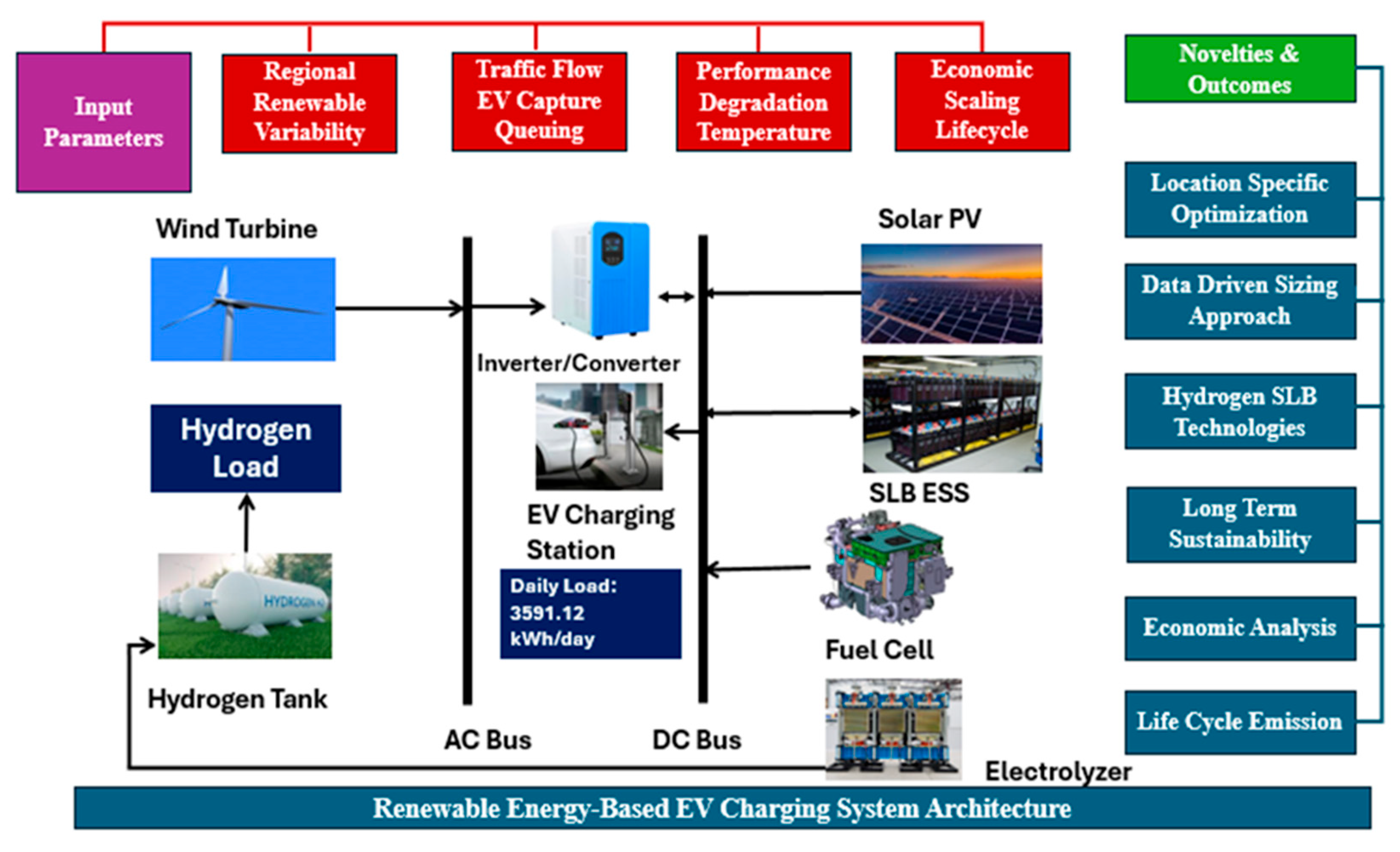
- This study applies location-specific optimization across two diverse Canadian regions to evaluate how regional renewable resource variability and climatic conditions affect system design and economics under a uniform load demand.
- This study develops a site-specific, data-driven approach that integrates traffic flow analysis, EV capture probability, daily load estimation, and queuing theory to enable optimal sizing of charging station, minimize waiting times, and accurately represent urban charging demand patterns.
- This work integrates hydrogen and SLB technologies with performance degradation modeling accounting for temperature effects, derating, and capacity fades to enhance system autonomy, resilience, and long-term sustainability while addressing RE intermittency under real-world cold climate conditions.
- This study performs detailed economic scaling analysis to evaluate the impact of equipment capacity expansion on NPC, COE, CAPEX, and OPEX, demonstrating a cost-effective, fully renewable off-grid system capable of supporting EV charging infrastructure in both urban and remote Canadian regions.
- This research provides a multi-dimensional assessment of renewable EV charging by integrating lifecycle emissions, SLB reuse, recoverable materials, and operational CO2 reduction, while linking carbon tax savings and resource recovery to offer a holistic sustainability framework aligned with SDGs 12 and 13.
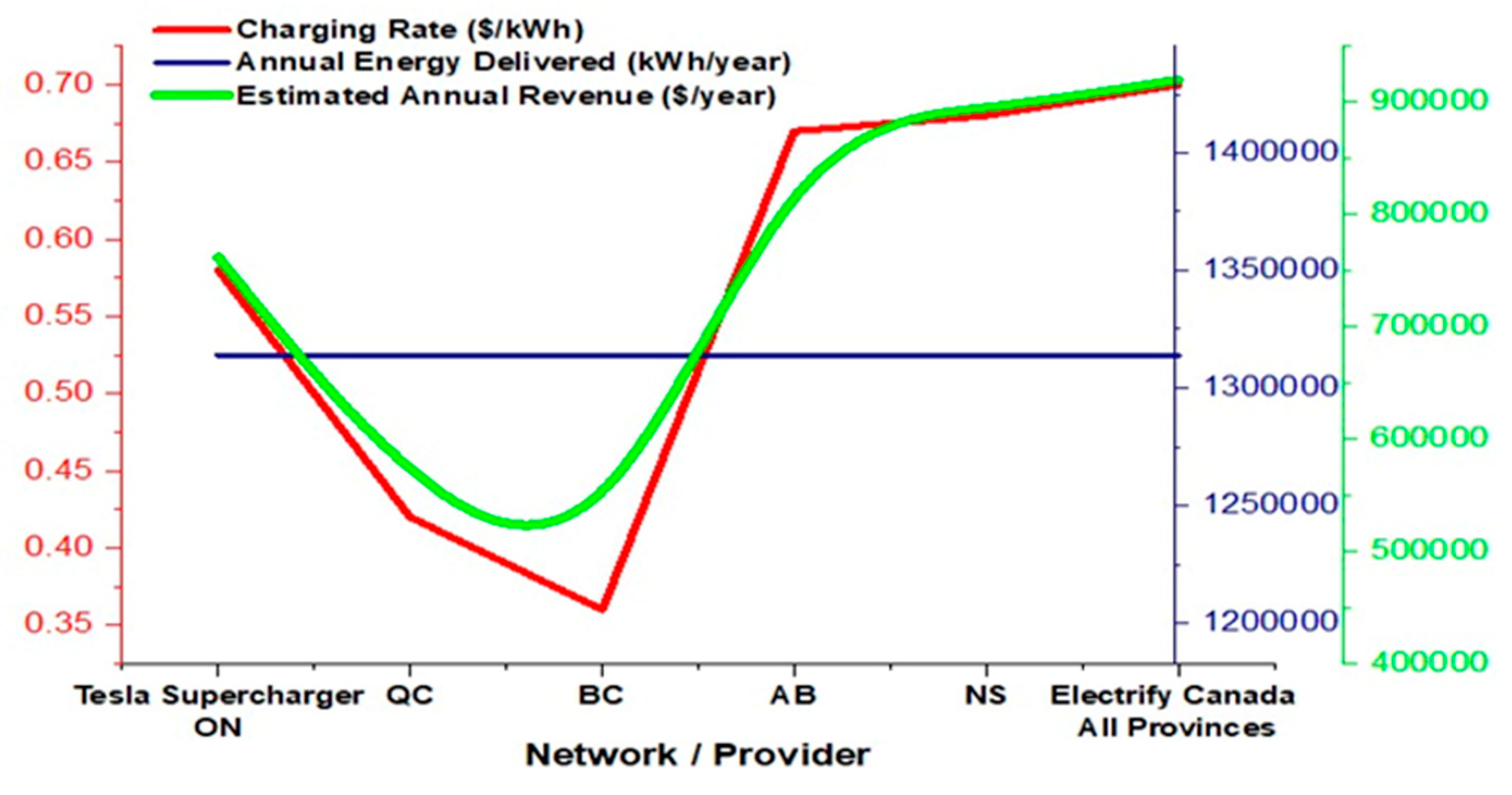
- This study provides a region-specific assessment of renewable energy that powers EV fast charging stations in Canada, integrating real networks, energy-based pricing, and estimating annual revenues by offering insights for sustainable and strategically located infrastructure.
3. System Architecture
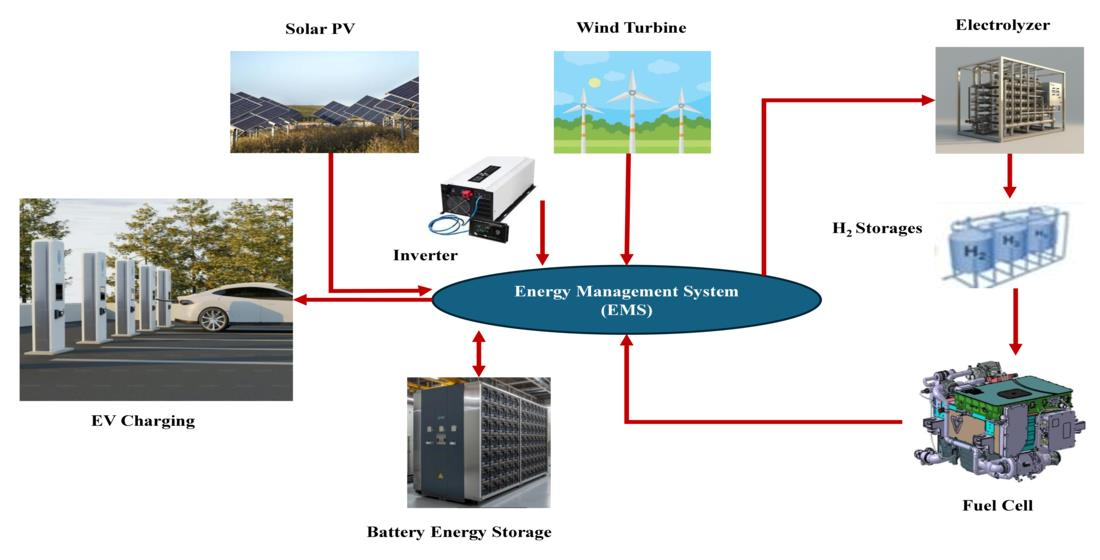
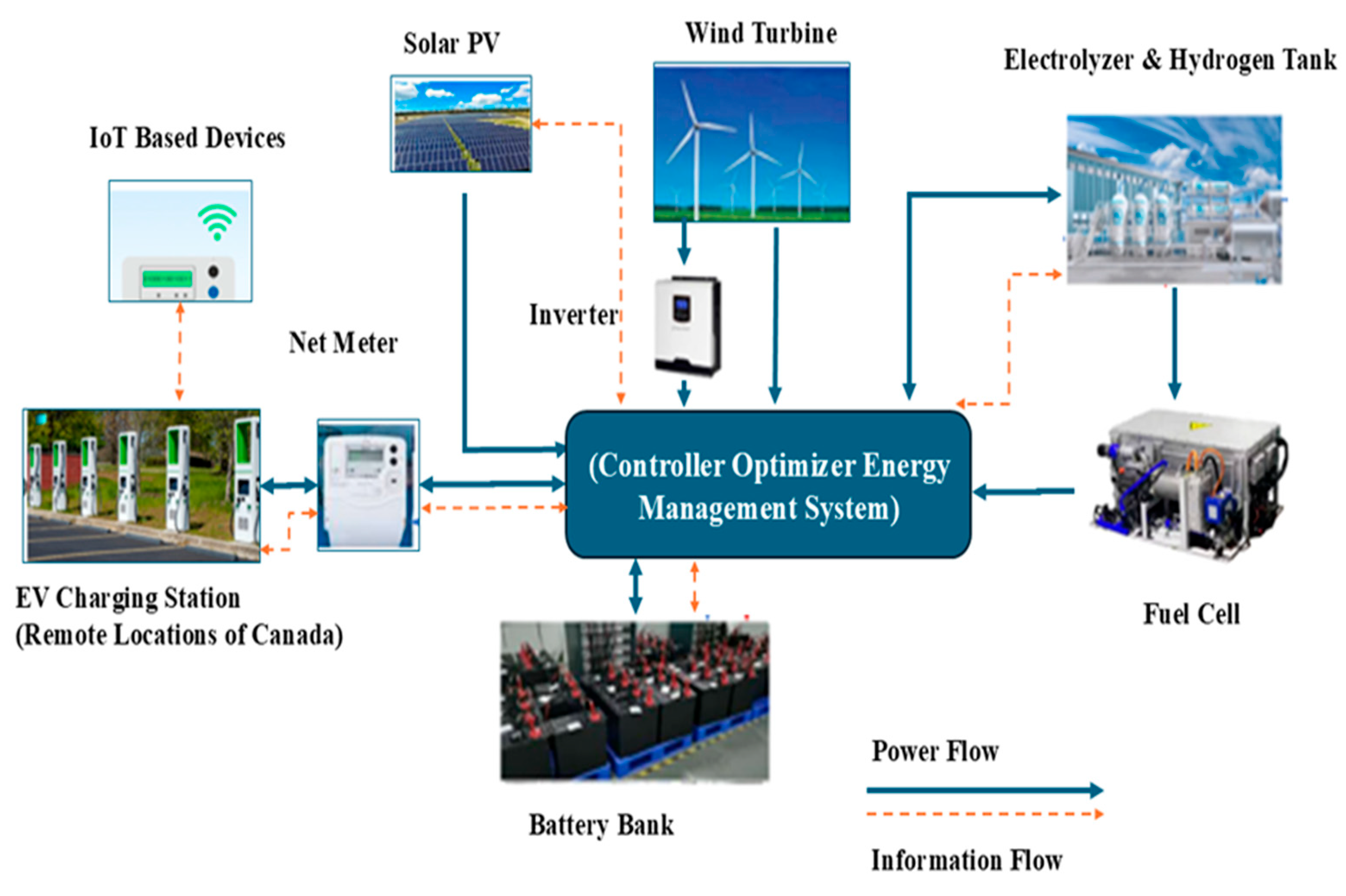
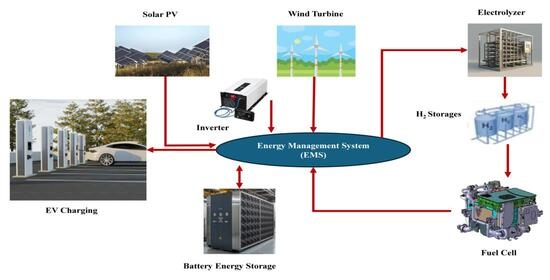
- Solar PV: generates DC electricity, converted to AC for system compatibility.
- Wind Turbine: produces AC electricity directly to supply charging stations.
- SLB Storage: stores excess RE for low generation periods or peak loads, ensuring continuous supply.
- Electrolyzer: converts surplus RE into hydrogen, stored in tanks.
- Fuel Cell: utilizes stored hydrogen to provide clean energy during peak demand, enhancing system reliability beyond typical renewable generation.
- Energy Management System: optimizes energy distribution and battery cycles based on real-time demand and generation.
- EV Charging Stations: deliver hybrid energy from RE, batteries, and fuel cells, even off grid, using demand response and pricing optimization.
- Hydrogen Load: considered in analysis to utilize electrolyzer and storage effectively.
- IoT: provides real-time data on generation, consumption, storage, and charging; red arrows indicate power flow, blue arrows data flow, enabling optimized, reliable, and low-cost off-grid EV charging with reduced environmental impact.
4. Mathematical Modeling and System Formulation
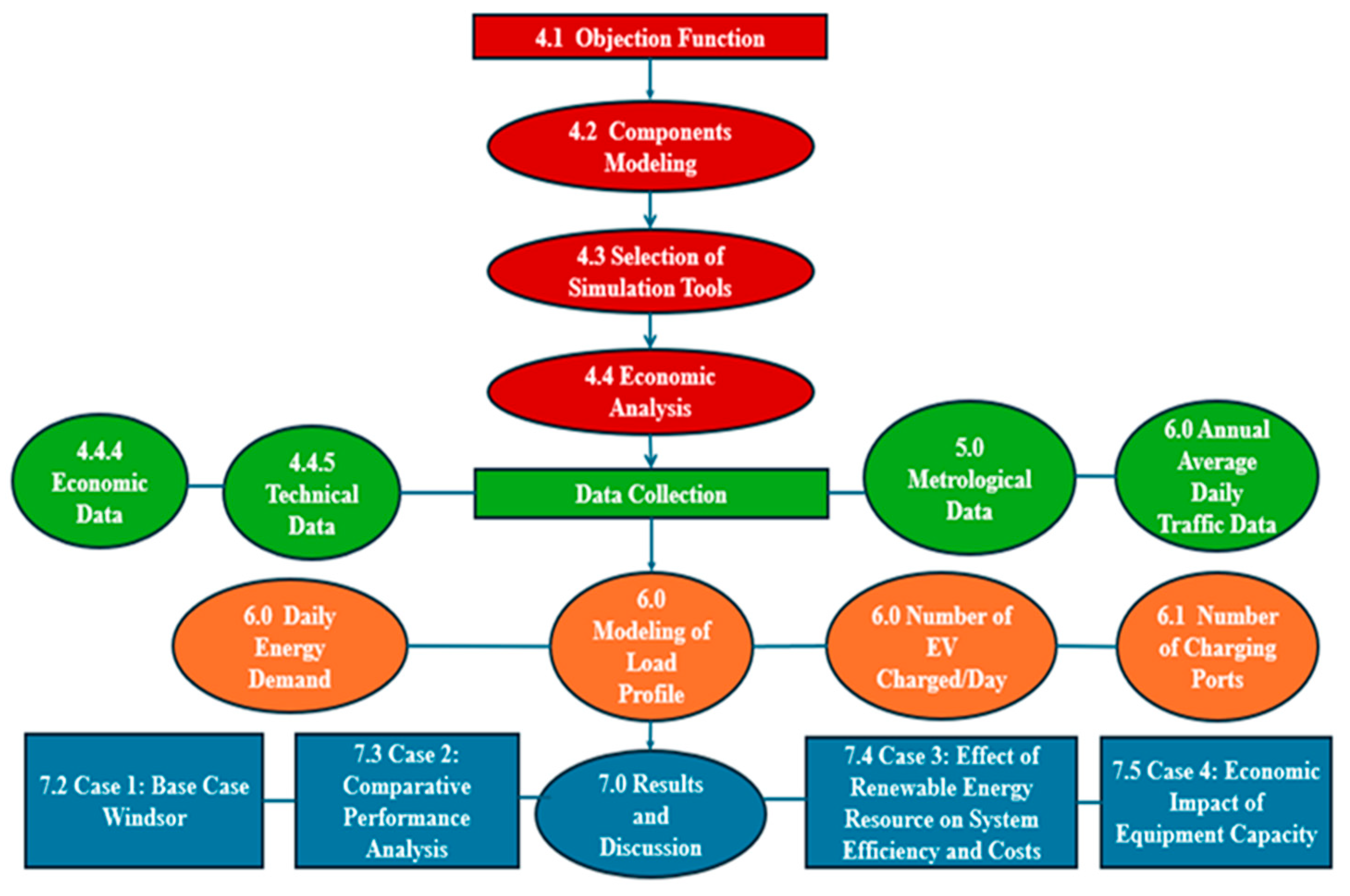
- Objective Function: the NPC of the HRES is minimized using HOMER Pro, subject to all operational and physical constraints.
- Constraints: operational constraints, technical limits, and energy balance equations are formulated to ensure that the system reliably meets load demand; constraints include power balance, PV installation area, battery state of charge limits, hydrogen inventory, and energy production requirements.
- Decision Variables: sizing and operational parameters including PV and wind capacities, wind turbine hub height, battery and hydrogen storage capacities, converter and electrolyzer capacities, and dispatch strategies are selected as decision variables for optimization.
- Component Modeling: each system component (PV, wind turbine, BESS, electrolyzer, fuel cell, hydrogen storage, and converter) is mathematically modeled using validated equations from the literature to accurately capture performance, operational behavior, and physical constraints.
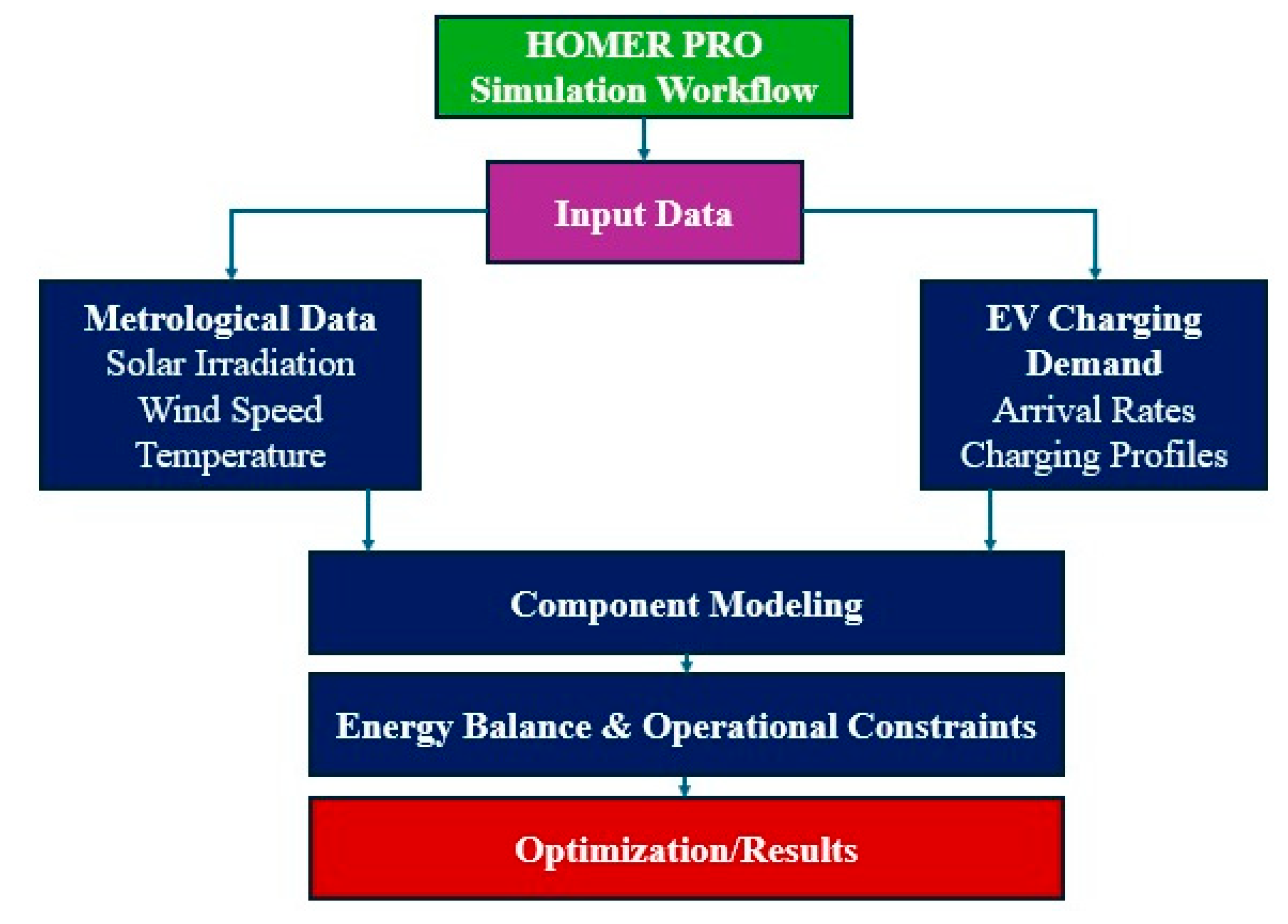
- Simulation Tool Selection: HOMER Pro is used to perform hourly simulations, capturing stochastic variability, battery cycling, hydrogen production, and renewable generation intermittency.
- Economic and Technical Analysis: system performance is evaluated through NPC, COE, and Total Cost of Ownership (TCO). Component degradation, climate adjustments, and operational limitations are incorporated to ensure accurate and reliable results.
- Meteorological Data: hourly solar irradiation, wind speed, and temperature data are collected from the NREL database to provide site-specific inputs for accurate RE modeling.
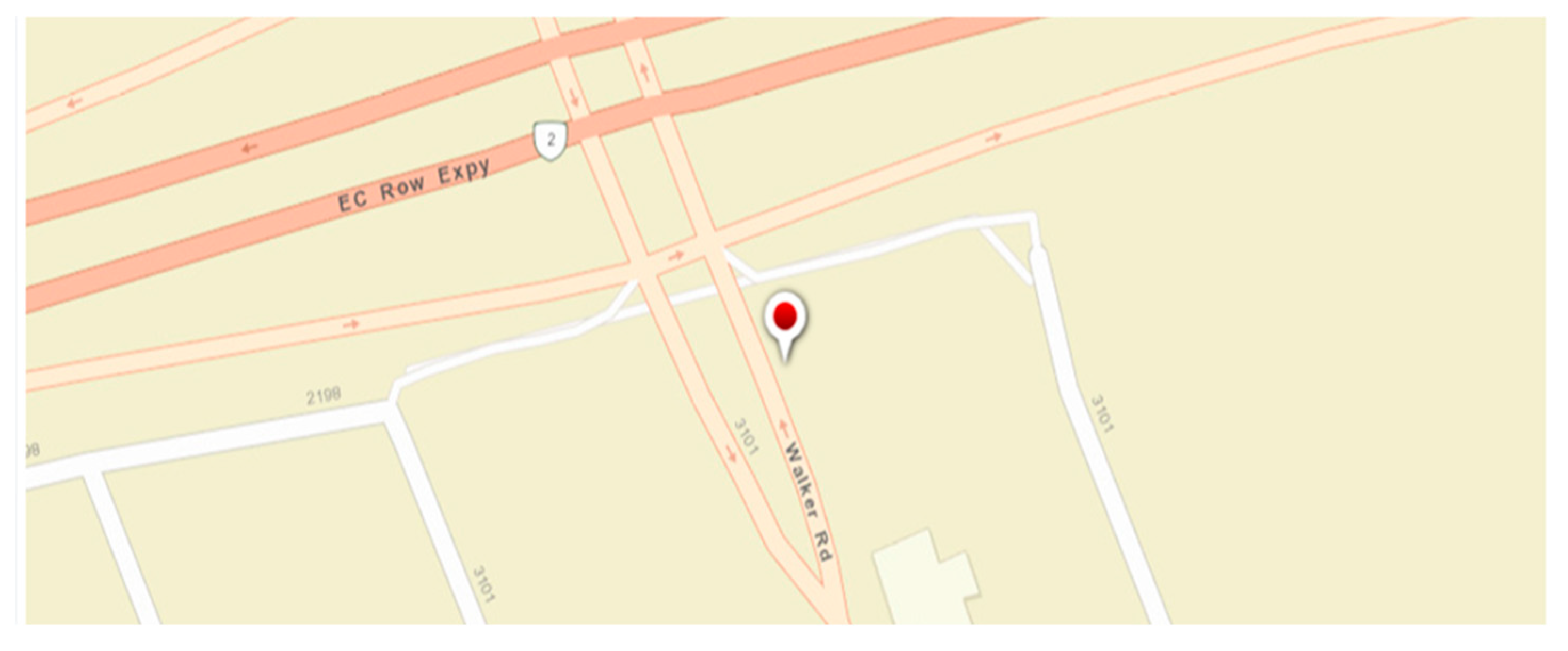
- Traffic Data: annual average daily traffic data are obtained from the Office of the City Engineer, Windsor, to estimate EV charging demand and inform system sizing.
- Results and Discussion: the analysis interprets numerical outputs, compares site performance, and examines sensitivities to key variables including solar irradiance, wind availability, ambient temperature, battery degradation, and hydrogen subsystem efficiency.
4.1. Optimization Framework and Objective Function
4.1.1. Operational Constraints
- Power Balance Constraint: total generation from PV, wind, fuel cell, and battery must meet load demand practices [3].
- Solar Installation Area Constraint: PV capacity is constrained by site-specific physical limits [30].
- Daily Electricity Production Constraint: ensures sufficient energy to meet EV charging demand (Section 6).
- Power Shortage Constraint: the off-grid system must have zero annual unmet demand [30].
- Battery SOC Constraint: maintains safe battery operation to prevent degradation [3].
- Minimum Hydrogen Inventory Constraint: ensures safe operation of the fuel cell [31].
4.1.2. Decision Variables
- PV and Wind Capacities (): directly determine RE generation and ability to meet load.
- Wind Turbine Hub Height (): optimizes wind energy capture via the power law.
- Battery Capacity (): provides energy reliability and reduces dependence on backup.
- Electrolyzer and Fuel Cell Capacity (): controls hydrogen storage for long-term energy supply.
- Converter Capacity (): ensures efficient AC/DC conversion between sources and loads.
- Hydrogen Storage (): maintains minimum hydrogen for continuous fuel cell operation.
- Dispatch Strategy (): determines system operation between load monitoring and cycle charging strategies.
4.2. Component Modeling
4.2.1. Wind Turbine
4.2.2. Solar PV
4.2.3. Energy Storage System (ESS)
4.2.4. Modeling of SLB Degradation
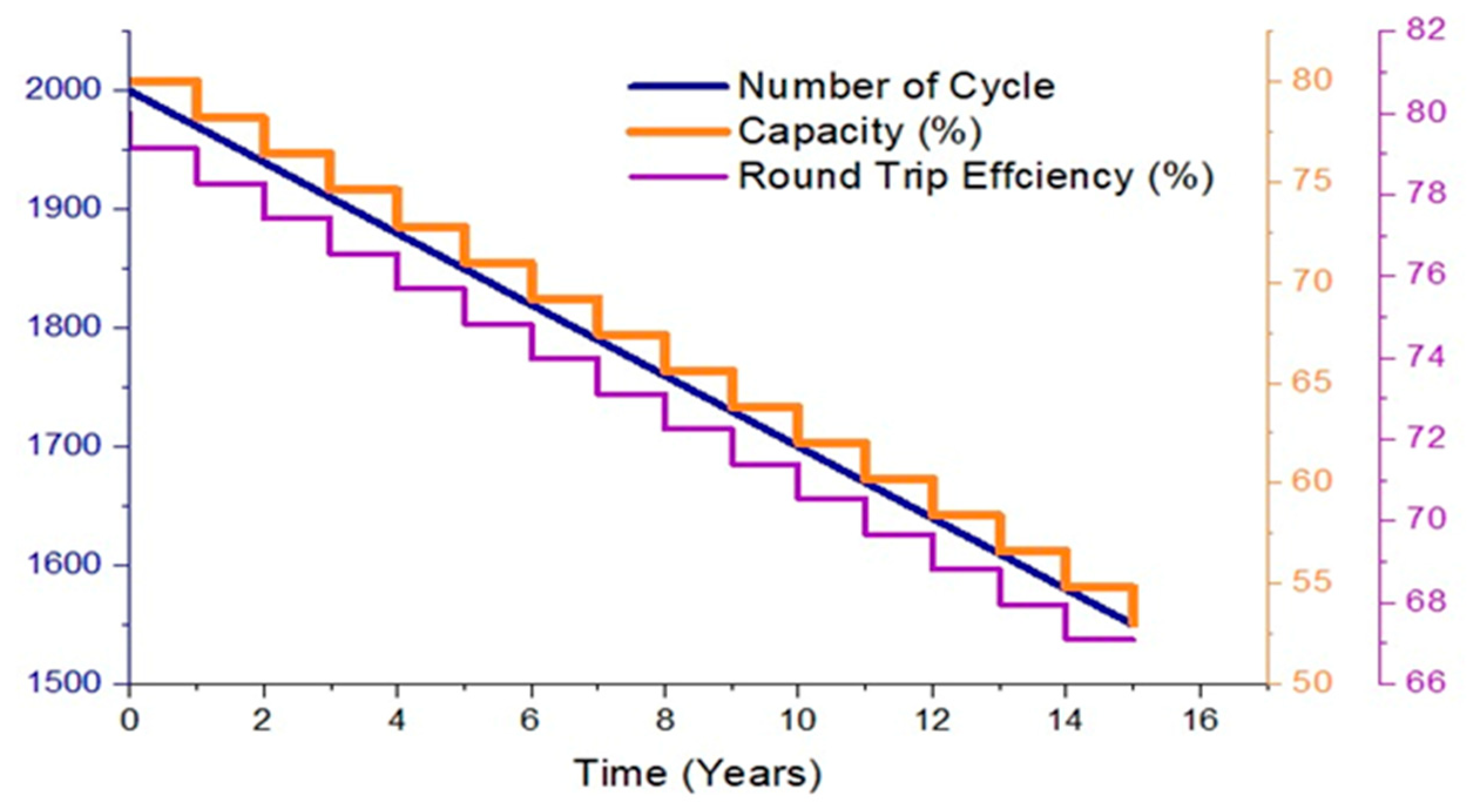
- Initial Capacity/SOH (State of Health): 80% [5]
- Capacity Fade per Year: 1.8% [35]
- Round-Trip Efficiency (RTE): 80% [36]
- Round-Trip Efficiency Loss per Year: 0.86% [37]
- Initial Number of Cycles: 2000 cycles [38]
- Cycle Loss per Year: 1.5% [38]
- Depth of Discharge (DOD): 80% [37]
4.2.5. Electrolyzer
4.2.6. Hydrogen Storage Tank
4.2.7. Hydrogen vs. Battery Storage: Pros and Cons
- Energy Storage Duration
- Hydrogen: suitable for long-duration storage, capable of covering energy needs for days or weeks, particularly useful when renewable generation is seasonal.
- SLB: effective for short to medium-term storage, but performance declines with frequent deep discharges, limiting reliability during prolonged low-generation periods.
- 2.
- Scalability and Energy Independence
- Hydrogen: highly scalable and independent, ensuring uninterrupted power in off-grid locations.
- SLB: can be scaled, but increasing storage requires more battery units, leading to higher replacement frequency due to cell degradation.
- 3.
- Capital and Operational Costs
- Hydrogen: higher upfront costs but longer lifespan (20–25 years) and low degradation; lower long-term operational costs for continuous energy availability despite lower round-trip efficiency (40–60%) [39].
- SLB: lower initial costs but may require replacement every 10–15 years; operational costs depend on charge/discharge cycles and efficiency [36]
- 4.
- Safety and Handling
- Hydrogen: requires high-pressure storage (350–700 bar) with strict safety standards (ISO 16111, ASME, ISO 14687-2) and redundant safety mechanisms [31].
- SLB: safer in terms of storage pressure but can be susceptible to thermal runaway if not properly managed.
- 5.
- Infrastructure and Integration
- Hydrogen: on-site electrolysis eliminates supply chain dependency; infrastructure allows for future hydrogen refueling.
- SLB: simple integration with PV and wind systems; requires careful thermal management and monitoring.
Impact of Extreme Winter Temperatures
4.2.8. Fuel Cell (FC)
4.2.9. Converter
4.3. Optimization Tool Selection
4.4. Economic Analysis
4.4.1. Net Present Cost (NPC)
4.4.2. Levelized Cost of Energy (LCOE)
4.4.3. Inflation, Discount Rate
4.4.4. Total Cost of Ownership (TCO)
4.4.5. Economic Analysis of System Components
4.4.6. Performance Adjustments and Degradation Analysis
4.4.7. Technical Specifications of System Components
5. Meteorological Data
5.1. Selection of Site
5.2. Annual Average Global Horizontal Irradiance (GHI)
5.3. Wind Speed Data
5.4. Temperature Data
5.5. Climatic Data Integration in HOMER
6. EV Arrival Rate and Load Estimation
Modeling of Charging Port (Estimation)
- Arrival rate (λ): 5.990 vehicles per hour, representing the peak observed flow during busy periods (Table 1).
- Battery capacity: 64 kWh, consistent with mid-size EV models such as Hyundai Kona, Kia Niro, and Kia Soul [58].
- Desired average waiting time (Wq): ≤10 min.
- Service rate per charging port (μ): corresponding to 20–30 min per vehicle or approximately 2.5 vehicles/h [55].
- The charging system is modeled as an M/M/C:FCFS/∞/∞ queue system.
7. Results and Discussion
7.1. System Optimization and Component Sizing
7.1.1. Windsor (Base Case)
7.1.2. Eagle Plains (Remote Northern Site)
- reduced PV efficiency due to low winter irradiance.
- increased wind turbine losses due to icing.
- higher battery degradation stress.
- greater reliance on fuel cells and hydrogen storage.
7.2. Comparative Performance Analysis
7.2.1. Renewable Penetration and Resource Utilization
- Windsor: achieves higher renewable contribution due to abundant solar resources. PV accounts for a substantial fraction of annual energy generation, reducing reliance on hydrogen conversion pathways.
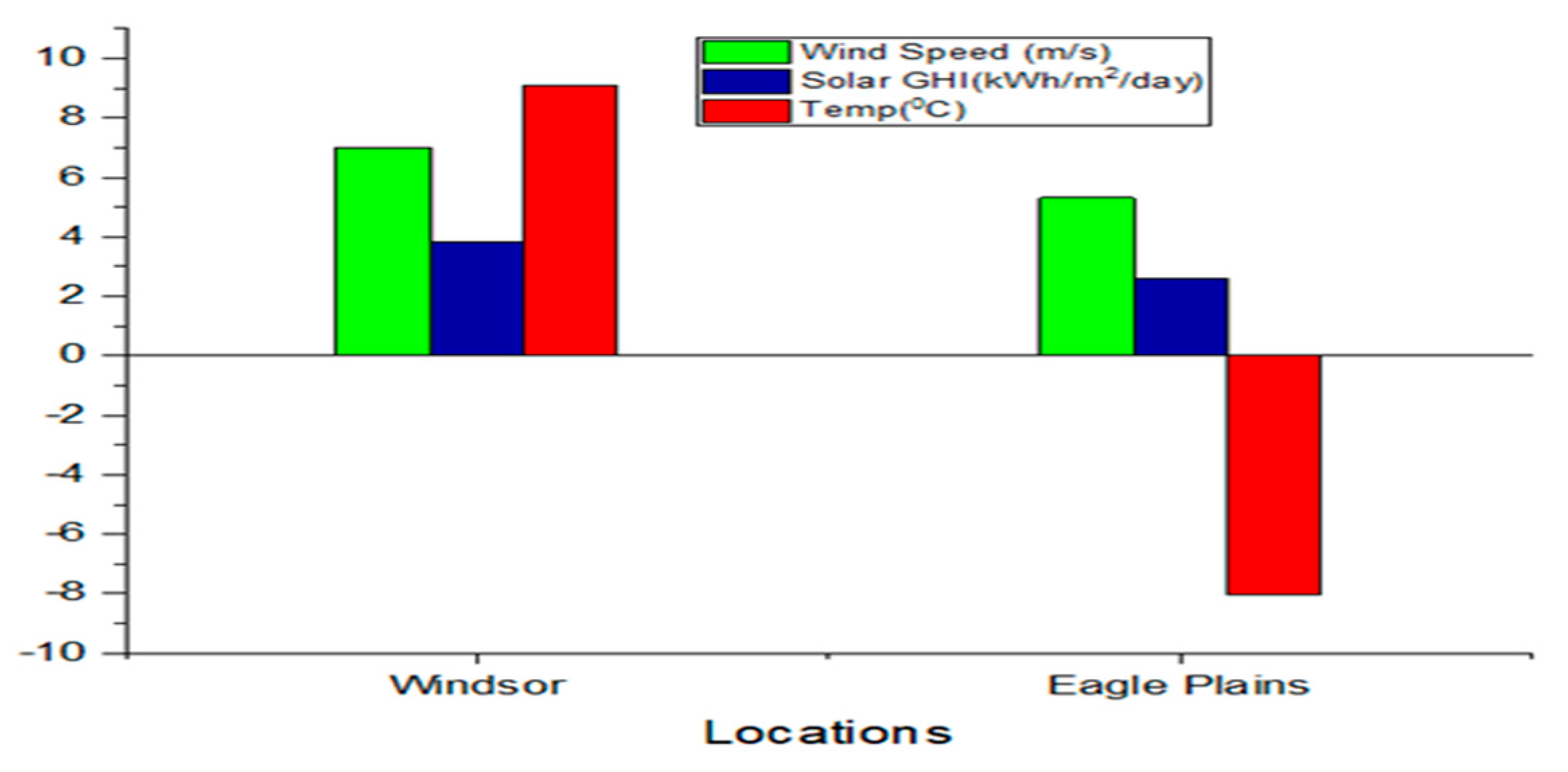
- Eagle Plains: shows lower renewable penetration because both solar and wind resources are weaker, and winters impose long periods of low irradiance.
7.2.2. Hydrogen System Behavior
- Windsor: Hydrogen functions primarily as a seasonal buffer and supplementary storage. Fuel cell operation is used for peak shaving rather than continuous supply.
- Eagle Plains: The fuel cell becomes a major energy supplier during prolonged low renewable periods. Hydrogen demand increases due to reduced PV and wind availability.
7.2.3. Battery Degradation and Temperature Effects
- Windsor maintains mild operating temperatures, limiting performance derating and extending usable capacity.
- Eagle Plains requires more conservative SOC operation and experiences greater efficiency losses in extreme cold, amplifying degradation related impacts on economic performance.
7.3. Economic Results
7.4. Economic Impact of Equipment Capacity Expansion
7.5. Revenue Analysis of EV Charging Station
7.6. Environmental and Lifecycle Impact Analysis
7.6.1. Battery Reuse and Emissions Reduction
7.6.2. Material Recovery and Resource Circularity
7.6.3. Operational Emissions and Carbon Tax Implications
7.7. Policy Framework and Sustainable Development Goals (SDGs)
- Regulatory Alignment
- 2.
- Infrastructure and Technology Development
- 3.
- Environmental and Community Considerations
- 4.
- Stakeholder Engagement
SDG Contributions
- SDG 7: (Affordable and Clean Energy): zero-emission charging and avoidance of carbon tax costs provide clean and economically competitive energy access.
- SDG 9: (Industry, Innovation, and Infrastructure): the system offers a scalable off-grid model for regions where conventional grid expansion is impractical.
- SDG 13: (Climate Action): complete elimination of operational CO2 emissions directly supports national decarbonization targets.
7.8. Contributions to Stakeholders
7.9. Contributions to Policymakers
Recommendations for Policymakers and Stakeholders
- Incentivize Modular Off-Grid Charging: provide subsidies, grants, or low-interest loans for modular EV charging systems in remote areas, and streamline permitting for standardized designs.
- Support Second-Life Batteries: offer tax credits or reduced import duties for using SLBs in energy storage, lowering capital costs and promoting circular economy practices.
- Fund Climate-Resilient Deployment: establish funding to offset costs of cold climate technologies such as battery thermal management, insulated enclosures, and hybrid system setups.
- Invest in Local Workforce Development: collaborate with Indigenous communities and rural institutes to train skilled personnel for installation, monitoring, and maintenance, enhancing reliability and local ownership.
- Integrate into Clean Energy Strategy: use techno-economic and environmental data (NPC, COE, emission reductions) to guide clean mobility policies, especially in areas where grid extension is unfeasible.
7.10. Challenges in Remote Areas
Mitigation Strategies
- Modular, Prefabricated Systems: containerized, plug and play designs allow preassembly, testing, and rapid deployment, reducing logistical complexity.
- Cold Climate Technology Adaptation: use insulated enclosures, battery heaters, cold-optimized PV modules, and hybrid PV/Wind/Fuel Cell systems to ensure reliable energy supply in harsh conditions.
- Local Workforce Training: partner with community colleges or Indigenous organizations to train technicians for diagnostics, maintenance, and repairs, fostering sustainability and community ownership.
- Remote Monitoring and Predictive Maintenance: IoT-based systems enable real-time tracking of energy production, battery status, and fault detection, minimizing site visits and operational costs.
- Strategic Partnerships and Incentives: collaborate with governments, clean energy agencies, and Indigenous communities to share investment costs, provide subsidies, and ensure culturally and economically viable solutions.
7.11. Sensitivity Analysis
- Wind Turbine Hub Height: increasing hub height from 31.8 m (Case 1) to 50 m (Case 3) improves wind capture, lowering NPC from $2.86 million to $2.83 million, COE from $0.205 to $0.203/kWh, and OPEX from $59,392/year to $57,674/year.
- Solar PV Lifetime: extending PV lifetime from 20 years (Case 2) to 25 years (Case 6) reduces NPC from $2.85 million to $2.80 million, COE from $0.204 to $0.201/kWh, and OPEX from $58,938/year to $56,067/year.
- Battery SOC Limits: reducing upper SOC from 100% (Case 5) to 80% (Case 7) has negligible effect on economics (NPC $2.81 million, COE $0.202/kWh), primarily improving battery longevity.
- Discount Rate: lowering the rate from 6% (Case 8) to 5% (Case 9) increases NPC to $2.91 million; raising it to 7% (Case 10) reduces NPC to $2.71 million but increases COE to $0.215/kWh.
- Hydrogen Fuel Cost: introducing hydrogen costs raises NPC and COE. At $0.10/kg (Case 11), NPC = $2.88 million, COE = $0.207/kWh; at $0.50/kg (Case 12), NPC = $3.18 million, COE = $0.228/kWh, OPEX = $79,571/year.
- EV Load Demand: reducing annual demand from 3800 kWh (Case 14) to 3400 kWh (Case 13) lowers NPC from $3.26 million to $3.10 M, OPEX from $84,319/year to $75,082/year, while COE increases from $0.216 to $0.242/kWh.
- SLB Degradation / Useful Life: SLB lifetime is highly influential: extending SLB life (Case 15) delivers the largest reductions in NPC of $2.29 million and COE of $0.164/kWh, while a shorter life (Case 16) raises NPC to $3.07 million and OPEX to $89,044/year, confirming SLB aging as a critical sensitivity.
- Ambient temperature: temperature shifts (−10 °C or +30 °C in Cases 17 and 18) change NPC of $2.55 million and COE of $0.183/kWh relative to baseline, indicating that extreme climates meaningfully affect component performance and operating costs by $56,115/year.
- Electrolyzer efficiency: raising electrolyzer efficiency from 80% to 90% (Case 20) reduces NPC of $2.55 million and COE of 0.183/kWh; showing electrolyzer performance is an important lever for reducing hydrogen pathway costs.
7.12. Comparative Analysis
8. Conclusions
Author Contributions
Funding
Data Availability Statement
Conflicts of Interest
References
- Singh, K.V.; Bansal, H.O.; Singh, D. A comprehensive review on hybrid electric vehicles: Architectures and components. J. Mod. Transp. 2019, 27, 77–107. [Google Scholar] [CrossRef]
- Longo, M.; Foiadelli, F.; Yaici, W. Electric Vehicles Integrated with Renewable Energy Sources for Sustainable Mobility. In New Trend in Electrical Vehicle Powertrains; Ukaew, A., Romeral Martinez, L., Eds.; Intech Open: London, UK, 2019. [Google Scholar]
- Akram, M.N.; Abdul-Kader, W. Supporting Sustainable Development Goals with Second-Life Electric Vehicle Battery: A Case Study. Sustainability 2025, 17, 6307. [Google Scholar] [CrossRef]
- Dong, Q.; Liang, S.; Li, J.; Kim, H.C.; Shen, W.; Wallington, T.J. Cost, energy, and carbon footprint benefits of second-life electric vehicle battery use. Iscience 2023, 26, 107195. [Google Scholar] [CrossRef]
- Akram, M.N.; Abdul-Kader, W. Repurposing Second-Life EV Batteries to Advance Sustainable Development: A Comprehensive Review. Batteries 2024, 10, 452. [Google Scholar] [CrossRef]
- Akram, M.N.; Abdul-Kader, W. Sustainable Development Goals and End-of-Life Electric Vehicle Battery: Literature Review. Batteries 2023, 9, 353. [Google Scholar] [CrossRef]
- Krishna, R.R.; Yesuratnam, G.; Veeraboina, P. A multi active full bridge integrated renewable energy standalone EV charging station with battery storage backup. Frankl. Open 2025, 10, 100235. [Google Scholar] [CrossRef]
- Harshitha, G.V.N.; Sujatha, K.N. Standalone PV Fed Electric Vehicle Battery Charging System. Int. Trans. Electr. Eng. Comput. Sci. 2025, 4, 13–24. [Google Scholar] [CrossRef]
- Monteiro, A.; Filho, A.V.M.L.; Dantas, N.K.L.; Castro, J.; Arcanjo, A.M.C.; Rosas, P.A.C.; Rodrigues, P.; Venerando, A.C.; Spader, N.; Mohamed, M.A.; et al. Integrating Battery Energy Storage Systems for Sustainable EV Charging Infrastructure. World Electr. Veh. J. 2025, 16, 147. [Google Scholar] [CrossRef]
- Gurmani, S.H.; Khan, M.J.; Ding, W.; Zulqarnain, R.M. Aczel–Alsina operations-based linguistic q-rung orthopair fuzzy aggregation operators and their application to site selection of electric vehicle charging station. Eng. Appl. Artif. Intell. 2025, 154, 110989. [Google Scholar] [CrossRef]
- Rehman, A.U.; Lu, J.; Du, B.; Bai, F.; Sanjari, M.J. Efficient Management of Electric Vehicle Charging Stations: Balancing user preferences and grid demands with energy storage systems and renewable energy. Appl. Energy 2025, 393, 126147. [Google Scholar] [CrossRef]
- Environment Yukon. The Dempster Highway Travelogue. 2014. Available online: https://yukon.ca/sites/default/files/env/env-dempster-highway-travelogue.pdf (accessed on 19 September 2025).
- Albertus, P.; Manser, J.S.; Litzelman, S. Long-duration electricity storage applications, economics, and technologies. Joule 2020, 4, 21–32. [Google Scholar] [CrossRef]
- Li, J.; Liu, P.; Li, Z. Optimal design and techno-economic analysis of a hybrid renewable energy system for off-grid power supply and hydrogen production: A case study of West China. Chem. Eng. Res. Des. 2022, 177, 604–614. [Google Scholar] [CrossRef]
- Ramkumar, G.; Kannan, S.; Mohanavel, V.; Karthikeyan, S.; Titus, A. The future of green mobility: A review exploring renewable energy systems integration in electric vehicles. Results Eng. 2025, 27, 105647. [Google Scholar] [CrossRef]
- Muthukumaran, S.; Rajesh, P.; Francis, S.H.; Rajeswari, I.R. Grid connected photovoltaic system powered electric vehicle charging station for energy management using hybrid method. J. Energy Storage 2025, 108, 114828. [Google Scholar]
- Karapidakis, E.; Nikologiannis, M.; Markaki, M.; Kouzoukas, G.; Yfanti, S. Enhancing Renewable Energy Integration and Implementing EV Charging Stations for Sustainable Electricity in Crete’s Supermarket Chain. Energies 2025, 18, 754. [Google Scholar] [CrossRef]
- Çeçen, M. Optimal integration of electric vehicle charging stations into a renewable-supported multi-energy system. Electr. Power Syst. Res. 2025, 247, 111832. [Google Scholar] [CrossRef]
- Eswar, K.N.D.V.S.; Doss, M.A.N.; Shorfuzzaman, M.; Elrashidi, A. Microgrid system for electric vehicle charging stations integrated with renewable energy sources using a hybrid DOA–SBNN approach. Front. Energy Res. 2025, 12, 1492243. [Google Scholar] [CrossRef]
- Das, T.K. Assessment of grid-integrated electric vehicle charging station based on solar-wind hybrid: A case study of coastal cities. Alex. Eng. J. 2024, 103, 288–312. [Google Scholar] [CrossRef]
- Duan, L.; Taylor, G.; Lai, C.S. Solar–Hydrogen-Storage Integrated Electric Vehicle Charging Stations with Demand-Side Management and Social Welfare Maximization. World Electr. Veh. J. 2024, 15, 337. [Google Scholar] [CrossRef]
- Ullah, Z.; Wang, S.; Wu, G.; Hasanien, H.M.; Rehman, A.U.; Turky, R.A.; Elkadeem, M.R. Optimal scheduling and techno-economic analysis of electric vehicles by implementing solar-based grid-tied charging station. Energy 2022, 267, 126560. [Google Scholar] [CrossRef]
- Ihm, J.; Amghar, B.; Chun, S.; Park, H. Optimum Design of an Electric Vehicle Charging Station Using a Renewable Power Generation System in South Korea. Sustainability 2023, 15, 9931. [Google Scholar] [CrossRef]
- Jaman, A.; Al Mahmud, R.; Das, B.K.; Tushar, M.S.H. Optimizing an integrated hybrid energy system with hydrogen-based storage to develop an off-grid green community for sustainable development in Bangladesh. Int. J. Hydrogen Energy 2024, 97, 766–786. [Google Scholar] [CrossRef]
- Güven, A.F.; Ateş, N.; Alotaibi, S.; Alzahrani, T.; Amsal, A.M.; Elsayed, S.K. Sustainable hybrid systems for electric vehicle charging infrastructures in regional applications. Sci. Rep. 2025, 15, 4199. [Google Scholar] [CrossRef]
- Kumar, M.; Shaikh, M.A.; Soomro, A.M.; Kazmi, S.A.A.; Kumar, A. Techno-economic comparative analysis of an off-grid PV-wind-hydrogen based EV charging station under four climatically distinct cities in Pakistan. Int. J. Hydrogen Energy 2024, 93, 1268–1282. [Google Scholar] [CrossRef]
- Abdin, Z.; Al Khafaf, N.; McGrath, B. Feasibility of hydrogen hybrid energy systems for sustainable on- and off-grid integration: An Australian REZs case study. Int. J. Hydrogen Energy 2024, 57, 1197–1207. [Google Scholar] [CrossRef]
- Roslan, M.; Ramachandaramurthy, V.K.; Mansor, M.; Mokhzani, A.; Jern, K.P.; Begum, R.; Hannan, M. Techno-economic impact analysis for renewable energy-based hydrogen storage integrated grid electric vehicle charging stations in different potential locations of Malaysia. Energy Strat. Rev. 2024, 54, 101478. [Google Scholar] [CrossRef]
- Praveenkumar, S.; Agyekum, E.B.; Ampah, J.D.; Afrane, S.; Velkin, V.I.; Mehmood, U.; Awosusi, A.A. Techno-economic optimization of PV system for hydrogen production and electric vehicle charging stations under five different climatic conditions in India. Int. J. Hydrogen Energy 2022, 47, 38087–38105. [Google Scholar] [CrossRef]
- Al Wahedi, A.; Bicer, Y. Techno-economic optimization of novel stand-alone renewables-based electric vehicle charging stations in Qatar. Energy 2022, 243, 123008. [Google Scholar] [CrossRef]
- Calabrese, M.; Portarapillo, M.; Di Nardo, A.; Venezia, V.; Turco, M.; Luciani, G.; Di Benedetto, A. Hydrogen Safety Challenges: A Comprehensive Review on Production, Storage, Transport, Utilization, and CFD-Based Consequence and Risk Assessment. Energies 2024, 17, 1350. [Google Scholar] [CrossRef]
- Güven, A.F.; Yücel, E. Application of HOMER in assessing and controlling renewable energy-based hybrid EV charging stations across major Turkish cities. Int. J. Energy Stud. 2023, 8, 747–780. [Google Scholar] [CrossRef]
- Soomro, M.A.; Memon, Z.A.; Kumar, M.; Baloch, M.H. Wind energy integration: Dynamic modeling and control of DFIG based on super twisting fractional order terminal sliding mode controller. Energy Rep. 2021, 7, 6031–6043. [Google Scholar] [CrossRef]
- Ampah, J.D.; Afrane, S.; Agyekum, E.B.; Adun, H.; Yusuf, A.A.; Bamisile, O. Electric vehicles development in Sub-Saharan Africa: Performance assessment of standalone renewable energy systems for hydrogen refueling and electricity charging stations (HRECS). J. Clean. Prod. 2022, 376, 134238. [Google Scholar] [CrossRef]
- Argue, C. How Long Do Electric Car Batteries Last? What Analyzing 10,000 EVs Tells Us. 2025. Available online: https://www.geotab.com/blog/ev-battery-health/ (accessed on 26 September 2025).
- Casals, L.C.; Amante García, B.; Canal, C. Second life batteries lifespan: Rest of useful life and environmental analysis. J. Environ. Manag. 2019, 232, 354–363. [Google Scholar] [CrossRef] [PubMed]
- Beckers, C.; Hoedemaekers, E.; Dagkilic, A.; Bergveld, H.J. Round-Trip Energy Efficiency and Energy-Efficiency Fade Estimation for Battery Passport. In Proceedings of the 2023 IEEE Vehicle Power and Propulsion Conference (VPPC), Milan, Italy, 24–27 October 2023; p. 1040332530. [Google Scholar]
- Gao, W.; Cao, Z.; Fu, Y.; Turchiano, C.; Kurdkandi, N.V.; Gu, J.; Mi, C. Comprehensive study of the aging knee and second-life potential of the Nissan Leaf e+ batteries. J. Power Sources 2024, 613, 234884. [Google Scholar] [CrossRef]
- Kaviani, A.K.; Riahy, G.H.; Kouhsari, S.H.M. Optimal design of a reliable hydrogen-based stand-alone wind/PV generating system, considering component outages. Renew. Energy 2009, 34, 2380–2390. [Google Scholar] [CrossRef]
- Abdelrahman, A.; Hu, Y.; Liu, J. Evaluating Low Temperature’s Impact on Lithium-Ion Batteries: Examination of Performance Metrics with Respect to Size and Chemistry. Machines 2025, 13, 1114. [Google Scholar] [CrossRef]
- Yassine, A.A.H.; Khoshbakhtnejad, E.; Sojoudi, H. Economics of Snow Accumulation on Photovoltaic Modules. Energies 2024, 17, 2962. [Google Scholar] [CrossRef]
- Kang, M.H.; Rohatgi, A.; Ristow, A. Development of a simple analytical model to quantify the PV module cost premium associated with module efficiency and cell technology. Renew. Sustain. Energy Rev. 2014, 37, 380–385. [Google Scholar] [CrossRef]
- Kharel, S.; Shabani, B. Hydrogen as a Long-Term Large-Scale Energy Storage Solution to Support Renewables. Energies 2018, 11, 2825. [Google Scholar] [CrossRef]
- El-Sattar, H.A.; Kamel, S.; Sultan, H.M.; Zawbaa, H.M.; Jurado, F. Optimal design of Photovoltaic, Biomass, Fuel Cell, Hydrogen Tank units and Electrolyzer hybrid system for a remote area in Egypt. Energy Rep. 2022, 8, 9506–9527. [Google Scholar] [CrossRef]
- Bank of Canada. Policy Interest Rate. 2025. Available online: https://www.bankofcanada.ca/core-functions/monetary-policy/key-interest-rate/ (accessed on 4 June 2025).
- Mortgage Capital Investment. Commercial Mortgage Rates. 2025. Available online: https://mortgagecapitalinvestment.com/service/commercial-mortgage-rates (accessed on 10 June 2025).
- Oladigbolu, J.O.; Mujeeb, A.; Al-Turki, Y.A.; Rushdi, A.M. A Novel Doubly-Green Stand-Alone Electric Vehicle Charging Station in Saudi Arabia: An Overview and a Comprehensive Feasibility Study. IEEE Access 2023, 11, 37283–37312. [Google Scholar] [CrossRef]
- Natural Resource Canada. Wind Energy in Cold Climates. 2025. Available online: https://natural-resources.canada.ca/energy-sources/renewable-energy/wind-energy-cold-climates (accessed on 21 September 2025).
- NREL. National Solar Radiation Database. 2025. Available online: https://www.nrel.gov/hpc/nsrdb-dataset?utm (accessed on 26 September 2025).
- Masrura, H.; Al-Awamib, A.T. Dynamics of an EV Charging Station considering Queuing Theory. Transp. Res. Procedia 2025, 84, 434–439. [Google Scholar] [CrossRef]
- Liu, J. Configuration of Electric Vehicle Charging Facilities Based on Queuing Theory. Theor. Nat. Sci. 2025, 92, 129–133. [Google Scholar] [CrossRef]
- Meng, F.; Pei, W.; Zhang, Q.; Zhang, Y.; Ma, B.; Li, L. Research on the capacity of charging stations based on queuing theory and energy storage scheduling optimization sharing strategy. J. Energy Storage 2024, 96, 112673. [Google Scholar] [CrossRef]
- Pourvaziri, H.; Sarhadi, H.; Azad, N.; Afshari, H.; Taghavi, M. Planning of electric vehicle charging stations: An integrated deep learning and queueing theory approach. Transp. Res. Part E: Logist. Transp. Rev. 2024, 186, 103568. [Google Scholar] [CrossRef]
- Alfraidi, W.; Shalaby, M.; Alaql, F. Modeling EV Charging Station Loads Considering On-Road Wireless Charging Capabilities. World Electr. Veh. J. 2023, 14, 313. [Google Scholar] [CrossRef]
- Muttaqi, K.M.; Isac, E.; Mandal, A.; Sutanto, D.; Akter, S. Fast and random charging of electric vehicles and its impacts: State-of-the-art technologies and case studies. Electr. Power Syst. Res. 2023, 226, 109899. [Google Scholar] [CrossRef]
- City of Windsor. Office of The City Engineer. 2025. Available online: https://www.citywindsor.ca/city-hall/city-departments/public-works (accessed on 15 September 2025).
- Transport Canada. ZEV Council Dashboard. 2025. Available online: https://tc.canada.ca/en/road-transportation/innovative-technologies/zero-emission-vehicles/zev-council-dashboard (accessed on 13 September 2025).
- Electric Vehicle Database. All Electric Vehicle. 2025. Available online: https://ev-database.org/?utm (accessed on 12 October 2025).
- John, D. Electrify Canada Switches to kWh Billing. 2025. Available online: https://driveteslacanada.ca/news/electrify-canada-switches-to-kwh-billing/ (accessed on 16 October 2025).
- Sktiger. How Much Would It Cost to Charge an Electric Car in Canada? 2025. Available online: https://flipcars.ca/how-much-would-it-cost-to-charge-an-electric-car-in-canada/ (accessed on 22 July 2025).
- Akram, M.N.; Abdul-Kader, W. Electric vehicle battery state changes and reverse logistics considerations. Int. J. Sustain. Eng. 2021, 14, 390–403. [Google Scholar] [CrossRef]
- Canada Energy Regulator. Provincial and Territorial Energy Profiles Qubec. 2024. Available online: https://www.cer-rec.gc.ca/en/data-analysis/energy-markets/provincial-territorial-energy-profiles/provincial-territorial-energy-profiles-quebec.html (accessed on 20 February 2025).
- Government of Canada. Update to the Pan-Canadian Approach to Carbon Pollution Pricing 2023–2030. 2021. Available online: https://www.canada.ca/en/environment-climate-change/services/climate-change/pricing-pollution-how-it-will-work/carbon-pollution-pricing-federal-benchmark-information/federal-benchmark-2023-2030.html (accessed on 20 February 2025).
- Lalji, A.F.; Smith, T.W. Canada’s Plan for Implementing UNDRIP Brings Potential and Uncertainty for Indigenous Peoples in Land and Resource Development and Regulation. 2023. Available online: https://www.mltaikins.com/insights/canadas-plan-for-implementing-undrip-brings-potential-and-uncertainty-for-indigenous-peoples-in-land-and-resource-development-and-regulation/?utm (accessed on 24 September 2025).
- Alhazmi, Y. Techno-Economic Design Analysis of Electric Vehicle Charging Stations Powered by Photovoltaic Technology on the Highways of Saudi Arabia. Energies 2025, 18, 315. [Google Scholar] [CrossRef]
- Alsharif, M.H.; Alsaif, F.; Singla, M.K.; Manna, S.; Kim, M.-K. Techno-economic optimization and environmental analysis of a solar-powered Electric Vehicles (EVs) charger system for a greener transportation ecosystem. Energy Rep. 2025, 13, 5803–5814. [Google Scholar] [CrossRef]
- Rehman, S.; Mohammed, A.B.; Alhems, L.; Alsulaiman, F. Comparative study of regular and smart grids with PV for Electrification of an academic campus with EV charging. Environ. Sci. Pollut. Res. 2023, 30, 77593–77604. [Google Scholar] [CrossRef] [PubMed]
- Al Abri, A.; Al Kaaf, A.; Allouyahi, M.; Al Wahaibi, A.; Ahshan, R.; Al Abri, R.S.; Al Abri, A. Techno-Economic and Environmental Analysis of Renewable Mix Hybrid Energy System for Sustainable Electrification of Al-Dhafrat Rural Area in Oman. Energies 2023, 16, 288. [Google Scholar] [CrossRef]





| Author | Year | Objective | Main Components | Software Used | Location | Results | Identified Gaps |
|---|---|---|---|---|---|---|---|
| [24] | 2025 | This study simulates a hybrid PV/WT/BG/FC/HT/Elz energy system using a genetic algorithm based on the NSGA-II non-dominated sorting technique. | PV/Wind/Electrolyzer/ Biogas/Fuel cell | MATLAB R2025a, v25.1 | Bangladesh | For the PV/WT/FC/BG configuration, the COE is $0.1634/kWh, ecosystem damage 0.00098, human health impact 0.1732 DALYs, and development index 0.696 DALYs. Lifecycle GHG emissions are 123,730 kg CO2-eq/year, carbon penalties $1856/year, with 30 jobs/MW over a 25-year project life. | The work focused on a single Bangladeshi site without analyzing different climates, or second-life battery use, and lacked SDG context. |
| [25] | 2025 | In this work, the authors explored the optimal hybrid system in Adana, Türkiye. The focus was to ensure EVCS continuous supply. | PV/Wind/Electrolyzer/ Biogas/Fuel cell. | HOMER version 3.14.2 | Türkiye | The optimization results show that the system comprising solar PV, biogas, electrolyzer, hydrogen tank, fuel cell, inverters, and grid is the most viable, with a total NPC of $611,283 and an LCOE of $0.0215/kWh. | Focused only on one Turkish Adana city; lacked demand variation, second-life batteries. |
| [26] | 2024 | A comprehensive study evaluated the technical and economic performance of an off-grid system in Pakistan. | PV/Wind/ Hydrogen | HOMER version 3.18.1 | Paki-stan | Compare the NPC and COE for various cities of Pakistan for the off-grid charging station | Limited to Pakistani sites without analyzing remote vs. urban contexts; did not assess grid-connected scenario. Detailed feasibility analysis was not presented. |
| [27] | 2024 | The study analyzed a hybrid energy system in Australia, comprising solar PV, WT, and BESS, across five regions to identify the optimal location for an EV charging station. | PV/Wind/ Hydrogen/ Battery | HOMER version 3.18.1 | Australia | HOMER Pro results indicate that Broken Hill and Murray River achieve optimal costs of $0.32/kWh (off-grid) and $0.030/kWh (on-grid), whereas Tasmania has higher costs of $0.38/kWh and $0.034/kWh for the respective modes. | Compared Australian sites but omitted EV-specific load profiles and policy guidance for remote areas. |
| [28] | 2024 | This research evaluates the technical and economic impacts of a renewable energy-based BSS integrated into an EV charging station in Malaysia. | PV/Wind/ Electrolyzer/ Battery/Hydrogen/Fuel cell | HOMER version 3.18.2 | Malaysia | The findings revealed positive results with the overall NPC varying between $1.4 M and $3.4 M at all sites, and the COE was observed between the value of $0.03/kWh up to $0.16/kWh. | Explored economics but did not evaluate detailed feasibility analysis and lacked SDG-focused evaluation. |
| [23] | 2023 | In this system, the authors presented EV charging stations that are based on the various RESs. | PV/Wind/ Battery/Grid | HOMER version 3.16.2 | South Korea | Results indicate that the PV/ESS-based configuration is the most optimal scenario, particularly regarding RE fractions involving PV, WT, and ESS. | Concentrated on Korean scenarios only; missing discussion on multi-region diversity, hydrogen systems, grid-connected systems, and second-life battery impacts. |
| [29] | 2022 | This study assessed the techno-economic and environmental performance of a solar PV plant producing electricity and hydrogen across five Indian cities: Chennai, Indore, Kolkata, Ludhiana, and Mumbai. | PV/Hydrogen | HOMER version 3.14.2 | India | The highest hydrogen production was observed in Kolkata (82,054 kg/year), followed by Chennai (79,030 kg/year), Ludhiana (78,524 kg/year), Indore (76,935 kg/year), and Mumbai (74,510 kg/year). | Studied hydrogen production but did not include the grid-connected scenario and multi-energy integration strategies. |
| [30] | 2022 | This study focuses on a standalone, renewable energy-based EVCS. | PV/Wind/ Electrolyzer/ Battery/Bio | HOMER version 3.14.2 | Qatar | The NPS is estimated to be between $2.53 M and $2.92 M, while the COE is estimated to vary between $0.285 and $0.329/kWh | The authors focused on cost metrics for Qatar but missed second-life battery analysis and SDG linkage. |
| Component | Capital Cost ($/kW) | Replacement Cost ($/KW) | Operation and Maintenance Cost $/kW Per Year | Lifetime (Years) | Source |
|---|---|---|---|---|---|
| Solar PV | 640 | 640 | 10 | 25 | [47] |
| Wind Turbine | 1000 | 1000 | 4 | 25 | [14,30] |
| Electrolyzer | 1500 | 1200 | 30 | 15 | [26] |
| Hydrogen Tank | 700/KG | 700/kg | 0 | 25 | [30] |
| Fuel Cell | 600 | 500 | 0.08/h | 40,000 h | [39,43] |
| Converter | 300 | 300 | 0 | 15 | [29] |
| Li-Ion Battery | 550 | 550 | 10 | 15 | [30] |
| Component | Adjustment Type | Value | Source |
|---|---|---|---|
| Wind Turbine | Winter Icing and Mechanical Losses | 4% loss | [48] |
| Low Temperature Shutdown Loss | 5% loss | [48] | |
| Solar PV | Global Solar Derating Factor Temperature Coefficient Adjustment | 9% loss −0.4%/°C | [41] [42] |
| Battery (SLB) | Annual Capacity Fade Minimum State of Charge (SOC) | 1.8% per year 20% | [35] [3] |
| Component | Model | Unit Capacity | Efficiency (%) | Lifetime | Source |
|---|---|---|---|---|---|
| Wind Turbine | Lagerwey LW30/250 | 250 kW | 25 years | [30] | |
| Solar PV | Longi Solar LR6-72 | 350 W | 18.10 | 25 years | [47] |
| Electrolyzer | Proton Exchange Membrane | 1 kW | 85 | 15 years | [26] |
| Fuel Cell | Proton Exchange Membrane | 1 kW | 45 | 40,000 h | [43] |
| Converter | Generic System Converter | 1 kW | 95 | 15 years | [29] |
| Hydrogen Tank | Hydrogen Storage Tank | 1 kg | 25 years | [26] | |
| Energy Storage System | Power Wall | 1 kWh | 15 years | [30] |
| Site | Province/Territory | Latitude (°N) | Longitude (°W) | Type of Region |
|---|---|---|---|---|
| Windsor | Ontario | 42.17° | 82.53° | Urban (Base Case) |
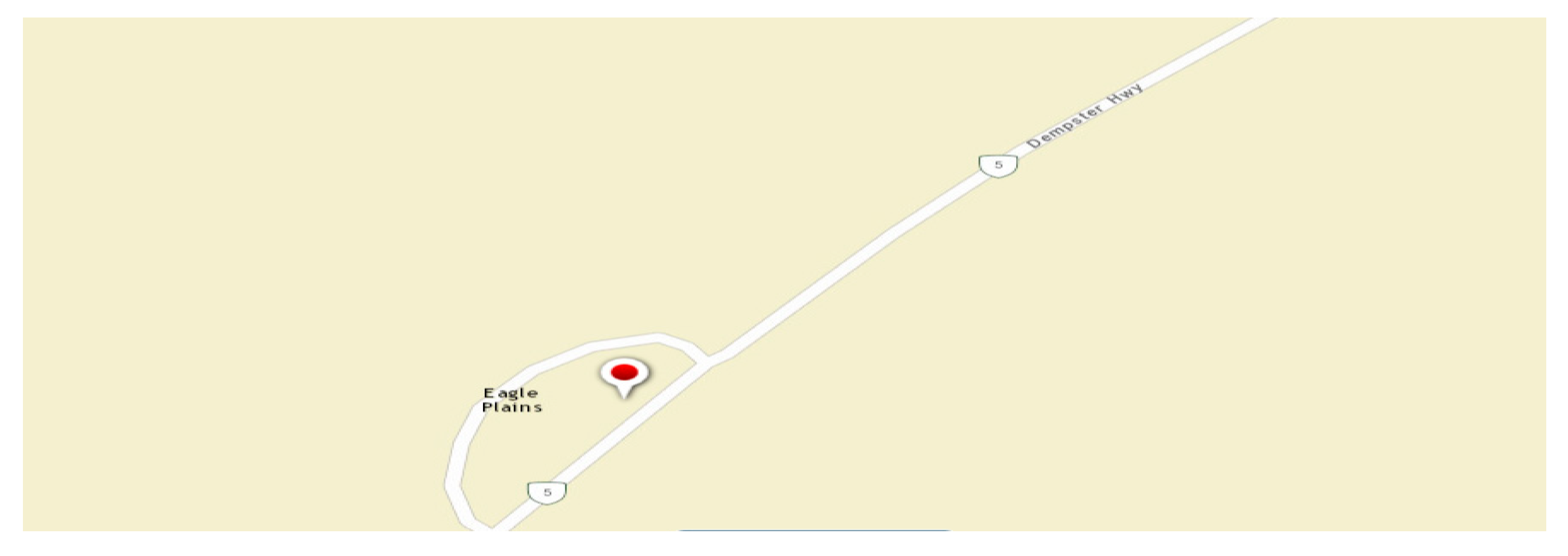
| Eagle Plains | Yukon Territories | 66°22 | 136°43 | Remote (Off Grid) |
| Hour | Traffic Flow (Vehicles) per Hour | EV Arrival Rate | Hourly Load (EV/day) × 50 kWh |
|---|---|---|---|
| 1.0 | 190 | 0.217 | 10.896 |
| 2.0 | 152 | 0.174 | 8.717 |
| 3.0 | 284 | 0.325 | 16.287 |
| 4.0 | 322 | 0.369 | 18.467 |
| 5.0 | 1314 | 1.504 | 75.357 |
| 6.0 | 2830 | 3.240 | 156.621 |
| 7.0 | 4656 | 5.330 | 267.019 |
| 8.0 | 4874 | 5.579 | 279.521 |
| 9.0 | 3564 | 4.080 | 204.394 |
| 10.0 | 3074 | 3.519 | 176.292 |
| 11.0 | 3404 | 3.897 | 195.218 |
| 12.0 | 3380 | 3.869 | 193.841 |
| 13.0 | 3396 | 3.887 | 194.759 |
| 14.0 | 4210 | 4.819 | 241.441 |
| 15.0 | 5231 | 5.988 | 300.500 |
| 16.0 | 5221 | 5.977 | 294.900 |
| 17.0 | 5233 | 5.990 | 295.300 |
| 18.0 | 3460 | 3.961 | 198.429 |
| 19.0 | 2466 | 2.823 | 141.424 |
| 20.0 | 1846 | 2.113 | 104.433 |
| 21.0 | 1441 | 1.650 | 82.641 |
| 22.0 | 1398 | 1.600 | 80.175 |
| 23.0 | 489 | 0.560 | 28.044 |
| 24.0 | 462 | 0.529 | 26.45 |
| Sum | 62,897/day | 72 EVs/day | 3591.126/day |
| Component/Parameter | Input Values |
|---|---|
| Solar PV | 350 kW |
| Wind Turbine | 100 kW |
| Fuel Cell | 100 kW |
| Electrolyzer | 100 kW |
| Converter | 319 kW |
| Hydrogen Tank | 100 kg |
| Wind Turbine Hub Height | 50 m |
| SLB Capacity | 64 kWh |
| SLB State of Health | 80% |
| State of Charge (min) | 20% |
| State of Charge (max) | 75% |
| Energy Storage System | 400 kWh |
| PV Derating Factor | 9% |
| PV Temperature Coefficient | −0.4%/°C |
| Wind Turbine Icing + Shutdown Losses | 4% + 5% |
| Battery Capacity Fade | 1.8%/year |
| Annual Load Demand | 1,310,761 kWh/year |
| Estimated Number of Charging Ports | 4 |
| Estimated Number of Cars Charged/Day | 72 |
| Dispatch Strategy | LF or CC |
| Inflation Rate | 2% |
| Discount/Interest Rate | 6% |
| Project Lifetime | 25 years |
| Location | NPC (M$) | COE ($/kWh) | CAPEX (M$) | OPEX ($/year) | Energy Production (kWh/year) |
|---|---|---|---|---|---|
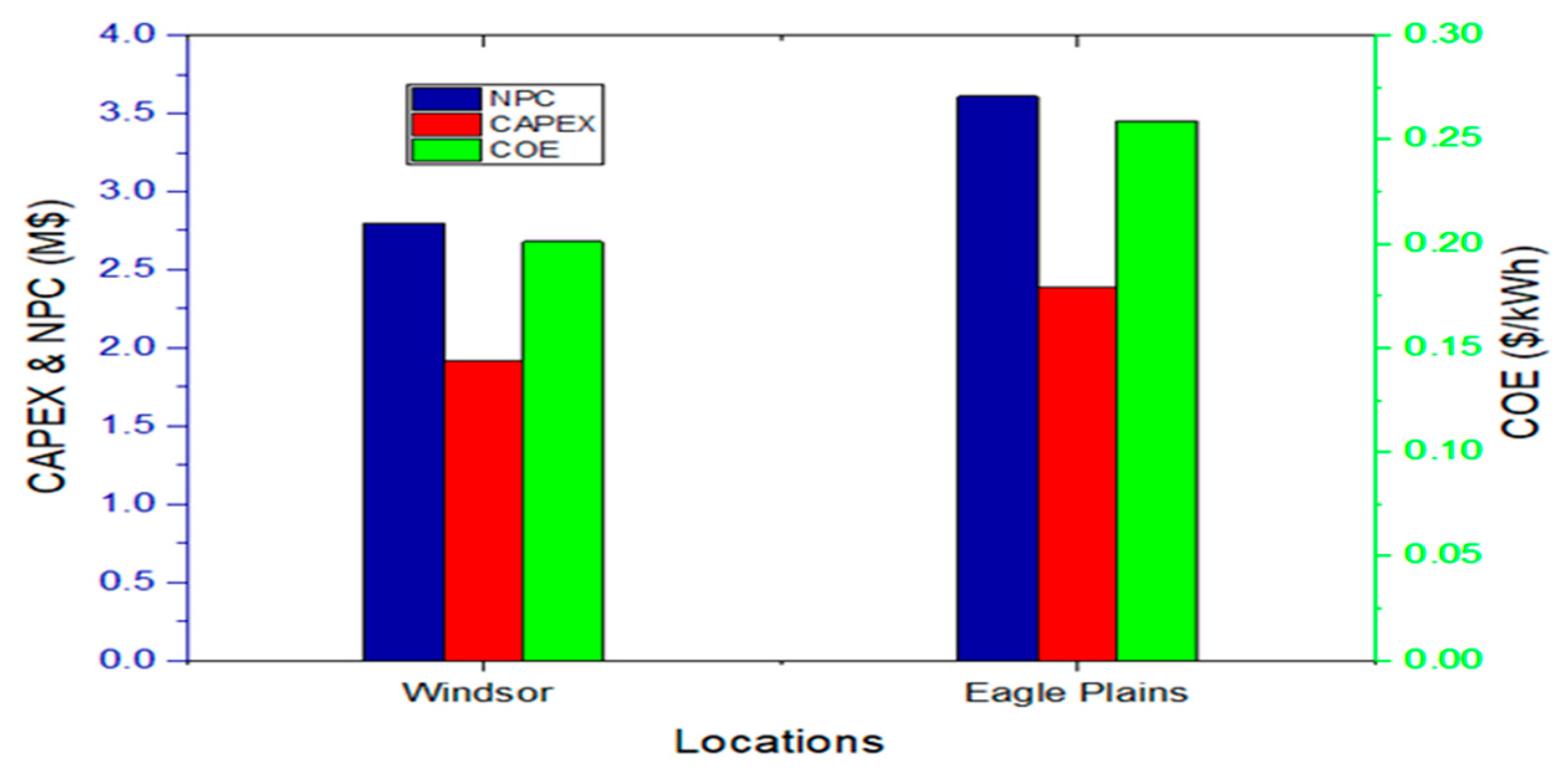
| Windsor | 2.80 | 0.201 | 1.92 | 56,067 | 1,315,038 |
| Eagle Plains | 3.61 | 0.259 | 2.39 | 77,714 | 1,329,709 |
| Location | NPC (M$) | COE ($/kWh) | CAPEX (M$) | OPEX ($) | Energy Production (kWh/year) |
|---|---|---|---|---|---|
| Eagle Plains | 0.81 | 0.058 | 0.47 | 21,647 | 1,329,709 |
| Component | Unit | Windsor | Eagle Plains |
|---|---|---|---|
| Solar PV | kW | 350 | 430 |
| Wind Turbine | kW | 100 | 200 |
| Fuel Cell | kW | 100 | 250 |
| Electrolyzer | kW | 100 | 350 |
| Converter | kW | 319 | 363 |
| Hydrogen Tank | kg | 100 | 350 |
| Energy Storage System | kWh | 400 | 1000 |
| Component | Unit (kWh/yr) | Windsor | Eagle Plains |
|---|---|---|---|
| Solar PV | (kWh/yr) | 771,436 | 318,515 |
| Wind Turbine | (kWh/yr) | 412,240 | 769,913 |
| Fuel Cell | (kWh/yr) | 131,362 | 241,281 |
| Total | (kWh/yr) | 1,315,038 | 1,329,709 |
| Sites | ESS (kWh) | Number of SLB | GHG Emissions Saving (Tons) |
|---|---|---|---|
| Windsor | 400 | 6 | 78 |
| Eagle Plains | 1000 | 16 | 208 |
| Locations | ESS (kWh) | Cobalt (kg) | Nickel (kg) | Lithium (kg) |
|---|---|---|---|---|
| Windsor | 400 | 46.4 | 160 | 29.2 |
| Eagle Plains | 1000 | 116 | 400 | 73 |
| Locations | Provence/ Territories | Grid Emission Factor (g CO2/kWh) | Annual Energy Demand (kWh) | Annual Emission (Tons CO2) | Annual Carbon Tax ($) |
|---|---|---|---|---|---|
| Windsor | Ontario | 35 | 1,310,761 | 45.99 | 4369 |
| Eagle Plains | Yukon Territories | 70 | 1,310,761 | 91.99 | 8739 |
| Cases | Wind Hub Height (m) | Solar PV Life Time (years) | Battery SOC Limits (%) | Discount Rate (%) | Hydrogen Fuel Cost ($/kg) | EV Load Demand (kWh) | SLB Deg Life Time (Years) | Scaled Temp °C | Inflow Rate ELz Efficiency (%) | Net Present Cost (NPC) (M$) | Cost of Energy (COE) ($/kWh) | Operating Cost ($/Year) |
|---|---|---|---|---|---|---|---|---|---|---|---|---|
| Case 1 | 31.8 | 20 | 10–100 | 6 | 0 | 3591.12 | 15 | 9.1 | 85 | 2.86 | 0.205 | 59,392 |
| Case 2 | 50 | 20 | 10–100 | 6 | 0 | 3591.12 | 15 | 9.1 | 85 | 2.85 | 0.204 | 58,938 |
| Case 3 | 50 | 22 | 10–100 | 6 | 0 | 3591.12 | 15 | 9.1 | 85 | 2.83 | 0.203 | 57,674 |
| Case 4 | 31.8 | 22 | 20–100 | 6 | 0 | 3591.12 | 15 | 9.1 | 85 | 2.84 | 0.204 | 58,128 |
| Case 5 | 31.8 | 25 | 10–100 | 6 | 0 | 3591.12 | 15 | 9.1 | 85 | 2.81 | 0.202 | 56,521 |
| Case 6 | 50 | 25 | 10–100 | 6 | 0 | 3591.12 | 15 | 9.1 | 85 | 2.80 | 0.201 | 56,067 |
| Case 7 | 31.8 | 25 | 10–80 | 6 | 0 | 3591.12 | 15 | 9.1 | 85 | 2.81 | 0.202 | 56,521 |
| Case 8 | 50 | 25 | 20–80 | 6 | 0 | 3591.12 | 15 | 9.1 | 85 | 2.80 | 0.201 | 56,067 |
| Case 9 | 50 | 25 | 20–80 | 5 | 0 | 3591.12 | 15 | 9.1 | 85 | 2.91 | 0.188 | 56,306 |
| Case 10 | 50 | 25 | 20–80 | 7 | 0 | 3591.12 | 15 | 9.1 | 85 | 2.71 | 0.215 | 55,550 |
| Case 11 | 50 | 25 | 20–80 | 6 | 0.1 | 3591.12 | 15 | 9.1 | 85 | 2.88 | 0.207 | 60,798 |
| Case 12 | 50 | 25 | 20–80 | 6 | 0.5 | 3591.12 | 15 | 9.1 | 85 | 3.18 | 0.228 | 79,571 |
| Case 13 | 50 | 25 | 20–80 | 6 | 0 | 3400.20 | 15 | 9.1 | 85 | 3.10 | 0.242 | 75,082 |
| Case 14 | 50 | 25 | 20–80 | 6 | 0 | 800.20 | 15 | 9.1 | 85 | 3.26 | 0.216 | 84,319 |
| Case 15 | 50 | 25 | 20–80 | 6 | 0 | 3591.12 | 20 | 9.1 | 85 | 2.29 | 0.164 | 39,766 |
| Case 16 | 50 | 25 | 20–80 | 6 | 0 | 3591.12 | 10 | 9.1 | 85 | 3.07 | 0.22 | 89,044 |
| Case 17 | 50 | 25 | 20–80 | 6 | 0 | 3591.12 | 15 | −10 | 85 | 2.55 | 0.183 | 56,115 |
| Case 18 | 50 | 25 | 20–80 | 6 | 0 | 3591.12 | 15 | 30 | 85 | 2.55 | 0.183 | 56,115 |
| Case 19 | 50 | 25 | 20–80 | 6 | 0 | 3591.12 | 15 | 9.1 | 80 | 2.81 | 0.201 | 56,098 |
| Case 20 | 50 | 25 | 20–80 | 6 | 0 | 3591.12 | 15 | 9.1 | 90 | 2.55 | 0.183 | 56,099 |
| Sr. No | Author | Year | Country | Configuration | COE($/kWh) | NPC ($Million) |
|---|---|---|---|---|---|---|
| 1 | [24] | 2025 | Bangladesh | PV/WT/Elz/BG/FC | 0.163 | - |
| 2 | [65] | 2025 | Saudi Arabia | PV/Battery/Inv | - | 0.823–1.05 |
| 3 | [66] | 2025 | South Korea | PV/Battery/Inv | - | 0.192 |
| 4 | [25] | 2025 | Türkiye | PV/BG/Elz/HT/Inv/Grid | 0.0215 | 0.6112 |
| 5 | [28] | 2024 | Malaysia | PV/WT/Elz/Battery/FC/HT | 0.03–0.16 | 1.4–3.4 |
| 6 | [20] | 2024 | Bangladesh | Grid/PV/WT/Battery | 0.11 | 0.4706 |
| 7 | [26] | 2024 | Pakistan | PV/WT/FC | 0.39–0.56 | 14.6–21 |
| 8 | [31] | 2023 | Türkiye | PV/WT/Battery/DG | 0.441–0.512 | 7.24–8.9 |
| 9 | [67] | 2023 | Saudi Arabia | PV/Battery/Grid | 0.064–0.403 | 10.33–35.7 |
| 10 | [30] | 2022 | Qatar | PV/WT/Battery/FC/HT/BG/Elz | 0.285–0.329 | 2.53–2.92 |
| 11 | [68] | 2023 | Oman | PV/WT/DG/Grid | 0.257–0.566 | 14.9–31.02 |
| This Study | Canada | PV/WT/Battery/FC/Elz/HT | 0.201–0.259 | 2.80–3.61 |
Disclaimer/Publisher’s Note: The statements, opinions and data contained in all publications are solely those of the individual author(s) and contributor(s) and not of MDPI and/or the editor(s). MDPI and/or the editor(s) disclaim responsibility for any injury to people or property resulting from any ideas, methods, instructions or products referred to in the content. |
© 2026 by the authors. Licensee MDPI, Basel, Switzerland. This article is an open access article distributed under the terms and conditions of the Creative Commons Attribution (CC BY) license.
Share and Cite
Akram, M.N.; Abdul-Kader, W. Designing a Sustainable Off-Grid EV Charging Station: Analysis Across Urban and Remote Canadian Regions. Batteries 2026, 12, 17. https://doi.org/10.3390/batteries12010017
Akram MN, Abdul-Kader W. Designing a Sustainable Off-Grid EV Charging Station: Analysis Across Urban and Remote Canadian Regions. Batteries. 2026; 12(1):17. https://doi.org/10.3390/batteries12010017
Chicago/Turabian StyleAkram, Muhammad Nadeem, and Walid Abdul-Kader. 2026. "Designing a Sustainable Off-Grid EV Charging Station: Analysis Across Urban and Remote Canadian Regions" Batteries 12, no. 1: 17. https://doi.org/10.3390/batteries12010017
APA StyleAkram, M. N., & Abdul-Kader, W. (2026). Designing a Sustainable Off-Grid EV Charging Station: Analysis Across Urban and Remote Canadian Regions. Batteries, 12(1), 17. https://doi.org/10.3390/batteries12010017