
You are currently viewing a new version of our website. To view the old version click .
Batteries
  • Article
  • Open Access

16 December 2025

KI-Assisted MnO2 Electrocatalysis Enables Low-Charging Voltage, Long-Life Rechargeable Zinc–Air Batteries

,
,
,
,
,
and
1
CNR NANOTEC—Institute of Nanotechnology, Via Monteroni, 73100 Lecce, Italy
2
Innovation Engineering Department, University of Salento, 73100 Lecce, Italy
3
Department of Experimental Medicine, University of Salento, 73100 Lecce, Italy
*
Author to whom correspondence should be addressed.

Abstract

Rechargeable zinc–air batteries (ZABs) are promising candidates for sustainable energy storage owing to their high theoretical energy density, safety, and environmental compatibility. However, their practical application is hindered by sluggish oxygen evolution reaction (OER) kinetics and the high charging voltage required, which reduce energy efficiency and accelerate electrode degradation. Here, we report for the first time the beneficial role of potassium iodide (KI) as a reaction modifier in ZABs employing manganese dioxide (MnO2) as a bifunctional catalyst. MnO2 not only exhibits remarkable electrocatalytic activity toward the oxygen reduction reaction (ORR) but also catalyzes the iodide oxidation reaction (IOR), which proceeds at significantly lower potentials than the OER. As a result, KI-modified MnO2 ZABs achieve a remarkably low charging voltage of ≈1.8 V and an energy efficiency of 69.9% at 5 mA/cm2. Although the IOR is not fully reversible in alkaline media and its effectiveness depends on the iodide concentration in the electrolyte—which may decrease upon repeated discharge–charge cycling—the suppression of electrode degradation enables stable operation for more than 200 charge–discharge cycles. These findings demonstrate the synergistic effect of KI and MnO2 in enabling an efficient ORR/IOR pathway, providing a sustainable and cost-effective alternative to noble metal catalysts and opening new perspectives for the practical development of high-performance ZABs.

1. Introduction

The growing demand for increasing renewable energy and reducing CO2 emissions needs to be accompanied by electrochemical storage systems. Considering the energy transition and green economy, alternatives to current batteries on the market are being investigated, focusing on materials with low environmental impact and low risk, such as water-based electrolyte batteries [1,2].
In the post-lithium battery scenario, zinc–air batteries (ZABs) represent a great alternative since they combine high theoretical mass energy density (1096 Wh/kg), high stability, safety, and environmental-friendliness [3,4]. The typical configuration of a rechargeable zinc–air battery includes a zinc metal anode, a liquid alkaline electrolyte based on KOH and ZnAc2, and a porous cathode consisting of a Gas Diffusion Layer (GDL), usually carbon-based, on which the active material that acts as an electrocatalyst is deposited [5].
Chemical reactions involved in conventional ZABs are zinc oxidation/zincate reduction and oxygen reduction/evolution.
Anode reaction: Zn + 4OH ↔ Zn(OH)42− + 2e
E° = −1.25 V (vs. SHE)
Cathode reaction: O2 + 2H2O + 4e ↔ 4OH
E° = 0.4 V (vs. SHE)
Overall   reaction :   Zn   +   1 2   O 2     ZnO E °   =   1.65   V   ( vs .   SHE )
The theoretical Open Circuit Voltage (OCV) of a ZAB in alkaline conditions is 1.65 V, but the practical discharging and charging voltage are 1.25 V (or lower) and 2 V (or higher), respectively, depending also on the current density applied [6]. This is because the multistep oxygen reduction reaction (ORR) and the oxygen evolution reaction (OER), which involve adsorption/desorption steps and electron transfer, result in sluggish kinetics, making it necessary to use electrocatalysts to accelerate reaction rates [7,8]. Among them, Pt is commonly used for the ORR, while RuO2 or IrO2 are considered benchmark materials for the OER [9]. Although noble metal-based materials exhibit good catalytic activity, their widespread application is limited by high costs, poor stability, and restricted multifunctionality. Therefore, significant efforts have been devoted to developing alternative materials that can improve the performance of ZABs while reducing dependence on expensive rare metals. In recent years, advanced earth-abundant electrocatalysts, like transition metal oxides (e.g., MnO2, NiO, Fe2O3), transition metal phosphides, sulfides, and nitrides (e.g., Ni3S2, FeNx), as well as heteroatom-doped carbon materials, have been extensively explored [10,11,12,13,14]. Nevertheless, ZABs still suffer from the sluggish kinetics of four-electron transfer steps and the high charging voltage (above 1.9 V), which arise from the intrinsically high thermodynamic equilibrium potential of the OER. These fundamental limitations can reduce the energy efficiency of ZABs, lead to the degradation of cathode materials, and ultimately shorten the battery life.
Beyond the development of advanced and sustainable bifunctional catalysts, an increasingly attractive approach involves exploring new oxidation reactions with more favorable kinetics and lower thermodynamic equilibrium voltages to replace the conventional OER. The use of readily oxidizable molecules, such as potassium iodide, urea, ethanol, or biomass-derived compounds (e.g., glucose), has been proposed as electrolyte additives, acting as reaction modifiers capable of providing alternative oxidation pathways that proceed at substantially lower potentials compared to the OER [15,16].
Some recent works have introduced potassium iodide (KI) as a reaction modifier to reduce the high charging voltage of ZABs [17,18]. In this strategy, the OER pathway is substituted by the iodide oxidation reaction (IOR), which proceeds with faster kinetics and a lower oxidation potential (0.26 V vs. SHE) compared to the OER (0.401 V vs. SHE) [19]. This reduced energy barrier not only improves round-trip efficiency but also mitigates the degradation processes associated with high charge overpotentials and carbon corrosion, extending the battery life [20,21]. Song et al. were among the first to report the advantages of KI in a ZAB employing Pt/C and Co3O4 electrocatalysts. They demonstrated that the overall IOR in alkaline media proceeds through an electrochemical–chemical (E-C) sequence. Specifically, I is first electrochemically oxidized to I2, which is unstable under alkaline conditions and subsequently undergoes disproportionation to regenerate I and form IO3 [17]. Moreover, recent studies have shown that Pt, Ru, and Co-based air cathodes [22,23,24] exhibit good activity for the IOR, and KI-modified ZABs incorporating these catalysts have low charging voltage (below 2 V), excellent stability, and high energy efficiency. However, due to the high cost and scarcity of these metals, there is a great need to develop sustainable and less expensive alternatives. Therefore, investigating the catalytic properties of bifunctional ORR/IOR cathodes based on non-precious catalysts is crucial to further improve the energy efficiency and cycling stability of rechargeable ZABs while enhancing their sustainability.
In this work, we report for the first time the beneficial role of potassium iodide (KI) as a reaction modifier in ZABs based on manganese dioxide (MnO2). MnO2 has attracted extensive attention as a catalyst for ZABs thanks to its unique combination of economic, environmental, and electrochemical advantages. In particular, MnO2 exhibits remarkable electrocatalytic activity toward the ORR, which is the key process governing the discharge performance of ZABs. Furthermore, MnO2 offers good chemical stability, low toxicity, and environmental compatibility, making it a preferable alternative to noble metal catalysts, such as Pt [25,26,27,28]. Here, we demonstrate that MnO2 is also active toward the IOR. By replacing the sluggish OER with the IOR, which proceeds at lower potentials, KI-modified MnO2 ZABs achieve an exceptionally low charging voltage of ≈1.8 V and an energy efficiency of 69.9% at 5 mA/cm2, thus significantly enhancing battery performance. Furthermore, since electrode degradation is greatly reduced, the batteries demonstrate an extended cycle life, exceeding 200 working cycles, and they also have practical application in cyclability, with a discharge areal capacity of 15 mAh/cm2.
Overall, this study highlights the potential of KI-modified MnO2 ZABs while also offering new perspectives for the development of sustainable bifunctional ORR/IOR catalysts with improved efficiency and stability, paving the way for future commercialization of high-performance ZABs.

2. Materials and Methods

2.1. Chemicals

Potassium permanganate (KMnO4), hydrochloric acid (HCl, 37 wt.%), potassium hydroxide (KOH, >85%), potassium iodide (KI), zinc acetate dihydrate (ZnAc2·2H2O), and absolute ethanol (C2H5OH) were purchased from Merk Life Science, Milano, Italy. Carbon black, Super P Conductive, 99+% (metals basis) was purchased from Thermo Scientific, Waltham, MA, USA. Nafion solution (D2021) was purchased from Ion Power, Tyrone, PA, USA (GmbH). Zinc foils were purchased from Merk Life Science. Commercial Carbon Foam (Porous C) was purchased from MTI Corporation, Richmond, CA, USA. All materials were used as received, without further purification.

2.2. Synthesis of Micro-Nanoparticles

For MnO2 NPs synthesis, KMnO4 (4 mmol) was dissolved in 58 mL H2O by stirring, and then 1.43 mL HCl (37 wt.%) was added to the solution. After stirring, the mixed solution was transferred into a 100 mL Teflon-lined stainless-steel autoclave, which was sealed and heated in an oven at 140 °C overnight. After cooling down to room temperature, brownish precipitate of MnO2 was collected and washed two times with deionized water and two times with ethanol. After drying overnight, brownish solids were collected.

2.3. Characterization

Scanning electron microscopy (SEM) characterization was carried out using a Zeiss Sigma 300 VP Gemini microscope (Zeiss, Oberkochen, Germany). X-ray diffraction (XRD) measurements were carried out using a Rigaku Ultima III X-ray diffractometer (Rigaku Corporation, Akishima, Japan) equipped with Cu Kα radiation (λ = 1.5406 Å). The data were collected from 10° to 80° with a speed of 0.5° s−1.

2.4. Electrochemical Tests

Linear sweep voltammetry (LSV) measurements were performed using an AUTOLAB potentiostat/galvanostat, comprising an RDE setup with a Glassy Carbon (GC) working electrode (3 mm diameter), Ag/AgCl (saturated KCl) as a reference, and platinum foil as a counter electrode. To investigate ORR activity, 2 mg of as-prepared manganese oxide was mixed with 2 mg of Super P carbon in a solution composed of 100 μL of 5 wt.% Nafion solution, 200 μL of ethanol, and 800 μL of distilled water. The as-prepared ink was mixed by sonication for 30 min. Then, 5 μL of the ink was drop-casted and dried onto the GC RDE to obtain a catalyst loading of 0.13 mg/cm2. Electrocatalytic activity was tested using a three-electrode setup with a 0.1 M KOH electrolyte (100 mL). Before the ORR tests, the electrolyte was purged with O2 for 15 min to obtain a O2-saturated solution. O2 is injected into the cell, and an oxygen flow is maintained above the solution surface even during the measurement. ORR LSVs were recorded in a range from 0.3 to −0.9 V (vs. Ag/AgCl).
OER tests were performed using the same three-electrode configuration with a 1M KOH electrolyte (100 mL) in a potential range between 0 and 0.7 V (vs. Ag/AgCl). To investigate IOR activity (in the three-electrode setup), different KI concentrations (0.167 M, 0.333 M, and 0.5 M) were added to the 1 M KOH electrolyte so that the ratio between the concentration of KOH and KI was 6:1, 3:1, and 2:1, respectively. Cyclic voltammetry (CV) measurements were performed using a Pt-modified working electrode (2 mm diameter), Ag/AgCl (saturated KCl) as a reference, and platinum foil as a counter electrode. Briefly, the prepared ink was drop-casted (2 μL) on Pt WE, obtaining a catalyst loading of 0.117 mg/cm2. CV measurements were recorded at 5 mV/s in N2-sat. (10 min) 1 M KOH with/without 0.5 M KI in a potential scan between −1.0 and 0.6 V (vs. Ag/AgCl). All measured potentials were converted to RHE using the following equation:
E(RHE) = E(Ag/AgCl) + 0.059 pH + 0.197

2.5. Full-Device Electrochemical Tests

A custom-made cell was used to assemble a Zn–air battery using polished zinc foil as anode and electrocatalyst-coated carbon foam as cathode. The cell was filled with a solution composed of 6 M KOH + 0.2 M ZnAc2 for the conventional ZAB and 6 M KOH + 1 M KI + 0.2 M ZnAc2 for the KI-modified ZAB, without any separator and with an electrolyte in static condition.
Gas diffusion electrodes were obtained by loading a homogeneous slurry composed of 40 wt.% MnO2, 50 wt.% Super P carbon and 10 wt.% PVdF mixed in NMP solvent in a solid/liquid ratio of 100 mg/mL through a doctor blade deposition on a carbon foam substrate. The deposited active area on the GDL is 0.64 cm2, and the electrodes were dried on a hot plate according to the following steps: 80 °C for 15 min, then 100 °C for 10 min, and finally 150 °C for 10 min. Total areal loading (active material + conductive carbon + binder) of the electrodes is 7 mg/cm2. Polarization curves were conducted as galvanodynamic measurements at a scan rate of 0.1 mA/s. ZAB discharge power density (mW/cm2) is calculated as the product of the cell voltage (V) and the current density (mA/cm2), which is obtained from the discharge polarization curve. Discharge–charge curves were conducted in galvanostatic mode, applying a fixed current density, specified below.

3. Results

3.1. KI-Modified ZAB

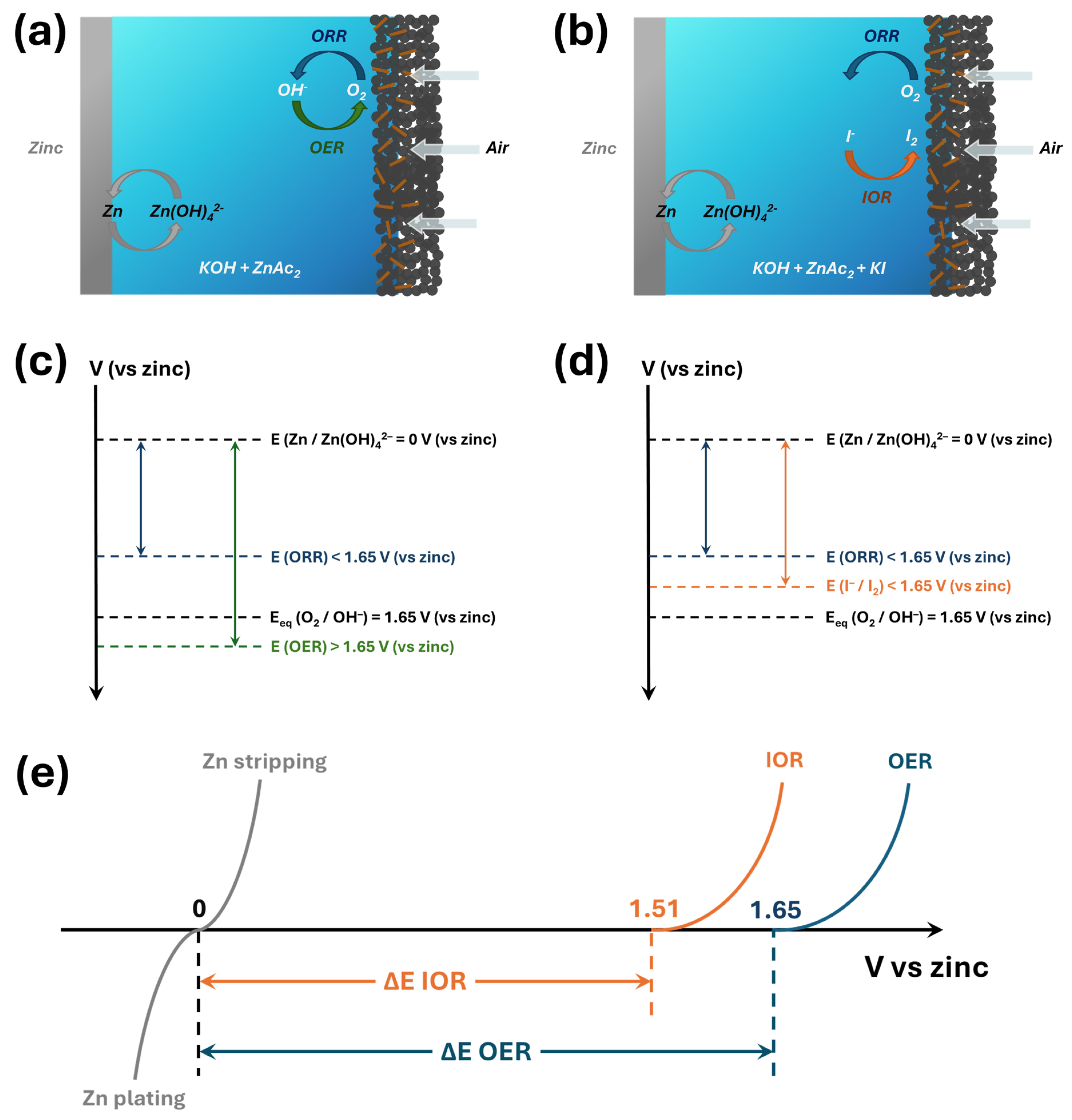
The operating principles of both conventional (a) and KI-modified ZAB (b) are depicted in Figure 1. During discharge, the two systems follow the same pathway. Zinc undergoes electrochemical oxidation at the anode, while the ORR occurs at the air cathode, producing OH and following the conventional alkaline ORR.
O2 + 2H2O + 4e → 4OH
Figure 1. Schematic diagram of the discharge and charge processes in (a) a conventional KOH-based electrolyte and (b) a KI-modified alkaline electrolyte; comparison of theoretical reaction voltages of (c) the conventional ZAB and (d) the KI-modified ZAB; (e) polarization curves for the OER and the IOR against Zn stripping/plating potential in ZABs (reported values are theoretical potentials).
In a conventional ZAB, the charging process relies on the OER at the air cathode, with a voltage exceeding the theoretical 1.65 V vs. Zn (in alkaline media, pH = 14), as shown in Figure 1c, which consists of the reverse reaction of the ORR as follows:
4OH → O2 + 2H2O + 4e
In contrast, the charging mechanism of a KI-modified ZAB is governed by the oxidation of I to IO3, which is thermodynamically more favorable than the OER and narrows the voltage gap against Zn/Zn(OH)42− (Figure 1d). The I/IO3 redox couple exhibits a lower equilibrium potential than that of the O2/OH couple and proceeds through faster electron transfer steps, whereas the OER involves multiple adsorbed intermediates and a sluggish 4e pathway.
In the KI-modified ZAB, the charge reaction (IOR) proceeds through an electrochemical–chemical (E-C) sequence as follows. The IOR begins with the electrochemical oxidation of iodide ions (I) to molecular iodine (I2). In general, I2 may exist transiently as a dissolved or gaseous species, but it is not stable under alkaline conditions, where it undergoes a chemical disproportionation reaction regenerating I and producing iodate (IO3) as the final oxidation product [22].
The reactions involved in this electrochemical–chemical (E-C) sequence are the following.
The electrochemical step (E) is as follows:
2I → I2 + 2e
The chemical step (C)—disproportionation in alkaline medium—is as follows:
3I2 + 6OH → 5I + IO3 + 3H2O
By replacing the OER with the iodide oxidation reaction (IOR), the charging voltage of ZABs is effectively lowered. As shown in Figure 1e, the theoretical polarization curves highlight that the thermodynamic potential of the IOR (1.51 V) is ~140 mV lower than that of the OER (1.65 V), although actual operating potentials remain higher due to overpotentials [19,29,30].

3.2. MnO2 OER/IOR Activity

Recent studies have demonstrated that MnO2-based catalysts can deliver competitive ORR performance and long cycling durability, and for these reasons, they were chosen as the active material for the preparation of electrodes in this work.
MnO2 micro-nanowires are synthesized via a hydrothermal route from potassium permanganate (KMnO4) in the presence of hydrochloric acid (HCl) in a Teflon-lined stainless-steel autoclave at 140 °C. As shown in the SEM images (Figure S1a), nanorod-shaped MnO2 particles with a diameter of 80–100 nm and a length of 1–3 μm are obtained. XRD analysis indicates that the material is mainly composed of the α-MnO2 crystalline phase. Figure S1b shows the diffractogram collected from the synthesized MnO2 powder, exhibiting the typical α-MnO2 crystallographic planes (110), (200), (310), (121), (411), and (521) at 12.7°, 17.95°, 28.7°, 37.5°, 49.8°, and 60.15°, respectively [31,32].
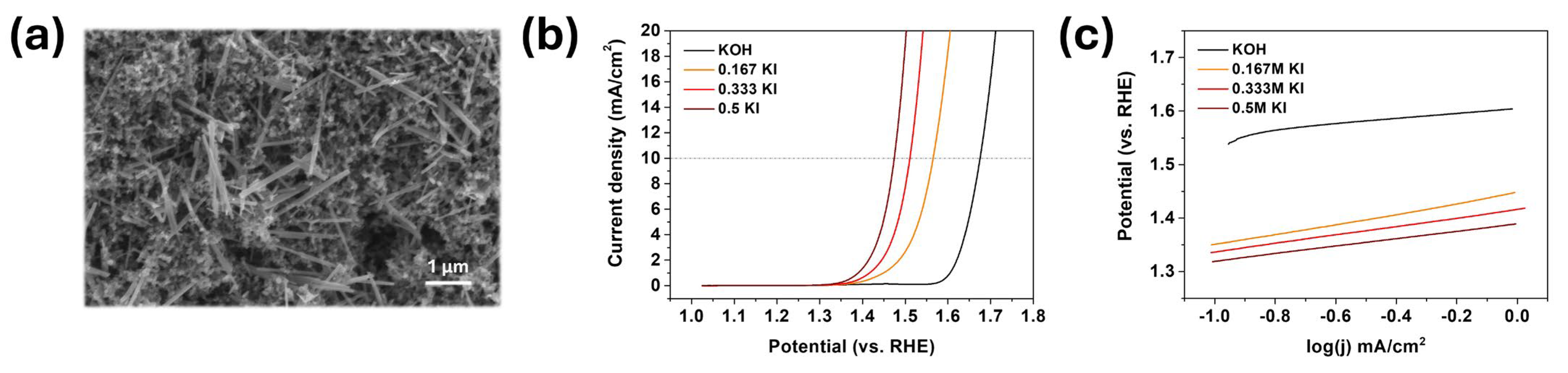
Figure 2a shows an SEM image of the MnO2-based electrode where the synthesized α-MnO2 micro-nanorods are embedded within the carbonaceous matrix of spheroidal Super P particles (having a size of ~50 nm).
Figure 2. (a) SEM image of MnO2-based electrodes used in this work; (b) LSV curves of MnO2 catalyst in 1 M KOH for the OER and 1 M KOH with 0.167 M, 0.333 M, and 0.5 M KI for the IOR; (c) corresponding Tafel plots.
The electrocatalytic performances are evaluated and, as expected, the synthesized MnO2 exhibits noticeable electrocatalytic activity toward the ORR in alkaline medium, as shown in Figure S1c. In contrast, when the electrolyte is saturated with argon, the corresponding voltammetric profile displays no distinct redox peaks or cathodic currents, confirming that the observed activity originates from oxygen reduction rather than other electrochemical processes.
Moreover, investigations in the oxidative potential range are carried out in a 1 M KOH electrolyte for the OER and in 1 M KOH + 0.167 M KI, 1 M KOH + 0.333 M KI, and 1 M KOH + 0.5 M KI for the IOR. As shown in Figure 2b, linear sweep voltammetry (LSV) reveals that MnO2 exhibits an onset potential of 1.675 V (vs. RHE) at 10 mA/cm2 in 1 M KOH. Interestingly, when KI is introduced into the electrolyte, the onset potential values decrease substantially and progressively with the increase in KI concentrations. The onset potentials at 10 mA/cm2 are 1.575 V, 1.511 V, and 1.474 V with the addition of 0.167 M KI, 0.333 M KI, and 0.5 M KI, respectively, in 1 M KOH. This suggests that I is oxidized in the presence of the MnO2 catalyst and that this oxidation reaction is thermodynamically favored over the oxidation of hydroxide ions, meaning that the conventional OER pathway is replaced by the oxidation of iodide ions.
The same trend is clearly visible in the decrease in the Tafel slope (Figure 2c) as the KI concentration increases, going from 96.5 mV/dec, 78.2 mV/dec, and 69.2 mV/dec for 0.167 M KI, 0.333 M KI, and 0.5 M KI, respectively (for KOH is 65.2 mV/dec). It can also be observed that the slope is similar between KOH and KOH + 0.5M KI, indicating that at the highest KI concentration, the oxidation kinetics are essentially comparable.
It can also be observed that the slope is similar between KOH and KOH + 0.5 M KI, indicating that at the highest KI concentration, the oxidation kinetics are essentially comparable. To better understand the reactions related to the IOR, we monitored the oxidation of I to I2 by cyclic voltammetry on MnO2 in a KI + KOH electrolyte and compared it with those obtained in KOH. As shown in Figure S2, in the presence of KI, we observe an anodic peak at 1.5 V vs. RHE, corresponding to the oxidation of I to I2, whereas the weak cathodic peak at 0.5 V vs. RHE is indicative of a possible I2/IO3 reduction [22,29].

3.3. ZAB Performance

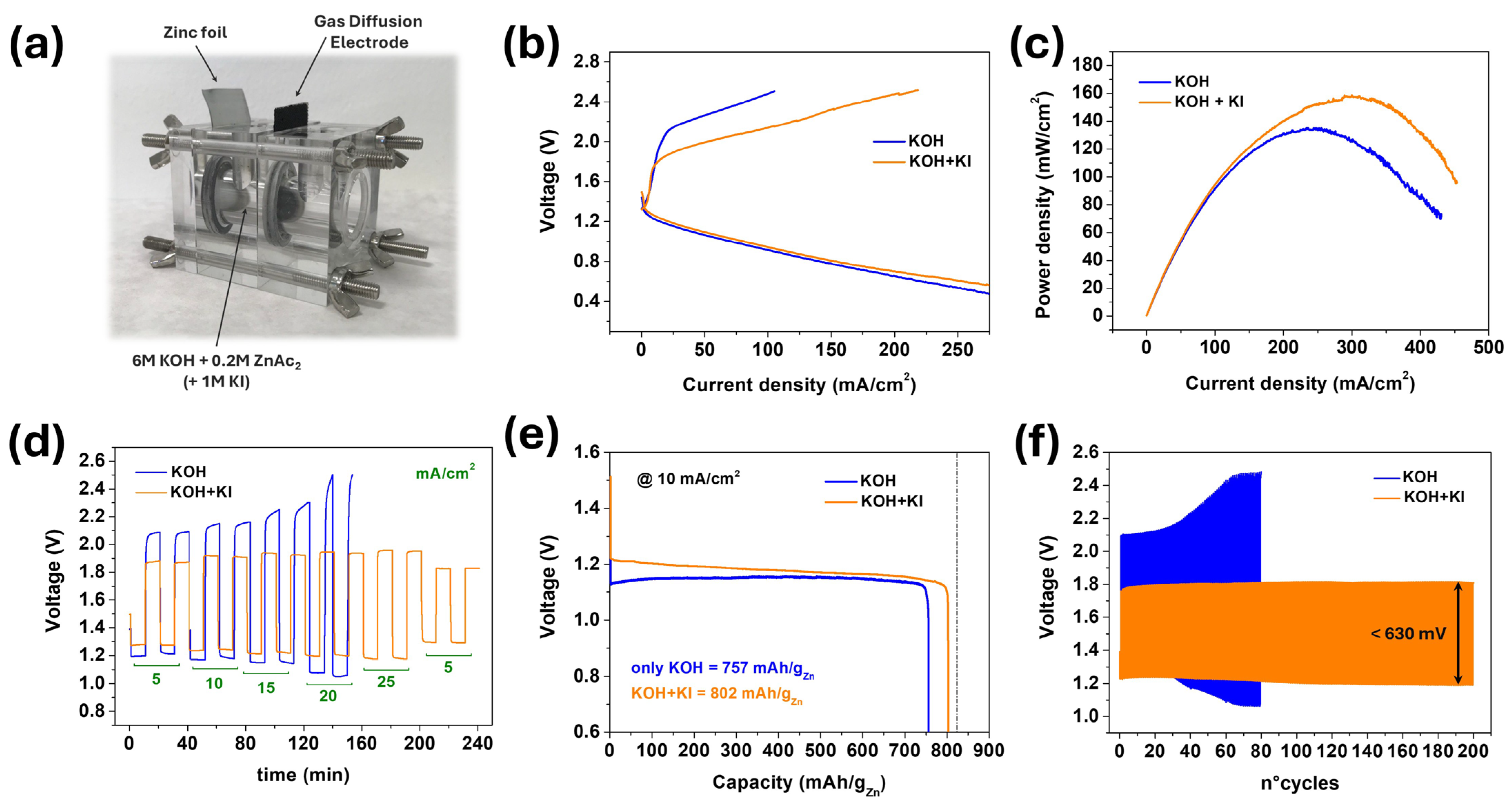
The bifunctional ORR/IOR activities of the synthesized MnO2, together with its favorable oxidation potential, suggest its suitability for practical application in a complete device. Therefore, we constructed a homemade liquid ZAB, as shown in Figure 3a, and performed a series of electrochemical tests to evaluate the effect of KI on MnO2-based batteries.
Figure 3. (a) Image of the custom-made setup of the zinc–air battery composed of zinc foil, a gas diffusion electrode, and a liquid alkaline electrolyte. Electrochemical tests of the MnO2-based ZAB without and with KI. (b) Discharge and charge polarization profiles. (c) Power density curves. (d) Discharge and charge rate performances. (e) Discharge specific capacity profiles at 10 mA/cm2. (f) Galvanostatic discharge and charge cycle performances at 5 mA/cm2 (20 min per cycle).
As shown in Figure 3b, the introduction of KI significantly reduces the charging voltage compared to the conventional system. The conventional ZAB reaches a charge potential of 2 V at a much lower current density (16.2 mA/cm2) compared to the KI-modified ZAB, which remains below 2 V, even at a higher current density of 52.1 mA/cm2. This demonstrates the beneficial effect of KI, as it lowers the charging overpotential by replacing the OER with the faster and more favorable IOR. Instead, during discharge, the voltages of the KI-modified ZAB are comparable to those of the conventional ZAB. It is worth noting that for other catalysts, such as Co1Fe1-N-C and FeCo-DACs, the discharge voltage with the KI modifier is consistently lower than that of the system without KI [18,23]. Remarkably, MnO2 displays superior discharge performance, suggesting that it does not suffer from the limitations that affect other materials in the presence of KI.
Moreover, the KI-modified ZAB exhibits a high peak power density of 158 mW/cm2, which is higher than that of the MnO2 catalyst without KI, which is 135 mW/cm2 (Figure 3c).
Rate performance testing further shows that the presence of KI narrows the discharge–charge voltage gap by decreasing the charging potential while maintaining similar discharge voltages (Figure 3d). The rate performance measurement shows that as the current density increases, the conventional ZAB exhibits progressively increasing charge overpotential, exceeding 2.2 V already at 15 mA/cm2. In the case of KI-modified ZAB, on the other hand, the charging potential remains below 2 V, even at 25 mA/cm2, thus allowing operation at high current densities. Furthermore, after the rate test up to 25 mA/cm2, the KI-modified ZAB returns to 5 mA/cm2 at the same voltages as the initial cycles, thus showing no signs of degradation. The improved electrochemical performance is attributed to the synergistic effect of KI and the bifunctional ORR/IOR activity of MnO2.
Both systems deliver stable discharge voltages (around 1.15 V for conventional and 1.18 V for KI-modified ZAB) and high specific capacities, which are 757 mAh/g for the conventional ZAB and 802 mAh/g for the KI-modified ZAB at 10 mA/cm2, calculated on zinc consumption (Figure 3e).
Cyclability tests were conducted at a constant current density of 5 mA/cm2 and reveal that the conventional ZAB rapidly fails since the charging voltage already increases beyond 2.4 V after 60 cycles. Instead, the KI-modified ZAB shows a lower charging potential of 1.76 V and achieves a very good energy efficiency of 69.9% (Figure 3f). The charging voltage of the KI-modified battery is over 330 mV lower (at the first cycle) and 670 mV lower (at the last cycle) than that of the conventional ZAB at the same charging current density. The cycling stability is remarkable, sustaining 65.7% energy efficiency, even after 200 cycles (20 min per cycle). Furthermore, after 200 cycles, the KI-modified ZAB demonstrates strong resilience and proves to be capable of long-term operation, with a decrease in round-trip efficiency of only 4.2%. In conventional ZABs, this deterioration is clearly visible from the electrolyte color change, which shifts from clear to brownish and contains precipitated fragments of carbon and catalytic material. Instead, the electrolyte of the KI-modified ZAB remains clear, even after numerous cycles (Figure S4), confirming the suppression of carbon corrosion and catalyst detachment in KI-containing systems and highlighting the protective role of the oxygen bubble-free IOR process. Moreover, we observed differences in dendrite formation at the Zn anode surface. After disassembling the cycled cells, we examined the morphology of the Zn anode, and SEM images (Figure S5) revealed that in the conventional ZAB (Figure S5a,c) the zinc surface was altered by plate-like deposits that covered the underlying Zn texture, whereas the KI-modified ZAB showed a cleaner Zn anode surface (Figure S5b,d), where dendrites were only beginning to form and were visible in their early stage.
Extended cyclability of 6 h (3 h for discharge and 3h for charge) further demonstrates that KI-modified ZABs can deliver stable discharge–charge behavior and long lifetimes (Figure S6). In this case, the KI-modified battery succeeds in maintaining a voltage gap lower than 630 mV for 27 cycles, demonstrating the long-term operation of this configuration. Moreover, this test holds promise for practical applications in large-scale energy storage since it shows a 15 mAh/cm2 of energy density per cycle (in short cycles in Figure 3f it was 0.833 mAh/cm2), which is higher than the value of 12 mAh/cm2 that is considered a threshold for practical applications [33,34].

4. Conclusions

In summary, we have demonstrated that the introduction of potassium iodide (KI) into MnO2-based zinc–air batteries replaces the sluggish OER with the more favorable iodide oxidation reaction (IOR), thereby significantly lowering the charging voltage and enhancing round-trip efficiency. This approach not only mitigates electrode degradation and suppresses carbon corrosion but also ensures stable ORR activity during discharge, leading to extended cycling stability beyond 200 cycles. It is important to note that the IOR is not fully reversible in alkaline media, that the beneficial reduction in charging voltage strongly depends on the iodide concentration in the electrolyte (as shown in Figure 2b), and that repeated discharge–charge cycling can gradually lower the I content. Nonetheless, compared with conventional ZABs and previously reported catalysts, KI-modified ZABs based on MnO2 electrodes deliver very good efficiency and durability while maintaining cost-effectiveness and environmental compatibility. These results highlight the dual advantage of KI addition in improving both energy efficiency and battery lifetime, underscoring its potential as a scalable strategy for advancing next-generation sustainable energy storage systems.

Supplementary Materials

The following supporting information can be downloaded at: https://www.mdpi.com/article/10.3390/batteries11120463/s1, Figure S1: (a) SEM image of MnO2 nanorods used as electrocatalysts. (b) XRD spectrum of synthesized MnO2 nanorods. (c) LSV curves of synthesized MnO2 nanorods in O2-saturated and Ar-saturated 0.1 M KOH at 5 mV/s at 1600 rpm. Figure S2: cyclic voltammetry (CV) measurements on MnO2 in KOH 1 M with and without KI 0.5 M. Figure S3: zoom on discharge–charge cycles at 5 mA/cm2. Figure S4: comparison of an electrolyte after device cycling with (left) and without (right) KI. Figure S5: SEM images showing the Zn surface after long-cycling ZAB (a,c) and KI-modified ZAB (b,d). Figure S6: galvanostatic discharge–charge cycle performances at 5 mA/cm2 (3 h per cycle).

Author Contributions

F.B. and L.D.M. conceptualized the work; F.B., S.D.M. and C.M. carried out the experimental part; F.B., S.D.M. and L.D.M. performed formal analysis and visualization; F.B. and L.D.M. wrote the original draft; F.B., S.D.M., M.M., C.M., G.G., A.D.R. and L.D.M. contributed to the writing, reviewing, and editing of the manuscript; L.D.M., A.D.R., M.M. and G.G. were responsible for project administration, funding acquisition, and supervision. All authors have read and agreed to the published version of the manuscript.

Funding

This work is supported by the European Research Council (ERC), ERC Consolidator Grant “HYNANOSTORE” (project number 101045746), the European Union—NextGeneration EU, the National Recovery and Resilience Plan (NRRP), project “Network 4 Energy Sustainable Transition—NEST” (Project code PE0000021, CUP B53C22004060006, Concession Decree No. 1561 of 11 October 2022 adopted by Ministero dell’Università e della Ricerca), the European Union through Next Generation EU, Mission 4 Component 1, PRIN PNRR 2022 “Hybrid Electrochemical Energy Storage in Sustainable batteries” (HEROES, P2022AFYZX 2023–2025 CUP B53D23026920001) project and by PRIN2022 PNRR “BAT-MEN” (BATtery Modeling, Experiments & Numerics) Enhancing battery lifetime, Project code: P20228C2PP 001, CUP: F53D23010020001, funded by MIUR (Italian Ministry of University and Research), and European Union–NextGenerationEU.

Data Availability Statement

All data needed to evaluate the conclusions of this work are present in the paper and the accompanying Supplementary Information (SI). The supporting information includes SEM and XRD data of MnO2 nanorods, LSV curves in O2-saturated and Ar-saturated 0.1 M KOH, CV on MnO2 in KOH 1 M with and without KI 0.5 M, zoom on discharge–charge cycles at 5 mA/cm2, SEM images of the Zn anode after long-cycling devices and galvanostatic charge and discharge cycle performances at 5 mA/cm2 (3 h per cycle). Further details are available from the corresponding authors upon reasonable request.

Acknowledgments

The work of Francesco Biscaglia contributing to this research is supported by the Italian National PhD program “PHOTOVOLTAICS” (38° cycle) in the work package “Solar intermittency and storage”. The authors gratefully thank P. Cazzato, S. Carallo, and D. Cannoletta for their valuable technical assistance.

Conflicts of Interest

The authors declare no conflicts of interest.

References

  1. Ahn, H.; Kim, D.; Lee, M.; Nam, K.W. Challenges and Possibilities for Aqueous Battery Systems. Commun. Mater. 2023, 4, 37. [Google Scholar] [CrossRef]
  2. Ju, Z.; Zhao, Q.; Chao, D.; Hou, Y.; Pan, H.; Sun, W.; Yuan, Z.; Li, H.; Ma, T.; Su, D.; et al. Energetic Aqueous Batteries. Adv. Energy Mater. 2022, 12, 2201074. [Google Scholar] [CrossRef]
  3. Wang, Q.; Kaushik, S.; Xiao, X.; Xu, Q. Sustainable Zinc-Air Battery Chemistry: Advances, Challenges and Prospects. Chem. Soc. Rev. 2023, 52, 6139–6190. [Google Scholar] [CrossRef] [PubMed]
  4. Shang, N.; Wang, K.; Wei, M.; Zuo, Y.; Zhang, P.; Wang, H.; Chen, Z.; Pei, P. Challenges for Large Scale Applications of Rechargeable Zn-Air Batteries. J. Mater. Chem. A 2022, 10, 16369–16389. [Google Scholar] [CrossRef]
  5. Song, Y.; Li, W.; Zhang, K.; Han, C.; Pan, A. Progress on Bifunctional Carbon-Based Electrocatalysts for Rechargeable Zinc–Air Batteries Based on Voltage Difference Performance. Adv. Energy Mater. 2024, 14, 2303352. [Google Scholar] [CrossRef]
  6. Li, G.; Long, Y.; Li, Z.; Li, S.; Zheng, Y.; He, B.; Zhou, M.; Hu, Z.; Zhou, M.; Hou, Z. Reducing the Charging Voltage of a Zn–Air Battery to 1.6 V Enabled by Redox Radical-Mediated Biomass Oxidation. ACS Sustain. Chem. Eng. 2023, 11, 8642–8650. [Google Scholar]
  7. Ge, X.; Sumboja, A.; Wuu, D.; An, T.; Li, B.; Goh, F.W.T.; Hor, T.S.A.; Zong, Y.; Liu, Z. Oxygen Reduction in Alkaline Media: From Mechanisms to Recent Advances of Catalysts. ACS Catal. 2015, 5, 4643–4667. [Google Scholar] [CrossRef]
  8. Jose, V.; Hu, H.; Edison, E.; Manalastas, W.; Ren, H.; Kidkhunthod, P.; Sreejith, S.; Jayakumar, A.; Nsanzimana, J.M.V.; Srinivasan, M.; et al. Modulation of Single Atomic Co and Fe Sites on Hollow Carbon Nanospheres as Oxygen Electrodes for Rechargeable Zn–Air Batteries. Small Methods 2021, 5, 2000751. [Google Scholar] [CrossRef]
  9. Chen, X.; Zhou, Z.; Karahan, H.E.; Shao, Q.; Wei, L.; Chen, Y. Recent Advances in Materials and Design of Electrochemically Rechargeable Zinc–Air Batteries. Small 2018, 14, 1801929. [Google Scholar] [CrossRef]
  10. Chen, M.; Kitiphatpiboon, N.; Feng, C.; Abudula, A.; Ma, Y.; Guan, G. Recent Progress in Transition-Metal-Oxide-Based Electrocatalysts for the Oxygen Evolution Reaction in Natural Seawater Splitting: A Critical Review. eScience 2023, 3, 100111. [Google Scholar] [CrossRef]
  11. Gesualdo, A.M.; Milanese, M.; Colangelo, G.; de Risi, A. Experimental Characterization of a Novel Fluidized-Bed Zn–Air Fuel Cell. Adv. Sustain. Syst. 2023, 7, 2300103. [Google Scholar] [CrossRef]
  12. Sun, Y.; Zhang, T.; Li, C.; Xu, K.; Li, Y. Compositional Engineering of Sulfides, Phosphides, Carbides, Nitrides, Oxides, and Hydroxides for Water Splitting. J. Mater. Chem. A 2020, 8, 13415–13436. [Google Scholar] [CrossRef]
  13. Das, C.; Sinha, N.; Roy, P. Transition Metal Non-Oxides as Electrocatalysts: Advantages and Challenges. Small 2022, 18, 202202033. [Google Scholar] [CrossRef] [PubMed]
  14. Xu, H.; Yang, J.; Ge, R.; Zhang, J.; Li, Y.; Zhu, M.; Dai, L.; Li, S.; Li, W. Carbon-Based Bifunctional Electrocatalysts for Oxygen Reduction and Oxygen Evolution Reactions: Optimization Strategies and Mechanistic Analysis. J. Energy Chem. 2022, 71, 234–265. [Google Scholar] [CrossRef]
  15. Yan, L.; Chen, J.; Yang, C.; Ning, J.; Hu, Y. Achieving High Energy Efficiency: Recent Advances in Zn-Air-Based Hybrid Battery Systems. Small Sci. 2024, 4, 202300094. [Google Scholar] [CrossRef]
  16. He, Y.; Cui, Y.; Chen, Y.; Tan, P. Redox Mediators Optimize Reaction Pathways of Rechargeable Zn-Air Batteries. Innov. Energy 2024, 1, 100028-1–100028-3. [Google Scholar] [CrossRef]
  17. Song, Z.; Ding, J.; Liu, B.; Liu, X.; Han, X.; Deng, Y.; Hu, W.; Zhong, C. A Rechargeable Zn–Air Battery with High Energy Efficiency and Long Life Enabled by a Highly Water-Retentive Gel Electrolyte with Reaction Modifier. Adv. Mater. 2020, 32, 201908127. [Google Scholar] [CrossRef]
  18. Fan, H.S.; Liang, X.; Ma, F.X.; Zhang, G.; Liu, Z.Q.; Zhen, L.; Zeng, X.C.; Xu, C.Y. Low-Potential Iodide Oxidation Enables Dual-Atom CoFe–N–C Catalysts for Ultra-Stable and High-Energy-Efficiency Zn–Air Batteries. Small 2024, 20, 202307863. [Google Scholar] [CrossRef]
  19. Zhao, S.; Liu, T.; Zuo, Y.; Wei, M.; Wang, J.; Shao, Z.; Leung, D.Y.C.; Zhao, T.; Ni, M. High-Power-Density and High-Energy-Efficiency Zinc-Air Flow Battery System for Long-Duration Energy Storage. Chem. Eng. J. 2023, 470, 144091. [Google Scholar] [CrossRef]
  20. Cui, M.; Ma, N.; Lei, H.; Liu, Y.; Ling, W.; Chen, S.; Wang, J.; Li, H.; Li, Z.; Fan, J.; et al. I3−/I− Redox Reaction-Mediated Organic Zinc-Air Batteries with Accelerated Kinetics and Long Shelf Lives. Angew. Chem.-Int. Ed. 2023, 62, 202303845. [Google Scholar] [CrossRef]
  21. Möller, S.; Barwe, S.; Masa, J.; Wintrich, D.; Seisel, S.; Baltruschat, H.; Schuhmann, W. Online Monitoring of Electrochemical Carbon Corrosion in Alkaline Electrolytes by Differential Electrochemical Mass Spectrometry. Angew. Chem.-Int. Ed. 2020, 59, 1585–1589. [Google Scholar] [CrossRef]
  22. Zhao, S.; Liu, T.; Dai, Y.; Wang, J.; Wang, Y.; Guo, Z.; Yu, J.; Bello, I.T.; Ni, M. Pt/C as a Bifunctional ORR/Iodide Oxidation Reaction (IOR) Catalyst for Zn-Air Batteries with Unprecedentedly High Energy Efficiency of 76.5%. Appl. Catal. B Environ. 2023, 320, 121992. [Google Scholar] [CrossRef]
  23. Qiao, J.; You, Y.; Kong, L.; Feng, W.; Zhang, H.; Huang, H.; Li, C.; He, W.; Sun, Z.M. Precisely Constructing Orbital-Coupled Fe–Co Dual-Atom Sites for High-Energy-Efficiency Zn–Air/Iodide Hybrid Batteries. Adv. Mater. 2024, 36, 202405533. [Google Scholar] [CrossRef]
  24. Zhang, Y.; Qin, H.; Alfred, M.; Ke, H.; Cai, Y.; Wang, Q.; Huang, F.; Liu, B.; Lv, P.; Wei, Q. Reaction Modifier System Enable Double-Network Hydrogel Electrolyte for Flexible Zinc-Air Batteries with Tolerance to Extreme Cold Conditions. Energy Storage Mater. 2021, 42, 88–96. [Google Scholar] [CrossRef]
  25. Yi, X.; Song, Y.; He, D.; Li, W.; Pan, A.; Han, C. Constructing a High-Performance Bifunctional MnO2-Based Electrocatalyst towards Applications in Rechargeable Zinc–Air Batteries. J. Mater. Chem. A Mater. Energy Sustain. 2024, 12, 29355–29382. [Google Scholar] [CrossRef]
  26. Gu, Y.; Yan, G.; Lian, Y.; Qi, P.; Mu, Q.; Zhang, C.; Deng, Z.; Peng, Y. MnIII-Enriched α-MnO2 Nanowires as Efficient Bifunctional Oxygen Catalysts for Rechargeable Zn-Air Batteries. Energy Storage Mater. 2019, 23, 252–260. [Google Scholar] [CrossRef]
  27. Marini, E.; Jörissen, L.; Brimaud, S. Rational Design of a Low-Cost, Durable and Efficient Bifunctional Oxygen Electrode for Rechargeable Metal-Air Batteries. J. Power Sources 2021, 482, 228900. [Google Scholar] [CrossRef]
  28. Salman, Y.; Waseem, S.; Alleva, A.; Banerjee, P.; Bonanni, V.; Emanuele, E.; Ciancio, R.; Gianoncelli, A.; Kourousias, G.; Bassi, A.L.; et al. Synthesis, Characterization, Functional Testing and Ageing Analysis of Bifunctional Zn-Air Battery GDEs, Based on α-MnO2 Nanowires and Ni/NiO Nanoparticle Electrocatalysts. Electrochim. Acta 2023, 469, 143246. [Google Scholar] [CrossRef]
  29. Ran, J.; Chen, P.; Quan, X.; Si, M.; Gao, D. Improving the Oxygen Evolution Reaction Kinetics in Zn-Air Battery by Iodide Oxidation Reaction. Small 2024, 20, 202402052. [Google Scholar] [CrossRef]
  30. Zou, X.; Lu, Q.; Wu, L.; Zhang, K.; Tang, M.; Xie, H.; Zhang, X.; Shao, Z.; An, L. I3-Mediated Oxygen Evolution Activities to Boost Rechargeable Zinc-Air Battery Performance with Low Charging Voltage and Long Cycling Life. Angew. Chem.-Int. Ed. 2025, 64, 202416235. [Google Scholar] [CrossRef]
  31. Xiao, W.; Wang, D.; Lou, X.W. Shape-Controlled Synthesis of MnO2 Nanostructures with Enhanced Electrocatalytic Activity for Oxygen Reduction. J. Phys. Chem. C 2010, 114, 1694–1700. [Google Scholar] [CrossRef]
  32. Yan, G.; Lian, Y.; Gu, Y.; Yang, C.; Sun, H.; Mu, Q.; Li, Q.; Zhu, W.; Zheng, X.; Chen, M.; et al. Phase and Morphology Transformation of MnO2 Induced by Ionic Liquids toward Efficient Water Oxidation. ACS Catal. 2018, 8, 10137–10147. [Google Scholar] [CrossRef]
  33. Parker, J.F.; Ko, J.S.; Rolison, D.R.; Long, J.W. Translating Materials-Level Performance into Device-Relevant Metrics for Zinc-Based Batteries. Joule 2018, 2, 2519–2527. [Google Scholar] [CrossRef]
  34. García-Gaitán, E.; Morant-Miñana, M.C.; Frattini, D.; Maddalena, L.; Fina, A.; Gerbaldi, C.; Cantero, I.; Ortiz-Vitoriano, N. Agarose-Based Gel Electrolytes for Sustainable Primary and Secondary Zinc-Air Batteries. Chem. Eng. J. 2023, 472, 144870. [Google Scholar] [CrossRef]
Disclaimer/Publisher’s Note: The statements, opinions and data contained in all publications are solely those of the individual author(s) and contributor(s) and not of MDPI and/or the editor(s). MDPI and/or the editor(s) disclaim responsibility for any injury to people or property resulting from any ideas, methods, instructions or products referred to in the content.

Article Metrics

Citations

Article Access Statistics

Multiple requests from the same IP address are counted as one view.