1. Introduction
Salinity is among the frequently encountered limiting factors in horticultural production. It is particularly important in enclosed growing systems, where salts tend to accumulate in the root environment because of repeated irrigation and nutrient-solution recycling. Elevated sodium chloride (NaCl) can initially decrease water permeability and make water uptake more difficult. Prolonged exposure may further lead to the accumulation of sodium (Na
+) and chloride (Cl
−) ions, which can disrupt nutrient balance and cellular metabolism [
1,
2]. These changes are usually accompanied by oxidative damage and decreased photosynthetic ability [
3]. Vegetable crops may also suffer from moderate salinity during seedling establishment. This phase is sensitive because root systems remain small while leaf area increases rapidly. Reduced early growth may therefore affect subsequent crop performance [
4].
Cucumber (
Cucumis sativus L.) is cultivated extensively in greenhouse and hydroponic systems and has considerable economic importance. However, cucumber seedlings are sensitive to salinity. Under NaCl stress, cucumber plants commonly show restricted root development, smaller leaf area, reduced biomass accumulation, and impaired water uptake [
5,
6,
7]. These responses are closely connected: restricted root growth can reduce water and nutrient delivery to leaves, whereas ion imbalance may further inhibit photosynthetic metabolism. Consequently, net photosynthetic rate (P
n), stomatal conductance (gs), transpiration rate (T
r), and pigment content tend to decrease with salinity [
8]. Recent studies have further shown that cucumber responses to salinity involve coordinated changes in photosynthetic electron transport, antioxidant metabolism, ion homeostasis, osmotic regulation, and stress-responsive gene networks [
9,
10,
11,
12].
Because silicon-containing treatments may show concentration-dependent rather than monotonic responses, identifying an appropriate supplementation level is important when evaluating stress-alleviation strategies. Previous studies have reported concentration-dependent responses in which intermediate silicon supply produced greater benefits for particular growth or physiological traits than higher supplementation levels [
13,
14]. Such responses may reflect changes in silicon availability, nutrient balance, or the accompanying ions supplied with the silicon source. Therefore, a higher supplementation level cannot be assumed to provide a greater physiological benefit [
13,
14].
Photosynthesis is one of the physiological processes most sensitive to salt stress. Part of this decline may result from stomatal closure, which restricts CO
2 diffusion into leaves. However, non-stomatal limitations, including pigment loss and impaired electron transport, may also contribute to photosynthetic inhibition [
15,
16]. Photosystem II (PSII) is particularly useful for assessing these responses. Chlorophyll fluorescence provides a rapid and non-invasive assessment of PSII function in vivo [
17]. The maximum quantum efficiency of PSII (F
v/F
m) reflects the maximum photochemical efficiency after dark adaptation, whereas the effective quantum yield of PSII [Y
(II)] and electron transport rate (ETR) characterize photochemical energy use under light-adapted conditions [
18].
Salt stress can also alter the partitioning of absorbed light energy. When carbon assimilation is restricted, excess excitation energy may accumulate in the photosynthetic apparatus. Non-photochemical quenching (NPQ) and the quantum yield of regulated non-photochemical energy dissipation [Y
(NPQ)] reflect regulated thermal dissipation, whereas the quantum yield of non-regulated energy loss [Y
(NO)] represents non-regulated energy dissipation [
19]. These parameters help distinguish regulated photoprotection from potentially damaging energy imbalance. In cucumber, the performance of PSII and photosystem I (PSI) is responsive to environmental conditions such as light and temperature [
20,
21]. However, the relationship between NaCl stress, Si supply, PSII energy partitioning, growth, ion balance, and oxidative injury remains incompletely characterized.
Oxidative stress is another major component of salt injury. Excess reactive oxygen species (ROS), including hydrogen peroxide (H
2O
2), can damage membranes, proteins, pigments, and other cellular components. Membrane injury is commonly evaluated using malondialdehyde (MDA) accumulation and electrolyte leakage [
22,
23]. Plants also activate antioxidant enzymes, including superoxide dismutase (SOD), peroxidase (POD), catalase (CAT), and ascorbate peroxidase (APX), to regulate oxidative pressure [
24,
25,
26]. Osmotic adjustment may further help stressed plants maintain cellular water status through the accumulation of proline, soluble sugars, and soluble proteins [
27,
28,
29].
Silicon (Si) is considered a beneficial element for many plant species and may improve plant performance under unfavorable environmental conditions [
30,
31,
32]. The amount of Si absorbed and accumulated by plants depends on species and transport capacity [
33,
34]. Si may affect water relations, ion distribution, antioxidant defense, and leaf structure under stress. In cucumber, Si-containing treatments have been reported to reduce oxidative damage, enhance antioxidant enzyme activity, improve root water uptake, and alleviate ion toxicity under salt stress [
6,
7]. More recent cucumber studies have also reported that Si-containing treatments may improve seedling growth, preserve PSII activity, regulate carbon and antioxidant metabolism, and alleviate stress-associated oxidative injury, although the magnitude of the response depends on the stress type, treatment source, and application conditions [
35,
36,
37].
Irrespective of these results, there are various aspects that are not clear. Most of the research has been conducted on one aspect of the response i.e., root water uptake, antioxidant enzymes, mineral nutrition or photosynthesis rate. Fewer investigations have considered all these processes simultaneously. In specific, PSII energy partitioning has been rarely related to recovery of growth, oxidative damage, osmotic regulation and sodium/potassium equilibrium at various silicon levels. The linkage is required since silicon might not be operating through one mechanism. The influence could be reliant on the combination of ion homeostasis, photochemical protection, and redox balance. It will also be useful to determine whether an intermediate potassium silicate supplementation level produces a stronger integrated response than a higher supplementation level in cucumber seedlings exposed to salt stress.
This study examined the effects of potassium silicate (K2SiO3) on cucumber seedlings exposed to NaCl stress under hydroponic conditions. The objectives were to determine whether K2SiO3 supplementation affected: (1) seedling growth, biomass accumulation, and root morphology; (2) photosynthetic pigments, gas exchange, and PSII photochemical performance; (3) PSII energy partitioning, oxidative injury, antioxidant enzyme activities, and osmotic adjustment; and (4) ion balance, nutrient status, and Si accumulation. We hypothesized that NaCl stress would inhibit root development, photosynthesis, PSII photochemical efficiency, and potassium (K+)/Na+ balance while increasing oxidative injury. We further hypothesized that potassium silicate would partly alleviate these responses and that the integrated response would be concentration dependent, with an intermediate K2SiO3 supplementation level producing a stronger overall response than the highest level tested.
2. Materials and Methods
2.1. Plant Material and Growth Conditions
Cucumber seeds (Cucumis sativus L. cv. Jinyou 35) were used in this study. Seeds of uniform size were selected and surface-sterilized with 1% sodium hypochlorite for 10 min. They were then rinsed five times with distilled water. The seeds were germinated on moist filter paper at 28 °C in darkness for 48 h. Germinated seeds were transferred to plastic trays containing vermiculite. When the cotyledons were fully expanded, uniform seedlings were transferred to a hydroponic system.
Seedlings were grown in half-strength Hoagland nutrient solution [
38]. Each seedling was placed in an independent hydroponic container containing 1.0 L of nutrient solution. One container with one seedling was considered one biological replicate. The nutrient solution was continuously aerated and renewed every three days. The pH was maintained at 6.0 ± 0.1 using 0.1 mol L
−1 HCl or KOH. Seedlings were acclimated for seven days before treatment. Treatments started when seedlings had three fully expanded true leaves.
The experiment was conducted in a greenhouse at Harbin University, Harbin, China. During the treatment period, the daytime temperature was 25.3–29.8 °C, and the nighttime temperature was 18.2–20.6 °C. Relative humidity was 60.0–70.2%. The photoperiod was 14 h light/10 h dark. The photosynthetic photon flux density at canopy height was 459–573 μmol m−2 s−1 at midday. The nutrient-solution temperature was 22.7–24.7 °C.
2.2. Preliminary NaCl and Potassium Silicate Screening
Two preliminary screening experiments were conducted before the main experiment. In the NaCl screening, seedlings were exposed to 0, 25, 50, 75, 100, 125, or 150 mmol L−1 NaCl for 14 d. Survival, shoot height, primary root length, shoot and root fresh weight (FW), SPAD value, Fv/Fm, Pn, and MDA content were evaluated. Seedling survival was calculated separately for each replicate as: Survival (%) = (number of surviving seedlings/initial number of seedlings) × 100. Based on these results, 75 mmol L−1 NaCl was selected because it produced clear growth and photosynthetic inhibition while maintaining high seedling survival.
In the potassium silicate screening, seedlings exposed to 75 mmol L−1 NaCl received potassium silicate supplying 0, 0.25, 0.5, 1.0, 2.0, or 3.0 mmol L−1 Si for 14 d. The same growth, photosynthetic, and oxidative-injury indicators were evaluated. The treatment supplying 1.0 mmol L−1 Si produced the strongest integrated improvement, whereas the treatment supplying 3.0 mmol L−1 Si showed weaker alleviation and signs of additional stress. K2SiO3 levels supplying 0.5, 1.0, and 2.0 mmol L−1 Si were therefore selected for the main experiment to represent low (0.5 mmol L−1 Si), intermediate (1.0 mmol L−1 Si), and high (2.0 mmol L−1 Si) K2SiO3 supplementation under the selected NaCl stress level (75 mmol L−1 NaCl).
Each screening treatment included six biological replicates. The NaCl and potassium silicate screening experiments were analyzed separately using one-way ANOVA followed by Tukey’s HSD test at p < 0.05.
2.3. Main Treatment Design and Sampling
The main experiment followed a completely randomized design with six treatments: CK, half-strength Hoagland nutrient solution without NaCl or K
2SiO
3; Si1, half-strength Hoagland nutrient solution with K
2SiO
3 supplying 1.0 mmol L
−1 Si; NaCl, half-strength Hoagland nutrient solution with 75 mmol L
−1 NaCl; NaCl + Si0.5, 75 mmol L
−1 NaCl plus K
2SiO
3 supplying 0.5 mmol L
−1 Si; NaCl + Si1, 75 mmol L
−1 NaCl plus K
2SiO
3 supplying 1.0 mmol L
−1 Si; and NaCl + Si2, 75 mmol L
−1 NaCl plus K
2SiO
3 supplying 2.0 mmol L
−1 Si. The Si1 treatment was included as a non-saline reference for K
2SiO
3 supplementation at the intermediate level (1.0 mmol L
−1 Si). The three K
2SiO
3 treatments under NaCl stress were used to compare low (NaCl + Si0.5, 0.5 mmol L
−1 Si), intermediate (NaCl + Si1, 1.0 mmol L
−1 Si), and high (NaCl + Si2, 2.0 mmol L
−1 Si) supplementation under the selected NaCl stress level (75 mmol L
−1 NaCl). The treatment design is summarized in
Table 1.
NaCl was supplied as analytical-grade sodium chloride. Potassium silicate (K2SiO3; Sigma-Aldrich, St. Louis, MO, USA) was used as the Si-containing treatment source. The potassium silicate solution was prepared separately and added slowly to the nutrient solution under continuous stirring. The pH of all solutions was subsequently adjusted to 6.0 ± 0.1. Because K2SiO3 supplied both soluble Si and K+, nutrient-solution K+ concentration was monitored and considered when interpreting the ion-balance results. No K-matched control was included; consequently, the contributions of soluble Si and accompanying K+ could not be separated. The observed responses were therefore interpreted as effects of potassium silicate supplementation.
Each treatment included eight biological replicates at each sampling time. One independent hydroponic container containing one seedling was considered one biological replicate. Seedlings assigned to the 7 and 14 d sampling times were predetermined at the beginning of the experiment and were destructively sampled independently. Samples collected at 7 and 14 d were used to characterize treatment responses at two stages of exposure.
2.4. Nutrient Solution Properties
Nutrient solution properties were measured at 0, 7, and 14 d after treatment. The 7 and 14 d solution samples were collected immediately before nutrient-solution renewal. The pH and electrical conductivity were measured using a pH/EC meter (HI98130, Hanna Instruments, Woonsocket, RI, USA). Osmotic potential was measured using a vapor pressure osmometer (Vapro 5600, Wescor, Logan, UT, USA). Turbidity was determined using a portable turbidity meter (2100Q, Hach, Loveland, CO, USA).
Solution Na+ and K+ concentrations were determined using a flame photometer (FP640, Shanghai Precision Scientific Instrument Co., Ltd., Shanghai, China). Soluble silicon concentration was determined by the molybdenum blue colorimetric method using a UV–visible spectrophotometer (UV-1800, Shimadzu, Kyoto, Japan). Solution properties were used to verify salinity level, osmotic pressure, Si availability, and K+ input associated with K2SiO3 application.
2.5. Growth Traits and Biomass
Shoot height was measured from the base of the stem to the shoot apex using a ruler. Stem diameter was measured at the cotyledon node using a digital caliper (Mitutoyo, Kawasaki, Japan). Leaf number was counted manually. Total leaf area per plant was measured using an LI-3100C area meter (LI-COR Biosciences, Lincoln, NE, USA).
For biomass determination, shoots and roots were separated at harvest, and fresh weight (FW) was recorded immediately. The samples used for biomass determination were dried at 105 °C for 30 min and subsequently at 75 °C to constant weight in a forced-air drying oven (DHG-9140A, Shanghai Yiheng, Shanghai, China) to obtain dry weight (DW).
Leaf relative water content (RWC) was measured using fully expanded leaves according to Barrs and Weatherley [
39]. Fresh weight (FW) was recorded immediately after sampling. Leaves were then soaked in distilled water for 6 h at room temperature to obtain turgid weight (TW). Dry weight (DW) was obtained after oven drying. RWC was calculated as:
where FW is fresh weight, TW is turgid weight, and DW is dry weight.
2.6. Root Morphology
The fresh roots were carefully rinsed with distilled water. The samples of roots were laid out on a clear tray filled with a thin layer of water and the overlapping roots were removed prior to scanning. Imaging of roots was done through a flatbed scanner (Epson Perfection V800 Photo, Epson, Nagano, Japan). The analysis of images was conducted using the WinRHIZO Pro software (Regent Instruments Inc., Quebec, QC, Canada).
The scanned root images were used for quantitative extraction of total root length, root surface area, root volume, mean root diameter, and root tip number using WinRHIZO Pro. All root traits were quantified separately for each biological replicate and expressed on a per-plant basis. Root image analysis followed the general principles described by Himmelbauer et al. [
40].
2.7. Photosynthetic Pigments and SPAD Value
The newest fully expanded functional leaves were used for pigment measurements. The main vein was avoided during sampling. Relative chlorophyll content was measured using a SPAD-502Plus chlorophyll meter (Konica Minolta, Osaka, Japan). Three readings were taken from each leaf, and their average was used for analysis.
Chlorophyll and carotenoid contents were determined according to Lichtenthaler [
41]. Fresh leaf tissue (0.20 g) was cut into small pieces and extracted with 80% acetone in darkness until the tissue became colorless. The extract was centrifuged at 10,000×
g for 10 min at 4 °C. Absorbance was measured at 663, 646, and 470 nm for the determination of chlorophyll a, chlorophyll b, and carotenoids, respectively, using a UV–visible spectrophotometer (UV-1800, Shimadzu, Kyoto, Japan). Total chlorophyll content was calculated from chlorophyll a and chlorophyll b. Chlorophyll and carotenoid contents were expressed as mg g
−1 FW.
2.8. Gas-Exchange Measurements
Gas exchange was measured between 09:00 and 11:00 on clear days. Measurements were made on the newest fully expanded functional leaves using an LI-6400XT portable photosynthesis system (LI-COR Biosciences, Lincoln, NE, USA). The leaf chamber was equipped with a red-blue light source. Photosynthetic photon flux density was set at 1000 μmol m−2 s−1. The reference CO2 concentration was maintained at 400 μmol mol−1. The air flow rate was 500 μmol s−1. Leaf temperature was maintained at 25 ± 1 °C.
The measured parameters were net photosynthetic rate (P
n), stomatal conductance (g
s), intercellular CO
2 concentration (C
i) and transpiration rate (T
r). The readings were taken when the parameters of gas exchange had stabilized. Water-use efficiency at any particular point was calculated as:
For each biological replicate, three leaves from the same seedling were measured, and the mean value was used as one biological replicate. Gas-exchange measurements were interpreted according to standard principles for photosynthetic gas-exchange analysis [
42,
43].
2.9. Chlorophyll Fluorescence and PSII Energy Partitioning
Chlorophyll fluorescence was measured using a pulse-amplitude-modulated chlorophyll fluorometer (MINI-PAM-II, Heinz Walz GmbH, Effeltrich, Germany). Measurements were made on the same leaf position used for gas exchange. Leaves were dark-adapted for 30 min with leaf clips before measurement, consistent with previously reported chlorophyll-fluorescence protocols for cucumber, including cucumber seedlings subjected to NaCl stress [
12,
44].
After dark adaptation, minimal fluorescence (F
o) was recorded under weak measuring light. Maximal fluorescence (F
m) was induced by a saturating pulse of 8000 μmol m
−2 s
−1 for 0.8 s. The maximum quantum efficiency of PSII was calculated as:
After dark-adapted measurements, leaves were exposed to actinic light of 800 μmol m
−2 s
−1 until steady-state fluorescence was reached. Steady-state fluorescence (F
s) and light-adapted maximal fluorescence (F
m′) were recorded. The effective quantum yield of PSII [Y
(II)], electron transport rate (ETR), photochemical quenching coefficient (qP), and non-photochemical quenching (NPQ) were calculated following standard procedures [
16,
18,
19].
PSII energy partitioning was evaluated using Y
(II), Y
(NPQ), and Y
(NO) according to Kramer et al. [
20]. Y
(II) represented the fraction of absorbed energy used in PSII photochemistry. Y
(NPQ) represented regulated thermal energy dissipation. Y
(NO) represented non-regulated energy loss. Y
(NPQ) and Y
(NO) were calculated by the instrument software according to Kramer et al. [
20]. The sum of Y
(II), Y
(NPQ), and Y
(NO) was equal to 1.
2.10. Oxidative Damage
Fresh leaf samples were collected at 7 and 14 d after treatment. Samples were immediately frozen in liquid nitrogen and stored at −80 °C until analysis.
Malondialdehyde (MDA) content was determined using the thiobarbituric acid (TBA) method [
22]. Fresh leaf tissue (0.50 g) was homogenized in 5 mL of 10% trichloroacetic acid. The homogenate was centrifuged at 10,000×
g for 10 min, and the supernatant was mixed with 0.6% TBA and heated at 95 °C for 30 min. After rapid cooling, the mixture was centrifuged again. Absorbance was recorded at 532 nm for the MDA–TBA reaction, while readings at 600 and 450 nm were used for correction of nonspecific and interfering absorbance, respectively.
Hydrogen peroxide (H
2O
2) content was measured according to Velikova et al. [
23]. Fresh leaf tissue was extracted with 0.1% trichloroacetic acid. The extract was mixed with potassium phosphate buffer and potassium iodide. Absorbance was measured at 390 nm.
Electrolyte leakage was measured using leaf discs and a DDS-307A conductivity meter (Leici, Shanghai, China). Leaf discs were rinsed with deionized water and placed in tubes containing 10 mL of deionized water. Initial conductivity was measured after incubation at room temperature for 12 h. The samples were then boiled for 30 min and cooled to room temperature. Final conductivity was measured. Electrolyte leakage was calculated as:
2.11. Antioxidant Enzyme Activities
Fresh leaf tissue (0.50 g) was ground in 5 mL of ice-cold 50 mmol L−1 phosphate buffer at pH 7.8 containing 1% polyvinylpyrrolidone. The homogenate was centrifuged at 12,000× g for 20 min at 4 °C. The supernatant was used for enzyme assays.
Superoxide dismutase (SOD) activity was measured by inhibition of nitroblue tetrazolium reduction at 560 nm [
24]. One unit of SOD activity was defined as the amount of enzyme required to cause 50% inhibition of nitroblue tetrazolium reduction. Peroxidase (POD) activity was measured using the guaiacol oxidation method, and catalase (CAT) activity was determined by monitoring H
2O
2 decomposition at 240 nm [
25]. Ascorbate peroxidase (APX) activity was measured by following the decrease in absorbance at 290 nm due to ascorbate oxidation [
26].
2.12. Osmotic Adjustment Substances
Free proline content was determined using the acid ninhydrin method [
28]. Fresh leaf tissue of 0.50 g was extracted with 3% sulfosalicylic acid. The extract was reacted with acid ninhydrin and glacial acetic acid. The reaction mixture was heated in a boiling water bath for 30 min. After cooling, toluene was added for chromophore extraction. Absorbance was measured at 520 nm.
Soluble sugar content was determined using the anthrone colorimetric method [
29]. Fresh leaf tissue of 0.50 g was extracted with distilled water in a boiling water bath. The extract was mixed with anthrone reagent and concentrated sulfuric acid. Absorbance was measured at 620 nm.
Soluble protein content was determined using the Coomassie Brilliant Blue G-250 method [
27]. Fresh leaf tissue of 0.50 g was extracted with phosphate buffer and mixed with Coomassie Brilliant Blue reagent. Absorbance was measured at 595 nm. Bovine serum albumin was used as the standard.
2.13. Ion Content, Nitrogen and Phosphorus Status, and Si Accumulation
Separate leaf and root samples used for mineral and nutrient analyses were oven-dried at 70 °C to constant weight and ground into fine powder. For Na+, K+, Ca2+, and Mg2+ analysis, 0.20 g of dried sample was digested with HNO3–H2O2 using a microwave digestion system (MARS 6, CEM Corporation, Matthews, NC, USA). Ion concentrations were determined using inductively coupled plasma optical emission spectrometry (Optima 8000, PerkinElmer, Waltham, MA, USA). The K+/Na+ ratio was calculated from the measured K+ and Na+ concentrations.
Leaf nitrogen (N) content was determined using the Kjeldahl method after H2SO4–H2O2 digestion. Nitrogen content was measured using an automatic Kjeldahl nitrogen analyzer and expressed as mg g−1 DW. Leaf phosphorus (P) content was determined after acid digestion using the molybdenum–antimony colorimetric method. Absorbance was measured at 700 nm using a UV–visible spectrophotometer (UV-1800, Shimadzu, Kyoto, Japan). Phosphorus content was expressed as mg g−1 DW.
Silicon content was determined using the molybdenum blue colorimetric method. Dried plant powder was digested with NaOH solution in a high-temperature water bath. The digest was neutralized and reacted with ammonium molybdate, tartaric acid, and reducing reagent. Absorbance was measured at 811 nm using a UV–visible spectrophotometer (UV-1800, Shimadzu, Kyoto, Japan). Silicon content was expressed as mg g−1 DW.
2.14. Root Activity and Nitrate Reductase Activity
Root activity was determined using the triphenyl tetrazolium chloride (TTC) method. Fresh root samples of 0.50 g were incubated with TTC solution and phosphate buffer at 37 °C. The reaction was stopped with sulfuric acid. The reduced triphenyl formazan was extracted with ethyl acetate. Absorbance was measured at 485 nm. Root activity was expressed as μg TPF g
−1 FW h
−1. TTC reduction was used as an indicator of root metabolic activity [
45].
Nitrate reductase (NR) activity was determined independently on fresh, non-dried leaf tissue using an in vivo colorimetric assay based on nitrite formation [
46]. Fresh leaf tissue was incubated in phosphate buffer containing KNO
3 and propanol under dark conditions.
2.15. Statistical Analysis
Data were analyzed using SPSS 27.0 (IBM Corp., Armonk, NY, USA) and R 4.3.2 (R Core Team, Vienna, Austria). Normality was tested using the Shapiro–Wilk test. Homogeneity of variance was tested using Levene’s test. Data were transformed when necessary to meet the assumptions of analysis of variance.
The 7 and 14 d measurements were obtained from independent destructively sampled seedlings. For variables measured at both sampling times, two-way ANOVA was used as the primary factorial analysis, with treatment and sampling time as fixed factors and the treatment × sampling-time interaction included in the model. The complete two-way ANOVA results are reported in
Table S4. When a significant treatment × sampling-time interaction was detected, all 12 treatment × sampling-time combinations were compared together using Tukey-adjusted pairwise comparisons at
p < 0.05; these results are reported in
Table S5. When the treatment × sampling-time interaction was not significant, interpretation was based on the corresponding main effects from the two-way ANOVA, with Tukey’s HSD test used for significant treatment main effects where appropriate.
Pearson correlation analysis was performed using biological replicate values to examine relationships among growth traits, root traits, gas-exchange parameters, chlorophyll fluorescence variables, PSII energy-partitioning variables, oxidative-damage indicators, antioxidant enzyme activities, osmotic-adjustment substances, nutrient traits, ion-balance traits, and Si accumulation. Principal component analysis was performed using standardized biological replicate values from the 14 d dataset. Figures were prepared using OriginPro 2023 (OriginLab Corporation, Northampton, MA, USA). Data are presented as means ± standard error. Different lowercase letters indicate significant differences according to the multiple-comparison procedure described above.
Full statistical outputs and supporting measurements are provided in the
Supplementary Materials.
Table S1 reports nutrient-solution properties.
Table S2 reports the preliminary-screening ANOVA results.
Table S3 reports additional growth and pigment traits not displayed in the main figures.
Table S4 reports the two-way ANOVA results for the main experiment.
Table S5 reports Tukey-adjusted pairwise comparisons among treatment × sampling-time combinations for variables showing a significant treatment × sampling-time interaction.
Table S6 reports Pearson correlation coefficients.
Table S7A,B report PCA eigenvalues, explained variance, and loadings.
3. Results
3.1. Preliminary Screening and Nutrient Solution Characteristics
The preliminary NaCl and K
2SiO
3-supplied Si screening results are summarized in
Table 2, (A) and (B), respectively. In the NaCl screening, seedling survival remained statistically comparable to the control from 0 to 75 mmol L
−1 NaCl, and the values at 25 and 50 mmol L
−1 NaCl were numerically higher than the control. In contrast, growth and photosynthetic traits showed a clearer concentration-dependent response to NaCl. Shoot height, primary root length, shoot FW, root FW, Pn, and Fv/Fm progressively decreased as the NaCl concentration increased, whereas MDA content increased. At the selected NaCl stress level (75 mmol L
−1 NaCl), seedling survival remained high, but growth, photosynthetic performance, and oxidative-injury indicators were clearly affected. Therefore, 75 mmol L
−1 NaCl was selected for the main experiment because it produced distinct salt stress while maintaining sufficient seedling survival.
The K
2SiO
3-supplied Si screening under 75 mmol L
−1 NaCl indicated that salt-induced inhibition was partially alleviated by K
2SiO
3 supplementation, but the response was concentration dependent. The treatment supplying 1.0 mmol L
−1 Si showed the strongest integrated response, including greater shoot height, primary root length, P
n, and F
v/F
m and lower MDA content than the unsupplemented NaCl treatment. The K
2SiO
3 treatments supplying 0.5, 1.0, and 2.0 mmol L
−1 Si were therefore selected for the main experiment to represent low (0.5 mmol L
−1 Si), intermediate (1.0 mmol L
−1 Si), and high (2.0 mmol L
−1 Si) K
2SiO
3 supplementation under the selected NaCl stress level (75 mmol L
−1 NaCl). The full ANOVA results for the preliminary screening experiments are provided in
Table S2.
Nutrient-solution properties during the main experiment are summarized in
Table S1. The pH remained close to 6.0 across treatments and sampling times. NaCl-containing treatments had substantially higher electrical conductivity and more negative osmotic potential than CK and Si1, while solution Na
+ concentrations remained approximately 72–76 mmol L
−1. K
2SiO
3 supplementation increased solution K
+ and soluble Si with increasing supplementation level, whereas turbidity remained low across treatments. These measurements verified the imposed salinity and the accompanying K
+ and soluble Si inputs associated with K
2SiO
3 supplementation.
3.2. K2SiO3 Partially Alleviated NaCl-Induced Growth Inhibition
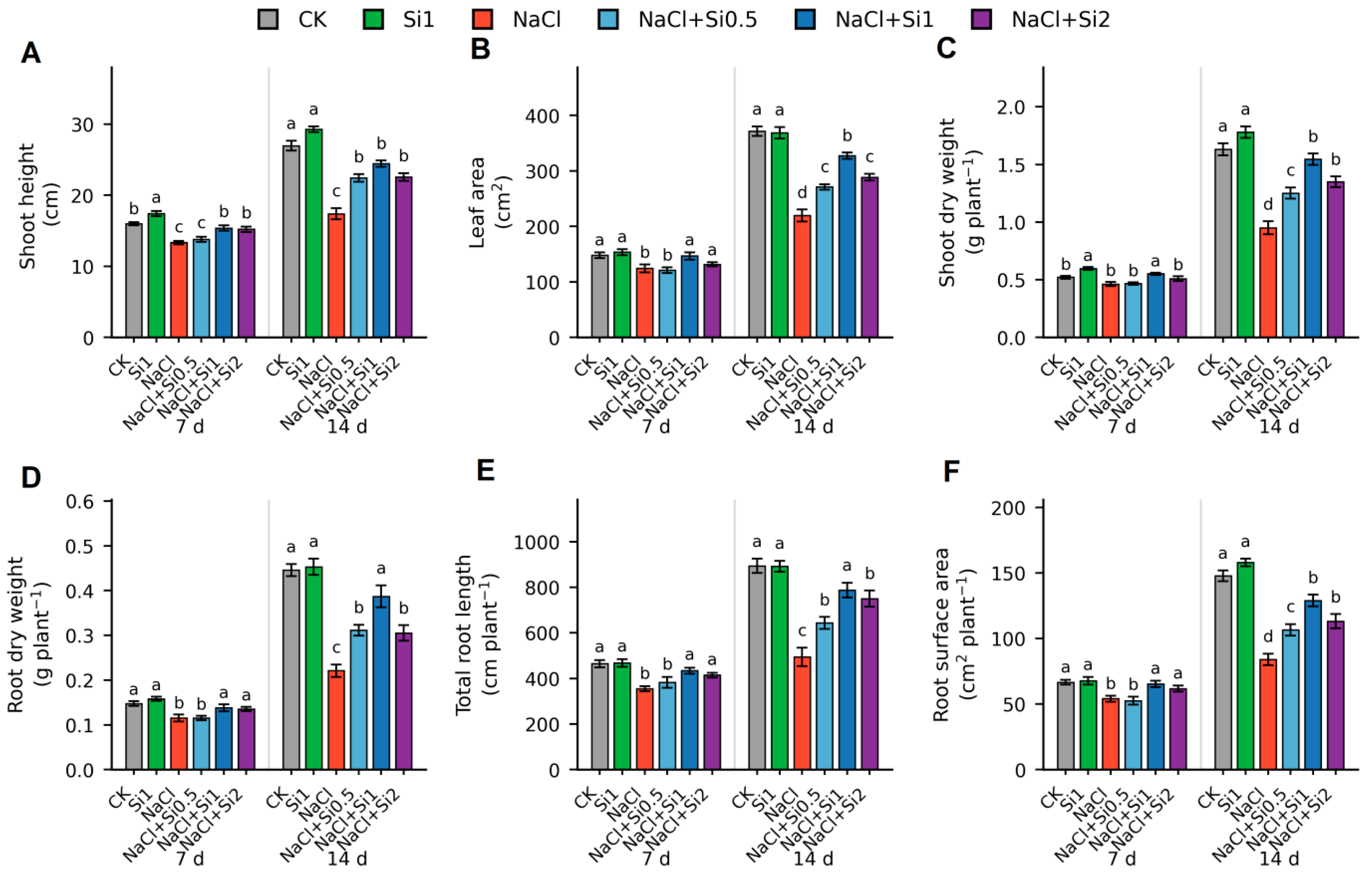
NaCl markedly inhibited cucumber seedling growth (
Figure 1). Additional growth traits supporting the growth and biomass results are reported in
Table S3. Treatment, sampling time, and their interaction significantly affected shoot height, leaf area, total root length, shoot dry weight, and root dry weight (
Table S4), with generally stronger inhibition at 14 d than at 7 d. K
2SiO
3 supplementation partially alleviated these reductions under NaCl stress. Among the three supplementation levels, NaCl + Si1 showed the strongest overall recovery of shoot growth, total root length, root surface area, and biomass, whereas NaCl + Si0.5 and NaCl + Si2 showed smaller improvements. Under non-saline conditions, Si1 generally remained comparable to CK.
Shoot and root fresh weights showed the same general response as dry biomass (
Table S3). At 14 d, all three K
2SiO
3 treatments increased shoot and root fresh weights relative to NaCl alone, with NaCl + Si1 showing the numerically highest fresh biomass among the salt-stressed K
2SiO
3 treatments. Leaf number differed little among treatments at 7 d but was reduced by NaCl at 14 d, whereas treatment differences in stem diameter were comparatively small.
3.3. K2SiO3 Partially Improved Pigment Status and Gas Exchange Under NaCl Stress
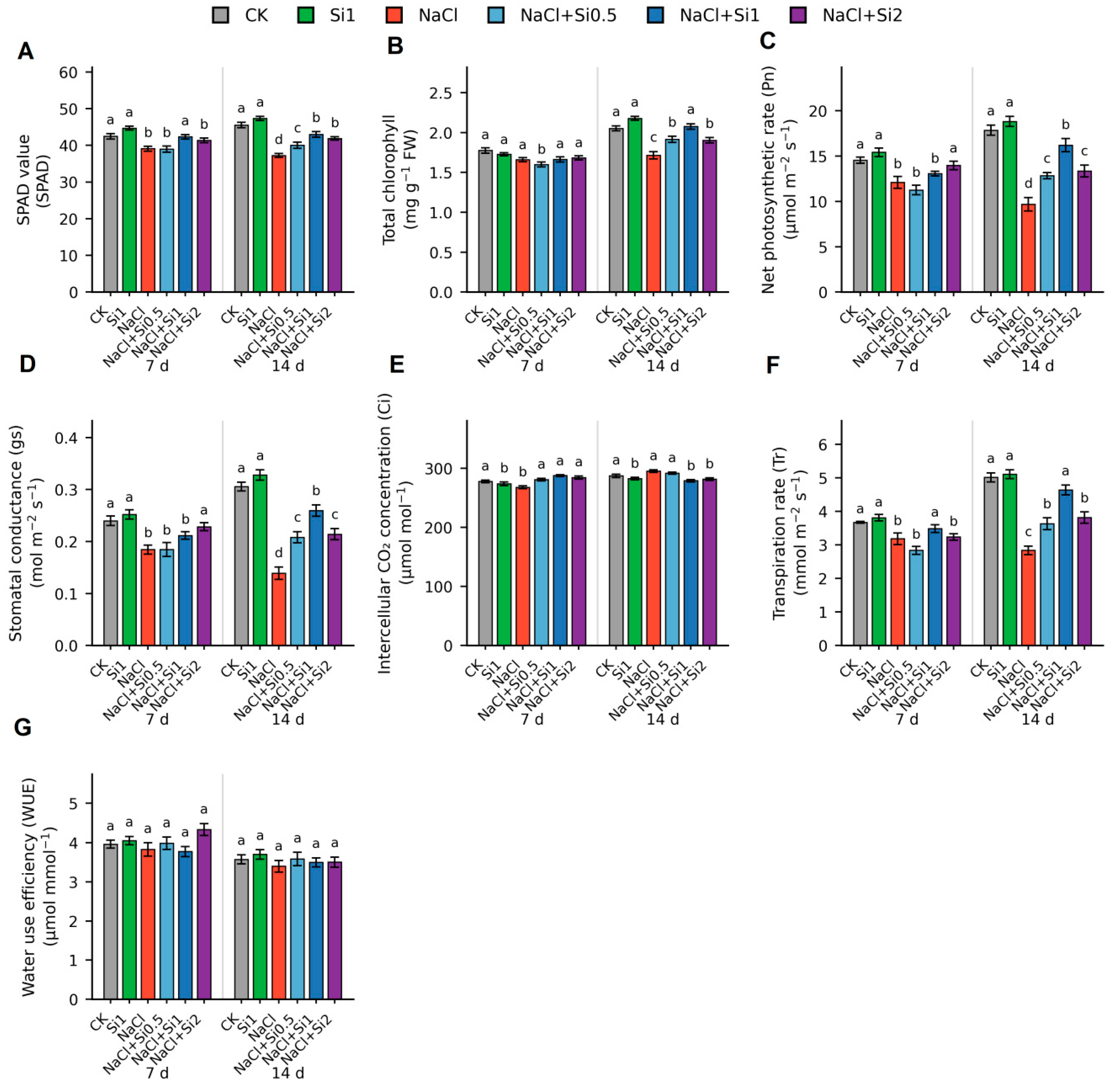
NaCl reduced photosynthetic pigment status and gas-exchange capacity in cucumber leaves (
Figure 2). Treatment, sampling time, and their interaction significantly affected SPAD value, total chlorophyll content, P
n, g
s, Ci, and T
r (
Table S4). By contrast, WUE showed no significant treatment effect or treatment × sampling-time interaction, indicating that this variable was less responsive to the imposed treatments than the other gas-exchange traits. Carotenoid content showed no significant treatment main effect, although the treatment × sampling-time interaction was significant (
Table S4).
K2SiO3 supplementation partially restored several NaCl-induced reductions in pigment status and gas exchange. Compared with NaCl alone, NaCl + Si0.5, NaCl + Si1, and NaCl + Si2 generally showed higher SPAD value, total chlorophyll content, Pn, gs, and Tr, but the magnitude of the response differed among supplementation levels. Among the three K2SiO3 treatments under NaCl stress, NaCl + Si1 showed the strongest overall recovery of pigment and gas-exchange traits. NaCl + Si0.5 produced a smaller improvement, whereas NaCl + Si2 did not consistently exceed NaCl + Si1 despite the higher K2SiO3 supplementation level. These results indicate a partial, rather than complete, recovery of photosynthetic pigment status and gas exchange under K2SiO3 supplementation.
The responses of C
i, WUE, and carotenoids differed from the responses of P
n, g
s, and T
r. Ci did not show the same directional response as Pn, suggesting that changes in gas exchange were not limited to a simple parallel reduction in all parameters. WUE was not significantly affected by treatment. Carotenoid content, which is reported in
Table S3 rather than
Figure 2, showed no treatment difference at 7 d. At 14 d, NaCl had the lowest carotenoid value, whereas NaCl + Si2 showed the highest value, and NaCl + Si0.5 and NaCl + Si1 were intermediate. Thus, the carotenoid response was weaker and less consistent than the responses of total chlorophyll and gas-exchange traits.
3.4. K2SiO3 Partially Maintained PSII Photochemistry and Energy Partitioning Under NaCl Stress
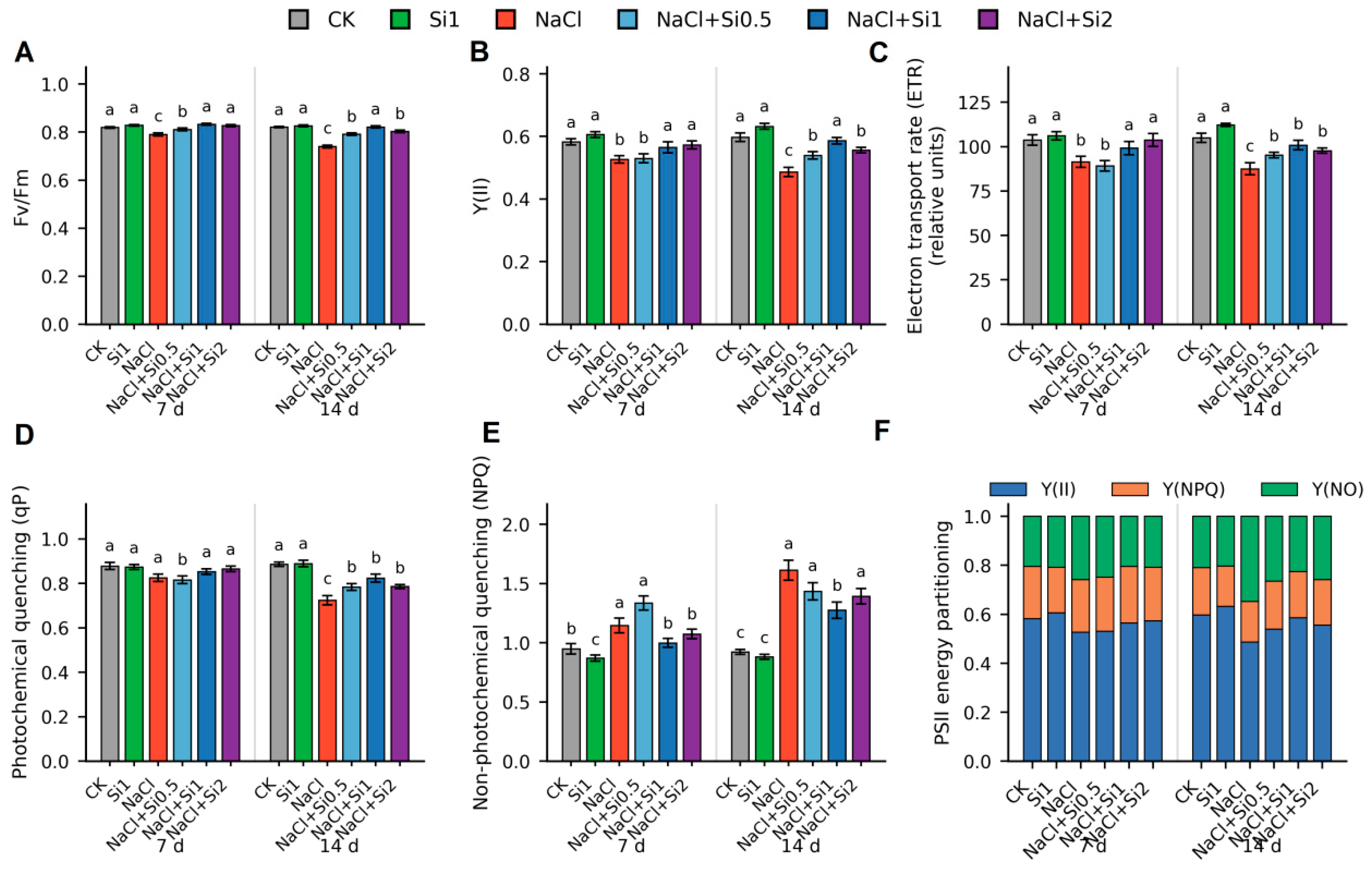
NaCl altered PSII photochemistry and energy partitioning in cucumber leaves (
Figure 3). Treatment significantly affected all measured PSII traits, including F
v/F
m, Y
(II), ETR, qP, NPQ, Y
(NPQ), and Y
(NO) (
Table S4). The treatment × sampling-time interaction was significant for F
v/F
m, qP, NPQ, and Y
(NO), but not for Y
(II), ETR, or Y
(NPQ). These results indicate that some PSII traits showed time-dependent treatment responses, whereas others were primarily affected by treatment across sampling times.
Relative to CK, NaCl reduced Fv/Fm, Y(II), ETR, and qP, indicating inhibition of PSII photochemical performance under salinity. K2SiO3 supplementation partially maintained these PSII photochemical traits under NaCl stress. Compared with NaCl alone, NaCl + Si0.5, NaCl + Si1, and NaCl + Si2 generally showed higher Fv/Fm, Y(II), ETR, and qP, with NaCl + Si1 showing the strongest overall recovery among the three K2SiO3 supplementation levels. NaCl + Si2 did not consistently produce a stronger response than NaCl + Si1, indicating that the PSII response was not simply proportional to the K2SiO3 supplementation level.
NaCl also modified PSII energy partitioning. Under NaCl stress, Y(II) decreased, whereas NPQ and Y(NO) increased, indicating reduced photochemical energy use together with increased energy dissipation and non-regulated energy loss. K2SiO3 supplementation partially reversed this pattern. In particular, NaCl + Si1 showed a partial shift toward higher photochemical energy use and lower stress-associated energy loss relative to NaCl alone. Y(NPQ) was less responsive than NPQ and Y(NO), as its treatment × sampling-time interaction was not significant. Overall, K2SiO3 partially maintained PSII photochemical function and energy partitioning under NaCl stress, with the most consistent response observed in NaCl + Si1.
3.5. K2SiO3 Reduced NaCl-Induced Oxidative Injury
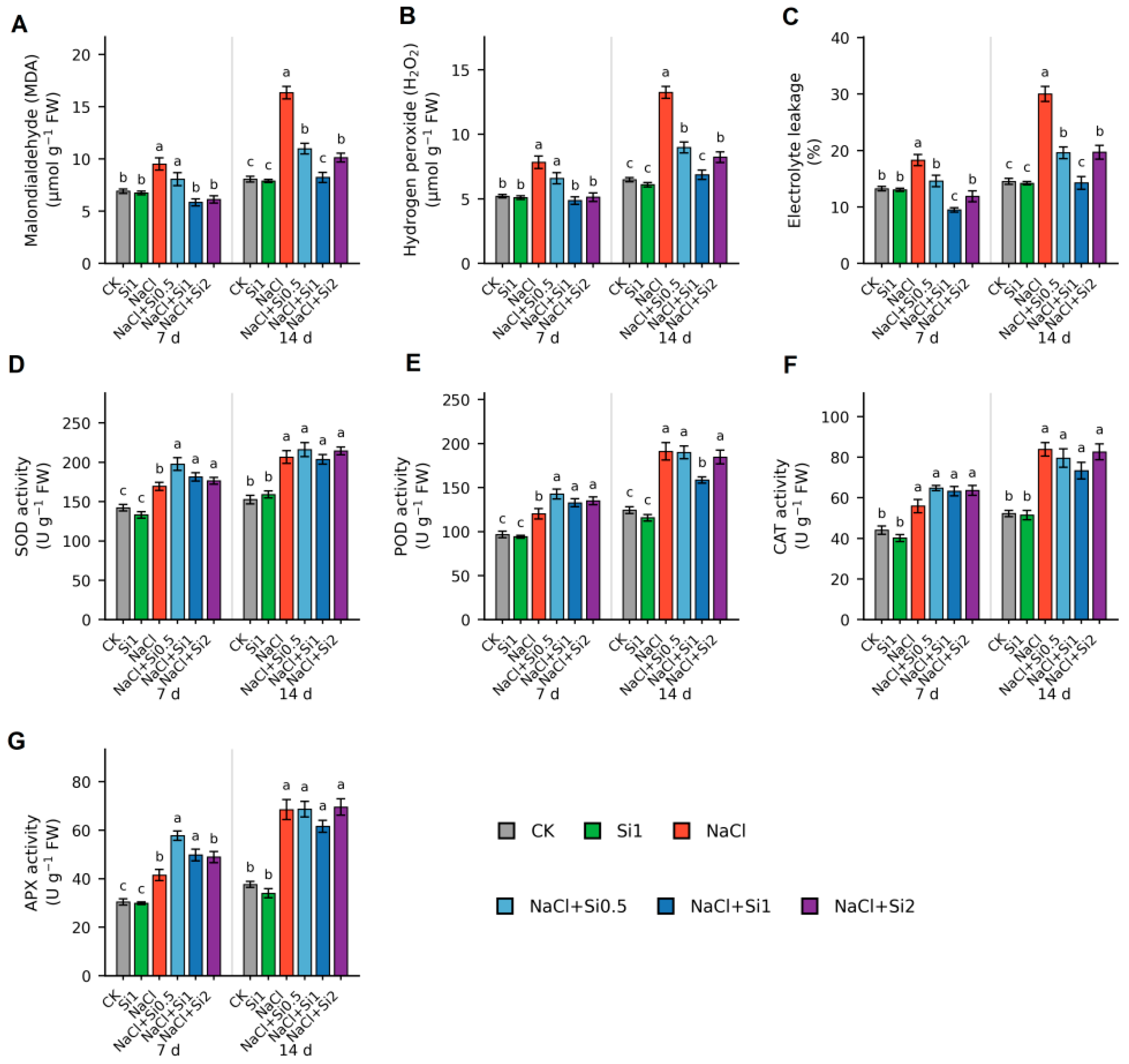
NaCl increased oxidative-injury indicators and altered antioxidant enzyme activities in cucumber leaves (
Figure 4). Treatment and sampling time significantly affected all measured oxidative-injury and antioxidant traits (
Table S4). The treatment × sampling-time interaction was significant for MDA, H
2O
2, electrolyte leakage, POD, CAT, and APX, whereas the interaction was not significant for SOD. Thus, most oxidative-injury and antioxidant traits showed time-dependent treatment responses, but SOD showed a more consistent treatment response across sampling times.
Relative to CK, NaCl increased MDA content, H2O2 content, and electrolyte leakage, indicating enhanced lipid peroxidation, reactive oxygen accumulation, and membrane injury under salinity. K2SiO3 supplementation partially reduced these oxidative-injury indicators under NaCl stress. Compared with NaCl alone, NaCl + Si0.5, NaCl + Si1, and NaCl + Si2 generally showed lower MDA, H2O2, and electrolyte leakage, but the magnitude of reduction differed among supplementation levels. NaCl + Si1 showed the strongest overall reduction in oxidative-injury indicators among the salt-stressed K2SiO3 treatments. NaCl + Si0.5 showed a partial reduction, whereas NaCl + Si2 did not consistently provide the greatest decrease despite the higher supplementation level.
The antioxidant enzyme responses were not uniform across enzymes. NaCl increased SOD, POD, CAT, and APX activities relative to CK, indicating that antioxidant responses were activated under salt stress. K2SiO3 supplementation modified these enzyme activities under NaCl stress, but the direction and magnitude of the changes differed among enzymes and supplementation levels. In several cases, lower MDA and H2O2 levels under NaCl + Si1 coincided with lower or moderately adjusted antioxidant enzyme activities relative to NaCl alone. This pattern indicates that K2SiO3 supplementation was associated with reduced oxidative injury, but not with a uniform increase in all antioxidant enzyme activities.
3.6. K2SiO3 Modified Osmotic Adjustment and Ion Homeostasis Under NaCl Stress
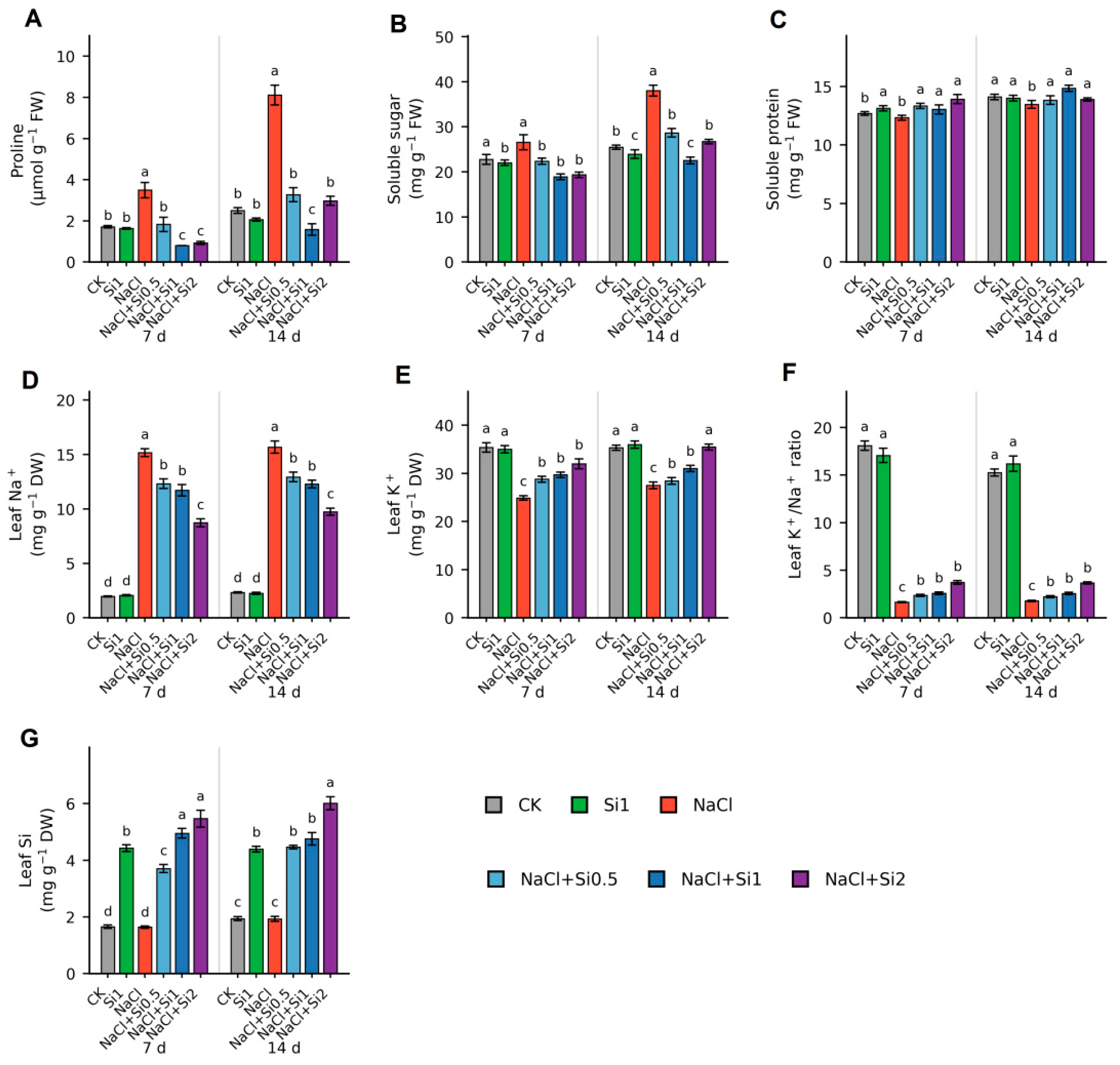
NaCl altered osmotic adjustment and ion homeostasis (
Figure 5). Treatment and sampling time significantly affected proline, soluble sugar, soluble protein, leaf Na
+, leaf K
+, the leaf K
+/Na
+ ratio, and leaf Si content, while the treatment × sampling-time interaction was significant for several of these traits (
Table S4). Salt stress increased proline, soluble sugar, and leaf Na
+ and markedly decreased the leaf K
+/Na
+ ratio. Potassium silicate partially reversed these responses.
Among the salt-stressed treatments, NaCl + Si2 produced the lowest leaf Na+ concentration and the highest K+/Na+ ratio, whereas NaCl + Si1 showed the strongest overall recovery of growth and photosynthesis. Thus, the most favorable ion-balance response did not coincide with the strongest integrated seedling response. Leaf Si content increased with increasing potassium silicate supplementation.
3.7. K2SiO3 Improved Root Activity and Nutrient-Related Traits Under NaCl Stress
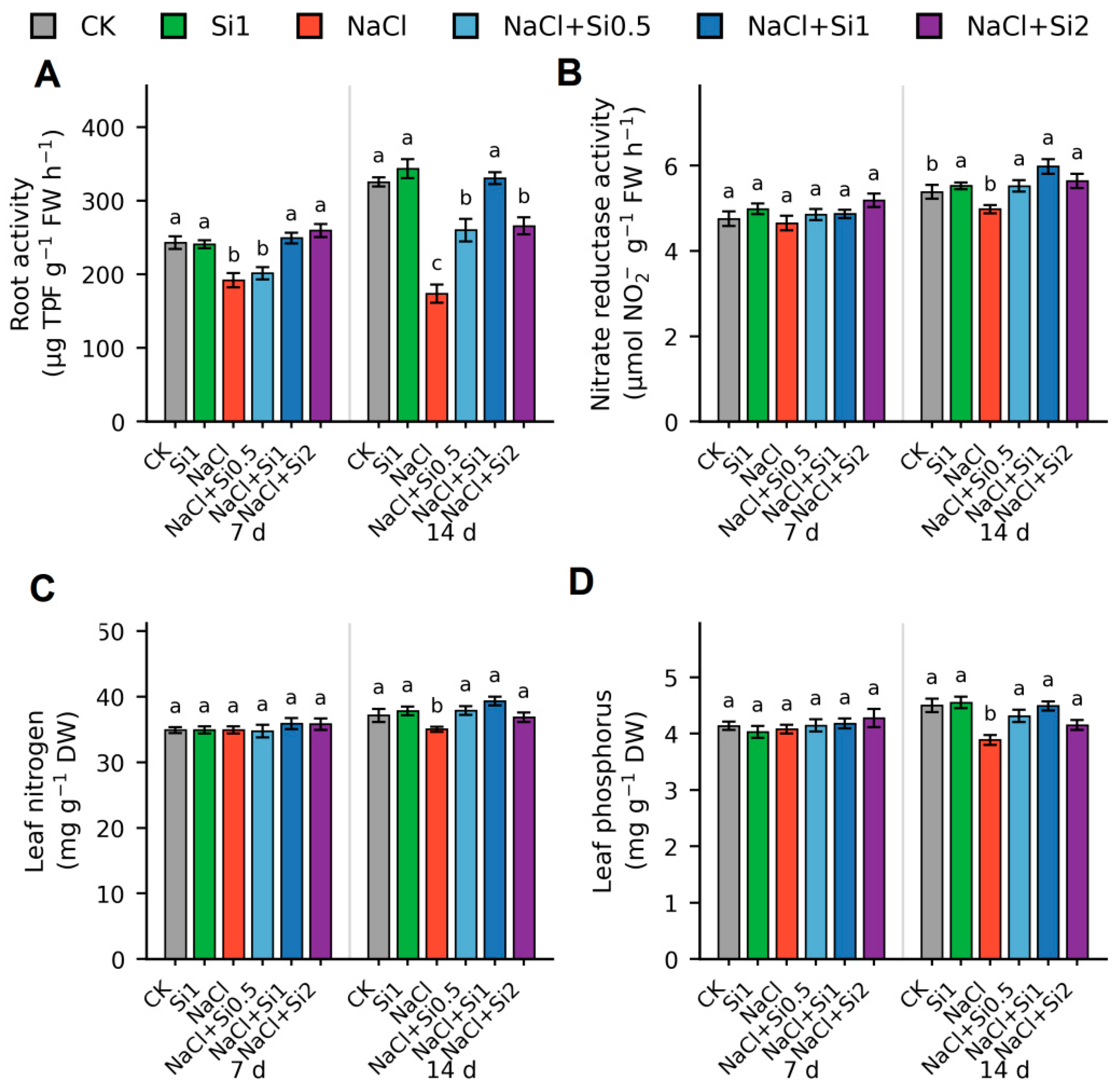
NaCl reduced root activity, nitrate reductase activity, and leaf P concentration, with smaller treatment-related changes also observed in leaf N concentration (
Figure 6). Treatment and sampling time significantly affected root activity, nitrate reductase activity, leaf N, and leaf P (
Table S4). The treatment × sampling-time interaction was significant for root activity and leaf P, whereas nitrate reductase activity and leaf N showed no significant interaction. Therefore, root activity and leaf P were interpreted using Tukey-adjusted comparisons among all treatment × sampling-time combinations (
Table S5), while nitrate reductase activity and leaf N were interpreted mainly according to the corresponding main effects.
Root activity showed a clear time-dependent treatment response. NaCl reduced root activity relative to CK and Si1, and the reduction was more pronounced at 14 d than at 7 d. Under NaCl stress, K2SiO3 supplementation partially restored root activity, but the magnitude of recovery differed among supplementation levels. At 14 d, NaCl + Si1 restored root activity to a level comparable to CK and Si1, whereas NaCl + Si0.5 and NaCl + Si2 showed intermediate values. Thus, NaCl + Si1 produced the strongest recovery of root metabolic activity among the salt-stressed K2SiO3 treatments.
Nitrate reductase activity showed significant treatment and sampling-time effects but no significant treatment × sampling-time interaction. Across sampling times, NaCl reduced nitrate reductase activity, whereas NaCl + Si1 and NaCl + Si2 showed higher overall values than NaCl. Leaf N concentration also showed a significant treatment effect, but the magnitude of treatment separation was comparatively small. NaCl tended to have lower leaf N, while NaCl + Si1 showed the highest overall treatment mean.
Leaf P showed a significant treatment × sampling-time interaction. At 7 d, treatment differences in leaf P were small. At 14 d, NaCl had the lowest leaf P concentration, whereas CK, Si1, and NaCl + Si1 maintained higher values. NaCl + Si0.5 and NaCl + Si2 showed intermediate responses. Overall, K
2SiO
3 supplementation partially maintained root activity and nutrient-related traits under NaCl stress, with the most consistent recovery observed in NaCl + Si1 (
Figure 6).
3.8. Integrated Relationships Among Growth, Photosynthesis, Oxidative Stress, and Ion Balance Under NaCl and K2SiO3 Treatments
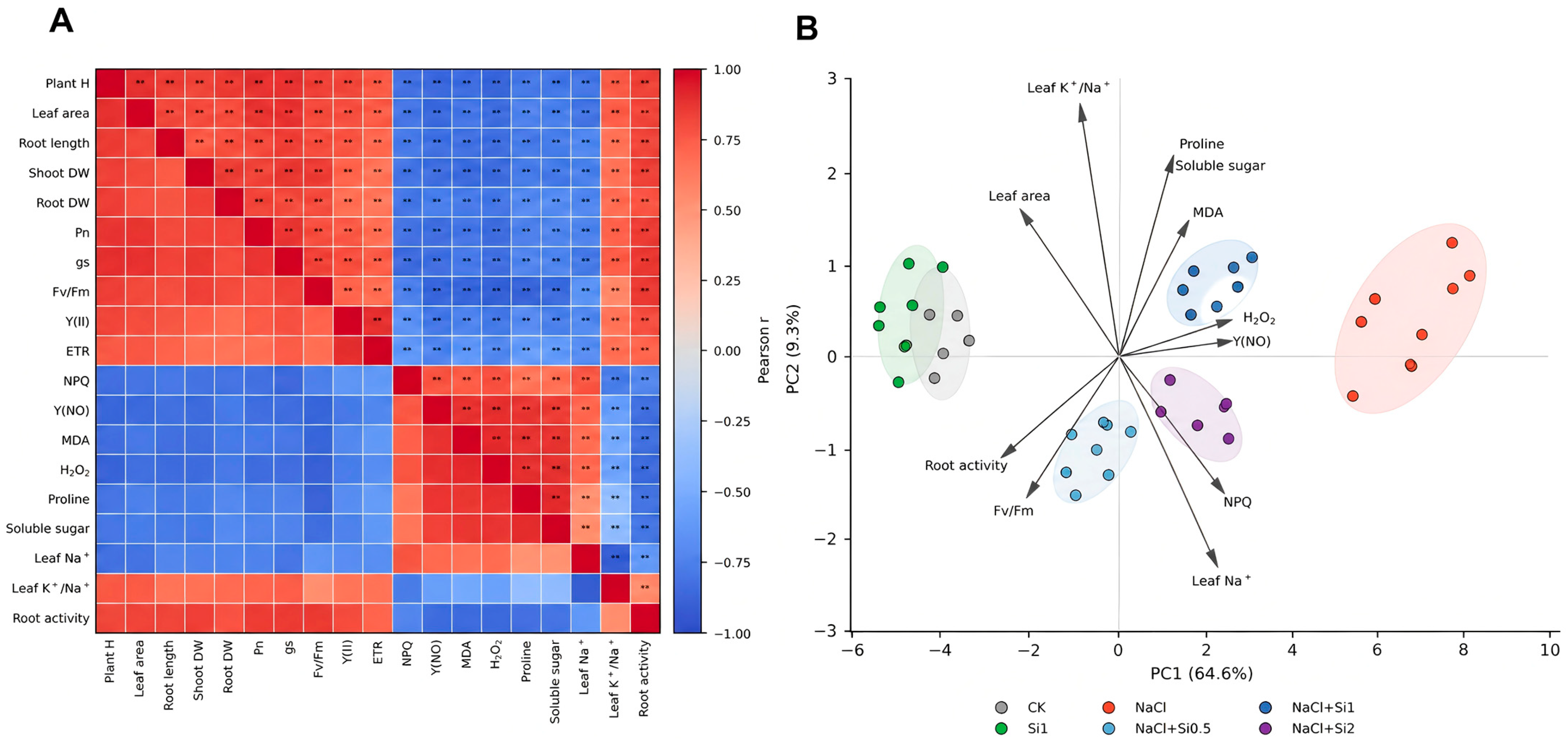
Selected Pearson correlations calculated from the 14 d biological-replicate dataset are reported in
Table S6. Shoot and root dry weight were positively correlated with shoot height, leaf area, total root length, root surface area, P
n, F
v/F
m, Y
(II), root activity, and the leaf K
+/Na
+ ratio. Both biomass traits were negatively correlated with NPQ, Y
(NO), MDA, H
2O
2, electrolyte leakage, proline, soluble sugar, and leaf Na
+ concentration. Because these correlations were calculated across six contrasting treatment groups, they were considered exploratory and may partly reflect treatment-associated separation.
PCA separated the six treatment groups (
Figure 7B). CK and Si1 were positioned toward the growth- and photosynthesis-related trait space, whereas NaCl was associated more strongly with oxidative-injury indicators, osmotic-stress variables, and leaf Na
+ accumulation. NaCl + Si1 shifted away from NaCl and toward CK and Si1, while NaCl + Si0.5 and NaCl + Si2 occupied intermediate positions. PC1 and PC2 explained 64.59% and 9.29% of the total variance, respectively, accounting for 73.88% cumulatively (
Table S7A). The PCA loadings are provided in
Table S7B.
4. Discussion
4.1. NaCl-Induced Growth Inhibition
The concentration of 75 mmol L
−1 NaCl in this study clearly caused inhibition of growth in cucumber seedlings. NaCl reduced shoot height, leaf area, shoot and root dry biomass, and root morphological traits, with the effects generally becoming more pronounced by 14 d. This reaction is in line with the overall impact of salinity on juvenile plants, which is characterized by osmotic stress and imbalance of ions that limit cellular growth, root functioning and biomass development [
1,
2].
NaCl reduced total root length, root surface area, root dry weight, and root metabolic activity, indicating that root-system development and physiological activity were constrained under salinity. Previous studies in cucumber have shown that salt-induced root impairment can be associated with reduced root water uptake and increased ion toxicity [
6,
7]. Such responses could contribute to limitations in water and nutrient supply to the shoot. However, the present experiment did not directly measure root hydraulic conductance or whole-plant water uptake, and therefore a direct causal pathway from reduced root activity to photosynthetic inhibition cannot be established.
The photosynthetic response also suggests that more than one limitation was involved. NaCl reduced stomatal conductance together with net photosynthetic rate, which is consistent with a stomatal component of photosynthetic inhibition. However, intercellular CO2 concentration did not decline proportionally with Pn, while chlorophyll content, Fv/Fm, Y(II), and ETR were also reduced. These responses indicate that non-stomatal limitations, including impaired photochemical performance, also contributed. Thus, reduced root function, altered water and ion relations, stomatal limitation, and photochemical impairment should be viewed as coordinated responses to salt stress rather than as a confirmed single cause-and-effect sequence.
The sodium chloride stress also enhanced leaf sodium (Na+) concentration and reduced potassium (K+)/sodium (Na+) ratio. This trend implies that some of the reduction in growth can be attributed to imbalance of ions. The excessive Na+ can damage the metabolism and nutrient balance of cells whereas a low K+/Na+ ratio may hinder physiological functions that are dependent on K+. Nevertheless, the available information cannot help in attributing the growth decline to a specific cause. The inhibition recorded is more probably due to the combined action of root limitation, osmotic stress, decreased photosynthesis, oxidative stress and changed ion homeostasis.
4.2. Growth Responses to K2SiO3 Under NaCl Stress
Potassium silicate supplementation partially alleviated NaCl-induced growth inhibition. Among the three supplementation levels tested under salt stress, NaCl + Si1 produced the strongest overall recovery of shoot growth, root development, biomass accumulation, and root activity. NaCl + Si0.5 and NaCl + Si2 also improved several growth traits relative to NaCl alone, but their integrated responses were smaller. This concentration-dependent pattern is consistent with the view that the benefit of Si-containing or potassium silicate treatments is not necessarily linear and may depend on plant species, stress intensity, application rate, and the accompanying ions supplied with the treatment source.
Comparable responses have been reported in other horticultural species under salinity. Potassium silicate alleviated salinity-associated reductions in growth, leaf water status, chlorophyll content, oxidative injury, and yield-related traits in strawberry grown under soilless culture [
47]. In
Bellis perennis, K
2SiO
3 was also associated with improved salinity tolerance and changes in photosynthetic and ion-related traits [
48]. These studies support the general relevance of potassium silicate under saline conditions, but they also indicate that the magnitude and optimal level of response may differ among species and cultivation systems.
Interpretation of the present growth response requires caution because K2SiO3 supplied both soluble Si and K+. The additional K+ may have contributed to changes in ion homeostasis and other physiological responses, particularly under NaCl stress. Because no K-matched control was included, the contributions of soluble Si and accompanying K+ cannot be separated. Accordingly, the responses observed in this study are interpreted as effects of potassium silicate supplementation rather than as Si-specific effects.
4.3. Photosynthetic Responses to NaCl and K2SiO3
Relative to CK, NaCl reduced SPAD value, total chlorophyll content, Pn, gs, and Tr, indicating that salinity lowered pigment status and gas-exchange capacity. The reduction in gs suggests that stomatal limitation contributed to the decline in Pn, because stomatal closure can restrict CO2 diffusion into leaves under salt stress.
However, Ci did not decrease in parallel with Pn. This pattern indicates that non-stomatal limitations may also have contributed to photosynthetic inhibition. These limitations may be associated with reduced chlorophyll content, impaired electron transport, and decreased biochemical capacity for carbon fixation. The decreases in Fv/Fm, Y(II), and ETR under NaCl are consistent with this interpretation. Thus, photosynthetic depression in NaCl-treated seedlings was likely associated with both stomatal and non-stomatal limitations.
Under salt stress, NaCl + Si0.5, NaCl + Si1, and NaCl + Si2 partially restored photosynthetic pigment status and gas exchange relative to NaCl. Among these treatments, NaCl + Si1 showed the strongest overall recovery of SPAD value, total chlorophyll content, Pn, gs, and Tr under the present experimental conditions. Similar cucumber studies have reported that Si-containing treatments can mitigate salt-induced declines in chlorophyll status, photosynthetic performance, and chlorophyll-fluorescence traits, although the degree of recovery depends on the Si source, concentration, cultivar, and stress conditions [
8,
49,
50]. Therefore, the improved photosynthetic response observed in NaCl + Si1 is best interpreted as part of a broader physiological response to K
2SiO
3 supplementation rather than as a single isolated photosynthetic effect.
4.4. PSII Energy Partitioning Under NaCl and K2SiO3 Treatments
The chlorophyll-fluorescence results indicated that PSII was sensitive to NaCl treatment. Relative to CK, NaCl decreased Fv/Fm, indicating reduced maximum PSII efficiency. NaCl also decreased Y(II) and ETR, indicating that the actual use of absorbed light energy for PSII photochemical electron transport was reduced. These responses are consistent with the salt-associated inhibition of photosynthesis observed in
Section 4.3.
PSII energy partitioning also changed under NaCl. The increase in NPQ indicates that a greater proportion of absorbed energy was dissipated as heat, which may represent a photoprotective response to excess excitation energy. However, NaCl also increased Y(NO). Because Y(NO) represents non-regulated energy loss, this increase suggests that a larger fraction of absorbed energy was lost through non-regulated pathways rather than controlled thermal dissipation. Therefore, NaCl was associated with both increased energy dissipation and a greater risk of photochemical energy imbalance.
Under salt stress, NaCl + Si0.5, NaCl + Si1, and NaCl + Si2 partially improved PSII photochemical performance relative to NaCl. Among these treatments, NaCl + Si1 showed the strongest overall recovery, with higher F
v/F
m, Y
(II), and ETR and lower NPQ and Y
(NO) than NaCl. These findings do not demonstrate a direct Si-specific effect on PSII because the K
2SiO
3 source supplied both Si and K
+. Rather, the improved PSII status in NaCl + Si1 was associated with the broader seedling response to K
2SiO
3 supplementation under salt stress. Previous cucumber studies have also linked Si-containing treatments with improved chlorophyll-fluorescence traits and reduced salt-associated photochemical impairment [
8,
50]. Under the present conditions, PSII energy partitioning therefore provided useful information for distinguishing improved photochemical use from stress-associated non-regulated energy loss.
4.5. NaCl-Induced Oxidative Injury and K2SiO3-Associated Alleviation
The stress of NaCl led to a rise in MDA, H
2O
2, and electrolyte leakage. Such indicators indicate that salt stress increased oxidative pressure and damage to membranes. MDA is often used as a marker of lipid peroxidation whereas H
2O
2 is one of the major reactive oxygen species. Elevated electrolyte leakage also implies less membrane stability [
23,
24].
The antioxidant enzyme activities were also enhanced during NaCl stress. SOD, POD, CAT and APX were found to be higher in NaCl-treated plants as compared with CK. It is implied by this response that cucumber seedlings initiated the antioxidant defense when faced with salinity. Nevertheless, increased antioxidant enzyme activity cannot be viewed individually as increased tolerance. Enzyme activities were high in NaCl treatment but MDA and H2O2 were equally high. It means that the antioxidant response was not enough to totally inhibit oxidative injury.
Potassium silicate supplementation reduced MDA, H
2O
2, and electrolyte leakage under salt stress, with the strongest overall reduction observed in NaCl + Si1. Some antioxidant enzyme activities were also lower in NaCl + Si1 than in NaCl alone while oxidative-injury indicators decreased. This pattern suggests a lower overall oxidative burden rather than a uniform stimulation of antioxidant enzyme activity. Previous studies in cucumber have similarly shown that Si nutrition can reduce lipid peroxidation and modify antioxidant enzyme responses under salinity [
49], and that Si-mediated alleviation of salt injury may be associated with reduced oxidative damage and changes in polyamine metabolism [
50,
51]. The present results are consistent with these reports, but because K
2SiO
3 supplied both Si and K
+, the oxidative-injury response should be interpreted as part of the combined response to potassium silicate supplementation.
4.6. Osmotic Adjustment Under NaCl and K2SiO3 Treatments
NaCl increased proline and soluble sugar accumulation, indicating that cucumber seedlings experienced osmotic stress under the imposed saline condition. These osmolytes are commonly associated with osmotic adjustment and may contribute to cellular water retention under stress [
27,
28,
29]. However, their accumulation should not be interpreted as a direct indicator of improved performance. In the present study, higher proline and soluble sugar levels occurred together with stronger oxidative injury, lower photosynthetic performance, and reduced growth under NaCl alone.
K2SiO3 supplementation reduced proline and soluble sugar accumulation under NaCl stress. This response should be interpreted cautiously because lower osmolyte concentrations do not necessarily mean weaker osmotic adjustment. Under the present conditions, the reduction in osmolyte accumulation coincided with lower MDA and H2O2 levels, higher root activity, and improved photosynthetic performance, particularly in NaCl + Si1. Therefore, the lower proline and soluble sugar levels in the K2SiO3-supplemented treatments more likely reflected a lower overall stress burden than a loss of stress-response capacity.
Soluble protein showed a less consistent response than proline and soluble sugar. This indicates that the osmotic-adjustment response was not uniform across all measured osmolyte-related traits. Together, these results suggest that osmotic adjustment was one component of the broader physiological response to NaCl and K2SiO3 treatments, rather than an isolated mechanism explaining growth recovery.
4.7. Ion Homeostasis Under NaCl and K2SiO3 Treatments
NaCl strongly affected ion homeostasis in cucumber seedlings. Leaf Na
+ concentration increased, while the leaf K
+/Na
+ ratio decreased, indicating salt-induced ionic imbalance. These changes are consistent with the general view that excessive Na
+ accumulation and a reduced K
+/Na
+ ratio can impair physiological processes that depend on K
+ availability and ion selectivity under salinity [
1,
2].
K2SiO3 supplementation was associated with lower leaf Na+ concentration and a higher leaf K+/Na+ ratio under NaCl stress. This ion-balance response was most pronounced in NaCl + Si2, which had the lowest leaf Na+ concentration and the highest K+/Na+ ratio among the salt-stressed treatments. However, NaCl + Si2 did not produce the strongest recovery of growth, root activity, photosynthetic performance, or oxidative status. Instead, NaCl + Si1 showed the strongest integrated seedling response. This divergence indicates that improved ion balance was associated with stress alleviation but did not fully explain the magnitude of whole-seedling recovery.
These ion-homeostasis responses require cautious interpretation because K
2SiO
3 supplied both soluble Si and K
+. Maintenance of a favorable K
+/Na
+ balance is an important component of plant responses to salinity, and Na
+ stress can disturb K
+ uptake, transport, and cellular homeostasis [
52,
53]. Therefore, the additional K
+ supplied with K
2SiO
3 may have contributed to the higher leaf K
+ concentration and K
+/Na
+ ratio, especially in NaCl + Si2. Because no K-matched control was included, the ion-homeostasis response cannot be attributed specifically to Si. It should instead be interpreted as part of the combined response to K
2SiO
3 supplementation. Future experiments including K-matched controls and alternative Si sources are needed to distinguish Si-specific effects from effects associated with accompanying K
+ supply.
4.8. Integrated Relationships Under NaCl and K2SiO3 Treatments
Correlation analysis indicated that biomass traits were positively associated with shoot height, leaf area, root morphological traits, Pn, Fv/Fm, Y(II), root activity, and the leaf K+/Na+ ratio. In contrast, biomass traits were negatively associated with NPQ, Y(NO), MDA, H2O2, electrolyte leakage, proline, soluble sugar, and leaf Na+ concentration. These associations suggest that better seedling performance under the present treatments was related to stronger root development, higher photosynthetic capacity, more efficient PSII photochemical performance, lower oxidative injury, and improved ion balance.
PCA further separated the treatment groups according to their integrated physiological profiles. CK and Si1 were positioned closer to the growth- and photosynthesis-related trait space, whereas NaCl was more strongly associated with oxidative-injury indicators, osmotic-stress variables, and leaf Na+ accumulation. NaCl + Si1 shifted away from NaCl and toward CK and Si1, while NaCl + Si0.5 and NaCl + Si2 occupied intermediate positions. This pattern is consistent with the stronger integrated response observed in NaCl + Si1.
These multivariate results should be interpreted as exploratory associations rather than evidence of a single causal pathway. The stronger response of NaCl + Si1 was associated with coordinated changes in root activity, photosynthetic performance, PSII energy use, oxidative status, osmotic adjustment, and ion balance. By contrast, NaCl + Si2 showed the strongest ion-balance response but not the strongest growth recovery. Therefore, the alleviation pattern under K2SiO3 supplementation was likely associated with the combined adjustment of multiple physiological processes rather than with ion homeostasis alone.
4.9. Limitations and Implications
This experiment was conducted under controlled hydroponic conditions at the seedling stage. Therefore, the findings should be interpreted within this experimental context. They cannot be directly extrapolated to cucumber flowering, fruit development, yield, or field performance. Further experiments under substrate culture, soil culture, and production-scale conditions are needed.
Only the 1.0 mmol L−1 Si treatment supplied as K2SiO3 was included under non-saline conditions. Therefore, the present design does not characterize the dose-dependent effects of K2SiO3 under non-saline conditions, and comparisons among the 0.5, 1.0, and 2.0 mmol L−1 supplementation levels should be restricted to the NaCl-stressed treatments.
A further limitation is that K2SiO3 was used as the Si source. Although nutrient-solution properties were monitored, the present design did not include a K-matched control. Therefore, the effects of soluble Si and accompanying K+ cannot be separated. The results should be interpreted as treatment-associated responses to K2SiO3 under hydroponic NaCl stress rather than as Si-specific effects.
The present study focused on physiological and biochemical responses. It did not examine Si transporter genes, Na+ transporters, aquaporins, or other molecular components. Therefore, the mechanisms discussed here should be interpreted as physiological explanations of the observed responses. Nevertheless, the results indicate that K2SiO3 supplementation may have potential for improving cucumber seedling performance under saline hydroponic conditions, although further testing of application rate and Si source is required before broader horticultural recommendations can be made.
5. Conclusions
The present study demonstrated that 75 mmol L−1 NaCl inhibited cucumber seedling growth by restricting root development, decreasing leaf water status, reducing gas exchange, impairing PSII photochemistry, altering PSII energy distribution, increasing leaf Na+ accumulation, decreasing the K+/Na+ ratio, and enhancing oxidative injury. These changes were accompanied by increased MDA, H2O2, electrolyte leakage, proline, and soluble sugar levels, indicating coordinated osmotic, ionic, photosynthetic, and oxidative stress responses.
K2SiO3 supplementation partially alleviated these NaCl-induced responses. Among the supplementation levels tested, K2SiO3 supplying 1.0 mmol L−1 Si produced the strongest integrated recovery of growth, root activity, photosynthetic performance, PSII function, and oxidative status. K2SiO3 supplying 2.0 mmol L−1 Si produced the lowest leaf Na+ concentration and the highest K+/Na+ ratio among the salt-stressed treatments but did not produce the greatest growth recovery. Thus, the most favorable ion-balance response did not coincide with the strongest integrated seedling response.
Correlation analysis and PCA further indicated that the stronger response of NaCl + Si1 was associated with coordinated changes in root activity, photosynthesis, PSII energy use, oxidative injury, osmotic adjustment, and ion balance. Because K2SiO3 supplied both soluble Si and K+ and no K-matched control was included, these responses cannot be attributed specifically to Si. The findings should therefore be interpreted as responses to K2SiO3 supplementation under the present hydroponic conditions. Further experiments using K-matched controls and alternative Si sources are needed to distinguish Si-specific effects from those associated with accompanying K+ supply.



 ,
,