


Abstract
Waterlogging restricts root-zone oxygen availability and can impair seedling growth and leaf quality in mulberry. Root-zone aeration may reduce waterlogging injury, but its effects on root anaerobic metabolism, photosynthesis, oxidative stress, and leaf functional quality have not been well integrated. In this study, Morus alba L. ‘Longsang No. 1’ seedlings were subjected to four treatments: normal moisture without aeration (CK), normal moisture with intermittent root-zone aeration (RA), waterlogging without aeration (WL), and waterlogging with intermittent root-zone aeration (WL+RA). Waterlogging was maintained with a water layer 1–2 cm above the substrate surface, and root-zone aeration was supplied using an air pump and microporous aeration stones for 30 min every 4 h. Root-zone dissolved oxygen, growth traits, root activity, root fermentative indicators, root and leaf oxidative injury, gas exchange, chlorophyll fluorescence, antioxidant enzyme activities, and leaf quality-related traits were measured after 14 d of treatment. Waterlogging decreased root-zone dissolved oxygen from 6.62 to 1.69 mg L−1. It also reduced plant height, total leaf area, shoot and root dry weight, root activity, Pn, Fv/Fm, Y(II), and ETR. In contrast, WL increased ADH and PDC activities, lactate and ethanol contents, MDA, H2O2, electrolyte leakage, and NPQ. Leaf 1-DNJ, polysaccharides, total phenolics, total flavonoids, DPPH, ABTS, and FRAP were also reduced under WL. Intermittent aeration increased root-zone dissolved oxygen to 4.64 mg L−1 under waterlogging and partially alleviated many of these changes. WL+RA showed higher growth, root activity, photosynthetic performance, PSII photochemical efficiency, antioxidant enzyme activities, and leaf functional quality than WL. These results indicate that intermittent root-zone aeration was associated with better mulberry seedling performance under waterlogging, together with changes in root-zone oxygen status, fermentation metabolism, photosynthesis, oxidative balance, and leaf quality.
1. Introduction
Mulberry leaves contain a range of bioactive constituents, including 1-deoxynojirimycin (1-DNJ), polysaccharides, phenolic compounds, and flavonoids. Recent studies have further characterized the 1-DNJ and polyphenol-related composition of mulberry leaves and demonstrated that their phenolic and flavonoid constituents contribute substantially to DPPH, ABTS, and FRAP antioxidant capacity [1,2,3]. Stable leaf growth and good leaf quality are essential in growing and using mulberry. Environmental stress can impact biomass production and leaf chemical composition.
Waterlogging is a frequent stressor in horticultural and nursery environments particularly when there are high levels of precipitation, bad drainage, or packed substrates. Gas diffusion is significantly restricted when the root zone is flooded. Availability of oxygen near the roots is also reduced. This might inhibit root respiration and absorption of nutrients and inhibit growth [4,5]. Recent studies in mulberry have further shown that waterlogging can restrict plant growth, reduce chlorophyll content and gas exchange, alter chlorophyll fluorescence, and increase non-photochemical energy dissipation [4,6,7].
Hypoxia in the root zone alters the metabolism of the plant. In limiting oxygen, roots might have enhanced anaerobic fermentation as a way of sustaining energy provision. Alcohol dehydrogenase and pyruvate decarboxylase are important enzymes involved in this pathway. Lactate and ethanol may accumulate when aerobic respiration is limited [5,8]. Such alterations may assist the plants to survive in conditions of low oxygen over the short term, and long-term anaerobic metabolism might be linked to carbon losses, cellular damage and decreased root growth. Waterlogging can also induce the formation of reactive oxygen species under stress or reoxygenation. It could enhance membrane lipid peroxidation and electrolyte leakage [5,8].
Reduced oxygen levels in the root zone can lead to changes in photosynthesis. Root stress may decrease the amount of water and nutrients that are delivered to leaves. It can also interfere with the stomatal behavior and chloroplast function. The alterations might reduce net photosynthetic rate, stomatal conductance and chlorophyll level. Chlorophyll fluorescence has been found to be useful in monitoring photosystem II when under stress. Fv/Fm is the highest photochemical performance index of PSII, whereas Y(II), ETR, qP, and NPQ are measures of light-acclimated photochemistry and energy dissipation [9,10]. Photosynthetic limitation and a change in the fluorescence parameters are frequently correlated with growth inhibition in crops experiencing root-zone oxygen deprivation [11,12,13].
Root-zone aeration is a potential management practice for reducing waterlogging injury. Studies in several horticultural and crop species have shown that increasing oxygen availability in the root zone can improve root growth, photosynthetic performance, antioxidant regulation, and water or nutrient acquisition under hypoxic or waterlogged conditions [11,12,13]. In mulberry, previous studies have primarily characterized the effects of waterlogging on plant growth, chlorophyll content, gas exchange, chlorophyll fluorescence, and related stress responses [4,6,7]. However, it remains unclear whether intermittent root-zone aeration can simultaneously modify root-zone oxygen status, root fermentative metabolism, photosynthetic performance, oxidative injury, and whole-plant growth in waterlogged mulberry seedlings.
This question is particularly relevant because mulberry leaves are not only photosynthetic organs but also harvested plant materials valued for their functional constituents, including 1-deoxynojirimycin (1-DNJ), polysaccharides, phenolic compounds, and flavonoids [1,2,3]. Among these constituents, 1-DNJ was selected as one of the principal quality indicators because it is a characteristic bioactive component of mulberry leaves and provides a specific measure of their compositional quality. Polysaccharides, total phenolics, total flavonoids, and the DPPH, ABTS, and FRAP assays were included as complementary indicators of broader compositional and chemical antioxidant properties. Thus, 1-DNJ was not treated as a stand-alone representation of leaf quality but was evaluated together with these complementary quality-related traits. Limited information is currently available on whether intermittent root-zone aeration can maintain these traits during waterlogging or how their changes occur in parallel with root-zone oxygen status and plant physiological responses. The present study addresses this gap by integrating measurements of root-zone dissolved oxygen, root fermentative and oxidative responses, photosynthesis, chlorophyll fluorescence, leaf oxidative status, and functional-quality traits within a single factorial experiment.
Accordingly, this study evaluated the responses of mulberry seedlings to intermittent root-zone aeration during waterlogging. The purposes included (1) to establish whether aeration can enhance the level of dissolved oxygen in the root zone and relieve the inhibition of growth caused by waterlogging; (2) to examine changes in root anaerobic metabolism and oxidative injury; (3) to appraise photosynthetic pigments, gas exchange and photochemistry of PSII; (4) to measure leaf oxidative damage, the activities of antioxidant enzymes and quality traits of the leaves; and (5) to investigate the interactions between root-zone oxygen, growth, photosynthesis, oxidative status and quality of leaves.
2. Materials and Methods
2.1. Plant Material and Growth Conditions
Uniform one-year-old nursery-grown mulberry (Morus alba L. ‘Longsang No. 1’) seedlings were obtained from the same nursery lot in Tailai County, Qiqihar City, Heilongjiang Province, China. Similar growth status seedlings were chosen prior to treatment. The first plant height was about 25 ± 2 cm and the base stem diameter was about 5.0 ± 0.5 mm. Diseased plants, mechanically damaged plants or abnormal growth were eliminated.
Each seedling was transplanted into a 3.0 L plastic pot filled with a prepared soilless substrate rather than mineral soil. The substrate consisted of sterilized peat, perlite, and vermiculite mixed at a volume ratio of 3:1:1. Therefore, soil classification according to the World Reference Base for Soil Resources or USDA Soil Taxonomy was not applicable. After mixing, the substrate had a pH of 5.32. The organic matter, total nitrogen, total potassium, total phosphorus, hydrolyzable nitrogen, available potassium, and available phosphorus contents were 49.20 g kg−1, 2.18 g kg−1, 14.60 g kg−1, 2.74 g kg−1, 166 mg kg−1, 207 mg kg−1, and 430 mg kg−1, respectively. In pots assigned to the root-zone aeration treatments, a microporous aeration stone connected to an aeration tube was placed at the bottom of each pot before substrate filling. Non-aerated pots were equipped with the same tubing and aeration stones but received no air supply, thereby maintaining a comparable pot structure among treatments.
Prior to treatment, all seedlings were acclimated over a period of 10 days under greenhouse conditions having a photoperiod of 14 h/10 h light/dark, day/night temperatures of 25/18 °C, relative humidity of 65–75 percent, and a photosynthetic photon flux density of about 250 μmol m−2 s−1. Plants were watered during acclimation so that they would not experience water deficit. The application of foliar fertilizer and pesticide was not done in the experimental period.
Fully expanded mature leaves at the same developmental position were used for physiological, biochemical, and functional-quality assays.
2.2. Waterlogging and Root-Zone Aeration Treatments
The experiment was arranged as a two-factor design with water regime and root-zone aeration as the two factors. Four treatment combinations were established: CK: normal moisture without root-zone aeration; RA: normal moisture with intermittent root-zone aeration; WL: waterlogging without root-zone aeration; WL+RA: waterlogging with intermittent root-zone aeration (Table 1).
Table 1.
Experimental treatment design for the mulberry seedling waterlogging and root-zone aeration experiment.
For CK and RA, substrate moisture was maintained at approximately 70–75% of the water-holding capacity by weighing pots daily and adding distilled water when necessary. For WL and WL+RA, waterlogging was imposed by maintaining a water layer 1–2 cm above the substrate surface. The water layer height was checked twice daily, and distilled water was added when necessary. The water layer height was kept identical between WL and WL+RA throughout the experiment.
Root-zone aeration was supplied using an air pump connected to microporous aeration stones placed near the bottom of each pot. For RA and WL+RA, aeration was applied intermittently for 30 min every 4 h. The air-flow rate was adjusted to approximately 0.8–1.0 L min−1 per pot. CK and WL pots were equipped with the same tubing and aeration stones but did not receive air supply.
The treatment lasted for 14 d. Each treatment contained six biological replicates, with one pot containing one seedling considered one biological replicate. Pots were randomly arranged and repositioned every two days to reduce positional effects. At the end of the 14 d treatment, seedlings were destructively harvested for growth, root activity, anaerobic metabolism, photosynthetic, oxidative damage, antioxidant enzyme, and leaf functional-quality measurements.
2.3. Root-Zone Dissolved Oxygen and Waterlogging Monitoring
Root-zone dissolved oxygen was measured at 09:00 on day 14 using a portable dissolved oxygen meter (HQ40d, Hach, Loveland, CO, USA) equipped with an optical dissolved oxygen probe. Before treatment, a perforated sampling tube wrapped with nylon mesh was inserted into the root zone of each pot, and the root-zone solution accumulated in the tube was used for measurement. For RA and WL+RA, dissolved oxygen was measured immediately before the next scheduled aeration cycle to avoid selectively recording the transient oxygen increase that may occur immediately after aeration. Dissolved oxygen was not monitored continuously or repeatedly over the 14-day treatment period. Therefore, the reported values represent pre-aeration endpoint measurements on day 14 rather than time-averaged dissolved oxygen concentrations. Possible temporal fluctuations between aeration cycles were not quantified.
2.4. Growth Traits, Biomass, and Root Activity
The values of plant height, stem diameter, leaf number, total leaf area, shoot dry weight, root dry weight, root/shoot ratio, and root activity were determined at harvest.
Plant heights were measured with the help of rulers as the distance between the substrate surface and the shoot apex. The stem diameter was measured with the help of the digital caliper (Mitutoyo, Kawasaki, Japan) with the stem placed 2 cm above the substrate surface. A manual count of the leaves was done. Total leaf area per plant was determined by LI-3100C area meter (LI-COR BIOSCIENCES, Lincoln, NE, USA).
Shoots and roots were separated after harvest. Samples were gently rinsed with distilled water, blotted dry, and weighed when fresh-weight data were required. Samples were then heated at 105 °C for 30 min and dried at 75 °C to constant weight in a forced-air drying oven (DHG-9140A, Shanghai Yiheng Scientific Instrument Co., Ltd., Shanghai, China). Shoot dry weight and root dry weight were recorded. The root/shoot ratio was calculated as root dry weight divided by shoot dry weight.
Root activity was assessed using the triphenyl tetrazolium chloride (TTC) reduction method. Fresh root samples (0.50 g) were incubated at 37 °C in darkness for 2 h with 5 mL of 0.4% TTC solution and 5 mL of 0.1 M phosphate buffer (pH 7.0). The reaction was terminated by adding 2 mL of 1 M H2SO4. The reduced triphenyl formazan was extracted with ethyl acetate, and the absorbance was measured at 485 nm using a UV-1800 UV–visible spectrophotometer (Shimadzu, Kyoto, Japan). Root activity was expressed as μg TPF g−1 FW h−1. The TTC reduction value was used as an operational indicator of root metabolic activity and was not considered a direct measurement of root oxygen consumption, mitochondrial respiration, or aerobic ATP production.
2.5. Root Fermentative Indicators and Root Oxidative Injury
The fresh roots were harvested and promptly frozen with liquid nitrogen and kept at −80 °C until analyzed. Anaerobic metabolism of roots was assessed through measurement of alcohol dehydrogenase activity, pyruvate decarboxylase activity, lactate content and ethanol content.
The colorimetry kits (Suzhou Comin Biotechnology Co., Ltd., Suzhou, China) were used to determine alcohol dehydrogenase activity and pyruvate decarboxylase activity per the manufacturer instructions. The enzyme activities were given in U g−1 FW. Commercial assay kits of the same supplier were used to measure the lactate content and the ethanol content and expressed as μmol g−1 FW. This was chosen since root-zone hypoxia may promote fermentation metabolism via ADH- and PDC-associated pathways.
Root H2O2 content was measured according to Velikova et al. [14], with slight modifications. The fresh root tissue was extracted using 0.1% trichloroacetic acid and the extract was mixed with potassium phosphate buffer and potassium iodide. The absorbance was read at 390 nm. Root MDA content was determined using the thiobarbituric acid method described by Heath and Packer [15]. The relative electrolyte leakage of roots was measured by the use of fresh root segments and the DDS-307A conductivity meter (Leici, Shanghai, China). Deionized water was used to rinse the samples which were then put in test tubes filled with deionized water. Preliminary conductivity was read after keeping them in room temperature incubation conditions for 12 h. After boiling the samples (30 min) and cooling down to room temperature, final conductivity was read. Relative electrolyte leakage was computed as follows: REL (%) = C1/C2 × 100, where C1 is the initial conductivity and C2 is the final conductivity after boiling.
2.6. Photosynthetic Pigments and Gas-Exchange Measurements
The newest fully expanded mature leaves were used for pigment and gas-exchange measurements. SPAD values were measured using a SPAD-502 Plus chlorophyll meter (Konica Minolta, Osaka, Japan). Five readings were taken from each biological replicate, avoiding the main vein, and the mean value was used for analysis.
Extracts of photosynthetic pigments were made by suspending 0.20 g of fresh leaf tissue in 20 mL of 80 percent acetone in darkness until all of the tissue was decolorized. The extract was centrifuged at 10,000× g after 10 min at 4 °C. The measurements of absorbance were conducted at 663, 646, and 470 nm with a UV-1800 UV–visible spectrophotometer (Shimadzu, Kyoto, Japan). The contents of chlorophyll a, chlorophyll b, and carotenoids were determined according to the method described by Lichtenthaler [16].
The measurements of leaf gas-exchange parameters were performed in the period between 09:00 and 11:00 with the help of an LI-6400XT portable photosynthesis system (LI-COR Biosciences, Lincoln, NE, USA). The measurements were recorded on intact, fully expanded mature leaves. The leaf chamber had a red–blue light source. Photosynthetic photon flux density was fixed at 1000 μmol m−2 s−1. Reference CO2 concentration was held at 400 μmol mol−1. Air-flow rate was 500 μmol s−1 and leaf temperature was kept at 25 °C.
The net photosynthesis rate (Pn), stomatal conductance (Gs), intercellular CO2 concentration (Ci), and transpiration rate (Tr) were the measured parameters. The readings were taken once the measurements had stabilized. The instantaneous water-use efficiency was determined as WUE = Pn/Tr.
Gas-exchange measurements were interpreted according to standard principles for photosynthetic gas-exchange analysis [17,18].
2.7. Chlorophyll Fluorescence Measurements
Chlorophyll fluorescence was measured using a pulse-amplitude-modulated chlorophyll fluorometer (MINI-PAM-II, Heinz Walz GmbH, Effeltrich, Germany). The same type of leaf used for gas exchange was used for fluorescence measurement. Leaves were dark-adapted for 30 min before measurement.
Minimal fluorescence (Fo) was recorded under weak measuring light. Maximal fluorescence (Fm) was induced by a saturating pulse of approximately 8000 μmol m−2 s−1 for 0.8 s. The maximum quantum efficiency of PSII was calculated as Fv/Fm = (Fm − Fo)/Fm.
After dark-adapted measurements, leaves were exposed to actinic light at 600 μmol m−2 s−1 until steady-state fluorescence was reached. Steady-state fluorescence (Fs) and light-adapted maximal fluorescence (Fm′) were recorded. The effective quantum yield of PSII [Y(II)], electron transport rate (ETR), photochemical quenching coefficient (qP), and non-photochemical quenching (NPQ) were calculated according to standard chlorophyll fluorescence protocols [9,10,19]. ETR was calculated as ETR = Y(II) × PPFD × 0.84 × 0.5, where PPFD was the actinic light intensity during fluorescence measurement, 0.84 represents assumed leaf absorptance, and 0.5 represents assumed equal distribution of absorbed light energy between PSI and PSII.
2.8. Leaf Oxidative Damage and Antioxidant Enzyme Activities
Fresh leaf samples were collected immediately after physiological measurements, frozen in liquid nitrogen, and stored at −80 °C until biochemical analysis.
Leaf H2O2 content was determined according to Velikova et al. [14]. The O2− production rate was measured by the hydroxylamine oxidation method [20]. Leaf MDA content was determined using the thiobarbituric acid method [15]. Leaf relative electrolyte leakage was measured using leaf discs and a DDS-307A conductivity meter (Leici, Shanghai, China). Leaf discs were rinsed with deionized water and immersed in deionized water for 12 h. Initial conductivity was recorded as C1. Samples were then boiled for 20 min, cooled to room temperature, and final conductivity was recorded as C2. Relative electrolyte leakage was calculated as REL (%) = C1/C2 × 100.
For antioxidant enzyme extraction, 0.50 g of fresh leaf tissue was ground in 5 mL of ice-cold 50 mM phosphate buffer at pH 7.0 containing 1 mM EDTA and 1% polyvinylpyrrolidone. The homogenate was centrifuged at 12,000× g for 20 min at 4 °C. The supernatant was used for enzyme assays.
SOD activity was measured by inhibition of nitroblue tetrazolium reduction at 560 nm [21]. POD activity was measured using the guaiacol oxidation method [22]. CAT activity was determined by monitoring H2O2 decomposition at 240 nm [23]. APX activity was determined by following the decrease in absorbance at 290 nm due to ascorbate oxidation [24]. Enzyme activities were expressed on a fresh-weight basis as U g−1 FW.
2.9. Osmotic Adjustment Substances and Leaf Functional Quality
Soluble sugar content was determined using the anthrone colorimetric method [25]. Fresh leaf tissue was extracted in distilled water in a boiling water bath. The extract was mixed with anthrone reagent and concentrated sulfuric acid, and absorbance was measured at 620 nm. Soluble sugar content was expressed as mg g−1 FW.
The concentration of soluble proteins was measured by means of the Coomassie Brilliant Blue G-250 technique [26]. A fresh leaf sample was treated with a phosphate buffer and combined with the Coomassie Brilliant Blue reagent. The absorbance was read at 595 nm and the standard used was bovine serum albumin. Soluble protein content was given in mg g−1 FW.
To evaluate the functionality of the leaves, full grown leaves were harvested at 14 d, freeze dried, milled and sieved using 60 mesh. The values of 1-DNJ, polysaccharides, total phenolics, total flavonoids and antioxidant capacity are given in dry-weight basis.
The 1-deoxynojirimycin (1-DNJ) content was determined by reversed-phase high-performance liquid chromatography after pre-column derivatization with 9-fluorenylmethyl chloroformate (FMOC-Cl), following the method [27]. Quantification was performed using an external 1-DNJ standard, and the results were expressed as mg g−1 DW.
The analysis of polysaccharides was done with the help of the phenol-sulfuric acid method and expressed in mg glucose equivalents g−1 DW [25]. The total phenolic content was analyzed based on the Folin–Ciocalteu and reported as mg gallic acid equivalents g−1 DW [28]. The total flavonoid content was assessed through the colorimetric method of aluminum chloride and presented as mg rutin equivalents g−1 DW [29].
Chemical antioxidant capacity was evaluated using DPPH, ABTS, and FRAP assays. DPPH radical-scavenging activity was measured [30]. ABTS radical cation-scavenging capacity was measured [31]. Ferric-reducing antioxidant power was measured [32]. DPPH and ABTS results were expressed as μmol Trolox equivalents g−1 DW, and FRAP results were expressed as μmol Fe2+ equivalents g−1 DW.
2.10. Statistical Analysis
Data were analyzed using SPSS 27.0 (IBM Corp., Armonk, NY, USA) and R 4.3.2 (R Core Team, Vienna, Austria). Data are presented as means ± standard deviations based on six biological replicates. Normality of model residuals was assessed using the Shapiro–Wilk test, and homogeneity of variance was examined using Levene’s test. Variables were transformed when necessary to meet the assumptions of analysis of variance, whereas untransformed values are presented in the figures.
Because the experiment followed a 2 × 2 factorial design, two-way analysis of variance was used to test the main effects of water regime, root-zone aeration, and their interaction on root-zone dissolved oxygen and the physiological, biochemical, growth, and leaf quality-related variables measured at day 14.
Partial eta squared (ηp2) was calculated as an estimate of the magnitude of the main effects of water regime and root-zone aeration and of their interaction. The F values, exact p values, and ηp2 values for all main and interaction effects are reported in Supplementary Table S1.
To compare the four individual treatment combinations and assign lowercase letters in the figures, one-way analysis of variance followed by Tukey’s honestly significant difference test was performed at p < 0.05. This treatment-combination analysis was used for graphical presentation and did not replace the factorial analysis. Figures were prepared using OriginPro 2023 (OriginLab Corporation, Northampton, MA, USA). Full two-way ANOVA outputs for the factorial analysis are provided in Supplementary Table S1.
3. Results
3.1. Root-Zone Aeration Improved Oxygen Status and Partially Alleviated Growth Inhibition Under Waterlogging
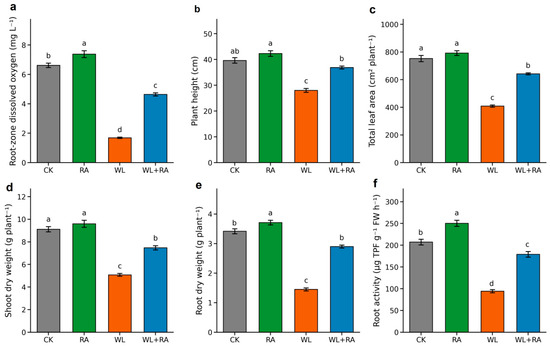
At the pre-aeration measurement on day 14, waterlogging strongly reduced root-zone dissolved oxygen (Figure 1a). The dissolved oxygen concentration was 6.62 mg L−1 in CK and 7.38 mg L−1 in RA. It decreased to 1.69 mg L−1 under WL. In WL+RA, dissolved oxygen was 4.64 mg L−1, which was higher than that in WL but remained lower than those in CK and RA. These values represent the root-zone oxygen status at the specified pre-aeration endpoint and not mean concentrations over the entire treatment period.
Figure 1.
Effects of waterlogging and intermittent root-zone aeration on root-zone dissolved oxygen measured immediately before the scheduled aeration cycle on day 14 (a), plant height (b), total leaf area (c), shoot dry weight (d), root dry weight (e), and TTC-based root activity (f). Values are means ± SD (n = 6); different lowercase letters indicate significant differences among treatments according to Tukey’s HSD test at p < 0.05.
Waterlogging also reduced seedling growth (Figure 1b–f). Plant height decreased from 39.63 cm in CK to 28.03 cm in WL. Total leaf area decreased from 753.04 to 409.07 cm2 plant−1. Shoot dry weight decreased from 9.12 to 5.08 g plant−1, and root dry weight decreased from 3.42 to 1.45 g plant−1. Root activity decreased from 207.28 to 94.41 μg TPF g−1 FW h−1.
Intermittent root-zone aeration improved these traits under waterlogging. In WL+RA, plant height increased to 36.87 cm, total leaf area to 642.25 cm2 plant−1, shoot dry weight to 7.48 g plant−1, and root dry weight to 2.90 g plant−1. Root activity also increased to 179.13 μg TPF g−1 FW h−1. Under normal moisture, RA caused comparatively small changes in most growth traits relative to CK, although root-zone dissolved oxygen, root dry weight, and root activity were higher in RA. Two-way ANOVA showed significant effects of water regime, root-zone aeration, and their interaction on root-zone dissolved oxygen, plant height, total leaf area, shoot dry weight, root dry weight, and root activity (Table S1).
3.2. Root-Zone Aeration Reduced Measured Indicators of Root Fermentative Metabolism and Oxidative Injury Under Waterlogging
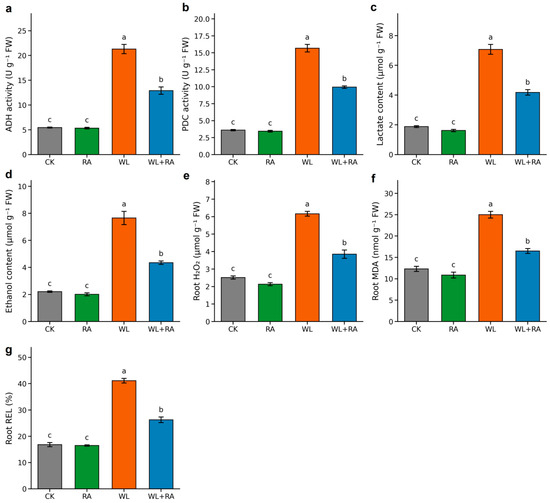
Waterlogging increased the measured indicators of root fermentative metabolism (Figure 2a–d). ADH activity increased from 5.47 U g−1 FW in CK to 21.30 U g−1 FW in WL, whereas PDC activity increased from 3.61 to 15.68 U g−1 FW. Lactate content increased from 1.88 to 7.08 μmol g−1 FW, and ethanol content increased from 2.21 to 7.66 μmol g−1 FW.
Figure 2.
Effects of waterlogging and intermittent root-zone aeration on ADH activity (a), PDC activity (b), lactate content (c), ethanol content (d), root H2O2 content (e), root MDA content (f), and root relative electrolyte leakage (g). Values are means ± SD (n = 6); different lowercase letters indicate significant differences among treatments according to Tukey’s HSD test at p < 0.05. ADH, alcohol dehydrogenase; PDC, pyruvate decarboxylase; MDA, malondialdehyde.
Compared with WL, WL+RA showed lower ADH activity, PDC activity, lactate content, and ethanol content, with values of 12.93 U g−1 FW, 9.95 U g−1 FW, 4.19 μmol g−1 FW, and 4.35 μmol g−1 FW, respectively. However, all four variables remained higher in WL+RA than in CK and RA. These results indicate that intermittent aeration attenuated, but did not normalize, the measured fermentative response under waterlogging.
Waterlogging also increased root oxidative injury (Figure 2e–g). Root H2O2 content increased from 2.52 μmol g−1 FW in CK to 6.17 μmol g−1 FW in WL. Root MDA content increased from 12.32 to 25.01 nmol g−1 FW. Root relative electrolyte leakage increased from 16.85% to 41.13%. In WL+RA, root H2O2, MDA, and relative electrolyte leakage decreased to 3.85 μmol g−1 FW, 16.51 nmol g−1 FW, and 26.30%, respectively. Two-way ANOVA showed significant effects of water regime, root-zone aeration, and their interaction on ADH activity, PDC activity, lactate content, ethanol content, root H2O2, root MDA, and root relative electrolyte leakage (Table S1).
3.3. Root-Zone Aeration Was Associated with Improved Pigment Status and Gas Exchange Under Waterlogging
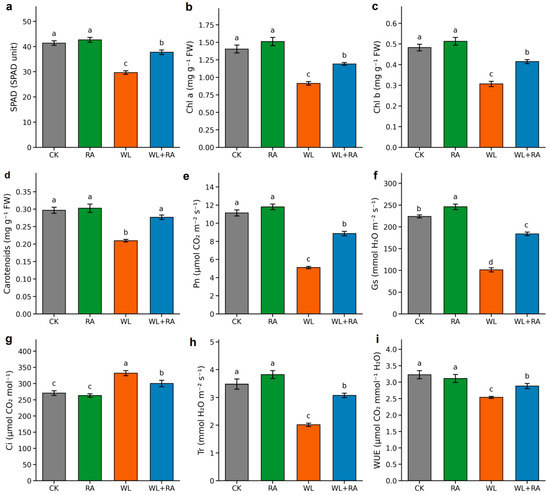
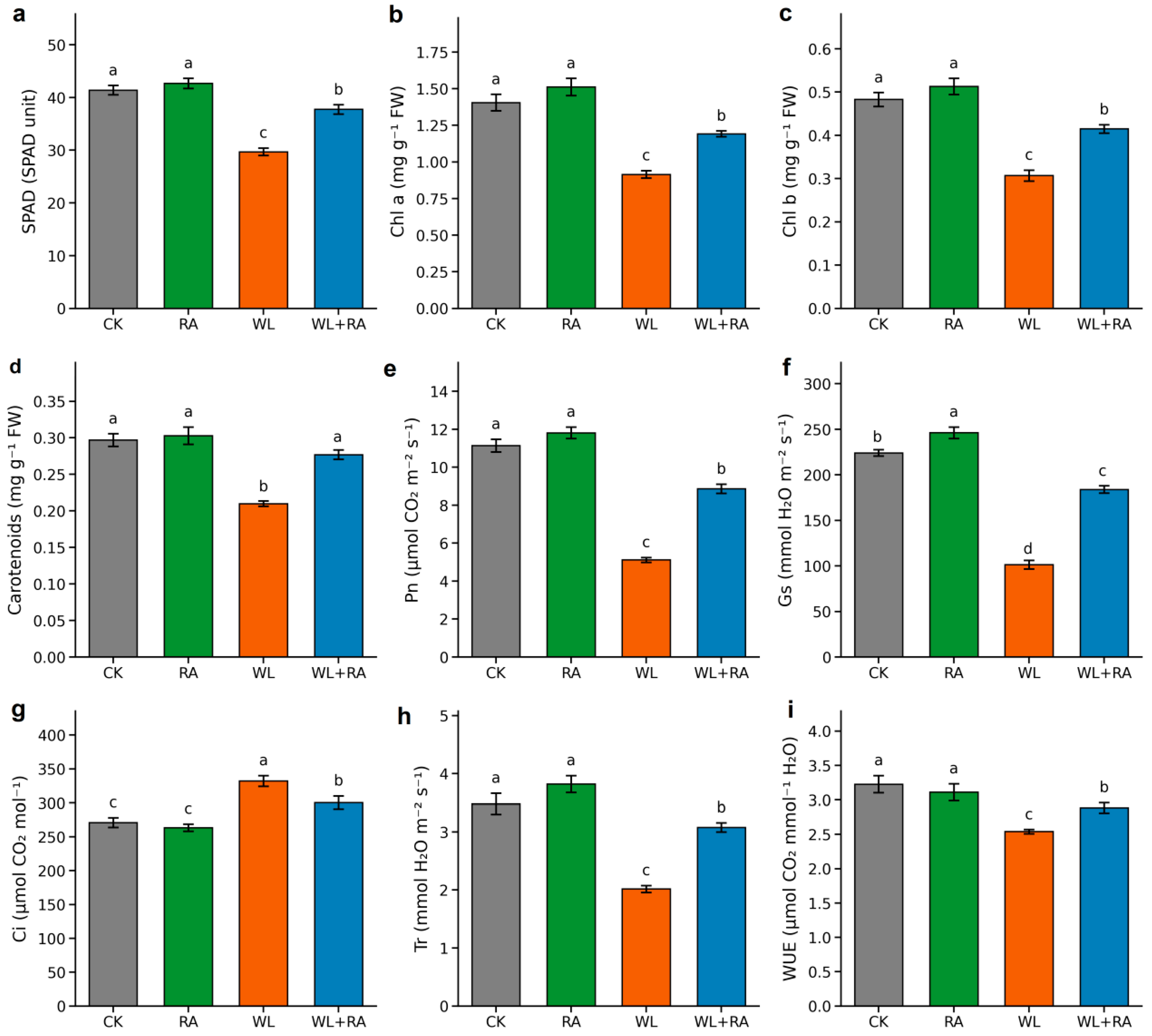
Waterlogging reduced leaf pigment status and photosynthetic gas exchange (Figure 3). The SPAD value decreased from 41.40 in CK to 29.70 in WL. Chl a decreased from 1.41 to 0.92 mg g−1 FW. Chl b decreased from 0.48 to 0.31 mg g−1 FW. Carotenoids decreased from 0.30 to 0.21 mg g−1 FW.
Figure 3.
Effects of waterlogging and intermittent root-zone aeration on SPAD value (a), chlorophyll a content (b), chlorophyll b content (c), carotenoid content (d), net photosynthetic rate (Pn) (e), stomatal conductance (gs) (f), intercellular CO2 concentration (Ci) (g), transpiration rate (Tr) (h), and instantaneous water-use efficiency (WUE) (i). Values are means ± SD (n = 6); different lowercase letters indicate significant differences among treatments according to Tukey’s HSD test at p < 0.05.
Gas exchange was also inhibited under WL. Pn decreased from 11.15 μmol CO2 m−2 s−1 in CK to 5.12 μmol CO2 m−2 s−1 in WL. gs decreased from 224.10 to 101.40 mmol H2O m−2 s−1. Tr decreased from 3.48 to 2.02 mmol H2O m−2 s−1. In contrast, Ci increased from 271.13 to 332.18 μmol CO2 mol−1. WUE decreased from 3.23 to 2.54 μmol CO2 mmol−1 H2O.
WL+RA showed higher pigment and gas-exchange values than WL. In WL+RA, SPAD increased to 37.75. Chl a, Chl b, and carotenoids increased to 1.19, 0.42, and 0.28 mg g−1 FW, respectively. Pn increased to 8.87 μmol CO2 m−2 s−1. gs and Tr increased to 184.03 mmol H2O m−2 s−1 and 3.08 mmol H2O m−2 s−1, respectively. Ci decreased to 300.42 μmol CO2 mol−1 compared with WL.
3.4. Root-Zone Aeration Partially Maintained PSII Photochemical Performance Under Waterlogging
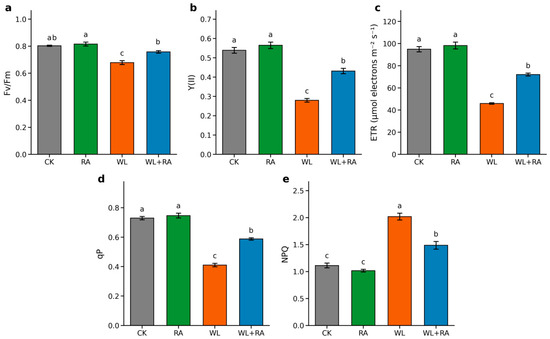
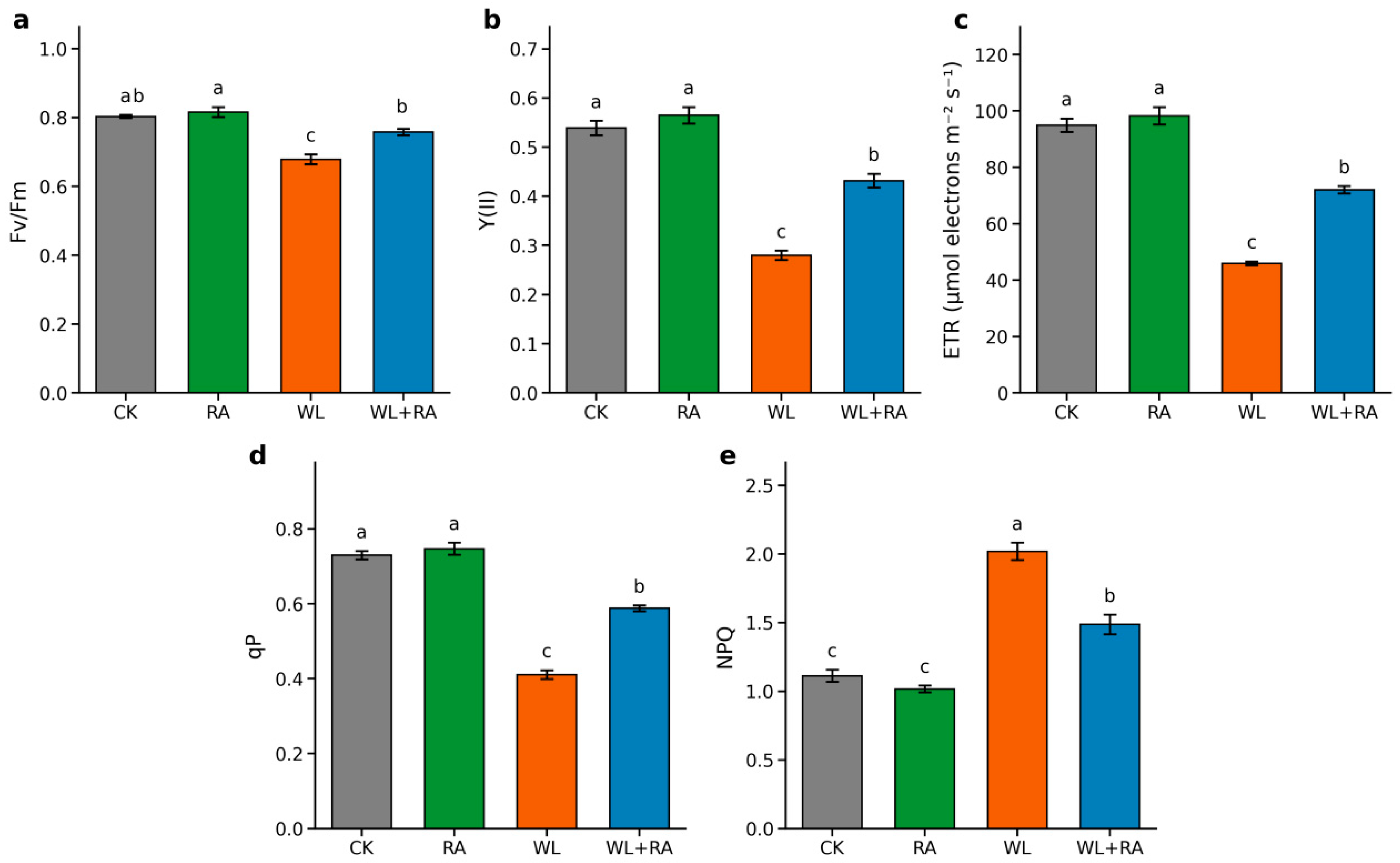
Waterlogging reduced PSII photochemical performance (Figure 4). Fv/Fm decreased from 0.803 in CK to 0.679 in WL. Y(II) decreased from 0.539 to 0.280. ETR decreased from 94.95 to 45.97 μmol electrons m−2 s−1. qP also decreased, from 0.730 in CK to 0.411 in WL.
Figure 4.
Effects of waterlogging and intermittent root-zone aeration on the maximum quantum efficiency of PSII (Fv/Fm) (a), effective quantum yield of PSII [Y(II)] (b), electron transport rate (ETR) (c), photochemical quenching coefficient (qP) (d), and non-photochemical quenching (NPQ) (e). Values are means ± SD (n = 6); different lowercase letters indicate significant differences among treatments according to Tukey’s HSD test at p < 0.05.
NPQ increased under waterlogging. The value increased from 1.113 in CK to 2.020 in WL. This indicates a clear change in non-photochemical quenching under waterlogging.
WL+RA showed intermediate values between CK and WL. Fv/Fm increased to 0.758. Y(II) increased to 0.432, and ETR increased to 72.05 μmol electrons m−2 s−1. qP increased to 0.588. NPQ decreased to 1.487 compared with WL. RA under normal moisture showed values close to CK. Two-way ANOVA showed significant effects of water regime, root-zone aeration, and their interaction on Fv/Fm, Y(II), ETR, qP, and NPQ (Table S1).
3.5. Root-Zone Aeration Reduced Leaf Oxidative Injury and Modified Antioxidant Enzyme Activities
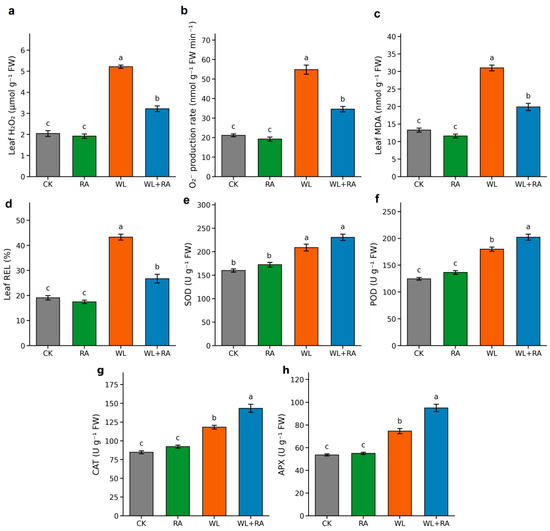
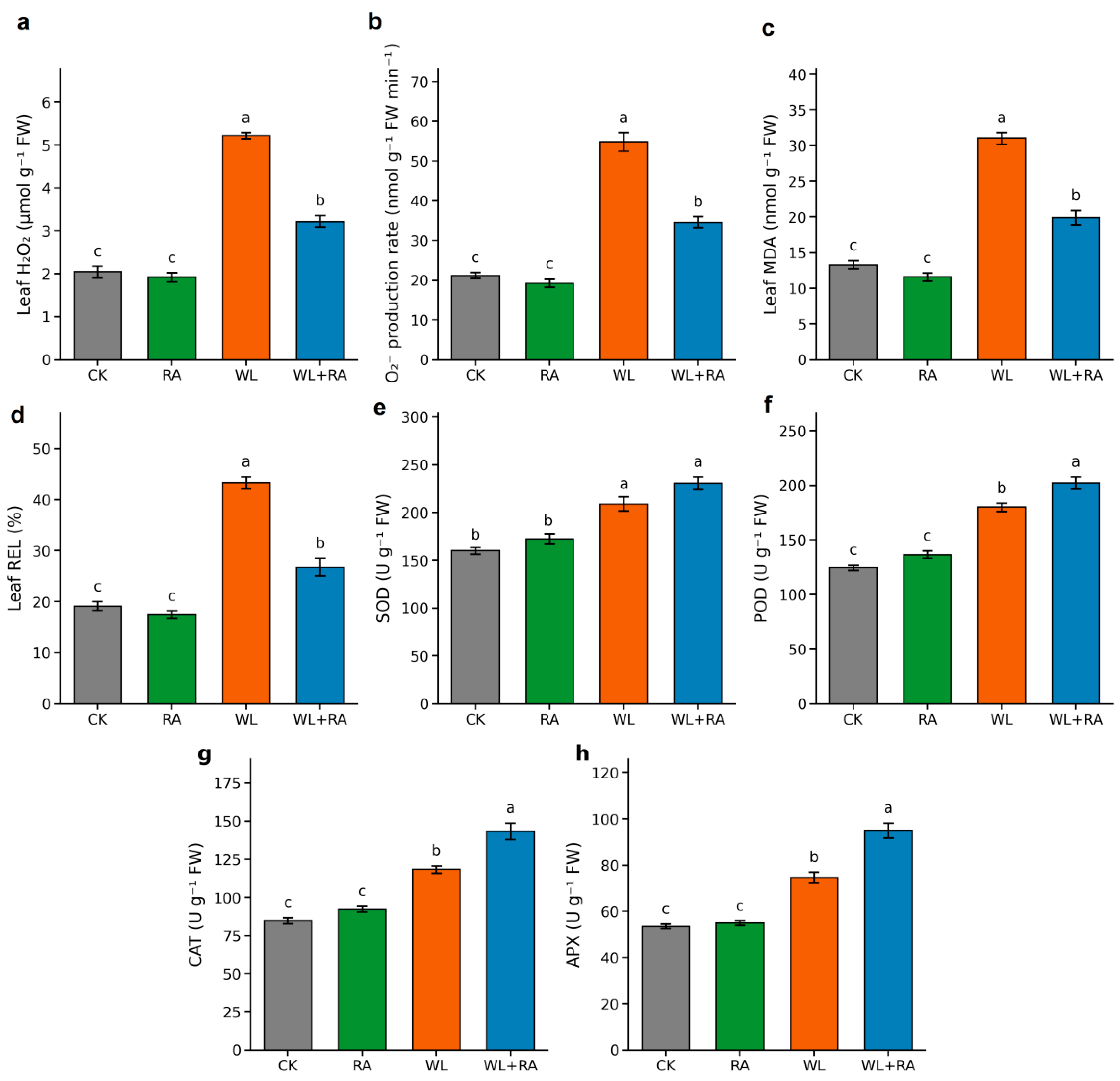
Waterlogging increased leaf oxidative damage indicators (Figure 5a–d). Leaf H2O2 content increased from 2.05 μmol g−1 FW in CK to 5.22 μmol g−1 FW in WL. O2− production rate increased from 21.18 to 54.83 nmol g−1 FW min−1. Leaf MDA content increased from 13.28 to 31.02 nmol g−1 FW. Leaf relative electrolyte leakage increased from 19.12% to 43.33%.
Figure 5.
Effects of waterlogging and intermittent root-zone aeration on leaf H2O2 content (a), O2− production rate (b), MDA content (c), relative electrolyte leakage (d), SOD activity (e), POD activity (f), CAT activity (g), and APX activity (h). Values are means ± SD (n = 6); different lowercase letters indicate significant differences among treatments according to Tukey’s HSD test at p < 0.05.
WL+RA reduced these injury indicators compared with WL. Leaf H2O2 decreased to 3.22 μmol g−1 FW. O2− production rate decreased to 34.58 nmol g−1 FW min−1. Leaf MDA decreased to 19.89 nmol g−1 FW. Leaf relative electrolyte leakage decreased to 26.75%. These values remained higher than those in CK and RA.
Antioxidant enzyme activities increased under waterlogging (Figure 5e–h). SOD activity increased from 160.08 U g−1 FW in CK to 208.95 U g−1 FW in WL. POD, CAT, and APX activities increased from 124.73 to 180.02 U g−1 FW, from 84.88 to 118.37 U g−1 FW, and from 53.63 to 74.65 U g−1 FW, respectively. Compared with WL, WL+RA showed significantly higher POD, CAT, and APX activities. SOD activity was numerically higher in WL+RA than in WL, but the difference was not significant. In WL+RA, SOD, POD, CAT, and APX activities were 230.80, 202.30, 143.57, and 95.08 U g−1 FW, respectively. Two-way ANOVA showed significant effects of water regime and root-zone aeration on all leaf oxidative damage and antioxidant enzyme variables (Table S1). The water regime × aeration interaction was significant for leaf H2O2, O2•− production rate, leaf MDA, leaf relative electrolyte leakage, CAT, and APX but not for SOD or POD.
3.6. Root-Zone Aeration Was Associated with Improved Leaf Functional Quality Under Waterlogging
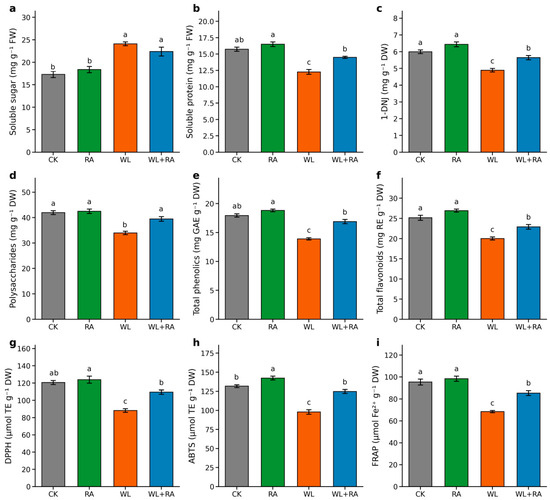
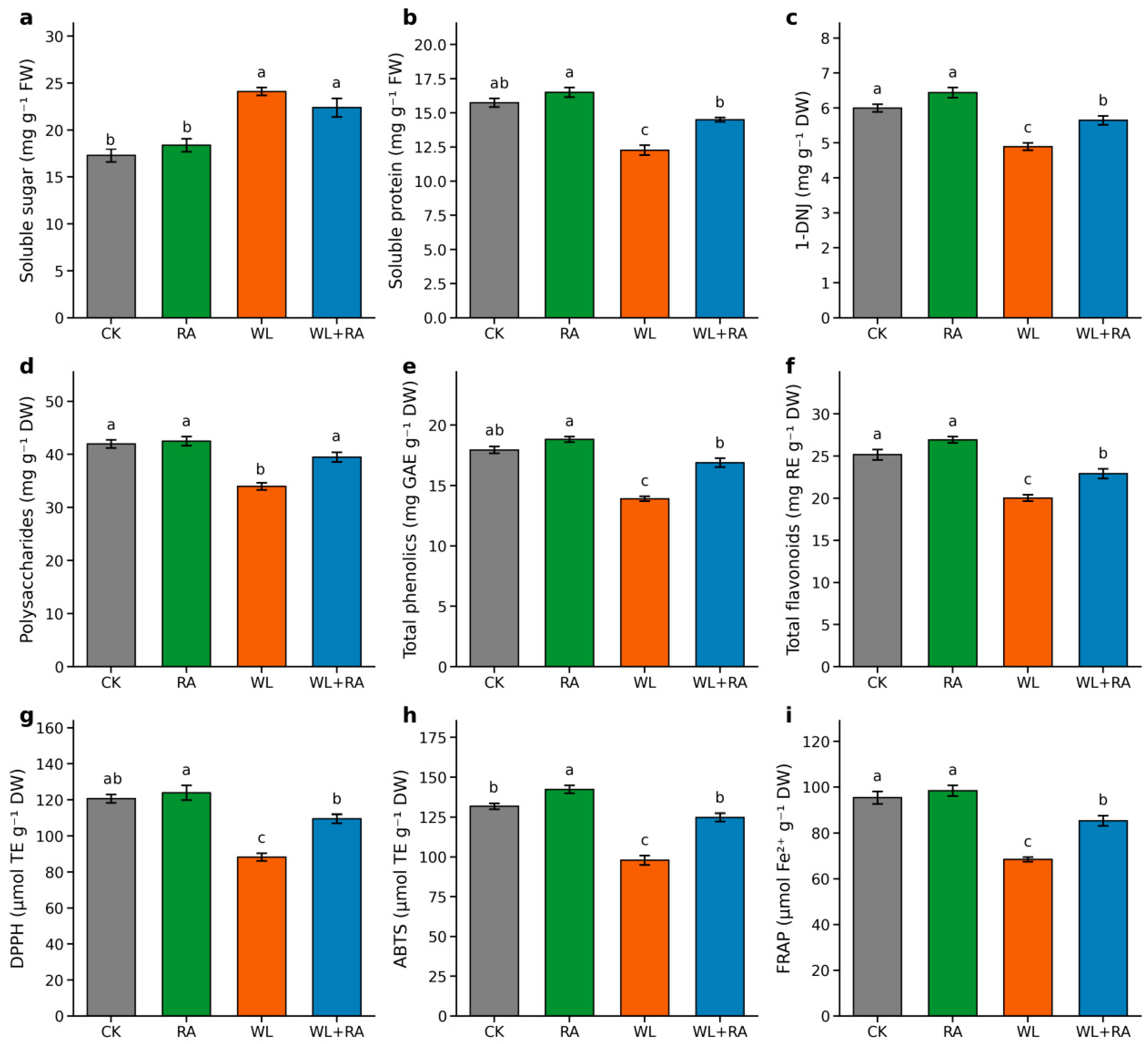
Waterlogging changed leaf quality-related traits (Figure 6). Soluble sugar content increased from 17.30 mg g−1 FW in CK to 24.12 mg g−1 FW in WL. Soluble protein content decreased from 15.74 to 12.27 mg g−1 FW. The 1-DNJ content decreased from 6.00 to 4.90 mg g−1 DW. Polysaccharide content decreased from 41.99 to 34.01 mg g−1 DW.
Figure 6.
Effects of waterlogging and intermittent root-zone aeration on soluble sugar content (a), soluble protein content (b), 1-DNJ content (c), polysaccharide content (d), total phenolic content (e), total flavonoid content (f), DPPH capacity (g), ABTS capacity (h), and FRAP (i). Values are means ± SD (n = 6); different lowercase letters indicate significant differences among treatments according to Tukey’s HSD test at p < 0.05.
Phenolic and flavonoid contents also decreased under WL. Total phenolics decreased from 17.95 to 13.91 mg GAE g−1 DW. Total flavonoids decreased from 25.18 to 20.04 mg RE g−1 DW. Chemical antioxidant capacity declined in the same treatment. DPPH decreased from 120.62 to 88.35 μmol TE g−1 DW. ABTS decreased from 131.68 to 97.97 μmol TE g−1 DW. FRAP decreased from 95.40 to 68.55 μmol Fe2+ g−1 DW.
WL+RA showed higher values than WL for most functional-quality traits. In WL+RA, soluble protein increased to 14.50 mg g−1 FW. The 1-DNJ content increased to 5.65 mg g−1 DW. Polysaccharides, total phenolics, and total flavonoids increased to 39.48 mg g−1 DW, 16.89 mg GAE g−1 DW, and 22.93 mg RE g−1 DW, respectively. DPPH, ABTS, and FRAP increased to 109.60 μmol TE g−1 DW, 124.97 μmol TE g−1 DW, and 85.43 μmol Fe2+ g−1 DW, respectively. Soluble sugar content was numerically lower in WL+RA than in WL, but the difference was not significant. Both WL and WL+RA had higher soluble sugar contents than CK and RA. Two-way ANOVA showed significant effects of water regime on all leaf quality-related variables (Table S1). Root-zone aeration significantly affected soluble protein, 1-DNJ, polysaccharides, total phenolics, total flavonoids, DPPH, ABTS, and FRAP but not soluble sugar. Significant water regime × aeration interactions were detected for soluble protein, polysaccharides, total phenolics, DPPH, ABTS, and FRAP.
Effect-size estimates further indicated that the magnitude of the water regime × aeration interaction varied among traits. Representative interaction effects included ηp2 values of 0.725 for root-zone dissolved oxygen, 0.787 for root dry weight, 0.809 for PDC activity, 0.628 for Pn, 0.508 for Y(II), 0.769 for leaf H2O2 content, and 0.416 for total phenolic content. Complete ηp2 estimates for all main and interaction effects, including non-significant effects, are provided in Supplementary Table S1.
4. Discussion
4.1. Waterlogging Injury Was Associated with Root-Zone Oxygen Depletion and Growth Inhibition
At the day-14 pre-aeration measurement, waterlogging sharply reduced root-zone dissolved oxygen. This result confirms that the WL treatment produced a low-oxygen root-zone condition at the measured endpoint under the present pot system. However, dissolved oxygen was not monitored continuously, and its temporal variation during the 14-day treatment and between successive aeration cycles remains unknown.
The lower root-zone dissolved oxygen under WL was accompanied by reduced plant height, leaf area, shoot dry weight, root dry weight, and TTC-based root activity. The TTC reduction assay provides an operational indicator of root metabolic activity but does not directly quantify oxygen consumption, mitochondrial respiration, ATP production, or nutrient uptake. Therefore, the lower TTC reduction value under WL indicates reduced root metabolic activity at harvest rather than directly demonstrating inhibition of aerobic respiration. The concurrent decreases in growth and root dry weight are consistent with impaired root performance under waterlogging. Similar growth inhibition has been reported in mulberry and other horticultural or woody crops exposed to waterlogging [6,7].
Intermittent root-zone aeration increased dissolved oxygen and TTC-based root activity under waterlogging and partially alleviated the reductions in growth. These concurrent responses are consistent with less severe impairment of root metabolic function in WL+RA. However, because root respiration was not measured directly, the higher TTC reduction value cannot be interpreted as evidence that aerobic respiration or cellular energy production was restored. Other interacting changes in root and whole-plant function may also have contributed to the growth response. Moreover, dissolved oxygen in WL+RA remained lower than in CK and RA, and growth traits did not fully return to normal-moisture levels. Therefore, the aeration treatment should be interpreted as a partial alleviation under the present pot experiment rather than as complete removal of waterlogging injury.
4.2. Intermittent Aeration Was Associated with Lower Fermentative Activity and Root Oxidative Injury
ADH and PDC activities increased markedly under WL, together with greater lactate and ethanol accumulation. These changes are consistent with enhanced root fermentative metabolism under oxygen limitation. ADH and PDC are key enzymes involved in fermentative pathways, and increases in their activities commonly occur when oxygen availability becomes restricted [5,8,33]. However, ADH and PDC activities and the accumulation of lactate and ethanol represent selected indicators of fermentative metabolism rather than a complete characterization of the metabolic response to root-zone hypoxia.
WL+RA reduced ADH activity, PDC activity, lactate content, and ethanol content compared with WL. Because these values remained higher than those in CK and RA, intermittent aeration should be interpreted as attenuating, rather than normalizing, the measured fermentative response. ADH and PDC activities, together with lactate and ethanol accumulation, represent selected indicators of fermentative metabolism but do not describe the complete metabolic response to root-zone hypoxia. Mitochondrial respiration, carbohydrate metabolic fluxes, hormonal regulation, and cellular energy status were not measured in the present study. Therefore, the results support lower fermentative activity in WL+RA than in WL but do not demonstrate complete recovery of aerobic metabolism. They also do not establish that the reduction in fermentative activity caused the improvement in growth.
In WL+RA, these injury indicators decreased. The lower root MDA content and electrolyte leakage indicate that membrane injury was less severe than in WL. These changes coincided with higher TTC-based root activity, but the present data do not establish the direction of this relationship. Because root respiration and cellular energy status were not measured directly, the higher TTC reduction value cannot be attributed specifically to improved aerobic metabolism. Further work combining TTC-based activity with direct measurements of root oxygen consumption, respiration, and energy status would be required to distinguish these processes. Recent physiological and transcriptomic evidence in mulberry has also shown that flooding disturbs ROS homeostasis and dynamically regulates antioxidant pathways [34].
4.3. Photosynthetic Responses to Aeration Were Associated with Coordinated Root and Leaf Changes
Waterlogging reduced SPAD values, chlorophyll contents, Pn, gs, Tr, and WUE, whereas Ci increased. The simultaneous decrease in gs and increase in Ci suggest that the reduction in Pn was not explained solely by stomatal closure. Reduced pigment contents and lower PSII photochemical performance indicate that non-stomatal limitations within the photosynthetic apparatus may also have contributed. However, chloroplast structural integrity and the abundance or activity of photosynthetic proteins were not directly examined.
Root-zone hypoxia may influence leaf photosynthesis through several interacting processes. In addition to stomatal regulation, changes in root metabolic activity, hydraulic conductivity, nutrient acquisition, chloroplast function, and source–sink relationships may affect carbon assimilation under waterlogging. These processes were not all measured in the present study and are therefore considered possible components of the physiological response rather than demonstrated mechanisms.
WL+RA partially reversed these changes, with higher Pn, gs, Tr, pigment contents, and PSII photochemical performance and lower Ci than WL. These concurrent responses indicate coordinated changes in stomatal behavior and leaf photochemical function. Improved root-zone oxygen availability may have contributed by supporting root metabolic function, but the benefits of aeration should not be attributed to oxygen availability alone. Plant performance under environmental stress emerges from interactions among root function, water and nutrient acquisition, whole-plant metabolic regulation, and resource allocation [35]. In the present study, higher root-zone dissolved oxygen occurred together with higher TTC-based root activity, better gas exchange and PSII performance, and lower oxidative injury. Nevertheless, hydraulic conductivity, nutrient uptake, and source–sink allocation were not measured. Their possible contributions should therefore be considered plausible components of the coordinated response rather than demonstrated mechanisms. Similar associations among root-zone conditions, photosynthetic performance, antioxidant regulation, and plant growth have been reported in horticultural crops [11,12,13].
The RA treatment under normal-moisture conditions caused only small changes in growth and photosynthesis compared with CK, whereas the response to aeration was more evident under waterlogging. This pattern is consistent with aeration being more beneficial when root-zone oxygen availability was restricted. However, the treatment contrast does not isolate oxygen availability from other interacting changes in root and whole-plant physiology.
Beyond the amount of oxygen supplied, the effectiveness of root-zone aeration may depend on whether resource delivery is aligned with plant physiological demand. At the production-system scale, exploitable crop yield depends on coordinated access to water and nutrients together with effective resource management rather than on the abundance of a single resource [36]. By analogy, the response to root-zone aeration may vary with developmental stage, root metabolic demand, nutrient requirements, waterlogging severity, and the timing and duration of aeration. In the present study, a fixed aeration schedule of 30 min every 4 h was applied for 14 d, whereas temporal changes in root oxygen demand, nutrient uptake, and whole-plant resource allocation were not measured. The results therefore demonstrate the response to the tested aeration regime under the present seedling-stage conditions but do not establish that oxygen supply was optimally synchronized with plant physiological demand throughout development.
4.4. Chlorophyll Fluorescence Indicated Partial Maintenance of PSII Photochemical Performance
Waterlogging reduced Fv/Fm, Y(II), ETR, and qP while increasing NPQ, indicating that PSII photochemistry was constrained and that a greater proportion of absorbed excitation energy was dissipated thermally [9,10,19]. The simultaneous reduction in photochemical efficiency and increase in NPQ is consistent with an acclimatory response to excess excitation pressure when carbon assimilation is restricted.
Intermittent aeration partially shifted this energy-use pattern toward photochemistry, as indicated by higher PSII efficiency and electron transport and lower thermal dissipation in WL+RA than in WL. However, the fluorescence parameters did not fully return to normal-moisture levels. This partial response may reflect coordinated improvements in pigment retention, root–shoot physiological function, and redox balance. Because chloroplast ultrastructure and photosynthetic protein abundance were not measured, the underlying structural or molecular basis of the response remains unresolved.
Compared with WL, WL+RA showed higher Fv/Fm, Y(II), ETR, and qP and lower NPQ. These responses indicate partial maintenance of PSII photochemical performance during waterlogging. They may have been associated with improved root-zone conditions, better root function, lower oxidative injury, and greater pigment retention. However, chloroplast ultrastructure and photosynthetic protein abundance were not measured. Therefore, the results support a physiological improvement in PSII performance but do not establish the underlying structural or molecular mechanism.
4.5. Lower Leaf Oxidative Injury Was Associated with Modified Antioxidant Defense
Waterlogging increased leaf H2O2, O2− production rate, MDA, and relative electrolyte leakage. These changes suggest stronger oxidative pressure and membrane injury in leaves. Waterlogging can disturb root metabolism and photosynthesis, which may increase reactive oxygen species production during stress and reoxygenation [5,8,34]. The higher MDA and electrolyte leakage in WL indicate that membrane stability was reduced.
WL+RA reduced leaf H2O2 content, O2− production rate, MDA content, and relative electrolyte leakage compared with WL. These changes coincided with higher Pn, Fv/Fm, and Y(II), indicating that lower oxidative injury and better photosynthetic performance occurred together under aerated waterlogging conditions. Lower oxidative injury may contribute to the maintenance of membrane integrity and photosynthetic structures, whereas improved photochemical performance may also reduce excess excitation pressure and reactive oxygen species formation. However, because these variables were measured at the same 14 d endpoint, their temporal sequence and causal direction cannot be resolved. The present results therefore do not establish that mitigation of oxidative injury caused the improvement in photosynthesis or that improved photosynthesis was responsible for the lower oxidative injury.
Antioxidant enzyme activities also changed under waterlogging and aeration. Compared with WL, WL+RA showed significantly higher POD, CAT, and APX activities, whereas SOD activity was numerically higher but not significantly different. SOD converts O2− to H2O2, whereas CAT and APX contribute to H2O2 removal, and POD participates in cellular peroxide metabolism [21,22,23,24]. The concurrent occurrence of higher activities of selected antioxidant enzymes and lower oxidative damage indicators is consistent with coordinated adjustment of enzymatic antioxidant defense and cellular redox status. Nevertheless, enzyme activity alone should not be equated with stress tolerance or interpreted as evidence that antioxidant activation was the primary mechanism responsible for improved photosynthesis or growth. Antioxidant regulation, oxidative status, and photosynthetic performance are therefore considered interrelated components of the overall physiological response to intermittent root-zone aeration.
4.6. Leaf Functional Quality Responded to Waterlogging and Root-Zone Aeration
Mulberry leaf functional quality reflects both species-characteristic constituents, such as 1-DNJ, and broader compositional traits, including polysaccharides, phenolics, flavonoids, and chemical antioxidant capacity [1,2,3]. Their coordinated decline under WL indicates that short-term waterlogging affected harvested-leaf composition in addition to plant growth and photosynthetic performance. Intermittent aeration partially maintained these traits, although several variables did not fully return to the levels observed under normal moisture.
The higher soluble sugar content under WL, despite lower growth and photosynthesis, may reflect reduced carbohydrate utilization, export, or sink demand. However, phloem transport, carbon allocation, and carbohydrate metabolic enzymes were not measured, and this interpretation remains tentative. Similarly, the partial maintenance of 1-DNJ, polysaccharides, phenolics, and flavonoids under WL+RA may have occurred in parallel with improved carbon assimilation and lower oxidative injury, but the present data do not establish a direct biochemical pathway linking these responses.
Multi-omics evidence has shown that flooding modifies phenylpropanoid- and flavonoid-related pathways in mulberry [37]. Nevertheless, pathway-related gene expression and individual metabolites were not quantified in the present study. The observed quality changes are therefore interpreted as coordinated treatment-associated responses at the 14 d endpoint rather than as direct downstream consequences of increased root-zone oxygen availability.
4.7. Limitations and Horticultural Implications
This study was conducted with mulberry seedlings under controlled pot conditions for 14 d. Therefore, the observed changes in growth, physiology, and leaf functional quality should be interpreted as short-term responses under the present experimental conditions rather than as direct evidence of long-term field or commercial production effects. The magnitude and persistence of these responses may vary with cultivation duration, waterlogging intensity, substrate type, aeration regime, seedling age, and environmental conditions.
Several limitations should be noted. First, this study used one mulberry cultivar, one substrate, one waterlogging depth, one aeration regime, and one treatment duration. Moreover, only one fixed aeration schedule was evaluated at the seedling stage. The experiment did not determine whether aeration timing or intensity was synchronized with temporal changes in root oxygen demand, nutrient requirements, or whole-plant physiological demand. Therefore, the present aeration regime should not be interpreted as an optimized schedule for different developmental stages or cultivation conditions. Second, all measurements were made at the 14 d endpoint. Root-zone dissolved oxygen was measured only once, immediately before the scheduled aeration cycle on day 14. Consequently, the temporal stability of root-zone oxygen and the magnitude of possible fluctuations during and between aeration cycles could not be determined. The reported dissolved oxygen values should therefore not be interpreted as time-averaged concentrations over the 14-day treatment period. In addition, the temporal sequence and causal direction among oxygen depletion, fermentative metabolism, antioxidant adjustment, oxidative injury, photosynthetic inhibition, growth reduction, and leaf quality changes cannot be resolved from the present design. Third, the study did not measure root anatomical traits, microbial community changes, nutrient uptake rates, or gene expression related to fermentation and secondary metabolism. Hydraulic conductivity, chloroplast ultrastructure, photosynthetic protein abundance, and source–sink transport were also not measured. Therefore, their respective contributions to the photosynthetic response cannot be distinguished from the present data. In addition, mitochondrial respiration, root oxygen consumption, carbohydrate metabolic fluxes, hormonal regulation, ATP production, and cellular energy status were not quantified. The TTC reduction assay provided an operational indicator of root metabolic activity but was not a direct measurement of aerobic respiration. Consequently, the metabolic interpretation is restricted to the measured TTC-based root activity and fermentative indicators and should not be taken as evidence of complete restoration of aerobic metabolism.
5. Conclusions
Waterlogging reduced root-zone dissolved oxygen in ‘Longsang No. 1’ mulberry seedlings. This was accompanied by lower growth, reduced TTC-based root activity, higher values of the measured fermentative indicators, greater root and leaf oxidative injury, lower photosynthetic performance, and reduced leaf functional quality. The increases in ADH and PDC activities and in lactate and ethanol contents are consistent with an enhanced root fermentative response under waterlogging.
Intermittent root-zone aeration partially alleviated these waterlogging-induced changes under the present pot experiment. Compared with WL, WL+RA increased root-zone dissolved oxygen, plant growth, root activity, Pn, Fv/Fm, Y(II), 1-DNJ, total phenolics, and chemical antioxidant capacity. It also reduced ADH and PDC activities, lactate and ethanol accumulation, H2O2, MDA, and relative electrolyte leakage. These responses indicate that aeration improved root-zone oxygen availability and was associated with lower activity of the measured fermentative indicators, higher TTC-based root activity, stronger photosynthetic performance, and lower oxidative damage.
Overall, intermittent root-zone aeration was associated with higher root-zone oxygen availability and less severe physiological and leaf-quality responses during 14 d of waterlogging. The observed improvements in 1-DNJ, polysaccharides, phenolics, flavonoids, and chemical antioxidant capacity represent short-term treatment-associated responses under the present controlled pot conditions. Although these findings indicate the potential value of root-zone aeration for mulberry seedlings grown in poorly drained substrates, their persistence and practical significance require validation under longer cultivation periods and field or commercial production environments. Therefore, specific agronomic recommendations regarding aeration schedules should not be made until such validation is available.
Supplementary Materials
The following supporting information can be downloaded at https://www.mdpi.com/article/10.3390/horticulturae12080999/s1: Table S1: Two-way ANOVA results for the effects of water regime, root-zone aeration, and their interaction on measured traits in mulberry seedlings.
Author Contributions
Conceptualization, N.X. and H.Z.; methodology, J.L.; formal analysis, B.D. and Y.W.; resources, H.Z.; writing—original draft, B.D. and W.F.; writing—review and editing, N.X. and H.Z. All authors have read and agreed to the published version of the manuscript.
Funding
This research was supported by the Natural Science Foundation of Heilongjiang Province of China (No. YQ2022C027); Harbin University Young Doctor Scientific Research Foundation (No. HUDF2024205); Harbin University Special Fund for Rural Revitalization Doctoral Scientific Research (HXC2023003).
Data Availability Statement
The original contributions presented in the study are included in the article; further inquiries can be directed to the corresponding author.
Conflicts of Interest
The authors declare no conflicts of interest.
References
- Mehmood, A.; Ma, H.; Chen, X. Unraveling molecular mechanisms of 1-deoxynojirimycin and polyphenol biosynthesis in mulberry leaves in response to ultrasound elicitation: An integrated metabolomics and transcriptomics approach. Food Res. Int. 2025, 206, 116072. [Google Scholar] [CrossRef] [Scilit] [PubMed]
- Martín-García, B.; Aznar-Ramos, M.J.; Verardo, V.; Gómez-Caravaca, A.M. The establishment of ultrasonic-assisted extraction for the recovery of phenolic compounds and evaluation of their antioxidant activity from Morus alba leaves. Foods 2022, 11, 314. [Google Scholar] [CrossRef] [Scilit] [PubMed]
- Tomczyk, M.; Miłek, M.; Sidor, E.; Kapusta, I.; Litwińczuk, W.; Puchalski, C.; Dżugan, M. The effect of adding the leaves and fruits of Morus alba to rape honey on its antioxidant properties, polyphenolic profile, and amylase activity. Molecules 2020, 25, 84. [Google Scholar] [CrossRef] [Scilit] [PubMed]
- Li, Y.; Huang, J.; Yu, C.; Mo, R.; Zhu, Z.; Dong, Z.; Hu, X.; Zhuang, C.; Deng, W. Physiological and transcriptome analyses of photosynthesis in three mulberry cultivars within two propagation methods (cutting and grafting) under waterlogging stress. Plants 2023, 12, 2066. [Google Scholar] [CrossRef] [Scilit] [PubMed]
- Pan, J.; Sharif, R.; Xu, X.; Chen, X. Mechanisms of waterlogging tolerance in plants: Research progress and prospects. Front. Plant Sci. 2021, 11, 627331. [Google Scholar] [CrossRef] [Scilit] [PubMed]
- Li, S.; Rao, L. Response of growth and chlorophyll fluorescence parameters of mulberry seedlings to waterlogging stress. Sci. Rep. 2024, 14, 25078. [Google Scholar] [CrossRef] [Scilit] [PubMed]
- Topali, C.; Antonopoulou, C.; Chatzissavvidis, C. Effect of waterlogging on growth and productivity of fruit crops. Horticulturae 2024, 10, 623. [Google Scholar] [CrossRef] [Scilit]
- Gao, M.; Gai, C.; Li, X.; Feng, X.; Lai, R.; Song, Y.; Zeng, R.; Chen, D.; Chen, Y. Waterlogging tolerance of Actinidia valvata Dunn is associated with high activities of pyruvate decarboxylase, alcohol dehydrogenase and antioxidant enzymes. Plants 2023, 12, 2872. [Google Scholar] [CrossRef] [Scilit] [PubMed]
- Baker, N.R. Chlorophyll fluorescence: A probe of photosynthesis in vivo. Annu. Rev. Plant Biol. 2008, 59, 89–113. [Google Scholar] [CrossRef] [Scilit] [PubMed]
- Murchie, E.H.; Lawson, T. Chlorophyll fluorescence analysis: A guide to good practice and understanding some new applications. J. Exp. Bot. 2013, 64, 3983–3998. [Google Scholar] [CrossRef] [Scilit] [PubMed]
- Zhu, J.; Xu, N.; Siddique, K.H.M.; Zhang, Z.; Niu, W. Aerated drip irrigation improves water and nitrogen uptake efficiencies of tomato roots with associated changes in the antioxidant system. Sci. Hortic. 2022, 306, 111471. [Google Scholar] [CrossRef] [Scilit]
- Zhang, Z.; Yang, R.; Sun, J.; Li, Y.; Geng, Y.; Pan, Y.; Zhang, Z. Root-zone aeration improves fruit yield and quality of tomato by enhancement of leaf photosynthetic performance. Agric. Water Manag. 2024, 291, 108639. [Google Scholar] [CrossRef] [Scilit]
- Li, G.; Cheng, H.; Qiao, C.; Feng, J.; Yan, P.; Yang, R.; Song, J.; Sun, J.; Zhao, Y.; Zhang, Z. Root-zone oxygen supply mitigates waterlogging stress in tomato by enhancing root growth, photosynthetic performance, and antioxidant capacity. Plant Physiol. Biochem. 2025, 222, 109744. [Google Scholar] [CrossRef] [Scilit] [PubMed]
- Velikova, V.; Yordanov, I.; Edreva, A. Oxidative stress and some antioxidant systems in acid rain-treated bean plants: Protective role of exogenous polyamines. Plant Sci. 2000, 151, 59–66. [Google Scholar] [CrossRef] [Scilit]
- Heath, R.L.; Packer, L. Photoperoxidation in isolated chloroplasts. I. Kinetics and stoichiometry of fatty acid peroxidation. Arch. Biochem. Biophys. 1968, 125, 189–198. [Google Scholar] [CrossRef] [Scilit] [PubMed]
- Lichtenthaler, H.K. Chlorophylls and carotenoids: Pigments of photosynthetic biomembranes. Methods Enzymol. 1987, 148, 350–382. [Google Scholar] [CrossRef] [Scilit]
- Long, S.P.; Bernacchi, C.J. Gas exchange measurements, what can they tell us about the underlying limitations to photosynthesis? Procedures and sources of error. J. Exp. Bot. 2003, 54, 2393–2401. [Google Scholar] [CrossRef] [Scilit] [PubMed]
- Busch, F.A.; Ainsworth, E.A.; Amtmann, A.; Cavanagh, A.P.; Driever, S.M.; Ferguson, J.N.; Kromdijk, J.; Lawson, T.; Leakey, A.D.B.; Matthews, J.S.A.; et al. A guide to photosynthetic gas exchange measurements: Fundamental principles, best practice and potential pitfalls. Plant Cell Environ. 2024, 47, 3344–3364. [Google Scholar] [CrossRef] [Scilit] [PubMed]
- Genty, B.; Briantais, J.M.; Baker, N.R. The relationship between the quantum yield of photosynthetic electron transport and quenching of chlorophyll fluorescence. Biochim. Biophys. Acta 1989, 990, 87–92. [Google Scholar] [CrossRef] [Scilit]
- Elstner, E.F.; Heupel, A. Inhibition of nitrite formation from hydroxylammonium chloride: A simple assay for superoxide dismutase. Anal. Biochem. 1976, 70, 616–620. [Google Scholar] [CrossRef] [Scilit] [PubMed]
- Beauchamp, C.; Fridovich, I. Superoxide dismutase: Improved assays and an assay applicable to acrylamide gels. Anal. Biochem. 1971, 44, 276–287. [Google Scholar] [CrossRef] [Scilit] [PubMed]
- Chance, B.; Maehly, A.C. Assay of catalases and peroxidases. Methods Enzymol. 1955, 2, 764–775. [Google Scholar] [CrossRef] [Scilit]
- Aebi, H. Catalase in vitro. Methods Enzymol. 1984, 105, 121–126. [Google Scholar] [CrossRef] [Scilit] [PubMed]
- Nakano, Y.; Asada, K. Hydrogen peroxide is scavenged by ascorbate-specific peroxidase in spinach chloroplasts. Plant Cell Physiol. 1981, 22, 867–880. [Google Scholar] [CrossRef] [Scilit]
- Dubois, M.; Gilles, K.A.; Hamilton, J.K.; Rebers, P.A.; Smith, F. Colorimetric method for determination of sugars and related substances. Anal. Chem. 1956, 28, 350–356. [Google Scholar] [CrossRef] [Scilit]
- Bradford, M.M. A rapid and sensitive method for the quantitation of microgram quantities of protein utilizing the principle of protein–dye binding. Anal. Biochem. 1976, 72, 248–254. [Google Scholar] [CrossRef] [PubMed]
- Kim, J.-W.; Kim, S.-U.; Lee, H.S.; Kim, I.; Ahn, M.Y.; Ryu, K.S. Determination of 1-deoxynojirimycin in Morus alba L. leaves by derivatization with 9-fluorenylmethyl chloroformate followed by reversed-phase high-performance liquid chromatography. J. Chromatogr. A 2003, 1002, 93–99. [Google Scholar] [CrossRef] [Scilit] [PubMed]
- Singleton, V.L.; Rossi, J.A. Colorimetry of total phenolics with phosphomolybdic–phosphotungstic acid reagents. Am. J. Enol. Vitic. 1965, 16, 144–158. [Google Scholar] [CrossRef] [Scilit]
- Chang, C.C.; Yang, M.H.; Wen, H.M.; Chern, J.C. Estimation of total flavonoid content in propolis by two complementary colorimetric methods. J. Food Drug Anal. 2002, 10, 178–182. [Google Scholar] [CrossRef] [Scilit]
- Brand-Williams, W.; Cuvelier, M.E.; Berset, C. Use of a free radical method to evaluate antioxidant activity. LWT Food Sci. Technol 1995, 28, 25–30. [Google Scholar] [CrossRef] [Scilit]
- Re, R.; Pellegrini, N.; Proteggente, A.; Pannala, A.; Yang, M.; Rice-Evans, C. Antioxidant activity applying an improved ABTS radical cation decolorization assay. Free Radic. Biol. Med. 1999, 26, 1231–1237. [Google Scholar] [CrossRef] [Scilit] [PubMed]
- Benzie, I.F.F.; Strain, J.J. The ferric reducing ability of plasma (FRAP) as a measure of “antioxidant power”: The FRAP assay. Anal. Biochem. 1996, 239, 70–76. [Google Scholar] [CrossRef] [Scilit] [PubMed]
- Xu, X.; Wang, H.; Qi, X.; Xu, Q.; Chen, X. Waterlogging-induced increase in fermentation and related gene expression in the root of cucumber (Cucumis sativus L.). Sci. Hortic. 2014, 179, 388–395. [Google Scholar] [CrossRef] [Scilit]
- Bai, X.; Huang, H.; Li, D.; Yang, F.; Cong, X.; Wu, S.; Zhu, W.; Qin, S.; Wen, Y. Physiological and transcriptomic analyses reveal the role of the antioxidant system and jasmonic acid (JA) signal transduction in mulberry (Morus alba L.) response to flooding stress. Horticulturae 2024, 10, 1100. [Google Scholar] [CrossRef] [Scilit]
- Thiengo, C.C.; Leonel, J.V.; Mendes, L.W.; Lavres, J. Separated for too long: Plant nutrition as the functional interface linking the plant–soil microbiome to plant performance. Sci. Agric. 2026, 83, e20260067. [Google Scholar] [CrossRef] [Scilit]
- Silva, E.H.F.M.D.; Vieira Junior, N.A.; Fattori Junior, I.M.; Marin, F.R. Exploring avenues for tropical soybean intensification: How much water and nutrients are demanded to achieve exploitable yield? Sci. Agric. 2024, 81, e20230168. [Google Scholar] [CrossRef] [Scilit]
- Hu, J.; Chen, W.; Duan, Y.; Ru, Y.; Cao, W.; Xiang, P.; Huang, C.; Zhang, L.; Chen, J.; Gan, L. Response mechanisms to flooding stress in mulberry revealed by multi-omics analysis. Phyton-Int. J. Exp. Bot. 2024, 93, 227–245. [Google Scholar] [CrossRef] [Scilit]
Disclaimer/Publisher’s Note: The statements, opinions and data contained in all publications are solely those of the individual author(s) and contributor(s) and not of MDPI and/or the editor(s). MDPI and/or the editor(s) disclaim responsibility for any injury to people or property resulting from any ideas, methods, instructions or products referred to in the content. |
© 2026 by the authors. Licensee MDPI, Basel, Switzerland. This article is an open access article distributed under the terms and conditions of the Creative Commons Attribution (CC BY) license.