
Article

Volatile Seasonal Analysis and Peel Phenolic Characterization of Two Finger Lime (Citrus australasica) Varieties Cultivated in Greece

by
Gianluca Cecchi
1,2,†,
Evgenia Panou
1,†,
Vasileios Ziogas
3,
Francesco Saverio Robustelli Della Cuna
4 and
Ioanna Chinou
1,*
1
Lab of Pharmacognosy and Chemistry of Natural Products, Department of Pharmacy, School of Health Sciences, National & Kapodistrian University of Athens, 15771 Athens, Greece
2
Department of Drug Science, University of Pavia, Viale Taramelli 12, 27100 Pavia, Italy
3
Institute of Olive Tree, Subtropical Plants and Viticulture, Hellenic Agricultural Organization—DIMITRA (ELGO-DIMITRA), 73134 Chania, Greece
4
Centro Ricerche Ambientali, Istituti Clinici Scientifici Maugeri IRCCS, 27100 Pavia, Italy
*
Author to whom correspondence should be addressed.
These authors contributed equally to this work.
Horticulturae 2026, 12(8), 967; https://doi.org/10.3390/horticulturae12080967
Submission received: 6 July 2026 / Revised: 31 July 2026 / Accepted: 2 August 2026 / Published: 4 August 2026

Highlights

What are the main findings?
The first chemical characterization of finger lime in Greece identified highly distinct volatile chemotypes for both varieties—Pink Ice and Green Crystal—with the latter studied for the first time.
Untargeted UHPLC-MS/MS profiling of the non-volatile fraction successfully annotated 58 metabolites, revealing several compounds reported for the first time in Citrus australasica, alongside cultivar-specific flavonoid and coumarin patterns.
What are the implications of the main findings?
Shifting profiles across harvest periods demonstrated that fruit ripening reduces total phenolic content while changing the essential oil compositions, showing that harvest timing is essential to isolate extracts with specific aromatic and bioactive profiles.
The highly diverse chemical fingerprints and successful regional adaptation of both varieties demonstrate their strong potential for expanded commercial cultivation in the Mediterranean.

Abstract

Finger lime (Citrus australasica) is an emerging high-value fruit species, yet the chemical profiles of Mediterranean-cultivated varieties remain underexplored. This study presents the first chemical characterization of two finger lime varieties, Pink Ice and Green Crystal, grown in Greece, providing the first report on the volatile and non-volatile composition of Green Crystal. Peel essential oils were extracted and analyzed through GC-MS across two harvesting periods (H1 and H2), while methanolic extracts were assessed for their total phenolic content (TPC) and DPPH radical scavenging activity. Non-volatile untargeted profiling was performed on stage H1 extracts using UHPLC-MS/MS. The results revealed a significant chemical divergence between the varieties. Green Crystal exhibited an unprecedented p-cymene/β-phellandrene/citronellal/citronellol volatile chemotype, while Pink Ice displayed a limonene/p-cymene/sabinene/terpinen-4-ol chemotype. Maturity of the fruit significantly influenced monoterpene distribution, with an increase in monoterpene hydrocarbons at the expense of oxygenated derivatives. TPC peaked at stage H1, showing a significant maturity-dependent decline in both varieties, whereas DPPH radical scavenging capacity remained stable across both harvests. UHPLC-MS/MS analysis annotated 58 metabolites, including several compounds reported for the first time in the species. Variety-specific tendencies were observed, with Pink Ice exhibiting greater diversity in flavanones, flavonols, and simple coumarins, whereas Green Crystal exhibited greater diversity in flavones, furanocoumarins, and HMG (hydroxy-3-methylglutaric acid)-flavonoid conjugates. These findings demonstrate that variety selection and harvesting timing are critical parameters for optimizing the commercial and bioactive value of Mediterranean-grown finger lime, highlighting the significant potential for expanded cultivation in the region.

1. Introduction

Citrus australasica (Rutaceae), commonly known as Australian finger lime, is among the Australian native Citrus species [1]. Finger limes have emerged as high-value commercial crops, with their fruits commonly used as flavorings in the beverage industry or as ingredients in culinary applications and gourmet cuisine, served with fish dishes or salads or used in alcoholic beverages [2,3]. Commercial production of finger limes remains geographically concentrated in Australia, where it represents one of the most highly produced Australian native fruit crops [4,5]. In 2019/2020, domestic production in Australia reached 3.4 tonnes/year, while international exports stood at 10 tonnes/year as of 2021 [5]. Global cultivation efforts have also expanded, including 12,000 trees in California and 100,000 trees in Guatemala [5]. The Australian finger lime industry comprises around 20 major growers and at least 50 smaller producers, contributing to a total production volume exceeding 100 tonnes per year [4].
C. australasica is a small, shrubby tree distinguished by its unique natural genetic diversity and its characteristic spindle-shaped fruit that varies extensively in size, seed count, and pigmentation [6]. From an agricultural perspective, the plant is resistant to drought, salinity, and diseases, while its varieties are commercially grown [1].
Citrus essential oils (EOs) are widely used in the culinary, pharmaceutical, and cosmetic industries. They are extracted mainly from the flavedo (outer rind of the fruit or peel), but also from the flowers and leaves [7]. Several studies have been conducted on the volatilomic profile of peel EO from C. australasica, highlighting its significant chemical diversity across different cultivars and cultivation sites. Research on Australian cultivations identified the Alstonville and Durham’s Emerald varieties as being characterized by limonene/sabinene and limonene/citronellal/citronellol chemotypes, respectively [8], while Rhyne Red and Red Champagne varieties also showed the prevalence of limonene along with γ-terpinene or the sesquiterpene bicyclogermacrene [9].
For cultivations in Mediterranean climates, extensive research has been conducted in Italy, where several variations were observed; for instance, the Sanguinea variety has been characterized by high levels of limonene/γ-terpinene/bicyclogermacrene in cultivations in Sicily [3], while in Basilicata, the chemotype of this variety was characterized by limonene/sabinene/α-pinene [10]. Pink Ice from Basilicata shared a similar profile with high levels of limonene and sabinene, while in Pistoia cultivations, apart from limonene, high levels of γ-terpinene and terpinen-4-ol were observed [10,11]. Collette variety’s EOs have shown profiles rich in limonene, γ-terpinene, and terpinen-4-ol, and Yellow Sunshine has also shown high levels of limonene and bicyclogermacrene [11]. Furthermore, the trigeneric hybrid Faustrime has been extensively studied in the Italian peninsula, exhibiting a profile dominated by limonene and citronellal in association with different monoterpenes contributing to the chemotype, such as γ-terpinene, β-phellandrene or α-pinene [3,10,11,12,13].
The chemical composition and biological activities of EOs are significantly influenced by maturation stages [14]. Studies across various Citrus species have shown that volatile profiles vary significantly during ripening, primarily affecting the distribution of monoterpene hydrocarbons and oxygenated monoterpenes [15]. For instance, while the highest limonene levels in species like C. aurantium, C. limon, and C. sinensis are often reached at the immature stage, other varieties such as C. reticulata achieve maximum EO yields and superior organoleptic qualities at the semimature stage [16]. Additional significant variations during maturation stages have been observed in C. medica, where the content of components such as α-thujene, 3-carene, α-pinene, β-pinene and γ-terpinene varied significantly during maturation stages [14].
Beyond its volatile fraction, the non-volatile phytochemical profile of finger lime consists of a rich matrix of organic acids, minerals, vitamins, and phenolic compounds, with the latter playing a pivotal role in the fruit’s overall bioactivity [17]. Within this phenolic profile, flavonoids represent one of the most dominant subclasses and are well-documented for their potent antioxidant properties [18]. Anthocyanins, flavanols, flavanones, and flavonols constitute the primary flavonoid subclasses described in finger limes [17], heavily influencing fruit quality by contributing to astringency, bitterness, sourness, sweetness, aroma, and color development [18]. In addition to flavonoids, the finger lime metabolome features other notable phenolic constituents, including coumarins [19] and various phenolic acids—such as coumaric acid, ferulic acid, p-coumaric acid, and their respective glucoside derivatives [17]. Coumarins and furanocoumarins, which are extensively distributed and investigated throughout the Citrus genus, possess an expansive range of bioactivities, including antimicrobial, anti-HIV, anticancer, antiviral, anticoagulant, antioxidant, and anti-inflammatory properties [20,21]. Conversely, these compounds are notable photosensitizers that can trigger severe adverse reactions upon topical contact or ingestion; furthermore, they act as potent inhibitors of various cytochrome P450 (CYP) enzyme families, which can lead to dangerous clinical outcomes due to interactions with co-administered medications [22].
Several studies have investigated the chemical composition and bioactivities of different plant parts of C. australasica. For instance, Aznar et al. quantified the major compounds within peel extracts, identifying organic acids and phenolics such as citric acid, pyrogallol, caffeic acid, coumarin, rutin, naringin, 2-coumaric acid, didymin, naringenin, and isorhamnetin [23]. Similarly, Cannavacciuolo et al. conducted a comparative assessment of different tissue parts of the Faustrime hybrid, evaluating their in vitro antioxidant capacities and characterizing a diverse array of metabolites, including simple coumarins, furanocoumarins, limonoids, C-glycoside and O-glycoside flavonoids, as well as 2-hydroxymethylglutaryl (HMG) flavonoids [19]. A comparative profiling of various finger lime cultivars grown in Italy highlighted the additional presence of hydroxycinnamic acids and anthocyanins across both peel and pulp extracts [11]. Furthermore, finger lime peel extracts have been biologically screened against diverse therapeutic targets, including cholinesterase enzymes and human cell lines; notably, they down-regulated the expression of the adhesion molecule CD44 in human glioblastoma cell lines (U87 and LN18) [24].
The growing economic value and biological potential of C. australasica have positioned this species as an emerging trend across the flavor, pharmaceutical, and cosmetic industries. While initial agricultural and chemical characterizations were primarily conducted in Central Europe, more extensive recent research in Italy highlights the species’ exceptional adaptability to Mediterranean climatic conditions. Crucially, the highly distinct volatile and non-volatile profiles emerging from these geographically diverse studies underscore the biosynthetic versatility of the species, suggesting that environmental factors and cultivar selection play a defining role in shaping its specialized metabolome.
This study represents the first chemical characterization of finger lime cultivated in Greece—a region globally renowned for its Citrus production. Specifically, this research provides the first scientific report on the chemical composition of the commercial Green Crystal variety alongside a comparative evaluation with Pink Ice. For this reason, an integrative analytical approach was employed that combines GC-MS volatilomic profiling across two distinct harvest stages (H1 and H2) to track maturity-driven shifts in EO composition, untargeted non-volatile metabolomics through UHPLC–MS/MS to annotate specialized phenolics, flavonoids, and coumarins, quantification of total phenolic content and evaluation of the DPPH radical scavenging capacity of methanolic extracts. Characterizing these metabolites is crucial for uncovering bioactive molecules, detecting potential quality markers, and assessing phototoxicity risks. Ultimately, this work shows how genotype and harvest stage influence the sensory and functional profile of finger lime in Mediterranean climates.

2. Materials and Methods

2.1. Plant Material

The plant material used in the study was provided by the Institute of Olive Tree, Subtropical Plants and Viticulture (ELGO-DIMITRA), located in Crete, Greece (latitude 35.493756° N, longitude 24.046944° E, Mediterranean climate, yearly average temperature of 18 °C, and annual rainfall of 853 mm) (Figure 1). In the current experimental design, the tree spacing was 4 × 6 m. The soil texture of the citrus grove was loam, with 45.50% sand, 19.30% clay and 35.41% silt, an organic matter content of 1.38%, an electrical conductivity of 0.22 dS m−1, 0.31 total CaCO3, and a pH of 6.5.
Fruit samples were collected from five random 3-year-old finger lime trees (of the Pink Ice and Green Crystal varieties), all grafted upon Swingle citrumelo—Citrus paradisi Macf × Poncirus trifoliata (L.) Raf. rootstock. The fruit samples were harvested from the middle of shoots, from the four directions of the tree (North, South, East, and West), and from the mid-height of the canopy. All trees were cultivated in the same orchard during the period 2024–25, under the same climatic conditions. All trees received the same cultivation practices, were irrigated via drip irrigation from May until October with irrigation water of low Na+, Co, and B ion contents, and a conductivity of 0.61 mMhos, and were fertilized with 21–0–0, 0–20–0, and 0–0–50, which each contain 0.01, 0.06, and 0.1 units of N, P, and K, respectively.
Finger lime fruits were collected at two distinct time periods. The first time period was at the beginning of September (for both varieties) (stage H1—premature stage), and the second sampling was performed at the stage of full maturation, in October 2025 for Pink Ice and December 2025 for Green Crystal (stage H2—full maturation). All finger lime fruits from both varieties were of representative size and shape for the variety, without any visible defects. A total of fifty fruits (ten fruits per tree of a similar developmental stage) were harvested from equally allocated points of the tree canopy.
The hand-picked fruits were split in half, and the pearly flesh was removed from the peel.

2.2. Essential Oils (EOs) Hydrodistillation and Preparation of Methanolic Extracts

For the extraction of the Eos, 30 g of fruit peel (flavedo) was cut into smaller pieces and immediately subjected to hydrodistillation using 1 L of distilled water for 3 h using a Clevenger-type apparatus. The hydrodistillation yields could not be evaluated, given the small amount of material; thus, the volatile fraction was captured in HPLC-grade n-hexane in the Clevenger apparatus, dried over anhydrous sodium sulfate (Na2SO4) (Lach-Ner, Neratovice, Czech Republic), and preserved in amber-glass vials at a temperature of 4 to 6 °C until subsequent analysis.
For each finger lime variety, a composite sample was prepared by pooling 5 g of fresh fruit peel harvested from the five distinct trees. The pooled material was comminuted and subjected to maceration with methanol (100 mL) at room temperature for 24 h. This extraction procedure was repeated, and the resulting extracts were combined after filtration and concentrated to dryness under reduced pressure using a rotary evaporator (Büchi Waterbath B-480; BUCHI Labortechnik AG, Flawil, Switzerland) at a controlled temperature not exceeding 40 °C. The resulting dry extract yields obtained from Pink Ice were 485.8 mg for Stage H1 and 587.8 mg for Stage H2, while Green Crystal yielded 365.8 mg for Stage H1 and 596.2 mg for Stage H2.

2.3. Gas Chromatography–Mass Spectroscopy (GC-MS) Analysis

The component analysis was performed by the technique of gas chromatography coupled with mass spectrometry (gas chromatography–mass spectrometry, GC-MS). The analysis was conducted using an Agilent Technologies Gas Chromatograph 7820A connected to an Agilent Technologies 5977B mass spectrometer system (Agilent, Santa Clara, CA, USA) based on electron impact (EI) and 70 eV of ionization energy. The gas chromatograph features a split/splitless injector and a 30 m long HP5MS capillary column with an internal diameter of 0.25 mm and a film thickness of 0.25 μm. The oven temperature was initiated at 40 °C, increased at 2 °C/min to 100 °C, followed by a 3 °C/min increase to 200 °C and a final rate of 5 °C/min until reaching 280 °C, for a total run time of 79.3 min. Helium was used as the carrier gas at a flow rate of 0.7 mL/min, with an injection volume of 2 μL, a split ratio of 1:10, and an injector temperature set at 280 °C. Volatiles compounds were identified by matching their mass spectra against Wiley mass spectral databases, bibliographic information, and internal data, as well as by comparing experimentally determined Kovats retention indices (KIs) with published literature values [25]. The components of the peel EOs were determined by considering their areas as a percentage of the total ion current. Data analysis was performed using MSD ChemStation (version F 01.03.2357).

2.4. Determination of Total Phenolic Content (TPC)

The total phenolic content (TPC) of the peel methanolic extracts was determined using the Folin–Ciocalteu spectrophotometric method [26]. Briefly, 25 μL of either standard gallic acid solutions (ranging from 2.5 to 100 μg/mL) or sample extracts (reconstituted at 4 mg/mL in DMSO) was added to a 96-well microplate. Subsequently, 125 μL of 10% (v/v) Folin–Ciocalteu reagent was added to each well, followed by the addition of 100 μL of sodium carbonate (Na2CO3). The reaction mixture was incubated at room temperature in the dark for 30 min. The absorbance was then measured at 765 nm using a TECAN Infinite M200 PRO multimode microplate reader (Tecan Group Ltd., Männedorf, Switzerland). All measurements were performed in triplicate. Quantifications were calculated using a gallic acid calibration curve equation: y = 0.0622x − 0.0842, R2 = 0.996. The results were expressed as milligrams of gallic acid equivalents per gram of dry extract (mg GAE/g dry extract).

2.5. 2,2-Diphenyl-1-Picrylhydrazyl (DPPH) Radical Scavenging Assay

The antioxidant capacity of the methanolic extracts was evaluated using the DPPH radical scavenging assay [26]. Briefly, 10 μL of each sample extract (reconstituted at 0.4 mg/mL in DMSO) or positive control (gallic acid at 0.1 mg/mL in DMSO) was mixed with 190 μL of a DPPH ethanolic solution (0.124 mg/mL) in the microplate wells. The reaction mixture was incubated in the dark at room temperature for 30 min. The absorbance was subsequently measured at 517 nm using a TECAN Infinite M200 PRO multimode microplate reader (Tecan Group, Männedorf, Switzerland). All evaluations were performed in triplicate, and the radical scavenging activity was calculated and expressed as the percentage inhibition of the DPPH radical using the following equation:
% i n h i b i t i o n = ODcontrol O D ( b l a n k ) ODsample O D s a m p l e ( b l a n k ) ODcontrol O D c o n t r o l ( b l a n k ) × 100
  • ODcontrol: Mean absorbance of the control (DMSO + DPPH).
  • ODcontrol (blank): Mean absorbance of the control blank (DMSO + EtOH).
  • ODsample: Mean absorbance of the sample (sample + DPPH).
  • ODsample (blank): Mean absorbance of the sample blank (sample + EtOH).

2.6. UHPLC–MS/MS Analysis and Data Processing

The chemical profiling of the methanolic extracts was performed using a Q-Exactive Orbitrap high-resolution mass spectrometer coupled to a Dionex Ultimate 3000 UHPLC system (Thermo Fisher Scientific, San Jose, CA, USA). Chromatographic separation was achieved on a Hypersil Gold UPLC C18 column (2.1 × 150 mm, 1.9 μm). The mobile phase consisted of solvent A (water with 0.1% formic acid and 5 mM ammonium formate) and solvent B (methanol with 0.1% formic acid and 5 mM ammonium formate). The elution gradient was optimized as follows: 2% B (0–2 min); 2% to 100% B (linear gradient, 2–17 min); 100% B (17–21 min, isocratic); and re-equilibration to 2% B (21–24 min). The column temperature was maintained at 25 °C with a constant flow rate of 0.3 mL/min. MS detection was performed in both positive and negative ionization modes over an m/z range of 50–1000, using an automated MS/MS data-dependent acquisition mode. Data processing was conducted using MZmine (version 4.9.14).

2.7. Statistical Analysis

All analyses were performed in triplicate, and data were expressed as mean values. For the EOs and volatile profiles, differences in relative compound concentrations across varieties and seasons were analyzed using a two-way ANOVA, followed by Bonferroni’s multiple comparison test. To evaluate overall multivariate chemical discrimination among varieties and harvest periods based on peel volatile profiles, Principal Component Analysis (PCA) was performed using PAST software version 5.3 [27] based on a correlation matrix. For the TPC and DPPH radical scavenging activity, differences among the sample groups were evaluated using a one-way ANOVA followed by Tukey’s post hoc test. For all statistical evaluations, a p < 0.05 was considered statistically significant. All statistical analyses and data graphing were performed using GraphPad Prism version 8.0.1 for Windows (GraphPad Software, La Jolla, CA, USA).

3. Results

3.1. Volatile Profiles and Chemical Composition of Peel EOs

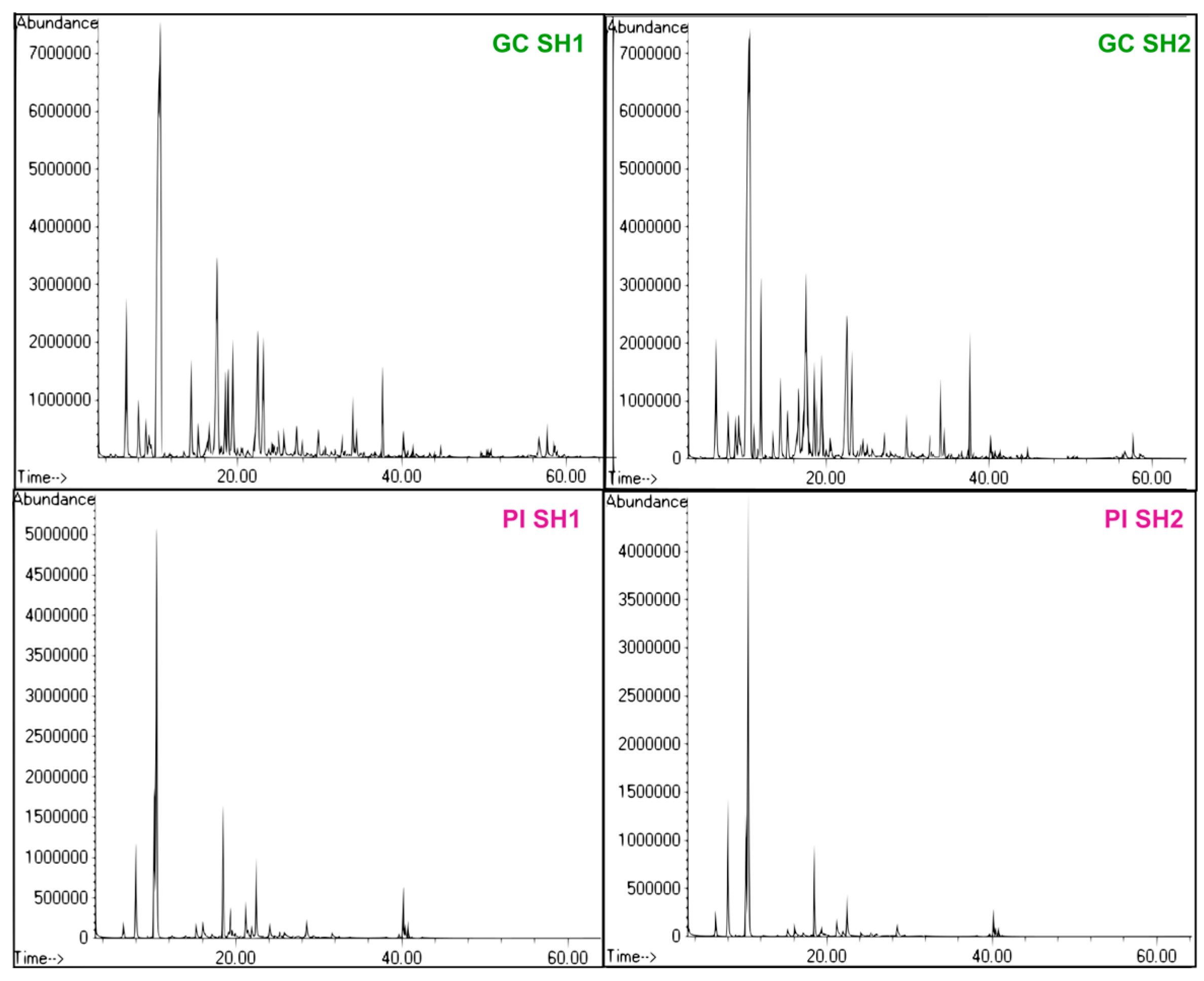
GC-MS analysis of peel EOs revealed major chemical and quantitative differences between C. australasica varieties Green Crystal and Pink Ice across the two harvesting stages (Table 1, Figure 2).
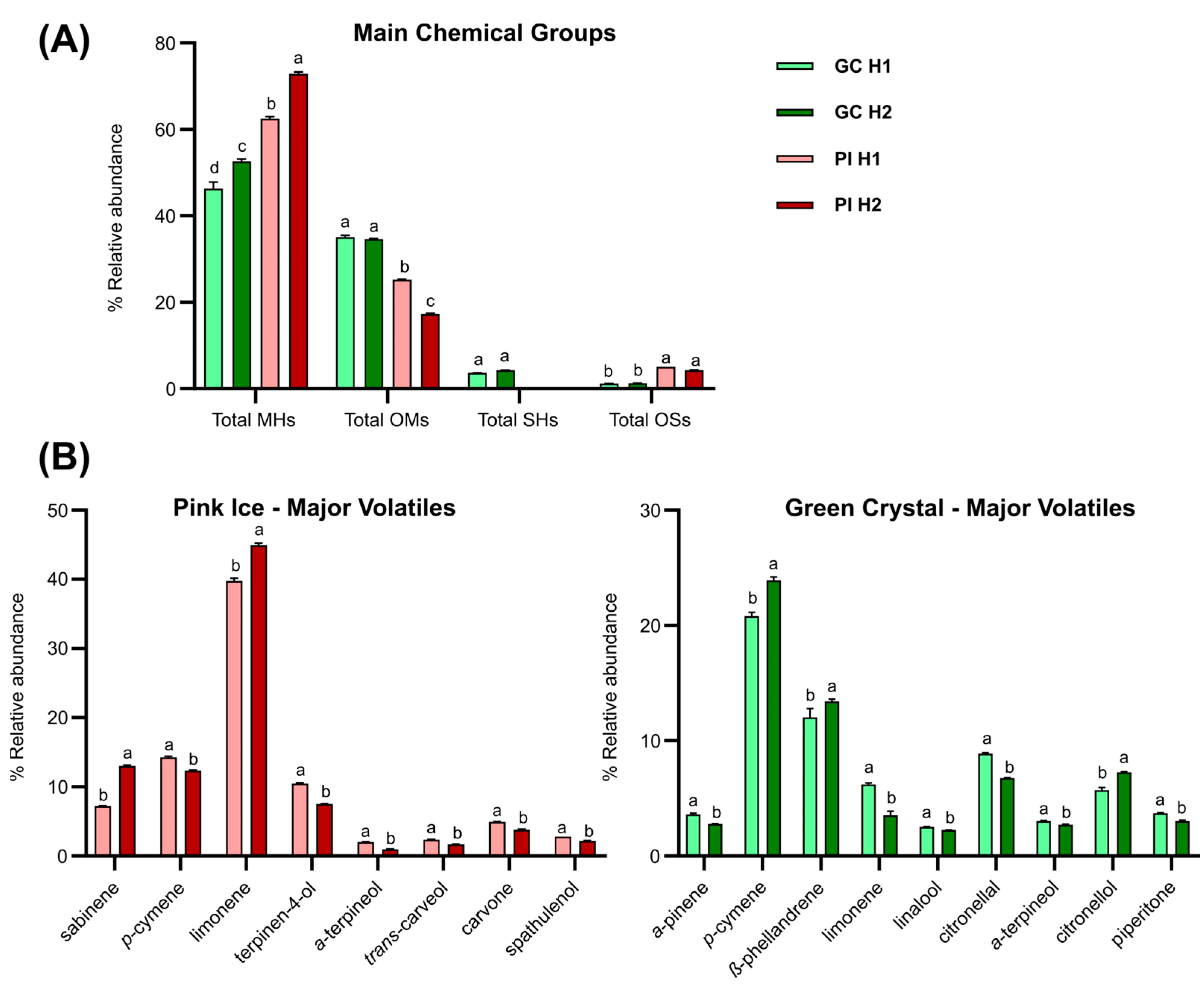
In the Green Crystal variety, 51 and 56 compounds were identified at harvest stages H1 and H2, respectively. Monoterpene hydrocarbons constituted the primary chemical class (46.31–52.59%), followed by oxygenated monoterpenes (34.54–35.06%), while sesquiterpenes and their oxygenated derivatives accounted for approximately 5% of the total composition (Figure 3A). The dominant volatile constituents in Green Crystal were p-cymene (20.81–23.92%), β-phellandrene (12.04–13.41%), citronellal (6.76–8.88%), citronellol (5.71–7.26%), and limonene (3.54–6.22%). Alcohols such as α-terpineol (2.72–3.04%), linalool (2.25–2.55%), isopulegol (1.09–2.21%) and terpinen-4-ol (1.63–1.68%), along with ketones including cryptone (1.10–2.39%), isomenthone (0.54–1.38%) and piperitone (3.03–3.71%), also contributed significantly to the volatile profile.
In the Pink Ice variety, 15 compounds were identified in Stage H1 and 11 in Stage H2, accounting for 92.97% and 94.56% of the total relative abundance, respectively. Monoterpene hydrocarbons dominated the volatile profile (62.53–72.92%), followed by oxygenated monoterpenes (17.33–25.21%) and oxygenated sesquiterpenes (4.31–5.10%) (Figure 3A). The major compounds in Pink Ice were limonene (39.78–44.92%), p-cymene (12.36–14.28%), sabinene (7.22–13.00%), and terpinen-4-ol (7.54–10.49%). Additional contributors included the ketone carvone (3.80–4.93%) and the sesquiterpene alcohol spathulenol (2.19–2.82%). Figure 3B presents major volatile constituents (>2.0% relative abundance in at least one harvest stage) across the two harvesting stages for both varieties.
Comparative analysis between the two varieties demonstrated significantly greater volatile diversity in Green Crystal. Monoterpene hydrocarbons such as β-pinene, α-phellandrene, and E- and Z-ocimene were detected exclusively in Green Crystal. Furthermore, a clear variety-specific distribution was observed in the alcoholic and ketonic fractions, where cis- and trans-piperitol and piperitone were unique to Green Crystal, whereas cis- and trans-carveol, carvone, cis-dihydrocarvone, and sabina ketone were exclusive to Pink Ice. Green Crystal was further distinguished by citronellal, citronellol, citronellyl formate, citronellyl acetate, linalool, isopulegol, cryptone, and isomenthone, all of which were absent in Pink Ice. In the sesquiterpene fraction, sesquiterpene hydrocarbons (E-caryophyllene, cis- and trans-bergamotene, α-humulene, viridiflorene, and β-bisabolene) occurred exclusively in Green Crystal, whereas oxygenated sesquiterpenes (spathulenol, maaliol, palustrol, globulol, viridiflorol, and cubeban-11-ol) were present in significantly higher relative abundances in Pink Ice (p < 0.05).

3.2. Multivariate Chemometric Analysis (PCA)

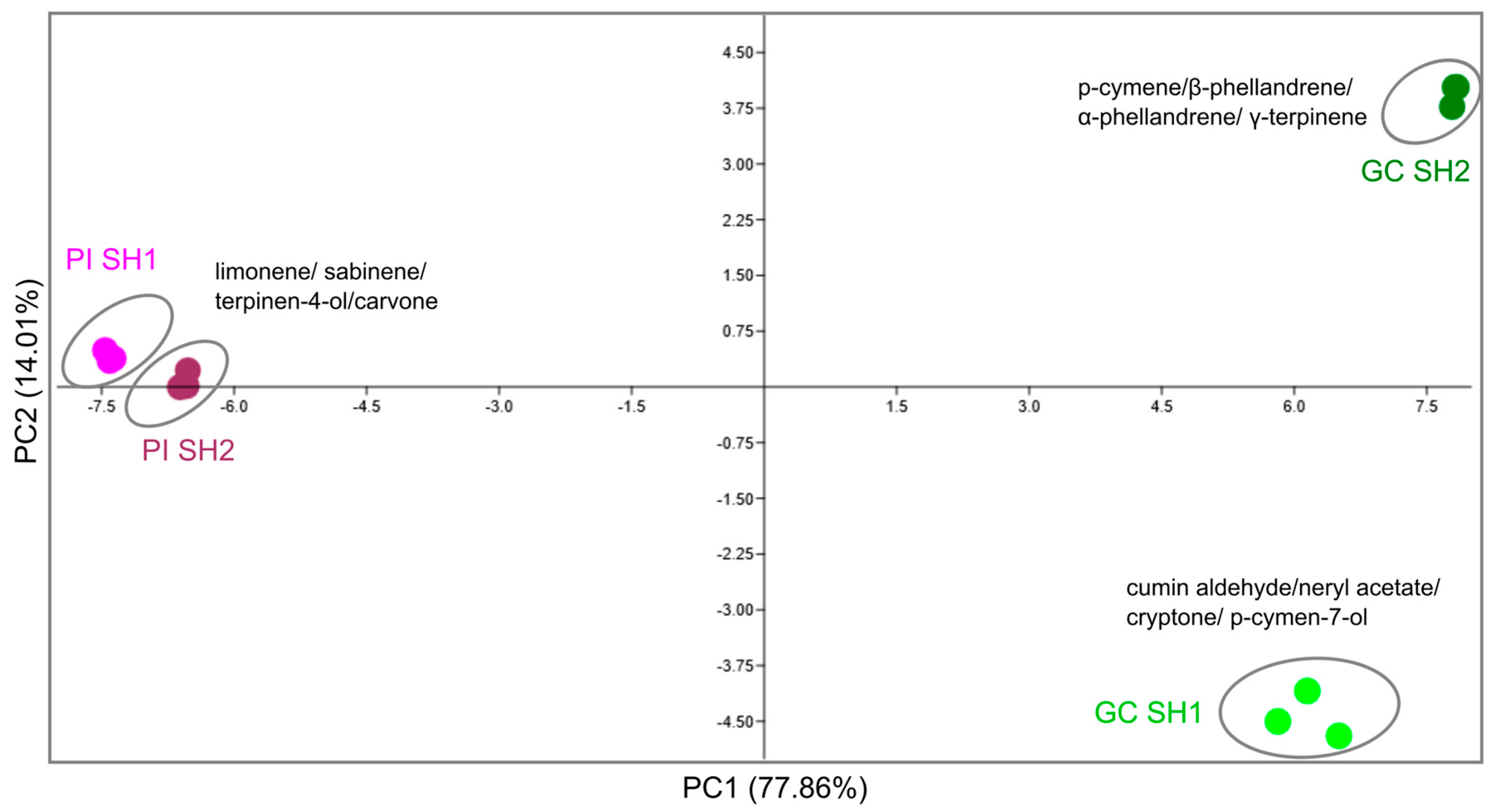
To evaluate the overall chemical relationships between varieties and harvest periods, Principal Component Analysis (PCA) was performed on the GC-MS volatile dataset across all replicates (Figure 4).
The first two principal components accounted for 91.88% of the total variance (PC1 = 77.86%, PC2 = 14.01%) (Figure S1). PC1 clearly separated Green Crystal (positive PC1 scores) from Pink Ice (negative PC1 scores) along the horizontal axis, reflecting their distinct, variety-specific chemotypes. Loading vector analysis (Table S1) indicated that Green Crystal was strongly defined by high relative abundances of myrcene (0.136), β-bisabolene (+0.136), citronellol (+0.136), α-trans-bergamotene (+0.136), linalool (+0.134), p-cymene (+0.132), citronellal (+0.131), and β-pinene (+0.130). Conversely, Pink Ice clustering along negative PC1 was driven by limonene (−0.134), sabinene (−0.124), terpinen-4-ol (−0.132), carvone (−0.135), trans-carveol (−0.134), and oxygenated sesquiterpenes, including spathulenol (−0.134), globulol (−0.136), viridiflorol (−0.135), maaliol (−0.136), and palustrol (−0.135).
PC2 captured the seasonal maturity shift, particularly within the Green Crystal variety. Premature peels (Stage H1) positioned in the negative PC2 quadrant were characterized by higher proportions of aldehydes, esters, and ketones, including cumin aldehyde (−0.309), neryl acetate (−0.272), p-cymen-7-ol (−0.238), 3-oxo-p-menth-1-en-7-al (−0.185) and cryptone (−0.171). The transition to full maturity (Stage H2, positive PC2 quadrant) was marked by significant accumulation of monoterpene hydrocarbons, notably α-phellandrene (0.246), terpinolene (0.246), E-β -ocimene (0.246), α-terpinene (0.246), and γ-terpinene (0.242). Pink Ice samples clustered tightly along PC1/PC2, with their seasonal shift predominantly differentiated along PC3 (7.03% variance), influenced by cis-sabinene hydrate (0.358), trans-sabinene hydrate (0.356) and p-cymen-8-ol (0.436).

3.3. TPC of Peel Extracts

The TPC of the methanolic extracts from both finger lime varieties was quantified and expressed as milligrams of gallic acid equivalents per gram of dry extract (Table 2). The quantification of TPC in the peel extracts revealed statistically significant differences (p < 0.05) between harvest stages H1 and H2 for both varieties, with peak concentrations observed at stage H1. Specifically, stage H1 extracts exhibited TPC values ranging from 36.54 to 39.53 mg GAE/g extract. During maturation (stage H2), these contents dropped significantly to 24.56 mg GAE/g extract for Green Crystal and 32.63 mg GAE/g extract for Pink Ice.

3.4. Radical Scavenging Activity of Peel Extracts

The antioxidant capacity of the extracts was evaluated via the DPPH radical scavenging assay, with results expressed as the percentage of radical inhibition (Table 3). Green Crystal showed a 20.55% inhibition for H1 and 14.01% inhibition for H2, with no statistical significance (p > 0.05) observed between the stages. Similarly, Pink Ice exhibited lower radical scavenging capacities of 15.04% and 12.55% for H1 and H2, respectively.

3.5. UHPLC-MS Analysis of Peel Extracts

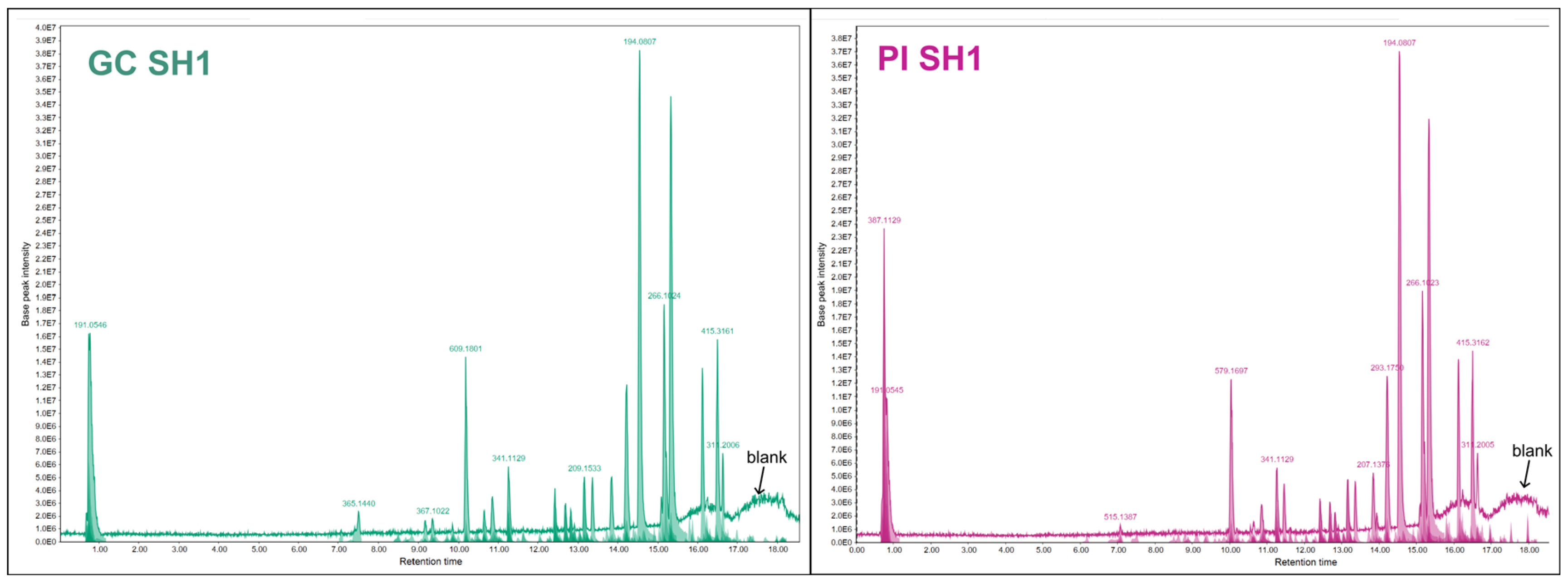
To comprehensively characterize the non-volatile secondary metabolites, the peel extracts from the Stage H1 harvest of both varieties were selected for high-resolution UHPLC–MS/MS analysis (Figure 5), as they exhibited the highest TPC values. Tentative compound identification of the detected features was achieved by integrating accurate mass measurements, isotopic pattern distributions, and MS/MS fragmentation patterns. These spectral datasets were systematically cross-referenced against open-access databases, including GNPS and MassBank, and validated using diagnostic fragmentation pathways reported in the literature. To further enhance structural annotation, the processed features were evaluated within the SIRIUS (version 6.1.0) computational framework [28], which allows in silico chemical class prediction. The secondary metabolites from the Stage H1 extracts are detailed in Table 4.
In total, 58 non-volatile secondary metabolites belonging to flavonoids, coumarins, phenolic acid derivatives, and limonoids were annotated, revealing substantial qualitative divergence between the two cultivars. Flavonoid derivatives represented a major class, with 17 flavonoid glycosides detected in Pink Ice and 14 in Green Crystal, whereas only two O-glycosides (neoericitrin and syringetin-3-O-hexosdie) and one C-glycoside (vicenin-2) were shared between the two varieties. Subclass distribution demonstrated that Pink Ice possessed greater diversity in flavanones and flavonols, while Green Crystal was characterized by a higher prevalence of flavones and the exclusive presence of HMG-flavonoid conjugates. Among coumarin derivatives, 21 distinct compounds were annotated (12 in Pink Ice and 14 in Green Crystal), with five common to both varieties (psoralen, 8-methoxypsoralen (xanthotoxin), 5-methoxypsoralen (bergapten), isoimperatorin, and umbelliferone). Among other specialized metabolite classes, phenolic glycosides cnidioside A and B and the phenolamide coumaroyl putrescine were unique to Green Crystal, citrusin F was detected solely in Pink Ice, and two major limonoids—limonin and isoobacunoic acid—were identified as shared constituents in both varieties.

4. Discussion

4.1. Volatile Composition of Peel EOs

This study provides the first scientific report on the EO composition of the commercial Green Crystal variety. Green Crystal exhibited a unique p-cymene/β-phellandrene/ citronellal/citronellol chemotype not previously documented in the finger lime volatilomic literature. While p-cymene and β-phellandrene are common in finger limes, they typically appear in low concentrations, with limonene usually as the dominant monoterpene. For instance, in the Faustrime hybrid from Sicily, limonene and β-phellandrene were found in high amounts, yet p-cymene levels were nearly three times lower than those of β-phellandrene [3]. Similarly, in the Alstonville, Judy’s Everbearing, and Durham’s Emerald varieties, the relative abundances of β-phellandrene and p-cymene reached only 0.18–4.74% and 0.32%, respectively [8].
The elevated percentages of the oxygenated monoterpenes citronellal and citronellol observed in Green Crystal are comparable to those found in specific Australian cultivars and hybrids. For example, citronellal levels reach 9.04% in Judy’s Everbearing and 9.26% in Durham’s Emerald, while citronellol reaches 2% and 5.18% in the same varieties, respectively [8]. Similarly, the Faustrime hybrid has been reported with 9.4% citronellal and 1.2% citronellol [11]. Oxygenated monoterpenes have been detected in other finger lime varieties, including Pink Pearl, Sanguinea, Durham’s Emerald, and Judy’s Everbearing [3,8]. Notably, the presence of piperitone in Green Crystal is consistent with the high percentages (2.9–6.9%) documented in the Faustrime hybrid cultivated in Italy [11,13].
For Pink Ice, the Greek-cultivated peels exhibited a limonene/p-cymene/sabinene/terpinen-4-ol chemotype. Previous evaluations of Pink Ice in Central Italy (Pistoia) identified terpinen-4-ol (38.3%) and limonene (26.5%) as the major compounds, alongside γ-terpinene (7.3%), which was entirely absent from the Greek-cultivated variety [11]. Furthermore, sabinene and p-cymene were detected at much lower levels in the Italian samples (1.7% and 0.2%, respectively) [11]. A different profile was reported for Pink Ice cultivated in Southern Italy, with the main components identified as limonene (37.68%), sabinene (33.33%), and α-pinene (5.55%) [10]. The occurrence of distinct chemotypes within the same variety has been well-documented in other finger lime cultivars. For example, the Sanguinea variety cultivated in Sicily showed a chemotype dominated by bicyclogermacrene (25.9%), α-pinene (10.2%), and spathulenol (9.8%) [35], whereas a separate study also conducted in Sicily characterized Sanguinea by limonene (65.7%), γ-terpinene (8.8%), and bicyclogermacrene (7.0%) [3]. These differences suggest that the volatile profile is not exclusively determined by the genotype but is significantly modulated by environmental factors, as well as by preharvest climatic conditions and cultural practices, harvesting time and extraction methods, all of which represent crucial factors that affect the chemical composition of EOs [15].
Furthermore, certain differences were observed between the documented compounds of Pink Ice in the previous literature and those in the present study, specifically regarding the presence of carvone, cis-carveol, and spathulenol, which were not reported in the EOs from the Italian peninsula. Notably, several volatile constituents identified in this study—including cis-dihydrocarvone, sabina ketone, cubeban-11-ol, and maaliol in Pink Ice—are reported here for the first time in finger lime EOs.
The clear chemical differentiation between Green Crystal and Pink Ice confirmed by PCA indicates distinct organoleptic identities. As shown, Green Crystal exhibits lower relative abundances of monoterpene hydrocarbons but higher proportions of oxygenated monoterpenes and sesquiterpene hydrocarbons, resulting in a notably broader volatile diversity than Pink Ice. Although many of these differentiating compounds occur in low concentrations, they play a critical role in defining the overall aromatic character [36]. Because the flavor contribution of volatiles depends on specific odor thresholds rather than absolute concentration [37], the absence or presence of these specific markers—such as the citronellal group in Green Crystal versus the carvone group in Pink Ice—indicates that these varieties will serve distinct culinary and industrial applications.

4.2. Influence of Harvesting Period on Volatile Composition

Distinct variations were observed between the two harvesting periods, representing the transition from immature to mature fruits. In Green Crystal, a significant shift in the total monoterpene hydrocarbons was noted (increasing from 46.31% to 52.59%, p < 0.05). This trend corresponded to changes in major constituents, specifically an increase in p-cymene (from 20.81% to 23.92%, p < 0.05) and β-phellandrene, alongside the late emergence of γ-terpinene (3.11%) and α-phellandrene (1.43%) at stage H2, while a simultaneous decrease in limonene (from 6.22% to 3.54%) was noted. Although oxygenated monoterpenes did not show an overall statistically significant shift, their internal distribution changed, with significant decreases observed in citronellal (8.88% to 6.76%), cryptone (2.39% to 1.10%), α-terpineol (3.04% to 2.72%), and piperitone (3.71% to 3.03%) (p < 0.05), while citronellol increased (from 5.71% to 7.26%). These quantitative shifts were clearly reflected in the PCA loading plot, where premature Green Crystal peels grouped in the negative PC2 quadrant due to higher proportions of volatile alcohols, aldehydes, esters, and ketones, whereas mature peels shifted into the positive PC2 quadrant driven by monoterpene hydrocarbon accumulation.
In Pink Ice, a similar shift observed in monoterpene distribution, which was characterized by an increase in hydrocarbons (62.53% to 72.92%) and a corresponding decrease in oxygenated derivatives (25.21% to 17.33%, p < 0.05). This rise in hydrocarbons is primarily attributed to the significant accumulation of limonene (39.78% to 44.92%), sabinene (7.22% to 13.00%), and α-pinene (1.13% to 2.27%, p < 0.05). Conversely, a small but significant decrease was noted in p-cymene (14.28% to 12.36%). The reduction in oxygenated compounds was driven by the decline of α-terpineol (2.00% to 0.98%), trans-carveol (2.36% to 1.70%), and carvone (4.93% to 3.80%) (p < 0.05). In the PCA matrix, this seasonal transition was primarily resolved along PC3, confirming that while both cultivars undergo monoterpene hydrocarbon enrichment during ripening, the specific precursor pathways involved are strongly genotype-dependent.
Studies investigating the impact of harvest timing and fruit maturity on finger lime EO composition remain scarce. Dugo et al. examined the Faustrime hybrid and found no major quantitative differences between early and late November samples, noting only a slightly modified ratio between limonene and β-phellandrene [13]. A more recent study by Cucinotta et al. on an unspecified variety (limonene/citronellal/β-phellandrene/γ-terpinene chemotype) observed that monoterpene hydrocarbons were higher in October and June, while oxygenated monoterpenes—specifically citronellal—peaked in January [2]. A comparable trend was observed in the Pink Ice variety, where the percentage of monoterpene hydrocarbons increased while oxygenated derivatives decreased over the advancing months. Conversely, the rise in sesquiterpene hydrocarbons as maturity progressed aligns with observations in the Green Crystal variety [2]. In other Citrus species, higher limonene levels observed in Green Crystal during Stage H1 align with reports for C. aurantium, C. limon, and C. sinensis, where this compound typically peaks at the immature stage [16], while higher levels of oxygenated derivatives detected in later maturation stages—such as spathulenol in Pink Ice—align with patterns observed in C. reticulate [16].
Generally, monoterpene hydrocarbons contribute less to the overall fragrance intensity of EOs than oxygenated compounds, which are highly odoriferous [37]. Regarding this organoleptic effect, while Green Crystal showed no significant change in total terpenoid amounts between months, the internal shifts in terpene distribution likely alter the final aromatic outcome. In Pink Ice, immature peels yielded EOs richer in oxygenated monoterpenes, potentially resulting in a more intense fragrance profile.

4.3. Total Phenolic Content of Extracts

The significant decrease in TPC observed from Stage H1 to H2 across both varieties aligns with a well-documented shift during fruit maturation in other Citrus peels, including C. limon [38], C. grandis [39], and C. reticulata [40], where immature tissues typically possess higher concentrations compared to their fully ripe counterparts. This tendency can be linked to changes in secondary metabolism pathways and altering enzyme gene expressions. Notably, the decline in total phenolics often correlates with a combined increase in polyphenol oxidase (an enzyme for phenolic catabolism) activity and a concomitant decrease in phenylalanine ammonia-lyase (an enzyme participating in phenolic biosynthesis) activity as the fruit ripens [39].
Regarding finger limes specifically, previous literature reports of TPC values ranged between 175.49 and 265.95 mg GAE/100 g dry weight across various extract types [23]. Additionally, while the TPC in peel extracts from red and white finger limes has been reported at 35–55 mg GAE/100 g fresh weight (FW) [41], our samples yielded higher concentrations (267.33 and 292.85 for Green Crystal, and 383.60 and 384.07 mg GAE/100 g FW for Pink Ice, when taking into account the extraction yields). In comparative studies of peel profiles, the Red and Pink Ice varieties demonstrated elevated TPC levels (9.1 ± 0.2 and 8.2 ± 0.2 mg GAE/g dry weight, respectively) compared to other cultivars, such as the Faustrime hybrid, which exhibited the lowest concentration (4.9 ±0.1 mg GAE/g dry weight) [11]. Although our values appeared higher than those in select reports, inherent variations in moisture content preclude a direct comparison between fresh and dried tissue data.

4.4. Chemical Profiling of Non-Volatile Metabolites in Peel Extracts

4.4.1. Identification of Flavonoids

The distinct flavonoid profiles between Pink Ice and Green Crystal highlights the complex secondary metabolome of C. australasica. In the Pink Ice variety, the presence of rutin, neodiosmin, poncirin, and the O-glycosides of kaempferol and isorhamnetin aligns with previous characterizations of this specific cultivar [11]. Furthermore, compounds such as isorhamnetin-O-dihexoside, naringin/narirutin, rhoifolin, syringetin-3-O-hexoside, vicenin-2, neoeriocitrin have been previously documented within the species [19,42]. Crucially, to the best of our knowledge, isovitexin-2″-O-rhamnoside and linarin are reported for the first time in C. ausratalasica, although they are typical compounds in Citrus [43,44].
In contrast, the phenolic profile of the Green Crystal variety has not been previously investigated. Our findings displayed a different array of flavonoid glycosides, including eriocitrin, chrysoeriol 7-O-rutinoside, (neo)hesperidin, apigenin-O-neohesperidoside and naringin/narirutin, which agree with general species profiles [30,42], whereas luteolin-7-O-rutinoside, diosmin and scoparin have previously been restricted to the Faustrime hybrid [11]. Notably, among the detected flavonoids, isovitexin-2″-O-arabinoside is also documented for the first time in C. australasica. Additionally, the presence of HMG (3-hydroxy-3-methylglutaric acid)–flavonoid conjugates involving isorhamnetin glycoside moieties has been previously identified in finger lime varieties such as Collette, Yellow Sunshine, Pink Ice, Red, and Faustrime [11,19]. However, in the present study, these flavonoid derivatives were exclusively detected in the Green Crystal variety.
Generally, in Citrus plants, naringenin serves as the central biosynthetic intermediate from which all subclasses diverge. The flavone subclass was represented by major aglycones (apigenin and luteolin) and their glucosides or O-methylated derivatives (diosmetin and acacetin). In contrast, flavonols—including quercetin, kaempferol, and isorhamnetin derivatives—are present in significantly lower abundance than flavanones and flavones [45]. In the current study, Pink Ice showed a more varied profile of flavanones and flavonols, whereas Green Crystal showed a higher diversity of flavones.
These structural variations generated during biosynthesis directly influence both the physical properties and the health-promoting profiles of the extracts. From a biological perspective, the specific arrangement and quantity of free or substituted hydroxyl groups dictate the capacity of these molecules to mitigate oxidative stress and clear free radicals [45]. In this regard, the general potency for vasoprotective effects follows the hierarchy of flavonols > flavones > flavanones [45]. Beyond bioactivity, the specific glycosylation type also dramatically affects the organoleptic properties of these compounds. For instance, flavanone O-glycosides possessing a neohesperidoside moiety—such as naringin, neohesperidin, and poncirin—are structurally associated with the characteristic bitterness found in certain Citrus fruits. Conversely, flavonoids bound to a rutinose moiety (rutinosides)—including rutin, narirutin, and diosmin—are non-bitter and generally considered tasteless [46].

4.4.2. Identification of Coumarins

Previous studies have primarily described the presence of coumarins within the peel EOs of finger lime varieties [2,9]. Specifically, compounds such as herniarin, psoralen, 8-methoxypsoralen, isopimpinellin, limettin (citropten), bergapten, isoimperatorin, 8-geranyloxypsoralen, and bergamottin have been documented in these volatile fractions [2,9]. Additionally, psoralen, xanthotoxin, isopimpinellin, and umbelliferone were previously reported in peel extracts of the Faustrime hybrid [19], while phenolics in the red finger lime (C. australasica var. sanguinea) were quantified with approximately 2.5% psoralen [47].
However, several coumarin derivatives detected in the current study are reported here for the first time in this species. These novel assignments include oxypeucedanin hydrate alongside the rutinosides of umbelliferone and scopoletin in Pink Ice, as well as phellopterin, prenyl scopoletin, rutarin, and rutaretin in Green Crystal. Interestingly, simple coumarins were slightly more diverse in Pink Ice, whereas furanocoumarins demonstrated a stronger representation in the Green Crystal variety.
Within the Citrus genus, numerous studies have documented the in vitro bioactivities of specialized coumarins. For instance, bergamottin and 8-geranyloxypsoralen isolated from C. limon possess antitumor activity, while 5-geranyloxy-7-methoxycoumarin, limettin, and isopimpinellin from C. aurantifolia (lime) have been shown to inhibit human colon cancer (SW-480) cell proliferation [48]. Furthermore, furanocoumarins widely exhibit antibacterial, antimicrobial, and fungicidal properties. Specifically, phellopterin has demonstrated antimicrobial activity against Staphylococcus aureus, S. epidermidis, and Micrococcus luteus and antiviral efficacy against herpes simplex virus-1 (HSV-1) [49]. Xanthotoxin, bergapten, and isopimpinellin are effective against S. aureus and Candida albicans in in vitro studies [50].
Furanocoumarins play a significant clinical role in treating dermatological conditions. Currently, psoralen, bergapten, and xanthotoxin are utilized to manage psoriasis, as they stimulate the proliferation and differentiation of melanocytes under the influence of ultraviolet (UV) light [21]. For other skin disorders, furanocoumarins—including psoralen, xanthotoxin, isopimpinellin, and oxypeucedanin hydrate—enhance melanin synthesis and have consequently been incorporated into topical cosmetic formulations for the treatment of vitiligo [21]. However, despite their therapeutic attributes, these compounds also have safety concerns. Long-term studies indicate that furanocoumarins exhibit cytotoxic, carcinogenic, and phototoxic activities; as a result, they must not exceed established legal limits in a number of Asian and European countries when they are included in cosmetic formulations [21].
Given the diverse biological and clinical aspects of this chemical class, the distinct and newly discovered coumarin profiles of Green Crystal and Pink Ice offer a practical framework for safety optimization and product development in commercial extract processing.

4.4.3. Identification of Other Compounds

Apart from flavonoids and coumarins, the phenolic glycosides cnidioside A and B were detected in Green Crystal, while citrusin F was identified in Pink Ice. Although these metabolites have been previously documented in other Citrus species [33,51,52], to the best of our knowledge, this is the first time they have been reported in C. australasica. Furthermore, coumaroyl putrescine—a polyamine classified specifically as a phenolamide—was identified solely in Green Crystal. In Citrus plants, polyamines play a crucial role in regulating growth, development, and various physiological processes [53]. Regarding human health benefits, dietary phenolamides possess significant therapeutic potential; for instance, feruloyl putrescine has been reported to exhibit anti-prostate hyperplasia effects; tri-p-coumaroyl spermidine can inhibit HIV-1 protease, while other molecules in this class have demonstrated notable neuroprotective, anti-inflammatory, and anti-tyrosinase activities [54]. Consequently, the discovery of this biologically potent compound class marks its first reported detection in finger limes.
Regarding oxygenated triterpenoids, the identification of limonin and isoobacunoic acid in both varieties aligns with the widespread distribution of limonoids throughout the Citrus genus [23,42]. Both identified compounds have been previously described in the peels of the Faustrime hybrid [19]. Limonin possesses a broad spectrum of pharmacological activities, including anticancer, anti-inflammatory, analgesic, antibacterial, antiviral, antioxidant, and hepatoprotective properties [55]. However, its documented toxicological profile should not be overlooked, as studies indicate the potential for hepatorenal and genetic toxicity [55]. Regarding the second limonoid, in vivo studies on excised tissues have evaluated the influence of isoobacunoic acid on phase II metabolic enzyme activity. This research demonstrated that the limonoid significantly induces glutathione S-transferase (GST) activity, which naturally enhances an organism’s capacity to detoxify numerous potentially harmful xenobiotics; thus, its upregulation by isoobacunoic acid offers a valuable and pronounced chemoprotective effect [56].

4.5. Evaluation of Antioxidant Activity

The DPPH radical scavenging capacities observed in this study align closely with previous studies on C. australasica. For example, the antioxidant potential of the finger lime varieties XiangBin and LiSiKe using the DPPH assay showed values of 1.25 ± 0.05 and 1.60 ± 0.05 mg TE/g fresh weight, respectively [30]. Sommano et al. investigated the radical scavenging activity at 1000 μg/mL, reporting an inhibition of 87.20% and an antioxidant capacity (TEAC) of 28.46 mg TE/100 g [57], with the inhibition percentages closely aligning with our findings when adjusting for sample concentrations.
Unlike TPC, clear seasonal variations or significant differences in DPPH activity were not observed between the two varieties. Although TPC is frequently correlated with DPPH scavenging, other components in finger limes—such as vitamin C, carotenoids, and minerals—also contribute to the total antioxidant activity [17]. In this regard, fluctuations in radical scavenging potential are driven by a complex combination of total phenols, flavonoids, and ascorbic acid contents [39]. Because these individual compounds can vary between the varieties and maturity stages, their shifting levels likely balance out the overall antioxidant effects despite the distinct differences observed in TPC.

5. Conclusions

This study establishes the first comprehensive metabolomic analysis for C. australasica varieties grown in Greece, a region with a deep-rooted tradition in high-quality Citrus production. Our research provides the first scientific report on the Green Crystal variety, identifying a unique p-cymene/β-phellandrene/citronellal/citronellol chemotype that has not been previously documented in finger lime EO compositions. Conversely, Pink Ice was defined by a limonene/p-cymene/sabinene/terpinen-4-ol profile, with the analysis revealing further chemical divergence between the two varieties. Furthermore, the results highlight that harvesting timing significantly modulates aromatic character. In both varieties, the transition toward maturity led to an increase in monoterpene hydrocarbons at the expense of more odoriferous oxygenated derivatives. Quantification of TPC showed a significant maturity-dependent decline, with higher concentrations observed during the early harvesting stage (H1) for both varieties. The subsequent investigation of the non-volatile metabolome of these varieties resulted in the identification of 58 distinct metabolites dominated by flavonoids and coumarins. Notable variations emerged between the genotypes, including newly reported metabolites in the species as well as variety-specific patterns.
These distinct chemical fingerprints and seasonal shifts suggest that both varieties possess unique aromatic and bioactive profiles, offering diverse functional applications. The successful acclimatization of these economically important varieties in Greece demonstrates significant potential for their expanded cultivation within the region. Proper management of both cultivar selection and harvesting timing is therefore critical for optimizing the aromatic quality and maximizing the commercial value of Mediterranean-grown finger lime.

Supplementary Materials

The following supporting information can be downloaded at https://www.mdpi.com/article/10.3390/horticulturae12080967/s1, Figure S1. Scree plot and corresponding eigenvalue table illustrating the percentage of explained variance (eigenvalue %) per principal component (PC1–PC11) for the principal component analysis (PCA) of finger lime peel essential oils. Table S1. Principal component analysis (PCA) loading scores for volatile compounds across principal components (PC1–PC11) in finger lime peel essential oils.

Author Contributions

Conceptualization, V.Z. and I.C.; methodology, E.P., V.Z. and I.C.; software: G.C. and E.P.; validation: G.C. and E.P.; formal analysis, G.C. and E.P.; investigation, G.C., E.P., V.Z., and I.C.; Resources, V.Z.; data curation, E.P. and V.Z.; writing—original draft preparation, G.C., E.P. and V.Z.; writing—review and editing, E.P., V.Z., and I.C.; visualization, E.P.; supervision, I.C. and F.S.R.D.C.; project administration, V.Z. and I.C.; funding acquisition, I.C. All authors have read and agreed to the published version of the manuscript.

Funding

This research received no external funding.

Data Availability Statement

The original contributions presented in this study are included in the article/Supplementary Materials. Further inquiries can be directed to the corresponding author.

Conflicts of Interest

The authors declare no conflicts of interest.

References

  1. Delort, E.; Yuan, Y.-M. Finger Lime/The Australian Caviar—Citrus australasica. In Exotic Fruits; Elsevier: Amsterdam, The Netherlands, 2018; pp. 203–210. ISBN 978-0-12-803138-4. [Google Scholar]
  2. Cucinotta, L.; Cafeo, G.; Alibrando, F.; Russo, M.; Sciarrone, D.; Mondello, L.; Mondello, M. Characterization of Oxygen Heterocyclic Compounds and Volatile Fraction of Citrus australasica Finger Lime Peel Essential Oil Exploiting a Multi-Technique Chromatographic Approach. J. Essent. Oil Res. 2025, 37, 46–55. [Google Scholar] [CrossRef]
  3. Cozzolino, R.; Câmara, J.S.; Malorni, L.; Amato, G.; Cannavacciuolo, C.; Masullo, M.; Piacente, S. Comparative Volatilomic Profile of Three Finger Lime (Citrus australasica) Cultivars Based on Chemometrics Analysis of HS-SPME/GC–MS Data. Molecules 2022, 27, 7846. [Google Scholar] [CrossRef] [PubMed]
  4. Nastasi, J.R.; Perry, K.R.; Alagappan, S.; King, J.M.; Cozzolino, D. Authentication of Finger Lime (Citrus australasica) Cultivars Enhances Provenance in Australian Native Food Supply Chains. J. Food Compos. Anal. 2026, 149, 108665. [Google Scholar] [CrossRef]
  5. Michalski, P.; Nur-A-Tomal, M.S.; Crawford, S.; Rudman, M.; Van ‘T Hag, L. Advancement in Fruit Drying through the Analysis of Moisture Sorption Isotherms: Processing Effects on Australian Native Fruits in Comparison to Apple. J. Food Eng. 2025, 395, 112526. [Google Scholar] [CrossRef]
  6. Lim, T.K. Edible Medicinal and Non-Medicinal Plants: Volume 4, Fruits; Springer: Dordrecht, The Netherlands, 2012; ISBN 978-94-007-4052-5. [Google Scholar]
  7. González-Mas, M.C.; Rambla, J.L.; López-Gresa, M.P.; Blázquez, M.A.; Granell, A. Volatile Compounds in Citrus Essential Oils: A Comprehensive Review. Front. Plant Sci. 2019, 10, 12. [Google Scholar] [CrossRef] [PubMed]
  8. Delort, E.; Jaquier, A.; Decorzant, E.; Chapuis, C.; Casilli, A.; Frérot, E. Comparative Analysis of Three Australian Finger Lime (Citrus australasica) Cultivars: Identification of Unique Citrus Chemotypes and New Volatile Molecules. Phytochemistry 2015, 109, 111–124. [Google Scholar] [CrossRef] [PubMed]
  9. Johnson, J.B.; Batley, R.; Manson, D.; White, S.; Naiker, M. Volatile Compounds, Phenolic Acid Profiles and Phytochemical Content of Five Australian Finger Lime (Citrus australasica) Cultivars. LWT 2022, 154, 112640. [Google Scholar] [CrossRef]
  10. D’Auria, M.; Racioppi, R. Volatile Organic Compounds from Citrus australasica Growing in Basilicata (Southern Italy). Nat. Prod. Res. 2023, 37, 3302–3305. [Google Scholar] [CrossRef] [PubMed]
  11. Cioni, E.; Migone, C.; Ascrizzi, R.; Muscatello, B.; De Leo, M.; Piras, A.M.; Zambito, Y.; Flamini, G.; Pistelli, L. Comparing Metabolomic and Essential Oil Fingerprints of Citrus australasica F. Muell (Finger Lime) Varieties and Their In Vitro Antioxidant Activity. Antioxidants 2022, 11, 2047. [Google Scholar] [CrossRef] [PubMed]
  12. Trozzi, A.; Verzera, A.; d’Alcontres, I.S. Constituents of the Cold-Pressed Oil of Faustrime, A Trigeneric Hybrid of Monocitrus australasica x Fortunella sp. × Citrus aurantifolia. J. Essent. Oil Res. 1993, 5, 97–100. [Google Scholar] [CrossRef]
  13. Dugo, P.; Mondello, L.; Zappia, G.; Bonaccorsi, I.; Cotroneo, A.; Russo, M.T. The Composition of the Volatile Fraction and the Enantiomeric Distribution of Five Volatile Components of Faustrime Oil ( Monocitrus australatica × Fortunella sp. × Citrus urantifolia ). J. Essent. Oil Res. 2004, 16, 328–333. [Google Scholar] [CrossRef]
  14. Wu, Z.; Li, H.; Yang, Y.; Zhan, Y.; Tu, D. Variation in the Components and Antioxidant Activity of Citrus medica L. var. sarcodactylis Essential Oils at Different Stages of Maturity. Ind. Crops Prod. 2013, 46, 311–316. [Google Scholar] [CrossRef]
  15. Salvatore, M.M.; Nicoletti, R.; Andolfi, A. Essential Oils in Citrus Fruit Ripening and Postharvest Quality. Horticulturae 2022, 8, 396. [Google Scholar] [CrossRef]
  16. Bourgou, S.; Rahali, F.Z.; Ourghemmi, I.; Saïdani Tounsi, M. Changes of Peel Essential Oil Composition of Four Tunisian Citrus during Fruit Maturation. Sci. World J. 2012, 2012, 1–10. [Google Scholar] [CrossRef] [PubMed]
  17. Qi, Y.; Liu, H.; Agar, O.T.; Imran, A.; De Souza, T.S.P.; Barrow, C.; Dunshea, F.; Suleria, H.A.R. Phytochemicals in Finger Lime and Their Potential Health Benefits: A Review. Food Rev. Int. 2024, 40, 2167–2187. [Google Scholar] [CrossRef]
  18. Corradini, E.; Foglia, P.; Giansanti, P.; Gubbiotti, R.; Samperi, R.; Laganà, A. Flavonoids: Chemical Properties and Analytical Methodologies of Identification and Quantitation in Foods and Plants. Nat. Prod. Res. 2011, 25, 469–495. [Google Scholar] [CrossRef] [PubMed]
  19. Cannavacciuolo, C.; Pagliari, S.; Giustra, C.M.; Carabetta, S.; Guidi Nissim, W.; Russo, M.; Branduardi, P.; Labra, M.; Campone, L. LC-MS and GC-MS Data Fusion Metabolomics Profiling Coupled with Multivariate Analysis for the Discrimination of Different Parts of Faustrime Fruit and Evaluation of Their Antioxidant Activity. Antioxidants 2023, 12, 565. [Google Scholar] [CrossRef] [PubMed]
  20. Lončar, M.; Jakovljević, M.; Šubarić, D.; Pavlić, M.; Buzjak Služek, V.; Cindrić, I.; Molnar, M. Coumarins in Food and Methods of Their Determination. Foods 2020, 9, 645. [Google Scholar] [CrossRef] [PubMed]
  21. Shtratnikova, V.Y. Furanocoumarins: History of Research, Diversity, Synthesis, Physiological Role in the Plant, and Medical Application. Russ. J. Plant Physiol. 2023, 70, 169. [Google Scholar] [CrossRef]
  22. Dugrand-Judek, A.; Olry, A.; Hehn, A.; Costantino, G.; Ollitrault, P.; Froelicher, Y.; Bourgaud, F. The Distribution of Coumarins and Furanocoumarins in Citrus Species Closely Matches Citrus Phylogeny and Reflects the Organization of Biosynthetic Pathways. PLoS ONE 2015, 10, e0142757. [Google Scholar] [CrossRef] [PubMed]
  23. Aznar, R.; Rodríguez-Pérez, C.; Rai, D.K. Comprehensive Characterization and Quantification of Antioxidant Compounds in Finger Lime (Citrus australasica L.) by HPLC-QTOF-MS and UPLC-MS/MS. Appl. Sci. 2022, 12, 1712. [Google Scholar] [CrossRef]
  24. De Vita, D.; Stringaro, A.R.; Colone, M.; Dupuis, M.L.; Sciubba, F.; Scipione, L.; Garzoli, S. Phytochemical Constituents and Biological Properties of Finger Lime (Citrus australasica F. Muell.) Peel, Pulp and Seeds. Appl. Sci. 2024, 14, 6498. [Google Scholar] [CrossRef]
  25. Adams, R.P. Identification of Essential Oil Components by Gas Chromatography/Mass Spectrometry, 4th ed.; Allured Publishing Corporation: Carol Stream, IL, USA, 2007. [Google Scholar]
  26. Katsouli, E.; Panou, E.; Ziogas, V.; Ntamposi, E.; Graikou, K.; Chinou, I. Peel and Leaf Volatile Profiles of the New Citrus Hybrid ‘Eugene’ and Parent Species. Horticulturae 2025, 11, 1531. [Google Scholar] [CrossRef]
  27. Hammer, Ø.; Harper, D.A.T.; Ryan, P.D. PAST: Paleontological Statistics Software Package for Education and Data Analysis. Palaeontol. Electron. 2001, 4, 1–9. [Google Scholar]
  28. Dührkop, K.; Fleischauer, M.; Ludwig, M.; Aksenov, A.A.; Melnik, A.V.; Meusel, M.; Dorrestein, P.C.; Rousu, J.; Böcker, S. SIRIUS 4: A Rapid Tool for Turning Tandem Mass Spectra into Metabolite Structure Information. Nat. Methods 2019, 16, 299–302. [Google Scholar] [CrossRef] [PubMed]
  29. Guo, H.; Chen, Y.-H.; Wang, T.-M.; Kang, T.-G.; Sun, H.-Y.; Pei, W.-H.; Song, H.-P.; Zhang, H. A Strategy to Discover Selective α-Glucosidase/Acetylcholinesterase Inhibitors from Five Function-Similar Citrus Herbs through LC-Q-TOF-MS, Bioassay and Virtual Screening. J. Chromatogr. B 2021, 1174, 122722. [Google Scholar] [CrossRef] [PubMed]
  30. Wang, Y.; Ji, S.; Zang, W.; Wang, N.; Cao, J.; Li, X.; Sun, C. Identification of Phenolic Compounds from a Unique Citrus Species, Finger Lime (Citrus australasica) and Their Inhibition of LPS-Induced NO-Releasing in BV-2 Cell Line. Food Chem. Toxicol. 2019, 129, 54–63. [Google Scholar] [CrossRef] [PubMed]
  31. Li, L.; Ju, J.; Zhuang, X.; Li, S.; Ma, R.; Li, J.; Ding, M.; Ma, C.; Wang, X.; Zhang, B. Chemistry of Bairui Granules and Its Mechanisms in the Protective Effect against Methotrexate-Induced Liver Injury. Phytomedicine 2024, 122, 155158. [Google Scholar] [CrossRef] [PubMed]
  32. Shi, H.; Chang, Y.; Feng, X.; Yang, G.; Zheng, Y.; Zheng, Q.; Zhang, L.; Zhang, D.; Guo, L. Chemical Comparison and Discrimination of Two Plant Sources of Angelicae Dahuricae Radix, Angelica dahurica and Angelica dahurica Var. Formosana, by HPLC-Q/TOF-MS and Quantitative Analysis of Multiple Components by a Single Marker. Phytochem. Anal. 2022, 33, 776–791. [Google Scholar] [CrossRef] [PubMed]
  33. Wu, X.-F.; Xie, B.; Huang, X.-L.; Wu, H.-Q.; Huo, Y.-P.; Zhou, X. Rapid Analysis Compositions of Processed Citrus medica L. Var. Sarcodactylis Swingle by UPLC-Q-TOF MS. J. Chin. Mass Spectrom. Soc. 2021, 42, 207. [Google Scholar] [CrossRef]
  34. Zhang, J.; Wu, X.; Qiu, J.; Zhang, L.; Zhang, Y.; Qiu, X.; Huang, Z.; Xu, W. Comprehensive Comparison on the Chemical Profile of Guang Chen Pi at Different Ripeness Stages Using Untargeted and Pseudotargeted Metabolomics. J. Agric. Food Chem. 2020, 68, 8483–8495. [Google Scholar] [CrossRef] [PubMed]
  35. Ruberto, G.; Rocco, C.; Rapisarda, P. Chemical Composition of the Peel Essential Oil of Microcitrus australasica Var. Sanguinea (F.M. Bail) Swing. J. Essent. Oil Res. 2000, 12, 379–382. [Google Scholar] [CrossRef]
  36. Vitalini, S.; Iriti, M.; Vinciguerra, V.; Garzoli, S. A Comparative Study of the Chemical Composition by SPME-GC/MS and Antiradical Activity of Less Common Citrus Species. Molecules 2021, 26, 5378. [Google Scholar] [CrossRef] [PubMed]
  37. Sharmeen, J.; Mahomoodally, F.; Zengin, G.; Maggi, F. Essential Oils as Natural Sources of Fragrance Compounds for Cosmetics and Cosmeceuticals. Molecules 2021, 26, 666. [Google Scholar] [CrossRef] [PubMed]
  38. Dong, X.; Hu, Y.; Li, Y.; Zhou, Z. The Maturity Degree, Phenolic Compounds and Antioxidant Activity of Eureka Lemon [Citrus limon (L.) Burm. f.]: A Negative Correlation between Total Phenolic Content, Antioxidant Capacity and Soluble Solid Content. Sci. Hortic. 2019, 243, 281–289. [Google Scholar] [CrossRef]
  39. Gupta, A.K.; Dhua, S.; Sahu, P.P.; Abate, G.; Mishra, P.; Mastinu, A. Variation in Phytochemical, Antioxidant and Volatile Composition of Pomelo Fruit (Citrus grandis (L.) Osbeck) during Seasonal Growth and Development. Plants 2021, 10, 1941. [Google Scholar] [CrossRef] [PubMed]
  40. Costanzo, G.; Vitale, E.; Iesce, M.R.; Naviglio, D.; Amoresano, A.; Fontanarosa, C.; Spinelli, M.; Ciaravolo, M.; Arena, C. Antioxidant Properties of Pulp, Peel and Seeds of Phlegrean Mandarin (Citrus reticulata Blanco) at Different Stages of Fruit Ripening. Antioxidants 2022, 11, 187. [Google Scholar] [CrossRef] [PubMed]
  41. Adhikari, B.; Dutt, M.; Vashisth, T. Comparative Phytochemical Analysis of the Fruits of Four Florida-Grown Finger Lime (Citrus australasica) Selections. LWT 2021, 135, 110003. [Google Scholar] [CrossRef]
  42. Denaro, M.; Smeriglio, A.; Xiao, J.; Cornara, L.; Burlando, B.; Trombetta, D. New Insights into Citrus Genus: From Ancient Fruits to New Hybrids. Food Front. 2020, 1, 305–328. [Google Scholar] [CrossRef]
  43. Peron, G.; Zengin, G.; Zancato, M. Metabolomics-Guided Valorization of Sicilian Star-Ruby Grapefruit (Citrus × paradisi) Peels through Sustainable Microwave-Assisted Extraction and Antioxidant Profiling. Food Biosci. 2026, 80, 108970. [Google Scholar] [CrossRef]
  44. El Zanaty, S.A.; El Wafa, S.A.A.; Hussein, M.A.; El Gizawy, H.A.; Temraz, A. Metabolic Identification of Bioactive Compounds of Citrus reticulata Cultivars Extracts for a Novel Approach to Polycystic Ovary Syndrome. Sci. Rep. 2025, 15, 32454. [Google Scholar] [CrossRef] [PubMed]
  45. Zhao, C.; Wang, F.; Lian, Y.; Xiao, H.; Zheng, J. Biosynthesis of Citrus Flavonoids and Their Health Effects. Crit. Rev. Food Sci. Nutr. 2020, 60, 566–583. [Google Scholar] [CrossRef] [PubMed]
  46. Nadi, R.; Golein, B.; Gómez-Cadenas, A.; Arbona, V. Developmental Stage- and Genotype-Dependent Regulation of Specialized Metabolite Accumulation in Fruit Tissues of Different Citrus Varieties. Int. J. Mol. Sci. 2019, 20, 1245. [Google Scholar] [CrossRef] [PubMed]
  47. Cornara, L.; Xiao, J.; Smeriglio, A.; Trombetta, D.; Burlando, B. Emerging Exotic Fruits: New Functional Foods in the European Market. eFood 2020, 1, 126–139. [Google Scholar] [CrossRef]
  48. Sarker, S.D.; Nahar, L. Dietary Coumarins. In Handbook of Dietary Phytochemicals; Xiao, J., Sarker, S.D., Asakawa, Y., Eds.; Springer: Singapore, 2020; pp. 1–56. ISBN 978-981-13-1745-3. [Google Scholar]
  49. Bartnik, M. Methoxyfuranocoumarins of Natural Origin–Updating Biological Activity Research and Searching for New Directions—A Review. Curr. Issues Mol. Biol. 2024, 46, 856–883. [Google Scholar] [CrossRef] [PubMed]
  50. Golfakhrabadi, F.; Shams Ardakani, M.R.; Saeidnia, S.; Akbarzadeh, T.; Yousefbeyk, F.; Jamalifar, H.; Khanavi, M. In Vitro Antimicrobial and Acetylcholinesterase Inhibitory Activities of Coumarins from Ferulago carduchorum. Med. Chem. Res. 2016, 25, 1623–1629. [Google Scholar] [CrossRef]
  51. Matsubara, Y.; Yusa, T.; Sawabe, A.; Iizuka, Y.; Okamoto, K. Structure and Physiological Activity of Phenyl Propanoid Glycosides in Lemon (Citrus limon BURM. f) Peel. Agric. Biol. Chem. 1991, 55, 647–650. [Google Scholar] [CrossRef]
  52. Dandlen, S.A.; Da Silva, J.P.; Miguel, M.G.; Duarte, A.; Power, D.M.; Marques, N.T. Quick Decline and Stem Pitting Citrus Tristeza Virus Isolates Induce a Distinct Metabolomic Profile and Antioxidant Enzyme Activity in the Phloem Sap of Two Citrus Species. Plants 2023, 12, 1394. [Google Scholar] [CrossRef] [PubMed]
  53. Killiny, N.; Nehela, Y. Citrus Polyamines: Structure, Biosynthesis, and Physiological Functions. Plants 2020, 9, 426. [Google Scholar] [CrossRef] [PubMed]
  54. Qiao, J.; Cai, W.; Wang, K.; Haubruge, E.; Dong, J.; El-Seedi, H.R.; Xu, X.; Zhang, H. New Insights into Identification, Distribution, and Health Benefits of Polyamines and Their Derivatives. J. Agric. Food Chem. 2024, 72, 5089–5106. [Google Scholar] [CrossRef] [PubMed]
  55. Fan, S.; Zhang, C.; Luo, T.; Wang, J.; Tang, Y.; Chen, Z.; Yu, L. Limonin: A Review of Its Pharmacology, Toxicity, and Pharmacokinetics. Molecules 2019, 24, 3679. [Google Scholar] [CrossRef] [PubMed]
  56. Perez, J.L.; Jayaprakasha, G.K.; Cadena, A.; Martinez, E.; Ahmad, H.; Patil, B.S. In Vivo Induction of Phase II Detoxifying Enzymes, Glutathione Transferase and Quinone Reductase by Citrus Triterpenoids. BMC Complement. Altern. Med. 2010, 10, 51. [Google Scholar] [CrossRef] [PubMed]
  57. Sommano, S.; Caffin, N.; Kerven, G. Screening for Antioxidant Activity, Phenolic Content, and Flavonoids from Australian Native Food Plants. Int. J. Food Prop. 2013, 16, 1394–1406. [Google Scholar] [CrossRef]
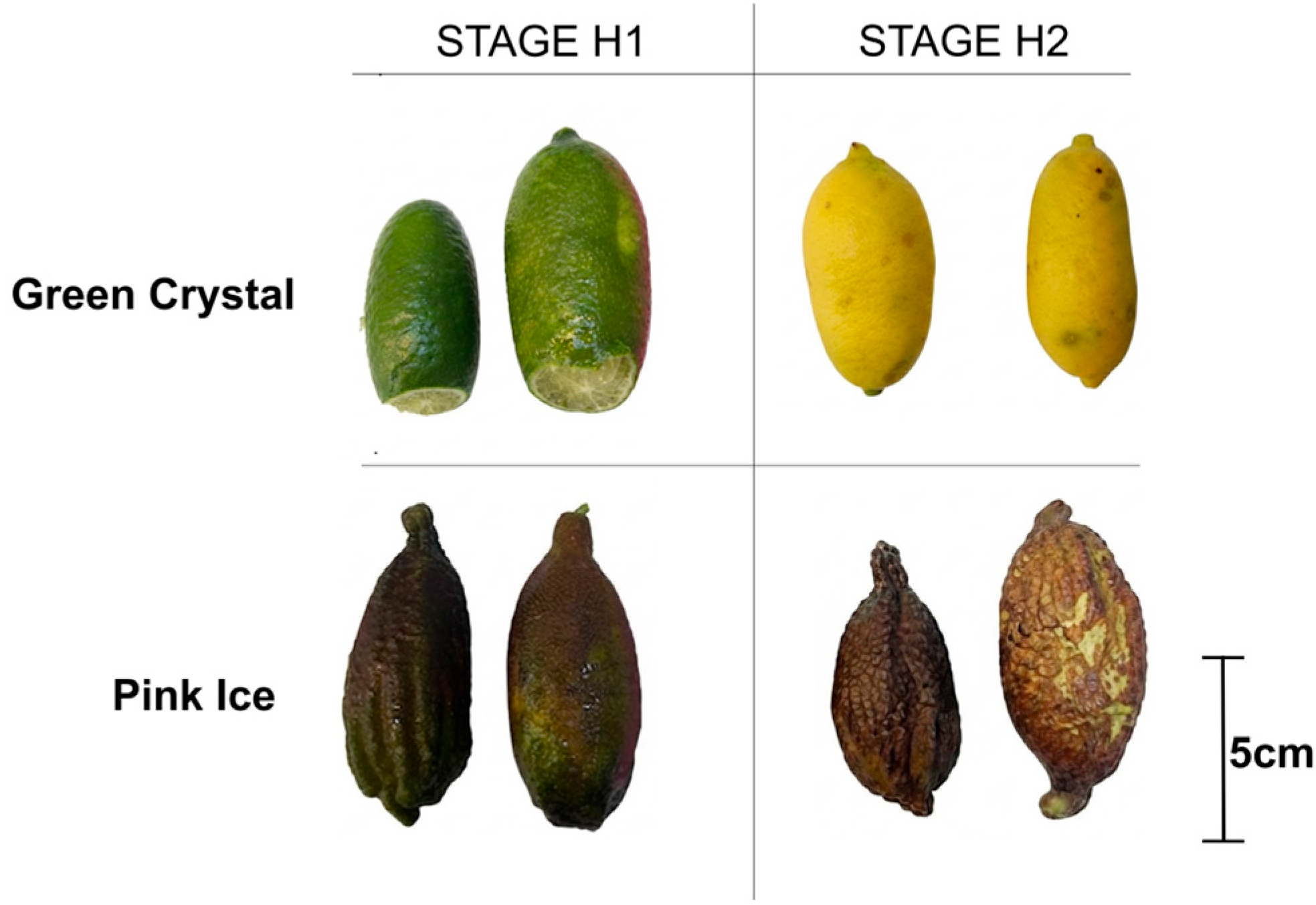
Figure 1. Fruits of C. australasica varieties Pink Ice and Green Crystal from stage H1—premature stage—and stage H2—full maturation stage.
Horticulturae 12 00967 g001
Figure 2. Total ion chromatograms (TIC) from GC-MS analysis of C. australasica varieties (Pink Ice, PI; Green Crystal, GC) at two harvest stages (H1 and H2).
Horticulturae 12 00967 g002
Figure 3. Seasonal variations in volatiles compounds from C. australasica varieties Pink Ice (PI) and Green Crystal (GC) across two harvest stages (H1 and H2). (A) Relative abundance (%) of main chemical groups (Total MHs: monoterpene hydrocarbons; Total OMs: oxygenated monoterpenes; Total SHs: sesquiterpene hydrocarbons; and Total OSs: oxygenated sesquiterpenes) for both varieties. (B) Relative abundance of major individual compounds (>2%) across harvest stages for Pink Ice and Green Crystal. Values represent mean ± SD. Different lowercase letters above the bars indicate statistically significant differences (p < 0.05) between harvest stages (H1 vs. H2) within each variety or chemical group.
Horticulturae 12 00967 g003
Figure 4. Principal Component Analysis (PCA) score plot of volatile profiles from C. australasica varieties Pink Ice (PI) and Green Crystal (GC) at harvest stages H1 (SH1) and H2 (SH2).
Horticulturae 12 00967 g004
Figure 5. UHPLC–MS/MS deconvoluted ion chromatograms (in negative ionization mode) of varieties Green Crystal (GC) and Pink Ice (PI) at harvest stage H1 (SH1).
Horticulturae 12 00967 g005
Table 1. Chemical composition of EOs from the finger lime varieties at different months of maturity.
No Chemical GroupCompoundsKIGreen CrystalPink Ice
Stage H1Stage H2Stage H1Stage H2
1. MHsα-thujene9310.25 ± 0.01 a0.23 ± 0.01 a0.12 ± 0.01 a0.10 ± 0.00 a
2.MHsα-pinene9353.61 ± 0.10 a2.78 ± 0.04 b1.13 ± 0.02 d2.37 ± 0.03 c
3.MHscamphene9470.09 ± 0.00 a0.07 ± 0.01 aN.D.N.D.
4.MHssabinene972N.D.N.D.7.22 ± 0.07 a13.00 ± 0.16 b
5.MHsβ-pinene9731.72 ± 0.05 a1.26 ± 0.04 bN.D.N.D.
6.MHsmyrcene9891.02 ± 0.04 a1.12 ± 0.02 aN.D.0.17 ± 0.06 b
7.MHsα-phellandrene1000N.D.1.43 ± 0.01 N.D.N.D.
8.MHsδ-3-carene10060.42 ± 0.01 a0.56 ± 0.02 aN.D.N.D.
9.MHsα-terpinene1016N.D.0.11 ± 0.01N.D.N.D.
10.MHsp-cymene102220.81 ± 0.34 b23.92 ± 0.30 a14.28 ± 0.15 c12.36 ± 0.07 d
11.MHslimonene10296.22 ± 0.11 c3.54 ± 0.35 d39.78 ± 0.42 b44.92 ± 0.31 a
12.MHsβ-phellandrene103012.04 ± 0.76 b13.41 ± 0.20 aN.D.N.D.
13.MHsZ-β-ocymene10430.07 ± 0.01 b0.42 ± 0.01 aN.D.N.D.
14.MHsE-β-ocymene1053N.D.0.17 ± 0.01N.D.N.D.
15.MHsγ-terpinene10590.06 ± 0.01 b3.11 ± 0.01 aN.D.bN.D.b
16.OMscis-sabinene hydrate1066N.D.N.D.0.19 ± 0.01N.D.
17.MHsterpinolene1087N.D.0.52 ± 0.02N.D.N.D.
18.OMstrans-sabinene hydrate1095N.D.N.D.0.21 ± 0.01N.D.
19.OMs linalool11032.55 ± 0.02 a2.25 ± 0.02 bN.D.N.D.
20.OMstrans-p-mentha-2,8-dien-1-ol1118N.D.N.D.1.25 ± 0.01 a0.76 ± 0.01 b
21.OMscis-p-menth-2-en-1-ol11190.88 ± 0.01 b1.29 ± 0.02 aN.D.N.D.
22.OMscis-p-mentha-2,8-dien-1-ol1133N.D.N.D.1.04 ± 0.03 a1.02 ± 0.06 a
23.OMstrans-p-menth-2-en-1-ol11380.35 ± 0.19 b0.80 ± 0.01 a0.40 ± 0.02 b0.27 ± 0.13 b
24.OMsneo-isopulegol11420.42 ± 0.01 b1.21 ± 0.01 aN.D.N.D.
25.OMsp-menth-3-en-8-ol1149N.D.0.26 ± 0.05N.D.N.D.
26.OMsisopulegol11511.09 ± 0.01 a2.21 ± 0.02 bN.D.N.D.
27.OMssabina ketone1157N.D.N.D.0.25 ± 0.01 a0.36 ± 0.00 a
28.OMscitronellal11588.88 ± 0.09 a6.76 ± 0.03 bN.D.N.D.
29.OMsisomenthone11610.54 ± 0.01 b1.38 ± 0.01 aN.D.N.D.
30.OMsterpinene-4-ol11731.63 ± 0.02 c1.68 ± 0.01 c10.49 ± 0.11 a7.54 ± 0.01 b
31.OMscryptone11782.39 ± 0.03 a1.10 ± 0.02 bN.D.N.D.
32.OMsp-cymen-8-ol11820.21 ± 0.01 a0.17 ± 0.01 a0.31 ± 0.03 a0.11 ± 0.01 a
33.OMsα-terpineol11873.04 ± 0.04 a2.72 ± 0.03 b2.00 ± 0.08 c0.98 ± 0.03 d
34.OMscis-dihydrocarvone1189N.D.N.D.0.56 ± 0.06N.D.
35.OMscis-piperitol11900.23 ± 0.01 a0.38 ± 0.01 aN.D.N.D.
36.OMstrans-piperitol12020.21 ± 0.01 a0.39 ± 0.01 a0.13 ± 0.02 aN.D.
37.OMstrans-carveol12160.21 ± 0.03 a0.04 ± 0.00 a2.36 ± 0.05 a1.70 ± 0.02 b
38.OMscis-carveol1228N.D.N.D.0.90 ± 0.05 a0.68 ± 0.02 a
39.OMscumin aldheyde12350.36 ± 0.02 aN.D.0.19 ± 0.03 a,c0.11 ± 0.00 b,c
40.OMscitronellol12375.71 ± 0.23 b7.26 ± 0.06 aN.D.N.D.
41.OMscarvone1238N.D.N.D.4.93 ± 0.04 a3.80 ± 0.08 b
42.OMspiperitone12483.71 ± 0.05 a3.03 ± 0.09 bN.DN.D.
43.OMsgeranial12690.24 ± 0.01 a0.37 ± 0.02 aN.D.N.D.
44.OMscitronellyl formate12770.61 ± 0.01 a0.31 ± 0.01 bN.D.N.D.
45.OMsp-cymen-7-ol12830.70 ± 0.03 a0.14 ± 0.01 bN.D.N.D.
46.OMs3-oxo-p-menth-1-en-7-al13230.36 ± 0.02 a0.15 ± 0.01 aN.D.N.D.
47.SHsδ-elemene1337N.D.N.D.0.13 ± 0.01 aN.D.
48.OMscitronellyl acetate13570.61 ± 0.23 a0.66 ± 0.01 aN.D.N.D.
49.OMsneryl acetate13670.13 ± 0.03N.D.N.D.N.D.
50.SHsE-caryophyllene14030.39 ± 0.01 a0.37 ± 0.01 aN.D.N.D.
51.SHsα-cis-bergamotene14080.11 ± 0.01 a0.11 ± 0.01 aN.D.N.D.
52.SHsα-trans-bergamotene14360.92 ± 0.03 b1.19 ± 0.01 aN.D.N.D.
53.SHsα-humulene14460.51 ± 0.02 a0.44 ± 0.00 aN.D.N.D.
54.SHsβ-santalene14640.08 ± 0.01 a0.08 ± 0.01 aN.D.N.D.
55.SHsE-β-farnesene14700.08 ± 0.02 a0.08 ± 0.01 aN.D.N.D.
56.SHsviridiflorene14960.07 ± 0.01 a0.11 ± 0.01 aN.D.N.D.
57.SHsZ-α-bisabolene15130.06 ± 0.00 a0.12 ± 0.00 aN.D.N.D.
58.SHsβ-bisabolene15181.45 ± 0.04 b1.78 ± 0.02 aN.D.N.D.
59.OSsmaaliol1558N.D.0.03 ± 0.00 a0.21 ± 0.00 a0.18 ± 0.01 a
60.OSspalustrol15590.00 ± 0,00 a0.03 ± 0.01 a0.16 ± 0.01 a0.16 ± 0.02 a
61.OSsspathulenol15680.41 ± 0.01 c0.31 ± 0.01 c2.82 ± 0.01 a2.19 ± 0.03 b
62.OSscaryophyllene oxide15700.27 ± 0.01 a0.18 ± 0.01 aN.D.N.D.
63.OSsglobulol15730.10 ± 0.01 b0.11 ± 0.01 b0.83 ± 0.00 a0.79 ± 0.01 a
64.OSsviridiflorol15790.14 ± 0.00 b0.14 ± 0.01 b0.87 ± 0.01 a0.70 ± 0.01 a
65.OSscubeban-11-ol15820.03 ± 0.00 b,c0.05 ± 0.00 b0.21 ± 0.00 a,b0.29 ± 0.01 a
66.OSsrosifoliol15880.06 ± 0.01 a0.07 ± 0.01 aN.D.N.D.
67.OSshumulene epoxide II15910.20 ± 0.01 a0.13 ± 0.01 aN.D.N.D.
68.OSsβ-bisabolol1671N.D.0.05 ± 0.01N.D.N.D.
69.OSsα-bisabolol1689N.D.0.18 ± 0.02N.D.N.D.
Total %86.25 ± 1.57 c92.83 ± 0.53 b92.97 ± 0.49 b94.56 ± 0.40 a
Total MHs46.31 ± 1.52 d52.59 ± 0.51 c62.53 ± 0.45 b72.92 ± 0.36 a
Total OMs35.06 ± 0.40 a34.54 ± 0.14 a25.21 ± 0.18 b17.33 ± 0.17 c
Total SHs3.67 ± 0.06 a4.28 ± 0.03 a0.13 ± 0.01 b0.0 ± 0.0 b
Total OSs1.21 ± 0.02 b1.28 ± 0.03 b5.10 ± 0.02 a4.31 ± 0.04 a
MHs: monoterpene hydrocarbons; OMs: oxygenated monoterpenes; SHs: sesquiterpene hydrocarbons; OSs: oxygenated sesquiterpenes. Within each row, values indicated by different superscripts indicate a significant difference (p < 0.05); N.D.: not detected.
Table 2. Total phenolic content of peel extracts.
TPC (mg GAE/g of Extract)
Stage H1Stage H2
Green Crystal36.54 ± 0.72 a24.56 ± 0.73 c
Pink Ice39.53 ± 1.81 a32.63 ± 2.04 b
Values expressed are means ± S.D. of three parallel measurements. GAE: gallic acid equivalents. Values indicated by different superscripts indicate a significant difference (p < 0.05).
Table 3. DPPH scavenging activity of peel extracts.
% Inhibition DPPH (200 μg/mL)
Stage H1Stage H2
Green Crystal 20.55 ± 6.77 a14.01 ± 0.55 a
Pink Ice15.04 ± 0.22 a12.55 ± 1.36 a
Values expressed are means ± S.D. of three parallel measurements. Statistical analysis (one-way ANOVA, p > 0.05) revealed no statistically significant differences across harvest stages or varieties.
Table 4. UHPLC–MS/MS data of non-volatile metabolites in the methanolic peel extracts of Green Crystal (GC) and Pink Ice (PI) finger lime varieties at harvest Stage H1.
No.Rt (min)AdductIon MassMolecular
Formula
Error (ppm)MS/MS FragmentsCompoundPresence in ExtractsReference
Flavonoids and glycosides
Flavanones
1a.8.62[M+NH4]+760.2670C33H42O191.51273.08/171.03/153.02/147.04Naringin/narirutin hexosidePIPubChem; fragmentation
1b.9.10[M−H]741.2225C33H42O19−3.04271.06/151.00/119.05Naringin/narirutin- hexosidePIPubChem; fragmentation
2.9.16[M−H]595.1651C27H32O15−2.93287.06/151.00/135.04/107.01EriocitrinGCGNPS
3.9.36[M−H]595.1650C27H32O15−3.10193.01/151.00/135.04/107.01NeoeriocitrinGC; PIGNPS
4a.9.84[M−H]579.1699C27H32O14−3.5271.06/151.00/119.05/107.01Naringin/narirutinGCGNPS
4b.10.02[M−H]579.1698C27H32O14−3.68271.06/151.00/119.05/107.01Naringin/narirutinPIGNPS
5.10.17[M−H]609.1803C28H34O15−3.6301.07/242.06/151.00(Neo)hesperidinGCGNPS
6.10.56[M+H]+757.2559C34H44O191.25171.03/161.06/153.02Hesperetin-7-dirhamnosylglucosidePI[29]
7.11.60[M+FA−H]639.1910C28H34O14−3.22327.08/285.08/270.05/196.00/ 151.00PoncirinPIGNPS; [11]
Flavones
8.9.71[M−H]563.1387C26H28O14−3.43293.04/117.03/61.99Isovitexin 2″-O-arabinosideGCPubChem; fragmentation
9.9.87[M−H]593.1492C27H30O15−3.36285.04/133.03Luteolin-7-O-rutinosideGC[19]
10.8.49[M−H]593.1494C27H30O15−3.02383.07/353.07/297.08/117.03Vicenin-2GC; PI[30]; GNPS
11.9.91[M+H]+463.1244C22H22O111.11343.08/313.07/298.05/151.04ScoparinGC[19]
12.9.92[M+H]+579.1715C27H30O141.15337.07/323.09/313.07/283.06Isovitexin 2″-O-rhamnosidePIGNPS
13.10.46[M+H]+579.1717C27H30O14 271.06/153.02/119.05Apigenin-O-rutinosideGCPubChem; fragmentation
14.10.47[M−H]607.1650C28H32O15−3.04299.05/284.03/255.03Chrysoeriol 7-O-rutinosideGC[30]
15.10.60[M−H]577.1541C27H30O14−3.78269.04/117.03Rhoifolin (Apigenin-7-O-neohesperidoside)PIGNPS
16.10.64[M−H]607.1650C28H32O15−3.04299.05/284.03/255.03DiosminGCGNPS
17.10.79[M+H]+609.1822C28H32O151.32301.07/286.05/258.05/229.05NeodiosminPIGNPS
18.11.92[M+FA−H]637.1755C28H32O14−3.00283.06/268.04Linarin (Acacetin-7-O-rutinoside)PIGNPS; [31]
Flavonols
19.8.50[M+H]+641.1722C28H32O171.52317.07/302.04/274.05Isorhamnetin-O-dihexosidePIPubChem; fragmentation
20.10.58[M−H]623.1594C28H32O16−3.78315.05/300.02/269.04Isorhamnetin-3-O- rutinosidePI[19]
21.10.17[M−H]609.1437C27H30O16−3.95300.02/271.02/255.03/151.00RutinPI[11]
22.10.66[M−H]507.1123C23H24O13−4.17329.03/314.01/301.03/286.01/270.02Syringetin-3-O-hexosideGC; PI[30]; GNPS
23.10.82[M−H]447.0917C21H20O11−3.55284.03/255.03/227.03Kaempferol-3-O-hexosidePIMassbannk
24.10.88[M−H]477.1020C22H22O12−3.88314.04/299.02/285.04/271.02/243.03Isorhamnetin-3-O-hexosidePIGNPS
25.10.96[M−H]623.1598C28H32O16−3.14315.05/300.03/299.02/271.02/243.03Isorhamnetin-3-O- neohesperidosideGCGNPS
26.11.24[M−H]621.1439C28H30O16−3.56315.05/299.02/271.02/243.03Isorhamnetin-HMG-O-hexosideGC[11]
27.11.61[M−H2O-H]765.1860C34H40O21−3.09315.05/299.02/271.02/243.03Isorhamnetin-diHMG-O-hexosideGC[19]
Coumarins and derivatives
Simple coumarins
28.7.08[M+H]+471.1505C21H26O121.69163.04/119.05/107.05/91.05Umbelliferone-7-O-rutinosidePIGNPS; fragmentation; PubChem
29.7.45[M+H]+501.1611C22H28O131.66193.05/178.03/133.03Scopoletin-7-O-rutinosidePIGNPS
30.10.62[M+H]+177.0548C10H8O32.14133.06/121.07/91.05/78.05Herniarin (7-methoxycoumarin)GCGNPS
31.11.99[M+H]+207.0657C11H10O42.49192.04/164.05/149.02/121.07/91.05Limettin (5,7-dimethoxycoumarin)PIGNPS
32.12.99[M−H]229.0858C14H14O3−5.32203.03/159.04/147.04/131.05/91.05Prenyl hydroxycoumarinGCPubChem
33.15.07[M+H]+261.1137C15H16O45.99193.05/149.06/137.06/109.07Prenyl scopoletinPIGNPS
34.16.60[M+H]+163.0391C9H6O30.79119.05/107.05/91.05UmbelliferoneGC; PIGNPS
Furanocoumarins
35.11.17[M+H]+187.0391C11H6O30.69143.05/131.05/115.05PsoralenGC; PIGNPS
36.11.26[M+H]+217.0502C12H8O43.06202.03/174.03/161.06/118.04/89.048-Methoxypsoralen (Xanthotoxin)GC; PIGNPS
37.11.45[M+H]+305.1033C16H16O64.38203.03/147.04/131.05/91.05Oxypeucedanin hydratePIGNPS
38.11.97[M+H]+247.0613C13H10O53.64232.04/217.01/189.02/161.02IsopimpinellinGC[19]
39.12.19[M+H]+217.0504C12H8O43.98202.03/174.03/161.06/118.04/89.045-Methoxypsoralen (bergapten)GC; PIGNPS
40a.12.75[M−H2O+H]+287.0928C16H16O64.88202.03/174.03/118.94OxypeucedaninPIGNPS
40b.12.95[M−H2O+H]+287.0928C16H16O64.88203.03/147.04/91.05Oxypeucedanin isomerPIGNPS
41.14.61[M+H]+301.1086C17H16O56.48233.04/218.02/173.02/162.03/134.04/78.05PhellopterinGC[32]; GNPS
42.14.87[M+H]+271.0980C16H14O45.59203.03 /147.04/131.05/119.05/91.05IsoimperatorinGC; PIGNPS
43.16.15[M+H]+339.1604C21H22O42.7203.03/147.04/129.03/95.09/81.078-GeranyloxypsoralenGCGNPS
44.16.70[M+H]+233.0454C12H8O52.36218.02/173.02/162.03/134.04/78.05Hydroxy methoxypsolaralenGC[32]
45.16.96[M+H]+339.1603C21H22O42.7203.03/159.04/147.04/131.05/91.05BergamottinGCGNPS
Dihydrofuranocoumarins
46.8.68[M+FA−H]469.1335C20H24O10−3.52261.08/243.07Rutarin or isomerGCGNPS
47.10.37[M+H]+263.0929C14H14O56.08245.08/191.03/163.04/89.04Rutaretin or isomerGCPubChem
Other phenolic compounds
48.4.71[M+H]+235.1452C13H18N2O23.81147.04/119.05/91.05Coumaroyl putrescinGCGNPS
49.7.70[M+NH4]+538.2138C22H32O141.43179.07/137.06/109.07Citrusin FPIPubChem, fragmentation
50.8.61[M−H]357.1180C16H22O9−3.10195.07/177.05/151.07/136.05/121.033-(2-Glucosyloxy-4-methoxyphenyl)propanoic acidPIGNPS
51.9.34[M−H]367.1022C17H20O9−3.42205.05/187.04/161.06/105.07Cnidioside AGCGNPS
52.9.36[M+NH4]+448.2189C20H30O102.63129.05/85.03/71.05Phenylethyl-deoxyhexosyl-hexosidePIGNPS
53a.9.57[M−H]397.1125C18H22O10−3.83235.06/191.07/176.05/161.02Cnidioside B isomerPI[33]; GNPS
54.9.97[M−H2O+H]+309.0983C15H18O84.60147.04/119.05/91.05Glucosyl-2-hydroxycinnamatePIGNPS; PubChem
53b.9.98[M−H]397.1126C18H22O10−3.58235.06/191.07/176.05/161.02Cnidioside B isomerGCGNPS
Limonoids and other compounds
55.7.49[M−H]365.1440C15H26O10−3.62125.02/101.02/71.01/59.01/57.03Propyl -HMG-hexosideGC; PI[19]
56.11.61[M+H]+471.2022C26H30O81.82213.09/161.06/105.07/95.01/79.05LimoninGC; PIGNPS
57.11.90[M+NH4]+446.2031C20H28O102.08127.04/103.04/99.04/85.03Phenylethyl-HMG-O-hexosideGCGNPS
58.12.04[M+H]+473.2178C26H32O81.70161.06/105.07/95.01Isoobacunoic acidGC; PI[34]
FA: formic acid; HMG: 3-Hydroxy-3-methylglutaric acid; Ions indicated in bold represent base peak ions.
Disclaimer/Publisher’s Note: The statements, opinions and data contained in all publications are solely those of the individual author(s) and contributor(s) and not of MDPI and/or the editor(s). MDPI and/or the editor(s) disclaim responsibility for any injury to people or property resulting from any ideas, methods, instructions or products referred to in the content.