Article

Morphological Attributes and Metabolites of Seedlings in the Selection of Melon Genotypes Under Water Deficit

by
Cintya Mikaelly Pereira Gaia Souza
1,*,
Baltazar Cirino Júnior
1,
Francismária Freitas de Lima
1,
Rodrigo Rafael da Silva
1,
Marvigna Lizier de Lima Dias Laurentino
1,
Geovanna Alicia Dantas Gomes
1,
Anddreza Maddalena
1,
Adriano Ferreira Martins
1,
Clarisse Pereira Benedito
1,
Edicleide Macedo da Silva
1,
Fred Augusto Lourêdo de Brito
1,
Salvador Barros Torres
2,
José Francismar de Medeiros
1,
Thieres George Freire da Silva
3 and
Glauber Henrique de Sousa Nunes
1,*
1
Department of Agricultural and Forestry Sciences, Federal Rural University of the Semi-Arid Region, Mossoró 59625-900, RN, Brazil
2
Department of Crop Production, Agricultural Research Company of Rio Grande do Norte, Mossoró 59625-900, RN, Brazil
3
Serra Talhada Academic Unit, Federal Rural University of Pernambuco, Serra Talhada 56909-535, PE, Brazil
*
Authors to whom correspondence should be addressed.
Horticulturae 2026, 12(7), 885; https://doi.org/10.3390/horticulturae12070885 (registering DOI)
Submission received: 11 June 2026 / Revised: 11 July 2026 / Accepted: 17 July 2026 / Published: 19 July 2026
(This article belongs to the Special Issue Growth, Development, and Stress Responses in Cucurbitaceae Crops)

Highlights

What are the main findings?
  • I-136 and PI234607 melon genotypes stand out as drought-tolerant at the early growth stage.
  • Water deficit reduced germination and growth but led to an increase in metabolite accumulation.
What are the implications of the main findings?
  • Germination assessment under water-deficit conditions enables the early identification of more drought-tolerant genotypes.
  • Integrated selection methodologies accelerate the identification of drought-tolerant genotypes.

Abstract

The selection of genotypes with greater tolerance to water scarcity during the early stages of growth can be a promising strategy for genetic improvement, as it enables early screening and may accelerate the identification and selection of tolerant genotypes under field conditions. Therefore, the objective of this study was to evaluate initial seedling growth, metabolic responses, and the selection of melon genotypes under water-deficit conditions. For this purpose, seeds from twenty genotypes were subjected to two osmotic potentials induced by PEG 6000 (0.0 and −0.25 MPa), with four replicates in a completely randomized design. The variables analyzed were germination percentage, germination speed index, shoot and root length, shoot and root dry mass, total dry mass, drought tolerance coefficient, and concentrations of amino acids, total sugars, and proline. Univariate and multivariate analyses of variance were performed, and genotypes were grouped using the Scott–Knott method. Genotype classification was based on the estimated drought tolerance coefficient, which was also evaluated using the membership function value. A water deficit of −0.25 MPa negatively affected germination speed and percentage, root length, and shoot dry mass, whereas metabolites exhibited the opposite behavior. Genotypes I-136 and PI234607 were classified as drought-tolerant, genotypes A-50 and A-52 as susceptible, and genotypes A-08 and A-09 as highly susceptible.

1. Introduction

Melon (Cucumis melo L.), a member of the Cucurbitaceae family, is a fruit vegetable crop that is widely consumed worldwide [1]. In the Northeast region of Brazil, its cultivation stands out even under adverse edaphoclimatic conditions, characterized by water scarcity and high temperatures [2].
Water availability is an essential condition for the germination process, as seedling formation results from a sequence of metabolic events that occur during imbibition [3]. This ability of seeds to absorb water is related to the structure and chemical composition of the seed coat and the endosperm, which may confer greater permeability or greater resistance to water uptake [4].
Water deficit causes cellular dehydration in plants, impairing several physiological processes, such as photosynthesis and stomatal movement, thereby limiting plant growth and development [5]. In this context, plants exhibit different mechanisms for adapting to water-deficit conditions, including the accumulation of osmolytes, such as proline, sugars, amino acids, and proteins. These compounds have been widely studied because they play a fundamental role in adaptation to water stress [6].
Identifying the tolerance of plant materials under water-restricted conditions through water-deficit indices at the seedling stage is advantageous because it allows precise control of water availability, minimizes environmental interference, and enables rapid evaluation, making the identification process more practical [7]. In this context, the use of osmotic solutions such as polyethylene glycol 6000 (PEG 6000) in seed studies, as a simulator of water deficit during the germination and seedling stages, is widely adopted because it reduces water potential and is not absorbed by plants, as it is an inert osmotic agent [8].
Although melon cultivation in semi-arid regions depends on irrigation systems that ensure an adequate water supply for the crop’s full development, these systems involve high installation and maintenance costs and may require between 3000 m3 and 5000 m3 of water per hectare throughout the production cycle [9]. In this context, the development of cultivars with lower water requirements emerges as a promising strategy to reduce the need for irrigation and lower production costs. Furthermore, reduced water demand contributes to the sustainability of the melon production chain, especially in semi-arid regions where water availability is limited and efficient water use is essential for the economic viability of the activity.
Because field selection is highly labor-intensive due to edaphoclimatic variability, the initial screening of genotypes through germination studies under osmotic solutions represents a viable strategy for identifying materials that are tolerant to water deficit.
Therefore, the objective of this study was to evaluate the initial seedling growth, metabolic responses, and selection of melon genotypes under water-deficit conditions.

2. Materials and Methods

2.1. Experimental Location and Characterization

The study was conducted at the Seed Analysis Laboratory of the Federal Rural University of the Semi-Arid Region (UFERSA), in Mossoró, Rio Grande do Norte, Brazil, from October 2023 to January 2024. Twenty melon genotypes were used (A-10, A-08, A-50, A-52, A-27, A-16, A-04, A-09, A-Italo, C-32, AM-55, PMR6, I-136, I-180, Ames, Nantais Oblong, PI236655, PI179901, PI614401, and PI234607), originating from the cucurbit germplasm collection of UFERSA.
Initially, a germination test was carried out with the 20 melon genotypes under the following osmotic levels: 0.0, −0.25, −0.50, −0.75, and −1.0 MPa. However, considering the complete inhibition of normal seedling germination at −0.50, −0.75, and −1 MPa, the 0.0 and −0.25 MPa potentials were selected for the present study.
The experimental design was completely randomized, in a 2 × 20 factorial scheme (osmotic potentials × genotypes), with four replications of 25 seeds each. The first factor consisted of two levels of osmotic potential related to water deficit—0.0 MPa (control) and −0.25 MPa (PEG 6000)—while the other factor corresponded to the twenty melon genotypes. The seeds were sown on germitest paper Germilab® (substrate) previously moistened with distilled water (0.0 MPa) and with a polyethylene glycol solution (−0.25 MPa) to simulate water deficit, at a proportion of 2.5 times the weight of the substrate. The osmotic potentials were determined following the methodology proposed by [10] and using Equation (1), proposed by [11]:
Ψs = (1.18 × 10⁻²) × C − (1.18 × 10⁻⁴) × C2 + (2.67 × 10⁻⁴) × C × T + (8.39 × 10⁻⁷) × C2 × T
where Ψs = osmotic potential (bar); C = concentration of the osmotic agent (g of PEG 6000 Kg−1 H2O); and T = temperature (°C).
Next, the paper sheets were rolled up and placed in a B.O.D. (Biological Oxygen Demand) germination chamber with a 12 h photoperiod per day at 25 °C [12].

2.2. Analyzed Variables

2.2.1. Germination and Germination Speed Index

For germination percentage, the recommendations of the Rules for Seed Analysis [12] were followed, according to Equation (2):
G =   N u m b e r   o f   g e r m i n a t e d   s e e d s T o t a l   n u m b e r   o f   s e e d s × 100
The germination speed index (GSI) was conducted together with the germination test, with daily counts of the number of germinated seeds up to the eighth day after the test was set up. Using these data, the GSI was determined according to Equation (3), proposed by [13]:
IVG   =     N u m b e r   o f   g e r m i n a t e d   s e e d s N u m b e r   o f   d a y s   a f t e r   s o w i n g

2.2.2. Aerial and Root Length

At the end of the germination test, measurements of the aerial and root of normal seedlings were taken using a graduated ruler, and the results were expressed in centimeters (cm).

2.2.3. Dry Mass of the Aerial, Root, and Total Seedling Dry Mass

Dry mass was obtained by weighing after drying in a forced-air circulation oven at 65 °C for 72 h and then measured using a precision balance (0.001 g). Total dry mass was obtained by summing the weights of the aerial and root, and the results were expressed in grams (g) per seedling.

2.2.4. Estimation of the Drought Tolerance Coefficient (DC) and Classification of Genotypes Under Water Stress

For the study of drought sensitivity, the DC value (drought tolerance coefficient) was estimated, which was calculated based on the ratio of data derived from normal water conditions and water deficit conditions for the same genotype for each trait [14,15,16]:
D C i j r = T i j w s r T i j w w r
D C i j = 1 r i j = 1 r D C i j r
where Dcijr = drought tolerance coefficient of the j-th trait for the i-th cultivar in the r-th replication; Tijwsr and Tijwwr = value of the j-th trait for the i-th cultivar evaluated under normal water regime and water stress conditions in the r-th replication, respectively; and Dcij is the mean value of the drought tolerance coefficient of the j-th trait for the i-th cultivar.
Melon tolerance to water stress was also evaluated using the membership function value (MFV). This methodology provides a comprehensive assessment using membership functions based on fuzzy mathematics theory. The membership function of a fuzzy set is a generalization of the indicator function in classical sets and represents the degree of truth as the extent of the evaluation [17]. For any set T, a membership function on T is any function mapping T to the real unit interval [0, 1]. According to the drought tolerance coefficient, the modified membership function value of drought tolerance (MFV) was calculated following the equations:
F i j = D C i j D C j m i n D C j m a x D C j m i n
F i = 1 n j = 1 n F i j
where Fij is the membership function value of the j-th trait for the i-th cultivar in relation to drought tolerance; Dcjmax and Dcjmin are, respectively, the maximum and minimum values of the drought resistance coefficient for the j-th trait; and Fi is the mean membership function value of the measured traits for the i-th cultivar in relation to drought tolerance.
Drought tolerance is divided into five levels according to the mean value ( F ¯ ) and the standard deviation (SD) of the membership function value (MFV) in two series of pot experiments. Drought tolerance was classified into five levels based on the mean value ( F ¯ ) and standard deviation (SD) of the MFV. When Fi F ¯ + 1.64 × SD, it is considered highly drought tolerant; F ¯ + 1 × SD ≤ Fi < F ¯ + 1.64 × SD, drought tolerant; F ¯ − 1 × SD ≤ Fi < F ¯ + 1 × SD, moderately drought tolerant; F ¯ − 1.64 × SD ≤ Fi < F ¯ − 1 × SD, susceptible; Fi < F ¯ − 1.64 × SD, highly susceptible.

2.2.5. Metabolite Assays

The concentrations of amino acids, total sugars, and proline were determined from 200 mg of fresh material from the whole seedling.
Proline content was obtained from the reaction with acidic ninhydrin and glacial acetic acid and quantified following the methodology proposed by [18]. Readings were performed using a spectrophotometer at an absorbance of 520 nm, and the results were expressed in mmol g−1 FM.
Amino acid content was determined using the methodology of [19], with 5% ninhydrin and 2% KCN in Methyl Cellosolve. Readings were performed using a spectrophotometer at an absorbance of 520 nm, and the results were expressed in mmol g−1 FM.
Total soluble sugar content was quantified using the anthrone method proposed by [20]. Readings were performed using a spectrophotometer at an absorbance of 520 nm, and the results were expressed in mg g−1 FM based on a glucose standard curve.

2.3. Statistical Analysis

The effects of genotype, water stress, and the interaction between these two factors were subjected to tests of normality and homoscedasticity. After meeting the assumptions, analysis of variance (ANOVA) and multivariate analysis of variance (MANOVA) were performed using Pillai’s criterion. Means under the two water-deficit levels were compared using the t-test, while genotype means were compared using the Scott–Knott method [21].
Hierarchical cluster analysis of the 20 melon genotypes subjected to two levels of water stress during germination, based on the drought tolerance coefficient (DC), was performed using the UPGMA algorithm from Euclidean distances. Pearson’s simple correlation coefficients were calculated between the membership function value of drought tolerance (MFV) and the drought tolerance coefficient (DC) for each trait.
Multiple linear regression was performed to construct selected indices of the drought tolerance membership function value (MFV) using multiple coefficients (DC) of some traits. Stepwise regression analysis was conducted using the entry selection method.
All analyses were performed using R software version 4.3.1 [22], with a nominal significance level of 0.05.

3. Results

3.1. Performance of Variables Under Water-Deficit Conditions

The ANOVA revealed significant variation among genotypes, the two drought regimes, and the interaction between these two factors for all tested variables at p < 0.001 (Table 1). The genotype × water stress interaction indicates that the genotypes exhibit different responses depending on the level of stress. Significance was also observed for the main effects of genotypes and water deficit, as well as for the interaction between these factors in the MANOVA using Pillai’s criterion (p < 0.001) (Table 1).
Variation among genotypes was confirmed by the mean value and standard deviation of the drought tolerance coefficient (DC) for each variable (Table 2).
Among the 10 variables analyzed, the germination speed index (GSI), germination percentage (PG), root length (RL), and shoot dry mass (SDM) showed reductions under water deficit of −0.25 MPa compared with the control treatment (0.0 MPa) (p > 0.05) (Table 2). For all these variables, the drought tolerance coefficient was lower than 1.0. Shoot dry mass (SDM) was highly sensitive to water deficit, whereas germination (PG) and root dry mass (RDM) were less affected by stress (Table 2).
Total sugars (ST), amino acids (AMI), and proline (PRO) showed the opposite behavior; that is, their mean values were higher under water-deficit conditions, especially for total sugars (ST) and amino acids (AMI) (Table 2).

3.2. Variation in the Drought Tolerance Coefficient (DC) and Classification of Genotypes

It can be observed in Table 3 that the best results for the germination speed index (IVG) were obtained for the genotypes A-04, A-10, A-27, AM-55, Ames, C-32, I-136, A-Italo, Nantais Oblong, PI179901, PI234607, PI236355, PI614401, and PMR6. Regarding germination (G), the genotypes that showed the highest drought tolerance coefficient were: A-04, A-10, A-16, A-27, A-50, AM-55, Ames, C-32, I-136, A-Italo, Nantais Oblong, PI179901, PI234607, PI236355, PI614401, and PMR6. For root length, the genotypes Ames and I-136 showed the best results. Only accession I-136 showed the highest drought tolerance coefficient for shoot length. The genotypes with the best results for root dry mass were Ames, C-32, Nantais Oblong, PI179901, and PI614401, while for shoot dry mass, I-136, A-Italo, and PI234607 stood out. The genotypes Ames, I-136, A-Italo, PI179901, and PI234607 showed the highest drought tolerance coefficient for total dry mass.
For metabolite variables such as total sugars and amino acids, the best results were observed for the genotypes A-08 and Ames, respectively. For proline content, the genotypes with the highest tolerance coefficients were A-04, A-08, A-10, A-27, A-50, AM-55, Ames, I-136, A-Italo, PI234607, PI614401, and PMR6 (Table 3).
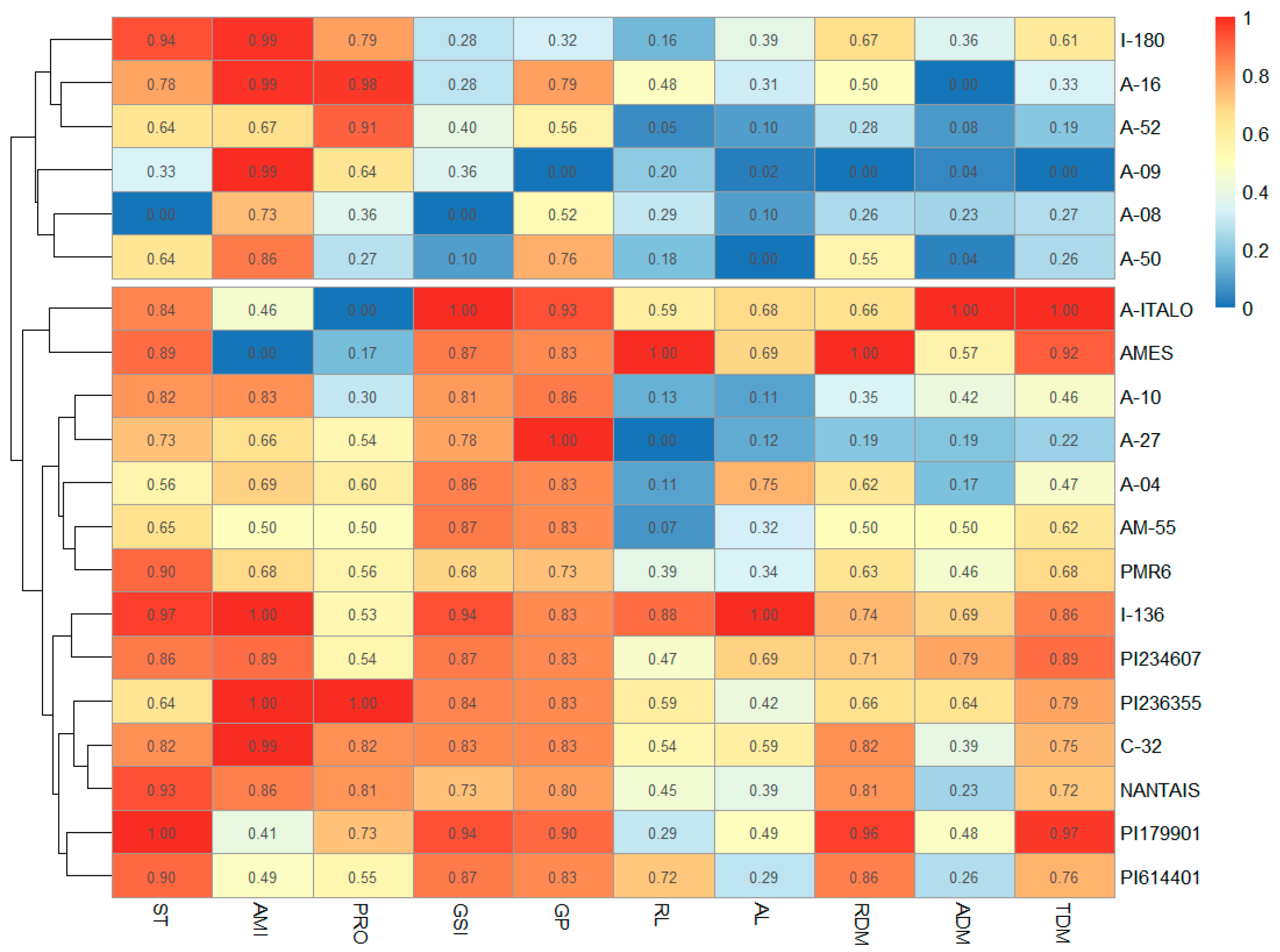
Two groups of genotypes were observed based on hierarchical clustering using the UPGMA method, employing a Euclidean distance matrix derived from the drought tolerance coefficient values. Values closer to 1 indicate greater tolerance to water deficit, whereas values closer to 0 indicate greater susceptibility to water stress (Figure 1).
The first cluster was formed by the genotypes A-Italo, Ames, A-10, A-27, A-04, AM-55, PMR6, I-136, PI234607, PI236355, C-32, Nantais Oblong, PI179901, and PI614401, with higher drought tolerance coefficients for most traits. The second cluster was composed of the genotypes I-180, A-16, A-52, A-09, A-08, and A-50, which showed high tolerance coefficient values ranging from 0.67 to 0.99 for the amino acids variable; for the other variables, these values were lower (Figure 1).
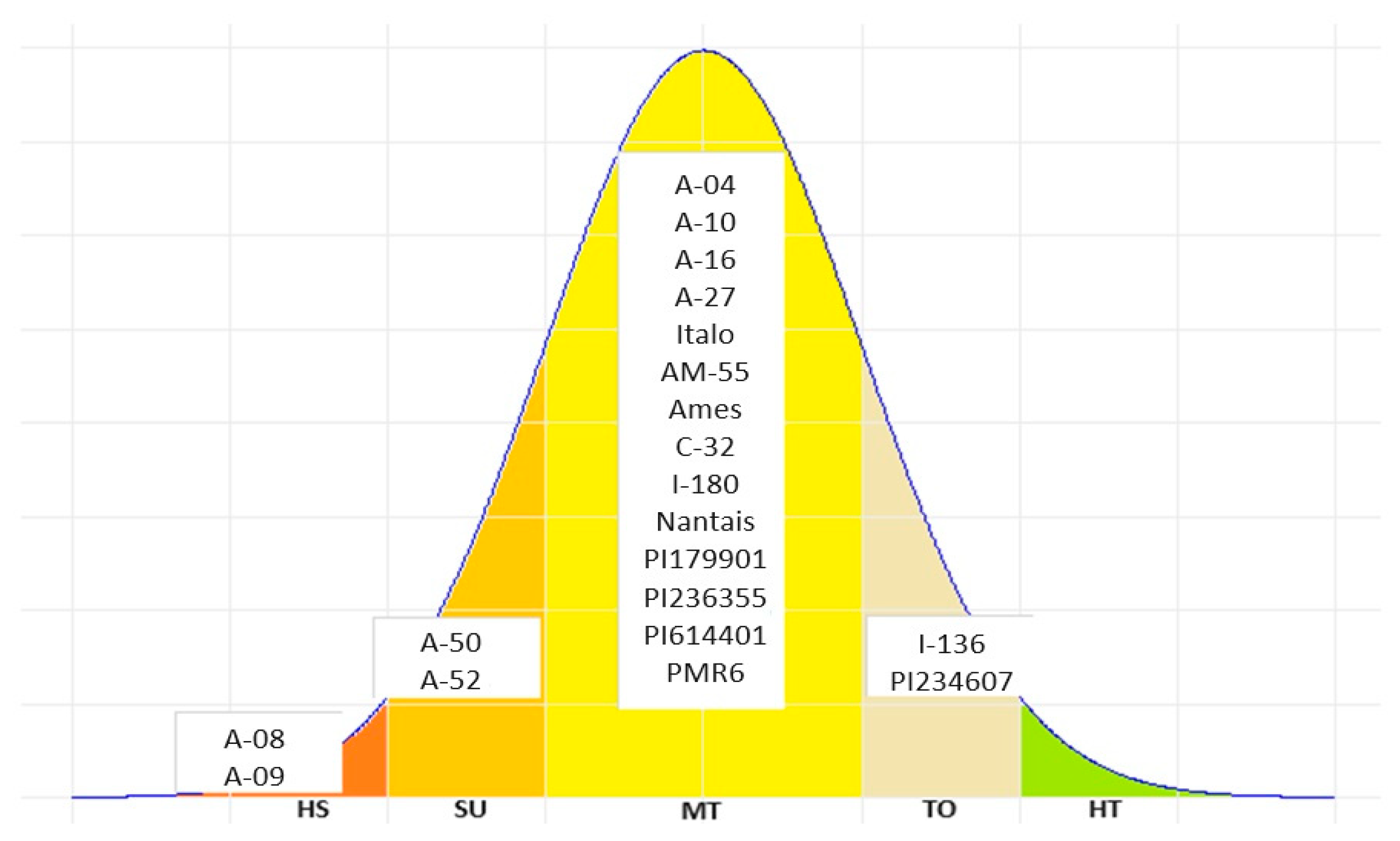
The genotypes were classified into four drought tolerance classes (Figure 2), with most of them classified as moderately drought tolerant (Table 4).

3.3. Correlation Between the Drought Tolerance Membership Function Value (MFV) and the Drought Tolerance Coefficient (DC) for Each Variable

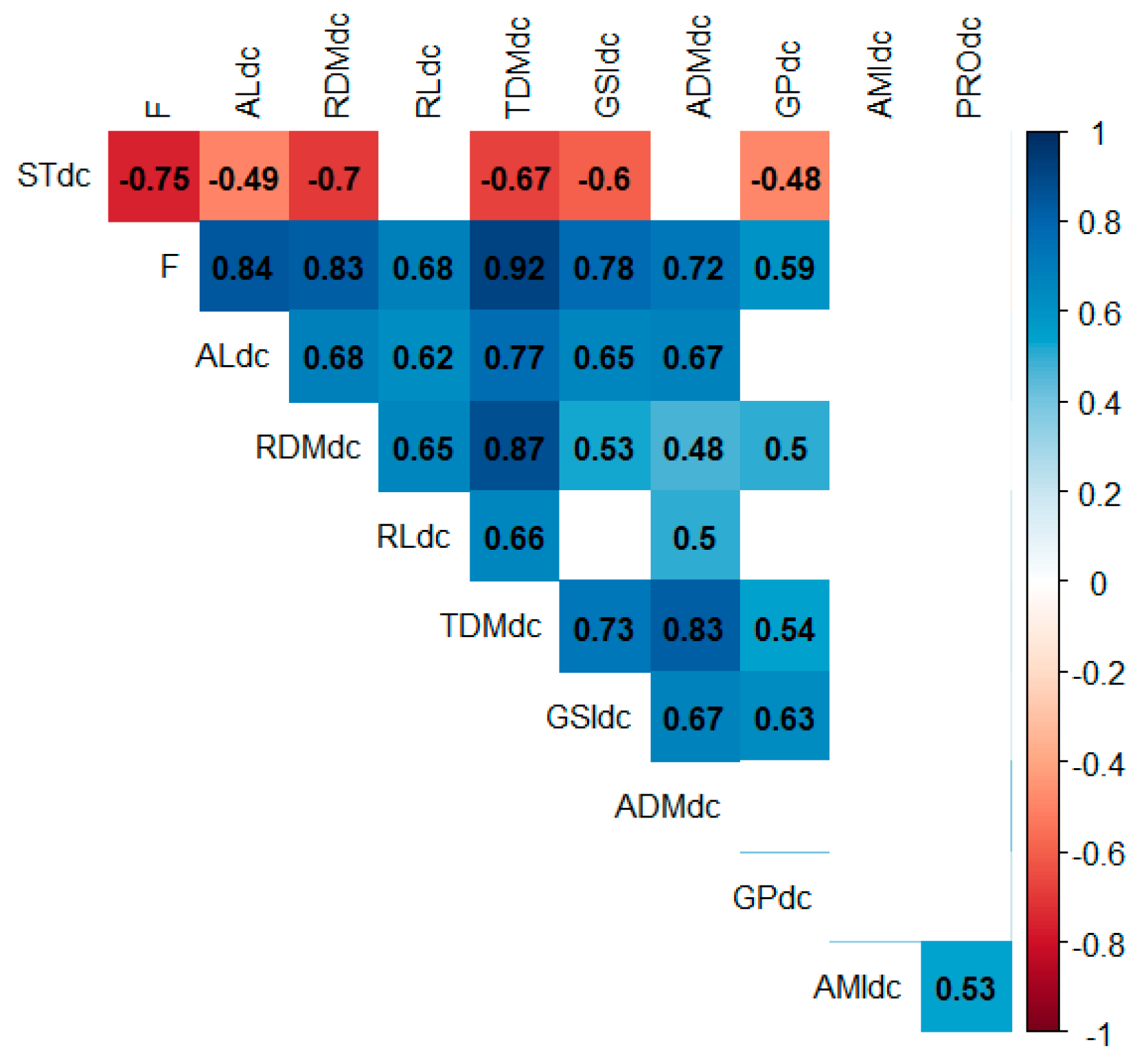
Simple Pearson correlation coefficients between the drought tolerance membership function value and the drought tolerance coefficient for each variable are shown in Figure 3. In this figure, blank spaces represent non-significant correlation estimates (p > 0.05).
Negative correlations were observed between total sugars and the tolerance coefficient for the variables aerial length (AL), root dry mass (RDM), total dry mass (TDM), germination speed index (GSI), and germination (PG). However, the membership function value and total sugars were negatively correlated (Figure 3).
The variables root dry mass (RDM), aerial dry mass (ADM), and total dry mass (TDM) were positively correlated with each other, as well as with aerial length (AL), root length (RL), and germination speed index (GSI). Positive correlations were also observed between root length (RL), aerial length (AL), and germination speed index (GSI). Positive correlations were further obtained between germination (PG) and root dry mass (RDM), total dry mass (TDM), and germination speed index (GSI). Amino acid and proline contents were positively correlated; however, this was not observed for the other variables (p > 0.05) (Figure 3).
Positive correlations were observed between the membership function value and the tolerance coefficient for the variables aerial length (AL), root dry mass (RDM), root length (RL), total dry mass (TDM), germination speed index (GSI), aerial dry mass (ADM), and germination (PG). However, the membership function value and total sugars were negatively correlated (Figure 3). The highest estimate (0.92, p < 0.05) was obtained for total dry mass, while the lowest was observed for germination (0.54, p < 0.05).

3.4. Drought Tolerance Explained by Multiple Drought Tolerance Coefficients (DC) from Trait Evaluation

Estimates of regression coefficients, partial coefficient of determination (R2), standard error, t-value, and the probability for the three limiting drought tolerance coefficients of traits accepted in the prediction of the membership function value (MFV) are shown in Table 5. The results indicated that the germination speed index, root length, and aerial length explained 40.86%, 27.09%, and 40.57% of the variation in the membership function value, respectively. In total, 81.40% of the variation in MFV was attributed to these three trait tolerance coefficients.

4. Discussion

The use of drought tolerance indices at the seedling stage is applied in several crops, such as wheat (biomass index, height index, and vigor index) [23] and barley (fresh mass index, SPAD index, and chlorophyll fluorescence index) [24]. However, the genetic potential of plants is influenced by environmental conditions, as seed and seedling development is usually affected by abiotic stresses [25]. Water availability, air temperature, gas concentration, and salt levels are among the various stress factors that trigger morphological and physiological changes in plants [26].
Among the variables evaluated in the present study, the results for germination, germination speed index, root length and aerial dry mass of melon seedlings under water stress conditions (−0.25 MPa) were lower compared to the control (0.0 MPa). This is likely because the osmotic agent used has high viscosity and high molecular weight, leading to cell dehydration and maintaining a constant concentration during the period of water restriction, which may delay seedling formation [27] and biomass accumulation. The more negative the osmotic potential, the longer the time required for the seed to absorb water. Furthermore, water uptake by the seed is essential for activating the nutrient reserves stored in the endosperm, promoting starch degradation through the action of the enzymes α-amylase and β-amylase, thereby initiating the germination process [28,29]. Therefore, a reduction in water potential can cause severe disturbances in the germination process, impairing seed germination or even completely inhibiting it [28].
Water restriction and low temperature during the germination stage of melon seeds can reduce seedling development, and in the field, emergence may be compromised, resulting in reduced productivity [30].
The tolerance for the germination of normal seedlings in this study was −0.25 MPa; a similar result was found in the study by [31] with smell melon (Cucumis melo var. dud aim Naudin), in which germination was observed within the range of −0.2 to −0.4 MPa.
Some species or cultivars under water-deficit conditions can adjust their cells through osmotically active agents such as proline, amino acids, and certain sugars. This indicates the efficiency of these organisms in tolerating longer periods of scarcity, representing a biochemical–physiological response to this type of stress [32,33]. In the present study, osmolytes (total sugar, proline, and amino acid contents) showed higher mean values and elevated drought tolerance coefficients under water-deficit conditions. This behavior may be related to the effect of water stress on solute concentration in plant tissues, although it may also result from the osmotic adjustment capacity of some plants, which may indicate greater adaptation to water-deficit conditions [34].
Proline has a highly energy-intensive metabolism: the complete oxidation of one proline molecule can generate about 30 ATP molecules, thereby providing energy for plant growth [8].
Water deficit can induce the accumulation of solutes in the cytoplasm and vacuole of plant cells, contributing to the maintenance of turgor pressure under low water potentials [29]. In melon seedlings as well, [35] observed a significant increase in sugar content under water-deficit conditions compared to the control.
Hierarchical cluster analysis allowed the inference that, among the 20 evaluated genotypes, most are moderately drought tolerant for all variables. In this context, the genotypes I-136 and PI234607 were classified as tolerant, showing high drought tolerance coefficient values. The genotypes classified as moderately tolerant and tolerant showed good performance under water deficit, as they were subjected to the same conditions as the others and were successful in the germination process.
Genotypes A-50 and A-52 were classified as susceptible, whereas genotypes A-08 and A-09 were classified as highly susceptible due to the low drought tolerance coefficient values observed for one or more variables. In studies related to water deficit, these genotypes may be used as sensitivity standards. It is understood that genotypes with lower tolerance coefficients were more strongly affected by water scarcity induced by polyethylene glycol 6000, which imposed a more restrictive condition compared to the others. Under water-deficit conditions, the germination process is possible when water uptake is sufficient. In this case, the plant may be tolerant to this condition [36].
Drought tolerance is a complex process controlled by several genes and expressed through multiple physiological and biochemical responses, which may interact with each other and vary according to the type, intensity, and duration of exposure to stress [27].
Positive correlations between growth variables and dry mass and germination variables are efficient parameters for selecting materials that may assist in plant breeding programs. On the other hand, variables that exhibited negative correlations, such as soluble sugars, indicate that, under water stress, seedlings increase the production and accumulation of these compounds, accompanied by a reduction in growth-related traits. Thus, although sugar accumulation may promote osmotic adjustment, contributing to adaptation to water deficit, the reduction in water content decreases cellular turgor, impairing cell expansion and, consequently, seedling growth [29].
Thus, evaluating drought tolerance in plant species is essential, as water scarcity triggers changes in multiple physiological and biochemical mechanisms, whose expression varies according to the species. This information is fundamental for guiding plant breeding programs and for identifying traits that differentiate genotypes in a germplasm bank.

5. Conclusions

The water deficit of −0.25 MPa negatively affects germination speed, germination percentage, root length and aerial dry mass, though with different intensities among the genotypes.
Metabolite levels (total sugars, proline and amino acids) increase under water deficit.
Cluster analysis based on the drought tolerance coefficient classified the 20 melon genotypes at the initial growth stage into four distinct classes: highly susceptible (A-08 and A-09), susceptible (A-50 and A-52), moderately tolerant (A-04, A-10, A-16, A-27, A-Italo, AM-55, Ames, C-32, I-180, Nantais Oblong, PI179901, PI236355, PI614401 and PMR6) and tolerant (I-136 and PI234607).
Stepwise regression analysis identified three main diagnostic indicators for evaluating drought resistance: germination speed index, root length and aerial length.

Limitations and Future Work

Regarding the limitations of the present study, among the five potentials tested (0.0, −0.25, −0.50, −0.75 and −1.0 MPa), the germination of normal seedlings was inhibited from −0.50 MPa and, therefore, only the 0.0 and −0.25 MPa treatments were considered in this study.
For future studies, it is suggested to apply irrigation treatments with water stress potentials below 50%, conducted under controlled conditions or in the field. In addition, using the genotypes selected in the present study—both tolerant and susceptible materials—physiological, nutritional, fruit-related, enzymatic and productive responses could be evaluated.

Author Contributions

Conceptualization, C.M.P.G.S. and G.H.d.S.N.; methodology, C.M.P.G.S., G.H.d.S.N., J.F.d.M., C.P.B. and E.M.d.S.; software, G.H.d.S.N.; validation, G.H.d.S.N. and C.M.P.G.S.; data acquisition, B.C.J., F.F.d.L., R.R.d.S., M.L.d.L.D.L., G.A.D.G., A.M. and A.F.M.; formal analysis, C.M.P.G.S., E.M.d.S. and G.H.d.S.N.; investigation, C.M.P.G.S. and G.H.d.S.N.; data curation, C.M.P.G.S., G.H.d.S.N., B.C.J. and F.A.L.d.B.; writing—original draft preparation, C.M.P.G.S., G.H.d.S.N. and E.M.d.S.; writing—review and editing, C.M.P.G.S., G.H.d.S.N., E.M.d.S. and B.C.J.; visualization, G.H.d.S.N., E.M.d.S., C.M.P.G.S., S.B.T., T.G.F.d.S. and F.A.L.d.B.; supervision, G.H.d.S.N., J.F.d.M. and E.M.d.S.; project administration, C.M.P.G.S., G.H.d.S.N., J.F.d.M. and E.M.d.S. All authors have read and agreed to the published version of the manuscript.

Funding

This study was funded in part by the Coordination for the Improvement of Higher Education Personnel (CAPES), Brazil—Finance code 001.

Data Availability Statement

The original contributions presented in this study are included in the article. Further inquiries can be directed to the corresponding authors.

Acknowledgments

We would like to thank the Federal Rural University of the Semi-Arid Region and CAPES for their financial support.

Conflicts of Interest

Author Salvador Barros Torres was employed by the company Agricultural Research Company of Rio Grande do Norte. The remaining authors declare that the research was conducted in the absence of any commercial or financial relationships that could be construed as a potential conflict of interest.

Correction Statement

This article has been republished with a minor correction to resolve spelling errors. The change does not affect the scientific content of the article.

References

  1. Aragão, M.F.; Pinheiro Neto, L.G.; Viana, T.V.A.; Manzano-Juarez, J.; Lacerda, C.F.; Costa, J.J.N. Evaluation of crop water status of melon plants in tropical semi-arid climate using thermal imaging. Braz. J. Agric. Environ. Eng. 2023, 27, 447–456. [Google Scholar] [CrossRef] [Scilit]
  2. Landau, E.C.; Marques, E.C.C.; Cavalieri, I.P.C.; Silva, G.A. Evolution of Melon Production (Cucumis melo, Cucurbitaceae). 2020. Available online: https://www.alice.cnptia.embrapa.br/bitstream/doc/1122691/1/Cap34-EvolucaoProducaoMelao.pdf (accessed on 10 June 2024).
  3. Marcos Filho, J. Physiology of Seeds of Cultivated Plants, 2nd ed.; ABRATES: Londrina, Brazil, 2018. [Google Scholar]
  4. Upretee, P.; Bandara, M.S.; Tanino, K.K. The role of seed characteristics on water uptake preceding germination. Seeds 2025, 3, 559–574. [Google Scholar] [CrossRef] [Scilit]
  5. Ullah, S.; Khalid, M.; Nafees, M.; Amin, F.; Durrani, S.K.; Ali, U. Seed priming as a mitigation strategy for drought stress: Impacts on germination, growth, and antioxidant activity in sweet pepper (Capsicum annuum L.). Biocatal. Agric. Biotechnol. 2025, 69, 103808. [Google Scholar] [CrossRef] [Scilit]
  6. Sytar, O.; Kumari, P.; Yadav, S.; Brestic, M.; Rastogi, A. Phytohormone priming: Regulator for heavy metal stress in plants. J. Plant Growth Regul. 2019, 38, 739–752. [Google Scholar] [CrossRef] [Scilit]
  7. Ren, K.; Tang, T.; Kong, W.; Su, Y.; Wang, Y.; Cheng, H.; Yang, Y.; Zhao, X. Response of watermelon to drought stress and its drought-resistance evaluation. Plants 2025, 14, 1289. [Google Scholar] [CrossRef] [Scilit] [PubMed]
  8. Cai, B.L.; Zhu, Z.; Liu, T.; Wang, J.H.; Tian, Q. The effects of drought stress on seed germination and seedling physiology of three Limonium species. Sci. Hortic. 2025, 351, 114396. [Google Scholar] [CrossRef] [Scilit]
  9. Hama-Aziz, Z.; Mustafa, R.A.; Neima, H.A. Water productivity of drip-irrigated melon under semi-arid climate. J. Appl. Hortic. 2023, 25, 74–78. [Google Scholar] [CrossRef] [Scilit]
  10. Villela, F.A.; Doni Filho, L.; Sequeira, E.L. Table of osmotic potential as a function of polyethylene glycol 6000 concentration and temperature. Pesq. Agropec. Bras. 1991, 26, 1957–1968. [Google Scholar]
  11. Michel, B.E.; Kaufmann, M.R. The osmotic potential of polyethylene glycol 6000. Plant Physiol. 1973, 51, 914–916. [Google Scholar] [CrossRef] [Scilit] [PubMed]
  12. Brasil Ministério da Agricultura, Pecuária e Abastecimento. Regras Para Análise de Sementes; MAPA: Brasília, Brazil, 2009; 399p. [Google Scholar]
  13. Maguire, J.D. Speed of germination-aid in selection and evaluation for seedling emergence and vigor. Crop Sci. 1962, 2, 176–177. [Google Scholar] [CrossRef] [Scilit]
  14. Blum, A.; Jordan, W.R. Breeding crop varieties for stress environments. Crit. Rev. Plant Sci. 1985, 2, 199–238. [Google Scholar] [CrossRef] [Scilit]
  15. Szira, F.; Bálint, A.F.; Börner, A.; Galiba, G. Evaluation of drought-related traits and screening methods at different developmental stages in spring barley. J. Agron. Crop Sci. 2008, 194, 334–342. [Google Scholar] [CrossRef] [Scilit]
  16. Chen, X.; Min, D.; Yasir, T.A.; Hu, Y.G. Evaluation of 14 morphological, yield-related and physiological traits as indicators of drought tolerance in Chinese winter bread wheat revealed by analysis of the membership function value of drought tolerance (MFVD). Field Crops Res. 2012, 137, 195–201. [Google Scholar] [CrossRef] [Scilit]
  17. Zadeh, L.A. Fuzzy sets. Inf. Control. 1965, 8, 338–353. [Google Scholar] [CrossRef] [Scilit]
  18. Bates, L.S. Rapid determination of free proline for water-stress studies. Plant Soil. 1973, 39, 205–207. [Google Scholar] [CrossRef] [Scilit]
  19. Yemm, E.W.; Cocking, E.C. The determination of amino-acids with ninhydrin. Analyst 1955, 80, 209–214. [Google Scholar] [CrossRef] [Scilit]
  20. Yemm, E.W.; Willis, A.J. The estimation of carbohydrates in plant extracts by anthrone. Biochem. J. 1954, 57, 508–514. [Google Scholar] [CrossRef] [Scilit] [PubMed]
  21. Scott, A.J.; Knott, M. Cluster-analysis method for grouping means in analysis of variance. Biometrics 1974, 30, 507–512. [Google Scholar] [CrossRef] [Scilit]
  22. R Core Team. R: A Language and Environment for Statistical Computing; R Foundation for Statistical Computing: Vienna, Austria, 2023; Available online: https://www.R-project.org/ (accessed on 18 February 2026).
  23. Ahmed, K.; Shabbir, G.; Ahmed, M. Exploring drought tolerance for germination traits of diverse wheat genotypes at seedling stage: A multivariate analysis approach. BMC Plant Biol. 2025, 25, 390. [Google Scholar] [CrossRef] [Scilit] [PubMed]
  24. Niu, L.; Bo, L.; Chen, S.; Qin, Z.; Dondu, D.; Namgyal, L.; Quzong, X.; Ga, Z.; Zhang, Y.; Shi, Y.; et al. Comprehensive evaluation and construction of drought resistance index system in hulless barley seedlings. Int. J. Mol. Sci. 2025, 26, 3799. [Google Scholar] [CrossRef] [Scilit] [PubMed]
  25. Tarnawa, Á.; Kende, Z.; Sghaier, A.H.; Kovács, G.P.; Gyuricza, C.; Khaeim, H. Effect of abiotic stresses from drought, temperature, and density on germination and seedling growth of barley (Hordeum vulgare L.). Plants 2023, 12, 1792. [Google Scholar] [CrossRef] [Scilit] [PubMed]
  26. Zhang, Y.; Xu, J.; Li, R.; Ge, Y.; Li, Y.; Li, R. Plants response to abiotic stress: Mechanisms and strategies. Int. J. Mol. Sci. 2023, 24, 10915. [Google Scholar] [CrossRef] [Scilit] [PubMed]
  27. Bouchyoua, A.; Kouighat, M.; Hafid, A.; Ouardi, L.; Khabbach, A.; Hammani, K.; Nabloussi, A. Evaluation of rapeseed (Brassica napus L.) genotypes for tolerance to PEG (polyethylene glycol)-induced drought at germination and early seedling growth. J. Agric. Food Res. 2024, 15, 100928. [Google Scholar] [CrossRef] [Scilit]
  28. Barbosa, G.V.V.; de Freitas, T.A.S.; Gama, D.C.; Ramos, Y.C.R. Memória hídrica em sementes: Uma revisão de literatura. Rev. Ciênc. Agro-Ambient. 2024, 21, 115–126. [Google Scholar] [CrossRef]
  29. Taiz, L.; Zeiger, E. Plant Physiology, 6th ed.; Artmed: Porto Alegre, Brazil, 2017. [Google Scholar]
  30. Saberali, S.F.; Aliakbarkhani, S.Z. Quantifying seed germination response of melon (Cucumis melo L.) to temperature and water potential: Thermal time, hydrotime and hydrothermal time models. S. Afr. J. Bot. 2020, 130, 240–249. [Google Scholar] [CrossRef] [Scilit]
  31. Sohrabikertabad, S.; Ghanbari, A.; Mohassel, M.; Mahalati, M.N.; Gherekhloo, J. Effect of desiccation and salinity stress on seed germination and initial plant growth of Cucumis melo. Planta Daninha 2013, 31, 833–841. [Google Scholar] [CrossRef] [Scilit]
  32. Anjum, S.A.; Ashraf, U.; Tanveer, M.; Khan, I.; Hussain, S.; Shahzad, B.; Wang, L.C. Drought induced changes in growth, osmolyte accumulation and antioxidant metabolism of three maize hybrids. Front. Plant Sci. 2017, 8, 69. [Google Scholar] [CrossRef] [Scilit] [PubMed]
  33. Zhang, L.X.; Lai, J.H.; Liang, Z.S.; Ashraf, M. Interactive effects of sudden and gradual drought stress and foliar-applied glycinebetaine on growth, water relations, osmolyte accumulation and antioxidant defence system in two maize cultivars differing in drought tolerance. J. Agron. Crop Sci. 2014, 200, 425–433. [Google Scholar] [CrossRef] [Scilit]
  34. Singh, A.K.; Srivastava, J.P.; Lal, J.P. Effect of PEG-6000 induced osmotic stress on germination, growth and nutrient uptake of two lentil [Lens culinaris (Medikus)] genotypes. J. Food Legumes 2018, 29, 188–194. [Google Scholar]
  35. Rehman, A.; Khalid, M.; Weng, J.; Li, P.; Rahman, S.U.; Shah, I.H.; Gulzar, S.; Tu, S.; Ningxiao, F.; Niu, Q.; et al. Exploring drought tolerance in melon germplasm through physiochemical and photosynthetic traits. Plant Growth Regul. 2024, 102, 603–618. [Google Scholar] [CrossRef] [Scilit]
  36. Ferreira, A.C.T.; Felito, R.A.; Rocha, A.M.; Carvalho, M.A.C.; Yamashita, O.M. Water and salt stresses on germination of cowpea (Vigna unguiculata cv. BRS Tumucumaque) seeds. Rev. Caatinga. 2017, 30, 1009–1016. [Google Scholar] [CrossRef] [Scilit]
Figure 1. Hierarchical cluster analysis of 20 melon genotypes subjected to two levels of water deficit during the germination stage, based on the drought tolerance coefficient value (0 to 1, according to the color scale), Euclidean distance, and UPGMA algorithm. GSI: germination speed index; GP: germination (%); RL: root length (cm); AL: aerial length (cm); RDM: root dry mass (g); ADM: aerial dry mass (g); TDM: total dry mass (g); ST: total sugars (mg g−1 FM); AMI: amino acids (mmol g−1 FM); PRO: proline (mmol g−1 FM). Cophenetic correlation = 0.85 (p < 0.05).
Horticulturae 12 00885 g001
Figure 2. Drought tolerance class of 20 melon genotypes subjected to two levels of water stress during the germination stage. HS: highly susceptible; SU: susceptible; MT: moderately drought tolerant; TO: drought tolerant; HT: highly drought tolerant.
Horticulturae 12 00885 g002
Figure 3. Simple Pearson correlation coefficients between the drought tolerance membership function value (MFV) and the drought tolerance coefficient (dc) for each trait. GSI: germination speed index; GP: germination (%); RL: root length (cm); AL: aerial length (cm); RDM: root dry mass (g); ADM: aerial dry mass (g); TDM: total dry mass (g); ST: total sugars (mg g−1 FM); AMI: amino acids (mmol g−1 FM); PRO: proline (mmol g−1 FM). F: membership function value. Blank spaces represent non-significant correlation estimates (p > 0.05).
Horticulturae 12 00885 g003
Table 1. Summary of the analysis of variance for morphological traits and metabolites in melon genotypes subjected to two levels of water stress during the germination stage.
Variable FV (F Value) QM (Error)
Genotype (G)Water Stress (WS)G × WS
df = 19df = 1df = 19df = 80
GSI16.40 ***53.97 ***5.89 ***12.9200
PG23.07 ***19.28 ***5.47 ***14.5700
RL18.89 ***4.06 ***7.78 ***1.7200
AL71.08 ***523.46 ***30.06 ***0.3200
RDM76.05 ***5.67 ***7.04 ***0.0020
ADM75.66 ***58.28 ***8.05 ***0.0018
TDM108.71 ***12.97 ***12.21 ***0.0038
ST12.88 ***1466.59 ***12.39 ***1.0875
AMI18.75 ***64.76 ***3.90 ***0.0004
PRO4.22 ***411.57 ***4.79 ***6.2 × 10⁻⁶
Genotype (G)Water Stress (WS)G × WS
F (Pillai)1/2.080.951.75
df2/57357df(G,G×WS) = 240; df(S) = 78
GSI: germination speed index; PG: germination (%); RL: root length (cm); AL: aerial length (cm); RDM: root dry mass (g); ADM: aerial dry mass (g); TDM: total dry mass (g); ST: total sugars (mg g−1 FM); AMI: amino acids (mmol g−1 FM); PRO: proline (mmol g−1 FM). ***: Significant at p < 0.001 by Snedecor’s F test; 1/: F value approximated by MANOVA; 2/: Degrees of freedom by MANOVA.
Table 2. Mean value and standard deviation (SD), drought tolerance coefficient (DC), and percentage of inhibition (%) of morphological traits and metabolites in melon genotypes during the germination stage under two levels of water deficit.
VariableWater Stress
(Mean ± SD)
DCInhibition (%)
0−0.25 MPa
GSI65.4 ± 4.87 a61.2 ± 8.07 b0.94−6.42
PG97.1 ± 6.33 a94.4 ± 9.06 b0.97−2.78
RL10.7 ± 1.88 a10.3 ± 3.18 b0.96−3.74
AL4.75 ± 2.48 a2.71 ± 1.43 a0.65−42.95
RDM0.037 ± 0.01 a0.036 ± 0.01 a0.97−2.70
ADM0.028 ± 0.01 a0.024 ± 0.01 b0.86−14.29
TDM0.064 ± 0.02 a0.061 ± 0.02 a0.97−4.69
ST19.6 ± 11.9 b84.8 ± 2.1 a6.27332.65
AMI0.022 ± 0.02 b0.037 ± 0.03 a2.9868.18
PRO0.001 ± 0.01 b0.004 ± 0.02 a3.72300.00
GSI: germination speed index; PG: germination (%); RL: root length (cm); AL: aerial length (cm); RDM: root dry mass (g); ADM: aerial dry mass (g); TDM: total dry mass (g); ST: total sugars (mg g−1 FM); AMI: amino acids (mmol g−1 FM); PRO: proline (mmol g−1 FM). Values followed by the same letter in the rows do not differ from each other according to the t-test (p > 0.05).
Table 3. Mean drought tolerance coefficient (DC) for morphological traits and metabolites in melon genotypes subjected to two levels of water deficit during the germination stage.
GenotypeMean (Variable)
GSIPGRLALRDMADMTDMSTAMIPRO
A-041.00 a1.00 a0.84 c1.00 b1.10 b0.66 c0.88 c9.73 c3.32 c3.61 a
A-080.73 b0.91 b1.03 c0.37 d0.79 c0.72 c0.74 c20.26 a2.99 c5.00 a
A-090.84 b0.75 c0.94 c0.30 d0.57 c0.54 c0.55 c13.98 b0.96 c3.38 b
A-100.98 a1.01 a0.87 c0.38 d0.87 c0.90 b0.88 c4.85 d2.24 c5.40 a
A-160.82 b0.99 a1.23 b0.58 c0.99 b0.50 c0.79 c5.52 d0.99 c1.38 b
A-270.97 a1.05 a0.73 c0.39 d0.73 c0.68 c0.71 c6.55 c3.59 c3.96 a
A-500.76 b0.98 a0.91 c0.27 d1.04 b0.53 c0.74 c8.25 c1.98 c5.54 a
A-520.86 b0.92 b0.79 c0.36 d0.81 c0.58 c0.69 c8.19 c3.48 c1.79 b
AM-551.00 a1.00 a0.80 c0.58 c1.00 b0.98 b0.99 b7.99 c4.82 b4.22 a
Ames1.00 a1.00 a1.76 a0.94 b1.42 a1.04 b1.20 a3.47 d8.76 a6.16 a
C-320.99 a1.00 a1.29 b0.84 b1.27 a0.87 b1.08 b4.76 d0.94 c2.29 b
I-1361.02 a1.00 a1.64 a1.23 a1.20 b1.16 a1.16 a1.97 d0.88 c4.00 a
I-1800.82 b0.85 b0.89 c0.65 c1.14 b0.84 c0.99 b2.58 d0.96 c2.47 b
A-Italo1.04 a1.03 a1.34 b0.92 b1.13 b1.45 a1.26 a4.37 d5.15 b7.17 a
Nantais0.96 a0.99 a1.19 b0.65 c1.26 a0.72 c1.06 b2.66 d1.99 c2.34 b
PI1799011.02 a1.02 a1.03 c0.75 b1.39 a0.96 b1.24 a1.39 d5.54 b2.84 b
PI2346071.00 a1.00 a1.21 b0.94 b1.17 b1.25 a1.18 a4.02 d1.76 c3.94 a
PI2363550.99 a1.00 a1.35 b0.68 c1.13 b1.11 b1.11 b8.26 c0.89 c1.22 b
PI6144011.00 a1.00 a1.47 b0.55 c1.30 a0.75 c1.09 b3.28 d4.91 b3.92 a
PMR60.94 a0.97 a1.13 c0.60 c1.11 b0.93 b1.03 b3.36 d3.42 c3.85 a
GSI: germination speed index; PG: germination (%); RL: root length (cm); AL: aerial length (cm); RDM: root dry mass (g); ADM: aerial dry mass (g); TDM: total dry mass (g); ST: total sugars (mg g−1 FM); AMI: amino acids (mmol g−1 FM); PRO: proline (mmol g−1 FM). According to the Scott–Knott test, means followed by the same letter in the columns belong to the same group (p > 0.05).
Table 4. Membership function value (MFV) and classification of melon genotypes subjected to two levels of water deficit during the germination stage.
GenotypeMFVClassification (Tolerance)
A-040.566Moderately tolerant
A-080.277Highly susceptible
A-090.259Highly susceptible
A-100.509Moderately tolerant
A-160.544Moderately tolerant
A-270.443Moderately tolerant
A-500.366Susceptible
A-520.387Susceptible
A-Italo0.716Moderately tolerant
AM-550.537Moderately tolerant
Ames0.693Moderately tolerant
C-320.740Moderately tolerant
I-1360.845Tolerant
I-1800.552Moderately tolerant
Nantais Oblong0.673Moderately tolerant
PI1799010.717Moderately tolerant
PI2346070.754Tolerant
PI2363550.741Moderately tolerant
PI6144010.653Moderately tolerant
PMR60.604Moderately tolerant
Mean 0.579
SD 0.166
SD: standard deviation.
Table 5. Estimated regression coefficient, partial coefficient of determination (R2), standard error, t-value, and probability of the accepted drought tolerance coefficient (DC) for each trait that can be used to predict the drought tolerance membership function value (MFV) in multiple regression.
Independent VariableEstimatePartial R2 (%)Standard ErrortPr (<ǀtǀ)
Intercepto−0.434 *-0.195−2.2260.041
GSI0.722 **40.860.2313.1280.006
RL0.155 *27.090.0722.1370.048
AL0.252 *40.570.0962.6270.018
Adjusted R2 81.40
GSI: germination speed index; RL: root length (cm); AL: aerial length (cm); *: Significant at p < 0.05; **: Significant at p < 0.01.
Disclaimer/Publisher’s Note: The statements, opinions and data contained in all publications are solely those of the individual author(s) and contributor(s) and not of MDPI and/or the editor(s). MDPI and/or the editor(s) disclaim responsibility for any injury to people or property resulting from any ideas, methods, instructions or products referred to in the content.