1. Introduction
Malus domestica is one of the world’s leading fruit crops and is of major economic importance for the Republic of Kazakhstan. According to official statistical data, apple orchards in Kazakhstan occupy almost 36,000 ha, accounting for approximately 85% of all fruit plantations, while gross apple production reached nearly 268,000 tons in 2024 (
https://stat.gov.kz/ru/industries/businessstatistics/stat-forrest-village-hunt-fish/publications/473786/, accessed on 2 July 2026). In the southeastern regions of the country, including Almaty Region, commercial horticulture is developing rapidly under a continental climate with warm summers and sufficient moisture during the growing season, which creates favourable conditions for the spread of fungal diseases [
1]. However, yield stability and fruit quality largely depend on the phytosanitary status of orchards [
2].
Among the fungal diseases of apple, leaf blotch and fruit spot associated with species of the genus
Alternaria are of considerable importance. These diseases have been reported in many apple-growing regions worldwide and are associated with deterioration in fruit quality, reduction in market value, and significant economic losses. The economic damage caused by
Alternaria spp.-associated diseases varies considerably depending on the region, disease type, and seasonal conditions: yield losses may range from 10 to 40% in the case of fruit spot [
3], and from 5 to 30%, reaching up to 80% in severe cases, in the case of bagged apple black spot disease [
4].
Studies conducted in Spain, France, and China have shown that leaf and fruit lesions of apple are most commonly associated with
A. alternata and closely related taxa, including the
A. arborescens species complex. Since morphological characteristics alone do not always allow reliable discrimination among closely related species, molecular markers and multilocus phylogenetic analysis are used alongside morphological traits for accurate identification [
4,
5]. Experimental inoculations are used to confirm pathogenicity of isolated strains in accordance with Koch’s postulates. Apple cultivars may differ considerably in their degree of susceptibility to infection [
3,
5].
It has also been shown that lesion development caused by
Alternaria spp. depends on a complex of environmental factors, primarily temperature, relative humidity, and duration of leaf wetness [
3,
5]. Resistance of apple cultivars to
Alternaria infection is quantitative in nature and varies considerably among genotypes [
6,
7]. This variation is of practical importance for the selection of less susceptible cultivars in both breeding programmes and integrated plant protection systems.
Despite the substantial body of international data, information on apple leaf and fruit lesions caused by
Alternaria spp. in southeastern Kazakhstan, including their molecular identification, pathogenicity, and interaction with apple cultivars, remains limited. Regional phytopathological studies conducted in Almaty Region have focused primarily on other fungal pathogens, such as scab (
Venturia inaequalis) and powdery mildew (
Podosphaera leucotricha) [
8], leaving
Alternaria-associated diseases largely uncharacterized at the molecular level. This complicates accurate pathogen diagnosis, assessment of phytosanitary risks, and the evidence-based selection of less susceptible cultivars for commercial horticulture in the region. Moreover, the use of morphological traits alone is insufficient for the reliable identification of closely related
Alternaria taxa, which necessitates the application of a molecular phylogenetic approach.
The present study aimed to: (i) monitor the prevalence and severity of apple leaf and fruit lesions in commercial orchards of Almaty Region; (ii) isolate the causal agent from infected tissues and identify a representative isolate using morphological and molecular methods; (iii) experimentally confirm the pathogenicity of the representative A. alternata isolate; and (iv) comparatively evaluate the susceptibility of apple cultivars after artificial inoculation of leaves and fruits.
2. Materials and Methods
2.1. Disease Evaluation
The study was conducted during 2023–2025 in three apple orchard locations in Talgar District, Almaty Region, Kazakhstan. Field surveys and sample collection were carried out in apple orchards located in Baibulak and Almalybak villages. The elevation of the study sites ranged from 1015 to 1066 m a.s.l.
The examined apple cultivars included both local and introduced varieties. As experimental material, 14 apple cultivars (Malus domestica Borkh.) were selected for detailed evaluation, including 8 introduced cultivars and 6 cultivars of domestic breeding. Each cultivar was represented by three trees of the same age, which were considered biological replicates (n = 3). In total, 42 trees were examined in the study. On each tree, 100 leaves were assessed.
The evaluated cultivars were ‘Red Delicious’, ‘Saltanat’, ‘Zaman’, ‘Granny Smith’, ‘Idared’, ‘Kamila’, ‘Shyryn’, ‘Maksat’, ‘Voskhod’, ‘Fuji’, ‘Golden Delicious’, ‘Aport’, ‘Red Jonaprince’, and ‘Talgar’. ‘Red Delicious’, ‘Saltanat’, ‘Granny Smith’, ‘Shyryn’, ‘Fuji’, and ‘Red Jonaprince’ were sampled in Baibulak village at 43°17′23″ N, 77°10′42″ E, 1015 m a.s.l.; ‘Talgar’, ‘Maksat’, ‘Zaman’, and ‘Voskhod’ were sampled in Almalybak village at 43°17′23″ N, 77°12′18″ E, 1042 m a.s.l.; and ‘Kamila’, ‘Idared’, ‘Aport’, and ‘Golden Delicious’ were sampled in Almalybak village at 43°17′02″ N, 77°12′21″ E, 1066 m a.s.l.
During field surveys conducted in 2023–2025, Alternaria-associated leaf and fruit symptoms were recorded in the surveyed commercial apple orchards of Almaty Region. DI varied among cultivars and years: in 2023, DI ranged from 18.67% to 64.33%; in 2024, from 20.00% to 68.67%; and in 2025, from 15.33% to 48.33%. These field observations confirmed the natural occurrence of Alternaria-associated symptoms in the surveyed orchards and provided the field basis for subsequent pathogen isolation, molecular identification, pathogenicity assays, and cultivar susceptibility evaluation.
Meteorological data for the 2023–2025 growing seasons were obtained from the Talgar district weather station, Almaty Region, Kazakhstan. The analyzed period covered April–September of each year and included mean air temperature, relative humidity, precipitation, saturation deficit, and wind speed (
Table 1). Leaf samples used for pathogen isolation were collected during the growing season.
During the growing season, phytopathological monitoring of the orchards was carried out. Field observations of disease development were performed three times during the growing season: at the appearance of the first symptoms, during the period of active disease development, and at the phase of its maximum expression. Disease assessment was conducted on each tree from four sides of the canopy (north, south, east, and west), which made it possible to obtain a more objective evaluation of the phytosanitary condition of the plants. To quantitatively characterize the epiphytotic process, disease incidence (DI, %) and the disease severity index (DSI, %) were determined. DI was calculated using the following formula:
The DSI was calculated using the following formula:
where a is the number of leaves in each severity class, b is the score of the corresponding class, N is the total number of examined leaves, and K is the maximum score of the assessment scale [
3].
DSI was assessed using a four-class scale: (0)—no symptoms observed; (1)—up to 10% of the affected leaf surface; (2)—10–50% of the affected leaf surface; (3)—more than 50% of the affected leaf surface [
3].
DI was recorded at the stage of maximum disease development, whereas DSI was assessed at three observation dates, followed by calculation of the seasonal mean value as the arithmetic mean of the three observations. Both parameters were used to characterize disease development; however, only the mean seasonal DSI values were used for statistical analysis and for classification of cultivar resistance. Data for 2023–2025 were analyzed separately by analysis of variance (ANOVA) in a randomized complete block design, where cultivar was considered the main factor and replicate was treated as a block. The individual tree served as the experimental unit. Differences among cultivar means were assessed using the least significant difference (LSD) test at p ≤ 0.05. The LSD0.05 values were calculated separately for each year.
Cultivar resistance categories were assigned based on the three-year mean DSI values. Cultivars with mean DSI ≤ 10% were classified as relatively resistant, whereas cultivars with mean DSI > 10% were classified as moderately susceptible under field conditions.
Field surveys conducted during the 2023–2025 growing seasons confirmed that Alternaria-associated leaf blotch and fruit spot were consistently present in all surveyed orchards, although disease severity varied among years and cultivars. These observations provided the basis for pathogen isolation and the subsequent laboratory investigations described in this study.
2.2. Isolation of Pathogens from Infected Apple Trees
For mycological analysis, apple leaves and fruits exhibiting disease symptoms were collected during the study period following standard plant pathology methods described by [
9]. Samples were placed in sterile collection bags, properly labeled with the collection site, sampling date, and unique sample identification number, and transported to the laboratory under refrigerated conditions on the day of collection for further analysis.
Fungal pathogens were isolated from symptomatic plant tissues. Apple leaves showing disease symptoms were surface-sterilized by immersion in 70% ethanol for 1 min, followed by air-drying under sterile conditions. Small tissue fragments (2–5 mm) were aseptically excised from the transition zone between healthy and infected tissue using sterile instruments and immediately transferred to Petri dishes containing potato dextrose agar (PDA; BD Difco™, Franklin Lakes, NJ, USA). Symptomatic apple fruits were surface-sterilized by immersion in 70% ethanol for 5 min, air-dried in a laminar flow hood, and similarly cut into 2–5 mm fragments from the boundary between healthy and diseased tissue, which were then plated onto PDA medium. All cultures were incubated at 25 °C for 7–10 days under standard laboratory conditions [
10].
2.3. Purification and Morphological Characterization of Fungal Isolates
Fungal colonies that developed from symptomatic leaf and fruit tissues were subcultured onto fresh PDA medium to obtain pure cultures. For final purification of the isolates, the single-conidium isolation method was used [
11]. A conidial suspension was prepared and 50 μL was spread onto the surface of water agar. After 18 h of incubation at 25 °C, a single conidium was selected under a stereomicroscope and transferred to a new Petri dish containing PDA medium. Pure cultures were stored at 5 °C on PDA slants until further study [
10].
For assessment of colony morphology, fungal isolates were cultured on PDA and incubated at 25 °C for 7 days. Colony color, texture, margin characteristics, and colony diameter were recorded. The developed fungal colonies were preliminarily identified based on morphological characteristics.
For microscopic analysis, wet mount slides were made. Fragments of mycelium were placed in a glycerol–water solution on microscope slides (Menzel-Gläser, Braunschweig, Germany) and examined using a BE580T light microscope (Ningbo ICOE Commodity Co., Ltd., Ningbo, China) equipped with a UNISON-8PE camera at 100×–400× magnification. Measurements of conidia and conidiophores were performed using a stage micrometer with a scale division of 10 μm (Edmund Optics, Barrington, NJ, USA). Morphological identification of fungi was carried out using taxonomic keys for the genus
Alternaria and other mycological manuals [
12].
2.4. Genomic DNA Extraction from Fungal Isolates
Among the obtained isolates, one representative isolate, designated KZ17, was selected for multilocus molecular identification. This isolate was chosen because it showed typical morphological and cultural characteristics of the recovered Alternaria isolates and was obtained from symptomatic apple tissues with clearly expressed disease symptoms. Based on preliminary morphological observations, KZ17 was considered suitable for initial species confirmation. Genomic DNA of isolate KZ17 was extracted from the mycelium of a 7-day-old culture using the commercial Proba-GS kit (AgroDiagnostika LLC, Moscow, Russia), which employs a silica membrane-based purification principle, according to the manufacturer’s instructions. The concentration and purity of the extracted DNA were assessed using a BioSpec-nano spectrophotometer (Shimadzu, Kyoto, Japan). DNA integrity was verified by electrophoresis in 1% agarose gel followed by visualization using a Quantum-ST5 gel documentation system (,Montreal Biotechnologies Inc., Dorval, PQ, Canada). Electrophoresis was performed at 90–100 V for 30–40 min. A 100 bp DNA ladder (Thermo Fisher Scientific, Waltham, MA, USA) was used as a molecular weight marker.
2.5. PCR Amplification and Sequencing of ITS, SSU, tef1-α and RPB2 Loci
Amplification of target DNA fragments was performed by polymerase chain reaction (PCR) using universal fungal primers (
Table 2) for the following molecular markers: the Internal Transcribed Spacer (ITS) region of rDNA, the small subunit of ribosomal RNA (SSU, 18S rRNA), as well as the protein-coding genes RNA polymerase II subunit 2 (
RPB2) and translation elongation factor 1-alpha (
tef1-α).
PCR amplification was carried out in a thermal cycler under the following conditions: initial denaturation at 98 °C for 30 s, followed by 30 cycles consisting of denaturation at 98 °C for 10 s, primer annealing at temperatures individually optimized for each primer pair for 30 s (60 °C for ITS, 56 °C for SSU, 58 °C for RPB2, and 56 °C for tef1-α), and extension at 72 °C for 60 s, followed by a final extension at 72 °C for 10 min.
The PCR mixture was prepared in a total volume of 20 μL containing 4 μL of 5 × HF Buffer (Thermo Scientific, Waltham, MA, USA), 1 μL of deoxyribonucleoside triphosphate (dNTPs) mixture, 0.5 μL of each primer, 0.2 μL of Phusion High-Fidelity DNA Polymerase (Thermo Scientific, Waltham, MA, USA), 2 μL of template DNA, and nuclease-free water to a final volume of 20 μL. PCR products were purified using ExoSAP-IT™ PCR Product Cleanup Reagent (Thermo Scientific, Waltham, MA, USA) according to the manufacturer’s protocol. Sequencing was performed in both directions using the BigDye Terminator v3.1 Cycle Sequencing Kit (Applied Biosystems, Foster City, CA, USA). Sequencing reactions were analyzed on an ABI 3500xL Genetic Analyzer (Applied Biosystems, Foster City, CA, USA).
Forward and reverse chromatograms were analyzed and manually checked, after which consensus sequences were assembled for each locus. Low-quality terminal regions were trimmed prior to further analysis. The sequences obtained in this study were deposited in GenBank under the following accession numbers: ITS—PZ111121.1; SSU—PZ111116.1; RPB 2—PZ255225.1; tef1-α—PZ255227.1.
Molecular identification of the studied isolate was carried out by comparing the obtained nucleotide sequences with uploaded sequences in the GenBank database using the BLASTn (
https://blast.ncbi.nlm.nih.gov/Blast.cgi, accessed on 20 January 2026) algorithm.
2.6. Phylogenetic Analysis
For phylogenetic analysis, sequences of the studied isolate KZ17 and reference strains of the genus
Alternaria available in the GenBank database were used. The analysis included strains representing
A. alternata (CBS 106.24, CBS 102598, CBS 102600, CBS 118814), as well as closely related species
A. gaisen (CBS 118488),
A. alstroemeriae (CBS 118809),
A. alternantherae (CBS 124392),
A. gossypina (CBS 100.23),
A. longipes (CBS 113.35, CBS 540.94), and
A. arborescens (CBS 102605). Preference was given to strains for which sequences of multiple analyzed loci were available. The isolates included in the phylogenetic analysis and their corresponding GenBank accession numbers are provided in
Supplementary Table S1.
Phylogenetic relationships were reconstructed based on a concatenated dataset of four markers: ITS, SSU, RPB2, and tef1-α. In addition to the sequences obtained in this study, reference sequences of closely related Alternaria species downloaded from GenBank were included in the analysis. A. alternantherae CBS 124392 was used as the outgroup, selected based on its phylogenetic position outside the main ingroup clade and its suitability for proper tree rooting.
Nucleotide sequence alignment for each locus was performed separately using the MUSCLE algorithm implemented in MEGA 11. Ambiguously aligned and low-quality terminal regions were excluded prior to subsequent concatenation of the matrices. The individual gene alignments were then combined into a single concatenated matrix using SequenceMatrix (version 1.10) software. The final combined dataset included 2335 nucleotide positions.
The phylogenetic tree was reconstructed using the Maximum Likelihood (ML) method in MEGA 11. The best-fitting nucleotide substitution model was determined based on the Bayesian Information Criterion (BIC); the Kimura 2-parameter (K2P) model was selected as optimal. The robustness of the internal tree topology was assessed by bootstrap analysis with 1000 pseudoreplicates. The resulting phylogenetic tree was visualized and graphically edited using FigTree v1.4.4.
2.7. Temperature and pH Experiments
A total of 20
Alternaria isolates were obtained from diseased apple tissues during the study. Based on preliminary cultural, morphological, and growth observations, isolate KZ17, molecularly identified as A. alternata, was selected as the representative isolate for temperature and pH experiments. A 5 mm diameter mycelial plug taken from the margin of a 7-day-old colony was placed in the center of a 90 mm Petri dish containing PDA, and the plates were incubated in the dark. For the temperature experiment, plates were incubated at 5, 10, 15, 20, 25, 30, 35, and 40 °C. For the pH experiment, the pH of PDA was adjusted to 3.0, 4.0, 5.0, 6.0, 7.0, 8.0, 9.0, 10.0, and 11.0 using 0.1 M NaOH or 0.1 M HCl. Colony diameter was measured daily; the value recorded on day 7 was used for final statistical comparison. Each treatment consisted of three replicates [
4]. Statistical analyses were performed using GraphPad Prism 9.0 (GraphPad Software, San Diego, CA, USA). Differences among treatments were analyzed by one-way ANOVA at
p ≤ 0.05.
2.8. Pathogenicity Test on Apple Microshoots
The pathogenicity of the fungus was assessed on apple microshoots grown in vitro. A total of 18 apple microshoots were used in the experiment, with 6 microshoots per replicate across three biological replicates, each microshoot representing an independent biological unit. The conidial suspension was prepared by scraping mycelium and conidia of
A. alternata from 7-day-old PDA cultures, followed by dilution with sterile distilled water to a concentration of 1 × 10
5 spores·mL
−1. The resulting suspension was locally introduced into fully expanded leaves of apple microshoots using a sterile syringe, avoiding the central vein. Inoculation was performed by infiltrating approximately 50 μL of suspension into the leaf blade. In the control treatment, sterile distilled water was introduced into the leaves in the same manner. After inoculation, the microshoots were incubated at 25 °C in darkness for the first 24 h and then maintained under a 16 h light/8 h dark photoperiod. Disease development was observed daily for 7 days. Pathogenicity was assessed visually based on the presence and severity of necrotic lesions on the leaves, and lesion diameter was measured using ImageJ (version 1.46j) software. To confirm Koch’s postulates, the pathogen was re-isolated from the margin of necrotic lesions onto PDA medium and identified based on morphological characteristics and molecular analysis [
16].
2.9. Evaluation of Apple Cultivar Resistance to A. alternata
The resistance of apple cultivars to A. alternata was evaluated using detached leaf assays on 14 apple cultivars (M. domestica). Healthy, fully expanded mature leaves were collected from the middle portion of current-year shoots during mid-August. The leaves were surface-sterilized by brief immersion in 70% ethanol for 30 s, rinsed twice with sterile distilled water, and air-dried under sterile conditions.
A. alternata isolate KZ17 maintained on PDA medium was used as the inoculum source. Agar plugs (5 mm diameter) containing actively growing mycelium were excised from the margin of a 4-day-old colony grown at 25 °C in darkness, using a sterile cork borer.
Inoculation was performed by making small wounds (approximately 2 mm) with a sterile scalpel blade on the adaxial leaf surface, positioned between the midrib and leaf margin in the central portion of the leaf blade. One agar plug containing pathogen mycelium was immediately placed on each wound site. Control treatments received sterile PDA plugs without mycelium.
Inoculated leaves were arranged in plastic trays with petioles wrapped in moist cotton to prevent desiccation. Trays were covered with transparent plastic film to maintain high humidity (>90% RH) and incubated at 25 °C under continuous darkness. Disease assessment was conducted at 4 and 8 days post-inoculation. Leaves were photographed using a digital camera, and necrotic lesion diameters were measured using ImageJ software at both time points.
Symptom evaluation included lesion size, presence of chlorotic halos, and overall tissue necrosis. Cultivar resistance was determined based on mean lesion diameter at day 8: smaller lesion diameters indicated higher resistance levels. To fulfill Koch’s postulates, the pathogen was re-isolated from lesion margins onto fresh PDA medium and re-identified based on morphological characteristics and molecular analysis. Each cultivar was tested using 3 inoculated leaves and 1 control leaf per replicate across 3 biological replicates, resulting in a total of 9 inoculated leaves and 3 control leaves per cultivar [
6].
Statistical analysis of lesion area data was performed using one-way analysis of variance (ANOVA) followed by Fisher’s LSD test at p ≤ 0.05, calculated separately for each assessment date. Differences among cultivar means were considered statistically significant at p ≤ 0.05.
The resistance of apple cultivars to
A. alternata was also evaluated on ripe fruits of the same 14 apple cultivars [
10]. Isolate KZ17 was grown on PDA medium until sporulation. To obtain a conidial suspension, the colony surface was flooded with approximately 20 mL of 0.05% Tween 80 solution, after which the culture surface was gently scraped with a sterile scalpel. The resulting conidial suspension was filtered through four layers of sterile gauze to remove mycelial fragments. The conidial concentration was adjusted to 1 × 10
5 conidia·mL
−1 using a hemocytometer (Neubauer chamber, Marienfeld, Lauda-Königshofen, Germany). The fruits were surface-disinfected in 70% ethanol for 5 min and then dried in a laminar flow cabinet. For each cultivar, 4 fruits were used per replicate: 3 fruits for inoculation and 1 fruit as the control. One puncture was made on the surface of each fruit using a sterile 31G needle, and 20 μL of the conidial suspension was applied to each puncture site. Control fruits were punctured in the same manner and treated with sterile distilled water. After inoculation, the fruits were placed in moist chambers and incubated at 20 °C for 14 days until disease symptoms appeared. Disease development was assessed by measuring the diameter of necrotic lesions using a digital caliper (Mitutoyo, Kawasaki, Japan). The experiment was conducted according to the following design: 14 cultivars × 4 fruits (3 inoculated + 1 control) × 3 replicates. Differences in lesion diameter among cultivars were analyzed by one-way ANOVA followed by Fisher’s LSD test at
p ≤ 0.05.
3. Results
3.1. Field Symptoms and Seasonal Development of A. alternata
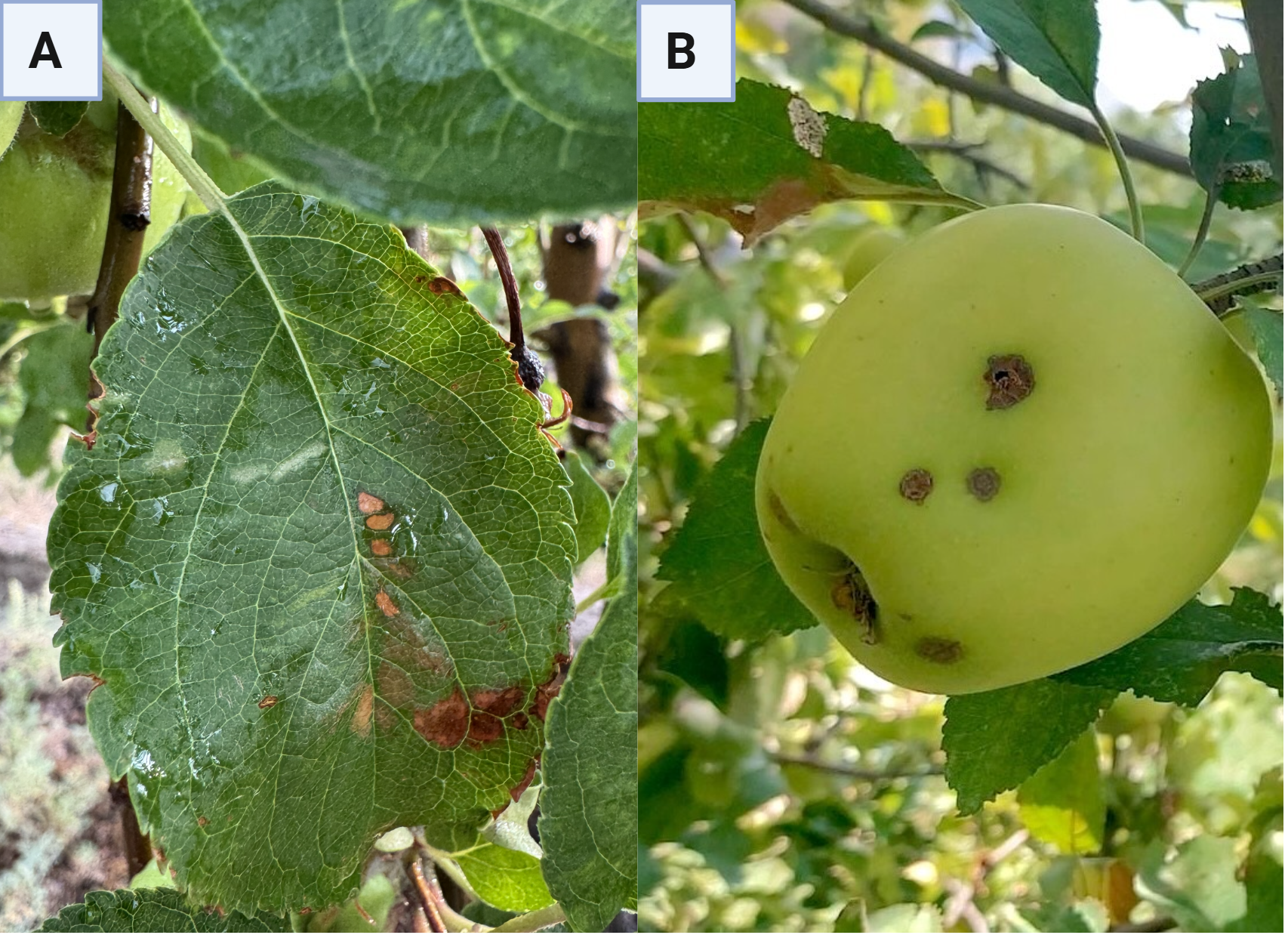
During phytopathological monitoring of commercial apple orchards in Almaty Region in 2023–2025, symptoms consistent with infection by fungi of the genus Alternaria were observed on apple leaves and fruits. On apple leaves, symptoms appeared as numerous round dark necrotic spots, 2 to 15 mm in diameter, unevenly distributed across the leaf blade. As the disease developed, the lesions enlarged, and some of them showed concentric zonation and a dark brown or purplish margin (
Figure 1A). On fruits, as they matured, dark necrotic spots developed, usually round in shape, with 1–2 lesions per fruit and diameters ranging from 2 to 30 mm. Around the infection sites, a zone of necrosis formed in the pericarp tissues, creating a dark halo (
Figure 1B).
With further disease development, the affected leaves turned yellow and prematurely abscised.
The development of A. alternata on apple appeared to be closely associated with meteorological conditions, particularly moisture-related factors such as relative humidity, precipitation, saturation deficit, and the availability of free moisture on plant surfaces. Free moisture on leaves, resulting from dew, fog, or rainfall, is considered an important prerequisite for conidial germination and subsequent infection of plant tissues.
Analysis of agroclimatic indicators for the growing seasons from April to September in 2023–2025 revealed substantial differences in environmental conditions that influenced disease development (
Table 1). The 2024 growing season was characterized by the most favorable conditions for pathogen development, with the highest mean monthly precipitation (52.48 mm), the highest mean relative humidity (54.65%), and the lowest mean saturation deficit (12.24 hPa), resulting in the highest mean seasonal DSI of 13.02%. The 2023 growing season presented intermediate conditions, with mean monthly precipitation of 40.82 mm, mean relative humidity of 47.37%, and mean saturation deficit of 14.02 hPa, corresponding to a mean seasonal DSI of 11.88%. The 2025 growing season was the least conducive to disease development, with the lowest mean monthly precipitation (34.88 mm), the lowest mean relative humidity (44.79%), and the highest mean saturation deficit (15.81 hPa), resulting in the lowest mean seasonal DSI of 8.44%.
Spearman’s rank correlation analysis was performed based on 18 monthly observations, covering April–September across all three study years. This non-parametric approach was selected due to the relatively small sample size and the absence of an assumption of normal data distribution. DSI showed a significant positive correlation with relative humidity (Spearman’s ρ = 0.518, p = 0.028), indicating that higher atmospheric moisture content favored disease development. Precipitation also showed a positive association with DSI, although this relationship did not reach statistical significance (ρ = 0.442, p = 0.066). In contrast, saturation deficit exhibited a negative near-significant correlation with DSI (ρ = −0.456, p = 0.057), suggesting that drier atmospheric conditions tended to suppress disease progression. Mean air temperature (ρ = −0.387, p = 0.112) and wind speed (ρ = −0.049, p = 0.848) demonstrated weak and non-significant relationships with disease severity.
These findings indicate that atmospheric moisture conditions were the main meteorological drivers of A. alternata lesion development during the study period. Higher relative humidity and increased moisture availability created favorable conditions for pathogen establishment and disease progression, whereas reduced humidity and elevated saturation deficit limited disease development. The year-to-year variation in disease severity followed a clear pattern, with the highest DSI recorded in 2024, intermediate values in 2023, and the lowest values in 2025. The mean seasonal DSI declined by 35.2% from 2024 to 2025, coinciding with corresponding changes in moisture-related meteorological variables. These results support the important role of atmospheric humidity in A. alternata pathogenesis on apple in the foothill zone of southeastern Kazakhstan.
The analysis revealed clear differences in disease incidence and severity among the evaluated apple cultivars and between the study years (
Table 3). In 2023, DI ranged from 18.67% (Fuji) to 64.33% (Voskhod), with a mean seasonal DSI varying from 7.59% (Fuji) to 20.31% (Shyryn). In 2024, disease incidence was the highest across all three years, ranging from 20.00% to 68.67%, with DSI values between 8.12% (Fuji) and 21.78% (Shyryn), reflecting the most favorable meteorological conditions for pathogen development recorded during the study period. In 2025, both DI and DSI were substantially lower: DI ranged from 15.33 to 48.33%, and DSI from 5.19% (Fuji) to 12.56% (Kamila), consistent with reduced atmospheric humidity and higher saturation deficit observed that season.
The three-year mean DSI values ranged from 6.97% (Fuji) to 17.68% (Saltanat), providing a robust basis for cultivar resistance classification. Statistical significance of differences among cultivar means for seasonal DSI values was assessed using Fisher’s LSD test at p ≤ 0.05. The LSD0.05 values were 8.79% in 2023, 6.89% in 2024, and 5.37% in 2025, calculated separately for each year.
Based on the three-year mean DSI values for 2023–2025, the evaluated apple cultivars were classified into two groups: relatively resistant and moderately susceptible. The more resistant group (resistance category 1) included Fuji, Red Jonaprince, Granny Smith, Zaman, Maksat, and Talgar, with mean DSI values ranging from 6.97 to 9.86%. The less resistant group (resistance category 2) comprised Golden Delicious, Idared, Aport, Red Delicious, Voskhod, Kamila, Shyryn, and Saltanat, with mean DSI values ranging from 11.12 to 17.68%. Fuji was the most resistant cultivar (mean DSI = 6.97%), while Saltanat (17.68%), Shyryn (17.44%), and Kamila (16.70%) were the most susceptible among the evaluated cultivars.
3.2. Morphological and Cultural Characteristics of Fungal Pathogen
During 2023–2025, a total of 84 symptomatic leaves and 28 symptomatic fruits were collected from commercial apple orchards in Almaty Region, yielding 112 tissue samples in total. From these samples, 20 fungal isolates were successfully obtained in pure culture (isolation rate: 17.9%), including 15 isolates from leaves and 5 from fruits.
The isolates were cultured on PDA and examined for colony and microscopic morphology. All isolates showed generally similar cultural and microscopic characteristics consistent with
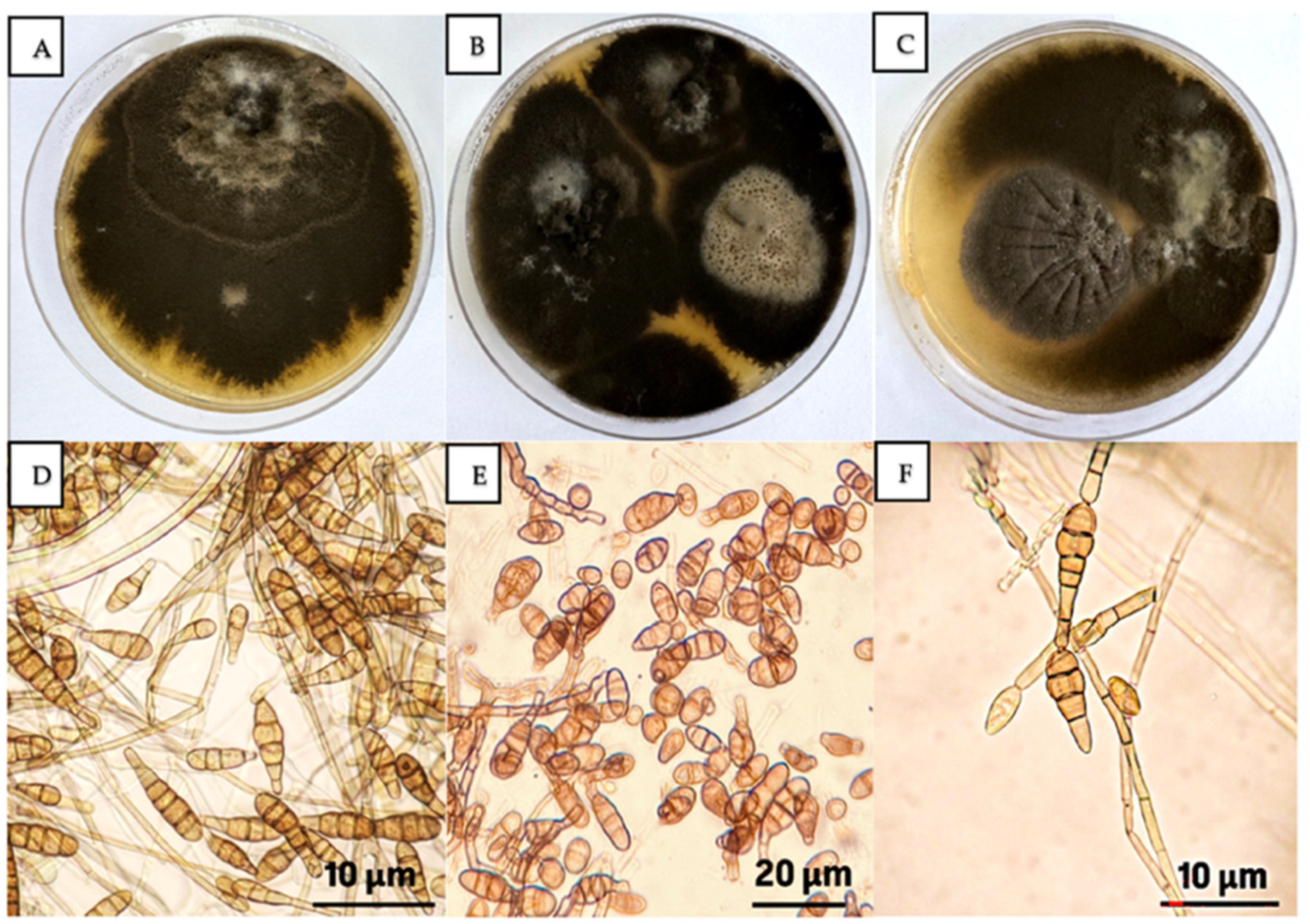
A. alternata, although minor variation in colony appearance was observed among individual isolates. Colony morphology on PDA is shown in
Figure 2A–C. Colonies were dark olive-brown to black, with dense aerial mycelium and abundant sporulation. Growth was radial with irregular to slightly lobed margins. After 7 days of incubation at 25 °C, colonies reached approximately 60–70 mm in diameter; the reverse side of the colonies was dark brown to black.
Microscopic observations revealed morphological characteristics typical of
A. alternata (
Figure 2D–F). Conidiophores were brown, septate, simple or occasionally branched, measuring approximately 20–50 × 3–6 μm (
Figure 2D). Conidia were produced in chains of 3–5 (
Figure 2F), were ovoid to obclavate with rounded apices and slightly tapered bases, measuring approximately 15–25 × 6–11 μm, with 3–5 transverse septa and occasionally one oblique or longitudinal septum (
Figure 2E,F). These morphological characteristics are consistent with published descriptions of
A. alternata [
12]. Based on these cultural and morphological characteristics, all isolates were tentatively identified as
A. alternata, pending molecular confirmation.
3.3. Molecular Identification of Isolate KZ17
Twenty
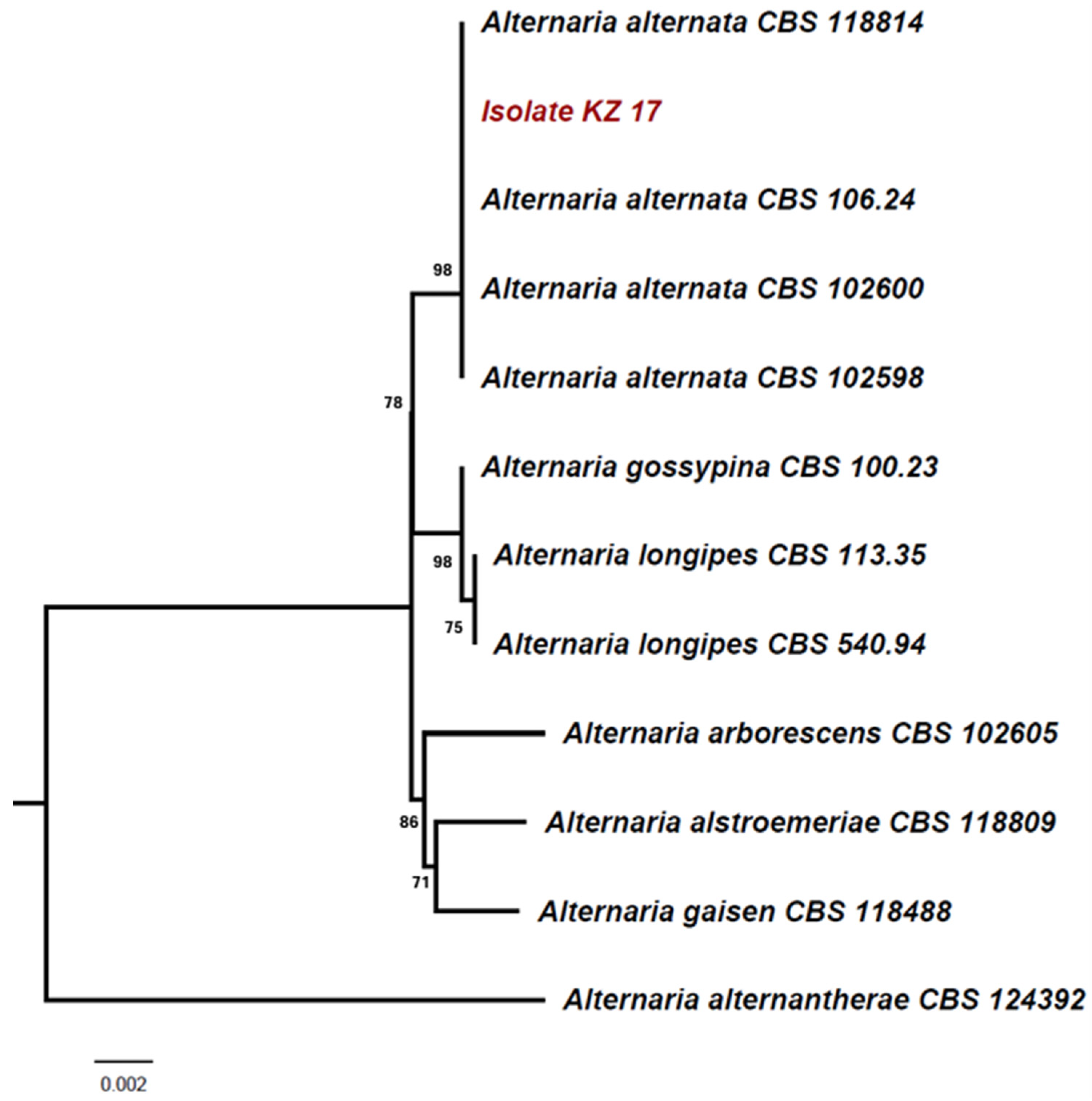
Alternaria isolates were recovered and initially grouped based on colony morphology, conidial characteristics, growth pattern, and cultural features. Based on these preliminary morphological and cultural observations, one representative isolate, KZ17, was selected for multilocus molecular identification and phylogenetic analysis to confirm species identity. Phylogenetic analysis based on the concatenated dataset of four genetic markers (ITS, SSU,
tef1-α, and
RPB2; 2335 nucleotide positions total) allowed reconstruction of the phylogenetic relationships between isolate KZ17 and reference strains of the genus
Alternaria (
Figure 3).
In the resulting phylogenetic tree, isolate KZ17 clustered with reference strains of A. alternata (CBS 118814, CBS 106.24, CBS 102600, and CBS 102598). The broader node uniting this group with A. gossypina and A. longipes received a bootstrap value of 78%, indicating moderate phylogenetic support. Within this clade, strains CBS 102600 and CBS 102598 formed a well-supported subclade with a bootstrap value of 98%. Therefore, the assignment of isolate KZ17 to A. alternata was based not solely on the bootstrap value of the phylogenetic tree, but on the combined evidence from morphological and cultural characteristics, high BLASTn sequence similarity, and multilocus phylogenetic placement. A. gossypina (CBS 100.23) and A. longipes (CBS 113.35 and CBS 540.94) formed a separate clade sister to the A. alternata group, with bootstrap support of 98% for the entire clade and 75% for the two A. longipes strains. More distantly related taxa—A. arborescens (CBS 102605), A. alstroemeriae (CBS 118809), and A. gaisen (CBS 118488)—occupied positions outside both of the above clades, with A. alstroemeriae and A. gaisen forming a supported group (bootstrap 86% and 71%, respectively). A. alternantherae (CBS 124392) was used as the outgroup for rooting the phylogenetic tree.
Based on the combined morphological, cultural, and multigene molecular phylogenetic evidence, isolate KZ17 was identified as A. alternata (Fr.) Keissler.
3.4. Effects of Temperature and pH on Mycelial Growth
The effects of temperature and pH on the mycelial growth of A. alternata isolate KZ17 were evaluated on PDA. These assays were performed to characterize the basic biological growth requirements of isolate KZ17 under laboratory conditions and to better understand the environmental conditions that may favor pathogen development. Colony diameter was measured daily, and the values recorded after 7 days of incubation were used for statistical analysis.
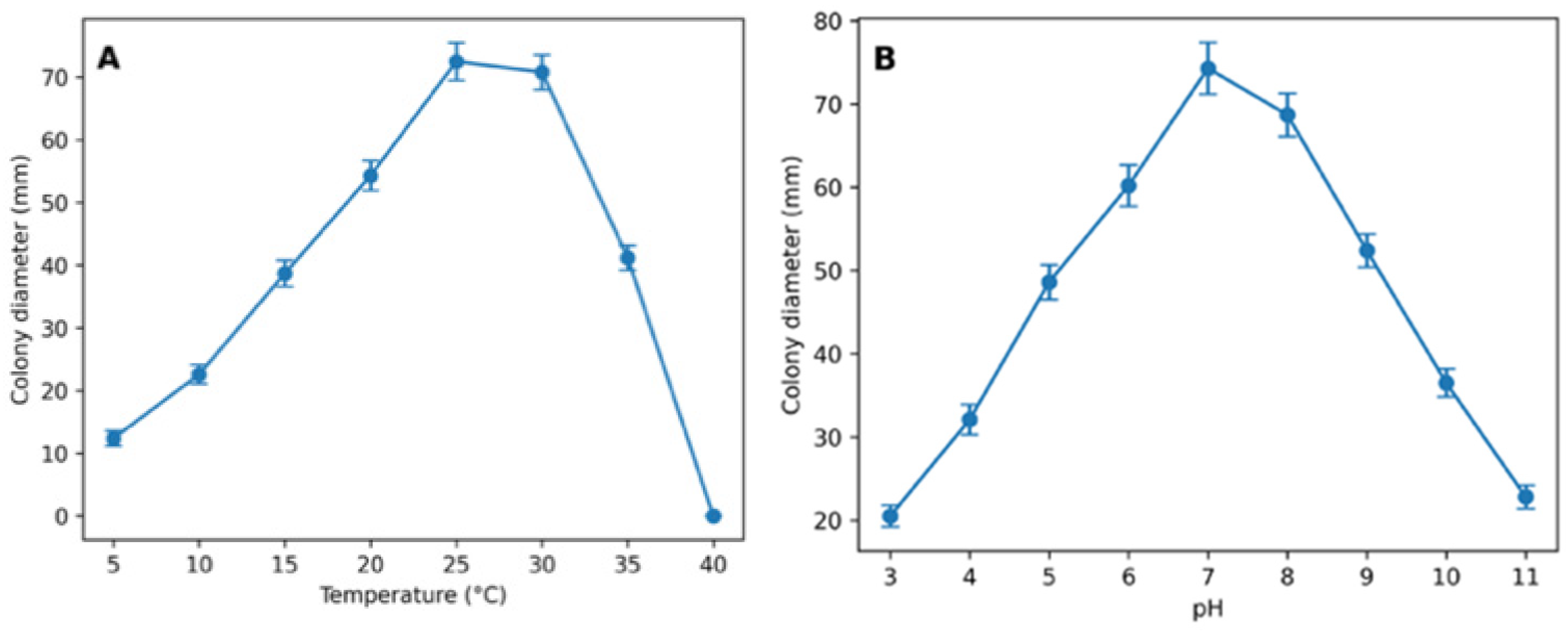
Temperature had a highly significant effect on the mycelial growth of
A. alternata (one-way ANOVA:
F = 9328.01,
p < 0.001). The fungus was capable of growth across a temperature range of 5 to 35 °C. Colony diameter increased progressively with rising temperature: from 12.4 ± 0.4 mm at 5 °C to 22.6 ± 0.5 mm at 10 °C, 38.7 ± 0.6 mm at 15 °C, and 54.3 ± 0.5 mm at 20 °C, reaching a maximum of 72.5 ± 0.5 mm at 25 °C. Growth at 30 °C remained high (70.8 ± 0.6 mm) and was not significantly different from that at 25 °C, indicating that both temperatures supported near-optimal mycelial development. Colony diameter declined markedly at 35 °C (41.2 ± 0.4 mm), and no visible mycelial growth was recorded at 40 °C (0.0 ± 0.0 mm) after 7 days of incubation; however, the thermal death point of the isolate was not determined in this study. The LSD
0.05 value was 0.819 mm, indicating that all pairwise differences among temperature treatments were statistically significant, with the exception of the 25 °C and 30 °C comparison. These results indicate that the optimum temperature range for mycelial growth of
A. alternata isolate KZ17 was 25–30 °C (
Figure 4A).
Medium pH also had a highly significant effect on mycelial growth (one-way ANOVA:
F = 4149.75,
p < 0.001). The fungus was capable of growth across a broad pH range from 3 to 11, although colony diameter varied markedly among pH levels. Colony diameter increased progressively from 20.5 ± 0.5 mm at pH 3 to 32.1 ± 0.5 mm at pH 4, 48.6 ± 0.6 mm at pH 5, and 60.2 ± 0.5 mm at pH 6, reaching a maximum of 74.3 ± 0.6 mm at pH 7, indicating that neutral pH was the most favorable for mycelial growth. Under alkaline conditions, colony diameter declined progressively: 68.7 ± 0.5 mm at pH 8, 52.4 ± 0.5 mm at pH 9, 36.5 ± 0.5 mm at pH 10, and 22.8 ± 0.5 mm at pH 11. The LSD
0.05 value was 0.899 mm, indicating that all pairwise differences among pH treatments were statistically significant. These results indicate that the optimum pH for mycelial growth of
A. alternata isolate KZ17 on PDA was 7 (
Figure 4B).
3.5. Pathogenicity Assay
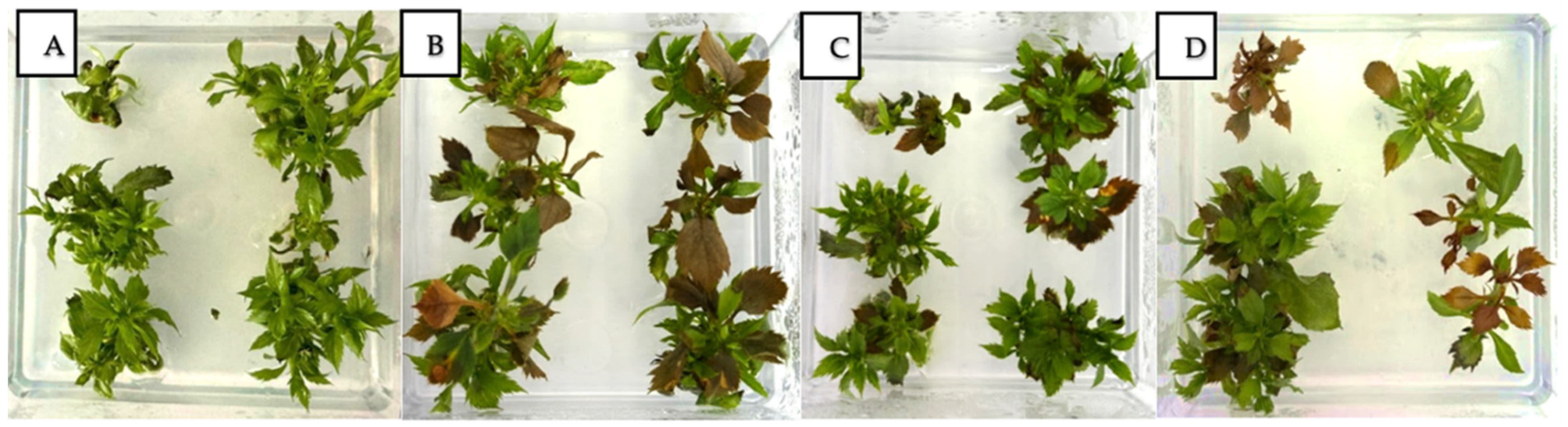
After inoculation of apple microshoots with a conidial suspension of isolate KZ17, necrotic leaf lesions were observed on all 18 microshoots across all three replicates (
Figure 5).
The first symptoms appeared at 3 days post-inoculation as localized necrotic areas at the sites of inoculum application. With time, lesion severity increased and the affected areas progressively expanded. No pathological changes were detected in the control samples treated with sterile distilled water. The absence of symptoms in the control microshoots, together with successful re-isolation and re-identification of A. alternata from inoculated tissues, confirmed Koch’s postulates. These results confirm the pathogenicity of isolate KZ17 toward apple microshoots under in vitro conditions.
3.6. Resistance of Apple Cultivars to A. alternata
According to the results of inoculation of detached leaves and ripe fruits of 14 apple cultivars, differences in the degree of susceptibility to
A. alternata were revealed (
Table 4).
Significant differences in susceptibility to
A. alternata were observed among the 14 evaluated apple cultivars on both detached leaves and ripe fruits (
p ≤ 0.05) (
Table 4). On detached leaves, lesion diameters ranged from 12.3 ± 0.20 mm (Granny Smith) to 19.2 ± 0.35 mm (Voskhod). The least susceptible cultivars were Granny Smith, Zaman, and Maksat, with mean lesion diameters of 12.3, 12.8, and 13.2 mm, respectively. The most susceptible cultivars were Voskhod, Kamila, and Saltanat, with lesion diameters of 19.2, 18.8, and 18.5 mm, respectively. On ripe fruits, dry rot lesion diameters ranged from 15.0 ± 1.2 mm (Granny Smith) to 30.0 ± 2.4 mm (Saltanat and Voskhod). The ranking of cultivar susceptibility on fruits was generally consistent with that observed on leaves, with Granny Smith, Zaman, and Maksat showing the smallest lesions, and Saltanat, Voskhod, and Kamila the largest. All inoculated leaves and fruits developed symptoms, whereas control treatments remained symptomless. Re-isolation and re-identification of the pathogen from inoculated tissues confirmed the fulfillment of Koch’s postulates.
When leaf susceptibility was assessed, the diameter of necrotic lesions at 8 days after inoculation varied significantly among cultivars (
p < 0.001), ranging from 12.3 mm to 19.2 mm (
Figure 6). The smallest lesions were recorded in Granny Smith, Zaman, and Maksat (12.3–13.2 mm), indicating their relatively higher resistance to
A. alternata. The largest necrotic lesions were observed in Shyryn, Golden Delicious, Idared, Saltanat, Kamila, and Voskhod (16.3–19.2 mm), indicating their greater susceptibility to the pathogen. Based on lesion diameter and statistical analysis (LSD
0.05 = 0.41 mm), the studied cultivars were classified into three distinct resistance groups: resistant (≤13.5 mm)—Granny Smith, Zaman, and Maksat; moderately resistant (13.6–16.0 mm)—Talgar, Aport, Red Jonaprince, Red Delicious, and Fuji; and susceptible (>16.0 mm)—Shyryn, Golden Delicious, Idared, Saltanat, Kamila, and Voskhod.
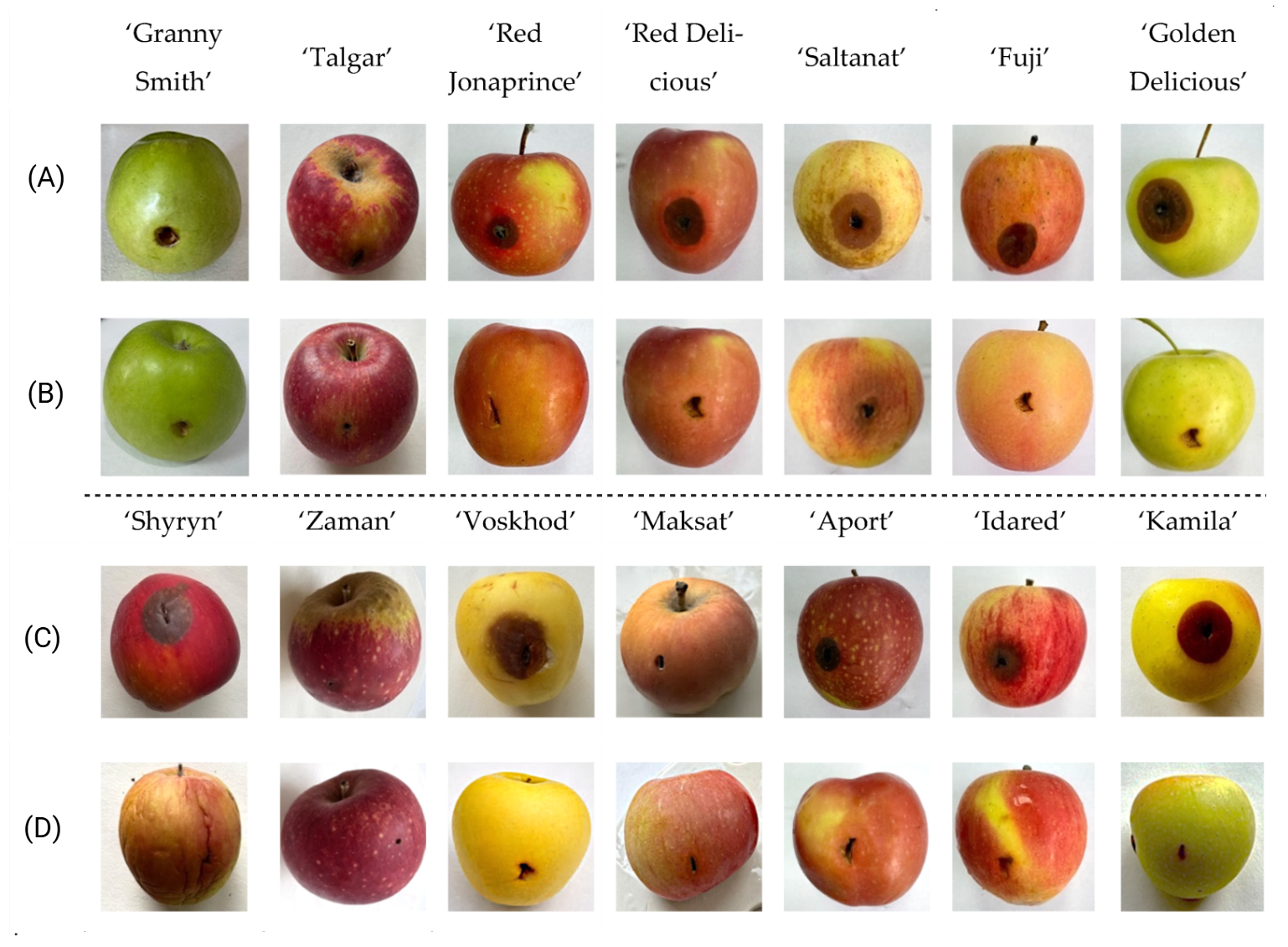
A similar pattern was observed in the fruit inoculation assay. Necrotic lesions developed on all inoculated fruits of all 14 cultivars, while control fruits treated with sterile distilled water remained symptomless throughout the incubation period. Representative symptoms at 14 days after inoculation are shown in
Figure 7.
The smallest lesion diameters were recorded in Granny Smith (15.0 ± 1.2 mm), Zaman (16.2 ± 1.3 mm), and Maksat (17.5 ± 1.4 mm), which also showed relatively lower susceptibility in the detached leaf assay. The largest fruit lesions were observed in Saltanat (30.0 ± 2.4 mm) and Voskhod (30.0 ± 2.4 mm), as well as Kamila (29.5 ± 2.3 mm) and Idared (28.5 ± 2.2 mm), indicating their high susceptibility to A. alternata infection. One-way ANOVA confirmed a statistically significant effect of cultivar on necrotic lesion diameter on fruits at 14 days after inoculation (p < 0.001; LSD0.05 = 3.15 mm). The fruit inoculation results were consistent with the leaf susceptibility patterns. Overall, these results demonstrate pronounced differentiation among the evaluated apple cultivars in resistance to A. alternata, enabling the identification of cultivars with relatively higher resistance and those with greater susceptibility to this pathogen.
4. Discussion
To our knowledge, this is the first integrative study combining field epidemiology, morphocultural characterization, multilocus molecular identification, pathogenicity assays, and cultivar resistance evaluation for Alternaria-associated diseases of apple in southeastern Kazakhstan. The results provide convergent evidence that A. alternata is an etiologically important pathogen associated with apple leaf blotch and fruit spot in this region and that disease expression is jointly shaped by environmental conditions and cultivar characteristics.
A major finding of this study was the molecular confirmation of isolate KZ17 as A. alternata based on four loci, ITS, SSU, RPB2, and tef1-α, all of which showed high sequence identity to authenticated A. alternata strains. Although the recovered isolates were morphologically consistent with classical descriptions of Alternaria, morphology alone is insufficient for reliable delimitation of small-spored taxa because closely related species often overlap in colony appearance and conidial traits. This agrees with previous studies showing that apple-associated Alternaria populations may include not only A. alternata but also members of the A. arborescens complex, and that multilocus phylogenetic analysis is therefore required for robust species identification. The identification of isolate KZ17 as A. alternata was supported by the combined evidence from morphocultural characteristics, sequence similarity, and multilocus phylogenetic placement.
A limitation of the present study is that multilocus molecular identification was performed for only one representative isolate, KZ17, although 20 Alternaria isolates were recovered from symptomatic apple tissues. Therefore, the molecular and phylogenetic results should be interpreted as confirmation of the identity of this representative isolate rather than as a full characterization of the regional Alternaria population. Future studies should include multilocus sequencing of additional isolates collected from different orchards, cultivars, tissues, and years to assess the diversity and population structure of Alternaria spp. associated with apple diseases in southeastern Kazakhstan.
Disease development in the present study was primarily associated with moisture-related environmental conditions. Among the three study years, the wetter 2024 season, characterized by the highest mean precipitation, higher relative humidity, and the lowest saturation deficit, coincided with the highest mean seasonal disease severity index. In contrast, the 2025 season was drier, with lower precipitation and relative humidity and a higher saturation deficit, and showed the lowest disease severity. The 2023 season represented an intermediate pattern, with moderate precipitation, relative humidity, and saturation deficit, corresponding to an intermediate mean seasonal DSI. Monthly correlation analysis further indicated a significant positive association between disease severity and relative humidity, while saturation deficit showed a negative near-significant association. Precipitation also showed a positive trend, although it did not reach statistical significance. Mean air temperature and wind speed were not significantly related to disease expression. These results suggest that atmospheric and surface moisture availability, rather than temperature alone, was the dominant environmental factor governing symptom development under the conditions of southeastern Kazakhstan. This interpretation is consistent with previous studies showing that Alternaria epidemics in apple orchards are strongly influenced by humidity, wetness duration, and rainfall-related moisture regimes.
In addition to the field observations, the laboratory experiments provided complementary information on the ecological characteristics of the pathogen. The determination of the temperature and pH ranges favorable for mycelial growth establishes the basic environmental requirements of A. alternata under controlled laboratory conditions. Although these findings do not directly translate into disease management recommendations, they improve our understanding of the environmental conditions favoring pathogen development and provide a scientific basis for future epidemiological studies, disease risk assessment, and integrated disease management strategies. Pathogenicity assays confirmed that the studied isolate was pathogenic rather than a secondary colonizer. Artificial inoculation induced typical necrotic lesions on leaves, fruits, and microshoots, whereas the controls remained symptomless, and re-isolation from symptomatic tissues fulfilled Koch’s postulates. This agrees with previous reports demonstrating successful induction of necrotic lesions by apple-associated Alternaria isolates in detached-tissue assays. It should be noted that in vitro microshoot, detached-leaf, and excised-fruit assays do not fully reproduce the physiological and biochemical defense responses of intact apple trees under orchard conditions. Therefore, the responses observed in these assays should be interpreted as a preliminary comparative assessment of susceptibility to isolate KZ17 under controlled inoculation conditions. Further validation on intact trees under field conditions is needed to confirm the stability of the observed resistance patterns. In addition, because the pathogenicity and cultivar susceptibility assays were performed with a single confirmed isolate, KZ17, the observed differences in cultivar responses should be interpreted with caution and regarded as a preliminary comparative assessment under controlled conditions.
Resistance analysis revealed marked cultivar-dependent variation under both field and controlled conditions. Under natural infection, Fuji showed the lowest disease severity index, followed by Red Jonaprince and Granny Smith. Under controlled inoculation, however, Granny Smith produced the smallest lesions in both detached leaves and fruits, whereas Fuji showed only moderate susceptibility. These discrepancies likely reflect differences between orchard and laboratory conditions, including inoculum pressure, host phenology, fruit maturity, and microclimatic effects, which may alter the phenotypic expression of resistance. Nevertheless, the strong correlation between lesion development on detached leaves and fruits indicates that cultivar responses were generally consistent across the two controlled assays, supporting the use of detached-leaf inoculation as a rapid preliminary screening tool for susceptibility to A. alternata. This conclusion agrees with previous work showing that detached-leaf assays can be useful for preliminary discrimination of susceptibility levels among apple genotypes and for reducing environmental noise during evaluation.
Based on the combined evidence from field monitoring and controlled inoculation assays, the tested cultivars showed differential susceptibility to A. alternata. Under field conditions, cultivars were classified into two categories based on mean seasonal DSI: relatively resistant (DSI ≤ 10%)—Fuji, Red Jonaprince, Granny Smith, Zaman, Maksat, and Talgar—and moderately susceptible (DSI > 10%)—Saltanat, Kamila, Voskhod, Shyryn, Idared, Golden Delicious, Aport, and Red Delicious. Under controlled inoculation, Granny Smith, Zaman, and Maksat consistently showed the smallest lesion diameters on both detached leaves and fruits, whereas Saltanat, Kamila, Voskhod, Shyryn, and Idared showed the greatest lesion development. This pattern confirms that susceptibility to Alternaria in apple is strongly cultivar-dependent and is consistent with previous studies showing cultivar-dependent variation in resistance under field and detached-leaf conditions.
The differential susceptibility observed among the 14 apple cultivars in the present study is broadly consistent with findings reported for
Alternaria-associated apple diseases in other apple-growing regions, although some cultivar responses varied across studies. The low susceptibility of Granny Smith agrees with results from India, where this cultivar was classified as resistant under natural epiphytotic conditions, with a pooled disease severity index of 4.83% [
17]. The consistency of this response across geographically distant regions and under different experimental conditions suggests that Granny Smith may possess relatively stable resistance or lower susceptibility to Alternaria blotch. The intermediate susceptibility of Fuji is consistent with reports from California, where this cultivar was more susceptible than Pink Lady in detached-fruit assays, although it was not among the most susceptible cultivars tested [
10]. In China, different Fuji-related cultivars and clones also showed considerable variability in lesion development, ranging from relatively resistant to more susceptible responses [
6]. This may partly explain the intermediate and variable susceptibility of Fuji observed across studies. In contrast, Golden Delicious was relatively susceptible in the present study. [
18] noted that Golden Delicious has been reported as susceptible in some Chinese studies but as resistant or moderately resistant in Japanese studies, and suggested that such inconsistencies may be associated with differences in the virulence of
A. alternata isolates or experimental conditions. A similar discrepancy was observed for Idared, which was among the more susceptible cultivars in the present assay but was identified as resistant in the Chinese screening of 84 apple cultivars [
6]. Red Delicious also showed only moderate susceptibility in the present study, although cultivars of the ‘Delicious’ lineage, including sports such as ‘Starking Delicious’, have often been reported as susceptible to Alternaria blotch in previous studies [
18].
These discrepancies indicate that cultivar responses to
Alternaria infection may be influenced not only by cultivar characteristics but also by isolate aggressiveness, inoculation method, incubation period, tissue maturity, and regional environmental conditions [
5] also reported variation in pathogenicity among apple-associated
Alternaria isolates and emphasized that pathogenicity may be isolate-dependent rather than strictly species-dependent. Therefore, the cultivar responses observed here should be interpreted in the context of the single KZ17 isolate and controlled assay conditions. Overall, the consistently low susceptibility of Granny Smith, together with the variable responses of Golden Delicious, Idared, Fuji, and Red Delicious among studies, supports the view that resistance to
Alternaria-associated apple diseases is shaped by both cultivar-specific factors and isolate-dependent variation in aggressiveness. The observed differences in cultivar susceptibility were evaluated phenotypically and were not intended to identify the physiological or molecular mechanisms underlying resistance. Resistance to
A. alternata is likely influenced by multiple structural, biochemical, and genetic factors, including differences in defense-related metabolites and enzyme activities. Investigation of these mechanisms represents an important direction for future research aimed at elucidating the basis of cultivar-specific responses to
A. alternata.
From a practical perspective, cultivars showing relatively low susceptibility in the present study, particularly ‘Fuji’, ‘Red Jonaprince’, ‘Granny Smith’, ‘Zaman’, ‘Maksat’, and ‘Talgar’, may be considered promising candidates for further regional evaluation and use in breeding or cultivar selection programs, pending confirmation with additional isolates as noted above. Their lower disease severity suggests that these cultivars could help reduce disease pressure in regional orchards. The results of this study also provide a basis for eco-friendly management of Alternaria-associated apple diseases in southeastern Kazakhstan. Since disease development was closely associated with moisture-related factors, regular monitoring during humid and rainy periods should be prioritized. Management strategies should include preferential use of the relatively resistant cultivars identified above, removal of infected leaves and fruits to reduce inoculum sources, improvement of canopy ventilation through pruning, avoidance of excessive irrigation, and timely phytosanitary monitoring. These measures may help reduce disease pressure while supporting integrated and environmentally safer disease management in regional apple orchards.
In conclusion, this study provides integrated evidence that A. alternata is a significant component of apple leaf blotch and fruit spot etiology in southeastern Kazakhstan. Disease development was primarily associated with moisture-related environmental conditions, while cultivar susceptibility was strongly cultivar-dependent. The integration of field observations, multilocus pathogen identification, pathogenicity assays, and detached-tissue screening establishes a methodological framework for resistance evaluation and climate-informed disease management in semi-arid and continental apple-growing systems.



 ,
,