Article

The Impact of Planting Density and Vegetative Duration on Yield Optimization and Cannabinoid Stability in Medicinal Cannabis Under Controlled-Environment Cultivation

1
IA-AGRO, 57001 Thessaloniki, Greece
2
Laboratory of Agricultural Engineering, School of Agriculture, Aristotle University of Thessaloniki, 54124 Thessaloniki, Greece
3
Institute of Plant Breeding & Genetic Resources, Hellenic Agricultural Organization DIMITRA, 57001 Thessaloniki, Greece
*
Authors to whom correspondence should be addressed.
Horticulturae 2026, 12(5), 619; https://doi.org/10.3390/horticulturae12050619 (registering DOI)
Submission received: 24 March 2026 / Revised: 12 May 2026 / Accepted: 14 May 2026 / Published: 17 May 2026
(This article belongs to the Section Protected Culture)

Abstract

Optimizing plant density and vegetative growth duration is important for improving productivity in controlled-environment medicinal cannabis cultivation. Although both factors strongly influence canopy development and yield, their combined effects under modern high-intensity LED lighting, and particularly their consequences for cannabinoid uniformity across the canopy, remain insufficiently characterized. This study examined how planting density and vegetative duration influence plant growth, yield, and cannabinoid concentration in Cannabis sativa L. (strain ‘Fat Banana’) grown under controlled environment conditions, high-intensity LED lighting and precision fertigation. Two vegetative durations (10 and 28 days) were evaluated in separate but identical controlled-environment chambers under broad-spectrum high-intensity LED lighting and automated precision fertigation on rockwool substrate. The 10-day regime compared 8, 14 and 18 plants m−2; the 28-day regime compared 6, 8 and 10 plants m−2. Each combination was replicated across two independent cultivation cycles, and because density levels differed between regimes, direct between-regime comparisons were restricted to the shared density of 8 plants m−2. Extending the vegetative phase from 10 to 28 days increased plant height, stem diameter and internodal length. Area-based yield increased strongly with density, reaching 1091 g m−2 at 18 plants m−2 under the 10-day regime and 1009 g m−2 at 10 plants m−2 under the 28-day regime. Apical biomass exceeded basal biomass, but total THC concentration did not differ significantly among planting densities, vegetative durations or canopy positions. Higher planting densities combined with shorter vegetative periods can therefore increase area-based productivity while maintaining stable THC concentration under high-intensity LED cultivation.

1. Introduction

Optimizing canopy structure and crop productivity is an important challenge in controlled environment agriculture (CEA), especially for high-value medicinal crops. In controlled environment cultivation systems, crop performance is usually assessed in terms of yield per unit area and production time rather than the output of individual plants. Under these conditions, planting density and the duration of vegetative growth strongly influence plant architecture, light interception, biomass production, and product uniformity in Cannabis sativa L. [1,2].
In commercial indoor medicinal cannabis operations, plant densities typically range from approximately 4 to 16 plants m−2 depending on cultivar vigor, available canopy height and training strategy, while vegetative growth durations most commonly fall between 7 and 35 days [1,2,3,4,5]. Short vegetative schedules (often called “sea-of-green” production) rely on higher densities of smaller, untrained plants, whereas longer vegetative schedules generally use lower densities of larger, often topped or trellised plants. Despite the agronomic relevance of these two production philosophies, systematic side-by-side comparisons under contemporary high-intensity LED systems are still limited, and reference data that can guide density selection for different vegetative schedules in single-topped, non-trellised production are sparse. This practical gap motivated the specific combinations evaluated in the present study (6–18 plants m−2 at two vegetative durations of 10 and 28 days).
Planting density determines how plant foliage is distributed within the growing space and how quickly the canopy closes. Increasing plant density can improve early light interception and increase yield per unit area. However, higher densities may also increase competition among plants for light and reduce biomass production per plant. In many crop systems, increasing plant density eventually leads to a point where additional plants no longer increase yield under the same light conditions. Identifying this range is particularly important in controlled-environment cannabis cultivation, where lighting intensity and growing space are tightly managed and energy costs are high [6,7].
Cannabis plants show strong plasticity in their growth responses to changes in canopy structure. As the canopy develops and shading increases, plants may respond by increasing stem elongation and plant height. Such responses are often associated with shade-avoidance mechanisms. While these responses can help plants compete for light in natural environments, excessive elongation is not desirable in indoor production because it can reduce plant stability and increase differences between upper and lower canopy layers [8,9].
The duration of vegetative growth also affects how canopy structure develops. Longer vegetative periods allow plants to accumulate more leaf area before flowering begins, which can increase canopy depth. Short vegetative periods limit plant expansion before flowering and may reduce structural differences between plants even at higher densities. Despite the importance of this interaction for crop scheduling, relatively few studies have examined planting density responses under different vegetative durations in controlled-environment cannabis systems, particularly under modern high-intensity LED lighting [3].
Canopy structure may also influence inflorescence development and the distribution of secondary metabolites within the plant. In some cropping systems, reduced light levels in lower canopy layers are associated with lower biomass production and differences in metabolite concentration. In medicinal cannabis cultivation, concerns remain about possible differences in cannabinoid concentration between upper and lower canopy positions, as such variation could affect product consistency. However, studies conducted under high light intensities have reported mixed results regarding vertical differences in cannabinoid concentration [10,11,12].
Another question relates to the relationship between biomass production and secondary metabolite concentration. Some studies suggest that rapid biomass accumulation may reduce metabolite concentration on a dry-weight basis. Whether planting strategies that increase yield per unit area influence cannabinoid concentration in controlled environments is still not fully understood [13,14].
Recent advances in LED lighting and fertigation management have improved environmental control in indoor cannabis production. High light intensity combined with precise nutrient delivery can support rapid plant growth while maintaining stable cultivation conditions. Under such conditions, increases in planting density may improve productivity without causing large changes in plant structure or cannabinoid concentration [15,16].
Despite the practical importance of these cultivation parameters for indoor production systems, their combined effects on canopy structure, biomass partitioning, yield formation and cannabinoid stability remain insufficiently characterized under modern high-intensity LED lighting without CO2 enrichment. The present study therefore investigated the interaction between planting density and vegetative duration in Cannabis sativa cultivated under controlled-environment conditions. Two vegetative durations and several planting densities were evaluated across two cultivation cycles, with the objective of determining how these factors influence plant architecture, yield per unit area, biomass distribution within the canopy, and cannabinoid composition.

2. Materials and Methods

2.1. Plant Material and Clonal Propagation

The experiment was carried out at the Institute of Plant Breeding and Genetic Resources of the Hellenic Agricultural Organization-DIMITRA (ELGO-DIMITRA) in Thessaloniki, Greece. The facility operates under a license issued under current Greek legislation for medical cannabis cultivation, which allows the cultivation and experimental evaluation of high-THC (>0.2% THC) C. sativa L. genotypes under controlled conditions. The cultivar used in this study was the high-THC strain ‘Fat Banana’ (Royal Queen Seeds, Amsterdam, The Netherlands). This cultivar is widely used in indoor medicinal cannabis production. All plants were propagated clonally from a single mother plant in order to minimize genetic variation among treatments. The mother plant had previously been evaluated across three cultivation cycles. Selection criteria included stable vegetative growth, uniform internode spacing, strong apical dominance, resistance to lodging, and consistent cannabinoid production. Apical cuttings (10–12 cm) were taken from actively growing shoots and rooted under controlled conditions at 24–25 °C and 85–90% relative humidity. During propagation, plants were exposed to a photosynthetic photon flux density (PPFD) of approximately 150 µmol m−2 s−1. Rooting occurred within 10–14 days. After root formation, cuttings were gradually acclimated to lower humidity before transplanting. At the time of transplanting, plants were standardized to a height of 10–12 cm with uniform leaf development and internode spacing.

2.2. Experimental Design and Treatments

The experiment evaluated two factors: vegetative duration (10 or 28 days) and planting density. Because the evaluated density levels differed between vegetative regimes, a full factorial design was not implemented; instead, density effects were analyzed separately within each vegetative regime, and direct comparisons between vegetative regimes were performed only at the shared density of 8 plants m−2, which was present in both regimes.
The two vegetative regimes were conducted simultaneously in two separate but identical controlled-environment chambers located in the same licensed facility. Vegetative duration treatments were assigned at the chamber level: the 10-day regime was conducted in one chamber and the 28-day regime in the second chamber. Environmental setpoints (temperature, relative humidity, VPD, PPFD, CO2, fertigation recipe) were matched between chambers and continuously monitored, but chamber-level replication of vegetative treatments was not possible. To address this limitation, each vegetative × density combination was replicated across two independent, temporally separated cultivation cycles, and cultivation cycle was included as a factor in the statistical analyses.
Plants were grown under an 18 h photoperiod during vegetative growth. After 10 or 28 days of vegetative growth (depending on treatment), plants were transferred to a 12 h photoperiod for flowering, which lasted 56–60 days until commercial harvest maturity. The total cultivation duration from transplanting to harvest was therefore approximately 66–70 days for the 10-day regime and 84–88 days for the 28-day regime.
Under the 10-day vegetative regime, planting densities of 8, 14, and 18 plants m−2 were evaluated. Plants were arranged in rectangular grid layouts, and plot areas were 1.50 m2 (8 plants m−2), 0.85 m2 (14 plants m−2), and 0.66 m2 (18 plants m−2). Under the 28-day vegetative regime, densities of 6, 8, and 10 plants m−2 were evaluated, with plot areas of 2.0 m2, 0.9 m2, and 1.5 m2, respectively. Plot layouts are shown in Supplementary Figures S1–S6.
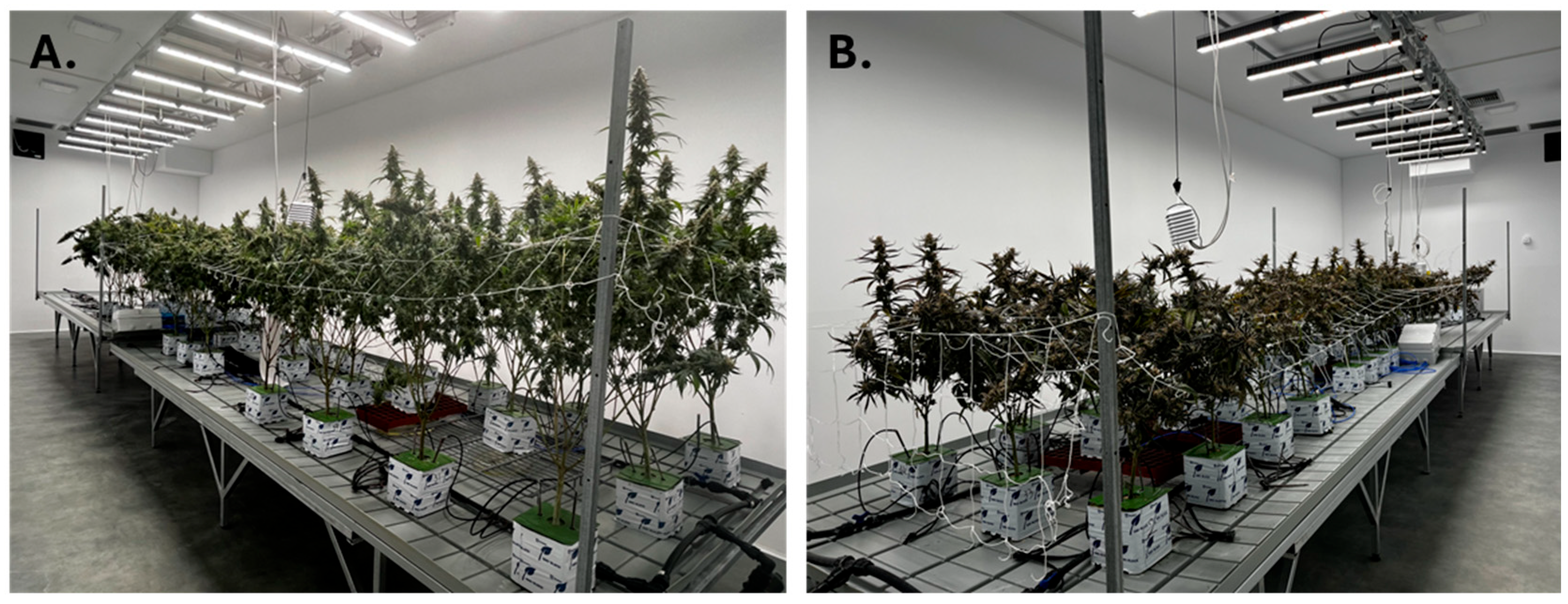
For each combination of planting density, vegetative duration, and cultivation cycle, plants were arranged in a single plot. To reduce border effects arising from differences in lateral light exposure and microclimate, only centrally located plants (shaded red in Supplementary Figures S1–S6) were used for measurements. Border plants were maintained but excluded from analysis. The experimental unit for whole-plant traits was the plot; plants sampled within a plot were treated as subsamples. The physical layout of the cultivation chambers, including plant arrangement, LED lighting distribution, and irrigation infrastructure, is shown in Figure 1.

2.3. Controlled Environment Conditions

Experiments were conducted in two independent controlled-environment agriculture (CEA) chambers (IA AGRO, Thessaloniki, Greece) located within the licensed facility. Each chamber was equipped with a dedicated HVAC system, dehumidification unit, air circulation system, and automated environmental control platform. Temperature, relative humidity, and photoperiod were continuously monitored and recorded. Environmental setpoints were maintained within narrow ranges in both chambers to ensure similar climatic conditions during the experiment. During the vegetative state (18 h light/6 h dark), daytime air temperature was maintained between 24 and 26 °C, while nighttime temperature ranged from 20 to 22 °C. Relative humidity was adjusted to maintain a vapor pressure deficit (VPD) of approximately 0.9–1.2 kPa. During the flowering stage (12 h light/12 h dark), temperature ranges remained similar. Relative humidity was reduced slightly to maintain a VPD between 1.2 and 1.5 kPa in order to support reproductive development and reduce disease risk. CO2 levels were not actively enriched and remained near ambient atmospheric concentrations (~400 ppm), maintained through normal air exchange within the cultivation chambers. Environmental conditions were continuously recorded using the facility’s digital control system.

2.4. Lighting Conditions and Radiative Environment

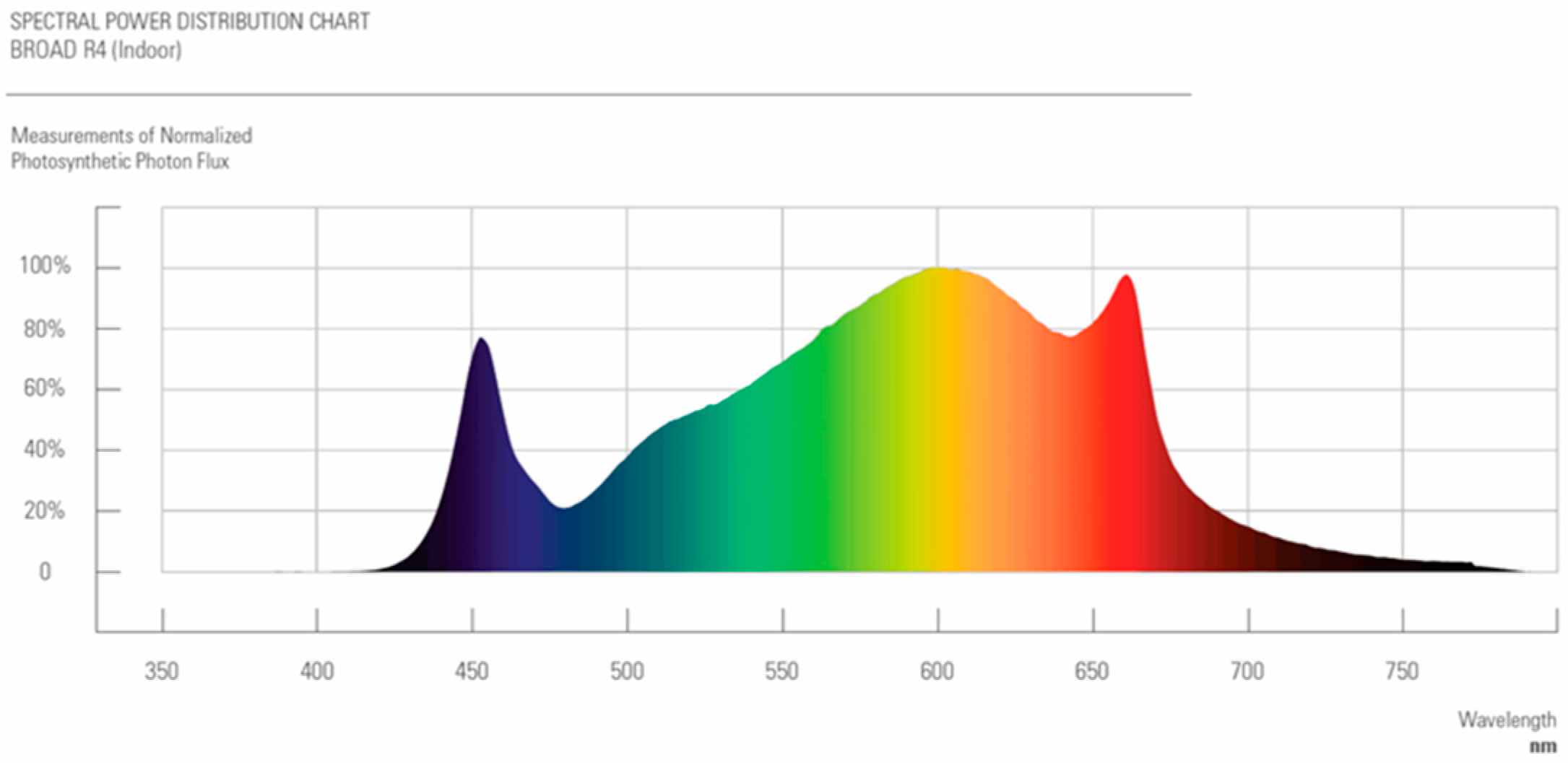
Photosynthetically active radiation (PAR) was supplied by broad-spectrum LED fixtures (Fluence VYPR Series, Fluence Bioengineering, Austin, TX, USA). The emitted spectrum included blue (400–500 nm), green (500–600 nm), red (600–700 nm), and far-red wavelengths. During the vegetative stage, canopy-level photosynthetic photon flux density (PPFD) was maintained at approximately 400 µmol m−2 s−1. After the transition to flowering, PPFD was increased to approximately 800 µmol m−2 s−1 at the upper canopy. Light intensity was measured using a calibrated quantum sensor (SpotOn Quantum PAR Meter, Innoquest Inc., Woodinville, WA, USA). Measurements were taken at multiple canopy positions, and spatial variation in PPFD remained within ±5%. Under flowering conditions (12 h photoperiod), the corresponding daily light integral (DLI) was approximately 34–35 mol m−2 d−1. The height of the LED fixtures remained constant during the experiment. As plant height increased, PPFD at the canopy level was maintained by electronically dimming the fixtures. The spectral power distribution (SPD) of the LED fixtures is shown in Figure 2. The spectrum covers the photosynthetically active range (400–700 nm) and includes peaks in the blue and red regions, with measurable far-red emission.

2.5. Substrate and Transplanting

Rooted cuttings were transplanted into Grodan Hugo rockwool blocks (Grodan, Roermond, The Netherlands) measuring 15 × 15 × 14 cm (approximately 3.15 L volume). Rockwool blocks were used as the cultivation substrate. Each block was irrigated using two pressure-compensated drip emitters delivering 2 L h−1 per emitter, providing a total discharge rate of 4 L h−1 per plant. Before transplanting, rockwool blocks were fully saturated with nutrient solution at the target EC and pH for the vegetative stage.

2.6. Nutrient Solution and Fertigation

Irrigation solution was prepared in a 200 L mixing tank and supplied through an automated fertigation controller (Autogrow IntelliDose, Auckland, New Zealand), which continuously monitored and adjusted pH and electrical conductivity (EC). Nutrient stock solutions were prepared in 5 L opaque containers at a concentration of 226 g L−1. The base fertigation program was the Athena Pro Series nutrient program (Athena Inc., Jacksonville Beach, FL, USA). Athena Pro Core (14-0-0), a calcium nitrate-based formulation, supplied nitrogen, calcium and micro-elements during all growth stages. During vegetative growth, Athena Pro Grow (2-8-20) was added; after the transition to flowering, Athena Pro Grow was replaced with Athena Pro Bloom (0-12-24). Athena Balance (a potassium-silicate-based pH buffer, 0-0-2) was added throughout the cycle to stabilize pH of the nutrient solution between 5.8 and 6.0; no mineral acid (e.g., H2SO4, HNO3) or hydroxide base was used to correct pH. During the last 14 days before harvest, Athena Fade was applied to reduce nitrogen concentration gradually. Target EC of the nutrient solution was 2.5 dS m−1 during vegetative growth, 3.0 dS m−1 during full flowering. Based on the manufacturer’s guaranteed analyses at the applied dilution rates, the approximate macronutrient concentrations of the final nutrient solution were: vegetative stage: N ≈ 165, P ≈ 55, K ≈ 260, Ca ≈ 160, Mg ≈ 45, S ≈ 125 mg L−1; flowering stage: N ≈ 160, P ≈ 100, K ≈ 380, Ca ≈ 195, Mg ≈ 55, S ≈ 170 mg L−1. The corresponding approximate micronutrient concentrations were: Fe ≈ 2.2–2.7, Mn ≈ 0.24–0.29, Zn ≈ 0.10–0.11, Cu ≈ 0.10–0.11, B ≈ 0.14–0.17, and Mo ≈ 0.02–0.023 mg L−1, supplied as Fe-DTPA, Mn-/Zn-/Cu-EDTA, boric acid, and sodium molybdate (Pro Core), plus additional Fe-DTPA (Pro Grow and Pro Bloom).

2.7. Irrigation Strategy, Crop Steering and Root-Zone Monitoring

A crop-steering irrigation strategy was applied by controlling substrate moisture and nutrient concentration. The daily irrigation schedule consisted of three phases. Phase 1 (“ramp-up”) began one or two hours after lights-on depending on the cultivation stage and consisted of short irrigation pulses (2–6% of substrate volume) used to rehydrate the substrate and achieve a leaching fraction of 2–5%. Phase 2 (“maintenance”) consisted of irrigations applied throughout the photoperiod to maintain substrate volumetric water content (VWC) within target ranges according to the developmental stage. Phase 3 (“dry-back”) extended from the final irrigation event of the day until the following morning.
Target peak VWC and overnight dry-backs were set according to the Athena Precision Irrigation Strategy, in which dry-back is expressed as the absolute reduction in VWC% between the final Phase 2 irrigation of the day and the first Phase 1 irrigation of the following morning. Peak VWC was maintained at approximately 65–75% during the vegetative stage with overnight dry-backs of 30–40%; 55–65% during early flowering (generative steering) with overnight dry-backs of 40–50%; 60–70% during the bulking phase of flowering, with more frequent maintenance pulses reducing overnight dry-backs to 25–35%; and 50–60% during the final maturation stage, accompanied by gradually reduced nutrient-solution EC.
Substrate EC was actively steered in parallel with VWC and dry-back. During vegetative steering, substrate EC was held close to the input EC of the nutrient solution by maintaining smaller overnight dry-backs, larger irrigation shots, and a 2–7% daily leaching fraction, which together flushed the substrate and prevented nutrient accumulation. During generative steering in early flowering, substrate EC was deliberately built up (“EC stacking”) by combining larger overnight dry-backs with reduced runoff, so that substrate EC rose well above the input EC and reinforced the generative stress signal. At the transition to the bulking phase, substrate EC was brought back down by restoring more frequent P2 maintenance pulses and slightly larger shots, producing higher daily leaching and a return toward input EC. During the final maturation stage, nutrient-solution EC itself was gradually reduced, allowing substrate EC to decline progressively to harvest.
Approximate daily nutrient-solution volumes per plant were 0.1–0.3 L during early vegetative growth, 0.3–0.6 L during late vegetative growth and the pre-flower stretch, 0.6–1.3 L during the bulking phase of flowering, and 0.3–0.6 L during the final maturation stage.
Substrate VWC, substrate EC (bulk), and root-zone temperature were monitored with Growlink substrate sensors (Growlink, Irvine, CA, USA) connected to the Growlink All-In-One controller, which also controlled irrigation timing and logged fertigation events. Two sensors were deployed per planting density plot within each cultivation chamber, one on each of the two centrally located sampled plants, with the exception of the 10 plants m−2 treatment under the 28-day vegetative regime, where only one centrally located plant was available and a single sensor was used. Each sensor was inserted horizontally into the side of the rockwool block at approximately 2.5 cm (1 in) from the block base, aligning the probe with the main root zone. Sensor placement is illustrated schematically in Supplementary Figure S7. The same irrigation protocol, target VWC ranges, and EC-steering rules were applied to all planting density treatments within a given vegetative regime.

2.8. Canopy Management

Plants were topped five days after transplanting into the rockwool blocks to promote the development of multiple productive apical stems. Light defoliation, selective removal of a limited number of large fan leaves shading developing lower inflorescences, was performed twice during the flowering stage, around the end of the stretch phase and approximately two weeks before harvest, consistently across all density and vegetative duration treatments. A horizontal trellis net was installed across the full canopy during the second week of the flowering phase to support plant structure and maintain a uniform canopy. These standardized canopy management practices were applied identically across all treatments to isolate the effects of planting density and vegetative duration from training-induced variability in canopy architecture.

2.9. Harvest Maturity Determination and Morphological Measurements

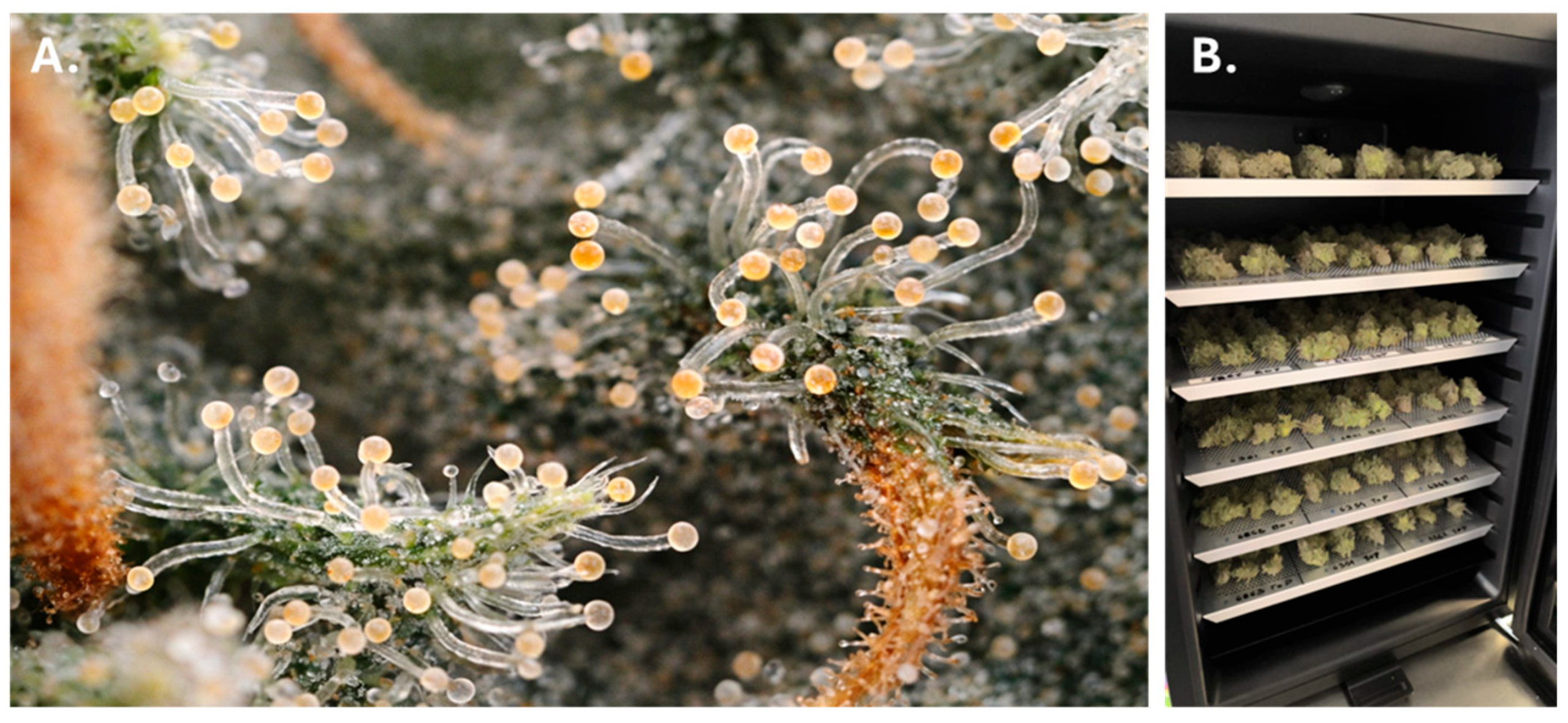
Commercial harvest maturity was determined by daily stereo-microscopic observation of glandular trichomes during the final week of flowering. Observations were made using a handheld digital USB microscope (60–200× magnification, 2 MP sensor); no automated image-analysis software was used, and the threshold was based on standardized visual assessment by the same trained operator throughout the experiment. For each plot, five plants were inspected in the morning of each sampling day; on each plant, three apical inflorescence bracts distributed across the plant’s uppermost three nodes were examined, giving 15 microscope fields of view per plot per day. Harvest was performed when approximately 20% of capitate-stalked trichomes on these fields of view showed amber coloration. This threshold follows established commercial practice in high-THC cannabis production, where the progression from transparent to milky to amber-colored trichomes reflects the peak and subsequent decline of cannabinoid accumulation [17]. A representative micrograph is shown in Figure 3A.
Because maturity was determined on a per-plot basis using the same threshold, harvest date varied slightly among treatments (up to ±3 days) within each vegetative regime but was consistently within 56–60 days from the transition to flowering. Harvest date was recorded and included as a covariate in exploratory analyses but did not significantly improve any of the final models and was therefore not retained. Combined with the vegetative phase, total cultivation duration from transplant to harvest was therefore approximately 66–70 days under the 10-day vegetative regime and 84–88 days under the 28-day regime.
After harvest, plants were assessed for plant height (cm, from substrate surface to apex), stem diameter (cm, measured 2 cm above the substrate with a digital caliper), and mean internodal length (cm, calculated from the distance between the third and eighth nodes). Inflorescences were counted and partitioned into apical (top half of the plant) and basal (bottom half) fractions. For each fraction, the total number of flowers, mean flower diameter, and mean flower length were recorded.
Harvested inflorescences were dried using a Cool Cure OG environmental-control unit (Cannatrol, North Pomfret, VT, USA), which regulates dry-bulb temperature and dew point (Figure 3B). Drying continued until water activity reached 0.60–0.62. Dry inflorescence mass was recorded separately for the apical and basal fractions, and per-plant and area-based yields were calculated. Samples were then ground to a uniform particle size and analyzed for total THC, total CBD, and total CBG.

2.10. Cannabinoid Extraction and Analysis

Cannabinoid extraction was performed following the European Pharmacopoeia (11.5) protocol with modifications. Dried, milled inflorescence samples (100 mg; laboratory mill IKA A11 -IKA-Werke GmbH & Co. KG, Staufen im Breisgau, Germany) were mixed with 5 mL of methanol and vortexed briefly. Extraction proceeded for 15 min on an orbital shaker at 20 °C, followed by 15 min of sonication and centrifugation for 10 min at 1800× g (4 °C). The supernatant was collected into a clean Falcon tube; the extraction was repeated twice and the supernatants were combined and filtered through a 0.22 µm PTFE membrane filter (Millex, Merck KGaA, Darmstadt, Germany) into a dark glass vial. Three extractions were performed per sample, and data are expressed as means of three biological replicates.
Cannabinoid profiling and quantification were carried out on a Shimadzu Nexera HPLC system (Kyoto, Japan), consisting of two LC-30AD pumps, a DGU-20A5 degasser, a CTO-20AC column oven, an SIL-30AC auto-injector, an SPD-M40 diode-array detector (DAD) and a single-quadrupole mass spectrometer (LCMS-2020). Chromatographic separation was achieved in 11 min on a NexLeaf CBX for Potency column (2.7 µm, 4.6 × 150 mm, Shimadzu-Shimadzu Corporation, Kyoto, Japan), fitted with a guard column and guard holder and maintained at 35 °C. An isocratic method was used, with the mobile phase consisting of 5 mM ammonium formate and acetonitrile (25:75, v/v) both containing 0.1% formic acid [18]. Flow rate was 1.4 mL min−1, injection volume was 5 µL, and the DAD acquisition wavelength was 228 nm.
For the quantification external calibration curves were prepared from authentic standards (LGC Reference Standards, Łomianki, Poland) and divided into three concentration mixes according to expected sample ranges: (i) cannabidiolic acid (CBDA), cannabigerolic acid (CBGA) and tetrahydrocanna-binolic acid (THCA) at 4.687–150 mg L−1; (ii) cannabidiol (CBD), cannabigerol (CBG) and Δ9-tetrahydrocannabinol (Δ9-THC) at 0.525–75 mg L−1; and (iii) cannabinol (CBN) and cannabichromene (CBC) at 0.5–20 mg L−1. Calibration curves were linear with r2 ≥ 0.998. Total THC, total CBD, and total CBG were calculated from their neutral and acidic forms as:
Total THC = Δ9-THC + 0.877 × THCA;
Total CBD = CBD + 0.877 × CBDA;
Total CBG = CBG + 0.878 × CBGA.
Concentrations are expressed as percentage of dry weight (% w/w).

2.11. Statistical Analysis

All analyses were performed in R (version 4.5.2). Because the evaluated planting density levels differed between vegetative regimes, density effects were tested separately within each regime (10-day and 28-day). The experimental unit for whole-plant traits was the plot; individual plants within plots were treated as subsamples and averaged to a plot-level mean prior to analysis. For variables measured separately in the apical and basal canopy fractions (floral traits, yield partition, cannabinoid concentrations), individual plant observations were retained and analyzed with linear mixed-effects models (LMM; lme4/lmerTest). Within each vegetative regime, the fixed effects for plot-level whole-plant traits were planting density and cultivation cycle; for canopy-partitioned traits, the fixed effects were planting density, canopy position and interaction, together with cultivation cycle as a main effect. Plant identity nested within plot was included as a random intercept to account for repeated measurements within plants. Cultivation cycle was tested first as a main effect and as an interaction with density; in no case was cycle (main or interaction) significant (all p > 0.05), and data were therefore pooled across cycles for presentation in the tables. For the direct between-regime comparison at the shared density of 8 plants m−2, the fixed effects were vegetative duration and cultivation cycle for whole-plant traits; for canopy-partitioned traits, the fixed effects were vegetative duration, canopy position and their interaction, together with cycle as a main effect.
Following a factorial analysis philosophy, interaction terms were tested and inspected first. Where a significant interaction was detected, main effects of the interacting factors were not interpreted in isolation; the interaction was instead decomposed using estimated marginal means and pairwise comparisons (emmeans package) with Tukey adjustment for multiple comparisons. Where interactions were not significant, main effects were interpreted directly. Multiple pairwise comparisons of density means are indicated in the tables by superscript letters (Tukey’s HSD at α = 0.05); “ns” denotes non-significant effects. Type III analyses of variance with Satterthwaite’s approximation of degrees of freedom were applied. Statistical significance was set at p < 0.05. Model assumptions of normality and homoscedasticity were evaluated by inspection of residual plots.


3. Results

3.1. Vegetative Growth and Morphology

Effects of Planting Density Under Different Vegetative Durations

Under the 10-day regime, planting density did not affect plant height or stem diameter (Table 1) but significantly shortened internodes at higher densities: plants at 8 plants m−2 had the longest internodes (4.03 cm), while those at 14 and 18 plants m−2 were similarly shorter (3.65 and 3.60 cm; p < 0.001). Under the 28-day regime, all three traits responded to density (all p < 0.001): plants at 8 plants m−2 were the tallest (111.5 cm) and had the thickest stems (1.27 cm), while 6 plants m−2 produced the longest internodes (8.12 cm). At 8 plants m−2, extending the vegetative phase from 10 to 28 days produced substantially larger plants (all p < 0.001): height increased from 69.5 to 111.5 cm (+60%), stem diameter from 0.82 to 1.27 cm (+55%), and internodal length from 4.03 to 7.40 cm (+84%), indicating that vegetative duration was a stronger driver of plant architecture than density within the densities tested (Table 1).

3.2. Floral Development

3.2.1. Effects of Planting Density Under Different Vegetative Durations

Under the 10-day vegetative regime, significant density × canopy interactions were detected for flower diameter (F2,14 = 61.70, p < 0.001) and flower length (F2,14 = 25.40, p < 0.001); density effects on these two traits therefore cannot be interpreted in isolation but depend on canopy position. Inspection of Table 2 shows that in the top (apical) canopy, flower diameter increased from 2.15 cm at 14 plants m−2 to 2.70 cm at 18 plants m−2, whereas in the bottom (basal) canopy the opposite pattern was observed, with the highest values at 14 plants m−2 (2.70 cm) and lower values at 8 and 18 plants m−2 (2.25 and 2.15 cm). Flower number, in contrast, showed no significant density main effect (F2,3 = 1.14, p = 0.428) and no interaction, while canopy position alone significantly affected flower number (F1,14 = 29.30, p < 0.001) and flower length (F1,14 = 47.10, p < 0.001), with apical fractions consistently carrying more and longer flowers than basal fractions. Under the 28-day vegetative regime, the density × canopy interaction was significant for flower diameter (F2,14 = 5.63, p = 0.016); density effects on diameter therefore depend on canopy position and are discussed within canopy level rather than as an overall density main effect. For flower length and flower number the interaction was not significant, so main effects can be interpreted directly: flower number increased with density (F2,17 = 4.35, p = 0.030), with the highest count at 8 plants m−2 (Table 2), and canopy position strongly affected flower diameter (F1,14 = 46.30, p < 0.001) and flower length (F1,14 = 41.04, p < 0.001).

3.2.2. Effect of Vegetative Duration at 8 Plants m−2

At the shared density of 8 plants m−2, significant vegetative duration × canopy interactions were detected for flower diameter (p = 0.004) and flower length (p = 0.003), so vegetative duration effects on these two traits differed between the apical and basal canopies. In both fractions the 28-day regime produced slightly larger dimensions than the 10-day regime, but the magnitude of the difference was larger in the apical than in the basal fraction (Table 2), consistent with greater apical light exposure in the deeper canopies of the longer regime. For flower number, the vegetative duration × canopy interaction was non-significant, so the main effect can be interpreted directly: plants grown for 28 days produced substantially more flowers than those grown for 10 days (F1,11 = 149.13, p < 0.001; from 48 to 38 flowers per plant under Veg10 to 144–107 under Veg28, apical–basal). Canopy position alone significantly affected flower number (p = 0.004) as well.

3.3. Dry Yield Distribution

3.3.1. Effects of Planting Density Under Different Vegetative Durations

Under the 10-day vegetative regime, the density × canopy interaction for yield partition was not significant (p = 0.872), allowing direct interpretation of main effects. Per-plant yield differed among densities (F2,3 = 12.89, p = 0.034), with the lowest value at 8 plants m−2 (51.9 g) and higher, similar values at 14 and 18 plants m−2 (63.3 and 60.6 g; Table 3). Area-based yield rose steeply with density—more than 2.6-fold from 8 to 18 plants m−2 (415.5 → 1091.2 g m−2). Canopy position strongly influenced biomass partition (F1,14 = 73.41, p < 0.001), with consistently greater yield in apical than in basal inflorescences. Under the 28-day regime, a significant density × canopy interaction was detected (F2,14 = 5.93, p = 0.014); density effects on yield partition therefore depend on canopy position. Table 3 shows that the density effect was pronounced in the apical fraction, where yield rose from 49.3 g at 6 plants m−2 to 75.4 and 73.1 g at 8 and 10 plants m−2, while basal yield remained relatively stable (34.3 → 35.1 → 27.8 g). Per-plant yield (sum of fractions) did not differ significantly among densities (p = 0.666), indicating that extended vegetative growth reduced the sensitivity of individual plant productivity to spacing. Area-based yield nonetheless increased with density, peaking at 10 plants m−2 (1009.4 g m−2).

3.3.2. Effect of Vegetative Duration at 8 Plants m−2

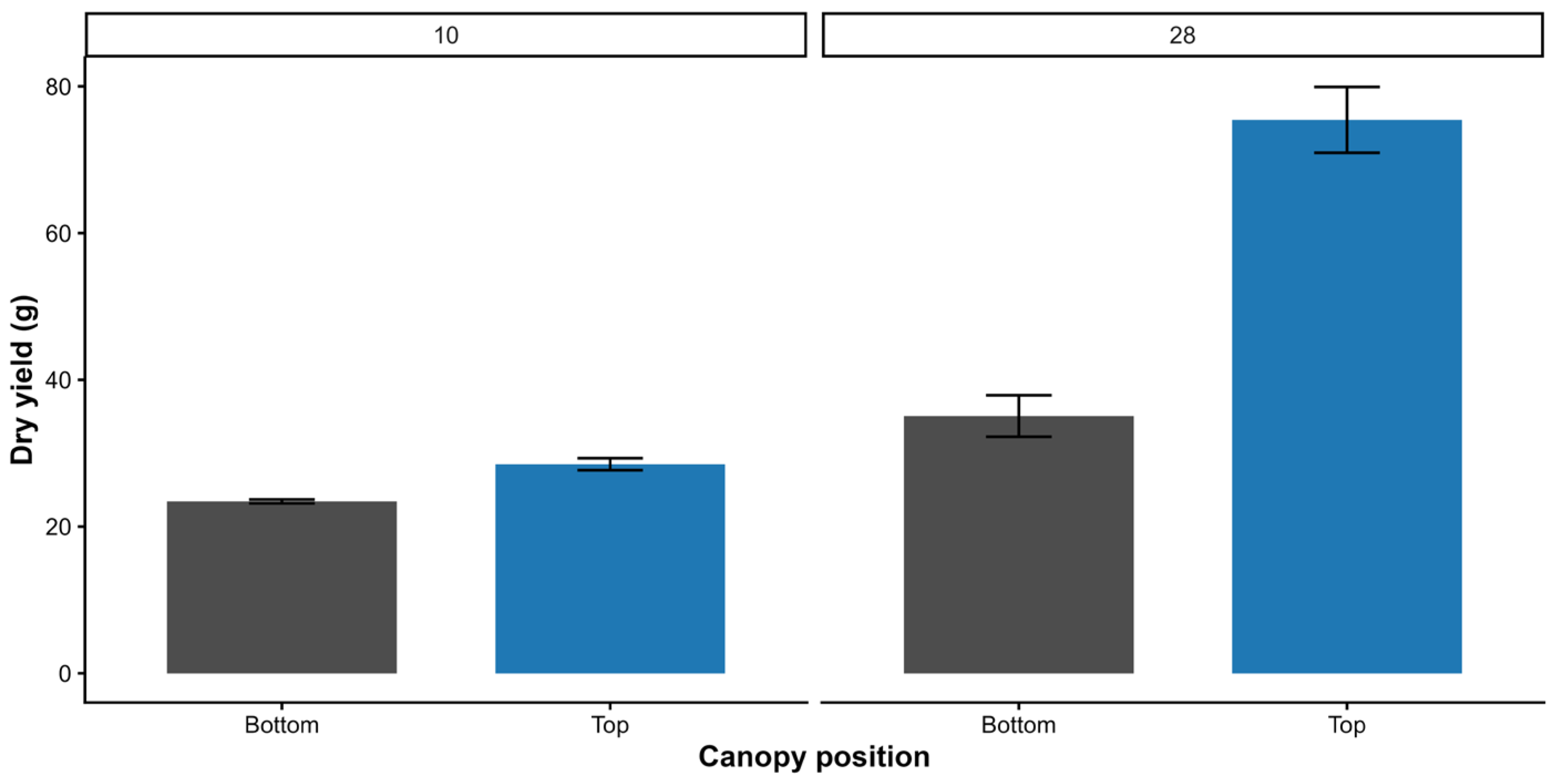
At 8 plants m−2, extending the vegetative phase more than doubled per-plant dry yield (51.9 → 110.5 g, p < 0.001; Table 3). The apical-vs-basal biomass gap also widened strongly under the longer regime (significant vegetative × canopy interaction, p < 0.001; Figure 4), because extra vegetative growth allowed the upper canopy to accumulate disproportionately more biomass while basal yield remained comparatively constrained.

3.4. Cannabinoid Composition

3.4.1. Effects of Planting Density Under Different Vegetative Durations

Cannabinoid concentrations were strikingly stable across treatments, confirming that the cultivation factors evaluated here did not compromise potency. Under the 10-day regime, total THC varied only within a narrow 16.4–19.4% range across all density × canopy combinations, without significant effects of planting density, canopy position, or their interaction (Table 4). Total CBD (0.28–0.36%) and total CBG (0.60–0.71%) showed the same pattern of uniformity. The absence of a vertical gradient is biologically notable: apical and basal flowers produced essentially the same cannabinoid concentrations under the dense, short-vegetative regime, indicating that the high-intensity LED environment delivered sufficient light to the lower canopy to sustain full secondary-metabolite accumulation even at 18 plants m−2. Under the 28-day regime, total THC again remained within a narrow 19.0–21.7% range and was not affected by planting density, canopy position, or their interaction. Total CBD was the only cannabinoid showing a significant density effect (Table 4): values were lowest at 8 plants m−2 (0.35–0.42%) and highest at 6 plants m−2 (0.50–0.51%), though the absolute range (~0.15 percentage points) was narrow and not of practical significance for a cultivar of this chemotype. Total CBG trended in the same direction at 6 plants m−2 but the response was only marginal (Table 4). Importantly, neither CBD nor CBG showed any vertical gradient or density × canopy interaction under the longer regime, so potency distribution within the canopy was not modulated by plant spacing under either vegetative duration.

3.4.2. Effect of Vegetative Duration at 8 Plants m−2

At the shared density of 8 plants m−2, extending vegetative growth from 10 to 28 days did not change total THC concentration (16.4–16.8% vs. 19.0–20.0%), total CBD, or total CBG (Table 4). Canopy position and the vegetative duration × canopy interaction were also non-significant for all three cannabinoids, confirming that neither the length of vegetative growth nor vertical position altered potency under the cultivation conditions tested. Taken together with the 3.3 results, these data indicate that vegetative duration drove yield without driving chemistry: plants grown for 28 days produced substantially more inflorescence biomass per plant (Table 3) while producing flowers of the same cannabinoid composition as plants grown for 10 days.

3.5. Cultivation Cycle Effects

Across all morphological, yield, and cannabinoid analyses, cultivation cycle was not a significant source of variation (p > 0.05 for all variables). No main effects or interactions involving the cycle were detected. This confirms strong reproducibility between the two independent cultivation runs and supports pooling of data for final statistical inference.

4. Discussion

4.1. Vegetative Duration and Plant Growth

Vegetative duration had a strong influence on plant structure in this study. At the shared density of 8 plants m−2, extending vegetative growth from 10 to 28 days increased plant height, stem diameter, and internodal length. These differences were larger than the variation observed among planting densities within each vegetative treatment. Longer vegetative growth allows plants to continue expanding before flowering begins. In controlled-environment cannabis cultivation, this usually leads to taller plants and thicker stems because vegetative growth continues for a longer period. Similar responses have been reported in previous studies of controlled-environment cannabis production [3,19,20]. Plants grown under the 10-day vegetative treatment remained smaller across all densities tested. Because flowering began earlier, there was less time for structural growth before reproductive development started. These results suggest that vegetative duration strongly influences plant architecture within the present cultivation system and should be considered when selecting plant density under similar production conditions.

4.2. Plant Density and Yield

Plant density influenced yield differently depending on vegetative duration. Under the 10-day vegetative treatment, per-plant yield differed among densities. The lowest yield per plant occurred at 8 plants m−2, while higher densities produced greater individual biomass. Area-based yield increased as density increased. The highest yield per square meter occurred at 18 plants m−2. Under the 28-day vegetative treatment, per-plant yield did not differ significantly among densities of 6, 8, and 10 plants m−2. When plants were allowed to grow longer before flowering, differences in horizontal spacing had a smaller effect on individual productivity. These results suggest that the response of yield to plant density depends on vegetative growth duration under the tested controlled-environment cultivation conditions [3,4,21].

4.3. Yield Distribution Within the Canopy

Inflorescence biomass was not distributed evenly within the plant canopy. In most treatments, the upper part of the canopy produced more dry inflorescence mass than the lower part. This pattern is commonly observed in dense crop canopies where upper leaves and flowers receive greater light exposure [22,23,24]. The difference between upper and lower canopy yield was more pronounced when plants were grown for 28 days before flowering. In that treatment, planting density also affected how biomass was distributed between canopy layers. However, lower canopy flowers still contributed a substantial portion of the total yield. Under the 10-day vegetative treatment, differences between canopy layers were smaller and did not change with planting density. Short vegetative growth likely limited canopy depth, which reduced vertical differences within the plant structure.

4.4. Cannabinoid Concentration

Cannabinoid concentrations were generally stable across the tested cultivation treatments. The most consistent biochemical result was the stability of total THC concentration, which did not differ significantly among planting densities, vegetative durations, or canopy positions. This indicates that the cultivation factors evaluated in this study did not alter the primary psychoactive cannabinoid under the tested conditions. In contrast, secondary cannabinoids showed more limited responses. Total CBD exhibited a significant density effect under the 28-day vegetative regime, while total CBG responses were marginal. These differences were relatively small and did not correspond to consistent patterns across canopy positions or vegetative treatments. Overall, the results indicate that variations in planting density and vegetative duration influenced plant architecture and yield but did not affect total THC concentration [2,5,12].

4.5. Biomass Production and Cannabinoid Content

In this study, increased biomass production was not associated with a reduction in THC concentration. Higher area-based yields achieved through increased planting density under the short vegetative treatment were not accompanied by lower THC levels. Similarly, plants grown for 28 days produced greater biomass without changes in THC concentration. These results indicate that THC dilution did not occur under the tested cultivation system, which combined high-intensity LED lighting with ambient (non-enriched) CO2 concentrations. Within these environmental conditions, increases in yield and biomass production were not associated with reductions in cannabinoid concentration [12,25].

4.6. Implications for Controlled-Environment Cultivation

The interaction between vegetative duration and planting density has practical implications for controlled-environment cannabis cultivation. Short vegetative periods allow higher planting densities and can increase yield per unit area while maintaining relatively small plant size. Longer vegetative periods produce larger plants and higher per-plant yield, but the influence of spacing becomes smaller within moderate density ranges. Growers may therefore choose different combinations of vegetative duration and density depending on production goals [1]. It is important to note that these conclusions are based on a single high-THC cultivar (‘Fat Banana’) grown as topped, trellis-supported plants under one light and fertigation regime; cultivars differing in vigor, branching, or flowering duration, and alternative training systems, may respond differently, and these conclusions should therefore be extended cautiously to other cultivars and training strategies.

4.7. Limitations and Future Research

Three main limitations of the present study should be explicitly repeated here. First, vegetative duration was assigned at the chamber level without chamber-level replication of vegetative regimes. Although environmental setpoints were matched, chambers and vegetative regimes were partially confounded, and vegetative duration effects should therefore be interpreted with caution; the two independent cultivation cycles, with non-significant cycle effects, provide indirect evidence of reproducibility but do not fully replace between-chamber replication. Second, density levels differed between regimes and only one shared density (8 plants m−2) allowed direct between-regime comparisons, precluding a full factorial interpretation. Third, only one cultivar (‘Fat Banana’) was tested, limiting the generality of the conclusions. In addition, canopy light distribution and leaf area index were not measured directly. Future work should use chamber-level replicated designs, include multiple cultivars spanning a range of morphotypes and flowering durations, measure within-canopy light penetration, and test additional environmental factors (e.g., CO2 enrichment, different spectral compositions), to determine whether the density × vegetative duration patterns observed here generalize beyond the conditions tested.

5. Conclusions

Planting density in controlled-environment medicinal cannabis cultivation should be considered together with vegetative duration. Under the tested conditions, shorter vegetative phases combined with higher planting densities improved area-based productivity, whereas extended vegetative growth increased plant size and per-plant biomass without altering total THC concentration. These findings indicate that yield optimization strategies can be implemented in controlled-environment cannabis cultivation without loss of cannabinoid potency under high-intensity LED lighting without CO2 enrichment. Because conclusions are based on a single cultivar (‘Fat Banana’) trained as topped, trellis-supported plants under one light and fertigation regime, extension to other cultivars and training systems should be made cautiously.

Supplementary Materials

The following supporting information can be downloaded at: https://www.mdpi.com/article/10.3390/horticulturae12050619/s1. Figure S1: Planting layout for the 8 plants m−2 treatment under the 10-day vegetative regime. Dashed lines indicate the effective plot area. Red-shaded squares represent centrally located plants selected for sampling. Border plants were excluded from statistical analysis to minimize edge effects. Figure S2: Planting layout for the 14 plants m−2 treatment under the 10-day vegetative regime. Inter-plant spacing and effective plot boundaries are indicated. Central plants (red) were sampled for morphological, yield, and cannabinoid analysis. Figure S3: Planting layout for the 18 plants m−2 treatment under the 10-day vegetative regime. Only centrally positioned plants (red) were included in statistical analyses to avoid border-related microenvironmental variation. Figure S4: Planting layout for the 6 plants m−2 treatment under the 28-day vegetative regime. Dashed lines denote effective plot area. Red-shaded plants represent sampling positions. Figure S5: Planting layout for the 8 plants m−2 treatment under the 28-day vegetative regime. Central plants (red) were selected for sampling; border plants were used as buffers. Figure S6: Planting layout for the 10 plants m−2 treatment under the 28-day vegetative regime. Spacing dimensions are shown in millimeters. Only centrally located plants were included in statistical evaluation. Figure S7: Side-view schematic of substrate sensor insertion.

Author Contributions

Conceptualization, P.K. and S.M.; methodology, P.K., S.M. and E.S.; software, P.K.; validation, P.K., I.G. and A.K.; formal analysis, P.K.; investigation, P.K., N.K. and M.K.; resources, I.G. and A.K.; data curation, P.K. and E.T.; writing—original draft preparation, P.K.; writing—review and editing, I.G., E.S., S.M. and A.K.; visualization, P.K.; supervision, I.G. and A.K.; project administration, P.K.; funding acquisition, M.K. All authors have read and agreed to the published version of the manuscript.

Funding

This research was funded by HECAGEN S.A. The article processing charge (APC) was covered by a waiver. The authors declare that this study received funding from HECAGEN S.A. The funder was not involved in the study design, collection, analysis, interpretation of data, the writing of this article, or the decision to submit it for publicationποια.

Data Availability Statement

The original contributions presented in this study are included in the article/Supplementary Materials. Further inquiries can be directed to the corresponding authors.

Acknowledgments

The authors acknowledge IA-AGRO SMPC for its support in the execution of the experimental work and the Institute of Plant Breeding and Genetic Resources (ELGO-DIMITRA) for support in analytical procedures. During the preparation of this manuscript, the authors used ChatGPT (GPT-5.3, OpenAI, San Francisco, CA, USA) for language refinement and text structuring. The authors have reviewed and edited the output and take full responsibility for the content of this publication.

Conflicts of Interest

Authors Panagiotis Karnoutsos, Nikos Koukovinos and Marios Karagiovanidis were employed by the company IA-AGRO. The remaining authors declare that the research was conducted in the absence of any commercial or financial relationships that could be construed as a potential conflict of interest.

Abbreviations

The following abbreviations are used in this manuscript:
ANOVAAnalysis of Variance
CBDCannabidiol
CBGCannabigerol
CEAControlled Environment Agriculture
CO2Carbon Dioxide
DLIDaily Light Integral
ECElectrical Conductivity
HPLCHigh-Performance Liquid Chromatography
LAILeaf Area Index
LMLinear Model
LMMLinear Mixed-Effects Model
PARPhotosynthetically Active Radiation
PPFDPhotosynthetic Photon Flux Density
PPMParts Per Million
SEStandard Error
SPDSpectral Power Distribution
THCΔ9-Tetrahydrocannabinol
VPDVapor Pressure Deficit
VWCVolumetric Water Content

References

  1. Backer, R.; Schwinghamer, T.; Rosenbaum, P.; Mccarty, V.; Eichhorn Bilodeau, S.; Lyu, D.; Ahmed, M.B.; Robinson, G.; Lefsrud, M.; Wilkins, O.; et al. Closing the Yield Gap for Cannabis: A Meta-Analysis of Factors Determining Cannabis Yield. Front. Plant Sci. 2019, 10, 495. [Google Scholar] [CrossRef]
  2. Danziger, N.; Bernstein, N. Too Dense or not too Dense: Higher Planting Density Reduces Cannabinoid Uniformity but Increases Yield/Area in Drug-Type Medical Cannabis. Front. Plant Sci. 2022, 13, 713481. [Google Scholar] [CrossRef]
  3. Schober, T.; Präger, A.; Hartung, J.; Graeff-Hönninger, S. The Effects of Plant Density and Duration of Vegetative Growth Phase on Agronomic Traits of Medicinal Cannabis (Cannabis sativa L.): A Regression Analysis. PLoS ONE 2024, 19, e0315951. [Google Scholar] [CrossRef] [PubMed]
  4. Eaves, J.; Eaves, S.; Morphy, C.; Murray, C. The Relationship Between Light Intensity, Cannabis Yields, and Profitability. Agron. J. 2020, 112, 1466–1470. [Google Scholar] [CrossRef]
  5. Ahrens, A.; Llewellyn, D.; Zheng, Y. Is Twelve Hours Really the Optimum Photoperiod for Promoting Flowering in Indoor-Grown Cultivars of Cannabis sativa? Plants 2023, 12, 2605. [Google Scholar] [CrossRef]
  6. Hirose, T. Development of the Monsi-Saeki Theory on Canopy Structure and Function. Ann. Bot. 2004, 95, 483–494. [Google Scholar] [CrossRef] [PubMed]
  7. Weiner, J.; Freckleton, R.P. Constant Final Yield. Annu. Rev. Ecol. Evol. Syst. 2010, 41, 173–192. [Google Scholar] [CrossRef]
  8. Smith, H.; Whitelam, G.C. The Shade Avoidance Syndrome: Multiple Responses Mediated by Multiple Phytochromes. Plant Cell Environ. 1997, 20, 840–844. [Google Scholar] [CrossRef]
  9. Franklin, K.A. Shade Avoidance. New Phytol. 2008, 179, 930–944. [Google Scholar] [CrossRef]
  10. Namdar, D.; Mazuz, M.; Ion, A.; Koltai, H. Variation in the Compositions of Cannabinoid and Terpenoids in Cannabis sativa Derived from Inflorescence Position Along the Stem and Extraction Methods. Ind. Crops Prod. 2018, 113, 376–382. [Google Scholar] [CrossRef]
  11. Spitzer-Rimon, B.; Duchin, S.; Bernstein, N.; Kamenetsky, R. Architecture and Florogenesis in Female Cannabis sativa Plants. Front. Plant Sci. 2019, 10, 350. [Google Scholar] [CrossRef]
  12. Rodriguez-Morrison, V.; Llewellyn, D.; Zheng, Y. Cannabis Yield, Potency, and Leaf Photosynthesis Respond Differently to Increasing Light Levels in an Indoor Environment. Front. Plant Sci. 2021, 12, 646020. [Google Scholar] [CrossRef]
  13. Jarrell, W.M.; Beverly, R.B. The Dilution Effect in Plant Nutrition Studies. Adv. Agron. 1981, 34, 197–224. [Google Scholar]
  14. Flores-Sanchez, I.J.; Verpoorte, R. Secondary Metabolism in Cannabis. Phytochem. Rev. 2008, 7, 615–639. [Google Scholar] [CrossRef]
  15. Nelson, J.A.; Bugbee, B. Economic Analysis of Greenhouse Lighting: Light Emitting Diodes vs. High Intensity Discharge Fixtures. PLoS ONE 2014, 9, e99010. [Google Scholar] [CrossRef]
  16. Bugbee, B. Toward an Optimal Spectral Quality for Plant Growth and Development: The Importance of Radiation Capture. Acta Hortic. 2016, 1134, 1–12. [Google Scholar] [CrossRef]
  17. Livingston, S.J.; Quilichini, T.D.; Booth, J.K.; Wong, D.C.J.; Rensing, K.H.; Laflamme-Yonkman, J.; Castellarin, S.D.; Bohlmann, J.; Page, J.E.; Samuels, A.L. Cannabis Glandular Trichomes Alter Morphology and Metabolite Content During Flower Maturation. Plant J. 2020, 101, 37–56. [Google Scholar] [CrossRef]
  18. Galettis, P.; Williams, M.; Gordon, R.; Martin, J.H. A Simple Isocratic HPLC Method for the Quantitation of 17 Cannabinoids. Aust. J. Chem. 2021, 74, 453–462. [Google Scholar] [CrossRef]
  19. Chandra, S.; Lata, H.; Khan, I.A.; Elsohly, M.A. Photosynthetic Response of Cannabis sativa L. to Variations in Photosynthetic Photon Flux Densities, Temperature and CO2 Conditions. Physiol. Mol. Biol. Plants 2008, 14, 299–306. [Google Scholar] [CrossRef] [PubMed]
  20. Rodriguez-Morrison, V.; Llewellyn, D.; Zheng, Y. Cannabis Inflorescence Yield and Cannabinoid Concentration are not Increased with Exposure to Short-Wavelength Ultraviolet-B Radiation. Front. Plant Sci. 2021, 12, 725078. [Google Scholar] [CrossRef] [PubMed]
  21. Caplan, D.; Dixon, M.; Zheng, Y. Optimal Rate of Organic Fertilizer During the Flowering Stage for Cannabis Grown in Two Coir-Based Substrates. Hortscience 2017, 52, 1796–1803. [Google Scholar] [CrossRef]
  22. Morello, V.; Brousseau, V.D.; Wu, N.; Wu, B.-S.; Macpherson, S.; Lefsrud, M. Light Quality Impacts Vertical Growth Rate, Phytochemical Yield and Cannabinoid Production Efficiency in Cannabis sativa. Plants 2022, 11, 2982. [Google Scholar] [CrossRef] [PubMed]
  23. Niinemets, Ü. Photosynthesis and Resource Distribution Through Plant Canopies. Plant Cell Environ. 2007, 30, 1052–1071. [Google Scholar] [CrossRef] [PubMed]
  24. Danziger, N.; Bernstein, N. Light Matters: Effect of Light Spectra on Cannabinoid Profile and Plant Development of Medical Cannabis (Cannabis sativa L.). Ind. Crops Prod. 2021, 164, 113351. [Google Scholar] [CrossRef]
  25. Westmoreland, F.M.; Kusuma, P.; Bugbee, B. Cannabis Lighting: Decreasing Blue Photon Fraction Increases Yield but Efficacy is More Important for Cost Effective Production of Cannabinoids. PLoS ONE 2021, 16, e0248988. [Google Scholar] [CrossRef]
Figure 1. Experimental controlled-environment cultivation chambers showing plant layouts, LED lighting system, and irrigation infrastructure. (A) Chamber 1 (28-day vegetative regime); (B) Chamber 2 (10-day vegetative regime).
Horticulturae 12 00619 g001
Figure 2. Spectral power distribution (SPD) of the broad-spectrum LED lighting used in the cultivation chambers.
Horticulturae 12 00619 g002
Figure 3. (A) Assessment of commercial harvest maturity based on glandular trichome coloration: representative digital micrograph of apical bracts showing glandular trichomes predominantly in the milky stage with approximately 20% exhibiting amber (brown) coloration. This developmental threshold was used as the harvest criterion, indicating peak secondary metabolite accumulation. (B) Precision-controlled post-harvest drying of cannabis inflorescences prior to apical and basal cannabinoid analysis.
Horticulturae 12 00619 g003
Figure 4. Dry inflorescence yield (g) at 8 plants m−2 under 10- and 28-day vegetative regimes, partitioned by canopy position (Top vs. Bottom). Bars represent means ± SE pooled across two cultivation cycles. Vegetative duration significantly affected per-plant yield (F1,11 = 109.62, p < 0.001), canopy position significantly influenced biomass allocation (F1,11 = 65.99, p < 0.001), and a significant Vegetative Duration × Canopy interaction was detected (F1,11 = 39.86, p < 0.001).
Horticulturae 12 00619 g004
Table 1. Morphological parameters of C. sativa as affected by vegetative duration and planting density.
Vegetative Duration (d)Density (Plants m−2)Plant Height (cm)Stem Diameter (cm)Internodal Length (cm)
10869.5 ± 1.0 a0.82 ± 0.05 a4.03 ± 0.06 a
101470.2 ± 2.8 a0.90 ± 0.09 a3.65 ± 0.06 b
101868.0 ± 0.8 a0.85 ± 0.03 a3.60 ± 0.09 b
28695.0 ± 5.2 a1.05 ± 0.03 a8.12 ± 0.15 a
288111.5 ± 2.7 b1.27 ± 0.05 b7.40 ± 0.29 ab
2810101.2 ± 0.8 ab1.15 ± 0.03 ab7.07 ± 0.05 b
Values are means ± SE pooled across cultivation cycles (cycle not significant, p > 0.05). Within each vegetative regime, means sharing a letter are not significantly different (Tukey’s HSD, α = 0.05). Significance of the density effect within each regime: Veg10: plant height p = 0.392 (ns), stem diameter p = 0.441 (ns), internodal length p < 0.001; Veg28: plant height p < 0.001, stem diameter p < 0.001, internodal length p < 0.001. At the shared density of 8 plants m−2, vegetative duration significantly affected all three traits (p < 0.001). ns, not significant. a,ab,b: Within each vegetative regime, means in the same column followed by the same letter(s) do not differ significantly (Tukey’s HSD, α = 0.05).
Table 2. Floral morphological traits of Cannabis sativa as affected by vegetative duration, planting density and canopy position.
Vegetative Duration (d)Density (Plants m−2)Canopy PositionNumber of FlowersFlower Diameter (cm)Flower Length (cm)
108Top48 ± 2 a2.45 ± 0.12 ab4.45 ± 0.06 a
108Bottom38 ± 3 a2.25 ± 0.03 ab3.00 ± 0.32 b
1014Top46 ± 6 a2.15 ± 0.03 b3.85 ± 0.12 b
1014Bottom33 ± 1 a2.70 ± 0.04 a4.20 ± 0.04 a
1018Top42 ± 1 a2.70 ± 0.04 a4.30 ± 0.04 a
1018Bottom31 ± 3 a2.15 ± 0.03 b3.10 ± 0.26 b
286Top83 ± 9 b2.55 ± 0.23 a4.83 ± 0.11 a
286Bottom93 ± 1 b2.40 ± 0.04 a3.35 ± 0.12 a
288Top144 ± 9 a2.80 ± 0.04 a4.20 ± 0.04 a
288Bottom107 ± 9 a2.15 ± 0.03 b3.75 ± 0.18 a
2810Top106 ± 9 ab2.55 ± 0.06 a4.40 ± 0.04 a
2810Bottom110 ± 24 ab2.10 ± 0.09 b3.30 ± 0.49 a
Values are means ± SE pooled across cultivation cycles (cycle not significant, p > 0.05). Linear mixed-effects models were applied within each vegetative regime. Significance of each effect (D = density, C = canopy position, D × C = interaction): Veg10-Flower number: D ns (p = 0.428); C (p < 0.001); D × C ns. Flower diameter: D ns (p = 0.650); C ns; D × C (p < 0.001). Flower length: D ns (p = 0.583); C (p < 0.001); D × C (p < 0.001). Veg28-Flower number: D (p = 0.030); C ns; D × C ns. Flower diameter: D ns; C (p < 0.001); D × C (p = 0.016). Flower length: D ns; C (p < 0.001); D × C ns. At 8 plants m−2-Flower number: Veg (p < 0.001); C (p = 0.004); Veg × C ns. Flower diameter: Veg ns; C (p < 0.001); Veg × C (p = 0.004). Flower length: Veg ns; C (p < 0.001); Veg × C (p = 0.003). Where D × C or Veg × C is significant, density/duration effects are interpreted within canopy position in the Results text rather than as main effects; density-level pairwise comparisons are available from the corresponding author upon request. ns, not significant. a,ab,b: Means in the same column and canopy position followed by the same letter(s) do not differ significantly (Tukey’s HSD, α = 0.05).
Table 3. Dry yield parameters of C. sativa as affected by vegetative duration and planting density.
Vegetative Duration (d)Density (Plants m−2)Per-Plant Dry Yield (g)Area-Based Dry Yield (g m−2)Top Yield (g)Bottom Yield (g)
10851.94 ± 0.70 b415.5 ± 5.6 c28.50 ± 0.81 b23.44 ± 0.26 a
101463.31 ± 1.12 a886.4 ± 15.7 b34.56 ± 1.60 a28.75 ± 0.52 a
101860.62 ± 1.01 a1091.2 ± 18.2 a33.19 ± 0.51 a27.44 ± 0.70 a
28683.56 ± 18.16 a501.4 ± 108.9 b49.25 ± 14.58 b34.31 ± 3.60 a
288110.50 ± 1.79 a884.0 ± 14.3 a75.44 ± 4.48 a35.06 ± 2.82 a
2810100.94 ± 8.22 a1009.4 ± 82.2 a73.12 ± 7.02 a27.81 ± 1.23 a
Values are means ± SE pooled across cultivation cycles (cycle not significant, p > 0.05). Per-plant yield = sum of top and bottom fractions; area-based yield = mean per-plant yield × planting density. Significance of each effect: Veg10-Per-plant yield: density (p = 0.034). Area-based yield: density (p < 0.001). Canopy partition (Top vs. Bottom): C (p < 0.001); D × C ns (p = 0.872). Veg28-Per-plant yield: density ns (p = 0.666). Area-based yield: density (p < 0.05). Canopy partition: C (p < 0.001); D × C (p = 0.014). At 8 plants m−2-Vegetative duration (p < 0.001); canopy (p < 0.001); Veg × C (p < 0.001). ns, not significant. a,b,c: Within each vegetative regime, means in the same column followed by the same letter(s) do not differ significantly (Tukey’s HSD, α = 0.05).
Table 4. Cannabinoid concentrations of C. sativa as affected by vegetative duration, planting density, and canopy position.
Vegetative Duration (d)Density (Plants m−2)Canopy PositionTotal THC (%)Total CBD (%)Total CBG (%)
108Top16.75 ± 1.48 a0.325 ± 0.049 a0.663 ± 0.074 a
108Bottom16.41 ± 1.06 a0.282 ± 0.034 a0.643 ± 0.009 a
1014Top17.96 ± 1.09 a0.335 ± 0.010 a0.685 ± 0.044 a
1014Bottom17.47 ± 0.08 a0.293 ± 0.009 a0.635 ± 0.010 a
1018Top19.35 ± 0.70 a0.360 ± 0.006 a0.710 ± 0.018 a
1018Bottom18.88 ± 0.33 a0.275 ± 0.006 a0.600 ± 0.018 a
286Top20.88 ± 0.18 a0.505 ± 0.067 a0.855 ± 0.010 a
286Bottom21.73 ± 1.09 a0.500 ± 0.052 a0.895 ± 0.044 a
288Top18.97 ± 0.24 a0.350 ± 0.029 b0.720 ± 0.058 a
288Bottom19.98 ± 1.20 a0.415 ± 0.010 b0.833 ± 0.054 a
2810Top20.35 ± 0.80 a0.375 ± 0.010 ab0.830 ± 0.018 a
2810Bottom20.55 ± 0.10 a0.455 ± 0.006 ab0.862 ± 0.020 a
Values are means ± SE pooled across cultivation cycles (cycle not significant, p > 0.05). Significance of each effect (D = density, C = canopy, D × C = interaction): Veg10—Total THC: D ns (F2,3 = 0.74, p = 0.545); C ns; D × C ns. Total CBD: D ns; C ns; D × C ns. Total CBG: D ns; C ns; D × C ns. Veg28—Total THC: D ns (F2,3 = 0.80, p = 0.526); C ns; D × C ns. Total CBD: D (F2,17 = 5.26, p = 0.017); C ns; D × C ns. Total CBG: D, C both 0.05 < p < 0.10; D × C ns. At 8 plants m−2—Total THC: Veg ns (p = 0.370); C ns; Veg × C ns. Total CBD: Veg ns; C ns; Veg × C ns. Total CBG: Veg ns; C ns; Veg × C ns. ns, not significant. a,ab,b: Within each vegetative regime, means in the same column followed by the same letter(s) do not differ significantly (Tukey’s HSD, α = 0.05).
Disclaimer/Publisher’s Note: The statements, opinions and data contained in all publications are solely those of the individual author(s) and contributor(s) and not of MDPI and/or the editor(s). MDPI and/or the editor(s) disclaim responsibility for any injury to people or property resulting from any ideas, methods, instructions or products referred to in the content.