Article

Effects of Exogenous Melatonin on Growth and Physiological Characteristics of Petunia Under Salt Stress

1
Life Science and Technology School, Lingnan Normal University, Zhanjiang 524048, China
2
College of Food Science and Technology, Guangdong Ocean University, Zhanjiang 524088, China
*
Author to whom correspondence should be addressed.
These authors contributed equally to this work.
Horticulturae 2026, 12(5), 579; https://doi.org/10.3390/horticulturae12050579
Submission received: 30 March 2026 / Revised: 26 April 2026 / Accepted: 5 May 2026 / Published: 8 May 2026

Abstract

Petunia × hybrida is a highly valued ornamental species worldwide, prized for its bright flower colors and long flowering period. Soil salinization is a major abiotic stress that negatively impacts both agriculture and ornamental plant cultivation. Its detrimental effects stem from osmotic stress, ionic toxicity, and oxidative stress induced by the accumulation of reactive oxygen species (ROS). Melatonin, a multifunctional signaling molecule, can enhance plant resistance under adverse conditions. In this study, Petunia × hybrida cv. ‘Mirage Rose’ was used to investigate these effects. The five treatment groups consisted of control (CK), salt stress alone (NaCl, 200 mmol·L−1), and salt stress combined with 50, 100, or 200 µmol·L−1 melatonin (NaCl + MT50, NaCl + MT100, and NaCl + MT200). Evaluations covered developmental morphology, physiological and biochemical parameters, stomatal density, and transcript levels of antioxidant enzymes. Results indicated that high salinity significantly inhibited vegetative growth and reduced stomatal density while increasing the accumulation of malondialdehyde (MDA), superoxide anions (O2), and hydrogen peroxide (H2O2). Exogenous melatonin application significantly alleviated these adverse effects, with 100 µmol·L−1 being the most effective concentration among the tested doses. This treatment enhanced the activity and gene expression of antioxidant enzymes, reduced membrane lipid peroxidation, promoted the accumulation of compatible solutes for osmotic balance, and improved stomatal development. Overall, 100 µmol·L−1 melatonin effectively enhanced salt tolerance in Petunia by regulating redox homeostasis and modulating stomatal characteristics.

1. Introduction

Petunia (Petunia × hybrida), a member of the family Solanaceae, is a non-woody ornamental species that is highly valued worldwide for its bright flower colors, long flowering period, and versatility in horticultural applications [1,2]. Soil salinization and alkalinization represent a global-scale ecological challenge, thereby imposing strict limitations on food cultivation systems and environmental stability. Besides consuming agricultural inputs and causing economic loss, saline conditions seriously endanger the cultivation and ornamental use of these plants [3]. Salt stress exerts adverse impacts on a wide range of plant species, such as rosemary, wheat, and quinoa, with distinct inhibitory effects on their growth, development, and yield [4,5,6]. Plant damage under salt exposure is mainly caused by three mechanisms, which are osmotic stress, ion toxicity, and oxidative stress.
In a saline substrate, the osmotic potential of the rhizosphere drops sharply, thereby hindering root water absorption and inducing a state of dehydration similar to that caused by drought even when environmental moisture is sufficient [7]. In addition, excessive Na+ and other monovalent cations hinder plants from absorbing and transporting important nutrient elements such as potassium (K+) and calcium (Ca2+) through competitive antagonism, thereby disrupting internal ion balance [3]. Moreover, under salt stress, metabolic homeostasis in plant tissues is disturbed, which disrupts the electron transport chain and ultimately leads to excessive accumulation of ROS such as superoxide radicals and H2O2 [8,9]. If the rate of ROS production exceeds the scavenging capacity of the endogenous antioxidant network, a state of oxidative overload occurs. These reactive species subsequently launch indiscriminate attacks on critical cellular components, targeting membrane lipids, functional proteins, and genetic material, thereby leading to membrane degradation via lipid peroxidation, loss of enzyme activity, and genomic damage [10]. MDA, a terminal byproduct generated in the lipid peroxidation cascade, is often used as an indicator reflecting the severity of damage to the internal structure of the cell membrane.
Under strong salinity stress, plants do not simply yield, but instead, they have developed a comprehensive, multi-level set of adaptive responses that have been shaped by the process of evolution over time. At the physiological level, plant cells intentionally generate and store low molecular weight compatible solutes, which include proline, betaine, soluble carbohydrates, and proteins, thereby reducing the osmotic potential of the cytoplasm to obtain water from the surrounding hypertonic environment and maintain turgor pressure and essential metabolic functions. Evidence confirms this, as melatonin (N-acetyl-5-methoxytryptamine) administration significantly promotes the accumulation of proline and soluble proteins, thereby supporting osmotic balance and protecting cellular integrity during salt exposure [11,12]. Meanwhile, strengthening intrinsic antioxidant mechanisms is a key approach to combat oxidative damage. This system includes enzymatic components such as superoxide dismutase (SOD), peroxidase (POD), and catalase (CAT), which act synergistically to neutralize ROS and maintain redox balance. Abundant research indicates that exogenous application of melatonin triggers significant enhancement of SOD, POD, CAT, and ascorbate peroxidase (APX) activity, accompanied by a reduction in H2O2 and MDA levels, which reflects its dual role as a direct free radical scavenger and an inducer of antioxidant enzymes under salt stress conditions [13,14,15].
From a structural perspective, stomatal aperture, as the main channel for gas and water vapor exchange between the leaf and the atmosphere, is strictly regulated under salt stress. To reduce water loss from transpiration, plants usually reduce stomatal openings, while long-term salt stress may even lead to a reduction in the number of stomata by interfering with the developmental trajectory of stomatal precursor cells. However, the strategy of closing stomata to retain water has contradictory consequences. It preserves water but simultaneously imposes strict restrictions on CO2 entry, which inhibits photosynthetic capacity, impairs energy production, and ultimately hinders growth [16,17].
In the past few years, the function of melatonin in plant response to environmental stress has aroused considerable scientific interest [18]. Initially identified in animal systems as a circadian-regulated endocrine agent, it is now recognized as a universally present and multifunctional signaling compound in the plant kingdom, where it is commonly referred to as a central guardian against oxidative assault. Evidence indicates that melatonin fulfills multiple physiological functions in plants. It not only acts as a potent scavenger of ROS through its indole-based molecular structure [19], but perhaps more critically, it also serves as a key regulatory signal, coordinately activating endogenous enzymatic antioxidant networks, osmotic homeostasis mechanisms, and transcription of stress response genes through regulating calcium flux, mitogen-activated protein kinase (MAPK) pathways, and functional dynamics of multiple transcription factor families (including NAC, WRKY, and MYB) [20,21]. Exogenous melatonin application aids in protecting plants against salt stress by modulating the expression and activity of antioxidant enzymes, which in turn mitigates the accumulation of ROS, including H2O2, induced by salt stress [10,22,23,24,25]. Substantial research has already confirmed that exogenous supplementation of melatonin significantly enhances the tolerance of economically important crops—such as soybean, cucumber, tomato, and rice—to challenges including salinity, chilling injury, drought, and heavy metal exposure, as reflected in the alleviation of growth inhibition, improvement of photosynthetic efficiency, enhancement of redox buffering capacity, and reduction in cellular oxidative damage [10].
However, the majority of these studies have focused on crops and vegetables, leaving a significant knowledge gap regarding ornamental plants. Despite advances in understanding melatonin’s role in the salt resilience of agronomic species, research on ornamentals—particularly salt-sensitive flowering species like petunias—remains notably limited. To date, no study has specifically investigated the mitigating effects of melatonin on salt stress in Petunia × hybrida. The present study aims to fill this gap [9,12,15,18,20,22,23,24,25,26]. Current literature primarily focuses on melatonin-mediated effects on Petunia morphogenesis or isolated stress-related physiological indicators; however, an integrated molecular and functional framework of melatonin simultaneously regulating three core adaptive axes, namely stomatal patterning, osmotic adjustment, and antioxidant fortification, to confer comprehensive salt tolerance remains inadequately elucidated, particularly in terms of a coherent evidence continuum of the adaptations from transcriptional regulation to observable cellular architecture [16,17].
This study used Petunia × hybrida cv. ‘Mirage Rose’ as experimental material. A salt stress model was established using 200 mmol·L−1 NaCl, and melatonin was applied at different concentrations of 0, 50, 100, and 200 µmol·L−1. Growth traits, including plant height, root length, and biomass, were measured, along with physiological and biochemical indices, such as soluble protein content, MDA content, O2 and H2O2 content, and the activities of SOD, POD, and CAT. Stomatal density and gene expression levels of PhCAT, PhAPX, PhSOD, and PhOsmotin. The aim is to evaluate the effects of different melatonin concentrations on salt stress tolerance in young Petunia seedlings under the current experimental conditions and to elucidate its potential association with physiological and molecular responses. This research provides a preliminary basis for further investigating the effects of melatonin on salt tolerance in Petunia and other ornamental plants.

2. Materials and Methods

2.1. Plant Materials and Growth Conditions

Seeds of Petunia × hybrida cv. ‘Mirage Rose’ were purchased from PanAmerican Seed (Chicago, IL, USA). All tissue culture experiments were conducted under sterile conditions. The basic medium was MS solid medium (containing 4.4 g L−1 MS powder, 30 g L−1 sucrose, and 8 g L−1 plant agar, pH 5.8), sterilized by autoclaving at 121 °C for 20 min before use. The culture room conditions were set to a light/dark cycle of 16 h of light and 8 h of dark with a light intensity of approximately 3500 lux, a temperature of 25 ± 2 °C, and a relative humidity of 60% to 70%. Salt and melatonin treatments were applied for 7 days.

2.2. Experimental Treatments

To determine an appropriate salt stress level for subsequent melatonin treatment experiments, a preliminary experiment was conducted to evaluate the effects of different NaCl concentrations on the growth and physiological responses of Petunia. As shown in Supplementary Figure S1, increasing NaCl concentrations progressively inhibited shoot height, root length, biomass accumulation, and leaf number. Meanwhile, Supplementary Figures S2 and S3 reveal that salt stress induced a dose-dependent increase in antioxidant enzyme activities (SOD, POD, and CAT), as well as in malondialdehyde (MDA), superoxide anion (O2), and hydrogen peroxide (H2O2) contents. Among the concentrations tested, 200 mmol·L−1 NaCl elicited the most pronounced elevation in antioxidant enzyme activities, indicating a strong oxidative stress response while still allowing sufficient survival and measurable physiological changes. Therefore, 200 mmol·L−1 NaCl was selected as the optimal salt stress concentration for further investigations into the ameliorative effects of exogenous melatonin on salt-stressed Petunia.
Therefore, the Murashige and Skoog (MS) solid medium (Hopebio, Qingdao, China) was used as CK. For salt stress, 200 mmol·L−1 NaCl was added to the MS medium to create the NaCl treatment group. Then, melatonin was added to this saline medium at 50, 100, or 200 µmol·L−1, designated as NaCl + MT50, NaCl + MT100, and NaCl + MT200.
Seeds were subjected to surface sterilization using a stepwise method involving immersion in 75% ethanol for 30 s, followed by treatment with 0.4% sodium hypochlorite for 5 min, and then rinsing three times with sterile distilled water. The seeds were then placed on Petri dishes for germination, and after approximately two weeks of growth under controlled conditions, seedlings with uniform size and vigorous growth were carefully selected and transferred into 300 mL tissue culture vessels containing 50 mL of experimental medium. Each vessel was planted with three seedlings, and every treatment group had at least ten vessels. After transfer, the plants were maintained in the culture chamber for an additional two weeks under the same conditions. All physiological and biochemical tests were conducted at this final time point, and the entire experiment was repeated three times independently to ensure the reproducibility of the results.

2.3. Growth Indicators

The number of leaves per plant was counted. Plant height (from the stem base to the growth point), root length (from the root base to the tip of the longest root), and the diameter of the middle part of the stem (stem width) were measured with a vernier caliper. Aboveground parts and roots were separated and weighed to determine fresh weight using an electronic balance (0.0001 g precision; PTY-224/323, Huazhi Electronic Technology Co., Ltd., Putian, China). Subsequently, samples were placed in a drying oven (GFL-230, Tianjin Laibote Rui Instrument Equipment Co., Ltd., Tianjin, China) at 80 °C and dried to constant weight for dry weight measurement.

2.4. Measurement of Soluble Protein Content

The content of soluble protein was determined by the Coomassie Brilliant Blue G-250 dye-binding method [27]. Fresh leaf tissue (0.1 g) was ground in 1 mL of pH 7.8 phosphate buffer (PBS) on ice and centrifuged at 4 °C and 13,000× g for 10 min, and the supernatant was taken as the enzyme extract. After mixing 0.1 mL of the supernatant with 1 mL of Coomassie Brilliant Blue G-250 reagent (Shanghai Macklin Biochemical Co., Ltd., Shanghai, China), the mixture was allowed to stand for 2 min, and the absorbance was measured at 595 nm. A standard curve was generated using bovine serum albumin (BSA) to calculate the content (C). Soluble protein concentration was calculated using the following formula:
( C × V t ) / ( 1000 × F W × V 1 )
where C is the measured protein concentration (mg mL−1), Vt is the total volume of the sample solution (mL), FW is the fresh weight of the sample (g), and V1 is the aliquot volume used in the assay (mL).

2.5. Detection of Antioxidant Enzyme Activity

The protocol used for isolating antioxidant enzymes was the same as that used for soluble protein extraction. SOD activity was measured by the nitroblue tetrazolium (NBT) photoreduction inhibition assay [28], and the assay mixture consisted of 100 µL of enzymatic extract added to 1 mL of SOD reaction buffer containing methionine (Met), NBT, and riboflavin. A control tube without enzymatic extract was used as the reference for maximum photoreduction (designated A0). Another tube kept in the dark served as the blank for instrument calibration. After a 10 min photochemical reaction, the absorbance (Ax) was measured at 560 nm using a spectrophotometer (T2600, Shanghai Yoke Instrument Co., Ltd., Shanghai, China). One unit of SOD activity was defined as the amount of enzyme needed to inhibit 50% NBT photoreduction under these conditions, and specific activity was calculated by the following formula:
S O D   a c t i v i t y   ( U · g 1   F W ) = [ ( A 0 A x ) × V t ] / ( 0.5 × A 0 × F W × V 1 )
where Vt is the total volume of the sample solution (mL), FW is the fresh weight of the sample (g), and V1 is the aliquot volume used in the assay (mL).
POD activity was measured using the guaiacol method with a spectrophotometer [29,30]. The reaction mixture consisted of 2.9 mL POD buffer (prepared with phosphate buffer, guaiacol, and hydrogen peroxide) and 0.1 mL of enzyme extract. The change in optical density was recorded at 470 nm every 30 s for 3 min. One unit (U) of enzyme activity was defined as a 0.01 increase in absorbance per minute under these conditions. Specific activity was calculated by the following formula:
P O D   a c t i v i t y   ( U · g 1 · m i n 1   F W ) = ( Δ A 470 × V t ) / ( 0.01 × t × F W × V 1 )
where ΔA470 is the change in absorbance per minute, Vt is the total reaction volume (mL), t is the reaction time (min), FW is the fresh weight of the sample (g), and V1 is the volume of enzyme extract used in the assay (mL).
CAT activity was measured using the ultraviolet absorption method [30]. Similarly, 100 µL of inactivated or fresh enzyme extract was mixed with 750 µL of PBS (pH 7.8) and 0.5 mL of distilled water. After mixing, 150 µL of 0.1 mol·L−1 H2O2 was added to initiate the reaction. The decrease in absorbance at 240 nm was recorded every 30 s for 2 min. One unit of enzyme activity (U) was defined as a decrease in absorbance of 0.01 per minute. Specific activity was calculated by the following formula:
C A T   a c t i v i t y   ( U · g 1 · m i n 1   F W ) = ( Δ A 240 × V t ) / ( 0.01 × t × F W × V 1 )
where ΔA240 = A0 − (A1 + A2 + A3)/3, with A0 representing the absorbance of the inactivated enzyme reaction solution and A1 − A3 representing the absorbance values of the fresh enzyme reaction solution; Vt is the total volume of the sample solution (mL); t is the reaction time (min); FW is the fresh weight of the sample (g); and V1 is the volume of enzyme extract used in the assay (mL).

2.6. Determination of Membrane Oxidative Damage and ROS Indices

MDA content was determined by the thiobarbituric acid (TBA) assay [31]. Fresh leaf tissue (0.1 g) was homogenized in 1 mL of 10% trichloroacetic acid (TCA) and then centrifuged to obtain the supernatant. The supernatant (0.5 mL) was mixed with an equal volume of 0.6% TBA solution, boiled for 15 min, immediately cooled on ice, and then centrifuged again. The absorbance of the resulting solution was measured at 450 nm, 532 nm, and 600 nm. MDA content was calculated using the following formula:
M D A   c o n t e n t   ( µ m o l · g 1   F W ) = [ 6.45 × ( A 532 A 600 ) 0.56 × A 450 ] × V t / ( F W × V 1 )
where Vt is the total volume of the sample solution (mL), FW is the fresh weight of the sample (g), and V1 is the aliquot volume used in the assay (mL).
The content of O2 was quantified using a commercial assay kit (Cat. No. G0116F, Suzhou Geruisi Bio-Technology Co., Ltd., Suzhou, China) according to the manufacturer’s instructions. Briefly, 0.1 g of fresh leaf tissue was homogenized in 1 mL of extraction solution and centrifuged at 12,000 rpm for 10 min at 4 °C. The supernatant was then reacted with the assay reagents, and the absorbance was measured at 540 nm. The O2 content was calculated as follows:
O 2   c o n t e n t   ( n m o l   g 1   F W ) = 237.1 × ( Δ A + 0.0011 ) × D / W
where ΔA is the absorbance difference (A1 − A0), with A1 and A0 representing the absorbance values of the sample and blank reaction solutions; D is the dilution factor; and W is the fresh weight of the sample (g).
H2O2 content was measured using a commercial assay kit (Cat. No. G0112F, Suzgou Geruisi Bio-Technology Co., Ltd., Suzhou, China) following the manufacturer’s protocol. Briefly, 0.1 g of fresh leaf tissue was homogenized in 1 mL of pre-cooled acetone and centrifuged at 12,000 rpm for 10 min at 4 °C. The supernatant was reacted with the assay reagents, and the absorbance was recorded at 415 nm. The H2O2 content was calculated as follows:
H 2 O 2   c o n t e n t   ( μ m o l   g 1   F W ) = 2.1 × ( Δ A 0.0078 ) × D / W
where ΔA is the absorbance difference (A1 − A0), with A1 and A0 representing the absorbance values of the sample and blank reaction solutions; D is the dilution factor; and W is the fresh weight of the sample (g).

2.7. Stomatal Density Measurement

Leaf specimens were first fixed by immersion in an ethanol and acetic acid solution (6:1, v/v) for 24 h. After that, the samples were transferred to 70% ethanol and kept at room temperature for 30 min and then dehydrated again in absolute ethanol for another 30 min. Next, the samples were placed in a glycerol clearing agent (prepared by mixing 1 mL of glycerol with 2 mL of distilled water) for 24 h. After clearing, stomatal morphology was observed using a biological microscope (BK5000, Chongqing Optec Instrument Co., Ltd., Chongqing, China) at ×400 magnification. Ten leaves were examined for each treatment, and the average number of stomata in the field of view was calculated [32,33].

2.8. Gene Expression Analysis

Total RNA was isolated from the third and fourth leaves. Reverse transcription was performed using 1 µg of total RNA and an oligo (dT) 20 primer following the manufacturer’s instructions (PrimeScript™ RT Reagent Kit with gDNA Eraser, TaKaRa Clontech, Inc., Kusatsu, Japan). The expression levels of genes related to antioxidant enzyme synthesis were detected by the Bio-Rad CFX96 Real-Time PCR Detection System (Bio-Rad, Hercules, CA, USA). The Tubulin gene was used as an internal reference control. Primers used for gene detection are listed in Table 1. The PCR conditions were as follows: initial denaturation at 95 °C for 30 s, followed by 40 cycles of 95 °C for 5 s and 60 °C for 30 s. Three independent biological replicates of leaf samples were used, and each was subjected to three technical replicates during analysis.

2.9. Data Analysis

Data were compiled using Microsoft Excel 17. Statistical analyses were performed using SAS 9.4. Differences among treatments were evaluated by one-way ANOVA followed by Duncan’s multiple range test at p < 0.05. Principal component analysis (PCA) and Spearman’s correlation analysis of the growth and physiological parameters were performed using the OmicShare tool (https://www.omicshare.com/tools, accessed on 23 April 2026).
For growth indices, ten plants per treatment were randomly selected and measured. For biochemical and molecular assays, three independent biological replicates were prepared. Each biological replicate consisted of pooled 3rd–4th leaves harvested from three plants grown in the same vessel (n = 3 vessels). Each biochemical assay was subsequently performed in triplicate (technical replicates). Results are presented as means ± standard error (SE).

3. Results

3.1. Effects of MT on the Growth of Petunia Under Salt Stress

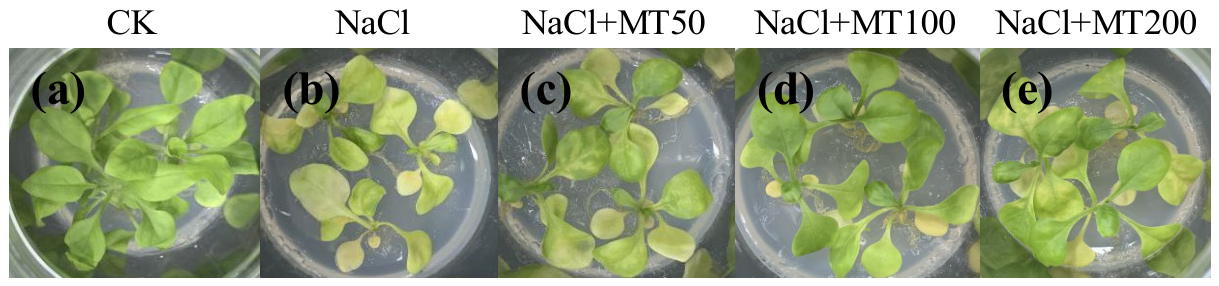
Salt stress caused significant inhibition of Petunia seedling growth (Figure 1). Compared with the CK, NaCl-treated seedlings exhibited reduced height, yellowing, fewer leaves, and weaker root systems (Figure 1).
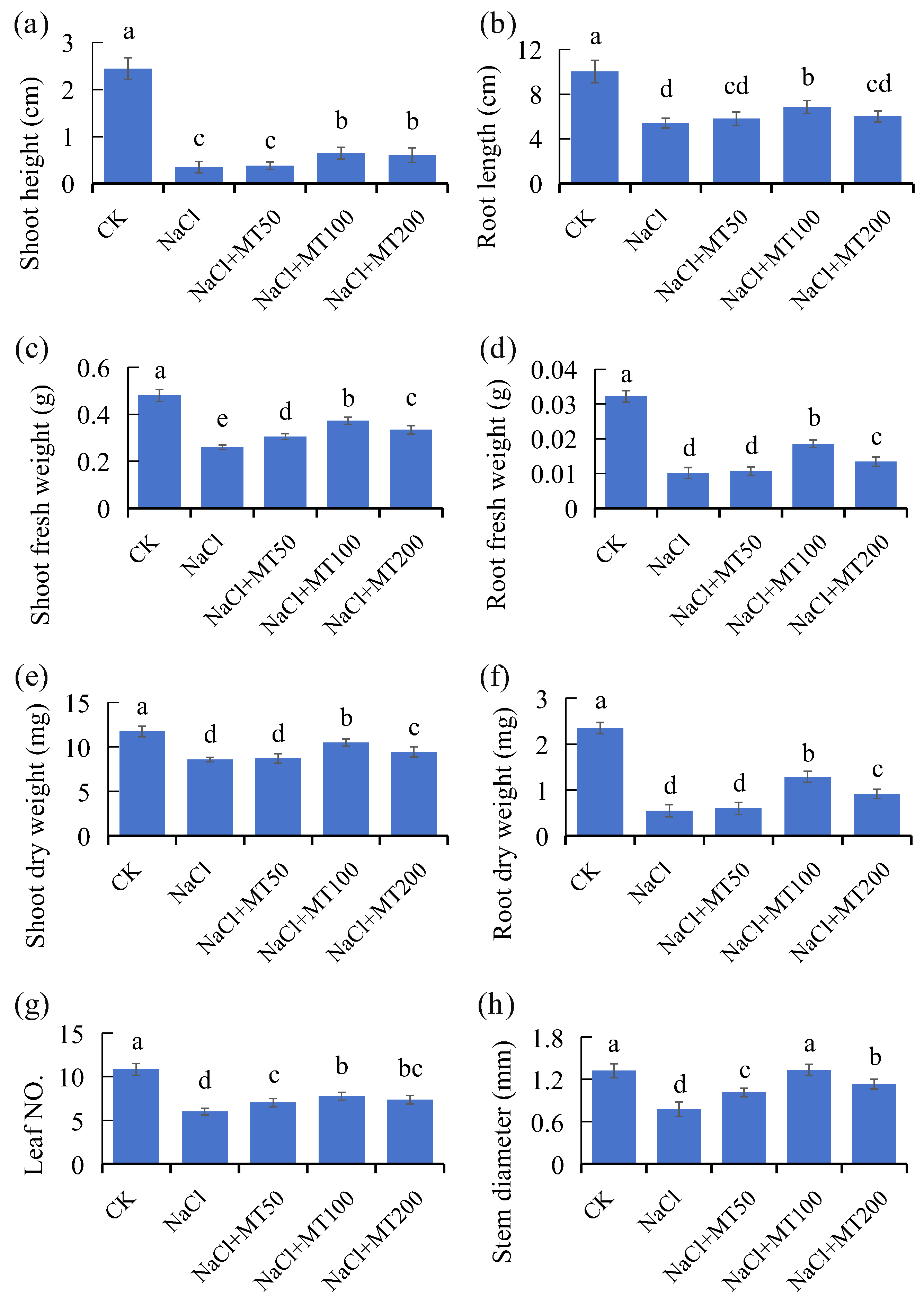
Measurement results showed that NaCl treatment reduced plant height by 85.67%, root length by 46.04%, shoot fresh weight by 46.02%, root fresh weight by 68.45%, shoot dry weight by 26.98%, root dry weight by 78.26%, leaf number by 44.52%, and stem diameter by 41.22% compared to the CK (Figure 2). Exogenous MT at different concentrations significantly alleviated salt stress-induced growth inhibition in a dose-dependent manner. At an application concentration of 50 μmol·L−1, a slight alleviation was observed, with plant height, root length, shoot fresh weight, root fresh weight, shoot dry weight, root dry weight, leaf number, and stem diameter increasing to 1.09, 1.07, 1.18, 1.05, 1.01, 1.20, 1.17, and 1.31 times that of the NaCl group, respectively. When the MT concentration was increased to 100 μmol·L−1, the alleviation effect was most pronounced, as plant height, root length, shoot fresh weight, shoot dry weight, root fresh weight, root dry weight, leaf number, and stem diameter increased to 1.86, 1.27, 1.44, 1.22, 1.83, 2.60, 1.29, and 1.72 times that of the salt-stressed group, respectively. However, the beneficial effects diminished at 200 μmol·L−1 MT, with growth data being lower than those in the 100 μmol·L−1 treatment, except for plant height. Therefore, 100 μmol·L−1 was determined to be the optimal concentration for alleviating salt-induced growth inhibition and promoting overall biomass accumulation in Petunia under salt stress (Figure 2). Notably, compared to the control, growth parameters in the 100 μmol·L−1 MT treatment remained significantly lower. Specifically, plant height, root length, leaf number, and shoot and root fresh weights were reduced by 73.3%, 31.6%, 28.2%, 22.5%, and 45.2%, respectively. This indicates that melatonin treatment attenuates, but does not fully alleviate, the adverse effects of salt stress on plant growth.

3.2. Effects on Soluble Protein Content and Antioxidant Enzyme Activities

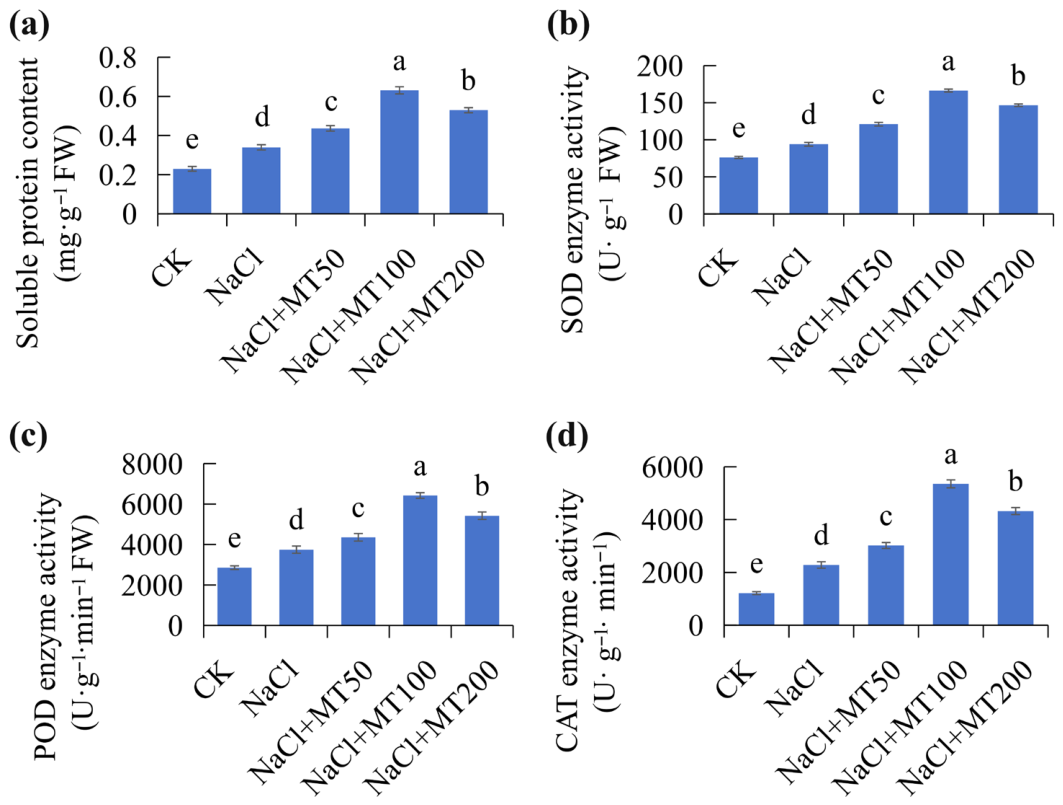
Salt stress (NaCl treatment) resulted in a significant increase in soluble protein content in Petunia leaves, which was 47.8% higher than the CK (Figure 3a). NaCl-treated plants exhibited a soluble protein content of 0.339 mg·g−1, which was significantly higher than that of the CK (0.229 mg g−1). Exogenous application of MT further increased soluble protein content in a dose-dependent manner, with 100 and 200 μmol·L−1 MT resulting in increases of 85.9% and 56.0%, respectively, compared with the NaCl treatment.
Salt stress significantly enhanced the antioxidant enzyme system in Petunia. Compared with the CK, the activities of SOD, POD, and CAT in plants treated by NaCl increased by 23.3%, 31.0%, and 88.2%, respectively (Figure 3b–d). Exogenous application of melatonin further enhanced these enzyme activities. At 100 μmol·L−1 melatonin, all three enzymes reached peak or near-peak activity. SOD activity reached 166.33 U·mg−1 prot, which was 77.1% higher than in the NaCl treatment (Figure 3b). POD activity reached 6423.33 U·g−1·min−1, representing an increase of 71.6% (Figure 3c). CAT activity reached 5356.67 U·g−1·min−1, corresponding to a 134.6% increase (Figure 3d). When the melatonin concentration was increased to 200 μmol·L−1, POD and CAT activities remained at high levels (5421.67 and 4232.33 U·g−1·min−1, respectively), whereas SOD activity decreased slightly compared with that at 100 μmol·L−1. Overall, these results indicate that 100 μmol·L−1 melatonin exerted the strongest synergistic effect in upregulating SOD, POD, and CAT activities, which was directly associated with the greatest reduction in membrane lipid peroxidation, as reflected by the lowest MDA accumulation.

3.3. Effects on Membrane Lipid Peroxidation and ROS Accumulation

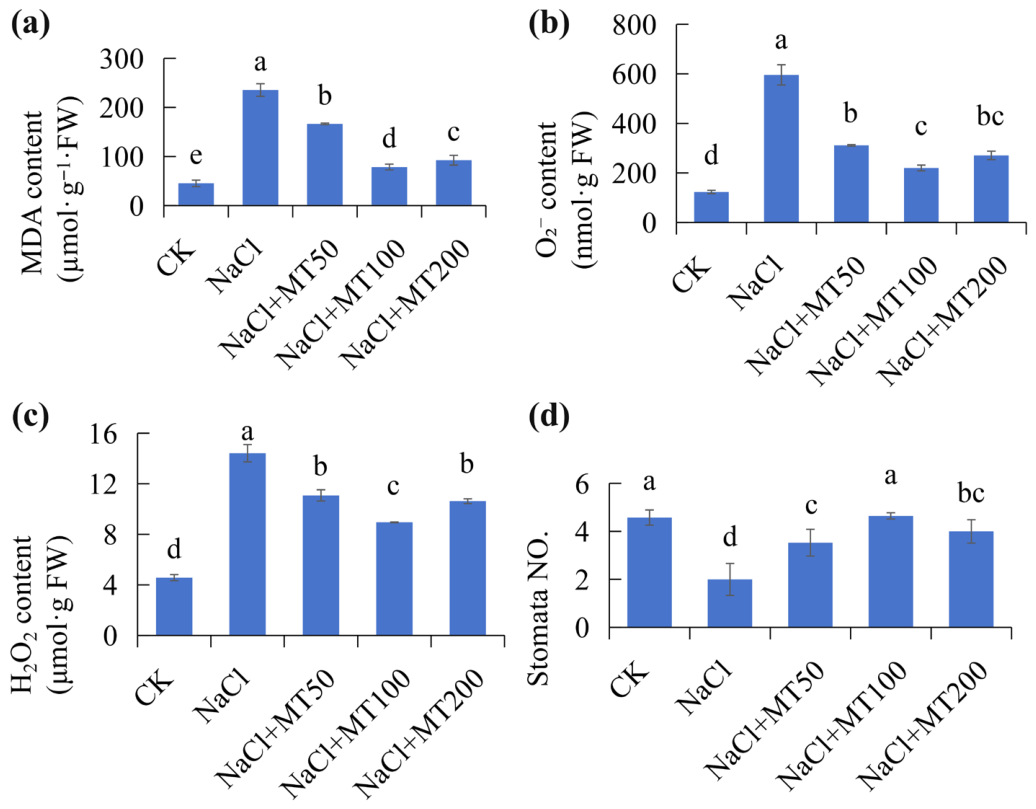
Saline conditions resulted in a marked increase in MDA levels. The MDA concentration in the NaCl-only group reached 235.43 μmol·g−1, which was over 5.2 times higher than that of the CK (45.37 μmol·g−1), indicating salt stress causes serious oxidative damage to cell membranes (Figure 4a). When melatonin was applied, this MDA accumulation was significantly reduced, and upon application of 50, 100, and 200 μmol·L−1 MT, MDA dropped to 166.53, 78.61, and 92.49 μmol·g−1, respectively. The most effective concentration was 100 μmol·L−1 MT, which reduced MDA levels by 66.6% compared with the NaCl-only group, whereas 200 μmol·L−1 MT also resulted in a significant reduction, though its effect was slightly less pronounced.
Concurrently, salt stress significantly increased the accumulation of O2 and H2O2, reaching 595.96 nmol·g−1 and 14.42 μmol·g−1, respectively, which were 4.8 and 3.2 times higher than the control group. Whereas melatonin treatment inhibited the generation of reactive oxygen species (ROS), with 100 μmol·L−1 melatonin showing the most significant effect, reducing O2 levels by 63.1% and H2O2 levels by 37.9% compared to the NaCl-only group.

3.4. Effects on Stomatal Counts per Field of View

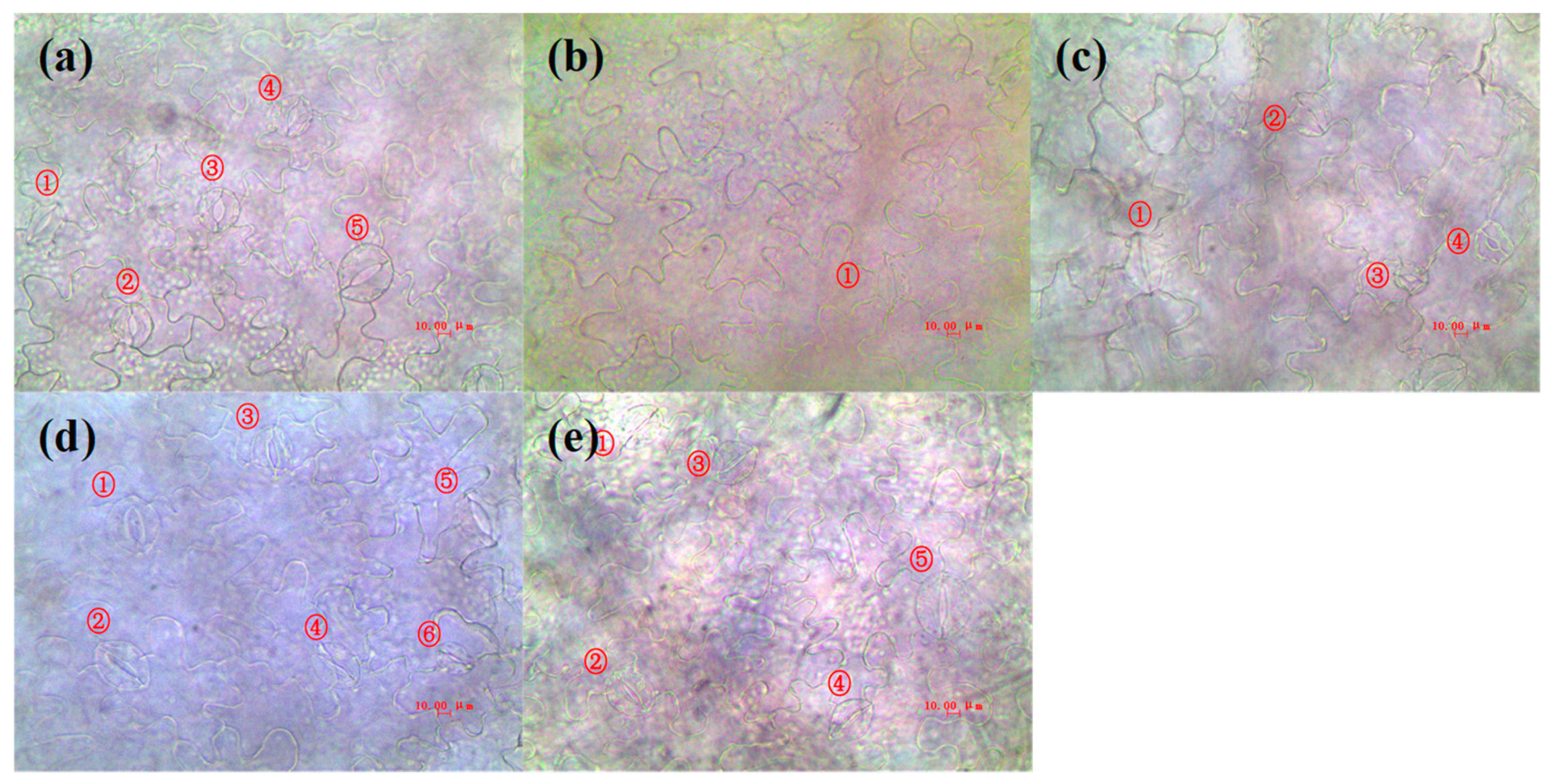
Microscopic examination of stomata (Figure 4b and Figure 5) revealed that saline conditions significantly reduced the number of stomata observed per field of view on the lower leaf epidermis of Petunia. In the CK group, the average stomatal count was 4.571 stomata/field. Under NaCl stress, this value dropped significantly to 2.0 stomata/field (a 55.8% decrease compared to CK). Such changes represent a common adaptive strategy in plants to reduce water loss under salt stress.
This trend was reversed following melatonin application, which caused significant increases in stomatal counts. At the 50 μmol·L−1 melatonin treatment, the stomatal count was restored to 3.529 stomata/field. A stronger response was observed at 100 μmol·L−1, where the stomatal count recovered to 4.643 stomata/field, exceeding that of the CK. At 200 μmol·L−1, the stomatal count remained high at 4.0 stomata/field, although slightly lower than the 100 μmol·L−1 treatment group. These results indicate that exogenous melatonin, especially at 100 μmol·L−1, significantly improved stomatal development in Petunia under salt stress, which may facilitate gas exchange and water regulation.

3.5. Effects on the Expression of Antioxidant Enzyme-Related Genes

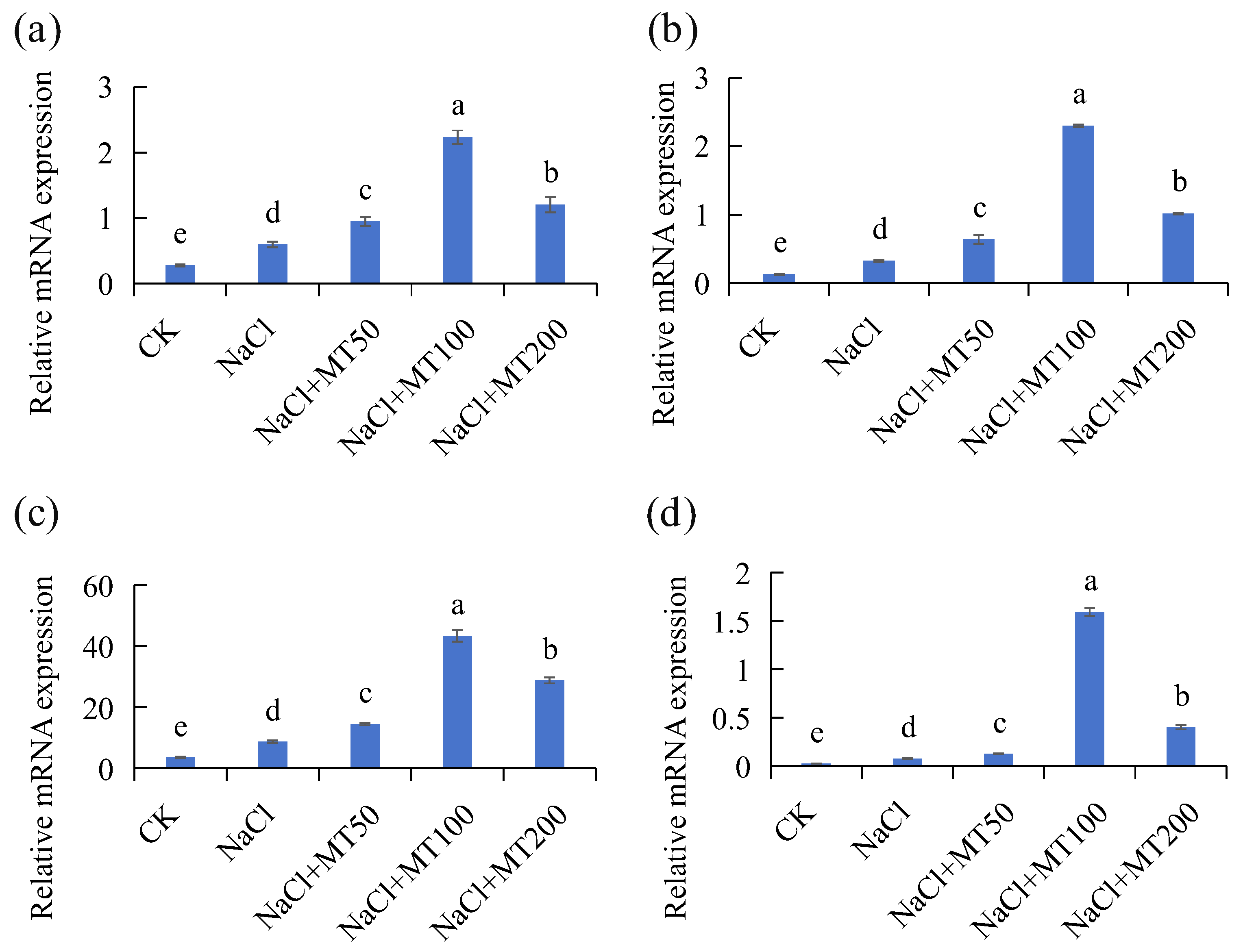
qRT-PCR analysis revealed that NaCl treatment significantly upregulated the transcript levels of PhCAT, PhAPX, PhSOD, and PhOsmotin. Relative to the CK, these genes showed 2.1-, 2.5-, 2.5-, and 3.1-fold increases, respectively (Figure 6).
Exogenous MT application further potentiated this upregulation. At 50 μmol·L−1 MT, transcript levels increased significantly compared to the NaCl-only group (1.6- to 2.0-fold). The most dramatic induction was observed under 100 μmol·L−1 MT treatment, where PhCAT, PhAPX, PhSOD, and PhOsmotin levels reached 3.7-, 7.1-, 5.0-, and 20.9-fold of those in the NaCl group, respectively. Notably, PhOsmotin exhibited the highest magnitude of upregulation, aligning with its critical role in osmotic regulation. These expression patterns corroborated the changes in enzyme activities, confirming that melatonin activates the antioxidant system via transcriptional regulation.

3.6. PCA and Spearman Correlation Analysis of Growth and Physiological Parameters

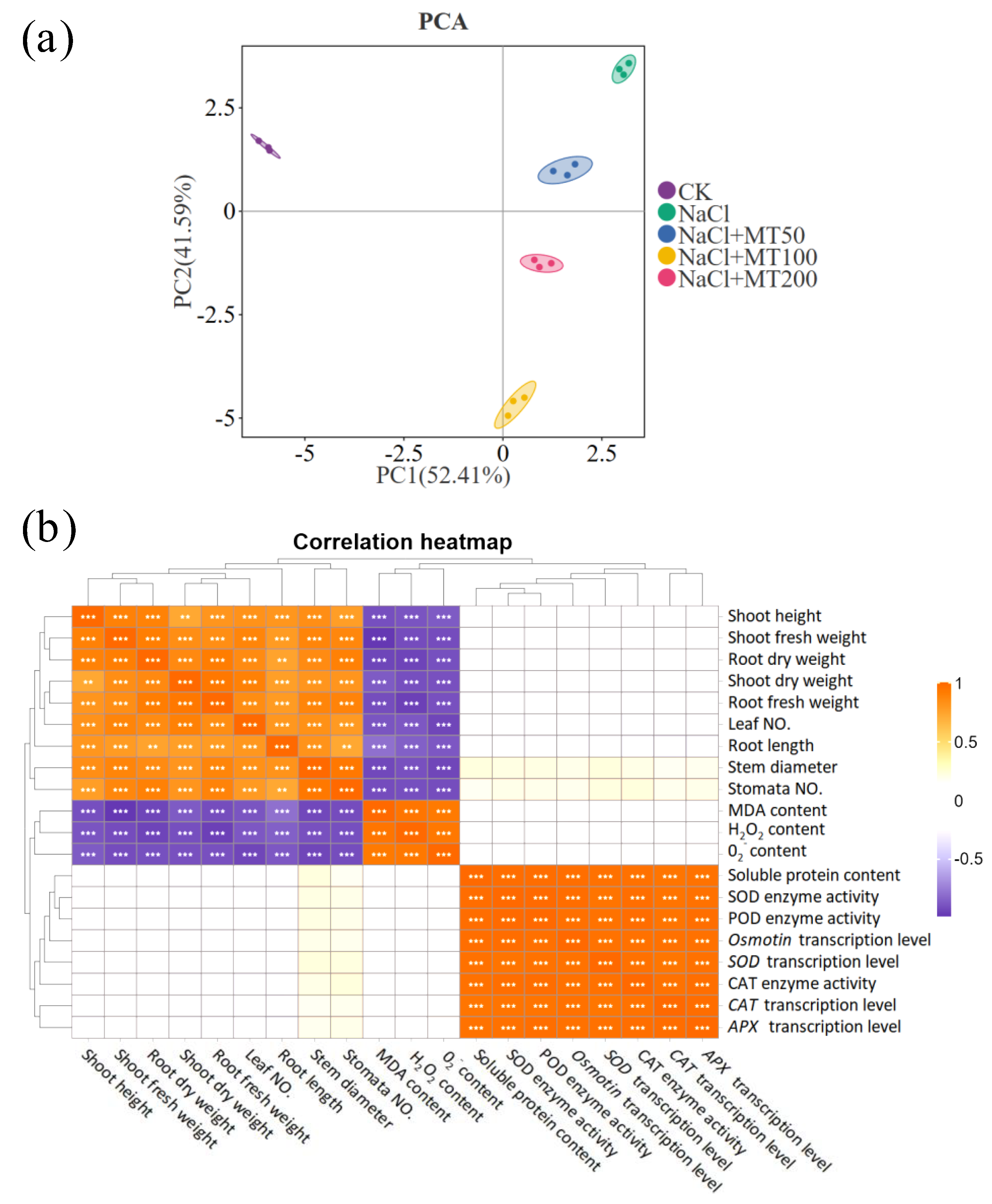
PCA revealed clear separation between the CK and NaCl stress-treated groups (Figure 7a), with PC1 and PC2 explaining 52.41% and 41.59% of the total variance, respectively. Melatonin treatments shifted the samples toward the CK group, with the NaCl + MT100 treatment being the closest to CK, indicating the optimal mitigation effect on salt stress.
Correlation analysis was performed on all measured growth and physiological parameters, as shown in the correlation heatmap (Figure 7b). Growth-related indices, including shoot height, shoot fresh weight, shoot dry weight, root fresh weight, root dry weight, root length, leaf number, and stem diameter, were significantly positively correlated with each other (p < 0.01 or p < 0.001). Meanwhile, these growth indices were significantly negatively correlated with stress-related markers such as MDA content, H2O2 content, and O2 content (p < 0.001). Antioxidant enzyme activities (SOD, POD, CAT, and APX) were also significantly positively correlated with each other and with soluble protein content (p < 0.001). Moreover, the activities of these enzymes were positively correlated with the transcription levels of their corresponding genes (p < 0.001).

4. Discussion

4.1. Melatonin-Mediated Growth Promotion Under Salinity Stress

Exogenous melatonin could alleviate salt-induced growth inhibition in Petunia seedlings. Under NaCl stress conditions, melatonin-treated seedlings exhibited higher plant height, root length, shoot fresh weight, root fresh weight, shoot dry weight, root dry weight, leaf number, and stem diameter compared with the untreated NaCl-stressed group. The growth-promoting effect of exogenous melatonin under salt stress has been documented in several plant species. In cotton, Jiang et al. [8] reported significant improvements in plant height, root length, and overall biomass following melatonin application under saline conditions. Ahmad et al. [9] likewise observed enhanced growth performance in maize seedlings, where optimal melatonin concentrations effectively counteracted salt-induced inhibition. Further supporting evidence comes from Li et al. [20], who demonstrated that melatonin treatment markedly increased plant height, root length, and fresh weight in the halophyte Limonium bicolor under salinity. These findings across different species support the general role of melatonin in alleviating salt stress, and our results further demonstrate that 100 μmol·L−1 MT is particularly effective in Petunia.

4.2. Synergistic Enhancement Mechanism of Melatonin, Oxidative Stress, and Antioxidant Defense

Oxidative stress, defined as ROS overaccumulation, plays a key role in salt phytotoxicity [10,18]. Salinity exposure caused a significant increase in MDA levels, a known marker of membrane lipid peroxidation, indicating clear oxidative damage. These results suggest that salt stress leads to serious cell membrane injury through ROS accumulation.
To counteract this, melatonin works in a twofold manner. First, the indole ring structure of melatonin acts as a direct antioxidant, scavenging various ROS and serving as the primary chemical defense line. This direct ROS-scavenging function has also been demonstrated in tomato seedlings under salt stress, where melatonin was shown to directly alleviate oxidative damage [14]. Second, and more importantly, melatonin acts as an effective signaling molecule, a role evident in maize, where melatonin treatment induced systemic activation of the antioxidant protective system [9]. We confirmed this signaling role with melatonin (100 μmol·L−1) treatment, which significantly increased the activities of antioxidant enzymes (SOD, POD, and CAT) in Petunia seedlings under salt stress; reduced the accumulation of O2, H2O2, and MDA; and markedly upregulated the expression of antioxidant-related genes (including PhSOD, PhCAT, and PhAPX), thereby enhancing the antioxidant defense capacity of plants at both physiological and transcriptional levels. These results indicate that melatonin can trigger particular transcriptional networks, presumably through altering the function of transcriptional factors including NAC, WRKY, and MYB, which are known regulators of stress-responsive genes, thereby programming a systemic antioxidant response. This signal-mediated enhancement involves a specific ROS-scavenging cascade. SOD first transforms superoxide anions (O2) to hydrogen peroxide (H2O2), which is subsequently decomposed into water and oxygen by POD and CAT. This synergistic defense system, orchestrated by melatonin, underlies the effective reduction in membrane damage observed in this study, a finding also reported in other horticultural crops such as tomato [14].

4.3. Melatonin Participates in Osmotic Regulation and the Maintenance of Protein Homeostasis

Keeping cellular water balance under osmotic stress is critical for salinity tolerance [7,18]. In Petunia leaves under salt stress, soluble protein levels increased significantly, indicating a typical osmotic adjustment response. This increase was further enhanced by exogenous application of melatonin, particularly at 100 and 200 μmol·L−1, with the lower concentration showing a more pronounced effect (Figure 3a). These changes were associated with growth recovery.
A high level of melatonin accumulation plays an active role in osmotic regulation. It promotes the synthesis of protective proteins, such as late embryogenic abundant (LEA) proteins and molecular chaperones, which help maintain cell integrity when dehydration stress occurs [11,15]. Strong molecular evidence revealed significant upregulation of the osmoprotectant gene PhOsmotin following treatment with 100 μmol·L−1 melatonin (Figure 6). In addition to its biosynthetic function, melatonin also helps maintain proteome stability through its antioxidant properties, which protect existing proteins from oxidative denaturation. Furthermore, its potential effect on calcium signaling pathways may influence both protein structural integrity and turnover rates, thereby strengthening proteostasis during stress [21,35].

4.4. Regulation of Melatonin on Stomatal Development and Its Physiological and Ecological Significance

Stomatal closure is an important strategy for plants to reduce water loss under salt stress; however, this adaptive response also reduces carbon dioxide uptake and photosynthesis [1]. Our morphological analysis clearly demonstrates this trade-off, as salt stress resulted in a significant reduction in stomatal density compared with the control (Figure 4 and Figure 5). Exogenous application of melatonin effectively alleviated this negative effect. A previous study in Silybum marianum has shown that melatonin could reverse salt-caused stomatal closure and restore stomatal structure [36].
The movement of stomata is closely controlled by hormonal pathways, particularly the balance between abscisic acid (ABA), which triggers stomatal closure, and auxin. These core signaling pathways are known to interact with melatonin, as described in recent mechanistic reviews [14]. We propose that exogenous melatonin influences the endogenous hormone balance during stress, possibly by inhibiting ABA signaling or modulating auxin pathways. This may, in turn, stimulate stomatal developmental genes (SPCH, MUTE) and regulate stomatal aperture. This regulation likely contributes to optimizing photosynthetic gas exchange and enhanced overall growth activity, findings that are consistent with studies in cotton and soybean, where melatonin maintained photosynthetic organs and stomatal functionality [37,38].

4.5. PCA and Correlation Analysis Verification

PCA and correlation analysis results collectively confirm that melatonin concentration is positively correlated with antioxidant enzyme activities and negatively correlated with the accumulation of oxidative damage indicators (MDA, O2, and H2O2). Notably, the 100 μmol·L−1 treatment group shows a physiological state closest to the control, making it the optimal mitigating dose. This finding is consistent with previous studies showing that exogenous melatonin enhances antioxidant enzyme activities (SOD, POD, and CAT) and concurrently mitigates oxidative damage by lowering MDA, O2, and H2O2 levels under saline conditions [39,40].

4.6. Physiological Analysis of Concentration Effects and Optimal Dose

Melatonin’s ability to alleviate salt stress exhibited a dose-dependent pattern. Among the concentrations tested, 100 μmol·L−1 melatonin treatment produced the most pronounced and balanced protective effect. It resulted in the greatest reduction in oxidative damage, as indicated by MDA levels, and induced the strongest coordinated increase in the activities of key antioxidant enzymes, including SOD, POD, and CAT, along with the highest upregulation of their corresponding genes. Therefore, under the conditions tested, 100 μmol·L−1 was identified as the optimal concentration, which is consistent with the common observation that biostimulants often exhibit diminished efficacy at excessive concentrations [10].

5. Conclusions

Exogenous melatonin significantly alleviated the adverse effects induced by 200 mmol·L−1 NaCl stress and relieved growth inhibition in Petunia. Among all tested concentrations, 100 μmol·L−1 MT showed the most effective protection. MT enhanced the activities of antioxidant enzymes (SOD, POD, and CAT); reduced the accumulation of MDA, H2O2, and O2; and increased soluble protein content to alleviate oxidative and osmotic damage. Meanwhile, MT upregulated the expression of antioxidant-related genes and improved stomatal density to stabilize physiological performance under salt stress. Multivariate statistical analyses further confirmed that the improved growth and physiological traits of salt-stressed Petunia seedlings were strongly correlated with the enhanced antioxidant capacity and gene expression regulation induced by the optimal MT treatment. While this study clarified physiological responses, future research should employ melatonin mutants and transcriptomic analyses to map the specific signaling network. Additionally, investigations into ion homeostasis and field trials are necessary to bridge the gap between physiological findings and horticultural practice.

Supplementary Materials

The following supporting information can be downloaded at: https://www.mdpi.com/article/10.3390/horticulturae12050579/s1, Figure S1: Effects of different concentrations of salt stress on the growth of Petunia: (a) shoot height, (b) root length, (c) shoot fresh weight, (d) root fresh weight, (e) shoot dry weight, (f) root dry weight, and (g) leaf number; Supplementary Figure S2: Effects of different concentrations of salt stress on soluble protein content and antioxidant enzyme activities (SOD, POD, and CAT) in Petunia; Supplementary Figure S3: Effects of different concentrations of salt stress on malondialdehyde (MAD), superoxide anion (O2), and hydrogen peroxide (H2O2) contents, as well as stomatal number in Petunia.

Author Contributions

Y.S.: writing—review and editing, revision and polishing of the manuscript; W.W.: writing—original draft; S.W.: writing—review and editing, revision and polishing of the manuscript; Y.F.: investigation, experiment participation; L.L.: investigation, experiment participation; J.X.: conceptualization, funding acquisition, writing—review and editing, revision and polishing of the manuscript. All authors have read and agreed to the published version of the manuscript.

Funding

This research was funded by the National Natural Science Foundation of China [Grant No. 32302600], the Talent Program of Lingnan Normal University [Grant No. ZL22017], and the University-Level Innovation and Entrepreneurship Training Program of Lingnan Normal University [Grant No. X202310579037].

Data Availability Statement

The original contributions presented in this study are included in the article. Further inquiries can be directed to the corresponding authors.

Conflicts of Interest

The authors declare no conflicts of interest.

References

  1. Al-Shammari, W.B.; Altamimi, H.; Abdelaal, K.A.A. Response of ornamental plants to salinity: Impact on species-specific growth, visual quality, photosynthetic parameters, and ion uptake. Front. Plant Sci. 2025, 16, 1611767. [Google Scholar] [CrossRef]
  2. Soares, L.S.; Stehmann, J.R.; Freitas, L.B. The Genus Petunia (solanaceae): Evolutionary Synthesis and Taxonomic Review. Plants 2025, 14, 1478. [Google Scholar] [CrossRef]
  3. Yan, M.X.; Xia, X.; Guo, Y.L.; Wang, L.; Li, M.Y. Development of Petunia Breeding and Application of Varieties. J. South China Agric. Univ. 2009, 3, 93–97. [Google Scholar] [CrossRef]
  4. Chetouani, M.; Arabi, M.; Belasri, L.; Mharchi, S.; Alaoui, K. Effect of salt stress on the essential oil content of rosemary at juvenile and adult stages under greenhouse conditions. E3S Web Conf. 2025, 632, 03005. [Google Scholar] [CrossRef]
  5. Taybi, T.; Alyahya, N. Comparative Analysis of Physiological and Biochemical Responses to Salt Stress Reveals Important Mechanisms of Salt Tolerance in Wheat. Int. J. Mol. Sci. 2025, 26, 3742. [Google Scholar] [CrossRef] [PubMed]
  6. Abidi, I.; Hirich, A.; Bazile, D.; Mahyou, H.; Gaboun, F.; Alaoui, S.B. Using Agronomic Parameters to Rate Quinoa (Chenopodium quinoa Willd.) Cultivars Response to Saline Irrigation under Field Conditions in Eastern Morocco. Environ. Sci. Proc. 2022, 16, 67. [Google Scholar] [CrossRef]
  7. Jeddi, K.; Siddique, K.H.M.; Hessini, K. Impact of Salinity on Plant Growth, Photosynthesis, Cell Wall Elasticity and Osmotic Adjustment in Damask Rose. Russ. J. Plant Physiol. 2025, 72, 171. [Google Scholar] [CrossRef]
  8. Jiang, D.; Lu, B.; Liu, L.T.; Duan, W.; Meng, Y.; Li, J.; Zhang, K.; Sun, H.; Zhang, Y.; Dong, H.; et al. Exogenous melatonin improves the salt tolerance of cotton by removing active oxygen and protecting photosynthetic organs. BMC Plant Biol. 2021, 21, 331. [Google Scholar] [CrossRef]
  9. Ahmad, S.; Cui, W.W.; Kamran, M.; Ahmad, I.; Meng, X.; Wu, X.; Su, W.; Javed, T.; El-Serehy, H.A.; Jia, Z.; et al. Exogenous application of melatonin induces tolerance to salt stress by improving the photosynthetic efficiency and antioxidant defense system of maize seedling. J. Plant Growth Regul. 2021, 40, 1270–1283. [Google Scholar] [CrossRef]
  10. Zeng, W.; Mostafa, S.; Lu, Z.; Jin, B. Melatonin-mediated abiotic stress tolerance in plants. Front. Plant Sci. 2022, 13, 847175. [Google Scholar] [CrossRef]
  11. Guo, X.Q.; Shi, Y.; Zhu, G.L.; Zhou, G. Melatonin mitigated salinity stress on alfalfa by improving antioxidant defense and osmoregulation. Agronomy 2023, 13, 1727. [Google Scholar] [CrossRef]
  12. Nie, M.G.; Ning, N.; Chen, J.F.; Zhang, Y.; Li, S.; Zheng, L.; Zhang, H. Melatonin enhances salt tolerance in sorghum by modulating photosynthetic performance, osmoregulation, antioxidant defense, and ion homeostasis. Cent. Eur. J. Biol. 2023, 18, 20220734. [Google Scholar] [CrossRef]
  13. Wang, D.Y.; Wang, J.; Shi, S.H.; Huang, L.; Zhu, M.; Li, F. Exogenous melatonin ameliorates salinity-induced oxidative stress and improves photosynthetic capacity in sweet corn seedlings. Photosynthetica 2021, 59, 327–336. [Google Scholar] [CrossRef]
  14. Ali, M.; Kamran, M.; Kamran, M.; Saleem, M.H.; Ahmad, S.; Parveen, A.; Malik, Z.; Afzal, S.; Ahmar, S.; Dawar, K.M.; et al. Melatonin-induced salinity tolerance by ameliorating osmotic and oxidative stress in the seedlings of two tomato (Solanum lycopersicum L.) cultivars. J. Plant Growth Regul. 2021, 40, 2236–2248. [Google Scholar] [CrossRef]
  15. Dadasoglu, E.; Turan, M.; Ekinci, M.; Argin, S.; Yildirim, E. Alleviation mechanism of melatonin in chickpea (Cicer arietinum L.) under the salt stress conditions. Horticulturae 2022, 8, 1066. [Google Scholar] [CrossRef]
  16. Huang, S.C.; Wu, P.; Yang, X.T.; Li, W.; Zhou, W.; Xie, Y.; Meng, X.; Li, Z.; Xu, Z.; Jin, N.; et al. Enhancing saline-alkali tolerance in cucumber seedlings: The role of exogenous melatonin in redox homeostasis and stomatal function. Plant Stress 2025, 15, 100789. [Google Scholar] [CrossRef]
  17. He, F.Q.; Zhao, X.Q.; Qi, G.X.; Sun, S.; Shi, Z.; Niu, Y.; Wu, Z.; Zhou, W. Exogenous melatonin alleviates NaCl injury by influencing stomatal morphology, photosynthetic performance, and antioxidant balance in maize. Int. J. Mol. Sci. 2024, 25, 10077. [Google Scholar] [CrossRef]
  18. Khan, T.A.; Saleem, M.; Fariduddin, Q. Recent advances and mechanistic insights on melatonin-mediated salt stress signaling in plants. Plant Physiol. Biochem. 2022, 188, 97–107. [Google Scholar] [CrossRef]
  19. Huang, X.; Tanveer, M.; Min, Y.; Shabala, S. Melatonin as a regulator of plant ionic homeostasis: Implications for abiotic stress tolerance. J. Exp. Bot. 2022, 73, 5886–5902. [Google Scholar] [CrossRef]
  20. Li, J.P.; Liu, Y.F.; Zhang, M.J.; Xu, H.; Ning, K.; Wang, B.; Chen, M. Melatonin increases growth and salt tolerance of Limonium bicolor by improving photosynthetic and antioxidant capacity. BMC Plant Biol. 2022, 22, 16. [Google Scholar] [CrossRef]
  21. Arora, D.; Singh, N.; Bhatla, S.C. Calmodulin and calcium-mediated melatonin signaling mechanisms in plants. Theor. Exp. Plant Physiol. 2024, 36, 635–645. [Google Scholar] [CrossRef]
  22. Li, J.P.; Liu, J.; Zhu, T.T.; Zhao, C.; Li, L.; Chen, M. The Role of Melatonin in Salt Stress Responses. Int. J. Mol. Sci. 2019, 20, 1735. [Google Scholar] [CrossRef]
  23. Zhang, T.G.; Shi, Z.F.; Zhang, X.H.; Zheng, S.; Wang, J.; Mo, J. Alleviating effects of exogenous melatonin on salt stress in cucumber. Sci. Hortic. 2020, 262, 109070. [Google Scholar] [CrossRef]
  24. Jiang, D.; Lu, B.; Liu, L.T.; Duan, W.; Chen, L.; Li, J.; Zhang, K.; Sun, H.; Zhang, Y.; Dong, H.; et al. Exogenous melatonin improves salt stress adaptation of cotton seedlings by regulating active oxygen metabolism. PeerJ 2020, 8, e10486. [Google Scholar] [CrossRef]
  25. Li, H.; Chang, J.J.; Chen, H.J.; Wang, Z.; Gu, X.; Wei, C.; Zhang, Y.; Ma, J.; Yang, J.; Zhang, X. Exogenous Melatonin Confers Salt Stress Tolerance to Watermelon by Improving Photosynthesis and Redox Homeostasis. Front. Plant Sci. 2017, 8, 295. [Google Scholar] [CrossRef]
  26. Sun, C.L.; Liu, L.J.; Wang, L.X.; Li, B.; Jin, C.; Lin, X. Melatonin: A master regulator of plant development and stress responses. J. Integr. Plant Biol. 2021, 63, 126–145. [Google Scholar] [CrossRef] [PubMed]
  27. Jones, C.G.; Daniel Hare, J.; Compton, S.J. Measuring plant protein with the Bradford assay: 1. Evaluation and standard method. J. Chem. Ecol. 1989, 15, 979–992. [Google Scholar] [CrossRef] [PubMed]
  28. Beyer, W.F.; Fridovich, I. Assaying for superoxide dismutase activity: Some large consequences of minor changes in conditions. Anal. Biochem. 1987, 161, 559–566. [Google Scholar] [CrossRef]
  29. Chance, B.; Maehly, A.C. Assay of catalases and peroxidases. Methods Enzymol. 1955, 2, 764–775. [Google Scholar] [CrossRef]
  30. Aebi, H. Catalase in vitro. Methods Enzymol. 1984, 105, 121–126. [Google Scholar] [CrossRef] [PubMed]
  31. Heath, R.L.; Packer, L. Photoperoxidation in isolated chloroplasts: I. Kinetics and stoichiometry of fatty acid peroxidation. Arch. Biochem. Biophys. 1968, 125, 189–198. [Google Scholar] [CrossRef]
  32. Sharma, N. Leaf Clearing Protocol to Observe Stomata and Other Cells on Leaf Surface. Bio-Protocol 2017, 7, e2545. [Google Scholar] [CrossRef]
  33. Albrechtová, J.; Kubínová, Z.; Soukup, A. Image Analysis: Basic Procedures for Description of Plant Structures. Methods Mol. Biol. 2019, 1992, 109–119. [Google Scholar] [CrossRef] [PubMed]
  34. Mallona, I.; Lischewski, S.; Weiss, J.; Hause, B.; Egea-Cortines, M. Validation of Reference Genes for Quantitative Real-Time PCR During Leaf and Flower Development in Petunia hybrida. BMC Plant Biol. 2010, 10, 4. [Google Scholar] [CrossRef]
  35. Zhang, Y.Y.; Liu, J.M.; Li, Y.C.; Liu, H.; Hua, J.; Xiong, M.; Song, H.; Yong, C. Effect of exogenous melatonin on seed germination and physiological characteristics of soybean seedlings under salt stress. BMC Plant Biol. 2026, 26, 301. [Google Scholar] [CrossRef] [PubMed]
  36. Zahedi, S.M.; Hosseini, M.S.; Hoveizeh, N.F.; Gholami, R.; Abdelrahman, M.; Tran, L.P. Exogenous melatonin mitigates salinity-induced damage in olive seedlings by modulating ion homeostasis, antioxidant defense, and phytohormone balance. Physiol. Plant. 2021, 173, 1682–1694. [Google Scholar] [CrossRef]
  37. Kang, S.M.; Shaffique, S.; Hoque, M.I.U.; Alomrani, S.O.; Park, Y.-S.; Lee, I.-J. Foliar treatment with melatonin modulates photosynthetic and antioxidant responses in Silybum marianum L. under salt stress. Sci. Hortic. 2024, 325, 112664. [Google Scholar] [CrossRef]
  38. Yang, X.; Liu, D.; Liu, C.; Li, M.; Yan, Z.; Zhang, Y.; Feng, G. Possible melatonin-induced salt stress tolerance pathway in Phaseolus vulgaris L. using transcriptomic and metabolomic analyses. BMC Plant Biol. 2024, 24, 72. [Google Scholar] [CrossRef]
  39. Wang, M.D.; Shah, S.; Wang, M.; Saira, A.; Hong, Y.; Yaseen, K.; Abdulwahed, F.A.; Sajid, A. Exogenous melatonin promotes salt stress tolerance by inducing physiological and biochemical adaptations in Chenopodium quinoa Willd. Physiolo. Mol. Biol. Plants 2026, 32, 875–892. [Google Scholar] [CrossRef]
  40. Ali, M.; Malik, Z.; Abbasi, G.H.; Irfan, M.; Ahmad, S.; Ameen, M.; Ali, A.; Sohaib, M.; Rizwan, M.; Ali, S. Potential of melatonin in enhancing antioxidant defense system and yield of maize (Zea mays L.) hybrids under saline condition. Sci. Hortic. 2024, 325, 112665. [Google Scholar] [CrossRef]
Figure 1. The effect of different concentrations of MT on the growth status in Petunia under different treatments: (a) control (MS medium); (b) NaCl stress (MS + 200 mmol·L NaCl); (c) NaCl stress + 50 µmol·L−1 MT; (d) NaCl stress + 100 µmol·L−1 L MT; (e) NaCl stress + 200 µmol·L−1 MT.
Horticulturae 12 00579 g001
Figure 2. Melatonin effects on shoot height (a), root length (b), shoot fresh weight (c), root fresh weight (d), shoot dry weight (e), root dry weight (f), leaf number (g) and stem diameter (h) in Petunia under CK (MS medium), NaCl stress, and NaCl stress combined with 50, 100, or 200 µmol·L−1 MT. Data are presented as mean ± SD (n = 3). Significant differences among treatments were determined by one-way ANOVA followed by Duncan’s multiple range test (p < 0.05). Different letters indicate significant differences among treatments (p < 0.05).
Horticulturae 12 00579 g002
Figure 3. Effects of different concentrations of melatonin (MT) on (a) soluble protein content, (b) superoxide dismutase (SOD) activity, (c) peroxidase (POD) activity, and (d) catalase (CAT) activity in Petunia under control (MS medium), NaCl stress (MS + 200 mmol/L NaCl), and NaCl stress combined with 50, 100, or 200 µmol·L−1 MT. Data are presented as mean ± SD (n = 3). Significant differences among treatments were determined by one-way ANOVA followed by Duncan’s multiple range test (p < 0.05). Different letters indicate significant differences among treatments (p < 0.05).
Horticulturae 12 00579 g003
Figure 4. Effects of different concentrations of melatonin (MT) on (a) malondialdehyde (MDA) content, (b) superoxide anion (O2) content, (c) hydrogen peroxide (H2O2) content, and (d) stomatal number in Petunia under control (MS medium), NaCl stress (MS + 200 mmol/L NaCl), and NaCl stress combined with 50, 100, or 200 µmol·L−1 MT. Data are presented as mean ± SD (n = 3). Significant differences among treatments were determined by one-way ANOVA followed by Duncan’s multiple range test (p < 0.05). Different letters indicate significant differences among treatments (p < 0.05).
Horticulturae 12 00579 g004
Figure 5. Representative images of stomatal number in Petunia leaves under (a) control (MS medium), (b) NaCl stress (MS + 200 mmol/L NaCl), (c) NaCl + 50 µmol·L−1 MT, (d) NaCl + 100 µmol·L−1 MT, and (e) NaCl + 200 µmol·L−1 MT. Scale bar = 10 μm. Circled numbers indicate individual stomata counted.
Horticulturae 12 00579 g005
Figure 6. Effects of different concentrations of melatonin (MT) on the relative expression levels of (a) CAT, (b) APX, (c) SOD, and (d) Osmotin in Petunia under control (MS medium), NaCl stress (MS + 200 mmol·L−1 NaCl), and NaCl stress combined with 50, 100, or 200 µmol·L−1 MT. Data are presented as mean ± SD (n = 3). Significant differences among treatments were determined by one-way ANOVA followed by Duncan’s multiple range test (p < 0.05). Different letters indicate significant differences among treatments (p < 0.05).
Horticulturae 12 00579 g006
Figure 7. PCA and correlation analysis of growth and physiological parameters in Petunia seedlings under salt stress with exogenous melatonin: (a) PCA plot showing the separation of different treatment groups based on growth and physiological indices. The ellipses represent the 95% confidence intervals for each treatment group: CK (control), NaCl (salt stress), NaCl + MT50, NaCl + MT100, and NaCl + MT200 (salt stress with 50, 100, and 200 µmol·L−1 melatonin, respectively). (b) Correlation heatmap of all measured growth and physiological indices. Orange and blue represent positive and negative correlations, respectively, with color intensity indicating the strength of the correlation. Asterisks indicate significant correlations (** p < 0.01, *** p < 0.001). The dendrograms illustrate the clustering relationships among the indices.
Horticulturae 12 00579 g007
Table 1. Primer accession numbers and nucleotide sequences used in qRT-PCR assays.
GenePrimers Sequences
(Accession No.)Forward Primer (5′ to 3′)Reverse Primer (5′ to 3′)
PhSODX14352.1ACTCAGTCGTTGGAAGAGCGTGGTAAGGCTGAGTTCGTGG
PhCATAY726007.1CAGCCAGTGGGACGATTAGTGGCACCACAATAGAAGGGCA
PhOsmotinAF376058.1CTTTCGCCCCAACTAAGCCTTGCACCAGGACATTCACCAT
PhAPXPeaxi162Scf00072ACTATTGGAGCCCATCAAGGAGGTGGCTCTGTCTTGTCCT
TubulinSGN-U207876TGGAAACTCAACCTCCATCCATTTCGTCCATTCCTTCACCTG
SOD, superoxide dismutase; CAT, catalase; Osmotin, Osmotin; APX, ascorbate peroxidase; Tubulin, b-tubulin 6 chain used as an internal standard [34].
Disclaimer/Publisher’s Note: The statements, opinions and data contained in all publications are solely those of the individual author(s) and contributor(s) and not of MDPI and/or the editor(s). MDPI and/or the editor(s) disclaim responsibility for any injury to people or property resulting from any ideas, methods, instructions or products referred to in the content.