Assessing Nutrient Accumulation in Chickpea (Cicer arietinum L.) Genotypes Grown in Soils with Different Texture: Response to Application of P and Zn Fertilizers, and Rhizobial Inoculant


Abstract
1. Introduction
2. Materials and Methods
2.1. Soil Collection and Planting
2.2. Plant Harvest, Processing, and Analysis of Macro- and Micronutrients
2.3. Statistical Analysis
3. Results
3.1. Shoot Mineral Accumulation: Response to Genotype and Adding P, Zn, and Rhizobial Inoculation
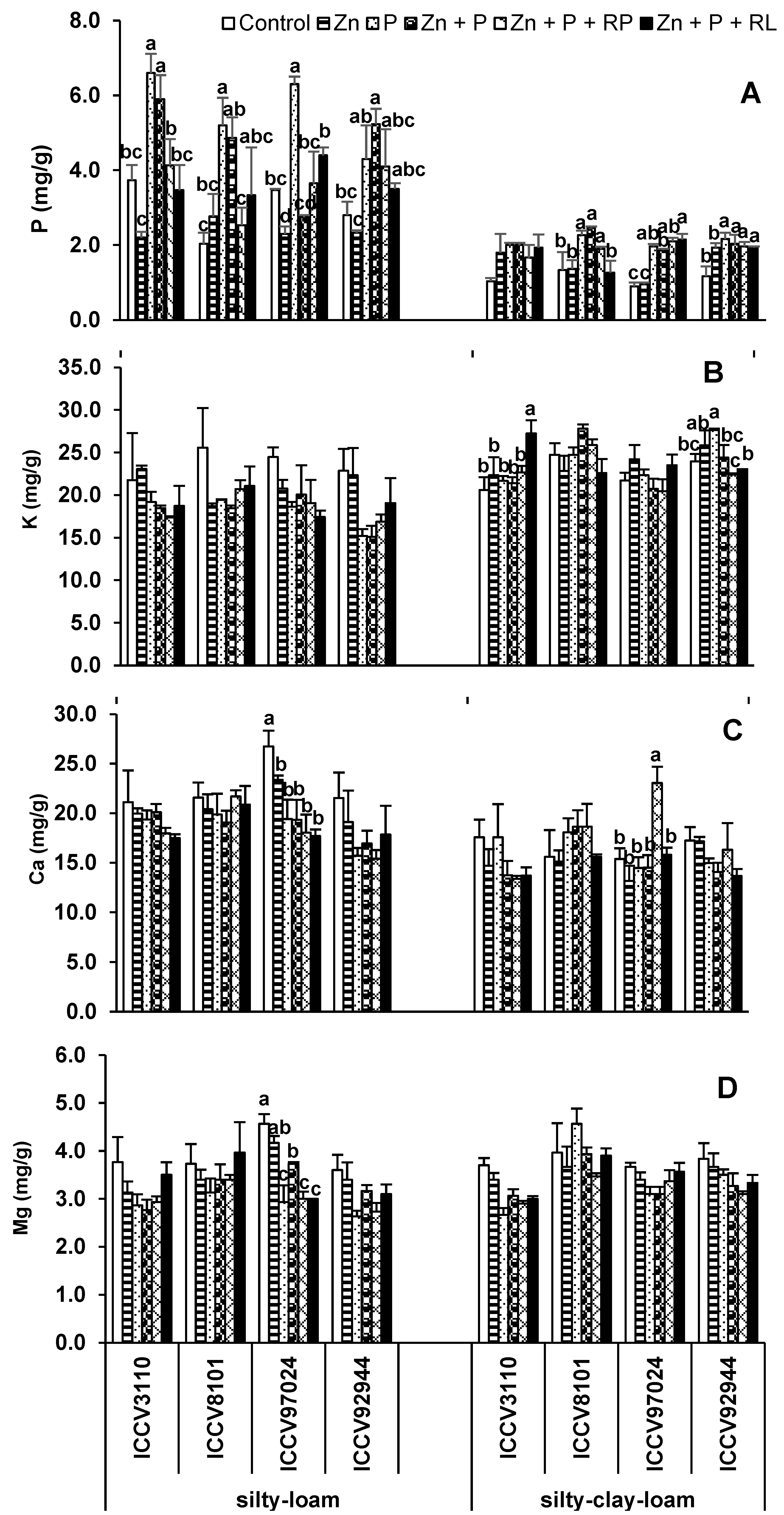
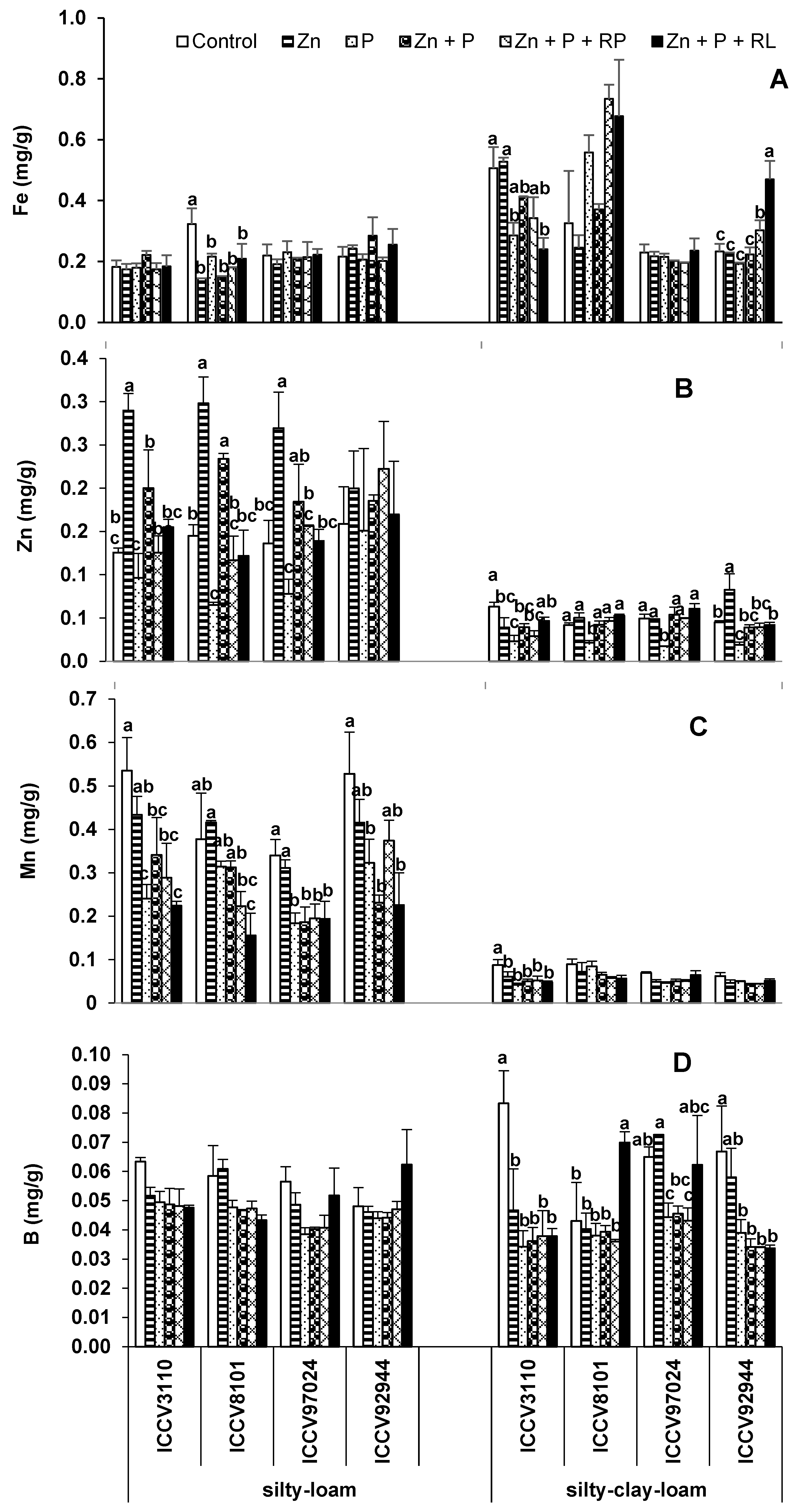
3.2. Interactions on Shoot Mineral Accumulation
4. Discussion
5. Conclusions
Author Contributions
Funding
Data Availability Statement
Acknowledgments
Conflicts of Interest
References
- World Integrated Trade Solution. South Africa Dried Chickpea, Shelled Imports by Country in 2023. Available online: https://wits.worldbank.org/trade/comtrade/en/country/ZAF/year/2023/tradeflow/imports/partner/ALL/product/071320 (accessed on 5 May 2024).
- Mpai, T.; Maseko, S.T. Possible benefits and challenges associated with production of chickpea in inland South Africa. Acta Agr. Scan. Sec. B Soil Plant Sci. 2018, 68, 479–488. [Google Scholar] [CrossRef]
- Ogola, J.B.O. Growth and yield response of chickpea to rhizobium inoculation: Productivity in relation to interception of radiation. Leg. Res. Int. J. 2015, 38, 837–843. [Google Scholar] [CrossRef]
- Dakora, F.D.; Belane, A.K.; Mohale, K.C.; Makhubedu, T.I.; Makhura, P.; Pule-Meulenberg, F.; Mapope, N.; Mogkelhe, S.N.; Gyogluu, C.; Phatlane, G.P.; et al. Food grain legumes: Their contribution to soil fertility, food security, and human nutrition/health in Africa. In Biological Nitrogen Fixation, 1st ed.; de Bruijn, F.J., Ed.; Wiley: Hoboken, NJ, USA, 2015; pp. 1063–1070. [Google Scholar]
- Macil, P.J.; Ogola, J.B.O.; Odhiambo, J.J.O. Response of soil pH and nodulation of three chickpea genotypes to biochar and rhizobium inoculation. Comm. Soil Sci. Plant Anal. 2020, 51, 2377–2387. [Google Scholar] [CrossRef]
- Ogola, J.B.O.; Macil, P.J.; Odhiambo, J.J.O. Biochar application and rhizobium inoculation increased intercepted radiation and yield of chickpea in contrasting soil types. Int. J. Plant Prod. 2021, 15, 219–229. [Google Scholar] [CrossRef]
- Ogola, J.B.O.; Madzivhandila, V.; Maseko, S.T.; Leboho, T.M. P-fertiliser and rhizobial inoculation increased the concentration of mineral nutrients in the rhizosphere of two chickpea genotypes. Acta Agric. Scan. Sec. B-Soil Plant Sci. 2023, 73, 94–101. [Google Scholar] [CrossRef]
- Ding, F.; Huang, Y.; Sun, W.; Jiang, G.; Chen, Y. Decomposition of organic carbon in fine soil particles is likely more sensitive to warming than in coarse particles: An incubation study with temperate grassland and forest soils in northern China. PLoS ONE 2014, 9, e95348. [Google Scholar] [CrossRef] [PubMed]
- Tahir, S.; Marschner, P. Clay addition to sandy soil reduces nutrient leaching–Effect of clay concentration and ped size. Comm. Soil Sci. Plant Anal. 2017, 48, 1813–1821. [Google Scholar] [CrossRef]
- Marshall, K. Clay mineralogy in relation to survival of soil bacteria. Annu. Rev. Phytopathol. 1975, 13, 357–373. [Google Scholar] [CrossRef]
- Van Elsas, J.D.; Dijkstra, A.F.; Govaert, J.M.; van Veen, J.A. Survival of Pseudomonas fluorescens and Bacillus subtilis introduced into two soils of different texture in field microplots. FEMS Microbiol. Ecol. 1986, 38, 151–160. [Google Scholar] [CrossRef]
- Yadav, A.; Singh, D.; Kumar, R.; Sachan, R.; Kumar, K.; Singh, A.; Tiwari, A.; Singh, K.K. Response of different level of phosphorus, zinc and rhizobium inoculation on growth yield attributes and yield of chickpea (Cicer aretinum L.). Int. J. Environ. Clim. Change 2022, 12, 1954–1964. [Google Scholar] [CrossRef]
- Kumar, D.; Kumar, N.; Tiwari, T.; Gautam, M.K.; Sachan, R.; Verma, A.; Mishra, T. Enhancing chickpea and nutrient profile through phosphorus and zinc application. Ecol. Environ. Cons. 2024, 7, S160–S165. [Google Scholar] [CrossRef]
- Singh, D.; Singh, H. Effect of phosphorus and zinc nutrition on yield, nutrient uptake and quality of chickpea. Ann. Plant Soil. Res. 2012, 14, 71–74. [Google Scholar]
- Nezomba, H.; Mtambanengwe, F.; Tittonell, P.; Mapfumo, P. Practical assessment of soil degradation on smallholder farmers’ fields in Zimbabwe: Integrating local knowledge and scientific diagnostic indicators. Catena 2017, 156, 216–227. [Google Scholar] [CrossRef]
- Lambers, H. Phosphorus acquisition and utilization in plants. Ann. Rev. Plant Biol. 2022, 73, 1–26. [Google Scholar] [CrossRef]
- Schroder, J.J.; Smit, A.L.; Cordel, D. Improved phosphorus use efficiency in agriculture: A key requirement for its sustainable use. Chemosphere 2011, 84, 822–831. [Google Scholar] [CrossRef]
- Hou, E.; Luo, Y.; Kuang, Y.; Chen, C.; Lu, X.; Jiang, L.; Luo, X.; Wen, D. Global meta-analysis shows pervasive phosphorus limitation of aboveground plant production in natural terrestrial ecosystems. Nat. Comm. 2020, 11, 637. [Google Scholar] [CrossRef]
- Buhmann, C.; Beukes, D.J.; Turner, D.P. Plant nutrient status of soils of the Lusikisiki area, Eastern Cape Province. S. Afr. J. Plant Soil 2006, 23, 93–98. [Google Scholar] [CrossRef]
- Kirkby, E. Introduction, definition, and classification of nutrients. In Mineral Nutrition of Higher Plants, 2nd ed.; Marschner, P., Ed.; Academic Press: Cambridge, MA, USA, 2011. [Google Scholar] [CrossRef]
- Madzivhandila, T.; Ogola, J.B.O.; Odhiambo, J.J.O. Growth and yield response of four chickpea cultivars to phosphorus fertilizer rates. J. Food Agric. Environ. 2012, 10, 451–555. [Google Scholar]
- Thangwana, N.M.; Ogola, J.B.O. Yield and yield components of chickpea (Cicer arietinum): Response to genotype and planting density in summer and winter sowings. J. Food Agric. Environ. 2012, 10, 710–715. [Google Scholar]
- Ogola, J.B.O.; Madzivhandila, T.; Odhiambo, J.J.O. Water use efficiency of chickpea (Cicer arietinum L.): Response to genotype and phosphorus fertilizer rates in winter and summer sowings. J. Food Agric. Environ. 2013, 11, 1341–1347. [Google Scholar]
- Lusiba, S.; Odhiambo, J.; Ogola, J. Growth, yield and water use efficiency of chickpea (Cicer arietinum): Response to biochar and phosphorus fertilizer application. Arch. Agron. Soil Sci. 2017, 63, 477–490. [Google Scholar] [CrossRef]
- Van Biljon, J.J.; Wright, C.A.; Fouche, D.S.; Botha, A.D.P. A new optimum value for zinc in the main maize producing sandy soils of South Africa. S. Afr. J. Plant Soil 2010, 27, 252–255. [Google Scholar] [CrossRef]
- Mohale, K.C.; Belane, A.K.; Dakora, F.D. Symbiotic N nutrition, C assimilation, and plant water use efficiency in Bambara groundnut (Vigna subterranean L. Verdc) grown in farmers’ fields in South Africa, measured using 15N and 13C natural abundance. Biol. Fert. Soils 2014, 50, 307–319. [Google Scholar] [CrossRef]
- Shisana, O.; Labadarios, D.; Rehle, T. The South African National Health and Nutrition Examinations Survey (SANHANES-1); HSRC Press: Cape Town, South Africa, 2012. [Google Scholar]
- Thompson, B.; Cohen, M. Increased concentrations of atmospheric carbon dioxide and zinc deficiency. Lancet Glob. Health 2015, 3, e585–e586. [Google Scholar] [CrossRef] [PubMed][Green Version]
- Department of Agriculture, Forestry and Fisheries (DAFF). Guidelines on the Data Required for Registration of Biological/Biopesticides Remedies in South Africa. Act 36 of 1947. 2015. Available online: https://www.nda.gov.za/images/Branches/AgricProducHealthFoodSafety/agriculture-inputs-control/guidelines/new-guidelines/guideline-for-registration-process-for-agricultural-remedies-2015.pdf (accessed on 10 December 2025).
- Kumaresan, G.; Reetha, D. Survival of Azospirillum brasilense in liquid formulation amended with different chemical additives. J. Phytol. 2011, 3, 48–51. [Google Scholar]
- Stewart, W.M.; Dibb, D.W.; Johnson, A.E.; Smyth, T.J. The contribution of commercial fertilizer nutrients to food production. Agron. J. 2005, 97, 1–6. [Google Scholar] [CrossRef]
- Kyei-Boahen, S.; Savala, C.E.N.; Chikoye, D.; Abaidoo, R. Growth and yield responses of cowpea to inoculation and phosphorus fertilization in different environments. Front. Plant Sci. 2017, 8, 646. [Google Scholar] [CrossRef]
- Ngoroyemoto, N.; Gupta, S.; Kulkarni, M.G.; Finnie, J.F.; Van Staden, J. Effect of organic biostimulants on the growth and biochemical composition of Amaranthus hybridus L. S. Afr. J. Bot. 2019, 124, 87–93. [Google Scholar] [CrossRef]
- Siwik-Ziomek, A.; Szczepanek, M. Soil enzyme activity and sulphur uptake by oilseed rape depending on fertilization and biostimulant application. Acta Agric. Scan. Sect. B–Soil Plant Sci. 2018, 68, 51–56. [Google Scholar] [CrossRef]
- Banka, M.; Aidoo, R.; Abaidoo, R.C.; Fialor, S.C.; Masso, C. Willingness to pay for biofertilizers among grain legume farmers in Northern Ghana. J. Sci. Res. Rep. 2018, 19, 1–13. [Google Scholar] [CrossRef][Green Version]
- Nyoki, D.; Ndakidemi, P.A. Rhizobium inoculation reduces P and K fertilization requirement in corn-soybean intercropping. Rhizosphere 2018, 5, 51–56. [Google Scholar] [CrossRef]
- Pal, V.; Singh, G.; Dhwaliwal, S.S. Symbiotic parameters, growth, productivity and profitability of chickpea as influenced by zinc sulphate and urea application. J. Soil Sci. Plant Nutr. 2020, 20, 738–750. [Google Scholar] [CrossRef]
- Walkley, A.; Black, I.A. An examination of the Degtjareff method for determining soil organic matter, and a proposed modification of the chromic acid titration method. Soil Sci. 1934, 37, 29–38. [Google Scholar] [CrossRef]
- Bouyoucos, G.J. Hydrometer method improved for making particle size analyses of soils. Agron. J. 1962, 54, 464–465. [Google Scholar] [CrossRef]
- Griffin, G.; Jokela, W.; Ross, D.; Pettinelli, D.; Morris, T.; Wolf, A. Recommended soil nitrate tests. Chapter 4. In Recommended Soil Testing Procedures for the Northeastern United States, 3rd ed.; Northeastern Regional Publication; University of Delaware: Newark, DE, USA, 2011; Volume 493, pp. 27–38. [Google Scholar]
- Bray, R.H.; Kurtz, L.T. Determination of total, organic, and available forms of phosphorus in soils. Soil Sci. 1945, 59, 39–46. [Google Scholar] [CrossRef]
- Du Plessis, S.F.; Burger, R.D.T. A comparison of chemical extraction methods for the evaluation of phosphate availability to topsoil. S. Afr. J. Agric. Sci. 1964, 8, 11–13. [Google Scholar]
- Fertilizer Society of South Africa. Manual of Soil Analysis Methods No. 37, 1st ed.; Lynwood Ridge: Pretoria, South Africa, 1974. [Google Scholar]
- Trierweiler, J.F.; Lindsay, W.L. EDTA-Ammonium carbonate soil test for zinc. Soil Sci. Soc. Am. J. 1969, 33, 49–54. [Google Scholar] [CrossRef]
- Giron, H.C. Comparison between dry ashing and wet digestion in the preparation of plant materials for atomic absorption analysis. Atom. Abs. News. 1973, 12, 28–29. [Google Scholar]
- Meshram, K. Evaluation of Chickpea (Cicer arietinum L.) Genotypes for Late Sown High Temperature Conditions. Ph.D. Thesis, Jawaharlal Nehru Krishi Vishwa Vidyalaya, Jabalpur, India, 2014. [Google Scholar]
- Khadari, A.; Mouradi, M.; Ghoulam, C. Growth and mineral nutrition of the chickpea (Cicer arietinum L.) rhizobium symbiosis under water deficit. Braz. Arch. Biol. Tech. 2017, 60, e17160325. [Google Scholar]
- Siddiqui, S.N.; Umar, S.; Husen, A.; Iqbal, M. Effect of phosphorus on plant growth and nutrient accumulation in a high and low zinc accumulating chickpea genotypes. Ann. Phyt. 2015, 4, 102–105. [Google Scholar]
- Huang, G.; Hayes, P.E.; Ryan, M.H.; Pang, J.; Lambers, H. Peppermint trees shift their phosphorus-acquisition strategy along a strong gradient of plant-available phosphorus by increasing their transpiration at very low phosphorus availability. Oecologia 2017, 185, 387–400. [Google Scholar] [CrossRef]
- Iqbal, A.; Gui, H.; Zhang, H.; Wang, X.; Pang, N.; Dong, Q.; Song, M. Genotypic variation in cotton genotypes for phosphorus-use efficiency. Agronomy 2019, 9, 689. [Google Scholar] [CrossRef]
- Duque, L.O.; Villordon, A. Root branching and nutrient efficiency: Status and way forward in root and tuber crops. Front. Plant Sci. 2019, 10, 237. [Google Scholar] [CrossRef] [PubMed]
- Motseo, N.M. Effect of Phosphorus and Biofertilizers on the Growth, Grain Yield and Rhizosphere Mineral Accumulation in Chickpea Genotypes Grown at Klipplaatdrift and Bon Accord, South Africa. Master’s Thesis, Tshwane University of Technology, Pretoria, South Africa, 2019. [Google Scholar]
- Neumann, G.; Römheld, V. Root excretion of carboxylic acids and protons in phosphorus-deficient plants. Plant Soil 1999, 211, 121–130. [Google Scholar] [CrossRef]
- Maseko, S.T.; Maredi, M.P.; Mathews, C.; Dakora, F.D. Harnessing ecosystem services from biological nitrogen fixation. In The Role of Ecosystem Services in Sustainable Food Systems, 1st ed.; Rusinamhodzi, L., Ed.; Elsevier: Amsterdam, The Netherlands, 2020. [Google Scholar]
- Moloto, R.M.; Dakora, F.D.; Soundy, P.; Maseko, S.T. Effects of biostimulants on tissue and rhizospheric acid phosphatase activity of chickpea genotypes. S. Afr. J. Plant Soil 2021, 28, 180–183. [Google Scholar] [CrossRef]
- Maseko, S.T.; Dakora, F.D. Relationship between acid phosphatase activity and P concentration in organs of Cyclopia and Aspalathus species, and a non-legume of the Cape Floristic Region. J. Plant Ecol. 2019, 12, 387–392. [Google Scholar] [CrossRef]
- Balai, K.; Jajoria, M.; Verma, R.; Deewan, P.; Bairwa, S.K. Nutrient content, uptake, quality of chickpea and fertility status of soil as influenced by fertilization of phosphorus and zinc. J. Pharm. Phytochem. 2017, 6, 392–398. [Google Scholar]
- Nuruzzaman, M.; Lambers, H.; Bolland, M.D.A.; Veneklaas, E.J. Phosphorus benefits of different legume crops to subsequent wheat grown in different soils of Western Australia. Plant Soil 2005, 271, 175–187. [Google Scholar] [CrossRef]
- Maseko, S.T.; Dakora, F.D. Rhizosphere acid and alkaline phosphatase activity as a marker of P nutrition in nodulated Cyclopia and Aspalathus species in the Cape fynbos of South Africa. S. Afr. J. Bot. 2013, 89, 289–295. [Google Scholar] [CrossRef]
- Zhang, W.; Liu, D.; Li, C.; Cui, Z.; Chen, Y.; Russell, Y.; Zou, C. Zinc accumulation and remobilization in winter wheat as affected by phosphorus application. Field Crops Res 2015, 184, 155–161. [Google Scholar] [CrossRef]
- Zhang, W.; Liu, D.; Liu, Y.; Chen, X.; Zou, C. Overuse of phosphorus fertilizer reduces the grain and flour protein contents and zinc bioavailability of winter wheat (Triticum aestivum L.). J. Agr. Food Chem. 2017, 65, 1473–1482. [Google Scholar] [CrossRef]
- Imran, M.; Rehim, A.; Hussain, S.; Zafar-ul-Hye, M.; Rehman, H. Efficiency of zinc and phosphorus applied to open-pollinated and hybrid cultivars of maize. Int. J. Agric. Biol. 2016, 18, 1249–1255. [Google Scholar] [CrossRef]
- Subba Rao, A.; Rupa, T.R. Importance of Zn x P interactions in crop production. Fert. News 2003, 48, 69–82. [Google Scholar]
- Allouzi, M.M.; Allouzi, S.M.A.; Keng, Z.X.; Supramaniam, C.V.; Singh, A.; Chong, S. Liquid biofertilizers as a sustainable solution for agriculture. Heliyon 2022, 8, 12. [Google Scholar] [CrossRef]
- Bargaz, A.; Lyamlouli, K.; Chtouki, M.; Zeroual, Y.; Dhiba, D. Soil microbial resources for improving fertilizers efficiency in an integrated plant nutrient management system. Front. Micro. 2018, 9, 1606. [Google Scholar] [CrossRef] [PubMed]
- Nyoki, D.; Ndakidemi, P.A. Selected chemical properties of soybean rhizosphere soil as influenced by cropping systems, rhizobium inoculation, and the supply of phosphorus and potassium after two consecutive cropping seasons. Int. J. Agron. 2018, 3426571. [Google Scholar] [CrossRef]
- Xia, H.; Xue, Y.; Liu, D.; Kong, W.; Xue, Y.; Tang, Y.; Li, J.; Li, D.; Mei, P. Rational application of fertilizer nitrogen to soil in combination with foliar Zn spraying improved Zn nutritional quality of wheat grain. Front Plant Sci. 2018, 9, 677. [Google Scholar] [CrossRef] [PubMed]
- Liu, D.Y.; Liu, Y.M.; Zhang, W.; Chen, X.P.; Zou, C.Q. Zinc uptake, translocation, and remobilization in winter wheat as affected by soil application of Zn fertilizer. Front. Plant Sci. 2019, 10, 426. [Google Scholar] [CrossRef]
- Cakmak, I.; Kalayci, M.; Ekiz, H.; Braun, H.J.; Kilinc, Y.; Yilmaz, A. Zinc deficiency as a practical problem in plant and human nutrition in Turkey: A NATO science for stability project. Field Crops Res. 1999, 60, 175–188. [Google Scholar] [CrossRef]
- Dakora, F.D. Defining new roles for plant and rhizobial molecules in sole and mixed plant cultures involving symbiotic legumes. New Phytol. 2003, 158, 39–49. [Google Scholar] [CrossRef]
- Cole, J.C.; Smith, M.W.; Penn, C.J.; Cheary, B.S.; Conaghan, K.J. Nitrogen, phosphorus, calcium, and magnesium applied individually or as a slow release or controlled release fertilizer increase growth and yield and affect macronutrient and micronutrient concentration and content of field-grown tomato plants. Sci. Hort. 2016, 211, 420–430. [Google Scholar] [CrossRef]
- Wafula, W.N.; Korir, N.K.; Ojulong, H.F.; Siambi, M.; Gweyi-Onyango, J.P. Protein, calcium, zinc, and iron contents of finger millet grain response to varietal differences and phosphorus application in Kenya. Agronomy 2018, 8, 24. [Google Scholar] [CrossRef]
- Masood, S.; Zhao, X.Q.; Shen, R.F. Bacillus pumilus increases boron uptake and inhibits rapeseed growth under boron supply irrespective of phosphorus fertilization. Ann. Bot. 2019, 11, plz036. [Google Scholar] [CrossRef]
- Irfan, M.; Abbas, M.; Shah, J.A.; Depar, N.; Memon, M.Y.; Sial, N.A. Interactive effect of phosphorus and boron on plant growth, nutrient accumulation and grain yield of wheat grown on calcareous soil. Eurasian J. Soil Sci. 2019, 8, 17–26. [Google Scholar] [CrossRef]
- Bunemann, E.K.; Schwenke, G.D.; Van Zwieten, L. Impact of agricultural inputs on soil organisms—A review. Soil Res. 2006, 44, 379–406. [Google Scholar] [CrossRef]



| Treatments | P | K | Ca | Mg | Fe | Zn | Mn | B |
|---|---|---|---|---|---|---|---|---|
| mg/g | ||||||||
| Genotype | ||||||||
| ICCV3110 | 3.59 ± 0.28 b | 19.65 ± 0.79 a | 19.33 ± 0.58 ab | 3.16 ± 0.13 bc | 0.24 ± 0.03 b | 0.11 ± 0.00 b | 0.34 ± 0.03 a | 0.05 ± 0.001 a |
| ICCV8101 | 2.30 ± 0.24 c | 19.89 ± 0.58 a | 20.58 ± 0.58 a | 3.51 ± 0.14 ab | 0.14 ± 0.00 c | 0.09 ± 0.01 b | 0.30 ± 0.02 ab | 0.05 ± 0.002 a |
| ICCV97024 | 4.79 ± 0.39 a | 20.44 ± 0.76 a | 20.76 ± 0.95 a | 3.57 ± 0.16 a | 0.21 ± 0.01 b | 0.20 ± 0.02 a | 0.24 ± 0.02 b | 0.04 ± 0.001 b |
| ICCV92944 | 4.94 ± 0.33 a | 19.53 ± 1.12 a | 17.75 ± 0.77 b | 3.07 ± 0.13 c | 0.31 ± 0.02 a | 0.23 ± 0.02 a | 0.35 ± 0.03 a | 0.06 ± 0.004 a |
| Fertilizer | ||||||||
| Control | 3.01 ± 0.24 bc | 22.85 ± 1.30 a | 22.73 ± 0.14 a | 3.91 ± 0.19 a | 0.21 ± 0.02 a | 0.14 ± 0.01 cd | 0.45 ± 0.04 a | 0.06 ± 0.003 a |
| Zn | 2.61 ± 0.25 c | 21.22 ± 0.88 ab | 20.71 ± 0.63 ab | 3.53 ± 0.16 ab | 0.21 ± 0.01 a | 0.26 ± 0.02 a | 0.39 ± 0.02 a | 0.05 ± 0.002 ab |
| P | 5.34 ± 0.43 a | 18.12 ± 0.61 c | 18.58 ± 0.86 bc | 2.89 ± 0.12 c | 0.21 ± 0.01 a | 0.10 ± 0.02 d | 0.27 ± 0.02 b | 0.04 ± 0.002 b |
| Zn + P | 5.06 ± 0.42 a | 17.84 ± 0.79 c | 18.86 ± 0.65 bc | 3.27 ± 0.14 bc | 0.22 ± 0.02 a | 0.20 ± 0.01 b | 0.28 ± 0.03 b | 0.04 ± 0.002 b |
| Zn + P + RP | 3.50 ± 0.37 bc | 18.50 ± 0.79 c | 18.28 ± 0.88 c | 3.02 ± 0.12 bc | 0.21 ± 0.01 a | 0.15 ± 0.02 bc | 0.27 ± 0.03 b | 0.05 ± 0.002 b |
| Zn + P + RL | 3.68 ± 0.34 b | 19.08 ± 1.03 bc | 18.48 ± 0.87 bc | 3.44 ± 0.28 ab | 0.20 ± 0.01 a | 0.15 ± 002 bcd | 0.20 ± 0.02 b | 0.05 ± 0.003 ab |
| F-Statistics | ||||||||
| Genotype | 12.92 *** | 0.24 ns | 3.58 * | 2.99 * | 5.50 ** | 14.76 *** | 3.31 * | 5.65 *** |
| Fertilizer | 10.05 *** | 4.50 *** | 4.29 *** | 4.76 *** | 0.23 ns | 9.66 *** | 10.02 *** | 3.39 ** |
| G × F | 8.81 *** | 1.40 ns | 5.23 ** | 14.04 *** | 4.90 * | 8.12 *** | 3.87 * | 2.2 ns |
| Treatments | P | K | Ca | Mg | Fe | Zn | Mn | B |
|---|---|---|---|---|---|---|---|---|
| mg/g | ||||||||
| Genotype | ||||||||
| ICCV3110 | 2.09 ± 0.05 a | 22.65 ± 0.69 b | 14.62 ± 0.63 b | 3.12 ± 0.13 b | 0.46 ± 0.07 ab | 0.043 ± 0.002 b | 0.05 ± 0.002 b | 0.036 ± 0.002 b |
| ICCV8101 | 2.16 ± 0.08 a | 24.76 ± 0.61 a | 17.25 ± 0.68 a | 3.19 ± 0.15 a | 0.58 ± 0.11 a | 0.045 ± 0.002 ab | 0.06 ± 0.003 a | 0.038 ± 0.001 b |
| ICCV97024 | 1.99 ± 0.06 a | 22.16 ± 0.53 b | 15.26 ± 0.58 ab | 3.37 ± 0.10 b | 0.27 ± 0.04 b | 0.053 ± 0.002 a | 0.06 ± 0.003 a | 0.051 ± 0.003 a |
| ICCV92944 | 1.99 ± 0.06 a | 24.53 ± 0.55 a | 17.31 ± 1.13 a | 3.45 ± 0.09 b | 0.27 ± 0.02 b | 0.054 ± 0.005 a | 0.05 ± 0.002 b | 0.054 ± 0.006 a |
| Fertilizer | ||||||||
| Control | 1.17 ± 0.13 c | 22.74 ± 0.72 a | 16.04 ± 0.81 ab | 3.79 ± 0.19 a | 0.21 ± 0.01 cd | 0.045 ± 0.002 b | 0.067 ± 0.003 a | 0.066 ± 0.005 a |
| Zn | 1.63 ± 0.17 b | 23.80 ± 0.88 a | 14.28 ± 0.73 b | 3.53 ± 0.18 a | 0.22 ± 0.01 c | 0.045 ± 0.003 b | 0.048 ± 0.002 b | 0.053 ± 0.005 b |
| P | 2.10 ± 0.06 a | 24.09 ± 0.75 a | 16.68 ± 0.92 ab | 3.55 ± 0.23 a | 0.46 ± 0.06 b | 0.019 ± 0.001 c | 0.056 ± 0.004 b | 0.039 ± 0.002 b |
| Zn + P | 2.09 ± 0.09 a | 23.58 ± 0.95 a | 15.23 ± 0.83 b | 3.34 ± 0.15 a | 0.34 ± 0.02 b | 0.041 ± 0.002 b | 0.048 ± 0.002 b | 0.037 ± 0.001 b |
| Zn + P + RP | 2.12 ± 0.24 a | 22.85 ± 0.69 a | 18.73 ± 1.83 a | 3.21 ± 0.09 a | 0.35 ± 0.03 bc | 0.043 ± 0.002 b | 0.051 ± 0.003 b | 0.038 ± 0.002 b |
| Zn + P + RL | 1.72 ± 0.16 ab | 24.08 ± 0.78 a | 14.69 ± 0.42 b | 3.45 ± 0.12 a | 0.69 ± 0.09 a | 0.055 ± 0.003 a | 0.053 ± 0.002 b | 0.046 ± 0.004 ab |
| F-Statistics | ||||||||
| Genotype | 1.61 ns | 4.81 ** | 3.53 * | 7.33 *** | 4.18 ** | 3.01 * | 6.12 *** | 7.11 *** |
| Fertilizer | 6.01 *** | 0.55 ns | 2.72 * | 1.49 ns | 15.11 *** | 27.74 *** | 5.30 *** | 7.71 *** |
| G × F | 4.03 * | 3.59 * | 6.38 ** | 1.64 ns | 3.64 ns | 4.29 ** | 1.14 ns | 4.56 ** |
| Treatment | P | K | Ca | Mg | Fe | Zn | Mn | B |
|---|---|---|---|---|---|---|---|---|
| mg/g | ||||||||
| Soil texture | ||||||||
| Silty-loam | 3.87 ± 0.18 a | 19.80 ± 0.49 b | 19.61 ± 0.39 a | 3.33 ± 0.07 a | 0.21 ± 0.009 b | 0.17 ± 0.009 a | 0.31 ± 0.015 a | 0.05 ± 0.001 a |
| Silty-clay-loam | 1.80 ± 0.07 b | 23.53 ± 0.32 a | 15.98 ± 0.47 b | 3.46 ± 0.07 a | 0.40 ± 0.039 a | 0.05 ± 0.002 b | 0.06 ± 0.004 b | 0.05 ± 0.003 a |
| F-Statistics | ||||||||
| Soil texture | 110.73 *** | 40.16 *** | 35.50 *** | 1.86 ns | 20.62 *** | 156.56 *** | 243.53 *** | 1.39 ns |
Disclaimer/Publisher’s Note: The statements, opinions and data contained in all publications are solely those of the individual author(s) and contributor(s) and not of MDPI and/or the editor(s). MDPI and/or the editor(s) disclaim responsibility for any injury to people or property resulting from any ideas, methods, instructions or products referred to in the content. |
© 2026 by the authors. Licensee MDPI, Basel, Switzerland. This article is an open access article distributed under the terms and conditions of the Creative Commons Attribution (CC BY) license.
Share and Cite
Maseko, S.T.; Nong, P.M.; Soundy, P. Assessing Nutrient Accumulation in Chickpea (Cicer arietinum L.) Genotypes Grown in Soils with Different Texture: Response to Application of P and Zn Fertilizers, and Rhizobial Inoculant. Horticulturae 2026, 12, 553. https://doi.org/10.3390/horticulturae12050553
Maseko ST, Nong PM, Soundy P. Assessing Nutrient Accumulation in Chickpea (Cicer arietinum L.) Genotypes Grown in Soils with Different Texture: Response to Application of P and Zn Fertilizers, and Rhizobial Inoculant. Horticulturae. 2026; 12(5):553. https://doi.org/10.3390/horticulturae12050553
Chicago/Turabian StyleMaseko, Sipho Thulane, Phinias Malesele Nong, and Puffy Soundy. 2026. "Assessing Nutrient Accumulation in Chickpea (Cicer arietinum L.) Genotypes Grown in Soils with Different Texture: Response to Application of P and Zn Fertilizers, and Rhizobial Inoculant" Horticulturae 12, no. 5: 553. https://doi.org/10.3390/horticulturae12050553
APA StyleMaseko, S. T., Nong, P. M., & Soundy, P. (2026). Assessing Nutrient Accumulation in Chickpea (Cicer arietinum L.) Genotypes Grown in Soils with Different Texture: Response to Application of P and Zn Fertilizers, and Rhizobial Inoculant. Horticulturae, 12(5), 553. https://doi.org/10.3390/horticulturae12050553