Article

Use of Wood Vinegar for Weed Control in Tunnel Greenhouse Cultivation Under Mediterranean Climate

1
Department of Agricultural Science, University of Naples Federico II, Via Università 100, 80055 Naples, Italy
2
AgroBioSciences (AgBS) Program, College of Agriculture and Environmental Sciences, Mohammed VI Polytechnic University, Ben Guerir 43150, Morocco
*
Author to whom correspondence should be addressed.
Horticulturae 2026, 12(5), 526; https://doi.org/10.3390/horticulturae12050526
Submission received: 2 April 2026 / Revised: 22 April 2026 / Accepted: 22 April 2026 / Published: 24 April 2026
(This article belongs to the Section Protected Culture)

Abstract

Weed infestations are a major agricultural problem, driving the need for sustainable control methods beyond conventional synthetic herbicides. This study explored wood vinegar (WV), a pyrolysis by-product, as a dual-purpose tool for weed management and crop growth. Chemically characterized WV exhibited an acidic pH, high acetic acid content, and diverse organic compounds. Pot experiments demonstrated WV’s strong, concentration-dependent inhibition of weed seedling emergence. Field trials across three seasons confirmed WV’s efficacy in reducing weed density and biomass, particularly at 50% and 100% concentrations, while also influencing weed community composition. Critically, subsequent evaluation of residual phytotoxicity on tomato and courgette crops revealed that WV 50% significantly optimized both plant biomass and fruit yield. In contrast, WV 100% negatively impacted courgette yield, and WV 10% showed variable effects. These findings highlight WV, especially at optimal dilutions like 50%, as a promising sustainable solution for integrated weed management with potential biostimulant properties for crops.

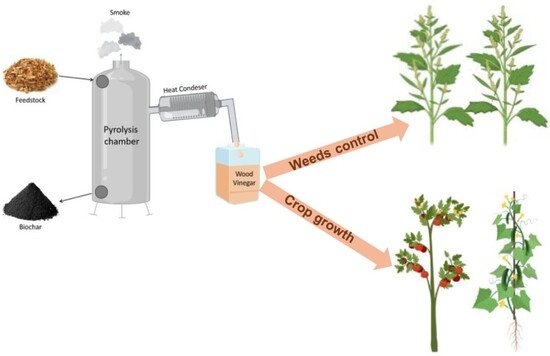
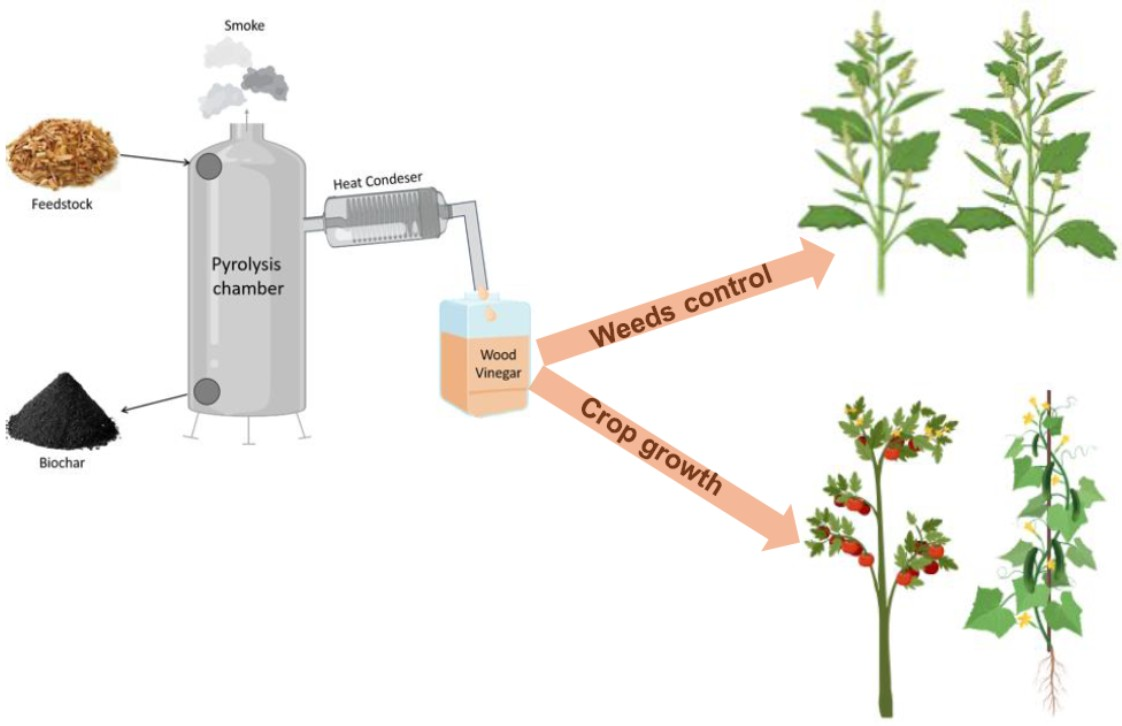
Graphical Abstract

1. Introduction

Weeds are one of the most persistent and costly challenges in agriculture, significantly affecting crop production and farm profitability [1]. These unwanted plants compete with crops for essential resources such as water, nutrients, sunlight, and space, often leading to substantial yield losses [2]. Studies suggest that uncontrolled weed infestations can reduce yields by 30–50%, and in extreme cases up to 100% in major crops like wheat, corn, and soybeans, with some extreme cases resulting in near-total crop failure. Additionally, some weed species can contaminate harvests, either by introducing toxic compounds into forage crops or by reducing the overall quality of the yield, leading to lower market prices or rejected shipments [3]. Beyond direct yield losses, weeds impose heavy financial burdens on farmers through increased production costs. A large portion of these direct and indirect costs comes from herbicide applications, which account for a significant share of global pesticide use [4]. In the United States alone, annual expenditures on weed control exceed several billion dollars per year, encompassing herbicides, mechanical weeding, and labor [5]. The economic impact of weeds is further exacerbated by the rise of herbicide-resistant weeds, such as Palmer amaranth (Amaranthus palmeri) and ryegrass (Lolium multiflorum), which have evolved due to over-reliance on chemical control methods [6]. Resistant weeds force farmers to adopt more expensive herbicides or alternative management strategies, driving up costs even further. The problem extends beyond immediate economic losses, as weeds also contribute to long-term environmental and operational challenges. Excessive herbicide use can degrade soil health, pollute water sources, and harm biodiversity, creating additional costs for remediation and conservation. Invasive weed species can spread beyond farmland, requiring costly management efforts in natural ecosystems and infrastructure. In developing countries, where manual weeding remains common, weeds consume a disproportionate amount of direct labor, sometimes 30–60% of total farm work, placing a heavy burden on smallholder farmers and limiting agricultural efficiency [7].
Overall, weeds represent a major constraint on global food production and agricultural sustainability. Addressing this challenge requires integrated weed management strategies that combine chemical, mechanical, biological, and cultural methods to reduce reliance on any single control method. The widespread use of synthetic herbicides has been a cornerstone of weed management since the mid-20th century, enabling large-scale, efficient crop production. However, their intensive use has led to significant challenges, most notably the evolution of herbicide-resistant weeds [8], along with environmental, economic, and agronomic concerns [9]. Herbicide resistance occurs when weed populations evolve genetic traits that allow them to survive applications of chemicals that were once effective against them. This phenomenon follows the principles of natural selection: repeated exposure to the same herbicide eliminates susceptible individuals while allowing resistant ones to survive, reproduce, and dominate the population. The scale of herbicide resistance is alarming: as of 2024, over 500 unique cases of herbicide-resistant weeds have been documented globally, affecting more than 250 species [8]. Glyphosate, once hailed as a universal solution, now faces resistance in 57 weed species, including economically important ones like Palmer amaranth and waterhemp (Amaranthus tuberculatus). Beyond resistance, heavy reliance on synthetic herbicides poses additional environmental and ecological threats. Prolonged herbicide use may contribute to soil degradation by disrupting microbial communities essential for nutrient cycling and organic matter decomposition. Moreover, water contamination is another critical issue, as herbicide runoff, particularly with chemicals like atrazine and glyphosate, contributes to pollution of rivers, lakes, and especially groundwater [10]. The decline in biodiversity is also a growing concern, as herbicides reduce plant diversity in and around fields, which in turn impacts pollinators, beneficial insects, and wildlife dependent on diverse habitats [11].
Given these challenges, the agricultural sector must shift toward integrated weed management strategies that combine chemical, cultural, mechanical, and biological control methods to create a more sustainable and resilient system. Crop rotation, cover cropping, and precision weed control technologies, such as robotic weeding and AI-driven herbicide applications, can help mitigate resistance development [12]. In response to the challenges posed by synthetic herbicides, including resistance and environmental concerns, there has been growing interest in natural herbicides derived from mineral, microbial and plant sources. These alternatives offer a more ecologically friendly approach to weed control, though their efficacy, cost, and scalability vary. Examples include pelargonic acid, a fatty acid naturally occurring in plants, that when used as a non-selective contact herbicide disrupts cell membranes, causing rapid wilting and necrosis of treated foliage [13]. While it provides rapid burndown of weeds, a mode of action similar to that of acetic acid [14], it lacks systemic action and does not kill roots, making repeat applications necessary for perennial weeds. Much research focuses on essential oils, such as clove oil (eugenol), cinnamon oil, and citronella oil, that exhibit herbicidal properties [15]. These oils are often used in organic horticulture for spot treatments, though their high volatility and cost limit large-scale use. Similarly, extracts from allelopathic plants like sorgoleone from sorghum (Sorghum bicolor) and juglone from walnut trees (Juglans regia) show phytotoxic effects, suppressing weed growth through natural biochemical interactions [16]. While promising, these compounds often require formulation improvements to enhance stability and field efficacy.
In recent years, several studies have investigated the potential of wood vinegar (WV), a by-product of plant biomass subjected to pyrolysis, characterized by an acidic pH and rich in organic acids (especially acetic acid) and phenolic compounds. To date, several studies have been conducted on the effects of WV in agriculture: when used at low concentrations, it may promote plant growth and is therefore widely used commercially [17]. At higher concentrations or in its pure form, it can be used as an insect repellent [18], with antagonistic action against foliar or soil-borne pathogens [19] or, as demonstrated by recent studies, for the control of weeds [20]. However, although the available results are promising, these are still limited to a few weed species without application studies in protected cultivation in Mediterranean environments. Here, with the increasing need for sustainable and eco-friendly practices, finding alternatives to synthetic herbicides is crucial. In this context, the general aim of our study was to evaluate the potential of WV derived from pruning waste to control a broad range of weed species. We first evaluated the effects of WV in a pot experiment, and then extended the study to a full replicated field experiment. WV was extensively chemically characterized and the impact, following soil application, on the growth of two crops, tomato (Solanum lycopersicum) and courgette (Cucurbita pepo), was evaluated. The specific hypotheses of the study were (i) WV has an anti-germination effect when applied to soil; (ii) the phytotoxic effect of WV is concentration-dependent; and (iii) the phytotoxic impact is short-term and does not negatively affect tomato and courgette production.

2. Materials and Methods

2.1. WV Production and Chemical Characterization

The pyrolysis process was conducted at a facility that handles woody pruning waste from apple and pear orchards in Ferrara, Northern Italy. After the soil particles are removed and the woody pruning waste is shredded into pieces smaller than 10 cm, it is slowly pyrolyzed until it reaches a temperature of 800 °C. The process is continuous, with an average residence time of approximately 2 h within the pyrolysis reactor. During pyrolysis, the gases are conveyed into a steel pipe, where they condense, and the WV is gathered in a plastic container underneath. After decanting, the liquid exhibits a brown-orange color.
The following parameters were the focus of the chemical analyses performed by an external accredited laboratory: total organic carbon (method—UNI EN 15936 2012), total acetic acid (method—IS 08.03/161 2017), total propionic acid (method, IS 08.03/161 2017), total phenolic content (method—EPA 3510C 1996 and EPA 8270E 2018), pH (method—APAT CNR IRSA 2060 Man 29 2003), electrical conductivity (method—APAT CNR IRSA 2030 Man 29 2003), total suspended solids (method—APAT CNR IRSA 2090 B Man 29 2003), ammonia nitrogen (method—UNI 11669:2017), sulphates (method—APAT CNR IRSA 4020 Man 29 2003), sulphites (method—APAT CNR IRSA 4150 Man 29 2003), sulphides (method—APHA Standard Methods 4500), chlorides (method—APAT CNR IRSA 4020 Man 29 2003), total phosphorus (method—M.U. 2252:08), nitrates (method—APAT CNR IRSA 4020 Man 29 2003), aluminum (method—EPA 3015A 2007 + EPA 6020B 2014), arsenic (method—EPA 3015A 2007 + EPA 6020B 2014), iron (method—EPA 3015A 2007 + EPA 6020B 2014), manganese (method—EPA 3015A 2007 + EPA 6020B 2014), hydrocarbons (method—UNI EN 14039:2005), and finally acetone (method—EPA 5021A 2014 + EPA 8260D 2018).
In terms of organic metabolites, wood vinegar was extracted using the method in [21]. Briefly, 200 mL of dichloromethane (DCM) was used three times to extract 1 L of wood vinegar. After being dried with anhydrous sodium sulfate (Na2SO4), an aliquot of the resultant extract was vacuum-evaporated in a rotary evaporator at 40 °C. To remove acidic compounds, the remaining 500 mL of DCM was rinsed three times with 100 mL of sodium hydroxide (NaOH). The rinsed extract was then dried as previously mentioned. Mass spectrometric analysis was then used to analyze the crude extract (acidic DCM) and the washed extract (DCM).
At a final concentration of 1 mg/mL, acidic DCM and DCM were reconstituted in methanol (MeOH) of LC-MS quality. An Agilent HP 1260 Infinity Series liquid chromatograph (Agilent Technologies, Santa Clara, CA, USA) equipped with an Adamas C18-X bond column (50 mm × 4.6 mm, 3.5 µm, Sepachrom S.r.l., Milan, Italy) and a quadrupole time-of-flight mass spectrometer (Q-TOF, Agilent Technologies) as well as a diode array detection system (DAD Agilent Technologies) were used with an injection volume of 7 µL for each sample. The samples were characterized in accordance with the procedure in [22]. Gas chromatography–mass spectrometry was also used to evaluate the DCM extract. An aliquot of the extract was derivatized using N,O-bis(trimethylsilyl)trifluoroacetamide (BSTFA) (Fluka, Buchs, Switzerland) and resuspended in ethyl acetate to reach a final concentration of 100 ppm prior to analysis. A 30 min ultrasonic bath (Sonorex, Bandelin electronic GmbH & Co. KG, Berlin, Germany) was used to facilitate the reaction. After that, the sample was put into an Agilent 8890 GC device (Agilent Technologies) that was connected to an Agilent 5977B MSD system. The technique outlined by [22] was used to modify the temperature gradient as well as other chromatographic and spectrometric parameters.

2.2. Application of WV in Pot Experiment

The first preliminary experiment was conducted in controlled conditions using pots to evaluate the ability of soil-applied WV to inhibit weed germination. Therefore, the total number of emerged seedlings was recorded as a global indicator of phytotoxicity, while the detailed botanical identification of individual species was deferred to the subsequent field trials. The soil was taken from a tunnel greenhouse located at the greenhouses of the Department of Agricultural Sciences in Portici (Naples, Southern Italy; 40°48′41″ N; 14°20′34″ E; 65 m a.s.l.) from the first 20 cm and sieved at 2 mm. The soil was categorized as a volcanic Andosol with a pH of 7.95 and electrical conductivity of 0.3189 dS/m with a sandy texture with 47.0% sand, 32.0% silt, and 21.0% clay. Chemical analysis recorded a C/N ratio of 15.74, a total nitrogen content of 1.33 g/kg, and an organic carbon content of 20.94 g/kg. The soil’s exchangeable cations included potassium (0.13 meq/100 g), magnesium (4.09 meq/100 g), calcium (13.7 meq/100 g), sodium (0.08 meq/100 g), and 119 g/kg of total CaCO3 and 26.9 mg/kg of accessible phosphorus (P2O5) and a bulk density of 1.41 g/cm3.
The sieved soil was then placed in 20 cm diameter pots and irrigated at field capacity to promote germination of the seeds present in the seed bank. At this point the soils were treated with WV applied to the soil surface by sprinkling in quantities of 0.8 L per m−2 at three concentrations: pure (100%) and diluted at 50% and 10% with distilled water. The experimental design included three treatments (WV 100%; WV 50%; WV 10%) plus the water control replicated ten times for a total of forty pots. The WV was applied only once at the beginning of the cycle and the pots were maintained in a greenhouse at +22 °C during the day and +16 °C at night. After 21 days the number of emerged seedlings was recorded for each pot.

2.3. Application of WV in Field Experiments

Based on the promising results obtained with the pot tests, experiments were conducted in real conditions in tunnel greenhouses. The field experiment was conducted over a period of ten months, from October 2023 to July 2024, in the greenhouses of the Department of Agricultural Sciences previously described. The site has a Mediterranean climate with a mean annual temperature of 16.5 °C, with the highest monthly temperature in July of 28.5 °C and the lowest in January of 9.5 °C. Environmental conditions inside the greenhouse were monitored throughout the experiment using an Opi evja-sensor (Evja S.r.l., Rome, Italy) which recorded temperature, relative humidity and water pressure deficit at hourly intervals (https://www.evja.eu/). Temperature ranged between 2 °C and 38 °C, with a daylight intensity of 1220 μmol/m2/s, calculated as the average of measurements taken at noon on ten sunny days. The daily light integral over the experimental period was estimated at 20 mol m−2 day−1.
The first experiment was conducted in autumn 2023 in experimental plots measuring 5 m × 2 m with four treatments, WV 100%, WV 50%, WV 10%, and the water control, with three replicates for a total of twelve plots. The soil was worked by milling to eliminate previously present weeds and levelled. On bare soil, treatments were applied by spray application with an electric shoulder pump (model Stocker 10 L Li-ion, Stocker S.r.l., Bolzano (BZ), Italy) in quantities of 0.8 L m−2. At this point, the plots were irrigated to field capacity every four days, and after 30 days the presence of weeds was quantified through a full-area survey of each plot. In detail, all individual plants of each species within each plot were counted (full-area assessment), and subsequently, the aboveground biomass was collected. The biomass was dried in an oven at +80 °C for 5 days and measured using a precision balance, separately for each plant species.
After the first cycle, the experiment was replicated with the same methods in winter (February 2024) and spring (April 2024) in the same tunnel greenhouse for three cycles in total. At the end of each cycle, the number of weeds and the dry biomass were quantified, always dividing by the different plant species.

2.4. Crop Response to WV in Field Conditions

The aim of the last experiment was to evaluate the possible effects of residual phytotoxicity due to three consecutive applications of WV. To this end, tomato and courgette crops were grown in the plots. The soil was worked with a rotary tiller in the first 15 cm and levelled. Subsequently, 25-day-old seedlings of the two species were transplanted with a spacing of 30 m × 50 cm for tomato and 50 m × 100 m for courgette. The crops were managed using standard agronomic practices for fertilization, irrigation and phytosanitary management without differences between the plots that had been previously treated with WV at different concentrations. Crop growth was assessed after 90 days for courgette and 120 for tomato. Production was quantified through the staggered harvesting of tomato berries and courgettes carried out every four days from the first harvest until the end of the cycle.

2.5. Randomization and Data Analysis

A randomized complete block design (RCBD) was adopted for both pot and plot experiments. In the pot experiment, four blocks correspond to the benches. The experiment comprised 40 pots in total, with four treatments (T1: water control; T2: wood vinegar 10% dilution; T3: wood vinegar 50% dilution; T4: wood vinegar undiluted (100%)), each replicated ten times. Treatment allocation to pots within each block was randomized using the R statistical environment (R Core Team, version 4.5.3) with the package agricolae. The function design.rcbd() was applied to generate a randomized arrangement of the treatments across the four benches. The resulting allocation table was subsequently used for the physical arrangement of pots in the greenhouse (Figure S1). For the plot experiment in field conditions, the same randomization approach was used with three blocks corresponding to separate soil parcels, each containing one of the four treatments with a total of three replicates each.
Three datasets were generated for statistical analyses: The first dataset was derived from the pot germination tests, which assessed the soil seed bank response in terms of the number of weed seedlings emerged under the four treatments described above. As these data were count-based, significance was evaluated using the non-parametric Kruskal–Wallis test. The second dataset was derived from the field experiment conducted over three cropping cycles. Count variables related to weed emergence in the field were analyzed using a generalized linear model (GLM), while continuous variables were assessed by means of a one-way ANOVA. The third dataset included biomass yield and crop yield of tomato and courgette, which were analyzed in the same way as the continuous variables of the field experiment (one-way ANOVA). For all datasets, assumptions of normality were verified using the Shapiro–Wilk test. Continuous variables were log-transformed. Variables that did not meet normality assumptions were analyzed with the non-parametric Kruskal–Wallis test. Whenever significant differences were detected, post hoc comparisons were carried out using Duncan’s multiple range test, with a significance level set at p < 0.05. All analyses were performed in the R statistical environment (version 4.5.3).

3. Results

3.1. WV Chemistry

The wood vinegar was strongly acidic, with a pH of 3.2 and an electrical conductivity of 1389.10 μS cm−1. The analysis found a concentration of 54.00 mg L−1 of phenol, 27,840.16 mg L−1 (2.78%) of acetic acid, and 72,447.01 mg L−1 (7.24%) of propionic acid. LC-MS analysis of the organic extract revealed 54 chemicals, two of which were tentatively identified through comparison with an internal database for plant secondary metabolites, including nicotinic acid (commonly known as niacin or vitamin B3) and malvalic acid. The DCM extract of wood vinegar was also analyzed by using GC-MS. This analysis revealed 133 chromatographic peaks, 23 of which were recognized by comparing their mass spectra to the NIST library and retention index. The substances found belonged to several classes, including phenolic derivatives (guaiacol, syringol, eugenol, catechol, etc.), fatty acids (oleic, stearic, and palmitic acids), polyalcohols (glycerol), and pyrimidine derivatives (Table 1).

3.2. WV in Pot Experiment

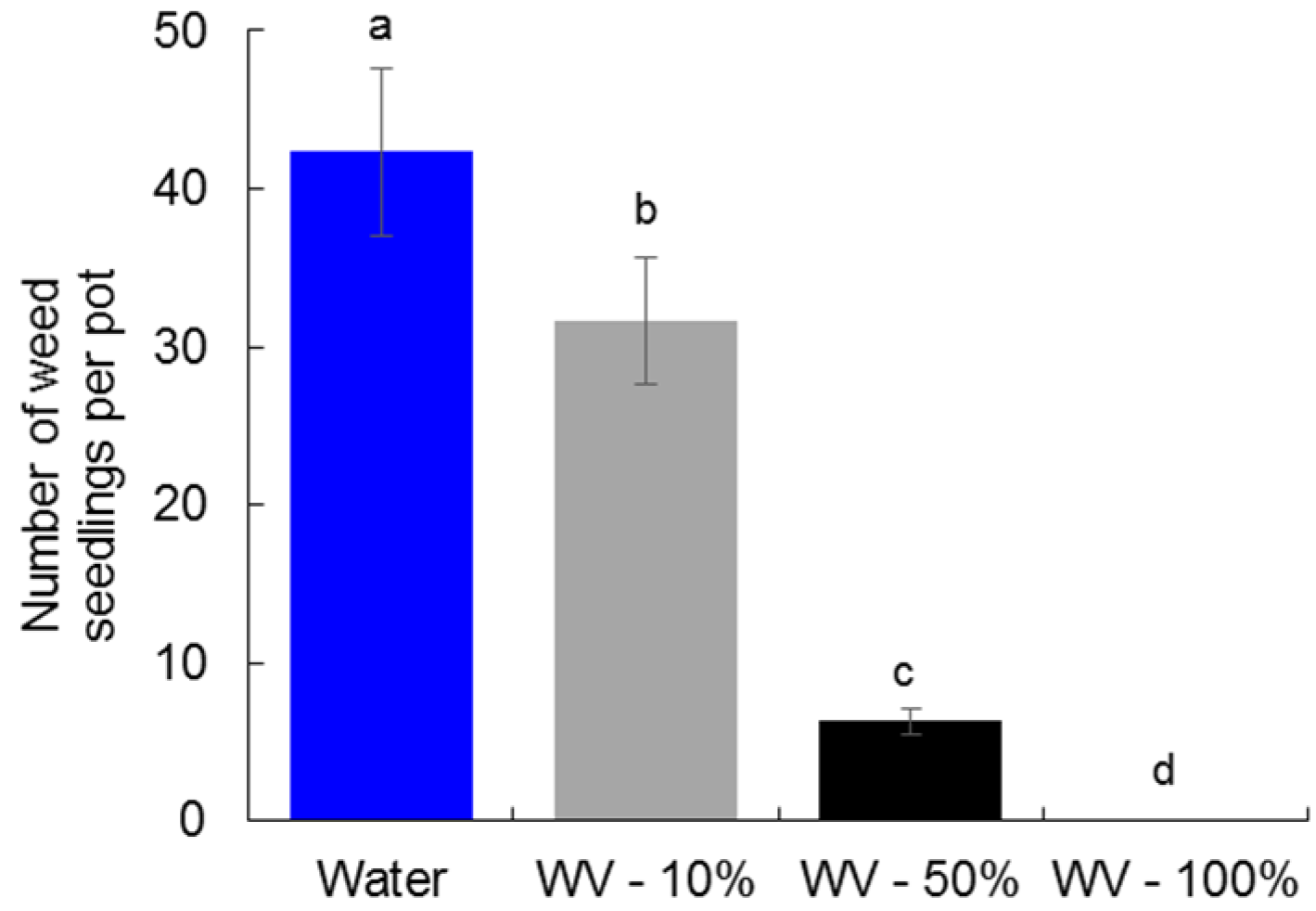
WV applied in pots had a highly significant concentration-dependent effect in inhibiting seedling emergence from the seed bank (Kruskal–Wallis, p < 0.001, Table 2). In fact, in the water control after 21 days, 42.3 seedlings were present, while 31.6 were detected in the pots treated with WV at a low concentration (10%) (Figure 1). At higher concentrations the inhibition was much more marked with only 6.3 seedlings when treated with 50% WV and no seedlings with undiluted WV.

3.3. WV in Field Conditions

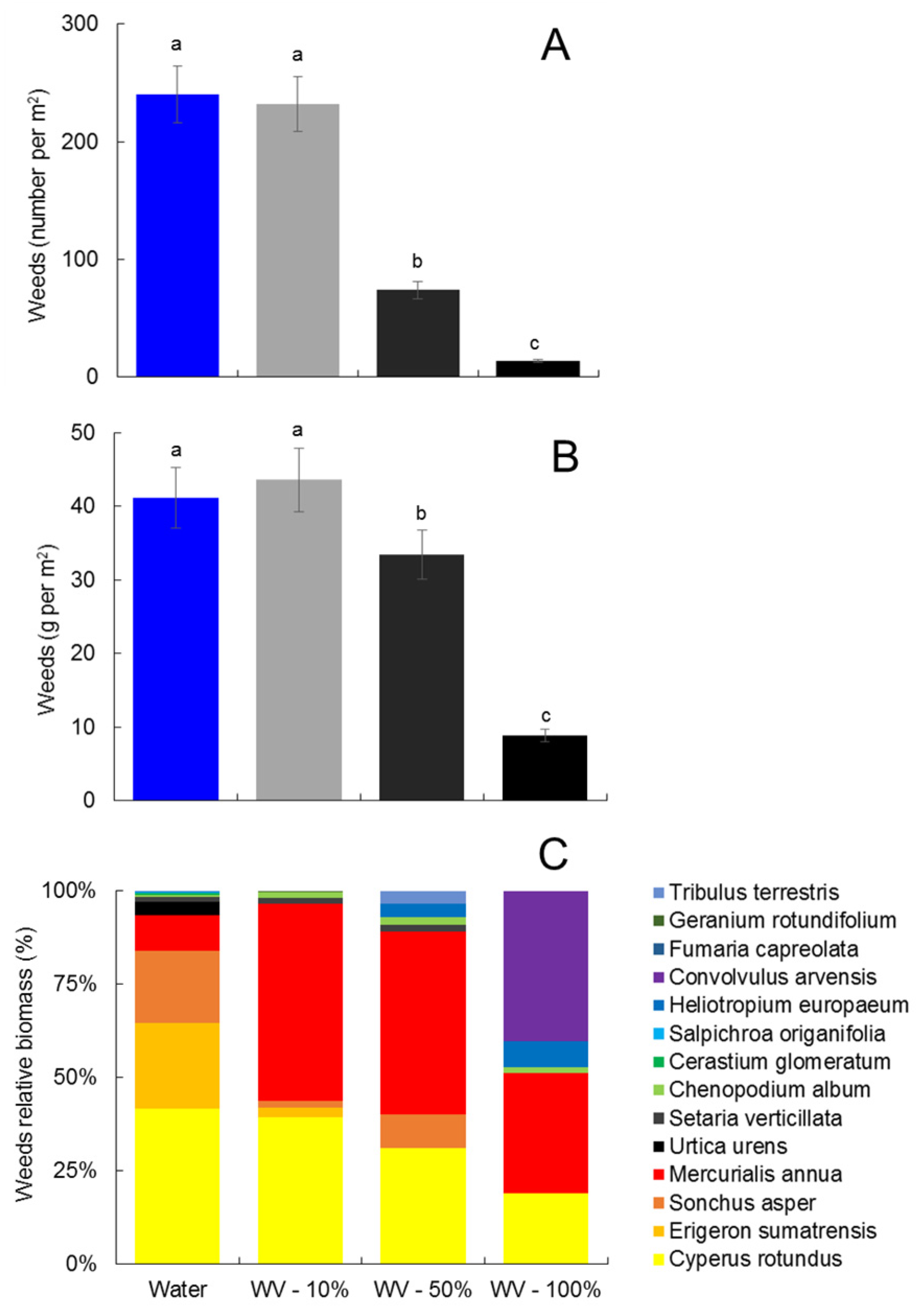
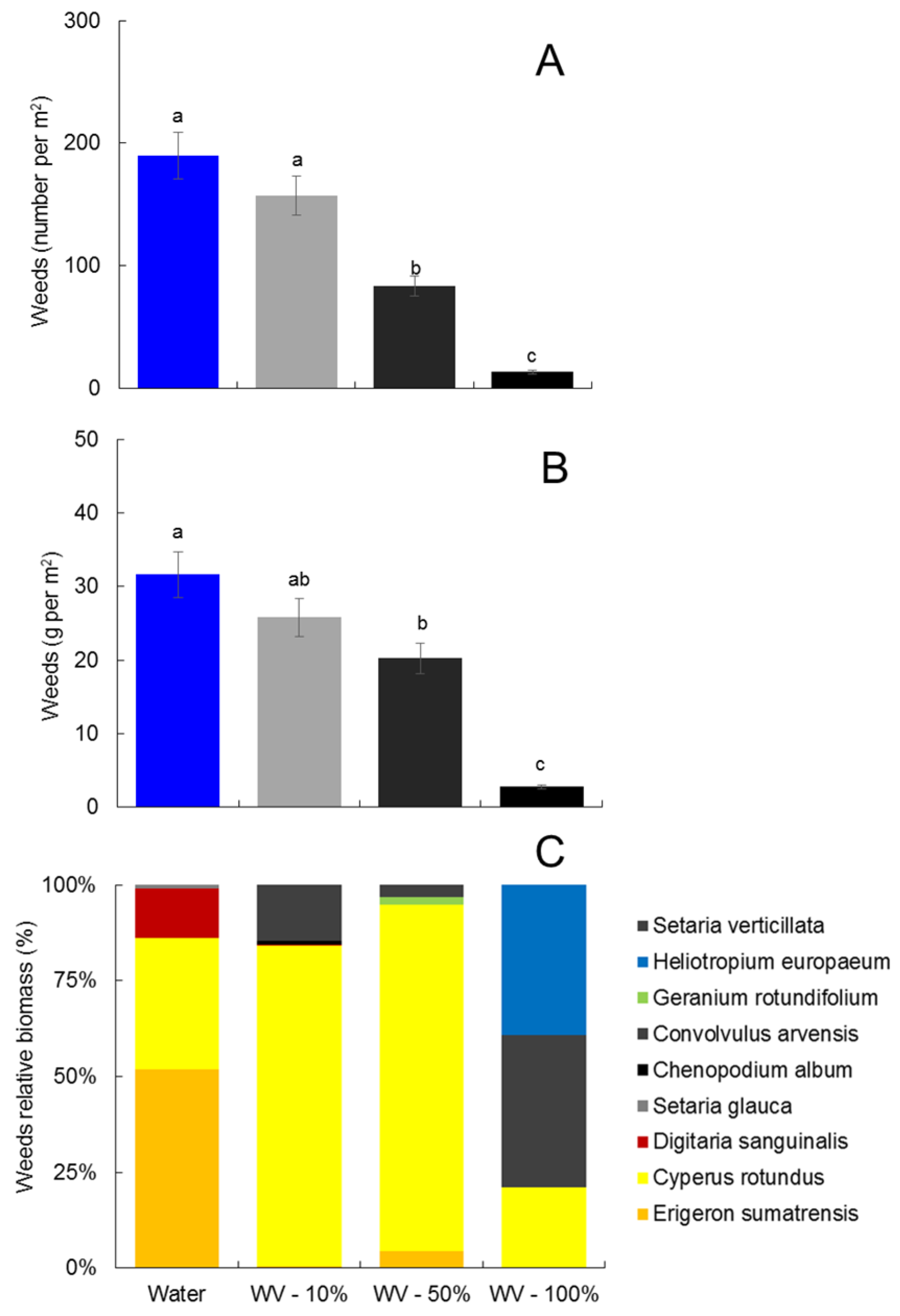
In the first cycle of application in the field, WV determined a concentration-dependent inhibition of the development of weeds both in terms of number of plants and in terms of aerial biomass (Table 3). At the lowest concentration (10%), no inhibitory effects were detected compared to the control, while WV at 50% reduced the number of weeds by 69% and the biomass by 19%. At the highest concentration, the inhibition of the number of weeds compared to the control was 94% while for the biomass it was 78% (Figure 2A,B). The application of WV also modified the floristic composition of the weeds (Figure 2C). The relative abundance of some species such as Sonchus asper (L.) Hill, Erigeron sumatrensis Retz. and to a lesser extent Cyperus rotundus L. decreased with the use of WV. On the contrary, some species, although reduced in absolute number and biomass, increased in relative abundance, in particular Mercurialis annua L. and Convolvulus arvensis L.
Even in the second round of applications, WV resulted in a concentration-dependent inhibition of weed number and biomass (Table 3). Again, at the lowest concentration (10%), WV showed no inhibition of weeds. In contrast, WV at 50% reduced the number of weeds by 56% and the biomass by 36% compared with the control. At full concentration, the inhibition of the number of weeds compared to the control was 93% while for the biomass it was 91% (Figure 3A,B). Also, the relative abundance of weed species was affected, with Erigeron sumatrensis L. and Digitaria sanguinalis (L.) Scop. decreasing with the use of WV. On the contrary, some species, although reduced in absolute number and biomass, increased in relative abundance, in particular Convolvulus arvensis L. and Heliotropium europaeum L. Finally, C. rotundus showed a relative increase with the use of WV at 10% and 50% but a decrease when WV was used at the maximum concentration (Figure 3C).
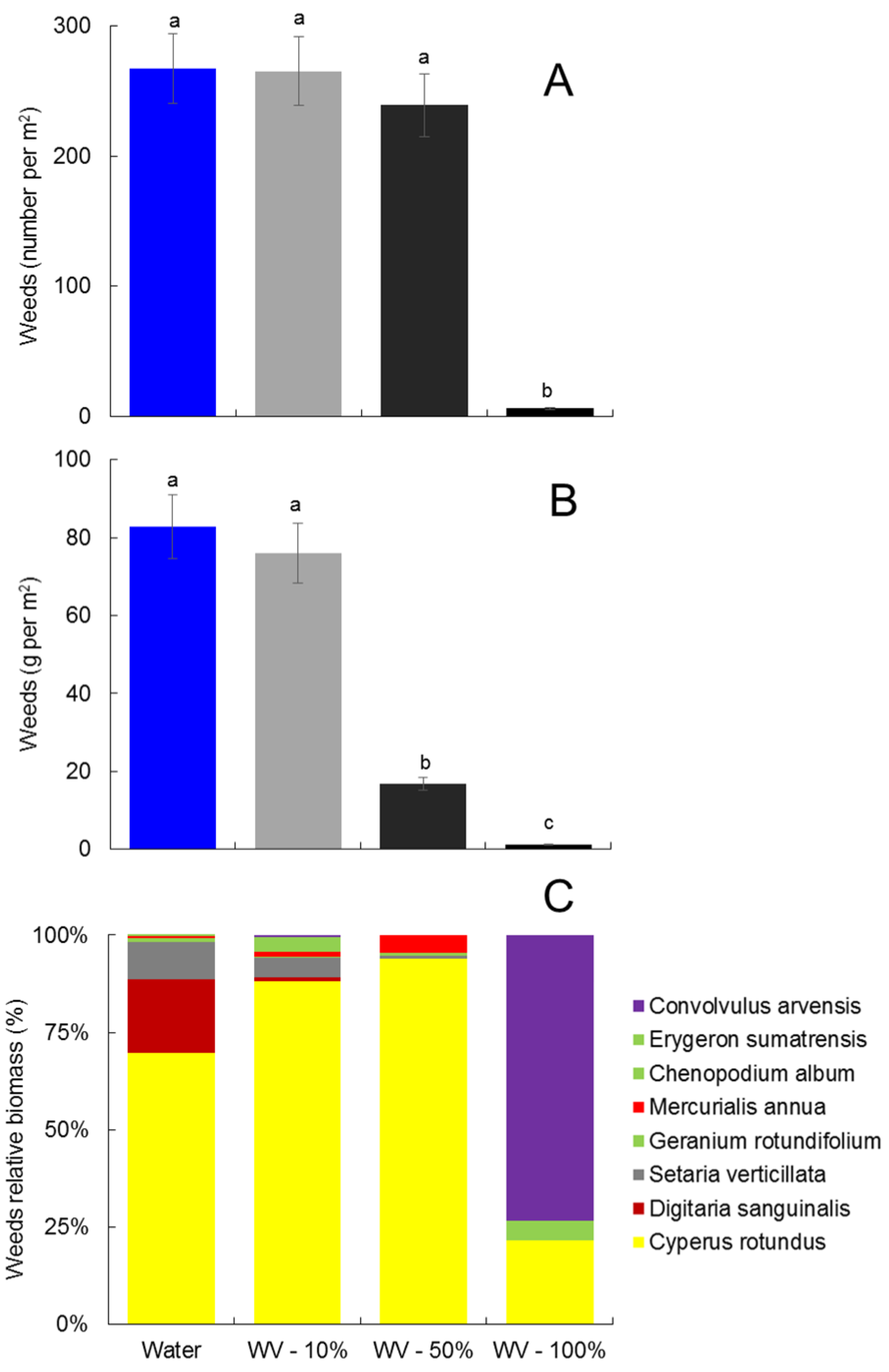
In the third cycle conducted in the spring period, the application of WV demonstrated a significant reduction in the number of weeds only at the highest concentration (Table 3, Figure 4A). As regards biomass, WV at a concentration of 10% had no effect while an inhibition of 79% was detected for WV at 50% and 98% in the case of the product used undiluted (Figure 4B). The weed community in the spring period was dominated by C. rotundus, both in the control and in the soil treated with WV at 10% and 50%, while this weed reduced its relative abundance in the case of the treatment with WV at 100% (Figure 4C). D. sanguinalis and Setaria verticillata (L.) P. Beauv., two weeds abundant in the control, disappeared in the soils treated with WV at all concentrations. Finally, Chenopodium album L. and C. arvensis were the only weed species that increased their relative abundance in soil treated with 100% WV.

3.4. Crop Response to WV in Field Conditions

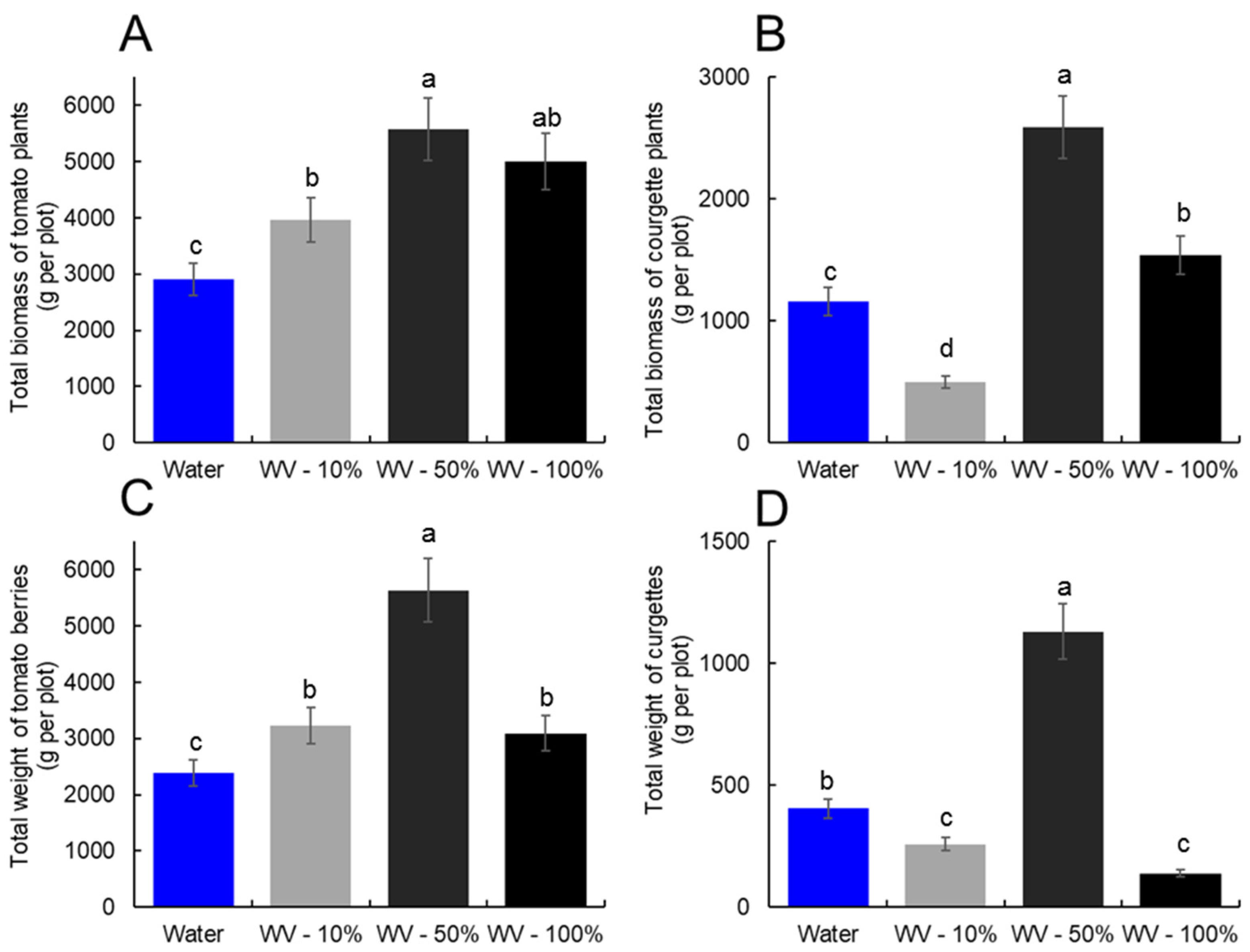
The investigation of the residual effects of three consecutive applications of WV on tomato and courgette crops revealed significant effects on both total plant biomass and fruit yield (Table 4, Figure 5). For tomato plants, the total biomass (Figure 5A) was notably enhanced by WV application. Specifically, the WV 50% treatment resulted in the highest total biomass, significantly exceeding both the control (water) and the WV 10% and WV 100% treatments. A similar trend was observed for the total weight of tomato berries (Figure 5C), where the WV 50% concentration led to the highest production. The WV 10% treatment also showed an increase in biomass and yield compared to the control, while the WV 100% treatment, although higher than the control in biomass, exhibited a reduced yield compared to WV 50%. Courgette plants also demonstrated a positive response to WV application. Total biomass (Figure 5B) was maximized with the WV 50% treatment, which resulted in a substantial increase compared to the control and WV 10%. The WV 100% treatment showed an intermediate effect, still promoting biomass accumulation compared to the control but less effectively than the 50% concentration. The total weight of courgettes (Figure 5D) followed a similar pattern, with the WV 50% treatment yielding the highest production. Interestingly, the WV 10% treatment led to a slight reduction in courgette weight compared to the control, and the WV 100% treatment showed the lowest production among all WV concentrations, significantly lower than the WV 50% and even below the control. Overall, the results suggest that a 50% concentration of WV optimized both the vegetative growth and fruit production in both tomato and courgette crops, indicating a beneficial effect at this specific dilution. Higher concentrations (100%) appeared to be detrimental to yield in courgette, while lower concentrations (10%) showed variable effects.

4. Discussion

4.1. Wood Vinegar for Weed Control

The results of this study demonstrate a clear consistency between controlled environment experiments and field applications. While the preliminary pot experiment established a robust baseline by focusing on the total reduction in the weed community, the subsequent field trials provided a more granular understanding through detailed floristic analysis. This two-step experimental design reveals that WV acts as a potent non-selective inhibitor of the seed bank, though its practical efficacy is modulated by the specific reproductive strategies of the weeds, such as the differences between annual and perennial species.
In line with previous studies, wood vinegar has shown an inhibitory effect on germination and growth in the seedling stage [20,23]. The effect of wood vinegar is concentration-dependent with weed inhibition close to 100% when applied at the full concentration and then progressively decreasing when diluted. Consistent with previous studies [19,24,25], the phytotoxic action was found to be concentration-dependent with maximum efficacy when applied undiluted. Studies conducted on seed germination in laboratory conditions in the absence of soil, which represent the majority of studies in the literature, have revealed that the phytotoxic action is manifested even at relatively low concentrations between 1% and 10%. Substantial phytotoxic effects have also been detected on adult plants when applied via foliar application, although the concentration required is usually higher [24]. Finally, the few studies where WV has been applied to the soil with anti-germination action demonstrate that the inhibitory action is detected only when used at high concentrations (50% or 75%), with the best results obtained with the undiluted product. In our experiment, both in controlled conditions in pots and in open fields, weed inhibition was obtained with the maximum concentration and with an application of 0.8 L m−2. This dosage is undoubtedly high, equivalent to 8000 L ha−2, but comparable to what was reported by [24] in Mediterranean ruderal weed vegetation. Moreover, it is important to consider that our study was conducted under protected horticultural conditions, where treated areas are relatively small and applications can be localized (e.g., pre-transplant or inter-row treatments), making such volumes more feasible. Nevertheless, the high dosages required to achieve total weed control are likely to restrict the practical use of WV to high-value crops, small-scale horticultural systems, or nursery conditions. Future research should therefore focus on optimizing application rates and developing more efficient formulations or precision delivery systems to reduce the volume required while maintaining herbicidal efficacy.
The lower efficacy of WV in the presence of soil is consistent with what has been reported in the literature for many allelopathic substances. In fact, in the presence of soil, organic molecules with phytotoxic action are more subject to processes that reduce their abundance or efficacy, such as microbial degradation, adsorption by clay minerals and organic matter, and possible leaching [23,26].
From the point of view of the mechanisms of action against weeds, WV is considered a contact herbicide as it determines the inhibition of seed germination or the drying of tissues that come into direct contact with it, which lose turgidity and become dehydrated [25,27]. This action is largely attributable to the most abundant organic compounds in WV, i.e., acetic and propionic acid. Acetic acid, a short-chain fatty acid, is known for its contact, non-systemic, and non-selective phytotoxic action against weeds when applied at high concentrations, often above 20% [28]. The study in [28] reported that acetic acid has strong herbicidal action when used at both 20% concentration and at rates close to 935 L ha−1. This compound is marketed as an herbicide in many countries, although in Italy and Europe it is not registered as a pesticide. The acetic acid content of WV is much lower than that present in products used as herbicides and varies between 2% and 5%, in relation to the starting feedstock and the pyrolysis conditions [24,29]. In our case the content was 2.7%, within the range observed in previous studies. Although the acetic acid content of WV is lower than that of products that use it in its pure form, the herbicidal action remains high. Some authors have hypothesized that other compounds present in WV such as phenols, ketones, and aldehydes may have additive or synergistic effects by increasing the herbicidal action [23]. However, the specific phytotoxic contribution of individual compounds identified by GC–MS was not directly assessed in this study and requires further investigation. The observed activity is therefore likely the result of the combined and potentially synergistic action of multiple constituents present in wood vinegar. Further research is needed to isolate and test individual compounds or defined mixtures in order to identify the key substances responsible for weed control.
Moreover, as demonstrated by our chemical analyses, WV exhibits a very low pH and it is well known that acidity enhances the phytotoxicity of some allelochemical compounds such as organic acids and phenols [30]. The study in [30] reported that propionic acid is particularly phytotoxic at low pH. In our WV, propionic acid is particularly abundant, and this, combined with the low pH, could contribute to the observed herbicidal effect. Future studies could investigate possible synergies between the different compounds, i.e., different acids and phenols, with the aim of identifying combinations that allow the reduction in application rates while maintaining sufficient effects and optimize treatment efficacy with minimum cost. Trace elements such as Al, As, and Fe were detected in wood vinegar at relatively low concentrations. While Fe represents an essential micronutrient for plant growth, elements such as Al and As may pose toxicological concerns at elevated levels. However, their effective concentration in soil is expected to be substantially reduced following application, due to dilution as well as soil-mediated processes such as adsorption, complexation with organic matter, and immobilization. Nevertheless, further studies are required to assess the environmental safety and regulatory compliance of wood vinegar under different soil and cropping conditions.
WV, as well as its main constituent acetic acid, is considered a contact, non-selective herbicide. However, previous studies have revealed differences in the resistance of some weeds to WV treatment. In detail, perennial grasses are on average more resistant than annual grasses to contact herbicides because underground survival structures such as rhizomes and tubers, which do not come into contact with the herbicide, survive and are subsequently able to form new individuals. For example, the application of WV derived from pine wood and applied in open fields on ruderal and nitrophilous vegetation caused the disappearance, within a few months, of many annual species with the subsequent dominance of a few more resilient perennial species such as Cynodon dactylon and Medicago sativa [25]. In another study, individuals of the tree Acacia dealbata, although damaged on the foliage by the application of WV, were able to form new shoots requiring repeated interventions for better control [24]. In this context, our in-depth analysis on the floristic composition of the infesting species has given interesting indications about the action of the WV. At the maximum concentration, the phytotoxic effect on the number of plants and total biomass is significant for all species, suggesting a non-specific action typical of non-selective herbicides. However, the species-level analysis reveals that some species, although largely inhibited, are able to develop at a very low density. Among these, we found C. rotundus and C. arvensis. The perennial C. rotundus, considered one of the worst weeds on a global scale [31], could be more resistant to WV thanks to the tubers that are also found at several centimeters of depth and therefore are not reached by the distillate application. Despite this, the application of the distillate has reduced, in absolute terms, the abundance of this important weed. A specific study that investigates the impact of the distillate on the survival of tubers and propagation of this species will be particularly useful. C. arvense was also found to be more resistant than many other species. This is a rhizomatous and climbing or creeping herbaceous perennial weed, and such traits could partially explain the tolerance to WV. In line with previous studies, most annual species were found to be more sensitive to WV treatment. For example, the broadleaf S. asper and the grass D. sanguinalis disappeared from the floristic composition with applications at 50% and 100%. In this context, M. annua is an exception, as in the winter cycle it became the most abundant species when WV was applied at 10% to 50%, suggesting a certain tolerance. Future studies may investigate the causes underlying this tolerance.

4.2. Wood Vinegar and Crop Performance

An aspect of great relevance, but still insufficiently explored, is the potential residual phytotoxic effect of WV when applied to soil. Considerations related to its chemical composition, with organic acids as the main components, suggest that rapid degradation in soil may occur, as acetic acid and other compounds are subject to biodegradation [32]; however, direct measurements of soil residues were not performed in this study, and therefore such assumptions should be considered preliminary.
Consistent with this interpretation, both tomato and courgette growth and yield were not negatively affected when grown in soils treated three times with WV, even at the highest concentration. In some cases, the biometric indices suggested a tendency toward increased plant development in treated plots compared to the control. More specifically, a unimodal response appeared to occur in relation to the concentration applied, with maximum growth observed at 50% WV. In this context, the potential biostimulant effect of WV has been reported in previous studies, although the mechanisms underlying this response are not yet fully understood. Smoke water derived from burned plant material has shown concentration-dependent effects, with higher concentrations producing phytotoxic responses and lower concentrations leading to neutral or stimulatory effects [33,34,35]. The nature of this dual and contrasting action is likely complex and related to the chemical composition of WV. Several mechanisms may contribute to the observed growth-promoting effects of WV at intermediate or low concentrations. First, low doses of organic acids and phenolic compounds may act as signaling molecules, triggering physiological responses in plants similar to those induced by plant hormones. Second, the application of WV to soil may stimulate microbial activity by providing a source of labile organic carbon, thereby enhancing nutrient mineralization and availability. Third, certain compounds present in WV may improve root development and nutrient uptake efficiency, indirectly supporting plant growth. These mechanisms are consistent with the hormesis phenomenon, whereby substances that are inhibitory at high concentrations can exert stimulatory effects at lower doses. However, the relative contribution of these processes remains unclear and requires further investigation. Accordingly, WV may exhibit a dose-dependent response, with phytotoxic effects at higher concentrations and potential stimulatory effects at lower dilutions. This interpretation is consistent with previous studies on wood vinegar and biochar [19,36]. While the biostimulant effect of WV is typically reported at much higher dilution rates when applied directly to plants, in this study a similar trend was observed at intermediate concentrations when applied to soil. This difference may be linked to soil-mediated processes, including microbial transformation of WV components. Some studies have reported an increase in biomass and microbial activity following WV application, likely due to the input of labile organic carbon [37,38]. However, longer-term studies and direct measurements of soil organic acid dynamics are required to confirm the persistence, degradation, and potential residual effects of WV under field conditions. Gaining insight into these processes will help clarify the mechanisms underlying the observed responses and support the development of more efficient and sustainable application strategies.

5. Conclusions

Wood vinegar obtained from pruning waste through pyrolysis showed strong efficacy in controlling weeds under controlled conditions, an effect consistently confirmed across three consecutive trials under greenhouse conditions. The observed herbicidal activity is likely related to its chemical composition, particularly the presence of acetic acid in combination with other organic acids and phenolic compounds, which may act synergistically. Our results suggest that wood vinegar could represent a promising alternative for weed management, especially when applied to bare soil prior to sowing in protected horticultural systems. In addition, short-term observations indicated no negative effects on subsequent tomato and courgette growth, with some indications of enhanced plant performance at intermediate concentrations. However, these findings should be considered preliminary, as the study was conducted over a single growing cycle and direct measurements of soil organic residues were not performed. Further research is therefore needed to evaluate long-term effects, clarify the persistence and degradation dynamics of wood vinegar in soil, and optimize application strategies to improve its agronomic feasibility and sustainability.

Supplementary Materials

The following supporting information can be downloaded at https://www.mdpi.com/article/10.3390/horticulturae12050526/s1, Figure S1: Arrangement of pots in experimental design following randomized complete block design (RCBD). Randomization of pots was obtained by means of function design.rcbd() in R, version 4.5.3 environment; Figure S2: Arrangement of plots in field experimental design following randomized complete block design (RCBD). Randomization of plots was obtained by means of function design.rcbd() in R, version 4.5.3 environment.

Author Contributions

Conceptualization, G.B. and G.I.; methodology, G.B., A.C., G.A. and G.I.; software, M.Z. and M.I.; validation, G.B., M.I. and G.I.; formal analysis, M.I., A.C., G.A., M.Z. and G.I.; investigation, G.B. and G.I.; resources, G.B., R.M. and G.I.; data curation, G.B. and G.I.; writing—original draft preparation, G.B., M.Z. and G.I.; writing—review and editing, G.B., M.I., A.C., G.A., M.Z., R.M. and G.I.; supervision, G.B., M.Z., R.M. and G.I. All authors have read and agreed to the published version of the manuscript.

Funding

This research did not receive any specific grant from funding agencies in the public, commercial, or not-for-profit sectors.

Data Availability Statement

The authors confirm that the data supporting the findings of this study are available within the article.

Acknowledgments

The authors would like to thank Tomaso Bertoli (CEO of BioKW) for providing the wood vinegar used in this study.

Conflicts of Interest

The authors declare no conflicts of interest.

References

  1. Peters, K.; Breitsameter, L.; Gerowitt, B. Impact of climate change on weeds in agriculture: A review. Agron. Sustain. Dev. 2014, 34, 707–721. [Google Scholar] [CrossRef]
  2. Horvath, D.P.; Clay, S.A.; Swanton, C.J.; Anderson, J.V.; Chao, W.S. Weed-induced crop yield loss: A new paradigm and new challenges. Trends Plant Sci. 2023, 28, 567–582. [Google Scholar] [CrossRef] [PubMed]
  3. Ikeda, M.; Nishi, T.; Asai, M.; Muranaka, T.; Konuma, A.; Tominaga, T.; Shimono, Y. The role of weed seed contamination in grain commodities as propagule pressure. Biol. Invasions 2022, 24, 1707–1723. [Google Scholar] [CrossRef]
  4. Shaner, D.L.; Beckie, H.J. The future for weed control and technology. Pest Manag. Sci. 2014, 70, 1329–1339. [Google Scholar] [CrossRef] [PubMed]
  5. Chauhan, B.S. Grand challenges in weed management. Front. Agron. 2020, 1, 3. [Google Scholar] [CrossRef]
  6. Ward, S.M.; Webster, T.M.; Steckel, L.E. Palmer amaranth (Amaranthus palmeri): A review. Weed Technol. 2013, 27, 12–27. [Google Scholar] [CrossRef]
  7. Rao, A.N.; Singh, R.G.; Mahajan, G.; Wani, S.P. Weed research issues, challenges, and opportunities in India. Crop Prot. 2020, 134, 104451. [Google Scholar] [CrossRef]
  8. Peterson, M.A.; Collavo, A.; Ovejero, R.; Shivrain, V.; Walsh, M.J. The challenge of herbicide resistance around the world: A current summary. Pest Manag. Sci. 2018, 74, 2246–2259. [Google Scholar] [CrossRef]
  9. Parven, A.; Meftaul, I.M.; Venkateswarlu, K.; Megharaj, M. Herbicides in modern sustainable agriculture: Environmental fate, ecological implications, and human health concerns. Int. J. Environ. Sci. Technol. 2025, 22, 1181–1202. [Google Scholar] [CrossRef]
  10. Jorfi, S.; Rahim, F.; Rahmani, A.; Jaafarzadeh, N.; Ghaedrahmat, Z.; Almasi, H.; Zahedi, A. Herbicide residues in water resources: A scoping review. Avicenna J. Environ. Health Eng. 2021, 8, 126–133. [Google Scholar] [CrossRef]
  11. Naz, S.; Iqbal, S.S.; Manan, A.; Chatha, M.; Zia, M. The web of life: Role of pesticides in the biodiversity decline. Int. J. For. Sci. 2023, 3, 72–94. [Google Scholar]
  12. Gerhards, R.; Andujar Sanchez, D.; Hamouz, P.; Peteinatos, G.G.; Christensen, S.; Fernandez-Quintanilla, C. Advances in site-specific weed management in agriculture—A review. Weed Res. 2022, 62, 123–133. [Google Scholar] [CrossRef]
  13. Loddo, D.; Jagarapu, K.K.; Strati, E.; Trespidi, G.; Nikolić, N.; Masin, R.; Otto, S. Assessing herbicide efficacy of pelargonic acid on several weed species. Agronomy 2023, 13, 1511. [Google Scholar] [CrossRef]
  14. Gettys, L.A.; Thayer, K.L.; Sigmon, J.W. Evaluating the effects of acetic acid and d-limonene on four aquatic plants. HortTechnology 2021, 31, 225–233. [Google Scholar] [CrossRef]
  15. De Mastro, G.; El Mahdi, J.; Ruta, C. Bioherbicidal potential of the essential oils from Mediterranean Lamiaceae for weed control in organic farming. Plants 2021, 10, 818. [Google Scholar] [CrossRef]
  16. De Melo, A.C.; dos Santos, T.E.B.; de Medeiros, L.B.; da Costa, G.D.; Cardoso, N.C.; Ferreira-Júnior, R.J.; Matos, F.S. Allelochemicals in sorghum (Sorghum bicolor (L.) Moench) as bio-inputs for weed control. Allelopath. J. 2025, 64, 2. [Google Scholar] [CrossRef]
  17. Zhu, K.; Gu, S.; Liu, J.; Luo, T.; Khan, Z.; Zhang, K.; Hu, L. Wood vinegar as a complex growth regulator promotes the growth, yield, and quality of rapeseed. Agronomy 2021, 11, 510. [Google Scholar] [CrossRef]
  18. Jesu, G.; Laudonia, S.; Bonanomi, G.; Flematti, G.; Germinara, S.G.; Pistillo, M.; Vinale, F. Biochar-derived smoke waters affect Bactrocera oleae behavior and control the olive fruit fly under field conditions. Agronomy 2022, 12, 2834. [Google Scholar] [CrossRef]
  19. Iacomino, G.; Idbella, M.; Staropoli, A.; Nanni, B.; Bertoli, T.; Vinale, F.; Bonanomi, G. Exploring the potential of wood vinegar: Chemical composition and biological effects on crops and pests. Agronomy 2024, 14, 114. [Google Scholar] [CrossRef]
  20. Chu, L.; Liu, H.; Zhang, Z.; Zhan, Y.; Wang, K.; Yang, D.; Yu, J. Evaluation of wood vinegar as an herbicide for weed control. Agronomy 2022, 12, 3120. [Google Scholar] [CrossRef]
  21. Flematti, G.R.; Ghisalberti, E.L.; Dixon, K.W.; Trengove, R.D. Identification of alkyl substituted 2H-furo[2,3-c]pyran-2-ones as germination stimulants present in smoke. J. Agric. Food Chem. 2009, 57, 9475–9480. [Google Scholar] [CrossRef]
  22. Staropoli, A.; Vassetti, A.; Salvatore, M.M.; Andolfi, A.; Prigigallo, M.I.; Bubici, G.; Scagliola, M.; Salerno, P.; Vinale, F. Improvement of nutraceutical value of parsley leaves (Petroselinum crispum) upon field applications of beneficial microorganisms. Horticulturae 2021, 7, 281. [Google Scholar] [CrossRef]
  23. Liu, X.; Zhan, Y.; Li, X.; Li, Y.; Feng, X.; Bagavathiannan, M.; Yu, J. The use of wood vinegar as a non-synthetic herbicide for control of broadleaf weeds. Ind. Crops Prod. 2021, 173, 114105. [Google Scholar] [CrossRef]
  24. Aguirre, J.L.; Baena, J.; Martín, M.T.; Nozal, L.; González, S.; Manjón, J.L.; Peinado, M. Composition, ageing and herbicidal properties of wood vinegar obtained through fast biomass pyrolysis. Energies 2020, 13, 2418. [Google Scholar] [CrossRef]
  25. Aguirre, J.L.; Baena, J.; Martín, M.T.; González, S.; Manjón, J.L.; Peinado, M. Herbicidal effects of wood vinegar on nitrophilous plant communities. Food Energy Secur. 2020, 9, e253. [Google Scholar] [CrossRef]
  26. Blum, U. Allelopathy: A soil system perspective. In Allelopathy: A Physiological Process with Ecological Implications; Reigosa, M.J., Pedrol, N., González, L., Eds.; Springer: Dordrecht, The Netherlands, 2006; pp. 299–340. [Google Scholar]
  27. Hao, Z.; Bagavathiannan, M.; Li, Y.; Qu, M.; Wang, Z.; Yu, J. Wood vinegar for control of broadleaf weeds in dormant turfgrass. Weed Technol. 2021, 35, 901–907. [Google Scholar] [CrossRef]
  28. Webber, C.L., III; White, P.M., Jr.; Shrefler, J.W.; Spaunhorst, D.J. Impact of acetic acid concentration, application volume, and adjuvants on weed control efficacy. J. Agric. Sci. 2018, 10, 1–8. [Google Scholar] [CrossRef]
  29. Shen, R.; Zhao, L.; Yao, Z.; Feng, J.; Jing, Y.; Watson, J. Efficient treatment of wood vinegar via microbial electrolysis cell with the anode of different pyrolysis biochars. Front. Energy Res. 2020, 8, 216. [Google Scholar] [CrossRef]
  30. Armstrong, J.; Armstrong, W. Phragmites die-back: Toxic effects of propionic, butyric and caproic acids in relation to pH. New Phytol. 1999, 142, 201–217. [Google Scholar] [CrossRef]
  31. Peerzada, A.M. Biology, agricultural impact, and management of Cyperus rotundus L.: The world’s most tenacious weed. Acta Physiol. Plant. 2017, 39, 270. [Google Scholar] [CrossRef]
  32. Nozoe, T.; Yasuda, M. Mechanisms of decomposition of acetic acid by methane-producing bacteria in submerged paddy soil. Soil Sci. Plant Nutr. 1995, 41, 151–155. [Google Scholar] [CrossRef]
  33. Bonanomi, G.; Jesu, G.; Zotti, M.; Idbella, M.; d’Errico, G.; Laudonia, S.; Abd-ElGawad, A. Biochar-derived smoke-water exerts biological effects on nematodes, insects, and higher plants but not fungi. Sci. Total Environ. 2021, 750, 142307. [Google Scholar] [CrossRef] [PubMed]
  34. Iacomino, G.; Cozzolino, A.; Idbella, M.; Amoroso, G.; Bertoli, T.; Bonanomi, G.; Motti, R. Potential of biochar as a peat substitute in growth media for Lavandula angustifolia, Salvia rosmarinus and Fragaria × ananassa. Plants 2023, 12, 3689. [Google Scholar] [CrossRef]
  35. Singh, S.; Uddin, M.; Chishti, A.S.; Bhat, U.H.; Singh, S.; Khan, M.M.A. Plant-derived smoke water and karrikinolide (KAR1) enhance physiological activities, essential oil yield and bioactive constituents of Mentha arvensis L. Front. Plant Sci. 2023, 14, 1129130. [Google Scholar] [CrossRef]
  36. Graber, E.R.; Meller Harel, Y.; Kolton, M.; Cytryn, E.; Silber, A.; Rav David, D.; Elad, Y. Biochar impact on development and productivity of pepper and tomato grown in fertigated soilless media. Plant Soil 2010, 337, 481–496. [Google Scholar] [CrossRef]
  37. Cardelli, R.; Becagli, M.; Marchini, F.; Saviozzi, A. Soil biochemical activities after the application of pyroligneous acid to soil. Soil Res. 2020, 58, 461–467. [Google Scholar] [CrossRef]
  38. Zhang, F.; Shao, J.; Yang, H.; Guo, D.; Chen, Z.; Zhang, S.; Chen, H. Effects of biomass pyrolysis derived wood vinegar on microbial activity and communities of activated sludge. Bioresour. Technol. 2019, 279, 252–261. [Google Scholar] [CrossRef]
Figure 1. Effect of WV applications in pots on emergence of seedlings from the seed bank. Values are means with associated standard deviations; different letters indicate statistically significant differences (p < 0.05, Duncan test).
Horticulturae 12 00526 g001
Figure 2. Effect of the first WV applications in field conditions on weed number (A), weed biomass (B) and the relative abundance of different weed species (C) developed from the seed bank. Values are means with associated standard deviations; different letters indicate statistically significant differences (p < 0.05, Duncan test). Colors in panels (A,B) represent the different treatments (Water, WV 10%, WV 50% and WV 100%) shown on the x-axis, while in panel (C), colors represent individual weed species.
Horticulturae 12 00526 g002
Figure 3. Effect of the second WV applications in field conditions on weed number (A), weed biomass (B) and the relative abundance of different weed species (C) developed from the seed bank. Values are means with associated standard deviations; different letters indicate statistically significant differences (p < 0.05, Duncan test). Colors in panels (A,B) represent the different treatments (Water, WV 10%, WV 50% and WV 100%) shown on the x-axis, while in panel (C), colors represent individual weed species.
Horticulturae 12 00526 g003
Figure 4. Effect of the third WV applications in field conditions on weed number (A), weed biomass (B) and the relative abundance of different weed species (C) developed from the seed bank. Values are means with associated standard deviations; different letters indicate statistically significant differences (p < 0.05, Duncan test). Colors in panels (A,B) represent the different treatments (Water, WV 10%, WV 50% and WV 100%) shown on the x-axis, while in panel (C), colors represent individual weed species.
Horticulturae 12 00526 g004
Figure 5. Effect of residual effect of WV applied at different concentrations (0%, 10%, 50%, and 100%) after three consecutive applications on the total biomass of tomato plants (A), total biomass of courgette plants (B), total weight of tomato berries (C), and total weight of courgettes (D). Values are means with associated standard deviations; different letters indicate statistically significant differences (p < 0.05, Duncan test).
Horticulturae 12 00526 g005
Table 1. Chemical and biochemical parameters and identified compounds of wood vinegar. This table presents a comprehensive overview, including general chemical parameters, as well as specific compounds identified by both LC-MS (liquid chromatography–mass spectrometry) and GC-MS (gas chromatography–mass spectrometry) analysis, along with their respective Retention Times (RT).
Parameter/Identified CompoundUnitResultAnalysis Technique
Acetic Acidmg L−127,840.1chemical
Propionic acidmg L−172,447.0chemical
Phenolsmg L−154.1chemical
pH-3.2chemical
Electrical conductivityµS cm−11389.1chemical
Total suspended solidsmg L−126.0chemical
Ammonia nitrogenmg L−18.3chemical
Sulphatesmg L−153.7chemical
Sulphitesmg L−10.32chemical
Sulphidesmg L−10.12chemical
Chloridesmg L−129.2chemical
Total phosphorusmg L−10.97chemical
Nitratesmg L−15.2chemical
Aluminummg L−10.92chemical
Arsenicmg L−10.02chemical
Ironmg L−1183chemical
Manganesemg L−11.11chemical
Total organic carbonmg L−115,600.4chemical
Hydrocarbonsmg L−177.1chemical
Acetonemg L−1320.0chemical
RT (min)
Nicotinic acid1.475 LC-MS
Malvalic acid6.697 LC-MS
Phenol5.617 GC-MS
o-Cresol6.673 GC-MS
m-Cresol6.8 GC-MS
p-Cresol6.938 GC-MS
Guaiacol8 GC-MS
Diethylene glycol8.231 GC-MS
Glycerol8.699 GC-MS
Catechol9.279 GC-MS
4-Methylcatechol10.242 GC-MS
Vanillin10.271 GC-MS
Syringol10.374 GC-MS
Protocatechuic aldehyde11.141 GC-MS
4-Ethylsyingol12.035 GC-MS
Eugenol12.161 GC-MS
m-Ethoxycarbonylaniline12.301 GC-MS
Syringaldehyde13.785 GC-MS
Vanillic Acid13.838 GC-MS
Propyl vanillate14.586 GC-MS
Palmitic Acid15.24 GC-MS
Oleic Acid, (Z)-15.301 GC-MS
Stearic acid16.085 GC-MS
Table 2. Result of Kruskal–Wallis test for the number of weed seedlings per plot according to treatment with WV. Significance defined as values of p below 0.05.
X2DFp-Value
Number of weed seedling per plot31.113>0.001
Table 3. Significance of treatment with different concentrations of WV applied in terms of number of weeds per m2 and grams of weeds per m2 (total biomass of weeds) in the three experimental cycles. For count variables, the generalized linear model (GLM) was applied; for continuous variables, a one-way Anova or Kruskal–Wallis test was applied according to whether the variable respected the assumption of normality. Significance was defined as values of p below 0.05.
CycleVariableTest TypeF-Value/Χ2p-Value
1Number per m2GLM325>0.001
2GLM322.5>0.001
3GLM147.1>0.001
1Grams per m2Kruskal–Wallis7.20.066
2Anova183.1>0.001
3Anova428.8>0.001
Table 4. Significance of treatment with different concentrations of WV in terms of plant biomass and yields in tomatoes and courgettes. One-way Anova or Kruskal–Wallis test was applied according to whether the variable respected the assumption of normality. Significance defined as values of p below 0.05.
SpeciesVariableTest TypeF-Value/Χ2p-Value
TomatoesPlant biomassAnova11.47>0.001
YieldsAnova21.1>0.001
CourgettesPlant biomassAnova110.2>0.001
YieldsKruskal–Wallis10.3850.015
Disclaimer/Publisher’s Note: The statements, opinions and data contained in all publications are solely those of the individual author(s) and contributor(s) and not of MDPI and/or the editor(s). MDPI and/or the editor(s) disclaim responsibility for any injury to people or property resulting from any ideas, methods, instructions or products referred to in the content.