Article

Salinity–Chloride Interaction Effects on Novel Citrus Combinations Under Various Field Conditions


by
Hend Askri
1,*,
Sywar Haffani
1,
Hager Snoussi
2,
Rim Zitouna-Chebbi
1,
Tarek Fezzani
3,
Asma Najar
4 and
Ronny Berndtsson
5,*
1
Laboratoire de Recherche Valorisation des Eaux Non Conventionnelles (LR16INRGREF02), Institut National de Recherches en Génie Rural, Eaux et Forêts, Université de Carthage, Ariana 2080, Tunisia
2
Laboratoire d’Horticulture, Institut National de la Recherche Agronomique de Tunis, Université de Carthage, Ariana 2080, Tunisia
3
Laboratoire de Gestion et de Valorisation des Ressources Forestières (LR16INRGREF01), Institut National de Recherches en Génie Rural, Eaux et Forêts, Université de Carthage, Ariana 2080, Tunisia
4
Laboratoire de Protection des Plantes, Institut National de la Recherche Agronomique de Tunis, Université de Carthage, Ariana 2080, Tunisia
5
Centre for Advanced Middle Eastern Studies, Division of Water Resources Engineering, Lund University, SE-22100 Lund, Sweden
*
Authors to whom correspondence should be addressed.
Horticulturae 2026, 12(4), 482; https://doi.org/10.3390/horticulturae12040482
Submission received: 3 February 2026 / Revised: 31 March 2026 / Accepted: 6 April 2026 / Published: 15 April 2026

Abstract

Citrus production is increasingly constrained worldwide by rising soil salinity, particularly in arid and semi-arid regions. In Tunisia, the expansion of saline soils represents a major abiotic stress limiting orchard productivity. The identification of salt-tolerant rootstocks has therefore become a priority, especially as alternatives to sour orange (SO, Citrus aurantium L.), which is highly susceptible to Citrus tristeza virus. In recent years, several outbreaks of the disease have been reported in the Cap Bon citrus-growing region, posing an imminent threat to the sustainability of citrus production in Tunisia. This study evaluated the salt tolerance of commercial cultivars (HER, MAR, WN, NH) grafted onto Citrus volkameriana Ten. & Pasq. (CV, Citrus aurantium × Citrus limon (L.) Burm.f.) and three Poncirus trifoliata hybrids (CC, C35, CTR) under irrigation water salinity ranging from 1.1 to 4.1 mS/cm and soil salinity between 1.8 and 3.8 mS/cm. Data were collected between 2020 and 2021 in five young citrus orchards (KHB, OSN, BKN, BSJ, CHK) located in the main citrus-producing region of Tunisia, with key physiological measurements conducted during the high-evaporation period. Salinity increased across most sites during summer 2021, affecting ion homeostasis, Na+/K+ selectivity, stomatal traits, photosynthetic performance, and growth. The highest leaf Cl concentration (0.4 meq g−1 dry weight) was recorded in the sensitive HER/CC combination at the OSN site. Increased salinity at OSN was associated with a 0.86% reduction in canopy growth compared to BSJ. Rootstock tolerance was strongly linked to the ability to restrict Cl accumulation in leaf tissues. Under higher salinity conditions, CV showed superior performance and represents a suitable alternative to SO.

1. Introduction

Citrus is a worldwide crop, cultivated in arid and semi-arid climates, which is vulnerable to drought and, subsequently, salinity problems [1]. High temperatures, and thus, evapotranspiration, are associated with poor water quality [2], limiting plant growth and productivity [3]. Soil salinization is a major constraint affecting irrigated agriculture in Tunisia, particularly in the main citrus-producing regions such as Cap Bon and Nabeul [4,5]. The occurrence and spatial variability of soil salinity in these areas are driven by several interacting factors. Irrigation water quality represents a major source of salt input, as the use of brackish or marginal irrigation water contributes to the progressive accumulation of salts in irrigated soils [6]. In addition, shallow saline groundwater tables can enhance salinization through capillary rise, supplying salts to the root zone. Citrus trees that are sensitive to salinity stress [7,8] suffer from cumulative salt effects even when irrigation water is not saline [9]. The adverse effects of salinity on commonly used citrus genotypes have been extensively reported in the literature [10,11,12,13,14] and include symptoms of leaf injury (chlorotic and necrotic patches), growth, and yield decline [14]. The primary effect of salinity in citrus is decreased stomatal conductance leading to reduced CO2 diffusion, chlorophyll content, and net photosynthesis. Salinity also inhibits growth, with ultimate plant death [15,16,17], while promoting increased ion accumulation [18,19]. Physiological disorders induced by salinity in citrus are primarily associated with leaf Cl accumulation rather than sodium buildup [14,20,21,22].
Most citrus trees cultivated in Tunisia are grafted onto sour orange (SO) rootstock, as a reliable choice for several decades. SO is considered a good Na+ and Cl excluder [3,23] and is commonly used in many citrus-producing regions in the world, especially in areas with high pH and calcareous soils. However, SO is susceptible to several diseases that cause substantial losses in citrus orchards, most notably Citrus tristeza virus (CTV), which induces a quick decline of citrus scions grafted onto SO [24]. Etehadpour et al. [21] reported that salt tolerance is not identical among citrus rootstocks. Novel citrus rootstocks such as Cleopatra mandarin (Citrus reshni Hort. Ex Tanka), Citrus volkameriana, (CV), and trifoliate hybrids derived from Poncirus trifoliata (L.) Raf. (Citrumelo, C35, and Carrizo Citrange) are promising rootstocks developed for their CTV tolerance and high yield capabilities. They were introduced in Tunisia from 2014 and experimented for their tolerance to main citrus viroids [25] and potentialities toward abiotic stress mainly under controlled conditions [17,26,27]. Zekri and Parsons [28] reported that Cleopatra mandarin and SO rootstocks are more salt-tolerant than Swingle citrumelo, Carrizo citrange, Milam lemon, and trifoliate oranges. Cleopatra mandarin is a good Cl excluder, whereas Carrizo citrange is a Cl accumulator but a good Na+ excluder [29,30]. Citrus volkameriana exhibits superior growth and root development under salt stress than SO [19]. Although citrus salinity tolerance has traditionally been studied mainly from the perspective of rootstock performance, increasing evidence indicates that the scion itself can significantly influence the overall response of grafted trees to salt stress [31]. The final salt tolerance of citrus trees therefore depends on the specific scion–rootstock combination rather than on the rootstock alone [32]. Hussain et al. [14] reported that both scions and rootstocks contribute to the regulation of ion accumulation, particularly Cl and Na+, in leaves, which ultimately determines plant performance under saline conditions. Grafting may therefore modify the physiological response to salinity, and the scion can either enhance or reduce the tolerance conferred by the rootstock [1,33]. For example, Simpson et al. [33] reported that rootstocks derived from crosses between Sunki mandarin and Swingle citrumelo showed higher salinity tolerance than sour orange when grown as ungrafted plants, but exhibited reduced tolerance once grafted with the “Olinda Valencia” scion. Similar observations were previously reported by Bañuls and Primo-Millo [34], who found greater defoliation and growth reduction in Navel orange trees grafted onto Troyer citrange compared with ungrafted rootstocks under saline conditions.
It is generally assumed that the physiological basis of citrus tolerance to salt stress lies in the plant’s ability to limit Cl uptake and its translocation from the roots to the shoots [11,35,36,37]. Certain Poncirus cultivars exhibit a stronger capacity to limit Na+ accumulation in their leaves, as well as an enhanced ability to exchange K+ for Na+ in the xylem. This mechanism effectively sequesters Na+ within the woody tissue of the roots and basal stem, in contrast to what is observed in Cleopatra mandarin [1,38]. Previous studies have shown that salt-sensitive citrus genotypes generally accumulate higher concentrations of Cl in their leaves, leading to foliar damage, reduced photosynthesis, and growth inhibition [39,40]. However, Na+ may also play a major role in salinity-induced growth reduction through its negative effects on gas exchange and CO2 assimilation [41]. In tolerant genotypes such as Poncirus trifoliata, mechanisms including sodium exclusion from the transpiration stream, withdrawal of Na+ from the xylem, and the maintenance of a favorable K+/Na+ ratio help limit Na+ accumulation in leaves. However, this exclusion capacity is effective mainly under low-to-moderate salinity levels and tends to decline under high salinity conditions (e.g., 100 mM NaCl), leading to increased sodium transport to the shoots [38]. In some cases, the maintenance of higher levels of K+ uptake by some genotypes under salt stress is referred as a salt tolerance mechanism, which can be explained via higher K+/Na+ selectivity [42]. Plants develop various defense systems, and physiological and biochemical mechanisms, to survive in salt stress, including selective accumulation compatible solutes, stimulation of antioxidant enzymes and compounds, production of regulatory proteins and polyamines, generation of nitric oxide, and adaptive regulation of plant hormones such as abscisic acid, ethylene, and jasmonates [21,43,44]. Plants grown in different substrates can respond differently to the same amount of salinity, and these differences can contribute to conflicting interpretations of relative salt tolerance. Poor soil drainage and low available water [45] can interact with salinity stress and affect the response of crops to salinity. Etrog citron and Rangpur lime seedlings grown in sandy soil had a greater ability to exclude Na+ and Cl from leaves than those grown in solution culture [46]. The soil matric potential could influence the salt tolerance of citrus and the availability of salt ions and thus, change tolerance to salinity [47].
Although previous studies have investigated the salinity response of some citrus rootstocks under controlled greenhouse conditions, information on the field performance of newly introduced rootstocks and their scion combinations under variable soil and irrigation water salinity remains scarce. In Tunisia, where SO is still widely used despite its susceptibility to Citrus tristeza virus (CTV), evaluating alternative CTV-tolerant rootstocks under real field conditions is therefore essential. In view of the above, this study aimed to assess the growth and nutritional responses of newly introduced citrus rootstock–scion combinations tolerant to Citrus tristeza virus (CTV) under saline field conditions. The evaluation was conducted in a juvenile orchard during the period of maximum evapotranspiration, when salt stress is expected to be most critical. This work provides original field-based information on the performance of these combinations under varying soil and irrigation water salinity levels. In the field study, commercial citrus cultivars grafted onto five rootstocks, including four CTV-tolerant cultivars (Citrus volkameriana, Citrumelo, Carrizo citrange, and C35 citrange,) and one reference (sour orange, salt-tolerant and CTV-sensitive) were evaluated under contrasting environmental conditions. Climatic variables, irrigation water quality, and soil characteristics were monitored, and irrigation management practices were implemented to assess plant responses to salinity. Particular attention was made to the correlation between chloride ion accumulation in mature leaves and tree growth, as well as nutritional disorders in citrus orchards.

2. Materials and Methods

2.1. Experimental Sites

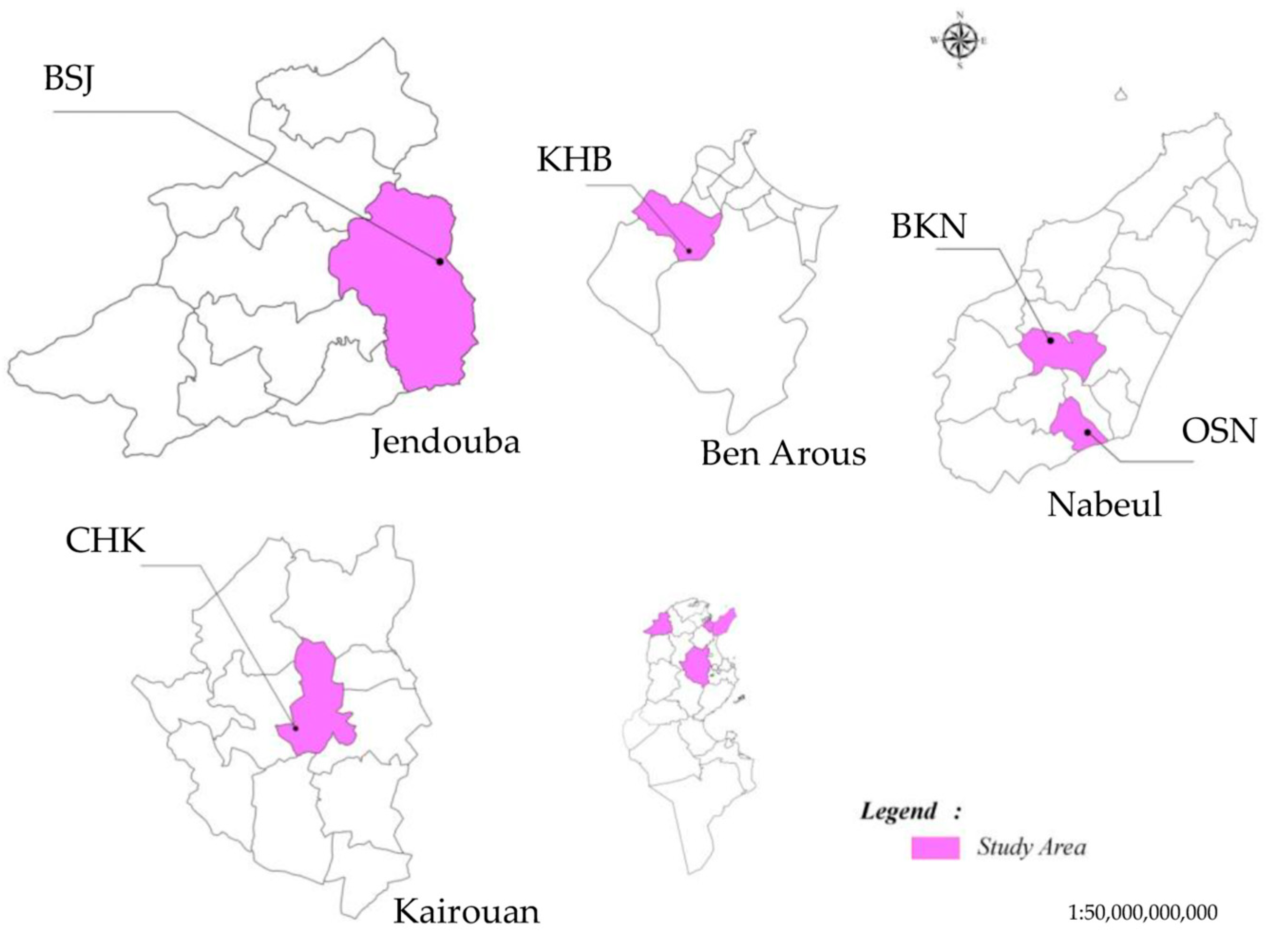
Five experimental sites of 0.5–1 ha were installed from 2017 to 2018 in different regions of Tunisia under various pedo-bioclimatic conditions and cultural practices (Figure 1). They are located both in coastal (Agricultural experimental unit (AEU) of INRGREF, Oued Souhil Nabeul (OSN), State-owned farm (Farm, Office of State Lands (OSL) INTILAKA Beni Khalled-Nabeul (BKN)) and continental (Agricultural Development and Valorization Company (ADVC) SEDAN Bou Salem-Jendouba (BSJ), Agricultural Promotion Company MABROUKA Khelidia-Ben Arous (KHB), and a farmer from Chebika-Kairouan (CHK)) areas. The climate is upper semi-arid in KHB, OSN, and BKN, sub-humid to upper semi-arid in BSJ, and lower semi-arid in CHK (Table 1). The soil texture shows variability among the sites, ranging from light to moderately light sand to heavy clay. The plant density varied slightly depending on the site and in KHB; trees were planted on single beds covered with plastic mulch to reduce evaporation and to leach salt from the rhizosphere. The management of irrigation and fertilization varies depending on the site. A drip irrigation system was used, and nutrients (N, P, and K) were supplied via fertigation at all sites except CHK. Additionally, in KHB, foliar applications of Zn, Mn, and amino acids were conducted.

2.2. Plant Material

Within the five pilot trials, commercial citrus varieties of orange (New Hall, NH; Washington Navel, WN mid-season maturity) and clementine (Marisol, MAR early maturity; Hernandina, HER late maturity), selected for their quality taste and maturity period, were grafted on sour orange (SO, Citrus aurantium L.) as a control and onto four rootstocks tolerant to CTV and to many viroids [25], dispatched according to Table 2 as follows: (1) Citrange Carrizo (CC, Citrus sinensis (L.) Osb. “Washington Navel” × Poncirus trifoliate (L.)), (2) Swingle citrumelo (CTR, Citrus paradisi Macf. × Poncirus trifoliata), (3) Citrus volkameriana (CV, Citrus aurantium × Citrus limon), (4) Citrange C35 (C35, Citrus sinensis “Ruby blood” × Poncirus trifoliata). Among these novel rootstocks, CV is reported as moderately tolerant to salinity, drought, high pH, and calcareous soils. Trifoliate hybrids (CTR, CC, and C35) are intermediate to sensitive with respect to salinity and drought. CTR and CC are not suited to clay soils or highly calcareous conditions, whereas C35 is tolerant to low iron stress under high pH and in soils with elevated levels of available calcium.

2.3. Soil Measurements

Soil samples were collected from all trials at three replicates per sampling point, and each sampling point represented the average of three depths (0–20, 20–40, and 40–60 cm). Two sampling campaigns were conducted: the first in autumn 2020, following rainfall-induced leaching, for initial physicochemical analyses, and the second in summer 2021 for pH and soil salinity evaluation (TDS, g/L; ECe, dS/m) using saturated soil paste extracts (Table 3). The sampling depth (0–60 cm) corresponds to the main citrus root zone. Citrus trees typically develop a relatively shallow root system, with the highest root density occurring within the upper 30–60 cm of soil, particularly under drip irrigation where roots tend to concentrate in the wetted zone [48,49]. The soil sodium adsorption ratio (SAR) was calculated according to Richards [50] and Ayers and Westcot [51] as S A R s = N a ( C a + M g ) / 2 ) ; pH and electrical conductivity of the saturated paste were performed at both initial sampling and at the end of the summer season to evaluate the effects of water irrigation quality and agricultural practices on the alkalinity and the salt accumulation in the rhizosphere. According to Ghraibeh et al. [52], exchangeable sodium percentage (ESP) was calculated from SAR as:
E S P % = 100 × 0.0126 + 0.01475 × S A R 1 + 0.0126 + 0.0147 × S A R
The soil texture varies depending on experimental site. The soil was classified as (1) sandy in Oued Souhil (OSN), (2) sandy loam in Beni Khalled (BKN), (3) loamy sandy clay in Bou Salem (BSJ) and Kairouan (CHK), and (4) clay in Khelidia (KHB) (Table 1). Comparable slightly basic pH values (average 7.6) were recorded at a depth of 0–60 cm across all experimental sites. However, considerable variation was observed regarding nutrient content, organic matter percentage, and salt accumulation (Table 3). The highest potassium concentrations were observed at KHB and BSJ, followed by CHK and BKN. Phosphorus content showed significant spatial variation, with BSJ exhibiting markedly higher levels compared with the other sites. In contrast, OSN recorded the lowest concentration of both potassium and phosphorus. Both total and active limestone contents were high at KHB, BSJ, and CHK, whereas they were negligible or absent at BKN and OSN. Organic matter content differed significantly among sites, ranging from 0.42% at OSN to 3.1% at BSJ. At the onset of the experiment, soils at all sites were classified as non-saline. Measurements of electrical conductivity of the saturated paste extract (ECe) conducted in September 2020 indicated low salinity levels, with mean values ranging from 1.4 dS m−1 at KHB to 2.4 dS m−1 at CHK. Based on soil pH values (7.1–7.9; <8.5), ECe (<4 dS m−1), and exchangeable sodium percentage (ESP < 15%), calculated according to Graibeh et al. [52] from SARₑ measured in autumn 2020, soils under irrigation were considered non-saline and non-alkaline, according to established classification criteria [50,51].

2.4. Water Measurements

Irrigation water samples were collected from September 2020 to August 2021. Three replicates were collected seasonally at four time points: autumn, winter, spring, and summer. Samples were analyzed for pH, electrical conductivity (ECw, dS m−1), total dissolved salts (TDS, g L−1), and ionic balance (Table 4). The sodium adsorption ratio of irrigation water (SARw) was calculated following the same approach used for soil SAR. Electrical conductivity of irrigation water (ECw) varied markedly among sites, with values ranging from 1.1 to 3.9 mS cm−1. According to Ayers and Westcot’s [51] classification of irrigation water salinity hazard, irrigation water at BSJ was classified as slightly saline (ECw = 1.1 mS cm−1). In contrast, irrigation water from OSN, KHB, CHK, and BKN was classified as moderately saline. Within this category, the highest ECw values were recorded at OSN (4.1 mS cm−1) and BKN (3.2 mS cm−1). Based on SARw values, irrigation water at KHB, BSJ, and CHK was considered suitable for most soils and did not pose a sodicity risk (SAR < 10). In contrast, irrigation water at OSN and BKN presented a moderate sodicity hazard (10 ≤ SAR < 18) and therefore required appropriate soil management practices, particularly adequate drainage, to prevent soil structure degradation.

2.5. Estimation of Total Water Inputs and Leaching Potential

During the experiments, the trees received water from two sources: rainfall and supplemental irrigation. All five citrus orchards were irrigated using drip systems. The sites KHB, OSN, and BKN were equipped with integrated drippers, while the sites CHK and BSJ used button drippers (drippers in deviation). The characteristics of the irrigation systems, including emitter flow rates and irrigation frequency during the experimental period, are summarized in Table 5. It can be seen that irrigation at CHK was less frequent than at the other sites (KHB, OSN, BKN, and BSJ). The BKN site not only had a higher emitter flow rate but also maintained a consistent irrigation frequency throughout the year. In contrast, the other sites reduced or completely stopped irrigation during autumn and winter, coinciding with the rainy season and harvest periods.
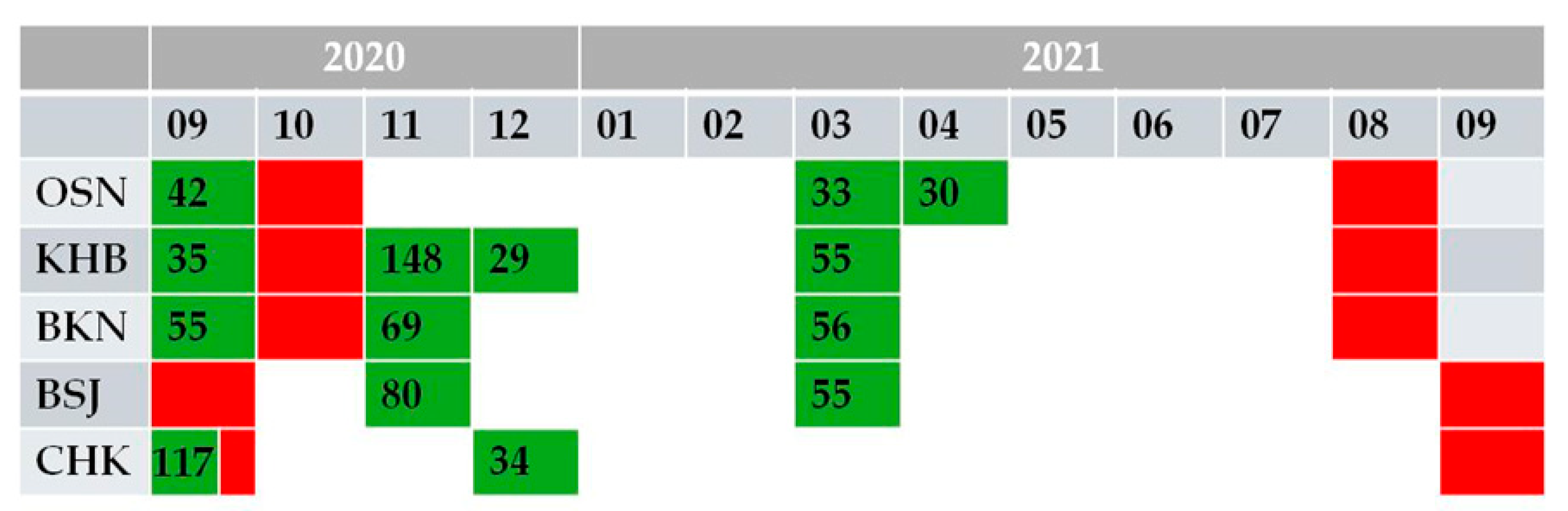
Irrigation duration and applied water volumes varied among sites depending on local orchard management practices. At the INRGREF Agricultural Experimental Unit in Nabeul (AEU Oued Souhil, OSN), irrigation scheduling was based on an average regime calculated according to the FAO method for estimating crop water requirements [49]. At the other study sites, irrigation amounts were derived from field surveys of growers’ practices, which rely on regional average water requirements and are adjusted according to seasonal variations. As a result, irrigation volumes were not uniformly quantified across all sites, which limits the precise estimation of the leaching fraction. Rainfall data were obtained from the General Directorate of Water Resources (Ministry of Agriculture, Tunisia) using the meteorological stations closest to each site (Khelidia, Nabeul, Menzel Bouzelfa, Bou Salem, and Kairouan for KHN, OSN, BKN, BSJ, and CHK, respectively). Total water input was calculated as the sum of irrigation and rainfall. Rainfall events were considered leaching events when precipitation exceeded 30 mm in a single day or when two consecutive days recorded more than 20 mm. The proportion of leaching rainfall relative to total water input (irrigation + rainfall) was calculated to estimate the potential intensity of soil leaching.

2.6. Symptomatology and Plant Mortality

The intensity of leaf toxicity symptoms was evaluated on all trees during the high evaporative period according to Goell’s scale [53,54], except for some missing observations at certain experimental sites. This evaluation was based on the progression of leaf chlorosis at the end of the summer season. The scale consists of 6 classes of chlorosis: (0) all leaves are green and healthy, (1) light green leaf color, (2): early chlorosis and yellowing of leaf edges, (3) pronounced chlorosis, (4) complete chlorosis, (5) chlorosed and necrotic leaves. The plant mortality (%) was calculated for each rootstock–scion combination as (missing plants/planted plants) × 100.

2.7. Tree Growth Analyses

Tree height (m) was measured after fruit harvest in 2021, and canopy volume (m3) was estimated assuming an ellipsoidal canopy shape commonly used for citrus trees. Growth measurements were performed on almost all trees, with some missing observations at certain sites. Canopy volume was calculated according to Colaço et al. [55]:
V m 3 = Π × W 2 × H 6 ,
where V is the canopy volume (m3), W IS the mean canopy width (m) calculated as the average of two perpendicular canopy diameters (e.g., north–south and east–west), and H is the tree height (m).

2.8. Leaf Mineral Analyses

At the end of the summer season, leaves were sampled simultaneously with soil and water, to diagnose tree nutritional status (K+, P, Ca2+, and Mg2+) and leaf toxic ion (Na+, Cl) contents, with three replicates per rootstock–scion combination. Leaves were dried at 60 °C for 48 h, then ground and extracted with diluted HNO3 (0.5%). Sodium and potassium concentrations were determined using a flame photometer (Jenway LTD., Staffordshire, UK); calcium and magnesium were measured using an atomic absorption spectrophotometer (Perkin Elmer Inc., Waltham, MA, USA). Phosphorus content in the leaf samples was determined using a colorimetric method. Chloride concentrations in the leaf samples were determined by titration using a Gonotec CM20 chloridmeter (Gonotec GmbH, Berlin, Germany) according to the instruction from the manufacturer.

2.9. Leaf Chlorophyll Pigment Content and Nitrogen Status

Chlorophyll content was measured on well-exposed leaves, similar to those used for mineral analyses, with three replicates per rootstock–scion combination. Chlorophyll was extracted in 80% acetone from ten leaf disks in the dark at 4 °C [56], and absorbance was measured at 663 and 645 nm using a spectrophotometer. Chlorophyll concentrations (mg·g−1 fresh matter) were calculated using the formula given by Arnon [57].
Simultaneously, plant nitrogen status was estimated using the Hydro-N-Tester (Yara International ASA, Oslo, Norway)., with three replicates per rootstock–scion combination. Each replicate corresponded to the average of 30 measurements taken on fully expanded leaves from the canopy of a single tree, at chest height and well exposed to sunlight. The instrument integrates individual readings to provide a representative value for each replicate. N-Tester values were used as a relative indicator of plant nitrogen status, as commonly reported in the literature, where they are generally correlated with leaf nitrogen concentration [58,59].

2.10. Stomatal Density and Size Measurements

Stomatal density and size were determined from leaf impressions taken on the abaxial surface by applying a thin layer of clear varnish to the lower side of fully expanded mature leaves [36]. For each scion/rootstock combination, three leaves were sampled, corresponding to three biological replicates per treatment. Stomatal density was measured on each leaf. Stomatal size (length and width) was determined on the same leaves used for stomatal density by measuring three stomata from different areas of each leaf, resulting in nine measurements per combination. Mean values were calculated to obtain a representative value per leaf. After drying, the varnish layer was carefully peeled off and mounted on a microscope slide. Stomatal traits were then observed under a phase-contrast binocular microscope (DM750, Leica Microsystems, Wetzlar, Germany). Stomatal length, width, and density were measured using the image analysis software ImageJ (version 1.45s; National Institutes of Health, Bethesda, MD, USA; Java 1.6.0_20, 32-bit).

2.11. Statistical Analyses

The experiments involved three factors (scion, rootstock, and site) arranged in randomized complete blocks for KHB, BKN, BSJ, and CHK. At the OSN site, randomization of treatments across planting rows was constrained by the existing irrigation infrastructure; therefore, replicates were arranged along the same row and a factorial design was adopted. One-, two-, and three-way ANOVA tests were performed using the SAS software (version 8.0; SAS Institute Inc., Cary, NC, USA) via mixed procedure. Multiple mean comparisons were made with Duncan’s test. Confidence intervals were calculated to a threshold of 95% probability. The correlation among the studied variables was calculated using Pearson correlation. The correlation plots were visualized using R software (version 4.4.1; R Foundation for Statistical Computing, Vienna, Austria). Correlation was considered significant at p ≤ 0.05. Ward’s method of hierarchical cluster analysis based on Euclidian distance was applied using SAS software. The obtained data were used to classify genotypes into clusters as either tolerant or sensitive.

3. Results

3.1. Total Water Supply and Potential Leaching Across Sites

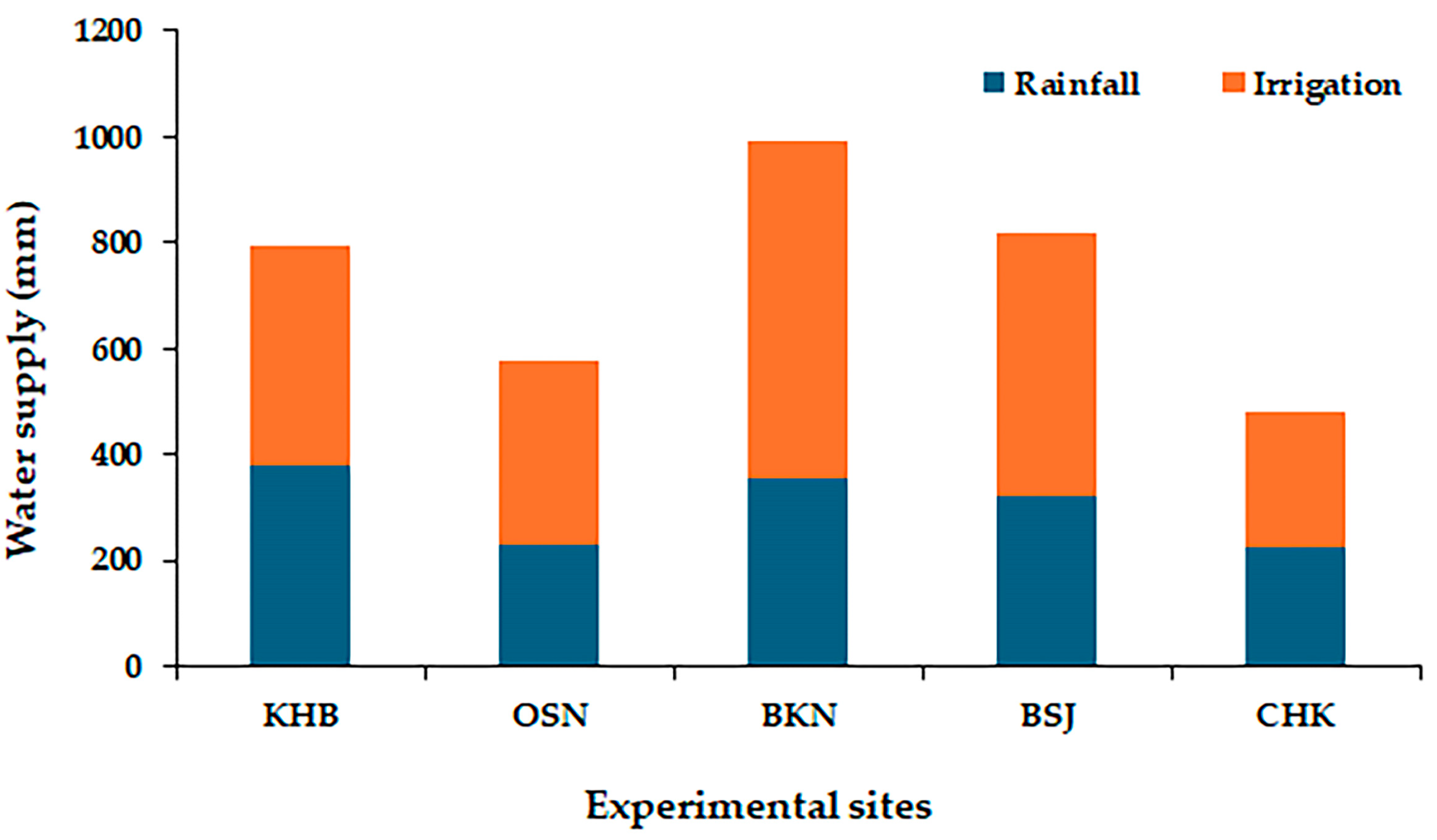
The total water input from both irrigation and rainfall during the experimental campaign is presented in Figure 2 for the different sites. The orchard at the BKN site received the highest total water input. The KHB and BSJ sites had similar final water inputs (~8000 m3/ha), while CHK received the least water from both rainfall and irrigation. Irrigation water accounted for 52–64% of the total water input. Figure 3 shows the occurrence and distribution of intense rainfall events across the experimental period. Significant events prior to the measurement campaign were recorded at all sites except BSJ. During the measurement campaign, the KHB site recorded the highest number of intense rainfall events, whereas the CHK site recorded the lowest. No intense rainfall events were observed between May and August. The number of rainfall events likely to induce soil leaching ranged from one to three depending on the site. The proportion of rainfall potentially contributing to drainage represented between 7 and 29% of the total water input. The highest cumulative rainfall was recorded at the KHB site, reaching 148 mm over five consecutive days, with a maximum daily rainfall of 65 mm.

3.2. Irrigation Effects of Soil Salinization Across Sites

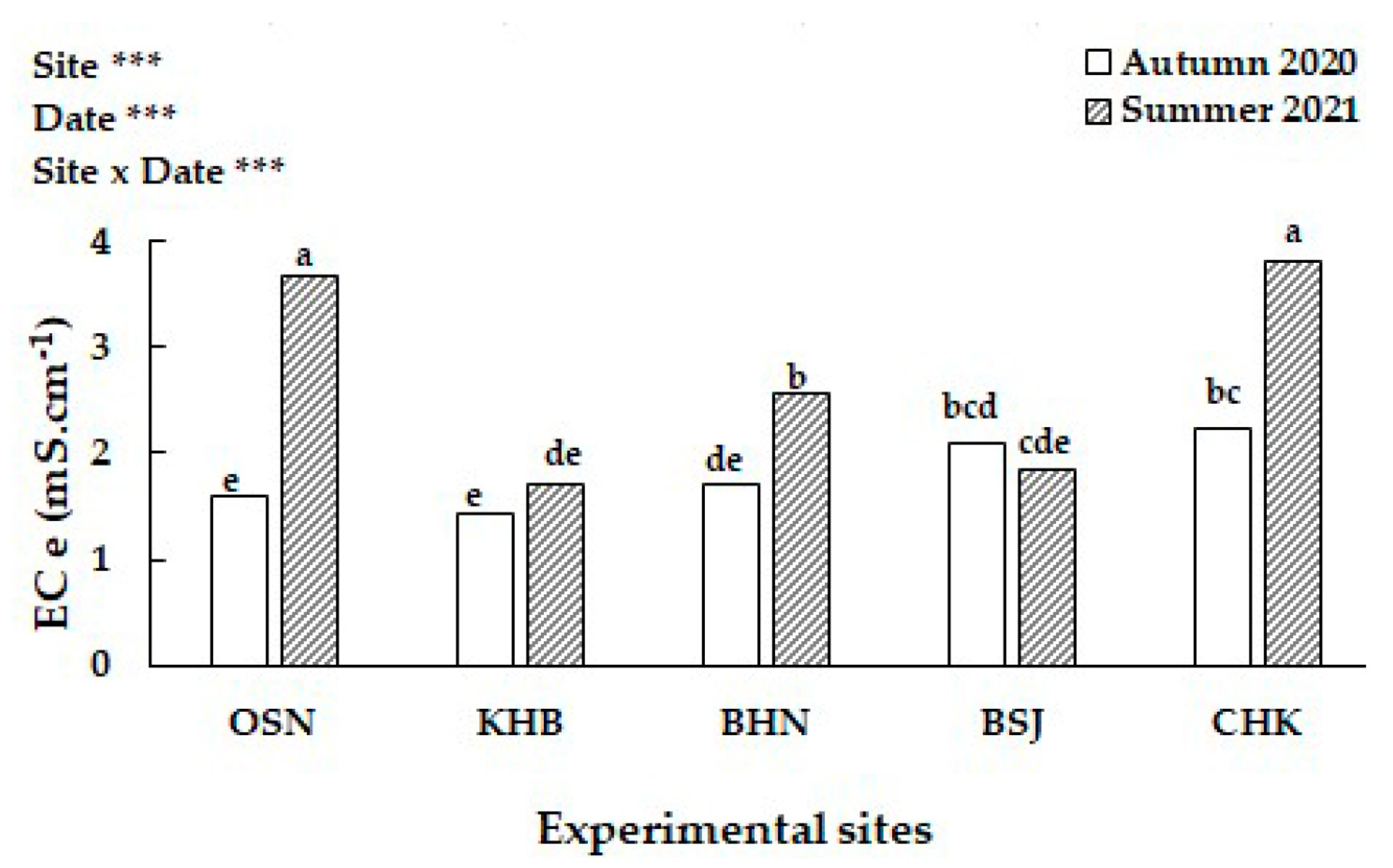
At the onset of the experiment, soils at all experimental sites were non-saline. By autumn 2020, electrical conductivity of the saturated soil extract (ECe) remained low, ranging from 1.4 mS/cm at KHB to 2.2 mS/cm at CHK. Over the course of the summer 2021, soil salinity increased at all sites except BSJ (Figure 4). The limited salinity increase at BSJ is consistent with the lower salinity of the irrigation water supplied at this site (Table 4), indicating a lower risk of salt accumulation. Despite the observed increases, ECe values at all sites remained below 4 mS/cm, suggesting that the studied soils had not yet reached salinization thresholds after one year of irrigation [51,60]. The most pronounced salinity buildup occurred at KHB and OSN, likely reflecting higher salinity in the irrigation water and site-specific soil characteristics that favor salt accumulation. These early salinity dynamics highlight the influence of water quality, irrigation management, and local soil properties on the evolution of soil salinity across diverse citrus orchards in Tunisia.

3.3. Effects of Soil Salinity on Toxicity Symptoms and Plant Mortality

Independently of the site and the species, leaf chlorosis symptoms were observed at the end of the summer season. However, for both orange and clementine, the intensity of the symptoms was more pronounced with trees grafted on C35, CC and CTR compared to those grafted on SO and CV (Table 6). Depending on the site, the percentage of plants with Goell indexes ranging from 0 to 2 in WN and NH scions varied from 70 to 100% for trees grafted on CV and SO rootstocks, and from 1 to 3 for more than 70% of plants grafted on C35, CC, and CTR rootstocks. In contrast, at the CHK site, leaf chlorosis levels were relatively high across all scions compared with the other sites. The plant mortality percentages varied with the site and rootstock. Low values (0–25%) were observed in trees grafted on CV and SO rootstocks. These values increased in C35, CC, and CTR combinations, particularly at the CHK site, where they reached 70% and 100% for CC and CTR, respectively (Table S1). Plant mortality was also observed at the OSN and BKN sites, reaching 50 and 35%, respectively, in trees grafted on CTR rootstock. Within orange combinations, the NH scion exhibited higher levels of leaf chlorosis than WN (Table 6). Clementine combinations were also more sensitive than orange ones, especially when grafted on C35, CC, and CTR rootstocks. Goell chlorosis classes generally ranged from 1 to 2 in HER and from 2 to 3 in MAR when grafted on CV and SO rootstocks. For the other rootstocks, the dominant chlorosis class was 3. At the CHK site, chlorosis levels ranged from 3 to 4 independently of the rootstock. Similarly to orange combinations, high mortality rates were recorded in both clementine scions grafted on CTR and CC rootstocks. More than 50% plant mortality was recorded at the OSN and BKN sites in CTR-grafted plants, reaching up to 100% mortality at the CHK site. In contrast, low mortality rates were observed in clementine trees grafted on SO and CV rootstocks, particularly at the BSJ (≤ 10%) and KHN (≤8%) sites (Table S1).

3.4. Effects of Soil Salinity on Tree Growth

Analysis of variance showed that site and rootstock were the dominant factors affecting all measured growth parameters. Site exerted particularly strong effects on SC (F = 145), RC (F = 102), SC/RC (F = 51), and CaV (F = 225), while rootstock also significantly influenced SC (F = 79), RC (F = 66), and CaV (F = 138). Scion effects were significant but generally less pronounced, especially for SC (F = 22), RC (F = 13), and CaV (F = 62). Significant interactions among site, rootstock, and scion were observed for all parameters, indicating that growth responses varied depending on the combined effects of environmental conditions and grafting combinations (Table S5).

3.4.1. Scion and Rootstock Circumference

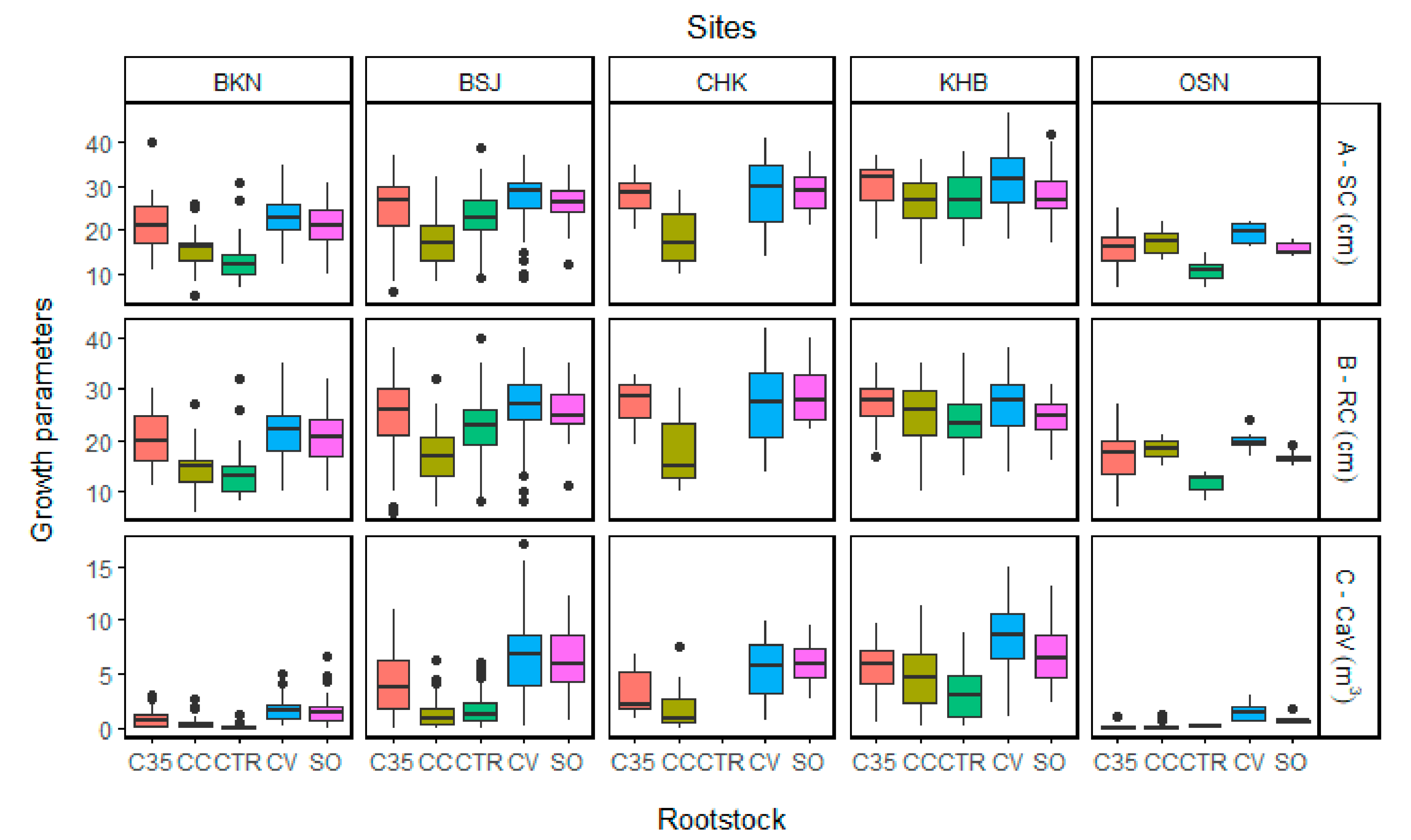
The highest SC and RS circumferences were obtained in KHB and BS. In contrast, significantly lower values were recorded in BKN, and particularly in OSN, due to the younger age of the orchard and the poorer irrigation water quality (Figure 5).
In OSN, higher SC values were observed with WN grafted on CV and C35 compared to WN/SO and WN/CC but no significant differences were reported for HER combinations (Figure 5—“A”). RS values of WN and HER grafted on CV, SO, C35, and CC were mostly higher than those on CTR. In BKN, RC and SC values obtained with NH and MAR combinations grafted on CV, SO, and C35 were equivalent and statistically higher than those with CC and CTR. Regardless of the rootstock, higher values were obtained with NH compared to MAR combinations. Similar trends were observed in CHK with WN, NH, and MAR (Table S1).
In KHB and BSJ, circumferences values were significantly higher with HER combinations compared to the rest of combinations. This trend was independent of the rootstock in KHB, whereas in BSJ, HER grafted on SO, CV, and C35 exhibited higher values than the remaining rootstocks (Figure 5—“B”).
The average values of the ratio SC/RC calculated for all the combinations in all the sites were close to 1 (Table S1). Results reflect a good compatibility of all scions with the new rootstocks studied independently. However, one-way ANOVA analyses showed significant differences between the sites. The higher ratio values were obtained in KHB (1.13), followed by BKN, BSJ, and CHK, whereas lower values were observed in OSN (0.95).

3.4.2. Canopy Volume

Independently of the combination (rootstock and scion), the lowest canopy values were observed in OSN and BKN. In contrast, the highest values were obtained in BSJ and KHB. However various combination responses were observed depending on the site (Figure 5—“C”). Tables S1 and S5 demonstrated that in OSN, WN/CV and HER/CV combinations recorded the most developed canopy values, followed by WN/SO and HER/SO. For both scions, a significant decrease was observed on combinations grafted on C35, CC, and CTR compared to those on CV and SO. Among them, WN combinations recorded higher canopy values than HER ones. Similar trends were observed in BKN with orange and clementine combinations: NH grafted on SO and CV were the most performing, followed by MAR/CV, MAR/SO, and NH/C35 (Table S1). The scions grafted on CC and CTR were the least performing, with a disadvantage for MAR compared to NH. As in the previous sites, the WN, NH, and MAR combinations in CHK performed better when grafted onto SO and CV rootstocks, followed by WN/C35 and MAR/C35. Lower canopy values were observed with MAR/CC, while no canopy estimations were available for orange and clementine grafted onto CC and CTR due to tree mortality. However, some variations in performance were observed in KHB and BSJ, which may be attributed to differences in water quality, irrigation management, and substrate characteristics. These factors likely influenced tree growth and survival by affecting nutrient availability, salt accumulation, and soil-water interactions. In both KHB and BSJ, HER grafted on SO and CV were the best performing combinations. In KHB similar canopy volumes to the previous ones were obtained with WN/CV, followed by WN/SO and HER grafted on C35 and CC. In BSJ, WN and MAR grafted on SO and CV and HER/C35 registered equal canopy volumes but lower than the best performing ones. Similarities between the two sites were also observed for the least developed combinations. In both, NH combinations grafted on SO and CV were less performing. In BSJ, they registered equivalent canopy values with WN/C35 and MAR/C35, whereas in KHB, with NH/C35 and WN/C35. However, all scions grafted on CTR and CC recorded less canopy values compared to the rest of combinations (Figure 5—“C” and Table S1).

3.5. Effects of Soil Salinity on Plant Nutrition

Analysis of variance showed that site was the dominant factor influencing all measured leaf mineral contents (Na+, K+, P, Cl, Ca2+, and Mg2+) (p < 0.0001). Site exerted particularly strong effects on K+ (F = 3606), Cl (F = 2890), Na+ (F = 860), and Mg2+ (F = 666), indicating marked environmental control of mineral accumulation. Rootstock also contributed substantially, especially for Cl (F = 1555), Na+ (F = 116), and Mg2+ (F = 68), while scion effects were significant but generally lower than those of site (Table S6).

3.5.1. Leaf Na, Cl, and K Contents

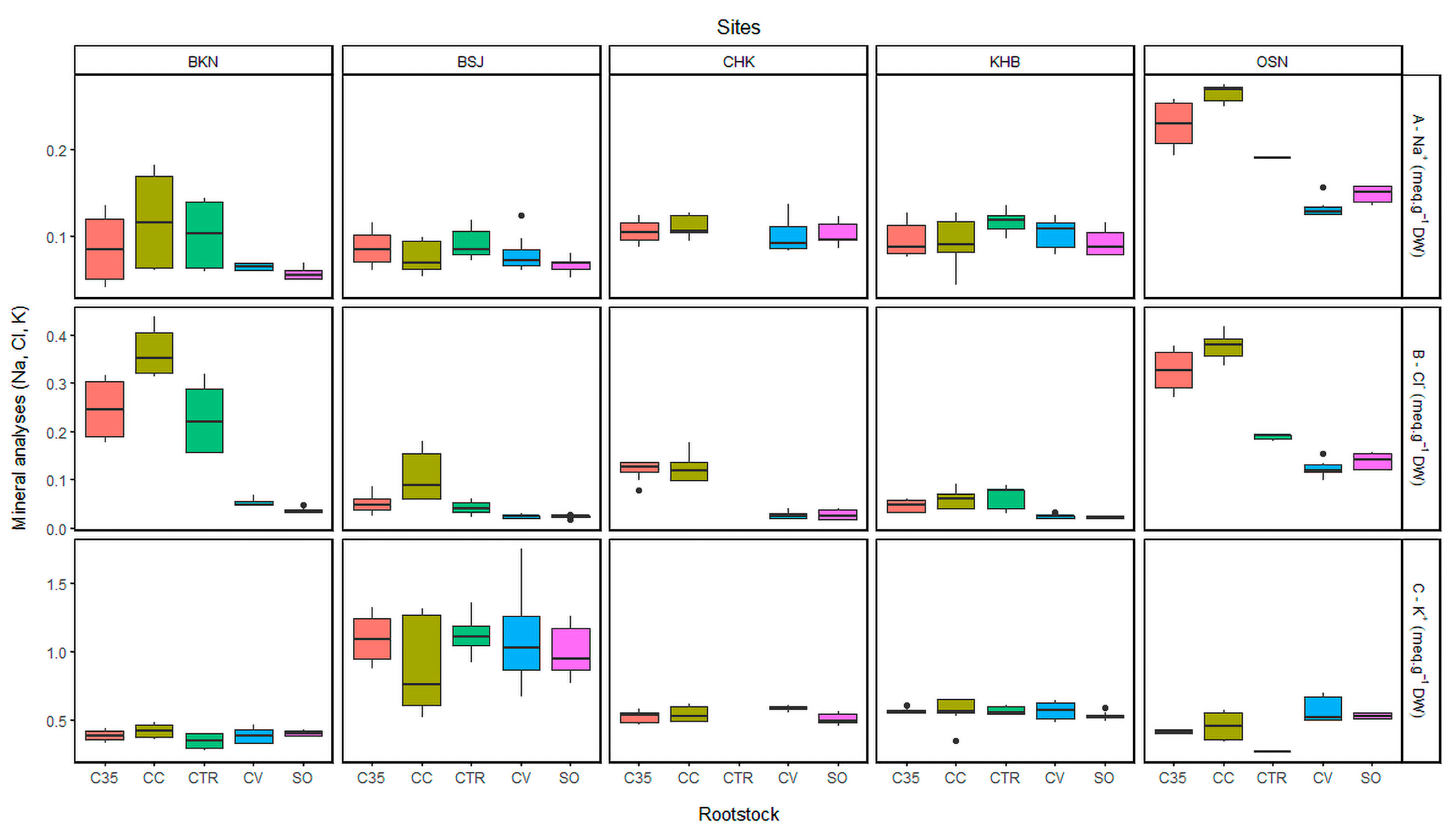
Independently of the scion–rootstock combination, the highest Na+ and Cl leaf contents were observed in OSN, with Cl also elevated at BKN, whereas the lowest values, particularly for Cl, were observed at KHB and BSJ. Overall, differences among sites and rootstocks were more pronounced for Cl than for Na+ (Figure 6—“A” and “B”). In contrast, leaf potassium contents showed an opposite trend, with the highest values recorded at BSJ, followed by KHB, while no significant differences were observed among combinations within each site. (Figure 6—“C”). Similar trends were observed in OSN, BKN, and CHK, regardless of scions. Trees grafted on SO and CV rootstocks consistently had lower Na+ and Cl leaf contents than those on C35, CC, and CTR. At OSN and CHK, CTR and CC rootstocks had the strongest negative impact on scions, with complete mortality observed for HER/CTR. Regarding scion responses, HER and MAR accumulated higher Na+ and Cl levels at OSN and BKN than WN and NH, while MAR also exhibited lower K+ leaf contents compared to the other scions. Conversely, at KHB and BSJ, leaf Cl contents were higher in oranges (WN and NH) than in clementines (HER and MAR) grafted on C35, CC, and CTR (Table S2).

3.5.2. Leaf Ca, Mg, and P Contents

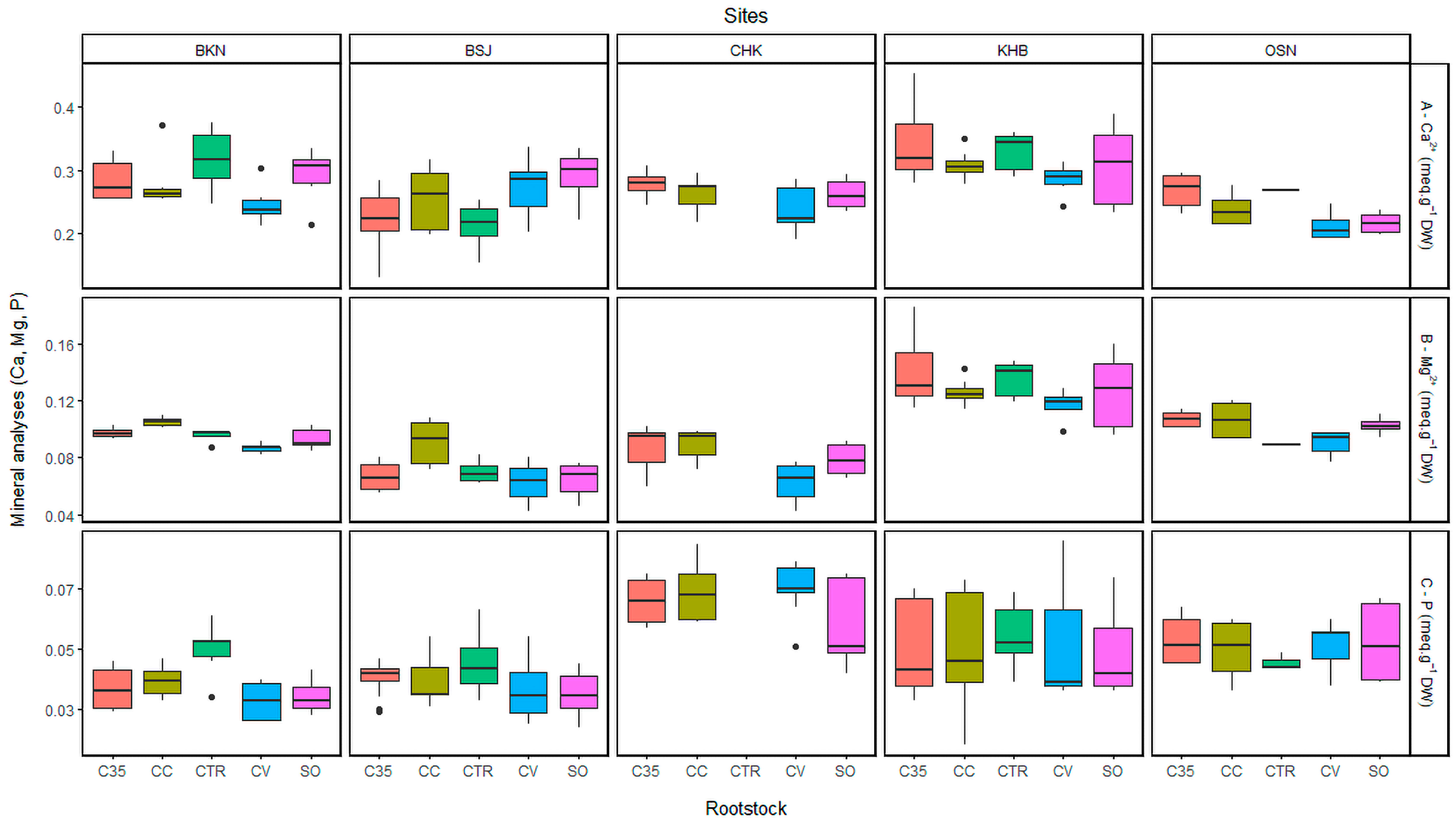
Leaf calcium (Ca2+) and magnesium (Mg2+) contents were higher in KHB compared to the other sites, whereas the highest phosphorus (P) leaf content values were observed in CHK (Figure 7—“A” and “B”). At OSN and KHB, differences in Ca2+, Mg2+, and P among rootstocks were minimal and mostly non-significant (Figure —“A”–“C”). However, clear variability among scions was observed at OSN and BKN for P and Ca, with clementines (MAR, HER) showing higher values than oranges (NH, WN) (Figure 7—“B” and “C” and Table S2). A similar trend was observed at BSJ, where P contents were higher in MAR and HER than in NH and WN, while Ca and Mg did not differ significantly among scions. At CHK, higher leaf P contents were associated with SO combinations, whereas for Ca and Mg, WN combinations had lower values compared to NH and MAR (Table S2).

3.6. Effects of Soil Salinity on Nitrogen Status and Leaf Chlorophyll Contents

Analysis of variance showed that site and rootstock were the main factors influencing N-Tester readings and chlorophyll parameters (p < 0.0001). Site had a strong effect on N-Tester readings (F = 58) and the Chl a/Chl b ratio (F = 116), indicating marked environmental influence on leaf physiological status. Rootstock also contributed substantially, while scion effects were notable, especially for Chl b (F = 115) and Chl tot (F = 136). Significant interactions, including site × rootstock, site × scion, rootstock × scion, and the three-way interaction, highlighted the combined effects of environmental conditions and grafting combinations on leaf physiological responses (Table S7).
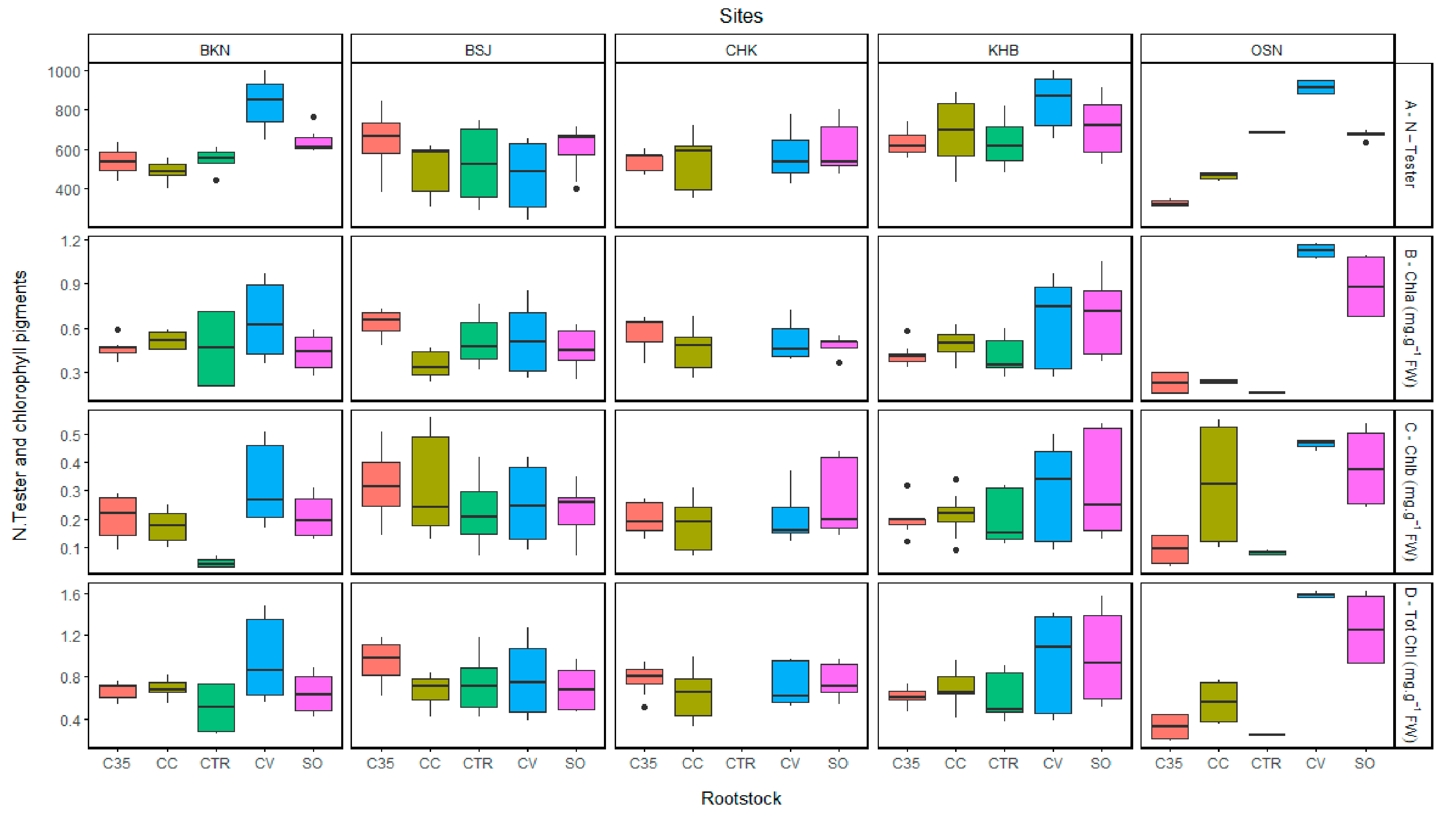
Site had a marked effect on N-Tester readings, with the highest values recorded at Khelidia (KHB) and BSJ compared to the other sites (Figure 8—“A”). Across sites, total chlorophyll contents were generally higher in combinations grafted on SO and CV rootstocks, independently of scion (Figure 8—“C”), highlighting the strong influence of rootstock on chlorophyll pigments, particularly Chl b and total chlorophyll (Figure 8—“B”). At OSN and BKN, SO and CV combinations consistently showed higher N-Tester and total chlorophyll values, whereas no significant rootstock effect was observed at KHB, BSJ, and CHK. Regarding scion responses, higher total chlorophyll contents were observed at BSJ in WN and NH compared to MAR and HER, while at CHK, the lowest values were recorded in MAR combinations. In contrast, Chl a and the Chl a/Chl b ratio showed no consistent variation in response to salinity across scion–rootstock combinations (Figure 8—“A” and Table S3).

3.7. Effects of Soil Salinity on Leaf Stomatal Density, Length, and Width

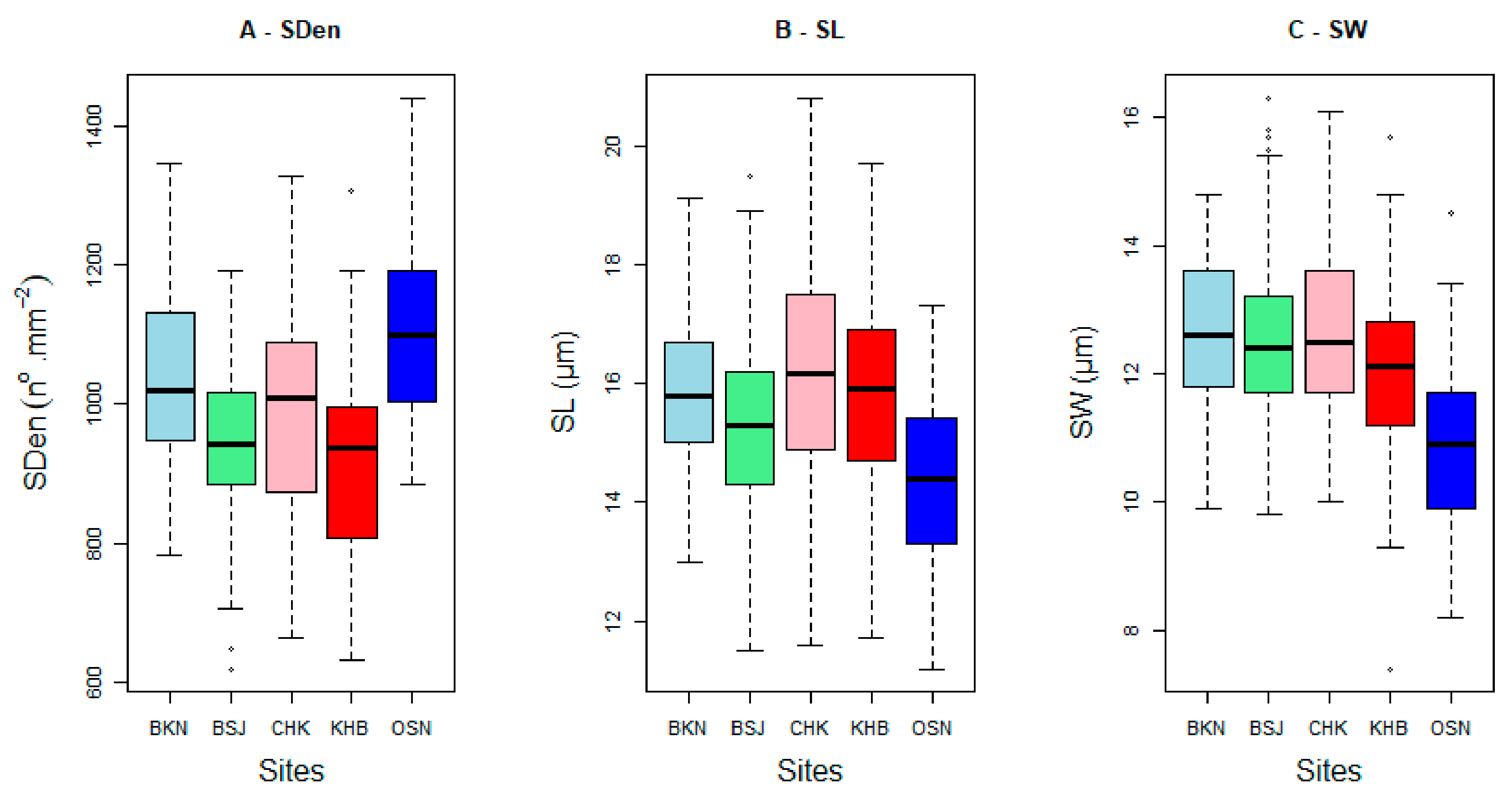
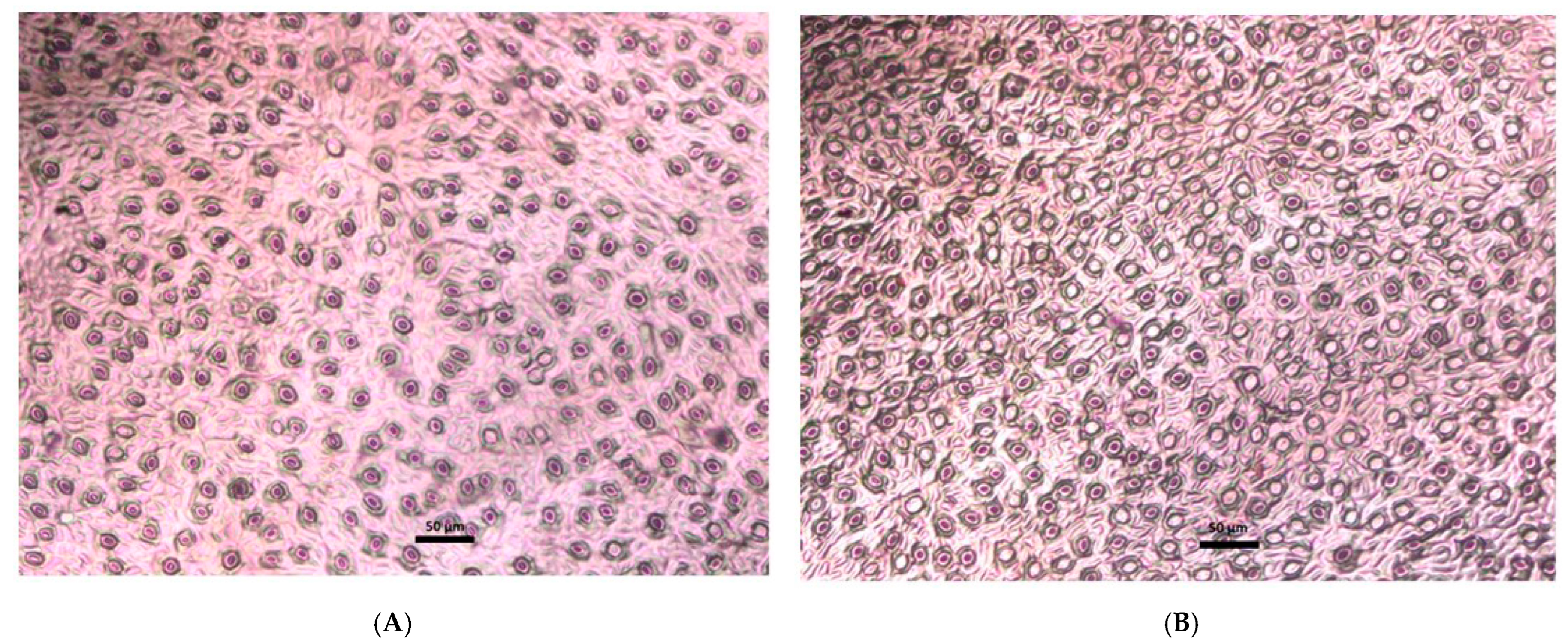
Analysis of variance showed that site was the dominant factor influencing stomatal traits. Site exerted strong effects on SDen (F = 30), SL (F = 30), and SW (F = 39). Rootstock and scion also contributed significantly to variation in most traits, particularly for SDen (F = 9 and F = 29, respectively) and SL (F = 14 and F = 9, respectively). The three-way site × rootstock × scion interaction was observed for most parameters, whereas rootstock × scion interactions were generally weak or non-significant (Table S8). In terms of site responses, SDen was highest at OSN, followed by BKN and CHK, whereas the lowest values were recorded at KHB and BSJ (Figure 9—“A”). Independently of site, clementine scions exhibited higher Sden than oranges, particularly when grafted on CC, CTR, and C35 rootstocks (Table S4). Stomatal size also varied with site conditions, with lower stomatal length and width observed at OSN, especially for HER compared to WN grafted on the same rootstocks (Figure 9—“B” and “C” and Table S4). This pattern is further illustrated in Figure 10, which shows a higher stomatal density on the abaxial leaf surface of Washington Navel grafted on sour orange at OSN compared to BSJ.

3.8. Effect Correlation Between the Studied Variables and Cluster Analysis

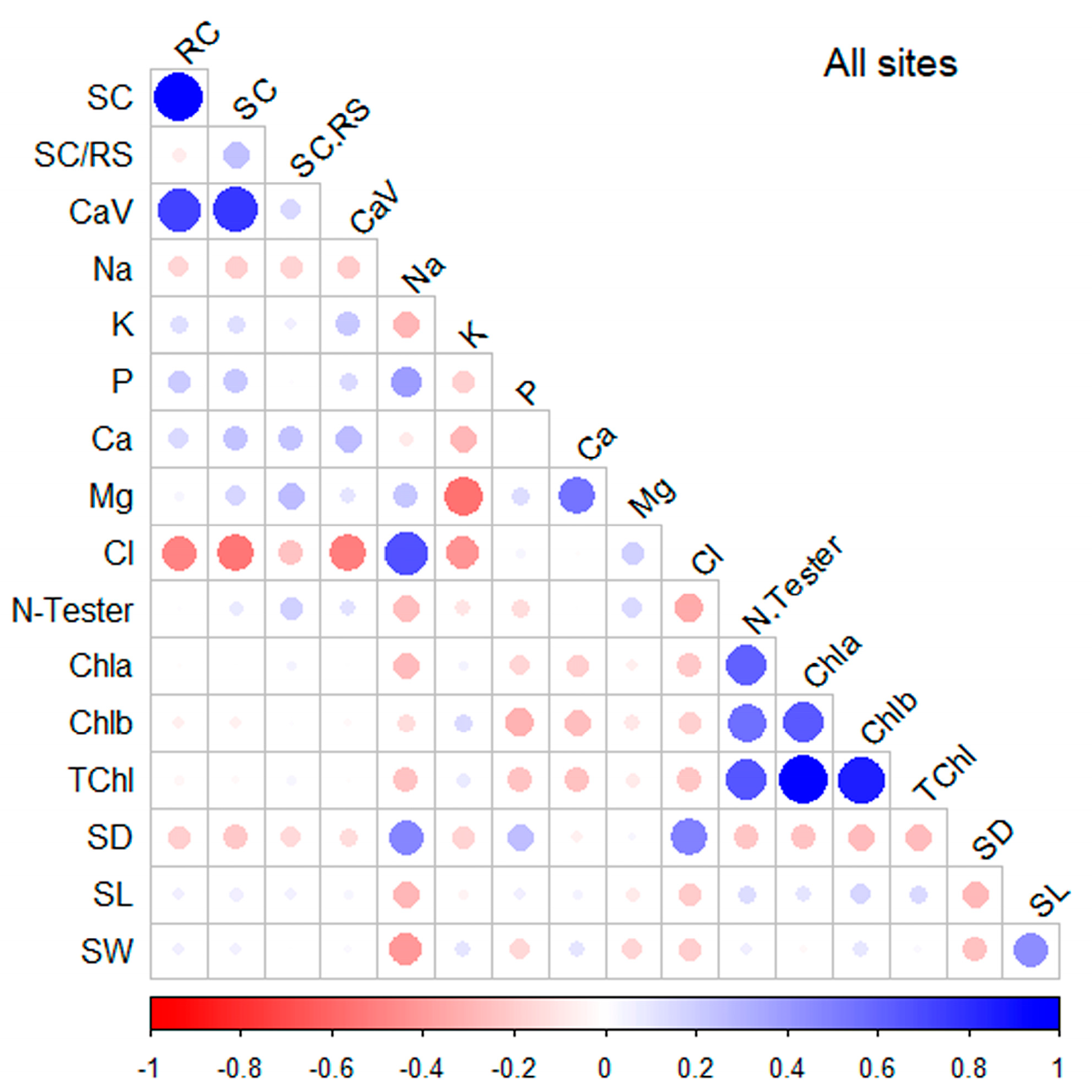
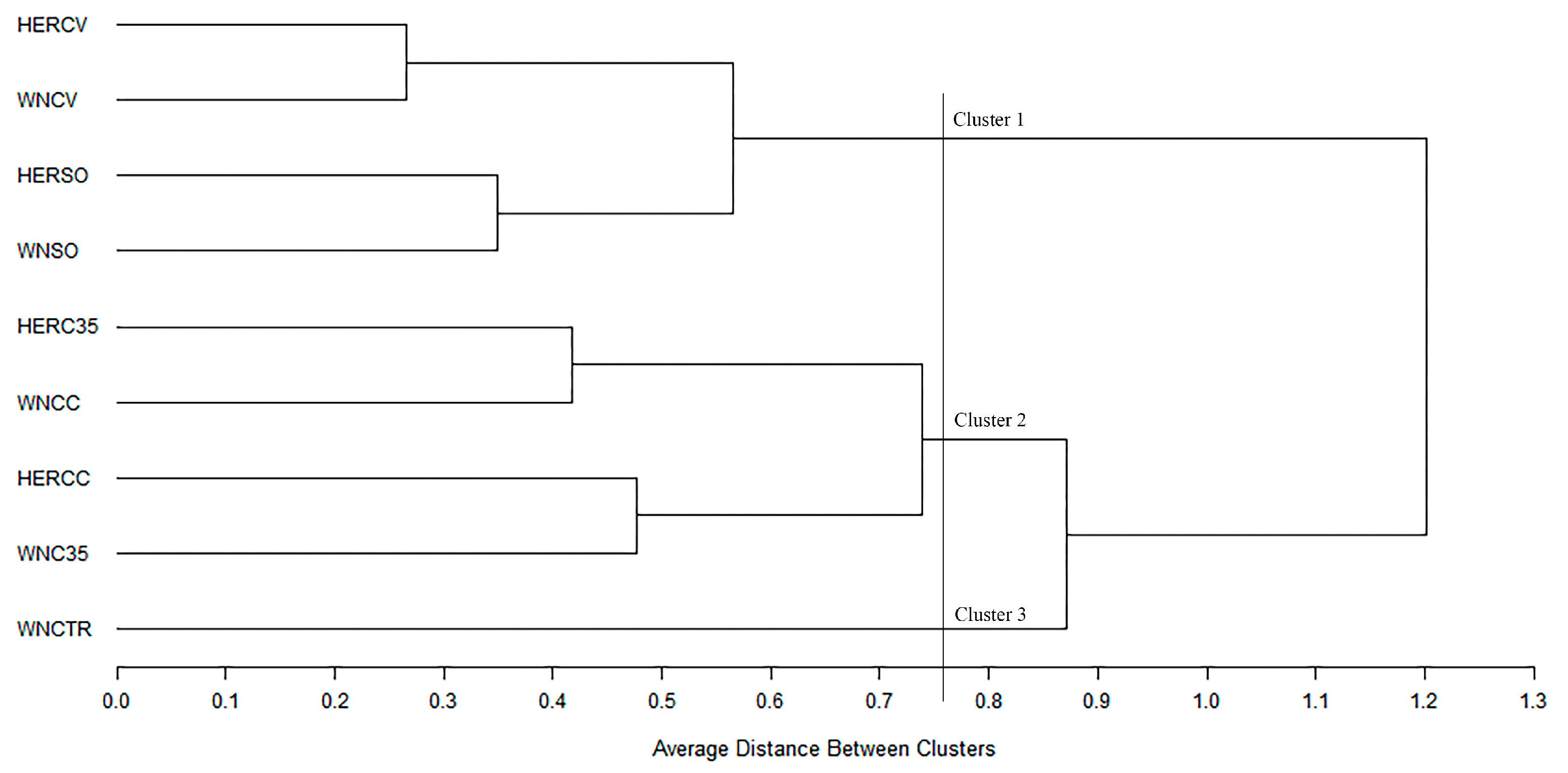
At all the studied sites, significant positive and negative correlations were observed between growth parameters (canopy volume, scion, and rootstock circumference), leaf inorganic ions (Na+, Cl, K+, Ca2+, Mg2+, P), chlorophyll content, N-Tester values, and stomata parameters (Figure 11). Scion and rootstock circumferences were positively correlated to canopy volume, phosphorus, calcium, and magnesium. Stomata number was highly correlated to sodium and chloride leaf contents and chlorophyll contents to N-Tester (p ≤ 0.001). On the contrary, significant negative correlations were detected between canopy volume and both Na+ and Cl leaf contents. Similarly, chloride was negatively correlated with chlorophyll leaf contents, N-Tester readings, and stomata number (p ≤ 0.001). Based on average values for the studied parameters, dendrogram analyses were performed using Ward’s method. The citrus combinations in Nabeul were clustered into low, moderate, and high salt stress tolerance. Cluster 1 includes the most salt-tolerant combinations. Those grouped in Cluster 2 are considered moderately tolerant, while the sensitive combinations to salt stress were associated in Cluster 3 (Figure 12).

4. Discussion

The novel citrus combinations evaluated under semi-arid to arid climate in 2021, with varying soil characteristics and irrigation water salinity levels, displayed distinct physiological and growth responses to salt stress. Plant tolerance was dependent on soil type, cultural practices, and the ability of rootstocks and scions to control the uptake and the leaf accumulation of Cl and Na+. The newly introduced rootstocks were primarily selected for their tolerance to Citrus tristeza virus (CTV), a necessary condition for their potential adoption as alternatives to sour orange (SO, Citrus aurantium), which remains widely used in Tunisian orchards but is highly susceptible to CTV. Building on this selection criterion, the present study evaluates the response of these CTV-tolerant rootstocks and their scion combinations to salinity stress under field conditions. Thus, while tolerance to CTV establishes the baseline for rootstock selection, the assessment of salt tolerance is conducted independently to identify combinations most suitable for saline environments.

4.1. Soil Salinization

The initial soil sampling occurring in autumn was carried out following substantial rainfall events that induced effective soil leaching at KHB, BKN, and OSN, resulting in low mean soil salinity levels (ECe < 2 mS·cm−1, Figure 4). In contrast, higher initial ECe values were observed at BSJ and CHK, which can be attributed to the lack of significant rainfall and the predominance of heavy-textured soils. The final (summer) sampling indicated a marked increase in soil salinity at OSN, BKN, and CHK. This increase is primarily associated with the use of saline irrigation water, reduced irrigation volumes, and, in the case of CHK, a predominantly clayey soil texture that limits salt leaching. The moderate salinity increase observed at BKN is likely explained by higher irrigation inputs and more frequent rainfall events. Conversely, soil salinity at KHB and BSJ remained relatively stable between the two sampling periods. At BSJ, this stability is attributable to the use of non-saline irrigation water (Table 4), whereas at KHB it can be explained by the combined effects of intense leaching events (Figure 3), higher water inputs, and the adoption of specific agronomic practices, including raised-bed planting and plastic mulching, which reduce soil evaporation and enhance salt leaching. In this context, Gimeno et al. [46] reported that the low leaching fraction of a clay-loam soil led to increased electrical conductivity and higher chloride concentrations in the soil solution.

4.2. Plant Toxicity Symptoms and Growth Responses

Detrimental effects of high salinity can be observed as chlorotic and necrotic patches on leaves [21,42], growth inhibition, yield decrease [61] and plant death. Rochdi et al. [62] reported foliar damages, biomass decreases, and Na+ and Cl accumulation on sour orange and two hybrids of Poncirus trifoliate grown at 70 mM NaCl for 30 days, and related the intensity of these effects to the tolerance of rootstocks. In our study, leaf injuries and deleterious salt effects were observed in all the sites at the high evaporative period. The leaf chlorosis symptoms intensity, salt accumulation, plant growth decrease, and mortality rates were highly related to soil salinity level, citrus rootstock, and scion tolerance. Cultivars grafted on C35, CC, and CTR rootstocks exhibited more leaf chlorosis compared to those on SO and CV, particularly in OSN, BKN, and CHK compared to KHB and BSJ. Furthermore, a scion effect was evident across highly salinized sites, with clementine trees exhibiting a higher susceptibility to leaf chlorosis compared to orange trees. Within each species, NH demonstrated greater sensitivity to leaf chlorosis than WN, while MAR was more sensitive than HER (Table 6). Simultaneously to leaf chlorosis, tree growth was affected by elevated salinity levels, and various mortality rates (Table 6 and Table S1) were observed depending on the substrate type and the salt tolerance of both rootstock and scion. The canopy values were higher in KHB and BSJ compared to the other sites (Figure 5 C). Trends observed in OSN can additionally be explained by the younger age of the orchards and the poorer quality of the irrigation water, which leads to the accumulation of Na+ and Cl in the soil solution, their uptake by the roots, and their subsequent accumulation in the leaves (Figure 6—“A” and “B”). Leaf analysis results can partly explain the site effects. Indeed, leaf sodium and chloride concentrations increased about 244 and 522% in OSN compared to BSJ, whereas the highest leaf potassium contents were recorded in BSJ compared to the other sites (215% increase). Differences between sites, rootstocks, and scions were more related to leaf Cl content rather than Na+ content (Figure 6—“A” and “B” and Table S2). Our findings agree with those reported by Banuls et al. [63] and Moya et al. [36], who primarily linked salinity-induced damage in citrus with Cl leaf accumulation rather than Na+ accumulation. Walker et al. [38] associated the least tolerant citrus species with those that accumulate the highest amounts of Cl in their leaves. Results of the study showed various rootstock and scion growth responses to toxic ion uptake that were dependent on the salinity level substrate. Therefore, under moderately salinized soils (OSN and BKN), CV and SO rootstock combinations recorded lower Na+ and Cl leaf contents and higher canopy values compared to C35, CC, and CTR ones. Among them, WN and NH combinations performed better than HER and MAR ones. HER and MAR trees grown in OSN and BKN accumulated more sodium and chloride in their leaves than WN and NH. Under slightly salinized soils (KHB and BSJ), HER grafted on SO and CV was the best performing combination, followed by WN grafted on CV and SO. SO and CV rootstocks were less well performing with NH scion compared to WN and HER ones. Significant increases in leaf Cl contents were observed with orange (WN, NH) compared to clementine (HER, MAR) scions grafted on C35, CC, and CTR rootstocks. BSJ seems to be the most favorable site for clementine growth. Indeed, the HER/C35 combination and all MAR combinations were more developed in BSJ compared to BKN and CHK. Highly significant negative correlations were detected between growth parameters (CV, RC, SC) and both Na+ and Cl leaf contents. The correlations between growth parameters and Cl ions were stronger than those with Na+ ions, indicating a potentially greater role of chloride in affecting plant growth under the conditions studied (Figure 11). In the same context, Simpson et al. [33] mentioned a negative relationship between Na+ and Cl concentrations and total leaf area, supporting the deleterious effects of toxic ion accumulation on growth and ultimately on survival rate. The level at which Cl buildup becomes toxic in the leaves is not clear. Al-Yassin et al. [64] reported that toxicity symptoms usually appear when leaf Cl levels reach about 1% of leaf dry weight, whereas Ferguson and Grattan [65] stated that leaf Cl concentration should be more than 0.7% dry weight, and from 0.4–0.7% according to White and Broadley [66]. In our experiments, by applying the conversion factor of 3.55 to convert chloride concentrations from meq g−1 to percentage dry matter, the threshold values reached 0.83 and 0.66% at OSN and BKN, respectively. However, these values reflect average site conditions rather than strict physiological thresholds, and genotypic differences in Cl exclusion and intracellular compartmentation (e.g., vacuolar sequestration) among rootstocks are likely to influence the effective toxicity threshold for each rootstock–scion combination. Toxicity can also result from excessive accumulation of Na+ (>0.131 meq/g DW) [67], and there are controversial reports for Na+ toxicity thresholds [21]. Most experts use 0.25% Na+ dry mass as their toxicity threshold in citrus [68]. Grattan et al. [69] reported that damage started at 0.1% Na+ leaf dry mass of citrus trees, while no injury until 0.5% Na+ dry weight was reported by Sauls [70]. In this study, the application of the 2.3 conversion factor revealed that threshold values were exceeded at the OSN (average 0.44%), whereas values at the remaining sites were consistently lower (<0.25%). These results suggest that both Na+ and Cl negatively influence tree growth in OSN. Lloyd et al. [41] demonstrated that Na+ plays a major role in reducing gas exchange, CO2 assimilation rate, and overall growth. According to Garcia-Sanchez et al. [13], decreases in ACO2 are a consequence of high leaf Cl concentration in salinized citrus. In the study conditions of OSN, a significant increase in SDen was accompanied by a decrease in stomata length and width (Figure 9 and Figure 10), which can be interpreted as an adaptive response of plants to salt stress: although stomatal density increases, smaller stomata size reduces the total pore area per leaf, thereby limiting stomata conductance and transpiration. Such a morphological adjustment allows the plant to maintain minimal gas exchange while minimizing water loss under high salinity conditions [71,72]. Lower transpiration rates reduce the osmotic stress, resulting in less salt uptake into the plant [36,73]. In our case, under moderate soil salinity levels, SD increased simultaneously to SL and SW decreased. This tendency was more pronounced with sensitive rootstocks (CC, CTR, and C35) and scions (HER, MAR). High correlations between Na+ contents and stomata parameters confirmed this explanation. Independently of the site, scions grafted on SO and CV registered higher growth parameters, total chlorophyll contents and N-Tester values compared to the other combinations. These results confirmed the higher tolerance of SO and CV compared to CTR, CC, and C35. Total chlorophyll content (TChl) and N-Tester values were significantly positively correlated with canopy volume, indicating a close association between leaf nitrogen status, chlorophyll content, and overall canopy development. Conversely, growth parameters and the uptake of potassium (K+) were negatively correlated with leaf sodium (Na+) and chloride (Cl) accumulation, suggesting that elevated Na+ and Cl levels may inhibit nutrient uptake and limit tree growth (Figure 6). Our results are consistent with those reported by Simpson et al. [33], reporting that salt stress negatively affects physiological processes within plants, such as CO2 assimilation, photosynthesis, and stomatal conductance, as well as interfering with the uptake of other ions (K+) [45,64], which can negatively affect yield and plant growth.

4.3. Mechanisms of Salt Tolerance Across Rootstock, Scion, and Substrate

Salinity tolerance is not uniform across citrus species. It is predominantly determined by rootstock, but scions influence overall salinity tolerance of the plant as well [19,30,33,74]. One of the most important traits that determine salt tolerance in citrus species is their ability to restrict toxic ion (Na+, Cl) accumulation in their tissues [19,36,41,63,75]. Behboudian et al. [76] found that accumulation of Cl in the scion was generally rootstock-dependent, while Na+ accumulation was scion-dependent in a range of citrus cultivars. Zekri and Parsons [28] reported that the higher salt tolerance of Cleopatra mandarin rootstock, relative to Swingle citrumelo, Carrizo, Milam lemon, and trifoliate orange, is primarily due to its enhanced capacity to exclude chloride ions (Cl). Trifoliate orange (Citrus trifoliata) and its hybrids are considered poor Cl excluders [77], while they have a great capacity to exclude Na+ at low salinity levels [38]. The sensitivity of Citrange Troyer to salt was related to the high accumulation of chlorides in leaf tissues, and no statistical correlation or simple relationship links the foliar sodium content of Citrange Troyer to the negative effects of salinity [20].
Under moderately salinized soil in OSN, growth was affected by elevated Na+ and Cl uptake; threshold tolerance was reached only with C35, CC, and CTR. However, differences between grafted combinations and their classification toward salt stress were attributed to their ability to exclude Cl from their leaves rather than Na+. The hierarchical cluster analysis provides insight into the physiological responses associated with salinity tolerance among the evaluated combinations (Figure 12). Those that clustered at low linkage distances, such as HER/CV with WN/CV and HER/SO with WN/SO, exhibited highly similar response patterns, suggesting comparable physiological behavior under saline conditions. This close association implies that salinity tolerance-related traits were only marginally affected by the scion. Combinations grouped at intermediate distances (HER/C35, WN/CC, HER/CC, and WN/C35) showed moderate similarity, indicating partial overlap in their physiological responses to salinity stress. The cross-clustering between C35 and CC treatments may reflect shared mechanisms of stress adaptation, including intermediate efficiency in chloride exclusion, sodium compartmentalization, or maintenance of water status. Such responses could confer a moderate level of salinity tolerance compared with the more closely clustered groups. In contrast, WN/CTR was clearly separated from all other combinations, joining the dendrogram at a substantially higher distance. This pronounced divergence suggests a distinct physiological strategy or a markedly different sensitivity to salinity stress. The isolated position of this combination may be associated with reduced capacity for ion exclusion, altered ion partitioning, or lower efficiency in stress mitigation mechanisms, ultimately resulting in a different tolerance level. At OSN, we recorded the highest Na+ and Cl leaf concentration and a moderate K+ level; the most salt-tolerant combinations are expected to perform best, where rootstocks such as CV can effectively regulate Na+ and Cl uptake and maintain physiological stability. In contrast, BSJ showed the lowest Na+ and Cl per leaf but the highest K+ content, enhanced by soil fertility (Table 3), which suggests an environment favoring selective K+ uptake, which may promote growth of sensitive combinations. Consequently, the most salt-sensitive combinations are likely to perform at BSJ, as their regulatory capacity may cope with ion imbalances.
Beyond salinity stress, the performance of rootstocks under other abiotic constraints should also be considered. While Citrus volkameriana (CV) showed promising tolerance to salinity in this study, its performance under other abiotic stresses should also be considered when proposing it as a substitute for sour orange (SO). Under high pH conditions representative of calcareous soils, CV has been classified as moderately tolerant to iron-deficiency chlorosis, whereas sour orange and other genotypes exhibit greater resistance to lime-induced chlorosis effects [6,78]. Likewise, investigations under deficit irrigation revealed that SO maintained higher chlorophyll concentration and chlorophyll fluorescence parameters under water stress compared to CV, suggesting greater drought resilience for SO, even though CV may support greater growth under non-stress conditions [79]. Therefore, although CV is a viable alternative to SO under salinity stress, its relative performance under additional stresses such as iron deficiency and water deficit may differ, and further research is needed to comprehensively evaluate its suitability across multiple abiotic constraints.

5. Conclusions

Plant tolerance to salinity depends on soil salinization levels and the ability of both rootstocks and scions to regulate the uptake and accumulation of Na+ and Cl in leaves. Irrigation with moderate saline water inevitably increases soil salinity; however, rainfall events, coupled with adequate water supply and the implementation of agricultural practices that enhance salt leaching, can mitigate salinity effects and restore soil solution salinity to levels compatible with plant growth (KHB, BSJ). Salt stress affected multiple physiological processes, notably ion homeostasis, Na+/K+ selectivity, stomatal traits, photosynthesis, and growth. The detrimental effects of salinity were strongly correlated with soil salinity levels and the capacity of rootstocks and scions to exclude Cl from leaf tissues. Based on growth parameters, leaf chlorosis symptoms, and plant mortality, citrus combinations grafted onto SO and CV rootstocks exhibited higher salt tolerance compared to those grafted onto C35, CC, and CTR. Within this latter group, C35 showed the highest tolerance, while CTR was the most sensitive rootstock. At moderate salinity levels (OSN, BKN, CHK), CV emerged as a promising candidate to replace SO, and orange cultivars were more adapted than clementine. Under slightly salinity conditions (BSJ, KHB), in addition to CV, C35 represents a suitable alternative to SO. By the end of the experiment, we were able to classify the newly introduced rootstocks according to their salt tolerance and to elucidate, at least partially, the physiological and ionic mechanisms underlying salt stress tolerance in citrus combinations. Leaf-level responses, particularly Cl exclusion, were highlighted as key factors. Low leaf Cl content, reduced growth percentage, and plant mortality proved to be effective indicators for screening citrus germplasm for salinity tolerance. However, additional controlled experiments on both grafted and ungrafted plants are needed to disentangle rootstock and scion contributions to salt tolerance and to better understand the mechanisms employed by tolerant combinations, particularly ion compartmentalization and osmotic adjustment at the root level.
As a future research perspective, experimental designs including both grafted and non-grafted plants should be considered to allow an independent assessment of rootstock and scion contributions to salt tolerance. Such approaches would help to better understand the mechanisms employed by tolerant combinations, particularly ion compartmentalization and osmotic adjustment at the root level, and would support the development of more resilient citrus production systems under saline conditions.

Supplementary Materials

The following supporting information can be downloaded at: https://www.mdpi.com/article/10.3390/horticulturae12040482/s1.

Author Contributions

Conceptualization, H.A.; methodology, H.A.; software, S.H. and T.F.; validation, H.A.; formal analysis, H.A. and S.H.; investigation, H.A., S.H. and A.N.; resources, H.A., H.S. and A.N.; data curation, H.A. and A.N.; writing—original draft preparation, H.A.; writing—review and editing, H.A., S.H., H.S., R.Z.-C., A.N. and R.B.; visualization, H.A.; supervision, H.A.; project administration, H.A. and A.N.; funding acquisition, R.B. All authors have read and agreed to the published version of the manuscript.

Funding

This research was supported by the Ministry of Agriculture, Hydraulic Resources and Fisheries through the Tunisian Institution for Agricultural Research and Higher Education (IRESA), primarily via two Impact Research Projects: “Exploration épidémiologique du virus de la tristeza (CTV) et évaluation des performances agronomiques de nouveaux porte-greffes tolérants au virus (ECTVPAPG)” and “Evaluation de la Viabilité de l’Utilisation des Eaux Usées Traitées Salées et des Boues résiduaires pour l’Irrigation des Agrumes sous Climat méditerranéen Semi-Aride du Cap Bon (EVITAR)”. Additional support for chloride analyses was provided by the United States Agency for International Development (USAID) through the PEER Cycle 8 project “Evaluation of New Citrus Rootstocks for their Adaptation in Different Growing Environments in Tunisia”. R.B. was funded by the MECW (Middle East in the Contemporary World) project at the Centre for Advanced Middle Eastern Studies, Lund University.

Data Availability Statement

The raw data supporting the conclusions of this article will be made available by the authors on request.

Acknowledgments

This work was supported by the Tunisian Institution for Agricultural Research and Higher Education (IRESA), the United States Agency for International Development (USAID), and the Middle East in the Contemporary World (MECW). The authors also gratefully acknowledge the Mabrouka Company (Khelidia), Intilaka Company (Beni Khalled), and SEDAN Company (Bou Salem) for their valuable technical support at the experimental sites and for facilitating the collection of agronomic practice data, as well as water, soil, and plant samples.

Conflicts of Interest

The authors declare no competing interests.

References

  1. Simpson, C.R.; Nelson, S.D.; Melgar, J.C.; Jifon, J.; King, S.; Schuster, G.; Volder, A. Effects of salinity on physiological parameters of grafted and ungrafted citrus trees. Sci. Hortic. 2015, 197, 483–489. [Google Scholar] [CrossRef]
  2. Azevedo Neto, A.D.; Prisco, J.T.; Eneas-Filho, J.; Abreu, C.E.B.; Filho, E.G. Effect of salt stress on antioxidative enzymes and lipid peroxidation in leaves and roots of salt-tolerant and salt-sensitive maize genotypes. Environ. Exp. Bot. 2006, 56, 87–94. [Google Scholar] [CrossRef]
  3. Gimeno, V.; Syvertsen, J.P.; Nieves, M.; Simón, I.; Martínez, V.; García-Sánchez, F. Orange varieties as interstocks increase the salt tolerance of lemon trees. J. Hortic. Sci. Biotechnol. 2009, 84, 625–631. [Google Scholar] [CrossRef]
  4. Anane, M. GIS-based AHP-multicriteria decision analysis to rank suitable sites for irrigation with reclaimed water in the Nabeul–Hammamet region (Tunisia). In Proceedings of the 5th International Conference on Water Resources and the Arid Environments (ICWRAE 5), Riyadh, Saudi Arabia, 7–9 January 2013; pp. 171–181. [Google Scholar]
  5. Ben Alaya, M.; Taupin, J.-D.; Msaddek, M.H.; Ayari, I.; Patris, N.; Chaabene, N.; Toumi, B.; Melki, F. Application of geochemical and isotopic tools to investigate water recharge and salinization in a coastal phreatic aquifer suffering severe natural and anthropogenic constraints: Case of the Mornag Aquifer, NE Tunisia. Proc. Int. Assoc. Hydrol. Sci. 2024, 385, 327–332. [Google Scholar] [CrossRef]
  6. Touati, R.; Nsiri, I.; Laajili-Ghezal, L. Effects of magnetically treated irrigation water on soil properties and citrus leaves in the Cap Bon region, Tunisia. Int. J. Agric. Innov. Res. 2024, 12, 426–433. [Google Scholar]
  7. Arbona, V.; Flors, V.; Jacas, J.; García Agustín, P.; Gómez Cadenas, A. Enzymatic and non-enzymatic antioxidant responses of Carrizo citrange, a salt-sensitive citrus rootstock, to different levels of salinity. Plant Cell Physiol. 2003, 44, 388–394. [Google Scholar] [CrossRef]
  8. Naorem, A.; Jayaraman, S.; Dang, Y.P.; Dalal, R.C.; Sinha, N.K.; Rao, C.S.; Patra, A.K. Soil constraints in an arid environment-challenges, prospects and implications. Agronomy 2023, 13, 220. [Google Scholar] [CrossRef]
  9. Levy, Y.; Syvertsen, J.P. Irrigation water quality and salinity effects in citrus trees. Hort. Rev. 2004, 30, 37–82. [Google Scholar] [CrossRef]
  10. Anjum, M.A. Effect of NaCl concentrations in irrigation water on growth and polyamine metabolism in two citrus rootstocks with different levels of salinity tolerance. Acta Physiol. Plant. 2008, 30, 43–52. [Google Scholar] [CrossRef]
  11. López-Climent, M.F.; Arbona, V.; Pérez-Clemente, R.M.; Gómez Cadenas, A. Relationship between salt tolerance and photosynthetic machinery performance in citrus. Environ. Exp. Bot. 2008, 62, 176–184. [Google Scholar] [CrossRef]
  12. Saleh, B.; Allario, T.; Dambier, D.; Ollitrault, P.; Morillon, R. Tetraploid citrus rootstocks are more tolerant to salt stress than diploid. C. R. Biol. 2008, 331, 703–710. [Google Scholar] [CrossRef]
  13. García-Sánchez, F.; Syvertsen, J.P.; Gimeno, V.; Botia, P.; Perez-Perez, J.G. Substrate type and salinity affect growth allocation, tissue ion concentrations, and physiological responses of Carrizo citrange seedlings. HortScience 2009, 44, 1432–1437. [Google Scholar] [CrossRef]
  14. Hussain, S.; Luro, F.; Costantino, G.; Ollitrault, P.; Morillon, R. Physiological analysis of salt stress behaviour of citrus species and genera: Low chloride accumulation as an indicator of salt tolerance. S. Afr. J. Bot. 2012, 81, 103–112. [Google Scholar] [CrossRef]
  15. Garcia-Sanchez, F.; Syvertsen, J.P. Salinity tolerance of Cleopatra mandarin and Carrizo citrange rootstock seedlings is affected by CO2 enrichment during growth. J. Am. Soc. Hortic. Sci. 2006, 131, 24–31. [Google Scholar] [CrossRef]
  16. Khoshbakht, D.; Asghari, M.R.; Haghighi, M. Effects of foliar applications of nitric oxide and spermidine on chlorophyll fluorescence, photosynthesis, and antioxidant enzyme activities of citrus seedlings under salinity stress. Photosynthetica 2018, 56, 1313–1325. [Google Scholar] [CrossRef]
  17. Moreno-Lora, A.; Calero-Velázquez, R.; Arenas-Arenas, F.J. Physiological responses of new citrus rootstocks to salinity stress induced by increasing sodium and chloride concentrations in the irrigation solution. J. Soil Sci. Plant Nutr. 2025, 25, 7868–7877. [Google Scholar] [CrossRef]
  18. Brumós, J.; Talón, M.; Bouhlal, R.Y.M.; Colmenero-Flores, J.M. Cl homeostasis in includer and excluder citrus rootstocks: Transport mechanisms and identification of candidate genes. Plant Cell Environ. 2010, 33, 2012–2027. [Google Scholar] [CrossRef]
  19. Roussos, P.A.; Tsichli, K.; Kyriakou, C.; Gasparatos, D. Citrus volkameriana grown under salinity: Impacts on soil properties, plant growth, leaf physiological and biochemical indices and nutrient content. J. Plant Growth Regul. 2025, 44, 4504–4525. [Google Scholar] [CrossRef]
  20. Romero-Aranda, R.; Moya, J.; Tadeo, F.; Legaz, F.; Primo-Millo, E.; Talón, M. Physiological and anatomical disturbances induced by chloride salts in sensitive and tolerant citrus: Beneficial and detrimental effects of cations. Plant Cell Environ. 1998, 21, 1243–1253. [Google Scholar] [CrossRef]
  21. Etehadpour, M.; Fatahi, R.; Zamani, Z.; Golein, B.; Naghavi, M.R.; Gmitter, F. Evaluation of the salinity tolerance of Iranian citrus rootstocks using morphophysiological and molecular methods. Sci. Hortic. 2020, 261, 109012. [Google Scholar] [CrossRef]
  22. Machado, R.M.A.; Serralheiro, R.P.; Madureira, H.; Soares, C.; Rodrigues, M.L.; Correia, C.M. Salt stress in plants and mitigation approaches. Plants 2022, 11, 717. [Google Scholar] [CrossRef] [PubMed]
  23. Syvertsen, J.P.; García-Sánchez, F. Multiple abiotic stresses occurring with salinity stress in citrus. Environ. Exp. Bot. 2014, 103, 128–137. [Google Scholar] [CrossRef]
  24. Grosser, J.W.; Omar, A.A.; Gmitter, J.A.; Syvertsen, J.P. Salinity tolerance of ‘Valencia’ orange trees on allotetraploid rootstocks. In Proceedings of the Florida State Horticultural Society, Orlando, FL, USA, 24–28 June 2012. [Google Scholar]
  25. Najar, A.; Homri, N.; Bouhlel, R.; Ben Mimoun, M.; Durán-Vila, N. Performance of the Tunisian ‘Maltaise demi-sanguine’ sweet orange inoculated with Citrus exocortis viroid (CEVd) and cachexia viroid (CVIIb) on eight rootstocks. Acta Hortic. 2015, 1065, 861–868. [Google Scholar] [CrossRef]
  26. Askri, H.; Najar, A.; Haddad, S.; Snoussi, S.; Rejeb, S. Influence of tristeza-tolerant rootstocks on the performance of the Hernandina clementine variety (Citrus clementina L.) under salt stress. J. New Sci. Agric. Biotechnol. 2017, 48, 2912–2919. [Google Scholar]
  27. Snoussi, H.; Askri, H.; Nacouzi, D.; Ouerghui, I.; Ananga, A.; Najar, A.; El Kayal, W. Comparative transcriptome profiling of salinity induced genes in citrus rootstocks with contrasted salt tolerance. Agriculture 2022, 12, 350. [Google Scholar] [CrossRef]
  28. Zekri, M.; Parsons, L.R. Growth and root hydraulic conductivity of several citrus rootstocks under salt and polyethylene glycol stresses. Physiol. Plant. 1989, 77, 99–106. [Google Scholar] [CrossRef]
  29. Banuls, J.; Primo-Millo, E. Effects of chloride and sodium on gas exchange parameters and water relations of citrus plants. Physiol. Plant. 1992, 86, 115–123. [Google Scholar] [CrossRef]
  30. Levy, Y.; Lifshitz, J.; De Malach, Y.; David, Y. The response of several Citrus genotypes to high salinity irrigation water. HortScience 1999, 34, 878–881. [Google Scholar] [CrossRef]
  31. Alcón-Bou, N.; Conesa, P.J.; Navarro, J.M.; Intrigliolo, D.S. Citrus salinity tolerance: A systematic review of cultivar selection trials, grafted versus nongrafted trees, and scion contributions. HortScience 2025, 60, 994–1002. [Google Scholar] [CrossRef]
  32. García-Lidón, Á.; García-Sánchez, A.; Carvajal, M.; Martínez, A. Role of rootstock and scion on root and leaf ion accumulation in lemon trees grown under saline conditions. Plant Soil 1998, 201, 245–253. [Google Scholar]
  33. Simpson, C.; Nelson, S.; Melgar, J.; Jifon, J.; King, S.; Schuster, G.; Volder, A. Growth response of grafted and ungrafted citrus trees to saline irrigation. Sci. Hortic. 2014, 169, 199–205. [Google Scholar] [CrossRef]
  34. Bañuls, J.; Primo-Millo, E. Effects of salinity on some citrus scion–rootstock combinations. Ann. Bot. 1995, 76, 97–102. [Google Scholar] [CrossRef]
  35. Gómez-Cadenas, A.; Iglesias, D.; Arbona, V.; Colmenero-Flores, J.M.; Primo-Millo, E.; Talón, M. Physiological and molecular responses of citrus to salinity. Recent Res. Dev. Plant Mol. Biol. 2003, 1, 281–298. [Google Scholar]
  36. Moya, J.L.; Gómez Cadenas, A.; Primo-Millo, E.; Talón, M. Chloride absorption in salt-sensitive Carrizo citrange and salt-tolerant Cleopatra mandarin citrus rootstocks is linked to water use. J. Exp. Bot. 2003, 54, 825–833. [Google Scholar] [CrossRef]
  37. Brumós, J.; Colmenero-Flores, J.M.; Conesa, A.; Izquierdo, P.; Sánchez, G.; Iglesias, D.J.; López-Climent, M.F.; Gómez Cadenas, A.; Talón, M. Membrane transporters and carbon metabolism implicated in chloride homeostasis differentiate salt stress responses in tolerant and sensitive citrus rootstocks. Funct. Integr. Genom. 2009, 9, 293–309. [Google Scholar] [CrossRef] [PubMed]
  38. Walker, R.R. Sodium exclusion and potassium–sodium selectivity in salt-treated trifoliate orange (Poncirus trifoliata) and Cleopatra mandarin (Citrus reticulata) plants. Funct. Plant Biol. 1986, 13, 293–303. [Google Scholar] [CrossRef]
  39. Chapman, H.D. The mineral nutrition of citrus. In The Citrus Industry, Volume II; Reuther, W., Batchelor, L.D., Weber, H.J., Eds.; University of California Press: Berkeley, CA, USA, 1968; pp. 127–289. [Google Scholar]
  40. Bañuls, J.; Legaz, F.; Primo-Millo, E. Effects of salinity on uptake and distribution of chloride and sodium in some citrus scion–rootstock combinations. J. Hortic. Sci. 1990, 65, 715–724. [Google Scholar] [CrossRef]
  41. Lloyd, J.; Kriedemann, P.E.; Aspinall, D. Contrast between Citrus species in response to salinisation: An analysis of photosynthesis and water relations for different rootstock-scion combinations. Physiol. Plant. 1990, 78, 236–246. [Google Scholar] [CrossRef]
  42. Tsabarducas, V.; Chatzistathis, T.; Therios, I.; Koukourikou-Petridou, M.; Tananaki, C. Differential tolerance of three self-rooted Citrus limon cultivars to NaCl stress. Plant Physiol. Biochem. 2015, 97, 196–206. [Google Scholar] [CrossRef]
  43. Shalata, A.; Mittova, V.; Volokita, M.; Guy, M.; Tal, M. Response of the cultivated tomato and its wild salt-tolerant relative Lycopersicon pennellii to salt-dependent oxidative stress: The root antioxidative system. Physiol. Plant. 2001, 112, 487–494. [Google Scholar] [CrossRef]
  44. Parida, A.K.; Das, A.B. Salt tolerance and salinity effects on plants: A review. Ecotoxicol. Environ. Saf. 2005, 60, 324–349. [Google Scholar] [CrossRef]
  45. Perez-Perez, J.G.; Syvertsen, J.P.; Botía, P.; García-Sánchez, F. Leaf water relations and net gas exchange responses of salinized Carrizo citrange seedlings during drought stress and recovery. Ann. Bot. 2007, 100, 335–345. [Google Scholar] [CrossRef]
  46. Gimeno, V.; Syvertsen, J.P.; Rubio, F.; Martínez, V.; García-Sánchez, F. Growth and mineral nutrition are affected by substrate type and salt stress in seedlings of two contrasting Citrus rootstocks. J. Plant Nutr. 2010, 33, 1435–1447. [Google Scholar] [CrossRef]
  47. Villagra, P.E.; Cavagnaro, J.B. Effects of salinity on the establishment and early growth of Prosopis argentina and Prosopis alpataco seedlings in two contrasting soils: Implications for their ecological success. Austral Ecol. 2005, 30, 325–335. [Google Scholar] [CrossRef]
  48. Parsons, L.R.; Wheaton, T.A. Effects of irrigation rate and frequency on young citrus tree performance and root distribution. HortScience 1996, 31, 577. [Google Scholar] [CrossRef]
  49. Allen, R.G.; Pereira, L.S.; Raes, D.; Smith, M. Crop Evapotranspiration—Guidelines for Computing Crop Water Requirements; FAO Irrigation and Drainage Paper No. 56; Food and Agriculture Organization of the United Nations: Rome, Italy, 1998; Available online: http://www.fao.org/3/x0490e/x0490e00.htm (accessed on 29 January 2026).
  50. Richards, L.A. Diagnosis and Improvement of Saline and Alkali Soils, 3rd ed.; Agricultural Handbook No. 60; United States Department of Agriculture: Washington, DC, USA, 1954.
  51. Ayers, R.S.; Westcot, D.W. Water Quality for Agriculture; FAO Irrigation and Drainage Paper No. 29 Rev. 1; Food and Agriculture Organization of the United Nations: Rome, Italy, 1994; Available online: http://www.fao.org/3/T0234e/T0234e00.htm (accessed on 1 January 2025).
  52. Ghraibeh, M.A.; Albalasmeh, A.A.; Pratt, C.; El Hanandeh, A. Estimation of exchangeable sodium percentage from sodium adsorption ratio of salt-affected soils using traditional and dilution extracts, saturation percentage, electrical conductivity, and generalized regression neural networks. Catena 2021, 205, 105466. [Google Scholar] [CrossRef]
  53. Goell, A. Salinity effects on citrus trees. In Proceedings of the First International Citrus Symposium; University of California, Riverside: Riverside, CA, USA, 1969; Volume 3, pp. 1819–1824. [Google Scholar]
  54. Naik, H.S.; Zhang, J.; Ganapathysubramanian, B.; Sarkar, S.; Singh, A.K.; Lorenz, A.J. High-throughput phenotyping of iron deficiency chlorosis using a 1–5 visual severity scale in soybean. Plant Methods 2019, 15, 97. [Google Scholar] [CrossRef]
  55. Colaço, A.F.; Trevisan, R.G.; Molin, J.P.; Rosell Polo, J.R.; Escolà, A. Orange tree canopy volume estimation by manual and LiDAR based methods. Adv. Anim. Biosci. 2017, 8, 477–480. [Google Scholar] [CrossRef]
  56. Torrecillas, A.; León, A.; Del Amor, F.; Martínez-Mompeán, M.C. A rapid determination of chlorophyll in foliar disks on lemon tree. Fruits 1984, 39, 617–622. [Google Scholar]
  57. Arnon, D.I. Copper enzymes in isolated chloroplasts. Polyphenoloxidase in Beta vulgaris. Plant Physiol. 1949, 24, 1–15. [Google Scholar] [CrossRef] [PubMed]
  58. Sharma, R.R.; Sharma, A.; Kumar, S. Use of N-tester and SPAD meters for rapid nitrogen assessment in fruit crops. J. Plant Nutr. 2010, 33, 109–118. [Google Scholar] [CrossRef]
  59. Minotti, P.; Oliveira, J.A.; de Souza, L. Evaluation of leaf chlorophyll meters (SPAD and N-tester) as indicators of nitrogen status in citrus. Sci. Hortic. 2018, 234, 123–131. [Google Scholar] [CrossRef]
  60. McGeorge, K.G. Irrigation and Soil Salinity in Semi-Arid Regions; FAO: Rome, Italy, 1954. [Google Scholar]
  61. Dabuxilatu, T.; Ikeda, M. Distribution of K, Na and Cl in root and leaf cells of soybean and cucumber plants grown under salinity conditions. Soil Sci. Plant Nutr. 2005, 51, 1053–1057. [Google Scholar] [CrossRef]
  62. Rochdi, A.; Lemsellek, J.; Bousarhal, A.; Rachidai, A. Évaluation sous serre de la tolérance à la salinité de quelques porte-greffes d’agrumes: Citrus aurantium et deux hybrides de Poncirus trifoliata (Poncirus × Citrus sinensis et Poncirus × Mandarinier sunki). Biotechnol. Agron. Soc. Environ. 2005, 9, 65–73. [Google Scholar]
  63. Bañuls, J.; Serna, M.D.; Legaz, F.; Talón, M.; Primo-Millo, E. Growth and gas exchange parameters of citrus plants stressed with different salts. J. Plant Physiol. 1997, 150, 194–199. [Google Scholar] [CrossRef]
  64. Al Yassin, A. Influence of salinity on citrus: A review paper. J. Cent. Eur. Agric. 2005, 5, 263–272. [Google Scholar] [CrossRef]
  65. Ferguson, L.; Grattan, S.R. How salinity damages citrus: Osmotic effects and specific ion toxicities. HortTechnology 2005, 15, 95–99. [Google Scholar] [CrossRef]
  66. White, P.J.; Broadley, M.R. Chloride in soils and its uptake and movement within the plant: A review. Ann. Bot. 2001, 88, 967–988. [Google Scholar] [CrossRef]
  67. Fernandez Ballester, G.; Martinez, V.; Ruiz, D.; Cerdá, A. Changes in inorganic and organic solutes in citrus growing under saline stresses. J. Plant Nutr. 1998, 21, 2497–2512. [Google Scholar] [CrossRef]
  68. Obreza, T.; Alva, A.; Hanlon, E.; Rouse, R. Citrus Grove Leaf Tissue and Soil Testing: Sampling, Analysis, and Interpretation; Florida Cooperative Extension Service, IFAS, University of Florida: Gainesville, FL, USA, 1992. [Google Scholar]
  69. Grattan, S.R. Irrigation Water Salinity and Crop Production; University of California Agriculture and Natural Resources (UCANR) Publications: Oakland, CA, USA, 2002. [Google Scholar]
  70. Sauls, J.W. Rootstock and Scion Varieties; Texas A&M AgriLife Extension Service: College Station, TX, USA, 2008. [Google Scholar]
  71. Kamululdeen, R.; Yunusa, I.A.M.; Bruhl, J.J.; Prychid, C.; Zerihun, A. Plasticity in stomatal density and morphology in okra and tomatoes in response to soil and water salinity. Acta Hortic. 2016, 1112, 45–53. [Google Scholar] [CrossRef]
  72. Hasanuzzaman, M.; Fujita, M. Plant responses and tolerance to salt stress: Physiological and molecular interventions. Int. J. Mol. Sci. 2023, 23, 4810. [Google Scholar] [CrossRef]
  73. Munns, R. Comparative physiology of salt and water stress. Plant Cell Environ. 2002, 25, 239–250. [Google Scholar] [CrossRef]
  74. Vardi, A.; Spiegel-Roy, P.; Ben-Hayyim, G.; Neumann, H.; Shalhevet, J. Response of Shamouti orange and Minneola tangelo on six rootstocks to salt stress. Citriculture 1988, 11, 75–82. [Google Scholar]
  75. Balal, R.M.; Khan, M.M.; Shahid, M.A.; Mattson, N.S.; Tahira, A.; Muhammad, A.; Garcia-Sanchez, F.; Usman, G.; Gimeno, V.; Zafar, I. Comparative studies on the physiobiochemical, enzymatic, and ionic modifications in salt-tolerant and salt-sensitive citrus rootstocks under NaCl stress. J. Am. Soc. Hortic. Sci. 2012, 137, 86–95. [Google Scholar] [CrossRef]
  76. Behboudian, M.H.; Törökfalvy, E.; Walker, R.R. Effects of salinity on ionic content, water relations and gas exchange parameters in some Citrus scion–rootstock combinations. Sci. Hortic. 1986, 28, 105–116. [Google Scholar] [CrossRef]
  77. Peynado, A. Relation of salt tolerance to cold hardiness of ‘Redblush grapefruit’ and ‘Valencia orange’ trees on various rootstocks. In Proceedings of the First International Citrus Symposium; University of California: Riverside, CA, USA, 1969; pp. 1793–1802. [Google Scholar]
  78. Incesu, M.; Yesiloglu, T.; Tuzcu, O.; Cimen, B.; Yilmaz, B. Response of citrus rootstocks to iron deficiency under high pH conditions. Citrus Res. Technol. 2016, 2, 12–25. [Google Scholar] [CrossRef]
  79. Incesu, M.; Cimen, B.; Yilmaz, B.; Yesiloglu, T.; Ilhan, M. Physiological investigation of drought stress tolerance of ‘W. Murcott’ mandarin grafted onto Carrizo, Sour Orange, and Volkameriana rootstocks. Horticulturae 2025, 11, 365. [Google Scholar] [CrossRef]
Figure 1. Location of experimental citrus orchards in four governorates of Tunisia: Ben Arous (Mabrouka, Khelidia—KHB), Nabeul (Intilaka, Beni Khalled—BKN and AEU, Oued Souhil—OSN), Jendouba (Sedan, Bou Salem—BSJ), and Kairouan (Farmer, Chebika—CHK).
Horticulturae 12 00482 g001
Figure 2. Total rainfall and irrigation water supplied (mm) at the five experimental sites (KHB, OSN, BKN, BSJ, CHK) during the study period. Blue bars represent cumulative rainfall, while orange bars indicate the volume of irrigation water applied at each site. Values correspond to the total water inputs over the experimental campaign for each site.
Horticulturae 12 00482 g002
Figure 3. Temporal distribution of rainfall events and the experimental campaign period across the five study sites during 2020–2021. Rainfall was considered a leaching event when a single day exceeded 30 mm or two consecutive days exceeded 20 mm. Significant leaching events are shown in green with corresponding precipitation values, while the start and end of the experimental campaign are indicated in red. Years and months are indicated at the top of the diagram for each experimental site (OSN, KHB, BKN, BSJ, CHK).
Horticulturae 12 00482 g003
Figure 4. Evolution of the soil solution extract salinity from saturated paste (ECe, mS·cm−1) in the five experimental orchards (OSN, KHB, BHN, BSJ, and CHK) sampled after autumn rains (September to October 2020) and at the end of the high evaporative period (August 2021). Irrigation water was slightly (BSJ, KHB) to moderately saline (OSN, BKN, CHK) on mean values (n = 9 per 0–60 cm depth) of soil samples. Different lowercase letters indicate significant differences between sites at the 5% level (p ≤ 0.05) according to Duncan’s multiple range test. *** indicates significant differences at p < 0.001, for the two-way interaction Site × Date.
Horticulturae 12 00482 g004
Figure 5. Boxplots showing the distribution of growth parameters across five experimental sites (BKN, BSJ, CHK, KHB, and OSN) according to rootstock (C35, CC, CTR, CV, and SO), with all scion varieties pooled. “A” Scion circumference (SC, cm); “B” Rootstock circumference (RC, cm), and “C” Canopy volume (CaV, m3). Boxes represent interquartile ranges (25th–75th percentiles), horizontal lines indicate medians, whiskers represent minimum and maximum values excluding outliers, and circles represent outliers.
Horticulturae 12 00482 g005
Figure 6. Boxplots showing the distribution of leaf mineral contents (Na+, Cl, K+; meq·g−1 DW) across five experimental sites (BKN, BSJ, CHK, KHB, OSN) according to rootstock (C35, CC, CTR, CV, and SO), with all scion varieties pooled. “A” Sodium (Na+), “B” Chloride (Cl), and “C” Potassium (K+). Boxes represent interquartile ranges (25th–75th percentiles), horizontal lines indicate medians, whiskers represent minimum and maximum values excluding outliers, and circles represent outliers.
Horticulturae 12 00482 g006
Figure 7. Boxplots showing the distribution of leaf mineral contents (Ca2+, Mg2+, P; meq·g−1 DW) across five experimental sites (BKN, BSJ, CHK, KHB, OSN) according to rootstock (C35, CC, CTR, CV, and SO), with all scion varieties pooled. “A” Calcium (Ca2+), “B” Mg2+ (Mg2+), and “C” Phosphorus (P). Boxes represent interquartile ranges (25th–75th percentiles), horizontal lines indicate medians, whiskers represent minimum and maximum values excluding outliers, and circles represent outliers.
Horticulturae 12 00482 g007
Figure 8. Boxplots showing the distribution of leaf mineral contents (for N-Tester readings, chlorophyll pigment contents (Chl a, Chl b, total Chl) across five experimental sites (BKN, BSJ, CHK, KHB, OSN) according to rootstock (C35, CC, CTR, CV, and SO), with all scion varieties pooled. “A” N-Tester; “B” Chl a, “C” Chl b, and “D” Tot Chl. Boxes represent interquartile ranges (25th–75th percentiles), horizontal lines indicate medians, whiskers represent minimum and maximum values excluding outliers, and circles represent outliers.
Horticulturae 12 00482 g008
Figure 9. Boxplots showing the distribution of stomatal traits according to sites (BKN, BSJ, CHK, KHB, OSN), with all scion–rootstock combinations pooled. “A” Stomatal density (SDen, no·mm−2); “B” stomatal length (SL, µm) and “C” stomatal width (SW, µm). Boxes represent interquartile iranges, median values are shown as horizontal lines, and whiskers represent data range excluding outliers and circles indicate outliers.
Horticulturae 12 00482 g009
Figure 10. Stomatal density on the abaxial leaf surface of Washington Navel (WN) grafted onto sour orange (SO) rootstock. (A) Leaves from BSJ (slightly saline water and non-salinized soil); (B) Leaves from OSN (moderately saline water and salinized soil). Observations were performed using a phase-contrast microscope with a 20× objective, scale bar = 50 µm.
Horticulturae 12 00482 g010
Figure 11. Correlation matrix of measured parameters, including growth traits, leaf mineral and chlorophyll contents, N-Tester readings, and stomatal characteristics, across the five experimental sites (OSN, KHB, BKN, BSJ, and CHK). Correlation coefficients were scaled from 1.0 to −1.0. Blue and red colors indicate positive and negative correlations, respectively. The size of the circles reflects correlation strength, with larger circles indicating stronger correlations.
Horticulturae 12 00482 g011
Figure 12. Dendrogram of nine citrus scion–rootstock combinations (Washington Navel (WN) and Hernandina (HER) grafted onto SO, CV, C35, CC, and CTR rootstocks, except HER/CTR) at the high-level salinized experimental site (OSN), resulting from cluster analysis using Ward’s method based on growth traits, leaf mineral and chlorophyll contents, N-Tester readings, and stomatal characteristics. The combinations are displayed on the vertical axis. The vertical line indicates the clustering threshold used to define the groups.
Horticulturae 12 00482 g012
Table 1. Location, soil texture, climate, area, and plant density of the experimentalsites.
Experimental SiteLocation/GovernorateSoil TypeClimateArea (ha), Plant Density
APC-MabroukaKhelidia, Ben Arous, northeastern Tunisia Clay soilUpper semi-arid1 ha, 4 m × 5 m
AEU-INRGREF Oued Souhil, Cap Bon Peninsula, NabeulSandy soilUpper semi-arid0.5 ha, 4 m × 6 m
OSL-IntilakaBeni Khalled, Cap Bon Peninsula, NabeulSandy-loam soilUpper semi-arid1 ha, 4 m × 6 m
ADVC-SedanBou Salem,
northwest Tunisia, Jendouba
Loamy-sandy-clay soilSub humid to upper
semi-arid
1 ha, 4 m × 6 m
Farmer-ChebikaChebika, central Tunisia, KairouanLoamy-clay-sandy soilLower semi-arid 1 ha, 5 m × 5 m
Note. APC, Agricultural Promotion Company; AEU, Agricultural Experimental Unit, INRGREF, National Institute of Agronomic Research of Tunisia; OSL, Office of State Lands; ADVC, Agricultural Development and Valorization Company.
Table 2. Rootstock–scion combinations at the experimental sites.
SiteScionRootstockNo. of CombinationsNo. of Trees/Trial
WNNHHERMAR
KHB All15210
OSN All1072
BKN All10360
BSJAll *19417
CHK All15400
Note. ✓ indicates the presence of the corresponding scion cultivar at the experimental site; All: indicates that all rootstocks were represented at the site; * Except. MAR/CC.
Table 3. Soil pH, electrical conductivity of the saturate paste extract (ECe), sodium adsorption ratio (SAR), exchangeable sodium percentage (ESP), carbon (C), organic matter (OM), total and active lemon (TL, AL), salt balance (Na+, Cl, K+, Mg2+, Ca2+, H C O 3 , S O 4 2 ), and nutrient contents (P2O5, K2O) of soil samples from the experimental sites. Data represent mean values of three measurements collected in autumn 2020.
Parameters/UnitsExperimental Sites
KHBOSNBKNBSJCHK
pH 7.9 ± 0.27.6 ± 0.27.1 ± 0.17.6 ± 0.17.9 ± 0.2
ECe mS cm−11.4 ± 0.11.6 ± 0.51.7 ± 0.22.1 ± 0.42.2 ± 0.3
C %0.6 ± 0.20.24 ± 0.21.1 ± 0.41.8 ± 0.40.6 ± 0.1
OM %1 ± 0.30.42 ± 0.32 ± 0.73.1 ± 0.71.1 ± 0.2
TL%26 ± 2.21.3 ± 0.53.3 ± 0.537 ± 0.336 ± 3.1
AL%11 ± 1.10 ± 0.00 ± 0.017 ± 3.717 ± 1.4
P2O5 ppm39 ± 152.8 ± 0.937 ± 11161 ± 5638 ± 6.9
K2O ppm732 ± 7996 ± 16448 ± 70717 ± 101524 ± 79
Mg2+meq L−10.1 ± 0.020.1 ± 0.030.1 ± 0.040.23 ± 0.070.15 ± 0.05
Ca2+meq L−14.9 ± 1.23 ± 0.96.2 ± 1.46.6 ± 2.39 ± 3.7
Clmeq L−18.2 ± 1.17.6 ± 1.910.8 ± 2.77.9 ± 210 ± 2.7
H C O 3 meq L−13.2 ± 0.42.8 ± 0.54.9 ± 0.42.7 ± 0.43.1 ± 0.4
Na+meq L−18.7 ± 0.88.5 ± 1.411.4 ± 1.813 ± 2.812 ± 3.2
K+meq L−10.5 ± 0.20.53 ± 0.20.03 ± 0.010.04 ± 0.010.03 ± 0.01
S O 4 2 meq L−14.6 ± 1.24.1 ± 0.98.9 ± 2.414 ± 3.411 ± 2.4
SAR 5.6 ± 0.77 ± 1.46.5 ± 1.07.4 ± 1.85.9 ± 2.0
ESP%6.5 ± 1.08.3 ± 1.77.7 ± 1.28.7 ± 2.26.9 ± 2.6
Table 4. pH, electrical conductivity (ECw), total dissolved salts (TDS), sodium adsorption ratio (SARw), and salt balance (Na+, Cl, K+, Mg2+, Ca2+, H C O 3 , S O 4 2 ) of irrigation water from five experimental sites. Data represent values of irrigation water samples collected from September 2020 to December 2021.
Experimental Sites
Parameter/UnitKHBOSNBKNBSJCHK
pH 7.9 ± 0.077.1 ± 0.57.1 ± 0.237.2 ± 0.57.6 ± 0.3
ECwmS cm−12.2 ± 0.144.1 ± 0.43.2 ± 0.551.1 ± 0.22.7 ± 0.2
TDSg L−11.48 ± 0.072.7 ± 0.22.25 ± 0.140.58 ± 0.131.5 ± 0.2
Mg2+meq L−10.16 ± 0.070.3 ± 0.20.4 ± 0.110.12 ± 0.10.38 ± 0.07
Ca2+meq L−14.5 ± 0.946.7 ± 1.85.0 ± 2.83.3 ± 0.56.7 ± 1.8
Clmeq L−112.46 ± 0.719.5 ± 3.116.3 ± 1.64.1 ± 0.49.9 ± 0.3
H C O 3 meq L−12.9 ± 0.65.9 ± 0.56.00 ± 1.12.4 ± 0.42.8 ± 0.3
Na+meq L−110.79 ± 0.419.1 ± 2.915.7 ± 2.67.2 ± 2.311.3 ± 1.2
K+meq L−10.22 ± 0.030.8 ± 0.070.13 ± 0.020.1 ± 0.020.23 ± 0.03
S O 4 2 meq L−14.5 ± 0.27.4 ± 4.46.3 ± 0.63.4 ± 0.410.8 ± 0.6
SARw 7.2 ± 0.9410.2 ± 1.410.05 ± 1.15.5 ± 2.66.1 ± 0.8
Table 5. Characteristics of the drip irrigation systems, emitter flow rates, irrigation frequency, and irrigation scheduling practices at five experimental sites. Irrigation duration and applied volumes varied among sites and were based on either FAO-based estimation (OSN) or field survey data (other sites).
SiteDripper TypeEmitter Flow RateWater Flow RateIrrigation FrequencyIrrigation Management
KHNIntegrated drippers3.5 L/h6.6 m3/hFebruary–April: every 3 days
May–September: every 2 days
October: one irrigation
Seasonal irrigation scheduling
OSNIntegrated drippers2.3 L/h10 m3/hEvery 2 or 3 days Based on water requirements estimated following Allen et al. [49]
BKNIntegrated drippers8 L/h7.2 m3/hEvery 2 or 3 daysLocal orchard management practices
BSJButton drippers8 L/h6.7 m3/hMarch–August: every 2 days
September–February: every 3–4 days
Seasonal adjustment
CHKButton drippers8 L/h6.4 m3/hMarch–August: every 3–4 days
September–February: every 1–2 weeks
Reduced winter irrigation
Table 6. Percentage distribution (%) of leaf chlorosis indices according to Goëll visual scale classes (0)–(4): (0) all leaves green and healthy; (1) light green leaf color; (2) early chlorosis with yellowing of leaf edges; (3) pronounced chlorosis; (4) complete chlorosis) in four scions including orange (WN and NH) and clementine (HER and MAR), grafted on five rootstocks (SO, CV, C35, CC, and CTR), across five experimental sites (OSN, KHB, BKN, BSJ, and CHK), assessed during the high evaporative season (summer 2021). Observations were conducted on all trees established at each site, except for scion–rootstock combinations not present at specific locations. The symbol “-” indicates combinations absent from a given site rather than missing data due to lack of sampling or analysis.
WNNHHERMAR
CSOCVC35CCCTRSOCVC35CCCTRSOCVC35CCCTRSOCVC35CCCTR
OSN000000-----00000-----
15867000-----033000-----
22533758325-----9267839225-----
3808825-----801708-----
400000-----00000-----
KHB029000064000000000-----
1714314003671140292121000-----
20575771360295750577979212129-----
3002129640021211400797164-----
4000000000000000-----
BKN0-----06000-----00000
1-----5319600-----00000
2-----3344333314-----5358330
3-----622334433-----3119695331
4-----303317-----008014
BSJ0000000000000000000-0
1191033007638241554300000120-4
2717148624324523830143876572038507338-19
31019102957052420521924437052501558-58
4000000005500005000-15
CHK00000000000-----00000
10000000000-----00000
200000200000-----00000
3856560250655030150-----785853150
4530101005252050-----133545250
Disclaimer/Publisher’s Note: The statements, opinions and data contained in all publications are solely those of the individual author(s) and contributor(s) and not of MDPI and/or the editor(s). MDPI and/or the editor(s) disclaim responsibility for any injury to people or property resulting from any ideas, methods, instructions or products referred to in the content.