Effects of Pollen Storage on Physiological Quality and Reproductive Performance in Date Palm (Phoenix dactylifera L.): A Systematic Review and Meta-Analysis

 ,
,  ,
,  , ,
, ,  and
and
Abstract
1. Introduction
2. Materials and Methods
2.1. Protocol
2.2. Selection Criteria
2.3. Search Strategy
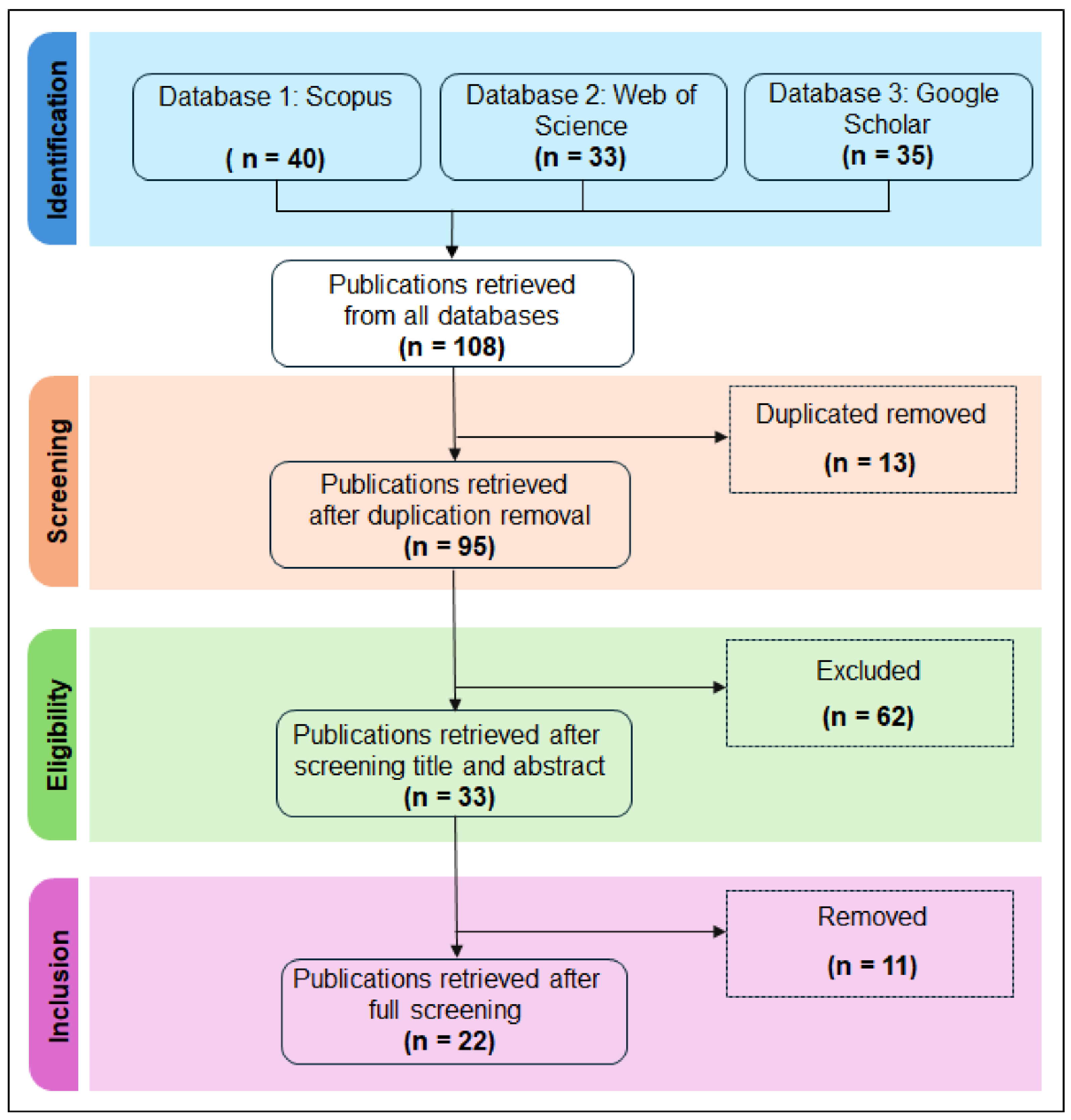
2.4. Study Selection
2.5. Methodological Quality Assessment
2.6. Data Extraction
2.7. Effect Size Index
2.8. Statistical Analysis
3. Results
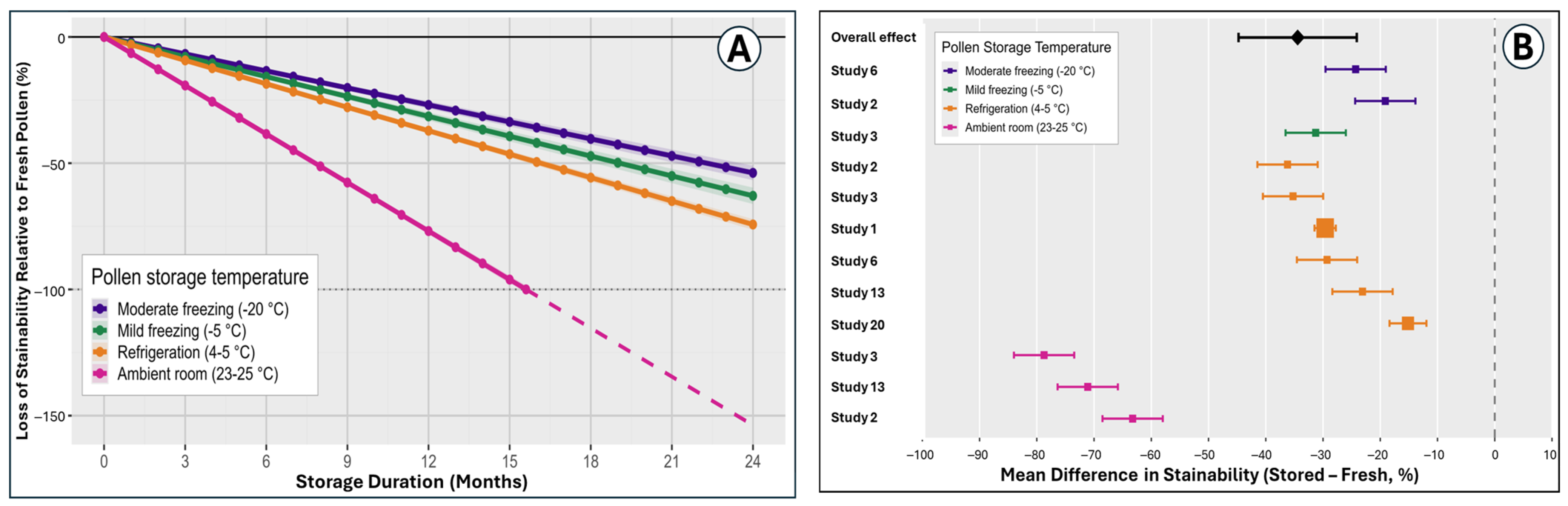
3.1. Effects of Pollen Storage on Stainability (Acetocarmine)
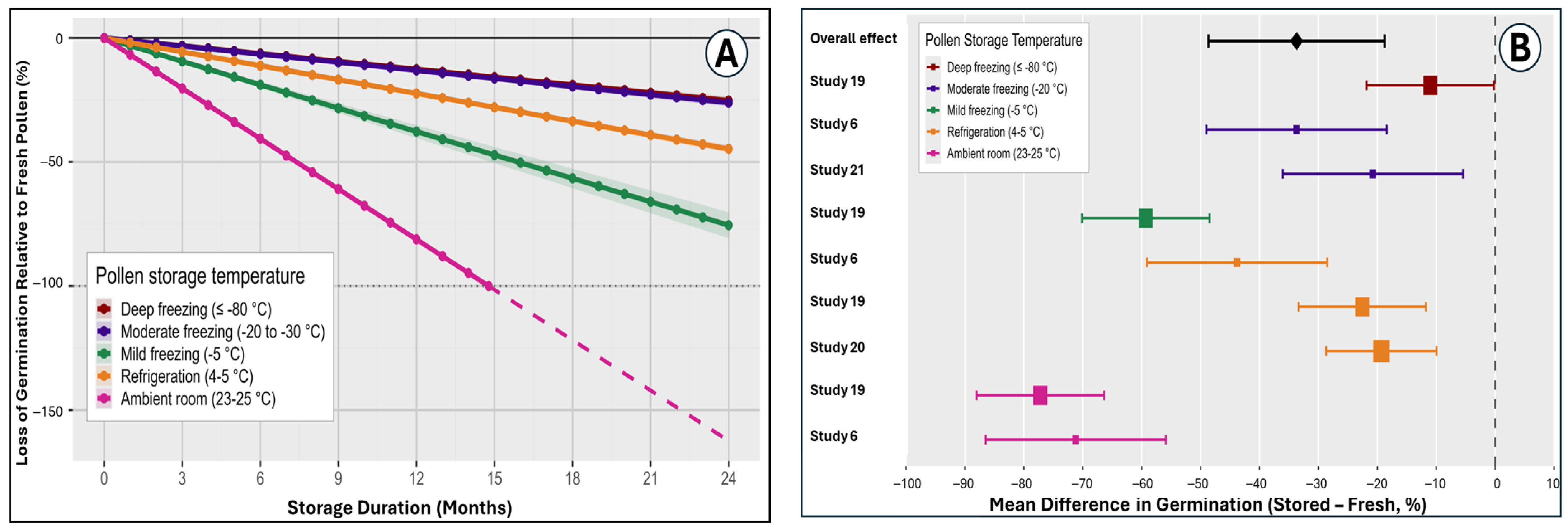
3.2. Effects of Pollen Storage on Germination In Vitro
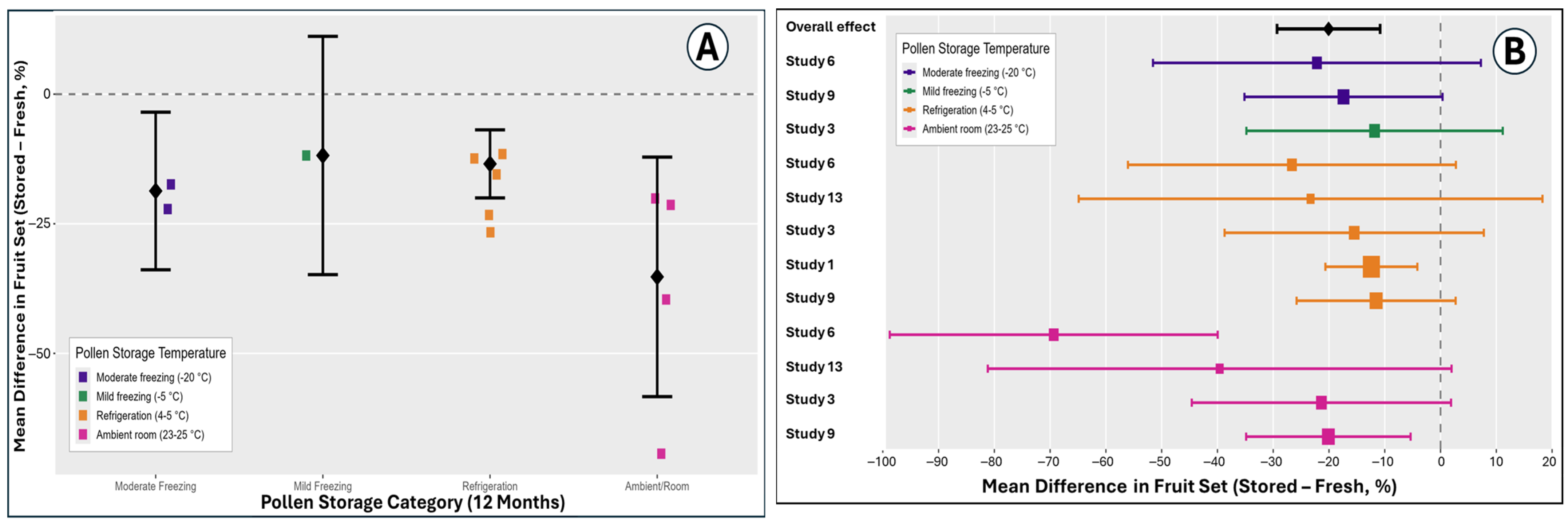
3.3. Effects of Pollen Storage on Fruit Set
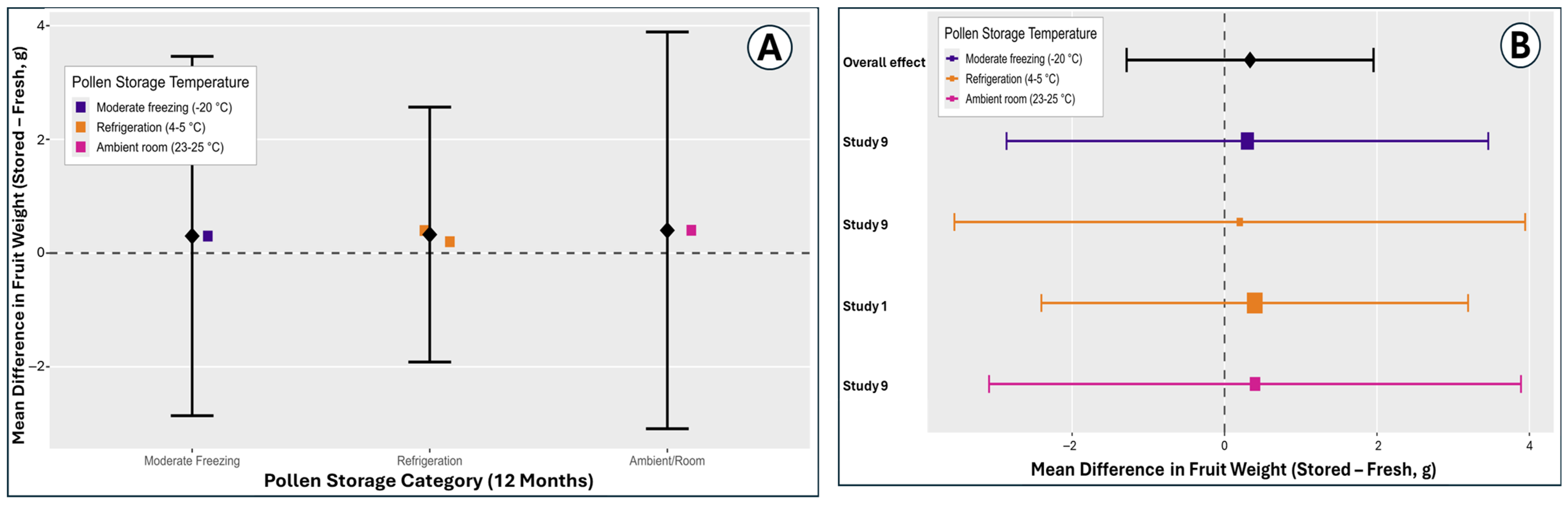
3.4. Effects of Pollen Storage on Fruit Weight at Harvest
4. Discussion
4.1. Pollen Storage and the Decline of Pollen Physiological Quality
4.2. Temperature-Dependent Preservation of Pollen Physiological Quality
4.3. From Pollen Physiological Quality to Reproductive Success
4.4. Methodological Considerations in Pollen Quality Assessment
4.5. Biological and Phenological Sources of Variability in Pollen Performance
4.6. Implications for Pollen Storage and Pollination Management in Date Palm Cultivation
4.7. Strengths and Limitations of the Current Evidence
5. Conclusions
Supplementary Materials
Author Contributions
Funding
Data Availability Statement
Acknowledgments
Conflicts of Interest
References
- Salomón-Torres, R.; Krueger, R.; García-Vázquez, J.P.; Villa-Angulo, R.; Villa-Angulo, C.; Ortiz-Uribe, N.; Sol-Uribe, J.A.; Samaniego-Sandoval, L. Date Palm Pollen: Features, Production, Extraction and Pollination Methods. Agronomy 2021, 11, 504. [Google Scholar] [CrossRef] [Scilit]
- Chao, C.T.; Krueger, R.R. The Date Palm (Phoenix dactylifera L.): Overview of Biology, Uses, and Cultivation. HortScience 2007, 42, 1077–1082. [Google Scholar] [CrossRef] [Scilit]
- Maryam, S. Advances in Pollen Biology and Pollination Strategies for Date Palm: A Review. J. Hortic. Sci. Technol. 2024, 15, 15–22. [Google Scholar] [CrossRef] [Scilit]
- Stanley, R.G.; Linskens, H.F. Pollen: Biology, Biochemistry, Management; Springer: Berlin, Germany, 1974. [Google Scholar]
- Al-Najm, A.; Brauer, S.; Trethowan, R.; Merchant, A.; Ahmad, N. Optimization of in Vitro Pollen Germination and Viability Testing of Some Australian Selections of Date Palm (Phoenix dactylifera L.) and Their Xenic and Metaxenic Effects on the Tissue Culture–Derived Female Cultivar “Barhee”. Vitr. Cell. Dev. Biol. Plant 2021, 57, 771–785. [Google Scholar] [CrossRef] [Scilit]
- Salomón-Torres, R.; Elhoumaizi, M.A.; Zambrano-Reyes, C.; Zaid, A.A.; Ruisanchez-Ortega, Y.; Peña-Yam, L.P.; Gutiérrez-Pacheco, M.M. Effect of Pollen Storage Duration on Stainability, Fruit Set, and Physical Traits in Date Palm (Phoenix dactylifera L.) Cultivar ‘Mejhoul’. Plants 2025, 14, 3189. [Google Scholar] [CrossRef] [Scilit]
- El Kadri, N.; Ben Mimoun, M. In Vitro Germination of Different Date Palm (Phoenix dactylifera L.) Pollen Sources from Southern Tunisia under the Effect of Three Storage Temperatures. Int. J. Fruit Sci. 2020, 20, S1519–S1529. [Google Scholar] [CrossRef] [Scilit]
- Zaid, A.; Oihabi, A. Variety Mejhoul The Jewel of Dates Origin, Distribution and International Markets; KIADPAI: Abu Dhabi, United Arab Emirates, 2022. [Google Scholar]
- Kadri, K.; Elsafy, M.; Makhlouf, S.; Awad, M.A. Effect of Pollination Time, the Hour of Daytime, Pollen Storage Temperature and Duration on Pollen Viability, Germinability, and Fruit Set of Date Palm (Phoenix dactylifera L.) Cv “Deglet Nour”. Saudi J. Biol. Sci. 2022, 29, 1085–1091. [Google Scholar] [CrossRef] [Scilit] [PubMed]
- Sharma, K.M.; Kumar, M.; Muralidharan, C.M.; Salomón-Torres, R. Date Palm Pollination Management. In Date Palm; Al-Khayri, J.M., Jain, S.M., Johnson, D.V., Krueger, R.R., Eds.; CABI: Wallingford, UK, 2023; pp. 209–240. [Google Scholar]
- Alavipour, S.; Khaleghi, E.; Moallemi, N.; Mehdikhanlou, K.; Trohi, A. Heteromorphism of Normal and Abnormal Flowers of Date Palm Cv. “Barhee” and Comparison of Green and Red Ghanami Pollens as Dominant Pollen. S. Afr. J. Bot. 2023, 163, 541–551. [Google Scholar] [CrossRef] [Scilit]
- Salomón-Torres, R.; Ortiz-Uribe, N.; Villa-Angulo, R.; Villa-Angulo, C.; Norzagaray-Plasencia, S.; Garcia-Verdugo, C. Effect of pollenizers on production and fruit characteristics of date palm (Phoenix dactylifera L.) cultivar Medjool in Mexico. Turk. J. Agric. For. 2017, 41, 338–347. [Google Scholar] [CrossRef] [Scilit]
- Araújo de Oliveira, A.C.; da Silva Lédo, A.; Polek, M.L.; Krueger, R.; Shepherd, A.; Volk, G.M. Optimization of In Vitro Germination and Cryopreservation Conditions for Preserving Date Palm Pollen in the USDA National Plant Germplasm System. Plant Cell Tissue Organ Cult. 2020, 144, 223–232. [Google Scholar] [CrossRef] [Scilit]
- Hachef, A.; Bourguiba, H.; Zarkouna, R.; Oueslati, R.; Cherif, E.; Zehdi-Azouzi, S. Effect of Long-Term Storage on Pollen Reproductive Quality and Polyphenolic Content of Date Palm (Phoenix dactylifera L.) Species in Tunisia. Appl. Fruit Sci. 2024, 66, 1453–1462. [Google Scholar] [CrossRef] [Scilit]
- Jafar Jaskani, M.; Fatima, B.; Salman Haider, M.; Abbas Naqvi, S.; Nafees, M.; Ahmad, R.; Ahmad Khan, I. Evaluation of Pollen Viability In Date Palm Cultivars Under Different Storage Temperatures. Pak. J. Bot. 2015, 47, 377–381. [Google Scholar]
- Boughediri, L.; Cerceau-Larrival, M.T.; Dore, J.C. Significance of Freeze-Drying in Long Term Storage of Date Palm Pollen. Grana 1995, 34, 408–412. [Google Scholar] [CrossRef] [Scilit]
- Sharma, K.M.; Baidiayavadra, D.A.; Muralidharan, C.M.; Panchal, C.N.; Verma, P. Effect of Storage Temperature and Containers on Date Palm (Phoenix dactylifera L.) Pollen Viability and Post-Storage Pollination. Sugar Tech 2024, 26, 1516–1521. [Google Scholar] [CrossRef] [Scilit]
- Mortazavi, S.M.H.; Arzani, K.; Moieni, A. Optimizing Storage and In Vitro Germination of Date Palm (Phoenix dactylifera L.) Pollen. J. Agric. Sci. Technol. 2010, 12, 181–189. [Google Scholar]
- Anushma, P.L.; Linta, V.; Rajesekharan, P.E.; Ganeshan, S. Pollen Storage Studies in Date Palm (Phoenix dactylifera L.). Int. J. Chem. Stud. 2018, 6, 2640–2642. [Google Scholar]
- Ateyyeh, A.F. Effect of Storage Method on Date Palm and Pistachio Pollen Viability. Jordan J. Agric. Sci. 2012, 8, 573–582. [Google Scholar]
- Mohamed, M.E.; Hamza El-Hag, K.; Abdalla Albashir Ibrahim, M.; Ahmed Elnagib, O.; Saad Adam, A. A Note on Effect of Storage of Date Palm (Phoenix dactylifera L.) Pollen Grains on Their Germination and Date’s Fruit Setting. Univ. Khartoum J. Agric. Sci. 2015, 23, 296–302. [Google Scholar] [CrossRef] [Scilit]
- El Kadri, N.; Ben Mimoun, M.B. The Effect of Pollen Storage Temperatures on Fruit Set and Fruit Quality of “Deglet Nour” Date Palm (Phoenix dactylifera L.) Cultivar. Italus Hortus 2020, 27, 53–63. [Google Scholar] [CrossRef] [Scilit]
- Firmage, D.H.; Dafni, A. Field Tests for Pollen Viability; A Comparative Approach. Acta Hortic. 2001, 561, 87–94. [Google Scholar] [CrossRef] [Scilit]
- Einhardt, P.M.; Correa, E.R.; Raseira, M.D.C.B. Comparação Entre Métodos Para Testar a Viabilidade de Pólen de Pessegueiro. Rev. Bras. Frutic. 2006, 28, 5–7. [Google Scholar] [CrossRef] [Scilit]
- Alexander, M.P. Differential Staining of Aborted and Nonaborted Pollen. Biotech. Histochem. 1969, 44, 117–122. [Google Scholar] [CrossRef] [Scilit] [PubMed]
- Heslop-Harrison, J.; Heslop-Harrison, Y. Evaluation of Pollen Viability by Enzymatically Induced Fluorescence; Intracellular Hydrolysis of Fluorescein Diacetate. Biotech. Histochem. 1970, 45, 115–120. [Google Scholar] [CrossRef] [Scilit] [PubMed]
- Munir, M. An Appraisal of Pollen Germination and Viability of Varied Male Pollen Sources of Date Palm (Phoenix dactylifera L.). J. Appl. Hortic. 2021, 23, 254–259. [Google Scholar] [CrossRef] [Scilit]
- Brewbaker, J.L.; Kwack, B.H. The Essential Role of Calcium Ion in Pollen Germination and Pollen Tube Growth. Am. J. Bot. 1963, 50, 859–865. [Google Scholar] [CrossRef] [Scilit]
- Mesnoua, M.; Roumani, M.; Salem, A. The Effect of Pollen Storage Temperatures on Pollen Viability, Fruit Set and Fruit Quality of Six Date Palm Cultivars. Sci. Hortic. 2018, 236, 279–283. [Google Scholar] [CrossRef] [Scilit]
- Page, M.J.; McKenzie, J.E.; Bossuyt, P.M.; Boutron, I.; Hoffmann, T.C.; Mulrow, C.D.; Shamseer, L.; Tetzlaff, J.M.; Akl, E.A.; Brennan, S.E.; et al. The PRISMA 2020 Statement: An Updated Guideline for Reporting Systematic Reviews. BMJ 2021, 372, n71. [Google Scholar] [CrossRef] [Scilit]
- Schardt, C.; Adams, M.B.; Owens, T.; Keitz, S.; Fontelo, P. Utilization of the PICO framework to improve searching PubMed for clinical questions. BMC Med. Inform. Decis. Mak. 2007, 7, 16. [Google Scholar] [CrossRef] [Scilit]
- Kumawat, P.; Singh Rathore, R.; Kumar, S.; Sharma, S.; Kumar Yadav, P.; Lata, K. Pollen Preservation Approaches in Date Palm Cultivation: Assessing Effects on Viability, Fruit Quality, and Yield in ‘Mundra Selection-3’. Appl. Fruit Sci. 2024, 66, 2425–2432. [Google Scholar] [CrossRef] [Scilit]
- Karim, K.; Awad, M.A.; Manar, A.; Monia, J.; Karim, A.; Mohammed, E. Effect of Flowering Stage and Storage Conditions on Pollen Quality of Six Male Date Palm Genotypes. Saudi J. Biol. Sci. 2022, 29, 2564–2572. [Google Scholar] [CrossRef] [Scilit]
- Izadi, M.; Shirazi, M.P.; Khademi, R. Study of the Effects of Storage Methods and Amount of Pollen on “Zahidi” Date Palm Fruit Setting. In Proceedings of the 4th International Date Palm Conference; Zaid, A., Alhadrami, G.A., Eds.; Acta Hort: Abu Dhabi, United Arab Emirates, 2010; pp. 1159–1162. [Google Scholar]
- Hachef, A.; Bourguiba, H.; Cherif, E.; Ivorra, S.; Terral, J.F.; Zehdi-Azouzi, S. Agro-Morphological Traits Assessment of Tunisian Male Date Palms (Phoenix dactylifera L.) for Preservation and Sustainable Utilization of Local Germplasm. Saudi J. Biol. Sci. 2023, 30, 103574. [Google Scholar] [CrossRef] [Scilit] [PubMed]
- Aly, H.S.H. Evaluation of Pollen Grains Germination, Viability and Chemical Composition of Some Date Palm Males. Middle East J. Agric. Res. 2018, 7, 235–247. [Google Scholar]
- Abdel-Sattar, M.; Yahia, M. Pollen Viability of Date Palm from Different Sources in Relation to Its Chemical Composition. Alex. J. Agric. Sci. 2017, 62, 149–155. [Google Scholar]
- R Core Team. R: A Language and Environment for Statistical Computing; R Foundation for Statistical Computing: Vienna, Austria, 2024. [Google Scholar]
- Viechtbauer, W. Conducting Meta-Analyses in R with the metafor package. J. Stat. Softw. 2010, 36, 1–48. [Google Scholar] [CrossRef] [Scilit]
- Wickham, H. ggplot2: Elegant Graphics for Data Analysis; Springer: New York, NY, USA, 2016. [Google Scholar]



| No. | Title | Country | Male Pollen Source | Storage Conditions | Storage Duration | Pollen Evaluation Methods | Outcomes Assessed |
|---|---|---|---|---|---|---|---|
| 1 | Effect of Pollen Storage Duration on Stainability, Fruit Set, and Physical Traits in Date Palm (Phoenix dactylifera L.) Cultivar ‘Mejhoul’ [6] | Mexico | ‘Mejhoul’, ‘Deglet Nour’, ‘Khadrawy’, and ‘Zahidi’ | Fresh, 4 °C | Up to 24 months | Acetocarmine, controlled hand pollination | Stainability, fruit set, fruit weight |
| 2 | Pollen Preservation Approaches in Date Palm Cultivation: Assessing Effects on Viability, Fruit Quality, and Yield in ‘Mundra Selection-3’ [32] | India | Local male palms | Fresh, ambient, 5 °C, −15 °C | Up to 12 months | Acetocarmine, controlled hand pollination | Stainability, fruit set, fruit weight |
| 3 | Effect of Storage Temperature and Containers on Date Palm (Phoenix dactylifera L.) Pollen Viability and Post-storage Pollination [17] | India | Local male palms | Fresh, ambient, 5 °C, −4 °C | Up to 24 months | Acetocarmine, controlled hand pollination | Stainability, fruit set |
| 4 | Effect of Long-Term Storage on Pollen Reproductive Quality and Polyphenolic Content of Date Palm (Phoenix dactylifera L.) Species in Tunisia [14] | Tunisia | Local male palms | Fresh, 4 °C | Up to 60 months | Alexander, in vitro assays | Stainability, germination |
| 5 | Effect of Flowering Stage and Storage Conditions on Pollen Quality of Six Male Date Palm Genotypes [33] | Tunisia | Six male genotypes | Ambient, 4 °C, −30 °C | Up to 4 Months | Acetocarmine, in vitro assays | Stainability, germination |
| 6 | Effect of Pollination Time, the Hour of Daytime, Pollen Storage Temperature and Duration on Pollen Viability, Germinability, and Fruit Set of Date Palm (Phoenix dactylifera L.) cv. ‘Deglet Nour’ [9] | Tunisia | Local male palms | Ambient, 4 °C, −30 °C | Up to 12 months | Acetocarmine, in vitro assays, controlled hand pollination | Stainability, germination, fruit set |
| 7 | Optimization of In Vitro Pollen Germination and Viability Testing of Some Australian Selections of Date Palm (Phoenix dactylifera L.) and their xenic and metaxenic effects on the tissue culture-derived female cultivar “Barhee” [5] | Australia | Three males Genotypes | 4 °C | 12 months | IKI, LPCB, acetocarmine, TTC, FDA, Alexander, and in vitro assays. | Stainability, germination |
| 8 | Optimization of In Vitro Germination and Cryopreservation Conditions for Preserving Date Palm Pollen in the USDA National Plant Germplasm System [13] | USA | ‘Dayri BC2’, ‘Fard #4’, ‘Jarvis #1’,‘Thoory BC3’, and ‘Thoory X F1’ | −196 °C | 9 months | In vitro assays | Germination |
| 9 | The Effect of Pollen Storage Temperatures on Fruit Set and Fruit Quality of ‘Deglet Nour’ Date Palm (Phoenix dactylifera L.) Cultivar [22] | Tunisia | Local male palms | Fresh, ambient, 4 °C, −20 °C | 12 months | Controlled hand pollination | Fruit set, fruit weight |
| 10 | In Vitro Germination of Different Date Palm (Phoenix dactylifera L.) Pollen Sources from Southern Tunisia under the Effect of Three Storage Temperatures [7] | Tunisia | Local male palms | Fresh, ambient, 4 °C, −20 °C | 12 months | In vitro assays | Germination |
| 11 | The Effect of Pollen Storage Temperatures on Pollen Viability, Fruit Set and Fruit Quality of Six Date Palm Cultivars [29] | Algeria | ‘Bouhlesse’, ‘Deglet Beida’, ‘Deglet Nour’, ‘Ghars’, ‘Halwaya’, and ‘Moch Deglet’ | Fresh, Ambient, 4 °C, −20 °C | Up to 13 Months | In vitro assays, controlled hand pollination | Germination, fruit set, fruit weight |
| 12 | Evaluation of Pollen Viability in Date Palm Cultivars under Different Storage Temperatures [15] | Pakistan | ‘Dhakki’, ‘Khadrawy’, and ‘Hillawi’ | 4 °C, −20 °C, −80 °C | Up to 12 Months | Acetocarmine, in vitro assays | Stainability, germination |
| 13 | Study of the Effects of Storage Methods and Amount of Pollen on ‘Zahidi’ Date Palms Fruit Setting [34] | Iran | Local male palms | Fresh, ambient, 4 °C | 12 months | Acetocarmine | Stainability |
| 14 | Optimizing Storage and In Vitro Germination of Date Palm (Phoenix dactylifera) Pollen [18] | Iran | ‘Ghanami’, ‘Samsmavi’, and ‘Gheibani’ | Ambient, 4 °C, −20 °C, −196 °C | 6 months | In vitro assays | Germination |
| 15 | Significance of Freeze-Drying in Long-Term Storage of Date Palm Pollen [16] | Algeria | Local male palms | 4 °C, −20 °C, −80 °C | Up to 24 Months | In vitro assays | Germination |
| 16 | A Note on Effect of Storage of Date Palm (Phoenix dactylifera L.) Pollen Grains on Their Germination and Date’s Fruit Setting [21] | Sudan | Local male palms | Fresh, 4 °C, −20 °C, | 12 months | In vitro assays, controlled hand pollination | Germination, fruit set |
| 17 | Agro-morphological traits assessment of Tunisian male date palms (Phoenix dactylifera L.) for preservation and sustainable utilization of local germplasm [35] | Tunisia | 180 males genotypes | Fresh pollen | 0 months | Alexander, in vitro assays | Stainability, Germination |
| 18 | An appraisal of pollen germination and viability of varied male pollen sources of date palm (Phoenix dactylifera L.) [27] | Saudi Arabia | Local male palms | Fresh pollen | 0 months | Acetocarmine, In vitro assays | Stainability, Germination |
| 19 | Effect of Storage Method on Date Palm and Pistachio Pollen Viability [20] | Jordan | Local male palms | Fresh, ambient, 4 °C, −5 °C, −80 °C | Up to 12 months | TTC, in vitro assays | Stainability, Germination |
| 20 | Evaluation of Pollen Grains Germination, Viability and Chemical Composition of Some Date Palm Males [36] | Egypt | Local male palms | 4 °C | 12 months | Acetocarmine, in vitro assays | Stainability, Germination |
| 21 | Pollen Storage Studies in Date Palm (Phoenix dactylifera L.) [19] | India | Local male palms | Fresh, 4 °C, −20 °C, −196 °C | Up to 12 months | In vitro assays | Germination |
| 22 | Pollen Viability of Date Palm from Different Sources in Relation to Its Chemical Composition [37] | Egypt | Local male palms | Fresh pollen | 0 months | Acetocarmine, in vitro assays | Stainability, Germination |
| Storage Condition | Temperature | Stainability Decline (% Month−1) | Germination Decline (% Month−1) |
|---|---|---|---|
| Room temperature | 23–25 °C | −6.41 (−6.51 to −6.30) | −6.77 (−6.83 to −6.71) |
| Refrigeration | 4–5 °C | −3.10 (−3.18 to −3.01) | −1.86 (−1.93 to −1.80) |
| Mild freezing | −5 °C | −2.62 (−2.76 to −2.49) | −3.14 (−3.36 to −2.93) |
| Moderate freezing | −20 °C | −2.24 (−2.36 to −2.12) | −1.09 (−1.15 to −1.02) |
| Deep freezing | ≤−80 °C | — | −1.05 (−1.12 to −0.99) |
Disclaimer/Publisher’s Note: The statements, opinions and data contained in all publications are solely those of the individual author(s) and contributor(s) and not of MDPI and/or the editor(s). MDPI and/or the editor(s) disclaim responsibility for any injury to people or property resulting from any ideas, methods, instructions or products referred to in the content. |
© 2026 by the authors. Licensee MDPI, Basel, Switzerland. This article is an open access article distributed under the terms and conditions of the Creative Commons Attribution (CC BY) license.
Share and Cite
Salomón-Torres, R.; Elhoumaizi, M.A.; Wright, G.C.; Zaid, A.A.; Ruisanchez-Ortega, Y.; Núñez-Ramírez, F.; Samaniego-Sandoval, L. Effects of Pollen Storage on Physiological Quality and Reproductive Performance in Date Palm (Phoenix dactylifera L.): A Systematic Review and Meta-Analysis. Horticulturae 2026, 12, 475. https://doi.org/10.3390/horticulturae12040475
Salomón-Torres R, Elhoumaizi MA, Wright GC, Zaid AA, Ruisanchez-Ortega Y, Núñez-Ramírez F, Samaniego-Sandoval L. Effects of Pollen Storage on Physiological Quality and Reproductive Performance in Date Palm (Phoenix dactylifera L.): A Systematic Review and Meta-Analysis. Horticulturae. 2026; 12(4):475. https://doi.org/10.3390/horticulturae12040475
Chicago/Turabian StyleSalomón-Torres, Ricardo, Mohammed Aziz Elhoumaizi, Glenn C. Wright, Abdelouahhab Alboukhari Zaid, Yohandri Ruisanchez-Ortega, Fidel Núñez-Ramírez, and Laura Samaniego-Sandoval. 2026. "Effects of Pollen Storage on Physiological Quality and Reproductive Performance in Date Palm (Phoenix dactylifera L.): A Systematic Review and Meta-Analysis" Horticulturae 12, no. 4: 475. https://doi.org/10.3390/horticulturae12040475
APA StyleSalomón-Torres, R., Elhoumaizi, M. A., Wright, G. C., Zaid, A. A., Ruisanchez-Ortega, Y., Núñez-Ramírez, F., & Samaniego-Sandoval, L. (2026). Effects of Pollen Storage on Physiological Quality and Reproductive Performance in Date Palm (Phoenix dactylifera L.): A Systematic Review and Meta-Analysis. Horticulturae, 12(4), 475. https://doi.org/10.3390/horticulturae12040475