Phytochemical Profile and Biological Activities of Allium longistylum Sprouts

 ,
,  ,
,  , and
, and 
Highlights
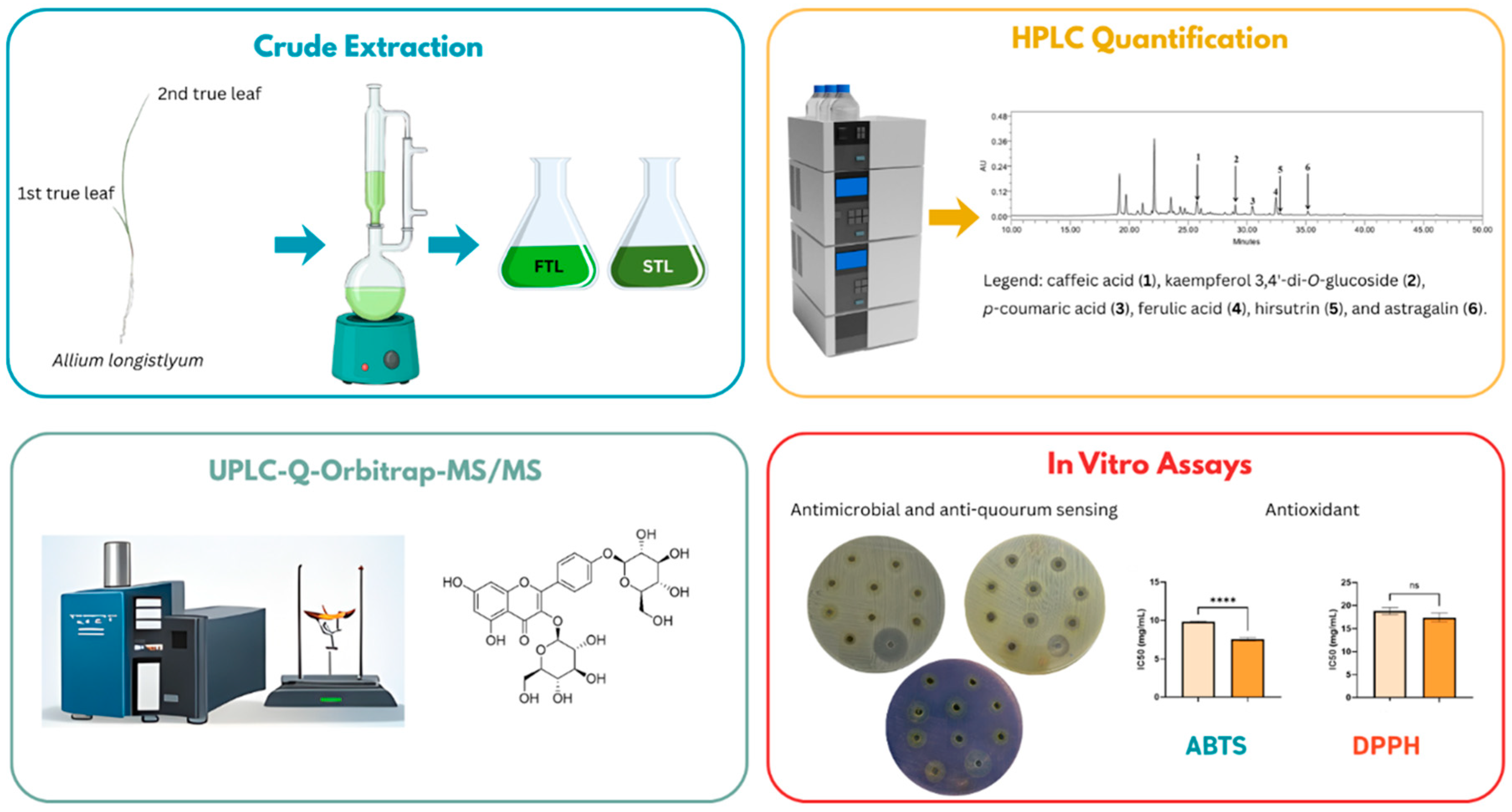
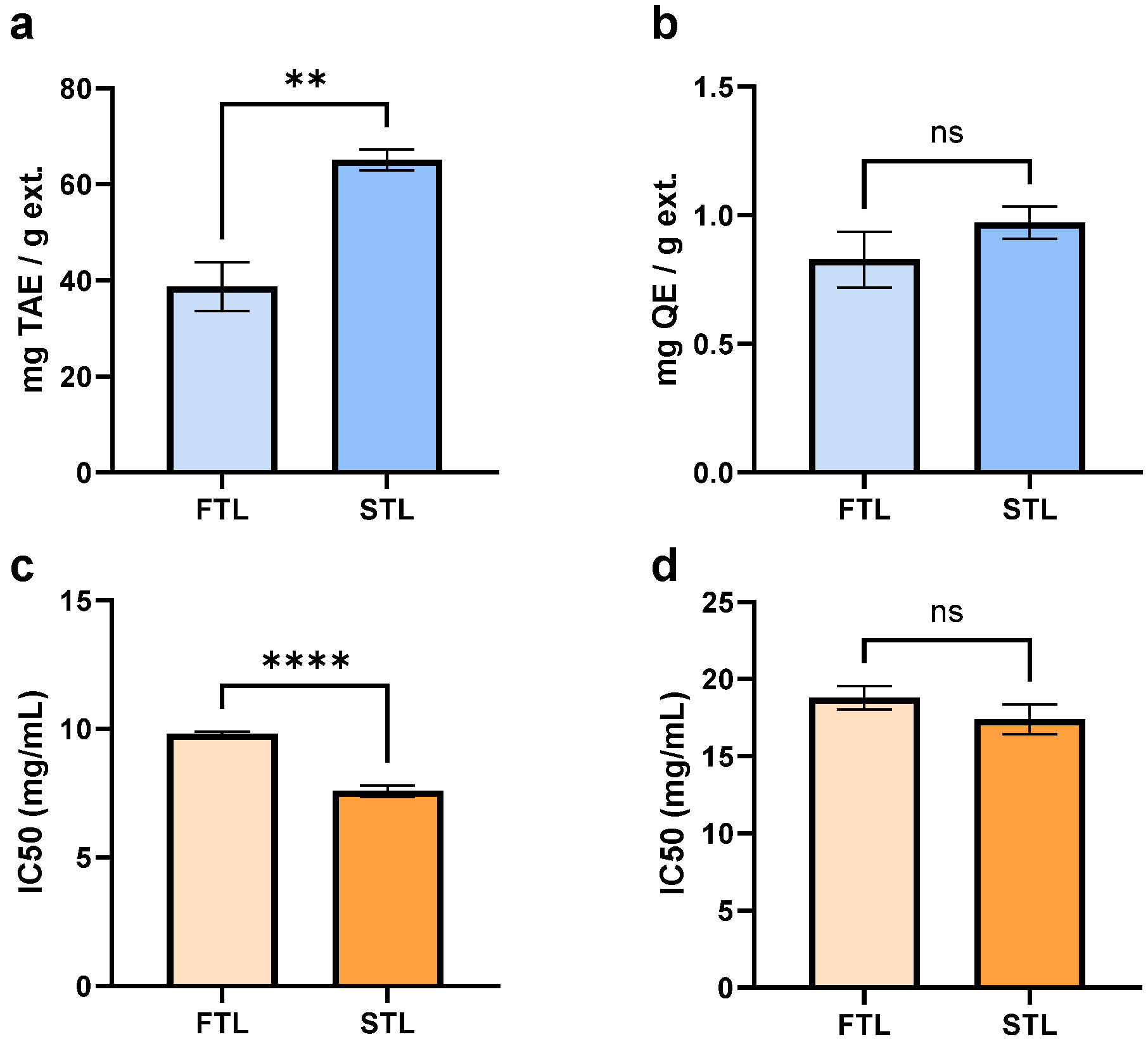
- The second true leaves of A. longistylum showed higher phenolic and stronger antioxidant activity.
- The extracts exhibited weak antimicrobial but measurable anti-QS activity.
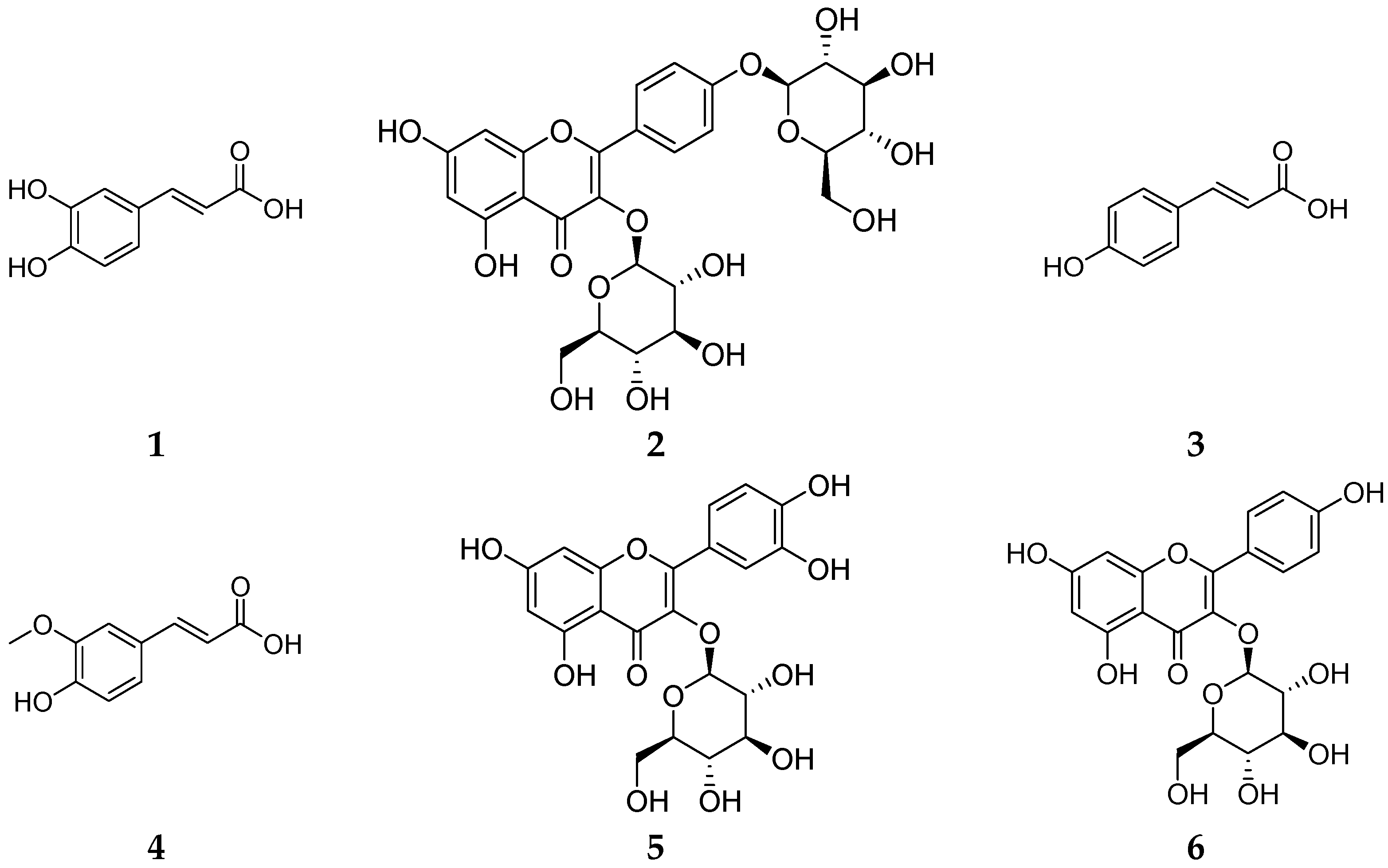
- Phenolic acids and flavonoids were identified via UPLC-MS and HPLC analyses.
- The developmental stage influences metabolite accumulation and bioactivity.
- A. longistylum shows potential as a source of functional bioactive compounds.
Abstract
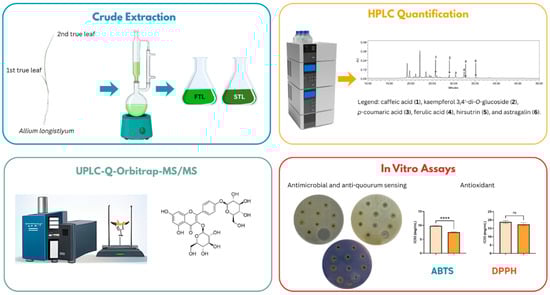
1. Introduction
2. Materials and Methods
2.1. Plant Materials and Cultivation Conditions
2.2. Instruments and Reagents
2.3. Crude Extraction
2.4. TPC Assay
2.5. TFC Assay
2.6. DPPH Radical Scavenging Assay
2.7. ABTS Radical Scavenging Assay
2.8. Preparation of Microbial Inoculum
2.9. Antimicrobial Activity by Disc Diffusion Assay
2.10. Anti-QS Activity Assay
2.11. MIC and MBC
2.12. Phytochemical Profiling by UPLC-Q-Orbitrap-ESI-MS/MS
2.13. Phytochemical Quantification by HPLC
2.14. Determination of Linearity
2.15. Statistical Analysis
3. Results and Discussion
3.1. TPC and TFC
3.2. ABTS and DPPH
3.3. Microbial Inhibitory Activity
3.4. QS Inhibition Assay
3.5. MIC and MBC Assay
3.6. UPLC-Q-Orbitrap-ESI-MS/MS Profiling
3.7. HPLC Quantification
4. Conclusions
Author Contributions
Funding
Data Availability Statement
Acknowledgments
Conflicts of Interest
References
- Ekşi, G.; Özkan, A.M.G.; Koyuncu, M. Garlic and onions: An eastern tale. J. Ethnopharmacol. 2020, 253, 112675. [Google Scholar] [CrossRef] [PubMed]
- Rocchetti, G.; Zhang, L.; Bocchi, S.; Giuberti, G.; Ak, G.; Elbasan, F.; Yıldıztugay, E.; Ceylan, R.; Picot-Allain, M.C.N.; Mahomoodally, M.F.; et al. The functional potential of nine Allium species related to their untargeted phytochemical characterization, antioxidant capacity, and enzyme inhibitory ability. Food Chem. 2021, 368, 130782. [Google Scholar] [CrossRef]
- Gorrepati, K.; Krishna, R.; Singh, S.; Shirsat, D.V.; Soumia, P.S.; Mahajan, V. Harnessing the nutraceutical and therapeutic potential of Allium spp.: Current insights and future directions. Front. Nutr. 2024, 11, 1497953. [Google Scholar] [CrossRef]
- Jomova, K.; Alomar, S.Y.; Valko, R.; Liska, J.; Nepovimova, E.; Kuca, K.; Valko, M. Flavonoids and their role in oxidative stress, inflammation, and human diseases. Chem.-Biol. Interact. 2025, 413, 111489. [Google Scholar] [CrossRef] [PubMed]
- Labudda, M.; Tokarz, K.; Tokarz, B.; Muszyńska, E.; Gietler, M.; Górecka, M.; Różańska, E.; Rybarczyk-Płońska, A.; Fidler, J.; Prabucka, B.; et al. Reactive oxygen species metabolism and photosynthetic performance in leaves of Hordeum vulgare plants co-infested with Heterodera filipjevi and Aceria tosichella. Plant Cell Rep. 2020, 39, 1719–1741. [Google Scholar] [CrossRef]
- Shi, Y.; Chen, J.; Hou, X. Similarities and differences of photosynthesis establishment-related mRNAs and novel lncRNAs in early seedlings (coleoptile/cotyledon vs. true leaf) of rice and Arabidopsis. Front. Genet. 2020, 11, 565006. [Google Scholar] [CrossRef]
- Dong, N.; Lin, H. Contribution of phenylpropanoid metabolism to plant development and plant–environment interactions. J. Integr. Plant Biol. 2020, 63, 180–209. [Google Scholar] [CrossRef]
- Choi, H.J.; Oh, B.U. A partial revision of Allium (Amaryllidaceae) in Korea and north-eastern China. Bot. J. Linn. Soc. 2011, 167, 153–211. [Google Scholar] [CrossRef]
- Kang, J.-Y.; Kang, M.-S.; Seo, E.-J.; Hwang, Y.-J.; Yoon, M.; Jang, B.-K.; Cho, W.; Lim, K.-B.; Ahn, Y.-J. Exploration of cytogenetic traits of Allium species endemic to Korea for novel ornamental cultivar breeding using FISH technique and RAPD markers. Hortic. Environ. Biotechnol. 2025, 66, 599–614. [Google Scholar] [CrossRef]
- Lee, H.-D.; Tonog, G.; Uy, N.P.; Lee, Y.; Kim, K.-Y.; Kim, H.; Lee, S. Phytochemical profile, antioxidant, anti-atopic, and anti-inflammatory activities of Filipendula glaberrima Nakai at different growth stages. Pharmaceuticals 2024, 17, 928. [Google Scholar] [CrossRef] [PubMed]
- Lee, C.-D.; Lee, H.-D.; Lee, S.; Lee, D.-H.; Ku, J.; Lee, S. Investigating the antioxidant potential of the ethyl acetate fraction from Rhododendron mucronulatum var. albiflorum. Hortic. Environ. Biotechnol. 2025, 66, 993–1004. [Google Scholar] [CrossRef]
- Padayao, M.H.R.; Padayao, F.R.P.; Patalinghug, J.M.; Raña, G.S.; Yee, J.; Geraldino, P.J.; Quilantang, N. Antimicrobial and quorum sensing inhibitory activity of epiphytic bacteria isolated from the red alga Halymenia durvillei. Access Microbiol. 2023, 5, 000563. [Google Scholar] [CrossRef]
- Padayao, F.R.P.A.; Acosta, O.B.L.; Ramos, R.I.; Sanchez, R.M.T.S.; Padayao, M.H.R.A.; Yee, J.C.; Arakawa, K.; Quilantang, N.G. Bioactivity screening and chemical profiling of Halymenia durvillei fermented by indigenous seaweed-associated Bacillus species. Microbe 2025, 8, 100491. [Google Scholar] [CrossRef]
- Li, Y.; Kong, D.; Fu, Y.; Sussman, M.R.; Wu, H. The effect of developmental and environmental factors on secondary metabolites in medicinal plants. Plant Physiol. Biochem. 2020, 148, 80–89. [Google Scholar] [CrossRef]
- Lee, S.-Y.; Lee, S.-Y.; Yoon, N.; Uy, N.P.; Choi, C.-H.; Lee, S.; Lee, S. Phytochemical profiling and antioxidant activity of true leaves and cotyledons of Adenocaulon himalaicum. ChemEngineering 2025, 9, 31. [Google Scholar] [CrossRef]
- Günal-Köroğlu, D.; Esatbeyoglu, T.; Capanoglu, E. Effect of germination on the phenolic compounds: Content, bioavailability, food applications, and health benefits. J. Food Meas. Charact. 2025, 19, 8144–8164. [Google Scholar] [CrossRef]
- Hazrati, S.; Mousavi, Z.; Mollaei, S.; Angourani, H.R.; Nicola, S. Effect of phenological variation on the phytochemical composition and antioxidant activity of different organs of Capparis spinosa L. Horticulturae 2025, 11, 702. [Google Scholar] [CrossRef]
- Angermann, C.; Heinemann, B.; Nogueira, B.B.; Mai, H.; Bauer, P.; Hildebrandt, T.M. Balancing nutrient remobilization and photosynthesis: Proteomic insights into the dual role of lupin cotyledons after germination. Plant J. 2025, 123, e70357. [Google Scholar] [CrossRef]
- Mathew, S.; Abraham, T.E.; Zakaria, Z.A. Reactivity of phenolic compounds towards free radicals under in vitro conditions. J. Food Sci. Technol. 2015, 52, 5790–5798. [Google Scholar] [CrossRef] [PubMed]
- Kumar, N.; Goel, N. Phenolic acids: Natural versatile molecules with promising therapeutic applications. Biotechnol. Rep. 2019, 24, e00370. [Google Scholar] [CrossRef]
- Qi, N.; Zhao, W.; Xue, C.; Zhang, L.; Hu, H.; Jin, Y.; Xue, X.; Chen, R.; Zhang, J. Phenolic acid and flavonoid content analysis with antioxidant activity assessment in Chinese C. pi. Shen honey. Molecules 2025, 30, 370. [Google Scholar] [CrossRef] [PubMed]
- Skroza, D.; Šimat, V.; Vrdoljak, L.; Jolić, N.; Skelin, A.; Čagalj, M.; Frleta, R.; Generalić Mekinić, I. Investigation of antioxidant synergisms and antagonisms among phenolic acids in the model matrices using FRAP and ORAC methods. Antioxidants 2022, 11, 1784. [Google Scholar] [CrossRef]
- May, K.L.; Grabowicz, M. The bacterial outer membrane is an evolving antibiotic barrier. Proc. Natl. Acad. Sci. USA 2018, 115, 8852–8854. [Google Scholar] [CrossRef]
- Xu, F.; Xie, Y.; Yu, W.; Wang, Z. Breaking the outer membrane barrier: Structure, targets, and antimicrobial strategies for Gram-negative bacteria. Front. Microbiol. 2026, 17, 1734749. [Google Scholar] [CrossRef]
- Mohsenipour, Z.; Hassanshahian, M. The effects of Allium sativum extracts on biofilm formation and activities of six pathogenic bacteria. Jundishapur J. Microbiol. 2015, 8, e18971. [Google Scholar] [CrossRef] [PubMed]
- Chacón, I.D.-L.-C.; Riley-Saldaña, C.A.; González-Esquinca, A.R. Secondary metabolites during early development in plants. Phytochem. Rev. 2012, 12, 47–64. [Google Scholar] [CrossRef]
- Salam, U.; Ullah, S.; Tang, Z.-H.; Elateeq, A.A.; Khan, Y.; Khan, J.; Khan, A.; Ali, S. Plant metabolomics: An overview of the role of primary and secondary metabolites against different environmental stress factors. Life 2023, 13, 706. [Google Scholar] [CrossRef]
- Li, Q.; Zhao, M.; Cheng, H.; Lin, X.; Du, N.; Huang, Y. Timing of cotyledon post-emergence damage drives physiological compensation and resource allocation in oak seedling establishment. BMC Plant Biol. 2026, 26, 471. [Google Scholar] [CrossRef]
- Subramani, T.; Saravanan, H.; David, H.; Solanke, J.; Rajaramon, S.; Dandela, R.; Solomon, A.P. Bioorganic compounds in quorum sensing disruption: Strategies, mechanisms, and future prospects. Bioorg. Chem. 2025, 156, 108192. [Google Scholar] [CrossRef]
- Liu, D.; Lu, Y.; Li, Z.; Pang, X.; Gao, X. Quorum sensing: Not just a bridge between bacteria. MicrobiologyOpen 2025, 14, e70016. [Google Scholar] [CrossRef]
- Papaneophytou, C. Phytochemical quorum-sensing inhibitors against bacterial pathogens: Mechanisms of action and translational challenges. Curr. Issues Mol. Biol. 2026, 48, 214. [Google Scholar] [CrossRef]
- Ogofure, A.G.; Sebola, T.; Green, E. Antibacterial and anticancer properties of Solanum mauritianum fruit components analyzed using LC-QTOF-MS/MS. Sci. Rep. 2025, 15, 16698. [Google Scholar] [CrossRef] [PubMed]
- Zouine, N.; Ghachtouli, N.E.; Abed, S.E.; Koraichi, S.I. A comprehensive review on medicinal plant extracts as antibacterial agents: Factors, mechanism insights and future prospects. Sci. Afr. 2024, 26, e02395. [Google Scholar] [CrossRef]
- Gonzalez-Pastor, R.; Carrera-Pacheco, S.E.; Zúñiga-Miranda, J.; Rodríguez-Pólit, C.; Mayorga-Ramos, A.; Guamán, L.P.; Barba-Ostria, C. Current landscape of methods to evaluate antimicrobial activity of natural extracts. Molecules 2023, 28, 1068. [Google Scholar] [CrossRef]
- Roque-Borda, C.A.; Primo, L.M.D.G.; Franzyk, H.; Hansen, P.R.; Pavan, F.R. Recent advances in the development of antimicrobial peptides against ESKAPE pathogens. Heliyon 2024, 10, e31958. [Google Scholar] [CrossRef]
- Dormousoglou, M.; Galiatsatos, I.; Stathopoulou, P.; Fragkouli, R.; Antonopoulou, M.; Fetzer, D.E.L.; Corazza, M.L.; Triantafylidis, V.; Tsiamis, G.; Vlastos, D.; et al. Evaluation of the antimicrobial, cyto-genotoxic, and antigenotoxic activity of Dipteryx odorata seed extracts. Int. J. Mol. Sci. 2026, 27, 561. [Google Scholar] [CrossRef]
- Abdallah, R.H.; Hassan, W.H.B.; Al-Massarani, S.M.; Abdel-Mageed, W.M.; Eldahmy, S.I.; Basudan, O.A.; Parveen, M.; El Senosy, E.; Abdelaziz, S. UPLC-ESI-MS/MS profiling of secondary metabolites from methanol extracts of in vivo and in vitro tissues of Daucus capillifolius Gilli (A comparative study). Molecules 2024, 29, 2694. [Google Scholar] [CrossRef]
- Szabo, R.; Gaspar, A. Determination of phenolic compounds by capillary zone electrophoresis–mass spectrometry. Molecules 2022, 27, 4540. [Google Scholar] [CrossRef] [PubMed]
- Lee, J.-E.; Jayakody, J.T.M.; Kim, J.-I.; Jeong, J.-W.; Choi, K.-M.; Kim, T.-S.; Seo, C.; Azimi, I.; Hyun, J.; Ryu, B. The Influence of solvent choice on the extraction of bioactive compounds from Asteraceae: A comparative review. Foods 2024, 13, 3151. [Google Scholar] [CrossRef]
- Liu, D.; Pan, S.; Sun, J. Natural phenolic acids as promising antimicrobial candidates in food industry: A review. Int. J. Food Microbiol. 2025, 443, 111413. [Google Scholar] [CrossRef]
- Zhou, H.; Chen, L.; Ouyang, K.; Zhang, Q.; Wang, W. Antibacterial activity and mechanism of flavonoids from Chimonanthus salicifolius S. Y. Hu. and its transcriptome analysis against Staphylococcus aureus. Front. Microbiol. 2023, 13, 1103476. [Google Scholar] [CrossRef]
- Halpani, C.G.; Mishra, S. Design, synthesis, characterization of ferulic acid and p-coumaric acid amide derivatives as an antibacterial/antioxidant agent. Pharm. Sci. Adv. 2023, 2, 100023. [Google Scholar] [CrossRef] [PubMed]
- Ahn, S.-Y.; Lee, C.-D.; Ku, J.J.; Lee, S.; Lee, S. Anti-aging potential of Cephalotaxus harringtonia extracts: The role of harringtonine and homoharringtonine in skin protection. Appl. Biol. Chem. 2024, 67, 96. [Google Scholar] [CrossRef]
- Lee, S.-W.; Lee, G.; Jo, J.-H.; Yang, Y.; Ahn, J.-H. Biosynthesis of phloretin and its C-glycosides through stepwise culture of Escherichia coli. Appl. Biol. Chem. 2024, 67, 99. [Google Scholar] [CrossRef]
- EzzahraeSmouni, F.; Bentayn, M.A.; Bari, A.; Karkouri, A.E.; Hami, H.; Jennan, S. Phytochemical characterization, antioxidant and antimicrobial activities of Calicotome villosa Link from Morocco. Nat. Prod. Sci. 2024, 30, 244–253. [Google Scholar] [CrossRef]
- Tian, C.; Liu, X.; Chang, Y.; Wang, R.; Lv, T.; Cui, C.; Liu, M. Investigation of the anti-inflammatory and antioxidant activities of luteolin, kaempferol, apigenin, and quercetin. S. Afr. J. Bot. 2020, 137, 257–264. [Google Scholar] [CrossRef]
- Setyawan, H.Y.; Singh, A.K.; Roy, A.; Pandit, S.; Gill, H.S.; Rajeev, M.; Rustagi, S.; Hee, C.W. A comprehensive review on kaempferol as a therapeutic flavonoid against ESKAPE and multiple drug-resistant bacteria: Recent advances and challenges. Phytomed. Plus 2025, 6, 100926. [Google Scholar] [CrossRef]
- Lima, E.M.F.; Winans, S.C.; Pinto, U.M. Quorum sensing interference by phenolic compounds–A matter of bacterial misunderstanding. Heliyon 2023, 9, e17657. [Google Scholar] [CrossRef] [PubMed]
- Ormeneanu, V.-P.; Andrei, C.; Zanfirescu, A.; Pușcașu, C.; Olaru, O.T.; Negreș, S. Synergistic interactions between natural phenolic compounds and antibiotics against multidrug-resistant K. pneumoniae: A pooled analysis of 216 in vitro tests. Microorganisms 2025, 13, 2497. [Google Scholar] [CrossRef]
- Pardo-Esté, C.; Cortés, J.; Castro-Severyn, J.; Pérez, V.; Henriquez-Aedo, K.; Cuadros, F.; Yañez, C.; Cuadros-Orellana, S.; Dorador, C.; Molina, V.; et al. Secondary metabolites with antimicrobial activity produced by thermophilic bacteria from a high-altitude hydrothermal system. Front. Microbiol. 2024, 15, 1477458. [Google Scholar] [CrossRef] [PubMed]
- Cheng, Y.; Chen, R.; Chen, F.; Wu, C.; Zhou, Y.; Tian, X.; Qian, D.; Xu, J. Metabolomics reveals stage-dependent metabolic dynamics associated with quality variation during the development of Albizia julibrissin flower. Ind. Crops Prod. 2026, 240, 122657. [Google Scholar] [CrossRef]



| tR (min) a | [M-H]− b | Molecular Weight | Tentative Identity | Ionization Mode |
|---|---|---|---|---|
| 10.22 | C15H18O8 | 326.1 | Coumaric acid O-glucoside | negative |
| 10.35 | C9H6O4 | 178.0 | Esculetin | negative |
| 10.41 | C15H18O8 | 326.1 | Coumaroyl hexoside | negative |
| 14.48 | C9H8O3 | 164.0 | p-Coumaric acid | negative |
| 16.78 | C27H30O17 | 626.1 | Herbacetin 3,8-di-O-glucoside | positive |
| 17.08 | C27H30O16 | 610.2 | Kaempferol 3,4′-di-O-glucoside | negative |
| 18.47 | C11H16O3 | 196.1 | loliolide | positive |
| 20.92 | C21H20O11 | 448.1 | Astragalin | negative |
| 21.07 | C15H12O6 | 288.1 | Aromadendrin | negative |
| 24.12 | C11H12O4 | 208.1 | Ethyl trans-caffeate | negative |
| 25.96 | C15H10O6 | 286.0 | Kaempferol | positive |
| tR (min) a | [M-H]− b | Molecular Weight | Tentative Identity | Ionization Mode |
|---|---|---|---|---|
| 10.10 | C9H8O4 | 180.0 | Caffeic acid | negative |
| 10.87 | C22H30O14 | 518.2 | Arillatose B | negative |
| 12.17 | C22H30O14 | 518.2 | Sibiricose A5 | negative |
| 12.49 | C18H26O10 | 402.2 | Kelampayoside A | negative |
| 14.51 | C9H8O3 | 164.0 | o-Coumaric acid | negative |
| 14.72 | C27H30O16 | 610.2 | Kaempferol 3,7-di-O-glucoside | negative |
| 17.17 | C27H30O16 | 610.2 | Kaempferol 3,4′-di-O-glucoside | negative |
| 17.21 | C10H10O4 | 194.1 | Ferulic acid | negative |
| 18.52 | C11H14O2 | 178.1 | Hydrocinnamic acid ethyl ester | positive |
| 19.73 | C21H20O12 | 464.1 | Hirsutrin | negative |
| 21.00 | C21H20O11 | 448.1 | Astragalin | negative |
| Compound | tR a (min) | Range (μg/mL) | Calibration Equation | R2 b | LOD c (μg/mL) | LOQ d (μg/mL) |
|---|---|---|---|---|---|---|
| 1 | 25.64 | 7.81–125 | y = 43,454x + 55,815 | 0.9998 | 1.64 | 4.96 |
| 2 | 28.94 | 7.81–125 | y = 10,642x + 18,632 | 0.9998 | 1.54 | 4.66 |
| 3 | 22.18 | 7.81–125 | y = 28,610x + 34,824 | 0.9999 | 0.90 | 2.76 |
| 4 | 22.81 | 7.81–125 | y = 45,068x + 57,472 | 0.9999 | 0.86 | 2.62 |
| 5 | 32.70 | 7.81–125 | y = 32,193x + 48,254 | 1.0000 | 1.73 | 5.24 |
| 6 | 35.06 | 7.81–125 | y = 16,221x + 35,852 | 0.9998 | 1.54 | 4.68 |
| Sample | Content (mg/g Extract) | ||||||
|---|---|---|---|---|---|---|---|
| 1 | 2 | 3 | 4 | 5 | 6 | Total | |
| FTL | 0.49 ± 0.01 | 1.26 ± 0.02 | 0.52 ± 0.03 | 0.31 ± 0.25 | 0.07 ± 0.01 | 0.20 ± 0.01 | 2.85 |
| STL | 0.46 ± 0.01 | 1.02 ± 0.02 | 0.44 ± 0.35 | 0.88 ± 0.05 | 0.11 ± 0.01 | 0.22 ± 0.01 | 3.13 |
Disclaimer/Publisher’s Note: The statements, opinions and data contained in all publications are solely those of the individual author(s) and contributor(s) and not of MDPI and/or the editor(s). MDPI and/or the editor(s) disclaim responsibility for any injury to people or property resulting from any ideas, methods, instructions or products referred to in the content. |
© 2026 by the authors. Licensee MDPI, Basel, Switzerland. This article is an open access article distributed under the terms and conditions of the Creative Commons Attribution (CC BY) license.
Share and Cite
Uy, N.P.; Lee, S.-Y.; Sanchez, R.M.T.; Choi, C.-H.; Lee, S. Phytochemical Profile and Biological Activities of Allium longistylum Sprouts. Horticulturae 2026, 12, 467. https://doi.org/10.3390/horticulturae12040467
Uy NP, Lee S-Y, Sanchez RMT, Choi C-H, Lee S. Phytochemical Profile and Biological Activities of Allium longistylum Sprouts. Horticulturae. 2026; 12(4):467. https://doi.org/10.3390/horticulturae12040467
Chicago/Turabian StyleUy, Neil Patrick, Sang-Yun Lee, Reyna Marie Therese Sanchez, Chung-Ho Choi, and Sanghyun Lee. 2026. "Phytochemical Profile and Biological Activities of Allium longistylum Sprouts" Horticulturae 12, no. 4: 467. https://doi.org/10.3390/horticulturae12040467
APA StyleUy, N. P., Lee, S.-Y., Sanchez, R. M. T., Choi, C.-H., & Lee, S. (2026). Phytochemical Profile and Biological Activities of Allium longistylum Sprouts. Horticulturae, 12(4), 467. https://doi.org/10.3390/horticulturae12040467