Article

Volatile Profiling of 21 Fragrant Camellias Derived from Camellia Sect. Theopsis

1
School of Design, Shanghai Jiao Tong University, Shanghai 200240, China
2
Shanghai Academy of Agricultural Sciences, Shanghai 201403, China
*
Authors to whom correspondence should be addressed.
These authors contributed equally to this work.
Horticulturae 2026, 12(4), 465; https://doi.org/10.3390/horticulturae12040465

Submission received: 25 February 2026 / Revised: 2 April 2026 / Accepted: 6 April 2026 / Published: 9 April 2026
(This article belongs to the Section Medicinals, Herbs, and Specialty Crops)

Abstract

This study aimed to provide a comprehensive characterization of floral volatile organic compounds (VOCs), perform systematic comparative analysis among multiple fragrant camellias, and establish a classification framework based on aroma components for cultivars derived from Camellia Sect. Theopsis. Volatile compounds were analyzed from 21 fragrant camellias using headspace solid-phase microextraction coupled with gas chromatography–time-of-flight mass spectrometry (HS-SPME-GC-TOFMS), followed by cluster and correlation analyses. A total of 51 volatile compounds were identified, including 20 alcohols, 15 aldehydes, and five esters, among which 27 were designated as major aroma components. Alcohols were the dominant class, and phenylethyl alcohol was detected in all cultivars, with a relative abundance ranging from 1.30% to 45.86%. Certain compounds, such as eugenol and 2-pentylfuran, exhibited cultivar-specific enrichment. Cluster analysis revealed a high degree of similarity in volatile profiles, with the strongest correlation observed between Camellia ‘Himenoka’ and Camellia ‘Minato-no-haru’ (r = 0.97). This similarity may be associated with a shared parental background, particularly the frequent use of Camellia lutchuensis in breeding. These findings provide a systematic understanding of floral VOC composition and offer a chemical basis for the utilization of Camellia Sect. Theopsis germplasm in fragrance-oriented breeding.

1. Introduction

Floral scent, a key determinant of ornamental quality in flowering plants, is a complex trait composed of diverse volatile organic compounds (VOCs) [1]. Its emission is regulated by plant metabolic pathways, transcription factors, changes in enzyme activities and other factors [2]. To date, a wide array of VOCs has been reported from more than 90 families [3]. Based on biosynthetic origin, floral volatiles are generally categorized into three major classes: terpenoids, phenylpropanoids/benzenoids, and aliphatic compounds [4]. Representative compounds from these classes, such as linalool, phenylethyl alcohol, and methyl salicylate, are widely recognized as key contributors to floral scent in ornamental plants [5]. Early studies have revealed pronounced variation in the composition of floral volatiles [6]. Extensive research has been conducted on floral scent in ornamental species such as sweet osmanthus [7], peony [8], and herbaceous peony [9], where the composition, biosynthesis, and functional roles of VOCs have been relatively well characterized. These studies have provided important insights into scent formation mechanisms and have facilitated the classification of aroma types based on chemical composition.
Camellia L., a genus in the Theaceae family, holds significant economic and ornamental value and is recognized as one of the ‘ten traditional famous flowers’ in China. In recent years, the number of fragrant camellia cultivars has increased substantially. Current evidence indicates that fragrant camellia resources are mainly distributed in Camellia Sect. Theopsis, Camellia Sect. Camelliopsis, and Camellia Sect. Oleifera, which are considered important sources of floral VOCs [10]. Floral scent is also a critical trait influencing the commercial value and market competitiveness of ornamental plants [11]. Previous studies on floral scent in Camellia have mainly focused on economically important species such as Camellia oleifera Abel and Camellia sinensis (L.) Kuntze, as well as interspecific variation in volatile composition [12]. A recent study on Camellia Sect. Theopsis systematically characterized floral volatile compounds and revealed variation patterns among species using multivariate analysis methods [13]. Gan Xiuhai et al. compared the volatile compositions of camellia, oil camellia, and tea flowers, identifying distinct profiles dominated by compounds such as 1-hexanol, acetophenone, and linalool [14]. Similarly, Fan Zhengqi et al. profiled essential oils using SDE-GC-MS and observed differences in aroma profiles among three species of camellia [15]. Qiu Jiansheng et al. analyzed floral scent from 12 camellia cultivars and reported that alcohols were the dominant components, followed by terpenes and esters [16]. All these studies show the increasing attention on fragrant camellias. Meanwhile, little attention has been paid to its breeding level.
Camellia Sect. Theopsis comprises approximately 44 species [17] and harbors abundant fragrant germplasm resources [18]. Among them, Camellia lutchuensis T. Ito has been widely used as an important parent in breeding programs due to its strong fragrance traits [19]. Previous studies have indicated notable interspecific variation in floral scent composition within this section [20]. In this study, we aimed to provide a comprehensive characterization of floral volatile composition, perform systematic comparative analysis among multiple fragrant camellia cultivars, and establish a classification framework based on aroma components for cultivars derived from Camellia Sect. Theopsis. To achieve this, 21 fragrant camellia cultivars bred using species from Camellia Sect. Theopsis were selected as experimental materials. Volatile compounds were identified and profiled using headspace solid-phase microextraction coupled with gas chromatography–time-of-flight mass spectrometry (HS-SPME-GC-TOFMS). The composition and relative abundance of volatiles were compared to identify major aroma components, and cluster analysis was conducted to evaluate similarities and differences in aroma profiles among cultivars. These findings provide a theoretical basis for the development and utilization of fragrant camellia resources and support breeding programs targeting specific scent characteristics.

2. Materials and Methods

2.1. Plant Materials

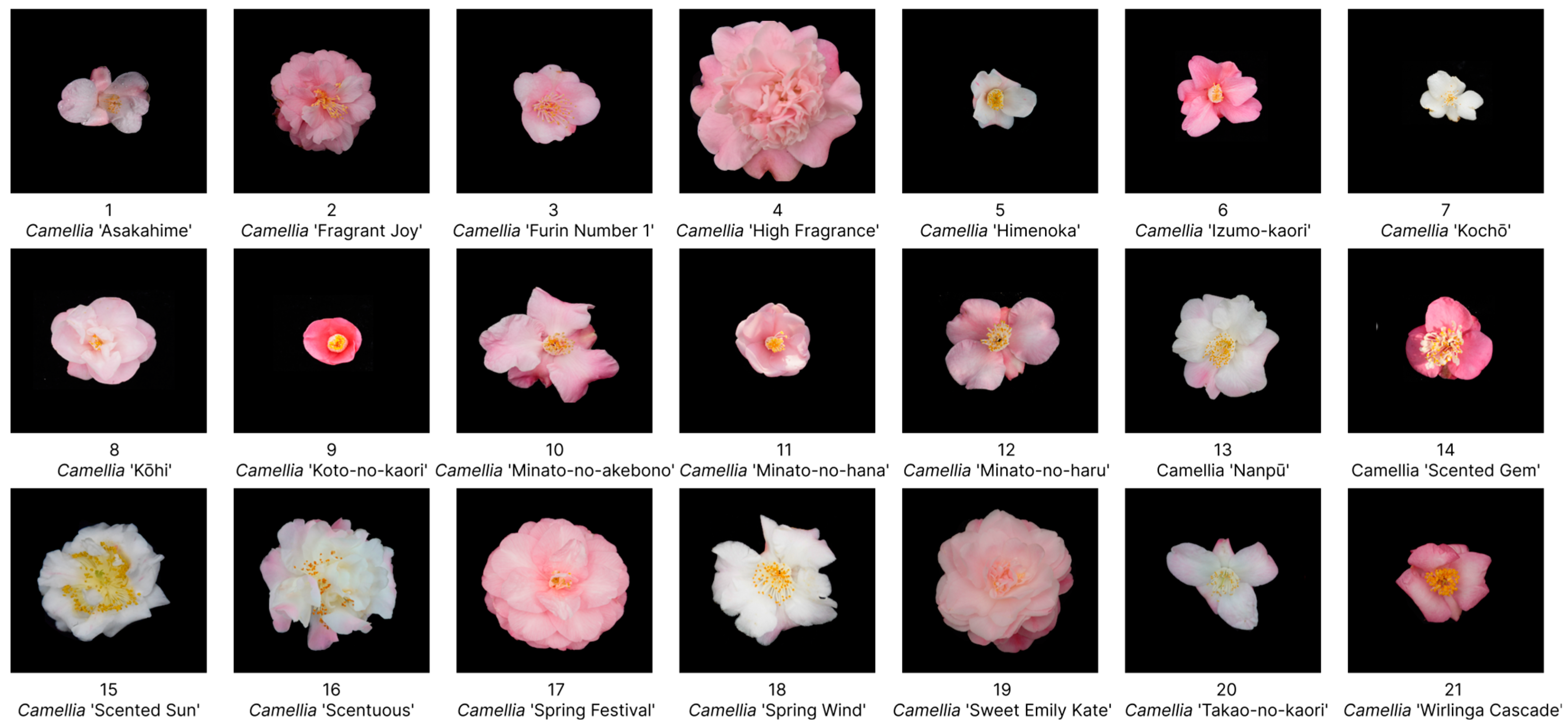
A total of 21 fragrant camellias originating from species of Camellia Sect. Theopsis were selected as main materials (Figure 1). All the materials were cultivated under the same conditions and using the same methods in the greenhouse of the Shanghai Academy of Agricultural Sciences (30.9526605° N, 121.47990139° E). Detailed information about these cultivars and their parental backgrounds is summarized in Table A1 (Appendix A).
For each material, 2–3 fully blooming flowers were collected from each plant, and 6–9 flowers in total from 3 plants were collected; then, the samples were mixed thoroughly and cut into 1–2 mm pieces, and a 1.5 g subsample was taken for volatile analysis.

2.2. Methods

2.2.1. Sample Preparation and Analysis of Volatile Compounds by GC-TOFMS

Volatile compounds were analyzed using an Agilent 7890B gas chromatograph (Agilent Technologies, Santa Clara, CA, USA) coupled with a Pegasus BT time-of-flight mass spectrometer (LECO Corporation, St. Joseph, MI, USA). Flower samples (1.5 g) were precisely weighed into 20 mL headspace vials and immediately sealed. Headspace volatile extraction was performed using a 2 cm divinylbenzene/carboxen/polydimethylsiloxane (DVB/CAR/PDMS) solid-phase microextraction (SPME) fiber. The samples were incubated at 50 °C for a 10 min equilibration period, followed by volatile adsorption onto the fiber for 30 min. Subsequently, the SPME fiber was thermally desorbed in the GC injector port at 250 °C for 5 min, with data acquisition initiated simultaneously.
Chromatographic separation was conducted on a DB-WAX capillary column (30 m × 250 μm × 0.25 μm). The injector port was maintained at 250 °C in splitless mode. High-purity helium served as the carrier gas at a constant flow rate of 1.0 mL·min−1. The oven temperature program was as follows: initial hold at 40 °C for 3 min; ramped to 70 °C at 3 °C·min−1; then increased to 180 °C at 5 °C·min−1; and finally ramped to 240 °C at 10 °C·min−1 and held for 7 min. Mass spectrometric parameters were set as follows: ion source temperature, 230 °C; electron ionization (EI) energy, 70 eV; transfer line temperature, 290 °C; detector voltage, 2016 V; acquisition rate, 10 spectra·s−1; and mass scan range, m/z 35–500.

2.2.2. Qualitative and Quantitative Analysis of Volatile Compounds

Tentative identification of volatile compounds was performed by matching the acquired mass spectra against the NIST 17.0 mass spectral library, with further verification using reference spectra from the NIST Chemistry WebBook database. Volatile compounds with a spectral match score exceeding 80% and a relative abundance greater than 1% were retained for subsequent analysis. Relative abundances were calculated based on peak area normalization and are reported as representative values for each sample. Compound identification was based on mass spectral matching and retention index comparison.
To support identification, retention indices (RIs) for volatile compounds were calculated based on the retention times of a C6–C30 n-alkane, using the following equation:
R I = 100 n + 100 ( t x t n ) t n + 1 t n
In Equation (1), t x is the retention time (min) of the target compound x; t n and   t n + 1 are the retention times (min) of the n-alkanes with n and n+1 carbon atoms, respectively; and n denotes the carbon number of the preceding n-alkane. The calculated RIs were further compared with the literature values to improve the reliability of compound identification.
The relative abundance of each volatile compound was calculated using the peak-area normalization method based on the total ion chromatogram (TIC) [21], as follows:
R e l a t i v e   C o n t e n t = 100 × P e a k   a r e a   o f   c o m p o u n d T o t a l   p e a k   a r e a
The calculated relative abundances are reported as representative percentage values for each sample [22].

2.3. Data Analysis

The selection of major aroma components was conducted as follows. First, volatile compounds with well-defined aroma characteristics were screened based on odor descriptors obtained from the FEMA database and Fenaroli’s Handbook of Flavor Ingredients (6th edition) [23]. Subsequently, these compounds were further evaluated in combination with their relative abundance data obtained in this study. Compounds exhibiting both characteristic odor descriptors and a relatively high abundance were designated as major aroma components. Based on these results, the characteristic aroma types of each cultivar were determined.
For data analysis, the processed datasets were imported into Origin 2021 (OriginLab Corporation, Northampton, MA, USA) and SPSS 26.0 (IBM Corp., Armonk, NY, USA) for preliminary data processing. Hierarchical clustering analysis was performed based on the relative abundance of volatile compounds using the Euclidean distance metric and complete linkage method. No additional normalization was applied prior to analysis. Heatmap visualization and correlation analysis were conducted using the ChiPlot online platform (https://www.chiplot.online/, accessed on 1 October 2025). Correlations among indicators were evaluated using Pearson correlation coefficients and presented as correlation matrices.

3. Results

3.1. Volatile Profiling of 21 Fragrant Camellias

A total of 51 volatile compounds were detected across the 21 fragrant cultivars, comprising 20 alcohols, 15 aldehydes, five esters, five furans, one phenolic compound, and five compounds classified as others (including three ethers, one alkane, and one phenylpropanoid). Overall, alcohols, aldehydes, and esters were the predominant classes of volatile compounds across the cultivars.
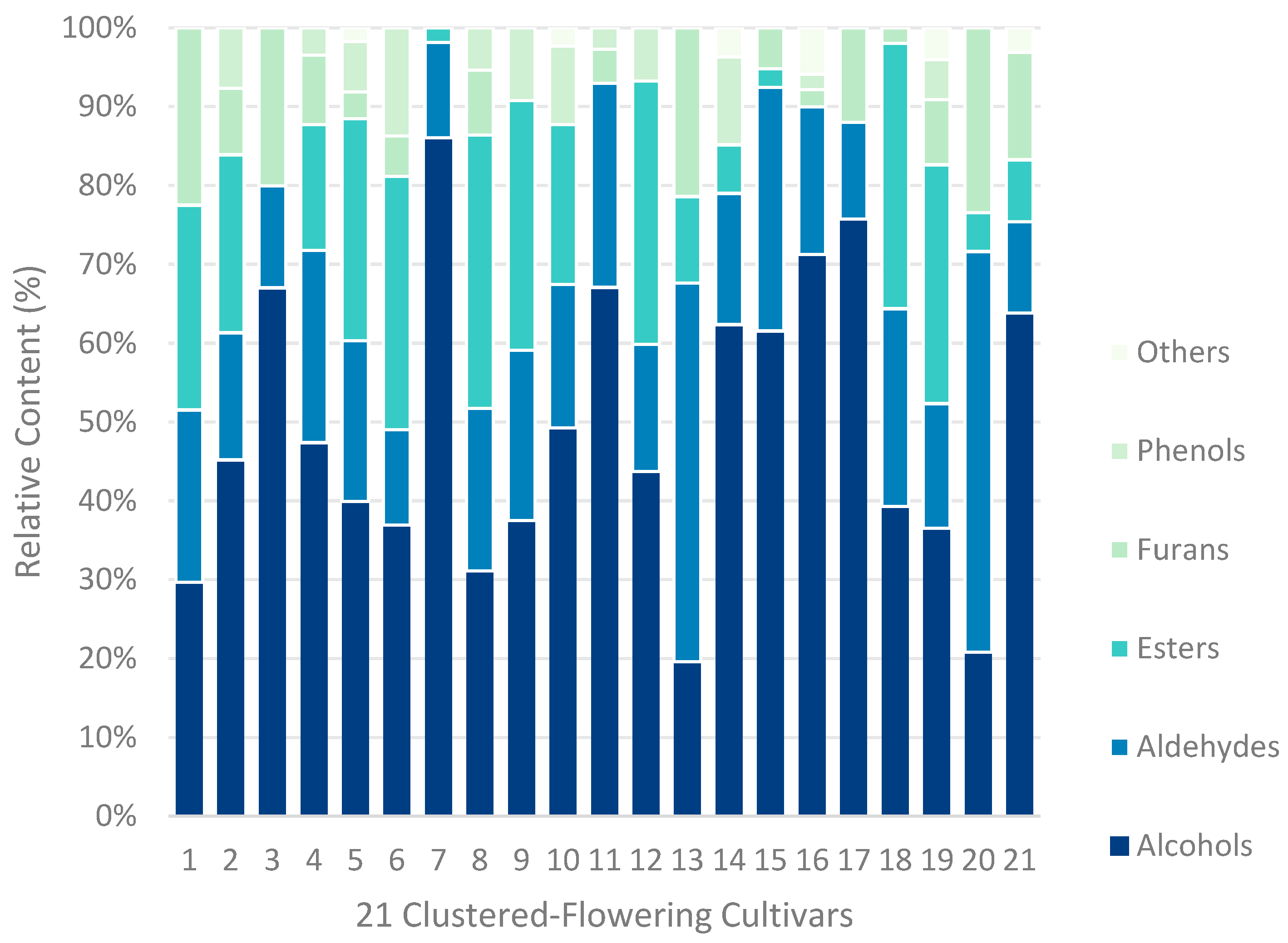
The composition and relative abundance of volatiles varied considerably among cultivars (Figure 2). Camellia ‘Sweet Emily Kate’ exhibited the highest number of volatiles, with 22 compounds identified, including 10 alcohols, five aldehydes, three esters, one furan, one phenolic compound, and two compounds classified as others. This was followed by Camellia ‘High Fragrance’ and Camellia ‘Scented Sun’, which contained 20 and 19 volatile compounds, respectively. In contrast, Camellia ‘Kochō’ and Camellia ‘Furin Number 1’ showed the fewest volatiles, with only 10 and nine compounds detected, respectively.
Alcohols were detected in all 21 cultivars, with the highest relative abundance observed in Camellia ‘Kochō’ (86.03%) and the lowest in Camellia ‘Nanpū’ (15.59%). Aldehydes were also ubiquitous across all cultivars; Camellia ‘Takao-no-kaori’ contained the greatest number of aldehydes (seven compounds) and the highest total aldehyde abundance (50.81%). Esters were detected in 17 cultivars, reaching the highest level in Camellia ‘Kōhi’ (34.68%). Furans were present in 16 cultivars, with notably higher proportions found in Camellia ‘Takao-no-kaori’ (23.46%), Camellia ‘Asakahime’ (22.49%), and Camellia ‘Nanpū’ (21.40%). The phenolic compound showed its peak relative abundance in Camellia ‘Izumo-kaori’ (13.70%). Compounds classified as others were detected in only six cultivars and generally accounted for minor proportions overall, reaching a maximum of 5.92% in Camellia ‘Scentuous’. The specific volatile compounds and their relative abundances for each cultivar are detailed in Table A2 (Appendix A).

3.2. Comparison of Major Aroma Components Among 21 Fragrant Camellias

Among the 51 volatile compounds identified across the 21 cultivars, 27 were identified as major aroma components. These comprised 10 alcohols, 10 aldehydes, four esters, one phenolic compound, and two compounds classified as others. Components with relative abundances exceeding 1% revealed pronounced differences in aroma profiles among cultivars (Table 1 and Table 2). The mean proportions of each chemical class were 33.43% for alcohols, 15.76% for esters, 17.13% for aldehydes, 6.15% for phenolics, and 9.77% for others.
Overall, alcohols dominated the aroma composition of these fragrant camellias, showing a substantially higher mean proportion than the other classes and being detected in all cultivars. The highest alcohol proportion was recorded in Camellia ‘Kochō’ (63.54%). Esters and aldehydes occurred at comparable levels and together constituted the secondary aroma components. Although phenolics showed the lowest mean proportion (6.15%), they exhibited notable cultivar-specific enrichment, reaching 12.47% in Camellia ‘Izumo-kaori’. Compounds classified as others accounted for a mean proportion of 9.77% and mainly included volatiles with distinctive odor characteristics, such as 2-pentylfuran. Regarding overall compositional trends, alcohols showed the most pronounced inter-cultivar variation, whereas esters demonstrated relatively stable distribution across cultivars.
As shown in Table 1 and Table 2, the major alcohols identified included phenylethyl alcohol, benzyl alcohol, linalool, and 1-hexanol. Phenylethyl alcohol was detected in all cultivars, with relative abundances ranging from 1.30% to 45.86%. The highest level was observed in Camellia ‘Kochō’ (45.86%), followed by Camellia ‘Furin Number 1’ (40.98%). Camellia ‘Wirlinga Cascade’ and Camellia ‘Scented Gem’ each showed relative abundances exceeding 23%, whereas the lowest level was observed in Camellia ‘Sweet Emily Kate’ (1.30%). Benzyl alcohol was found in 18 cultivars, reaching 10.32% in Camellia ‘Fragrant Joy’ and remaining below 2% in cultivars such as Camellia ‘Scented Sun’. Linalool occurred in 18 cultivars, with the highest level in Camellia ‘Wirlinga Cascade’ (10.82%), followed by Camellia ‘Izumo-kaori’ (8.84%) and Camellia ‘Scented Sun’ (8.76%). It was not detected in Camellia ‘Furin Number 1’, Camellia ‘Minato-no-akebono’, or Camellia ‘Takao-no-kaori’. The distribution of 1-hexanol was highly cultivar-specific, reaching 43.83% in Camellia ‘Spring Festival’, followed by Camellia ‘Scented Sun’ (15.13%), Camellia ‘Furin Number 1’ (11.58%), and Camellia ‘Wirlinga Cascade’ (8.77%). In the remaining 17 cultivars, 1-hexanol was consistently below 5%, and in 11 cultivars it was either undetected or present only at trace levels. Among other alcohols, α-terpineol was detected in only seven cultivars (including Camellia ‘Sweet Emily Kate’), with a maximum relative abundance of 4.98%. Geraniol was found exclusively in Camellia ‘Fragrant Joy’ (3.24%) and Camellia ‘Wirlinga Cascade’ (1.06%). 1-Penten-3-ol was not detected in most cultivars or was present only at trace levels.
Aldehydes were primarily represented by (E)-2-hexenal, benzaldehyde, and hexanal. (E)-2-Hexenal was detected in 19 cultivars. The highest level occurred in Camellia ‘Minato-no-hana’ (15.58%), followed by Camellia ‘Minato-no-akebono’ (10.98%) and Camellia ‘Scented Gem’ (10.60%). Benzaldehyde was notably enriched in Camellia ‘Nanpū’ (20.35%) and Camellia ‘Spring Wind’ (13.42%), with lower levels in Camellia ‘Koto-no-kaori’ (9.38%) and Camellia ‘Himenoka’ (9.02%); in more than half of the cultivars, however, it was below 2% or not detected. Hexanal showed the highest levels in Camellia ‘Takao-no-kaori’ (16.26%) and Camellia ‘Nanpū’ (11.58%), while remaining below 6% in all other cultivars. Methylbutanal isomers showed a more restricted distribution: butanal, 3-methyl- reached 7.60% in Camellia ‘Scented Sun’, whereas butanal, 2-methyl- reached 6.07% in Camellia ‘Takao-no-kaori’.
Esters, phenolics, and compounds classified as others also showed pronounced inter-cultivar differences. Benzoic acid methyl ester and methyl salicylate were the core ester components with their dominance varying among cultivars. Benzoic acid methyl ester was predominant in Camellia ‘Asakahime’, Camellia ‘Koto-no-kaori’, Camellia ‘Minato-no-haru’, and Camellia ‘Spring Wind’, ranging from 19.2% to 21.1%. In contrast, methyl salicylate was relatively abundant in Camellia ‘Kōhi’ (11.47%) and Camellia ‘Izumo-kaori’ (11.13%). Among minor esters, benzoic acid, 2-methoxy-, methyl ester occurred only in Camellia ‘Fragrant Joy’, Camellia ‘Izumo-kaori’, Camellia ‘Kōhi’, Camellia ‘Minato-no-haru’, Camellia ‘Spring Wind’, and Camellia ‘Sweet Emily Kate’, ranging from 1.2% to 5.6%, while acetic acid methyl ester was detected solely in Camellia ‘Scented Sun’ (1.09%). Eugenol, the only phenolic compound detected, occurred in 12 cultivars and reached 12.47% in Camellia ‘Izumo-kaori’. Compounds classified as others were dominated by 2-pentylfuran, which was highest in Camellia ‘Asakahime’, Camellia ‘Furin Number 1’, and Camellia ‘Takao-no-kaori’ (17.61–21.35%); estragole was detected only in Camellia ‘Sweet Emily Kate’ (2.02%) and Camellia ‘Wirlinga Cascade’ (1.51%).

3.3. Cluster Analysis of 21 Fragrant Camellias Based on Aroma Components

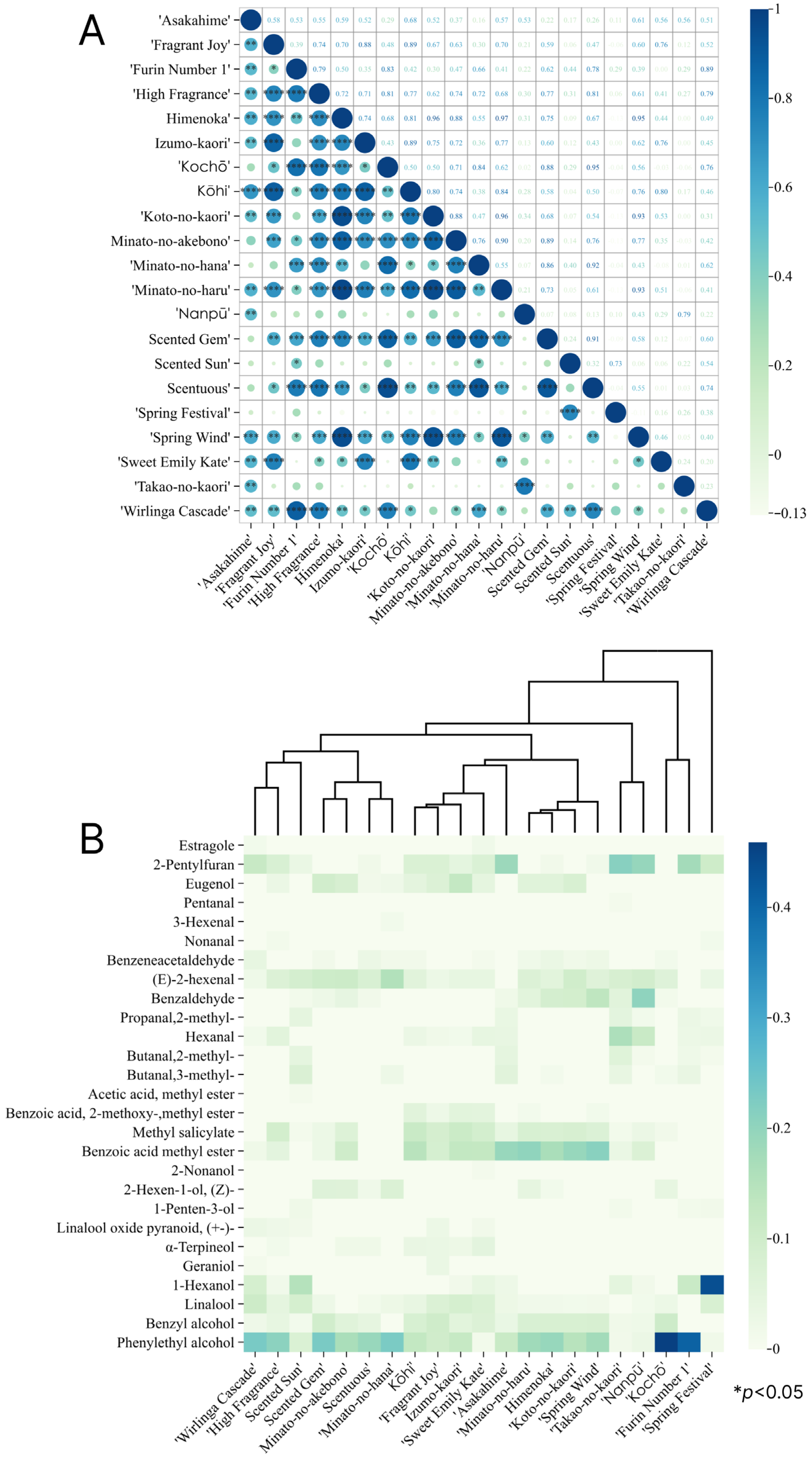
Correlation analysis of the major aroma components across the 21 fragrant camellias revealed that most cultivars shared similar aroma profiles, while the strength of association among cultivars showed a hierarchical and clustered pattern (Figure 3A). Specifically, Camellia ‘Himenoka’, Camellia ‘Koto-no-kaori’, Camellia ‘Minato-no-haru’, and Camellia ‘Spring Wind’ showed the strongest mutual correlations, with all pairwise correlation coefficients exceeding 0.9. The closest association was observed between Camellia ‘Himenoka’ and Camellia ‘Minato-no-haru’ (r = 0.97). Centered on this core group, most of the remaining cultivars, including Camellia ‘High Fragrance’, Camellia ‘Minato-no-akebono’, and Camellia ‘Scented Gem’, exhibited widespread and significant positive correlations, collectively forming a tightly connected cultivar cluster. This similarity in aroma profiles may be associated with their shared genetic background, as many of these cultivars have been reported to involve C. lutchuensis as a parental donor. In contrast, Camellia ‘Nanpū’, Camellia ‘Scented Sun’, Camellia ‘Spring Festival’, and Camellia ‘Takao-no-kaori’ displayed more-distinctive aroma characteristics. These cultivars showed weak correlations with each other, and their correlation coefficients with most members of the main cluster were generally below 0.5, indicating pronounced compositional divergence. Notably, within this distinctive set, Camellia ‘Nanpū’ and Camellia ‘Takao-no-kaori’ still showed a moderate correlation (r ≈ 0.8), suggesting shared patterns in the accumulation of certain aroma components. Additionally, strong aroma similarity was observed between some non-core cultivars: Camellia ‘Furin Number 1’ and Camellia ‘Wirlinga Cascade’ showed a high correlation (r = 0.89). Overall, this analysis clearly delineates inter-cultivar similarity and divergence based on major aroma components.
To intuitively visualize the distribution and clustering of aroma compounds across the 21 cultivars, a heatmap visualization with hierarchical clustering was generated based on their relative abundances of major aroma components (Figure 3B). The results showed that the 27 major aroma components could be grouped by their abundance profiles. Although alcohols such as phenylethyl alcohol, benzyl alcohol, and linalool were widely present, their accumulation levels varied markedly among cultivars. Ester compounds, represented by benzoic acid methyl ester and methyl salicylate, remained at relatively high levels in certain cultivars and were particularly prominent in specific groups such as Camellia ‘Asakahime’ and Camellia ‘Koto-no-kaori’. In contrast, 2-pentylfuran and aldehydes such as hexanal and (E)-2-hexenal were mainly concentrated in a small subset of cultivars, including Camellia ‘Nanpū’ and Camellia ‘Takao-no-kaori’.
Based on correlation analysis and compound distribution patterns, the 21 cultivars were classified into five clusters based on aroma composition and relative abundance (Figure 3B). Cluster 1 comprised Camellia ‘High Fragrance’, Camellia ‘Minato-no-akebono’, Camellia ‘Minato-no-hana’, Camellia ‘Scented Gem’, Camellia ‘Scented Sun’, Camellia ‘Scentuous’, and Camellia ‘Wirlinga Cascade’. This group was characterized by relatively high and comparable levels of phenylethyl alcohol and benzyl alcohol. Cluster 2 included Camellia ‘Asakahime’, Camellia ‘Fragrant Joy’, Camellia ‘Himenoka’, Camellia ‘Izumo-kaori’, Camellia ‘Kōhi’, Camellia ‘Koto-no-kaori’, Camellia ‘Minato-no-haru’, Camellia ‘Spring Wind’, and Camellia ‘Sweet Emily Kate’. This cluster was distinguished by relatively high and comparable levels of benzoic acid methyl ester and methyl salicylate. Cluster 3 consisted of Camellia ‘Nanpū’ and Camellia ‘Takao-no-kaori’. This group showed elevated levels of 2-pentylfuran. Aldehydes represented the largest proportion of their aroma profiles, with hexanal, benzaldehyde, and (E)-2-hexenal all occurring at relatively high and comparable levels. Cluster 4 contained Camellia ‘Furin Number 1’ and Camellia ‘Kochō’. Their scent profiles were dominated by phenylethyl alcohol, which exceeded 40% in both cultivars. Beyond this shared dominant compound, the remaining major aroma components above the abundance threshold differed substantially between the two cultivars. Cluster 5 included only Camellia ‘Spring Festival’. It was characterized by 1-hexanol as the most abundant component, followed by 2-pentylfuran and linalool.

4. Discussion

In this study, volatile compounds in 21 fragrant camellias derived from Camellia Sect. Theopsis were systematically profiled using HS-SPME-GC-TOFMS. A total of 51 volatile compounds were identified, among which 27 were defined as major aroma components. Alcohols represented the most abundant class, followed by aldehydes and esters, indicating their dominant contribution to floral scent. The major aroma classes identified here are largely consistent with previous large-scale studies of Camellia Sect. Theopsis [15], confirming that phenylpropanoids/benzenoids (e.g., phenylethyl alcohol) and terpenoids (e.g., linalool) constitute the primary chemical basis of camellia floral scent.
Breeding processes have influenced the accumulation of certain volatile compounds [24]. In our study, aroma composition exhibited both high similarity and distinct specificity among cultivars. Clustering and correlation analyses revealed that cultivars sharing C. lutchuensis as a common parent, such as Camellia ‘Himenoka’, Camellia ‘Minato-no-haru’, and Camellia ‘Koto-no-kaori’, exhibited highly similar aroma profiles, suggesting strong genetic dominance of key scent traits. This aligns with the conclusion of Oyama-Okubo, who highlighted C. lutchuensis as an important aromatic parent [25]. Phenylethyl alcohol, a compound with prominent aromatic characteristics widely used in the food and cosmetics industries [26], and benzoic acid methyl ester, a core floral odorant also involved in plant chemical defense [27], may play important roles in shaping the aroma profiles of these cultivars. However, this interpretation should be treated with caution, as the genetic basis underlying these similarities has not been directly examined in the present study. In contrast, cultivars exhibiting more-distinctive aroma profiles may reflect the influence of different parental backgrounds, indicating possible variation in metabolic patterns. Further studies integrating metabolomic and gene expression analyses would be valuable to better understand the mechanisms underlying such cultivar-specific aroma traits.
The classification of these cultivars into five clusters highlights the chemical basis of scent diversity and reflects the dominance of specific classes of volatile compounds that define distinct aroma types. Alcohol-dominated profiles, primarily driven by phenylethyl alcohol and linalool, were associated with typical floral scent characteristics [28], consistent with previous studies on floral fragrance composition [29]. These compounds are widely recognized as key contributors to floral aroma and are commonly found in ornamental species. In contrast, cultivars enriched in ester compounds, such as methyl salicylate and benzoic acid methyl ester, exhibited fresher and fruity aroma notes. Methyl salicylate is known to impart minty and cooling characteristics [30], while benzoic acid methyl ester contributes sweet and fruity nuances [31], suggesting variation in scent expression among cultivars. Meanwhile, the accumulation of 2-pentylfuran and aldehydes in certain cultivars suggests alternative aroma formation patterns, contributing to more-distinctive scent profiles. These compounds are commonly associated with green, beany, or fruity notes [32], further expanding the diversity of aroma characteristics observed in camellia cultivars [33]. Such compositional variation is consistent with previous reports on floral volatile diversity [34].
The observed variation in volatile composition among cultivars reflects underlying metabolic diversity and provides insight into the formation of distinct scent types. From a breeding perspective, these results provide a chemical basis for the selection of fragrant camellias with specific aroma traits. For example, cultivars enriched in phenylethyl alcohol and linalool may be preferentially selected to enhance floral fragrance, whereas those with higher levels of methyl salicylate may contribute to fresh and mint-like scent profiles. In addition, the classification of cultivars based on their volatile composition offers a practical framework for germplasm evaluation and targeted hybridization, facilitating the development of new cultivars with diverse and desirable aromatic characteristics. Furthermore, these findings may support the utilization of fragrant camellia resources in fragrance-related industries, such as cosmetics, by providing a scientific basis for the identification and application of key aroma compounds.

5. Conclusions

This study systematically characterized the volatile profiles of 21 fragrant camellias and identified alcohols as the dominant aroma class. Hierarchical clustering revealed distinct aroma groups, reflecting both shared and cultivar-specific scent characteristics. Correlation analysis suggested a high degree of similarity in aroma traits among cultivars, which may be related to their shared parental background, particularly the frequent use of C. lutchuensis. However, this relationship remains preliminary and requires further validation. Overall, this study establishes a volatile-based classification framework and provides a chemical basis for the breeding of fragrant camellias.

Author Contributions

Formal analysis, writing—original draft preparation, writing—review and editing, Y.C.; material collection, volatiles analysis, R.M.; material collection, Y.W. (Yin Wu); writing—review and editing, M.L.; project administration, funding acquisition, writing—review and editing, Y.Z.; project administration, writing—review and editing, Y.W. (Yani Wu). All authors have read and agreed to the published version of the manuscript.

Funding

Agriculture Research System of Shanghai, China, grant number 2025-8-03, 2023 Shanghai Oriental Talents Program—Youth Project, grant number Shanghai Talent [2024] No. 4; and The Shanghai Academy of Agricultural Sciences Program for Excellent Research Team (2025-030).

Data Availability Statement

Data is contained within the article.

Acknowledgments

The authors would like to thank the Analysis and Testing Center of Shanghai Jiao Tong University for providing the testing equipment.

Conflicts of Interest

The authors declare no conflicts of interest.

Abbreviations

The following abbreviations are used in this manuscript:
VOCsVolatile Organic Compounds
HS-SPME-GC-TOFMSHeadspace Solid-Phase Microextraction Coupled with Gas Chromatography–Time-of-Flight Mass Spectrometry
GC-TOFMSGas Chromatography–Time-of-Flight Mass Spectrometry
DVB/CAR/PDMSDivinylbenzene/Carboxen/Polydimethylsiloxane
EIElectron Ionization
TICTotal Ion Chromatogram
RIRetention Index
NISTNational Institute of Standards and Technology
FEMAFlavor and Extract Manufacturers Association

Appendix A

Appendix A.1

This table provides detailed information on the origin (pedigree) of the 21 fragrant camellias included in this study. It summarizes the known parentage or breeding background of each cultivar. The identification numbers correspond to those shown in Figure 1, allowing direct linkage between cultivar images and their origin information. Part of the origin information was obtained from https://camellia.iflora.cn/Home/index (accessed on 15 January 2026).
Table A1. Origin and cultivar information of the 21 fragrant camellias.
No.CultivarOriginNo.CultivarOrigin
1Camellia ‘Asakahime’C. japonica var. rusticana ‘Kazahana’ × C. lutchuensis12Camellia ‘Minato-no-haru’C. japonica ‘Kon-wabisuke’ ×
C. lutchuensis
2Camellia
‘Fragrant Joy’
C. rusticana × C. lutchuensis13Camellia ‘Nanpū’C. saluensis × C. lutchuensis
3Camellia
‘Furin Number 1’
No information14Camellia ‘Scented Gem’C. lutchuensis × C. japonica ‘Kanto-tsukimiguruma’
4Camellia
‘High Fragrance’
C. japonica var. ‘Mrs Bertha A. Harms’ × (Camellia ‘Salab’ × Camellia ‘Scentuous’)15Camellia ‘Scented Sun’C. japonica var.’Mrs Bertha A. Harms’ × Camellia ‘Salab’ × seedling L.B.F.634
5Camellia ‘Himenoka’No information16Camellia ‘Scentuous’C. japonica ‘Tiffany’ × C. lutchuensis
6Camellia ‘Izumo-kaori’C. japonica ‘Izumotaisha-yabu-tsubaki’ × C. lutchuensis17Camellia ‘Spring Festival’A seedling of C. cuspidata
7Camellia ‘Kochō’A seedling of Camellia ‘Tiny Princess’18Camellia ‘Spring Wind’C. japonica P.I.1231695 × C. lutchuensis P.I.226756
8Camellia ‘Kōhi’C. japonica ‘Hishikaraito’ × C. lutchuensis19Camellia ‘Sweet Emily Kate’C. japonica ‘Tiffany’ × (C. japonica ‘The Czar’ × C. lutchuensis)
9Camellia ‘Koto-no-kaori’C. japonica ‘Tōkai’ × C. lutchuensis20Camellia ‘Takao-no-kaori’C. japonica ‘Kon-wabisuke’ × C. lutchuensis
10Camellia ‘Minato-no-akebono’C. lutchuensis × C. japonica ‘Kanto-tsukimiguruma’21Camellia ‘Wirlinga Cascade’A seedling of Camellia ‘Wirlinga Belle’
11Camellia ‘Minato-no-hana’A seedling of C. rosiflora

Appendix A.2

This table provides the complete dataset for the volatile analysis of all 21 cultivars in this study and serves as detailed support for Figure 2 in the main text, which summarizes the relative abundances of major volatile classes. It lists all detected volatile compounds for each cultivar and their relative abundances (%) calculated using the peak-area normalization method. Values are reported as representative percentage values for each sample and are used for comparative analysis of compound-level differences among cultivars.
Table A2. Numbers and relative abundances of volatile compounds in 21 fragrant camellias bred using species from Camellia Sect. Theopsis.
No.CultivarsAlcoholsAldehydesEstersFuransPhenolsOthersTotal
NRC/%NRC/%NRC/%NRC/%NRC/%NRC/%NRC/%
1Camellia ‘Asakahime’626.48519.52223.18220.08----1589.25
2Camellia ‘Fragrant Joy’740.33514.40320.1617.5116.87--1789.27
3Camellia ‘Furin Number 1’458.86411.38--117.61----987.85
4Camellia ‘High Fragrance’942.64721.94214.3517.9213.14--2090.00
5Camellia ‘Himenoka’536.62418.70325.8623.0915.8911.581691.75
6Camellia ‘Izumo-kaori’733.62411.02329.2414.69112.47--1691.03
7Camellia ‘Kochō’574.72410.5011.63------1086.85
8Camellia ‘Kōhi’428.32618.77331.5717.5114.87--1591.04
9Camellia ‘Koto-no-kaori’532.58318.77227.51--18.05--1186.91
10Camellia ‘Minato-no-akebono’741.08215.19216.90--18.3211.921383.40
11Camellia ‘Minato-no-hana’857.28522.11--13.6712.34--1585.39
12Camellia ‘Minato-no-haru’538.71314.28329.59--15.96--1288.55
13Camellia ‘Nanpū’717.87543.80210.03119.52----1591.22
14Camellia ‘Scented Gem’554.92314.6625.43--19.8213.261288.08
15Camellia ‘Scented Sun’1053.64526.9022.0924.52----1987.15
16Camellia ‘Scentuous’959.20415.52--11.8311.6114.921683.08
17Camellia ‘Spring Festival’766.32510.73--110.51----1387.56
18Camellia ‘Spring Wind’434.65 322.14 329.69 11.75 ----1188.23
19Camellia ‘Sweet Emily Kate’1032.68 514.12 327.09 17.39 14.50 23.63 2289.41
20Camellia ‘Takao-no-kaori’718.94 746.23 24.47 121.35 ----1790.98
21Camellia ‘Wirlinga Cascade’955.49 410.06 26.85 111.83 --22.72 1886.94

References

  1. Kondo, M.; Oyama-Okubo, N.; Ando, T.; Marchesi, E.; Nakayama, M. Floral Scent Diversity Is Differently Expressed in Emitted and Endogenous Components in Petunia axillaris Lines. Ann. Bot. 2006, 98, 1253–1259. [Google Scholar] [CrossRef] [PubMed]
  2. Han, Y.; Wang, H.; Wang, X.; Li, K.; Dong, M.; Li, Y.; Zhu, Q.; Shang, F. Mechanism of floral scent production in Osmanthus fragrans and the production and regulation of its key floral constituents, β-ionone and linalool. Hortic. Res. 2019, 6, 106. [Google Scholar] [CrossRef] [PubMed]
  3. Fu, X.; Zhou, Y.; Zeng, L.; Dong, F.; Mei, X.; Liao, Y.; Watanabe, N.; Yang, Z. Analytical method for metabolites involved in biosynthesis of plant volatile compounds. RSC Adv. 2017, 7, 19363–19372. [Google Scholar] [CrossRef]
  4. Qiao, Z.; Hu, H.; Yan, B.; Chen, L. Advances in the biosynthesis and gene regulation of floral volatile benzenoids and phenylpropanoids. Acta Hortic. Sin. 2021, 48, 1815–1826. [Google Scholar] [CrossRef]
  5. Omata, A.; Yomogida, K.; Nakamura, S.; Ota, T.; Izawa, Y. Studies on the volatile compounds of Camellia flowers. J. Jpn. Soc. Hortic. Sci. 1989, 58, 429–434. [Google Scholar] [CrossRef]
  6. Knudsen, J.T.; Eriksson, R.; Gershenzon, J.; Ståhl, B. Diversity and distribution of floral scent. Bot. Rev. 2006, 72, 1. [Google Scholar] [CrossRef]
  7. Fu, J.; Hou, D.; Wang, Y.; Zhang, C.; Bao, Z.; Zhao, H.; Hu, S. Identification of floral volatile compounds in 29 cultivars from four groups of Osmanthus fragrans by gas chromatography-mass spectrometry. Hortic. Environ. Biotechnol. 2019, 60, 611–623. [Google Scholar] [CrossRef]
  8. Zhang, Y.; Zhi, H.; Qu, L.; Su, D.; Luo, J. Analysis of flower volatile compounds and odor classification of 17 tree peony cultivars. Sci. Hortic. 2024, 338, 113665. [Google Scholar] [CrossRef]
  9. Feng, L.; Li, Y.; Sheng, L.; Li, T.; Zhao, D.; Tao, J. Comparative analysis of headspace volatiles of different herbaceous peony (Paeonia lactiflora Pall.) cultivars. J. Essent. Oil Bear. Plants 2016, 19, 167–175. [Google Scholar] [CrossRef]
  10. Li, H.; Fan, Y. Research Progress on the Main Components, Metabolic Pathways and Key Functional Genes of Floral Terpenes. Mol. Plant Breed. 2023, 1–17. Available online: https://link.cnki.net/urlid/46.1068.S.20230719.1244.006 (accessed on 10 November 2024).
  11. Yang, M.; Xie, Y.; Xu, L.; Xiang, C.; Fu, S.; Chen, B.; Wei, M.; Chen, X.; Li, Q. Analysis of floral volatile compounds in flowers of four Camellia cultivars. Hubei Agric. Sci. 2023, 62, 137–142, 169. [Google Scholar] [CrossRef]
  12. Fan, Z.; Li, J.; Li, X.; Yin, H. Compositional analysis of floral scent of 11 ornamental Camellia cultivars. In Proceedings of the International Camellia Congress, Jinhua, China, 12–15 March 2023. [Google Scholar]
  13. Fan, Z.; Li, J.; Li, X.; Yin, H. Composition analysis of floral scent within genus Camellia uncovers substantial interspecific variations. Sci. Hortic. 2019, 250, 207–213. [Google Scholar] [CrossRef]
  14. Gan, X.; Liang, Z.; Wang, D.; Wang, R. Analysis of Aroma Components in Three Species of Camellia Flowers by HS-SPME/GC-MS. Food Sci. 2013, 34, 204–207. [Google Scholar]
  15. Fan, Z.; Li, J.; Tian, M.; Li, X.; Ni, S. Preliminary Studies of Aromatic Constituents among Three Species (Variation) of Camellia. Acta Hortic. Sin. 2006, 33, 592–596. [Google Scholar] [CrossRef]
  16. Qiu, J.; Zhang, Y.; Chen, J.; Tian, M.; Xie, Z.; Chen, X. Volatile Compounds in Flowers of 12 Camellia Species. For. Res. 2015, 28, 358–364. [Google Scholar] [CrossRef]
  17. Chang, H.T. Systematic Study of the Genus Camellia; Sun Yat-Sen University Press: Guangzhou, China, 1981. [Google Scholar]
  18. Zhang, Y.; Du, C.; Hu, Y. Resources of Camellia Sect. Theopsis and Sect. Eriandria and Germplasm Innovation. Subtrop. Plant Sci. 2021, 50, 323–332. [Google Scholar] [CrossRef]
  19. Zhang, Y.L. Micro-Perspective on Camellias: A Brief History of Theopsis Camellias; China Architecture & Building Press: Beijing, China, 2018. [Google Scholar]
  20. Jullien, F.; Gao, J.; Orel, G.; Legendre, L. Analysis of Tissue-Specific Emission of Volatiles by the Flowers of Six Camellia Species. Flavour Fragr. J. 2008, 23, 115–120. [Google Scholar] [CrossRef]
  21. Oliveira, L.C.; Nunes, C.E.P.; Brito, V.L.G.; Caetano, A.P.S. Floral Oil Production in a Family Dominated by Pollen Flowers: The Case of Macairea radula (Melastomataceae). Flora 2022, 288, 152008. [Google Scholar] [CrossRef]
  22. Xu, W.; Zhang, Q. Study of Emission Patterns of Characteristic Volatiles Identified in Lagerstroemia caudata Flowers and Key Genes Related to MEP Pathway. Ph.D. Thesis, Beijing Forestry University, Beijing, China, 2019. [Google Scholar]
  23. Burdock, G.A.; Fenaroli, G. Fenaroli’s Handbook of Flavor Ingredients, 6th ed.; CRC Press/Taylor & Francis Group: Boca Raton, FL, USA, 2010. [Google Scholar] [CrossRef]
  24. Liu, H.; Gu, J.; Lu, Q.; Li, H.; Hong, Y.; Chen, X.; Ren, L.; Deng, L.; Liang, X. Transcriptomic Analysis Reveals the High-Oleic Acid Feedback Regulating the Homologous Gene Expression of Stearoyl-ACP Desaturase 2 (SAD2) in Peanuts. Int. J. Mol. Sci. 2019, 20, 3091. [Google Scholar] [CrossRef]
  25. Oyama-Okubo, N.; Tanikawa, N.; Nakayama, M.; Shibata, M.; Suzuki, K.; Kondo, M. Screening of genetic resources of Camellia lutchuensis for fragrant Camellia breeding; analysis of floral scent compounds. Acta Hortic. 2009, 813, 399–406. [Google Scholar] [CrossRef]
  26. Hirata, H.; Ohnishi, T.; Watanabe, N. Biosynthesis of floral scent 2-phenylethanol in rose flowers. Biosci. Biotechnol. Biochem. 2016, 80, 1865–1873. [Google Scholar] [CrossRef]
  27. Ke, Y.; Abbas, F.; Zhou, Y.; Yu, R.; Fan, Y. Auxin-responsive R2R3-MYB transcription factors HcMYB1 and HcMYB2 activate volatile biosynthesis in Hedychium coronarium flowers. Front. Plant Sci. 2021, 12, 710826. [Google Scholar] [CrossRef]
  28. Scognamiglio, J.; Jones, L.; Letizia, C.S.; Api, A.M. Fragrance material review on phenylethyl alcohol. Food Chem. Toxicol. 2012, 50, S224–S239. [Google Scholar] [CrossRef] [PubMed]
  29. Scognamiglio, J.; Jones, L.; Vitale, D.; Letizia, C.S.; Api, A.M. Fragrance material review on benzyl alcohol. Food Chem. Toxicol. 2012, 50, S140–S160. [Google Scholar] [CrossRef] [PubMed]
  30. Cuchet, A.; Jame, P.; Anchisi, A.; Schiets, F.; Oberlin, C.; Lefèvre, J.-C.; Carénini, E.; Casabianca, H. Authentication of the naturalness of wintergreen (Gaultheria genus) essential oils by gas chromatography, isotope ratio mass spectrometry and radiocarbon assessment. Ind. Crops Prod. 2019, 142, 111873. [Google Scholar] [CrossRef]
  31. Gao, Y.; Lei, Z.; Huang, J.; Sun, Y.; Liu, S.; Yao, L.; Liu, J.; Liu, W.; Liu, Y.; Chen, Y. Characterization of Key Odorants in Lushan Yunwu Tea in Response to Intercropping with Flowering Cherry. Foods 2024, 13, 1252. [Google Scholar] [CrossRef]
  32. Cai, X.; Mai, R.; Zou, J.; Zhang, H.; Zeng, X.; Zheng, R.; Wang, C. Analysis of Aroma-Active Compounds in Three Sweet Osmanthus (Osmanthus Fragrans) Cultivars by GC-Olfactometry and GC-MS. J. Zhejiang Univ.-Sci. B 2014, 15, 638–648. [Google Scholar] [CrossRef]
  33. Chen, C.; Sheng, M.; Yuan, H.; Pan, X.; Tian, H.; Lou, X. Perceptual interaction of aroma compounds and their effects on the enhancement of flavor quality in foods: A review. Trends Food Sci. Technol. 2025, 165, 105315. [Google Scholar] [CrossRef]
  34. Xiao, Z.; Li, Q.; Niu, Y.; Zhou, X.; Liu, J.; Xu, Y.; Xu, Z. Odor-active compounds of different lavender essential oils and their correlation with sensory attributes. Ind. Crops Prod. 2017, 108, 748–755. [Google Scholar] [CrossRef]
Figure 1. Floral images of the 21 fragrant camellias. Note: The number assigned to each flower image is used consistently throughout all figures and tables in this manuscript.
Horticulturae 12 00465 g001
Figure 2. Numbers and proportions of volatile compounds in 21 fragrant camellias.
Horticulturae 12 00465 g002
Figure 3. Correlation analysis (A) and heatmap analysis (B) of aroma components in the fragrant camellias. Note: In (A), * indicates a significant correlation at p < 0.05; ** indicates a highly significant correlation at p < 0.01; *** indicates a very highly significant correlation at p < 0.001; and **** indicates an extremely significant correlation at p < 0.0001. The aroma compositions of the cultivars show a certain degree of similarity; a flatter ellipse and a darker color indicate a higher correlation in aroma composition between cultivars.
Horticulturae 12 00465 g003
Table 1. Aroma components and their relative abundances (%) in the fragrant camellias (cultivars 1–11).
CategoriesCompound NameCAS NumberRIRelative Content (%)
1234567891011
AlcoholsPhenylethyl alcohol60-12-8187811.50 10.08 40.98 20.80 19.27 12.23 45.86 12.67 14.58 16.65 22.89
Benzyl alcohol100-51-618363.43 10.32 -4.00 7.99 5.29 10.75 8.23 8.09 5.93 -
Linalool78-70-614682.62 7.19 -4.58 1.70 8.84 2.79 3.78 1.48 -2.59
1-Hexanol111-27-312742.40 -11.58 1.73 -1.59 -----
Geraniol106-24-11799-3.24 ---------
α-Terpineol98-55-51629-3.18 -1.35 -2.60 -3.64 -2.11 -
Linalool oxide pyranoid, (+−)-14049-11-71706-2.74 -2.25 -------
1-Penten-3-ol616-25-11104--1.28 --------
2-Hexen-1-ol, (Z)-928-94-91332----1.49 -4.13 --6.22 7.29
2-Nonanol628-99-91439-----------
EstersBenzoic acid methyl ester93-58-3154019.16 8.69 -4.96 16.67 12.70 -14.49 19.25 10.21 -
Methyl salicylate119-36-817134.03 8.94 -9.39 7.74 11.13 1.63 11.47 8.25 6.68 -
Benzoic acid, 2-methoxy-, methyl ester606-45-11807-2.53 ---5.42 -5.61 ---
Acetic acid, methyl ester79-20-9798-----------
AldehydesButanal, 3-methyl-590-86-38675.61 -3.60 -1.18 -1.52 ---2.40
Butanal, 2-methyl-96-17-38684.47 -2.18 --------
Hexanal66-25-110203.81 1.81 2.73 5.44 -1.41 -2.92 ---
Propanal, 2-methyl-78-84-27763.50 -2.87 --------
Benzaldehyde100-52-714312.13 ---9.02 -1.32 -9.38 4.21 -
(E)-2-hexenal6728-26-31143-2.76 -7.04 5.35 3.97 6.31 5.72 9.96 10.98 15.58
Benzeneacetaldehyde122-78-11559----3.16 -1.36 1.55 1.81 -1.60
Nonanal124-19-61301---1.29 -------
3-Hexenal4440-65-71073----------1.46
Pentanal110-62-3974-----------
PhenolsEugenol97-53-02183-6.87 -3.14 5.89 12.47 -4.87 8.05 8.32 2.34
Others2-Pentylfuran3777-69-3115218.68 7.51 17.61 7.92 1.61 4.69 -7.51 ---
Estragole140-67-01591-----------
Table 2. Aroma components and their relative abundances (%) in the fragrant camellias (cultivars 12–21).
CategoriesCompound NameCAS NumberRIRelative Content (%)
12131415161718192021
AlcoholsPhenylethyl alcohol60-12-8187818.11 3.10 23.09 7.52 19.21 1.75 17.68 1.30 1.62 23.19
Benzyl alcohol100-51-618367.91 2.24 9.73 1.24 4.33 -8.37 6.93 1.75 2.26
Linalool78-70-614681.70 1.51 2.35 8.76 1.28 7.97 1.63 7.46 -10.82
1-Hexanol111-27-31274-1.60 -15.13 -43.83 -4.05 4.77 8.77
Geraniol106-24-11799---------1.06
α-Terpineol98-55-51629----2.14 --4.98 --
Linalool oxide pyranoid, (+−)-14049-11-71706---1.65 ---1.57 -2.95
1-Penten-3-ol616-25-11104---2.13 -1.61 --1.33 -
2-Hexen-1-ol, (Z)-928-94-913324.33 -6.30 -2.05 -----
2-Nonanol628-99-91439-------1.07 --
EstersBenzoic acid methyl ester93-58-3154020.24 7.17 2.66 ---21.14 12.59 3.22 2.12
Methyl salicylate119-36-817138.15 2.86 2.77 1.00 --7.12 9.26 1.25 -
Benzoic acid, 2-methoxy-, methyl ester606-45-118071.20 -----1.44 5.24 --
Acetic acid, methyl ester79-20-9798---1.09 ------
AldehydesButanal, 3-methyl-590-86-3867-1.02 -4.51 -1.03 --6.07 -
Butanal, 2-methyl-96-17-3868-11.58 ---3.10 -4.10 16.26 1.50
Hexanal66-25-11020-1.37 -4.54 -1.86 --4.99 -
Propanal, 2-methyl-78-84-27765.44 20.35 2.45 1.30 1.60 -13.42 -5.69 -
Benzaldehyde100-52-714316.92 9.49 10.60 8.95 7.91 3.39 6.16 4.13 8.36 2.25
(E)-2-hexenal6728-26-311431.92 -1.61 -3.00 -2.56 1.12 -3.97
Benzeneacetaldehyde122-78-11559-1.02 -4.51 -1.03 --6.07 -
Nonanal124-19-61301-----1.36 ----
3-Hexenal4440-65-71073----------
Pentanal110-62-3974--------1.07 -
PhenolsEugenol97-53-021835.96 -9.82 -1.61 --4.50 --
Others2-Pentylfuran3777-69-31152-19.52 -3.35 1.83 10.51 1.75 7.39 21.35 11.83
Estragole140-67-01591-------2.02 -1.51
Disclaimer/Publisher’s Note: The statements, opinions and data contained in all publications are solely those of the individual author(s) and contributor(s) and not of MDPI and/or the editor(s). MDPI and/or the editor(s) disclaim responsibility for any injury to people or property resulting from any ideas, methods, instructions or products referred to in the content.