Article

Ecophysiological Responses to Conventional vs. Sap-Flow Respectful Spur Pruning Across Four Dates During a Drought Vintage: A Case Study in Priorat


1
Departament d’Enginyeria Química, Campus Sescelades, Universitat Rovira i Virgili, Països Catalans 26, 43007 Tarragona, Spain
2
Institut des Sciences de la Vigne et du Vin (ISVV), Université de Bordeaux, 210 Chemin de Leysotte, CS 50008, 33882 Villenave d’Ornon Cedex, France
3
Departament de Bioquímica i Biotecnologia, Facultat d’Enologia de Tarragona, Campus Sescelades, Universitat Rovira i Virgili, Marcel·lí Domingo, s/n, 43007 Tarragona, Spain
*
Author to whom correspondence should be addressed.
Horticulturae 2026, 12(4), 444; https://doi.org/10.3390/horticulturae12040444
Submission received: 6 March 2026 / Revised: 24 March 2026 / Accepted: 31 March 2026 / Published: 3 April 2026
(This article belongs to the Section Viticulture)

Abstract

This study compares conventional spur pruning and sap-flow respectful spur pruning, applied at four pruning dates (October, December, January, March), on grapevine ecophysiology, yield, and grape quality in Priorat (Spain) during an exceptionally hot, dry vintage. Although sap-flow respectful pruning has expanded rapidly in commercial vineyards, its performance has not been rigorously evaluated. The trial was conducted in Mas Perinet’s Mas Vell vineyard on Grenache Noir and Cabernet Sauvignon. Pruning date was more critical than method for delaying veraison relative to peak summer heat—especially in Grenache Noir, where late pruning delayed veraison by 16 days. In Cabernet Sauvignon, leaf surface temperature was generally similar between treatments, except for RP-CS, which showed lower temperatures. Multi-year trials are needed to assess the cumulative effects of sap-flow respectful pruning on sap-flow architecture and wood health. These results support late pruning as an immediate adaptation to warming in Priorat, with pruning method as a longer-term strategy requiring further study.

1. Introduction

Grapevine cultivation for wine production is highly sensitive to climatic variability, with historical records indicating continuous shifts in grape-growing areas across Europe in response to changing thermal requirements. Grapevines typically require mean air temperatures between 12 °C and 22 °C during the growing season, solar radiation of at least 700–900 μmol photons s−1 m−2, approximately 600–800 mm of annual rainfall or adequate irrigation, and a frost-free growth period. Projections suggest that the distribution of grape-growing regions in Europe will continue to change over the next century. Vineyards are increasingly exposed to prolonged droughts and rising temperatures [1], and [2] has demonstrated that the interaction of these stressors can advance fruit ripening by 4 to 11 days.
Global warming is expected to drive substantial changes in grape cultivation, including the adoption of drought-tolerant varieties and rootstocks. Studies also indicate a potential shift in viticultural zones towards higher latitudes and elevations [3]. These simulations consistently predict shorter growing seasons, earlier onset of phenological stages, and reduced phase duration under future climate scenarios. The 2023 IPCC Assessment Report [4] confirms that the frequency of hot extremes (including heatwaves) has increased globally, while the frequency of cold extremes has decreased. In viticulture, such patterns highlight the importance of strategies to avoid exposing vines to periods of peak heat stress.
One approach involves delaying budburst to postpone fruit ripening, thereby reducing the risk of sunburn and minimising the overlap of ripening with extreme heat events. Ref. [5] found that late winter pruning at phenological stages G–H (inflorescences/flowers visible) on Maturana in La Rioja (Spain, 2015–2016) significantly delayed all grape phenological stages, created cooler/longer ripening periods, reduced yield by 41–67% (due to flower/fruit set losses), maintained fruit composition, and improved the anthocyanin-to-sugar ratio plus acidity without altering soluble solids. Ref. [6] reported that delayed winter pruning—even at early budbreak—postponed Chardonnay phenology and ripening by 5–14 days in Franciacorta (2020–2022), without yield loss in single-step protocols. Ref. [7] observed that late pruning reduced the yield of Pinot noir by ~28% but optimised quality trade-offs through extended cycles. For Cabernet Sauvignon (CS), ref. [8] demonstrated advanced budbreak/flowering in early winter pruning treatments, while late treatments (August) preserved acidity despite lower soluble solids; ref. [9] confirmed protective frost effects with heterogeneous ripening responses; and [10] positioned late pruning as an effective frost adaptation tool, delaying budburst 4–10 days across cultivars while maintaining yield potential. Beyond phenological delays, late pruning can also interact with elevated temperature to modulate berry composition. Ref. [11] reported that in Shiraz, late pruning delayed budbreak by up to 23 days and veraison by up to 16 days, and under heated conditions, it maintained the anthocyanin-to-sugar ratio while enhancing the tannin-to-sugar ratio compared to winter-pruned controls.
In response to the extreme drought in 2023, following an already dry 2022 vintage, pruning has emerged as a critical factor influencing vine water economy. The effects of respectful pruning techniques on vine vegetative growth have recently been assessed by [12]. Ref. [13] assessed conventional pruning (CP)—with large crown-level cuts on 2-year wood creating extensive wounds—and sap-flow respectful pruning (RP) [14]—featuring smaller cuts on 1-year wood or 1–2 cm sacrificial stubs—to determine whether the preserved xylem continuity under RP could minimise transpiration losses, embolism propagation, and spur desiccation under zero-irrigation conditions, potentially maintaining hydraulic efficiency (pd-LWP), while conventional large wounds exacerbate water deficits. The importance of RP lies in its ability to regulate vine growth, optimise the allocation of plant and soil resources, and promote uniform grape ripening. By adjusting pruning severity, growers can modulate bud load according to vine vigour, thereby influencing leaf area, yield components, and ultimately technological, phenolic, and aromatic maturity [15]. Pruning also affects canopy density, which, in turn, influences airflow and the microclimate within the canopy—factors that significantly affect the incidence of fungal diseases [16,17] and the vine’s response to climatic constraints.
Although pruning is crucial for prolonging vine lifespan, improper cuts can disrupt sap flow and compromise plant health. Pruning wounds are highly susceptible to grapevine trunk disease (GTD) pathogens (Eutypa lata, Botryosphaeriaceae, Fomitiporia mediterranea), serving as primary infection portals with vulnerability persisting weeks to months post-pruning [18]. Researchers such as [19] have optimised the spray timing (within 48–72 h post-pruning) and fungicide efficacy (e.g., pyraclostrobin + boscalid) to minimise penetration during periods of peak spore dispersal [20]. However, chemical treatments for GTD control are severely limited in organic viticulture, underscoring the importance of cultural practices. Sap-flow respectful pruning has thus been commercially promoted as a key alternative strategy, avoiding large wounds and minimising cuts on older wood—where hydraulic resistance is higher and living xylem area lower (40–50% reduced conductivity)—thereby reducing disease entry points and preserving vascular integrity to promote long-term trunk health [13,14].
The Simonit & Sirch pruning method is based on four fundamental principles applicable to any variety, climate, and training system: (1) Branching, which builds a natural chronology of living wood (trunk → permanent arms → annual spurs), allowing progressive spatial occupation and uniformity; (2) continuity of sap flow, preserving the intact conductive cylinder (phloem, xylem, cambium) from roots to crown buds through longitudinally aligned wounds and short arms near the trunk; (3) small cuts on young wood, performed only on 1-year-old wood (<2–3 cm diameter) to minimise exposed surface and necrosis (70–80% reduction vs. large cuts); and (4) respect wood, leaving 1–2 cm sacrificial stubs on ≥2-year-old wood to isolate desiccation cones, excised only after full necrosis the following season.
In addition to their negative impact on sap flow, pruning wounds can serve as entry points for trunk diseases such as Eutypa dieback and Esca. Two factors play a key role in reducing the risk of pathogen infection. Ref. [21] concluded that the incidence and severity of Eutypa dieback were greatest where the total surface area was largest, rather than the size of individual cuts exposed by pruning. In conventional pruning, crown-level cuts tend to be wider than those used in sap-flow respectful pruning, where cuts are made higher on the cane. The second factor is the age of the wood. Conventional pruning typically creates wounds on two-year-old wood. In contrast, this is often avoided in sap-flow respectful pruning, particularly when pruning cuts are carried out. A study by [22] on Eutypa dieback transmission through pruning wounds showed significantly lower infection rates when wounds were located on one-year-old wood. Sap-flow respectful pruning, therefore, represents a potential strategy to reduce the risk of wood disease contamination.
The pruning date can also affect the risk of trunk disease infection. Pruning wounds are highly susceptible to pathogen entry immediately after cutting, and this susceptibility gradually decreases over time. In a study examining susceptibility to Phaeoacremonium aleophilum and Phaeomoniella chlamydospora in pruning wounds, ref. [23] demonstrated that infection risk decreases significantly two months after pruning. For these pathogens, late pruning (e.g., in February) shifts the high-susceptibility period to when natural inoculum pressure is minimal (i.e., the infection risk for both species is lower in early spring than in winter). In some cases, late pruning has even been shown to shorten the period of maximum vulnerability [23]. Similar results were reported by [24] in studies of infection by Lasiodiplodia theobromae and Neofusicoccum parvum in CS and Chardonnay.
Budburst in grapevines is primarily regulated by the hormonal balance between auxins (budbreak inhibitors produced in shoot apices) and cytokinins (promoters synthesised mainly in roots and trunk basal tissues) [25]. Upper shoots maintain high auxin concentrations that suppress lateral bud release through apical dominance; delayed pruning preserves these inhibitory shoots longer, sustaining auxin transport to basal buds and thereby postponing budburst onset [26]. The later the pruning date, the stronger and more prolonged this correlative inhibition, shifting the entire phenological progression—including flowering, veraison, and ripening—by several days to weeks. Thus, strategic timing of pruning offers a practical tool for modulating vine phenology to avoid spring frost risk or escape peak summer heat stress.
Given the increasing frequency of extreme drought events in Mediterranean viticulture—such as the unprecedented 2023 season in Priorat, and complete reservoir depletion under rainfed llicorella soils—this study deliberately compared conventional pruning (CP) with large crown-level cuts on 2-year wood with Simonit & Sirch [14] sap-flow respectful pruning (RP) featuring smaller cuts on 1-year wood or sacrificial 1–2 cm stubs across four dates (October–March). While late pruning delays budburst by 5–14 days, thus escaping July–August heat peaks (>40 °C), the anatomical preservation of xylem continuity under RP gains critical relevance under hydraulic failure: CP’s extensive desiccation cones exacerbate water transport barriers during drought-induced embolism, whereas RP isolates necrosis, potentially maintaining pd-LWP and spur vitality when irrigation is unavailable [13]. This worst-case 2023 trial justifies comparing both methods precisely because extreme stress unmasks fundamental hydraulic differences which may be absent in milder years, informing Priorat growers whether RP confers short-term resilience or requires long-term adoption for GTD/drought adaptation in organic, warming terroirs.
Sap-flow respectful pruning (RP), combined with strategically timed late-winter pruning dates, was hypothesised to outperform conventional pruning (CP) by (i) preserving hydraulic efficiency and reducing water-stress indicators (pd-LWP, gs) via intact xylem paths; and (ii) delaying budburst to decouple veraison/ripening from Priorat’s July–August heat peaks (>40 °C)—particularly under 2023’s unprecedented dry-farmed deficits (0 irrigation). The experiment was conducted in 2023, following an extremely dry 2022 season, specifically to assess whether RP and late pruning could improve vine growing conditions under consecutive drought years, thereby enhancing resilience, yield stability, and quality in this warming slate terroir.

2. Materials and Methods

2.1. Experimental Design and Plant Material

Based on the bibliographic information reviewed, four pruning dates between October and March were selected to cover the broadest possible period. The objective of this experiment was to assess the effects of early versus late pruning and to identify which pruning date may be most suitable for a commercial vineyard under climate change conditions. Pruning was therefore performed on 25 October 2022 (day of year, DOY 298; D1), 20 December 2022 (DOY 354; D2), 30 January 2023 (DOY 30; D3), and 16 March 2023 (DOY 75; D4).
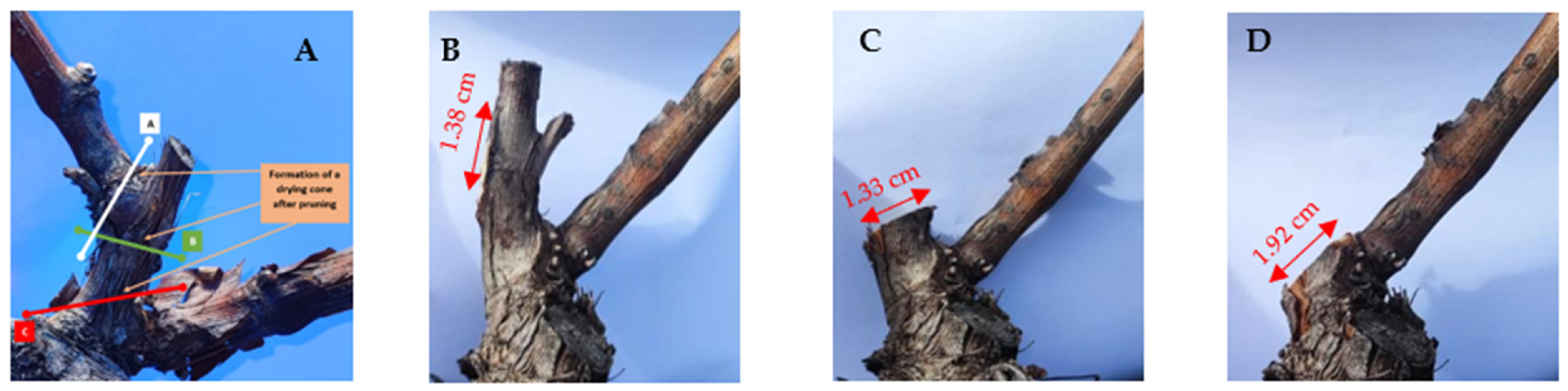
Two pruning methods were evaluated: conventional bilateral cordon pruning (CP) and sap-flow respectful bilateral cordon pruning (RP). Combining the two pruning methods with the four pruning dates yielded a total of eight treatments per cultivar. Vines were pruned to a bud load of 12 buds per vine. Respectful pruning was performed as shown in Figure 1B, following the principles described by Simonit & Sirch [14]. In the conventional treatment, each fruiting position was pruned to a two-bud spur on the previous season’s wood by placing the cut directly beneath the crown buds on two-year-old wood, thereby transecting the continuous conductive cylinder of phloem, xylem, and cambium that connects the perennial arm to the annual canes. This approach concentrates large pruning wounds at the crown region and promotes the formation and radial–longitudinal expansion of desiccation cones within the older arm wood, progressively intersecting functional sap pathways supplying the retained spur. In the sap-flow respectful treatment, cuts were positioned in accordance with the “anatomical pruning” guidelines of Simonit & Sirch [14]; i.e., spatially offset from the functional sap path and from the crown region. When internodal distance permitted, primary cuts were made higher on two-year-old wood, leaving a sacrificial stub above the desired spur, whereas in crowded positions, cuts were made below the insertion point of undesirable one-year-old canes, again leaving an intermediate segment of wood to host the necrosis cone away from the sap route of the retained spur. In both variants of respectful pruning, desiccation cones were intentionally confined to these sacrificial segments, which were scheduled for removal in subsequent years only after complete necrosis, such that their excision would not generate new drying cones within functional wood. Across the cordon, spur arms were kept short and close to the trunk, pruning wounds were aligned longitudinally from one season to the next, and pre-existing woody structures were selectively preserved and integrated into the vine’s sap flow architecture to maintain continuous, unsevered conductive pathways along each production arm, as advocated in Simonit & Sirch’s methodology.
Two varieties were studied. Grenache Noir (GN), planted in 1992 and grafted onto 110 Richter, is a native Spanish variety that is well adapted to the pedoclimatic conditions of Priorat; however, it is prone to reductions in total acidity and increases in alcohol content. Its rootstock, 110 Richter, is the most widely used in Spain due to its strong adaptation to dry soils and its ability to cope with variable conditions [27]. Cabernet Sauvignon (CS), planted in 1999 and grafted onto 110 Richter, is a Bordeaux variety that is less adapted to Priorat’s conditions and more sensitive to water stress and trunk diseases.
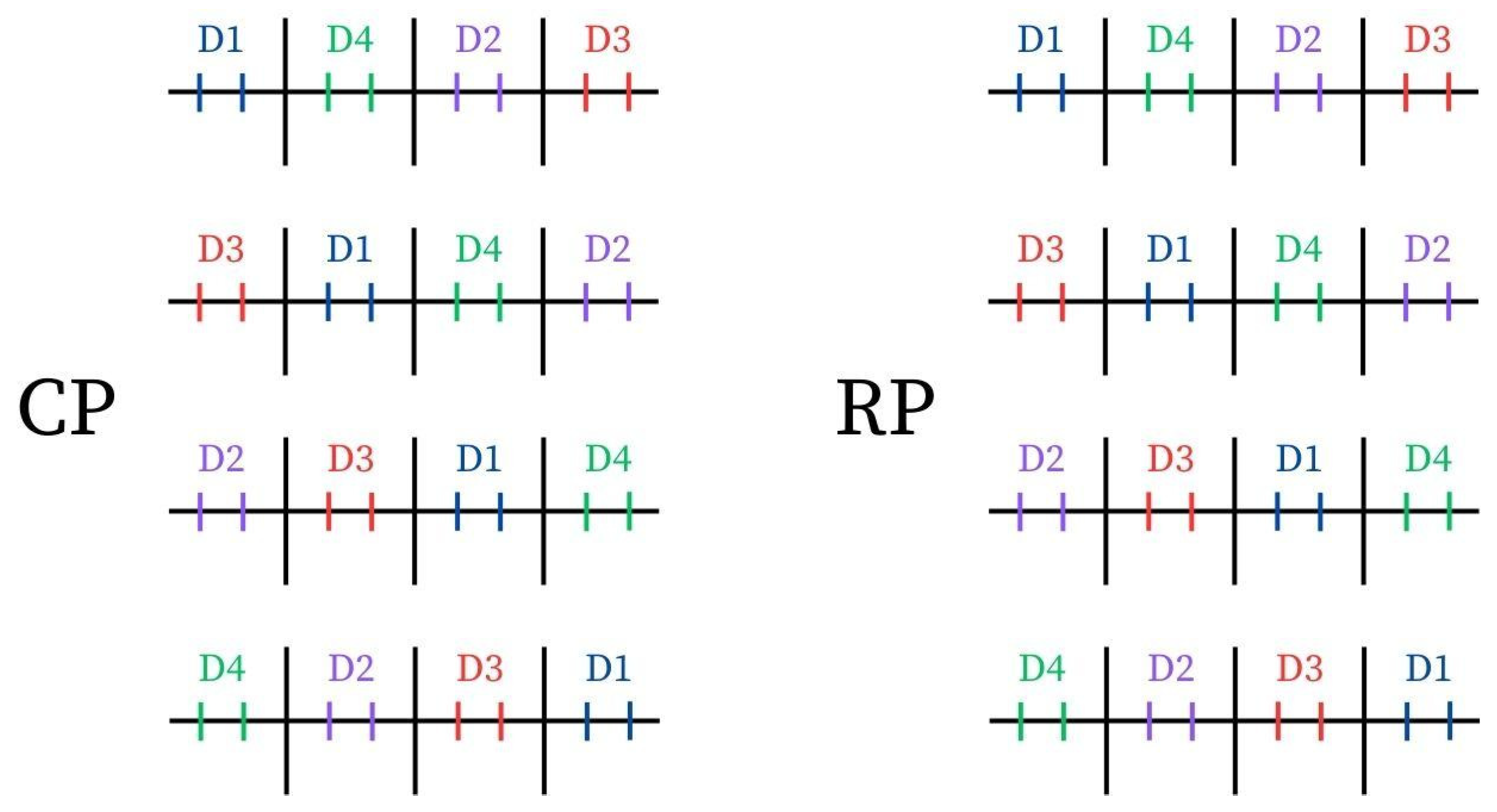
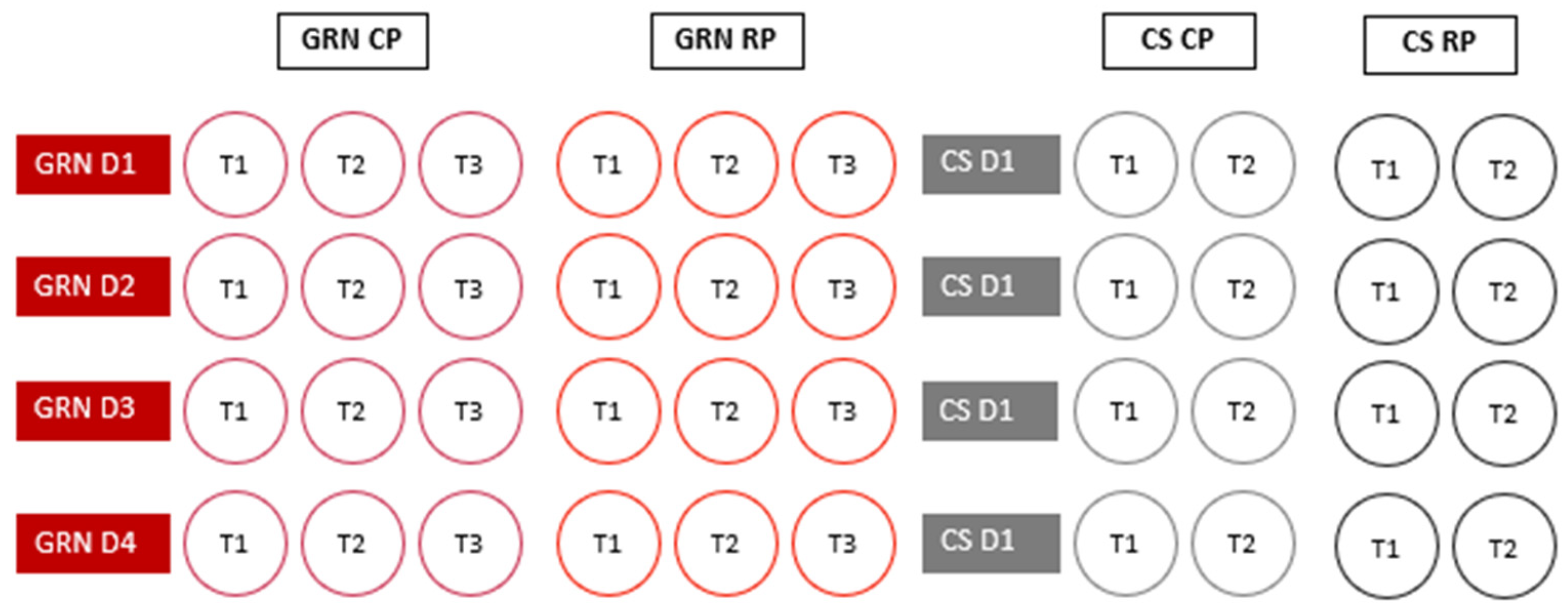
For each treatment, eight replicates were established. The treatments were arranged in a Latin square design with randomised blocks to minimise potential variability associated with the terrain (Figure 2).
This experiment was conducted over a single growing season (2023) and, therefore, the results reflect vine responses under the specific climatic conditions of that year (Table 1).

2.2. Climate and Soil Characteristics

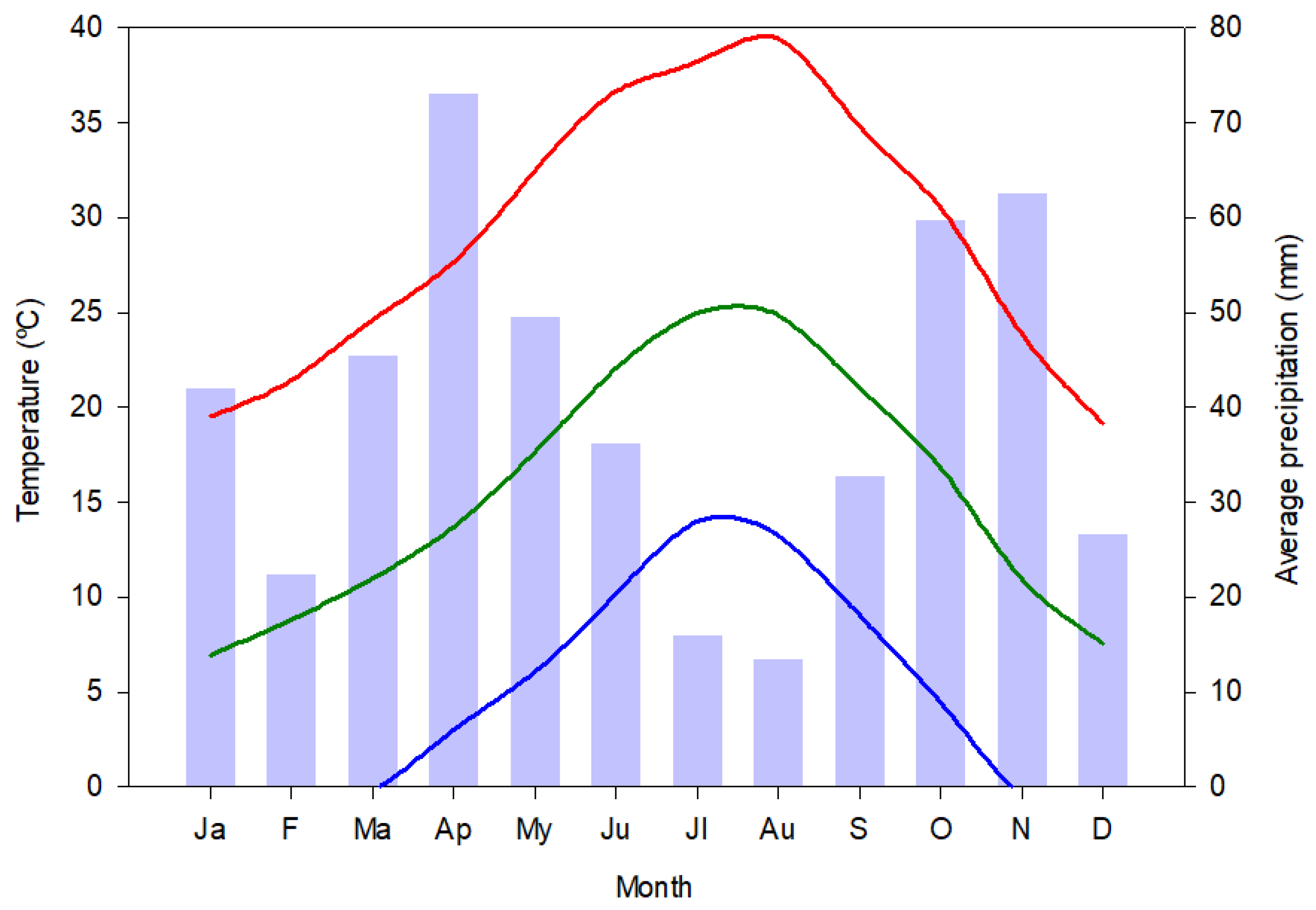
Figure A1 (Appendix A) presents an ombrothermic diagram constructed from the average monthly temperatures and precipitation values obtained from the longest available time series provided by Dades Agrometeorològiques [28] for the weather station closest to the study site, Torroja del Priorat. The dataset spans the period from 1 January 2007 to 31 December 2022. In addition to the graph shown in Figure A1 (Appendix A), Table 2 provides a more detailed description of the climatic conditions recorded during the experiment. The study was performed during the 2023 growing season (April–September) at Torroja del Priorat. This year was exceptionally warm and arid, with an average temperature of 21.8 °C—well above typical Mediterranean norms—driven by peaks of 26.3 °C in August and frequent maximums exceeding 33 °C in July. Precipitation totalled just 136.1 mm over this critical period—a severe deficit against the region’s historical averages—with particularly dry conditions in April (3.8 mm) and August (4.6 mm) exacerbating water stress during budbreak and veraison. Concurrently, high solar radiation (523–744 MJ/m2 monthly) and elevated reference evapotranspiration (ETP summing 806.5 mm) intensified atmospheric demand, while pre-season reserves from January–March remained at 61.6 mm. Moderate average humidity (52–64%) and consistent winds (~1 m/s) further promoted transpiration losses, creating a high-stress environment that accelerated phenology, challenged vine hydraulics, and shaped the vintage’s concentrated yet quality-focused profile.
The 2023 Priorat vintage was exceptionally hot and dry (ITe was 2456.8 °C, a 12.9% increase over the available historical average (2176.0 °C), while accumulated rainfall during the vine’s growing cycle was 167.6 mm—a 40.3% decrease over the same period) with veraison/ripening coinciding with >40 °C peaks, thus causing berry shrivel and phenolic imbalance. This prompted the experimental testing of four pruning dates (Oct–Mar) to delay these critical stages.
The vines studied are planted in the Mas Vell plot, owned by Mas Perinet, located in the municipality of La Morera de Montsant within the Priorat region (41°13′30.7″ N, 0°52′27.2″ E). The vineyard is situated at approximately 332 metres above sea level, covers an area of 12.8 hectares, and has terraced slopes of 37% in the GN plot and 42% in the CS plot.
The DOQ Priorat wine region is distinguished by its unique soil. This small appellation covers a total area of 176 km2 [29] and exhibits a wide variety of soil types. Notably, certain vineyards contain abundant fragments of crushed slate, locally known as “Llicorella.” These soils are highly stony and promote deep water infiltration. The soils of Priorat mainly originate from the Paleozoic era, specifically the Carboniferous period, dating from approximately 354 to 290 million years ago [30]. Geological mapping of the Catalan territory is well documented by [31], which provides soil and geological classifications according to both Soil Taxonomy [32] and the World Reference Base for Soil Resources [33].
According to Soil Taxonomy, the soils in the Mas Vell plot are classified as s43p. The “s43” designation corresponds to Lithic and Typic Xerorthents—soils formed from diverse lithologies on steep slopes, characterised by a xeric moisture regime with wet, cool winters and warm, dry summers [34] Figure A1 (Appendix A). These soils are shallow, underdeveloped, and well-drained, with medium to coarse textures and variable amounts of large rock fragments. The abundance of Llicorella contributes to a predominantly acidic pH and a low calcium carbonate content. The “p” in “s43p” indicates a high content of slate and schist fragments.
Under the World Reference Base for Soil Resources, the same soils are classified as Eutric Leptosols and Eutric Skeletic Leptic Regosols. In this system, Eutric denotes soils with a base saturation greater than 50% in the upper horizons, Skeletic indicates a high proportion of coarse fragments, Leptic refers to shallow soils overlying bedrock, and Regosol identifies young soils with minimal profile development [33].
When combined with local soil characteristics, these conditions may be even more restrictive. The soils in the case study plot are shallow, highly stony, and rich in llicorella, a slate-derived material with dark coloration. Limited root penetration reduces access to water in low-moisture soils, while the dark soil colour increases heat absorption. Together, these factors create particularly stressful conditions for vine growth and survival.
Fertilisation followed organic protocols using Organia Biofuerza (FertinagroBiotech, Teruel, Spain; NPK with NOVOPHOS® gradual phosphorus, hydrolysed proteins, humic acids), applied pre-budburst at manufacturer-recommended rates (200 kg/ha equivalent NPK). This bio-stimulant formulation enhances root development, soil aggregation, and multi-phase nutrient availability—particularly P—under Priorat’s nutrient-poor llicorella soils and is compliant with EU organic Reg. 2018/848 [35].

2.3. Pruning Methodology Applied in This Case Study

In conventional spur-pruning, a two-bud spur from the previous year’s growth is retained while the remainder is removed (Figure 1D) to prevent the development of unwanted shoots. These cuts create pruning wounds that develop into drying cones [36], which may have long-term detrimental effects. Sap-flow respectful pruning seeks to mitigate these impacts by making cuts slightly higher on two-year-old wood or below the crown of undesirable one-year-old wood when insufficient spacing is available (Figure 1B,C). This technique aims to spatially separate drying cones from the active sap pathways of the retained spur. Additionally, sap-flow respectful pruning prioritises the strategic selection and preservation of woody structures, ensuring their integration into the vine’s natural sap flow architecture [13]. Additionally, ref. [37] suggested that xylem in grapevine trunks is anatomically integrated but functions in a sectored manner, due to high axial hydraulic conductivity. These findings have important implications for both vineyard management practices and fruit cluster uniformity within a single grapevine.
In Figure 1A, cut C represents the conventional pruning technique (also shown in Figure 1B) used for decades in Priorat and similar regions, where the blade is placed directly below the crown buds on two-year-old wood, creating a large pruning wound that is prone to desiccation cone formation that intersects functional sap pathways. This method systematically selects and retains the lowest canes as next year’s spurs for optimal fruiting position and vigour control. In contrast, sap-flow respectful pruning [14] involves cuts such as those labelled A or B (Figure 1A, also shown in Figure 1B,C), positioned higher on two-year-old wood or below undesirable one-year-old canes, deliberately leaving a 1–2 cm sacrificial stub to confine necrosis away from the retained buds’ vascular route, thus minimising hydraulic disruption and disease entry while preserving the conductive cylinder’s integrity.
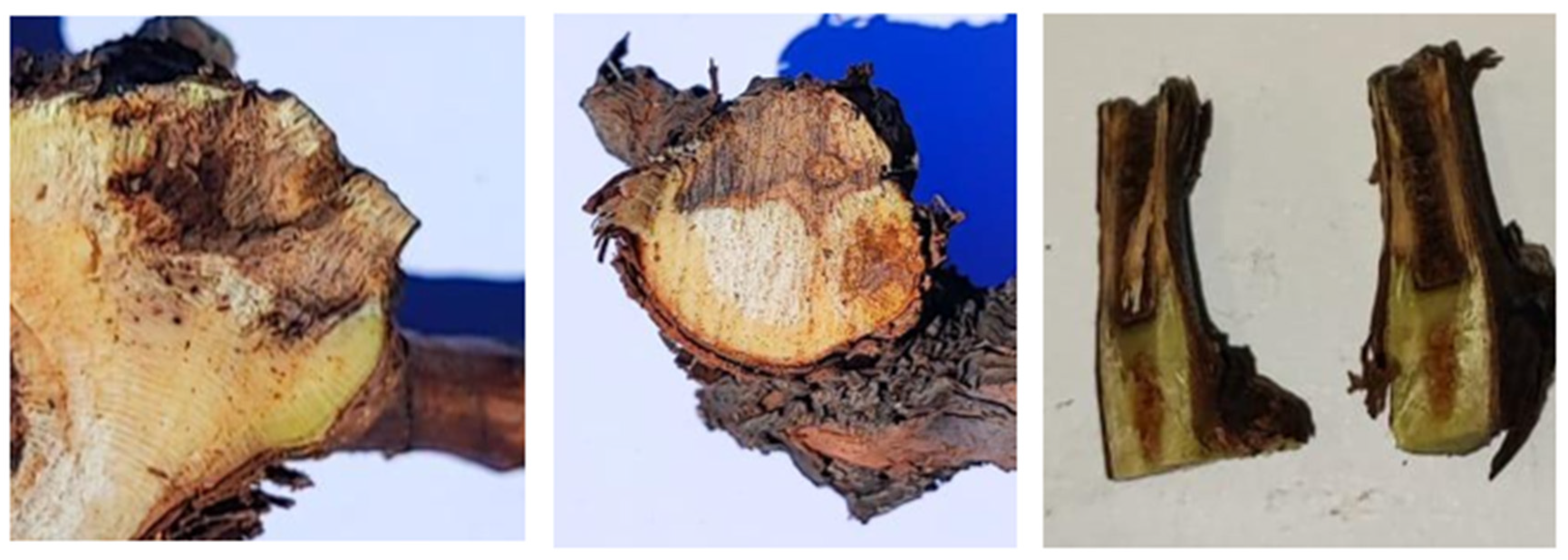
In conventional winter pruning, the blade is positioned directly below the crown buds on two-year-old wood (Figure 1D), transecting the continuous conductive cylinder (phloem, xylem, and cambium) linking the perennial arm to the annual extension. Cambium damage prevents effective compartmentalisation, triggering the formation of extensive radial–longitudinal desiccation cones that propagate into functional xylem vessels supplying the retained buds (left and right panels, Figure 3). Depending on the wound size, accumulated dead wood impairs axial sap circulation, restricting water and mineral transport to tissues distal to the injury [14,38], with demonstrable short-term impacts on vine hydraulic efficiency and physiological performance.
However, the most significant impact of conventional pruning arises from the long-term accumulation of pruning wounds. With each pruning season, wounds accumulate and, when two cuts are made within 2 cm of each other, the wood between them also dies. This results in a larger desiccation cone than the two initial wounds alone would produce [14,38,39]. Reducing sap supply to spur buds can lead to weak vegetative growth and insufficient accumulation of compounds required for fruit maturation. When these limitations coincide with severe water deficits, reduced sap flow may cause cane decline due to dehydration. Because dead wood cannot conduct sap, it becomes a physical barrier that hinders the movement of water and nutrients to developing canes.
In sap-flow respectful pruning, cuts are made away from the desired buds to encourage the formation of desiccation cones without disrupting sap flow to those buds (right image in Figure 3). To remove this necrotic wood, it is essential to wait until the following season and excise the dry remnants produced by the previous year’s respectful pruning. Once the wood has fully desiccated, removing it does not induce new desiccation cones [38].

2.4. Phenology

Phenological monitoring was conducted using the BBCH scale specific to grapevine [40], with detailed stage descriptions provided in Table A1 (Appendix B). Additionally, the stages described by [41] were employed; these are explained in Table A1 (Appendix B). For each stage, both the developmental stage and the percentage of buds or organs reaching that stage were recorded.
Monitoring began when the first signs of budburst were observed. The initial assessment took place on 23 March 2023 (DOY 82), and subsequent observations were conducted periodically until 8 August 2023 (DOY 220), at which point the vines reached BBCH stage M (veraison). For the phenological analysis, four key stages were considered: Budburst, flowering, pea-size stage, and veraison.
A bud was considered to have reached budburst when a small green or red tip became visible. Only primary buds were evaluated. The retained stage was defined as the date at which 50% of the productive buds left after pruning had burst. Observations were performed on at least five vine plants per homogeneous zone. Monitoring commenced when a minimum of 5% of buds had burst, and at least one additional observation was conducted within a maximum interval of one week to ensure an observation after 50% budburst. The date of 50% budburst was determined by interpolation between the observations immediately before and after this threshold.
A flower was considered open when the base of the cap was detached, regardless of whether the cap fell off. The 50% flowering stage corresponds to the date when 50% of the flowers were open. The flowering level was assessed per vine or per inflorescence, and an average was calculated. Monitoring began when at least 5% of flowers were open, and at least one additional observation was conducted within a maximum interval of one week to capture the 50% flowering point. The 50% flowering date was interpolated between the observations immediately before and after this threshold.
Veraison marks the onset of grape ripening. The colour-appearance method was used to compare the same grape variety at the same site interannually. Observations involved visually estimating the percentage of coloured berries across all bunches of a vine, with a minimum of five vine plants per homogeneous zone. Monitoring began when at least 5% of berries were soft to the touch, with at least one additional observation conducted within a maximum one-week interval to capture the point at which 50% of berries had softened. The date of 50% berry veraison completion was interpolated between the observations immediately before and after this threshold.

2.5. Vegetative Development and Leaf Area

The measurement of vine growth provides insights into growth kinetics. Monitoring growth kinetics enables assessment of whether different treatments respond similarly to the vintage’s climatic conditions. This study is particularly relevant given the exceptional conditions of the 2023 vintage, which was characterised by the lowest rainfall recorded over the past ten years from budburst until mid-May, followed by sparse precipitation from mid-May to the end of June.
For each treatment, the same three shoots per vine were monitored. These shoots were previously marked immediately after budburst. Shoot length and diameter were measured weekly from 28 April (DOY 118) to 28 June (DOY 209). Between the pea-size stage and veraison, measurement frequency was increased to three times per week to accurately track berry diameter development in parallel. Shoot diameter was measured using a digital calliper (1108-150, INSIZE Co., Ltd., Suzhou, China), while shoot length was measured using a measuring tape (PowerLock 10 m, Stanley Black & Decker, New Britain, CT, USA).
Leaf area was measured at the beginning of July, once the apical meristem had dried and growth had ceased. The length of the main vein of each leaf on the primary shoot, as well as the length of leaves on secondary shoots, was measured using a ruler. Only leaves with a midrib length greater than 3 cm were included. Leaf area was then calculated according to [42], using the following equations.
For GN,
y = ( 147.7 × X m i d r i b ( c m ) × 10 ) 3387 10 6 ,
for CS,
y = ( 0.38 + 1.21 × X m i d r i b ( c m ) 2 ) 10 4 .
The results are expressed in square metres (m2). Due to greater canopy heterogeneity in GN, measurements were performed on all GN vines included in the experiment. In contrast, due to the more homogeneous canopy structure in CS, sampling was reduced to half the number of CS vines.
Shoot diameter and leaf area measurements were standardized along the main fruit-bearing shoots. Shoot diameter was measured between the third and fourth internodes, using undamaged, representative shoots from each vine.

2.6. Water Stress

Water stress parameters were assessed during two periods: pre-veraison on 6 and 19 July (DOY 187 and 200, respectively), and during maturation on 22 August (DOY 234).
To evaluate the vines’ responses to water and heat stress, surface leaf temperature and leaf water potential (LWP) were measured. Leaf temperature and leaf water potential were recorded on fully expanded, healthy adult leaves located between the third and fourth node of the same shoots, explicitly excluding young apical leaves and older basal leaves to avoid ontogenetic effects on leaf physiology.
Surface temperature was recorded on every vine for each treatment, while LWP was measured on every other vine. Measurements were performed directly in the vineyard to minimise alterations in the studied parameters. Leaf surface temperature was measured using an infrared thermometer (830-T2, Testo SE & Co., Titisee-Neustadt, Germany). LWP at each phenological stage was measured using a pressure chamber (Model 600 Pressure Chamber Instrument, PMS Instruments Co., Albany, OR, USA) according to the procedure described by [43]. Predawn LWP (pd-LWP) was measured one to two hours before sunrise (around 8:00; 6:15 solar time), when vine water status is at its maximum [44], and midday LWP (md-LWP) was measured at 14:30 (12:45 solar time).
Photosynthetic activity was assessed using an Infrared Gas Analyser (CI-340 Handheld Photosynthesis System, CID Bio-Science, Inc., Camas, WA, USA) to determine net photosynthesis (Pn), stomatal conductance (gs), and transpiration (E). Measurements were taken between 11:30 and 14:00 (9:30–12:00 solar time) to ensure optimal Pn, with light intensity maintained above 1200 μmol photons m−2 s−1. Chlorophyll content was measured using a chlorophyll concentration meter (MC-100, Apogee Instruments, Inc., Logan, UT, USA), which provides active chlorophyll readings without requiring full sunlight. For each vine, a leaf located between the third and fourth node was selected and placed inside the hermetic chamber of both devices for measurements.

2.7. Yield Components, Berry Development, and Ripening

From fruit set to veraison, berry diameter was monitored to assess fruit growth dynamics. For each treatment, three previously marked shoots were selected at the beginning of the experiment. From each shoot, six berries were randomly chosen from the bunches, and their diameters were measured using a digital calliper (1108-150, INSIZE Co., Ltd., Suzhou, China). Monitoring began on 8 June (DOY 159) and continued until 2 August (DOY 214).
Ripeness measurements were conducted for all treatments to assess potential alcohol content (°Brix; % m/m sucrose), total titratable acidity (TTA; g/L), and pH. The first measurement took place on 7 August (DOY 219). For each treatment, random berry samples were collected from each bunch of each vine. The final measurement was performed during grape harvest on 6 September (DOY 249), analysing the must obtained after crushing all grapes harvested for each treatment. pH was measured using a pH meter (pH Meter Basic 20, Crison Instruments, S.A., Barcelona, Spain), TTA was determined using 0.204 mol/L NaOH, and potential sugar (°Brix) was measured with a digital refractometer (HI 96801, Hanna Instruments, S.L., Eibar, Spain).
At harvest, yield was determined at multiple levels. For each treatment, the average bunch weight and yield per plant were calculated. Each bunch of each vine was weighed using a portable scale (HR 2393/95, Koninklijke Philips N.V., Amsterdam, The Netherlands) (Figure 4).

2.8. Small-Vessel Vinification Performance

Small-scale fermentations were performed following the methodology of [42]. For GN, three replicates per treatment were fermented, resulting in a total of 24 micro-vinifications. For CS, lower yields allowed only two replicates per treatment, for a total of 16 micro-vinifications. Grapes were hand-harvested at full ripeness into 20 kg boxes and stored at 21 °C in a cold room prior to crushing.
Grapes were de-stemmed and crushed individually for each tank using a de-stemmer (Delta E2, Bucher Vaslin S.A., Chalonnes-sur-Loire, France). Fermentation was carried out in 5 L tanks (Wide-mouth container, Supermercado del Embalaje, Tarragona, Spain), filled to three-quarters capacity to facilitate proper cap management. Room temperature during fermentation was maintained at 23 °C, and 2 ppm SO2 was added to the must. All musts were inoculated with 40 g/hl of yeast (LALVIN ICV GRETM Saccharomyces cerevisiae, Lallemand Inc., Montreal, Quebec, Canada). The cap was gently punched down twice daily until alcoholic fermentation was complete. During the tumultuous phase, must density and temperature were monitored daily to track sugar consumption and avoid excessively high temperatures (>28 °C).
Once fermentation was complete (residual sugars < 2 g/L), which took 21 days for both GN and CS, the pomace was pressed. Free-run wine was obtained using a cone-shaped funnel to separate juice from solids. Press wine was collected using a 40 L hydropress (Speidel 40 Litre Stainless Steel Hydropress, Vigo Presses Ltd., Honiton, UK), yielding 2.0–2.5 L per pressing depending on variety and fruit ripeness. After pressing, the juice was allowed to settle overnight and then racked into the same tank for clarification (Figure 5). Potassium metabisulphite (WINY, Enartis Sepsa, Navarrete, Spain) was added at 19.8 mg/L SO2 equivalent, in order to prevent microbial spoilage. Wines were stabilised at 4 °C for two months, followed by racking before bottling in December, and stored at 4 °C. Finished wines were bottled without fining or filtration. Malolactic fermentation was not performed to avoid unintended malolactic deviations, and no oak treatment or ageing was applied.
Fermentation progress was monitored by measuring mass loss due to CO2 evolution using a handheld scale (HR 2393/95, Koninklijke Philips N.V., Amsterdam, The Netherlands).
Anthocyanin and tannin concentrations were analysed after crushing the whole berries, and extraction of phenolic compounds was performed following a modified version of the Glories method [45] to determine total anthocyanin and tannin contents. Anthocyanin results are expressed as malvidin-3-O-glucoside equivalents (mg/L), whereas total tannins were quantified after acid hydrolysis and expressed as (+)-catechin equivalents (g/L). Alcohol content (ABV; % vol.) was determined using an ebulliometer (Ebulliómetro eléctrico, GAB Sistemática Analítica S.L., Barcelona, Spain) equipped with an electronic temperature probe (DS TEMP, Laboratories Dujardin Salleron, Noizay, France). pH was measured with a pH meter (pH Meter Basic 20, Crison Instruments, S.A., Barcelona, Spain), and total acidity (TTA; g/L) was determined by titration with 0.204 mol/L NaOH (ITW Reagents, AppliChem GmbH, Darmstadt, Germany).
An additional sample was used to determine the total polyphenol index (TPI) and hue using a spectrophotometer (4255/50, Zuzi, Beriain, Spain) at the Department of Biochemistry and Biotechnology, Rovira i Virgili University (Tarragona, Spain).

2.9. Statistical Analysis

The error bars in the graphs represent the least significant difference (LSD) procedure. They are constructed in such a way that if two means are the same, their intervals will overlap 95.0% of the time.
Statistical analyses were performed using STATGRAPHICS CENTURION 19 (version 19.7.01), Microsoft Excel (version 2412), and the complementary program XLSTAT 2020 (version 2020.1.3). Both t-tests and z-tests were conducted. The t-test is used to determine whether two datasets are statistically different, while the z-test assesses the probability that new data are consistent with a previously established value.
For wine analyses, one-way ANOVA was performed, followed by a homoscedasticity test Table A2 (Appendix C). Analysis of variance is a general statistical procedure used to partition the sources of variability within a dataset, with the aim of determining the extent to which an independent variable contributes to observed differences.

3. Results

3.1. Climate Characteristics

As shown in Figure A1 (Appendix A), the annual climatic averages from 2007 to 2022 indicate that, from budburst (April) to harvest (September), the mean temperatures and precipitation were as follows: 13.7 °C and 73 mm (April), 17.6 °C and 49 mm (May), 22.1 °C and 36 mm (June), 25.0 °C and 16 mm (July), 24.9 °C and 13 mm (August), and 21.1 °C and 33 mm (September). For the natural year of the study (October 2022 to September 2023; Table 2), these values were 15.9 °C and 3.8 mm (April), 17.7 °C and 31 mm (May), 23.0 °C and 18 mm (June), 25.9 °C and 35 mm (July), 26.3 °C and 5 mm (August), and 22.3 °C and 44 mm (September).
Comparison of these data shows that the study year exceeded the long-term average temperatures and experienced generally lower precipitation, indicating noticeably warmer and drier conditions. Summing the monthly averages from April to September, the long-term period (2007–2022) totals 124.3 °C and 221 mm of precipitation. In contrast, for the study year, the totals were 131.1 °C and 137 mm, representing a 5.5% increase in temperature and a 38.0% decrease in precipitation. These values highlight the challenging climatic conditions in the Priorat region in 2023.

3.2. Phenology

Analysis of Table 3A,B indicates that, for GN, CP generally resulted in slightly earlier budburst compared to RP, although the difference did not exceed four days. This pattern persisted during flowering and became more pronounced at the D1 pruning date, with differences of up to 11 days. However, by veraison, this trend was no longer observed and a slight reversal occurred, with CP occurring approximately three days later than RP for D1, D2, and D4.
For CS, only minor variations were observed in the progression of the phenological cycle between the two pruning methods. Budburst occurred around 10 April for both CP and RP, with no observable differences. During flowering, RP occurred approximately seven days earlier than CP. At the pea-size stage, this trend reversed, with RP lagging slightly behind CP, although the difference did not exceed three days. During veraison, the trend was similar to that observed during flowering but with smaller differences, ranging from two to three days.
For GN (Table 3A), the primary distinction among pruning dates lies between the D1–D2 and D3–D4 periods. Budburst occurred earlier for D1 and D2, with differences of up to eight days. Flowering appeared relatively homogeneous; however, for RP, it was delayed by approximately one week compared to CP. This trend continued through the pea-size stage, except for D1. During veraison, D1 and D2 reached this stage approximately one week earlier under CP. For RP, a similar trend was observed, though the differences between treatments were smaller.
For CS (Table 3B), the pea-size and veraison stages were reached with smaller differences in days between pruning dates than in GN (Table 3A), indicating a more uniform phenological response to pruning in CS.
Table A3 (Appendix D) presents the number of days between budburst and the three other main phenological stages. Generally, for both varieties, veraison was reached more rapidly under RP, with differences ranging from approximately three days to one week. Another notable trend is that, regardless of variety, the duration to reach each phenological stage from budburst shortened when pruning was performed later. Specifically, the D3–D4 pair required less time to complete each stage than the D1–D2 pair.
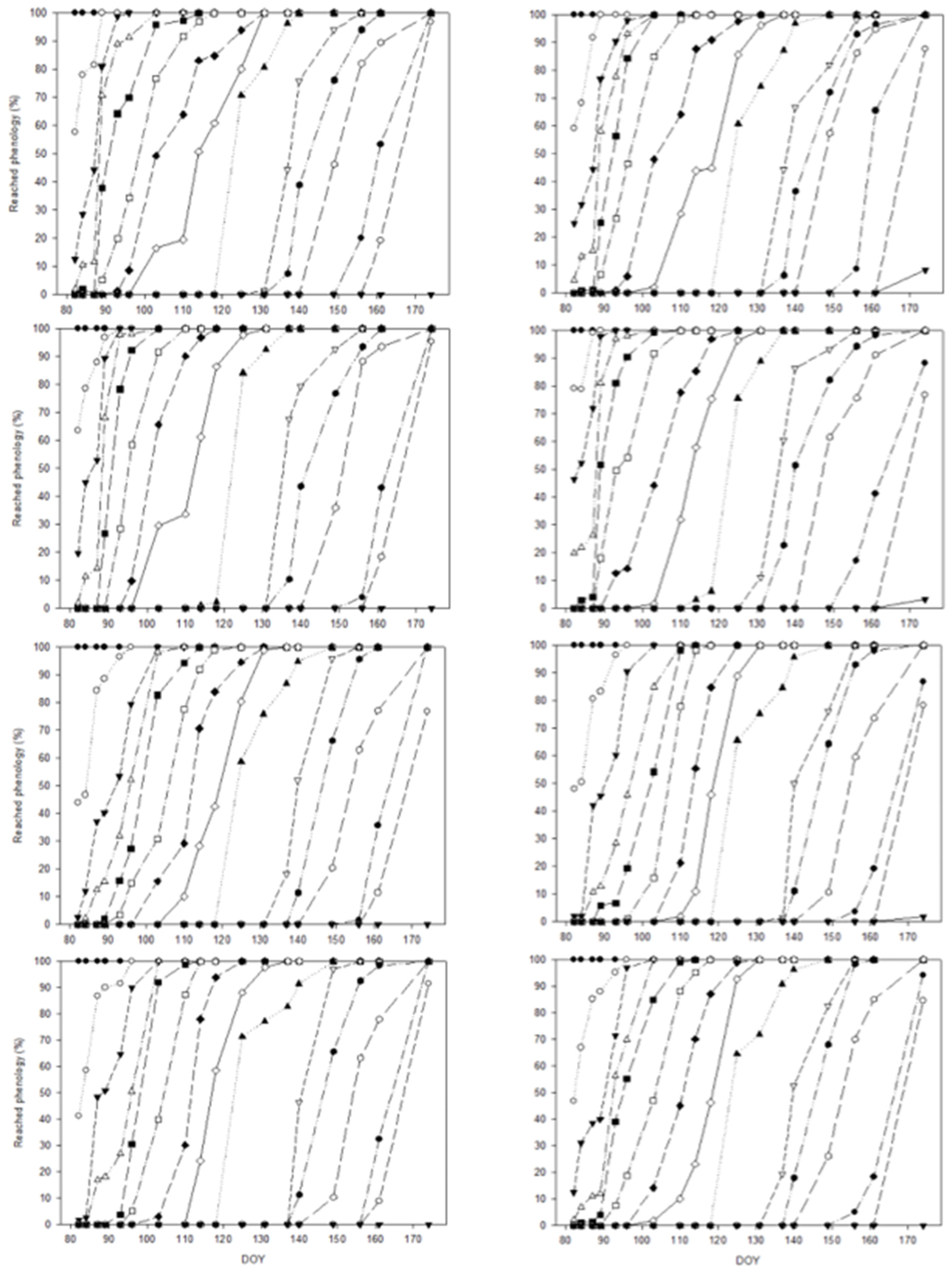
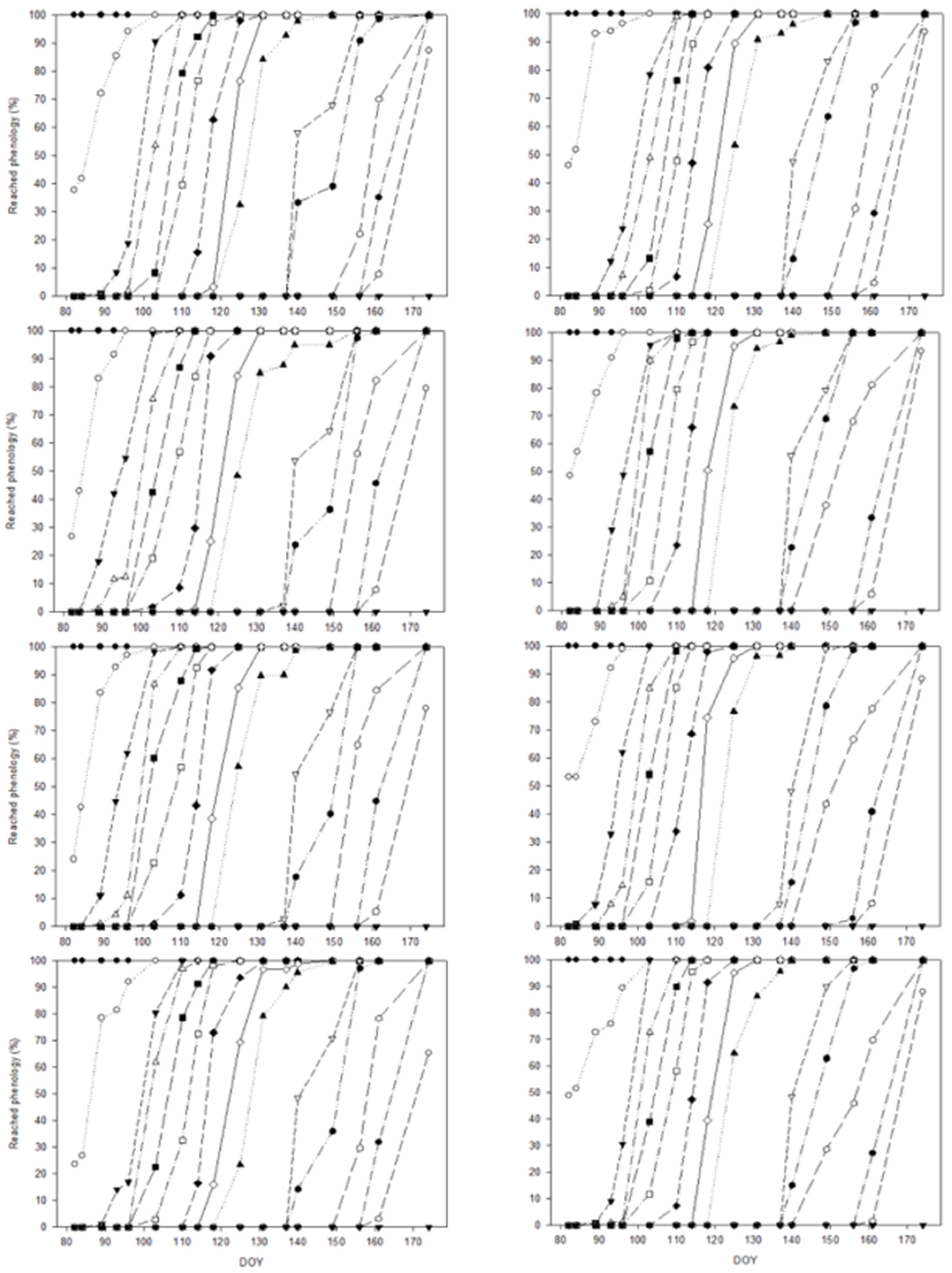
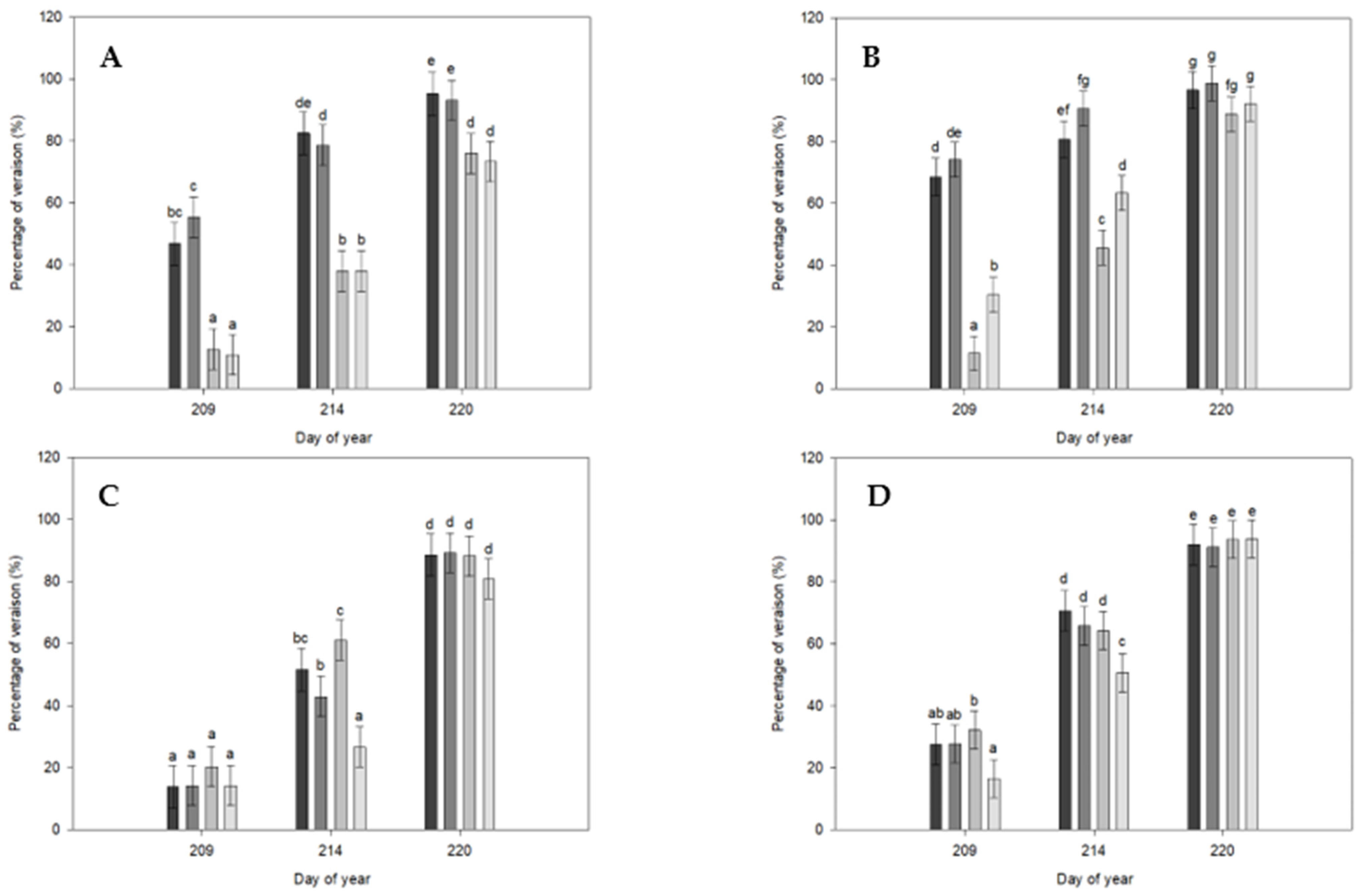
Figure A4A (Appendix G) shows the evolution of veraison. For GN, both pruning types (and especially CP) exhibited the fastest progression of veraison for the earliest pruning dates (D1 and D2), indicating accelerated colour development in vines pruned earlier. On average, D1 and D2 reached DOY 220 with differences of 23% and 6% compared to D3 and D4 under CP and RP, respectively.
For CS, no significant differences in veraison completion were observed, with a generally uniform trend. The only notable observation was a slower progression for D4 under both CP and RP during intermediate stages; however, these eventually reached the same veraison levels as the other treatments within each pruning type.

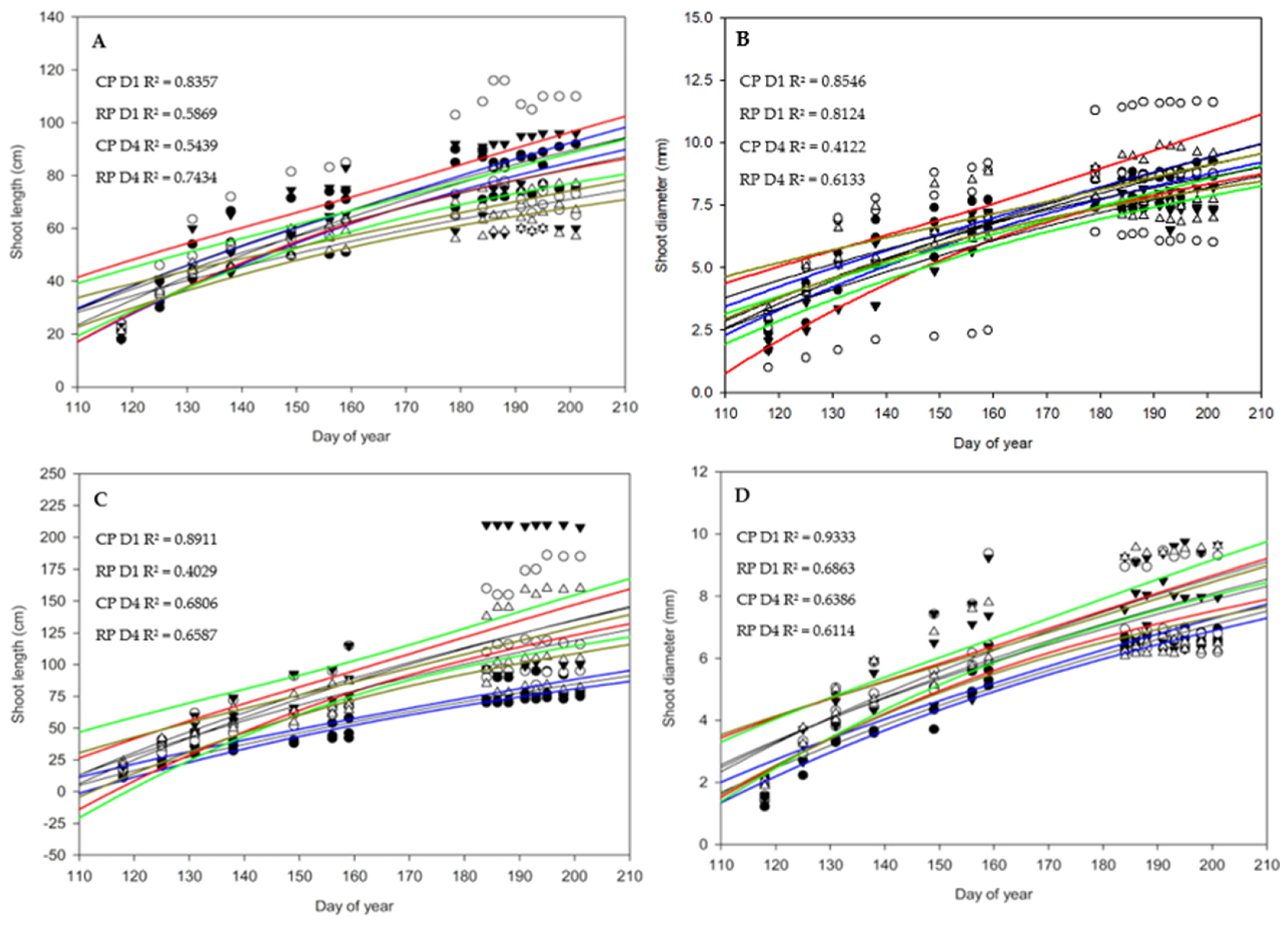
3.3. Shoot Growth Kinetics

Figure 6 presents the logarithmic regressions of shoot growth parameters, specifically length and diameter. For GN (Figure 6A,B), there is considerable overlap among all treatments, indicating similar growth patterns and high variability. As this analysis provides a qualitative perspective of the data, specific numerical values cannot be rigorously discussed; rather, general trends are highlighted. The only exception is observed in Figure 6A, where RP-D4 shows a downward trend starting around DOY 140, suggesting a potential reduction in shoot length growth compared with the other treatments.
For CS (Figure 6C,D), the trends are clearer. The CP-D1 treatment consistently showed lower growth values. This pattern is particularly noticeable in Figure 6C, where the regression line and confidence intervals for CP-D1 diverge from the other treatments beginning around DOY 135, indicating reduced shoot growth compared to the remaining treatments.

3.4. Leaf Area Measurement

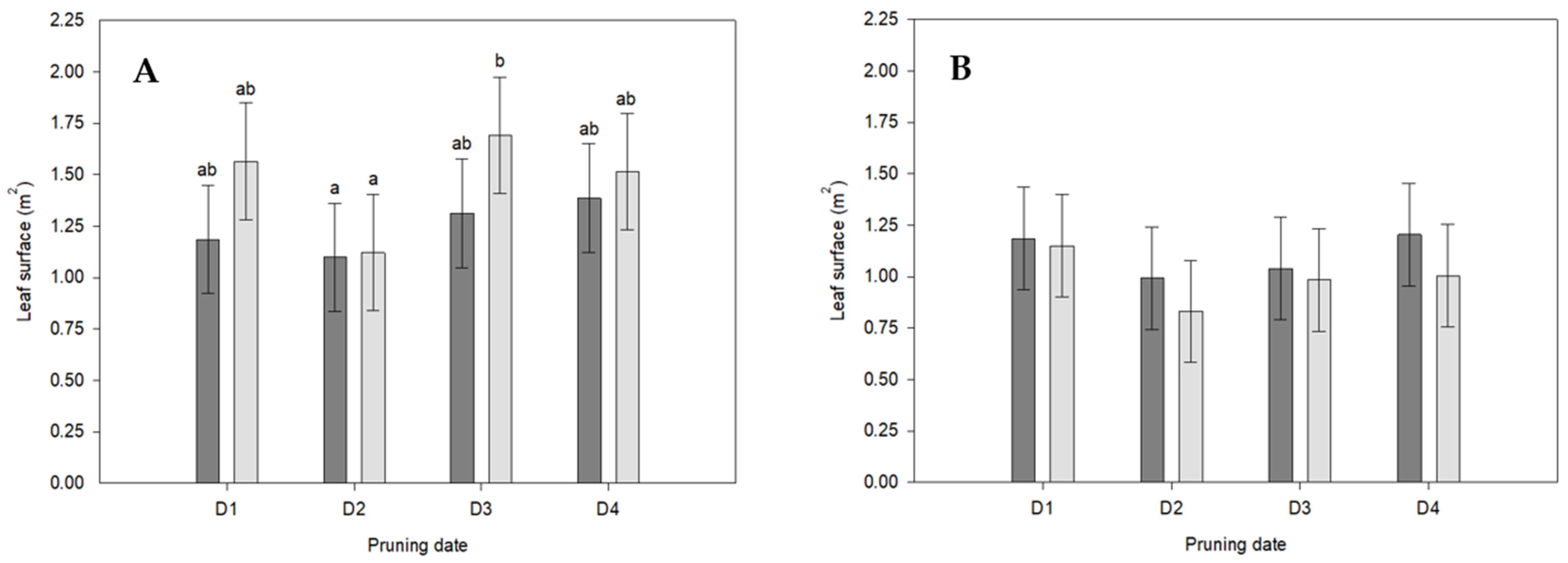
For GN, the results indicate that RP tended to produce larger leaf areas in both secondary and total measurements (Figure 7A,B). On average, the secondary leaf area was 30% higher and the total leaf area was 18% higher under RP, although these differences were not statistically significant.
Regarding pruning dates, D2 consistently exhibited the lowest total leaf area across both pruning methods. This treatment showed a mean total leaf area of 1.12 m2, compared with 1.59 m2 for the other three pruning dates, suggesting a trend toward reduced leaf development in D2.
For CS (Figure 7B), an opposite trend to that observed in GN (Figure 7A) was noted between the two pruning methods. Both secondary and total leaf areas tended to be higher under CP. On average, the secondary leaf area for CP was 0.128 m2, compared to 0.027 m2 for RP. These results suggest that, with a larger sample size, the differences could potentially reach statistical significance, indicating higher leaf area under CP. Additionally, the greater variability observed in leaf measurements for GN may be due both to intrinsic varietal traits and to sampling factors [46]. GN tends to have a more lobed leaf, with deeper lateral sinuses and greater heterogeneity in leaf size and blade orientation within the same vine, which increases the light and temperature gradient among leaves that appear equivalent. In addition, a higher intra-clonal diversity in water-use behaviour and water-use efficiency has been described in GN, which can translate into more heterogeneous physiological responses among leaves under the same treatment.

3.5. Response to Water and Heat Stress

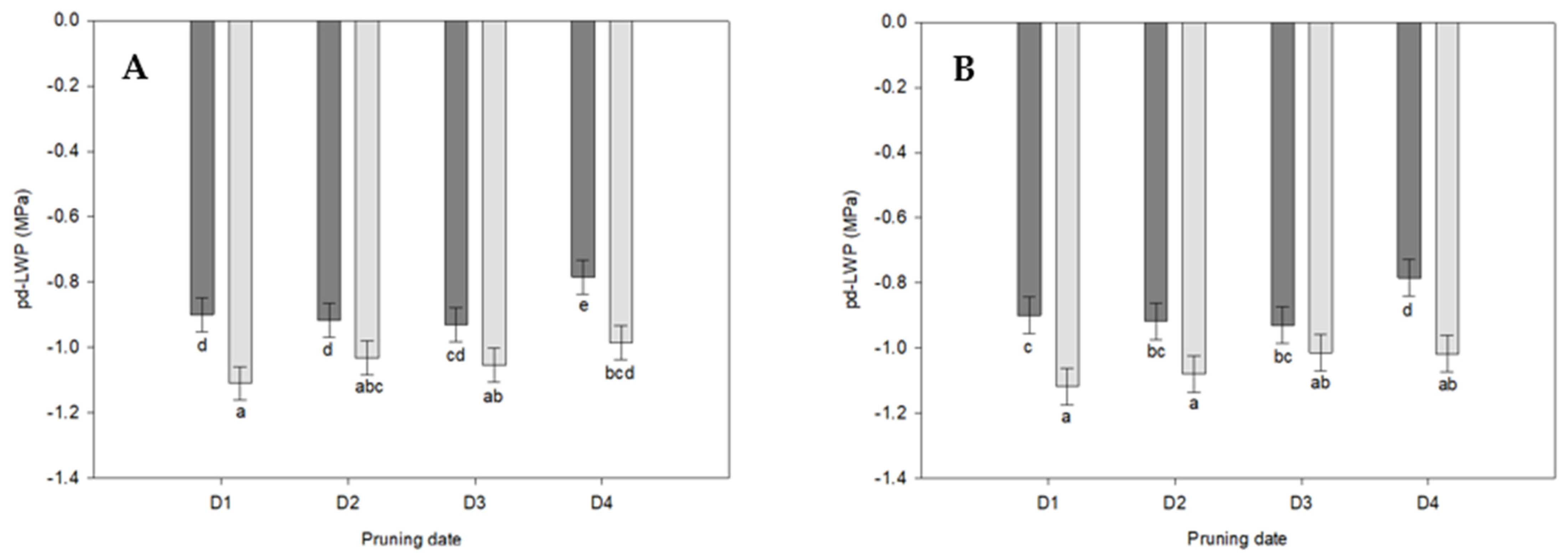
Figure 8 shows a notable difference in pd-LWP between CP and RP for GN. Plants subjected to RP had an average pd-LWP of −1.05 MPa, compared to −0.88 MPa for CP. While no statistically significant differences were observed across all groups, there was a clear trend toward more positive pd-LWP values in the CP treatment, regardless of grape variety. Significant differences were observed for D1 and D4 in both pruning types, except for CS-D1, although these differences were marginal. A larger sample size might have revealed additional significant differences. Overall, the trend indicated an increase in pd-LWP values for both CP and RP, with values approximately 16% more positive.
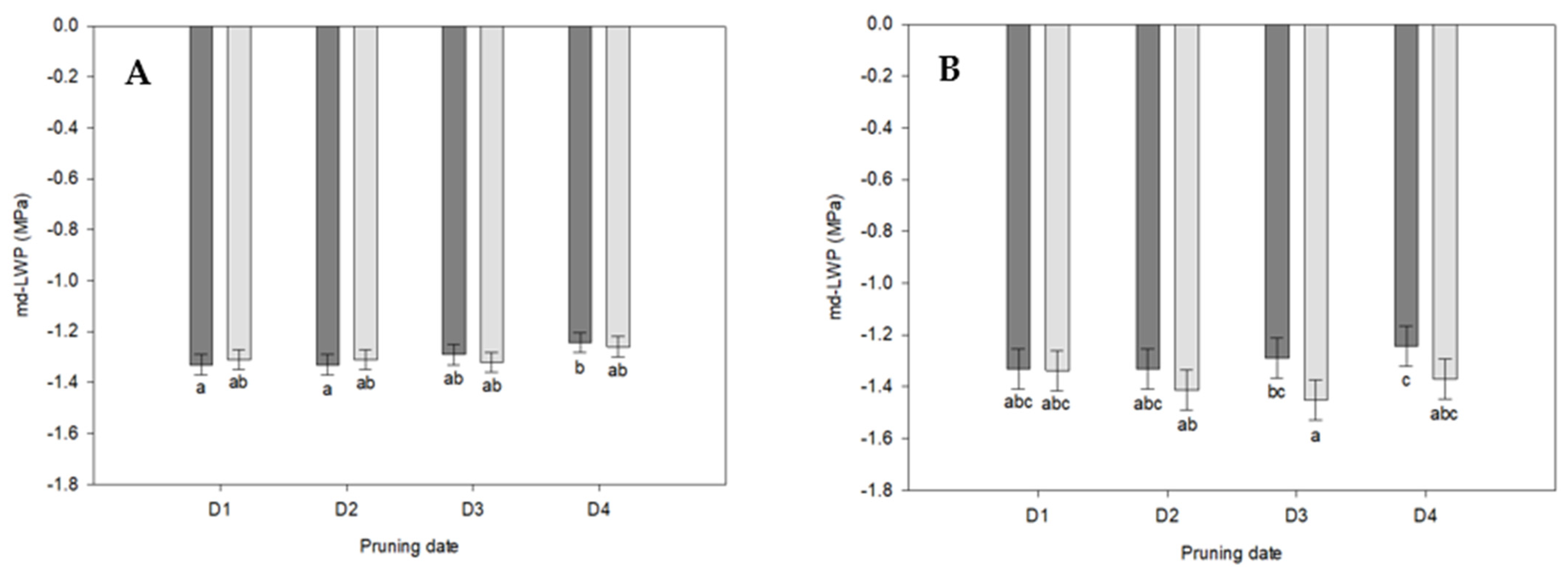
The md-LWP results (Figure 9) showed no significant differences between treatments, regardless of grape variety. No clear trend was observed, suggesting that pd-LWP is a more sensitive parameter for detecting treatment differences than md-LWP. It is possible that, with reduced variability in the CS data or a larger sample size, differences in md-LWP might have been detected.
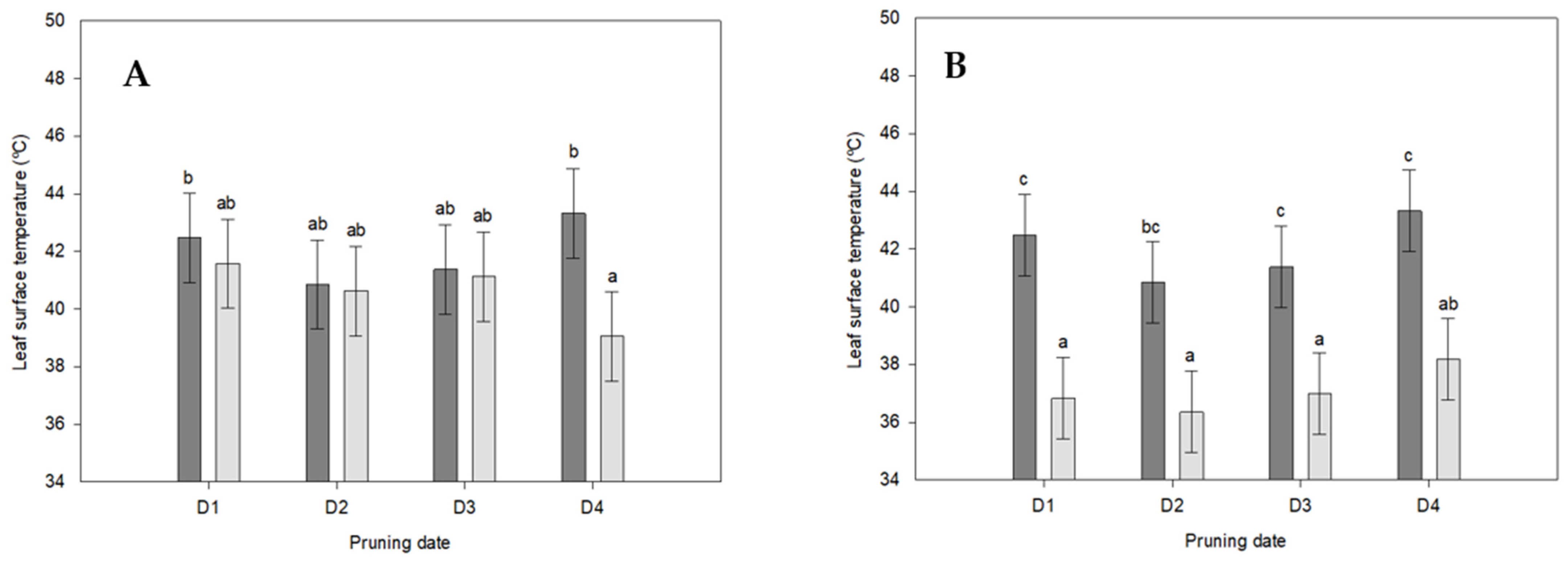
Measurements of leaf surface temperature for GN (Figure 10A) did not reveal any notable trends. However, for CS (Figure 10B), CP plants generally exhibited higher leaf temperatures, with significant differences observed for D1. Although differences were not statistically significant across all pruning dates, the average leaf temperature for CP treatments was approximately 12% higher than for RP, indicating a consistent trend.

3.6. Photosynthetic Response

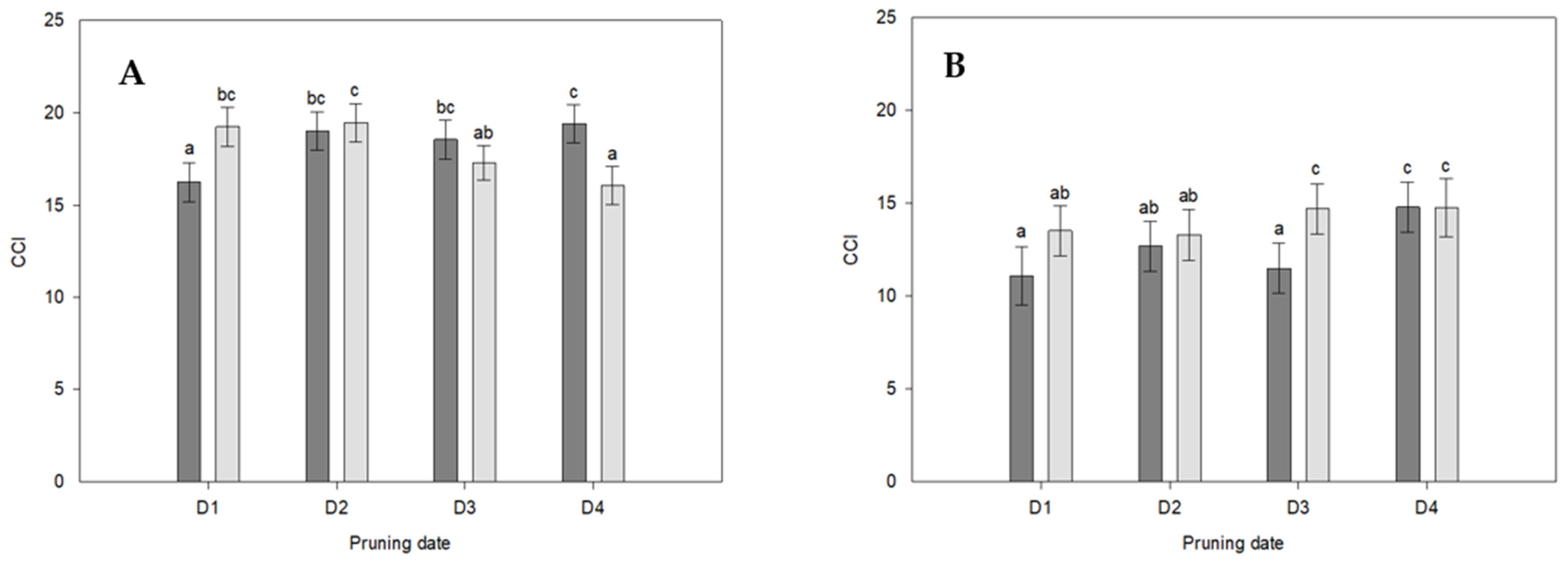
Figure 11 presents the chlorophyll content results, expressed in CCI units. For GN (Figure 11A), an interesting trend is observed: CCI values were significantly higher for RP in D1, approximately equal for D2 and D3, and reversed in D4, where CP showed significantly higher values. Specifically, in D1, the CCI for CP was 16% lower than RP; in D4, it was 17% higher.
For CS, no significant differences were observed. Although the data showed greater variability than GN, no clear trend was apparent. From D1 to D2, the CCI values between pruning types tended to converge, followed by a relative increase for RP between D2 and D3, and subsequent equalisation in D4. With a larger sample size, some of these trends might have reached statistical significance at the confidence level used.
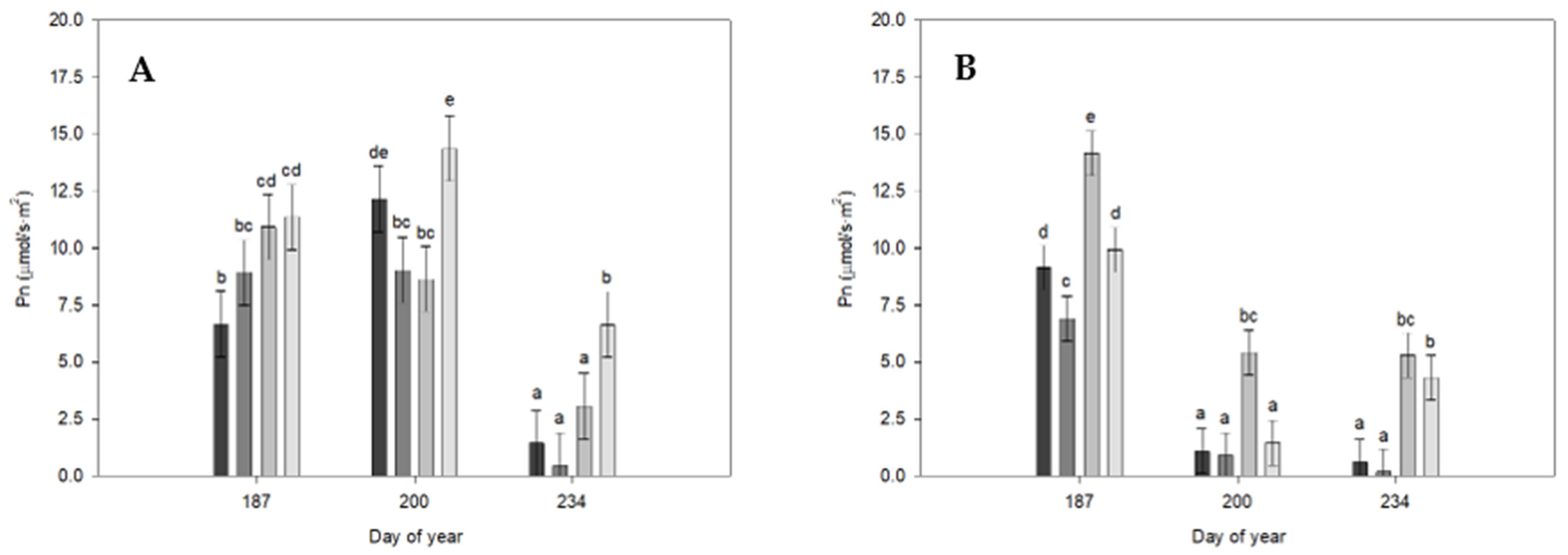
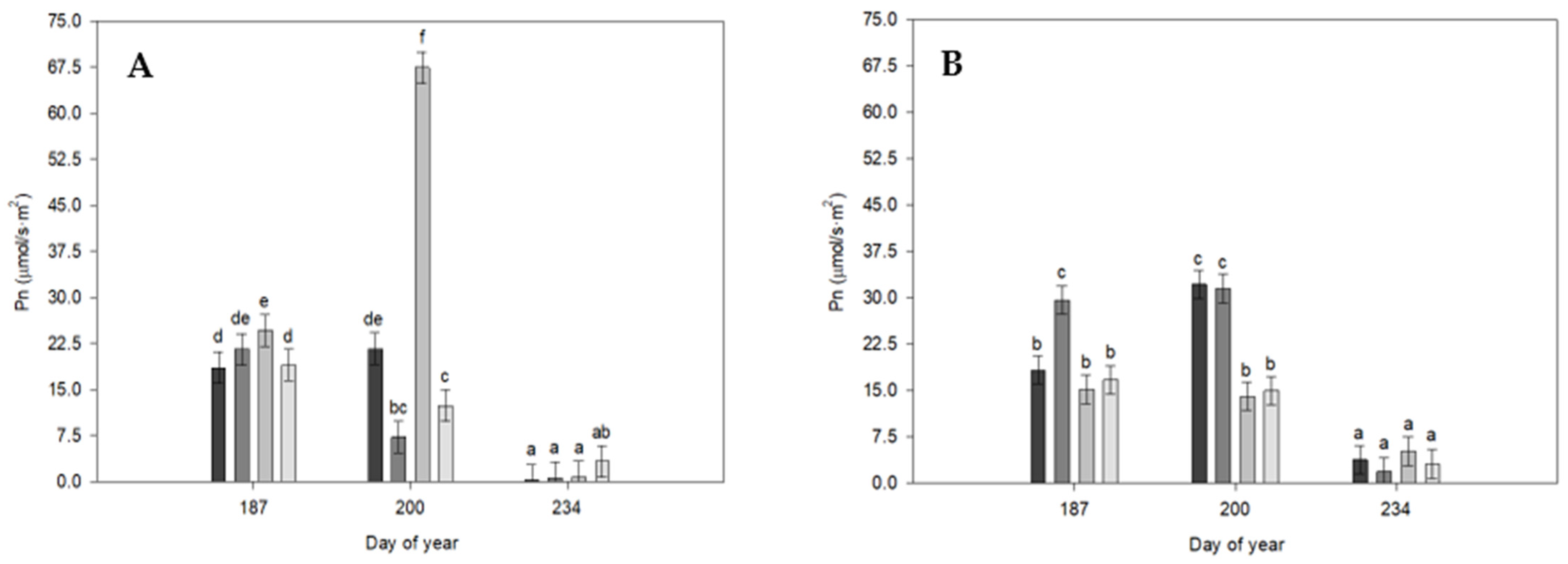
Figure 12 shows the evolution of Pn in GN, highlighting notable differences between RP and CP. At DOY 187, Pn values were similar across treatments; however, by DOY 200, Pn in RP was significantly lower than in CP, indicating a temporary reduction in photosynthetic activity. On average, Pn values for CP were approximately 8.5 times higher than for RP at this stage. By DOY 234, Pn values returned to similar levels for both pruning types. Notably, high variability was observed, especially for CP-D4, which can be attributed to strong heterogeneity among vines. Some vines ceased photosynthetic activity entirely due to extreme water and heat stress, while others were less affected, resulting in marked differences in observed values.
Despite the lack of statistically significant differences, an apparent trend is observable in GN for both pruning types: Pn values for later pruning dates (D3 and D4) tended to be higher than for earlier dates (D1 and D2) across measurement days, apart from DOY 200 for CP, where this trend did not hold.
For CS (Figure 13), no consistent or significant differences were observed, either among pruning dates or between pruning methods. An unusual exception was observed for CP-D3 on DOY 200, where all vines in this modality exhibited exceptionally high Pn values that substantially exceeded expected norms. The cause of this anomaly remains unexplained.
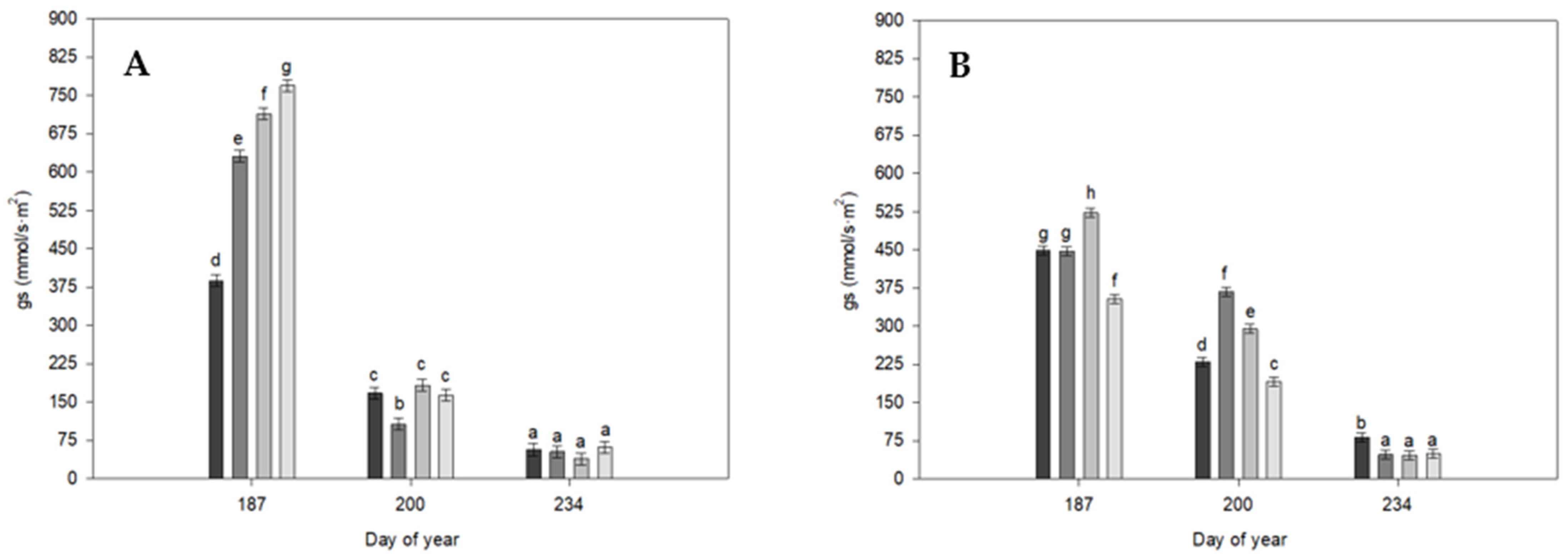
Examination of gs results for GN (Figure 14) indicates that gs in CP vines was consistently higher than in RP across all treatments. While the trends are less pronounced than those observed for Pn, a clear tendency for higher gs values under CP is evident. Specifically, the average gs values for RP were 61% lower than CP on DOY 187, 39% lower on DOY 200, and 32% lower on DOY 234.
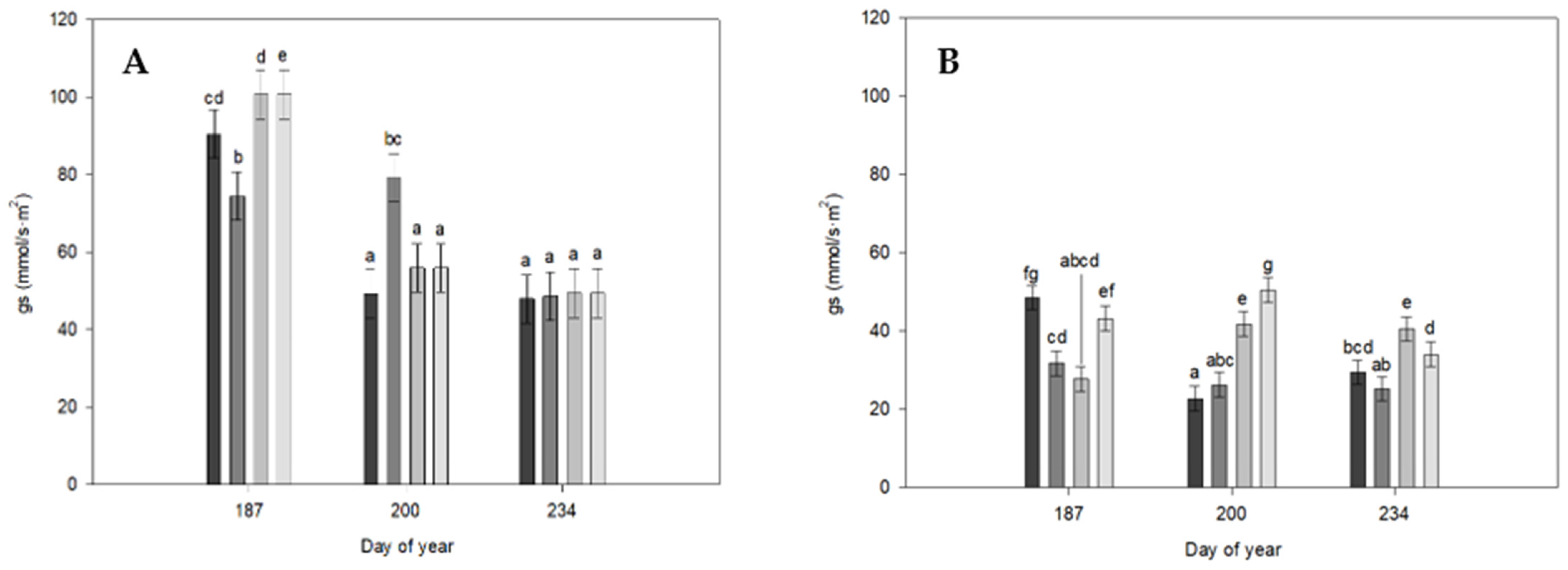
In contrast, for CS (Figure 15), the trends observed in GN were not maintained. Although CP values were higher on DOY 187, this pattern did not persist. On DOY 200, RP showed higher gs values, and by DOY 234, no significant differences were observed between the pruning methods.

3.7. Grape Growth, Yield, and Physicochemical Composition

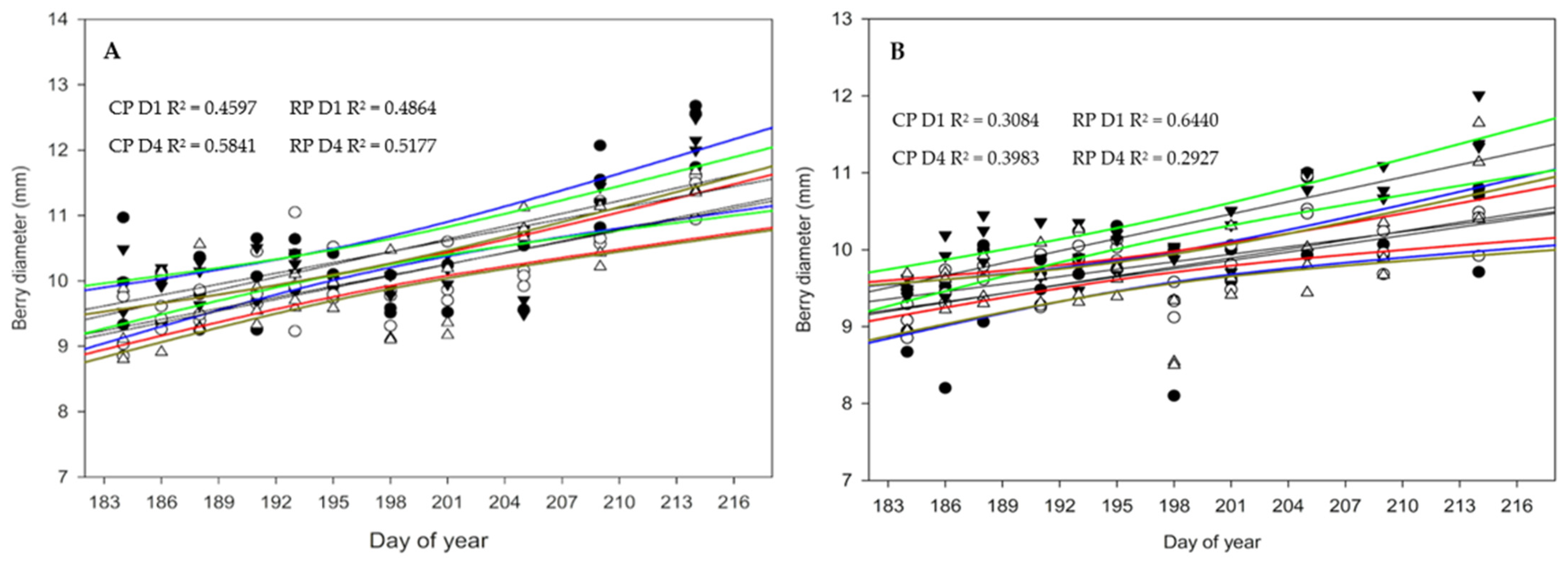
Examination of berry growth kinetics for CS and GN (Figure 16) indicates that berry growth was generally similar across all treatments, regardless of pruning modality. For CS, the average berry diameter was slightly larger under RP; however, the difference was not statistically significant. A notable exception was observed for RP-D1, where an increase in berry diameter became apparent from approximately DOY 187.
For GN (Figure 16A), no substantial differences in berry growth were observed among treatments. In contrast, for CS (Figure 16B), the final growth trends appeared to be influenced more by pruning type than by pruning date, suggesting that pruning type, rather than timing, had a stronger effect on berry diameter.
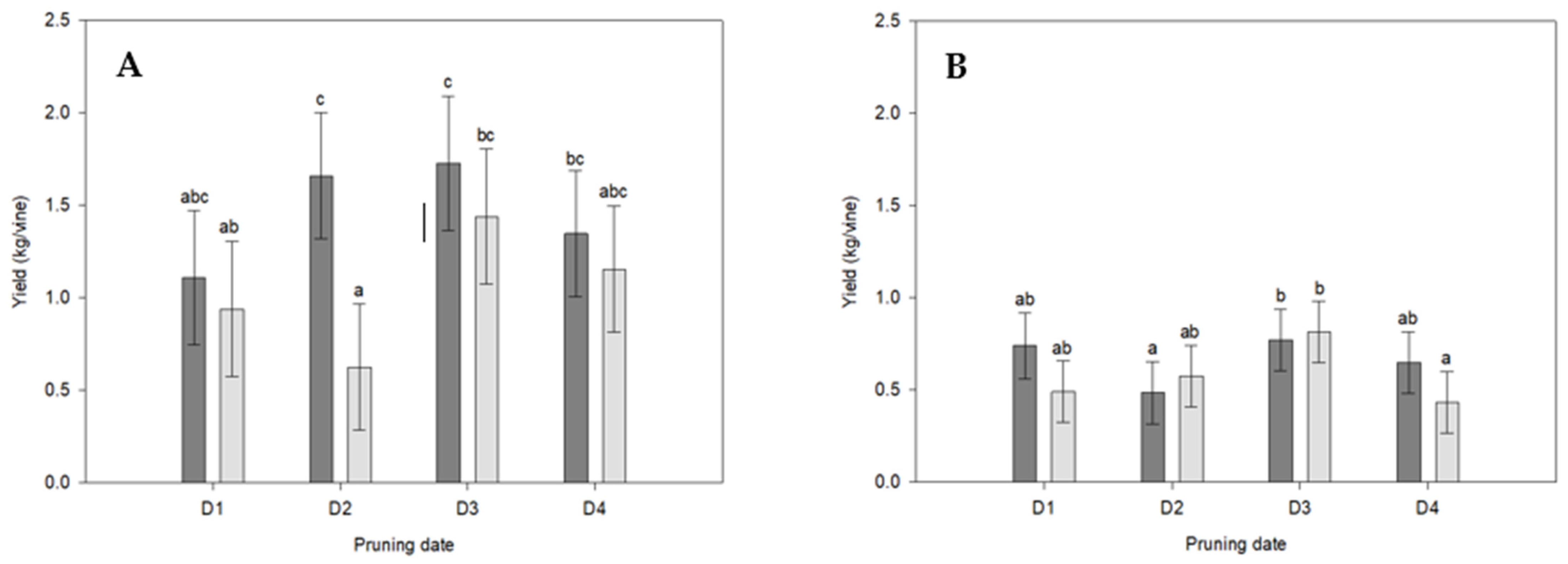
Yield per plant for GN (Figure 17A) indicated a general trend of higher yields under CP compared to RP. This trend was particularly pronounced and significant for D3. Notably, significant differences between CP and RP were also observed on D2, with CP showing higher production, consistent with the pattern observed across other CP treatments.
For CS (Figure 17B), this trend was less consistent. On D2 and D3, the pattern was reversed, with RP yielding higher values than CP.
Regarding pruning dates, January pruning (D3) generally yielded the highest average, although the difference was not statistically significant. For D2, the opposite trend was observed for GN-CP, further highlighting the variability in response to pruning timing.
Table 4 presents must soluble solids Brix, TTA, and pH for the varieties GN (Table 4A) and CS (Table 4B) across four pruning dates (D1–D4) and two pruning methods (RP and CP).
For GN, Brix in RP was notably higher at early pruning dates (D1–D2), with an 8% decline at later pruning dates (D3–D4). In CP, the latest pruning date (D3) resulted in a 7% reduction relative to the average of the other treatments. Overall, CP improved Brix by an average of 1.5% compared to RP. TTA in GN was 9% lower in RP for later pruning dates relative to early ones. Conversely, in CP, late pruning (D3) increased TTA by 1% above the mean of the remaining dates. Must pH showed no consistent meaningful trends.
For CS, Brix in RP improved by 9% in later pruning dates (D2 and D4) compared to the earliest date (D1). In CP, the latest pruning date (D4) led to a 6% decline relative to the average of the other dates. No consistent improvement was observed for CP over RP. TTA in RP decreased by 19% at D3 compared to the RP average. In CP, the highest TTA values (D2 and D4) were 6% above the CP mean. Overall, CP improved TTA by an average of 13% relative to RP. As observed for GN, pH values in CS exhibited no clear treatment-related pattern.
Table 5 presents anthocyanin and tannin concentrations in wine for GN (Table 5A) and CS (Table 5B), providing an overview of the wines’ phenolic composition.
For GN, anthocyanin concentrations were highly variable, depending on both the pruning method and date. These measurements were obtained after alcoholic fermentation and skin maceration, meaning total polyphenol extraction depended on the condition of the skins and the fermentation and extraction processes. Statistically significant differences were observed in RP between the D1-D2 pair and the D3-D4 pair, with D1-D2 yielding 57% lower anthocyanin concentrations than D3-D4. In CP, anthocyanin extraction was more uniform, with no significant differences except for D3, which was 18% lower than the average of the other dates. Overall, the average anthocyanin concentration for CP was 16% higher than that of RP.
Tannin concentrations for GN did not show significant differences, except for RP-D2, which was notably higher than all other treatments, approximately 79% above the mean of the remaining results.
For CS, anthocyanin concentrations did not differ significantly across pruning dates for CP. In contrast, RP showed significant variations depending on pruning date, with D1 and D3 yielding higher concentrations than D2 and D4, particularly D1. Similarly to GN, CP generally produced higher anthocyanin levels than RP, with an average 33% increase.
A similar pattern was observed for CS tannins as for GN, with RP-D2 again yielding significantly higher values than the other RP treatments. This consistency suggests a potential trend warranting further investigation in future experiments. Although tannin trends did not exactly mirror those of anthocyanins, CP tannin values were clearly higher than the RP average by approximately 47%.
The results for CI and TPI for GN are presented in Table 6A. For CI, CP consistently exhibited higher values, with an average 24% greater than RP. Significant differences were also observed within treatments, particularly for RP, where D3 and D4 displayed lower CI values. TPI showed a similar pattern: for CP, D3 and D4 reached the highest values, 13% higher than D1 and D2, whereas for RP, D1 recorded the lowest values, 26% lower than the other pruning days.
For CS (Table 6B), CI values did not differ significantly across pruning methods or dates. Although CP-D4 exhibited considerable dispersion, making it unclear whether the slightly lower CI value represents an actual decrease or is due to variability, comparisons with other parameters, such as anthocyanin levels, suggest that dispersion is the more likely explanation. For TPI, significant differences between pruning methods were observed, with CP values averaging 18% higher than RP, while differences among pruning dates were less pronounced.
Table 7A presents the results for ABV and TTA in GN. For ABV, RP treatments showed the highest values in D1 and D2, approximately 6% higher than D3 and D4. In contrast, no significant differences were observed among CP treatments across pruning dates. For TTA, no consistent trend was observed for either pruning date or pruning method. A notable observation is that, for both pruning types, two dates exhibited higher TTA values than the other two; however, these dates did not coincide between CP and RP.
For CS (Table 7B), more pronounced differences were observed. ABV values for RP were significantly higher than for CP, averaging approximately 5% higher, similar to GN. For TTA, no significant differences were observed among pruning methods overall; however, D2-CP showed the highest value of 7.2 g/L, approximately 16% above the mean of the other three dates with the same pruning type.

4. Discussion

The present study provides an assessment of the effects of two pruning methods—CP and RP—and four distinct pruning dates on vegetative growth, phenology, physiological responses, berry development, and wine quality of GN and CS grapevines. The 2023 vintage in the Priorat region was characterised by exceptionally warm and dry conditions, resulting in significant impacts on plant development, fruit maturation, physiological performance, and wine physicochemical properties.
This trial was conducted specifically during the 2023 extreme drought conditions in Priorat—a rainfed (dry-farmed) region where irrigation water was unavailable—and regional reservoirs had reached critically low levels, as 2022 was also very dry and hot. The primary objective was to evaluate whether conventional pruning (CP) or sap-flow respectful pruning (RP) could mitigate spur desiccation and necrosis, as widespread vine mortality was observed across the landscape due to acute water deficits and hydraulic failure. By testing these pruning approaches under severe abiotic stress, the study aimed to identify management strategies that preserve productive wood and enhance vine resilience in the absence of supplemental water.
Phenological analysis revealed minimal differences in budbreak timing between pruning methods. In GN, RP induced a slight delay (~3 days) relative to CP; however, this difference was negligible in the context of overall growth, and no differences were observed in CS. Progression through later phenological stages indicated that, in GN, the pruning type influenced the rate of phase transitions, where RP was associated with a modest delay in veraison, particularly for early pruning dates (D1 and D2). In contrast, CS exhibited minimal sensitivity to the pruning method. It should be highlighted that, with CP, veraison was delayed by 16 days under the later pruning treatments (D3 and D4), particularly in Grenache. Similar delays in veraison (up to 16 days) were reported by [11] in Shiraz subjected to late pruning, although additional warming (as simulated by open-top chambers) partially offset the delay, advancing veraison by up to seven days. This suggests that the net phenological shift in warm vintages results from the interaction between pruning date and seasonal thermal accumulation.
The pruning date also affected phenological development. In GN, later pruning dates (D3 and D4) generally delayed progression compared to earlier dates (D1 and D2), whereas CS showed no comparable response. These results highlight a clear varietal effect: GN exhibits greater phenological plasticity in response to pruning interventions, while CS appears more robust. These findings align with prior reports for Sauvignon Blanc and Sangiovese [47,48], where delayed pruning postponed budburst and flowering. Notably, veraison in GN was primarily influenced by pruning date rather than pruning method, with D1 and D2 treatments achieving earlier colour development than D3 and D4. This observation has practical implications for optimising pruning schedules to achieve targeted oenological outcomes in GN.
The latest pruning date (D4) was deliberately scheduled for March to align with regional phenological rhythms in Priorat, where budbreak typically commences across the DOQ Priorat by early April under average conditions. Although most commercial vineyards complete pruning by late February or early March to allow time for cane mulching, pre-budbreak mechanisation (e.g., soil tillage, cover crop management), and other field operations, this later timing was specifically tested to evaluate its feasibility within real-world commercial constraints. Unlike controlled lab or greenhouse experiments, this study was conducted in a fully operational field vineyard at Mas Perinet, where practical scheduling must accommodate machinery access, labour coordination, and the full production cycle prior to the onset of vegetative growth.
Shoot growth showed high inter-vine variability, precluding the detection of statistically significant differences between treatments. Similarly, leaf area measurements revealed no significant differences, highlighting the influence of vineyard heterogeneity and environmental stressors on vegetative parameters. While previous studies [12] have reported enhanced shoot diameter and pruning weights under RP management, our results suggest that such effects may be masked under extreme climatic conditions or require multi-year evaluation to manifest. Notably, many farmers across premium wine regions are increasingly adopting sap-flow respectful pruning techniques, underscoring the urgency to begin rigorous scientific assessment—even through single-year studies like this one—to provide evidence-based guidance on its practical efficacy and long-term viability.
pd-LWP revealed consistent trends, with CP vines exhibiting more positive values, indicating lower water stress and reduced tension required to extract soil water. This suggests that CP vines maintain superior water status at the onset of photosynthesis. In contrast, md-LWP did not differ significantly, likely reflecting uniform stress exposure under severe drought conditions, with md-LWP approaching thresholds for severe water deficit (−1.4 to −1.6 MPa) [49,50]. According to [51], conventional pruning (CP) likely preserves a more intact hydraulic pathway in the perennial wood, reducing embolism propagation and hydraulic resistance along the sap flow route to buds/shoots. This maintains higher pre-dawn leaf water potential (pd-LWP; fewer negative values) by minimising overnight rehydration barriers from pruning-induced necrosis cones that intersect functional xylem vessels. In RP, sacrificial cuts confine desiccation to non-critical wood, but this may inadvertently increase overall path length/resistance to retained spurs, exacerbating pd-LWP tension under extreme drought despite the goal of anatomical preservation [14]. The lack of midday differences (md-LWP) reflects transpirational override during peak stress, where stomatal closure equalises potentials regardless of baseline hydraulic status.
Leaf surface temperature measurements were generally similar between treatments, except for RP-CS, which exhibited lower temperatures. This response may relate to varietal differences in stomatal behaviour, where CS displays a more anisohydric pattern, facilitating leaf boundary layer regeneration and thermoregulation, whereas GN is more isohydric [52].
CCI was variable, particularly in GN, with significant differences observed across pruning dates. In GN, CP had higher CCI values at D1, equalised at D2-D3, and reversed at D4, potentially reflecting environmental heterogeneity and vine-specific stress responses. Pn in GN displayed higher values in D3 and D4, suggesting better acclimation to thermal and water stress in these later-pruned vines. In CS, Pn differences were less pronounced. gs generally decreased over the season under stress conditions, with CP vines exhibiting higher gs than RP in GN, indicating a potential advantage in maintaining photosynthetic activity under high-stress conditions.
Berry diameter and growth kinetics were largely unaffected by pruning method or timing in GN, while CS displayed an increase in diameter for RP-D1 from DOY 187 until harvest. Yield did not differ significantly among treatments, likely due to high variability. Notably, higher Pn values did not directly translate into increased yield, consistent with meta-analyses indicating that pruning effects on yield are highly contingent on varietal, climatic, and edaphic factors [53]. Similarly, ref. [11] found that late pruning increased yield only in a single season out of three, highlighting the strong interannual variability in yield responses to pruning timing.
The observed delay in pruning (D3-D4) differentially affected must composition depending on variety and pruning method. In GN, later pruning reduced Brix under both RP and CP, whereas in CS, a delayed positive response occurred in RP but not CP. This suggests that variety-specific phenological traits modulate the impact of pruning timing on sugar accumulation, as other authors have concluded [54,55], even though pruning occurred after budburst in those studies. This observation can also be attributable to a concomitant delay in phenology; in particular, given that harvest was conducted on the same date across all pruning treatments, later pruning would consequently have resulted in a shorter period for sugar accumulation, thereby leading to lower soluble solids at harvest. TTA exhibited a more consistent method-dependent pattern: CP generally enhanced TTA relative to RP, particularly in CS, where an average 13% increase was observed. The marked TTA decrease in RP-D3 across both varieties indicates that specific date-method combinations could strongly influence acidity, despite the disparity in published data [56,57], warranting further investigation. The absence of clear pH trends supports the view that pH is a buffered parameter, less responsive to short-term pruning shifts, as shown by [57].
Anthocyanins, tannins, TPI, and CI were quantified to assess wine phenolic composition. No clear directional trends emerged for pruning type or date, although some treatments showed significant differences. For GN, earlier pruning dates under RP (D1-D2) produced wines with higher ABV and acidity, whereas CP values were more uniform. In CS, RP generally yielded higher ABV, and D2 produced elevated tannin concentrations. Discrepancies between CI and anthocyanin content likely reflect the complex interactions between free and copigmented anthocyanins, polymeric pigments, and pH-dependent colour expression [58,59].

5. Conclusions

In conclusion, pruning date had a stronger impact than pruning method on grape quality for both Grenache Noir (GN) and Cabernet Sauvignon (CS) during the extreme 2023 drought. Late pruning (January–March) consistently preserved average acidity in both CS and GN, and moderated alcohol potential by decoupling veraison from peak summer heat, avoiding berry shrivel and phenolic over-extraction. Conventional pruning (CP) yielded better vine water status at harvest, with less negative pre-dawn leaf water potentials, whereas sap-flow respectful pruning (RP) provided no clear short-term physiological or quality advantages in this trial, underscoring pruning date as the key lever for immediate mitigation of dehydration risk.
Major phenological differences were observed for GN, but the short-term impact of pruning method on overall vine development appears limited. Sap-flow respectful pruning, though promoted as beneficial for sap-flow continuity and trunk disease control, only showed slight, non-significant improvements in leaf area and potential yield, with no consistent gains in wine composition. Physiological variables (vine water status, photosynthesis, leaf temperature) also differed little between methods, suggesting that short-term vine functioning is largely insensitive to pruning strategy.
These findings underscore the inherent complexity of predicting yield and quality outcomes based solely on pruning practices, emphasising the importance of long-term, multi-year studies to fully elucidate the implications of sap-flow respectful pruning versus conventional pruning for vine health, productivity, and oenological potential. This study does not yet provide definitive evidence on the ecophysiological effects of sap-flow respectful versus conventional pruning, but it offers useful preliminary data to guide future, multi-year trials. The results highlight the need to test whether sap-flow respectful pruning, alone or within broader canopy management strategies, can improve vine resilience to climate-change stressors such as extreme drought and heatwaves in Priorat. In this context, pruning date emerges as a key lever within a wider adaptive toolkit for dry, hot vintages.

Author Contributions

Conceptualisation, S.-O.A.; methodology, S.-O.A. and M.-S.G.; formal analysis, D.E., G.O., M.A. (Marco Alba), M.A. (Mateos Assumpta) and M.-S.J.M.; investigation, D.E.; resources, L.M.; writing—review and editing, L.M., S.-O.A. and M.-S.G.; supervision, S.-O.A.; project administration, L.M. and S.-O.A. All authors have read and agreed to the published version of the manuscript.

Funding

This research received no external funding. All the fieldwork was funded by Perinet Winery.

Data Availability Statement

Restrictions apply to the availability of these data. Data were obtained from the experimental vineyard of the private wine cellar Mas Perinet and are available from the authors with the permission of the experimental vineyard of the private wine cellar Mas Perinet.

Acknowledgments

The authors acknowledge the support of Mas Perinet for allowing the performance of part of the experiment in its vineyard.

Conflicts of Interest

The authors declare no conflicts of interest.

Appendix A

Figure A1. An ombrothermic diagram covering the period from 1 January 2007 to 31 December 2022 for the meteorological station of Torroja del Priorat. The chart displays the average monthly temperatures (green line), minimum temperatures (blue line), and maximum temperatures (red line). Monthly average precipitation is represented by light blue bars.
Horticulturae 12 00444 g0a1

Appendix B

Table A1. BBCH coding of the phenological stages of vine development and correspondence with the stages described by Baggiolini at the pea-size stage.
Stadium, According to BBCHDescription of the StadiumThe Stadium, According to Baggiolini
Bud break
0Lethargy: Winter fades, bright brown or dark depending on the variety; Bud scales closed, depending on the variety.A
1The buds begin to swell inside the scales.A
3End of swollen buds: swollen but not green.A
5Woolly Stadium; brown wool, clearly visible.B
7Beginning of bud opening; leaf apices green, inconspicuous.C7
9Bud opening: leaf apex visible.C9
Leaf Development
11The first leaf unfolded and out of the shoot.D–E
122 sheets unfolded.E
133 sheets unfolded.E
199 or more unfolded sheets.E–F
Appearance of the floral organ
53Inflorescences are conspicuous.F
55Clumped-up flower buds. G
57Separate flower buds.H
Flowering
61About 10% of the caps dropped.I
63Approximately 30% of the caps dropped.
65About 50% of the hats fell off.
69End of flowering.
Fruit formation
71Fruit curd; the young fruits begin to swell.J
73From berries the size of a pellet tree, the grapes begin to dangle.
75Pea-sized berries; hanging grapes.K
77Beginning of the closure of the grapes.
79Grapes formed.L
81Veraison.M

Appendix C

Table A2. Demonstrative table for homoscedasticity analysis of data variances for Bartlett’s test at 5% significance level. When no differentiation is observed among measurement days, pruning types, or pruning days, the dataset exhibits homoscedasticity. Consequently, each test conducted separately must also demonstrate homoscedasticity.
ParameterSample Size (nº Observations)Bartlett Testp-ValueConclusion
GN shoot length19269.09600.2791Homoscedastic
CS CP D1 shoot length4514.71130.3982Homoscedastic
CS CP D4 shoot length4519.62060.1426Homoscedastic
CS RP D1 shoot length4543.8559<0.0001Not homoscedastic
CS RP D4 shoot length4525.31830.0316Not homoscedastic
GN CP D1 shoot diameter484.75140.9940Homoscedastic
GN CP D4 shoot diameter482.89920.9997Homoscedastic
GN RP D1 shoot diameter4812.73630.6227Homoscedastic
GN RP D4 shoot diameter487.91540.9271Homoscedastic
CS CP D1 shoot diameter4513.26490.5058Homoscedastic
CS CP D4 shoot diameter4511.60560.6379Homoscedastic
CS RP D1 shoot diameter458.45230.8645Homoscedastic
CS RP D4 shoot diameter4516.58040.2792Homoscedastic
GN CP total leaf area3211.81580.0080Not homoscedastic
GN RP total leaf area303.01120.3899Homoscedastic
GN D1 total leaf area151.17290.2788Homoscedastic
GN D2 total leaf area161.73450.1878Homoscedastic
GN D3 total leaf area161.37590.2408Homoscedastic
GN D4 total leaf area151.52560.2168Homoscedastic
CS total leaf area323.96120.7842Homoscedastic
GN CP secondary leaf area3210.49150.0148Not homoscedastic
GN RP secondary leaf area300.55360.9070Homoscedastic
GN D1 secondary leaf area15<0.00010.9980Homoscedastic
GN D2 secondary leaf area160.00780.9296Homoscedastic
GN D3 secondary leaf area162.80490.0940Doubtful
GN D4 secondary leaf area151.79200.1807Homoscedastic
CS CP secondary leaf area164.70120.1950Homoscedastic
CS RP secondary leaf area1614.18310.0027Not homoscedastic
CS D1 secondary leaf area80.02180.8826Homoscedastic
CS D2 secondary leaf area89.90080.0017Not homoscedastic
CS D3 secondary leaf area82.70750.0999Doubtful
CS D4 secondary leaf area83.22890.0723Doubtful
GN pd-LWP325.79200.5642Homoscedastic
CS pd-LWP323.61190.8232Homoscedastic
GN md-LWP321.83740.9683Homoscedastic
CS md-LWP3213.66820.0574Doubtful
GN leaf surface temperature327.62740.3666Homoscedastic
CS leaf surface temperature325.51990.5968Homoscedastic
GN chlorophylls995.54450.2159Homoscedastic
CS chlorophylls3010.17220.1790Homoscedastic
GN net photosynthesis DOY 187322.48870.9274Homoscedastic
CS net photosynthesis DOY 1873210.9580.1404Homoscedastic
GN CP net photosynthesis DOY 200164.86360.1821Homoscedastic
GN RP net photosynthesis DOY 2001611.95540.0075Not homoscedastic
CS CP net photosynthesis DOY 200169.56950.0266Not homoscedastic
CS RP net photosynthesis DOY 200162.27730.5169Homoscedastic
GN CP net photosynthesis DOY 2341620.06100.0002Not homoscedastic
GN RP net photosynthesis DOY 2341610.21730.0168Not homoscedastic
CS net photosynthesis DOY 2343211.50400.1181Homoscedastic
GN stomatal conductance DOY 187326.80030.4450Homoscedastic
CS stomatal conductance DOY 187328.65950.2780Homoscedastic
GN stomatal conductance DOY 2003210.90740.1427Homoscedastic
CS stomatal conductance DOY 200324.71490.6947Homoscedastic
GN stomatal conductance DOY 234327.45860.3827Homoscedastic
CS stomatal conductance DOY 234329.87820.1956Homoscedastic
GN berry diameter15639.37250.8820Homoscedastic
CS berry diameter14445.45780.5366Homoscedastic
GN yield596.56310.4757Homoscedastic
CS yield615.02910.6564Homoscedastic
GN anthocyanins244.73830.6919Homoscedastic
CS anthocyanins244.57160.7121Homoscedastic
GN tannins243.67720.8161Homoscedastic
CS tannins248.41600.2973Homoscedastic
GN colour intensity246.34240.5004Homoscedastic
CS CP colour intensity1219.17310.0003Not Homoscedastic
CS RP colour intensity126.75220.0802Doubtful
GN TPI245.67120.5786Homoscedastic
CS TPI241.53120.9812Homoscedastic
GN CP ABV127.29460.0631Doubtful
GN RP ABV1217.10670.0007Not Homoscedastic
CS ABV247.42010.3865Homoscedastic
GN TTA244.69340.6973Homoscedastic
CS TTA248.60650.2822Homoscedastic
GN CP percentage of veraison DOY 209313.75170.2896Homoscedastic
GN CP percentage of veraison DOY 2143112.24910.0066Not Homoscedastic
GN CP percentage of veraison DOY 2203111.02330.0116Not Homoscedastic
GN RP percentage of veraison DOY 209314.14880.2458Homoscedastic
GN RP percentage of veraison DOY 214318.59450.0352Not Homoscedastic
GN RP percentage of veraison DOY 2203112.09250.0071Not Homoscedastic
CS CP percentage of veraison DOY 209314.97430.1737Homoscedastic
CS CP percentage of veraison DOY 214319.18760.0269Not Homoscedastic
CS CP percentage of veraison DOY 2203110.09410.0178Not Homoscedastic
CS RP percentage of veraison DOY 209314.54550.2083Homoscedastic
CS RP percentage of veraison DOY 214313.18700.3637Homoscedastic
CS RP percentage of veraison DOY 220314.59230.2042Homoscedastic

Appendix D

Table A3. Days After Bud Breaking (DABB) for GN (A) and CS (B) at main phenological stages, and for RP and CP at all pruning dates. B: flowering, PS: pea-size stage, and V: veraison.
VarietyGN (A)
Pruning TypeCPRP
Pruning DateD1D2D3D4D1D2D3D4
DABB to B5353454460524952
DABB to PS7173646469757174
DABB to V125125123123118119120110
VarietyCS (B)
Pruning TypeCPRP
Pruning DateD1D2D3D4D1D2D3D4
DABB to B6767595956574952
DABB to PS7876687077766773
DABB to V130130119123123124116121

Appendix E

Figure A2. Graphics depicting the evolution of vine phenology, from budburst to the small pea stage in GN in both treatments, RP (right) and CP (left), on all pruning dates from top to bottom (D1, October, D2, December, D3, January, and D4, March). Continuous line with black colour filled round shaped icons show phenological stage (Horticulturae 12 00444 i009) BBCH 00, dotted line with white colour filled round shaped icons show phenological stage (Horticulturae 12 00444 i010) BBCH 5, dashed line with black colour filled triangle shaped icons show phenological stage (Horticulturae 12 00444 i011) BBCH 7, dashed and two dotted line with white colour filled triangle shaped icons show phenological stage (Horticulturae 12 00444 i012) BBCH 9, dashed line with black colour filled square shaped icons show phenological stage (Horticulturae 12 00444 i013) BBCH 11, dashed and one dotted line with white colour filled square shaped icons show phenological stage (Horticulturae 12 00444 i014) BBCH 13, dashed line with black colour filled diamond shaped icons show phenological stage (Horticulturae 12 00444 i015) BBCH 53, continuous line with white colour filled diamond shaped icons show phenological stage (Horticulturae 12 00444 i016) BBCH 55, dotted line with black colour filled triangle shaped icons show phenological stage (Horticulturae 12 00444 i017) BBCH 57, dashed line with white colour filled triangle shaped icons show phenological stage (Horticulturae 12 00444 i018) BBCH 60, dashed and two dotted line with black colour filled round shaped icons show phenological stage (Horticulturae 12 00444 i019) BBCH 65, dashed line with white colour filled round shaped icons show phenological stage (Horticulturae 12 00444 i020) BBCH 68, dashed and one dotted line with black colour filled round shaped icons show phenological stage (Horticulturae 12 00444 i021) BBCH 73, dashed line with white colour filled round shaped icons show phenological stage (Horticulturae 12 00444 i022) BBCH 75 and continuous line with black colour filled triangle shaped icons show phenological stage (Horticulturae 12 00444 i023) BBCH 77.
Horticulturae 12 00444 g0a2

Appendix F

Figure A3. Graphics depicting the evolution of vine phenology, from budburst to the small pea stage in CS in both treatments, RP (right) and CP (left), on all pruning dates from top to bottom (D1, October, D2, December, D3, January, and D4, March). Continuous line with black colour filled round shaped icons show phenological stage (Horticulturae 12 00444 i024) BBCH 00, dotted line with white colour filled round shaped icons show phenological stage (Horticulturae 12 00444 i025) BBCH 5, dashed line with black colour filled triangle shaped icons show phenological stage (Horticulturae 12 00444 i026) BBCH 7, dashed and two dotted line with white colour filled triangle shaped icons show phenological stage (Horticulturae 12 00444 i027) BBCH 9, dashed line with black colour filled square shaped icons show phenological stage (Horticulturae 12 00444 i028) BBCH 11, dashed and one dotted line with white colour filled square shaped icons show phenological stage (Horticulturae 12 00444 i029) BBCH 13, dashed line with black colour filled diamond shaped icons show phenological stage (Horticulturae 12 00444 i030) BBCH 53, continuous line with white colour filled diamond shaped icons show phenological stage (Horticulturae 12 00444 i031) BBCH 55, dotted line with black colour filled triangle shaped icons show phenological stage (Horticulturae 12 00444 i032) BBCH 57, dashed line with white colour filled triangle shaped icons show phenological stage (Horticulturae 12 00444 i033) BBCH 60, dashed and two dotted line with black colour filled round shaped icons show phenological stage (Horticulturae 12 00444 i034) BBCH 65, dashed line with white colour filled round shaped icons show phenological stage (Horticulturae 12 00444 i035) BBCH 68, dashed and one dotted line with black colour filled round shaped icons show phenological stage (Horticulturae 12 00444 i036) BBCH 73, dashed line with white colour filled round shaped icons show phenological stage (Horticulturae 12 00444 i037) BBCH 75 and continuous line with black colour filled triangle shaped icons show phenological stage (Horticulturae 12 00444 i038) BBCH 77.
Horticulturae 12 00444 g0a3

Appendix G

Figure A4. Percentage of veraison monitoring for GN in CP and RP (A and B, respectively) and CS in CP and RP (C and D, respectively), on all pruning dates. From darker grey to lighter grey, the bars show the percentage of veraison for D1, D2, D3, and D4, respectively. (A) (F-ratio = 38.53; p-value < 0.0001); (B) (F-ratio = 48,17; p-value < 0.0001); (C) (F-ratio = 45.93; p-value < 0.0001); (D) (F-ratio = 42.89; p-value < 0.0001). Error bars represent LSD intervals (95% confidence). Different letters indicate statistical differences, and the absence of letters indicates no statistical differences.
Horticulturae 12 00444 g0a4

Appendix H

Table A4. Summary of the differences observed between RP and CP (A) and summary of the differences observed between pruning dates (B).
AGNCS
Phenology No significant difference in phenophases.No significant difference in phenophases.
Vegetative developmentSimilar growth kinetics; lower secondary and total leaf area for conventional pruning.Similar growth kinetics; higher secondary and total leaf area for conventional pruning.
Resistance to stressReduced morning water deficit for conventional pruning; similar leaf temperatures.Reduced morning water deficit for conventional pruning; lower leaf temperature for conventional pruning.
Photosynthetic activityEarly cessation of Pn and superior stomatal conductance for conventional pruning.Homogeneous Pn and conductance between pruning types.
Yield (g/vine)Significant variability between dates; overall superior under conventional pruning.No significant trend observed.
Micro vinificationAnthocyanin tannins and total acidity: no significant influence of pruning type.
Alcoholic strength: lower for conventional pruning.
Anthocyanins and tannins: higher concentration for conventional pruning.
Total Acidity: no significant difference.
Alcoholic strength: lower for conventional pruning.
BGNCS
Phenological developmentLater veraison for D3 and D4 has no stable trend on the rest of the phenological cycle.Longer cycle for dates D1 and D2, and no stable trend on the rest of the phenological cycle.
Vegetative growthHomogeneous growth kinetics; secondary and total leaf areas are lower for D2.Significantly lower growth kinetics for the CP-D1 modality; upper secondary and total leaf area for dates D1 and D4, but not significant.
Resistance to stressSimilar overall water deficit; uniform leaf temperature. Similar overall water deficit; uniform leaf temperatures.
Photosynthetic activityClear photosynthesis and similar stomatal conductance.Clear photosynthesis and similar stomatal conductance.
Yield (g/vine)Higher yield for D3.Higher yield for D3.
Micro vinificationAnthocyanins: No significant differences.
Alcoholic strength: Variability between dates; D1 and D2 dates for respective pruning show higher levels.
Tannins and total acidity: No significant difference.
Anthocyanins: dates D1 and D3 have higher concentrations.
Alcoholic strength: No significant differences.
Tannins: Higher concentration for date D2.
Total acidity: No significant difference.

References

  1. International Organisation of Vine and Wine (IOV). Severe Drought and Extreme Heat Pose a New Threat to Wine Production. Available online: https://www.oiv.int/press/severe-drought-and-extreme-heat-pose-new-threat-wine-production (accessed on 23 November 2024).
  2. Webb, L.B.; Whetton, P.H.; Bhend, J.; Darbyshire, R.; Briggs, P.R.; Barlow, E.W.R. Earlier wine-grape ripening driven by climatic warming and drying and management practices. Nat. Clim. Change 2012, 2, 259–264. [Google Scholar] [CrossRef]
  3. Alikadic, A.; Pertot, I.; Eccel, E.; Dolci, C.; Zarbo, C.; Caffarra, A.; De Filippi, R.; Furlanello, C. The impact of climate change on grapevine phenology and the influence of altitude: A regional study. Agric. For. Meteorol. 2019, 271, 73–82. [Google Scholar] [CrossRef]
  4. Lee, H.; Calvin, K.; Dasgupta, D.; Krinner, G.; Mukherji, A.; Thorne, P.; Trisos, C.; Romero, J.; Aldunce, P.; Barrett, K.; et al. Section 2. In Climate Change 2023: Synthesis Report; Contribution of Working Groups I, II and III to the Sixth Assessment Report of the Intergovernmental Panel on Climate Change; IPCC: Geneva, Switzerland, 2023; pp. 35–115. [Google Scholar] [CrossRef]
  5. Zheng, W.; García, J.; Balda, P.; Martínez de Toda, F. Effects of late winter pruning at different phenological stages on vine yield components and berry composition in La Rioja, North-central Spain. OENO One 2017, 51, 363. [Google Scholar] [CrossRef]
  6. Vercesi, A.; Garavani, A.; Parisi, M.G.; Gatti, M.; Poni, S. Vine Performance and Phenology Postponement in Cane-Pruned Chardonnay Vines Grown in a Temperate Climate: The Effects of a Delayed Winter Pruning. Aust. J. Grape Wine Res. 2023, 2023, e1329802. [Google Scholar] [CrossRef]
  7. Gatti, M.; Frioni, T.; Garavani, A.; Biagioni, A.; Poni, S. Impact of delayed winter pruning on phenology and ripening kinetics of Pinot Noir grapevines. BIO Web Conf. 2019, 13, 04002. [Google Scholar] [CrossRef]
  8. Aloy, K.; Gobi, S.F.; Martins, H.C.G.B.; Jacobs, S.A.; Eckhardt, D.P.; Brighenti, A.F.; Costa, V.B. Winter pruning timing, development and quality of Cabernet Sauvignon in Southern Brazil. Com. Sci. 2025, 16, e4301. [Google Scholar] [CrossRef]
  9. Netzer, Y.; Suued, Y.; Harel, M.; Ferman-Mintz, D.; Drori, E.; Munitz, S.; Stanevsky, M.; Grünzweig, J.M.; Fait, A.; Ohana-Levi, N.; et al. Forever young late shoot pruning affects phenological development, physiology, yield and wine quality of Vitis vinifera cv. Malbec. Agriculture 2022, 12, 605. [Google Scholar] [CrossRef]
  10. Frioni, T.; Pirez, F.J.; Diti, I.; Ronney, L.; Poni, S.; Gatti, M. Post-budbreak pruning changes intra-spur phenology dynamics, vine productivity and berry ripening parameters in Vitis vinifera L. cv. ‘Pinot Noir’. Sci. Hortic. 2019, 256, 108584. [Google Scholar] [CrossRef]
  11. Moran, M.; Petrie, P.; Sadras, V. Effects of Late Pruning and Elevated Temperature on Phenology, Yield Components, and Berry Traits in Shiraz. Am. J. Enol. Vitic. 2019, 70, 9–18. [Google Scholar] [CrossRef]
  12. Galar-Martínez, M.; Torres, N.; Sebastián, B.; Palacios, J.; Arzoz, I.; Juanena, N.; Villa-Llop, A.; Loidi, M.; Dewasme, C.; Roby, J.P.; et al. Respectful Pruning Improves Grapevine Development: A Case Study in Young Vineyards. Aust. J. Grape Wine Res. 2024, 1, 8448405. [Google Scholar] [CrossRef]
  13. Claverie, M.; Lecomte, P.; Delorme, G.; Dumot, V.; Jacquet, O.; Cochard, H. Xylem water transport is influenced by age and winter pruning characteristics in grapevine (Vitis vinifera). OENO One 2023, 57, 53–68. [Google Scholar] [CrossRef]
  14. Simonit, M. Manuale di Potatura Della Vite; Cordone Speronato; Edizioni L’Informatore Agrario s.r.l.: Verona, Italy, 2016; p. 318. [Google Scholar]
  15. Possingham, J.V. New Concepts in Pruning Grapevines. In Horticultural Reviews; Janick, J., Ed.; John Wiley & Sons, Inc.: New York, NY, USA, 1994; Volume 16, pp. 235–254. [Google Scholar]
  16. O’Daniel, S.B.; Archbold, D.D.; Kurtural, S.K. Effects of Balanced Pruning Severity on Traminette (Vitis spp.) in a Warm Climate. Am. J. Enol. Vitic. 2012, 63, 284–290. [Google Scholar] [CrossRef]
  17. Theocharis, S.; Gkrimpizis, T.; Karadimou, S.; Nikolaou, K.E.; Koundouras, S.; Taskos, D. Exploring the Interplay of Bud Load and Pruning Type in Shaping ‘Xinomavro’ (Vitis vinifera L.) Vine Growth, Yield, and Berry Composition. Horticulturae 2024, 10, 1111. [Google Scholar] [CrossRef]
  18. Gramaje, D.; Úrbez-Torres, J.R.; Sosnowski, M.R. Managing Grapevine Trunk Diseases with Respect to Etiology and Epidemiology: Current Strategies and Future Prospects. Plant Dis. 2018, 102, 12–39. [Google Scholar] [CrossRef]
  19. Ayres, M.R.; Billones-Baaijens, R.; Savocchia, S.; Scott, E.S.; Sosnowski, M.R. Critical timing of fungicide application for pruning wound protection to control grapevine trunk diseases. Aust. J. Grape Wine Res. 2021, 28, 70–74. [Google Scholar] [CrossRef]
  20. Mutawila, C.; Halleen, F.; Mostert, L. Optimisation of time of application of Trichoderma biocontrol agents for protection of grapevine pruning wounds. Aus. J. Grape Wine Res. 2016, 22, 279–287. [Google Scholar] [CrossRef]
  21. Henderson, B.; Sosnowski, M.R.; McCarthy, M.G.; Scott, E.S. Incidence and severity of Eutypa dieback in grapevines are related to total surface area of pruning wounds. Aust. J. Grape Wine Res. 2020, 27, 87–93. [Google Scholar] [CrossRef]
  22. Moller, W.J.; Kasimatis, A.N. Protection of grapevine pruning wounds from Eutypa dieback. Plant Dis. 1980, 64, 278–280. [Google Scholar] [CrossRef]
  23. Eskalen, A.; Feliciano, A.J.; Gubler, W.D. Susceptibility of grapevine pruning wounds and symptom development in response to infection by Phaeoacremonium aleophilum and Phaeomoniella chlamydospora. Plant Dis. 2007, 91, 1100–1104. [Google Scholar] [CrossRef]
  24. Úrbez-Torres, J.R.; Gubler, W.D. Susceptibility of grapevine pruning wounds to infection by Lasiodiplodia theobromae and Neofusicoccum parvum. Plant Pathol. 2011, 60, 261–270. [Google Scholar] [CrossRef]
  25. Ezzili, B.; Bejaoui, M. New contribution to the survey of the theory of the acrotony on the branch of one year grapevine: II—Influence of growth regulators on bud burst carried by one eye cuttings in post-dormancy stage. OENO One 2000, 34, 145–154. [Google Scholar] [CrossRef]
  26. Buesa, I.; Yeves, A.; Sanz, F.; Chirivella, C.; Intrigliolo, D.S. Effect of delaying winter pruning of Bobal and Tempranillo grapevines on vine performance, grape and wine composition. Aust. J. Grape Wine Res. 2020, 27, 94–105. [Google Scholar] [CrossRef]
  27. Ministerio de Agricultura, Pesca y Alimentación (MAPA). Material Vegetal: 110 Richter (110R). Available online: https://www.mapa.gob.es/ministerio/pags/Biblioteca/fondo/pdf/28713_all.pdf (accessed on 15 January 2025).
  28. Generalitat de Catalunya. RuralCat: Dades Agrometeorològiques. Available online: https://ruralcat.gencat.cat/web/guest/agrometeo.estacions (accessed on 1 December 2024).
  29. Consell Regulador DOQ Priorat. DOCa Priorat. Available online: https://www.doqpriorat.org/es/doca-priorat/ (accessed on 27 January 2025).
  30. Enciclopedia Humanidades. Eras Geológicas. Available online: https://humanidades.com/eras-geologicas/ (accessed on 13 April 2025).
  31. Institut Cartogràfic I Geològic de Catalunya (ICGC). Mapa de Sòls de Catalunya 1:250000. Available online: https://www.icgc.cat/es/Geoinformacion-y-mapas/Datos-y-productos/Geoinformacion-tematica/Cartografia-de-suelos/Mapa-de-suelos-1250000 (accessed on 2 March 2025).
  32. U.S. Department of Agriculture (USDA). Natural Resources Conservation Service. Soil Taxonomy. Available online: https://www.nrcs.usda.gov/resources/guides-and-instructions/soil-taxonomy (accessed on 18 January 2025).
  33. International Soil Reference and Information Centre (ISRIC): World Soil Information. World Reference Base for Soil Resources (WRB). Available online: https://www.isric.org/explore/wrb (accessed on 18 January 2025).
  34. Universidad de Granada (UGR). Regímenes de Humedad del Suelo. Available online: http://edafologia.ugr.es/programas_suelos/practclas/taxoil/comun/regimenesrht.htm (accessed on 18 January 2025).
  35. Unión Europea. Reglamento (UE) 2018/848 del Parlamento Europeo y del Consejo, de 30 de Mayo de 2018, Sobre Producción Ecológica y Etiquetado de los Productos Ecológicos. DOUE L 150 de 14.6.2018, p. 1–92. Available online: https://www.boe.es/buscar/doc.php?id=DOUE-L-2018-80995 (accessed on 16 February 2026).
  36. Faúndez-López, P.; Delorenzo-Arancibia, J.; Gutiérrez-Gamboa, G.; Moreno, Y.M. Pruning cuts affect wood necrosis but not the percentage of budburst or shoot development on spur pruned vines for different grapevine varieties. Vitis 2021, 60, 137–141. [Google Scholar] [CrossRef]
  37. McElrone, A.J.; Manuck, C.M.; Brodersen, C.R.; Patakas, A.; Pearsall, K.R.; Williams, L.E. Functional hydraulic sectoring in grapevines as evidenced by sap flow, dye infusion, leaf removal and micro-computed tomography. AoB Plants 2021, 13, plab003. [Google Scholar] [CrossRef]
  38. Dubé, G. Évaluer L’impact des Plaies de Taille sur la Circulation de la Sève et L’alimentation des Bourgeons de la Vigne. 2018. Available online: https://www.agrireseau.net/documents/Document_97260.pdf (accessed on 14 January 2026).
  39. Deloire, A.; Dumont, C.; Giudici, M.; Rogiers, S.; Pellegrino, A. A few words on grapevine winter buds and pruning in consideration of sap flow. IVES Tech. Rev. Vine Wine 2022, hal-04134943. [Google Scholar] [CrossRef]
  40. Eichhorn, K.W.; Lorenz, H. Phaenologische entwicklungsstadien der rebe. Nachrichtenblatt Dtsch. Pflanzenschutzdienstes 1977, 29, 119–120. [Google Scholar]
  41. Baggiolini, M. Les stades repères dans le développement annuel de la vigne et leur utilisation pratique. Rev. Romande Agric. Arboric. 1952, 8, 4–6. [Google Scholar]
  42. Sánchez-Ortiz, A.; Nadal-Roquet, M.; Lampreave-Figueras, M.; Mateo-Sanz, J.M. Assessment of colour and tannin extraction in Tempranillo and Cabernet-Sauvignon using small-scale fermentation vessels. OENO One 2021, 55, 141–160. [Google Scholar] [CrossRef]
  43. Schölander, P.F.; Bradstreet, E.D.; Hemmingsen, E.A.; Hammel, H.T. Sap Pressure in Vascular Plants: Negative hydrostatic pressure can be measured in plants. Science 1965, 148, 339–346. [Google Scholar] [CrossRef]
  44. Carbonneau, A. Aspects Qualitatifs: Traite D’irrigation; Tiercelin, J.R., Ed.; Tec & Doc Lavosier: Paris, France, 1998; p. 989. [Google Scholar]
  45. Nadal, M. Phenolic Madurity in Red Grapes. In Methodologies and Results in Grapevine Research; Delrot, S., Medrano, H., Or, E., Bavaresco, L., Grando, S., Eds.; Springer Science: New York, NY, USA, 2010; pp. 389–409. [Google Scholar]
  46. Gago, P.; Conejero, G.; Martínez, M.C.; This, P.; Verdeil, J.L. Comparative anatomy and morphology of the leaves of Grenache Noir and Syrah grapevine cultivars. S. Afr. J. Enol. Vitic. 2019, 40, 132–140. [Google Scholar] [CrossRef]
  47. Gatti, M.; Pirez, F.J.; Chiari, G.; Tombesi, S.; Palliotti, A.; Merli, M.C.; Poni, S. Phenology, Canopy Aging and Seasonal Carbon Balance as Related to Delayed Winter Pruning of Vitis vinifera L. cv. Sangiovese Grapevines. Front. Plant Sci. 2016, 7, 659. [Google Scholar] [CrossRef] [PubMed]
  48. Trought, M.C.T.; Bennett, J.S.; Boldingh, H.L. Influence of retained cane number and pruning time on grapevine yield components, fruit composition and vine phenology of Sauvignon Blanc vines. Aust. J. Grape Wine Res. 2011, 17, 258–262. [Google Scholar] [CrossRef]
  49. Van Leeuwen, C.; Trégoat, O.; Choné, X.; Bois, B.; Pernet, D.; Gaudillère, J.P. Vine water status is a key factor in grape ripening and vintage quality for red Bordeaux wine. How can it be assessed for vineyard management purposes? J. Int. Sci. Vigne Vin. 2009, 43, 121–134. [Google Scholar] [CrossRef]
  50. Bahar, E.; Carbonneau, A.; Korkutal, I. The effect of extreme water stress on leaf drying limits and possibilities of recovering in three grapevine (Vitis vinifera L.) cultivars. Afr. J. Agric. Res. 2011, 6, 1151–1160. [Google Scholar]
  51. Ghiglieno, I.; Facciano, L.; Valenti, L.; Amari, F.; Cola, G. Evaluation of the impact of vine pruning periods on grape production and composition: An integrated approach considering different years and cultivars. OENO One 2025, 59, 8239. [Google Scholar] [CrossRef]
  52. Tamayo, M.; Sepúlveda, L.; Guequen, E.P.; Saavedra, P.; Pedreschi, R.; Cáceres-Mella, A.; Alvaro, J.E.; Cuneo, I.F. Hydric Behavior: Insights into Primary Metabolites in Leaves and Roots of Cabernet Sauvignon and Grenache Grapevine Varieties under Drought Stress. Horticulturae 2023, 9, 556. [Google Scholar] [CrossRef]
  53. Friend, A.P.; Trought, M. Delayed winter spur-pruning in New Zealand can alter yield components of Merlot grapevines. Aust. J. Grape Wine Res. 2008, 13, 157–164. [Google Scholar] [CrossRef]
  54. Frioni, T.; Tombesi, S.; Silvestroni, O.; Lanari, V.; Bellincontro, A.; Sabbatini, P.; Gatti, M.; Poni, S.; Palliotti, A. Postbudburst Spur Pruning Reduces Yield and Delays Fruit Sugar Accumulation in Sangiovese in Central Italy. Am. J. Enol. Vitic. 2016, 67, 419–425. [Google Scholar] [CrossRef]
  55. Petrie, P.R.; Brooke, S.J.; Moran, M.A.; Sadras, V.O. Pruning after budburst to delay and spread grape maturity. Aus. J. Grape Wine Res. 2017, 23, 378–389. [Google Scholar] [CrossRef]
  56. Falginella, L.; Gaiotti, F.; Belfiore, N.; Mian, G.; Lovat, L.; Tomasi, D. Effect of early cane pruning on yield components, grape composition, carbohydrates storage and phenology in Vitis vinifera L. cv. Merlot. OENO One 2022, 56, 19–28. [Google Scholar] [CrossRef]
  57. Ferrara, G.; Magarelli, A.; Palasciano, M.; Coletta, A.; Crupi, P.; Tarantino, A.; Mazzeo, A. Effects of different winter pruning times on table grape vines performance and starch reserves to face climate changes. Sci. Hortic. 2022, 305, 111385. [Google Scholar] [CrossRef]
  58. Heras-Roger, J.; Alonso-Alonso, O.; Gallo-Montesdeoca, A.; Díaz-Romero, C.; Darias-Martín, J. Influence of copigmentation and phenolic composition on wine color. J. Food Sci. Technol. 2016, 53, 2540–2547. [Google Scholar] [CrossRef] [PubMed]
  59. Brouillard, R.; Delaporte, B.; Dubois, J.E. Chemistry of anthocyanin pigments. 3. Relaxation amplitudes in pH-jump experiments. J. Am. Chem. Soc. 1978, 100, 6202–6205. [Google Scholar] [CrossRef]
Figure 1. Guide to achieving conventional spur-pruning (D) and respectful spur-pruning (B,C). Examples of pruning cut diameters measured with callipers. Figure (A) provides a global conceptual overview of the cutting site to facilitate comprehension of the subsequent subfigures (Perinet Winery, 2024).
Horticulturae 12 00444 g001
Figure 2. Schematic representation of the experimental design conducted. A Latin square design was used, which was valid for both varieties, as the same structure was used. The left block corresponds to CP, while the right block corresponds to RP. Horizontal black lines represent vineyard rows, whereas the vertical intersecting lines indicate the spacing among pruning dates. Each row was divided into four equal sections, each containing two plants. The plant arrangement was determined as shown in the figure and based on the pruning date. The blue lines refer to date D1, the violet lines refer to date D2, the red lines refer to date D3, and the green lines refer to date D4.
Horticulturae 12 00444 g002
Figure 3. Desiccation cone resulting from a clear-cut (left), propagation of dead wood in the carrier (middle), and the effect of respectful pruning on the drying cone (right) (Perinet Winery, 2024).
Horticulturae 12 00444 g003
Figure 4. Schematisation of the analysis and sampling processes.
Horticulturae 12 00444 g004
Figure 5. Plan for carrying out micro-vinification of GN and CS in both treatments, RP and CP, on all pruning dates.
Horticulturae 12 00444 g005
Figure 6. Logarithmic regressions for the evolution of growth in both length and diameter of the shoots for GN (A and B, respectively) and CS (C and D, respectively) in both treatments, RP and CP, on all pruning dates. Black colour-filled round-shaped icons show (Horticulturae 12 00444 i001) CP D1, white colour-filled round-shaped icons show (Horticulturae 12 00444 i002) CP D4, black colour-filled triangle-shaped icons show (Horticulturae 12 00444 i003) RP D1, and white colour-filled triangle-shaped icons show (Horticulturae 12 00444 i004) RP D4. The coloured lines represent the 95% confidence intervals for the regression line of each treatment. The blue lines correspond to CP D1, the red lines to CP D4, the green lines to RP D1, and the ochre lines to RP D4. If the area between two lines of the same colour overlaps with the area within other lines, it indicates that there are no significant differences between the regression lines for each group of values.
Horticulturae 12 00444 g006
Figure 7. Measurement of total leaf area during pea-size phenological stage for GN (A) and CS (B) in both treatments, RP and CP, on all pruning dates. Dark grey coloured bars show the CP leaf surface, and light grey coloured bars show the RP leaf surface. (A) (F-ratio = 1.34; p-value = 0.2514); (B) (F-ratio = 0.54; p-value = 0.7963). Error bars represent LSD intervals (95% confidence). Different letters indicate statistical differences, and the absence of letters indicates no statistical differences.
Horticulturae 12 00444 g007
Figure 8. Measurement of pd-LWP during ripening for CS (B) and GN (A) in both treatments. Dark grey coloured bars show CP pd-LWP, and light grey coloured bars show RP pd-LWP. (A) (F-ratio = 8.42; p-value < 0.0001); (B) (F-ratio = 7.84; p-value = 0.0001). Error bars represent LSD intervals (95% confidence). Different letters indicate statistical differences, and the absence of letters indicates no statistical differences.
Horticulturae 12 00444 g008
Figure 9. Measurement of md-LWP during ripening for CS (B) and GN (A) in both treatments. Dark grey coloured bars show CP md-LWP, and light grey coloured bars show RP md-LWP. (A) (F-ratio = 1.43; p-value = 0.2403); (B) (F-ratio = 1.54; p-value = 0.2022). Error bars represent LSD intervals (95% confidence). Different letters indicate statistical differences, and the absence of letters indicates no statistical differences.
Horticulturae 12 00444 g009
Figure 10. Measurement of leaf temperature at midday during ripening for CS (B) and GN (A) in both treatments, RP and CP, on all pruning dates. Dark grey coloured bars show CP leaf temperature and light grey coloured bars show RP leaf temperature. (A) (F-ratio = 1.43; p-value = 0.2389); (B) (F-ratio = 8.27; p-value < 0.0001). Error bars represent LSD intervals (95% confidence). Different letters indicate statistical differences, and the absence of letters indicates no statistical differences.
Horticulturae 12 00444 g010
Figure 11. Measurement of chlorophyll content (CCI) during ripening for CS (B) and GN (A) in both treatments, RP and CP, on all pruning dates. Dark grey coloured bars show CP CCI, and light grey coloured bars show RP CCI. (A) (F-ratio = 3.77; p-value = 0.0012); (B) (F-ratio = 2.21; p-value = 0.0737). Error bars represent LSD intervals (95% confidence). Different letters indicate statistical differences, and the absence of letters indicates no statistical differences.
Horticulturae 12 00444 g011
Figure 12. Measurement of Pn at midday and on different dates for GN in both treatments, RP (B) and CP (A), on all pruning dates. From darker to lighter grey, the bars show Pn for D1, D2, D3, and D4, respectively. (A) (F-ratio = 18.86; p-value < 0.0001); (B) (F-ratio = 41.93; p-value < 0.0001). Error bars represent LSD intervals (95% confidence). Different letters indicate statistical differences, and the absence of letters indicates no statistical differences.
Horticulturae 12 00444 g012
Figure 13. Measurement of Pn at midday and on different dates for CS in both treatments, RP (B) and CP (A), on all pruning dates. From darker to lighter grey, the bars show Pn for D1, D2, D3, and D4, respectively. (A) (F-ratio = 105.45; p-value < 0.0001); (B) (F-ratio = 46.62; p-value < 0.0001). Error bars represent LSD intervals (95% confidence). Different letters indicate statistical differences, and the absence of letters indicates no statistical differences.
Horticulturae 12 00444 g013
Figure 14. Measurement of gs at midday and on different dates for GN in both treatments, RP (B) and CP (A), on all pruning dates. From darker grey to lighter grey, the bars show D1, D2, D3, and D4 gs, respectively. (A) (F-ratio = 38.91; p-value < 0.0001); (B) (F-ratio = 18.76; p-value < 0.0001). Error bars represent LSD intervals (95% confidence). Different letters indicate statistical differences, and the absence of letters indicates no statistical differences.
Horticulturae 12 00444 g014
Figure 15. Measurement of gs at midday and on different dates for CS in both treatments, RP (B) and CP (A), on all pruning dates. From darker grey to lighter grey, the bars show D1, D2, D3, and D4 gs, respectively. (A) (F-ratio = 1164.11; p-value < 0.0001); (B) (F-ratio = 837.97; p-value < 0.0001). Error bars represent LSD intervals (95% confidence). Different letters indicate statistical differences, and the absence of letters indicates no statistical differences.
Horticulturae 12 00444 g015
Figure 16. Logarithmic regressions for the evolution of berry growth for GN (A) and CS (B) in both treatments, RP and CP, on all pruning dates. Black colour-filled round-shaped icons show (Horticulturae 12 00444 i005) CP D1, white colour-filled round-shaped icons show (Horticulturae 12 00444 i006) CP D4, black colour-filled triangle-shaped icons show (Horticulturae 12 00444 i007) RP D1, and white colour-filled triangle-shaped icons show (Horticulturae 12 00444 i008) RP D4. The coloured lines represent the 95% confidence intervals for the regression line of each treatment. The blue lines correspond to CP D1, the red lines to CP D4, the green lines to RP D1, and the ochre lines to RP D4. If the area between two lines of the same colour overlaps with the area within other lines, it indicates that there are no significant differences between the regression lines of each group of values.
Horticulturae 12 00444 g016
Figure 17. Average yield per vine for GN (A) and CS (B) in both treatments, RP and CP, on all pruning dates. Dark grey coloured bars show CP yield per vine, and light grey coloured bars show RP yield per vine. (A) (F-ratio = 2.14; p-value = 0.0558); (B) (F-ratio = 1.46; p-value = 0.2007). Error bars represent LSD intervals (95% confidence). Different letters indicate statistical differences, and the absence of letters indicates no statistical differences.
Horticulturae 12 00444 g017
Table 1. Description of the experimental design with dates and type of pruning.
Grape VarietyNº of PlantsModalityDOYPruning Type
GN & CS8D1 CP298 (2022)CP
GN & CS8D2 CP354 (2022)CP
GN & CS8D3 CP30 (2023)CP
GN & CS8D4 CP75 (2023)CP
GN & CS8D1 RP298 (2022)RP
GN & CS8D2 RP354 (2022)RP
GN & CS8D3 RP30 (2023)RP
GN & CS8D4 RP75 (2023)RP
Table 2. Climatic data from October 2022 to September 2023 (from the beginning to the end of the experiment) from the weather station of Torroja del Priorat. Average temperature (Tavg), maximum temperature (Tmax), minimum temperature (Tmin), and Precipitation (P) are shown.
Month and YearTavg (°C)Tmax (°C)Tmin (°C)P (mm)
October 202219.631.88.110
November 202213.427.12.912
December 20229.922.7−1.439
January 20236.419.5−5.56
February 20237.323.3−3.048
March 202313.328.3−4.27
April 202315.931.02.24
May 202317.731.06.531
June 202323.039.112.518
July 202325.941.214.035
August 202326.342.014.55
September 202322.333.811.844
Table 3. Summary of the main phenological stages dates of GN (A) and CS (B) in both treatments, RP and CP on all pruning dates.
Pruning TypeCPRP
Pruning DateD1D2D3D4D1D2D3D4
A
Bud breaking (C-09)March 26th (DOY 85)March 26th (DOY 85)April 3rd (DOY 93)April 3rd (DOY 93)March 30th (DOY 89)March 29th (DOY 88)April 6th (DOY 96)April 3rd (DOY 93)
Flowering (I-65)May 18th (DOY 138)May 18th (DOY 138)May 18th (DOY 138)May 17th (DOY 137)May 29th (DOY 149)May 20th (DOY 140)May 25th (DOY 145)May 25th (DOY 145)
Pea Size (K-73)June 5th (DOY 156)June 5th (DOY 156)June 6th (DOY 157)June 6th (DOY 157)June 7th (DOY 158)June 12th (DOY 163)June 16th (DOY 167)June 16th (DOY 167)
Veraison (M-73)July 19th (DOY 200)July 19th (DOY 200)August 4th (DOY 216)August 4th (DOY 216)July 26th (DOY 207)July 26th (DOY 207)August 4th (DOY 216)July 31st (DOY 212)
B
Bud breaking (C-09)April 13th (DOY 103)April 10th (DOY 100)April 10th (DOY 100)April 9th (DOY 99)April 13th (DOY 103)April 9th (DOY 99)April 9th (DOY 99)April 9th (DOY 99)
Flowering (I-65)June 1st
(DOY 152)
June 1st (DOY 152)June 1st (DOY 152)June 1st
(DOY 152)
May 25th (DOY 145)May 25th (DOY 145)May 25th (DOY 145)May 25th (DOY 145)
Pea Size (K-73)June 12th (DOY 163)June 10th (DOY 161)June 10th (DOY 161)June 12th (DOY 163)June 15th (DOY 166)June 13th (DOY 164)June 12th (DOY 163)June 15th (DOY 166)
Veraison (M-73)August 3rd (DOY 215)August 3rd (DOY 215)July 31st (DOY 212)August 4th (DOY 216)July 31st (DOY 212)July 31st (DOY 212)July 31st (DOY 212)August 2nd (DOY 214)
Table 4. Measurement of Brix, TTA, and pH in the resulting must for GN (A) and CS (B) in both treatments, RP and CP, on all pruning dates. A (Brix-F-ratio = 1026.27; p-value < 0.0001; TTA-F-ratio = 733.44; p-value < 0.0001; pH-F-ratio = 10.58; p-value = 0.0001); B (Brix-F-ratio = 758.57; p-value < 0.0001; TTA-F-ratio = 1239.78; p-value < 0.0001; pH-F-ratio = 8.18; p-value = 0.0003). Uncertainty is represented by LSD intervals (95% confidence). Different letters indicate statistical differences, and the absence of letters indicates no statistical differences.
GN (A)Brix (% m/m Sucrose)TTA (g/L)pH
Pruning DateRPCPRPCPRPCP
D126.3 ± 0.1 d26.9 ± 0.1 e5.6 ± 0.1 f5.2 ± 0.1 c3.3 ± 0.1 cd3.4 ± 0.1 d
D228.3 ± 0.1 f26.0 ± 0.1 c5.4 ± 0.1 e5.5 ± 0.1 e3.4 ± 0.1 d3.3 ± 0.1 bc
D324.8 ± 0.1 a24.8 ± 0.1 a5.0 ± 0.1 a6.2 ± 0.1 g3.3 ± 0.1 cd3.3 ± 0.1 a
D425.8 ± 0.1 b26.0 ± 0.1 c5.1 ± 0.1 b5.3 ± 0.1 d3.3 ± 0.1 ab3.3 ± 0.1 ab
CS (B)Brix (% m/m Sucrose)TTA (g/L)pH
Pruning DateRPCPRPCPRPCP
D124.8 ± 0.1 a26.0 ± 0.1 d7.2 ± 0.1 c7.4 ± 0.1 d3.2 ± 0.1 bc3.2 ± 0.1 ab
D227.0 ± 0.1 f27.5 ± 0.1 g7.3 ± 0.1 d7.6 ± 0.1 e3.3 ± 0.1 c3.2 ± 0.1 bc
D325.9 ± 0.1 c26.6 ± 0.1 e5.8 ± 0.1 a7.4 ± 0.1 d3.3 ± 0.1 cd3.3 ± 0.1 c
D427.1 ± 0.1 f25.6 ± 0.1 b7.0 ± 0.1 b7.6 ± 0.1 e3.3 ± 0.1 c3.2 ± 0.1 a
Table 5. Measurement of anthocyanins and tannins in the resulting wines for GN (A) and CS (B) in both treatments, RP and CP, on all pruning dates. A (Anthocyanins F-ratio = 16.39; p-value < 0.0001; Tannins F-ratio = 10.33; p-value = 0.0001); B (Anthocyanins F-ratio = 3.44; p-value = 0.0522; Tannins F-ratio = 10.76; p-value = 0.0016). Uncertainty is represented by LSD intervals (95% confidence). Different letters indicate statistical differences, and the absence of letters indicates no statistical differences.
GN (A)Anthocyanins (mg/L)Tannins (g/L)
Pruning DateRPCPRPCP
D1102 ± 24 a277 ± 24 d2.2 ± 0.3 a2.6 ± 0.3 a
D2125 ± 24 a223 ± 24 bc4.2 ± 0.3 b2.3 ± 0.3 a
D3251 ± 24 cd197 ± 24 b2.3 ± 0.3 a2.2 ± 0.3 a
D4278 ± 24 d218 ± 24 bc2.1 ± 0.3 a2.7 ± 0.3 a
CS (B)Anthocyanins (mg/L)Tannins (g/L)
Pruning DateRPCPRPCP
D1470 ± 82 ab653 ± 82 c3.1 ± 0.6 ab5.0 ± 0.6 cd
D2440 ± 82 ab511 ± 82 abc4.8 ± 0.6 c6.1 ± 0.6 d
D3485 ± 82 ab653 ± 82 c2.7 ± 0.6 a4.2 ± 0.6 bc
D4410 ± 82 a579 ± 82 bc2.7 ± 0.6 a4.3 ± 0.6 bc
Table 6. Measurement of colour intensity (CI) and total polyphenol index (TPI) in GN (A) and CS (B) in both treatments, RP and CP, on all pruning dates. A (CI F-ratio = 3.87; p-value = 0.0119; TPI F-ratio = 1.40; p-value = 0.2707); B (CI F-ratio = 1.46; p-value = 0.3037; TPI F-ratio = 16.28; p-value = 0.0004). Uncertainty is represented by LSD intervals (95% confidence). Different letters indicate statistical differences, and the absence of letters indicates no statistical differences.
GN (A)CI (Colour Intensity)TPI (Total Polyphenol Index)
Pruning DateRPCPRPCP
D113 ± 2 c13 ± 2 c32 ± 9 a48 ± 9 ab
D212 ± 2 bc11 ± 2 abc47 ± 9 ab46 ± 9 ab
D39 ± 3 ab14 ± 2 c41 ± 9 ab52 ± 9 b
D48 ± 2 a14 ± 2 c42 ± 9 ab54 ± 9 b
CS (B)CI (Colour Intensity)TPI (Total Polyphenol Index)
Pruning DateRPCPRPCP
D121 ± 3 b21 ± 3 b82 ± 4 a104 ± 4 cd
D221 ± 3 ab21 ± 3 b82 ± 4 a96 ± 4 bc
D320 ± 3 ab21 ± 3 b93 ± 4 b107 ± 4 d
D419 ± 3 ab15 ± 3 a79 ± 4 a100 ± 4 bcd
Table 7. Measurement of ABV and TTA in the resulting wines in GN (A) and CS (B) in both treatments, RP and CP, on all pruning dates. A (ABV F-ratio = 5.83; p-value = 0.0017; TTA F-ratio = 54.78; p-value < 0.0001); B (ABV F-ratio = 37.01; p-value < 0.0001; TTA F-ratio = 1.62; p-value = 0.2573). Uncertainty is represented by LSD intervals (95% confidence). Different letters indicate statistical differences, and the absence of letters indicates no statistical differences.
GN (A)ABV (% vol.)TTA (g/L)
Pruning DateRPCPRPCP
D117.0 ± 0.2 c16.5 ± 0.2 b5.3 ± 0.1 c4.9 ± 0.1 ab
D217.0 ± 0.2 c16.4 ± 0.2 ab5.2 ± 0.1 c5.2 ± 0.1 c
D316.0 ± 0.2 a16.1 ± 0.2 ab4.8 ± 0.1 a5.7 ± 0.1 d
D416.2 ± 0.2 ab16.5 ± 0.2 b4.8 ± 0.1 a5.0 ± 0.1 b
CS (B)ABV (% vol.)TTA (g/L)
Pruning DateRPCPRPCP
D116.2 ± 0.2 c15.4 ± 0.2 a6.4 ± 0.7 ab6.3 ± 0.7 ab
D216.9 ± 0.2 d15.9 ± 0.2 bc6.8 ± 0.7 ab7.2 ± 0.7 b
D316.0 ± 0.2 bc15.9 ± 0.2 b6.0 ± 0.7 a5.8 ± 0.7 a
D417.0 ± 0.2 d15.4 ± 0.2 a6.4 ± 0.7 ab6.4 ± 0.7 ab
Disclaimer/Publisher’s Note: The statements, opinions and data contained in all publications are solely those of the individual author(s) and contributor(s) and not of MDPI and/or the editor(s). MDPI and/or the editor(s) disclaim responsibility for any injury to people or property resulting from any ideas, methods, instructions or products referred to in the content.