Allelopathic Interactions in Vegetable Production Systems: Current Knowledge and Future Perspectives




Abstract
1. Introduction
2. Conceptual Framework of Allelopathy

| Plant Name | Scientific Name | Active Compounds | Mode of Action | Effects |
|---|---|---|---|---|
| Basil | Ocimum basilicum L. | Eugenol, estragole, linalool, cineol | Destruction of the cell membrane, inhibition of cell division, and disruption of photosynthesis | Reduced the growth rate of nearby plants |
| Thyme | Thymus vulgaris L. | Thymol, carvacrol | Inhibition of water absorption in the plant, inhibition of cellular respiration, and disruption of protein synthesis in the soil | Destruction of common weeds and limitation of their development in crops |
| Wild thyme | Thymus serpyllum L. | Tannins, thymol, carvacrol, organic acids, ethanol | Reduced germination rate, inhibition of root elongation | Reduced the growth rate of nearby plants |
| Lavander | Lavandula angustifolia Mill. | Linalyl acetate, lavandulil, linalool, camphor | Inhibition of germination, damage to the root system, inhibition of shoot development, antifungal effects, repellent effects against pests | Reduced the growth rate of nearby plants, assisting in pest control in crops |
| Mint | Mentha piperita L. | Flavonoids, volatile acids, polyphenols, menthone | Repellent effects against pests, inhibition of germination | Reduced the growth rate of nearby plants, assisting in pest control in crops |
| Oregano | Origanum onites L. | Carvacrol, thymol | Inhibition of germination and blockage of photosynthesis | Reduced the growth rate of nearby plants |
| Rosemary | Rosmarinus officinalis L. | Rozmarinic acid, carnosol | Inhibition of germination by blocking cellular respiration | Reduced the growth rate of nearby plants |
| Sage | Salvia officinalis L. | Camphor, cineole, phenolic acid, salvinol | Slowing seedling growth and root elongation, inhibition of seed germination, antibacterial and antifungal effects in the soil | Destruction of common weeds and limitation of their development in crops, and elimination of crop pests |
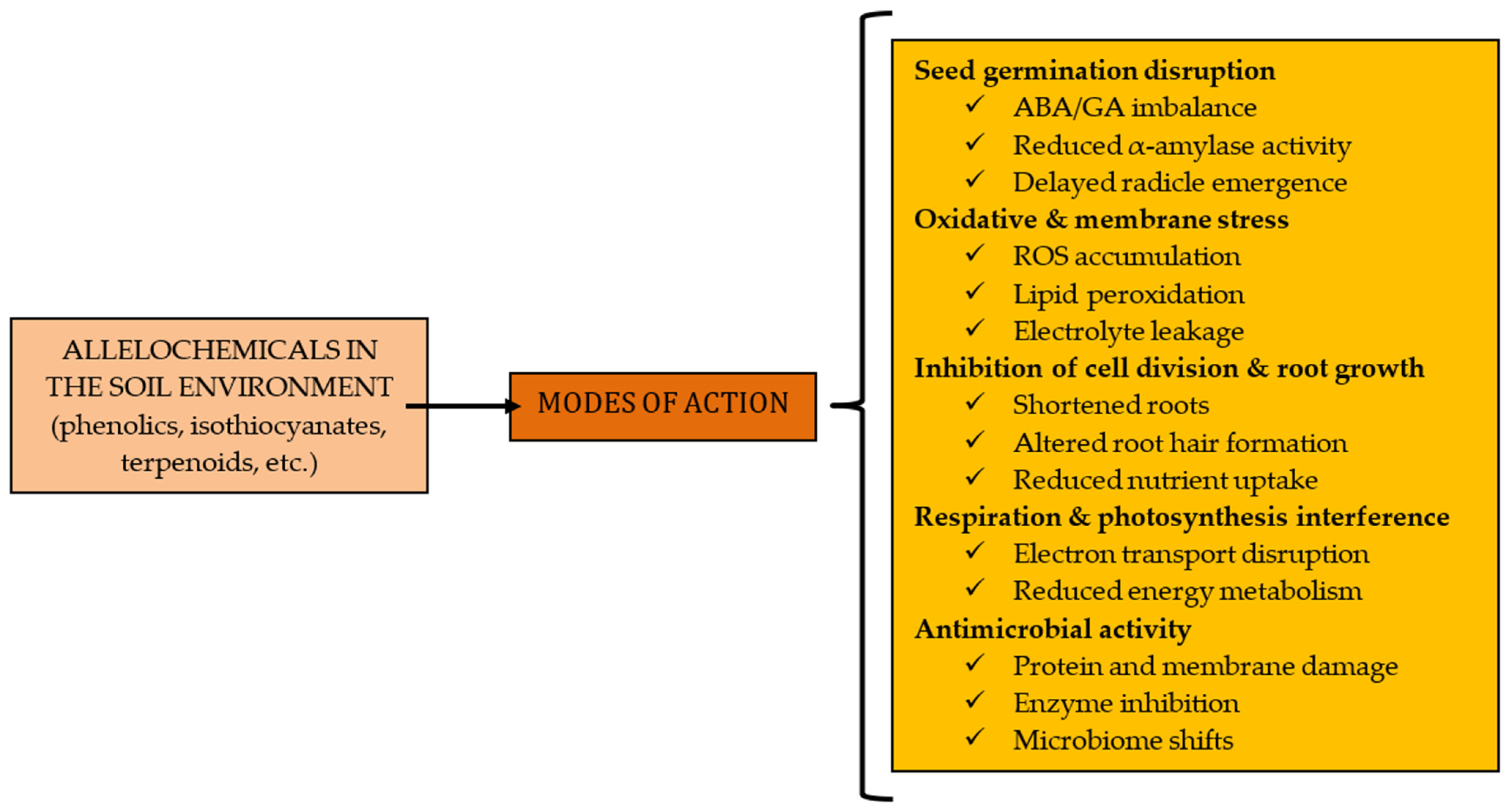
- Phenolic compounds (phenolic acids, flavonoids, tannins, quinones) such as ferulic acid, p-coumaric acid, vanillic acid, juglone, act on membrane permeability, inhibiting cell division and elongation, also block enzymes involved in germination and photosynthesis, generating oxidative stress. The effects of these compounds are evidenced by direct contact with tissues or by altering the root microenvironment [46,50].
- Alkaloids such as caffeine, nicotine (in particular species), and other tertiary alkaloids are considered allelochemicals that interact through enzymes and receptors, disrupt protein synthesis and energy metabolism, and can be toxic at low concentrations, affecting germination and early development [54,55].
- Benzoxazinones (benzoxazinoids), such as DIMBOA, BOA (in wheat, corn, rye), or similar derivatives, represent a class of heterocyclic chemical compounds (C8H7NO2) consisting of a benzene ring fused to an oxazine ring containing a carbonyl group (C=O). Structurally, they are benzoxazine derivatives. They act through compounds released into the soil as precursors or degradation products; they inhibit the growth of weeds and certain microorganisms by blocking essential metabolic pathways and by direct toxicity to the roots [56,57].
- Cyanogenic glycosides and isothiocyanates (derived from glucosinolates), a good example for this is the cyanogenic glycosides (HCN release) and isothiocyanates from Brassicaceae. They act by degrading and releasing reactive agents (cyanide, isothiocyanates) that inhibit cellular respiration and key enzymes and exert antimicrobial effects, thereby reducing the competitiveness of sensitive species [24,26].
- Fatty acids and aliphatic compounds (aldehydes, ketones) such as pelargonic acid and sorgoleone (root exudate specific to sorghum), which act by destabilizing the membrane, causing loss of cell integrity and local dehydration, sorgoleone strongly inhibits the absorption and growth of roots of other species [44,58,59,60,61,62,63,64].
- Saponins and steroids from various medicinal plants. The mode of action is by disrupting the permeability of cell membranes (pore formation), also affecting the absorption of nutrients, and may have antifungal/antibacterial effects [52].
- Non-protein amino acids, peptides, and purines-mimosine, caffeine (purine), etc., which interfere with nitrogen metabolism, protein synthesis, or enzyme function, blocking germination by inhibiting key metabolic steps.
3. Sources of Allelopathic Compounds in Vegetable Systems
4. Effects of Allelopathy on Weed and Pest Dynamics
| Plant Species/Group | Main Allelopathic Compounds | Effects and Relevance of Vegetables Cropping Systems |
|---|---|---|
| Rye (Secale cereale L.) | Benzoxazinoids (DIBOA/DIMBOA * derivatives), phenolic compounds | Strong residue and mulch effects on weed emergence suppression; widely used as an allelopathic cover crop |
| Sorghum/sorghum– Sudangrass (Sorghum spp.) | Sorgoleone (root exudate), phenolic compounds | Significant weed suppression, particularly in warm-season systems; effects associated with both root exudation and residue decomposition |
| Buckwheat (Fagopyrum esculentum Moench.) | Phenolic compounds | Rapid soil canopy development and effective competition with weeds; possible additional allelopathic contribution |
| Marigold (Tagetes spp.) | Thiophenes | Allelopathic effects are mainly discussed in the context of nematode and soil-borne pathogen management |
| Aromatic species (e.g., Lamiaceae) | Terpenoids | Antimicrobial and insecticidal properties; primarily used as plant extracts rather than as field-applied residues |
5. Experimental Approaches Used in Allelopathy Research
6. Allelopathy in Sustainable and Organic Vegetable Production
- (a)
- Microorganism-based bioherbicides contain bacteria or fungi capable of producing secondary metabolites that inhibit the germination and development of weed seeds or seedlings. Representative examples include Phytophthora palmivora Butler., which has been used to control weeds in perennial crops, and Alternaria cassiae Ness., which exhibits activity against specific weed species in legume crops [13,80,101,102]. These biological agents act by infecting, producing toxins, or interfering with essential physiological processes in target weeds.
- (b)
- Plant extract-based bioherbicides rely on natural compounds produced by plants with allelopathic potential. Certain plant species can secrete volatile or water-soluble substances with herbicidal properties, which can be exploited for weed management. Extracts derived from pelargonium or citrus plants have demonstrated effectiveness against annual weeds. Pelargonic acid, a naturally occurring monocarboxylic acid found in Pelargonium species and several other plants, is widely used as a contact bioherbicide, causing rapid desiccation of weed tissues upon application [44,57,58,59,60,87,88,103,104].
- (c)
- Organic acids and essential oils constitute another important group of bioherbicides. These natural substances are predominantly obtained from aromatic and medicinal plants and exhibit strong allelochemical properties. Their herbicidal activity is often associated with damage to cellular membranes and disruption of metabolic processes in weed tissues. Citrus oil, for instance, is used as a contact bioherbicide, while fatty acids such as caprylic and capric acid exert phytotoxic effects by dissolving the protective waxy layer of leaves. Additionally, lipid benzoquinones such as sorgoleone are produced by Sorghum Moench. species, interfere with photosynthetic processes and membrane integrity, ultimately leading to plant death [54,59,60,96].
7. Challenges, Knowledge Gaps, and Future Research Directions
8. Conclusions
Author Contributions
Funding
Data Availability Statement
Acknowledgments
Conflicts of Interest
References
- Rice, E.L. Allelopathy; Academic Press: Cambridge, MA, USA, 1974; ISBN 0-12-587050-7. [Google Scholar]
- Istrate, A.-M.-R.; Stoleru, V. Studies on the Behavior of Peri-Urban Iasi Inhabitants Toward Decorative Vegetable Gardens. In ISHS Acta Horticulturae 1441: EHC2024: International Symposium on Urban Horticulture: From Vertical Farming to Planting Design; ISHS: Leuven, Belgium, 2025; pp. 89–96. [Google Scholar] [CrossRef]
- Istrate, A.-M.-R.; Cojocariu, M.; Teliban, G.-C.; Cojocaru, A.; Stoleru, V. Quality and Yield of Edible Vegetables from Landscape Design. Horticulturae 2023, 9, 615. [Google Scholar] [CrossRef]
- Cheema, Z.A.; Farooq, M.; Wahid, A. Allelopathy: Current Trends and Future Applications; Springer Science & Business Media: Berlin/Heidelberg, Germany, 2012; ISBN 978-3-642-30594-8. [Google Scholar]
- Revillini, D.; David, A.S.; Reyes, A.L.; Knecht, L.D.; Vigo, C.; Allen, P.; Searcy, C.A.; Afkhami, M.E. Allelopathy-Selected Microbiomes Mitigate Chemical Inhibition of Plant Performance. New Phytol. 2023, 240, 2007–2019. [Google Scholar] [CrossRef] [PubMed]
- Al Harun, A.Y.; Johnson, J.; Uddin, N.; Robinson, R.W. The Effects of Temperature on Decomposition and Allelopathic Phytotoxicity of Boneseed Litter. J. Environ. Sci. 2015, 33, 1–11. [Google Scholar] [CrossRef]
- Altman-Kurosaki, N.T.; Pratte, Z.A.; Stewart, F.J.; Hay, M.E. Coral–Algal Competition: Allelopathy, Temporal Variance, and Effects on Coral Microbiomes. Coral Reefs 2025, 44, 49–62. [Google Scholar] [CrossRef]
- Calara, M.; Munteanu, N.; Brezeanu, C.; Brezeanu, P.M.; Balaita, C.; Antal Tremurici, A.; Muscalu, S.P.; Stoleru, V.; Stan, T.; Teliban, G.C.; et al. Weed Infestation Dynamics Influenced by Some Allelopathic Species in Climbing Bean (Phaseolus vulgaris) Crop. In Lucrari Stiintifice, Seria Horticultura; Editura “Ion Ionescu de la Brad”: Iași, Romania, 2024; Volume 67, p. 121. [Google Scholar]
- Kumar, N.; Singh, H.; Giri, K.; Kumar, A.; Joshi, A.; Yadav, S.; Singh, R.; Bisht, S.; Kumari, R.; Jeena, N.; et al. Physiological and Molecular Insights into the Allelopathic Effects on Agroecosystems Under Changing Environmental Conditions. Physiol. Mol. Biol. Plants 2024, 30, 417–433. [Google Scholar] [CrossRef] [PubMed]
- Choudhary, C.S.; Behera, B.; Raza, M.B.; Mrunalini, K.; Bhoi, T.K.; Lal, M.K.; Nongmaithem, D.; Pradhan, S.; Song, B.; Das, T.K. Mechanisms of Allelopathic Interactions for Sustainable Weed Management. Rhizosphere 2023, 25, 100667. [Google Scholar] [CrossRef]
- El Marsni, Z.; Casas, L.; Mantell, C.; Rodríguez, M.; Torres, A.; Macias, F.A.; Martínez de la Ossa, E.J. Allelopathic Properties of the Fractions Obtained from Sunflower Leaves Using Supercritical Carbon Dioxide: The Effect of Co-Solvent Addition. J. Supercrit. Fluids 2013, 82, 221–229. [Google Scholar] [CrossRef]
- Meiners, S.J. Functional Correlates of Allelopathic Potential in a Successional Plant Community. Plant Ecol. 2014, 215, 661–672. [Google Scholar] [CrossRef]
- Guo, X.; Liu, X.-Y.; Jiang, S.-Y.; Guo, S.-X.; Wang, J.-F.; Hu, Y.; Li, S.-M.; Li, H.-M.; Wang, T.; Sun, Y.-K.; et al. Allelopathy and Arbuscular Mycorrhizal Fungi Interactions Shape Plant Invasion Outcomes. NeoBiota 2023, 89, 187–207. [Google Scholar] [CrossRef]
- Shadab, M.; Bhatti, N.; Ain, Q.; Akhtar, N.; Parveen, U.; Alharby, H.F.; Hakeem, K.R.; Siddiqui, M.B. Allelopathy for the Sustainable Management of Agricultural Pests: Appraisal of Major Allelochemicals and Mechanisms Underlying Their Actions. S. Afr. J. Bot. 2024, 175, 496–513. [Google Scholar] [CrossRef]
- Callaway, R.M.; Vivanco, J.M. Invasion of Plants into Native Communities Using the Underground Information Superhighway. Allelopath. J. 2007, 19, 143–152. [Google Scholar]
- Molisch, H. Der Einfluß Einer Pflanze Aud Die Andere Allelopathie; Gustav Fischer: Jena, Germany, 1937. [Google Scholar]
- Rice, E.L. Allelopathy—An Overview. In Chemically Mediated Interactions Between Plants and Other Organisms; Cooper-Driver, G.A., Swain, T., Conn, E.E., Eds.; Springer: Boston, MA, USA, 1985; pp. 81–105. ISBN 978-1-4757-9658-2. [Google Scholar]
- Inderjit; Duke, S.O. Ecophysiological Aspects of Allelopathy. Planta 2003, 217, 529–539. [Google Scholar] [CrossRef] [PubMed]
- Jabran, K.; Mahajan, G.; Sardana, V.; Chauhan, B.S. Allelopathy for Weed Control in Agricultural Systems. Crop Prot. 2015, 72, 57–65. [Google Scholar] [CrossRef]
- Price, A.; Kelton, J. Allelopathic Weed Suppression Through the Use of Cover Crops. In Weed Control; BoD—Books on Demand: Norderstedt, Germany, 2012; pp. 12–30. ISBN 978-953-51-0159-8. [Google Scholar]
- Tabaglio, V.; Marocco, A.; Schulz, M. Allelopathic Cover Crop of Rye for Integrated Weed Control in Sustainable Agroecosystems. Ital. J. Agron. 2013, 8, e5. [Google Scholar] [CrossRef]
- Ullah, R.; Aslam, Z.; Attia, H.; Sultan, K.; Alamer, K.H.; Mansha, M.Z.; Althobaiti, A.T.; Kashgry, N.A.T.A.; Algethami, B.; Zaman, Q.u.; et al. Sorghum Allelopathy: Alternative Weed Management Strategy and Its Impact on Mung Bean Productivity and Soil Rhizosphere Properties. Life 2022, 12, 1359. [Google Scholar] [CrossRef]
- Hoffman, M.L.; Weston, L.A.; Snyder, J.C.; Regnier, E.E. Allelopathic Influence of Germinating Seeds and Seedlings of Cover Crops on Weed Species. Weed Sci. 1996, 44, 579–584. [Google Scholar] [CrossRef]
- Bangarwa, S.K.; Norsworthy, J.K.; Mattice, J.D.; Gbur, E.E. Glucosinolate and Isothiocyanate Production from Brassicaceae Cover Crops in a Plasticulture Production System. Weed Sci. 2011, 59, 247–254. [Google Scholar] [CrossRef]
- Gomiero, T.; Pimentel, D.; Paoletti, M.G. Environmental Impact of Different Agricultural Management Practices: Conventional Vs. Organic Agriculture. Crit. Rev. Plant Sci. 2011, 30, 95–124. [Google Scholar] [CrossRef]
- Morra, M.J.; Kirkegaard, J.A. Isothiocyanate Release from Soil-Incorporated Brassica Tissues. Soil. Biol. Biochem. 2002, 34, 1683–1690. [Google Scholar] [CrossRef]
- Ko, D.-Y.; Seo, S.-M.; Lee, Y.-H.; Gil, C.S.; Lee, H.; Ku, K.-M. Turning Glucosinolate into Allelopathic Fate: Investigating Allyl Isothiocyanate Variability and Nitrile Formation in Eco-Friendly Brassica Juncea from South Korea. Sci. Rep. 2024, 14, 15423. [Google Scholar] [CrossRef]
- Hanschen, F.S.; Winkelmann, T. Biofumigation for Fighting Replant Disease—A Review. Agronomy 2020, 10, 425. [Google Scholar] [CrossRef]
- Ji, Y.; Zhang, Y.; Fang, W.; Li, Y.; Yan, D.; Cao, A.; Wang, Q. A Review of Biofumigation Effects with Plant Materials. New Plant Prot. 2024, 1, e21. [Google Scholar] [CrossRef]
- Singh, H.P.; Batish, D.R.; Kohli, R.K. Allelopathic Interactions and Allelochemicals: New Possibilities for Sustainable Weed Management. Crit. Rev. Plant Sci. 2003, 22, 239–311. [Google Scholar] [CrossRef]
- Khamare, Y.; Chen, J.; Marble, S.C. Allelopathy and Its Application as a Weed Management Tool: A Review. Front. Plant Sci. 2022, 13, 1034649. [Google Scholar] [CrossRef] [PubMed]
- Hickman, D.T. Cropping System Redesign for Allelopathy: A Vision for the ‘Post-Herbicide Era’. Weed Res. 2025, 65, e70022. [Google Scholar] [CrossRef]
- Stoleru, V.; Munteanu, N.; Stoleru, C.M.; Rotaru, L. Cultivar Selection and Pest Control Techniques on Organic White Cabbage Yield. Not. Bot. Horti Agrobot. Cluj-Napoca 2012, 40, 190–196. [Google Scholar] [CrossRef]
- Calara, M.; Munteanu, N.; Brezeanu, C.; Brezeanu, P.M.; Avasiloaiei, D.I. Allelopathic Potential Assessment of Different Vegetal Extracts on Lettuce Seed Germination. In Lucrări Stiințifice, Seria Horticultura; Editura “Ion Ionescu de la Brad”: Iași, Romania, 2023; Volume LXVII. [Google Scholar]
- Calara, M.; Munteanu, N.; Avasiloaiei, D.I.; Brezeanu, C.; Brezeanu, P.M.; Hlihor, M. Assessing the Allelopathic Potential of Various Species for Weed Control in Organic Farming on a Climbing Bean Crop. In Lucrări Stiințifice, Seria Horticultura; Editura “Ion Ionescu de la Brad”: Iași, Romania, 2023; Volume LXVIII. [Google Scholar]
- Gomiero, T.; Pimentel, D.; Paoletti, M.G. Is There a Need for a More Sustainable Agriculture? Crit. Rev. Plant Sci. 2011, 30, 6–23. [Google Scholar] [CrossRef]
- Islam, A.K.M.M. Allelopathy of Five Lamiaceae Medicinal Plant Species, Extended Summary in Lieu of Dissertation. Ph.D. Thesis, Ehime University, Matsuyama, Japan, 2014. [Google Scholar]
- Allelopathy. Available online: https://en.wikipedia.org/w/index.php?title=Allelopathy&oldid=1318939567 (accessed on 20 January 2026).
- Bezuidenhout, S.R. KZN Agriculture & Rural Development—Allelopathy. Available online: https://www.kzndard.gov.za/allelopathy (accessed on 20 January 2026).
- McCoy, R.M.; Widhalm, J.R.; McNickle, G.G. Allelopathy as an Evolutionary Game. Plant Direct 2022, 6, e382. [Google Scholar] [CrossRef]
- Indrea, D.; Apahidean, A.S.; Sima, R. Legumicultură; Academic Press: Cluj-Napoca, Romania, 2012. [Google Scholar]
- Azirak, S.; Karaman, S. Allelopathic Effect of Some Essential Oils and Components on Germination of Weed Species. Acta Agric. Scand. Sect. B Soil. Plant Sci. 2008, 58, 88–92. [Google Scholar] [CrossRef]
- Khare, P.; Srivastava, S.; Nigam, N.; Singh, A.K.; Singh, S. Impact of Essential Oils of E. Citriodora, O. Basilicum and M. Arvensis on Three Different Weeds and Soil Microbial Activities. Environ. Technol. Innov. 2019, 14, 100343. [Google Scholar] [CrossRef]
- Travlos, I.; Rapti, E.; Gazoulis, I.; Kanatas, P.; Tataridas, A.; Kakabouki, I.; Papastylianou, P. The Herbicidal Potential of Different Pelargonic Acid Products and Essential Oils Against Several Important Weed Species. Agronomy 2020, 10, 1687. [Google Scholar] [CrossRef]
- Bozarı, S. Satureja Hortensis Bitkisinin Uçucu Yağlarının Hordeum vulgare L. Tohumları Üzerine Genotoksik Etkileri. Kahramanmaraş Sütçü İmam Üniversitesi Doğa Bilim. Derg. 2017, 20, 185. [Google Scholar] [CrossRef]
- Veraplakorn, V. In Vitro Micropropagation and Allelopathic Effect of Lantana (Lantana camara L.). Agric. Nat. Resour. 2017, 51, 478–484. [Google Scholar] [CrossRef]
- Xu, Y.; Chen, X.; Ding, L.; Kong, C.-H. Allelopathy and Allelochemicals in Grasslands and Forests. Forests 2023, 14, 562. [Google Scholar] [CrossRef]
- Cheng, F.; Cheng, Z. Research Progress on the Use of Plant Allelopathy in Agriculture and the Physiological and Ecological Mechanisms of Allelopathy. Front. Plant Sci. 2015, 6, 1020. [Google Scholar] [CrossRef]
- Fadiji, A.E.; Adeniji, A.; Lanrewaju, A.A.; Babalola, O.O. Dynamics of Soil Microbiome and Allelochemical Interactions: An Overview of Current Knowledge and Prospects. Ann. Microbiol. 2025, 75, 21. [Google Scholar] [CrossRef]
- Alemayehu, Y.; Chimdesa, M.; Yusuf, Z. Allelopathic Effects of Lantana camara L. Leaf Aqueous Extracts on Germination and Seedling Growth of Capsicum annuum L. and Daucus carota L. Scientifica 2024, 2024, 9557081. [Google Scholar] [CrossRef] [PubMed]
- Mekky, M.S.; Hassanien, A.M.A.; Kamel, E.M.; Ismail, A.E.A. Allelopathic Effect of Ocimum basilicum L. Extracts on Weeds and Some Crops and Its Possible Use as New Crude Bio-Herbicide. Ann. Agric. Sci. 2019, 64, 211–221. [Google Scholar] [CrossRef]
- Naila, S.; Haq, Z.U.; Abdulllah, A.; Salam, A. Allelopathic Effect of Taraxacum officinale L. on Germination and Physiology of Wheat. In Sustainable Intensification for Agroecosystem Services and Management; Jhariya, M.K., Banerjee, A., Meena, R.S., Kumar, S., Raj, A., Eds.; Springer: Singapore, 2021; pp. 711–741. ISBN 978-981-16-3207-5. [Google Scholar]
- Semerdjieva, I.; Atanasova, D.; Maneva, V.; Zheljazkov, V.; Radoukova, T.; Astatkie, T.; Dincheva, I. Allelopathic Effects of Juniper Essential Oils on Seed Germination and Seedling Growth of Some Weed Seeds. Ind. Crops Prod. 2022, 180, 114768. [Google Scholar] [CrossRef]
- Scognamiglio, M.; Esposito, A.; D’Abrosca, B.; Pacifico, S.; Fiumano, V.; Tsafantakis, N.; Monaco, P.; Fiorentino, A. Isolation, Distribution and Allelopathic Effect of Caffeic Acid Derivatives from Bellis perennis L. Biochem. Syst. Ecol. 2012, 43, 108–113. [Google Scholar] [CrossRef]
- Pacheco, A.; Pohlan, J.; Schulz, M. Allelopathic Effects of Aromatic Species Intercropped with Coffee: Investigation of Their Growth Stimulation Capacity and Potential of Caffeine Uptake in Puebla, Mexico. Allelopath. J. 2008, 21, 39–56. [Google Scholar]
- Zhao, H.-H.; Kong, C.-H.; Xu, X.-H. Herbicidal Efficacy and Ecological Safety of an Allelochemical-Based Benzothiazine Derivative. Pest Manag. Sci. 2019, 75, 2690–2697. [Google Scholar] [CrossRef]
- Liang, G.; Niu, Y. The Allelopathic Effect of Para-Hydroxybenzoic Acid on the Gene Expression of Photosynthesis and Respiration in Solanum lycopersicum. Curr. Plant Biol. 2022, 32, 100261. [Google Scholar] [CrossRef]
- Chadeganipour, M.; Haims, A. Antifungal Activities of Pelargonic and Capric Acid on Microsporum Gypseum. Mycoses 2001, 44, 109–112. [Google Scholar] [CrossRef] [PubMed]
- Loddo, D.; Jagarapu, K.K.; Strati, E.; Trespidi, G.; Nikolić, N.; Masin, R.; Berti, A.; Otto, S. Assessing Herbicide Efficacy of Pelargonic Acid on Several Weed Species. Agronomy 2023, 13, 1511. [Google Scholar] [CrossRef]
- Coleman, R.; Penner, D. Organic Acid Enhancement of Pelargonic Acid. Weed Technol. 2008, 22, 38–41. [Google Scholar] [CrossRef]
- Amali Jesudas, P. Sorgoleone from Sorghum Bicolor as a Potent Bioherbicide. Res. J. Recent Sci. 2014, 3, 32–36. [Google Scholar]
- Dayan, F.E.; Rimando, A.M.; Pan, Z.; Baerson, S.R.; Gimsing, A.L.; Duke, S.O. Sorgoleone. Phytochemistry 2010, 71, 1032–1039. [Google Scholar] [CrossRef]
- Einhellig, F.A.; Souza, I.F. Phytotoxicity of Sorgoleone Found in Grain Sorghum Root Exudates. J. Chem. Ecol. 1992, 18, 1–11. [Google Scholar] [CrossRef]
- Gimsing, A.L.; Bælum, J.; Dayan, F.E.; Locke, M.A.; Sejerø, L.H.; Jacobsen, C.S. Mineralization of the Allelochemical Sorgoleone in Soil. Chemosphere 2009, 76, 1041–1047. [Google Scholar] [CrossRef]
- Latif, S.; Chiapusio, G.; Weston, L.A. Allelopathy and the Role of Allelochemicals in Plant Defence. In Advances in Botanical Research; Elsevier: Amsterdam, The Netherlands, 2017; Volume 82, pp. 19–54. ISBN 978-0-12-801431-8. [Google Scholar]
- Weir, T.L.; Vivanco, J.M. Allelopathy: Full Circle from Phytotoxicity to Mechanisms of Resistance. In Allelopathy in Sustainable Agriculture and Forestry; Zeng, R.S., Mallik, A.U., Luo, S.M., Eds.; Springer: New York, NY, USA, 2008; pp. 105–117. ISBN 978-0-387-77336-0. [Google Scholar]
- Xu, G.; Shan, S.; Yun, Z.; Clements, D.R.; Yang, Y.-H.; Yang, S.-S.; Zhen, F.-P.; Jin, G.-M.; Zhang, F.; Feng, Z.; et al. Allelopathic Effects of Rapeseed (Brassica juncea) on Invasive Weed Phalaris Minor Retz. Res. Sq. 2024. [Google Scholar] [CrossRef]
- Cook, D.; Rimando, A.M.; Clemente, T.E.; Schröder, J.; Dayan, F.E.; Nanayakkara, N.P.D.; Pan, Z.; Noonan, B.P.; Fishbein, M.; Abe, I.; et al. Alkylresorcinol Synthases Expressed in Sorghum Bicolor Root Hairs Play an Essential Role in the Biosynthesis of the Allelopathic Benzoquinone Sorgoleone. Plant Cell 2010, 22, 867–887. [Google Scholar] [CrossRef] [PubMed]
- Al-Sherif, E.; Hegazy, A.K.; Gomaa, N.H.; Hassan, M.O. Allelopathic Effect of Black Mustard Tissues and Root Exudates on Some Crops and Weeds. Planta Daninha 2013, 31, 11–19. [Google Scholar] [CrossRef]
- Cartea, M.E.; Francisco, M.; Soengas, P.; Velasco, P. Phenolic Compounds in Brassica Vegetables. Molecules 2010, 16, 251–280. [Google Scholar] [CrossRef]
- Shen, S.; Xu, G.; Li, D.; Clements, D.R.; Jin, G.; Liu, S.; Yang, Y.; Chen, A.; Zhang, F.; Kato-Noguchi, H. Allelopathic Potential of Sweet Potato (Ipomoea batatas) Germplasm Resources of Yunnan Province in Southwest China. Acta Ecol. Sin. 2018, 38, 444–449. [Google Scholar] [CrossRef]
- Valcheva, E.; Popov, V. Role of the Allelopathy in Mixed Vegetable Crops in the Organic Farming. Sci. Papers. Ser. A. Agron. 2013, LVI, 422–425. [Google Scholar]
- Li, J.; Liu, Y.; Zhang, P.; Zeng, G.; Cai, X.; Liu, S.; Yin, Y.; Hu, X.; Hu, X.; Tan, X. Growth Inhibition and Oxidative Damage of Microcystis Aeruginosa Induced by Crude Extract of Sagittaria trifolia Tubers. J. Environ. Sci. 2016, 43, 40–47. [Google Scholar] [CrossRef] [PubMed]
- Lim, C.J.; Lim, C.K.; Arumugam, M.; Ee, G.C.L.; Omar, D.; Basri, M. Green Water-Dispersible Coarse Powder Nano-Formulation for Allelopathic Leaf Extract of Mikania micrantha Kunth Ex H.B.K. in Controlling the Rice Weed Echinochloa colona (L.) Link. Ind. Crops Prod. 2022, 187, 115468. [Google Scholar] [CrossRef]
- Wang, F.; Zhao, W.; Chen, J.; Zhou, Y. Allelopathic Inhibitory Effect on the Growth of Microcystis Aeruginosa by Improved Ultrasonic-Cellulase Extract of Vallisneria. Chemosphere 2022, 298, 134245. [Google Scholar] [CrossRef]
- Javaid, A.; Shafique, S.; Bajwa, R.; Shafique, S. Effect of Aqueous Extracts of Allelopathic Crops on Germination and Growth of Parthenium Hysterophorus L. S. Afr. J. Bot. 2006, 72, 609–612. [Google Scholar] [CrossRef]
- Inderjit; Wardle, D.A.; Karban, R.; Callaway, R.M. The Ecosystem and Evolutionary Contexts of Allelopathy. Trends Ecol. Evol. 2011, 26, 655–662. [Google Scholar] [CrossRef]
- Bakacsy, L.; Kardos, L.V.; Szepesi, Á.; Nagy, K.N.; Vasas, A.; Feigl, G. Investigation of the Allelopathic Effect of Two Invasive Plant Species in Rhizotron System. Life 2024, 14, 475. [Google Scholar] [CrossRef]
- Li, Z.-H.; Wang, Q.; Ruan, X.; Pan, C.-D.; Jiang, D.-A. Phenolics and Plant Allelopathy. Molecules 2010, 15, 8933–8952. [Google Scholar] [CrossRef]
- Inderjit. Soil Microorganisms: An Important Determinant of Allelopathic Activity. Plant Soil. 2005, 274, 227–236. [Google Scholar] [CrossRef]
- Swathika, N.; Subramanian, K.S.; Marimuthu, S.; Chandrakumar, K. Green Herbicide Revolution: Development and Characterization of Eucalyptus Globulus Essential Oil-Loaded Nanoemulsion for Sustainable Weed Control. BioNanoScience 2025, 15, 480. [Google Scholar] [CrossRef]
- De Miranda, C.A.S.F.; Cardoso, M.d.G.; Carvalho, M.L.M.d.; Machado, S.M.F.; Gomes, M.d.S.; de Andrade, J.; Teixeira, M.L. Atividade Alelopática de Óleos Essenciais de Plantas Medicinais Na Germinação E Vigor de Aquênios de Alface. Semin. Ciências Agrárias 2015, 36, 1783–1798. [Google Scholar] [CrossRef]
- Bradley, M. Petition for the Listing of Pelargonic Acid and Related C6—C12 Fatty Acids on the USDA National List of Allowed and Prohibited Substances; DOW Agro Sciences LLC: Indianapolis, IN, USA, 2005. [Google Scholar]
- Pan, Z.; Baerson, S.R.; Wang, M.; Bajsa-Hirschel, J.; Rimando, A.M.; Wang, X.; Nanayakkara, N.P.D.; Noonan, B.P.; Fromm, M.E.; Dayan, F.E.; et al. A Cytochrome P450 CYP71 Enzyme Expressed in Sorghum Bicolor Root Hair Cells Participates in the Biosynthesis of the Benzoquinone Allelochemical Sorgoleone. New Phytol. 2018, 218, 616–629. [Google Scholar] [CrossRef]
- Sarr, P.S.; Nakamura, S.; Ando, Y.; Iwasaki, S.; Subbarao, G.V. Sorgoleone Production Enhances Mycorrhizal Association and Reduces Soil Nitrification in Sorghum. Rhizosphere 2021, 17, 100283. [Google Scholar] [CrossRef]
- Zhong, S.; Xu, Z.; Li, Y.; Li, C.; Yu, Y.; Wang, C.; Du, D. What Modulates the Impacts of Acid Rain on the Allelopathy of the Two Asteraceae Invasives? Ecotoxicology 2023, 32, 114–126. [Google Scholar] [CrossRef] [PubMed]
- Uddin, M.R.; Thwe, A.A.; Kim, Y.B.; Park, W.T.; Chae, S.C.; Park, S.U. Effects of Jasmonates on Sorgoleone Accumulation and Expression of Genes for Sorgoleone Biosynthesis in Sorghum Roots. J. Chem. Ecol. 2013, 39, 712–722. [Google Scholar] [CrossRef] [PubMed]
- Waligóra, H.; Nowicka, S.; Idziak, R.; Ochodzki, P.; Szulc, P.; Majchrzak, L. The Total Phenolic Compound and Sorgoleone Content as Possible Indirect Indicators of the Allelopathic Potential of Sorghum Varieties (Sorghum bicolor (L.) Moench). J. Plant Prot. Res. 2023, 63, 450–458. [Google Scholar] [CrossRef]
- Uddin, M.R.; Park, S.U.; Dayan, F.E.; Pyon, J.Y. Herbicidal Activity of Formulated Sorgoleone, a Natural Product of Sorghum Root Exudate. Pest Manag. Sci. 2014, 70, 252–257. [Google Scholar] [CrossRef] [PubMed]
- Rubatzky, V.E.; Yamaguchi, M. World Vegetables: Principles, Production, and Nutritive Values; Springer: New York, NY, USA, 2012; ISBN 978-1-4615-6015-9. [Google Scholar]
- Hangan, A.-M.-R.; Cojocaru, A.; Teliban, G.-C.; Vîntu, V.; Stoleru, V. Urban and Peri-Urban Vegetable Gardens Composition. Sci. Papers. Ser. B. Hortic. 2021, LXV, 457–464. [Google Scholar]
- PubChem Sorgoleone. Available online: https://pubchem.ncbi.nlm.nih.gov/compound/6475682 (accessed on 13 January 2026).
- Uddin, M.R.; Park, K.W.; Han, S.M.; Pyon, J.Y.; Park, S.U. Effects of Sorgoleone Allelochemical on Chlorophyll Fluorescence and Growth Inhibition in Weeds. Allelopath. J. 2012, 30, 61–70. [Google Scholar]
- Ranjan Satapathy, S.; Prasad Khanduri, V.; Singh, B.; Riyal, M.K.; Kumar, S.; Kumar, P.; Rawat, D. Allelopathic Potential of Ficus auriculata and Ficus semicordata on Growth of Four Traditional Food Crops of Garhwal Himalaya. J. Agric. Food Res. 2022, 9, 100352. [Google Scholar] [CrossRef]
- Tănase, B.E.; Zaharia Rogojină, M.; Stoleru, V. Preliminary Studies on the Allelopathic Effect of Some Endemic Species of Aromatic Plants and Their Possible Use as Bio-Herbicides. In Lucrări Stiințifice, Universitatea de Stiințe Agricole și Medicină Veterinară Ion Ionescu de la Brad Iași, Seria Horticultura; Editura “Ion Ionescu de la Brad”: Iași, Romania, 2024. [Google Scholar]
- Santos, I.L.V.L.; da Silva, C.R.C.; dos Santos, S.L.; Maia, M.M.D. Sorgoleone: Benzoquinona Lipídica De Sorgo Com Efeitos Alelopáticos Na Agricultura Como Herbicida. Arq. Inst. Biol. 2012, 79, 135–144. [Google Scholar] [CrossRef]
- Houben, S.; Brinks, H.; Salomons, J.; de Cara, M.; Thorsted, M.D.; Miche, V.; Molendijk, L.; Schlathoelter, M. Crop Rotation: Practical Information. Best 4 Soil. 2020. Available online: https://www.best4soil.eu/assets/factsheets/12.pdf (accessed on 17 November 2025).
- Botanista, E. Crop Rotation—Characteristics, Advantages, Methods. Available online: https://www.botanistii.ro/blog/rotatia-culturilor/ (accessed on 17 November 2025).
- Hayyat, M.S.; Safdar, M.E.; Asif, M.; Tanveer, A.; Ali, L.; Qamar, R.; Ali, H.H.; Farooq, N.; Javeed, H.M.A.; Tarar, Z.H. Allelopathic Effect of Waste-Land Weeds on Germination and Growth of Winter Crops. Planta Daninha 2020, 38, e020173626. [Google Scholar] [CrossRef]
- Kalisz, S.; Kivlin, S.N.; Bialic-Murphy, L. Allelopathy Is Pervasive in Invasive Plants. Biol. Invasions 2021, 23, 367–371. [Google Scholar] [CrossRef]
- Wang, P.; Chai, Y.N.; Roston, R.; Dayan, F.E.; Schachtman, D.P. The Sorghum Bicolor Root Exudate Sorgoleone Shapes Bacterial Communities and Delays Network Formation. mSystems 2021, 6, 10–128. [Google Scholar] [CrossRef]
- Kang, Y.; Gobler, C.J. Nitrogen Liberated Via Allelopathy Can Promote Harmful Algal Blooms. Harmful Algae 2023, 129, 102490. [Google Scholar] [CrossRef]
- Hussain, M.I.; Araniti, F.; Schulz, M.; Baerson, S.; Vieites-Álvarez, Y.; Rempelos, L.; Bilsborrow, P.; Chinchilla, N.; Macías, F.A.; Weston, L.A.; et al. Benzoxazinoids in Wheat Allelopathy—From Discovery to Application for Sustainable Weed Management. Environ. Exp. Bot. 2022, 202, 104997. [Google Scholar] [CrossRef]
- Carvalho, M.S.S.; Andrade-Vieira, L.F.; dos Santos, F.E.; Correa, F.F.; das Graças Cardoso, M.; Vilela, L.R. Allelopathic Potential and Phytochemical Screening of Ethanolic Extracts from Five Species of Amaranthus spp. in the Plant Model Lactuca Sativa. Sci. Hortic. 2019, 245, 90–98. [Google Scholar] [CrossRef]
- Jilani, G.; Mahmood, S.; Chaudhry, A.N.; Hassan, I.; Akram, M. Allelochemicals: Sources, Toxicity and Microbial Transformation in Soil—A Review. Ann. Microbiol. 2008, 58, 351–357. [Google Scholar] [CrossRef]
- Real, M.; Gámiz, B.; López-Cabeza, R.; Celis, R. Sorption, Persistence, and Leaching of the Allelochemical Umbelliferone in Soils Treated with Nanoengineered Sorbents. Sci. Rep. 2019, 9, 9764. [Google Scholar] [CrossRef]
- Lau, J.A.; Puliafico, K.P.; Kopshever, J.A.; Steltzer, H.; Jarvis, E.P.; Schwarzländer, M.; Strauss, S.Y.; Hufbauer, R.A. Inference of Allelopathy Is Complicated by Effects of Activated Carbon on Plant Growth. New Phytol. 2008, 178, 412–423. [Google Scholar] [CrossRef] [PubMed]
- Zhang, Z.; Liu, Y.; Yuan, L.; Weber, E.; van Kleunen, M. Effect of Allelopathy on Plant Performance: A Meta-Analysis. Ecol. Lett. 2021, 24, 348–362. [Google Scholar] [CrossRef] [PubMed]
- Bonanomi, G.; Zotti, M.; Idbella, M.; Mazzoleni, S.; Abd-ElGawad, A.M. Microbiota Modulation of Allelopathy Depends on Litter Chemistry: Mitigation or Exacerbation? Sci. Total Environ. 2021, 776, 145942. [Google Scholar] [CrossRef] [PubMed]


| Species | Allelochemical Class | Release Pathway | Primary Target | Evidence Level | Notes |
|---|---|---|---|---|---|
| Brassicaceae spp. (cabbage, Mustard) | Glucosinolates → ITCs1 | Residue incorporation | Weeds, Pathogens | Field + greenhouse | Strongly management-dependent |
| Allium spp. | Organosulfur Compounds | Residues, tissue disruption | Pathogens | Greenhouse > field | Short persistence |
| Fabaceae spp. | Phenolics, flavonoids | Residues, Exudates | Weeds (indirect) | Field (mixed) | Effects often indirect |
| Solanaceae spp. | Glycoalkaloids, Phenolics | Residues | Weeds, pathogens | Greenhouse | Risk of autotoxicity |
| Rye spp. | Benzoxazinoids, Phenolics | Mulch, residues | Weeds | Field | High biomass advantage |
| Sorghum spp. | Sorgoleone, phenolics | Roots, residues | Weeds | Field + greenhouse | Warm-season systems |
| Criterion | Sorgoleone | Pelargonic Acid |
|---|---|---|
| Origin and nature | Natural allelopathic compound produced by the roots of sorghum (Sorghum bicolor L.), of phenolic/benzoquinone * nature. | Saturated fatty acid (C9 *), commercially used as a contact herbicide. |
| Mode of action | Inhibits photosynthesis, cellular respiration, and other metabolic processes; complex action with multiple targets. | Destroys the cellular membranes of green tissues upon contact, causing rapid dehydration. |
| Type of action | Mainly preventive, inhibiting germination and the growth of young plants. | Contact herbicide with rapid and visible effects on young plants. |
| Spectrum of control | Effective against several weed species, with variable sensitivity among species. | Non-selective; affects all plants it comes into contact with. |
| Soil persistence | May persist locally in the upper soil layer, exerting a prolonged allelopathic effect. | Low persistence; degrades relatively rapidly in the environment. |
| Mobility and residues | Low mobility; potential impact on subsequent crops if not properly managed. | Low risk of long-term residues. |
| Availability and use | Mainly studied experimentally; limited commercial use. | Commercially available in various formulations. |
| Environmental impact | High potential for use in ecological weed control strategies; still under study. | Considered relatively safe when used according to label instructions, but may also affect non-target plants. |
| Target Group | Primary Objective | Main Allelopathic Effects | Most Sensitive Stage | Key Compounds/ Plant Sources | Limitations /Variability |
|---|---|---|---|---|---|
| Weeds | Suppression of weed emergence and early growth | Inhibition of seed germination Reduced radicle and root growth Early seedling vigor reduction | Pre-emergence to early post-emergence | Phenolics (rye, buckwheat), benzoxazinoids (rye), sorgoleone (Sorghum), isothiocyanates (Brassicaceae) | Strongly species-dependent Small-seeded annuals are more sensitive Perennials and large-seeded weeds are less affected |
| Soil-borne pathogens | Reduction of inoculum potential and disease pressure | Antimicrobial activity Enzyme and membrane damage Indirect suppression via microbiome shifts | Free-living or early infection stages | Isothiocyanates (Brassicaceae), phenolics, thiosulfinates (Allium spp.) | Narrow dose–time window Strong dependence on soil moisture and temperature Effects often transient |
| Nematodes | Suppression of population density and activity | Toxic effects on juveniles and eggs Interference with mobility and reproduction | Motile juvenile stages | Thiophenes (Tagetes spp.), isothiocyanates (Brassicaceae) | Species-specific responses Requires proper residue management Variable persistence in soil |
| Insect pests | Indirect regulation within IPM systems | Altered host plant quality Reduced herbivore performance Enhanced natural enemy interactions | Feeding and developmental stages | Terpenoids (aromatic plants), phenolics, sulfur-containing compounds | Weak direct allelopathic effects Mostly indirect and system-dependent Rarely effective as a stand-alone control |
| Allelopathic Plant | Target Species | Application/Method | Conc. | Observed Effect | Mode of Action | Involved Compounds | Observations | References |
|---|---|---|---|---|---|---|---|---|
| Basil (essential oil) | Agropyron repens (L.) P. Beauv., Setaria viridis (L.) P. Beauv., Amaranthus retroflexus L., and Echinochloa crus-galli (L.) P. Beauv. | Foliar application | 0.8–12.8% | Biomass reduction up to 68% (10 days) | Contact phytotoxicity | Volatile essential oils | Concentration-dependent effect | [43,51] |
| Aromatic essential oils | Weed seeds (dicotyledonous species) | Substrate application | 3–20% | Germination inhibition up to 88% | Inhibition of germination and early growth | Volatile, etheric compounds | Increased efficiency above 6% | [42,55] |
| Pelargonic acid + essential oils | Agropyron repens (L.) P. Beauv., Lolium rigidum Gaud., et Avena sterilis L. | Foliar application | - | Biomass reduction up to 96% | Contact and systemic action | Pelargonic acid, lemon essential oil, and manuka oil | ~90% efficiency in combinations | [44,59] |
| Sorghum (sorgoleone) | Agricultural weeds | Root release | - | Radicular phytotoxic effect | Chemical inhibition at the soil level | Sorgoleone, p450 enzymes | JA > 1 µm inhibits development | [87,96] |
| Helianthus, Sorghum, Rice (aqueous extracts) | Parthenium hysterophorus L. | Application to leaves and seeds | 5–25% | Helianthus: 69%, sorghum: 56% | Inhibition of germination and growth | Water-soluble compounds | Bud extracts showed the highest efficiency | [76] |
| Aspect | Greenhouse/ Pot Experiments | Field Studies | Implications for Interpretation |
|---|---|---|---|
| Allelochemical concentration | Highly effective concentrations due to small soil volume and limited dilution | Strong dilution and uneven spatial distribution | Greenhouse results often overestimate field-level effects |
| Soil microbial complexity | Reduced microbial diversity and activity | High microbial diversity and functional redundancy | Rapid degradation or transformation of allelochemicals in field soils |
| Environmental conditions | Controlled moisture and temperature | Highly variable, weather-dependent | The activation and decay of compounds depend on rainfall and temperature |
| Residue–soil contact | Uniform mixing and contact | Variable incorporation depth and mulch distribution | Inconsistent exposure of target organisms in the field |
| Chemical persistence | Longer persistence of active compounds | Short-lived activity due to leaching, volatilization, and microbial breakdown | Narrow dose–time window under field conditions |
| Confounding mechanisms | Largely minimized or absent | Dominant (mulch shading, physical suppression, nutrient dynamics, competition) | Difficult to separate chemical effects from physical and ecological ones |
| Reproducibility | High experimental repeatability | Lower reproducibility across sites and seasons | Multi-site and multi-year trials are required |
| Predictive value for practice | Useful for mechanistic understanding | Essential for agronomic validation | Field studies are the ultimate test of practical relevance |
| Category | Key Aspect | Concise Description | Implications for Research and Practice |
|---|---|---|---|
| Methodological challenges | Unrealistic concentrations | Use of crude extracts or pure compounds at concentrations exceeding those naturally occurring in soils | Overestimation of allelopathic potential and limited field relevance |
| Methodological challenges | Inadequate experimental controls | Use of activated carbon may alter nutrient availability and microbial activity | Misinterpretation of strictly chemical allelopathic effects |
| Methodological challenges | Limited spatial and temporal replication | Field studies conducted at a single site or during a single growing season | Reduced the generalizability and reproducibility of results |
| Methodological challenges | Confounding mechanisms | Physical effects and resource competition are not clearly separated from chemical effects | Difficulty in attributing observed effects exclusively to allelopathy |
| Knowledge gaps | Actual soil concentrations | Lack of data on the real spatial and temporal levels of allelochemicals in soils | Uncertainty regarding ecological and agronomic relevance |
| Knowledge gaps | Molecular mechanisms | Limited understanding of the physiological and molecular responses of target plants under natural conditions | Restricted ability to predict crop and weed responses |
| Knowledge gaps | Multitrophic interactions | Insufficient investigation of effects on soil microorganisms and other trophic levels | Underestimation of indirect effects and ecological feedbacks |
| Knowledge gaps | Long-term effects | Scarcity of multi-annual and crop rotation studies | Poor understanding of cumulative impacts in agricultural systems |
| Future directions | Multi-site, multi-year studies | Replicated experiments across locations and years | Increased robustness and transferability of findings |
| Future directions | Advanced chemical analytics | Integration of lc–ms/ms, metabolomics, and isotopic tracing | Accurate quantification and tracking of allelochemicals |
| Future directions | Factorial experimental designs | Experimental separation of competition, physical, and chemical effects | Clear identification of dominant mechanisms |
| Future directions | Microbial ecology focus | Studies on microbial degradation and adaptation to allelochemicals | Improved prediction of persistence and efficacy in soils |
| Future directions | Integrated modeling | Development of soil–plant–microbe mechanistic models | Predictive assessment of allelopathy under field conditions |
| Future directions | Agronomic evaluation | Assessment of benefits and risks in real cropping systems | Realistic implementation in sustainable agriculture |
Disclaimer/Publisher’s Note: The statements, opinions and data contained in all publications are solely those of the individual author(s) and contributor(s) and not of MDPI and/or the editor(s). MDPI and/or the editor(s) disclaim responsibility for any injury to people or property resulting from any ideas, methods, instructions or products referred to in the content. |
© 2026 by the authors. Licensee MDPI, Basel, Switzerland. This article is an open access article distributed under the terms and conditions of the Creative Commons Attribution (CC BY) license.
Share and Cite
Tanase, B.E.; Istrate, A.-M.-R.; Stoleru, V. Allelopathic Interactions in Vegetable Production Systems: Current Knowledge and Future Perspectives. Horticulturae 2026, 12, 438. https://doi.org/10.3390/horticulturae12040438
Tanase BE, Istrate A-M-R, Stoleru V. Allelopathic Interactions in Vegetable Production Systems: Current Knowledge and Future Perspectives. Horticulturae. 2026; 12(4):438. https://doi.org/10.3390/horticulturae12040438
Chicago/Turabian StyleTanase, Beatrice Elena, Ana-Maria-Roxana Istrate, and Vasile Stoleru. 2026. "Allelopathic Interactions in Vegetable Production Systems: Current Knowledge and Future Perspectives" Horticulturae 12, no. 4: 438. https://doi.org/10.3390/horticulturae12040438
APA StyleTanase, B. E., Istrate, A.-M.-R., & Stoleru, V. (2026). Allelopathic Interactions in Vegetable Production Systems: Current Knowledge and Future Perspectives. Horticulturae, 12(4), 438. https://doi.org/10.3390/horticulturae12040438