Article

The Effects of Light Quality on Growth and Physiological Responses of Aquilaria crassna Tissue-Cultured Plantlets


Key Laboratory of State Forestry and Grassland Administration on South China Forest Cultivation and Management, Research Institute of Tropical Forestry, Chinese Academy of Forestry, Guangzhou 510520, China
*
Authors to whom correspondence should be addressed.
Horticulturae 2026, 12(3), 394; https://doi.org/10.3390/horticulturae12030394
Submission received: 13 February 2026 / Revised: 16 March 2026 / Accepted: 20 March 2026 / Published: 22 March 2026
(This article belongs to the Special Issue Advances in Cultivation and Breeding of Woody Plants)

Abstract

This study evaluated the effects of red LED (RL), blue LED (BL), and white LED (WL) on the growth, physiological responses, and hormonal regulation of Aquilaria crassna tissue-cultured plantlets. Morphological assessment revealed that both RL and BL treatments reduced growth variation, with RL significantly promoting shoot elongation and secondary root development. Compared to WL, RL also enhanced the rooting rate and aboveground biomass. Analysis of hormones and physiological indicators indicated that RL and BL treatments decreased abscisic acid (ABA), cytokinin (CTK), and malondialdehyde (MDA) contents, while increasing indole-3-acetic acid (IAA), gibberellic acid (GA), soluble sugar levels, and superoxide dismutase (SOD) and catalase (CAT) activities, thereby altering hormone balance and antioxidant system stability. Correlation analysis revealed that light quality was significantly negatively correlated with ABA content, while root development was closely associated with hormonal balance and antioxidant capacity. A comprehensive evaluation using the entropy-weighted TOPSIS method ranked RL as the most favorable light condition for overall growth and development, with a closeness coefficient of 0.71. These findings provide a scientific basis for optimizing light quality management to improve the efficiency and quality of A. crassna tissue culture systems.

1. Introduction

Aquilaria crassna Pierre ex Lecomte (Thymelaeaceae) is a tree species native to the tropical rainforests of Southeast Asia [1]. For centuries, agarwood derived from A. crassna species has been highly valued not only as a premium incense material but also for its traditional medicinal uses, with its well-documented sedative and gastroprotective properties [2]. Furthermore, extracts from A. crassna leaves have been reported to exhibit a broad spectrum of pharmacological activities, including antioxidant, anti-inflammatory, antihyperglycemic and antimicrobial effects [3]. Driven by its immense economic and medicinal value, natural populations of A. crassna have been severely overexploited, resulting in its classification as an endangered species across much of its native range [4]. The establishment of A. crassna plantations represents an effective strategy to meet the increasing demand for fragrance and pharmaceutical products while alleviating pressure on remaining wild populations. However, agarwood formation and quality are strongly genotype-dependent, and only a limited proportion of individuals are capable of producing high-quality resin [5]. Furthermore, the chemical composition and pharmacological potency of agarwood vary considerably among individual trees [2].
Micropropagation provides an efficient approach for the large-scale multiplication of elite A. crassna genotypes with confirmed agarwood-producing potential [5]. The commercial application of tissue culture for clonal propagation of medicinal plants has been extensively documented [6]. Nevertheless, a high and stable rooting frequency is a critical determinant of the economic feasibility of micropropagation systems, particularly for woody plant species, in which adventitious root formation is a major bottleneck [7]. Similar limitations were also encountered during the micropropagation of A. crassna in our preliminary experiments [8]. Plant tissue culture is underpinned by the remarkable totipotency of plant cells and their consequent capacity for de novo organogenesis [9]. Among the environmental factors regulating in vitro morphogenesis, light plays a central role in controlling both developmental and physiological processes [10]. Plants perceive light signals via an array of photoreceptors—phytochromes (sensing red and far-red light), cryptochromes (blue/UV-A) and phototropins (blue)—which initiate intracellular signaling cascades [11,12]. Activation of these photoreceptors modulates gene expression and interacts with hormonal regulatory networks, ultimately shaping morphogenesis and physiological performance [13,14]. Conventionally, in vitro cultures are maintained under broad-spectrum white light (400–780 nm) [15]. However, accumulating evidence indicates that monochromatic or narrow-bandwidth light, particularly red and blue light emitted by light-emitting diodes (LEDs), can more precisely regulate in vitro growth and adventitious root formation [16,17,18,19]. To date, no study has systematically evaluated the effect of specific LED wavelengths on adventitious rooting of A. crassna plantlets grown in vitro.
In this study, tissue-cultured plantlets of A. crassna were exposed to red LED (RL), blue LED (BL), and white LED (WL) to systematically evaluate the effects of light quality on plantlet growth, physiological performance, and hormonal regulation during the in vitro stage. Morphological traits related to shoot growth and root system development were quantified, along with key physiological and biochemical indicators, including endogenous hormone levels, antioxidant enzyme activities, and oxidative stress markers, to elucidate the regulatory responses of A. crassna plantlets to different light qualities. The objective of this study was to identify the optimal light quality for promoting uniform growth, enhancing adventitious rooting, and improving the physiological stability of A. crassna tissue-cultured plantlets, thereby improving propagation efficiency and plantlet quality to support the sustainable utilization and conservation of this endangered species.

2. Materials and Methods

2.1. Plant Materials and Light Quality Treatments

All materials were derived from a clonal population obtained via tissue culture from a single 5-year-old mother plant of A. crassna. This clonal population was maintained through continuous subculture for one year. Tissue-cultured plantlets of A. crassna with a height of 2–3 cm were used as experimental materials and cultivated under controlled environmental conditions. The culture conditions were set as follows: a 12 h photoperiod, temperature of 24 ± 2 °C, relative humidity of 65%, and a fixed distance of 25 cm between the light source and the plantlets. Three light quality treatments were applied: WL (400–780 nm), RL (peak wavelength 660 nm) and BL (peak wavelength 450 nm). All light treatments were provided at an identical photosynthetic photon flux density (PPFD) of 70 ± 2 μmol m−2 s−1. All lamps were LED (model KW-ZWD34WS; Shenzhen Chenhua Energy-saving Lighting Co., Ltd., Shenzhen, China). Spectral measurements were performed using a plant light analyzer (model OHSP-350P; Hangzhou Hongpu Optical Technology Co., Ltd., Hangzhou, China).
The experiment followed a randomized complete block design (RCBD) with a single factor (light quality). Microshoots were cultured on 1/4-strength Murashige and Skoog (MS) medium supplemented with 0.1 mg L−1 naphthaleneacetic acid (NAA), 20 g L−1 sucrose and 7 g L−1 agar. A total of 315 plantlets bearing three fully expanded leaves were randomly assigned to the three light treatments 105 plantlets per treatment). Each treatment consisted of 21 culture vessels (five plantlets per vessel), constituting three biological replicates (seven vessels per replicate). Growth parameters were assessed after 45 days of cultivation under the respective light conditions. For subsequent analyses, a subset of samples was oven-dried to determine dry mass, while the remainder were immediately snap-frozen in liquid nitrogen and stored at −80 °C for phytohormone and physiological analyses. Three replicate samples were collected from each treatment to ensure data reliability.

2.2. Plant Growth Measurement

Prior to the experiment, the rooting medium was uniformly prepared, and the initial heights of all plantlets were recorded to ensure experimental consistency. After 45 days of cultivation under the respective light treatments, plant height and rooting success were evaluated. The increments in plant height and rooting rates were calculated. Root morphological parameters, including total root length, primary root length, number of primary roots, primary root diameter, and number of secondary roots, were determined using a flatbed scanner coupled with WinRHIZO Pro 2012a root analysis software (Regent Instruments, Québec City, QC, Canada).

2.3. Measurement of Physiological Indicators

For physiological analyses, frozen stem and leaf samples (0.10 g) were selected. The content of MDA was determined using the 20% (w/v) trichloroacetic acid (TCA) and 0.5% (w/v) thiobarbituric acid (TBA) method [20]. SOD activity was assessed through the nitrotetrazolium blue chloride (NBT) photochemical reduction assay [21]. CAT activity was measured by monitoring the decomposition of H2O2 at 240 nm [22]. The soluble sugar content was quantified using anthrone colorimetry [23]. All physiological measurements were performed with three independent biological replicates per treatment.

2.4. Endogenous Hormone Contents Measurement

The gibberellin (GA), cytokinin (CTK), abscisic acid (ABA) and indole-3 acetic acid (IAA) contents of A. crassna tissue culture plantlets were quantified using an optimized double-antibody sandwich enzyme-linked immunosorbent assay (ELISA) according to manufacturer specifications (Shanghai Enzyme-linked Biotechnology, Shanghai, China). Briefly, frozen samples (0.20 g) were pulverized in liquid nitrogen and homogenized in 2 mL of phosphate-buffered saline (PBS; 0.01 M, pH 7.5). Following centrifugation at 10,000 rpm for 10 min at 4 °C, 50 μL of supernatant was transferred to microplate wells pre-coated with anti-plant hormone antibodies. After the addition of biotinylated detection antibodies, the plates were incubated at 37 °C for 30 min. The wells were subsequently aspirated and washed five times with buffer. Horseradish peroxidase-conjugated streptavidin (50 μL) was then added, followed by a 30 min incubation at 37 °C and five additional washes. Chromogenic development was initiated by adding 50 μL each of substrates A and B, with incubation at 37 °C for 10 min. Reactions were terminated with 50 μL of stop solution (reagent C). Absorbance at 450 nm was measured against a standard curve generated from five serially diluted hormone standards. Hormone concentrations were determined through linear regression analysis of standard curve data. A new standard curve was prepared for each experiment. All antibodies used were derived from rabbits. All assays included three independent biological replicates per sample.

2.5. Modified Entropy-Weighted TOPSIS Analysis

To objectively evaluate the comprehensive performance of distinct light quality treatments, an enhanced Technique for Order Preference by Similarity to Ideal Solution (TOPSIS) incorporating entropy-based weighting was implemented (Hwang & Yoon, 1981) [24]. This method ranks alternatives by their geometric proximity to a theoretical optimal solution while rigorously accounting for indicator relevance through information entropy.
The analytical procedure comprised the following sequential steps:
Step 1: Data Standardization. To eliminate the influence of dimensionality on the evaluation results, each indicator was normalized or standardized. For the j-th evaluation index of the i-th sample (xij), the normalized value x i j was calculated using the following Formulas (1) and (2).
x i j = x j x m i n x m a x x m i n
x i j = x m a x x j x m a x x m i n
Here, x m i n and x m a x represent the minimum and maximum values in the j-th column, respectively.
Step 2: Non-negative Translation. Given that the entropy weight method requires non-negative input data and the standardization process is based on the minimum value, non-negative translation was applied to x i j to ensure all values were positive, using Formula (3):
x i j = x i j + 0.0001
Step 3: Weight Calculation and Matrix Construction. The weight p i j of the i-th sample for the j-th indicator was calculated using Formula (4):
p i j = x i j i = 1 3 x i j
This step generated a new matrix P.
Step 4: Entropy Value Calculation. The entropy value e j for the j-th indicator was calculated using Formula (5):
e j = ( 1 ln 3 ) i 3 ( p i j l n p i j ) ,   i = 1 ,   2 ,   3
Step 5: Difference Degree and Weight Determination. The difference degree d j of the j-th indicator was defined, and the weight w j was determined using Formulas (6) and (7):
d j = 1 e j ,   j = 1 ,   2 ,   3 19
w j = d j j = 1 3 d j ,   j = 1 ,   2 ,   3
Here, a smaller entropy value e j corresponds to a larger weight w j .
Step 6: Weighted Normalized Matrix Construction. To objectively rank the evaluation objects and minimize subjective influences, a weighted normalized matrix R was constructed using Formula (8):
R = w j x i j
Step 7: Ideal Solution Determination. Based on the comprehensive weight w, a weighted normalized evaluation matrix was established to calculate the positive and negative ideal solutions for each indicator using Formulas (9) and (10)
R + = m a x ( R 1 + , R 2 + , R 3 + )
R = m i n ( R 1 , R 2 , R 3 )
Step 8: Distance Calculation: the distance D i + between the evaluation object and the positive ideal solution, and the distance D i between the evaluation object and the negative ideal solution, were calculated using the Formulas (11) and (12).
D i + = j = 1 3 ( R i j R j + ) 2
D i = j = 1 3 ( R i j R j ) 2
Step 9: Closeness Coefficient Calculation and Ranking. The closeness coefficient Ci was calculated and sorted using Formula (13):
C i = D i D i + + D i ,   i = 1 ,   2 ,   3 19
A larger C i value indicates that the evaluation object is closer to the optimal solution.

2.6. Statistical Analysis

All statistical analyses were conducted using Excel 2016. One-way analysis of variance (ANOVA) was performed to assess differences in variables across light quality treatments. When ANOVA indicated significant differences, pairwise comparisons between group means were performed using Tukey’s honestly significant difference (HSD) test. Pearson correlation analysis was conducted to assess the relationships between variables, with statistical significance defined at p ≤ 0.05 and p ≤ 0.01. Graphs were prepared using Origin 2022 (OriginLab Co., Northampton, MA, USA).

3. Results

3.1. Effect of Light Quality on Plant Growth

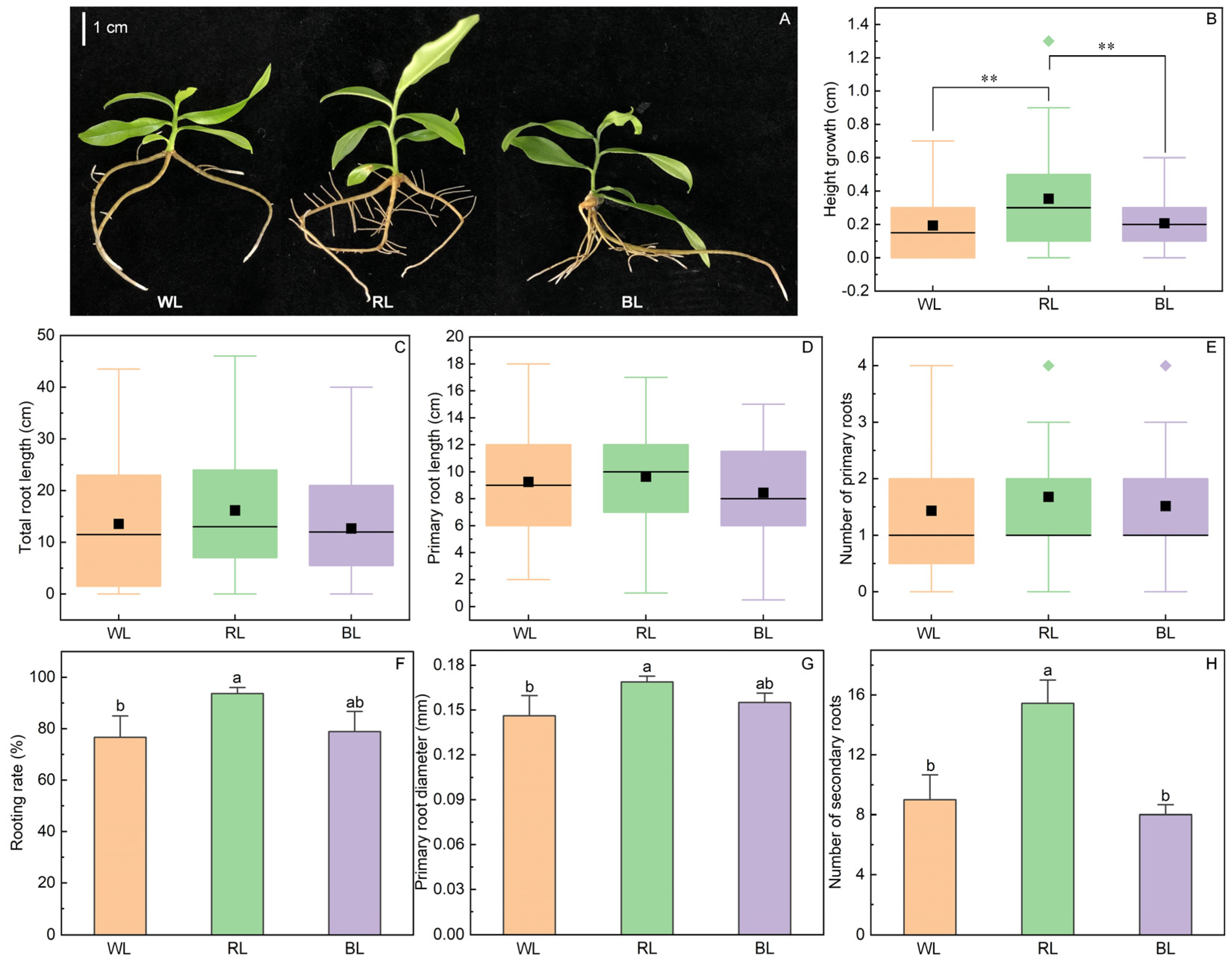
Distinct morphological responses were observed in A. crassna tissue-cultured plantlets exposed to different light qualities compared with the white LED (WL) control. Red LED (RL) treatment significantly increased plant height and promoted the development of more secondary roots, thereby enhancing the overall root system architecture. In contrast, Blue LED (BL) treatment maintained plant height comparable to that of the WL group but resulted in inferior root development (Figure 1A). Specifically, plantlet height under RL increased significantly by 83.03%, reaching a maximum of 1.3 cm. No significant difference in height was detected between the BL and WL treatments, with the maximum height under BL being 0.6 cm. Moreover, the coefficient of variation for height was reduced under both RL and BL treatments (Figure 1B), indicating enhanced growth uniformity. No significant differences were observed among light treatments in total root length, primary root length, or the number of primary roots. However, the coefficients of variation for these root-related traits were reduced under both RL and BL treatments (Figure 1C–E). Additionally, RL significantly increased the rooting rate by 22.17%, while no significant difference was observed between BL and WL treatments (Figure 1F–H). Further analysis of the effects of different light qualities on plant biomass revealed that the aboveground fresh weight under RL treatment was higher than that under WL treatment, with no significant difference between RL and BL treatments (Table 1). These results suggest that RL promotes shoot elongation and root system development, whereas BL mainly stabilizes growth variability without enhancing root morphological traits.

3.2. Effect of Light Quality on Hormone Contents and Physiological Indicators

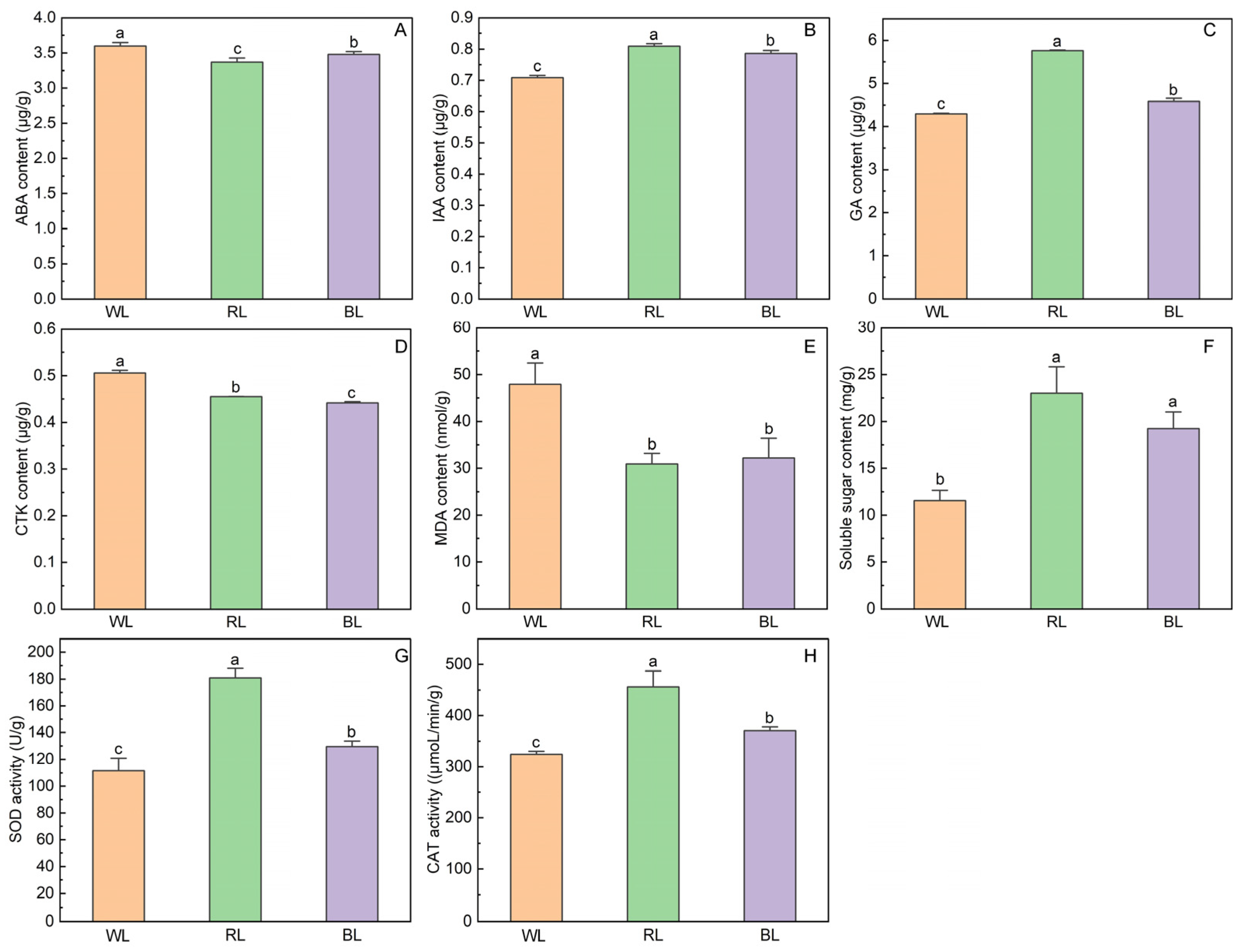
Compared to WL, both RL and BL treatments significantly reduced ABA content, with decreases of 14.27% and 10.88%, respectively (Figure 2A). Conversely, IAA content increased significantly under RL and BL, by 6.36% and 3.27%, respectively (Figure 2B). GA content was also elevated, with increases of 34.21% and 6.66% under RL and BL, respectively (Figure 2C). In contrast, CTK content declined significantly under both RL and BL, by 10.02% and 12.70%, respectively (Figure 2D). As shown in Table 2, the light quality treatments altered the balance of endogenous hormones. Compared with WL, the IAA/ABA and GA/ABA ratios were significantly increased, whereas the CTK/ABA, CTK/IAA, and CTK/GA ratios were significantly reduced under both RL and BL treatments. Notably, the GA/IAA ratio was significantly higher under RL than under WL, but significantly lower under BL than under WL. Analysis of physiological indicators revealed that MDA content was significantly higher under WL treatment than under RL and BL, being 1.55- and 1.49-fold greater, respectively (Figure 2E). In contrast, soluble sugar content, SOD activity, and CAT activity were significantly enhanced under RL and BL treatments compared to WL. Under RL, soluble sugar content, SOD activity, and CAT activity were 1.99, 1.62, and 1.41 times higher than under WL, respectively; under BL, they were 1.67, 1.16, and 1.14 fold higher than those under WL, respectively (Figure 2F,G). These results suggest that A. crassna tissue-cultured plantlets exhibit distinct hormonal and physiological adjustments in response to different light qualities, with RL and BL enhancing antioxidant capacity and favorably modulating growth-related hormone profiles.

3.3. Correlation Analysis of Growth and Development-Related Indicators

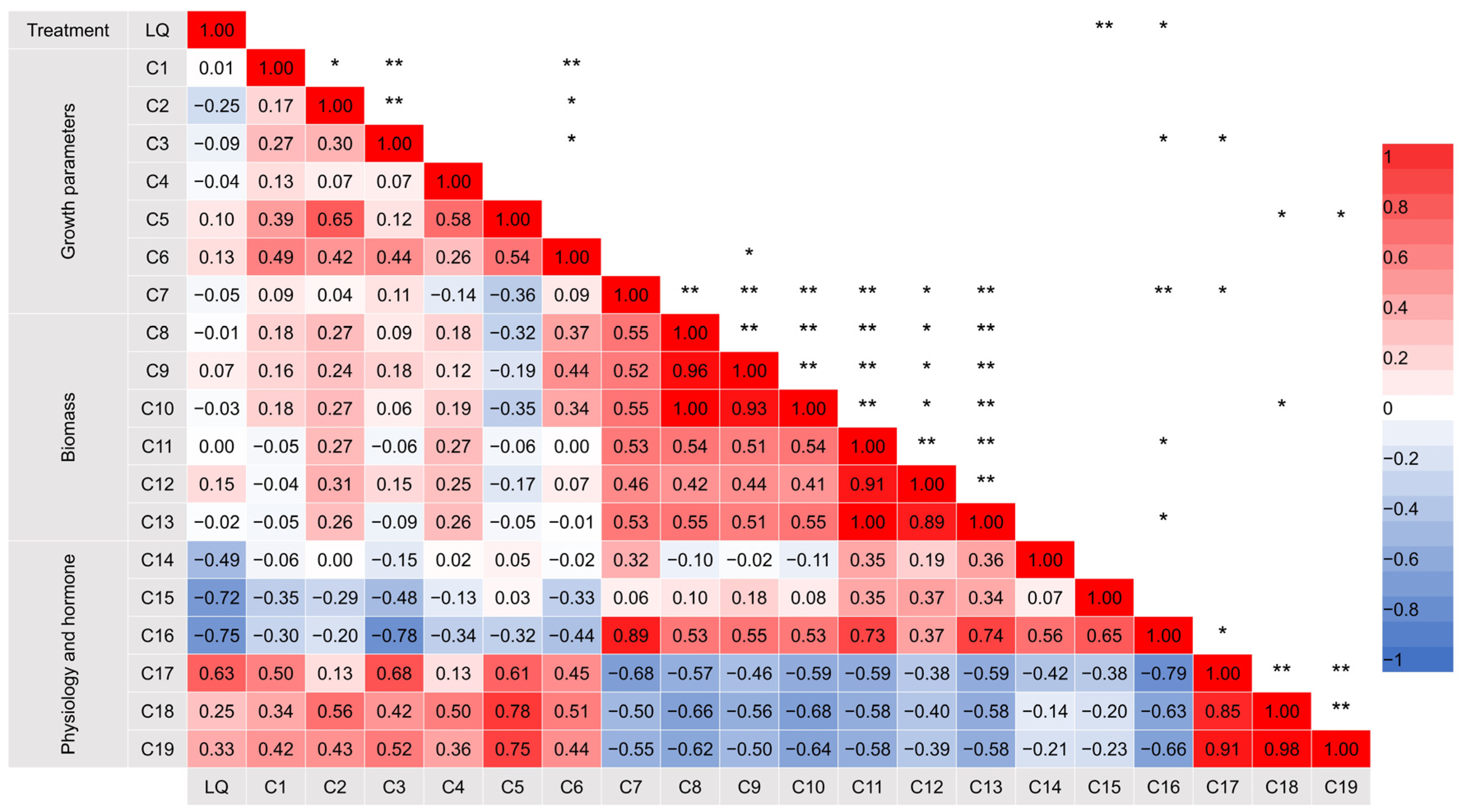
To further clarify the effects of light quality on the growth, hormonal regulation, and physiological responses of A. crassna tissue-cultured plantlets, Pearson correlation analysis was performed (Figure 3). Light quality was significantly negatively correlated with ABA content (p < 0.01), indicating that spectral composition strongly influences endogenous hormone regulation. Plant height exhibited positive correlations with the rooting rate and root dry weight (p < 0.05), while the number of primary roots showed a strong positive correlation with aboveground dry weight (p < 0.01). Primary root length correlated positively with both root diameter and soluble sugar content (p < 0.05) but negatively with MDA content (p < 0.05), suggesting that enhanced root elongation is associated with reduced oxidative stress and greater carbohydrate accumulation. Rooting rate was positively associated with aboveground water content and GA levels (p < 0.05) but negatively associated with root dry weight (p < 0.05), reflecting that rooting efficiency is tightly linked to hormonal balance and, in turn, biomass allocation. Aboveground water content was positively correlated with GA levels and the GA/ABA ratio (p < 0.05). Moreover, GA levels were positively associated with both the GA/ABA ratio and SOD activity (p < 0.05), suggesting that GA not only regulates water distribution but may also enhance antioxidant capacity under these light conditions. The IAA/ABA ratio was positively correlated with soluble sugar content (p < 0.01), the GA/ABA ratio with SOD activity (p < 0.05), and the CTK/IAA ratio with MDA content (p < 0.05). Collectively, these correlative relationships indicate that hormonal balance plays a central role in regulating osmotic adjustment and redox homeostasis under different light quality conditions.

3.4. Comprehensive Analysis

Given the differential responses of various evaluation indices under different light quality treatments, this study employed the entropy-weighted TOPSIS method to systematically and objectively assess the effects of light quality on the growth and development of A. crassna tissue-cultured plantlets. First, the indicator weights were determined by calculating the entropy values of the raw data. More data dispersion indicates that an indicator contains more information, resulting in a smaller entropy value and thus a larger assigned weight. The results showed that the height growth, the rooting rate, and the number of secondary roots ranked highest in weight, with values of 6.01%, 5.18%, and 5.14%, respectively. In contrast, the CTK/IAA ratio, dry weight of roots, and MDA content were assigned the lowest weights, each at 2.8% (Table 3). Based on these weights, a weighted normalized decision matrix was constructed. The distances of each light quality treatment from the positive and negative ideal solutions were then calculated to derive the closeness coefficient, which was used for comprehensive evaluation. The results indicated that the RL treatment exhibited the shortest distance to the positive ideal solution and the farthest distance from the negative ideal solution, resulting in the highest closeness coefficient of 0.71, which indicates superior overall growth and developmental performance under RL. The BL treatment ranked second, while the WL treatment had the lowest closeness coefficient (0.33), indicating the poorest overall performance (Table 4).

4. Discussion

Beyond serving as the energy source for photosynthesis, light acts as a pivotal environmental signal that regulates cellular differentiation, dedifferentiation and redifferentiation [10]. Through interactions with photoreceptors such as phytochromes and cryptochromes, light modulates the biosynthesis, transport and signaling of endogenous hormones, thereby influencing the type, timing and efficiency of organogenesis [11]. Specific wavelengths are perceived by distinct photoreceptors, triggering distinct physiological responses that constitute the mechanistic basis by which light quality governs organogenic programs [12].
In this study, WL treatment resulted in a relatively low adventitious rooting rate in A. crassna tissue-cultured plantlets, whereas red LED irradiation markedly promoted root initiation. This observation is consistent with observations reported for Protea cynaroides, Picea abies, and Camellia gymnogyna [18,19,25]. Under red light, A. crassna plantlets not only achieved the highest rooting rate but also developed longer, more numerous and thicker roots, indicating that red light enhances both root initiation and subsequent root system development. Similar promoting effects of red light on root growth have been reported for Cunninghamia lanceolata seedlings [26] and Scrophularia kakudensis microshoots [27], which exhibited superior root number and length under red LED illumination compared to other spectral treatments. A similar promotive effect of red light on lateral root formation has also been documented in tobacco [28]. In addition to promoting root development, red LED light significantly stimulated shoot elongation and aboveground biomass accumulation in A. crassna plantlets. These findings align with previous reports in multiple species, demonstrating that red light enhances aerial organ growth. For example, red LED light accelerates neo-leaf formation in P. cynaroides [18] and provides the most effective spectral regime for stem elongation in S. kakudensis [27]. In tobacco, RL promotes both the elongation and proliferation of epidermal cells, resulting in pronounced stem extension [29]. Increased lateral root density improves water and nutrient uptake, which may partly explain the greater shoot height observed under red light. Enhanced red light ratios have also been shown to increase photosynthetic efficiency and yield in strawberry [30], while rice plants grown under red-enriched spectra exhibit higher photosynthetic rates under both saturating and photo-inhibitory conditions [31], ultimately leading to increased dry-matter accumulation [32]. Likewise, Spirulina platensis achieves maximal growth rates under red LED illumination [33]. Collectively, these results indicate that red light provides a favorable spectral environment for coordinated root and shoot development in A. crassna tissue-cultured plantlets.
Nevertheless, plant responses to spectral quality are highly species-specific. For example, tomato seedlings display limited sensitivity to light quality, whereas Arabidopsis thaliana responds strongly under identical LED regimes [34]. A. crassna microshoots likewise exhibited a marked spectral sensitivity, with distinct growth responses to red and blue light. Plantlets cultured under BL were significantly shorter than those grown under RL, supporting the widely reported observation that red light promotes, whereas blue light restrains, stem elongation [35]. BL has been reported to inhibit adventitious root formation in Prunus serotina in vitro [36], whereas it exerts a stimulatory effect in Vanilla planifolia and Ocimum basilicum [17,37]. In A. crassna, BL proved more effective than WL in promoting adventitious root initiation. Although the rooting percentage under blue light was slightly lower than under red light, the difference was not statistically significant; however, the number of lateral roots was significantly reduced under blue light. These results indicate that, in A. crassna, RL enhances both adventitious root emergence and subsequent lateral root development, whereas BL primarily supports root initiation without promoting root system elaboration.
Compared with WL, RL and BL treatments led to significantly higher soluble sugar accumulation in A. crassna plantlets, along with a marked increase in rooting rates (Figure 2F). Light quality has been shown to modulate carbohydrate metabolism through photoreceptor-mediated pathways. Studies on lettuce indicate that phytochrome activity is closely linked to the regulation of sucrose-metabolizing enzymes, with RL in particular promoting soluble sugar accumulation [38]. More broadly, red or blue light treatments have been demonstrated to induce greater accumulation of soluble sugars or starch compared with WL [39]. Carbohydrates are essential for the formation of adventitious roots [40]. Reactive oxygen species (ROS) are inevitably generated during intensive metabolic activity associated with root initiation and elongation. An effective antioxidant defense is therefore essential for successful rooting. In A. crassna plantlets, RL treatment induced the highest SOD and CAT activities and the lowest MDA content, followed by BL. In contrast, WL resulted in comparatively low antioxidant enzyme activities and elevated MDA accumulation (Figure 2). MDA content serves as a widely used marker of lipid peroxidation in studies of oxidative stress and redox signaling, particularly in investigations of plant responses to biotic and abiotic stresses [41]. ROS accumulation induces membrane lipid peroxidation, which compromises cell membrane integrity; this damage may be mitigated by the activity of enzymes such as SOD and CAT [42]. In A. crassna plantlets, the coordinated increase in SOD and CAT activities under red and blue LEDs indicates an enhanced capacity to detoxify superoxide radicals and hydrogen peroxide, thereby preventing oxidative damage. Previous studies across diverse species have demonstrated positive correlations between SOD and CAT activities and rooting competence, while elevated MDA content is associated with poor rooting performance [43,44,45,46]. Our results demonstrate that red or blue LED irradiation enhances adventitious root formation in A. crassna microshoots by strengthening antioxidant defense and suppressing oxidative injury. From an applied perspective, the superior antioxidant status induced by red light likely contributes to improved root quality, sustained root growth, and enhanced plantlet vigor during subsequent acclimatization.
Light is a key environmental regulator of plant hormone biosynthesis and signaling [14], and hormonal balance represents a central regulatory layer integrating environmental cues with developmental responses during adventitious root formation. CTK and ABA have been demonstrated to be negative regulators of adventitious root formation, whereas IAA acts as a positive regulator promoting adventitious root formation [47,48]. In our study, light quality markedly altered endogenous hormone profiles in A. crassna microshoots. RL treatment induced the highest IAA content while simultaneously reducing CTK and ABA levels, thereby establishing a hormonal milieu favorable for root induction (Figure 2). Relative to WL treatment, BL also elevated IAA levels, which may explain its ability to initiate adventitious roots; however, its weaker suppression of ABA may limit further root system development. Similar regulatory effects of light quality on hormone dynamics have been reported in other species. For example, RL treatment rapidly elevates IAA levels and enhances rooting in C. gymnogyna [25], and RL has also been reported to promote auxin transport from leaves to roots in tobacco seedlings [28]. In addition, BL improves rooting competence in low IAA chrysanthemum single leaf cuttings [49], and BL-irradiated tea stem cuttings exhibit increased expression of auxin transport-related genes accompanied by enhanced root formation [50]. Moreover, RL treatment significantly reduces ABA concentrations in C. gymnogyna [25], further supporting its promotive role in adventitious rooting. On the other hand, RL and BL also increased GA levels relative to WL, with RL inducing the highest GA accumulation. Although endogenous GA content is generally considered to be negatively correlated with adventitious rooting [51], this effect appears to be context-dependent. In A. crassna tissue culture plantlets, GA content was significantly and positively correlated with rooting rate and aboveground water content (Figure 3). These results suggest that an appropriate GA level is beneficial for plant growth and development in A. crassna under in vitro conditions. Consistently, RL-treated C. gymnogyna exhibits elevated GA levels accompanied by improved rooting performance [25]. These findings indicate that the role of GA in adventitious rooting is species-dependent. Moreover, GA has been reported to interact synergistically with auxin to promote root elongation and penetration, while also driving stem height [52]. Previous studies have demonstrated that gibberellin-deficient mutants of pea exhibit significantly lower adventitious root induction rates and numbers compared with the wild type, suggesting that optimal gibberellin levels promote adventitious root formation [53]. GA can promote root system growth by reducing the biosynthesis of auxin transport inhibitors [54]. Given the multifaceted effects of GA on rooting development across different species, further in-depth molecular investigations in additional species are warranted. Consistently, RL-treated plantlets exhibited both enhanced rooting and increased shoot height, indicating coordinated regulation of below- and aboveground growth.
Taken together, our results demonstrate that RL creates a permissive physiological state for adventitious rooting in A. crassna by synchronously enhancing carbon availability, strengthening antioxidant defense, and establishing a hormonal balance. From an applied perspective, these findings provide a physiological basis for optimizing light spectral regimes during in vitro propagation of A. crassna. However, given that BL also exerts positive effects on root induction in A. crassna micropropagated plantlets, the impact of combining RL and BL at specific ratios on adventitious root induction in this species remains unclear. This represents a focus of our future research.
We employed the TOPSIS (Technique for Order Preference by Similarity to an Ideal Solution) method to evaluate the comprehensive effects of different light quality treatments. The entropy-weighted TOPSIS approach enables standardized integration of diverse indicator types, objectively assigns weights based on information provided by the data, and ranks treatments according to their relative distances from the ideal best and ideal worst solutions [24]. By contrast, principal component analysis (PCA) serves primarily as a ranking and dimensionality reduction tool that facilitates the identification of major sources of variation and correlation structures among variables [55]. However, PCA does not directly provide an intuitive ranking of treatments relative to agricultural or biological optima. Moreover, PCA focuses on explaining variance within fewer components, and variables with high variance may dominate the analysis even if they are not necessarily the most relevant indicators for practical assessment of tissue culture performance. Thus, PCA and TOPSIS serve distinct purposes. In this study, TOPSIS was considered more appropriate because our primary objective was to identify the most favorable light quality based on overall biological performance. In the TOPSIS method, the closeness coefficient (Ci) represents the proximity of plant growth status to the ideal state. The red LED (RL) treatment exhibited a Ci value of 0.71, indicating that RL achieved an optimal balance between promoting growth and maintaining physiological homeostasis. From a biological perspective, Ci values approaching 1.0 indicate a higher overall adaptive capacity of seedlings under specific light qualities.
In this study, A. crassna tissue culture plantlets subjected to RL treatment exhibited clear morphological and physiological advantages. RL notably promoted shoot elongation, secondary root development, rooting rate, and aboveground biomass accumulation, while BL mainly contributed to reducing growth variation without significantly improving root traits. Both RL and BL treatments effectively decreased ABA content, MDA accumulation, and cytokinin-related hormonal ratios (CTK/ABA, CTK/IAA, CTK/GA), while significantly enhancing IAA content, GA content, IAA/ABA and GA/ABA ratios, soluble sugar content, and the SOD and CAT activities. These coordinated physiological responses indicate improved stress tolerance and growth potential under RL. Correlation analysis further revealed that light quality was negatively correlated with ABA levels, while strong positive relationships were observed between root traits, antioxidant activity, and carbohydrate metabolism. These results suggest that enhanced root development in A. crassna is closely linked to the maintenance of physiological homeostasis and effective mitigation of oxidative stress. The comprehensive evaluation identified RL as the most favorable light quality for overall plantlet performance, followed by BL and FL. Collectively, these findings demonstrate that RL represents an optimal and practical light regime for improving in vitro rooting efficiency and plantlet quality in A. crassna propagation.

5. Conclusions

A. crassna is a critically endangered medicinal plant of high value. Micropropagation using explants obtained directly from elite mother plants helps preserve genetic traits associated with high agarwood yield and specific medicinal compounds. This approach ensures a consistent supply of plant material, allows for quality control, and overcomes the variability issues commonly encountered in conventional propagation methods. Tissue culture enables the year-round, large-scale production of standardized, high-quality plantlets under sterile and controlled conditions, thereby supporting the development of a stable industrial supply chain. Compared with conventional fluorescent lamps, LEDs provide significant advantages, including exceptional luminous efficacy, minimal heat output, and extended operational longevity. These characteristics substantially reduce long-term energy consumption and decrease cooling costs in tissue culture facilities. RL can be considered the most appropriate light regime to optimize in vitro propagation efficiency and plantlet quality of A. crassna, thereby contributing to conservation strategies and the sustainable use of this endangered species. Nevertheless, further in-depth molecular studies are warranted to elucidate how different light qualities regulate differential gene expression and how such changes correlate with phytohormone biosynthesis, auxin transport, and photosynthetic performance in plantlets. Additionally, the present study examined only the effects of monochromatic red or blue LED light on the rooting and growth of A. crassna tissue-cultured plantlets. Whether combined red and blue LED illumination further enhances adventitious root formation and growth in this species remains to be explored.

Author Contributions

Conceptualization, X.L.; methodology, X.L.; software, Z.C.; validation, Z.C.; formal analysis, Z.C.; investigation, X.L.; resources, B.H.; data curation, Z.C.; writing—original draft preparation, X.L.; writing—review and editing, X.L.; visualization, Z.C.; supervision, B.Z.; project administration, B.Z.; funding acquisition, B.Z. All authors have read and agreed to the published version of the manuscript.

Funding

This research was funded by the Guangdong Forestry Science and Technology Innovation Project (grant number: 2015KJCX006, 2018KLCX019).

Data Availability Statement

The original contributions presented in this study are included in the article. Further inquiries can be directed to the corresponding authors.

Conflicts of Interest

The authors declare no conflicts of interest.

Abbreviations

The following abbreviations are used in this manuscript:
WLWhite LED
RLRed LED
BLBlue LED
LEDLight-emitting diode
MDAMalondialdehyde
CATCatalase
SODSuperoxide dismutase
IAAIndole-3 acetic acid
GAGibberellins
CTKCytokinin
ABAAbscisic acid

References

  1. Wongwad, E.; Pingyod, C.; Saesong, T.; Waranuch, N.; Wisuitiprot, W.; Sritularak, B.; Temkitthawon, P.; Ingkaninan, K. Assessment of the bioactive components, antioxidant, antiglycation and anti-inflammatory properties of Aquilaria crassna Pierre ex Lecomte leaves. Ind. Crops Prod. 2019, 138, 111448. [Google Scholar] [CrossRef]
  2. Takamatsu, S.; Ito, M. Agarotetrol as an index for evaluating agarwood in crude drug products. J. Nat. Med. 2022, 76, 857–864. [Google Scholar] [CrossRef] [PubMed]
  3. Kamonwannasit, S.; Nantapong, N.; Kumkrai, P.; Luecha, P.; Kupittayanant, S.; Chudapongse, N. Antibacterial activity of Aquilaria crassna leaf extract against Staphylococcus epidermidis by disruption of cell wall. Ann. Clin. Microbiol. Antimicrob. 2013, 20, 12–20. [Google Scholar] [CrossRef] [PubMed]
  4. Kalra, R.; Kaushik, N. A review of chemistry, quality and analysis of infected agarwood tree (Aquilaria sp.). Phytochem. Rev. 2017, 16, 1045–1079. [Google Scholar] [CrossRef]
  5. Minh, T.V. Application of tissue culture techniques in woody species conservation, Improvement and Development in Vietnam: Agarwood (Aquilaria crassna Pierre ex LeComte) via Shoot-tip Culture. In Proceedings of the Second International Symposium on Biotechnology of Tropical and Subtropical Species, Taipei, China, 5–9 November 2001. [Google Scholar]
  6. Twaij, B.M.; Jazar, Z.H.; Hasan, M.N. Trends in the Use of Tissue Culture, Applications and future aspects. Int. J. Plant Biol. 2020, 11, 8385. [Google Scholar] [CrossRef]
  7. Dewir, Y.H.; Murthy, H.N.; Ammar, M.H.; Alghamdi, S.S.; Al-Suhaibani, N.A.; Alsadon, A.A.; Paek, K.Y. In vitro rooting of Leguminous plants: Difficulties, alternatives, and strategies for improvement. Hortic. Environ. Biotechnol. 2016, 57, 311–322. [Google Scholar] [CrossRef]
  8. Li, X.; Chen, Z.; Hu, B.; Zeng, B. Establishment of a highly efficient micropropagation system of Aquilaria crassna Pierre ex Lecomte. Forests 2024, 15, 1774. [Google Scholar] [CrossRef]
  9. Pulianmackal, A.J.; Kareem, A.V.; Durgaprasad, K.; Trivedi, Z.B.; Prasad, K. Competence and regulatory interactions during regeneration in plants. Front. Plant Sci. 2014, 11, 142. [Google Scholar] [CrossRef]
  10. Han, J.; Li, Y.; Zhao, Y.; Sun, Y.; Li, Y.; Peng, Z. How does light regulate plant regeneration? Front. Plant Sci. 2025, 15, 1474431. [Google Scholar]
  11. Yun, F.; Liu, H.; Deng, Y.; Hou, X.; Liao, W. The role of light-regulated auxin signaling in root development. Int. J. Mol. Sci. 2023, 24, 5253. [Google Scholar] [CrossRef]
  12. Rawat, S.; Laxmi, A. Light at the end of the tunnel: Integrating signaling pathways in the coordination of lateral root development. Biochem. Soc. Trans. 2024, 52, 1895–1908. [Google Scholar] [CrossRef] [PubMed]
  13. Weller, J.L.; Hecht, V.; Schoor, J.K.V.; Davidson, S.E.; Ross, J.J. Light regulation of gibberellin biosynthesis in pea is mediated through the COP1/HY5 pathway. Plant Cell 2009, 21, 800. [Google Scholar] [CrossRef] [PubMed]
  14. Symons, G.M.; Reid, J.B. Hormone levels and response during de-etiolation in pea. Planta 2003, 216, 422–431. [Google Scholar] [CrossRef] [PubMed]
  15. Ragonezi, C.; Klimaszewska, K.; Castro, M.R.; Lima, M.; Oliveira, P.; Zavattieri, M.A. Adventitious rooting of conifers: Influence of physical and chemical factors. Trees 2010, 24, 975–992. [Google Scholar] [CrossRef]
  16. Poudel, P.R.; Kataoka, I.; Mochioka, R. Effect of red- and blue-light-emitting diodes on growth and morphogenesis of grapes. Plant Cell Tiss. Organ. Cult. 2008, 92, 147–153. [Google Scholar] [CrossRef]
  17. Ramírez-Mosqueda, M.A.; Iglesias-Andreu, L.G.; Luna-Sánchez, I.J. Light quality affects growth and development of in vitro plantlet of Vanilla planifolia Jacks. S. Afr. J. Bot. 2017, 109, 288–293. [Google Scholar] [CrossRef]
  18. Wu, H.; Lin, C. Red light-emitting diode light irradiation improves root and leaf formation in difficult-to-propagate Protea cynaroides L. plantlets in vitro. HortScience 2012, 47, 1490–1494. [Google Scholar] [CrossRef]
  19. Alallaq, S.; Ranjan, A.; Brunoni, F.; Novák, O.; Lakehal, A.; Bellini, C. Red light controls adventitious root regeneration by modulating hormone homeostasis in Picea abies seedlings. Front. Plant Sci. 2020, 11, 586140. [Google Scholar] [CrossRef]
  20. Heath, R.L.; Packer, L. Photoperoxidation in isolated chloroplasts: I. Kinetics and stoichiometry of fatty acid peroxidation. Arch. Biochem. Biophys. 2022, 726, 109248. [Google Scholar] [CrossRef]
  21. Giannopolitis, C.N.; Ries, S.K. Superoxide dismutases: I. Occurrence in higher plants. Plant Physiol. 1977, 59, 309–314. [Google Scholar] [CrossRef]
  22. Rao, M.V.; Paliyath, G.; Ormrod, D.P. Ultraviolet-B-and ozone-induced biochemical changes in antioxidant enzymes of Arabidopsis thaliana. Plant Physiol. 1996, 110, 125–136. [Google Scholar] [CrossRef]
  23. Ebell, L.F. Variation in total soluble sugars of conifer tissues with method of analysis. Phytochemistry 1969, 8, 227–233. [Google Scholar] [CrossRef]
  24. Hwang, C.L.; Yoon, K. Multiple Attribute Decision Making: Methods and Applications: A State-of-the-Art Survey; Springer: Berlin/Heidelberg, Germany, 1981. [Google Scholar]
  25. Fu, H.; Wei, X.; Chen, Q.; Yong, S.; Liu, Q.; Dang, J.; Wu, D.; Liang, G.; Guo, Q. Comparative transcriptome analysis of molecular mechanisms underlying adventitious root developments in Huangshan Bitter tea (Camellia gymnogyna Chang) under red light quality. Front. Plant Sci. 2023, 14, 1154169. [Google Scholar] [CrossRef]
  26. Liu, Q.; Huang, Z.; Ma, X.; Tigabu, M.; Xing, X.; Jin, S.; Liu, B. Phenotypic plasticity of Cunninghamia lanceolata (Lamb.) Hook. seedlings in response to varied light quality treatments. Forests 2022, 13, 201. [Google Scholar]
  27. Manivannan, A.; Soundararajan, P.; Park, Y.G.; Jeong, B.R. Physiological and proteomic insights into red and blue light-mediated enhancement of in vitro growth in Scrophularia kakudensis-A potential medicinal plant. Front. Plant Sci. 2021, 11, 607007. [Google Scholar] [CrossRef] [PubMed]
  28. Meng, L.; Song, W.; Liu, S.; Dong, J.; Zhang, Y.; Wang, C.; Xu, Y.; Wang, S. Light quality regulates lateral root development in tobacco seedlings by shifting auxin distributions. J. Plant Growth Regul. 2015, 34, 574–583. [Google Scholar] [CrossRef]
  29. Zhou, Z.; Feng, S.; Gai, S.; Gao, P.; Xu, C.; Xia, M.; Tang, W.; Lu, X. Affordable phosphor-converted LEDs with specific light quality facilitate the tobacco seedling growth with low energy consumption in Industrial Seedling Raising. J. Photochem. Photobiol. B Biol. 2022, 235, 112564. [Google Scholar] [CrossRef]
  30. Guiamba, H.; Zhang, X.; Sierka, E.; Lin, K.; Ali, M.M.; Ali, W.M.; Lamlom, S.F.; Kalaji, H.M.; Telesiński, A.; Yousef, A.F.; et al. Enhancement of photosynthesis efficiency and yield of strawberry (Fragaria ananassa Duch.) plants via LED systems. Front. Plant Sci. 2022, 13, 918038. [Google Scholar] [CrossRef]
  31. Matsuda, R.; Ohashi-Kaneko, K.; Fujiwara, K.; Goto, E.; Kurata, K. Photosynthetic characteristics of rice leaves grown under red light with or without supplemental blue light. Plant Cell Physiol. 2004, 45, 1870. [Google Scholar] [CrossRef]
  32. Ren, M.; Liu, S.; Mao, G.; Tang, C.; Gai, P.; Guo, X.; Zheng, H.; Wang, W.; Tang, Q. Simultaneous Application of red and blue light regulate carbon and nitrogen metabolism, induces antioxidant defense system and promote growth in rice seedlings under low light stress. Int. J. Mol. Sci. 2023, 24, 10706. [Google Scholar] [CrossRef]
  33. Wang, C.Y.; Fub, C.C.; Liu, Y.C. Effects of using light-emitting diodes on the cultivation of Spirulina platensis. Biochem. Eng. J. 2007, 37, 21–25. [Google Scholar] [CrossRef]
  34. Spaninks, K.; van Lieshout, J.; van Ieperen, W.; Offringa, R. Regulation of early plant development by red and blue light: A comparative analysis between Arabidopsis thaliana and Solanum lycopersicum. Front. Plant Sci. 2020, 11, 599982. [Google Scholar] [CrossRef]
  35. Sabzalian, M.R.; Heydarizadeh, P.; Zahedi, M.; Boroom, A.; Agharokh, M.; Sahba, M.R.; Schoefs, B. High performance of vegetables, flowers, and medicinal plants in a red-blue LED incubator for indoor plant production. Agron. Sustain. Dev. 2014, 34, 879–886. [Google Scholar] [CrossRef]
  36. Fuernkranz, H.A.; Nowak, C.A.; Maynard, C.A. Light effects on in vitro adventitious root formation in axillary shoots of mature Prunus serotina. Physiol. Plant. 1990, 80, 337–341. [Google Scholar] [CrossRef]
  37. Lim, Y.J.; Eom, S.H. Effects of different light types on root formation of Ocimum basilicum L. cuttings. Sci. Hortic. 2013, 164, 552–555. [Google Scholar] [CrossRef]
  38. Lin, K.H.; Huang, M.Y.; Huang, W.D.; Hsu, M.H.; Yang, Z.W.; Yang, C.M. The effects of red, blue, and white light-emitting diodes on the growth, development, and edible quality of hydroponically grown lettuce (Lactuca sativa L. var. capitata). Sci. Hortic. 2013, 150, 86–91. [Google Scholar] [CrossRef]
  39. Ruedell, C.M.; de Almeida, M.R.; Schwambach, J.; Posenato, C.F.; Fett-Neto, A.G. Pre and post-severance effects of light quality on carbohydrate dynamics and microcutting adventitious rooting of two Eucalyptus species of contrasting recalcitrance. Plant Growth Regul. 2013, 69, 235–245. [Google Scholar] [CrossRef]
  40. Chen, X.; Qu, Y.; Sheng, L.; Liu, J.; Huang, H.; Xu, L. A simple method suitable to study de novo root organogenesis. Front. Plant Sci. 2014, 5, 208. [Google Scholar] [CrossRef]
  41. Morales, M.; Munné-Bosch, S. Malondialdehyde: Facts and Artifacts. Plant Physiol. 2019, 180, 1246–1250. [Google Scholar] [CrossRef]
  42. Dhindsa, R.S.; Pamela, P.D.; Thorpe, T.A. Leaf senescence: Correlated with increased levels of membrane permeability and lipid peroxidation, and decreased levels of superoxide dismutase and catalase. J. Exp. Bot. 1981, 1, 93–101. [Google Scholar] [CrossRef]
  43. Liu, Y.; Wei, L.; Feng, L.; Zhang, M.; Hu, D.; Tie, J.; Liao, W. Hydrogen Sulfide Promotes Adventitious Root Development in Cucumber under Salt Stress by Enhancing Antioxidant Ability. Plants 2022, 11, 935. [Google Scholar] [CrossRef] [PubMed]
  44. Chen, W.; Niu, T.; Lian, W.; Ye, T.; Sun, Q.; Zhang, J. Involvement of endogenous IAA and ABA in the regulation of arbuscular mycorrhizal fungus on rooting of tea plant (Camellia sinensis L.) cuttings. BMC Plant Biol. 2024, 24, 1266. [Google Scholar] [CrossRef] [PubMed]
  45. Xu, Y.; Liang, Y.; Yang, M. Effects of composite LED light on root growth and antioxidant capacity of Cunninghamia lanceolate tissue culture seedlings. Sci. Rep. 2019, 9, 9766. [Google Scholar] [CrossRef] [PubMed]
  46. Vilasboa, J.; da Costa, C.T.; Ransan, L.G.; Mariath, J.E.A.; Fett-Neto, A.G. Microcutting redox profile and anatomy in Eucalyptus spp. with distinct adventitious rooting competence. Front. Plant Sci. 2021, 11, 620832. [Google Scholar] [CrossRef]
  47. Rowe, J.H.; Topping, J.F.; Liu, J.L.; Lindsey, K. Abscisic acid regulates root growth under osmotic stress conditions via an interacting hormonal network with cytokinin, ethylene and auxin. New Phytol. 2016, 211, 225–239. [Google Scholar] [CrossRef]
  48. Lakehal, A.; Bellini, C. Control of adventitious root formation: Insights into synergistic and antagonistic hormonal interactions. Physiol. Plant 2019, 165, 90–100. [Google Scholar] [CrossRef]
  49. Gil, C.S.; Jung, H.Y.; Lee, C.; Eom, S.H. Blue light and NAA treatment significantly improve rooting on single leaf-bud cutting of Chrysanthemum via upregulated rooting-related genes. Sci. Hortic. 2020, 274, 109650. [Google Scholar] [CrossRef]
  50. Shen, Y.; Fan, K.; Wang, Y.; Wang, H.; Ding, S.; Song, D.; Shen, J.; Li, H.; Song, Y.; Han, X.; et al. Red and blue light affect the formation of adventitious roots of tea cuttings (Camellia sinensis) by regulating hormone synthesis and signal transduction pathways of mature leaves. Front. Plant Sci. 2022, 13, 943662. [Google Scholar] [CrossRef]
  51. Mauriat, M.; Petterle, A.; Bellini, C.; Moritz, T. Gibberellins inhibit adventitious rooting in hybrid aspen and arabidopsis by affecting auxin transport. Plant J. 2014, 78, 372–384. [Google Scholar] [CrossRef]
  52. Guan, L.; Murphy, A.S.; Peer, W.A.; Gan, L.; Li, Y.; Cheng, Z.M. Physiological and molecular regulation of adventitious root formation. Crit. Rev. Plant Sci. 2015, 34, 506–521. [Google Scholar] [CrossRef]
  53. Rasmussen, A.; Hosseini, S.A.; Hajirezaei, M.R.; Druege, U.; Geelen, D. Adventitious rooting declines with the vegetative to reproductive switch and involves a changed auxin homeostasis. J. Exp. Bot. 2015, 66, 1437–1452. [Google Scholar] [CrossRef]
  54. Tan, H.; Man, C.; Xie, Y.; Yan, J.; Chu, J.; Huang, J. A Crucial role of GA-regulated flavonol biosynthesis in root growth of Arabidopsis. Mol. Plant 2019, 12, 521–537. [Google Scholar] [CrossRef]
  55. Patterson, N.; Price, A.L.; Reich, D. Population structure and eigenanalysis. PLoS Genet. 2006, 2, e190. [Google Scholar] [CrossRef]
Figure 1. Morphology and growth parameters of A. crassna tissue-cultured plantlets under different light quality. (A) Morphology of A. crassna tissue-cultured plantlets; (B) height growth; (C) total root length; (D) primary root length; (E) number of primary roots; (F) rooting rate; (G) primary root diameter; (H) number of secondary roots. WL means white LED, RL means red LED, and BL means blue LED. (BE) Upper and lower boundaries of the box represent the first and third quartiles of the observed values, respectively. Outliers, defined as values beyond the whiskers, are represented by the ◇ symbol. The ■ symbol superimposed at the center of the box represents the arithmetic mean of the data. The horizontal line within the box indicates the median. The vertical lines extending above and below the box denote the maximum and minimum values, respectively. The ** in the box diagrams indicate significant differences by the Tukey HSD test (p < 0.01). The different lowercase letters in column charts indicate significant differences according to Tukey’s HSD test (p < 0.05).
Horticulturae 12 00394 g001
Figure 2. The physiology and hormone changes of A. crassna tissue-cultured plantlets under different light qualities. (A) ABA content; (B) IAA content; (C) GA content; (D) CTK content; (E) MDA content; (F) soluble content; (G) SOD activity; (H) CAT activity. WL means white LED, RL means red LED, and BL means blue LED. Data are the mean ± standard deviations. The different lowercase letters indicate significant differences according to Tukey’s HSD test (p < 0.05).
Horticulturae 12 00394 g002
Figure 3. Correlation analysis among the comparison indexes of A. crassna tissue-cultured plantlets. LQ means light quality, C1 means height growth, C2 means total root length, C3 means primary root length, C4 means number of primary roots, C5 means rooting rate, C6 means primary root adiameter, C7 means number of secondary roots, C8 means aboveground fresh weight, C9 means aboveground dry weight, C10 means aboveground water content, C11 means fresh weight of roots, C12 means dry weight of roots, C13 means water content of roots, C14 means ABA content, C15 means IAA content, C16 means GA content, C17 means CTK content, C18 means IAA/ABA, C19 means GA/ABA, C20 means CTK/ABA, C21 means GA/IAA, C22 means CTK/IAA, C23 means CTK/GA, C24 means MDA content, C25 means soluble sugar content, C26 means SOD activity, and C27 means CAT activity. The same below. The ** indicates significant differences at p < 0.01, and the * indicates significant differences at p < 0.05.
Horticulturae 12 00394 g003
Table 1. Biomass of A. crassna tissue culture plantlets under different light quality.
IndexWLRLBL
Aboveground fresh weight (g)0.1628 ± 0.0166 b0.2087 ± 0.0056 a0.1731 ± 0.0106 ab
Aboveground dry weight (g)0.0266 ± 0.00290.0350 ± 0.00390.0306 ± 0.0015
Aboveground water content (g)0.1362 ± 0.0137 b0.1737 ± 0.0089 a0.1425 ± 0.0097 ab
Fresh weight of roots (g)0.1596 ± 0.03270.1572 ± 0.03440.1594 ± 0.0761
Dry weight of roots (g)0.0169 ± 0.00200.0161 ± 0.00370.0199 ± 0.0106
Water content of roots (g)0.1427 ± 0.03070.1411 ± 0.03080.1395 ± 0.0656
Note: WL means white LED, RL means red LED, and BL means blue LED. The data in the table are the means ± SD (n = 3). The different letters indicate significant differences by the Tukey HSD test (p < 0.05).
Table 2. Endogenous hormone ratios of A. crassna tissue-cultured plantlets under different light quality.
IndexWLRLBL
IAA/ABA0.1970 ± 0.0013 c0.2402 ± 0.0036 a0.2258 ± 0.0019 b
GA/ABA1.1977 ± 0.0055 c1.7143 ± 0.0223 a1.3144 ± 0.0168 b
CTK/ABA0.1405 ± 0.0013 a0.1350 ± 0.0017 b0.1268 ± 0.0017 c
GA/IAA6.0585 ± 0.0415 b7.1201 ± 0.0580 a5.8282 ± 0.0859 c
CTK/IAA0.7135 ± 0.0085 a0.5621 ± 0.0031 b0.5618 ± 0.0084 b
CTK/GA0.1178 ± 0.0010 a0.0789 ± 0.0005 c0.0964 ± 0.0009 b
Note: WL means white LED, RL means red LED, and BL means blue LED. The data in the table are the means ± SD (n = 3). The different letters indicate significant differences according to Tukey’s HSD test (p < 0.05).
Table 3. Summary of weight calculation results using the entropy method.
IndexInformation Entropy Value eInformation Utility Value dWeight Value (%)
C10.220.786.01
C20.450.554.25
C30.610.392.97
C40.570.433.31
C50.330.675.18
C60.540.463.52
C70.330.675.14
C80.440.564.35
C90.570.433.28
C100.380.624.80
C110.600.403.06
C120.630.372.84
C130.420.584.50
C140.580.423.24
C150.620.382.90
C160.410.594.57
C170.630.372.88
C180.610.392.98
C190.440.564.34
C200.550.453.50
C210.390.614.71
C220.630.372.84
C230.590.413.13
C240.630.372.84
C250.610.392.97
C260.620.382.91
C270.610.392.99
Table 4. Computational results of the comprehensive evaluation model based on the TOPSIS method.
IndexWLRLBL
C16.01 × 10−66.01 × 10−24.16 × 10−3
C21.02 × 10−24.25 × 10−24.25 × 10−6
C31.99 × 10−22.97 × 10−22.97 × 10−6
C43.31 × 10−63.31 × 10−21.54 × 10−2
C55.18 × 10−65.18 × 10−26.77 × 10−3
C63.52 × 10−63.52 × 10−21.38 × 10−2
C76.91 × 10−35.14 × 10−25.14 × 10−6
C84.35 × 10−64.35 × 10−29.79 × 10−3
C93.28 × 10−63.28 × 10−21.57 × 10−2
C104.80 × 10−64.80 × 10−28.07 × 10−3
C111.83 × 10−23.06 × 10−23.06 × 10−6
C122.84 × 10−22.84 × 10−62.70 × 10−2
C139.19 × 10−34.50 × 10−64.50 × 10−2
C143.24 × 10−61.60 × 10−23.24 × 10−2
C152.90 × 10−62.90 × 10−22.22 × 10−2
C164.57 × 10−64.57 × 10−28.91 × 10−3
C172.88 × 10−62.28 × 10−22.88 × 10−2
C182.98 × 10−62.98 × 10−21.98 × 10−2
C194.34 × 10−64.34 × 10−29.81 × 10−3
C203.50 × 10−61.40 × 10−023.50 × 10⁻²
C218.40 × 10−34.71 × 10−24.71 × 10−6
C222.84 × 10−62.83 × 10−22.84 × 10−2
C233.13 × 10−63.13 × 10−21.72 × 10−2
C242.84 × 10−62.84 × 10−22.62 × 10−2
C252.97 × 10−62.97 × 10−22.00 × 10−2
C262.91 × 10−22.91 × 10−62.16 × 10−2
C272.99 × 10−022.99 × 10−61.95 × 10−2
D+1.80 × 10−17.29 × 10−21.43 × 10⁻¹
D5.99 × 10−21.80 × 10−11.04 × 10−1
Cj3.34 × 10−17.12 × 10−14.21 × 10−1
Rank312
Note: D means distance to ideal solution, Cj means comprehensive score.
Disclaimer/Publisher’s Note: The statements, opinions and data contained in all publications are solely those of the individual author(s) and contributor(s) and not of MDPI and/or the editor(s). MDPI and/or the editor(s) disclaim responsibility for any injury to people or property resulting from any ideas, methods, instructions or products referred to in the content.