Article

SpNAC089 Confers Cadmium Tolerance in Sedum plumbizincicola by Binding to and Activating SpREFl Promoter

1
Key Laboratory of Three Gorges Regional Plant Genetic & Germplasm Enhancement (CTGU)/Biotechnolegy Research Center, China Three Gorges University, Yichang 443002, China
2
State Key Laboratory of Tree Genetics and Breeding, Key Laboratory of Tree Breeding of Zhejiang Province, Research Institute of Subtropical Forestry, Chinese Academy of Forestry, Hangzhou 311400, China
3
College of Horticulture, Jilin Agricultural University, Changchun 130118, China
*
Authors to whom correspondence should be addressed.
Horticulturae 2026, 12(3), 366; https://doi.org/10.3390/horticulturae12030366
Submission received: 22 January 2026 / Revised: 12 March 2026 / Accepted: 13 March 2026 / Published: 16 March 2026
(This article belongs to the Section Biotic and Abiotic Stress)

Abstract

Cadmium (Cd) pollution has caused severe environmental hazards and human health risks. Phytoremediation, a green and sustainable approach, has emerged as a promising solution for Cd-contaminated soil remediation. Sedum plumbizincicola, a typical Cd hyperaccumulator, can efficiently uptake Cd from soil and translocate it to above-ground tissues, making it an ideal model for studying Cd tolerance mechanisms. Our preliminary studies demonstrated that the Rubber elongation factor (SpREFl) enhances Cd tolerance in S. plumbizincicola, and yeast one-hybrid screening identified SpNAC089 (NCBI accession number: PV553670.1) as a potential upstream transcription factor of SpREFl. In this study, we systematically investigated the regulatory mechanism of the SpNAC089 transcription factor on SpREFl. Subcellular localization assays showed that SpNAC089 is exclusively localized in the cell nucleus, and yeast transcriptional activation experiments confirmed its intrinsic transcriptional autoactivation activity. Transgenic S. alfredii overexpressing SpNAC089 exhibited significantly enhanced cadmium tolerance—with milder leaf yellowing and growth inhibition under Cd stress—and reduced Cd accumulation in roots, stems, and leaves compared to wild-type (WT) plants. Further mechanistic analyses revealed that SpNAC089 directly binds to the 1901–1950 bp region of the SpREFl promoter, which contains cis-acting elements (MBS and TCA motifs). This binding activates SpREFl transcription, thereby upregulating the activities of antioxidant enzymes (superoxide dismutase, SOD; peroxidase, POD) and reducing malondialdehyde (MDA) content under Cd stress, ultimately mitigating oxidative damage. These findings uncover a novel transcriptional regulatory pathway (SpNAC089-SpREFl) underlying Cd tolerance in S. plumbizincicola and highlight SpNAC089 as a candidate gene for optimizing phytoremediation strategies of Cd-polluted soils.

1. Introduction

Global industrialization and urbanization have drastically accelerated soil contamination by heavy metals, among which cadmium (Cd) is one of the most toxic and widespread pollutants [1]. Cd exhibits high persistence (half-life of 10–30 years in soil) and bioaccumulation, inhibiting plant growth, disrupting metabolic mechanisms, and interfering with photosynthesis [2,3,4]. It can also enter the food chain, causing health issues such as kidney damage in humans [5]. Studies indicate that over 16% of soil samples are contaminated with heavy metals, with Cd being the most prominent [6]. The long half-life and persistence of Cd add to the difficulty of soil remediation [7,8]. Phytoremediation using hyperaccumulator plants offers a sustainable strategy for Cd-contaminated soils [9,10,11].
Sedum plumbizincicola (the hyperaccumulating ecotype of Sedum alfredii Hance) is a representative Cd hyperaccumulator native to China, characterized by its exceptional capacity to absorb and tolerate high levels of Cd while maintaining robust growth [12,13,14]. In recent years, it has attracted considerable attention from researchers and gradually become a focal point in heavy metal remediation studies. While the physiological mechanisms underlying Cd hyperaccumulation, such as metal transport [15], vacuolar compartmentalization [16], and antioxidant defense [17], have been extensively documented, the upstream transcriptional regulatory networks governing these processes in S. plumbizincicola remain largely elusive.
Plants mitigate Cd toxicity through complex molecular pathways involving metal transporters (e.g., NRAMPs [18], ZIPs [19], HMAs [20]) and chelators (e.g., phytochelatins [21]). However, the coordinated expression of these functional genes relies heavily on specific transcription factors (TFs) that act as molecular switches [22]. Among plant-specific TFs, the NAC (NAM, ATAF, and CUC) family is one of the largest and plays a central role in regulating stress responses [23,24,25]. In various species, NAC TFs have been shown to enhance stress tolerance by modulating reactive oxygen species (ROS) scavenging, hormone signaling, and the expression of downstream detoxification genes [26,27,28]. For instance, in rice, OsNAC300 enhances cadmium sequestration into vacuoles by upregulating OsHMA3, thereby reducing cadmium accumulation in the shoots [29]. Similarly, OsNAC3 in rice improves plant cadmium tolerance by increasing the activity of antioxidant enzymes [30]. In soybeans, GmNAC181 modulates cadmium absorption efficiency through regulation of metal transport proteins [31]. GhNAC79 in cotton enhances antioxidant capacity to mitigate cadmium toxicity [32]. TaNAC47 in wheat improves cell wall cadmium sequestration and reduces cadmium ion transport [33]. In Arabidopsis, ANAC102 enhances tolerance and detoxification efficiency via the jasmonic acid (JA) signaling pathway [34]. Despite their recognized importance in model plants, the specific functions and regulatory mechanisms of NAC transcription factors in Cd hyperaccumulators like S. plumbizincicola are poorly understood.
In previous studies [35], the laboratory discovered the cadmium resistance mechanism of the SpREFl gene in the rubber-extending factor of S. plumbizincicola. The study found that its overexpression enhances plant tolerance to cadmium, reduces damage caused by stress, but decreases cadmium accumulation in the aboveground parts. Additionally, two upstream regulatory transcription factors, NAC089 and ATHB-15-like25, were identified through the Yeast One-Hybrid experiment, and NAC089 was subsequently used as a research focus.
This study aims to elucidate the regulatory mechanism of the SpNAC089 transcription factor on the SpREFl gene in S. plumbizincicola. We seek to understand how SpNAC089 contributes to Cd tolerance and the potential applications of this knowledge in improving phytoremediation techniques. Understanding the molecular mechanisms underlying Cd tolerance in S. plumbizincicola can provide insights into developing strategies for soil remediation and improving the Cd tolerance of crops. This research is crucial for addressing environmental pollution and ensuring food safety.

2. Materials and Methods

2.1. Plant Materials and Growth Conditions

S. plumbizincicola plants were collected from a Cd-contaminated site in Quzhou city, Zhejiang Province, China, and propagated asexually by cuttings to ensure genetic uniformity. Plants were grown in a controlled climate chamber (25 °C, 16 h light/8 h dark cycle, light intensity 125 μmol·m−2·s−1, relative humidity 60%) using half-strength Hoagland nutrient solution (Sinopharm Chemical Reagent Co., Ltd., Shanghai, China) (pH 5.8) to reduce background heavy metal accumulation. After 30 days of growth, uniform 3 cm-long branches were selected, rooted in deionized water for 3 weeks, and then subjected to Cd stress treatment: seedlings were transferred to 10 μM CdCl2 solution (prepared with half-strength Hoagland nutrient solution), and control seedlings were maintained in nutrient solution. After 7 days of treatment, root, stem, and leaf tissues were collected, rapidly frozen in liquid nitrogen, and stored at −80 °C for subsequent RNA extraction and physiological analysis.

2.2. RNA Extraction and cDNA Synthesis

Total RNA was extracted from S. plumbizincicola leaves using the Polysaccharide-Polyphenol Reagent Kit (Tiangen, Beijing, China) according to the manufacturer’s protocol—this kit is specifically designed to handle plants with high polysaccharide and polyphenol content, ensuring high RNA purity. First-strand cDNA was synthesized using the PrimeScript RT reagent Kit (Takara, Dalian, China), following the standard protocol (25 °C for 10 min, 37 °C for 15 min, 85 °C for 5 s). RNA quality was assessed using a NanoDrop 2000 spectrophotometer (Thermo Fisher Scientific, Wilmington, DE, USA) (A260/A280 ratio 1.8–2.0) and 1% agarose gel electrophoresis (clear 28S and 18S rRNA bands).

2.3. Sequence and Phylogenetic Analysis

The full-length cDNA sequence of SpNAC089 was retrieved from our previous S. plumbizincicola transcriptome data [35]. The open reading frame (ORF) of SpNAC089 was predicted using Expasy Translate (https://web.expasy.org/translate/ (accessed on 19 August 2024)), and the amino acid sequence was visualized using SnapGene Viewer 6.0.2 (GSL Biotech, San Diego, CA, USA). Subcellular localization was predicted using CELLO v2.5 (http://cello.life.nctu.edu.tw/ (accessed on 21 May 2024)), and transmembrane domains were analyzed using PHOBIUS (https://phobius.sbc.su.se/ (accessed on 18 July 2024))—a tool optimized for predicting transmembrane regions in eukaryotic proteins. For phylogenetic analysis, amino acid sequences of SpNAC089 and NAC family members from Arabidopsis thaliana (retrieved from TAIR: https://www.arabidopsis.org/ (accessed on 13 November 2024)) and S. plumbizincicola (retrieved from our genome database) were aligned using ClustalW 2.1. A neighbor-joining phylogenetic tree was constructed using MEGA 11 (https://www.megasoftware.net/ (accessed on 15 November 2024)) with 1000 bootstrap replicates and the Poisson model. The 2000 bp sequence upstream of the SpNAC089 ORF (promoter region) was extracted from the S. plumbizincicola genome database. Cis-acting elements were predicted using PlantCARE (http://bioinformatics.psb.ugent.be/webtools/plantcare/html/ (accessed on 11 December 2024))—a comprehensive database for plant promoter cis-element analysis—and visualized using TBtools 1.120, with elements categorized by function (stress response, hormone response, growth regulation)

2.4. Construction of Expression Vectors and Generation of Transgenic Plants

Specific primers for SpNAC089 ORF amplification (with restriction enzyme sites for vector ligation) were designed using Primer Premier 5.0 and synthesized by Sunny Biotechnology (Hangzhou, China). The full-length ORF of SpNAC089 was amplified from S. plumbizincicola cDNA using high-fidelity DNA polymerase, and the PCR product was cloned into the pCAMBIA1300 vector (digested with corresponding restriction enzymes) to generate the overexpression construct pCAMBIA1300-SpNAC089. The construct was verified by Sanger sequencing and introduced into Agrobacterium tumefaciens strain EHA105 via electroporation.
Sterile S. alfredii leaves were used as explants for Agrobacterium-mediated transformation. Explants were immersed in Agrobacterium suspension (OD600 = 0.6) for 10 min, blotted dry on sterile filter paper, and cultured on MS medium (supplemented with 0.5 mg·L−1 6-BA and 0.1 mg·L−1 NAA) in the dark for 2 days. Subsequently, explants were transferred to selection medium (MS + 0.5 mg·L−1 6-BA + 0.1 mg·L−1 NAA + 50 mg·L−1 hygromycin + 200 mg·L−1 cefotaxime) for callus induction and shoot differentiation. After 4–6 weeks, regenerated shoots were transferred to rooting medium (1/2 MS + 0.2 mg·L−1 IBA + 50 mg·L−1 hygromycin). Positive transgenic lines were identified by PCR using SpNAC089-specific primers, with genomic DNA extracted via the CTAB method.

2.5. RNA Extraction and Real-Time PCR Analysis

Total RNA was extracted from S. alfredii leaves using the TIANGEN Polysaccharide Polyphenol Total RNA Extraction Kit (Tiangen, Beijing, China). First-strand cDNA synthesis was performed using the PrimeScript™ RT Master Mix (TaKaRa, Dalian, China). Quantitative primers were designed using the Primer3Plus website (https://www.primer3plus.com/), and qPCR was performed using 2 × Q3 SYBR qPCR Master Mix (TOLOBIO, Shanghai, China) on a 7300 Real-Time PCR System (Applied Biosystems, Foster City, CA, USA). Each sample was technically replicated three times. SaUBC9 was selected as the internal reference gene, and the results were analyzed using the 2−∆∆CT method.

2.6. Determination of Physiological Indicators and Cd Content

For physiological index determination, 3-week-old rooted cuttings of WT and transgenic S. alfredii were treated with 50 μM CdCl2 for 7 days (consistent with phenotypic observation). SOD activity was measured using the NBT reduction method [36]: reaction mixtures (containing 50 mM phosphate buffer (pH 7.8), 13 mM Met, 75 μM NBT, 10 μM EDTA, 2 μM riboflavin, and enzyme extract) were illuminated at 4000 lx for 20 min, and absorbance was measured at 560 nm. POD activity was determined using the guaiacol oxidation method [37]: the increase in absorbance at 470 nm was monitored after adding enzyme extract to a reaction mixture containing 50 mM phosphate buffer (pH 6.0), 20 mM guaiacol, and 40 mM H2O2. MDA content was measured using the thiobarbituric acid (TBA) method [38]: samples were homogenized in 5% TCA and boiled with 0.67% TBA for 30 min, and absorbance was measured at 450 nm, 532 nm, and 600 nm. MDA content was calculated using the formula: MDA (μmol·g−1 FW) = [6.45 × (A532 − A600) − 0.56 × A450] × V/(W × 1000), where V is the extract volume and W is the sample fresh weight.
For Cd content analysis, WT and transgenic plants treated with 50 μM CdCl2 for 7 days were harvested, and roots, stems, and leaves were separated. Tissues were washed with deionized water to remove surface impurities, desorbed with 0.1 mol·L−1 EDTA for 30 min to eliminate surface-adsorbed Cd, and rinsed again with deionized water. Samples were dried at 80 °C to constant weight, ground into powder, and digested with HNO3-HClO4 (4:1, v/v) at 120 °C until clear. Cd content was determined using an inductively coupled plasma mass spectrometer (ICP-MS, Agilent 7900, Agilent Technologies, Santa Clara, CA, USA) with certified reference materials (GBW07603, National Research Center for Certified Reference Materials, Beijing, China) for quality control.

2.7. Transcriptional Activition Activity Assay

The full-length ORF of SpNAC089 was cloned into the pGBKT7 vector (Clontech, Mountain View, CA, USA) to generate the fusion construct pGBKT7-SpNAC089 (SpNAC089 fused to the GAL4 DNA-binding domain). The construct and empty pGBKT7 vector (negative control) were transformed into yeast strain Y2HGold (Clontech) via the lithium acetate method. Transformed yeast cells were plated on SD/-Trp medium (to verify transformation efficiency) and SD/-Trp/-His/-Ade medium (to assess transcriptional activation activity) and cultured at 30 °C for 3–5 days. X-α-gal (5-bromo-4-chloro-3-indolyl-α-D-galactopyranoside) was added to SD/-Trp/-His/-Ade medium at a final concentration of 40 μg·mL−1 to detect β-galactosidase activity—blue colonies indicate transcriptional activation.

2.8. Subcellular Localization

The full-length ORF of SpNAC089 (without the stop codon) was cloned into the pCAMBIA1302 vector (digested with XbaI and BamHI) to generate the pCAMBIA1302-SpNAC089 construct (SpNAC089 fused to the N-terminus of GFP). The construct, empty pCAMBIA1302 vector (control), nuclear marker (NLS-mCherry), and plasma membrane marker (At3g53420-mCherry) were introduced into A. tumefaciens strain EHA105. Agrobacterium-mediated transient expression was performed in 3–4-week-old Nicotiana benthamiana leaves: Agrobacterium suspensions (OD600 = 0.5) were mixed with 10 mM MES (pH 5.6), 10 mM MgCl2, and 200 μM acetosyringone, incubated at room temperature for 3 h, and infiltrated into N. benthamiana leaves using a 1 mL syringe. After infiltration, plants were incubated in the dark for 12 h, then under normal light for 48 h. GFP and mCherry fluorescence signals were observed using a laser scanning confocal microscope (LSM 880, Zeiss, Jena, Germany) with excitation wavelengths of 488 nm (GFP) and 587 nm (mCherry).

2.9. Luciferase Complementation (Luc) Assay

The 2000 bp promoter fragment of SpREFl (SpREFl 2k) was cloned into the 0800Luc vector (digested with KpnI and BamHI) to generate the reporter construct 0800Luc-SpREFl 2k. The full-length ORF of SpNAC089 was cloned into the 62-sk vector (digested with XbaI and BamHI) to generate the effector construct 62-sk-SpNAC089. The reporter and effector constructs, along with empty vectors (0800-Luc + 62-sk, 0800-Luc + 62-sk-SpNAC089, 0800-Luc-SpREFl 2k + 62-sk) as controls, were introduced into A. tumefaciens EHA105. Agrobacterium suspensions (OD600 = 0.5 for both reporter and effector) were mixed at a 1:1 ratio and infiltrated into 4–6-week-old N. benthamiana leaves. After 48 h of incubation, 1 mM luciferin (Solarbio, Beijing, China) was sprayed onto leaves, and luciferase activity was detected using a Tanon 5200 living imaging system (Tanon Science & Technology, Shanghai, China) with an exposure time of 5 min.

2.10. Yeast One-Hybrid Assay

The 2000 bp SpREFl promoter fragment and its truncated segments (1–500 bp, 501–1000 bp, 1001–1500 bp, 1501–2000 bp, 1501–1650 bp, 1651–1800 bp, 1801–1950 bp) were cloned into the pLacZi vector (Clontech) to generate bait constructs. The full-length ORF of SpNAC089 was cloned into the pb42AD vector (Clontech) to generate the prey construct pb42AD-SpNAC089. Bait and prey constructs were co-transformed into yeast strain EGY48 (Clontech) via the lithium acetate method. Transformed yeast cells were plated on SD/-Trp/-Ura medium (to verify co-transformation) and cultured at 28 °C for 3–5 days. Positive clones were transferred to SD/-Trp/-Ura/X-gal medium (containing 40 μg·mL−1 X-gal) to detect β-galactosidase activity—blue colonies indicate specific binding between SpNAC089 and the promoter fragment.

2.11. Electrophoretic Mobility Shift Assay (EMSA)

The full-length ORF of SpNAC089 was cloned into the pGEX4T1 vector (GE Healthcare, Chicago, IL, USA) to generate pGEX4T1-SpNAC089 (GST-tagged SpNAC089). The construct was transformed into Escherichia coli BL21 (DE3) (TransGen Biotech, Beijing, China), and recombinant protein expression was induced with 0.5 mM IPTG at 24 °C for 12 h (optimized via pre-experiments at 18 °C, 24 °C, 30 °C, and 37 °C). GST-SpNAC089 protein was purified using Glutathione Sepharose 4B beads (GE Healthcare) according to the manufacturer’s protocol, and protein concentration was determined using the BCA method (Beyotime Biotechnology, Shanghai, China).
Biotin-labeled and unlabeled double-stranded DNA probes corresponding to the 1801–1950 bp region of the SpREFl promoter (containing MBS and TCA elements) were synthesized by Sunny Biotechnology (Hangzhou, China). EMSA was performed using the Chemiluminescent EMSA Kit (Beyotime Biotechnology, Shanghai, China) following the standard protocol: 2 μg of purified GST-SpNAC089 was incubated with 20 fmol biotin-labeled probe in binding buffer (containing 10 mM Tris-HCl (pH 7.5), 50 mM KCl, 1 mM DTT, 2.5% glycerol, and 50 ng·μL−1 poly(dI-dC)) at room temperature for 20 min. For competition experiments, 200-fold excess unlabeled probe was added to the reaction mixture. Samples were separated on a 6% non-denaturing polyacrylamide gel in 0.5× TBE buffer, transferred to a nylon membrane, and cross-linked with UV light (254 nm, 120 mJ·cm−2). Biotin-labeled DNA was detected using streptavidin-horseradish peroxidase (HRP) and chemiluminescent substrate.

2.12. Statistical Analysis

All experiments were performed with three biological replicates (each replicate consisting of 5–10 plants), and data were presented as mean ± standard deviation (SD). Statistical analysis was conducted using SPSS 22.0 (IBM, Armonk, NY, USA). Significant differences between WT and transgenic lines were determined using Duncan’s multiple range test: * p < 0.05, ** p < 0.01; “ns” indicates no significant difference.

3. Results

3.1. Sequence Analysis and Functional Prediction of SpNAC089

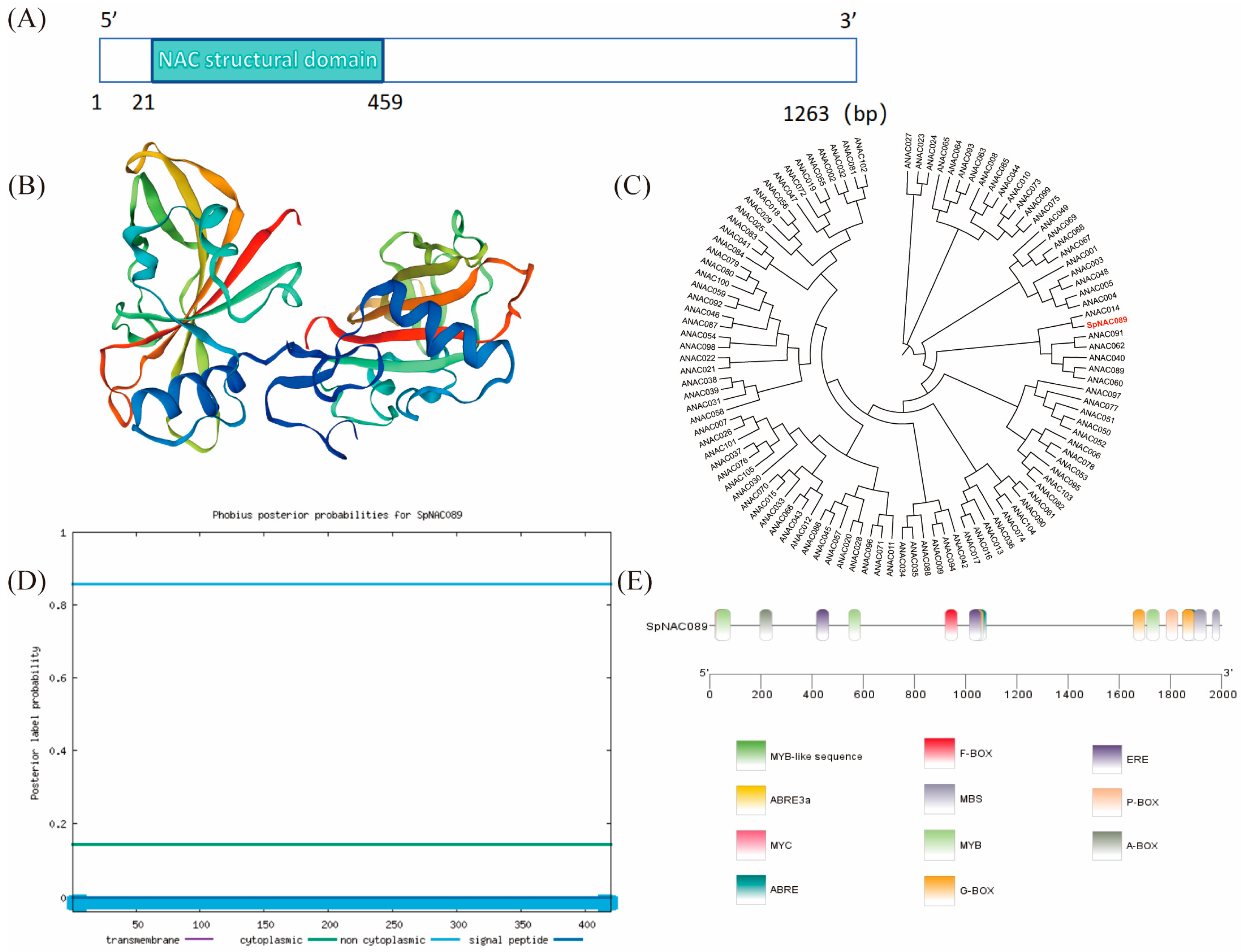
The full-length cDNA of SpNAC089 is 1263 bp, with a 5′-UTR of 87 bp and 3′-UTR of 112 bp, encoding a 420-amino-acid protein with a predicted molecular weight of 46.8 kDa and isoelectric point of 6.28 (Figure 1A,B). Phylogenetic analysis showed that SpNAC089 exhibits high homology with ANAC014, a member of the NAC family from Arabidopsis thaliana. Studies have shown that NAC014 is involved in regulating various abiotic stress [36,39], suggesting that SpNAC089 is likely a key regulator in abiotic stress (Figure 1C). Transmembrane domain prediction via PHOBIUS revealed no transmembrane regions in SpNAC089 (Figure 1D), consistent with its predicted role as a nuclear-localized transcription factor.
Cis-acting element analysis of the 2000 bp SpNAC089 promoter region identified multiple stress-responsive and hormone-responsive elements (Figure 1E): (1) MYB and MYC binding sites (associated with drought, salt, and heavy metal stress responses); (2) abscisic acid (ABA) response elements (ABRE, involved in ABA-mediated stress signaling); (3) salicylic acid (SA) response elements (TCA, linked to ROS homeostasis); and (4) ethylene response elements (ERE, involved in multiple stress responses). These elements suggest that SpNAC089 expression may be regulated by various abiotic stresses and hormone signals, laying the foundation for its role in Cd stress responses.

3.2. SpNAC089 Is Localized in the Nucleus and Has Transcriptional Activation Activity

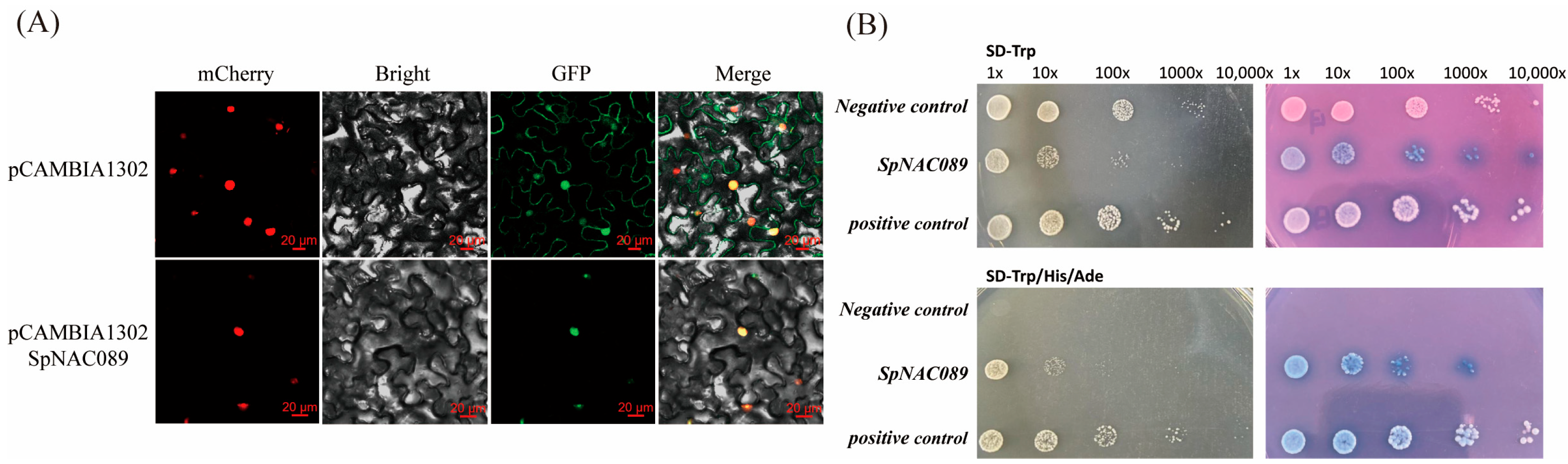
Subcellular localization of SpNAC089 was analyzed via transient expression in N. benthamiana leaves. The GFP signal of the SpNAC089-GFP fusion protein overlapped completely with the nuclear marker (NLS-mCherry) and was not detected in the plasma membrane or cytoplasm (Figure 2A). In contrast, the GFP signal of the empty pCAMBIA1302 vector was distributed throughout the cell. These results confirm that SpNAC089 is exclusively localized in the nucleus, consistent with its function as a transcription factor.
Yeast transcriptional activation assays were performed to test whether SpNAC089 functions as a transcriptional activator. Yeast cells transformed with pGBKT7-SpNAC089 grew normally on SD/-Trp/-His/-Ade medium and turned blue after X-α-gal staining, indicating activation of the His3, Ade2, and LacZ reporter genes (Figure 2B). In contrast, yeast cells transformed with the empty pGBKT7 vector (negative control) did not grow on SD/-Trp/-His/-Ade medium. These results demonstrate that SpNAC089 has intrinsic transcriptional activation activity, a key characteristic of functional transcription factors.

3.3. Generation and Identification of SpNAC089-Overexpressing Transgenic S. alfredii

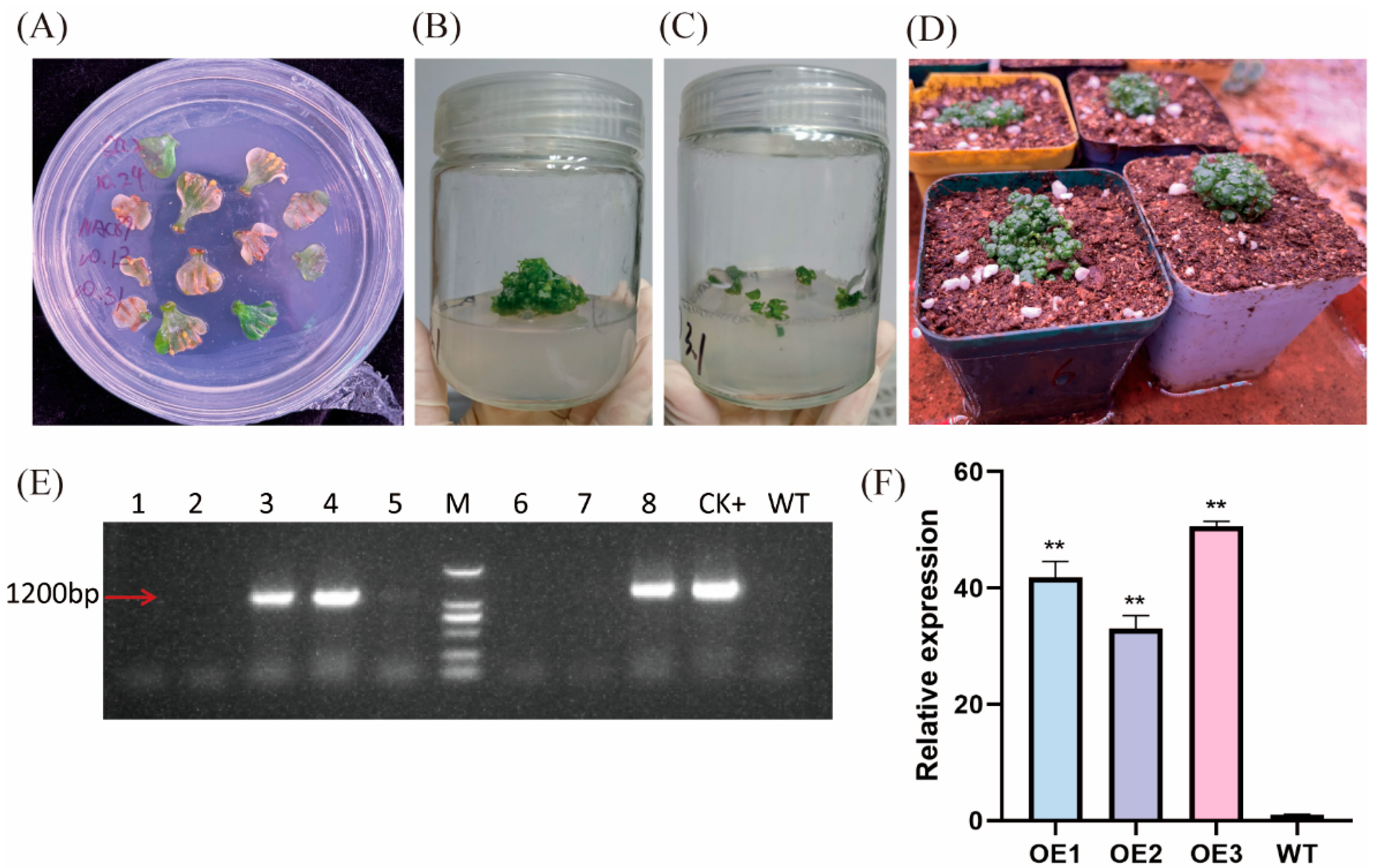
Agrobacterium-mediated transformation of S. plumbizincicola leaf explants yielded 8 putative transgenic lines. Callus induction was observed 2 weeks after explant culture (Figure 3A), shoot differentiation occurred at 4–6 weeks (Figure 3B), and rooting was achieved on 1/2 MS medium after 2 weeks (Figure 3C). Regenerated plants were transferred to the greenhouse and grew normally (Figure 3D). PCR identification using SpNAC089-specific primers showed that 3 lines (OE1, OE2, OE3) were positive—amplifying a 1200 bp target fragment consistent with the positive control (pCAMBIA1300-SpNAC089 plasmid)—while no fragment was amplified in WT plants (Figure 3E). The positive transformation rate was 37.5%, providing sufficient material for subsequent functional analysis. The transcript abundance of SpNAC089 in transgenic lineswas determined by qRT–PCR (Figure 3F). We used the OE1, OE2 and OE3 lines with significantly increased transcript levels to conduct Cd stress experiments.

3.4. Overexpressing of SpNAC089 Enhances Cd Tolerance and Reduces Cd Accumulation

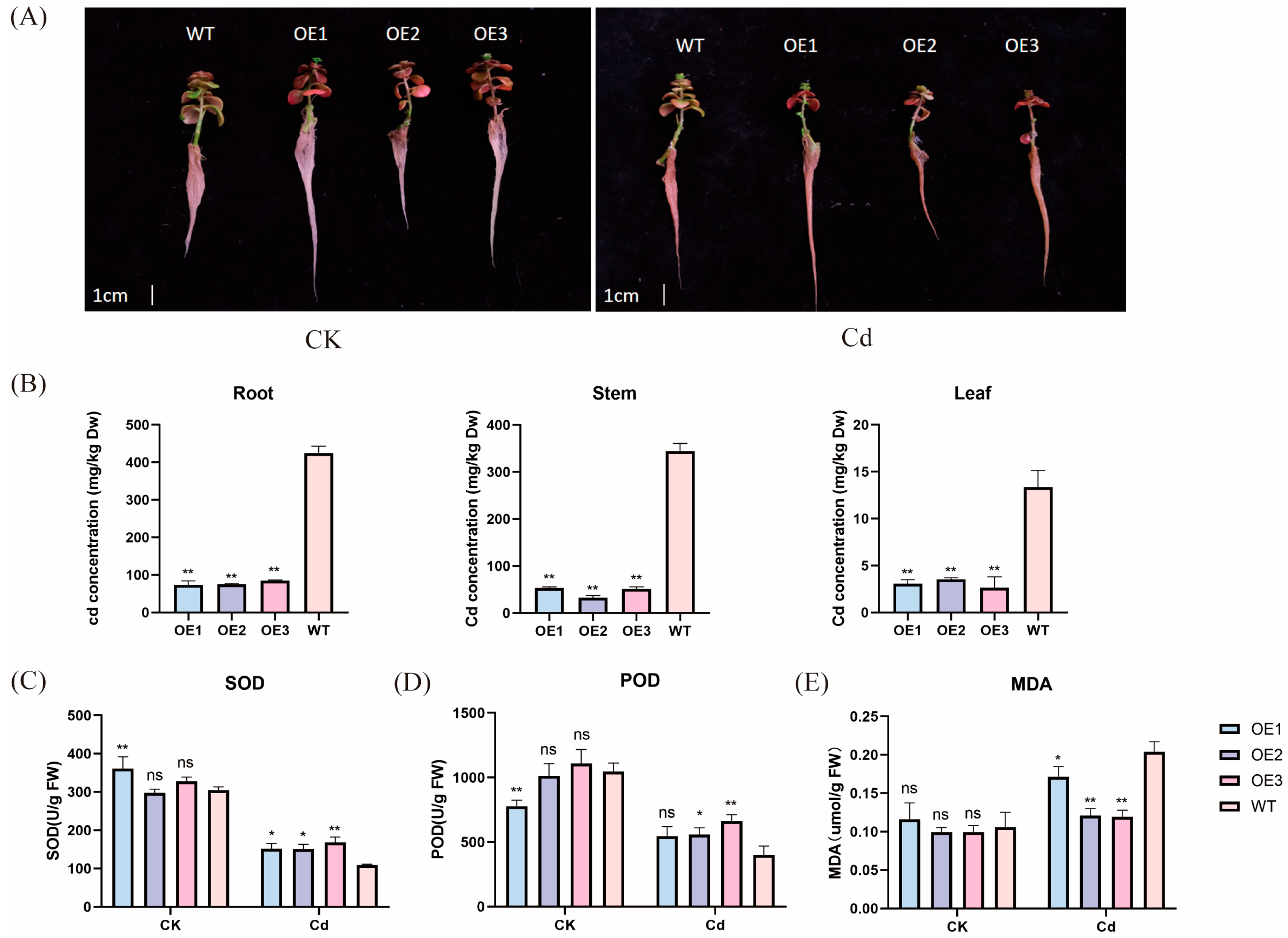
To evaluate the effect of SpNAC089 overexpression on Cd tolerance, wild-type (WT) and SpNAC089-overexpressing transgenic S. alfredii (OE1, OE2, OE3 lines) were treated with 10 μM CdCl2 for 7 days. Under Cd stress, WT plants exhibited obvious toxicity symptoms, including significant leaf yellowing and wilting (Figure 4A). In contrast, none of the OE lines exhibited severe wilting, though their plant size was slightly smaller than that of the WT (Figure 4A). No phenotypic differences were observed between transgenic lines and WT under normal growth conditions (0 μM CdCl2), indicating that SpNAC089 overexpression does not affect the normal growth and development of S. alfredii.
Cd content analysis in different tissues (roots, stems, leaves) revealed a consistent trend: compared with WT, SpNAC089-overexpressing lines accumulated significantly less Cd in all tested organs (Figure 4B). Among the transgenic lines, OE3 showed the most obvious reduction in Cd accumulation, followed by OE1 and OE2, but the overall variation among transgenic lines was small. This result suggests that SpNAC089 overexpression may inhibit Cd uptake or translocation in S. alfredii, thereby reducing Cd-induced toxicity.
Physiological responses to Cd stress further confirmed the enhanced tolerance of transgenic lines. Under normal conditions, the activities of antioxidant enzymes (superoxide dismutase, SOD; peroxidase, POD) and the content of malondialdehyde (MDA, an indicator of lipid peroxidation) showed no significant differences between transgenic lines and WT (Figure 4C–E). After Cd treatment, all plants exhibited decreased SOD and POD activities and increased MDA content—typical physiological changes under Cd-induced oxidative stress. However, SpNAC089-overexpressing lines maintained significantly higher SOD and POD activities than WT, while their MDA content was notably lower (Figure 4C–E). Among the transgenic lines, OE3 showed the highest antioxidant enzyme activities and the lowest MDA content, which was consistent with its optimal growth performance under Cd stress. These results indicate that overexpression of SpNAC089 enhances the antioxidant capacity of S. alfredii, reduces Cd-induced oxidative damage to cell membranes, and thereby improves Cd tolerance.

3.5. SpNAC089 Directly Binds to SpREFl Promoter and Activates Its Transcription

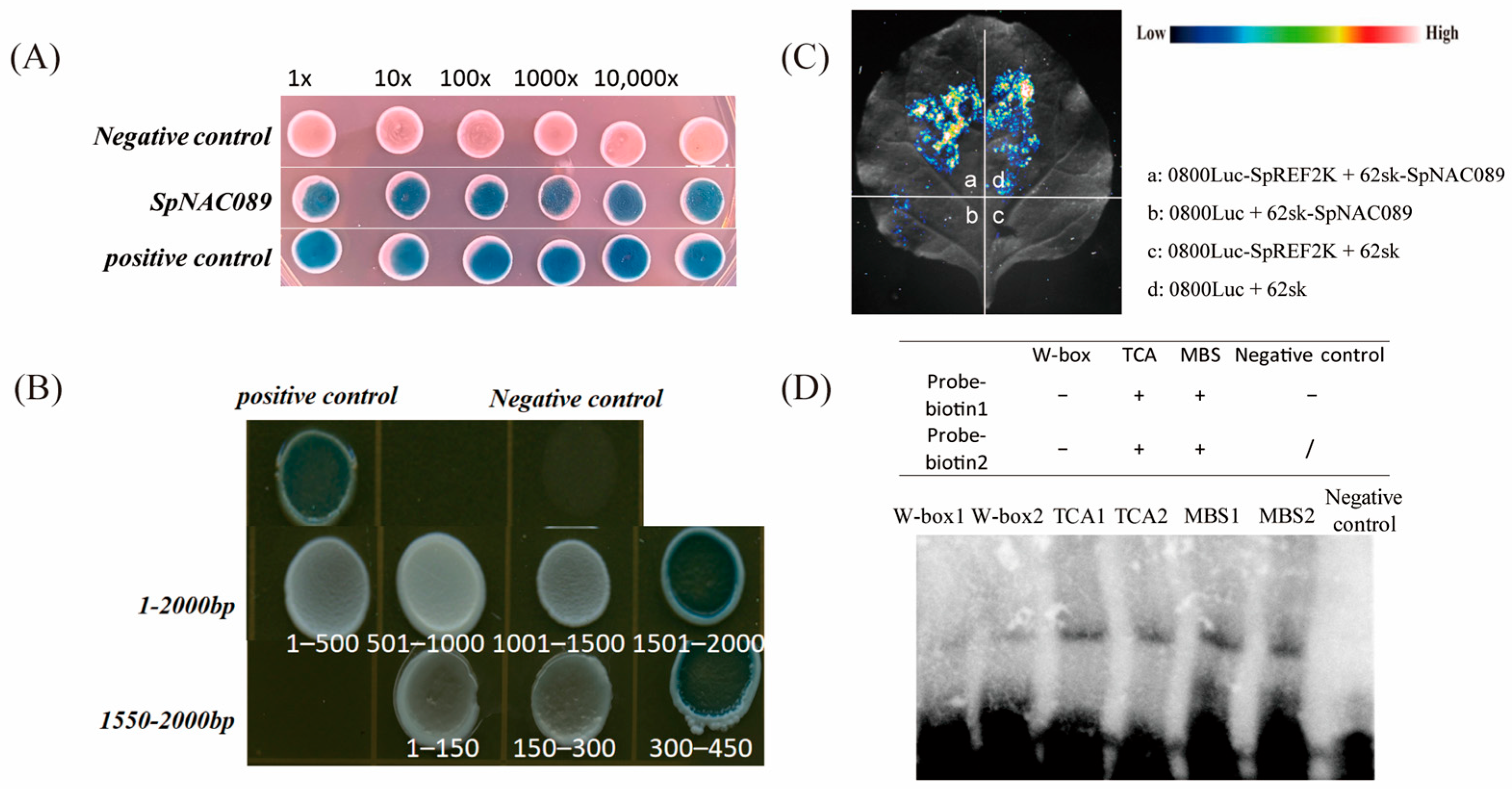
Yeast one-hybrid assays were performed to verify the binding of SpNAC089 to the SpREFl promoter. Yeast cells co-transformed with pb42AD-SpNAC089 and pLacZi-SpREFl 2k (2000 bp promoter) grew on SD/-Trp/-Ura medium and turned blue on SD/-Trp/-Ura/X-gal medium, while cells co-transformed with the empty pb42AD vector and pLacZi-SpREFl 2k did not (Figure 5A), indicating that SpNAC089 specifically binds to the SpREFl promoter.
To localize the binding site, truncated SpREFl promoter fragments were used in yeast one-hybrid assays. Only yeast cells co-transformed with pb42AD-SpNAC089 and pLacZi-SpREFl 1501–2000 bp grew and turned blue (Figure 5B), narrowing the binding region to 1501–2000 bp. Further subdivision into 1501–1650 bp, 1651–1800 bp, and 1801–1950 bp showed that only the 1801–1950 bp fragment mediated binding—confirming this segment as the core binding region of SpNAC089.
Luciferase complementation assays in N. benthamiana leaves showed that co-expression of 62sk-SpNAC089 (effector) and 0800Luc-SpREFl 2k (reporter) resulted in significantly stronger luciferase activity compared to control combinations (0800Luc + 62sk-SpNAC089, 0800Luc-SpREFl 2k + 62sk, 0800Luc + 62sk) (Figure 5C), demonstrating that SpNAC089 activates SpREFl transcription.
EMSA was performed to confirm direct binding of SpNAC089 to the SpREFl promoter. Purified GST-SpNAC089 formed a DNA-protein complex with the biotin-labeled 1801–1950 bp probe (Figure 5D), and this complex was competitively inhibited by excess unlabeled probe—indicating specific binding. Cis-acting element analysis of the 1801–1950 bp region identified two MBS motifs (MYB binding sites) and one TCA motif (SA response element), suggesting that SpNAC089 binds to these elements to regulate SpREFl expression.

4. Discussion

4.1. SpNAC089 Enhances Cd Tolerance by Regulating Antioxidant Capacity and Cd Accumulation

NAC transcription factors are core regulators of plant abiotic stress responses, with well-documented roles in drought, salt, and heavy metal stress [23,24,25]. For example, soybean GmNAC20 and GmNAC11 enhance drought tolerance by activating ABA-responsive genes [37]; rice OsNAC5 improves salt tolerance via interaction with bZIP transcription factors [38]; maize ZmNAC55 mediates drought response by activating SnRK2-dependent ABA signaling [40]. In this study, we identified SpNAC089, a novel NAC transcription factor from S. plumbizincicola, that enhances Cd tolerance when overexpressed—consistent with the functional diversity of NAC family members.
Cd stress induces excessive ROS production, leading to oxidative damage to lipids, proteins, and nucleic acids [41,42]. Plants mitigate this damage via antioxidant enzymes (SOD, POD, CAT) and non-enzymatic antioxidants (ascorbate, glutathione) [17]. For instance, high Cd-accumulating willow genotypes maintain higher SOD and POD activities under Cd stress [43]; cotton GhHSP70-26-overexpressing tobacco enhances drought tolerance by increasing antioxidant enzyme activity [44]. In our study, SpNAC089-overexpressing S. plumbizincicola showed significantly higher SOD and POD activities and lower MDA content under Cd stress (Figure 4C–E), indicating that SpNAC089 enhances Cd tolerance by improving ROS scavenging capacity and reducing lipid peroxidation. This aligns with our previous finding that SpREFl overexpression also enhances antioxidant capacity [33], suggesting a coordinated regulatory role of the SpNAC089-SpREFl pathway in maintaining redox balance. Interestingly, under Cd stress, the OE lines exhibited smaller plant size. In contrast, although WT were slightly larger, they suffered severe oxidative damage accompanied by leaf yellowing and wilting. This may indicate a resource allocation trade-off strategy of plants in response to cadmium stress: The overexpression of SpNAC089 appropriately reduces the energy input for vegetative growth in the OE lines, reallocating more intracellular energy and metabolic substances to the synthesis of antioxidant enzymes and the regulation of cadmium-stress-related genes. This maximizes the plant’s resistance to cadmium-induced oxidative damage.
Notably, SpNAC089-overexpressing lines accumulated less Cd in roots, stems, and leaves compared to WT (Figure 4B). Reduced Cd accumulation is a common strategy for plants to alleviate Cd toxicity—for example, rice OsABCG36 enhances Cd tolerance by effluxing Cd from root cells [45]; Arabidopsis AtABCG36 reduces Cd accumulation via plasma membrane-localized Cd extrusion [46,47]. In this study, the phenotype of “enhanced cadmium tolerance + reduced cadmium accumulation” may represent an adaptive mechanism regulated by SpNAC089 in S. plumbizincicola. This mechanism enables plants to grow more stably in highly Cd-polluted environments (enhanced tolerance) while precisely regulating cadmium accumulation to prevent self-damage caused by excessive uptake. This provides a superior genetic improvement direction for phytoremediation applications. We hypothesize that SpNAC089 may regulate Cd transporters (e.g., NRAMPs, ABC transporters) to inhibit Cd uptake or enhance Cd efflux. Future studies should identify SpNAC089-regulated transporters to clarify the mechanism of reduced Cd accumulation.

4.2. SpNAC089 Directly Regulates SpREFl Expression via Binding to MBS and TCA Elements

Transcription factors exert their functions by binding to specific cis-acting elements in target gene promoters [48]. For example, cowpea NAC1/NAC2 bind to drought-responsive elements in target promoters to enhance stress tolerance [49]; Arabidopsis MYB75 binds to ACBP2/ABCC2 promoters to improve Cd tolerance [50]; tobacco NtbHLH123 regulates NtCBF expression via G-box/E-box motifs [51]. In this study, we confirmed that SpNAC089 directly binds to the 1801–1950 bp region of the SpREFl promoter and activates its transcription (Figure 5)—establishing a direct regulatory relationship between SpNAC089 and SpREFl.
Cis-acting element analysis identified MBS and TCA motifs in the SpREFl promoter’s 1801–1950 bp region. MBS motifs are recognized by MYB transcription factors and are involved in drought stress response [52]; TCA motifs mediate SA response and are linked to ROS homeostasis [53]. The binding of SpNAC089 to these elements suggests cross-talk between Cd stress, drought stress, and SA signaling. SA has been shown to enhance Cd tolerance by regulating antioxidant enzymes and PC synthesis [54]; thus, SpNAC089 may integrate SA signaling to modulate SpREFl expression and Cd tolerance. Future studies should investigate whether SA affects the SpNAC089-SpREFl pathway and Cd tolerance in S. plumbizincicola.
Our findings also expand the functional diversity of REF family genes. Traditionally, REF genes were thought to be involved in rubber synthesis [35], but our previous work showed that SpREFl enhances Cd tolerance [35], and this study confirms that SpREFl is transcriptionally regulated by SpNAC089. This highlights the role of REF genes in heavy metal stress response, beyond their classical function in rubber biosynthesis.

5. Conclusions

In this study, we systematically characterized the function and regulatory mechanism of SpNAC089 in S. plumbizincicola Cd tolerance. SpNAC089 is a nuclear-localized NAC transcription factor with intrinsic transcriptional activation activity. Overexpression of SpNAC089 enhances Cd tolerance in S. alfredii by improving antioxidant capacity (increased SOD and POD activities) and reducing Cd accumulation. Mechanistically, SpNAC089 directly binds to the 1801–1950 bp region of the SpREFl promoter (containing MBS and TCA elements) and activates its transcription, forming a novel SpNAC089-SpREFl regulatory pathway. These findings deepen our understanding of the molecular mechanisms underlying Cd tolerance in S. plumbizincicola and provide a candidate gene (SpNAC089) for genetic engineering to improve phytoremediation efficiency of Cd-contaminated soils. Future research should focus on identifying upstream regulators of SpNAC089 and downstream targets of SpREFl to fully elucidate the Cd tolerance regulatory network in S. plumbizincicola.

Supplementary Materials

The following supporting information can be downloaded at: https://www.mdpi.com/article/10.3390/horticulturae12030366/s1, Supplementary Table S1: The primer sequences used in this study.

Author Contributions

Conceptualization, R.H. and W.Q.; Methodology, C.Z. and T.J.; Software, T.J.; Formal analysis, R.H.; Data curation, C.Z.; Writing—original draft, R.H.; Writing—review & editing, W.Q. and Z.H.; Visualization, T.J.; Supervision, Z.H. (Corresponding Author). and W.Q. (Corresponding Author); Project administration, R.Z.; Funding acquisition, W.Q. All authors have read and agreed to the published version of the manuscript.

Funding

This work was supported by the Biosafety and Genetic Resource Management Project (No. KJZXSA202402) and the National Nonprofit Institute Research Grant of CAF (No. RISF2021YZ01 and RISFZ-2021-01).

Data Availability Statement

The original contributions presented in the study are included in the article/Supplementary Material, further inquiries can be directed to the corresponding author.

Conflicts of Interest

The authors declare no conflicts of interest.

References

  1. Duan, Q.; Lee, J.; Liu, Y.; Chen, H.; Hu, H. Distribution of Heavy Metal Pollution in Surface Soil Samples in China: A Graphical Review. Bull. Environ. Contam. Toxicol. 2016, 97, 303–309. [Google Scholar] [CrossRef]
  2. Sodango, T.H.; Li, X.; Sha, J.; Bao, Z. Review of the Spatial Distribution, Source and Extent of Heavy Metal Pollution of Soil in China: Impacts and Mitigation Approaches. J. Health Pollut. 2018, 8, 53–70. [Google Scholar] [CrossRef]
  3. Ali, H.; Khan, E. Trophic Transfer, Bioaccumulation, and Biomagnification of Non-Essential Hazardous Heavy Metals and Metalloids in Food Chains/Webs—Concepts and Implications for Wildlife and Human Health. Hum. Ecol. Risk Assess. Int. J. 2019, 25, 1353–1376. [Google Scholar] [CrossRef]
  4. Tripathi, D.K.; Singh, S.; Singh, S.; Mishra, S.; Chauhan, D.K.; Dubey, N.K. Micronutrients and Their Diverse Role in Agricultural Crops: Advances and Future Prospective. Acta Physiol. Plant 2015, 37, 139. [Google Scholar] [CrossRef]
  5. Huamain, C.; Chunrong, Z.; Cong, T.; Yongguan, Z. Heavy Metal Pollution in Soils in China: Status and Countermeasures. Ambio 1999, 28, 130–134. [Google Scholar]
  6. Yang, Q.; Li, Z.; Lu, X.; Duan, Q.; Huang, L.; Bi, J. A Review of Soil Heavy Metal Pollution from Industrial and Agricultural Regions in China: Pollution and Risk Assessment. Sci. Total Environ. 2018, 642, 690–700. [Google Scholar] [CrossRef] [PubMed]
  7. Haider, F.U.; Liqun, C.; Coulter, J.A.; Cheema, S.A.; Wu, J.; Zhang, R.; Wenjun, M.; Farooq, M. Cadmium Toxicity in Plants: Impacts and Remediation Strategies. Ecotoxicol. Environ. Saf. 2021, 211, 111887. [Google Scholar] [CrossRef]
  8. Ismael, M.A.; Elyamine, A.M.; Moussa, M.G.; Cai, M.; Zhao, X.; Hu, C. Cadmium in Plants: Uptake, Toxicity, and Its Interactions with Selenium Fertilizers. Metallomics 2019, 11, 255–277. [Google Scholar] [CrossRef]
  9. Zhang, C.; Zha, Y.; Guang, P.; Ai, F.; Yin, Y.; Guo, H. Synergistic Effects of Tree-Herb Intercropping on the Phytoremediation Efficiency of Cadmium and Lead Contaminated Soil. Sci. Total Environ. 2024, 954, 176709. [Google Scholar] [CrossRef] [PubMed]
  10. Oubohssaine, M.; Dahmani, I. Phytoremediation: Harnessing Plant Power and Innovative Technologies for Effective Soil Remediation. Plant Stress 2024, 14, 100578. [Google Scholar] [CrossRef]
  11. Li, S.; He, Z.; Qiu, W.; Yu, M.; Wu, L.; Han, X.; Zhuo, R. SpCTP3 from the Hyperaccumulator Sedum plumbizincicola Positively Regulates Cadmium Tolerance by Interacting with SpMDH1. J. Hazard. Mater. 2024, 472, 134517. [Google Scholar] [CrossRef]
  12. Wu, L.; Li, Z.; Akahane, I.; Liu, L.; Han, C.; Makino, T.; Luo, Y.; Christie, P. Effects of Organic Amendments on Cd, Zn and Cu Bioavailability in Soil with Repeated Phytoremediation by Sedum plumbizincicola. Int. J. Phytoremediat. 2012, 14, 1024–1038. [Google Scholar] [CrossRef] [PubMed]
  13. Pu, R.; Hu, G.; Jiang, Q.; Zhou, W.; Zhao, B.; Xia, C.; Hu, J.; Xiang, W.; Liu, M.; Deng, H.; et al. SpHMA3: A Genetic Boost for Cadmium Tolerance and Bioremediation in Arabidopsis Thaliana and Zea Mays. Int. J. Mol. Sci. 2025, 26, 3487. [Google Scholar] [CrossRef]
  14. Yang, X.; Long, X.; Ni, W.; Fu, C. Sedum Alfredii H: A New Zn Hyperaccumulating Plant First Found in China. Chin. Sci. Bull. 2002, 47, 1634–1637. [Google Scholar] [CrossRef]
  15. Wu, H.; Chen, C.; Du, J.; Liu, H.; Cui, Y.; Zhang, Y.; He, Y.; Wang, Y.; Chu, C.; Feng, Z.; et al. Co-Overexpression FIT with AtbHLH38 or AtbHLH39 in Arabidopsis-Enhanced Cadmium Tolerance via Increased Cadmium Sequestration in Roots and Improved Iron Homeostasis of Shoots. Plant Physiol. 2012, 158, 790–800. [Google Scholar] [CrossRef]
  16. Tian, S.; Xie, R.; Wang, H.; Hu, Y.; Hou, D.; Liao, X.; Brown, P.H.; Yang, H.; Lin, X.; Labavitch, J.M.; et al. Uptake, Sequestration and Tolerance of Cadmium at Cellular Levels in the Hyperaccumulator Plant Species Sedum Alfredii. J. Exp. Bot. 2017, 68, 2387–2398. [Google Scholar] [CrossRef] [PubMed]
  17. Song, J.; Sun, Z.; Saud, S.; Fahad, S.; Nawaz, T. Exploring the Deleterious Effects of Heavy Metal Cadmium on Antioxidant Defense and Photosynthetic Pathways in Higher Plants. Plant Stress 2025, 15, 100716. [Google Scholar] [CrossRef]
  18. Lebrun, M.; Michel, C.; Joulian, C.; Morabito, D.; Bourgerie, S. Rehabilitation of Mine Soils by Phytostabilization: Does Soil Inoculation with Microbial Consortia Stimulate Agrostis Growth and Metal(Loid) Immobilization? Sci. Total Environ. 2021, 791, 148400. [Google Scholar] [CrossRef]
  19. Robinson, K.A.; Koepke, J.I.; Kharodawala, M.; Lopes, J.M. A Network of Yeast Basic Helix-Loop-Helix Interactions. Nucleic Acids Res. 2000, 28, 4460–4466. [Google Scholar] [CrossRef]
  20. Cai, H.; Huang, S.; Che, J.; Yamaji, N.; Ma, J.F. The Tonoplast-Localized Transporter OsHMA3 Plays an Important Role in Maintaining Zn Homeostasis in Rice. J. Exp. Bot. 2019, 70, 2717–2725. [Google Scholar] [CrossRef] [PubMed]
  21. Li, F.; Deng, Y.; Liu, Y.; Mai, C.; Xu, Y.; Wu, J.; Zheng, X.; Liang, C.; Wang, J. Arabidopsis Transcription Factor WRKY45 Confers Cadmium Tolerance via Activating PCS1 and PCS2 Expression. J. Hazard. Mater. 2023, 460, 132496. [Google Scholar] [CrossRef] [PubMed]
  22. Luo, Z.-B.; He, J.; Polle, A.; Rennenberg, H. Heavy Metal Accumulation and Signal Transduction in Herbaceous and Woody Plants: Paving the Way for Enhancing Phytoremediation Efficiency. Biotechnol. Adv. 2016, 34, 1131–1148. [Google Scholar] [CrossRef]
  23. Shu, L.; Li, L.; Jiang, Y.-Q.; Yan, J. Advances in Membrane-Tethered NAC Transcription Factors in Plants. Plant Sci. 2024, 342, 112034. [Google Scholar] [CrossRef]
  24. Ernst, H.A.; Nina Olsen, A.; Skriver, K.; Larsen, S.; Lo Leggio, L. Structure of the Conserved Domain of ANAC, a Member of the NAC Family of Transcription Factors. EMBO Rep. 2004, 5, 297–303. [Google Scholar] [CrossRef] [PubMed]
  25. Mendoza-Almanza, B.; Guerrero-González, M.d.l.L.; Loredo-Tovias, M.; García-Arreola, M.E.; Loredo-Osti, C.; Padilla-Ortega, E.; Delgado-Sánchez, P. AsNAC Genes: Response to High Mercury Concentrations in Allium Sativum Seed Clove. BioTech 2025, 14, 27. [Google Scholar] [CrossRef]
  26. Wang, H.; Qin, L.; Feng, C.; Wu, M.; Zhong, H.; Liu, J.; Wu, Q.; Que, Y. Pathogen Resistance Was Negatively Regulated by the NAC Transcription Factor ScATAF1 in Sugarcane. Plant Physiol. Biochem. 2024, 213, 108828. [Google Scholar] [CrossRef]
  27. An, J.-P.; Li, R.; Qu, F.-J.; You, C.-X.; Wang, X.-F.; Hao, Y.-J. An Apple NAC Transcription Factor Negatively Regulates Cold Tolerance via CBF-Dependent Pathway. J. Plant Physiol. 2018, 221, 74–80. [Google Scholar] [CrossRef]
  28. Lee, D.; Chung, P.J.; Jeong, J.S.; Jang, G.; Bang, S.W.; Jung, H.; Kim, Y.S.; Ha, S.; Choi, Y.D.; Kim, J. The Rice Os NAC 6 Transcription Factor Orchestrates Multiple Molecular Mechanisms Involving Root Structural Adaptions and Nicotianamine Biosynthesis for Drought Tolerance. Plant Biotechnol. J. 2017, 15, 754–764. [Google Scholar] [CrossRef] [PubMed]
  29. Hu, S. Rice Transcription Factors OsHSFl, OsMYB45, and OsNAC300 Are Involved in the Regulation of Cd Tolerance. Ph.D. Thesis, Nanjing Agricultural University, Nanjing, China, 2017. [Google Scholar] [CrossRef]
  30. Zhang, M. Mechanism Analysis of Cadmium Tolerance in Rice Transcription Factor OsNAC3. Master’s Thesis, Nanjing Agricultural University, Nanjing, China, 2021. Available online: https://link.cnki.net/doi/10.27244/d.cnki.gnjnu.2021.000483 (accessed on 12 March 2026).
  31. Wang, X.; Chen, K.; Zhou, M.; Gao, Y.; Huang, H.; Liu, C.; Fan, Y.; Fan, Z.; Wang, Y.; Li, X. GmNAC181 Promotes Symbiotic Nodulation and Salt Tolerance of Nodulation by Directly Regulating GmNINa Expression in Soybean. N. Phytol. 2022, 236, 656–670. [Google Scholar] [CrossRef] [PubMed]
  32. Guo, Y.; Pang, C.; Jia, X.; Ma, Q.; Dou, L.; Zhao, F.; Gu, L.; Wei, H.; Wang, H.; Fan, S.; et al. An NAM Domain Gene, GhNAC79, Improves Resistance to Drought Stress in Upland Cotton. Front. Plant Sci. 2017, 8, 1657. [Google Scholar] [CrossRef]
  33. Zhang, L.; Zhang, L.; Xia, C.; Zhao, G.; Jia, J.; Kong, X. The Novel Wheat Transcription Factor TaNAC47 Enhances Multiple Abiotic Stress Tolerances in Transgenic Plants. Front. Plant Sci. 2016, 6, 1174. [Google Scholar] [CrossRef] [PubMed]
  34. Luo, X.; Jiang, X.; Schmitt, V.; Kulkarni, S.R.; Tran, H.C.; Kacprzak, S.M.; Van Breusegem, F.; Van Aken, O.; Vandepoele, K.; De Clercq, I. ANAC102 Predominantly Expresses a Nuclear Protein and Acts as a Negative Regulator of Methyl Viologen-Induced Retrograde Signaling. J. Exp. Bot. 2024, 75, 4655–4670. [Google Scholar] [CrossRef]
  35. Huang, Q. SpREFl Gene Participates in the Regulation Mechanism of Cadmium Resistance in Mineral-Associated Sedum; Anhui Normal University: Wuhu, China, 2022. [Google Scholar]
  36. Wu, Z.; Li, T.; Xiang, J.; Teng, R.; Zhang, D.; Teng, N. A Lily Membrane-Associated NAC Transcription Factor LlNAC014 Is Involved in Thermotolerance via Activation of the DREB2-HSFA3 Module. J. Exp. Bot. 2023, 74, 945–963. [Google Scholar] [CrossRef]
  37. Hao, Y.-J.; Wei, W.; Song, Q.-X.; Chen, H.-W.; Zhang, Y.-Q.; Wang, F.; Zou, H.-F.; Lei, G.; Tian, A.-G.; Zhang, W.-K.; et al. Soybean NAC Transcription Factors Promote Abiotic Stress Tolerance and Lateral Root Formation in Transgenic Plants. Plant J. 2011, 68, 302–313. [Google Scholar] [CrossRef] [PubMed]
  38. Li, R.; Song, Y.; Wang, X.; Zheng, C.; Liu, B.; Zhang, H.; Ke, J.; Wu, X.; Wu, L.; Yang, R.; et al. OsNAC5 Orchestrates OsABI5 to Fine-tune Cold Tolerance in Rice. J. Integr. Plant Biol. 2024, 66, 660–682. [Google Scholar] [CrossRef] [PubMed]
  39. Shengcai, L.; Tianliu, H.; Yingxiao, H.; Weijia, L.; Mengbo, Y.; Rui, Z.; Ning, L. CaNAC014 Transcription Factor Enhances Salt Stress Tolerance in Pepper by Regulating the Activity of the CaSOS1 Promoter. Plant Stress 2025, 18, 101025. [Google Scholar] [CrossRef]
  40. Mao, H.; Yu, L.; Han, R.; Li, Z.; Liu, H. ZmNAC55, a Maize Stress-Responsive NAC Transcription Factor, Confers Drought Resistance in Transgenic Arabidopsis. Plant Physiol. Biochem. 2016, 105, 55–66. [Google Scholar] [CrossRef] [PubMed]
  41. Smeets, K.; Opdenakker, K.; Remans, T.; Van Sanden, S.; Van Belleghem, F.; Semane, B.; Horemans, N.; Guisez, Y.; Vangronsveld, J.; Cuypers, A. Oxidative Stress-Related Responses at Transcriptional and Enzymatic Levels after Exposure to Cd or Cu in a Multipollution Context. J. Plant Physiol. 2009, 166, 1982–1992. [Google Scholar] [CrossRef] [PubMed]
  42. Gill, S.S.; Tuteja, N. Cadmium Stress Tolerance in Crop Plants: Probing the Role of Sulfur. Plant Signal Behav. 2011, 6, 215–222. [Google Scholar] [CrossRef]
  43. Han, X.; Zhang, Y.; Yu, M.; Zhang, J.; Xu, D.; Lu, Z.; Qiao, G.; Qiu, W.; Zhuo, R. Transporters and Ascorbate-Glutathione Metabolism for Differential Cadmium Accumulation and Tolerance in Two Contrasting Willow Genotypes. Tree Physiol. 2020, 40, 1126–1142. [Google Scholar] [CrossRef]
  44. Ni, Z.; Liu, N.; Yu, Y.; Bi, C.; Chen, Q.; Qu, Y. The Cotton 70-kDa Heat Shock Protein GhHSP70-26 Plays a Positive Role in the Drought Stress Response. Environ. Exp. Bot. 2021, 191, 104628. [Google Scholar] [CrossRef]
  45. Fu, S.; Lu, Y.; Zhang, X.; Yang, G.; Chao, D.; Wang, Z.; Shi, M.; Chen, J.; Chao, D.-Y.; Li, R.; et al. The ABC Transporter ABCG36 Is Required for Cadmium Tolerance in Rice. J. Exp. Bot. 2019, 70, 5909–5918. [Google Scholar] [CrossRef]
  46. Kim, D.; Bovet, L.; Maeshima, M.; Martinoia, E.; Lee, Y. The ABC Transporter AtPDR8 Is a Cadmium Extrusion Pump Conferring Heavy Metal Resistance. Plant J. 2007, 50, 207–218. [Google Scholar] [CrossRef] [PubMed]
  47. Kobae, Y.; Sekino, T.; Yoshioka, H.; Nakagawa, T.; Martinoia, E.; Maeshima, M. Loss of AtPDR8, a Plasma Membrane ABC Transporter of Arabidopsis Thaliana, Causes Hypersensitive Cell Death upon Pathogen Infection. Plant Cell Physiol. 2006, 47, 309–318. [Google Scholar] [CrossRef]
  48. Chen, Y.; Xia, P. NAC Transcription Factors as Biological Macromolecules Responded to Abiotic Stress: A Comprehensive Review. Int. J. Biol. Macromol. 2025, 308, 142400. [Google Scholar] [CrossRef]
  49. Srivastava, R.; Kobayashi, Y.; Koyama, H.; Sahoo, L. Cowpea NAC1/NAC2 Transcription Factors Improve Growth and Tolerance to Drought and Heat in Transgenic Cowpea through Combined Activation of Photosynthetic and Antioxidant Mechanisms. J. Integr. Plant Biol. 2023, 65, 25–44. [Google Scholar] [CrossRef]
  50. Zheng, T.; Lu, X.; Yang, F.; Zhang, D. Synergetic Modulation of Plant Cadmium Tolerance via MYB75-Mediated ROS Homeostasis and Transcriptional Regulation. Plant Cell Rep. 2022, 41, 1515–1530. [Google Scholar] [CrossRef]
  51. Zhao, Q.; Xiang, X.; Liu, D.; Yang, A.; Wang, Y. Tobacco Transcription Factor NtbHLH123 Confers Tolerance to Cold Stress by Regulating the NtCBF Pathway and Reactive Oxygen Species Homeostasis. Front. Plant Sci. 2018, 9, 381. [Google Scholar] [CrossRef] [PubMed]
  52. Jiang, H.; Zhou, L.-J.; Gao, H.-N.; Wang, X.-F.; Li, Z.-W.; Li, Y.-Y. The Transcription Factor MdMYB2 Influences Cold Tolerance and Anthocyanin Accumulation by Activating SUMO E3 Ligase MdSIZ1 in Apple. Plant Physiol. 2022, 189, 2044–2060. [Google Scholar] [CrossRef]
  53. Yuan, X.; Wang, H.; Cai, J.; Bi, Y.; Li, D.; Song, F. Rice NAC Transcription Factor ONAC066 Functions as a Positive Regulator of Drought and Oxidative Stress Response. BMC Plant Biol. 2019, 19, 278. [Google Scholar] [CrossRef]
  54. Waheed, A.; Zhang, Q.; Xu, H.; Dou, H.; Muhammad, M.; Aili, A.; Alshaharni, M.O. Mitigation of Cadmium Stress by Salicylic Acid: Physiological and Biochemical Responses in NM-2006, NM-92, and Mash-88 Mung Bean Varieties. J. Hazard. Mater. 2025, 485, 136878. [Google Scholar] [CrossRef]
Figure 1. Sequence and structural analysis of SpNAC089. (A) Full-length cDNA sequence of SpNAC089 (1263 bp); the open reading frame (ORF) is highlighted in bold. (B) AlphaFold-predicted 3D structure of SpNAC089; different colors indicate different degrees of sequence diversity. (C) Phylogenetic tree of SpNAC089 and NAC family members from Arabidopsis thaliana (At) and Sedum plumbizincicola (Sp); bootstrap values (1000 replicates) are shown at branch nodes; SpNAC089 is marked marked in red. (D) Transmembrane domain prediction of SpNAC089; the x-axis represents amino acid position (1–420 aa), and the y-axis represents the probability of being a transmembrane region (values < 0.5 indicate no transmembrane domain). (E) Cis-acting elements in the SpNAC089 promoter region (2000 bp upstream of the ATG start codon); different colored blocks represent different element types: red = stress response (MYB/MYC binding sites), blue = hormone response (ABRE/TCA/ERE), green = growth regulation; the x-axis represents promoter length (bp), and the y-axis lists element names.
Horticulturae 12 00366 g001
Figure 2. Subcellular localization and transcriptional activation activity of SpNAC089. (A) Subcellular localization in Nicotiana benthamiana leaves; SpNAC089-GFP signal (green) colocalizes with the nuclear marker NLS-mCherry (red); empty pCAMBIA1302-GFP is used as a control (signal distributed throughout the cell); left to right: mCherry: the nuclear marker used in this study is NLS-mCherry, which signals red fluorescence; Bright: bright-field image; GFP: GFP signal; Merge: overlay of fluorescence image and bright-field image, signals yellow fluorescence; scale bar = 20 μm. (B) Transcriptional activation activity in yeast strain Y2HGold; yeast cells transformed with pGBKT7-SpNAC089 grow on SD/-Trp/-His/-Ade medium and turn blue with X-α-gal staining, while cells transformed with the empty pGBKT7 vector (negative control) do not grow; 1×, 10×, 100×, 1000×, 10,000× indicate serial dilutions of yeast cell.
Horticulturae 12 00366 g002
Figure 3. Generation and identification of SpNAC089-overexpressing transgenic S. alfredii. (A) Callus induction from leaf explants. (B) Shoot differentiation from callus. (C) Rooting of transgenic seedlings. (D) Transgenic plants grown in the greenhouse. (E) PCR identification of transgenic lines; M: DNA marker 2000; 1–8: putative transgenic lines; CK+: positive control (pCAMBIA1300-SpNAC089 plasmid); WT: wild type; the target band size is 1200 bp. (F) Transcript levels of SpNAC089 in transgenic and WT lines. WT: wild type; OE1, OE2, OE3: SpNAC089-overexpressing transgenic lines; Data are presented as mean ± SD (n = 3); ** p < 0.01 (Duncan’s multiple range test).
Horticulturae 12 00366 g003
Figure 4. Cd tolerance and physiological responses of SpNAC089-overexpressing transgenic S. alfredii. (A) Phenotypes of WT and transgenic lines under Cd stress; CK: 0 μM CdCl2 (7 days); Cd: 10 μM CdCl2 (7 days); scale bar = 1 cm; WT: wild type; OE1, OE2, OE3: SpNAC089-overexpressing transgenic lines. (B) Cd content in roots, stems, and leaves of WT and transgenic lines; (C) SOD activity; (D) POD activity; (E) MDA content. Data are presented as mean ± SD (n = 3); * p < 0.05, ** p < 0.01, ns: not significant (Duncan’s multiple range test).
Horticulturae 12 00366 g004
Figure 5. SpNAC089 directly binds to the SpREFl promoter and activates its transcription. (A) Yeast one-hybrid assay showing binding of SpNAC089 to the 2000 bp SpREFl promoter; yeast cells co-transformed with pb42AD-SpNAC089 and pLacZi-SpREFl 2k grow on SD/-Trp/-Ura medium and turn blue on SD/-Trp/-Ura/X-gal medium; 1×, 10×, 100×, 1000×, 10,000× indicate serial dilutions. (B) Truncated promoter analysis localizing the binding site to the 1801–1950 bp region; only the 1501–2000 bp and 1801–1950 bp fragments support blue colony formation. (C) Luciferase complementation assay; a: 0800Luc-SpREFl 2k + 62sk-SpNAC089, b: 0800Luc + 62sk-SpNAC089, c: 0800Luc-SpREFl 2k + 62sk, d: 0800Luc + 62sk; the color scale represents luciferase activity (relative light units, RLU). (D) EMSA showing specific binding of GST-SpNAC089 to the 1801–1950 bp region; biotin1 and biotin2: two overlapping probes covering the 1801–1950 bp region; +: presence, −: absence; unlabeled probe (200× excess) competitively inhibits complex formation; the red arrow indicates the DNA-protein complex.
Horticulturae 12 00366 g005
Disclaimer/Publisher’s Note: The statements, opinions and data contained in all publications are solely those of the individual author(s) and contributor(s) and not of MDPI and/or the editor(s). MDPI and/or the editor(s) disclaim responsibility for any injury to people or property resulting from any ideas, methods, instructions or products referred to in the content.