Article

The Trade-Offs of Integrating Newly Established Clover Cover Crops as a Living Mulch in Broccoli Production in the Northern Great Plains

1
248D McFadden Biostress Laboratory, Department of Agronomy, Horticulture and Plant Science, South Dakota State University, Brookings, SD 57007, USA
2
Department of Agronomy, Horticulture and Plant Science, South Dakota State University West River Agriculture Center, 711 N Creek Drive, Rapid City, SD 57703, USA
3
255B McFadden Biostress Laboratory, Department of Agronomy, Horticulture and Plant Science, South Dakota State University, Brookings, SD 57007, USA
*
Author to whom correspondence should be addressed.
Horticulturae 2026, 12(3), 364; https://doi.org/10.3390/horticulturae12030364
Submission received: 27 January 2026 / Revised: 25 February 2026 / Accepted: 4 March 2026 / Published: 16 March 2026
(This article belongs to the Section Medicinals, Herbs, and Specialty Crops)

Abstract

Managing weeds and improving soil health are priorities for South Dakota vegetable farmers. Clover (Trifolium spp.), used as a living mulch within and along cash crop rows, may aid in weed suppression and prevent soil erosion. However, prior research has shown living mulch often leads to yield decreases in cash crops. Research conducted in eastern South Dakota investigated the effects of four clover and four in-row soil management treatments on small-scale broccoli production. Whole plots of red (Trifolium pratense), white (Trifolium repens), and white × kura (Trifolium repens × ambiguum) clovers were direct-seeded in early spring; each clover plot and a bare ground control included four in-row management treatments: no-till + fabric, tilled + fabric, no-till, and tilled. Clover and weed growth were measured throughout the season. During the establishment year, 12.8 cm of precipitation was received, which effectively established the clover living mulch plots. However, in 2023, 5.6 cm of precipitation was received, which negatively affected the clover living mulch plots and created favorable conditions for weeds to outcompete the clover and broccoli. The results highlight the potential challenges and opportunities for managing clover cover crops as a living mulch during the first year of establishment in organic broccoli production.

1. Introduction

Midwest specialty crop producers have expressed an interest in replacing black plastic mulch with a natural alternative in their production systems. Cover crops are a common conservation practice in American farms to prevent soil erosion, improve weed suppression and provide a crop rotation when a cash crop is not planted [1,2,3]. A living mulch is a cover crop that is simultaneously planted during the growing season, and which is never terminated [4]. Living mulches are commonly planted in the walkways and the cash crop rows are strip tilled [4,5]. Living pathways are becoming increasingly popular due to the potential for improved soil health, decreased soil erosion, weed suppression, nitrogen fixation and improved water infiltration, which all address concerns expressed by Midwest vegetable producers [6,7,8]. Living mulches may also offer resources for pollinators as well as provide natural enemies with habitat to aid in pest suppression [9,10].
Clovers (Trifolium spp.) are perennial legumes that are typically planted as cover crops, living mulch, or as green manure that can benefit producers prior to or during the growing season [11]. Green manures are legumes or grasses grown to be tilled into the soil to boost nitrogen and suppress weeds before cash crop planting [7,12]. Legumes can provide nitrogen fixation, weed suppression, decreased soil erosion, improved nutrient cycling, and improved soil structure [11,13]. However, clovers may require mowing or hand weeding throughout the season, which may add to farmers’ labor costs [3,14]. Efforts to integrate clovers have also been shown to reduce cash crop yields [2,15,16], which can negatively impact farm income.
Red clover (T. pratense) is a biennial cover crop with a tap root [16]. White clover (T. repens) is a perennial cover crop with a stoloniferous structure [17]. White × kura clover (T. repens × ambiguum) is newer to the market, has similar characteristics to kura clover, and has a rhizomatous root structure that makes it different from white clover [18,19]. Because white × kura clover is newer to the market, limited research has been conducted, which provides an opportunity to test a new clover species for farmers and scientists to further trial. White clover, due to its sprawling tendencies and effective weed suppression and nitrogen fixation properties, is commonly integrated into small vegetable systems across the Midwest [7,8,9,16]. Kura clover is common for landscapers and landscape restoration due to its root structure, drought tolerance and flowering potential [18]. Kura clover and white clover are low growing and are easy to mow but management may become labor intensive in high rainfall areas during the first year of establishment [11,20]. Red clover has a strong flowering potential, which can attract pollinators to the field and may be beneficial for flowering crops such as cucurbits or brambles [10,21]. Successful weed suppression with red and white clover was noticed in carrot production in North Dakota and in broccoli, bell pepper and snap bean production in Wisconsin [3,16]. Although weed suppression was successful, cash crop yields from strip-tilled rows suffered, which highlighted the need to investigate how different fabric, tillage and no-tillage treatments influence production outcomes in South Dakota. Perennial clover species were integrated to measure weed suppression due to different root systems, such as tap roots (red clover), stoloniferous roots (white clover) and rhizomatous roots (white × kura clover). The three clover species were also selected as perennial species to encourage reduced tillage each season for vegetable growers. These unique traits combined with previous midwestern research on red and white clover conveyed strong potential for South Dakota systems.
Broccoli (Brassica oleracea var. italica) is a common cash crop grown on small farms during the spring or fall season [22,23]. Broccoli has become increasingly difficult to grow in the Midwest due to high summer temperatures, which cause broccoli to flower and bolt [15,22]. Broccoli cultivar “Sequoia” had a 6–17% marketable yield reduction in Minnesota due to increased hot and dry summer temperatures in 2021 [22]. “Imperial” broccoli planted on July 1 in Minnesota produced an 83–99% marketable yield in 2021, which was higher than several other common broccoli cultivars [22]. Researchers in South Carolina and New York are breeding broccoli crops to become more heat resistant [24]. Because broccoli is a difficult crop to manage due to increasing temperatures and climate variability, genetic breeding for climate tolerance may be critical to production [24,25].
Living mulches may aid in temperature regulation for cool season crops compared to black plastic mulch or landscape fabric applications [3]. However, broccoli plants are sensitive to competition and cash crop yields decreased in systems using no-till and cereal rye [15]. Pfeiffer et al. [16] found broccoli yields were suppressed 100% by red clover living mulch plots.
The objectives of our research were to test the effects of clover living mulch and in-row soil management treatments on broccoli cash crop performance and weed suppression. This research evaluated tilled and untilled treatments with and without in-row fabric in the first year of establishment of the clover.

2. Materials and Methods

2.1. Site Description

Field research was conducted from April to October in 2022 and 2023 at the South Dakota State University (SDSU) Specialty Crop Research Farm in Brookings, South Dakota, USA. The experiment site, on a Barnes clay loam soil, had experienced drought conditions for several years before and during this trial. It was managed during the trial using organic practices but was not certified organic. The experimental treatments were located side-by-side within the same field boundaries but were seeded in different plots each year to investigate first year living mulch establishment as an alternative to black plastic mulch and clover and in-row treatment impacts on weed management, broccoli plant health and harvest performance.

2.2. Experimental Design

Whole-plot (between row) treatments were “Domino” white clover (WC), “Dynamite” red clover (RC), “Aberlasting” white × kura clover (KC) and a bare ground control treatment (BG). Jerry oats (Avena sativa) were planted as an oat nurse crop within clover treatments to shade out early season weeds and improve clover establishment. In-row treatments within whole plots were no-till without fabric (NT), no-till with fabric (NTF), tilled without fabric (T), and tilled with fabric (TF). This study was a split plot randomized complete block design with four replicated blocks (Scheme 1). “Imperial” broccoli (Brassica oleracea) was selected as the cash crop and cut-flower varieties as guard row crops. Broccoli is commonly grown by South Dakota vegetable farmers for its cool season potential and ability to be planted in spring or summer.

2.3. Field Management

Dates for field activities and data collection are listed in Table 1. Timelines in 2022 and 2023 differ due to labor constraints and shortages in 2023. Clover and oat treatments were seeded in a new area of the research field each year using a 1.5 m no-till drill. Total field size was 122 m × 37 m and clover whole-plot dimensions were 9 m × 12 m.
Clover was seeded at 0.6 cm deep; rates were determined by industry standards and seed weight: RC at 4.4 kg/ha, WC at 2.7 Kg/ha and KC at 4.3 kg/ha. Clovers were inoculated with Rhizobium leguminosarum biovar trifoil + Sinorhizobium mellioti (Visjon Biologics, Henrietta, TX, USA) prior to planting. All clover were provided by GoSeed (Salem, OR, USA). Oats were seeded 2.5 cm deep at 13.6 kg/ha as a nurse crop with the clovers to outcompete early season weeds. In 2022, A soil test conducted one day prior to clover and oat seeding indicated concentrations of 11.375 ppm nitrogen (N), 53 ppm phosphorus (P), and 104.25 ppm potassium (K).
Clover whole plots were mowed two times before broccoli planting on 17 May and 16 June 2022 and on 1 June 2023. Two tillage passes for the bare ground plots occurred on the same days as the mowing treatments prior to broccoli planting in 2022 and 2023. Clovers were seeded about three months before planting rows were tilled and fabric was placed. On the day of planting broccoli (18 July 2022 and 27 June 2023), the plots were mowed, tilled, irrigated, and landscape fabric was installed, according to the in-row treatment (Table 1). Plots were mowed to a 20 cm height. Treatments that required tillage (T and TF) received two 91 cm-wide tillage passes across 3.6 m management rows with a BCS 749 walk-behind tiller (BCS, Oregon City, Oregon). Single drip tape irrigation lines with 20.32 cm emitter spacing (The Toro Company, Bloomington, MN, USA) were installed in each management row after tillage. Black woven landscape fabric was installed for no-till fabric and tilled fabric treatments with 15 cm steel landscape staples applied every 2.54 cm.
“Imperial” broccoli seeds (Johnny’s Selected Seeds, Winslow, ME, USA) were sown in 50 cell trays in a greenhouse in early June (Table 1). Broccoli seedlings were then transplanted into the in-row soil management treatments by hand using a hand trowel on 15 July 2022 and 27 June 2023. Broccoli plants were transplanted into the field earlier in 2023 compared to 2022 due to quick growth in the greenhouse. Cash crop management strips were 3.6 m long and consisted of 20 “Imperial” broccoli transplants per double row with a 30.5 cm in-row spacing. Two-meter-wide nylon mesh row covers (ProtekNet) over galvanized steel hoops, weighed down with sandbags, were installed to protect the broccoli heads and leaves from deer and pest damage (Table 1) [26]. Grasshopper pressure was persistent throughout the season but decreased as temperatures cooled down in the fall.
Fertilizer was applied several times over the course of each season (Table 1) through drip irrigation using a Dosatron fertilizer injector (Ingersoll Rand, Davidson, NC, USA) at 500 ppm using Nature’s Source Organic Plant Food 10-4-3 (Nature’s Source, Sherman, TX, USA). Drip irrigation was applied during weeks with insufficient precipitation, as determined using data from a local high-accuracy weather station that records temperature and precipitation. Irrigation was applied at a rate equivalent to 2.54 cm of rainfall to compensate for the limited precipitation received throughout the growing season.

2.4. Data Collection

Clover establishment and weed competition was assessed every 10–14 days over the course of the season (Table 1). A 25 × 25 cm2 quadrat was randomly tossed three times within the whole clover plot alleyways (between crop rows) and two times in each in-row soil management treatment (planting rows) to assess weed, oat and clover growth. The tallest weed, oat and clover in each quadrat was measured from the base of the soil to the tallest leaf. Oats, clovers, and weeds inside the quadrat were cut at ground level and stored in a paper sample bag prior to biomass drying. Samples were then dried for approximately three days at 60 °C in 2022 and five days at 43 °C in 2023, and then weighed to the nearest 0.1 g. After data was taken, the whole-plot walkways were mowed, and bare ground treatments were hand cultivated (Table 1). Mowing height was set at 10.2 cm with two passes along each row for height consistency with a BCS 749 walk-behind flail mower (BCS, Oregon City, OR, USA). Bare ground treatments received two 91.4 cm-wide tillage passes per whole plot (between row) with a BCS 749 walk-behind tiller. No-till with fabric, no-till without fabric, and tilled with fabric treatments were weeded by hand per 3.6 m management strip. Oats were hand weeded out in the broccoli rows at the first weeding events for 2022 and 2023 due to competition with the clover and cash crop treatments. Tilled without fabric treatments were hand cultivated with a stirrup hoe per 3.6 m management strip. Plots were mowed and hand weeded three times after biomass collection events (Table 1). Each mowing and hand weeding event was timed in minutes to evaluate labor required.
Broccoli canopy width was collected once in 2022 and twice in 2023 (Table 1). Canopy width was collected across the two outermost leaf tips from the middle eight plants of each 3.6 m management strip. Plant height was collected once in 2022 and twice in 2023 (Table 1). Plant height was measured from the base of the plant to the tip of the highest leaf. SPAD measurements were collected once in 2022 and twice in 2023 with a SPAD meter (Konica Minolta Sensing America Inc., Ramsey, NJ, USA). SPAD measurements were collected five times from the most recently matured leaves of the middle eight broccoli plants in each 3.6 m management strip. SPAD readings are an indirect measurement of chlorophyll content and can aid with fertilizer decisions [15].
After all broccoli heads were harvested in early October (Table 1), four broccoli plants were trimmed at the base of the stem and were dried at 60 °C for one week (2022) or at 43 °C for 1.5 weeks (2023) prior to weighing.
Broccoli was harvested twice in 2022 and four times in 2023, with the discrepancy being due to the amount of unmarketable heads in 2022 because of late summer heat (Table 1). Except for the final harvest each year, only mature broccoli heads were harvested, weighed, and graded into distinct categories based on the USDA size and quality standards [27]. Standards were modified during the season to measure broccoli head width instead of stem diameter, which is a difference from the USDA standards [27]. All broccoli heads were harvested on the final harvest date regardless of size. Marketable categories included U.S. 1 (free of imperfections and a head diameter between 10.1–15.2 cm) and U.S. 2 (free of imperfections and a head diameter of 7.6 cm). The head diameter for broccoli was in addition to the stem length requirements from the USDA [27]. Non-marketable categories included any heads below 7.6 cm in diameter as well as puffiness, bolting, and hollow stem.

2.5. Statistical Analysis

All data were analyzed in SAS (version 9.4). Broccoli size and weight at harvest, SPAD, plant height, canopy width, hand weeding and mowing labor data, and dried broccoli plant biomass were analyzed using analysis of variance (ANOVA) for all response variables using the PROC GLIMMIX procedure with year, clover variety, and management as fixed factors and clover as a split plot error term. All data were separated by year, and mean separations for treatment effects were based on Fisher’s protected least significant differences at p ≤ 0.05. If interactions were not present, data were analyzed based on main effects of clover and soil management treatments. When interactions between clover and soil management existed, data were analyzed and presented as differences among soil management treatments within each clover treatment.
Clover whole-plot and in-row plant height and biomass were analyzed using repeated-measures mixed-model ANOVA using the mixed procedure in SAS (version 9.4). Date, clover variety, and management were fixed factors and block was treated as a random factor. All corresponding means separations were based on Fishers protected least significant differences at p < 0.05.

3. Results

3.1. Living Mulch Performance

Clover and weed heights and biomass generally increased through to early September each season, after which, weed regrowth dropped precipitously (Table 2 and Table 3). Clover growth in 2022 was higher than in 2023; conversely, weed growth across treatments was generally greater in 2023 than in 2022.
Kura × White Clover: KC height stayed relatively consistent throughout the two seasons, ending with a height of 13 cm in both years, but heights otherwise were lower in 2023. (Table 2). Biomass increased throughout the season in 2022, ending with the largest amount on 5 October at 1184 kg/ha average dry weight (Table 3). In 2023, KC growth was much more restricted, ending the season at 386 kg/ha; conversely, weed biomass was much greater than in 2022. Weed height varied throughout the seasons in KC treatments, with the tallest height, 34 cm, being recorded on 1 August 2022, and 21 cm being recorded in August and September in 2023. (Table 2).
Red clover: RC height increased throughout the season, with peak heights of 35 cm in 2022 and 28 cm in 2023 (Table 2). RC clover plant biomass also increased throughout the season to produce an average of 868 kg/ha dry weight by the end of the season in 2022 and 616 kg/ha in 2023 (Table 3). Weed biomass was greatest in the September of both years: 279 kg/ha in 2022 and 433 kg/ha in 2023 (Table 3). Following the same trend as KC, RC biomass was highest in 2022, with more restricted weed growth compared to 2023. Weed growth in RC plots was greatly restricted by the October of both years.
White clover: WC height increased gradually throughout the season, with peak heights of 23 cm on 9 September 2022 and 15 cm on 4 October 2023 (Table 2). Likewise, WC plant biomass increased throughout the season to give an end of season average of 1411 kg/ha in 2022 and 412 kg/ha in 2023 (Table 3). Weed biomass peaked in August 2022 at 208 kg/ha and in September 2023 at 524 kg/ha and then decreased (Table 3). The tallest weed heights were in September (39 cm in 2022 and 26 cm in 2023 (Table 2).
Bare ground: BG weed height peaked in September and was shorter in BG compared to clover plots at most dates in both years (Table 2). Weed biomass peaked in August (2023) and September (2022) and then decreased by the end of the season (Table 3). Weed biomass was generally lower in BG compared to clover plots in 2022, with more variable results in 2023.

3.2. Labor Analysis

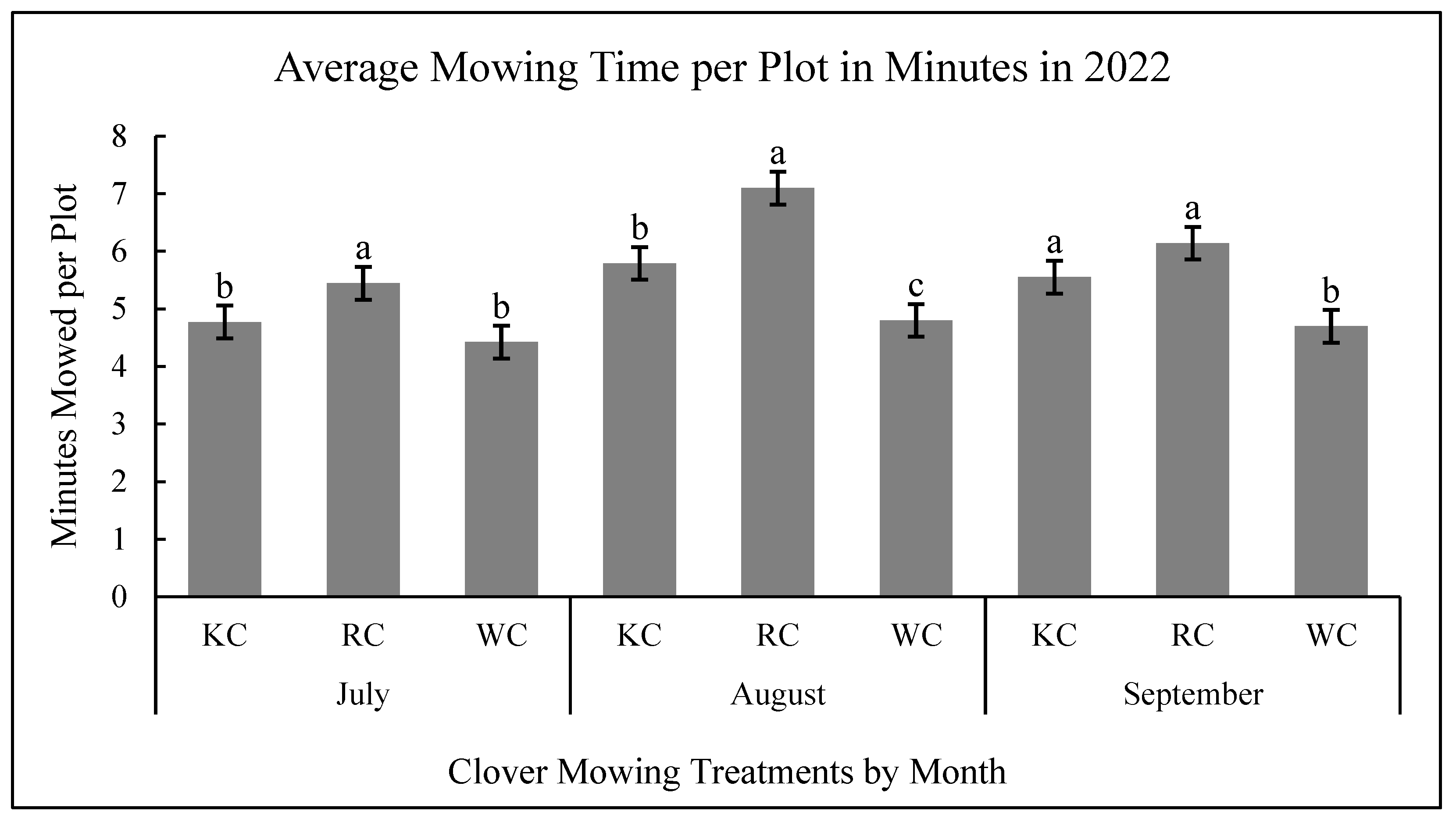
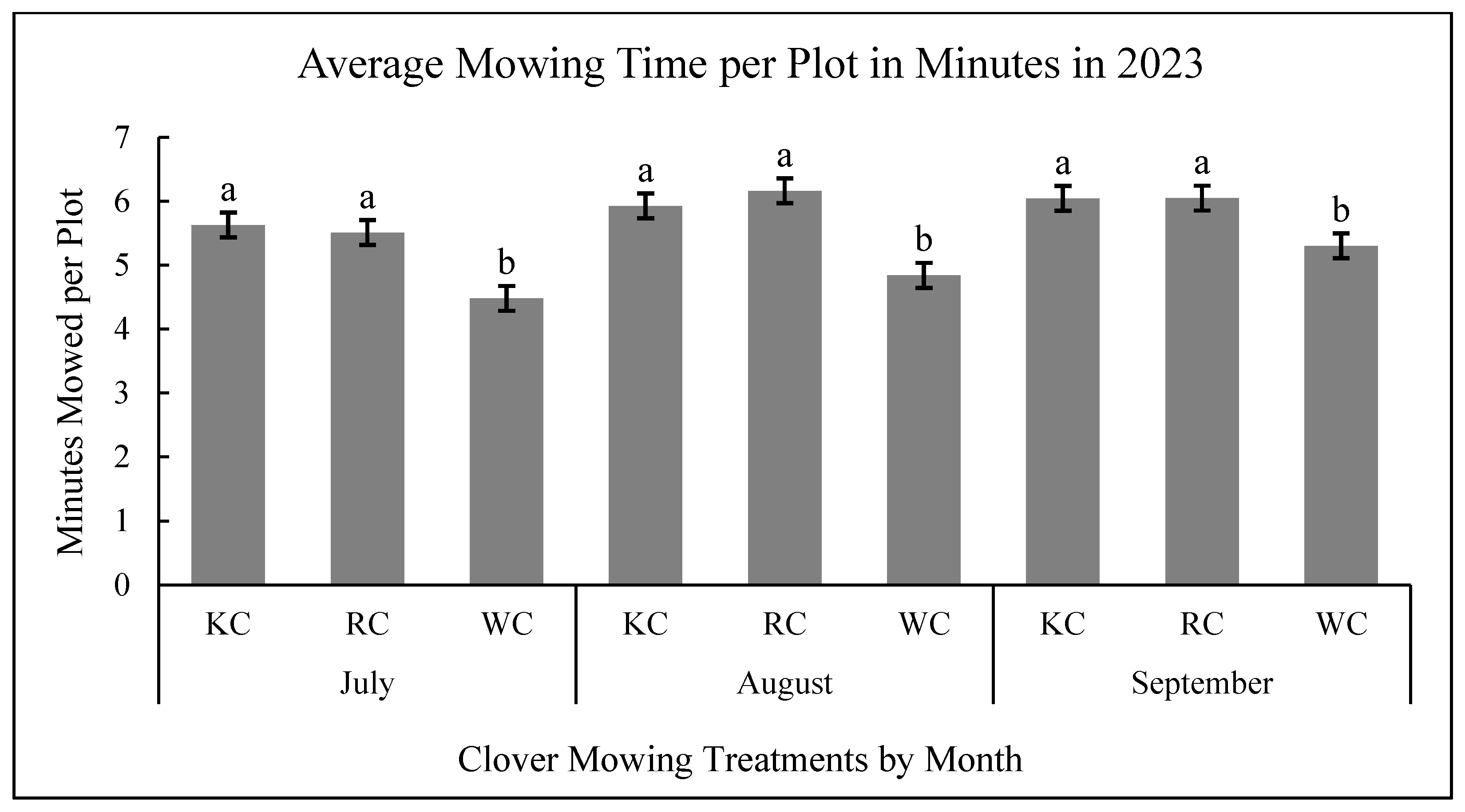
Mowing times differed significantly (p = 0.01) among clover types at all mowings in both years (Figure 1 and Figure 2). In 2022, RC took the most time, followed by KC, with WC requiring the least time, and with differences between RC and WC ranging from 21% to 39%. The same general pattern held in 2023, with WC requiring the least time. RC required less time than in 2022, and there were no significant differences in mowing times between KC and RC in 2023. The difference in mowing times between RC and WC in 2023 was less, ranging from 13% to 24%.
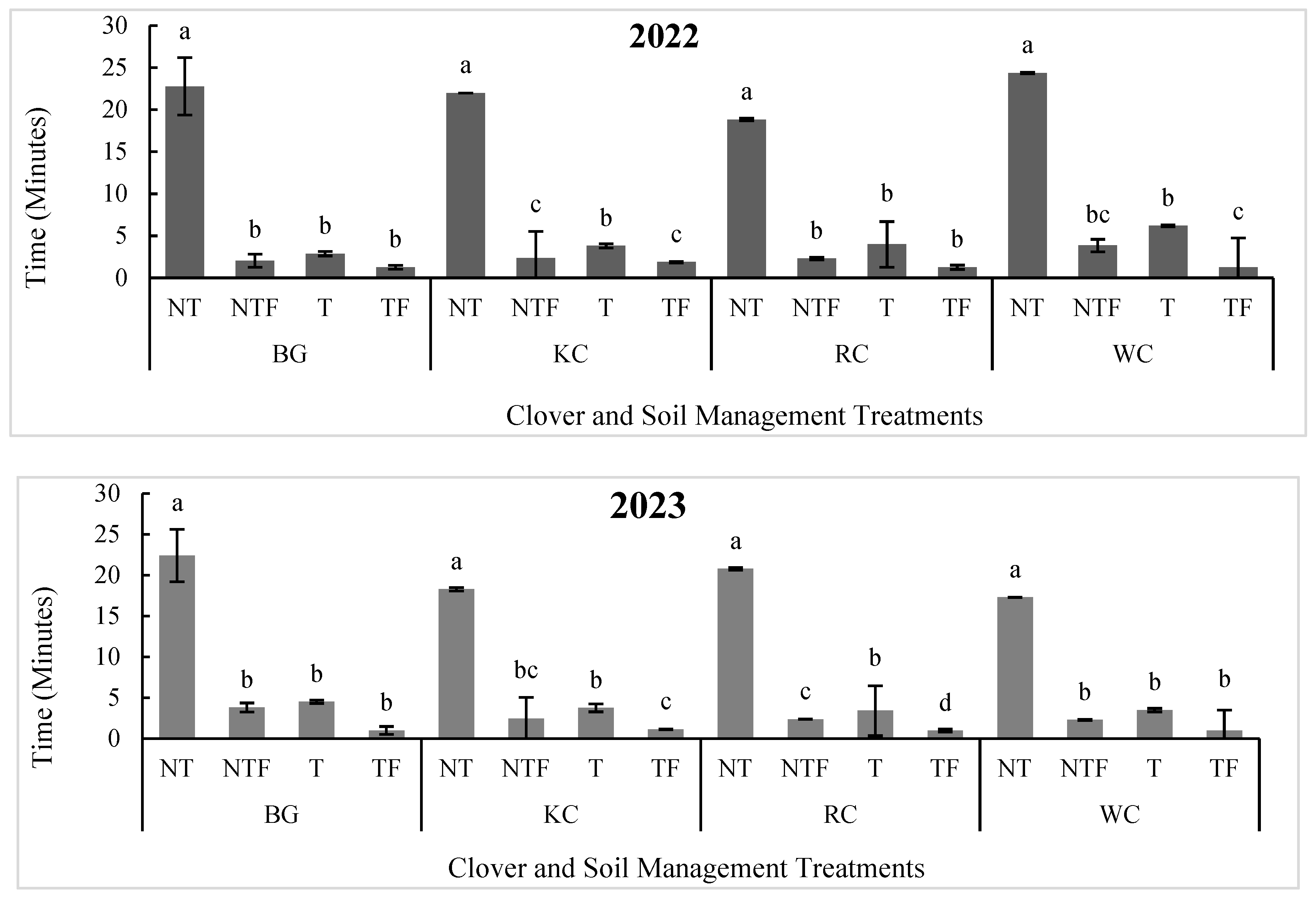
Management and clover treatments interacted (p = 0.04 for timed hand weeding in July in both 2022 and 2023 (Figure 3)), although management treatments followed similar trends across clover treatments. The NT treatments consistently took much longer to weed compared to the clover treatments (Figure 3). T, TF and NTF treatments took similar amounts of time to weed per BG plot. Within clover plots, the TF plots generally required the least time and the T plots the most time weeding (Figure 3), while the fabric plots (NTF and TF) were statistically equal in July.
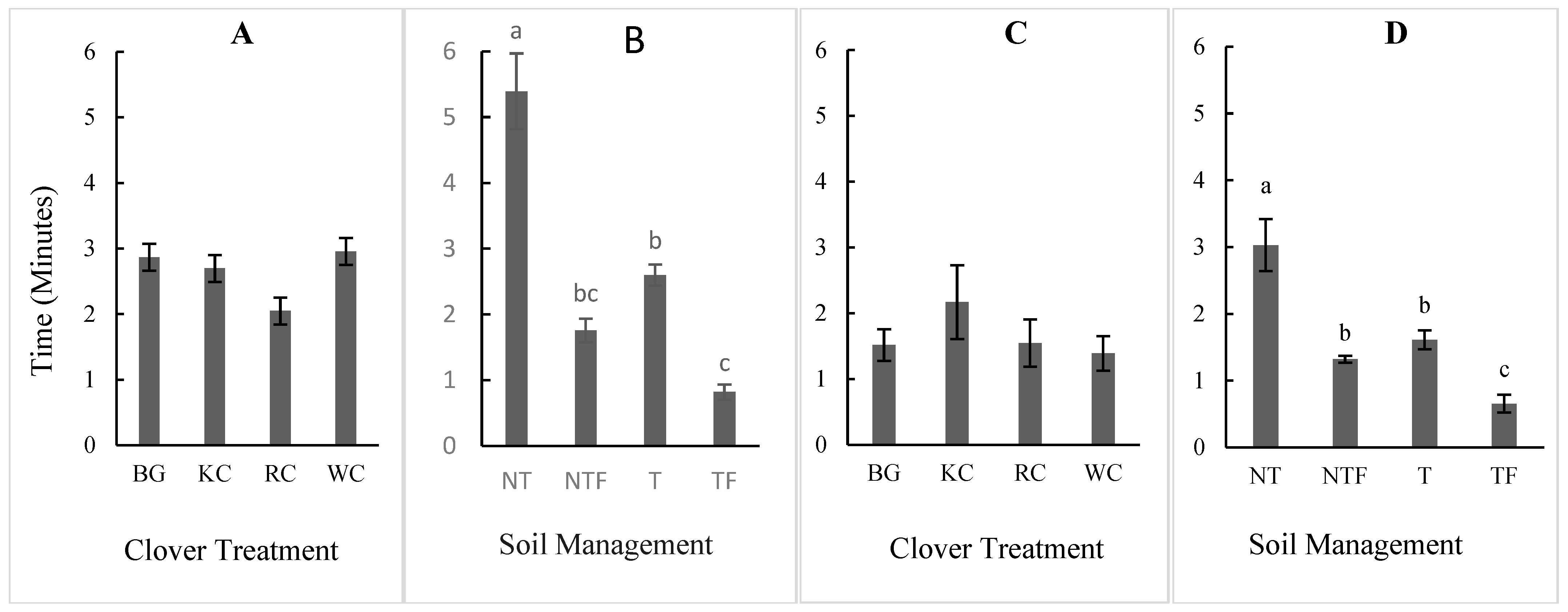
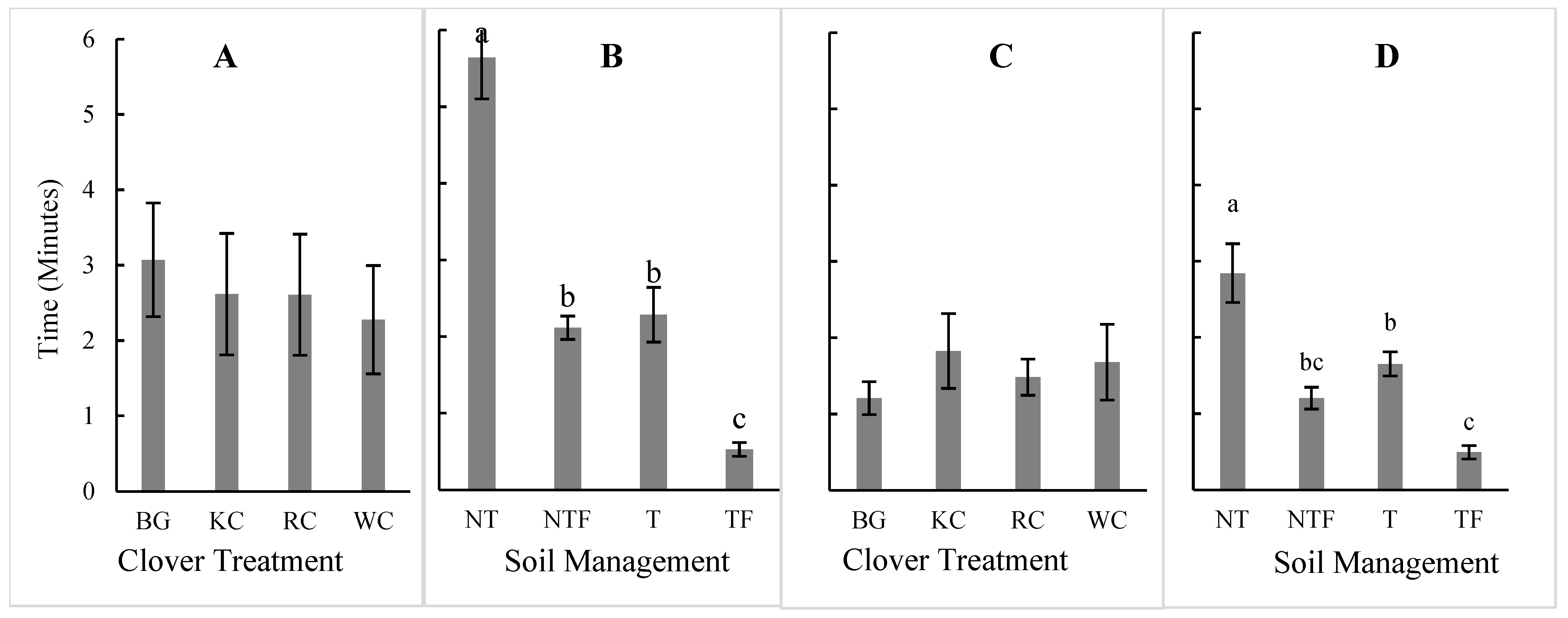
Later-season (August and September) hand weeding times did not exhibit management-clover interaction in 2022 or 2023 (p = 0.5; Figure 4 and Figure 5). Among soil management treatments (Figure 4B,D and Figure 5B,D), NT treatments took the longest and TF treatments the least time to hand weed (2022: p = 0.04 August, p = 0.01 September; 2023: p = 0.04 August, and p = 0.08 September). NTF plots took similar amounts of time to hand weed compared to both T and TF treatments. Clover whole-plot treatments resulted in no hand weeding time differences (p = 0.3) in the August and September of either year (Figure 4A,C and Figure 5A,C).

3.3. Cash Crop Performance

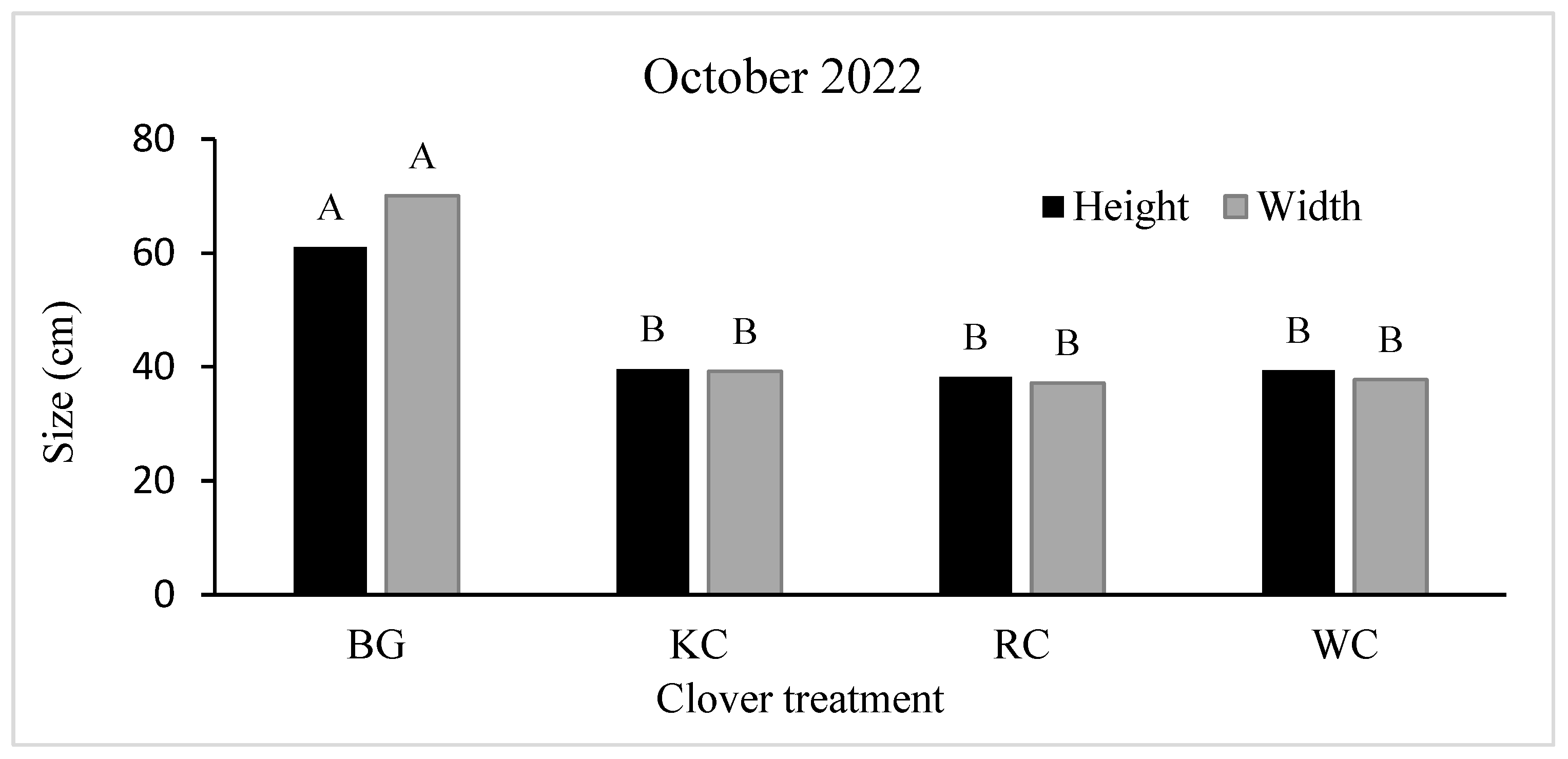
Plant Height and Width: Broccoli height and canopy width in bare ground (BG) plots was significantly greater than that in clover plots (p < 0.0001, Figure 6) but did not differ by soil management treatments at the end of the season in October 2022.
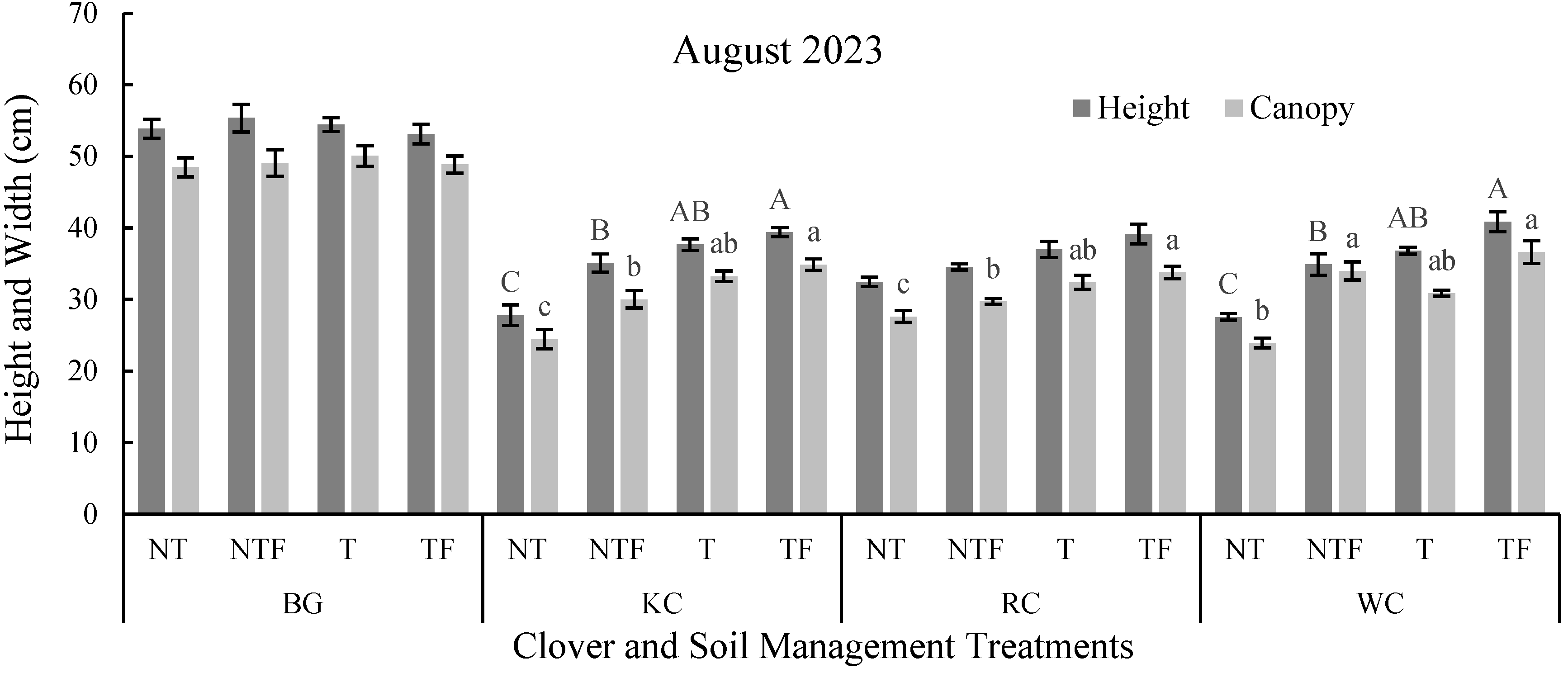
At midseason (11 August) 2023, there was interaction between the clover and soil management treatments (p = 0.01) in terms of both broccoli height and width (Figure 7). Bare ground plots produced the largest plants, and within the BG plots, management treatments were not significant. In the KC and WC plots, NT resulted in smaller plants than other soil management treatments, and the results for the NTF plots were intermediate (Figure 7). Broccoli sizes in the TF and T treatments were similar (Figure 7). Soil management treatments had no effect on plant height in the RC plots, but broccoli width responses mirrored those in the KC and WC plots (Figure 7).
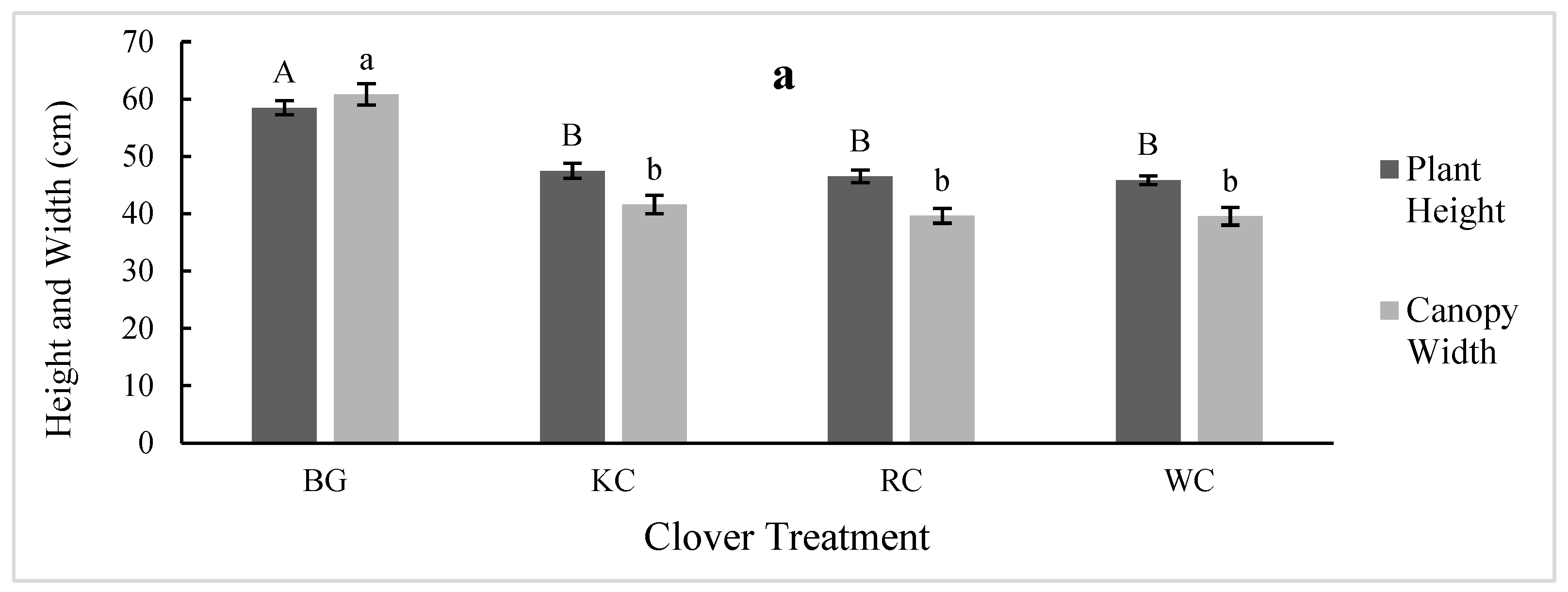
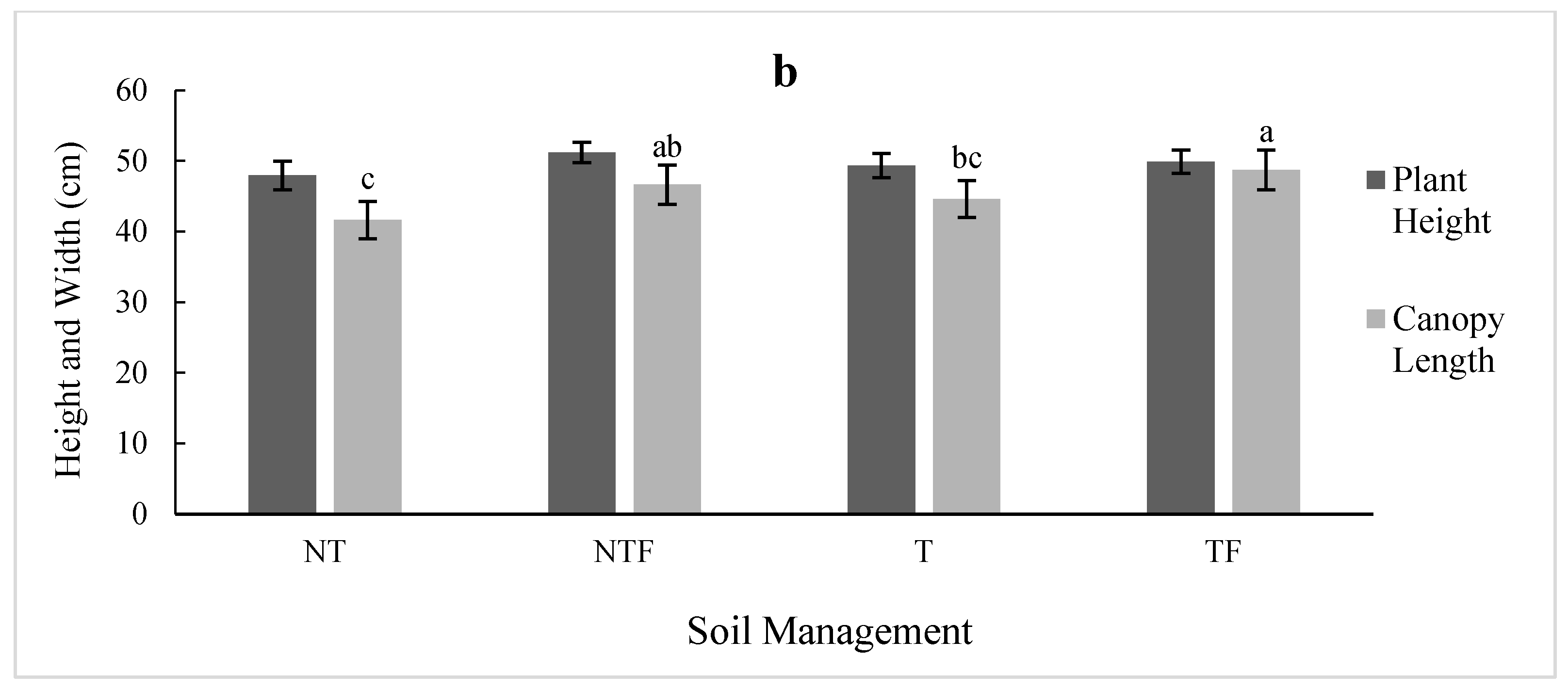
Similar to 2022, at the end of the season in 2023, clover (KC, RC, and WC) uniformly decreased broccoli height (p = 0.01) and width (p = 0.01) compared to bare ground treatment (Figure 8a). The clover plots did not differ among themselves. Fabric treatments resulted in the widest, and no-till without fabric in the smallest, canopy width at the end of the season in 2023 (Figure 8b).
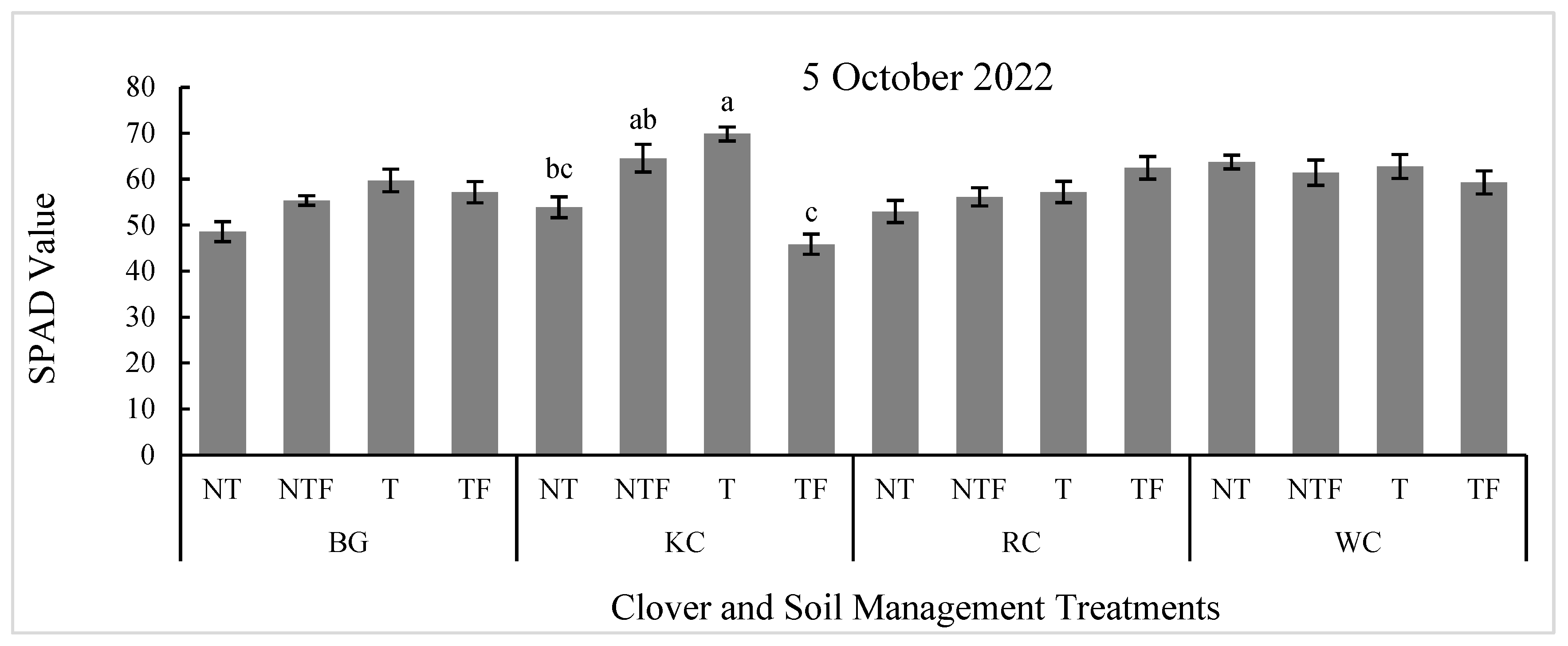
SPAD values: There was interaction (p = 0.02) between clover and soil management treatments for SPAD values in 2022. Only within the KC plots were soil management treatments significant (p = 0.01) (Figure 9): T resulted in the highest and TF in the lowest SPAD values, with NTF and NT being intermediate. In 2023, there were no significant SPAD reading differences between treatments in either August or September.

3.4. Broccoli Whole Plant Biomass

In both 2022 and 2023, BG treatments resulted in heavier plant dry weights (p = 0.01) compared with the plots with clover; within the clover plots in 2022, there were no differences between KC, RC and WC (Table 4). In 2023, the KC plots’ broccoli biomass was significantly greater than that of the RC plots, with WC being intermediate. Soil management treatments had no effect on (p = 0.6) broccoli plant dried biomass in 2022 (Table 4). In 2023, fabric treatments (NTF and TF) resulted in the greatest plant weights, and NT treatments the lowest (p = 0.01), with T intermediate for other treatments (Table 4).

3.5. Broccoli Heads

Marketable broccoli yield (number and weight) was higher in the BG plots compared to the clover treatments in 2022, while soil management treatments had no effect on marketable broccoli yields in 2022 (Table 5). Within clover plots, KC, RC and WC broccoli plants showed similar broccoli yields (Table 5). Non-marketable broccoli yields mirrored those of marketable yields, with BG outyielding RC, KC and WC treatments (Table 5), and soil management treatments having no effect (p = 0.8) on non-marketable head count or total weights (Table 5).
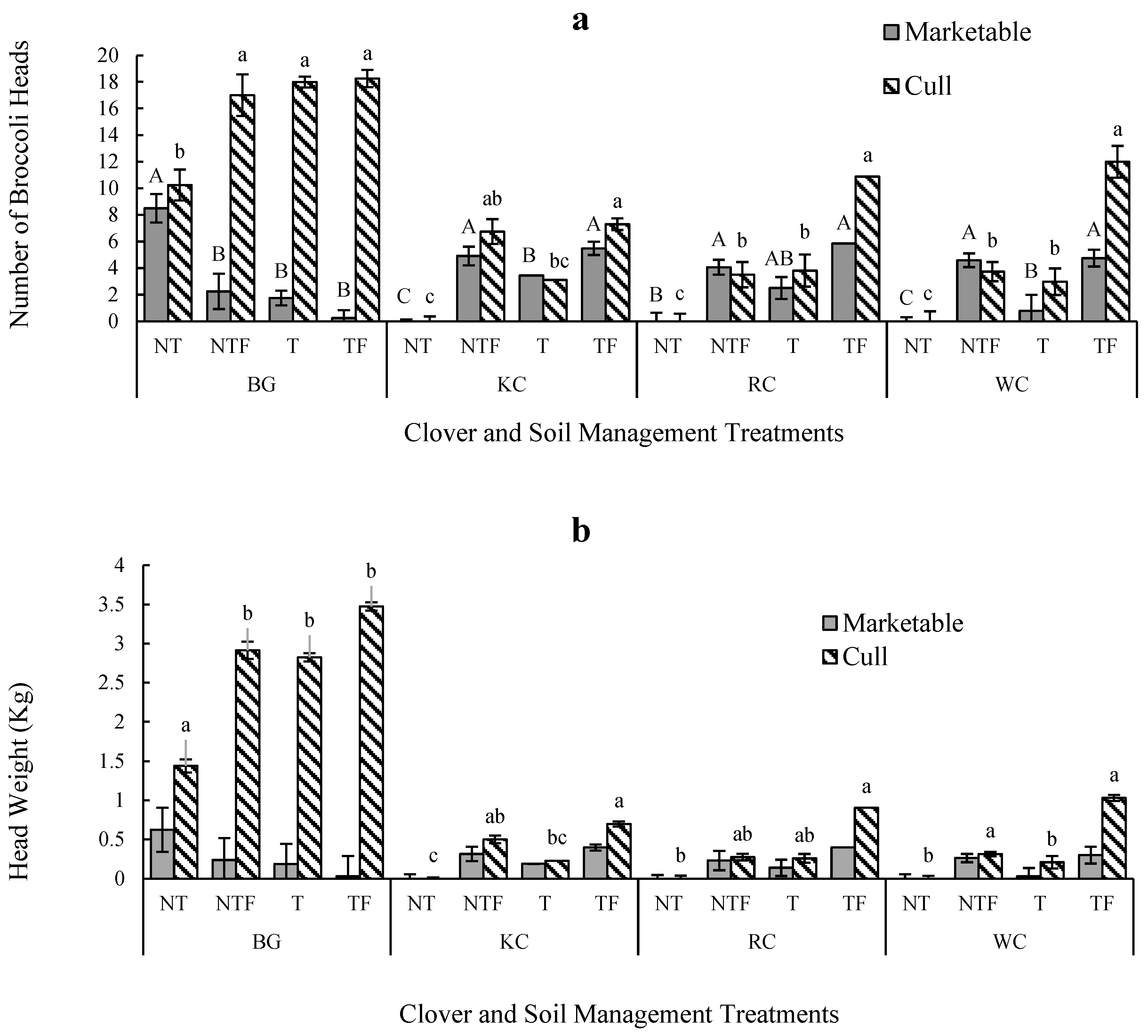
In 2023, there was interaction between soil management treatments and clover treatments for both marketable (p = 0.01) and unmarketable/cull (p = 0.02) broccoli head counts and weights (Figure 10).
Within the BG plots, NT treatments resulted in the most marketable and the fewest culled heads (Figure 10), and culled heads vastly outnumbered marketable ones in all but the NT management plot. In contrast to BG, the NT plots with clover treatments had no head formation, marketable or otherwise. In the KC plots, treatments with fabric (NTF and TF) resulted in the most marketable and culled heads, with T intermediate in terms of effect (Figure 10). In the RC plots, NTF, T and TF treatments resulted in similar outcomes for the number of marketable broccoli heads, and the fabric treatments produced the most culled heads (Figure 10). In terms of WC, the TF and NTF treatments had the most marketable heads and TF resulted in the most culled heads (Figure 10).
Broccoli weights followed very similar patterns to head counts in 2023, except there was no significant effect of management treatments on marketable head weights. Culled head weights were lowest for NT treatments (Figure 10). The fabric treatments (NTF and TF) tended to result in more culled heads than the T treatment, but the difference was not always significant.

4. Discussion

Clover establishment was impacted by precipitation (Table 6), which was not reported in other studies [8,9,16]. The 2022 season received more moisture than 2023 and produced a better clover stand early in the season (Table 2) compared to 2023. April 2022 had adequate soil moisture, including over 4.7 cm of rainfall over the four days following the planting date; clovers and oats, thus, had a strong start. However, total rainfall in April 2023 was only 2.8 cm, and cover crops showed delayed establishment due to the limited rainfall in late April and during the month of May. This allowed weeds to vigorously compete with the oats and clover.
Sprinkler irrigation was used to help establish clover in May and early June 2023 due to continuing limited moisture. Rainfall later in June and July caused weeds to grow quickly and clover establishment to suffer from competition. By the end of both seasons, as temperatures declined, clovers were the remaining foliage in the plot and weeds were difficult to predict. Mowing heights were initially set to 10 cm, but weeds were regrowing aggressively, so the height was decreased to 5 cm without causing clover dieback.
In 2022, clover plots were weeded every seven to ten days, creating less competition with weeds over time. In 2023 clover biomass was collected and plots were weeded every 10–14 days due to labor constraints, which caused higher weed density throughout the season and increased competition for broccoli plants. BG plots were hand cultivated in 2022 due to small plot width (1.67 m). In 2023 the plot width was adjusted to 1.8 m to fit the BCS 749 tiller attachment; the more intense tillage of the BCS decreased weed growth in the BG plots by the end of the season, an effect noted in other studies [3,9].
In 2022, WC performed well, with good clover biomass and fewer weeds compared to the other clovers. This promise as a good cover crop for weed suppression was also found by Abouziena et al. and Perkus, et al. [2,28]. Although KC plots were similar to WC plots in terms of clover biomass, KC plots had a high density of weeds throughout the season, which may be a concern for vegetable growers. Although red clover is desirable due to its flowering potential and support for pollinators, RC underperformed compared to WC and KC for weed suppression. This may have been because its taproots did not compete as well with weeds as the more fibrous root systems of WC and KC. The resulting higher weed density may decrease crop growth as well as increasing weed seed banks, causing added labor costs in the future [16,29].
In 2023, RC plots resulted in the highest amount of biomass and lowest amount of weed biomass, in direct contrast to 2022, and there are reports of it being less competitive in other studies [16]. The taproot may have been a benefit in the more moisture-restricted conditions of 2023. White clover only produced 412 kg/ha in 2023, which was low compared to 2022. KC clover also underperformed in 2023, with a peak biomass of 386 kg/ha by the end of the season. The underperformance may have been due to lower soil moisture, but could also be due to the plots being weeded and mowed less often in 2023 due to labor constraints. The field location in 2023 also had more compacted soil compared to 2022, which may have benefitted the RC with its taproot. Plots in 2023 also had a higher presence of perennial weeds, including Canada thistle, perennial sow thistle, dandelions and others, which made weeding events very difficult and further disrupted the weeds’ density.
Weeds collected were noticeably different between plots. Weeds in the BG plots included mostly annuals: purslane (Portulaca oleracea), redroot pigweed (Amaranthus retroflexus), lady’s thumb (Persicaria maculosa), common lambquarter (Chenopodium giganteum), and venice mallow (Hibiscus trionum). Weeds in the northernmost living mulch plots consisted of many broadleaf perennials or biennuals: Canada thistle (Cirsium arvense), western salsify (Tragopogon dubius), perennial sowthistle (Sonchus arvensis), bull thistle (Cirsium vulgare), dandelion (Taraxacum officinale), and waterhemp (Amaranthus tuberculatus). This was different in the southernmost living mulch plots, which primarily contained grass weeds: yellow foxtail (Setaria pumila), green foxtail (S. viridis), giant foxtail (S. faberi), woolly cup grass (Eriochloa villosa), crabgrass (Digitaris), and barnyard grass (Echinochloa). Weeds such as green and yellow foxtail were noticeably more present in the RC plots compared to the KC and WC, which could mean that grasses are more competitive than broadleaves and RC may not be as competitive against grasses compared to WC and KC. A North Dakota study reported mixed results in terms of red vs. white clover’s competitiveness with weeds, with white being more competitive at one location [3].
Less time was needed for hand weeding as the seasons progressed, which was also noted in Wisconsin [16]. Hand weeding took more time at the beginning of the season in BG plots due to grass weeds including green and yellow foxtail, crab grass and wooly cup grass. As the season went on, BG plots were easier to manage as weed density declined. Despite the noted differences in weed species, there were no significant differences among clover types in terms of weeding time needed.
NT treatments took the longest to hand weed compared to T, NTF and TF treatments due to high weed density and the competitive nature of drought tolerant weeds. After July, NT treatments took less time to weed once weed density was reduced and clovers were able to further grow and establish. TF treatments took the shortest amount of time to hand weed due to the tillage and fabric suppressing weed density. NTF treatments were second behind TF treatments for time needed to hand weed. NTF treatments allow for the soil to receive soil health benefits from the clover while suppressing weeds and decreasing labor costs over time. Tilled treatments were difficult to hand cultivate in 2023 due to sporadic rain events, which made the stirrup hoe difficult to use in T treatments. Very few studies show the impact of labor time needed to weed and mow living mulch plots, which highlights the values of the results in this study.
In contrast to hand weeding, mowing events took longer as the seasons progressed. Red clover took the longest to mow early in the season due to their woody stem structure, which caught in the push mower. As the season went on, KC and RC plots were similar in terms of the amount of time it took to mow, which was surprising for KC due to its low growing structure [19]. Due to its sprawling form, WC plots took the least amount of time to mow in August and September. In addition, WC treatments also showed the greatest amount of weed suppression, which may be beneficial for farmers searching for a low-cost input into their systems. Farmers and researchers should consider labor costs and the time needed to weed and mow clover living mulch strips, which may depend on equipment available.
The broccoli plants in the BG plots were the tallest and widest compared to those with the clover treatments, which was expected due to decreased competition from oats, weeds, and clover. It was unanticipated that the RC plots would perform the same as the KC and WC plots for broccoli plant height considering red clover is very competitive for light and space due to its tall structure [1]. Plant height was greater in conventional tilled cereal rye rows than it was in no-till and strip-tilled rows in Iowa [15]. Similar to the Iowa study [15], the broccoli plants grown in the BG plots were taller than those in the NT living mulch plots.
The broccoli plants in 2023 were noticeably larger than the broccoli plants in 2022. Broccoli was planted three weeks earlier in 2023, increasing the growing season length. Changes to fertigation schedules in 2023 may also have impacted broccoli growth compared to 2022. Warren et al. found that higher fertilizer rates helped lessen the broccoli yield reduction in clover–ryegrass living mulch [13]. In 2022, SPAD readings indicated an interaction between clover and management treatments. Only in the KC plot were any differences noted, and the trend (TF lowest and T highest) was not noted in broccoli plant size or yield. SPAD readings were not significantly different in 2023, and tended to be a bit higher than in 2022, which could be due to early establishment of clovers as more time is needed for clovers to deposit nitrogen into the soil [11]. Dried broccoli plant biomass differed more in weight in 2023 than in 2022. This could partly be due to the longer season in 2023 compared to 2022 and the changes in the fertigation schedule in 2023. It was also noted in Iowa that treatments applied to conventional tilled rows, stripped tilled, and no-till rows of broccoli grown in roller-crimped cereal rye had no effect on dried plant biomass [15].
In 2022, dried broccoli plant biomass was smaller when clover treatments were used than it was in bare ground, which could signify competition with clovers and weeds [9,13]. This can be a concern for growers interested in living mulches because it may decrease cash crop yields and produce smaller broccoli heads. The 2023 broccoli biomass was similar to that for 2022; however, RC resulted in the lowest broccoli dried biomass. As considered above, red clover can be very competitive when planted alongside cash crops and here we have demonstrated the competitive nature of this species on broccoli plant biomass.
In 2022, no significant differences were found between soil management treatments in terms of broccoli plant biomass, however, differences were indicated in broccoli biomass for 2023. NT treatments showed high competition with broccoli plants compared to the other treatments and resulted in the lightest broccoli mass. Broccoli showed similar plant weights in conventional and stripped tilled systems in Iowa [15]. Future studies should consider broccoli dried biomass in the future since there are few studies that include this information.
In 2023, broccoli produced more heads than in 2022, which could be due to the longer growing season or increased fertility. Bare ground plots produced larger broccoli plants and heavier heads, likely due to less competition for light, space and nutrients with clovers and weeds [8,9]. Broccoli heads in the BG plots matured earlier in the season due to little competition with weeds and high heat during August. NT treatments produced fewer broccoli heads compared to the other management treatments due to competition with clovers and weeds during both seasons [15]. In 2022 and 2023, the broccoli plants with the TF treatments produced the greatest number of total broccoli heads, which is comparable to Michigan [12]. TF broccoli plants had the greatest number of non-marketable broccoli heads in both seasons, which may be due to the soil being less compacted from tillage events, and the fabric reducing competition [7]. Broccoli heads in the NT treatments were never able to establish in both seasons due to the heavy suppression of the clover living mulch. A longer growing season may have changed this outcome as broccoli growth was slowed due to competition from oats, clovers, and weeds. Despite the use of weed-suppressive fabric, broccoli yields declined, suggesting that this practice alone was inadequate for preventing yield loss. Tillage also failed to maintain yields, which may be attributed to the substantially lower rainfall in 2023 compared to 2022, leading to higher levels of soil compaction prior to tillage and broccoli planting (Table 6). August and September 2022 and 2023 were much warmer compared to previous years in South Dakota, which contributed to the large amount of unmarketable broccoli heads.
Broccoli in the T treatments had greater weed competition compared to those in the NT treatments due to there being little competition from clovers. NTF treatments did have clover species still present in the planting holes, but weeds were removed at clover and weed biomass collection events, which may have caused delayed head formation, leading to the high presence of non-marketable broccoli. Heatwaves caused broccoli heads to become puffy and bolt quickly after crop maturity [15,16]. Due to labor constraints, broccoli harvest occurred once a week, which may have resulted in more non-marketable bolted broccoli heads.
Clover type did not result in many differences for marketable and non-marketable broccoli head formation in 2022. Only two harvest events occurred in 2022, which caused more broccoli heads to bolt at maturity compared to 2023. In 2023, there were differences between clover treatments for broccoli head formation. There were more total broccoli heads in the WC plots than there were in the KC and RC plots, which is surprising due to its stoloniferous roots [17]. The RC and KC plots performed similarly to each other in 2023 in terms of broccoli head formation, but the KC plots had more non-marketable broccoli heads compared to the RC treatments. As shown on the east coast [24], broccoli is a heat sensitive crop and can suffer yield reductions during heat spikes and drought events.

5. Conclusions

During the first year of establishment, clover living mulch showed negative effects on broccoli cash crop yield and plant health. Weed suppression was promising throughout the growing season and clovers suppressed weeds by the end of the season. Limited rainfall affected clover growth throughout the season, especially in late summer, which was not a major concern in other studies [8,16]. Tillage and landscape fabric applications still show little protection against yield loss, which specialty crop farmers should consider if they are interested in incorporating living mulches into their systems. Broccoli health and harvest data was negatively affected by weather and suppression by clover, oat and weeds, which was noted in Wisconsin [16].
Farmers who are considering integrating living mulches into their farm system may experience positive benefits including improved soil health [12] and the living mulch acting as a beneficial green manure. Farmers should consider the benefits of weed suppression [3,30] from living mulches and the living mulch acting as a refuge for beneficial insects, including pollinators, in the agroecosystem [31]. Vegetable growers should also consider increased fertilizer rates during clover establishment to maintain cash crop growth during the growing season. Supplemental irrigation should be applied during clover establishment and to cash crops each week when 2.54 cm of precipitation is not received. Clover cover crops used as a living mulch can be beneficial to vegetable producers as a long-term sustainable practice when favorable growing conditions are met.
This research confirms that early season clover cover crops used as a living mulch negatively impact broccoli cash crop establishment in the Northern Great Plains. Future research should consider increased early season irrigation and supplemental irrigation throughout the season to encourage clover growth and increase weed suppression. Cash crops should be appropriately fertilized to improve competition and overall healthy plant mass; increased fertilizer rates may be needed. Future research should explore higher fertilizer rates in combination with clover living mulches. Further studies should also consider evaluating clover and weed establishment over multiple years to evaluate clovers’ needs as a living mulch over time for vegetable producers. Similar crops to broccoli, such as sprouting broccoli or broccolini that are bred to be better suited for warm summers, should be investigated in future research given the heat sensitivity outcome with traditional broccoli crops shown in this research.

Author Contributions

Conceptualization, K.M.L. and R.B.; methodology, K.M.L., R.B. and A.R.B.; software, K.M.L. and A.R.B.; validation, K.M.L., R.B. and A.R.B.; formal analysis, A.R.B. and K.M.L.; investigation, A.R.B.; resources, K.M.L.; data curation, A.R.B.; writing—original draft preparation, A.R.B.; writing—review and editing, K.M.L. and R.B.; visualization, A.R.B. and K.M.L.; supervision, K.M.L. and R.B.; project administration, K.M.L.; and funding acquisition, K.M.L. and R.B. All authors have read and agreed to the published version of the manuscript.

Funding

This research was funded, in part, by the USDA Specialty Crop Block Grant Program administered by the South Dakota Department of Agriculture and Natural Resources (2021SDSU04).

Data Availability Statement

The original contributions presented in this study are included in the article. Further inquiries can be directed to the corresponding author.

Conflicts of Interest

The authors declare no conflicts of interest.

References

  1. Hooks, C.R.R.; Hinds, J.; Zobel, E.; Patton, T. The Effects of Crimson Clover Companion Planting on Eggplant Crop Growth, Yield and Insect Feeding Injury. Int. J. Pest Manag. 2013, 59, 287–293. [Google Scholar] [CrossRef]
  2. Perkus, E.A.; Grossman, J.M.; Pfeiffer, A.; Rogers, M.A.; Rosen, C.J. Exploring Overwintered Cover Crops as a Soil Management Tool in Upper-Midwest High Tunnels. HortScience 2022, 57, 171–180. [Google Scholar] [CrossRef]
  3. Puka-Beals, J.; Gramig, G. Weed Suppression Potential of Living Mulches, Newspaper Hydromulches, and Compost Blankets in Organically Managed Carrot Production. HortTechnology 2021, 31, 89–96. [Google Scholar] [CrossRef]
  4. Burgio, G.; Kristensen, H.L.; Campanelli, G.; Bavec, F.; Bavec, M.; Fragstein, P.V.; Depalo, L.; Lanzoni, A.; Canali, S. Effect of Living Mulch on Pest/Beneficial Interaction. Build. Org. Bridges 2014, 3, 741–744. [Google Scholar]
  5. Hinds, J.; Wang, K.-H.; Hooks, C.R.R. Growth and Yield of Zucchini Squash (Cucurbita pepo L.) as Influenced by a Sunn Hemp Living Mulch. Biol. Agric. Hortic. 2016, 32, 21–33. [Google Scholar] [CrossRef]
  6. Depalo, L.; Burgio, G.; von Fragstein, P.; Kristensen, H.L.; Bavec, M.; Robačer, M.; Campanelli, G.; Canali, S. Impact of Living Mulch on Arthropod Fauna: Analysis of Pest and Beneficial Dynamics on Organic Cauliflower (Brassica oleracea L. Var. Botrytis) in Different European Scenarios. Renew. Agric. Food Syst. 2017, 32, 240–247. [Google Scholar] [CrossRef]
  7. Stein, S.; Hartung, J.; Möller, K.; Zikeli, S. The Effects of Leguminous Living Mulch Intercropping and Its Growth Management on Organic Cabbage Yield and Biological Nitrogen Fixation. Agronomy 2022, 12, 1009. [Google Scholar] [CrossRef]
  8. Tarrant, A.R.; Brainard, D.C.; Hayden, Z.D. Cover Crop Performance between Plastic-Mulched Beds: Impacts on Weeds and Soil Resources. HortScience 2020, 55, 1069–1077. [Google Scholar] [CrossRef]
  9. Bruce, D.; Silva, E.M.; Dawson, J.C. Suppression of Weed and Insect Populations by Living Cover Crop Mulches in Organic Squash Production. Front. Sustain. Food Syst. 2022, 6, 995224. [Google Scholar] [CrossRef]
  10. Tillman, J.; Nair, A.; Gleason, M.; Batzer, J. Rowcovers and Strip Tillage Provide an Alternative to Plasticulture Systems in Summer Squash Production. HortScience 2015, 50, 1777–1783. [Google Scholar] [CrossRef]
  11. Alexander, J.R.; Baker, J.M.; Venterea, R.T.; Coulter, J.A. Kura Clover Living Mulch Reduces Fertilizer N Requirements and Increases Profitability of Maize. Agronomy 2019, 9, 432. [Google Scholar] [CrossRef]
  12. Thériault, F.; Stewart, K.A.; Seguin, P. Use of Perennial Legumes Living Mulches and Green Manures for the Fertilization of Organic Broccoli. Int. J. Veg. Sci. 2009, 15, 142–157. [Google Scholar] [CrossRef]
  13. Warren, N.D.; Smith, R.G.; Sideman, R.G. Effects of Living Mulch and Fertilizer on the Performance of Broccoli in Plasticulture. HortScience 2015, 50, 218–224. [Google Scholar] [CrossRef]
  14. Granatstein, D.; Mullinix, K. Mulching Options for Northwest Organic and Conventional Orchards. HortScience 2008, 43, 45–50. [Google Scholar] [CrossRef]
  15. Jokela, D.; Nair, A. No Tillage and Strip Tillage Effects on Plant Performance, Weed Suppression, and Profitability in Transitional Organic Broccoli Production. HortScience 2016, 51, 1103–1110. [Google Scholar] [CrossRef]
  16. Pfeiffer, A.; Silva, E.; Colquhoun, J. Living Mulch Cover Crops for Weed Control in Small-Scale Applications. Renew. Agric. Food Syst. 2016, 31, 309–317. [Google Scholar] [CrossRef]
  17. Sparks, B.; Munshaw, G.; Williams, D.; Barrett, M.; Beasley, J.; Woosley, P. Preplant Cultivation Techniques and Planting Date Effects on White Clover Establishment into an Existing Cool-Season Turfgrass Sward. HortScience 2015, 50, 615–620. [Google Scholar] [CrossRef]
  18. Ginakes, P.; Grossman, J.; Baker, J.; Sooksa-nguan, T. Tillage Intensity Influences Nitrogen Cycling in Organic Kura Clover Living Mulch. Nutr. Cycl. Agroecosyst. 2020, 116, 71–82. [Google Scholar] [CrossRef]
  19. Lane, I.; Watkins, E.; Spivak, M. Turfgrass Species Affect the Establishment and Bloom of Kura Clover (Trifolium ambiguum) in Lawns. HortScience 2019, 54, 824–828. [Google Scholar] [CrossRef]
  20. McCurdy, J.D.; McElroy, J.S.; Guertal, E.A. White Clover (Trifolium repens) Establishment within Dormant Bermudagrass Turf: Cultural Considerations, Establishment Timing, Seeding Rate, and Cool-Season Companion Grass Species. HortScience 2013, 48, 1556–1561. [Google Scholar] [CrossRef]
  21. Kahl, H.M.; Leslie, A.W.; Hooks, C.R.R. Effects of Red Clover Living Mulch on Arthropod Herbivores and Natural Enemies, and Cucumber Yield. Ann. Entomol. Soc. Am. 2019, 112, 356–364. [Google Scholar] [CrossRef]
  22. Hoidal, N.; Rohwer, C.; Enjalbert, N. Midwest Broccoli Trial Results; University of Minnesota Digital Conservancy: Minneapolis, MN, USA, 2021; Available online: https://hdl.handle.net/11299/225725 (accessed on 1 May 2024).
  23. Muramoto, J.; Smith, R.F.; Shennan, C.; Klonsky, K.M.; Leap, J.; Ruiz, M.S.; Gliessman, S.R. Nitrogen Contribution of Legume/Cereal Mixed Cover Crops and Organic Fertilizers to an Organic Broccoli Crop. HortScience 2011, 46, 1154–1162. [Google Scholar] [CrossRef]
  24. Farnham, M.W.; Bjorkman, T. Breeding Vegetables Adapted to High Temperatures: A Case Study with Broccoli. HortScience 2011, 46, 1093–1097. [Google Scholar] [CrossRef]
  25. Stansell, Z.; Björkman, T.; Branham, S.; Couillard, D.; Farnham, M.W. Use of a Quality Trait Index to Increase the Reliability of Phenotypic Evaluations in Broccoli. HortScience 2017, 52, 1490–1495. [Google Scholar] [CrossRef]
  26. Nelson, H.; Gleason, M. Improving Row Cover Systems for Organic Management of Insect Pests and Diseases in Muskmelon and Squash—Year 3; Iowa State University Research and Demonstration Farms Progress Reports; Iowa State University Digital Press: Ames, IA, USA, 2019; Volume 1. [Google Scholar]
  27. U.S. Department of Agriculture. United States Standards for Broccoli Processing; U.S. Department of Agriculture: Washington, DC, USA, 1997. Available online: https://www.ams.usda.gov/grades-standards/broccoli-processing-grades-and-standards (accessed on 1 May 2024).
  28. Abouziena, H.F.; Hafez, O.M.; El-Metwally, I.M.; Sharma, S.D.; Singh, M. Comparison of Weed Suppression and Mandarin Fruit Yield and Quality Obtained with Organic Mulches, Synthetic Mulches, Cultivation, and Glyphosate. HortScience 2008, 43, 795–799. [Google Scholar] [CrossRef]
  29. Vollmer, E.R.; Creamer, N.; Reberg-Horton, C.; Hoyt, G. Evaluating Cover Crop Mulches for No-till Organic Production of Onions. HortScience 2010, 45, 61–70. [Google Scholar] [CrossRef]
  30. Rylander, H.; Rangarajan, A.; Maher, R.M.; Hutton, M.G.; Rowley, N.W.; McGrath, M.T.; Sexton, Z.F. Black Plastic Tarps Advance Organic Reduced Tillage II: Impact on Weeds and Beet Yield. HortScience 2020, 55, 826–831. [Google Scholar] [CrossRef]
  31. Splawski, C.E.; Regnier, E.E.; Harrison, S.K.; Goodell, K.; Bennett, M.A.; Metzger, J.D. Mulch Effects on Floral Resources and Fruit Production of Squash, and on Pollination and Nesting by Squash Bees. HortTechnology 2014, 24, 535–545. [Google Scholar] [CrossRef]
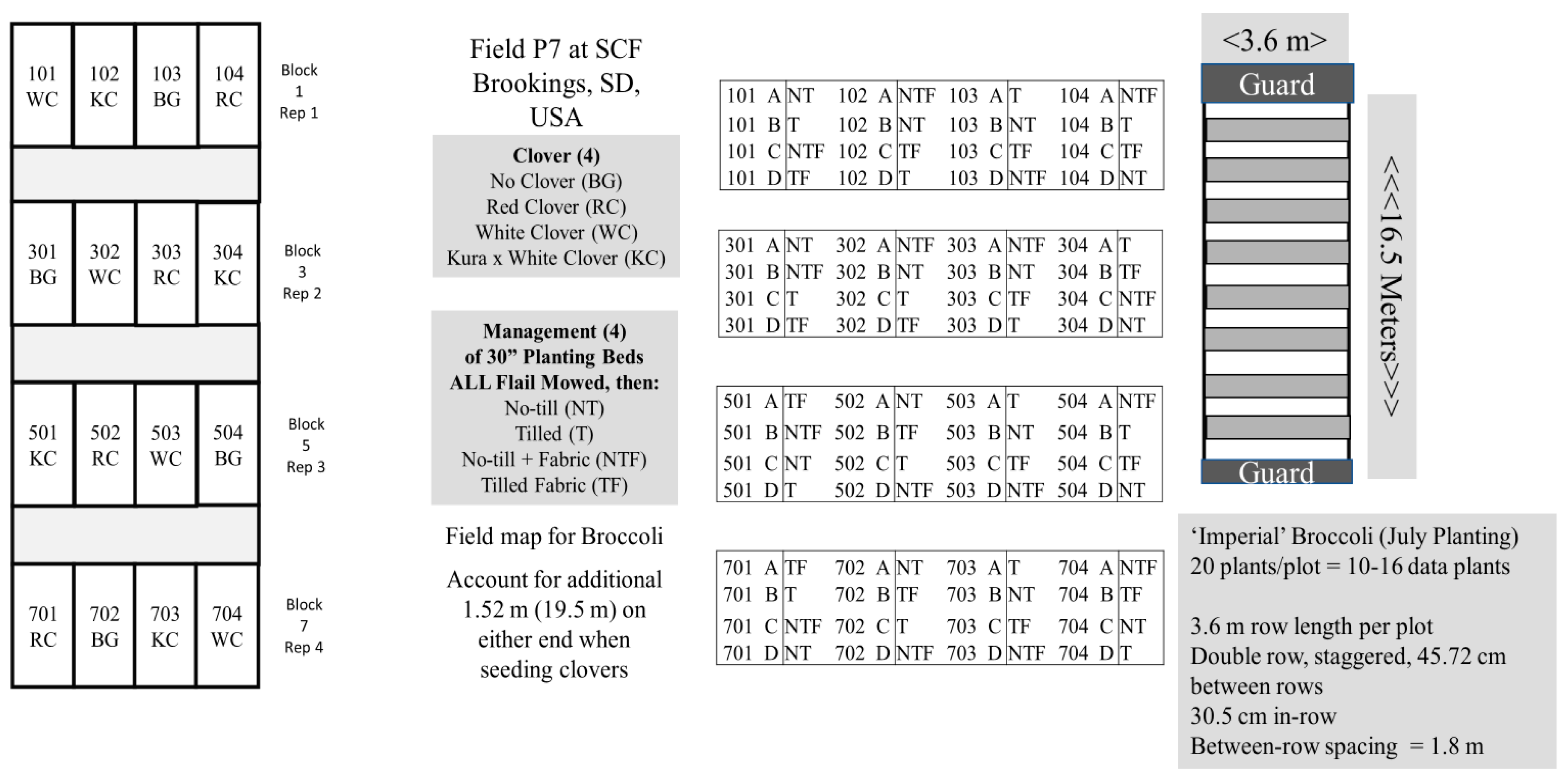
Scheme 1. Demographic of a plot map for the specialty crop field where broccoli and living mulch research was conducted in 2022 and 2023 in Brookings, SD, USA.
Horticulturae 12 00364 sch001
Figure 1. Time in minutes required for two persons to mow 3.6 m clover pathways on 13 July, 4 August and 8 September 2022. KC: white × kura clover, RC: red clover, and WC: white clover. Means with common letters within response variables are not different, according to Fisher’s unrestricted least significant difference procedure (α = 0.05).
Horticulturae 12 00364 g001
Figure 2. Time in minutes required for two persons to mow 3.6 m clover pathways on 12 July, 4 August and 7 September 2023. BG: bare ground, KC: white × kura clover, RC: red clover, and WC: white clover. Means with common letters within response variables are not different, according to Fisher’s unrestricted least significant difference procedure (α = 0.05).
Horticulturae 12 00364 g002
Figure 3. Time in minutes required to weed 3.6 m beds with two people on 13 July 2022 and 12 July 2023. BG: bare ground, KC: white × kura clover, RC: red clover, and WC: white clover. NT: no-till, NTF: no-till + fabric, TF: tilled + fabric, and T: tilled. Means with common letters within clover treatments are not different, according to Fisher’s unrestricted least significant difference procedure (α = 0.05).
Horticulturae 12 00364 g003
Figure 4. (AD) Time in minutes required by two people to hand weed 3.6 m beds on 4 August (A,B) and 8 September 2022 (C,D). BG: bare ground, KC: white × kura clover, RC: red clover, and WC: white clover. NT: no-till, NTF: no-till + fabric, TF: tilled + fabric, and T: tilled. Means with common letters within response variables are not different, according to Fisher’s unrestricted least significant difference procedure (α = 0.05).
Horticulturae 12 00364 g004
Figure 5. (AD) Time in minutes required by two people to hand weed 3.6 m beds on 4 August (A,B) and 7 September 2023 (C,D). BG: bare ground, KC: white × kura clover, RC: red clover, and WC: white clover. NT: no-till, NTF: no-till + fabric, TF: tilled + fabric, and T: tilled. Means with common letters within response variables are not different, according to Fisher’s unrestricted least significant difference procedure (α = 0.05).
Horticulturae 12 00364 g005
Figure 6. Broccoli canopy width and plant height, 6 October 2022. Clover treatments: BG: bare ground, KC: white × kura clover, RC: red clover, and WC: white clove. Means with common letters within response variables are not different, according to Fisher’s unrestricted least significant difference procedure (α = 0.05).
Horticulturae 12 00364 g006
Figure 7. Broccoli canopy width and plant height (11 August 2023) within clover and management rows. BG: bare ground, KC: white × kura clover, RC: red clover, and WC: white clover. NT: no-till, NTF: no-till + fabric, TF: tilled + fabric, and T: tilled. Means with common letters within response variables are not different, according to Fisher’s unrestricted least significant difference (α = 0.05). Lowercase letters represent mean separations for canopy and uppercase letters represent mean separations for height.
Horticulturae 12 00364 g007
Figure 8. (a,b) Broccoli canopy width and plant height on 28 September 2023, within clover and management treatments. BG: bare ground, KC: white × kura clover, RC: red clover, and WC: white clover. NT: no-till, NTF: no-till + fabric, TF: tilled + fabric, and T: tilled. Means with common letters within response variables are not different, according to Fisher’s unrestricted least significant difference (α = 0.05). Lowercase letters represent mean separations for canopy and uppercase letters represent mean separations for height.
Horticulturae 12 00364 g008aHorticulturae 12 00364 g008b
Figure 9. Broccoli SPAD on 5 October 2022 at Brookings, SD, USA. BG: bare ground, KC: white × kura clover, RC: red clover, and WC: white clover. NT: no-till, NTF: no-till + fabric, TF: tilled + fabric, and T: tilled. Means with common letters within response variables are not different, according to Fisher’s unrestricted least significant difference procedure (α = 0.05).
Horticulturae 12 00364 g009
Figure 10. Broccoli cumulative head number (a) and weight (b) from 20-plant plots harvested on 31 August, 8 September, 14 September and 21 September 2023, at the Specialty Crops Research Field in Brookings, SD, USA. BG: bare ground, KC: white × kura clover, RC: red clover, and WC: white clover. NT: no-till, NTF: no-till + fabric, TF: tilled + fabric, and T: tilled. Means with common letters within clover treatments are not different, according to Fisher’s unrestricted least significant difference procedure (α = 0.05). Uppercase letters represent mean separations for marketable broccoli heads and lowercase letters represent mean separations for culled broccoli heads.
Horticulturae 12 00364 g010
Table 1. The 2022 and 2023 field activities at the Specialty Crops Research Farm in Brookings, SD, USA.
Activity/Data Collection2022 Dates2023 Dates
Seeded oats and clover26-April27-April
Seeded broccoli in greenhouse7-June2-June
Mowed clover, tilled, placed fabric15-July27-June
Broccoli planted in the field18-July27-June
Fertigated19-July; 3-August; 15-August; 31-August29-June; 26-July; 26-August
Installed ProtekNet row cover15-August29-June
Biomass of whole-plot clover and weeds30-June; 13-July; 1-August; 9-September; 5-October26-June; 12-July; 4-August; 7-September; 4-October
Biomass of in-row clover and weeds30-June; 13-July; 1-August; 9-September; 5-October11-July; 3-August; 6-September
Mowed clover/weeded subplots30-June; 13-July; 1-August; 9-September12-July; 4-August; 7-September
Mid-season plant height, canopy and SPAD---11-August; 28-September
Harvested broccoli heads21-September; 3-October31-August; 8-September; 14-September; 21-September
Final plant height, canopy, SPAD and broccoli biomass4 and 5-October28-September
Table 2. Clover and weed heights from whole-plot (pathway) alleyways between “Imperial” broccoli rows throughout 2022 and 2023 at the Specialty Crop Research Field, Brookings, SD, USA.
2022
--------------- Weed Height (cm) ------------------------------------ Clover Height (cm) -----------------------
Trt30-June13-JulyAugust9-September5-October30-June13-JulyAugust9-September5-October
BG z11 Bb y17 Aa9 Cb22 Ba7 Bc 0 Ca 0 C0 C0 C0 B
KC14 Ab13 Bb34 Aa31 Aa 4 Bc11 Ab12 Ab13 Bb18 Ba13 Bb
RC11 Bb15 Ab21 Ba 38 Aa12 Ab15 Ab17 Ab22 Aab35 Aa27 Aa
WC14 Ab18 Aab31 Aa39 Aa12 Ab11 Ab11 ABb13 Bb23 ABa14 BAa
2023
--------------- Weed Height (cm) ------------------------------------ Clover Height (cm) -----------------------
Trt26-June12-JulyAugust7-September4-October26-June12-July4-August7-September4-October
BG9 a4 Bb9 Ba12 Ba4 Bb00 B0 C0 C0 C
KC12 b12 Ab21 Aa21 Aa16 Aab4 b12 Aa7 Bb10 Ba13 Ba
RC11 b18 Aa17 Aa19 Aa19 Aa6 c14 Ab12 Ab21 Aa28 Aa
WC10 b14 Aab20 Aa26 Aa16 Ab2 c8 Ab6 Bb13 Ba15 Ba
z BG = bare ground; KC = kura × white clover; RC= red clover; and WC = white clover. y Uppercase letters represent differences among treatments within a single date and lowercase letters represent differences among dates within rows for single treatment response. Values within the same column or treatment followed by the same letter are not statistically different, according to Fisher’s protected least significant difference (p ≤ 0.05). Data represent a repeated-measure analysis and are presented as management (M) within clover (C) treatments due to multiple response variables with M × C interactions.
Table 3. Clover and weed whole-plot (pathway) biomass accumulation collected from alleyways between planted “Imperial” broccoli rows throughout 2022 and 2023 research seasons at the Specialty Crop Research Field, Brookings, SD.
2022
--------------------- Weed Biomass (Kg/h) ------------------------- ----------------- Clover Biomass (Kg/h) ------------------
30 June13 July1 August9 September5 October30 June13 July1 August9 September5 October
BG y34 B z bc x66 Bb91 Ca212 Aa9 Bc0 C0 C0 B0 C0 C
KC91 Abc116 Ab355 Aa133 Bb8 Bc27 Bc109 ABbc237 Ab353 Bb1184 Aa
RC20 Bc147 Ab183 Bab279 Aa13 Bc58 Ad189 Ac300 Ab547 Ab868 Ba
WC35 Bc112 Ab208 Ba144 Ba45 Ac21 Bc85 Bc310 Ab585 Ab1411 Aa
2023
---------------------- Weed Biomass (Kg/h) ----------------------- ------------------ Clover Biomass (Kg/h) --------------------
26 June12 July4 August7 September4 October26 June12 July4 August7 September4 October
BG115 Ab66 Bbc557 Aa291 Ba20 Bc00 B0 C0 C0 C
KC100 Ab374 Aa311 Aa375 ABa91 Ab6 d62 Ac49 Bc314 Bb386 Ba
RC67 Bc352 Aa259 Bb433 Aa75 Ac6 c66 Ab70 Ab533 Aa616 Aa
WC68 Bc277 Ab256 Bb524 Aa106 Abc 5 c51 Ab25 BCc301 Ba412 Ba
z Uppercase letters represent differences among treatments within a single date column. Lowercase letters represent differences among dates within rows for single treatment type. y BG= bare ground, RC= red clover, KC= white × kura clover, and WC= white clover. x Values within the same column and treatment followed by the same letter are not statistically different, according to Fisher’s protected least significant difference (p ≤ 0.05). Data represent a repeated-measure analysis and are presented as management (M) within clover (C) treatments due to multiple response variables with M × C interactions.
Table 4. Mean dried plant biomass of “Imperial” broccoli plants grown in 2022 and 2023 at the Specialty Crop Research Field, South Dakota State University, Brookings, SD, USA.
Dried Biomass (g)
Treatment20222023
Clover (C)
BG (Bare ground)163 a y152 a
KC (white × kura clover)42 b78 b
RC (red clover)36 b58 c
WC (white clover)40 b69 bc
  p-value z0.010.01
Management (M)
NT—No tillage6457 c
NTF—No tillage with fabric74105 a
T—Tillage7185 b
TF—Tillage with fabric73108 a
  p-value0.610.01
C × M
  p-value0.720.63
y Values within the same column and treatment followed by the same letter are not statistically different, according to Fisher’s protected least significant difference (p ≤ 0.05). z p-values based on F test.
Table 5. Average number of broccoli heads and total harvested head weight per 20 plants from “Imperial” broccoli grown in 2022 at the Specialty Crop Research Field, South Dakota State University, Brookings, SD, USA.
MarketableNon-Marketable
TreatmentHead CountHead Weight (Kg)Head CountHead Weight (Kg)
Clover (C) z
  BG11 a y3.0 a7.0 a3.0 a
  KC5 b0.4 b0.4 b0.1 b
  RC3 b0.3 b0.2 b0.1 b
  WC5 b0.2 b0.3 b0.1 b
  p-value x0.010.010.010.01
Management (M) w
  NT4.01.02.01.0
  NTF5.01.02.01.0
  T6.01.02.01.0
  TF8.01.02.01.0
  p-value0.240.550.880.83
C × M
  p-value0.430.930.990.98
z Clover treatments: bare ground (BG), red clover (RC), white clover, (WC), and white × kura clover (KC). y Values within the same column and treatment followed by the same letter are not statistically different, according to Fisher’s protected least significant difference (p ≤ 0.05). x p-values based on F test. w Management treatments: tillage (T), no-till (NT), tillage + fabric (TF), and no-till + fabric (NTF).
Table 6. Mean monthly total precipitation and monthly average minimum and maximum temperatures for the 2022 and 2023 research seasons at the Specialty Crop Research Field, South Dakota State University, Brookings, SD, USA.
Air Temperature (°C)
YearMonthAverage Daily MaximumAverage Daily Minimum Monthly Range Total Precipitation (cm)
2022April11.35.3 4.7
May21.515.41.7–33.38.1
June28.722.86.7–36.74.3
July30.224.310.6–36.18.1
August28.222.08.9–38.36.7
September27.018.91.1–351.7
2023April11.7−0.3 2.8
May23.89.41.7–31.12.8
June 28.115.96.7–33.95.3
July27.114.27.2–36.73.9
August28.315.38.3–36.75.1
September25.518.43.3–36.72.0
Disclaimer/Publisher’s Note: The statements, opinions and data contained in all publications are solely those of the individual author(s) and contributor(s) and not of MDPI and/or the editor(s). MDPI and/or the editor(s) disclaim responsibility for any injury to people or property resulting from any ideas, methods, instructions or products referred to in the content.