Article

Impact of Environmental Factors, Farming Practices, and Genetic Diversity on Hop (Humulus lupulus L.) Yield and Quality


1
Department of Agricultural, Food and Forest Sciences, University of Palermo, Viale delle Scienze Build. 4, 90128 Palermo, Italy
2
Euro-Mediterranean Institute of Science and Technology (IEMEST), Via Michele Miraglia, 20, 90139 Palermo, Italy
3
Italian Brewing Research Centre (CERB), University of Perugia, 06126 Perugia, Italy
4
Mediterranean Agroforestry Institute (IAM), Universitat Politècnica de València, Camino de Vera s/n, 46022 Valencia, Spain
*
Authors to whom correspondence should be addressed.
Horticulturae 2026, 12(3), 338; https://doi.org/10.3390/horticulturae12030338
Submission received: 30 January 2026 / Revised: 2 March 2026 / Accepted: 9 March 2026 / Published: 11 March 2026
(This article belongs to the Special Issue Flavor Biochemistry of Horticultural Plants)

Abstract

This study explores how extreme heat, farm design, and genotype interact to shape the growth, yield, and quality of hops (Humulus lupulus L.) in semi-arid Mediterranean environments, supporting climate-resilient expansion of high-value specialty crops beyond traditional production regions. Field performance of Cascade and Chinook was evaluated across contrasting management settings in inland Sicily during the 2023 growing season. Microclimatic observations from the Sicilian Agrometeorological Information Service (SIAS) were coupled with the quantitative heat-stress indicator Extra Degree Days (EDD) to link thermal exposure to phenology and quality outcomes. Results suggest that hop performance under semi-arid Mediterranean conditions is shaped by cultivar choice and management-defined environments, with cone yield and, especially, resin and essential oil traits varying across trellis and soil cover settings. Using phase-specific heat exposure as an interpretable indicator of thermal pressure, this study provides a decision-oriented framework to relate heat conditions to phenology and quality outcomes and to support the selection of cultivar–management combinations suited to heat-prone regions. Overall, the findings inform climate-smart hop management strategies to sustain cone quality amid increasing temperature variability in semi-arid environments.

1. Introduction

The cultivation of hops (Humulus lupulus L.), an essential ingredient in beer production, is significantly influenced by environmental factors, farming practices, and genetic differences among hop varieties. Hop is a dioecious, perennial climbing plant cultivated for the female inflorescences (cones or strobili), whose lupulin glands accumulate the main secondary metabolites of technological interest, including bitter resins (α- and β-acids) and essential oils [1]. From a brewing perspective, hop cones are primarily valued for their contribution to bitterness and aroma, and their chemical composition largely determines the “technological quality” of the harvested product [2,3]. Consequently, hop productivity should be considered jointly in terms of cone yield and cone quality, because environmental drivers and management can affect not only biomass partitioning and cone formation but also the concentration and profile of key compounds such as α-acids and essential oils. These factors collectively impact the growth, yield, and quality of hop plants [4]. Under ongoing climate change, increasing heat extremes and water scarcity are emerging as major constraints for specialty crops, strengthening the need for climate-resilient production systems and transferable agronomic “design rules” that can be adopted beyond traditional growing areas [5,6]. Environmental conditions, including temperature, photoperiod, and soil composition, play critical roles in determining the productivity and chemical composition of hops [7]. Additionally, optimized farming practices, such as irrigation, fertilization, and pest management, are crucial for enhancing hop yield and quality, especially in challenging climates [8]. In this context, management levers that buffer crop performance against heat stress are not only an agronomic issue but also a challenge for food–water–energy systems, because they shape resource use, farm viability, and the stability of supply chains for high-value products.
The genetic diversity among hop varieties further influences their adaptability to different environments and their yield performance. Extensive research has been conducted in regions outside the traditional hop cultivation areas, including the USA [9,10,11] and Brazil [12,13,14,15], as well as in Corsica [16] and central-southern Italy [17,18,19]. Other countries, such as the Russian Federation, are also working to restore and innovate their hop cultivation systems after significant declines [20]. However, fewer studies explicitly link field management choices to quantitative heat-stress metrics in a way that supports decision-making and scalability across semi-arid environments.
The hop-growing sector is currently expanding, fueled by the rising demand for craft beer production. In Italy, the cultivated area has steadily increased since 2020 [21], now reaching 97.5 hectares dedicated to hop cultivation nationwide [22]. In southern regions, various cultivation trials have demonstrated that modern hop varieties are well-suited for open-field production [19,23]. Studies conducted in central and southern Italy, including the main islands, have shown the high adaptability of American hop varieties such as Cascade, Chinook, Comet, and Nugget, with favorable yield and quality parameters [24]. In semi-arid regions such as those in the southern Mediterranean basin, adopting tailored cultivation strategies is crucial to optimizing hop production. These regions face unique challenges, such as limited water availability and high temperatures, which can significantly impact hop growth and yield [25,26]. Understanding the interactions between environmental factors, farming practices, and genetic differences is essential for developing effective hop cultivation strategies in these areas. Importantly, the Mediterranean semi-arid belt can also function as an “early-warning” analogue for other regions expected to face similar heat and drought regimes [27], making locally generated evidence valuable for broader climate-adaptation efforts.
This study was designed to quantify how genotype × farm design × heat exposure interactions affect hop productivity (cone yield and brewing-relevant quality traits) under semi-arid Mediterranean conditions. Specifically, during the 2023 growing season, detailed microclimatic observations were obtained from weather stations operated by the Sicilian Government in the Sicilian hinterland (SIAS) [28]. The experiment aimed to explore the productive and qualitative responses of two hop genotypes—Cascade and Chinook—previously reported as suitable for Mediterranean or warm environments [29,30,31], subjected to different management practices, including trellis design (S-trellis and V-trellis), pole height (2.6, 3.6, and 4.6 m), and mulching (none or plastic mulch). This resulted in five experimental settings (ES), with the factor variety nested within the ES.
Beyond documenting performance, the goal was to identify practical, transferable combinations of genotype and farm design (trellis configuration, pole height, and soil cover management) that can sustain yield and cone quality under heat-prone conditions. Considering the increasing frequency of hot and dry weather worldwide [32], we also provide a preliminary estimate of the impact of extreme heat events by calculating Extreme Degree Days (EDD) (cumulative exceedance above 30 °C) [33], and by testing whether differences in EDD are associated with changes in yield and/or quality parameters across genotypes and management settings. By combining EDD with field outcomes, this study offers a decision-oriented approach to assessing heat exposure and guiding climate-smart management and the diversification of high-value crops in semi-arid regions.

2. Materials and Methods

2.1. Study Area and Experimental Design

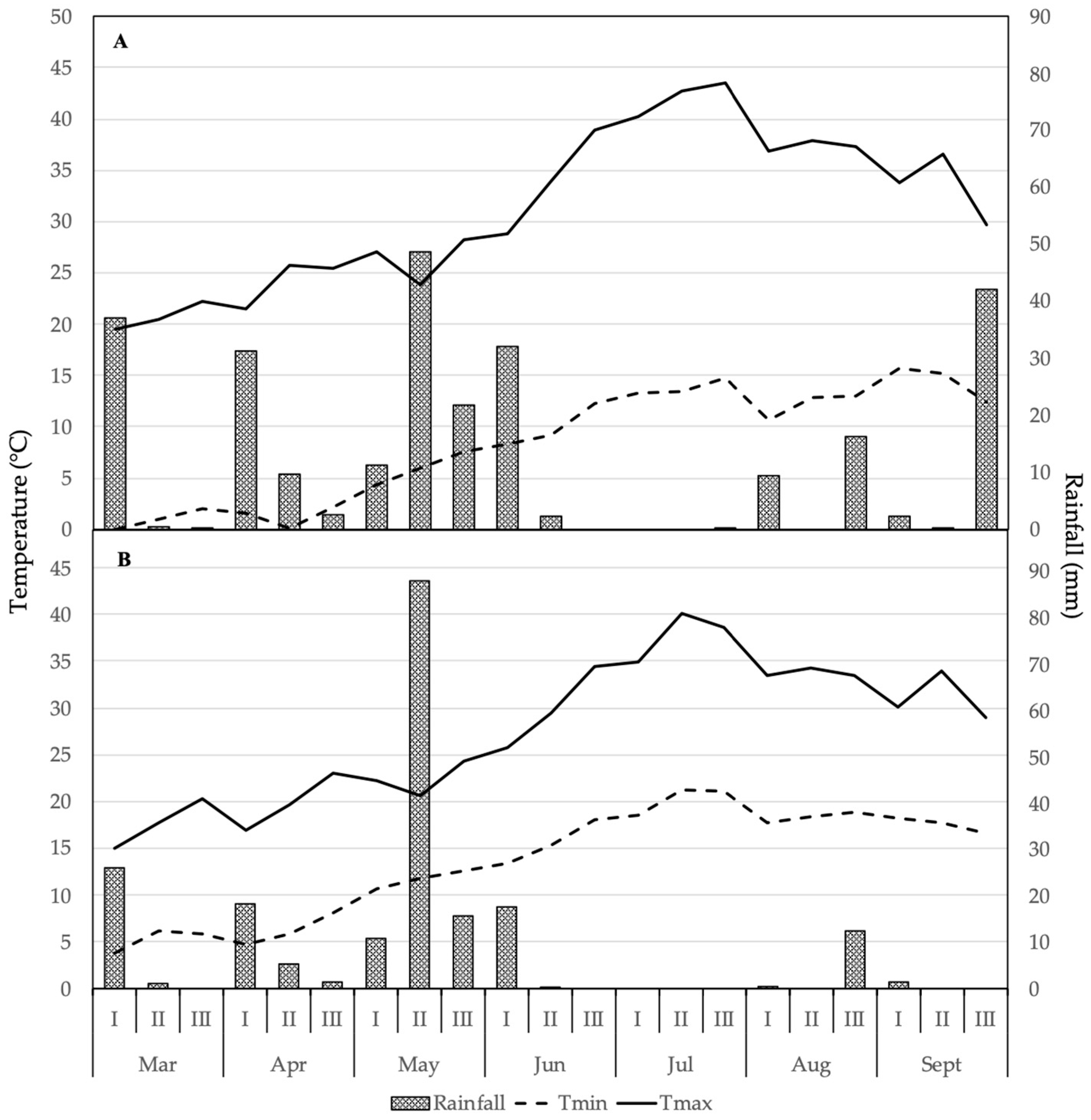
The experiment was conducted at two locations in inland Sicily, characterized by a semi-arid climate [34], with warm, predominantly dry summers and mild, rainy winters. The sites included the “Sparacia” experimental farm (37°38′ N, 13°45′ E; 600 m a.s.l.), in the Cammarata area (Agrigento, AG, Sicily, Italy), and a private farm (37°42′ N, 14°17′ E; 470 m a.s.l.) near Pietraperzia (Enna, EN, Sicily, Italy). Throughout the hop cultivation cycle, both locations experienced infrequent rainfall and elevated summer temperatures, with maximum temperatures exceeding 30 °C (Figure 1) [28].
The experiment was conducted during the 2023 growing season at two hop yards in Sicily: the “Sparacia” farm (established in 2021) and the Pietraperzia site (established in 2020). At both sites, hop rows were spaced 3.0 m apart, with 0.7 m between plants within each row. The trial evaluated the productive and qualitative responses of two hop genotypes (Cascade and Chinook) under contrasting management practices, including: (i) trellis design (S-trellis and V-trellis), (ii) pole height (2.6, 3.6, and 4.6 m), and (iii) soil cover management (no mulch vs. plastic mulch). These factors were combined into five experimental settings (ES), with the factor variety nested within the ES. Each elementary treatment was replicated three times (n = 3), and each replicate consisted of six plants. Table 1 summarizes the experimental settings. Within each ES, plants were cultivated following standard agronomic practices for Mediterranean environments [19,35,36].

2.2. Field Measurements

In both growing environments, hop plants were monitored weekly for their phytosanitary and developmental conditions. The BBCH (Biologische Bundesanstalt, Bundessortenamt, and CHemical industry) scale [37] was employed to evaluate the main phenological phases, determining the starting and ending dates of each developmental stage when at least 50% of plants had reached the respective phase. This approach allowed for calculating the average duration of each stage for every replication in Growing Degree Days (GDDs; °C), computed from the day of shoot emergence (BBCH phase 0.9) using the formula:
G D D = i = 1 K ( T a v g T b a s e ) i
where i and K indicate the starting and ending date of each phenological stage (i.e., first and last days of measurement, respectively), Tavg is the daily average temperature (obtained by fitting a sine curve to daily Tmin and Tmax), and Tbase is the base temperature (i.e., the temperature value below which plant growth is assumed to be zero). A Tbase of 0 °C was adopted for the vegetative stages, whereas a threshold of 5 °C was selected for the reproductive phases [38].
To assess crop responses to extremely high temperatures, the accumulation of degree days over 30 °C (EDD) was computed according to Lobell et al. [33]. The >30 °C threshold was chosen as an operational, literature-based cutoff because it is frequently used in hop-climate and agronomic studies to define “hot days” and as a practical limit above which heat load becomes agronomically significant [36,39]. Additionally, evidence indicates that higher temperatures are linked to reductions in hop yield and quality, as well as stress-related changes in secondary metabolism and its regulation, supporting the idea of monitoring heat exposure above this high-temperature threshold [40,41,42]. It was also selected to detect supra-optimal thermal exposure, which is increasingly common in semi-arid Mediterranean climates and can impact cone development and secondary metabolite profiles; therefore, EDD offers a decision-oriented indicator to compare heat-stress loads across different sites and management practice settings. Hourly temperatures were estimated from daily minimum and maximum T using a sinusoidal function, and extreme degree days were calculated as:
E D D = t = 1 N D D 30 + , t ;     D D 30 + , t = 0   i f   T t < 30   ° C ( T t 30 ) 24   i f   T t 30   ° C
where DD30+, t is the EDD for hour t, with t ranging from 27 May to 29 August 2023, for a total of 2304 h. EDD accumulation was calculated for each experimental setting and then summarized separately for vegetative and reproductive periods to support phase-specific interpretation of heat exposure. All calculations were performed separately for the vegetative (VGD) and the reproductive (RGD) growth stages, with BBCH stage 5.1 (inflorescence bud visible) marking the transition between phases. Phenological observations were used to align thermal metrics with developmental timing rather than calendar dates whenever relevant.
Across experimental settings, plants were irrigated using drip irrigation, delivering approximately 2000 m3 ha−1 over the season to support crop establishment and production under semi-arid conditions. Soil moisture, plant water status, and phenology were periodically monitored. The harvest time was based on a cone dry matter content of 20% [43]. All botanical fractions were harvested, weighed, and representative cone samples were sorted and stored under vacuum at −25 °C before analysis.

2.3. Chemical Analyses

In all 5 experimental settings, the quality of hops cones was tested following the standard methods of Analytica European Brewery Convention (A-EBC) 7.2 for moisture content, and 7.7 for α- and β-acids (%) [44].
In ES2 and ES3, the essential oil (EO) content and composition were assessed through A-EBC methods 7.10 and 7.12 [44]. EOs were obtained through steam distillation using a 20 L Albrigi Luigi EO extractor (Albrigi Luigi SRL, Verona, Italy). The bottom of the extractor was filled with tap water, and fresh plant material was positioned on top of a grill placed above the water. The hermetically sealed extractor used a 2000 W electric stove to generate steam, which passed through plant material to release volatile components. The vapor condensed in a cooler and collected in a tube, separating EO and residual water. The process lasted at least 3 h, stopping after 30 min without extracting any EOs. EO yields, in mL per 100 g, were stored at 4 °C until analysis.
The components of the EOs were determined using gas chromatography (GC) on a Clarus 500 GC from Perkin-Elmer (Shelton, CT, USA), equipped with a flame ionization detector (FID) and a ZB-5 capillary column (30 m × 0.25 mm i.d. × 0.25 μm film). An injection of 1 µL was used. The oven temperature started at 60 °C for 5 min, then increased by 3 °C/min to 180 °C, and was further raised by 20 °C/min to 280 °C, where it was held for 10 min. Helium was used as the carrier gas at 1.2 mL/min. Both the injector and the detector were maintained at 250 °C. The EO’s percentage composition was derived from GC peak areas without correction factors, using Total Chrom 6.2 software (Perkin-Elmer). For compound identification, GC–MS analysis was performed on the same Clarus 500 GC–MS system under identical conditions. The ionization source was set at 200 °C in electron impact mode at 70 eV. Mass spectra were acquired in TIC mode over m/z 45–500. Data processing was performed with Turbomass 5.4 software (Perkin-Elmer). Retention indices were obtained by injecting a C8–C32 n-alkane standard under the same conditions. Identification of the EO components was achieved by comparing their mass spectra with those in the NIST MS Search 2.0 library and by referencing available literature data [45].

2.4. Statistical Analysis

Statistical analysis was performed using Minitab® (Minitab LLC, State College, PA, USA), version 19.2.0.0, and Sigmaplot® (Grafiti LLC, Palo Alto, CA, USA), version 12.0. The GLM procedure was used, setting the durations of the main growing phases and all qualitative features of hop cones (α- and β-acids, EO yields, and composition) as dependent variables. The experimental scheme was a two-factor, fixed-nested design with three replications, with ‘variety’ nested within ‘experimental setting’ (ES). To validate adherence to the ANOVA assumptions, normality and variance homogeneity of all data were assessed using the Ryan–Joiner test (α = 0.05) and Levene’s test (α = 0.05), respectively [46]. Post-hoc comparisons were performed only after a significant ANOVA effect and were conducted using Tukey’s HSD test (p ≤ 0.05) as an experiment-wise control of Type I error for multiple pairwise comparisons within the relevant factor levels [46]. Principal component analysis (PCA) was also performed using MATLAB version 7.6.0 (The MathWorks Inc., Natick, MA, USA) to understand the relationships between experimental settings and quality parameters of each hop variety.

3. Results

3.1. Growing Duration Phases, Hop Biomass and Cone Yields, and Quality

No significant differences were observed for the VGD and RGD parameters (expressed in EDD) as a function of the experimental setting (ES) factor. However, significant differences in GDD requirements during the vegetative stage were observed depending on the ES considered (p < 0.01; Table 2). No statistical differences were detected for RGD (expressed in GDDs) based on the ES factor alone (Table 2). However, considering the varieties nested within the ES factor, significant differences between Cascade and Chinook were observed only within ES1 for the RGD parameter expressed in GDDs (p < 0.05; Table 2), with Chinook plants maturing earlier than Cascade (620.5 and 829.8 °C dd−1, respectively). With this exception, no statistical differences were observed for the accumulation of GDDs or EDD during the vegetative and reproductive development phases for all the sources of variation introduced.
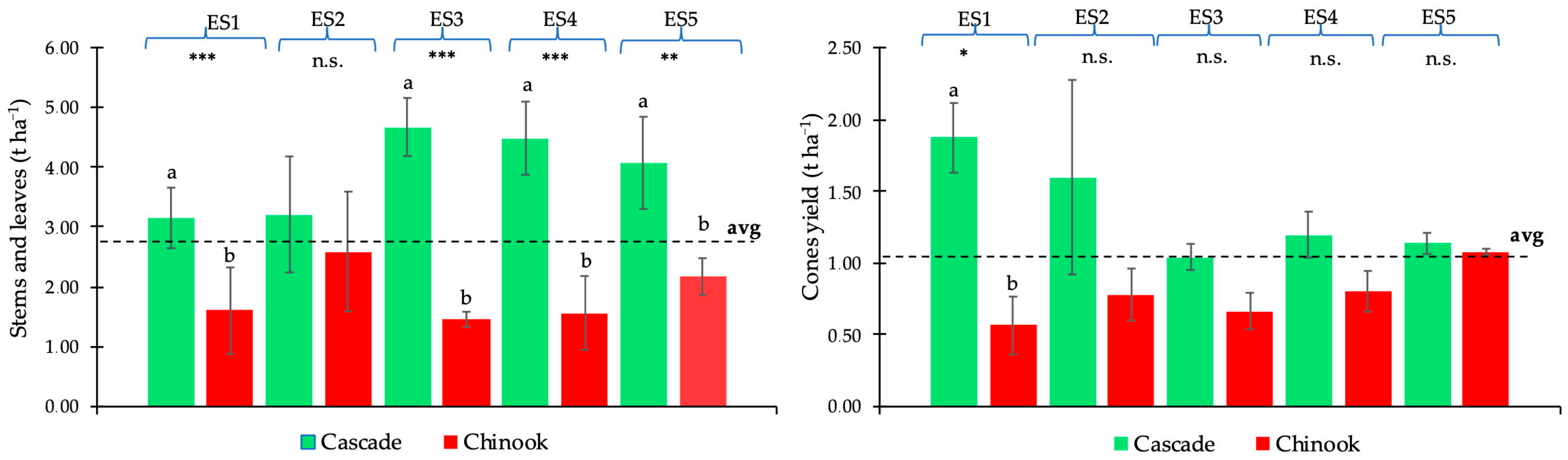
The biomass of hop plant stems and leaves varied significantly depending on the ES (p < 0.001) as well as on the variety nested within the ES factor (Figure 2). Except for ES2, where no statistical difference between the means was detected, Cascade plants consistently exhibited greater stem and leaf production, always exceeding the average values calculated among all treatment combinations (i.e., 2.89 t ha−1). Specifically, across the different ESs, Cascade showed yields approximately 96%, 220%, 186%, and 87% higher than the average of Chinook plants in ES1, ES3, ES4, and ES5, respectively (Figure 2). In most cases, no statistical differences were observed between cone yields at the ES factor level; only within ES1, Cascade plants showed statistically higher productivity than Chinook, with average yields of 1.87 t ha−1 and 0.56 t ha−1, respectively (p < 0.05; Figure 2).
Regarding the qualitative aspects of hop cones (i.e., α-acids, β-acids, and their investigated components), the results for the main parameters determined are reported in Table 3.
Except for the percentage of co-humulone to total α-acids, all qualitative parameters were significantly influenced by the ES factor. The yields of total α-acids (p < 0.001), co-humulone (p < 0.001), and n+ad-humulone (p < 0.001) were significantly higher in ES2, with average values of approximately 28%, 25%, and 29% higher compared to the average of the other treatments (Table 3). For β-acids and their components (i.e., co-lupulone and n+ad-lupulone), significant differences were also observed at the ES level, with ES1 boosting the yield of these compounds. The α/β-acid ratio also varied significantly due to the specific ES (p < 0.05; Table 3), with ES5 showing the highest value, likely due to the lowest β-acid yields recorded for this treatment. Considering the nested factors shown in Table 3 (i.e., variety within ES), the highest values for α-acids, co-humulone, and n+ad-humulone were observed in Cascade plants within ES2, although these were not statistically different from Chinook within the same ES. For α-acids, significant differences were identified between Cascade and Chinook in ES1 (p < 0.05) and ES4 (p < 0.05), with significantly higher values shown by Cascade plants in the first case and by Chinook in the second case. The highest average yields in absolute terms for β-acids were observed in Chinook in ES1, although these were not statistically different from Cascade within the same experimental treatment. Significant differences in β-acid yields were recorded in ES4 (p < 0.05) and ES5 (p < 0.05), with Cascade showing 71% and 106% higher values than Chinook in ES4 and ES5, respectively. Similar to the β-acid yields, and clearly correlated, significant differences in co-lupulone content were observed within the ES5 treatment (p < 0.05). For n+ad-lupulone, significant differences (p < 0.01) were noted in both ES4 and ES5, with Cascade showing significantly higher values compared to Chinook (Table 3).
For EO yield, statistical differences were observed among the experimental settings, with higher yields in ES2 (p < 0.05; Table 4). Significant differences between varieties emerged only within ES2 (p < 0.05), with Cascade showing EO yields approximately 42% higher compared to Chinook under the same experimental conditions. The detected amounts of the three main EO components—myrcene, humulene, and caryophyllene—were significantly affected by both the genotype and the experimental setting. The concentration of myrcene varied significantly with the experimental setting (p < 0.001; Table 4). The highest yields were found in ES3, with production levels 25% higher than the other setting. Significant differences (p < 0.05) were also observed between varieties, with Cascade EO containing more myrcene than Chinook in both ES2 and ES3. The highest humulene content was recorded in ES2, with concentrations approximately double those in the other setting (p < 0.001; Table 4). Within these ES, Chinook consistently showed the highest humulene values (p < 0.001). Caryophyllene concentrations varied significantly depending on the ES (p < 0.001) and on the variety within either ES2 (p < 0.001) or ES3 (p < 0.001). Chinook EO was the most enriched in caryophyllene (p < 0.001; Table 4). For other compounds in hop EOs, significant differences were observed both at the ES level and among varieties within specific ES treatments (p < 0.001; Table 4).

3.2. Association Between Growing Duration Phases and Hop Quality Characteristics (PCA)

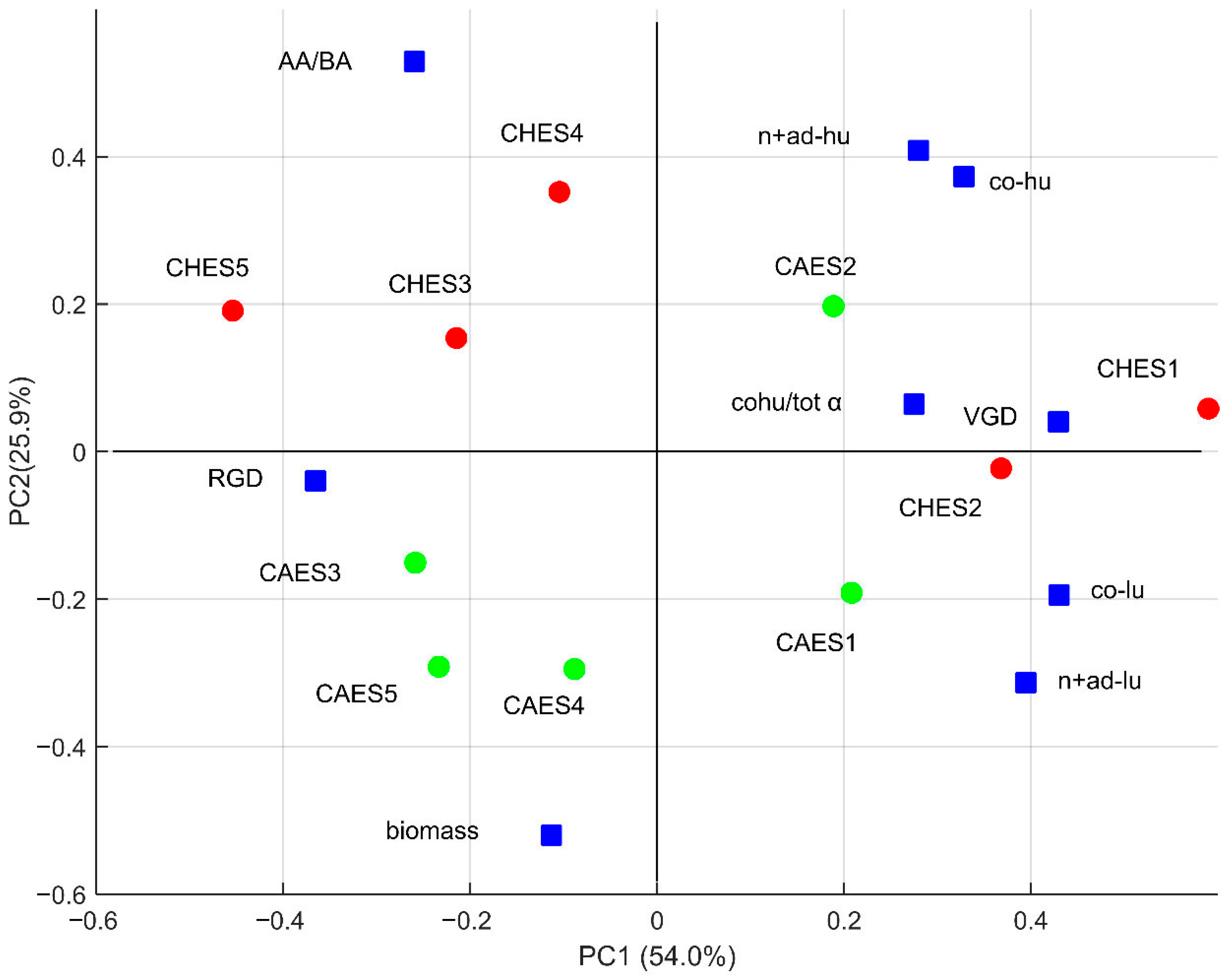
A PCA was conducted to explore the possible association between thermal requirements, durations of vegetative (VGD) and reproductive (RGD) phenological phases, biomass production, and the main qualitative characteristics of hop plants, including the content of α- and β-acids, α- to β-acid ratio, and co-humulone to total α-acid ratio.
A bi-plot of the scores and loadings of the PCA is shown in Figure 3. Two principal components were identified, explaining 79.9% of the total variance (54.0% and 25.9% for the first (PC1) and the second (PC2) principal components, respectively). The first PC was strongly associated with the durations of phenological stages, which appear well separated and positioned in opposite quadrants. The second PC was otherwise more associated with biomass yield and, to a lesser extent, with the α/β-acid ratio. The PC1 spread the sample scores according to the growth location; irrespective to the variety, all samples subjected to ES1 and ES2 (i.e., obtained from the Pietraperzia farm) were plotted on the positive side of the PC1, whereas all samples from ES3, ES4 and ES5 (i.e., from the Sparacia farm) were on the left side of the same PC. The first group of samples (ES1 and ES2) was characterized by a prolonged vegetative phase (VGD) and higher α and β acid contents. Contrastingly, the second group of samples (ES3, ES4, and ES5) showed a prolonged reproductive phase (RGD). The PC2 spread the samples mainly according to genotype, showing most Chinook samples (4 out of 5) on the positive side and the majority of Cascade’s (4 out of 5) in the lower part of the bi-plot. On the positive side of PC2, the samples showing the highest α- to β-acid ratio took place, while on the negative side were found the samples that showed higher biomass production, two genotype-dependent characteristics (Figure 3).

4. Discussion

Our findings indicate that while heat exposure during vegetative and reproductive phases remained relatively stable across experimental settings, thermal requirements for vegetative development varied among settings. This divergence suggests that, under semi-arid Mediterranean conditions, management and micro-environmental factors can modulate crop developmental rates beyond what is captured by extreme heat accumulation alone. In other words, EDD quantifies supra-optimal thermal load, whereas GDD reflects the pace of development; the two metrics can decouple under local conditions and farm design. This interpretation is coherent with agroclimatic literature showing that trellis architecture and soil cover management can modify within-canopy temperature, radiation, and airflow, thereby altering the “effective” thermal environment perceived by the crop even under the same station-recorded climate [23,31,36]. The crucial role of vegetative stage duration and heat accumulation in hop development has already been evidenced [25], with shorter vegetative phases often associated with improved plant development. Our results are consistent with that framework and support the use of phase-specific heat metrics (GDD and EDD) to interpret management-driven differences in phenology. Similar recommendations—i.e., interpreting hop phenology using phase-specific thermal descriptors—have been proposed in international work on hop adaptation to warming trends [47,48,49].
In the reproductive phase, the relative stability of RGD (EDD) across settings suggests a limited sensitivity of reproductive timing to site-level variation in extreme heat exposure within the range observed in 2023. However, the significant genotype effect observed within ES1 (earlier reproductive development for Chinook) highlights that cultivar choice can shift developmental timing even under similar heat-load conditions, a point that becomes increasingly relevant under climate change scenarios [50,51]. This is in line with reports from major hop-growing regions indicating cultivar-specific phenological thresholds and different sensitivities to seasonal heat patterns, which can shift the timing of cone development relative to peak summer temperatures [35,36,52]. From a management perspective, this timing shift can be leveraged to reduce the overlap between sensitive reproductive stages and the hottest part of the season, potentially mitigating quality losses in heat-prone regions. Phenological “escape” through cultivar choice is widely discussed as a practical adaptation strategy in perennial and specialty crops under increasing heatwave risk [41,47].
Regarding biomass production, results show that hop plant biomass, particularly in stems and leaves, is significantly influenced by both experimental settings and variety. Cascade plants consistently produced more biomass than Chinook. This pattern indicates a robust genotype signal for vegetative vigor but also suggests a potential trade-off between vegetative growth and quality-oriented outcomes depending on local management conditions [31]. International hop studies frequently report that higher vigor does not automatically translate into superior brewing value, because excessive canopy growth can increase shading and humidity within the canopy and can modify source–sink relations during cone filling [35,53,54]. Although cone yield did not differ significantly among settings, Cascade generally showed higher productivity than Chinook. Taken together, these results imply that yield stability across settings may mask important differences in allocation and quality formation, emphasizing the need to evaluate “value traits” (bitter acids and essential oils) alongside yield when expanding hop cultivation into new environments [19]. This “value-trait” perspective is consistent with brewing-oriented literature, where the economic relevance of hops is tied to resin and oil attributes at least as much as to cone mass [35,41,55].
Except for the percentage of co-humulone to total α-acids, which was slightly low, most of the investigated qualitative parameters were in line with the genotype characteristics. In particular, our hop samples showed on average comparable levels of α-acids and lower levels of β-acids when compared to the same hop cultivars grown in Mediterranean areas [56]. Quality traits were significantly shaped by the interaction between genotype and experimental setting, indicating that the same cultivar can express different chemical profiles depending on farm design and microclimate. Cascade consistently achieved the highest values, supporting its suitability for semi-arid Mediterranean production systems under the tested conditions. The α/β-acid ratio was elevated due to low β-acids; as suggested elsewhere, this may partly reflect greater oxidation susceptibility of β-acids when hops are stored as cones, given their larger exposed surface area [54]. However, because cones in this study were processed immediately and rapidly frozen, post-harvest artefacts are unlikely to fully explain the pattern; a field-driven effect linked to the heat/stress context during cone development is a plausible alternative interpretation [17,47]. Importantly, the genotype × setting interaction observed here aligns with evidence from other Mediterranean field experiments showing that microclimate and management can substantially alter cone chemistry even when yields remain similar [23,26,57,58]. Comparable genotype-by-environment effects on bitter-acid profiles have also been documented in international studies across contrasting climates and management systems [41,47,59].
Essential oil (EO) yield further emphasized the role of management and location: significant differences among experimental settings were observed, with ES2 producing the highest EO yields, consistent with reference values for the cultivars [57]. This result supports a practical interpretation: optimizing farm design and soil cover strategies can materially improve value traits (EO yield) even within the same regional climate. Cascade plants consistently produced higher EO yields than Chinook across different settings, suggesting that cultivar selection can be a first-order lever for maximizing aromatic potential under semi-arid conditions. The EO composition showed significant differences due to genotype and the interaction between genotype and environment, but in all cases, it differed from the reference values for the studied cultivars, with higher levels of myrcene in both hops [57]. Such deviations from standard reference profiles are frequently reported when hops are grown outside their traditional production areas, supporting a “terroir” effect driven by the interaction of heat load, radiation, and plant water status [60,61,62]. In particular, comparisons with widely used US industry references [57,63,64] suggest that oil yields and component balance can shift markedly under semi-arid Mediterranean conditions, with cultivar-specific sensitivity. Such compositional shifts are consistent with a “terroir” effect and may reflect the influence of heat exposure, microclimate, and management on secondary metabolism, reinforcing observations in Mediterranean environments [19,29,30]. The evidence that even modest climatic differences can shift cone chemistry supports the need for site-specific agronomic choices when targeting specific brewing profiles [61,62]. For growers and industry, this implies that expanding hop production into semi-arid regions is feasible, but quality targets will probably require cultivar- and setting-specific “recipes” rather than uniform protocols.
Finally, principal component analysis (PCA) revealed that both experimental settings and genetic factors significantly affect hop plant phenology and quality. The Pietraperzia location (with or without mulch) was associated with higher α- and β-acid content and a longer vegetative phase, suggesting a potential physiological link between stage duration and cone-quality attributes. This clustering pattern supports the hypothesis that management-mediated shifts in developmental timing can influence the biochemical trajectory of cone maturation, which warrants multi-year and multi-site validation. Genetic traits also contributed to sample separation through the co-humulone/α-acid ratio and biomass production. As commonly emphasized for multivariate ordinations, PCA remains descriptive and does not demonstrate causality; nonetheless, the loadings provide a biologically plausible structure that is consistent with known links among phenology, source–sink balance, and secondary-metabolite accumulation in hops [42,65,66]. Overall, PCA provides an integrative view consistent with a decision-oriented message: location and farm design affect the expression of quality traits, and genotype choice determines the “response envelope” within which management operates. This interpretation aligns with international evidence that environment and management modulate hop cone chemistry within cultivar-specific limits, reinforcing the need for cultivar- and site-tailored strategies when hops are introduced into warmer, drier regions [35,52,58].

5. Conclusions

The research highlights that semi-arid Mediterranean environments can support hop production, but maintaining cone value traits requires a climate-smart combination of cultivar choice and farm design. Across experimental settings, vegetative development was more responsive to local environmental and management conditions than to genotype, as indicated by changes in GDD-based vegetative requirements even under similar extreme-heat loads (EDD > 30 °C). Cascade generally exhibited higher vegetative vigor and essential oil yield than Chinook, supporting its suitability for semi-arid Mediterranean hop yards under the tested conditions; yet the strongest determinant of cone chemistry (α- and β- acids, and essential oil profiles) was the genotype × environment interaction, suggesting that comparable yields can mask meaningful shifts in brewing-relevant quality. By linking BBCH phenology to phase-specific heat metrics (GDD and EDD), the study offers a transferable, decision-oriented framework for comparing heat exposure across sites and seasons and for designing cultivar-specific management strategies that stabilize quality under increasing heat variability, with multi-year validation needed to confirm the stability of these patterns under interannual climate variability.

Author Contributions

Conceptualization, A.C., R.M. and O.M.; methodology, R.M., A.C. and V.A.; software, R.M. and V.A.; validation, M.S., A.C., M.V. and R.M.; formal analysis, R.M. and V.A. investigation, R.M.; resources, O.M., A.C. and M.V.; data curation, A.C. and V.A.; writing—original draft preparation, R.M.; writing—review and editing, A.C., V.A. and M.S.; visualization, V.A.; supervision, A.C.; project administration, A.C. All authors have read and agreed to the published version of the manuscript.

Funding

This research received no external funding.

Data Availability Statement

The original contributions presented in this study are included in the article. Further inquiries can be directed to the corresponding authors.

Acknowledgments

The authors would like to express their gratitude to Domenico Munì, Luigi Madonia, and Biagio Amormino for their support and contributions to this research. Special thanks to Filippo Vinci for his valuable insights and assistance.

Conflicts of Interest

The authors declare no conflicts of interest.

References

  1. Biancardi, E.; Wagner, T. The beer hop in Italy. Ann. Istituto Sper. Colt. Ind. Bologna 1989, 21, 1–59. [Google Scholar]
  2. Almaguer, C.; Schönberger, C.; Gastl, M.; Arendt, E.; Becker, T. Humulus lupulus—A story that begs to be told. A review. J. Inst. Brew. 2014, 120, 289–314. [Google Scholar] [CrossRef]
  3. Neve, R.A. The cultivated hop. In Hops; Springer: Dordrecht, The Netherlands, 1991; pp. 25–47. [Google Scholar] [CrossRef]
  4. Gallardo, M.; Agehara, S.; Rechcigl, J. Optimization of trellis design and height for double-season hop (Humulus lupulus L.) production in a subtropical climate: Growth, morphology, yield, and cone quality during establishment years. Eur. J. Agron. 2025, 162, 127415. [Google Scholar] [CrossRef]
  5. Broomandi, P.; Bagheri, M.; Fard, A.M.; Hadei, M.; Abdoli, M.; Roshani, A.; Fathian, A.; Shafiei, S.; Leuchner, M.; Kumar, P.; et al. The Escalating Threat of Heatwaves in Central Asia: Climate Change Impacts and Public Health Risks. Glob. Chall. 2025, 9, e00401. [Google Scholar] [CrossRef]
  6. Mihrete, T.B.; Mihretu, F.B. Crop Diversification for Ensuring Sustainable Agriculture, Risk Management and Food Security. Glob. Chall. 2025, 9, 2400267. [Google Scholar] [CrossRef] [PubMed]
  7. Shellie, R.A.; Poynter, S.D.; Li, J.; Gathercole, J.L.; Whittock, S.P.; Koutoulis, A. Varietal characterization of hop (Humulus lupulus L.) by GC–MS analysis of hop cone extracts. J. Sep. Sci. 2009, 32, 3720–3725. [Google Scholar] [CrossRef] [PubMed]
  8. Cochran, D.; Senske, A. Evaluating the Effects of Nitrogen Fertilization on Hop Yield; Iowa State University Research and Demonstration Farms Progress Reports; Iowa State University: Ames, IA, USA, 2019; Available online: https://iastatedigitalpress.com/farmreports/article/771/galley/644/download/ (accessed on 15 December 2025).
  9. Acosta-Rangel, A.; Rechcigl, J.; Bollin, S.; Deng, Z.; Agehara, S. Hop (Humulus lupulus L.) phenology, growth, and yield under subtropical climatic conditions: Effects of cultivars and crop management. Aust. J. Crop Sci. 2021, 15, 764–772. [Google Scholar] [CrossRef]
  10. Acosta-Rangel, A.; Agehara, S.; Rechcigl, J. Double-season production of hops (Humulus lupulus L.) with photoperiod manipulation in a subtropical climate. Sci. Hortic. 2024, 332, 113177. [Google Scholar] [CrossRef]
  11. Rutto, L.K.; Xu, Y.; Ren, S.; Scoggins, H.; Davis, J. Results from hop cultivar trials in mid-Atlantic United States. HortTechnology 2021, 31, 542–551. [Google Scholar] [CrossRef]
  12. Fagherazzi, M.M.; Sarnighausen, V.R.; Rufato, L.; Nerbass, F.R.; Santos, M.F.S.D. Climatological conditions of the southern Santa Catarina state highlands for hop production. Rev. Ceres 2023, 70, 1–7. [Google Scholar] [CrossRef]
  13. Fortuna, G.C.; Neves, C.S.; Campos, O.P.; Gomes, J.A.O.; Silva, J.C.R.L.; Souza, A.A.; Funari, C.S.d.; Marques, M.O.M.; Bonfim, F.P.G. Hop Tropicalization: Chemical Compositions of Varieties Grown under Organic and Conventional Systems in Subtropical Conditions. Horticulturae 2023, 9, 855. [Google Scholar] [CrossRef]
  14. Jastrombek, J.M.; Faguerazzi, M.M.; de Cássio Pierezan, H.; Rufato, L.; Sato, A.J.; da Silva Ricce, W.; Vieira Marques, V.; Rodrigues Leles, N.; Ruffo Roberto, S. Hop: An emerging crop in subtropical areas in Brazil. Horticulturae 2022, 8, 393. [Google Scholar] [CrossRef]
  15. Leles, N.R.; Sato, A.J.; Rufato, L.; Jastrombek, J.M.; Marques, V.V.; Missio, R.F.; Mello Fernandes, N.L.; Ruffo Roberto, S. Performance of hop cultivars grown with artificial lighting under subtropical conditions. Plants 2023, 12, 1971. [Google Scholar] [CrossRef] [PubMed]
  16. Dabbous-Wach, A.; Rodolfi, M.; Paolini, J.; Costa, J.; Ganino, T. Characterization of wild Corsican hops and assessment of the performances of German hops in Corsican environmental conditions through a multidisciplinary approach. Appl. Sci. 2021, 11, 3756. [Google Scholar] [CrossRef]
  17. Marceddu, R.; Carrubba, A.; Sarno, M. Cultivation trials of hop (Humulus lupulus L.) in a Mediterranean environment. In XXXI International Horticultural Congress (IHC2022): International Symposium on Innovative Perennial Crops Management 1366; International Society for Horticultural Science (ISHS): Angers, France, 2022; Volume 1366, pp. 147–154. [Google Scholar] [CrossRef]
  18. Riccioni, C.; Belfiori, B.; Sileoni, V.; Marconi, V.; Perretti, G.; Bellucci, M.; Rubini, A. High genetic and chemical diversity of wild hop populations from Central Italy with signals of a genetic structure influenced by both sexual and asexual reproduction. Plant Sci. 2021, 304, 110794. [Google Scholar] [CrossRef]
  19. Ruggeri, R.; Tolomio, M.; Muganu, M.; Loreti, P.; Virga, G.; Iacuzzi, N.; Rossini, F. Establishment of a commercial organic hopyard in a Mediterranean environment: Production attributes and their relationship with soil texture. Sci. Hortic. 2023, 310, 111720. [Google Scholar] [CrossRef]
  20. Dementiev, D.; Leonteva, V.; Ivanova, I.; Fadeev, A. Technology of cultivation of Civil hops in Chuvashia. IOP Conf. Ser. Earth Environ. Sci. 2021, 839, 022033. [Google Scholar] [CrossRef]
  21. Licciardo, F.; Carbone, K.; Ievoli, C.; Manzo, A.; Tarangioli, S. Outlook Economico-Statistico del Comparto Luppolo; CREA: Rome, Italy, 2021. Available online: https://innovaluppolo.crea.gov.it/wp-content/uploads/2021/05/OUTLOOKSE_ES_2021.pdf (accessed on 30 January 2026).
  22. Carbone, K.; Licciardo, F. Luppolo Made in Italy, Una Filiera in (Lenta) Crescita. Terra e Vita, 13 October 2023. Available online: https://terraevita.edagricole.it/colture-alternative/luppolo-made-in-italy-una-filiera-in-lenta-crescita/ (accessed on 12 December 2025).
  23. Marceddu, R.; Carrubba, A.; Alfeo, V.; Alessi, A.; Sarno, M. Adapting American Hop (Humulus lupulus L.) Varieties to Mediterranean Sustainable Agriculture: A Trellis Height Exploration. Horticulturae 2024, 10, 181. [Google Scholar] [CrossRef]
  24. Rossini, F.; Loreti, P.; Provenzano, M.E.; De Santis, D.; Ruggeri, R. Agronomic performance and beer quality assessment of twenty hop cultivars grown in Central Italy. Ital. J. Agron. 2016, 11, 180–187. [Google Scholar] [CrossRef]
  25. Marceddu, R.; Carrubba, A.; Sarno, M. Resilience of hop (Humulus lupulus L.) to salinity, heat and drought stresses: A mini-review. Front. Plant Sci. 2022, 13, 1064922. [Google Scholar] [CrossRef] [PubMed]
  26. Ruggeri, R.; Loreti, P.; Rossini, F. Exploring the potential of hop as a dual-purpose crop in the Mediterranean environment: Shoot and cone yield from nine commercial cultivars. Eur. J. Agron. 2018, 93, 11–17. [Google Scholar] [CrossRef]
  27. Zittis, G.; Almazroui, M.; Alpert, P.; Ciais, P.; Cramer, W.; Dahdal, Y.; Fnais, M.; Francis, D.; Hadjinicolaou, P.; Howari, F.; et al. Climate change and weather extremes in the Eastern Mediterranean and Middle East. Rev. Geophys. 2022, 60, e2021RG000762. [Google Scholar] [CrossRef]
  28. SIAS. Servizio Informativo Agrometeorologico Siciliano. 2024. Available online: http://www.sias.regione.sicilia.it (accessed on 24 September 2025).
  29. Forteschi, M.; Porcu, M.C.; Fanari, M.; Zinellu, M.; Secchi, N.; Buiatti, S.; Passaghe, P.; Bertoli, S.; Pretti, L. Quality assessment of Cascade hop (Humulus lupulus L.) grown in Sardinia. Eur. Food Res. Technol. 2019, 245, 863–871. [Google Scholar] [CrossRef]
  30. Gresta, F.; Calvi, A.; Santonoceto, C.; Strano, T.; Ruberto, G. Agronomic traits and essential oil profiles of Humulus lupulus L. cultivated in southern Italy. J. Essent. Oil Res. 2023, 35, 60–70. [Google Scholar] [CrossRef]
  31. Carrubba, A.; Marceddu, R.; Sarno, M. Hop (Humulus lupulus L.): Suitability of traditional cultivars to a low-trellis farming system in a semiarid environment. HortScience 2022, 57, 1409–1415. [Google Scholar] [CrossRef]
  32. Lesk, C.; Anderson, W. Decadal variability modulates trends in concurrent heat and drought over global croplands. Environ. Res. Lett. 2021, 16, 055024. [Google Scholar] [CrossRef]
  33. Lobell, D.B.; Hammer, G.L.; McLean, G.; Messina, C.; Roberts, M.J.; Schlenker, W. The critical role of extreme heat for maize production in the United States. Nat. Clim. Change 2013, 3, 497–501. [Google Scholar] [CrossRef]
  34. Rivas-Martínez, S.; Sánchez-Mata, D. Boreal vegetation series of North America. Plant Biosyst. 2011, 145, 208–219. [Google Scholar] [CrossRef]
  35. Rossini, F.; Virga, G.; Loreti, P.; Iacuzzi, N.; Ruggeri, R.; Provenzano, M.E. Hops (Humulus lupulus L.) as a novel multipurpose crop for the Mediterranean region of Europe: Challenges and opportunities of their cultivation. Agriculture 2021, 11, 484. [Google Scholar] [CrossRef]
  36. Marceddu, R.; Carrubba, A.; Sarno, M. Cultivation trials of hop (Humulus lupulus L.) in semi-arid environments. Heliyon 2020, 6, e05114. [Google Scholar] [CrossRef] [PubMed]
  37. Rossbauer, G.; Buhr, L.; Hack, H.; Hauptmann, S.; Klose, R.; Meier, U.; Stauss, R.; Weber, E. Phänologische Entwick-lungsstadien von KulturHopfen (Humulus lupulus L.). Nachrichtenblatt Des Dtsch. Planzenschutzdienstes 1995, 47, 249–253. [Google Scholar]
  38. Srečec, S.; Kvaternjak, I.; Kaučić, D.; Marić, V. Dynamics of hop growth and accumulation of α-acids in normal and extreme climatic conditions. Agric. Conspec. Sci. 2004, 69, 59–62. Available online: https://hrcak.srce.hr/12270 (accessed on 15 December 2025).
  39. Forster, A.; Schüll, F.; Bertazzoni, J.; Gahr, A. The impact of climatic conditions on the biogenesis of various compounds in hops. BrewingScience 2021, 74, 160–171. [Google Scholar] [CrossRef]
  40. Potopová, V.; Lhotka, O.; Možný, M.; Musiolková, M. Vulnerability of hop-yields due to compound drought and heat events over European key-hop regions. Int. J. Climatol. 2021, 41, E2136–E2158. [Google Scholar] [CrossRef]
  41. Mozny, M.; Trnka, M.; Vlach, V.; Zalud, Z.; Cejka, T.; Hajkova, L.; Potopova, V.; Semenov, M.A.; Semeradova, D.; Büntgen, U. Climate-induced decline in the quality and quantity of European hops calls for immediate adaptation measures. Nat. Commun. 2023, 14, 6028. [Google Scholar] [CrossRef]
  42. Eriksen, R.L.; Padgitt-Cobb, L.K.; Townsend, M.S.; Henning, J.A. Gene expression for secondary metabolite biosynthesis in hop (Humulus lupulus L.) leaf lupulin glands exposed to heat and low-water stress. Sci. Rep. 2021, 11, 5138. [Google Scholar] [CrossRef]
  43. Calderwood, L.; Post, J. Hop Harvest Timing in the Northeast; University of Vermont Extension Extension North-West Crops and Soils Program: St. Albans, VT, USA, 2015; Available online: https://www.uvm.edu/d10-files/documents/2024-06/Hop_Harvest_Determination_factsheet.pdf (accessed on 11 November 2025).
  44. Analytica European Brewery Convention. Analytica-EBC, 5th ed.; Hans Carl, Fachverlag: Nürnberg, Germany, 2007.
  45. Adams, R.P. Identification of Essential Oil Components by Gas Chromatography/Mass Spectrometry, 5th ed.; Texensis Publishing: Gruver, TX, USA, 2017. [Google Scholar]
  46. Gomez, K.A.; Gomez, A.A. Statistical Procedures for Agricultural Research; John Wiley & Sons: New York, NY, USA, 1984. [Google Scholar]
  47. Donner, P.; Pokorný, J.; Ježek, J.; Krofta, K.; Patzak, J.; Pulkrábek, J. Influence of weather conditions, irrigation and plant age on yield and alpha-acids content of Czech hop (Humulus lupulus L.) cultivars. Plant Soil Environ. 2020, 66, 41–46. [Google Scholar] [CrossRef]
  48. Lobell, D.B. Climate change adaptation in crop production: Beware of illusions. Glob. Food Secur. 2014, 3, 72–76. [Google Scholar] [CrossRef]
  49. Olesen, J.E.; Trnka, M.; Kersebaum, K.C.; Skjelvåg, A.O.; Seguin, B.; Peltonen-Sainio, P.; Rossi, F.; Kozyra, J.; Micale, F. Impacts and adaptation of European crop production systems to climate change. Eur. J. Agron. 2011, 34, 96–112. [Google Scholar] [CrossRef]
  50. Agehara, S.; Carrubba, A.; Sarno, M.; Marceddu, R. Phenological assessment of hops (Humulus lupulus L.) grown in semi-arid and subtropical climates through BBCH scale and a thermal-based growth model. Agronomy 2024, 14, 3045. [Google Scholar] [CrossRef]
  51. Bauerle, W.L. Intracanopy CO2 and light interactions on Humulus lupulus L. net canopy carbon gain under current and future atmospheric CO2 concentrations. Agric. For. Meteorol. 2021, 310, 108621. [Google Scholar] [CrossRef]
  52. Bauerle, W.L.; Hazlett, M. Humulus lupulus L. strobilus in situ photosynthesis and respiration temperature responses. Plants 2023, 12, 2030. [Google Scholar] [CrossRef]
  53. Mozzon, M.; Foligni, R.; Mannozzi, C. Brewing Quality of Hop Varieties Cultivated in Central Italy Based on Multivolatile Fingerprinting and Bitter Acid Content. Foods 2020, 9, 541. [Google Scholar] [CrossRef]
  54. Rutnik, K.; Ocvirk, M.; Košir, I.J. The Stability of Hop (Humulus lupulus L.) Resins during Long-Period Storage. Plants 2023, 12, 936. [Google Scholar] [CrossRef]
  55. Afonso, S.; Arrobas, M.; Rodrigues, M.Â. Agronomic and chemical evaluation of hop cultivars grown under Mediterranean conditions. Span. J. Agric. Res. 2021, 19, e0904. [Google Scholar] [CrossRef]
  56. Contin, D.R.; Habermann, E.; De Souza, B.C.; De Oliveira, E.A.; Martinez, C.A.; Vieira, P.C.; Da Costa, F.B. Exploring the tropical acclimation of European and American hop cultivars (Humulus lupulus L.): Focus on physiology, productivity, and chemical composition. Eur. J. Agron. 2023, 151, 126990. [Google Scholar] [CrossRef]
  57. Hoplist. Variety Manual. 2024. Available online: https://www.hopslist.com/hops/ (accessed on 30 January 2026).
  58. Herkenhoff, M.E.; Brödel, O.; Frohme, M. Hops across continents: Exploring how terroir transforms the aromatic profiles of five hop (Humulus lupulus) varieties grown in their countries of origin and in Brazil. Plants 2024, 13, 2675. [Google Scholar] [CrossRef] [PubMed]
  59. Ou, Z.; Chang, S.; Li, S.; Tan, Y.; Zhou, Y.; Pang, X. Characterization of the key aroma compounds in different varieties of hops by application of the sensomics approach. Food Chem. 2024, 460, 140448. [Google Scholar] [CrossRef] [PubMed]
  60. Morcol, T.B.; Negrin, A.; Matthews, P.D.; Kennelly, E.J. Hop (Humulus lupulus L.) terroir has large effect on a glycosylated green leaf volatile but not on other aroma glycosides. Food Chem. 2020, 321, 126644. [Google Scholar] [CrossRef] [PubMed]
  61. Carbone, K.; Bianchi, G.; Petrozziello, M.; Bonello, F.; Macchioni, V.; Parisse, B.; De Natale, F.; Alilla, R.; Cravero, M.C. Tasting the Italian terroir through craft beer: Quality and sensory assessment of Cascade hops grown in Central Italy and derived monovarietal beers. Foods 2021, 10, 2085. [Google Scholar] [CrossRef]
  62. Rodolfi, M.; Chiancone, B.; Liberatore, C.M.; Fabbri, A.; Cirlini, M.; Ganino, T. Changes in chemical profile of Cascade hop cones according to the growing area. J. Sci. Food Agric. 2019, 99, 6011–6019. [Google Scholar] [CrossRef] [PubMed]
  63. John I. Haas, Inc. Chinook [Mini Spec Sheet]. 2020. Available online: https://www.johnihaas.com/wp-content/uploads/2020/08/MiniSpecSheets-Chinook.pdf (accessed on 18 February 2026).
  64. John I. Haas, Inc. Cascade [Mini Spec Sheet]. 2020. Available online: https://www.johnihaas.com/wp-content/uploads/2020/09/MiniSpecSheets-Cascade.pdf (accessed on 18 February 2026).
  65. Codesido, S.; Hanafi, M.; Gagnebin, Y.; González-Ruiz, V.; Rudaz, S.; Boccard, J. Network principal component analysis: A versatile tool for the investigation of multigroup and multiblock datasets. Bioinformatics 2021, 37, 1297–1303. [Google Scholar] [CrossRef] [PubMed]
  66. Olsovska, J.; Bostikova, V.; Dusek, M.; Jandovska, V.; Bogdanova, K.; Cermak, P.; Boštík, P.; Mikyska, A.; Kolar, M. Humulus lupulus L. (hops)—A valuable source of compounds with bioactive effects for future therapies. Mil. Med. Sci. Lett. 2016, 85, 19–30. [Google Scholar] [CrossRef]
Figure 1. Ten-day values of rainfall and temperatures recorded at Sparacia (A) (Agrigento, AG, Sicily, Italy) and Pietraperzia (B) (Enna, EN, Sicily, Italy) during the 2023 growing season.
Horticulturae 12 00338 g001
Figure 2. Mean values ± SEM and results of nested ANOVA of stems and leaves biomass (on the left) and cones production (on the right) of Cascade and Chinook hops grown in 2023 in five experimental settings (ES) in Sicily. In both graphs, horizontal dashed lines represent the mean value across varieties and ES. Significance of the calculated F values within each ES: *** significant at p ≤ 0.001; ** significant at 0.001 < p ≤ 0.01; * significant at 0.01 < p ≤ 0.05; n.s. not significant. For varieties within ES: different letters on top of the two bars indicate a significant difference according to Tukey’s Test (p < 0.05).
Horticulturae 12 00338 g002
Figure 3. Bi-plot of scores and loadings (blue squares) of the PCA carried out on the duration of vegetative (VGD) and reproductive (RGD) growth stages, biomass yields, and analytical features (co-hu = co-humulone; n+ad-hu = n+ad-humulone; cohu/tot α = co-humulone to total α acid ratio; co-lu = co-lupulone; n+ad-lu = n+ad-lupulone; AA/BA = α to β acid ratio) in Cascade (CA, green dots) and Chinook (CH, red dots) hop cultivars subjected to five experimental settings (ES 1 to 5). Each point is the average of 18 plants.
Horticulturae 12 00338 g003
Table 1. Details of farming practices adopted in 2023 at Sparacia (Agrigento, AG, Sicily, Italy) and Pietraperzia (Enna, EN, Sicily, Italy).
Farming Practice CodificationDescription
ES1S-trellis design; 4.6 m-high; no mulch; Pietraperzia (EN).
ES2S-trellis design; 4.6 m-high; plastic mulch (PE film); Pietraperzia (EN).
ES3V-trellis design; 4.6 m-high; plastic mulch (PE film); Cammarata (AG).
ES4V-trellis design; 2.6 m-high; plastic mulch (PE film); Cammarata (AG).
ES5V-trellis design; 3.6 m-high; plastic mulch (PE film); Cammarata (AG).
Table 2. Averages + SEM of VGD and RGD (expressed in GDDs and EDDs) of Cascade and Chinook hops grown in 2023 in two Sicilian environments, each according to different ESs (n = 3).
SourceDFVGD (gdd)VGD (edd)RGD (gdd)RGD (edd)
Experimental setting (ES)4
ES1 618.4 ± 137.2 a24.91 ± 13.57725.1 ± 177.978.3 ± 13.6
ES2 594.4 ± 140.7 ab22.65 ± 14.56749.1 ± 204.580.5 ± 14.6
ES3 406.8 ± 99.3 bc13.07 ± 9.09869.9 ± 99.384.1 ± 9.1
ES4 447.3 ± 125.6 ac16.78 ± 11.50829.3 ± 125.680.4 ± 11.5
ES5 366.2 ± 0.01 c9.36 ± 0.01910.4 ± 0.0187.8 ± 0.01
Significance of p-value **n.s.n.s.n.s.
Variety within ES5
Var within ES11
CA × ES1 602.4 ± 215.126.86 ± 21.19829.8 ± 215.176.3 ± 21.19
CH × ES1 634.5 ± 0.0022.96 ± 0.00620.5 ± 0.0080.2 ± 0.00
Significance of p-value n.s.n.s.*n.s.
Var within ES21
CA × ES2 535.2 ± 141.616.84 ± 7.91897.0 ± 141.686.4 ± 7.91
CH × ES2 653.7 ± 137.428.46 ± 19.13601.3 ± 137.474.7 ± 19.13
Significance of p-value n.s.n.s.n.s.n.s.
Var within ES31
CA × ES3 366.2 ± 0.009.36 ± 0.00910.4 ± 0.0087.8 ± 0.00
CH × ES3 447.3 ± 140.416.78 ± 12.85829.4 ± 140.480.4 ± 12.85
Significance of p-value n.s.n.s.n.s.n.s.
Var within ES41
CA × ES4 447.3 ± 140.416.78 ± 12.85829.4 ± 140.480.4 ± 12.85
CH × ES4 447.3 ± 140.416.78 ± 12.85829.4 ± 140.480.4 ± 12.85
Significance of p-value n.s.n.s.n.s.n.s.
Var within ES51
CA × ES5 366.2 ± 0.009.36 ± 0.00910.4 ± 0.0087.8 ± 0.00
CH × ES5 366.2 ± 0.009.36 ± 0.00910.4 ± 0.0087.8 ± 0.00
Significance of p-value n.s.n.s.n.s.n.s.
Error20
Total29
VGD = vegetative growth duration; RGD = reproductive growth duration; GDD =growing degree days; EDD = extreme degree days. Note: Significance of the p-values: ** significant at 0.001 < p ≤ 0.01; * significant at 0.01 < p ≤ 0.05; n.s. not significant. For each variable, means within the same column with the same superscript letter are not significantly different according to Tukey’s Test (p ≤ 0.05).
Table 3. Averages + SEM of α-acids, β-acids, and their components from Cascade and Chinook hops grown in 2023 in two Sicilian environments, each according to different ESs (n = 3).
SourceDFα-Acids
(% DM)
Co-Hum
(% DM)
n+ad-hum (% DM)β-acids
(% DM)
Co-Lup
(% DM)
n+ad-lup
(% DM)
α/β Acids
Ratio
co-hum/α-Acids
(%)
Experimental
setting (ES)
4
ES1 8.19 ± 1.56 ab2.29 ± 0.45 ab5.90 ± 1.11 ab4.31 ± 0.78 a2.15 ± 0.39 a2.16 ± 0.40 a1.93 ± 0.35 b27.91 ± 0.65
ES2 10.05 ± 2.04 a2.58 ± 0.57 a7.48 ± 1.64 a3.80 ± 0.81 ab1.88 ± 0.43 ab1.92 ± 0.42 ab2.86 ± 1.25 ab25.82 ± 3.75
ES3 6.84 ± 0.63 b1.78 ± 0.16 bc5.06 ± 0.47 b2.22 ± 0.81 c1.12 ± 0.34 c1.10 ± 0.47 c3.50 ± 1.38 a26.07 ± 0.61
ES4 7.92 ± 1.88 ab2.05 ± 0.56 ac5.87 ± 1.31 ab2.66 ± 0.91 bc1.33 ± 0.38 bc1.33 ± 0.53 bc3.34 ± 1.52 ab25.63 ± 1.26
ES5 6.24 ± 1.27 b1.59 ± 0.33 c4.65 ± 0.94 b2.11 ± 0.96 c1.06 ± 0.42 c1.05 ± 0.53 c3.48 ± 1.64 a25.39 ± 0.88
Significance of p-value *******************n.s.
Variety within ES5
Var within ES11
CA × ES1 6.91 ± 0.93 b1.92 ± 0.30 b4.99 ± 0.63 b3.88 ± 0.961.91 ± 0.431.97 ± 0.541.86 ± 0.5427.76 ± 0.92
CH × ES1 9.46 ± 0.61 a2.65 ± 0.15 a6.81 ± 0.46 a4.74 ± 0.232.39 ± 0.112.35 ± 0.122.00 ± 0.0628.06 ± 0.40
Significance of p-value ***n.s.n.s.n.s.n.s.n.s.
var within ES21
CA × ES2 11.02 ± 2.602.90 ± 0.64 a8.13 ± 2.063.43 ± 1.001.75 ± 0.521.69 ± 0.483.51 ± 1.5826.54 ± 3.31
CH × ES2 9.09 ± 0.942.26 ± 0.32 b6.83 ± 1.084.16 ± 0.512.01 ± 0.362.14 ± 0.212.21 ± 0.3625.10 ± 4.75
Significance of p-value n.s.*n.s.n.s.n.s.n.s.n.s.n.s.
var within ES31
CA × ES3 6.89 ± 0.851.79 ± 0.235.10 ± 0.642.55 ± 0.941.24 ± 0.401.31 ± 0.553.12 ± 1.6825.91 ± 0.92
CH × ES3 6.79 ± 0.501.78 ± 0.135.01 ± 0.371.88 ± 0.641.00 ± 0.300.89 ± 0.343.88 ± 1.2126.22 ± 0.09
Significance of p-value n.s.n.s.n.s.n.s.n.s.n.s.n.s.n.s.
var within ES41
CA × ES4 6.58 ± 1.46 b1.65 ± 0.44 b4.93 ± 1.02 b3.36 ± 0.73 a1.60 ± 0.361.76 ± 0.37 a1.96 ± 0.01 b24.92 ± 1.38
CH × ES4 9.25 ± 1.16 a2.44 ± 0.37 a6.81 ± 0.79 a1.96 ± 0.20 b1.06 ± 0.110.90 ± 0.09 b4.72 ± 0.27 a26.34 ± 0.74
Significance of p-value ****n.s.*****n.s.
var within ES51
CA × ES5 5.65 ± 1.701.47 ± 0.484.18 ± 1.212.83 ± 0.82 a1.36 ± 0.42 a1.47 ± 0.40 a1.99 ± 0.05 b25.84 ± 0.94
CH × ES5 6.83 ± 0.341.70 ± 0.085.13 ± 0.271.38 ± 0.12 b0.76 ± 0.06 b0.62 ± 0.06 b4.97 ± 0.20 a24.93 ± 0.64
Significance of p-value n.s.n.s.n.s.*******n.s.
Error20
Total29
co-hum = co-humulone; n+ad-hum = n+ad-humulone; co-lup = co-lupulone; n+ad-lup = n+ad-lupolone; α/β acids = α to β acid ratio; co-hum/α-ac = co-humulone to α-acids % ratio. Note: Significance of the p-values: *** significant at p ≤ 0.001; ** significant at 0.001 < p ≤ 0.01; * significant at 0.01 < p ≤ 0.05; n.s. not significant. For each variable, means within the same column with the same superscript letter are not significantly different according to Tukey’s Test (p ≤ 0.05).
Table 4. Averages + SEM of EOs yields and main compounds from Cascade and Chinook hops, obtained from cones harvested in 2023 in two experimental settings in Sicily.
SourceDFEOs
(mL 100g−1 DM)
Myrcene
(%)
Humulene (%)Caryophyllene (%)Others
(%)
Experimental setting (ES)1
ES2 1.62 ± 0.33 a55.29 ± 0.13 b23.57 ± 0.10 a11.65 ± 0.06 a9.43 ± 0.03 b
ES3 1.34 ± 0.52 b69.54 ± 0.09 a12.13 ± 0.01 b5.40 ± 0.01 b12.92 ± 0.06 a
Significance of p-value *************
Variety within ES2
Var within ES21
CA × ES2 1.91 ± 0.09 a67.23 ± 0.01 a14.55 ± 0.01 b5.72 ± 0.00 b12.50 ± 0.00 a
CH × ES2 1.34 ± 0.15 b43.37 ± 0.03 b32.59 ± 0.03 a17.59 ± 0.02 a6.36 ± 0.01 b
Significance of p-value ***********
Var within ES31
CA × ES3 1.21 ± 0.6177.89 ± 0.01 a10.89 ± 0.00 b4.27 ± 0.00 b6.94 ± 0.01 b
CH × ES3 1.53 ± 0.4061.18 ± 0.01 b13.38 ± 0.00 a6.54 ± 0.01 a18.90 ± 0.00 a
Error8n.s.**********
Total11
EOs = essential oils; Others = other compounds. Note: Significance of the p-values: *** significant at p ≤ 0.001; * significant at 0.01 < p ≤ 0.05; n.s. not significant. For each variable, means within the same column with the same superscript letter are not significantly different according to Tukey’s Test (p ≤ 0.05).
Disclaimer/Publisher’s Note: The statements, opinions and data contained in all publications are solely those of the individual author(s) and contributor(s) and not of MDPI and/or the editor(s). MDPI and/or the editor(s) disclaim responsibility for any injury to people or property resulting from any ideas, methods, instructions or products referred to in the content.