Article

Mechanical Harvest of Southern Highbush Blueberries: Influence of Harvest Interval, Delay to Impact, and Pulp Temperature at Impact on Postharvest Quality

Horticultural Sciences Department, University of Florida/IFAS, Gainesville, FL 32611, USA
*
Author to whom correspondence should be addressed.
Horticulturae 2026, 12(3), 336; https://doi.org/10.3390/horticulturae12030336
Submission received: 22 December 2025 / Revised: 25 February 2026 / Accepted: 4 March 2026 / Published: 11 March 2026
(This article belongs to the Section Postharvest Biology, Quality, Safety, and Technology)

Abstract

Fresh market blueberry (Vaccinium spp.) fruits are fragile and experience numerous impacts during harvest, packing, and shipping. Mechanical harvest of southern highbush blueberries (SHB) is being increasingly implemented due to rising costs and limited availability of labor. As new commercial cultivars become available, questions arise among growers as to their suitability for mechanical harvest. Early spring harvests in growing areas in the southeastern U.S. routinely occur when ambient temperatures exceed 30 °C. A series of experiments was conducted over a decade to determine the effects of mechanical impacts on fruit quality. These experiments employed a 60 cm drop height to induce bruising under three scenarios encountered during commercial harvest and handling. (1) Harvest interval: Nonimpacted ‘Star’ and ‘Sweetcrisp’ fruits had higher soluble solids content to titratable acidity ratios (SSC:TA) after a 7-day interval (Harvest 2) as compared with those from the initial Harvest 1. Impacted ‘Star’ blueberries from Harvest 2 were 70–100% softer during 14-d storage at 1 °C/85% relative humidity than those from Harvest 1, whereas ‘Sweetcrisp’ fruits were less affected by the harvest delay (30–40% increase in soft fruit). (2) Pulp temperature at impact: There were no differences in bruise severity for ‘Meadowlark’, ‘Colossus’, or ‘Sentinel’ due to pulp temperature at impact. Overall, impacted fruits consistently exhibited greater weight loss (3% to 9%), were softer, and had more severe bruising compared with nonimpacted controls. (3) Delays between harvest and impact: Delay-to-impact (5 or 24 h) did not affect weight loss for ‘Meadowlark’ (0.57% to 0.62%) during 4 d of storage at 5 °C. ‘Colossus’ and ‘Sentinel’, held overnight at 22 °C, lost approximately 35% to 45% more fresh weight after the 24 h delay to impact compared with those fruits with the 5 h delay to impact. Impacted blueberries exhibited significantly more severe bruising (38.5% to 84.4%) than control fruits (1.0% to 8.3%). ‘Sentinel’ was softer at harvest than the other cultivars and had the highest amount of severe bruising (82.7%), followed by ‘Meadowlark’ (52.67%) and ‘Colossus’ (42.57%). Flavor profiles varied by cultivar, with SSC:TA ratios ranging from 18 (‘Colossus’) to 21 (‘Meadowlark’) to 44 (‘Sentinel’). Immediately after impact at 15 °C, 20 °C, or 30 °C, the respiration rate (RR) for ‘Meadowlark’ increased as compared with the control fruit. RR for fruits at 5 °C or 10 °C remained fairly constant during the 8 h measurement period. These findings highlight the interactions of harvest interval, pulp temperature, and delay to impact on the postharvest quality of several commercially grown, SHB cultivars over this extended period of time. These three factors must be considered in order to develop effective strategies for mechanical harvest under the warm spring conditions encountered in the subtropical growing conditions in the southeastern U.S.A.

1. Introduction

Between 2018 and 2021, the United States blueberry production increased by 16%, reaching 670 million pounds, while total acreage expanded by 10% to 99,400 acres [1]. The 2023 crop value exceeded $1 billion, reflecting a 14% increase over the same period. Due to its subtropical climate, Florida is the first region in the continental U.S. to supply blueberries to the domestic market, with an annual crop value over $75 million. Blueberry production has grown substantially in the state over the past two decades, driven by the adoption of southern highbush blueberries (SHB) suited to the state’s subtropical climate. Florida ranked eighth nationally in harvested acreage (6100 acres) and yield (3650 lb/A) [1], and production is about equally split between fresh and processed markets.
Blueberries are highly susceptible to mechanical damage caused by impact forces during harvest, packing, and transport [2,3,4,5]. Such impact stress accelerates ethylene production and respiration, leading to reduced fruit quality and marketability [6]. Mild bruising often goes undetected during grading but can progress during storage, resulting in accelerated moisture loss, shriveling, softening, and decay [7]. Compositional quality is also affected, as cellular disruption increases electrolyte leakage, reduces acidity, and contributes to nutritional and flavor degradation [8,9,10,11]. Susceptibility to bruising varies by cultivar and is influenced by harvest maturity and pulp temperature at the time of harvest [12].
Commercial blueberry harvesters were introduced more than 50 years ago, primarily to harvest processed berries, with more than 100 over-the-row harvesters in commercial use [13]. Northern highbush blueberries had losses greater than 80% for early harvesters [14]. In the late 1990s, van Dalfsen and Gaye [15] reported 15% greater losses for mechanically harvested, northern highbush blueberries as compared with those hand-harvested; they also cited up to 30% yield reduction when unharvested fruit and ground losses were included. Ground loss refers to harvested blueberries that are not captured by the harvester, mainly due to ineffective catch plates. Mechanical harvesters became widely adopted for harvesting fresh-market, highbush blueberries in cooler climates, and for rabbiteye cultivars in the southeastern U.S.A. [16]. Contrarily, SHB grown in warmer climates for the fresh market has traditionally been hand-harvested to minimize mechanical damage; mechanical harvest was utilized only for fruit destined for the lower-priced processing market. Recent trends indicate increased adoption of mechanical harvesting for fresh-market blueberries in warmer regions such as Florida, where SHB cultivars predominate [17]. Expanding acreage has intensified labor demands, making hand harvest increasingly costly and less reliable [18]. In response to this increased demand, manufacturers have improved and automated mechanical harvesters to reduce fruit damage, while blueberry breeding programs have released cultivars with enhanced firmness and impact resistance.
Beginning about 2010, growers in the Southeast increasingly adopted mechanical harvest of SHB blueberries to reduce labor costs; losses were very significant due to the removal of unripe fruit, damage to marketable fruit, and ground losses. ‘Star’ was a 1995 release from the University of Florida breeding program with excellent fruit quality but only average firmness. ‘Star’ was widely grown in north-central Florida; however, it fell out of production due to relatively low yields, higher chilling requirements, and susceptibility to Xylella fastidiosa, or bacterial leaf scorch [19]. At that time, blueberry cultivars were being released from the University of Florida breeding program with a new trait—the crisp trait—with increased firmness and the potential for mechanical harvest [20]. ‘Sweetcrisp’ was a 2005 release with the crisp trait and superior fruit firmness compared with other commercial cultivars of that period; however, yields were only medium, and detachment of green fruit during mechanical harvest was a problem. ‘Meadowlark’ was released in 2009 and began to replace ‘Star’ and ‘Sweetcrisp’ for mechanical harvest in the years after these initial studies. Later releases from the UF program were ‘Colossus’ (2019) and ‘Sentinel’ (2020) [20]. ‘Sentinel’, released in 2020, exhibits desirable flavor attributes and is also suitable for mechanical harvest [20]. Consumer sensory panels have also shown a strong preference for firmer fruit [21].
To reduce labor costs, SHB growers began extending the harvest interval from every 3 to 4 d for manual harvest to every 7 d for mechanical harvest (B. Ferguson, pers. comm.). However, the effects of this delayed harvest on fruit quality had not been documented at that time. In 2018, Strik [22] studied the effects of extending harvest intervals from 4 to 12 d on the fruit quality of northern highbush cultivars. They found that SSC increased in five of the seven cultivars studied during the extended time on the plant, while TTA decreased. These authors concluded that, despite slightly softer fruit, the harvest interval for these northern highbush blueberry cultivars could be extended to 12 d with minimal effect on fruit quality.
Fruit detachment in blueberries is influenced by both ripening stage and cultivar, with detachment force typically decreasing as the fruits ripen [23]. Detachment may occur at either the fruit–pedicel junction or at the peduncle–pedicel junction, depending on cultivar anatomy and harvest method [24]. Separation at the peduncle–pedicel junction is preferred by shippers and by consumers; “stemmy fruit” resulting from separation at the pedicel–pedicel junction can cause mechanical damage during handling. Anatomical and molecular analyses further suggest that cultivar-specific differences in abscission zone development contribute to variability in detachment force and harvest suitability [25].
SHB cultivars vary in suitability for mechanical harvest due to their firmness. Takeda et al. [17] screened four such cultivars with drops from 20 or 40 inches (51 or 101 cm) onto a hard surface and reported ‘Farthing’, ‘Sweetcrisp’, and breeding line FL 05-028 to be more resistant to bruising than ‘Scintilla’. Fruit maturity at harvest may also influence susceptibility to mechanical damage. In Florida, blueberries are typically hand-harvested every 3 to 4 days during the peak season; however, mechanical harvest often has longer harvest intervals, necessitating that ripe fruit remain on the bush for extended periods.
Blueberry harvest in subtropical regions like Florida occurs during the spring months of April and May when daytime temperatures can exceed 30 °C. There is a wide range of pulp temperatures for fruit picked from shaded and sun-exposed locations on the bush. We have measured pulp temperatures of fruit directly exposed to sunlight at >40 °C. Fruits with this wide range of pulp temperatures are mixed during harvest, which can increase variability during subsequent handling and packing, and is considered a major factor influencing bruise susceptibility. Studies on strawberries [26], apples [27], and plums [28] have shown that immediate cooling after harvest improves resistance to impact damage. However, another study determined that apples preconditioned for 4 d at 38 °C were less susceptible to bruising after 4 months at 1 °C than those immediately stored at that temperature [29,30]. In sweet cherry, a negative correlation between pulp temperature and bruising was reported [31]. For blueberries, firmness is better maintained at pulp temperatures below 10 °C [32,33,34,35]. Santana et al. [36] found that impacted ‘Meadowlark’ fruit held at various temperatures exhibited greater weight loss and softening than nonimpacted fruit, though the direct effect of pulp temperature at impact remained unclear.
Commercially grown blueberries are often partially forced-air cooled to 10 °C immediately after harvest, and then either packed into plastic clamshell containers the same day and forced-air cooled to 1 °C, or held overnight at 10 °C before packing and final cooling. Sargent et al. [37] simulated this handling sequence using a random mixture of SHB (‘Farthing’, ‘Sweetcrisp’, and ‘Emerald’) and found no negative effects of partial cooling to 10 °C followed by a 24 h delay to cooling to 1 °C relative humidity (RH) on fruit quality after 21 days of storage. In a separate study, freshly harvested blueberries (‘Windsor’ and ‘Farthing’) with pulp temperatures of 10 or 20 °C were subjected to a single impact and held for 4 days at 5 °C/90% RH; pulp temperature did not significantly affect the measured quality parameters [38]. Demir et al. [39] impacted SHB (‘Misty’) to simulate commercial handling and reported that an electronic nose reliably detected differences in aroma volatiles compared with nonimpacted fruit during 24 d of storage at 2 °C/95% RH.
Advances in SHB cultivar development and postharvest handling and cooling have significantly improved blueberry fruit quality and, in turn, shelf life. The successful implementation of mechanical harvest has historically been limited due to knowledge gaps related to harvest interval and the sensitivity of available cultivars to impacts.
This report discusses a series of tests conducted over a decade that were designed to characterize the suitability of commercial SHB cultivars for mechanical harvest, beginning with earlier through later cultivars. These tests were carried out under simulated commercial handling conditions to determine resistance to impact as affected by (1) extended harvest interval, and (2) delays to impact for SHB preconditioned over a range of pulp temperatures at the time of impact.

2. Materials and Methods

2.1. Preliminary Tests

In 2011, tests were conducted to determine fruit detachment force according to fruit ripeness stage and resistance to impact. The commercial cultivars tested were considered as having potential for mechanical harvest; however, little information was available related to effects on fruit quality.
To characterize fruit detachment force, ‘Star’ (non-crisp type) and ‘Sweetcrisp’ (crisp type) were harvested at green, red, and blue color stages (n = 20 per stage) from open-field plants at a commercial farm in north-central Florida in April 2011. The method of Sargent et al. [40] was employed, whereby a force gauge (Imada DS2-4, Northbrook, IL, USA) measured maximum detachment force for each fruit. Fruit from both cultivars detached at the desirable fruit–pedicel abscission zone. Green fruit from both cultivars required significantly more detachment force (2.0 N) than fruit at either red (1.1 N) or blue (0.9 N) color stages. No significant differences were observed between these cultivars at red or blue ripeness stages. Among green fruits, detachment force was lower for ‘Sweetcrisp’ (1.6 N) than for ‘Star’ (2.4 N), indicating that cultivar-specific differences exist in abscission zone strength at early ripening stages.
An impact test was developed to easily separate these two firmness types via resistance to impact. To accomplish this, the same two commercial cultivars, ‘Star’ and ‘Sweetcrisp’, were hand-harvested in April 2011 at the blue stage and uniform size at the same commercial farm in north-central Florida and transported to the Postharvest Horticulture Laboratory at the University of Florida in Gainesville (45 min transit time). Following overnight storage at 5 °C, the randomized fruits were brought to room temperature (22 °C) and then individually dropped (n = 12 to 15 fruit) from 60, 91, or 122 cm, representing a range of drop heights encountered using a typical commercial blueberry harvester. Each fruit received a single impact onto a hard, smooth, and slightly slanted (15° angle) surface, such that it bounced directly onto a foam pad. An effort was made to minimize fruit rotation upon release. The dropped fruits were then stored for 3 d at 5 °C for softening to develop, warmed to ambient temperature, and then each was rated tactilely (firm or soft) by the same person for the incidence of soft fruit. Results showed that the 60 cm drop provided the best discrimination of firmness between these fruit types. ‘Star’ fruits dropped from 60 cm were rated 53% soft, whereas ‘Sweetcrisp’ fruits were rated only 12% soft. At the higher drop heights (91 and 122 cm), these increased impact energies exhibited >30% soft fruit for both cultivars, reducing discriminatory power.

2.2. Delay-to-Harvest: Storage Quality and Impact Resistance

In the 2011 and 2012 seasons, ‘Star’ and ‘Sweetcrisp’ were selected for testing, being grown in an open field at the University of Florida, Plant Science Research and Education Unit in Citra, FL. The mature plants were spaced 0.9 m in-row by 2.74 m between rows. Training followed commercial practices for this region: early summer (postharvest) hedging and topping, followed by some hand pruning where necessary.
In April of both years, individual fruits were tagged at the color break stage (about 25% purple color), and then monitored every two days until reaching the full blue color stage. At this same point of physiological ripeness, half of the tagged fruits were harvested immediately (Harvest 1) into 125-g, vented clamshell containers (model A9756, Pactiv Evergreen, Lake Forest, IL, USA), while the remaining fruits were harvested 7 d later (Harvest 2). Blue epidermal color was selected as the harvest index since this is the method used by commercial picking crews.
After harvest, the fruits were transported to the Postharvest Horticulture Laboratory in Gainesville, FL, and stored overnight at 5 °C. The following day, fruits were placed at 1 °C/85% RH in vented clamshells (n = 3) to simulate commercial storage conditions, and then individual fruits were evaluated at 0, 7, and 14 days. Appearance was rated visually for each clamshell using a 5-point hedonic scale (5 = field fresh, 3 = limit of marketability, and 1 = completely overripe). A subsample (10 fruit/clamshell) was withdrawn and individually assessed for firmness (gently squeezed between the thumb and forefinger; rated firm or soft), and then visually rated for shrivel (+/−). After each evaluation, these subsamples were frozen at −30 °C for subsequent analyses.
The U.S. grade standards for fresh blueberries specify that no more than 8% of a sample at shipping point may be out of grade. Scorable defects include “overripe” (mushy), leaking, shriveling, and scars [41]. For the purposes of these tests, results for fruit quality were designed for treatment comparisons only. Determination of percent marketable fruit was not made; this is market-dependent since acceptable losses vary widely due to the high variability between individual farming operations. What may be a viable treatment for one operation may not be cost-effective for another.
For compositional analyses, frozen samples were thawed, homogenized, and centrifuged at 17,600× g for 25 min. The resulting juice was filtered through cheesecloth and analyzed for soluble solids content (SSC), titratable acidity (TA), and pH. SSC was measured using a digital refractometer (AR200; Reichert, Depew, NY, USA) and expressed as °Brix. For TA determination, 6 mL of juice was diluted with 50 mL of deionized water and titrated with 0.1 N sodium hydroxide (NaOH) to an endpoint of pH 8.2 using an automatic titrimeter (Titrino 719 S, Metrohm Ion Analysis; Switzerland). Juice pH was measured by the titrimeter prior to titration, and TA was recorded directly from the titration endpoint and expressed as percent citric acid.
To evaluate impact resistance, a separate subset of fruits from each harvest time was equilibrated to room temperature (22 °C) the day after harvest and subjected to the standardized drop test (60 cm, n = 20). Impacted fruits were then stored for 3 d at 5 °C and rated tactilely for softening, as described in the Preliminary Tests.

2.3. Delay to Cooling and Pulp Temperature at Impact

Commercial blueberry cultivars that were considered by growers to be acceptable for mechanical harvest were selected for tests in 2015 and 2021. Fruits with uniform blue color and size were hand-harvested twice in May of 2015 (Meadowlark’) and in 2021 (‘Colossus’ and ‘Sentinel’) at the same commercial farm in north-central Florida. Samples were immediately transported to the Postharvest Horticulture Laboratory at the University of Florida in Gainesville, where, upon arrival, blueberries (2015: 30 fruits or ~120 g and 2021: 20 fruits or ~75 g) were placed in each of three vented, clamshell containers (model A9744, Pactiv, Lake Forest, IL, USA; 170 g capacity). Fruit weight and firmness were measured within 1 h of harvest at ambient temperature (22 °C), and then quickly cooled with high velocity air to the impact temperature of 5, 10, 15, or 20 °C. After 5 or 24 h, fruits were impacted to simulate commercial handling practices of same-day packing or next-day packing. Following the delay at these respective temperatures, fruits were either not dropped (control) or dropped once from 60 cm according to the procedure determined in the above Preliminary Tests. The 60 cm impact was characterized by using the Berry Impact Recording Device (BIRD II, Alpha AgTech, Athens, GA, USA) and was equivalent to 230 g (gravity units, g = 9.8 m/s2). In 2015, fruits from all treatments were cooled to 5 °C and held for 4 d, simulating commercial handling conditions, at which time quality evaluations were conducted. In 2021, the post-impact procedure was modified by adopting a newer, faster assessment procedure developed by Yu et al. [3]. For this procedure, following the impact treatments, the fruits were held overnight at room temperature (22 °C), and quality was evaluated the following day. Takeda et al. [25] employed two post-impact storage regimes to evaluate bruise incidence and severity; as in the present study, these authors determined that there was no significant effect of bruise development by holding the fruit at ambient temperature overnight to accelerate bruise development.
Post-impact quality assessments for individual fruit firmness maxima (n = 25 fruits in 2015 and n = 20 fruits in 2021 from each of the three clamshell replicates) were measured nondestructively using a FirmTech 2 (Bioworks, Wamego, KS, USA) fitted with a 3 cm diameter flat plate probe and reported in g·mm−1 of compression. After firmness measurement, each fruit was sliced through the equator, and images of the cut surfaces were taken for subsequent visual rating of internal bruise severity. Bruise severity was determined by subjectively estimating the area of internal discoloration on the cut surface using a scale from 0% to 100% according to Yu et al. [3]. Fruits were considered marketable when the mean bruise severity rating was <20% of the cut-surface area. Following the rating, samples were frozen in impermeable bags (n = 3) and held at −30 °C for further analyses.
Blueberry composition was determined from frozen samples that were thawed, homogenized, and centrifuged, and then the filtered juice was used to measure SSC, TA, and pH using the methods previously described.
In May of 2016, a local grower reported that condensation would develop within the fruit (bulk-packed in field lugs) from the time of harvest to arrival at the cooling facility, less than 30 min away. This led us to develop a test to determine the effect of harvest impacts at high ambient temperatures on the respiration rate of a SHB. ‘Meadowlark’ fruit were carefully harvested at a commercial farm in Archer, FL, returned to the Postharvest Horticulture Laboratory (30 min travel time), randomized into two groups (nonimpacted and impacted), and preconditioned at 5, 10, 15, 20, or 30 °C. The following morning, one group was impacted, as previously described, and then fruits from both treatments were placed in 130 mL jars (10 fruits/jar, n = 4 jars). Respiration rate (CO2 production) was determined 1, 2, 4, 6, and 8 h after the impact treatment by sealing the jars for 1 h, and then withdrawing a 3 mL headspace sample from each jar via lids fitted with septa; CO2 was analyzed as described in detail by Zhang et al. [42]. The jars were ventilated between measurements to ensure CO2 never accumulated >1% to avoid suppression of respiration.

2.4. Statistical Analysis

All experiments were conducted using a Completely Randomized Design and analyzed by ANOVA with SAS software (version 9.4; SAS Institute Inc., Cary, NC, USA). Mean separation of significant treatment interactions was performed using Tukey’s Honestly Significant Difference (HSD) test at p ≤ 0.05. For the harvest delay trials, data from the two harvest years (2011 and 2012) were combined when no significant year-by-treatment interaction was detected. No significant differences due to pulp temperature were observed between the two harvests within each season (2015 and 2021); therefore, results for fruit firmness and bruising are presented as averages within each season.

3. Results and Discussion

3.1. Delayed Harvest Interval: Storage Quality and Impact Responses

Storage Quality Tests. Delaying harvest of blue fruit by 7 days (Harvest 2) significantly influenced postharvest quality attributes in ‘Star’ and ‘Sweetcrisp’ blueberries during 14 days of storage at 1 °C/85–90% RH. Appearance ratings declined slightly during storage but did not differ significantly due to time or cultivar, and were rated fair to good (Table 1). However, fruits from both cultivars for Harvest 2 were softer and had a higher incidence of shriveling symptoms. After 14 d of storage, ‘Star’ exhibited more pronounced deterioration than ‘Sweetcrisp’, the former having 6.7% soft fruits from Harvest 1 but four times that amount (24.1%) for fruits from Harvest 2 (Table 1). ‘Star’ was also prone to excessive moisture loss during cold storage, regardless of harvest interval, as evidenced by visible shriveling at 56.1% and 52.0% for Harvests 1 and 2, respectively.
In contrast to ‘Star’, ‘Sweetcrisp’ had fewer soft fruits and less shriveling after 14 d storage, although the 7-d delay (Harvest 2) still led to a marked increase in soft fruits (26.7%) and shriveling (33.3%) by day 14 (Table 1). Recently, Godara et al. [43] reported similar results for ‘Meadowlark’ and ‘Brightwell’ cultivars grown in southern Georgia; fruits from the first harvest were firmer and had longer storage life than those from the second and third harvests. The findings in this current report reinforce the cultivar-dependent nature of harvest interval on postharvest quality, with ‘Sweetcrisp’ demonstrating greater tolerance to delayed harvest and maintaining superior texture and flavor attributes compared with ‘Star’. Despite having a high incidence of shrivel, the severity was not sufficient to affect the appearance ratings, as fruits from both harvest intervals and both cultivars were rated above the minimum rating of 3.
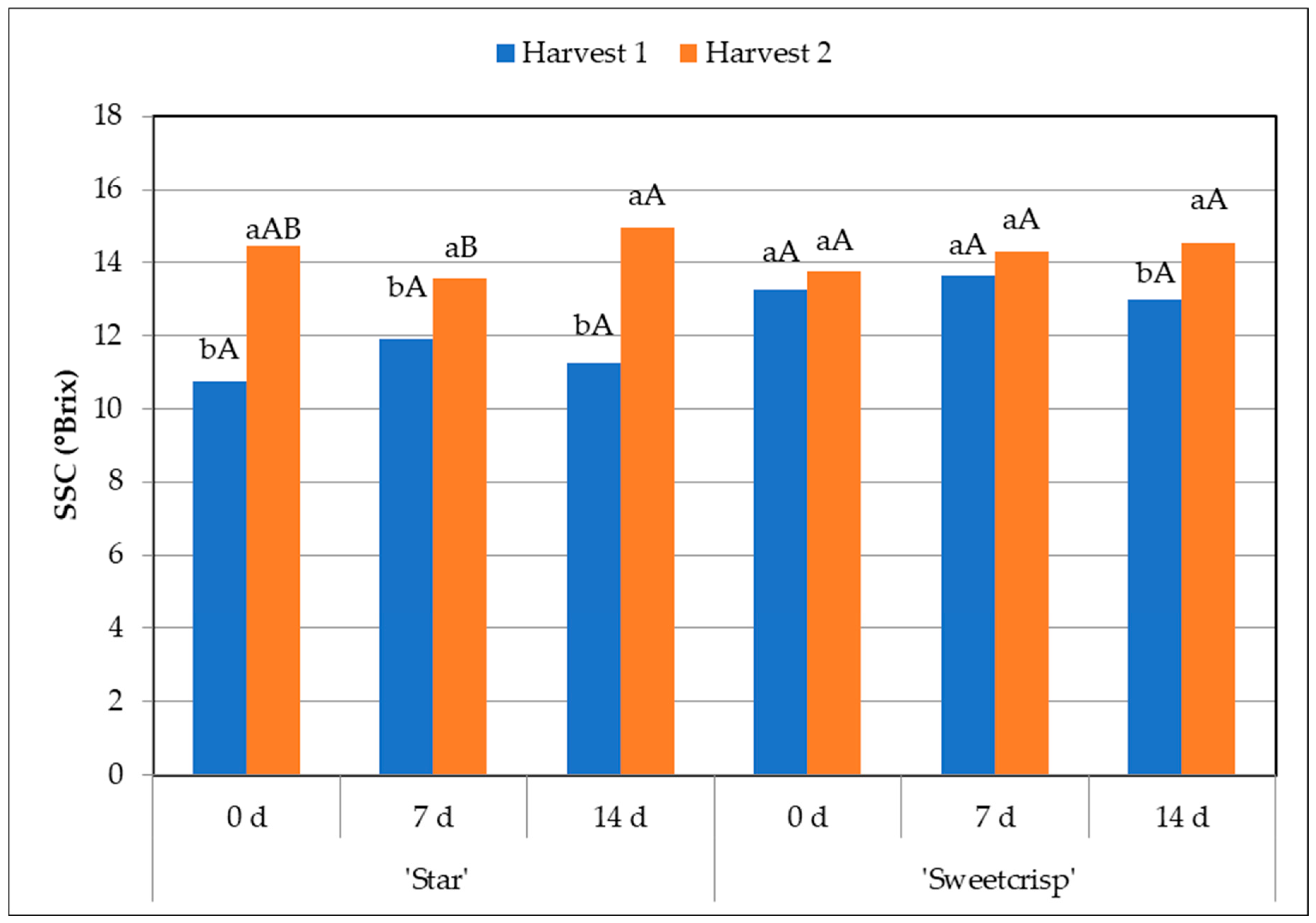
Soluble solids content (SSC) for ‘Star’ was 10.8 °Brix at Harvest 1, but during the 7-d period leading to Harvest 2, fruits continued to accumulate assimilates, resulting in significantly higher SSC at 14.5 °Brix (Figure 1). In contrast, ‘Sweetcrisp’ accumulated more assimilates during the ripening period leading up to Harvest 1 with 13.3 °Brix; however, SSC remained constant during the period leading to Harvest 2. During the 14-d storage, there was negligible variation in SSC for either cultivar (Figure 1).
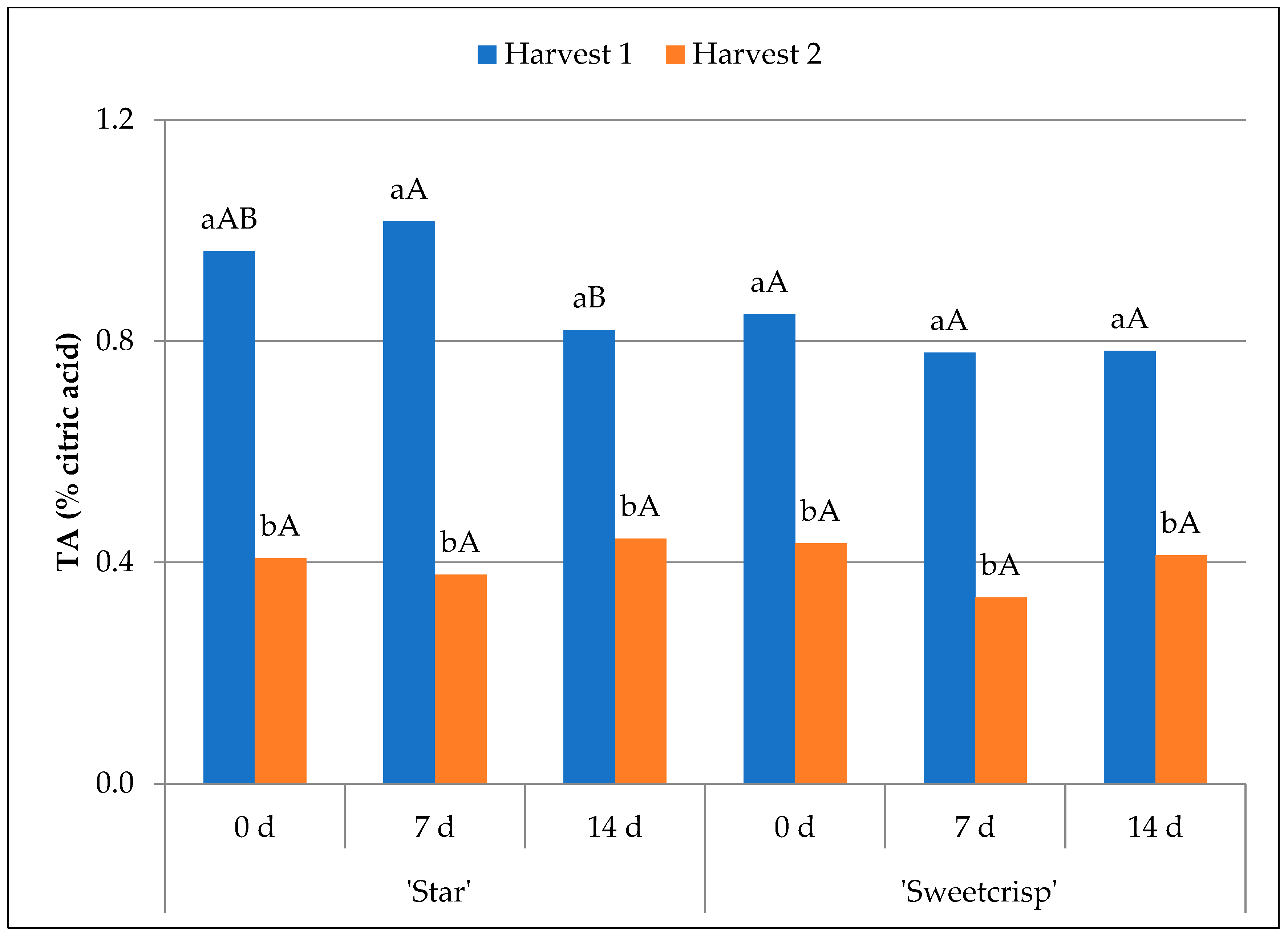
There was a dramatic decrease in titratable acidity (TA) between Harvests 1 and 2 for both ‘Star’ and ‘Sweetcrisp’, which dropped from 0.93% (‘Star’) and 0.81% (‘Sweetcrisp’) in Harvest 1 to 0.34% in Harvest 2 (Figure 2). Decreases in TA have been reported for ‘Meadowlark’ blueberry after the 14-d storage at 1 °C/85% RH, notably for fruits harvested after a 7-d interval [43].
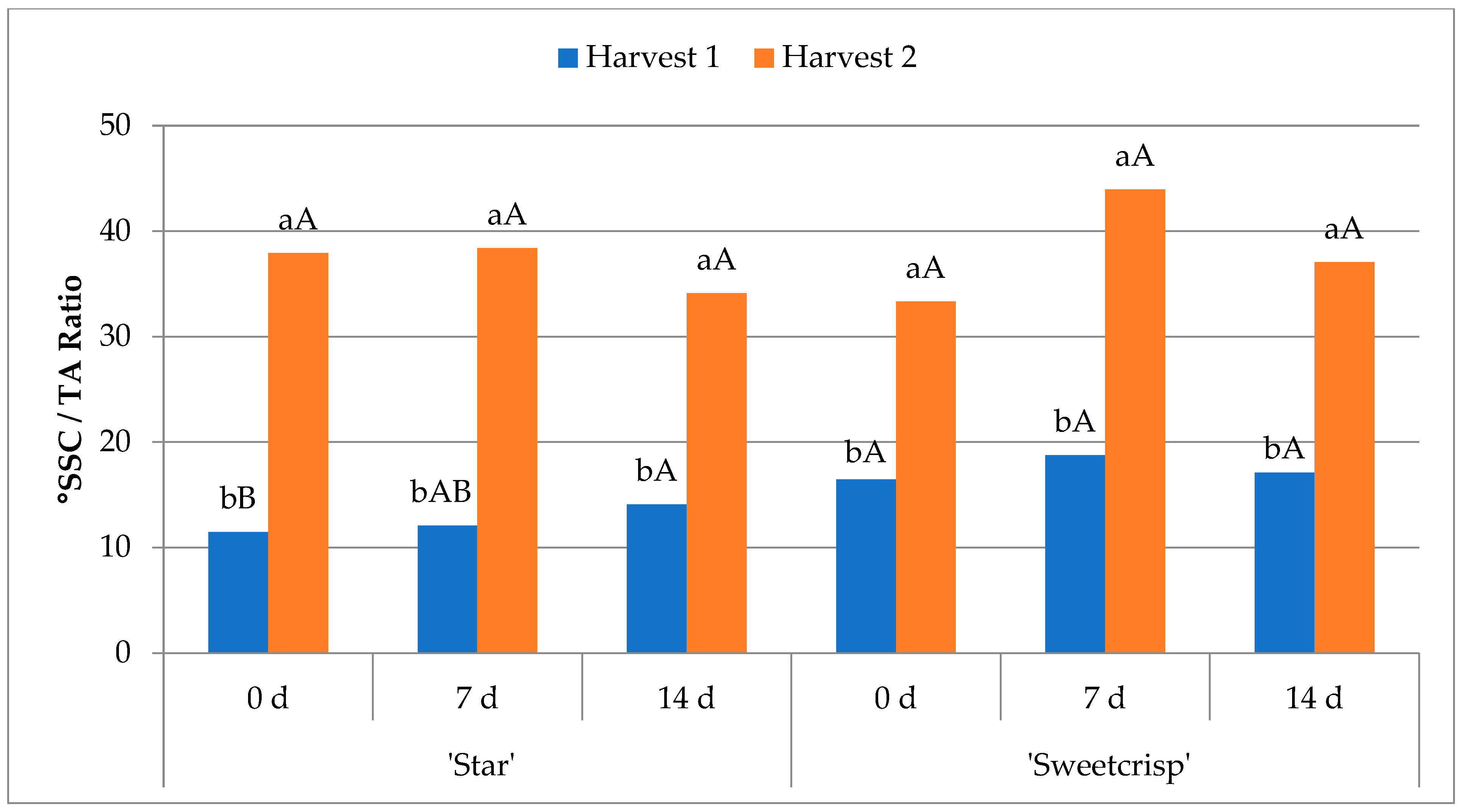
SSC:TA ratios were significantly influenced by harvest interval, with Harvest 2 fruits consistently exhibiting higher ratios for both ‘Star’ and ‘Sweetcrisp’. On average, harvest delay increased the SSC:TA ratio by nearly two- to three-fold, reflecting the substantial reduction in acidity during the 7-day interval between harvests. For ‘Star’, Harvest 1 fruits ranged from 11.5 to 14.1, while Harvest 2 fruits reached 34.1 to 37.9. ‘Sweetcrisp’ followed a similar pattern, with Harvest 1 fruits showing ratios between 16.4 and 18.7; Harvest 2 fruits rose to 33.3 to 43.9 (Figure 3). These trends for both cultivars remained consistent throughout storage, with delayed-harvested fruits exhibiting higher SSC:TA ratios that indicate a distinctly sweeter flavor profile. Cai et al. [44] reported that northern highbush blueberries (’Liberty’) harvested after a 7-day interval had a lower SSC:TA ratio during storage at 1 °C than those harvested initially or after 11 or 14 d. This was attributed to the higher SSC and TA at that 7-d harvest interval. However, ratios for ‘Liberty’ harvested after 11 or 14 d rose to 30 or higher during the 28-d storage period. Overall, these results demonstrate the importance of harvest interval in balancing postharvest quality attributes for the fresh market.
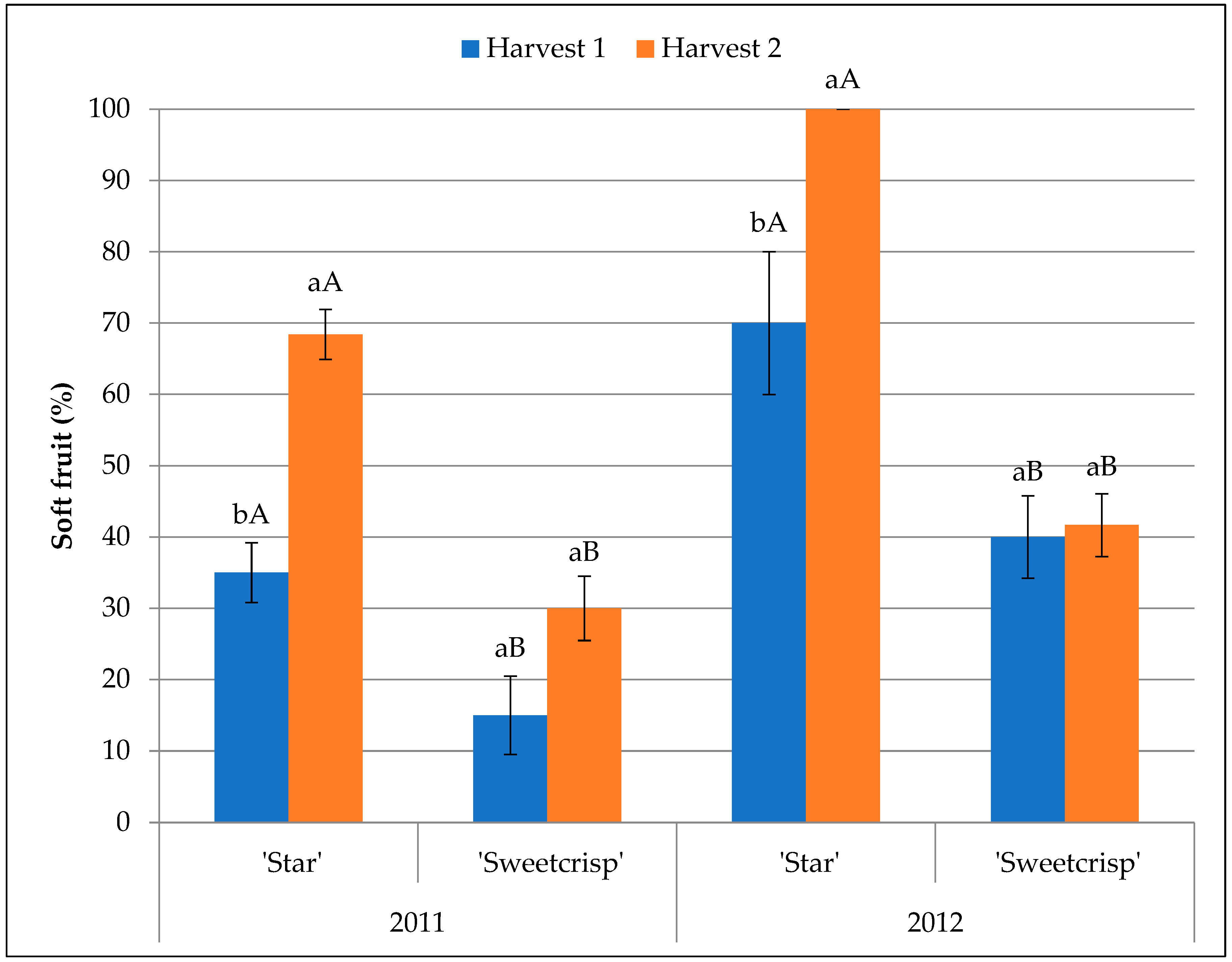
Fruit Impact Tests. Fruit impact assessments demonstrated that extending the harvest interval increased susceptibility to mechanical damage in both ‘Star’ and ‘Sweetcrisp’ blueberries. ‘Star’ fruits consistently exhibited a higher incidence of soft fruit compared with ‘Sweetcrisp’, and this trend was exacerbated by increasing the harvest interval. In 2011, delayed harvest doubled the incidence of soft fruit, reaching approximately 70% in ‘Star’ and 30% in ‘Sweetcrisp’ (Figure 4). Seasonal variation significantly influenced fruit firmness in both cultivars. In 2012, this effect was even more pronounced, where soft fruit incidence for the extended harvest rose to 100% in ‘Star’ and to 42% in ‘Sweetcrisp’. Weather data for Alachua County, Florida, indicated that daytime temperatures in 2012 were >5 °C higher during the spring harvest season than those in 2011; these higher temperatures in 2012 most likely accelerated fruit ripening, leading to softer fruit at harvest for both cultivars [45]. These results indicate that delayed harvest substantially compromises fruit texture and increases vulnerability to impact damage. The comparatively lower soft fruit incidence in ‘Sweetcrisp’ supports its classification as a crispy-textured cultivar with greater mechanical resilience during harvest.
Complementary studies support these observations. Lobos et al. [46] found that extending harvest beyond 40% overall bush ripeness improved flavor in northern highbush cultivars Aurora and Liberty without significantly compromising postharvest storage life, although these responses were highly cultivar-dependent. Similar findings were reported by Cai et al. [44] for northern highbush ‘Liberty’, in that fruits from the short harvest interval (3 d) were firmer than those harvested after 7-, 11-, or 14-day intervals. Godara et al. [43] recently reported that delayed harvest intervals up to 14 d for SHB ‘Meadowlark’ also increased total soluble solids, but also led to reduced firmness and elevated fruit damage at harvest.

3.2. Delay to Impact and Pulp Temperature at Impact

Although delayed harvest intervals enhanced flavor profiles in the two previously studied SHB cultivars, the notable compromises encountered in texture needed to be addressed. To further understand how these changes interact during commercial postharvest handling, fruit susceptibility to impact damage and quality loss was studied by varying cooling delays and pulp temperatures. These assessments provided critical insight into how harvest interval and postharvest logistics influence blueberry quality under conditions that simulated commercial handling.
Weight Loss. Pulp temperature at impact did not affect subsequent weight loss in these tests; therefore, these values were averaged by cultivar and by delay to impact. Overall weight loss was slight (0.57% to 1.99%) under the conditions of these tests (Table 2). Impacted fruits had 3% to 9% higher weight loss than nonimpacted fruits. The delay to impact (5 or 24 h) did not affect weight loss for ‘Meadowlark’ (0.57% to 0.62%) during the 4-d storage at 5 °C. However, both ‘Colossus’ and ‘Sentinel’ lost approximately 35% to 45% fresh weight after the 24 h delay to impact compared with fruits with the 5 h delay to impact. This outcome is supported by the authors’ previous report, where SHB either impacted under controlled conditions (a single impact from 60 cm) or after mechanical harvest (multiple impacts) had increased weight loss during subsequent storage as compared with nonimpacted fruit [5,37]. Stress from bruising can also induce various changes in physiological and metabolic processes, including increased weight loss [47,48,49]. Paniagua et al. [50] reported that softening of rabbiteye blueberry (‘Centurion’) correlated with higher weight loss (3.47% to 15.06%) during storage at 4 °C for 3 weeks.
Weight loss was also cultivar-dependent. In separate tests, freshly harvested SHB ‘Windsor’ and ‘Farthing’ were held at 22 °C; after 3 h, weight loss was <1% for both cultivars. However, during the next hour, ‘Windsor’ lost 10% fresh weight, whereas ‘Farthing’ remained constant [39]. ‘Windsor’ was determined to have a much larger stem scar area than ‘Farthing’, which was attributed to the huge difference in weight loss. According to Nunes et al. [51], acceptable weight loss (as correlated with the onset of shriveling) was 2 to 3% for highbush blueberries (Patriot’), whereas Sanford et al. [33] reported an upper limit of 5 to 8% weight loss for low-bush blueberries. These results reinforce the critical importance of rapid cooling to minimize weight loss. Regardless of the storage conditions following impact in this present study, none of the treatments reached 2% weight loss, and thus, weight loss was considered negligible.
Firmness and Bruising. Pulp temperature at impact and delay to impact had no significant effect on fruit firmness or bruise severity. Initial firmness values before temperature conditioning were 242, 255, and 204 (g·mm−1) for ‘Meadowlark’, ‘Colossus’, and ‘Sentinel’, respectively, and firmness remained constant for the nonimpacted control fruit after the 24 h storage period. However, the firmness of impacted fruit decreased from 6% to 18% compared with the respective control fruit (Table 3). The 24 h delay-to-impact resulted in a slight, but statistically significant decrease in firmness for ‘Colossus’ and ‘Meadowlark’ fruits; however, both remained noticeably firmer than ‘Sentinel’.
Paniagua et al. [50] observed similar results for ‘Centurion’ blueberries stored at 4 °C compared with those at 1 °C. It is a common practice for blueberry researchers, producers, and consumers to classify fruit quality based on texture. However, Moggia et al. [4] showed that firmness is not always a reliable predictor of bruising since physiological differences at harvest, such as cultivar or maturity, can affect initial firmness.
The 60 cm impact readily discriminated between soft and firm SHB cultivars. Impacted fruits exhibited significantly more severe bruising (38.5% to 84.4%) than control fruits (1.0% to 8.3%) (Table 3). ‘Sentinel’ was softer at harvest than the other varieties and had the highest amount of severe bruising (82.7%), followed by ‘Meadowlark’ (52.67%) and ‘Colossus’ (42.57%). Similarly, Moggia et al. [4] found that internal bruising was higher in softer fruit and recommended that fruit with initial firmness lower than 1.6 N should not be held in long-term storage. These authors also concluded that cultivar and/or maturity at harvest had the most influence on blueberry firmness and susceptibility to bruising. Yu et al. [2] reported variation in bruise susceptibility for SHB varieties by correlating bruising severity with data from an impact recording device.
The 60 cm drop employed in these tests was originally developed as a screening tool to distinguish soft blueberry cultivars and breeding lines from those with potential for mechanical harvest. From this perspective, of the three SHB cultivars studied in these latter tests, ‘Meadowlark’ and ‘Colossus’ (‘Sentinel’ to a lesser extent) were identified as having potential for mechanical harvest, based on the lower amount of severe bruising. However, the 60-cm drop height could not distinguish the effects of pulp temperature on bruise incidence and severity for these firm cultivars. A higher drop height should be investigated for better discrimination between crisp-type SHB.
Flavor parameters. Neither pulp temperature nor delay-to-impact affected SSC or TA for the cultivars tested. ‘Sentinel’ had a higher °Brix and a lower TA, with the resultant SSC:TA ratio more than double that for ‘Meadowlark’ or ‘Colossus’ (Table 4). pH was negatively correlated to TA and was similar for all treatments, averaging 3.2 for ‘Meadowlark’, 3.4 for ‘Colossus’, and 4.2 for ‘Sentinel’. In other studies, ‘Meadowlark’ and ‘Farthing’ were exposed to numerous impacts during mechanical harvest but did not exhibit any differences in SSC or TA compared with hand-harvested fruits [10]. Results from Moggia et al. [4] showed that highbush blueberries (‘Brigitta’) picked softer had higher SSC, while blueberries that were initially firmer had higher TA; these findings are supported by the current results. In contrast, Xu et al. [11] reported that blueberry (unknown cultivar) SSC and TA decreased with extended mechanical vibration simulating transport frequency during 12 days of storage at 4 °C. Other researchers reported a similar decrease in SSC following vibration in apples [52] and grapes [53].
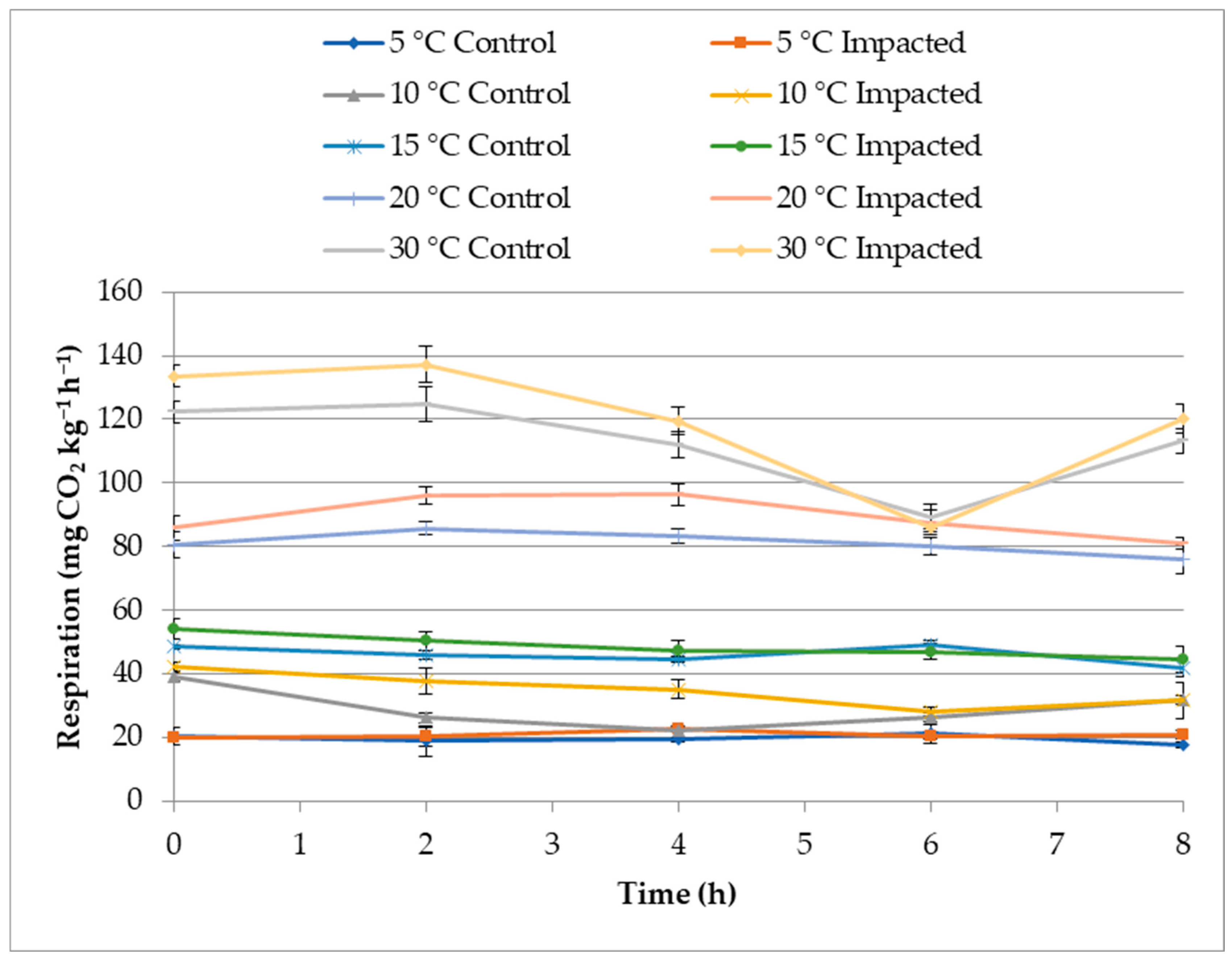
Respiration Rate. At Time 0, differences in RR were evident between ‘Meadowlark’ fruits at each of the five pulp temperatures (5 °C through 30 °C), ranging from 20.0 to 133.6 mg CO2 · kg−1 · h (Figure 5). There were also immediate differences in RR between impacted and control fruits at 15 °C, 20 °C, or 30 °C. Impacted fruits from 20 °C or 30 °C had higher RR than respective control fruits until merging after 6 h, whereas fruits from both treatments at 15 °C merged after 2 h. RR for treatments at 10 °C separated after 2 h, but merged by 6 h. Those fruits at 5 °C remained at the same basal RR of 20.0 mg CO2 · kg−1 · h for both treatments over the 8 h measurement period. Fruit firmness, SSC, TA, and bruise severity remained constant throughout the entire period, but, interestingly, RR from both 30 °C treatments dramatically increased from 6 h to 8 h. It is possible that the increased RR was a stress response due to the extended period at this elevated temperature.
Perkins-Veazie [54] reported similar values for RR for nonimpacted blueberries (unnamed cultivar) at increments from 10 °C to 27 °C. These current findings also align with those reported by Sargent et al. [38] for the softer ‘Windsor’ and ‘Farthing’ cultivars. In that study, fruits impacted at 30 °C exhibited respiration rates nearly twice as high as those of nonimpacted controls. Data from this former and the present studies confirm that RR varies with respect to cultivar and pulp temperature > 20 °C following impact stress. Xu et al. [11] determined that stress from vibration also increased blueberry RR and ethylene production and accelerated senescence, noting a positive correlation with extended vibration periods up to 36 h. It is well established that substrates such as sugars and acids are increasingly consumed by respiratory activity as pulp temperatures approach 30 °C or higher [55]. Numerous reports have noted that RR increased with physical stress for fresh-cut fruits and vegetables as compared with the whole crop [56].

4. Conclusions

This series of studies was conducted over a 10-year period and presents accumulated information based on a succession of commercial SHB cultivars grown in this rapidly changing industry. These cultivars were subjected to conditions simulating commercial mechanical harvest and postharvest handling to determine the effects of harvest interval, delay from harvest to impact, and pulp temperature at impact (60 cm drop height). ‘Star’ and ‘Sweetcrisp’ exhibited a higher proportion of soft fruit after 7 and 14 d of storage at 1 °C; ‘Star’ exhibited greater sensitivity to impact than the firmer-textured ‘Sweetcrisp’. Subjective ratings for “soft vs. firm fruit”, while conducted under controlled conditions, nevertheless showed increased variability and were replaced upon the availability of more objective firmness measurement instrumentation. These findings suggest that firm-fruited cultivars are better suited for extended harvest intervals, but that growers should consider reducing the time between mechanical harvest to less than 7 days.
Initial studies with ‘Meadowlark’ and later with ‘Colossus’ and ‘Sentinel’ SHB determined that pulp temperature at impact had no significant effect on the parameters studied, with the exception of RR. However, impacted fruits were significantly softer and developed more severe bruising than nonimpacted fruits. Impacted fruits from all cultivars and those harvested after the 7-d harvest interval lost more weight than nonimpacted fruits. Delaying impact by 24 h resulted in higher weight loss in nonimpacted ‘Colossus’ and ‘Sentinel’ under the conditions of these studies. SSC and TA were not affected by pulp temperature at impact, nor by the harvest interval; ‘Sentinel’ had higher °Brix, lower TA, and the resultant higher SSC:TA ratio than the other two cultivars tested.
When impacted at 20 °C or 30 °C, RR for ‘Meadowlark’ remained significantly higher than that of the control for 6 h, whereas RR remained fairly constant for fruits impacted at 15 °C or lower over that same sampling period. Therefore, SHB cultivars harvested at typical field temperatures > 20 °C should be quickly cooled to 15 °C or lower to minimize losses in fruit quality during the extended periods encountered during commercial handling and shipping operations. The 60-cm drop height proved to be a quick method to separate soft breeding lines and cultivars from firm and crisp-type fruits, based on bruise incidence and severity. However, since it was not sensitive to discriminate between crisp-type SHB, higher drop heights (i.e., higher impact forces) should be investigated in future studies.

Author Contributions

Conceptualization and investigation, S.S. (Steven Sargent), J.W. and A.B.; methodology, A.B., M.S. and S.S. (Sonya Stahl); formal analysis, A.B. and S.S. (Steven Sargent); writing—original draft preparation, S.S. (Steven Sargent) and A.B.; writing—review and editing, S.S. (Steven Sargent), J.W., A.B., M.S. and S.S. (Sonya Stahl); project administration S.S. (Steven Sargent) and J.W. All authors have read and agreed to the published version of the manuscript.

Funding

This project was partially funded by the USDA National Institute of Food and Agriculture Specialty Crop Research Initiative project (021756).

Data Availability Statement

The original contributions presented in this study are included in the article. Further inquiries can be directed to the corresponding author.

Acknowledgments

The authors express their appreciation to Straughn Farms, Waldo, Florida, for their collaboration with this project.

Conflicts of Interest

The authors declare no conflicts of interest. The funders had no role in the design of the study; in the collection, analyses, or interpretation of data; in the writing of the manuscript, or in the decision to publish the results.

References

  1. U.S. Department Agriculture/National Agricultural Statistics Service. 2023 Blueberry Statistics; New Jersey Field Office: Newark, NJ, USA, 2024; Volume 7. Available online: https://www.nass.usda.gov/Statistics_by_State/New_Jersey/Publications/Blueberry_Statistics/NJ-2023-Blueberry.pdf (accessed on 3 February 2026).
  2. Yu, P.; Li, C.; Takeda, F.; Krewer, G.; Rains, G.; Hamrita, T. Measurement of Mechanical Impacts Created by Rotary, Slapper, and Sway Blueberry Mechanical Harvesters. Comput. Electron. Agric. 2014, 101, 84–92. [Google Scholar] [CrossRef]
  3. Yu, P.; Li, C.; Takeda, F.; Krewer, G. Visual Bruise Assessment and Analysis of Mechanical Impact Measurement in Southern Highbush Blueberries. Appl. Eng. Agric. 2014, 30, 29–37. [Google Scholar] [CrossRef]
  4. Moggia, C.; Graell, J.; Lara, I.; González, G.; Lobos, G.A. Firmness at Harvest Impacts Postharvest Fruit Softening and Internal Browning Development in Mechanically Damaged and Non-Damaged Highbush Blueberries (Vaccinium corymbosum L.). Front. Plant Sci. 2017, 8, 535. [Google Scholar] [CrossRef]
  5. Sargent, S.A.; Takeda, F.; Williamson, J.G.; Berry, A.D. Harvest of Southern Highbush Blueberry with a Modified, Over-the-Row Mechanical Harvester: Use of Soft-Catch Surfaces to Minimize Impact Bruising. Agronomy 2021, 11, 1412. [Google Scholar] [CrossRef]
  6. Xu, R.; Takeda, F.; Krewer, G.; Li, C. Measure of Mechanical Impacts in Commercial Blueberry Packing Lines and Potential Damage to Blueberry Fruit. Postharvest Biol. Technol. 2015, 110, 103–113. [Google Scholar] [CrossRef]
  7. Shewfelt, R. Postharvest treatment for extending the shelf life of fruits and vegetables. Food Technol. 1986, 40, 70. [Google Scholar]
  8. Li, Z.; Thomas, C. Quantitative Evaluation of Mechanical Damage to Fresh Fruits. Trends Food Sci. Technol. 2014, 35, 138–150. [Google Scholar] [CrossRef]
  9. Nunez-Barrios, A.; Nesmith, D.S.; Chinnan, M.; Prussia, S.E. Dynamics of Rabbiteye Blueberry Fruit Quality in Response to Harvest Method and Postharvest Handling Temperature. Small Fruits Rev. 2005, 4, 73–81. [Google Scholar] [CrossRef]
  10. Sargent, S.A.; Berry, A.D.; Williamson, J.G.; Olmstead, J.W. Postharvest Quality of Mechanically and Hand-Harvested, Southern Highbush Blueberry Fruit for Fresh Market. HortTechnology 2013, 23, 437–441. [Google Scholar] [CrossRef]
  11. Xu, F.; Liu, S.; Liu, Y.; Wang, S. Effect of Mechanical Vibration on Postharvest Quality and Volatile Compounds of Blueberry Fruit. Food Chem. 2021, 349, 129216. [Google Scholar] [CrossRef] [PubMed]
  12. Opara, U.L.; Pathare, P.B. Bruise Damage Measurement and Analysis of Fresh Horticultural Produce—A Review. Postharvest Biol. Technol. 2014, 91, 9–24. [Google Scholar] [CrossRef]
  13. Eck, P. Blueberry Science; Rutgers University Press: New Brunswick, NJ, USA, 1988. [Google Scholar]
  14. Brown, G.; Schulte, N.; Timm, E.; Beaudry, R.; Peterson, D.; Hancock, J.; Takeda, F. Estimates of Mechanization Effects on Fresh Blueberry Quality. Appl. Eng. Agric. 1996, 12, 21–26. [Google Scholar] [CrossRef]
  15. van Dalfsen, K.B.; Gaye, M.M. Yield of hand and mechanical harvesting of highbush blueberries in British Columbia. Appl. Eng. Agric. 1999, 15, 393–398. [Google Scholar] [CrossRef]
  16. Williamson, J.G.; Cline, W.O. Mechanized Harvest of Southern Highbush Blueberries for the Fresh Market: An Introduction and Overview of the Workshop Proceedings. HortTechnology 2013, 23, 416–418. [Google Scholar] [CrossRef]
  17. Takeda, F.; Yang, W.; Li, C.; Freivalds, A.; Sung, K.; Xu, R.; Hu, B.; Williamson, J.; Sargent, S. Applying New Technologies to Transform Blueberry Harvesting. Agronomy 2017, 7, 33. [Google Scholar] [CrossRef]
  18. Hussein, Z.; Fawole, O.A.; Opara, U.L. Harvest and Postharvest Factors Affecting Bruise Damage of Fresh Fruits. Hortic. Plant J. 2020, 6, 1–13. [Google Scholar] [CrossRef]
  19. Brannen, P.; Krewer, G.; Boland, B.; Horton, D.; Chang, C.J. Bacterial Leaf Scorch of Blueberry. University of Georgia Cooperative Extension, Circular 922. Available online: https://extension.uga.edu (accessed on 3 March 2026).
  20. Phillips, D.; Williamson, J.; Lyrene, P.; Munoz, P. Southern Highbush Blueberry Cultivars from the University of Florida: HS1245, Rev. 9/2022. EDIS 2022, 2022. [Google Scholar] [CrossRef]
  21. Padley, L.; Lyrene, P. Studies with crisp-textured blueberries. HortScience 2006, 41, 985. [Google Scholar] [CrossRef]
  22. Strik, B. Frequency of Harvest Affects Berry Weight, Firmness, Titratable Acidity, and Percent Soluble Solids of Highbush Blueberry Cultivars in Oregon. J. Am. Pomol. Soc. 2019, 73, 254–268. [Google Scholar] [CrossRef]
  23. Vashisth, T.; Malladi, A. Fruit Detachment in Rabbiteye Blueberry: Abscission and Physical Separation. J. Amer. Soc. Hort. Sci. 2013, 138, 95–101. [Google Scholar] [CrossRef]
  24. Vashisth, T.; NeSmith, D.S.; Malladi, A. Anatomical and Gene Expression Analyses of Two Blueberry Genotypes Displaying Differential Fruit Detachment. J. Amer. Soc. Hort. Sci. 2015, 140, 620–626. [Google Scholar] [CrossRef]
  25. Takeda, F.; Gerard, K.; Changying, L.; Daniel, M.; James, O. Techniques for Increasing Machine Harvest Efficiency in Highbush Blueberry. HortTechnology 2013, 23, 430–436. [Google Scholar] [CrossRef]
  26. Ferreira, M.D.; Sargent, S.A.; Brecht, J.K.; Chandler, C.K. Strawberry Bruising Sensitivity Depends on the Type of Force Applied, Cooling Method, and Pulp Temperature. HortScience 2009, 44, 1953–1956. [Google Scholar] [CrossRef]
  27. Toivonen, P.M.A.; Hampson, C.; Stan, S.; McKenzie, D.-L.; Hocking, R. Factors Affecting Severity of Bruises and Degree of Apparent Bruise Recovery in a Yellow-Skinned Apple. Postharvest Biol. Technol. 2007, 45, 276–280. [Google Scholar] [CrossRef]
  28. Martínez-Romero, D.; Castillo, S.; Valero, D. Forced-Air Cooling Applied before Fruit Handling to Prevent Mechanical Damage of Plums (Prunus salicina Lindl.). Postharvest Biol. Technol. 2003, 28, 135–142. [Google Scholar] [CrossRef]
  29. Klein, J.D. Relationship of Harvest Date, Storage Conditions, and Fruit Characteristics to Bruise Susceptibility of Apple. J. Amer. Soc. Hort. Sci. 1987, 112, 113–118. [Google Scholar] [CrossRef]
  30. Bollen, A.F. Major Factors Causing Variation in Bruise Susceptibility of Apples (Malus domestica) Grown in New Zealand. N. Z. J. Crop Hortic. Sci. 2005, 33, 201–210. [Google Scholar] [CrossRef]
  31. Crisosto, C.H.; Garner, D.; Doyle, J.; Day, K.R. Relationship between Fruit Respiration, Bruising Susceptibility, and Temperature in Sweet Cherries. HortScience 1993, 28, 132–135. [Google Scholar] [CrossRef]
  32. Ballinger, W.E.; Maness, E.P.; McClure, W.F. Relationship of Stage of Ripeness and Holding Temperature to Decay Development of Blueberries1. J. Amer. Soc. Hort. Sci. 1978, 103, 130–134. [Google Scholar] [CrossRef]
  33. Sanford, K.A.; Lidster, P.D.; McRae, K.B.; Jackson, E.D.; Lawrence, R.A.; Stark, R.; Prange, R.K. Lowbush Blueberry Quality Changes in Response to Mechanical Damage and Storage Temperature. J. Amer. Soc. Hort. Sci. 1991, 116, 47–51. [Google Scholar] [CrossRef]
  34. Tetteh, M.K.; Prussia, S.E.; NeSmith, D.S.; Verma, B.P.; Aggarwal, D. Modeling Blueberry Firmness and Mass Loss during Cooling Delays and Storage. Trans. ASAE 2004, 47, 1121–1127. [Google Scholar] [CrossRef]
  35. NeSmith, D.S.; Nunez-Barrios, A.; Prussia, S.; Aggarwal, D. Postharvest berry quality of six rabbiteye blueberry cultivars in response to temperature. J. Amer. Pomol. Soc. 2005, 59, 13–18. [Google Scholar] [CrossRef]
  36. Santana, M.A.; Sargent, S.A.; Berry, A.D. Effects of pulp temperature at physical impact on blueberry fruit quality. Proc. Fla. State Hort. Soc. 2015, 128, 196–198. [Google Scholar]
  37. Sargent, S.A.; Berry, A.D.; Brecht, J.K.; Santana, M.; Zhang, S. Delays to Blueberry Cooling and Effects on Storage Quality Under Commercial Conditions. HortScience 2016, 51, S308. [Google Scholar]
  38. Sargent, S.A.; Berry, A.D.; Brecht, J.K.; Santana, M.; Zhang, S.; Ristow, N. Studies on Quality of Southern Highbush Blueberry Cultivars: Effects of Pulp Temperature, Impact and Hydrocooling. Acta Hortic. 2017, 1180, 497–502. [Google Scholar] [CrossRef]
  39. Demir, N.; Ferraz, A.C.; Sargent, S.A.; Balaban, M.O. Classification of impacted blueberries during storage using an electronic nose. J. Sci. Food Agric. 2011, 9, 1722–1727. [Google Scholar] [CrossRef] [PubMed]
  40. Sargent, S.A.; Berry, A.D.; Williamson, J.G.; Olmstead, J. Fruit detachment force of southern highbush blueberry: An aid to selection of cultivars suitable for mechanical harvest. HortScience 2010, 45, S306. [Google Scholar]
  41. U.S. Department of Agriculture, Agricultural Marketing Service. United States Standards for Grades of Blueberries; Fresh Products Branch: Washington, DC, USA, 1995. Available online: https://www.ams.usda.gov/sites/default/files/media/Blueberries_Standard%5B1%5D.pdf (accessed on 3 February 2026).
  42. Zhang, Z.; Huber, D.J.; Rao, J. Ripening Delay of Mid-Climacteric Avocado Fruit in Response to Elevated Doses of 1-Methylcyclopropene and Hypoxia-Mediated Reduction in Internal Ethylene Concentration. Postharvest Biol. Technol. 2011, 60, 83–91. [Google Scholar] [CrossRef]
  43. Godara, A.; Rubio Ames, Z.; Deltsidis, A. Delayed Harvest Reduces Postharvest Quality and Storability of Southern Highbush Cv. Meadowlark and Rabbiteye Blueberry Cv. Brightwell. HortScience 2025, 60, 182–190. [Google Scholar] [CrossRef]
  44. Cai, Y.; Takeda, F.; Foote, B.; DeVetter, L. Effects of Machine-Harvest Interval on Fruit Quality of Fresh Market Northern Highbush Blueberry. Horticulturae 2021, 7, 245. [Google Scholar] [CrossRef]
  45. University of Florida/IFAS. Florida Automated Weather Network, FAWN. Reports. 2026. Available online: https://fawn.ifas.ufl.edu/ (accessed on 3 February 2026).
  46. Lobos, G.A.; Callow, P.; Hancock, J.F. The Effect of Delaying Harvest Date on Fruit Quality and Storage of Late Highbush Blueberry Cultivars (Vaccinium corymbosum L.). Postharvest Biol. Technol. 2014, 87, 133–139. [Google Scholar] [CrossRef]
  47. Lee, E.; Sargent, S.A.; Huber, D.J. Physiological Changes in Roma-Type Tomato Induced by Mechanical Stress at Several Ripeness Stages. HortScience 2007, 42, 1237–1242. [Google Scholar] [CrossRef]
  48. Li, Z.; Pan, Q.; Jin, Z.; Mu, L.; Duan, C. Comparison on Phenolic Compounds in Vitis vinifera Cv. Cabernet Sauvignon Wines from Five Wine-Growing Regions in China. Food Chem. 2011, 125, 77–83. [Google Scholar] [CrossRef]
  49. Ktenioudaki, A.; O’Donnell, C.P.; Emond, J.P.; Do Nascimento Nunes, M.C. Blueberry Supply Chain: Critical Steps Impacting Fruit Quality and Application of a Boosted Regression Tree Model to Predict Weight Loss. Postharvest Biol. Technol. 2021, 179, 111590. [Google Scholar] [CrossRef]
  50. Paniagua, A.C.; East, A.R.; Heyes, J.A. Interaction of Temperature Control Deficiencies and Atmosphere Conditions during Blueberry Storage on Quality Outcomes. Postharvest Biol. Technol. 2014, 95, 50–59. [Google Scholar] [CrossRef]
  51. Nunes, M.C.N.; Emond, J.P.; Brecht, J.K. Quality Curves for Highbush Blueberries as a Function of the Storage Temperature. Small Fruits Rev. 2004, 3, 423–440. [Google Scholar] [CrossRef]
  52. Lu, F.; Xu, F.; Li, Z.; Liu, Y.; Wang, J.; Zhang, L. Effect of Vibration on Storage Quality and Ethylene Biosynthesis-Related Enzyme Genes Expression in Harvested Apple Fruit. Sci. Hortic. 2019, 249, 1–6. [Google Scholar] [CrossRef]
  53. Jung, H.M.; Lee, S.; Lee, W.-H.; Cho, B.-K.; Lee, S.H. Effect of Vibration Stress on Quality of Packaged Grapes during Transportation. Eng. Agric. Environ. Food 2018, 11, 79–83. [Google Scholar] [CrossRef]
  54. Perkins-Veazie, P. Blueberry. In The Commercial Storage of Fruits, Vegetables, and Florist & Nursery Stocks; Gross, K.C., Wang, C.Y., Saltveit, M., Eds.; Agriculture Handbook 66; U.S. Department of Agriculture, Agricultural Research Service: Washington, DC, USA, 2016; pp. 240–242. [Google Scholar]
  55. Fonseca, S.C.; Oliveira, F.A.R.; Brecht, J.K. Modelling Respiration Rate of Fresh Fruits and Vegetables for Modified Atmosphere Packages: A Review. J. Food Eng. 2002, 52, 99–119. [Google Scholar] [CrossRef]
  56. Fagundes, C.; Carciofi, B.A.M.; Monteiro, A.R. Estimate of Respiration Rate and Physicochemical Changes of Fresh-Cut Apples Stored under Different Temperatures. Food Sci. Technol. 2013, 33, 60–67. [Google Scholar] [CrossRef]
Figure 1. Delay-to-Harvest: °Brix of early- and delayed-harvest blueberry fruits during the 14-d storage at 1 °C. Mean separation letters indicate statistical differences determined using Tukey’s HSD test (p ≤ 0.05). Lowercase letters denote comparisons between the two harvest intervals within each storage day for a given cultivar, whereas uppercase letters denote comparisons across storage times within each harvest interval.
Horticulturae 12 00336 g001
Figure 2. Delay-to-Harvest: TA of early- and delay-harvested blueberry fruit during the 14-d storage at 1 °C. Mean separation letters indicate statistical differences using Tukey’s HSD test (p ≤ 0.05). Lowercase letters denote comparisons between the two harvest intervals within each storage day for a given cultivar, whereas uppercase letters denote comparisons across storage times within each harvest interval.
Horticulturae 12 00336 g002
Figure 3. Delay-to-Harvest: SSC:TA ratio of early- and delayed-harvested blueberry fruit during the 14-d storage at 1 °C. Mean separation letters indicate statistical differences using Tukey’s HSD test (p ≤ 0.05). Lowercase letters denote comparisons between the two harvest intervals within each storage day for a given cultivar, whereas uppercase letters denote comparisons across storage times within each harvest interval.
Horticulturae 12 00336 g003
Figure 4. Delay-to-Harvest: Soft fruit (%) for ‘Star’ and ‘Sweetcrisp’ after impact (60 cm) and the 3-d storage at 5 °C for each season. Mean separation letters indicate statistical differences using Tukey’s HSD test (p ≤ 0.05). Lowercase letters denote comparisons between the two harvest intervals within each year for a given cultivar, whereas uppercase letters denote comparisons between cultivars for each harvest interval.
Horticulturae 12 00336 g004
Figure 5. Respiration rates of ‘Meadowlark’ blueberries conditioned overnight at selected temperatures with or without a single 60 cm impact. For each pulp temperature, vertical lines represent standard deviation (p < 0.05).
Horticulturae 12 00336 g005
Table 1. Delay-to-Harvest: Quality of nonimpacted blueberry fruit for each harvest during 14 d storage at 1 °C.
Quality During Storage
Appearance RatingSoft (%)Shriveled (%)
CultivarHarvest7 d14 d7 d14 d7 d14 d
Star14.5 z aA y3.9 aB3.3 aA6.7 aA15.0 aB56.1 aA
24.3 aA3.5 aB12.5 aA24.1 aA34.7 aA52.0 aA
Sweetcrisp14.6 aA3.9 aB0.0 aA5.0 aA8.3 aA16.7 bA
24.7 aA4.0 aB6.1 aB26.7 aA18.6 aA33.3 aA
z Values represent the mean of both years (2011 and 2012). y Means followed by the same lowercase letter within a column and by cultivar or the same uppercase letter within a row are not significantly different according to Tukey’s HSD test, p ≤ 0.05. Appearance rating scale: 1-very poor; 2-poor; 3-fair, limit of marketability; 4-good; and 5-excellent.
Table 2. Pulp Temperature at Impact: Weight loss after 5 or 24 h conditioning +/− impact and storage for either 4 d at 5 °C (‘Meadowlark’) or overnight at 22 °C (‘Colossus’ and ‘Sentinel’). Combined pulp temperatures.
Weight Loss (%)
CultivarDelay to Impact (h)ControlImpacted
Meadowlark50.57 z aB y0.62 aA
240.49 aB0.59 aA
Colossus51.31 bB1.42 bA
241.92 aA1.99 aA
Sentinel51.26 bB1.37 bA
241.86 aB1.92 aA
z Values for pulp temperature at impact were not significant and, therefore, were averaged by cultivar and by delay-to-impact. y Means followed by the same lowercase letter within a column and by cultivar, or by the same uppercase letter in a row, are not significantly different according to Tukey’s HSD test, p ≤ 0.05.
Table 3. Pulp Temperature at Impact: Blueberry firmness and severe bruising after a 5 or 24 h delay with or without 60 cm impact, and then held for 4 d at 5 °C (‘Meadowlark’) or overnight at 22 °C (‘Colossus’ and ‘Sentinel’) to rate bruising (severe when ≥20% of the cut surface area exhibited internal discoloration). Combined pulp temperatures.
Firmness (g·mm−1)Severe Bruising (%)
CultivarDelay (h)ControlImpactedControlImpacted
Meadowlark5258 z bA y221 aB4.2 aB53.3 aA
24268 aA219 aB7.5 aB52.0 aA
Colossus5247 aA222 aB1.3 aB46.7 aA
24237 bA222 aB1.0 aB38.5 aA
Sentinel5197 aA168 aB2.5 bB84.4 aA
24195 aA170 aB8.3 aB81.0 aA
z Values for pulp temperature at impact were not significant and, therefore, were averaged by cultivar and by delay-to-impact. y Means followed by the same lowercase letter within a column and by cultivar, or by the same uppercase letter in a row, are not significantly different according to Tukey’s HSD test, p ≤ 0.05.
Table 4. Blueberry flavor parameters after 5 or 24 h delays with and without a single 60 cm impact, and then held for 4 d at 5 °C (‘Meadowlark’) or overnight at 22 °C (‘Colossus’ and ‘Sentinel’). Combined pulp temperatures for each cultivar and delay to impact.
CultivarDelay to Impact (h)SSC (°Brix)TA
(% Citric Acid)
SSC:TA Ratio
Meadowlark011.8 z a y0.72 a20.4 a
511.6 a0.55 b22.3 a
2411.5 a0.59 a20.6 b
Colossus013.5 a0.80 a17.2 b
513.5 a0.63 b21.7 a
2412.0 b0.79 a15.5 b
Sentinel014.7 b0.31 a47.1 b
515.1 ab0.28 a54.9 a
2415.2 a0.30 a52.7 ab
z Values for pulp temperature at impact were not significant and, therefore, were averaged by cultivar and by delay to impact. y Means followed by the same lowercase letter within a column and by cultivar are not significantly different according to Tukey’s HSD test, p ≤ 0.05.
Disclaimer/Publisher’s Note: The statements, opinions and data contained in all publications are solely those of the individual author(s) and contributor(s) and not of MDPI and/or the editor(s). MDPI and/or the editor(s) disclaim responsibility for any injury to people or property resulting from any ideas, methods, instructions or products referred to in the content.