Next Article in Journal
A Study on the Directional Cultivation of Mechanization-Adapted Watermelon Scion Seedlings in a Plant Factory
Previous Article in Journal
Assessment of the Heat-Stress-Mitigating Effect of Kaolin in Grapevine: A Comparative Study in Two Vineyards
 
 
Due to scheduled maintenance work on our servers, there may be short service disruptions on this website between 11:00 and 12:00 CEST on March 28th.
Article

Breeding Study of a New Variety of Dendrobium officinale ‘Tiefeng No.1’
1
Zhejiang Institute of Subtropical Crops, Zhejiang Academy of Agricultural Sciences, Wenzhou 325005, China
2
Innovation Center of Chinese Medicine Crops, Zhejiang Academy of Agricultural Sciences, Hangzhou 310021, China
3
State Key Laboratory of Crop Genetics & Germplasm Enhancement and Utilization, College of Resources and Environmental Sciences, Nanjing Agricultural University, Nanjing 210095, China
*
Authors to whom correspondence should be addressed.
Horticulturae 2026, 12(3), 326; https://doi.org/10.3390/horticulturae12030326
Submission received: 13 January 2026 / Revised: 5 March 2026 / Accepted: 6 March 2026 / Published: 9 March 2026
(This article belongs to the Special Issue Breeding and Production Practices for Root Vegetables and Tubers)

Abstract

To select and breed superior varieties of Dendrobium officinale with high quality and strong resistance to adverse conditions, a systematic selection process was employed to screen for outstanding strains, complemented by tissue culture for seed propagation. Following screening and self-purification, a new variety, ‘Tiefeng No.1’, was developed. Between 2019 and 2023, a comprehensive assessment of its characteristics, regional product ratio tests, and productivity research was meticulously conducted. The results indicated that the new variety of Dendrobium officinale is stable and of excellent quality. The polysaccharide content ranged from 44.35% to 58.55%, and the mannose content varied from 14.03% to 22.38%, both of which meet the standards set by the Chinese Pharmacopoeia (2020). The anthocyanidin content was measured at 94.76 to 115.43 μg/g, which is double that of the Yueqing landraces. It exhibits good frost resistance and disease resistance. Through production verification and demonstration, ‘Tiefeng No.1’ has proven to possess excellent quality and high yield, showcasing significant potential for promotion in the primary growing regions.

1. Introduction

Dendrobium officinale Kimura & Migo is a perennial herbaceous plant belonging to the genus Dendrobium within the Orchidaceae family and is recognized as a valuable traditional Chinese medicinal herb. According to the “Compendium of Materia Medica” [1], Dendrobium officinale is noted for its effects, including nourishing yin and essence, replenishing internal deficiencies, enhancing cognitive function, alleviating fright, and promoting longevity. Modern pharmacological research has identified various active components in Dendrobium officinale, such as polysaccharides, alkaloids, bibenzyls, and amino acids [2,3]. This herb has multiple applications, including lowering blood sugar and lipid levels, boosting human immunity, and improving sleep quality [4,5]. Dendrobium officinale is primarily distributed across provinces including Zhejiang, Guizhou, Yunnan, Fujian, Jiangxi, Guangdong, and Guangxi. However, due to its specific growth requirements, the challenges of natural reproduction, and overharvesting, wild populations of Dendrobium officinale are becoming increasingly scarce, leading to its classification as a nationally protected second-class plant.
The Yandang Mountain area in Yueqing City is the authentic production region of Dendrobium officinale, holding titles such as “Hometown of Chinese Dendrobium officinale” and “Hometown of Chinese Dendrobium officinale Fengdou Processing”. By 2023, the cultivation area of Dendrobium officinale in Yueqing City had exceeded 8 square kilometers, including 2.3 square kilometers of under-forest cultivation. The annual production of fresh Dendrobium officinale stems and Dendrobium officinale Fengdou in the city accounts for 30% and 80% of the national total output, respectively [6,7]. Dendrobium officinale from Yandang Mountain is primarily characterized by distinct reddish-brown spots on the stem epidermis and exhibits significantly higher anthocyanin content compared to specimens from other producing regions [8].
Despite the late initiation and gradual progress in the research on germplasm resources and variety breeding, a significant number of high-quality Dendrobium officinale germplasm resources remain underutilized in breeding programs. Current research efforts and systematic breeding initiatives have led to the development of new varieties, including ‘Xianhu No.3’ [9], ‘Yuhu No.4’ [10], and ‘Guihu No.1’ [11]. However, the stems and leaves of these varieties predominantly exhibit a green coloration.
During field research in Yandang Mountain, the team discovered a Dendrobium officinale plant exhibiting significantly superior growth compared to other strains. Seed pods were obtained through self-pollination. Utilizing tissue culture techniques to propagate seedlings, the researchers screened and purified superior strains. After years of dedicated effort, they successfully developed ‘Tiefeng No.1’, which received approval from the Zhejiang Provincial Forest Variety Approval Committee in January 2024, with the variety registration number Zhe S-SV-DO-032-2023. This variety is distinguished by its high polysaccharide and anthocyanin content, as well as its excellent resistance, marking a significant breakthrough in the development of local Dendrobium officinale varieties in the Yandang Mountain region.

2. Materials and Methods

2.1. Test Materials

A comparative variety trial was conducted using the local dominant cultivar in Yueqing and ‘Xianhu No.2’ as control varieties. ‘Tiefeng No.1’ served as the test material, which originated from wild superior Dendrobium officinale strains in Yandang Mountain, Wenzhou, obtained through selfing and purification screening.

2.2. Breeding Methods and Process

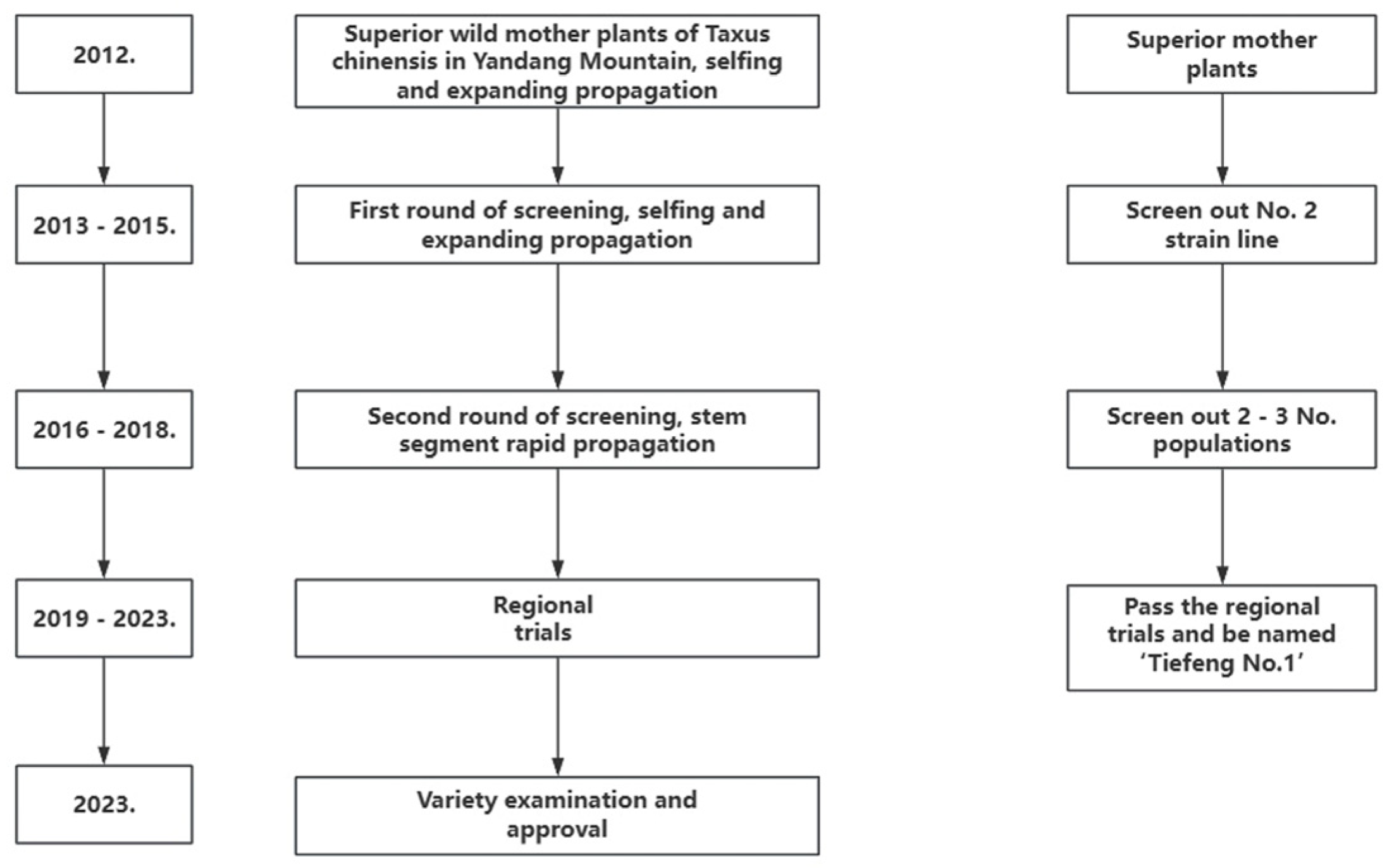
In January 2012, a natural variant of Dendrobium officinale with purple-red stems and leaves was discovered. In June of the same year, self-pollination was conducted, and tissue culture techniques were employed to propagate the plant, resulting in the development of offspring lines. From May 2013 to May 2015, preliminary screening of the obtained offspring lines was performed, yielding the superior line ‘No.2’. In June 2015, the ‘No.2’ line underwent self-pollination to breed a second-generation superior population. From May 2016 to March 2018, a second round of screening was conducted, resulting in the establishment of the superior population ‘No.2–3’. In April 2018, rapid propagation techniques utilizing stem segments of Dendrobium officinale were employed to expand the ‘No.2–3’ superior population for regional trial planting. In April 2019, regional trials were conducted in four locations: Lucheng, Wenzhou, Zhejiang; Yueqing, Zhejiang; Taishun, Zhejiang; and Jinping, Guizhou. From 2019 to 2023, continuous annual yield measurements were recorded at the regional trial sites, while simultaneously assessing indicators such as dry matter ratio, polysaccharide content, and anthocyanin content. The new variety ‘Tiefeng No.1’ was finalized. During 2022–2023, following the finalization of the new Dendrobium officinale variety ‘Tiefeng No.1’, pot experiments were established in Kantou Village, Dajing Town, Yueqing City, to compare the trait differences between ‘Tiefeng No.1’ and ‘Xianhu No.2’. The detailed breeding process is summarized in Figure 1.

2.3. Regional Variety Comparison Trial

In April 2019, using the local main cultivated variety in Yueqing as the control (CK), one test site was established in each of the following locations: Yueqing (Kantou Village, Dajing Town, Yueqing City), Taishun (Deep Mountain Rare Plant Planting Professional Cooperative Base, Zhuli Township, Taishun County), Lucheng (National Agricultural Science and Technology Park Experimental Base of Wenzhou Vocational College of Science and Technology), and Jinping (Tiepengtang Dendrobium officinale Industrial Park Greenhouse, Dunzhai Town, Jinping County, Qiandongnan Prefecture, Guizhou). These sites are hereinafter referred to as “Yueqing”, “Taishun”, “Lucheng”, and “Jinping”. At each experimental site, we randomly selected six adjacent greenhouses as observation units. In each greenhouse, half of the seedling beds were planted with ‘Tiefeng No.1’, while the other half served as the control group. The management conditions adhered to the standards established by Zhou et al. [12]. From 2021 to 2023, during April of each year, we randomly selected one plot (16 square meters in area) for both ‘Tiefeng No.1’ and the control group in every experimental greenhouse. All newly grown fresh shoots were harvested, and the plot weight was measured before converting it to yield per mu. Six clusters of Dendrobium officinale were randomly selected within the designated plots to measure indicators such as polysaccharide, mannose, and anthocyanin content. The determination methods for polysaccharides and anthocyanins are detailed in Section 2.7 and Section 2.8, respectively. The method for determining mannose content follows the 2025 edition of the Chinese Pharmacopoeia [13].

2.4. Microstructural Analysis

Using fresh stems and leaves of ‘Tiefeng No.1’ as materials, surface impurities were gently rinsed with deionized water or a buffer solution. Subsequently, the materials were cut into segments measuring 5–10 mm using a sharp scalpel. The stem and leaf segments were embedded in melted agar. After cooling, they were secured on the microtome sample stage and sliced into sections that were 50 μm thick. Finally, the sections were observed under a 10× microscope. The microscope used in this study was the VHX from Keyence, Osaka, Japan. Ten sections of each material were analyzed.

2.5. Stress Resistance Test

2.5.1. Freeze Resistance Test

In this study, we randomly selected three clumps of ‘Tiefeng No.1’ and the control variety, the local Yueqing species, which had been cultivated for two years at the Yueqing regional test site. The samples were subjected to a temperature of −6 °C for a duration of 12 h. We then observed the phenotypic changes in Dendrobium officinale and measured the relative electrical conductivity of the leaves, alongside the activities of superoxide dismutase, catalase, and peroxidase. The acclimation procedure and the method for assessing phenotypic injury were conducted in accordance with the methodology established by Wu et al. [14].
Determination of Relative Electrical Conductivity
The collected leaves were thoroughly rinsed with distilled water, dried, and subsequently cut into pieces while avoiding the veins. A sample of 0.5 g was weighed and placed in a 50 mL centrifuge tube, followed by the addition of 30 mL of distilled water. After shaking for 4 h, the conductivity (E1) was measured using a conductivity meter. The mixture was then boiled at 100 °C for 30 min and allowed to cool to room temperature before measuring the conductivity (E2). The relative electrolyte leakage (REL%) was calculated using the formula REL% = (E1/E2) × 100%.
Determination of Superoxide Dismutase, Catalase and Peroxidase Activities
Approximately 1 g of leaf tissue was weighed, rinsed with PBS, and then dried and accurately reweighed. The leaf tissue was cut into small pieces, placed in a mortar, and ground into a powder using liquid nitrogen. Nine milliliters of PBS (pH 7.2–7.4) was added, and the mixture was homogenized manually. The samples were centrifuged at 2000–3000 rpm for 20 min, and the supernatant was collected for testing; any unused portions were stored at −20 °C for future use. The measurements were performed using enzyme immunoassay kits (Jiangsu Enzyme Immunoassay Industrial Co., Ltd., Nanjing, China) based on the double-antibody sandwich method to determine the content of various indicators in plant samples.

2.5.2. Disease Resistance Test

At the Yueqing regional test site, ten randomly selected two-year-old clumps of ‘Tiefeng No.1’ and the control variety (local Yueqing species) were inoculated with pathogens responsible for leaf spot disease and blackboard disease. The plants were cultivated under greenhouse conditions (25 °C/15 °C for 12 h each, humidity 65–70%) for a duration of 15 days prior to recording the incidence of disease. The methods for evaluating the experiment and resistance against black spot disease were based on the work of Zhang et al. [15], while the assessment of leaf spot disease followed the methodology outlined by Xu et al. [16].

2.6. Comparison of Trait Differences Between ‘Tiefeng No.1’ and ‘Xianhu No.2’

‘Xianhu No.2’ was approved by the Zhejiang Provincial Crop Variety Approval Committee for non-major crops in December 2011 [17]. In April 2022, following the development of the new Dendrobium officinale cultivar ‘Tiefeng No.1’, the research team procured seedlings of ‘Xianhu No.2’ and conducted pot experiments in Kantou Village, Dajing Town, Yueqing City. Each treatment consisted of 10 pots, with 3 clusters of Dendrobium officinale per pot, and each treatment was replicated 3 times. The management protocol adhered to the guidelines established by Zhou et al. [12]. In April 2023, three pots were randomly selected from each treatment for the measurement of agronomic traits and quality-related indicators.

2.7. Determination Method for Polysaccharide Content in Dendrobium officinale

A 0.3 g sample of Dendrobium officinale was weighed, and 200 mL of deionized water was added. The mixture was heated under reflux for 2 h and then allowed to cool naturally before it was transferred to a 250 mL volumetric flask. After filtration, 2 mL of the filtrate was accurately measured and transferred to a 15 mL centrifuge tube. Precisely 10 mL of anhydrous ethanol was added, and the mixture was thoroughly mixed, refrigerated for 1 h, and then centrifuged at 4000 rpm for 20 min. The supernatant was discarded, and the precipitate was washed twice with 80% ethanol, using 8 mL each time. After centrifugation and discarding the supernatant, the precipitate was dissolved in hot water and transferred to a 25 mL volumetric flask.
One milliliter of the test liquid was measured and transferred to a 10 mL test tube. One milliliter of freshly prepared 5% phenol solution was added, and the mixture was thoroughly mixed. Next, 5 mL of sulfuric acid was carefully introduced, and the mixture was thoroughly mixed. The resulting mixture was heated in a boiling water bath for 20 min, then removed and cooled in an ice bath for 5 min. Finally, the absorbance was measured at a wavelength of 488 nm.

2.8. Determination Method of Anthocyanin Content in Dendrobium officinale

One gram of Dendrobium officinale powder was weighed, an anthocyanin extraction solution prepared with a mixture of ethanol, water, and hydrochloric acid (3 mol/L) in a ratio of 3:2:1 was added, and then the solution was diluted to a final volume of 100 mL. Ultrasonic extraction was performed for 30 min. Following extraction, the mixture was hydrolyzed in a water bath at 45 °C for 40 min. Once the hydrolysate had cooled to room temperature, the solution was centrifuged at 12,000 rpm for 10 min, and the supernatant was filtered through a 0.45 μm microporous membrane for analysis. The test solution was prepared by mixing the detection solution, chloroform, and deionized water in equal volumes (1:1:1). Chloroform and water were added to the mixture, which was stirred thoroughly and then centrifuged at 12,000 rpm for 5 min at 4 °C. Finally, 200 μL of the supernatant was taken, and the absorbance was measured at 530 nm.

2.9. Statistical Analysis

All data were analyzed using analysis of variance with IBM SPSS Statistics 25.0 software, followed by Tukey’s test (p < 0.05) to examine significant differences between ‘Tiefeng No.1’ and the control across different origins and detection indicators. Statistical significance (p-values) is indicated in the figure legends as follows: * p < 0.05, ** p < 0.01. Six samples were tested for each experimental indicator.

3. Results

3.1. The Botanical Morphological Characteristics of ‘Tiefeng No.1’

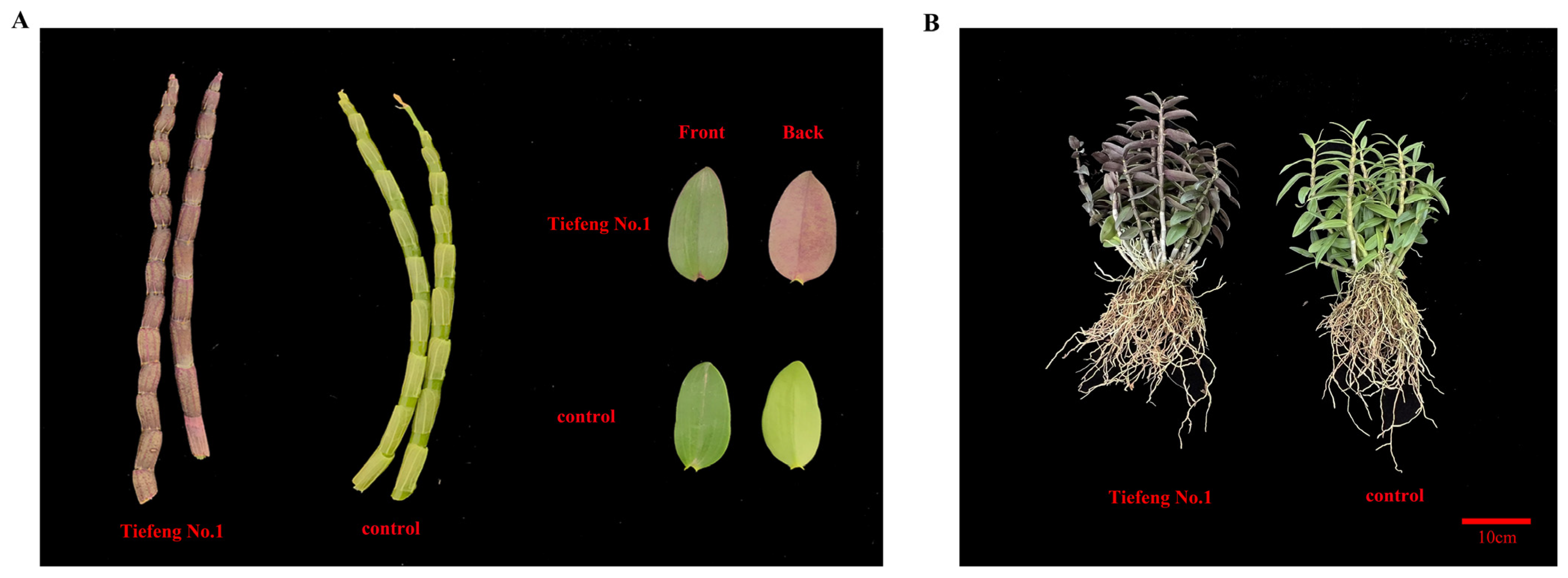
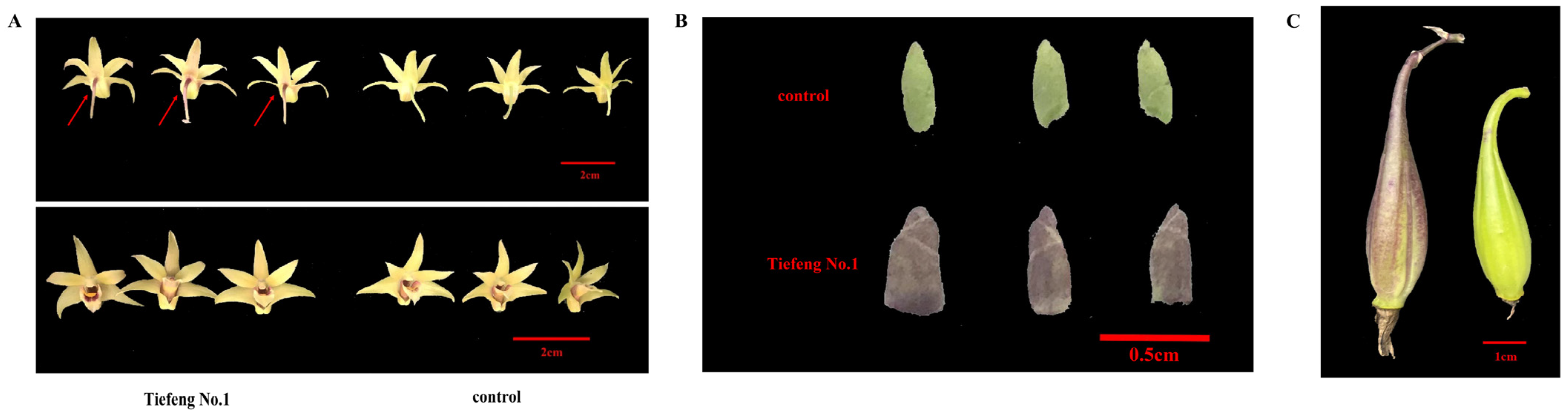
The stem of ‘Tiefeng No.1’ is purplish-red, clustered, erect, and cylindrical, measuring 10–19 cm in length. The leaves are distichous, papery, oblong-lanceolate in shape, purplish-red in color, alternate, thick in texture, slightly wider at the base, and decurrent into a stem-clasping sheath. The leaf sheaths are purplish-red, with their upper margins loosening and spreading away from the stem as they age. The flowering period is from late May to mid-June. The flowers are yellow-green with a red patch on the middle of the lip. The flower buds are purplish-red, usually emerging from the upper part of old stems, bearing 2–3 flowers. The pedicels are purplish-red, 2.0–2.5 cm long. The seed pods are purplish-red, 3–4 cm long. See Figure 2 and Figure 3.

3.2. Microstructural Observation of ‘Tiefeng No.1’

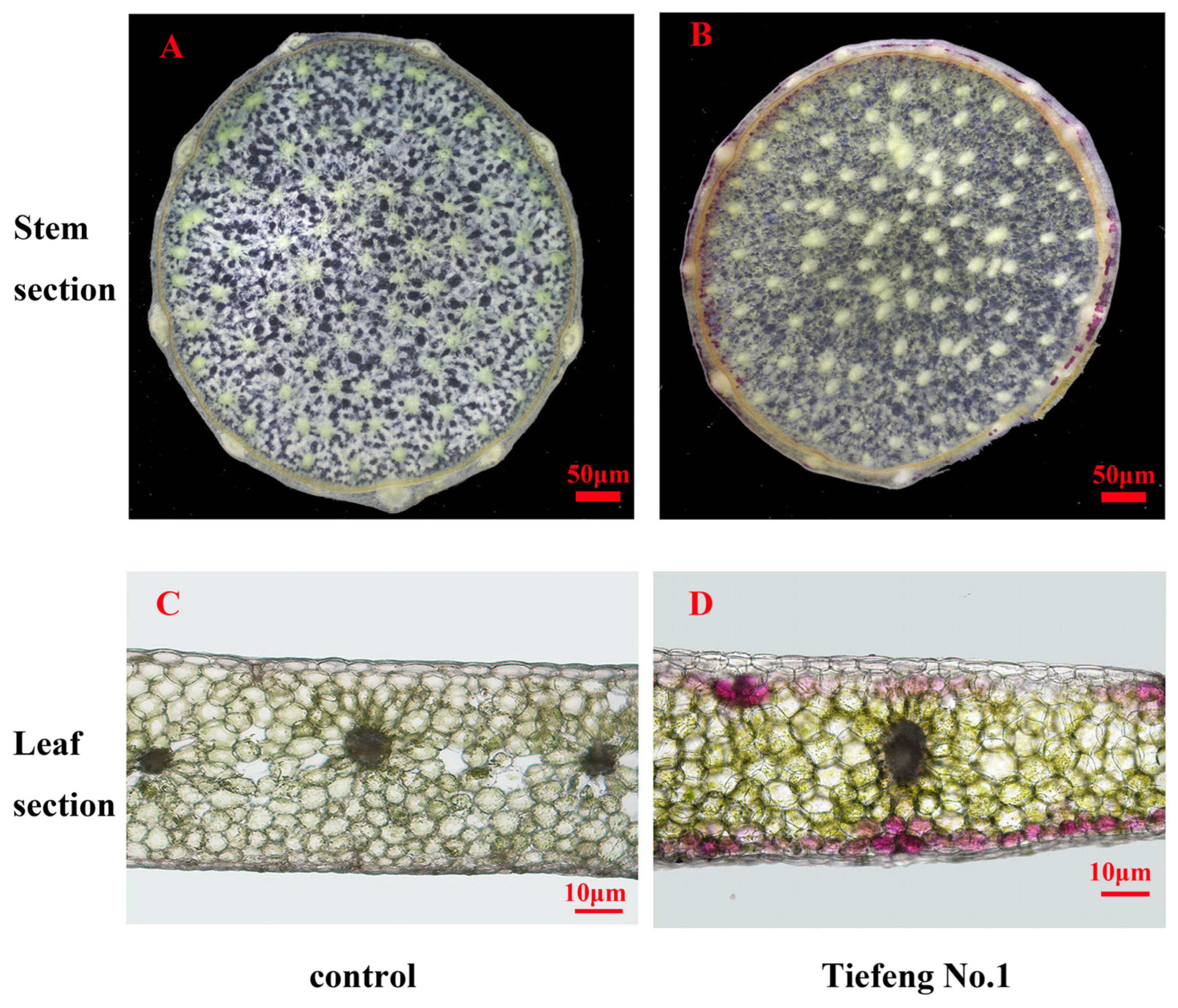
The stem cross-section reveals that the epidermal cells comprise a single layer of purplish-red, flattened cells, which are covered by a yellow cuticle. A colorless sheath layer, composed of parenchyma cells, is discernible in the outer layer. The fundamental parenchyma cells are polygonal and uniform in size, interspersed with numerous vascular bundles arranged in approximately 4–5 concentric rings. A distinct purplish-red ring is evident around the stem’s periphery (Figure 4A,B). In the leaf cross-section structure, the upper epidermis is tightly arranged, exhibiting purplish-red, polygonal cells with thickened walls. The lower epidermis is also densely arranged, purplish-red, and aligned in rows. The sheath cells are more tightly packed and exhibit irregular shapes compared to the control. Distinct purplish-red cells are observable on both the upper and lower surfaces of the leaf blade (Figure 4C,D).

3.3. Yield and Quality Characteristics of ‘Tiefeng No.1’

From 2021 to 2023, a three-year variety comparison trial was conducted across four locations: Yueqing, Taishun, Lucheng in Wenzhou, Zhejiang, and Jinping in Guizhou. Fresh cluster weight and yield were measured during the first three years following transplantation, with specific results presented in Table 1. The findings indicated that the yield of ‘Tiefeng No.1’ did not show a significant difference when compared to the control group.
In the experiment, the quality differences between ‘Tiefeng No.1’ and the control variety were assessed by measuring the polysaccharide content, mannose content in dried products, anthocyanin content in fresh products, and drying rate, as shown in Table 2. The data in the table represent the average results of three years of testing. The results showed that the polysaccharide content, anthocyanin content, and dry matter ratio of ‘Tiefeng No.1’ in the pilot areas of Yueqing, Taishun, Lucheng, and Jinping were significantly higher than those of the local variety in Yueqing. The polysaccharide content of ‘Tiefeng No.1’ in the Lucheng pilot area increased by 53.82% compared to the control. There was no significant difference in mannose content among the four regional test sites. The anthocyanin content in the Jinping pilot area increased by 111.37% compared to the control, while that in the Taishun pilot area increased by 106.49%. The dry matter ratios in the four locations increased by 27.26%, 27.42%, 27.19%, and 28.68%, respectively, compared to the control variety. The three-year, four-location trial results demonstrated that all quality indicators of ‘Tiefeng No.1’ met the requirements of the 2020 edition of the Pharmacopoeia of the People’s Republic of China.

3.4. Stress Resistance Test Results

3.4.1. Freeze Resistance Test Results

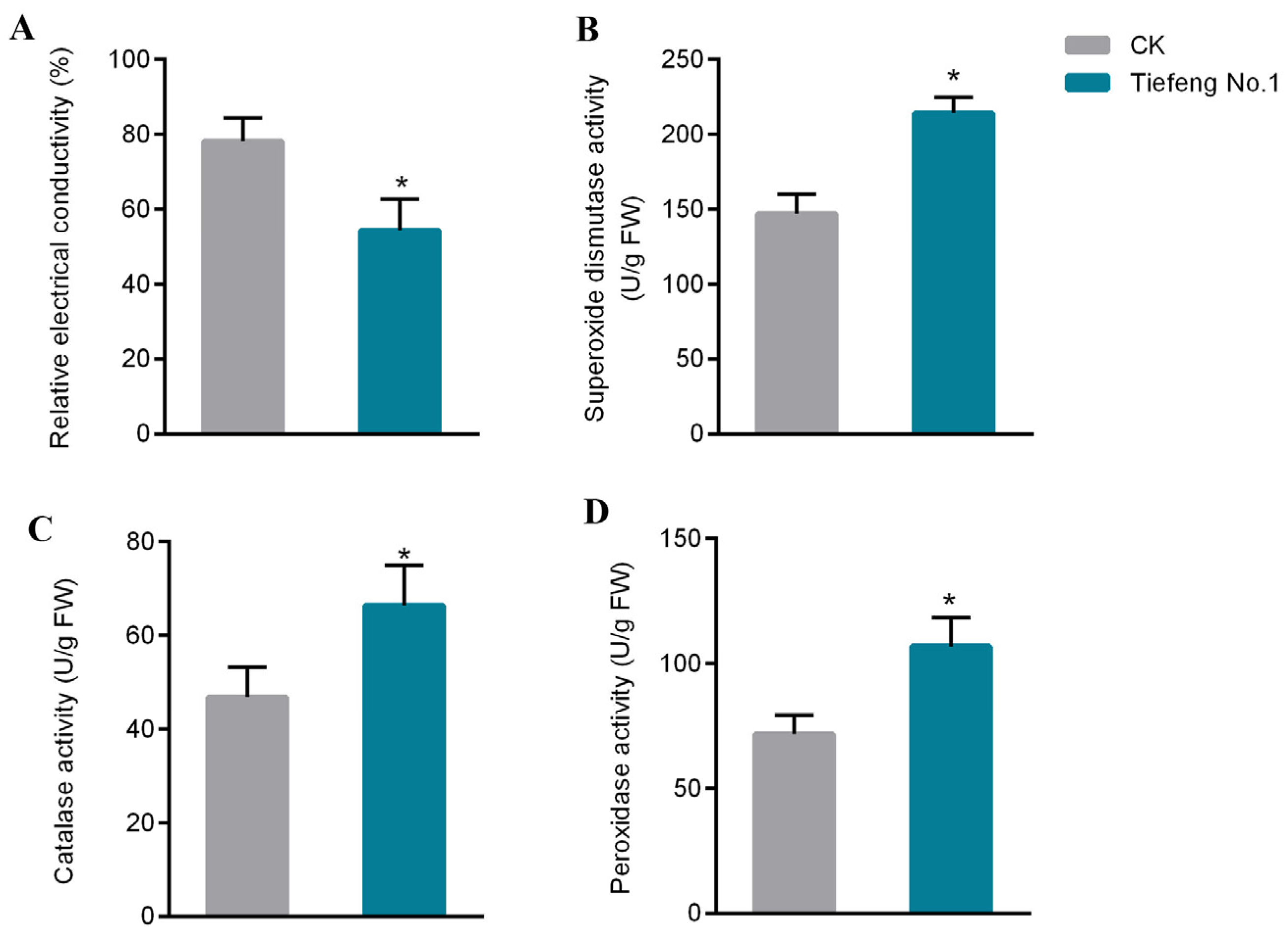
Under low-temperature conditions, the cell membrane functions as the primary defense mechanism for plants in perceiving cold stress. An increase in the permeability of plant cell membranes corresponds to a rise in the electrical conductivity of plant leaves. This study quantified the electrical conductivity under low-temperature treatment, revealing that the conductivity of ‘Tiefeng No.1’ leaves was significantly lower than that of the control (Figure 5A). Antioxidant enzymes, the levels of which fluctuate under stress conditions, play a crucial role in scavenging excessive reactive oxygen species and mitigating the oxidative damage they inflict on plants. In this study, the activities of superoxide dismutase (SOD), catalase (CAT), and peroxidase (POD) enzymes in ‘Tiefeng No.1’ exhibited increases, with the respective activities measured at 147.25 U/g, 46.85 U/g, and 71.84 U/g, reflecting enhancements of 45.56%, 41.75%, and 48.82% compared to the control (Figure 5B–D). These results suggest that ‘Tiefeng No.1’ may possess better frost resistance.

3.4.2. Disease Resistance Test Results

This study found, through disease resistance tests, that ‘Tiefeng No.1’ exhibits resistance to leaf spot and black spot diseases (Table 3).

3.5. Comparative Analysis of ‘Tiefeng No.1’ and ‘Xianhu No.2’

The pot experiment was conducted to compare the differences in agronomic traits and quality traits between ‘Tiefeng No.1’ and ‘Xianhu No.2’, as shown in Table 4 and Table 5. The results showed that ‘Tiefeng No.1’ had an average of 11.50 buds per cluster, with an average stem length of 20.40 cm. The average fresh weight of a single stem was 4.10 g, and the fresh weight per cluster was 47.15 g. ‘Xianhu No.2’ had an average of 12.10 buds per cluster, with an average stem length of 20.90 cm. The average fresh weight of a single stem was 4.30 g, and the fresh weight per cluster was 52.03 g. There was no significant difference between the two varieties. The stem polysaccharide content (dry product) of ‘Tiefeng No.1’ was 55.31%, representing a 33.79% increase compared to ‘Xianhu No.2’; its mannose content (dry product) was 17.46%, showing a 4.43% decrease relative to ‘Xianhu No.2’; while the anthocyanin content (fresh product) reached 102.60 μg/g, marking a 73.96% rise over ‘Xianhu No.2’.

4. Discussion

Dendrobium officinale contains a variety of bioactive compounds, primarily including polysaccharides, amino acids, alkaloids, and multiple trace elements [18]. Among these, polysaccharides are the predominant active components and are found in significant quantities. Modern pharmacological research has demonstrated that polysaccharides possess various effects, including anti-mutagenic properties, immune regulation, tumor growth inhibition, and reduction in blood sugar levels [19,20]. The Chinese Pharmacopoeia specifies that polysaccharides are a key criterion for the quality evaluation of Dendrobium officinale [13], with specimens of superior quality containing more than 50% polysaccharides [21]. Therefore, cultivating varieties with high polysaccharide content is one of the important objectives in Dendrobium officinale breeding. According to research by Chen [22], there are currently only 17 cultivated Dendrobium officinale varieties with clearly identified parentage in China, with polysaccharide content ranging from 15.6% to 57.5%. The results of this study indicate that, despite minor variations, the polysaccharide content of ‘Tiefeng No.1’ consistently exceeded 50% across all test sites (Table 2), demonstrating significant potential for development. However, due to the complex structure of polysaccharides, which exert diverse biological activities through various mechanisms, further in-depth molecular and clinical studies are necessary to elucidate the specific medicinal effects of ‘Tiefeng No.1’.
The Dendrobium officinale planting area in Yandang Mountain belongs to the central subtropical maritime monsoon climate, featuring the unique climatic environment of a “famous coastal mountain” [23]. Prolonged low-temperature periods and climatic stimuli such as frost and severe cold promote the accumulation of secondary metabolic active components in Dendrobium officinale plants. The unique natural environment significantly influences the characteristics of Dendrobium officinale. The color of its flowers, stems, and other external traits is closely linked to its ornamental value. Anthocyanins, which are key secondary metabolites, play a crucial role in plant coloration. They not only enhance the ornamental features of plants but also exhibit physiological functions, such as antioxidant properties and stress resistance, thereby improving the plant’s adaptability to environmental stresses [24]. In this experiment, the newly bred Dendrobium officinale variety ‘Tiefeng No.1’ exhibited a 103.53% increase in anthocyanin content compared to the main locally cultivated variety in Yueqing. We speculate that the higher anthocyanin content may contribute to the enhanced cold and frost resistance observed in ‘Tiefeng No.1’.
Under low-temperature stress, the decrease in membrane fluidity leads to an imbalance in ion homeostasis and increased ion leakage, resulting in elevated relative electrical conductivity in plant leaves [25]. This study found that the relative electrical conductivity of ‘Tiefeng No.1’ leaves under low-temperature conditions was significantly lower than that of the control, indicating that ‘Tiefeng No.1’ experiences less membrane system damage due to low temperatures. Abiotic stress can increase the levels of reactive oxygen species (ROS) in cells, which adversely affect crop productivity and yield [26]. During low-temperature stress, the metabolism of ROS in plants becomes dysregulated, making them susceptible to oxidative bursts and the accumulation of free radicals within plant cells [27]. Antioxidants involved in ROS detoxification include superoxide dismutase (SOD), peroxidase (POD), and catalase (CAT) [28]. In this study, the activities of SOD, POD, and CAT in ‘Tiefeng No.1’ under low-temperature conditions were significantly higher than those in the control, suggesting that ‘Tiefeng No.1’ may exhibit enhanced frost resistance.
The results indicate that ‘Tiefeng No.1’ possesses superior quality and holds significant potential for widespread application and popularization. Therefore, the breeding of this variety has enriched the germplasm resources of Dendrobium officinale and contributed to the advancement of the Dendrobium officinale industry.

5. Conclusions

The results of this study indicate that the per-mu yield of ‘Tiefeng No.1’ does not significantly differ from that of the control group. However, its drying rate, polysaccharide content, and anthocyanin content are significantly higher than those of the control variety. Resistance tests demonstrate that ‘Tiefeng No.1’ exhibits superior frost resistance compared to the control and shows good resistance to leaf spot and black spot diseases. In comparison with ‘Xianhu No.2’, ‘Tiefeng No.1’ displays significantly increased levels of polysaccharides and anthocyanins.

Author Contributions

J.C., W.J. and Z.T. planned and designed the research; J.C., Z.Z., M.Z., Y.L. and X.D. performed the experiments; J.C. and Z.Z. analyzed the data, and together with J.C. wrote the manuscript. All authors have read and agreed to the published version of the manuscript.

Funding

This work was supported by the National Natural Science Foundation of China (32102485). This work was also supported by the “Three Rural Areas and Nine Directions” Science and Technology Collaboration Program of Zhejiang Province (2025SNJF011) and also supported by the Wenzhou Agricultural New Varieties Breeding Collaboration Group Project (ZX2024005-1), the Wenzhou Major Science and Technology Innovation Research Project (ZN2023005) and the Wenzhou Science and Technology Commissioner Special Project (X2025005).

Institutional Review Board Statement

Not applicable.

Informed Consent Statement

Not applicable.

Data Availability Statement

The original contributions presented in this study are included in the article. Further inquiries can be directed to the corresponding authors.

Conflicts of Interest

The authors declare no conflicts of interest.

References

  1. Li, S.Z. Compendium of Materia Medica; Shanghai Scientific and Technical Publishers: Shanghai, China, 2008; pp. 7–1920. [Google Scholar]
  2. Sun, L.; Chen, X.M.; Wu, C.M.; Guo, S.X. Advances and prospects of pharmacological activities of Dendrobium officinale Kimura et Migo polysaccharides. Acta Pharm. Sin. 2020, 55, 2322–2329. [Google Scholar]
  3. Ning, Y.H.; Gu, J.W.; Liu, Z.P.; Ying, S.G. Research progress on active components and pharmacological effects of Dendrobium officinale. Asia-Pac. Tradit. Med. 2016, 12, 71–73. [Google Scholar]
  4. Wu, J.; Wang, J.F.; Fang, L.; Wu, H.L.; Zhu, M.W.; Wang, R.W. Domestic Research Progress of Dendrobium officinale Kimura et Migo. Chin. Pharm. J. 2013, 48, 1610–1613. [Google Scholar]
  5. Tian, L.X.; Chen, X.M.; Guo, S.X.; Shan, T.T. Study on Two Phenotypes of Dendrobium officinale. Chin. Pharm. J. 2018, 53, 98–103. [Google Scholar]
  6. Guo, S.M. A ‘Fairy Grass’ helps rural revitalization—Recording the characteristic industry of Dendrobium officinale in Yueqing City, Wenzhou City, Zhejiang Province. Compr. Agric. Dev. China 2023, 11, 46–49. [Google Scholar]
  7. Ao, Z.X.; Kong, Q.; Yu, X.X. Innovation leads the integration development and makes the Dendrobium officinale industry bigger and stronger. For. Zhejiang Prov. 2020, 9, 22–23. [Google Scholar]
  8. Chen, J.D.; Jiang, W.; Song, M.Q.; Zhou, Y.J.; Li, Y.P.; Duan, X.J.; Tao, Z.M. Identification and Expression Analysis of UDP-glycosyltransferase (UGT) Gene Family in Dendrobium officinale. China J. Chin. Mater. Medica 2023, 48, 1840–1850. [Google Scholar]
  9. Xu, J.; Wang, X.T.; Hu, L.J.; Li, M.Y.; Shao, Q.S.; Jia, C. Breeding of Dendrobium officinale var. “Xianhu 3” and Its Characteristics. Mod. Chin. Med. 2017, 19, 337–341. [Google Scholar]
  10. Xu, S.P.; Yuan, X.Y.; Zhang, Y.; He, P.; Cui, B. A New Dendrobium officinale Cultivar ‘Yuhu 4’. Acta Hortic. Sin. 2023, 50, 233–234. [Google Scholar]
  11. Luo, M.; Liu, X.; Yang, L.L.; Yang, P.F.; Wu, M.K.; Sun, S.D.; Xia, Y. A New Dendrobium officinale Cultivar ‘Guihu 1’. Acta Hortic. Sin. 2023, 50, 197–198. [Google Scholar]
  12. Zhou, H.J.; Chen, F.L.; Zeng, F.; Liu, Y.; Wei, C.H.; Xie, Y. Effects of different cultivation methods on agronomic traits of Dendrobium officinale. Northwest Hortic. 2024, 11, 73–75. [Google Scholar]
  13. National Pharmacopoeia Commission. Pharmacopoeia of the People’s Republic of China; National Pharmacopoeia Commission: Beijing, China, 2020; pp. 303–304.
  14. Wu, Z.G.; Jiang, W.; Chen, S.L.; Mantri, N.; Tao, Z.M.; Jiang, C.X. Insights from the cold transcriptome and metabolome of Dendrobium officinale: Global reprogramming of metabolic and gene regulation networks during cold acclimation. Front. Plant Sci. 2016, 7, 1653. [Google Scholar] [CrossRef] [PubMed]
  15. Zhang, Z.Y.; Zhou, M.L.; Liang, J.P.; Huang, P.P.; Zhang, C. Breeding of a New Dendrobium officinale Cultivar ‘Fuhu No.1’. Fujian J. Agric. Sci. 2020, 35, 709–716. [Google Scholar]
  16. Xu, S.E.; Lu, P.; Jin, L.P.; Wang, Y.J. Control of bacterial leaf spot disease in Dendrobium officinale and growth-promoting effects by Paenibacillus polymyxa. J. Zhejiang Agric. Sci. 2016, 57, 2033–2034. [Google Scholar]
  17. Li, M.Y.; Wang, Y.; Zheng, H.X.; Li, J.M.; Xu, J.; Zhu, H.Z.; Zhu, J.Q.; Xie, X.B. Breeding of Dendrobium officinale var. ‘Xianhu 2’ and Its Characteristics. Chin. Pharm. J. 2013, 48, 1677–1680. [Google Scholar]
  18. Tao, Z.X.; Lu, N.S.; Wu, X.Q.; Huang, Y.K.; Xiao, Y.X.; Wang, X. Research progress on chemical constituents and pharmacological effects of Dendrobium. J. Pharm. Res. 2021, 40, 44–51. [Google Scholar]
  19. Yu, J.N. Study on Chemical Constituents, In Vitro Activities and Network Pharmacological Prediction of Anti-Hepatocellular Carcinoma Targets of Five Dendrobium Species. Master’s Thesis, Zhejiang Sci-Tech University, Hangzhou, China, 2023. [Google Scholar]
  20. Liu, H.D. Extraction and Antibacterial Effects of Volatile Components from Dendrobium officinale. Master’s Thesis, Hunan Agricultural University, Changsha, China, 2017. [Google Scholar]
  21. Yan, P.P.; Ye, W.; Jiang, J.L.; Wang, P.Y.; Jiang, J.F.; Hong, Z.C. Quality and safety analysis of Dendrobium officinale under different bionic cultivation modes. Chin. Agric. Sci. Bull. 2023, 39, 64–68. [Google Scholar]
  22. Chen, X.M.; Tian, L.X.; Shan, T.T.; Sun, L.; Guo, S.X. Research Progress on Germplasm Resources and Genetic Breeding of Dendrobium officinale. Acta Pharm. Sin. 2018, 53, 1493–1503. [Google Scholar]
  23. Zhu, Y.L.; Wang, Z.X.; Yu, W.B.; Sheng, W.J.; Wang, Y.S.; Wang, X.; Liu, J.M.; Xu, C.; Song, Y.H. Research progress on the medicinal value of anthocyanins. J. Anhui Agric. Univ. 2023, 50, 1082–1091. [Google Scholar]
  24. Li, Z.W.; Luo, W.H.; Wang, P.Y.; Jiang, J.L.; Zheng, H.W.; Zheng, X.J.; Jiang, R.; Ye, W. Identification of WD40 Transcription Factor Family in Dendrobium officinale and Correlation Analysis with Anthocyanin Biosynthesis under Light Stress. Southeast Hortic. 2026, 1–14. [Google Scholar]
  25. Yan, H.J.; Tan, F. Changes of chloroplast ultrastructure in Gardenia jasminoides leaves under natural low temperature. Her. Tradit. Chin. Med. 2006, 2, 1–2. [Google Scholar]
  26. Shareen; Faraz, A.; Faizan, M. Physiological Impact of Reactive Oxygen Species on Leaf. In Reactive Oxygen Species: Prospects in Plant Metabolism; Springer Nature: Singapore, 2023; pp. 95–113. [Google Scholar]
  27. Fan, Y.; Wang, K.; Wang, M.; Wang, X.; Li, H.; Wu, Y. Production, functions and scavenging mechanisms of reactive oxygen species in plants under low-temperature stress. Maejo Int. J. Sci. Technol. 2023, 17, 210. [Google Scholar]
  28. Hasanuzzaman, M.; Bhuyan, M.H.M.B.; Parvin, K.; Bhuiyan, T.F.; Anee, T.I.; Nahar, K.; Hossen, M.S.; Zulfiqar, F.; Alam, M.M.; Fujita, M. Regulation of ROS metabolism in plants under environmental stress: A review of recent experimental evidence. Int. J. Mol. Sci. 2020, 21, 8695. [Google Scholar] [CrossRef]
Figure 1. A schematic diagram of the breeding process of ‘Tiefeng No.1’.
Horticulturae 12 00326 g001
Figure 2. Plant morphological characteristics of ‘Tiefeng No.1’ ((A): whole plant phenotype, (B): stem and leaf phenotype).
Horticulturae 12 00326 g002
Figure 3. Flower (A), flower bud (B) and pod (C) phenotype of ‘Tiefeng No.1’. The red arrow in (A) represents the purplish-red pedicel.
Horticulturae 12 00326 g003
Figure 4. The microstructure of stem and leaf slices of ‘Tiefeng No.1’. Cross-sectional microscopic image of control (A) and ‘Tiefeng No.1’ (B) stem; Microscopic sections of control (C) and ‘Tiefeng No.1’ (D) leaves.
Horticulturae 12 00326 g004
Figure 5. Relative electrical conductivity and antioxidant enzyme activity. Relative electrical conductivity (A); Superoxide dismutase activity (B); Catalase activity (C); Peroxidase activity (D). Statistical significance (p-values) is indicated in the figure, * p < 0.05.
Horticulturae 12 00326 g005
Table 1. Yield performance of ‘Tiefeng No.1’ in four experimental sites from 2021 to 2023.
Test SiteTest VarietyYield (kg/667 m2)
2021Significance Test2022Significance Test2023Significance Test
YueqingTiefeng No.1405.56NS473.79NS489.31NS
Control389.22435.44452.33
TaishunTiefeng No.1403.25NS452.38NS461.25NS
Control388.24425.14423.45
LuchengTiefeng No.1421.25NS444.12NS452.25NS
Control399.24417.46415.80
JinpingTiefeng No.1433.48NS501.32NS498.57NS
Control417.23477.65474.38
Note: The yield differences between ‘Tiefeng No.1’ and the control group were compared, both planted in the same year and location. The term ‘NS’ indicates no significant difference. Yield is defined as the weight of fresh Dendrobium officinale stems, excluding leaves, measured per 667 square meters.
Table 2. Quality traits of ‘Tiefeng No.1’ at four experimental sites from 2021 to 2023.
CharacteristicTest VarietyTest Site
YueqingTaishunLuchengJinping
Average ValueIncrease Compared to Control (%)Average ValueIncrease Compared to Control (%)Average ValueIncrease Compared to Control (%)Average ValueIncrease Compared to Control (%)
Polysaccharide content (dry product (%))Tiefeng No.151.04 *43.8651.20 *46.2953.10 *53.8252.49 *39.01
Control35.4835.0034.5237.76
Mannose content (dry basis (%))Tiefeng No.118.466.5818.405.0217.4611.2818.689.95
Control17.3217.5216.6916.99
Anthocyanin content (fresh product (μg/g))Tiefeng No.1103.53 **98.22109.11 **106.49105.77 **97.96113.02 **111.37
Control52.2352.8453.4353.47
Dry matter percentage (%)Tiefeng No.135.34 *27.2635.13 *27.4236.02 *27.1936.07 *28.68
Control27.7727.5728.3228.03
Note: The differential analysis in the table is a comparative analysis between ‘Tiefeng No.1’ and the control group under the same indicator from the same origin. Statistical significance (p-values) is indicated in the table, * p < 0.05, ** p < 0.01.
Table 3. Resistance identification results of Dendrobium officinale.
Variety (Line)Incidence of Leaf Spot Disease (%)Incidence of Black Spot Disease (%)
Control4.53 (HR)4.18 (HR)
Tiefeng No.13.19 (HR)2.77 (HR)
Note: HR stands for high resistance to disease.
Table 4. Comparison of agronomic traits between ‘Tiefeng No.1’ and ‘Xianhu No.2’.
Variety NameNumber of Sprouts per ClumpStem Length (cm)Fresh Stem Weight (g)Fresh Weight per Clump (g)
Tiefeng No.111.5020.404.1047.15
Xianhu No.212.1020.904.3052.03
Table 5. Comparison of quality traits between ‘Tiefeng No.1’ and ‘Xianhu No.2’.
Variety NamePolysaccharide Content (Dry Product (%))Increase Compared to Control (%)Anthocyanin Content (Fresh Product (μg/g))Increase Compared to Control (%)
Tiefeng No.155.31 *33.79102.60 **73.96
Xianhu No.241.3458.98
* p < 0.05, ** p < 0.01.
Disclaimer/Publisher’s Note: The statements, opinions and data contained in all publications are solely those of the individual author(s) and contributor(s) and not of MDPI and/or the editor(s). MDPI and/or the editor(s) disclaim responsibility for any injury to people or property resulting from any ideas, methods, instructions or products referred to in the content.