Article

Effects of Combined Blue–Green Light Treatments on Photosynthetic Characteristics and Antioxidant Activity in Pepper Seedlings


1
Shanxi Key Laboratory of Germplasm Resources Innovation and Utilization of Vegetable and Flower, College of Horticulture, Shanxi Agricultural University, Taigu 030801, China
2
College of Resources and Environment, Shanxi Agricultural University, Taigu 030801, China
3
Department of Horticulture, The University of Haripur, Haripur 22620, Pakistan
*
Authors to whom correspondence should be addressed.
These authors contributed equally to this work.
Horticulturae 2026, 12(3), 306; https://doi.org/10.3390/horticulturae12030306
Submission received: 2 February 2026 / Revised: 27 February 2026 / Accepted: 3 March 2026 / Published: 5 March 2026
(This article belongs to the Section Protected Culture)

Abstract

Light spectral composition critically influences seedling physiology in protected horticulture systems. This study investigates the impact of light-quality regulation on the growth and physiological traits of pepper seedlings, using the pepper cultivar ‘GS4’. Plants were exposed to four light treatments: white light (W), blue light (B), green light (G), and combined blue–green light (BG). The results showed that BG significantly promoted the growth of pepper seedlings compared with B and G, and the seedlings treated with BG developed visibly healthier darker green leaves by day 4. Moreover, BG treatment mitigated the green-light-induced cell membrane damage, as indicated by reduced relative electrolyte conductivity, and improved the balance between CO2 assimilation and water loss through the regulation of stomatal function. The BG treatment resulted in a significantly higher net photosynthetic rate than the B and G treatments, while showing no significant difference from the W treatment. Additionally, BG treatment mitigated the inhibitory effects of single light treatments on chlorophyll accumulation and maintained stable chlorophyll a/b ratios. It also enhanced antioxidant enzyme activities, thereby reducing oxidative stress and lipid peroxidation. Furthermore, BG treatment stabilized soluble sugar and protein levels while preventing the excessive proline accumulation observed under the G treatment. Overall, under the tested short-term seedling conditions, BG light treatment improved photosynthetic performance, antioxidant activity, and metabolic stability, alleviated physiological stress associated with monochromatic light exposure, and achieved performance comparable to that of white light.

1. Introduction

Pepper (Capsicum annuum L.) belongs to the genus Capsicum within the family Solanaceae and is an annual or perennial herbaceous plant [1]. Indeed, it is the most extensively planted and economically valuable vegetable crop in China. According to statistics from the Food and Agriculture Organization (FAO), China’s pepper cultivation area reached 11.3973 million mu (1 mu = 0.0667 hectares, equivalent to 759,820 hectares) in 2022, with a total production of 16.8374 million metric tons, ranking first globally in both planting area and yield [2]. With the rapid advancement of agricultural technologies, protected cultivation has become an important production mode for peppers, significantly extending the harvest period and improving economic returns. However, the growth and development of pepper are regulated by the combined effects of multiple environmental factors [3].
Light is the primary energy source for photosynthesis in plants. In protected cultivation, however, light environments are typically characterized by low transmission, heterogeneous spatial distribution of irradiance, suboptimal light quality, limited photoperiod, reduced ultraviolet radiation, and the concurrent occurrence of high temperature and low CO2 concentrations [4]. These constraints are particularly severe under prolonged overcast or haze conditions, further aggravating light deficiency and restricting pepper growth. Additionally, plastic film aging and structural shading reduce inside light intensity to 50–70% of open-field levels and shorten the effective light duration. This impairs photosynthetic performance and subject plants to low-light stress. Low light markedly reduces the photosynthetic efficiency of pepper plants [5,6,7], leading to decreased leaf thickness and chlorophyll content, reduced accumulation of photosynthates, and impaired flowering and fruit set, ultimately resulting in a lower fruit-set rate and an increased incidence of malformed fruits [8]. In addition, low-light conditions adversely affect pollen viability and pollen tube growth rate, thereby decreasing the success of pollination and fertilization and reducing fruit set in pepper [9]. Furthermore, pepper plants grown under low-light conditions exhibit reduced stress tolerance, which ultimately compromises yield and fruit quality.
To mitigate the adverse effects of low light on the growth and yield of greenhouse-grown pepper, various strategies have been adopted to meet the light requirements of pepper throughout its growth and development cycle. LED light sources are regarded as ideal type of artificial light sources for protected cultivation due to their adjustable spectrum and intelligent control [10], which maximize the biological benefits of light environment regulation in agricultural production. Previous studies have demonstrated that red light promotes dry matter accumulation and leaf area expansion in plants, and it represents the waveband with the highest instantaneous quantum efficiency for driving photosynthesis [11]; continuous red light irradiation can effectively accelerate the stem elongation of plants. Blue light, by contrast, modulates chloroplast development, but an excessively high proportion of blue light inhibits cell division and stem elongation [12]; continuous blue light irradiation increases total dry weight, total fresh weight (FW) and seedling vigor index in pepper seedlings [13]. Furthermore, combined red and blue light has a more pronounced promotional effect on seedling growth, development and pigment accumulation compared with monochromatic light [14]. Green light can penetrate the canopy leaves to reach the lower leaf layers, thereby inducing photosynthetic energy acquisition in the understory foliage [15]. Far-red light exerts a synergistic effect with red light, exhibiting a dual-light enhancement effect, and the two wavebands jointly regulate plant growth and development; in shaded environments, far-red light can activate the expression of relevant genes and thus promote stem elongation [16]. Wu et al. (2025) [17] reported that replacing a portion of red and blue light with green light during callus growth of grafted tomato seedlings significantly increased the activities of superoxide dismutase (SOD), peroxidase (POD), catalase (CAT) and ascorbate peroxidase (APX) in all treatment groups, and the enzyme activities in the treatment group with 30% green light (R7B3G3) were significantly higher than those in the white light, R7B3, R7B3G1 and R7B3G2 groups. Blue light treatment significantly enhanced the activities of APX, POD, CAT and SOD in postharvest sweet orange peel, modified their activity dynamics, improved peel antioxidant capacity, and delayed fruit senescence [18]. In white-stage strawberry fruits, blue light irradiation at an intensity of 200 μmol m−2 s−1 significantly accelerated the coloration and ripening processes, improved the internal fruit quality and enhanced the total antioxidant capacity [19]. Gai et al. (2025) [20] reported that compared with full-spectrum light, blue light treatment significantly shortened the internode length and reduced the plant height of pepper seedlings. In marine environments, blue and green light gradually become the dominant light qualities with increasing water depth. To maintain efficient photosynthesis, seagrasses optimize the efficient photosynthesis; seagrasses optimize the efficiency of blue light capture by remodeling the structural characteristics of the photosynthetic apparatus (e.g., forming a novel L-PSI–LHCII supercomplex enriched in chlorophyll b and lacking the far-red light-absorbing chlorophyll specific to terrestrial plants), which enables their survival and reproduction in deep-water environments. This adaptive evolution highlights the core role of blue and green light in regulating the photosynthetic function and ecological adaptability of submerged plants [21]. Although blue and green light have been studied as signal light qualities individually, their combined effects on photosynthesis and antioxidant balance in pepper seedlings remain poorly quantified. In particular, the interactive modulation of stomatal dynamics, pigment stability, and reactive oxygen species (ROS) homeostasis under a defined blue–green light ratio has not been systematically evaluated in pepper at the seedling stage.
We hypothesized that a balanced blue–green photon ratio (1:1) would improve coordination between stomatal regulation (primarily mediated by blue light) and internal light distribution (enhanced by green light penetration), thereby stabilizing photosynthetic efficiency and antioxidant responses compared with monochromatic light. To test this hypothesis, we performed short-term controlled light treatments and integrated gas-exchange, pigment, antioxidant, osmotic, and multivariate analyses.

2. Materials and Methods

2.1. Experimental Site and Plant Materials

The experiment was conducted at the Horticultural Experimental Station of Shanxi Agricultural University (37°25′ N, 112°35′ E). Fully developed seeds of the advanced inbred pepper line ‘GS4’ were selected and disinfected by hot-water treatment at 55 °C for 15 min in a thermostatic water bath with continuous stirring. After disinfection, the seeds were soaked in distilled water for 12 h and subsequently incubated for germination in an artificial climate chamber at 28 °C. On 16 April 2025, the seeds with radicle protrusion were sown in 72-cell plug trays and transferred to a controlled-environment growth chamber (16/8 h light/dark photoperiod; 25/20 °C day/night temperature). The relative humidity was maintained at 65%, and the light intensity was set at 20,000 lx. Seedlings with uniform growth were transplanted into nutrient pots for acclimatization at the five-true-leaf stage (45 days after sowing), and the subsequent light treatments were initiated after the acclimatization period.

2.2. Light Treatments and Experimental Design

When ‘GS4’ pepper seedlings reached the eight-true-leaf stage, uniform plants with comparable height and size that were free from pests and diseases, were selected for light treatments. The experimental unit was a single nutrient pot with one uniform ‘GS4’ pepper seedling; each light treatment contained three independent biological replicates, and each biological replicate consisted of 12 seedlings (3 seedlings per black cloth-isolated compartment, 4 compartments in total) to eliminate light interference and spatial autocorrelation among samples. White light (W; full-spectrum LED, 400–700 nm, primary peak approximately 450 nm, broad secondary band approximately 600–630 nm, Figure S1A) served as the control. Three experimental treatments were established: monochromatic blue LED light (B, 460 nm, Full Width at Half Maximum (FWHM) approximately 19 nm), monochromatic green LED light (G, 520 nm, FWHM approximately 30 nm), and a combined blue–green light treatment (BG, 1:1 ratio). The distance between the LED lamps and the seedling canopy was adjusted to maintain the photosynthetic photon flux density (PPFD) at 150 μmol m−2 s−1 [22]. The LED light sources were provided by Shenzhen Rongnengda Technology Development Co., Ltd., Shenzhen, China. The spectra of the light sources were monitored daily using a spectrum analyzer (PS300, LI-COR Biosciences, Lincoln, NE, USA), and the light intensity was measured with a photo-quantum meter (MQ-100, Apogee Instruments Inc., Logan, UT, USA). Measurements were taken daily at five positions across the canopy plane (four corners and the center) to ensure spatial uniformity. The distance between the light source and canopy was adjusted as plants grew to maintain consistent PPFD at the canopy level. All other environmental conditions were kept identical among treatments, as detailed in Table 1. Three independent biological replicates were used per treatment. Destructive sampling was conducted on independent seedling populations at 0, 2, 4, and 6 d after the initiation of light treatment for all measurements at each time point. Specifically, the seedlings sampled at different time points were independent and non-repetitive, which ensured the complete statistical independence of the samples across all time points. The second and third fully expanded functional leaves were harvested, immediately frozen in liquid nitrogen, and stored at −80 °C for subsequent physiological and biochemical analyses.

2.3. Determination of Parameters and Methods

2.3.1. Measurement of Physiological Traits

Leaf area was determined using the second and third fully expanded functional leaves with a leaf area meter (YMJ-B, Hangzhou, China). Relative electrical conductivity (REC) was measured using a conductivity meter (DDS-307A, Shanghai, China) following a modified protocol based on Liang et al. [23]. Briefly, leaf disks (0.5 cm diameter; major veins avoided) were collected, and ten disks per treatment were immersed in 20 mL ultrapure water. The initial conductivity (A1) was recorded after gentle mixing. Samples were then shaken at room temperature for 2 h, and conductivity was measured again (A2). Subsequently, samples were boiled for 30 min, cooled to room temperature, and the final conductivity (A3) was recorded. REC was calculated using the following formula:
REC ( % ) = A 2 A 1 A 3 A 1 × 100

2.3.2. Determination of Photosynthetic Parameters

Chlorophyll and carotenoid contents were determined using the 95% ethanol extraction method as previously described [17]. Microscopic observation of stomata characteristics was performed using the nail polish imprint technique. Briefly, healthy and intact leaves were gently cleaned with degreased cotton to remove surface contaminants, after which a thin, transparent layer of nail polish was evenly applied. The nail polish was air-dried for 5–6 min to form a continuous film, after which the imprint membrane was carefully peeled off along the leaf margin with sterile forceps and mounted flat on a microscope slide to prepare a temporary specimen. The stomatal aperture, density, and other related parameters were then quantitatively determined under a light microscope. Photosynthetic gas-exchange parameters of the second and third fully expanded functional leaves were measured between 09:00 and 11:00 using a LI-6800 portable photosynthesis system (LI-COR Biosciences, Lincoln, NE, USA). The recorded parameters included net photosynthetic rate (Pn), stomatal conductance (Gs), transpiration rate (Tr), and intercellular CO2 concentration (Ci). Measurement conditions were set as follows: photosynthetically active radiation of 800 µmol m−2 s−1, airflow rate of 500 µmol s−1, and ambient CO2 concentration of 400 µmol mol−1. Instantaneous water-use efficiency was calculated as Pn/Tr. Each treatment included three biological replicates.

2.3.3. Determination of Antioxidant-Related Parameters

The superoxide anion content was determined using the hydroxylamine oxidation method [24]. Briefly, 0.5 g of leaf tissue was homogenized in 4 mL of 50 mM potassium phosphate buffer (pH 7.8). The homogenate was centrifuged at 12,000 r min−1 for 15 min at 4 °C. Subsequently, 1 mL of supernatant was mixed with 1 mL of 10 mM hydroxylamine hydrochloride and incubated at 25 °C for 20 min. The production of O2 was quantified based on nitrite formation. For antioxidant enzyme assays, 0.2 g of fresh leaf tissue was homogenized with 2 mL of 50 mM phosphate buffer (pH 7.8), followed by centrifugation at 15,000 r min−1 for 15 min at 4 °C. The resulting supernatant was used for enzyme activity determination. CAT activity was assayed using the UV spectrophotometric method based on H2O2 decomposition; SOD activity was determined using the nitroblue tetrazolium (NBT) photochemical reduction method; POD activity was measured using the guaiacol colorimetric method; and malondialdehyde (MDA) content was quantified using the thiobarbituric acid (TBA) method [25]. For histochemical detection, leaves were incubated in 1 mg mL−1 3,3′-diaminobenzidine (DAB) or NBT solution (purity ≥ 99%) for 6 h at 25 °C in darkness [21]. After staining, chlorophyll was removed using a decolorization solution (absolute ethanol:glacial acetic acid:glycerol = 3:1:1, v/v/v). Leaves were then fixed overnight at 25 °C, flattened, and photographed [26].

2.3.4. Determination of Osmoregulatory Substances

The soluble sugar content was determined using the anthrone–sulfuric acid method [27]. Briefly, 0.5 g of fresh tissue was homogenized with distilled water to a final volume of 25 mL and incubated in a boiling water bath for 1 h. After centrifugation at 10,000 r min−1 for 15 min at 4 °C, 1 mL of supernatant was mixed with 2.5 mL of anthrone–sulfuric acid reagent and incubated in boiling water for 10 min, and the absorbance was measured at 620 nm.
Soluble protein content was measured using the Coomassie Brilliant Blue G-250 method [27]. A 0.3 g sample was homogenized in 3 mL of distilled water and centrifuged. One milliliter of supernatant was mixed with 5 mL Coomassie reagent, allowed to react for 2 min at room temperature, and absorbance was measured at 595 nm. Vitamin C content was determined using a modified ammonium molybdate colorimetric method [27]. Fresh tissue (1.0 g) was homogenized in oxalic acid solution containing EDTA-Na2, centrifuged, and reacted with ammonium molybdate and sulfuric acid. After incubation at 30 °C in darkness for 15 min, and absorbance was measured at 760 nm. Proline content was determined using a modified acidic ninhydrin colorimetric method [28]. Fresh tissue (0.5 g) was extracted in 3% sulfosalicylic acid, reacted with acidic ninhydrin, and heated for 30 min. After extraction with toluene, the absorbance of the upper phase was measured at 520 nm. All treatments were performed with three biological replicates.

2.3.5. Principal Component Analysis and Correlation Heatmap

Prior to multivariate analysis, all physiological indices were averaged across three technical replicates for each biological replicate to eliminate technical measurement variation. Principal component analysis (PCA) and correlation heatmap analysis combined with hierarchical clustering were conducted using the OmicStudio platform (https://www.omicstudio.cn/tool, accessed on 6 November 2025) [29] based on mean values of three independent biological replicates (n = 3) for each light treatment, ensuring statistical independence of the analysis dataset and avoiding pseudo-replication.

2.4. Statistical Analysis

All experiments were conducted with three independent biological replicates. Given that sampling at different time points was destructive and based on independent seedling populations, one-way analysis of variance (ANOVA) followed by Duncan’s multiple range test was used to evaluate significant differences in physiological indices among light treatments at each individual time point (0, 2, 4, 6 d). This analytical approach avoids pseudo-replication caused by repeated measurements on the same sample and accurately reflects the independent variation in each physiological index among different light treatments at a specific time point. This statistical method is therefore appropriate for the experimental design of this study. Data were organized and visualized using Microsoft Excel 2020. Statistical analyses were performed using SPSS 27.0. Differences were considered statistically significant at the p < 0.05 level. Results are presented as mean ± standard deviation (SD).

3. Results

3.1. Effects of Combined BG on the Growth Characteristics of Pepper Seedlings

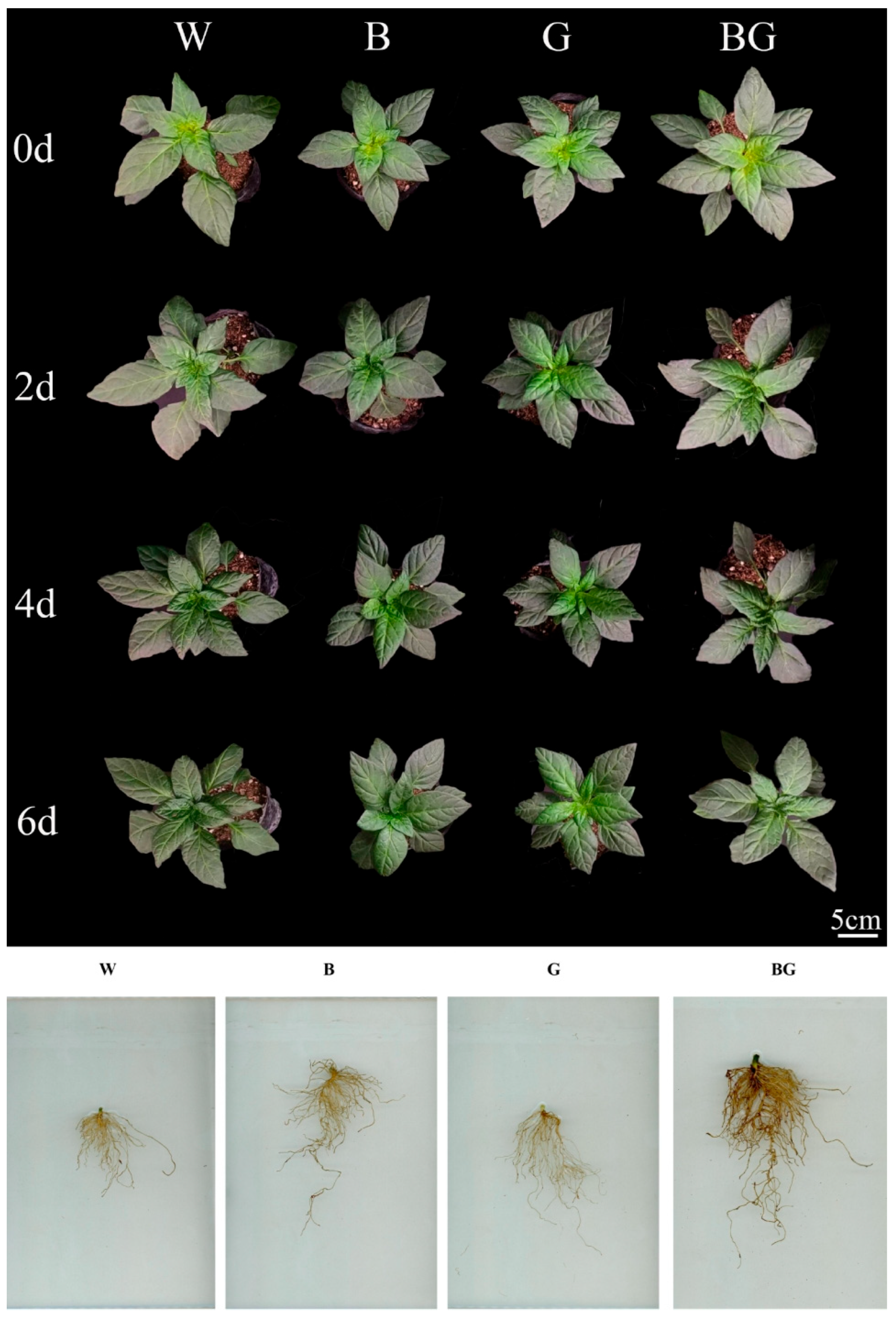
BG treatment improved the growth of pepper seedling with the increase in treatment time. By day 4, BG-treated seedlings showed newly expanded darker green leaves than W control (Figure 1). Root morphology differed among treatments. W showed the weakest root development. B and G increased root length and lateral root number relative to W. BG produced the most developed root system, with greater root spread, more fibrous roots, and higher root biomass than W, B and G (Figure 1).

3.2. Effects of Combined BG on Leaf Area and Relative Electrolyte Conductivity in Pepper Seedlings

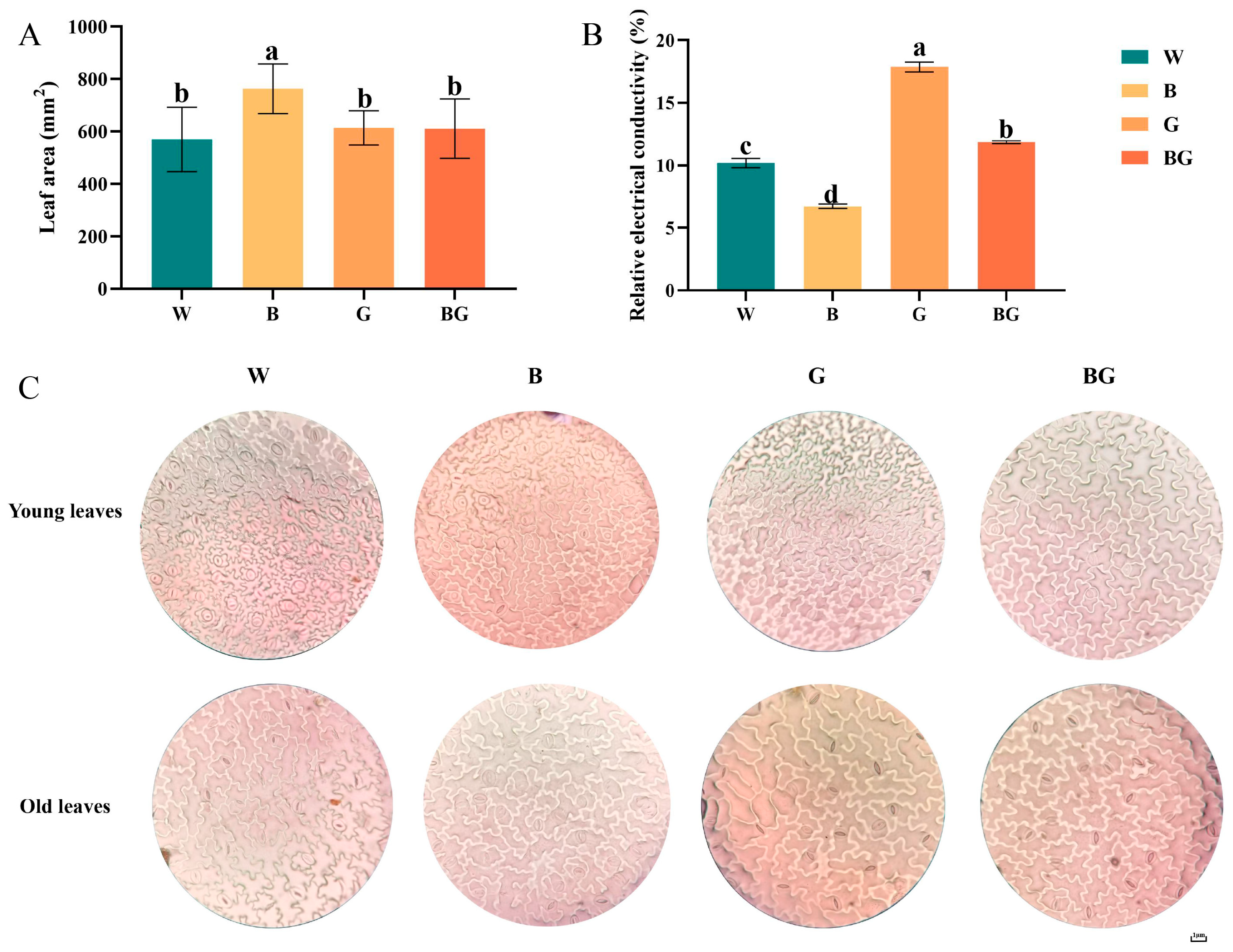
On day 4, the leaf area of functional leaves under B increased significantly by 33.92% compared with the W control (Figure 2A). REC was significantly reduced by 33.88% under B relative to the W but increased 75.26% under G. Notably, the BG significantly decreased REC by 33.64% compared with the G (Figure 2B). In the W group, stomata exhibited relatively large apertures but were sparsely distributed. The B significantly increased stomatal density, although stomatal apertures were slightly reduced. The stomatal density in older leaves was lower than that in the young leaves across all treatments, and stomatal activity varied significantly: W-treated old leaves had almost completely closed stomata; B and G maintained stomata in a semi-open state; only BG treatment kept a certain degree of stomatal opening in old leaves, and the guard cell walls showed the same obvious undulation as young leaves under BG (Figure 2C). Overall, BG treatment had a significant promoting effect on the maintenance of stomatal opening and morphological structure in pepper leaves (especially young leaves), while W, B and G treatments had weak regulatory effects on the stomatal activity of old leaves.

3.3. Effects of Combined BG on Photosynthetic Characteristics and Pigment Content in Pepper Seedlings

B significantly increased the transpiration rate (p < 0.05) compared with W (Table 2). In contrast, Pn and instantaneous water use efficiency (WUE) were reduced by 41.4% and 55.8%, respectively. G showed the lowest Pn, accompanied by reduced stomatal conductance and WUE. BG alleviated the adverse effects associated with monochromatic light. Under the BG, the Pn (2.7565 ± 0.3038 μmol m−2 s−1) was significantly higher than under B or G, showing a moderate increase compared with B and a substantial enhancement relative to G. In absolute terms, BG restored photosynthetic capacity to a level approaching that of the W. Meanwhile, the transpiration rate under the BG was 17.0% lower than that under the B, and WUE (1.4658 μmol CO2 mmol−1 H2O) increased by 54.1% and 198.8% compared with the B and G treatments, respectively.
Different light quality treatments exerted significant regulatory effects on chlorophyll content in pepper leaves (Table 3). B and G significantly reduced the contents of chlorophyll a, chlorophyll b, and carotenoids in pepper leaves compared with W (p < 0.05). In contrast, BG resulted in significantly higher contents of chlorophyll a, chlorophyll b, and carotenoids than B, and its total chlorophyll content did not differ significantly from that under W, while being significantly higher than that under B. Moreover, the chlorophyll a/b ratio under BG was closer to that of W, further indicating that BG effectively alleviated the inhibitory effects of monochromatic B or G on photosynthetic pigment accumulation in pepper leaves.

3.4. Effects of Combined BG on the Antioxidant Properties of Pepper

3.4.1. Effects of Combined Blue–Green Light on Superoxide Anion and Hydrogen Peroxide Contents in Pepper Seedlings

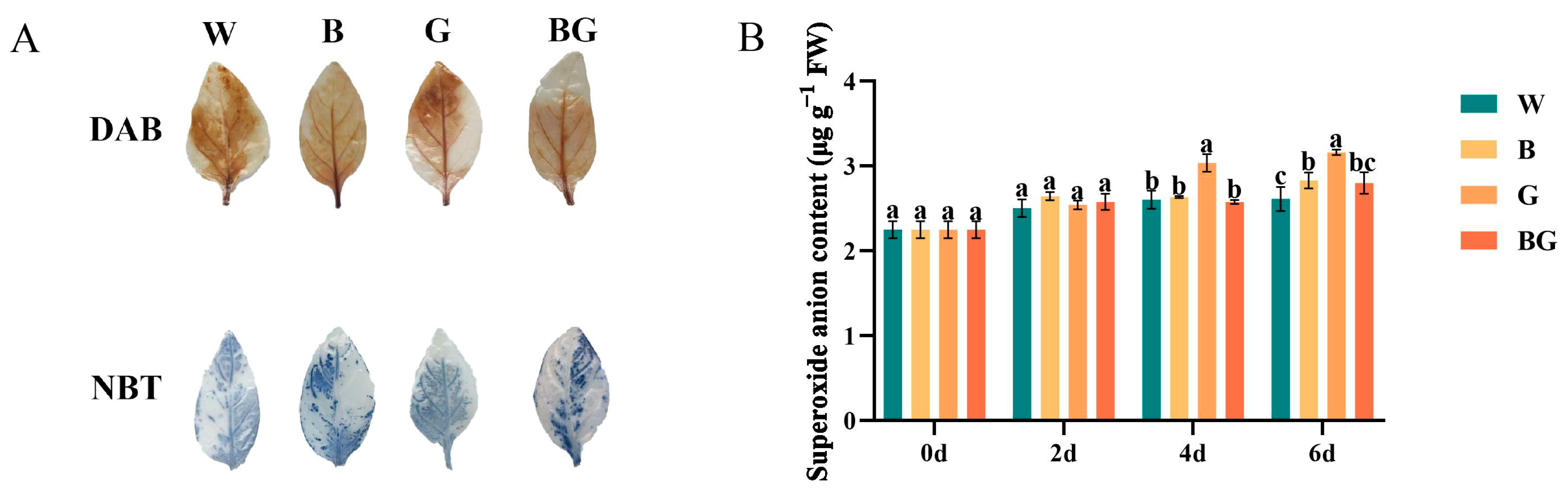
Leaves under G showed the strongest DAB and NBT staining, where BG showed weaker staining and was similar to W (Figure 3A). Superoxide anion content increased significantly (p < 0.05) over time under G and was higher than W (Figure 3B). B also increased superoxide relative to W. BG maintained lower superoxide levels than B and G at all time points and did not differ significantly from W.

3.4.2. Effects of BG on Antioxidant Enzyme Activity and Malondialdehyde Content in Pepper Seedlings

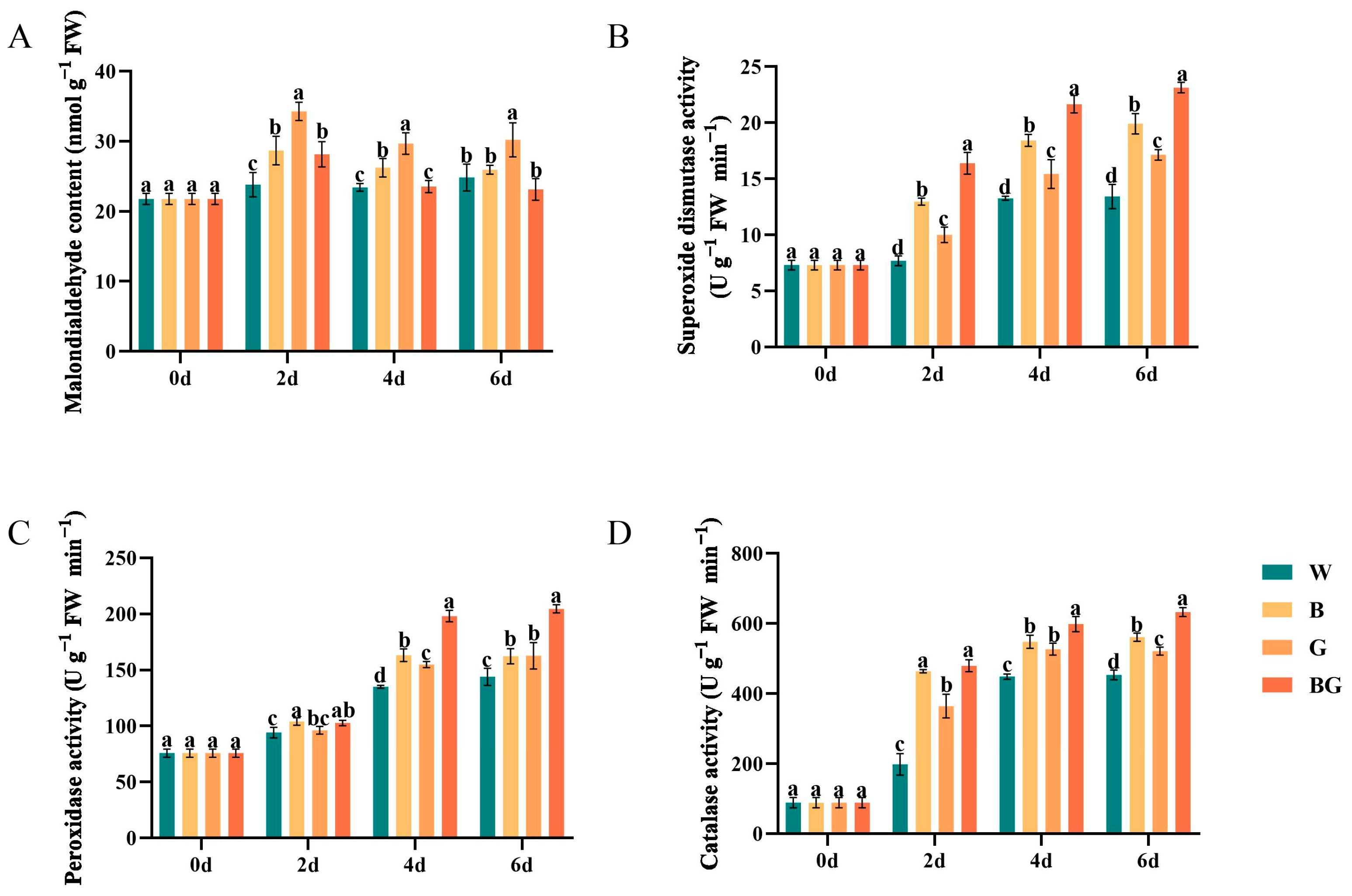
MDA content increased continuously under G and was the highest among treatments at each time point. MDA content under B was also higher than that under W. However, MDA content under BG showed no significant difference compared to the W and was significantly lower than that under the B or the G (Figure 4A). The response trends of SOD, POD, and CAT activity were consistent (Figure 4B–D). BG significantly upregulated the activity of all three enzymes over time. By 4–6 d, enzyme activity was significantly higher than that under B or G. Notably, at 6 d, SOD and POD activity under the BG approached the levels observed under W, while CAT activity was higher than that under W.

3.5. Effects of Blue–Green Light on Osmotic Regulation Substances and Vitamin C Content in Pepper Seedlings

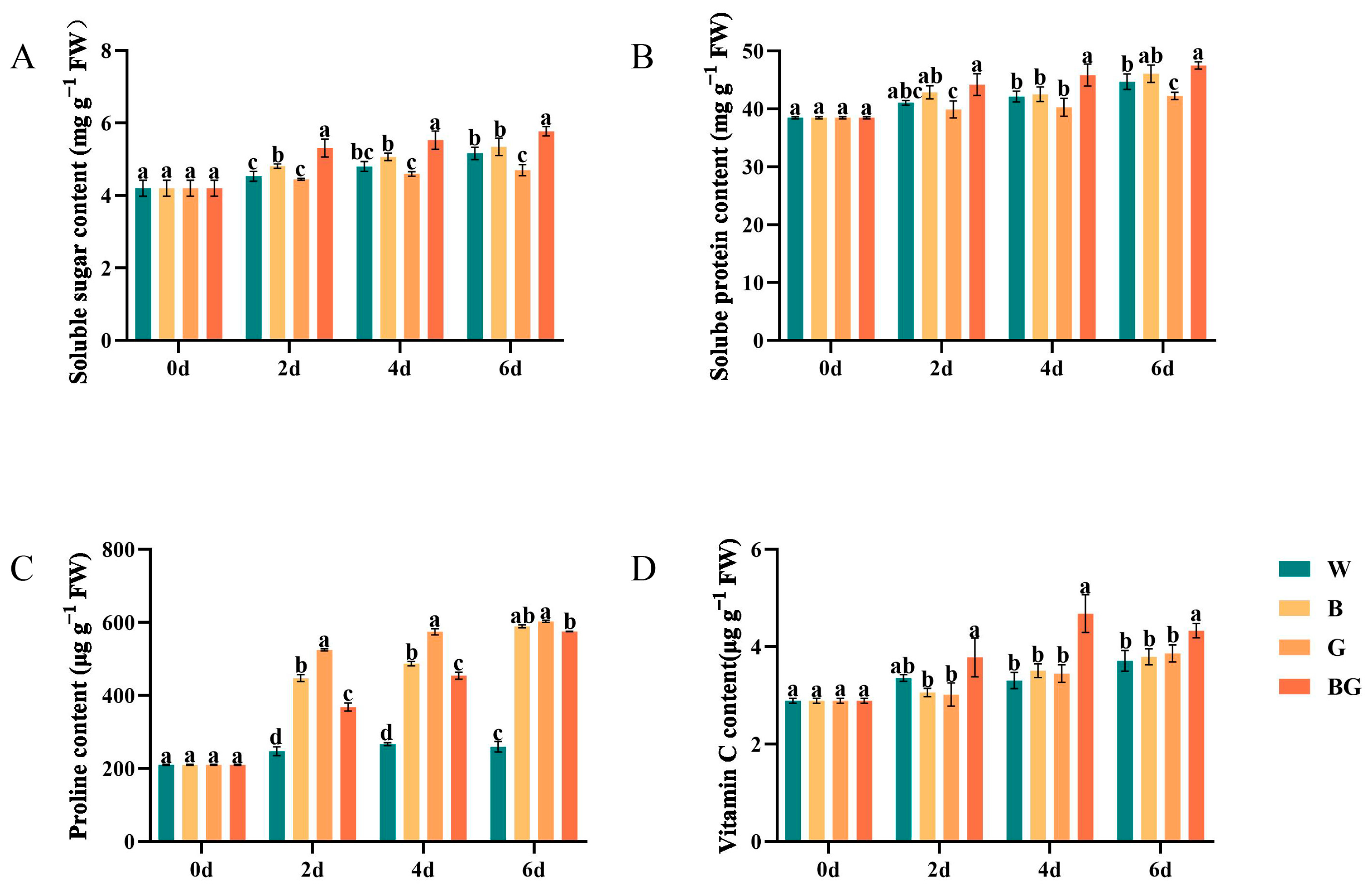
Changes in osmotic regulators and vitamin C are shown in Figure 5. The BG maintained a relatively stable level throughout the 6 d period, with no significant difference from the W (p > 0.05). G significantly increased soluble sugar on day 4. Soluble protein increased under BG and was higher than under B and G (Figure 5B). For proline content (Figure 5C), BG induced a gradual increase in proline content over time, which was significantly lower than G at 6 d (p < 0.05); G caused a sharp proline accumulation (up to ~600 μg g−1 FW at 6 d). BG also maintained a steady increase in vitamin C content (Figure 5D), with a significantly higher content than B and G at 4 d (p < 0.05).

3.6. Comprehensive Analysis of the Effects of Combined Blue-Green Light on Pepper at Seedling Stage

PCA was performed using the mean values of three biological replicates for 21 physiological indices. The first two principal components explained 70.68% of the total variation, with PC1 and PC2 accounting for 43.78% and 26.90%, respectively (Figure S2A). The ordination plot showed separation trends among light treatments. BG samples formed a relatively compact cluster and were positioned apart from the monochromatic light treatments. Mantel test analysis further indicated that light quality may contribute substantially to physiological variation among treatments (R = 0.92593, p < 0.05), suggesting a close statistical relationship rather than direct regulatory determination, and highlighting the distinct physiological configuration observed under BG at the seedling stage. Correlation-based clustering analysis examined relationships among the four physiological modules (Figure S2B). Within each module, several indicators were positively correlated (p < 0.05). For example, Pn, stomatal conductance, and leaf area varied in parallel under the tested light conditions. SOD and POD activities also showed positive association within the antioxidant module. A moderate negative correlation was observed between antioxidant parameters and photosynthetic variables (p < 0.05). These results indicate coordinated correlation patterns among physiological traits across treatments, rather than direct functional interdependence.

4. Discussion

Pepper is a widely cultivated economic crop globally. Consequently, seedling quality is a key determinant of high-yield, high-quality production. In the context of sustainable vegetable seedling production systems, spectral regulation has emerged as a key management strategy to optimize both growth performance and quality formation [30]. Light quality, as one of the key factors influencing the growth and development of pepper seedlings, mainly exerts its effect by regulating the synthesis of photosynthetic pigments, photosynthetic enzyme activity, and the integrity of chloroplast structure. Blue light, on the other hand, not only promotes dry matter accumulation in leaves but also maintains a stable nitrogen content, as well as the retention of vitamin C post-harvest, thus optimizing fruit quality in a synergistic manner [31]. Broad-spectrum RGB light maximizes sweet pepper biomass and plant compactness, improving light use efficiency [32]. Although red–blue light has been widely studied, BG-mediated physiological regulation remains poorly understood, particularly regarding photosynthesis, antioxidant defense, and osmotic adjustment. We therefore systematically examined short-term physiological responses of pepper seedlings to BG, focusing on these integrated processes.

4.1. Effects of B, G, and BG Treatments on Pepper Growth and Photosynthesis

The B treatment significantly promoted leaf expansion at 4 d (Figure 2A) and enhanced stomatal conductance and transpiration by stimulating stomatal opening. However, photosynthetic pigment accumulation was suppressed under monochromatic blue light, limiting light-harvesting efficiency. Consequently, the increase in Pn did not match the elevated transpiration rate, resulting in reduced WUE (Table 2). This imbalance suggests that blue light alone may enhance stomatal activity. The lowest Pn under green light was the combined result of altered pigment composition (reduced chlorophyll a/b ratio, Table 3, may indicate an altered balance between light-harvesting complexes and reaction centers or antenna size adjustment) and oxidative stress-induced membrane damage (elevated REC and MDA); this conclusion is supported by the significant negative correlation between MDA content and Pn in the correlation heatmap (Figure S2B). Moreover, the highest REC (Figure 2B) and continuously elevated MDA content (Figure 4A) observed under green light, as direct biochemical markers of cell membrane lipid peroxidation, verify the occurrence of membrane damage in pepper seedlings. Such membrane damage may further compromise the function of the photosynthetic apparatus and reduce stomatal activity. As a result, WUE was lowest under this treatment. In contrast, the BG demonstrated clear synergistic effects. By day 4, pigment accumulation and root development were significantly enhanced (Figure 1), providing structural and physiological support for improved photosynthetic performance. This complementary interaction resulted in a greater increase in Pn relative to transpiration, thereby significantly improving WUE (Table 2). Enhanced pigment content under BG treatment further optimized light energy capture. These findings are consistent with previous studies that LED spectral regulation can significantly affect plant growth and chlorophyll metabolism. Park et al. [33] found that different LED light qualities (R, G, B, W) differentially regulated the shoot growth, chlorophyll content and photosynthetic fluorescence parameters of Coleus, confirming that spectral quality plays a key role in coordinating plant morphology and photosynthetic physiology. Their findings lend further support to our conclusion that the elevated pigment content and Pn under BG treatment arise from a balanced spectral signaling environment, rather than a simple additive effect of blue and green light. Matthews et al. [34], Chen et al. [35], and Lim et al. [36] collectively demonstrated that green light modulates stomatal movement, morphology, and photosynthesis in combination with blue light, rather than being merely inefficient for photosynthesis. However, we hypothesize that the beneficial effects of BG combination observed here would likely persist under broader spectra including red light or white light. Claypool et al. [32] observed that blue–green light increased stomatal density in pepper seedlings compared with monochromatic blue or green light, and that RG and RGB light improved growth traits relative to RB treatment. These findings align with our results, suggesting that the balancing effects of blue and green light represent conserved physiological responses under red or full white light, rather than being limited to narrow waveband combinations.

4.2. Effects of B, G, and BG Treatments on Pepper Antioxidant Properties

Histochemical staining and physiological indices collectively indicated that different light qualities triggered distinct redox responses in pepper seedlings (Figure 3). The concurrent upregulation of antioxidant enzymes (SOD, POD, and CAT) across treatments reflects the activation of coordinated ROS-scavenging mechanisms that maintain intracellular redox balance [37]. Compared with monochromatic treatments, the BG was associated with a more synchronized enhancement of antioxidant enzyme activities. Similar regulatory effects of blue or composite light on plant antioxidant systems have been reported in other species, supporting that light quality modulates redox physiology rather than acting as a direct stressor [38,39]. Hu et al. [38] found that blue light enhanced antioxidant enzyme activity and reduced lipid peroxidation in cherry seedlings, while Anum et al. [39] noted that green light supplementation activated antioxidant defense in red-leaf lettuce. Overall, in the present study, monochromatic green light induced significant oxidative stress, as evidenced by the strongest DAB/NBT staining (Figure 3A) and continuous accumulation of superoxide anions (Figure 3B); in contrast, BG treatment maintained moderate ROS signaling while preventing excessive oxidative damage through enhanced antioxidant enzyme activity. This highlights the regulatory advantage of BG in balancing stress signaling and cellular protection, which is supported by the low ROS levels, high antioxidant enzyme activity, and stable MDA content in BG-treated seedlings.

4.3. Effects of B, G, and BG Treatments on Pepper Osmotic Regulators and Nutritional Quality Formation

Light quality also influenced osmotic regulatory substances closely linked to carbon–nitrogen metabolism and redox balance [40]. The accumulation patterns of soluble sugars, soluble proteins, proline, and vitamin C under different light treatments (Figure 5) suggest that green-light-induced excessive proline accumulation is a physiological response to its oxidative stress, while BG maintains the homeostasis of osmotic regulators, which may be associated with its effective mitigation of oxidative stress (low ROS/MDA levels). Rather than reflecting stress alleviation, these changes indicate a light-quality–dependent redistribution of metabolic resources during early seedling development. Previous studies support this interpretation. Zhang et al. [41] showed that blue light increased soluble protein content and nitrogen metabolism enzyme activities, while composite light improved biomass and nutritional quality in lettuce. These findings support our results that blue–green light synergistically enhances photosynthate synthesis and allocation. Proline and vitamin C are important osmoprotectants and antioxidants involved in stress adaptation [42,43]; in this study, green-light-induced excessive proline accumulation may be a compensatory response to oxidative damage, while BG’s stable vitamin C accumulation (Figure 5D) may contribute to ROS scavenging, which is in alignment with the findings of Bucky et al. [44] on light quality regulation of antioxidant substances. Studies on peppers [31] and tomatoes [45] have consistently demonstrated that light quality interventions with blue light or an optimal red–blue light combination at the seedling stage can induce transgenerational physiological effects by regulating plant photosynthesis, nutrient accumulation and other key physiological processes, thus serving as a core regulatory strategy to enhance the nutritional quality of fruits. Specifically, blue light can significantly elevate the contents of capsorubin, vitamin C and protein in pepper fruits, while the red–blue light combination (R1B0.8) markedly promotes the accumulation of carotenoids, soluble sugars and other nutritional substances in tomato fruits.
PCA and correlation heatmap analyses revealed treatment-associated clustering of physiological indicators (Figure S2). These analyses describe multivariate association patterns among photosynthesis, pigment composition, antioxidant defense, and osmotic regulation. Similar findings have been reported by Li et al. [46], who demonstrated that combined light improved photosynthetic and growth performance in cucurbit seedlings. Comparable module coordination has been associated with enhanced stress tolerance in wheat under high-temperature conditions [47]. In summary, this study demonstrates that short-term light quality exposure triggers coordinated physiological adjustments in pepper seedlings. BG treatment optimizes photosynthesis, antioxidant activity, and osmotic regulation, highlighting the key role of spectral composition in early seedling physiology. It should be noted that our findings represent short-term physiological responses during the seedling stage, and long-term plant growth, biomass accumulation, and yield were not assessed.

5. Conclusions

The combined BG treatment improved leaf morphology and stomatal structure, enhanced photosynthetic gas exchange, and consequently increased the Pn. Moreover, it alleviated the inhibitory effects of single light qualities on photosynthetic pigment accumulation and reduced associated membrane system damage. Through the synergistic enhancement of antioxidant enzyme (SOD, POD, and CAT) activities, this treatment effectively suppressed the accumulation of ROS, reducing oxidative stress and membrane lipid peroxidation. Additionally, the composite light treatment helps maintain the stability of osmotic regulators and promotes the continuous accumulation of soluble proteins, thereby ensuring a steady improvement in nutritional quality. Collectively, under the tested short-term experimental conditions, the 1:1 BG treatment enhanced the photosynthetic performance, and the overall growth of pepper seedlings through a multifaceted, coordinated regulation. Notably, the results of this study cannot be directly extrapolated to pepper yield, field growth performance, or agronomic effects over the entire growth cycle.

Supplementary Materials

The following supporting information can be downloaded athttps://www.mdpi.com/article/10.3390/horticulturae12030306/s1, Figure S1: LED Light Spectra Used in the Study; Figure S2: PCA and correlation analyses of the effects of W, B, G, and BG treatments on pepper seedlings (based on mean values of three independent biological replicates, n = 3).

Author Contributions

Writing—original draft, R.Z. and Z.W.; methodology, R.Z., Z.W. and Q.H.; writing—review and editing, Y.L., Y.S., Y.Z. and A.K.; validation, Y.F., Y.J. and Y.L.; formal analysis, Z.W., Y.F. and Y.J.; investigation, Z.W.; data curation, R.Z., Z.W. and Q.H.; visualization, Z.W. and Q.H.; supervision, R.Z., Y.S. and Y.Z.; project administration, R.Z.; funding acquisition, R.Z.; conceptualization, R.Z. All authors have read and agreed to the published version of the manuscript.

Funding

This research was supported by the Basic Research Program of Shanxi Province (202403021212306), the Shanxi Key Laboratory of Germplasm Resources Innovation and Utilization of Vegetable and Flower (SCHHKF202501), the Doctoral Research Starting Project at Shanxi Agricultural University (2024BQ10, 2024BQ76), and the Shanxi Province Excellent Doctoral Work Award-Scientific Research Project (SXBYKY2024056, SXBYKY2024080).

Data Availability Statement

The original contributions presented in this study are included in the article. Further inquiries can be directed to the corresponding author.

Conflicts of Interest

The authors declare that they have no conflicts and competing interests.

Abbreviations

The following abbreviations are used in this manuscript:
FAOFood and Agriculture Organization
LEDLight-emitting diode
SODSuperoxide dismutase
PODPeroxidase
CATCatalase
APXAscorbate peroxidase
MDAMalondialdehyde
RECRelative electrical conductivity
NBTNitroblue tetrazolium
TBAThiobarbituric acid
DAB3,3′-diaminobenzidine

References

  1. Zou, X.X.; Yang, S.; Zhu, F.; Yuan, F. Development status and future trends of high-quality fresh-eating pepper industry in China. Acta Hortic. Sin. 2024, 51, 27–38. [Google Scholar] [CrossRef]
  2. Food and Agriculture Organization of the United Nations. FAOSTAT. Available online: https://www.fao.org/faostat (accessed on 17 May 2025).
  3. Eom, K.; Jung, P.K.; Choi, S.-H.; Kim, T.-W.; Yoo, S.-Y.; Park, S.-H.; Sonn, Y.-K. Water requirement of red pepper at different growth stages. Korean J. Soil Sci. Fertil. 2010, 43, 201–208. [Google Scholar]
  4. Fu, T.; Wu, Y.Y.; Tao, Q.J.; Xiang, X. Physiological and biochemical responses of young ‘Yinhong’ grapevines to short-term low light stress. Jiangsu J. Agric. Sci. 2013, 30, 405–410. [Google Scholar]
  5. Gao, J.X.; Yan, X.J.; Li, N.; Wang, X. Effects of low temperature and weak light on growth and photosynthetic characteristics of different pepper lines. North. Hortic. 2016, 1, 6–9. [Google Scholar]
  6. Wang, C.P.; Huang, Q.Z.; Lei, K.R.; Lu, Z.J.; Huang, R.; Lin, Q.; Zheng, Y. Chlorophyll fluorescence characteristics of pepper seedlings under low temperature and weak light and their relationship with cultivar tolerance. Acta Hortic. Sin. 2015, 42, 1798–1806. [Google Scholar] [CrossRef]
  7. Bahram, B. Amelioration of chilling stress by paclobutrazol in watermelon seedlings. Sci. Hortic. 2009, 121, 144–148. [Google Scholar] [CrossRef]
  8. Chen, Y.H.; Jiang, J.Z. Effects of light intensity on photosynthetic characteristics and growth of pepper. Shanghai J. Agric. Sci. 1998, 14, 46–50. [Google Scholar]
  9. Yan, Z. Effects of Light and Temperature Conditions on Pollen Vitality and Fruit Set of Pepper. Master’s Thesis, Hunan Agricultural University, Changsha, China, 2004. [Google Scholar]
  10. Liu, W.K.; Zha, L.Y.; Shao, M.J. Discussion on lighting strategies for plant factories based on LED advantages. Agric. Eng. Technol. 2020, 40, 59–63. [Google Scholar] [CrossRef]
  11. Clavijo-Herrera, J.; van Santen, E.; Gómez, C. Growth, Water-Use Efficiency, Stomatal Conductance, and Nitrogen Uptake of Two Lettuce Cultivars Grown under Different Percentages of Blue and Red Light. Horticulturae 2018, 4, 16. [Google Scholar] [CrossRef]
  12. Dougher, T.A.O.; Bugbee, B. Long-term blue light effects on histology of lettuce and soybean leaves and stems. J. Am. Soc. Hortic. Sci. 2004, 129, 467–472. [Google Scholar] [CrossRef]
  13. Lin, K.M.; Liu, W.K.; Liu, J.Y.; Chen, Y.Q. Effects of continuous red and blue LED light on pepper seedling growth and seedling index. J. Light. Eng. 2023, 34, 1–6. [Google Scholar]
  14. Ma, X.J.; Liu, Z.Q.; Liu, Y.P.; Zhang, Q.; Sun, K.; Huang, S.; Sun, Z.; Park, Z.; Zhang, T. Effects of different red and blue light combinations as night supplemental lighting on tomato seedlings. Shandong Agric. Sci. 2022, 54, 51–56. [Google Scholar] [CrossRef]
  15. Wang, Y.; Folta, K.M. Contributions of green light to plant growth and development. Am. J. Bot. 2013, 100, 70–78. [Google Scholar] [CrossRef] [PubMed]
  16. Xu, Y.N.; Yan, J.R.; Sun, X.; Wang, X.; Liu, Y.; Sun, Z.; Qi, M.; Li, T.; Wang, F. Roles of red and far-red light in regulating plant growth, development, and abiotic stress responses. J. Integr. Plant Biol. 2023, 58, 622–637. [Google Scholar]
  17. Wu, G.; Li, Z.; Zhang, J.; Liu, S.; He, X.; Cui, D.; Li, Y.; Li, Y.; Wang, F.; Li, S. Effects of green light replacing partial red and blue light on healing and growth of grafted tomato seedlings. Sci. Hortic. 2025, 352, 114420. [Google Scholar] [CrossRef]
  18. Sun, H.; Zhou, Y.; Liu, S.; Yu, Q.; Yin, M.; Huan, C.; Zheng, X.; Shen, S. Blue light-mediated inhibition of chlorophyll degradation in postharvest ‘Newhall’ sweet orange. Postharvest Biol. Technol. 2026, 231, 113895. [Google Scholar] [CrossRef]
  19. Lin, B.; Huang, S.; Liang, Y.; Liang, Y.; Li, Z.; Lin, Y.; Li, M.; Wang, Y.; He, W.; Luo, Y.; et al. Blue light as a postharvest tool: Intensity-dependent enhancement of ripening, quality, and shelf-life potential in detached strawberries. Food Chem. X 2025, 31, 103024. [Google Scholar] [CrossRef] [PubMed]
  20. Gai, S.; Su, L.; Tang, C.; Xia, M.; Zhou, Z. The antagonistic effects of red and blue light radiation on leaf and stem development of pepper (Capsicum annuum L.) seedlings. Plant Sci. 2025, 351, 112338. [Google Scholar] [CrossRef]
  21. Charras-Ferroussier, Q.; Mathiot, C.; Semchonok, D.A.; Elias, E.; Bhatti, A.F.; Lebrun, R.; Guillemain, D.; Siponen, M.I.; Croce, R.; Jungas, C. Thriving across seawater depths: How blue light shapes a large PSI supercomplex and specific photosynthetic traits in the seagrass Posidonia oceanica. Plant Commun. 2025, 7, 101574. [Google Scholar] [CrossRef]
  22. Zhang, R.; He, Q.; Pan, Q.; Feng, Y.; Shi, Y.; Li, G.; Zhang, Y.; Liu, Y.; Khan, A. Blue-green light treatment enhances the quality and nutritional value in postharvest Chinese cabbage (Brassica rapa L. ssp. pekinensis). Food Chem. X 2024, 24, 102004. [Google Scholar] [CrossRef]
  23. Liang, M.; Li, H.; Yong, K.; Huang, G.; Guo, Y.; Lu, M. Pepper autophagy related gene CaATG8e differentially regulates plant tolerance to heat and salt stress. Sci. Hortic. 2023, 308, 111559. [Google Scholar] [CrossRef]
  24. Xie, Z.X.; Duan, L.S.; Tian, X.L.; Wang, B.; Eneji, A.E.; Li, Z. Coronatine alleviates salinity stress in cotton by improving the antioxidative defense system and radical-scavenging activity. J. Plant Physiol. 2008, 165, 375–384. [Google Scholar] [CrossRef]
  25. Li, H.S. Principles and Techniques of Plant Physiological and Biochemical Experiments, 3rd ed.; Higher Education Press: Beijing, China, 2000; pp. 164–169. [Google Scholar]
  26. Cai, W.; Yang, S.; Wu, R.; Cao, J.; Shen, L.; Guan, D.; Shuilin, H. Pepper NAC-type transcription factor NAC2c balances the trade-off between growth and defense responses. Plant Physiol. 2021, 186, 2169–2189. [Google Scholar] [CrossRef]
  27. Li, M.; Wang, Y.; Wei, X.; Wang, Z.; Wang, C.; Du, X.; Lin, Y.; Zhang, Y.; He, W.; Wang, X.; et al. Effects of pretreatment and freezing storage on the bioactive components and antioxidant activity of two kinds of celery after postharvest. Food Chem. X 2023, 18, 100655. [Google Scholar] [CrossRef] [PubMed]
  28. Bates, L.S.; Waldren, R.P.; Teare, I.D. Rapid determination of free proline for water-stress studies. Plant Soil 1973, 39, 205–207. [Google Scholar] [CrossRef]
  29. Lyu, F.; Han, F.; Ge, C.; Mao, W.; Chen, L.; Hu, H.; Chen, G.; Lang, Q.; Fang, C. OmicStudio: A composable bioinformatics cloud platform with real-time feedback that can generate high-quality graphs for publication. iMeta 2023, 2, e85. [Google Scholar] [CrossRef] [PubMed]
  30. Gallegos-Cedillo, V.M.; Nájera, C.; Gruda, N.S.; Signore, A.; Gallegos, J.; Rodríguez, R.; Ochoa, J.; Egea-Gilabert, C.; Fernández, J.A. An in-depth analysis of sustainable practices in vegetable seedlings nurseries: A review. Sci. Hortic. 2024, 334, 113342. [Google Scholar] [CrossRef]
  31. Zhou, C.; Wang, L.; Wu, Y.; Tong, S.; Jin, J.; Zhang, L.; Li, C. Optimizing post-harvest chili fruit quality through light spectrum manipulation. Sci. Hortic. 2025, 350, 114312. [Google Scholar] [CrossRef]
  32. Claypool, N.B.; Lieth, J.H. Physiological responses of pepper seedlings to various ratios of blue, green, and red light using LED lamps. Sci. Hortic. 2020, 268, 109371. [Google Scholar] [CrossRef]
  33. Park, B.G.; Lee, J.H.; Shin, E.J.; Kim, E.A.; Nam, S.Y. Light quality influence on growth performance and physiological activity of Coleus cultivars. Int. J. Plant Biol. 2024, 15, 807–826. [Google Scholar] [CrossRef]
  34. Matthews, J.S.; Vialet-Chabrand, S.; Lawson, T. Role of blue and red light in stomatal dynamic behaviour. J. Exp. Bot. 2020, 71, 2253–2269. [Google Scholar] [CrossRef]
  35. Chen, X.; Zhang, X.J.; Tang, C.Z.; Zhou, Z.; Xia, M.; Liu, H.M. Responses of early rice seedlings to different blue light wavelengths. J. Nucl. Agric. Sci. 2024, 38, 1814–1821. [Google Scholar]
  36. Lim, S.; Kim, J. Light quality affects water use of sweet basil by changing its stomatal development. Agronomy 2021, 11, 303. [Google Scholar] [CrossRef]
  37. Wang, Q.; Peng, X.; Lang, D.; Ma, X.; Zhang, X. Physio-biochemical and transcriptomic analysis reveals that the mechanism of Bacillus cereus G2 alleviated oxidative stress of salt-stressed Glycyrrhiza uralensis Fisch. seedlings. Ecotoxicol. Environ. Saf. 2022, 247, 114264. [Google Scholar] [CrossRef]
  38. Hu, J.W.; Zheng, L.; Meng, X.; Zhu, X.; Song, T.; Li, X. Effects of red and blue light ratios on antioxidant metabolism in cherry seedlings. China Fruits 2024, 4, 55–60. [Google Scholar] [CrossRef]
  39. Anum, H.; Cheng, R.F.; Tong, Y.X. Improving plant growth, anthocyanin production and oxidative status of red lettuce (Lactuca sativa cv. Lolla Rossa) by optimizing red to blue light ratio with a constant green light fraction in a plant factory. Sci. Hortic. 2024, 338, 113832. [Google Scholar] [CrossRef]
  40. Sun, N.; Wei, M.; Li, Y.; Wang, X.; Yang, F.; Shi, Q. Effects of light quality on carbon and nitrogen metabolism and enzyme activities in tomato seedlings. Acta Hortic. Sin. 2016, 43, 80. [Google Scholar]
  41. Zhang, T.; Shi, Y.; Piao, F.; Sun, Z. Effects of different LED sources on the growth and nitrogen metabolism of lettuce. Plant Cell Tissue Organ Cult. 2018, 134, 231–240. [Google Scholar] [CrossRef]
  42. Renzetti, M.; Funck, D.; Trovato, M. Proline and ROS: A unified mechanism in plant development and stress response? Plants 2024, 14, 2. [Google Scholar] [CrossRef]
  43. Paciolla, C.; Fortunato, S.; Dipierro, N.; Paradiso, A.; De Leonardis, S.; Mastropasqua, L.; de Pinto, M.C. Vitamin C in plants: From functions to biofortification. Antioxidants 2019, 8, 519. [Google Scholar] [CrossRef]
  44. Bucky, A.; Pičmanová, M.; Porley, V.; Pont, S.; Austin, C.; Khan, T.; McDougall, G.; Johnstone, A.; Stewart, D. Light manipulation as a route to enhancement of antioxidant properties in red amaranth and red lettuce. Front. Nutr. 2024, 11, 1386988. [Google Scholar] [CrossRef] [PubMed]
  45. Zhang, Y.; Zhu, K.; Wang, X.; Yan, J.; Zhu, H.; Zhang, N.; Wang, Y.; Zhao, Q.; Liu, Y.; Bu, X.; et al. Manipulation of artificial light environment improves plant biomass and fruit nutritional quality in tomato. J. Adv. Res. 2025, 75, 79–93. [Google Scholar] [CrossRef]
  46. Li, F.H.; Jie, Y.F.; Wu, G.X.; Xu, Q.; Li, Y.; Li, Y.; Zhang, J.; Li, S. Effects of red, blue, and green LED light on watermelon and melon seedlings. China Veg. 2022, 8, 49–56. [Google Scholar] [CrossRef]
  47. Li, P.H.; Li, J.; Meng, X.Y.; Sun, Y.; Feng, Y.; Li, Y.; Diao, D.; Zhao, W.; Wu, W.; Han, D.; et al. Physiological responses and stress resistance of cold-type wheat under high temperature. Acta Agron. Sin. 2025, 51, 1118–1130. [Google Scholar] [CrossRef]
Figure 1. Effects of the W, B, G, and BG treatments on the seedling phenotypic characteristics of pepper. W: white light treatment; B: blue light treatment; G: green light treatment; BG: combined blue–green light treatment. Bar = 5 cm.
Horticulturae 12 00306 g001
Figure 2. Effects of W, B, G, and BG treatments on leaf area and relative electrolyte conductivity of pepper (A): leaf area; (B): relative electrical conductivity; (C): stomatal activity. Different lowercase letters above the bars indicate significant differences among treatments at p < 0.05. Data are mean ± SD of three independent biological replicates (n = 3). The same as shown in the figure below. Bar = 1 μm.
Horticulturae 12 00306 g002
Figure 3. Effects of W, B, G and BG treatments on superoxide anion and hydrogen peroxide contents in pepper: (A) DAB and NBT staining; (B) superoxide anion content. Different lowercase letters above the bars indicate significant differences among treatments at p < 0.05.
Horticulturae 12 00306 g003
Figure 4. Effects of W, B, G and BG treatments on antioxidant enzyme activities and malondialdehyde content in pepper: (A) malondialdehyde content; (B) superoxide dismutase activity; (C) peroxidase activity; (D) catalase activity. Different lowercase letters above the bars indicate significant differences among treatments at p < 0.05.
Horticulturae 12 00306 g004
Figure 5. Effects of W, B, G, and BG treatments on osmotic adjustment substances and vitamin C content in pepper. (A) Soluble sugar content; (B) soluble protein content; (C) proline content; (D) vitamin C content. Different lowercase letters above the bars indicate significant differences among treatments at p < 0.05.
Horticulturae 12 00306 g005
Table 1. Treatments scheme for the seedling stage of peppers.
Light ProcessingPPFD (μmol m−2 s−1)Temperature (Day/Night, °C)
White light (CK)15025/20
Blue light (460 nm)15025/20
Green light (520 nm)15025/20
Blue–green light (1:1)15025/20
Table 2. Effects of W, B, G and BG treatments on photosynthetic characteristics of pepper leaves.
TreatmentsTrPnCiGsWUE
mmol m−2 s−1µmol m−2 s−1µmol mol−1mol m−2 s−1µmol CO2 mmol−1 H2O
W1.7148 ± 0.0917 b3.6830 ± 0.2384 a531.1720 ± 21.303 a0.1386 ± 0.0094 a2.1537 ± 0.2139 a
B2.2889 ± 0.113 a2.1573 ± 0.5791 b521.6796 ± 25.6349 a0.1560 ± 0.0075 a0.9512 ± 0.2883 c
G0.3966 ± 0.0778 c0.1898 ± 0.0294 c473.9070 ± 99.0921 a0.0247 ± 0.0049 b0.4905 ± 0.1255 d
BG1.8996 ± 0.3012 b2.7565 ± 0.3038 b510.7774 ± 0.8819 a0.1377 ± 0.0183 a1.4658 ± 0.1871 b
Note: Data are mean ± SD of three independent biological replicates (n = 3), and different lowercase letters in the same column indicate significant differences among treatments at p < 0.05 (Duncan’s multiple range test).
Table 3. Effects of W, B, G and BG treatments on pigment content in pepper leaves.
TreatmentsChlaChlbCarChl(a+b)Chla/b
mg g−1 FWmg g−1 FWmg g−1 FWmg g−1 FW
W0.7337 ± 0.0849 a0.3662 ± 0.0345 a0.0617 ± 0.0079 a1.0999 ± 0.1194 a2.0006 ± 0.0423 a
B0.6079 ± 0.038 b0.3173 ± 0.0174 b0.041 ± 0.002 b0.9252 ± 0.0552 b1.9154 ± 0.023 b
G0.6504 ± 0.0375 ab0.3549 ± 0.0146 ab0.0364 ± 0.0044 b1.0054 ± 0.0521 ab1.8319 ± 0.0322 c
BG0.6991 ± 0.0559 ab0.3552 ± 0.0205 ab0.0527 ± 0.0041 a1.0543 ± 0.0764 ab1.9664 ± 0.0433 ab
Different lowercase letters above the bars indicate significant differences among treatments at p < 0.05.
Disclaimer/Publisher’s Note: The statements, opinions and data contained in all publications are solely those of the individual author(s) and contributor(s) and not of MDPI and/or the editor(s). MDPI and/or the editor(s) disclaim responsibility for any injury to people or property resulting from any ideas, methods, instructions or products referred to in the content.