Article

Improving Soil Health in Bamboo Forests Through the Cultivation of Stropharia rugosoannulata on Bamboo Residues


1
Research Institute of Subtropical Forestry, Chinese Academy of Forestry, Hangzhou 311400, China
2
Chongqing Academy of Forestry, Chongqing 400036, China
3
Shandong Key Laboratory of Edible Mushroom Technology, College of Horticulture, Ludong University, Yantai 264000, China
*
Authors to whom correspondence should be addressed.
Horticulturae 2026, 12(3), 286; https://doi.org/10.3390/horticulturae12030286
Submission received: 1 January 2026 / Revised: 9 February 2026 / Accepted: 16 February 2026 / Published: 27 February 2026
(This article belongs to the Special Issue Advances in Quality Regulation and Improvement of Ornamental Plants)

Abstract

Utilizing bamboo residues for the cultivation of Stropharia rugosoannulata is an ecological practice grounded in the concept of agricultural waste recycling, aiming to improve soil microecology and enhance nutrient cycling in bamboo forests. However, a comprehensive and systematic evaluation of the ecological effects of using bamboo residues as cultivation substrates is lacking. To evaluate soil responses following the cultivation of S. rugosoannulata, a field experiment was conducted using bamboo residues pre-fermented with 4% rapeseed cake. The results showed that cultivating S. rugosoannulata with rapeseed cake-fermented bamboo residues significantly enhanced soil nutrient levels and enzyme activities. Notable increases were observed in soil organic carbon, total nitrogen, available nitrogen, and total potassium, as well as in the activities of sucrase, urease, peroxidase, polyphenol oxidase, and neutral protease. Both bacterial and fungal α-diversity were significantly enhanced, and substantial shifts occurred in the community structure and composition of soil microbiota. Metabolomic analysis revealed that significantly differential metabolites were primarily enriched in five key pathways, including purine metabolism, glycerolipid metabolism, biosynthesis of plant secondary metabolites, and starch and sucrose metabolism. Correlation analyses further revealed that specific microbial taxa (four bacterial genera and seven fungal genera) exhibited strong correlations with soil nutrient indicators, whereas another group of taxa (six bacterial phyla and eight fungal genera) was closely linked to soil enzyme activities. Furthermore, bacterial communities were significantly correlated with metabolite variations after substrate addition. Specifically, Firmicutes showed strong positive correlations with multiple metabolites, whereas Planctomycetes exhibited negative correlations with some of the same metabolites, indicating potential competitive interactions. Based on these findings, this study proposes a preliminary “Microbe–Enzyme–Metabolite–Nutrient” coupling cycle, driven by the synergistic interplay among bamboo residues, hypha–microbiome complex, soil enzymes, and functional metabolites. This mechanism provides a scientific explanation for the soil health improvements observed during S. rugosoannulata cultivation and offers theoretical support for the efficient utilization of bamboo waste and maintenance of forest ecosystem stability.

1. Introduction

S. rugosoannulata is recognized by the Food and Agriculture Organization of the United Nations as a recommended understory economic mushroom species, owing to its vibrant coloration, high nutritional value—including substantial protein and bioactive polysaccharides—and pronounced stress tolerance. The cultivation of this fungus in bamboo forest systems demonstrates significant potential for activating ecological resources and advancing sustainable development [1,2,3,4]. This species secretes extracellular enzymes such as cellulase, hemicellulase, and ligninolytic enzymes, which facilitate the decomposition of cultivation substrates. Consequently, it enhances soil aeration, preserves soil structure, balances nutrient availability, elevates soil enzyme activity, and promotes microbial diversity. These contributions enable an effective ‘bacteria-forest’ ecological synergy [5].
Currently, the cultivation substrates for Stropharia rugosoannulata primarily consist of conventional materials such as pine needles, crop straw, and fruit tree branches [6,7]. Although studies have confirmed the feasibility of using bamboo residues as an alternative substrate [8], the coupled effects of cultivating S. rugosoannulata with bamboo-based substrates on soil physicochemical properties, enzyme activities, microbial community structure, and metabolite profiles in bamboo forest ecosystems remain unclear. Moreover, previous research on alternative substrates has not systematically addressed the interrelationships among bamboo residue decomposition, microbial dynamics, and soil feedback. There is a particular lack of investigation into the transformation of soil organic matter, microbe-mediated allelopathic interactions, and the mechanisms underlying the maintenance of ecological balance in bamboo forest soils.
Soil microbial community composition serves as a key indicator of soil quality [9]. Soil microbial biomass increases with the accumulation of soil organic matter (SOM), representing a critical parameter for characterizing material cycling and energy flow within the soil ecosystem [10]. SOM consists of various carbon components, each decomposed and utilized by specific soil extracellular enzymes. Labile carbon components—such as monosaccharides, starch, cellulose, and hemicellulose—are primarily broken down by carbon hydrolases, including β-glucosidase and α-cellulase. In contrast, the decomposition of recalcitrant carbon components (e.g., lignin) depends mainly on oxidases such as peroxidase [11]. Notably, oxidases like peroxidase are not only involved in lignin degradation but also play a crucial catalytic role in degrading exogenous refractory pollutants, including pesticides and pharmaceutical residues. Through oxidation, hydrolysis, and related reactions, these enzymes convert toxic compounds into less toxic intermediates, positioning them as core agents in the microbial remediation of contaminated soils. This function has been widely recognized in the remediation of agricultural chemical pollution and drug-contaminated sites, underscoring the broad-spectrum detoxification value of oxidases beyond their role in the carbon cycle [12,13]. In bamboo forest management, this broad-spectrum detoxification capacity may be vital for maintaining soil health and ecological security. Monitoring changes in oxidase activity thus provides key insights into the material cycling and stress resistance of these ecosystems.
Meanwhile, allelochemicals such as organic acids, quinones, and vanillic acid produced during edible fungus cultivation can influence crop growth by regulating soil enzyme activities and nutrient metabolism. Moreover, soil microorganisms can mediate the mitigation or enhancement in these allelopathic effects [9,14], thus forming a complex network of “substrate decomposition-microbial metabolism-soil feedback.” However, in the context of bamboo residue-based cultivation, the interaction mechanisms among soil nutrients, enzyme activities, microbial communities, and their metabolites remain poorly understood. This knowledge gap constitutes a key bottleneck limiting the efficient utilization of bamboo waste and the sustainable ecological cultivation in bamboo forest soils.
To further investigate the impact of using bamboo waste as a cultivation substrate for S. rugosoannulata on the soil health of bamboo forest lands, this study focuses on the relationship among “bamboo residues—S. rugosoannulata cultivation—soil health.” Through field cultivation experiments using bamboo scraps fermented with 4% rapeseed cake, we integrated soil chemical analysis, enzyme activity assays, microbiome sequencing, and metabolomics techniques to systematically analyze the dynamic changes in soil physicochemical properties, enzyme activities, microbial community structure, and metabolites after cultivation. The intrinsic connections among these factors were elucidated. This research not only provides a novel approach for the efficient resource utilization of bamboo residues, but also offers theoretical support for maintaining the ecological balance of bamboo forests and establishing a sustainable “mushroom–forest” synergistic cultivation model.

2. Materials and Methods

2.1. Study Site and Sampling Methods

The experiment was conducted at the Subtropical Forestry Research Institute of the Chinese Academy of Forestry (30°06′ N, 119°96′ E), located in Fuyang District, Hangzhou City, Zhejiang Province. The region is characterized by a subtropical monsoon climate with a recorded minimum temperature of −9 °C. The experimental site is situated at an elevation of 120 m and features a west-facing slope of approximately 15°, a canopy density of 0.7, and yellow soil as the dominant soil type.
Prior to sowing, a cultivation substrate was prepared by evenly mixing sieved (particle size < 5 mm) clean bamboo residues with 4% rapeseed cake, followed by fermentation. Prior to laying, the fermented substrate should be fully moistened and allowed to release residual gases, with its moisture content maintained at 70–75%. Planting trenches, 30 cm wide and 10–15 cm deep, were dug along the contour lines. The substrate was applied in layers. First, an approximately 18–20 cm thick layer of substrate was spread evenly. Then, the spawn (purchased from an edible fungus company) was broken into pieces (about 30 g each) and inoculated onto the surface of the substrate in a staggered, plum-blossom pattern, with inoculation points spaced 5–8 cm apart. The spawn was applied at a rate of 2.5 bags per square meter (0.5 kg per bag), equivalent to one bag per meter of planting trench. Subsequently, an additional layer of substrate about 10–12 cm thick was spread over the spawn, lightly compacted, and shaped into a gentle arched mound. After inoculation, the surface of the bamboo-residue substrate was covered with loose topsoil from the planting area, using small soil clods (1–3 cm in diameter) to form a layer about 5 cm thick. After covering with soil, the soil moisture content was maintained between 20% and 25%. Planting was completed in late October of the same year, and the harvest of S. rugosoannulata was finished in late April of the following year.
Soil sampling was conducted on two occasions, first in mid-October before experimental treatments (i.e., prior to inoculation of S. rugosoannulata), serving as the baseline control; and again in mid-October of the following year, after a full growth cycle of S. rugosoannulata, representing the treatment group. The experiment followed a randomized complete block design, with three independent biological replicates for each treatment. Each treatment was randomly assigned to three spatially separated experimental plots measuring 7 m × 5 m (35 m2). During each sampling event, soil cores from the 0–20 cm depth were collected from each plot using a five-point sampling method and combined in equal amounts to form a composite sample per plot. Each composite sample was divided into two portions. One was air-dried and sieved (<2 mm) to determine soil abiotic properties, and the other was immediately frozen in liquid nitrogen for microbial community and metabolomic analyses.

2.2. Determination of Soil Abiotic Factors

Soil pH was measured potentiometrically according to HJ 962-2018 [15]. Soil organic carbon was determined using the potassium dichromate oxidation–spectrophotometric method following HJ 615-2011 [16]. Total nitrogen was analyzed using the semi-micro Kjeldahl method described in LY/T 1228-2015 [17], and available nitrogen was measured using the alkali hydrolysis diffusion method [18]. The soil samples were digested with mixed acids at high temperatures prior to analysis.
Total phosphorus was determined using the molybdenum–antimony colorimetric method (HJ 632-2011) [19]. Available phosphorus was measured according to NY/T 1121.7-2014 [20]. Total potassium was analyzed following GB 9836-88 [21], and available potassium was extracted with ammonium acetate and quantified using flame photometry following NY/T 889-2004 [22].
Urease activity was determined using the indophenol blue method. Sucrase activity was quantified by measuring the absorbance at 540 nm of the brown-red aminonitrophenol compound produced in the reaction with 3,5-dinitrosalicylic acid (DNS) [23]. Peroxidase activity was assessed by measuring the absorbance of the reaction product extracted in diethyl ether at 430 nm [24]. The polyphenol oxidase activity was determined by measuring the absorbance at 430 nm of the potassium dichromate reaction mixture [25]. Neutral protease activity was evaluated by measuring the absorbance at 680 nm of the tyrosine reaction mixture [26]. Soil neutral phosphatase (S-NP) activity was measured using the disodium phenyl phosphate colorimetric method by quantifying the phenol released [27].

2.3. DNA Extraction, PCR Amplification, and Sequencing

Soil samples from the treatment and control groups were subjected to 16S rRNA and ITS2 (Internal Transcribed Spacer 2) sequencing. Microbial DNA was extracted from 0.5 g of frozen soil per sample using the HiPure Soil DNA Kit (Magen, Guangzhou, China), following the manufacturer’s instructions.
The V3–V4 hypervariable region of the bacterial 16S rDNA was amplified using the primer pair 341F (5′-CCTACGGGNGGCWGCAG-3′) and 806R (5′-GGACTACHVGGGTATCTAAT-3′). The fungal ITS2 region was amplified with primers ITS3_KYO2 (5′-GATGAAGAACGYAGYRAA-3′) and ITS4 (5′-TCCTCCGCTTATTGATATGC-3′).
PCR amplification was conducted using a standard protocol: initial denaturation at 95 °C for 5 min; 30 cycles of 1 min at 95 °C, 1 min at 60 °C, and 1 min at 72 °C; followed by a 7 min final extension at 72 °C. The amplification products were size-selected and quality-checked using 2% agarose gel electrophoresis, purified using AMPure XP Beads (Beckman Coulter, Brea, CA, USA), and quantified using a Qubit 3.0 Fluorometer. Sequencing libraries were constructed using the Illumina DNA Prep Kit (Illumina, San Diego, CA, USA). Equimolar concentrations of qualified libraries were pooled, and paired-end sequencing (2 × 250 bp) was performed using an Illumina NovaSeq 6000 platform. The sequence data are available in the NCBI Sequence Read Archive (SRA) database (Biopro-ject: PRJNA1428517).
The raw sequences from the Illumina platform were quality-filtered using FASTP (version 0.18.0). The clean reads were assembled into tags using FLASH (version 1.2.11) with a minimum overlap of 10 bp and a maximum mismatch rate of 2%. Low-quality tags were removed to obtain high-quality clean tags. The operational taxonomic units (OTUs) were clustered at a 97% similarity threshold using the UPARSE algorithm in USEARCH (version 11.0.667). For 16S rRNA data, chimeric sequences were identified and removed using the UCHIME algorithm. The resulting effective tags were used for OTU abundance analyses and subsequent statistical processing. The most abundant sequence in each OTU was selected as a representative sequence.

2.4. Untargeted Metabolomics: Sample Preparation and Analysis

Soil samples (100 mg) were individually homogenized in liquid nitrogen using a grinding mill. The resulting powder was suspended in a pre-cooled extraction solution containing 80% methanol and 0.1% formic acid and vigorously vortexed. The mixtures were incubated on ice for 5 min and centrifuged at 15,000× g for 5 min at 4 °C. The supernatant was collected and diluted with LC-MS-grade water to obtain a final concentration of 53% methanol. The diluted extracts were transferred to fresh vials and centrifuged again for 10 min. The final supernatant was used for LC-MS analysis, and equal aliquots from each sample were pooled to generate a quality control (QC) sample.
LC-MS/MS analysis was conducted using a UHPLC system (Vanquish, Thermo Fisher Scientific, Waltham, MA, USA) coupled to a Q Exactive HFX hybrid quadrupole-Orbitrap mass spectrometer (Thermo Scientific, Bremen, Germany). Chromatographic separation was achieved using a UPLC BEH Amide column (Waters, Milford, MA, USA). The mass spectrometer operated in information-dependent acquisition (IDA) mode under Xcalibur software control (version 4.1; Thermo Fisher Scientific, Waltham, MA, USA), continuously acquiring full-scan MS spectra, followed by MS/MS scans for the most intense ions.
The raw data files were converted from vendor format to mzXML using ProteoWizard (version 3.0). Subsequent data processing, including peak detection, extraction, alignment, and integration, was performed using an in-house R script based on the XCMS package (version 3.12.0). Metabolites were annotated by matching the acquired MS/MS spectra with an in-house MS2 spectral database (BiotreeDB; Biotree, Shanghai, China).
For multivariate statistical analysis, the normalized data were subjected to unsupervised principal component analysis (PCA) and supervised partial least squares discriminant analysis (PLS-DA) using the R package GModels (version 2.18.1; http://www.r-project.org/, accessed on 9 January 2024). To improve model interpretability, orthogonal partial least squares-discriminant analysis (OPLS-DA) was applied because of the effective separation of the predictive variation from the structured noise. Differentially accumulated metabolites (DAMs) were identified by combining the variable importance in projection (VIP) score (VIP ≥ 1) from the OPLS-DA model with univariate statistical significance (Student’s t-test, p < 0.05). Significant metabolites were annotated against the KEGG and Human Metabolome Database (HMDB; https://hmdb.ca, accessed on 9 January 2024).

2.5. Statistical Analysis

Paired Student’s t-tests (SPSS 22.0) were used to evaluate the statistical significance (p < 0.05) of changes in soil properties before and after the cultivation of S. rugosoannulata. Alpha diversity was estimated within QIIME (v1.9.1) using the Shannon, Chao1, and ACE (equivalent to observed OTUs) indices. Pearson correlation coefficients between environmental factors and microbial taxa were computed using the psych package (v1.8.4) in R.
Heatmaps and correlation network diagrams were generated using the Omicsmart online platform (http://www.omicsmart.com). Taxonomic abundance profiles were visualized using Krona (v2.6). Venn diagrams and UpSet plots illustrating the shared and unique species/OTUs/ASVs among groups were constructed using the R packages VennDiagram (v1.6.16) and UpSetR (v1.3.3), respectively.
For metabolomics data, metabolites were ranked according to their VIP scores derived from the (O)PLS models. Metabolites with VIP ≥ 1 were defined as differentially accumulated metabolites between the pre- and post-cultivation groups.

3. Results

3.1. Sequence Data, Microbial Richness, and Diversity

Following quality control, the number of effective Tags obtained from 16S rRNA and ITS gene sequencing ranged from 46,204 to 53,820 and 33,529 to 58,133, respectively. Clustering at a 97% similarity threshold generated 7428 bacterial OTUs and 1511 fungal OTUs.
Rarefaction curve analysis demonstrated that the curves for bacterial 16S sequences reached a plateau at approximately 5407 and 6147 sequences in the control and treatment groups, respectively (Figure S1a). Similarly, the curves for fungal ITS sequences approached saturation at approximately 2338 and 2229 randomly selected sequences for the control and treatment groups, respectively (Figure S1b).
Alpha diversity indices were used to evaluate the microbial community diversity and richness (Table 1). Compared with the control, the soil planted with S. rugosoannulata exhibited a significant increase in the bacterial Shannon index. Although the Chao1 and ACE indices also increased, the differences were not statistically significant (p < 0.05). For fungi, soil in the treatment group exhibited a significant increase in the Chao1 and ACE indices compared with the control, whereas the difference in the Shannon index was not statistically significant (p < 0.05). In summary, the cultivation of S. rugosoannulata resulted in the altered diversity and richness indices of soil microbial communities.

3.2. Microbial Community Composition Based on 16S rRNA (Bacteria) and ITS (Fungi) Gene Sequencing

Microbial community shifts between the two treatments were assessed using principal component analysis (PCA) (Figure S2). The first two principal components explained the majority of the total variability at the OTU level for both bacterial and fungal communities (Figure S2a,b). The PCA plots revealed evident distinctions in community structures before and after the cultivation of S. rugosoannulata. The replicates from the pre-cultivation group clustered tightly and were clearly separated from those of the post-cultivation group. The greater separation along both PC1 and PC2 for fungi indicated that cultivation exerted a more pronounced effect on fungal communities than on bacterial communities.
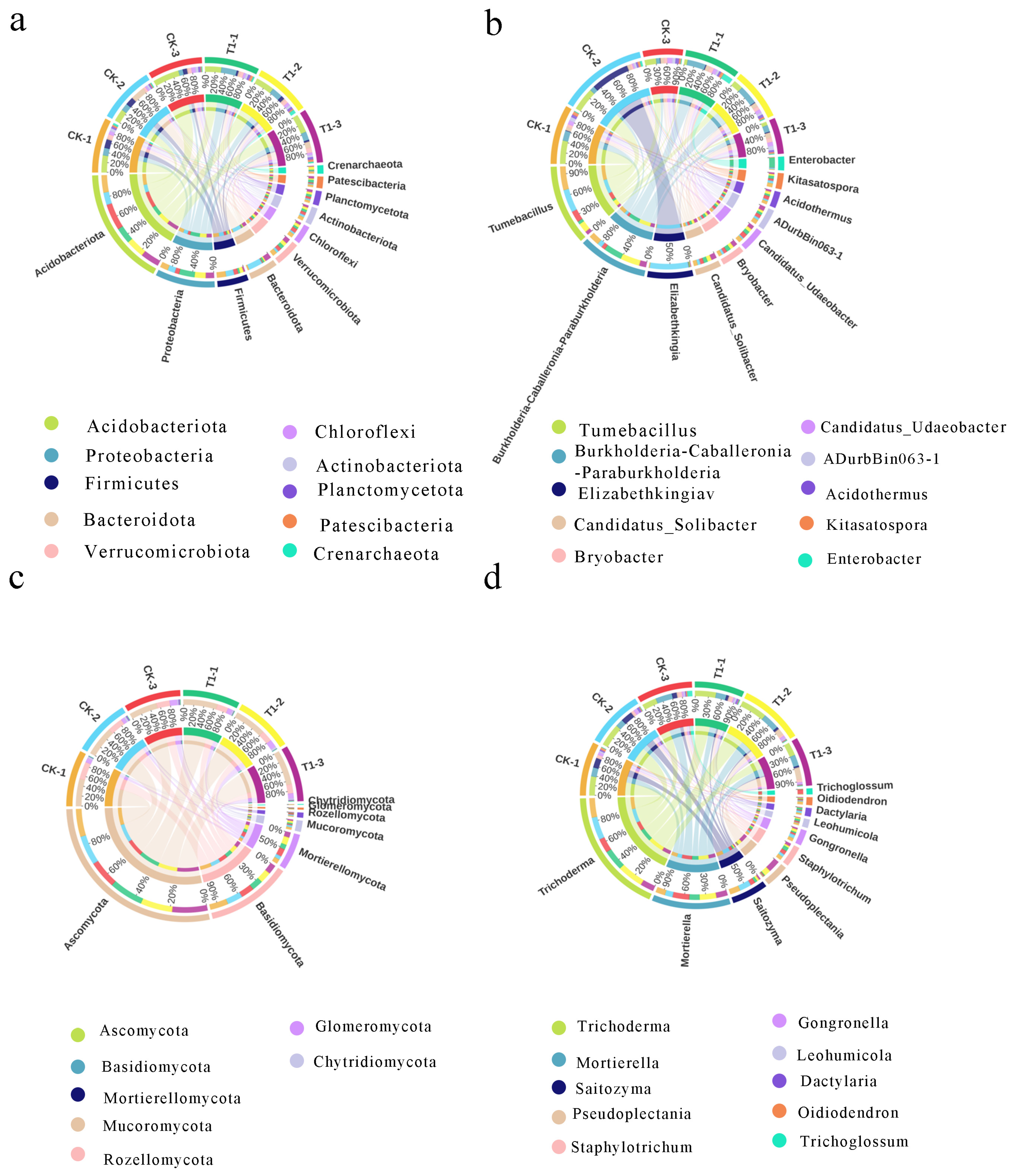
Cultivation of S. rugosoannulata significantly altered the soil bacterial and fungal community structures. At the phylum level, the relative abundances of the top 10 most abundant bacterial phyla (accounting for 64–90% of total sequences) and fungal phyla (accounting for 70.81–88.77% of total sequences) were significantly changed. Similarly, at the genus level, the relative abundances of the top 10 most abundant bacterial genera (18–42% of total sequences) and fungal genera (34.53–51.16% of total sequences) were also significantly modified (Figure 1a–d).
Regarding the bacterial community, at the phylum level, cultivation significantly altered the relative abundances of taxa associated with active nutrient cycling. The relative abundances of Proteobacteria, Verrucomicrobiota, and Planctomycetota increased. In contrast, taxa typically adapted to oligotrophic or stable soil conditions, such as Acidobacteriota and Chloroflexi, showed a significant decrease in their relative abundances (Figure 1a). At the genus level, following cultivation, the relative abundances of the BurkholderiaCaballeroniaParaburkholderia complex and Enterobacter—both associated with potential plant growth promotion and organic matter degradation—increased. Conversely, the abundances of genera often linked to oligotrophic environments or with less defined functional roles, such as Tumebacillus and Elizabethkingia, decreased (Figure 1b). LEfSe analysis further identified six significantly different biomarkers (log10 LDA score > 4.0). These biomarkers were distributed across multiple taxonomic ranks, indicating a comprehensive shift in soil bacterial taxa following cultivation (Figure S3a,b).
Changes in the Fungal Community, at the phylum level, cultivation led to an increase in the relative abundance of taxa associated with organic matter decomposition, plant symbiosis, and nutrient acquisition, such as Ascomycota, Mortierellomycota, and Glomeromycota. In contrast, the relative abundances of Basidiomycota—which primarily comprises saprotrophic macrofungi—and Mucoromycota, involved in rapid humification processes, decreased accordingly (Figure 1c). At the genus level, the abundances of Trichoderma and Mortierella, which possess potential for biocontrol and soil nutrient activation, increased significantly. Conversely, the abundances of other dominant genera, such as Saitozyma, Staphylotrichum, and Gongronella, decreased (Figure 1d). LEfSe analysis identified a total of 12 fungal biomarkers (log10 LDA > 4.0), clearly revealing the differentiation in fungal taxa induced by cultivation (Figure S3c,d).
The dynamics of these key taxa suggest that the cultivation of S. rugosoannulata may selectively enrich microorganisms closely associated with nutrient cycling and plant interactions, thereby driving a functional restructuring of the soil microbial community. For detailed changes in additional taxa at the phylum, family, and other taxonomic levels, please refer to Figure S3.

3.3. Effects of S. rugosoannulata Cultivation on Soil Physicochemical Properties

Cultivation of S. rugosoannulata effectively enhanced the transformation and release of soil carbon and nitrogen nutrients. The contents of soil organic carbon, available nitrogen, and total nitrogen increased significantly by 34.6%, 30.6%, and 36.9%, respectively (p < 0.05), while soil pH decreased significantly by 2.2%. In contrast, no significant differences were observed in the contents of total phosphorus, total potassium, available potassium, or available phosphorus compared to the control group (p > 0.05). Regarding carbon cycling, sucrase activity—which is involved in labile carbon transformation—increased significantly (p < 0.05). In nitrogen cycling, both urease and neutral protease activities were also significantly enhanced (p < 0.05). Additionally, peroxidase activity, which participates in the decomposition of recalcitrant carbon such as lignin, showed a significant increase (p < 0.05). However, no significant changes were detected in the activities of polyphenol oxidase or acid phosphatase, which are associated with polyphenol oxidation and phosphorus activation, respectively (p > 0.05) (Table 2).

3.4. Alterations in Soil Metabolites Following the Cultivation of S. rugosoannulata

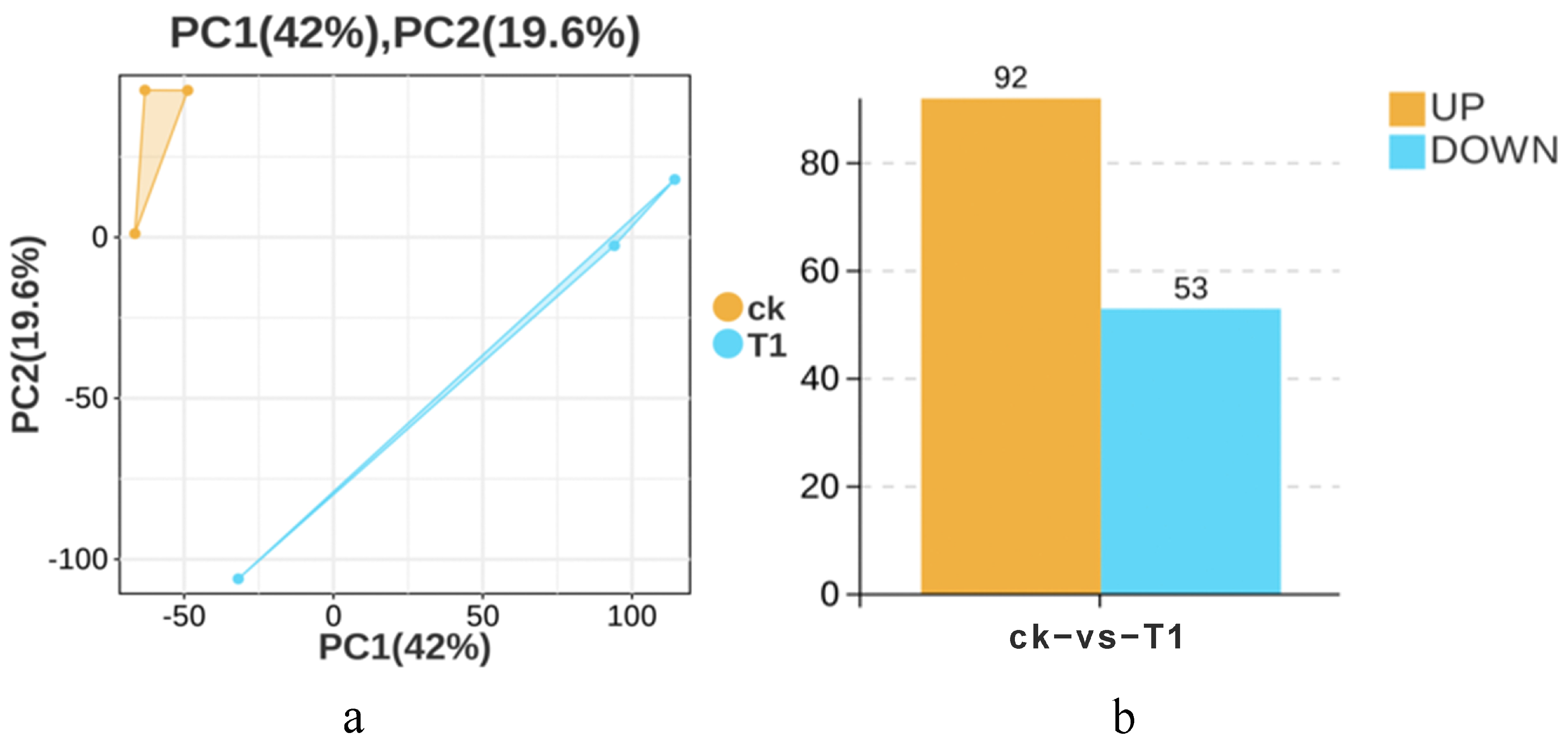
To characterize the dynamic changes in soil metabolites following the cultivation of S. rugosoannulata using bamboo residues, a metabolomic analysis of soil samples was conducted using UPLC–MS/MS. Rigorous quality control and reproducibility assessments confirmed instrumental stability, ensuring the reliability and repeatability of the metabolomic dataset. Principal component analysis (PCA) revealed a clear separation between the treatment and control groups, which formed distinct clusters. The first two principal components (PC1 and PC2) accounted for 61.6% of the total metabolic variation (Figure 2a). Orthogonal projections to latent structure discriminant analysis (OPLS-DA) further demonstrated a significant separation between the groups (Supplementary Figure S4). These multivariate statistical results indicated the high reproducibility and credibility of the dataset, supporting its suitability for subsequent analyses.
DAMs were identified using a variable importance in projection (VIP) score ≥ 1 from the OPLS-DA model combined with Student’s t-test (p < 0.05). A total of 145 DAMs were detected across the six soil samples, of which 92 were upregulated and 53 were downregulated (Supplementary Table S1 and Figure 2b). Notably, 61.4% remained unannotated. The classification of the top 15 metabolites was dominated by amino acids/peptides and their analogs, fatty acids and conjugates, along with steroidal compounds. Hierarchical clustering analysis further revealed distinct accumulation patterns of DAMs among the treatment groups (Supplementary Figure S5).
Functional profiling of differential metabolites was performed using the KEGG database. The differential metabolites were notably enriched in pathways linked to soil nutrient cycling and microbial metabolism, including purine metabolism, glycerophospholipid metabolism, biosynthesis of unsaturated fatty acids, starch and sucrose metabolism, and arginine and proline metabolism (Supplementary Figure S6). Together, these results indicate that S. rugosoannulata cultivation significantly modulates key soil metabolic pathways governing carbon-nitrogen turnover, lipid metabolism, and secondary microbial metabolism. Other relevant pathways (top 20) are listed in Figure S6.

3.5. Effects of Soil Physicochemical Properties and Metabolites on Microbial Communities

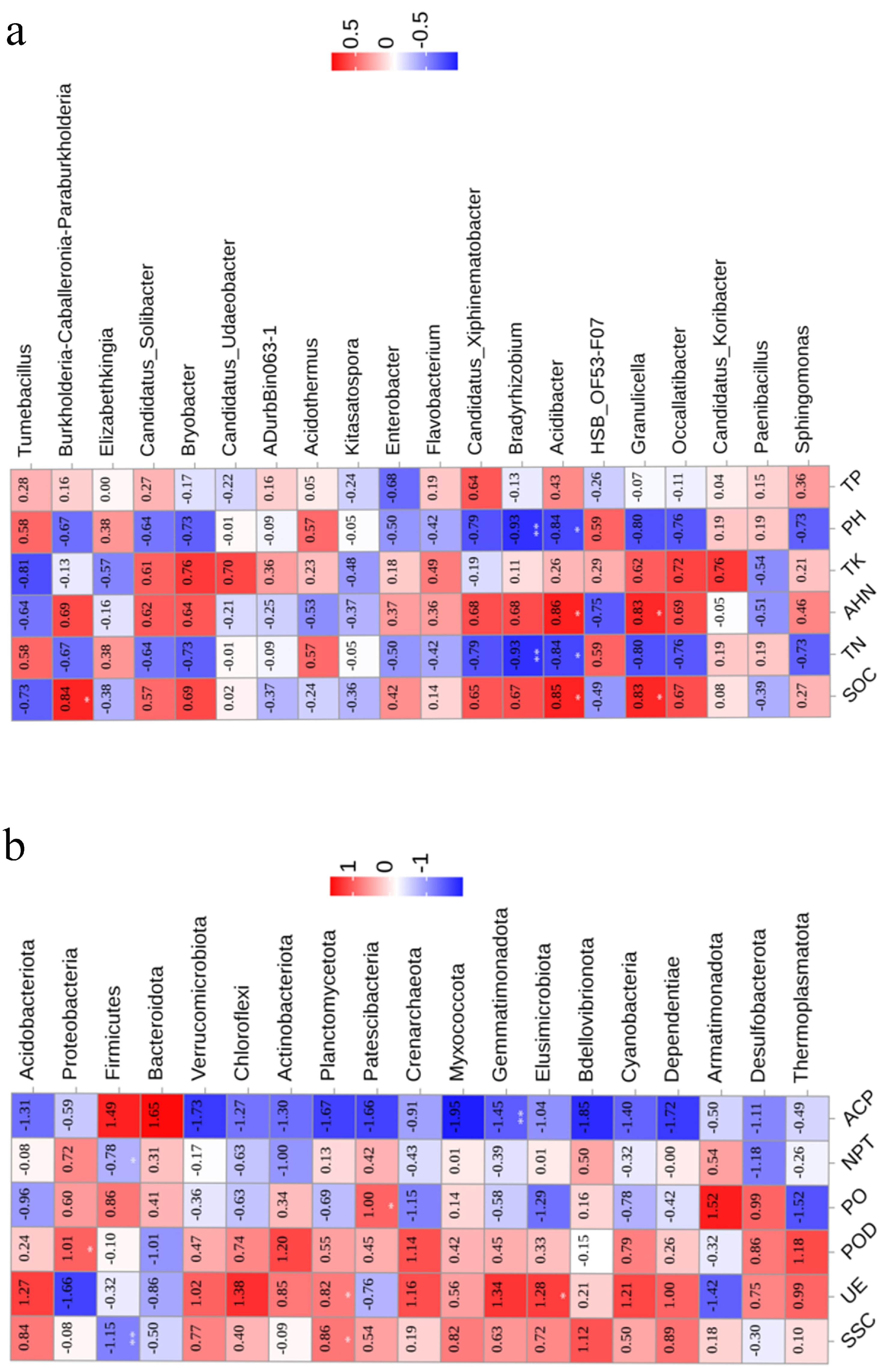
Correlation analysis revealed significant associations between specific bacterial taxa and soil properties in soils cultivated with S. rugosoannulata for one year. At the genus level, four bacterial genera exhibited significant correlations with soil physicochemical properties (Figure 3a). The BurkholderiaCaballeroniaParaburkholderia genus exhibited a significant positive correlation with soil organic carbon (SOC). In contrast, Bradyrhizobium abundance was negatively correlated with total nitrogen (TN) and pH. Acidibacter abundance was positively correlated with SOC and available hydrolytic nitrogen (AHN) but negatively correlated with TN and pH. Similarly, Granulicella displayed significant positive correlations with SOC and AHN.
At the phylum level, six bacterial phyla were significantly correlated with soil enzyme activities (Figure 3b). Proteobacteria were positively correlated with soil peroxidase (POD), whereas Firmicutes were negatively correlated with soil sucrase (SSC) and neutral protease (NPT). Planctomycetota abundance was positively correlated with SSC and urease (UE), whereas Patescibacteria abundance was positively associated with soil polyphenol oxidase (PO). Conversely, Gemmatimonadota abundance was negatively correlated with soil acid phosphatase (ACP), whereas Elusimicrobiota abundance was positively correlated with UE.
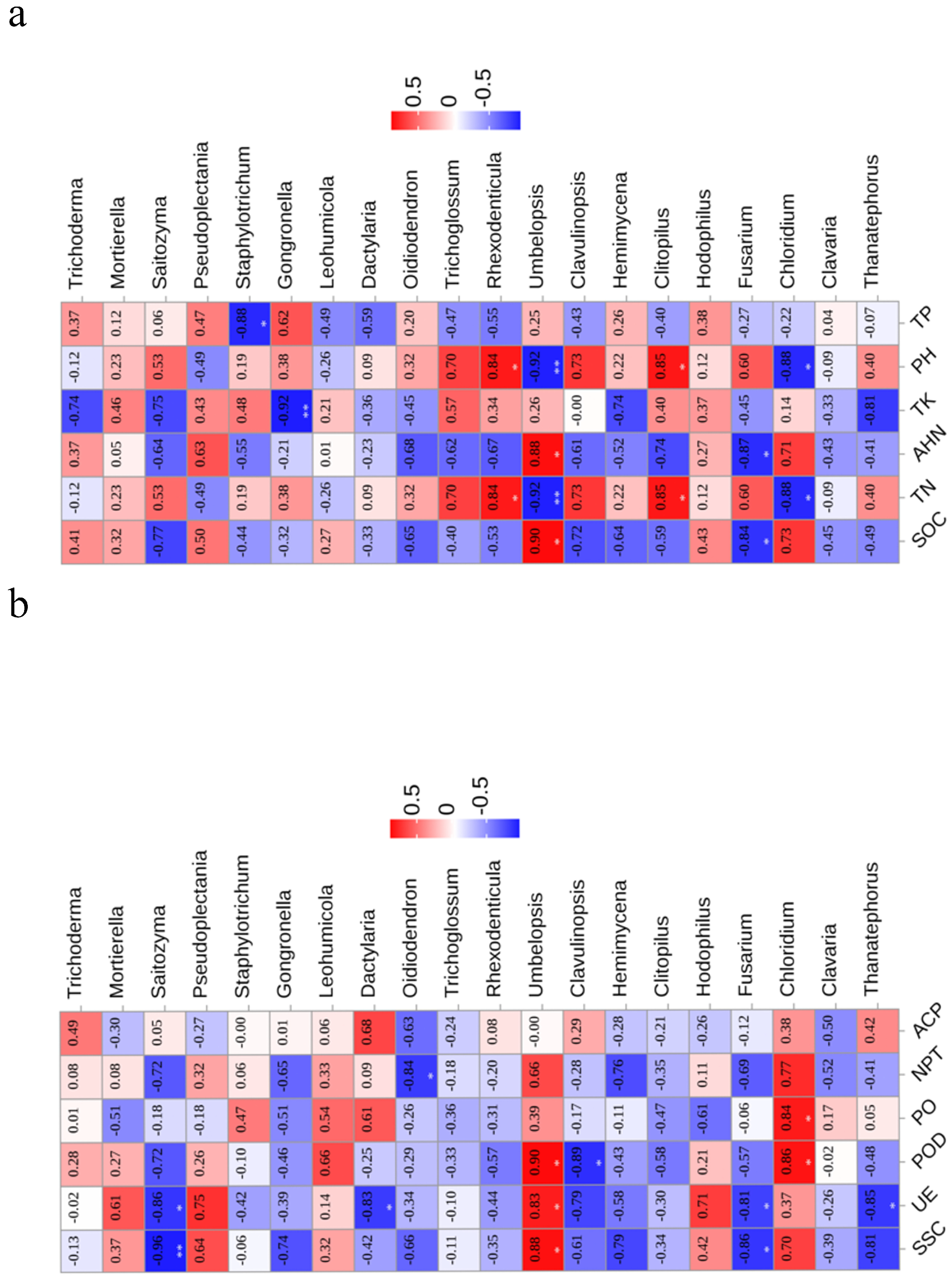
Correlation analysis also revealed significant associations between fungal genera and soil physicochemical properties (Figure 4a). Several genera (e.g., Saitozyma, Dactylaria, Oidiodendron, Umbelopsis, Clavulinopsis, Fusarium, Chloridium, and Thanatephorus) were significantly negatively correlated with SSC, UE, NPT, and POD.
Notably, the correlations between specific genera varied. The genus Fusarium exhibited significant positive correlations with both POD and PO. In contrast, Umbelopsis showed positive correlations with SSC, UE, and POD but negative correlations with TN and pH. Additionally, Umbelopsis was positively correlated with SOC and AHN.
Additional significant correlations between fungal taxa and soil properties were observed (Figure 4b). Staphylotrichum was negatively correlated with total phosphorus (TP), and Gongronella was negatively correlated with total potassium (TK). Rhexodenticula was positively correlated with both pH and TN. In contrast, Clitopilus and Chloridium were significantly negatively correlated with TN and pH, and Fusarium was negatively correlated with SOC and AHN.
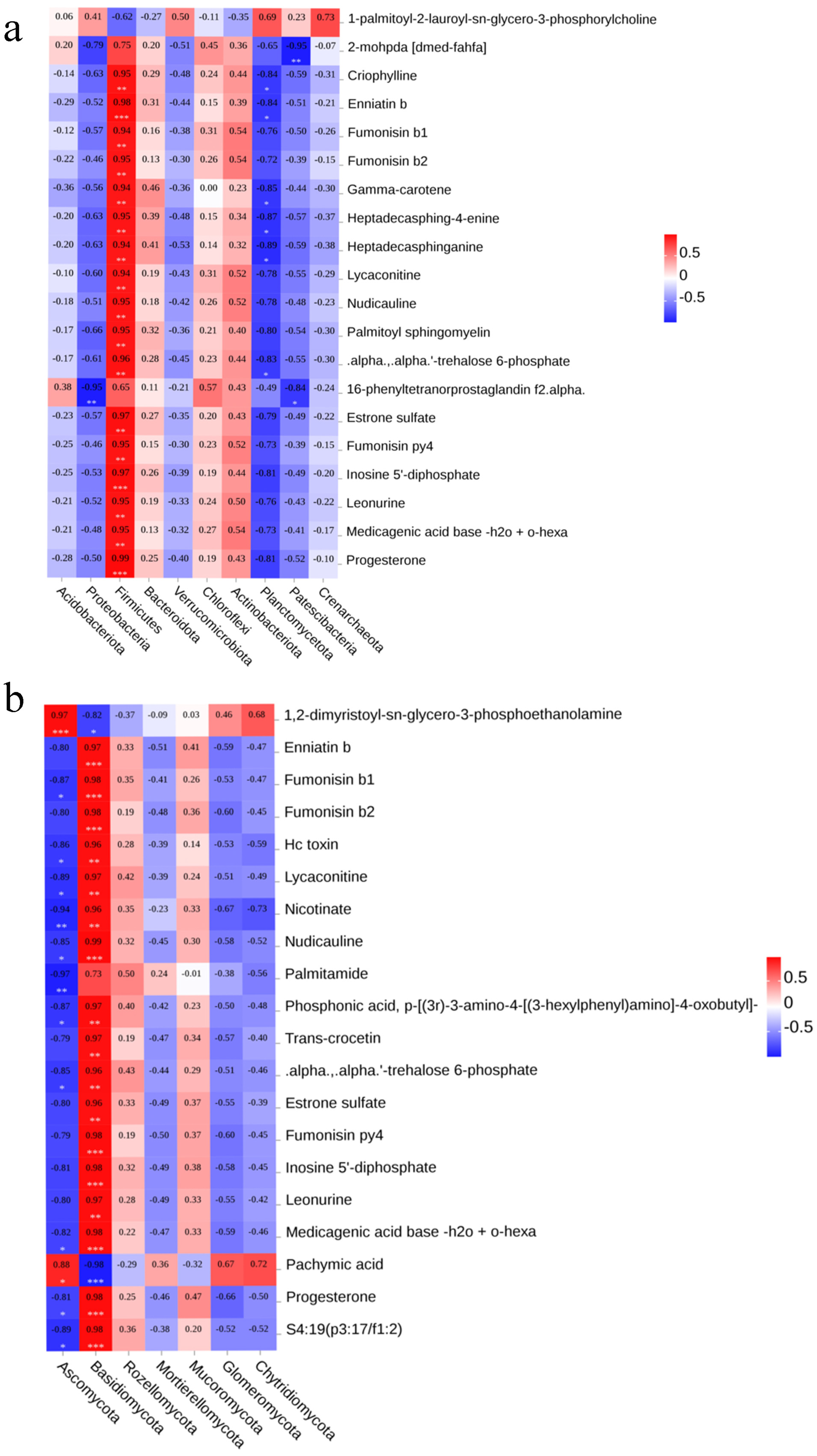
Microorganisms also exhibited significant correlations with soil metabolites. At the phylum level, bacteria displayed strong associations with metabolite profiles (Figure 5a). Proteobacteria were significantly negatively correlated with 16-phenyltertranorprostaglandin F2α, whereas Firmicutes showed significant positive correlations with estrone sulfate, fumonisin PY4, inosine 5′-diphosphate, leonurine, medicagenic acid base -H2O + O-hexa, progesterone, criophylline, enniatin B, fumonisin B1, fumonisin B2, gamma-carotene, heptadecasphing-4-enine, heptadecasphinganine, lycaconitine, nudicauline, palmitoyl sphingomyelin, and α,α’-trehalose 6-phosphate. Planctomycetota presented significant negative correlations with criophylline, enniatin B, gamma-carotene, heptadecasphing-4-enine, heptadecasphinganine, and α,α′-trehalose 6-phosphate. Patescibacteria exhibited significant negative correlations with 2-MoHPDA (DMed-FAHFA) and 16-phenyltetranorprostaglandin F2α.
For fungi at the phylum level, Ascomycota and Basidiomycota were significantly correlated with metabolites (Figure 5b). Specifically, Fumonisin B1 was significantly positively correlated with Basidiomycota and negatively correlated with Ascomycota. Fumonisin PY4 was significantly associated with Basidiomycota. In addition, Ascomycota was positively correlated with 1,2-dimyristoyl-sn-glycero-3-phosphoethanolamine.

4. Discussion

4.1. Effects of Cultivating S. rugosoannulata Using Bamboo Residues on Soil Physicochemical Properties and Enzyme Activities in Bamboo Forests

Cultivating S. rugosoannulata using bamboo sawdust significantly altered the soil physicochemical properties. After cultivation, notable increases were observed in SOC, AHN, and TN, whereas a decrease in soil pH was recorded.
The accumulation of SOC is likely associated with the decomposition of cellulose, lignin, and hemicellulose in bamboo sawdust by S. rugosoannulata mycelium, which converts these components into metabolic products that subsequently enter the soil [13,14]. Concurrently, enzymes and metabolites secreted by the mycelium promote the stabilization of organic carbon. The integration of the mycelial network with soil particles further facilitates the formation of stable aggregates, thereby reducing the loss of organic carbon [28,29].
The increase in AHN and TN could be explained by several mechanisms. First, the decomposition of the cultivation substrate, particularly the fermented bamboo sawdust amended with 4% rapeseed cake, was observed. It is rich in organic matter and nitrogen because the mycelium releases available nitrogen components, such as ammonium nitrogen. Subsequent microbial activity converts these into more stable nitrogen forms [30]. Second, extracellular enzymes (e.g., cellulases and ligninases) secreted by the mycelium accelerate the mineralization of organic matter by decomposing macromolecular nitrogen-containing compounds into soluble molecules (e.g., amino acids and ammonium nitrogen), thereby enhancing the AHN pool [31]. Additionally, the accumulation of mycelial biomass and the incorporation of its residues upon senescence contribute to the increase in soil TN, which was consistent with the observations of Dong Liu et al. [14].
The decrease in soil pH may be due to the generation of acidic intermediate products resulting from the microbial metabolic decomposition of the cultivation substrate. The decomposition of organic matter, accelerated by extracellular enzymes secreted by S. rugosoannulata mycelium, further promotes the production of these acidic metabolites [32]. Moreover, the decomposition of nitrogen-containing organic matter through nitrification releases H+ ions, intensifying soil acidification [33].
Soil enzyme activities also underwent significant changes during S. rugosoannulata cultivation. Sucrase activity increased likely because the fungal mycelium decomposed carbon sources, such as sucrose, in the substrate to obtain energy. Sucrase catalyzes the hydrolysis of sucrose into glucose and fructose, providing essential energy for mycelial growth [34]. The enhancement in neutral protease activity was likely attributed to the decomposition of proteinaceous materials in the substrate by S. rugosoannulata mycelium. This process converts proteins into utilizable small-molecule nitrogen sources (e.g., amino acids), which can support mycelial expansion and fruiting-body development [35]. Urease activity increased due to the presence of nitrogenous organic matter in the substrate, as urease facilitated the decomposition of urea-like compounds to meet the nitrogen requirements of the fungus [36]. Additionally, peroxidase activity was enhanced. During mycelial growth and fruiting-body formation, intensified metabolic activity leads to the accumulation of reactive oxygen species (ROS). Peroxidase helps scavenge ROS, protecting cells from oxidative damage and maintaining the physiological stability of the fungus [37].
However, it should be noted that the above analysis and discussion are primarily based on inferences drawn from existing literature and known microbial ecological processes. Direct measurement of the degradation rate of bamboo-chip lignocellulose has not been performed, nor have nitrogen transformation pathways (such as the dynamics of ammonium and nitrate) been systematically tracked. Furthermore, quantitative assessment of fungal biomass turnover remains insufficient. Future studies could adopt research strategies similar to those used by Mohd Faheem Khan et al., including approaches such as mixed-culture incubation experiments, enzyme-inhibition assays, and identification and analysis of key functional enzymes, in order to obtain more direct evidence regarding mycelium-mediated soil carbon and nitrogen cycling processes [38].

4.2. Effects on the Diversity, Richness, and Composition of Microbial Communities

As the most abundant and diverse group of soil microorganisms, bacteria play essential roles in agricultural ecosystems by driving nutrient cycling, maintaining soil structure, and supporting plant growth [39]. The bacterial community structure changed markedly after the cultivation of S. rugosoannulata using bamboo sawdust. Under the experimental conditions, the Shannon index of soil bacterial alpha diversity increased significantly in the cultivated soil, whereas the Chao1 and ACE indices also increased, but not to a statistically significant extent. Concurrently, variations in community composition were observed. The relative abundances of Acidobacteriota, Firmicutes, Bacteroidota, and Chloroflexi decreased significantly, whereas those of Proteobacteria and Verrucomicrobia increased significantly.
The decline in Acidobacteriota abundance may be attributed to their preference for low-carbon environments, as the high C/N ratio of bamboo sawdust likely restricted their growth. Additionally, the release of recalcitrant compounds such as lignin during substrate decomposition promoted the proliferation of cellulose-degrading bacteria (e.g., Proteobacteria), which competed with Acidobacteriota for nutritional resources. The secondary metabolites secreted by the S. rugosoannulata mycelium may also directly suppress Acidobacteriota activity [40].
The notable decrease in Firmicutes abundance may be linked to changes in carbon source availability. Fermentative bacteria preferentially utilize simple carbon substrates, and the accessible carbon pool is reduced due to the complex carbon structure of bamboo sawdust, which is rich in cellulose and lignin. Moreover, the rapidly colonizing mycelium of S. rugosoannulata preferentially consumes readily available nutrients, intensifying competition with Firmicutes and limiting their growth [41,42].
The increase in Verrucomicrobia abundance was attributed to organic acids (e.g., methanol and formic acid) generated during the later stages of bamboo sawdust fermentation, which can provide a suitable carbon source. Simultaneously, the loose structure of the bamboo substrate enhanced aeration and the metabolic activity of aerobic or facultatively anaerobic Verrucomicrobia [30].
The decrease in Bacteroidota abundance may be related to their preference for low C/N environments. Although nitrogen supplements were added, the C/N ratio of the substrate remained higher than optimal for this phylum. The decline in Chloroflexi abundance may be due to niche displacement during the decomposition of recalcitrant organic matter by S. rugosoannulata mycelium. Furthermore, hypoxic conditions resulting from the high moisture content of the substrate, along with deviations from the temperature optima for thermophilic Chloroflexi, may suppress their growth [43,44]. In summary, the changes in physicochemical properties (e.g., pH, C/N ratio, and available phosphorus) induced by substrate fermentation combined with mycelium–microbe interactions were the primary drivers of bacterial community succession during the cultivation of S. rugosoannulata with bamboo sawdust.
The fungal community also underwent significant changes. Compared with the control group, the fungal alpha diversity in soil cultivated with S. rugosoannulata increased significantly in the Chao1 and ACE indices, whereas the Shannon index remained unchanged. At the phylum level, shifts were observed. Ascomycota, Mortierellomycota, Glomeromycota, and Chytridiomycota increased, whereas Basidiomycota, Mucoromycota, and Rozellomycota decreased.
The increase in Ascomycota was attributed to their ability to decompose cellulose and hemicellulose, facilitating the utilization of intermediate products and simple sugars derived from bamboo sawdust decomposition by S. rugosoannulata. Their rapid growth, combined with high tolerance to environmental fluctuations, allows them to quickly occupy ecological niches under nutrient-rich conditions [45,46]. The decline in Basidiomycota was primarily due to the introduction of S. rugosoannulata as a strongly dominant species, suppressing the growth of other basidiomycetes through intense resource competition, enzyme secretion, and antagonistic interactions [47]. The increase in Mortierellomycota abundance may result from their capacity to utilize lipid-degradation products (e.g., free fatty acids and glycerol) as well as simple sugars and organic acids released during substrate decomposition mediated by S. rugosoannulata [45]. The reduction in Mucoromycota abundance may reflect their sensitivity to competitive pressure, as they are disadvantaged in a highly competitive environment dominated by S. rugosoannulata and other fast-growing fungi (e.g., Ascomycota and Mortierellomycota). Moreover, their preferred simple carbon sources (e.g., starch and sugars) were rapidly depleted during the later stages of substrate decomposition [45]. The increase in Glomeromycota may be associated with spores introduced through bamboo sawdust, casing soil, or nearby plant root systems. The increase in Chytridiomycota was promoted by the persistent high humidity of the cultivation system, which provided favorable conditions for zoospore release and the availability of substrates from dead microorganisms and degrading bamboo sawdust for decomposing chitin and cellulose.
In summary, the cultivation of S. rugosoannulata altered the diversity and richness of the soil fungal community, consistent with the findings of Liu [11].

4.3. Effects on Metabolites and Metabolic Pathways

Allelopathy refers to the phenomenon in which metabolic secretions produced by microorganisms or plants can exert beneficial or adverse effects on other organisms in their shared environment. These allelochemicals can either alleviate or intensify autotoxicity through interactions with soil microorganisms. In cultivated edible fungi, allelopathic autotoxicity is a common constraint; autotoxins, including organic acids, quinones, and alkaloids, may inhibit crop growth by altering soil enzyme activities and nutrient metabolism [48].
Metabolomic analysis in this study revealed that the cultivation of S. rugosoannulata with bamboo sawdust significantly modified soil metabolite profiles. S. rugosoannulata functioned not only as a decomposer but also as a biological driver that enhanced the soil ecological functioning by introducing diverse metabolites into the soil and reorganizing the microbial metabolic network. Metabolites significantly enriched after cultivation (e.g., amino acids, peptides, and carbohydrates) provide readily available nitrogen and carbon sources for microorganisms, accelerating the mineralization of bamboo sawdust organic matter and the release of nutrients [33]. The accumulation of lipid metabolites (e.g., glycerophospholipids and fatty acids) serves not only as a fundamental membrane component for microbial proliferation but also facilitates the cementation of soil particles and the formation of aggregates owing to their amphiphilic characteristics. This aggregation plays a crucial role in improving soil physical structure and enhancing water and fertilizer retention.
Analysis of significantly enriched metabolic pathways further elucidated the mechanisms underlying the effects of S. rugosoannulata. Lipid metabolism pathways, including glycerophospholipid, ether lipid, and unsaturated fatty acid metabolism, were comprehensively activated. This activation enhances the environmental adaptability of indigenous microorganisms. For example, ether lipid metabolism improves membrane stability under acidic conditions, whereas unsaturated fatty acids increase membrane fluidity at low temperatures [49]. Purine metabolism, identified as one of the most enriched pathways, suggests that S. rugosoannulata effectively converts recalcitrant lignin-bound nitrogen in bamboo sawdust into a slow-release nitrogen pool composed of purines and related derivatives. This conversion may synchronize more effectively with the nitrogen uptake patterns of bamboo forests, reducing nitrogen leaching [50]. Several bioactive secondary metabolites (e.g., flavonoids and terpenoids) were also detected in the soil, and their corresponding biosynthetic pathways (e.g., glucocorticoid/sex hormone receptor agonist pathways and α-linolenic acid metabolism) were significantly enriched. At low concentrations, these compounds may act as signaling molecules that regulate bamboo growth and development (e.g., phytohormone-like activity) and enhance induced resistance (e.g., jasmonic acid precursor biosynthesis). Enhanced carotenoid metabolism protected rhizosphere microorganisms from oxidative stress, whereas increased porphyrin metabolism improved the functionality of photosynthetic and nitrogen-fixing bacteria. These metabolic adjustments contribute to a healthier rhizosphere micro-ecosystem [51]. It is important to note that due to the incomplete annotation of a large proportion of metabolites, the reported pathway enrichment results may underestimate the true extent of biological alterations. Consequently, some critical pathways might remain undetected. Future studies could enhance explanatory power through targeted metabolomic validation or multi-omics integration.

4.4. Association Analysis Between Soil Differential Metabolites and Microorganisms

Soil microorganisms are the key executors of soil metabolic activities, directly reflecting detectable biological responses under varying environmental conditions [52]. Moreover, variations in microbial diversity and abundance strongly influenced soil metabolite profiles, thereby regulating the cycling and metabolic transformation of exogenous nutrients in the soil. Therefore, elucidating the relationships between soil metabolites and microbial communities is essential for assessing the impact of S. rugosoannulata cultivation with bamboo sawdust on soil quality.
The results revealed significant correlations between changes in multiple metabolites and bacterial community structure following the cultivation of S. rugosoannulata with bamboo sawdust. Firmicutes exhibited significant positive correlations with the widest range of metabolites, including phytotoxins/mycotoxins (e.g., fumonisin B1, B2, and enniatin B), hormones (e.g., estrone sulfate and progesterone), lipids/sphingolipids (e.g., heptadecasphing-4-enine and palmitoyl sphingomyelin), nucleotides (inosine-5′-diphosphate), plant secondary metabolites (e.g., leonurine), and sugar phosphates (α,α′-trehalose-6-phosphate). These associations indicate that Firmicutes were highly active during bamboo sawdust degradation, and their increased abundance was accompanied by the accumulation of multiple metabolites. Notably, the positive correlations between Firmicutes and various mycotoxins highlight the potential risk of mycotoxin contamination in this cultivation system, which requires further investigation.
In contrast, Planctomycetota exhibited significant negative correlations with several metabolites that were positively associated with Firmicutes (e.g., criophylline, enniatin B, and gamma-carotene). Similarly, Patescibacteria exhibited negative correlations with specific metabolites. These inverse relationships may indicate competitive or antagonistic interactions between bacterial groups. The increased abundance of Planctomycetota and Patescibacteria may suppress microorganisms responsible for producing these metabolites, particularly compounds of potential toxicity, or their own metabolic activity may consume precursor substrates, thereby reducing the accumulation of these metabolites. The unique ecological functions of Planctomycetota, such as the degradation of complex organic matter and the engagement in aerobic ammonium oxidation, may contribute to lowering harmful substances within the soil system.
In summary, significant associations were observed between the bacterial community structure, particularly the abundances of Firmicutes, Planctomycetota, and Patescibacteria, and the accumulation of specific metabolites (notably toxins, hormones, and lipids) in the bamboo sawdust cultivation system. Firmicutes may serve as bioindicators for the accumulation of various metabolites, including potentially harmful toxins, whereas Planctomycetota and related phyla may function as “scavengers” or “regulators”. These findings provide important insights into soil microecological interactions during substrate-based cultivation, informing strategies for assessing and managing mycotoxin risks and optimizing cultivation to enhance product safety and soil quality. It should be noted, however, that the findings of this study are fundamentally based on correlation analysis. While significant associations were observed between specific bacterial taxa (such as Firmicutes) and various metabolites—including mycotoxins and hormone-like substances—these correlations do not directly establish clear ecological functions or confirm actual environmental risks. To further elucidate the biological significance underlying these observed relationships, future research could adopt strategies similar to those employed by Heidi Demaegdt and Mohd Faheem Khan et al., such as utilizing in vitro bioassays (e.g., mycotoxicity tests) and investigating microbial degradation and biotransformation of complex compounds [53,54]. These approaches would help obtain more direct evidence regarding the potential ecotoxicological effects of microbial metabolites.

4.5. Association Analysis of Soil Physicochemical Properties, Soil Enzymes, and Microorganisms

Correlation analysis revealed a complex network of interactions among soil physicochemical properties, enzyme activities, and microbial communities. At the bacterial genus level, BurkholderiaCaballeroniaParaburkholderia and Acidibacter showed significant positive correlations with SOC and AHN. This pattern aligns with their ecological functions, including organic matter decomposition, nitrogen fixation, phosphorus solubilization, and diverse carbon metabolism capabilities under acidic conditions [55,56]. In contrast, Bradyrhizobium and Acidibacter were significantly negatively correlated with TN and pH, with the latter association likely reflecting the preference of Acidibacter for acidic environments [57]. The positive correlation between Granulicella and SOC and AHN may be related to its involvement in cellulose decomposition and organic nitrogen mineralization.
At the bacterial phylum level, Proteobacteria were positively correlated with POD activity, possibly due to the ability of certain members to directly or indirectly participate in the degradation of complex organic matter such as lignin [58]. Firmicutes abundance was negatively correlated with sucrase (SSC) and neutral protease (NPT) activities, suggesting that their increased abundance may inhibit sucrose decomposition and proteolytic activity. This may reflect their metabolic strategy of preferentially utilizing simple carbon sources rather than secreting extracellular hydrolases, along with the competitive suppression of other enzyme-producing microorganisms [59]. Planctomycetota were positively correlated with SSC and UE activities, likely due to their efficiency in decomposing complex organic carbon, directly contributing to increased SSC, whereas their anaerobic ammonium oxidation processes consumed ammonium ions and created a “nitrogen-stress” condition that indirectly stimulated UE activity to replenish the ammonium pool [60]. The negative correlation between Gemmatimonadota and acid phosphatase (ACP) activity suggests that this phylum may rely on phosphorus-mineralization strategies distinct from those mediated by ACP (e.g., secreting alternative phosphoesterases or solubilizing inorganic phosphorus), thereby reducing the demand for ACP.
Regarding fungi, Umbelopsis markedly enhanced SOC and AHN levels by decomposing lignocellulose and chitin. Fusarium exhibited a dual functional role. On one hand, it acted as an efficient lignin degrader, showing positive associations with both POD and PO. On the other hand, its negative correlations with SOC and AHN, along with its potential pathogenicity, require careful consideration.
Several rare fungal genera perform complementary and synergistic functions in processes such as cellulose degradation and nitrogen mineralization. Through functional specialization and complex metabolic coordination, these fungal taxa collectively establish an efficient and stable microbial degradation network. This network drives the synergistic transformation and efficient cycling of carbon, nitrogen, phosphorus, and other nutrients derived from bamboo sawdust, ultimately leading to significant improvements in soil fertility.

4.6. Coupled Cycle Mechanism of Microorganism–Enzyme–Metabolite–Nutrient

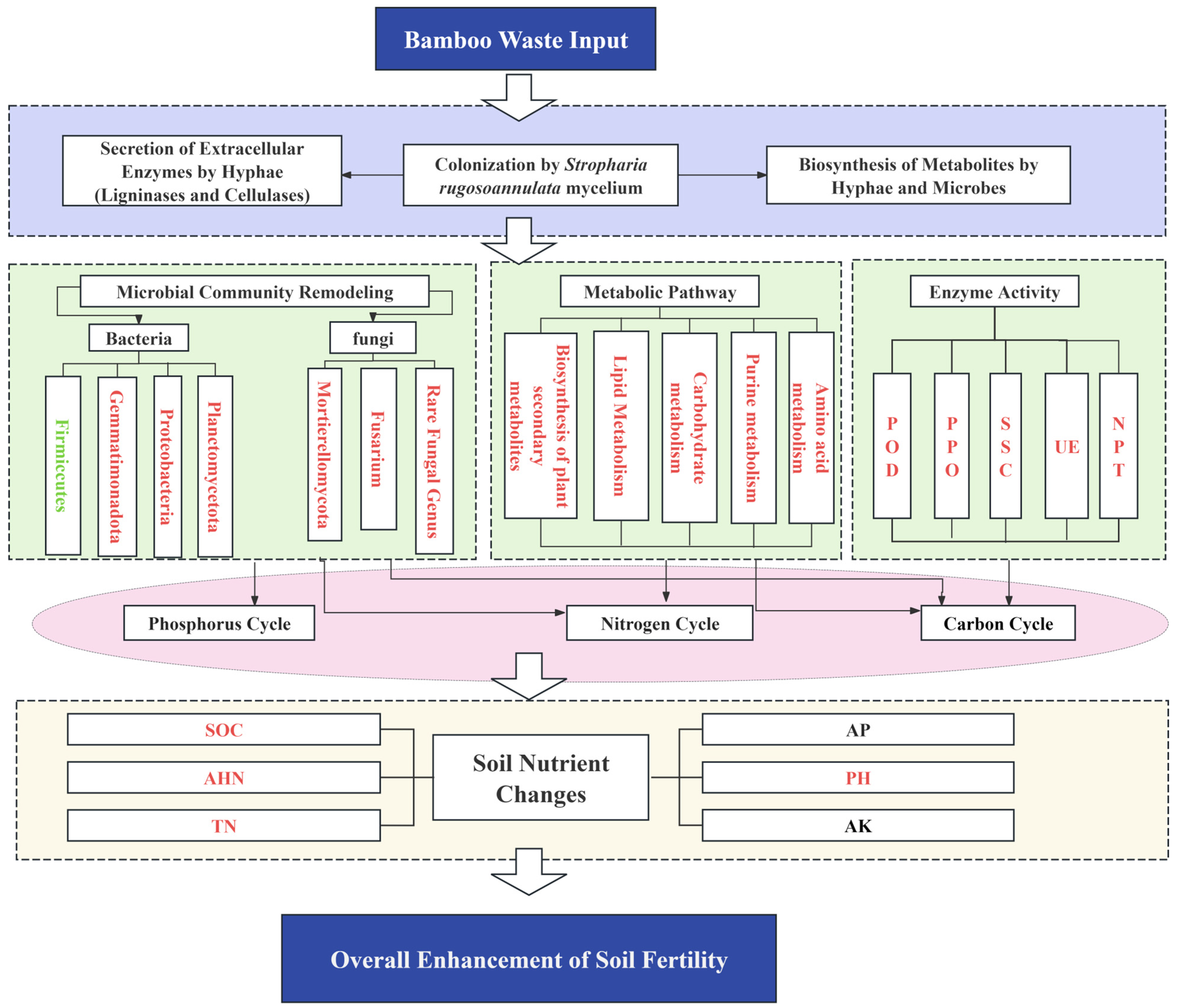
Acting as the primary driver, the mycelium of S. rugosoannulata initiates the decomposition of bamboo lignocellulose by secreting extracellular enzymes such as ligninase and cellulase. This decomposition directly expands the SOC pool and reshapes the soil microbial community through the release of readily degradable carbon substrates and metabolites (e.g., organic acids). Restructuring is characterized by the enrichment of decomposers, such as Proteobacteria and Ascomycota, accompanied by the suppression of certain groups, including Firmicutes. Subsequent microbial succession further regulates the soil enzyme activity profile. For instance, the activity of POD involved in lignin degradation was positively correlated with the abundance of Proteobacteria and Fusarium, whereas the increase in UE activity was closely linked to Planctomycetes. These enzyme shifts precisely regulate nutrient-cycling pathways. POD facilitated the decomposition of lignin to unlock structural barriers for subsequent decomposition, whereas hydrolases such as SSC and NPT converted large organic molecules into small, bioavailable nutrients such as glucose and ammonium nitrogen, thereby markedly increasing the AHN and TN contents. Concurrently, metabolomic analysis revealed a functional metabolic network underpinning this process. The activation of lipid metabolism pathways (e.g., glycerophospholipids and ether lipids) enhances microbial membrane stability, thereby supporting high microbial activity. A significant enrichment in purine metabolism suggests the transformation of recalcitrant lignin-bound nitrogen in bamboo scraps into a slow-release nitrogen pool that synchronizes the nitrogen supply with the bamboo growth demand while reducing leaching risk. Furthermore, secondary metabolites (e.g., flavonoids and terpenoids) function as signaling molecules that fine-tune the health and stress resistance of rhizosphere micro-ecology. By synthesizing correlative evidence from soil physicochemical properties, enzyme activities, microbial community structure, and metabolomic profiles at this site, we infer and tentatively propose a conceptual “microorganism-enzyme-metabolite-nutrient” coupling pathway mediated by fungal hyphae (Figure 6). It should be noted that a limitation of this study is the absence of blank controls established at the cultivation site. Consequently, the potential influences of factors such as seasonal variations could not be independently monitored or accounted for. This model requires further experimental and functional validation.

5. Conclusions

This study revealed that the input of bamboo residues initiated decomposition through the secretion of ligninase and cellulase by fungal hyphae, which was associated with an increase in soil organic carbon. The released readily degradable carbon sources and metabolites appeared to reshape the microbial community structure, enriching key functional taxa with decomposing capabilities, such as Proteobacteria and Ascomycota. Microbial community succession further corresponded with shifts in the soil enzyme activity profile, collectively contributing to the conversion of complex organic matter into plant-available nutrients such as available nitrogen and total nitrogen. Metabolomic evidence also suggested that the enrichment of pathways such as purine metabolism may promote the transformation of recalcitrant nitrogen into a slow-release nitrogen pool, potentially synchronizing nitrogen supply with plant demand. Meanwhile, the activation of lipid metabolism could enhance microbial membrane stability, while secondary metabolites might participate in microecological regulation. Based on these findings, we propose a conceptual model for soil health enhancement that encompasses bamboo scrap input, hyphal activation, microbial community restructuring, enzyme activity modulation, and metabolic network coordination. This model—tentatively termed the “Microorganism–Enzyme–Metabolite–Nutrient” cycle—requires further experimental and functional validation. This research provides a preliminary scientific basis and technical perspective for the high-value and ecological utilization of bamboo scraps, and offers a testable ecological model for recycling agricultural and forestry waste via edible mushroom cultivation toward improving soil health and supporting sustainable forest management. Future studies should focus on the long-term stability of this coupling mechanism and its generalizability across different bamboo forest ecosystems.

Supplementary Materials

The following supporting information can be downloaded at: https://www.mdpi.com/article/10.3390/horticulturae12030286/s1, Figure S1: Rarefaction curves of (a) 16S rRNA and (b) ITS genes, showing the number of observed species as a function of the number of sequences. CK1-3 and T1–3 denote the control and treatment groups, respectively; Figure S2: Principal component analysis (PCA) of (a) bacterial communities (16S rRNA gene) and (b) fungal communities (ITS gene) pre-and post-cultivation of S. rugosoannulata with bamboo scraps. Each colored dot corresponds to a sample. CK1–2: Control group; T1–3: Treatment group. Figure S3: LEfSe analysis showing microbial taxa with significant differences before and after cultivating Stropharia rugosoannulata with bamboo residues. (a) Significantly different bacterial taxa and (b) cladogram of bacterial taxa based on 16S rRNA gene sequences. (c) Significantly different fungal taxa and (d) cladogram of fungal taxa based on ITS gene sequences. All cladograms (b,d) depict taxa with significant differences (p < 0.05) in relative abundance between groups. CK: Control group; T1: Treatment group. Figure S4: OPLS–DA score plot from the cultivation of S. rugosoannulata with bamboo scraps. Figure S5: Clustering heatmap of differential metabolites. The shorter the cluster branch length, the higher the similarity it indicates. CK1–3: Control group; T1–3: Treatment group. Figure S6 KEGG pathway enrichment analysis of differential metabolites following the cultivation of S. rugosoannulata with bamboo residues. The abscissa represents the ratio of the number of differential metabolites to the total identified metabolites in a given pathway; a higher value indicates a greater enrichment degree. The point color corresponds to the p-value of the hypergeometric test; a smaller value denotes higher reliability and statistical significance. The point size reflects the number of differential metabolites in the corresponding pathway; a larger size represents a greater quantity. Table S1: Differentially accumulated metabolites (DAMs) between control group and other treatment groups.

Author Contributions

Conceptualization, J.X. and W.Z.; methodology, X.W.; software, X.L.; validation, B.W., D.L. and X.C.; formal analysis, X.W.; investigation, X.L.; resources, D.L.; data curation, X.W.; writing—original draft preparation, X.W.; writing—review and editing, J.X.; visualization, X.L.; supervision, X.C.; project administration, J.X.; funding acquisition, W.Z. All authors have read and agreed to the published version of the manuscript.

Funding

This research was funded by the Zhejiang Forestry Science and Technology Program (2023SY01). Fundamental Research Funds of CAF (CAFYBB2025ZA019-1). Forestry Science and Technology Program of Zhejiang (2025B04).

Data Availability Statement

All original data generated and analyzed in this research have been submitted to the NCBI repository. The assigned accession numbers are pending and will be updated in this manuscript immediately upon receipt.

Conflicts of Interest

The authors declare no conflicts of interest.

References

  1. Wu, J.; Tokuyama, S.; Nagai, K.; Yasuda, N.; Noguchi, K.; Matsumoto, T.; Hirai, H.; Kawagishi, H. Strophasterols A to D with an unprecedented steroid skeleton: From the mushroom Stropharia rugosoannulata. Angew. Chem. 2012, 124, 10978–10980. [Google Scholar] [CrossRef]
  2. Gao, H.; Bao, Y.H. Research progress on health benefits and fresh-keeping processing of Stropharia rugosoannulata. Food Ferment. Ind. 2017, 43, 277–282. [Google Scholar] [CrossRef]
  3. Bruhn, J.N.; Abright, N.; Mihail, J.D. Forest farming of wine-cap Stropharia mushrooms. Agrofor. Syst. 2010, 79, 267–275. [Google Scholar] [CrossRef]
  4. Yang, F.J.; Zhang, C.L.; Xie, C.; Li, W.W. Study on inter-planting cultivation techniques of Stropharia rugoannulata and benefit analysis under the forest in the highland tropical. Mod. Agric. Sci. Technol. 2015, 96–97. [Google Scholar]
  5. Gong, S.; Chen, C.; Zhu, J.; Qi, G.; Jiang, S. Effects of wine-cap Stropharia cultivation on soil nutrients and bacterial communities in forestlands of northern China. PeerJ. 2018, 6, e5741. [Google Scholar] [CrossRef]
  6. Zhang, Y.F.; Tao, Y.J.; Shen, M. Effects of Pear Branch Residues on Agronomic Traits and Yield of Stropharia rugosoannulata. J. Zhejiang Agric. Sci. 2025, 66, 2152–2156. [Google Scholar] [CrossRef]
  7. Duan, H.K.; Liu, X.P.; Hao, H.B.; Zhang, J.X.; Chen, H.; Chen, Q. Degradation ability of rice straw and enzyme activity analysis of Stropharia rugosoannulata strains. North. Hortic. 2025, 14, 87–94. [Google Scholar]
  8. Wu, Y.F.; Xia, J.; Chen, S.; Zhang, W.; Xie, J.Z. Study on the suitable proportion of bamboo sawdust and wheat bran compost as cultivation substrate for Stropharia rugosoannulata. Acta Agric. Zhejiangensis 2022, 34, 1024–1031. [Google Scholar]
  9. Zhao, C.Y.; Gao, H.L.; Li, X.M.; Xiong, Y. Analysis of continuous cropping obstacles and control techniques in edible mushroom cultivation. J. Yunnan Minzu Univ. (Nat. Sci. Ed.) 2023, 32, 558–562+588. [Google Scholar]
  10. Xia, J.; Chen, S.; Wu, Y.F.; Zhang, W.; Xie, J.Z. Dynamic changes of soil microbial biomass and microbial quotient in Phyllostachys edulis forest after planting Dictyophora indusiata. J. Nanjing For. Univ. (Nat. Sci. Ed.) 2022, 46, 127–134. [Google Scholar]
  11. Cusack, D.F.; Silver, W.L.; Torn, M.S.; Burton, S.D.; Firestone, M.K. Changes in microbial community characteristics and soil organic matter with nitrogen additions in two tropical forests. Ecology 2011, 92, 621–632. [Google Scholar] [CrossRef]
  12. Khan, M.F. Microbial Remediation of Agrochemical-Contaminated Soils: Enzymatic Mechanisms, Quorum Sensing, and Emerging Opportunities. Integr. Environ. Assess. Manag. 2025, 19, vjaf167. [Google Scholar] [CrossRef]
  13. Khan, M.F. Fungi for Sustainable Pharmaceutical Remediation: Enzymatic Innovations, Challenges, and Applications—A Review. Processes 2025, 13, 1034. [Google Scholar] [CrossRef]
  14. Liu, D.; Wang, Y.; Zhang, P.; Yu, F.; Perez-Moreno, J. Macrofungi Cultivation in Shady Forest Areas Significantly Increases Microbiome Diversity, Abundance and Functional Capacity in Soil Furrows. J. Fungi 2021, 7, 775. [Google Scholar] [CrossRef]
  15. Luo, X.; Liang, Y.; Wang, Z.; Xie, Z.; Chen, D.; Liu, J. Spatio-temporal variation characteristics and influencing factors of soil nickel background values in Guangdong Province. J. Agro-Environ. Sci. 2025, 44, 3108–3121. [Google Scholar]
  16. Huang, T.; Chen, K.; Zhong, A.; Zhu, L.; Wang, Z.; Zhuang, J.; Yang, J. Aerobic composting effect and microbial community of multi-source organic waste based on process parameter optimization. J. Yangzhou Univ. (Agric. Life Sci. Ed.) 2025, 46, 125–133. [Google Scholar]
  17. Guan, J.; Jiang, X.; Cheng, J.; Chen, S.; Yu, S.; Chen, S.; Yu, S. Algal solution addition enhances soil carbon and nitrogen sequestration in rare earth tailing sands. Ecol. Environ. Sci. 2025, 34, 1890–1899. [Google Scholar]
  18. Wu, J.; Wu, W.; Shen, L.; Tan, J.; Li, X.; Wang, Q.; Xiong, L.; Huang, Y.; Sha, C. Spatiotemporal variation characteristics of salinity and analysis of dominant factors in coastal saline-alkali land. Environ. Monit. China 2025, 41, 209–218. [Google Scholar]
  19. Zhang, J.; Li, Y.; Bi, X.; De, J.; Zhang, J.; Guo, X. Diversity of bacterial community in rhizosphere soil of Phragmites australis in Lalu Wetland, Tibet and its response to environmental factors. J. Plant Res. 2026, 46, 181–194. [Google Scholar]
  20. Wei, T.; Li, H.; Wang, G.; Chen, W.; Li, G. Effects of artificial grass planting on soil microbial diversity, soil metabolome and fruit quality in Lingwu long jujube orchard. Acta Hortic. Sin. 2026, 53, 185–201. [Google Scholar]
  21. Zhao, L.; Tian, J.; Shao, Y.; Yao, G.; Li, H. Ecological restoration of saline-alkali land in the shrinking area of plateau inland lake: A case study of Dalinuoer Lake in Inner Mongolia. J. Ecol. Rural Environ. 2025, 41, 761–769. [Google Scholar]
  22. Guan, X.; Liang, X.; Chen, X.; Yan, Z.; Xie, J.; Deng, G.; Qian, Y.; Qiu, C.; Li, X.; Hu, J.; et al. Spatial distribution and comprehensive evaluation of soil fertility in Jinggang Pomelo orchards in a typical red soil region. Soils 2025, 57, 1438–1447. [Google Scholar]
  23. Guo, X.; Li, Q.; Wu, G.; Zhang, X. Effects of combined application of biochar composite water-retaining agent and arbuscular mycorrhizal fungi on tobacco growth and soil microenvironment under drought stress. J. Henan Agric. Sci. 2026, 55, 88–100. [Google Scholar]
  24. Qiu, H.S.; Ge, T.D.; Liu, J.Y.; Chen, X.; Hu, Y.; Wu, J.; Su, Y.; Kuzyakov, Y. Effects of biotic and abiotic factors on soil organic matter mineralization: Experiments and structural modeling analysis. Eur. J. Soil Biol. 2018, 84, 27–34. [Google Scholar] [CrossRef]
  25. Wang, R.; Liu, J.; Jiang, W.; Ji, P.; Li, Y. Metabolomics and microbiomics reveal impacts of rhizosphere metabolites on alfalfa continuous cropping. Front. Microbiol. 2022, 13, 833968. [Google Scholar] [CrossRef]
  26. Zhen, Y.; Lv, G.B.; Chen, K.; Yu, Q.; Niu, B.; Jing, J.; Liu, G. Impact of PaGLK transgenic poplar on microbial community and soil enzyme activity in rhizosphere soil. Front. Bioeng. Biotechnol. 2022, 10, 965209. [Google Scholar] [CrossRef] [PubMed]
  27. Zhao, C.; Tao, X.; Wen, H.; Sun, G.; Liang, G.; Han, J.; Zhu, H.; Wei, M.; Sun, G.; Liang, G.; et al. Effects of Different Concentrations of Specialized Microbial Fertilizer on Rhizosphere Soil Nutrients, Enzyme Activities, and Microbial Community Numbers in Continuous Cropping Pepper. Soils Fertil. Sci. China 2025, 12, 83–90. [Google Scholar]
  28. Ye, Z.H.; Luo, G.A.; Wang, Z.; Yao, R.T.; Lu, Y.Y.; Wu, J.S.; Xu, Z.E. Effects of Cultivating Edible Mushrooms under Phyllostachys edulis Forest on Soil Properties and Bacterial Community Characteristics. Sci. Silvae Sin. 2024, 60, 143–151. [Google Scholar] [CrossRef]
  29. Liu, J.; Min, D.Q.; Tang, K.L.; Xu, P.; Deng, P.; Tang, C.L.; Xu, P.; Deng, P.; Tang, C.L. Research Status and Development Prospects of Stropharia rugosoannulata. Hunan Agric. Sci. 2021, 6, 113–117. [Google Scholar] [CrossRef]
  30. Wu, Y.F.; Zhong, C.M.; Liu, L.N.; Chen, S.; Lu, Y.B.; Xie, J.Z. Effects of Different Nitrogen Sources on Bamboo Sawdust Fermentation and Mycelial Growth of Stropharia rugosoannulata. J. Bamboo Res. 2022, 41, 51–57. [Google Scholar]
  31. Zhuo, X.Y. Effects of Nitrogen Source and Content on Lignocellulose Metabolism in Stropharia rugosoannulata Substrate and Its Application Research. Master’s Thesis, Nanjing Agricultural University, Nanjing, China, 2022. [Google Scholar] [CrossRef]
  32. Sun, M. Study on Mycelial Culture and Variation Pattern of Extracellular Enzyme Activity in Stropharia rugosoannulata. Master’s Thesis, Yanbian University, Yanji, China, 2013. [Google Scholar]
  33. Hong, Q.; Zhang, J.J.; Hao, H.B.; Zhao, J.; Chen, H.; Zhao, Y. Effects of In-situ Returning of Stropharia rugosoannulata Spent Substrate on Soil Physicochemical Properties and Fungal Diversity. Acta Agric. Shanghai 2023, 39, 1–7. [Google Scholar] [CrossRef]
  34. Qin, J.T.; Wang, L.; Cao, Y.J.; Lai, Y.T.; Zheng, Q.H.; Lin, H.; Huang, Z.X.; Yang, D.S.; Wang, L.Y. Effects of Carbon Sources on Mycelial Growth and Polysaccharide Activity of Inonotus obliquus. Food Res. Dev. 2022, 43, 51–59. [Google Scholar]
  35. Feng, W.L.; Cai, W.M.; Jin, Q.L.; Fan, L.J.; Shen, Y.Y.; Song, T.T.; Tian, F.F. Study on Activity Changes of Related Extracellular Enzymes During the Growth and Development of Flammulina filiformis. Acta Agric. Zhejiangensis 2012, 24, 430–433. [Google Scholar]
  36. Zhao, S.Z.; Liu, F.; Qiao, R.X.; Yin, H.Y.; Wang, H.X.; Zhao, C.Y. Characteristics of the Effects of Wetland Plant Rhizosphere Secretions on Nitrogen Mineralization Processes Under Nitrogen Input. Ecol. Sci. 2024, 43, 70–76. [Google Scholar] [CrossRef]
  37. Liu, Y.Y.; Wei, C.Z.; Xie, Y.B.; Tong, Z.J.; Han, X.; Gan, B.C.; Xie, B.G.; Yan, J.J. Expression Characteristics of Class II Peroxidase Genes in Flammulina filiformis During Fruiting Body Development and Stress Response. Biotechnol. Bull. 2023, 39, 340–349. [Google Scholar] [CrossRef]
  38. Khan, M.F.; Rama, M.; Murphy, C.D. Biodegradation of Fluorinated β-Triketone Herbicide Tembotrione by a Bacterial–Fungal Consortium. Biocatal. Agric. Biotechnol. 2025, 70, 103828. [Google Scholar] [CrossRef]
  39. Gans, J.; Wolinsky, M.; Dunbar, J. Computational improvements reveal great bacterial diversity and high metal toxicity in soil. Science 2005, 309, 1387–1390. [Google Scholar] [CrossRef]
  40. Wang, G.H.; Liu, J.J.; Yu, Z.H.; Wang, X.Z.; Jin, J.; Liu, X.B. Research Progress in Ecology of Soil Acidobacteria. Biotechnol. Bull. 2016, 32, 14–20. [Google Scholar] [CrossRef]
  41. Wang, K. Microbial Substrate Utilization Strategies and Related Microorganisms During Soil Priming Effects. Master’s Thesis, Zhejiang University, Hangzhou, China, 2020. [Google Scholar] [CrossRef]
  42. Wang, J.L.; Fan, R.C.; Li, Y.L.; Zhang, W.W.; Kong, F.J.; Wang, Y.Y.; Xie, Z.F.; Zhao, S.Y.; Zhang, G.Q. Isolation, Identification and Biological Characteristics of Two Competitive Contaminants in Stropharia rugosoannulata Cultivation. J. Beijing Univ. Agric. 2025, 40, 7–14. [Google Scholar] [CrossRef]
  43. Chen, C.Z.; Li, J.F.; Liu, S.B.; Lan, M.J.; E, R.A.H.; Wang, Y.K.; Sun, H.W. Effect of C/N Ratio on Microbial Community Distribution and Nitrogen Removal Efficiency in Simultaneous Nitrification and Denitrification (SBR) System. Environ. Chem. 2021, 40, 3598–3607. [Google Scholar]
  44. Guan, Z.W. Functional Studies on Histone-Like Proteins HU and IHF in Cytophaga hutchinsonii. Ph.D. Thesis, Shandong University, Jinan, China, 2020. [Google Scholar] [CrossRef]
  45. Chen, Q.; Hui, C.M.; Tao, H.; Qin, W.L.; Wang, Y.M.; Xiao, Z.K.; Liu, J.L.; Liu, W.Y. Soil Fungal Community Structure and Functional Diversity of Dendrocalamus brandisii from Different Geographic Provenances. Soils 2024, 56, 1294–1303. [Google Scholar] [CrossRef]
  46. Liu, Y.H.; Zheng, D.D.; Jiang, Q.H.; Wan, Y.Q.; Luo, A.X.; Ruan, R.S. Analysis of Distillation Products from Low-Temperature Pyrolysis and Acid Hydrolysis of Bamboo Sawdust and Its Main Components. Sci. Silvae Sin. 2006, 9, 96–101. [Google Scholar]
  47. Zeng, Y.Y. Construction of Core Germplasm Bank and Analysis of Substrate Degradation Capacity of Stropharia rugosoannulata. Master’s Thesis, Huazhong Agricultural University, Wuhan, China, 2023. [Google Scholar] [CrossRef]
  48. Sun, K.; Xia, J.Y.; Ye, X.Y.; Fang, Z.; Li, A.; Zhou, B.; Zhang, J. Research Progress on Continuous Cropping Obstacles of Medicinal/Edible Fungi. World For. Res. 2025, 38, 49–57. [Google Scholar] [CrossRef]
  49. Liu, T.X.; Liang, Y.Z.; Shi, Z.Q. Effects of Microbial Degradation on Changes in Molecular Composition of Soil Dissolved Organic Matter. J. Agro-Environ. Sci. 2025, 1–16. [Google Scholar]
  50. Lu, X.N.; Chen, L.Y.; Li, Y.C.; Fang, T.; Hu, X.Y.; Li, Y.F.; Yu, Y.F. Effects of Litter Exchange Between Phyllostachys edulis and Broadleaved Forests on Soil Nitrogen Mineralization and Microbial Contribution. Acta Ecol. Sin. 2022, 42, 4988–4997. [Google Scholar]
  51. Zhang, J.Q. Mechanisms of the Influence of Intercropping Maize at Key Growth Stages on Rhizosphere Soil Microbial Community and Soil Metabolites. Master’s Thesis, Northwest A&F University, Yangling, China, 2025. [Google Scholar] [CrossRef]
  52. Song, Y.; Li, X.N.; Yao, S.; Yang, X.L.; Jiang, X. Correlations between soil metabolomics and bacterial community structures in the pepper rhizosphere under plastic greenhouse cultivation. Sci. Total Environ. 2020, 728, 138439. [Google Scholar] [CrossRef]
  53. Long, C.; Liu, R.L.; Yin, L.; Song, Y.S.; He, G.H.; Liu, Z.W. Correlation between organic carbon composition and microbial population characteristics in acidic red soil. Acta Sci. Circumstantiae 2024, 44, 377–388. [Google Scholar] [CrossRef]
  54. Demaegdt, H.; Daminet, B.; Evrard, A.; Scippo, M.L.; Muller, M.; Pussemier, L.; Callebaut, A.; Vandermeiren, K. Endocrine activity of mycotoxins and mycotoxin mixtures. Food Chem Toxicol. 2016, 96, 107–116. [Google Scholar] [CrossRef]
  55. Khan, M.F.; Chowdhary, S.; Koksch, B.; Murphy, C.D. Biodegradation of Amphipathic Fluorinated Peptides Reveals a New Bacterial Defluorinating Activity and a New Source of Natural Organofluorine Compounds. Environ. Sci Technol. 2023, 57, 9762–9772. [Google Scholar] [CrossRef]
  56. Chen, R.B.; Zuo, Z.Y.; Huang, B.H.; Li, L.L.; Mei, Y.H. Screening, identification of a Burkholderia strain and optimization of its phosphorus-solubilizing performance. Chin. J. Appl. Ecol. 2022, 33, 1669–1678. [Google Scholar] [CrossRef]
  57. Dai, Z.; Su, W.; Chen, H.; Barberán, A.; Zhao, H.; Yu, M.; Yu, L.; Brookes, P.C.; Schadt, C.W.; Chang, S.X.; et al. Long-term nitrogen fertilization decreases bacterial diversity and favors the growth of Actinobacteria and Proteobacteria in agro-ecosystems across the globe. Glob Chang Biol. 2018, 24, 3452–3461. [Google Scholar] [CrossRef]
  58. Tang, H.; Wang, M.J.; Yang, X.W.; Wu, M.; Luo, W.; Luo, C.B. Heterogeneity of microbial communities and bamboo lignocellulose degradation capacity in different segments of the digestive tract of Cyrtotrachelus buqueti (Coleoptera: Curculionidae). Acta Entomol. Sin. 2021, 64, 449–459. [Google Scholar] [CrossRef]
  59. Xu, Z.S.; Liu, J.H.; Lu, X.P.; Wu, J.Y.; Li, J.L.; Chen, X.J.; Zhang, B.W.; Zhang, X.L.; Yang, Y.M. Effects of straw pellet returning on black soil enzyme activities and bacterial community. Acta Ecol. Sin. 2019, 39, 4347–4355. [Google Scholar]
  60. Wei, X.; Wang, L.; Wang, Z.X.; Peng, Q.Q.; Li, Y.Q.; Xu, Y.Q.; Fang, J.S.; Liu, R.L. Community composition and functional characteristics of microorganisms in surface sediments of the Mariana Trench. J. Shanghai Ocean Univ. 2022, 31, 1235–1247. [Google Scholar]
Figure 1. Microbial community composition in soils amended with bamboo chips for the cultivation of S. rugosoannulata. (a,b) Bacterial and (c,d) fungal relative abundances at the (a,c) phylum and (b,d) genus levels.
Horticulturae 12 00286 g001
Figure 2. PCA of Metabolites (a) and Comparative Analysis of Differential Metabolites between Control and Treatment Groups (b).
Horticulturae 12 00286 g002
Figure 3. (a) Correlation between bacterial genera and soil physicochemical properties. (b) Correlation between bacterial phyla and soil enzyme activities. The x-axis represents the bacterial genera or phyla (based on 16S rRNA gene sequences). The y-axis represents the soil physicochemical properties and soil enzyme activities. Red and blue colors indicate positive and negative correlations, respectively. * and ** represent significance (p < 0.05) and high significance (p < 0.01), respectively. Note: TP: Total phosphorus; SOC: Soil Organic carbon; AHN: Alkali-hydrolyzed nitrogen; TN: Total nitrogen; TK: Total potassium; SSC: Soil Sucrase; UE: Urease; POD: Peroxidase; PO: Polyphenol oxidase; NPT: Neutral protease; ACP: Acidic phosphatase.
Horticulturae 12 00286 g003
Figure 4. Correlation between fungal genera and soil physicochemical properties (a) and soil enzyme activities (b). The x-axis represents the fungal genera, and the y-axis represents the soil physicochemical properties and enzyme activities. Red and blue colors indicate positive and negative correlations, respectively. * and ** represent significance (p < 0.05) and high significance (p < 0.01), respectively.
Horticulturae 12 00286 g004
Figure 5. Correlation between bacterial (a) and fungal (b) phyla and soil metabolites. The y-axis represents the differential bacterial phyla (based on 16S rRNA gene sequences) and fungal phyla (based on ITS gene sequences). The x-axis represents the differential soil metabolites. Red and blue colors indicate positive and negative correlations, respectively. *, **, *** respectively indicate significance (p < 0.05), high significance (p < 0.01), and extremely high significance (p < 0.001), respectively.
Horticulturae 12 00286 g005
Figure 6. Schematic diagram of the assumed coupling cycle mechanism of microorganisms–enzymes–metabolites–nutrients. Red indicates a significant increase, green indicates a significant decrease, and black indicates no significant differences.
Horticulturae 12 00286 g006
Table 1. Alpha diversity indices of bacterial and fungal communities under different treatments.
TreatmentBacteriaFungi
Chao1ACEShannonChao1ACEShannon
CK
T1
2164.18 ± 251.00 a2376.00 ± 283.16 a7.79 ± 0.55 b929.62 ± 19.29 b936.50 ± 14.69 b6.41 ± 0.21 a
2378.93 ± 94.71 a2581.68 ± 103.60 a8.63 ± 0.320 a974.50 ± 19.59 a986.55 ± 21.40 a6.16 ± 0.32 a
Note: CK (control, before cultivation); T1 (treatment, after cultivation with bamboo residues). Different letters in the same column indicate a significant difference at p < 0.05 among the two treatments.
Table 2. Soil properties after mushroom cultivation with bamboo residues.
Component IndicatorCKT1
Total phosphorus (TP, mg·kg−1)509.12 ± 26.85 a517.67 ± 48.85 a
Available potassium (AK, mg·kg−1)100.00 ± 0.80 a102.38 ± 9.21 a
Organic carbon (SOC, g·kg−1)24.98 ± 0.36 b33.63 ± 2.44 a
Alkali-hydrolyzed nitrogen (AHN, mg·kg−1)95.28 ± 8.49 b124.47 ± 2.63 a
Total nitrogen (TN, g·kg−1)928.01 ± 29.14 b1270.63 ± 7.38 a
pH7.34 ± 0.08 a7.18 ± 0.04 b
Total potassium (TK, g·kg−1)13.66 ± 0.58 a13.98 ± 0.37 a
Available phosphorus (AP, mg·kg−1)15.73 ± 0.47 a16.99 ± 1.09 a
Sucrase (SSC, mg·kg−1)25.73 ± 1.00 b29.31 ± 0.50 a
Urease (UE, mg·kg−1)326.25 ± 15.89 b359.96 ± 15.59 a
Peroxidase (POD, g·kg−1)8.38 ± 0.40 b9.35 ± 0.41 a
Polyphenol oxidase (PPO, mg·kg−1)18.63 ± 0.45 a19.51 ± 1.72 a
Neutral protease (NPT, g·kg−1)0.52 ± 0.07 b0.71 ± 0.09 a
Acidic phosphatase (ACP, mg·kg−1)1126.85 ± 220.39 a1193.44 ± 164.05 a
Note: CK (control, before cultivation); T1 (treatment, after cultivation with bamboo residues). Different letters in the same row indicate a significant difference at p < 0.05 among the two treatments.
Disclaimer/Publisher’s Note: The statements, opinions and data contained in all publications are solely those of the individual author(s) and contributor(s) and not of MDPI and/or the editor(s). MDPI and/or the editor(s) disclaim responsibility for any injury to people or property resulting from any ideas, methods, instructions or products referred to in the content.