Article

Unraveling the Genetic Basis of Soluble Sugar Accumulation in Tomato Fruits via Genome-Wide Association Studies


1
Key Laboratory of Horticultural Plant Biology and Germplasm Innovation in East China, Ministry of Agriculture, College of Horticulture, Nanjing Agricultural University, Nanjing 211800, China
2
Key Laboratory of Genome Research and Genetic Improvement of Xinjiang Characteristic Fruits and Vegetables, Institute of Fruits and Vegetables, Xinjiang Uygur Autonomous Region Academy of Agricultural Sciences, Urumqi 830091, China
3
School of Agronomy and Horticulture, Jiangsu Vocational College of Agriculture and Forestry, Jurong 212499, China
4
Anhui Vada Modern Agricultural Technology Co., Ltd., Fuyang 236001, China
*
Authors to whom correspondence should be addressed.
Horticulturae 2026, 12(3), 267; https://doi.org/10.3390/horticulturae12030267
Submission received: 25 December 2025 / Revised: 14 February 2026 / Accepted: 19 February 2026 / Published: 26 February 2026
(This article belongs to the Special Issue Advances in Germplasm Innovation and Utilization of Tomato)

Abstract

Soluble sugars, primarily glucose and fructose, are crucial determinants of tomato taste and flavor. To elucidate the genetic mechanisms regulating soluble sugar content, we conducted genome-wide association studies (GWAS) on the variations in soluble solids content (SSC), glucose and fructose among 234 tomato germplasms. 4,284,885 high-quality single-nucleotide polymorphisms (SNPs) were screened for associations with these traits. Significant loci were predominantly located on chromosomes 1, 3, 6 and 9. Beyond confirming known genes (SFP5 and Lin5) in these mapped genomic regions, six candidate genes were newly associated with sugar content based on haplotypes showing significant positive associations with the traits. Functional predictions suggest these genes are involved in sugar transport (Solyc01G003192, Solyc01G003198), sugar metabolism (Solyc01G003200, Solyc01G003201 and Solyc09G000424) and the production of sugar synthesis substrates (Solyc09G002436), indicating their potential roles in regulating soluble sugar content. The results expand the molecular basis of sugar accumulation in tomatoes, offering practical avenues for genetically improving fruit sugar content.

1. Introduction

Tomato (Solanum lycopersicum L.) holds a prominent position as one of the highest-yielding and most widely consumed vegetable crops worldwide. In 2022, the global tomato cultivation area reached 4.917 million hectares, with a total production of 186 million tons [1]. Tomatoes are highly favored by consumers for their rich nutritional components and unique flavor quality. Fruit flavor is primarily determined by the dynamic composition and concentration of soluble sugars, organic acids, and volatile compounds [2].
Soluble sugar in tomato fruits is predominantly derived from photosynthate assimilation. Approximately 20% is produced by the fruits’ own photosynthesis, while the remaining 80% is synthesized by leaves and subsequently transported to the fruits [3]. Sucrose, a primary photosynthetic product, is the main form of transported photoassimilates. After being synthesized, it is transported over a long distance through the phloem and then unloaded into the fruits [4]. By the action of transmembrane transporters and metabolic enzymes, sucrose is eventually broken down and distributed throughout the fruit tissues as fructose and glucose. This process promotes the continuous accumulation of sugars in the fruits [5]. Therefore, identifying key regulatory genes involved in sugar metabolism and transport is crucial for enhancing sugar accumulation.
Soluble sugar content is a complex quality trait controlled by multiple genes and affected by various environmental factors. Thus far, numerous genes related to sugar metabolism and transport during fruit development have been characterized. Gene sucr encodes a vacuolar invertase, and its heterologous expression in tomato can significantly increase the contents of sucrose, total sugar and soluble solids in ripe fruits [6]. The expression level of phosphoenolpyruvate carboxykinase (PEPCK) plays a key role in regulating the sugar-acid ratio of ripe fruits [7,8]. Invertase inhibitor 1 (INVINH1) and vacuolar processing enzyme 5 (VEP5) are both involved in the regulation of fruit sugar accumulation. The content of glucose and fructose is significantly increased in the single-gene knockout lines of INVINH1 and VPE5 [9,10]. Further studies have confirmed that there is a synergistic regulatory effect between the two genes, and the soluble sugar content is significantly increased in the double-gene knockout lines [11]. Sugar transport is also a key factor regulating fruit sugar accumulation. A portion of soluble sugars is utilized for energy metabolism, while the remainder is stored in vacuoles and plastids via specific organelle membrane transporters [12]. A variety of related functional proteins have been reported, such as sucrose transporters (BvSUTs) [13], vacuolar sugar transporter 1 (ClVST1) [14], early responsive to dehydration like 6 (MdERDL6) and tonoplast sugar transporter 1/2 (MdTST1/2) responsible for bidirectional sugar transport across the tonoplast [15]. In addition, sugar transporter protein 1 (STP1) positively regulates the soluble solids content (SSC) by modulating the levels of glucose, fructose, and sucrose in tomato fruits [16]. The SWEET protein family also plays a vital role in sugar transport. In fruits with silenced SlSWEET7a and SlSWEET14 genes, the contents of fructose and glucose are increased, along with the enhanced activity of invertase and the elevated expression of sucrose metabolism-related genes. In contrast, silencing SlSWEET12c promotes sucrose accumulation while reducing hexose content [17,18]. Elucidating functions of these genes provides new insights into sugar metabolism and transport.
GWAS offers a powerful tool to unravel the genetic architecture of complex quantitative traits and pinpoint candidate genes at the population level [19]. To date, GWAS has been widely employed to investigate tomato agronomic traits, such as the response mechanism of mineral elements [20], stress tolerance [21,22,23] and fruit quality attributes, including fruit weight [24], tip morphology [25], firmness [26], organic acid content [27,28], and sugar content [16,29,30]. In GWAS targeting sugar-related traits, Tieman et al. [29] collected a total of 398 tomato germplasm resources, including modern cultivars, heirloom varieties, and wild-type tomatoes. Through metabolome-wide GWAS (mGWAS), two loci (namely Lin5 and SSC11.1) were found to be significantly associated with glucose and fructose content. Subsequently, Zhang et al. [30] utilized GWAS to identify a “brake gene” CDPK27 and its homologous gene CDPK26, which inhibit fruit sugar accumulation. Knockout of these genes resulted in a 30% increase in glucose and fructose contents, significantly enhancing fruit sweetness while maintaining fruit weight and yield.
Although a substantial number of loci and genes associated with sugar metabolism in tomato have been reported, the underlying regulatory pathways and molecular mechanisms remain incompletely elucidated, largely due to interspecific genetic diversity and genotype-by-environment interactions. A comprehensive understanding of sugar accumulation requires not only the identification of master regulators but also the characterization of the direct effectors. These genes encoding enzymes and transporters that execute sugar metabolism and partitioning within the fruit. The specific roles of many such effector genes in the natural variation of tomato sugar content remain underexplored at the population level. To address this gap, we conducted a GWAS for SSC, glucose, and fructose in tomato fruits using 234 tomato germplasm accessions with 4,284,885 SNPs. Through analysis of peak SNPs, integrated with functional annotations and haplotype analysis, we pinpointed key candidate genes involved in sugar accumulation. This research was aimed to expand the genetic basis of soluble sugar content in tomatoes and provide molecular targets for precision breeding of high-quality cultivars.

2. Materials and Methods

2.1. Plant Materials and Growth Conditions

This study utilized a panel of 234 tomato germplasm accessions for association analysis, comprising 220 cultivated varieties, 9 modern commercial hybrids and 5 wild accessions. We planted these materials and conducted trait surveys at the Baima Teaching and Research Base of Nanjing Agricultural University (Latitude: 31.5696° N, Longitude: 119.1577° E) in the spring and summer of 2023. Plants were arranged according to a randomized complete block design with three biological replicates per genotype. Each replicate contained eight plants spaced at 35 cm × 50 cm. Standard agronomic practices were implemented for field management throughout the experimental period.

2.2. Determination of SSC

At harvest, tomato fruits were picked at the red-ripe stage, characterized by full red coloration and firmness, to ensure uniform maturity across all samples for traits measurement. These three fruits were pooled and homogenized. SSC was measured using a handheld refractometer (Atago PAL-1, ATAGO, Tokyo, Japan). The refractometer was zeroed with distilled water. Then, the fruit juice was taken and applied on the measuring area of the refractometer for reading, and this value was SSC in the fruits. Three biological replicates were measured per genotype, and the mean of these three values was reported as the SSC for that variety. At the same time, tomato mesocarp and exocarp were taken and flash frozen in liquid nitrogen and stored at −80 °C for the next experiment.

2.3. Extraction and Determination of Soluble Sugar

This study aimed to quantify the predominant soluble sugars in ripe tomato fruit: glucose and fructose. The analysis was performed using ultra-performance liquid chromatography coupled with a refractive index detector (UPLC-RID, Waters Corporation, Milford, MA, USA). Extraction of soluble sugars was performed according to the method described by Zhao et al. [31] with slight modifications. After grinding 2 g tomato fruit sample with liquid nitrogen, 5 mL of 80% ethanol was added, and the mixture was homogenized for 1 min. The homogenate was centrifuged at 25 °C and 4000 rpm for 10 min to separate the supernatant, which was transferred into a vial. The residue was further extracted with 5 mL of the same solution. Both supernatants were mixed together, and this liquid was the extraction liquid. The extraction solution was evaporated in a constant temperature water bath at 70 °C until all ethanol was removed. The residue was then dissolved in ultra-pure water and fixed volume to 10mL, and thoroughly mixed. The 1mL sample was filtered through a 0.45 μm filter for ultra-high performance liquid chromatography analysis.
The instrument model was the Ultra-Performance Liquid Chromatography UPLC ACQUITY H-Class (manufactured by Waters Corporation, Milford, MA, USA) equipped with an Evaporative Light Scattering Detector (ELSD). The chromatographic column was UPLC ACQUITY BEH Amide (100 mm × 2.1 mm × 1.7 μm). The column temperature was 45 °C. Mobile phase was acetonitrile: water (containing 0.2% triethylamine) = 80:20, delivered at a flow rate of 0.2 mL·min−1. The injection volume was 2 μL, and the total run time was 10 min. The ELSD conditions were as follows: nitrogen gas pressure, 25 Psi; drift tube temperature, 55 °C; nebulizer temperature, 25 °C. The contents of fructose and glucose were calculated according to the measured peak areas of the samples and the standard curve.
Stock solutions of glucose and fructose were prepared at a concentration of 5 mg·mL−1. These were serially diluted to create a standard curve with concentrations of 0.05, 0.1, 0.15, 0.2, 0.5, and 1 mg·mL−1 for both analytes. The calibration curves were constructed by plotting peak area (y-axis) against concentration (x-axis). The curves demonstrated good linearity within this range, with correlation coefficients (R2) of 0.997 for glucose and 0.994 for fructose. The corresponding linear regression equations were y = 789.27x + 320.58 (glucose) and y = 1540x + 809.6 (fructose). The LOD and LOQ were determined based on a signal-to-noise ratio (S/N) of 3 and 10, respectively. The LOD was approximately 0.003 mg·mL−1and the LOQ was 0.01 mg·mL−1 for both analytes. The recovery tests were conducted by spiking tomato homogenate with known quantities of glucose and fructose standards at three concentration levels, corresponding to ap-proximately 0.5×, 1×, and 2× of the endogenous content found in the samples. The average recovery rates across low, medium, and high spiking levels were 96.5% ± 3.2% (mean ± SD) for glucose and 97.8% ± 2.5% for fructose (n = 9, three levels in triplicate).

2.4. Genome Sequencing and Reference Genome Information

After collecting young leaves of 234 tomato germplasm accessions, the total genomic DNA of the samples was extracted by Annoroad Gene Technology (Beijing, China). Subsequently, paired-end small-fragment DNA libraries with an insert size of approximately 350 bp were constructed and sequenced on the Illumina platform. The sequencing strategy was PE150. The average sequencing depth for each material was 12×, which was used for the development of SNP markers within populations. To ensure the reliability of the analysis results, strict quality control was performed on the raw sequencing data. High-quality clean reads were obtained by filtering the raw sequences through the following steps, and all subsequent analyses were based on this high-quality data: (1) Removal of reads with severe adapter contamination (overlap with adapter sequence > 5 bp); (2) Removal of low-quality reads (more than 50% of bases with a quality score below 19); (3) Removal of reads containing over 5% ‘N’ bases. The high-quality variations were further filtered according to the following standards: MAF ≥ 0.05, missing rate ≤ 10%. Finally, 4,284,885 SNPs were obtained from 234 tomato materials for further analysis.
We use the tomato genome SL5.0 as the reference genome [32]. Its download address is http://solomics.agis.org.cn/tomato/ (accessed on 21 February 2025).

2.5. Genotyping and Genetic Structure Analysis

Plink (version 1.90b6.18) was used to calculate the heterozygosity and minor allele frequency (MAF) of individuals in the population. The kinship analysis was performed using Tassel software (version 5.2.89) [33] to obtain the kinship matrix SNP density maps, and were visualized using the software package in R (version 4.5.0).

2.6. GWAS Analysis

In the process of GWAS analysis, to effectively control population structure and kinship among individuals and reduce false positive results, we included population structure and kinship matrix into the model. We used the Compressed Mixed Linear Model (CMLM) in the TASSEL software package (version 5.2.89) [34] to evaluate the correlation between SNPs and glucose and fructose, and used Linear Mixed Model (LMM+QK) in the GEMMA (genome-wide efficient mixed-model association) software (version 0.98.3) [35] to conduct association analysis. The formula is as follows: Y = αX + βQ + μK + e, in this equation, Y, X, Q, and K represent the phenotype, genotype, structure matrix, and relative kinship matrix, respectively. α represents the fixed effect of SNPs, β represents the fixed effect of population structure, μ represents the predicted random individual, and e is the random residual. To clarify, the Q matrix representing population structure was derived from Principal Component Analysis (PCA). Specifically, we used Plink (version 1.90b6.18) to compute the eigenvalues and eigenvectors from the genotype data. The first three principal components were utilized to construct the principal component matrix for inclusion in the GWAS model.
In order to avoid losing important loci under strict Bonferroni correction (1/n = 1.27 × 10⁻⁶, where n is the effective number of independent SNPs) and to discover more candidate genes affecting sugar content. We set an empirical threshold of p < 8 × 10⁻⁶ to detect loci with moderate effect sizes while maintaining a low false discovery rate. In this, the Genetic Type I error calculator (GEC) [36] was utilized to determine the effective number of independent SNPs.
The Manhattan plots and Quantile-quantile plots were drawn to visualize the association analysis results using R with the package CMplot (version 4.5.1). Linkage disequilibrium (LD) patterns and haplotype blocks surrounding significant loci were analyzed using LDBlockShow software (version 1.39) [37].

2.7. Identification of Potential Candidate Genes

Candidate genomic regions were initially defined as a 200 kb upstream and downstream of the peak SNPs. This broad window was chosen as a conservative first step to capture all potential causal genes that might be in linkage disequilibrium with the association signal. To precisely identify the most promising candidates, a two-step prioritization strategy was then applied: Firstly, the potential candidate genes for the three traits were functionally annotated using the reference genome annotation database and published literature. Genes implicated in sugar metabolism and transport were prioritized for further analysis.
Secondly, Annovar [38] was used to annotate the SNP variations within the exon regions of candidate genes. Significant SNPs located in the 2000 bp upstream and 1000 bp downstream promoter regions of the candidate genes, along with non-synonymous mutations in the exon regions, were selected for haplotype analysis. Haplotype analysis was performed using the software package in R. For genes associated with multiple traits, phenotypic values corresponding to the trait with the greatest number of significant SNPs were compared. Only genes whose haplotypes showed statistically significant associations with the sugar traits were considered final candidate genes.

2.8. Statistical Analyses

Phenotypic data for glucose, fructose, and SSC were initially processed using Microsoft Excel 2016 (version 16.0). The data are presented throughout the manuscript as mean ± standard deviation (SD) unless otherwise specified. The coefficient of variation (CV) for each trait was calculated as (SD/mean) × 100%. Origin2024 software (version SR1. 10.100173) was used for person correlation analysis of the three traits. Histograms and correlation graphs are also generated by Origin2024 software.

3. Results

3.1. Population Structure and Phenotypic Analysis

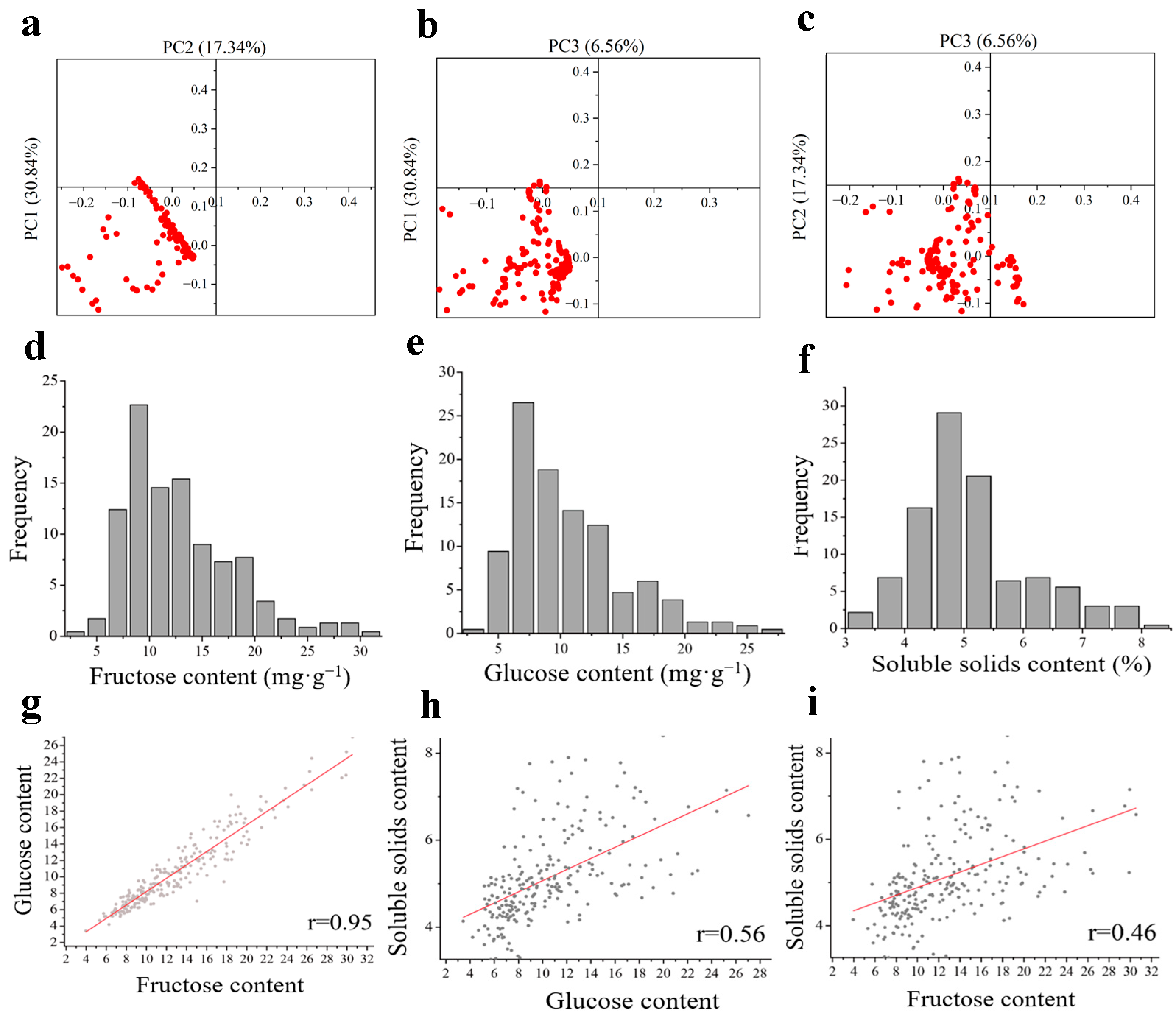
Prior to the GWAS, we assessed the population structure using genotype data from all 234 accessions. The results of the principal component analysis (PCA) indicated that the retained samples did not form distinct subpopulations (Figure 1a–c). Phenotyping revealed phenotypic variations and continuous distributions for fructose, glucose, and SSC across 234 tomato germplasms (Figure 1d–f, Supplementary Table S1b). Glucose and fructose exhibited comparable content levels. Fructose content ranged from 3.96 to 30.54 mg/g (mean = 12.85 mg/g), while glucose content ranged from 3.42 to 27.03 mg/g (mean = 10.51 mg/g). SSC varied from 3.26% to 8.40%, with an average value of 5.14%. The coefficient of variation (CV) was 39.92% for fructose, 16.27% for glucose, and 19.94% for SSC. Correlation analysis revealed a strong positive relationship between glucose and fructose (r = 0.95, Figure 1g). Given that soluble sugars (fructose and glucose) constitute the major part of SSC, the positive correlations of glucose and fructose with SSC were evident, with values of 0.56 and 0.46, respectively (Figure 1h,i). These results laid a favorable foundation for the subsequent GWAS.

3.2. Genetic Structure Analysis

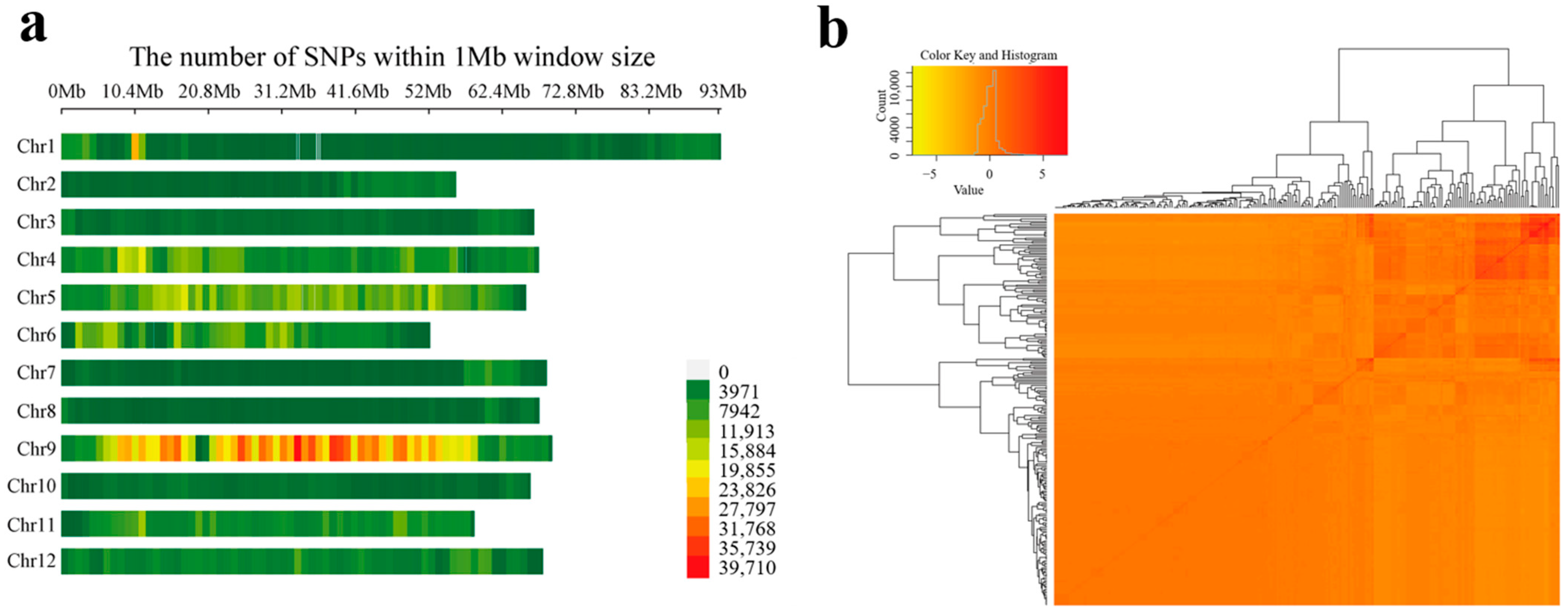
After filtering SNPs with a missing rate ≤ 10% and MAF ≥ 0.05, a final set of 4,284,885 high-quality SNPs was remained. These SNPs were widely distributed across all 12 chromosomes of the tomato reference genome (SL5.0) (Figure 2a). Marker density varied among chromosomes, with chromosome 9 showing the highest SNP abundance. Among the 234 tomato germplasms, individual heterozygosity did not exceed 0.6, and most values fell between 0 and 0.1 (Supplementary Figure S1). The MAF distribution of SNPs was predominantly between 0.05 to 0.3 (Supplementary Figure S2), which is well within the acceptable range. Furthermore, kinship analysis revealed weak relatedness among tomato genotypes, indicating the presence of extensive genetic diversity within the population.

3.3. Genome-Wide Association Analysis

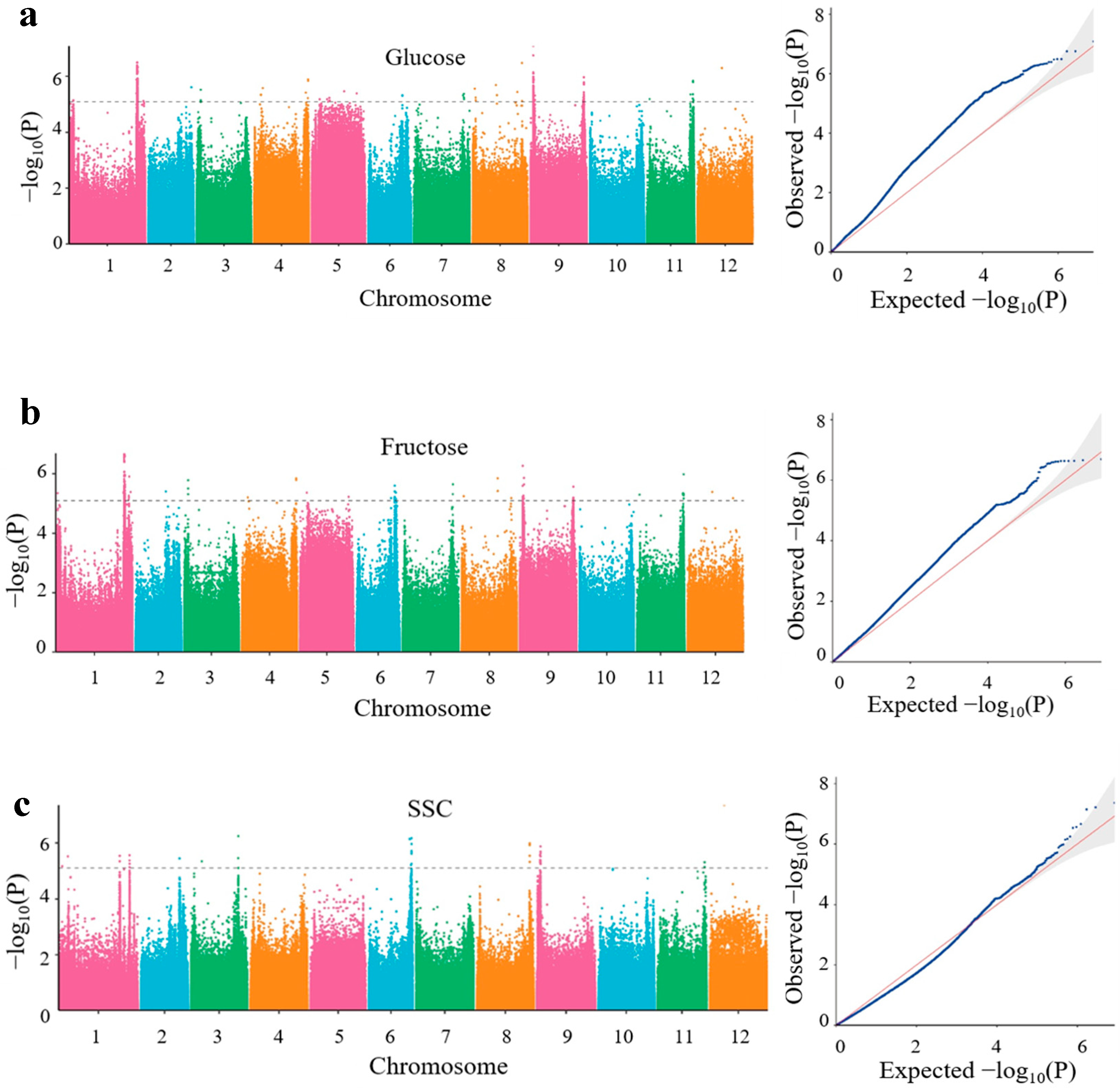
To identify novel alleles regulating soluble sugar content, we performed a GWAS for glucose, fructose and SSC in 234 tomato accessions. Using the threshold of p < 8 × 10⁻⁶, the number of significantly associated SNPs varied across traits. The largest number of SNPs (n = 640) was associated with glucose content, with the majority localized to chromosomes 1 and 9 (Figure 3a). For fructose content, 299 significant SNPs were identified, with distinct peaks clustering on chromosomes 1, 6, and 9 (Figure 3b). In contrast, SSC exhibited fewer associated variants, with only 49 SNPs detected, predominantly localized to chromosomes 1, 3, 6, and 9 (Figure 3c). Applying Bonferroni threshold corrections (p < 1.27 × 10⁻⁶) reduced the number of significant SNPs to 48 for glucose, 31 for fructose, and 12 for SSC. These results indicated that the three quantitative traits glucose, fructose, and SSC were regulated by multiple loci.
Notably, the quantile-quantile (Q-Q) plots revealed a stronger deviation of the observed p-values from the expected null distribution for glucose and fructose compared to SSC (Figure 3). This pattern suggests a higher proportion of genetic variance explained by the tested SNPs for the monosaccharide traits, indicating potentially higher heritability or a stronger polygenic signal for glucose and fructose in this population. In contrast, SSC, being a composite trait, may be influenced by a more complex mix of genetic and environmental factors, resulting in a relatively attenuated polygenic signal.
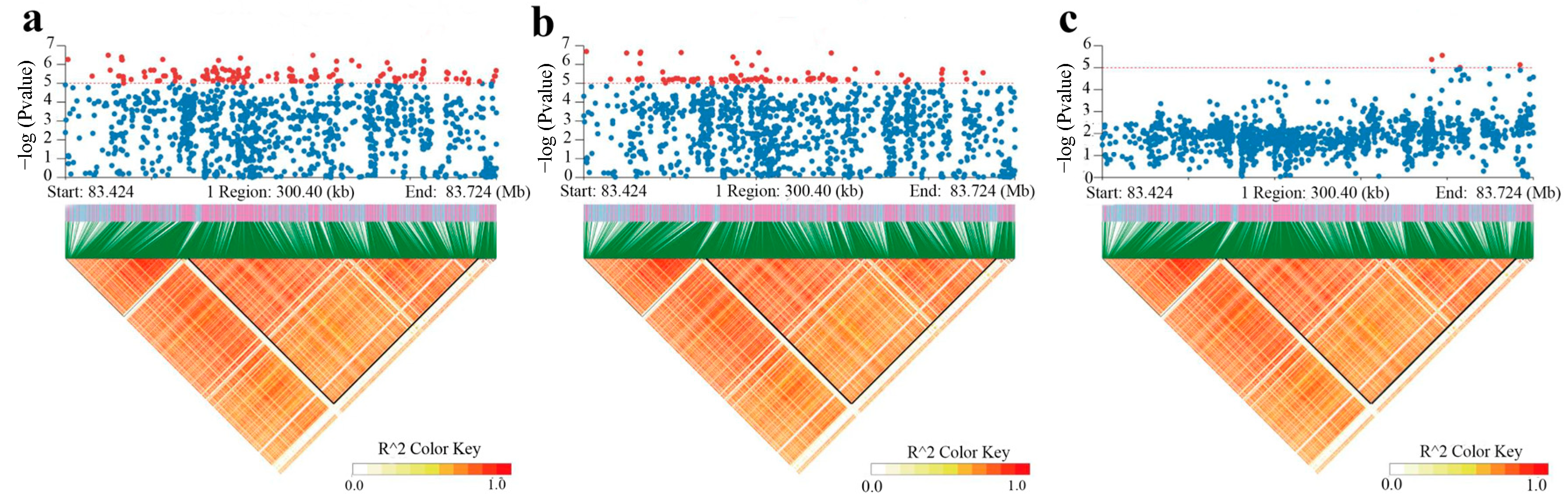
Among the identified SNPs, chr01_83596516 exhibited strong associations with both glucose and fructose with p-values of 3.20 × 10⁻⁷ and 2.45 × 10⁻⁷, respectively (Figure 4a,b). The CMLM revealed that this locus accounted for 11.12% of the phenotypic variation in glucose and 12.24% in fructose, suggesting it as a major locus for sugar content. Notably, the peak SNP locus chr01_83660949 (with a p-value of 2.75 × 10⁻⁶) in SSC was 64 kb away from chr01_83596516 (Figure 4c). LD analysis revealed that these two peak SNPs were located in the same haplotype block (ranging from 83.25 Mb to 83.71 Mb with an interval of 192 kb) (Supplementary Tables S2 and S4). Similarly, on chromosome 9, the glucose-associated SNP chr09_65656451 and the fructose-associated SNP chr09_65648958 were very close with a distance of only approximately 7 kb. These results indicated that glucose and fructose content may be regulated by the same candidate genes. From all SNPs with p-values above the empirical significance threshold (p < 8 × 10⁻⁶), we selected 11 representative peak SNPs based on the criterion of having the smallest p-value within each distinct association signal peak region. Four of them are associated with SSC, four with fructose content, and three with glucose content. These SNPs were distributed across chromosomes 1, 3, 6, and 9.

3.4. Prediction of Candidate Genes

We identified 250 functionally annotated genes within 200 kb upstream and downstream of 11 peak SNPs. Among these, 94 near the glucose-associated loci (Supplementary Table S2), 122 genes were located near the fructose-associated loci (Supplementary Table S3) and 143 near the SSC-associated loci (Supplementary Table S4). Due to the close spatial proximity of certain peak SNP loci, particularly on chromosomes 1 and 9, some genes were associated with multiple loci, resulting in overlap between these gene sets.
Since sugar metabolism and transport are critical for fruit sugar accumulation, genes associated with these biological pathways were prioritized as candidate genes. Based on the gene annotation information, we initially identified twelve candidate genes influencing sugar content across three traits. Among these genes, two previously characterized genes, Solyc01G003193 (annotated as sugar-porter family protein 5, SFP5) and Solyc09G00412 (annotated as beta-fructofuranosidase, LIN5), were localized on chromosomes 1 and 9, respectively. In the remaining ten candidate genes (Table 1), six were related to sugar transporters, while four to sugar metabolism. Notably, four potential key genes, Solyc01G003192, Solyc01G003198, Solyc01G003200, and Solyc01G003201, were co-localized with the peak SNPs chr01_83660949 (SSC) and chr01_83596516 (glucose). Functional annotation revealed that Solyc01G003192 and Solyc01G003198 encode early responsive to dehydration like 6 (ERDL6) protein. Importantly, Solyc01G003192 was located in the same haplotype block as Solyc01G003193, suggesting it might also play an important role in the transmembrane transporter of carbohydrates. Furthermore, Solyc01G003200 and Solyc01G003201 encode for phosphoglycerate mutase family proteins, which are critical enzymes in glycolysis. On chromosome 9, Solyc09G002436 was associated with both fructose and glucose, and annotated as a pyruvate kinase involved in glycolysis. Solyc09G000424, located downstream region of the peak SNP chr09_3570443 of SSC, was predicted to encode endoglucanase, potentially participating in cellulose hydrolysis. Besides, Solyc03G002229 and Solyc06G002582 on other chromosomes were annotated as a Vacuolar ATP synthase and a UDP-xylose transporter 3-like, respectively. Within fructose-associated loci on chromosome 6, Solyc06G001947 and Solyc06G001978 were identified, encoding plasma membrane ATPase and bidirectional sugar transporter, respectively.

3.5. Haplotype Analysis

Following statistical analysis of significant SNPs located in promoter regions and non-synonymous SNPs in exon regions, six genes were screened as final candidates based on their significant haplotype differences in fruit soluble sugar.
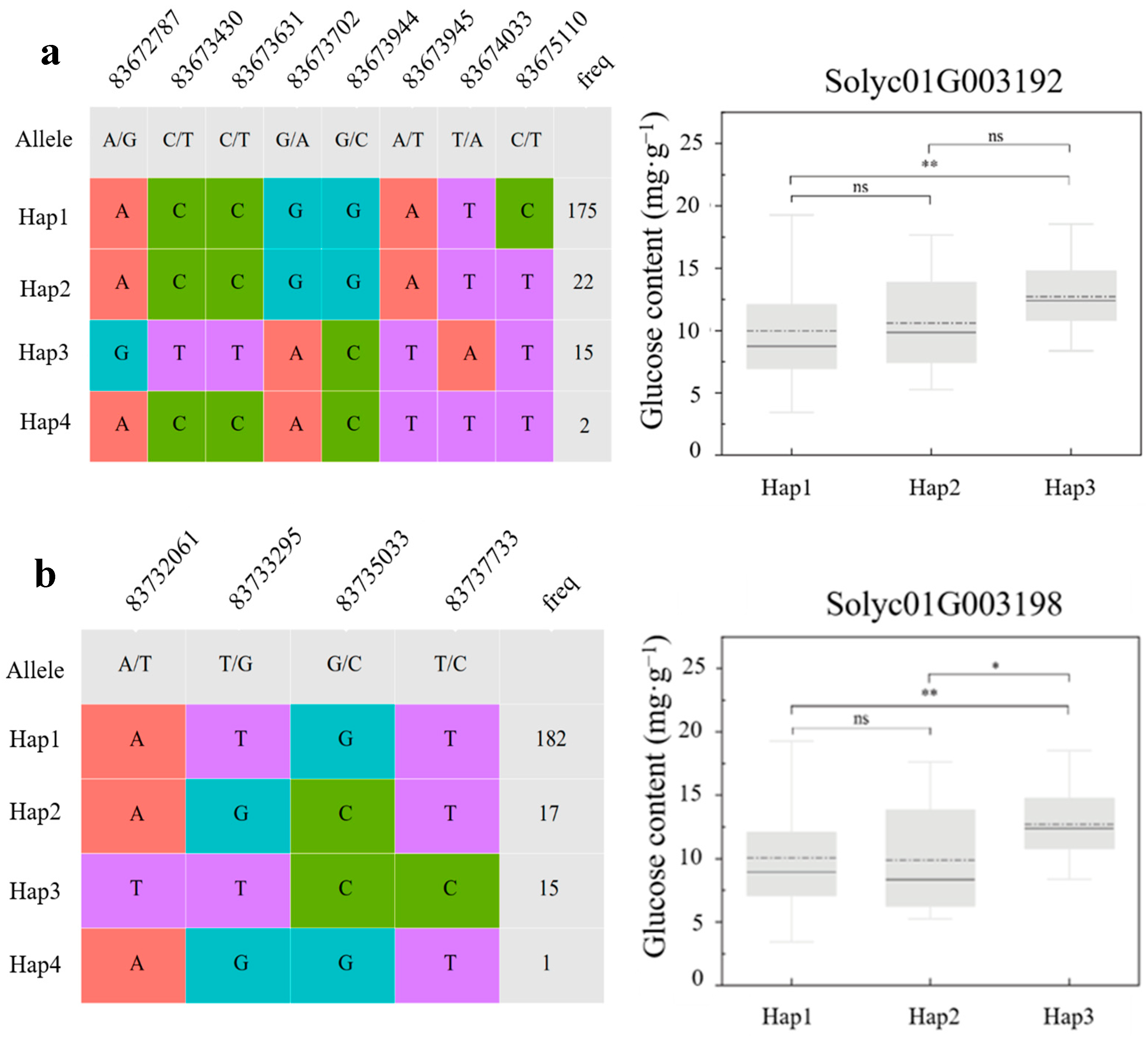
Solyc01G003192 was associated with both glucose and SSC. We analyzed the significant SNPs of these traits, and found that glucose contained more significant SNPs (glucose: n = 640, SSC: n = 299). Consequently, glucose was selected for haplotype analysis. The result showed that seven significant SNPs were identified in the promoter region. One non-synonymous SNP was present in the exon region, which caused the amino acid at position 87 of the protein sequence to change from alanine to valine. Four haplotypes were defined based on these variations: Hap1 (n = 175), Hap2 (n = 22), Hap3 (n = 15), and Hap4 (n = 2, Figure 5a). Glucose content did not show clear differences between Hap2 and Hap1 or Hap3, but it was significantly different between Hap1 and Hap3 (p = 0.0019, Figure 5a).
Solyc01G003198 exhibited two significant SNPs in its promoter region. Within the exon region, five SNPs were identified, comprising three synonymous mutations and two non-synonymous mutations. The SNP chr01_83733295 caused an amino acid change from phenylalanine to cysteine at position 34 of the encoded protein, while the SNP chr01_83735033 caused an amino acid change from glutamine to histidine at position 225. Based on these four variations, three major haplotypes were defined Hap1 (n = 182), Hap2 (n = 17), and Hap3 (n = 15, Figure 5b). The glucose content of Hap3 was significantly increased compared to Hap1 (p = 0.0031) and Hap2 (p = 0.033, Figure 5b).
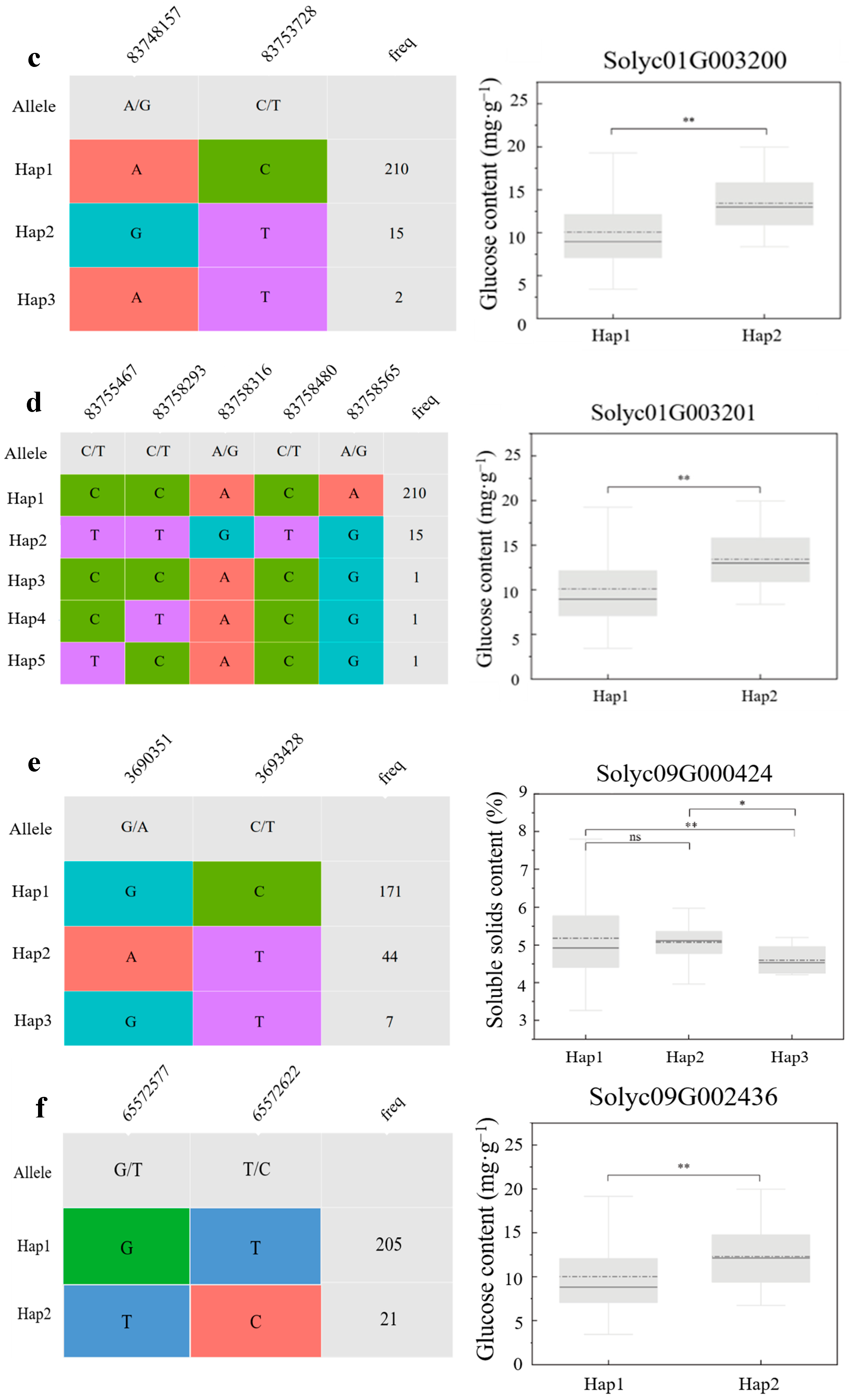
Solyc01G003200 exhibited two significant SNPs in its promoter region but no variants in the exon. Based on these promoter SNPs, haplotype analysis defined two major haplotypes. Frequency analysis revealed that there were 210 and 15 germplasms for Hap1 and Hap2, respectively (Figure 5c). Comparative analysis revealed a significant difference in glucose content between Hap2 and Hap1 (p = 0.0013, Figure 5c).
Solyc01G003201 exhibited two synonymous SNPs in the exon region, meaning that no amino acid change and the function of the Solyc01G003201 protein remained unchanged. Five significant SNPs in the promoter region defined two major haplotypes (Figure 5d). Among them, Hap1 and Hap2 had 210 and 15 germplasms, respectively. Compared to Hap1, Hap2 showed a significant increase in glucose content (p = 0.0014, Figure 5d).
In Solyc09G000424 (Figure 5e), three exon SNPs were identified, with one synonymous and two non-synonymous. The SNPs chr09_3690351 and chr09_3693428 caused valine-to-isoleucine (position 186) and alanine-to-valine (position 306) substitutions, respectively. Haplotype analysis of these non-synonymous SNPs classified the accessions into three haplotypes: Hap1 (n = 171), Hap2 (n = 44), and Hap3 (n = 7). Significant differences in SSC were detected between Hap1 and Hap3 (p = 0.0038) and between Hap2 and Hap3 (p = 0.013).
Solyc09G002436 contained one synonymous exon SNP and two significant promoter SNPs. Haplotype analysis of the promoter SNPs resolved two haplotypes, with 205 of Hap1 and 21 of Hap2 (Figure 5f). Glucose content of Hap1 was remarkably decreased compared to Hap2 (p = 0.009, Figure 5f).

4. Discussion

4.1. GWAS Reveals Eight Genes in Sugar Metabolism: Two Known and Six Newly Associated Candidates

In this study, implementation of a GWAS strategy on a diverse panel of 234 tomato accessions identified several candidate genes implicated in sugar metabolism and transport. By analyzing associations with soluble solids content (SSC), glucose, and fructose, and prioritizing candidates through integrated annotation and haplotype analysis, we pinpointed key genes regulating these traits. This strategy helps mitigate potential false positives from the use of a moderate significance threshold. Our approach confirmed the presence of known genes such as Solyc01G003193 (SFP5) and Solyc09G000412 (Lin5) within the associated loci and, more importantly, led to the identification of six candidate genes not previously established as regulators of natural variation in tomato sugar content, providing an expanded molecular understanding of sugar accumulation in tomato fruits.

4.2. Six Candidate Genes Showed Significant Haplotype-Trait Correlations

In breeding research and commercial production, soluble solids content (SSC) is a common metric for sugar content, as sugars account for 55–65% of SSC [39]. GWAS for SSC have been conducted in various fruits including watermelon [40], tomato [14,41], melon [42], and peach [43]. In contrast, studies on GWAS analysis of monosaccharide content (such as glucose and fructose) to explore sugar-related genes are still rarely reported. In this study, genes involved in sugar metabolism and transport were prioritized as candidate genes regulating SSC, glucose, and fructose. Fruit sugar accumulation constitutes a complex physiological process, requiring the involvement of various sugar transporters and sugar metabolism genes, which jointly determines the sugar content of fruits [44]. According to the gene annotation information, we initially identified twelve potential candidate genes. Among these, Solyc01G003192, Solyc01G003193, Solyc01G003200, Solyc01G003201, and Solyc09G002436 were detected across multiple traits. Mutations located within the promoter region might lead to changes in its promoter activity, subsequently affecting the expression level of the genes. Non-synonymous mutations in exons would result in differences in amino acid sequences among varieties, while mutations in introns generally do not cause differences among varieties [45]. To further evaluate the potential role of these candidate genes in regulating sugar content, we examined the associations between specific SNPs (located in their promoter or coding regions) and the target traits. Based on this analysis, six genes (Solyc01G003192, Solyc01G003198, Solyc01G003200, Solyc01G003201, Solyc09G002436, and Solyc09G000424) were identified as having significant haplotype-trait correlations, supporting their candidacy as key regulators. The Hap3 of Solyc01G003192, the Hap3 of Solyc01G003198, the Hap2 of Solyc01G003200, the Hap2 of Solyc01G003201, the Hap1 of Solyc09G000424, and the Hap2 of Solyc09G002436 were identified as the dominant haplotypes.

4.3. The Functions of Key Candidate Genes and Their Potential Roles in Sugar Metabolism and Transport

Based on haplotype analysis and integrated gene annotation, we identified three genes involved in sugar transport processes, one of which corresponds to gene Solyc01G003193 (SFP5) whose down-regulation by RNAi strategy has been reported to lead to significantly lower SSC content in the fruits, associated with significant reduction of glucose, sucrose, and fructose content [46]. Phloem unloading and post-phloem transport, critical for fruit sugar accumulation, involve transporters such as SUTs, MSTs, and SWEETs [47,48,49]. In addition, two candidate genes (Solyc01G003192 and Solyc01G003198) are functionally annotated as ERD6-like sugar transport-related protein. The ERLD6 transporter, a member of the MSTs family is located on the vacuolar membrane, and acts as an H+/glucose symporter to promote the glucose efflux from the vacuole to the cytoplasm and regulate glucose under various stress conditions [50]. Studies have shown that overexpression of MdERDL6-1 increases the glucose concentration in the cytoplasm, demonstrating its role in exporting glucose from the vacuole. Further research has found that the glucose exported to the cytoplasm induces the expression of sugar transporters MdTST1 and MdTST2 by generating glucose signals, thereby promoting sugar accumulation [15]. This study identified two candidate ERD6-like genes that showed significant haplotype-trait correlations, suggesting their potential involvement in sugar accumulation.
Five genes (Solyc09G000412, Solyc01G003200, Solyc01G003201, Solyc09G000424, and Solyc09G002436) were identified in the sugar metabolic pathway, among which only Solyc09G00412 (Lin5) has been previously reported. Gene Solyc09G000412 (Lin5) encodes a cell wall invertase on chromosome 9 responsible for hydrolyzing sucrose into glucose and fructose. It has been shown that the base polymorphism at this locus can increase the glucose and fructose content of fruits without affecting yield, whereas silencing Solyc09G00412 (Lin5) significantly reduces soluble sugar content [51,52]. During fruit development and ripening, sugar metabolism roughly goes through three stages: starch accumulation and degradation, sucrose accumulation and degradation, and hexose accumulation and reuse [53]. The changes in sugar content during these three stages are closely related to the regulation of metabolic enzymes. The coordinated action of metabolic enzymes in fruits ultimately regulates soluble sugar levels and flavor. Our results showed that the four potential candidate genes, Solyc01G003200, Solyc01G003201, Solyc09G000424, and Solyc09G002436, affect the changes in sugar content by participating in the sugar metabolism pathway. Specifically, Solyc09G002436 encodes pyruvate kinase (PK), a key glycolytic enzyme that catalyzes the conversion of phosphoenolpyruvate (PEP) to pyruvate while generating ATP [54]. The product pyruvate is then used as a substrate in the tricarboxylic acid cycle (TCA cycle), thus affecting the interconversion of soluble sugars and organic acids. Supporting this, upregulation of EjPK in loquat halts acid accumulation and increases soluble sugars 4–5 folds [55], while an OsPK3 mutation in rice reduces PK activity and impairs sucrose transport, affecting grain filling [56]. These studies indicated that activating or inhibiting the expression of certain enzymes or genes related to sugar metabolism can regulate the overall level of sugar metabolism and transport. In addition, Solyc01G003200 and Solyc01G003201 encode phosphoglycerate mutase family proteins, which catalyze the mutual conversion between 3-phosphoglycerate and 2-phosphoglycerate [57]. Glycolysis is an important branch pathway of sugar metabolism. Phosphoglycerate mutase and pyruvate kinase work together to complete energy production and substance conversion in the glycolytic process. It is plausible that altering their expression levels would affect the rate of sugar metabolism and consequently influence sugar content. After sucrose reaches the sink cells, it will be hydrolyzed into glucose and fructose by sucrose synthase or invertase [49], and then participate in the generation of carbohydrates such as cellulose to build new cell walls. Moreover, Solyc09G000424 encodes an endoglucanase, a key enzyme regulating fruit softening in fruit growth and ripening [58]. However, its potential role in sugar metabolism is not yet defined. This enzyme catalyzes the hydrolysis of cellulose into dextrins, which undergo subsequent enzymatic conversion to glucose, as demonstrated in recent work [59]. We hypothesize that the glucose generated through this reaction may partially re-enter the glycolytic pathway and be integrated into central carbon metabolism, thereby contributing to sugar metabolic cycling.
Although mechanistic understanding of sugar accumulation in tomato has advanced, identifying new genetic regulators and their genetic mechanisms remains vital for breeding progress. In this work, we have identified six candidate genes whose natural allelic variation is significantly associated with fruit soluble sugar through GWAS. While this study provides robust statistical evidence and prioritizes targets for breeding, definitive proof of function requires direct experimental validation. Therefore, functional characterization of these candidates using transgenic (overexpression) and gene-editing (CRISPR-Cas9) approaches in tomato is a primary objective of our ongoing research. This work establishes a critical foundation for these future mechanistic studies aimed at precisely understanding and manipulating sugar metabolism for fruit quality improvement. These efforts will be fundamental to developing targeted breeding strategies for superior fruit quality. Furthermore, the intriguing pattern of both shared and trait-specific loci identified for SSC and monosaccharides merits further investigation. Future studies integrating multi-omics data and functional genomics will be essential to dissect the distinct and overlapping genetic pathways governing soluble solid composition and hexose accumulation in tomato fruits.

5. Conclusions

GWAS analysis of 234 tomato accessions identified 4,284,885 high-quality SNPs associated with soluble solid content (SSC), glucose, and fructose levels. The associated loci were predominantly located on chromosomes 1, 3, 6 and 9. While these genomic regions contained previously characterized genes like Solyc01G003193 (SFP5) and Solyc09G00412 (Lin5), our haplotype analysis prioritized six additional genes as key candidates. The genes Solyc01G003192 and Solyc01G003198 (ERD6-like sugar transporters) are involved in sugar transport processes; Solyc01G003200 and Solyc01G003201 (hosphoglycerate mutases), Solyc09G000424 (endoglucanase), and Solyc09G002436 (pyruvate kinase) participate in sugar metabolism pathways; and Solyc09G002436 affects the production of sugar synthesis substrates.

Supplementary Materials

The following supporting information can be downloaded at: https://www.mdpi.com/article/10.3390/horticulturae12030267/s1, Table S1a: Phenotypic data of 234 materials used in the study; Table S1b: statistical analysis and variation of glucose (mg/g), fructose (mg/g) and soluble solid content (SSC, %); Table S2: Functional annotated genes adjacent to glucose-associated loci; Table S3: Functional annotated genes adjacent to fructose-associated loci; Table S4: Functional annotated genes adjacent to soluble solids content-associated loci; Table S5: The exact positions and mutations in the 6 most interesting genes described in Figure 5; Table S6: Haplotypes of the six candidate genes and their corresponding SSC, fructose, and glucose contents. Figure S1: The heterozygosity rate of 234 tomato germplasms; Figure S2: The MAF distribution of SNPs.

Author Contributions

Methodology, Z.C. and Y.X.; conceptualization Y.X., X.Y. and Z.C.; software, Y.X. and Z.C.; formal analysis, Y.X.; resources, P.L., E.H., J.W. and W.Q.; writing original draft preparation, Y.X.; visualization, Y.X. and X.Y.; review, Y.L. and J.L.; supervision, R.Z.; project administration, Z.W. and F.J.; funding acquisition, Z.W. and F.J. All authors have read and agreed to the published version of the manuscript.

Funding

This work was supported by Key Research and Development Program of Autonomous Region (2025B02008); Youth Support Program for Young Researchers of Jiangsu Vocational College of Agriculture and Forestry (2022kj28); Special Program for Basic Science and Technology Resources Survey (2023FY101204); ‘111 Center’.

Data Availability Statement

The original contributions presented in this study are included in the article/Supplementary Materials. Further inquiries can be directed to the corresponding authors.

Acknowledgments

We appreciated the help from the National Key Laboratory of Crop Genetics, Germplasm Enhancement in the determination of sugar content and the high-performance computing platform of the Bioinformatics Center at Nanjing Agricultural University for their assistance.

Conflicts of Interest

Author Wenming Qi was employed by the company Anhui Vada Modern Agricultural Technology Co., Ltd. The remaining authors declare that the research was conducted in the absence of any commercial or financial relationships that could be construed as a potential conflict of interest.

References

  1. Li, X.; Lu, S.J.; Tang, J.H.; Wu, K.M.; Chen, Y.Q.; Wang, C.; Yang, J.; Pan, Q.; Xiao, D.Q.; Li, Q.J.; et al. Comprehensive evaluation of different varieties of cherry tomatoes based on principal component analysis and sensory evaluation. China Cucurbits Veg. 2025, 38, 72–80. [Google Scholar] [CrossRef]
  2. Yu, J.Q.; Gu, K.D.; Zhang, L.L.; Sun, C.H.; Zhang, Q.Y.; Wang, J.H.; Wang, C.K.; Wang, W.Y.; Du, M.C.; Hu, D.G. MdbHLH3 modulates apple soluble sugar content by activating phosphofructokinase gene expression. J. Integr. Plant Biol. 2022, 64, 884–900. [Google Scholar] [CrossRef]
  3. Powell, A.L.T.; Nguyen, C.V.; Hill, T.; Cheng, K.L.; Figueroa-Balderas, R.; Aktas, H.; Ashrafi, H.; Pons, C.; Fernández-Muñoz, R.; Vicente, A.; et al. Uniform ripening encodes a Golden 2-like transcription factor regulating tomato fruit chloroplast development. Science 2012, 336, 1711–1715. [Google Scholar] [CrossRef]
  4. Ruan, Y.L. Sucrose Metabolism, Gateway to diverse carbon use and sugar signaling. Annu. Rev. Plant Biol. 2014, 65, 33–67. [Google Scholar] [CrossRef]
  5. Su, J.; Zhu, L.C.; Zhou, H.; Li, B.Y.; Wang, F.W.; Li, M.J. Research progress on accumulation pattern and regulation of soluble sugar in fruit. Acta Hortic. Sin. 2023, 50, 885–895. [Google Scholar] [CrossRef]
  6. Chetelat, R.T.; Deverna, J.W.; Bennett, A.B. Introgression into tomato (Lycopersicon esculentum) of the L. chmielewskii sucrose accumulator gene (sucr) controlling fruit sugar composition. Theor. Appl. Genet. 1995, 91, 327–333. [Google Scholar] [CrossRef] [PubMed]
  7. Huang, Y.; Goto, Y.; Nonaka, S.; Fukuda, N.; Ezura, H.; Matsukura, C. Overexpression of the phosphoenolpyruvate carboxykinase gene (SlPEPCK) promotes soluble sugar accumulation in fruit and post-germination growth of tomato (Solanum lycopersicum L.). Plant Biotechnol. 2015, 32, 281–289. [Google Scholar] [CrossRef]
  8. Huang, Y.X.; Yin, Y.G.; Sanuki, A.; Fukuda, N.; Ezura, H.; Matsukura, C. Phosphoenolpyruvate carboxykinase (PEPCK) deficiency affects the germination; growth and fruit sugar content in tomato (Solanum lycopersicum L.). Plant Physiol. Biochem. 2015, 96, 417–425. [Google Scholar] [CrossRef]
  9. Jin, Y.; Ni, D.A.; Ruan, Y.L. Posttranslational elevation of cell wall invertase activity by silencing its inhibitor in tomato delays leaf senescence and increases seed weight and fruit hexose level. Plant Cell 2009, 21, 2072–2089. [Google Scholar] [CrossRef] [PubMed]
  10. Ariizumi, T.; Higuchi, K.; Arakaki, S.; Sano, T.; Asamizu, E.; Ezura, H. Genetic suppression analysis in novel vacuolar processing enzymes reveals their roles in controlling sugar accumulation in tomato fruits. J. Exp. Bot. 2011, 62, 2773–2786. [Google Scholar] [CrossRef] [PubMed]
  11. Wang, B.K.; Li, N.; Huang, S.Y.; Hu, J.H.; Wang, Q.; Tang, Y.P.; Yang, T.; Asmutola, P.; Wang, J.; Yu, Q.H. Enhanced soluble sugar content in tomato fruit using CRISPR/Cas9-mediated SlINVINH1 and SlVPE5 gene editing. PeerJ 2021, 9, 12478. [Google Scholar] [CrossRef]
  12. Zhu, L.C.; Su, J.; Peng, Y.J.; Cao, W.J.; Ma, F.W.; Ma, B.Q.; Li, M.J. Research progress on the relationship between sugar transporters and fruits sugar accumulation. Acta Hortic. Sin. 2022, 49, 2529–2542. [Google Scholar] [CrossRef]
  13. Heidari, P.; Ahmadizadeh, M.; Hosseinzadeh, M. Sugar transporter gene family: Structure, evolution, and expression analysis in Beta vulgaris. Veg. Res. 2025, 5, e002. [Google Scholar] [CrossRef]
  14. Ren, Y.; Sun, H.H.; Zong, M.; Guo, S.G.; Ren, Z.J.; Zhao, J.Y.; Li, M.Y.; Zhang, J.; Tian, S.W.; Wang, J.F.; et al. Localization shift of a sugar transporter contributes to phloem unloading in sweet watermelons. New Phytol. 2020, 227, 1858–1871. [Google Scholar] [CrossRef]
  15. Zhu, L.C.; Li, B.Y.; Wu, L.M.; Li, H.X.; Wang, Z.Y.; Wei, X.Y.; Ma, B.Q.; Zhang, Y.F.; Ma, F.W.; Ruan, Y.L.; et al. MdERDL6-mediated glucose efflux to the cytosol promotes sugar accumulation in the vacuole through up-regulating TSTs in apple and tomato. Proc. Natl. Acad. Sci. USA 2021, 118, e2022788118. [Google Scholar] [CrossRef]
  16. Wang, Y.; Shi, C.M.; Ge, P.F.; Li, F.M.; Zhu, L.H.; Wang, Y.R.; Tao, J.B.; Zhang, X.Y.; Dong, H.Q.; Gai, W.X.; et al. A 21-bp InDel in the promoter of STP1 selected during tomato improvement accounts for soluble solid content in fruits. Hortic. Res. 2023, 10, uhad009. [Google Scholar] [CrossRef] [PubMed]
  17. Zhang, X.S.; Feng, C.Y.; Wang, M.N.; Li, T.L.; Liu, X.; Jiang, J. Plasma membrane-localized SlSWEET7a and SlSWEET14 regulate sugar transport and storage in tomato fruits. Hortic. Res. 2021, 8, 186. [Google Scholar] [CrossRef]
  18. Sun, J.Q.; Feng, C.Y.; Liu, X.; Jiang, J. The SlSWEET12c sugar transporter promotes sucrose unloading and metabolism in ripening tomato fruits. Horticulturae 2022, 8, 935. [Google Scholar] [CrossRef]
  19. Cortes, L.T.; Zhang, Z.W.; Yu, J.M. Status and prospects of genome-wide association studies in plants. Plant Genome 2021, 14, 20077. [Google Scholar] [CrossRef]
  20. Zhang, M.N.; Tang, H.Q.; Xu, Q.; Xiao, Z.H.; Zhou, C.X.; Qian, Y.X.; Gong, R.Y.; Zhao, H.T.; Wang, J.Y.; Xing, Z.J.; et al. Integration of GWAS and transcriptome approaches for the identification of nitrogen-, phosphorus-, and potassium-responsive genes in tomato. Hortic. Res. 2025, 12, uhaf112. [Google Scholar] [CrossRef] [PubMed]
  21. Wang, Z.; Hong, Y.C.; Zhu, G.T.; Li, Y.M.; Niu, Q.F.; Yao, J.J.; Hua, K.; Bai, J.J.; Zhu, Y.F.; Shi, H.Z.; et al. Loss of salt tolerance during tomato domestication conferred by variation in a Na+/K+ transporter. EMBO J. 2020, 39, e103256. [Google Scholar] [CrossRef]
  22. Zhu, Y.F.; Zhu, G.T.; Xu, R.; Jiao, Z.X.; Yang, J.W.; Lin, T.; Wang, Z.; Huang, S.W.; Chong, L.L.Y.; Zhu, J.K. A natural promoter variation of SlBBX31 confers enhanced cold tolerance during tomato domestication. Plant Biotechnol. J. 2023, 21, 1033–1043. [Google Scholar] [CrossRef]
  23. Yang, P.; He, G.X.; Liang, Q.W.; Song, G.; Li, Y.Q.; Gao, Y.; Zhang, J.H. Genome-wide analysis of the ATP-binding cassette B subfamily in tomato and its response to cadmium stress. Veg. Res. 2025, 5, e049. [Google Scholar] [CrossRef]
  24. Ruggieri, V.; Francese, G.; Sacco, A.; D’Alessandro, A.; Rigano, M.M.; Parisi, M.; Milone, M.; Cardi, T.; Mennella, G.; Barone, A. An association mapping approach to identify favourable alleles for tomato fruit quality breeding. BMC Plant Biol. 2014, 14, 337. [Google Scholar] [CrossRef] [PubMed]
  25. Song, J.W.; Shang, L.L.; Li, C.X.; Wang, W.Q.; Wang, X.; Zhang, C.L.; Guo, A.; Ye, J.; Yang, C.X.; Li, H.X.; et al. Variation in the fruit development gene POINTED TIP regulates protuberance of tomato fruit tip. Nat. Commun. 2022, 13, 5940. [Google Scholar] [CrossRef]
  26. Zhang, S.W.; Wu, S.Q.; Jia, Z.Q.; Zhang, J.H.; Li, Y.; Ma, X.Y.; Fan, B.L.; Wang, P.Q.; Gao, Y.N.; Ye, Z.B.; et al. Exploring the influence of a single-nucleotide mutation in EIN4 on tomato fruit firmness diversity through fruit pericarp microstructure. Plant Biotechnol. J. 2024, 22, 2379–2394. [Google Scholar] [CrossRef] [PubMed]
  27. Gai, W.X.; Yuan, L.D.; Yang, F.; Ahiakpa, J.K.; Li, F.M.; Ge, P.F.; Zhang, X.Y.; Tao, J.B.; Wang, F.; Yang, Y.; et al. Genome-wide variants and optimal allelic combinations for citric acid in tomato. Hortic. Res. 2024, 11, uhae070. [Google Scholar] [CrossRef] [PubMed]
  28. Gai, W.X.; Yang, F.; Yuan, L.D.; Ul Haq, S.; Wang, Y.R.; Wang, Y.; Shang, L.L.; Li, F.M.; Ge, P.F.; Dong, H.Q.; et al. Multiple-model GWAS identifies optimal allelic combinations of quantitative trait loci for malic acid in tomato. Hortic. Res. 2023, 10, uhad021. [Google Scholar] [CrossRef]
  29. Tieman, D.; Zhu, G.T.; Resende, M.F.R.; Lin, T.; Taylor, M.; Zhang, B.; Ikeda, H.; Liu, Z.Y.; Fisher, J.; Zemach, I.; et al. A chemical genetic roadmap to improved tomato flavor. Science 2017, 355, 391–394. [Google Scholar] [CrossRef]
  30. Zhang, J.Z.; Lyu, H.J.; Chen, J.; Cao, X.; Du, R.; Ma, L.; Wang, N.; Zhu, Z.G.; Rao, J.L.; Wang, J.; et al. Releasing a sugar brake generates sweeter tomato without yield penalty. Nature 2024, 635, 647–656. [Google Scholar] [CrossRef]
  31. Zhao, Y.; Huo, J.W.; Xin, X.L.; Qin, D.; Chen, L.; Zhang, Q. HPLC analysis of the major components of sugars and organic acids in blue honeysuckle fruits. J. Anhui Agric. Univ. 2015, 42, 937–942. [Google Scholar]
  32. Zhou, Y.; Zhang, Z.Y.; Bao, Z.G.; Li, H.B.; Lyu, Y.Q.; Zan, Y.J.; Wu, Y.Y.; Cheng, L.; Fang, Y.H.; Wu, K.; et al. Graph pangenome captures missing heritability and empowers tomato breeding. Nature 2022, 606, 527–534. [Google Scholar] [CrossRef]
  33. Bradbury, P.J.; Zhang, Z.W.; Kroon, D.E.; Casstevens, T.M.; Ramdoss, Y.; Buckler, E.S. TASSEL, software for association mapping of complex traits in diverse samples. Bioinformatics 2007, 23, 2633–2635. [Google Scholar] [CrossRef]
  34. Zhang, Z.W.; Ersoz, E.; Lai, C.Q.; Todhunter, R.J.; Tiwari, H.K.; Gore, M.A.; Bradbury, P.J.; Yu, J.M.; Arnett, D.K.; Ordovas, J.M.; et al. Mixed linear model approach adapted for genome-wide association studies. Nat. Genet. 2010, 42, 355–360. [Google Scholar] [CrossRef]
  35. Zhou, X.; Stephens, M. Genome-wide efficient mixed-model analysis for association studies. Nat. Genet. 2012, 44, 821–824. [Google Scholar] [CrossRef]
  36. Li, M.X.; Yeung, J.M.Y.; Cherny, S.S.; Sham, P.C. Evaluating the effective numbers of independent tests and significant p-value thresholds in commercial genotyping arrays and public imputation reference datasets. Hum. Genet. 2012, 131, 747–756. [Google Scholar] [CrossRef]
  37. Dong, S.S.; He, W.M.; Ji, J.J.; Zhang, C.; Guo, Y.; Yang, T.L. LDBlockShow: A fast and convenient tool for visualizing linkage disequilibrium and haplotype blocks based on variant call format files. Brief. Bioinform. 2020, 22, bbaa227. [Google Scholar] [CrossRef]
  38. Wang, K.; Li, M.Y.; Hakonarson, H. ANNOVAR, functional annotation of genetic variants from high-throughput sequencing data. Nucleic Acids Res. 2010, 38, e164. [Google Scholar] [CrossRef]
  39. Kader, A.A. Flavor quality of fruits and vegetables. J. Sci. Food Agric. 2008, 88, 1863–1868. [Google Scholar] [CrossRef]
  40. Guo, S.G.; Zhao, S.J.; Sun, H.H.; Wang, X.; Wu, S.; Lin, T.; Ren, Y.; Gao, L.; Deng, Y.; Zhang, J.; et al. Resequencing of 414 cultivated and wild watermelon accessions identifies selection for fruit quality traits. Nat. Genet. 2019, 51, 1616–1623. [Google Scholar] [CrossRef] [PubMed]
  41. Liu, Z.B.; Jiang, J.B.; Li, J.F. GWAS characterization of the genetic regions associated with nine important agronomic traits in tomato (Solanum lycopersicum L.). Agronomy 2023, 13, 1191. [Google Scholar] [CrossRef]
  42. Yan, H.L.; Wang, K.; Wang, M.M.; Feng, L.L.; Zhang, H.M.; Wei, X.Y. QTL mapping and genome-wide association study reveal genetic loci and candidate genes related to soluble solids content in melon. Curr. Issues Mol. Biol. 2023, 45, 7110–7129. [Google Scholar] [CrossRef]
  43. Li, X.W.; Wang, J.B.; Su, M.S.; Zhang, M.H.; Hu, Y.; Du, J.H.; Zhou, H.J.; Yang, X.F.; Zhang, X.A.; Jia, H.J.; et al. Multiple-statistical genome-wide association analysis and genomic prediction of fruit aroma and agronomic traits in peaches. Hortic. Res. 2023, 10, uhad117. [Google Scholar] [CrossRef]
  44. Ren, Y.; Liao, S.J.; Xu, Y. An update on sugar allocation and accumulation in fruits. Plant Physiol. 2023, 193, 888–899. [Google Scholar] [CrossRef]
  45. Liu, H.J. Genome-Wide Association Study Identifies Significant Genetic Loci for Root System Architecture Traits and Yield-Related Traits in Response to Low Phosphorus Stress in Brassica napus. Doctoral Dissertation, Huazhong Agricultural University, Wuhan, China, 2022. [Google Scholar]
  46. Cao, H.H. Functional Study of Tomato Sugar Transporter Protein SlSFP5 and Transcription Factors SlMYB70 in Tomato Development and Ripening. Doctoral Dissertation, Chongqing University, Chongqing, China, 2020. [Google Scholar] [CrossRef]
  47. Oparka, K.J. What is phloem unloading. Plant Physiol. 1990, 94, 393–396. [Google Scholar] [CrossRef] [PubMed]
  48. Patrick, J.W. Phloem unloading, Sieve element unloading and post-sieve element transport. Plant Physiol. Plant Mol. Biol. 1997, 48, 191–222. [Google Scholar] [CrossRef] [PubMed]
  49. Julius, B.T.; Leach, K.A.; Tran, T.M.; Mertz, R.A.; Braun, D.M. Sugar transporters in plants, new insights and discoveries. Plant Cell Physiol. 2017, 58, 1442–1460. [Google Scholar] [CrossRef]
  50. Poschet, G.; Hannich, B.; Raab, S.; Jungkunz, I.; Klemens, P.A.W.; Krueger, S.; Wic, S.; Neuhaus, H.E.; Büttne, M. A novel arabidopsis vacuolar glucose exporter is involved in cellular sugar homeostasis and affects the composition of seed storage compounds. Plant Physiol. 2011, 157, 1664–1676. [Google Scholar] [CrossRef]
  51. Zanor, M.I.; Osorio, S.; Nunes-Nesi, A.; Carrari, F.; Lohse, M.; Usadel, B.; Kühn, C.; Bleiss, W.; Giavalisco, P.; Willmitzer, L.; et al. RNA interference of LIN5 in tomato confirms its role in controlling brix content, uncovers the influence of sugars on the levels of fruit hormones, and demonstrates the importance of sucrose cleavage for normal fruit development and fertility. Plant Physiol. 2009, 150, 1204–1218. [Google Scholar] [CrossRef] [PubMed]
  52. Fridman, E.; Carrari, F.; Liu, Y.S.; Fernie, A.R.; Zamir, D. Zooming in on a quantitative trait for tomato yield using interspecific introgressions. Science 2004, 305, 1786–1789. [Google Scholar] [CrossRef]
  53. Wang, L.B.; Niu, J.P.; Wang, G.D.; Xie, Y.H.; Zhang, C.; Yu, Z.F.; Xie, B.; Zhang, Q.Q.; Zheng, H.Y.; Yuan, R.H.; et al. Research progress on sugar signaling during fruit development and ripening. Guangdong Agric. Sci. 2024, 51, 1–16. [Google Scholar] [CrossRef]
  54. Muñoz, M.E.; Ponce, E. Pyruvate kinase, current status of regulatory and functional properties. Comp. Biochem. Physiol. B-Biochem. Mol. Biol. 2003, 135, 197–218. [Google Scholar] [CrossRef] [PubMed]
  55. Qin, Q.P.; Kaas, Q.T.; Zhang, L.L.; Xu, K.; Li, N.Y.; Zheng, W.W.; Lai, Q.X. Isolation and characterization of a cytosolic pyruvate kinase cDNA from loquat (Eriobotrya japonica Lindl.). Plant Mol. Biol. Report. 2013, 31, 109–119. [Google Scholar] [CrossRef]
  56. Hu, L.; Tu, B.; Yang, W.; Yuan, H.; Li, J.L.; Guo, L.A.; Zheng, L.; Chen, W.L.; Zhu, X.B.; Wang, Y.P.; et al. Mitochondria-associated pyruvate kinase complexes regulate grain filling in rice. Plant Physiol. 2020, 183, 1073–1087. [Google Scholar] [CrossRef]
  57. Duminil, P.; Davanture, M.; Oury, C.; Boex-Fontvieille, E.; Tcherkez, G.; Zivy, M.; Hodges, M.; Glab, N. Arabidopsis thaliana 2, 3-bisphosphoglycerate-independent phosphoglycerate mutase 2 activity requires serine 82 phosphorylation. Plant J. 2021, 107, 1478–1489. [Google Scholar] [CrossRef]
  58. Su, G.Q.; Lin, Y.F.; Wang, C.F.; Lu, J.; Liu, Z.M.; He, Z.R.; Shu, X.; Chen, W.B.; Wu, R.R.; Li, B.J.; et al. Expansin SlExp1 and endoglucanase SlCel2 synergistically promote fruit softening and cell wall disassembly in tomato. Plant Cell 2024, 36, 709–726. [Google Scholar] [CrossRef]
  59. Han, W.J.; Wang, Y.R.; Li, H.W.; Diao, S.F.; Suo, Y.J.; Li, T.S.; Sun, P.; Li, F.D.; Fu, J.M. Transcriptome and metabolome reveal distinct sugar accumulation pattern between PCNA and PCA mature persimmon fruit. Int. J. Mol. Sci. 2023, 24, 8599. [Google Scholar] [CrossRef]
Figure 1. Phenotype view of three traits in 234 tomato accessions. (ac) 3D sectional PCA plot of genotypic data from 234 tomato accessions.; (df) Frequency distributions of glucose, fructose, and SSC; (gi) phenotypic correlations among three traits.
Horticulturae 12 00267 g001
Figure 2. SNP density and kinship matrix analysis. (a) SNPs density and distribution across 12 tomato chromosomes. Different colors represent the density of variation of markers within 1 Mb window size. The density values are represented with the legend color box on the right. (b) A heatmap of the kinship matrix of the 234 tomato accessions. The color histogram (Kinship) shows the distribution of coefficients of coancestry values in the whole kinship matrix.
Horticulturae 12 00267 g002
Figure 3. GWAS of glucose (a), fructose (b), and SSC (c) in tomato fruits. Manhattan plots are shown on the left, with the x-axis indicating the chromosome number and the y-axis showing the −log10P value. The black dashed lines represent p = 8 × 10⁻⁶. Quantile-quantile plots are shown on the right, with the x-axis indicating the expected −log10P value and the y-axis indicating the observed −log10P value. The red line represents the expected distribution under the null hypothesis, while the blue line represents the actual observed p-values.
Horticulturae 12 00267 g003
Figure 4. Analysis of major locus on chromosome 1 for glucose (a), fructose (b), and SSC (c). Local Manhattan plot (top panels) and LD heatmap (bottom panels) showed the 83.42–83.72 Mb region of chromosome 1. The red dashed lines in top panels indicate the significance threshold with the p-value of 1 × 10⁻⁵. Red dots represent SNPs significantly associated with the trait, and blue dots represent SNPs that did not reach the significance threshold. LD blocks in bottom panels are indicated by a black border. The R2 value is represented by the color scale.
Horticulturae 12 00267 g004
Figure 5. The haplotype diagrams display the combination of alleles at significant SNP loci for each candidate gene. (a) Solyc01G003192, (b) Solyc01G003198, (c) Solyc01G003200, (d) Solyc01G003201, (e) Solyc09G000424, (f) Solyc09G002436. Each column represents a specific SNP position (genomic coordinates are indicated at the top). The letters A (Adenine), T (Thymine), C (Cytosine), and G (Guanine) denote the nucleotide identity at each polymorphic site. For a given locus, e.g., A/G, the first letter (A) represents the reference allele from the SL5.0 genome, while the second letter (G) indicates the alternative allele identified in the population. Each colored cell indicates the specific allele carried by a haplotype at the corresponding SNP position. The “freq” column on the right shows the frequency of each haplotype in the studied population. The distinct combinations of these alleles define the haplotypes associated with significant differences in sugar content. *: Significant differences (p < 0.05); **: Extremely significant differences (p < 0.01); ns: No significant differences. Left panels show haplotype information of the gene, right panels show the result of student’s t-test of major haplotypes. The solid lines in the right panel represent the median, and the dashed lines represent the mean.
Horticulturae 12 00267 g005aHorticulturae 12 00267 g005b
Table 1. Information on proposed candidate genes for sugar-related traits identified by GWAS.
TraitsChrPeak SNPAlleleGene IDGene Start (bp)Gene End (bp)Gene Annotation
Glucose and
SSC
1Chr01_83596516
Chr01_83660949
G/A
T/C
Solyc01G00319283,674,14083,678,463Sugar transporter ERD6-like
Solyc01G00319883,733,07083,736,738Sugar transporter ERD6-like
Solyc01G00320083,749,93683,753,298Phosphoglycerate mutase
Solyc01G00320183,756,64083,757,809Phosphoglycerate mutase
Glucose and fructose9Chr09_65656451
Chr09_65648958
T/C
G/A
Solyc09G00243665,573,11165,581,604Pyruvate Kinase
SSC3Chr03_56356066G/ASolyc03G00222956,241,02156,253,046Vacuolar ATP synthase
6Chr06_50659801C/TSolyc06G00258250,679,31450,684,723UDP-xylose transporter 3-like
9Chr09_3570443A/GSolyc09G0004243,689,6333,694,758Endoglucanase
Fructose6Chr06_46286129C/TSolyc06G00194746,137,81446,144,982Plasma membrane ATPase
Solyc06G00197846,396,84646,399,113Bidirectional sugar transporter
Disclaimer/Publisher’s Note: The statements, opinions and data contained in all publications are solely those of the individual author(s) and contributor(s) and not of MDPI and/or the editor(s). MDPI and/or the editor(s) disclaim responsibility for any injury to people or property resulting from any ideas, methods, instructions or products referred to in the content.