Brief Report

Weather Conditions Associated with Citrus Canker Incidence Caused by AW Strain in the Lower Rio Grande Valley of South Texas

by
Amit Sharma
1,
Teresa Patricia Feria Arroyo
1,
George Yanev
2,3 and
Madhurababu Kunta
4,*
1
School of Integrative Biological and Chemical Sciences, The University of Texas Rio Grande Valley, 1201 W University Drive, Edinburg, TX 78539, USA
2
School of Mathematical and Statistical Sciences, The University of Texas Rio Grande Valley, 1201 W University Drive, Edinburg, TX 78539, USA
3
Institute of Mathematics and Informatics, Bulgarian Academy of Sciences, 1113 Sofia, Bulgaria
4
Citrus Center, Texas A&M University-Kingsville, 312 North International Blvd., Weslaco, TX 78599, USA
*
Author to whom correspondence should be addressed.
Horticulturae 2026, 12(2), 143; https://doi.org/10.3390/horticulturae12020143

Submission received: 19 December 2025 / Revised: 14 January 2026 / Accepted: 23 January 2026 / Published: 27 January 2026

Abstract

Citrus canker, caused by bacterium Xanthomonas citri subsp. citri (Xcc), affects the citrus industry by making the fruit unmarketable due to unsightly lesions on the fruit. Citrus canker caused by a relatively new AWstrain of Xcc was reported on the citrus trees in the residential areas of the Lower Rio Grande Valley (LRGV) of South Texas. Xcc AW has a limited host range, predominantly affecting limes and a few other citrus species. Previous work has reported prevailing environmental conditions that influence the incidence and spread of the citrus canker caused by the Asiatic A strain. However, no information is available on the environmental factors impacting the incidence of canker caused by AW strain. In this study, monthly data on temperature, humidity, rainfall, and wind speed were grouped into biologically meaningful categories, and corresponding disease incidence was examined descriptively. Disease incidence was highest under high temperatures, humid conditions, and particularly during periods of rainfall and high wind speeds, which likely facilitated bacterial dispersal. These observed patterns indicate that warm, humid, rainy conditions, and stronger winds are associated with increased citrus canker incidence in the LRGV. This study provides insights into environmental conditions conducive to disease incidence and may serve as a foundation for developing explanatory and predictive models leading to management strategies for protecting citrus production in South Texas.

1. Introduction

Citrus is widely cultivated in tropical and subtropical climatic regions worldwide [1,2]. However, its production is challenged by an extensive range of pests and pathogens. Citrus canker is one of the serious diseases of citrus fruits that causes extensive damage to all major cultivars. The severity of the disease varies depending on pathogen strain and citrus variety. The causal agent of this disease is the Gram-negative bacterium, Xanthomonas citri (Syn. Xanthomonas axonopodis) [1,3,4]. This bacterium is categorized into three different forms based on the pathovars, differences in host range, and prevalence. Xanthomonas citri subsp. citri (Xcc) (Syn. Xanthomonas axonopodis pv. citri) causes Cancrosis A, also known as the Asiatic type of canker, which is widespread and has a host range affecting almost all citrus species [4,5], while Xanthomonas citri pv. aurantifolii, which causes Cancrosis B, has a restricted host range affecting a few citrus species including lemons, key limes, sour oranges, and pummelo in South America [3,6]. A variant of Xanthomonas citri pv. aurantifolii causes ancrosis C, affecting only key lime (C. aurantiifolia) in Brazil. Another strain of bacteria known as A* was reported from Oman, Saudi Arabia, Iran, and India affecting key limes [3,4,7]. Xcc infection renders premature fruit drop, unmarketable fruits, and restricted access to fresh fruit markets. If the preventive measures are not strictly followed, the losses due to the disease can go up to 80%. Therefore, it is important to manage citrus canker to reduce the losses and mitigating its impact on fruit production and trade [8].
In the United States, citrus canker was first reported in 1912 in Florida on imported seedlings from Japan [9]. The disease caused by the Asiatic strain was observed in Gulf Coast states including Texas, Florida, and Louisiana in the early 1900s [10]. Efforts were subsequently made to eradicate the disease [11,12]. An extensive eradication program in Florida involved the removal of nearly seven million commercial, four million nursery, and 0.8 million residential trees around infected sites with a cost of more than 1 billion dollars [13]. The United States department of agriculture’s (USDA) implemented efforts for eradicating the citrus canker from 1995 to 2006 surpassed USD 1.3 billion; additionally, USD 90 million was spent by the government on the Citrus Health Response Program (CHRP) [14]. Unfortunately, despite implementing various eradication programs, citrus canker is still endemic in Florida.
A relatively new AW strain of the pathogen affecting key limes and alemow (C. macrophylla) was first reported in Florida in 2004 [15]. The persistent occurrence of citrus canker in Florida prompted disease surveys in the Upper Gulf Coast regions and the Rio Grande Valley (RGV) of South Texas.AW strain affecting backyard key lime (C. aurantiifolia), makrut lime (C. hystrix) trees, and Ponderosa lemon (C. limon) trees was reported in Cameron County, South Texas [11]. In 2016, citrus canker was also reported in several citrus trees located in the residential areas in the Upper Gulf Coast area [8]. The occurrence of the disease in residential citrus plants in Brazoria, Fort Bend, and Harris Counties [8,14] raises a constant concern about the spread of the disease to other places in Texas.
The challenge here is to manage the disease to avoid fruit losses and make the fruit marketable for the local and export industries. Disease development is a complex process that depends on the interaction of several components, including suitable environmental conditions, the inherent aggressiveness and survival capacity of the pathogen, and the presence of a host that is vulnerable to infection. Previous studies have demonstrated that environmental conditions, including temperature, rainfall, moisture, and wind speed were reported as the crucial factors for citrus canker caused by A strain to develop and spread [16]. These conditions play a critical role in influencing host susceptibility, pathogen survival, multiplication, dispersal, and the rates of spore penetration and germination [16,17]. However, the relative importance of these environmental variables may vary across geographic regions and pathogen strains. Moreover, regional climatic variability can alter disease dynamics, underscoring the need for location- and strain-specific investigations. The specific weather conditions that promote citrus canker incidence caused by AW strain in the Lower Rio Grande Valley (LRGV) have not yet been described. This study focuses on understanding the regional environmental conditions that favor citrus canker disease incidence caused by AW in LRGV. Building on established knowledge of how temperature, wind speed, rainfall, and relative humidity relate to disease development [13,16,18,19,20], we present a descriptive assessment of citrus canker incidence caused by the AW strain under prevailing environmental conditions in the LRGV. Overall, this study aims to contribute to a better understanding of the citrus canker epidemiology under the weather conditions of the LRGV. Recognizing the potential weather parameters that favor citrus canker incidence caused by AW strain in the LRGV is crucial for guiding timely and effective management strategies before the disease becomes an epidemic.

2. Materials and Methods

2.1. Disease Incidence Data

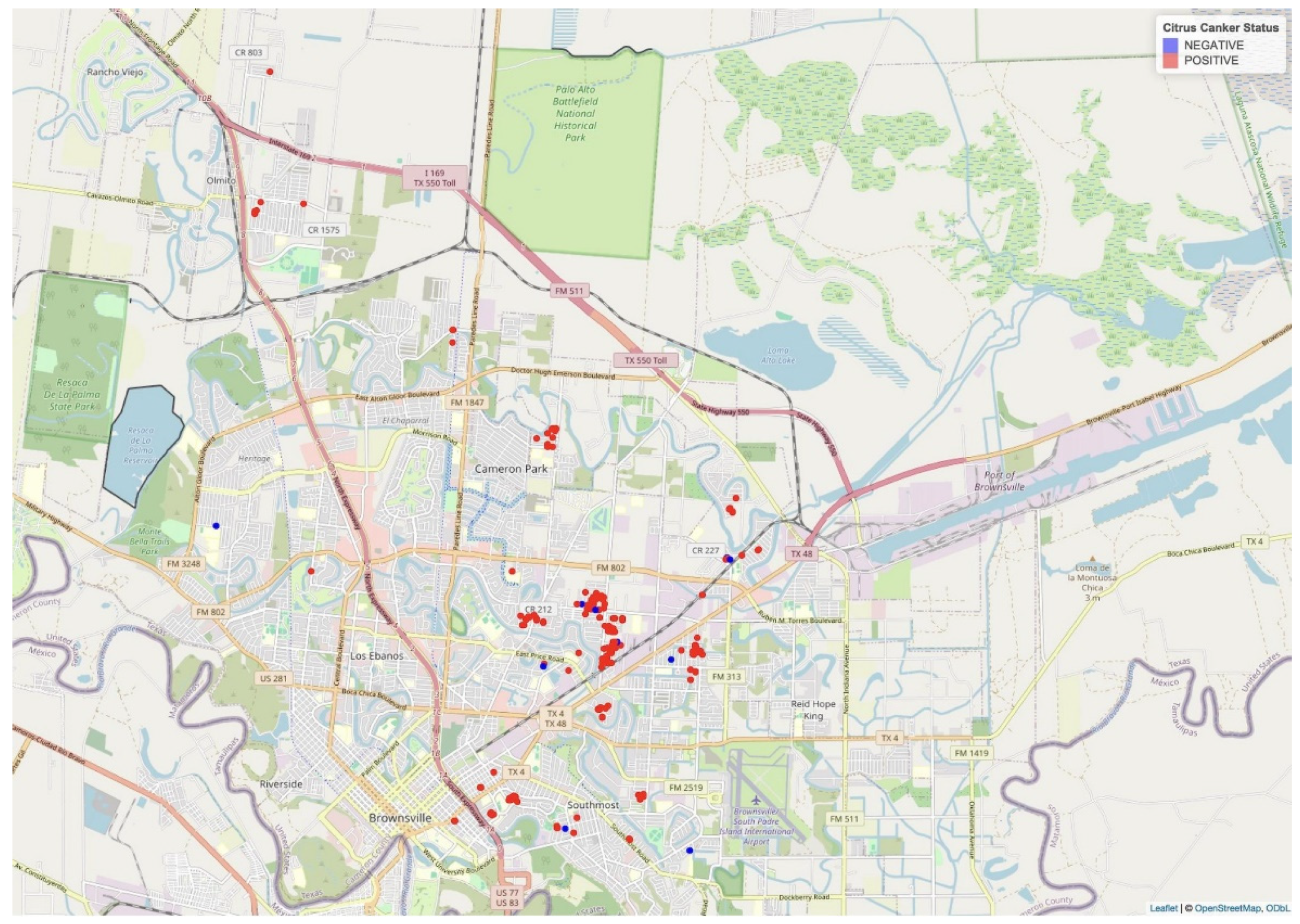
We utilized USDA survey data on citrus canker disease for the 2015–2024 period. It covers 12 known and 1 unknown species of Citrus, including: key lime (C. aurantiifolia), lemon (C. limon), sour orange (C. aurantium), orange (C. sinensis), grapefruit (C. paradisi), calamondin (C. madurensis), mandarin (C. reticulata), tangerine (C. reticulata), kumquats (Fortunella species), unknown Citrus species, makrut lime (C. hystrix), pummelo (C. maxima), and trifoliate oranges (Poncirus trifoliata). The survey data, which include cases associated with the AW strain for the period from January 2021 to September 2024, show the distribution of citrus canker-positive and -negative trees (Figure 1). Based on the structure of the dataset, each record appears to represent a single surveyed tree rather than repeated observations over time. Despite the inclusion of multiple citrus species in the survey, canker-positive cases occurred predominantly in key lime, with limited cases in lemon, makrut lime, and trifoliate orange. To provide an overall description of disease occurrence, we aggregated the information for all the surveyed citrus species into a single category “citrus.” Monthly disease incidence (DI) as the percentage of trees tested positive (entities) out of the total number of surveyed trees per month (sampling unit) was calculated [21,22]. At the outset, the dataset consisted of observations spanning from January 2021 to September 2024. However, months in which no canker-positive or canker-negative trees were recorded, including April 2021, May 2021, September 2022, and November 2023, were excluded from the dataset. Information on post-detection management actions, such as tree removal, was not included in the dataset.

2.2. Weather Data

Historical weather data included the following variables: temperature (°C), humidity (%), precipitation (mm), and wind speed (km/h). We retrieved monthly weather data from January 2021 to September 2024, corresponding to the same months as the recorded DI, from an online database of Visual Crossing Corporation [23], which includes data from multiple sources: Integrated Surface Database (ISD), Meteorological Assimilation Data Ingest System (MADIS), Global Historical Climatological Network daily (GHCNd) powered by National Oceanic and Atmosphere Administration (NOAA), and a German Meteorological Service (Deutscher Wetterdienst (DWD), Offenbach, Germany). Monthly median values were used to summarize each environmental variable as a robust measure resistant to outliers. The only exception is the precipitation, which is often zero-inflated; mean values were used instead to capture the overall rainfall trend.

2.3. Descriptive Analysis of Environmental Factors Associated with Citrus Canker Incidence

Each environmental variable was grouped into biologically meaningful ranges to facilitate the comparison with DI. The primary objective of this analysis was to quantify the distribution of DI (%) within each category of the environmental variables in order to identify conditions associated with relatively high or low disease incidence. Based on existing knowledge of citrus canker by other Xanthomonas citri strains, which is favored by temperatures between 20 °C and 30 °C and high relative humidity [3], temperature data were divided into three categories, ≤25 °C, 25–30 °C, and >30 °C, while relative humidity into two ranges, moderate (50–70%) and high (>70%). As citrus canker spreads predominantly through rain and wind, severe infections are often observed where trees are exposed to wind-driven rain [3,4]. Precipitation was classified into three categories, 0 mm indicating no rainfall, 0–0.1 mm representing light rainfall, and >0.1 mm indicating high rainfall events. Wind speed was grouped into 0–20 km/h to >20 km/h to represent calm to gentle and moderate to strong wind regimes, based on the classification provided by NOAA. For each environmental category, descriptive statistics of DI (%) were calculated, including the mean and quartile range, to describe how disease incidence varied across environmental conditions. This approach allowed for the identification of environmental ranges corresponding to relatively higher and lower citrus canker incidence. Descriptive analyses were performed using RStudio (version 2025.05.1, Build 513).

3. Results and Discussion

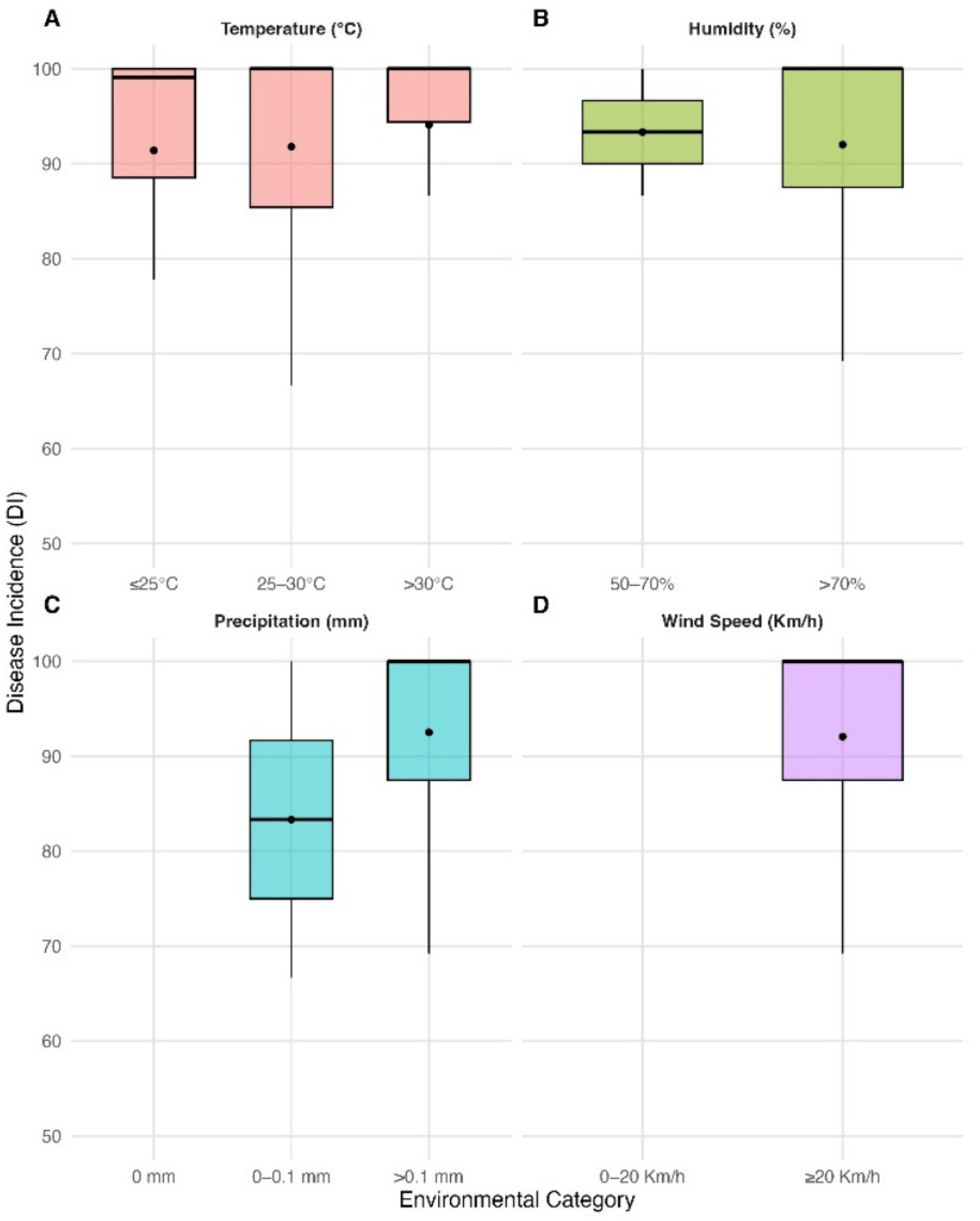
To our knowledge, this is the first report to describe the patterns of citrus canker incidence in relation to weather parameters caused by the Xcc AW strain. Disease incidence showed distinct patterns across environmental categories, indicating that specific combinations of temperature, humidity, rainfall, and wind speed may favor citrus canker development under the subtropical conditions of the LRGV (Figure 2). Summary statistics, including the mean, Q1 (first quartile), Q2 (median), and Q3 (third quartile) of DI for each environmental category, are presented in Supplementary Table S1. Previous studies suggested that temperature in the range of 20 °C to 30 °C is crucial, while relatively earlier studies suggested that citrus canker develops best at 30 °C to 35 °C [24]. In this study, median DI remained high across all temperature categories (Figure 2A) indicating that the Xcc AW strain can infect and develop under a broad thermal regime. Average DI seemed to vary a little across temperature categories, with a slight increase observed at temperatures above 30 °C, although variability decreased compared with lower temperature ranges. The average DI value remained almost similar at ≤ 25 °C and 25–30 °C (Figure 2A). This pattern suggests that high temperatures favored the citrus canker incidence whereas warm to moderate conditions were associated with comparatively lower average disease levels. The increase in DI at temperatures above 30 °C indicates that the pathogen remains active and capable of infection even under hotter conditions, consistent with its adaptation to tropical and subtropical climates. Temperature can control the incubation of bacteria and symptoms expression in the host plant [25,26]. It has been documented that citrus canker develops most effectively at temperatures between 30 °C and 35 °C, supporting the observation that high temperature conditions enhance disease expression [24]. In another study, disease development was shortest at 35 °C, with a mean incubation period of 2.29 days, which was comparable to that observed at 30 °C (2.48 days) across all isolates [27]. This observation reflects the shared dependence of both the host and the pathogen on similar thermal optima. Citrus growth accelerates near 30 °C, and increased host physiological activity under these conditions may coincide with greater susceptibility to bacterial infection and lesion expansion. These observations are consistent with the thermal characteristics of Xcc, which exhibit optimal growth at approximately 28–30 °C and maximum growth at 35–39 °C, suggesting that elevated field temperatures are conducive to both pathogen proliferation and symptom development [3].
The disease propagates when there is free moisture on the surface of infected tissue, and the bacterial exudates ooze out from the water-soaked lesions [3,28]. Under favorable conditions of presence of water film and adequate temperature, the symptoms start appearing within a week as a lesion on the plant surface [3,4,5]. The initial stages of the infection process are also governed by moisture and humidity, which makes it crucial for the bacterial infection and dissemination [29,30]. It has been established that canker incidence is severe at high relative humidity. In this study, DI remained relatively high (90–100%) across both humidity categories (50–70% and >70%), suggesting that citrus canker incidence was favored under generally humid conditions (Figure 2B). The median DI was higher when relative humidity exceeded 70%, whereas the mean DI remained nearly same, indicating that elevated humidity generally enhanced disease expression, but variability among observations limited changes in the overall average. The broader interquartile range at >70% humidity may suggest that fluctuations in microclimate can influence the degree of DI. These two humidity categories indicates that once it exceeded about 50%, conditions were already suitable for disease development and continued to promote infection as humidity increased. These results are consistent with previous findings where a strong positive correlation between citrus canker incidence and relative humidity was observed [31]. Another study examining the influence of relative humidity on citrus canker development indicated that higher humidity levels are more conducive to disease progression. Citrus canker incubation periods were shortest at higher humidity levels (95.6–100%) and longest at lower humidity levels (80.5–85.7%). At lower humidity level of 80.5%, inoculated leaves dried over time without developing typical symptoms. At higher humidity levels of 95.6% and 100%, all isolates initiated disease within 2–3 days and developed complete symptoms within 2 weeks [27]. High relative humidity may prolong leaf wetness, enhance bacterial survival, and facilitate infection by Xcc, reinforcing that sustained moisture plays a critical role in citrus canker development.
Several scientific studies have reported that rainfall can serve as a medium for the dissemination of the bacterium responsible for citrus canker [1,3,28,32,33,34]. Another study shows that if the precipitation falls below a critical threshold, a significant reduction in the correlation between rainfall and canker incidence can be seen, highlighting the necessity of sufficient rainfall required for effective bacterial dispersal [35]. Our findings indicated that the DI was greater in periods with high rainfall compared to periods of light rainfall or dry conditions with no rain (Figure 2C). Notably, at 0 mm precipitation, no DI was recorded, indicating that at least minimal rainfall or moisture is required for infection to occur. The average and median DI reached 83.3% during periods of light rainfall (0–0.1 mm). In contrast, precipitation exceeding 0.1 mm corresponded with higher median and mean DI values (100% and 92%, respectively), indicating that rainfall events promote the onset and spread of citrus canker caused by AW strain. Overall, these results suggest that rainfall events are essential to sustain citrus canker incidence, with heavier rain likely enhancing bacterial dispersal, infection, and disease progression. Precipitation may act by facilitating rain splash dispersal of bacterium over the distance, increase the leaf wetness period which is critical for the successful establishment and progression of disease, and may promote stomatal or wound penetration by Xcc [18]. The observed increase in DI under increasing rainfall conditions in this study aligns with the well documented role of rain in initiating and intensifying citrus canker epidemics. Periodic observations of a key lime nursery from June 2021 to May 2023 showed higher citrus canker prevalence during August, coinciding with periods of higher cumulative monthly rainfall accompanied by elevated temperature and relative humidity [27].
It has been observed that wind along with rain splashes plays a significant role in dispersing citrus canker bacteria and increasing the infection rate. Wind speeds of more than 8 m/s could drive bacterial penetration through plant’s natural openings or wounds [4]. In this study, DI was observed only under wind speeds ≥20 km/h, with no disease recorded below this threshold (Figure 2D). This pattern highlights the importance of moderate to strong winds in facilitating citrus canker spread. Wind not only aids in the physical dispersal of bacterial inoculum through rain splash but can also cause small abrasions on leaf surfaces, increasing host susceptibility [3,4]. The absence of disease under calm and gentle conditions (≤20 km/h) suggests that limited air movement restricts bacterial dispersal and infection opportunities. Similar findings have been reported in previous studies, where wind was identified as a major factor influencing the secondary spread and intensity of citrus canker [3,4,31,36]. In a study examining the role of wind speed in citrus canker dispersal, higher wind speeds were associated with substantially greater movement of Xcc from infected canopies. Simulated wind-rain events demonstrated that increasing wind speed resulted in markedly higher concentrations and fluxes of bacterial inoculum transported via wind-driven splash, with dispersal occurring over greater distances under stronger winds. Bacterial recovery consistently increased with wind speed, and greater quantities of inoculum were detected both near and downwind of infected trees. These observations highlight the importance of windy conditions, particularly when combined with rainfall, in facilitating the spread of citrus canker in subtropical environments [36].
Overall, citrus canker incidence caused by AW strain in the LRGV appeared to be associated with a combination of warm temperature, high humidity, rainfall events, and windy conditions. High temperatures (>30 °C), and overall humid conditions favored higher DI, consistent with the known requirements of Xcc for thermal and moisture conditions. Rainfall events were required to sustain disease, and no incidence occurred in the absence of precipitation, confirming that moisture availability is essential for citrus canker incidence. Likewise, disease occurred only under wind speeds ≥20 km/h, highlighting the role of wind in dispersing bacterial inoculum. Although this study is descriptive in nature, the results highlight indicative patterns in the observed relationships rather than quantitative associations. Despite these limitations, the descriptive approach offers valuable preliminary insights into how temperature, humidity, rainfall, and wind conditions may be associated with citrus canker incidence caused by AW strain under the subtropical environment of the LRGV serving as a foundation for future, more detailed epidemiological studies. Collectively, these findings highlight the importance of environmental factors in shaping the observed dynamics of citrus canker incidence in the region. Future research should focus on developing predictive models and decision support systems that integrate local weather data to improve disease forecasting and management. The outcomes of such efforts would benefit the Texas citrus industry by enabling proactive and targeted strategies to mitigate disease risk before epidemics occur in the RGV.

4. Conclusions

Citrus canker caused by the AW strain of Xanthomonas citri subsp. citri represents an emerging concern for citrus production in the LRGV of South Texas. This study provides the first descriptive assessment of environmental conditions associated with disease incidence caused by this strain in the region. By categorizing key weather variables into biologically meaningful ranges and examining corresponding disease incidence, we observed patterns linking higher disease levels with warm temperatures, high relative humidity, rainfall, and elevated wind speeds. These conditions likely enhance bacterial survival and dispersal, thereby increasing opportunities for infection. Although the analyses were descriptive and did not involve inferential statistical testing, the observed patterns highlight environmental conditions that may favor citrus canker incidence in the LRGV. The findings contribute to a foundational understanding of the epidemiology of the AW strain and underscore the importance of weather-driven factors in disease development. Future studies incorporating inferential, multivariate, and predictive modeling approaches are needed to quantify interactions among environmental variables and to define risk thresholds that can inform disease forecasting and management strategies aimed at protecting citrus production in South Texas.

Supplementary Materials

The following supporting information can be downloaded at: https://www.mdpi.com/article/10.3390/horticulturae12020143/s1. Table S1. Summary statistics (mean, Q1 [first quartile], Q2 [median], and Q3 [third quartile]) of disease incidence (DI) across environmental variable categories (temperature, humidity, precipitation, and wind speed).

Author Contributions

Writing—original draft preparation, A.S.; writing—review and editing, A.S., G.Y., T.P.F.A. and M.K.; Methodology: A.S., G.Y., T.P.F.A. and M.K.; investigation: A.S., G.Y., T.P.F.A. and M.K. All authors have read and agreed to the published version of the manuscript.

Funding

This research received no external funding. The graduate student, Amit Sharma, is supported by Presidential Graduate Research Assistantship, The University of Texas Rio Grande Valley.

Data Availability Statement

The original contributions presented in this study are included in the article/Supplementary Material. Further inquiries can be directed to the corresponding author.

Acknowledgments

The authors sincerely appreciate CHRP USDA APHIS PPQ for providing the survey data on citrus canker disease for the period 2015–2024.

Conflicts of Interest

The authors declare no conflicts of interest.

References

  1. Nasreen, R.; Bora, P.; Medhi, A. Citrus Canker: Developments down the Lane. Ann. Plant Soil Res. 2021, 22, 396–404. [Google Scholar] [CrossRef]
  2. Srivastava, A. Global Citrus Nutrition Research: An Incisive Analysis. Curr. Hortic. 2014, 2, 2014. [Google Scholar]
  3. Das, A.K. Citrus Canker-A Review. J. Appl. Hortic. 2003, 5, 52–60. [Google Scholar] [CrossRef]
  4. Gottwald, T.R.; Graham, J.H.; Schubert, T.S. Citrus Canker: The Pathogen and Its Impact. Plant Health Prog. 2002, 3, 15. [Google Scholar] [CrossRef]
  5. Naqvi, S.A.H.; Wang, J.; Malik, M.T.; Umar, U.-U.-D.; Ateeq-Ur-Rehman; Hasnain, A.; Sohail, M.A.; Shakeel, M.T.; Nauman, M.; Hafeez-ur-Rehman; et al. Citrus Canker—Distribution, Taxonomy, Epidemiology, Disease Cycle, Pathogen Biology, Detection, and Management: A Critical Review and Future Research Agenda. Agronomy 2022, 12, 1075. [Google Scholar] [CrossRef]
  6. Patané, J.S.; Martins, J.; Rangel, L.T.; Belasque, J.; Digiampietri, L.A.; Facincani, A.P.; Ferreira, R.M.; Jaciani, F.J.; Zhang, Y.; Varani, A.M. Origin and Diversification of Xanthomonas citri Subsp. citri Pathotypes Revealed by Inclusive Phylogenomic, Dating, and Biogeographic Analyses. BMC Genom. 2019, 20, 700. [Google Scholar] [CrossRef]
  7. Vernière, C.; Hartung, J.S.; Pruvost, O.P.; Civerolo, E.L.; Alvarez, A.M.; Maestri, P.; Luisetti, J. Characterization of Phenotypically Distinct Strains of Xanthomonas axonopodis pv. citri from Southwest Asia. Eur. J. Plant Pathol. 1998, 104, 477–487. [Google Scholar] [CrossRef]
  8. Gochez, A.M.; Behlau, F.; Singh, R.; Ong, K.; Whilby, L.; Jones, J.B. Panorama of Citrus Canker in the United States. Trop. Plant Pathol. 2020, 45, 192–199. [Google Scholar] [CrossRef]
  9. Berger, E.W. Citrus Canker in the Gulf Coast Country, with Notes on the Extent of Citrus Culture in the Localities Visited. Proc. Fla. State Hortic. Soc. 1914, 27, 120–127. [Google Scholar]
  10. Stevens, H.E. Citrus canker. Fla. Agric. Exp. Stn. Bull. 1914, 122, 111–118. [Google Scholar]
  11. da Graça, J.V.; Kunta, M.; Park, J.-W.; Gonzalez, M.; Santillana, G.; Mavrodieva, V.; Bartels, D.W.; Salas, B.; Duffel, M.N.; Dale, J. Occurrence of a Citrus Canker Strain With Limited Host Specificity in South Texas. Plant Health Prog. 2017, 18, 196–203. [Google Scholar] [CrossRef]
  12. Dopson, R.N. The Eradication of Citrus Canker. Plant Dis. Rep. 1964, 48, 30–31. [Google Scholar]
  13. Neri, F.M.; Cook, A.R.; Gibson, G.J.; Gottwald, T.R.; Gilligan, C.A. Bayesian Analysis for Inference of an Emerging Epidemic: Citrus Canker in Urban Landscapes. PLoS Comput. Biol. 2014, 10, e1003587. [Google Scholar] [CrossRef] [PubMed]
  14. Perez, E.; Kunta, M.; Ancona, V.; da Graça, J.V.; Ayin, C.; Santillana, G.; Mavrodieva, V. The Return of Asiatic Citrus Canker to Texas: Surveys and Eradication Efforts. Plant Health Prog. 2021, 22, 143–148. [Google Scholar] [CrossRef]
  15. Sun, X.; Stall, R.E.; Jones, J.B.; Cubero, J.; Gottwald, T.R.; Graham, J.H.; Dixon, W.N.; Schubert, T.S.; Chaloux, P.H.; Stromberg, V.K.; et al. Detection and Characterization of a New Strain of Citrus Canker Bacteria from Key/Mexican Lime and Alemow in South Florida. Plant Dis. 2004, 88, 1179–1188. [Google Scholar] [CrossRef]
  16. Negi, A.; Singh, J.; Kumar, P.; Kumar, A.; Sachan, S.; AbdelRahman, M.A.E. Role of Meteorological Factors for the Development and Forecasting of Citrus Canker Disease in the Tarai Region of the Indo-Gangetic Plains. Appl. Fruit Sci. 2025, 67, 216. [Google Scholar] [CrossRef]
  17. Mahawer, A.K.; Sharma, R.M.; Dubey, A.K.; Awasthi, O.P.; Singh, D.; Dahuja, A.; Mitra, S.V.A.C.R.; Kumar, A. Effect of Weather Parameters and Citrus Genotypes on the Occurrence of Citrus Canker Incited by Xanthomonas Citri Pv. Citri. Indian Phytopathol. 2023, 76, 605–613. [Google Scholar] [CrossRef]
  18. Gottwald, T.R.; Irey, M. Post-Hurricane Analysis of Citrus Canker II: Predictive Model Estimation of Disease Spread and Area Potentially Impacted by Various Eradication Protocols Following Catastrophic Weather Events. Plant Health Prog. 2007, 8, 22. [Google Scholar] [CrossRef]
  19. Irey, M.; Gottwald, T.R.; Graham, J.H.; Riley, T.D.; Carlton, G. Post-Hurricane Analysis of Citrus Canker Spread and Progress towards the Development of a Predictive Model to Estimate Disease Spread Due to Catastrophic Weather Events. Plant Health Prog. 2006, 7, 16. [Google Scholar] [CrossRef]
  20. Raza, M.M.; Khan, M.A.; Atiq, M.; Binyamin, R.; Javaid, M. Prediction of Citrus Canker Epidemics Generated through Different Inoculation Methods. Arch. Phytopathol. Plant Prot. 2014, 47, 1335–1348. [Google Scholar] [CrossRef]
  21. Cardoso, J.E.; Santos, A.A.; Rossetti, A.G.; Vidal, J.C. Relationship between Incidence and Severity of Cashew Gummosis in Semiarid North-Eastern Brazil. Plant Pathol. 2004, 53, 363–367. [Google Scholar] [CrossRef]
  22. Seem, R.C. Disease Incidence and Severity Relationships. Annu. Rev. Phytopathol. 1984, 22, 133–150. [Google Scholar] [CrossRef]
  23. Weather API & Weather Data—Historical Data & 15-Day Forecasts. Available online: https://www.visualcrossing.com/ (accessed on 14 December 2025).
  24. Christiano, R.S.C.; Dalla Pria, M.; Jesus Junior, W.C.; Amorim, L.; Bergamin Filho, A. Modelling the Progress of Asiatic Citrus Canker on Tahiti Lime in Relation to Temperature and Leaf Wetness. Eur. J. Plant Pathol. 2009, 124, 1–7. [Google Scholar] [CrossRef]
  25. Dalla Pria, M.; Christiano, R.C.S.; Furtado, E.L.; Amorim, L.; Bergamin Filho, A. Effect of Temperature and Leaf Wetness Duration on Infection of Sweet Oranges by Asiatic Citrus Canker. Plant Pathol. 2006, 55, 657–663. [Google Scholar] [CrossRef]
  26. Koizumi, M. The Incubation Period of Citrus Canker in Relation to Temperature. Bull. Fruit Tree Res. Stn. B 1976, 33–46. [Google Scholar]
  27. Kumar, D.; Jarial, K.; Jarial, R.S.; Jandaik, S.; Rana, V.K. Multiple Regression and PCA Based Approach for Epidemiology of Citrus Canker. Appl. Fruit Sci. 2025, 67, 419. [Google Scholar] [CrossRef]
  28. Stall, R.E.; Miller, J.W.; Marco, G.M.; Echenique, B.I.C. de Population Dynamics of Xanthomonas Citri Causing Cancrosis of Citrus in Argentina. Proc. Fla. State Hortic. Soc. 1980, 93, 10–14. [Google Scholar]
  29. Arora, A.; Kaur, S.; Rattanpal, H.S.; Singh, J. Development of Citrus Canker in Relation to Environmental Conditions. Plant Dis. Res. 2013, 28, 100–101. [Google Scholar]
  30. Pruvost, O.; Boher, B.; Brocherieux, C.; Nicole, M.; Chiroleu, F. Survival of Xanthomonas axonopodis pv. citri in Leaf Lesions Under Tropical Environmental Conditions and Simulated Splash Dispersal of Inoculum. Phytopathology® 2002, 92, 336–346. [Google Scholar] [CrossRef]
  31. Khan, M.; Abid, M. Effect of Environmental Conditions on Citrus Canker Disease Development. Pak. J. Phytopathol. 2007, 19, 139–144. [Google Scholar]
  32. Graham, J.H.; Gottwald, T.R.; Cubero, J.; Achor, D.S. Xanthomonas axonopodis pv. citri: Factors Affecting Successful Eradication of Citrus Canker: Eradication of Xanthomonas axonopodis pv. citri. Mol. Plant Pathol. 2004, 5, 1–15. [Google Scholar] [CrossRef]
  33. Bergamin Filho, A.; Hughes, G. Citrus Canker Epidemiology-Methodologies and Approaches: A Moderated Discussion Session. In Proceedings of the International Citrus Canker Research Workshop, Fort Pierce, FL, USA, 20–22 June 2000; pp. 24–25. [Google Scholar]
  34. Goto, M. The Role of Extracellular Polysaccharides of Xanthomonas campestris pv. citri in Dissemination and Infection: A Review. In Proceedings of the Abstracts on Fallen Leaf Conference on the Genus Xanthomonas, South Lake Tahoe, CA, USA, 20–23 September 1985; pp. 20–23. [Google Scholar]
  35. Canteros, B.I.; Gochez, A.M.; Moschini, R.C. Management of Citrus Canker in Argentina, a Success Story. Plant Pathol. J. 2017, 33, 441–449. [Google Scholar] [CrossRef]
  36. Bock, C.H.; Graham, J.H.; Gottwald, T.R.; Cook, A.Z.; Parker, P.E. Wind Speed Effects on the Quantity of Xanthomonas citri subsp. citri Dispersed Downwind from Canopies of Grapefruit Trees Infected with Citrus Canker. Plant Dis. 2010, 94, 725–736. [Google Scholar] [CrossRef]
Figure 1. Spatial distribution of citrus canker-positive (red) and -negative (blue) cases from 2021 to 2024.
Horticulturae 12 00143 g001
Figure 2. Relationship between environmental factors and disease incidence (DI) of citrus canker caused by AW strain. (A) Temperature, (B) relative humidity, (C) precipitation, and (D) wind speed. Each boxplot shows the distribution of DI across environmental categories, with horizontal lines representing medians and black dots representing means. Disease incidence tended to be higher under high temperature (>30 °C), humid conditions (>70%), in the presence of rainfall (>0 mm), and at higher wind speeds (≥20 km h−1). This pattern indicates that warm, humid, and rainy conditions accompanied by moderate to strong winds favor the incidence of citrus canker in the region.
Horticulturae 12 00143 g002
Disclaimer/Publisher’s Note: The statements, opinions and data contained in all publications are solely those of the individual author(s) and contributor(s) and not of MDPI and/or the editor(s). MDPI and/or the editor(s) disclaim responsibility for any injury to people or property resulting from any ideas, methods, instructions or products referred to in the content.