Characterization and Application of Endophytic Bacteria for Enhancing Nitrogen Uptake in Vanda Orchids
 ,
,  and
and
Abstract
1. Introduction
2. Materials and Methods
2.1. Molecular Identification by 16S rRNA Sequencing and Phylogenetic Analysis
2.2. In Vitro Analysis of Endophytic Bacterial Colonization and Nitrogen Content in Vanda
2.3. Effects of Endophytic Bacteria on the Growth and Nitrogen Uptake of Vanda Orchids Under Greenhouse Conditions
3. Results
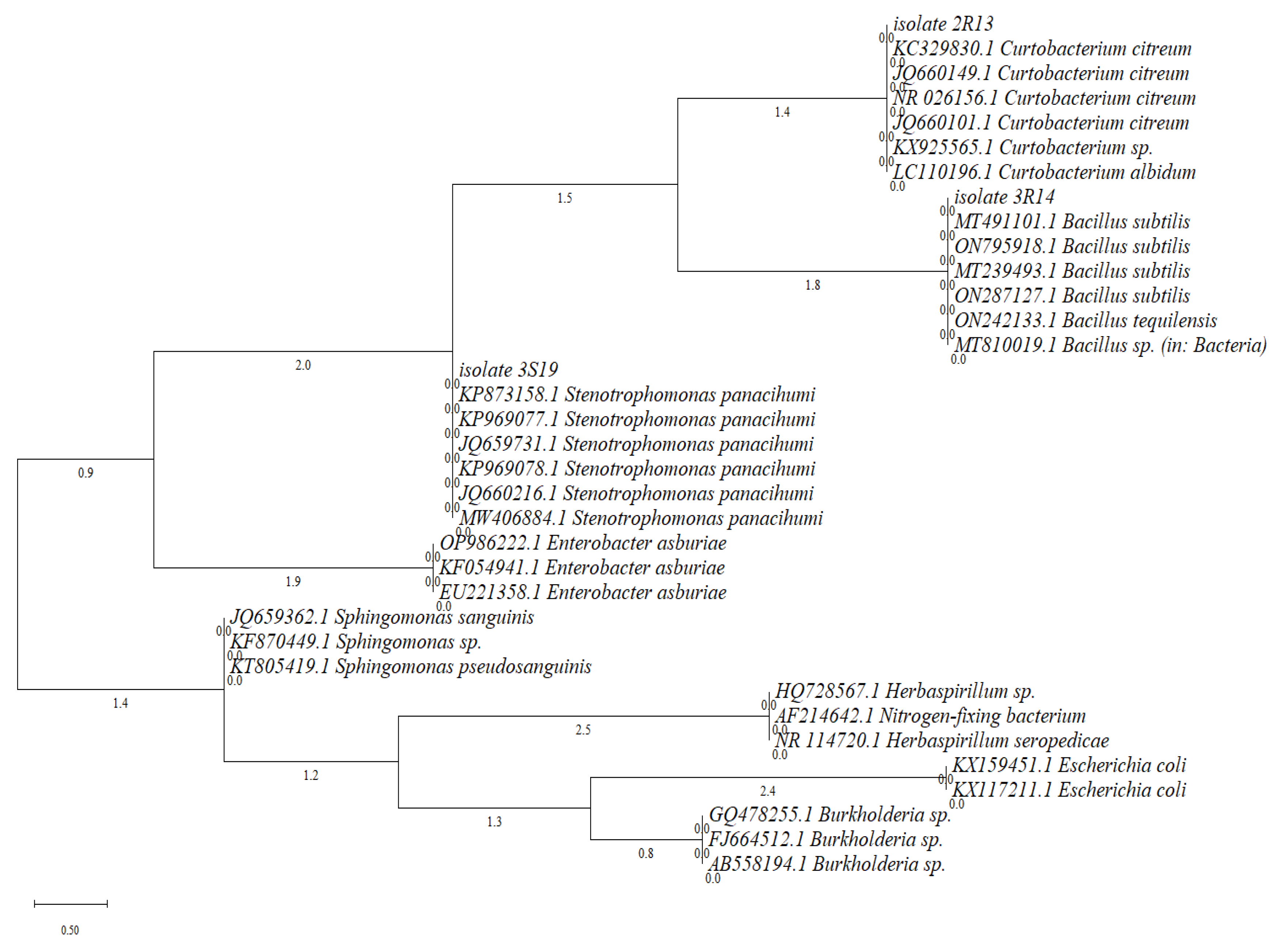
3.1. Phylogeny of Endophytic Bacteria Isolated from Vanda ‘Pachara Delight’
3.2. Colonization and the Potential of Endophytic Bacteria on Nitrogen Content in Vanda: A Comprehensive In Vitro Analysis
3.2.1. Total Nitrogen Concentration (mg g−1 DW)
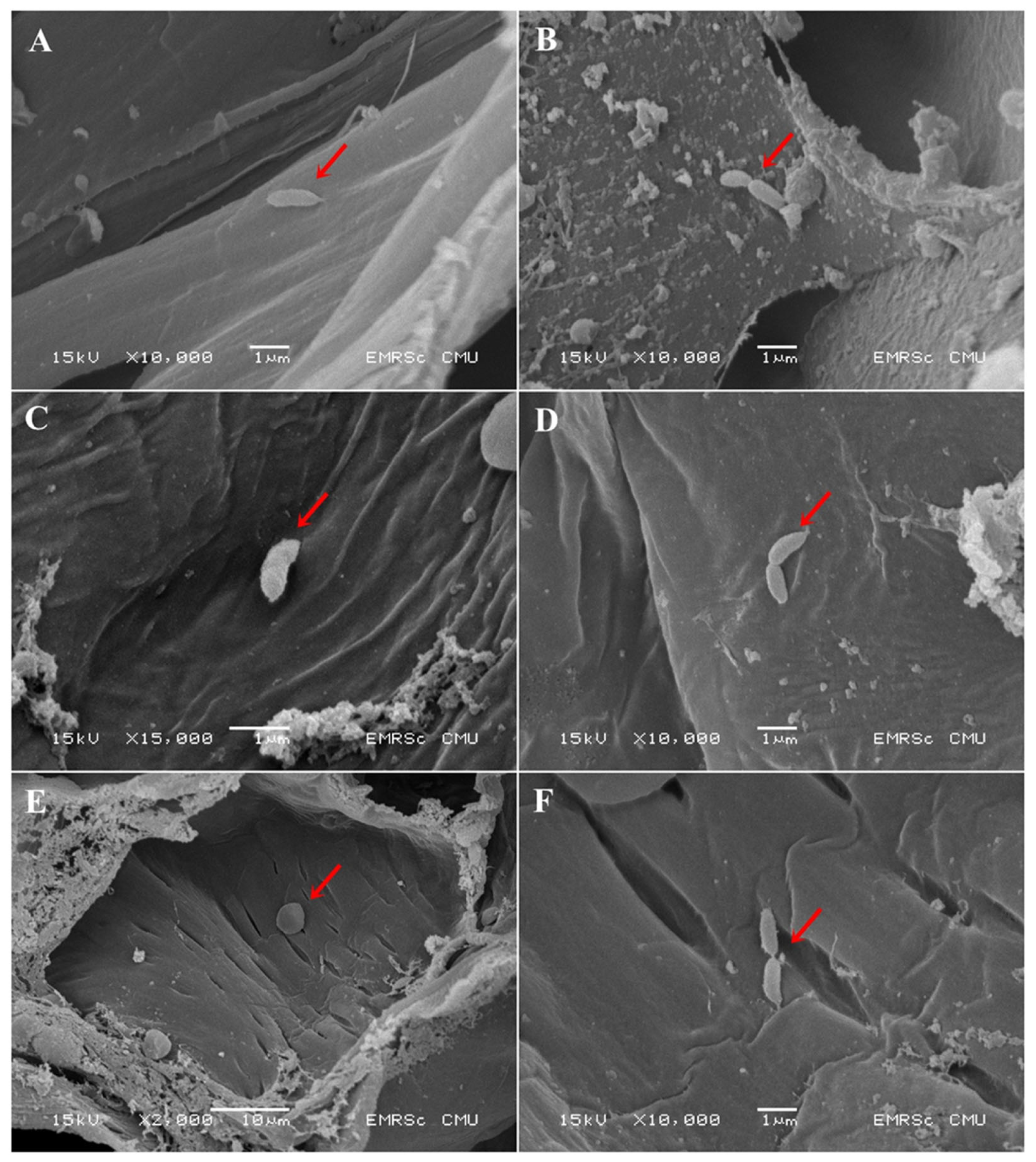
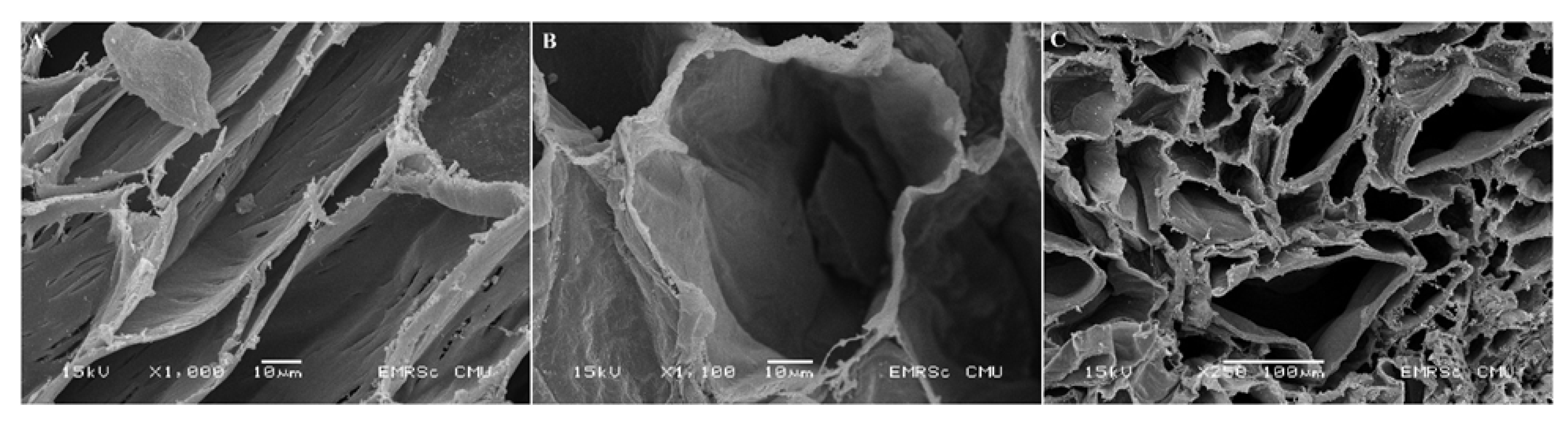
3.2.2. Colonization of Isolate 3S19 in Inoculated Vanda ‘Pachara Delight’ Tissue
3.3. Influence of Endophytic Bacteria on the Vegetative Growth and Nitrogen Concentration in Vanda ‘Pachara Delight’ Under Greenhouse Conditions
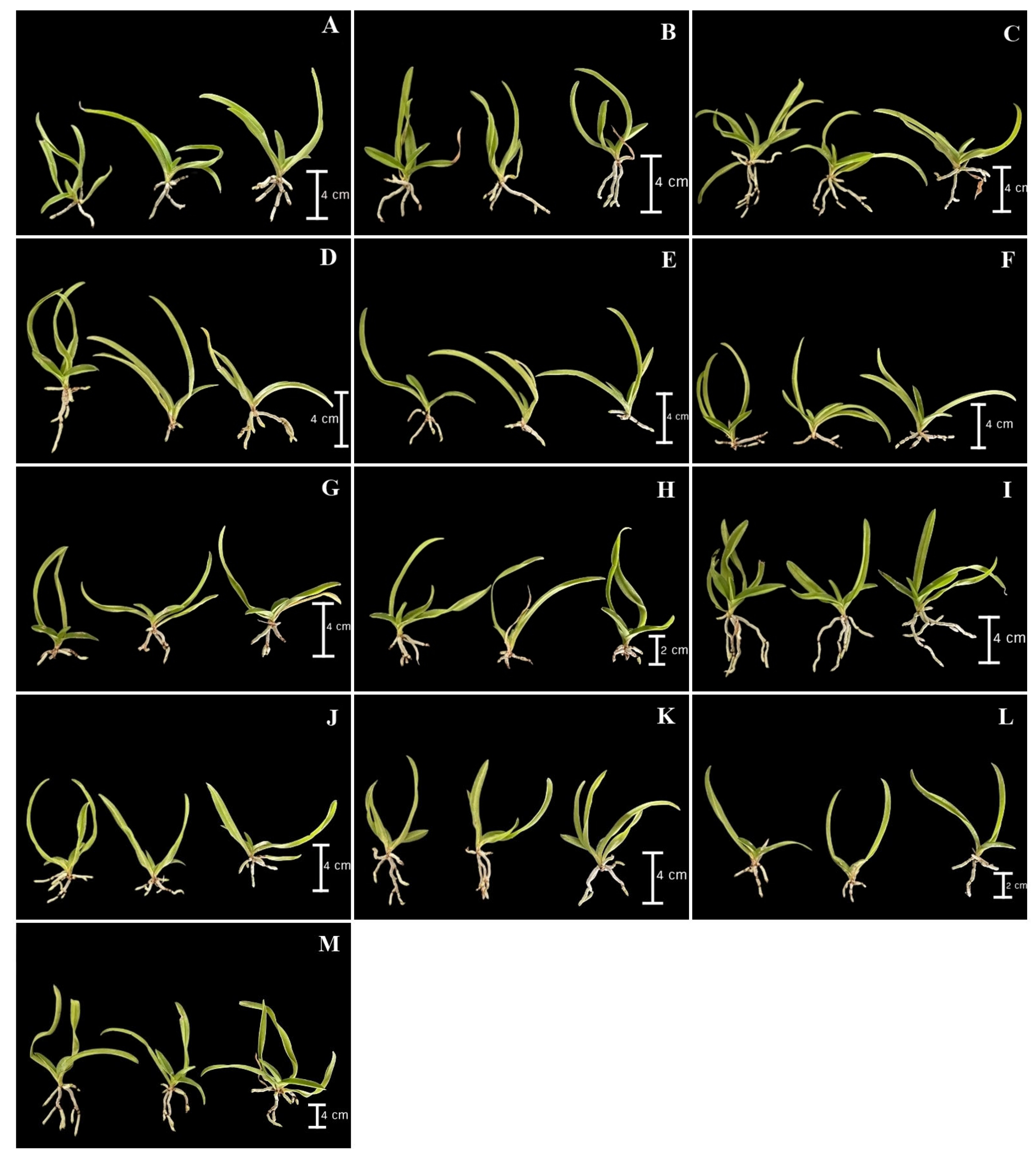
3.3.1. Plant Growth
3.3.2. Total Nitrogen Concentration (mg g−1 DW)
4. Discussions
- (a)
- Phylogenetic Identification and Functional Significance of Endophytic Isolates from Vanda ‘Pachara Delight’
- (b)
- Optimizing Inoculum Density for Effective Endophytic Colonization in Vanda ‘Pachara Delight’ In Vitro
- (c)
- Optimal Inoculum Density: Balancing Vegetative Development and Efficient Nitrogen Uptake in Vanda Under Greenhouse Conditions
5. Conclusions
Author Contributions
Funding
Data Availability Statement
Acknowledgments
Conflicts of Interest
References
- Zion Market Research. Orchid Market Size, Share, Trends, Analysis, Growth 2032. Available online: https://www.zionmarketresearch.com/report/orchid-market (accessed on 12 September 2025).
- Royal Horticultural Society. Vandarothschildiana. Available online: https://www.rhs.org.uk/plants/119675/Vanda-rothschildiana/details (accessed on 9 September 2025).
- Grove, D.L. Vandas and Ascocendas and Their Combinations with Other Genera; Timber Press: Portland, OR, USA, 1995; p. 241. [Google Scholar]
- Hossain, M. Orchid mycorrhiza: Isolation, culture, characterization and application. S. Afr. J. Bot. 2022, 151, 365–384. [Google Scholar] [CrossRef] [Scilit]
- Li, T.; Wu, S.; Yang, W.; Selosse, M.; Gao, J. How Mycorrhizal Associations Influence Orchid Distribution and Population Dynamics. Front. Plant Sci. 2021, 12, 647114. [Google Scholar] [CrossRef] [Scilit] [PubMed]
- Saikia, J.; Thakur, D. A review on endophytic bacteria of orchids: Functional roles toward synthesis of bioactive metabolites for plant growth promotion and disease biocontrol. Planta 2024, 260, 103. [Google Scholar] [CrossRef] [Scilit] [PubMed]
- Herrera, H.; Fuentes-Quiroz, A.; Soto, J.; Valadares, R.; Arriagada, C. Orchid-associated bacteria and their plant growth promotion capabilities. In Orchid Phytochemistry, Biology and Horticulture; Merillon, J.M., Kodja, H., Eds.; Springer: Cham, Switzerland, 2022; pp. 1–25. [Google Scholar]
- Chand, K.; Shah, S.; Pant, B. Growth Promoting Effect of Endophytic Bacteria Bacillus subtilis From Leaves of Vanda cristata and Its Potential Impact on In vitro Growth of Orchid. J. Nepal Biotechnol. Assoc. 2023, 4, 8–16. [Google Scholar] [CrossRef] [Scilit]
- Gontijo, J.B.; Andrade, G.V.S.; Baldotto, M.A.; Baldotto, L.E.B. Bioprospecting and selection of growth-promoting bacteria for Cymbidium sp. orchids. Sci. Agric. 2018, 75, 368–374. [Google Scholar] [CrossRef] [Scilit]
- Inkaewpuangkham, W.; Panjama, K.; Inkham, C.; Chromkaew, Y.; Ruamrungsri, S. Isolation and selection potential N-fixing of endophytic bacteria in Vanda orchid. In Proceedings of the 14th Research Administration Network Conference 2021, Bangkok, Thailand, 5–6 August 2021; pp. 87–95. [Google Scholar]
- Vacin, E.; Went, F.W. Some pH changes in nutrient solutions. Bot. Gaz. 1949, 110, 605–613. [Google Scholar] [CrossRef] [Scilit]
- Ohyama, T.; Ito, M.; Kobayashi, K.; Araki, S.; Yasuyoshi, S.; Sasaki, O.; Yamazaki, T.; Soyama, K.; Tanemura, R.; Mizuno, Y.; et al. Analytical procedures of N, P, K contents in plant and manure materials using H2SO4-H2O2 Kjeldahl digestion method. Bull. Fac. Agric. Niigata Univ. 1991, 43, 111–120. [Google Scholar]
- Inkaewpuangkham, W.; Panjama, K.; Inkham, C.; Chromkaew, Y.; Ruamrungsri, S. Assessment of IAA synthesis by endophytic bacteria in Vanda (Orchidaceae). In Proceedings of the 9th International Scientific and Practical Conference on Biotechnology, Bangkok, Thailand, 12–13 July 2021; pp. 331–338. [Google Scholar]
- Hung, S.W.; Chiu, M.; Huang, C.; Kuo, C. Complete genome sequence of Curtobacterium sp. C1, a beneficial endophyte with the potential for in-plant salinity stress alleviation. Mol. Plant. Microbe. Interact. 2022, 35, 731–735. [Google Scholar] [CrossRef] [Scilit] [PubMed]
- Kabir, M.H.; Unban, K.; Kodchasee, P.; Govindarajan, R.K.; Lumyong, S.; Suwannarach, N.; Wongputtisin, P.; Shetty, K.; Khanongnuch, C. Endophytic bacteria isolated from tea leaves (Camellia sinensis var. assamica) enhanced plant-growth-promoting activity. Agriculture 2023, 13, 533. [Google Scholar] [CrossRef] [Scilit]
- Ulrich, K.; Kube, M.; Becker, R.; Schneck, V.; Ulrich, A. Genomic analysis of the endophytic Stenotrophomonas strain 169 reveals features related to plant-growth promotion and stress tolerance. Front. Microbiol. 2021, 12, 630743. [Google Scholar] [CrossRef] [Scilit] [PubMed]
- Adeleke, B.S.; Ayangbenro, A.S.; Babalola, O.O. Effect of endophytic bacterium, Stenotrophomonas maltophilia JVB5 on sunflowers. Plant. Prot. Sci. 2022, 58, 185–198. [Google Scholar] [CrossRef] [Scilit]
- Alibrandi, P.; Monaco, N.L.; Calevo, J.; Voyron, S.; Puglia, A.M.; Cardinale, M.; Perotto, S. Plant growth promoting potential of bacterial endophytes from three terrestrial Mediterranean orchid species. Plant Biosyst. 2021, 155, 1153–1164. [Google Scholar] [CrossRef] [Scilit]
- Khan, A.; Singh, A.V.; Gautam, S.S.; Agarwal, A.; Punetha, A.; Upadhayay, V.K.; Kukreti, B.; Bundela, V.; Jugran, A.K.; Goel, R. Microbial bioformulation: A microbial assisted biostimulating fertilization technique for sustainable agriculture. Front. Plant Sci. 2023, 14, 1270039. [Google Scholar] [CrossRef] [Scilit] [PubMed]
- Oliveira, A.L.M.; Urquiaga, S.; Döbereiner, J.; Baldani, J.I. The effect of inoculating endophytic N2-fixing bacteria on micropropagated sugarcane plants. Plant Soil. 2002, 242, 205–215. [Google Scholar] [CrossRef] [Scilit]
- Shah, S.; Chand, K.; Rekadwad, B.; Shouche, Y.S.; Pant, B. A prospectus of plant growth promoting endophytic bacterium from orchid (Vanda cristata). BMC Biotechnol. 2021, 21, 7. [Google Scholar] [CrossRef] [Scilit] [PubMed]
- Faria, D.C.; Dias, A.C.; Melo, I.S.; de Carvalho Costa, F.E. Endophytic bacteria isolated from orchid and their potential to promote plant growth. World J. Microbiol. Biotechnol. 2013, 29, 217–221. [Google Scholar] [CrossRef] [Scilit] [PubMed]
- Azarbad, H.; Junker, R.R. Biological and experimental factors that define the effectiveness of microbial inoculation on plant traits: A meta-analysis. ISME Commun. 2024, 4, ycae122. [Google Scholar] [CrossRef] [Scilit] [PubMed]
- Vuolo, F.; Novello, G.; Bona, E.; Gorrasi, S.; Gamalero, E. Impact of plant-beneficial bacterial inocula on the resident bacteriome: Current knowledge and future perspectives. Microorganisms 2022, 10, 2462. [Google Scholar] [CrossRef] [Scilit] [PubMed]
- Jarrell, W.M.; Beverly, R.B. The dilution effect in plant nutrition studies. Adv. Agron. 1981, 34, 197–224. [Google Scholar]
- Riedell, W.E. Mineral-nutrient synergism and dilution responses to nitrogen fertilizer in field-grown maize. J. Plant Nutr. Soil Sci. 2010, 173, 869–874. [Google Scholar] [CrossRef] [Scilit]



| Factors | Nitrogen Content (mg g−1 Dry Weight) | |
|---|---|---|
| Isolates | Ratios | In Vitro |
| 2R13 | 1:1 | 9.98 ± 0.13 b |
| 1:10 | 7.94 ± 0.28 cd | |
| 1:25 | 9.32 ± 0.62 bc | |
| 1:50 | 8.18 ± 0.52 cd | |
| 3S19 | 1:1 | 7.92 ± 0.12 cd |
| 1:10 | 7.80 ± 0.32 de | |
| 1:25 | 12.46 ± 0.91 a | |
| 1:50 | 6.38 ± 0.12 e | |
| 3R14 | 1:1 | 8.23 ± 0.63 cd |
| 1:10 | 8.15 ± 0.71 cd | |
| 1:25 | 10.12 ± 0.50 b | |
| 1:50 | 8.23 ± 0.73 cd | |
| Deionized water (Control) | 7.62 ± 0.15 de | |
| isolates | ns | |
| ratios | * | |
| isolates × ratios | * | |
| LSD0.05 | 1.47 | |
| %CV | 11.89 | |
| Factors | Number of Leaves | Plant Height (cm) | Number of Roots | Root Length (cm) | |
|---|---|---|---|---|---|
| Isolates | Ratios | ||||
| 2R13 | 1:1 | 5.4 ± 0.23 cd | 9.5 ± 0.23 a | 5.2 ± 0.31 cd | 2.6 ± 0.34 fg |
| 1:10 | 5.8 ± 0.17 bc | 9.0 ± 0.24 abc | 4.9 ± 0.21 de | 4.0 ± 0.16 bc | |
| 1:25 | 6.4 ±0.12 a | 9.2 ± 0.12 abc | 6.1 ±0.07 a | 4.5 ± 0.11 ab | |
| 1:50 | 5.0 ± 0.14 d | 9.4 ± 0.17 ab | 5.0 ± 0.19 cde | 2.8 ± 0.29 efg | |
| 3S19 | 1:1 | 5.8 ± 0.14 c | 8.9 ± 0.20 bc | 5.4 ±0.13 bcd | 4.7 ± 0.26 a |
| 1:10 | 5.4± 0.27 cd | 9.2 ± 0.27 abc | 5.9 ± 0.24 ab | 2.9 ± 0.30 ef | |
| 1:25 | 6.3 ± 0.12ab | 8.6 ± 0.15 cd | 5.6 ± 0.13 abc | 4.0 ± 0.14 bc | |
| 1:50 | 4.3 ± 0.19 e | 8.2 ± 0.16 d | 3.9 ± 0.27 f | 1.6 ± 0.18 h | |
| 3R14 | 1:1 | 5.6 ± 0.13 c | 9.5 ± 0.23 a | 5.1 ± 0.15 cd | 3.3 ± 0.16 de |
| 1:10 | 5.8 ± 0.26 bc | 9.4± 0.19 ab | 4.5 ± 0.42ef | 2.2 ± 0.21 g | |
| 1:25 | 6.6 ± 0.13 a | 8.7 ± 0.20 cd | 5.9 ± 0.20 ab | 3.2 ± 0.13 def | |
| 1:50 | 6.3 ± 0.16 ab | 9.1± 0.25 abc | 4.9 ± 0.28cde | 2.6 ± 0.18 fg | |
| Deionized water (Control) | 5.7± 0.17 c | 8.7± 0.12 cd | 5.4 ± 0.15bcd | 3.7 ± 0.15 cd | |
| Isolates | * | * | ns | * | |
| Ratios | * | * | * | * | |
| isolates × ratios | * | * | * | * | |
| LSD0.05 | 0.50 | 0.56 | 0.64 | 0.59 | |
| %CV | 12.15 | 8.59 | 17.04 | 25.44 | |
| Factors | Nitrogen Content (mg g−1 Dry Weight) | |
|---|---|---|
| Isolates | Ratios | Greenhouse Conditions |
| 2R13 | 1:1 | 8.62 ± 0.23 bcd |
| 1:10 | 8.48 ± 0.11 cde | |
| 1:25 | 7.49 ± 0.18 ef | |
| 1:50 | 11.18 ± 0.42 a | |
| 3S19 | 1:1 | 8.22 ± 0.17 cdef |
| 1:10 | 9.62 ± 0.66 b | |
| 1:25 | 7.32 ± 0.26 f | |
| 1:50 | 10.83 ± 0.66 a | |
| 3R14 | 1:1 | 9.18 ± 0.43 bc |
| 1:10 | 7.78 ± 0.38 def | |
| 1:25 | 8.27 ± 0.35 cdef | |
| 1:50 | 8.61 ± 0.28 bcd | |
| Deionized water (Control) | 7.31 ± 0.21 f | |
| isolates | ns | |
| ratios | * | |
| isolates × ratios | * | |
| LSD0.05 | 1.07 | |
| %CV | 8.65 | |
Disclaimer/Publisher’s Note: The statements, opinions and data contained in all publications are solely those of the individual author(s) and contributor(s) and not of MDPI and/or the editor(s). MDPI and/or the editor(s) disclaim responsibility for any injury to people or property resulting from any ideas, methods, instructions or products referred to in the content. |
© 2026 by the authors. Licensee MDPI, Basel, Switzerland. This article is an open access article distributed under the terms and conditions of the Creative Commons Attribution (CC BY) license.
Share and Cite
Panjama, K.; Inkaewpuangkham, W.; Chromkaew, Y.; Inkham, C.; Ruamrungsri, S. Characterization and Application of Endophytic Bacteria for Enhancing Nitrogen Uptake in Vanda Orchids. Horticulturae 2026, 12, 141. https://doi.org/10.3390/horticulturae12020141
Panjama K, Inkaewpuangkham W, Chromkaew Y, Inkham C, Ruamrungsri S. Characterization and Application of Endophytic Bacteria for Enhancing Nitrogen Uptake in Vanda Orchids. Horticulturae. 2026; 12(2):141. https://doi.org/10.3390/horticulturae12020141
Chicago/Turabian StylePanjama, Kanokwan, Wanwisa Inkaewpuangkham, Yupa Chromkaew, Chaiartid Inkham, and Soraya Ruamrungsri. 2026. "Characterization and Application of Endophytic Bacteria for Enhancing Nitrogen Uptake in Vanda Orchids" Horticulturae 12, no. 2: 141. https://doi.org/10.3390/horticulturae12020141
APA StylePanjama, K., Inkaewpuangkham, W., Chromkaew, Y., Inkham, C., & Ruamrungsri, S. (2026). Characterization and Application of Endophytic Bacteria for Enhancing Nitrogen Uptake in Vanda Orchids. Horticulturae, 12(2), 141. https://doi.org/10.3390/horticulturae12020141