

Article

Mapping of Cadmium Tolerance-Related QTLs at the Seedling Stage in Diploid Potato Using a High-Density Genetic Map

1
State Environmental Protection Key Laboratory of Soil Environmental Management and Pollution Control, Nanjing Institute of Environmental Sciences, Ministry of Ecology and Environment, Nanjing 210042, China
2
Jiangxi Key Laboratory of Environmental Pollution Control, Jiangxi Academy of Eco-Environmental Sciences and Planning, Nanchang 330039, China
3
Yunnan Key Laboratory of Potato Biology, Yunnan Normal University, Kunming 650500, China
4
College of Agriculture, Jiangxi Agricultural University, Nanchang 330000, China
*
Authors to whom correspondence should be addressed.
These authors contributed equally to this work.
Horticulturae 2025, 11(12), 1478; https://doi.org/10.3390/horticulturae11121478
Submission received: 28 October 2025 / Revised: 29 November 2025 / Accepted: 3 December 2025 / Published: 7 December 2025
(This article belongs to the Section Biotic and Abiotic Stress)

Abstract

Potato is globally recognized as the fourth most crucial staple food crop, trailing behind wheat, rice, and maize. Cadmium (Cd), a predominant heavy-metal pollutant in agricultural soils, demonstrates high biological toxicity and mobility. Therefore, exploring the genetic and molecular mechanisms underpinning cadmium tolerance in potato is of substantial theoretical and practical significance. In this research, an F2 population composed of 170 families was established through the cross-breeding of homozygous diploid potato lines HD-5 (highly cadmium-tolerant) and M9 (cadmium-sensitive). Employing hydroponic cultivation, six traits, namely plant height (PH), root length (RL), shoot fresh weight (SFW), root fresh weight (RFW), chlorophyll content (SPAD), and nitrogen content (LNC), were measured in potato seedlings following a 9-day treatment with 40 mg·L−1 CdCl2. By utilizing the high-density genetic map of this population for QTL mapping, a total of 35 genetic loci associated with cadmium tolerance in potato seedlings were identified. Notably, loci21 and loci22 on chromosome 9, loci29 on chromosome 10, and loci31 and loci33 on chromosome 12 were consistently detected across multiple environmental conditions. This reproducibility across environments suggests the phenotypic stability of these five loci, which are thus considered reliable and robust genetic determinants. In addition, transcriptome sequencing analysis of roots from parental lines HD-5 and M9 after cadmium treatment revealed that significantly differentially expressed genes between the two parents were associated with glutathione metabolism and photosynthesis. By integrating QTL mapping, transcriptome analysis, and gene annotation, we screened four candidate genes involved in cadmium tolerance regulation: DM8C09G01000 (GST), DM8C09G01060 (GST), DM8C09G02130 (OXP1), and DM8C06G22960 (PsaH). These findings provide molecular targets and a genetic basis for molecular breeding of cadmium-tolerant potato varieties.

1. Introduction

Potato (Solanum tuberosum L.) is the fourth most important staple food crop worldwide, with a global annual production exceeding 383 million metric tons and a cultivation area of approximately 16.8 million hectares in 2023 (FAO database). Thus, the healthy development of the potato industry is vitally important for global food security. Cadmium (Cd) is a non-essential heavy metal element for plant growth and development, with strong biological toxicity and mobility [1]. Cadmium enters terrestrial ecosystems predominantly through anthropogenic activities, including mining operations, the application of phosphate fertilizers and soil amendments, discharge of sewage sludge, and coal combustion in power generation facilities [2,3]. Due to its relatively high mobility in soil, cadmium is readily taken up by plants, leading to contamination of the food chain and posing significant toxicological threats to both plant and animal species [4,5,6]. When cadmium concentrations in plants exceed critical thresholds, a range of phytotoxic effects are observed, such as diminished antioxidant enzyme activity, increased cell membrane permeability, and structural cellular damage. These physiological impairments disrupt essential processes including photosynthesis, respiration, transpiration, enzymatic function, cell division, and membrane integrity, ultimately resulting in growth suppression or plant death [7,8]. In addition to altering plant physiology and biochemical pathways, cadmium contamination also reduces agricultural productivity and compromises crop quality. Through bioaccumulation along the food chain, cadmium presents serious health risks to humans, with well-documented associations to various adverse health outcomes, including carcinogenesis, renal tubular dysfunction, skeletal fractures, and osteomalacia [9,10]. The National Soil Pollution Survey Report released in 2014 indicated that the over-standard rate of cultivated soil sites in China was as high as 16.1%, with Cd contamination exceeding the standard at 7.0% of sites, ranking it among the primary heavy metal pollutants [11].
Nevertheless, research regarding the molecular mechanisms underpinning cadmium tolerance in potato remains comparatively scarce. Cadmium exerts a negative impact on plant growth, with characteristic toxic manifestations encompassing reduced root length and diameter, browning of root tips, leaf chlorosis, stunted plant height, and decreased biomass [12,13,14,15]. For example, Hassan (2016) revealed through pot experiments that cadmium stress (60 mg·kg−1) significantly inhibited the lengths and dry weights of shoots and roots in potato seedlings [16]. Under hydroponic conditions, Huang (2015) reported that exposure to 10 μM cadmium led to substantial reductions in root length and root surface area among three pepper cultivars, accompanied by notable shortening of root tips [17]. Dinakar (2009) observed cadmium toxicity symptoms in peanut seedlings subsequent to cadmium chloride treatment, such as growth retardation, leaf discoloration, and root blackening [18]. Guilherme (2015) discovered that when the cadmium concentration exceeded 0.03 mmol·L−1, the germination rate of wheat seeds declined by 31%, and at 0.06 mmol·L−1, the lengths of shoots and roots were reduced by 18.5% and 15.6%, respectively [19].
In photosynthetic organs, cadmium (Cd2+) adversely affects plant growth by replacing magnesium ions (Mg2+) due to their similar ionic radii, directly impeding chlorophyll biosynthesis and accelerating its degradation, thereby inducing leaf chlorosis [20]. For instance, Hédiji et al. (2010) reported that 90-day-old tomato leaves exposed to 100 mM Cd exhibited reduced contents of chlorophyll and carotenoids [21]. Concurrently, Cd stress significantly reduces the maximum photochemical efficiency of photosystem II (PSII) and net CO2 assimilation rate in plants, while inhibiting the activity of ribulose-1,5-bisphosphate carboxylase (RuBisCO). These effects lead to decreased stomatal conductance, disruption of chloroplast structure, and chlorophyll degradation, thereby impairing plant growth and development [22]. Under normal conditions, the production and scavenging of reactive oxygen species (ROS) in plants maintain a dynamic equilibrium [23]. However, Cd stress triggers an overproduction of ROS, disrupting this metabolic balance. Cd stress triggers a reactive oxygen species (ROS) burst in plants, leading to the excessive accumulation of ROS such as superoxide anion (O2), hydrogen peroxide (H2O2), and hydroxyl radical (-OH). This accumulation disrupts the structure of biologically active macromolecules (e.g., DNA and proteins) and adversely affects plant metabolic and physiological functions [24]. The most specific and efficient detoxification strategy in plants is the synthesis of phytochelatins (PCs). Under cadmium stimulation, phytochelatin synthase (PCS) utilizes reduced glutathione (GSH) as a substrate to synthesize thiol-rich PC polypeptides. These PCs efficiently chelate with cadmium ions (Cd2+), forming low-toxicity PC-Cd complexes [25,26,27]. Subsequently, these complexes are sequestered into vacuoles via the assistance of ABC transporters, enabling compartmentalized storage of toxic ions. This process represents a critical molecular basis for plant tolerance to Cd [28].
The tolerance of plants to cadmium (Cd) stress is coordinately regulated by a multi-level gene network, and a multitude of key genes directly governing plant Cd tolerance have been identified. At the transcriptional regulation level, diverse transcription factors assume pivotal functions. For example, in Arabidopsis thaliana, the R2R3-subfamily transcription factor MYB4 positively responds to Cd stress through enhancing the coordinated activity of the antioxidant defense system and up-regulating the expression of genes PCS1 and MT1C. Members of the WRKY family augment tolerance by modulating the expression of downstream transporters (e.g., AtPDR8, TaHMA3). Under Cd stress conditions, the expression of AtWRKY12 is repressed, whereas that of AtWRKY13 is increased. The latter up-regulates the expression of the AtPDR8 gene (Arabidopsis thaliana pleiotropic drug resistance 8), thereby enhancing Arabidopsis’ tolerance to Cd [29,30]. At the functional execution level, the target genes regulated by these transcription factors are directly accountable for Cd transport and detoxification. Metal transporters (e.g., SpHMA3 in Sedum plumbizincicola, AtPDR8 in Arabidopsis) mitigate cytoplasmic toxicity by sequestering Cd into vacuoles or effluxing it [31]. Chelation-related genes (e.g., TaNramp1, TaNramp5, TaIRT2, TaHMA2, TaHMA3, and TaLCT1) encode proteins that synthesize phytochelatins or metallothioneins, forming low-toxicity complexes with Cd [32]. Moreover, signal transduction and post-transcriptional regulation are essential. For instance, in rice, miR390 serves as a negative regulator, and its overexpression diminishes plant Cd tolerance [33]. Although a large number of genes involved in regulating plant Cd tolerance have been discovered, the molecular genetic network underlying plant Cd tolerance is intricate, and its intrinsic mechanisms remain incompletely understood. Therefore, it is imperative to further explore additional Cd tolerance genes.
Compared with other crops, research on cadmium (Cd) tolerance and Cd accumulation in potato (Solanum tuberosum L.) remains relatively scarce. Mengist (2018) constructed an F1 mapping population consisting of 188 diploid potato families and, using genetic mapping, localized quantitative trait loci (QTLs) associated with tuber Cd content to chromosomes 3, 5, 6, and 7, with contribution rates ranging from 5% to 33% [34]. Additionally, Ye et al. (2020) identified three candidate genes (StHMA3E1, StHMA8, and StWRKY29) potentially involved in regulating tuber Cd accumulation through homologous cloning and gene family analysis [1]. However, studies specifically investigating the genetic mechanisms underlying Cd tolerance in potato are still lacking.
Forward genetic approaches employed for the genetic mapping of target traits represent effective strategies for the exploration of candidate genes. Nevertheless, the cultivated potato (Solanum tuberosum L.) predominantly exhibits an autotetraploid nature with a highly heterozygous genome, which results in intricate progeny segregation patterns. As a consequence, the majority of genetic investigations regarding crucial potato traits have been carried out utilizing diploid materials [32]. However, the vast majority of diploid potatoes exhibit self-incompatibility and inbreeding depression, making it difficult to develop genome-homozygous inbred lines through multiple generations of selfing, even the production of F2 mapping populations, which require only one generation of F1 selfing, remains challenging. Consequently, the populations constructed for genetic mapping of most traits are often suboptimal with complex genetic backgrounds, hindering the dissection of polygenic traits into individual Mendelian factors and their localization to specific chromosomal loci, thereby severely limiting the precision and efficiency of genetic mapping. This study employed self-compatible, highly homozygous diploid potato lines (HD-5, M9) to develop an F2 population for quantitative trait locus (QTL) mapping of cadmium tolerance, effectively circumventing the genetic complexities associated with tetraploid inheritance, including selfing barriers and high heterozygosity in cultivated potatoes. This strategy establishes a solid foundation in genetic, statistical, and experimental design, enabling the precise identification and localization of cadmium tolerance QTLs. The strategy is as follows: (1) Genotype fixation and phenotypic reproducibility: Highly homozygous diploid lines maintain stable and identical genetic compositions across successive generations, thereby ensuring that phenotypic observations are not confounded by segregating genotypes. This genetic stability allows for consistent and reliable phenotypic evaluations across diverse environments or repeated experimental trials, effectively minimizing environmental noise and measurement variability [35]. (2) Simplified genetic architecture: Tetraploid potatoes inherit through tetrasomic segregation patterns, which involve complex allelic dosage effects and require specialized statistical models for QTL analysis—factors that collectively reduce analytical power and increase computational complexity. In contrast, diploid populations follow classical Mendelian biallelic segregation ratios (1:2:1), enabling more straightforward, accurate, and computationally efficient construction of genetic linkage maps and subsequent QTL mapping [36,37]. (3) Leveraging historical recombination for high-resolution mapping: The selfing process in homozygous diploid lines leads to the accumulation of a substantial number of historical recombination events over successive generations. An F2 population derived from such lines can capture these accumulated recombinations through a single cross, thereby enabling the localization of quantitative trait loci (QTLs) within narrower genomic intervals. In comparison to heterozygous diploid crosses, which generate only limited novel recombinations, this approach offers significantly enhanced mapping resolution [35]. (4) Facilitating the development of downstream genetic resources: Homozygous diploid lines can be further advanced into recombinant inbred lines (RILs), near-isogenic lines (NILs), or introgression lines—genetic resources that are particularly valuable for subsequent applications such as gene cloning, functional validation, and marker-assisted selection (MAS) [38]. (5) Overcoming self-incompatibility (SI) barriers: Conventional diploid potatoes are hindered in the production of homozygous lines due to the presence of self-incompatibility mechanisms. However, engineered lines such as HD5 and M9 have achieved self-compatibility through the introduction of dominant self-compatibility genes (e.g., Sli), enabling successive selfing and the generation of highly homozygous progeny, thereby overcoming longstanding technical limitations [36]. (6) Simplifying statistical models and enhancing detection power: In diploid F2 populations, alleles exhibit clear dosage states (0, 1, and 2), which are compatible with well-established and statistically robust QTL mapping approaches—including single-marker analysis, interval mapping, and composite interval mapping. This avoids analytical complications such as “ghost QTLs” or inaccurate dosage inference commonly observed in tetraploid systems [35]. (7) Increased genome coverage efficiency: Given that the diploid genome is approximately half the size of the tetraploid genome, high-density SNP markers or whole-genome resequencing achieve greater genomic coverage per unit sequencing depth. This enables more comprehensive genotype resolution under equivalent sequencing conditions, thereby improving the sensitivity and reliability of QTL detection [39].
In the present study, a segregating population consisting of 170 F2 progeny, which were derived from a cross between the homozygous diploid potato lines HD-5 (characterized by strong cadmium tolerance) and M9 (exhibiting cadmium sensitivity), was employed. Potato seedlings at the 30-day growth stage were subjected to hydroponic cultivation and exposed to a 40 mg·L−1 cadmium solution for 9 days. Subsequently, phenotypic data were collected for six crucial traits: chlorophyll content (SPAD), leaf nitrogen content (LNC), plant height (PH), root length (RL), shoot fresh weight (SFW), and root fresh weight (RFW). A high-density genetic map of the target population was utilized to conduct QTL mapping for these six traits, with the aim of identifying the genetic loci associated with cadmium tolerance in potato seedlings. Subsequently, transcriptome sequencing was carried out on the root systems of the parental lines (HD-5 and M9) after cadmium treatment. Through differential expression gene (DEG) analysis, functional enrichment (KEGG/GO) analyses, and gene annotation screening, four candidate genes conferring cadmium tolerance were identified. Notably, key glutathione metabolism enzyme genes and the PsaH gene were found to potentially regulate cadmium stress tolerance by coordinately modulating antioxidant defense mechanisms and photosynthetic efficiency. The glutathione metabolic pathway was significantly enriched in cadmium-tolerant potato genotypes. Three candidate genes—encoding oxoprolinase (OXP, DM8C09G02130) and glutathione S-transferase (GST, DM8C09G01000, DM8C09G01060)—displayed markedly upregulated expression in the Cd-tolerant genotype HD-5. OXP participates in the glutathione cycle to maintain intracellular GSH homeostasis, while GST enhances the reactive oxygen species scavenging capacity through its detoxification and antioxidant functions, thereby alleviating cadmium-induced oxidative damage. Furthermore, a gene encoding a photosystem I subunit, PsaH (DM8C06G22960), was identified within the stable QTL region. Its elevated expression in M9 may contribute to maintaining photosystem stability and electron transport efficiency, thereby mitigating cadmium-induced inhibition of the photosynthetic apparatus. The candidate genes identified in this study offer precise molecular targets for breeding Cd-tolerant potato cultivars, with the four selected candidates serving as clear objectives for subsequent gene cloning and functional validation. Once their functions are confirmed, these genes may serve as key targets for developing novel potato varieties with high cadmium tolerance and low cadmium accumulation. Based on the sequence variations in these candidate genes, closely linked functional markers can be developed. These markers are applicable to marker-assisted selection (MAS), enabling the rapid and efficient screening of large-scale germplasm resources or progeny populations at the early breeding stages. This facilitates the precise identification of individuals carrying favorable alleles, thereby significantly shortening the breeding cycles and enhancing breeding efficiency. Moreover, this study reveals distinct stress response mechanisms that may exist between sensitive and tolerant varieties, providing insights for the formulation of cadmium-tolerant breeding strategies in potato. For example, it can not only enhance the expression of tolerance-related genes but also optimize the efficiency of stress response mechanisms, thereby avoiding the energy-intensive hyper-response commonly observed in sensitive cultivars. Breeders may consider pyramiding superior alleles associated with diverse response strategies to develop varieties with enhanced comprehensive resistance. By integrating HD-5’s highly efficient cadmium exclusion mechanism with M9”s high-activity root detoxification system, for instance, synergistic super-cadmium-tolerant varieties could be developed, enabling stable and high-quality production in cadmium-contaminated soils.

2. Materials and Methods

2.1. Plant Materials and Cadmium Treatment Conditions

HD-5 and M9 are naturally self-compatible homozygous mutants of Solanum chacoense L., preserved and provided by the Potato Science Research Institute of Yunnan Normal University. HD-5 was used as the female parent and M9 as the male parent to generate F1 progeny, which was subsequently selfed to produce an F2 segregating population consisting of 170 families. This F2 population served as the experimental material in this study.
Virus-free tissue culture seedlings of the parental lines (HD-5 and M9) and the 170 F2 families were aseptically cultured on Murashige and Skoog (MS) medium. The cultures were maintained in a sterile growth room at 25 ± 2 °C with 60–70% relative humidity and a 16 h light/8 h dark photoperiod for 15 days. Uniformly growing seedlings were selected and transferred to hydroponic tanks, where they were cultured in 10 mL·L−1 Hoagland’s nutrient solution for 15 days. Subsequently, the seedlings were transferred to sterile distilled water containing the specified cadmium (CdCl2,Shanghai Aladdin Bio-Chem Technology Co., Ltd., Shanghai, China) concentration for treatment. After 9 days, relevant phenotypes were measured, with 6 plants per family. Three independent experiments (E1–E3) were performed.
Specifically, to maintain the pH and electrical conductivity (EC) of the nutrient solution within the optimal range of 5.5–6.5, a pH meter was employed for real-time monitoring. When the pH fell below the target range, a small volume of 1 M NaOH was added; conversely, when the pH exceeded the desired range, 1 M HCl (Shanghai Aladdin Bio-Chem Technology Co., Ltd., Shanghai, China ) was applied. Measurements were performed at 12-h intervals, and adjustments were made as needed to ensure solution stability. Concurrently, the electrical conductivity (EC) of the nutrient solution was monitored using an EC meter. When the EC value fell below the optimal range, nutrient salts (KNO3, Ca(NO3)2 ,Wentong Potash Group Co., Shanghai, China) were supplemented; conversely, when the EC exceeded the desired range, deionized water was added to achieve dilution and maintain electrical conductivity within the range of 1.5–2.0 mS cm−1. Aeration (oxygen supply) plays a critical role in ion exchange, root respiration, and the bioavailability of Cd2+. Therefore, each nutrient solution tank (5 L capacity) was equipped with a 1 W mini air pump connected to a 2 cm diameter air stone to maintain continuous micro-bubbling at approximately 0.5 L min−1, ensuring that the dissolved oxygen (DO) concentration in the solution remained at or above 6 mg L−1. The entire nutrient solution was replaced every three days to prevent precipitate formation or reduced interaction between Cd2+ and root exudates. During solution replacement, the root system was gently rinsed with deionized water, including light tapping, before being re-immersed in freshly prepared nutrient solution.

2.2. Phenotypic Identification of Potato Seedlings

To determine the optimal Cd treatment concentration, five CdCl2 concentration gradients were set up: 0 mg·L−1 (control), 10 mg·L−1, 20 mg·L−1, 30 mg·L−1, and 40 mg·L−1. These were administered to the two parental lines. Specifically, to maintain the pH and conductivity (EC) of the nutrient solution stable within the range of 5.5 to 6.5, we use a pH meter for real-time monitoring. If the pH is too low, a small amount of 1 M NaOH is added; if it is too high, 1 M HCl is added. Re-measurement is conducted every 12 h, and adjustments are made as necessary. Simultaneously, we monitor the conductivity (EC) of the nutrient solution using an EC meter. If the conductivity is too low, nutrient salts (KNO3, Ca(NO3)2) are supplemented; if it is too high, deionized water is added for dilution, to maintain the conductivity within the range of 1.5 to 2.0 mS cm−1. Aeration (oxygen supply) is crucial for ion exchange, root respiration, and the available forms of Cd2+. Therefore, we install a 1 W small air pump in each nutrient solution tank (5 L capacity), paired with a 2 cm diameter air stone, to continuously generate microbubbles (≈0.5 L min−1) to maintain dissolved oxygen (DO) in the solution at ≥6 mg L−1. The entire nutrient solution is replaced every 3 days to prevent Cd2+ from forming precipitates or reducing its activity due to root exudates. Before replacement, the roots are rinsed (patted with deionized water) and then re-placed in the newly prepared solution. Nine days after Cd treatment, SPAD and LNC values of potato seedlings were measured using a Tuopuyunnong TYS-4N Plant Nutrient Analyzer(Zhejiang Topu Yunong Technology Co., Ltd., Zhejiang, China). Seedling plant height and root length were measured with a ruler (in cm), while shoot fresh weight and root fresh weight were weighed using an analytical balance with 0.001 g precision. All phenotypic data were compiled and organized using Microsoft Excel 2021, and statistical analyses for comparative evaluation were performed using IBM SPSS Statistics (Version 29.0.1.0).

2.3. QTL Mapping Analysis

Whole-genome sequencing (WGS) was employed for genotyping the 170 F2 families. Using DM8.1 as the reference genome, a high-density linkage map containing 4826 Bin markers with a total genetic distance of 1075.693 cM was constructed (unpublished data). Additive QTLs were mapped using QTL IciMapping v4.2 software, incorporating the six phenotypic traits identified, via the inclusive composite interval mapping for additive effects (ICIM-ADD) with a logarithm of odds (LOD) threshold set at 2.5.

2.4. Transcriptome Sequencing and Gene Enrichment Analysis

Root samples of parental lines HD-5 and M9 were collected after 9 days of Cd treatment, with three biological replicates per genotype. Samples were immediately flash-frozen in liquid nitrogen and stored at −80 °C. Total RNA was extracted using the Plant RNA Extraction Kit (Tiangen Biotech (Beijing) Co., Ltd., Beijing, China). Library construction and sequencing were performed by Gene Denovo Biotechnology (Guangzhou) Co., Ltd. (Guangzhou, China) on the Illumina HiSeq™ 2500 platform. Raw sequencing reads were quality-controlled using fastp software (Version 0.24.1) to filter low-quality data, yielding clean reads. Clean reads were aligned to the DM8.1 reference genome using HISAT2, and transcripts were reconstructed with StringTie. Gene expression levels were quantified via RSEM. Principal Component Analysis (PCA) was conducted using R software (Version 3.6) based on expression data. Differential expressed genes (DEGs) were identified using DESeq2 with input data consisting of read count data from gene expression quantification. The criteria for DEG screening were set as |log2(Fold Change)| ≥ 1 and false discovery rate (FDR) ≤ 0.05. DEGs were mapped to each term in the Gene Ontology (GO) database, and the number of DEGs associated with each term was counted to generate a list of DEGs with specific GO annotations. Hypergeometric tests were performed to identify GO terms significantly enriched in DEGs compared to the background gene set. p-values were calculated and corrected using Bonferroni correction, with a threshold of corrected p-value ≤ 0.05 for qualified GO terms. For pathway enrichment analysis, Kyoto Encyclopedia of Genes and Genomes (KEGG) pathways were used as functional units. Hypergeometric tests were applied to detect pathways significantly enriched in DEGs relative to the background gene set, following the same statistical correction method as GO enrichment analysis.

2.5. Screening of Candidate Genes for Cadmium Tolerance in Potato

Candidate genes associated with cadmium (Cd) tolerance were identified via an integrated approach combining phenotypic evaluation, genetic mapping, and transcriptomic analysis. Cadmium tolerance was first evaluated at the seedling stage using the Cd-tolerant genotype HD-5 and Cd-sensitive genotype M9. QTL mapping was performed, and QTLs were merged by their physical positions to identify stably inherited genetic loci. To further refine candidate gene screening, transcriptome sequencing data were integrated. Differentially expressed genes (DEGs) were analyzed, followed by pathway enrichment (KEGG/GO) analysis and functional gene annotation to prioritize candidate genes potentially associated with Cd tolerance. Finally, the expression patterns of selected candidate genes were preliminarily validated via quantitative real-time PCR (qRT-PCR).

3. Results

3.1. Phenotypic Analysis of Cadmium Tolerance in Parental Lines and F2 Population

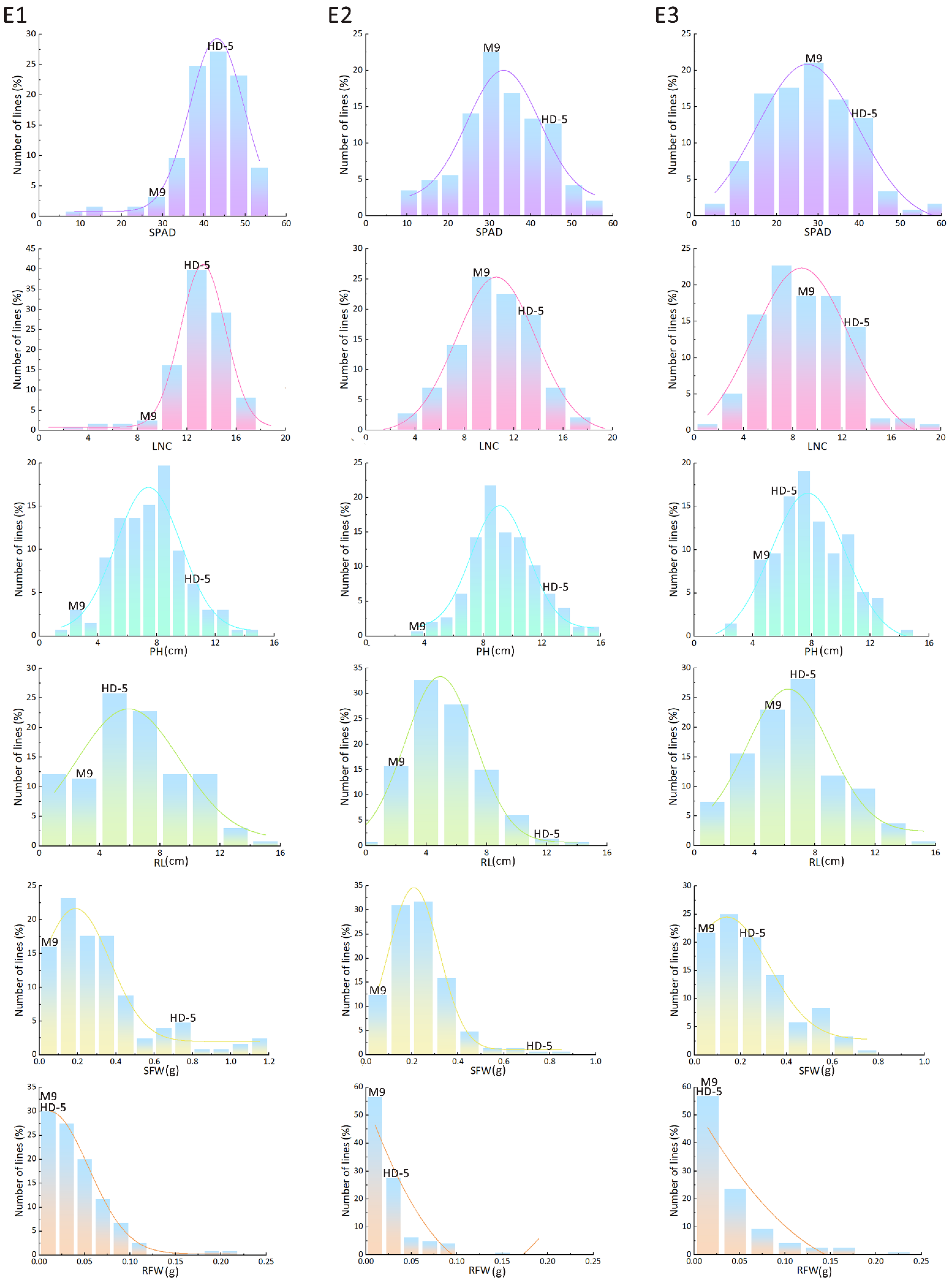
To evaluate cadmium (Cd) tolerance, the parental lines HD-5 (Cd-tolerant) and M9 (Cd-sensitive) were subjected to a gradient of Cd concentrations. A treatment of 40 mg·L−1 Cd induced a clear phenotypic divergence: the Cd-tolerant HD-5 exhibited reduced biomass but remained viable, whereas the Cd-sensitive M9 seedlings were nearly lethal (Figure 1). Consequently, this concentration was selected for subsequent phenotyping of the 170 F2 families. Phenotypic evaluation was conducted across three independent experimental environments. Six key traits were measured: SPAD, LNC, PH, RL, SFW, and RFW (Table S1). Across all environments, HD-5 consistently displayed significantly (p < 0.05) or highly significantly (p < 0.01) higher values for all traits compared to M9 (Figure 2, Table 1). Within the F2 population, all traits displayed substantial phenotypic variation, with coefficients of variation (CV) ranging from 20% to 80%. RFW showed the highest variability, with CVs between 84.47% and 111.74% across the three experiments (Table S1). Further analysis of the frequency distribution, skewness, and kurtosis indicated that all traits conformed to a continuous distribution, confirming that this population is well-suited for QTL mapping.
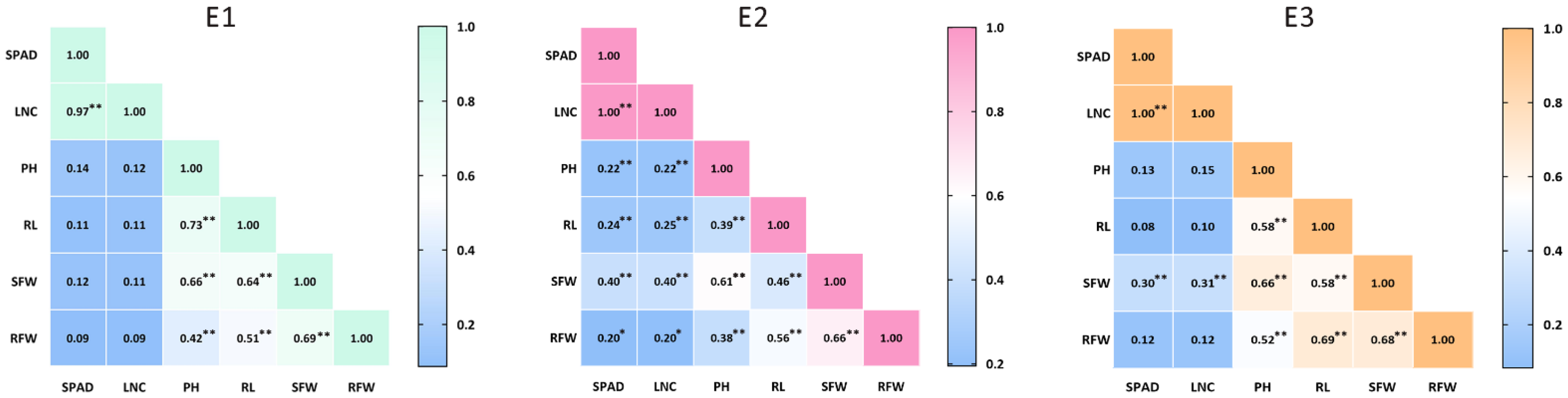
Pearson correlation coefficients between the six traits were further calculated using average values across three environments (Figure 3). SPAD (chlorophyll content) is a key indicator reflecting the relative chlorophyll content in leaves, while LNC (nitrogen content) indicates leaf nitrogen concentration, both parameters characterize plant nutritional status. Notably, the correlation between SPAD and LNC was consistently close to 1 across all three environments, indicating an extremely strong and stable positive relationship. PH and RL are representative of overall plant growth vigor, with their correlation coefficients ranging from 0.39 to 0.73. For biomass-related traits, SFW and RFW serve as critical metrics for assessing biomass accumulation, and their correlation ranged narrowly from 0.66 to 0.69, suggesting a moderate yet stable association.

3.2. QTL Mapping in the F2 Population

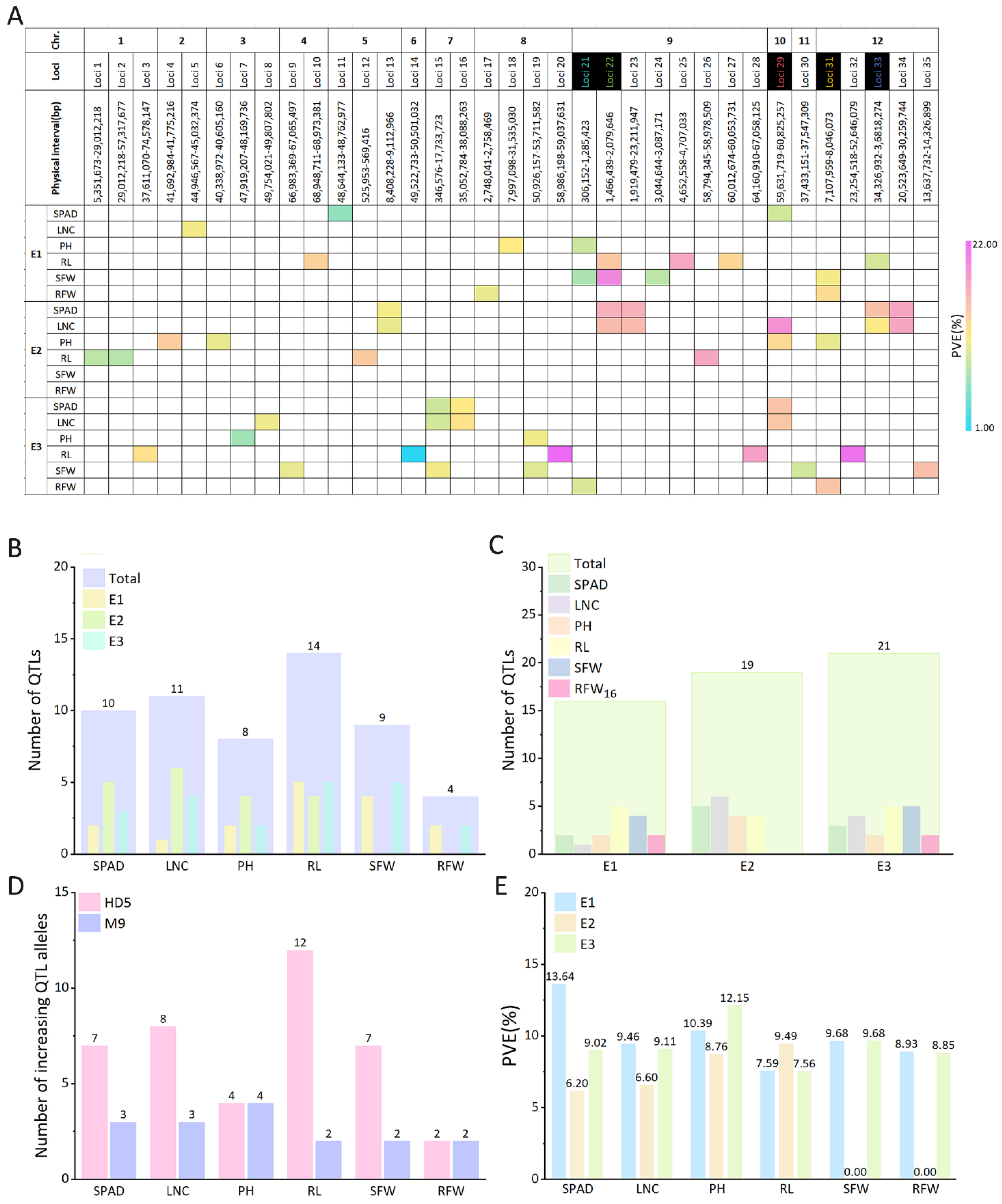
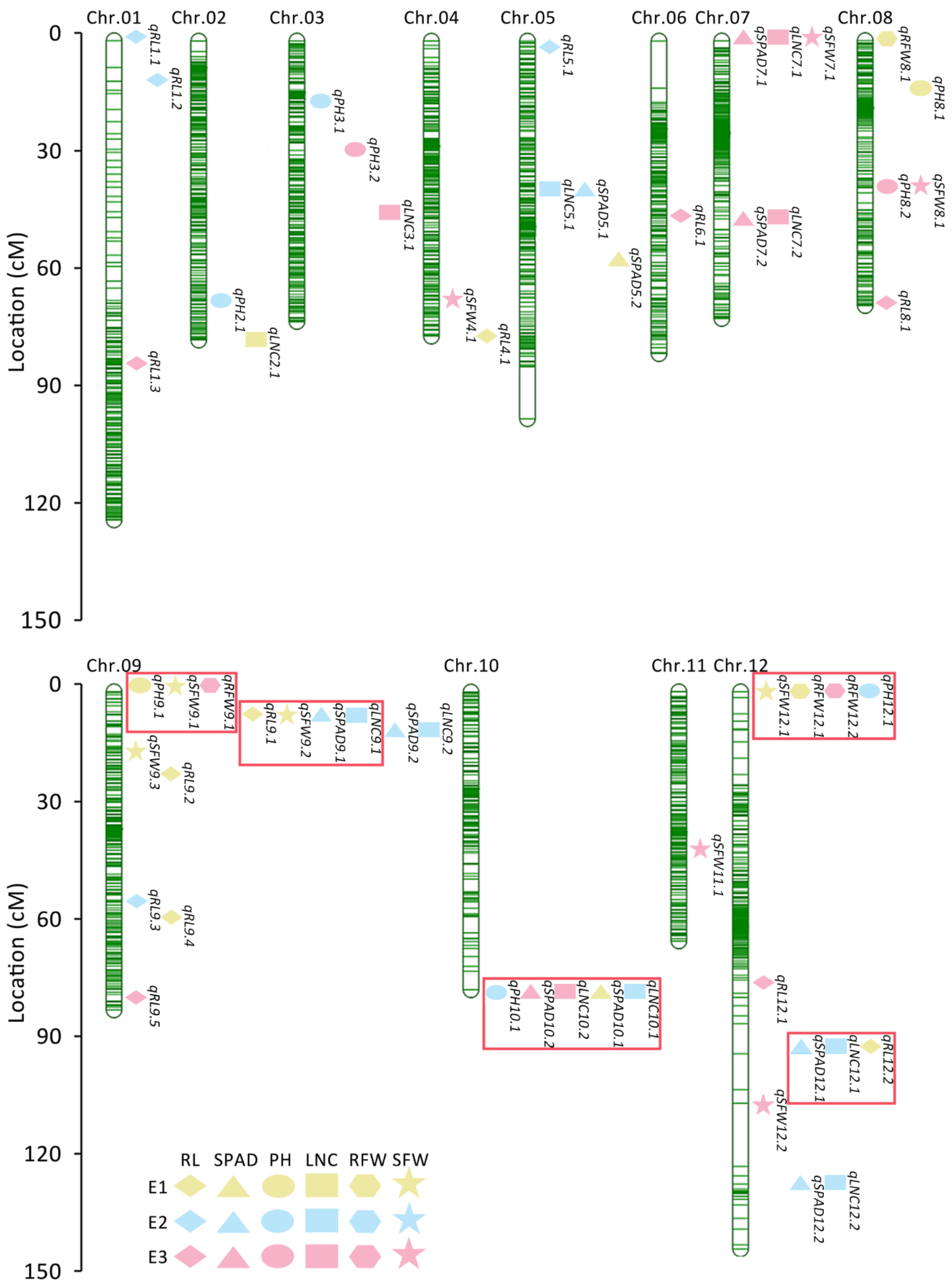
Using inclusive composite interval mapping (ICIM) with a high-density genetic linkage map constructed from 4826 Bin markers, a total of 56 additive QTLs associated with cadmium tolerance in potato were detected using IciMapping v4.2 software (Figure 4 and Table 2). These QTLs were distributed across three environments: 16 in E1, 19 in E2, and 21 in E3 (Figure 4C). All QTLs were mapped to 12 chromosomes (Figure 4A), with chromosome 9 harboring the most (14 QTLs) and chromosome 6 the fewest (1 QTL). The phenotypic variance explained (PVE) by individual QTLs ranged from 1.3% to 21.98% (Figure 4E). By trait category, 10 QTLs were detected for SPAD, 11 for LNC, 8 for PH, 14 for RL, 9 for SFW, and 4 for RFW (Figure 4B). After merging QTLs based on physical position, 35 unique genetic loci were ultimately identified (Table 2).

3.3. Identification of Stable QTLs

Among the 35 identified genetic loci (Figure 4A and Table 2), some were detected across multiple environments. Notably, a total of five loci were consistently detected in two or more environments, exhibiting high stability and reliability, and thus were defined as stable QTLs: loci21, loci22, loci29, loci31, and loci33. Of these, two (loci21, loci22) were located on chromosome 9, one (loci29) on chromosome 10, and two (loci31, loci33) on chromosome 12 (Table 2 and Figure 5). QTLs associated with chlorophyll content included qSPAD-9-1, qSPAD-10-1, qSPAD-10-2, and qSPAD-12-1; those associated with nitrogen content included qLNC-9-1, qLNC-10-1, qLNC-10-2, and qLNC-12-1; those associated with plant height included qPH-9-1, qPH-10-1, and qPH-12-1; those associated with root length included qRL-9-1 and qRL-12-2; those associated with shoot fresh weight included qSFW-9-1, qSFW-9-2, and qSFW-12-1; and those associated with root fresh weight included qRFW-9-1, qRFW-12-1, and qRFW-12-2 (Table 2 and Figure 5).

3.4. Effect Analysis of Five Stable QTLs

To further elucidate the effects of these five stable loci, we summarized the phenotypic differences among the three genotypes at each locus in the F2 population, without considering interactions between loci (Table 3). After segregation and recombination, each locus in the F2 population exhibited three genotypes: paternal homozygotes, maternal homozygotes, and heterozygotes. Therefore, we first classified the F2 population into HD-5 type, M9 type, and H type based on the identified locus markers, and then compared the phenotypic differences in the corresponding traits using the mean values across the three environments.
The results indicate that both parents contributed favorable alleles. Notably, the number of favorable alleles contributed by the maternal parent HD-5 was significantly greater than that by the paternal parent M9 (Figure 4D and Table 3). For most QTLs, the mean phenotypic values of F2 families carrying favorable alleles were significantly higher than those carrying unfavorable alleles (p < 0.05). The favorable alleles at loci21, 22, 29, and 33 were derived from HD-5, while the favorable allele at loci31 was derived from M9. For example, at loci21, the HD-5 allele increased plant height by approximately 1.839 cm (qPH-9-1), shoot fresh weight by approximately 0.196 g (qSFW-9-1), and root fresh weight by approximately 0.030 g (qRFW-9-1). In addition, some loci exhibited dominant heterozygote advantage, where the phenotypic values of the heterozygous genotype were higher than those of both parental genotypes. In conclusion, the five stable QTLs are relatively reliable and warrant further investigation.

3.5. Transcriptome and Differential Gene Analysis

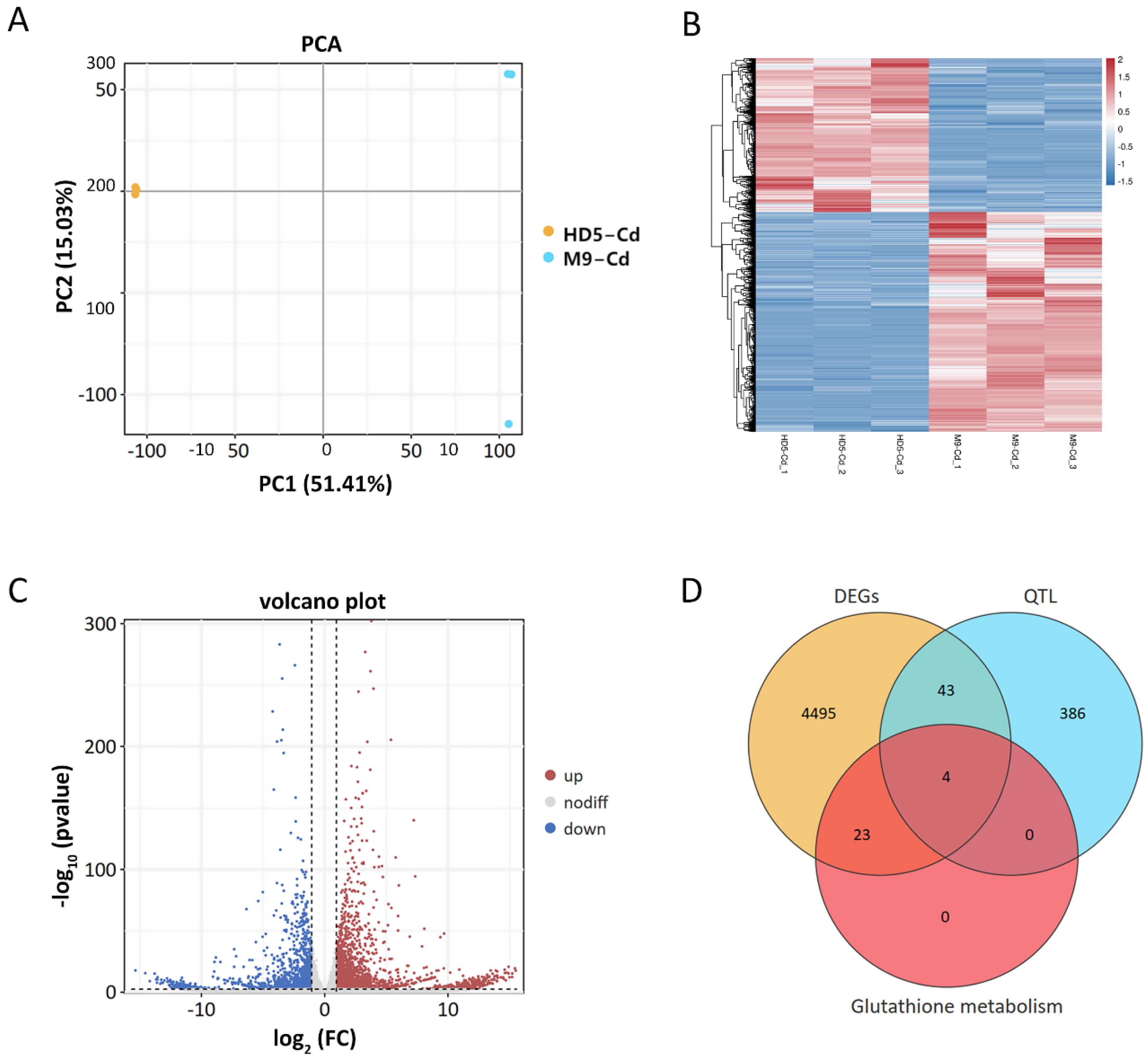
To further elucidate the molecular genetic mechanisms underlying cadmium tolerance in potato seedlings, transcriptome sequencing analysis was performed on the roots of the two parents (HD-5 and M9) after 9 days of cadmium treatment (40 mg·L−1). Principal Component Analysis (PCA) based on expression profiles revealed complete separation of samples HD-5-Cd and M9-Cd along the PC1 axis, indicating fundamental differences in the dominant variation dimension between the two. The relatively close distances between respective samples within each parent indicated good stability of intra-group replicates (Figure 6A). Using DESeq2 software(Version 1.40.2) for differential gene expression analysis with thresholds of |log2(Fold Change)| ≥ 1 and FDR ≤ 0.05, a total of 4565 DEGs were identified, including 1880 downregulated genes and 2685 upregulated genes (Figure 6B,C).
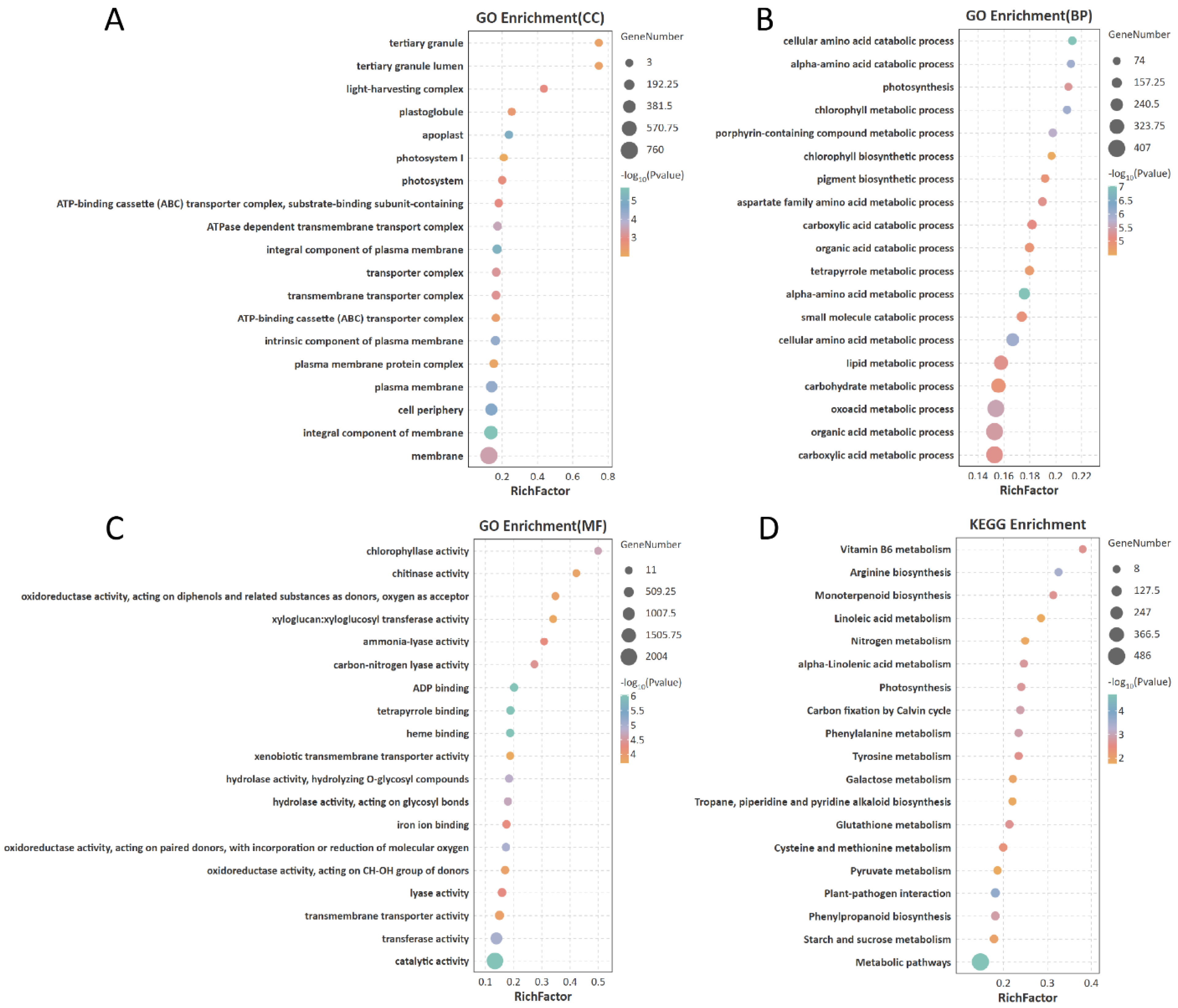
We performed Gene Ontology (GO) enrichment analysis using differentially expressed genes (DEGs) between the two parents. In terms of cellular component (CC), the significantly enriched GO terms included ATPase-dependent transmembrane transport complex, ATP-binding cassette (ABC) transporter complex, light-harvesting complex, photosystem, and transmembrane transporter complex (Figure 7A). For molecular function (MF), the significantly enriched GO terms were oxidoreductase activity, catalytic activity, transferase activity, and chlorophyllase activity (Figure 7C). In the context of biological process (BP), DEGs were significantly enriched in pigment metabolic process, alpha-amino acid metabolic process, chlorophyll metabolic process, and photosynthesis (Figure 7B).
Additionally, we conducted KEGG enrichment analysis using DEGs. The top 20 significantly enriched pathways were plotted, mainly including Carbon fixation by Calvin cycle, Phenylpropanoid biosynthesis, Photosynthesis, and Glutathione metabolism (Figure 7D).
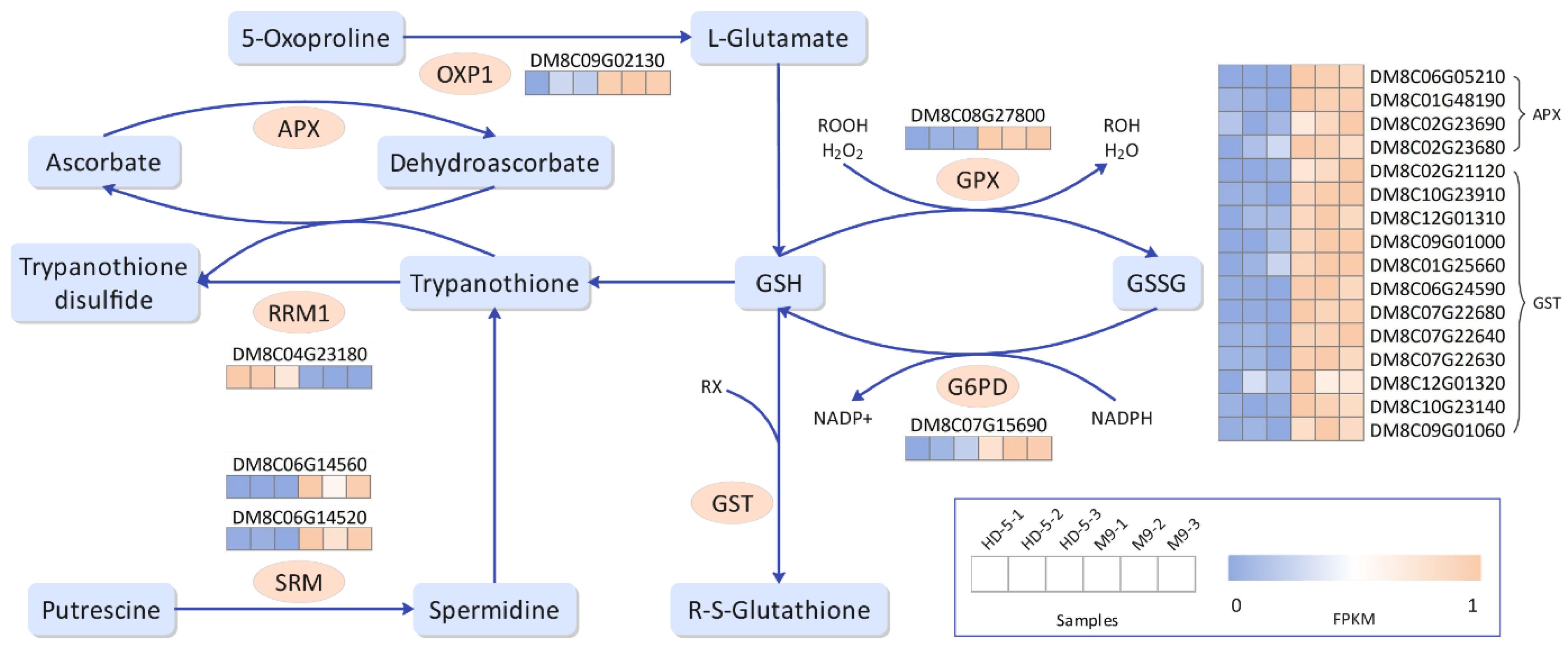
GO and KEGG enrichment analyses revealed that the glutathione metabolic pathway and Photosynthesis are primarily involved in regulating cadmium tolerance differences between the two parents. Notably, glutathione is a key antioxidant and heavy metal detoxification molecule in plants, playing a central role in cadmium tolerance mechanisms. Therefore, we performed a detailed analysis of differentially expressed genes in this pathway (Figure 8).
Under cadmium (Cd) stress treatment, a total of 22 DEGs were enriched in the glutathione metabolic pathway. Glutathione, a key antioxidant in plants, exists in two forms: reduced glutathione (GSH) and oxidized glutathione (GSSG) [40]. In the glutathione metabolic pathway, three enzymes—glutathione peroxidase (GPX), glutathione S-transferase (GST), and 5-oxoprolinase (OXP)—play crucial roles, and changes in their activities are closely associated with plant tolerance to environmental stress [41,42]. We further analyzed the expression profiles of DEGs involved in this pathway (Figure 8) and found that GPX-related gene (DM8C08G27800), GST-related genes (e.g., DM8C10G23910 and DM8C09G01000), and OXP-related gene (DM8C09G02130) exhibited higher expression levels in M9. Among these, DEGs encoding GST proteins were the most abundant (12 in total), and all these DEGs showed higher expression levels in M9 compared to HD-5, indicating that the upregulated expression of GST-related genes likely plays an important role in cadmium tolerance of potato seedlings. Furthermore, four genes encoding ascorbate peroxidase (APX) (e.g., DM8C06G05210 and DM8C01G48190) and genes encoding spermidine synthase (SRM) (DM8C06G14520 and DM8C06G14560) also exhibited relatively high expression levels in M9.

3.6. Screening of Candidate Genes for Cadmium Tolerance in Potato Seedlings

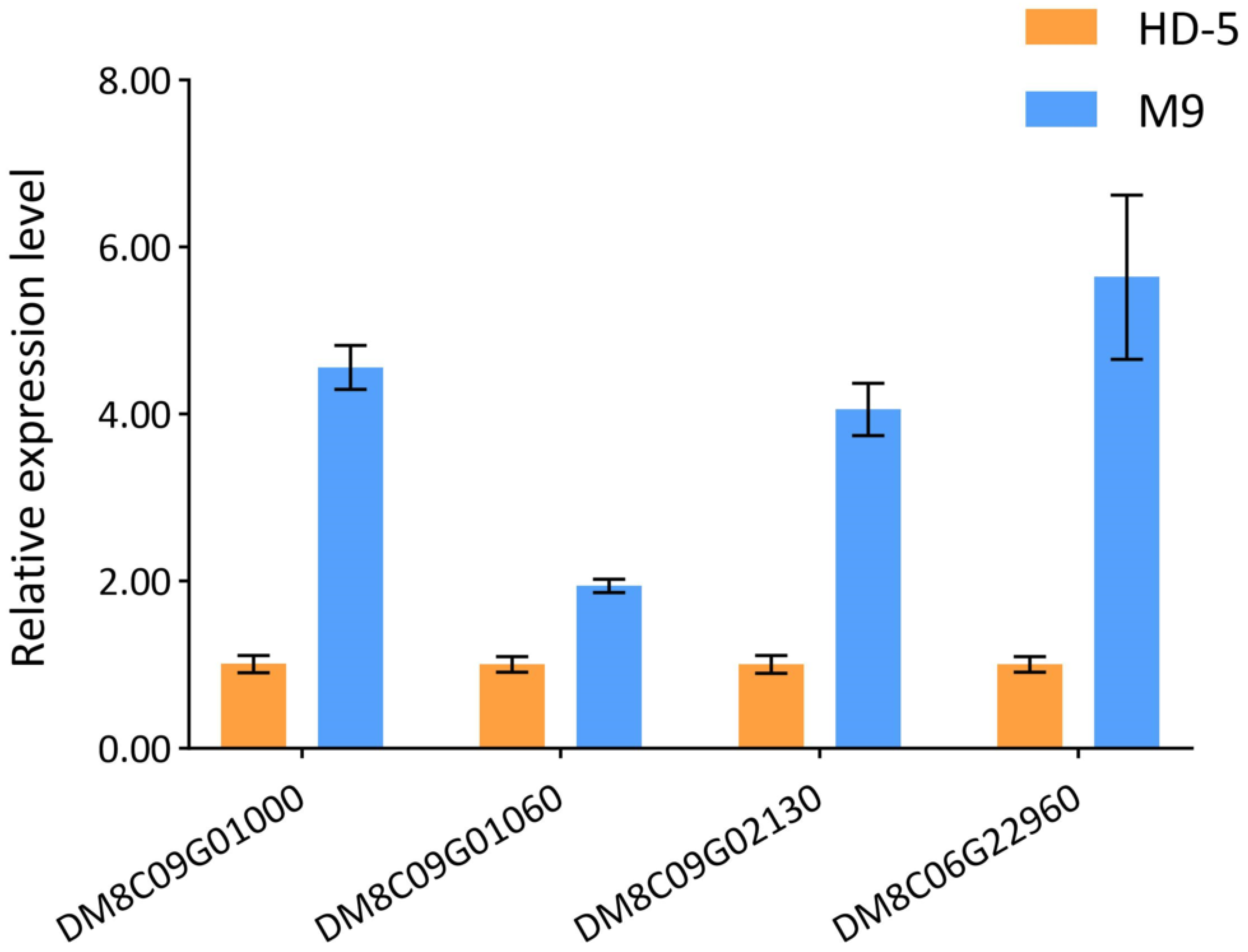
Within five stable QTL intervals, 433 genes were identified based on their physical positions in the DM8.1 reference genome. On this foundation, in conjunction with transcriptome differential expression analysis, 47 differentially expressed genes (DEGs) were screened within the five quantitative trait locus (QTL) intervals. KEGG enrichment analysis results showed that the glutathione metabolic pathway and photosynthesis were the main pathways involved in mediating cadmium tolerance. Therefore, we intersected the 47 DEGs in the five stable QTL intervals with differentially expressed genes in the glutathione metabolic pathway, and obtained 3 candidate genes in this pathway, namely DM8C09G01000 (GST), DM8C09G01060 (GST), and DM8C09G02130 (OXP1). Moreover, gene annotation analysis identified a candidate gene (DM8C06G22960, encoding PsaH) located within the QTL region that is associated with the photosynthetic pathway. In addition, qRT-PCR analysis demonstrated that the expression levels of DM8C09G01000 (GST), DM8C09G01060 (GST), DM8C09G02130 (OXP1), and DM8C06G22960 (PsaH) were significantly upregulated in the M9 relative to the HD-5 (Figure 9). Taken together, a total of 4 candidate genes related to cadmium tolerance regulation were screened in this study (Figure 6D), which are involved in glutathione metabolism and photosynthesis.

4. Discussion

This study initially dissected the genetic and molecular mechanisms underlying cadmium (Cd) tolerance in potato seedlings through the integration of QTL mapping and transcriptome analysis. Phenotypic characterization of six relevant traits was conducted on the parental lines HD-5 and M9, along with their F2 population, across three replicated experiments. By utilizing a high-density genetic map, 56 additive QTLs were co-localized, and these were further merged according to physical positions to identify 5 stable genetic loci across multiple environments. Transcriptome analysis of root tissues from both parents under Cd stress identified 4 candidate genes situated within stable QTL intervals with significant differential expression. GO and KEGG enrichment analyses further revealed the core function of the glutathione metabolic pathway in Cd tolerance.

4.1. Appropriate Genetic Population and High-Density Genetic Map Enhance QTL Mapping Efficiency

Although potato is one of the most important food crops, QTL studies in potato lag significantly behind those in major cereal crops such as rice and maize, primarily due to its autotetraploid genetic nature. The highly heterozygous genome of tetraploid potato and frequent recombination events between four homologous chromosomes result in complex segregation patterns in progeny [43]. Most genetic studies on important potato traits rely on diploid materials [44,45]. However, most diploid potatoes exhibit self-incompatibility and inbreeding depression, hindering the construction of suitable genetic populations. In this study, we developed an F2 segregating population using two self-compatible homozygous diploid lines. Generally, increasing marker density is an effective strategy to improve QTL mapping resolution [46]. Compared to traditional markers such as SSR and RFLP, we utilized a high-density genetic map constructed via whole-genome sequencing (WGS), combined with phenotypic data for six traits across three replicate experiments, to detect 56 QTLs (Table 2). In summary, the use of an appropriate genetic population and high-density genetic map significantly improved the efficiency and precision of our genetic mapping.

4.2. Integration of QTL Mapping and Transcriptome Analysis Facilitates Candidate Gene Mining

In the present study, 56 quantitative trait loci (QTLs) were integrated into 35 genetic loci according to their physical positions. Among these, 5 loci (loci21, loci22, loci29, loci31, and loci33) were repeatedly identified across multiple environments and designated as stable QTLs. Among these 5 stable loci, loci21 and loci22 concurrently regulated plant height, biomass, and chlorophyll content, whereas loci31 and loci33 on chromosome 12 predominantly governed root length. Notably, except for loci31, where the favorable allele was derived from M9, the favorable alleles of all other stable QTLs were derived from HD-5. This indicates that Cd tolerance is not contributed by a single parent, suggesting that trait improvement in breeding could be achieved by pyramiding favorable alleles from different sources.
Despite the significantly improved resolution of potato QTL mapping, numerous candidate genes remain within the identified stable QTL intervals. Differential expression profiling is a valuable strategy for studying trait-related genes [47] and can effectively reduce the number of candidate genes. Therefore, we performed transcriptome sequencing analysis on seedling roots of both parents after treatment with 40 mg·L−1 Cd. A total of 433 genes were identified within and flanking regions of the 5 stable QTL intervals. To further narrow down the candidate gene pool, we integrated differential expression analysis, reducing the candidate genes to 47. Based on GO and KEGG enrichment analyses and gene annotations, we ultimately screened 4 most promising candidate genes. In conclusion, the combination of high-density genetic map-based QTL mapping, transcriptome sequencing, and gene annotation significantly improved the efficiency of candidate gene mining in this study.

4.3. Cd Tolerance Candidate Genes Within Stable QTL Intervals

The synthesis and degradation of glutathione (GSH) in plants are accomplished via the γ-glutamyl cycle [4]. Within this cycle, 5-oxoproline is catalytically converted to L-glutamate by oxoprolinase (OXP) with the consumption of ATP, a process by which OXP contributes to the maintenance of intracellular glutathione levels [5]. Glutathione participates in heavy metal detoxification, and impairment of OXP function leads to glutathione accumulation, thereby affecting plant growth and development [6]. Relevant studies indicate that glutathione S-transferase (GST) is involved in antioxidant defense and metabolic regulation in plants, playing a critical role in plant growth and stress response [44]. Furthermore, GST plays a critical role in the enzymatic reactive oxygen species (ROS) scavenging mechanism, and its overexpression contributes to mitigating ROS-induced damage and enhancing plant resilience to abiotic stress [11]. For instance, overexpression of PpGST increased cadmium (Cd) stress tolerance in transgenic tobacco lines [48], while overexpression of OsGSTU6 in rice reduced Cd accumulation in leaves and improved plant tolerance to Cd stress. The glutathione metabolic pathway identified through KEGG enrichment analysis is notably significant, and the three candidate genes within this pathway—DM8C09G02130, DM8C09G01000, and DM8C09G01060—all exhibit higher expression levels in M9. Specifically, DM8C09G02130 is annotated as “5-oxoprolinase” while DM8C09G01000 and DM8C09G01060 are annotated as “glutathione S-transferase.” The enzymes OPX and GST encoded by these genes are crucial participants in the glutathione metabolic cycle. Of particular significance, the expression levels of genes encoding key enzymes in this pathway—including glutathione peroxidase (GPX), ascorbate peroxidase (APX), and sulfiredoxin (SRM)—were consistently higher in the cadmium-sensitive genotype M9 than in the highly cadmium-tolerant genotype HD-5. This pattern likely reflects inherent differences associated with distinct genetic backgrounds and the developmental stages sampled for transcriptome analysis. Compared to HD-5, M9 exhibited a more active antioxidant enzyme system in root tissues and enhanced scavenging capacity of reactive oxygen species (ROS) in root cells, which may contribute to its ability to mitigate cadmium-induced stress. These findings suggest that the three candidate genes encoding GPX and GST may not only enhance glutathione-dependent detoxification pathways but also modulate Cd tolerance through the regulation of downstream stress-responsive genes via complex signaling networks.
Plant responses to abiotic stress are not merely characterized by the up-regulation of stress-related genes; more crucially, they are defined by the efficiency and sustainability of these responses, as exemplified by the salt tolerance exhibited in Moroccan sea orache. The marked overexpression of stress-responsive genes in M9 may signify an “emergency” or “compensatory” response mechanism. Under cadmium (Cd) stress, the root cells of M9 presumably activate a potent and energy-intensive antioxidant defense system, which is intended to scavenge excessive reactive oxygen species (ROS) and sequester Cd ions. This explains the transcriptionally evident enhanced activity of the defense system in M9. Nevertheless, such an intense response may entail substantial energy expenditures, such as ATP consumption via oxidative phosphorylation (OXPHOS), and may not be sustainable in the long term. It potentially fails to effectively restrict the translocation and accumulation of Cd in the aerial tissues, consequently resulting in a stress-sensitive phenotype at the whole-plant level.
In contrast, the cadmium-tolerant genotype HD-5 may possess a more “efficient” and “refined” tolerance mechanism. Its tolerance is likely not primarily dependent on a “burst-like” up-regulation of stress-responsive genes after stress, but is supported by the following aspects: (1) Basal expression levels and early-warning mechanisms: HD-5 may display higher constitutive antioxidant enzyme activity or a more sensitive early signal perception system, which enables an effective response during the initial stress phase, thus preventing large-scale reactive oxygen species (ROS) accumulation. (2) Efficient sequestration and compartmentalization: HD-5 might show greater efficiency in sequestering Cd ions into root cell vacuoles or the cell wall, thereby reducing cytoplasmic Cd toxicity at the source and decreasing the reliance on the glutathione (GSH)-mediated detoxification system. (3) Metabolic remodeling capacity: As is observed in salt-tolerant species such as Argania spinosa under salinity stress, tolerant genotypes often exhibit a stronger capacity for metabolite remodeling. For example, they accumulate osmoregulatory compounds like proline and soluble sugars to maintain cellular homeostasis [49]. HD-5 is likely superior to M9 in these aspects, thereby conferring a comprehensive tolerance advantage. Numerous studies suggest that under salt stress, the accumulation of amino acids (e.g., arginine, proline) and polyamines constitutes a crucial adaptive strategy in plants [50]. Therefore, the “more active” antioxidant enzyme system observed in M9 roots may merely reflect its response to severe cellular damage, rather than serving as an indicator of high tolerance efficiency.
Photosynthesis assumes a pivotal role in plant growth, and a multitude of studies have indicated that cadmium (Cd) exerts a detrimental influence on the photosynthetic processes in plants [12,13,14]. PsaH encodes the H subunit of the photosystem I (PSI) complex, which is indispensable for maintaining the stability of PSI and facilitating efficient photoelectron transport [15]. Based on gene annotation, this study identified a candidate gene, DM8C06G22960 (PsaH), situated within a stable quantitative trait locus (QTL) associated with the photosynthetic pathway. Under Cd stress, the up-regulated expression of PsaH in M9 may signify a compensatory mechanism that safeguards the photosynthetic apparatus and ensures continuous electron transfer. This response is intricately associated with the activation of the antioxidant system: a stabilized photosynthetic apparatus curtails electron leakage and minimizes the generation of reactive oxygen species (ROS), thereby alleviating the oxidative stress on downstream antioxidant components such as glutathione S-transferase (GST) and glutathione peroxidase (GPX). The synergistic interaction between source control and terminal scavenging constructs an integrated defense network against photo-oxidative stress in plants. Therefore, the expression level of PsaH presumably contributes to cadmium tolerance in potatoes through the indirect modulation of photosynthetic efficiency and ROS production.
All four candidate genes exhibited high expression levels in both parents, with each showing significant fold changes in differential expression. Collectively, these candidate genes provide targets and theoretical foundations for future gene cloning, functional validation, and genetic breeding efforts.

5. Conclusions

This study utilized a high-density genetic map to perform quantitative trait locus (QTL) mapping for six cadmium tolerance-related traits in diploid potatoes, leading to the identification of 56 additive QTLs. Based on their physical positions, these QTLs were consolidated into 35 genetic loci, five of which demonstrated consistent detection across multiple environments. Notably, the favorable alleles associated with these stable quantitative trait loci (QTLs) originated from both the cadmium-tolerant parent HD-5 (e.g., loci21, loci22, loci29, loci33) and the cadmium-sensitive parent M9 (e.g., loci31). This indicates that the pyramiding of favorable alleles from diverse parental lines can effectively enhance cadmium tolerance in potatoes. Transcriptomic analysis of the root systems of the parental lines under cadmium stress revealed that the glutathione metabolism and photosynthetic pathways play crucial roles in cadmium tolerance. By integrating QTL mapping with transcriptomic data, four candidate genes (DM8C09G01000, DM8C09G01060, DM8C09G02130, DM8C06G22960) were identified within the stable QTL regions, offering well-defined targets for subsequent functional validation and molecular breeding. This study demonstrates the efficacy of combining high-density QTL mapping with transcriptomic profiling for dissecting complex traits such as cadmium tolerance, a strategy applicable to the improvement of other crops under heavy metal stress. During the initial phase, an integrated strategy will be implemented, combining systems and comparative omics analyses, subcellular localization assays in tobacco leaves, molecular cloning, yeast functional complementation, plant overexpression, and ion profiling techniques to functionally characterize the four candidate genes. This research seeks to elucidate the molecular mechanisms underlying the contribution of these candidate genes to cadmium tolerance in potato plants. The findings establish a solid theoretical basis and offer valuable genetic resources for the development of cadmium-tolerant potato cultivars, with substantial implications for ensuring safe potato production and facilitating ecological remediation in areas impacted by heavy metal pollution.

Supplementary Materials

The following supporting information can be downloaded at: https://www.mdpi.com/article/10.3390/horticulturae11121478/s1, Table S1. The data of parents in three environments. Table S2. The data of the F2 population in three environments. Table S3. Screening candidate genes from stable QTLs based on gene expression levels. Table S4. Primers used for qRT-PCR.

Author Contributions

Y.F., J.Y., L.N. and L.S. designed the project, and L.S., X.L. (Xinqi Li) performed all the experiments and wrote the manuscript. P.S., Z.L., X.P., H.L., Y.Y., D.Y., G.L., G.Y., J.C., Q.Z., X.L. (Xiaoman Liu) and Y.T. assisted in conducting the experiments and analyzing the data. Y.F. and J.Y. provided the direction for the study and made corrections to the manuscript. All authors have read and agreed to the published version of the manuscript.

Funding

Financial support for this research was provided in part by the Open Research Project of the Key Laboratory of Soil Environment Management and Pollution Control, Ministry of Ecology and Environment (No. SEMPC202411), and the Yunnan Students’ Platform for Innovation and Entrepreneurship Training Program (2024) (Number: S202410681061). The funders had no role in the experimental design, data collection and analysis, or preparation of the manuscript.

Informed Consent Statement

Not applicable.

Data Availability Statement

The raw data supporting the conclusions of this article will be made available by the authors on request.

Acknowledgments

We wish to thank all the students who participated in this project by helping with the Cd treatment experiment on potato seedlings. We thank Guangzhou Kidio Biotechnology Co., Ltd., for assisting in sequencing and bioinformatics analyses. We thank the assistant scientist Berlaine Quime from the International Rice Research Institute for the critical reading and modification of the manuscript.

Conflicts of Interest

The authors declare no conflicts of interest.

Abbreviations

Cd: Cadmium; HD-5: highly cadmium-tolerant; M9: cadmium-sensitive; PH: plant height; RL: root length; SFW: shoot fresh weight; RFW: root fresh weight; SPAD: chlorophyll content; LNC: nitrogen content; QTL: quantitative trait locus; OXP:5-oxoprolinase; GST: glutathione S-transferase; PsaH: subunit H of photosystem I.

References

  1. Ye, Y.; Dong, W.; Luo, Y.; Fan, T.; Xiong, X.; Sun, L.; Hu, X. Cultivar diversity and organ differences of cadmium accumulation in potato (Solanum tuberosum L.) allow the potential for Cd-safe staple food production on contaminated soils. Sci. Total Environ. 2020, 711, 134534. [Google Scholar] [CrossRef] [PubMed]
  2. Li, Y.; Zhou, S.; Jia, Z.; Liu, K.; Wang, G. Temporal and spatial distributions and sources of heavy metals in atmospheric deposition in western Taihu Lake, China. Environ. Pollut. 2021, 284, 117465. [Google Scholar] [CrossRef] [PubMed]
  3. Clemens, S.; Aarts, M.G.; Thomine, S.; Verbruggen, N. Plant science: The key to preventing slow cadmium poisoning. Trends Plant Sci. 2013, 18, 92–99. [Google Scholar] [CrossRef]
  4. Angon, P.B.; Islam, S.; Kc, S.; Das, A.; Anjum, N.; Poudel, A.; Suchi, S.A. Sources, effects and present perspectives of heavy metals contamination: Soil, plants and human food chain. Heliyon 2024, 10, e28357. [Google Scholar] [CrossRef]
  5. Zheng, R.; Feng, X.; Zou, W.; Wang, R.; Yang, D.; Wei, W.; Li, S.; Chen, H. Converting loess into zeolite for heavy metal polluted soil remediation based on “soil for soil-remediation” strategy–ScienceDirect. J. Hazard. Mater. 2021, 412, 125199. [Google Scholar] [CrossRef]
  6. Rizwan, M.; Ali, S.; Adrees, M.; Ibrahim, M.; Tsang, D.C.; Zia-ur-Rehman, M.; Zahir, Z.A.; Rinklebe, J.; Tack, F.M.; Ok, Y.S. A critical review on effects, tolerance mechanisms and management of cadmium in vegetables. Chemosphere 2017, 182, 90–105. [Google Scholar] [CrossRef]
  7. Lin, L.; Zhou, W.; Dai, H.; Cao, F.; Zhang, G.; Wu, F. Selenium reduces cadmium uptake and mitigates cadmium toxicity in rice. J. Hazard. Mater. 2012, 235–236, 343–351. [Google Scholar] [CrossRef] [PubMed]
  8. Seth, C.S.; Chaturvedi, P.K.; Misra, V. The role of phytochelatins and antioxidants in tolerance to Cd accumulation in Brassica juncea L. Ecotoxicol. Environ. Saf. 2008, 71, 76–85. [Google Scholar] [CrossRef]
  9. Bertin, G.; Averbeck, D. Cadmium: Cellular effects, modifications of biomolecules, modulation of DNA repair and genotoxic consequences (a review). Biochimie 2006, 88, 1549–1559. [Google Scholar] [CrossRef]
  10. Jarup, L.; Akesson, A. Current status of cadmium as an environmental healthproblem. Toxicol. Appl. Pharmacol. 2009, 238, 201–208. [Google Scholar] [CrossRef]
  11. Li, J.; Zhou, Y.W.; Chen, S.; Gao, X.J. Actualities, damage and management of soil cadmium pollution in China. Anhui Agric. Sci. Bull. 2015, 21, 104–107. (In Chinese) [Google Scholar]
  12. Abbas, T.; Rizwan, M.; Ali, S.; Adrees, M.; Zia-Ur-Rehman, M.; Qayyum, M.F.; Ok, Y.S.; Murtaza, G. Effect of biochar on alleviation of cadmium toxicity in wheat (Triticum aestivum L.) grown on Cd-contaminated saline soil. Environ. Sci. Pollut. Res. 2017, 25, 25668–25680. [Google Scholar] [CrossRef]
  13. Hu, Y.; He, R.; Mu, X.; Zhou, Y.; Li, X.; Wang, H.; Xing, W.; Liu, D. Cadmium toxicity in plants: From transport to tolerance mechanisms. Plant Signal. Behav. 2025, 20, 2544316. [Google Scholar] [CrossRef] [PubMed]
  14. Najeeb, U.; Jilani, G.; Ali, S.; Sarwar, M.; Xu, L.; Zhou, W. Insights into cadmium induced physiological and ultra-structural disorders in Juncus effusus L. and its remediation through exogenous citric acid. J. Hazard. Mater. 2014, 186, 565–574. [Google Scholar] [CrossRef]
  15. Wei, Q.; Zou, D.Y.; Xia, J.; Cui, H.Q.; Fu, S.M.; Li, B.; Zhu, Y.X.; Du, S.T. Effects of Typical Herbicides on Growth and Cadmium Accumulation in Arabidopsis thaliana. Russ. J. Plant Physiol. 2025, 72, 151. [Google Scholar] [CrossRef]
  16. Hassan, W.; Bano, R.; Bashir, S.; Aslam, Z. Cadmium toxicity and soil biological index under potato (Solanum tuberosum L.) cultivation. Soil Res. 2016, 54, 460. [Google Scholar] [CrossRef]
  17. Huang, B.; Xin, J.; Dai, H.; Liu, A.; Zhou, W.; Yi, Y.; Liao, K. Root morphological responses of three hot pepper cultivars to Cd exposure and their correlations with Cd accumulation. Environ. Sci. Pollut. Res. Int. 2015, 22, 1151–1159. [Google Scholar] [CrossRef]
  18. Dinakar, N.; Nagajyothi, P.C.; Suresh, S.; Damodharam, T.; Suresh, C. Cadmium induced changes on proline, antioxidant enzymes, nitrate and nitrite reductases in Arachis hypogaea L. J. Environ. Biol. 2009, 30, 289–294. [Google Scholar]
  19. Guilherme, M.d.F.S.; Oliveira, H.M.; da Silva, E. Cadmium toxicity on seed germination and seedling growth of wheat Triticum aestivum. Acta Sci. Biol. Sci. 2015, 37, 499. [Google Scholar] [CrossRef]
  20. Parmar, P.; Kumari, N.; Sharma, V. Structural and functional alterations in photosynthetic apparatus of plants under cadmium stress. Bot. Stud. 2013, 54, 45. [Google Scholar] [CrossRef]
  21. Hédiji, H.; Djebali, W.; Cabasson, C.; Maucourt, M.; Baldet, P.; Bertrand, A.; Zoghlami, L.B.; Deborde, C.; Moing, A.; Brouquisse, R.; et al. Effects of long-term cadmium exposure on growth and metabolomic profile of tomato plants RID B-6902-2008. Ecotox. Environ. Safe. 2010, 73, 1965–1974. [Google Scholar] [CrossRef]
  22. Dias, M.C.; Monteiro, C.; Moutinho-Pereira, J.; Correia, C.; Gonçalves, B.; Santos, C. Cadmium toxicity affects photosynthesis and plant growth at different levels. Acta Physiol. Plant. 2012, 35, 1281–1289. [Google Scholar] [CrossRef]
  23. Mittler, R.; Vanderauwera, S.; Suzuki, N.; Miller, G.; Tognetti, V.B.; Vandepoele, K.; Gollery, M.; Shulaev, V.; Van Breusegem, F. ROS signaling: The new wave? Trends Plant Sci. 2011, 16, 300–309. [Google Scholar] [CrossRef]
  24. Halliwell, B. Reactive Species and Antioxidants. Redox Biology Is a Fundamental Theme of Aerobic Life. Plant Physiol. 2006, 141, 312–322. [Google Scholar] [CrossRef] [PubMed]
  25. Grill, E.; Löffler, S.; Winnacker, E.L.; Zenk, M.H. Phytochelatins, the heavy-metal-binding peptides of plants, are synthesized from glutathione by a specific γ-glutamylcysteine dipeptidyl transpeptidase (phytochelatin synthase). Proc. Natl. Acad. Sci. USA 1989, 86, 6838–6842. [Google Scholar] [CrossRef] [PubMed]
  26. Hirata, K.; Tsuji, N.; Miyamoto, K. Biosynthetic regulation of phytochelatins, heavy metal-binding peptides. J. Biosci. Bioeng. 2005, 100, 593–599. [Google Scholar] [CrossRef]
  27. Mehra, R.; Kodati, V.; Abdullah, R. Chain Length-Dependent Pb(II)-Coordination in Phytochelatins. Biochem. Biophys. Res. Commun. 1995, 215, 730–736. [Google Scholar] [CrossRef]
  28. Luo, J.S.; Zhang, Z. Mechanisms of cadmium phytoremediation and detoxification in plants. Crop J. 2021, 9, 521–529. [Google Scholar] [CrossRef]
  29. Han, Y.; Fan, T.; Zhu, X.; Wu, X.; Ouyang, J.; Jiang, L.; Cao, S. WRKY12 represses GSH1 expression to negatively regulate cadmium tolerance in Arabidopsis. Plant Mol. Biol. 2019, 99, 149–159. [Google Scholar] [CrossRef]
  30. Zhang, Q.; Cai, W.; Ji, T.T.; Ye, L.; Lu, Y.T.; Yuan, T.T. WRKY13 enhances cadmium tolerance by promoting D-CYSTEINE DESULFHYDRASE and hydrogen sulfide production. Plant Physiol. 2020, 183, 01504. [Google Scholar] [CrossRef]
  31. Liu, H.; Zhao, H.; Wu, L.; Liu, A.; Zhao, F.; Xu, W. Heavy metal ATPase 3 (HMA3) confers cadmium hypertolerance on the cadmium/zinc hyperaccumulator Sedum plumbizincicola. New Phytol. 2017, 215, 687–698. [Google Scholar] [CrossRef]
  32. Li, G.Z.; Zheng, Y.X.; Liu, H.T.; Liu, J.; Kang, G.Z. WRKY74 regulates cadmium tolerance through glutathione-dependent pathway in wheat. Environ. Sci. Pollut. Res. 2022, 29, 68191–68201. [Google Scholar] [CrossRef]
  33. Ishimaru, K.; Hirotsu, N.; Madoka, Y.; Murakami, N.; Hara, N.; Onodera, H.; Kashiwagi, T.; Ujiie, K.; Shimizu, B.I.; Onishi, A.; et al. Loss of function of the IAA-glucose hydrolase gene TGW6 enhances rice grain weight and increases yield. Nat. Genet. 2013, 45, 707–711. [Google Scholar] [CrossRef] [PubMed]
  34. Mengist, M.F.; Alves, S.; Griffin, D.; Creedon, J.; McLaughlin, M.J.; Jones, P.W.; Milbourne, D. Genetic mapping of quantitative trait loci for tuber-cadmium and zinc concentration in potato reveals associations with maturity and both overlapping and independent components of genetic control. Theor. Appl. Genet. 2018, 131, 929–945. [Google Scholar] [CrossRef]
  35. Zhang, Y.M.; Mao, Y.; Xie, C.; Smith, H.; Luo, L.; Xu, S. Mapping Quantitative Trait Loci Using Naturally Occurring Genetic Variance Among Commercial Inbred Lines of Maize (Zea mays L.). Genetics 2005, 169, 2267–2275. [Google Scholar] [CrossRef]
  36. Huang, W.; Dong, J.; Zhao, X.; Zhao, Z.; Li, C.; Li, J.; Song, B. QTL analysis of tuber shape in a diploid potato population. Front. Plant Sci. 2022, 13, 1046287. [Google Scholar] [CrossRef]
  37. van Lieshout, N.; van der Burgt, A.; de Vries, M.E.; ter Maat, M.; Eickholt, D.; Esselink, D.; van Kaauwen, M.P.W.; Kodde, L.P.; Visser, R.G.F.; Lindhout, P.; et al. Solyntus, the New Highly Contiguous Reference Genome for Potato (Solanum tuberosum). G3 Genes Genomes Genet. 2020, 10, 3489–3495. [Google Scholar] [CrossRef]
  38. Lindhout, P.; Meijer, D.; Schotte, T.; Hutten, R.C.; Visser, R.G.; van Eck, H.J. Towards F 1 Hybrid Seed Potato Breeding. Potato Res. 2011, 54, 301–312. [Google Scholar] [CrossRef]
  39. Yang, J.; Yao, C.; Miao, J.; Li, N.; Ji, F.; Hu, D.; Wang, S.; Zhou, Z.; Dai, K.; Chen, A.; et al. Construction of a High-Density Genetic Map and QTL Mapping Analysis for Yield, Tuber Shape, and Eye Number in Diploid Potato. Agriculture 2025, 15, 2032. [Google Scholar] [CrossRef]
  40. Noctor, G.; Foyer, C.H. Ascorbate and glutathione: Keeping active oxygen under control. Annu. Rev. Plant Physiol. Plant Mol. Biol. 1998, 49, 249–279. [Google Scholar] [CrossRef] [PubMed]
  41. Hell, R.; Bergmann, L. λ-Glutamylcysteine synthetase in higher plants: Catalytic properties and subcellular localization. Planta 1990, 180, 603–612. [Google Scholar] [CrossRef]
  42. Hell, R.; Bergmann, L. Glutathione synthetase in tobacco suspension cultures: Catalytic properties and localization. Physiol. Plant 1988, 72, 70–76. [Google Scholar] [CrossRef]
  43. Zhou, Q.; Tang, D.; Huang, W.; Yang, Z.; Zhang, Y.; Hamilton, J.P.; Visser, R.G.F.; Bachem, C.W.B.; Buell, C.R.; Zhang, Z.; et al. Haplotype-resolved genome analyses of a heterozygous diploid potato. Nat. Genet. 2020, 52, 1018–1023. [Google Scholar] [CrossRef]
  44. Li, Y.; Wang, Y.; He, Y.Q.; Ye, T.T.; Huang, X.; Wu, H.; Ma, T.X.; Pritchard, H.W.; Wang, X.F.; Xue, H. Glutathionylation of a glycolytic enzyme promotes cell death and vigor loss during aging of elm seeds. Plant Physiol. 2024, 195, 2596–2616. [Google Scholar] [CrossRef]
  45. Meijer, D.; Viquez-Zamora, M.; van Eck, H.J.; Hutten, R.C.B.; Su, Y.; Rothengatter, R.; Visser, R.G.F.; Lindhout, W.H.; van Heusden, A.W. QTL mapping in diploid potato by using selfed progenies of the cross S. tuberosum × S. chacoense. Euphytica 2018, 214, 121. [Google Scholar] [CrossRef] [PubMed]
  46. Liu, X.; Zhang, H.; Li, H.; Li, N.; Zhang, Y.; Zhang, Q.; Wang, S.; Wang, Q.; Wang, H. Fine-Mapping Quantitative Trait Loci for Body Weight and Abdominal Fat Traits: Effects of Marker Density and Sample Size. Poult. Sci. 2008, 87, 1314–1319. [Google Scholar] [CrossRef]
  47. Yang, J.; Sun, K.; Li, D.; Luo, L.; Liu, Y.; Huang, M.; Yang, G.; Liu, H.; Wang, H.; Chen, Z.; et al. Identification of stable QTLs and candidate genes involved in anaerobic germination tolerance in rice via high-density genetic mapping and RNA-Seq. BMC Genom. 2019, 20, 355. [Google Scholar] [CrossRef] [PubMed]
  48. Liu, Y.J.; Han, X.M.; Ren, L.L.; Yang, H.L.; Zeng, Q.Y. Functional divergence of the glutathione S-transferase supergene family in Physcomitrella patens reveals complex patterns of large gene family evolution in land plants. Plant Physiol. 2013, 161, 773–786. [Google Scholar] [CrossRef]
  49. Hammou, R.A.; Ben El Caid, M.; Harrouni, C.; Daoud, S. Germination enhancement, antioxidant enzyme activity, and metabolite changes in late Argania spinosa kernels under salinity. J. Arid. Environ. 2023, 219, 105095. [Google Scholar] [CrossRef]
  50. El-Badri, A.M.; Batool, M.; AAMohamed, I.; Wang, Z.; Khatab, A.; Sherif, A.; Ahmad, H.; Khan, M.N.; Hassan, H.M.; Elrewainy, I.M.; et al. Antioxidative and Metabolic Contribution to Salinity Stress Responses in Two Rapeseed Cultivars during the Early Seedling Stage. Antioxidants 2021, 10, 1227. [Google Scholar] [CrossRef]
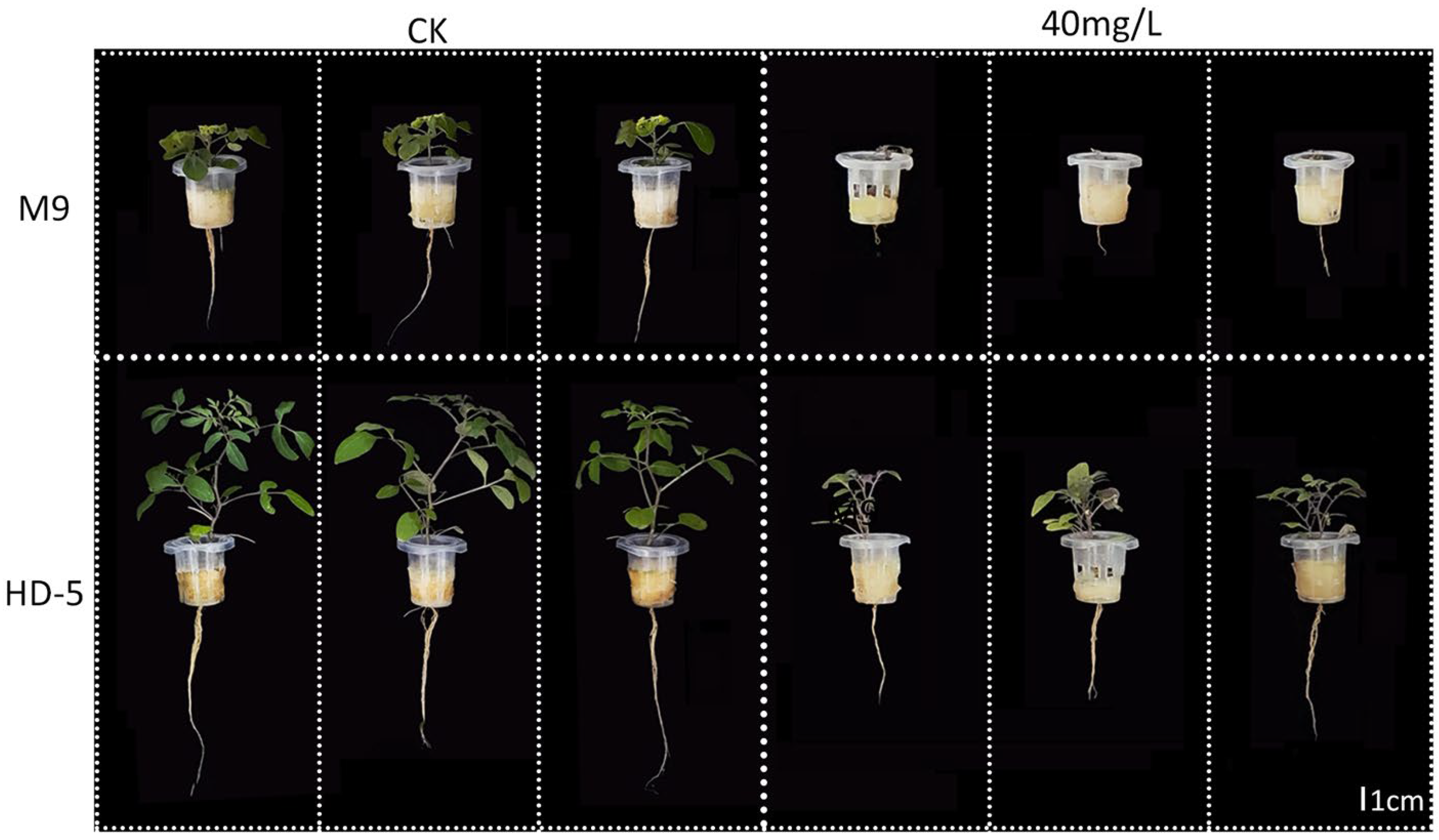
Figure 1. Phenotypic traits of two parental potato lines under cadmium concentration treatments of 40 mg·L−1 and 0 mg·L−1. Notes: HD-5 refers to a homozygous diploid potato line with high cadmium tolerance, while M9 signifies a homozygous diploid potato line sensitive to cadmium. The control group (CK) was treated with 0 mg·L−1 cadmium. To guarantee the maintenance of normal physiological states and avoid dehydration, the duration of photographic recording was strictly restricted to within 10 min. Scale bar = 1 cm.
Horticulturae 11 01478 g001
Figure 2. Frequency distribution histograms depicting the phenotypic traits of six characters within the F2 segregation population were constructed across environments (E1E3): Notes: Environments: (E1), 19 February to 2 April 2025; (E2), 31 March to 12 May 2025; (E3), 24 April to 5 June 2025. SPAD represents the relative chlorophyll content; LNC denotes the leaf nitrogen content; PH refers to the plant height; RL signifies the root length; SFW stands for the shoot fresh weight; and RFW represents the root fresh weight. Moreover, the phenotypic values of the two parental lines, HD-5 and M9, for the six traits under the three environments are presented in each corresponding histogram.
Horticulturae 11 01478 g002
Figure 3. Correlation analysis of six traits within the F2 population under three environmental conditions (E1E3). Notes: Environments: (E1), 19 February to 2 April 2025; (E2), 31 March to 12 May 2025; (E3), 24 April to 5 June 2025. * indicates significant correlation at the 0.05 level (two-tailed); ** indicates significant correlation at the 0.01 level (two-tailed).
Horticulturae 11 01478 g003
Figure 4. Summary of QTL Mapping Results. Notes: A is the QTL mapping chart, where the blackened loci indicate five stable sites. (A) The QTL mapping chart, where the blackened loci indicate five stable sites. (B) Statistical analysis of the number of QTLs associated with six traits. (C) Statistical analysis of the number of QTLs detected across three environmental conditions. (D) Statistical analysis of the number of QTLs identified in the HD-5 and M9 strains. (E) Phenotypic variation explained by six traits under different environmental conditions.
Horticulturae 11 01478 g004
Figure 5. Distribution of All QTLs on Chromosomes. QTLs associated with distinct phenotypic traits are annotated using distinct symbols: pale yellow denotes QTLs identified in environment E1, light blue represents QTLs detected in environment E2, and pink indicates QTLs specific to environment E3. Notes: The red frames show the QTLs that can be detected in multiple environments from E1 to E3.
Horticulturae 11 01478 g005
Figure 6. Transcriptome sequencing analysis of the two parents after different treatments. (A) PCA. (B) Clustering analysis of differentially expressed genes. (C) Volcano plot. (D) QTL mapping interval and Venn diagram showing the intersection of transcriptome differentially expressed genes in the glutathione pathway.
Horticulturae 11 01478 g006
Figure 7. KEGG and GO enrichment analysis of differentially expressed genes (DEGs) (Top 20). Notes: (A) depicts the enrichment status of differentially expressed genes (DEGs) within the cellular component (CC) category, as elucidated by Gene Ontology (GO) analysis. (B) demonstrates the enrichment status of DEGs in the biological process (BP) category, as ascertained through GO analysis. (C) illustrates the enrichment status of DEGs in the molecular function (MF) category, as determined via GO analysis. (D) showcases the outcomes of KEGG pathway enrichment analysis for DEGs.
Horticulturae 11 01478 g007
Figure 8. The expression profiles of differentially expressed genes (DEGs) involved in the glutathione metabolic pathway were analyzed in homozygous diploid potato lines HD-5, which exhibits strong cadmium tolerance, and M9, which displays high cadmium sensitivity. Gene expression levels were normalized based on FPKM values.
Horticulturae 11 01478 g008
Figure 9. The qRT-PCR expression profiles of four candidate genes under 40 mg·L−1 cadmium treatment. Values are the means ± standard errors (n = 3).
Horticulturae 11 01478 g009
Table 1. Phenotypic Data Analysis of Parental and F2 Generation Seedlings Subjected to Treatment with a Cadmium Concentration of 40 mg·L−1 a,b. Phenotypic values: Mean ± standard deviation (SD) of parental lines and F2 population c. CV: coefficient of variation d. SD: Standard Deviation e. * Significant at p < 0.05; ** Highly significant at p < 0.01.
Traits aEnv bParents cF2 Population
HD-5M9Mean ± SD dRangeSkewnessKurtosisCV (%) e
SPAD144.167 ± 5.02428.747 ± 1.992 **41.78 ± 8.0348.13−1.433.9319.23%
246.433 ± 9.26428.300 ± 0.608 **33.07 ± 10.1149.73−0.13−0.2230.56%
344.070 ± 2.72927.433 ± 3.67727.90 ± 10.6154.500.30−0.0238.05%
LNC113.800 ± 1.4808.433 ± 1.097 **12.99 ± 2.4114.43−1.363.7618.53%
214.500 ± 2.7788.880 ± 0.48510.48 ± 3.0514.88−0.14−0.2929.12%
313.337 ± 1.1258.877 ± 1.813 *8.93 ± 3.2016.300.28−0.1035.90%
PH (cm)110.533 ± 1.3432.667 ± 1.172 **7.47 ± 2.3712.450.190.1231.69%
212.800 ± 0.5292.133 ± 0.987 **9.42 ± 2.2611.800.220.0723.98%
37.333 ± 0.9074.200 ± 0.200 **7.93 ± 2.3011.930.16−0.3728.98%
RL (cm)16.000 ± 0.1003.500 ± 0.656 **6.11 ± 3.1113.600.19−0.5950.95%
211.400 ± 0.7002.367 ± 1.026 **5.30 ± 2.3712.700.750.6144.71%
35.627 ± 1.4763.333 ± 2.0136.64 ± 3.1315.900.440.2147.11%
SFW (g)10.743 ± 0.2630.027 ± 0.011 **0.32 ± 0.261.131.421.8978.99%
20.771 ± 0.0130.020 ± 0.002 **0.24 ± 0.140.831.543.8857.64%
30.238 ± 0.0750.022 ± 0.004 *0.25 ± 0.170.680.78−0.2567.08%
RFW (g)10.047 ± 0.0230.047 ± 0.0250.04 ± 0.030.201.996.0784.47%
20.027 ± 0.0030.004 ± 0.001 **0.02 ± 0.030.141.984.35109.07%
30.018 ± 0.0050.004 ± 0.001 *0.04 ± 0.040.232.105.24111.74%
Table 2. Additive QTL mapping for cadmium tolerance in potato seedlings. a QTLs: quantitative trait loci name. ,b Chr.: chromosome. c PVE (%): phenotypic variance explained (%). d ADD: additive effect.
LociQTLs aChr. bPhysical Interval (bp)PVE(%) cAdd d
1oci 1qRL−1−1129,012,218–57,317,67713.3385−0.7984
1oci 2qRL−1−215,351,673–29,012,21812.9135−2.1055
1oci 3qRL−1−3137,611,070–74,578,1478.1859−0.9840
1oci 4qPH−2−1241,692,984–41,775,2167.0634−0.9950
1oci 5qLNC−2−1244,946,567–45,032,3749.4553−1.1362
1oci 6qPH−3−1340,338,972–40,605,16010.11011.2234
1oci 7qPH−3−2347,919,207–48,169,73614.69161.4137
1oci 8qLNC−3−1349,754,021–49,807,8029.8225−1.2750
1oci 9qSFW−4−1466,983,369–67,065,49710.2155−0.0772
1oci 10qRL−4−1468,948,711–68,973,3817.2827−1.1359
1oci 11qRL−5−15525,953–569,4166.9233−1.1279
1oci 12qLNC−5−158,408,228–9,112,96610.07341.8651
qSPAD−5−158,408,228–9,112,9669.36726.0306
1oci 13qSPAD−5−2548,644,133–48,762,97715.6618−0.7231
1oci 14qRL−6−1649,522,733–50,501,03221.98970.0792
1oci 15qSPAD−7−17346,576–17,733,72311.90175.3474
qLNC−7−17346,576–17,733,72311.60271.6182
qSFW−7−17346,576–17,733,7239.48900.1134
1oci 16qSPAD−7−2735,052,784–38,088,2638.69654.5112
qLNC−7−2735,052,784–38,088,2638.32071.3958
1oci 17qRFW−8−182,748,041–2,758,46910.0285−0.0021
1oci 18qPH−8−187,997,098–31,535,0308.77670.0605
1oci 19qSFW−8−1850,926,157–53,711,58210.8234−0.0279
qPH−8−2850,926,157–53,711,5829.6140−1.2853
1oci 20qRL−8−1858,986,198–59,037,6311.3025−1.1749
1oci 21qPH−9−19306,152–1,285,42311.9977−0.1802
qSFW−9−19306,152–1,285,42313.9843−0.0323
qRFW−9−19306,152–1,285,42311.1250−0.0009
1oci 22qRL−9−191,466,439–2,079,6466.7259−0.1402
qSFW−9−291,466,439–2,079,6462.2921−0.0700
qSPAD−9−191,466,439–2,079,6465.3037−5.1453
qLNC−9−191,466,439–2,079,6466.0150−1.7924
1oci 23qSPAD−9−291,919,479–23,211,9475.3037−5.1453
qLNC−9−291,919,479–23,211,9476.0150−1.7924
1oci 24qSFW−9−393,044,644–3,087,17112.9603−0.1434
1oci 25qRL−9−294,652,558–4,707,0334.8812−0.9193
1oci 26qRL−9−3958,794,345–58,978,5094.7732−0.3706
1oci 27qRL−9−4960,012,674–60,053,7317.6266−1.1940
1oci 28qRL−9−5964,160,910–67,058,1254.4546−0.0799
1oci 29qPH−10−11059,631,719–60,825,2577.7293−0.2199
qSPAD−10−11059,631,719–60,825,25711.6191−3.8553
qLNC−10−11059,631,719–60,825,2573.5926−0.8455
qSPAD−10−21059,631,719–60,825,2576.4580−5.8361
qLNC−10−21059,631,719–60,825,2576.6984−1.8112
1oci 30qSFW−11−11137,433,151–37,547,30911.6941−0.1081
1oci 31qSFW−12−1127,107,959–56,641,1529.46880.2960
qRFW−12−1127,107,959–56,641,1527.83640.1114
qRFW−12−2127,107,959–56,641,1526.56860.0734
qPH−12−1127,107,959–56,641,15210.12660.1935
1oci 32qRL−12−11223,254,518–52,646,0791.86630.1982
1oci 33qSPAD−12−11234,326,932–36,818,2746.2909−8.3609
qLNC−12−11234,326,932–36,818,2749.1109−2.5908
qRL−12−21234,326,932–36,818,27411.4310−1.9586
1oci 34qSFW−12−21213,637,732–14,326,8996.2020−0.0410
1oci 35qSPAD−12−21220,523,649–30,259,7444.7350−5.0345
qLNC−12−21220,523,649–30,259,7444.7797−1.5651
Table 3. Analysis of phenotypic effects of five stable loci. Letters from a and b indicate significantly different values according to statistical analysis using Duncan’s multiple range test (α = 0.05).
StableStable QTLsTraitsNumber of LinesDonor of Positive AllelePhenotypic Value
LociPaternal Genotype (M9)Heterozygous GenotypeMaternal Genotype (HD-5)Paternal Genotype (M9)Heterozygous GenotypeMaternal Genotype (HD-5)
Loci21qPH−9−1PH (cm)372555HD-56.530 b7.035 b8.369 a
qSFW−9−1SFW (g)3722530.216 b0.315 ab0.411 a
qRFW−9−1RFW (g)2625530.018 b0.032 ab0.048 a
Loci22qRL−9−1RL (cm)382751HD-54.915 b6.054 ab7.117 a
qSFW−9−2SFW (g)3824490.205 b0.320 a 0.389 a
qSPAD−9−1SPAD39294629.991 b33.543 ab35.127 a
qLNC−9−1LNC4029469.670 b10.660 ab11.100 a
Loci29qPH−10−1PH (cm)412248HD-58.563 b9.580 ab9.811 a
qSPAD−10−1SPAD27204741.133 ab38.330 b42.497 a
qLNC−10−1LNC3922459.500 b10.300 ab11.147 a
qSPAD−10−2SPAD24213624.910 a26.022 a29.150 a
qLNC−10−2LNC2421378.010 a8.275 a9.253 a
Loci31qSFW−12−1SFW (g)282137M90.351 a0.237 a0.270 a
qRFW−12−1RFW(g)2821360.044 a0.042 a0.029 a
qRFW−12−2RFW (g)2226360.044 a0.035 a0.029 a
qPH−12−1PH (cm)32274810.217 a8.933 a8.379 a
Loci33qSPAD−12−1SPAD341148HD-516.779 b32.689 a33.377 a
qLNC−12−1LNC3411485.588 b10.426 a10.512 a
qRL−12−2RL (cm)3411484.608 b7.902 a6.011 ab
Disclaimer/Publisher’s Note: The statements, opinions and data contained in all publications are solely those of the individual author(s) and contributor(s) and not of MDPI and/or the editor(s). MDPI and/or the editor(s) disclaim responsibility for any injury to people or property resulting from any ideas, methods, instructions or products referred to in the content.