Article

Anti-Coronavirus Activity of Extracts from Scenedesmus acutus cf. acutus Meyen Cultivated in Innovative Photobioreactor Systems


by
Maya Margaritova Zaharieva
1,
Dimitrina Zheleva-Dimitrova
2,
Pelagia Foka
3,
Erini Karamichali
3,
Tanya Chan Kim
1,
Vessela Balabanova-Bozushka
2,
Yana Ilieva
1,
Anna Brachkova
1,
Reneta Gevrenova
2,
Stanislav Philipov
4,
Sevda Naydenska
5,
Urania Georgopoulou
3,
Alexander Kroumov
1,* and
Hristo Najdenski
1
1
The Stephan Angeloff Institute of Microbiology, Bulgarian Academy of Sciences, 1113 Sofia, Bulgaria
2
Department of Pharmacognosy, Faculty of Pharmacy, Medical University of Sofia, 1000 Sofia, Bulgaria
3
Department of Microbiology, Laboratory of Molecular Virology, Hellenic Institute Pasteur, Vasilissis Sofias 127, 11521 Athens, Greece
4
Department of Human Anatomy, Histology, General and Clinical Pathology and Forensic Medicine, Faculty of Medicine, Hospital Lozenetz, Sofia University “St. Kliment Ohridski”, 2 Kozyak Str., 1407 Sofia, Bulgaria
5
Faculty of Medicine, Alexandrovska Hospital, Medical University of Sofia, 1431 Sofia, Bulgaria
*
Author to whom correspondence should be addressed.
Fermentation 2026, 12(2), 85; https://doi.org/10.3390/fermentation12020085
Submission received: 23 December 2025 / Revised: 21 January 2026 / Accepted: 23 January 2026 / Published: 3 February 2026
(This article belongs to the Section Fermentation Process Design)

Abstract

Coronaviruses are worldwide-distributed RNA viruses with zoonotic potential and the ability to jump from one host species to another, including humans. Even after the COVID-19 pandemic, the search for new, biologically active substances with anti-coronavirus activity continues to be a critical milestone for human health protection. In the framework of a complex engineering strategy, we cultivated the microalgal species Scenedesmus acutus in two different innovative types of flat-plate photobioreactors (PBR1 and K1) for CO2 utilization and biomass production with special features. Isolated extracts from the microalgal biomass of each one were compared for their anti-coronavirus potential. The design of both PBRs allows a hydrodynamic regime to achieve best fluid flow distribution in their sections, therefore providing the optimal so-called flashing light effect. Of course, this is achieved under well-controlled operational conditions. A strain of beta coronavirus 1 (BCoV, bovine coronavirus) replicated in MDBK cells was used as an in vitro model for the evaluation of the antiviral activity of both extracts. The cell viability, number of survived BCoV particles, and cytopathic effect were evaluated after pre-incubation of the virus with the extracts or direct treatment. The extracts’ samples exhibited evident antiviral activity—extract 1 (from PBR1) in concentrations ≥ 200 µg/mL and extract 2 (from K1) in concentrations ≥150 µg/mL. The ddPCR result revealed significant diminishment of the BCoV particles in samples treated with higher concentrations of the extracts. The phytochemical analysis for certain main groups of compounds (flavonoids, polyphenols, carotenoids, and lipids) showed some differences for both extracts, which could be a possible reason for the observed difference in the antiviral activity. In conclusion, the innovative PBRs are a good platform for studying microalgal growth kinetics by applying different stress conditions from hydrodynamics and mass transfer subsystems. Both extracts showed promising potential for the isolation of metabolites with antiviral activity against BCoV and could be an object for future pharmacological investigations.

1. Introduction

Microalgae processes are very complex, and, to study them successfully, interdisciplinary knowledge is required. Process development is a step-by-step procedure where, in order to achieve the desired secondary metabolites, many different previous steps and equipment must be optimized in order to gain valuable biomass. Maximum biomass production is a target, which means complete utilization of the CO2 from the gas phase is required. This cannot be done in a simple photobioreactor (PBR) vessel where gas–liquid flows are more chaotic and their distribution is not optimal.
Therefore, the crucially important sub-system in process development can be considered the quality of the PBR and its design in terms of the hydrodynamic regime. It is well known that secondary metabolites as high-value products (HVP) can be achieved in a two-step optimization procedure.
The first step is maximization of biomass concentration and, correspondingly, maximization of CO2 sequestration entering the liquid phase. Here, one robust criterion is the reactor surface-to-volume ratio [Sf/V], which precisely shows the PBR’s potential for light illumination, which corresponds to high biomass production. The authors, for the first time, modeled microalgae kinetics where PBR geometry was connected with a specific growth rate model [1].
The second step involves optimizing HVP synthesis and internal extracellular production. This is most often done during the stationary phase, where different approaches can be used to direct microalgae metabolism as needed. The flashing light effect (FLE) phenomenon is a key factor in this two-step optimization process. Our recent publication highlighting the importance of FLE can be found elsewhere [2]. Building on this, the authors demonstrated significant achievements in developing highly effective photobioreactors in Bulgaria and Brazil [3]. Moreover, fully utilizing biomass components aligns well with the integrated biorefinery concept, which is explained elsewhere [4]. Light illumination and hydrodynamics are the most important factors for PBR effectiveness and design. In this study, two hybrid shapes, flat-plate and column PBRs, were selected to meet the main goals and experiments of this project. The primary principle for autotrophic algae growth is that the PBR vessel must provide unlimited light conditions. The Sf/V is a key criterion (see [1]), which assesses the reactor’s ability to absorb light under the given conditions, correlating to high (maximum) biomass production. All calculations and detailed analytical methods are provided in [1]. Several new hybrid PBRs with varying Sf/V ratios were constructed and tested with a working volume of V = 1.25 L and a geometric volume of V = 3 L. Additionally, both theoretical and experimental evidence in chemical and biochemical engineering shows that microalgae physiology is strongly connected to the hydrodynamics of PBRs [3,4,5,6,7]. These studies evaluate the current state of the art and explore new hybrid PBR designs. Of particular importance to this study is its focus on fluid flow distribution [3]. The approach and principles from system analysis theory [8,9] underpin the development of new hybrid and large-scale (10 L) flat-plate PBRs, detailed in [3].
In other mentioned works, authors very successfully demonstrated an engineering approach based on the system analysis theory described in detail in [4,5,6]:
-
Therefore, the scheme was checked out to produce high-value products (HVPs), which will be demonstrated below;
-
Applying such a hybrid PBR design, the researcher is able to use pH as a control parameter because this state parameter changes according to the amount of HCO3 in the liquid, helping to maintain acid–base balance;
-
If light illumination is controlled and different wavelengths are properly chosen of visible light by knowing the characteristics of hydrodynamics, one can search for optimal trajectories to obtain high-value secondary metabolites, which is not a singular act. It is a loop procedure where the experiment is planned and executed, and, further, the response of the system is analyzed. During decision making, the control parameters of the process are changing in order to improve PBR performance, and a new experiment with the changed parameters is executed, and so on, from the beginning.
All theoretical achievements regarding modeling development, scale-up, and PBR design are detailed in the fundamental review in this area [6], which was a milestone in establishing several multifunctional labs featuring hybrid flat-plate–column PBRs, primarily aimed at producing HVPs with antimicrobial and antiviral activities. As mentioned earlier, the goal is to fulfill the technical and economic viability of the integral biorefinery concept. Therefore, there is an urgent need to find natural sources of antiviral drugs from plants, and, more specifically, from microalgae, to compete effectively with synthetic options.
The majority of the approved antiviral drugs are synthetic. The well-known antivirals that are derived from biomolecules are either connected to human immunity, e.g., interferon alfa-2a [10,11], or are modified building blocks of the nucleic acids in every organism—chemically modified nucleoside analogs like aciclovir or lamivudine [11,12]. The reasons why plant or algal secondary metabolites have not reached approval as systemic drugs, despite their strong in vitro antiviral effect, are the same as for other drug classes—mainly due to pharmacokinetic and toxicity problems [13,14] and/or lack of incentive for companies to invest heavily in expensive clinical trials with natural products that are difficult to patent [15,16,17]. Therefore, if the microalgae are the subject, the products obtained from the biomass extracts must be identified, analyzed in detail, and classified from a medical and pharmaceutical point of view. From this point of view, it must be mentioned that the complex extracts and the variability between plant and algae species make standardization and the tests for reproducible toxicity difficult [14,18]. Not only is the isolation and purification or the synthetic production of microalgal compounds expensive at scale [19], but also many (micro)algal antivirals are large, polar molecules, such as sulfated polysaccharides, which have poor absorption [13]. Even if injected, they may be rapidly neutralized by the immune system, triggering immune allergic responses or coagulation reactions [13,14,20,21]. The stability of other microalgal molecules and their systemic delivery are also challenging [20,21,22]. Moreover, for systemic drugs, regulators require not only a chemically well-defined compound, but also a specific molecular target and targeted inhibition as a mechanism of action, while many algal antivirals have no fully known mechanisms of action [22,23] or act nonspecifically—they prevent virus attachment by their charge or by forming a physical barrier. This nonspecific mode of action is more effective in vitro than in vivo [22].
As discussed above, by using mathematical modeling and system analysis theory, research on microalgal products is challenging but not pointless, and they can be used in the near future as drugs against viruses. Moreover, as a rich source of biologically active compounds and a still insufficiently explored area in terms of antiviral and antimicrobial activity, they could be a promising source of new bioactive molecules, and, thus, research on their pharmacological potential should be expanded and deepened. First of all, they can be used in combination with approved antivirals in order to reduce the dose and toxic effects of the antiviral. They can also be used as dietary supplements. Today, some of the microalgae products sold as immune-supporting or -balancing supplements, as their main or secondary role, include spirulina [24] and Chlorella powder [25], astaxanthin from Haematococcus pluvialis [26], Dunaliella salina and its β-carotene [27], and omega-3 supplements from Thraustchytrids and Schizochytrium [28,29,30,31]. Further, (micro)algal products work well topically, especially the sulfated polysaccharides, and they could be developed into nasal sprays, gels, and mouth rinses, etc. [13,32]. Moreover, pharmacokinetic hurdles could be overcome by nanoparticle formulations, chemical modification, or recombinant production of a compound [19,23].
Taking into account such facts, vaccines for many viruses are still not developed today. In addition, the key problems of clinical antiviral drugs today are the dose-dependent adverse effects and cytotoxicity, as well as the risk of the development of resistance in viruses [33]. For that reason, the antiviral components from plants and algae are still promising and under active study today [34]. In the state of the art, macroalgae products are closer to clinical or near-clinical use than those from microalgae. There are fucoidan immune stimulatory supplements [35]; studies show that carrageenan-based nasal/throat antiviral spray on the market reduced the duration of common cold symptoms by 2 days and significantly reduced viral load [32]; and griffithsin is in early-phase clinical trials (Phase 1/safety/tolerability) in topical products (vaginal or rectal microbicide) [36,37]. However, the very potent in vitro antiviral microalgal metabolites, such as carotenoids and other pigments, sulphate polysaccharides, lectins and other proteins, terpenes, flavonoids, and phenolics, can one day find their place onto pharmacy shelves [38,39,40].
A Scopus search did not acquire any published papers about the antiviral activity of Tetradesmus acutus, nor of the Scenedesmaceae family generally. However, its close relative, Tetradesmus obliquus, still used with its outdated name, Scenedesmus obliquus (in fact, both species have been moved from Scenedesmus to the Tetradesmus genus [41]), has been examined more.
An ethanolic extract of T. obliquus, in a dose-dependent manner, inhibited the in vitro replication (DNA copy numbers and infectious viral titer) of cyprinid herpesvirus 3 (CyHV-3), an incurable virus that causes high mortality rates in aquacultures worldwide. Its mean inhibitory concentration was 0.4 mg/mL.
However, the extract was not very selective and, among several other microalgae tested, was the most cytotoxic to common carp brain (CCB) cells [33].
A fraction of this microalgae, primarily of water-soluble polysaccharides with protein, showed considerable antiviral activity, although not the highest in the study, as Arthrospira platensis had a stronger activity. At nontoxic concentrations for the eukaryotic cells tested (1.1 to 1.5 mg/mL, depending on whether the extract was made with hot or cold water), the fraction inhibited the replication of Hepatitis C virus (HCV) genotype 4a replicon, rotavirus Wa strain, Herpes simplex virus (HSV1), and Coxsackievirus B4 with 10–40%. More precisely, the HSV1 was inhibited by 10–20%, the rotavirus by 30%, and the HCV and Coxsackie viruses by 30–40% [42].
Enteroviruses such as Coxsackievirus, poliovirus, and echovirus are of high clinical relevance. For example, Coxsackievirus B3 CVB3, outbreaks of which occur annually worldwide, can cause heart muscle infection, leading to dilated cardiomyopathy and myocarditis [43,44]. To date, no effective antiviral therapies have been approved for either the prevention or treatment of diseases caused by viruses in the Picornaviridae family, including CVB3, Enterovirus 71, and human rhinovirus [45]. Only the drug ribavirin has been shown to exert slight antiviral activity against CVB3 infection [46].
Protein hydrolysates of this species, hydrolyzed by a 1.2% solution of pepsin, trypsin, or papain after extraction with NaOH, with or without neutralization, were found to be rich in amino acids Arg, Lys, Asp, Ala, and His. Most of the hydrolysates had detectable antiviral activity against CVB3 (CVB3) [34]. The papain hydrolysate (Sd2pa) and pepsin hydrolysate (Sd1pep) achieved the best results. At 100 µg/mL, they reached inhibitions of antiviral activity of 66.2% and 57.6%, respectively. To determine the mechanism of action, viral inhibition was examined during the attachment and penetration steps. Most of the tested extracts had more than 50% antiviral activity in the tests. Sd1Pep and Sd2Pa again had the best results—at all steps, but mainly in the attachment—at 74% and 78.3%, respectively. Therefore, one of the most likely modes of action might be by competitive binding to some regions of the viral capsid protein or to cellular surfaces or receptors, blocking the viral entry. Similarly, bovine lactoferrin and peptidic fragments thereof have been described as inhibitors of early phases of viral infection. The results show that hydrolysates from T. obliquus may provide a potential therapeutic option against CVB3 and potentially against Picornaviridae viruses in general [34].
Real-time qPCR quantified the viral DNA or RNA in inoculated cells in the aforementioned studies, while the infectious viral particle titer was estimated using the endpoint dilution assay. The principle of that method includes visually inspecting and counting plate wells with infected cell cultures with a cytopathogenic effect (CPE). The mode of action tests included the same principle, but either the extract could be added to infected cells, or the virus could be added to cells treated with extracts. The test for viral attachment included pre-incubation of the virus with the agent.
Having in mind the published research about the complexity of the microalgae process as a system, optimal process development is the main goal, where, in this framework of the integral biorefinery concept, one extremely important step is the synthesis and production of HVP, e.g., the antiviral activity of Tetradesmus spp. Following this logic, in this study, we aimed to investigate the antiviral activity against beta coronavirus 1 of two dichloromethane extracts obtained from Scenedesmus acutus cf. acutus Meyen, cultivated in innovative flat-plate PBRs specially designed for this study.

2. Materials and Methods

2.1. Chemicals and Reagents

The culture media Minimal Essential Medium (MEM) with Earle’s salts (#MEM-A), and the ingredients fetal bovine serum (#FBS-HI-12A), pen/strep 100× (#PS-B), stable L-glutamine, non-essential amino acids (NEAA), and Accutase® (#ACC-1B) used for cell culturing, originated from Capricorn Scientific GmbH (Ebsdorfergrund, Germany). The dye 3-(4,5-dimethylthiazolyl-2)-2,5-diphenyltetrazolium bromide (MTT, #M2128-1G), the chemical Sodium pyruvate (#S8636), and the buffer Dulbecco’s phosphate-buffered saline (PBS, #D8537), were purchased from Merck (Sigma-Aldrich, Steinheim, Germany).

2.2. Microalgal Strain and Culture Medium

The microalgae strain Scenedesmus cf. acutus Meyen (PUNCOCHAROVA 1981/14, #438) was purchased from CCALA (Culture Collection of Autotrophic Organisms, Experimental Garden and Gene Pool Collections Třeboň, Institute of Botany of the CAS, v. v. i., Dukelská 135, 379 82 Třeboň, Czech Republic) under the National Science Fund project KΠ-06-H37/12. It was maintained in BBM agar medium under the given working conditions. For the aim of the experiments, the strain was cultured in modified M-8 medium. The modification of the composition published by Kroumov et al. in [47] and used in this study contains the following ingredients [g/L]: 3.0 KNO3, KH2PO4 0.74, CaCl2·2H2O 0.013, FeSO4·7H2O 0.13, MgSO4·7H2O 0.4, NaEDTA·Fe 0.04, and NaHPO4 0.26. As a buffer, sodium bicarbonate was added. This composition represents a three-times concentrated medium, which ensures unlimited fast growth of the culture during the process development and scale-up.

2.3. Photobioreactor Construction, Experimental Design of the Microalgae Culturing, and Cultural Conditions

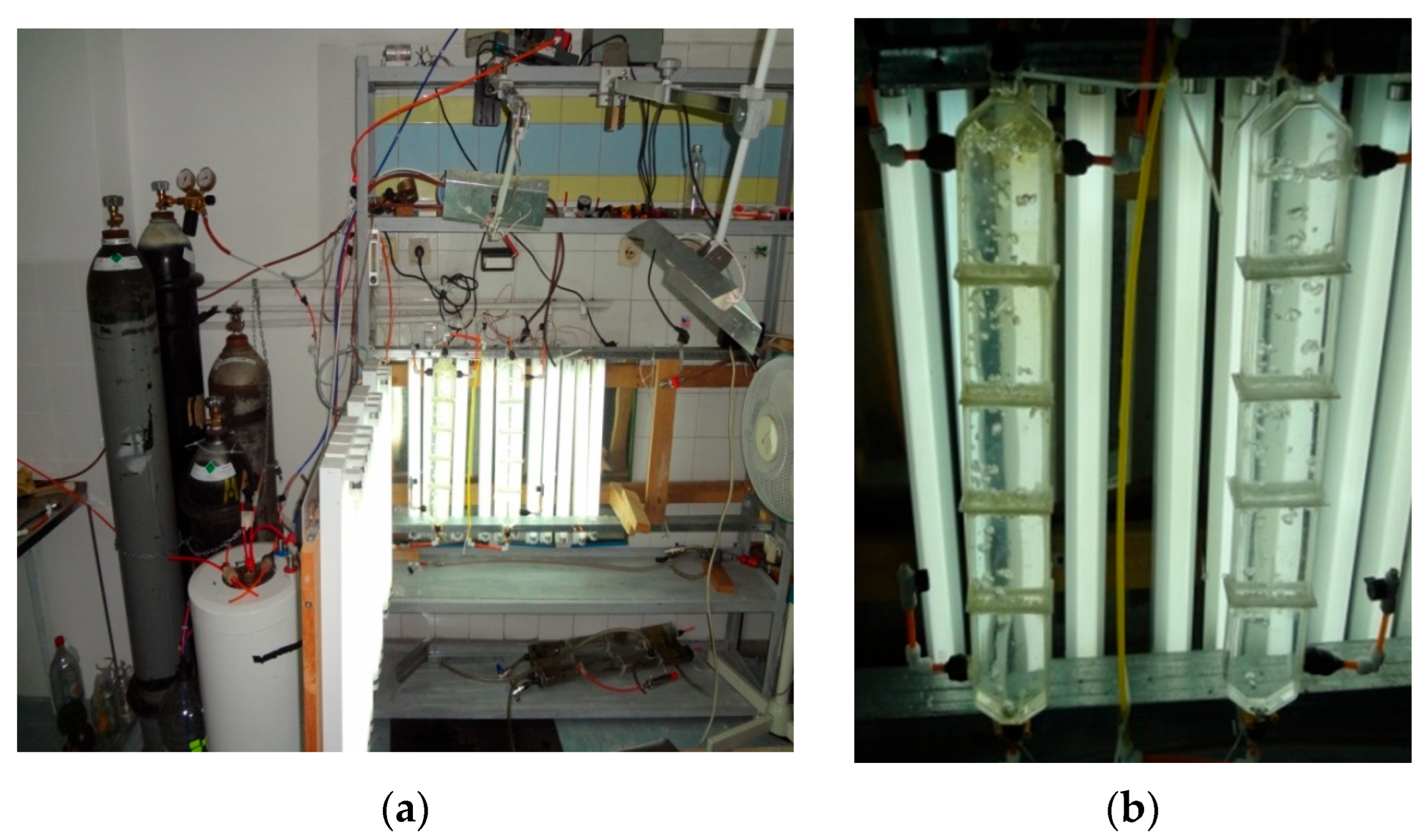
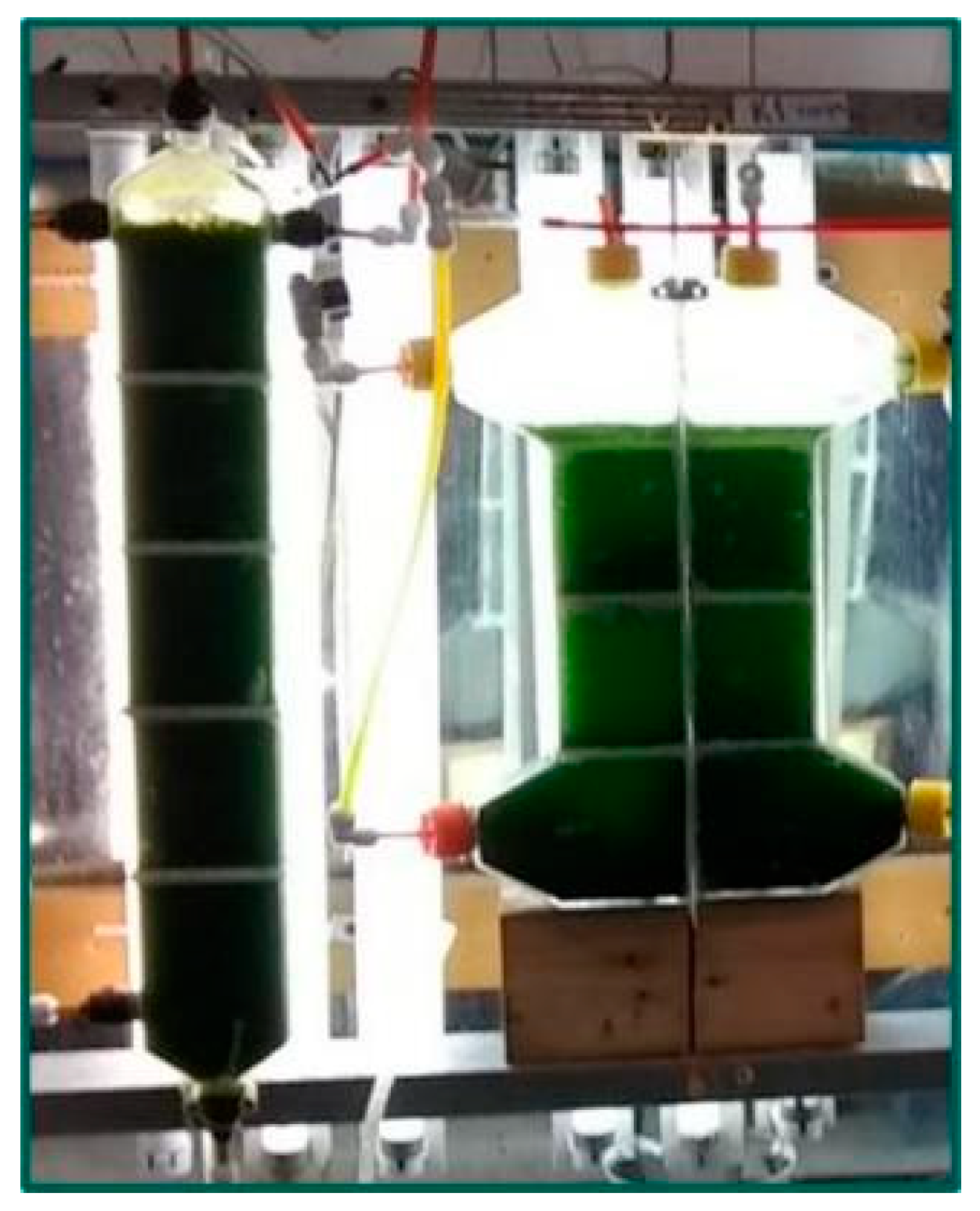
In the scheme presented in Figure 1, the conduction of the so-called “cold experiment” is documented. “Cold experiments”, i.e., with the use of water, were performed to specify the safety ranges of the PBR loads in the gas phase. According to the mathematical analysis of the design, PBR1 was chosen as a hybrid “flat-plate–column” type, where the geometric volume is V = 1.25 L and the working volume is V = 1 L. The thickness of the reactor is 3 cm, the width 7 cm, and the height 50 cm. PBR1 consists of 5 cells arranged vertically. Each cell can be considered as a separate continuous stirred tank reactor CSTR where an “ideal mixing” of the phases in the cell is assumed. Hybrid PBRs (Figure 1 and Figure 2) are made of visible light transmissive plastic. In the different PBRs, the organization of a determined flashing light effect (FLE) tremendously increased PBR biomass productivity. It is notable that the gas flow value determines the circulation of the two-phase flow in a circle inside the cells.
The scheme may be closed, and the gas circulates from PBRs and the gasholder until complete utilization of CO2 by the two connected PBRs in sequence. The light source for the installation was chosen as in the literature, i.e., using 3 front and 3 rear PBR fluorescent lights, 18 W each. In front of the installation, 2 metal-halide lamps of 150 W each were additionally used. The latter were turned on when the biomass concentration exceeded 2 g/L. The influence of light source, wavelength, light distribution, and other factors on photosynthesis is explained in detail in the authors’ mini-review [48]. Therefore, the choice of light load is consistent with the latest achievements in the field. The illumination of our PBRs from the back side was Iback = 81 µmol m−2 s−1, and, from the front wall, was in the interval Ifront = 604–660 µmol m−2 s−1 when the biomass concentration was above X = 6 g/L. The experiments were performed in light irradiation mode, with 24(light)/0(dark) hours. The measurements of the light emission were carried out with a Luxmeter TES 1335 (TES Electrical Corp., Rui Guang, Taipei, Taiwan).

2.4. Preparation of Biomass Samples for Analysis

The measurement of dry weight (dw) followed standard protocols in biotechnology [3]. Briefly, at the end of the cultivation process (21 days), a sample of 50 mL was withdrawn from each bioreactor (PBR1 and K1). The sample is centrifuged at 4000× g for 10 min, and the pellet is dried in a thermostat (Memmert, Schwabach, Germany) at T = 105 °C until a constant dw is achieved. The biomass withdrawn from each bioreactor was freeze-dried (lyophilized) in a vertical freeze dryer (BK-FD18P, BIOBASE Group, Jinan, Shandong, China). According to the manufacturer’s instructions and a published protocol [5], the microalgal biomass was first placed in glass vessels and frozen at −80 °C for 4 h within the lyophilizer. Thereafter, the vessels were placed on shelves in the chamber of the lyophilizer and dried for 48 h under a deep vacuum.
Dichloromethane extracts were prepared from the lyophilized microalgal biomass. Briefly, biomass from PBR1 and K1 bioreactors was subjected to extraction with dichloromethane, as previously described [49]. Before the experiments, the extracts were dissolved in 70% ethanol (96%, #603-002-00-5, Honeywell Specialty Chemicals, Seelze, Germany) and 30% distilled water with ultrasonification (ultrasound bath BIOBASE Group UC-20C, Jinan, Shandong, China). The stock at a concentration of 100 mg/mL was prepared freshly before each experiment.

2.5. Quantitative Determination of Polyphenols in S. acutus Biomass

The total polyphenol quantification was performed as described in the Eur. Ph.8.0 with modifications [49]. The lyophilized microalgae mass (20 mg) was extracted with 10 mL of distilled water by ultrasound-assisted extraction for 30 min. After filtering through filter paper, 2.0 mL of the filtrate was diluted to 10.0 mL with water. Then, to 2.0 mL of this solution, 1.0 mL of Folin–Ciocalteu’s phenol reagent and 10.0 mL of water were added. The solution was diluted to 25.0 mL with a 290 g/L sodium carbonate. The absorbance was measured at 760 nm after 30 min, using water as a blank on a UV-VIS spectrophotometer (UV-1203, Shimadzu, Kyoto, Japan). The total polyphenol content was expressed as pyrogallol equivalent [49,50].

2.6. Quantitative Determination of Flavonoids in S. acutus Biomass

A sample of 0.02 g of the powdered microalgae mass was placed and was extracted with 10 mL methanol for 30 min in an ultrasound bath. After filtration, the eluate was diluted in a volumetric flask to 10 mL with MeOH. Then, 500 µL of the solution was diluted to 2 mL with a 20 g/L aluminium chloride in methanol. The blank was prepared with 500 µL of sample solution diluted to 2.0 mL with MeOH. The absorbance was measured after 15 min at 420 nm by comparison with the blank. The total flavonoid content was expressed as hyperoside equivalent [49,51].

2.7. Quantitative Determination of Chlorophylls and Carotenoids in S. acutus Biomass

The quantitative determination of chlorophylls and carotenoids was carried out according to the method of Gonçalves et al. [52]. An amount of 10 mg of lyophilized microalgae mass (LMM) was extracted with 5 mL of 80% acetone in an ultrasound bath for 20 min, followed by centrifugation (3000× g, 8 min). The absorbance of the supernatant was measured at 470, 646.8, and 663.2 nm against a blank comprising 80% acetone. The concentration of pigments (mg g LMM−1) was calculated using the following Equations (1)–(3) [53]:
Chla = 12.25 × A663.2 − 2.79 × A646.8
Chlb = 21.50 × A646.8 − 5.10 × A663.2
TC = (1000 × A470 − 1.82 × Chla − 85.02 × Chlb)/198
where Chla—chlorophyll a; Chlb—chlorophyll b; TC—total carotenoids; A646.8—absorbance at 646.8 nm; A663.2—absorbance at 663.2 nm; and A470—absorbance at 470 nm.

2.8. Quantitative Determination of Lipids in S. acutus Biomass

The total lipids quantification was done according to the method applied by Carpio et al., 2015 [54]. A sample of 10 mg of lyophilized microalgae mass was soaked in 5 mL chloroform–methanol mixture (2:1, v/v) for 8 h (×3). After centrifugation (4000× g for 5 min), pooled supernatants were evaporated to dryness under vacuum, and the total lipids were quantified gravimetrically and expressed as mg/100 g dw. Reported values were averages of three measurements.

2.9. LC–MS Profiling of S. acutus Dichloromethane Extracts

The LC–MS analyses were performed on a Q Exactive Plus mass spectrometer (ThermoFisher Scientific, Inc., Waltham, MA, USA), in negative and positive ion mode with an m/z range from 10 to 1000 as previously described [49]. The separation was performed on a C18 column; the mobile phase contained 0.1% formic acid in water (A) and 0.1% formic acid in acetonitrile (B). The gradient elution program was as follows: 0–1 min from 0 to 5% B, 20 min-30% B, 25 min-50% B, 30 min-70% B, 33 min-95%. The flow rate was 0.3 mL/min, and the injection volume was 1 µL. Data acquisition was processed by software Xcalibur 4.2 (ThermoScientific, Waltham, MA USA). MZmine 2 software was used to analyze the LC–MS raw files for further semi-quantitative analysis. Results are expressed as the percentage peak area of each compound to the total peak areas of the metabolites.

2.10. Beta Coronavirus 1 Strain

For evaluation of the antiviral activity of the microalgae extracts, the bovine coronavirus strain “S379 Riems” (022V-04370 Beta-coronavirus 1, FLI, WOAH Collaborating Centre for Zoonoses in Europe, Insel Riems, Greifswald, Germany) was selected. The reason for the selection of this strain is the possibility of conducting research in a BSL2 area instead of BSL 3, which is required for the SARS-CoV-2 viral strains. Also, both virus species belong to the beta coronavirus genus, and recent research revealed certain similarities between them. For instance, SARS-CoV-2 variants of the receptor-binding domain (RBD) and N-terminal domain (NTD) of the spike (S) protein potentially expand species tropism to bovine AXL and NRP1 receptors and show similarities to BCoV, leading to an increased risk of the worldwide transmission of COVID-19 [55].

2.11. Cultivation of MDBK Cells

The Madin–Darby bovine kidney cell line MDBK (NBL-1, #600396) was delivered from CLS Cell Lines Service (GmbH, Eppelheim, Germany). The cells were cultivated in culture medium MEM, supplemented with 10% (v/v) FBS, 0.1 mM non-essential amino acids, 1 mM sodium pyruvate, 2 mM GlutaMAX™, and Pen/Strep solution. Cells were grown under sterile standard conditions in a CO2 incubator (Panasonic MCO-18AC, Panasonic Healthcare co., Ltd., Oizumi-Machi, Japan) at 37 °C, 5% (v/v) CO2 supply, and high humidity. Cells were sub-cultured every 72 h according to the protocol of the biobank through cell detachment by using PBS and Accutase® and dilution at a ratio of 1:4 in the culture medium described above.

2.12. Evaluation of the In Vitro Cytotoxicity of PBR1 and K1 Extracts

The in vitro cytotoxicity of both extracts, PBR1 and K1, was evaluated following Annex C of ISO 10993-5 [56]. Median inhibitory (IC50) and maximum non-toxic concentrations (MNCs) were calculated in GraphPad Prism software (Version 6.00, for Windows, GraphPad Software, La Jolla, CA, USA), based on the data obtained after 24, 48, and 72 h of exposure to 10 two-fold decreasing concentrations of both extracts from 4 to 0.0078 mg/mL. Briefly, for the aim of the experiment, cells were detached, counted, and resuspended in fresh culture medium. Thereafter, the cell suspension was diluted to a density of 0.135 ×10⁶ cells/mL, and 100 µL of this suspension was distributed in each well of 96-well plates. The latter were incubated for 24, 48, and 72 h in a CO2 incubator (see description above). After each period of incubation, sterile MTT-dye solution (5 mg/mL in PBS) was added to each well to reach a final concentration of 0.5 mg/mL. Thereafter, plates were incubated further for 2 h at 37 °C. The reaction product (formazan crystals) formed in proliferating cells was dissolved in 100 μL/well 2-propanol after removal of the culture medium. The absorbance of the surviving cell fraction was measured at λ = 540 nm (reference filter at 690 nm) on a microplate reader ELx800 (BioTek Instruments, Inc., Winooski, VT, USA). The median inhibitory and maximal non-toxic concentrations were calculated in GraphPad Prism software by using a [log(inhibitor) vs. normalized response—variable slope] model:
Y = 100 1 + 10 l o g ( I C 50 X ) × h i l l s l o p e .

2.13. Mathematical Model for the Calculation of Median Antiviral Effect

The median antiviral effect “EC50” was calculated by using the software of symbolic mathematics, MAPLE 15®. For this aim, we applied self-developed programs for non-linear modeling and response surface analysis (RSA) of the experimental data points as described in [57]. The theory of the models is based on Chou and Talalay [58,59]. As an objective function of the search in the non-linear regression procedure, a statistical criterion of weighted least squares was used. An algorithm searching for the minimum of the sum of weighted squares was used, which gave the best values of the fitting parameter. The model can be written as follows:
F a F u = D o s e D m m ,
where Fa stands for the affected fraction; Fu stands for the unaffected fraction (1 − Fa) = Fu; Dose refers to the amount of drug; Dm is the median-effect of drug concentration (here Dm = EC50) and m is the hillslope of the curve (for m = 1 the curve is hyperbolic; for m > 1, sigmoidal; for m < 1, negative (flat) sigmoidal).
The applied methodology of RSA demonstrated the predictive potential of Equation (5) as a function of the changes to model parameters −EC50 and m. RSA 3D plots showed how the model can describe the phenomena in the frame of the standard deviation of the “EC50” and “m”. The statistical evaluation of the experimental data was performed by using the GraphPad Prism software program (GraphPad Prism version 9.0.0 for Windows, GraphPad Software, Boston, MA, USA).

2.14. Propagation of Bovine Coronavirus in MDBK Cells

Briefly, adherent MDBK cell culture in a 25 cm2 sterile cell culture flask (Corning, Glendale, AZ, USA), with a density ≥85%, was infected with virus particles at a multiplicity of infection (MOI) 1 (see Equation (6)) from a stock with concentration 1.47 × 10⁷ (TCID50/mL) according to the data sheet of the biobank. The culture medium MEM used for the infection contained no FBS and no Pen/Strep solution. Cells were incubated for 3 h with the virus, and, thereafter, the medium was replaced with complete MEM supplemented with 10% (v/v) FBS. The cell culture was observed during the next 48 h under an inverted microscope for the appearance of a cytopathic effect (CPE). After increasing the number of the virus plaques, the supernatant was collected, distributed in cryovials, and frozen at −80 °C. The virus titer was estimated, as described before, with ddPCR, plaque assay, and TCID50 assay [57]. The aliquots with the virus were cryopreserved at −80 °C and were used for other experiments, as well. The number of virus particles needed for the infection of MDBK cells was calculated as follows:
V   m L =   n u m b e r   o f   c e l l s   ×   n u m b e r   o f   c u l t u r e   f l a s k s   ×   M O I v i r a l   t i t e r
where V stands for the volume of the virus stock solution, which is used for the infection.

2.15. Determination of the Bovine Coronavirus Titer in PBR1- and K1-Treated Samples with ddPCR

The titer of the bovine coronavirus stock used for the experiments in this study was determined with ddPCR, TCID50 Assay, and plaque assay as published in [57]. The same virus stock and positive virus control as in [57] were used for the experiments described here, as both experimental sets were performed in parallel with the same virus controls. For this study, the number of virus particles in the PBR1- and K1-treated samples was estimated with ddPCR following the protocol published in [57]. Briefly, RNA was isolated from the supernatant of the treated samples with the NucleoSpin RNA virus kit (Marcherey-Nagle GmbH & Co. KG, Deuren, Germany), whereby the manufacturer’s protocol was applied without modifications. The RNA concentration was measured with the NanoDrop™ Lite spectrophotometer (ThermoFisher Scientific, Waltham, MA, USA). Reverse transcription was performed with 1 ng viral RNA by using the PrimeScriptTM Reverse Transcriptase kit of TaKaRa Bio Inc. (Shiga, Japan). The protocol for the ddPCR was applied as in [57] by using the ddPCRTM Supermix for Probes (Bio-Rad Laboratories Inc., Hercules, CA, USA). The ddPCR reactions of the treated samples contained 9 µL of the reaction product from the reverse transcription. The primers/probe set target was the nucleocapsid gene of the BCoV, the same recommended by the biobank from which the virus was delivered: forward primer 5′-GGACCCAAGTAGCGATGAG-3′, reverse primer 5′-GACCTTCCTGAGCCTTCAATA-3′, and probe 6-FAM-5′-ATTCCGACTAGGTTTCCGCCTGG-3′-BHQ1 [34]. The ddPCR protocol was as follows: 9 µL cDNA, 900 nM primers, 200 nM probe, 1× ddPCRTM Supermix for Probes, and PCR water up to 20 µL final reaction volume. Each reaction of the samples treated with the K1 extract was prepared in two replicates. Each dilution of the positive virus control was repeated twice. The ddPCR program started with initial denaturation at 95 °C (10 min) followed by 40 cycles of denaturation (94 °C, 30 s), annealing and extension (57 °C, 1 min), final enzyme deactivation (98 °C, 10 min), reaction end at 4 °C (∞), and ramp rate 2 °C/s. Two replicates were also prepared for each dilution and a negative control. The virus titer (number of BCoV particles/mL) was calculated as published in [57]: 150 µL supernatant containing virus particles leads to 50 µL RNA yields, 1 ng RNA of which is used for a 20 µL reverse transcription reaction. A volume of 9 µL cDNA from the latter was added into 20 µL ddPCR reaction.

2.16. Determination of the Antiviral Activity of PBR1 and K1 Extracts with a Cell Viability Assay

Two treatment schemes were applied for the determination of the antiviral potential of PBR1 and K1 extract, having in mind the median inhibitory and maximum non-toxic concentrations of both extracts. Both treatment schemes were performed with concentrations of the extracts ranging between 0.025 and 0.2 mg/mL. Treatment scheme 1 included preincubation of the BCoV solution prepared for infection of the MDBK cells with PBR1 or K1 extract for 1 h at 37 °C before adding it to the cells for 4 h further incubation. Treatment scheme 2 represented a direct treatment approach whereby the mixtures of the virus particles and one of the extracts in different concentrations was added directly to the cells for 3 h incubation without a pre-incubation period. The fraction of viable cells was measured by applying ISO 10993-5/2006, Annex C, with some modifications [30,31], as described in Section 2.3 of Section 2. The initial cell density was the same. The virus inoculum was prepared in MEM containing 2% FBS, so that the MOI = 1, and 100 µL was added to each well after aspirating the culture medium. After 3 h, the supernatant was replaced with complete culture medium, containing 10% FBS. The plates with the samples were incubated for 90 h at 37 °C and 5% in a CO2 incubator with a humidified atmosphere. At the end of the incubation period, the CPE was documented under an inverted microscope with magnification 200×. The cell viability was measured as described above in Section 2.3. The effective concentration 50% (median effective concentration, EC50) was calculated with a non-linear mathematical model coded in MAPLE 15® software. The selectivity index (SI) was calculated as the ratio between IC50 in MDBK cells and EC50 [60].

2.17. Statistical Evaluation

The experimental points were statistically evaluated with two-way ANOVA in GraphPad Prism software (Version 6.00, for Windows, GraphPad Software, La Jolla, CA, USA). Experiments were carried out in duplicate (ddPCR) or in triplicate (MTT assay). The data are presented as mean values ± SD. A value of p < 0.05 was considered a statistically significant difference between two compared group of variables.

3. Results

3.1. Culture Conditions of the Microalgal Strain

During the “cold experiments”, the optimal ranges of the PBR loads in the gas phase were obtained in interval 2–5 [v/v/min]. The operational temperature ranged between 25 °C and 29 °C; the pH was 7.4 after medium refreshment and reached 10 before adding new medium; the QCO2 was 2–10% [v/v]; and the air flow enriched with CO2 was Qair = 0.1–0.4 L/L/min. At the end of the culturing (21 days), the biomass of each bioreactor reached a concentration of 7.4 g/L for PBR1 and 3.9 g/L for K1.

3.2. Phytochemical Content and LC–MS Profiling of Biomass from S. acutus

The obtained data from the phytochemical analysis are systematized in Table 1. The data revealed that K1 biomass has a higher content of flavonoids, polyphenols, carotenoids, and lipids in comparison with PBR1 biomass. Accordingly, cultivation in the K1 bioreactor resulted in about a two-fold increase in flavonoid and polyphenol content compared to PBR1. Additionally, the content of total carotenoids from the K1 bioreactor biomass is higher in comparison with that obtained from the PBR1 bioreactor. The same tendency is observed also for the amount of lipids.
Further, two dichloromethane extracts were obtained from the lyophilized biomass of the PBR1 and K1 photobioreactors. PBR1 and K1 dichloromethane extracts were screened by ultra-high-performance liquid chromatography—high resolution Orbitrap mass spectrometry (LC-MS) in negative and positive ion mode. Based on the MS accurate masses, MS/MS fragments, relative ion abundance, retention times, and comparison with literature data, two phenolic (2 and 3), two dicarboxylic (1 and 4), 30 fatty acids (5–34), and two monoterpenoid hydroxylactones (35 and 36) were annotated in the extract. Their retention times, molecular formula, MS/MS fragment ions, and mass measurement errors are depicted in Table 2. Identification confidence levels for metabolite profiling were previously described [61].
An MS/MS spectrum of 1 with deprotonated molecule [M-H] at m/z 159.065 was acquired (Table 2). The precursor ion yielded an abundant ion at m/z 115.075 [M-H-CO2] (36.5%), together with fragment ions at m/z 141.054 [M-H-H2O] and a base peak at m/z 97.064 [M-H-H2O-CO2]. The fragmentation pattern of 1 was consistent with the dicarboxylic acid methyladipic acid, dereplicated previously in some algae [62]. Compound 4 afforded [M-H] at m/z 187.097 and the same fragmentation pathway with fragments at m/z 169.086 [M-H-H2O], 143.107 [M-H-CO2], and a base peak at m/z 125.096 [M-H-H2O-CO2]. Based on previous MS and MS/MS data, compound 4 was tentatively annotated as azelaic acid [63,64].
Similarly, compounds 2 and 3 were related to phenyllactic acid and hydroxyphenyllactic acid, respectively, previously found in seaweeds [62].
Herein, one polyunsaturated fatty acid (PUFA) (16), 10 monohydroxy (5–14), eight dihydroxy (16–29), and five trihydroxy-PUFAs (30–34) were tentatively identified in both extracts (Table 2). Their LC–MS strategy for dereplication was discussed in detail in [49,65].
In positive ion mode, two monoterpenoid lactones were tentatively identified in both extracts. Compounds 35 and 36 share the same protonated molecule at m/z 197.117 and gave fragments at m/z 179.106 [M+H-H2O]+, 161.096 [M+H-2H2O]+, 135.117 [M+H-2H2O-CO2]+, 133.101 [M+H-2H2O-CO]+, and 107.086 [M+H-2H2O-CO-CH2]+. Based on comparison with literature data, 35/36 were annotated as loliolide/isololiolide [62], previously reported in several algae species, including Scenedesmus deserticola [66,67].

3.3. In Vitro Cytotoxicity of PBR1 and K1 Extracts on MDBK Cells

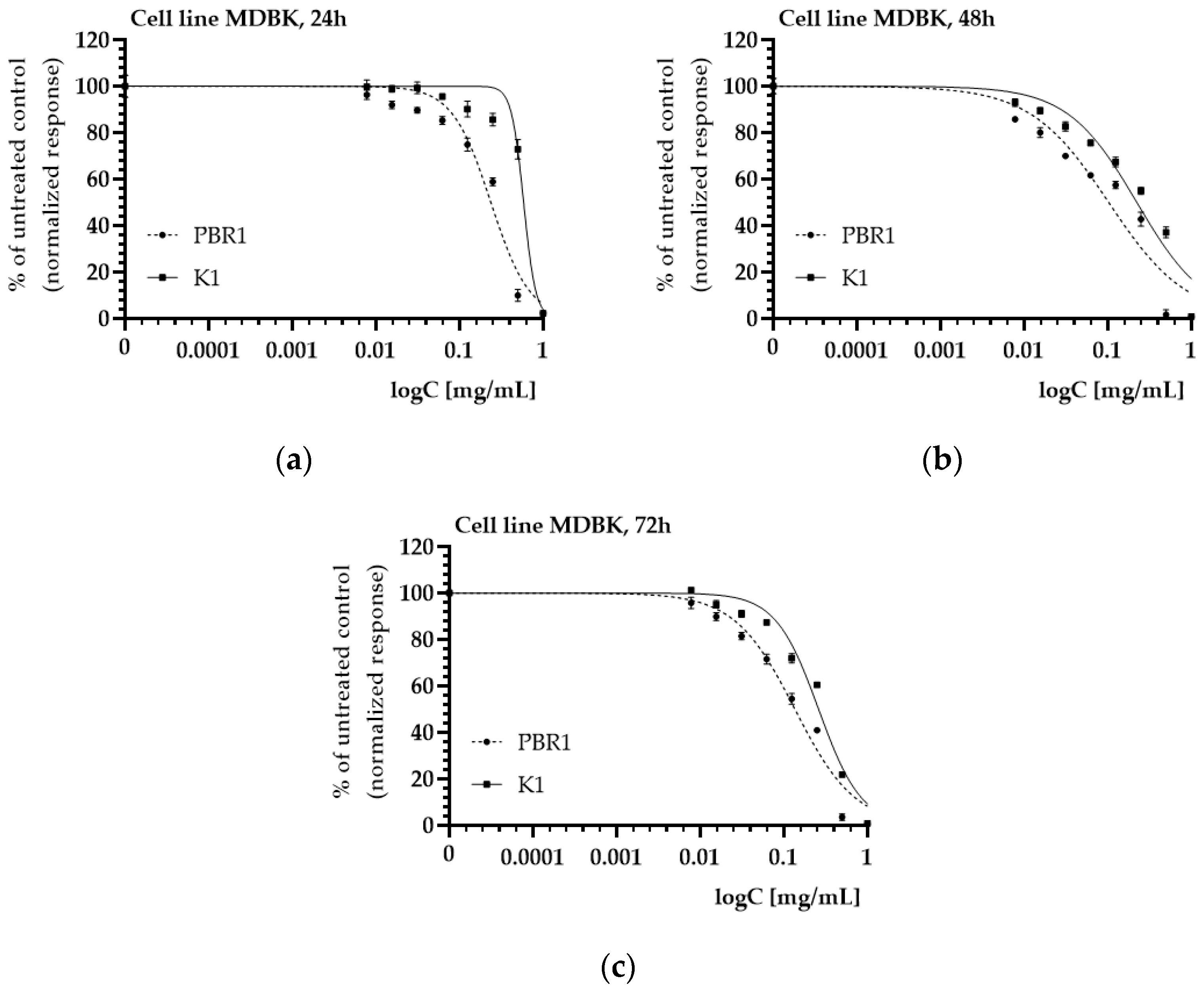
As a first step of the antiviral assays, the in vitro cytotoxicity of PBR1 and K1 extracts was analyzed by using the cancer cell line MDBK, which was used subsequently for the propagation of the bovine coronavirus. The percentage of viable cells measured after 24, 48, and 72 h of exposure to both extracts was calculated, taking into account the results of absorbance from the MTT-dye reduction analysis. The dose–response curves are presented in Figure 3. The model parameters (hill slope “m” and the coefficient of determination “R2”), median inhibitory concentrations, and maximal non-toxic concentrations are given in Table 2.
The median inhibitory concentrations of PBR1 extract are two-fold lower than those of K1 extract, whereas the MNC of K1 is lower than that of PBR1. The cytotoxic activity increases directly proportional to the applied concentration. Up to the 48th h of incubation, a time-dependent decrease in IC50 and MNC values was observed, followed by a slight increase at the 72nd h (Table 3).

3.4. Antiviral Activity of Dichloromethane Extracts from Tetradesmus Acutus Evaluated with MTT Assay

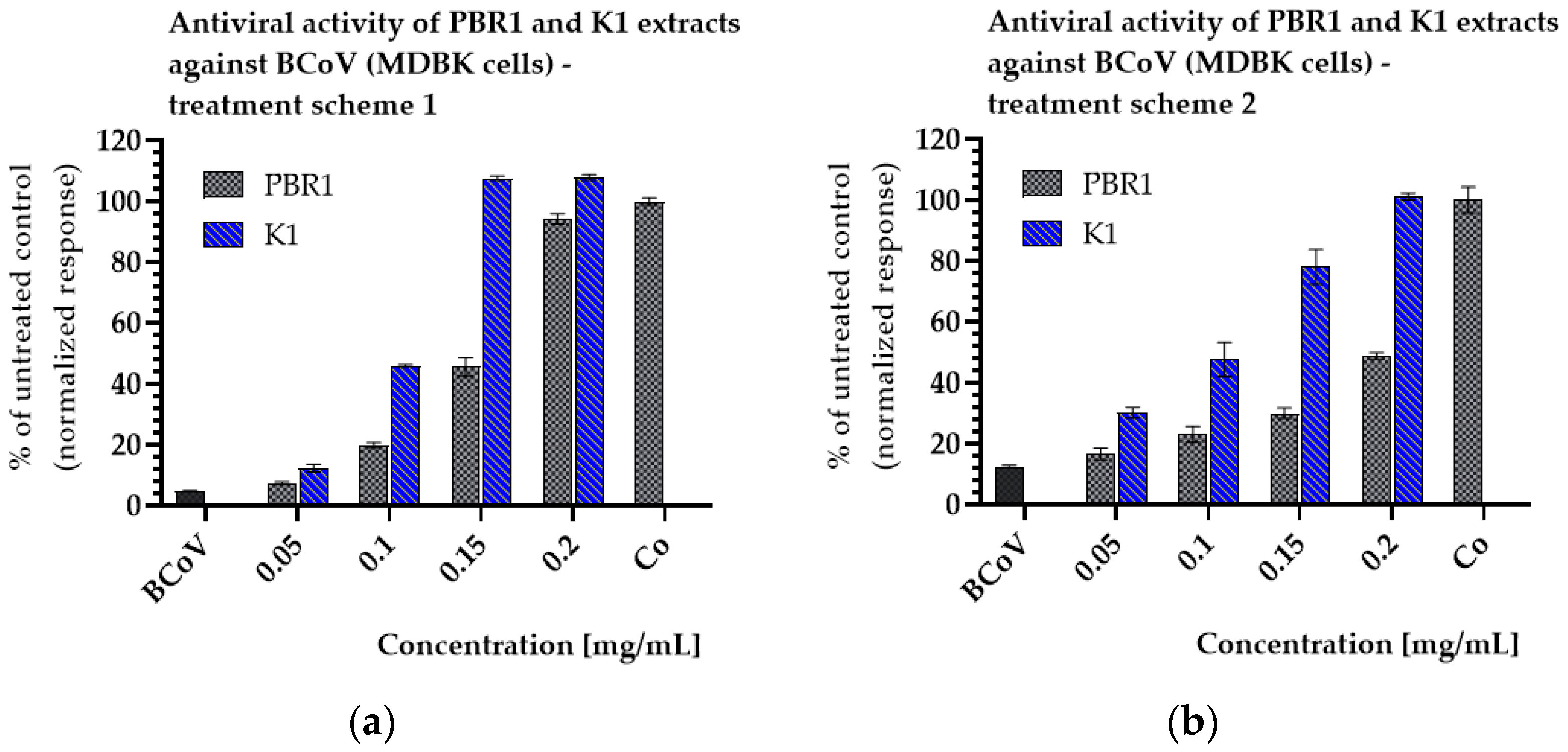
The results from the antiviral activity (schemes 1 and 2) of PBR1 and K1 are given in Figure 4. The statistical analysis is presented in Supplementary Table S1. Four concentrations of both extracts, selected based on the in vitro cytotoxicity result, were tested in this first experiment. Scheme 1, which includes preincubation of the virus with the extracts, lead to inactivation of the virus at lower concentrations (0.15 mg/mL for K1 and 0.2 mg/mL for PBR1 extract). Therefore, this treatment scheme was selected for the estimation of the 50% effective concentrations by MTT-assay, microscopic evaluation of cytopathic effect, and determination of the number of viable viral particles by ddPCR.
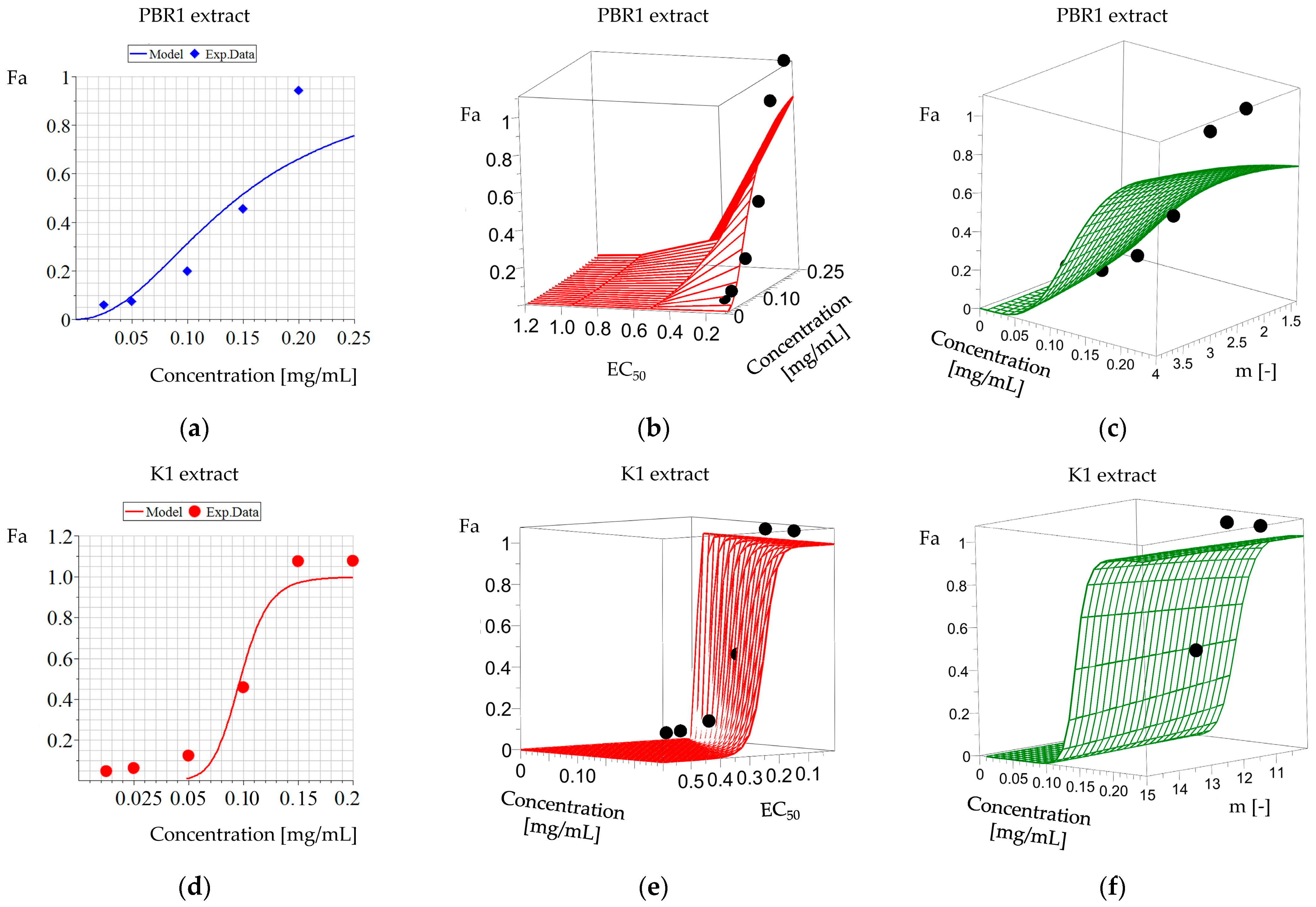
Figure 5 presents the concentration–effect curves after application of treatment scheme 1 in a concentration range of 0.025–0.2 mg/mL for the PBR1 extract and 0.0125–0.2 mg/mL for the K1 extract. The RSA analysis proves the suitability of the mathematical model used for the experimental data points. The model parameters and EC50 values are given in Table 4.
As visible from the data in Table 4, both extracts achieve 50% antiviral effect in the concentration range 0.130—0.15 mg/mL. The value for 50% effect based on the real experimental data points for K1 is between 0.1 and 0.15 mg/mL, whereby the viable cell fraction at a concentration of 0.15 mg/mL is 100%. PBR1 extract prevents the MDBK cells from the BCoV-induced cytopathic effect at a higher concentration of 0.2 mg/mL, whereby the viable cell fraction is 94%. The SI values of PBR1 and K1 extracts are also given in Table 4. They represent the ratio of the IC50 (cytotoxic concentration on MDBK cells in the absence of virus) after 72 h of exposure to each extract and the 50% bioactive concentration EC50 [60]. SI for the K1 extract is two-fold higher than that of the PBR1 extract.

3.5. Inhibition of the CPE of BCoV in MDBK Cells by PBR1 and K1 Extracts

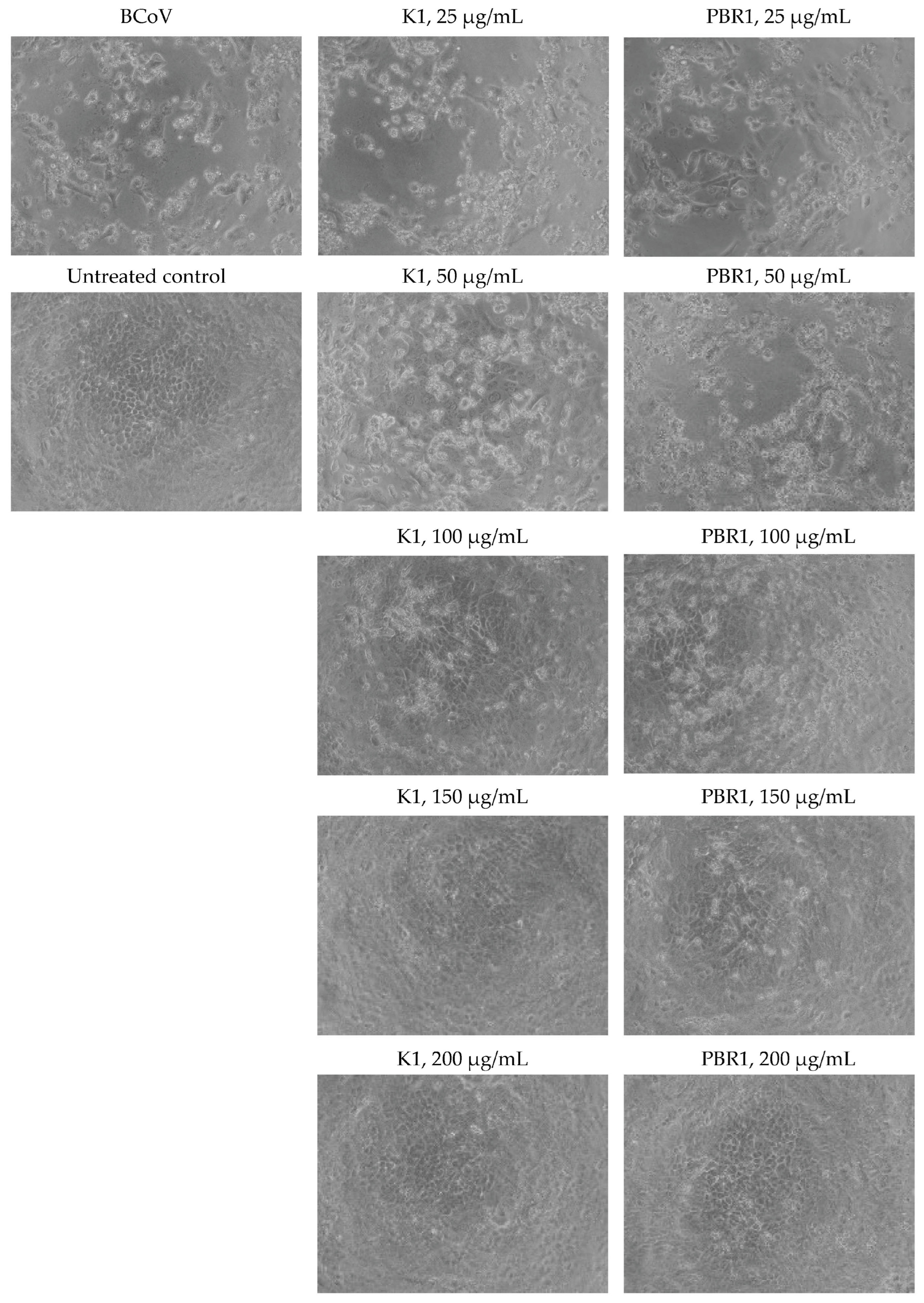
The inhibitory effects of PBR1 and K1 extracts on BCoV-induced cytopathic effects (CPE) in MDBK cells are shown in Figure 6. Cell morphology was assessed in BCoV-infected cells incubated with five concentrations of each extract chosen based on the cytotoxicity, in untreated controls, and in virus-infected cells without extract treatment. At low concentrations (25 and 50 µg/mL), pronounced cell loss, rounding, discohesion, and the clumping of residual cells were observed, consistent with membrane disruption and cytoskeletal damage. Higher extract concentrations reduced the number of discohesive cells and plaque-forming units. Cell density in samples treated with 25 and 50 µg/mL was irregular, with only a minority of cells exhibiting normal morphology, indicating absent cytoskeletal changes. At increasing concentrations, cells displayed morphological features consistent with reduced viral replication, a concentration-dependent rise in proliferation, and enhanced membrane stability, evidenced by greater intercellular contacts. At 100–150 µg/mL K1 extract or 150–200 µg/mL PBR1 extract, cell morphology was comparable to that of untreated controls.

3.6. Quantitative Analysis of Virus Particles by ddPCR After Treatment with PBR1 and K1 Extracts

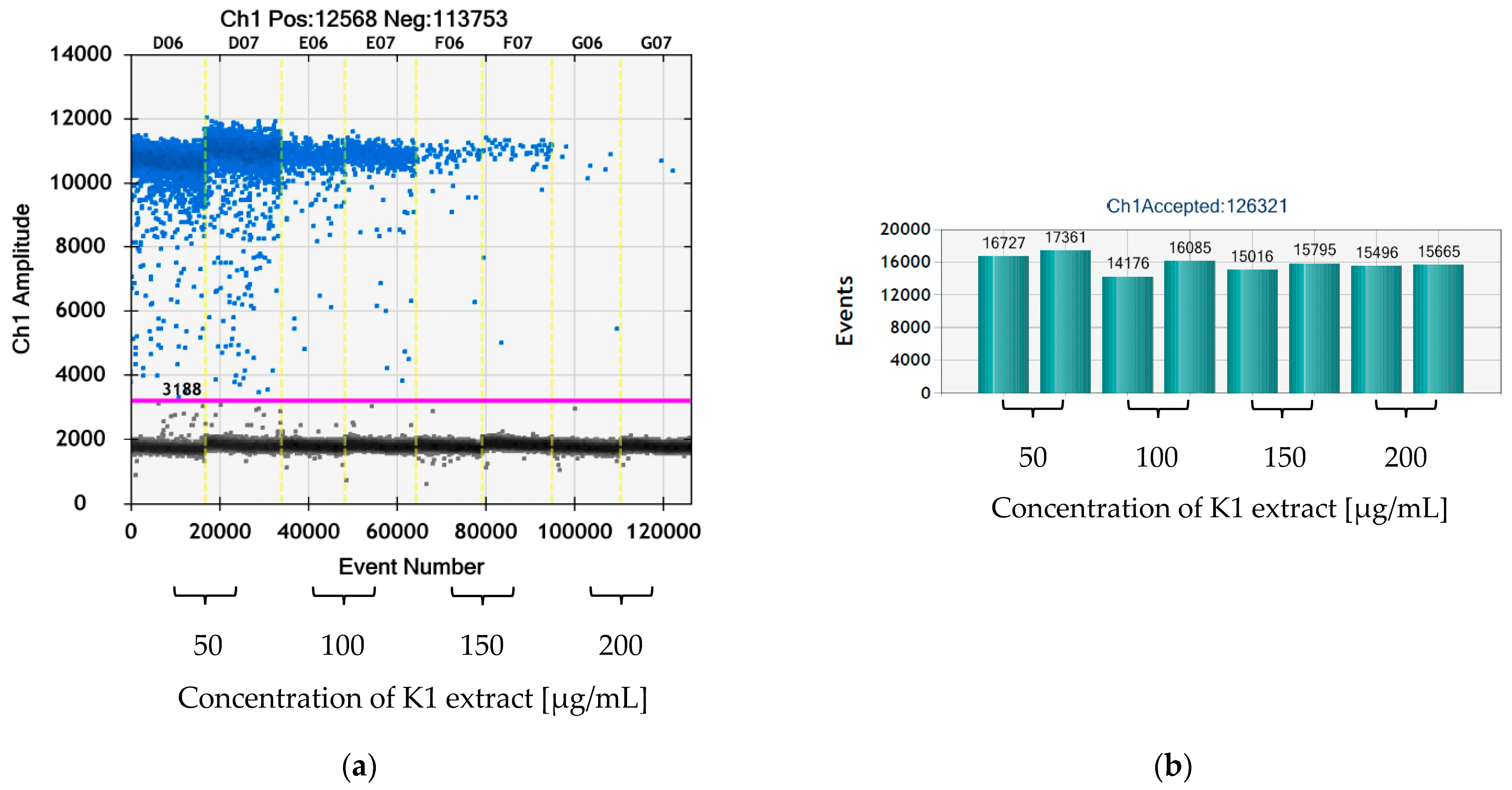
The data from the quantitative ddPCR, performed in order, determine the number of BCoV particles in samples infected with the virus and treated with PBR1 and K1 extracts. The results are presented in Figure 7 and Table 5. Each sample was repeated twice. In Figure 7a, there is a histogram presenting the positive and negative droplets in each sample used for the calculation of the number of virus particles. The raw data from each repetition are given in Supplementary Table S2 (concentration of BCoV cDNA in each sample). The number of virus particles dropped significantly from 1.3 × 10¹⁰/mL in the untreated BCoV-infected control to 2.87 × 10³/mL in cell supernatant treated with 200 µg/mL K1 extract. The decrease of the virus particles was inversely proportional to the concentration applied.

4. Discussion

In the current study, we evaluated, for the first time, the antiviral activity of dichloromethane extracts obtained from Scenedesmus acutus cf. acutus Meyen cultivated in two innovative flat-plate PBRs (Figure 2). It is known from the scientific literature that some products with antiviral activity have a marine origin and are isolated from algae [68]. Moreover, some products contain large molecules that cannot be reproduced by chemical synthesis [69]. An important point in the search for bioactive molecules in microalgae is their ability to reach high biomass levels without excessive energy costs [70].
Modeling of the fluid flow distribution of hybrid PBR1 is crucial to obtain optimal FLE resulting in maximum biomass. In our complex work [3], these phenomena were demonstrated in the chosen hybrid PBR vessel [3]. In this cited work, distribution of flow was calculated by using computational fluid dynamics (CFD) software (SimFlow CFD 5.0). The CFD simulations were conducted in Comsol Multiphysics 5.2, which is a multipurpose software platform used to simulate physics-based problems, and the turbulent fluid flow movement was analyzed through the Reynolds-Averaged Navier–Stokes (RANS) equation, assuming that the fluid is incompressible and Newtonian. By using principles of analogy, the hydrodynamics of any hybrid PBR can be modeled with this software [3] for the given initial and boundary conditions.
In the Bulgarian laboratory, the hydrodynamics of the two hybrid PBRs (PBR1 and K1) was visualized and monitored during the so-called “cold” experiments (liquid is water only, Figure 1). The PBRs were used as follows:
-
Firstly, as a proven system for purification of waste gases with high CO2 content in the gas phase and for the achievement of maximum biomass concentration;
-
Secondly, the system (in the sense of PBR as a system) was checked out to produce HVPs with antiviral potential;
Using CFD software, many scenarios were executed and analyzed. From simulation results, we may highlight several benefits:
-
Many hypotheses wherein the initial conditions are changed can demonstrate the potential of PBR1 and K1 design for the accumulation of different amount of biomass, as proven by the experimentally measured biomass concentrations in the current work (PBR1 = 7.4 g/L; K1 = 3.9 g/L);
-
It must be noticed that a hybrid PBR design of this kind where dynamics of the processes is high enough, the researcher can use pH to control the load of CO2. In this way, well known pH-stat can be very successfully applied by automatically added CO2 or base in order to maintain pH in the set point;
-
In order to achieve high synthesis of internal HVP, light conditions must be optimized by choosing proper different wavelengths of visible light;
-
Notably optimal results from the two-steps optimization procedure, as was explained above, is a loop procedure, not a single action.
Therefore, realization of such an approach is the final step of process development, where optimal biomass and synthesis of HVP are achieved.
The results obtained from the phytochemical analysis of the biomass collected from PBR1 and K1 revealed that slower biomass accumulation in K1 leads to increased synthesis of secondary metabolites compared to PBR1. The biomass concentration in K1 was two-fold lower than that in PBR1. The microalgae cultivated in K1 were richer in flavonoids, polyphenols, carotenoids, and lipids. The chlorophyll a and b content was also higher (Table 1). One plausible explanation could be the fact that, during rapid growth, the synthesis of primary metabolites such as proteins, carbohydrates, and lipids is preferentially promoted. The result for the carotenoid content shown in Table 1 reveals that slower-growing microalgae cultivated in the K1 photobioreactor contain four-fold more carotenoids than the microalgae in PBR1. The amount of carotenoids is approximately five-fold lower than our previous investigations performed in a small-scale photobioreactor (inoculum stage) under red or green light inner LED light source [49], in contrast to the lipid composition, which, here, in the bigger flat-plate PBRs (production phase), is around four-fold higher. One possible reason is the fact that green or red light sources induce stress, and, subsequently, the synthesis of protective antioxidant compounds such as carotenoids increases. In the current investigation, only white light was applied. Further investigations on the metabolism of the microalgae in both PBR systems should be performed in order to explain if there are other reasons for this difference. A different approach for the extraction of carotenoids and lipids by wall-degrading enzymes could also be used in future studies in order to increase the product yield for the determination of these metabolites [71]. According to the LS–MS analysis, both S. acutus extracts revealed similar phytochemical profiling. PBS revealed a higher content of PUFAs (85.2%) compared to K1 (78.0%). However, K1 demonstrated a higher level of dicarboxylic and phenolic acids methyladipic (1), phenyllactic (2), hydroxyphenyllactic (3), and azelaic acid (4), as well as monoterpenoid lactones loliolide /isololiolide (36 and 37) (Table 2).
As already mentioned in the introduction, there are no published data on the direct antiviral activity of extracts obtained from Tetradesmus acutus. However, there is still a wealth of information about the antiviral action of the microalgae bioactive compounds, such as lectins, polysaccharides, and pigments, e.g., carotenoids, polyphenols, flavonoids, and glycolipids [22]. Our extracts are rich in lipids, whereby the more potent extract K1 contains higher levels of carotenoids than the PBR1 extract. From both tested schemes, the first one, which includes pre-incubation of the extracts with the virus before adding the mixture to the cells, led to a CPE at two-fold lower concentrations (Figure 6) than the second applied treatment scheme, wherein the mixture of BCoV and extract was added to the cell culture without pre-incubation. In previous investigations, it was suggested that some glucolipids probably harm the virus envelope by changing the shape of virus particles, thus causing lysis and preventing the formation of plaques in the cell culture. However, the exact mode of action is not clear and warrants further investigation.
The inhibition of BCoV caused CPE in MDBK cells, proving the antiviral activity of K1 and PBR1 extract in concentrations equal to or higher than 150 µg/mL. Virus-infected cells remain metabolically active after infection, which is needed for the support of the virus replication. During the time period, downregulation of surface adhesion proteins occurs, which leads to certain pathomorphological changes [72]. The latter includes cell the rounding, detachment, and clumping of the adherent cells. Such changes were characteristic of cells protected by lower concentrations of the extracts (up to 100 µg/mL), whereby a concentration-dependent protective effect was observed with increasing concentration. A concentration of 100 µg/mL revealed stable cell morphology and limited areas with cell clumps. The formation of plaque-forming units was greatly reduced in samples treated with 100 µg/mL K1 or PBR1 extracts, in contrast to 25 and 50 µg/mL, where cellular contacts were significantly disrupted and multiple lesions were found in the cell monolayer when observed under a microscope. Such cellular damage is associated with a higher level of cytopathicity and lower biological effectiveness of the protectors. Increasing the concentration reveals the presence of permissive cells (cells with viral replication and cytopathic effect) and resolving cells (cells with viral replication but no cytopathic effect), which ratio in favor of the resolving cells. In samples treated with 150 and 200 µg/mL K1 extract, the cell morphology was identical to that of the negative control (untreated non-infected cells). For the PBR1 extract, such a protective effect was achieved after incubation with 200 µg/mL. The difference in the activity between both extracts could be explained with the different concentrations of certain compounds in the extracts, as revealed by the LC–MS analysis. However, there is a lack of information in the scientific literature about the antiviral activity of the compounds identified in our extracts. It is known that some PUFAs [73,74] and dicarboxylic and phenolic acids can possess antiviral activity [75], but it should be proven in a separate study for relevance to the exact compounds identified in the current study.
The quantification of the remaining virus particles after treatment of MDBK cells in our study with the more active K1 extract revealed a significant diminishment of the number of BC-V particles as compared to the untreated BCoV-infected control (Δlog = 4.53 × 10⁶) after incubation with 200 µg/mL K1 extract. The CPE effect was fully eliminated after the application of 150 g/mL, which could be explained by the fact that the ddPCR determines the presence of viral nucleic acid but does not give information about the viability and infection potential of the virus particle, which may have a damaged envelope and impaired ability to penetrate the host cell.

5. Conclusions

A new, multifunctional installation for the utilization of CO2 from waste gases and maximum biomass production, where microalgae are cultured in closed PBRs, has been created (and not exclusively for Bulgarian conditions). The quality of the installation allows its application to studies of the growth kinetics of microalgae, which are also related to the production of HVPs. The created hybrid PBR1 “flat-plate–column” type shows the capabilities of modern PBRs used for laboratory research and industrial production. The biomass levels were higher in PBR1, but more lipids and secondary metabolites accumulated under the conditions created by the different hydrodynamics in the K1 bioreactor. Therefore, by controlling the cultivation conditions, the metabolism of the microalgae can be directed towards the synthesis of high-value secondary metabolites.
Taken together, our data indicate that antiviral activity is stronger when the biomass is richer in secondary metabolites and lipids, which was characteristic of the microalgae cultivated in the flat-plate K1 bioreactor. Pre-incubation of the virus with either of the two tested extracts led to a stronger inhibition of the virus replication than the direct treatment approach. Both extracts ameliorated the BCoV-induced cytopathic effect at a concentration of 100 µg/mL, whereby the protective effect of the K1 extract was more pronounced, most probably due to the higher levels of flavonoids, polyphenols, carotenoids, and lipids. Concentrations of 150 and 200 µg/mL led to significant diminishment of the virus replication in K1 extract-treated samples, as proven by ddPCR.
In conclusion, it is worth subjecting the extracts to further investigation regarding the phytochemical profile and pharmacological potential of the separated fractions or single compounds and their exhibition of antiviral activity against bovine coronavirus and other representatives of the same genus.

Supplementary Materials

The following supporting information can be downloaded at: https://www.mdpi.com/article/10.3390/fermentation12020085/s1, Table S1: Statistical analysis of the data used for Figure 4—two-way ANOVA; Table S2: Raw data from the ddPCR for enumeration of the BCoV particles in K1-treated samples.

Author Contributions

Conceptualization, A.K., M.M.Z., H.N., U.G. and P.F. methodology, A.K., M.M.Z., E.K., R.G., D.Z.-D., V.B.-B., S.N. and T.C.K.; software, A.K.; validation, S.P. and S.N.; formal analysis, S.P., A.K., M.M.Z., R.G., D.Z.-D., V.B.-B., T.C.K. and A.B.; investigation, M.M.Z., Y.I., T.C.K., S.P., S.N., A.B., R.G., D.Z.-D. and V.B.-B.; resources, M.M.Z., H.N. and U.G.; data curation, M.M.Z., P.F., E.K. and Y.I.; writing—original draft preparation, A.K., M.M.Z., Y.I., R.G. and D.Z.-D.; writing—review and editing, H.N., U.G., P.F. and A.K.; visualization, M.M.Z. and S.P.; supervision, A.K., H.N. and U.G.; project administration, M.M.Z.; funding acquisition, M.M.Z. All authors have read and agreed to the published version of the manuscript.

Funding

This research was funded by grant number KΠ-06-H53/2 (11 November 2021) of the Bulgarian National Sciences Fund.

Institutional Review Board Statement

Not applicable.

Informed Consent Statement

Not applicable.

Data Availability Statement

Research data are available from the corresponding authors.

Acknowledgments

The in vitro cytotoxicity and antiviral assays were performed on equipment donated by the Alexander von Humboldt Foundation to Maya Zaharieva, under the Alumni Program “Equipment subsidies”.

Conflicts of Interest

The authors declare no conflicts of interest.

Abbreviations

The following abbreviations are used in this manuscript:
BCoVBovine coronavirus
PBR1Photobioreactor 1
K1Photobioreactor K1
CPECytopathic effect
IC50Median inhibitory concentration
MNCMaximal non-toxic concentration
EC50Effective concentration 50%
SISelectivity index
CFDComputational fluid dynamics

References

  1. Kroumov, A.; Gacheva, G.; Iliev, I.; Alexandrov, S.; Pilarski, P.; Petkov, G. Analysis of Sf/V Ratio of Photobioreactors Linked with Algal Physiology. Genet. Plant Physiol. 2013, 3, 55–64. [Google Scholar]
  2. Zaharieva, M.M.; Scheufele, F.B.; Kroumov, A.D.; Najdenski, H. Flashing Light Effect as a Stress to Maximize Microalgae Growth. In Microalgae Biotechnology and Sustainable Development; Khan, A., Alzahrani, K.A., Eds.; Springer Nature: Singapore, 2026; pp. 1–14. ISBN 9789819525973. [Google Scholar]
  3. Hinterholz, C.L.; Trigueros, D.E.G.; Módenes, A.N.; Borba, C.E.; Scheufele, F.B.; Schuelter, A.R.; Kroumov, A.D. Computational Fluid Dynamics Applied for the Improvement of a Flat-Plate Photobioreactor Towards High-Density Microalgae Cultures. Biochem. Eng. J. 2019, 151, 107257. [Google Scholar] [CrossRef]
  4. Scheufele, F.B.; Hinterholz, C.L.; Zaharieva, M.M.; Najdenski, H.M.; Módenes, A.N.; Trigueros, D.E.G.; Borba, C.E.; Espinoza-Quiñones, F.R.; Kroumov, A.D. Complex Mathematical Analysis of Photobioreactor System. Eng. Life Sci. 2019, 19, 844–859. [Google Scholar] [CrossRef]
  5. Schuelter, A.R.; Kroumov, A.D.; Hinterholz, C.L.; Fiorini, A.; Trigueros, D.E.G.; Vendruscolo, E.G.; Zaharieva, M.M.; Módenes, A.N. Isolation and Identification of New Microalgae Strains with Antibacterial Activity on Food-Borne Pathogens. Engineering Approach to Optimize Synthesis of Desired Metabolites. Biochem. Eng. J. 2019, 144, 28–39. [Google Scholar] [CrossRef]
  6. Kroumov, A.D.; Módenes, A.N.; Trigueros, D.E.G.; Espinoza-Quiñones, F.R.; Borba, C.E.; Scheufele, F.B.; Hinterholz, C.L. A Systems Approach for CO2 Fixation from Flue Gas by Microalgae—Theory Review. Process Biochem. 2016, 51, 1817–1832. [Google Scholar] [CrossRef]
  7. Hinterholz, C.; Schuelter, A.; Módenes, A.; Trigueros, D.; Espinoza-Quiñones, F.; Kroumov, A. Microalgae Flat Plate-Photobioreactor (FP-PBR) System Development: Computational Tools to Improve Experimental Results. Acta Microbiol. Bulg. 2017, 33, 119–124. [Google Scholar]
  8. Kaffarov, V.V.; Vinarov, A.J.; Gordeev, L.S. Modeling Biochemical Reactors; Lesnaya Promishlenost (Forrest Industry): Moscow, Russia, 1979; p. 344. [Google Scholar]
  9. Kaffarov, V.V.; Vinarov, A.J.; Gordeev, L.S. Modeling and System Analysis of Biochemical Industrial Production; Lesnaya Promishlenost (Forrest Industry): Moscow, Russia, 1985; p. 280. [Google Scholar]
  10. Chronopoulou, S.; Tsochantaridis, I.; Tokamani, M.; Kokkinopliti, K.D.; Tsomakidis, P.; Giannakakis, A.; Galanis, A.; Pappa, A.; Sandaltzopoulos, R. Expression and Purification of Human Interferon Alpha 2a (IFNα2a) in the Methylotrophic Yeast Pichia Pastoris. Protein Expr. Purif. 2023, 211, 106339. [Google Scholar] [CrossRef]
  11. Boyadjieva, N.; Yakimova, K. Pharmacology and Toxicology; Arso Medical Publishing House: Varna, Bulgaria, 2014. [Google Scholar]
  12. Seley-Radtke, K.L.; Yates, M.K. The Evolution of Nucleoside Analogue Antivirals: A Review for Chemists and Non-Chemists. Part 1: Early Structural Modifications to the Nucleoside Scaffold. Antivir. Res. 2018, 154, 66–86. [Google Scholar] [CrossRef]
  13. Bello-Morales, R.; Andreu, S.; Ruiz-Carpio, V.; Ripa, I.; López-Guerrero, J.A. Extracellular Polymeric Substances: Still Promising Antivirals. Viruses 2022, 14, 1337. [Google Scholar] [CrossRef] [PubMed]
  14. Dong, X.; Qiu, Y.; Jia, N.; Wu, Y.; Nie, Q.; Wen, J.; Zhao, C.; Zhai, Y. Recent Advances of Edible Marine Algae-Derived Sulfated Polysaccharides in Antiviral Treatments: Challenges vs. Opportunities. Front. Nutr. 2025, 12, 1561119. [Google Scholar] [CrossRef]
  15. Sahoo, A.; Mandal, A.K.; Kumar, M.; Dwivedi, K.; Singh, D. Prospective Challenges for Patenting and Clinical Trials of Anticancer Compounds from Natural Products: Coherent Review. Recent Pat. Anti-Cancer Drug Discov. 2023, 18, 470–494. [Google Scholar] [CrossRef] [PubMed]
  16. Paller, C.J.; Denmeade, S.R.; Carducci, M.A. Challenges of Conducting Clinical Trials of Natural Products to Combat Cancer. Clin. Adv. Hematol. Oncol. HO 2016, 14, 447–455. [Google Scholar]
  17. Ovcharenko, D.; Mukhin, D.; Ovcharenko, G. Alternative Cancer Therapeutics: Unpatentable Compounds and Their Potential in Oncology. Pharmaceutics 2024, 16, 1237. [Google Scholar] [CrossRef]
  18. Wei, Q.; Fu, G.; Wang, K.; Yang, Q.; Zhao, J.; Wang, Y.; Ji, K.; Song, S. Advances in Research on Antiviral Activities of Sulfated Polysaccharides from Seaweeds. Pharmaceuticals 2022, 15, 581. [Google Scholar] [CrossRef]
  19. Chekunova, E.M.; Virolainen, P.A. Microalgae as Production Systems of Bioactive Compounds. Bioengineering Approaches. Ecol. Genet. 2023, 21, 38–39. [Google Scholar] [CrossRef]
  20. Xia, D.; Qiu, W.; Wang, X.; Liu, J. Recent Advancements and Future Perspectives of Microalgae-Derived Pharmaceuticals. Mar. Drugs 2021, 19, 703. [Google Scholar] [CrossRef] [PubMed]
  21. Osathanunkul, M.; Thanaporn, S.; Karapetsi, L.; Nteve, G.M.; Pratsinakis, E.; Stefanidou, E.; Lagiotis, G.; Avramidou, E.; Zorxzobokou, L.; Tsintzou, G.; et al. Diversity of Bioactive Compounds in Microalgae: Key Classes and Functional Applications. Mar. Drugs 2025, 23, 222. [Google Scholar] [CrossRef]
  22. Carbone, D.A.; Pellone, P.; Lubritto, C.; Ciniglia, C. Evaluation of Microalgae Antiviral Activity and Their Bioactive Compounds. Antibiotics 2021, 10, 746. [Google Scholar] [CrossRef]
  23. Eze, C.N.; Onyejiaka, C.K.; Ihim, S.A.; Ayoka, T.O.; Aduba, C.C.; Ndukwe, J.K.; Nwaiwu, O.; Onyeaka, H. Bioactive Compounds by Microalgae and Potentials for the Management of Some Human Disease Conditions. AIMS Microbiol. 2023, 9, 55–74. [Google Scholar] [CrossRef]
  24. Karkos, P.D.; Leong, S.C.; Karkos, C.D.; Sivaji, N.; Assimakopoulos, D.A. Spirulina in Clinical Practice: Evidence-Based Human Applications. Evid.-Based Complement. Altern. Med. ECAM 2011, 2011, 531053. [Google Scholar] [CrossRef] [PubMed]
  25. Heo, Y.; Kim, M.-Y.; Cho, J.Y. Chlorella Vulgaris, a Representative Edible Algae as Integrative and Alternative Medicine. Integr. Med. Res. 2026, 15, 101228. [Google Scholar] [CrossRef] [PubMed]
  26. Ahmadi, A.-R.; Ayazi-Nasrabadi, R. Astaxanthin Protective Barrier and Its Ability to Improve the Health in Patients with COVID-19. Iran. J. Microbiol. 2021, 13, 434–441. [Google Scholar] [CrossRef]
  27. Metwally, M.H.; Ibrahim, Z.A.M.; Ismail, I.E.; El-Kholy, M.S. Effect of Dietary Supplementation with Dunaliella salina on Early Growth Performance of Pekin Ducklings. Zagazig J. Agric. Res. 2025, 52, 593–601. [Google Scholar] [CrossRef]
  28. Morita, M.; Kuba, K.; Ichikawa, A.; Nakayama, M.; Katahira, J.; Iwamoto, R.; Watanebe, T.; Sakabe, S.; Daidoji, T.; Nakamura, S.; et al. The Lipid Mediator Protectin D1 Inhibits Influenza Virus Replication and Improves Severe Influenza. Cell 2013, 153, 112–125. [Google Scholar] [CrossRef]
  29. Leu, G.-Z.; Lin, T.-Y.; Hsu, J.T.A. Anti-HCV Activities of Selective Polyunsaturated Fatty Acids. Biochem. Biophys. Res. Commun. 2004, 318, 275–280. [Google Scholar] [CrossRef]
  30. Bays, H.E.; Tighe, A.P.; Sadovsky, R.; Davidson, M.H. Prescription Omega-3 Fatty Acids and Their Lipid Effects: Physiologic Mechanisms of Action and Clinical Implications. Expert Rev. Cardiovasc. Ther. 2008, 6, 391–409. [Google Scholar] [CrossRef]
  31. Kannan, N.; Rao, A.S.; Nair, A. Microbial Production of Omega-3 Fatty Acids: An Overview. J. Appl. Microbiol. 2021, 131, 2114–2130. [Google Scholar] [CrossRef]
  32. Ludwig, M.; Enzenhofer, E.; Schneider, S.; Rauch, M.; Bodenteich, A.; Neumann, K.; Prieschl-Grassauer, E.; Grassauer, A.; Lion, T.; Mueller, C.A. Efficacy of a Carrageenan Nasal Spray in Patients with Common Cold: A Randomized Controlled Trial. Respir. Res. 2013, 14, 124. [Google Scholar] [CrossRef]
  33. Fritzsche, S.; Blenk, P.; Christian, J.; Castiglione, K.; Becker, A.M. Inhibitory Properties of Crude Microalgal Extracts on the in Vitro Replication of Cyprinid Herpesvirus 3. Sci. Rep. 2021, 11, 23134. [Google Scholar] [CrossRef] [PubMed]
  34. Afify, A.E.-M.M.R.; El Baroty, G.S.; El Baz, F.K.; Abd El Baky, H.H.; Murad, S.A. Scenedesmus Obliquus: Antioxidant and Antiviral Activity of Proteins Hydrolyzed by Three Enzymes. J. Genet. Eng. Biotechnol. 2018, 16, 399–408. [Google Scholar] [CrossRef]
  35. Wang, K.; Xu, X.; Wei, Q.; Yang, Q.; Zhao, J.; Wang, Y.; Li, X.; Ji, K.; Song, S. Application of Fucoidan as Treatment for Cardiovascular and Cerebrovascular Diseases. Ther. Adv. Chronic Dis. 2022, 13, 20406223221076891. [Google Scholar] [CrossRef] [PubMed]
  36. Teleshova, N.; Keller, M.J.; Fernández Romero, J.A.; Friedland, B.A.; Creasy, G.W.; Plagianos, M.G.; Ray, L.; Barnable, P.; Kizima, L.; Rodriguez, A.; et al. Results of a Phase 1, Randomized, Placebo-Controlled First-in-Human Trial of Griffithsin Formulated in a Carrageenan Vaginal Gel. PLoS ONE 2022, 17, e0261775. [Google Scholar] [CrossRef] [PubMed]
  37. Brand, R. A Randomized, Double-Blind Phase 1 Safety and Pharmacokinetic Study of Q-Griffithsin Enema Administered Rectally to HIV-1 Seronegative Adults. 2023. Available online: https://clinicaltrials.gov/ (accessed on 27 November 2025).
  38. Rinaldi, K.L.; Senhorinho, G.N.A.; Laamanen, C.A.; Scott, J.A. A Review of Extremophilic Microalgae: Impacts of Experimental Cultivation Conditions for the Production of Antimicrobials. Algal Res. 2024, 78, 103427. [Google Scholar] [CrossRef]
  39. Sivaramakrishnan, R.; Suresh, S.; Kanwal, S.; Ramadoss, G.; Ramprakash, B.; Incharoensakdi, A. Microalgal Biorefinery Concepts’ Developments for Biofuel and Bioproducts: Current Perspective and Bottlenecks. Int. J. Mol. Sci. 2022, 23, 2623. [Google Scholar] [CrossRef] [PubMed]
  40. Bratchkova, A.; Kroumov, A. Microalgae as Producers of Biologically Active Compounds with Antibacterial, Antiviral, Antifungal, Antialgal, Antiprotozoal, Antiparasitic and Anticancer Activity. ACTA Microbiol. Bulg. 2020, 36, 79–89. [Google Scholar]
  41. Algae Base: Listing the World’s Algae. Available online: https://www.algaebase.org/ (accessed on 26 November 2025).
  42. Singab, A.N.; Ibrahim, N.; Elsayed, A.E.; El-Senousy, W.; Aly, H.; Abd Elsamiae, A.; Matloub, A. Antiviral, Cytotoxic, Antioxidant and Anti-Cholinesterase Activities of Polysaccharides Isolated from Microalgae Spirulina Platensis, Scenedesmus Obliquus and Dunaliella Salina. Arch. Pharm. Sci. Ain Shams Univ. 2018, 2, 121–137. [Google Scholar] [CrossRef]
  43. Turner, R.B. The Treatment of Rhinovirus Infections: Progress and Potential. Antiviral Res. 2001, 49, 1–14. [Google Scholar] [CrossRef]
  44. Graci, J.D.; Cameron, C.E. Mechanisms of Action of Ribavirin against Distinct Viruses. Rev. Med. Virol. 2006, 16, 37–48. [Google Scholar] [CrossRef]
  45. Nakayama, T.; Urano, T.; Osano, M.; Hayashi, Y.; Sekine, S.; Ando, T.; Makinom, S. Outbreak of Herpangina Associated with Coxsackievirus B3 Infection. Pediatr. Infect. Dis. J. 1989, 8, 495–498. [Google Scholar] [CrossRef]
  46. Choi, H.J.; Lim, C.H.; Song, J.H.; Baek, S.H.; Kwon, D.H. Antiviral Activity of Raoulic Acid from Raoulia Australis Against Picornaviruses. Phytomedicine 2009, 16, 35–39. [Google Scholar] [CrossRef]
  47. Kroumov, A.; Módenes, A.; Trigueros, D. A Complex Theoretical Approach for Algal Medium Optimization for CO2 Fixation from Flue Gas. Acta Microbiol. Bulg. 2015, 31, 61–70. [Google Scholar]
  48. Carvalho, A.P.; Silva, S.O.; Baptista, J.M.; Malcata, F.X. Light Requirements in Microalgal Photobioreactors: An Overview of Biophotonic Aspects. Appl. Microbiol. Biotechnol. 2011, 89, 1275–1288. [Google Scholar] [CrossRef] [PubMed]
  49. Zaharieva, M.M.; Zheleva-Dimitrova, D.; Rusinova-Videva, S.; Ilieva, Y.; Brachkova, A.; Balabanova, V.; Gevrenova, R.; Kim, T.C.; Kaleva, M.; Georgieva, A.; et al. Antimicrobial and Antioxidant Potential of Scenedesmus Obliquus Microalgae in the Context of Integral Biorefinery Concept. Molecules 2022, 27, 519. [Google Scholar] [CrossRef] [PubMed]
  50. European Pharmacopoeia. European Pharmacopoeia 8th Edition, A. Tannins in Herbal Drugs. European Directorate for the Quality of Medicines & HealthCare (EDQM); European Pharmacopoeia: Strasbourg, France, 2013; pp. 275–276. [Google Scholar]
  51. European Pharmacopoeia. European Pharmacopoeia 8th Edition, B. Safflower Flower. European Directorate for the Quality of Medicines & HealthCare (EDQM); European Pharmacopoeia: Strasbourg, France, 2013; pp. 1371–1372. [Google Scholar]
  52. Gonçalves, V.D.; Fagundes-Klen, M.R.; Trigueros, D.E.G.; Schuelter, A.R.; Kroumov, A.D.; Módenes, A.N. Combination of Light Emitting Diodes (LEDs) for Photostimulation of Carotenoids and Chlorophylls Synthesis in Tetradesmus sp. Algal Res. 2019, 43, 101649. [Google Scholar] [CrossRef]
  53. Lichtenthaler, H.K.; Buschmann, C. Chlorophylls and Carotenoids: Measurement and Characterization by UV-VIS Spectroscopy. Curr. Protoc. Food Anal. Chem. 2001, 1, F4.3.1–F4.3.8. [Google Scholar] [CrossRef]
  54. Carpio, R.B.; Leon, R.L.D.; Martinez-Goss, M.R. Growth, Lipid Content, and Lipid Profile of The Green Alga, Chlorella Vulgaris Beij., Under Different Concentrations of Fe and CO2. J. Eng. Sci. Technol. 2015, 1, 19–30. [Google Scholar]
  55. Ma, Y.; Lei, M.; Chen, H.; Huang, P.; Sun, J.; Sun, Q.; Hu, Y.; Shi, J. Susceptibility of Bovine to SARS-CoV-2 Variants of Concern: Insights from ACE2, AXL, and NRP1 Receptors. Virol. J. 2023, 20, 276. [Google Scholar] [CrossRef] [PubMed]
  56. ISO 10993-5:2009; Biological Evaluation of Medical Devices—Part 5: Tests for In Vitro Cytotoxicity. ISO: Geneva, Switzerland, 2009. Available online: https://www.iso.org/standard/36406.html (accessed on 15 April 2025).
  57. Zaharieva, M.M.; Foka, P.; Karamichali, E.; Kroumov, A.D.; Philipov, S.; Ilieva, Y.; Kim, T.C.; Podlesniy, P.; Manasiev, Y.; Kussovski, V.; et al. Photodynamic Inactivation of Bovine Coronavirus with the Photosensitizer Toluidine Blue O. Viruses 2023, 16, 48. [Google Scholar] [CrossRef]
  58. Chou, T.-C.; Martin, N. A Computer Program for Quantitation of Synergism and Antagonism in Drug Combinations, and the Determination of IC50 and ED50 Values. In CompuSyn for Drug Combinations: PC Software and Useres Guide; ComboSynInc: Paramus, NJ, USA, 2005. [Google Scholar]
  59. Zaharieva, M.; Trochopoulos, A.; Dimitrova, L.; Berger, M.; Najdenski, H.; Konstantinov, S.; Kroumov, A. New Insights in Routine Procedure for Mathematical Evaluation of In Vitro Cytotoxicity Data from Cancer Cell Lines. Int. J. Bioautomation 2018, 22, 87–106. [Google Scholar] [CrossRef]
  60. Indrayanto, G.; Putra, G.S.; Suhud, F. Validation of In-Vitro Bioassay Methods: Application in Herbal Drug Research. Profiles Drug Subst. Excip. Relat. Methodol. 2021, 46, 273–307. [Google Scholar] [CrossRef]
  61. Çiçek, S.S.; Mangoni, A.; Hanschen, F.S.; Agerbirk, N.; Zidorn, C. Essentials in the Acquisition, Interpretation, and Reporting of Plant Metabolite Profiles. Phytochemistry 2024, 220, 114004. [Google Scholar] [CrossRef]
  62. Mahomoodally, M.F.; Sadeer, N.B.; Zengin, G.; Cziáky, Z.; Jekő, J.; Diuzheva, A.; Sinan, K.I.; Palaniveloo, K.; Kim, D.H.; Rengasamy, K.R.R.; et al. In Vitro Enzyme Inhibitory Properties, Secondary Metabolite Profiles and Multivariate Analysis of Five Seaweeds. Mar. Drugs 2020, 18, 198. [Google Scholar] [CrossRef]
  63. Budiyanto, F.; Sari, M.; Widyaningrum, S.R.; Putra, A.B.N.; Palupi, K.D.; Rachman, F.; Untari, F.; Handayani, T.; Rasyid, A. Profiling and Antiproliferative Activity of Tropical Seaweed Extracts Using LC-HRMS and in Silico Approaches. Algal Res. 2025, 90, 104181. [Google Scholar] [CrossRef]
  64. Abu-Reidah, I.M.; Contreras, M.M.; Arráez-Román, D.; Segura-Carretero, A.; Fernández-Gutiérrez, A. Reversed-Phase Ultra-High-Performance Liquid Chromatography Coupled to Electrospray Ionization-Quadrupole-Time-of-Flight Mass Spectrometry as a Powerful Tool for Metabolic Profiling of Vegetables: Lactuca Sativa as an Example of Its Application. J. Chromatogr. A 2013, 1313, 212–227. [Google Scholar] [CrossRef]
  65. Liang, Y.; Yan, G.-Y.; Wu, J.-L.; Zong, X.; Liu, Z.; Zhou, H.; Liu, L.; Li, N. Qualitative and Quantitative Analysis of Lipo-Alkaloids and Fatty Acids in Aconitum Carmichaelii Using LC–MS and GC–MS. Phytochem. Anal. 2018, 29, 398–405. [Google Scholar] [CrossRef] [PubMed]
  66. Cho, D.-H.; Yun, J.-H.; Heo, J.; Lee, I.-K.; Lee, Y.-J.; Bae, S.; Yun, B.-S.; Kim, H.-S. Identification of Loliolide with Anti-Aging Properties from Scenedesmus Deserticola JD052. J. Microbiol. Biotechnol. 2023, 33, 1250–1256. [Google Scholar] [CrossRef] [PubMed]
  67. Grabarczyk, M.; Wińska, K.; Mączka, W.; Potaniec, B.; Anioł, M. Loliolide—The Most Ubiquitous Lactone. Acta Univ. Lodz. Folia Biol. Oecologica 2015, 11, 1–8. [Google Scholar] [CrossRef]
  68. Yasuhara-Bell, J.; Lu, Y. Marine Compounds and Their Antiviral Activities. Antiviral Res. 2010, 86, 231–240. [Google Scholar] [CrossRef]
  69. Commercial Production of Microalgae: Ponds, Tanks, and Fermenters. In Progress in Industrial Microbiology; Elsevier: Amsterdam, The Netherlands, 1999; Volume 35, pp. 313–321.
  70. Kroumov, A.D.; Scheufele, F.B.; Trigueros, D.E.G.; Modenes, A.N.; Zaharieva, M.; Najdenski, H. Modeling and Technoeconomic Analysis of Algae for Bioenergy and Coproducts. In Algal Green Chemistry; Elsevier: Amsterdam, The Netherlands, 2017; pp. 201–241. [Google Scholar]
  71. Rivera, S.M.; Christou, P.; Canela-Garayoa, R. Identification of Carotenoids Using Mass Spectrometry. Mass Spectrom. Rev. 2014, 33, 353–372. [Google Scholar] [CrossRef]
  72. de Oliveira, P.; Cunha, K.; Neves, P.; Muniz, M.; Gatto, G.; Salgado Filho, N.; Guedes, F.; Silva, G. Renal Morphology in Coronavirus Disease: A Literature Review. Med. Kaunas Lith. 2021, 57, 258. [Google Scholar] [CrossRef]
  73. Goc, A.; Niedzwiecki, A.; Rath, M. Polyunsaturated ω-3 fatty acids inhibit ACE2-controlled SARS-CoV-2 binding and cellular entry. Sci. Rep. 2021, 11, 5207. [Google Scholar] [CrossRef] [PubMed]
  74. Asnawi, A.; Aligita, W.; Febrina, E.; Kurnia, D.; Andriansyah, I.; Aman, O. Molecular docking and molecular dynamics study of PUFAs from Navicula salinicola: Prospective antiviral strategies targeting the SARS-CoV-2 spike protein. Silico Pharmacol. 2025, 14, 8. [Google Scholar] [CrossRef] [PubMed]
  75. Dang, Z.; Jung, K.; Zhu, L.; Xie, H.; Lee, K.H.; Chen, C.H.; Huang, L. Phenolic diterpenoid derivatives as anti-influenza a virus agent. ACS Med. Chem. Lett. 2015, 6, 355–358. [Google Scholar] [CrossRef] [PubMed]
Figure 1. Laboratory installation including two photobioreactors of type PBR1; (a) installation with photobioreactors of type PBR1 and light sources; (b) photobioreactors of type PBR1 shown in close-up.
Fermentation 12 00085 g001
Figure 2. Flat-plate photobioreactors of type PBR1 and K1 in a working mode used for culturing and biomass collection of the microalgal strain Scenedesmus cf. acutus Meyen. Left—PBR1, a flat-plate photobioreactor; Right—K1, a novel photobioreactor design.
Fermentation 12 00085 g002
Figure 3. Dose–response curves for cell inhibition after treating of MDBK cells with PBR1 and K1 extracts for 24, 48, and 72 h. Legend: PBR1—extract obtained from PBR1 microalgal biomass; K1—extract obtained from K1 microalgal biomass; (a) Model and experimental points for cell viability vs. concentration of PBR1 and K1 after 24 h of incubation; (b) Model and experimental points for cell viability vs. concentration of PBR1 and K1 after 48 h of incubation; (c) Model and experimental points for cell viability vs. concentration of PBR1 and K1 after 72 h of incubation.
Fermentation 12 00085 g003
Figure 4. Analysis of MDBK cell viability after exposure to both extracts at concentrations below and above the critical MNC: (a) Treatment scheme 1—pre-incubation of BCoV with the extracts; (b) Treatment scheme 1—direct treatment. Legend: PBR1—extract obtained from biomass cultivated in photobioreactor PBR1; K1—extract obtained from biomass cultivated in photobioreactor K1; BCoV—cells infected with bovine coronavirus but not treated with extracts; Co—untreated control.
Fermentation 12 00085 g004
Figure 5. PBR1 and K1 extracts antiviral activity against BCoV after the treatment scheme 1—plots of curves of the non-linear model used for calculation of the median effective concentrations and the response surface analysis (RSA): (a) Model and experimental data of antiviral activity (Fa) vs. applied concentration of PBR1 extract; (b) RSA of the antiviral activity of PBR1 as a function of “Dose” and EC50, where m is kept constant; (c) RSA of the antiviral activity of PBR1 as a function of “Dose” and m, where EC50 is kept constant; (d) Model and experimental data of antiviral activity (Fa) vs. applied concentration of K1 extract; (e) RSA of the antiviral activity of K1 extract as a function of “Dose” and EC50, where the value of m is kept constant; (f) RSA of the antiviral activity of K1 as a function of “Dose” and m, where EC50 is equal to a constant. Legend: PBR1—extract obtained from biomass cultivated in photobioreactor PBR1; K1—extract obtained from biomass cultivated in photobioreactor K1; EC50—effective concentration 50%; m—hillslope.
Fermentation 12 00085 g005
Figure 6. Micrographs of MDBK cells infected with BCoV and treated with PBR1 or K1 extract—100× magnification.
Fermentation 12 00085 g006
Figure 7. Enumeration of BCoV particles with ddPCR. Legend: (a) histogram of the positive and negative signals from the droplets measured based on 6-FAM dye fluorescence – the blue dots represent the positive fluorescent droplets, whereas the grey dots represent the negative not fluorescent droplets; (b) graph of the number of droplets generated in each sample before starting the PCR reaction.
Fermentation 12 00085 g007
Table 1. Phytochemical analysis of lyophilized microalgal biomass obtained from S. acutus cultured in PBR1 and K1 photobioreactors.
PhotobioreactorFlavonoids (g/100 g dw)Polyphenols (g/100 g dw)Chlorophyll a mg/g dwChlorophyll b mg/g dwTotal Carotenoids mg/g dwLipids
(g/100 g dw)
K10.40 ± 0.022.08 ± 0.626.68 ± 0.512.96 ± 0.091.27 ± 0.0821.57 ± 0.75
PBR10.23 ± 0.011.38 ± 0.124.62 ± 0.321.79 ± 0.710.35 ± 0.0118.87 ± 0.43
Legend: dw—dry weight.
Table 2. LC–MS profiling of PBR1 and K1 extracts.
NTentatively Annotated CompoundMolecular FormulaAccurate Mass
[M-H]
Fragmentation Pattern
(Relative Abundance)
tR
(min)
Δ ppmRelative Content in PBR1 [%]Relative Content in K1 [%]Level of Confidence *
1.methyladipic acidC7H12O4159.0663159.0652 (29.5), 141.0544 (2.6), 115.0751 (36.5), 97.0644 (100), 83.0487 (4.9), 69.0331 (0.7)3.59−6.4890.311.11C
2.phenyllactic acidC9H10O3165.0557165.0546 (24.4), 147.0439 (100), 119.0488 (37.8), 101.0301 (2.6), 72.9915 (31.2)4.89−6.5890.050.55C
3.hydroxyphenyllactic acidC9H10O4181.0506181.0498 (56.4), 163.0390 (100), 135.0439 (70.9), 119.0488 (43.3), 107.0487 (5.2), 93.0333 (3.3), 72.9915 (31.9)2.58−4.7620.0851.91C
4.azelaic acidC9H16O4187.0976187.0968 (38.5), 169.0858 (2.4), 143.1066 (1.6), 125.0958 (100), 97.0644 (7.2), 83.0486 (0.9), 57.0331 (3.1)6.29−4.2343.6555.10C
5.hydroxyhexadecatetraenoic acid IC16H24O3263.1653263.1653 (69.8), 245.1548 (24.2), 219.1750 (14.9), 205.1223 (35.3), 201.1643 (100), 173.1322 (9.6), 161.1325 (86.3), 147.1168 (33.5), 133.1013 (10.8), 119.0851 (4.8), 107.0850 (39.6), 71.0487 (52.7), 59.0123 (71.8)12.100.1604.732.72D1
6.hydroxyhexadecatetraenoic acid IIC16H24O3263.1653263.1653 (14.1), 245.1544 (0.8), 219.1744 (5.1), 201.1643 (2.0), 163.1112 (0.5), 153.0909 (100), 151.1122 (0.6), 135.0804 (4.3), 125.0959 (3.4), 111.0799 (1.9), 102.1348 (0.5), 83.0486 (0.7), 69.1991 (1.7), 59.0123 (17.4)12.310.2743.2531.44D1
7.hydroxyhexadecatetraenoic acid IIIC16H24O3263.1653263.1653 (26.9), 245.1549 (3.6), 219.1742 (4.5), 201.1643 (39.4), 193.0863 (9.4), 165.0911 (19.9), 153.0912 (21.1), 149.0959 (38.5), 147.1170 (20.6), 121.1009 (100), 119.0852 (23.1), 111.0799 (4.4), 97.0645 (18.4), 95.0486 (4.1), 69.1179 (9.7), 59.0123 (58.8)12.460.2742.380.76D1
8.hydroxyhexadecatetraenoic acid IVC16H24O3263.1653263.1662 (3.1), 219.1757 (1.3), 201.1639 (2.9), 191.2182 (0.7), 163.1118 (9.0), 137.0955 (2.4), 121.1006 (1.1), 109.0644 (100), 91.0539 (3.5), 85.0643 (1.1), 69.0330 (3.8), 57.0330 (3.0)12.743.5421.2781.47D1
9.hydroxyhexadecatetraenoic acid VC16H24O3263.1653263.1654 (67.9), 245.1546 (4.3), 219.1750 (17.4), 201.1644 (13.6), 191.1068 (5.4), 179.1066 (3.1), 161.1327 (1.7), 147.1167 (5.5), 135.1168 (5.7), 123.1168 (4.2), 115.0387 (14.6), 101.0230 (34.9), 97.0643 (16.4), 83.0486 (3.2), 71.0487 (100), 59.0123 (6.3)13.270.3880.8180.48D1
10.hydroxyhexadecatrienoic acid IC16H26O3265.1809265.1810 (89.4), 247.1702 (68.1), 207.1386 (100), 203.1802 (16.2), 203.1802 (16.2), 189.1279 (1.3), 181.1227 (0.9), 163.1482 (5.8), 149.1329 (5.8), 71.0486 (11.3), 59.0123 (17.4)12.670.3092.123.57D1
11.hydroxyhexadecatrienoic acid IIC16H26O3265.1809265.1811 (100), 247.1699 (15.4), 237.1861 (3.3), 203.1803 (2.9), 183.1019 (15.6), 155.1067 (68.5), 137.0960 (0.8), 109.0644 (4.7), 59.0122 (0.9)12.800.5361.342.36D1
12.hydroxyhexadecatrienoic acid IIIC16H26O3265.1809265.1810 (100), 247.1703 (27.7), 203.1797 (5.5), 195.1020 (14.1), 177.0906 (1.2), 167.57.5), 151.1114 (2.4), 143.0699 (8.4), 121.1010 (4.2), 97.0644 (2.3), 83.0485 (0.6), 59.0122 (6.8)12.930.4230.961.68D1
13.hydroxyhexadecadienoic acid IC16H28O3267.1966267.1967 (100), 249.1860 (42.6), 223.2069 (0.7), 205.1952 (1.9), 167.1067 (68.9), 149.0961 (3.6), 113.0956 (2.1), 59.0123 (8.3)13.930.5691.071.04D1
14.hydroxyhexadecadienoic acid IIC16H28O3267.1966267.1966 (100), 249.1859 (7.0), 223.2.57 (1.9), 205.1957 (1.5), 167.1064 (1.7), 151.1112 (2.1), 143.0701 (41.9), 113.0957 (6.2), 59.0122 (2.3), 57.0330 (3.8)14.16−0.0300.380.36D1
15.octadecatetraenoic acid C18H28O2275.2017275.2016 (100), 257.1907 (1.1), 231.2115 (8.4), 203.1798 (0.3), 177.1639 (2.1), 163.0755 (0.4), 127.0746 (0.2), 59.0123 (4.5)14.70−0.1940.380.27D1
16.dihydroxyhexadecapentaenoic acidC16H22O4277.1445277.1446 (66.0), 259.1336 (6.6), 233.1544 (3.3), 221.1180 (40.1), 215.1435 (4.8), 191.1433 (1.7), 1,771,276 (54.4), 161.0961 (14.4), 149.0959 (15.5), 135.0803 (100), 121.0645 (23.2), 107.0489 (9.7), 97.0644 (63.6), 71.0487 (33.2), 59.0123 (23.1)9.960.2080.430.40D1
17.dihydroxyhexadecatetraenoic acidC16H24O4279.1602279.1612 (10.8), 261.1497 (11.7), 243.1388 (1.8), 217.1599 (4.3), 207.1021 (70.9), 181.0861 (24.9), 157.0859 (58.9), 139.0752 (6.8), 121.0645 (51.0), 107.0487 (1.2), 97.0644 (100), 71.0487 (25.6), 65.0381 (29.8), 59.0123 (12.9)9.143.5020.601.68D1
18.hydroxyoctadecatrienoic acid IC18H30O3293.2122293.2125 (79.1), 275.2017 (100), 235.1700 (80.9), 201.1827 (10.6), 171.1016 (0.7), 59.0124 (4.5)14.710.82510.1910.18D1
19.hydroxyoctadecatrienoic acid IIC18H30O3293.2122293.2126 (100), 275.2018 (35.5), 235.1700 (2.6), 211.1331 (6.5), 183.1383 (19.9), 171.1018 (18.6), 109.0645 (1.0), 59.0123 (0.5)14.791.4739.528.89D1
20.hydroxyoctadecatrienoic acid IIC18H30O3293.2122293.2126 (100), 275.2017 (11.4), 223.1336 (15.0), 211.1335 (2.2), 195.1384 (12.8), 181.1224 (2.9), 165.1402 (0.4), 111.0797 (0.5)14.951.2685.645.57D1
21.hydroxyoctadecadienoic acidC18H32O3295.2279295.2278 (100), 277.2172 (21.4), 286.1098 (0.3), 259.2103 (0.3), 251.2393 (0.4), 195.1384 (18.2), 179.1436 (1.1), 155.1064 (0.3), 113.0956 (1.4), 59.0123 (1.2)15.90−0.0956.926.04D1
22.dihydroxyoctadecapentaenoic acidC18H26O4305.1758305.1761 (89.8), 287.1651 (7.2), 263.1646 (2.9), 249.1496 (63.2), 243.1757 (0.4), 205.1595 (5.2), 185.1179 (3.3), 151.1117 (1.9), 135.0802 (100), 125.0958 (21.8), 97.0643 (16.2), 79.0537 (10.6), 59.0121 (1.7), 57.0330 (2.1)11.920.9420.710.78D1
23.dihydroxyoctadecatetraenoic acidC18H28O4307.1915307.1918 (32.7), 289.1807 (18.9), 235.1337 (100), 217.1243 (1.0), 211.1334 (34.1), 209.1176 (35.1), 185.1174 (87.9), 151.1121 (0.6), 125.0958 (33.2), 121.0645 (92.2), 97.0644 (62.5), 71.0487 (29.6), 65.0381 (45.9)11.121.0333.343.23D1
24.dihydroxyoctadecatrienoic acid IC18H30O4309.2071309.2075 (100), 291.1968 (79.4), 273.1866 (2.2), 251.1650 (20.6), 237.1499 (4.9), 219.1390 (3.8), 207.1390 (2.1), 185.1174 (10.5), 171.1017 (66.5), 137.0959 (25.6), 97.0642 (3.9), 83.0488 (0.8), 71.0487 (20.1)10.871.0596.034.43D1
25.dihydroxyoctadecatrienoic acid IIC18H30O4309.2071309.2075 (79.8), 291.1967 (56.0), 273.1849 (10.7), 251.1652 (63.7), 233.1699 (26.7), 209.1541 (100), 197.1177 (19.8), 135.1161 (1.3), 111.0797 (8.9), 71.0487 (8.1), 59.0122 (6.5)12.891.1562.141.74D1
26.dihydroxyoctadecaenoic acidC18H32O4311.2228311.2232 (100), 293.2126 (20.7), 275.2015 (3.8), 211.1333 (13.8), 197.1181 (7.3), 185.1171 (5.1), 171.1017 (38.4), 139.1118 (4.9), 129.0910 (5.6), 113.0958 (2.8), 57.0329 (1.2)13.971.3732.061.53D1
27.dihydroxyoctadecenoic acid IC18H34O4313.2384313.2387 (100), 295.2280 (12.4), 277.2169 (4.9), 213.1501 (0.5), 195.1385 (3.4), 183.1382 (28.9), 129.0908 (20.0), 99.0801 (12.4), 58.0045 (2.5)13.000.9811.402.09D1
28.dihydroxyoctadecenoic acid IIC18H34O4313.2384313.2389 (100), 295.2281 (8.7), 277.2183 (2.6), 195.1384 (2.9), 183.1382 (30.5), 129.0908 (17.9), 99.0800 (11.4)13.421.3640.881.41D1
29.dihydroxyoctadecenoic acid IIC18H34O4313.2384313.2389 (100), 295.2281 (6.2), 277.2177 (5.9), 201.1127 (48.1), 171.1017 (6.1), 155.1065 (1.9), 137.0957 (0.4), 127.1116 (4.5), 58.0044 (1.1)13.691.4600.600.93D1
30.trihydroxyoctadecatetraenoic acid IC18H28O5323.1864323.1866 (28.5), 305.1761 (39.8), 287.1655 (8.0), 265.1447 (19.9), 237.1494 (100), 223.1335 (11.7), 193.1592 (4.2), 177.1276 (2.9), 171.1017 (36.8), 151.0753 (34.3), 135.0800 (2.5), 123.0801 (6.3), 81.0330 (34.4), 59.0124 (0.9)7.800.6581.291.33D1
31.trihydroxyoctadecatetraenoic acid IIC18H28O5323.1864323.1867 (69.9), 305.1760 (100), 287.1654 (15.8), 243.1751 (1.0), 223.1340 (3.7), 195.1016 (9.4), 185.1175 (35.1), 161.0599 (3.6), 149.0962 (2.6), 135.0802 (29.4), 125.0595 (7.0), 106.0410 (15.4), 59.0122 (3.1)8.870.9680.830.88D1
32.trihydroxyoctadecatrienoic acid IC18H30O5325.2020325.2024 (100), 307.1912 (2.2), 289.1802 (3.5), 263.1663 (0.4), 249.1493 (0.6), 237.1503 (0.5), 209.1184 (2.4), 193.1228 (0.4), 181.1225 (31.2), 141.0907 (4.7), 125.0595 (2.2), 109.0642 (0.6), 85.0279 (13.5), 59.0123 (2.6)8.700.9622.693.05D1
33.trihydroxyoctadecadienoic acid C18H32O5327.2177327.2180 (100), 309.2065 (1.1), 291.1964 (1.9), 269.1759 (3.5), 251.1649 (6.2), 223.1705 (1.8), 211.1335 (2.8), 195.1387 (0.6), 183.1382 (20.5), 125.0592 (0.5), 109.0643 (0.3), 85.0279 (13.5), 59.0124 (0.3)9.310.8033.562.55D1
34.trihydroxyoctadecenoic acidC18H34O5329.2333329.2336 (100), 311.2233 (1.2), 293.2133 (0.8), 229.1442 (7.7), 211.1333 (10.5), 183.1378 (0.8), 171.1017 (20.8), 157.1223 (0.9), 139.1115 (7.0), 127.1115 (1.9), 99.0800 (13.9), 57.0330 (0.8)9.760.8897.665.17D1
NTentatively Annotated CompoundMolecular FormulaAccurate Mass
[M+H]+
Fragmentation Pattern
(Relative Abundance)
tR (min)Δ ppm Level
35.loliolide/isoliolideC11H18O3197.1172197.1170 (80.4), 179.1065 (100), 161.0959 (28.0), 151.1119 (4.1), 137.0959 (3.6), 135.1168 (59.6), 133.1011 (47.8), 119.0855 (5.6), 107.0858 (48.5), 93.0703 (18.2), 81.0705 (4.3), 67.0549 (4.3)5.19−1.1211.881.99C
36.loliolide/isoliolideC11H18O3197.1172197.1170 (89.9), 179.1064 (100), 161.0960 (24.7), 151.1118 (5.4), 135.1168 (55.6), 133.1011 (42.7), 119.0857 (5.3), 107.0859 (43.2), 93.0703 (15.4), 81.0706 (3.3), 67.0549 (3.6)5.68−1.1218.7311.31C
* C-tentative identification matched with a standard compound, match of at least tR, MS, and MS/MS with an actual authentic standard analyzed in parallel, preferably supported by other online data; D-tentative identification based on libraries, model compounds, etc.; D1—relatively reliable evidence [61].
Table 3. Median inhibitory and maximal non-toxic concentrations of PBR1 and K1 on the bovine cell line MDBK.
Parameters and Time of IncubationPBR1K1
24 h exposure time:
IC50 [mg/mL]0.238
[0.2083 to 0.2689]
0.586
[0.4115 to 0.6309]
Hill slope (m)−1.880
[−2.476 to −1.492]
−5.970
[−6.005 to −4.167]
R20.9580.961
MNC [mg/mL]0.1580.513
48 h exposure time:
IC50 [mg/mL]0.103
[0.07966 to 0.1315]
0.223
[0.1879 to 0.2644]
Hill slope (m)−0.9260
[−1.156 to −0.7441]
−1.050
[−1.274 to −0.8727]
R20.9240.938
MNC [mg/mL]0.0420.100
72 h exposure time:
IC50 [mg/mL]0.136
[0.1210 to 0.1527]
0.261
[0.2334 to 0.2911]
Hill slope (m)−1.206
[−1.376 to −1.062]
−1.696
[−2.056 to −1.421]
R20.9720.972
MNC [mg/mL]0.0680.158
Legend: IC50—stands for concentration of median inhibition; R2—correlation coefficient; MNC—maximal non-toxic concentration.
Table 4. Median effective concentrations and selectivity index of PBR1 and K1 extracts on MDBK cells after exposure of the cells to BCoV and application of treatment scheme 1.
EC50 [mg/mL]IC50 [mg/mL]Hill SlopeR2SI (IC50/EC50)
PBR10.1360.1362.40.981
K10.1270.26111.350.9942.055
Legend: PBR1—extract obtained from biomass cultivated in photobioreactor PBR1; K1—extract obtained from biomass cultivated in photobioreactor K1; EC50—effective concentration 50%; IC50—inhibitory concentration 50% after 72 h exposure to the extracts as given in Table 2; SI—selectivity index; IC50—concentration causing (50%) inhibition, where data are determined from cytotoxicity assay in vitro.
Table 5. Number of the BCoV particles in the cell supernatant of samples treated with K1 extract—ddPCR.
Sample/Dilution of the cDNABCoV cDNA Concentration/Reaction *BCoV cDNA Concentration/mLΔlog cDNA/mL vs. Virus Control
Virus control [reference]:
  Dilution 10−49.5 × 1031.3 × 1010-
  Dilution 10−58.9 × 10²
  Dilution 10−69.6 × 101
K1 50 µg/mL:
  Sample 19.58 × 1031.98 × 1066.57 × 103
  Sample 29.34 × 10³
K1 100 µg/mL:
  Sample 19.70 × 1021.95 × 1056.67 × 104
  Sample 28.74 × 10²
K1 150 µg/mL:
  Sample 19.8 × 1011.88 × 1046.91 × 105
  Sample 28.0 × 101
K1 200 µg/mL:
  Sample 11.52 × 1012.87 × 1034.53 × 106
  Sample 21.2 × 101
Legend: *-the volume of the ddPCR reaction is 20 µL; BCoV-bovine coronavirus; K1-dichloromethane extract of the biomass from photobioreactor K1; Δlog cDNA/mL—difference in the viral cDNA number between the BCoV control and the corresponding sample of extract from photobioreactor K1.
Disclaimer/Publisher’s Note: The statements, opinions and data contained in all publications are solely those of the individual author(s) and contributor(s) and not of MDPI and/or the editor(s). MDPI and/or the editor(s) disclaim responsibility for any injury to people or property resulting from any ideas, methods, instructions or products referred to in the content.