Article

Impact of Freeze-Drying on the Viability and Microbial Community Structure of Traditional Mexican Pulque


by
Mayrene Sarai Flores Montesinos
,
Fernando Astudillo-Melgar
,
Francisco Bolívar
and
Adelfo Escalante
*
Departamento de Ingeniería Celular y Biocatálisis, Instituto de Biotecnología, Universidad Nacional Autónoma de México, Cuernavaca 62210, Mexico
*
Author to whom correspondence should be addressed.
Fermentation 2026, 12(2), 83; https://doi.org/10.3390/fermentation12020083
Submission received: 24 December 2025 / Revised: 1 February 2026 / Accepted: 2 February 2026 / Published: 3 February 2026
(This article belongs to the Special Issue Starter Advances in Beverage and Dairy Fermentation)

Abstract

Pulque is a traditional Mexican fermented beverage produced by the spontaneous fermentation of the sap (aguamiel) produced by several Agave (maguey) species. Pulque fermentation starts with the addition of freshly collected aguamiel (harvested twice daily) into a traditional container known as the tinacal, which contains previously fermented pulque serving as a microbial inoculum; the native microbiota associated with both the aguamiel and the inoculum ferments the available sugars, driving the development of the beverage’s characteristic sensorial properties. However, the preservation of its complex microbiota for research, fermentation standardization, and long-term conservation has not been systematically evaluated. In this study, we assessed the impact of freeze-drying on the viability, taxonomic composition, and diversity of the bacterial and yeast communities of pulque across five independent batches. Viable counts revealed no systematic loss of cultivable populations across major guilds. High-throughput sequencing of the V3-V4 16S rDNA and ITS1 regions demonstrated that the global taxonomic structure of pulque is preserved mainly after freeze-drying, with dominant genera, including Lactobacillus, Acetobacter, Zymomonas, Lactococcus, Saccharomyces, and Kazachstania, remaining stable. A modest decrease in richness, without major shifts in community architecture, was observed among minor yeasts, indicating that freeze-drying effectively preserves the core microbiota of pulque. Moreover, preserving pulque biomass safeguards the microbial dimension of this ancestral biocultural resource while enabling future efforts to standardize fermentation and establish microbial biobanks.

1. Introduction

Pulque is a traditional Mexican fermented alcoholic beverage produced from the fermentation of fresh sap (aguamiel) extracted from several species of Agave (maguey) cultivated for pulque production [1,2,3]. This milky-white, viscous, acidic beverage with a low alcohol content has been produced since pre-Hispanic times, with its traditional manufacturing process remaining virtually unchanged.
Archaeological evidence suggests that the cultivation of various Agave species for aguamiel extraction in the Tehuacán Valley (present-day Puebla, México) began between 4000 and 2000 BCE [4]. The use of obsidian scrapers for maguey handling appeared in the Late Preclassic (400 BCE–200 CE) and increased during the Postclassic period (900–1521 CE) [5], indicating a long-standing history of pulque production extending at least 2500 years. Due to its religious, cultural, medicinal, and economic significance, pulque is considered the most thoroughly studied traditional Mexican fermented beverage [1,2,3].
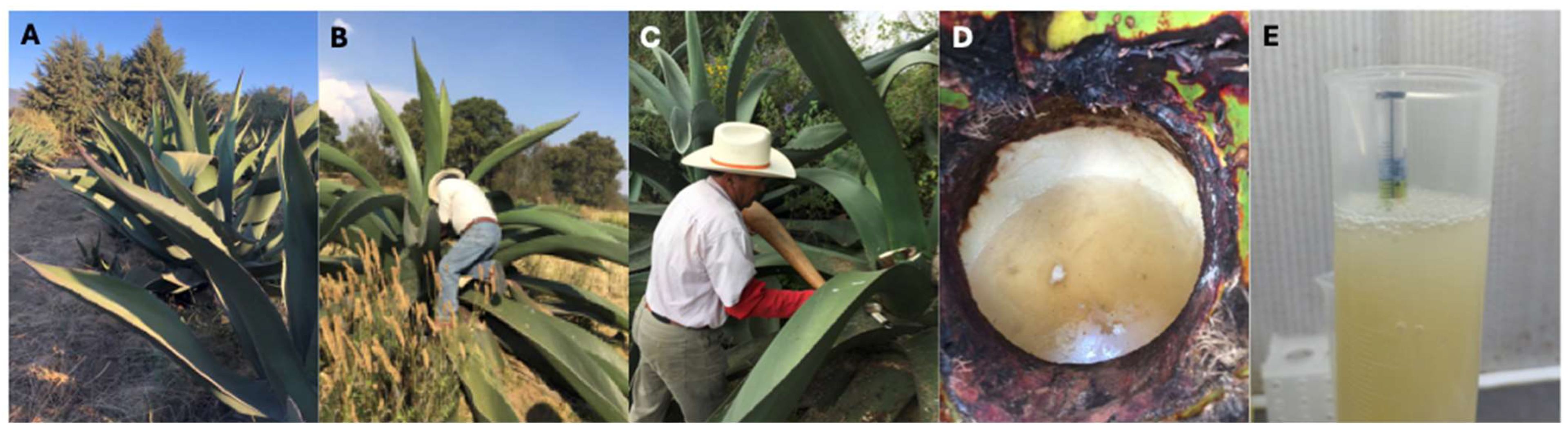
Today, the primary maguey plantations for aguamiel and pulque production are found in Hidalgo, Estado de México, Puebla, and Tlaxcala, although smaller plantations exist in other states [1,2,6]. The production process, consistent across regions, includes four main steps: plant castration, aguamiel extraction, seed preparation, and fermentation [1,2]. Castration creates a central cavity (cajete) in the plant, where aguamiel accumulates after the cavity walls are scraped to stimulate sap flow (Figure 1). This operation is carried out twice daily using a traditional scraper. The morning extraction collects aguamiel that accumulated overnight; the cavity is then re-scraped, initiating a new accumulation cycle until evening, and the process is repeated throughout the plant’s productive lifespan [1,2].
Fermentation begins with the preparation of a seed (semilla) by allowing aguamiel to ferment spontaneously for several days. This seed is then transferred to vats (tinacales), into which fresh aguamiel is added twice daily. Fermentation time varies by producer and region, but generally lasts several hours. For large-scale fermentations (up to 1000 L), a second seed is prepared and transferred to large tinacales, and aguamiel collected from extensive maguey plantations is poured into the tinacal twice daily over several days (up to 72 h). The resulting pulque is either consumed locally, distributed to pulquerías (typical Mexican establishments where pulque is sold and consumed), or pasteurized for canning and bottling [1,2,3].
The fermentation of aguamiel is driven by a complex microbial community that imparts pulque’s unique sensory characteristics. These include: (i) acidification (pH 3.5–4.2) through lactic and acetic acid bacteria producing lactic and acetic acids [7]; (ii) production of extracellular polysaccharides, mainly dextrans by Leuconostoc spp. and levans by Zymomonas mobilis; and (iii) ethanol production (4–7%) by Z. mobilis and Saccharomyces cerevisiae [1,8,9].
Although several studies have characterized aguamiel and pulque microbiota using 16S rDNA, ITS1, and shotgun metagenomics [8,9,10,11], and a stable microbial core has been identified [9], no efforts have been made to preserve these microbial consortia for use as fermentation inoculum. Microorganisms from traditional fermentations are considered valuable biocultural resources due to their long-standing role in human health and nutrition [12,13]. Preserving the microbial diversity associated with traditional fermented beverages is crucial for both cultural heritage and microbial conservation [14]. In this study, we evaluated the use of freeze-drying as a strategy to preserve microbial biomass from traditional pulque using skim milk as a cryoprotectant. Preservation efficiency was assessed via microbial plate counts (total lactic acid bacteria, mesophilic aerobes, and yeasts) and relative microbial abundance profiling (bacteria and yeasts) through high-throughput amplicon sequencing of the V3–V4 16S rDNA and ITS1 regions.

2. Materials and Methods

2.1. Pulque Samples Collection

Samples of overnight-fermented pulque (Fpulq) (~12–14 h) from a traditional wooden barrel (tinacal) were provided by Mr. Salvador Cueto, a local producer in Huitzilac, Morelos, México (19°01′49.3″ N, 99°15′53.1″ W, 2561 MASL). Samples were placed in sterile plastic bags, stored on ice, and transported to the laboratory in a cooler (~25 min by car).
Pulque was prepared as traditionally in this locality: for seed preparation, approximately 10 L of freshly collected aguamiel extracted from A. salmiana plants were poured into a plastic bucket. This fermentation of aguamiel is performed at ambient temperature by the microorganisms naturally associated with sap [9,14].

2.2. Microbiological Determinations

Total counts of lactic acid bacteria (LAB), aerobic mesophilic bacteria, and yeasts in each fermented pulque batch and freeze-dried biomass were analyzed as previously [15], by plating 0.1 mL of serial dilutions in duplicate (10−1–10−6) in 0.1% peptone (BD DIFCO, Mexico City, México) water onto APT agar (BD DIFCO, Mexico City) for LAB, Nutrient agar (BD DIFCO, Mexico City) for mesophiles, and YPD agar (CONDALAB, Madrid, Spain) for yeasts. All culture media were sterilized as indicated by the respective providers: 121 °C for 15 min, avoiding overheating. For freeze-dried biomass samples, 0.1 g was rehydrated in 1 mL of 0.1% peptone water prior to serial dilutions and plating as above.
Because baseline pulque samples (Fpulq) were liquid, their viable counts were converted from CFU/mL to log CFU/g of dry biomass equivalent using a mass balance-based normalization. Specifically, CFU/mL values obtained for Fpulq were normalized to the freeze-dried biomass yield recovered at T0 (excluding skim milk) from a known processed volume of pulque (550 mL). The conversion was performed according to the following equation:
CFU/g = (CFU × 10 × dilution factor × 550 mL)/dry biomass obtained at T0 (g)
where CFU corresponds to the number of colonies counted on plates inoculated with 0.1 mL of an appropriate serial dilution. The dilution factor corrects for the applied decimal dilution, while the factor 10 converts CFU per 0.1 mL to CFU per mL, and the dry biomass corresponds to the freeze-dried mass obtained at T0, excluding the cryoprotectant.
Survival percentages were calculated using the viable counts at T0 as the reference condition (100%), and subsequent storage time points were expressed relative to this value, allowing the evaluation of viability losses associated with freeze-drying and storage. Plates were incubated at 30 °C for 48 h, and representative plates were selected for colony enumeration. Normalization to dry biomass weight enabled direct, biologically meaningful comparisons across all sampling points.

2.3. Freeze-Drying of Overnight-Fermented Pulque Biomass

The protocol for freeze-drying of pulque biomass was adapted from the procedures described previously [16,17,18,19]: A sample of 550 mL in quadruplicate of each Fpulq batch (1–5) was centrifuged at 5000 rpm, 4 °C for 40 min. Pellets were washed with sterile Milli-Q water and resuspended in 50 mL of 10% skim milk (BD Difco, Mexico City) as a cryoprotectant. Samples were pre-frozen sequentially at 4 °C (30 min), −20 °C (30 min), and −70 °C (1 h) before overnight freeze-drying (~15 h) in a ZLGJ-10 laboratory benchtop freeze-dry device (Zhengzhou Ketai Laboratory Equipment Co., Zhengzhou, China). Each freeze-dried sample from batches 1–5 was stored at −20 °C and analyzed for total LAB, mesophilic aerobes, and yeasts as described in Section 2.2, immediately after freeze-drying (0 h), 24 h, 7 days (1 week), and 28 days (Tfinal) for CFU/g of dried material and survival percentages of determinations.

2.4. Metagenomic DNA Extraction from Overnight-Fermented Pulque and Freeze-Dried Samples

Metagenomic DNA was extracted as previously [9] using the Quick-DNA™ Fecal/Soil Microbe Miniprep Kit (Zymo Research, Irvine, CA, USA) from the cellular biomass in 10 mL of each overnight fermented pulque batch or 0.1 g of freeze-dried pulque biomass resuspended in 750 uL of solution I of the kit with an additional lysozyme (spatula tip with lysozyme, Sigma-Aldrich, St. Louis, MO, USA) incubation step (1 h, 37 °C) to enhance cellular lysis. After lysis, microbial DNA was processed according to the kit’s protocol. DNA quality was assessed by 1% agarose gel electrophoresis, and concentration was determined by Nanodrop™ spectrophotometry (Thermo Fisher, Waltham, MA, USA).

2.5. PCR Amplification of V3-V4 16S rDNA, ITSR1 Regions and Sequencing

Metagenomic DNA samples were sent to Novogene (Durham, NC, USA) for amplicon sequencing of the V3–V4 region of the 16S rDNA gene and the fungal internal transcribed spacer (ITS1). Services included DNA preparation and amplification of specific DNA regions (16S, ITS), mix and purification of PCR products, library preparation, and sequencing by the Illumina NovaSeq 6000 platform (San Diego, CA, USA), resulting in paired-end 250 bp reads (https://www.novogene.com/us-en/services/research-services/metagenome-sequencing/16s-18s-its-amplicon-metagenomic-sequencing/, accessed on 9 June 2025).
The primers used for the amplification of V3–V4 regions of the 16S rDNA were 341F 5′-CCTAYGGGRBGCASCAG-3′ and 806R 5′-GGACTACNNGGGTATCTAAT-3′, resulting in 450 bp products, and the primers for the amplification of the ITS1 region were ITS5-1737F 5′-GGAAGTAAAAGTCGTAACAAGG-3′ and ITS2-2043R 5′-GCTGCGTTCTTCATCGATGC-3′, resulting in 200–400 bp products. All these primers are included in the primer catalog used by Novogene for 16S/18S/ITS Amplicon Metagenomic Sequencing service.

2.6. Taxonomy Assignment and Diversity Analysis

The analysis of V3–V4 16S rDNA and ITS1 amplicon sequences was performed using the pipeline reported previously [9]: Raw sequencing data quality control was analyzed using FASTQC v0.12.0 (https://www.bioinformatics.babraham.ac.uk/projects/fastqc/, accessed on 23 June 2025). Identified chimeric sequences were cleaned from the dataset through blast fragments, and ChimeraSlayer with the QIIME’s parallel_identify_chimeric_seqs.py script, and sequences were analyzed using QIIME (Quantitative Insights Into Microbial Ecology) version 1.9.1 software in Python 2.7 [20,21]. The sequences were clustered into operational taxonomic units (OTUs), and the merge was performed for the SeqPrep method. Bacterial identification was performed using the SILVA 138 database with a 97% similarity threshold and the closed system with the command pick_closed_reference_otus.py [22]. For yeasts, taxonomy assignment was performed using the UNITE database v10.0 [23]. For all datasets, a data filtering cutoff of 0.01% was used for abundance, as in [9,24]. Alpha diversity was evaluated using the Shannon–Weaver index, Simpson index, OTUs_observed, and Chao1. Beta diversity was calculated using the Bray–Curtis matrix and generating principal coordinates analysis (PCoA) plots from QIIME [20].

2.7. Statistical Analysis

Viable counts of analyzed microbial groups in Fpulq and freeze-dried pulque biomass storage for different times were reported as the average of five replicate pulque batches and SD, except for freeze-dried samples analyzed after 28 days of storage, which correspond to the averages and SD of three batches. The results of each metric were analyzed using ANOVA, with the Dunnett test (0.95 confidence interval) used to estimate significant differences between the samples.

3. Results

3.1. Impact of Freeze-Drying and Storage on the Viability of the Main Microbial Groups of Pulque Microbiota

Table 1 summarizes the viable counts of total aerobic mesophilic bacteria, total yeasts, and lactic acid bacteria (LAB), expressed as logCFU/g of freeze-dried pulque biomass, and their corresponding survival percentages relative to T0 across three time points: 24 h, 7 days (1 week), and 28 days post freeze drying (Tfinal). Viable counts of Fpulq samples, prior to normalization, ranged between 108 and 109 CFU/mL for total aerobic mesophiles, LAB, and yeasts across batches. These values were subsequently normalized to dry biomass equivalents as described in Section 2.2.
For total aerobic mesophilic bacteria, viable counts remained remarkably stable throughout the freeze-drying process and subsequent storage. At 0 h, mesophile counts (8.53 ± 0.73 logCFU/g, 100%) were comparable to those observed in Fpulq (8.68 ± 0.61 logCFU/g). Similar values were maintained at 24 h (99%), 1 week (99.85%), and Tfinal (100%). These results indicate that freeze-drying followed by frozen storage did not cause a measurable loss of viability in the mesophilic bacterial fraction, ruling out dehydration or low-temperature stress as causes.
A comparable trend was observed for total yeasts, whose viable counts showed only minor fluctuations during storage. Yeast counts remained close to those of Fpulq across all time points, with survival values ranging from 96% to 100%. Notably, even after 28 days of storage, yeast viability remained above 96%, indicating that, when normalized by dry biomass, fungal populations are effectively preserved during freeze-drying.
For LAB, viable counts also remained stable throughout the experimental period. LAB counts at 0 h (8.52 ± 0.78 logCFU/g, 100%) slightly exceeded those of Fpulq (8.28 ± 0.65 logCFU/g). Similar values were observed at 24 h and 1 week. At Tfinal, LAB counts decreased modestly (95%) but remained within the same order of magnitude as the fresh control. Overall, LAB viability was not significantly compromised by freeze-drying or storage, indicating a robust tolerance of this group under the conditions evaluated.
Taken together, the data in Table 1 demonstrate that freeze-drying using skim milk as cryoprotectant and storage at −20 °C preserves the viability of the major microbial groups of pulque microbiota over at least 28 days of storage when microbial counts are expressed per gram of dry biomass. The absence of systematic declines across microbial groups supports the conclusion that freeze-drying is an effective strategy for preserving the complex microbiota of fermented beverages without inducing selective losses within major functional guilds.

3.2. Taxonomic Profiling and Diversity Analysis of Fresh and Freeze-Dried Pulque

3.2.1. Bacterial Community Structure

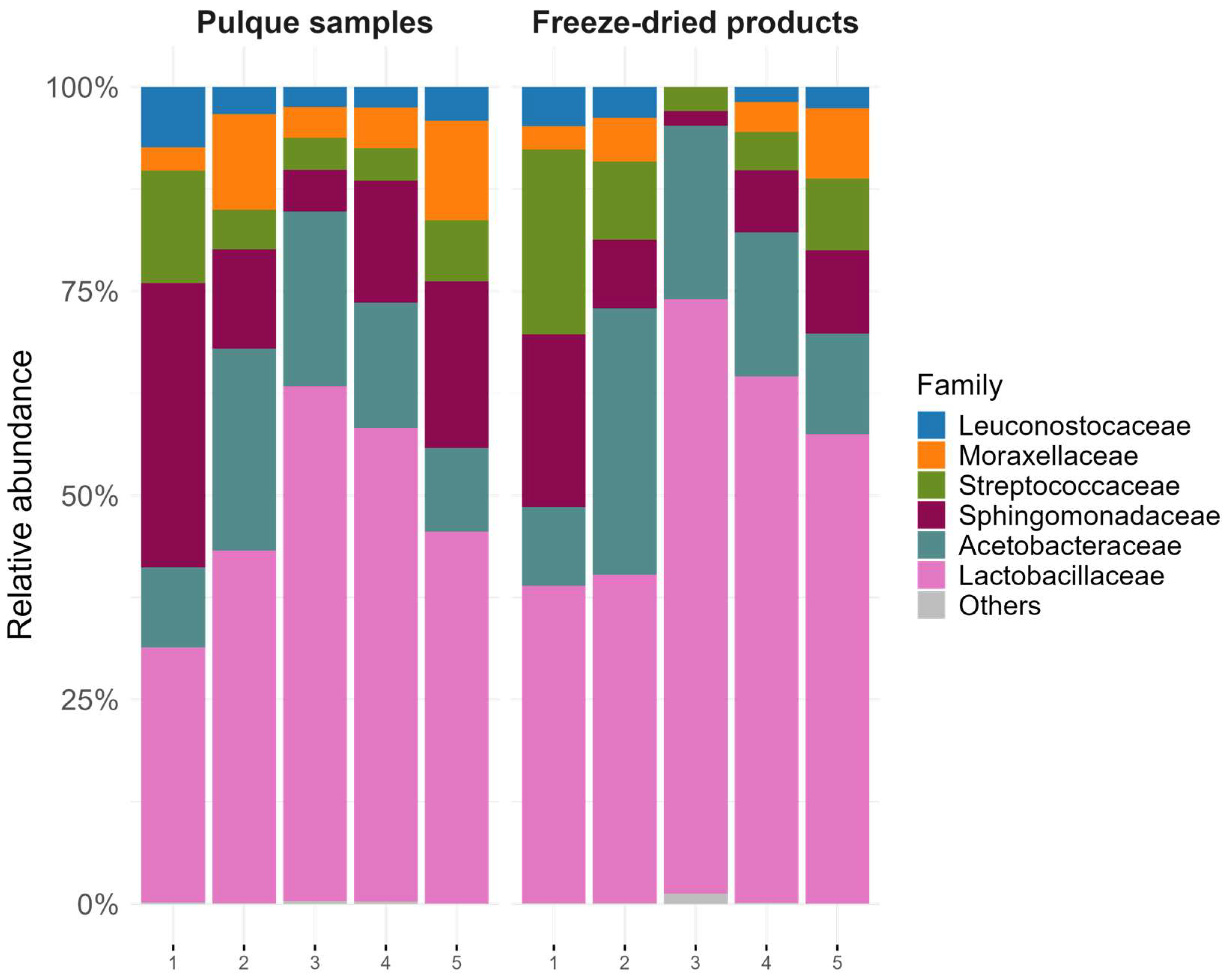
High-throughput sequencing of the V3-V4 16S rDNA gene revealed that the bacterial communities of Fpulq and their corresponding freeze-dried biomass samples were dominated by the same major families (Figure 2). Lactobacillaceae (Lactobacillus) constituted the most abundant group across all samples, followed by Acetobacteraceae (Acetobacter), Sphingomonadaceae (Zymomonas), Streptococcaceae (Lactococcus), Moraxellaceae (Acinetobacter), and Leuconostocaceae (Leuconostoc). Collectively, these seven genera accounted for more than 95% of the total relative abundance in both conditions, indicating a high degree of preservation of the dominant bacterial structure after freeze-drying.
Although relative abundances varied between Fpulq and freeze-dried biomass, the overall trends remained consistent. For instance, pulque batch 3 exhibited the highest abundance of Lactobacillaceae, and this pattern was similarly maintained in its freeze-dried counterpart (L3). In cases where families such as Leuconostocaceae and Moraxellaceae decreased to <1% relative abundance, they were grouped into the “Other” category rather than being lost, suggesting partial reduction of low-abundance taxa while retaining key community members.
From an ecological perspective, Figure 2 demonstrates that the V3-V4 16S rDNA from all prominent bacterial families present in Fpulq is also detected in the freeze-dried biomass at comparable proportions. This fact supports the observation that the bacterial core microbiota of pulque is resilient to freeze-drying, consistent with the previously described microbial core [9], which comprises Lactobacillus, Leuconostoc, Weissella, Lactococcus, Acetobacter, Gluconobacter, Zymomonas, and Obesumbacterium.

3.2.2. Bacterial Community Composition at the Genus Level

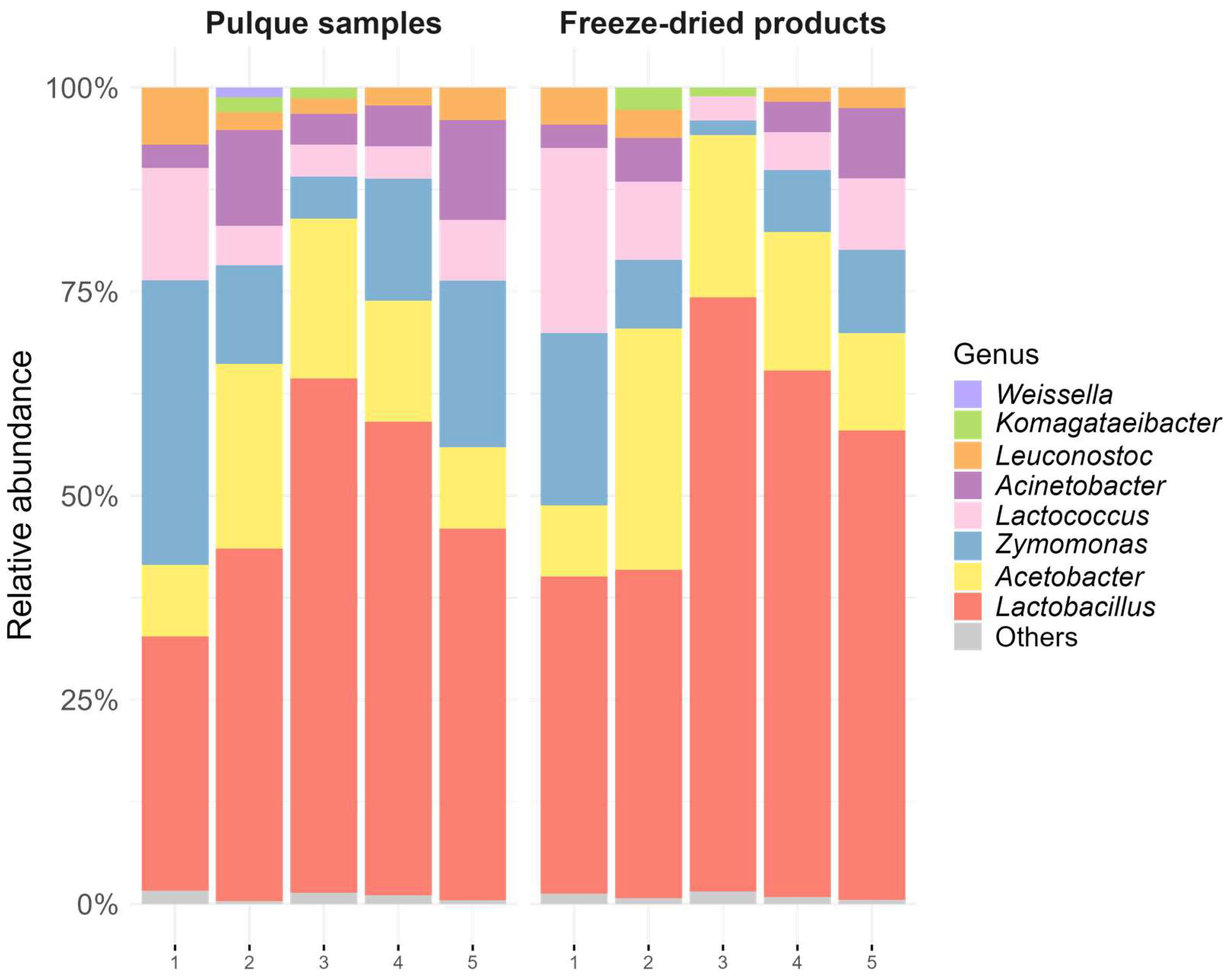
Figure 3 shows the relative abundance profiles of the major bacterial genera identified in Fpulq samples and their corresponding freeze-dried biomass products. Across all samples, the community was consistently dominated by Lactobacillus, followed by Acetobacter, Zymomonas, Lactococcus, Acinetobacter, Leuconostoc, Komagataeibacter, and Weissella. This abundance corresponds to the well-established bacterial core [9] of traditional pulque fermentation and was preserved after freeze-drying.
In Fpulq, Lactobacillus represented ~40–55% of the total community, and this dominance was maintained in the freeze-dried biomass, where it frequently exceeded 50%. Acetobacter and Zymomonas, two key genera associated with acetic acid and ethanol metabolism, also remained within similar proportional ranges before and after processing, indicating that the freeze-drying procedure of pulque biomass did not substantially alter the representation of these ecologically and functionally relevant taxa.
Minor genera such as Weissella, Komagataeibacter, and Leuconostoc showed slight fluctuations across batches, yet none were eliminated by freeze-drying; instead, their proportions varied within expected inter-batch differences. Notably, batch-specific patterns observed in the Fpulq samples, such as the elevated abundance of Acetobacter in sample pulque 3 or the higher contribution of Zymomonas in sample pulque 1, were preserved mainly in their corresponding freeze-dried samples, highlighting strong sample-specific consistency in community structure. Overall, this result demonstrates that freeze-drying preserves the global taxonomic structure of the bacterial microbiota at the genus level, including dominance patterns and the relative contributions of key fermentative genera.
Alpha diversity indices are shown in Table 2. No significant differences were detected in Observed OTUs, Shannon, or Simpson indices between Fpulq and freeze-dried biomass, indicating comparable richness and evenness. However, the Chao1 index was significantly reduced in freeze-dried biomass (p < 0.05), suggesting that the loss primarily affected low-abundance taxa, which are more susceptible to dehydration- and freezing-induced stress.
Overall, these results indicate that freeze-drying preserves the dominant bacterial community with high fidelity while selectively reducing the richness of minor constituents. This interpretation is further supported by the beta-diversity analysis, which shows that Fpulq and freeze-dried biomass samples clustered closely, indicating a conserved global community structure.

3.3. Yeast Community Structure

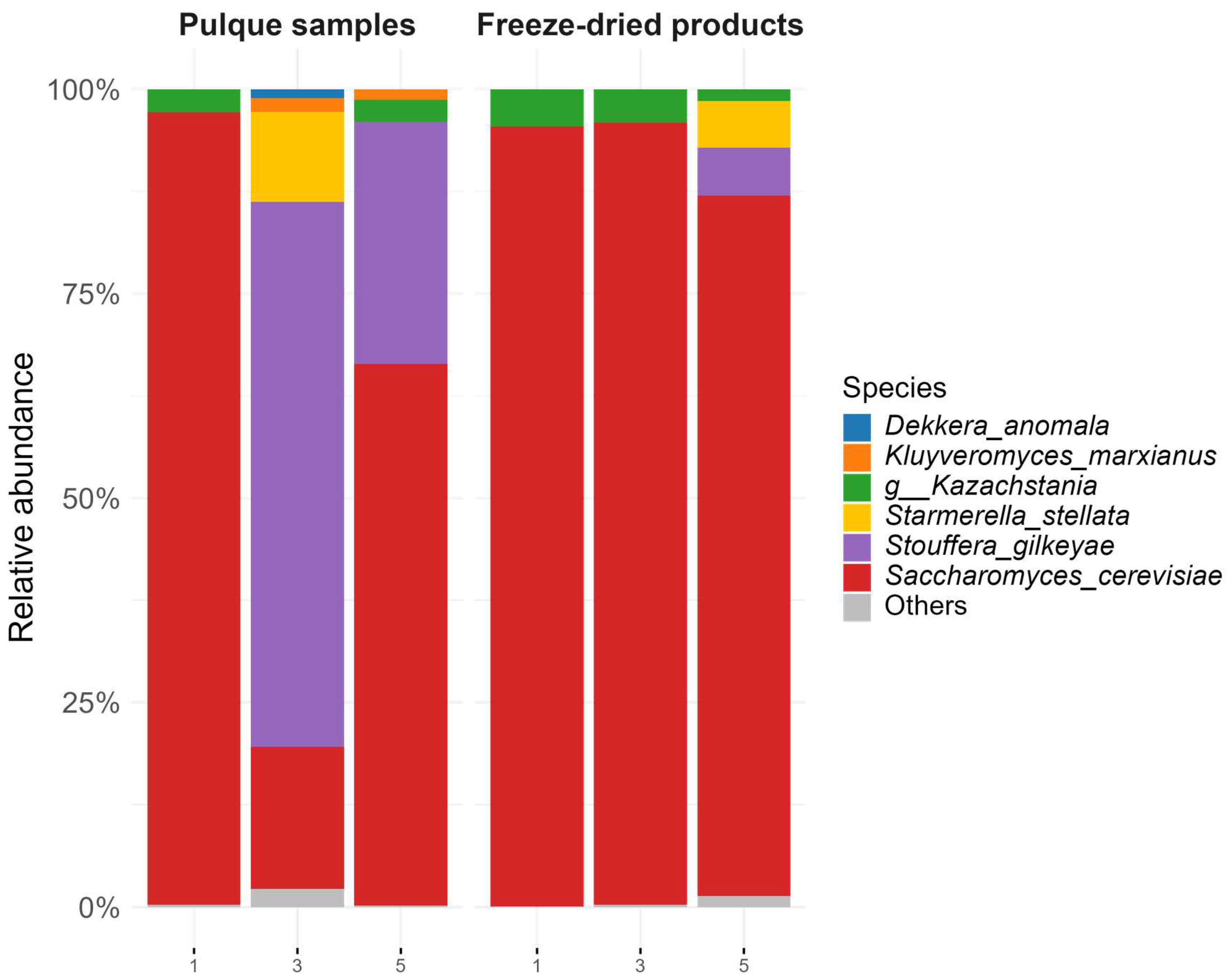
Sequencing of the ITS1 region revealed that the yeast community of Fpulq was dominated by Saccharomyces cerevisiae, Stouffera gilkeyae, Starmerella stellata, species of Kazachstania, Kluyveromyces marxianus, and Dekkera anomala (Figure 4). In freeze-dried biomass samples, the community shifted toward a simpler structure, with S. cerevisiae remaining the dominant taxon, followed by Kazachstania, while several species experienced substantial reductions.
Freeze-drying had a greater impact on yeast communities than on bacterial ones. Notably, S. gilkeyae and D. anomala were no longer detected in several freeze-dried samples, and K. marxianus showed a marked decrease. Both fresh and freeze-dried pulque biomass exhibited considerable inter-sample variability, suggesting an intrinsic heterogeneity in the fungal community, likely influenced by fermentation stage, substrate composition, and strain-level dynamics.
The taxa identified in this study partially overlap with the yeast core previously reported for pulque, which includes Kazachstania, Kluyveromyces, Saccharomyces, Hanseniaspora, and an unidentified OTU within Saccharomycetales. The presence of Saccharomyces, Kazachstania, and Kluyveromyces in both conditions confirms that key fermentative yeasts persist following freeze-drying.
The alpha diversity indices for fresh and freeze-dried pulque biomass are shown in Table 3. Although no significant differences were detected due to large standard deviations, clear trends emerged. Shannon and Simpson indices were lower in freeze-dried samples, suggesting reduced evenness and increased dominance of stress-tolerant species, mainly Saccharomyces. Both Observed OTUs and Chao1 values decreased modestly, reflecting a loss of yeast richness, again driven primarily by low-abundance taxa. Although yeast diversity was reduced, the persistence of Saccharomyces and Kazachstania preserves the system’s primary alcoholic function.
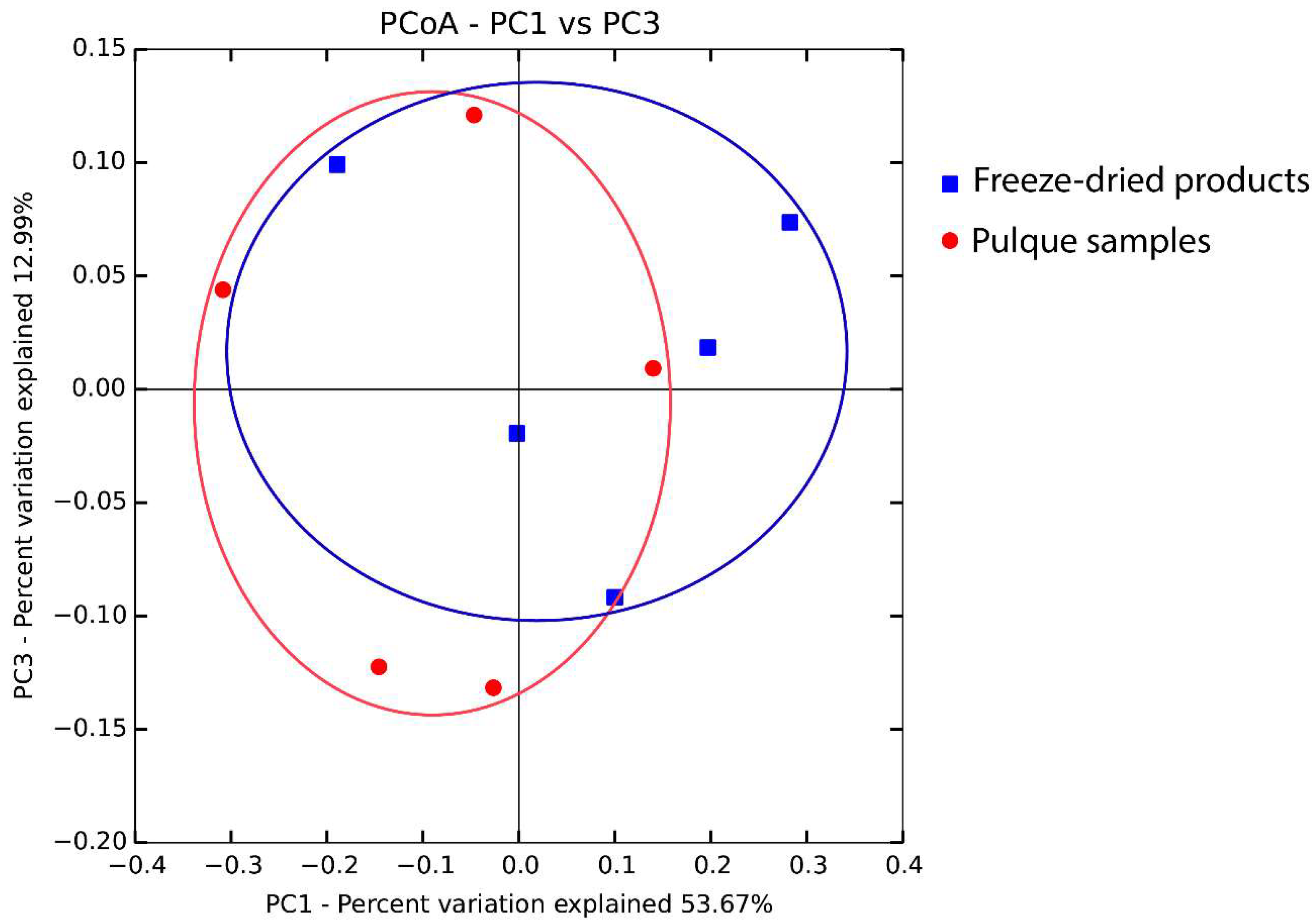
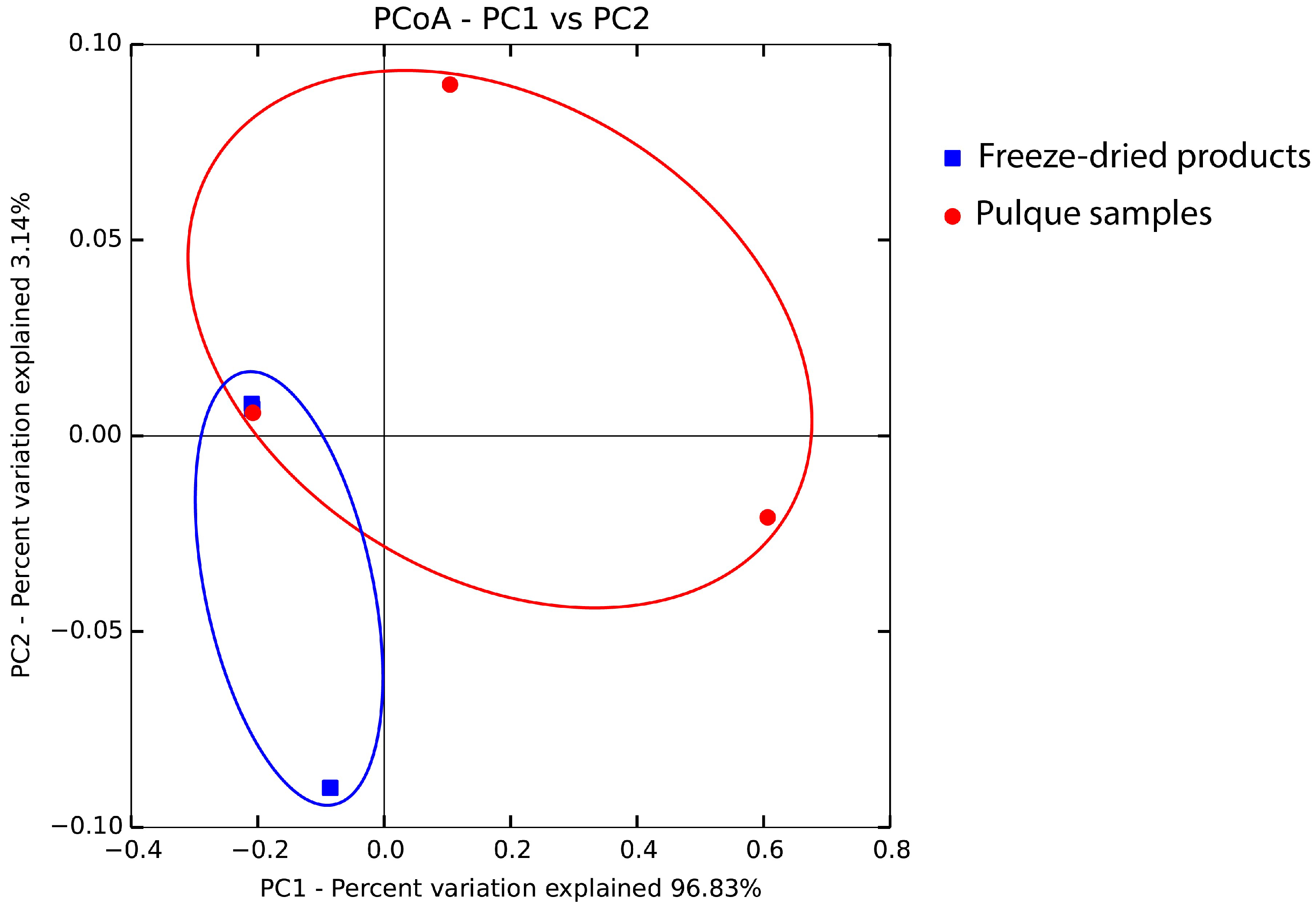
Bray–Curtis beta diversity revealed distinct patterns for bacteria (Figure 5) and the yeast community (Figure 6) when comparing pulque samples and freeze-dried products. In the PCoA ordination, bacteria showed partial overlap among sample types, with only a tendency toward separation along PC1, suggesting that freeze-drying largely preserves the overall structure of the bacterial community, with moderate changes associated with the process. In contrast, yeasts showed a more pronounced separation between pulque and freeze-dried samples along the primary axis, along with greater dispersion among pulque samples, suggesting that some members of the yeast community may be more sensitive to preservation and undergo more pronounced restructuring after freeze-drying.
These findings align with reports on the freeze-drying of complex fermentative microbiota [25], in which dominant yeasts typically exhibit higher survival, while minority taxa are more susceptible to membrane damage, oxidative stress, and impaired recovery after desiccation.
Taken together, the sequencing results demonstrate that freeze-drying preserves the global microbial architecture of pulque biomass, maintaining the dominant bacterial families and yeast species that characterize the traditional fermentation. However, the process exerts selective pressure that disproportionately affects minority taxa, thereby reducing richness, particularly in yeast communities.
From a functional standpoint, preserving Lactobacillus, Acetobacter, Saccharomyces, and Kazachstania is particularly relevant, as these genera play central roles in acidification, ethanol production, aroma formation, and overall fermentation dynamics. Their persistence ensures that the freeze-dried pulque biomass used in subsequent murine assays retains the core microbiota necessary for a representative biological and metabolic response, even if community complexity is partially reduced.

4. Discussion

In this contribution, we analyzed the use of freeze-drying to preserve microbial biomass from traditional pulque from Huitzilac, Morelos, México. For pulque production for this study, the local producer prepared a seed and determined the fermentation time. The mature seed was poured into an empty, clean wooden barrel used as a tinacal. Freshly collected aguamiel (in the morning and dusk) was poured to feed the seed in the tinacal. Fermentation begins due to the microbial activity of microorganisms present in the seed and those incorporated with the fresh aguamiel. A continuous fermentation is maintained by adding fresh-collected aguamiel, as above, to the fermented product in the tinacal for several days at ambient temperature. In this production locality, fermented pulque is consumed or sold after several hours of fermentation (6 to 24 h).
Preserving complex microbial consortia from traditional fermented foods and beverages remains a significant challenge for both fundamental research and applied fermentation processes. The impact of freeze-drying on the viability of specific food cultures has been widely documented across freeze-dried fermented beverages and food cultures with negative to minor adverse effects, including kefir [26,27], kimchi [28], kombucha [29,30], low-alcohol wines [31], sourdough starters [32,33], and for pulque seed conservation [17]. In this study, we demonstrate that freeze-drying of pulque microbiota, combined with skim milk as a cryoprotectant and subsequent frozen storage, effectively preserves the cultivable fractions of the main microbial guilds.
The collective findings of this study reveal a differentiated response across microbial guilds to freeze-drying in pulque: No systematic loss of viable aerobic mesophiles, LAB, or yeasts was detected during freeze-drying or over 28 days of frozen storage. Viability values remained close to those of fresh pulque, with survival percentages fluctuating around 95–100%, indicating that freeze-drying per se did not exert a measurable detrimental effect on these microbial groups under the conditions tested.
The apparent stability of viable counts across microbial guilds suggests that multiple protective mechanisms may operate during freeze-drying of pulque microbiota using skim milk as cryoprotectant. Skim milk is widely recognized as an effective cryoprotectant [16,19,34,35], providing proteins and lactose that stabilize and protect the cell membranes and reduce mechanical damage caused by ice crystal formation. The use of 10% skim milk as a cryoprotectant results in longer viability than glycerol for several bacterial groups [16]. The efficient use of 10% skimmed milk (supplemented with 10% lactose) resulted in a higher yeast survival percentage after freeze-drying [19]. Additionally, Ca2+ in skim milk has been reported to stabilize the cell membrane of yeasts, thereby increasing survival after freeze-drying [19]. Together, these factors likely create a protective microenvironment that supports the survival of diverse microorganisms during freeze-drying and frozen storage. Based on these reports describing the efficiency of freeze-drying and the use of skimmed milk as a cryoprotectant for different microbial groups, we decided to use this method and skim milk to preserve pulque biomass. In addition, the intrinsic matrix of pulque, rich in exopolysaccharides such as dextrans, levans, and other fructans produced by LAB and associated bacteria, may further contribute to cellular protection by potentially buffering osmotic stress and limiting oxidative damage during dehydration, as proposed for other fermented foods [19,34,35].
While viable counts indicate a remarkable preservation of cultivable populations, amplicon-based analyses revealed a more nuanced response of microbial community structure to freeze-drying. Bacterial alpha-diversity metrics showed only minor differences between fresh and freeze-dried samples, and beta-diversity analyses indicated substantial overlap in community composition, supporting the notion that the bacterial core microbiota of pulque is robust to freeze-drying. Dominant bacterial taxa previously associated with pulque fermentation remained prevalent after preservation, reinforcing the idea that the functional bacterial backbone of this traditional fermentation is resilient to dehydration-based conservation methods.
In contrast, the fungal community showed greater sensitivity to freeze-drying at the community level. Although viable yeast counts remained stable, fungal alpha diversity decreased in freeze-dried samples, and beta-diversity analyses revealed a more distinct separation between fresh and preserved communities. This pattern suggests that freeze-drying may selectively affect low-abundance or more sensitive fungal taxa, leading to a simplified community dominated by fewer highly resilient yeasts, such as Saccharomyces and Kazachstania. Importantly, these taxa are among the most functionally relevant yeasts in pulque fermentation, contributing to ethanol production and sensory attributes, which supports the functional preservation of the fermentation. Minority yeast taxa were affected, particularly rare yeasts such as S. gilkeyae and D. anomala, suggesting that freeze-drying imposes a selective filter, narrowing the long tail of low-abundance species. From an ecological perspective, such reductions may diminish niche diversity, metabolic flexibility, and the capacity for secondary metabolite production.
The sequencing data further demonstrate that freeze-drying preserves the global taxonomic structure of the pulque microbiota, retaining the dominant bacterial genera and the principal yeast taxa associated with fermentation. The stability of genera such as Lactobacillus, Acetobacter, Zymomonas, Lactococcus, Saccharomyces, and Kazachstania highlights the robustness of pulque’s microbial core. This feature aligns with previous ecological analyses reporting this community as highly structured, recurrent, and resilient across temporal fermentation cycles [9]. This resilience likely derives from functional interdependencies among these taxa, including sugar utilization, ethanol and acetic acid metabolism, and cross-feeding relationships that stabilize the microbial diversity responsible for the fermentation process.
At a functional level, maintaining the dominant bacterial genera and the principal yeast taxa associated with fermentation potentially preserves key metabolic capabilities, including lactic acid production, ethanol oxidation, CO2 generation, and aromatic compound synthesis. These microbial functions are central to pulque’s biochemical ecology, sensory characteristics, and potential health-related properties. While reduced yeast richness may attenuate some sensory outcomes in reconstituted pulque, it does not compromise the ecological validity of the microbiota for biological studies.
Freeze-drying under a standardized protocol, using skim milk as a cryoprotectant, preserved the cultivable fractions of the major microbial guilds in pulque. At the same time, DNA-based profiling indicated that bacterial community structure was largely conserved, and yeast diversity was modestly reduced, mainly among low-abundance taxa. Several limitations should be acknowledged. First, we tested a single cryoprotectant and one freeze-drying regimen; thus, we cannot infer whether alternative protectants or optimized drying curves would further improve the recovery of minority yeasts or minimize community shifts. Second, we did not evaluate the functional performance of reconstituted biomass in controlled fermentations (e.g., kinetics, metabolite profiles, sensory outcomes), which will be important for future applications and for comparison with studies that benchmark preservation strategies and beverage quality. Third, amplicon sequencing reflects relative DNA-based community profiles and does not directly quantify viability at the taxon level. Despite these limitations, the novelty of this work is the demonstration that a naturally assembled microbial consortium from a traditional biocultural fermentation can be preserved by freeze-drying with high retention of cultivable populations and core community architecture across independent batches.
Beyond its microbiological and technological implications, the preservation of pulque biomass through freeze-drying also carries significant biocultural value. Pulque is one of the oldest fermented beverages of Mesoamerica, and its microbial consortium represents a living component of this cultural heritage. Safeguarding its native microbiota contributes to the conservation of a unique biological legacy shaped by centuries of traditional practices and ecological adaptation. At the same time, maintaining viable and compositionally representative pulque biomass provides a strategic foundation for future efforts to standardize fermentation processes, develop controlled starter cultures, and ensure consistent product quality without compromising the beverage’s ancestral identity.

5. Conclusions

This study demonstrates that freeze-drying is a viable strategy for preserving the microbial community of traditional pulque, maintaining the dominant bacterial and yeast taxa that define its fermentative identity, but selectively reducing low-abundance fungal taxa. The core microbiota remains conserved mainly, supporting the use of freeze-dried biomass as a representative inoculum for future biological studies and controlled fermentation processes. The results also highlight the need to optimize preservation conditions to improve the recovery of minority taxa, particularly yeast species, which contribute to the ecosystem’s metabolic richness. Overall, the freeze-dried pulque microbiota constitutes a valuable biological resource for research, fermentation standardization, and the long-term safeguarding of the biocultural heritage associated with this ancestral beverage. Under a standardized protocol, future work should benchmark alternative cryoprotectants and validate fermentation performance and product quality after reconstitution.

Author Contributions

Conceptualization, A.E., M.S.F.M. and F.A.-M.; methodology, M.S.F.M. and F.A.-M.; formal analysis, M.S.F.M., F.A.-M., F.B. and A.E.; investigation, M.S.F.M. and F.A.-M.; resources, F.B. and A.E.; data curation, M.S.F.M. and F.A.-M.; writing—original draft preparation, M.S.F.M., F.B. and A.E.; writing—review and editing, M.S.F.M., F.B. and A.E.; funding acquisition, A.E. and F.B. All authors have read and agreed to the published version of the manuscript.

Funding

This research was funded by projects PAPIIT IN227023 (DGAPA, UNAM).

Institutional Review Board Statement

Not applicable.

Informed Consent Statement

Not applicable.

Data Availability Statement

The original contributions presented in the study are included in the article. Further inquiries can be directed to the corresponding author.

Acknowledgments

The authors acknowledge Salvador Cueto for the sampling facilities for the overnight fermented pulque samples analyzed in this study. To Mariana Manzoni Maroneze for the technical support for freeze-drying.

Conflicts of Interest

The authors declare no conflict of interest.

References

  1. Valdivieso Solís, D.G.; Vargas Escamilla, C.A.; Mondragón Contreras, N.; Galván Valle, G.A.; Gilés-Gómez, M.; Bolívar, F.; Escalante, A. Sustainable production of pulque and maguey in mexico: Current situation and perspectives. Front. Sustain. Food Syst. 2021, 5, 678168. [Google Scholar] [CrossRef]
  2. Moreno-Terrazas, R.; Escalante, A.; Verdugo-Valdez, A.G.; De la Rosa, M.; Ortiz Basurto, R.I.; Orantes-García, C.; Palafox-González, L.; Castro Díaz, A.S.; Lappe-Oliveras, P. Bebidas refrescantes y alcohólicas de agave. In Panorama Aprovechamiento de Agaves en México; CONACYT, CIATEJ, AGARED: Jalisco, Mexico, 2017; pp. 123–163. ISBN 978-607-97548-2-2. [Google Scholar]
  3. Álvarez-Ríos, G.D.; Figueredo-Urbina, C.J.; Casas, A. Sistemas de manejo de maguey pulquero en México. Rev. Etnobiol 2020, 18, 3–23. [Google Scholar]
  4. MacNeish, R. A Summary of the Subsistence. In The Prehistory of the Tehuacan Valley: Volume 1 Environment and Subsistence; Byers, D.S., Ed.; University of Texas Press, Ltd.: London, UK, 1967; pp. 290–309. [Google Scholar]
  5. Parsons, J.R.; Darling, J.A. Maguey (Agave spp.) utilization in Mesoamerican civilization: A case for Precolumbian “pastoralism”. Bol. Soc. Bot. Méx. 2000, 66, 81–91. [Google Scholar] [CrossRef]
  6. Noriega-Juárez, A.D.; Meza-Espinoza, L.; García-Magaña, M.d.L.; Ortiz-Basurto, R.I.; Chacón-López, M.A.; Anaya-Esparza, L.M.; Montalvo-González, E. Aguamiel, a traditional Mexican beverage: A review of its nutritional composition, health effects and conservation. Foods 2025, 14, 134. [Google Scholar] [CrossRef] [PubMed]
  7. Secretaría de Economía Pulque Manejado a Granel. Available online: http://www.economia-nmx.gob.mx/normasmx/detallenorma.nmx?clave=NMX-V-037-1972 (accessed on 16 May 2016).
  8. Chacón-Vargas, K.; Torres, J.; Giles-Gómez, M.; Escalante, A.; Gibbons, J.G. Genomic profiling of bacterial and fungal communities and their predictive functionality during pulque fermentation by whole-genome shotgun sequencing. Sci. Rep. 2020, 10, 15115. [Google Scholar] [CrossRef] [PubMed]
  9. Astudillo-Melgar, F.; Hernández-Chávez, G.; Rodríguez-Alegría, M.E.; Ochoa-Leyva, A.; López Munguía, A.; Escalante, A. Evaluating the temporal stability of the core microbiota in traditional Mexican pulque fermentation. Food Biosci. 2025, 71, 107306. [Google Scholar] [CrossRef]
  10. Rocha-Arriaga, C.; Espinal-Centeno, A.; Martinez-Sánchez, S.; Caballero-Pérez, J.; Alcaraz, L.D.; Cruz-Ramírez, A. Deep microbial community profiling along the fermentation process of pulque, a biocultural resource of Mexico. Microbiol. Res. 2020, 241, 126593. [Google Scholar] [CrossRef]
  11. Huezo-Sánchez, A.R.; Ortega-Rodríguez, E.M.; Pérez-Armendáriz, B.; El-Kassis, E.G. characterization of bacterial diversity in aguamiel and two types of pulque from the Zacatlán Region, México. Fermentation 2023, 9, 564. [Google Scholar] [CrossRef]
  12. Marshall, E.; Mejía-Lorío, D.J. Traditional Fermented Food and Beverages for Improved Livelihoods; Diversification Booklet; FAO: Rome, Italy, 2011; ISBN 978-92-5-107074-1. [Google Scholar]
  13. Hernández-Velázquez, R.; Flörl, L.; Lavrinienko, A.; Sebechlebská, Z.; Merk, L.; Greppi, A.; Bokulich, N.A. The future is fermented: Microbial biodiversity of fermented foods is a critical resource for food innovation and human health. Trends Food Sci. Technol. 2024, 150, 104569. [Google Scholar] [CrossRef]
  14. Peralta-García, I.; González-Muñoz, F.; Elena, R.-A.M.; Sánchez-Flores, A.; López Munguía, A. Evolution of fructans in aguamiel (Agave sap) during the plant production lifetime. Front. Nutr. 2020, 7, 566950. [Google Scholar] [CrossRef]
  15. Escalante, A.; Giles-Gómez, M.; Hernandez, G.; Cordova-Aguilar, M.; Lopez-Munguia, A.; Gosset, G.; Bolivar, F. Analysis of bacterial community during the fermentation of pulque, a traditional Mexican alcoholic beverage, using a polyphasic approach. Int. J. Food Microbiol. 2008, 124, 126–134. [Google Scholar] [CrossRef]
  16. Cody, W.L.; Wilson, J.W.; Hendrixson, D.R.; McIver, K.S.; Hagman, K.E.; Ott, C.M.; Nickerson, C.A.; Schurr, M.J. Skim milk enhances the preservation of thawed −80 °C bacterial stocks. J. Microbiol. Methods 2008, 75, 135–138. [Google Scholar] [CrossRef]
  17. Manrique, R. Caracterización y Conservación de Inóculos Tradicionales Para la Producción de Pulque. Master’s Thesis, Universidad Nacional Autónoma de México, Mexico City, Mexico, 2012. [Google Scholar]
  18. Wang, L.; He, M.; Wu, T.; Yang, K.; Wang, Y.; Zhang, Y.; Gu, Y.; Deng, K. Screening of the freeze-drying protective agent for high-quality milk beer yeast (Kluyveromyces marxianus) and optimization of freeze-drying process conditions. J. Food Process. Preserv. 2021, 45, e16016. [Google Scholar] [CrossRef]
  19. Abadias, M.; Teixidó, N.; Usall, J.; Benabarre, A.; Viñas, I. Viability, efficacy, and storage stability of freeze-dried biocontrol agent candida sake using different protective and rehydration media. J. Food Prot. 2001, 64, 856–861. [Google Scholar] [CrossRef] [PubMed]
  20. Navas-Molina, J.A.; Peralta-Sánchez, J.M.; González, A.; McMurdie, P.J.; Vázquez-Baeza, Y.; Xu, Z.; Ursell, L.K.; Lauber, C.; Zhou, H.; Song, S.J.; et al. Chapter Nineteen—Advancing our understanding of the human microbiome using QIIME. Methods Enzymol. 2013, 531, 371–444. [Google Scholar] [CrossRef]
  21. Kuczynski, J.; Stombaugh, J.; Walters, W.A.; González, A.; Caporaso, J.G.; Knight, R. Using QIIME to analyze 16S rRNA gene sequences from microbial communities. Curr. Protoc. Bioinform. 2011, 36, 1–20. [Google Scholar] [CrossRef]
  22. Quast, C.; Pruesse, E.; Yilmaz, P.; Gerken, J.; Schweer, T.; Yarza, P.; Peplies, J.; Glöckner, F.O. The SILVA Ribosomal RNA gene database project: Improved data processing and web-based tools. Nucleic Acids Res. 2013, 41, D590–D596. [Google Scholar] [CrossRef] [PubMed]
  23. Abarenkov, K.; Nilsson, R.H.; Larsson, K.-H.; Taylor, A.F.S.; May, T.W.; Frøslev, T.G.; Pawlowska, J.; Lindahl, B.; Põldmaa, K.; Truong, C.; et al. The UNITE Database for molecular identification and taxonomic communication of fungi and other eukaryotes: Sequences, taxa and classifications reconsidered. Nucleic Acids Res. 2024, 52, D791–D797. [Google Scholar] [CrossRef]
  24. Caporaso, J.G.; Lauber, C.L.; Walters, W.A.; Berg-Lyons, D.; Huntley, J.; Fierer, N.; Owens, S.M.; Betley, J.; Fraser, L.; Bauer, M.; et al. Ultra-high-throughput microbial community analysis on the Illumina HiSeq and MiSeq platforms. ISME J. 2012, 6, 1621–1624. [Google Scholar] [CrossRef] [PubMed]
  25. Cui, S.; Hu, M.; Sun, Y.; Mao, B.; Zhang, Q.; Zhao, J.; Tang, X.; Zhang, H. Effect of trehalose and lactose treatments on the freeze-drying resistance of lactic acid bacteria in high-density culture. Microorganisms 2022, 11, 48. [Google Scholar] [CrossRef]
  26. Mudoor Sooresh, M.; Jayawickrama, A.; Silva, A.; Nguyen, S.; Schmidt, S.; Sebastian, J.; Carey, S.; Harynuk, J.; Willing, B.P.; Bourrie, B.C.T. Fermentation of kefir with traditional freeze-dried starter cultures successfully recreates fresh culture fermented kefir. Front. Microbiol. 2025, 16, 1655390. [Google Scholar] [CrossRef]
  27. Conde-Islas, A.Á.; Jiménez-Fernández, M.; Cantú-Lozano, D.; Urrea-García, G.R.; Luna-Solano, G. Effect of the freeze-drying process on the physicochemical and microbiological properties of mexican kefir grains. Processes 2019, 7, 127. [Google Scholar] [CrossRef]
  28. Lee, M.-E.; Jang, J.-Y.; Lee, J.-H.; Park, H.-W.; Choi, H.-J.; Kim, T.-W. Starter cultures for kimchi fermentation. J. Microbiol. Biotechnol. 2015, 25, 559–568. [Google Scholar] [CrossRef]
  29. Phan Van, T.; Nguyen, Q.-D.; Nguyen, N.-N.; Do, A.D. Efficiency of freeze- and spray-dried microbial preparation as active dried starter culture in kombucha fermentation. J. Sci. Food Agric. 2024, 104, 8707–8719. [Google Scholar] [CrossRef]
  30. Correia Santana, D.; Danieleto, F.B.; Oliveira Valdo, K.; M. Arpini-Costa, C.; Carneiro Kalil, I.; Ugerre De Andrade, T.; Azevedo Bertolazi, A.; Gonçalves Santos Passos, H.; Mileib Vasconcelos, C. Kombucha and its dehydrated and freeze-dried derivatives: Physicochemical and microbiological characterization and in vivo toxicity evaluation. RECyT 2024, 41, 54–63. [Google Scholar] [CrossRef]
  31. Nikolaou, A.; Sgouros, G.; Mitropoulou, G.; Santarmaki, V.; Kourkoutas, Y.; Nikolaou, A.; Sgouros, G.; Mitropoulou, G.; Santarmaki, V.; Kourkoutas, Y. Freeze-dried immobilized kefir culture in low alcohol winemaking. Foods 2020, 9, 115. [Google Scholar] [CrossRef] [PubMed]
  32. Stefanello, R.F.; Nabeshima, E.H.; Iamanaka, B.T.; Ludwig, A.; Fries, L.L.M.; Bernardi, A.O.; Copetti, M.V. Survival and stability of Lactobacillus fermentum and Wickerhamomyces anomalus strains upon lyophilisation with different cryoprotectant agents. Food Res. Int. 2019, 115, 90–94. [Google Scholar] [CrossRef]
  33. Santos, J.G.; de Souza, E.L.; de Souza Couto, M.V.; Rodrigues, T.Z.; de Medeiros, A.R.S.; de Magalhães Cordeiro, A.M.T.; Lima, M.d.S.; de Oliveira, M.E.G.; da Costa Lima, M.; de Araújo, N.P.R.; et al. Exploring the effects of freeze-dried sourdoughs with Lactiplantibacillus pentosus 129 and Limosilactobacillus fermentum 139 on the quality of long-fermentation bread. Microorganisms 2024, 12, 1199. [Google Scholar] [CrossRef] [PubMed]
  34. Ge, S.; Han, J.; Sun, Q.; Zhou, Q.; Ye, Z.; Li, P.; Gu, Q. Research progress on improving the freeze-drying resistance of probiotics: A review. Trends Food Sci. Technol. 2024, 147, 104425. [Google Scholar] [CrossRef]
  35. Jeong, S.-G.; Choi, I.S.; Kim, H.M.; Chang, J.Y.; Park, H.W. supercooling pretreatment improves the shelf-life of freeze-dried Leuconostoc mesenteroides WiKim32. J. Microbiol. Biotechnol. 2022, 32, 1599–1604. [Google Scholar] [CrossRef]
Figure 1. Key steps of pulque production. (A). Maguey rows in a maguey plantation in Huitzilac, Morelos. México. (B). Local pulque producer scraping the cavity known as cajete, where aguamiel accumulates. (C). Aguamiel extraction using a traditional acocote tool. (D). Aguamiel accumulated in the cajete. (E). Overnight-fermented pulque prior to freeze-drying process.
Fermentation 12 00083 g001
Figure 2. Families corresponding to the composition of the bacterial microbiota in fermented pulque and freeze-dried biomass are expressed in relative abundance. Stacked bar plots illustrate the taxonomic composition of the bacterial microbiota at the genus level for five independent pulque batches (left panel) and their respective freeze-dried products (right panel). On the x-axis, the numbers correspond to five independent pulque batches (left panel) and their respective freeze-dried biomass (right panel). Each bar represents the relative abundance (%) of the dominant bacterial Family identified by V3-V4 16S rDNA gene sequencing. Others: Families with a relative abundance of less than 1%.
Fermentation 12 00083 g002
Figure 3. Relative abundance of bacterial genera in fermented pulque samples and their corresponding freeze-dried biomass products. Stacked bar plots illustrate the taxonomic composition of the bacterial microbiota at the genus level for five independent pulque batches (left panel) and their respective freeze-dried biomass (right panel). Each bar represents the relative abundance (%) of the dominant genera identified by V3-V4 16S rDNA gene sequencing. Others: Genus with a relative abundance of less than 1%.
Fermentation 12 00083 g003
Figure 4. Diversity of the yeast microbiota in fermented pulque and freeze-dried biomass samples was expressed as relative abundance. Stacked bar plots illustrate the taxonomic composition of the yeast microbiota for three independent pulque batches (left panel) and their respective freeze-dried products (right panel). Each bar represents the relative abundance (%) of the dominant species identified. Others: Genus with a relative abundance of less than 1%.
Fermentation 12 00083 g004
Figure 5. Beta diversity analysis of the bacterial community in pulque samples and freeze-dried biomass. Between-community dissimilarities were calculated using the Bray–Curtis metric and visualized by principal coordinates analysis (PCoA). Each point represents one sample, and distances between points reflect differences in bacterial community composition. PC1 explained 53.67% and PC3 12.99% of the variance. Colors indicate sample type, and ellipses summarize the dispersion of each group.
Fermentation 12 00083 g005
Figure 6. Beta-diversity analysis of the fungal community in pulque samples and freeze-dried products. Between-community dissimilarities were estimated using the Bray–Curtis index and visualized in a PCoA. Each point corresponds to one sample, and distances reflect differences in community composition. PC1 explained 96.83% and PC2 3.14% of the variance. Colors indicate sample type, and ellipses represent the dispersion of each group.
Fermentation 12 00083 g006
Table 1. Viable counts (logCFU/g of dried biomass sample) of total aerobic mesophilic bacteria, yeasts, and lactic acid bacteria in overnight-fermented pulque (Fpulq) and freeze-dried pulque biomass storage for different times.
Microbial GroupFpulqStorage Time Of Freeze-Dried Pulque Biomass
T0 h (%)24 h (%)1 Week (%)Tfinal (%)
Total aerobic mesophilic bacteria8.68 ± 0.618.53 ± 0.73 (100)8.44 ± 0.48 (99.02)8.51 ± 0.44 (99.85)8.68 ± 0.08 (100)
Total yeasts8.59 ± 0.558.52 ± 0.84 (100)8.66 ± 0.78 (100)8.46 ± 0.41 (99.25)8.18 ± 0.35 (96.01)
Total LAB8.28 ± 0.658.52 ± 0.78 (100)8.41 ± 0.47 (98.73)8.47 ± 0.33 (99.46)8.10 ± 0.42 (95.05)
Viable counts are expressed as logCFU/g of dry biomass equivalent. Fpulq corresponds to overnight-fermented liquid pulque and was normalized to dry biomass equivalents using the T0 yield (excluding skim milk). Survival percentages were calculated using T0 as the reference condition (100%), and subsequent storage times are expressed relative to this value. Survival percentages were calculated from mean CFU/g values and their associated standard deviations, using T0 as the reference condition. Values slightly above 100% reflect experimental variability and are not statistically different from T0. Data are the average ± SD of five independent pulque batches, except for Tfinal, which is the average of three batches.
Table 2. Alpha diversity indices for bacteria detected in fermented pulque and freeze-drying biomass.
Sample 1Diversity Indices
Observed OTUsChao1ShannonSimpson
Fermented pulque130.50 ± 1.80133.27 ± 0.953.15 ± 0.220.81 ± 0.05
Freeze-dried biomass126.36 ± 3.45130.28 ± 1.45 *2.63 ± 0.400.70 ± 0.10
1 n = 5 for each sample. * Indicates significant differences between Fpulq and freeze-dried biomass samples, p < 0.05, t-test.
Table 3. Alpha diversity indices for yeast detected in overnight-fermented pulque and freeze-drying samples.
Sample 1Diversity Indices
Observed OTUsChao1ShannonSimpson
Fermented pulque11.10 ± 5.0011.10 ± 5.000.97 ± 0.550.35 ± 0.20
Freeze-dried biomass8.67 ± 4.278.82 ± 4.480.48 ± 0.280.14 ± 0.08
1 n = 3 for each sample. No significant differences were detected at p < 0.05 in a t-test.
Disclaimer/Publisher’s Note: The statements, opinions and data contained in all publications are solely those of the individual author(s) and contributor(s) and not of MDPI and/or the editor(s). MDPI and/or the editor(s) disclaim responsibility for any injury to people or property resulting from any ideas, methods, instructions or products referred to in the content.