Review

Extracellular Polymeric Substance Production in Rhodococcus: Advances and Perspectives

by
Mariana P. Lanfranconi
1,*,
Roxana A. Silva
1,
Natalia E. Sandoval
1,
José Sebastián Dávila Costa
2 and
Héctor M. Alvarez
1
1
INBIOP (Instituto de Biociencias de la Patagonia), Consejo Nacional de Investigaciones Científicas y Técnicas, Facultad de Ciencias Naturales y Ciencias de la Salud, Universidad Nacional de la Patagonia San Juan Bosco, Ruta Provincial N° 1, Km 4-Ciudad Universitaria, Comodoro Rivadavia 9000, Argentina
2
Planta Piloto de Procesos Industriales Microbiológicos—(PROIMI-CONICET), Av. Belgrano y Pasaje Caseros, Tucumán 4001, Argentina
*
Author to whom correspondence should be addressed.
Fermentation 2026, 12(2), 82; https://doi.org/10.3390/fermentation12020082 (registering DOI)
Submission received: 17 December 2025 / Revised: 13 January 2026 / Accepted: 20 January 2026 / Published: 2 February 2026

Abstract

The genus Rhodococcus is relevant for its biosynthetic capabilities and metabolic versatility, resulting in the production of different metabolites to adapt to harsh environmental conditions. Exopolysaccharides are secreted by different members of Rhodococcus and have many biotechnological applications. Their use benefits different industries such as environmental remediation, medicine, pharmaceuticals, and food, among others, that appear in existing literature. This study presents the advances, weaknesses, and future directions in the production of this biopolymer by Rhodococcus. It also provides an overview of their taxonomic distribution within the genus, their composition, structures, yield, and the underexplored genes and possible mechanisms involved in the synthesis of extracellular polymeric substances. By combining past and current research with future directions on production in Rhodococcus, this work aims to present this genus as a serious alternative for obtaining these unique natural polymers.

1. Introduction

Members of the genus Rhodococcus belong to Actinomycetota phylum, previously known as “Actinobacteria”, used term throughout this work. They are metabolically versatile bacteria, known for their biotechnological features [1,2]. While Rhodococcus species have been intensively studied as biofactories of highly valued compounds (carotenoids, neutral lipids) and their bioremediation applications, their production of extracellular polymeric substance (EPS) has not been deeply studied. EPS is mostly composed of polysaccharides that, once synthesized can also be associated with proteins, organic acids and/or lipids. Thus, we consider them as synonyms throughout this work. Besides, extracellular polysaccharides and exopolysaccharides, refer to carbohydrate-based polymeric compounds located outside the cell, both terms are used interchangeable in this review.
Bacterial EPS constitute a structurally diverse group of high molecular-weight polymers that are either tightly associated with the cell surface or secreted into the extracellular environment. Its synthesis involves a dynamic interplay among different steps, including substrate(s) uptake, central metabolism, and polymer assembly [3]. At the molecular level, bacterial EPS are synthesized through several well-defined pathways, reflecting distinct strategies of polymer assembly and export. The Wzx/Wzy-dependent pathway, the ABC transporter-dependent route, the synthase-dependent system, and the sucrase-dependent mechanism represent the four canonical models of EPS biosynthesis [4]. These pathways involve complex enzymatic machineries comprising glycosyltransferases, polymerases, flippases, and specific regulatory proteins that ensure the correct chain length, monomer composition, and secretion. These macromolecules, composed mainly of repeating units of sugars and sugar derivatives, often include non-carbohydrate substituents such as acetate, pyruvate, or succinate, which confer unique physicochemical and biological properties. EPS play essential roles in bacterial physiology during adaptation to environmental (or culture) conditions. Simultaneously, EPS represents an expanding class of biopolymers with wide industrial and biomedical applications. In other words, EPS is relevant in both applied and natural contexts. Rhodococci are notable EPS producers but are not considered among the major EPS-producing genera, such as Bacillus, lactic acid bacteria, and Gram-negative bacteria, including Pseudomonas and Xanthomonas [5]. How much of this classification depends on the understudied capacity of Rhodococcus remains to be determined. In this genus, most studies are centered on strain-specific bioactive properties; however, a genus-level synthesis linking genetics, biosynthetic machinery, structural diversity, and scalable production is lacking. This review represents an opportunity for integrating genomic, biochemical and process data, and it explores (1) an innovative view at phenotypic and taxonomic level of study of EPS production in Rhodococcus; (2) the conditions that influence EPS synthesis; (3) the chemical structures and physicochemical properties of rhodococcal EPS, with special attention to their biological activities, yields and applications; (4) the current knowledge of biosynthetic genes, and (5) a roadmap for research priorities.

2. Taxonomic Distribution of EPS Producers in Rhodococcus

Rhodococcus genus contains more than 50 described species, including some reclassifications into novel genera [6,7]. Species and strains within each species are usually found in soil, fresh waters, marine sediments and on the surfaces of plants and animals from extreme environments (polluted, arid, dry, freezing temperatures, high UV radiation, saline, among others). Rhodococcus is a catabolic and anabolic powerhouse with high genetic redundancy in biosynthetic pathways, and whose genomes range from 4 to 10 Mpb [8]. One of the major differences among Rhodococcus species is the wide variety of genome sizes (Table S1), which could also affect their metabolic abilities. While species within this genus have been intensively studied for neutral lipid storage and biotransformation/bioremediation applications [1,2], their production of EPS has received limited and fragmented attention [9]. With the advent of whole-genome sequencing, phylogenomics of Rhodococcus has shown the heterogeneity that characterizes this genus [10]. Based on species-groups defined by [10] plus those rhodococcal strains reported as EPS producers, a TYGS phylogenetic tree was constructed by the inference of distances using the Genome BLAST Distance Phylogeny approach (GBDP) (Figure 1) (https://tygs.dsmz.de/, accessed on 20 November 2025; v403; [11]). The phylogenetic tree revealed that EPS synthesis is well distributed across Rhodococcus genus, with EPS production highly extended within it. However, mining these genomes to determine their metabolic potential is still lacking and offers a new avenue for future research. Regarding EPS production, R. qingshengii is also well studied, but this is not reflected in the tree due to the absence of available sequenced genomes beyond those shown in Figure 1. Other biotechnologically relevant species include R. opacus, R. jostii, R. pyridinivorans, R. ruber, and R. equi, the animal pathogen reclassified in Rhodococcus genus as R. hoagii during the last decade [6] and recently reclassified as part of Prescottella genus [12]. Considering that only those representatives with a sequenced genome appear in Figure 1, EPS producers with no WGS information are missing. An example is R. globerulus, whose ability to synthesize EPS has recently been reported, but its genome is unavailable [9]. In addition, many species whose capacity to produce EPS has not yet been tested, some of them closely related to those already characterized, such as R. koreensis, a neighboring species to R. jostii and R. opacus.
R. erythropolis and R. rhodochrous are the most studied species at the phenotypic level and best EPS producers, with seven and five strains, respectively (Figure 1). Most of them were grown in similar conditions, and the resulting sugar composition and EPS yield vary greatly [9]. Another interesting difference among strains arises from the high content of lipids present in the EPS produced in R. erythropolis IEGM 1415 [9]. These topics will be presented below in a detailed section on EPS composition in Rhodococcus. Differences in composition from strains with similar genome sizes and genomic synteny could be related to the first steps of the carbon source internalization or central metabolism. Furthermore, genome sizes of these two species vary from 5 to 7 Mpb, much smaller than the biotechnologically relevant R. jostii and R. opacus (Table S1).
In contrast to what might be hypothesized, EPS production may not be a feature of species with larger genomes, but rather more common among species with compact genomes. Oleaginous species in Rhodococcus, such as R. jostii, possess a high redundancy of genes involved in neutral lipid synthesis [1]. Both neutral lipids and carbohydrates are carbon-rich compounds that, at some point, could compete for metabolic intermediates. The connection between these two processes in Rhodococcus is discussed in Section 3, focusing on factors influencing EPS production.
Beyond the species groups included in Figure 1, other Rhodococcus species were not considered for visual clarity. Some of them lack an available genome or a reported biotechnological purpose. In conclusion, an increasing number of genomes are being sequenced, and new strains are taxonomically identified every year, yet only a low proportion of Rhodococcus species has been studied (Table S1). This scenario offers a great opportunity to find new kinds of EPS and study their applications in different industries.

3. Factors Affecting EPS Production

The production of EPS in Rhodococcus has generated significant interest due to its ecological and biotechnological implications, including biofilm formation, biodegradation, and interactions with environmental pollutants. The ability of Rhodococcus to produce EPS depends on the species, and it is linked to the metabolism and environmental adaptations. In general, the synthesis of EPS is influenced by several factors (Table 1). Among them, carbon and nitrogen sources, the presence of toxic compounds, and probably the oleaginous nature of the strain are addressed in this section.
The influence of carbon sources on the production of EPS in Rhodococcus species has been investigated in recent years. The nature of the carbon source significantly affects the yield and structural characteristics of the EPS, consequently impacting its functionality and application. Carbon sources such as glucose, sucrose, lactose, and organic acids play different roles in EPS production. Glucose is often preferred by many bacterial species, including Rhodococcus, as it can induce higher biomass yields and stimulate metabolism [13]. For instance, in the presence of glucose, R. erythropolis showed increased adhesion to surfaces, facilitating the degradation of compounds such as dibenzofuran due to enhanced EPS production [14]. Competitive carbon catabolite repression mechanisms can limit the utilization of other carbon sources in favor of glucose [13]. In another study, lactose increased EPS yields compared to glucose in some Rhodococcus strains, illustrating the complex regulatory pathways governing EPS synthesis [15]. In terms of biotechnological relevance, the ability of Rhodococcus species to produce EPS from different carbon sources enhances their utility in bioremediation approaches. Enhanced EPS production aids in biofilm formation, which is crucial for microbial survival in adverse conditions, enabling better degradation of environmental contaminants [9]. In conclusion, the production of exopolysaccharides in Rhodococcus is significantly influenced by the choice of carbon source. Understanding these relationships allows for the optimization of culture conditions to enhance EPS production, increasing the potential for industrial application while also providing insights into the ecological roles of these bacteria in various environments.
Table 1. Environmental factors affecting EPS production in Rhodococcus species.
Environmental FactorImpact on EPS ProductionReferences
TemperatureEPS production is sensitive to temperature variations, with optimal ranges promoting higher yields. Deviations may lead to reduced production due to metabolic stress.[14,16]
pHThe acidic or basic nature of the environment can significantly affect EPS biosynthesis. Each Rhodococcus species has specific pH ranges conducive to optimal EPS production.[9,14]
Nutrient availabilityThe presence of specific nutrients, particularly carbon and nitrogen sources, is essential for stimulating EPS synthesis. Limited nutrients can lead to decreased production levels.[9,16,17]
SalinityHigher salinity can trigger stress responses that may stimulate EPS production as a protective mechanism. However, extremely high levels can be detrimental.[9]
Hydrocarbon presenceThe presence of hydrocarbons serves both as a carbon source and as a stressor, potentially enhancing EPS production for cellular protection against toxicity.[14,16]
Electrokinetic potentialVariations in the electrokinetic properties of cell surfaces, influenced by EPS, can affect their interaction with the environment and overall EPS production capabilities.[14,16]
Water stressMetabolic slowdown, use of intracellular TAGs for the synthesis of EPS.[18]
The presence of hydrocarbons has a significant influence on the production of EPS in Rhodococcus species. This is crucial for their survival and effectiveness in degrading these compounds. Several studies demonstrated that hydrocarbons stimulate the synthesis of EPS due to the necessity of Rhodococcus cells to enhance their surface interactions with hydrophobic substrates. In certain strains, such as R. erythropolis, the exposure to hydrocarbons like naphthalene and diesel increased the production of EPS [19]. The upregulation of oxidative stress response genes is linked to this process, and the resulting EPS facilitates adhesion to hydrophobic surfaces and provides cellular protection [19]. The EPS usually serves as a matrix that aggregates cells, providing a shield against harmful environmental factors, while also improving nutrient and oxygen availability [20]. This allows the bacteria to thrive in hydrocarbon-rich environments, where they actively participate in biodegradation processes [16]. The type and concentration of hydrocarbons directly influence the structural composition of the resulting EPS. These compositional changes subsequently modify key properties, such as emulsification and substrate bioavailability, thereby improving the biodegradation efficacy of Rhodococcus [21]. This illustrates how Rhodococcus employs EPS as an adaptive trait in hydrocarbon-rich habitats, positioning them as key players in bioremediation efforts aimed at mitigating hydrocarbon pollution. In conclusion, hydrocarbons play a significant role in influencing the production of exopolysaccharides in Rhodococcus, enhancing their adhesion, biofilm formation, and overall effectiveness in biodegradation processes. The ability to produce EPS in response to hydrocarbons supports microbial survival in challenging environments and optimizes the degradation of these pollutants, underlining the ecological importance of these bacteria in contaminated sites.
The influence of nitrogen on the production of EPS has been extensively studied, particularly in the context of microbial metabolism and biofilm formation. Hernández et al. [17] studied the relationship between nitrogen availability and carbon metabolism in R. jostii RHA1. The study revealed that disruption of the nlpR regulatory gene promotes a decrease in carbon fluxes to lipogenesis and a partial redirection of output fluxes to sugar-derived products such as EPS. In addition, this regulatory protein might influence directly or indirectly the expression of other genes related to carbohydrate metabolism, including EPS and glycogen biosynthesis. This regulation suggests a complex balance regarding the resource allocation between energy storage (via neutral lipids) and structural biomass improvement through EPS [17]. Often, water stress response in bacteria involves significant physiological and morphological modifications, characterized by the synthesis of EPS as a protective mechanism against osmotic pressure changes. Under water stress conditions, R. opacus PD630 showed a significant reduction in its metabolic activity. In the first 24 h, the reduction was approximately 39%, while it was around 90% after prolonged water stress (190 days) [18]. This metabolic slowdown correlated with the use of intracellular TAGs, suggesting these lipid reserves are crucial not just for energy, but also as precursors for biosynthetic pathways like EPS synthesis. It was observed that R. opacus PD630 has osmoprotectant mechanisms through the accumulation of EPS, which contributes to maintaining cell integrity under dehydration conditions [18].
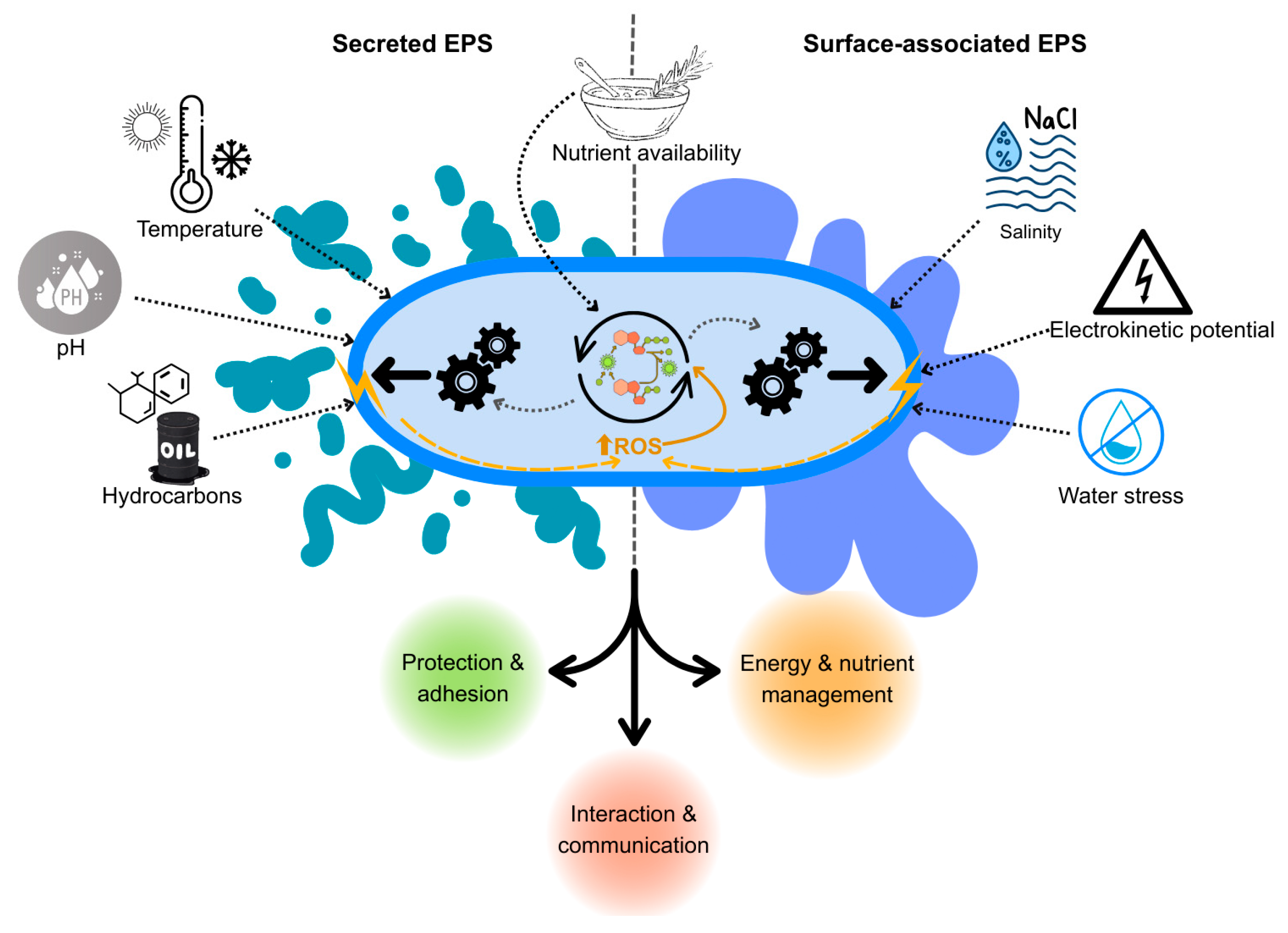
In summary, Figure 2 illustrates how environmental stressors such as temperature, pH, salinity, and hydrocarbons influence EPS production in Rhodococcus. These factors trigger metabolic shifts and Reactive Oxygen Species (ROS) signaling, leading to the formation of either secreted or surface-associated EPS. These substances play critical biological roles, facilitating protection, adhesion, nutrient management, and cellular communication, thereby ensuring bacterial adaptation across diverse ecological niches.

4. Chemical Composition of EPS in the Rhodococcus Genus

Bacterial EPS are mainly synthesized intracellularly and secreted extracellularly. They can be classified as capsular polysaccharides (when they are associated with cellular membranes/wall) or exopolysaccharides (when they are secreted into the surrounding environment) [22]. EPS can be further classified regarding the structure, as homopolysaccharides, which are constituted by the same monosaccharide unit, or heteropolysaccharides, which consist of a mixture containing more than one type of sugar, organic acid, or other compounds [22]. In addition, monomers can be linked by α- or β-glycosidic bonds, forming branched or linear EPS. Once synthesized, EPS can undergo modifications by incorporating functional groups, such as acetyl, carboxyethyl, and other compounds (e.g., proteins), thereby altering the polymeric chemical structure and resulting in different physicochemical/biological properties.
As previously mentioned, strains of genus Rhodococcus have the flexibility to survive on diverse environmental features and to metabolize a wide spectrum of carbon sources. Owing to these capabilities, EPS synthesis and its composition are often related to metabolites generated during culture conditions by cellular metabolism.
In contrast to probiotic bacteria, which produce polysaccharides with a molecular weight between 10 and 1000 kDa [23], EPS characterized in rhodococcal strains are usually high molecular weight acidic heteropolysaccharides (A-HeP) (Table 2). They are composed of reducing sugars (D-mannose, D-glucose, L-rhamnose, D-galactose, and L-fucose), amino sugars (glucosamine), and N-acetylated amino sugars (N-acetylglucosamine) (Table 2). In addition, they may contain proteins, organic acids (pyruvic acids), lipids (stearic and palmitic acids), and other specific compounds (Table 2). Furthermore, the pyruvic-acetal group attached to the linear EPS structure of several Rhodococcus strains is common in bacterial exopolysaccharides [24]. On the other hand, an unusual substance, rhodaminic acid, was detected in the capsular EPS of R. equi serotype 4 [25] (Table 2). Substituents can alter the physicochemical characteristics of EPS, resulting in an improvement of EPS solubilization [26]. The next section will address these features of EPS.
The capacity of EPS synthesis in Rhodococcus was recently reported in forty-seven strains belonging to fourteen species of the genus [9]. The authors determined that the main components in these polymers were carbohydrates, lipids, proteins, and nucleic acids; one-third of them corresponded to lipopolysaccharides. Furthermore, they proposed that similarities and differences among rhodococcal EPS depend not only on the species or environmental growth conditions but also on the strain metabolism. This hypothesis is consistent with the findings in R. erythropolis DSM 43215 and PR4 that produced HeP and two different A-HeP, respectively (Table 2).
R. erythropolis PR4 is a marine strain with the ability to degrade various linear and branched alkanes (including pristane) [32,33]. This strain simultaneously synthesized two A-HeP, mucoidan, and a fatty-acid-containing EPS (PR4 FACEPS). While both EPS exhibited different sugar units and acidic residues, the main difference lies in the presence of fatty acids found in PR4 FACEPS (~7.5%, w/w) (Table 2) [33]. Apparently, as a consequence of hexadecanoic and octadecanoic acids linked to the sugar monomers through ester bonds, an increase in the molecular weight and hydrophobicity of EPS was observed. These physicochemical characteristics could be related to the emulsifying activity of these polymers [33]. In this context, C18 and C16 fatty acids were also detected in three A-HeP from R. rhodochrous strains able to emulsify an aromatic fraction from Arabic light oil (Table 2) [37,40,41]. The S-2 EPS, produced by R. rhodochrous S-2, had a protective effect against hexadecane toxicity on this strain and increased emulsification of polyaromatic hydrocarbons in oil-contaminated seawater, improving the bioremediation process [40].
Neutral and lighter EPS were only described in R. erythropolis (DSM 43215) and R. qingshengii QDR4-2 (Table 2). Although both EPS contain more than 90% of carbohydrates (with glucose and mannose units), only the R. erythropolis EPS (PLS-1) has glucosamine and proteins in its composition [30,38]. PLS-1 was synthesized using different compounds as unique carbon sources, with maximal production yields when cells were cultivated on glycerol.
Understanding the composition and structure of EPS is important when considering its biotechnological applications (see Section 5). For example, the different monomer proportions in ATCC 53968 and SM-1 EPS—both containing the same neutral sugars, fatty acids, and organic acids—may lead to differences in their hydrophobicities and electrostatic interactions, resulting in ATCC 53968 EPS being more viscous and moisture-adsorbing than SM-1 EPS [37].
Based on the wide EPS composition spectrum reported in this section, it is clear that the metabolic versatility of Rhodococcus strains contributes to the high diversity of structures observed in their EPS. Thus, understanding the molecular processes involved in synthesis of rhodococcal EPS, its secretion and the regulation systems of both processes are essential for optimizing their industrial exploitation.

5. Biological Properties, Yields, and Biotechnological Applications

As mentioned in the previous section, Rhodococcus species typically synthesize high-molecular-weight acidic EPS that may be secreted to the extracellular medium or form part of the capsule. Although some capsular rhodococcal EPS have been reported to incorporate interesting molecules as monomers or substituents [25], such polysaccharides are usually produced by the pathogenic strains of R. hoagii (formerly R. equi). Therefore, capsular EPS from rhodococci will not be considered in this section when discussing biotechnological processes.
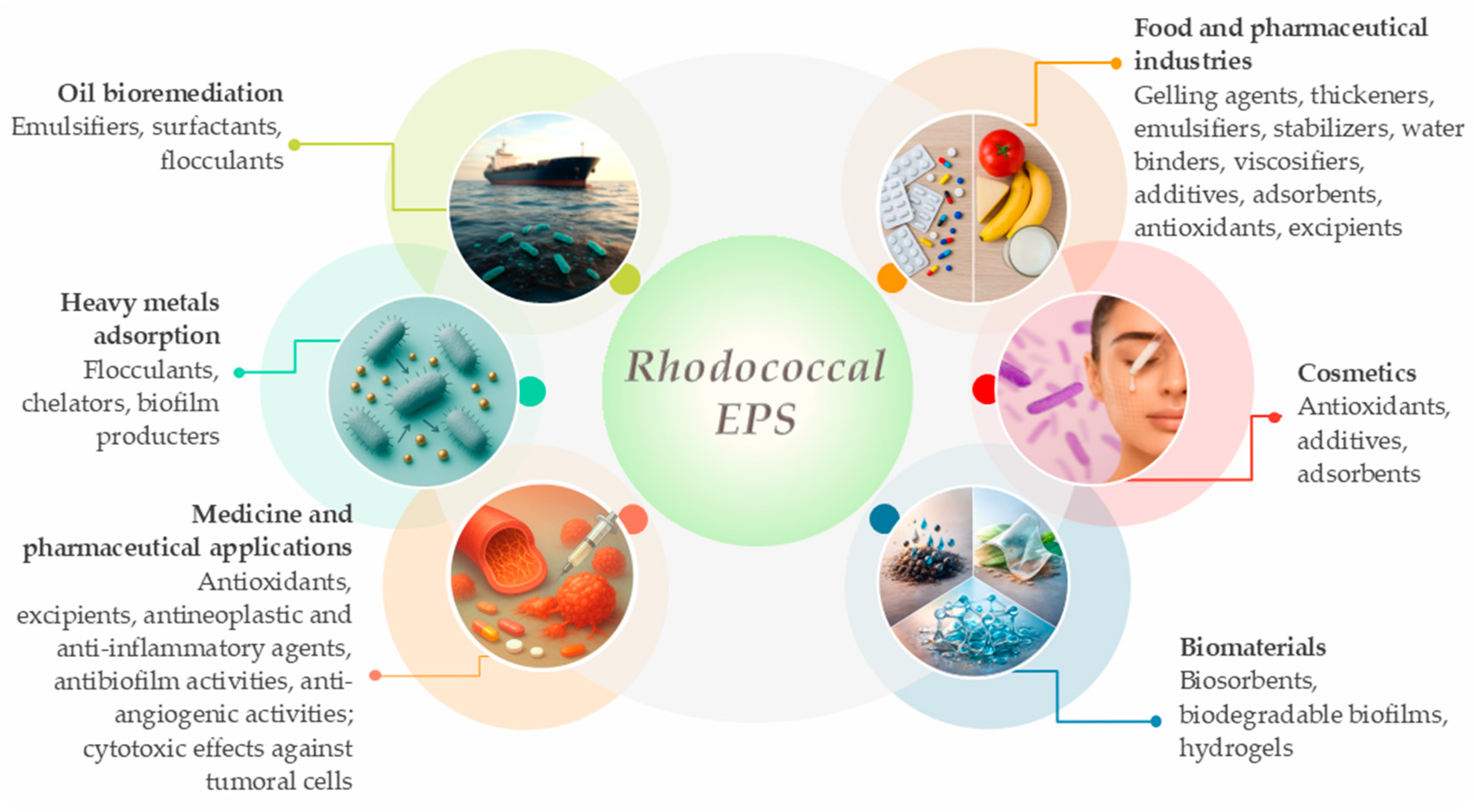
EPS is usually classified according to its EPS composition and natural role within bacterial biofilms [47]. However, in this review, we considered their physicochemical characteristics, focusing on their connection to biotechnological applications. Several biological activities have been described for rhodococcal EPS [31], ranging from the most common functions as thickener, emulsifier, stabilizer, and viscosifier to other, more specific activities, such as antiangiogenic, antineoplastic, cytotoxic, or antiviral properties (Figure 3, Table 3). Their potential biotechnological uses include environmental remediation, the food industry, human benefits, and biomaterials production (Figure 3).
Various methodologies are usually used to isolate the EPS from bacteria (reviewed in [4]). Researchers predominantly follow the same workflow: (1) separation of bacterial cells, (2) purification of EPS from companion proteins and lipids, (3) concentration of EPS, and (4) qualitative and quantitative analysis [4,48]. Many authors mentioned that EPS recovery yields depend on the methodologies used [4]. Commercial bacterial EPS are produced at concentrations ranging from 40 g/L to more than 100 g/L (xanthan, kurdlan, dextran, and levan) [5]. In contrast, Rhodococcus strains produced between 0.01 and 10.14 g/L of EPS (Table 3). Despite this low production, they exhibit interesting and multifunctional properties, as shown in Table 3. For example, R. erythropolis strains have a range of applications: DSM 43215 produces an EPS with anti-inflammatory activity suitable for pharmaceutical use; HX-2 synthesizes a remarkable, versatile EPS that could be used in the food, cosmetic, and pharmaceutical industries; and PR4 generates an EPS very useful for oil recovery (Table 3). Furthermore, the EPS of strain HX-2 shows cytotoxic effects against tumoral cells, suggesting a potential for antineoplastic therapies [31]. An interesting antiviral activity against human norovirus (NoV) was recently detected in EPS isolated from five Rhodococcus species (R. hoagii, R. erythropolis, R. rhodochrous, R. rhodnii, and R. coprophilus) [49]. In the study, EPS were able to bind NoV, preventing these sequestered viruses from infecting their target cells.
Table 3. Maximum yields, biological activities, and feasible applications of EPS from Rhodococcus.
StrainMaximum
Yields (g/L)
Biological Activities and Related
Biotechnological Applications
References
R. erythropolis DSM 432151.94Anti-inflammatory agent[30]
R. erythropolis AU-15.00Emulsifier[50]
R. erythropolis HX-26.37 (normal conditions)
8.96 (optimized conditions)
3.74 (purified)
Gelling agent, thickener,
emulsifier, stabilizer, water binder
or viscosifier (food industry)
Additive and adsorbent (food, cosmetic, and pharmaceutical industries)
Cytotoxicity against tumoral cells, antineoplastic agent (medicine and pharmaceutical industry)
[31]
R. erythropolis IEGM 14150.07N.D.[9]
R. erythropolis PR4N.D.Oil emulsifier[33]
R. jostii RHA10.01 (wt)
0.05 (OE nlpR *)
N.D.[17]
R. opacus 89 UMCS0.18Flocculant
Adsorbent of heavy metals
Modulator of calcium carbonate mineralisation
[35,51]
R. pyridinivorans ZZ4717.12 (wet EPS)
10.14 (dry EPS)
Antibiofilm and antiangiogenic activity
Cytotoxicity against tumoral cells
Antioxidant activity
[52,53]
R. qingshengii IGTS81.70 g/100 g cellThickener[37]
R. qingshengii LMR3561.95
3.64 (+30 mM Pb)
Lead tolerance (heavy-metal bioremediation)[54]
R. qingshengii QDR4-23.85Emulsifier and antioxidant (health, food, and pharmaceutical industries)[38]
R. rhodochrous0.27Flocculant[39]
R. rhodochrous S-2N.D.Emulsifier, thickener, moisture-absorber,
and moisture-retentor
[55]
R. rhodococcus sp. MI 27.4Biosorbent for Fe(III) and Cu(II)[46,56]
N.D., not determined; wt, wild type; OE, overexpression. * nlpR encodes a transcriptional activator of genes associated with nitrogen and lipid accumulation.
Various rhodococcal strains have environmental biotechnology potential, derived from their EPS oil emulsifiers or their heavy-metal adsorption capacity. Both R. qingshengii LMR356 and R. opacus FCL89 tolerate heavy metals (Table 3). Strain LMR356 could tolerate up to 30 mM Pb(II). In addition, when it was inoculated into seedlings of Sulla spinosissima, plant tolerance to this metal ion increased from 14.41 to 79.12% compared to control plants [54]. The authors proposed that EPS production could be one of the mechanisms of heavy metal tolerance in R. qingshengii LMR356. Furthermore, EPS from strain FCL89 exhibits flocculant and heavy-metal adsorbent properties for Pb(II), Cd(II), Ni(II), Co(II), and Cr(IV) [51]. These characteristics sustain its application in wastewater treatment and environmental remediation.
The diverse bioactivities of EPS from Rhodococcus species demonstrate the adaptability of these biopolymers for industrial and medical applications. These activities depend on the chemical structure and physicochemical characteristics of EPS. High viscosity is a desired property of EPS used as an excipient in the food and medicine industries. This feature is strongly associated with high molecular weights. Some rhodococcal EPS have molecular weights up to 2000 kDa (Table 2). For example, the EPS isolated from R. erythropolis HX-2 (called HPS) exhibited a molecular weight of 1040 kDa and contained both lipids and proteins (Table 2) [32]. The authors suggested that these characteristics are related to the remarkable viscosity demonstrated by HPS. At this point, it is important to mention that the covalent nature of protein/polysaccharide or fatty acids/polysaccharide bonds has been reported in Rhodococcus representatives [30,33,37,40], ruling out the possibility of serendipitous bonds in EPS.
Furthermore, fatty acids linked to EPS can also contribute to emulsifying activities [57]. These properties are useful in the food and pharmaceutical industries and in bioremediation technologies. Some strains of R. erythropolis and R. rhodochrous produced EPS with these characteristics (Table 2). In this context, the FACEPS from the PR4 strain contains palmitic and stearic acids attached to the polymeric backbone that may contribute to the emulsifying activity observed and to the tolerance of this strain to linear and branched alkanes [33]. In the case of FACEPS from the S-2 strain, it is proposed that the fatty acid moiety may be involved not only in emulsifying activity but also in thickening, moisture absorption, and moisture retention [55]. In addition, the authors identified a partial relationship between the polysaccharide backbone’s biological activities and its acidity. Acidity is a chemical characteristic that is sometimes related to flocculation or chelation processes [35]. Based on these findings, further research is needed to expand the potential applications of this EPS.
One way to increase EPS concentration could be to force an internal metabolic shift. In a previous work, researchers described that the addition of Penicillin G to the culture medium significantly increased EPS concentration [30]. This enhancement could be a consequence of growth arrest, with a concomitant reduction in the synthesis of peptidoglycan and lipopolysaccharide and a rearrangement of intracellular metabolism towards the synthesis and secretion of EPS [30]. A similar hypothesis was used to develop a technique to increase the viscosity and yield of bacterial exopolysaccharides in three typical EPS producers, Sphingomonas elodea, Xanthomonas campestris, and Paenibacillus elgii [58]. Beyond the already reported Rhodococcus species able to synthesize EPS, based on Figure 1, there are more than 20 species within the genus with unknown EPS-synthesizing capacity, and other culture conditions still untested could trigger higher EPS production. Thus, more approaches are needed to identify new strains capable of producing large quantities of EPS or to improve production processes.

6. Genes Relevant to EPS Biosynthesis

The four mechanisms that drive EPS synthesis in bacteria have largely been reported [59] and were mentioned in the Introduction. As indicated in Section 4, Rhodococcus mostly produces heteropolymers. However, the synthesis of bacterial cellulose by Rhodococcus sp. MI 2 [46] cannot rule out the extracellular synthesis pathway involved in homopolysaccharide synthesis and assembly. The other mechanisms share regulation at similar points, including the transport of carbon sources into the cell, the synthesis of activated sugars and sugar nucleotides, and their polymerization into repeating units. Eventually, all three pathways end with EPS polymerization and export. According to the limited bibliography, Rhodococcus may use the Wzx/Wzy-dependent route [60]. However, much work remains to be conducted to generalize this mechanism to all representatives capable of synthesizing EPS.
Significant progress has been made in understanding the molecular mechanisms and genetic regulation underlying EPS production [59]. The genes involved are typically organized into clusters that coordinate the successive steps of biosynthesis. The first step of EPS synthesis, which includes the uptake and metabolism of the substrate, usually involves genes located in a different chromosomal region relative to the successive groups of enzymes. Other steps involve the regulation, synthesis of nucleotide-sugar precursors, polymerization of sugar monomers, and ultimately, secretion of the polysaccharide [61]. In Rhodococcus, the organization of genes involved in EPS biosynthesis still needs to be further studied. Although there is a lack of systematized information, these groups include genes encoding UDP-glucose 6-dehydrogenases, GDP-fructose synthase, GDP L-fucose synthase, GDP-mannose 4,6-dehydrogenase, glycosyltransferases (GT), undecaprenyl-phosphate galactose phosphotransferases, N-acetylglucosaminyl-diphospho-decaprenol L-rhamnosyltransferases, capsular polysaccharide biosynthesis proteins, and polysaccharide biosynthesis proteins, among others [9,60,62]. Recent characterization of glgA-like GT4 enzymes in Rhodococcus jostii RHA1 has further illustrated the functional diversity of glycosyltransferases and their connection to nucleotide-sugar metabolism [63]. Knowledge regarding the pathways involved in EPS biosynthesis in Rhodococcus is still limited. R. jostii RHA1, the paradigm of oleaginous bacteria, contains three gene clusters involved in polysaccharide synthesis in its genome [34]. Unfortunately, none of them has been characterized. In the Rhodococcus genus, one of the most studied species of EPS producers is R. erythropolis [30,31,32,50,60]. There is only one work that reported the expression of a large gene cluster in R. erythropolis PR4 during growth on hydrocarbons, as shown through transcriptomic analysis [60]. Upregulated genes belonging to this cluster included those encoding enzymes for the synthesis of activated sugars, GT, wzy involved in the polymerization of repeating units, and wzz that defines the chain length of the EPS. Beyond Rhodococcus, the Wzx/Wzy pathway has been highly studied in bacteria [59].
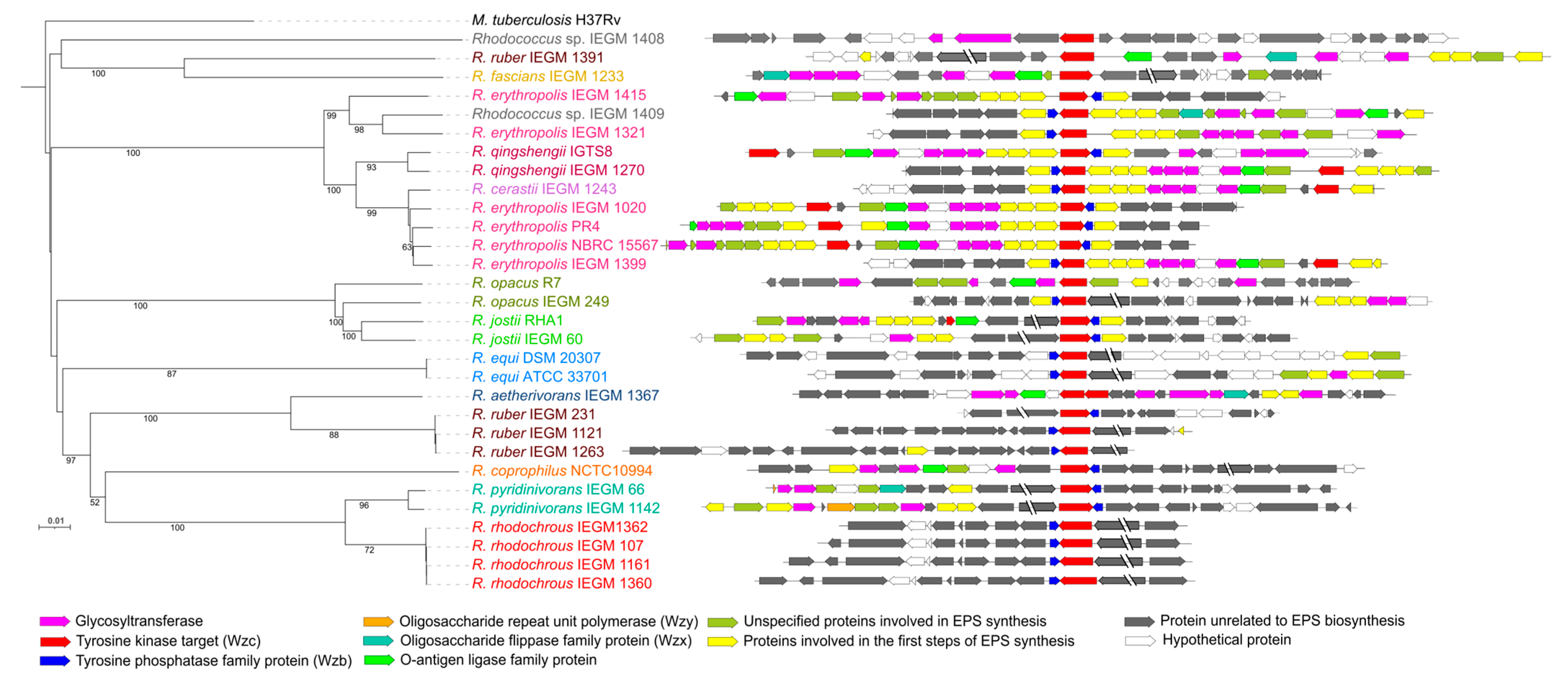
The massive number of genome sequencing projects in Rhodococcus offers the possibility to detect individual genes or gene clusters involved in EPS synthesis and reconstruct the metabolic pathways that result in these polymers. Furthermore, a high gene redundancy may also indicate an enhanced capacity to synthesize EPS across a wider variety of biotic or abiotic conditions. An in silico comparison of EPS biosynthetic potential among Rhodococcus species (and strains) was recently published [9]. The work showed that EPS synthesis is strain-specific and cannot be generalized to the taxonomic level of species. Even within the same species, genes encoding enzymes involved in any step of EPS synthesis are arranged differently, have different copy numbers or can be replaced for others according to the sugar to be incorporated into the polymer. This irregular pattern of enzymes involved in polysaccharide assembly is also found in lactic acid bacteria, the paradigm of EPS production [64]. It is proposed that these changes in metabolic pathways occur to adjust their survival in particular environments [65]. Based on the limited information available, biosynthesis of EPS is apparently controlled by at least one gene cluster in R. erythropolis [60]. To define how conserved this locus is throughout the genus, an in silico reconstruction of this cluster was conducted using whole genomes of EPS producers with available and sufficient information on the target cluster (Figure 4). We focused on the region adjacent to the gene encoding tyrosine kinase Wzc, a key player in EPS synthesis that regulates assembly and export of EPS. The cluster was not found in other species beyond the R. erythropolis/R. qingshengii group, suggesting a poorly conserved region throughout the genus. In addition, genes within the cluster suffered a clear rearrangement even at the strain level (Figure 4). The distribution and functional diversity of genes involved in EPS synthesis provide a genetic basis for explaining the differences in EPS production in Rhodococcus not only at the species level but also for strains belonging to the same species. This is particularly true for GTs and extracellular polysaccharide synthesis-related proteins, such as Wzc.
Understanding which functional enzymes are involved at each step of EPS synthesis can provide a basis for optimizing culture conditions to increase EPS production. In this context, amino acid (acyl carrier protein) ligases (AALs) are a group of enzymes with unknown function that are consistently located in EPS gene clusters in Actinobacteria and Proteobacteria [66]. Rhodococcus is not the exception, and the AAL cassette within the genus is highly conserved in almost all AAL-encoding Rhodococcus species. Four distinct contexts for EPS synthesis were found surrounding the AAL cassette, indicating that the block spatially associates with one EPS synthesis gene cluster but is located at different positions in the genome. Furthermore, no AAL sequences colocalized with the gene cluster shown in Figure 4. No reports confirm a metabolic role for AAL cassettes in EPS production in Rhodococcus species or other bacteria. The exact nature of AAL cassettes in EPS synthesis and/or modification remains unclear and warrants further study.

7. Conclusions and Future Research Perspectives

The Rhodococcus genus, renowned for the biotechnological relevance and environmental resilience of its representatives, is increasingly recognized as a source of structurally diverse extracellular polymers [9,67,68]. However, certain topics that remain poorly characterized need to be addressed. EPS studies in Rhodococcus need a shift from descriptive studies to integrative, genome-guided exploration of EPS diversity. High-throughput sequencing and omics-based regulation analysis would help to uncover unrecognized EPS biosynthetic gene clusters and confirm those reported in in silico studies [69]. As presented in Section 3, numerous studies demonstrate the effects of growth conditions, including carbon source, pH, temperature, and salinity. However, there is a need to decipher the molecular mechanisms by which these factors trigger EPS synthesis and excretion. When these challenges were considered, and metabolically relevant enzymes were identified, genetically engineered strains would increase yields and open opportunities for the discovery of polymers with novel architectures and functionalities.
Despite their potential, the lack of standardized protocols for structural analysis limits comparability across studies. This handicap extends beyond Rhodococcus EPS, and in all cases, efforts should be directed towards standardizing methods for chemical analysis to define its composition, substituents, degree of branching, charge, and other characteristics. It is imperative to find a new medium composition that could impact cell growth and EPS yields while, at the same time, reducing production costs. One possibility is the use of inexpensive agro-industrial wastes, such as sugarcane juice, fruit juice, or potato starch wastewater, which have previously been used as substrates for the production of other metabolites or for the production of EPS by other bacteria [70,71,72]. In this context, juice from ripe fruits was used to isolate and grow Rhodococcus sp. MI 2 and produce cellulose as EPS [46]. Bacterial cellulose is receiving massive attention due to its unique features. However, the capacity of Rhodococcus isolates to produce this biopolymer has been overlooked and deserves to be further studied. Furthermore, most available studies remain at the laboratory or pilot-project stage; no reported costs for downstream processing or scalability at the industrial scale have been reported. Consequently, the transition from bench-scale synthesis to industrial implementation continues to be limited by uncertainty regarding production costs and process robustness.
The fields of application of EPS produced by Rhodococcus strains could be broadened, particularly if research efforts are directed toward replacing synthetic or non–environmentally friendly compounds currently used in industry. Their potential extends across multiple sectors, including agriculture, bioremediation, and wastewater treatment. Moreover, their biocompatibility and non-toxicity make them suitable for applications in pharmaceuticals, biomedical coatings, and controlled-release systems. Future studies focusing on production optimization and functional characterization could therefore enable Rhodococcus EPS to contribute meaningfully to the development of sustainable biobased materials, aligning with the principles of green chemistry and circular bioeconomy.
In summary, EPS obtained from Rhodococcus representatives has evolved from niche industrial additives to a relevant area of research in microbiology, biotechnology, and materials science. Advances in genome mining, metabolic engineering, and sustainable bioprocessing would pave the way for better knowledge and improvement of EPS production. The coming years are expected to consolidate these polymers as key components of bio-based economies and high-value biomaterials for environmental and biomedical applications.

Supplementary Materials

The following supporting information can be downloaded at: https://www.mdpi.com/article/10.3390/fermentation12020082/s1, Table S1: Genomic data from Rhodococcus strains.

Author Contributions

Conceptualization, M.P.L.; methodology, M.P.L. and N.E.S.; Figure creation, R.A.S. and N.E.S.; writing—original draft preparation, M.P.L., R.A.S., N.E.S., and J.S.D.C.; writing—review and editing, M.P.L., R.A.S., and H.M.A.; supervision, M.P.L. All authors have read and agreed to the published version of the manuscript.

Funding

This research was funded by UNPSJB, PI 1924.

Institutional Review Board Statement

Not applicable.

Informed Consent Statement

Not applicable.

Data Availability Statement

The original contributions presented in this study are included in the article/Supplementary Material. Further inquiries can be directed to the corresponding author.

Conflicts of Interest

The authors declare no conflicts of interest.

References

  1. Alvarez, H.M.; Hernández, M.A.; Lanfranconi, M.P.; Silva, R.A.; Villalba, M.S. Rhodococcus as biofactories for microbial oil production. Molecules 2021, 26, 4871. [Google Scholar] [CrossRef]
  2. Cappelletti, M.; Presentato, A.; Piacenza, E.; Firrincieli, A.; Turner, R.J.; Zannoni, D. Biotechnology of Rhodococcus for the production of valuable compounds. Appl. Environ. Microbiol. 2020, 104, 8567–8594. [Google Scholar] [CrossRef]
  3. Upadhyaya, C.; Patel, H.; Patel, I.; Upadhyaya, T. Extremophilic exopolysaccharides: Bioprocess and novel applications in 21 st century. Fermentation 2025, 11, 16. [Google Scholar] [CrossRef]
  4. Nguyen, H.T.; Pham, T.T.; Nguyen, P.T.; Le-Buanec, H.; Rabetafika, H.N.; Razafindralambo, H.L. Advances in microbial exopolysaccharides: Present and future applications. Biomolecules 2024, 14, 1162. [Google Scholar] [CrossRef] [PubMed]
  5. Netrusov, A.I.; Liyaskina, E.V.; Kurgaeva, I.V.; Liyaskina, A.U.; Yang, G.; Revin, V.V. Exopolysaccharides producing bacteria: A review. Microorganisms 2023, 11, 1541. [Google Scholar] [CrossRef] [PubMed]
  6. Nouioui, I.; Carro, L.; García-López, M.; Meier-Kolthoff, J.P.; Woyke, T.; Kyrpides, N.C.; Pukall, R.; Klenk, H.P.; Goodfellow, M.; Göker, M. Genome-based taxonomic classification of the phylum Actinobacteria. Front. Microbiol. 2018, 9, 2007. [Google Scholar] [CrossRef] [PubMed]
  7. Val-Calvo, J.; Vázquez-Boland, J.A. Mycobacteriales taxonomy using network analysis-aided, context-uniform phylogenomic approach for non-subjective genus demarcation. mBio 2023, 14, e0220723. [Google Scholar] [CrossRef]
  8. Cappelletti, M.; Zampolli, J.; Di Gennaro, P.; Zannoni, D. Genomics of Rhodococcus. In Biology of Rhodococcus. Microbiology Monographs, 2nd ed.; Alvarez, H., Ed.; Springer: Cham, Switzerland, 2019; Volume 16, pp. 23–60. [Google Scholar] [CrossRef]
  9. Krivoruchko, A.; Nurieva, D.; Luppov, V.; Kuyukina, M.; Ivshina, I. The lipid- and polysaccharide-rich extracellular polymeric substances of Rhodococcus support biofilm formation and protection from toxic hydrocarbons. Polymers 2025, 17, 1912. [Google Scholar] [CrossRef]
  10. Sangal, V.; Goodfellow, M.; Jones, A.L.; Seviour, R.J.; Sutcliffe, I.C. Refined systematics of the genus Rhodococcus based on whole genome analyses. In Biology of Rhodococcus. Microbiology Monographs, 2nd ed.; Alvarez, H., Ed.; Springer: Cham, Switzerland, 2019; Volume 16, pp. 1–21. [Google Scholar] [CrossRef]
  11. Meier-Kolthoff, J.P.; Göker, M. TYGS is an automated high-throughput platform for state-of-the-art genome-based taxonomy. Nat. Commun. 2019, 10, 2182. [Google Scholar] [CrossRef]
  12. Sangal, V.; Goodfellow, M.; Jones, A.L.; Sutcliffe, I.C. A stable home for an equine pathogen: Valid publication of the binomial Prescottella equi gen. nov., comb. nov., and reclassification of four rhodococcal species into the genus Prescottella. Int. J. Syst. Evol. Microbiol. 2022, 72, 005551. [Google Scholar] [CrossRef]
  13. Tomás-Gallardo, L.; Santero, E.; Floriano, B. Involvement of a putative cyclic amp receptor protein (DRP)-like binding sequence and a CRP-like protein in glucose-mediated catabolite repression of thn genes in Rhodococcus sp. strain TFB. Appl. Environ. Microbiol. 2012, 78, 5460–5462. [Google Scholar] [CrossRef]
  14. Chen, Y.; Wei, Q.; Wang, X.; Wu, Y.; Fu, C.; Wang, X.; Hangzhou, X.; Li, L. Characterizing the contaminant-adhesion of a dibenzofuran degrader Rhodococcus sp. Microorganisms 2025, 13, 93. [Google Scholar] [CrossRef]
  15. Yoshida, N.; Hayasaki, T.; Takagi, H. Gene expression analysis of methylotrophic oxidoreductases involved in the oligotrophic growth of Rhodococcus erythropolis N9T-4. Biosci. Biotechnol. Biochem. 2011, 75, 123–127. [Google Scholar] [CrossRef] [PubMed]
  16. Ivshina, I.B.; Krivoruchko, A.V.; Kuyukina, M.S.; Peshkur, T.A.; Cunningham, C.J. Adhesion of Rhodococcus bacteria to solid hydrocarbons and enhanced biodegradation of these compounds. Sci. Rep. 2022, 12, 21559. [Google Scholar] [CrossRef]
  17. Hernández, M.A.; Gleixner, G.; Sachse, D.; Alvarez, H.M. Carbon allocation in Rhodococcus jostii RHA1 in response to disruption and overexpression of nlpR regulatory gene, based on 13C-labeling analysis. Front. Microbiol. 2017, 8, 1992. [Google Scholar] [CrossRef] [PubMed]
  18. Alvarez, H.M.; Silva, R.A.; Cesari, A.C.; Zamit, A.L.; Peressutti, S.R.; Reichelt, R.; Keller, U.; Malkus, U.; Rasch, C.; Maskow, T.; et al. Physiological and morphological responses of the soil bacterium Rhodococcus opacus strain PD630 to water stress. FEMS Microbiol. Ecol. 2004, 50, 75–86. [Google Scholar] [CrossRef]
  19. Sazykin, I.; Makarenko, M.; Khmelevtsova, L.; Seliverstova, E.Y.; Rakin, A.; Sazykina, M. Cyclohexane, naphthalene, and diesel fuel increase oxidative stress, CYP153, sodA, and recA gene expression in Rhodococcus erythropolis. Microbiologyopen 2019, 8, e00855. [Google Scholar] [CrossRef] [PubMed]
  20. Juárez, K.; Reza, L.A.A.; Bretón-Deval, L.; Morales-Guzmán, D.; Trejo-Hernández, M.R.; García-Guevara, F.; Lara, P. Microaerobic degradation of crude oil and long chain alkanes by a new Rhodococcus strain from Gulf of Mexico. World J. Microbiol. Biotechnol. 2023, 39, 264. [Google Scholar] [CrossRef]
  21. Mo, L.T.; Irina, P.; Natalia, S.; Irina, N.; Lenar, A.; Andrey, F.; Ekaterina, A.; Sergey, A.; Olga, P. Hydrocarbons biodegradation by Rhodococcus: Assimilation of hexadecane in different aggregate states. Microorganisms 2022, 10, 1594. [Google Scholar] [CrossRef]
  22. Sajna, K.V.; Sharma, S.; Nadda, A.K. Microbial exopolysaccharides: An introduction. In Microbial Exopolysaccharides as Novel and Significant Biomaterials, 1st ed.; Nadda, A.K., Sajna, K.V., Sharma, S., Eds.; Springer Nature: Cham, Switzerland, 2021; pp. 1–18. [Google Scholar] [CrossRef]
  23. Angelin, J.; Kavitha, M. Exopolysaccharides from probiotic bacteria and their health potential. Int. J. Biol. Macromol. 2020, 162, 853–865. [Google Scholar] [CrossRef]
  24. Severn, W.B.; Richards, J.C. The acidic specific capsular polysaccharide of Rhodococcus equi serotype 3. Structural elucidation and stereochemical analysis of the lactate ether and pyruvate acetal substituents. Can. J. Chem. 1992, 70, 2664–2676. [Google Scholar] [CrossRef]
  25. Severn, W.B.; Richards, J.C. The structure of the specific capsular polysaccharide of Rhodococcus equi serotype 4. Carbohydr. Res. 1999, 320, 209–222. [Google Scholar] [CrossRef] [PubMed]
  26. Miertus, S.; Navarini, L.; Cesàro, A. Configurational stability and molecular dynamics of acetal-linked pyruvate substituents in polysaccharides. Carbohydr. Res. 1994, 257, 227–238. [Google Scholar] [CrossRef]
  27. Leitch, R.A.; Richards, J.C. Structural analysis of the specific capsular polysaccharide of Rhodococcus equi serotype 1. Biochem. Cell Biol. 1990, 68, 778–789. [Google Scholar] [CrossRef]
  28. Severn, W.B.; Richards, J.C. Structural analysis of the specific capsular polysaccharide of Rhodococcus equi serotype 2. Carbohydr. Res. 1990, 206, 311–332. [Google Scholar] [CrossRef]
  29. Masoud, H.; Richards, J.C. Structural elucidation of the specific capsular polysaccharide of Rhodococcus equi serotype 7. Carbohydr. Res. 1994, 252, 223–233. [Google Scholar] [CrossRef]
  30. Rapp, P.; Beck, C.H.; Wagner, F. Formation of exopolysaccharides by Rhodococcus erythropolis and partial characterization of a heteropolysaccharide of high molecular weight. Eur. J. Appl. Microbiol. Biotechnol. 1979, 7, 67–78. [Google Scholar] [CrossRef]
  31. Hu, X.; Li, D.; Qiao, Y.; Wang, X.; Zhang, Q.; Zhao, W.; Huang, L. Purification, characterization and anticancer activities of exopolysaccharide produced by Rhodococcus erythropolis HX-2. Int. J. Biol. Macromol. 2020, 145, 646–654. [Google Scholar] [CrossRef] [PubMed]
  32. Urai, M.; Yoshizaki, H.; Anzai, H.; Ogihara, J.; Iwabuchi, N.; Harayama, S.; Sunairi, M.; Nakajima, M. Structural analysis of mucoidan, an acidic extracellular polysaccharide produced by a pristane-assimilating marine bacterium, Rhodococcus erythropolis PR4. Carbohydr. Res. 2007, 342, 927–932. [Google Scholar] [CrossRef]
  33. Urai, M.; Yoshizaki, H.; Anzai, H.; Ogihara, J.; Iwabuchi, N.; Harayama, S.; Sunairi, M.; Nakajima, M. Structural analysis of an acidic, fatty acid ester-bonded extracellular polysaccharide produced by a pristane-assimilating marine bacterium, Rhodococcus erythropolis PR4. Carbohydr. Res. 2007, 342, 933–942. [Google Scholar] [CrossRef]
  34. Perry, M.B.; MacLean, L.L.; Patrauchan, M.A.; Vinogradov, E. The structure of the exocellular polysaccharide produced by Rhodococcus sp. RHA1. Carbohydr. Res. 2007, 342, 2223–2229. [Google Scholar] [CrossRef]
  35. Czemierska, M.; Szcześ, A.; Pawlik, A.; Wiater, A.; Jarosz-Wilkołazka, A. Production and characterisation of exopolymer from Rhodococcus opacus. Biochem. Eng. J. 2016, 112, 143–152. [Google Scholar] [CrossRef]
  36. Czemierska, M.; Szcześ, A.; Jarosz-Wilkołazka, A. Physicochemical factors affecting flocculating properties of the proteoglycan isolated from Rhodococcus opacus. Biophys. Chem. 2021, 277, 106656. [Google Scholar] [CrossRef] [PubMed]
  37. Urai, M.; Anzai, H.; Iwabuchi, N.; Sunairi, M.; Nakajima, M. A novel viscous extracellular polysaccharide containing fatty acids from Rhodococcus rhodochrous ATCC 53968. Actinomycetologica 2004, 18, 15–17. [Google Scholar] [CrossRef]
  38. Li, F.; Hu, X.; Li, J.; Sun, X.; Luo, C.; Zhang, X.; Li, H.; Lu, J.; Li, Y.; Bao, M. Purification, structural characterization, antioxidant and emulsifying capabilities of exopolysaccharide produced by Rhodococcus qingshengii QDR4-2. J. Polym. Environ. 2023, 31, 64–80. [Google Scholar] [CrossRef]
  39. Czemierska, M.; Szcześ, A.; Hołysz, L.; Wiater, A.; Jarosz-Wilkołazka, A. Characterisation of exopolymer R-202 isolated from Rhodococcus rhodochrous and its flocculating properties. Eur. Polym. J. 2017, 88, 21–33. [Google Scholar] [CrossRef]
  40. Urai, M.; Anzai, H.; Ogihara, J.; Iwabuchi, N.; Harayama, S.; Sunairi, M.; Nakajima, M. Structural analysis of an extracellular polysaccharide produced by Rhodococcus rhodochrous strain S-2. Carbohydr. Res. 2006, 341, 766–775. [Google Scholar] [CrossRef]
  41. Urai, M.; Anzai, H.; Iwabuchi, N.; Sunairi, M.; Nakajima, M. A novel moisture-absorbing extracellular polysaccharide from Rhodococcus rhodochrous SM-1. Actinomycetologica 2002, 16, 26–31. [Google Scholar] [CrossRef]
  42. Neu, T.R.; Poralla, K. An amphiphilic polysaccharide from an adhesive Rhodococcus strain. FEMS Microbiol. Lett. 1988, 49, 389–392. [Google Scholar] [CrossRef]
  43. Aizawa, T.; Neilan, B.A.; Couperwhite, I.; Urai, M.; Anzai, H.; Iwabuchi, N.; Nakajima, M.; Sunairi, M. Relationship between extracellular polysaccharide and benzene tolerance of Rhodococcus sp. 33. Actinomycetologica 2005, 19, 1–6. [Google Scholar] [CrossRef]
  44. Urai, M.; Aizawa, T.; Anzai, H.; Ogihara, J.; Iwabuchi, N.; Neilan, B.; Couperwhite, I.; Nakajima, M.; Sunairi, M. Structural analysis of an extracellular polysaccharide produced by a benzene tolerant bacterium, Rhodococcus sp. 33. Carbohydr. Res. 2006, 341, 616–623. [Google Scholar] [CrossRef] [PubMed]
  45. Vinogradov, E.V.; Knirel, Y.A.; Shashkov, A.S.; Gorin, S.E.; Vustina, T.F.; Soiiyfer, V.S.; Esipov, S.E.; Lysak, L.V.; Kochetkov, N.K. Structure of the extracellular polysaccharide from Rhodococcus sp. containing D-lyxo-hexulosonic acid. Bioorg. Khimiya 1988, 14, 1214–1223. [Google Scholar]
  46. Tanskul, S.; Amornthatree, K.; Jaturonlak, N. A new cellulose-producing bacterium, Rhodococcus sp. MI 2: Screening and optimization of culture conditions. Carbohydr. Polym. 2013, 92, 421–428. [Google Scholar] [CrossRef] [PubMed]
  47. Flemming, H.C.; Neu, T.R.; Wozniak, D.J. The EPS matrix: The “House of biofilm cells”. J. Bacteriol. 2007, 189, 7945–7947. [Google Scholar] [CrossRef]
  48. Kaur, N.; Dey, P. Bacterial exopolysaccharides as emerging bioactive macromolecules: From fundamentals to applications. Res. Microbiol. 2023, 174, 104024. [Google Scholar] [CrossRef]
  49. Santiso-Bellón, C.; Randazzo, W.; Carmona-Vicente, N.; Peña-Gil, N.; Cárcamo-Calvo, R.; Lopez-Navarro, S.; Navarro-Lleó, N.; Yebra, M.J.; Monedero, V.; Buesa, J.; et al. Rhodococcus spp. interacts with human norovirus in clinical samples and impairs its replication on human intestinal enteroids. Gut Microbes 2025, 17, 2469716. [Google Scholar] [CrossRef]
  50. Semeniuk, I.; Koretska, N.; Kochubei, V.; Lysyak, V.; Pokynbroda, T.; Karpenko, E.; Midyana, H. Biosynthesis and characteristics of metabolites of Rhodococcus erythropolis AU-1 strain. J. Microbiol. Biotechnol. Food Sci. 2022, 11, e4714. [Google Scholar] [CrossRef]
  51. Dobrowolski, R.; Szcześ, A.; Czemierska, M.; Jarosz-Wikołazka, A. Studies of cadmium (II), lead (II), nickel (II), cobalt (II) and chromium (VI) sorption on extracellular polymeric substances produced by Rhodococcus opacus and Rhodococcus rhodochrous. Bioresour. Technol. 2017, 225, 113–120. [Google Scholar] [CrossRef]
  52. Güvensen, N.C.; Alper, M.; Taşkaya, A. The evaluation of biological activities of exopolysaccharide from Rhodococcus pyridinovorans in vitro. Eur. J. Res. Dev. 2022, 2, 491–504. [Google Scholar] [CrossRef]
  53. Taşkaya, A.; Güvensen, N.C.; Güler, C.; Şancı, E.; Karabay Yavaşoğlu, N.Ü. Exopolysaccharide from Rhodococcus pyridinivorans ZZ47 strain: Evaluation of biological activity and toxicity. J. Agric. Prod. 2023, 4, 63–71. [Google Scholar] [CrossRef]
  54. Oubohssaine, M.; Sbabou, L.; Aurag, J. Potential of the plant growth-promoting rhizobacterium Rhodococcus qingshengii LMR356 in mitigating lead stress impact on Sulla spinosissima L. Environ. Sci. Pollut. Res. 2024, 31, 46002–46022. [Google Scholar] [CrossRef]
  55. Urai, M.; Aizawa, T.; Nakajima, M.; Sunairi, M. An anionic polymer incorporating low amounts of hydrophobic residues is a multifunctional surfactant. Part 1: Emulsifying, thickening, moisture-absorption and moisture-retention abilities of a fatty acid-containing anionic polysaccharide. Adv. Chem. Eng. Sci. 2015, 5, 173–180. [Google Scholar] [CrossRef]
  56. Yingkong, P.; Tanskul, S. Adsorption of iron (III) and copper (II) by bacterial cellulose from Rhodococcus sp. MI 2. J. Polym. Environ. 2019, 27, 1948–1958. [Google Scholar] [CrossRef]
  57. Mouro, C.; Gomes, A.P.; Gouveia, I.C. Microbial exopolysaccharides: Structure, diversity, applications, and future frontiers in sustainable functional materials. Polysaccharides 2024, 5, 241–287. [Google Scholar] [CrossRef]
  58. Li, O.; Liu, A.; Lu, C.; Zheng, D.Q.; Qian, C.D.; Wang, P.M.; Jiang, X.H.; Wu, X.C. Increasing viscosity and yields of bacterial exopolysaccharides by repeatedly exposing strains to ampicillin. Carbohydr. Polym. 2014, 110, 203–208. [Google Scholar] [CrossRef]
  59. Kamat, S. Molecular Basis and Genetic Regulation of EPS. In Microbial Exopolysaccharides as Novel and Significant Biomaterials, 1st ed.; Nadda, A.K., Sajna, K.V., Sharma, S., Eds.; Springer Nature: Cham, Switzerland, 2021; pp. 45–83. [Google Scholar] [CrossRef]
  60. Laczi, K.; Kis, Á.; Horváth, B.; Maróti, G.; Hegedüs, B.; Perei, K.; Rákhely, G. Metabolic responses of Rhodococcus erythropolis PR4 grown on diesel oil and various hydrocarbons. Appl. Microbiol. Biotechnol. 2015, 99, 9745–9759. [Google Scholar] [CrossRef]
  61. Rana, S.; Upadhyay, L.S. Microbial exopolysaccharides: Synthesis pathways, types and their commercial applications. Int. J. Biol. Macromol. 2020, 157, 577–583. [Google Scholar] [CrossRef]
  62. Iino, T.; Wang, Y.; Miyauchi, K.; Kasai, D.; Masai, E.; Fujii, T.; Ogawa, N.; Fukuda, M. Specific gene responses of Rhodococcus jostii RHA1 during growth in soil. Appl. Environ. Microbiol. 2021, 78, 6954–6962. [Google Scholar] [CrossRef]
  63. Cereijo, A.E.; Ferretti, M.V.; Iglesias, A.A.; Álvarez, H.M.; Asencion Diez, M.D. Study of two glycosyltransferases related to polysaccharide biosynthesis in Rhodococcus jostii RHA1. Biol. Chem. 2024, 405, 325–340. [Google Scholar] [CrossRef] [PubMed]
  64. Zhang, K.; Zhang, X.; Qi, X.; Duan, S.; Feng, Z.; Gong, P.; Wu, Z.; Li, B.; Liu, F. Molecular mechanisms for exopolysaccharides synthesis in Lactobacillus helveticus: Relationship between structural characteristics and genomics. Carbohydr. Polym. 2025, 368, 124170. [Google Scholar] [CrossRef] [PubMed]
  65. Bundalovic-Torma, C.; Whitfield, G.B.; Marmont, L.S.; Howell, P.L.; Parkinson, J. A systematic pipeline for classifying bacterial operons reveals the evolutionary landscape of biofilm machineries. PLoS Comput. Biol. 2020, 16, e1007721. [Google Scholar] [CrossRef]
  66. Simunović, V. Genomic and molecular evidence reveals novel pathways associated with cell surface polysaccharides in bacteria. FEMS Microbiol. Ecol. 2021, 97, fiab119. [Google Scholar] [CrossRef] [PubMed]
  67. Ivshina, I.; Bazhutin, G.; Tyumina, E. Rhodococcus strains as a good biotool for neutralizing pharmaceutical pollutants and obtaining therapeutically valuable products: Through the past into the future. Front. Microbiol. 2022, 13, 967127. [Google Scholar] [CrossRef] [PubMed]
  68. Elias, P.M.; das Neves Vasconcellos Brandão, I.Y.; Maass, D. Unlocking hidden value: The metallurgical promise of Rhodococcus spp. Environ. Sci. Biotechnol. 2025, 24, 557–569. [Google Scholar] [CrossRef]
  69. Simunović, V.; Grubišić, I. Amino acid (acyl carrier protein) ligase-associated biosynthetic gene clusters reveal unexplored biosynthetic potential. Mol. Genet. Genom. 2023, 298, 49–65. [Google Scholar] [CrossRef]
  70. Guo, J.; Liu, J.; Yang, Y.; Zhou, Y.; Jiang, S.; Chen, C. Fermentation and kinetics characteristics of a bioflocculant from potato starch wastewater and its application. Sci. Rep. 2018, 8, 3631. [Google Scholar] [CrossRef]
  71. Herrero, O.M.; Alvarez, H.M. Fruit residues as substrates for single-cell oil production by Rhodococcus species: Physiology and genomics of carbohydrate catabolism. World J. Microbiol. Biotechnol. 2024, 40, 61. [Google Scholar] [CrossRef]
  72. Wang, Z.; Yang, Y.; Yu, W.; Zhou, B.; Qiu, Y.; Chen, Z.; Du, R. Analysis of the metabolic process of sugarcane juice fermented by Leuconostoc mesenteroides and identification of exopolysaccharides. Food Res. Int. 2025, 220, 117098. [Google Scholar] [CrossRef]
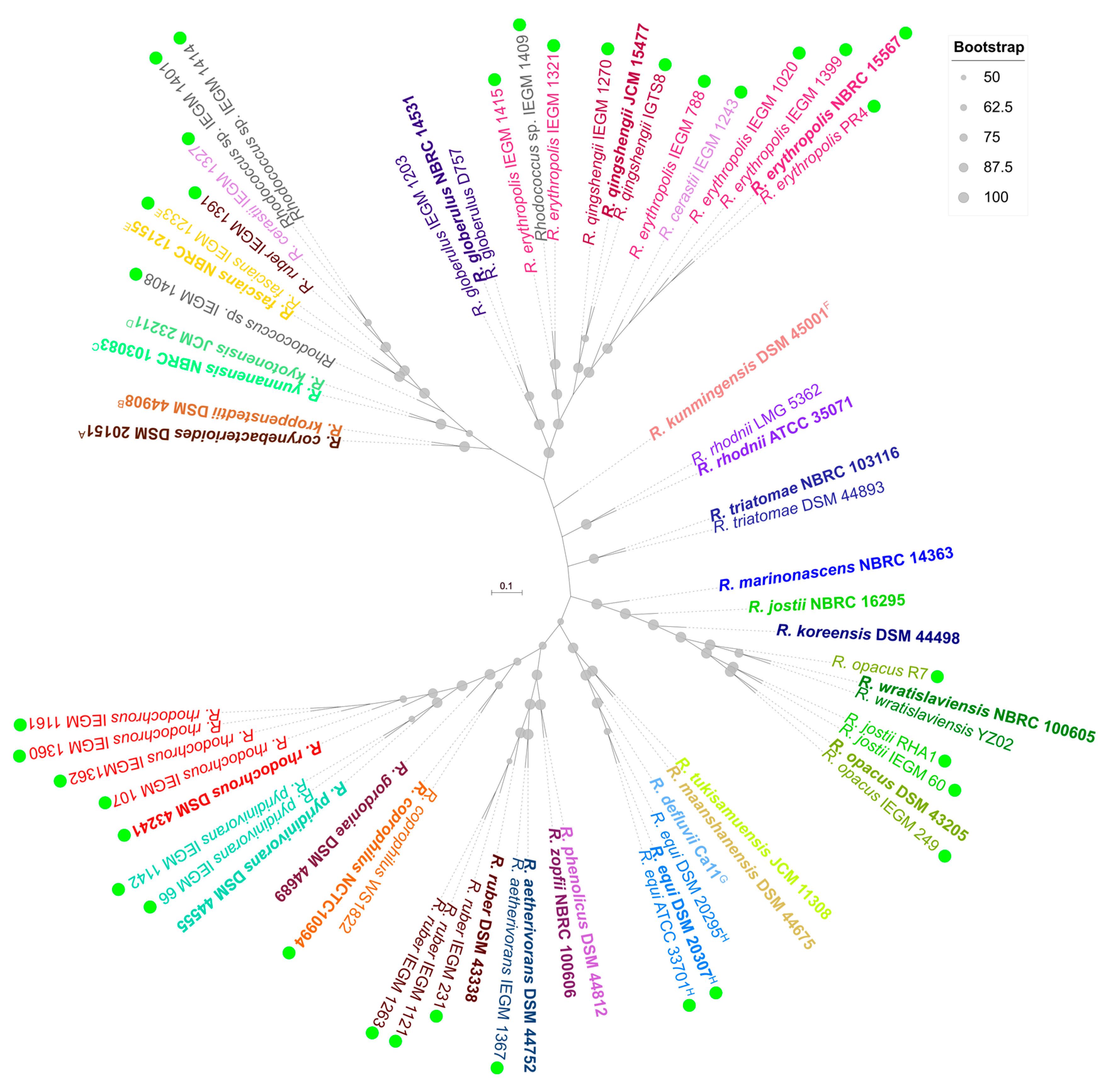
Figure 1. Whole-genome Rhodococcus tree. Pseudo-Bootstrap values were calculated from 100 replicates and are shown as circles of different sizes in each branch. Type strains appear in bold and different colors were used for each species shown. Green circles indicate strains for which EPS has been studied. Renamed Rhodococcus species are identified by superscript letters. A, Rhodococcoides corynebacterioides; B, Rhodococcoides kroppenstedtii; C, Rhodococcoides yunnanense; D, Rhodococcoides kyotonense; E, Rhodococcoides fascians; F, Aldersonia kunmingensis; G, Prescottella defluvii; H, Prescottella equi.
Fermentation 12 00082 g001
Figure 2. Integrative model showing effectors, physiological responses of Rhodococcus species, and EPS localization.
Fermentation 12 00082 g002
Figure 3. Biotechnological applications of rhodococcal EPS (circled images were generated using ChatGPT, OpenAI, GPT-5.1, March 2025 version).
Fermentation 12 00082 g003
Figure 4. Whole-genome tree and genomic context of Wzc in Rhodococcus. The tree was constructed based on EPS producers and inferred using TYGS, the colours differentiate each species. On the right side of each strain, the genomic context of the Wzc with the highest identity to its counterpart in R. erythropolis PR4 (RER_13270) is shown.
Fermentation 12 00082 g004
Table 2. Characteristics of exopolysaccharides from Rhodococcus strains.
StrainSubstrateEPS Acronym and CompositionMolecular Weight
(kDa)
References
R. equi serotype 1 (ATCC 33701)NM plus glucoseA-HeP
Mannose/pyruvic acid/glucose/glucuronic acid (1:1:1:2).
An acetyl group is attached to glucuronic acid. The pyruvic acid is linked to mannose via an acetal bond.
N.D.[27]
R. equi serotype 2 (ATCC 33702)N.D.A-HeP
Glucose/mannose/rhamnose/glucuronic acid (1:1:1:1).
A carboxyethyl moiety is linked to rhamnose, and two acetyl groups are attached to mannose.
N.D.[28]
R. equi serotype 3 (ATCC 33703)N.D.A-HeP
Glucose/mannose/glucuronic acid/pyruvic acid/galactose (1:1:1:1:1).
A carboxyethyl moiety is linked to mannose. Pyruvic acid is linked to glucuronic acid via an acetal bond.
N.D.[24]
R. equi serotype 4 (ATCC 33704)N.D.A-HeP
Glucose/mannose/rhodaminic acid/pyruvic acid (2:1:1:1).
Pyruvic acid is linked to rhodaminic acid via an acetal bond.
N.D.[25]
R. equi serotype 7
(ATCC 33706)
N.D.A-HeP
Galactose/mannose/rhamnose (1:1:1).
A pyruvic acid moiety linked to mannose via an acetal bond.
N.D.[29]
R. erythropolis (DSM 43215)NM plus glycerolHeP
Sugars (96.6%) and proteins (3.3%).
Glucose/mannose (1:1) and traces of glucosamine.
1140[30]
R. erythropolis HX-2N.D.A-LHeP
Carbohydrates (79.24% w/w), proteins (5.20% w/w) and lipids (8.45% w/w).
Glucose (27.29%), mannose (26.66%), galactose (24.83%), fucose (4.79%) and glucuronic acid (15.84%).
1040[31]
R. erythropolis PR4 (NBRC 100887)NM plus salts and glucoseA-HeP
Glucose/N-acetylglucosamine/fucose/glucuronic acid (2:1:1:1).
N.D.[32]
NM plus salts and glucoseA-LHeP
Galactose/glucose/mannose/glucuronic acid/pyruvic acid (1:1:1:1:1).
Pyruvic acid is linked to mannose via an acetal bond. Stearic acid (2.9% w/w) and palmitic acid (4.3% w/w) are attached to the polymer, probably by ester bonds.
N.D.[33]
R. jostii RHA1 (NBRC 108803)NM plus glucoseA-HeP
Glucose/galactose/fucose/glucuronic acid (1:1:1:1).
An acetyl group linked to galactose.
N.D.[34]
R. opacus 89 UMCS (FCL89)NM plus glucoseA-HeP
Polysaccharides (64.6%) and proteins (9.44%).
Reducing sugars (184.79 μg/mg), N-acetylated amino sugars (4.17 μg/mg), uronic acids (117.6 μg/mg), amino sugars (9.23 μg/mg), and proteins (142.4 μg/mg). Mannose/galactose/glucose (2.7:1.3:1).
760[35,36]
R. qingshengii IGTS8 (ATCC 53968; formerly R. rhodochrous IGTS8)NM plus salts and glucoseA-LHeP
Galactose/glucose/fucose/glucuronic acid (3:2:2:2).
In addition, there are pyruvic acid (5.8% w/w) (probably attached via an acetal bond), stearic acid (1.3% w/w), and palmitic acid (4.1% w/w).
>2000[37]
R. qingshengii QDR4-2NM plus salts and glucoseHeP
Carbohydrates (92.55% w/w).
Mannose/glucose (81.5:18.5).
945[38]
R. rhodochrousMM plus glucoseA-HeP
Polysaccharide (62.86%) and protein (10.36%). Reducing sugars (232.41 μg/mg), amino sugars (15.07 μg/mg), and N-acetylated amino sugars (4.84 μg/mg), uronic acids (45.29 μg/mg).
Mannose/glucose/galactose (12:6:1).
1300[39]
R. rhodochrous S-2NM plus salts and glucoseA-LHeP
Galactose/mannose/glucose/glucuronic acid (1:1:1:1). Stearic acid (0.8% w/w) and palmitic acid (2.7% w/w).
>2000[40]
R. rhodochrous SM-1 aNM plus salts and glucoseA-LHeP
Galactose/glucose/fucose/glucuronic acid (6:3:2:4).
In addition, there are pyruvic acid (10.3% w/w) (probably attached via an acetal bond), stearic acid (1.2% w/w), and palmitic acid (2.3% w/w).
>2000[41]
Rhodococcus sp. 33 bNM plus salts, glucose, and n-hexadecaneA-HeP
Glucose/galactose/rhamnose/glucuronic acid (1:1:2:1).
One acetate residue per repeating unit.
N.D.[42]
Rhodococcus sp. 33 cNM plus salts and glucose, MM plus mannitolA-HeP
Neutral sugars (66% w/w), uronic acids (18.4% w/w), and pyruvic acid (15.6% w/w).
Galactose/glucose/mannose/glucuronic acid/pyruvic acid (1:1:1:1:1).
Pyruvic acid is linked to mannose via an acetal bond.
>2000[43,44]
Rhodococcus sp. C13-6NM plus salts, glucose, and glycerolA-HeP
Glucose/fucose/lyxo-hexulosonic acid (1:2:2)
250[45]
Rhodococcus sp. MI 2NM plus sucrose or coconut juice mediumHoP
Glucose
N.D.[46]
A-HeP, acidic heteropolysaccharide; HeP, heteropolysaccharide; A-LHeP, acidic lipo-heteropolysaccharide; HoP, homopolysaccharide; N.D., not determined; NM, nutritive medium; MM, mineral medium. a mucoidal mutant of R. rhodochrous J1 ATCC 12674; b isolated from pond water; c isolated from a contaminated site.
Disclaimer/Publisher’s Note: The statements, opinions and data contained in all publications are solely those of the individual author(s) and contributor(s) and not of MDPI and/or the editor(s). MDPI and/or the editor(s) disclaim responsibility for any injury to people or property resulting from any ideas, methods, instructions or products referred to in the content.