Next Article in Journal
A Novel Mycoprotein Candidate: Neurospora intermedia FF171 from Pu-Erh Tea with Genomics-Based Safety Profiling
Previous Article in Journal
Fermented Dairy Products: From Artisanal Production to Functional Products and Beyond
Previous Article in Special Issue
Evolution of Brettanomyces bruxellensis During Secondary Fermentation of Sparkling Wines and Counteraction Strategies
error_outline You can access the new MDPI.com website here. Explore and share your feedback with us.
 
 
Article

Probiotic Fermentation: A Strategy to Induce the Significant Amplification of Phenolics and Bioactivity in Milk Thistle Seeds


by
Suzana Dimitrijević-Branković
1,*,
Valentina Nikšić
2,
Milica Milutinović
1,
Snežana Dimitrijević
3,
Vladimir Filipović
3,
Katarina Mihajlovski
1 and
Marija Milić
1
1
Faculty of Technology and Metallurgy, University of Belgrade, 11000 Belgrade, Serbia
2
Vinča Institute of Nuclear Sciences—National Institute of the Republic of Serbia, University of Belgrade, 11351 Belgrade, Serbia
3
Institute for Multidisciplinary Research, University of Belgrade, 11030 Belgrade, Serbia
*
Author to whom correspondence should be addressed.
Fermentation 2026, 12(1), 26; https://doi.org/10.3390/fermentation12010026
Submission received: 23 November 2025 / Revised: 19 December 2025 / Accepted: 29 December 2025 / Published: 3 January 2026
(This article belongs to the Special Issue Microbial Ecosystems in Fermented Foods)

Abstract

This study investigates how fermentation of milk thistle seeds (MTSs) by Saccharomyces cerevisiae var. boulardii, alone or with Lacticaseibacillus rhamnosus, affects phenolic compounds content and bioactivity of the resulting extracts. Microwave-assisted extraction parameters were optimized for maximal yield and validated for scale-up. The extracts were analyzed for total phenolic compounds (TPCs), total flavonoid compounds (TFCs), and bioactivities including antioxidant, antimicrobial, and prebiotic effects. Optimal extraction conditions were 70% ethanol, liquid to solid (L/S) ratio 30 mL/g, 180 W power, and 3 min duration, enabling energy-efficient recovery of antioxidants with higher yields than previously reported. Solid-state fermentation with S. boulardii significantly enhanced extraction efficiency, doubling TPC (647.6 ± 24.4 mg GAE/g dm) and TFC (87.04 ± 6.88 mg QE/g dm) contents, and antioxidant capacity (4.27 ± 0.19 mmol Fe2+/g dm) compared to non-fermented MTSs. Fermented extracts fully inhibited Staphylococcus aureus and partially Escherichia coli and Candida albicans. They also promoted the growth of probiotics such as S. boulardii and lactic acid bacteria strains, while non-fermented extracts showed opposite effects. These findings highlight the potential of MTS fermentation as a sustainable strategy to enhance bioactive compound yield and develop functional supplements that support human and animal health.

1. Introduction

Milk thistle, a wild plant, botanically called Silybum marianum, belongs to the Asteraceae family and originates from southern Europe, southern Russia, Asia Minor, and northern Africa. The plant’s primary active compound is the silymarin complex. This complex comprises approximately 65–80% silymarin flavonolignans—natural phenolic compounds with flavonoid and lignan components—and 20–30% of other substances [1]. Although all aerial parts of the plant (leaf, flower, and seed) have a certain number of active components, according to many studies, a higher content of phenolic compounds was obtained in seed extracts [2]. Accordingly, milk thistle seed extract (MTSE) has been employed for centuries to treat liver diseases and is still widely used. Many studies have shown that MTSE represents a multifunctional compound that exhibits several beneficial properties, with antioxidant and anti-inflammatory effects, acting also as a modulator of signaling pathways. These activities potentially disable the emergence and progression of harmful mechanisms that are responsible for various types of diseases, such as cancer, diabetes, hepatitis, non-alcoholic fatty liver disease, alcoholic liver disease, hepatitis C virus, hepatitis B virus, metabolic syndrome, depression, cardiovascular diseases, and thalassemia [3,4,5].
Various extraction methods and their efficacy for total phenolic compound (TPC) extraction from milk thistle seeds (MTSs) have been described in the literature [6,7,8,9]. Most of them were in reference to conventional extraction techniques. For example, Ismaili et al. (2016) [6] and Denev et al. (2020) [10] used Soxhlet apparatus to extract TPC from MTS with polar solvents under reflux conditions. Mukhtar et al. (2023) [8] and Ali et al. (2020) [11] used concentrated ethanol, while Javeed et al. (2022) [12] used methanol to extract TPC from MTS under the shaking conditions. Microwave extraction has also been shown to be effective in the extraction of silymarin from milk thistle seeds [7,9]. Microwave-assisted extraction is a technique that has been extensively researched within our working group [13,14,15,16]. This technique enables fast and selective extraction of high yields of bioactive compounds with enhanced bioactivities, like antioxidant activity.
However, the literature data on the influence of fermentation on the content of TPCs and the antioxidant activity of the extract from milk thistle seeds is either scarce or absent. Fermentation is a process of partial decomposition of the fermented substrate, due to the activity of various microorganisms involved, like bacteria, yeasts, and fungi. It is considered one of the most useful methods of the biocatalytic process to produce new, active and less toxic bioactive products compared to those that are chemically synthesized [17]. A convenient way to ferment plant material is via solid-state fermentation (SSF), where microorganisms are allowed to grow under controlled conditions on solid materials in the absence of free liquid [18]. Recent research shows that this type of fermentation beneficially improves the bioactivity of plant extracts [19,20,21,22,23]. Adebo and Gabriela Medina-Meza (2020) [19], Wang et al., (2024) [24], and Zhao et al. (2021) [23] have conducted review reports in which many cases prove the fermentation impact of plant-based food on enhanced release of phenolic compounds content and improved antioxidant capacity, supporting the fermentation use in the production of value-added functional food. Up to now, only two attempts to ferment the milk thistle using lactic acid bacteria (LAB) were performed by Amini et al. (2024) [25] and Teleszko et al. (2024) [26], whereby both groups of authors aimed to produce health-enhancing beverages. Interestingly, Amini et al. (2024) [25] observed no significant change in antioxidant activity in milk thistle extract after fermentation, with the TPC content being slightly increased, while the total flavonoid compounds content was even reduced; however, they reached a several-fold increase in silymarin concentration after LAB fermentation. The second group of researchers led by Teleszko et al. (2024) [26] was focused on the determination of main nutritional parameters and silymarin content in the extract before and after fermentation, whereby the most significant finding was in reference to the changes in the total amino acid content, but surprisingly, no presence of the silymarin was found in the extracts.
Thus, according to the previously mentioned studies, this study stands alone in its aim to evaluate the fermentation effect of the milk thistle seeds, using the probiotic culture Saccharomyces cerevisiae var. boulardii and Lacticaseibacillus rhamnosus, on the phenolic compounds content and multifunctional biological activity expression, particularly antioxidant, antimicrobial and prebiotic, in the extracts obtained after microwave-assisted extraction. The selection of S. boulardii and L. rhamnosus as fermentation starters was based on their complementary metabolic and enzymatic properties. S. boulardii, a GRAS-status probiotic yeast, is known to secrete a broad spectrum of carbohydrases and β-glucosidases that promote the release of bound phenolic compounds from plant matrices. L. rhamnosus is a well-characterized lactic acid bacterium commonly used in food fermentations and recognized for its ability to biotransform phenolic compounds through deglycosylation and organic acid production. Co-fermentation was included to explore the potential synergistic effects of yeast–bacteria interactions on phenolic compounds liberation and antioxidant capacity, as such combined systems have been reported to enhance biotransformation efficiency in other plant-based substrates [23].

2. Materials and Methods

2.1. Sample Material and Chemicals

The milk thistle seeds were obtained from the Institute of Medicinal Plant Research “Dr Josif Pancić,” Pančevo, Serbia.
Saccharomyces boulardii (Saccharomyces cerevisiae var. boulardii HANSEN CBS 5926), Lacticaseibacillus rhamnosus ATCC 7469, Lactobacillus paracasei 26, Lactobacillus plantarum 299v, Escherichia coli ATCC 25922, Staphylococcus aureus ATCC 25923, and Candida albicans ATCC 10259, belong to the collection of the Department of Biochemical Engineering and Biotechnology of the Faculty of Technology and Metallurgy, Belgrade.
A growth medium Tryptic Soy Broth (TSB), de Man–Rogosa–Sharpe (MRS) broth, agar, and yeast extract were obtained from the Institute of Immunology and Virology, Torlak, Belgrade, Serbia.
Folin–Ciocalteu phenol reagent, DPPH (2,2-diphenyl1-picrylhydrazyl), gallic acid, glycine, TPTZ (2,4,6-tripyridyl-s-triazine), 3,5-dinitrosalicylic acid (DNS), potassium iodate, disodium hydrogen phosphate, zinc acetate, and potassium ferrocyanide were purchased from Sigma–Aldrich (Steinheim, Germany). Sodium carbonate and MeOH were purchased from Lach-Ner (Neratovice, Czech Republic). Silymarin was obtained from Omnipharm, France, while ferric chloride hexahydrate and ferrous sulfate heptahydrate were obtained from Analytika (Prague, Czech Republic), and ethanol from Zorka Pharma-Hemija d.o.o., Šabac, Serbia.
All chemicals were of analytical grade.

2.2. Extraction Procedure

Microwave-assisted extraction (MAE) of antioxidants from milk thistle seed (MTS) was performed by using a household microwave oven (LG MC7849HS, LG Electronics Inc., Seoul, Republic of Korea). The MTS was previously ground in a mill, and sieved to a particle size ˂0.3 mm. The ground material was transferred to 100 mL Erlenmeyer flasks, moistened with distilled water in a ratio of 1:1, and transferred to thermal pretreatment in a pressure cooker for 20 min. According to some preliminary investigations, the ground seeds release active components more easily than whole seeds during thermal pretreatment, prior to microwave extraction.
The MAE of the samples was performed in accordance with the experimental design presented in Table 1, considering the following parameters: ethanol/water solutions (used as a reaction solvent), liquid/solid ratio, extraction time, and microwave power. After the process completes, the solid and liquid phases were separated using a vacuum pump (V-700, Buchi labortechnik AG, Fanil, Switzerland), afterward the extracts were stored in a refrigerator at 4 °C and used for further analyses.

2.3. Experimental Design

A single-factor experimental design was used to evaluate key process factors during the microwave-assisted extraction of antioxidants from MTS. Thereby, ethanol concentration (%), liquid/solid ratio (mL/g), extraction time (min), and microwave power (W) were considered as process variables, while the content of total phenolic compounds (mg GAE/g dm), total flavonoid compounds (mg QE/g dm) and dry matter content (mg/mL), followed by antioxidant capacity determination, measured by the Ferric Reducing Antioxidant Power (FRAP) method (mmol Fe2+/g dm) were the observed responses (Table 1).
The experiments were performed in triplicate, and the results were expressed as means ± standard deviation. The obtained mean values were further proceeded via historical data design within Response Surface Methodology (Design Expert 12.0.3.0 program), for observing the action mode of the process variables on the predicted responses, and evaluating the correlations principles within the responses.

2.4. The Fermentation of Milk Thistle Seeds

For solid-state fermentation of MTS, the liquid inoculum was prepared by mixing the two inoculants S. boulardii and a mixture of S. boulardii and L. rhamnosus in a ratio of 1:4 (v:v). Lactobacilli were grown overnight at 37 °C in MRS broth, while S. boulardii was grown in TSB, supplemented with 0.6% (w/v) yeast extract at 37 °C, for 24 h in a rotary shaker (120 rpm). Fermentation was carried out in 250 mL Erlenmeyer flasks using 1 g (dry matter) of MTS, an inoculum concentration of 10% (v/v), and a moisture content of 70%, for 24 h at 30 °C. The viable cell counts of starter cultures were approximately 1 × 10⁸ CFU/mL for S. boulardii and 1 × 10⁹ CFU/mL for L. rhamnosus, corresponding to an applied inoculum level of approximately 1 × 10⁷–108 CFU per gram of dry substrate [27]. Afterward, microwave-assisted extraction (MAE) of the fermented samples was performed to obtain the extracts.

2.5. Evaporation of Extracts

The extracts were evaporated in a vacuum evaporator (Büchi Labortechnik AG, Flawil, Switzerland), at a temperature of 60 °C and a pressure of 150 mbar, to obtain a higher concentration of dry matter content (approx. 1% (w/v)), and such methods were used in DPPH analysis (for determining IC50 value), and for testing the antimicrobial and prebiotic activities.

2.6. Dry Matter Content (DMC)

Percentage of dry matter was measured on a Moisture Balance (MA 9507, Iskra, Ljubljana, Slovenia). An aliquot of 5 mL of extract was transferred to a suitable aluminum container, which was placed in a moisture balance apparatus, and the value of dry matter was read from the control panel after the sample was evaporated to dryness.

2.7. Total Phenolic Compounds (TPC)

Total phenolic compounds in the extracts were determined following the previously described Folin–Ciocalteu method [28]. The results were expressed as mg gallic acid equivalents (GAEs)/g extract dry matter, using the gallic acid calibration curve.

2.8. Total Flavonoid Compounds (TFCs)

An aliquot of 1 mL of extract and 1 mL of a 2% AlCl3 solution in methanol are added to a test tube, then vortexed. After 10 min of incubation in the dark at room temperature, absorbance is measured on a spectrophotometer at 415 nm. The results are expressed as mg of quercetin equivalents per g of extract dry matter (mg QE/g dm) [14].

2.9. Antioxidant Activity

2.9.1. FRAP Method

The operating FRAP method was conducted using the following procedure: an aliquot of 4.5 mL of FRAP solution and 150 µL of the extract were poured in the test tube [28]. FRAP solution, prepared just before use, consists of 25 mL of acetate buffer (300 mmol/L, pH 3.6), 2.5 mL of 10 mmol/L TPTZ, and 2.5 mL of 20 mmol/L solution of FeCl3 · 6H2O. The contents of the test tubes were strongly mixed, and after 5 min, absorbance was measured at 593 nm. The blank consisted of FRAP solution, and the results were expressed as mmol Fe2+/g dm.

2.9.2. DPPH Method

The DPPH radical scavenging assay was used to determine the IC50 values of the extracts, which were calculated according to dependence of the extract concentration (0.05–0.1 mg/mL) and percentage of DPPH radical inhibition [29].
A test tube containing 50 µL of the extract and 4 mL of methanol was supplemented with 1 mL of a 0.2 mmol DPPH solution prepared in MeOH. After thoroughly mixing the contents, the test tube was kept in the dark for 30 min, at room temperature. The absorbance was determined spectrophotometrically at 517 nm, whereby the blank was pure MeOH, and the control sample was made the same way as the test sample but with pure solvent used in place of the extract. Equation (1) was used to calculate the DPPH radical’s scavenging activity (%):
I n h i b i t i o n % = A C A S A C × 100
where AC denotes the absorbance of the control and AS is the absorbance of the sample at 517 nm.

2.10. HPLC Analysis

The HPLC analysis was performed on a Dionex Ultimate 3000 Thermo Scientific (Waltham, MA, USA) HPLC instrument equipped with a UV detector. The analyses were running on a XBridge C18 column (3.0 mm × 100 mm, 3.5 μm particle size) thermostated at 30 °C. The mobile phase was mixture composed of water containing 0.1% (v/v) formic acid (A) and methanol (B): linear gradient from 10% to 50% B in 45 min, from 50% to 100% B in 5 min, and linear equilibration phase 10% B for 5 min. The flow rate was 0.5 mL/min. UV spectra of the samples were recorded at 210, 270, 310, and 350 nm. All analyses were run in triplicate. Data were processed with Chromeleon 7.2 Software.

2.11. Antimicrobial Activity of Extracts

Antimicrobial activity was determined by the agar dilution method, in which extracts were mixed with melted Tryptic Soy Agar (TSA), on which, after solidification, an inoculum of tested microorganisms was applied [30]. Petri dishes containing 10% (v/v) and 20% (v/v) of the extract (non-fermented and fermented) were mixed with TSA, dried, and then inoculated with specific dilutions of microorganisms, by placing 50 µL of inoculum at precisely marked places on the Petri dishes. For these set of experiments, strains of Gram-negative bacteria Escherichia coli ATCC 25922, Gram-positive Staphylococcus aureus ATCC 25923, and the yeast Candida albicans ATCC 10259 (which were grown overnight at 37 °C in TSB) were used. After 24 h of incubation at 37 °C, the formed colonies from individual microorganisms were counted and the antimicrobial activity was determined by comparing the number of colonies on media containing only the TSA (designated as control) and media with the extract. All the measurements were performed in duplicate.

2.12. Prebiotic Activity of Extracts

Prebiotic activity was determined by the same agar dilution method, as in the described method of antimicrobial activity, with the following microorganisms, the yeast Saccharomyces boulardii (Saccharomyces cerevisiae var. boulardii HANSEN CBS 5926) and the lactic acid bacteria (LAB) Lactobacillus paracasei 26, Lactobacillus plantarum 299v and Lacticaseibacillus rhamnosus ATCC 7469 (whereby the fresh overnight cultures were used, the yeast grown in TSB and the LAB grown in MRS, at 37 °C). Petri dishes intended for inoculation of prepared probiotic culture (50 µL of inoculum) contained dried TSA with 10% (v/v), 20% (v/v) and 25% (v/v) of the extract (non-fermented and fermented). A larger portion of the extract was used for assessing prebiotic activity, compared to the concentrations used to determine its antimicrobial effects against pathogenic strains. This approach aimed to determine the extent of its stimulating effects and to identify any potential antimicrobial actions against probiotic cultures. After 48 h of incubation at 37 °C, the formed colonies from individual microorganisms were counted and the prebiotic activity was determined by comparing the number of colonies on media with and without the extract (designated as control) [31]. All the measurements were performed in duplicate.

2.13. Statistics

Statistical analysis was performed with the program Origin Pro 9 (OriginLab, Northampton, MA, USA), within the one-way analysis of variance (ANOVA), accomplished by Tukey test of multiple comparison, with a significance level of p < 0.05. All results are presented as the mean ± standard deviation of three independent replicates.
Antimicrobial and prebiotic assays were conducted as duplicate screening tests and were therefore excluded from inferential statistical analysis.

3. Results

3.1. Influence of Process Parameters on Bioactive Compound Content and Antioxidant Activity in MTS Extracts

Table 2 summarizes the levels of process parameters and their corresponding response values following the microwave-assisted extraction of bioactive compounds from milk thistle seeds.

3.1.1. Total Phenolic Compounds, Flavonoid Compounds, and Dry Matter Content

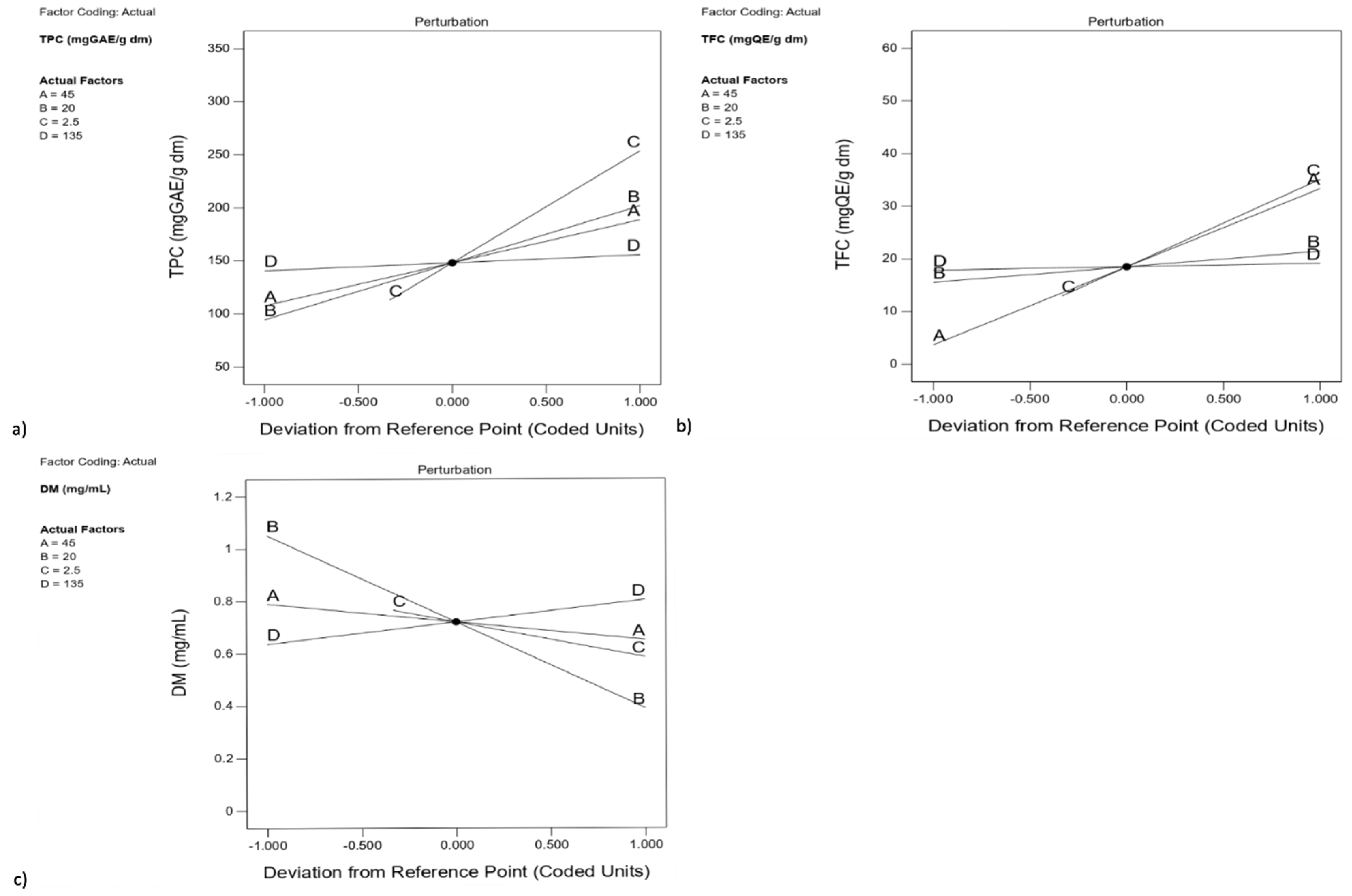
The ANOVA analysis of total phenolic compound extraction from MTS revealed that factors B and C were statistically significant model terms (Supplementary Material Table S1). Depending on the factors’ variations, the TPC may be increased by almost 4-fold (Table 2). Factor C, representing extraction time, has the most pronounced positive effect on TPC (Figure 1a). Therefore, prolonging the extraction time resulted in maximal phenolic compounds content. The L/S ratio was the second-most influential factor, with factor A having a moderate influence. Variations in microwave power did not impact the extraction efficiency of TPC. The relation of independent variables to the TPC is expressed via Equation (2) (non-significant model terms were excluded) as follows:
TPC (mg GAE/g dm) = 148.25 + 53.81xB + 105.62xC
When considering the total flavonoid compounds (TFC) in the MTS extracts, factors A and C were found to be significant model terms (Supplementary Material Table S1). Varying the extraction conditions can increase the TFC yield by up to tenfold. Similarly to phenolic compounds, factor C has the most pronounced positive effect on TFC extraction. This is followed by the impact of ethanol concentration, with the largest quantities extracted in predominantly alcoholic solutions (Figure 1b). Factors B and D did not express any impact on the extraction of TFC. These relationships are illustrated via Equation (3):
TFC (mg QE/g dm) =18.51 + 14.85xA + 16.61xC
The dry matter (DM) of the MTS extracts varied between 0.14 and 1.03 mg/mL and was contingent on process parameter variations. Factor B was the single factor that significantly affected DM in the obtained extracts (Supplementary Material Table S1), due to a lower L/S ratio leading to an increase in dry matter. All factors were negatively correlated with DM, except factor D; however, its influence was negligible (Figure 1c). The mathematical correlation between DM and process parameters is described in Equation (4):
DM (mg/mL) = 0.72 − 0.33xB
The optimal factor levels for obtaining the highest quantities of TPC from MTS are as follows: 70% ethanol concentration, L/S ratio 30 mL/g, microwave power 180 W, and time of 3 min.
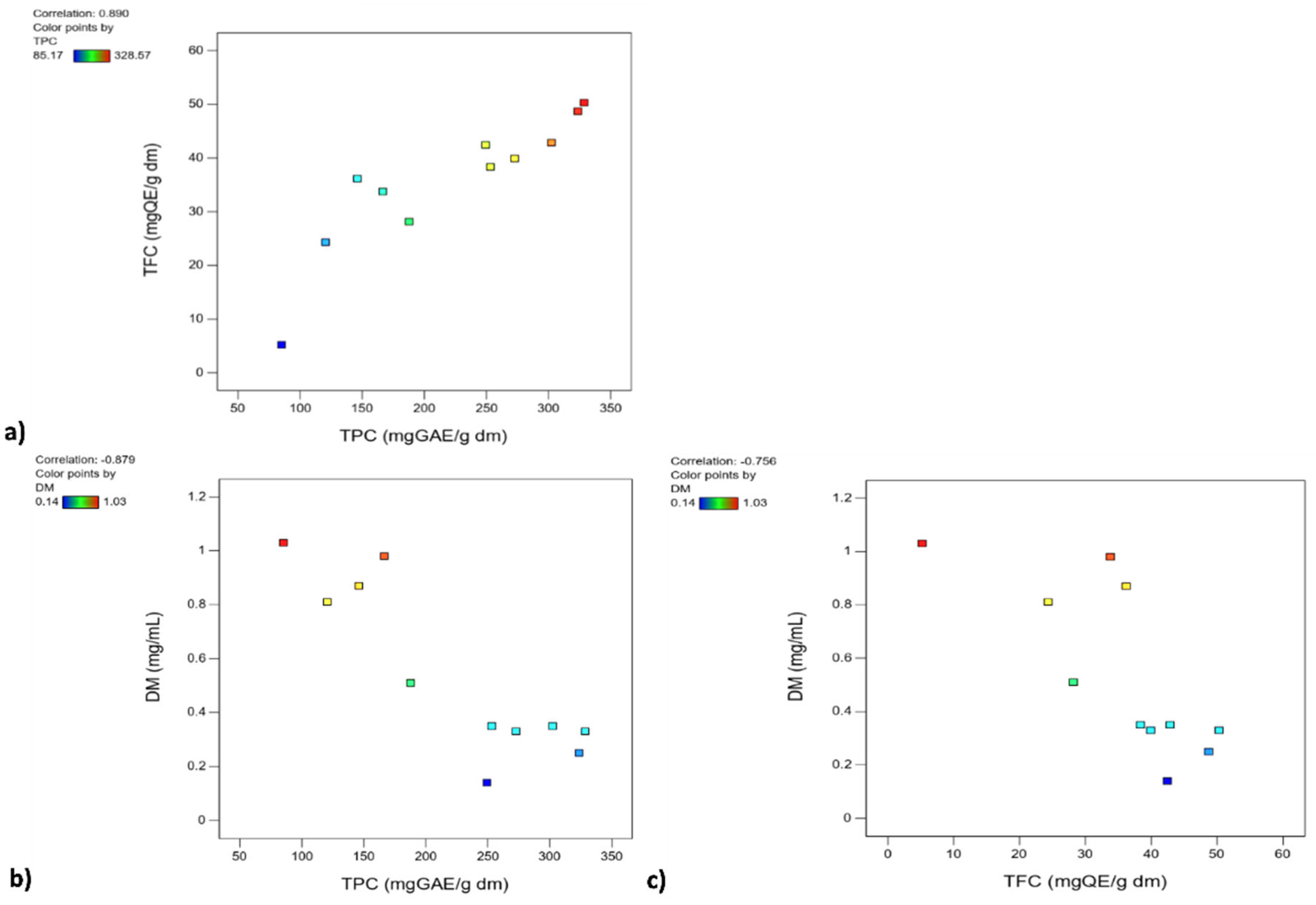
In terms of response relationships, TPC showed a strong correlation with TFC (R2 = 0.890). However, dry matter exhibited a negative correlation with both TPC and TFC, indicating that other constituents of milk thistle seeds were also extracted (Figure 2a–c).

3.1.2. Antioxidant Activity

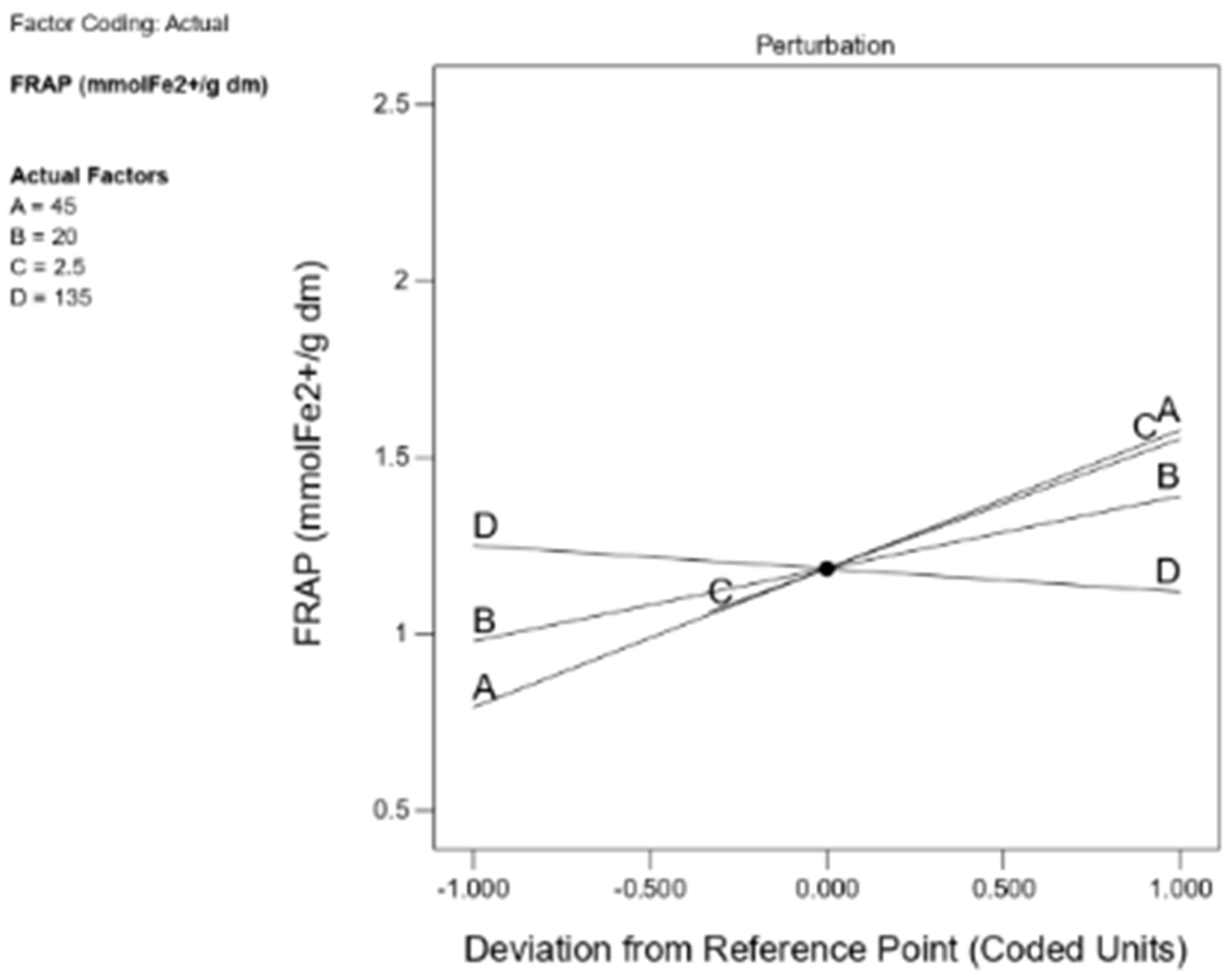
In evaluating the antioxidant activity of the extracts, as measured by their reduction capacity (FRAP), factors A, B, and C emerged as significant model terms (Supplementary Material Table S1). Factors A and C affect the antioxidant activity in a nearly identical positive way, with factor B being the second-most influential parameter (Figure 3). Consequently, the highest antioxidant activity was observed in extracts derived from highly concentrated ethanol solutions, with extended extraction times and the largest L/S ratio. In addition, the antioxidant activity may increase by almost three-fold in the extracts derived from the process where the parameters are close to optimal levels.
The relations between antioxidant activity and reducing power are described in the following manner (Equation (5)):
FRAP (mmol Fe2+/g dm) =1.19 + 0.39xA + 0.21xB + 0.37xC
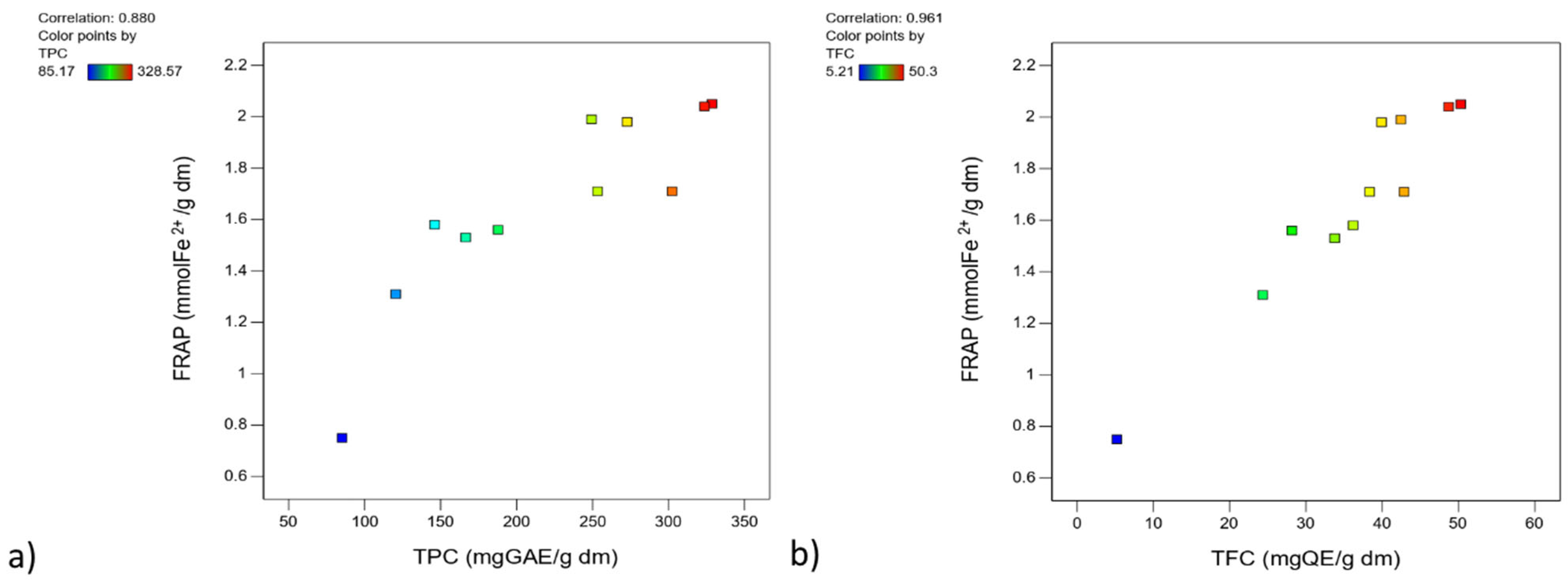
Considering response relations, it was found that TPCs and TFCs were positively correlated with antioxidant activity, and determined via FRAP (Figure 4a,b), where TFC was found to be quite highly related (R2 = 0.961), in comparison to TPC (R2 = 0.880).

3.2. Scale-Up Performance

Subsequently, we tested the scale-up system using the same laboratory equipment to determine if the outlined procedure is reliable and reproducible for larger-scale operations. Occasionally, we increased the reaction mixture’s volume by six times. The extraction time varied from 3 to 10 min at 180 W and from 3 to 7 min at 360 W (since a 10 min extraction at 360 W resulted in overheating and turbulent boiling of the reaction mixture, preventing process completion). The L/S ratio remained at 30 mL/g.
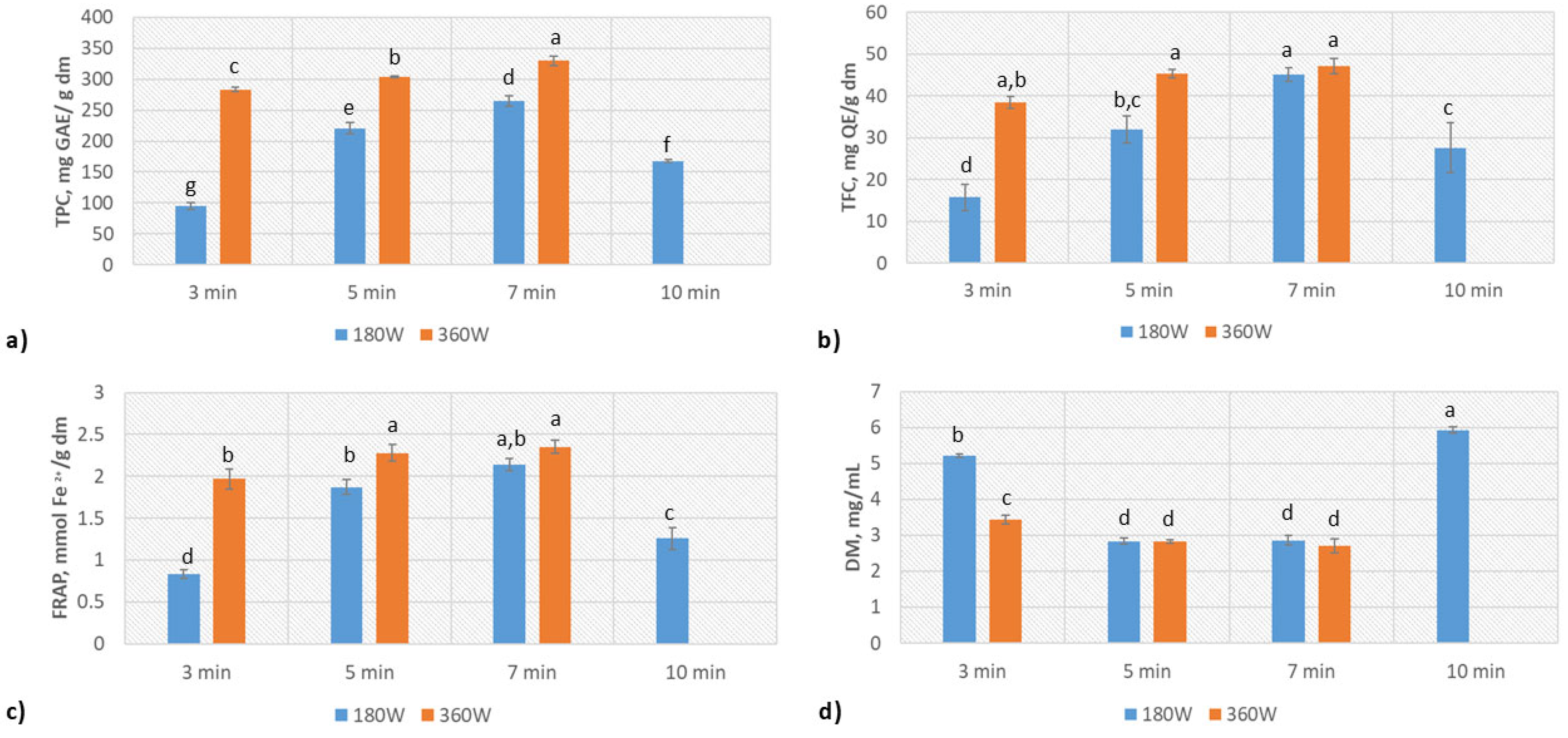
The results mirrored those of the small-scale experiments; TPC, TFC, and antioxidant activity (FRAP) increased with extended extraction times up to 7 min (Figure 5a–d). The maximal responses values were obtained by applying higher wattage of 360 W; however, except for the TPC, the maximal values of TFC and FRAP did not differ statistically with regard to the microwave power, which was also revealed within small-scale experiments. Following the optimal conditions, maximal obtained response values were compatible with maximal values obtained under the small-scale experiments, and thus it is considered that the developed extraction procedure may be easily modulated on the scale-up system. Dry matter content varied in an inverse manner when compared to TPC and TFC content and reducing power, and was also well correlated with the small-scale set of experiments.

3.3. Solid-State Fermentation of MTS

MAE of the fermented samples was carried out under the optimal conditions adopted from the previous experiments: specifically, an ethanol concentration of 70%, L/S ratio of 30 mL/g, microwave power of 180 W, and an extraction time of 3 min. For comparison, a non-fermented sample was simultaneously extracted under identical conditions, and analyzed for bioactive compound content.
Solid-state fermentation of MTS, assisted by S. boulardii (Sb), proved highly beneficial for extracting enhanced amounts of antioxidants. In the sample fermented with S. boulardii, the content of TPC was doubled in comparison to non-fermented sample, similar to the FRAP values obtained (Table 3). When MTS was fermented using a mixture of S. boulardii and L. rhamnosus (Sb+Lr), greater quantities of TPCs and TFCs, along with enhanced antioxidant activity, compared to the non-fermented sample were detected (Table 3). However, compared to single-culture fermentation, using the mixed cultures resulted in 59% lower TPC, 72% reduced TFC, and an approximately 60% decrease in reducing capacity.
The dry matter content was found to be the highest in the non-fermented sample, and was inversely correlated with TPCs, TFCs, and FRAP. This suggests that the dry matter primarily consists of other constituents without antioxidative properties.
An additional parameter used to quantify the antioxidant properties within DPPH method is the IC50 value, which represents the concentration of the extract that inhibits 50% of the initial concentration of DPPH radicals, whereby a lower IC50 value indicates a stronger antioxidant activity of the extract. In this study, it was used to assess and compare the antioxidant potential of both fermented and non-fermented extract samples. The results showed a close similarity between the fermented and non-fermented extracts, with the fermented extract having a slight edge in scavenging free DPPH radicals. IC50 of the fermented sample (0.135 mg/mL) was ~15% lower than non-fermented extract (IC50 0.156 mg/mL, Supplementary Material Figure S1).

3.4. HPLC Analysis

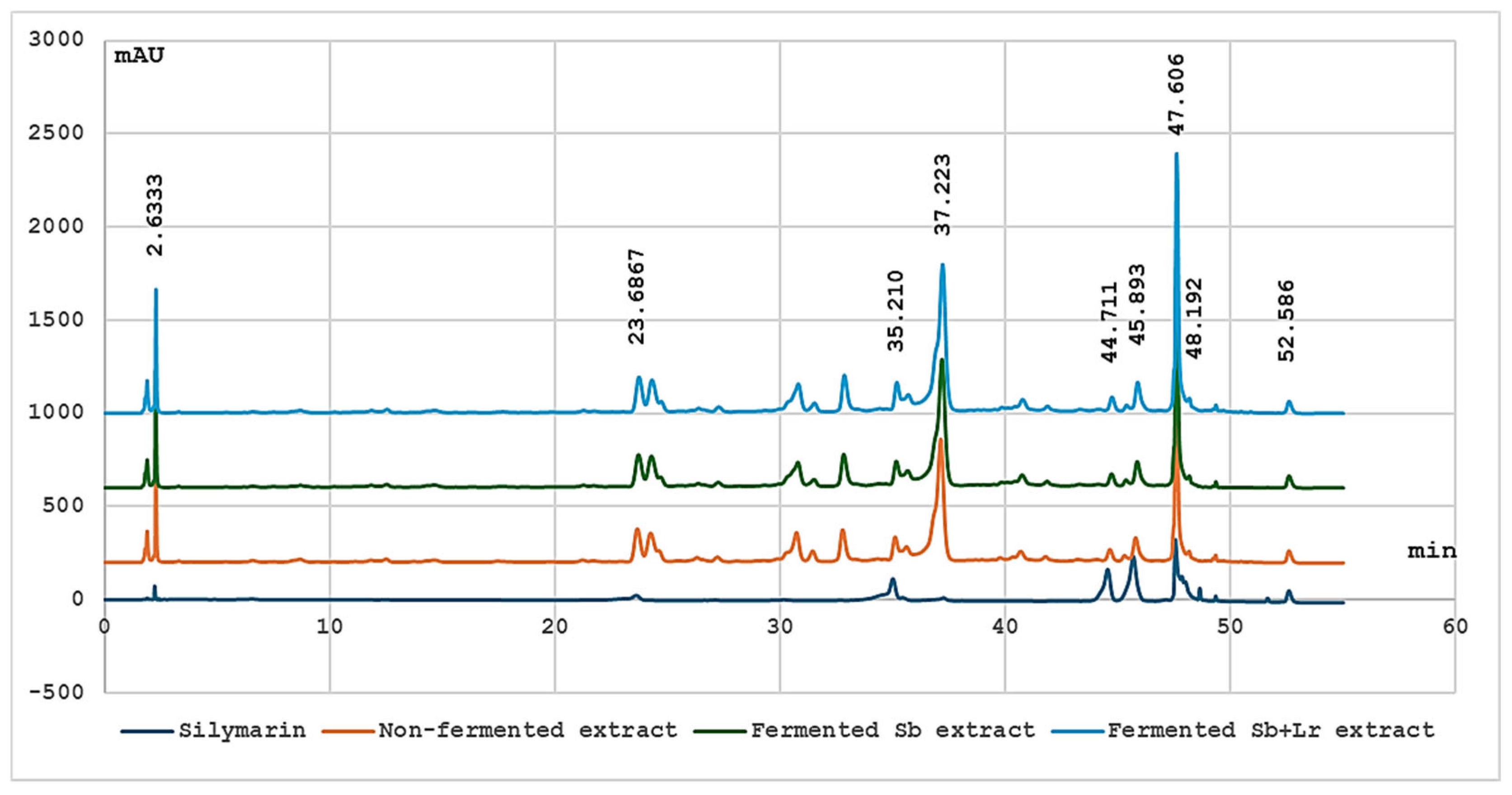
HPLC was employed to display the chromatographic profiles of the extracted phenolic compounds both pre- and post-fermentation, enabling a comparison with the standard silymarin compound (Milk thistle Seeds PE 80% Silymarin) (Figure 6). The use of silymarin as a reference standard allowed targeted comparison of phenolic compound enrichment following fermentation, as silymarin-related flavonolignans constitute the major phenolic fraction of milk thistle seeds. Consequently, the observed increase in chromatographic peak areas reflects an enhancement of silymarin-associated phenolic compounds signal intensity, rather than full identification or quantification of individual compounds. An intriguing observation is that the phenolic compounds profiles between fermented and non-fermented samples generally do not differ. Yet, based on peak areas, elevated quantities of phenolic compounds in post-fermentation extracts are readily discernible. As shown in Figure 6, major peaks from the fermented sample occupied a larger area (indicative of a higher concentration) compared to the non-fermented sample. For example, when the mayor peak at retention time 47.606 min for the fermented Sb sample occupies 100% of the area, then the corresponding areas for the same retention time occupied 95.6% and 78.1% for the fermented Sb+Lr sample and non-fermented sample, respectively. Similarly, for the second-most distinctive peak at retention time 37.223 min, when the fermented Sb sample occupies 100%, then the calculated non-fermented sample occupies 81.6% of the area, and fermented Sb+Lr sample 91.6% of the area (Supplementary Material Figure S2).

3.5. Antimicrobial Activity

The antimicrobial potential was evaluated for the extracts of the non-fermented MTS and the MTS fermented with S. boulardii (which were previously evaporated for solvent removal and attainment of greater dry matter concentration), toward Gram-negative pathogen strain E. coli, Gram-positive S. aureus, and yeast C. albicans. Thereby, varied extract concentration (10% (v/v) and 20% (v/v)) in the nutrient medium was tested for the pathogen’s growth inhibition (Table 4). In relation to the control sample (where pathogens grew on nutrient medium without extracts addition), the inhibition or stimulation effects of observed extracts were identified and presented in percentage terms.
Complete growth inhibition (100%) of S. aureus occurred when fermented extract was poured in the medium and was about the same, showing successful independence from the extract concentration. The non-fermented extract also demonstrated strong inhibitory potential against S. aureus but needed a larger volume in the growth media, suggesting the fermented extract might be more effective. Gram-negative bacteria E. coli was less sensitive in the presence of the MTS extracts; however, the non-fermented sample succeeded in partly inhibiting the pathogen’s growth, by around 35%, while the fermented sample inhibited much less growth, at around 20% (both under higher extract concentration employed). The yeast C. albicans was found to be resistant to the presence of the non-fermented sample, and even some growth-stimulating effect was observed; however, the fermented extract was able to inhibit up to 17% of the yeast growth.

3.6. Prebiotic Activity

The prebiotic activity of the non-fermented MTS and the MTS fermented with S. boulardii (extracts were evaporated prior added to the growth medium) was tested in terms of their ability to stimulate the growth of selected probiotics: the yeast S. boulardii and the lactobacilli L. paracasei and L. plantarum. The varied extract concentration (10% (v/v), 20% (v/v), and 25% (v/v)) in the nutrient medium was tested (Table 5). Similarly to antimicrobial activity testing, the stimulation/inhibition effects of observed extracts were identified in accordance with the corresponding control sample and presented in percentage terms.
The yeast S. boulardii was found to be the most stimulated probiotic, by more than 90%, by the addition of 10% (v/v) of fermented extract in the growing medium, in comparison to the control. Interestingly, the growth-stimulation potential decreased when higher dry matter fermented extract concentration was added in the nutrient medium. In contrast, non-fermented extract exhibited much lower stimulating effect (when added in the lowest concentration) in comparison to fermented extract, which reached only 10%, but was also found to be inhibitory for the yeast growth when added in higher concentration.
Lactobacilli were less sensitive to the extract addition; however, a very good growth-stimulating effect of L. plantarum was achieved when fermented MTS extract was added in a concentration of 20% (v/v) into the nutrient medium. The growth of L. plantarum may be stimulated by more than 50% when fermented MTS extract was added in lower concentration, as well. Fairly satisfactory effects from L. paracasei growth were achieved when fermented extract was added, showing more stimulating effects when added in lower concentrations. Thus, the maximal growth rate of L. paracasei increased to around 43%, with regard to the control. Non-fermented MTS extract performed much differently from fermented extract, and exhibited lower stimulating effects toward lactic acid bacteria growth. It achieved the highest growth-stimulating effect of 30% on the L. plantarum strain, when was added in the final concentration of 10% (v/v). Each extract concentration increases in the nutrient medium caused the decrease in the bacteria growth-stimulating effect, where in the concentration of 25% (v/v), the observed effect was almost negligible. However, the addition of the non-fermented MTS extract into the nutrient medium caused a growth inhibition effect on L. plantarum, which was more pronounced with an increase in the extract concentration.

4. Discussion

Regarding the effects of process parameters on bioactive compound content and antioxidant activity in MTS extracts, ANOVA analysis revealed that extraction time had the most pronounced positive influence, followed by the liquid-to-solid ratio and ethanol concentration, while microwave power showed no significant effect on TPC isolation. Extraction time and ethanol concentration were key determinants of TFC yield, whereas a lower liquid-to-solid ratio increased dry matter content. Antioxidant activity was similarly enhanced under higher ethanol concentration, prolonged extraction time, and larger liquid-to-solid ratio, collectively resulting in an up to threefold increase. Optimal extraction of phenolic compounds from MTS was achieved using 70% ethanol, 30 mL/g L/S ratio, 180 W power, and 3 min extraction time, with strong positive correlations observed between TPC, TFC, and antioxidant activity, while dry matter showed a negative association with these compounds. Lorenzo et al. (2020) [7] made a similar attempt to recover the main phenolic compound silymarin from Silybum marianum via MAE and achieved maximal yields during prolonged extraction time for 30 min, at 400 W, but also, the same may be achieved during an extraction process lasting 15 min by applying higher power of 800 W. One more MAE was performed by Zheng et al. (2009) [9]; however, the authors concluded that higher solvent quantities (ethanol concentration of 81.5% (v/v), and solid–liquid ratio of 1:38 g/mL) and much more time (60 min) is required to be spent for extraction of maximal quantities of TPC, in comparison to our study. Apart from MAE, the literature reports revealed much more attempts of conventional extraction techniques to isolate TPC from different parts of the milk thistle plant. However, the results obtained within our study were found to be highly improved in comparison to others. The main advantages are reflected in a short-lasting process, simplicity of design, and several-fold higher yields of TPC extracted. For example, Mukhtar et al. (2023) [8] and Ali et al. (2020) [11] have recently extracted phenolic compounds from MTS using ethanol under shaking conditions, and results showed maximal TPC of 164.34 mg GAE/g dm and 245.2 mg GAE/g dm, respectively. However, the last group of authors reported quite higher flavonoid compounds content, of 88.2 mg QE/g dm. The sonication of milk thistle achenes (with 80% ethanol, L/S ratio 50 mL/g, for 15 min) resulted in lower TPC quantities, as well [32]. The literature also revealed that sophisticated methods may offer improved yields of TPC, but such reports are scarce. There is one work by Abderrezag et al. (2022) [33], in which the authors presented a complex procedure for isolating of TPC in wild Algerian milk thistle seeds, by using of ternary solvent mixture composed of CO2:EtOH:H2O, at 90 bar, 40 °C, and for 160 min. Generally, there is an assumption that total phenolic compounds content in different extracts of milk thistle differed highly, and was predominantly affected by the extraction conditions; however, one of the great observations is that TPC is unevenly arranged among different parts of the plant. Thus, milk thistle seeds have been identified as a dominant source of phenolic compounds, which is a finding corroborated by our study. For example, Akhtar and Mirza (2018) [34] reported more than 10-fold lower quantities of TPC in methanolic extract of milk thistle ariel parts, and more than 7-fold lower quantities of TFC. In addition, Sulas et al. (2016) [35] observed much lower TPC quantities in leaves in comparison to our study, and declared that significant variations in bioactive compounds content may be affected on the vegetative stage of the plant, as well. Additionally, most researchers find positive relations between phenolic compounds and antioxidant activity [32].
Scale-up experiments confirmed the reliability and reproducibility of the optimized extraction procedure, as trends in phenolic and flavonoid compounds, followed by antioxidant yields closely matched small-scale results. Extending extraction time and increasing microwave power up to 360 W enhanced bioactive compound recovery without significant deviations, indicating that the process can be efficiently adapted for larger-scale applications. Although microwave power appeared statistically insignificant within the narrower range tested in the single-factor design (90–180 W), the scale-up experiments employed a broader operational window (up to 360 W), where increased power improved heating efficiency and accelerated solvent penetration. This explains why maximal extraction values were observed at 360 W during scale-up, without contradicting the earlier ANOVA-based conclusions.
During fermentation, the structural breakdown of plant cell walls is induced, leading to the liberation or even synthesis of various antioxidant compounds. In fact, microorganisms while growing on a substrate produce enzymes, such as cellulases, hemicellulases, pectinases, amylases, and glucanases, which release bound phenolic compounds, and thus increase the yield of TPC after fermentation [36]. Microorganisms also produce β-glucosidases, which transform glucosides into their corresponding aglycones. As a result, while extracts may have similar TPC concentrations, their antioxidant activity can be greater since aglycones are more potent antioxidants than glucosides [37]. On the contrary, some authors found that fermentation processes may affect the decrease in the content of TPC, because some microorganisms may use them as a substrate for growth, and consecutively the final extract may express a lower bioactive compounds content and antioxidant activity [38]. The markedly lower TPC and antioxidant yields obtained in the mixed Sb+Lr culture compared to the single-culture Sb fermentation can be explained by several plausible mechanistic interactions occurring during co-fermentation. First, competition for readily available carbohydrates may reduce the metabolic activity of S. boulardii, which is primarily responsible for enzymatic liberation of bound phenolic compounds. Second, L. rhamnosus rapidly acidifies the microenvironment, which can suppress yeast-associated hydrolytic enzymes involved in cell wall degradation and phenolic compounds release. Third, LAB are known to express β-glucosidases and related enzymes capable of metabolizing phenolic compounds as growth substrates, potentially decreasing the final measurable TPC content in the extracts. Similar non-synergistic or antagonistic interactions have been reported in other mixed microbial consortia, suggesting that biotransformation efficiency is not necessarily additive and may depend strongly on strain compatibility and ecological dynamics [23,37]. In the literature, it was found that, for ethanolic extracts of milk thistle dietary supplements, the maximum concentrations used in the assay (0.167 mg/mL) failed to scavenge 50% of free radicals in nine of the tested dietary supplement samples. As a result, they were classified as weak antioxidants in the DPPH scavenging assay [39]. However, rather surprisingly, the sample that exhibited the highest potential to scavenge DPPH radicals, possessed a low flavonoid/phenolic compound content [39]. In another study of Pereira et al. (2014) [40] the IC50 of milk thistle syrup was higher than in our study (0.32 mg/mL), indicating a lower DPPH scavenging potential. However, some reports exhibited quite better DPPH scavenging potential, like in the study of Javeed et al. (2022) [12] where the methanolic extracts of milk thistle were able to scavenge 63–76% free DPPH radicals (depending on the plant part), at concentration of 50 µg/mL.
HPLC analysis revealed that fermented MTS extracts exhibited similar phenolic compounds profiles to non-fermented ones but with noticeably higher peak intensities, indicating an increased concentration of phenolic compounds after fermentation. Those results indicated that microbes certainly induced linkages breakdown and released the same structural phenolic compounds, as presented in non-fermented sample, thus causing their increased yield. However, it may be speculated that microbes probably did not produce other compounds which may significantly contribute to antioxidant activity. When comparing the profile of the standard silymarin, it was found that the profiles of the fermented and non-fermented samples strongly correspond, suggesting the selective isolation of target bioactive compounds. Standard silymarin consisted of several main active flavolignan constituents, including silybin A, silybin B, silidianin, silicristin, isosilybin A, and isosilybin B, whereby the sum of silybin A + silybin B occupied 62.8%, followed by 26.1% of the sum of silidianin and silicristin, and 11.1% of the sum of isosilybin A and isosilybin B. Such a flavolignan distribution was found to be in a good agreement with the convenient literature data [41,42,43]. Close spectra matching was found with the work of Sherif et al. (2017) [43], but also Arampatzis et al. (2019) [41] and Ebrahimzadeh et al. (2020) [42], allowing us to speculate on the flavolignan spectral positions. Given that silymarin is the predominant phenolic constituent of milk thistle seeds and the principal bioactive marker of this matrix, the analytical strategy adopted in this study was intentionally oriented toward monitoring silymarin-related phenolic signals. While this targeted approach limits comprehensive structural profiling, it provides a biologically relevant and robust framework for assessing fermentation-induced modulation of the dominant phenolic compounds fraction.
Fermented MTS extracts showed strong antimicrobial activity, completely inhibiting S. aureus growth and partially suppressing E. coli and C. albicans, indicating enhanced efficacy against Gram-positive bacteria compared to non-fermented extracts. Gram-negative bacteria are generally more complicated to attack (in comparison to Gram (+)), due to an additional layer to the outer membrane, based on phospholipids, proteins, and lipopolysaccharides, which form an impermeable barrier to most hydrophobic molecules [44]. The overall antimicrobial activity results suggest that the non-fermented and fermented extracts act via distinct mechanisms on the growth of the evaluated pathogenic strains. Ali et al. (2020) [11] speculate that antimicrobial activity of MTS extracts may be correlated to the content of phenolic and flavonoid compounds, which is in agreement with this study. Similar results were previously obtained by Abed et al. (2015) [44]. According to them, it is difficult to establish the exact mechanism of action, but it could be explained by the toxicity of those compounds towards non-specific interactions, such as the formation of hydrogen bonds with the cell walls proteins or enzymes, inhibition of bacterial metabolism, or sequestration of substances necessary for the bacteria’s growth [44].
Fermented MTS extracts notably enhanced the growth of probiotics—especially S. boulardii and L. plantarum—at lower concentrations, while non-fermented extracts showed weaker or even inhibitory effects, confirming the superior prebiotic potential of fermented samples. In this regard, many reports have shown that it is not uncommon that plant extracts rich in phenolic compounds may inhibit the growth of probiotic bacterial strains [45,46]. Taken together, obtained results were highly interesting, because they emphasize the positive impact of the fermentation process on the biological activity of obtained MTS extracts, which resulted that fermented extracts were more effective in stimulating the probiotics growth, than non-fermented ones. Generally, probiotics are bacteria which provide significant health benefits such as lowering gastrointestinal discomfort, enhancing immunological health, and treating constipation [45]. Therefore, the role of foods and their components that may positively interact with gut microbial ecosystems is highly appreciable. Choe and colleagues (2019) [45] have recently introduced for the first time the influence of a milk thistle seed flour extract on a gut bacterial community in vitro. They have shown that milk thistle seed flour extract reduced the relative abundance of Bifidobacteria, but had no effect on the Lactobacillus genus. Thus, the results obtained within our study represent a novel successful approach, where fermented MTS extract, rich in distinctive composition of dietary phenolic compounds, was able to more efficiently modulate gut microbiota, reflected in both probiotics growth stimulation, S. boulardii yeast and Lactobacillus strains. It is assumed that the expressed growth-stimulating effects of selected probiotics may be due to the TPC content in extracts, with an explanation that probiotics could metabolize those compounds during growth [31,45]. Furthermore, some microorganisms can hydrolyze O-glycosylated phenolic compounds to aglycone and glucose, which they can use as a sole source of energy and carbon [31]. Also, the main phenolic compound in MTS extracts, silymarin, could reduce oxidative stress in the medium and improve the antioxidant defense mechanisms [47], thus providing better conditions for the probiotic microorganism’s growth and metabolic activity. However, besides the fermented extract contained much higher TPC quantities than non-fermented, it could also be assumed that combined effect of all components and their specific composition extracted from the plant matrices may impact its overall bioactivity effects.
The present study has several limitations that should be acknowledged. First, the phenolic compounds profiling performed by HPLC-UV was restricted to a single reference standard (silymarin), preventing full structural identification and quantification of individual flavonolignans. Second, key fermentation parameters such as pH dynamics, microbial population kinetics, and metabolite evolution were not monitored and thus the mechanistic drivers behind the different outcomes of single-culture and mixed-culture fermentations remain partially unresolved. Third, the antimicrobial and probiotic-growth assays performed in this study were de-signed as screening tools, relying on colony-count agar dilution rather than standard-ized Minimum Inhibitory Concentration (MIC) determination, growth curves, or kinetic modeling. As such, the results allow comparative assessment of fermented versus non-fermented extracts, but do not provide full pharmacodynamic characterization. The prebiotic assessment did not include Bifidobacterium spp., which limits conclusions about selective stimulation according to established prebiotic criteria. Future studies incorporating metabolomic profiling, extended microbial panels, kinetic modeling, and gut microbiota simulation systems are needed to validate and deepen the mechanistic understanding of the bioactivities observed in this work.

5. Conclusions

The fermentation of milk thistle seeds, as demonstrated in this study, offers a promising approach to producing natural products with enhanced bioactivities suitable for both human and animal consumption. Before fermentation, we thoroughly evaluated microwave-assisted extraction, establishing optimal conditions that allow for a safer and simpler isolation of target compounds in higher yields than previously reported.
Uniquely, our research is the first to demonstrate that fermented milk thistle seed extract positively interacts with lactobacilli and Saccharomyces boulardii yeast, bolstering the gut microbiota community while inhibiting pathogenic growth. At the same time, the extract is able to express strong antioxidant activity, via the reduction power and free radicals scavenging capacity.
Another significant achievement is our proven scale-up system, which demonstrates that our extraction procedure is scalable and reliable, paving the way for future large-scale production.
The enhanced bioactivity and antioxidant properties of the fermented milk thistle seed extract highlight its potential as a valuable ingredient in functional foods, nutraceutical formulations, and pharmaceutical preparations. Our microwave-assisted extraction process, combined with fermentation, offers an energy-efficient and resource-saving method to obtain high-quality extracts from milk thistle seeds. Compared to traditional extraction techniques, this method reduces processing time, uses fewer resources, and potentially minimizes waste, making it a more sustainable choice for large-scale production.

Supplementary Materials

The following supporting information can be downloaded at https://www.mdpi.com/article/10.3390/fermentation12010026/s1, Table S1: The analysis of variance (ANOVA) for the experimental results; Figure S1: DPPH radical scavenging activity of fermented and non-fermented milk thistle seed extracts.; Figure S2: HPLC chromatographic profiles of non-fermented extract, fermented (Sb) extract, and fermented (Sb + Lr) extract of milk thistle seeds in comparison with standard silymarin.

Author Contributions

Conceptualization, S.D.-B.; methodology, S.D.-B. and M.M. (Marija Milić); software, M.M. (Marija Milić); validation, V.N., M.M. (Milica Milutinović) and K.M.; formal analysis, V.N. and K.M.; investigation, V.N. and M.M. (Milica Milutinović); resources, S.D. and V.F.; data curation, M.M. (Marija Milić); writing—original draft preparation, V.N.; writing—review and editing, M.M. (Marija Milić); visualization, K.M., S.D. and V.F.; supervision, S.D.-B.; project administration, S.D.-B.; funding acquisition, S.D.-B. All authors have read and agreed to the published version of the manuscript.

Funding

This research was funded by the Ministry of Science, Technological Development and Innovation of the Republic of Serbia, grants number: 451-03-136/2025-03/200135, 451-03-136/2025-03/200017 and 451-03-136/2025-03/200053.

Institutional Review Board Statement

Not applicable. This study did not involve humans or animals.

Informed Consent Statement

Not applicable. This study did not involve humans.

Data Availability Statement

The data that support the findings of this study are available from the corresponding author upon reasonable request.

Acknowledgments

During the preparation of this manuscript, the authors used an AI tool (ChatGPT 5.1) for the purpose of generating some visual components in the graphical abstract. The authors have reviewed and edited the output and take full responsibility for the content of this publication.

Conflicts of Interest

The authors declare no conflicts of interest. The funders had no role in the design of the study; in the collection, analyses, or interpretation of data; in the writing of the manuscript; or in the decision to publish the results.

Abbreviations

The following abbreviations are used in this manuscript:
DMDry matter
GAEGallic acid equivalents
LABLactic acid bacteria
L/SLiquid/solid
MAEMicrowave-assisted extraction
MTSEMilk thistle seeds extract
QEQuercetin equivalents
TFCTotal flavonoid compounds
TPCTotal phenolic compounds
TSATryptic Soy agar
TSBTryptic Soy broth

References

  1. Surai, P.F. Silymarin as a Natural Antioxidant: An Overview of the Current Evidence and Perspectives. Antioxidants 2015, 4, 204–247. [Google Scholar] [CrossRef] [PubMed]
  2. Nowak, A.; Florkowska, K.; Zielonka-Brzezicka, J.; Duchnik, W.; Muzykiewicz, A.; Klimowicz, A. The effects of extraction techniques on the antioxidant potential of extracts of different parts of milk thistle (Silybum marianum L.). Acta Sci. Pol. Technol. Aliment. 2021, 20, 37–46. [Google Scholar] [CrossRef]
  3. Adetuyi, B.O.; Omolabi, F.K.; Olajide, P.A.; Oloke, J.K. Pharmacological, biochemical and therapeutic potential of milk thistle (silymarin): A review. World News Nat. Sci. 2021, 37, 75–91. [Google Scholar]
  4. Bhattacharya, S. Milk thistle (Silybum marianum L. Gaert) seeds in health. In Nuts and Seeds in Health and Disease Prevention, 2nd ed.; Preedy, V.R., Watson, R.R., Eds.; Academic Press: San Diego, CA, USA, 2020; pp. 429–438. [Google Scholar]
  5. Federico, A.; Dallio, M.; Loguercio, C. Silymarin/Silybin and Chronic Liver Disease: A Marriage of Many Years. Molecules 2017, 22, 191. [Google Scholar] [CrossRef]
  6. Alaoui Ismaili, S.; Marmouzi, I.; Sayah, K.; Harhar, H.; Faouzi, M.E.A.; Gharby, S.; Himmi, B.; Kitane, S.; Alaoui El Belghiti, M. Chemical analysis and anti-oxidation activities of the Moroccan Milk Thistle. Mor. J. Chem. 2016, 4, 695–702. [Google Scholar] [CrossRef]
  7. Lorenzo, J.M.; Putnik, P.; Bursać Kovačević, D.; Petrović, M.; Munekata, P.E.; Gómez, B.; Marszałek, K.; Roohinejad, S.; Barba, F.J. Silymarin compounds: Chemistry, innovative extraction techniques and synthesis. In Studies in Natural Products Chemistry: Bioactive Natural Products; Atta-Ur-Rahman, Ed.; Elsevier: Amsterdam, The Netherlands, 2020; Volume 64, pp. 111–130. [Google Scholar]
  8. Mukhtar, S.; Xiaoxiong, Z.; Khalid, W.; Moreno, A.; Lorenzo, J.M. In Vitro Antioxidant Capacity of Purified Bioactive Compounds in Milk Thistle Seed (Silybum marianum) Along with Phenolic Profile. Food Anal. Methods 2023, 16, 651–663. [Google Scholar] [CrossRef]
  9. Zheng, X.; Wang, X.; Lan, Y.; Shi, J.; Xue, S.J.; Liu, C. Application of response surface methodology to optimize microwave-assisted extraction of silymarin from milk thistle seeds. Sep. Purif. Technol. 2009, 70, 34–40. [Google Scholar] [CrossRef]
  10. Denev, P.; Ognyanov, M.; Georgiev, Y.; Teneva, D.; Klisurova, D.; Yanakieva, I. Chemical composition and antioxidant activity of partially defatted milk thistle (Silybum marianum L.) seeds. Bulg. Chem. Commun. 2020, 52, 182–187. [Google Scholar]
  11. Ali, B.S.M.; ElSayed, A.I.; Doheem, M.A.; Eita, A.M.A.; Omar, A.A. Effect of Milk Thistle (Silybum marianum (L.) Gaertn) Seed Extract on Bacterial Activities and Growth of Human Liver Cancer Cells. J. Biotechnol. Res. 2020, 6, 27–33. [Google Scholar] [CrossRef]
  12. Javeed, A.; Ahmed, M.; Sajid, A.R.; Sikandar, A.; Aslam, M.; Hassan, T.u.; Samiullah; Nazir, Z.; Ji, M.; Li, C. Comparative Assessment of Phytoconstituents, Antioxidant Activity and Chemical Analysis of Different Parts of Milk Thistle Silybum marianum L. Molecules 2022, 27, 2641. [Google Scholar] [CrossRef]
  13. Milutinović, M.; Radovanović, N.; Rajilić-Stojanović, M.; Šiler-Marinković, S.; Dimitrijević, S.; Dimitrijević-Branković, S. Microwave-assisted extraction for the recovery of antioxidants from waste Equisetum arvense. Ind. Crop. Prod. 2014, 61, 388–397. [Google Scholar] [CrossRef]
  14. Milutinović, M.; Radovanović, N.; Ćorović, M.; Šiler-Marinković, S.; Rajilić-Stojanović, M.; Dimitrijević-Branković, S. Optimisation of microwave-assisted extraction parameters for antioxidants from waste Achillea millefolium dust. Ind. Crop. Prod. 2015, 77, 333–341. [Google Scholar] [CrossRef]
  15. Pavlović, M.D.; Buntić, A.V.; Šiler-Marinković, S.S.; Dimitrijević-Branković, S.I. Ethanol influenced fast microwave-assisted extraction for natural antioxidants obtaining from spent filter coffee. Sep. Purif. Technol. 2013, 118, 503–510. [Google Scholar] [CrossRef]
  16. Ranic, M.; Nikolic, M.; Pavlovic, M.; Buntic, A.; Siler-Marinkovic, S.; Dimitrijevic-Brankovic, S. Optimization of microwave-assisted extraction of natural antioxidants from spent espresso coffee grounds by response surface methodology. J. Clean. Prod. 2014, 80, 69–79. [Google Scholar] [CrossRef]
  17. Paul, P.E.V.; Sangeetha, V.; Deepika, R.G. Emerging Trends in the Industrial Production of Chemical Products by Microorganisms. In Recent Developments in Applied Microbiology and Biochemistry; Buddolla, V., Ed.; Academic Press: London, UK, 2019; pp. 107–125. [Google Scholar] [CrossRef]
  18. Manan, M.A.; Webb, C. Design aspects of solid state fermentation as applied to microbial bioprocessing. J. Appl. Biotechnol. Bioeng. 2017, 4, 511–532. [Google Scholar] [CrossRef]
  19. Adebo, O.A.; Gabriela Medina-Meza, I. Impact of Fermentation on the Phenolic Compounds and Antioxidant Activity of Whole Cereal Grains: A Mini Review. Molecules 2020, 25, 927. [Google Scholar] [CrossRef]
  20. Danshiitsoodol, N.; Inoue, Y.; Sugimoto, S.; Shakya, S.; Noda, M.; Sugiyama, M. Eriobotrya japonica Fermentation with Plant-Derived Lactiplantibacillus plantarum MSC-5T Ameliorates Antioxidant Activity in HEK293 Cells. Fermentation 2024, 10, 197. [Google Scholar] [CrossRef]
  21. Li, Z.; Teng, J.; Lyu, Y.; Hu, X.; Zhao, Y.; Wang, M. Enhanced Antioxidant Activity for Apple Juice Fermented with Lactobacillus plantarum ATCC14917. Molecules 2019, 24, 51. [Google Scholar] [CrossRef]
  22. Saleh, R.M.; Kabli, S.A.; Al-Garni, S.M.; Al-Ghamdi, M.A.; Abdel-Aty, A.M.; Mohamed, S.A. Solid-state fermentation by Trichoderma viride for enhancing phenolic content, antioxidant and antimicrobial activities in ginger. Lett. Appl. Microbiol. 2018, 67, 161–167. [Google Scholar] [CrossRef]
  23. Zhao, Y.-S.; Eweys, A.S.; Zhang, J.-Y.; Zhu, Y.; Bai, J.; Darwesh, O.M.; Zhang, H.-B.; Xiao, X. Fermentation Affects the Antioxidant Activity of Plant-Based Food Material through the Release and Production of Bioactive Components. Antioxidants 2021, 10, 2004. [Google Scholar] [CrossRef]
  24. Wang, Z.; Zheng, Y.; Dai, Y.; Yang, R.; Zhao, R.; Sun, G.; Zhou, W.-W.; Feng, S.; Feng, Y.; Li, N.; et al. Effect of probiotic fermentation on the extraction rate and bioactivity of plant-based polysaccharides: A review. Innov. Food Sci. Emerg. Technol. 2024, 98, 103863. [Google Scholar] [CrossRef]
  25. Amini, A.; Mousavi, Z.E.; Mousavi, S.M. Biological transformation of herbal extracts through Lactic Acid Bacteria fermentation: A study on Milk thistle and liquorice root extract. Food Biosci. 2024, 62, 105105. [Google Scholar] [CrossRef]
  26. Teleszko, M.; Haraf, G.; Zając, A.; Garncarek, Z.; Górska, K.; Krzos, G.; Hałaburda, A.; Kotecki, P. Use of Directed Lactic Fermentation to Obtain Plant-Based, Upcycled Beverage from Milk Thistle Endosperm. Sustainability 2024, 16, 5342. [Google Scholar] [CrossRef]
  27. Liu, N.; Song, M.; Wang, N.; Wang, Y.; Wang, R.; An, X.; Qi, J. The effects of solid-state fermentation on the content, composition and in vitro antioxidant activity of flavonoids from dandelion. PLOS ONE 2020, 15, e0239076. [Google Scholar] [CrossRef]
  28. Milić, M.D.; Buntić, A.V.; Mihajlovski, K.R.; Ilić, N.V.; Davidović, S.Z.; Dimitrijević-Branković, S.I. The development of a combined enzymatic and microbial fermentation as a viable technology for the spent coffee ground full utilization. Biomass Convers. Biorefinery 2021, 13, 6747–6759. [Google Scholar] [CrossRef]
  29. Rudić, S.; Dimitrijević-Branković, S.; Dimitrijević, S.; Milić, M. Valorization of unexploited artichoke leaves dust for obtaining of extracts rich in natural antioxidants. Sep. Purif. Technol. 2021, 256, 117714. [Google Scholar] [CrossRef]
  30. Balouiri, M.; Sadiki, M.; Ibnsouda, S.K. Methods for in vitro evaluating antimicrobial activity: A review. J. Pharm. Anal. 2016, 6, 71–79. [Google Scholar] [CrossRef]
  31. Milutinović, M.; Dimitrijević-Branković, S.; Rajilić-Stojanović, M. Plant Extracts Rich in Polyphenols as Potent Modulators in the Growth of Probiotic and Pathogenic Intestinal Microorganisms. Front. Nutr. 2021, 8, 688843. [Google Scholar] [CrossRef]
  32. Lucini, L.; Kane, D.; Pellizzoni, M.; Ferrari, A.; Trevisi, E.; Ruzickova, G.; Arslan, D. Phenolic profile and in vitro antioxidant power of different milk thistle [Silybum marianum (L.) Gaertn.] cultivars. Ind. Crop. Prod. 2016, 83, 11–16. [Google Scholar] [CrossRef]
  33. Abderrezag, N.; Montenegro, Z.J.S.; Louaer, O.; Meniai, A.-H.; Cifuentes, A.; Ibáñez, E.; Mendiola, J.A. One-step sustainable extraction of Silymarin compounds of wild Algerian milk thistle (Silybum marianum) seeds using Gas Expanded Liquids. J. Chromatogr. A 2022, 1675, 463147. [Google Scholar] [CrossRef]
  34. Akhtar, N.; Ihsan-ul-Haq; Mirza, B. Phytochemical analysis and comprehensive evaluation of antimicrobial and antioxidant properties of 61 medicinal plant species. Arab. J. Chem. 2018, 11, 1223–1235. [Google Scholar] [CrossRef]
  35. Sulas, L.; Re, G.A.; Bullitta, S.; Piluzza, G. Chemical and productive properties of two Sardinian milk thistle (Silybum marianum (L.) Gaertn.) populations as sources of nutrients and antioxidants. Genet. Resour. Crop. Evol. 2016, 63, 315–326. [Google Scholar] [CrossRef]
  36. Shahidi, F.; Yeo, J. Insoluble-Bound Phenolics in Food. Molecules 2016, 21, 1216. [Google Scholar] [CrossRef] [PubMed]
  37. Marazza, J.A.; Nazareno, M.A.; de Giori, G.S.; Garro, M.S. Enhancement of the antioxidant capacity of soymilk by fermentation with Lactobacillus rhamnosus. J. Funct. Foods 2012, 4, 594–601. [Google Scholar] [CrossRef]
  38. Othman, N.B.; Roblain, D.; Chammen, N.; Thonart, P.; Hamdi, M. Antioxidant phenolic compounds loss during the fermentation of Chétoui olives. Food Chem. 2009, 116, 662–669. [Google Scholar] [CrossRef]
  39. Viktorova, J.; Stranska-Zachariasova, M.; Fenclova, M.; Vitek, L.; Hajslova, J.; Kren, V.; Ruml, T. Complex Evaluation of Antioxidant Capacity of Milk Thistle Dietary Supplements. Antioxidants 2019, 8, 317. [Google Scholar] [CrossRef]
  40. Pereira, C.; Calhelha, R.C.; Barros, L.; Queiroz, M.J.R.; Ferreira, I.C. Synergisms in antioxidant and anti-hepatocellular carcinoma activities of artichoke, milk thistle and borututu syrups. Ind. Crop. Prod. 2014, 52, 709–713. [Google Scholar] [CrossRef]
  41. Arampatzis, D.A.; Karkanis, A.C.; Tsiropoulos, N.G. Impact of Plant Density and Mepiquat Chloride on Growth, Yield, and Silymarin Content of Silybum marianum Grown under Mediterranean Semi-Arid Conditions. Agronomy 2019, 9, 669. [Google Scholar] [CrossRef]
  42. Ebrahimzadeh, M.H.; Younesikelaki, F.S.; Naseri, M.; Yousefi Javan, I.; Rahbarian, R.; Nanna, R.S. Green synthesis of silver nano-particles using silymarin extracted from root callus of Silybum marianum (L.) Gaertn and their antibacterial activity. J. Med. Spice Plants 2020, 24, 63–68. [Google Scholar]
  43. Sherif, N.H.; Hawas, A.M.; Abdallah, W.E.; Saleh, I.A.; Shams, K.A.; Hammouda, F.M. Potential role of milk thistle seed and its oil extracts against heart and brain injuries induced by Î3-radiation exposure. Int. J. Pharm. Pharm. Sci. 2017, 9, 52–58. [Google Scholar] [CrossRef]
  44. Abed, I.J.; Al-Moula, R.; Abdulhasan, G.A. Antibacterial effect of flavonoids extracted from seeds of Silybum marianum against common pathogenic bacteria. World J. Exp. Biosci. 2015, 3, 36–39. [Google Scholar]
  45. Choe, U.; Li, Y.; Gao, B.; Yu, L.; Wang, T.T.Y.; Sun, J.; Chen, P.; Yu, L. The chemical composition of a cold-pressed milk thistle seed flour extract, and its potential health beneficial properties. Food Funct. 2019, 10, 2461–2470. [Google Scholar] [CrossRef]
  46. Tabasco, R.; Sánchez-Patán, F.; Monagas, M.; Bartolomé, B.; Moreno-Arribas, M.V.; Peláez, C.; Requena, T. Effect of grape polyphenols on lactic acid bacteria and bifidobacteria growth: Resistance and metabolism. Food Microbiol. 2011, 28, 1345–1352. [Google Scholar] [CrossRef]
  47. Stastnik, O.; Pavlata, L.; Mrkvicova, E. The Milk Thistle Seed Cakes and Hempseed Cakes are Potential Feed for Poultry. Animals 2020, 10, 1384. [Google Scholar] [CrossRef]
Figure 1. The process parameters’ influence on total phenolic compounds (a), total flavonoid compounds (b), and dry matter content (c) during microwave-assisted extraction of milk thistle seeds.
Fermentation 12 00026 g001
Figure 2. Response relations of microwave-assisted extraction of milk thistle seeds: TPC-TFC (a), TPC-DM (b), and TFC-DM (c).
Fermentation 12 00026 g002
Figure 3. The process parameters’ influence on the antioxidant activity (measured by FRAP) during microwave-assisted extraction of milk thistle seeds.
Fermentation 12 00026 g003
Figure 4. Response relations of microwave-assisted extraction of milk thistle seeds: TPC-FRAP (a) and TFC-FRAP (b).
Fermentation 12 00026 g004
Figure 5. Scale-up performance of the microwave-assisted extraction of milk thistle seeds: total phenolic compounds (a), total flavonoid compounds (b), reducing capacity by FRAP (c), and dry matter content (d). Error bars represent mean values ± standard deviation of three independent replicates (n = 3). Different lowercase letters above the bars indicate statistically significant differences among means according to one-way ANOVA followed by Tukey’s multiple comparison test (p < 0.05).
Fermentation 12 00026 g005
Figure 6. HPLC profiles of fermented and non-fermented extracts of milk thistle seeds with regard to standard silymarin.
Fermentation 12 00026 g006
Table 1. The levels of the process parameters during the microwave-assisted extraction of milk thistle seeds.
FactorsUnitsLevels
−101
A: Ethanol concentration%205070
B: Liquid/solid ratiomL/g102030
C: Extraction timemin234
D: Microwave powerW90 180
Table 2. Experimental design matrix and corresponding responses for microwave-assisted extraction of milk thistle seeds.
FactorsResponses
SampleABCDTPC,
mg GAE/g dm
TFC,
mg QE/g dm
Dry Matter,
mg/mL
FRAP,
mmol Fe2+/g dm
1201039085.17 ± 6.25.21 ± 1.681.03 ± 0.060.75 ± 0.08
25010390120.5 ± 7.424.3 ± 1.760.81 ± 0.011.31 ± 0.07
37010390146.1 ± 2.236.2 ± 2.430.87 ± 0.021.58 ± 0.07
47010390166.5 ± 4.433.8 ± 3.830.98 ± 0.031.53 ± 0.02
57020390253.3 ± 4.038.4 ± 0.870.35 ± 0.051.71 ± 0.07
67030390249.4 ± 2.542.4 ± 1.230.14 ± 0.031.99 ± 0.04
770302180187.8 ± 1.628.2 ± 2.400.51 ± 0.041.56 ± 0.10
870303180302.3 ± 5.042.9 ± 2.260.35 ± 0.011.71 ± 0.03
970304180328.6 ± 4.550.3 ± 3.210.33 ± 0.012.05 ± 0.09
107030390272.7 ± 7.239.9 ± 1.300.33 ± 0.021.98 ± 0.02
1170303180323.6 ± 2.748.7 ± 0.440.25 ± 0.042.04 ± 0.05
A: ethanol concentration, %; B: liquid/solid ratio, mL/g; C: time, min; D: microwave power, W; TPC: total phenolic compounds; TFC: total flavonoid compounds.
Table 3. Response values after solid-state fermentation of milk thistle seeds.
SampleTPC,
mg GAE/g dm
TFC,
mg QE/g dm
FRAP,
mmol Fe2+/g dm
Dry Matter,
%
Non-fermented319.9 ± 21.7 c40.68 ± 3.23 b2.09 ± 0.23 c0.30 ± 0.02 a
Fermented, Sb647.6 ± 24.4 a87.04 ± 6.88 a4.27 ± 0.19 a0.15 ± 0.02 c
Fermented, Sb+Lr406.6 ± 28.9 b50.58 ± 2.88 b2.66 ± 0.23 b0.24 ± 0.01 b
Results are presented as mean ± standard deviation of three replicates and the values in the same column with same superscript letter are not significantly different from each other (p> 0.05). TPC: total phenolic compounds; TFC: total flavonoid compounds.
Table 4. Antimicrobial activity of the milk thistle seeds extracts.
ExtractStrain, log10(CFU/mL)
E. coliS. aureusC. albicans
Control7.656.895.21
Non-fermented10% v/v7.486.485.39
20% v/v7.475.405.34
Fermented, Sb10% v/v7.585.185.20
20% v/v7.55ND5.13
Values are log10(CFU/mL) means from duplicate screening assays. ND indicates that no colonies were detected at the tested dilution.
Table 5. Prebiotic activity of the milk thistle seeds extracts.
ExtractStrain, log10(CFU/mL)
S. boulardiiL. paracaseiL. plantarum
Control5.857.037.05
Non-fermented10% v/v5.897.196.30
20% v/v5.807.086.87
25% v/v5.657.066.82
Fermented, Sb10% v/v6.927.287.42
20% v/v6.577.217.54
25% v/v6.147.107.13
Values are log10(CFU/mL) means from duplicate screening assays.
Disclaimer/Publisher’s Note: The statements, opinions and data contained in all publications are solely those of the individual author(s) and contributor(s) and not of MDPI and/or the editor(s). MDPI and/or the editor(s) disclaim responsibility for any injury to people or property resulting from any ideas, methods, instructions or products referred to in the content.