
Article

Mathematical Modeling of Soot Formation and Fragmentation of Carbon Particles During Their Pyrolysis Under Conditions of Removal from the Front of a Forest Fire

by
Nikolay Viktorovich Baranovskiy
* and
Viktoriya Andreevna Vyatkina
School of Energy and Power Engineering, Tomsk Polytechnic University, 634050 Tomsk, Russia
*
Author to whom correspondence should be addressed.
Submission received: 19 November 2025 / Revised: 13 March 2026 / Accepted: 18 March 2026 / Published: 1 April 2026
(This article belongs to the Topic Environmental Pollutant Management and Control)

Abstract

The object of the study is a single heated carbonaceous particle of relatively small size, 0.003 to 0.01 m. Main hypothesis: The formation of soot particles and black carbon particles is caused by the thermochemical destruction of dry organic matter of forest fuel and the mechanical fragmentation of coke residue. The aim of the study is to conduct numerical simulations of heat and mass transfer in a single heated carbonaceous particle, taking into account the soot formation process and assessing its fragmentation with regard to heat exchange with the external environment in a 2D setting. As part of this study, a new model of heat and mass transfer in a pyrolyzed carbonaceous particle was developed, taking into account its step-by-step fragmentation (fragmentation tree model with four secondary particle formations from the initial particle). The calculations resulted in the distributions of temperature and volume fractions of phases in the carbonaceous particle across various scenarios. Scenarios of surface fires (initial temperatures of 900 K and 1000 K), crown fires (1100 K), and a firestorm (1200 K) for typical vegetation (pine, spruce, birch) are considered. Cubic carbonaceous particles are considered in the approximation of a 2D mathematical model. To describe heat and mass transfer in the structure of the carbonaceous particle, a differential equation of thermal conductivity with corresponding initial and boundary conditions of the third type is used, taking into account the gross reaction in the kinetic scheme of pyrolysis and soot formation. Differential analogues of partial differential equations are solved using the finite difference method of second-order approximation. Options for using the developed mathematical model and probabilistic fragmentation criterion for assessing aerosol emissions are proposed. Recommendations: The suggested mathematical model must be incorporated with mathematical models of forest fire plume and aerosol transport in the upper layers of the atmosphere. Moreover, probabilistic criteria for health assessment must be developed for the practical use of the suggested mathematical model.

1. Introduction

Globally, forest fires emit approximately 34% of the total atmospheric soot, while in some regions, such as Southeast Asia and the Russian Federation, these fires account for up to 63% of regional soot emissions [1]. An analysis of black carbon emissions in northern Eurasia for the period 2002–2015 showed that emissions from biomass burning in this region amounted to approximately 9.2–9.5% of global sources and 26% of biomass burning sources worldwide [2]. The spring season has been particularly influential, as emitted carbon particles negatively affect glacier melting. Such carbon and soot particles can also impact the health of people living in regions with active forest fires. The development of geomonitoring information and computing systems that could be linked to medical information systems is necessary.
Carbon particle emissions from forest fires primarily affect the human respiratory system. Exposure to such particles can cause or exacerbate cardiorespiratory diseases and chronic obstructive pulmonary disease. Relatively large carbonaceous particles are formed in large quantities during the destruction of forest fuels. Continuing their movement in the atmospheric surface layer, these particles undergo physicochemical, thermophysical, and physicomechanical transformations [3]. These changes lead to the formation of soot and black carbon particles and, consequently, aerosol particles. Products of soot formation and the mechanical fragmentation of carbonaceous particles can enter the human upper respiratory tract with inhaled air and settle on its surface. It is important to understand the extent of the expected public health damage from forest fires. Therefore, it is necessary to develop mathematical models of soot particle formation for the subsequent development of specialized software for predicting the societal damage from forest fires.
Particulate matter in atmospheric air is a pollutant, including in urbanized areas [4]. Such particles affect public health, causing cardiorespiratory diseases and allergic reactions [5,6]. Particles in the atmosphere can have different chemical compositions depending on their source and the processes of interaction with other components of the air [4]. Studies on the properties of atmospheric aerosol from forest fires have been conducted in various regions [7,8,9]. Carbonaceous particles in the composition of atmospheric particulate matter make up 20–50% of the mass concentration of particles [10,11,12]. A significant proportion of studies are devoted to the study of particles with a size of 2.5 and 10 μm [13,14,15,16]. In recent decades, the AERONET aerosol monitoring network has been intensively developed [17]. In Tomsk, at the IAO SB RAS, measurements of aerosol characteristics have been carried out since 1996 at an aerosol monitoring station [18]. Satellite technologies are also used to study aerosols [19]. Remote sensing technology based on the MODIS instrument has been used [20,21]. Particulate matter particles affect human health [22,23,24,25].
Aerosol particles can be a product of thermal decomposition and mechanical destruction of firebrands and embers [26]. A thermomechanical model of firebrand fragmentation is presented in [26]. It is assumed that the mass loss of such a firebrand is caused not only by thermal decomposition, but also by thermomechanical destruction. Typical approaches are based on the concepts of fractal geometry [27,28]. In addition, mathematical models of firebrands transport in the surface layer of the atmosphere are discussed in the literature. Incidentally, it is believed that the shape of a firebrand in most cases can be represented by a cylinder [29,30,31,32,33,34,35,36,37,38,39,40,41], and less often by a cube, rectangle or disk. In addition, experimental studies on the transport of firebrands [42,43,44] were conducted at different times for different shapes and sizes of particles. The shape of a firebrand or particle is also of great importance. The authors of [45] considered the issues of the statistical distribution of particle sizes and shapes. It was established that the main shape of a firebrand is a cylinder. In addition to [45], issues of the shape and size of firebrands are considered in [46,47].
The main problem is the lack of advanced software for assessing the societal risks of forest fires, particularly the impact on the population in regions with active forest fires. To address this problem, a complex set of interrelated tasks must be addressed, one of which is the development of mathematical models for the formation of forest fire-damaging factors. In the context of this study, this study is concerned with the processes of soot formation and fragmentation of carbon particles.
Main hypothesis: The formation of soot particles and black carbon particles is caused by the thermochemical destruction of dry organic matter of forest fuel and the mechanical fragmentation of coke residue. The aim of this study is to conduct numerical simulations of heat and mass transfer in a single heated carbonaceous particle (firebrand or ember), taking into account the soot formation process and assessing its fragmentation, further taking into account heat exchange with the external environment in a two-dimensional setting.
The research objectives necessary to achieve this goal are as follows:
(1)
The development of a deterministic mathematical model of heat and mass transfer in a pyrolyzed carbonaceous particle, taking into account soot formation;
(2)
The development of a probabilistic criterion for assessing carbonaceous particle fragmentation at each stage of this process;
(3)
Scenario modeling of heat and mass transfer and fragmentation of the carbonaceous particle;
(4)
The formulation of conclusions and proposals for the practical application of the developed deterministic–probabilistic approach to assessing aerosol emissions.
The novelty of this study lies in the development of a new model of heat and mass transfer in a pyrolyzed carbonaceous particle, taking into account its stage-by-stage fragmentation.

2. Methodology

2.1. Physical Statement

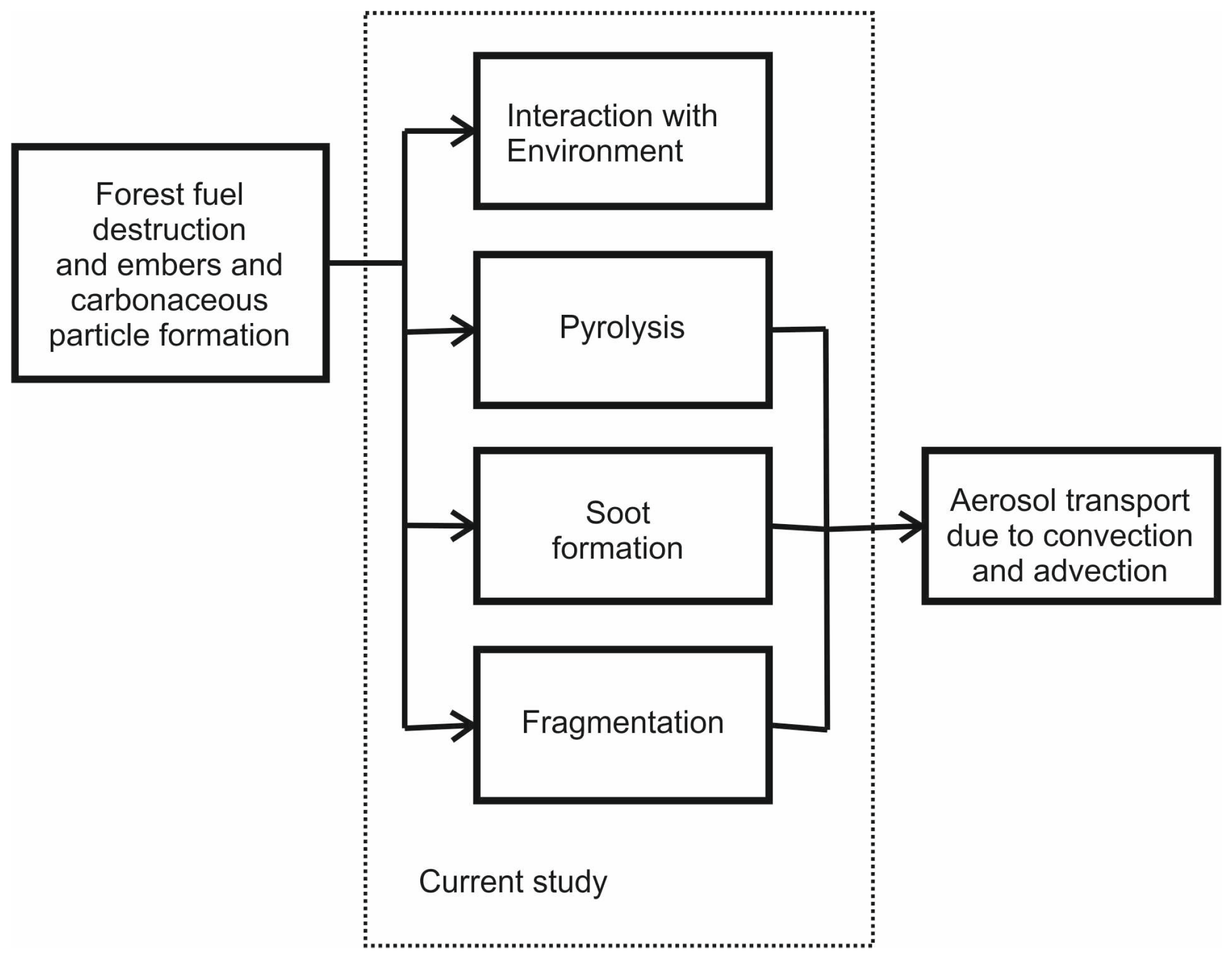
The processes of soot formation and fragmentation of carbonaceous particles are examined in this study. The characteristic time of these processes is measured in seconds. Therefore, to solve the problems posed in this article, it is not necessary to consider the movement of carbonaceous particles in conjunction with aerosol transport in the atmosphere. In fact, complete thermomechanical destruction of carbonaceous particles occurs within a short period of time. All these processes occur in the immediate vicinity of a forest fire front in the surface layer of the atmosphere. A diagram demonstrating the relationship between the various objectives in the context of this study is presented in Figure 1.
It is worth noting that a simplified model must be developed to ensure software operation in anticipation of a disaster. The objectives of this study require solutions near the forest fire front, so it makes no sense to consider the movement of carbonaceous particles and the resulting aerosol in other atmospheric layers. However, scientific journals have already published results on these problems, and further development of software for assessing aerosol impacts on public health should be carried out in collaboration with other researchers.
As already noted, the processes under consideration occur near the source of a forest fire. Carbonaceous particles are destroyed before reaching the upper atmospheric layer. Therefore, it makes no sense to consider scenarios for the movement of carbonaceous particles in the upper atmosphere. Aerosol transport, however, is a different problem beyond the scope of this study and largely already addressed by other researchers.
The following assumptions were made in the modeling:
(1)
Particle material is modeled using the concept of continuum mechanics;
(2)
There is no moisture in the particle material;
(3)
Carbonaceous particles are modeled by square solution domains with dimensions ranging from 0.01 m to 0.003 m;
(4)
Convective heat exchange between the particle and the environment occurs in accordance with the assumption that the forest fire temperature in the zone where the carbonaceous particle is removed from the fire front is the same;
(5)
Thermophysical characteristics of the particle and air are independent of temperature;
(6)
Transport of the particle in the convective column of a forest fire and its possible collisions with other particles are not considered;
(7)
Single-stage pyrolysis of dry organic matter is taken into account based on the kinetic scheme proposed in [48];
(8)
Temperature distribution is described by a non-stationary nonlinear heat conduction equation;
(9)
Soot formation is taken into account using the kinetic scheme proposed in [49];
(10)
Volume fraction of soot particles is proportional to the volume fraction of dry organic matter decomposed during pyrolysis with dispersion coefficient αs.

2.2. Mathematical Statement

In this article, mathematical modeling was applied to simulate heat and mass transfer processes in a single carbonaceous particle exposed to the environment. The main advantage of this approach is the ability to obtain meaningful results with a certain simplification of the mathematical formulation, the geometry of the solution domain, and the boundary conditions. The very essence of mathematical modeling lies in discarding secondary factors and constructing a mathematical model based on the most significant factors. Indeed, in real situations, during the destruction of wood in the front of a forest fire, carbonaceous particles of various geometries can form, including cubic and spherical particles, as well as particles of irregular shape [41,43,44]. However, to obtain results suitable for predicting forest fire dangers [50] and methods of assessing public health [51], it is sufficient to use simplified geometry. When predicting catastrophic processes, it is necessary to obtain predictable information with sufficient time for prevention [52]. In this case, it is the use of simplified mathematical and geometric formulations that can ensure the receipt of predictable information in the context of the advancement of a real catastrophe [53].
The scientific literature presents various approaches to simplifying the geometric formulation when solving problems in mathematical physics using numerical methods. The following method for simplifying the geometry of the solution domain is proposed in [54]. In this case, it is necessary to describe the geometry of three types of particles. A two-dimensional formulation is considered since it has previously been substantiated that physically justified results can be obtained for particles using a two-dimensional formulation [50], ignoring some aspects of the spatial distribution of physical quantities. Thus, the following types of particles exist: cubic or square, spherical or cylindrical, and irregularly shaped particles. The first case is an idealized version, but in a number of situations, this version describes the real geometry of carbonaceous particles. Thus, the task is to approximate the description of particles of the second and third types using a cubic shape. One study [54] proposes using simple geometric figures in which it is necessary to geometrically inscribe the shape of a particle other than a cube. Graphic information is provided below.
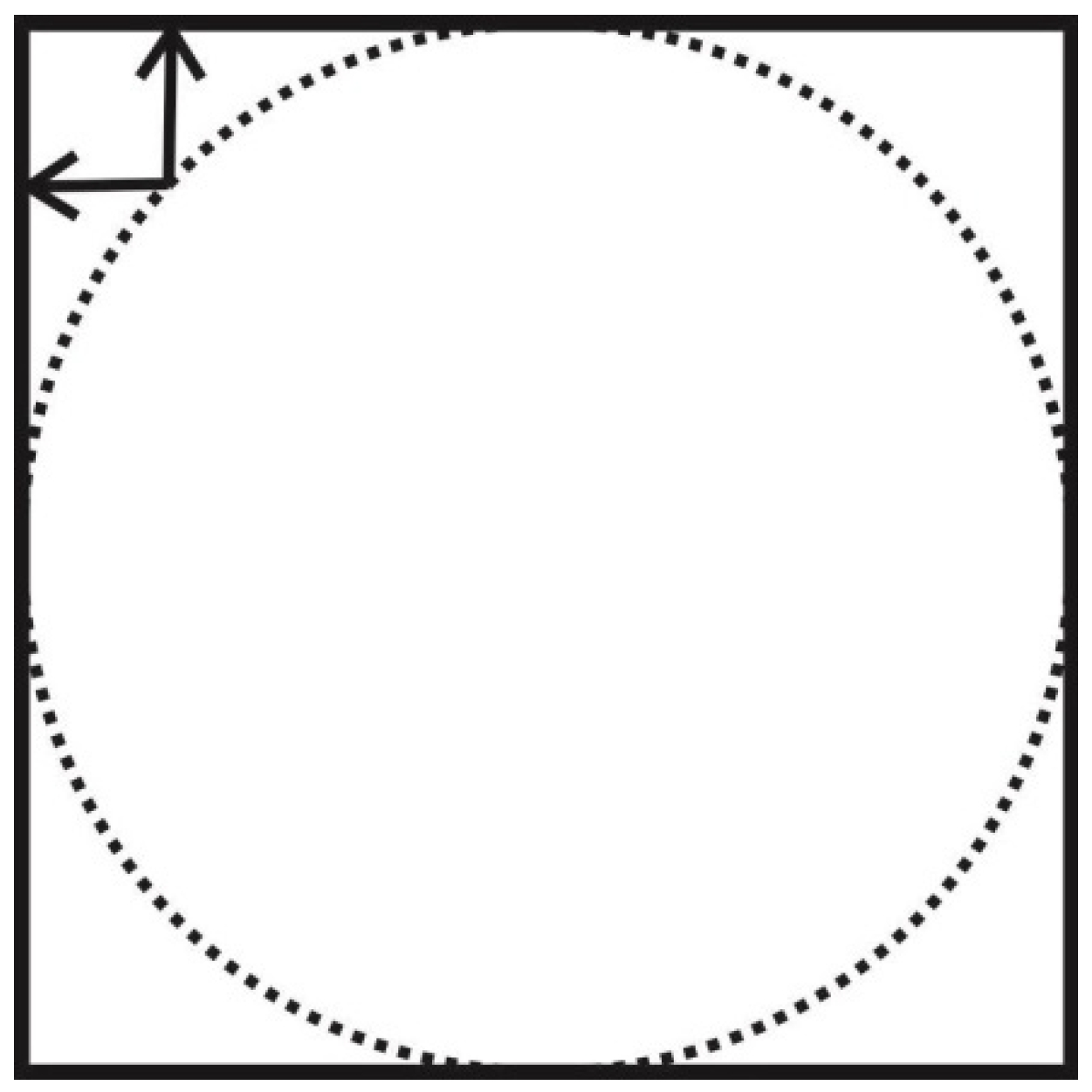
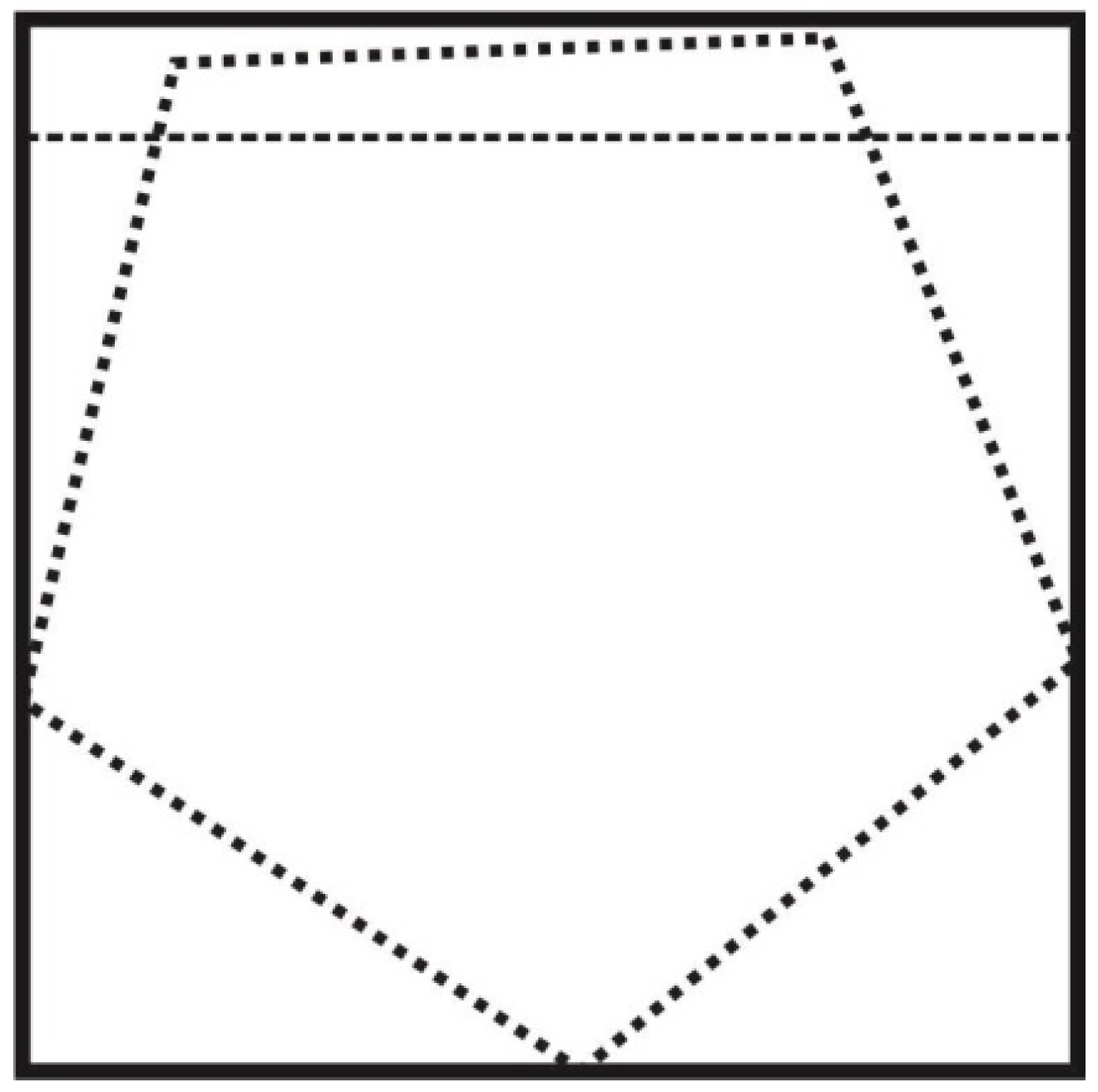
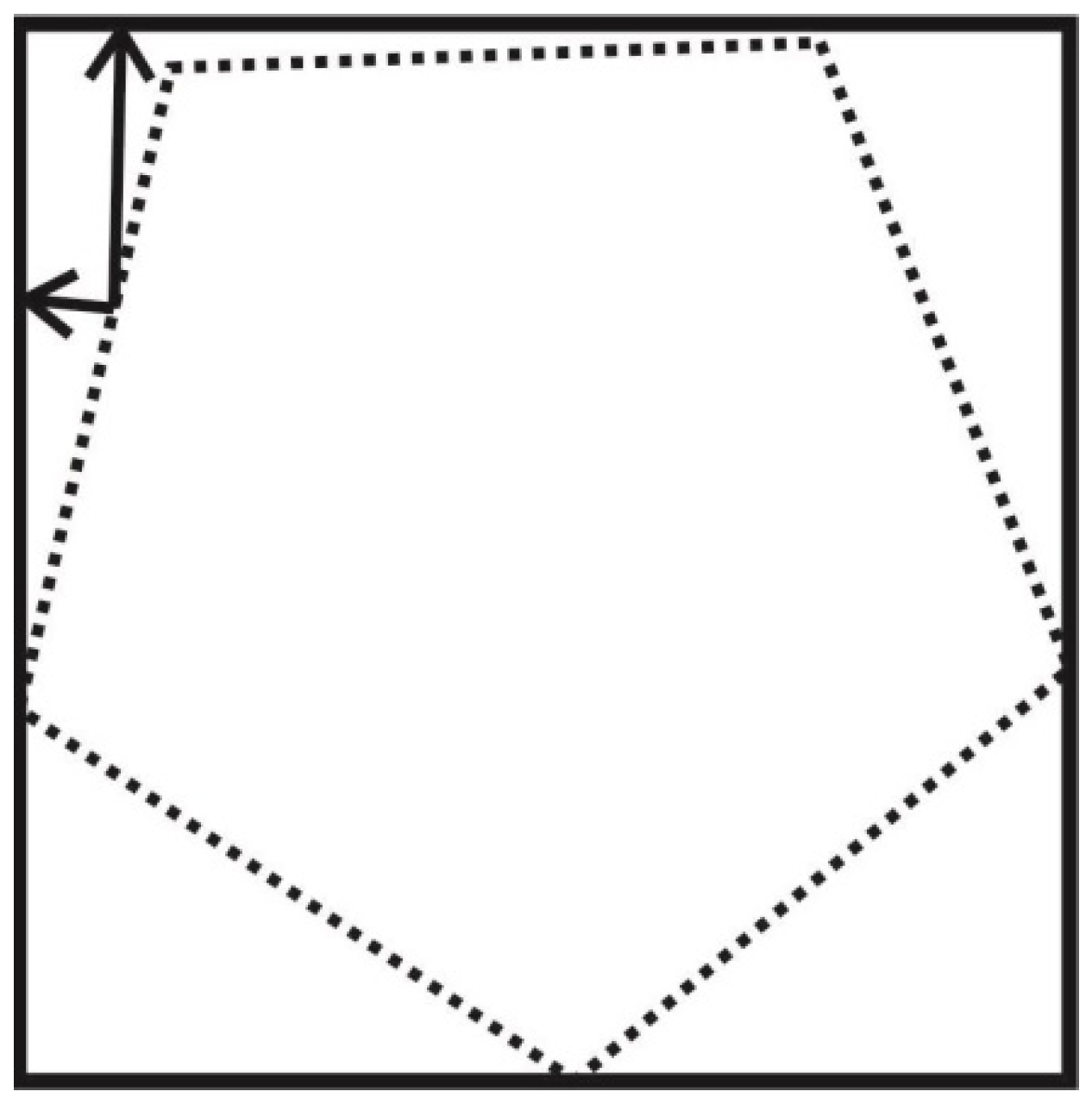
Therefore, this study utilizes a simplified geometry approach based on particle shapes inscribed within a square (Figure 2 and Figure 3).
This variant uses a square inscribed with a circle. The boundaries of the circle are extended to the boundaries of the square in which the circle is inscribed.
In the case of an irregular shape, an arbitrary particle must also be inscribed in a square to simplify the geometry of the solution domain.
Only in the case of generalized simplified geometry can a scenario modeling approach, where a group of scenarios is identified to obtain predictive information, be effectively used. Clearly, when modeling the removal of carbonaceous particles, it is impossible to know the actual distribution of the emitted particles by shape and size at the modeling stage [45]. Certain statistical regularities can be taken into account [45], but then it is incorrect to apply a deterministic modeling approach [50]. In this case, statistical modeling methods must be applied, such as Monte Carlo methods [45] or particles-in-cells methods [55]. However, these are completely different methods, which often require the use of multiprocessor computing technology and a parallel programming paradigm [52]. It is difficult to imagine that a forestry department or municipal health department has a dedicated supercomputer and the personnel capable of servicing such computing systems. Therefore, simplification is the only possible way to obtain results applicable to real-world situations of monitoring, assessing, and predicting the impact of carbonaceous particles in the context of public health.
The second approach involves further modifying the boundary conditions while geometrically simplifying the particle shape to model their heat exchange with the environment. In this case, an approach that takes into account the imperfect nature of the particle’s surface contact with the environment can be applied. Let us consider the example of a particle with an irregular shape (Figure 4). This approach is also valid for a circle.
A particle’s surface layer can be introduced, taking into account the volume fraction of the carbonaceous particle’s material (dry organic matter). Then, the boundary conditions at the particle’s boundary must include a non-ideal contact condition—for example:
t > 0 , x = 0 : λ T x = φ α ( T e T ) ,
In contrast to the ideal contact conditions,
t > 0 , x = 0 : λ T x = α ( T e T ) .
φ is the volume fraction of dry organic matter in the particle’s surface layer.
Calculations revealed that, in this case, the temperature deviation at the boundary of a square inscribed with an irregularly shaped particle can fluctuate between 10 and 40%. In turn, the temperature distribution within the particle’s interior does not differ significantly for each of the variants.
Therefore, this study utilizes a simplified geometry approach based on particle shapes inscribed within a square. As part of the simulation, a two-dimensional heat conduction equation and kinetic equations were solved:
ρ c T t = λ ( 2 T x 2 + 2 T y 2 ) q p k ρ φ 1 exp ( E R T ) | 0 < x < L ; 0 < y < H .
ρ φ 1 t = k ρ φ 1 exp ( E R T ) ,    
The initial and boundary conditions were written as follows:
t = 0 :   T = T 0 ,     0 < x < L ,     0 < y < H
t = 0 :   φ 1 = φ 10 ,       φ 2 = φ 20    
t > 0 , x = 0 : λ T x = α ( T e T ) ,
t > 0 , x = L :             λ T x = α ( T e T ) ,
t > 0 , y = 0 : λ T y = α ( T e T ) ,
t > 0 , y = H :             λ T y = α ( T e T ) ,
where α is the heat transfer coefficient; αs is the dispersion coefficient; c is the heat capacity of dry organic matter; E is the activation energy of the pyrolysis process; φ1 is the volume fraction of dry organic matter; φ2 is the volume fraction of soot particles; φ3 is the volume fraction of the gas phase; k is the pre-exponential factor of the pyrolysis process; λ is the thermal conductivity of dry organic matter; qp is the thermal effect of the pyrolysis process; R is the universal gas constant; ρ is the density of dry organic matter; ρs is the density of soot particles; t is time; Te is the temperature at the flame front; T is the temperature; and x,y are spatial coordinates.

2.3. Description of Scenarios

Table 1 presents the main scenarios for mathematical modeling of heat and mass transfer in a carbonaceous particle, taking into account soot formation. The main types of forest fires are considered: low- and high-intensity surface fires, crown fires, and firestorms [56]. Each type of forest fire corresponds to a specific temperature at the forest fire front and a heat transfer coefficient characterizing the speed of the forest fire front movement [57]. The dispersion coefficient was selected in accordance with a previously published work [58], taking into account the results of [49].
The sizes of carbonaceous particles varied between 1 cm and 3 mm in cross-section. This corresponds to the actual size range of carbonaceous particles formed during wood and forest fuel combustion [44,59,60]. The choice of typical tree species was due to their widespread occurrence in the Siberian region and throughout the Russian Federation as a whole [61]. The main thermophysical properties of the forest fuels under consideration are presented in Table 2. The average air temperature in the Siberian regions was used as the ambient temperature (Table 3).

2.4. Numerical Algorithm

At the first stage, the input data required for the computational procedure implemented in a high-level programming language are read and initialized in accordance with the algorithm. Then, the calculation process goes through several sequential stages. Three blocks can be distinguished. The first block is responsible for calculating the temperature field in a carbon particle. Since the system of equations to be solved corresponds to a two-dimensional statement, a locally one-dimensional method for solving two-dimensional equations of mathematical physics is used [64,65]. To solve one-dimensional equations, the finite difference method was used [66]. To solve different analogs of parabolic partial differential equations, the marching method is used [67,68]. In each block, the calculation is carried out identically. In the forward run, the running coefficients are initialized, and in the reverse run, the temperature at the next time layer is calculated. The second block allows calculating the volume fractions of phases, including dry organic matter and soot particles. For this purpose, a numerical implementation of the kinetic schemes of pyrolysis and soot formation is used. To solve systems of ordinary differential equations, the finite difference method is also used, taking into account the simple iteration method to resolve nonlinearities on the right-hand sides of the differential equations. The third block calculates the probability and number of fragments of a carbon particle at different stages of its fragmentation.
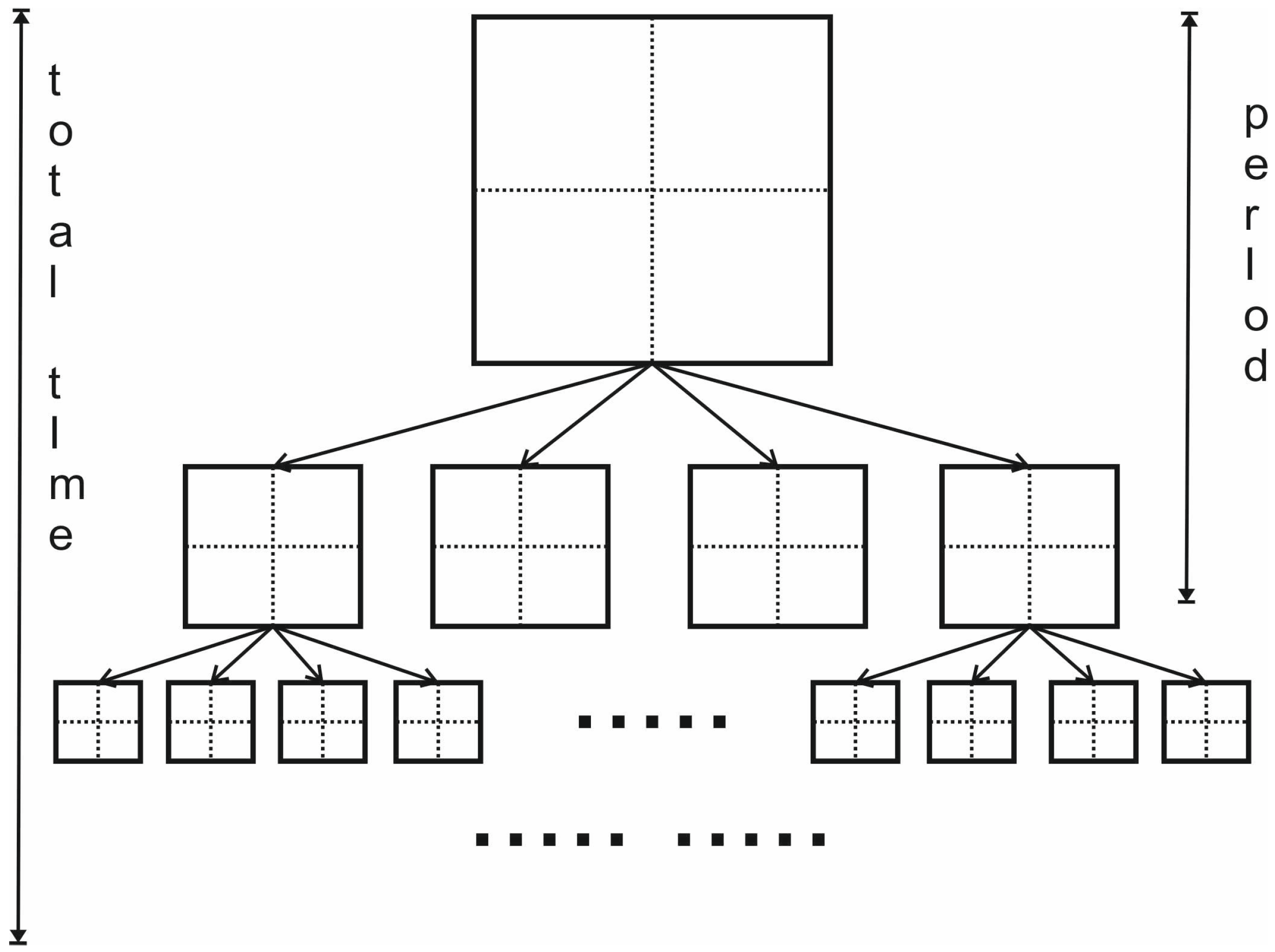
A description of a mathematical model for the fragmentation of a carbonaceous particle is presented below. While moving through the surface layer of the atmosphere, a carbonaceous particle, heated to high temperatures, undergoes oxidative pyrolysis, forming soot particles. While the particle remains at a sufficiently high temperature, it undergoes thermochemical destruction, forming gaseous and condensed pyrolysis products. Among the condensed products, liquid condensed products and soot particles can be distinguished. As a result of thermochemical destruction, the dry organic matter undergoes changes, leaving behind coke—the carbonaceous residue of the particle. This carbonaceous skeleton can be mechanically destroyed by exposure to the environment. The following phenomenological model of fragmentation is proposed. This process occurs stepwise. At each step, particles from the previous layer are broken down into four smaller particles with a certain period. Geometrically, this process can be represented as a particle destruction tree. A diagram of the particle fragmentation tree is shown below (Figure 5).
This process can be described mathematically using the following algebraic expressions.
S—fragmentation step.
tfr_s—fragmentation time at step S.
dtfr—fragmentation period.
tfr_(s + 1) = tfr_s + dtfr—fragmentation time at step S + 1.
Nfr_s—number of particles at fragmentation step S.
Nfr_(s + 1) = Nfr_s × 4—number of particles at fragmentation step S + 1.
Lfr_s—characteristic size at fragmentation step S.
Lfr_(s + 1) = Lfr_s/2—characteristic size at fragmentation step S + 1.
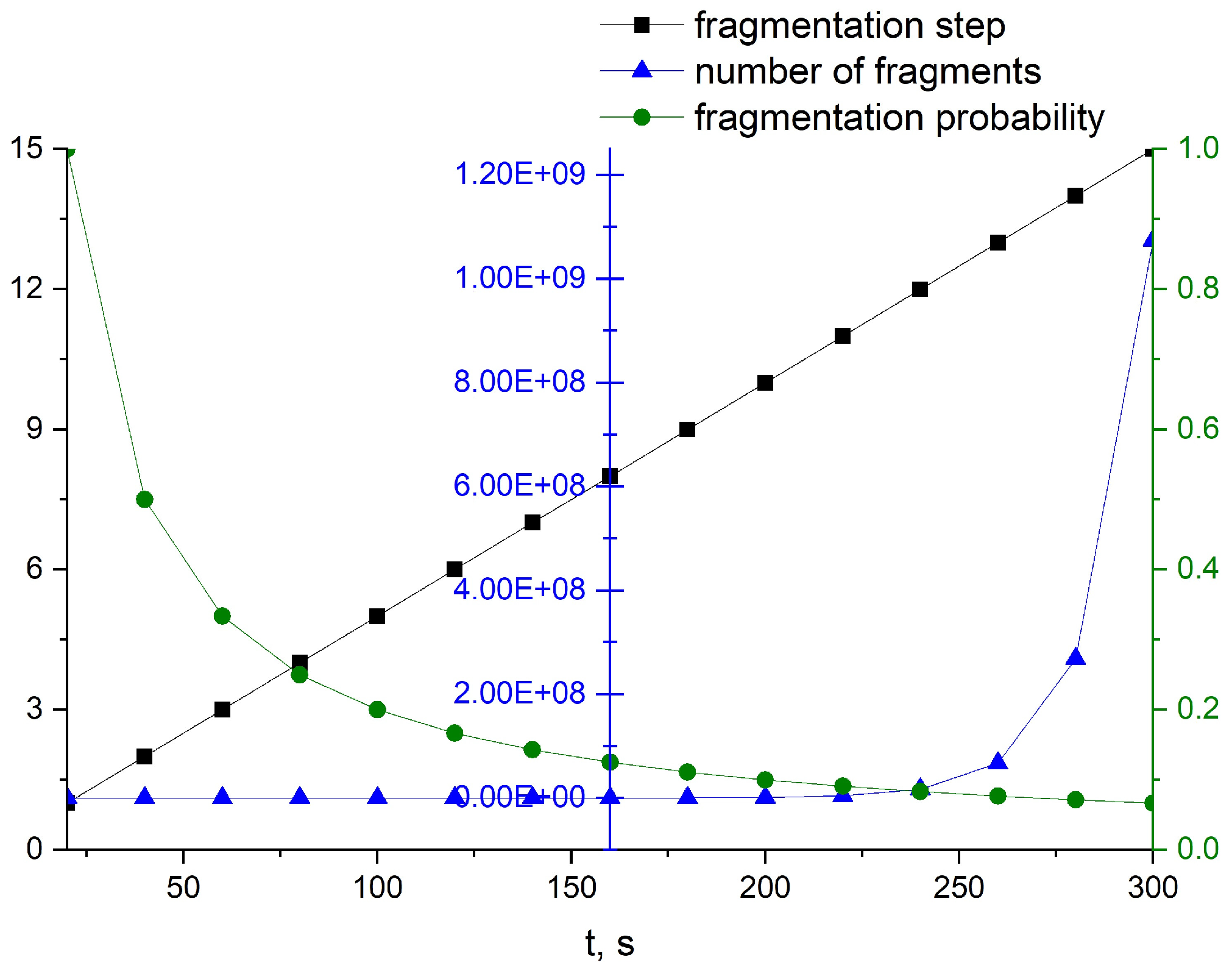
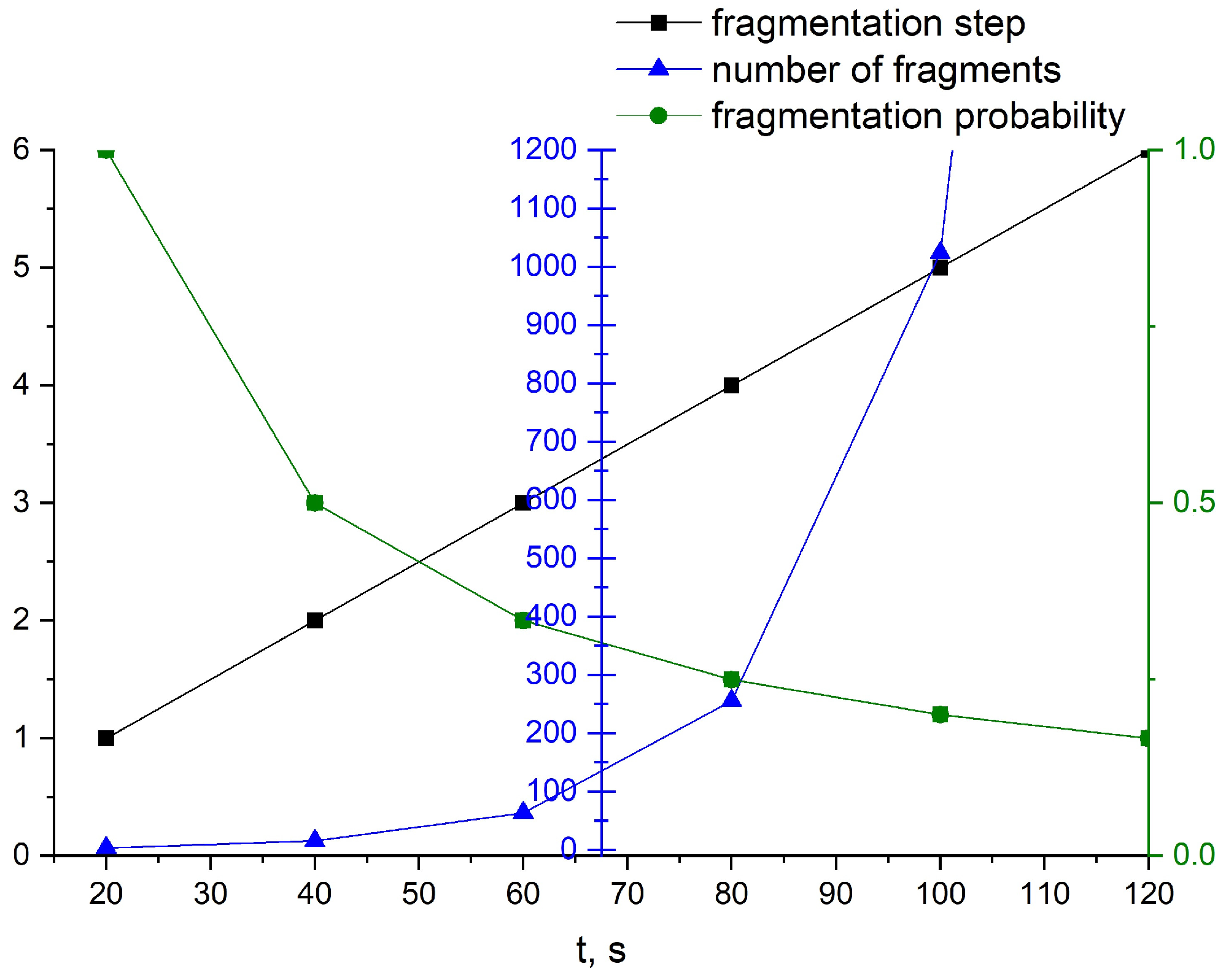
Pfr_s = 1/S—fragmentation probability at step S.
This process is repeated a specified number of steps with a specified period.
The actual process of particle motion and possible particle collisions are not considered in this problem, as they are a separate issue. On the other hand, similar studies have been published previously [29,30,31,32,33,34,35,36,37,38,39,40,41,42,43,44]. However, the incorporation of mathematical models of particle motion will significantly increase the computational complexity of the algorithm. This, in turn, will necessitate the use of multiprocessor computing technology and parallel programming paradigms, or will significantly reduce the disaster warning period. Therefore, the value of such a software product will be minimal for practical use in forestry, healthcare, or environmental monitoring. Moreover, this will force the abandonment of the concept of deterministic modeling and the use of stochastic methods such as Monte Carlo [45] or particles-in-cells methods [55]. These, however, require entirely different research and different tasks and methods, the implementation of which requires high-performance computing.
The proposed mathematical model will enable the development of new systems or the modernization of existing systems for predicting the environmental and social consequences of forest fires using a deterministic–probabilistic approach. The developed model is implemented in the high-level programming language Delphi. The RAD Studio 10.2 program was used for calculations [69]. The developed console application can be used with GIS systems [70,71] to visualize predictable information, taking into account spatial localization [72].

3. Results and Discussion

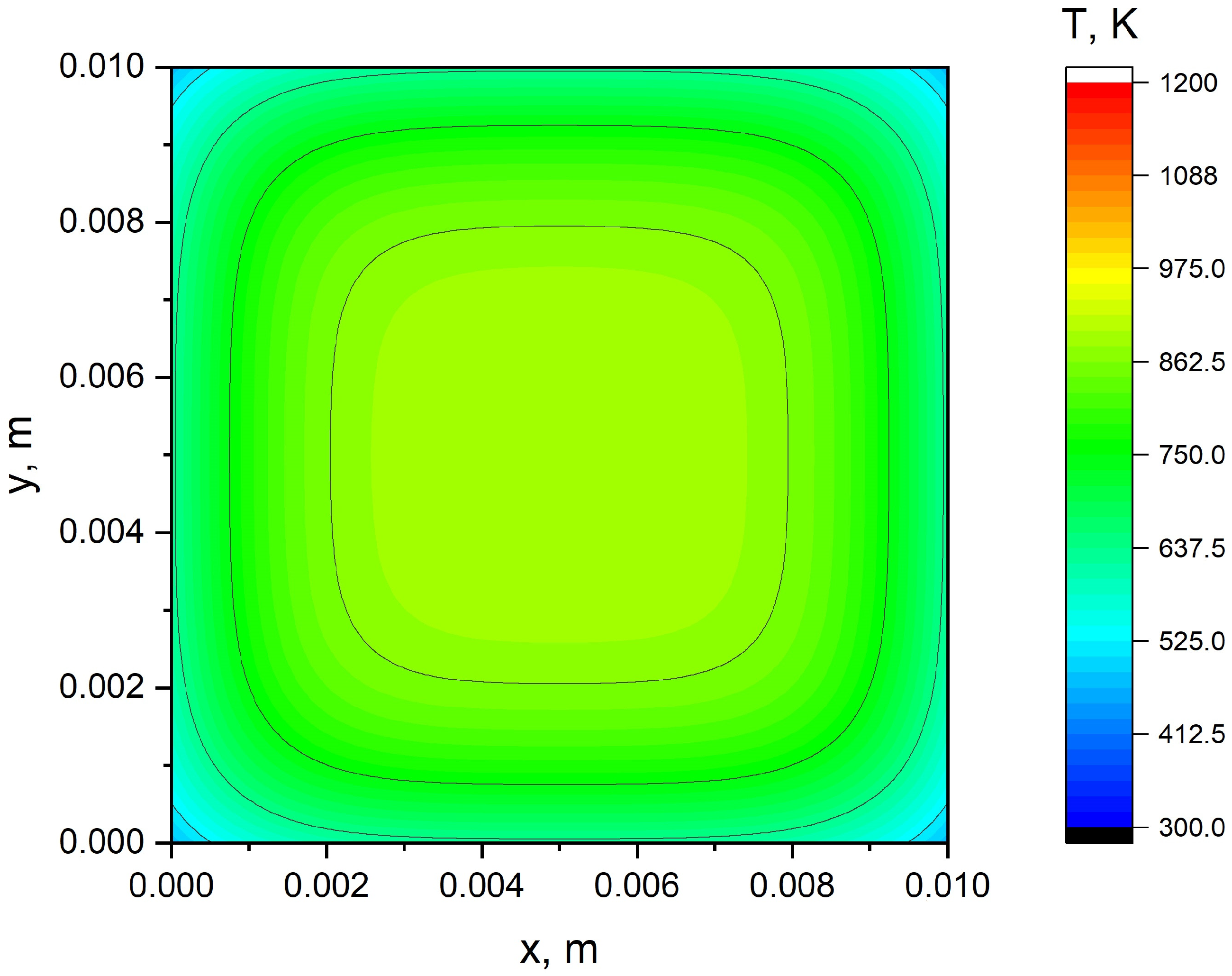
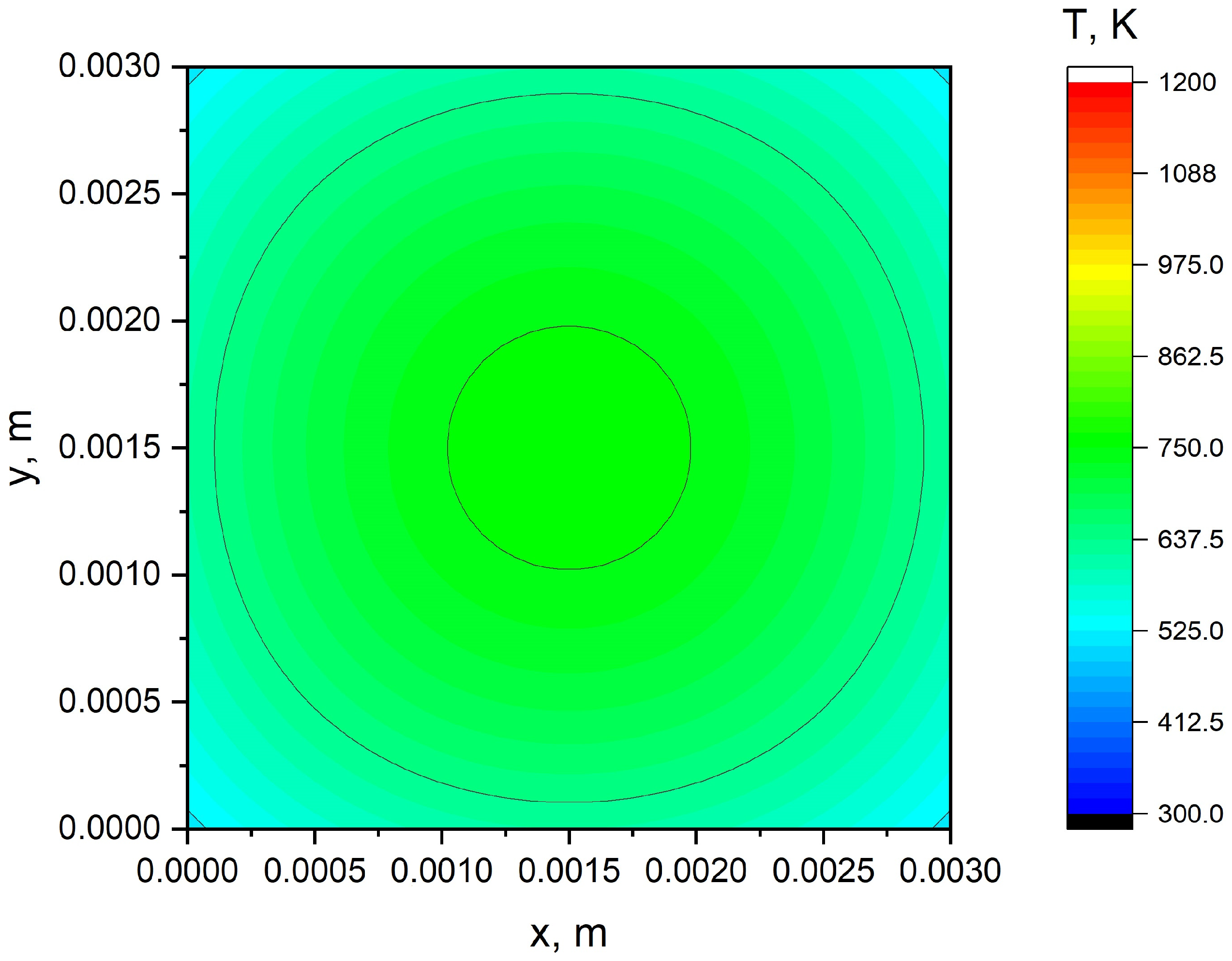
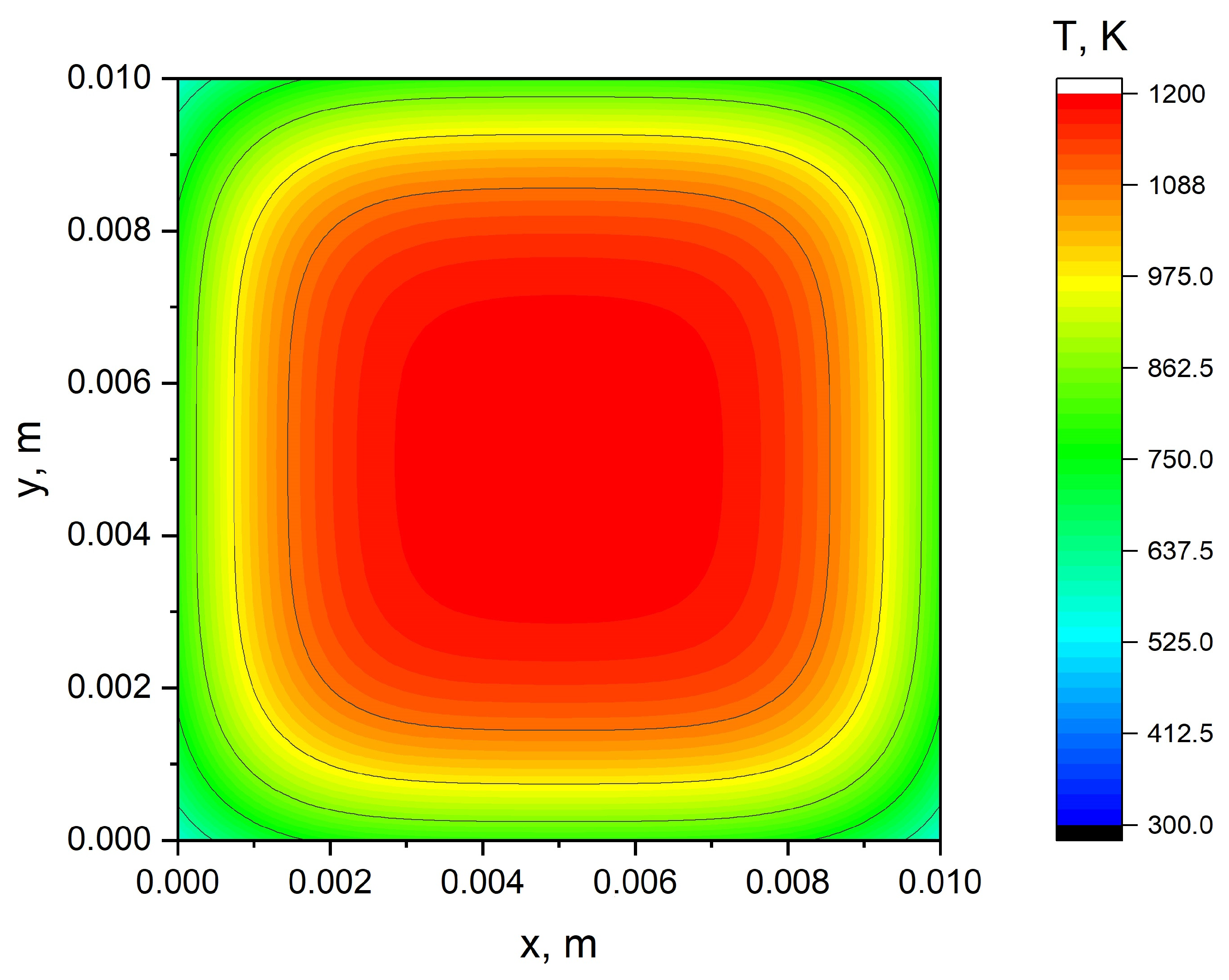
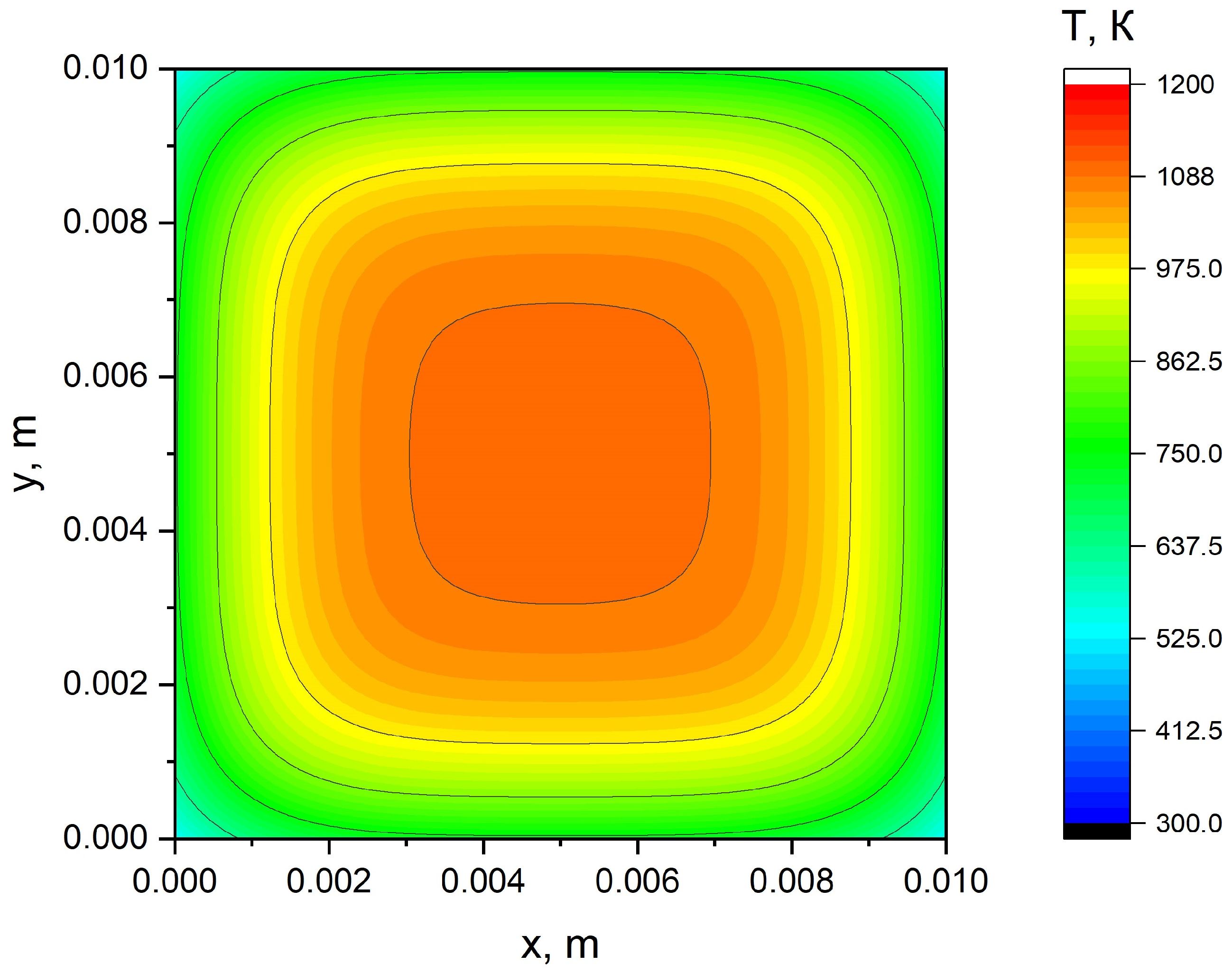
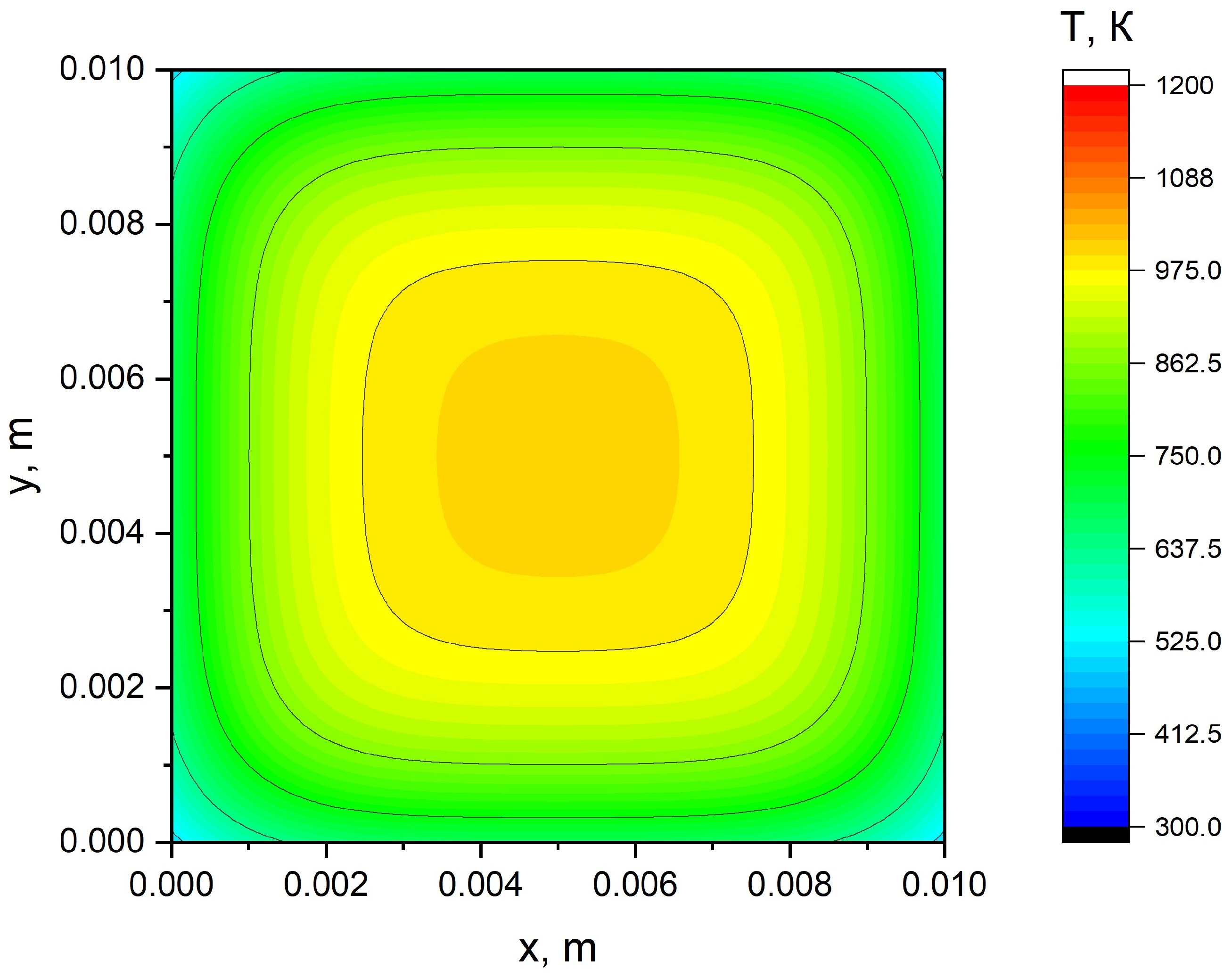
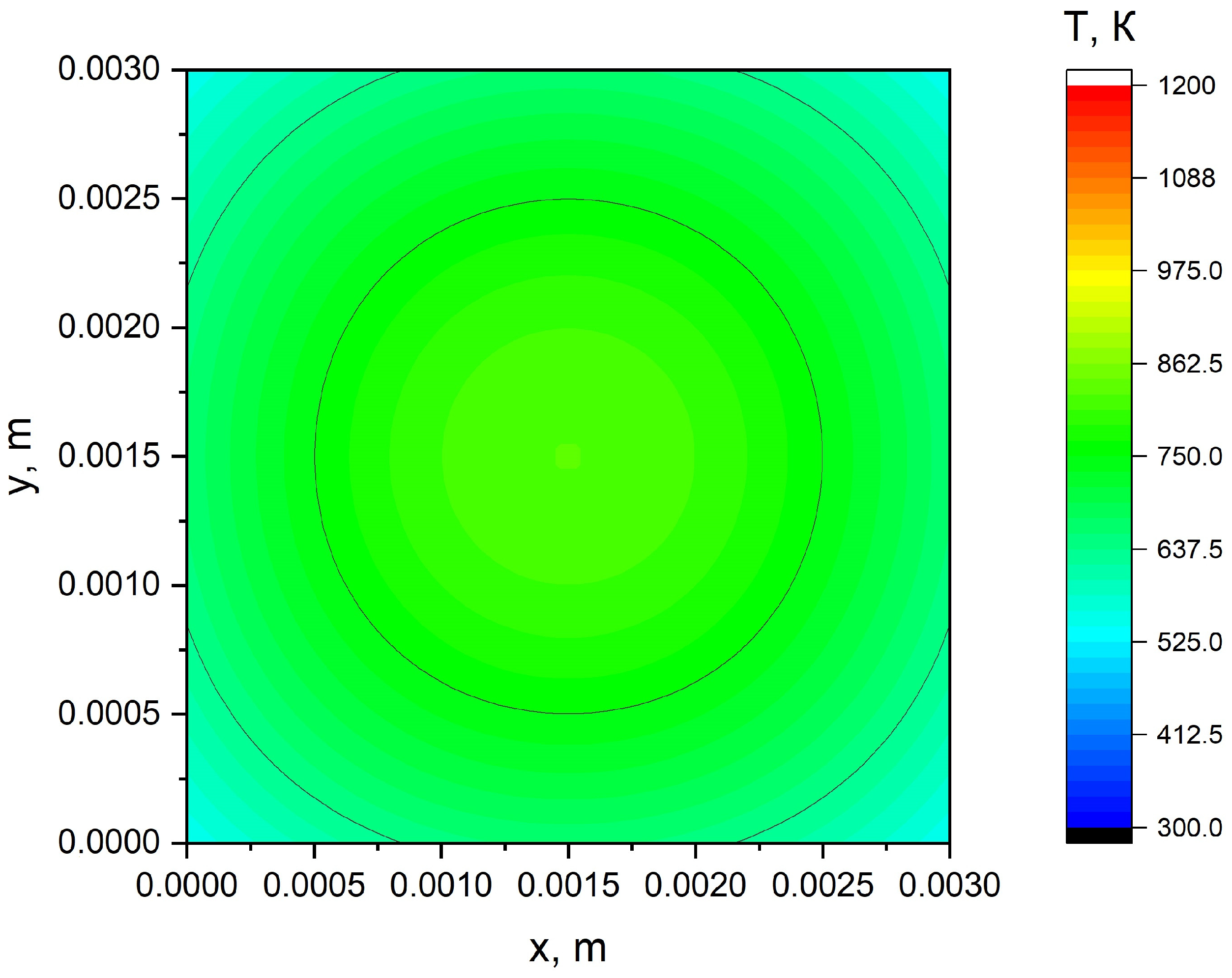
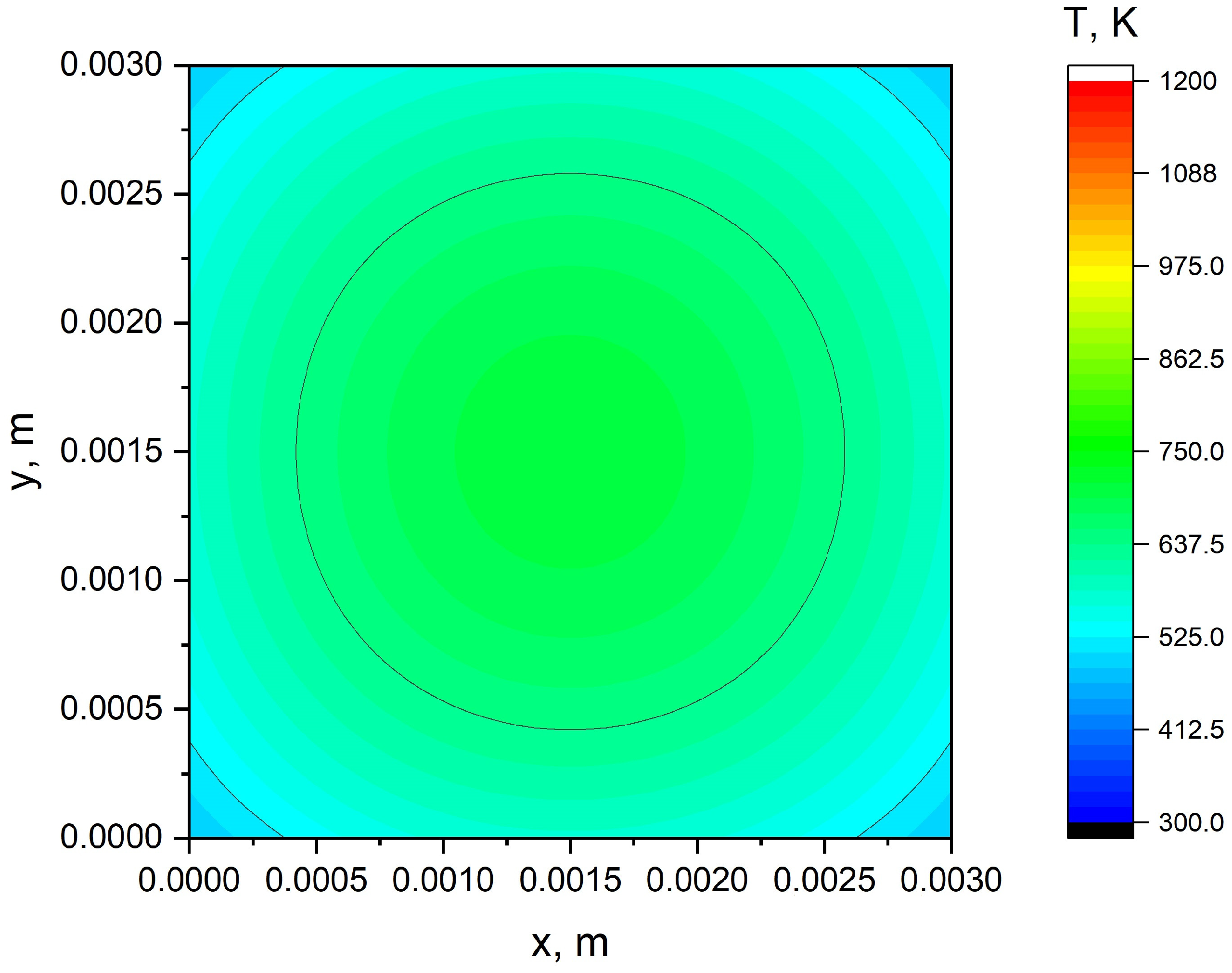
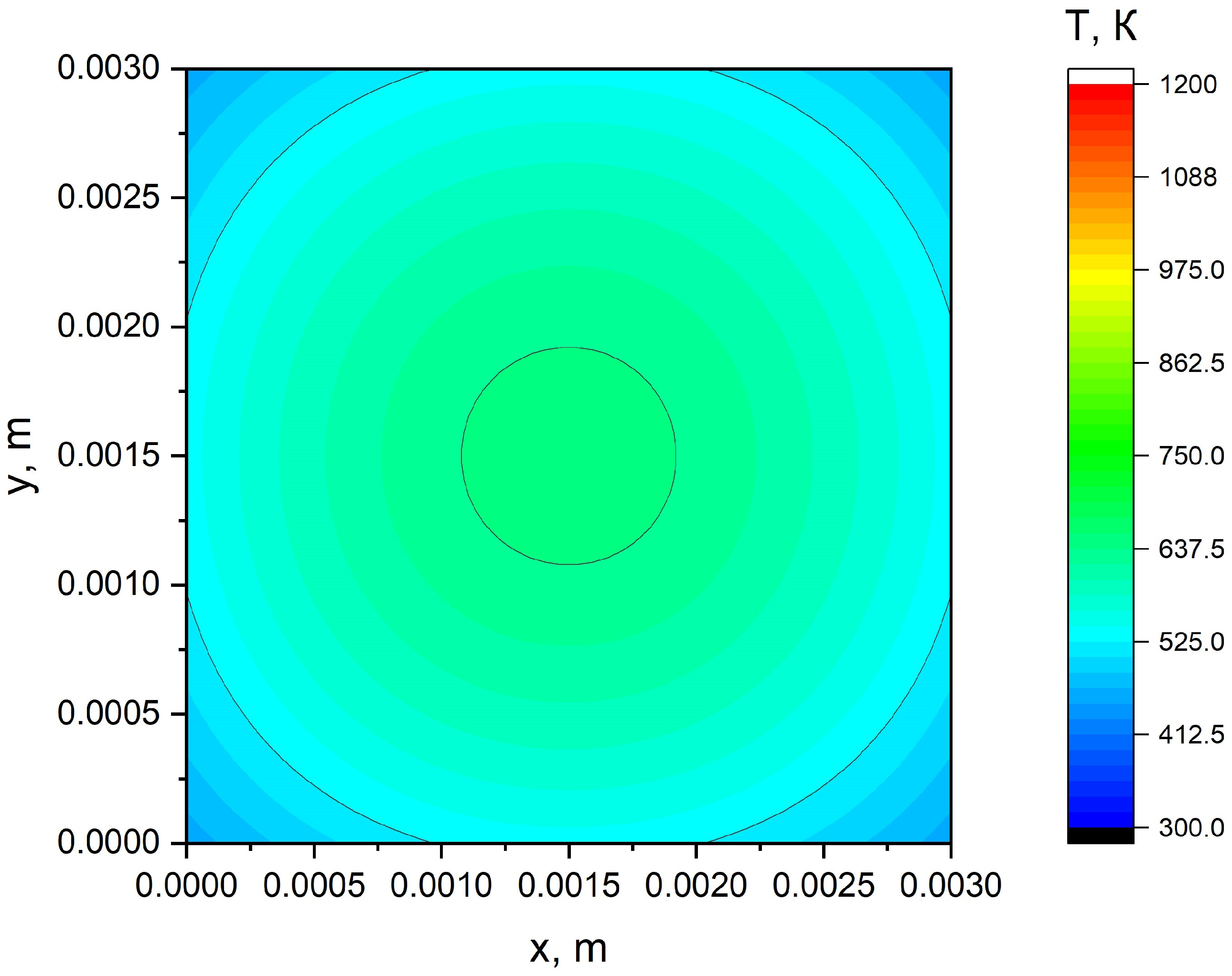
The figures show typical results of calculations of temperature fields of carbon particles from various types of forest fuel formed during different types of forest fires at different points in time.
In this study, it is assumed that at the initial moment, the particle has just left the flame combustion zone of forest fuels and has a temperature comparable to the temperature in the fire front. Specifically, the following temperatures were used in this study: 900 K for particles from the front of a low-intensity surface fire, 1000 K for particles from the front of a high-intensity surface fire, 1100 K for particles from the front of a crown fire, and 1200 K for particles from the firestorm zone.
Previously, studies on the pyrolysis of forest fuels have been conducted [73]. It was found that a forest fuel loses all moisture within a few seconds while in the flame combustion zone. Thus, upon removal from the front of a forest fire, the particle no longer contains moisture. Therefore, adding the moisture evaporation process to the proposed model is an error in the construction of the mathematical model. The proposed mathematical model can be applied to any real forest fire situation in conjunction with the scenario modeling approach.
This paper examines carbonaceous particles formed from the most common tree species in the Russian Federation—pine, birch, and spruce. The following parameters are considered in the modeling:
-
Thermophysical characteristics (density, heat capacity, thermal conductivity). Taking these parameters into account allows us to consider the influence of the type of initial forest fuel on heat transfer processes within the structure of the carbonaceous particle during its interaction with the environment.
-
Thermokinetic characteristics (pre-exponential factor, activation energy of the pyrolysis reaction). Taking these parameters into account influences the oxidative pyrolysis process and soot formation as a result of physicochemical transformations.
-
Dispersion coefficient. Taking this parameter into account allows us to account for the influence on the soot formation process.
Thus, the proposed mathematical model takes into account the entire range of significant parameters necessary for accounting for the type of initial forest fuel: thermophysical characteristics, thermokinetic characteristics, and dispersion coefficient.
An analysis of the results presented in Figure 6, Figure 7, Figure 8, Figure 9, Figure 10, Figure 11, Figure 12 and Figure 13 shows that the cooling of smaller carbonaceous particles occurs significantly faster than that of larger ones. However, the central part of a relatively large carbonaceous particle remains heated to the initial temperature for several tens of seconds. However, particles of the order of 1 cm can already have surface layers cooled to temperatures of 650–700 K. However, both these temperatures and the heat reserve of the particle will be sufficient that, under certain conditions, the settling of such a particle on the ground layer of forest fuels will lead to its ignition [74,75,76]. In addition, numerical calculations were carried out for scenarios of a high-intensity surface fire, a crown fire, and a firestorm. A comparative analysis of the results shows that the lowest cooling rates are characteristic of particles ejected from the front of a low-intensity surface forest fire. This is explained by the lowest speed of their transfer by the plume from the forest fire in the air [77,78]. Maximum cooling rates are typical for particles released during a firestorm. In this case, the rate of removal of heated particles will be greatest. According to [57], the particle’s transport speed will influence the heat transfer coefficient and enhance the convective heat exchange between the heated particle and the air flow.
In central layers, thermal decomposition and destruction of the particle’s core (dry organic matter) occur. As a result, the particle can mechanically break down into fragments, ultimately forming so-called PM10 and PM2.5 black carbon.
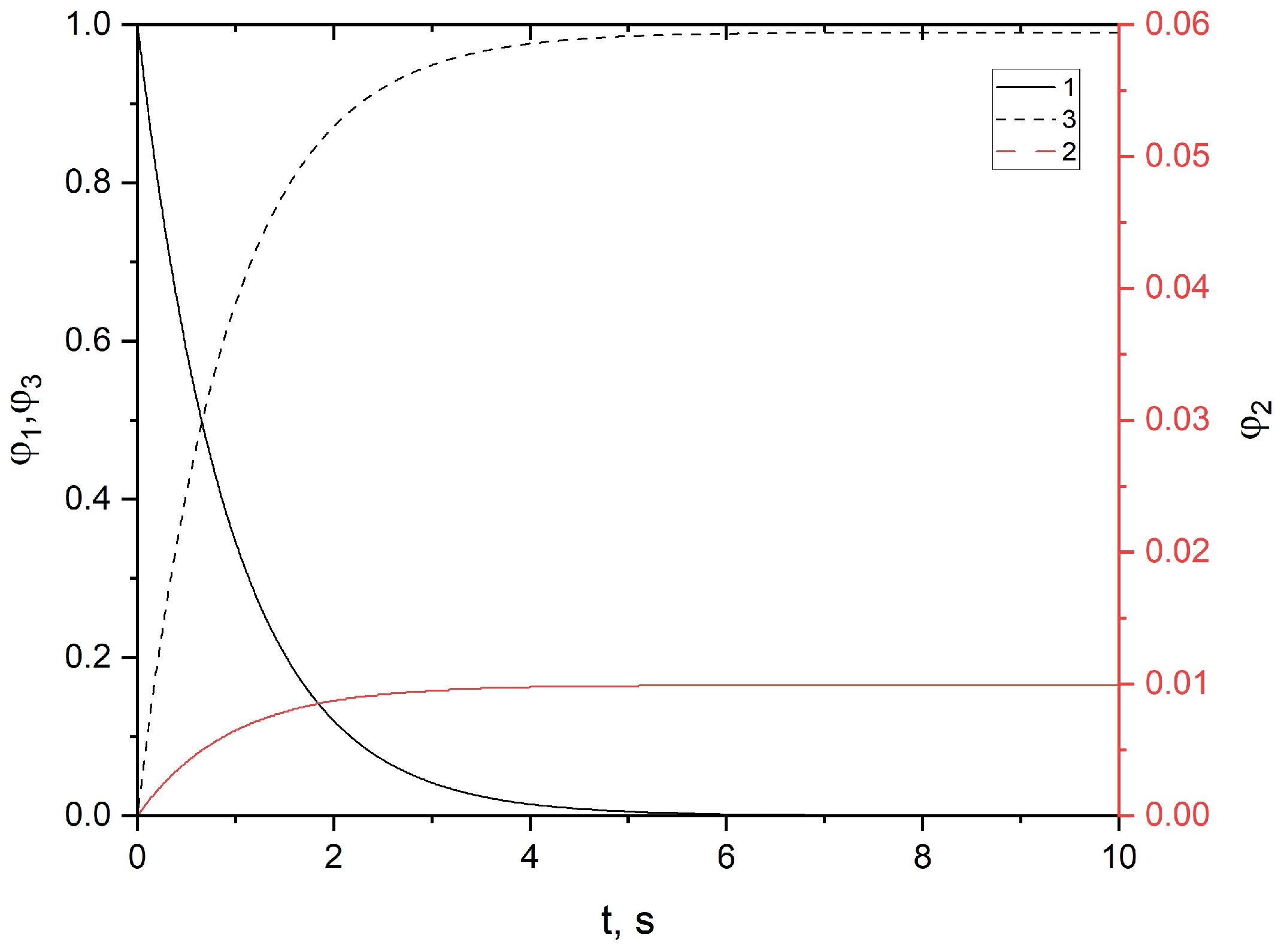
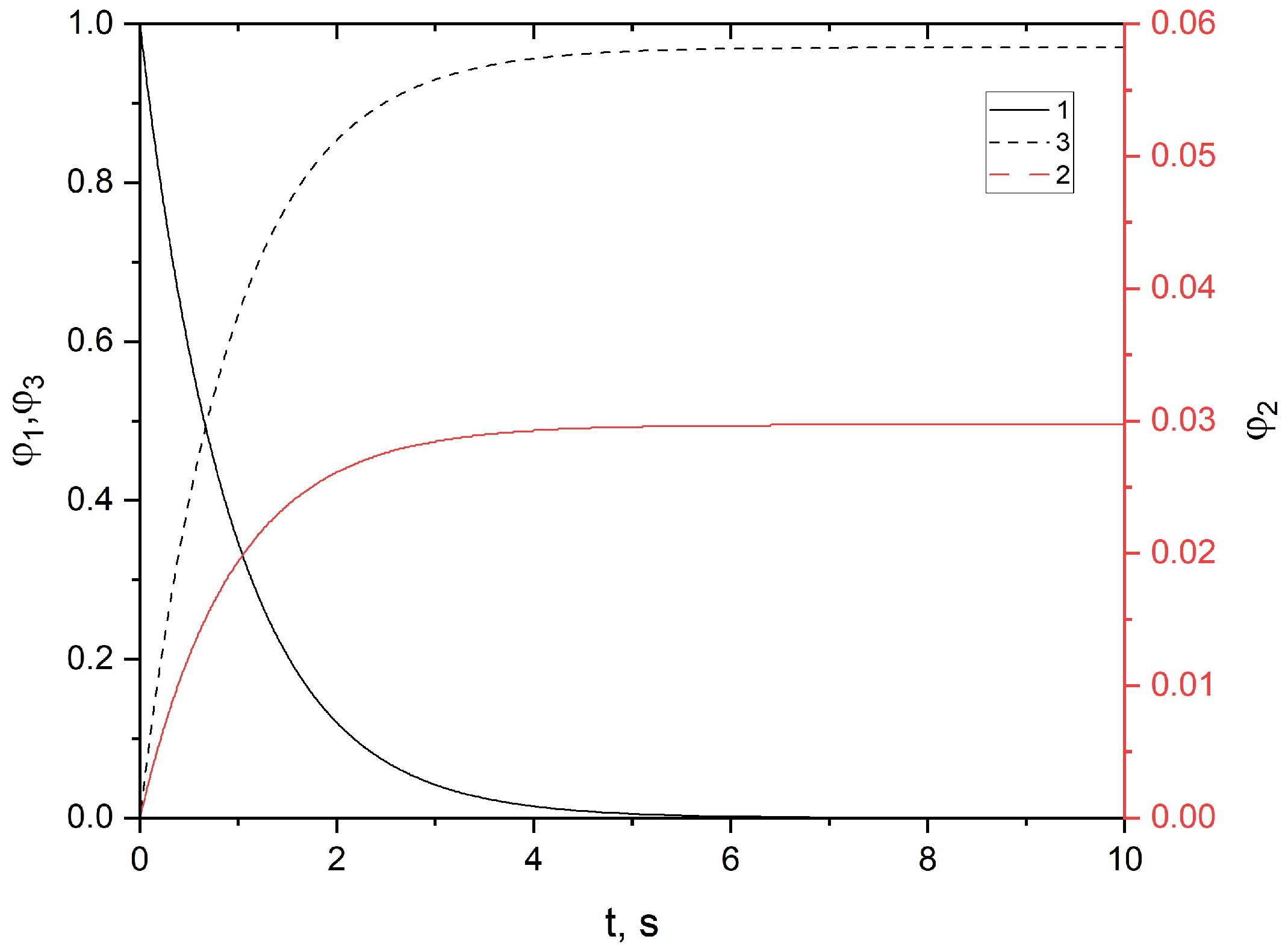
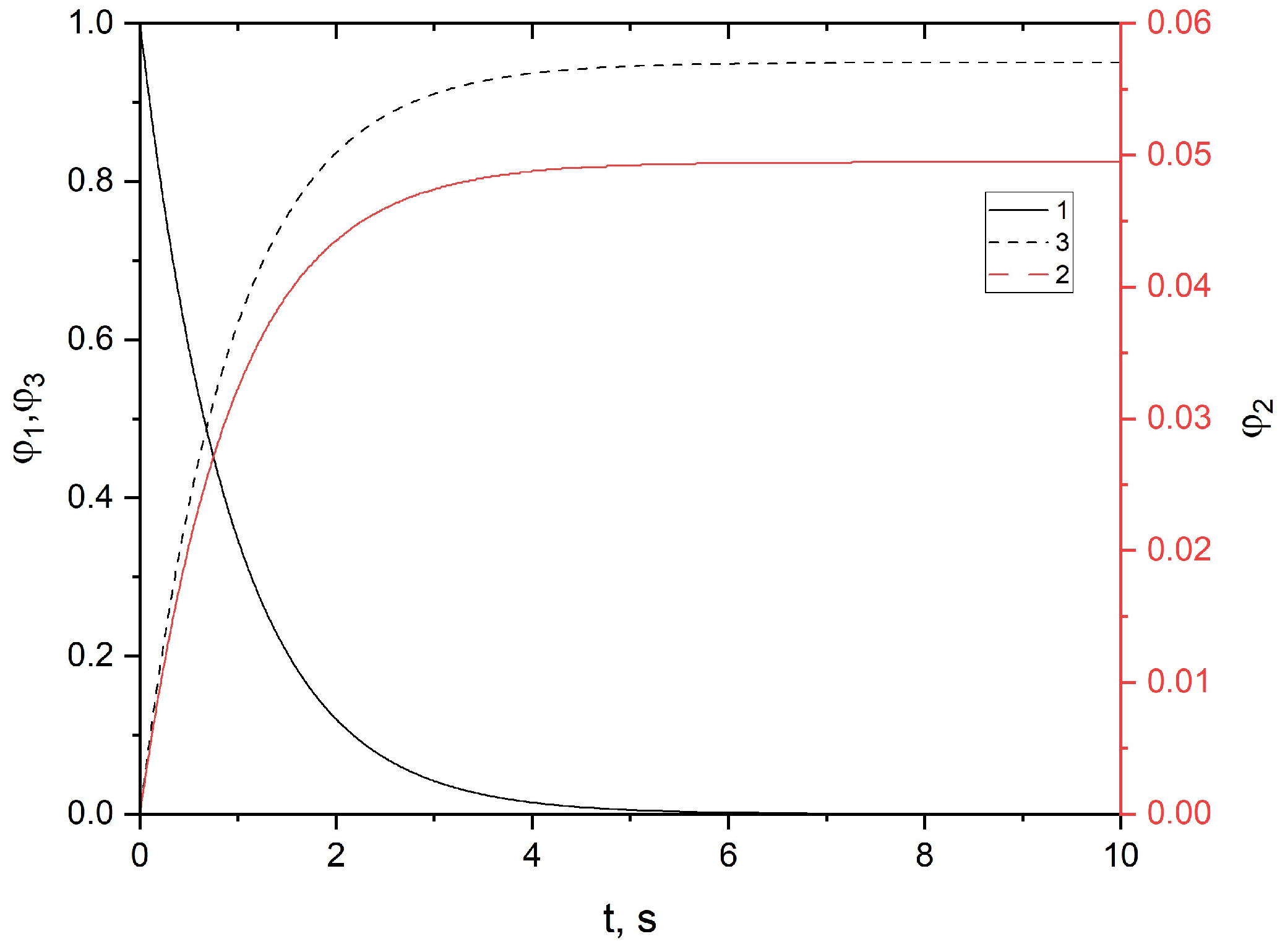
Figure 14, Figure 15 and Figure 16 show the time dependences of the phase volume fractions for the center of a carbonaceous particle. These data provide insight into pyrolysis and soot formation within the particle as a whole. Analysis of the results presented in Figure 14, Figure 15 and Figure 16 shows that the dispersion coefficient has the greatest influence on the volume fraction of soot particles. A comparative analysis shows that the smaller the particle, the more intense and rapid the formation of soot particles. In fact, the more relatively small particles ejected by a forest fire front, the more soot particles are formed during the particles’ transport through the air. Soot formation due to thermal destruction of the carbonaceous particle occurs within the first few seconds of its transport through the air. Subsequently, the process is limited by the mechanical destruction of the particle into smaller fragments through a multi-stage process.
Figure 17 and Figure 18 show the particle fragmentation curves over time.
According to estimates [48], the accuracy of mathematical models of forest fire theory can reach 580%. This significant variation in the deviations of the numerical solution from the true solution is explained by the relatively large influence of many parameters, which are essentially stochastic in nature. Nevertheless, the reliability of the obtained results should be discussed separately.
First, a study was conducted on the convergence of the numerical solution on a sequence of condensed grids. Results were obtained from test runs of the software implementation of the mathematical model with various values of the grid parameters. The condition for matching two runs of the software implementation was a temperature difference of no more than 1 K at the control point of the computational domain. Ultimately, the following grid parameters were adopted: dt (time step) equals 0.01 s, and spatial steps (hx, hy) equal 0.00005 m.
Second, a comparative analysis of the obtained results with previously obtained results was conducted. Two problems were considered. The first task was a numerical study of soot formation during the thermal destruction of a forest combustible material element (birch leaf) caused by the impact of a forest fire front [58]. The boundary and initial conditions were matched, and agreement between the numerical results for the two formulations was obtained, taking into account a 10% deviation. This deviation is explained by the difference in the structure of the studied sample in the different formulations. When modeling a forest fuel element, a three-layer structure is considered in the solution domain, while in the present study, a single-layer structure is considered.
The second task was a numerical study of the ignition of a forest combustible material layer by a single heated particle [79]. The boundary and initial conditions were matched, and agreement between the numerical results for the two formulations was obtained, taking into account a deviation of up to 30%. This deviation is explained by two factors: in [79], heat loss occurs due to contact with the surface of the forest combustible material layer, and heat influx occurs due to the chemical reaction of oxidation of pyrolysis products by atmospheric oxygen. In the present problem, only the heat flow into the environment is considered.
The proposed mathematical model has certain limitations. First, this study only considers carbonaceous particles with cubic geometry in a two-dimensional approximation. In reality, a significant proportion of particles have spherical and cylindrical geometries. Currently, such particle geometries are not considered. It should also be noted that a small proportion of particles have irregular geometry. On the one hand, embers with such geometry can be ignored or used in consideration of the inscribed geometry in a cube. Second, this study does not consider issues of aerosol propagation in time and space. It is assumed that all formed soot particles instantly enter the atmosphere. This assumption is used by analogy with heat and mass transfer processes in thermal protection problems. In such problems, it is assumed that the resulting pyrolysis products of the protective coating instantly end up in the near-surface layer above the thermal protection element. Third, it is not possible to take into account the temperature of different atmospheric layers or consider spatial processes. In fact, at present, the probabilistic criterion operates largely as a black box simulation model. Future research also needs to construct a deterministic mathematical model of the spatio-temporal physical processes occurring during the fragmentation of a carbon particle due to mechanical destruction, rather than just assessing the probability of its formation using a black box simulation model.
The current study involves modeling heat and mass transfer in a single heated, pyrolyzed carbonaceous particle. The mathematical model takes into account only the initial temperature of the particle transported from the forest fire front and the air temperature in the surface layer of the atmosphere immediately adjacent to and above the forest fire front. The study does not currently consider temperatures in various atmospheric layers. Moreover, this is unnecessary, as the dry organic matter of the particle undergoes almost complete thermal decomposition within a few seconds. The heated particle simply will not be transported to a higher atmospheric layer. The formation of soot particles, which are the centers of aerosol particle formation, also occurs within a few seconds. It would be advisable to consider the temperatures of various atmospheric layers when mathematically modeling aerosol transport in the atmosphere. However, this is not currently modeled in the study. This should be addressed in future studies. For the time being, ambient air temperature data taken from a climate reference book [63] were used. Clearly, the new data are insufficient, but for now, they are sufficient to demonstrate the performance of the mathematical model. Specifically, data from the Tomsk meteorological station were used for scenario modeling in this study. Modeling the spatial dynamics of aerosol propagation is not yet possible in this study, as this is the subject of a separate study. Therefore, the spatial resolution of the meteorological data is currently irrelevant. However, looking ahead, it is possible to propose using forecast fields of meteorological parameters generated by a non-hydrostatic mathematical weather forecasting model [80]. This mathematical model is currently used by Roshydromet of the Russian Federation to generate short- and medium-term weather forecasts. Thus, all the technical capabilities are available to conduct such studies in the future. The process of mechanical destruction with the formation of black carbon fragments competes with the process of thermal destruction with the formation of soot particles. While soot formation due to thermal destruction occurs initially, lasting approximately 4–5 s, the process of mechanical destruction or fragmentation, resulting in the formation of black carbon particles, is more protracted and can also occur during particle cooling. Analysis of numerical results shows that the lifetime of relatively large fragments is no more than 100 s. It can be hypothesized that the fragmentation process of carbon particles is a significant contributor to the volume of soot and black carbon emitted into the Earth’s atmosphere during forest fires. However, more precise experimental studies are needed, both in model fires and by observing actual forest fires.

4. Conclusions

As part of this research, scenario-based numerical modeling of heat and mass transfer processes in a single carbonaceous particle was conducted, taking into account the formation of soot particles due to the thermal destruction of dry organic matter and the formation of black carbon through mechanical fragmentation.
Key findings:
(1)
Mathematical simulation showed that most dry organic matter thermally decomposed with soot formation in several seconds, for example, 4 s for a 0.01 m particle emitted from a firestorm area.
(2)
Mathematical simulation showed that the volume fraction of soot mainly depends on the dispersion coefficient rather than thermophysical and thermokinetic parameters.
(3)
In fact, fragmentation tree modeling showed that the initial particle was fragmented over 100 s to approximately 1000 secondary particles through several fragmentation periods.
Recommendations: The suggested mathematical model must be incorporated with mathematical models of forest fire plume and aerosol transport in the upper layers of the atmosphere. Moreover, probabilistic criteria for health assessment must be developed for practical use of the suggested mathematical model.

Author Contributions

Conceptualization, N.V.B.; methodology, N.V.B.; software, N.V.B. and V.A.V.; validation, N.V.B. and V.A.V.; formal analysis, N.V.B.; investigation, N.V.B. and V.A.V.; resources, N.V.B. and V.A.V.; data curation, V.A.V.; writing—original draft preparation, N.V.B. and V.A.V.; writing—review and editing, N.V.B.; visualization, V.A.V.; supervision, N.V.B.; project administration, N.V.B.; funding acquisition, N.V.B. All authors have read and agreed to the published version of the manuscript.

Funding

This study was supported by grant No. 25-21-00017 from the Russian Science Foundation, https://rscf.ru/project/25-21-00017/.

Institutional Review Board Statement

Not applicable.

Informed Consent Statement

Not applicable.

Data Availability Statement

Data are available upon request.

Conflicts of Interest

The authors declare no conflicts of interest.

References

  1. Lamarque, J.-F.; Bond, T.C.; Eyring, V.; Granier, C.; Heil, A.; Klimont, Z.; Lee, D.; Liousse, C.; Mieville, A.; Owen, B.; et al. Historical (1850–2000) gridded anthropogenic and biomass burning emissions of reactive gases and aerosols: Methodology and application. Atmos. Meas. Tech. 2010, 10, 7017–7039. [Google Scholar] [CrossRef]
  2. Hao, W.M.; Petkov, A.; Nordgren, B.L.; Corley, R.E.; Silverstein, R.P.; Urbanski, S.P.; Evangeliou, N.; Balkanski, Y.; Kinder, B.L. Daily black carbon emissions from fires in northern Eurasia for 2002–2015. Geosci. Model Dev. 2016, 9, 4461–4474. [Google Scholar] [CrossRef]
  3. Baranovskiy, N.V.; Vyatkina, V.A.; Chernyshov, A.M. Numerical simulation of forest fires and possibilities to estimate aerosol emission: Recent advances. Fire Saf. J. 2024, 150, 104250. [Google Scholar] [CrossRef]
  4. Badarinath, K.V.S.; Kharol, S.K.; Kiran Chand, T.R.; Parvathi, Y.G.; Anasuya, J.; Jyothsna, A.N. Variations in black carbon aerosol, carbon monoxide and ozone over an urban area of Hyderabad, India, during the forest fire season. Atmos. Res. 2007, 85, 18–26. [Google Scholar] [CrossRef]
  5. Harrison, R.M.; Yin, J. Particulate matter in the atmosphere: Which particle properties are important for its effects on health? Sci. Total Environ. 2000, 249, 6633–6653. [Google Scholar] [CrossRef]
  6. Seaton, A.; MacNee, W.; Donaldson, K.; Godden, D. Particulate air pollution and acute health effects. Lancet 1995, 345, 176–178. [Google Scholar] [CrossRef]
  7. Tiwary, P.; Kukreti, S.; Shridhar, V.; Pandey, H.; Rana, S.; Arunachalam, K.; Singh, V. Assessment of light absorbing carbonaceous aerosol and its absorption properties from forest fire in Himalayan Critical Zone Observatory. Sci. Total Environ. 2025, 968, 178878. [Google Scholar] [CrossRef]
  8. Yarragunta, Y.; Srivastava, S.; Mitra, D.; Chandola, H.C. Influence of forest fire episodes on the distribution of gaseous air pollutants over Uttarakhand, India. GISci. Remote Sens. 2020, 57, 190–206. [Google Scholar] [CrossRef]
  9. Bhattarai, N.; Dahal, S.; Thapa, S.; Pradhananga, S.; Karky, B.S.; Rawat, R.S.; Windhorst, K.; Watanabe, T.; Thapa, R.B.; Avtar, R. Forest Fire in the Hindu Kush Himalayas: A Major Challenge for Climate Action. J. For. Livelihood 2022, 21, 14–31. [Google Scholar] [CrossRef]
  10. Prairuang, W.; Chetiyanurorukul, T.; Suriyawong, P.; Ho, S.; Paluang, P.; Furuuchi, M.; Amin, M.; Hata, M. Daytime-nighttime variations in the concentration of PM0.1 carbanaceous particles during biomass fire episode in Chiang Mai, Thailand. Particuology 2024, 87, 316–324. [Google Scholar] [CrossRef]
  11. Prairuang, W.; Suwattiga, P.; Chetiyanukorukul, T.; Hongtieab, S.; Limpaseni, W.; Ikamori, F.; Hata, M.; Furuuchi, M. The influence of the open burning of agricultural biomass and forest fires in Thailand on the carbonaceous components in size-fractioned particles. Environ. Pollut. 2019, 247, 238–247. [Google Scholar] [CrossRef]
  12. Guo, Y. Characteristics of size-segregated carbonaceous aerosols in the Beijing-Tianjin-Hebei region. Environ. Sci. Pollut. Res. 2016, 23, 13918–13930. [Google Scholar] [CrossRef] [PubMed]
  13. Amnuaylojaroen, T.; Parasin, N. Future Health Risk Assessment of Exposure to PM2.5 in Different Age Groups of Children in Northern Thailand. Toxics 2023, 11, 291. [Google Scholar] [CrossRef] [PubMed]
  14. Dutta, A.; Chavalparit, O. Assessment of health burden due to the emissions of fine particulate matter from motor vehicles: A case of Nakhon Ratchasima province, Thailand. Sci. Total Environ. 2023, 872, 162128. [Google Scholar] [CrossRef] [PubMed]
  15. Tesfaldet, Y.J.; Chanpiwat, P. The effects of meteorology and biomass burning on urban air quality: The case of Bangkok. Urban Clim. 2023, 49, 101441. [Google Scholar] [CrossRef]
  16. Tial, M.K.S.; Amin, M.; Putri, R.M.; Hata, M.; Furuuchi, M.; Prairuang, W. Size fractioned ambient particles down to nanoparticles (PM0.1) during a haze episode in Myanmar. IOP Conf. Ser. Earth Environ. Sci. 2023, 1199, 12017. [Google Scholar] [CrossRef]
  17. Kozlov, V.S.; Panchenko, M.V.; Yausheva, E.P. Mass fraction of black carbon in submicron aerosol as an indicator of influence of smoke from remote forest fires in Siberia. Atmos. Environ. 2008, 42, 2611–2620. [Google Scholar] [CrossRef]
  18. Panchenko, M.V.; Pkhalagov, Y.u.A.; Rakhimov, R.F.; Sakerin, S.M.; Belan, B.D. Geophysical factors of the aerosol weather formation in the Western Siberia. Atmos. Ocean. Opt. 1999, 12, 883–894. [Google Scholar]
  19. Ignatious, A.; Lakshmi, N.; Resmi, E.; Sumesh, R.; Rajeevan, M. Satellite-based investigation of immediate impact of forest fires on the spatial distribution of aerosol loading over India. Atmos. Environ. 2025, 364, 121652. [Google Scholar] [CrossRef]
  20. Abdou, W.A.; Diner, D.J.; Martonchik, J.V.; Bruegge, C.J.; Kahn, R.A.; Gaitley, B.J.; Crean, K.A.; Remer, L.A.; Holben, B. Comparison of coincident Multiangle Imaging Spectroradiometer and Moderate Resolution Imaging Spectroradiometer aerosol optical depths over land and ocean scenes containing Aerosol Robotic Network sites. J. Geophys. Res. Atmos. 2005, 110, D10. [Google Scholar] [CrossRef]
  21. Fu, Y.; Li, R.; Wang, X.; Bergeron, Y.; Valeria, O.; Chavades, R.D.; Wang, Y.; Hu, J. Fire detection and fire radiative power in forests and low-biomass lands in northeast Asia: MODIS versus VIIRS fire products. Remote Sens. 2020, 12, 2870. [Google Scholar] [CrossRef]
  22. Choomanee, P.; Bualert, S.; Thongyen, T.; Salao, S.; Szymanski, W.W.; Rungratanaubon, T. Vertical Variation of Carbonaceous Aerosols with in the PM2.5 Fraction in Bangkok, Thailand. Aerosol Air Qual. Res. 2020, 20, 43–52. [Google Scholar] [CrossRef]
  23. Huyen, T.T.; Yamaguchi, R.; Kurotsuchi, Y.; Seriguchi, K.; Dung, N.T.; Thuy, N.T.T.; Thuy, L.B. Characteristics of chemical components in fine particles (PM2.5) and ultra fine particles (PM0.1) in Hanoi, Vietnam: A case study in two seasons with different humidity. Water Air Soil Pollut. 2021, 232, 183. [Google Scholar] [CrossRef]
  24. Jamhari, A.A.; Latif, M.T.; Wahab, M.I.A.; Hassan, H.; Othman, M.; Abd Hamid, H.H.; Tekasakul, P.; Prairuang, W.; Hata, M.; Furuuchi, M.; et al. Seasonal variation and size distribution of inorganic and carbonaceous components, source identification of size-fractioned urban air particles in Kuala Lumper, Malaysia. Chemosphere 2022, 287, 132309. [Google Scholar] [CrossRef]
  25. Zhang, N.; Maung, M.W.; Win, M.S.; Feng, J.; Yao, X. Carbonaceous aerosol and inorganic ions of PM2.5 in Yangon and Mandalay of Myanmar: Seasonal and spatial variations in composition and sources. Atmos. Pollut. Res. 2022, 13, 101444. [Google Scholar] [CrossRef]
  26. Barr, B.W.; Ezekoye, O.A. Thermo-mechanical modeling of firebrand breakage on a fractal tree. Proc. Combust. Inst. 2013, 34, 2649–2656. [Google Scholar] [CrossRef]
  27. Mandelbrot, B.B. The Fractal Geometry of Nature; W.H. Freeman and Company: New York, NY, USA, 1977. [Google Scholar]
  28. Collin, A.; Lamorlette, A.; Bernardin, D.; Seno-Guillaume, O. Modelling of tree crowns with realistic morphological features: New reconstruction methodology based on Iterated Function System tool. Ecol. Model. 2011, 222, 503–513. [Google Scholar] [CrossRef]
  29. Kortas, S.; Mindykowski, P.; Consalvi, J.; Mhiri, H.; Porterie, B. Experimental validation of a numerical model for the transport of firebrands. Fire Saf. J. 2009, 44, 1095–1102. [Google Scholar] [CrossRef]
  30. Anthenien, R.A.; Tse, S.D.; Fernandez-Pello, A.C. On the trajectories of embers initially elevated or lofted by small scale ground fire plumes in high winds. Fire Saf. J. 2006, 41, 349–363. [Google Scholar] [CrossRef]
  31. Thomas, C.M.; Sharples, J.J.; Evans, J.P. The termal-velocity assumption in simulations of long-range ember transport. Math. Comput. Simul. 2020, 175, 96–107. [Google Scholar] [CrossRef]
  32. Tarifia, C.S.; del Natanio, P.P. Open Fires and Transport of Firebrands; Thechnical Report; Instituto Nacional del Technico Aeronautica “Esteban Terrades”: Madrid, Spain, 1962. [Google Scholar]
  33. Wadhwani, R.; Sutherland, D.; Ooi, A.; Moinuddin, K.; Thorpe, G. Verification of a Lagrangian particle model for short-range firebrand transport. Fire Saf. J. 2017, 91, 776–783. [Google Scholar] [CrossRef]
  34. Anand, C.; Shotorban, B.; Mahalingam, S. Dispersion and deposition of firebrands in a turbulent boundary layer. Int. J. Multiph. Flow 2018, 109, 98–113. [Google Scholar] [CrossRef]
  35. Consalvi, J.; Mindykowski, P.; Vantelon, J.; Porterie, B. Scaling the transport of firebrands by wind-blown plumes. Fire Saf. J. 2011, 46, 48–55. [Google Scholar] [CrossRef]
  36. Himoto, K.; Tanaka, T. Transport of Disk-shaped Firebrands in a Turbulent Boundary Layer. In Proceedings of the Eighth International Symposium on Fire Safety Science, Beijing, China, 18–23 September 2005; Volume 8, pp. 433–444. [Google Scholar] [CrossRef]
  37. Sardoy, N.; Consalvi, J.L.; Porterie, B.; Fernandez-Pello, A.C. Modeling transport and combustion of firebrands from burning trees. Combust. Flame 2007, 150, 151–169. [Google Scholar] [CrossRef]
  38. Qin, Y.; Trouve, A. A numerically accurate mathematical framework for simulation of firebrand transport in landscape-scale fire spread models. Fire Saf. J. 2025, 152, 104343. [Google Scholar] [CrossRef]
  39. Kaye, N.B.; Moinuddin, K.; Wadhwani, R. Stochastic modeling of the flight of embers ejected from an ember dragon. Fire Saf. J. 2025, 158, 104523. [Google Scholar] [CrossRef]
  40. Kepert, J.D.; Thurston, W.; Tory, K.J. A fast, physically based model of firebrand transport by bushfire plumes. Agric. For. Meteorol. 2024, 345, 109839. [Google Scholar] [CrossRef]
  41. Wadhwani, R.; Sullivan, C.; Wickramasinghe, A.; Kyng, M.; Khan, N.; Moinuddin, K. A review of firebrand studies on generation and transport. Fire Saf. J. 2022, 134, 103674. [Google Scholar] [CrossRef]
  42. Albini, F.A. Transport of firebrands by line thermals. Combust. Sci. Technol. 1983, 32, 277–288. [Google Scholar] [CrossRef]
  43. Woyaheese, J.P.; Pagni, P.J.; Liepman, D. Brand propagation from large-scale fires. J. Fire. Prot. Eng. 1999, 10, 32–44. [Google Scholar] [CrossRef]
  44. Manzello, S.L.; Shields, J.R.; Cleary, T.G.; Maranghides, A.; Mell, W.E.; Yang, J.C.; Hayashi, Y.; Nii, D.; Kurita, T. On the development and characterization of a firebrand generator. Fire Saf. J. 2008, 43, 258–268. [Google Scholar] [CrossRef]
  45. Tohidi, A.; Kaye, N.; Bridges, W. Statistical description of firebrand size and shape distribution from coniferous trees for use in Metropolis Monte Carlo simulations of firebrand flight distance. Fire Saf. J. 2015, 77, 21–35. [Google Scholar] [CrossRef]
  46. Manzello, S.L.; Maranghides, A.; Mell, W.E. Firebrand generation from burning vegetation1. Int. J. Wildland Fire 2007, 16, 458–462. [Google Scholar] [CrossRef]
  47. Manzello, S.L.; Maranghides, A.; Shields, J.R.; Mell, W.E.; Hayashi, Y.; Nii, D. Mass and size distribution of firebrands generated from burning Korean pine (Pinus koraiensis) trees. Fire Mater. 2008, 33, 21–31. [Google Scholar] [CrossRef]
  48. Grishin, A.M. Mathematical Modeling of Forest Fires and New Methods of Fighting Them; Publishing House of the Tomsk State University: Tomsk, Russia, 1992; 390p. [Google Scholar]
  49. Grishin, A.M. A general mathematical model of forest fires and its application to the protection and safeguarding of forests. In Conjugate Problems of Mechanics and Ecology: Selected Reports of International Conference; Publishing House of the Tomsk State University: Tomsk, Russia, 2000; pp. 88–137. (In Russian) [Google Scholar]
  50. Baranovskiy, N.V. (Ed.) Forest Fire Danger Prediction Using Deterministic-Probabilistic Approach; IGI Global: Hershey, PA, USA, 2021. [Google Scholar] [CrossRef]
  51. Baranovskiy, N.V.; Kuznetsov, G.V. Forest Fire Occurrences and Ecological Impact Prediction; Publishing House of the SB RAS: Novosibirsk, Russia, 2017; 259p. [Google Scholar]
  52. Baranovskiy, N.V. Forest fire danger assessment using SPMD-model of computation for massive parallel system. Int. Rev. Model. Simul. 2017, 10, 193–201. [Google Scholar] [CrossRef]
  53. Grisin, A.M. Prediction of Catastrophes; Publishing House of Tomsk University: Tomsk, Russia, 2001; 122p. (In Russian) [Google Scholar]
  54. Bakhvalov, Y.A.; Gorbatenko, N.I.; Grechikhin, V.V. Mathematical and Computer Modeling of Complex Technical Systems; Publishing House of the Journal “News of Universities. Electromechanics”: Novocherkassk, Russia, 2014; Volume 171, p. 3. [Google Scholar]
  55. Grigor’ev, Y.N.; Vshivkov, V.A. Particles in Cells Numeriacl Methods; Nauka. Siberian Department: Novosibirsk, Russia, 2000; 184p. (In Russian) [Google Scholar]
  56. Baranovskiy, N.; Malinin, A. Mathematical Simulation of Forest Fire Impact on Industrial Facilities and Wood-Based Buildings. Sustainability 2020, 12, 5475. [Google Scholar] [CrossRef]
  57. Pankratov, B.M.; Polezhaev, Y.V.; Rudko, A.K. Interaction of Materials with Gas Flows; Zuev, V.S., Ed.; Mashinostroenie: Moscow, Russia, 1975; 224p. (In Russian) [Google Scholar]
  58. Baranovskiy, N.; Kirienko, V. Mathematical Simulation of Forest Fuel Pyrolysis in One-Dimensional Statement Taking into Account Soot Formation. Processes 2021, 9, 1616. [Google Scholar] [CrossRef]
  59. Manzello, S.L.; Cleary, T.G.; Shields, J.R.; Maranghides, A.; Mell, W.; Yang, J.C. Experimental investigation of firebrands: Generation and ignition of fuel beds. Fire Saf. J. 2008, 43, 226–233. [Google Scholar] [CrossRef]
  60. Yoshioka, H.; Hayashi, Y.; Masuda, H.; Noguchi, T. Real-Scale Fire Wind Tunnel Experiment on Generation of Firebrands from a House on Fire. Fire Sci. Technol. 2004, 23, 142–150. [Google Scholar] [CrossRef]
  61. Abaimov, V.F. (Ed.) Dendrology: A Textbook and Practical Training for Universities, 3rd ed.; Corrected and Enlarged; Izdatelstvo Yurait: Moscow, Russia, 2005; 470p. (In Russian) [Google Scholar]
  62. Ayubov, E.N.; Luk’yanovich, A.V.; Novikov, O.N.; Norseeva, M.E.; Omelchenko, M.V.; Prishchepov, D.Z.; Skubak, N.Y.; Tverdokhlebov, N.V.; Tarakanov, A.Y. Fires and Explosions: A Monograph, 2nd ed.; FGBU VNII GOChS (FC): Moscow, Russia, 2017; 144p. (In Russian) [Google Scholar]
  63. Scientific and Applied Handbook on the Climate of the USSR; Series 3. Long-Term Data. Parts 1–6. Issue 20. (Tomsk, Novosibirsk, Kemerovo regions and Altai Krai); Gidrometeoizdat: St. Petersburg, Russia, 1993; 718p. (In Russian)
  64. Samarskii, A.A.; Vabishchevich, P.N. Computational Heat Transfer; Mathematical Modeling; Wiley: Chichester, UK, 1995; Volume 1. [Google Scholar]
  65. Samarskii, A.A.; Vabishchevich, P.N. Computational Heat Transfer; Finite Difference Methodology; Wiley: Chichester, UK, 1995; Volume 2. [Google Scholar]
  66. Samarskii, A.A. The Theory of Difference Schemes; CRC Press: Boca Raton, FL, USA, 2001. [Google Scholar]
  67. Samarskiy, A.A.; Nikolaev, E.S. Methods for Solving Grid Equations; Nauka: Moscow, Russia, 1978; 590p. (In Russian) [Google Scholar]
  68. Bahvalov, N.S.; Zhidkov, N.P.; Kobelkov, G.M. Numerical Methods, Binom; Knowledge Laboratory: Moscow, Russia, 2021; 636p. (In Russian) [Google Scholar]
  69. Delphi. Available online: https://www.embarcadero.com/ru/products/delphi (accessed on 10 November 2025).
  70. Karanina, S.Y.; Kocheeva, N.A.; Belikova, M.Y.; Baranovskiy, N.V. Analysis of a thunderstorm activity according to WWLLN: A case study. Int. Rev. Electr. Eng. 2018, 13, 69–79. [Google Scholar] [CrossRef]
  71. Baranovskiy, N.; Zharikova, M. A Web-Oriented Geoinformation System Application for Forest Fire Danger Prediction in Typical Forests of the Ukraine; Thematic Cartography for the Society; Springer International Publishing: Cham, Switzerland, 2014; pp. 13–22. [Google Scholar]
  72. Yankovich, K.S.; Yankovich, E.P.; Baranovskiy, N.V. Classification of Vegetation to Estimate Forest Fire Danger Using Landsat 8 Images: Case Study. Math. Probl. Eng. 2019, 2019, 6296417. [Google Scholar] [CrossRef]
  73. Baranovskiy, N.V.; Kirienko, V.A. Mathematical Simulation of Heat and Mass Transfer During Forest Fuel Pyrolysis Caused by High Temperature from Crown Forest Fire. Int. Rev. Model. Simul. (IREMOS) 2020, 13, 223. [Google Scholar] [CrossRef]
  74. Baranovskiy, N.; Zakharevich, A. Experimental modeling of spruce needles ignition by a carbonaceous particle heated to high temperatures. For. Sci. ISSUES 2020, 3, 1–9. [Google Scholar] [CrossRef]
  75. Baranovskiy, N.V.; Zakharevich, A.V.; Osotova, D.S. Experimental study of pine forest fuel layer ignition by the steel heated particle. EPJ Web Conf. 2015, 82, 01020. [Google Scholar] [CrossRef]
  76. Baranovskiy, N.V.; Zakharevich, A.V. Experimental research of grassy rags ignition by heated up to high temperatures carbon particle. In Multifunctional Materials and Modeling; Apple Academic Press: Oakville, ON, Canada, 2015; pp. 11–18. [Google Scholar]
  77. Grishin, A.M.; Golovanov, A.N.; Kolesnikov, A.A.; Strokatov, A.A.; Tsvyk, R.S. Experimental study of thermal and fire tornados. Dokl. Phys. 2005, 50, 66–68. [Google Scholar] [CrossRef]
  78. Kataeva, L.Y. Application of Concepts and Methods of Fluid and Gas Mechanics to Solve Some Current Environmental Problems. Ph.D. Thesis, Tomsk State University, Tomsk, Russia, 2000; 180p. (In Russian) [Google Scholar]
  79. Baranovskiy, N.V. (Ed.) Mathematical Modeling of Forest Fuel Ignition by the Heated Up to High Temperatures Particle. In Forest Fire Danger Prediction Using Deterministic-Probabilistic Approach; IGI Global Scientific Publishing: Hershey, PA, USA, 2021; pp. 167–199. [Google Scholar]
  80. Tolstykh, M.A.; Goyman, G.S.; Fadeev, R.Y.; Travova, S.V.; Shashkin, V.V. Development of the global multiscale atmosphere model: Computational aspects. J. Phys. Conf. Ser. 2021, 1740, 012074. [Google Scholar] [CrossRef]
Figure 1. Study workflow.
Carbon 12 00030 g001
Figure 2. Circle inscribed in square.
Carbon 12 00030 g002
Figure 3. Irregular figure inscribed in square.
Carbon 12 00030 g003
Figure 4. Boundary layer for figure inscribed in square.
Carbon 12 00030 g004
Figure 5. Fragmentation tree.
Carbon 12 00030 g005
Figure 6. Temperature field of a 1 cm pine carbon particle during a firestorm for 10 s.
Carbon 12 00030 g006
Figure 7. Temperature field of a 1 cm pine carbon particle during a crown fire for 10 s.
Carbon 12 00030 g007
Figure 8. Temperature field of a 1 cm pine carbon particle during a high-intensity surface fire for 10 s.
Carbon 12 00030 g008
Figure 9. Temperature field of a 1 cm pine carbon particle during a low-intensity surface fire for 10 s.
Carbon 12 00030 g009
Figure 10. Temperature field of a 3 mm pine carbon particle during a firestorm for 10 s.
Carbon 12 00030 g010
Figure 11. Temperature field of a 3 mm pine carbon particle during a crown fire for 10 s.
Carbon 12 00030 g011
Figure 12. Temperature field of a 3 mm pine carbon particle during a high-intensity surface fire for 10 s.
Carbon 12 00030 g012
Figure 13. Temperature field of a 3 mm pine carbon particle during a low-intensity surface fire for 10 s.
Carbon 12 00030 g013
Figure 14. Distribution of phase fractions in a 1 cm pine carbon particle during a firestorm for 10 s with a dispersion coefficient of αs = 0.01: 1—dry organic matter; 2—soot; 3—gas phase.
Carbon 12 00030 g014
Figure 15. Distribution of phase fractions in a 1 cm pine carbon particle during a firestorm for 10 s with a dispersion coefficient of αs = 0.03: 1—dry organic matter; 2—soot; 3—gas phase.
Carbon 12 00030 g015
Figure 16. Distribution of phase fractions in a 1 cm pine carbon particle during a firestorm for 10 s with a dispersion coefficient of αs = 0.05: 1—dry organic matter; 2—soot; 3—gas phase.
Carbon 12 00030 g016
Figure 17. Fragmentation curves of 1 cm pine carbon particle during a low-intensity surface fire over time (up to 300 s).
Carbon 12 00030 g017
Figure 18. Fragmentation curves of 1 cm pine carbon particle during a low-intensity surface fire over time (up to 120 s).
Carbon 12 00030 g018
Table 1. Main scenarios of heat and mass transfer, taking into account soot formation.
Type of Forest FireTemperature at the Front, KHeat Transfer Coefficient, W/(m2·K)Dispersion CoefficientForest Fuel
Low-intensity surface fire900800.01Pine
0.03Spruce
0.05Birch
High-intensity surface fire10001500.01Pine
0.03Spruce
0.05Birch
Crown fire11001800.01Pine
0.03Spruce
0.05Birch
Firestorm12002000.01Pine
0.03Spruce
0.05Birch
Table 2. Thermophysical properties of the forest combustible materials under consideration [62].
Forest fuelρ, kg/m3λ, W/(m·K)c, J/(kg·K)
Pine5200.152300
Spruce4500.112200
Birch 6300.152400
Table 3. Ambient temperature, depending on the period of the fire season [63].
Spring (April)Summer (June)Autumn (September)
Environment temperature, K275293283
Disclaimer/Publisher’s Note: The statements, opinions and data contained in all publications are solely those of the individual author(s) and contributor(s) and not of MDPI and/or the editor(s). MDPI and/or the editor(s) disclaim responsibility for any injury to people or property resulting from any ideas, methods, instructions or products referred to in the content.