Article

A Constructed 2D-Cu2O/Carbon Nitride Heterojunction for Efficient CO2 Photoreduction to CH4

School of Science, China University of Geosciences (Beijing), Beijing 100083, China
*
Author to whom correspondence should be addressed.
C 2026, 12(1), 6; https://doi.org/10.3390/c12010006 (registering DOI)
Submission received: 28 November 2025 / Revised: 15 January 2026 / Accepted: 16 January 2026 / Published: 18 January 2026
(This article belongs to the Section Carbon Cycle, Capture and Storage)

Abstract

With the dual challenges of global energy scarcity and worsening environmental issues, the efficient and selective conversion of CO2 into CH4-an environmentally friendly fuel with high energy density—offers considerable application potential. In this study, a 2D-Cu2O/carbon nitride (2D-Cu2O/CN) heterojunction catalyst was successfully prepared. Notably, 2D-Cu2O/CN shows enhanced light absorption capacity, reduced charge-transfer resistance, and efficient separation of photogenerated electron–hole pairs. It exhibits a CH4 yield of 14.1 μmol·g−1·h−1, 4-fold higher than that of CN. This study provides a feasible approach for the design of high-efficiency photocatalysts for CO2 reduction to CH4.

1. Introduction

Since the Industrial Revolution, human society has increasingly depended on fossil fuels, such as coal, oil, and natural gas, to drive economic growth and support industrial production [1]. However, this dependence has resulted in significant environmental challenges and the progressive depletion of finite energy resources. Among the emissions generated from fossil fuel consumption, carbon dioxide (CO2) is a primary contributor to the greenhouse effect, exacerbating global warming and extreme weather events. Therefore, it is imperative to advance methods that can simultaneously reduce atmospheric CO2 levels and generate renewable energy. Among the various strategies under investigation, the photocatalytic conversion of CO2 into chemicals or fuels has attracted considerable attention. Among the various products, CH4, the main component of natural gas, stands out as an ideal clean fuel due to its very high energy density (890 kJ·mol−1) and an important chemical feedstock that can be converted into hydrogen, methanol, and a variety of other valuable industrial chemicals through established catalytic processes [2]. The efficient and highly selective conversion of CO2 to CH4 enables the efficient storage of solar energy and promotes carbon neutrality, exhibiting enormous application potential [3,4].
Graphitic carbon nitride (CN), a metal-free semiconductor with a moderate bandgap (~2.7 eV), consists mainly of carbon and nitrogen and has been widely explored as a photocatalyst for CO2 reduction. Its conduction-band edge lies at a sufficiently negative potential to thermodynamically facilitate the multi-electron reduction of CO2 to CH4 [5,6,7,8,9,10,11,12]. Compared with bulk g-C3N4, CN nanosheets provide a higher density of exposed surface sites owing to their reduced thickness and increased surface accessibility [13]. Additionally, CN is low-cost, environmentally benign, and can be readily synthesized from abundant precursors, rendering it an attractive platform for catalysis. However, the photocatalytic performance of pristine CN remains constrained by rapid recombination of photogenerated electron–hole pairs and limited light absorption efficiency. These inherent drawbacks hinder CN’s capacity to generate efficient photogenerated electrons and to sustain multi-electron reaction pathways, both of which are essential for efficient CH4 production [14,15,16,17,18,19,20,21].
To address these challenges, constructing heterojunctions has proven to be an effective strategy. Cuprous oxide (Cu2O), a p-type semiconductor with a bandgap of 1.9–2.2 eV, can readily couple with CN to form a well-matched heterojunction [22,23]. It exhibits excellent absorption across the visible spectrum for efficient charge generation [24,25]. Therefore, these attributes make the Cu2O/CN heterojunction a promising system for selective CO2 photoreduction to CH4.
Recent studies have highlighted the particular advantages of two-dimensional (2D/2D) heterojunction architectures in photocatalysis [26,27,28]. Previous reports on 2D CuInS2/ZnIn2S4, Bi2WO6/Ti3C2, and MXene/SnNb2O6 have demonstrated that dimensionality-matched heterojunctions can establish intimate interfacial contact for efficient charge transfer and subsequently enhance photocatalytic activity [29,30]. Inspired by these advancements, we designed a dimensionality-matched 2D-Cu2O/CN heterojunction to achieve selective photocatalytic reduction of CO2 to CH4. A 2D-Cu2O/CN heterojunction facilitates the separation of photogenerated electron–hole pairs, electron transfer, and light absorption. While various Cu-based CN photocatalysts have been reported, most of these systems rely on bulk Cu oxides or Cu nanoparticles randomly deposited on CN, which limits interfacial contact and charge-transfer efficiency. In this work, we constructed a well-defined 2D-Cu2O/CN heterojunction composed of ultrathin Cu2O nanosheets coupled with 2D CN. The photocatalytic performance of the 2D-Cu2O/CN catalyst was significantly improved compared with pristine CN. CH4 was obtained as the sole product, with a production rate of 14.1 μmol·g−1·h−1, which was approximately four times higher than that of CN (2.7 μmol·g−1·h−1). These findings underscore the distinct advantages of constructing closely integrated 2D/2D Cu2O/CN heterostructures for photocatalytic CO2 reduction.

2. Experimental Procedures

2.1. Synthesis of CN and 2D-Cu2O/CN

As shown in Figure 1, urea was thermally treated at 550 °C for 2 h with a heating rate of 5 °C min−1, producing a pale-yellow solid that was collected as graphitic carbon nitride (CN). Subsequently, 1.0 g of CN was dispersed in 40 mL of deionized water to obtain a homogeneous suspension. To this suspension, 0.1 g of Cu(NO3)2·6H2O was added under continuous stirring. After stirring for 1 h, an aqueous solution of NaBH4 (25 mg· L−1) was introduced dropwise to reduce the copper precursor, and the mixture was further stirred for 2 h. The resulting product was then separated by filtration, washed several times with ethanol, and dried under vacuum to yield the final Cu2O/CN material.

2.2. Photocatalytic CO2 Reduction

Photocatalytic CO2 reduction tests were conducted in a sealed quartz reactor (100 mL). 7.5 mg of tris(2,2′-bipyridyl)ruthenium(II) chloride hexahydrate and 10 mg of the synthesized photocatalyst were dispersed in a solution consisting of 4 mL of triethanolamine (TEOA) and 10 mL of deionized water. The mixture was loaded into the reactor, which was then sealed and evacuated to remove residual air. Subsequently, CO2 was purged for 1 h to fully saturate the reaction medium. The CO2 pressure inside the reactor is equal to the external atmospheric pressure. Photocatalytic reactions are carried out under irradiation from a 300 W Xe lamp equipped with an AM 1.5G filter (350 < λ < 780 nm). The radiation intensity of the reactor is 0.62 W·cm−2. A circulating water-cooling system was used throughout the experiment to maintain a constant temperature and prevent overheating. During the simulated solar irradiation, 1 mL gas samples were collected hourly and analyzed by gas chromatography to determine product composition and the generation rates of CO2 reduction products.

2.3. Photoelectrochemical Measurements

Mott–Schottky, photocurrent, and electrochemical impedance spectroscopy (EIS) analyses were conducted on an electrochemical workstation to evaluate the charge-transfer characteristics of the catalysts. The working electrode was prepared by ultrasonically dispersing 3 mg of the sample in 300 μL of anhydrous ethanol to obtain a homogeneous suspension. This suspension was then drop-cast onto a 15 × 15 mm2 fluorine-doped tin oxide (FTO) glass substrate to achieve uniform coverage. The coated electrode was subsequently air-dried for approximately 1 h to remove the solvent. A platinum wire was employed as the counter electrode, and an Ag/AgCl electrode was used as the reference. All measurements were conducted in a 0.5 M Na2SO4 aqueous solution. These electrochemical tests provided insight into the charge separation efficiency and interfacial dynamics of the photocatalysts.

3. Results and Discussion

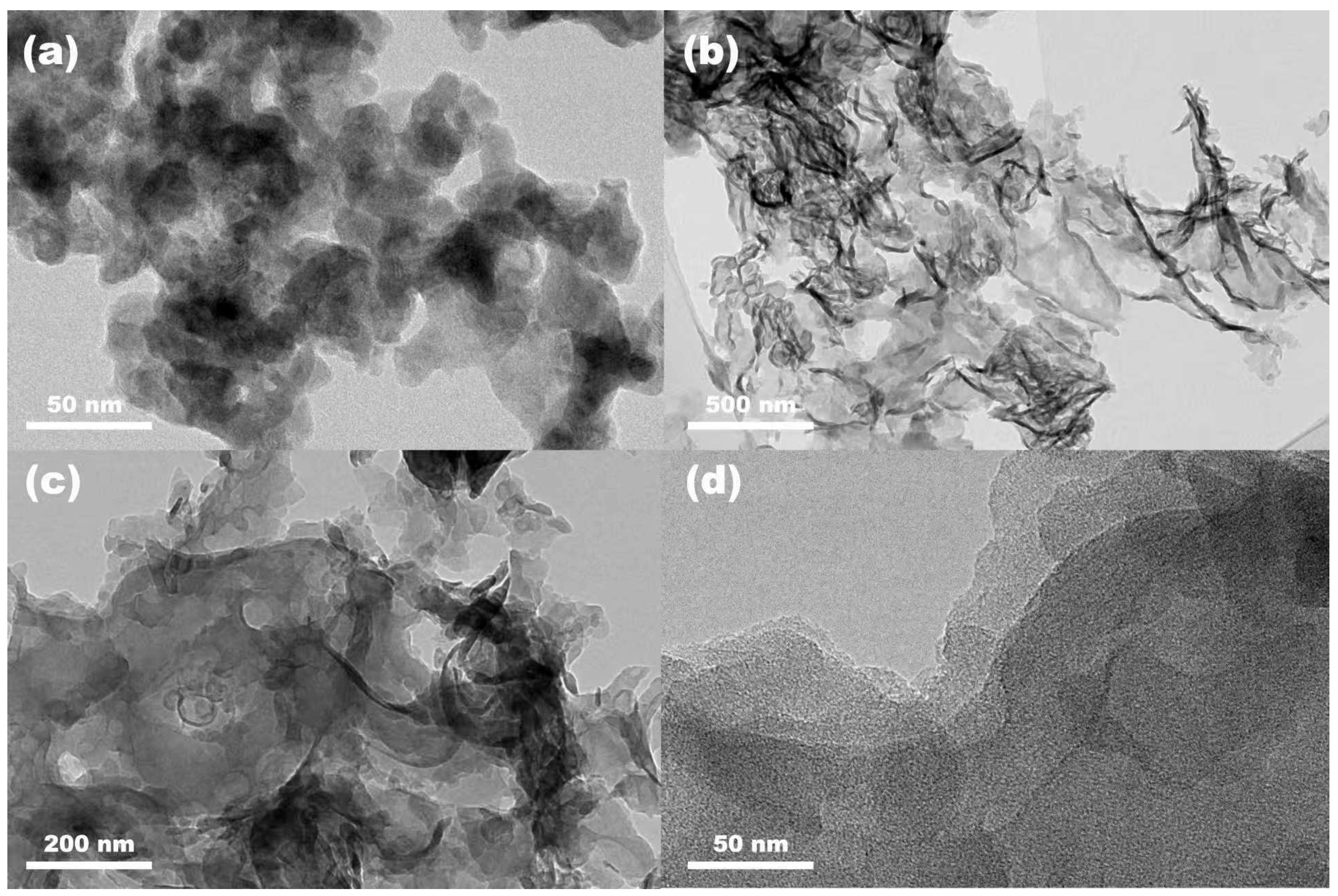
Transmission electron microscopy (TEM) images of 2D-Cu2O, CN, and 2D-Cu2O/CN are shown in Figure 2a–c. CN exhibits a nanosheet structure, and 2D-Cu2O also presents an ultra-thin nanosheet structure. The TEM and high-resolution TEM (HR-TEM) images of 2D-Cu2O/CN are displayed in Figure 2d. It can be observed that the 2D-Cu2O/CN material displays an irregular, sheet-like porous morphology. This morphology indicates that the CN nanosheets and 2D-Cu2O are effectively incorporated within the composite structure.
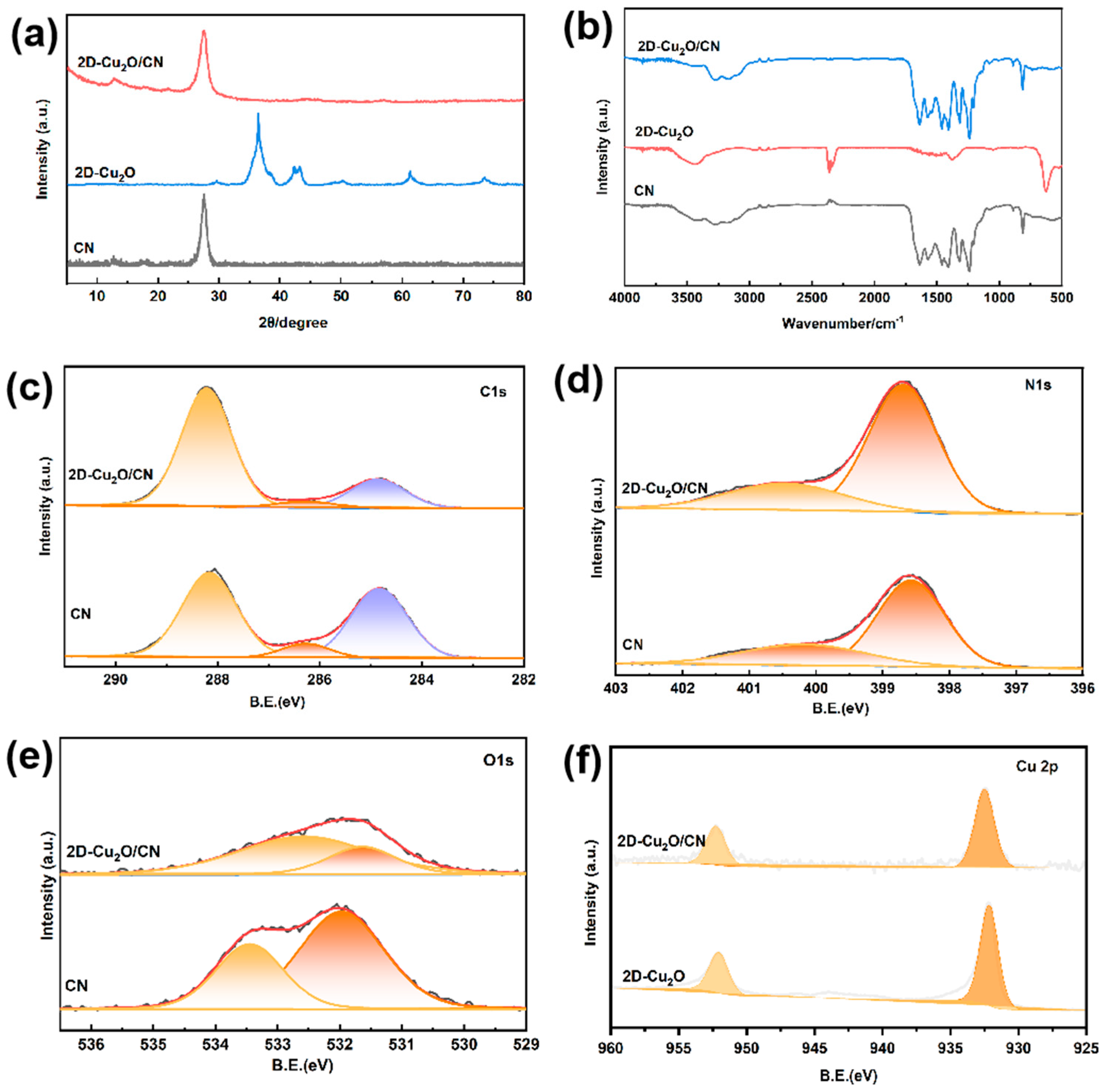
Figure 3a presents the XRD patterns of CN, 2D-Cu2O, and the 2D-Cu2O/CN composite. Pristine CN exhibits characteristic peaks at 13.0° and 27.0°, corresponding to the (100) and (002) planes, which are attributed to the in-plane ordering of triazine units and the interlayer stacking of conjugated aromatic systems, respectively [31]. Notably, 2D-Cu2O shows diffraction peaks at 29.6°, 36.4°, 42.3°, 61.3°, and 73.5°, assigned to the (110), (111), (200), (220), and (311) planes of cubic Cu2O. In the composite, the XRD pattern largely resembles that of CN, indicating that its crystalline framework is preserved after integration with Cu2O. The XRD pattern of 2D-Cu2O/CN after cycling is shown in Figure S1. No significant change is observed, demonstrating its excellent structural stability. FT-IR analysis (Figure 3b) further confirms the structural features of the samples. The 2D-Cu2O/CN spectrum closely resembles that of CN, with a band at 810 cm−1 corresponding to the bending vibration of triazine rings and strong bands between 1100 cm−1 and 1700 cm−1 arising from C–N stretching in the aromatic heterocycles [12]. Notably, the characteristic signals of 2D-Cu2O are not clearly observed in either XRD or FT-IR, likely due to its relatively low loading in the composite, which limits the detectability of Cu2O peaks. These results confirm the successful construction of the 2D-Cu2O/CN heterojunction and further demonstrate that the intrinsic structural framework of CN remains essentially unaltered within the composite.
X-ray photoelectron spectroscopy (XPS) was employed to analyze the composition of tall samples. As shown in Figure 3c, the high-resolution C 1s spectrum can be deconvoluted into three characteristic peaks at 284.2 eV, 286.4 eV, and 288.6 eV, corresponding to C−C, C−O, and N−C=N groups on the CN surface. The N 1 s spectrum (Figure 3d) reveals two distinct peaks at 398.6 eV and 400.2 eV, which are assigned to sp2-hybridized nitrogen in C=N−C and tertiary nitrogen in N−(C)3 groups. For 2D-Cu2O/CN, these N 1 s peaks shift to higher binding energies of 398.7 eV and 400.5 eV. Conversely, in Figure 3e, the O 1 s XPS spectrum of CN shows two peaks at 532.0 eV (C−O) and 533.5 eV (C=O), and these peaks shift to lower binding energies of 531.5 eV and 532.5 eV for 2D-Cu2O/CN [27]. These systematic shifts in binding energy confirm the formation of a heterojunction interface between CN and 2D-Cu2O. Furthermore, the Cu 2p spectrum in Figure 3f confirms the presence of 2D-Cu2O, with characteristic peaks at 952.2 eV and 932.2 eV corresponding to Cu 2p3/2 and Cu 2p1/2 [32].
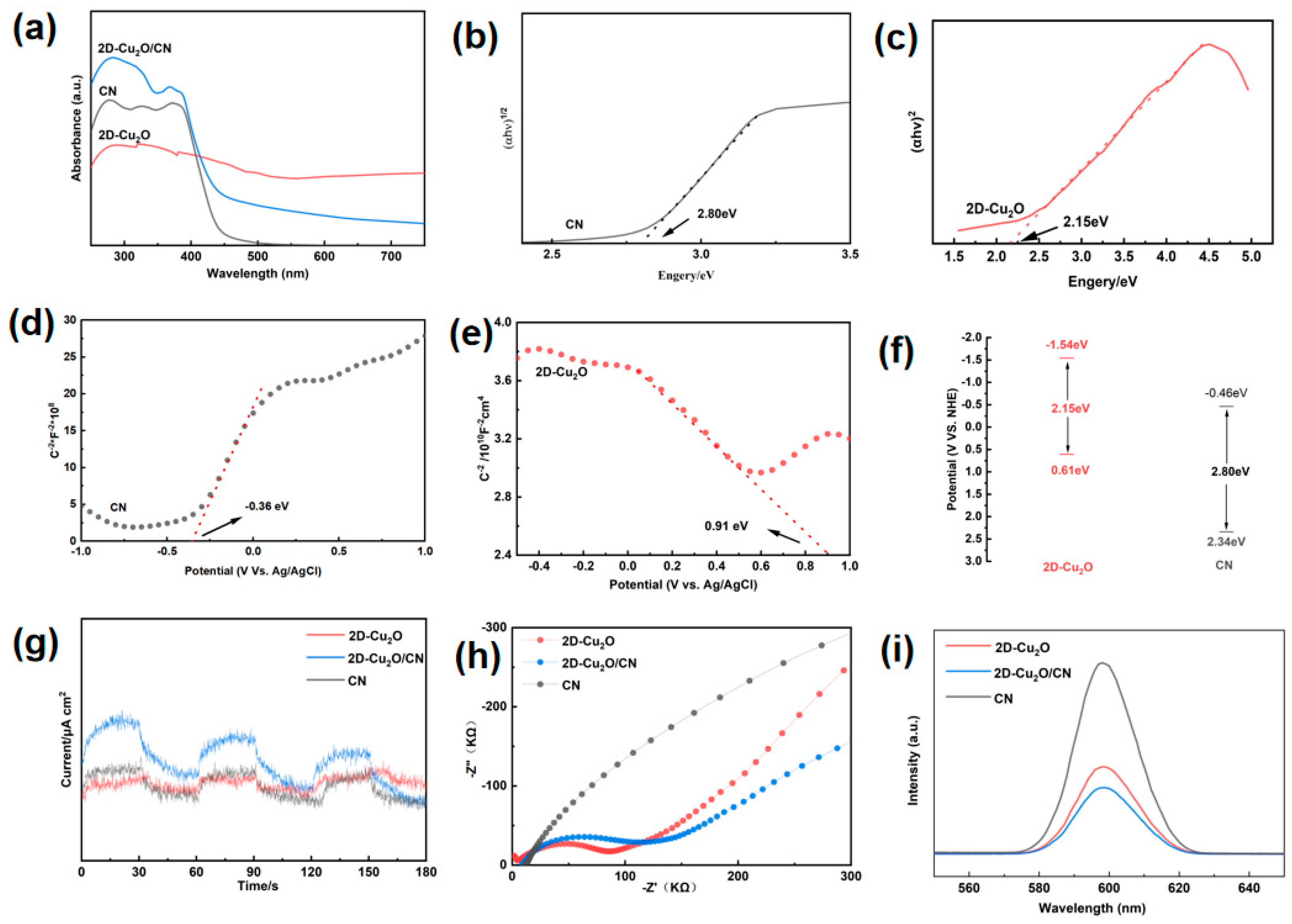
The optical absorption properties of the samples were investigated using ultraviolet-visible (UV-Vis) spectroscopy. As shown in Figure 4a, the 2D-Cu2O/CN heterojunction exhibits markedly stronger absorption across the ultraviolet–visible region compared with pristine CN. In addition, a noticeable red shift in the absorption edge of 2D-Cu2O/CN suggests enhanced light-harvesting capability, which is expected to benefit photocatalytic activity. As shown in Figure 4b,c, the bandgap energies of CN and 2D-Cu2O were determined from the Tauc plots derived from their UV-Vis absorption spectra. The calculated bandgaps are 2.80 eV for CN and 2.15 eV for 2D-Cu2O. To further determine the band edge positions, Mott-Schottky measurements were conducted. As shown in Figure 4d,e, the Mott-Schottky plots of CN and 2D-Cu2O exhibit distinctly different slope characteristics. The positive slope observed for CN confirms its n-type semiconductor behavior, whereas the negative slope displayed by 2D-Cu2O indicates its p-type semiconducting nature. The flat-band potentials of CN and 2D-Cu2O were measured as −0.36 eV and 0.91 eV versus Ag/AgCl, respectively. The Mott-Schottky analysis reveals that both CN and 2D-Cu2O possess comparably high carrier concentrations (~5.1 × 1019 cm−3 for electrons in CN and ~4.5 × 1019 cm−3 for holes in 2D-Cu2O). This comparable magnitude in carrier density provides a fundamental basis for the efficient charge separation and transfer observed in the 2D-Cu2O/CN heterojunction [33]. The flat-band potentials are determined from the Mott–Schottky plots using an Ag/AgCl reference electrode. All potentials are converted to the normal hydrogen electrode (NHE) scale according to the equation: ENHE = EAg/AgCl + 0.197. For n-type semiconductors, the CB potential is generally 0.1–0.3 eV more negative than the flat-band potential. In this work, a constant value of 0.3 eV was adopted as the correction factor for all calculations. Based on this approximation, the CB potential of CN was determined to be −0.46 eV versus the normal hydrogen electrode (NHE) [34]. In contrast, for the p-type semiconductor 2D-Cu2O, the VB potential is approximately equal to its flat-band potential. Therefore, the VB position of 2D-Cu2O is evaluated to be 0.61 eV. Accordingly, the VB potential was determined to be 2.34 eV for CN, and the CB potential was −1.54 eV for 2D-Cu2O. A schematic illustration of the band structures of CN and 2D-Cu2O is provided in Figure 4f, clearly showing the relative positions of the CB and VB for each semiconductor. The favorable band alignment between CN and Cu2O in the heterojunction is expected to facilitate efficient charge separation and transfer, which is crucial for enhancing the photocatalytic performance of the composite. It should be noted that the band-edge positions derived from electrochemical measurements represent thermodynamic reference levels under equilibrium conditions and do not necessarily reflect the effective reduction capability at catalytically active sites during multi-electron CO2 reduction.
The photoelectrochemical properties of the catalysts were further evaluated, and the results are summarized in Figure 4g–i. As shown in Figure 4g, the transient photocurrent responses recorded under successive light-on/off cycles reveal that the 2D-Cu2O/CN heterojunction generates a notably higher photocurrent than the individual components. These results indicate that the composite exhibits excellent capability for generating photogenerated charge carriers as well as efficient charge-transfer behavior. To obtain deeper insight into the interfacial charge-transfer behavior, electrochemical impedance spectroscopy (EIS) measurements were carried out. The Nyquist plots shown in Figure 4h indicate that the 2D-Cu2O/CN sample exhibits a much smaller semicircle radius compared with pristine CN. The reduced arc radius indicates a significant decrease in charge-transfer resistance. Photoluminescence (PL) spectroscopy was used to investigate the behavior of photogenerated electron-hole pairs. As shown in Figure 4i, 2D-Cu2O/CN displays substantially weaker PL emission compared with pristine CN and 2D-Cu2O, indicating that electron–hole recombination is effectively suppressed within the heterostructure. The results align well with the enhanced charge dynamics revealed by photocurrent and EIS measurements.
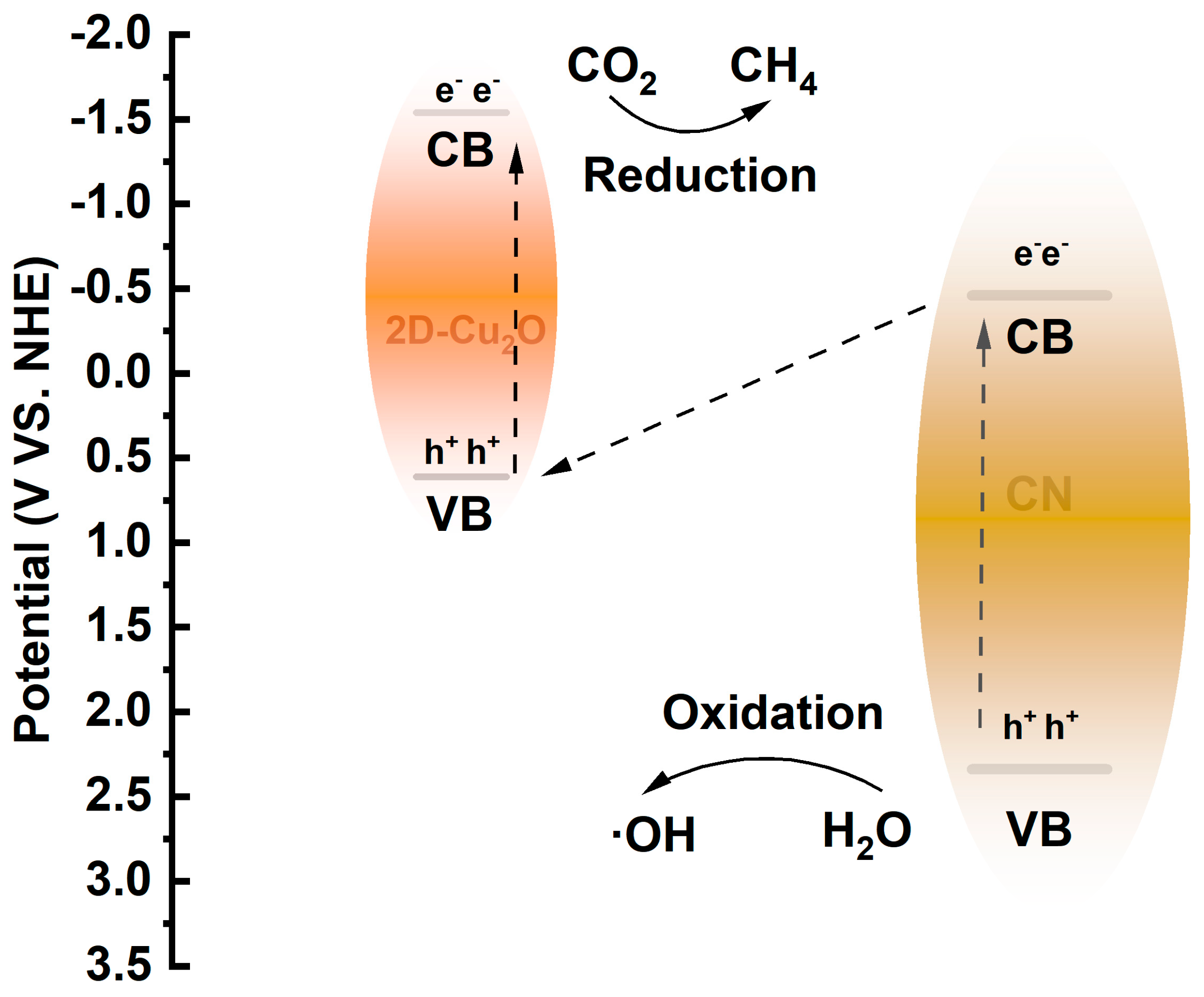
The conduction band (CB) positions of 2D-Cu2O and CN are measured at −1.54 eV and −0.46 eV, respectively, whereas their valence band (VB) positions are 0.61 eV for 2D-Cu2O and 2.34 eV for CN (vs. NHE at pH = 7). The CB edge of 2D-Cu2O/CN is more negative than the reduction potential of the CH4/CO2 couple (−0.24 V vs. NHE), meeting the thermodynamic requirement for CO2 reduction to CH4. Accordingly, a possible Z-scheme mechanism is proposed for the photocatalytic CO2 reduction, as depicted in Figure 5. Upon irradiation with light energy exceeding the bandgaps of both semiconductors, electrons in the VB of 2D-Cu2O are excited to its CB, generating photogenerated holes (h+), while electrons in the VB of CN are similarly excited to its CB, producing corresponding holes and photogenerated electrons (e). The photogenerated e in the CB of CN then migrate to the VB of 2D-Cu2O, where they recombine with the h+. This recombination can facilitate efficient spatial separation of photogenerated charge carriers [35]. Under standard reaction conditions, the Ru(bpy)32+/TEOA system dominates charge generation, while the Cu2O/CN heterojunction primarily functions as an electron-accepting and charge-separating platform.
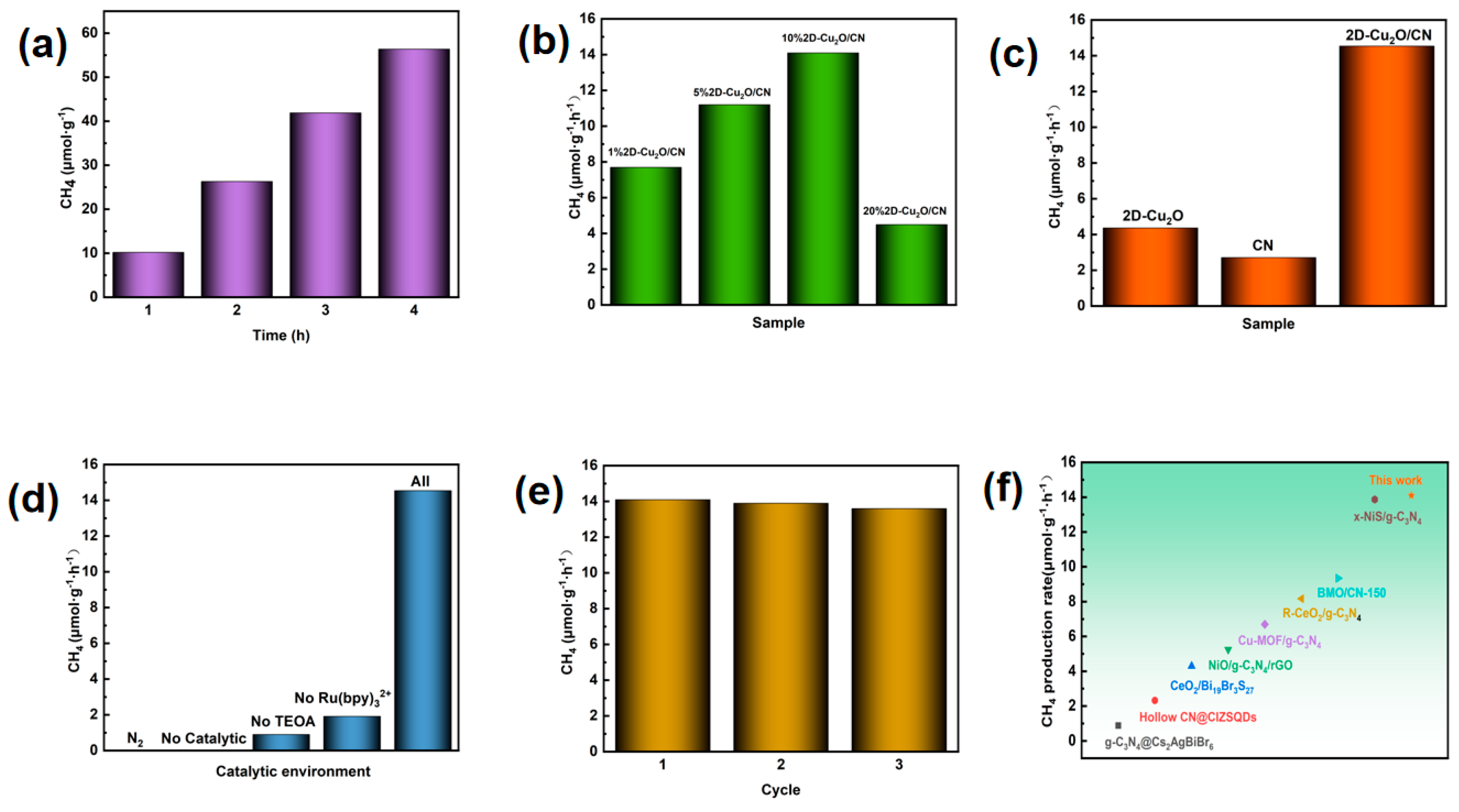
The CO2 reduction performance of the photocatalyst is investigated. Only CH4 is detected, whereas CO or H2 are not observed. Figure 6a presents the time-dependent CH4 production of 2D-Cu2O/CN over a 4 h period, showing a continuous and steady increase in yield throughout the reaction. Figure 6b presents the photocatalytic performance of heterojunctions constructed by loading different amounts of 2D-Cu2O onto CN. The results indicate that the sample containing 10% 2D-Cu2O demonstrates the highest photocatalytic activity for CO2 reduction to CH4. Figure 6c compares the CH4 yield among CN, 2D-Cu2O, and 2D-Cu2O/CN. CH4 yield over 2D-Cu2O/CN reaches 14.1 μmol·g−1·h−1, which is approximately 5.2 times higher than that of CN (2.7 μmol·g−1·h−1) and 2D-Cu2O (4.37 μmol·g−1·h−1). Figure 6d the performance of 2D-Cu2O/CN under different catalytic environments. No product is detected without the catalyst and N2, and 2D-Cu2O/CN maintains a CH4 production rate of 1.92 μmol·g−1·h−1 even in the absence of a photosensitizer, and a rate of 0.9 μmol·g−1·h−1 without TEOA. This result indicates that the heterojunction itself possesses intrinsic photocatalytic activity for CO2 reduction, while Ru(bpy)32+ mainly functions to improve light utilization and interfacial charge injection efficiency. Figure 6e shows that the CH4 production of 2D-Cu2O/CN remains almost unchanged over three consecutive cycles, demonstrating its excellent catalytic stability. Figure 6f compares the performance of 2D-Cu2O/CN with previously reported studies; an improvement in the photocatalytic CO2 to CH4 performance is observed compared with some reported catalysts under similar conditions. Further data are available in the Supporting Information, Table S1.

4. Conclusions

In this work, a 2D-Cu2O/CN heterojunction was successfully fabricated. 2D-Cu2O/CN facilitates the transfer of photogenerated charges from the interior to the surface and improves electron transport efficiency, endowing its excellent activity in photocatalytic CO2 reduction to CH4. Compared with CN, the CH4 yield over 2D-Cu2O/CN is 14.1 μmol·g−1·h−1, approximately 4 times that of CN (2.7 μmol·g−1·h−1). This work proposes an efficient design strategy for CO2 to CH4 photocatalysts, providing a new avenue for the future development of solar-driven carbon conversion technologies.

Supplementary Materials

The following supporting information can be downloaded at: https://www.mdpi.com/article/10.3390/c12010006/s1, Figure S1: The XRD pattern of 2D-Cu2O/CN after cycling; Table S1: A comparison of CH4 production performance among different heterojunctions.

Author Contributions

J.L., X.Z., and J.G.: Data curation, methodology, writing—original draft. X.L.: Supervision. All authors have read and agreed to the published version of the manuscript.

Funding

This work is supported by the National Natural Science Foundation of China (52472257) and the CNPC Innovation Fund (No. 2024DQ02-0311).

Data Availability Statement

The original contributions presented in this study are included in the article/Supplementary Materials. Further inquiries can be directed to the corresponding author.

Conflicts of Interest

There are no conflicts to declare.

References

  1. Kondratenko, E.V.; Mul, G.; Baltrusaitis, J. Status and perspectives of CO2 conversion into fuels and chemicals by catalytic, photocatalytic and electrocatalytic processes. Energy Environ. Sci. 2013, 6, 3112–3135. [Google Scholar] [CrossRef]
  2. Grim, R.G.; Ferrell, J.R., III; Huang, Z.; Tao, L. The feasibility of direct CO2 conversion technologies on impacting mid-century climate goals. Joule 2023, 7, 1684–1699. [Google Scholar] [CrossRef]
  3. Yuan, Z.M.; Zhu, X.L.; Gao, X.Q.; An, C.H.; Wang, Z.; Zuo, C. Enhancing photocatalytic CO2 reduction with TiO2-based materials: Strategies, mechanisms, challenges, and perspectives. Environ. Sci. Ecotechnology 2024, 20, 100368. [Google Scholar] [CrossRef] [PubMed]
  4. Chen, H.; Lu, C.; Liu, F.; Lin, Y.; Chen, C.; Zou, D. Efficiency of CO2 photoreduction to hydrocarbons with K2Fe2O4/rGO heterojunction as a photocatalyst. J. CO2 Util. 2024, 85, 102858. [Google Scholar] [CrossRef]
  5. Gür, T.M. Carbon dioxide emissions, capture, storage and utilization: Review of materials, processes and technologies. Prog. Energy Combust. Sci. 2022, 89, 100965. [Google Scholar] [CrossRef]
  6. Cai, M.J.; Wu, Z.Y.; Li, Z. Greenhouse-inspired supra-photothermal CO2 catalysis. Nat. Energy 2021, 6, 807–814. [Google Scholar] [CrossRef]
  7. Ran, J.; Jaroniec, M.; Qiao, S.Z. Cocatalysts in semiconductor-based photocatalytic CO2 reduction: Achievements, challenges, and opportunities. Adv. Mater. 2018, 30, 1704649. [Google Scholar] [CrossRef] [PubMed]
  8. He, Y.; Yin, L.; Yuan, N.; Zhang, G. Adsorption and activation, active site and reaction pathway of photocatalytic CO2 reduction: A review. Chem. Eng. J. 2024, 481, 148754. [Google Scholar] [CrossRef]
  9. Wang, L.Q.; Si, W.P.; Tong, Y.Y.; Hou, F. Graphitic carbon nitride (g-C3N4)-based nanosized heteroarrays: Promising materials for photoelectrochemical water splitting. Carbon Energy 2020, 2, 223–250. [Google Scholar] [CrossRef]
  10. Vuong, H.T.; Nguyen, D.V.; Phuong, P.; Phan, P.D.; Bao, M.; Ho, N.; Nguyen, H.A. Nitrogen-rich graphitic carbon nitride (g-C3N5): Emerging low-bandgap materials for photocatalysis. Carbon Neutralization 2023, 2, 425–457. [Google Scholar] [CrossRef]
  11. Tang, J.; Guo, C.Y.; Wang, T.T.; Cheng, X.L.; Huo, L.H.; Zhang, X.F.; Huang, C.B. A review of g-C3N4-based photocatalytic materials for photocatalytic CO2 reduction. Carbon Neutralization 2024, 3, 557–583. [Google Scholar] [CrossRef]
  12. Cao, S.; Liu, H.; Jia, Z. Controllable adsorption groups on amine-functionalized carbon nitride for enhanced photocatalytic CO2 reduction. Chem. Eng. J. 2023, 455, 140746. [Google Scholar] [CrossRef]
  13. Michalska, M.; Pavlovsky, J.; Martynkova, G.S.; Kratosova, G.; Hornok, V.; Nagy, P.B.; Novak, V.; Szabo, T. Comparative study of photocatalysis with bulk and nanosheet graphitic carbon nitrides enhanced with silver. Sci. Rep. 2024, 14, 11512. [Google Scholar] [CrossRef]
  14. Ren, F.Y.; Sun, Z.; Ma, T.; Zhang, H.; Wei, M.; Chen, S. Recent research progress in photocatalytic reduction of CO2 using g-C3N4-based heterostructures. Fuel Chem. Technol. 2025, 53, 40–52. [Google Scholar] [CrossRef]
  15. Khan, I.; Sun, Y.S.; Khan, F.; Jing, Z.G.; Kareem, A.; Naseem, M.; Ali, Z. Synthesis, mechanism and environmental applications of g-C3N4 composites: A synergistic approach to adsorption and photocatalysis. Sep. Puri Cation Technol. 2025, 359, 130472. [Google Scholar] [CrossRef]
  16. Sadanandan, A.; Yang, J.; Devtade, V.; Singh, G.; Dharmarajan, N.; Fawaz, M.; Lee, J.; Tavakkoli, E.; Jeon, C.; Kumar, P. Carbon nitride based nanoarchitectonics for nature-inspired photocatalytic CO2 reduction. Prog. Mater. Sci. 2024, 142, 101242. [Google Scholar] [CrossRef]
  17. Mo, Z.; Zhu, X.; Jiang, Z.; Song, Y.; Liu, D.; Li, H.; Yang, X.; She, Y.; Lei, Y.; Yuan, S.; et al. Porous nitrogen-rich g-C3N4 nanotubes for efficient photocatalytic CO2 reduction. Appl. Catal. B Environ. Energy 2019, 256, 117854. [Google Scholar] [CrossRef]
  18. Zhang, F.; Li, Y.H.; Qi, M.Y.; Tang, Z.R. Boosting the activity and stability of Ag-Cu2O/ZnO nanorods for photocatalytic CO2 reduction. Appl. Catal. B Environ. Energy 2020, 268, 118380. [Google Scholar] [CrossRef]
  19. Fu, W.L.; Liu, Z.; Wang, T.Y.; Liang, J.S. Promoting C2+ Production from Electrochemical CO2 Reduction on Shape-Controlled Cuprous Oxide Nanocrystals with High-Index Facets. ACS Sustain. Chem. Eng. 2020, 8, 15223–15229. [Google Scholar] [CrossRef]
  20. Sun, Z.; Wang, H.; Wu, Z.; Wang, L. g-C3N4 based composite photocatalysts for photocatalytic CO2 reduction. Catal. Today 2017, 300, 160–172. [Google Scholar] [CrossRef]
  21. Neaţu, Ş.; Maciá-Agulló, J.A.; Concepción, P.; Garcia, H. Gold-copper nanoalloys supported on TiO2 as photocatalysts for CO2 reduction by water. J. Am. Chem. Soc. 2014, 136, 15969–15976. [Google Scholar] [CrossRef]
  22. Wang, Z.; Zhang, M.; Hu, J. Polymeric carbon nitride loaded with atomic Cu sites for improved CO2 photocatalytic conversion performance. J. Power Sources 2023, 577, 233188. [Google Scholar] [CrossRef]
  23. Bhattacharyya, K.; Mane, G.; Rane, V.; Tripathi, A.; Tyagi, A. Selective CO2 Photoreduction with Cu-Doped TiO2 Photocatalyst: Delineating the Crucial Role of Cu-Oxidation State and Oxygen Vacancies. J. Phys. Chem. C 2021, 125, 1793–1810. [Google Scholar] [CrossRef]
  24. Lee, D.; Satyanarayana, M.; Bhosale, R.; Jo, W.; Tonda, S. Cu–Ni core–shell bimetallic cocatalyst decorated polymeric carbon nitride for highly efficient and selective methane production from photocatalytic CO2 reduction. Appl. Surf. Sci. 2022, 599, 153973. [Google Scholar] [CrossRef]
  25. Li, N.; Li, H.; Xu, C.; Zhou, Z.; Rao, T.; Ji, R.; Lin, S.; Du, J.; Xu, S.; Lyu, S.; et al. Synergistic enhanced activation of peroxymonosulfate by heterojunction Co3O4-CuO@CN for removal of oxytetracycline: Performance, mechanism, and stability. Environ. Res. 2023, 234, 116517. [Google Scholar] [CrossRef] [PubMed]
  26. Fu, J.W.; Yu, J.G.; Jiang, C.J.; Cheng, B. g-C3N4-Based Heterostructured Photocatalysts. Adv. Energy Mater. 2018, 8, 1701503. [Google Scholar] [CrossRef]
  27. Kong, M.D.; Li, P.; Lu, J.; Zhou, J.W.; Wu, J.K.; Xu, J.X.; Lin, H.F.; Wang, H.; Li, Y.Y.; Wang, L. Synergistic spatial charge separation of intimate 2D/2D/2D dual heterojunctions for efficient visible-light photocatalysis. J. Alloys Compd. 2025, 1038, 182769. [Google Scholar] [CrossRef]
  28. Cao, S.W.; Shen, B.J.; Tong, T.; Fu, J.W.; Yu, J.G. 2D/2D Heterojunction of Ultrathin MXene/Bi2WO6 Nanosheets for Improved Photocatalytic CO2 Reduction. Adv. Funct. Mater. 2018, 28, 1800136. [Google Scholar] [CrossRef]
  29. Guan, Z.J.; Pan, J.W.; Li, Q.Y.; Li, G.Q.; Yang, J.J. Boosting Visible-Light Photocatalytic Hydrogen Evolution with an Efficient CuInS2/ZnIn2S4 2D/2D Heterojunction. ACS Sustain. Chem. Eng. 2019, 7, 7736–7742. [Google Scholar] [CrossRef]
  30. Bao, Y.C.; Pan, J.K.; Wu, H.; Zhang, Z.S.; Li, Y.J.; Wang, Z.L.; Hui, T.T.; Yang, B.; Li, J.N.; Hu, H.T.; et al. Designed 2D/2D/2D Bi2WO6/Ti3C2/SnNb2O6 Z-scheme heterojunction via interfacial chemical bond with enhanced photocatalytic activity. J. Alloys Compd. 2023, 948, 169762. [Google Scholar] [CrossRef]
  31. Zhou, D.; Zhang, J.; Jin, Z. Reduced graphene oxide assisted g-C3N4/rGO/NiAl-LDHs type II heterostructure with high performance photocatalytic CO2 reduction. Chem. Eng. J. 2022, 450, 138108. [Google Scholar] [CrossRef]
  32. Li, X.; Sun, Y.; Xu, J.; Shao, Y.; Wu, J.; Xu, X.; Pan, Y.; Ju, H.; Zhu, J.; Xie, Y. Selective visible-light-driven photocatalytic CO2 reduction to CH4 mediated by atomically thin CuIn5S8 layers. Nat. Energy 2019, 4, 690–699. [Google Scholar] [CrossRef]
  33. Sellers, M.C.K.; Seebauer, E.G. Measurement method for carrier concentration in TiO2 via the Mott–Schottky approach. Thin Solid Films 2011, 519, 2103–2110. [Google Scholar] [CrossRef]
  34. Wang, J.M.; Kim, E.; Kumar, D.P.; Rangappa, A.P.; Kim, Y.; Zhang, Y.X.; Kim, T.K. Highly Durable and Fully Dispersed Cobalt Diatomic Site Catalysts for CO2 Photoreduction to CH4. Angew. Chem. Int. Ed. 2022, 61, e202113044. [Google Scholar] [CrossRef]
  35. Zhao, X.; Fan, Y.Y.; Zhang, W.S.; Zhang, X.J.; Han, D.X. Nanoengineering Construction of Cu2O Nanowire Arrays Encapsulated with g-C3N4 as 3D Spatial Reticulation All-Solid-State Direct Z-Scheme Photocatalysts for Photocatalytic Reduction of Carbon Dioxide. ACS Catal. 2020, 10, 6367–6376. [Google Scholar] [CrossRef]
  36. Zhao, Q.Y.; Yin, H.B. Construction of A NiS/g-C3N4 Co-Catalyst-Based S-Scheme Heterojunction and Its Performance in Photocatalytic CO2 Reduction. Catalysts 2025, 15, 599. [Google Scholar] [CrossRef]
  37. Zhu, C.; Zhong, K.; Zhu, B.; Li, S.; Li, H.; Yang, J.; Xu, H. Engineering the S-scheme heterojunction modulating the charge density of the central carbon atom of half-metallic carbon nitride for boosting CO2 photoreduction. Appl. Catal. B Environ. Energy 2025, 371, 125200. [Google Scholar] [CrossRef]
  38. Li, X.; Guan, J.; Jiang, H.; Song, X.; Huo, P.; Wang, H. rGO modified R-CeO2/g-C3N4 multi-interface contact S-scheme photocatalyst for efficient CO2 photoreduction. Appl. Surf. Sci. 2021, 563, 150042. [Google Scholar] [CrossRef]
  39. Sabir, M.; Qiu, G.G.; Yang, S.Y.; Tahir, M. Femtosecond transient absorption spectroscopy investigation on Cu-MOF/g-C3N4 S-scheme heterojunction for photocatalytic CO2 reduction. J. Environ. Chem. Eng. 2025, 13, 119415. [Google Scholar] [CrossRef]
  40. Tao, F.F.; Dong, Y.L.; Yang, L. A NiO/g-C3N4 p-n Heterojunctions Wrapped by rGO for the Enhanced CO2 Photocatalytic Reduction. ACS Sustain. Chem. Eng. 2024, 12, 6709–6718. [Google Scholar] [CrossRef]
  41. Manikandan, M.; Anandharam, E.; Manikandan, E. Engineering NiO/g-C3N4 and NiO/rGO composites for dual applications in electrochemical water splitting and energy storage. Sci. Rep. 2025, 15, 36708. [Google Scholar] [CrossRef] [PubMed]
  42. Wang, X.; Jiang, J.; Xu, Q.; Duan, L.; Guo, H. Understanding inclusive quantum dots hollow CN@CIZS heterojunction for enhanced photocatalytic CO2 reduction. Appl. Surf. Sci. 2022, 604, 154601. [Google Scholar] [CrossRef]
  43. Dong, Y.H.; Pan, A.Z. Fabricating a type II heterojunction by growing lead-free perovskite Cs2AgBiBr6 in situ on graphite-like g-C3N4 nanosheets for enhanced photocatalytic CO2 reduction. Nanoscale 2023, 15, 15619–15625. [Google Scholar]
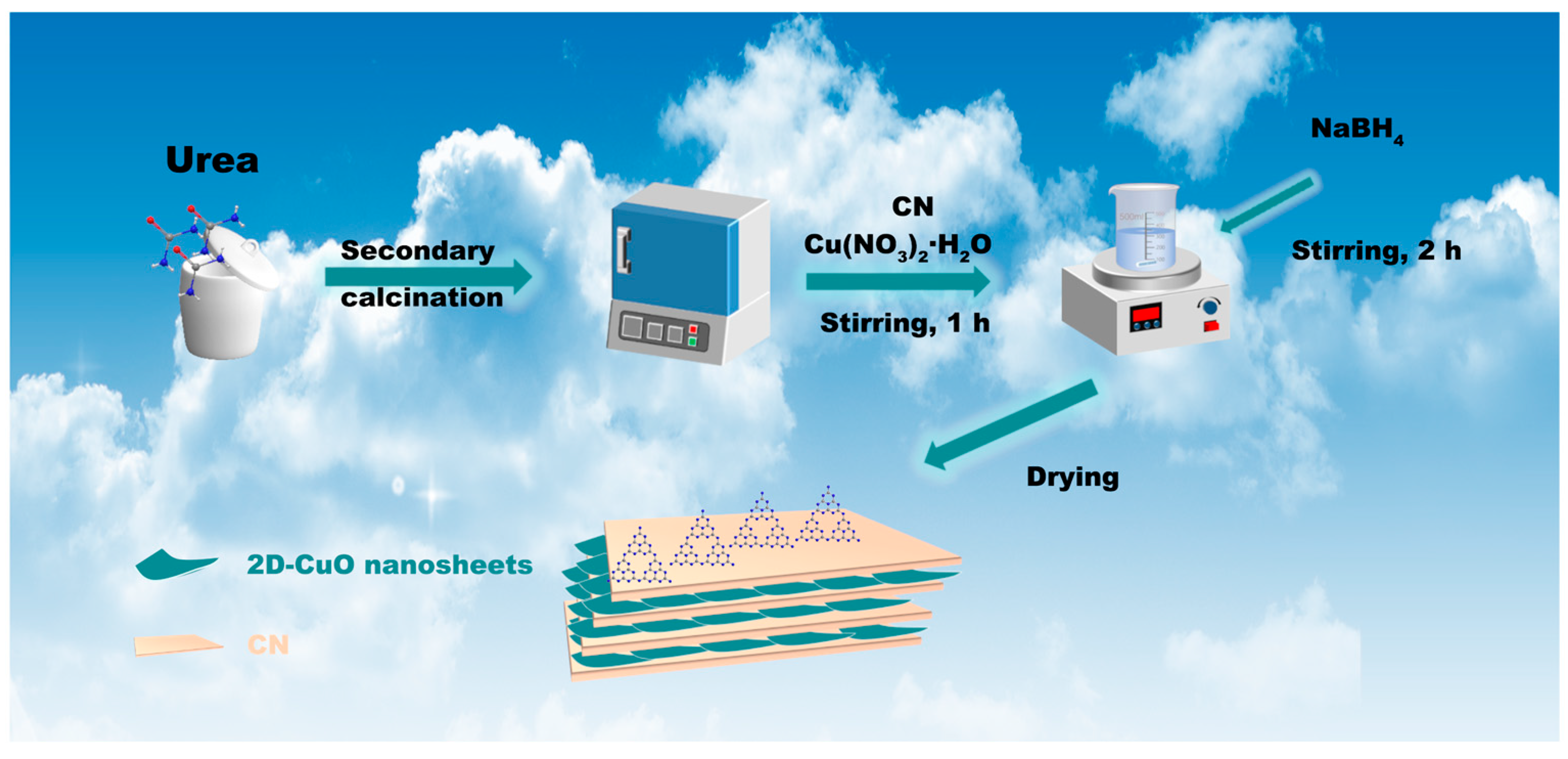
Figure 1. The preparation flowchart of 2D-Cu2O/CN.
Carbon 12 00006 g001
Figure 2. TEM image of (a) 2D-Cu2O, (b) CN and (c) 2D-Cu2O/CN, and (d) HR-TEM of 2D-Cu2O/CN.
Carbon 12 00006 g002
Figure 3. (a) XRD patterns of CN, 2D-Cu2O, and 2D-Cu2O/CN; (b) FT-IR spectra of CN, 2D-Cu2O, and 2D-Cu2O/CN; (cf) the C 1 s, N 1 s, O 1 s, and Cu 2p XPS spectra of CN and 2D-CuO2/CN.
Carbon 12 00006 g003
Figure 4. (a) UV-Vis spectra of CN, 2D-Cu2O, and 2D-Cu2O/CN; (b,c) the Tauc plots of CN and 2D-Cu2O; (d,e) the Mott-Schottky plots of CN and 2D-Cu2O; (f) the schematic band structure of CN and 2D-Cu2O; (gi) are i-t curves, EIS, PL spectra of CN, 2D-Cu2O, and 2D-Cu2O/CN.
Carbon 12 00006 g004
Figure 5. Schematic illustration of the photocatalytic mechanism of 2D-Cu2O/CN.
Carbon 12 00006 g005
Figure 6. (a) Time-dependent CH4 production of 2D-Cu2O/CN within 4 h; (b) the performance profiles of 2D-Cu2O/CN composites with varying 2D-Cu2O loadings; (c) catalytic yield comparison between CN, 2D-Cu2O and 2D-Cu2O/CN; (d) control experiments of 2D-Cu2O/CN under different catalytic conditions; (e) cycling stability test of 2D-Cu2O/CN for CO2 photoreduction; (f) performance comparison of 2D-Cu2O/CN with previously reported catalysts [36,37,38,39,40,41,42,43].
Carbon 12 00006 g006
Disclaimer/Publisher’s Note: The statements, opinions and data contained in all publications are solely those of the individual author(s) and contributor(s) and not of MDPI and/or the editor(s). MDPI and/or the editor(s) disclaim responsibility for any injury to people or property resulting from any ideas, methods, instructions or products referred to in the content.