Article

Bimetallic Catalysts on Activated Carbon for Enhanced NO Reduction

by
Patrícia S. F. Ramalho
,
Olívia S. G. P. Soares
,
José L. Figueiredo
and
Manuel F. R. Pereira
*
LSRE-LCM, ALiCE, Faculty of Engineering, University of Porto, Rua Dr. Roberto Frias, 4200-465 Porto, Portugal
*
Author to whom correspondence should be addressed.
Submission received: 26 December 2025 / Revised: 22 January 2026 / Accepted: 30 January 2026 / Published: 4 February 2026
(This article belongs to the Section Combustion Emissions)

Abstract

Reducing emissions of nitrogen compounds represents a significant challenge in environmental protection, and catalytic treatment is an effective approach. Carbon-based catalysts offer a promising alternative by exploiting the redox properties of carbon materials and eliminating the need for external reducing agents. In this study, nitrogen-free and nitrogen-doped activated carbons were used for NO reduction. The catalysts were developed by incorporating transition metals (Cu and Fe), alkali metals (K), and bimetallic Cu-K formulations. The addition of K to Cu and the presence of nitrogen functionalities improved the catalytic performance and an optimum Cu/K ratio was identified. The best-performing catalyst, AC_M_BM@5Cu5K, achieved 100% NO conversion at 410 °C, producing mainly N2 and CO2, while N2O was detected as an intermediate and CO was not observed. The catalyst’s stability was evaluated in a 100 h continuous test at 376 °C, during which the catalyst maintained approximately 90% NO conversion for 40 h before deactivation. The deactivation mechanism is discussed in detail.

Graphical Abstract

1. Introduction

Air pollution is a major environmental challenge due to the continuing global expansion of industrial development. Nitrogen oxides are recognised as the most harmful pollutants emitted into the air from the burning of fossil fuels in industry, including transport industries [1,2].
N2O is present alongside NOx in the flue gases of various industrial processes. While it is not a primary component of exhaust gases, N2O is recognised as an intermediate in NO reduction and is generated as a by-product in some NOx reduction methods [3,4].
The removal of NO has been extensively studied due to its role as a major contributor to acid rain, photochemical pollution, and ozone formation [5]. Numerous techniques have been devised to mitigate air pollution, such as catalytic oxidation, photochemical processes, adsorption, and selective catalytic reduction (SCR) [6,7].
The most common conventional method for reducing NOx emissions is selective catalytic reduction with ammonia (SCR-NH3), using ammonia as the reducing agent. Industrial catalysts commonly consist of vanadium oxide uniformly dispersed on TiO2, with WO3 or MoO3 incorporated as promoters to enhance the catalytic activity [8,9]. However, despite widespread use, some problems persist with this catalyst. For example, vanadium compounds exhibit significant toxicity to both human health and the environment. Furthermore, the catalyst operates within a restricted temperature range, is prone to N2O formation, and exhibits low thermal stability [10,11].
Due to their unique properties, including excellent chemical stability, high porosity, and a large specific surface area, carbon-based catalysts have emerged as promising candidates for use in environmental remediation applications [12,13,14]. These catalysts are widely used in numerous applications, such as the removal of pollutants from air and water, the degradation of organic pollutants, and photocatalytic processes [15,16,17,18]. In addition, carbon materials can serve as effective support materials whose catalytic efficiency can be enhanced by tailoring their properties [10,15].
In these systems, activated carbon plays a dual role, acting as a support for metal deposition while also participating as a reductant during NO reduction, which may lead to gradual carbon consumption and catalyst deactivation. In addition to its textural properties, the surface chemistry of carbon materials is crucial, since surface functional groups can influence NO adsorption and activation. Under reaction conditions, a carbon surface may undergo oxidation, leading to the formation of oxygen-containing functional groups. Therefore, the oxygen balance during NO reduction may involve not only gaseous products such as CO2, but also the accumulation of oxygenated surface species on the carbon framework, which can further contribute to deactivation and long-term performance changes [19].
The use of carbon materials for abatement has stimulated interest in investigating the interaction between nitrogen oxides and carbon-based materials. Activated carbon alone is capable of NOx reduction to N2 without the need for an external reduction agent, although it requires temperatures in excess of 500 °C, and the efficiency of the reaction is strongly influenced by the surface properties and pore structure of the carbon material [20,21]. The required temperature can be significantly reduced by incorporating metals such as Co, Cu, Ni, or Fe [15,22,23,24,25]. In this context, the choice of Cu, Fe, and K in the present work was motivated by their reported relevance in NO reduction over carbon-based catalysts. Copper is widely recognised for its redox capability and high catalytic activity, often enabling NO conversion at lower temperatures [15,26]. Iron was selected as an additional transition metal for comparison, since it has also been investigated for NO reduction, but typically exhibits lower activity than Cu [26]. In addition, potassium has been reported as an effective promoter due to its influence on surface basicity and NO adsorption/activation, and its combination with Cu may lead to synergistic effects in NO reduction [27,28,29].
Bailón-García et al. [26] investigated the activity of carbon xerogels doped with metallic elements (Fe, Co, and Cu) for NO reduction. Their results showed that the efficiency of NO conversion is dependent on the type of metal that is used. Among the catalysts tested, those containing copper showed superior catalytic performance. A previous study [15] focused on the preparation of activated carbons with modified chemical and textural properties, which were evaluated in selective catalytic reduction. The results showed that the incorporation of copper is critical for efficient NO reduction, and nitrogen doping significantly improves the catalytic activity of carbon materials. The catalytic performance is influenced by the initial oxidation state of the metal, its affinity for NO, and its redox behaviour, including its tendency to be oxidised by NO and the subsequent reduction of the oxide by carbon [20]. This shows that, in a NO–carbon reaction, the metal is involved in a redox process in which it is oxidised by NO and then reduced by carbon.
Potassium has been found to affect the behaviour of carbon in NOx reactions [28,30,31]. Illán-Gómez et al. [22,27] have studied the use of potassium in combination with metals, such as Ni, Co, Cu, and Fe, to improve NO reduction. Their results have demonstrated that bimetallic potassium catalysts (KNi, KCo, KFe, and KCu) enhance the effectiveness of NOx reduction. Feng et al. [28] reported that potassium acts as a highly effective enhancer for CuO for facilitating NO removal through AC.
Recent research has continued to validate these strategies. A study on Cu–Al catalysts impregnated with potassium revealed that K significantly improves CO-assisted NO and N2O reduction, achieving high selectivity to N2 at reduced temperatures—underscoring the relevance of K-promoted Cu systems for lowering operational temperatures [32].
Additionally, a comprehensive review of potassium promotion in flue gas abatement systems confirmed that K enhances catalyst basicity, promotes N2O decomposition, stabilises active centres, and improves redox properties—confirming the broad relevance of K in carbon-based NOx catalysts [29].
This work presents a systematic study aimed at enhancing NO reduction over what is achieved by activated carbon-based catalysts by optimising the metal loading and developing mono- and bimetallic formulations based on Cu and K, including nitrogen-doped carbon supports. The novelty of this study lies in the identification of an optimal Cu/K combination that enables complete NO conversion at lower temperatures, along with a comprehensive assessment of catalyst durability. In addition to catalytic activity screening, a long-term stability test (100 h) was performed and the deactivation mechanism was investigated in detail, providing insight into the roles of carbon consumption and surface chemistry evolution under reaction conditions.

2. Materials and Methods

2.1. Preparation of Catalysts

A Norit Gac 1240 W commercial activated carbon sample (sample AC) and a N-doped activated carbon sample (sample AC_M_BM) were used as the supports. Additional information on the preparation process is available in reference [15]. Aqueous solutions of Cu(NO3)2·3H2O (99.5%), Fe(NO3)3·9H2O (98%), and KNO3 (99%) were used to prepare the Cu, Fe, and K catalysts by the incipient wetness impregnation technique. Following impregnation, the samples were subjected to drying at 100 °C and then thermally dried under a N2 flow for 4 h.

2.2. Characterisation of Materials

The textural properties of the catalysts were analysed by N2 adsorption at −196 °C using a Quantachrome NOVA 4200e multistation instrument (Quantachrome Instruments, Boynton Beach, FL, USA). The specific surface area was calculated by the Brunauer–Emmett–Teller (BET) method.
The surface chemistry was characterised by an XPS analysis following the experimental procedures described in previous studies [16]. A thermogravimetric analysis (TGA) was performed using a STA 409 PC/4/H Luxx Netzsch thermal analyser (Netzsch, Selb, Germany), as described elsewhere [33].
The metal concentration in the samples was measured using Inductively Coupled Plasma Optical Emission Spectrometry (ICP-OES) with an ICPE-9000 spectrometer (Shimadzu, Auckland, New Zealand).
The morphology was observed by TEM scanning/transmission electron microscope (S/TEM) using a Thermo Fisher Scientific model Talos F200X (Thermo Fisher Scientific, Waltham, MA, USA, University of Malaga, Spain). The acceleration voltage was 200 kV and we used the equipment in STEM-HAADF mode for the EDX composition maps. HAADF means High-Angle Annular Dark Field and references the detector capturing the electrons diffracted at a high angle by the sample.

2.3. Catalytic Tests

A fixed-bed U-shaped microreactor with 200 mg of catalyst was used for the catalytic tests. NO reduction was performed at a total flow rate of 100 cm3 min−1, with a NO concentration of 1000 ppm in He. The reaction temperature was ramped from 100 °C to 460 °C at a rate of 3 °C min−1. The NO, NO2, and NOx concentrations were monitored using a Thermo Fisher Scientific NO-NO2-NOx analyser. For each specific experiment, the reaction products were analysed by gas chromatography (GC) with an Inficon Micro GC Fusion system equipped with two columns (Rt-Molsieve 5A and Rt-Q-Bond) and two thermal conductivity detectors, with He as the carrier gas. The Rt-Molsieve 5A column detects N2, NO, and CO, while the Rt-Q-Bond column is used for N2O and CO2.

3. Results

3.1. Materials Characterisation

The N2 adsorption–desorption isotherms at −196 °C were determined to evaluate the textural properties of the activated carbon samples. The representative N2 adsorption–desorption isotherms for selected samples are provided in the Supplementary Information. The results obtained for the different prepared samples are presented in Table 1.
Table 1 shows that the commercial activated carbon (AC) exhibited the highest surface area, SBET = 834 m2 g−1, while the AC_M_BM sample had a lower surface area, with SBET = 647 m2 g−1. This decrease can be attributed to the disruption of some micropores originally present in the AC during milling, coupled with the introduction of the nitrogen precursor, which partially restricted nitrogen access to the pores [15,34].
Furthermore, the impregnation with metal species led to an additional decrease in both the surface area and pore volume, due to the partial pore blockage by the copper and potassium [15,16]. A detailed comparison of micropore volume (Vmicro) and mesopore surface area (Smeso) across the samples shows that the micropores were more significantly affected by the treatments, particularly after metal incorporation. These structural changes reduced the accessibility to the porous network and may have influenced the dispersion of active phases, ultimately impacting the catalytic performance.
The metal content determined using ICP-OES for each sample is listed in Table 2.
Using the ICP-OES technique, it was found that samples prepared with copper (Cu) and a combination of copper and potassium (CuK) reached the desired amount of metal, as shown in Table 2. For example, the AC designation @10Cu means that the AC was subjected to impregnation with a solution containing 10% (wt.%) Cu; the analysis demonstrates the presence of 9.9% Cu.
The analysis of the surface composition by XPS (Table 2) showed inferior results to those obtained by ICP-OES. This is because the XPS technique provides specific information about the elemental composition and chemical bonding of surface atoms of materials, to a depth of up to 5–10 nm. This result revealed that the distribution of the metallic phase on the AC surface was not homogeneous, and the metal may have been concentrated in the internal porous structure. Regarding the N-functionalities, the pyridine (N6), pyrrole (N5), and quaternary groups (N-Q) are the characteristic structures typically observed in carbon-based materials [33]. An increase in the nitrogen content was observed in the N-doped sample, as expected (N, XPSAC_M_BM@10Cu = 5.5%; N, XPSAC_M_BM@5Cu5K = 5.2%).

3.2. Catalyst Testing Results

3.2.1. Catalytic Reduction of NO on Activated Carbons with Different Metals

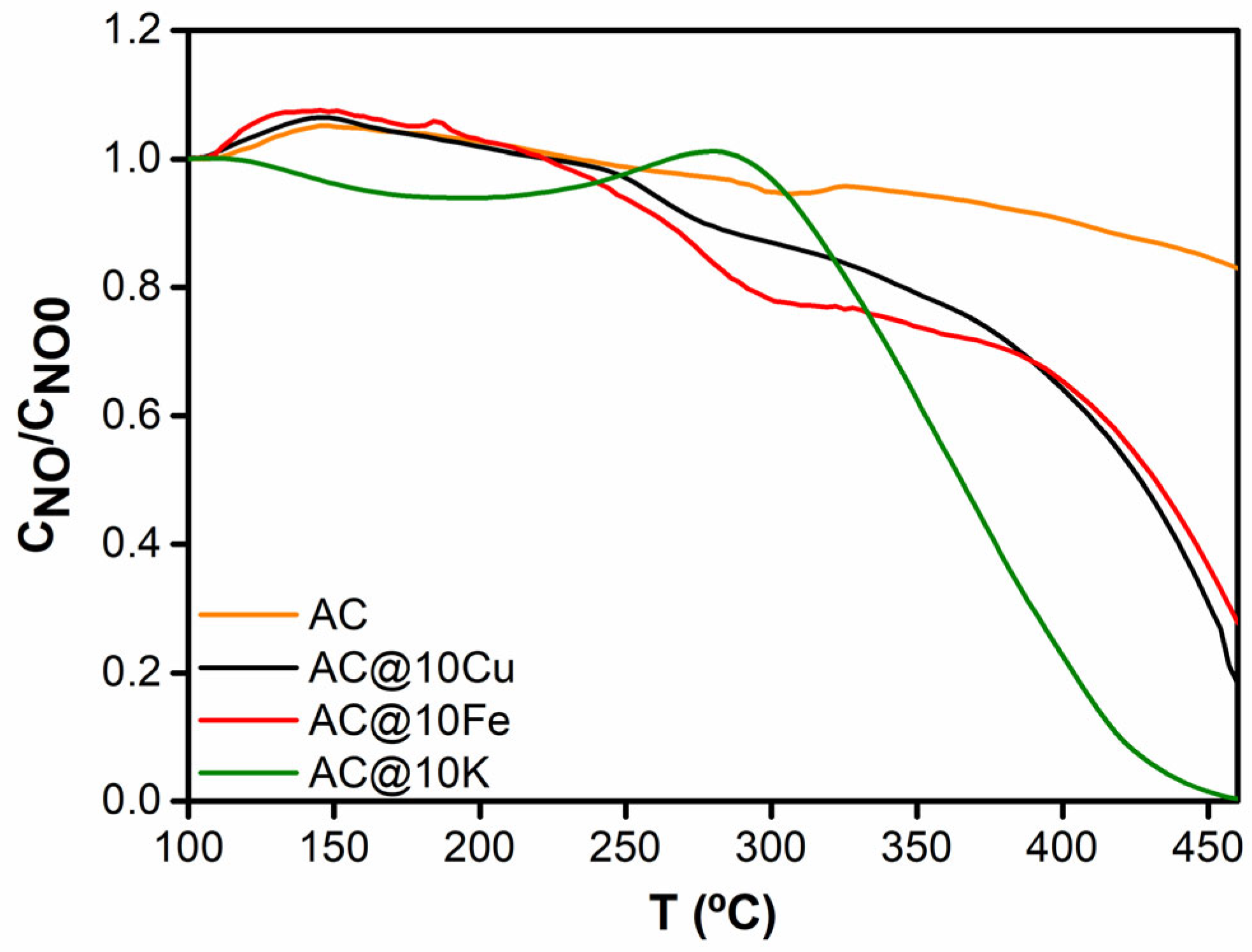
The effect of the different metals supported on the commercial AC on the catalytic NO reduction was assessed in light-off experiments from 100 °C to 460 °C, as represented in Figure 1.
When the catalytic test starts, there is a release of NO adsorbed on the catalyst during the pre-treatment at 100 °C, resulting in an initial concentration of NO at the reactor exit that exceeds that initially supplied [15].
In a previous work [15], the AC showed no significant catalytic activity until the temperature reached 460 °C (XNO, AC = 17%). For comparison, the NO conversion profile of AC is included in Figure 1. Figure 1 shows that the incorporation of a metal phase into a carbon material enhances the catalytic activity, indicating the need for a metal phase for effective NO reduction. Metal-supported catalysts exhibit different levels of NO conversion. AC@10Fe showed the lowest NO conversion (XNO, 460°C = 72%), followed by AC@10Cu, with a NO conversion of 82% at 460 °C, while the AC@10K catalyst demonstrated the highest catalytic performance, achieving a NO conversion of 100% at 460 °C, which are in agreement with the results reported in the literature [26,28,35,36]. Bailón-García et al. [26] explored the catalytic reduction of NOx using transition metals (Fe, Cu, and Co) in the carbon support and found that copper exhibited the highest activity among the metals tested, while iron showed the lowest. Feng et al. [28] investigated how potassium, copper, and the combination of the two elements affect the catalytic reduction process of nitrogen oxide (NO), and observed that potassium resulted in a higher catalytic activity than copper when the process occurred at a temperature of 300 °C (XNO, K/AC = 74%; XNO, Cu/AC = 50%). In our work, activated carbon containing 10% potassium (%wt.) exhibited promising catalytic activity for NO reduction, in spite of having a lower surface area (SBET = 681 m2 g−1) than AC@10Cu (SBET = 768 m2 g−1), revealing that the nature of the metals plays a more relevant role than the surface area, prompting further exploration of bimetallic catalysts.

3.2.2. Catalytic Reduction of NO on Activated Carbon-Based Bimetallic Catalysts

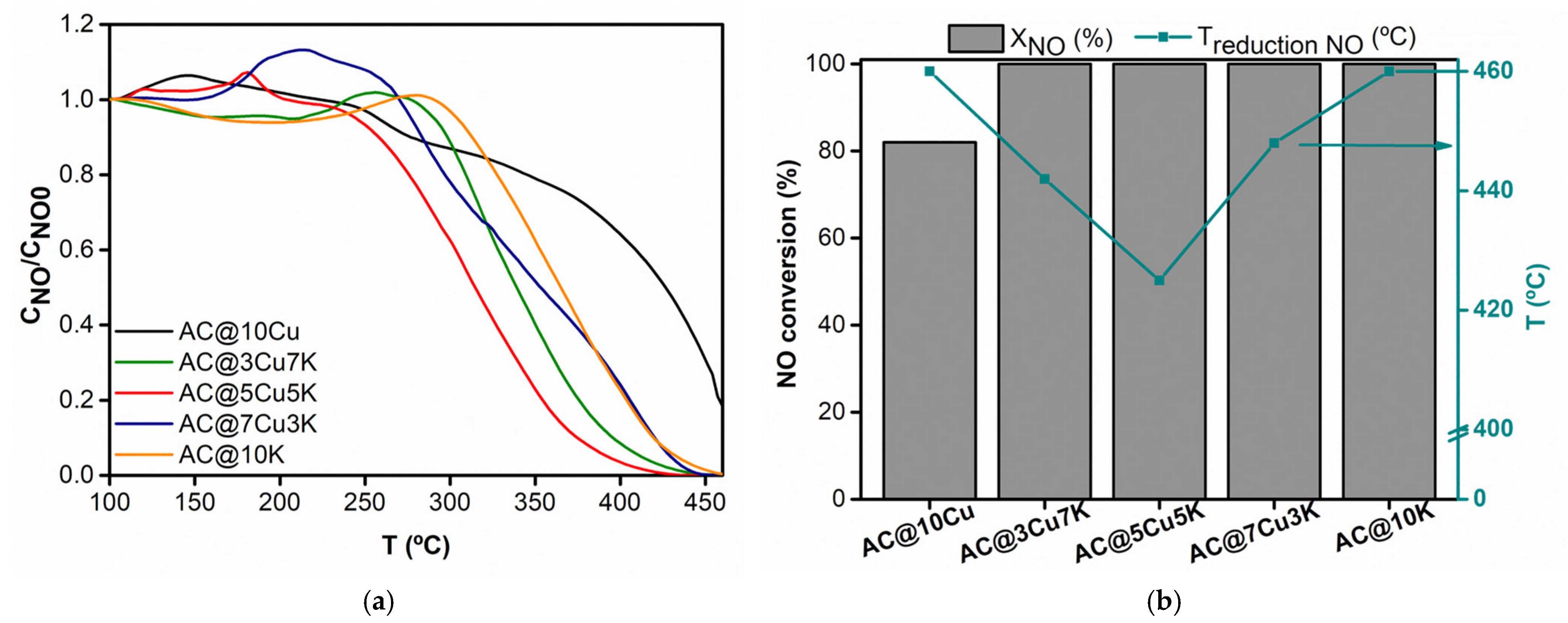
Considering that potassium and copper performed well in the catalytic reduction of NOx, the combination of these two metals was evaluated to further enhance their catalytic properties. Different combinations of copper and potassium were investigated, keeping the total metal concentration constant (10%), as shown in Figure 2.
Figure 2 shows that coupling potassium and copper in the carbon material increased the catalytic performance, as expected. Various combinations of copper and potassium resulted in complete NO conversion. The temperature required for the complete conversion of NO (T 100%) varied according to the proportion used, increasing in the sequence AC@5Cu5K < AC@3Cu7K < AC@7Cu3K (with values of T = 425 °C, 442 °C, and 448 °C, respectively). Ramalho et al. [15] found that the Cu content influences the catalytic activity of NO removal. At 460 °C, AC@5Cu (activated carbon impregnated with 5 wt.% Cu) achieved 50% NO conversion, which improved to 82% with the addition of 10 wt.% Cu in AC@10Cu, but decreased for Cu contents of 15 and 20 wt.%, indicating that there is an optimal metal content for the conversion of NO.
When K was added to Cu, there was an increase in the catalytic performance, resulting in NO conversions of 100%, with AC@5Cu5K achieving complete conversion at a temperature of 425 °C. Feng et al. [28] also observed that adding K to Cu on activated carbon enhances the catalytic activity and reported the existence of an optimal K content to achieve improved performance.
This synergistic effect may be attributed to the promoter role of potassium, which can modify the surface basicity and enhance NO adsorption/activation, facilitating NO conversion at lower temperatures. In addition, potassium may influence the redox behaviour of copper species and improve the overall efficiency of a Cu-based catalytic cycle, contributing to higher NO conversion and improved performance compared to monometallic systems [29,32].

3.2.3. Catalytic Reduction of NO on N-Doped Activated Carbon-Based Catalysts

A previous work [15], focused on assessing the impact of various support functionalisation’s on NO reduction, showed that the best catalyst was that with N-containing surface groups.
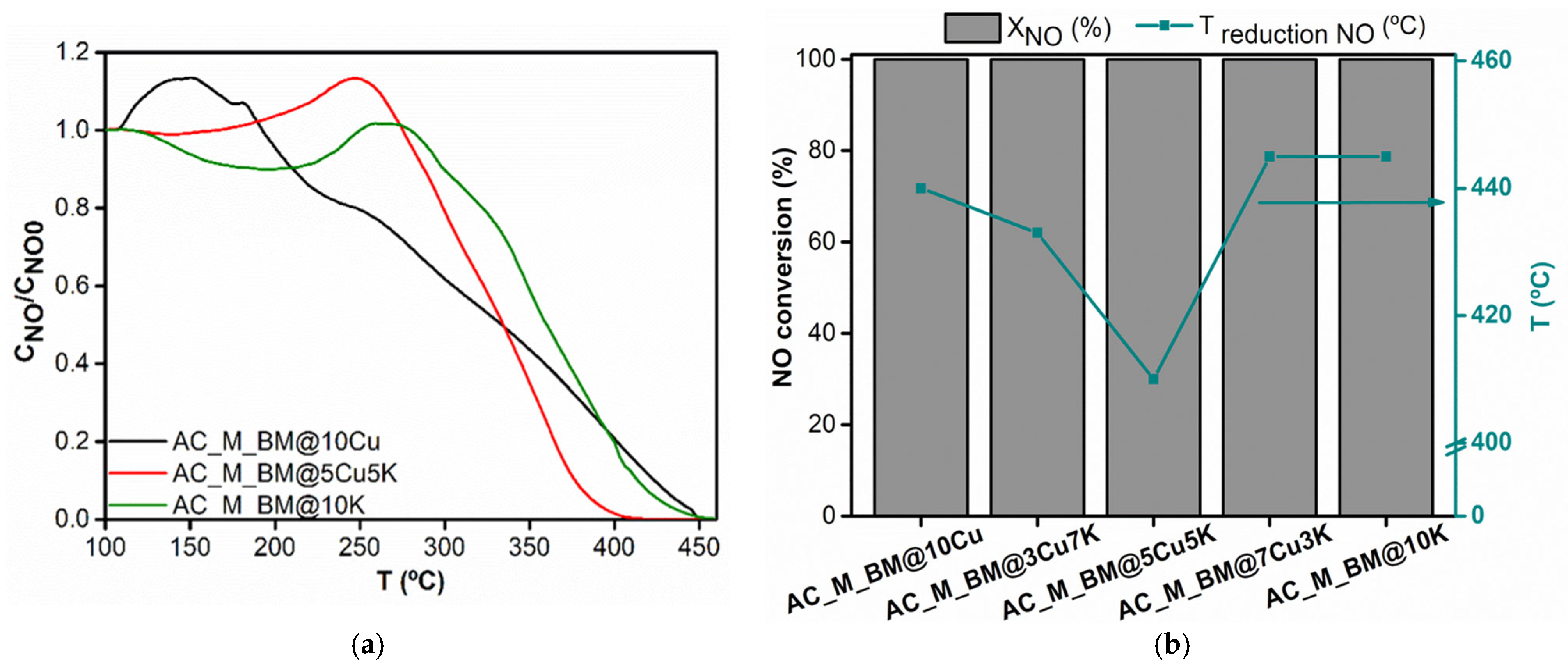
Therefore, catalysts supported on N-doped carbons were developed and tested, as can be seen in Figure 3.
Compared to materials without nitrogen (Section 3.2.2), NO reduction starts at lower temperatures due to the presence of nitrogen groups on the carbon supports. These groups can interact with NO, facilitating the formation of nitrogen [15,37,38].
The improved performance observed with nitrogen doping may be attributed not only to an increased intrinsic reactivity of the carbon framework, but also to enhanced metal–support interactions promoted by the nitrogen-containing surface sites. In this context, nitrogen functionalities may facilitate NO adsorption/activation, while simultaneously contributing to improved stabilisation of the active metal phase on the carbon surface. Although metal dispersion was not directly quantified in this study, the catalytic trends are consistent with the combined contribution of these effects [15,37,38].
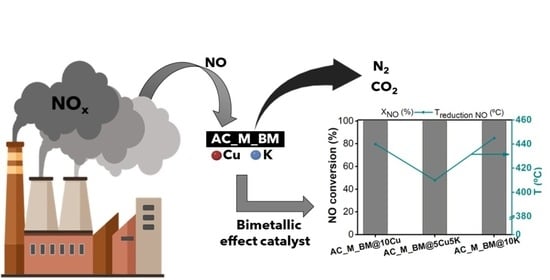
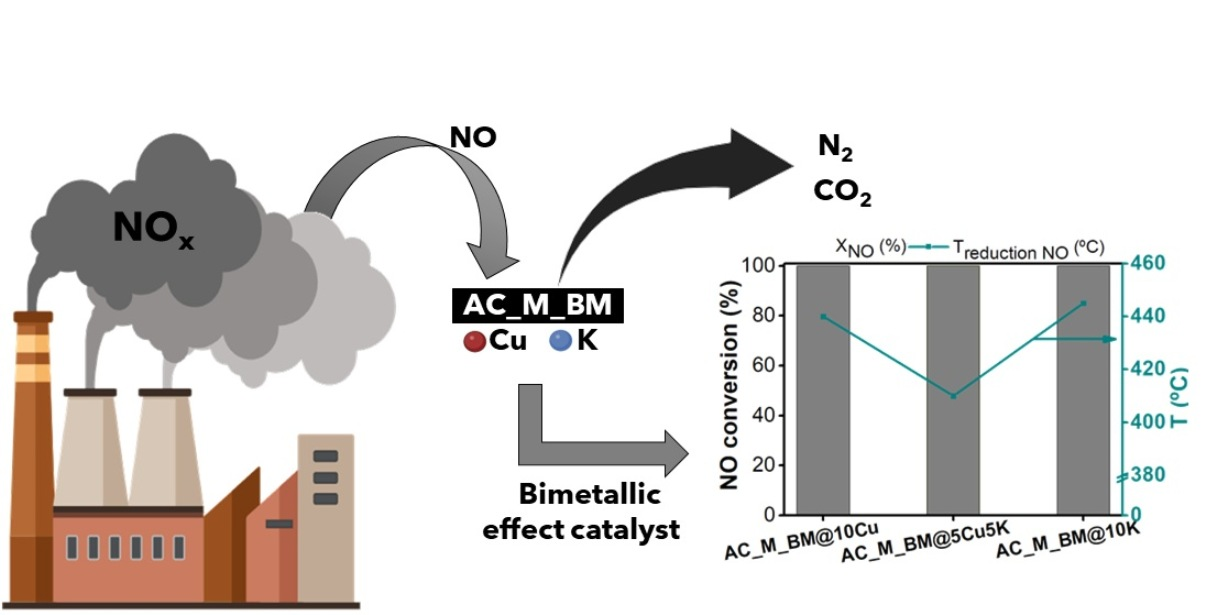
Analysing Figure 3, all the samples showed NO conversions of 100%. The AC_M_BM@10K sample achieved NO reduction at T = 445 °C and the AC_M_BM@10Cu and AC_M_BM@5Cu5K samples achieved 100% conversion at lower temperatures (T = 440 °C and 410 °C, respectively).
The catalysts’ performance at reducing NO is directly linked to the chemical composition of their surfaces, especially the presence of nitrogen groups, which play a fundamental role in the conversion of NO into N2 during the reaction [15,37,39,40,41]. Wang et al. [5] demonstrated that N-6 (N-pyridine) sites are highly active in the direct catalytic decomposition of NO at 500 °C in N-doped carbon materials; in the absence of this doping, the carbon catalyst showed a NO conversion of less than 10%. Lin et al. [42] studied the effects of nitrogen doping precursors and additives on the selective catalytic NOx reduction (SCR) on modified activated carbons, observing that N-doped activated carbon showed a higher conversion of NOx (66%) than the other catalysts tested.
Furthermore, Li et al. [31] reported that N-doped porous biochar exhibited an impressive NOx conversion of 82% at 260 °C, highlighting the crucial role of N-6 groups in enhancing denitrification activity. On the other hand, the N-doped ACM-5 catalyst with a KHCO3 promoter demonstrated a higher NOx conversion (52%) compared to the other reported nitrogen-doped carbon catalysts (30%). In contrast, undoped activated carbon only showed 10% NOx conversion [43].

3.2.4. Assessment of Products Formed During NO Reduction over AC_M_BM@5Cu5K

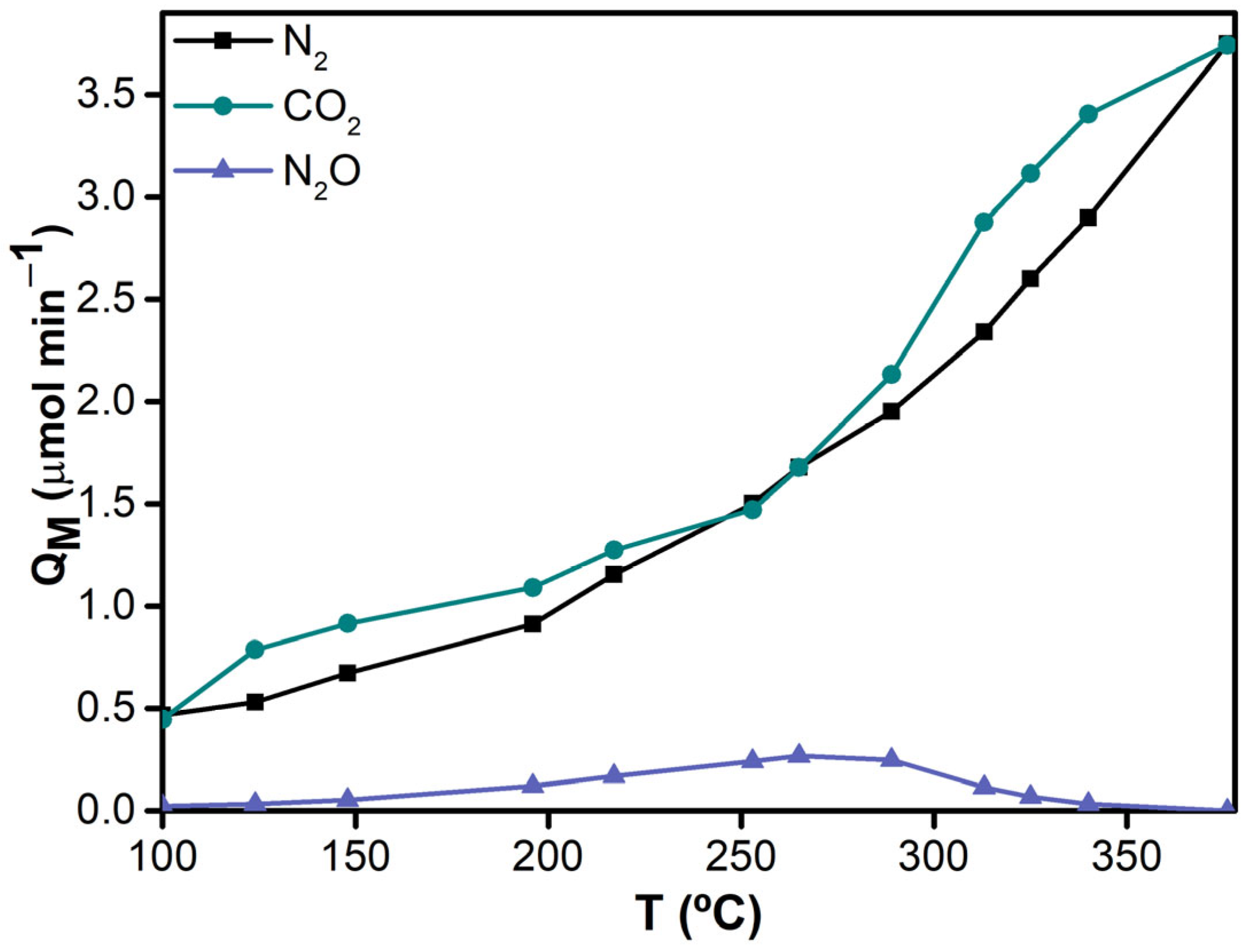
Figure 4 shows the products generated by the catalytic reduction of NO over AC_M_BM@5Cu5K. The catalytic tests were carried out up to 376 °C; this temperature was specifically selected with the strategy of achieving a conversion of 90% prior to carrying out the stability test.
During this process, NO can be converted into different products (Figure 4), depending on the reaction conditions. Under the studied conditions, the main reaction pathway can be described as follows [24]:
2 N O + C N 2 + C O 2
The results presented in Figure 4 show that, as the reaction temperature increased, the production of CO2 and N2 increased. However, the amount of CO2 was always slightly higher than that of N2. Furthermore, small amounts of N2O were formed during the reaction. However, at higher temperatures, N2O tends to decompose into N2, thus reducing its quantity [44].
Moreover, throughout the catalytic tests, no carbon monoxide (CO) was detected in the effluent gas stream under the studied experimental conditions. Therefore, CO2 was the dominant carbon-containing product, which is thermodynamically favoured, indicating that Equation (1) is mainly responsible for the observed products.
When carrying out the reaction balance, it was observed that 3.74 µmol of N2 and 3.75 µmol of CO2 were generated from 7.40 µmol of NO at 376 °C. This shows that the conversion of NO into the desired products was effective.
Xue et al. [45] investigated NO reduction by AC with a Cu catalyst, where only N2 and CO2 were detected as the products. However, they also found that the concentration of CO2 was higher than that of N2.
These results indicate that carbon consumption occurred during the reaction, consistent with the formation of CO2, and this contributes to catalyst deactivation, as discussed in the Stability Test section.

3.2.5. Stability Test

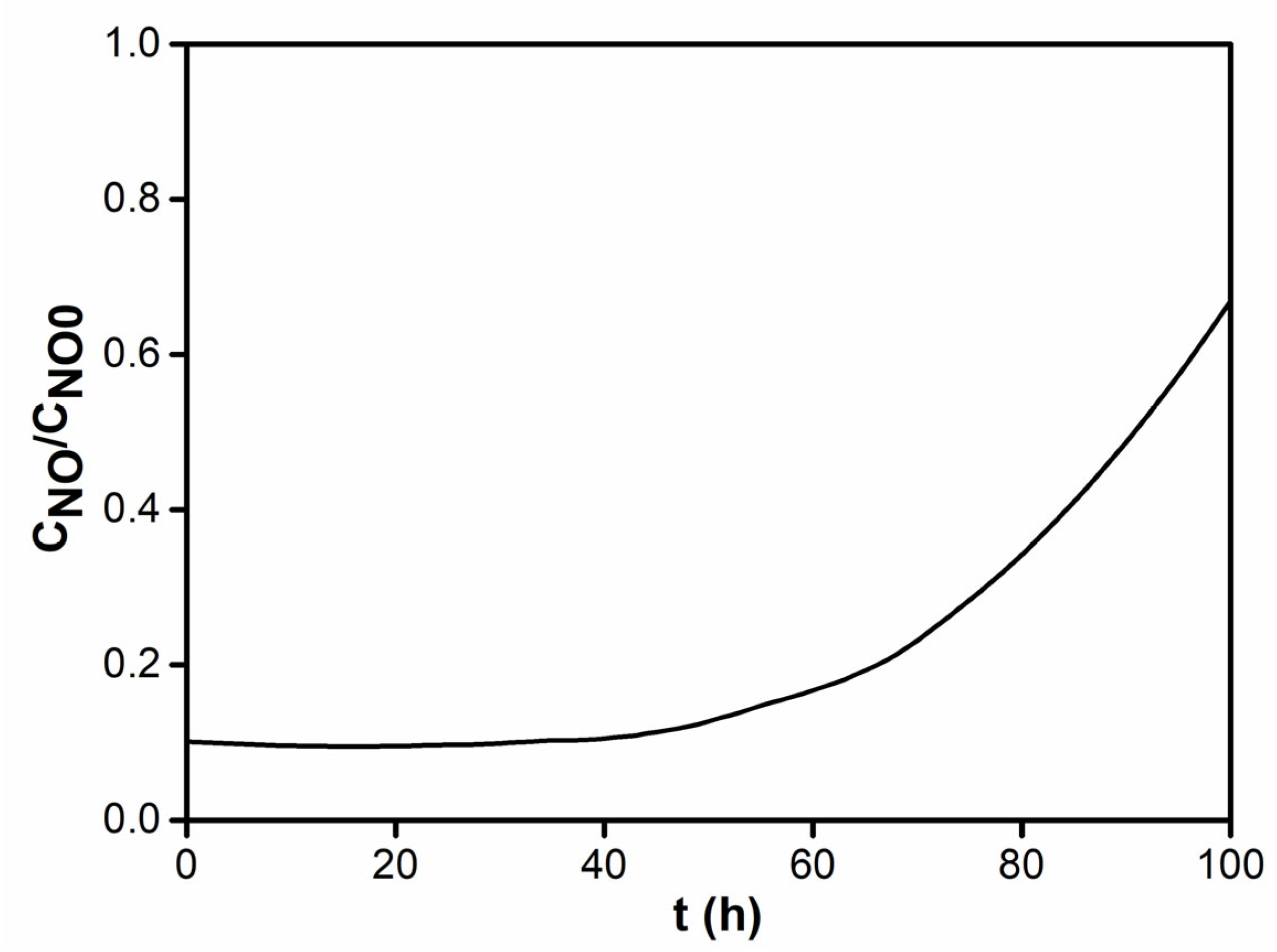
AC_M_BM@5Cu5K was the most effective catalyst tested, achieving 100% NO conversion at a lower temperature (T = 410 °C), and was tested to assess its stability over time. The stability test was conducted for 100 h at 376 °C. Based on previous catalytic tests, this temperature was chosen to achieve 90% conversion.
Figure 5 shows that the sample maintained a 90% conversion during the first 40 h of reaction time. After this duration, the sample began to show a decrease in activity. This loss of activity can be attributed to carbon consumption during the reaction, which leads to catalyst mass loss and compromises the metal-support interaction, thereby decreasing the amount of reactive material available to promote NO reduction.
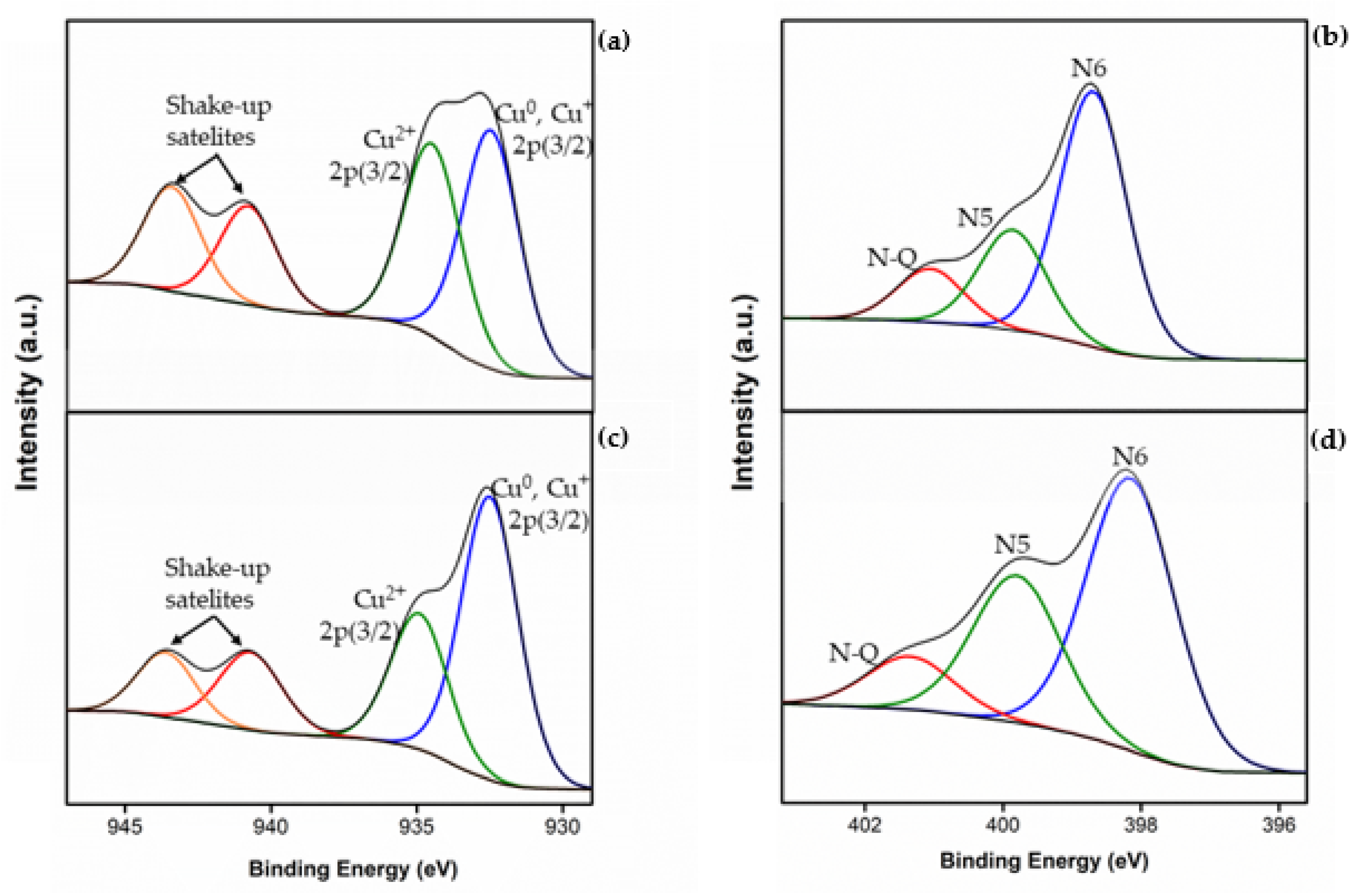
The XPS results of the Cu 2p(3/2) and N1S of the AC_M_BM@5Cu5k sample before and after the catalytic reaction are shown in Figure 6 and Table 3.
The spectra of Cu 2p(3/2) exhibits a peak with a broad signal in the range of 931—937 eV [15,28,46,47]. The signal is decomposed into two peaks: the first corresponds to Cu0 and Cu+ (932 eV) and the second corresponds to Cu2+ (934 eV). Cu2+ has two shake-up satellite peaks in its constitution.
Before the catalytic reaction, AC_M_BM@5Cu5K has a higher amount of Cu2+ (62.3%) on its surface and a lower amount of Cu0 and Cu+ (37.7%), as shown in Figure 6 and Table 3, indicating copper oxidation in the catalyst. After the catalytic test, the area of the Cu2+ peak decreases (50.1%), suggesting that Cu2+ undergoes reduction by AC [15,28].
The N1S nitrogen spectrum is composed of three peaks: The first, observed around 398.0 eV, is associated with pyridine nitrogen (N6). The second, ranging from 400.0 to 400.9 eV, corresponds to pyridone and pyrrole (N5). The third, with a peak maximum between 401.2 and 401.7 eV, is assigned to quaternary nitrogen (NQ) [15,33,48,49]. It can be seen from the N1S spectrum that the catalyst has three nitrogen peaks on its surface, showing an increase in N5 after the catalytic test (from 24.5% to 31.1%), apparently at the expense of N6. A decrease in N6 prompts a decrease in the surface basicity [15,37,49], which also affects the catalytic activity. Wang et al. [5] investigated the influence of N2 on SCR and observed a correlation between the NOx conversion and the presence of the N6 group, indicating that catalytic activity is mainly benefited by the introduction of N6 groups instead of other N-groups.
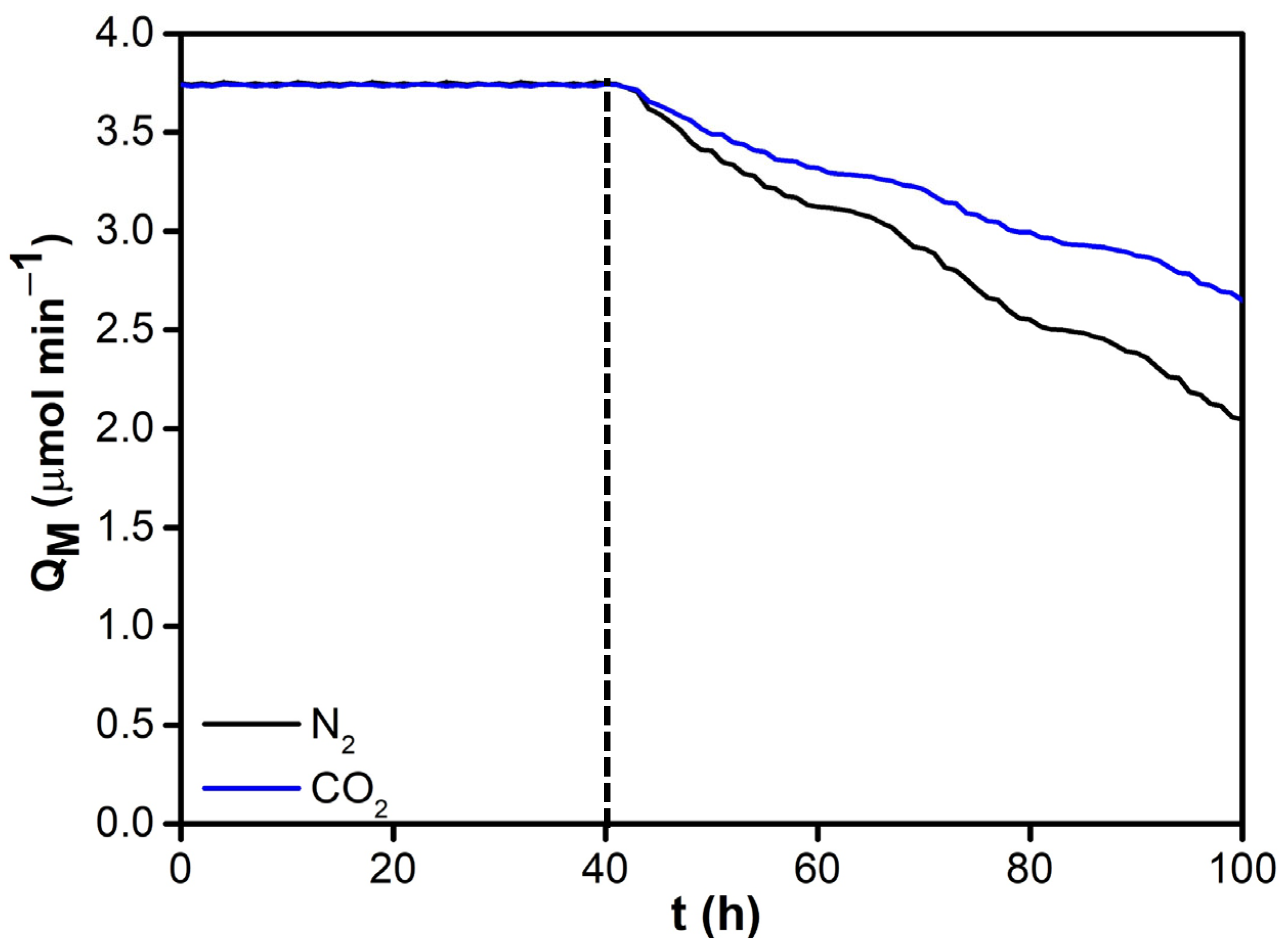
For the stability test, the products resulting from the reduction of NO by carbon were also analysed and are shown in Figure 7.
Figure 7 shows the variation in the products’ molar flow rate (CO2 and N2) in the NO reduction throughout the stability test. No presence of N2O or CO was detected. It was observed that the molar flow rates of CO2 and N2 remained constant throughout the first 40 h of the test. However, after this time, there was a gradual decrease in these two compounds. This decline suggests that, after 40 h, the catalyst loses its catalytic efficiency. These results are consistent with the observations for the stability test in Figure 5. This indicates that, as the test progressed, there was a degradation of the catalytic activity of the material.
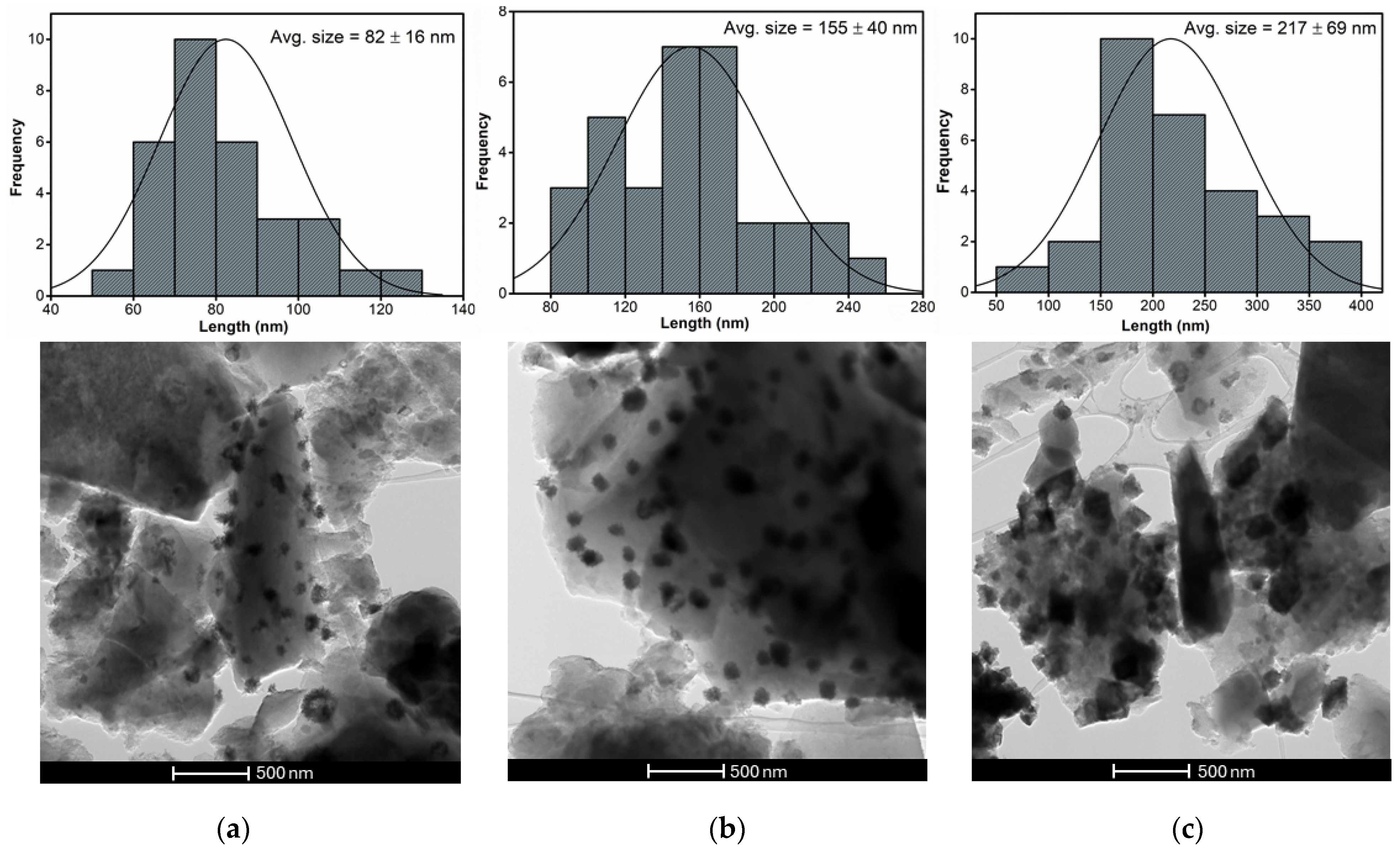
For the AC_M_BM@5Cu5K catalyst, detailed analyses were performed on three different samples by transmission electron microscopy (TEM): before the reaction, after 39 h of the stability test, and at the end of the test (Figure 8).
Before starting the reaction, the TEM images of the AC_M_BM@5Cu5K catalyst allowed us to establish the baseline structure of the catalyst, revealing that the metal was well dispersed throughout the support and that the particles had an average diameter of 82 nm, as shown in Figure 8a. After 39 h of the stability test, an increase in the size of the metallic particles was observed (155 nm), as illustrated in Figure 8b. Finally, at the end of the test, as shown in Figure 8c, the existence of agglomerates of metallic particles was observed, now presenting with an average diameter of 217 nm. The TEM images reveal that some of the metallic particles appeared to no longer be in contact with the support. This could have resulted from the consumption of carbon by NO, which reduced the amount of C available near the metallic particles. With less C to maintain the reaction, the metallic particles tended to agglomerate, thus decreasing the catalytic activity.
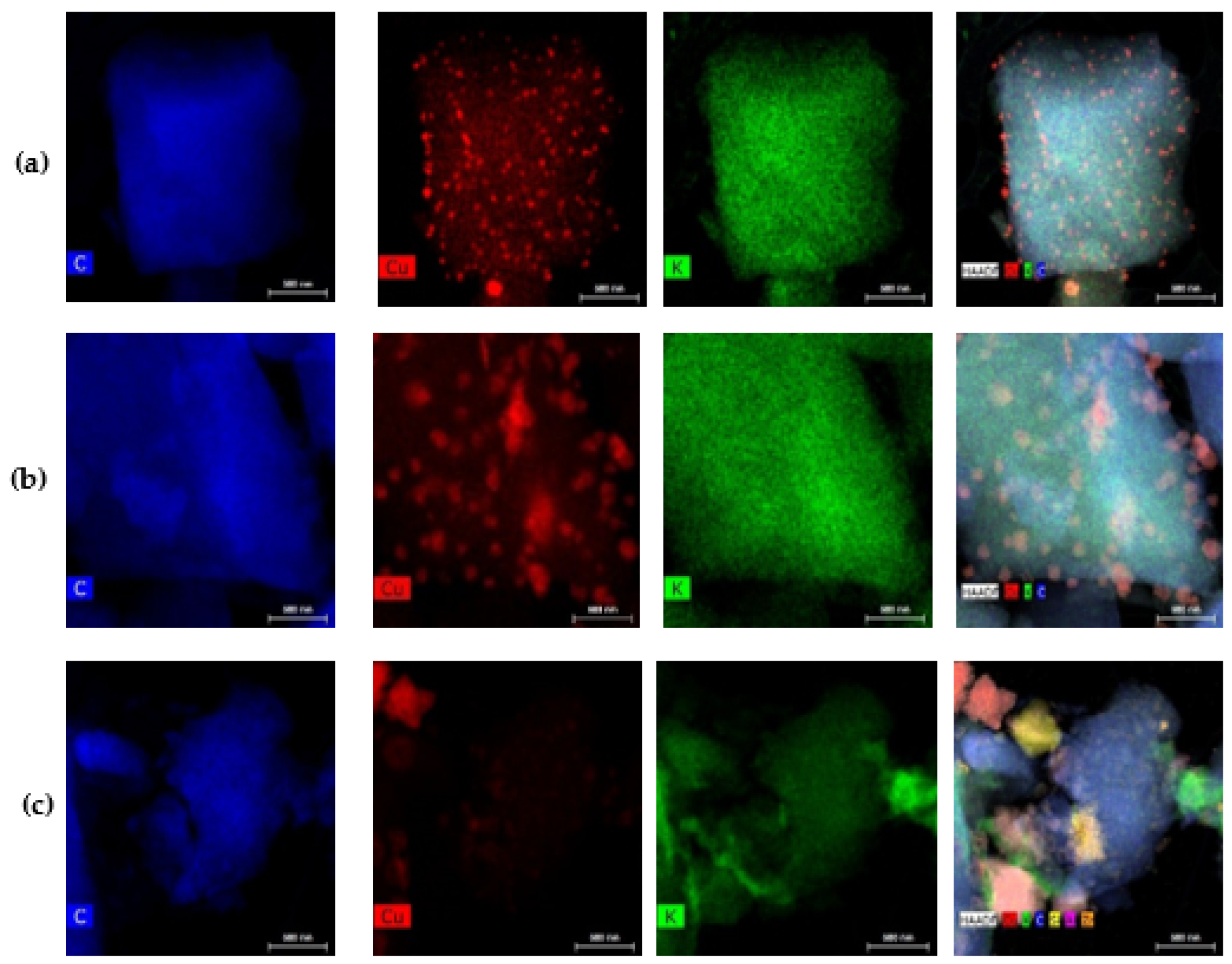
The element dispersion maps, obtained by EDX, provide a detailed view of how the metallic components were distributed and whether there was any redistribution or agglomeration of metals during the reaction. These results are shown in Figure 9.
The EDX analysis shows that the metals were initially evenly distributed on the support. After 39 h of reaction (Figure 9b), the particles began to agglomerate, forming larger clusters. Figure 9c shows large clusters of metallic particles at the end of the reaction. The distribution of elements on the map shows regions densely populated by metals, contrasting with the initial dispersion. In conclusion, the combination of TEM and EDX reveals the changes in the morphology and elemental distribution of the catalyst throughout the reaction. Through high-resolution images and element distribution maps, it was possible to observe that the growth of particles, the formation of agglomerates, and C consumption due to the reduction of NO (Equation (1)) were the main factors responsible for the loss of catalytic activity.
Table 4 summarises the key changes observed in the catalyst after the reaction. A decrease in the catalyst mass from 0.21 mg (before) to 0.19 mg (after 100 h of reaction) was recorded, corresponding to a mass loss of 9.5%.
A thermogravimetric analysis (TGA) provided additional evidence of carbon support degradation. The fixed carbon content decreased from 42% in the fresh catalyst to 35% after 100 h of reaction, representing a relative loss of approximately 16.7%.
In contrast, the proportions of volatiles and ash increased from 32% to 35% and from 26% to 29%, respectively. However, these increases were not due to the formation of new volatile or inorganic components, but rather resulted from the overall decrease in the catalyst mass. The estimated absolute loss of fixed carbon (~0.0217 mg) closely matches the measured mass loss (~0.02 mg), providing strong evidence that the degradation of the carbon matrix was the primary mechanism responsible for the observed deactivation. This structural damage likely led to metal particle agglomeration and reduced accessibility of active sites, thereby diminishing the catalytic performance.
The catalyst showed a decrease in the specific surface area and volume of micropores. This reduction could be attributed to the agglomeration of metal particles during the stability test. When metal particles clump together, the active surface area available for a reaction decreases. The analysis of the copper (Cu) and potassium (K) contents using the ICP-OES method showed that the concentrations of these elements remained similar before and after the stability test, indicating that the amount of these metals in the catalyst did not undergo significant changes.
The surface composition of the catalyst was examined by XPS, revealing a loss of approximately 2.6% of carbon, with an equivalent increase in the oxygen content. Furthermore, there was a slight increase in the surface contents of Cu and K, while the nitrogen content slightly decreased after the stability test. These variations can be explained by the loss of carbon mass during the stability test, which left the metals more exposed on the catalyst surface. The increase in oxygen (2.3%) was due to the formation of new oxygenated groups on the catalyst surface during the reaction. Different oxygen-containing surface functionalities may also affect metal anchoring and catalytic behaviour through the formation of C–O–metal species, as reported in the literature [50]. The slight decrease in nitrogen content may have been associated with the participation of nitrogen-containing surface groups during the reaction, which may have influenced NO adsorption and reduction.
Overall, the catalytic performance of the prepared materials was governed by the combined effects of textural properties, surface chemistry, and metal–support interactions. Although metal impregnation resulted in a reduction in the surface area and micropore volume due to partial pore blockage, the catalytic trends indicate that the nature of the metal phase and the promoting effect of potassium were the dominant factors in the NO conversion. Additionally, the deactivation observed during the stability test was primarily due to carbon consumption and the evolving surface chemistry, which reduced the availability of reactive carbon near the metal particles and promoted metal particle growth and agglomeration. This is supported by the TGA, XPS, and TEM/EDX analyses.
To provide a better context for the catalytic performance reported in this work, Table 5 presents a qualitative comparison with representative carbon-based catalysts reported in the literature.
Table 5 compares the catalytic performance obtained in this work with the literature data and with our previous study [15]. The results confirm that the combination of Cu and K supported on N-doped activated carbon improves NO conversion, allowing for complete NO removal at a lower temperature (410 °C) compared to the best monometallic Cu-based catalyst previously reported (440 °C).

4. Conclusions

SCR systems have been recognised as a highly effective method for reducing nitrogen oxide (NOx) emissions. This study focused on the preparation and evaluation of activated carbon-based catalysts impregnated with metals (K, Cu, and Fe), with the aim of optimising the metal concentrations and developing bimetallic catalysts to enhance the catalytic performance. The catalytic activity was assessed through light-off experiments, and the best catalyst was further evaluated with a long-term stability test (100 h). The coupling of potassium (K) and copper (Cu) significantly improved the catalytic efficiency. Consequently, bimetallic catalysts outperform their monometallic counterparts in terms of NO reduction performance. After the optimisation of metal contents and incorporation of nitrogen groups, a substantial increase in the catalytic performance was observed. Among the samples tested, AC_M_BM@5Cu5K proved to be the most effective for reducing NO to N2, achieving a conversion of 100% at a temperature of 410 °C. In the NO reduction reaction, the products CO2, N2O, and N2 were obtained. The N2 and CO2 were considered stable end products, while the N2O was identified as an intermediate, as its concentration decreased with increasing temperature and NO conversion. Therefore, under higher temperature conditions or greater NO reduction efficiency, N2O formation declines, favouring N2 and CO2 as the predominant products. In the stability test, the AC_M_BM@5Cu5K maintained its catalytic effectiveness for 40 h, producing only N2 and CO2, losing its catalytic activity after this time. This loss of activity is attributed to the gradual consumption of the carbon support near the metal particles, which promotes metal agglomeration and a decrease in available reactive sites. The thermogravimetric analysis (TGA) provides quantitative support for this hypothesis, revealing a carbon mass loss of approximately 2% after the reaction. These findings confirm that the structural degradation of the carbon matrix contributes significantly to catalyst deactivation over time. Overall, improving catalyst durability while maintaining high NO conversion remains an important challenge for carbon-based NO reduction systems.

Supplementary Materials

The following supporting information can be downloaded at: https://www.mdpi.com/article/10.3390/c12010014/s1.

Author Contributions

P.S.F.R.: Conceptualisation, Methodology, Investigation, Formal analysis, Visualisation, Writing—original draft. O.S.G.P.S.: Supervision, Conceptualisation, Methodology, Writing—review and editing. J.L.F.: Conceptualisation, Writing—review and editing. M.F.R.P.: Supervision, Conceptualisation, Funding acquisition, Writing—review and editing. All authors have read and agreed to the published version of the manuscript.

Funding

This paper is a result of the project “SMART&GREEN Towards Climate Neutral Cities”, with the reference NORTE 2030 FEDER 02696100 co financed by the European Union, through the NORTE 2030 Regional Program, of Portugal 2030. This work was also financially supported by Fundação para a Ciência e a Tecnologia, I.P. /MCTES through national funds: LSRE-LCM, UID/50020/2025 (https://doi.org/10.54499/UID/50020/2025); and ALiCE, LA/P/0045/2020 (https://doi.org/10.54499/LA/P/0045/2020). Research fellowship SFRH/BD/149838/2019 (https://doi.org/10.54499/SFRH/BD/149838/2019) (P.S.F.R) funded by FCT.

Data Availability Statement

The original contributions presented in this study are included in the article/Supplementary Materials. Further inquiries can be directed to the corresponding author.

Conflicts of Interest

The authors declare that they have no known competing financial interests or personal relationships that could have appeared to influence the work reported in this paper.

References

  1. Skalska, K.; Miller, J.S.; Ledakowicz, S. Trends in NOx abatement: A review. Sci. Total Environ. 2010, 408, 3976–3989. [Google Scholar] [CrossRef]
  2. Gómez-García, M.A.; Pitchon, V.; Kiennemann, A. Pollution by nitrogen oxides: An approach to NOx abatement by using sorbing catalytic materials. Environ. Int. 2005, 31, 445–467. [Google Scholar] [CrossRef]
  3. Gonçalves, F.; Figueiredo, J.L. Development of carbon supported metal catalysts for the simultaneous reduction of NO and N2O. Appl. Catal. B Environ. 2004, 50, 271–278. [Google Scholar] [CrossRef]
  4. Gonçalves, F.; Figueiredo, J.L. Synergistic effect between Pt and K in the catalytic reduction of NO and N2O. Appl. Catal. B Environ. 2006, 62, 181–192. [Google Scholar] [CrossRef]
  5. Wang, Y.; Zhou, Y.; Shen, Y.; Zhu, S. Pyridinic N: A special group for enhancing direct decomposition reaction of NO over N-doped porous carbon. Micropor. Mesopor. Mat. 2018, 265, 98–103. [Google Scholar] [CrossRef]
  6. Ahmadi, R.; Alivand, M.S.; Haj Mohammad Hossein Tehrani, N.; Ardjmand, M.; Rashidi, A.; Rafizadeh, M.; Seif, A.; Mollakazemi, F.; Noorpoor, Z.; Rudd, J. Preparation of fiber-like nanoporous carbon from jute thread waste for superior CO2 and H2S removal from natural gas: Experimental and DFT study. J. Chem. Eng. 2021, 415, 129076. [Google Scholar] [CrossRef]
  7. Li, S.; Huang, Y.; Zhu, H.; Long, J.; Xiao, L.; Li, P.; Zhao, L.; Zhang, J. Dual improvement in acid and redox properties of the FeOx/OAC catalyst via APS oxygen-functionalization: High low-temperature NH3-SCR activity, SO2 and H2O tolerance. Fuel 2023, 341, 127716. [Google Scholar] [CrossRef]
  8. Fu, Z.; Guo, M.; Liu, C.; Ji, N.; Song, C.; Liu, Q. Design and Synthesis Functional Selective Catalytic Reduction Catalyst for NOx Removal. Procedia Eng. 2015, 121, 952–956. [Google Scholar] [CrossRef][Green Version]
  9. Alemany, L.J.; Lietti, L.; Ferlazzo, N.; Forzatti, P.; Busca, G.; Giamello, E.; Bregani, F. Reactivity and Physicochemical Characterization of V2O5-WO3/TiO2 De-NOx Catalysts. J. Catal. 1995, 155, 117–130. [Google Scholar] [CrossRef]
  10. Anthonysamy, S.B.I.; Afandi, S.B.; Khavarian, M.; Mohamed, A.R.B. A review of carbon-based and non-carbon-based catalyst supports for the selective catalytic reduction of nitric oxide. Beilstein J. Nanotechnol. 2018, 9, 740–761. [Google Scholar] [CrossRef]
  11. Shan, W.; Song, H. Catalysts for the selective catalytic reduction of NOx with NH3 at low temperature. Catal. Sci. Technol. 2015, 5, 4280–4288. [Google Scholar] [CrossRef]
  12. Figueiredo, J.L.; Pereira, M.F.R. Carbon Materials for Catalysis. In Carbon as Catalyst; Serp, P., Figueiredo, J.L., Eds.; Carbon Materials for Catalysis; John Wiley & Sons, Inc.: Hoboken, NJ, USA, 2009; pp. 177–217. [Google Scholar]
  13. Modi, A.; Singh, S.; Verma, N. Improved performance of a single chamber microbial fuel cell using nitrogen-doped polymer-metal-carbon nanocomposite-based air-cathode. Int. J. Energy Res. 2017, 42, 3271–3280. [Google Scholar] [CrossRef]
  14. Zhang, Q.; Liu, X.; Ning, P.; Song, Z.; Li, H.; Gu, J. Enhanced performance in NOx reduction by NH3 over a mesoporous Ce–Ti–MoOx catalyst stabilized by a carbon template. Catal. Sci. Technol. 2015, 5, 2260–2269. [Google Scholar] [CrossRef]
  15. Ramalho, P.S.F.; Soares, O.S.G.P.; Figueiredo, J.L.; Pereira, M.F.R. Catalytic reduction of NO over copper supported on activated carbon. Catal. Today 2023, 418, 114044. [Google Scholar] [CrossRef]
  16. Felgueiras, M.B.S.; Restivo, J.; Sousa, J.P.S.; Pereira, M.F.R.; Soares, O.S.G.P. Copper Supported on Mesoporous Structured Catalysts for NO Reduction. Catalysts 2022, 12, 170. [Google Scholar] [CrossRef]
  17. Soares, O.S.G.P.; Ramalho, P.S.F.; Fernandes, A.; Órfão, J.J.M.; Pereira, M.F.R. Catalytic bromate reduction in water: Influence of carbon support. J. Environ. Chem. Eng. 2019, 7, 103015. [Google Scholar] [CrossRef]
  18. Orge, C.; Soares, O.; Ramalho, P.; Pereira, M.; Faria, J. Magnetic Nanoparticles for Photocatalytic Ozonation of Organic Pollutants. Catalysts 2019, 9, 703. [Google Scholar] [CrossRef]
  19. Zheng, J.; Zhang, S.; Zeng, Y.; Li, M.; Li, X.; Zhong, Q. Revealing the Key Role of Acidic Oxygen-Containing Groups on Activated Carbon for Low-Temperature NH3-SCR Denitration. Catal. Lett. 2024, 154, 4378–4388. [Google Scholar] [CrossRef]
  20. Catalão, R.A.; Maldonado-Hódar, F.J.; Fernandes, A.; Henriques, C.; Ribeiro, M.F. Reduction of NO with metal-doped carbon aerogels. Appl. Catal. B Environ. 2009, 88, 135–141. [Google Scholar] [CrossRef]
  21. Fu, H.; Zhang, J.; Huang, Y.; Zhao, L. Ammonia-free selective catalytic reduction of NO by coal-based activated carbon supported Cu-Mn oxides at low temperature. J. Environ. Chem. Eng. 2024, 12, 113228. [Google Scholar] [CrossRef]
  22. Illán-Gómez, M.J.; Brandán, S.; Salinas-Martínez de Lecea, C.; Linares-Solano, A. Improvements in NOx reduction by carbon using bimetallic catalysts. Fuel 2001, 80, 2001–2005. [Google Scholar] [CrossRef]
  23. Mochida, I.; Ogaki, M.; Fujitsu, H.; Komatsubara, Y.; Ida, S. Reduction of nitric oxide with activated PAN fibres. Fuel 1985, 64, 1054–1057. [Google Scholar] [CrossRef]
  24. Illán-Gómez, M.J.; Linares-Solano, A.; Radovic, L.R.; Salinas-Martínez de Lecea, C. NO Reduction by Activated Carbons. 7. Some Mechanistic Aspects of Uncatalyzed and Catalyzed Reaction. Energy Fuels 1996, 10, 158–168. [Google Scholar] [CrossRef]
  25. Illan-Gomez, M.J.; Linares-Solano, A.; Salinas-Martinez de Lecea, C.; Calo, J.M. Nitrogen oxide (NO) reduction by activated carbons. 1. The role of carbon porosity and surface area. Energy Fuels 1993, 7, 146–154. [Google Scholar] [CrossRef]
  26. Bailón-García, E.; Drwal, E.; Grzybek, T.; Henriques, C.; Ribeiro, M.F. Catalysts based on carbon xerogels with high catalytic activity for the reduction of NOx at low temperatures. Catal. Today 2020, 356, 301–311. [Google Scholar] [CrossRef]
  27. Illán-Gómez, M.J.; Brandán, S.; Linares-Solano, A.; Salinas-Martínez de Lecea, C. NOx reduction by carbon supporting potassium-bimetallic catalysts. Appl. Catal. B Environ. 2000, 25, 11–18. [Google Scholar] [CrossRef]
  28. Feng, B.; Lu, G.; Wang, Y.; Guo, Y.; Guo, Y. Promoting Role of Potassium on the Catalytic Performance of Copper Oxide for the Reduction of NO by Activated Carbon. Chin. J. Catal. 2011, 32, 853–861. [Google Scholar] [CrossRef]
  29. Xu, Z.; Li, Y.; Shi, H.; Lin, Y.; Wang, Y.; Wang, Q.; Zhu, T. Application Prospect of K Used for Catalytic Removal of NOx, COx, and VOCs from Industrial Flue Gas: A Review. Catalysts 2021, 11, 419. [Google Scholar] [CrossRef]
  30. Bueno-López, A.N.; García-García, A.; Caballero, J.A.; Linares-Solano, A. Influence of potassium loading at different reaction temperatures on the NOx reduction process by potassium-containing coal pellets. Fuel 2003, 82, 267–274. [Google Scholar] [CrossRef]
  31. Li, Q.; Hou, Y.; Wang, J.; Liu, Y.; Xiang, N.; Huang, Z. Superiority of Raw Biomass and Potassium Hydroxide in Preparation of Ultrahigh Nitrogen Doping of Carbon for NH3-SCR Reaction. ACS Sustain. Chem. Eng. 2020, 8, 11308–11316. [Google Scholar] [CrossRef]
  32. Gomes, S.M.S.; Montani, S.d.S.; Palacio, L.A.; Zotin, F.M.Z. Performance of copper-aluminum catalysts impregnated with potassium in NO and N2O reduction by CO. Catal. Today 2025, 447, 115140. [Google Scholar] [CrossRef]
  33. Rocha, R.P.; G.P. Soares, O.S.; Gonçalves, A.G.; Órfão, J.J.M.; Pereira, M.F.R.; Figueiredo, J.L. Different methodologies for synthesis of nitrogen doped carbon nanotubes and their use in catalytic wet air oxidation. Appl. Catal. A-Gen. 2017, 548, 62–70. [Google Scholar] [CrossRef]
  34. Soares, O.S.G.P.; Rocha, R.P.; Órfão, J.J.M.; Pereira, M.F.R.; Figueiredo, J.L. Mechanothermal Approach for N-, S-, P-, and B-Doping of Carbon Nanotubes: Methodology and Catalytic Performance in Wet Air Oxidation. C 2019, 5, 30. [Google Scholar] [CrossRef]
  35. Illán-Gómez, M.J.; Raymundo-Piñero, E.; García-García, A.; Linares-Solano, A.; Salinas-Martínez de Lecea, C. Catalytic NOx reduction by carbon supporting metals. Appl. Catal. B Environ. 1999, 20, 267–275. [Google Scholar] [CrossRef]
  36. Li, X.; Wang, H.; Shao, G.; Wang, G.; Lu, L. Low temperature reduction of NO by activated carbons impregnated with Fe based catalysts. Int. J. Hydrogen Energy 2019, 44, 25265–25275. [Google Scholar] [CrossRef]
  37. Sousa, J.P.S.; Pereira, M.F.R.; Figueiredo, J.L. Modified activated carbon as catalyst for NO oxidation. Fuel Process. Technol. 2013, 106, 727–733. [Google Scholar] [CrossRef]
  38. Sousa, J.P.S.; Pereira, M.F.R.; Figueiredo, J.L. Catalytic oxidation of NO to NO2 on N-doped activated carbons. Catal. Today 2011, 176, 383–387. [Google Scholar] [CrossRef]
  39. Tomita, A. Suppression of nitrogen oxides emission by carbonaceous reductants. Fuel Process. Technol. 2001, 71, 53–70. [Google Scholar] [CrossRef]
  40. Matzner, S.; Boehm, H.P. Influence of nitrogen doping on the adsorption and reduction of nitric oxide by activated carbons. Carbon 1998, 36, 1697–1703. [Google Scholar] [CrossRef]
  41. Wan, X.-K.; Shi, H.-X.; Zou, X.-Q.; Ge, P.; Wang, D.-H. Effect of nitrogen doping on the reduction of nitric oxide with activated carbon in the presence of oxygen. J. Zhejiang Univ. Sci. A 2008, 9, 113–117. [Google Scholar] [CrossRef]
  42. Lin, Y.; Li, Y.; Xu, Z.; Xiong, J.; Zhu, T. Transformation of functional groups in the reduction of NO with NH3 over nitrogen-enriched activated carbons. Fuel 2018, 223, 312–323. [Google Scholar] [CrossRef]
  43. Li, Q.; Hou, Y.; Xiang, N.; Liu, Y.; Huang, Z. A new insight into the promotional effect of nitrogen-doping in activated carbon for selective catalytic reduction of NOX with NH3. Sci. Total Environ. 2020, 740, 140158. [Google Scholar] [CrossRef]
  44. Thomas, K.M. The release of nitrogen oxides during char combustion. Fuel 1997, 76, 457–473. [Google Scholar] [CrossRef]
  45. Xue, Y.; Lu, G.; Guo, Y.; Guo, Y.; Wang, Y.; Zhang, Z. Effect of pretreatment method of activated carbon on the catalytic reduction of NO by carbon over CuO. Appl. Catal. B Environ. 2008, 79, 262–269. [Google Scholar] [CrossRef]
  46. Méar, F.O.; Essi, M.; Sistat, P.; Guimon, M.F.; Gonbeau, D.; Pradel, A. Structural characterization of a Cu(II) thin-film aging in a Cu-nitrate solution. Appl. Surf. Sci. 2009, 255, 6607–6611. [Google Scholar] [CrossRef]
  47. Swadźba-Kwaśny, M.; Chancelier, L.; Ng, S.; Manyar, H.G.; Hardacre, C.; Nockemann, P. Facile in situ synthesis of nanofluids based on ionic liquids and copper oxide clusters and nanoparticles. Dalton Trans. 2012, 41, 219–227. [Google Scholar] [CrossRef]
  48. Jansen, R.J.J.; van Bekkum, H. XPS of nitrogen-containing functional groups on activated carbon. Carbon 1995, 33, 1021–1027. [Google Scholar] [CrossRef]
  49. Boehm, H.-P. Catalytic Properties of Nitrogen-Containing Carbons; Serp, P., Figueiredo, J.L., Eds.; Carbon Materials for Catalysis; John Wiley & Sons, Inc.: Hoboken, NJ, USA, 2009; pp. 219–265. [Google Scholar]
  50. Dang, Y.; Liu, Y.; Xiang, P.; Tan, Z.; Tian, Z.; Greiner, M.; Heumann, S.; Ding, Y.; Qiao, Z.-A. Carbon Surface Chemistry: Benchmark for the Analysis of Oxygen Functionalities on Carbon Materials. Adv. Mater. 2025, 37, 2418239. [Google Scholar] [CrossRef]
Figure 1. Dimensionless NO concentration for activated carbon (AC) and metal-supported AC catalysts.
Carbon 12 00014 g001
Figure 2. Evolution of the dimensionless concentration of NO (a) and NO conversion and temperature to reach full conversion (b) in the presence of Cu and K-based catalysts on activated carbon.
Carbon 12 00014 g002
Figure 3. Evolution of the dimensionless concentration of NO (a) and NO conversion and temperature to reach full conversion (b) in the presence of Cu and K-based catalysts on activated carbon doped with nitrogen.
Carbon 12 00014 g003
Figure 4. Molar flow vs. the reaction temperature in the reduction of NO over AC_M_BM@5Cu5K.
Carbon 12 00014 g004
Figure 5. Dimensionless concentration of NO during a stability test at 376 °C for 100 h over the AC_M_BM@5Cu5K catalyst.
Carbon 12 00014 g005
Figure 6. X-ray photoelectron spectroscopy analysis of the sample AC_M_BM@5Cu5K before and after the catalytic reaction: (a) Cu 2p(3/2) region before reaction; (b) N 1s region before reaction; (c) Cu 2p(3/2)/region after reaction; (d) N 1s region after reaction.
Carbon 12 00014 g006
Figure 7. Molar flow rate vs. reaction time in the reduction of NO over AC_M_B_MB@5Cu5K during a stability test. The dashed line indicates the onset of the decrease in QM.
Carbon 12 00014 g007
Figure 8. TEM micrograph of AC_M_BM@5Cu5K catalyst before reaction (a), after 39 h of reaction (b), and at the end of the reaction (c), as well as the particle size distribution for each step.
Carbon 12 00014 g008
Figure 9. EDX of AC_M_BM@5Cu5K catalyst before reaction (a), after 39 h of reaction (b), and at end of the reaction (c) (scale of 500 nm).
Carbon 12 00014 g009
Table 1. Textural properties of the catalytic samples.
SampleSBET (m2 g−1)Smeso a (m2 g−1)Vmicro a (cm3 g−1)Vp P/P0=0.95 (cm3 g−1)
AC834700.330.45
AC_M_BM647960.240.37
AC@10Cu768940.300.40
AC@10Fe760990.320.40
AC@10K681990.230.36
AC@7Cu3K735990.240.39
AC@5Cu5K716970.280.37
AC@3Cu7K6771000.220.36
AC_M_BM@10Cu577990.210.30
AC_M_BM@10K552980.210.30
AC_M_BM@5Cu5K519920.200.27
a Micropore volume (Vmicro) and mesopore surface area (Smeso) calculated by the t-method.
Table 2. Iron, copper, potassium, and nitrogen content determined by ICP-OES and XPS.
SampleFeICP-OES
(%)
CuICP-OES
(%)
CuXPS
(%)
KICP-OES
(%)
KXPS
(%)
NXPS
(%)
AC@10Cu-9.92.5--0.3
AC@10Fe9.3-n.d-n.dn.d
AC@10K--n.d9.2n.dn.d
AC@7Cu3Fe2.25.9n.d-n.dn.d
AC@7Cu3K-6.5n.d2.3n.dn.d
AC@5Cu5K-4.6n.d3.9n.dn.d
AC@3Cu7K-2.8n.d5.6n.dn.d
AC_M_BM@10Cu-10.46.7--5.5
AC_M_BM@10K--n.d9.6n.dn.d
AC_M_BM@5Cu5K-4.83.34.73.75.2
n.d—not determined.
Table 3. Peak position (eV) and peak area for the core levels Cu 2p(3/2) and N1s of the AC_M_MB@5Cu5K samples before and after the catalytic reaction.
ElementCore LevelPropertiesAC_M_BM@5Cu5K
(Before Reaction)
AC_M_BM@5Cu5K
(After Reaction)
Cu0, Cu+2p(3/2)Binding energy (eV)932.5932.3
Peak area (%)37.749.9
Cu2+2p(3/2)Binding energy (eV)934.5934.7
Satellite peak 1940.4940.7
Satellite peak 2934.4943.6
Peak area (%)62.350.1
N61sBinding energy (eV)398.1398.1
Peak area (%)62.557.7
N51sBinding energy (eV)399.6399.8
Peak area (%)24.531.1
N-Q Binding energy (eV)401.2401.3
Peak area (%)13.011.2
Table 4. Textural properties, as well as copper, potassium, and nitrogen content, determined by ICP-OES and XPS of AC_M_BM@5Cu5K before and after the stability test.
AC_M_BM@5Cu5K (Before)AC_M_BM@5Cu5K (After)
Catalyst (mg)0.210.19
SBET (m2 g−1)716485
Smeso (m2 g−1) a9774
Vmicro (cm3 g−1) a0.280.13
CuICP-OES (%)4.84.6
CuXPS (%)3.33.8
KICP-OES (%)4.74.7
KXPS (%)3.74.1
NXPS (%)5.24.6
CXPS (%)74.972.3
OXPS (%)12.915.2
Volatiles (%wt) 3236
Cfixed (%wt) 4235
Ash (%wt) 2629
†—determined by thermogravimetric analysis. a Micropore volume (Vmicro) and mesopore surface area (Smeso) calculated by the t-method.
Table 5. Comparison of carbon-based catalysts reported in the literature for NO reduction under different operating conditions.
CatalystCarbon MaterialNO Concentration
(ppm)
Reducing AgentKey PerformanceStabilityRef.
AC_M_BM@5Cu5K
(this work)
N-doped AC1000none100% NO conversion at 410 °C40 h (376 °C)-
ACActivated carbon1000none17% NO conversion at 460 °C-[15]
AC_M_BM@10CuN-doped AC1000none100% NO conversion at 440 °C36 h (400 °C)[15]
Cu-K-O/AC
(Cu/K = 2)
Activated carbon2000none100% NO conversion at 390 °C5 h (400 °C)[28]
Cu/CXCarbon xerogel (CX)500H2 (1%)100% NO conversion at 220 °C-[26]
MF-U_10CuMelamine foams (MF)1000 + 5% O2none94% NO conversion at 350 °C20 h (300 °C)[16]
Disclaimer/Publisher’s Note: The statements, opinions and data contained in all publications are solely those of the individual author(s) and contributor(s) and not of MDPI and/or the editor(s). MDPI and/or the editor(s) disclaim responsibility for any injury to people or property resulting from any ideas, methods, instructions or products referred to in the content.