Review

Short and Long Non-Coding RNAs in Renal Cell Carcinoma

1
Department of Human Sciences and Promotion of the Quality of Life, San Raffaele Roma University, 00166 Rome, Italy
2
Department of Clinical Sciences, Polytechnic University of Marche, 60126 Ancona, Italy
3
Department of Experimental and Clinical Medicine, Polytechnic University of Marche, 60126 Ancona, Italy
4
Advanced Technology Center for Aging Research, Istituto di Ricovero e Cura a Carattere Scientifico (IRCCS) INRCA, 60121 Ancona, Italy
5
Department of Life Science, Health and Health Professions, Link Campus University, 00165 Rome, Italy
*
Authors to whom correspondence should be addressed.
These authors contributed equally to this work.
These authors share last authorship.
Non-Coding RNA 2026, 12(2), 8; https://doi.org/10.3390/ncrna12020008
Submission received: 24 January 2026 / Revised: 19 February 2026 / Accepted: 26 February 2026 / Published: 27 February 2026
(This article belongs to the Section Clinical Applications of Non-Coding RNA)

Abstract

Renal cell carcinoma (RCC) represents the most frequent kidney malignancy and remains a major clinical challenge due to its often silent onset, high metastatic potential, and limited responsiveness to conventional chemotherapy. Increasing evidence indicates that non-coding RNAs (ncRNAs), including microRNAs (miRNAs), long non-coding RNAs (lncRNAs), and circular RNAs (circRNAs), are key regulators of RCC tumorigenesis, progression, and therapy resistance. Rather than providing a purely descriptive overview, this review focuses on emerging mechanistic paradigms through which ncRNAs actively shape tumor behavior and therapeutic response in RCC. This review summarizes current knowledge on the biological and clinical relevance of ncRNAs in RCC, highlighting their dual roles as oncogenic drivers or tumor suppressors through the modulation of pathways involved in proliferation, apoptosis, angiogenesis, invasion, immune evasion, metabolic reprogramming, and ferroptosis. Particular emphasis is placed on mechanistically defined ncRNA regulatory axes controlling ferroptosis, autophagy, metabolic reprogramming, and immune escape, as well as on ncRNA-mediated intercellular communication via extracellular vesicles, which promotes the dissemination of resistance to targeted therapies. The review also addresses ncRNA-based diagnostic and prognostic applications, including miRNA signatures capable of discriminating RCC subtypes and circulating ncRNAs as minimally invasive biomarkers. Moreover, the manuscript discusses ncRNA-mediated mechanisms of resistance to targeted therapies such as sunitinib, sorafenib, and axitinib, emphasizing regulatory networks involving miRNA targets, lncRNA–miRNA sponging, RNA-binding proteins, extracellular vesicle transfer, and epigenetic modulation. Emerging therapeutic opportunities are also addressed, including strategies aimed at inhibiting oncogenic ncRNAs or restoring tumor-suppressive ncRNAs to enhance drug sensitivity and improve patient stratification.

1. Introduction

Renal cell carcinoma (RCC) is the most common malignancy arising in the kidney and accounts for about 90% of newly diagnosed kidney cancers [1]. Its incidence and mortality have been increasing globally, and the disease is reported more frequently in men than in women [2]. In particular, men between 60 and 70 years of age often develop more aggressive tumors, which are typically associated with higher stage and grade [3]. RCC develops from the proximal renal tubular epithelium and includes three main histological subtypes: clear cell (ccRCC), papillary (pRCC), and chromophobe (chRCC). Among these, ccRCC is the predominant subtype, representing roughly 80% of cases, and it accounts for most RCC-related deaths [4]. This variant shows a marked tendency to metastasize, with common sites of spread including the lungs [5], liver [6], bones [7], and lymph nodes [8]. At the time of first diagnosis, distant metastases are already present in approximately 30% of ccRCC patients, likely because the early phases of the disease are often clinically silent [9]. RCC occurrence increases with advancing age, but several lifestyle-related factors also contribute to its development; obesity, alcohol consumption, hypertension, and cigarette smoking are all associated with higher risk.
Surgical resection remains the gold standard for patients with early-stage RCC [10]. However, because a considerable proportion of individuals present with metastatic disease at diagnosis or develop metastases after treatment, there is a strong need to expand research efforts toward additional therapeutic strategies. In patients with inoperable RCC, targeted therapies represent a key option and can improve overall survival as well as delaying disease progression [11]. In this context, treatments aimed at blocking regulatory pathways that support metastatic dissemination may represent particularly effective approaches for advanced, non-resectable disease. Immunotherapy, especially immune checkpoint blockade, together with targeted therapy, most notably using antiangiogenic agents such as monoclonal antibodies, kinase inhibitors, and inhibitors of the mechanistic target of rapamycin (mTOR) and vascular endothelial growth factor (VEGF) pathways, has emerged as a promising therapeutic avenue [12]. RCC tumorigenesis is a multifactorial and dynamic process driven by genetic and epigenetic alterations that disrupt cellular homeostasis and promote uncontrolled growth [13]. Among the molecular mechanisms involved, DNA methylation changes, histone modifications, genomic instability, and driver gene mutations have all been implicated in RCC progression [14].
As with several malignant and non-malignant disorders [15,16,17,18,19,20], RCC can also arise from inherited conditions; loss of chromosome 3p, a region containing tumor suppressor genes such as Von Hippel–Lindau (VHL), SET domain-containing 2, histone lysine methyltransferase (SETD2), Polybromo 1 (PBRM1), and BRCA1-associated protein 1 (BAP1), has been linked to RCC pathogenesis [21]. Alterations affecting VHL, including its inactivation, represent one of the most frequent genetic events observed in RCC [22]. The VHL gene encodes a protein involved in controlling the hypoxia-inducible factor (HIF) pathway; therefore, loss of VHL leads to increased expression of HIF-regulated genes that support glucose metabolism, cell proliferation, and angiogenesis [23].
Given that RCC is often detected at advanced stages, displays a strong propensity for metastasis, and shows limited sensitivity to conventional chemotherapy, the identification of new biomarkers is a major priority. Such biomarkers could support earlier diagnosis, refine prognostic assessment, and contribute to the development of novel targeted treatments for more effective clinical management [24,25,26].
While dysregulation of protein-coding genes is clearly relevant, increasing evidence indicates that non-coding RNAs (ncRNAs) also contribute substantially to key oncogenic processes in RCC [27]. ncRNAs are transcribed RNA molecules that do not encode proteins and include several subclasses, such as long non-coding RNAs (lncRNAs), microRNAs (miRNAs), circular RNAs (circRNAs), and small nuclear RNAs [28]. Multiple studies have suggested that altered ncRNA expression is not only linked to RCC initiation and progression but also to therapy resistance, influencing fundamental cellular functions including proliferation, migration, apoptosis, and metabolic reprogramming [29].
The purpose of this review is to examine the contribution of ncRNAs to RCC development and to discuss their involvement in mechanisms of drug resistance. Unlike previous reviews that have primarily focused on individual classes of non-coding RNAs, this review provides a comprehensive and integrated overview of miRNAs, lncRNAs, and circRNAs in renal cell carcinoma. By jointly examining these ncRNA classes, we highlight their interconnected regulatory networks and emerging mechanistic roles in tumor progression, immune modulation, and resistance to targeted therapies. This integrated perspective aims to frame ncRNAs as active drivers of disease biology rather than isolated molecular markers.

2. MicroRNAs, Long Non-Coding RNAs and Circular RNAs

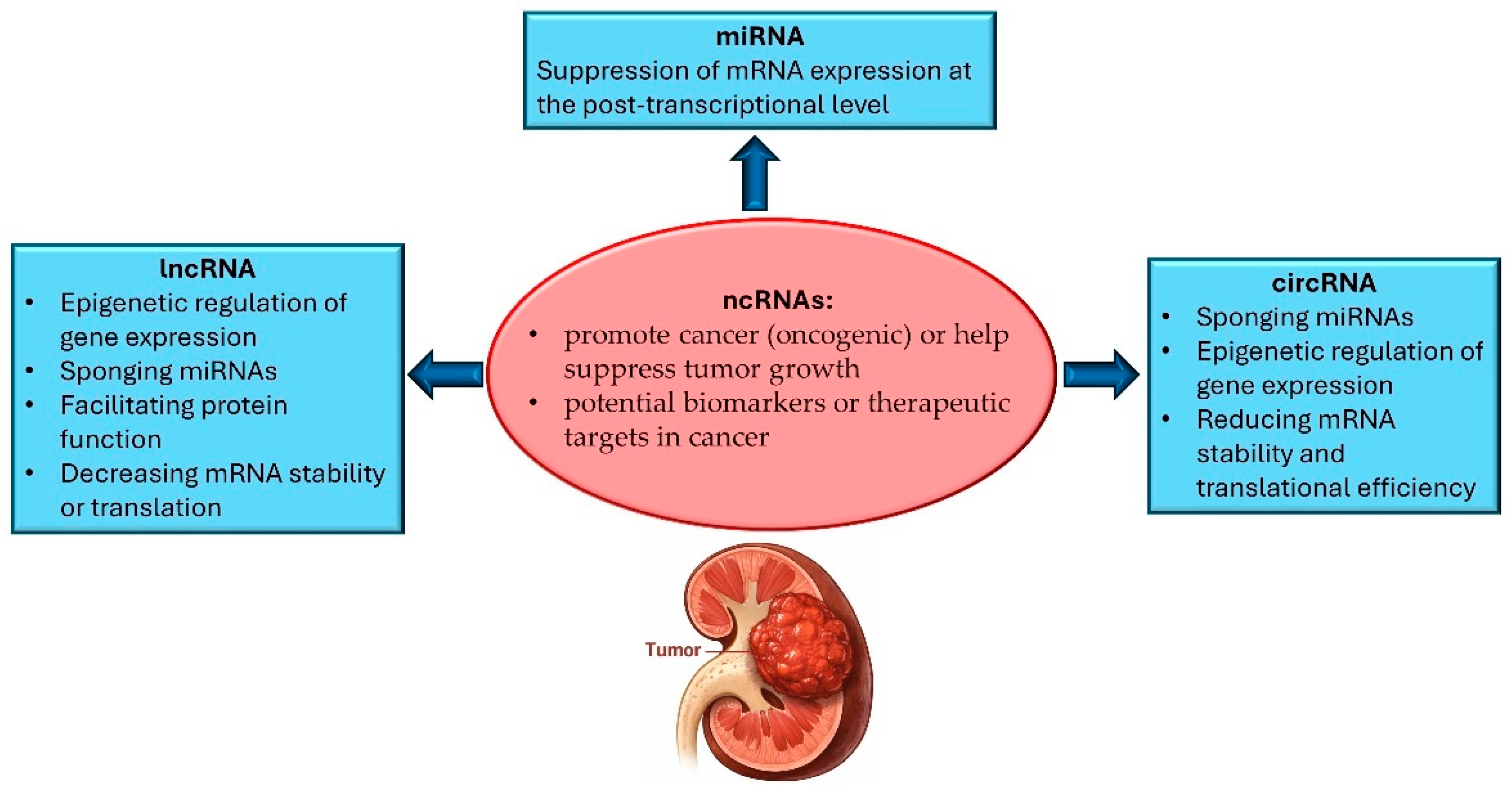
RCC is defined by deregulated cell proliferation, the capacity to invade and disseminate to distant sites, and the disruption of physiological cell death programs. In recent years, ncRNAs have been identified as important regulators of multiple cellular processes [30,31,32,33]. This discovery has driven strong research interest, as ncRNAs represent a highly diverse group of transcripts, including molecules with oncogenic activity as well as others with tumor-suppressive functions [34]. Consequently, several clinical trials are currently investigating ncRNAs as cancer biomarkers and as potential therapeutic targets. The recognition of ncRNAs as key components of gene regulation has provided additional layers of understanding of cancer biology, clarifying how these molecules contribute to tumor initiation and progression and how they may be exploited therapeutically. In particular, dysregulated ncRNA expression and the downstream signaling networks they affect have been strongly associated with malignant transformation and disease progression [35]. Moreover, genetic alterations affecting loci that encode ncRNAs have been linked to several tumor types [27]. ncRNAs include miRNAs, lncRNAs, and circRNAs (Figure 1).
miRNAs are small RNAs, approximately 22 nucleotides in length, that regulate gene expression by binding to complementary sequences, most commonly within the 3′ untranslated region (3′UTR) of target mRNAs. This interaction typically results in mRNA degradation and/or inhibition of translation. Altered miRNA expression has been reported across multiple cancer types and has been shown to influence key cellular and molecular programs involved in malignant transformation. Although the full spectrum of miRNA functions in cancer is still being defined, miRNAs are known to act either as tumor suppressors or as oncogenic regulators, thereby contributing to tumor growth, progression, and metastatic dissemination. Individual miRNAs are able to regulate multiple targets simultaneously and can modulate the expression of both protein-coding and non-coding transcripts. Their targets include oncogenes such as rat sarcoma proto-oncogene (RAS), MYC proto-oncogene (MYC), and epidermal growth factor receptor (EGFR), as well as tumor suppressors including tumor protein p53 (TP53), phosphatase and tensin homolog (PTEN), and BRCA1. A well-known example of an oncogenic miRNA is miR-155, which has been implicated in aberrant B-cell proliferation and the development of leukemia and lymphoma. Similarly, miR-21 is frequently upregulated in pre-B cell lymphoma and has also been associated with several other malignancies. Conversely, several miRNAs exert tumor-suppressive functions. For instance, the let-7 family can downregulate RAS expression, thereby limiting oncogenic signaling. miR-15a and miR-16-1 also act as tumor suppressors; however, their mutation or deletion has been linked to chronic lymphocytic leukemia. Finally, miR-34a regulates multiple oncogenic pathways and has been reported to be inactivated in certain tumors, including prostate cancer and multiple myeloma [27].
lncRNAs are RNA transcripts longer than 200 nucleotides that regulate gene expression through multiple mechanisms, including epigenetic modulation, chromatin remodeling, transcriptional control, post-transcriptional regulation, and signal transduction. lncRNAs have been widely implicated in cancer initiation, progression, and metastatic dissemination [36]. lncRNAs can exert their functions in cis, influencing nearby genes close to their transcriptional locus, or in trans, acting on distant genomic regions. In addition, several lncRNAs facilitate molecular interactions by bringing together regulatory components such as mRNAs, miRNAs, and proteins, including transcription factors, RNA-binding proteins (RBPs), and chromatin-modifying complexes, thereby serving as scaffolds that support the formation of functional regulatory assemblies [37]. For instance, metastasis-associated lung adenocarcinoma transcript 1 (MALAT1) has been reported to increase the expression of enhancer of zeste homolog 2 (EZH2) by interacting with miR-205 and to promote apoptosis in acute lymphoblastic leukemia cells. Overall, multiple studies indicate that lncRNAs can contribute to tumor development by behaving as oncogenic regulators [38]. HOX transcript antisense RNA (HOTAIR) is a well-characterized oncogenic lncRNA that is frequently upregulated in breast cancer and has been linked to unfavorable clinical outcomes [39]. However, not all lncRNAs promote tumorigenesis; several exert protective roles by limiting proliferation, triggering apoptosis, preserving genomic integrity, or sustaining tumor suppressor pathways. Maternally expressed gene 3 (MEG3) is among the best-studied lncRNAs with tumor-suppressive properties. It has been reported to enhance p53 protein levels and to modulate the transforming growth factor beta (TGFβ) signaling pathway, ultimately reducing cell proliferation [40,41]. Another established tumor-suppressive lncRNA is GAS5, which is often downregulated across different cancer types and has been validated in vivo in glioblastoma and breast cancer models. In addition, GAS5 can influence glucocorticoid receptor signaling and interact with miRNAs involved in the control of cell growth, promoting apoptosis and reducing migratory potential [42].
circRNAs are produced through back-splicing of precursor mRNA transcripts and are characterized by a covalently closed loop structure. This configuration makes circRNAs highly stable in vivo, supporting their potential utility as biomarkers and, in some cases, as therapeutic targets or tools [43].
Beyond their oncogenic or tumor-suppressive functions, ncRNAs can also contribute to the emergence of drug resistance in cancer cells. Several preclinical investigations have explored ncRNA-based strategies to overcome therapy resistance. For example, the lncRNA plasmacytoma variant translocation 1 (PVT1) has been reported to promote gemcitabine resistance in pancreatic cancer by activating the Wingless-related integration site (Wnt)/β-catenin axis and autophagy-related pathways. Accordingly, PVT1 has been proposed as a potential therapeutic target, as its downregulation may restore gemcitabine sensitivity. In breast cancer, MALAT1 has been shown to be upregulated in drug-resistant cells, and its inhibition can increase responsiveness to chemotherapy. Conversely, certain lncRNAs appear to counteract chemoresistance: long intergenic non-protein coding rna (LINC)00968 has been reported to reduce drug resistance in breast cancer by repressing Wnt2 and inhibiting Wnt2/β-catenin signaling, through a mechanism involving the recruitment of Hes-related family bHLH transcription factor with YRPW motif 1 (HEY1) [44].
Luo et al. reported that the lncRNA EIF3J divergent transcript (EIF3J-DT) is upregulated in gastric cancer cells with acquired resistance to chemotherapy. Their findings, supported by both in vitro and in vivo experiments, indicated that EIF3J-DT promotes autophagy and increases the expression of the autophagy-related 14 (ATG14) gene in resistant gastric cancer cells [45].
Among ncRNAs involved in chemosensitivity and chemoresistance, miRNAs are some of the most extensively investigated. A representative example is miR-125, which has been associated with therapy resistance across multiple tumor types. In breast cancer, miR-125 contributes to paclitaxel resistance by suppressing the pro-apoptotic factor Bcl-2 antagonist killer 1 (Bak1). It has also been shown to reduce the expression of dihydrofolate reductase (DHFR) and thymidylate synthase (TS), thereby promoting resistance to methotrexate or Tomudex in colon cancer and osteosarcoma. In contrast, miR-125b levels have been reported to inversely correlate with 5-fluorouracil resistance in hepatocellular carcinoma. Given these context-dependent effects, further preclinical investigation of anti-miRNA approaches is required before they can be advanced into clinical trials [46].
More recently, circRNAs have also been implicated in the regulation of chemoresistance. In osteosarcoma, hsa_circ_0001258 has been shown to increase glutathione s-transferase mu 2 (GSTM2) expression by sequestering miR-744-3p, thereby contributing to drug resistance. In addition, hsa_circ_0004015 has been reported to influence resistance to tyrosine kinase inhibitors (TKIs) in non-small cell lung cancer by modulating the miR-1183/3-phosphoinositide dependent protein kinase 1 (PDPK1) signaling axis. Overall, similarly to lncRNAs and miRNAs, circRNAs represent potential therapeutic targets for strategies aimed at limiting chemoresistance [46].

3. miRNAs in RCC

3.1. miRNAs Used for Diagnosis and Prognosis in RCC

Differential diagnosis in RCC remains a common challenge in routine pathology practice, and the identification of reliable biomarkers is therefore essential to improve diagnostic accuracy and patient management. miRNAs have potential clinical value in RCC diagnosis and may help differentiate among histological subtypes. Huang et al. compared miRNA expression profiles in 11 paired RCC specimens, consisting of ccRCC samples and their matched non-tumor renal tissues. Using microarray analysis, they identified a panel of 81 miRNAs, including 48 that were associated with ccRCC. Within this group, 17 miRNAs were downregulated in ccRCC compared with non-tumor tissue, 2 were upregulated, and 14 showed no significant differences between tumor and normal samples [47].
Fridman et al. reported overlapping miRNA expression patterns between oncocytoma and chromophobe RCC, as well as between ccRCC and pRCC. By analyzing miRNAs extracted from 71 formalin-fixed, paraffin-embedded renal tumor specimens, they developed a two-step decision-tree classifier based on the expression of six miRNAs. In the first step, miR-210 and miR-221 were used to separate the two main subtype pairs (clear cell vs. papillary and oncocytoma vs. chromophobe). In the second step, miR-200c and miR-139-5p enabled discrimination between oncocytoma and chromophobe tumors, whereas miR-31 and miR-126 were applied to distinguish clear-cell from papillary RCC [48].
In a separate study, Petillo et al. reported subtype-specific miRNA signatures that could serve as distinctive markers across RCC variants. They evaluated miRNA expression in 20 tumor samples, with four specimens per group: pRCC, chRCC, oncocytoma, ccRCC with favorable prognosis (overall survival > 5 years), and ccRCC with poor prognosis (overall survival < 5 years). Notably, increased expression of miR-424 and miR-203 in ccRCC allowed discrimination from the papillary subtype. In addition, miR-203 showed reduced expression in oncocytoma but was upregulated in chromophobe RCC, further supporting its potential value in differential diagnosis [49].
Overall, these studies indicate that miRNA expression profiling can discriminate not only between non-tumor and tumor renal tissue but also among distinct histological subtypes of renal cancer by capturing subtype-specific differences in the abundance of these short non-coding RNAs. As shown in the studies by Fridman [48] and Petillo [49], different miRNAs can have similar roles, suggesting that more studies are needed to identify all miRNAs involved in the different histological subtypes of RCC. Comparing miRNA expression patterns between normal and tumor renal tissues can support diagnostic improvement and provide insight into the biological functions of miRNAs in RCC. In this context, Juan et al. identified 35 miRNAs capable of distinguishing ccRCC from patient-matched normal kidney tissue with high accuracy. Among these, 26 miRNAs were consistently downregulated, whereas 9 were upregulated in ccRCC relative to normal samples. Notably, miR-155 and miR-21, both frequently overexpressed in several cancer types, as well as miR-210, a hypoxia-inducible miRNA, were also found to be increased in ccRCC. In addition, several of the downregulated miRNAs were associated with recurrent chromosomal deletions that are characteristic of ccRCC [50].
To support RCC diagnosis, miRNA profiling can also be applied to liquid biopsy samples, offering the advantage of a minimally invasive approach. Dias et al. investigated plasma-derived miRNA profiles in 32 patients with ccRCC sampled before and after surgery, as well as in 37 patients with metastatic disease. They reported that miR-25-3p, miR-126-5p, miR-200c-3p, and miR-301a-3p decreased after tumor resection, whereas miR-1293 levels increased. In addition, miR-301a-3p was elevated in patients with metastatic disease, while miR-1293 showed reduced expression in this group [51].
Multiple studies have shown that specific miRNA signatures may provide prognostic information and help predict survival outcomes in RCC. Yu-Zheng et al. identified 147 miRNAs capable of distinguishing tumor tissue from normal renal tissue. Among these, 22 miRNAs were significantly associated with overall survival: 13 were negatively correlated with survival (miR-223, miR-365-2, miR-21, miR-18a, miR-183, miR-335, miR-149, miR-9-2, miR-365-1, miR-130b, miR-9-1, miR-625, and miR-146b), whereas 9 miRNAs (miR-584, miR-10b, miR-27b, miR-769, miR-181a-2, miR-23b, miR-204, miR-24-1, and miR-139) were associated with more favorable survival outcomes [52]. In addition, Zhao et al. and Huang et al. reported further prognostic miRNAs. Zhao et al. found that reduced miR-497 expression correlated with advanced disease stage, higher histological grade, and metastatic spread, and was therefore linked to shorter overall survival. Using the Cancer Genome Atlas (TCGA) database, Huang et al. showed that increased expression of miR-21-5p, miR-223-3p, and miR-365a-3p was associated with worse survival in patients with ccRCC [53,54].

3.2. miRNAs and Drug Resistance in RCC

Drug resistance represents a major limitation in the treatment of many cancers and can markedly affect patient outcomes [55,56,57,58,59]. A substantial body of evidence supports the involvement of miRNAs in the resistance of RCC to targeted therapies (Table 1). For instance, miR-96-5p has been reported to be upregulated in sunitinib-resistant ccRCC, where it contributes to resistance by targeting PTEN and suppressing its expression [60].
miR-99a-3p has also been implicated in sunitinib resistance, as it targets the oncogene ribonucleotide reductase regulatory subunit M2 (RRM2) and promotes apoptosis in resistant cells. Consistently, reduced miR-99a-3p expression in RCC has been associated with poorer patient survival [54,61].
Thrombospondin 1 (THBS1), a gene linked to ccRCC response to sunitinib and patient prognosis, has been identified as a target of both miR-96-5p and miR-29b-3p. Quantitative reverse transcription polymerase chain reaction (qRT-PCR) analyses showed that miR-96-5p and miR-29b-3p were increased in ccRCC tumor tissues compared with matched adjacent non-tumor kidney samples. In parallel, decreased THBS1 expression in tumor tissue correlated with advanced stage, higher Fuhrman grade, and unfavorable prognosis. These results suggest that upregulation of miR-96-5p and miR-29b-3p may drive THBS1 suppression, thereby contributing to sunitinib resistance in ccRCC. Overall, these findings provide mechanistic insight into acquired drug resistance and may support the development of improved therapeutic strategies [62].
Sekino et al. reported, based on qRT-PCR analysis, that miR-130b expression was increased in RCC tissues compared with matched normal renal samples. They also showed that miR-130b influences cell growth and identified an inverse relationship between miR-130b levels and expression of the tumor suppressor PTEN in RCC. In particular, in vitro experiments supported a role for miR-130b in sunitinib resistance through PTEN regulation: miR-130b was significantly upregulated in sunitinib-resistant Caki-1 cells compared with the corresponding parental Caki-1 line [63].
miR-885-5p levels were reported to decrease significantly following sunitinib exposure, and this reduction was associated with unfavorable disease progression in ccRCC. Both in vitro and in vivo data supported a functional role for miR-885-5p suppression in the acquisition of sunitinib resistance. Mechanistically, sunitinib treatment was shown to reduce GATA binding protein 1 (GATA1) expression, leading to diminished GATA1 binding to the miR-885 promoter and consequent transcriptional repression of miR-885-5p. In addition, perilipin 3 (PLIN3) was validated as a direct target of miR-885-5p. PLIN3 participates in lipid droplet formation, a process that can limit oxidative stress by sequestering toxic lipids and thereby protecting solid tumor cells from lipotoxic damage. The authors found that PLIN3 upregulation occurred as a consequence of miR-885-5p downregulation induced by sunitinib treatment. Collectively, these findings suggest that the GATA1/miR-885-5p/PLIN3 regulatory axis may represent both a potential therapeutic target and a biomarker to predict and improve response to sunitinib in ccRCC [64].
miR-31-5p was identified as a key factor in promoting resistance to sorafenib in RCC cell lines. miR-31-5p has been identified as an important mediator of sorafenib resistance in RCC cell models. Although sorafenib can improve survival in patients with advanced RCC, its clinical benefit is often limited by the emergence of acquired resistance. Extracellular vesicles (EVs) are known to participate in intercellular communication by transporting bioactive molecules between cells. In this study, EVs released from sorafenib-resistant RCC cell lines (786-O and ACHN) were shown to be internalized by sorafenib-sensitive parental cells, inducing a resistant phenotype.
Among the EV cargo, miR-31-5p was enriched and was found to suppress MutL homolog 1 (MLH1), a gene implicated in drug responsiveness. Both in vitro and in vivo experiments confirmed that miR-31-5p promotes sorafenib resistance through MLH1 downregulation. Consistently, MLH1 expression was reduced in resistant cells, and re-expression of MLH1 restored sorafenib sensitivity. From a clinical perspective, patients who experienced disease progression during sorafenib therapy showed increased levels of miR-31-5p in circulating EVs compared with pre-treatment samples. Overall, these results indicate that EV-mediated transfer of miR-31-5p contributes to the spread of resistance within the tumor by targeting MLH1, highlighting miR-31-5p and MLH1 as potential biomarkers and therapeutic targets to counteract sorafenib resistance in RCC [65].
A recent study investigated VHL-dependent miRNAs in ccRCC. In particular, loss of function of the VHL tumor suppressor gene is recognized as one of the earliest and foundational events in the development of ccRCC. The resulting accumulation of HIFα due to VHL inactivation contributes to tumor progression, in part by modulating miRNA expression. miRNA expression profiling and high-throughput analyses were performed to identify a subset of miRNAs regulated by VHL in ccRCC. Among them, miR-2355-5p was found to be significantly upregulated in both ccRCC cell lines and patient tumor samples. Additionally, circulating levels of miR-2355-5p were markedly elevated in plasma from ccRCC patients. Further investigation revealed that the overexpression of miR-2355-5p is regulated by Hypoxia-inducible factor 2 alpha (HIF-2α). Functional studies using CRISPR/Cas9-mediated knockout of miR-2355-5p demonstrated impaired angiogenic potential, reduced cell proliferation, and significant suppression of tumor growth in mouse xenograft models. Through a miR-2355-5p pulldown assay, five tumor suppressor genes—Aconitase 1 (ACO1), BTG anti-proliferation factor 2 (BTG2), CKLF-like MARVEL transmembrane domain-containing 4 (CMTM4), slit guidance ligand 2 (SLIT2), and WD repeat and FYVE domain-containing 2 (WDFY2)—were identified as direct targets. These genes were consistently downregulated in both human ccRCC tumors and xenograft tissues. Overall, this study highlights the oncogenic role of miR-2355-5p and provides insight into its contribution to tumor angiogenesis and growth in VHL-deficient ccRCC [66].
miR-210-3p has been found to be downregulated in doxorubicin-resistant RCC cells (Caki-2/DOX). It enhances drug sensitivity by targeting the 3′UTR of ATP-binding cassette subfamily C member 1 (ABCC1), leading to reduced expression of multidrug resistance-associated protein 1 (MRP1), an efflux transporter associated with chemoresistance [67].
Another study reported that miR-124 is upregulated in renal cancer cells and contributes to cisplatin resistance. Specifically, miR-124 was shown to reduce cisplatin sensitivity in RCC mainly by inhibiting Calpain 4 (CAPN4). CAPN4 can promote the degradation of CCR4-NOT transcription complex subunit 3 (CNOT3), a key component of the CCR4–NOT transcriptional complex. CNOT3 has been implicated in the regulation of necroptosis by controlling the stability and translation of specific mRNAs.
Experimental evidence indicated that the increase in miR-124 observed after cisplatin exposure limits CAPN4 activity, thereby preventing CAPN4-dependent CNOT3 degradation and ultimately suppressing necroptosis in RCC cells. These results suggest that interfering with this regulatory axis could represent a therapeutic strategy to overcome cisplatin resistance in RCC by restoring alternative, non-apoptotic cell death programs [68].

4. Circular Non-Coding RNAs in Renal Cell Carcinoma

circRNAs are small closed-loop RNAs without 5′ caps or 3′ polyadenylate tails [69]. Originally, circRNAs were considered mere byproducts of transcription. Then, it was discovered that the majority of these were involved in both physiological and pathological processes, among which were cancer development and progression. circRNAs have been shown to serve multiple roles, including acting as sponges for microRNAs, binding molecules for RNA binding proteins (RBPs), regulators of transcription, or templates for protein synthesis. Their involvement in various types of tumors has been extensively studied. The functions of circRNAs are closely linked to their location within the cell: those found in the nucleus may play a role in controlling gene transcription and alternative RNA splicing [70], while cytoplasmic circRNAs commonly function as microRNA sponges or interact with RBPs to influence post-transcriptional regulation of genes associated with tumors [71]. Although circRNAs are often introduced as miRNA sponges, studies in RCC indicate that circRNA–miRNA interactions operate through defined and mechanistically relevant regulatory axes [72]. In RCC, circRNAs such as circASAP1, circGRAMD4, circ_0003520, circPDHK1, and circAGAP1 have been shown to modulate tumor growth, immune evasion, ferroptosis, and drug response by selectively binding specific miRNAs and thereby regulating downstream target genes. For example, circ_0003520 regulates RCC progression through the circ_0003520/miR-205-5p/Cullin 4B (CUL4B) axis, while circGRAMD4 modulates immune-related pathways by sponging miRNAs involved in antigen presentation [73,74]. Similarly, circAGAP1 influences therapeutic sensitivity through interaction with miRNAs targeting platelet-derived growth factor receptor (PDGFR) signaling [75]. These RCC-specific examples demonstrate that circRNA–miRNA interplay is not a generic sponge effect but a structured layer of post-transcriptional regulation that shapes oncogenic and tumor-suppressive pathways in a context-dependent manner.
Despite these insights, the specific functions of circRNAs in RCC are still not well understood (Table 2). Wang et al. revealed that circASAP1 was upregulated in ccRCC with a direct correlation with poor prognosis and metastasis. Moreover, the high expression of circASAP1 correlated with ccRCC cell viability, invasion and metastasis. Finally, they demonstrated the relationship between circRNA and the ArfGAP with SH3 domain, ankyrin repeat and PH domain 1 (ASAP1)/heterogeneous nuclear ribonucleoprotein C (HNRNPC)/glutathione peroxidase 4 (GPX4) axis. HNRNPC bound circASAP1 through amino acid residues 16–87. Silencing circASAP1 did not affect HNRNPC mRNA levels but led to a reduction in its protein levels via the ubiquitin–proteasome degradation pathway. Transcriptomic analysis revealed that protein-coding genes responsive to circASAP1 knockdown, including GPX4, were enriched in the ferroptosis pathway. Mechanistically, HNRNPC was found to regulate GPX4 expression by stabilizing its mRNA, thereby influencing its protein levels. Loss of circASAP1 expression induced a ferroptosis phenotype in RCC cells and significantly reduced both subcutaneous tumor growth and lung metastasis in nude mice. The decrease in circASAP1 expression suppresses RCC progression and metastasis by promoting ferroptosis through enhanced ubiquitination of HNRNPC. This highlights a novel regulatory axis and presents a potential therapeutic avenue for renal cancer treatment [76].
Zhou et al. revealed that high levels of circGRAMD4 in RCC correlated with a poor patient prognosis. Loss of circGRAMD4, due to the activation of CD8+ T cell-mediated anti-tumor immunity, led to a marked suppression of RCC proliferation. In particular, it was demonstrated that circGRAMD4 bound to RNA-binding motif protein 4 (RBM4) protein, enhancing the stability of NBR1 mRNA, an autophagic cargo receptor. This stabilization increased NBR1 expression, which promoted the degradation of major histocompatibility complex class I (MHC-1) molecules via macroautophagy/autophagy pathways. Consequently, antigen presentation in RCC cells was impaired, causing dysfunction of cluster of differentiation 8 positive (T lymphocyte) (CD8+) T cells and enabling tumor immune evasion. Combining circGRAMD4 inhibition with immune checkpoint blockade (ICB) reshaped the immunosuppressive tumor microenvironment, improving ICB therapeutic efficacy. Targeting circGRAMD4 could be a promising strategy to boost immunotherapy outcomes in combination with ICB [74].
circ_0003520 is another circRNA that is increased in ccRCC. It was demonstrated that circ_0003520 acts as an oncogene that drives ccRCC progression by modulating the miR-205-5p/CUL4B axis, highlighting a potential therapeutic target for inhibiting ccRCC growth. In vitro studies showed that knockdown of circ_0003520 inhibited cell proliferation, migration, invasion, and angiogenesis, and promoted apoptosis. Mechanism analysis revealed that circ_0003520 upregulated CUL4B through sequestering miR-205-5p. Inhibiting miR-205-5p or overexpressing CUL4B could reverse the suppressive effects of circ_0003520 knockdown on ccRCC. Additionally, circ_0003520 was shown to facilitate tumor growth in vivo through the miR-205-5p/CUL4B pathway. Overall, circ_0003520 acts as an oncogene that drives ccRCC progression by modulating the miR-205-5p/CUL4B axis, highlighting a potential therapeutic target for inhibiting ccRCC growth [73].
Ning et al. studied a possible delivery strategy to target circPDHK1, which is overexpressed in ccRCC and promotes cancer cell proliferation and migration. They developed a new nucleic acid drug delivery system, aptamer-guided lipid nanoparticle carrying siRNA against circPDHK1 (AS1411/LNP-si circPDHK1). Both in vitro and in vivo experiments showed that treatment with AS1411/LNP-si circPDHK1 led to a reduced expression of circPDHK1 in ccRCC cells. This delivery system demonstrated enhanced tumor-targeting efficiency and extended circulation time compared to non-targeted formulations. Importantly, AS1411/LNP-si circPDHK1 effectively blocked phosphorylation within the mTOR–protein kinase B (AKT) signaling pathway, inhibited proliferation and migration of ccRCC cells, and showed minimal toxicity in vital organs [77].
Lv et al. identified a marked upregulation of circAGAP1 in ccRCC, correlating with poor prognosis. In this study, they conducted a comprehensive investigation combining bioinformatics analyses and experimental validation to elucidate the function of circAGAP1 in sunitinib response. It was revealed that circAGAP1 is upregulated in sunitinib-sensitive ccRCC cells and enhances sensitivity to sunitinib by inhibiting cell proliferation, clonogenicity, and migration. Mechanistically, circAGAP1 acts as a competing endogenous RNA, sponging miR-149-5p, miR-455-5p, and miR-15a-5p, thereby modulating the expression of PDGFR, a known target of sunitinib. Overexpression of these miRNAs counteracted the sensitizing effect of circAGAP1, further validating this regulatory axis. circAGAP1 plays a critical role in modulating sunitinib sensitivity in ccRCC and may serve as a novel biomarker and potential therapeutic target to overcome drug resistance [75].

5. Long Non-Coding RNA in Renal Cell Carcinoma

lncRNAs can regulate different biological process, including cell proliferation, cell death, cell differentiation and cell cycle regulation, and they play pivotal roles in oncogenesis. A large number of lncRNAs have been related to RCC development and progression or participate in the resistance of RCC to targeted therapy (Table 3). Indeed, different studies have demonstrated that some oncogenic lncRNAs could inhibit the apoptosis of cancer cells and promote cell proliferation and migration, as demonstrated in gastric cancer [78]. Furthermore, specific lncRNAs have been implicated in the promotion of chemoresistance and the reprogramming of cellular energy metabolism within malignant cells [79].

5.1. lncRNA in RCC Development and Progression

A study investigated LINC01322 RNA expression in RCC patients. Researchers found that LINC01322 expression was significantly elevated in advanced-stage tumors, particularly those located in the left kidney and treated with total nephrectomy. Higher LINC01322 levels also correlated with larger tumor size. Additionally, bioinformatic analysis suggested that LINC01322 may interact with the VHL gene, potentially influencing the tumor microenvironment and contributing to RCC progression. These findings suggest that LINC01322 could serve as a diagnostic marker for high-risk RCC patients, although further studies are needed to confirm its mechanistic link with VHL and to evaluate its potential as a blood-based biomarker [80].
Wilms tumor 1-associated protein (WTAP), a key component of the N6-methyladenosine (m6A) methyltransferase complex, has been found to be significantly upregulated in RCC tissues compared to normal counterparts. WTAP promotes tumor cell proliferation and metastasis both in vitro and in vivo. WTAP facilitates m6A methylation of the long noncoding RNA TEX41, leading to its degradation via YTH N6-methyladenosine RNA binding protein 2 (YTHDF2)-mediated recognition. The loss of TEX41 stabilizes the interaction with SUZ12 polycomb repressive complex 2 subunit (SUZ12), a subunit of the polycomb repressive complex 2 (PRC2), enhancing SUZ12 histone methyltransferase activity and contributing to Histone deacetylase 1 (HDAC1) gene silencing. These findings delineate a novel oncogenic regulatory axis—WTAP/TEX41/SUZ12/HDAC1—in RCC progression, underscoring the critical role of epigenenetic modifications in tumor biology. This axis may offer new insights into RCC pathogenesis and presents potential targets for therapeutic intervention [81].
Marked upregulation of LINC00365 was highlighted in advanced RCC cases and in older patients undergoing total nephrectomy, suggesting its potential as a diagnostic marker for identifying high-risk individuals, particularly among the elderly. Furthermore, higher expression was observed in female patients, revealing its possible use as a gender-specific biomarker. Future studies assessing LINC00365 levels in serum samples are warranted to validate its clinical utility as a non-invasive diagnostic tool [82].
Oxidative stress is caused by an imbalance between the production of reactive oxygen species (ROS) and cells’ antioxidant defenses, and has been associated in the development and progression of several diseases [83,84,85,86,87,88,89]. Although lncRNAs were considered non-translatable, recently it has been discovered that they can encode functional peptides involved in the progression of tumors [90]. In this study, it was discovered that a novel peptide, TCL6-encoded peptide 6148 (TCL6148), was encoded by T-cell leukemia/lymphoma 6 (TCL6). Chen et al. demonstrated that TCL6148 exerts anti-tumor activity by inducing ferroptosis in RCC via the glutamic-oxaloacetic transaminase 1 (GOT1)/GPX4 signaling pathway. TCL6148 promoted the accumulation of Fe2+, increased reactive ROS levels, and enhanced lipid peroxidation, thereby increasing RCC cell susceptibility to ferroptosis. Notably, TCL6148 markedly improved the efficacy of sunitinib, suggesting a potential combinational strategy to overcome drug resistance. In vivo studies further confirmed the safety and tumor-suppressive effects of TCL6148. Overall, the results obtained by this research group highlight TCL6148 as a promising therapeutic agent for RCC and offer new perspectives on peptide-based treatments for this malignancy [91].
G protein-coupled receptor class C group 5 member D antisense RNA 1 (GPRC5D-AS1) is a lncRNA that was studied in lung squamous cell carcinoma as biomarker in clinical applications. In RCC, its expression was studied in renal cancer cell line 786-O and in nude mice. Jia et al. showed that after GPRC5D-AS1 silencing there was an increase in the number of proliferating cells and migrating cells, as well as an important increase in tumor volume in nude mice and higher levels of β-catenin, Ki-67, PCNA and N-cadherin. Results showed an opposite trend for cells that overexpressed GPRC5D-AS1 [92].
Li et al. revealed that LINC00645 is among the most dysregulated lncRNA between RCC and healthy renal tissue. In this study, they showed that it is involved in RCC development. In particular, it was demonstrated that LINC00645 functions as a tumor suppressor in RCC, inhibiting cell proliferation, migration, and invasion. RNA-binding protein heterogeneous nuclear ribonucleoprotein A2/B1 (HNRNPA2B1) stabilized rho-associated coiled-coil containing protein kinase 1 (ROCK1) mRNA by direct binding. LINC00645 competes for the RRM1 domain of HNRNPA2B1, which is crucial for its interaction with ROCK1 mRNA, thereby promoting ROCK1 mRNA destabilization and reducing its expression. In RCC cells, decreased LINC00645 expression disrupts this interaction, leading to increased ROCK1 levels and enhanced tumor progression. Notably, RCC cells with low LINC00645 expression exhibit heightened sensitivity to the ROCK1 inhibitor Y-27632. These findings suggest that the LINC00645/HNRNPA2B1/ROCK1 axis plays a critical role in RCC progression and presents a potential therapeutic target, especially for patients with reduced LINC00645 expression [93].
The expression of lncRNA HIF1A antisense RNA 2 (HIF1A-AS2), located on chromosome 14, was studied in different tumors, including breast, lung, gastric and bladder cancer. In ccRCC, HIF1A-AS2 is known to promote cell proliferation through the miR-130a-5p/Erb-B2 receptor tyrosine kinase 2 (HER2) (ERBB2) and miR-30a-5p/SRY-box transcription factor 4 (SOX4) pathways. Recent studies have expanded this understanding by demonstrating that HIF1A-AS2 also facilitates ccRCC cell migration via the regulation of hypoxia-inducible factor 1 alpha (HIF1α) mediated by the transcription factor Gli family zinc finger 1 (Gli1). Expression analyses in tumor and normal tissues, supported by public databases and 30 clinical samples, confirmed significant upregulation of HIF1A-AS2 in tumor tissues. Knockdown of HIF1A-AS2 in ccRCC cell lines resulted in marked reductions in cell proliferation and migration. Bioinformatic and experimental approaches revealed a direct interaction between HIF1A-AS2 and Gli1, with HIF1A-AS2 positively regulating Gli1 expression. Gli1, which is overexpressed in ccRCC, in turn modulates HIF1α expression, a well-known oncogene that accumulates due to common VHL mutations in ccRCC. Further experiments demonstrated that Gli1 directly binds the promoter region of HIF1α, enhancing its transcription. Given the central role of HIF1α in lipid metabolism in ccRCC, RNA-seq analyses of HIF1A-AS2 knockdown cells revealed significant alterations in lipid metabolic pathways, with sterol regulatory element binding transcription factor 1 (SREBP1) identified as a potential downstream effector of HIF1A-AS2.
These findings highlight the critical role of HIF1A-AS2 in promoting ccRCC progression through modulation of the Gli1/HIF1α axis and remodeling of lipid metabolism, providing new therapeutic insights [94].
lncRNA osteopetrosis-associated transmembrane protein 1 anti-sense RNA 1 (OSTM1-AS1) was found, in the studies of Chen et al., to be one of the most abundant lncRNAs, and it was highly expressed both in RCC tissue and cell lines. OSTM1-AS1 promoted cell migration and invasion by suppressing miR-491-5p, which normally inhibits matrix metallopeptidase 9 (MMP-9), a key enzyme involved in tumor progression. Silencing OSTM1-AS1 increased miR-491-5p levels, reduced MMP-9 expression, and suppressed RCC cell invasiveness, while reversing these effects by downregulating miR-491-5p or overexpressing MMP-9 restored malignancy. In vivo, OSTM1-AS1 knockdown significantly reduced tumor growth in mice. The OSTM1-AS1/miR-491-5p/MMP-9 axis plays a crucial role in RCC progression and may offer a novel therapeutic target [95].
Vasculogenic mimicry (VM) presents a critical role in the invasion and metastasis of various tumors, including RCC. A recent study identified lncRNA-SERB as significantly overexpressed in RCC tumor cells. Both in vitro and in vivo mouse model analyses demonstrated that lncRNA-SERB enhanced VM formation and consequently promoted tumor cell invasion. LncRNA-SERB acted as an upstream regulator of ERβ by binding to its 3′UTR, thereby increasing ERβ expression. Elevated ERβ, in turn, facilitated VM through the transcriptional activation of zinc finger E-box binding homeobox 1 (ZEB1), a key factor in tumor progression. Therapeutically, the administration of the Food and Drug Administration (FDA)-approved anti-estrogen ICI 182,780 in preclinical models significantly reduced tumor growth and metastasis, underscoring the potential of targeting the lncRNA-SERB/ERβ/ZEB1 axis in RCC. These findings offer novel insights into RCC pathogenesis and present new avenues for therapeutic intervention aimed at disrupting VM-driven tumor progression [96].
Hereditary leiomyomatosis and renal cell carcinoma (HLRCC) is one of the most aggressive RCCs, characterized by germline loss-of-function mutation of fumarate hydratase (FH) [97].
FH-deficient RCC represents a distinct subtype of kidney cancer characterized by disrupted cellular metabolism, although the mechanisms of its metabolic reprogramming remain poorly understood. This study investigated the role of lncRNAs in this context by integrating RNA-sequencing and mass spectrometry on FH-deficient RCC tissues and conducting functional assays using the UOK262 cell line and patient-derived xenograft (PDX) models. The lncRNA MIR4435-2HG was found to be selectively overexpressed in FH-deficient RCC compared to ccRCC. Mechanistically, MIR4435-2HG expression was epigenetically upregulated by fumarate through histone demethylation. Functional studies revealed that MIR4435-2HG enhanced glutamine metabolism by binding to signal transducer and activator of transcription 1 (STAT1), which transcriptionally activated glutaminase 1 (GLS1). Targeting GLS1 with the inhibitor CB-839 significantly reduced tumor growth in vivo. These findings highlight MIR4435-2HG as a key regulator of metabolic remodeling in FH-deficient RCC and propose GLS1 as a promising therapeutic target, with MIR4435-2HG serving as a potential biomarker for treatment response [98].

5.2. Interactions and Cross-Talk Between Short and Long Non-Coding RNAs: Mutual Regulation of miRNAs and lncRNAs

Many lncRNAs can act as miRNA sponges, binding mRNA and regulating downstream genes expression. An example is lncRNA DMDRMR, which acts as sponge for miR-378a-5p and upregulates EXH2 and SMAD-specific E3 ubiquitin protein ligase 1 (SMURF1). EZH2 prevents the transcription of DAB2 interacting protein (DAB2IP); meanwhile, SMURF1 regulates DAB2IP degradation. This mechanism activates the vascular endothelial growth factor A (VEGFA)/vascular endothelial growth factor receptor 2 (VEGFR2) pathway, which drives angiogenesis in ccRCC and contributes to sunitinib resistance [99].
lncRNA E2F1 mRNA stabilizing factor (EMS) was found to be overexpressed in sorafenib-resistant RCC tissues and cells. Wang et al. demonstrated that silencing EMS enhanced the effectiveness of sorafenib, reducing cell growth and promoting apoptosis in resistant RCC cells. In animal models, combining EMS knockdown with sorafenib therapy significantly suppressed tumor progression. Mechanistically, EMS acts as a molecular sponge for miR-363-3p, whose levels are reduced in resistant cells, thereby preventing it from downregulating dual-specificity phosphatase 10 (DUSP10), a gene that contributes to drug resistance. Restoring miR-363-3p or suppressing DUSP10 re-sensitized cells to sorafenib. The EMS/miR-363-3p/DUSP10 pathway plays a key role in sorafenib resistance in RCC and may serve as a valuable therapeutic target and biomarker [100].
A recent study by Zhu et al. explored the role of m6A modification in RCC and its interaction with lncRNA LHX1 divergent transcript (LHX1-DT). Low expression of LHX1-DT was found in RCC tissues, and it was related to poor overall survival in RCC patients. Moreover, they demonstrated, using functional assays, that the overexpression of LHX1-DT reduced RCC cell proliferation and invasion. The m6A reader protein insulin-like growth factor 2 mrna binding protein 2 (IGF2BP2), regulated by methyltransferase-like 14 (METTL14), specifically recognized the m6A modification site on LHX1-DT, thereby enhancing its stability. Furthermore, LHX1-DT behaved as a competing endogenous RNA (ceRNA) by sequestering miR-590-5p, leading to the upregulation of programmed cell death 4 (PDCD4), which suppresses RCC cell proliferation and invasion. The authors suggested that LHX1-DT operates as an independent prognostic biomarker for RCC, and the IGF2BP2/LHX1-DT/miR-590-5p/PDCD4 signaling axis constitutes a promising therapeutic target for RCC progression [101].
The role of HOXA transcript at the distal tip (HOTTIP), a lncRNA, was investigated in RCC by Zhang et al. HOTTIP resulted in upregulation in RCC tissues with respect to normal tissues and correlated with a poorer prognosis based on the TCGA database. They demonstrated that HOTTIP functioned as a ceRNA for miR-506. In particular, when downregulating HOTTIP, cell proliferation, migration and invasion were found to reduce [102].
Tian et al. investigated the role of the long non-coding RNA small nucleolar RNA host gene 1 (SNHG1) in regulating autophagy and sunitinib resistance in RCC. Elevated SNHG1 expression was observed in RCC tissues and cell lines and was associated with poor patient prognosis. Functional assays revealed that silencing SNHG1 inhibited RCC cell proliferation, migration, invasion, and autophagy, while also restoring sensitivity to sunitinib treatment. Mechanistically, SNHG1 was shown to bind to the RNA-binding protein polypyrimidine tract binding protein 1 (PTBP1), which in turn upregulated ATG7, a key autophagy-related gene. Through this SNHG1/PTBP1/ATG7 axis, SNHG1 promoted malignant progression and drug resistance in RCC cells [103].
The bond of some lncRNAs with proteins can promote changes in downstream genes. For example, different studies highlighted that the androgen receptor (AR) could be involved in RCC progression and metastasis. Wei et al. discovered that the lncRNA suppressing androgen receptor in renal cell carcinoma (SARCC) binds to and promotes the degradation of the AR protein, resulting in the downregulation of miR-143-3p. This, in turn, suppresses downstream signaling pathways involving Akt, matrix metallopeptidase 13 (MMP-13), K-ras, and phosphorylated extracellular signal-regulated kinase (p-ERK). Moreover, sunitinib has been shown to upregulate lncRNA SARCC expression, thereby enhancing RCC cell sensitivity to the drug and reducing resistance [104].
lncRNA HOTAIR is known to be involved in the proliferation, migration, invasion and inhibition of apoptosis in RCC [105,106]. Furthermore, it was demonstrated that lncRNA HOTAIR competitively binds miR-17-5p and regulates Beclin1 in RCC cells, leading to the activation of cell autophagy and RCC resistance to sunitinib. Indeed, higher levels of autophagy are involved in resistance in cancer cells, and are considered a tolerance mechanism of cells towards tumor therapy [107].

5.3. Role of lncRNAs in Resistance to Targeted Therapies

An in vivo study conducted by Pan et al. identified a lncRNA, STX17 divergent transcript (STX17-DT), involved in axitinib resistance in RCC. STX17-DT is overexpressed in axinitib-resistant RCC cells and is related to worse patient outcomes. They demonstrated that STX17-DT enhanced the stability of interferon alpha inducible protein 6 (IFI6) mRNA by interacting with the protein heterogeneous nuclear ribonucleoprotein A1 (hnRNPA1), which reduced mitochondrial ROS levels and inhibited ferroptosis. STX17-DT was also loaded into extracellular vesicles via hnRNPA1, enabling the spread of resistance between cells. Notably, combining axitinib with STX17-DT-targeted siRNA improved treatment effectiveness compared to axitinib alone [108].
LncRNA IGFL2-AS1 is significantly upregulated in sunitinib-resistant RCC and is associated with reduced survival rates in ccRCC patients undergoing sunitinib treatment. IGFL2-AS1 competitively interacts with HNRNPC, a versatile RNA-binding protein, which leads to increased expression of tumor protein p53 inducible nuclear protein 2 (TP53INP2). The elevated levels of TP53INP2 stimulate autophagy, contributing to the development of sunitinib resistance in RCC cells. Additionally, IGFL2-AS1 can be encapsulated within exosomes, facilitating the transfer of sunitinib resistance to neighboring RCC cells [109].
It is known that lncRNA SNHG12 has a role in tumor development. Liu et al. investigated the role of SNHG12 in RCC tissue sample and sunitinib-resistant cells, where it resulted in upregulation and was related to a poor clinical prognosis. lncRNA SNHG12 interacts with the transcription factor specificity protein 1 (Sp1), inhibiting its deubiquitination and thereby increasing Sp1 protein stability. Moreover, SNHG12 promotes the binding of Sp1 to cell division cycle-associated protein-3 (CDCA3) promoter, upregulating it [110].
The release of exosomes with lncRNAs can be considered a mechanism to induce drug resistance in RCC cells. LncRNA activated in RCC with sunitinib resistance (ARSR) promoted resistance to sunitinib in RCC cells binding miR-34/miR-449 and then upregulating AXL receptor tyrosine kinase (AXL) and c-Met [111]. Meanwhile, LncARSR can be encapsulated within exosomes, facilitating the transfer of drug resistance from sunitinib-resistant cells to sensitive ones [111].
In another study, exosomes isolated from sunitinib-sensitive and -resistant RCC cells were characterized by transmission electron microscopy and Western blot analysis. Co-culture experiments revealed that exosomes from sunitinib-resistant RCC cells (R-exos) enhanced proliferation and upregulated key proliferative markers, cyclin D1 (CCND1) and proliferating cell nuclear antigen (PCNA), while suppressing apoptosis and reducing Bcl-2-associated X protein (Bax) and Caspase-3 expression by delivering the long non-coding RNA SNHG16. In resistant cell-derived xenograft models, R-exos promoted tumor growth, whereas SNHG16 knockdown significantly inhibited tumor progression. Mechanistically, SNHG16 modulated trophinin-associated protein (TROAP) expression by sponging miR-106a-5p, with miR-106a-5p inhibition or TROAP overexpression reversing the anti-tumor effects of SNHG16 silencing. These findings indicate that the SNHG16/miR-106a-5p/TROAP axis plays a pivotal role in mediating sunitinib resistance and tumor aggressiveness in RCC, highlighting this pathway as a potential therapeutic target for patients undergoing sunitinib treatment [112].
lncRNA leucine-rich repeat containing 75 A-antisense RNA1 (LRRC75A-AS1) was identified as a potential lncRNA that could predict the efficacy of immune checkpoint inhibitor therapy and cancer progression in RCC. Tokunaga et al. showed that LRRC75A-AS1 was upregulated in ccRCC tissues compared with in adjacent normal tissues, and it was related to a poor outcome in patients with RCC. LRRC75A-AS1 regulated cell proliferation and invasion; indeed, its knockdown reduced tumorigenesis [113].
lncRNA Polo-like kinase 1 substrate 1 (PLK1S1) was found to be upregulated in RCC and was related to a poor prognosis. lncRNA PLK1S1 promoted sorafenib resistance in RCC cells through the regulation of C-X-C motif chemokine receptors 5 (CXCR5) sponging miR-653 [114].
Xu et al. discovered a novel lncRNA, termed sorafenib resistance-associated lncRNA in RCC (SRLR), which is overexpressed in sorafenib-resistant RCC cells. SRLR directly interacted with the nuclear transcription factor nuclear factor kappa B (NF-κB), promoting interleukin 6 (IL-6) transcription and activating the signal transducer and activator of transcription (STAT3) signaling pathway, ultimately contributing to sorafenib resistance [115]. Another lncRNA, KIF9-AS1, functions by sponging miR-497-5p, thereby activating the TGF-β and autophagy signaling pathways, and also enhancing RCC cell resistance to sorafenib [116].
lncRNA nuclear-enriched abundant transcript 1 (NEAT1) is upregulated in various human cancers, among which are RCC. In malignant cells, NEAT1 modulated target gene expression, promoting cell proliferation, migration, and invasion while inhibiting apoptosis, primarily through its interaction with miRNAs. In RCC, elevated NEAT1 levels correlated with tumor progression and poor patient survival. Mechanistically, NEAT1 enhanced epithelial–mesenchymal transition and contributed to sorafenib resistance by regulating c-Met expression through competitive binding with miR-34a [117].
Table 3. Biological and clinical relevance of lncRNAs in RCC.
lncRNABiological and Clinical RelevanceExpression Levels in RCCRef.
LINC01322Interacts with VHL gene and contributes to RCC progressionHigh expression in advanced stages[80]
TEX41Facilitates m6A methylation and degradation; loss stabilizes interaction with SUZ12 enhancing HDAC1 gene silencing, promoting RCC progression.Downregulated (due to degradation)[81]
LINC00365Diagnostic marker; higher expression in advanced RCC, elderly, and female patients; potential gender-specific biomarkerUpregulated[82]
TCL6Peptide TCL6148 induces ferroptosis via GOT1/GPX4 pathway, promoting Fe2+ accumulation and enhancing sensitivity to sunitinibDownregulated in RCC and correlated with poor prognosis[91]
GPRC5D-AS1Suppresses proliferation and migration when overexpressed; silencing increases tumor growth and proliferation markersDownregulated in RCC cell lines[92]
LINC00645Tumor suppressor; inhibits proliferation, migration, invasion; destabilizes ROCK1 mRNA via HNRNPA2B1 interaction; low levels promote tumor progressionDownregulated[93]
HIF1A-AS2Promotes proliferation and migration via Gli1/HIF1α axis; regulates lipid metabolism; knockdown reduces tumor growthUpregulated[94]
OSTM1-AS1Promotes migration and invasion by suppressing miR-491-5p, leading to increased MMP-9; knockdown reduces tumor growthUpregulated [95]
lncRNA-SERBPromotes tumor cell invasion enhancing VM formation;
increases Erβ expression
Upregulated[96]
MIR4435-2HGUpregulated by fumarate through histone demethylation; enhances glutamine metabolism binding STAT1 that activates GLS1 → inhibiting GLS1 with CB-839 reduces tumor growth in vivoUpregulated in FH-deficient RCC compared to ccRCC[98]
DMDRMRTriggers VEGFA/VEGFR2 signaling by sponging miR-378a-5p, boosting EZH2 and SMURF1 to suppress DAB2IP, promoting angiogenesis and sunitinib resistanceUpregulated in ccRCC[99]
EMSSponges miR-363-3p, upregulates DUSP10, promotes sorafenib resistance and tumor growthUpregulated in sorafenib-resistant RCC tissues and cells[100]
LHX1-DTStabilized by m6A reader IGF2BP2; sponges miR-590-5p to upregulate PDCD4, suppressing proliferation and invasionLow expression; associated with poor survival[101]
HOTTIPActs as ceRNA for miR-506; promotes proliferation, migration and invasionUpregulated; correlates with poor prognosis[102]
SNHG1Binds PTBP1 to upregulate ATG7, enhancing autophagy and sunitinib resistanceUpregulated in RCC and sunitinib-resistant cells[103]
SARCCBinds and degrades androgen receptor (AR), downregulates miR-143-3p, suppresses Akt/MMP-13/K-Ras/p-ERK pathways; increases sunitinib sensitivityUpregulated by sunitinib[104]
HOTAIRSponges miR-17-5p to regulate Beclin1, activates autophagy, contributes to proliferation and sunitinib resistanceUpregulated in RCC[105,106,107]
STX17-DTEnhances IFI6 mRNA stability via hnRNPA1, reduces ROS and ferroptosis, promotes axitinib resistanceUpregulated in axitinib-resistant RCC[108]
IGFL2-AS1Interacts with HNRNPC to upregulate TP53INP2, promotes autophagy and sunitinib resistance; transferred via exosomesUpregulated in sunitinib-resistant RCC[109]
SNHG12Binds Sp1 to prevent deubiquitination, promotes CDCA3 expression, linked to poor prognosisUpregulated in RCC and sunitinib-resistant cells[110]
ARSRSponges miR-34/miR-449, upregulates AXL and c-Met, transfers resistance via exosomesUpregulated in sunitinib-resistant RCC[111]
SNHG16Delivered by exosomes; sponges miR-106a-5p, upregulates TROAP, promotes tumor growth and sunitinib resistanceUpregulated in sunitinib-resistant RCC[112]
LRRC75A-AS1Regulates proliferation and invasion, predicts poor outcomes and immune checkpoint inhibitor efficacyUpregulated in ccRCC tissues[113]
PLK1S1Promotes sorafenib resistance via CXCR5 by sponging miR-653Upregulated in RCC[114]
SRLRBinds NF-κB, promotes IL-6 transcription and STAT3 signaling, inducing sorafenib resistanceUpregulated in sorafenib-resistant RCC[115]
KIF9-AS1Sponges miR-497-5p, activates TGF-β and autophagy pathways, enhances sorafenib resistanceUpregulated in sorafenib-resistant RCC[116]
NEAT1Sponges miR-34a, upregulates c-Met, promotes epithelial–mesenchymal transition (EMT), proliferation, invasion, sorafenib resistanceUpregulated in RCC[117]

5.4. Targeting of Non-Coding RNAs

The recognition of ncRNAs as key regulators of gene expression has prompted the development of therapeutic strategies aimed at modulating their activity. For miRNAs, two main approaches have been established: inhibition of oncogenic miRNAs using antisense oligonucleotides, including antagomiRs and locked nucleic acid (LNA)-modified inhibitors, and restoration of tumor-suppressive miRNAs through the delivery of synthetic miRNA mimics [118]. These strategies enable sequence-specific modulation of miRNA function and have demonstrated biological activity in multiple preclinical models.
LncRNAs and circRNAs, which often exert their functions through interactions with DNA, RNA, or proteins, can be targeted using antisense oligonucleotides or small interfering RNAs (siRNAs) designed to promote transcript degradation or disrupt functional domains [119,120]. In addition, CRISPR/Cas-based approaches have been explored to selectively interfere with ncRNA genomic loci or regulatory regions, although their therapeutic application remains largely experimental. CircRNAs, due to their covalently closed structure and high stability, represent particularly attractive targets but also pose technical challenges for efficient and specific silencing.
One of the major limitations of ncRNA-based therapies is effective and selective delivery. To overcome this barrier, several delivery platforms are under investigation, including lipid- and polymer-based nanoparticles, chemically conjugated oligonucleotides, and extracellular vesicle-based systems, which aim to improve stability, biodistribution, and cellular uptake [121]. Although most ncRNA-targeting strategies are still in preclinical development, accumulating evidence suggests that modulation of miRNA, lncRNA, and circRNA activity may represent a promising therapeutic avenue. Further advances in delivery technologies and a deeper understanding of ncRNA biology will be essential for the successful clinical translation of ncRNA-based therapeutic strategies.

6. Conclusions

RCC continues to represent a major clinical challenge because it often develops without symptoms, frequently presents with metastatic spread at diagnosis, and shows limited responsiveness to conventional treatments. Within this context, ncRNAs, especially miRNAs, lncRNAs, and circRNAs, have gained attention as crucial regulatory molecules involved in tumor initiation, disease progression, and resistance to therapy.
An increasing body of evidence indicates that ncRNAs not only act as oncogenic drivers or tumor suppressors, but also hold substantial value as diagnostic, prognostic, and predictive biomarkers. Some ncRNAs are able to distinguish among RCC histological subtypes, whereas others correlate with responsiveness or resistance to targeted agents such as sunitinib, sorafenib, and axitinib. In addition, the complex interplay between lncRNAs and miRNAs, together with the expanding functional relevance of circRNAs, underscores the multilayered nature of gene regulation in RCC. These findings also point to new therapeutic opportunities, including strategies aimed at inhibiting or modulating ncRNA-dependent signaling networks. Overall, improving our understanding of ncRNA-mediated mechanisms in RCC may facilitate earlier detection, refine patient stratification, and promote the development of more personalized treatment strategies.
From a clinical and translational perspective, several ncRNAs discussed in this review emerge as particularly relevant biomarker candidates and therapeutic targets in RCC. Circulating and tissue-derived miRNAs such as miR-21, miR-210, miR-155, and miR-301a-3p show consistent associations with RCC subtype discrimination, disease progression, and patient outcome, supporting their potential use as diagnostic or prognostic biomarkers. Among lncRNAs, molecules such as ARSR, SNHG1, HOTAIR, and STX17-DT actively drive resistance to targeted therapies, while others, including LINC00645 and GAS5, exhibit tumor-suppressive functions, highlighting their therapeutic relevance. In addition, emerging circRNAs such as circASAP1, circGRAMD4, circPDHK1, and circAGAP1 regulate key processes including ferroptosis, immune evasion, and drug sensitivity, positioning them as novel targets for therapeutic intervention. Together, these ncRNAs represent a restricted set of high-priority candidates for future validation studies aimed at improving biomarker development and ncRNA-based therapeutic strategies in renal cell carcinoma. Further translational and clinical investigations will be required to fully exploit ncRNAs as actionable targets in renal cancer management.

Author Contributions

Conceptualization, R.C., V.S. and M.C.; methodology, V.S., V.P. (Valentina Pozzi) and N.B.; software, V.P. (Veronica Pompei); validation, M.C. and V.P. (Veronica Pompei); writing—original draft preparation, M.C., V.P. (Valentina Pozzi), V.S., G.B., D.M., S.F., A.B. and R.C.; writing—review and editing, V.S., D.M., D.S. and R.C.; visualization, S.F.; supervision, R.C. and D.S. All authors have read and agreed to the published version of the manuscript.

Funding

This research received no external funding.

Institutional Review Board Statement

Not applicable.

Informed Consent Statement

Not applicable.

Data Availability Statement

No new data were created or analyzed in this study.

Conflicts of Interest

The authors declare no conflicts of interest.

Abbreviations

The following abbreviations are used in this manuscript:
3′UTR3′ untranslated region
ABCC1ATP-binding cassette subfamily C member 1
ACO1Aconitase 1
AktProtein kinase B
ARAndrogen receptor
ASAP1ArfGAP with SH3 domain, ankyrin repeat and PH domain 1
ATG7Autophagy-related 7
ATG14Autophagy-related 14
AXLAXL receptor tyrosine kinase
BAP1BRCA1-associated protein 1
Bak1BCL2 antagonist/killer 1
BaxBcl-2-associated X protein
Bcl-2B-cell lymphoma 2
BTG2BTG anti-proliferation factor 2
CAPN4Calpain 4
ccRCCClear cell renal cell carcinoma
CD8+Cluster of differentiation 8 positive (T lymphocytes)
CDCA3Cell division cycle-associated 3
ceRNACompeting endogenous RNA
chRCCChromophobe renal cell carcinoma
circRNA(s)Circular RNA(s)
CMTM4CKLF-like MARVEL transmembrane domain-containing 4
CNOT3CCR4-NOT transcription complex subunit 3
CRISPR/Cas9Clustered regularly interspaced short palindromic repeats/CRISPR-associated protein 9
CUL4BCullin 4B
CXCR5C-X-C motif chemokine receptor 5
DAB2IPDAB2-interacting protein
DHFRDihydrofolate reductase
DMDRMR(lncRNA) DMDRMR
DNADeoxyribonucleic acid
DOXDoxorubicin
DUSP10Dual-specificity phosphatase 10
EGFREpidermal growth factor receptor
EIF3J-DTEIF3J divergent transcript
EMSE2F1 mRNA stabilizing factor
EMTEpithelial–mesenchymal transition
ERBB2Erb-B2 receptor tyrosine kinase 2 (HER2)
ERKExtracellular signal-regulated kinase
ERβEstrogen receptor beta
EV(s)Extracellular vesicle(s)
EZH2Enhancer of zeste homolog 2
FDAFood and Drug Administration
Fe2+Ferrous ion
FHFumarate hydratase
GOT1Glutamic-oxaloacetic transaminase 1
GPX4Glutathione peroxidase 4
GLS1Glutaminase 1
Gli1GLI family zinc finger 1
GPRC5D-AS1G protein-coupled receptor class C group 5 member D antisense RNA 1
GATA1GATA-binding protein 1
GSTM2Glutathione S-transferase mu 2
HDAC1Histone deacetylase 1
HEY1Hes-related family bHLH transcription factor with YRPW motif 1
HIFHypoxia-inducible factor
HIF-2αHypoxia-inducible factor 2 alpha
HIF1αHypoxia-inducible factor 1 alpha
HIF1A-AS2HIF1A antisense RNA 2
HLRCCHereditary leiomyomatosis and renal cell carcinoma
HNRNPCHeterogeneous nuclear ribonucleoprotein C
HNRNPA1Heterogeneous nuclear ribonucleoprotein A1
HNRNPA2B1Heterogeneous nuclear ribonucleoprotein A2/B1
HOTTIPHOXA transcript at the distal tip
HOTAIRHOX transcript antisense RNA
ICBImmune checkpoint blockade
IFI6Interferon alpha inducible protein 6
IGF2BP2Insulin-like growth factor 2 mRNA binding protein 2
IGFL2-AS1IGF-like family member 2 antisense RNA 1
IL-6Interleukin 6
lncRNA(s)Long non-coding RNA(s)
LHX1-DTLHX1 divergent transcript
LINCLong intergenic non-protein coding RNA
LRRC75A-AS1Leucine-rich repeat containing 75A antisense RNA 1
MALAT1Metastasis-associated lung adenocarcinoma transcript 1
m6AN6-methyladenosine
MEG3Maternally expressed gene 3
METTL14Methyltransferase like 14
MHC-IMajor histocompatibility complex class I
miRNA(s)MicroRNA(s)
MLH1MutL homolog 1
MMP-9Matrix metallopeptidase 9
MMP-13Matrix metallopeptidase 13
MRP1Multidrug resistance-associated protein 1
mRNAMessenger RNA
mTORMechanistic target of rapamycin
MYCMYC proto-oncogene
ncRNA(s)Non-coding RNA(s)
NEAT1Nuclear paraspeckle assembly transcript 1
NF-κBNuclear factor kappa B
NRF2Nuclear factor erythroid 2-related factor 2
OSTM1-AS1Osteopetrosis-associated transmembrane protein 1 antisense RNA 1
p-ERKPhosphorylated ERK
PBRM1Polybromo 1
PCNAProliferating cell nuclear antigen
PDCD4Programmed cell death 4
PDGFRPlatelet-derived growth factor receptor
PDPK13-phosphoinositide dependent protein kinase 1
PDXPatient-derived xenograft
PLIN3Perilipin 3
PLK1S1Polo-like kinase 1 substrate 1
pRCCPapillary renal cell carcinoma
PRC2Polycomb repressive complex 2
PTBP1Polypyrimidine tract binding protein 1
PTENPhosphatase and tensin homolog
PVT1Plasmacytoma variant translocation 1
qRT-PCRQuantitative reverse transcription–polymerase chain reaction
RASRat sarcoma proto-oncogene
RBM4RNA binding motif protein 4
RCCRenal cell carcinoma
RRM2Ribonucleotide reductase regulatory subunit M2
RBP(s)RNA-binding protein(s)
ROCK1Rho-associated coiled-coil containing protein kinase 1
ROSReactive oxygen species
RRMsRNA recognition motifs
SARCCSuppressing androgen receptor in renal cell carcinoma
SETD2SET domain containing 2, histone lysine methyltransferase
shRNAShort hairpin RNA
siRNASmall interfering RNA
SLIT2Slit guidance ligand 2
SMURF1SMAD specific E3 ubiquitin protein ligase 1
SNHG1Small nucleolar RNA host gene 1
SNHG12Small nucleolar RNA host gene 12
SNHG16Small nucleolar RNA host gene 16
SOX4SRY-box transcription factor 4
Sp1Specificity protein 1
SREBP1Sterol regulatory element binding transcription factor 1
SRLRSorafenib resistance-associated lncRNA in RCC
STAT1Signal transducer and activator of transcription 1
STAT3Signal transducer and activator of transcription 3
STX17-DTSTX17 divergent transcript
SUZ12SUZ12 polycomb repressive complex 2 subunit
TCGAThe Cancer Genome Atlas
TCL6T-cell leukemia/lymphoma 6
TCL6148TCL6-encoded peptide 6148
TGFβTransforming growth factor beta
THBS1Thrombospondin 1
TKI(s)Tyrosine kinase inhibitor(s)
TP53Tumor protein p53
TP53INP2Tumor protein p53 inducible nuclear protein 2
TROAPTrophinin-associated protein
TSThymidylate synthase
ubiquitin–proteasomeUbiquitin–proteasome degradation pathway
VEGFVascular endothelial growth factor
VEGFAVascular endothelial growth factor A
VEGFR2Vascular endothelial growth factor receptor 2
VHLVon Hippel–Lindau
VMVasculogenic mimicry
WDFY2WD repeat and FYVE domain containing 2
WntWingless-related integration site
WTAPWilms tumor 1-associated protein
YTHDF2YTH N6-methyladenosine RNA binding protein 2
ZEB1Zinc finger E-box binding homeobox 1

References

  1. Dong, J.; Duan, M.; Liu, X.; Li, H.; Zhang, Y.; Zhang, T.; Fu, C.; Yu, J.; Hu, W.; Peng, S. Prediction of Distant Metastasis of Renal Cell Carcinoma Based on Interpretable Machine Learning: A Multicenter Retrospective Study. J. Multidiscip. Healthc. 2025, 18, 195–207. [Google Scholar] [CrossRef]
  2. Gonzalez Leon, T.; Morera Perez, M. Renal Cancer in the Elderly. Curr. Urol. Rep. 2016, 17, 6. [Google Scholar] [CrossRef]
  3. Liao, Z.; Wang, D.; Song, N.; Xu, Y.; Ge, H.; Peng, Z. Prognosis of clear cell renal cell carcinoma patients stratified by age: A research relied on SEER database. Front. Oncol. 2022, 12, 975779. [Google Scholar] [CrossRef]
  4. Salgia, N.J.; Zengin, Z.B.; Pal, S.K.; Dizman, N. Renal Cell Carcinoma of Variant Histology: New Biologic Understanding Leads to Therapeutic Advances. Am. Soc. Clin. Oncol. Educ. Book 2024, 44, e438642. [Google Scholar] [CrossRef]
  5. Singh, M.; Aryal, V.; Dangol, A.M.S.; Neupane, K.; Gurung, B.; Shrestha, S.; Tuladhar, S.M.; Maskey, S.; Dhakal, H.P. Lung metastasis from renal cell carcinoma 16 years after nephrectomy: A case report and review of the literature. Clin. Case Rep. 2021, 9, e05033. [Google Scholar] [CrossRef] [PubMed]
  6. Fleckenstein, F.N.; Schernthaner, R.E.; Duran, R.; Sohn, J.H.; Sahu, S.; Marshall, K.; Lin, M.; Gebauer, B.; Chapiro, J.; Salem, R.; et al. Renal Cell Carcinoma Metastatic to the Liver: Early Response Assessment after Intraarterial Therapy Using 3D Quantitative Tumor Enhancement Analysis. Transl. Oncol. 2016, 9, 377–383. [Google Scholar] [CrossRef] [PubMed]
  7. Cesana, B.; Cochet, C.; Filhol, O. New players in the landscape of renal cell carcinoma bone metastasis and therapeutic opportunities. Int. J. Cancer 2025, 156, 475–487. [Google Scholar] [CrossRef]
  8. Tadayoni, A.; Paschall, A.K.; Malayeri, A.A. Assessing lymph node status in patients with kidney cancer. Transl. Androl. Urol. 2018, 7, 766–773. [Google Scholar] [CrossRef]
  9. Apanovich, N.; Matveev, A.; Ivanova, N.; Burdennyy, A.; Apanovich, P.; Pronina, I.; Filippova, E.; Kazubskaya, T.; Loginov, V.; Braga, E.; et al. Prediction of Distant Metastases in Patients with Kidney Cancer Based on Gene Expression and Methylation Analysis. Diagnostics 2023, 13, 2289. [Google Scholar] [CrossRef]
  10. Khandpur, U.; Haile, B.; Makary, M.S. Early-Stage Renal Cell Carcinoma Locoregional Therapies: Current Approaches and Future Directions. Clin. Med. Insights Oncol. 2024, 18, 11795549241285390. [Google Scholar] [CrossRef] [PubMed]
  11. Semenescu, L.E.; Kamel, A.; Ciubotaru, V.; Baez-Rodriguez, S.M.; Furtos, M.; Costachi, A.; Dricu, A.; Tataranu, L.G. An Overview of Systemic Targeted Therapy in Renal Cell Carcinoma, with a Focus on Metastatic Renal Cell Carcinoma and Brain Metastases. Curr. Issues Mol. Biol. 2023, 45, 7680–7704. [Google Scholar] [CrossRef]
  12. Yang, S.; Yang, X.; Hou, Z.; Zhu, L.; Yao, Z.; Zhang, Y.; Chen, Y.; Teng, J.; Fang, C.; Chen, S.; et al. Rationale for immune checkpoint inhibitors plus targeted therapy for advanced renal cell carcinoma. Heliyon 2024, 10, e29215. [Google Scholar] [CrossRef]
  13. Angulo, J.C.; Manini, C.; Lopez, J.I.; Pueyo, A.; Colas, B.; Ropero, S. The Role of Epigenetics in the Progression of Clear Cell Renal Cell Carcinoma and the Basis for Future Epigenetic Treatments. Cancers 2021, 13, 2071. [Google Scholar] [CrossRef]
  14. Lasseigne, B.N.; Brooks, J.D. The Role of DNA Methylation in Renal Cell Carcinoma. Mol. Diagn. Ther. 2018, 22, 431–442. [Google Scholar] [CrossRef]
  15. Fantone, S.; Tossetta, G.; Di Simone, N.; Tersigni, C.; Scambia, G.; Marcheggiani, F.; Giannubilo, S.R.; Marzioni, D. CD93 a potential player in cytotrophoblast and endothelial cell migration. Cell Tissue Res. 2022, 387, 123–130. [Google Scholar] [CrossRef]
  16. Joof, A.N.; Bajinka, O.; Zhou, Y.; Ren, F.; Tan, Y. The Central Role of NRF2 in Cancer Metabolism and Redox Signaling: Novel Insights into Crosstalk with ER Stress and Therapeutic Modulation. Cell Biochem. Biophys. 2025, 83, 4145–4161. [Google Scholar] [CrossRef]
  17. Piani, F.; Tossetta, G.; Cara-Fuentes, G.; Agnoletti, D.; Marzioni, D.; Borghi, C. Diagnostic and Prognostic Role of CD93 in Cardiovascular Disease: A Systematic Review. Biomolecules 2023, 13, 910. [Google Scholar] [CrossRef]
  18. Acuna-Pilarte, K.; Koh, M.Y. The HIF axes in cancer: Angiogenesis, metabolism, and immune-modulation. Trends Biochem. Sci. 2025, 50, 677–694. [Google Scholar] [CrossRef]
  19. Tossetta, G.; Fantone, S.; Gesuita, R.; Di Renzo, G.C.; Meyyazhagan, A.; Tersigni, C.; Scambia, G.; Di Simone, N.; Marzioni, D. HtrA1 in Gestational Diabetes Mellitus: A Possible Biomarker? Diagnostics 2022, 12, 2705. [Google Scholar] [CrossRef] [PubMed]
  20. DeBerardinis, R.J.; Thompson, C.B. Cellular metabolism and disease: What do metabolic outliers teach us? Cell 2012, 148, 1132–1144. [Google Scholar] [CrossRef] [PubMed]
  21. Bihr, S.; Ohashi, R.; Moore, A.L.; Ruschoff, J.H.; Beisel, C.; Hermanns, T.; Mischo, A.; Corro, C.; Beyer, J.; Beerenwinkel, N.; et al. Expression and Mutation Patterns of PBRM1, BAP1 and SETD2 Mirror Specific Evolutionary Subtypes in Clear Cell Renal Cell Carcinoma. Neoplasia 2019, 21, 247–256. [Google Scholar] [CrossRef]
  22. Akuma, M.; Kim, M.; Zhu, C.; Wiljer, E.; Gaudreau-Lapierre, A.; Patterson, L.D.; Egevad, L.; Tanguay, S.; Trinkle-Mulcahy, L.; Stanford, W.L.; et al. Loss of VHL-mediated pRb regulation promotes clear cell renal cell carcinoma. Cell Death Dis. 2025, 16, 307. [Google Scholar] [CrossRef] [PubMed]
  23. Choueiri, T.K.; Fay, A.P.; Gagnon, R.; Lin, Y.; Bahamon, B.; Brown, V.; Rosenberg, J.E.; Hutson, T.E.; Baker-Neblett, K.L.; Carpenter, C.; et al. The role of aberrant VHL/HIF pathway elements in predicting clinical outcome to pazopanib therapy in patients with metastatic clear-cell renal cell carcinoma. Clin. Cancer Res. 2013, 19, 5218–5226. [Google Scholar] [CrossRef] [PubMed]
  24. Schiavoni, V.; Campagna, R.; Pozzi, V.; Cecati, M.; Milanese, G.; Sartini, D.; Salvolini, E.; Galosi, A.B.; Emanuelli, M. Recent Advances in the Management of Clear Cell Renal Cell Carcinoma: Novel Biomarkers and Targeted Therapies. Cancers 2023, 15, 3207. [Google Scholar] [CrossRef] [PubMed]
  25. Campagna, R.; Pozzi, V.; Spinelli, G.; Sartini, D.; Milanese, G.; Galosi, A.B.; Emanuelli, M. The Utility of Nicotinamide N-Methyltransferase as a Potential Biomarker to Predict the Oncological Outcomes for Urological Cancers: An Update. Biomolecules 2021, 11, 1214. [Google Scholar] [CrossRef]
  26. Pozzi, V.; Di Ruscio, G.; Sartini, D.; Campagna, R.; Seta, R.; Fulvi, P.; Vici, A.; Milanese, G.; Brandoni, G.; Galosi, A.B.; et al. Clinical performance and utility of a NNMT-based urine test for bladder cancer. Int. J. Biol. Markers 2018, 33, 94–101. [Google Scholar] [CrossRef]
  27. Slack, F.J.; Chinnaiyan, A.M. The Role of Non-coding RNAs in Oncology. Cell 2019, 179, 1033–1055. [Google Scholar] [CrossRef]
  28. Ratti, M.; Lampis, A.; Ghidini, M.; Salati, M.; Mirchev, M.B.; Valeri, N.; Hahne, J.C. MicroRNAs (miRNAs) and Long Non-Coding RNAs (lncRNAs) as New Tools for Cancer Therapy: First Steps from Bench to Bedside. Target. Oncol. 2020, 15, 261–278. [Google Scholar] [CrossRef]
  29. Chen, B.; Dragomir, M.P.; Yang, C.; Li, Q.; Horst, D.; Calin, G.A. Targeting non-coding RNAs to overcome cancer therapy resistance. Signal Transduct. Target. Ther. 2022, 7, 121. [Google Scholar] [CrossRef]
  30. Feng, F.; Jiao, P.; Wang, J.; Li, Y.; Bao, B.; Luoreng, Z.; Wang, X. Role of Long Noncoding RNAs in the Regulation of Cellular Immune Response and Inflammatory Diseases. Cells 2022, 11, 3642. [Google Scholar] [CrossRef]
  31. Avellini, C.; Licini, C.; Lazzarini, R.; Gesuita, R.; Guerra, E.; Tossetta, G.; Castellucci, C.; Giannubilo, S.R.; Procopio, A.; Alberti, S.; et al. The trophoblast cell surface antigen 2 and miR-125b axis in urothelial bladder cancer. Oncotarget 2017, 8, 58642–58653. [Google Scholar] [CrossRef]
  32. Licini, C.; Avellini, C.; Picchiassi, E.; Mensa, E.; Fantone, S.; Ramini, D.; Tersigni, C.; Tossetta, G.; Castellucci, C.; Tarquini, F.; et al. Pre-eclampsia predictive ability of maternal miR-125b: A clinical and experimental study. Transl. Res. 2021, 228, 13–27. [Google Scholar] [CrossRef] [PubMed]
  33. Polizzi, A.; Alibrandi, A.; Lo Giudice, A.; Distefano, A.; Orlando, L.; Analazi, A.M.; Pizzo, G.; Volti, G.L.; Isola, G. Impact of periodontal microRNAs associated with alveolar bone remodeling during orthodontic tooth movement: A randomized clinical trial. J. Transl. Med. 2024, 22, 1155. [Google Scholar] [CrossRef]
  34. Marton, E.; Varga, A.; Domoszlai, D.; Buglyo, G.; Balazs, A.; Penyige, A.; Balogh, I.; Nagy, B.; Szilagyi, M. Non-Coding RNAs in Cancer: Structure, Function, and Clinical Application. Cancers 2025, 17, 579. [Google Scholar] [CrossRef] [PubMed]
  35. Polizzi, A.; Santonocito, S.; Distefano, A.; De Pasquale, R.; Alibrandi, A.; Alanazi, A.M.; Li Volti, G.; Isola, G. Analysis of oral lichen planus severity on micro-RNA linked with malignant transformation risks. Oral. Dis. 2024, 30, 2918–2928. [Google Scholar] [CrossRef] [PubMed]
  36. Su, Z.; Ao, J.; Zhao, F.; Xu, G.; Chen, H.; Gao, C. The roles of long non-coding RNAs in renal cell carcinoma (Review). Mol. Clin. Oncol. 2023, 18, 4. [Google Scholar] [CrossRef]
  37. Statello, L.; Guo, C.J.; Chen, L.L.; Huarte, M. Gene regulation by long non-coding RNAs and its biological functions. Nat. Rev. Mol. Cell Biol. 2021, 22, 96–118. [Google Scholar] [CrossRef]
  38. Song, Y.; Guo, N.H.; Zheng, J.F. LncRNA-MALAT1 regulates proliferation and apoptosis of acute lymphoblastic leukemia cells via miR-205-PTK7 pathway. Pathol. Int. 2020, 70, 724–732. [Google Scholar] [CrossRef]
  39. Suwardjo, S.; Gilang Permana, K.; Aryandono, T.; Heriyanto, D.S.; Anwar, S.L. Long-Noncoding-RNA HOTAIR Upregulation is Associated with Poor Breast Cancer Outcome: A Systematic Review and Meta Analysis. Asian Pac. J. Cancer Prev. 2024, 25, 1169–1182. [Google Scholar] [CrossRef]
  40. He, Y.; Wu, Y.T.; Huang, C.; Meng, X.M.; Ma, T.T.; Wu, B.M.; Xu, F.Y.; Zhang, L.; Lv, X.W.; Li, J. Inhibitory effects of long noncoding RNA MEG3 on hepatic stellate cells activation and liver fibrogenesis. Biochim. Biophys. Acta 2014, 1842, 2204–2215. [Google Scholar] [CrossRef]
  41. Campagna, R.; Cecati, M.; Pozzi, V.; Fumarola, S.; Pompei, V.; Milanese, G.; Galosi, A.B.; Sartini, D.; Emanuelli, M. Involvement of transforming growth factor beta 1 in the transcriptional regulation of nicotinamide N-methyltransferase in clear cell renal cell carcinoma. Cell. Mol. Biol. 2018, 64, 51–55. [Google Scholar] [CrossRef] [PubMed]
  42. Filippova, E.A.; Fridman, M.V.; Burdennyy, A.M.; Loginov, V.I.; Pronina, I.V.; Lukina, S.S.; Dmitriev, A.A.; Braga, E.A. Long Noncoding RNA GAS5 in Breast Cancer: Epigenetic Mechanisms and Biological Functions. Int. J. Mol. Sci. 2021, 22, 6810. [Google Scholar] [CrossRef] [PubMed]
  43. Feng, X.Y.; Zhu, S.X.; Pu, K.J.; Huang, H.J.; Chen, Y.Q.; Wang, W.T. New insight into circRNAs: Characterization, strategies, and biomedical applications. Exp. Hematol. Oncol. 2023, 12, 91. [Google Scholar] [CrossRef] [PubMed]
  44. Singh, D.; Assaraf, Y.G.; Gacche, R.N. Long non-coding RNA mediated drug resistance in breast cancer. Drug Resist. Updat. 2022, 63, 100851. [Google Scholar] [CrossRef]
  45. Luo, Y.; Zheng, S.; Wu, Q.; Wu, J.; Zhou, R.; Wang, C.; Wu, Z.; Rong, X.; Huang, N.; Sun, L.; et al. Long noncoding RNA (lncRNA) EIF3J-DT induces chemoresistance of gastric cancer via autophagy activation. Autophagy 2021, 17, 4083–4101. [Google Scholar] [CrossRef]
  46. Wang, W.T.; Han, C.; Sun, Y.M.; Chen, T.Q.; Chen, Y.Q. Noncoding RNAs in cancer therapy resistance and targeted drug development. J. Hematol. Oncol. 2019, 12, 55. [Google Scholar] [CrossRef]
  47. Huang, Y.; Dai, Y.; Yang, J.; Chen, T.; Yin, Y.; Tang, M.; Hu, C.; Zhang, L. Microarray analysis of microRNA expression in renal clear cell carcinoma. Eur. J. Surg. Oncol. 2009, 35, 1119–1123. [Google Scholar] [CrossRef]
  48. Fridman, E.; Dotan, Z.; Barshack, I.; David, M.B.; Dov, A.; Tabak, S.; Zion, O.; Benjamin, S.; Benjamin, H.; Kuker, H.; et al. Accurate molecular classification of renal tumors using microRNA expression. J. Mol. Diagn. 2010, 12, 687–696. [Google Scholar] [CrossRef]
  49. Petillo, D.; Kort, E.J.; Anema, J.; Furge, K.A.; Yang, X.J.; Teh, B.T. MicroRNA profiling of human kidney cancer subtypes. Int. J. Oncol. 2009, 35, 109–114. [Google Scholar] [CrossRef]
  50. Juan, D.; Alexe, G.; Antes, T.; Liu, H.; Madabhushi, A.; Delisi, C.; Ganesan, S.; Bhanot, G.; Liou, L.S. Identification of a microRNA panel for clear-cell kidney cancer. Urology 2010, 75, 835–841. [Google Scholar] [CrossRef]
  51. Silva, V.R.; Neves, S.P.; Santos, L.S.; Dias, R.B.; Bezerra, D.P. Challenges and Therapeutic Opportunities of Autophagy in Cancer Therapy. Cancers 2020, 12, 3461. [Google Scholar] [CrossRef] [PubMed]
  52. Ge, Y.Z.; Wu, R.; Xin, H.; Zhu, M.; Lu, T.Z.; Liu, H.; Xu, Z.; Yu, P.; Zhao, Y.C.; Li, M.H.; et al. A tumor-specific microRNA signature predicts survival in clear cell renal cell carcinoma. J. Cancer Res. Clin. Oncol. 2015, 141, 1291–1299. [Google Scholar] [CrossRef]
  53. Yang, G.; Xiong, G.; Cao, Z.; Zheng, S.; You, L.; Zhang, T.; Zhao, Y. miR-497 expression, function and clinical application in cancer. Oncotarget 2016, 7, 55900–55911. [Google Scholar] [CrossRef] [PubMed]
  54. Huang, M.; Zhang, T.; Yao, Z.Y.; Xing, C.; Wu, Q.; Liu, Y.W.; Xing, X.L. MicroRNA related prognosis biomarkers from high throughput sequencing data of kidney renal clear cell carcinoma. BMC Med. Genom. 2021, 14, 72. [Google Scholar] [CrossRef]
  55. Fantone, S.; Marzioni, D.; Tossetta, G. NRF2/KEAP1 signaling inhibitors in gynecologic cancers. Expert. Rev. Anticancer. Ther. 2024, 24, 1191–1194. [Google Scholar] [CrossRef]
  56. de Groot, R.; Reedijk, D.; Faucher, Q.; Mihaila, S.M.; Masereeuw, R. Strategies for overcoming ABC transporter mediated drug resistance in colorectal cancer. Am. J. Physiol. Cell Physiol. 2025, 329, C699–C717. [Google Scholar] [CrossRef]
  57. Tossetta, G.; Fantone, S.; Marzioni, D.; Mazzucchelli, R. Role of Natural and Synthetic Compounds in Modulating NRF2/KEAP1 Signaling Pathway in Prostate Cancer. Cancers 2023, 15, 3037. [Google Scholar] [CrossRef]
  58. Hassan, A.; Aubel, C. The PI3K/Akt/mTOR Signaling Pathway in Triple-Negative Breast Cancer: A Resistance Pathway and a Prime Target for Targeted Therapies. Cancers 2025, 17, 2232. [Google Scholar] [CrossRef]
  59. Tossetta, G. Metformin Improves Ovarian Cancer Sensitivity to Paclitaxel and Platinum-Based Drugs: A Review of In Vitro Findings. Int. J. Mol. Sci. 2022, 23, 2893. [Google Scholar] [CrossRef] [PubMed]
  60. Park, S.E.; Kim, W.; Hong, J.Y.; Kang, D.; Park, S.; Suh, J.; You, D.; Park, Y.Y.; Suh, N.; Hwang, J.J.; et al. miR-96-5p targets PTEN to mediate sunitinib resistance in clear cell renal cell carcinoma. Sci. Rep. 2022, 12, 3537. [Google Scholar] [CrossRef]
  61. Osako, Y.; Yoshino, H.; Sakaguchi, T.; Sugita, S.; Yonemori, M.; Nakagawa, M.; Enokida, H. Potential tumor-suppressive role of microRNA-99a-3p in sunitinib-resistant renal cell carcinoma cells through the regulation of RRM2. Int. J. Oncol. 2019, 54, 1759–1770. [Google Scholar] [CrossRef] [PubMed]
  62. Wu, S.; Wang, Y. Expressions of miR-96-5p, miR-29b-3p, and Their Target Gene THBS1 in Clear Cell Renal Cell Carcinoma and Sunitinib Resistance. Altern. Ther. Health Med. 2024, 30, 268–273. [Google Scholar] [PubMed]
  63. Sekino, Y.; Sakamoto, N.; Sentani, K.; Oue, N.; Teishima, J.; Matsubara, A.; Yasui, W. miR-130b Promotes Sunitinib Resistance through Regulation of PTEN in Renal Cell Carcinoma. Oncology 2019, 97, 164–172. [Google Scholar] [CrossRef]
  64. Yao, D.; Xia, S.; Jin, C.; Zhao, W.; Lan, W.; Liu, Z.; Xiu, Y. Feedback activation of GATA1/miR-885-5p/PLIN3 pathway decreases sunitinib sensitivity in clear cell renal cell carcinoma. Cell Cycle 2020, 19, 2195–2206. [Google Scholar] [CrossRef]
  65. He, J.; He, J.; Min, L.; He, Y.; Guan, H.; Wang, J.; Peng, X. Extracellular vesicles transmitted miR-31-5p promotes sorafenib resistance by targeting MLH1 in renal cell carcinoma. Int. J. Cancer 2020, 146, 1052–1063. [Google Scholar] [CrossRef]
  66. Page, P.M.; Dastous, S.A.; Richard, P.O.; Pavic, M.; Nishimura, T.; Riazalhosseini, Y.; Crapoulet, N.; Martin, M.; Turcotte, S. MicroRNA profiling identifies VHL/HIF-2alpha dependent miR-2355-5p as a key modulator of clear cell Renal cell carcinoma tumor growth. Cancer Cell Int. 2025, 25, 71. [Google Scholar] [CrossRef]
  67. Li, S.; Yang, J.; Wang, J.; Gao, W.; Ding, Y.; Ding, Y.; Jia, Z. Down-regulation of miR-210-3p encourages chemotherapy resistance of renal cell carcinoma via modulating ABCC1. Cell Biosci. 2018, 8, 9. [Google Scholar] [CrossRef] [PubMed]
  68. Mao, Q.; Zhuang, Q.; Shen, J.; Chen, Z.; Xue, D.; Ding, T.; He, X. MiRNA-124 regulates the sensitivity of renal cancer cells to cisplatin-induced necroptosis by targeting the CAPN4-CNOT3 axis. Transl. Androl. Urol. 2021, 10, 3669–3683. [Google Scholar] [CrossRef] [PubMed]
  69. Qu, S.; Yang, X.; Li, X.; Wang, J.; Gao, Y.; Shang, R.; Sun, W.; Dou, K.; Li, H. Circular RNA: A new star of noncoding RNAs. Cancer Lett. 2015, 365, 141–148. [Google Scholar] [CrossRef]
  70. Li, Z.; Huang, C.; Bao, C.; Chen, L.; Lin, M.; Wang, X.; Zhong, G.; Yu, B.; Hu, W.; Dai, L.; et al. Exon-intron circular RNAs regulate transcription in the nucleus. Nat. Struct. Mol. Biol. 2015, 22, 256–264. [Google Scholar] [CrossRef]
  71. Lei, M.; Zheng, G.; Ning, Q.; Zheng, J.; Dong, D. Translation and functional roles of circular RNAs in human cancer. Mol. Cancer 2020, 19, 30. [Google Scholar] [CrossRef]
  72. Hansen, T.B.; Jensen, T.I.; Clausen, B.H.; Bramsen, J.B.; Finsen, B.; Damgaard, C.K.; Kjems, J. Natural RNA circles function as efficient microRNA sponges. Nature 2013, 495, 384–388. [Google Scholar] [CrossRef]
  73. Yang, X.; Zeng, X.; Xia, N.; Xie, X.; Long, Y. Circ_0003520/miR-205-5p/CUL4B Axis Drives the Progression of Clear Cell Renal Carcinoma. J. Biochem. Mol. Toxicol. 2025, 39, e70263. [Google Scholar] [CrossRef]
  74. Zhou, M.; Chen, M.; Zheng, Z.; Li, Q.; Liao, L.; Wang, Y.; Xu, Y.; Shu, G.; Luo, J.; Yang, T.; et al. CircRNA GRAMD4 induces NBR1 expression to promote autophagy and immune escape in renal cell carcinoma. Autophagy 2025, 21, 2332–2352. [Google Scholar] [CrossRef]
  75. Lv, Q.I.; Wang, G.; Hong, Y.I.; Zhu, T.; Qin, S.; Sun, S.; Wang, Y.; Liu, Y.; Zhang, Q.; Ma, C.; et al. Circular RNA circAGAP1 promotes sunitinib sensitivity in renal cell carcinoma via sponging multiple PDGFR-targeted miRNAs. Oncol. Res. 2025, 33, 407–420. [Google Scholar] [CrossRef] [PubMed]
  76. Wang, Y.; Yang, T.; Li, Q.; Zheng, Z.; Liao, L.; Cen, J.; Chen, W.; Luo, J.; Xu, Y.; Zhou, M.; et al. circASAP1 induces renal clear cell carcinoma ferroptosis by binding to HNRNPC and thereby regulating GPX4. Mol. Cancer 2025, 24, 1. [Google Scholar] [CrossRef] [PubMed]
  77. Ning, H.; Jiang, Y.; Li, B.; Ren, J.; Ran, A.; Li, W.; Xiao, B. Targeted delivery of circPDHK1 siRNA via aptamer functionalized lipid nanoparticles inhibits ccRCC growth and migration. Int. J. Pharm. 2025, 677, 125666. [Google Scholar] [CrossRef]
  78. Lian, Y.; Cai, Z.; Gong, H.; Xue, S.; Wu, D.; Wang, K. HOTTIP: A critical oncogenic long non-coding RNA in human cancers. Mol. Biosyst. 2016, 12, 3247–3253. [Google Scholar] [CrossRef]
  79. Majidinia, M.; Yousefi, B. Long non-coding RNAs in cancer drug resistance development. DNA Repair 2016, 45, 25–33. [Google Scholar] [CrossRef]
  80. Maharati, A.; Taghehchian, N.; Taghavinia, F.; Golshan, A.; Aarabi, A.; Abbaszadegan, M.R.; Moghbeli, M. LINC01322 may serve as a potential diagnostic marker for advanced stage tumors in renal cell carcinoma patients eligible for total nephrectomy. Biochem. Biophys. Rep. 2024, 40, 101843. [Google Scholar] [CrossRef]
  81. Zhou, Z.; Chen, X.; Wang, H.; Ding, L.; Wang, M.; Li, G.; Xia, L. WTAP-dependent N6-methyladenosine methylation of lncRNA TEX41 promotes renal cell carcinoma progression. Sci. Rep. 2024, 14, 24742. [Google Scholar] [CrossRef]
  82. Taghavinia, F.; Akhlaghipour, I.; Golshan, A.; Aarabi, A.; Abbaszadegan, M.R.; Moghbeli, M. LINC00365 as a potential biomarker for total nephrectomy in advanced-stage renal cell carcinoma patients. Pathol. Res. Pract. 2024, 263, 155630. [Google Scholar] [CrossRef]
  83. Schiavoni, V.; Emanuelli, M.; Milanese, G.; Galosi, A.B.; Pompei, V.; Salvolini, E.; Campagna, R. Nrf2 Signaling in Renal Cell Carcinoma: A Potential Candidate for the Development of Novel Therapeutic Strategies. Int. J. Mol. Sci. 2024, 25, 13239. [Google Scholar] [CrossRef] [PubMed]
  84. Tossetta, G.; Fantone, S.; Togni, L.; Santarelli, A.; Olivieri, F.; Marzioni, D.; Rippo, M.R. Modulation of NRF2/KEAP1 Signaling by Phytotherapeutics in Periodontitis. Antioxidants 2024, 13, 1270. [Google Scholar] [CrossRef]
  85. Tossetta, G.; Fantone, S.; Marzioni, D.; Mazzucchelli, R. Cellular Modulators of the NRF2/KEAP1 Signaling Pathway in Prostate Cancer. Front. Biosci. 2023, 28, 143. [Google Scholar] [CrossRef] [PubMed]
  86. Schiavoni, V.; Emanuelli, M.; Campagna, R.; Cecati, M.; Sartini, D.; Milanese, G.; Galosi, A.B.; Pozzi, V.; Salvolini, E. Paraoxonase-2 shRNA-mediated gene silencing suppresses proliferation and migration, while promotes chemosensitivity in clear cell renal cell carcinoma cell lines. J. Cell Biochem. 2024, 125, e30572. [Google Scholar] [CrossRef] [PubMed]
  87. Zhou, N.J.; Bao, W.Q.; Zhang, C.F.; Jiang, M.L.; Liang, T.L.; Ma, G.Y.; Liu, L.; Pan, H.D.; Li, R.Z. Immunometabolism and oxidative stress: Roles and therapeutic strategies in cancer and aging. npj Aging 2025, 11, 59. [Google Scholar] [CrossRef]
  88. Annesi, L.; Tossetta, G.; Borghi, C.; Piani, F. The Role of Xanthine Oxidase in Pregnancy Complications: A Systematic Review. Antioxidants 2024, 13, 1234. [Google Scholar] [CrossRef]
  89. Delli Muti, N.; Salvio, G.; Ciarloni, A.; Perrone, M.; Tossetta, G.; Lazzarini, R.; Bracci, M.; Balercia, G. Can extremely low frequency magnetic field affect human sperm parameters and male fertility? Tissue Cell 2023, 82, 102045. [Google Scholar] [CrossRef]
  90. Yi, Q.; Feng, J.; Lan, W.; Shi, H.; Sun, W.; Sun, W. CircRNA and lncRNA-encoded peptide in diseases, an update review. Mol. Cancer 2024, 23, 214. [Google Scholar] [CrossRef]
  91. Chen, Z.; Jia, X.; Meng, K.; Li, W.; Wang, Y.; Cheng, S.; Liu, M. A novel peptide TCL6148 induces ferroptosis via the GOT1/GPX4 pathway to enhance sunitinib sensitivity in renal cell carcinoma. Int. J. Biol. Macromol. 2025, 313, 144242. [Google Scholar] [CrossRef]
  92. Jia, M.; Chen, X.; Kang, S.; Cao, F.; Zhao, Y.; Zhang, L.; Bao, X.; Wang, L.; Li, H.; Li, C. Long noncoding RNA GPRC5D-AS1 in renal cell carcinoma: A molecular mechanism study. Transl. Androl. Urol. 2024, 13, 230–244. [Google Scholar] [CrossRef]
  93. Zhou, X.; Jiang, Y.; Wang, Z.; Wei, L.; Zhang, H.; Fang, C.; Zhu, S.; Du, Y.; Su, R.; Li, W.; et al. Chemerin alleviates the placental oxidative stress and improves fetal overgrowth of gestational diabetes mellitus mice induced by high fat diet. Mol. Med. 2024, 30, 239. [Google Scholar] [CrossRef] [PubMed]
  94. Li, X.; Wu, Y.; Xiao, Z.; Liu, Y.; Wang, C.; Zhou, L.; Yang, X. Long non-coding RNA HIF1A-AS2 promotes carcinogenesis by enhancing Gli1-mediated HIF1alpha expression in clear cell renal cell carcinoma. Pathol. Res. Pract. 2024, 253, 154984. [Google Scholar] [CrossRef]
  95. Chen, J.F.; Ye, S.Z.; Wang, K.J.; Meng, X.Y.; Yang, B.B.; Wu, K.R.; Ma, Q. Long non-coding RNA OSTM1-AS1 promotes renal cell carcinoma progression by sponging miR-491-5p and upregulating MMP-9. Sci. Rep. 2025, 15, 359. [Google Scholar] [CrossRef]
  96. Tang, S.; Chen, F.; Zhang, J.; Chang, F.; Lv, Z.; Li, K.; Li, S.; Hu, Y.; Yeh, S. LncRNA-SERB promotes vasculogenic mimicry (VM) formation and tumor metastasis in renal cell carcinoma. J. Biol. Chem. 2024, 300, 107297. [Google Scholar] [CrossRef]
  97. Tomlinson, I.P.; Alam, N.A.; Rowan, A.J.; Barclay, E.; Jaeger, E.E.; Kelsell, D.; Leigh, I.; Gorman, P.; Lamlum, H.; Rahman, S.; et al. Germline mutations in FH predispose to dominantly inherited uterine fibroids, skin leiomyomata and papillary renal cell cancer. Nat. Genet. 2002, 30, 406–410. [Google Scholar] [CrossRef]
  98. Zhu, L.; Hong, Y.; Zhu, Z.; Huang, J.; Wang, J.; Li, G.; Wu, X.; Chen, Y.; Xu, Y.; Zheng, L.; et al. Fumarate induces LncRNA-MIR4435-2HG to regulate glutamine metabolism remodeling and promote the development of FH-deficient renal cell carcinoma. Cell Death Dis. 2024, 15, 151. [Google Scholar] [CrossRef]
  99. Zhu, Y.; Liu, X.; Wang, Y.; Pan, Y.; Han, X.; Peng, B.; Zhang, X.; Niu, S.; Wang, H.; Ye, Q.; et al. DMDRMR promotes angiogenesis via antagonizing DAB2IP in clear cell renal cell carcinoma. Cell Death Dis. 2022, 13, 456. [Google Scholar] [CrossRef] [PubMed]
  100. Wang, P.; Deng, Q.; Pan, S.; Dong, W. Long Noncoding RNA E2F1 Messenger RNA Stabilizing Factor (EMS) Promotes Sorafenib Resistance in Renal Cell Carcinoma by Regulating miR-363-3p and Dual-Specificity Phosphatase 10 Expression. J. Biochem. Mol. Toxicol. 2025, 39, e70153. [Google Scholar] [CrossRef] [PubMed]
  101. Zhu, C.; Li, R.; You, X.; Xu, J.; Wang, J.; Dong, D.; Chen, X.; Wang, K. m6A reader IGF2BP2-stabilized lncRNA LHX1-DT inhibits renal cell carcinoma (RCC) cell proliferation and invasion by sponging miR-590-5p. npj Precis. Oncol. 2025, 9, 193. [Google Scholar] [CrossRef]
  102. Zhang, C.; Hu, Z.; Fu, Y.; Wang, J. Long non-coding RNA HOTTIP promotes renal cell carcinoma progression through the regulation of the miR-506 pathway. Aging 2024, 16, 10832–10840. [Google Scholar] [CrossRef]
  103. Tian, P.; Wei, J.; Li, J.; Ren, J.; He, C. An oncogenic role of lncRNA SNHG1 promotes ATG7 expression and autophagy involving tumor progression and sunitinib resistance of Renal Cell Carcinoma. Cell Death Discov. 2024, 10, 273. [Google Scholar] [CrossRef]
  104. Zhai, W.; Sun, Y.; Guo, C.; Hu, G.; Wang, M.; Zheng, J.; Lin, W.; Huang, Q.; Li, G.; Zheng, J.; et al. LncRNA-SARCC suppresses renal cell carcinoma (RCC) progression via altering the androgen receptor(AR)/miRNA-143-3p signals. Cell Death Differ. 2017, 24, 1502–1517. [Google Scholar] [CrossRef]
  105. Wu, Y.; Liu, J.; Zheng, Y.; You, L.; Kuang, D.; Liu, T. Suppressed expression of long non-coding RNA HOTAIR inhibits proliferation and tumourigenicity of renal carcinoma cells. Tumor Biol. 2014, 35, 11887–11894. [Google Scholar] [CrossRef]
  106. Chiyomaru, T.; Fukuhara, S.; Saini, S.; Majid, S.; Deng, G.; Shahryari, V.; Chang, I.; Tanaka, Y.; Enokida, H.; Nakagawa, M.; et al. Long non-coding RNA HOTAIR is targeted and regulated by miR-141 in human cancer cells. J. Biol. Chem. 2014, 289, 12550–12565. [Google Scholar] [CrossRef]
  107. Li, D.; Li, C.; Chen, Y.; Teng, L.; Cao, Y.; Wang, W.; Pan, H.; Xu, Y.; Yang, D. LncRNA HOTAIR induces sunitinib resistance in renal cancer by acting as a competing endogenous RNA to regulate autophagy of renal cells. Cancer Cell Int. 2020, 20, 338. [Google Scholar] [CrossRef] [PubMed]
  108. Pan, Y.; Liu, S.; Shu, G.; Chen, M.; Fu, L.; Chen, C.; Chen, Y.; Zhuang, Q.; Xue, D.; He, X. STX17-DT facilitates axitinib resistance in renal cell carcinoma by inhibiting mitochondrial ROS accumulation and ferroptosis. Cell Death Dis. 2025, 16, 125. [Google Scholar] [CrossRef] [PubMed]
  109. Pan, Y.; Lu, X.; Shu, G.; Cen, J.; Lu, J.; Zhou, M.; Huang, K.; Dong, J.; Li, J.; Lin, H.; et al. Extracellular Vesicle-Mediated Transfer of LncRNA IGFL2-AS1 Confers Sunitinib Resistance in Renal Cell Carcinoma. Cancer Res. 2023, 83, 103–116. [Google Scholar] [CrossRef]
  110. Liu, Y.; Cheng, G.; Huang, Z.; Bao, L.; Liu, J.; Wang, C.; Xiong, Z.; Zhou, L.; Xu, T.; Liu, D.; et al. Long noncoding RNA SNHG12 promotes tumour progression and sunitinib resistance by upregulating CDCA3 in renal cell carcinoma. Cell Death Dis. 2020, 11, 515. [Google Scholar] [CrossRef] [PubMed]
  111. Qu, L.; Ding, J.; Chen, C.; Wu, Z.J.; Liu, B.; Gao, Y.; Chen, W.; Liu, F.; Sun, W.; Li, X.F.; et al. Exosome-Transmitted lncARSR Promotes Sunitinib Resistance in Renal Cancer by Acting as a Competing Endogenous RNA. Cancer Cell 2016, 29, 653–668. [Google Scholar] [CrossRef]
  112. Saimaiti, W.; Ma, J.; Dilimulati, P.; Wang, Y. Sunitinib-resistant renal cell carcinoma cell-derived exosomes promote facilitation of tumor progression via secretion of the lncRNA SNHG16. Hum. Cell 2025, 38, 100. [Google Scholar] [CrossRef]
  113. Tokunaga, T.; Hirata, H.; Hitaka, Y.; Fujii, N.; Kobayashi, K.; Hayano, T.; Asai, Y.; Shiraishi, K. Role of long non-coding RNA leucine-rich repeat containing 75 A-antisense RNA1 in the invasion and progression of renal cell carcinoma. Oncol. Rep. 2025, 53, 8844. [Google Scholar] [CrossRef] [PubMed]
  114. Li, W.; Yang, D.; Zhang, Y.; Zhao, S.; Li, D.; Liu, M. Long non-coding RNA PLK1S1 was associated with renal cell carcinoma progression by interacting with microRNA-653 and altering C-X-C chemokine receptor 5 expression. Oncol. Rep. 2020, 44, 1985–1996. [Google Scholar] [CrossRef]
  115. Xu, Z.; Yang, F.; Wei, D.; Liu, B.; Chen, C.; Bao, Y.; Wu, Z.; Wu, D.; Tan, H.; Li, J.; et al. Long noncoding RNA-SRLR elicits intrinsic sorafenib resistance via evoking IL-6/STAT3 axis in renal cell carcinoma. Oncogene 2017, 36, 1965–1977. [Google Scholar] [CrossRef] [PubMed]
  116. Jin, Y.; Huang, R.; Xia, Y.; Huang, C.; Qiu, F.; Pu, J.; He, X.; Zhao, X. Long Noncoding RNA KIF9-AS1 Regulates Transforming Growth Factor-beta and Autophagy Signaling to Enhance Renal Cell Carcinoma Chemoresistance via microRNA-497-5p. DNA Cell Biol. 2020, 39, 1096–1103. [Google Scholar] [CrossRef]
  117. Liu, F.; Chen, N.; Gong, Y.; Xiao, R.; Wang, W.; Pan, Z. The long non-coding RNA NEAT1 enhances epithelial-to-mesenchymal transition and chemoresistance via the miR-34a/c-Met axis in renal cell carcinoma. Oncotarget 2017, 8, 62927–62938. [Google Scholar] [CrossRef] [PubMed]
  118. Winkle, M.; El-Daly, S.M.; Fabbri, M.; Calin, G.A. Noncoding RNA therapeutics—Challenges and potential solutions. Nat. Rev. Drug Discov. 2021, 20, 629–651. [Google Scholar] [CrossRef]
  119. Grillone, K.; Carida, G.; Luciano, F.; Cordua, A.; Di Martino, M.T.; Tagliaferri, P.; Tassone, P. A systematic review of non-coding RNA therapeutics in early clinical trials: A new perspective against cancer. J. Transl. Med. 2024, 22, 731. [Google Scholar] [CrossRef]
  120. Pierce, J.B.; Zhou, H.; Simion, V.; Feinberg, M.W. Long Noncoding RNAs as Therapeutic Targets. Adv. Exp. Med. Biol. 2022, 1363, 161–175. [Google Scholar] [CrossRef]
  121. Zhu, Y.; Zhu, L.; Wang, X.; Jin, H. RNA-based therapeutics: An overview and prospectus. Cell Death Dis. 2022, 13, 644. [Google Scholar] [CrossRef] [PubMed]
Figure 1. Roles of non-coding RNAs in renal cell carcinoma. Schematic overview showing how major classes of non-coding RNAs (ncRNAs)—long non-coding RNAs (lncRNAs), microRNAs (miRNAs), and circular RNAs (circRNAs)—regulate gene expression and influence tumor biology. lncRNAs and circRNAs modulate oncogenic pathways through epigenetic regulation, miRNA sponging, effects on protein function, and alterations in mRNA stability/translation, while miRNAs primarily suppress mRNA expression at the post-transcriptional level.
Ncrna 12 00008 g001
Table 1. Biological and clinical relevance of miRNAs in RCC.
miRNABiological and Clinical RelevanceExpression Levels in RCCRef.
miR-210/miR-221Hypoxia-induced; used in subtype classification (ccRCC vs. papillary); linked to progressionUpregulated in ccRCC[48]
miR-200c/miR-139-5pDistinguishes oncocytoma from chromophobe RCC; downregulated after surgeryDownregulated post-surgery[48]
miR-31/miR-126Differentiate ccRCC from papillary tumorsNot specified[48]
miR-424 and miR-203Discriminates ccRCC from papillaryUpregulated in ccRCC[49]
miR155, miR-21 and miR210Induced by hypoxiaUpregulated in ccRCC[50]
miR-25-3p, miR-126-5p, miR-200c-3p, and miR-301a-3pNot specified in functiondownregulated in ccRCC after surgery[51]
miR-1293Potential biomarker for disease progressionUpregulated in ccRCC after surgery[51]
miR-301a-3p Potential role in metastasisUpregulated in patients with metastatic disease[51]
miR-223, miR-365–2, miR-21, miR-18a, miR-183, miR-335, miR-149, miR-9–2, miR-365–1, miR-130b, miR-9–1, miR-625, and miR-146bNot specifiedNegative association with survival[52]
miR-584, miR-10b, miR-27b, miR-769, miR-181a-2, miR-23b, miR-204, miR-24–1, and miR-139Not specifiedPositively associated with better survival outcomes[52]
miR-497 Low expression is associated with more aggressive stages [53]
miR-21-5p, miR-223-3p, and miR-365a-3p Overexpression is associated with worse survival outcomes in ccRCC[54]
miR-99a-3pTargets PTENUpregulated in sunitinib-resistant ccRCC[61]
miR-96-5p and miR-29b-3pTargets THBS1Upregulated in ccRCC,
downregulates THBS1, contributing to sunitinib resistance in ccRCC
[62]
miR-130bInhibits PTENUpregulated in RCC cell lines[63]
miR-885-5p
-
Regulates PLIN3, which is involved in lipid droplet formation to protect against oxidative stress and lipotoxic damage
-
Suppressed by GATA1 downregulation
-
Its suppression contributes to sunitinib resistance in ccRCC
Significantly reduced after sunitinib treatment; associated with poor disease progression and drug resistance[64]
miR-31-5pPromotes sorafenib resistance by being transferred via EVs from resistant to sensitive cells; suppresses MLH1, a drug sensitivity geneUpregulated in EVs from sorafenib-resistant RCC cells and in patient plasma during disease progression[65]
miR-2355-5pOncogenic miRNA regulated by HIF-2α in VHL-deficient ccRCC; targets tumor suppressors (ACO1, BTG2, CMTM4, SLIT2, WDFY2); promotes angiogenesis and growthSignificantly upregulated in ccRCC tissues, cell lines, and plasma of patients[66]
miR-210-3pEnhances doxorubicin sensitivity by targeting ABCC1/3′UTR, reducing expression of MRP1, an efflux transporter involved in chemoresistanceDownregulated in doxorubicin-resistant RCC cells (Caki-2/DOX)[67]
miR-124Induces cisplatin resistance by targeting CAPN4, protecting CNOT3 from degradation, thereby suppressing necroptosis, a form of programmed cell deathUpregulated in RCC cells following cisplatin treatment[68]
Table 2. Biological and clinical relevance of circRNAs in RCC.
circRNABiological and Clinical RelevanceExpression Levels in RCCRef.
circASAP1Correlated with ccRCC cell viability, invasion and metastasis.
Knockdown suppresses RCC progression and metastasis by promoting ferroptosis.
Upregulated in ccRCC[76]
circGRAMD4Its loss correlated with a marked suppression of RCC proliferation.
It binds RBM4 protein to stabilize NBR1 mRNA, enhancing MHC-I degradation via autophagy and impairing CD8+ T cell function → immune evasion.
Upregulated in RCC: high levels correlated with a poor patient prognosis[74]
Circ_0003520Oncogene: promotes proliferation, migration, invasion, and angiogenesis by sponging miR-205-5p → upregulates CUL4B.Upregulated in ccRCC[73]
circPDHK1Drives proliferation and migration; therapeutic inhibition via AS1411/LNP-siRNA blocks mTOR-AKT signaling.Upregulated in ccRCC; targeted by siRNA delivery system for therapy[77]
circAGAP1Enhances sunitinib sensitivity by sponging miR-149-5p, miR-455-5p, and miR-15a-5p, modulating PDGFR expression.Upregulated in sunitinib-sensitive ccRCC cells; correlates with better drug response[75]
Disclaimer/Publisher’s Note: The statements, opinions and data contained in all publications are solely those of the individual author(s) and contributor(s) and not of MDPI and/or the editor(s). MDPI and/or the editor(s) disclaim responsibility for any injury to people or property resulting from any ideas, methods, instructions or products referred to in the content.