Design and Application of Stimuli-Responsive Hydrogels for 4D Printing: A Review of Adaptive Materials in Engineering

Abstract
1. Introduction
2. Classification of Hydrogels
3. Stimuli-Responsive Hydrogels
3.1. Moisture-Responsive Hydrogels
3.2. Thermo-Responsive Hydrogels

3.3. Chemical-Responsive Hydrogel
3.4. Redox-Responsive Hydrogels

3.5. pH-Responsive Hydrogels

3.6. Other Stimuli-Responsive Hydrogels


| Stimulus | Materials Responsible for Shape-Morphing | Material (Hydrogel: Composition of the Base Material) | Fabrication Technique | Swelling | Response Speed | Reversibility | Proposed Application(s) | Reference |
|---|---|---|---|---|---|---|---|---|
| Temperature | poly(NIPAM-co-DMAPMA)/clay | Bilayer NIPAM + DMAPMA + crosslinking agent (MBA) + light initiator TPO + rheological modifier (Laponite XLG) | DIW | Moderate | Fast | High | Bionic | [128] |
| Temperature | PVA/(PVA-MA)-g-PNIPAM | PVA + NIPAM + Photoabsorber (tartrazineas) + light initiator TPO | DLP | Moderate | Fast | High | Actuators | [72] |
| Temperature | PAA | Acrylic Acid + PI (TPO) + crosslinker (dexadecyl acrylate) | SLA | High | Slow | High | Biomedical | [129] |
| Temperature | PNIPAM PNIPAM + PiPrOx | 2-isopropyl-2-oxazoline + 2-Methyl-2-oxazoline + NIPAM + PI (TPO) + photoabsorber (Orange G) | SLA | Moderate | Fast | High | Biomedical | [130] |
| Temperature + pH | NIPAAm + MA-BSA | poly(ethyleneoxide)-b-poly(propylene oxide)-b-poly(ethylene oxide) + Photocurer (Lithium phenyl-2,4,6-trimethylbenzoylphosphinate) | DIW | High | Moderate | Moderate | Biomaterials | [25] |
| Temperature | PNIPAM + Alginate | NIPAAm + crosslinker (PEGDA) + PI + rheological modifier (Laponite XLG) | - | Moderate | Moderate | High | soft robotics | [131] |
| Temperature | PNIPAM | NIPAM + PI a-ketoglutaric acid + cross-linker(MBA) + Rheology modifier Carbomer 940 | Extrusion + UV curing | Moderate | Slow–moderate | High | Drug release | [132] |
| Temperature + Light | PNIPAM + Prussian Blue Nanoparticles | (NIPAM + PEG dimethacrylate) + crosslinker (PEGDA700) + PI (Darocur 1173) | SLA | Moderate | Fast | High | Actuators | [133] |
| Temperature | (PNIPA/PAA) | rheological modifier (Laponite) + NIPAM + Crosslinker N,N′-methylenebisacrylamide (Bis) + PI (LAP) | Extrusion | High | Moderate | High | Actuators | [134] |
| Temperature | PNIPAM/Alginate/CNF | NIPAM + PI (Irgacure) + crosslinker (MBA) + Crosslinker PEGDA + Reinforced (TCNF) | DIW | Moderate | Moderate | High | Drug Release | [135] |
| Temperature | PNIPAM | NIPAM + crosslinker (MBA) + rheology modifier (Carbomer) | DIW | Moderate | Moderate | High | controlled drug release | [136] |
| Humidity | poly(MAA-co- OEGMA) | oligo(ethylene glycol) methacrylate (OEGMA) + ethacrylic acid (MAA) + 4-Nitrophenyl benzoate (Catalyst) | DIW | High | Slow | Moderate | soft robots | [137] |
| Humidity | PLA + PHBV | Bilayer Polyurethane + polyketone + PLA | FFF | Low–moderate | Slow | Moderate | Smart structures | [138] |
| Temperature + Hydration | Poly(N-vinyl caprolactam) (PNVCL) | Bilayer N,N-Dimethylacrylamid + NVCL + Crosslinker (PEGFMA) + PI (Irgacure) | SLA | Moderate | Moderate | High | actuator | [139] |
| Ca2+/chitosan | Sodium Alginate | Sodium alginate + 2-(Dimethylamino) ethyl methacrylate + methacrylic anhydride + PI 2-hydroxy-2-methylpropiophenone | DIW | High | Slow | Moderate | - | [140] |
| Humidity | Chitosan + Acetic Acid | Chitosan Powder + Crosslinker (Critric Acid) + Rheological Modifier (trimethyl silane spray) | DIW | High | Slow | Moderate | Actuator | [141] |
| Water | Non-isocyanate poly(hydroxyurethane) | poly(ethyleneglycol) + Chain Extender poly(ethylene oxide) diamine + cross-linker tris(2-aminoethylene)amine (TAEA) | DIW | High | Slow | High | Biomedical | [142] |
| Temperature + Water | polyurethane (PU)-polyvinyl chloride (SMPVC) bilayer | Bilayer Water swelling (PU) + Heat shrinkage shape (SMPVC) | DIW | Moderate | Moderate | High | - | [143] |
| pH of acidic or basic Environment | PAAm/PAAc | Bilayer Acrylic acid + Crosslinker (MBA) + UV initiator (ammonium persulfate) + coupling agent ((trimethoxysilyl) propylmethacrylate) + cyanoacrylate adhesive to bond two layers | - | High | Slow | Moderate | Lipophilic Drug Delivery | [144] |
| Magnet | Magnetic hydrogel structures from natural polymers | alginate (ALG) + methylcellulose (MC) + polyacrylic acid (PAA) + magnetite nanoparticles of Fe3O4 (MNPs) + 0.5 M CaCl2 solution for 24 h for Ca2+ crosslinking | DIW | Low | Fast | High | Actuators | [38] |
| Temperature | PNIPAM/short carbon fibers (SCFs) | NIPAM + PI (2959) SCFs + Rheology modifier (clay nanosheets) + (PEGDA, PEGDA) + catalyst (N,N,N’,N’-Tetramethylethylenediamine) (TEMED) + Glucose + glucose oxidase | DIW | Moderate | Fast | High | Self-Sensing Actuators | [145] |
| pH | poly(4-vinylpyridine) (P4VP) + Acrylonitrile butadiene styrene (ABS) | Pure ABS + P4VP + 10 mM phosphateecitrate (for pH sensing) + Ammonium acetate | FFF | Low–moderate | Slow | Moderate | Sensing claw | [146] |
| Temperature | PNIPAM/gold nanorod | NIPAm monomer + PI (Irgacure 819) + ethylene glycol/acetone solution + macrocrosslinkers (bi-, tri-, and tetra-allyl-functional PNIPAm) | Multiphoton lithography | Moderate | Fast | High | bioinspired soft materials | [147] |
| Dehydration | Ceramic elastomer slurry/acrylic acid-PEGDA (AP) precursor with low viscosity | Crosslinker (PEGDA) + Ceramic elastomer: benzyl acrylate (BA), PEGDA and zirconia (ZrO2) nanopowders | DLP | Low | Slow | Moderate | - | [148] |
| Light | carbon nanotube-doped NIPAM composite (CNNC) | NIPAM + (Single wall CNTs) SWNTs with polyaniline sulfonic acid groups + cross-linking agent (MBA) + PI (Triethanolamine + LAP) | femtosecond laser direct writing | Moderate | Fast | High | microbots | [149] |
| Magnet | Light-curable magnetic hydrogel elastomer (PLMHE) with magnetic controllability | Monomer PEG (4 0 0) DA + catalyst (OMNIRAD TPO) + Thickening agent (Bentonite clay) + neodymium iron boron magnetic powder + Mechanical properties enhancer (Polyethylene glycol) + Light initiator (TPO) | Extrusion | Low | Fast | High | Soft Actuators | [150] |
| Water | Acrylic acid (AAC) network and Fe3+ ions | Acrylic acid (AAC) + Physical crosslinkers (Fe3+) + cross-linker (MBA) + PI (LAP) | DLP | High | Slow | Moderate | Stretchable electronics | [151] |
| Water + Light | Liquid metal nanodroplets armored by carbon dots (LMD@CDs) + poly acrylamide (AAm) | Monomer (AAm) + PI (TPO) + cross-linker (PEGDA) + Carbon-dot-armored liquid metal nanodroplets (LMD@CDs) | DLP | Moderate | Fast | High | - | [152] |
| Dehydration + Rehydration | F-127-based hydrogel | Photo absorber (Tartrazine) + F-127 diacrylate + PI (LAP+ Irgacure 2959) + LiCl solution | DLP | High | Moderate | Moderate | Strain Sensor | [153] |
| Temperature + Light | (NIPAm) and polyethylene glycol thiol-coated gold nanorod (P-AuNR) hydrogel | NIPAm + P-AuNR + AAm + chemical crosslinking agent (N,N-Methylenebisacrylamide) + UV PI (irgacure 295) | Photopolymerization | Moderate | Fast | High | - | [154] |
4. Applications
4.1. Hydrogel-Based Actuation and Soft Robotics


4.2. Energy Storage

4.3. Water Purification

4.4. Sensors

4.5. Drug Delivery
5. Printing Technologies and Material Requirements
5.1. Mechanical Properties and Structural Design of Stimuli-Responsive Hydrogels for 4D Printing
| AM Process Classification | Brief Description | Examples of Technique | Form of Raw Material | Hydrogel Compatibility | Pros | Cons | References |
|---|---|---|---|---|---|---|---|
| Binder Jetting | A liquid bonding agent is selectively applied to a thin layer of powder spread across a powder bed, effectively binding the powder particles in specified areas. | Metal binder jetting, sand binder jetting, ceramic binder Jetting. | Ceramics, metal, biomaterials, polymers | Low | High build rate, incorporating functionally graded materials. | Resolution and accuracy, post-processing | [236,237,238] |
| Directed Energy Deposition | Focused thermal energy is employed to melt materials during deposition, facilitating their fusion. The source of thermal energy can be a laser, electron beam, or plasma arc. | Electron beam AM, laser engineering net shaping | Metals, alloys, and composites | Not Suitable | High-throughput new material development, rapid manufacturing of large near-net-shape parts. | Shrinkage, residual stress, and deformation | [236,237,239] |
| Material jetting | Droplets of build materials, such as fine inorganic powders suspended in organic solvents with photopolymer or waxes, are selectively deposited to construct the desired part. | PolyJet, NanoParticle Jetting | Polymers | Moderate | High resolution and accuracy, multiple materials and colors, smooth surface finishes | Limited material selection, strength | [236,237,240] |
| Material Extrusion | Material is selectively dispensed through a heated nozzle using a powder injection molding feedstock, which consists of metal powder combined with organic binders and formed into coils, rods, or granules. This material is extruded through the heated nozzle and deposited onto a platform that has precise x, y, and z motion control to create the desired geometric shape. Afterward, the part undergoes debinding and consolidation processes to achieve the final product. | Direct ink writing, fused filament fabrication | Polymers | High (Preferred) | Low costs, a large variety of feedstock materials | Impaired surface quality, part deformation | [236,237,241] |
| Powder Bed Fusion | Thermal energy is employed to selectively fuse specific regions of a powder bed, defining the final part geometry. The energy source, which may be a laser or an electron beam, either sinters or melts the powders depending on the material and the intensity of the applied energy. | Selective laser sintering, direct metal laser sintering, electron beam melting, selective heat sintering | Metals, polymers | Not Suitable | Homogeneous microstructures, free of internal stresses | High cost, rough surface finish | [236,237,242] |
| Sheet Lamination | Thin sheets or foils of material are shaped using a laser or knife and then bonded together to create a 3D part. This process does not require sintering. | Laminated object manufacturing, ultrasonic AM | Metals, polymers | Low | Hybrid manufacturing integration, ease of material handling | Surface finish, limited material selection | [236,237,243] |
| Vat Photo- polymerization | A liquid photopolymer mixed with metal or ceramic powder is selectively hardened using light-activated polymerization. When metals or ceramics are involved, the polymer breaks down, and the shape is solidified through a sintering process. | Scanning stereolithography, microstereolithography, two-photon polymerization | Polymers | High (Preferred) | High precision, smooth finish, versatile material options | Limited material strength, limited build volume | [236,237,244] |
5.2. Extrusion-Based Printing Techniques
Direct Ink Writing
5.3. Vat Photopolymerization
5.3.1. Stereolithography
5.3.2. Digital Light Processing


5.4. Role of Rheology in Additive Manufacturing and 4D Printing
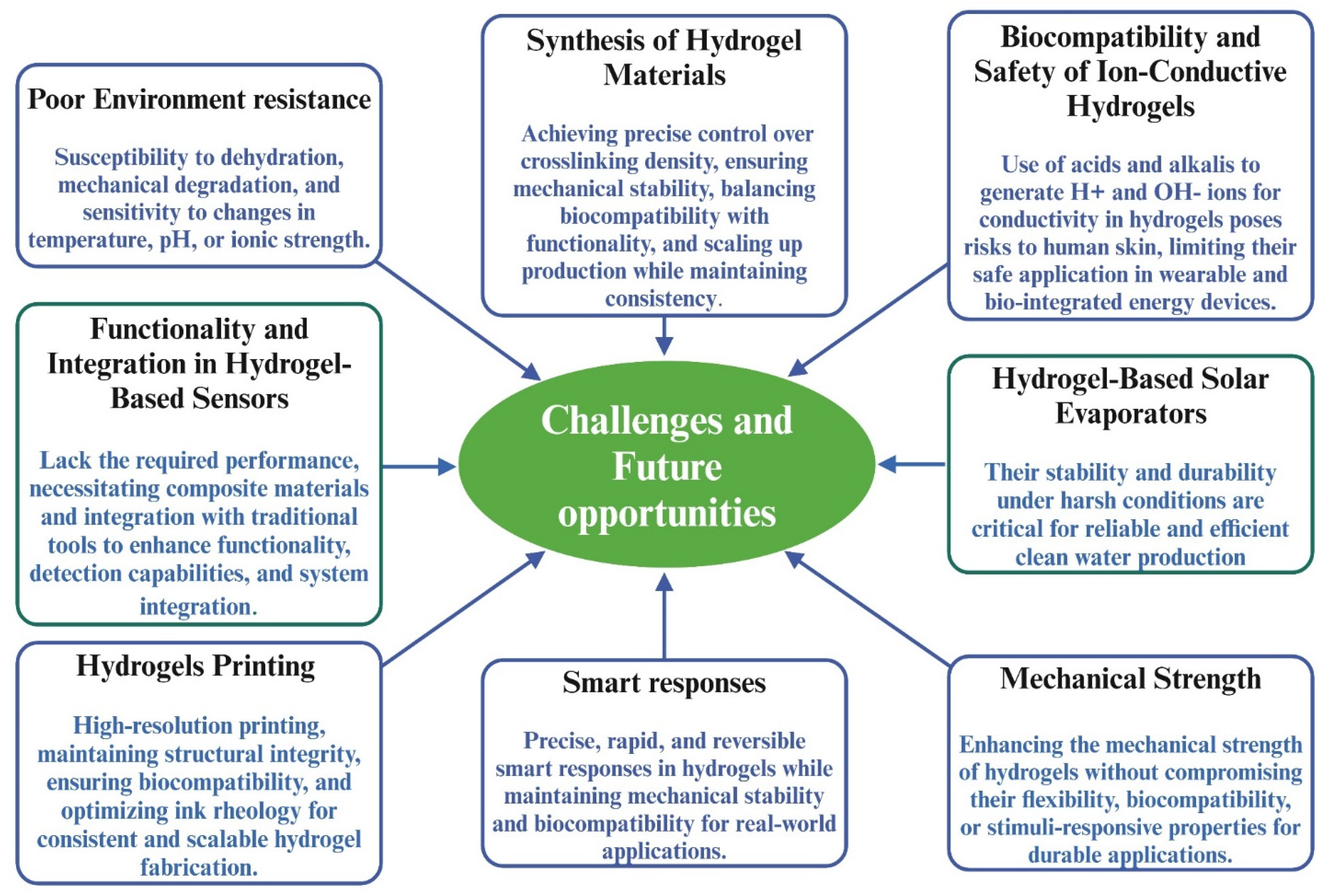
6. Challenges and Future Opportunities
- (1)
- For instance, conventional conductive hydrogels are limited to moderate environments due to their poor environmental resilience. Their high water content and hydrophilic structure cause them to swell undesirably in humid conditions, freeze at sub-zero temperatures, and dehydrate through evaporation, compromising their structural integrity [277]. However, conductive hydrogels are typically designed to achieve desired properties by incorporating many conductive fillers. However, this often weakens the gels’ mechanical properties due to reduced network compatibility caused by the aggregation of conductive materials. As a result, this restricts their practical applications, particularly in wearable electronics, which necessitate a blend of high conductivity, stretchability, fracture strength, appropriate modulus, and quick self-recovery. Therefore, ongoing efforts are necessary to meticulously choose the raw materials, optimize fabrication methods, and refine structural designs [278]. Moreover, developing suitable ink for printing requires balancing tunable rheology with printing quality, as highly concentrated ink offers rapid prototyping. Still, it can result in rigid, less-responsive devices, while dilute ink improves flexibility but sacrifices shape fidelity and speed [279].
- (2)
- Natural hydrogels derived from renewable and cost-effective sources like starch form a fascinating category of biopolymeric materials. They are being progressively employed in a diverse range of applications spanning the biomedical, cosmeceutical, and food industries. However, the synthesis of these materials is hampered by lengthy processing times, high energy consumption, and safety concerns, which often result in significant environmental damage. These issues are major obstacles to their broader utilization [280]. There are several limitations related to the printability of natural hydrogels; for example, the mechanical performance, specifically the elastic modulus, is lower in the permanent state compared to the temporary state after the printing [281].
- (3)
- Hydrogels have emerged as promising materials for energy conversion and storage systems. Most ion-conductive hydrogel electrolytes derive their conductivity from the movement of H+ and OH- ions. However, generating these ions typically requires the use of acids and alkalis, which can be harmful to human skin. This presents a challenge for their application in wearable electronic devices. While the preparation methods and technologies for hydrogel electrolytes are relatively mature, there is significant room for improvement in material selection. Developing environmentally and socially sustainable materials, or using biodegradable hydrogels as electrolyte or electrode materials, is an urgent need [282].
- (4)
- Another area where hydrogels are making strides is sensors. Hydrogel material alone often falls short of meeting application demands, so composite materials are used to introduce additional functionalities. The synergy between hydrogels and other traditional analytical tools is leveraged. While hydrogels do not always surpass existing techniques, they enhance functionality, facilitate detection, and integrate multiple sensor components into a single system.
- (5)
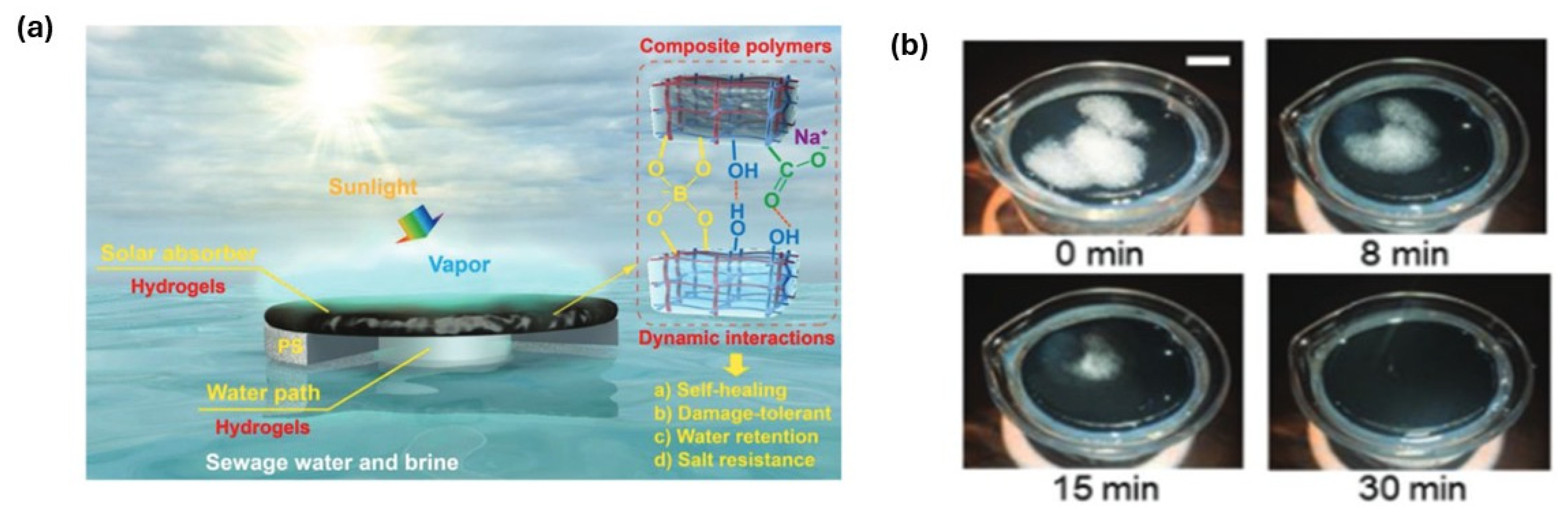
- Hydrogel-based evaporators have outperformed many reported evaporators, offering distinct advantages. However, challenges and opportunities remain to enhance their strengths. For instance, a deeper understanding of the fundamental evaporation mechanism within hydrogels is needed. Additionally, the stability and durability of hydrogel-based solar evaporators under severe conditions require improvement to ensure stable clean water delivery in practical applications [283].
- (6)
- Achieving high-strength hydrogels requires overcoming limitations such as balancing mechanical robustness with flexibility, ensuring biocompatibility, and enhancing stability under varying environmental conditions. Developing tunable mechanical properties for specific applications, integrating multiple enhancement strategies for synergistic effects, and understanding structure–property relationships through advanced characterization techniques remain critical hurdles [284,285]. Additionally, creating scalable and sustainable fabrication methods while maintaining performance consistency poses significant challenges.
- (7)
- The widespread adoption of 3D hydrogel printing faces several critical hurdles, including optimizing material properties for improved printability and bioactivity, enhancing printing techniques for higher resolution and speed, and designing complex scaffold architectures with functional gradients and vascular networks. Post-printing processing, such as ensuring structural integrity and functionality, along with the challenges of scaling up to high-throughput manufacturing, further complicate its implementation. Additionally, the clinical translation of 3D-printed hydrogels requires addressing regulatory and ethical considerations, as well as ensuring reproducibility and biocompatibility for real-world applications [286].
7. Conclusions
Author Contributions
Funding
Data Availability Statement
Acknowledgments
Conflicts of Interest
List of Abbreviation
| 3DP | Three-Dimensional Printing |
| 4D Printing | Four-Dimensional Printing (3D printing with time-dependent transformation) |
| AA | Acrylic Acid |
| AAC | Acrylic Acid Network |
| AFM | Atomic Force Microscopy |
| AL | Alginate |
| ALP | Alkaline Phosphatase |
| AM | Additive Manufacturing |
| APS | Ammonium Persulfate |
| ARS | Alizarin Red S |
| ASTM | American Society for Testing and Materials |
| BA | Benzyl Acrylate |
| BGC | Bioactive Glass Ceramic |
| BMP | Bone Morphogenetic Protein |
| BMP-2 | Bone Morphogenetic Protein-2 |
| BTE | Bone Tissue Engineering |
| Ca2+ | Calcium Ion |
| CAD | Computer-Aided Design |
| Ca-P | Calcium Phosphate |
| CMC | Carboxymethyl Cellulose |
| CNF | Cellulose Nanofiber |
| CNT | Carbon Nanotube |
| CS | Chitosan |
| CSG | Chitosan-Based Hydrogel |
| CTE | Cartilage Tissue Engineering |
| DED | Directed Energy Deposition |
| DIW | Direct Ink Writing |
| DLW | Direct Laser Writing |
| DLP | Digital Light Processing |
| DMAPMA | N,N-Dimethylaminopropyl Methacrylamide |
| DN | Double Network |
| EBE | Electron Beam Energy |
| EBM | Electron Beam Melting |
| ECM | Extracellular Matrix |
| EDGMA | Ethylene Glycol Dimethacrylate |
| EO | Ethylene Oxide |
| E–Z | Trans–Cis Isomerization |
| FFF | Fused Filament Fabrication |
| GAG | Glycosaminoglycan |
| GelMA | Gelatin Methacryloyl |
| GO | Graphene Oxide |
| HA | Hydroxyapatite |
| HEMA | 2-Hydroxyethyl Methacrylate |
| IPN | Interpenetrating Polymer Network |
| ISO | International Organization for Standardization |
| LCST | Lower Critical Solution Temperature |
| LAP | Lithium Phenyl-2,4,6-Trimethylbenzoylphosphinate |
| LOM | Laminated Object Manufacturing |
| MBA–N | N′-Methylenebisacrylamide |
| MC | Methylcellulose |
| MMP | Matrix Metalloproteinase |
| MNP | Magnetic Nanoparticle |
| MXene | Two-Dimensional Transition Metal Carbide/Nitride |
| Mw | Molecular Weight |
| NBG | Nano-Bioglass |
| NIPAM | N-Isopropylacrylamide |
| NIR | Near-Infrared |
| OEGMA | Oligo(ethylene glycol) Methacrylate |
| OCN | Osteocalcin |
| PAA | Poly(acrylic acid) |
| PAAm | Polyacrylamide |
| PAM | Polyacrylamide |
| PANI | Polyaniline |
| PBS | Phosphate-Buffered Saline |
| PEC | Polyelectrolyte Complex |
| PEG | Poly(ethylene glycol) |
| PEGDA | Poly(ethylene glycol) Diacrylate |
| PEDOT:PSS | Poly(3,4-ethylenedioxythiophene):Poly(styrenesulfonate) |
| PET | Poly(ethylene terephthalate) |
| PHBV | Poly(3-hydroxybutyrate-co-3-hydroxyvalerate) |
| PI | Photoinitiator |
| PLA | Polylactic Acid |
| PLGA | Poly(lactic-co-glycolic acid) |
| PLLA | Poly(L-lactic acid) |
| PNIPAM | Poly(N-isopropylacrylamide) |
| PNVCL | Poly(N-vinylcaprolactam) |
| PSL | Projection-Based Stereolithography |
| RGO | Reduced Graphene Oxide |
| RH | Relative Humidity |
| SCF | Short Carbon Fiber |
| SEM | Scanning Electron Microscopy |
| SFF | Solid Freeform Fabrication |
| SLA | Stereolithography |
| SLS | Selective Laser Sintering |
| SLM | Selective Laser Melting |
| SPION | Superparamagnetic Iron Oxide Nanoparticle |
| TAG | Tannic Acid–Gelatin |
| TE | Tissue Engineering |
| TEMED | N,N,N′,N′-Tetramethylethylenediamine |
| TGF-β | Transforming Growth Factor-Beta |
| TOCN | TEMPO-Oxidized Cellulose Nanofiber |
| TPO | Diphenyl(2,4,6-trimethylbenzoyl)phosphine Oxide |
| UV | Ultraviolet |
| VAT | Vat Photopolymerization |
| WD | Wound Dressing |
| WMR | Walking Magnetic Robot |
References
- Seliktar, D. Designing Cell-Compatible Hydrogels for Biomedical Applications. Science 2012, 336, 1124–1128. [Google Scholar] [CrossRef]
- Zhou, Y.; Wan, C.; Yang, Y.; Yang, H.; Wang, S.; Dai, Z.; Ji, K.; Jiang, H.; Chen, X.; Long, Y.; et al. Highly Stretchable, Elastic, and Ionic Conductive Hydrogel for Artificial Soft Electronics. Adv. Funct. Mater. 2019, 29, 1806220. [Google Scholar] [CrossRef]
- Garg Guru, S.; Khalsa, R.; Garg Guru, A. Hydrogel: Classification, Properties, Preparation and Technical Features. 2016. Available online: https://www.researchgate.net/publication/316075989_Hydrogel_Classification_Properties_Preparation_and_Technical_Features (accessed on 2 July 2024).
- Wang, W.; Narain, R.; Zeng, H. Hydrogels. In Polymer Science and Nanotechnology: Fundamentals and Applications; Elsevier: Amsterdam, The Netherlands, 2020; pp. 203–244. [Google Scholar] [CrossRef]
- Yan, B.; Han, L.; Xiao, H.; Zhang, J.; Huang, J.; Hu, W.; Gu, Y.; Liu, Q.; Zeng, H. Rapid Dewatering and Consolidation of Concentrated Colloidal Suspensions: Mature Fine Tailings via Self-Healing Composite Hydrogel. ACS Appl. Mater. Interfaces 2019, 11, 21610–21618. [Google Scholar] [CrossRef] [PubMed]
- Yuk, H.; Lin, S.; Ma, C.; Takaffoli, M.; Fang, N.X.; Zhao, X. Hydraulic Hydrogel Actuators and Robots Optically and Sonically Camouflaged in Water. Nat. Commun. 2017, 8, 14230. [Google Scholar] [CrossRef] [PubMed]
- Ma, C.; Lu, W.; Yang, X.; He, J.; Le, X.; Wang, L.; Zhang, J.; Serpe, M.J.; Huang, Y.; Chen, T. Bioinspired Anisotropic Hydrogel Actuators with on–off Switchable and Color-Tunable Fluorescence Behaviors. Adv. Funct. Mater. 2018, 28, 1704568. [Google Scholar] [CrossRef]
- Chen, J.; Peng, Q.; Thundat, T.; Zeng, H. Stretchable, Injectable, and Self-Healing Conductive Hydrogel Enabled by Multiple Hydrogen Bonding toward Wearable Electronics. Chem. Mater. 2019, 31, 4553–4563. [Google Scholar] [CrossRef]
- Li, L.; Yan, B.; Yang, J.; Chen, L.; Zeng, H. Novel Mussel-Inspired Injectable Self-Healing Hydrogel with Anti-Biofouling Property. Adv. Mater. 2015, 27, 1294–1299. [Google Scholar] [CrossRef]
- Maulvi, F.A.; Lakdawala, D.H.; Shaikh, A.A.; Desai, A.R.; Choksi, H.H.; Vaidya, R.J.; Ranch, K.M.; Koli, A.R.; Vyas, B.A.; Shah, D.O. In Vitro and in Vivo Evaluation of Novel Implantation Technology in Hydrogel Contact Lenses for Controlled Drug Delivery. J. Control. Release 2016, 226, 47–56. [Google Scholar] [CrossRef]
- Chen, Y.; Wang, W.; Wu, D.; Nagao, M.; Hall, D.G.; Thundat, T.; Narain, R. Injectable Self-Healing Zwitterionic Hydrogels Based on Dynamic Benzoxaborole–Sugar Interactions with Tunable Mechanical Properties. Biomacromolecules 2018, 19, 596–605. [Google Scholar] [CrossRef]
- Tseng, T.C.; Tao, L.; Hsieh, F.Y.; Wei, Y.; Chiu, I.M.; Hsu, S.H. An Injectable, Self-Healing Hydrogel to Repair the Central Nervous System. Adv. Mater. 2015, 27, 3518–3524. [Google Scholar] [CrossRef]
- Momeni, F.; Liu, X.; Ni, J. A Review of 4D Printing. Mater. Des. 2017, 122, 42–79. [Google Scholar] [CrossRef]
- Tibbits: The Emergence of “4D Printing”—Google Scholar. Available online: https://scholar.google.com/scholar?hl=en&as_sdt=0,5&cluster=9787433058056401908 (accessed on 12 June 2024).
- Choi, J.; Reddy, D.A.; Islam, M.J.; Seo, B.; Joo, S.H.; Kim, T.K. Green Synthesis of the Reduced Graphene Oxide–CuI Quasi-Shell–Core Nanocomposite: A Highly Efficient and Stable Solar-Light-Induced Catalyst for Organic Dye Degradation in Water. Appl. Surf. Sci. 2015, 358, 159–167. [Google Scholar] [CrossRef]
- Ge, Q.; Qi, H.J.; Dunn, M.L. Active Materials by Four-Dimension Printing. Appl. Phys. Lett. 2013, 103, 131901. [Google Scholar] [CrossRef]
- Pei, E. 4D Printing: Dawn of an Emerging Technology Cycle. Assem. Autom. 2014, 34, 310–314. [Google Scholar] [CrossRef]
- Khoo, Z.X.; Teoh, J.E.M.; Liu, Y.; Chua, C.K.; Yang, S.; An, J.; Leong, K.F.; Yeong, W.Y. 3D Printing of Smart Materials: A Review on Recent Progresses in 4D Printing. Virtual Phys. Prototyp. 2015, 10, 103–122. [Google Scholar] [CrossRef]
- Dong, Y.; Wang, S.; Ke, Y.; Ding, L.; Zeng, X.; Magdassi, S.; Long, Y. 4D Printed Hydrogels: Fabrication, Materials, and Applications. Adv. Mater. Technol. 2020, 5, 2000034. [Google Scholar] [CrossRef]
- 3D Printing Is So 2013—Introducing 4D Printing!—Brit + Co. Available online: https://www.brit.co/4d-printing/ (accessed on 13 June 2024).
- Hu, Y.; Wang, Z.; Jin, D.; Zhang, C.; Sun, R.; Li, Z.; Hu, K.; Ni, J.; Cai, Z.; Pan, D.; et al. Botanical-Inspired 4D Printing of Hydrogel at the Microscale. Adv. Funct. Mater. 2020, 30, 1907377. [Google Scholar] [CrossRef]
- Li, Z.; Liu, P.; Ji, X.; Gong, J.; Hu, Y.; Wu, W.; Wang, X.; Peng, H.Q.; Kwok, R.T.K.; Lam, J.W.Y.; et al. Bioinspired Simultaneous Changes in Fluorescence Color, Brightness, and Shape of Hydrogels Enabled by AIEgens. Adv. Mater. 2020, 32, 1906493. [Google Scholar] [CrossRef]
- Spiegel, C.A.; Hippler, M.; Münchinger, A.; Bastmeyer, M.; Barner-Kowollik, C.; Wegener, M.; Blasco, E. 4D Printing at the Microscale. Adv. Funct. Mater. 2020, 30, 1907615. [Google Scholar] [CrossRef]
- Kim, S.H.; Seo, Y.B.; Yeon, Y.K.; Lee, Y.J.; Park, H.S.; Sultan, M.T.; Lee, J.M.; Lee, J.S.; Lee, O.J.; Hong, H.; et al. 4D-Bioprinted Silk Hydrogels for Tissue Engineering. Biomaterials 2020, 260, 120281. [Google Scholar] [CrossRef]
- Narupai, B.; Smith, P.T.; Nelson, A. 4D Printing of Multi-Stimuli Responsive Protein-Based Hydrogels for Autonomous Shape Transformations. Adv. Funct. Mater. 2021, 31, 2011012. [Google Scholar] [CrossRef]
- Koetting, M.C.; Peters, J.T.; Steichen, S.D.; Peppas, N.A. Stimulus-Responsive Hydrogels: Theory, Modern Advances, and Applications. Mater. Sci. Eng. R Rep. 2015, 93, 1–49. [Google Scholar] [CrossRef] [PubMed]
- Ullah, F.; Othman, M.B.H.; Javed, F.; Ahmad, Z.; Akil, H.M. Classification, Processing and Application of Hydrogels: A Review. Mater. Sci. Eng. C Mater. Biol. Appl. 2015, 57, 414–433. [Google Scholar] [CrossRef] [PubMed]
- Sun, X.; Yao, F.; Li, J. Nanocomposite Hydrogel-Based Strain and Pressure Sensors: A Review. J. Mater. Chem. A Mater. 2020, 8, 18605–18623. [Google Scholar] [CrossRef]
- Hendi, A.; Hassan, M.U.; Elsherif, M.; Alqattan, B.; Park, S.; Yetisen, A.K.; Butt, H. Healthcare Applications of PH-Sensitive Hydrogel-Based Devices: A Review. Int. J. Nanomed. 2020, 15, 3887–3901. [Google Scholar] [CrossRef]
- Nasution, H.; Harahap, H.; Dalimunthe, N.F.; Ginting, M.H.S.; Jaafar, M.; Tan, O.O.H.; Aruan, H.K.; Herfananda, A.L. Hydrogel and Effects of Crosslinking Agent on Cellulose-Based Hydrogels: A Review. Gels 2022, 8, 568. [Google Scholar] [CrossRef]
- Champeau, M.; Heinze, D.A.; Viana, T.N.; de Souza, E.R.; Chinellato, A.C.; Titotto, S. 4D Printing of Hydrogels: A Review. Adv. Funct. Mater. 2020, 30, 1910606. [Google Scholar] [CrossRef]
- Protsak, I.S.; Morozov, Y.M. Fundamentals and Advances in Stimuli-Responsive Hydrogels and Their Applications: A Review. Gels 2025, 11, 30. [Google Scholar] [CrossRef]
- Zhang, Y.; Wu, B.M.; Zhang, Y.; Wu, B.M. Current Advances in Stimuli-Responsive Hydrogels as Smart Drug Delivery Carriers. Gels 2023, 9, 838. [Google Scholar] [CrossRef]
- Agrawal, A.; Hussain, C.M.; Agrawal, A.; Hussain, C.M. 3D-Printed Hydrogel for Diverse Applications: A Review. Gels 2023, 9, 960. [Google Scholar] [CrossRef]
- Palencia, M.; Espinosa-Duque, A.; Otálora, A.; García-Quintero, A. Cellulose-Based Stimuli-Responsive Hydrogels. In Plant and Algal Hydrogels for Drug Delivery and Regenerative Medicine; Woodhead Publishing: Cambridge, UK, 2021; pp. 423–470. [Google Scholar] [CrossRef]
- Amirthalingam, S.; Rajendran, A.K.; Moon, Y.G.; Hwang, N.S. Stimuli-Responsive Dynamic Hydrogels: Design, Properties and Tissue Engineering Applications. Mater. Horiz. 2023, 10, 3325–3350. [Google Scholar] [CrossRef] [PubMed]
- Khonakdar, H.; Ehsani, M.; Naderi, G.; Shokrolahi, F.; Khonakdar, H.A. Recent Advances in Injectable Stimuli-Responsive Hydrogels for Biomedical Applications. J. Polym. Environ. 2025, 33, 3512–3554. [Google Scholar] [CrossRef]
- Simińska-Stanny, J.; Nizioł, M.; Szymczyk-Ziółkowska, P.; Brożyna, M.; Junka, A.; Shavandi, A.; Podstawczyk, D. 4D Printing of Patterned Multimaterial Magnetic Hydrogel Actuators. Addit. Manuf. 2022, 49, 102506. [Google Scholar] [CrossRef]
- Yarali, E.; Mirzaali, M.J.; Ghalayaniesfahani, A.; Accardo, A.; Diaz-Payno, P.J.; Zadpoor, A.A. 4D Printing for Biomedical Applications. Adv. Mater. 2024, 36, 2402301. [Google Scholar] [CrossRef]
- Zhang, Z.; Wang, Y.; Wang, W. Machine Learning in Gel-Based Additive Manufacturing: From Material Design to Process Optimization. Gels 2025, 11, 582. [Google Scholar] [CrossRef]
- Caló, E.; Khutoryanskiy, V.V. Biomedical Applications of Hydrogels: A Review of Patents and Commercial Products. Eur. Polym. J. 2015, 65, 252–267. [Google Scholar] [CrossRef]
- Revete, A.; Aparicio, A.; Cisterna, B.A.; Revete, J.; Luis, L.; Ibarra, E.; Segura González, E.A.; Molino, J.; Reginensi, D. Advancements in the Use of Hydrogels for Regenerative Medicine: Properties and Biomedical Applications. Int. J. Biomater. 2022, 2022, 3606765. [Google Scholar] [CrossRef]
- Li, J.; Mooney, D.J. Designing Hydrogels for Controlled Drug Delivery. Nat. Rev. Mater. 2016, 1, 16071. [Google Scholar] [CrossRef]
- Chung, H.J.; Park, T.G. Self-Assembled and Nanostructured Hydrogels for Drug Delivery and Tissue Engineering. Nano Today 2009, 4, 429–437. [Google Scholar] [CrossRef]
- Slaughter, B.V.; Khurshid, S.S.; Fisher, O.Z.; Khademhosseini, A.; Peppas, N.A. Hydrogels in Regenerative Medicine. Adv. Mater. 2009, 21, 3307–3329. [Google Scholar] [CrossRef]
- Zhou, Z.; Qian, C.; Yuan, W. Self-Healing, Anti-Freezing, Adhesive and Remoldable Hydrogel Sensor with Ion-Liquid Metal Dual Conductivity for Biomimetic Skin. Compos. Sci. Technol. 2021, 203, 108608. [Google Scholar] [CrossRef]
- Samadian, H.; Maleki, H.; Allahyari, Z.; Jaymand, M. Natural Polymers-Based Light-Induced Hydrogels: Promising Biomaterials for Biomedical Applications. Coord. Chem. Rev. 2020, 420, 213432. [Google Scholar] [CrossRef]
- Wu, J.J.; Huang, L.M.; Zhao, Q.; Xie, T. 4D Printing: History and Recent Progress. Chin. J. Polym. Sci. Engl. Ed. 2018, 36, 563–575. [Google Scholar] [CrossRef]
- Beebe, D.J.; Moore, J.S.; Bauer, J.M.; Yu, Q.; Liu, R.H.; Devadoss, C.; Jo, B.H. Functional Hydrogel Structures for Autonomous Flow Control inside Microfluidic Channels. Nature 2000, 404, 588–590. [Google Scholar] [CrossRef]
- Richter, A.; Kuckling, D.; Howitz, S.; Gehring, T.; Arndt, K.F. Electronically Controllable Microvalves Based on Smart Hydrogels: Magnitudes and Potential Applications. J. Microelectromechanical Syst. 2003, 12, 748–753. [Google Scholar] [CrossRef]
- Yarali, E.; Mubeen, A.A.; Cussen, K.; van Zanten, L.; Moosabeiki, V.; Zadpoor, A.A.; Accardo, A.; Mirzaali, M.J. Two-Photon Polymerization Based 4D Printing of Poly(N-Isopropylacrylamide) Hydrogel Microarchitectures for Reversible Shape Morphing. Sci. Rep. 2025, 15, 21549. [Google Scholar] [CrossRef] [PubMed]
- Zheng, J.; Yu, H.; Wang, J.; Zhang, Y.; Guo, H.; Qiu, Y.; Wang, X.; Liu, L.; Li, W.J. 4D Printed Butterfly-Inspired Hydrogel Structures: Simple Strategies for Multiform Morphing. ACS Mater. Lett. 2025, 7, 1035–1041. [Google Scholar] [CrossRef]
- Bai, J.; Liu, F.; Cui, J.; Hong, Y.; Hao, M.; Liu, B.; Lv, Y.; Zhai, Y.; Ren, W.; Qin, Z.; et al. Bioinspired 4D Printing of Multi-Responsive and Tough Hydrogels with Micelle-Enhanced Double Networks. Chem. Eng. J. 2025, 520, 165745. [Google Scholar] [CrossRef]
- Li, H.; Bartolo, P.J.D.S.; Zhou, K. Direct 4D Printing of Hydrogels Driven by Structural Topology. Virtual Phys. Prototyp. 2025, 20, e2462962. [Google Scholar] [CrossRef]
- Jensen, P.J.; Graham, J.P.; Busch, T.K.; Fitz, O.; Jayanadh, S.; Pashuck, T.E.; Gonzalez-Fernandez, T. Biocompatible Composite Hydrogel with On-Demand Swelling-Shrinking Properties for 4D Bioprinting. Biomater. Sci. 2025, 13, 3264–3279. [Google Scholar] [CrossRef]
- Jang, S.; Park, S. 4D Printed Untethered Milli-Gripper Fabricated Using a Biodegradable and Biocompatible Electro- and Magneto-Active Hydrogel. Sens. Actuators B Chem. 2023, 384, 133654. [Google Scholar] [CrossRef]
- Zari, E.; Grillo, D.; Tan, Z.; Swiatek, N.; Linfoot, J.D.; Borvorntanajanya, K.; Nasca, L.; Pierro, E.; Florea, L.; Dini, D.; et al. A Reinforced Light-Responsive Hydrogel for Soft Robotics Actuation. In Proceedings of the 2024 IEEE 7th International Conference on Soft Robotics, RoboSoft 2024, San Diego, CA, USA, 14–17 April 2024; pp. 270–275. [Google Scholar] [CrossRef]
- Zhang, J.; Wu, G.; Ding, A. 4D Biofabrication of Functionally Gradient Hydrogels: A Pathway to Morphogenetic Tissue Engineering. Chem. Eng. J. 2025, 522, 167810. [Google Scholar] [CrossRef]
- Li, J.; Zhang, G.; Cui, Z.; Bao, L.; Xia, Z.; Liu, Z.; Zhou, X. High Performance and Multifunction Moisture-Driven Yin–Yang-Interface Actuators Derived from Polyacrylamide Hydrogel. Small 2023, 19, 2303228. [Google Scholar] [CrossRef] [PubMed]
- Yao, Y.; Yin, C.; Hong, S.; Chen, H.; Shi, Q.; Wang, J.; Lu, X.; Zhou, N. Lanthanide-Ion-Coordinated Supramolecular Hydrogel Inks for 3D Printed Full-Color Luminescence and Opacity-Tuning Soft Actuators. Chem. Mater. 2020, 32, 8868–8876. [Google Scholar] [CrossRef]
- Zheng, Y.; Huang, H.; Yu, J.; Hu, Z.; Wang, Y. Highly Stretchable and Strong Poly (Vinyl Alcohol)-Based Hydrogel for Reprogrammable Actuator Applications. Chem. Eng. J. 2023, 454, 140054. [Google Scholar] [CrossRef]
- Shi, Z.; Gao, X.; Ullah, M.W.; Li, S.; Wang, Q.; Yang, G. Electroconductive Natural Polymer-Based Hydrogels. Biomaterials 2016, 111, 40–54. [Google Scholar] [CrossRef]
- Liu, Z.; Liu, J.; Zhang, J.; Zheng, B.; Ren, X.; Long, Y.; Fang, L.; Ou, R.; Liu, T.; Wang, Q. Highly Compressible Hydrogel Sensors with Synergistic Long-Lasting Moisture, Extreme Temperature Tolerance and Strain-Sensitivity Properties. Mater. Chem. Front. 2020, 4, 3319–3327. [Google Scholar] [CrossRef]
- Wu, Z.; Yang, X.; Wu, J. Conductive Hydrogel- and Organohydrogel-Based Stretchable Sensors. ACS Appl. Mater. Interfaces 2021, 13, 2128–2144. [Google Scholar] [CrossRef]
- Peng, Y.; Pi, M.; Zhang, X.; Yan, B.; Li, Y.; Shi, L.; Ran, R. High Strength, Antifreeze, and Moisturizing Conductive Hydrogel for Human-motion Detection. Polymer 2020, 196, 122469. [Google Scholar] [CrossRef]
- Mulakkal, M.C.; Trask, R.S.; Ting, V.P.; Seddon, A.M. Responsive Cellulose-Hydrogel Composite Ink for 4D Printing. Mater. Des. 2018, 160, 108–118. [Google Scholar] [CrossRef]
- Capanema, N.S.V.; Mansur, A.A.P.; Carvalho, I.C.; Carvalho, S.M.; Mansur, H.S. Bioengineered Water-Responsive Carboxymethyl Cellulose/Poly(Vinyl Alcohol) Hydrogel Hybrids for Wound Dressing and Skin Tissue Engineering Applications. Gels 2023, 9, 166. [Google Scholar] [CrossRef]
- Wei, J.; Jia, S.; Guan, J.; Ma, C.; Shao, Z. Robust and Highly Sensitive Cellulose Nanofiber-Based Humidity Actuators. ACS Appl. Mater. Interfaces 2021, 13, 54417–54427. [Google Scholar] [CrossRef] [PubMed]
- Thakur, V.; Singh, R.; Kumar, R.; Gehlot, A. 4D Printing of Thermoresponsive Materials: A State-of-the-Art Review and Prospective Applications. Int. J. Interact. Des. Manuf. 2023, 17, 2075–2094. [Google Scholar] [CrossRef]
- Dou, Q.Q.; Liow, S.S.; Ye, E.; Lakshminarayanan, R.; Loh, X.J. Biodegradable Thermogelling Polymers: Working Towards Clinical Applications. Adv. Heal. Mater. 2014, 3, 977–988. [Google Scholar] [CrossRef] [PubMed]
- Takezawa, T.; Mori, Y.; Yonaha, T.; Yoshizato, K. Characterization of Morphology and Cellular Metabolism during the Spheroid Formation by Fibroblasts. Exp. Cell Res. 1993, 208, 430–441. [Google Scholar] [CrossRef]
- Hua, M.; Wu, D.; Wu, S.; Ma, Y.; Alsaid, Y.; He, X. 4D Printable Tough and Thermoresponsive Hydrogels. ACS Appl. Mater. Interfaces 2021, 13, 12689–12697. [Google Scholar] [CrossRef]
- Bauman, L.; Zhao, B. Multi-Thermo Responsive Double Network Composite Hydrogel for 3D Printing Medical Hydrogel Mask. J. Colloid. Interface Sci. 2023, 638, 882–892. [Google Scholar] [CrossRef]
- Spratte, T.; Geiger, S.; Colombo, F.; Mishra, A.; Taale, M.; Hsu, L.Y.; Blasco, E.; Selhuber-Unkel, C. Increasing the Efficiency of Thermoresponsive Actuation at the Microscale by Direct Laser Writing of PNIPAM. Adv. Mater. Technol. 2023, 8, 2200714. [Google Scholar] [CrossRef]
- Zhang, Q.; Weber, C.; Schubert, U.S.; Hoogenboom, R. Thermoresponsive Polymers with Lower Critical Solution Temperature: From Fundamental Aspects and Measuring Techniques to Recommended Turbidimetry Conditions. Mater. Horiz. 2017, 4, 109–116. [Google Scholar] [CrossRef]
- Alexander, A.; Ajazuddin; Khan, J.; Saraf, S.; Saraf, S. Polyethylene Glycol (PEG)–Poly(N-Isopropylacrylamide) (PNIPAAm) Based Thermosensitive Injectable Hydrogels for Biomedical Applications. Eur. J. Pharm. Biopharm. 2014, 88, 575–585. [Google Scholar] [CrossRef]
- Kumar, A.; Srivastava, A.; Galaev, I.Y.; Mattiasson, B. Smart Polymers: Physical Forms and Bioengineering Applications. Prog. Polym. Sci. 2007, 32, 1205–1237. [Google Scholar] [CrossRef]
- Zheng, W.J.; An, N.; Yang, J.H.; Zhou, J.; Chen, Y.M. Tough Al-Alginate/Poly(N -Isopropylacrylamide) Hydrogel with Tunable LCST for Soft Robotics. ACS Appl. Mater. Interfaces 2015, 7, 1758–1764. [Google Scholar] [CrossRef] [PubMed]
- Lopez-Larrea, N.; Wustoni, S.; Peñas, M.I.; Uribe, J.; Dominguez-Alfaro, A.; Gallastegui, A.; Inal, S.; Mecerreyes, D. PNIPAM/PEDOT:PSS Hydrogels for Multifunctional Organic Electrochemical Transistors. Adv. Funct. Mater. 2024, 2403708. [Google Scholar] [CrossRef]
- Zhang, K.; Li, F.; Wu, Y.; Feng, L.; Zhang, L. Construction of Ionic Thermo-Responsive PNIPAM/γ-PGA/PEG Hydrogel as a Draw Agent for Enhanced Forward-Osmosis Desalination. Desalination 2020, 495, 114667. [Google Scholar] [CrossRef]
- Liu, Y.; Zheng, X. 3D Printed Thermo-Responsive Hydrogel Evaporator with Enhanced Water Transport for Efficient Solar Steam Generation. Sol. Energy 2024, 273, 112507. [Google Scholar] [CrossRef]
- Solis, D.M.; Czekanski, A. The Effect of the Printing Temperature on 4D DLP Printed PNIPAM Hydrogels. Soft Matter 2022, 18, 3422–3429. [Google Scholar] [CrossRef]
- Hoffman, A.S. Hydrogels for Biomedical Applications. Adv. Drug Deliv. Rev. 2012, 64, 18–23. [Google Scholar] [CrossRef]
- Rastogi, P.; Biofabrication, B.K. Review of Alginate-Based Hydrogel Bioprinting for Application in Tissue Engineering. Biofabrication 2019, 11, 042001. [Google Scholar] [CrossRef]
- Han, X.; Dong, Z.; Fan, M.; Liu, Y.; Li, J.; Wang, Y.; Yuan, Q.; Li, B.; Zhang, S. Macromol. Rapid Commun. 12/2012. Macromol. Rapid Commun. 2012, 33, 1017. [Google Scholar] [CrossRef]
- Dutta, S.; Cohn, D. Temperature and PH Responsive 3D Printed Scaffolds. J. Mater. Chem. B 2017, 5, 9514–9521. [Google Scholar] [CrossRef]
- Che, Y.; Li, D.; Liu, Y.; Ma, Q.; Tan, Y.; Yue, Q.; Meng, F. Physically Cross-Linked PH-Responsive Chitosan-Based Hydrogels with Enhanced Mechanical Performance for Controlled Drug Delivery. RSC Adv. 2016, 6, 106035–106045. [Google Scholar] [CrossRef]
- Sheng, W.; Liu, T.; Liu, S.; Wang, Q.; Li, X.; Guang, N. Temperature and PH Responsive Hydrogels Based on Polyethylene Glycol Analogues and Poly(Methacrylic Acid) via Click Chemistry. Polym. Int. 2015, 64, 1415–1424. [Google Scholar] [CrossRef]
- Thakur, S.; Arotiba, O.A. Synthesis, Swelling and Adsorption Studies of a PH-Responsive Sodium Alginate–Poly(Acrylic Acid) Superabsorbent Hydrogel. Polym. Bull. 2018, 75, 4587–4606. [Google Scholar] [CrossRef]
- Wang, W.; Hu, J.; Zhang, R.; Yan, C.; Cui, L.; Zhu, J. A PH-Responsive Carboxymethyl Cellulose/Chitosan Hydrogel for Adsorption and Desorption of Anionic and Cationic Dyes. Cellulose 2021, 28, 897–909. [Google Scholar] [CrossRef]
- Dhand, C.; Das, M.; Datta, M.; Malhotra, B.D. Recent Advances in Polyaniline Based Biosensors. Biosens. Bioelectron. 2011, 26, 2811–2821. [Google Scholar] [CrossRef]
- Ko, Y.; Jeong, H.Y.; Kwon, G.; Kim, D.; Lee, C.; You, J. PH-Responsive Polyaniline/Polyethylene Glycol Composite Arrays for Colorimetric Sensor Application. Sens. Actuators B Chem. 2020, 305, 127447. [Google Scholar] [CrossRef]
- Garcia, C.; Gallardo, A.; López, D.; Elvira, C.; Azzahti, A.; Lopez-Martinez, E.; Cortajarena, A.L.; González-Henríquez, C.M.; Sarabia-Vallejos, M.A.; Rodríguez-Hernández, J. Smart PH-Responsive Antimicrobial Hydrogel Scaffolds Prepared by Additive Manufacturing. ACS Appl. Bio Mater. 2018, 1, 1337–1347. [Google Scholar] [CrossRef]
- Mehta, P.; Sharma, M.; Devi, M. Hydrogels: An Overview of Its Classifications, Properties, and Applications. J. Mech. Behav. Biomed. Mater. 2023, 147, 106145. [Google Scholar] [CrossRef]
- Luo, J.; Sun, F. Calcium-Responsive Hydrogels Enabled by Inducible Protein–Protein Interactions. Polym. Chem. 2020, 11, 4973–4977. [Google Scholar] [CrossRef]
- Di, X.; Ma, Q.; Xu, Y.; Yang, M.; Wu, G.; Sun, P. High-Performance Ionic Conductive Poly(Vinyl Alcohol) Hydrogels for Flexible Strain Sensors Based on a Universal Soaking Strategy. Mater. Chem. Front. 2021, 5, 315–323. [Google Scholar] [CrossRef]
- Cruz, H.; Laycock, B.; Strounina, E.; Seviour, T.; Oehmen, A.; Pikaar, I. Modified Poly(Acrylic Acid)-Based Hydrogels for Enhanced Mainstream Removal of Ammonium from Domestic Wastewater. Environ. Sci. Technol. 2020, 54, 9573–9583. [Google Scholar] [CrossRef]
- Shi, H.; Yang, Y.; Huang, Y.; Li, X.; Shi, Y. Anisotropic Single-Domain Hydrogel with Stimulus Response to Temperature and Ionic Strength. Macromolecules 2022, 56, 528–534. [Google Scholar] [CrossRef]
- Kirillova, A.; Maxson, R.; Stoychev, G.; Gomillion, C.T.; Ionov, L. 4D Biofabrication Using Shape-Morphing Hydrogels. Advanced Materials 2017, 29, 1703443. [Google Scholar] [CrossRef] [PubMed]
- Huang, L.; Jiang, R.; Wu, J.; Song, J.; Bai, H.; Li, B.; Zhao, Q.; Xie, T. Ultrafast Digital Printing toward 4D Shape Changing Materials. Adv. Mater. 2017, 29, 1605390. [Google Scholar] [CrossRef] [PubMed]
- Piazza, R.D.; dos Santos, C.C.; Pinto, G.C.; Lucena, G.N.; Junior, M.J.; Marques, R.F.C. Multifunctional Redox and Temperature-Sensitive Drug Delivery Devices. Biomed. Mater. Devices 2023, 2, 191–207. [Google Scholar] [CrossRef]
- Gaddimath, S.; Payamalle, S.; Channabasavana Hundi Puttaningaiah, K.P.; Hur, J. Recent Advances in PH and Redox Responsive Polymer Nanocomposites for Cancer Therapy. J. Compos. Sci. 2024, 8, 28. [Google Scholar] [CrossRef]
- Ma, X.; Sekhar, K.P.C.; Zhang, P.; Cui, J. Advances in Stimuli-Responsive Injectable Hydrogels for Biomedical Applications. Biomater. Sci. 2024, 12, 5468–5480. [Google Scholar] [CrossRef]
- Altinbasak, I.; Sanyal, R.; Sanyal, A. Best of Both Worlds: Diels–Alder Chemistry towards Fabrication of Redox-Responsive Degradable Hydrogels for Protein Release. RSC Adv. 2016, 6, 74757–74764. [Google Scholar] [CrossRef]
- Khodeir, M.; Antoun, S.; van Ruymbeke, E.; Gohy, J.F. Temperature and Redox-Responsive Hydrogels Based on Nitroxide Radicals and Oligoethyleneglycol Methacrylate. Macromol. Chem. Phys. 2020, 221, 1900550. [Google Scholar] [CrossRef]
- Hoare, T.R.; Kohane, D.S. Hydrogels in Drug Delivery: Progress and Challenges. Polymer 2008, 49, 1993–2007. [Google Scholar] [CrossRef]
- Thakur, V.J.; Thakur, M.K. Polymer Gels; Springer: Berlin/Heidelberg, Germany, 2018. [Google Scholar] [CrossRef]
- Kim, J.; Kim, J.H.; Ariga, K. Redox-Active Polymers for Energy Storage Nanoarchitectonics. Joule 2017, 1, 739–768. [Google Scholar] [CrossRef]
- Li, L.; Shi, Y.; Pan, L.; Shi, Y.; Yu, G. Rational Design and Applications of Conducting Polymer Hydrogels as Electrochemical Biosensors. J. Mater. Chem. B 2015, 3, 2920–2930. [Google Scholar] [CrossRef]
- Kocak, G.; Tuncer, C.; Bütün, V. PH-Responsive Polymers. Polym. Chem. 2016, 8, 144–176. [Google Scholar] [CrossRef]
- Gupta, P.; Vermani, K.; Garg, S. Hydrogels: From Controlled Release to PH-Responsive Drug Delivery. Drug Discov. Today 2002, 7, 569–579. [Google Scholar] [CrossRef]
- Rizwan, M.; Yahya, R.; Hassan, A.; Yar, M.; Azzahari, A.D.; Selvanathan, V.; Sonsudin, F.; Abouloula, C.N. Erratum: PH Sensitive Hydrogels in Drug Delivery: Brief History, Properties, Swelling, and Release Mechanism, Material Selection and Applications. Polymers 2017, 9, 137. Polymers 2017, 9, 225. [Google Scholar] [CrossRef]
- Gao, K.; Xu, K. Advancements and Prospects of PH-Responsive Hydrogels in Biomedicine. Gels 2025, 11, 293. [Google Scholar] [CrossRef] [PubMed]
- Datta, D.; Colaco, V.; Bandi, S.P.; Dhas, N.; Janardhanam, L.S.L.; Singh, S.; Vora, L.K. Stimuli-Responsive Self-Healing Ionic Gels: A Promising Approach for Dermal and Tissue Engineering Applications. ACS Biomater. Sci. Eng. 2025, 11, 1338–1372. [Google Scholar] [CrossRef] [PubMed]
- Liu, J.; Huang, Y.; Kumar, A.; Tan, A.; Jin, S.; Mozhi, A.; Liang, X.J. PH-Sensitive Nano-Systems for Drug Delivery in Cancer Therapy. Biotechnol. Adv. 2014, 32, 693–710. [Google Scholar] [CrossRef]
- Alam, A.; Meng, Q.; Shi, G.; Arabi, S.; Ma, J.; Zhao, N.; Kuan, H.C. Electrically Conductive, Mechanically Robust, PH-Sensitive Graphene/Polymer Composite Hydrogels. Compos. Sci. Technol. 2016, 127, 119–126. [Google Scholar] [CrossRef]
- Wang, T.; Zhang, X.; Wang, Z.; Zhu, X.; Liu, J.; Min, X.; Cao, T.; Fan, X. Smart Composite Hydrogels with PH-Responsiveness and Electrical Conductivity for Flexible Sensors and Logic Gates. Polymers 2019, 11, 1564. [Google Scholar] [CrossRef]
- Zhao, Y.; Hua, M.; Yan, Y.; Wu, S.; Alsaid, Y.; He, X. Stimuli-Responsive Polymers for Soft Robotics. Annu. Rev. Control Robot. Auton. Syst. 2022, 5, 515–545. [Google Scholar] [CrossRef]
- Jin, Z.; Wei, X.; He, X.; Wang, Z.; Zhao, Z.; He, H.; Yang, Y.; Chen, N. Research Progress and Emerging Directions in Stimulus Electro-Responsive Polymer Materials. Materials 2024, 17, 4204. [Google Scholar] [CrossRef] [PubMed]
- Rothermund, M.A.; Koehler, S.J.; Vaissier Welborn, V. Electric Fields in Polymeric Systems. Chem. Rev. 2024, 124, 13331–13369. [Google Scholar] [CrossRef] [PubMed]
- Shin, Y.; Choi, M.Y.; Choi, J.; Na, J.H.; Kim, S.Y. Design of an Electro-Stimulated Hydrogel Actuator System with Fast Flexible Folding Deformation under a Low Electric Field. ACS Appl. Mater. Interfaces 2021, 13, 15633–15646. [Google Scholar] [CrossRef] [PubMed]
- Han, D.; Farino, C.; Yang, C.; Scott, T.; Browe, D.; Choi, W.; Freeman, J.W.; Lee, H. Soft Robotic Manipulation and Locomotion with a 3D Printed Electroactive Hydrogel. ACS Appl. Mater. Interfaces 2018, 10, 17512–17518. [Google Scholar] [CrossRef]
- Podstawczyk, D.; Nizioł, M.; Szymczyk, P.; Wiśniewski, P.; Guiseppi-Elie, A. 3D Printed Stimuli-Responsive Magnetic Nanoparticle Embedded Alginate-Methylcellulose Hydrogel Actuators. Addit. Manuf. 2020, 34, 101275. [Google Scholar] [CrossRef]
- Chen, Z.; Zhao, D.; Liu, B.; Nian, G.; Li, X.; Yin, J.; Qu, S.; Yang, W. 3D Printing of Multifunctional Hydrogels. Adv. Funct. Mater. 2019, 29, 1900971. [Google Scholar] [CrossRef]
- Zhou, X.; Liu, H.; Yu, Z.; Yu, H.; Meng, D.; Zhu, L.; Li, H. Direct 3D Printing of Triple-Responsive Nanocomposite Hydrogel Microneedles for Controllable Drug Delivery. J. Colloid. Interface Sci. 2024, 670, 1–11. [Google Scholar] [CrossRef]
- Wu, Q.; Ma, C.; Chen, L.; Sun, Y.; Wei, X.; Ma, C.; Zhao, H.; Yang, X.; Ma, X.; Zhang, C.; et al. A Tissue Paper/Hydrogel Composite Light-Responsive Biomimetic Actuator Fabricated by In Situ Polymerization. Polymers 2022, 14, 5454. [Google Scholar] [CrossRef]
- Kuksenok, O.; Balazs, A.C. Stimuli-Responsive Behavior of Composites Integrating Thermo-Responsive Gels with Photo-Responsive Fibers. Mater. Horiz. 2015, 3, 53–62. [Google Scholar] [CrossRef]
- Li, Y.; Zheng, W.; Li, B.; Dong, J.; Gao, G.; Jiang, Z. Double-Layer Temperature-Sensitive Hydrogel Fabricated by 4D Printing with Fast Shape Deformation. Colloids Surf. A Physicochem. Eng. Asp. 2022, 648, 129307. [Google Scholar] [CrossRef]
- Abdullah, T.; Okay, O. 4D Printing of Body Temperature-Responsive Hydrogels Based on Poly(Acrylic Acid) with Shape-Memory and Self-Healing Abilities. ACS Appl. Bio Mater. 2023, 6, 703–711. [Google Scholar] [CrossRef] [PubMed]
- Brossier, T.; Habib, M.; Benkhaled, B.T.; Volpi, G.; Lapinte, V.; Blanquer, S. 4D Printing of Hydrogels Based on Poly(Oxazoline) and Poly(Acrylamide) Copolymers by Stereolithography. Mater. Adv. 2024, 5, 2750–2758. [Google Scholar] [CrossRef]
- Podstawczyk, D.; Nizioł, M.; Szymczyk-Ziółkowska, P.; Fiedot-Toboła, M.; Podstawczyk, D.; Nizioł, M.; Szymczyk-Ziółkowska, P.; Fiedot-Toboła, M. Development of Thermoinks for 4D Direct Printing of Temperature-Induced Self-Rolling Hydrogel Actuators. Adv. Funct. Mater. 2021, 31, 2009664. [Google Scholar] [CrossRef]
- Zu, S.; Wang, Z.; Zhang, S.; Guo, Y.; Chen, C.; Zhang, Q.; Liu, T.; Liu, Q.; Zhang, Z. A Bioinspired 4D Printed Hydrogel Capsule for Smart Controlled Drug Release. Mater. Today Chem. 2022, 24, 100789. [Google Scholar] [CrossRef]
- Pelluau, T.; Brossier, T.; Habib, M.; Sene, S.; Félix, G.; Larionova, J.; Blanquer, S.; Guari, Y. 4D Printing Nanocomposite Hydrogel Based on PNIPAM and Prussian Blue Nanoparticles Using Stereolithography. Macromol. Mater. Eng. 2024, 309, 2300305. [Google Scholar] [CrossRef]
- Zhao, H.; Huang, Y.; Lv, F.; Liu, L.; Gu, Q.; Wang, S. Biomimetic 4D-Printed Breathing Hydrogel Actuators by Nanothylakoid and Thermoresponsive Polymer Networks. Adv. Funct. Mater. 2021, 31, 2105544. [Google Scholar] [CrossRef]
- Goyal, R.; Sahu, S.; Mitra, S.; Niranjan, R.; Priyadarshini, R.; Yadav, R.; Lochab, B. Nanocellulose-Reinforced 4D Printed Hydrogels: Thermoresponsive Shape Morphing and Drug Release. ACS Appl. Polym. Mater. 2024, 6, 1348–1361. [Google Scholar] [CrossRef]
- Zu, S.; Zhang, Z.; Liu, Q.; Wang, Z.; Song, Z.; Guo, Y.; Xin, Y.; Zhang, S. 4D Printing of Core–Shell Hydrogel Capsules for Smart Controlled Drug Release. Biodes Manuf. 2022, 5, 294–304. [Google Scholar] [CrossRef]
- Jiang, Z.; Shen, P.; Li Tan, M.; Yan, Q.; Viktorova, J.; Cementon, C.; Peng, X.; Xiao, P.; Connal, L.A. 3D and 4D Printable Dual Cross-Linked Polymers with High Strength and Humidity-Triggered Reversible Actuation. Mater. Adv. 2021, 2, 5124–5134. [Google Scholar] [CrossRef]
- Tahouni, Y.; Cheng, T.; Lajewski, S.; Benz, J.; Bonten, C.; Wood, D.; Menges, A. Codesign of Biobased Cellulose-Filled Filaments and Mesostructures for 4D Printing Humidity Responsive Smart Structures. 3D Print Addit. Manuf. 2023, 10, 1–14. [Google Scholar] [CrossRef] [PubMed]
- Zhuo, S.; Shu Hieng Tie, B.; Keane, G.; Geever, L.M. Strategies for Developing Shape-Shifting Behaviours and Potential Applications of Poly (N-Vinyl Caprolactam) Hydrogels. Polymers 2023, 15, 1511. [Google Scholar] [CrossRef] [PubMed]
- Cao, P.; Tao, L.; Gong, J.; Wang, T.; Wang, Q.; Ju, J.; Zhang, Y. 4D Printing of a Sodium Alginate Hydrogel with Step-Wise Shape Deformation Based on Variation of Crosslinking Density. ACS Appl. Polym. Mater. 2021, 3, 6167–6175. [Google Scholar] [CrossRef]
- Parimita, S.; Kumar, A.; Krishnaswamy, H.; Ghosh, P. Solvent Triggered Shape Morphism of 4D Printed Hydrogels. J. Manuf. Process. 2023, 85, 875–884. [Google Scholar] [CrossRef]
- Fanjul-Mosteirín, N.; Aguirresarobe, R.; Sadaba, N.; Larrañaga, A.; Marin, E.; Martin, J.; Ramos-Gomez, N.; Arno, M.C.; Sardon, H.; Dove, A.P. Crystallization-Induced Gelling as a Method to 4D Print Low-Water-Content Non-Isocyanate Polyurethane Hydrogels. Chem. Mater. 2021, 33, 7194–7202. [Google Scholar] [CrossRef]
- Ren, L.; Li, B.; Liu, Q.; Ren, L.; Song, Z.; Zhou, X.; Gao, P. 4D Printing Dual Stimuli-Responsive Bilayer Structure Toward Multiple Shape-Shifting. Front. Mater. 2021, 8, 655160. [Google Scholar] [CrossRef]
- Han, Z.; Wang, P.; Mao, G.; Yin, T.; Zhong, D.; Yiming, B.; Hu, X.; Jia, Z.; Nian, G.; Qu, S.; et al. Dual PH-Responsive Hydrogel Actuator for Lipophilic Drug Delivery. ACS Appl. Mater. Interfaces 2020, 12, 12010–12017. [Google Scholar] [CrossRef]
- Li, S.; Yang, H.; Chen, G.; Zheng, J.; Wang, W.; Ren, J.; Zhu, C.; Yang, Y.; Cong, Y.; Fu, J. 4D Printing of Biomimetic Anisotropic Self-Sensing Hydrogel Actuators. Chem. Eng. J. 2023, 473, 145444. [Google Scholar] [CrossRef]
- Wu, C.Y.; Chen, J.R.; Su, C.K. 4D-Printed PH Sensing Claw. Anal. Chim. Acta 2022, 1204, 339733. [Google Scholar] [CrossRef]
- Nishiguchi, A.; Zhang, H.; Schweizerhof, S.; Schulte, M.F.; Mourran, A.; Möller, M. 4D Printing of a Light-Driven Soft Actuator with Programmed Printing Density. ACS Appl. Mater. Interfaces 2020, 12, 12176–12185. [Google Scholar] [CrossRef]
- Wang, R.; Yuan, C.; Cheng, J.; He, X.; Ye, H.; Jian, B.; Li, H.; Bai, J.; Ge, Q. Direct 4D Printing of Ceramics Driven by Hydrogel Dehydration. Nat. Commun. 2024, 15, 758. [Google Scholar] [CrossRef]
- Deng, C.; Liu, Y.; Fan, X.; Jiao, B.; Zhang, Z.; Zhang, M.; Chen, F.; Gao, H.; Deng, L.; Xiong, W. Femtosecond Laser 4D Printing of Light-Driven Intelligent Micromachines. Adv. Funct. Mater. 2023, 33, 2211473. [Google Scholar] [CrossRef]
- Deng, C.; Qu, J.; Dong, J.; Guo, Y.; Wu, X.; Fang, Y.; Sun, X.; Wei, Y.; Li, Z. 4D Printing of Magnetic Smart Structures Based on Light-Cured Magnetic Hydrogel. Chem. Eng. J. 2024, 494, 152992. [Google Scholar] [CrossRef]
- Li, H.; Chng, C.B.; Zheng, H.; Wu, M.S.; Bartolo, P.J.D.S.; Qi, H.J.; Tan, Y.J.; Zhou, K. Self-Healable and 4D Printable Hydrogel for Stretchable Electronics. Adv. Sci. 2024, 11, 2305702. [Google Scholar] [CrossRef]
- Wang, L.; Zhang, J.; Zhang, X.; Shi, G.; He, Y.; Cui, Z.; Zhang, X.; Fu, P.; Liu, M.; Qiao, X.; et al. High Colloidal Stable Carbon Dots Armored Liquid Metal Nano-Droplets for Versatile 3D/4D Printing Through Digital Light Processing (DLP). Energy Environ. Mater. 2024, 7, e12609. [Google Scholar] [CrossRef]
- Shi, W.; Jang, S.; Kuss, M.A.; Alimi, O.A.; Liu, B.; Palik, J.; Tan, L.; Krishnan, M.A.; Jin, Y.; Yu, C.; et al. Digital Light Processing 4D Printing of Poloxamer Micelles for Facile Fabrication of Multifunctional Biocompatible Hydrogels as Tailored Wearable Sensors. ACS Nano 2024, 18, 7580–7595. [Google Scholar] [CrossRef]
- Ratri, M.C.; Suh, J.; Ryu, J.; Chung, B.G.; Shin, K. Formulation of Three-Dimensional, Photo-Responsive Printing Ink: Gold Nanorod-Hydrogel Nanocomposites and Their Four-Dimensional Structures That Respond Quickly to Stimuli. J. Appl. Polym. Sci. 2023, 140, e53799. [Google Scholar] [CrossRef]
- Chirani, N.; Yahia, H.; Gritsch, L.; Motta, F.L.; Chirani, S.; Faré, S. History and Applications of Hydrogels. J. Biomed. Sci. 2021, 4, 1–23. [Google Scholar] [CrossRef]
- Rehman, W.U.; Asim, M.; Hussain, S.; Khan, S.A.; Khan, S.B. Hydrogel: A Promising Material in Pharmaceutics. Curr. Pharm. Des. 2020, 26, 5892–5908. [Google Scholar] [CrossRef]
- Zolfagharian, A.; Denk, M.; Bodaghi, M.; Kouzani, A.Z.; Kaynak, A. Topology-Optimized 4D Printing of a Soft Actuator. Acta Mech. Solida Sin. 2020, 33, 418–430. [Google Scholar] [CrossRef]
- Sydney Gladman, A.; Matsumoto, E.A.; Nuzzo, R.G.; Mahadevan, L.; Lewis, J.A. Biomimetic 4D Printing. Nat. Mater. 2016, 15, 413–418. [Google Scholar] [CrossRef] [PubMed]
- Wan, X.; Xiao, Z.; Tian, Y.; Chen, M.; Liu, F.; Wang, D.; Liu, Y.; Bartolo, P.J.D.S.; Yan, C.; Shi, Y.; et al. Recent Advances in 4D Printing of Advanced Materials and Structures for Functional Applications. Adv. Mater. 2024, 36, 2312263. [Google Scholar] [CrossRef] [PubMed]
- Ionov, L. Hydrogel-Based Actuators: Possibilities and Limitations. Mater. Today 2014, 17, 494–503. [Google Scholar] [CrossRef]
- Zhu, H.; Ye, X.; Tian, Y.; Ge, Y.; Huang, H.; Lim, Z.H.; Gao, M.; Liu, B.; Zhao, Y.; Zhou, K.; et al. Bioinspired Porous Magnetoresponsive Soft Actuators with Programmable 3D Curved Shapes. Appl. Phys. Rev. 2024, 11, 041424. [Google Scholar] [CrossRef]
- Lee, Y.; Song, W.J.; Sun, J.Y. Hydrogel Soft Robotics. Mater. Today Phys. 2020, 15, 100258. [Google Scholar] [CrossRef]
- Wang, Z.; Chen, Y.; Ma, Y.; Wang, J. Bioinspired Stimuli-Responsive Materials for Soft Actuators. Biomimetics 2024, 9, 128. [Google Scholar] [CrossRef]
- Goudu, S.R.; Yasa, I.C.; Hu, X.; Ceylan, H.; Hu, W.; Sitti, M.; Goudu, S.R.; Yasa, I.C.; Hu, X.; Ceylan, H.; et al. Biodegradable Untethered Magnetic Hydrogel Milli-Grippers. Adv. Funct. Mater. 2020, 30, 2004975. [Google Scholar] [CrossRef]
- Takishima, Y.; Yoshida, K.; Khosla, A.; Kawakami, M.; Furukawa, H. Fully 3D-Printed Hydrogel Actuator for Jellyfish Soft Robots. ECS J. Solid State Sci. Technol. 2021, 10, 037002. [Google Scholar] [CrossRef]
- Zhao, Q.; Liang, Y.; Ren, L.; Qiu, F.; Zhang, Z.; Ren, L. Study on Temperature and Near-Infrared Driving Characteristics of Hydrogel Actuator Fabricated via Molding and 3D Printing. J. Mech. Behav. Biomed. Mater. 2018, 78, 395–403. [Google Scholar] [CrossRef]
- Sun, L.; Zhao, Q.; Che, L.; Li, M.; Leng, X.; Long, Y.; Lu, Y. Multi-Stimuli-Responsive Weldable Bilayer Actuator with Programmable Patterns and 3D Shapes. Adv. Funct. Mater. 2024, 34, 2311398. [Google Scholar] [CrossRef]
- Han, Z.; Li, Y.; Wu, X.; Zhang, J. Tetherless and Batteryless Soft Navigators and Grippers. ACS Appl. Mater. Interfaces 2024, 16, 14345–14356. [Google Scholar] [CrossRef] [PubMed]
- Sun, W.; Williamson, A.S.; Sukhnandan, R.; Majidi, C.; Yao, L.; Feinberg, A.W.; Webster-Wood, V.A.; Sun, W.; Williamson, A.S.; Sukhnandan, R.; et al. Biodegradable, Sustainable Hydrogel Actuators with Shape and Stiffness Morphing Capabilities via Embedded 3D Printing. Adv. Funct. Mater. 2023, 33, 2303659. [Google Scholar] [CrossRef]
- Rumley, E.H.; Preninger, D.; Shomron, A.S.; Rothemund, P.; Hartmann, F.; Baumgartner, M.; Kellaris, N.; Stojanovic, A.; Yoder, Z.; Karrer, B.; et al. Biodegradable Electrohydraulic Actuators for Sustainable Soft Robots. Sci. Adv. 2023, 9, eadf5551. [Google Scholar] [CrossRef] [PubMed]
- Li, M.; Wang, X.; Dong, B.; Sitti, M. In-Air Fast Response and High Speed Jumping and Rolling of a Light-Driven Hydrogel Actuator. Nat. Commun. 2020, 11, 3988. [Google Scholar] [CrossRef]
- Zhao, S.X.; Zhao, X. Multi-Scale Multi-Mechanism Design of Tough Hydrogels: Building Dissipation into Stretchy Networks. Soft Matter 2014, 10, 672–687. [Google Scholar] [CrossRef]
- Sun, T.L.; Kurokawa, T.; Kuroda, S.; Ihsan, A.B.; Akasaki, T.; Sato, K.; Haque, M.A.; Nakajima, T.; Gong, J.P. Physical Hydrogels Composed of Polyampholytes Demonstrate High Toughness and Viscoelasticity. Nat. Mater. 2013, 12, 932–937. [Google Scholar] [CrossRef]
- Oh, E.; Lee, Y.; Lee, H.J.; Na, Y.; Kim, A.; Park, J.D.; Yoon, C.K.; Song, S.H. Untethered Wavelength-Selective Multi-Shape Programmable Hybrid Soft Robot. Sci. Rep. 2025, 15, 9240. [Google Scholar] [CrossRef]
- Zhang, W.; Zhu, X.; Chen, X.; Zhou, Y.; Tang, Y.; Ding, L.; Wu, P. Cyano-Bridged Coordination Polymer Hydrogel-Derived Sn–Fe Binary Oxide Nanohybrids with Structural Diversity: From 3D, 2D, to 2D/1D and Enhanced Lithium-Storage Performance. Nanoscale 2016, 8, 9828–9836. [Google Scholar] [CrossRef]
- Shi, Y.; Peng, L.; Yu, G. Nanostructured Conducting Polymer Hydrogels for Energy Storage Applications. Nanoscale 2015, 7, 12796–12806. [Google Scholar] [CrossRef]
- Wang, Z.; Li, H.; Tang, Z.; Liu, Z.; Ruan, Z.; Ma, L.; Yang, Q.; Wang, D.; Zhi, C. Hydrogel Electrolytes for Flexible Aqueous Energy Storage Devices. Adv. Funct. Mater. 2018, 28, 1804560. [Google Scholar] [CrossRef]
- Kim, H.; Kim, D.; Kim, J.; Lee, Y.; Shin, M.; Kim, J.; Bossuyt, F.M.; Lee, G.H.; Lee, B.; Taylor, W.R.; et al. Advances and Perspectives in Fiber-Based Electronic Devices for next-Generation Soft Systems. npj Flex. Electron. 2025, 9, 84. [Google Scholar] [CrossRef]
- Li, K.; Zhao, J.; Zhussupbekova, A.; Shuck, C.E.; Hughes, L.; Dong, Y.; Barwich, S.; Vaesen, S.; Shvets, I.V.; Möbius, M.; et al. 4D Printing of MXene Hydrogels for High-Efficiency Pseudocapacitive Energy Storage. Nat. Commun. 2022, 13, 6884. [Google Scholar] [CrossRef] [PubMed]
- Hu, Y.; Zhou, H.; Wang, N.; Zhi, L.; Li, N.; Liu, Q.; Chen, Z.; Liu, Q.; Mo, F. 3D-Printed Conductive Hydrogels for Flexible Electrochemical Energy Storage: Mechanisms, Fabrication, and Applications. Energy Mater. 2025, 5, 500147. [Google Scholar] [CrossRef]
- Wang, C.; Zhai, S.; Yuan, Z.; Chen, J.; Yu, Z.; Pei, Z.; Liu, F.; Li, X.; Wei, L.; Chen, Y. Drying Graphene Hydrogel Fibers for Capacitive Energy Storage. Carbon 2020, 164, 100–110. [Google Scholar] [CrossRef]
- Chen, M.; Chen, J.; Zhou, W.; Han, X.; Yao, Y.; Wong, C.P. Realizing an All-Round Hydrogel Electrolyte toward Environmentally Adaptive Dendrite-Free Aqueous Zn–MnO2 Batteries. Adv. Mater. 2021, 33, 2007559. [Google Scholar] [CrossRef]
- Wang, Y.; Li, Q.; Hong, H.; Yang, S.; Zhang, R.; Wang, X.; Jin, X.; Xiong, B.; Bai, S.; Zhi, C. Lean-Water Hydrogel Electrolyte for Zinc Ion Batteries. Nat. Commun. 2023, 14, 3890. [Google Scholar] [CrossRef]
- Wang, D.; Yang, F.; Cong, L.; Feng, W.; Wang, C.; Chu, F.; Nan, J.; Chen, R. Lignin-Containing Hydrogel Matrices with Enhanced Adhesion and Toughness for All-Hydrogel Supercapacitors. Chem. Eng. J. 2022, 450, 138025. [Google Scholar] [CrossRef]
- Zhao, J.; Cao, L.; Lai, F.; Wang, X.; Huang, S.; Du, X.; Li, W.; Lin, Z.; Zhang, P. Double-Cross-Linked Polyaniline Hydrogel and Its Application in Supercapacitors. Ionics 2022, 28, 423–432. [Google Scholar] [CrossRef]
- Lin, J.-H.; Du, X.-S. Self-Healable and Redox Active Hydrogel Obtained via Incorporation of Ferric Ion for Supercapacitor Applications. Chem. Eng. J. 2022, 446, 137244. [Google Scholar] [CrossRef]
- Muddasar, M.; Jabeen, N.; Culebras, M.; Collins, M.N. Mechanistic Insights and Performance of Fully Lignin-Based Hydrogels for next-Generation Ionic Thermoelectric Supercapacitors. Mater. Sci. Eng. R Rep. 2026, 168, 101151. [Google Scholar] [CrossRef]
- Zhang, R.; Zhang, Z.; Xu, P.; Xu, J.; Gao, Y.; Gao, G. Cellulose Nanofiber Hydrogel with High Conductivity Electrolytes for High Voltage Flexible Supercapacitors. Carbohydr. Polym. 2024, 326, 121654. [Google Scholar] [CrossRef] [PubMed]
- Li, X.J.; Zhang, Y.; Chen, J.; Wang, Y.; Cheng, Z.; Chen, X.; Guo, M. A Cellulose-Based Interpenetrating Network Hydrogel Electrolyte for Flexible Solid-State Supercapacitors. Cellulose 2023, 30, 2399–2412. [Google Scholar] [CrossRef]
- Jiang, C.; Gao, M.; Zhang, S.; Huang, L.; Yu, S.; Song, Z.; Wu, Q. Chitosan/Graphene Oxide Hybrid Hydrogel Electrode with Porous Network Boosting Ultrahigh Energy Density Flexible Supercapacitor. Int. J. Biol. Macromol. 2023, 225, 1437–1448. [Google Scholar] [CrossRef] [PubMed]
- Cao, X.; Jiang, C.; Sun, N.; Tan, D.; Li, Q.; Bi, S.; Song, J. Recent Progress in Multifunctional Hydrogel-Based Supercapacitors. J. Sci. Adv. Mater. Devices 2021, 6, 338–350. [Google Scholar] [CrossRef]
- Thakur, S.; Chaudhary, J.; Kumar, V.; Thakur, V.K. Progress in Pectin Based Hydrogels for Water Purification: Trends and Challenges. J. Environ. Manag. 2019, 238, 210–223. [Google Scholar] [CrossRef]
- Siddique, M.F.; Omar, F.K.; Waseem, M.; Al-Marzouqi, A.H. Self-Cleaning Alginate–PVA Hydrogel Evaporator with Enhanced Solar Desalination Efficiency and Long-Term Salt Resistance. ACS Omega 2025, 10, 52459–52472. [Google Scholar] [CrossRef]
- Guo, Y.; de Vasconcelos, L.S.; Manohar, N.; Geng, J.; Johnston, K.P.; Yu, G. Highly Elastic Interconnected Porous Hydrogels through Self-Assembled Templating for Solar Water Purification. Angew. Chem. Int. Ed. 2022, 61, e202114074. [Google Scholar] [CrossRef]
- Li, F.; Li, N.; Wang, S.; Qiao, L.; Yu, L.; Murto, P.; Xu, X. Self-Repairing and Damage-Tolerant Hydrogels for Efficient Solar-Powered Water Purification and Desalination. Adv. Funct. Mater. 2021, 31, 2104464. [Google Scholar] [CrossRef]
- Guo, Y.; Lu, H.; Zhao, F.; Zhou, X.; Shi, W.; Yu, G. Biomass-Derived Hybrid Hydrogel Evaporators for Cost-Effective Solar Water Purification. Adv. Mater. 2020, 32, 1907061. [Google Scholar] [CrossRef]
- Yang, Y.; Zhu, Q.; Peng, X.; Sun, J.; Li, C.; Zhang, X.; Zhang, H.; Chen, J.; Zhou, X.; Zeng, H.; et al. Hydrogels for the Removal of the Methylene Blue Dye from Wastewater: A Review. Environ. Chem. Lett. 2022, 20, 2665–2685. [Google Scholar] [CrossRef]
- Lim Teik Zheng, A.; Phromsatit, T.; Boonyuen, S.; Andou, Y. Synthesis of Silver Nanoparticles/Porphyrin/Reduced Graphene Oxide Hydrogel as Dye Adsorbent for Wastewater Treatment. FlatChem 2020, 23, 100174. [Google Scholar] [CrossRef]
- Jiao, G.J.; Ma, J.; Li, Y.; Jin, D.; Zhou, J.; Sun, R. Removed Heavy Metal Ions from Wastewater Reuse for Chemiluminescence: Successive Application of Lignin-Based Composite Hydrogels. J. Hazard. Mater. 2022, 421, 126722. [Google Scholar] [CrossRef] [PubMed]
- Le, V.T.; Joo, S.W.; Berkani, M.; Mashifana, T.; Kamyab, H.; Wang, C.; Vasseghian, Y. Sustainable Cellulose-Based Hydrogels for Water Treatment and Purification. Ind. Crops Prod. 2023, 205, 117525. [Google Scholar] [CrossRef]
- Hossain, M.S.; Hossain, M.M.; Khatun, M.K.; Hossain, K.R. Hydrogel-Based Superadsorbents for Efficient Removal of Heavy Metals in Industrial Wastewater Treatment and Environmental Conservation. Environ. Funct. Mater. 2023, 2, 142–158. [Google Scholar] [CrossRef]
- Liu, Y.; Zhu, Y.; Mu, B.; Zong, L.; Wang, X.; Wang, A. One-Step Green Construction of Granular Composite Hydrogels for Ammonia Nitrogen Recovery from Wastewater for Crop Growth Promotion. Environ. Technol. Innov. 2024, 33, 103465. [Google Scholar] [CrossRef]
- Diacon, A.; Albota, F.; Mocanu, A.; Brincoveanu, O.; Podaru, A.I.; Rotariu, T.; Ahmad, A.A.; Rusen, E.; Toader, G. Dual-Responsive Hydrogels for Mercury Ion Detection and Removal from Wastewater. Gels 2024, 10, 113. [Google Scholar] [CrossRef]
- Godiya, C.B.; Martins Ruotolo, L.A.; Cai, W. Functional Biobased Hydrogels for the Removal of Aqueous Hazardous Pollutants: Current Status, Challenges, and Future Perspectives. J. Mater. Chem. A Mater. 2020, 8, 21585–21612. [Google Scholar] [CrossRef]
- Zhou, P.; Zhang, Z.; Mo, F.; Wang, Y. A Review of Functional Hydrogels for Flexible Chemical Sensors. Adv. Sens. Res. 2024, 3, 2300021. [Google Scholar] [CrossRef]
- Chen, S.; Sun, L.; Zhou, X.; Guo, Y.; Song, J.; Qian, S.; Liu, Z.; Guan, Q.; Meade Jeffries, E.; Liu, W.; et al. Mechanically and Biologically Skin-like Elastomers for Bio-Integrated Electronics. Nat. Commun. 2020, 11, 1107. [Google Scholar] [CrossRef]
- Wei, D.; Lv, S.; Zuo, J.; Liu, J.; Wang, J.; Liu, L.; Zeng, Q. Engineering Versatile Bi-Network Ionic Conductive Hydrogels Wearable Sensors via on Demand Graft Modification for Real-Time Human Movement Monitoring. Chem. Eng. J. 2024, 496, 154176. [Google Scholar] [CrossRef]
- Zhao, L.; Zhao, J.; Zhang, F.; Xu, Z.; Chen, F.; Shi, Y.; Hou, C.; Huang, Y.; Lin, C.; Yu, R.; et al. Highly Stretchable, Adhesive, and Self-Healing Silk Fibroin-Dopted Hydrogels for Wearable Sensors. Adv. Heal. Mater. 2021, 10, 2002083. [Google Scholar] [CrossRef] [PubMed]
- Shen, Z.; Zhang, Z.; Zhang, N.; Li, J.; Zhou, P.; Hu, F.; Rong, Y.; Lu, B.; Gu, G.; Shen, Z.; et al. High-Stretchability, Ultralow-Hysteresis ConductingPolymer Hydrogel Strain Sensors for Soft Machines. Adv. Mater. 2022, 34, 2203650. [Google Scholar] [CrossRef] [PubMed]
- Ren, J.; Liu, Y.; Wang, Z.; Chen, S.; Ma, Y.; Wei, H.; Lü, S.; Ren, J.; Liu, Y.; Wang, Z.; et al. An Anti-Swellable Hydrogel Strain Sensor for Underwater Motion Detection. Adv. Funct. Mater. 2022, 32, 2107404. [Google Scholar] [CrossRef]
- Chen, L.; Fei, X.; Zhou, Y.; Tian, J.; Xu, L.; Li, Y. Polyionic Liquids Supramolecular Hydrogel with Anti-Swelling Properties for Underwater Sensing. J. Colloid Interface Sci. 2022, 628, 287–298. [Google Scholar] [CrossRef]
- Ming, X.; Sheng, Y.; Yao, L.; Li, X.; Huang, Y.; Zhu, H.; Zhang, Q.; Zhu, S. Anti-Swelling Conductive Polyampholyte Hydrogels via Ionic Complexations for Underwater Motion Sensors and Dynamic Information Storage. Chem. Eng. J. 2023, 463, 142439. [Google Scholar] [CrossRef]
- Li, Z.; Guan, J. Thermosensitive Hydrogels for Drug Delivery. Expert. Opin. Drug Deliv. 2011, 8, 991–1007. [Google Scholar] [CrossRef]
- Pahlevanzadeh, F.; Emadi, R.; Valiani, A.; Kharaziha, M.; Poursamar, S.A.; Bakhsheshi-Rad, H.R.; Ismail, A.F.; RamaKrishna, S.; Berto, F. Three-Dimensional Printing Constructs Based on the Chitosan for Tissue Regeneration: State of the Art, Developing Directions and Prospect Trends. Materials 2020, 13, 2663. [Google Scholar] [CrossRef]
- Bose, S.; Vahabzadeh, S.; Bandyopadhyay, A. Bone Tissue Engineering Using 3D Printing. Mater. Today 2013, 16, 496–504. [Google Scholar] [CrossRef]
- O’Brien, F.J. Biomaterials & Scaffolds for Tissue Engineering. Mater. Today 2011, 14, 88–95. [Google Scholar] [CrossRef]
- Gao, J.; Li, M.; Chen, H.; Xu, Z.; Li, J.; Kong, Y.; Zuo, X. Synthesis of Stimuli-Responsive Copolymeric Hydrogels for Temperature, Reduction and PH-Controlled Drug Delivery. J. Ind. Eng. Chem. 2025, 143, 252–261. [Google Scholar] [CrossRef]
- Cheng, Y.; Zhang, H.; Wei, H.; Yu, C.Y. Injectable Hydrogels as Emerging Drug-Delivery Platforms for Tumor Therapy. Biomater. Sci. 2024, 12, 1151–1170. [Google Scholar] [CrossRef] [PubMed]
- Gupta, B.; Agarwal, R.; Alam, M.S. Hydrogels for Wound Healing Applications. In Biomedical Hydrogels; Woodhead Publishing: Stockton, UK, 2011; pp. 184–227. [Google Scholar] [CrossRef]
- Merino, S.; Martín, C.; Kostarelos, K.; Prato, M.; Vázquez, E. Nanocomposite Hydrogels: 3D Polymer-Nanoparticle Synergies for on-Demand Drug Delivery. ACS Nano 2015, 9, 4686–4697. [Google Scholar] [CrossRef] [PubMed]
- Xiao, Y.; Gu, Y.; Qin, L.; Chen, L.; Chen, X.; Cui, W.; Li, F.; Xiang, N.; He, X. Injectable Thermosensitive Hydrogel-Based Drug Delivery System for Local Cancer Therapy. Colloids Surf. B Biointerfaces 2021, 200, 111581. [Google Scholar] [CrossRef]
- Kuang, X.; Roach, D.J.; Wu, J.; Hamel, C.M.; Ding, Z.; Wang, T.; Dunn, M.L.; Qi, H.J. Advances in 4D Printing: Materials and Applications. Adv. Funct. Mater. 2019, 29, 1805290. [Google Scholar] [CrossRef]
- Antezana, P.E.; Municoy, S.; Ostapchuk, G.; Catalano, P.N.; Hardy, J.G.; Evelson, P.A.; Orive, G.; Desimone, M.F. 4D Printing: The Development of Responsive Materials Using 3D-Printing Technology. Pharmaceutics 2023, 15, 2743. [Google Scholar] [CrossRef]
- Quanjin, M.; Rejab, M.R.M.; Idris, M.S.; Kumar, N.M.; Abdullah, M.H.; Reddy, G.R. Recent 3D and 4D Intelligent Printing Technologies: A Comparative Review and Future Perspective. Procedia Comput. Sci. 2020, 167, 1210–1219. [Google Scholar] [CrossRef]
- Loh, G.H.; Pei, E.; Harrison, D.; Monzón, M.D. An Overview of Functionally Graded Additive Manufacturing. Addit. Manuf. 2018, 23, 34–44. [Google Scholar] [CrossRef]
- Lewis, J.A. Direct Ink Writing of 3D Functional Materials. Adv. Funct. Mater. 2006, 16, 2193–2204. [Google Scholar] [CrossRef]
- Zafar, M.Q.; Zhao, H. 4D Printing: Future Insight in Additive Manufacturing. Met. Mater. Int. 2019, 26, 564–585. [Google Scholar] [CrossRef]
- Guo, J.; Zhang, R.; Zhang, L.; Cao, X. 4D Printing of Robust Hydrogels Consisted of Agarose Nanofibers and Polyacrylamide. ACS Macro Lett. 2018, 7, 442–446. [Google Scholar] [CrossRef] [PubMed]
- González-Henríquez, C.M.; Sarabia-Vallejos, M.A.; Rodriguez-Hernandez, J. Polymers for Additive Manufacturing and 4D-Printing: Materials, Methodologies, and Biomedical Applications. Prog. Polym. Sci. 2019, 94, 57–116. [Google Scholar] [CrossRef]
- View of Polymer-Based Smart Material in 4D Printing Applications. Available online: https://ojs.bonviewpress.com/index.php/SWT/article/view/6450/1676 (accessed on 3 January 2026).
- Deng, Z.; Qian, T.; Hang, F. Three-Dimensional Printed Hydrogels with High Elasticity, High Toughness, and Ionic Conductivity for Multifunctional Applications. ACS Biomater. Sci. Eng. 2020, 6, 7061–7070. [Google Scholar] [CrossRef] [PubMed]
- Wang, Z.; Gu, J.; Zhang, D.; Zhang, Y.; Chen, J. Structurally Dynamic Gelatin-Based Hydrogels with Self-Healing, Shape Memory, and Cytocompatible Properties for 4D Printing. Biomacromolecules 2022, 24, 109–117. [Google Scholar] [CrossRef]
- Ma, Y.; Lu, Y.; Yue, Y.; He, S.; Jiang, S.; Mei, C.; Xu, X.; Wu, Q.; Xiao, H.; Han, J. Nanocellulose-Mediated Bilayer Hydrogel Actuators with Thermo-Responsive, Shape Memory and Self-Sensing Performances. Carbohydr. Polym. 2024, 335, 122067. [Google Scholar] [CrossRef]
- Li, Q.; Zhi, X.; Xia, Y.; Han, S.; Guo, W.; Li, M.; Wang, X. Ultrastretchable High-Conductivity MXene-Based Organohydrogels for Human Health Monitoring and Machine-Learning-Assisted Recognition. ACS Appl. Mater. Interfaces 2023, 15, 19435–19446. [Google Scholar] [CrossRef]
- Wang, Y.Y.; Chen, P.W.; Chen, Y.H.; Yeh, M.Y. Research on Advanced Photoresponsive Azobenzene Hydrogels with Push–Pull Electronic Effects: A Breakthrough in Photoswitchable Adhesive Technologies. Mater. Horiz. 2025, 12, 227–237. [Google Scholar] [CrossRef]
- Bose, A.; Reidy, J.P.; Pötschke, J. Sinter-Based Additive Manufacturing of Hardmetals: Review. Int. J. Refract. Met. Hard Mater. 2023, 119, 263–4368. [Google Scholar] [CrossRef]
- Vafadar, A.; Guzzomi, F.; Rassau, A.; Hayward, K. Advances in Metal Additive Manufacturing: A Review of Common Processes, Industrial Applications, and Current Challenges. Appl. Sci. 2021, 11, 1213. [Google Scholar] [CrossRef]
- Ziaee, M.; Crane, N.B. Binder Jetting: A Review of Process, Materials, and Methods. Addit. Manuf. 2019, 28, 781–801. [Google Scholar] [CrossRef]
- Svetlizky, D.; Das, M.; Zheng, B.; Vyatskikh, A.L.; Bose, S.; Bandyopadhyay, A.; Schoenung, J.M.; Lavernia, E.J.; Eliaz, N. Directed Energy Deposition (DED) Additive Manufacturing: Physical Characteristics, Defects, Challenges and Applications. Mater. Today 2021, 49, 271–295. [Google Scholar] [CrossRef]
- Gülcan, O.; Günaydın, K.; Tamer, A. The State of the Art of Material Jetting—A Critical Review. Polymers 2021, 13, 2829. [Google Scholar] [CrossRef] [PubMed]
- Oleff, A.; Küster, B.; Stonis, M.; Overmeyer, L. Process Monitoring for Material Extrusion Additive Manufacturing: A State-of-the-Art Review. Prog. Addit. Manuf. 2021, 6, 705–730. [Google Scholar] [CrossRef]
- Dev Singh, D.; Mahender, T.; Raji Reddy, A. Powder Bed Fusion Process: A Brief Review. Mater. Today Proc. 2021, 46, 350–355. [Google Scholar] [CrossRef]
- Salmi, M. Additive Manufacturing Processes in Medical Applications. Materials 2021, 14, 191. [Google Scholar] [CrossRef]
- Zhang, F.; Zhu, L.; Li, Z.; Wang, S.; Shi, J.; Tang, W.; Li, N.; Yang, J. The Recent Development of Vat Photopolymerization: A Review. Addit. Manuf. 2021, 48, 102423. [Google Scholar] [CrossRef]
- Imrie, P.; Jin, J. Multimaterial Hydrogel 3D Printing. Macromol. Mater. Eng. 2024, 309, 2300272. [Google Scholar] [CrossRef]
- Lewis, J.A.; Smay, J.E.; Stuecker, J.; Cesarano, J. Direct Ink Writing of Three-Dimensional Ceramic Structures. J. Am. Ceram. Soc. 2006, 89, 3599–3609. [Google Scholar] [CrossRef]
- Smay, J.; Gratson, G.; Shepherd, R.; Cesarano, J., III; Lewis, J.W. Directed Colloidal Assembly of 3D Periodic Structures. Adv. Mater. 2002, 14, 1279–1283. [Google Scholar] [CrossRef]
- Qin, S.; Jiang, Y.; Ji, Z.; Yang, C.; Guo, Y.; Zhang, X.; Qin, H.; Jia, X.; Wang, X. Three-Dimensional Printing of High-Performance Polyimide by Direct Ink Writing of Hydrogel Precursor. J. Appl. Polym. Sci. 2021, 138, 50636. [Google Scholar] [CrossRef]
- Cheng, Y.; Chan, K.H.; Wang, X.Q.; Ding, T.; Li, T.; Lu, X.; Ho, G.W. Direct-Ink-Write 3D Printing of Hydrogels into Biomimetic Soft Robots. ACS Nano 2019, 13, 13176–13184. [Google Scholar] [CrossRef] [PubMed]
- Liu, J.; Garcia, J.; Leahy, L.M.; Song, R.; Mullarkey, D.; Fei, B.; Dervan, A.; Shvets, I.V.; Stamenov, P.; Wang, W.; et al. 3D Printing of Multifunctional Conductive Polymer Composite Hydrogels. Adv. Funct. Mater. 2023, 33, 2214196. [Google Scholar] [CrossRef]
- Li, X.; Zhang, P.; Li, Q.; Wang, H.; Yang, C. Direct-Ink-Write Printing of Hydrogels Using Dilute Inks. iScience 2021, 24. [Google Scholar] [CrossRef] [PubMed]
- Das, M.; Sharabani-Yosef, O.; Eliaz, N.; Mandler, D. Hydrogel-Integrated 3D-Printed Poly(Lactic Acid) Scaffolds for Bone Tissue Engineering. J. Mater. Res. 2021, 36, 3833–3842. [Google Scholar] [CrossRef]
- Li, H.; Tan, C.; Li, L. Review of 3D Printable Hydrogels and Constructs. Mater. Des. 2018, 159, 20–38. [Google Scholar] [CrossRef]
- Demoly, F.; Dunn, M.L.; Wood, K.L.; Qi, H.J.; André, J.C. The Status, Barriers, Challenges, and Future in Design for 4D Printing. Mater. Des. 2021, 212, 110193. [Google Scholar] [CrossRef]
- Ramezani, M.; Mohd Ripin, Z. 4D Printing in Biomedical Engineering: Advancements, Challenges, and Future Directions. J. Funct. Biomater. 2023, 14, 347. [Google Scholar] [CrossRef]
- Ge, Q.; Sakhaei, A.H.; Lee, H.; Dunn, C.K.; Fang, N.X.; Dunn, M.L. Multimaterial 4D Printing with Tailorable Shape Memory Polymers. Sci. Rep. 2016, 6, 31110. [Google Scholar] [CrossRef]
- Puza, F.; Lienkamp, K. 3D Printing of Polymer Hydrogels—From Basic Techniques to Programmable Actuation. Adv. Funct. Mater. 2022, 32, 2205345. [Google Scholar] [CrossRef]
- Liz-Basteiro, P.; Reviriego, F.; Martínez-Campos, E.; Reinecke, H.; Elvira, C.; Rodríguez-Hernández, J.; Gallardo, A. Vat Photopolymerization 3D Printing of Hydrogels with Re-Adjustable Swelling. Gels 2023, 9, 600. [Google Scholar] [CrossRef]
- Melchels, F.P.W.; Feijen, J.; Grijpma, D.W. A Review on Stereolithography and Its Applications in Biomedical Engineering. Biomaterials 2010, 31, 6121–6130. [Google Scholar] [CrossRef]
- Uzcategui, A.C.; Muralidharan, A.; Ferguson, V.L.; Bryant, S.J.; McLeod, R.R. Understanding and Improving Mechanical Properties in 3D Printed Parts Using a Dual-Cure Acrylate-Based Resin for Stereolithography. Adv. Eng. Mater 2018, 20, 1800876. [Google Scholar] [CrossRef] [PubMed]
- Han, D.; Lu, Z.; Chester, S.A.; Lee, H. Micro 3D Printing of a Temperature-Responsive Hydrogel Using Projection Micro-Stereolithography. Sci. Rep. 2018, 8, 1963. [Google Scholar] [CrossRef] [PubMed]
- Kodama, H. Automatic Method for Fabricating a Three-dimensional Plastic Model with Photo-hardening Polymer. Rev. Sci. Instrum. 1981, 52, 1770–1773. [Google Scholar] [CrossRef]
- Karakurt, I.; Aydoğdu, A.; Çıkrıkcı, S.; Orozco, J.; Lin, L. Stereolithography (SLA) 3D Printing of Ascorbic Acid Loaded Hydrogels: A Controlled Release Study. Int. J. Pharm. 2020, 584, 119428. [Google Scholar] [CrossRef]
- Alketbi, A.S.; Shi, Y.; Li, H.; Raza, A.; Zhang, T.J. Impact of PEGDA Photopolymerization in Micro-Stereolithography on 3D Printed Hydrogel Structure and Swelling. Soft Matter 2021, 17, 7188–7195. [Google Scholar] [CrossRef]
- Singh, M.; Zhang, J.; Bethel, K.; Liu, Y.; Davis, E.M.; Zeng, H.; Kong, Z.; Johnson, B.N. Closed-Loop Controlled Photopolymerization of Hydrogels. ACS Appl. Mater. Interfaces 2021, 13, 40365–40378. [Google Scholar] [CrossRef]
- Kalossaka, L.M.; Mohammed, A.A.; Sena, G.; Barter, L.; Myant, C. 3D Printing Nanocomposite Hydrogels with Lattice Vascular Networks Using Stereolithography. J. Mater. Res. 2021, 36, 4249–4261. [Google Scholar] [CrossRef]
- Monk, D.W.; Gale, R.O. The Digital Micromirror Device for Projection Display. Microelectron. Eng. 1995, 27, 489–493. [Google Scholar] [CrossRef]
- He, Y.; Yu, R.; Li, X.; Zhang, M.; Zhang, Y.; Yang, X.; Zhao, X.; Huang, W. Digital Light Processing 4D Printing of Transparent, Strong, Highly Conductive Hydrogels. ACS Appl. Mater. Interfaces 2021, 13, 36286–36294. [Google Scholar] [CrossRef]
- Guo, Z.; Ma, C.; Xie, W.; Tang, A.; Liu, W. An Effective DLP 3D Printing Strategy of High Strength and Toughness Cellulose Hydrogel towards Strain Sensing. Carbohydr. Polym. 2023, 315, 121006. [Google Scholar] [CrossRef] [PubMed]
- Caprioli, M.; Roppolo, I.; Chiappone, A.; Larush, L.; Pirri, C.F.; Magdassi, S. 3D-Printed Self-Healing Hydrogels via Digital Light Processing. Nat. Commun. 2021, 12, 2462. [Google Scholar] [CrossRef] [PubMed]
- Zhang, B.; Li, S.; Hingorani, H.; Serjouei, A.; Larush, L.; Pawar, A.A.; Goh, W.H.; Sakhaei, A.H.; Hashimoto, M.; Kowsari, K.; et al. Highly Stretchable Hydrogels for UV Curing Based High-Resolution Multimaterial 3D Printing. J. Mater. Chem. B 2018, 6, 3246–3253. [Google Scholar] [CrossRef] [PubMed]
- Zheng, X.; Smith, W.; Jackson, J.; Moran, B.; Cui, H.; Chen, D.; Ye, J.; Fang, N.; Rodriguez, N.; Weisgraber, T.; et al. Multiscale Metallic Metamaterials. Nat. Mater. 2016, 15, 1100–1106. [Google Scholar] [CrossRef]
- Ge, Q.; Chen, Z.; Cheng, J.; Zhang, B.; Zhang, Y.F.; Li, H.; He, X.; Yuan, C.; Liu, J.; Magdassi, S.; et al. 3D Printing of Highly Stretchable Hydrogel with Diverse UV Curable Polymers. Sci. Adv. 2021, 7, eaba4261. [Google Scholar] [CrossRef]
- Tibbits, S. 4D Printing: Multi-Material Shape Change. Archit. Des. 2014, 84, 116–121. [Google Scholar] [CrossRef]
- Smay, J.E.; Cesarano, J.; Lewis, J.A. Colloidal Inks for Directed Assembly of 3-D Periodic Structures. Langmuir 2002, 18, 5429–5437. [Google Scholar] [CrossRef]
- Bercea, M. Bioinspired Hydrogels as Platforms for Life-Science Applications: Challenges and Opportunities. Polymers 2022, 14, 2365. [Google Scholar] [CrossRef]
- Li, Y.; Cheng, Q.; Deng, Z.; Zhang, T.; Luo, M.; Huang, X.; Wang, Y.; Wang, W.; Zhao, X. Recent Progress of Anti-Freezing, Anti-Drying, and Anti-Swelling Conductive Hydrogels and Their Applications. Polymers 2024, 16, 971. [Google Scholar] [CrossRef]
- Liu, J.; Wang, W.; Li, H.; Huo, P.; Teng, P.; Ding, H.; Shen, X. Recent Progress in Fabrications, Properties and Applications of Multifunctional Conductive Hydrogels. Eur. Polym. J. 2024, 208, 112895. [Google Scholar] [CrossRef]
- Ge, G.; Wang, Q.; Zhang, Y.Z.; Alshareef, H.N.; Dong, X. 3D Printing of Hydrogels for Stretchable Ionotronic Devices. Adv. Funct. Mater. 2021, 31, 2107437. [Google Scholar] [CrossRef]
- Krystyjan, M.; Koshenaj, K.; Ferrari, G. A Comprehensive Review on Starch-Based Hydrogels: From Tradition to Innovation, Opportunities, and Drawbacks. Polymers 2024, 16, 1991. [Google Scholar] [CrossRef]
- Costa, P.D.C.; Costa, D.C.S.; Correia, T.R.; Gaspar, V.M.; Mano, J.F. Natural Origin Biomaterials for 4D Bioprinting Tissue-Like Constructs. Adv. Mater. Technol. 2021, 6, 2100168. [Google Scholar] [CrossRef]
- Han, X.; Xiao, G.; Wang, Y.; Chen, X.; Duan, G.; Wu, Y.; Gong, X.; Wang, H. Design and Fabrication of Conductive Polymer Hydrogels and Their Applications in Flexible Supercapacitors. J. Mater. Chem. A Mater. 2020, 8, 23059–23095. [Google Scholar] [CrossRef]
- Zhou, X.; Guo, Y.; Zhao, F.; Yu, G. Hydrogels as an Emerging Material Platform for Solar Water Purification. Acc. Chem. Res. 2019, 52, 3244–3253. [Google Scholar] [CrossRef] [PubMed]
- Guo, R.; Yu, D.; Wang, S.; Fu, L.; Lin, Y. Nanosheet–Hydrogel Composites: From Preparation and Fundamental Properties to Their Promising Applications. Soft Matter 2023, 19, 1465–1481. [Google Scholar] [CrossRef] [PubMed]
- Chen, Y.M.; Dong, K.; Liu, Z.Q.; Xu, F. Double Network Hydrogel with High Mechanical Strength: Performance, Progress and Future Perspective. Sci. China Technol. Sci. 2012, 55, 2241–2254. [Google Scholar] [CrossRef]
- Sun, W.; Schaffer, S.; Dai, K.; Yao, L.; Feinberg, A.; Webster-Wood, V. 3D Printing Hydrogel-Based Soft and Biohybrid Actuators: A Mini-Review on Fabrication Techniques, Applications, and Challenges. Front. Robot. AI 2021, 8, 673533. [Google Scholar] [CrossRef]


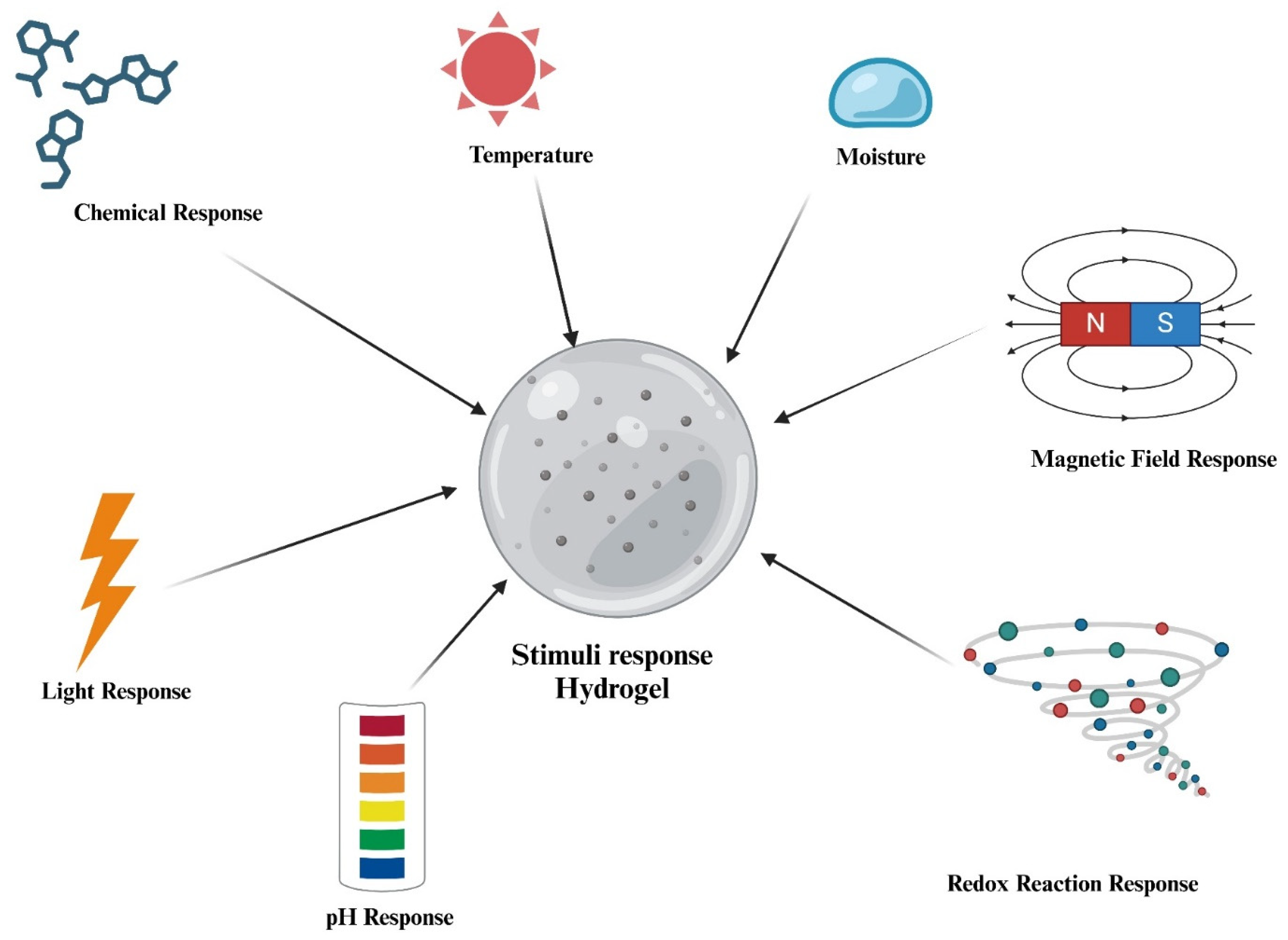


Disclaimer/Publisher’s Note: The statements, opinions and data contained in all publications are solely those of the individual author(s) and contributor(s) and not of MDPI and/or the editor(s). MDPI and/or the editor(s) disclaim responsibility for any injury to people or property resulting from any ideas, methods, instructions or products referred to in the content. |
© 2026 by the authors. Licensee MDPI, Basel, Switzerland. This article is an open access article distributed under the terms and conditions of the Creative Commons Attribution (CC BY) license.
Share and Cite
Siddique, M.F.; Omar, F.K.; Al-Marzouqi, A.H. Design and Application of Stimuli-Responsive Hydrogels for 4D Printing: A Review of Adaptive Materials in Engineering. Gels 2026, 12, 138. https://doi.org/10.3390/gels12020138
Siddique MF, Omar FK, Al-Marzouqi AH. Design and Application of Stimuli-Responsive Hydrogels for 4D Printing: A Review of Adaptive Materials in Engineering. Gels. 2026; 12(2):138. https://doi.org/10.3390/gels12020138
Chicago/Turabian StyleSiddique, Muhammad F., Farag K. Omar, and Ali H. Al-Marzouqi. 2026. "Design and Application of Stimuli-Responsive Hydrogels for 4D Printing: A Review of Adaptive Materials in Engineering" Gels 12, no. 2: 138. https://doi.org/10.3390/gels12020138
APA StyleSiddique, M. F., Omar, F. K., & Al-Marzouqi, A. H. (2026). Design and Application of Stimuli-Responsive Hydrogels for 4D Printing: A Review of Adaptive Materials in Engineering. Gels, 12(2), 138. https://doi.org/10.3390/gels12020138