Exploring the Relationships between Macrofungi Diversity and Major Environmental Factors in Wunvfeng National Forest Park in Northeast China

 ,
,  ,
,
Abstract
1. Introduction
2. Materials and Methods
2.1. Study Area Description
2.2. Fruiting Body Sampling
2.3. Soil Sampling, Analysis and Environmental Data Collection
2.4. Species Identification
2.5. Statistical Analysis
3. Results
3.1. Species Richness
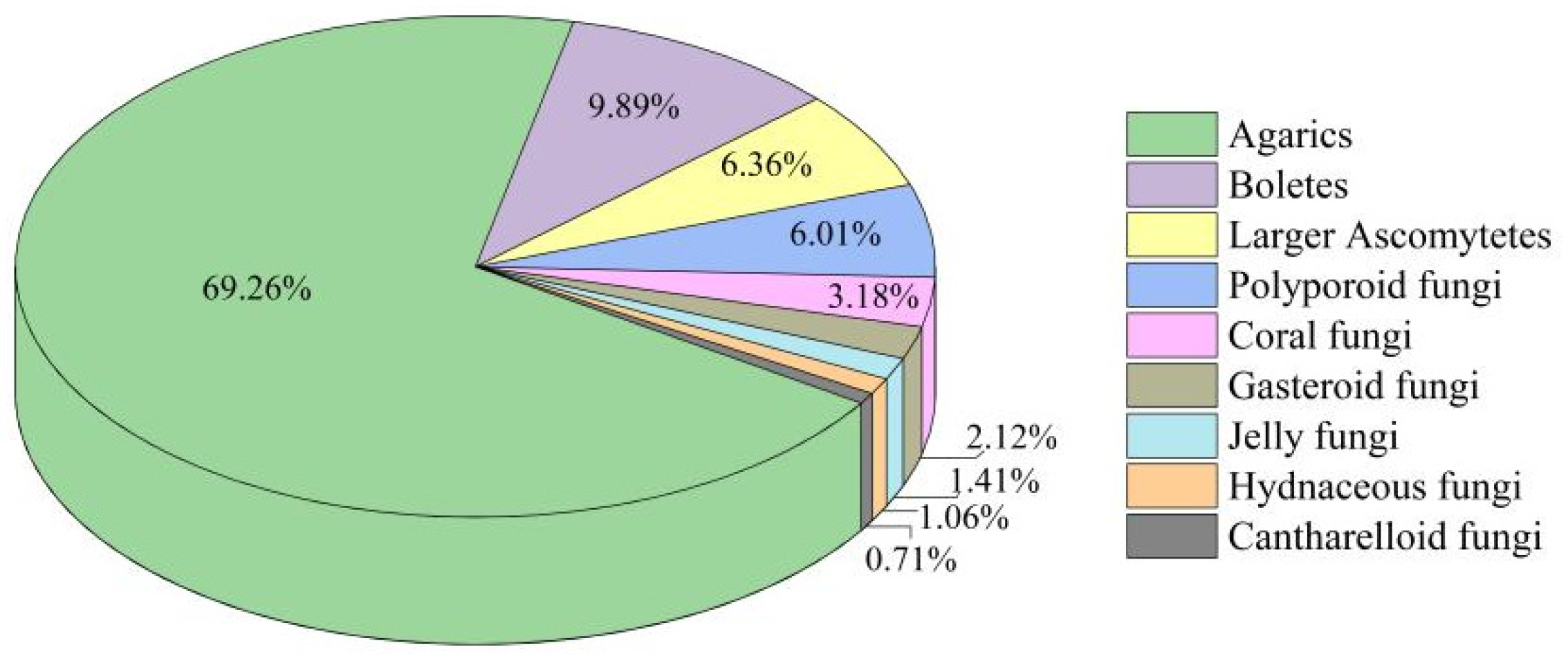
3.2. Macrofungal Types
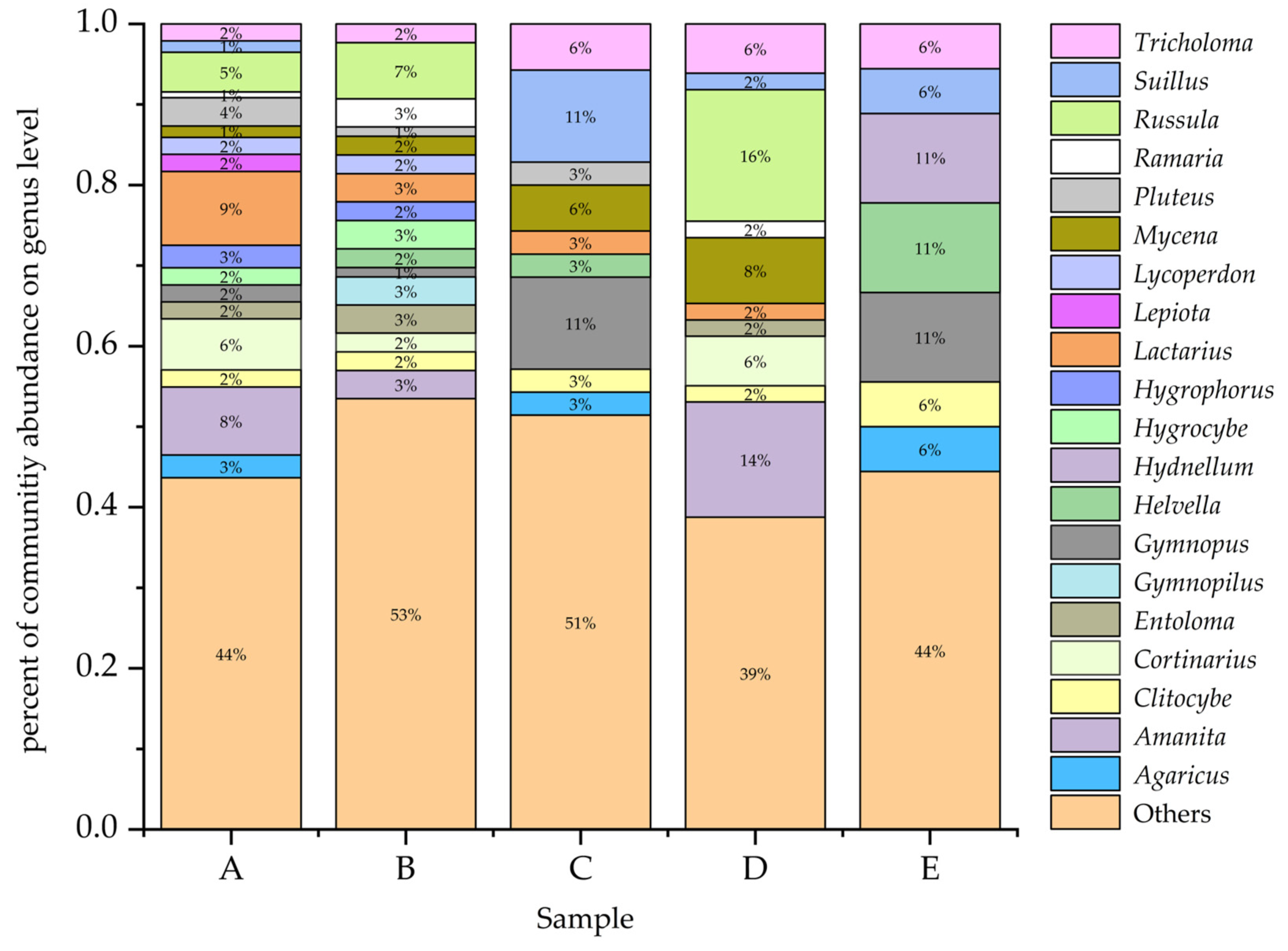
3.3. Analysis of Dominant Families and Genera
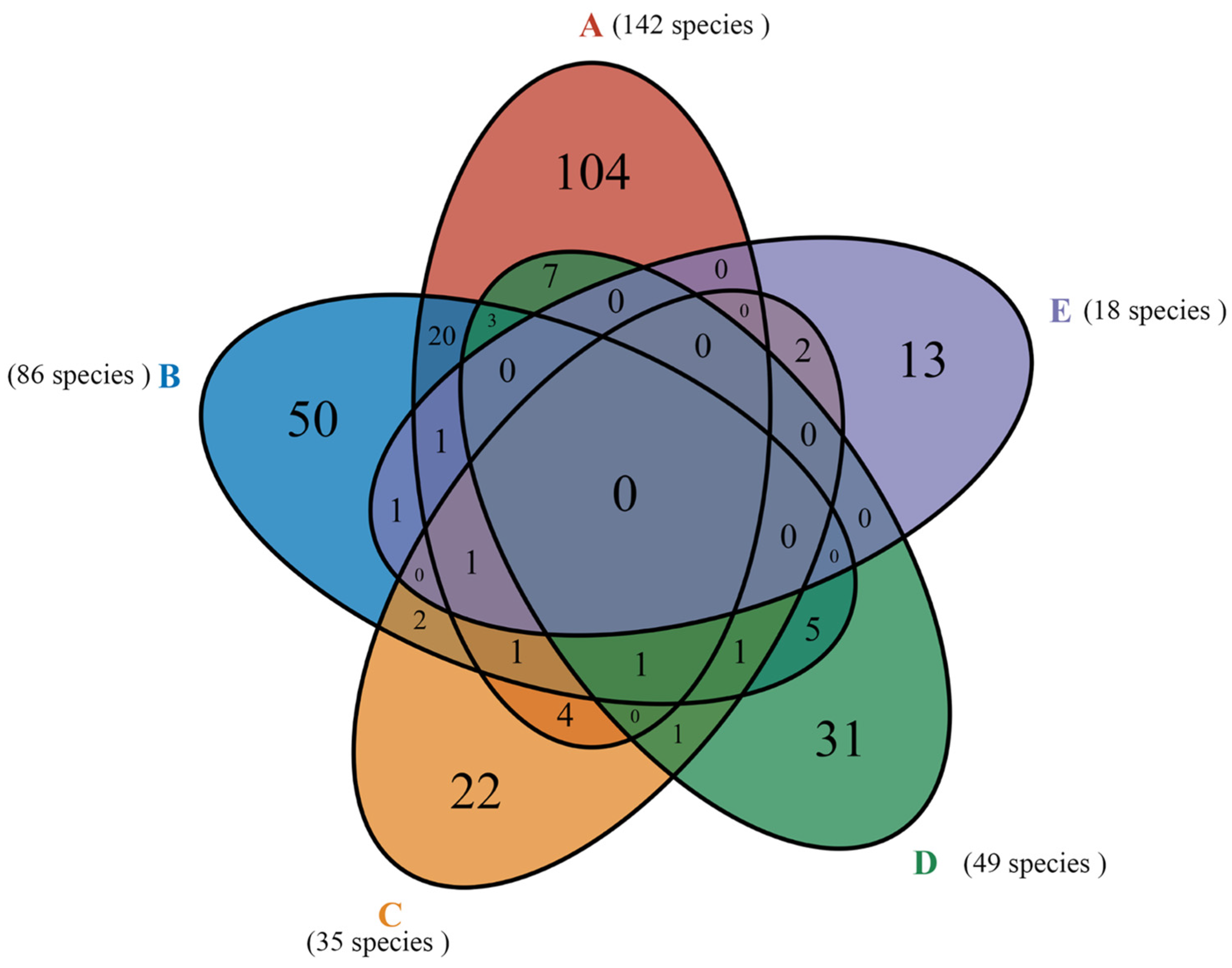
3.4. Forest Type and Species Composition
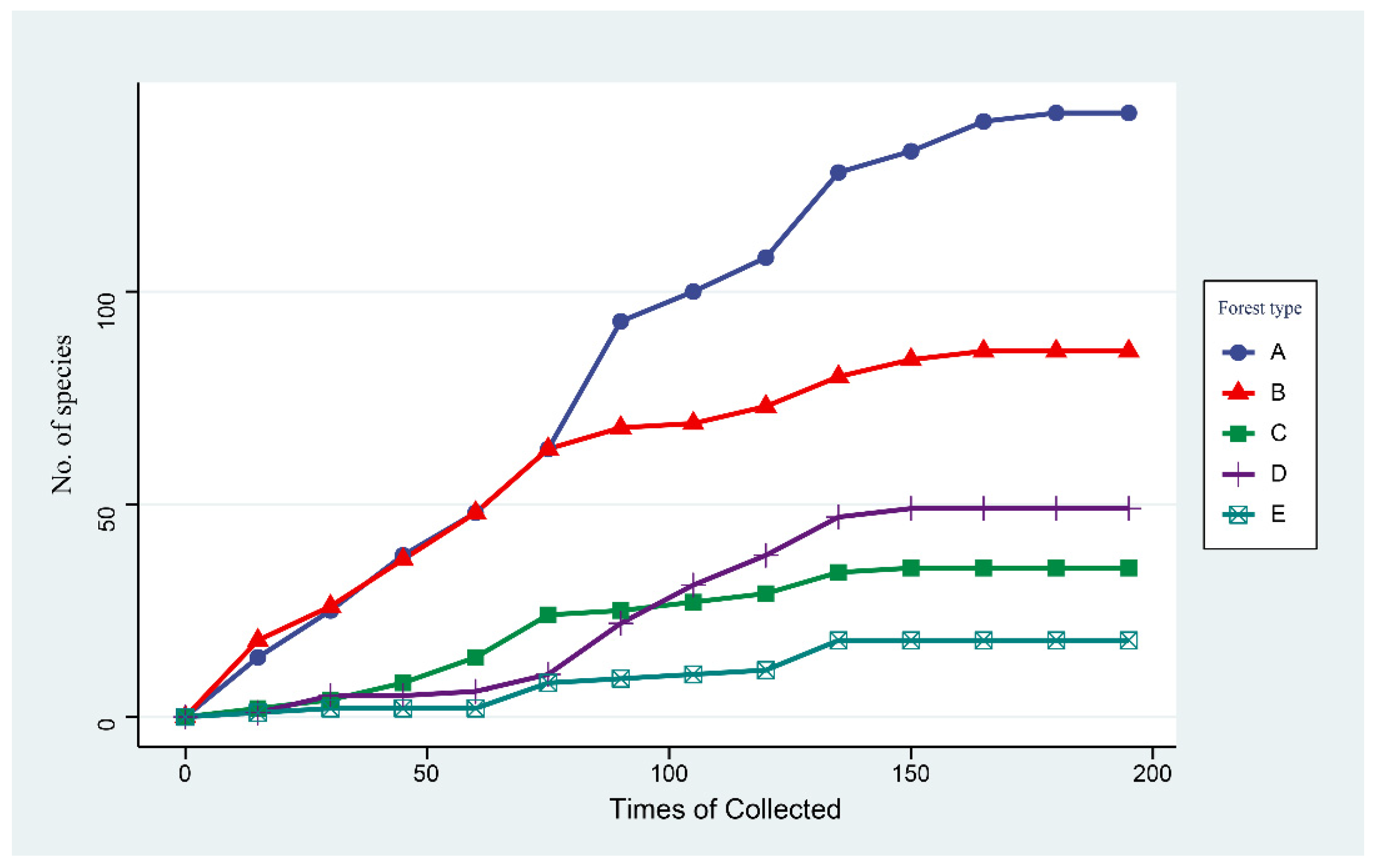
3.5. Cumulative Abundance of Macrofungi in Five Forest Types
3.6. Functional Diversity of Macrofungal Communities
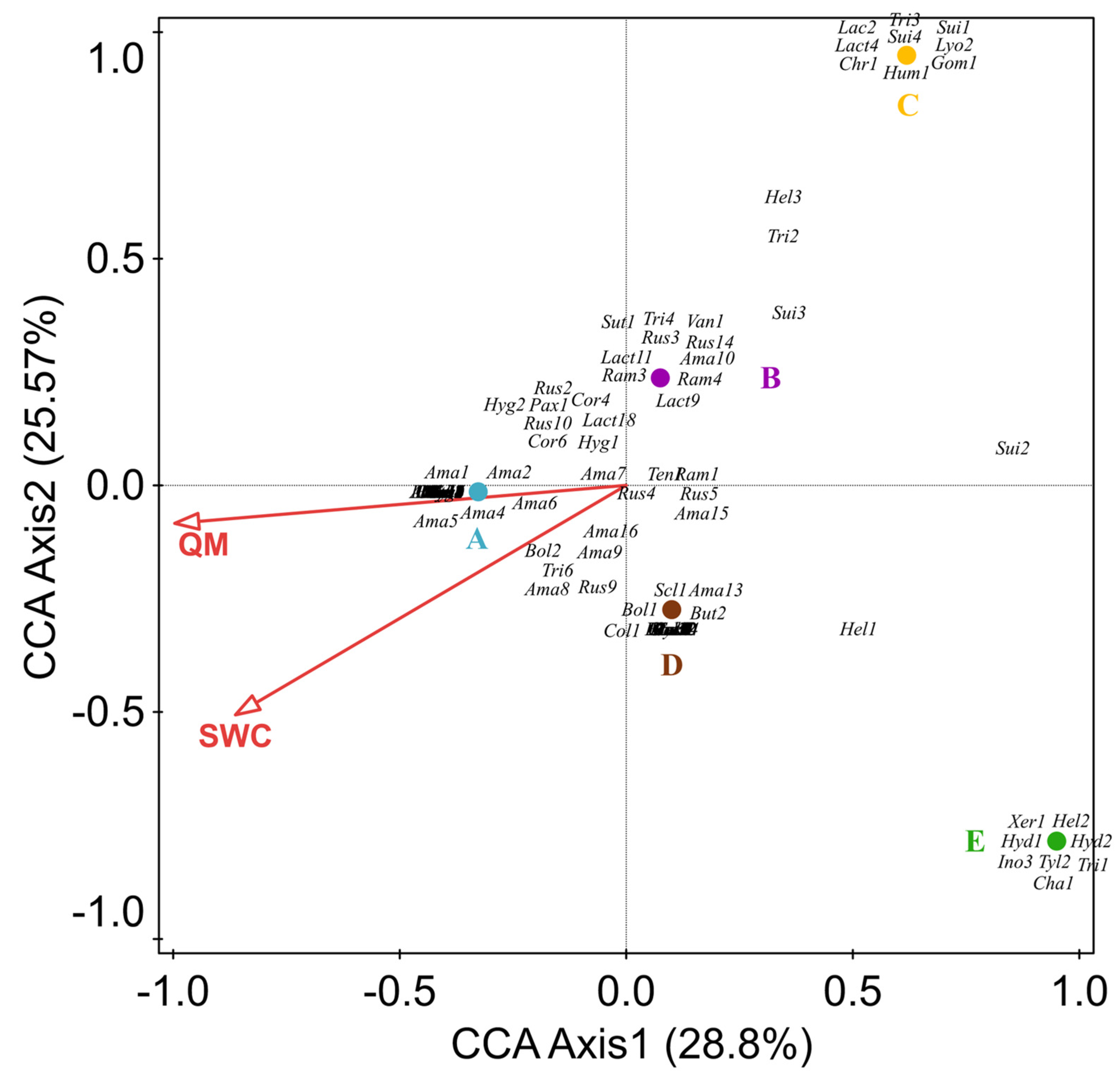
3.7. CCA Analysis of Macrofungal Communities and Selected Environmental Factors
4. Discussion
5. Conclusions
Author Contributions
Funding
Institutional Review Board Statement
Informed Consent Statement
Data Availability Statement
Conflicts of Interest
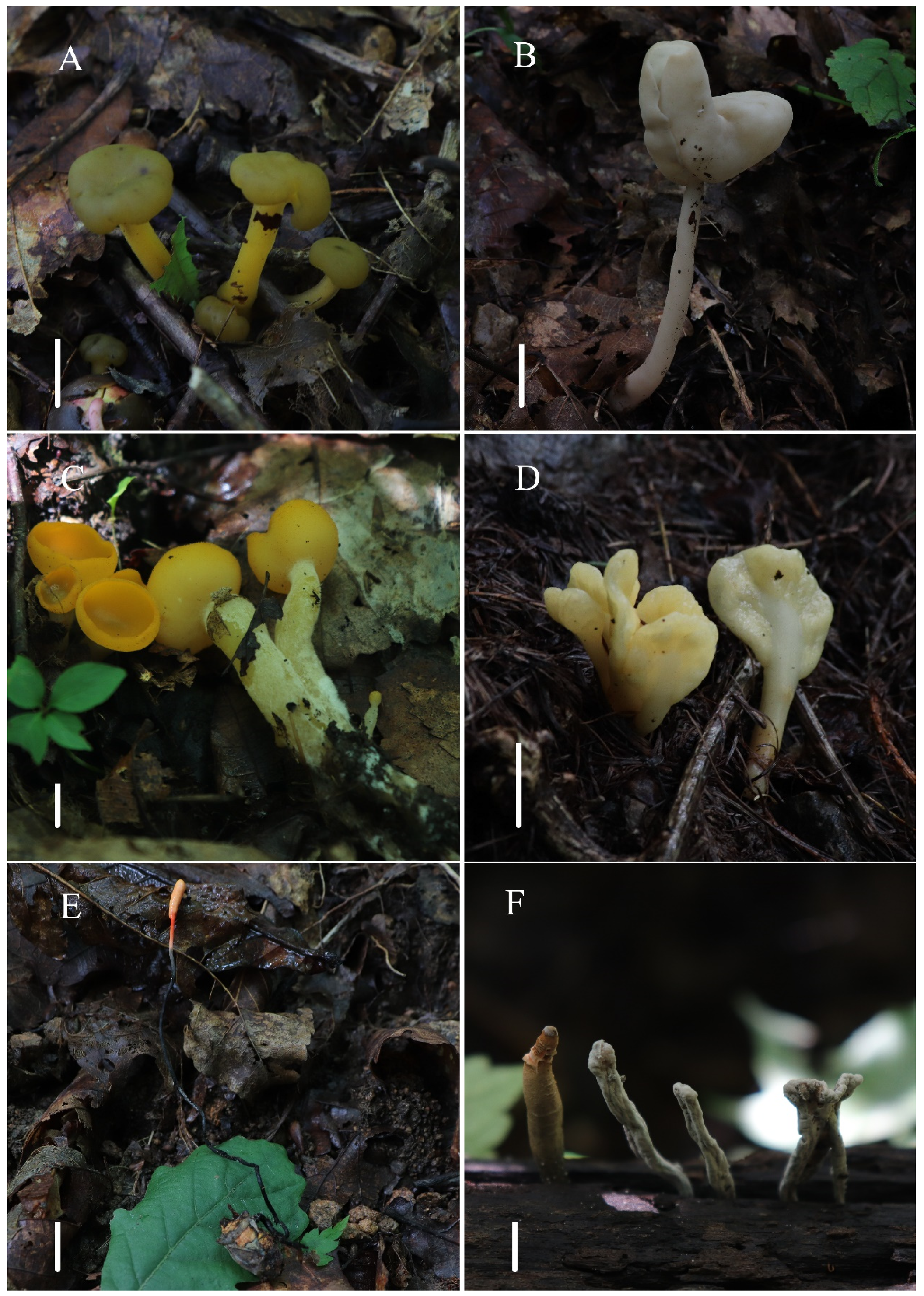
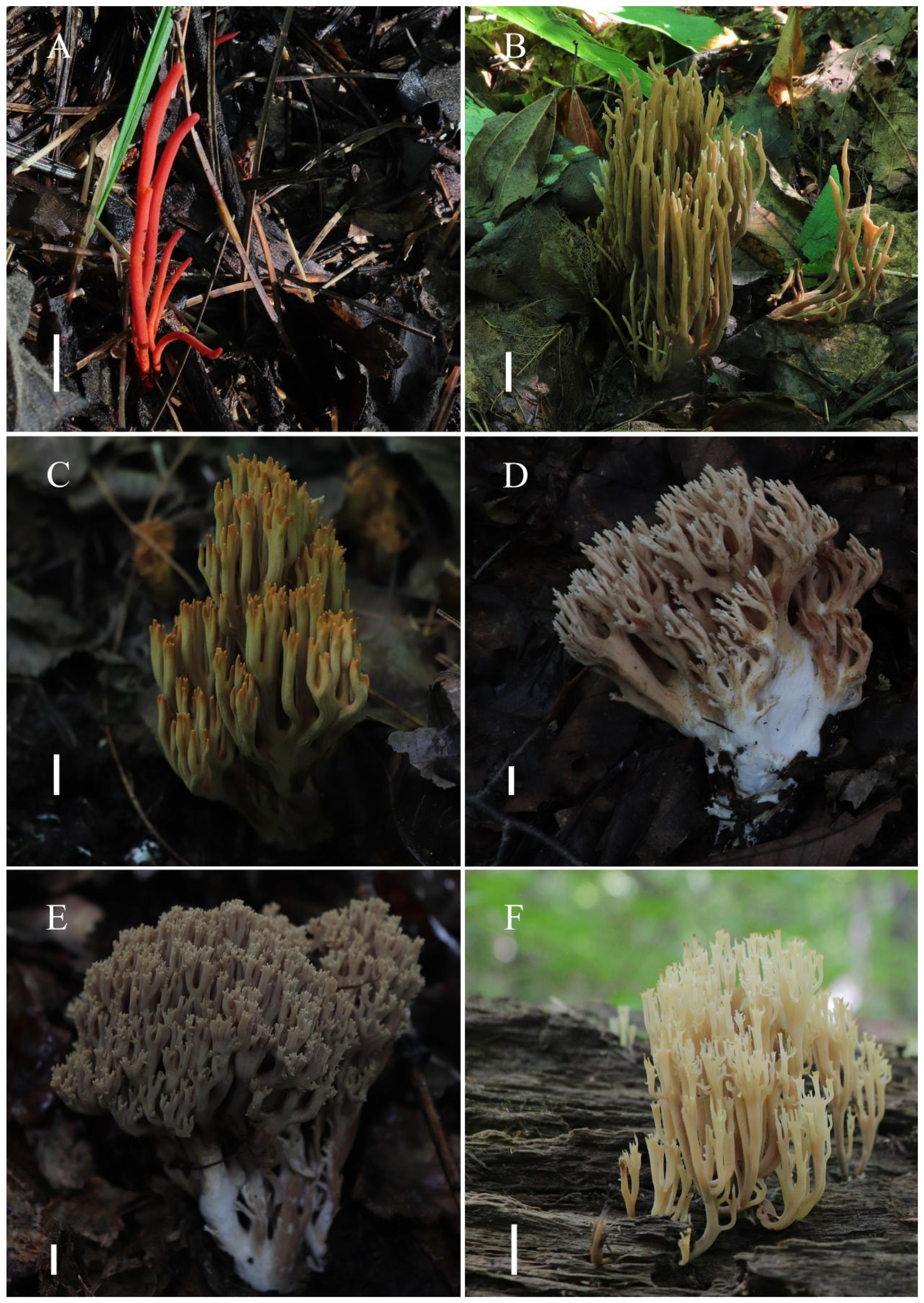
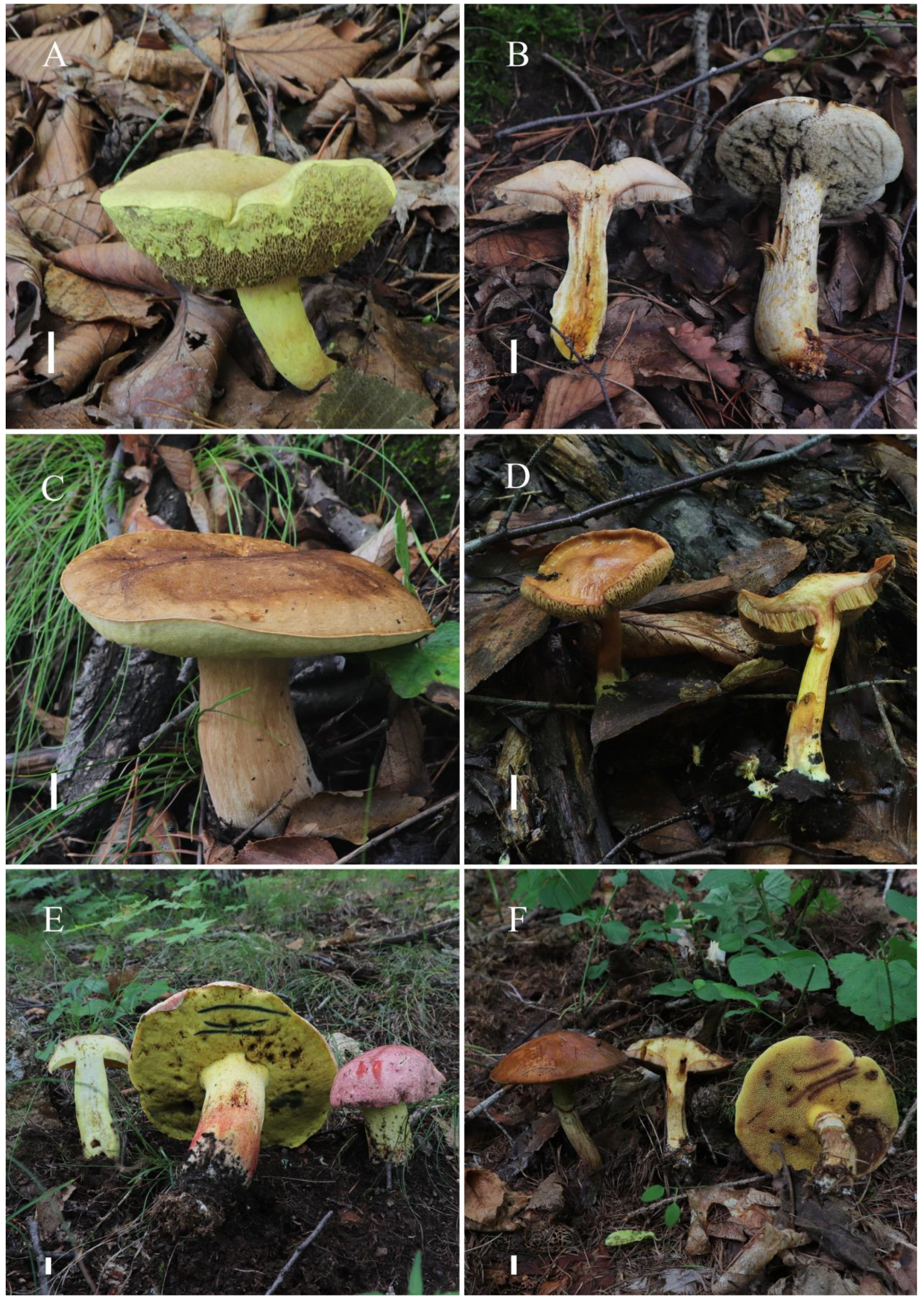
Appendix A. Photos of Some Species


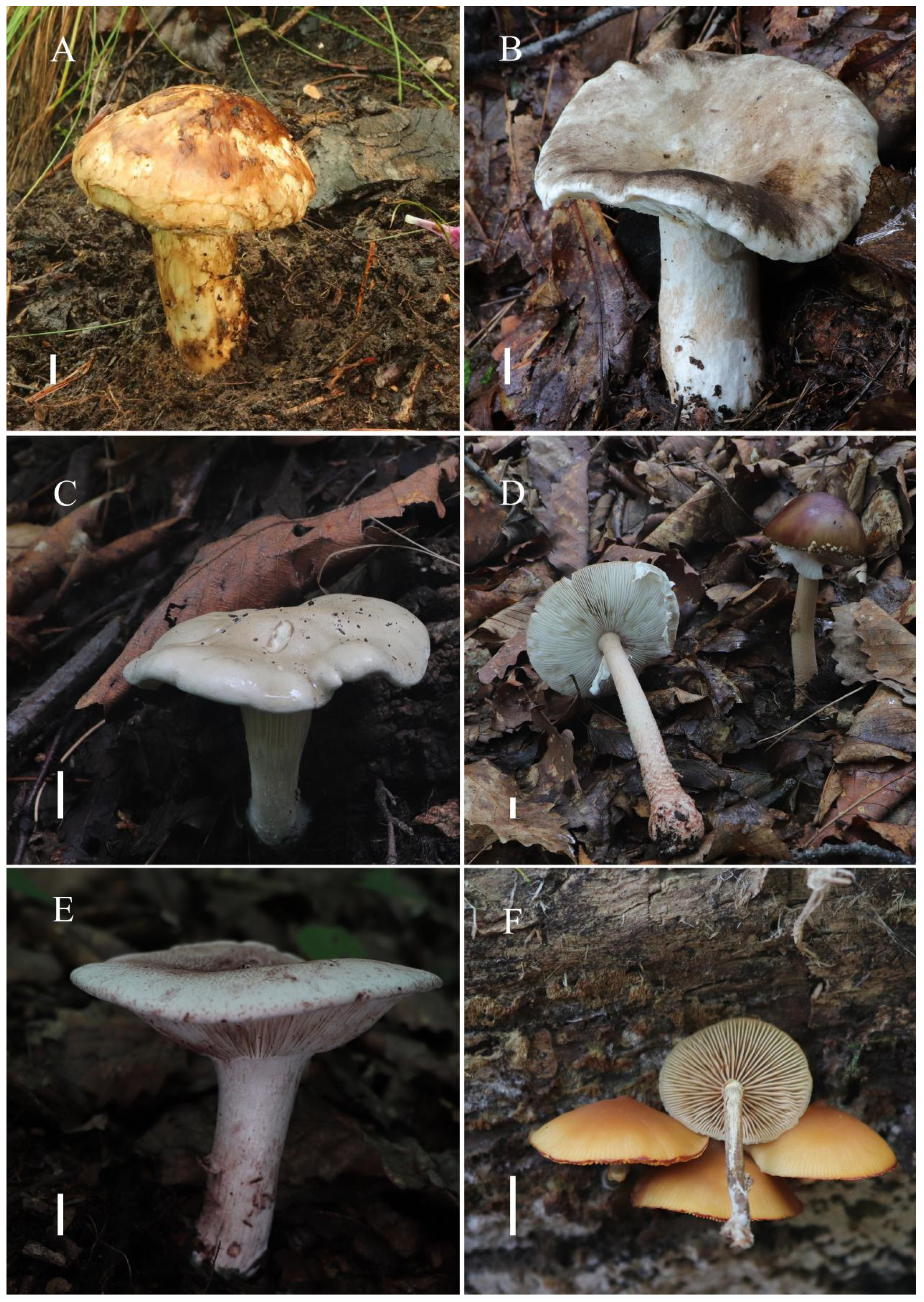

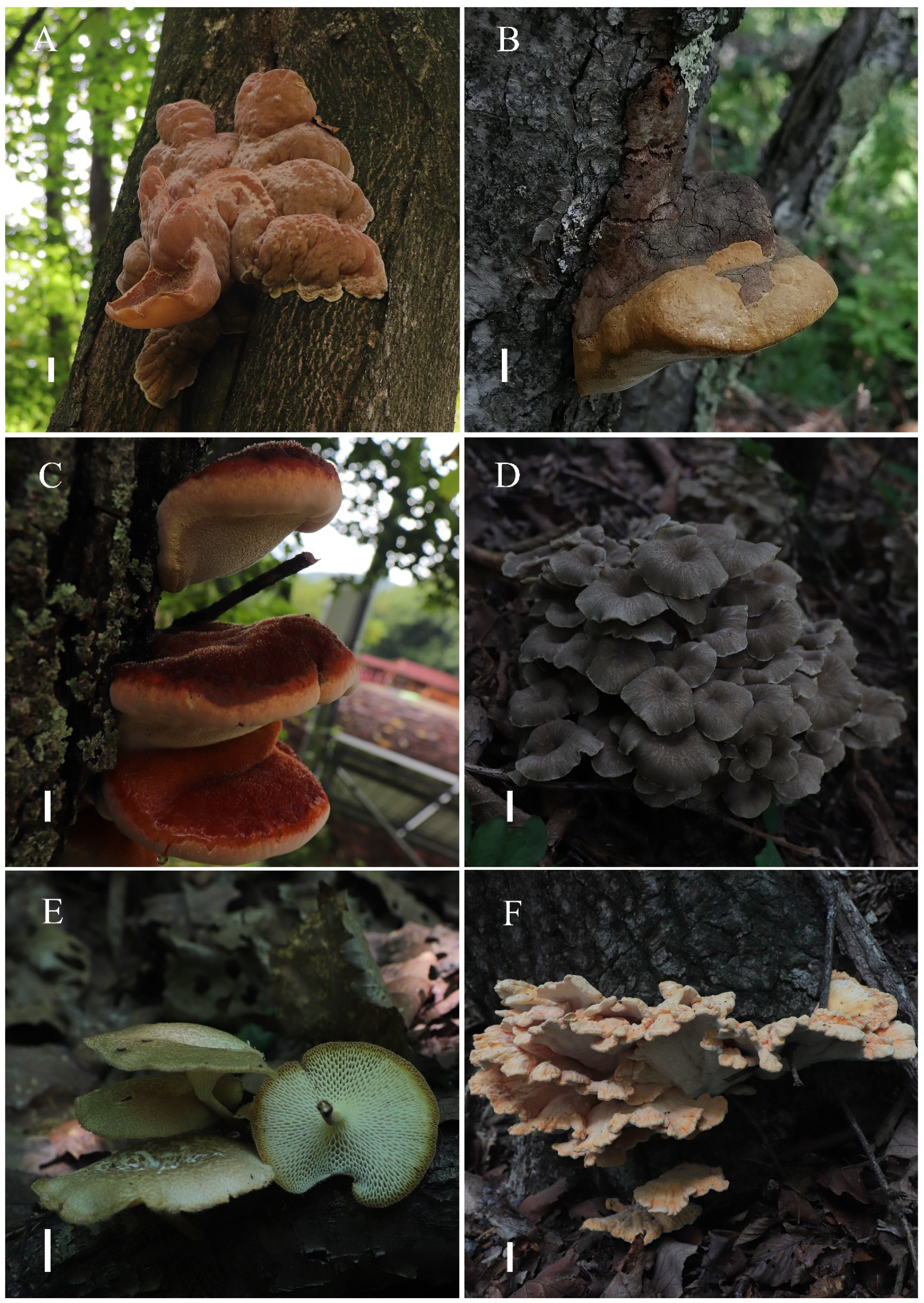
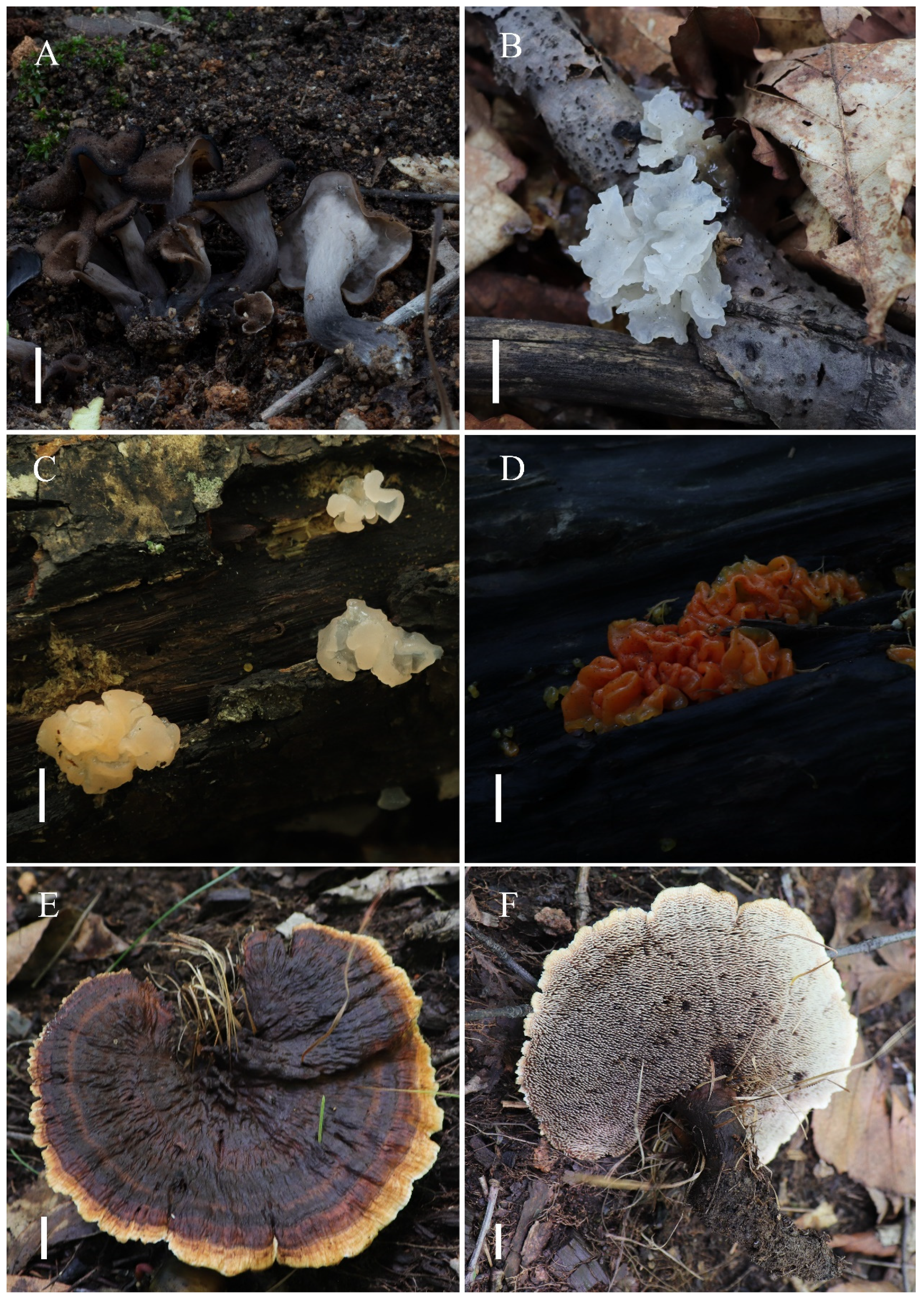
Appendix B. Macrofungi were collected in five forest types of Wunvfeng National Forest Park
| Species | Family | Genera | A | B | C | D | E | F | N | ML | Categories | SN | GenBank Number |
| Agaricus arvensis Schaeff. | Agaricaceae | Agaricus | √ | 4 | SS | Agarics | HMJAU60588 | ||||||
| Agaricus dulcidulus Schulzer | Agaricaceae | Agaricus | √ | 2 | SS | Agarics | HMJAU60589 | ||||||
| Agaricus moelleri Wasser | Agaricaceae | Agaricus | √ | √ | 3 | SS | Agarics | HMJAU60590 | |||||
| Agaricus placomyces Peck | Agaricaceae | Agaricus | √ | 1 | SS | Agarics | HMJAU60591 | ||||||
| Agaricus semotus Fr. | Agaricaceae | Agaricus | √ | 2 | SS | Agarics | HMJAU60592 | ||||||
| Agaricus subrufescens Peck | Agaricaceae | Agaricus | √ | 1 | SS | Agarics | HMJAU60593 | ||||||
| Agrocybe arvalis (Fr.) Singer | Strophariaceae | Agrocybe | √ | 3 | SS | Agarics | HMJAU60594 | ||||||
| Agrocybe erebia (Fr.) Kühner ex Singe | Strophariaceae | Agrocybe | √ | 2 | SS | Agarics | HMJAU60595 | ||||||
| Agrocybe praecox (Pers.) Fayod | Strophariaceae | Agrocybe | √ | √ | √ | 6 | SS | Agarics | HMJAU60596 | ||||
| Amanita altipes Zhu L. Yang, M. Weiss & Oberw. | Amanitaceae | Amanita | √ | 1 | EM | Agarics | HMJAU60597 | ||||||
| Amanita chepangiana Tulloss & Bhandary | Amanitaceae | Amanita | √ | 1 | EM | Agarics | HMJAU60598 | ||||||
| Amanita excelsa (Fr.) Bertill. | Amanitaceae | Amanita | √ | 1 | EM | Agarics | HMJAU60599 | ||||||
| Amanita flavipes S. Imai | Amanitaceae | Amanita | √ | 2 | EM | Agarics | HMJAU60600 | ||||||
| Amanita fuliginea Hongo | Amanitaceae | Amanita | √ | 2 | EM | Agarics | HMJAU60601 | ||||||
| Amanita hemibapha (Berk. & Broome) Sacc. | Amanitaceae | Amanita | √ | 2 | EM | Agarics | HMJAU60602 | ||||||
| Amanita ibotengutake T. Oda, C. Tanaka & Tsuda | Amanitaceae | Amanita | √ | √ | √ | 6 | EM | Agarics | HMJAU60603 | ||||
| Amanita oberwinklerana Zhu L. Yang & Yoshim. | Amanitaceae | Amanita | √ | √ | 3 | EM | Agarics | HMJAU60604 | |||||
| Amanita orsonii Ash. Kumar & T.N. Lakh. | Amanitaceae | Amanita | √ | √ | 5 | EM | Agarics | HMJAU60605 | |||||
| Amanita pallidocarnea (Höhn.) Boedijn | Amanitaceae | Amanita | √ | 2 | EM | Agarics | HMJAU60606 | ||||||
| Amanita pallidorosea P. Zhang & Zhu L. Yang | Amanitaceae | Amanita | √ | 2 | EM | Agarics | HMJAU60607 | ||||||
| Amanita rimosa P. Zhang & Zhu L. | Amanitaceae | Amanita | √ | 1 | EM | Agarics | HMJAU60608 | ||||||
| Amanita rubescens Pers. | Amanitaceae | Amanita | √ | 2 | EM | Agarics | HMJAU60609 | ||||||
| Amanita subglobosa Zhu L. Yang | Amanitaceae | Amanita | √ | 1 | EM | Agarics | HMJAU60610 | ||||||
| Amanita vaginata (Bull.) Lam. | Amanitaceae | Amanita | √ | √ | 3 | EM | Agarics | HMJAU60611 | |||||
| Amanita virosa Secr. | Amanitaceae | Amanita | √ | √ | 4 | EM | Agarics | HMJAU60612 | |||||
| Ampulloclitocybe clavipes (Pers.) Redhead, Lutzoni, Moncalvo & Vilgalys | Hygrophoraceae | Ampulloclitocybe | √ | 4 | LS | Agarics | HMJAU60613 | ||||||
| Armillaria gallica Marxm. & Romagn. | Physalacriaceae | Armillaria | √ | √ | √ | 15 | WS | Agarics | HMJAU60614 | OL891486 | |||
| Armillaria mellea (Vahl) P. Kumm. | Physalacriaceae | Armillaria | √ | 1 | WS | Agarics | HMJAU60615 | ||||||
| Artomyces pyxidatus (Pers.) Jülich | Auriscalpiaceae | Artomyces | √ | √ | 7 | WS | Coral fungi | HMJAU60616 | |||||
| Bjerkandera adusta (Willd.) P. Karst. | Phanerochaetaceae | Bjerkandera | √ | 1 | WS | Polyporoid fungi | HMJAU60617 | ||||||
| Boletus aereus Bull. | Boletaceae | Boletus | √ | 2 | EM | Boletes | HMJAU60618 | ||||||
| Boletus edulis Bull. | Boletaceae | Boletus | √ | √ | 4 | EM | Boletes | HMJAU60619 | |||||
| Bothia castanella (Peck) Halling, T.J. Baroni & Manfr. Binder | Boletaceae | Bothia | √ | 2 | EM | Boletes | HMJAU60620 | ||||||
| Bulgaria inquinans (Pers.) Fr. | Phacidiaceae | Bulgaria | √ | 1 | WS | Larger Ascomytetes | HMJAU60621 | ||||||
| Butyriboletus regius D. Arora & J.L. Frank | Boletaceae | Butyriboletus | √ | 2 | EM | Boletes | HMJAU60622 | OL891490 | |||||
| Butyriboletus roseoflavus (Hai B. Li & Hai L. Wei) D. Arora & J.L. Frank | Boletaceae | Butyriboletus | √ | 3 | EM | Boletes | HMJAU60623 | OL891497 | |||||
| Calocybe persicolor (Fr.) Singer | Lyophyllaceae | Calocybe | √ | 3 | SS | Agarics | HMJAU60624 | ||||||
| Chalciporus piperatus (Bull.) Bataille | Boletaceae | Chalciporus | √ | 1 | EM | Boletes | HMJAU60625 | ||||||
| Chroogomphus helveticus (Singer) M.M. Moser | Gomphidiaceae | Chroogomphus | √ | 4 | EM | Agarics | HMJAU60626 | OL891485 | |||||
| Clavaria fragilis Holmsk. | Clavariaceae | Clavaria | √ | 1 | SS | Coral fungi | HMJAU60627 | ||||||
| Clavulinopsis corniculata (Schaeff.) Corner | Clavariaceae | Clavulinopsis | √ | 1 | SS | Coral fungi | HMJAU60628 | ||||||
| Clavulinopsis sulcata Overeem | Clavariaceae | Clavulinopsis | √ | 10 | SS | Coral fungi | HMJAU60629 | ||||||
| Clitocybe fasciculata H.E. Bigelow & A.H. Sm. | Tricholomataceae | Clitocybe | √ | √ | √ | √ | 2 | LS | Agarics | HMJAU60630 | |||
| Clitocybe geotropa (Bull.) Quél. | Tricholomataceae | Clitocybe | √ | 1 | LS | Agarics | HMJAU60631 | ||||||
| Clitocybe gibba (Pers.) P. Kumm. | Tricholomataceae | Clitocybe | √ | 4 | LS | Agarics | HMJAU60632 | ||||||
| Clitocybe odora (Bull.) P. Kumm. | Tricholomataceae | Clitocybe | √ | 1 | LS | Agarics | HMJAU60633 | ||||||
| Clitocybe subditopoda Peck | Tricholomataceae | Clitocybe | √ | √ | √ | 10 | LS | Agarics | HMJAU60634 | ||||
| Coltricia crassa Y.C. Dai | Hymenochaetaceae | Coltricia | √ | 2 | EM | Polyporoid fungi | HMJAU60635 | ||||||
| Coltricia strigosipes Corner | Hymenochaetaceae | Coltricia | √ | 1 | EM | Polyporoid fungi | HMJAU60636 | ||||||
| Coprinellus disseminatus (Pers.) J.E. Lange | Psathyrellaceae | Coprinellus | √ | 8 | SS | Agarics | HMJAU60637 | ||||||
| Coprinellus radians (Desm.) Vilgalys, Hopple & Jacq. Johnson | Psathyrellaceae | Coprinellus | √ | 5 | SS | Agarics | HMJAU60638 | ||||||
| Coprinus comatus (O.F. Müll.) Pers. | Agaricaceae | Coprinus | √ | 1 | DS | Agarics | HMJAU60639 | ||||||
| Cordyceps militaris Cordyceps militaris (L.) Fr. | Cordycipitaceae | Cordyceps | √ | 3 | EI | Larger Ascomytetes | HMJAU60640 | ||||||
| Cortinarius anomalus (Fr.) Fr. | Cortinariaceae | Cortinarius | √ | 2 | EM | Agarics | HMJAU60641 | OL891464 | |||||
| Cortinarius armillatus (Fr.) Fr. | Cortinariaceae | Cortinarius | √ | 4 | EM | Agarics | HMJAU60642 | OL891465 | |||||
| Cortinarius balaustinus Fr. | Cortinariaceae | Cortinarius | √ | 3 | EM | Agarics | HMJAU60643 | ||||||
| Cortinarius bivelus (Fr.) Fr. | Cortinariaceae | Cortinarius | √ | √ | 5 | EM | Agarics | HMJAU60644 | OL891467 | ||||
| Cortinarius caperatus (Pers.) Fr. | Cortinariaceae | Cortinarius | √ | 1 | EM | Agarics | HMJAU60645 | OL891466 | |||||
| Cortinarius cotoneus Fr. | Cortinariaceae | Cortinarius | √ | √ | 3 | EM | Agarics | HMJAU60646 | OL891468 | ||||
| Cortinarius ectypus J. Favre | Cortinariaceae | Cortinarius | √ | 2 | EM | Agarics | HMJAU60647 | ||||||
| Cortinarius flammeouraceus Niskanen, Kytov., Liimat., Ammirati & Dima | Cortinariaceae | Cortinarius | √ | 4 | EM | Agarics | HMJAU60648 | OL891470 | |||||
| Cortinarius hesleri Ammirati, Niskanen, Liimat. & Matheny | Cortinariaceae | Cortinarius | √ | 1 | EM | Agarics | HMJAU60649 | ||||||
| Cortinarius pholideus (Lilj.) Fr. | Cortinariaceae | Cortinarius | √ | 3 | EM | Agarics | HMJAU60650 | OL891469 | |||||
| Cortinarius sanguineus (Wulfen) Gray | Cortinariaceae | Cortinarius | √ | 2 | EM | Agarics | HMJAU60651 | ||||||
| Cortinarius subbalaustinus Rob. Henry | Cortinariaceae | Cortinarius | √ | 1 | EM | Agarics | HMJAU60652 | ||||||
| Cortinarius torvus (Fr.) Fr. | Cortinariaceae | Cortinarius | √ | 1 | EM | Agarics | HMJAU60653 | ||||||
| Cotylidia diaphana (Cooke) Lentz | Rickenellaceae | Cotylidia | √ | 4 | SS | Jelly fungi | HMJAU60654 | ||||||
| Craterellus cornucopioides (L.) Pers. | Hydnaceae | Craterellus | √ | 1 | EM | Cantharelloid | HMJAU60655 | ||||||
| Crepidotus applanatus (Pers.) P. Kumm. | Crepidotaceae | Crepidotus | √ | 1 | WS | Agarics | HMJAU60656 | ||||||
| Crepidotus malachius Sacc. | Crepidotaceae | Crepidotus | √ | 5 | WS | Agarics | HMJAU60657 | ||||||
| Cyclocybe erebia (Fr.) Vizzini & Matheny | Tubariaceae | Cyclocybe | √ | 2 | SS | Agarics | HMJAU60658 | ||||||
| Cystoderma granulosum (Batsch) Fayod | Agaricaceae | Cystoderma | √ | 4 | SS | Agarics | HMJAU60659 | ||||||
| Dacrymyces chrysospermus Berk. & M.A. Curtis | Dacrymycetaceae | Dacrymyces | √ | 3 | WS | Jelly fungi | HMJAU60660 | ||||||
| Dacrymyces yunnanensis B. Liu & L. Fan | Dacrymycetaceae | Dacrymyces | √ | √ | 6 | WS | Jelly fungi | HMJAU60661 | |||||
| Daldinia concentrica (Bolton) Ces. & De Not. | Hypoxylaceae | Daldinia | √ | 5 | WS | Larger Ascomytetes | HMJAU60662 | ||||||
| Elmerina cladophora (Berk.) Bres. | Auriculariaceae | Elmerina | √ | √ | 3 | WS | Polyporoid fungi | HMJAU60663 | |||||
| Elmerina hispida (Imazeki) Y.C. Dai & L.W. Zhou | Auriculariaceae | Elmerina | √ | 1 | WS | Polyporoid fungi | HMJAU60664 | ||||||
| Entoloma abortivum (Berk. & M.A. Curtis) Donk | Entolomataceae | Entoloma | √ | 2 | SS | Agarics | HMJAU60665 | ||||||
| Entoloma alboumbonatum Hesler | Entolomataceae | Entoloma | √ | 2 | SS | Agarics | HMJAU60666 | ||||||
| Entoloma caespitosum W.M. Zhang | Entolomataceae | Entoloma | √ | 5 | SS | Agarics | HMJAU60667 | ||||||
| Entoloma clypeatum (L.) P. Kumm. | Entolomataceae | Entoloma | √ | 4 | SS | Agarics | HMJAU60668 | ||||||
| Entoloma holoconiotum (Largent & Thiers) Noordel. & Co-David | Entolomataceae | Entoloma | √ | 4 | SS | Agarics | HMJAU60669 | ||||||
| Entoloma mediterraneense Noordel. & Hauskn. | Entolomataceae | Entoloma | √ | 1 | SS | Agarics | HMJAU60670 | ||||||
| Entoloma rhodopolium (Fr.) P. Kumm. | Entolomataceae | Entoloma | √ | 2 | SS | Agarics | HMJAU60671 | ||||||
| Entonaema liquescens Möller | Hypoxylaceae | Entonaema | √ | 3 | WS | Larger Ascomytetes | HMJAU60672 | ||||||
| Favolus squamosus (Huds.) A. Ames | Polyporaceae | Favolus | √ | 1 | WS | Polyporoid fungi | HMJAU60673 | ||||||
| Flammulaster erinaceellus (Peck) Watling | Tubariaceae | Flammulaster | √ | 6 | WS | Agarics | HMJAU60674 | ||||||
| Galerina helvoliceps (Berk. & M.A. Curtis) Singe | Hymenogastraceae | Galerina | √ | 4 | WS | Agarics | HMJAU60675 | ||||||
| Galerina marginata (Batsch) Kühner | Hymenogastraceae | Galerina | √ | 4 | WS | Agarics | HMJAU60676 | ||||||
| Geastrum triplex Jungh. | Geastraceae | Geastrum | √ | 1 | LS | Gasteroid fungi | HMJAU60677 | ||||||
| Gerhardtia borealis (Fr.) Contu & A. Ortega | Lyophyllaceae | Gerhardtia | √ | 3 | SS | Agarics | HMJAU60678 | ||||||
| Gerronema nemorale Har. Takah. | Marasmiaceae | Gerronema | √ | 1 | WS | Agarics | HMJAU60679 | ||||||
| Gloeostereum incarnatum S. Ito & S. Imai | Cyphellaceae | Gloeostereum | √ | 4 | WS | Polyporoid fungi | HMJAU60680 | ||||||
| Gomphidius maculatus (Scop.) Fr. | Gomphidiaceae | Gomphidius | √ | 2 | EM | Cantharelloid | HMJAU60681 | ||||||
| Gymnopilus junonius (Fr.) P.D. Orton | Hymenogastraceae | Gymnopilus | √ | 3 | WS | Agarics | HMJAU60682 | ||||||
| Gymnopilus penetrans (Fr.) Murrill | Hymenogastraceae | Gymnopilus | √ | 2 | WS | Agarics | HMJAU60683 | ||||||
| Gymnopilus suberis (Maire) Singer | Hymenogastraceae | Gymnopilus | √ | 6 | WS | Agarics | HMJAU60684 | ||||||
| Gymnopus alnicola J.L. Mata & Halling | Omphalotaceae | Gymnopus | √ | 4 | LS | Agarics | HMJAU60685 | ||||||
| Gymnopus confluens (Pers.) Antonín, Halling & Noordel. | Omphalotaceae | Gymnopus | √ | √ | 14 | LS | Agarics | HMJAU60686 | OL884222 | ||||
| Gymnopus densilamellatus Antonín, Ryoo & Ka | Omphalotaceae | Gymnopus | √ | √ | √ | √ | 25 | LS | Agarics | HMJAU60687 | OL884223 | ||
| Gymnopus dryophilus (Bull.) Murrill | Omphalotaceae | Gymnopus | √ | √ | 30 | LS | Agarics | HMJAU60688 | OL891463 | ||||
| Gymnopus gibbosus (Corner) A.W. Wilson, Desjardin & E. Horak | Omphalotaceae | Gymnopus | √ | 7 | LS | Agarics | HMJAU60689 | OL884224 | |||||
| Gymnopus loiseleurietorum (M.M. Moser, Gerhold & Tobies) Antonín & Noordel. | Omphalotaceae | Gymnopus | √ | 7 | LS | Agarics | HMJAU60690 | ||||||
| Harrya chromapes (Frost) Halling, Nuhn, Osmundson & Manfr. | Boletaceae | Harrya | √ | 1 | EM | Boletes | HMJAU60691 | OL891492 | |||||
| Hebeloma birrus (Fr.) Gillet | Hymenogastraceae | Hebeloma | √ | 6 | EM | Agarics | HMJAU60692 | OL891483 | |||||
| Heliocybe sulcata (Berk.) Redhead & Ginns | Gloeophyllaceae | Heliocybe | √ | 2 | WS | Agarics | HMJAU60693 | ||||||
| Helvella crispa (Scop.) Fr. | Hydnaceae | Helvella | √ | √ | 2 | EM | Larger Ascomytetes | HMJAU60694 | |||||
| Helvella elastica Bull. | Helvellaceae | Helvella | √ | 1 | EM | Larger Ascomytetes | HMJAU60695 | ||||||
| Helvella macropus (Pers.) P. Karst. | Helvellaceae | Helvella | √ | √ | 3 | EM | Larger Ascomytetes | HMJAU60696 | |||||
| Hemistropharia albocrenulata (Peck) Jacobsson & E. Larss. | Tubariaceae | Hemistropharia | √ | 1 | SS | Agarics | HMJAU60697 | ||||||
| Hericium erinaceus (Bull.) Pers. | Hericiaceae | Hericium | √ | 1 | WS | Hydnaceous fungi | HMJAU60698 | ||||||
| Humaria hemisphaerica (F.H. Wigg.) Fuckel | Pyronemataceae | Humaria | √ | 1 | EM | Larger Ascomytetes | HMJAU60699 | ||||||
| Hydnellum aurantiacum (Batsch) P. Karst. | Bankeraceae | Hydnellum | √ | 2 | EM | Hydnaceous fungi | HMJAU60700 | OL891471 | |||||
| Hydnellum peckii Banker | Bankeraceae | Hydnellum | √ | 2 | EM | Hydnaceous fungi | HMJAU60701 | OL891487 | |||||
| Hygrocybe cantharellus (Schwein.) Murrill | Hygrophoraceae | Hygrocybe | √ | 5 | SS | Agarics | HMJAU60702 | ||||||
| Hygrocybe chlorophana (Fr.) Wünsche | Hygrophoraceae | Hygrocybe | √ | 5 | SS | Agarics | HMJAU60703 | ||||||
| Hygrocybe coccinea (Schaeff.) P. Kumm. | Hygrophoraceae | Hygrocybe | √ | 4 | SS | Agarics | HMJAU60704 | ||||||
| Hygrocybe coccineocrenata.D. Orton) M.M. Moser | Hygrophoraceae | Hygrocybe | √ | 5 | SS | Agarics | HMJAU60705 | ||||||
| Hygrocybe miniata (Fr.) P. Kumm. | Hygrophoraceae | Hygrocybe | √ | 4 | SS | Agarics | HMJAU60706 | ||||||
| Hygrocybe reidii Kühner | Hygrophoraceae | Hygrocybe | √ | 1 | SS | Agarics | HMJAU60707 | ||||||
| Hygrophoropsis aurantiaca (Wulfen) Maire | Hygrophoropsidaceae | Hygrophoropsis | √ | √ | 7 | LS | Agarics | HMJAU60708 | OL891484 | ||||
| Hygrophorus conicus (Schaeff.) Fr. | Hygrophoraceae | Hygrophorus | √ | √ | 6 | EM | Agarics | HMJAU60709 | |||||
| Hygrophorus nemoreus (Pers.) Fr. | Hygrophoraceae | Hygrophorus | √ | √ | 9 | EM | Agarics | HMJAU60710 | |||||
| Hygrophorus pudorinus (Fr.) Fr. | Hygrophoraceae | Hygrophorus | √ | 1 | EM | Agarics | HMJAU60711 | ||||||
| Hygrophorus russula (Schaeff. ex Fr.) Kauffman | Hygrophoraceae | Hygrophorus | √ | 2 | EM | Agarics | HMJAU60712 | ||||||
| Hypholoma capnoides (Fr.) P. Kumm. | Strophariaceae | Hypholoma | √ | 2 | WS | Agarics | HMJAU60713 | ||||||
| Hypholoma sublateritium (Fr.) Quél. | Strophariaceae | Hypholoma | √ | 4 | WS | Agarics | HMJAU60714 | ||||||
| Infundibulicybe geotropa (Bull.) Harmaja | Tricholomataceae | Infundibulicybe | √ | 2 | SS | Agarics | HMJAU60715 | ||||||
| Infundibulicybe gibba (Pers.) Harmaja | Tricholomataceae | Infundibulicybe | √ | 2 | SS | Agarics | HMJAU60716 | ||||||
| Inocybe assimilata Britzelm. | Inocybaceae | Inocybe | √ | 2 | EM | Agarics | HMJAU60717 | ||||||
| Inocybe asterospora Quél. | Inocybaceae | Inocybe | √ | 1 | EM | Agarics | HMJAU60718 | ||||||
| Inocybe suaveolens D.E. Stuntz | Inocybaceae | Inocybe | √ | 2 | EM | Agarics | HMJAU60719 | OL891472 | |||||
| Inonotus hispidus (Bull.) P. Karst. | Hymenochaetaceae | Inonotus | √ | 3 | WS | Polyporoid fungi | HMJAU60720 | ||||||
| Laccaria amethystina Cooke | Hydnangiaceae | Laccaria | √ | 4 | EM | Agarics | HMJAU60721 | ||||||
| Laccaria laccata (Scop.) Cooke | Hydnangiaceae | Laccaria | √ | 4 | EM | Agarics | HMJAU60722 | ||||||
| Lactarius albidocinereus X.H. Wang, S.F. Shi & T. Bau | Russulaceae | Lactarius | √ | 2 | EM | Agarics | HMJAU60723 | OL891473 | |||||
| Lactarius brunneoviolascens Bon | Russulaceae | Lactarius | √ | 1 | EM | Agarics | HMJAU60724 | ||||||
| Lactarius conglutinatus X.H. Wang | Russulaceae | Lactarius | √ | 6 | EM | Agarics | HMJAU60725 | ||||||
| Lactarius deterrimus Gröger | Russulaceae | Lactarius | √ | 5 | EM | Agarics | HMJAU60726 | ||||||
| Lactarius flavidus Boud. | Russulaceae | Lactarius | √ | 1 | EM | Agarics | HMJAU60727 | ||||||
| Lactarius glyciosmus (Fr.) Fr. | Russulaceae | Lactarius | √ | 1 | EM | Agarics | HMJAU60728 | ||||||
| Lactarius hirtipes J.Z. Ying | Russulaceae | Lactarius | √ | 3 | EM | Agarics | HMJAU60729 | ||||||
| Lactarius lilacinus Fr. | Russulaceae | Lactarius | √ | 3 | EM | Agarics | HMJAU60730 | ||||||
| Lactarius pallidus Pers. | Russulaceae | Lactarius | √ | 2 | EM | Agarics | HMJAU60731 | ||||||
| Lactarius piperatus (L.) Pers. | Russulaceae | Lactarius | √ | 1 | EM | Agarics | HMJAU60732 | ||||||
| Lactarius proximellus Beardslee & Burl. | Russulaceae | Lactarius | √ | 1 | EM | Agarics | HMJAU60733 | ||||||
| Lactarius pubescens Fr. | Russulaceae | Lactarius | √ | 1 | EM | Agarics | HMJAU60734 | ||||||
| Lactarius subvellereus Peck | Russulaceae | Lactarius | √ | 2 | EM | Agarics | HMJAU60735 | ||||||
| Lactarius torminosus (Schaeff.) Pers. | Russulaceae | Lactarius | √ | 2 | EM | Agarics | HMJAU60736 | ||||||
| Lactarius trivialis (Fr.) Fr. | Russulaceae | Lactarius | √ | 1 | EM | Agarics | HMJAU60737 | OL891474 | |||||
| Lactarius vietus (Fr.) Fr. | Russulaceae | Lactarius | √ | 2 | EM | Agarics | HMJAU60738 | ||||||
| Lactarius volemus (Fr.) Fr. | Russulaceae | Lactarius | √ | 3 | EM | Agarics | HMJAU60739 | ||||||
| Lactarius zonarius (Bull.) Fr. | Russulaceae | Lactarius | √ | √ | 2 | EM | Agarics | HMJAU60740 | |||||
| Lactifluus bertillonii (Neuhoff ex Z. Schaef.) Verbeken | Russulaceae | Lactifluus | √ | 1 | EM | Agarics | HMJAU60741 | OL891489 | |||||
| Lactifluus pilosus (Verbeken, H.T. Le & Lumyong) Verbeken | Russulaceae | Lactifluus | √ | 1 | EM | Agarics | HMJAU60742 | ||||||
| Laetiporus sulphureus (Bull.) Murrill | Laetiporaceae | Laetiporus | √ | √ | 2 | WS | Polyporoid fungi | HMJAU60743 | |||||
| Leccinum aurantiacum (Bull.) Gray | Boletaceae | Leccinum | √ | 2 | EM | Boletes | HMJAU60744 | ||||||
| Leccinum scabrum (Bull.) Gray | Boletaceae | Leccinum | √ | 1 | EM | Boletes | HMJAU60745 | ||||||
| Leccinum versipelle (Fr. & Hök) Snell | Boletaceae | Leccinum | √ | 1 | EM | Boletes | HMJAU60746 | ||||||
| Lentinellus ursinus (Fr.) Kühner | Auriscalpiaceae | Lentinellus | √ | 6 | WS | Agarics | HMJAU60747 | ||||||
| Lentinus edodes (Berk.) Singer | Omphalotaceae | Lentinus | √ | 2 | WS | Agarics | HMJAU60748 | ||||||
| Lentinus sajor-caju (Fr.) Fr. | Polyporaceae | Lentinus | √ | 6 | WS | Agarics | HMJAU60749 | OL891475 | |||||
| Leotia lubrica (Scop.) Pers. | Leotiaceae | Leotia | √ | 4 | SS | Larger Ascomytetes | HMJAU60750 | ||||||
| Lepiota castanea Quél. | Agaricaceae | Lepiota | √ | 5 | LS | Agarics | HMJAU60751 | ||||||
| Lepiota cristata (Bolton) P. Kumm. | Agaricaceae | Lepiota | √ | 4 | LS | Agarics | HMJAU60752 | ||||||
| Lepista nuda (Bull.) Cooke | Tricholomataceae | Lepista | √ | √ | 9 | SS | Agarics | HMJAU60753 | |||||
| Lepista personata (Fr.) Cooke | Tricholomataceae | Lepista | √ | 1 | SS | Agarics | HMJAU60754 | ||||||
| Leucocybe connata (Schumach.) Vizzini, P. Alvarado, G. Moreno & Consiglio | Lyophyllaceae | Leucocybe | √ | 3 | EM | Agarics | HMJAU60755 | ||||||
| Lycoperdon mammiforme Pers. | Lycoperdaceae | Lycoperdon | √ | 8 | SS | Agarics | HMJAU60756 | ||||||
| Lycoperdon perlatum Pers. | Lycoperdaceae | Lycoperdon | √ | √ | 5 | SS | Gasteroid fungi | HMJAU60757 | |||||
| Lycoperdon umbrinum Pers. | Lycoperdaceae | Lycoperdon | √ | 3 | SS | Gasteroid fungi | HMJAU60758 | ||||||
| Lyophyllum decastes (Fr.) Singer | Lyophyllaceae | Lyophyllum | √ | 3 | EM | Agarics | HMJAU60759 | ||||||
| Lyophyllum infumatum (Bres.) Kühner | Lyophyllaceae | Lyophyllum | √ | 1 | EM | Agarics | HMJAU60760 | OL891476 | |||||
| Macrocystidia cucumis (Pers.) Joss. | Macrocystidiaceae | Macrocystidia | √ | 2 | SS | Agarics | HMJAU60761 | ||||||
| Marasmius confertus Berk. & Broome | Marasmiaceae | Marasmius | √ | 2 | LS | Agarics | HMJAU60762 | ||||||
| Marasmius maximus Hongo | Marasmiaceae | Marasmius | √ | √ | 8 | LS | Agarics | HMJAU60763 | |||||
| Marasmius nigrodiscus (Peck) Halling | Marasmiaceae | Marasmius | √ | 2 | LS | Agarics | HMJAU60764 | ||||||
| Marasmius occultatiformis Antonín, Ryoo & H.D. Shin | Marasmiaceae | Marasmius | √ | 4 | LS | Agarics | HMJAU60765 | ||||||
| Marasmius siccus (Schwein.) Fr. | Marasmiaceae | Marasmius | √ | 1 | LS | Agarics | HMJAU60766 | ||||||
| Megacollybia clitocyboidea R.H. Petersen, Takehashi & Nagas. | Megacollybia | Megacollybia | √ | √ | 4 | WS | Agarics | HMJAU60767 | |||||
| Melanoleuca cognata (Huds.) Fr. | Tricholomataceae | Melanoleuca | √ | 1 | SS | Agarics | HMJAU60768 | ||||||
| Mucidula brunneomarginata Lj.N. Vassiljeva) R.H. Petersen | Physalacriaceae | Mucidula | √ | 2 | WS | Agarics | HMJAU60769 | ||||||
| Mutinus caninus (Huds.) Fr. | Phallaceae | Mutinus | √ | 4 | LS | Gasteroid fungi | HMJAU60770 | ||||||
| Mycena galericulata (Scop.) Gray | Mycenaceae | Mycena | √ | 5 | LS | Agarics | HMJAU60771 | ||||||
| Mycena haematopus (Pers.) P. Kumm. | Mycenaceae | Mycena | √ | 3 | LS | Agarics | HMJAU60772 | ||||||
| Mycena pelianthina (Fr.) Quél. | Mycenaceae | Mycena | √ | 1 | LS | Agarics | HMJAU60773 | ||||||
| Mycena polygramma (Bull.) Gray | Mycenaceae | Mycena | √ | 2 | LS | Agarics | HMJAU60774 | ||||||
| Mycena pura (Pers.) P. Kumm. | Mycenaceae | Mycena | √ | √ | √ | 4 | LS | Agarics | HMJAU60775 | ||||
| Mycena roseocandida (Peck) Sacc. | Mycenaceae | Mycena | √ | 1 | LS | Agarics | HMJAU60776 | ||||||
| Mycena sanguinolenta (Alb. & Schwein.) P. Kumm. | Mycenaceae | Mycena | √ | 8 | LS | Agarics | HMJAU60777 | ||||||
| Mycena stylobates (Pers.) P. Kumm. | Mycenaceae | Mycena | √ | √ | 12 | LS | Agarics | HMJAU60778 | |||||
| Neolentinus cyathiformis (Schaeff.) Della Magg. & Trassin. | Gloeophyllaceae | Neolentinus | √ | √ | 15 | WS | Agarics | HMJAU60779 | OL891477 | ||||
| Omphalina pyxidata (Bull.) Quél. | Tricholomataceae | Omphalina | √ | 3 | LS | Agarics | HMJAU60780 | ||||||
| Ophiocordyceps nutans (Pat.) G.H. Sung, J.M. Sung, Hywel-Jones & Spatafora | Ophiocordycipitaceae | Ophiocordyceps | √ | 1 | EI | Larger Ascomytetes | HMJAU60781 | ||||||
| Oudemansiella mucida (Schrad.) Höhn. | Physalacriaceae | Oudemansiella | √ | 4 | WS | Agarics | HMJAU60782 | ||||||
| Paxillus involutus (Batsch) Fr. | Paxillaceae | Paxillus | √ | √ | 2 | EM | Agarics | HMJAU60783 | |||||
| Paxillus orientalis Gelardi, Vizzini, E. Horak & G. Wu | Paxillaceae | Paxillus | √ | 1 | EM | Agarics | HMJAU60784 | ||||||
| Peziza domiciliana Cooke | Pezizaceae | Peziza | √ | 3 | SS | Larger Ascomytetes | HMJAU60785 | ||||||
| Phallus tenuissimus T.H. Li, W.Q. Deng & B. Liu | Phallaceae | Phallus | √ | 2 | LS | Gasteroid fungi | HMJAU60786 | ||||||
| Phellinus pomaceus (Pers.) Maire | Hymenochaetaceae | Phellinus | √ | √ | 2 | WS | Polyporoid fungi | HMJAU60787 | |||||
| Pholiota aurivella (Batsch) P. Kumm. | Strophariaceae | Pholiota | √ | 4 | WS | Agarics | HMJAU60788 | ||||||
| Pholiota squarrosoides (Peck) Sacc. | Strophariaceae | Pholiota | √ | 3 | WS | Agarics | HMJAU60789 | ||||||
| Phylloporus yunnanensis N.K. Zeng, Zhu L. Yang & L.P. Tang | Boletaceae | Phylloporus | √ | 2 | EM | Boletes | HMJAU60790 | ||||||
| Phyllotopsis nidulans (Pers.) Singer | Phyllotopsidaceae | Phyllotopsis | √ | 7 | WS | Agarics | HMJAU60791 | ||||||
| Piptoporus soloniensis (Dubois) Pilát | Fomitopsidaceae | Piptoporus | √ | 2 | WS | Polyporoid fungi | HMJAU60792 | OL891488 | |||||
| Pleurotus citrinopileatus Singer | Pleurotaceae | Pleurotus | √ | 4 | WS | Agarics | HMJAU60793 | ||||||
| Pleurotus ostreatus (Jacq.) P. Kumm. | Pleurotaceae | Pleurotus | √ | √ | 8 | WS | Agarics | HMJAU60794 | OL891478 | ||||
| Pleurotus pulmonarius (Fr.) Quél. | Pleurotaceae | Pleurotus | √ | 2 | WS | Agarics | HMJAU60795 | ||||||
| Pluteus atromarginatus (Konrad) Kühner | Pluteaceae | Pluteus | √ | 2 | LS | Agarics | HMJAU60796 | ||||||
| Pluteus cervinus (Schaeff.) P. Kumm. | Pluteaceae | Pluteus | √ | 1 | LS | Agarics | HMJAU60797 | ||||||
| Pluteus hispidulus (Fr.) Gillet | Pluteaceae | Pluteus | √ | 1 | LS | Agarics | HMJAU60798 | ||||||
| Pluteus leoninus (Schaeff.) P. Kumm | Pluteaceae | Pluteus | √ | √ | 1 | LS | Agarics | HMJAU60799 | |||||
| Pluteus phlebophorus (Ditmar) P. Kumm. | Pluteaceae | Pluteus | √ | 2 | LS | Agarics | HMJAU60800 | ||||||
| Pluteus pouzarianus Singer | Pluteaceae | Pluteus | √ | 2 | LS | Agarics | HMJAU60801 | ||||||
| Podoscypha nitidula (Berk.) Pat. | Podoscyphaceae | Podoscypha | √ | 3 | WS | Polyporoid fungi | HMJAU60802 | ||||||
| Polyporus arcularius (Batsch) Fr. | Polyporaceae | Polyporus | √ | 10 | WS | Polyporoid fungi | HMJAU60803 | ||||||
| Polyporus submelanopus H.J. Xue & L.W. Zhou | Polyporaceae | Polyporus | √ | 1 | WS | Polyporoid fungi | HMJAU60804 | ||||||
| Polyporus umbellatus (Pers.) Fr. | Polyporaceae | Polyporus | √ | 4 | SS | Polyporoid fungi | HMJAU60805 | ||||||
| Psathyrella delineata (Peck) A.H. Sm. | Psathyrellaceae | Psathyrella | √ | 1 | WS | Agarics | HMJAU60806 | ||||||
| Psathyrella typhae (Kalchbr.) A. Pearson & Dennis | Psathyrellaceae | Psathyrella | √ | 4 | WS | Agarics | HMJAU60807 | ||||||
| Pseudolaccaria fellea (Peck) Vizzini, Matheny & Consiglio & M. Marchetti | Callistosporiaceae | Pseudolaccaria | √ | 3 | WS | Agarics | HMJAU60808 | ||||||
| Pseudoplectania nigrella (Pers.) Fuckel | Sarcosomataceae | Pseudoplectania | √ | 5 | SS | Larger Ascomytetes | HMJAU60809 | ||||||
| Pulveroboletus macrosporus G. Wu & Zhu L. Yang | Boletaceae | Pulveroboletus | √ | 1 | EM | Boletes | HMJAU60810 | ||||||
| Ramaria cokeri R.H. Petersen | Gomphaceae | Ramaria | √ | √ | 2 | EM | Coral fungi | HMJAU60811 | |||||
| Ramaria fennica (P. Karst.) Ricken | Gomphaceae | Ramaria | √ | 1 | EM | Coral fungi | HMJAU60812 | ||||||
| Ramaria marrii Scates | Gomphaceae | Ramaria | √ | 2 | EM | Coral fungi | HMJAU60813 | ||||||
| Ramaria sanguinipes R.H. Petersen & M. Zang | Gomphaceae | Ramaria | √ | 2 | EM | Coral fungi | HMJAU60814 | ||||||
| Ramaria stricta (Pers.) Quél. | Gomphaceae | Ramaria | √ | 3 | EM | Coral fungi | HMJAU60815 | ||||||
| Rhodocollybia butyracea (Bull.) Lennox | Omphalotaceae | Rhodocollybia | √ | √ | 12 | SS | Agarics | HMJAU60816 | |||||
| Russula aeruginea Lindblad ex Fr. | Russulaceae | Russula | √ | 3 | EM | Agarics | HMJAU60817 | ||||||
| Russula amoena Quél. | Russulaceae | Russula | √ | √ | 2 | EM | Agarics | HMJAU60818 | |||||
| Russula cyanoxantha (Schaeff.) Fr. | Russulaceae | Russula | √ | 1 | EM | Agarics | HMJAU60819 | ||||||
| Russula emetica (Schaeff.) Pers. | Russulaceae | Russula | √ | √ | √ | 18 | EM | Agarics | HMJAU60820 | ||||
| Russula foetens Pers. | Russulaceae | Russula | √ | √ | 3 | EM | Agarics | HMJAU60821 | |||||
| Russula furcata Pers. | Russulaceae | Russula | √ | 3 | EM | Agarics | HMJAU60822 | ||||||
| Russula grata Britzelm. | Russulaceae | Russula | √ | 2 | EM | Agarics | HMJAU60823 | ||||||
| Russula lakhanpalii A. Ghosh, K. Das & R.P. Bhatt | Russulaceae | Russula | √ | 2 | EM | Agarics | HMJAU60824 | OL891479 | |||||
| Russula paludosa Britzelm. | Russulaceae | Russula | √ | √ | 6 | EM | Agarics | HMJAU60825 | |||||
| Russula risigallina (Batsch) Sacc. | Russulaceae | Russula | √ | 3 | EM | Agarics | HMJAU60826 | ||||||
| Russula rosea Pers. | Russulaceae | Russula | √ | √ | 4 | EM | Agarics | HMJAU60827 | |||||
| Russula senecis S. Imai | Russulaceae | Russula | √ | 6 | EM | Agarics | HMJAU60828 | ||||||
| Russula sororia (Fr.) Romell | Russulaceae | Russula | √ | 3 | EM | Agarics | HMJAU60829 | ||||||
| Russula veternosa Fr. | Russulaceae | Russula | √ | 2 | EM | Agarics | HMJAU60830 | ||||||
| Russula vinosa Lindblad | Russulaceae | Russula | √ | 2 | EM | Agarics | HMJAU60831 | ||||||
| Russula virescens (Schaeff.) Fr. | Russulaceae | Russula | √ | 1 | EM | Agarics | HMJAU60832 | ||||||
| Sarcodontia spumea (Sowerby) Spirin | Meruliaceae | Sarcodontia | √ | 3 | WS | Polyporoid fungi | HMJAU60833 | ||||||
| Schizophyllum commune Fr. | Schizophyllaceae | Schizophyllum | √ | 4 | WS | Agarics | HMJAU60834 | ||||||
| Scleroderma areolatum Ehrenb. | Sclerodermataceae | Scleroderma | √ | 4 | EM | Gasteroid fungi | HMJAU60835 | ||||||
| Sowerbyella rhenana (Fuckel) J. Moravec | Pyronemataceae | Sowerbyella | √ | 5 | EM | Larger Ascomytetes | HMJAU60836 | ||||||
| Spathularia flavida Pers. | Cudoniaceae | Spathularia | √ | 4 | SS | Larger Ascomytetes | HMJAU60837 | ||||||
| Stropharia rugosoannulata Farl. ex Murrill | Tubariaceae | Stropharia | √ | 3 | SS | Agarics | HMJAU60838 | ||||||
| Suillus americanus (Peck) Snell | Suillaceae | Suillus | √ | 1 | EM | Boletes | HMJAU60839 | ||||||
| Suillus granulatus (L.) Roussel | Suillaceae | Suillus | √ | 1 | EM | Boletes | HMJAU60840 | ||||||
| Suillus grevillei (Klotzsch) Singer | Suillaceae | Suillus | √ | √ | 10 | EM | Boletes | HMJAU60841 | OL891494 | ||||
| Suillus luteus (L.) Roussel | Suillaceae | Suillus | √ | √ | 4 | EM | Boletes | HMJAU60842 | OL891496 | ||||
| Suillus placidus (Bonord.) Singer | Suillaceae | Suillus | √ | 3 | EM | Boletes | HMJAU60843 | OL884444 | |||||
| Suillus subaureus (Peck) Snell | Suillaceae | Suillus | √ | 5 | EM | Boletes | HMJAU60844 | OL891495 | |||||
| Suillus tomentosus Singer, Snell & E.A. Dick | Suillaceae | Suillus | √ | 3 | EM | Boletes | HMJAU60845 | ||||||
| Sutorius brunneissimus (W.F. Chiu) G. Wu & Zhu L. Yang | Boletaceae | Sutorius | √ | 1 | EM | Boletes | HMJAU60846 | ||||||
| Tengioboletus glutinosus G. Wu & Zhu L. Yang | Boletaceae | Tengioboletus | √ | √ | 5 | EM | Boletes | HMJAU60847 | |||||
| Tremella Fuciformis Berk. | Tremellaceae | Tremella | √ | 3 | WS | Jelly fungi | HMJAU60848 | ||||||
| Trichoderma rhododendri (Jaklitsch) Jaklitsch & Voglmayr | Hypocreaceae | Trichoderma | √ | 3 | WS | Larger Ascomytetes | HMJAU60849 | ||||||
| Tricholoma matsutake (S. Ito & S. Imai) Singer | Tricholomataceae | Tricholoma | √ | 4 | EM | Agarics | HMJAU60850 | ||||||
| Tricholoma psammopus (Kalchbr.) Quél. | Tricholomataceae | Tricholoma | √ | √ | 5 | EM | Agarics | HMJAU60851 | OL891480 | ||||
| Tricholoma saponaceum (Fr.) P. Kumm. | Tricholomataceae | Tricholoma | √ | 2 | EM | Agarics | HMJAU60852 | ||||||
| Tricholoma sejunctum (Sowerby) Quél. | Sarcoscyphaceae | Tricholoma | √ | 4 | EM | Agarics | HMJAU60853 | OL891481 | |||||
| Tricholoma stans (Fr.) Sacc. | Tricholomataceae | Tricholoma | √ | 2 | EM | Agarics | HMJAU60854 | ||||||
| Tricholoma subacutum Peck | Tricholomataceae | Tricholoma | √ | √ | 2 | EM | Agarics | HMJAU60855 | |||||
| Tricholoma ustale (Fr.) P. Kumm. | Tricholomataceae | Tricholoma | √ | 1 | EM | Agarics | HMJAU60856 | OL891482 | |||||
| Tricholoma ustaloides Romagn. | Tricholomataceae | Tricholoma | √ | 1 | EM | Agarics | HMJAU60857 | ||||||
| Tricholomopsis rutilans (Schaeff.) Singer | Tricholomataceae | Tricholomopsis | √ | 2 | SS | Agarics | HMJAU60858 | ||||||
| Tylopilus eximius (Peck) Singer | Boletaceae | Tylopilus | √ | 1 | EM | Boletes | HMJAU60859 | OL891491 | |||||
| Tylopilus felleus (Bull.) P. Karst. | Boletaceae | Tylopilus | √ | 1 | EM | Boletes | HMJAU60860 | ||||||
| Tylopilus virens (W.F. Chiu) Hongo | Boletaceae | Tylopilus | √ | 2 | EM | Boletes | HMJAU60861 | OL891493 | |||||
| Tyromyces lacteus (Fr.) Murrill | Incrustoporiaceae | Tyromyces | √ | 1 | WS | Polyporoid fungi | HMJAU60862 | ||||||
| Vanrija pseudolonga (M. Takash., Sugita, Shinoda & Nakase) Weiß | Cryptococcaceae | Vanrija | √ | 1 | EM | Boletes | HMJAU60863 | ||||||
| Volvopluteus michiganensis (A.H. Sm.) Justo & Minnis | Pluteaceae | Volvopluteus | √ | 1 | SS | Boletes | HMJAU60864 | ||||||
| Wynnea gigantea Berk. & M.A. Curtis | Wynneaceae | Wynnea | √ | √ | 5 | SS | Larger Ascomytetes | HMJAU60865 | |||||
| Xerocomus ferrugineus (Schaeff.) Alessio | Boletaceae | Xerocomus | √ | 1 | EM | Boletes | HMJAU60866 | ||||||
| Xerocomus magniporus M. Zang & R.H. Petersen | Boletaceae | Xerocomus | √ | 1 | EM | Boletes | HMJAU60867 | ||||||
| Xeromphalina campanella (Batsch) Kühner & Maire | Mycenaceae | Xeromphalina | √ | 1 | WS | Agarics | HMJAU60868 | ||||||
| Xylaria hypoxylon (L.) Grev. | Xylariaceae | Xylaria | √ | 4 | WS | Larger Ascomytetes | HMJAU60869 | ||||||
| Xylaria polymorpha (Pers.) Grev. | Xylariaceae | Xylaria | √ | 1 | WS | Larger Ascomytetes | HMJAU60870 | ||||||
| Note: Abbreviations: A = Q. mongolica forest; B = Broad-leaved forest; C = P. koraiensis and Q. mongolica mixed forest, with P. koraiensis as the dominant species; D = P. koraiensis and Q. mongolica mixed forest, with Q. mongolica as the dominant species; E = P. koraiensis forest; F = random collection; N = Number of fruiting bodies; ML = Mode of Life; SN = Specimen Number; EM = ectomycorrhizal; SS = soil saprotroph; WS = wood saprotroph; LS = litter saprotroph; DS = dung saprotroph; EI = endophyte-insect pathogen. | |||||||||||||
Appendix C. Species Scientific Names and Corresponding Abbreviations
| Species | Acronyms | Species | Acronyms | Species | Acronyms | Species | Acronyms | Species | Acronyms |
| Amanita altipes | Ama1 | Cortinarius armillatus | Cor2 (A) | Inocybe assimilata | Ino1 (A) | Leccinum scabrum | Lec2 (D) | Russula vinosa | Ru14 |
| Amanita chepangiana | Ama2 | Cortinarius balaustinus | Cor3 (A) | Inocybe asterospora | Ino2 (A) | Leccinum versipelle | Lec3 (A) | Russula virescens | Ru15 (A) |
| Amanita excelsa | Ama3 (D) | Cortinarius bivelus | Cor4 | Inocybe suaveolens | Ino3 | Leucocybe connata | Leu1 (A) | Scleroderma areolatum | Scl1 |
| Amanita flavipes | Ama4 | Cortinarius caperatus | Cor5 (A) | Laccaria amethystina | Lac1 (D) | Lyophyllum decastes | Lyo1 (A) | Sowerbyella rhenana | Sow1 (D) |
| Amanita fuliginea | Ama5 | Cortinarius cotoneus | Cor6 | Laccaria laccata | Lac2 | Lyophyllum infumatum | Lyo2 | Suillus americanus | Sui1 |
| Amanita hemibapha | Ama6 | Cortinarius ectypus | Cor7 (A) | Lactarius albidocinereus | Lact1 (D) | Paxillus involutus | Pax1 | Suillus grevillei | Sui2 |
| Amanita ibotengutake | Ama7 | Cortinarius flammeouraceus | Cor8 (A) | Lactarius brunneoviolascens | Lact2 (A) | Paxillus orientalis | Pax2 (A) | Suillus luteus | Sui3 |
| Amanita oberwinklerana | Ama8 | Cortinarius hesleri | Cor9 (A) | Lactarius conglutinatus | Lact3 (A) | Phylloporus yunnanensis | Phy1 (A) | Suillus placidus | Sui4 |
| Amanita orsonii | Ama9 | Cortinarius pholideus | Cor10 (D) | Lactarius deterrimus | Lact4 | Pulveroboletus macrosporus | Pul1 (D) | Suillus subaureus | Sui5 (A) |
| Amanita pallidocarnea | Ama10 | Cortinarius sanguineus | Cor11 (D) | Lactarius flavidus | Lact5 (A) | Ramaria cokeri | Ram 1 | Suillus tomentosus | Sui6 (A) |
| Amanita pallidorosea | Ama11 (A) | Cortinarius subbalaustinus | Cor12 (A) | Lactarius glyciosmus | Lact6 (A) | Ramaria marrii | Ram2 (A) | Sutorius brunneissimus | Sut1 |
| Amanita rimosa | Ama12 (A) | Cortinarius torvus | Cor13 (A) | Lactarius hirtipes | Lact7 (A) | Ramaria sanguinipes | Ram 3 | Tengioboletus glutinosus | Ten1 |
| Amanita rubescens | Ama13 | Craterellus cornucopioides | Cra1(A) | Lactarius lilacinus | Lact8 (A) | Ramaria stricta | Ram 4 | Tricholoma matsutake | Tri1 |
| Amanita subglobosa | Ama14 (A) | Gomphidius maculatus | Gom1 | Lactarius pallidus | Lact9 | Russula aeruginea | Rus1 (D) | Tricholoma psammopus | Tri2 |
| Amanita vaginata | Ama15 | Harrya chromapes | Har1 (A) | Lactarius piperatus | Lact10 (A) | Russula amoena | Rus2 | Tricholoma saponaceum | Tri3 |
| Amanita virosa | Ama16 | Hebeloma birrus | Heb1 (A) | Lactarius proximellus | Lact11 | Russula cyanoxantha | Rus3 | Tricholoma sejunctum | Tri4 |
| Boletus aereus | Bol1 | Helvella crispa | Hel1 | Lactarius pubescens | Lact12 (A) | Russula emetica | Rus4 | Tricholoma stans | Tri5 (D) |
| Boletus edulis | Bol2 | Helvella elastica | Hel2 | Lactarius subvellereus | Lact13 (A) | Russula foetens | Rus5 | Tricholoma subacutum | Tri6 |
| Bothia castanella | Bot1 (A) | Helvella macropus | Hel3 | Lactarius torminosus | Lact14 (D) | Russula furcata | Rus6 (D) | Tricholoma ustale | Tri7 (D) |
| Butyriboletus regius | But1 (A) | Humaria hemisphaerica | Hum1 | Lactarius trivialis | Lact15 (A) | Russula grata | Rus7(A) | Tricholoma ustaloides | Tri8 (A) |
| Butyriboletus roseoflavu | But2 | Hydnellum aurantiacum | Hyd1 | Lactarius vietus | Lact16 (A) | Russula lakhanpalii | Rus8 (D) | Tylopilus eximius | Tyl1 (D) |
| Chalciporus piperatus | Cha1 | Hydnellum peckii | Hyd2 | Lactarius volemus | Lact17 (A) | Russula paludosa | Rus9 | Tylopilus felleus | Tyl2 |
| Chroogomphus helveticus | Chr1 | Hygrophorus conicus | Hyg1 | Lactarius zonarius | Lact18 | Russula rosea | Rus10 | Tylopilus virens | Tyl3 (A) |
| Coltricia crassa | Col1 | Hygrophorus nemoreus | Hyg2 | Lactifluus bertillonii | Lacti1 (A) | Russula senecis | Rus11 (D) | Vanrija pseudolonga | Van1 |
| Coltricia strigosipes | Col2 (A) | Hygrophorus pudorinus | Hyg3 (A) | Lactifluus pilosus | Lacti2 (A) | Russula sororia | Rus12 (D) | Xerocomus ferrugineus | Xer1 |
| Cortinarius anomalus | Cor1 (D) | Hygrophorus russula | Hyg4 (A) | Leccinum aurantiacum | Lec1 (A) | Russula veternosa | Rus13 (A) | Xerocomus magniporus | Xer2 (A) |
| Note: Abbreviations: Overlapping species labels are marked and noted in parentheses. A = Q. mongolica forest; D = P. koraiensis and Q. mongolica mixed forest, with Q. mongolica as the dominant species. | |||||||||
References
- Clemmensen, K.E.; Bahr, A.; Ovaskainen, O.; Dahlberg, A.; Ekblad, A.; Wallander, H.; Stenlid, J.; Finlay, R.D.; Wardle, D.A.; Lindahl, B.D. Roots and associated fungi drive long-term carbon sequestration in boreal forest. Science 2013, 339, 1615–1618. [Google Scholar] [CrossRef] [PubMed]
- Talbot, J.M.; Bruns, T.D.; Smith, D.P.; Branco, S.; Glassman, S.I.; Erlandson, S.; Vilgalys, R.; Peay, K.G. Independent roles of ectomycorrhizal and saprotrophic communities in soil organic matter decomposition. Soil Biol. Biochem. 2013, 57, 282–291. [Google Scholar] [CrossRef]
- Liu, Y.; Li, X.; Kou, Y. Ectomycorrhizal fungi: Participation in nutrient turnover and community assembly pattern in forest ecosystems. Forests 2020, 11, 453. [Google Scholar] [CrossRef]
- Petre, C.V.; Balaes, T.; Tănase, C. Lignicolous basidiomycetes as valuable biotechnological agents. Mem. Sci. Sect. Rom. Acad. 2014, 37, 37–62. [Google Scholar]
- Cairney, J.W. Extramatrical mycelia of ectomycorrhizal fungi as moderators of carbon dynamics in forest soil. Soil Biol. Biochem. 2012, 47, 198–208. [Google Scholar] [CrossRef]
- Bahram, M.; Põlme, S.; Kõljalg, U.; Zarre, S.; Tedersoo, L. Regional and local patterns of ectomycorrhizal fungal diversity and community structure along an altitudinal gradient in the Hyrcanian forests of northern Iran. New Phytol. 2012, 193, 465–473. [Google Scholar] [CrossRef] [PubMed]
- Tedersoo, L.; Bahram, M.; Põlme, S.; Kõljalg, U.; Yorou, N.S.; Wijesundera, R.; Ruiz, L.V.; Vasco-Palacios, A.M.; Thu, P.Q.; Suija, A. Global diversity and geography of soil fungi. Science 2014, 346, 6213. [Google Scholar] [CrossRef]
- Wang, J.; Shi, X.; Zheng, C.; Suter, H.; Huang, Z. Different responses of soil bacterial and fungal communities to nitrogen deposition in a subtropical forest. Sci. Total Environ. 2021, 755, 142449. [Google Scholar] [CrossRef]
- Mukhtar, H.; Lin, C.-M.; Wunderlich, R.F.; Cheng, L.-C.; Ko, M.-C.; Lin, Y.-P. Climate and land cover shape the fungal community structure in topsoil. Sci. Total Environ. 2021, 751, 141721. [Google Scholar] [CrossRef]
- Kujawska, M.B.; Rudawska, M.; Wilgan, R.; Leski, T. Similarities and differences among soil fungal assemblages in managed forests and formerly managed forest reserves. Forests 2021, 12, 353. [Google Scholar] [CrossRef]
- Claridge, A.W.; Barry, S.C.; Cork, S.J.; James, M. Diversity and habitat relationships of hypogeous fungi. II. Factors influencing the occurrence and number of taxa. Biodivers. Conserv. 2000, 9, 175–199. [Google Scholar] [CrossRef]
- Jones, M.D.; Durall, D.M.; Cairney, J.W.G. Ectomycorrhizal fungal communities in young forest stands regenerating after clearcut logging. New Phytol. 2003, 157, 399–422. [Google Scholar] [CrossRef]
- Kernaghan, G.; Widden, P.; Bergeron, Y.; Légaré, S.; Paré, D. Biotic and abiotic factors affecting ectomycorrhizal diversity in boreal mixed-woods. Oikos 2003, 102, 497–504. [Google Scholar] [CrossRef]
- Smith, M.E.; Douhan, G.W.; Fremier, A.K.; Rizzo, D.M. Are true multihost fungi the exception or the rule? Dominant ectomycorrhizal fungi on Pinus sabiniana differ from those on co-occurring Quercus species. New Phytol. 2009, 182, 295–299. [Google Scholar] [CrossRef] [PubMed]
- Komura, D.L.; Moncalvo, J.M.; Dambros, C.S.; Bento, L.S.; Neves, M.A.; Charles, E.; Zartman, C.E. How do seasonality, substrate, and management history influence macrofungal fruiting assemblages in a central Amazonian Forest? Biotropica 2017, 49, 643–652. [Google Scholar] [CrossRef]
- Olou, B.A.; Yorou, N.S.; Striegel, M.; Bässler, C.; Krah, F.S. Effects of macroclimate and resource on the diversity of tropical wood-inhabiting fungi. For. Ecol. Manag. 2019, 436, 79–87. [Google Scholar] [CrossRef]
- Lepinay, C.; Jiráska, L.; Tláskal, V.; Brabcová, V.; Vrška, T.; Baldrian, T. Successional Development of Fungal Communities Associated with Decomposing Deadwood in a Natural Mixed Temperate Forest. J. Fungi 2021, 7, 412. [Google Scholar] [CrossRef] [PubMed]
- Zhu, W.; Cai, X.; Liu, X.; Wang, J.X.; Cheng, S.; Zhang, X.Y.; Li, D.Y.; Li, M.H. Soil microbial population dynamics along a chronosequence of moist evergreen broad-leaved forest succession in southwestern China. J. Mt. Sci. 2010, 7, 327–338. [Google Scholar] [CrossRef]
- Weand, M.P.; Arthur, M.A.; Lovett, G.M.; Sikora, F.; Weathers, K.C. The phosphorus status of northern hardwoods differs by species but is unaffected by nitrogen fertilization. Biogeochemistry 2010, 97, 159–181. [Google Scholar] [CrossRef]
- Ferris, R.; Peace, A.J.; Newton, A.C. Macrofungal communities of lowland Scots pine (Pinus sylvestris L.) and Norway spruce (Picea abies (L.) Karsten.) plantations in England: Relationships with site factors and stand structure. For. Ecol. Manag. 2000, 131, 255–267. [Google Scholar] [CrossRef]
- Ye, L.; Li, H.; Mortimer, P.E.; Xu, J.; Gui, H.; Karunarathna, S.C.; Kumar, A.; Hyde, K.D.; Shi, L. Substrate Preference Determines Macrofungal Biogeography in the Greater Mekong Sub-Region. Forests 2019, 10, 824. [Google Scholar] [CrossRef]
- Kutszegi, G.; Siller, I.; Dima, B.; Merényi, Z.; Varga, T.; Takács, K.; Turcsányi, G.; Bidló, A.; Ódor, P. Revealing hidden drivers of macrofungal species richness by analyzing fungal guilds in temperate forests, West Hungary. Community Ecol. 2021, 22, 13–28. [Google Scholar] [CrossRef]
- Chen, Y.; Yuan, Z.L.; Bi, S.; Wang, X.Y.; Ye, Y.Z.; Svenning, J.C. Macrofungal species distributions depend on habitat partitioning of topography, light, and vegetation in a temperate mountain forest. Sci. Rep. 2018, 8, 13589. [Google Scholar] [CrossRef] [PubMed]
- Li, H.L.; Guo, J.Y.; Ye, L.; Gui, H.; Hyde, K.D.; Xu, J.C.; Mortimer, P.E. Composition of woody plant communities drives macrofungal community composition in three climatic regions. J. Veg. Sci. 2021, 32, e13001. [Google Scholar] [CrossRef]
- Alem, D.; Dejene, T.; Oria-de-Rueda, J.A.; Martín-Pinto, P. Survey of macrofungal diversity and analysis of edaphic factors influencing the fungal community of church forests in Dry Afromontane areas of Northern Ethiopia. For. Ecol. Manag. 2021, 496, 119391. [Google Scholar] [CrossRef]
- Heine, P.; Hausen, J.; Ottermanns, R.; Schäffer, A.; Roß-Nickoll, M. Forest conversion from Norway spruce to European beech increases species richness and functional structure of above-ground macrofungal communities. For. Ecol. Manag. 2019, 432, 522–533. [Google Scholar] [CrossRef]
- Tomao, A.; Bonet, J.A.; Castaño, C.; de-Miguel, S. How does forest management affect fungal diversity and community composition? Current knowledge and future perspectives for the conservation of forest fungi. For. Ecol. Manag. 2020, 457, 117678. [Google Scholar] [CrossRef]
- Li, H.; Guo, J.; Karunarathna, S.C.; Ye, L.; Xu, J.; Hyde, K.D.; Mortimer, P.E. Native Forests Have a Higher Diversity of Macrofungi Than Comparable Plantation Forests in the Greater Mekong Subregion. Forests 2018, 9, 402. [Google Scholar] [CrossRef]
- Kooch, Y.; Sanji, R.; Tabari, M. The effect of vegetation change in C and N contents in litter and soil organic fractions of a Northern Iran temperate forest. Catena 2019, 178, 32–39. [Google Scholar] [CrossRef]
- Aerts, R.; Ewald, M.; Nicolas, M.; Piat, J.; Skowronek, S.; Lenoir, J.; Hattab, T.; Garzón-López, C.X.; Feilhauer, H.; Schmidtlein, S.; et al. Invasion by the alien tree Prunus serotina alters ecosystem functions in a temperate deciduous forest. Front. Plant Sci. 2017, 8, 179. [Google Scholar] [CrossRef]
- Dobrovolny, L. Density and spatial distribution of beech (Fagus sylvatica L.) regeneration in Norway spruce (Piceaabies (L.) Karsten) stands in the central part of the Czech Republic. Ifor. Biogeosci. For. 2016, 9, 666–672. [Google Scholar] [CrossRef]
- Liang, J.H.; Tang, Z.Z. Ji’an Jilin National Nature Reserve key protected plants and protective measures. For. Investig. Des. 2015, 4, 80–83. [Google Scholar]
- Cox, F.; Barsoum, N.; Lilleskov, E.A.; Bidartondo, M.I. Nitrogen availability is a primary determinant of conifer mycorrhizas across complex environmental gradients. Ecol. Lett. 2010, 13, 1103–1113. [Google Scholar] [CrossRef] [PubMed]
- Suz, L.M.; Barsoum, N.; Benham, S.; Dietrich, H.P.; Fetzer, K.D.; Fischer, R.; García, P.; Gehrman, J.; Kristöfel, F.; Manninger, M.; et al. Environmental drivers of ectomycorrhizal communities in Europe’s temperate oak forests. Mol. Ecol. 2014, 23, 5628–5644. [Google Scholar] [CrossRef]
- Shuhada, S.N.; Salim, S.; Nobilly, F.; Lechner, A.M.; Azhar, B. Conversion of peat swamp forest to oil palm cultivation reduces the diversity and abundance of macrofungi. Glob. Ecol. Conserv. 2020, 23, e01122. [Google Scholar] [CrossRef]
- Wang, S. The Research on the Evaluation and satisfaction of the Ecologicalv Tourism Resources of Ji’an Wunvfeng National Forest Park. Master’s Thesis, Jilin Agricultural University, Changchun, China, 2013. [Google Scholar]
- Shi, X.; Yu, D.; Xu, S.; Warner, E.D.; Wang, H.; Sun, W.; Zhao, Y.; Gong, Z. Cross-reference for relating Genetic Soil Classification of China with WRB at different scales. Geoderma 2010, 155, 344–350. [Google Scholar] [CrossRef]
- Chen, H.J.; Yu, H.B.; Ma, Y.G.; Chen, J.S.; Qian, C.; Liu, S.W.; Cui, T.R.; Zhong, H. Zircon U-Pb Age, Petrological Geochemistry and Tectonic Implication of Alkaline Granitein South-Eastern, Thin Province. J. Jilin Univ. (Earth Sci. Ed.) 2020, 50, 531–541. [Google Scholar] [CrossRef]
- Xing, P.; Xu, Y.; Gao, T.; Li, G.; Zhou, J.; Xie, M.; Ji, R. The community composition variation of Russulaceae associated with the Quercus mongolica forest during the growing season at Wudalianchi City, China. PeerJ 2020, 8, e8527. [Google Scholar] [CrossRef]
- Qin, N.; Bau, T. Recognition of Mycena sect. Amparoinasect. nov. (Mycenaceae, Agaricales), including four new species and revision of the limits of sect. Sacchariferae. Mycokeys 2019, 52, 103–124. [Google Scholar] [CrossRef]
- Li, Y.; Li, T.H.; Yang, Z.L.; Bau, T.; Dai, Y.C. Atlas of Chinase Macrofungal Resources; Central China Farmer’s Publishing House: Zhengzhou, China, 2015. [Google Scholar]
- Liu, X.L. The Macrofungi in China; HeNan Science and Technology Press: Zhengzhou, China, 2000. [Google Scholar]
- Manter, D.K.; Vivanco, J.M. Use of the ITS primers, ITS1F and ITS4, to characterize fungal abundance and diversity in mixed-template samples by qPCR and length heterogeneity analysis. J. Microbiol. Methods 2007, 71, 7–14. [Google Scholar] [CrossRef]
- Thines, M.; Aoki, T.; Crous, P.W.; Hyde, K.D.; Lücking, R.; Malosso, E.; May, T.W.; Miller, A.N.; Redhead, S.A.; Yurkov, A.M. Setting scientific names at all taxonomic ranks in italics facilitates their quick recognition in scientific papers. IMA Fungus 2020, 11, 25. [Google Scholar] [CrossRef]
- Ter Braak, C.J.; Smilauer, P. Canoco Reference Manual and User’s Guide: Software for Ordination, Version 5.0; Microcomputer Power: Ithaca, NY, USA, 2012. [Google Scholar]
- Corporation, O.L. Origin, 9.0; Microcal Massachusetts: Northampton, MA, USA, 2012. [Google Scholar]
- He, F.; Yang, B.; Wang, H.; Yan, Q.; Cao, Y.; He, X. Changes in composition and diversity of fungal communities along Quercus mongolica forests developments in Northeast China. Appl. Soil Ecol. 2016, 100, 162–171. [Google Scholar] [CrossRef]
- García-Guzmán, O.M.; Garibay-Orijel, R.; Hernández, E.; Arellano-Torres, E.; Oyama, K. Word-wide meta-analysis of Quercus forests ectomycorrhizal fungal diversity reveals southwestern Mexico as a hotspot. Mycorrhiza 2017, 27, 811–822. [Google Scholar] [CrossRef] [PubMed]
- Barrico, L.; Rodríguez-Echeverría, S.; Freitas, H. Diversity of soil basidiomycete communities associated with Quercus suber L. in Portuguese montados. Eur. J. Soil Biol. 2010, 46, 280–287. [Google Scholar] [CrossRef]
- Herrera, M.; Montoya, L.; Bandala, V.M. Two Lactarius species (subgenus Plinthogalus) in ectomycorrhizal association with tropical Quercus trees in eastern Mexico. Mycologia 2018, 110, 1033–1046. [Google Scholar] [CrossRef]
- Khalid, A.N.; Naseer, A. Amanita pseudovaginata from Pakistan. World J. Biol. Biotechnol. 2020, 5, 19–21. [Google Scholar] [CrossRef]
- Wang, Q.; He, X.H.; Guo, L.-D. Ectomycorrhizal fungus communities of Quercus liaotungensis Koidz of different ages in a northern China temperate forest. Mycorrhiza 2012, 22, 461–470. [Google Scholar] [CrossRef] [PubMed]
- Zotti, M.; Ambrosio, E.; Di Piazza, S.; Bidaud, A.; Boccardo, F.; Pavarino, M.; Mariotti, M.; Vizzini, A. Ecology and diversity of Cortinarius species (Agaricales, Basidiomycota) associated with Quercus ilex L. in the Mediterranean area of Liguria (North-western Italy). Plant Biosyst. Int. J. Deal. All Asp. Plant Biol. 2014, 148, 357–366. [Google Scholar] [CrossRef]
- Smith, J.; Molina, R.; Huso, M.M.; Luoma, D.; McKay, D.; Castellano, M.; Lebel, T.; Valachovic, Y. Species richness, abundance, and composition of hypogeous and epigeous ectomycorrhizal fungal sporocarps in young, rotation-age, and old-growth stands of Douglas-fir (Pseudotsuga menziesii) in the Cascade Range of Oregon, USA. Can. J. Bot. 2002, 80, 186–204. [Google Scholar] [CrossRef]
- Hernández-Rodríguez, M.; Oria-de-Rueda, J.A.; Martín-Pinto, P. Post-fire fungal succession in a Mediterranean ecosystem dominated by Cistus ladanifer L. For. Ecol. Manag. 2013, 289, 48–57. [Google Scholar] [CrossRef]
- Courty, P.-E.; Buée, M.; Diedhiou, A.G.; Frey-Klett, P.; Le Tacon, F.; Rineau, F.; Turpault, M.-P.; Uroz, S.; Garbaye, J. The role of ectomycorrhizal communities in forest ecosystem processes: New perspectives and emerging concepts. Soil Biol. Biochem. 2010, 42, 679–698. [Google Scholar] [CrossRef]
- Gao, T.T. Dynamic Changes of Ectomycorrhizal Fungal Community in Pinus Koraiensis with Time Scale and the Influencing Factors. Master’s Thesis, Jilin Agricultural University, Changchun, China, 2020. [Google Scholar]
- Alem, D.; Dejene, T.; Oria-de-Rueda, J.A.; Geml, J.; Martín-Pinto, P. Soil Fungal Communities under Pinus patula Schiede ex Schltdl. & Cham. Plantation Forests of Different Ages in Ethiopia. Forests 2020, 11, 1109. [Google Scholar] [CrossRef]
- Dickie, I.A.; Bolstridge, N.; Cooper, J.A.; Peltzer, D.A. Co-invasion by Pinus and its mycorrhizal fungi. New Phytol. 2010, 187, 475–484. [Google Scholar] [CrossRef]
- Copot, O.; Mardari, C.; Bîrsan, C.C.; Tănase, C.C. Lignicolous fungal assemblages and relationships with environment in broadleaved and mixed forests from the North-East Region of Romania. Plant Ecol. Evol. 2020, 153, 45–58. [Google Scholar] [CrossRef]
- Gates, G.M.; Mohammed, C.; Wardlaw, T.; Ratkowsky, D.A.; Davidson, N.J. The ecology and diversity of wood-inhabiting macrofungi in a native Eucalyptus obliqua forest of southern Tasmania, Australia. Fungal Ecol. 2011, 4, 56–67. [Google Scholar] [CrossRef]
- Heilmann-Clausen, J. A gradient analysis of communities of macrofungi and slime moulds on decaying beech logs. Mycol. Res. 2001, 105, 575–596. [Google Scholar] [CrossRef]
- Goia, I.; Gafta, D. Beech versus spruce deadwood as forest microhabitat: Does it make any difference to bryophytes? Plant Biosyst. Int. J. Deal. All Asp. Plant Biol. 2018, 2018. 153, 187–194. [Google Scholar] [CrossRef]
- Rudolf, K.; Morschhauser, T.; Pál-Fám, F. Macrofungal diversity in disturbed vegetation types in North-East Hungary. Open Life Sci. 2012, 7, 634–647. [Google Scholar] [CrossRef][Green Version]
- Heilmann-Clausen, J.; Aude, E.; Dort, K.V.; Christensen, M.; Piltaver, A.; Veerkamp, M.; Walleyn, R.; Siller, I.; Standovár, T.; Òdor, P. Communities of wood-inhabiting bryophytes and fungi on dead beech logs in Europe-reflecting substrate quality or shaped by climate and forest conditions? J. Biogeogr. 2014, 41, 2269–2282. [Google Scholar] [CrossRef]
- Su, F.; Xu, S.; Sayer, E.J.; Chen, W.; Du, Y.; Lu, X. Distinct storage mechanisms of soil organic carbon in coniferous forest and evergreen broadleaf forest in tropical China. J. Environ. Manag. 2021, 295, 113–142. [Google Scholar] [CrossRef]
- Zakaria, A.J.; Boddy, L. Mycelial foraging by Resinicium bicolor: Interactive effects of resource quantity, quality and soil composition. FEMS Microbiol. Ecol. 2002, 40, 135–142. [Google Scholar] [CrossRef][Green Version]
- Bahnmann, B.; Mašínová, T.; Halvorsen, R.; Davey, M.L.; Sedlák, P.; Tomšovský, M.; Baldrian, P. Effects of oak, beech and spruce on the distribution and community structure of fungi in litter and soils across a temperate forest. Soil Biol. Biochem. 2018, 119, 162–173. [Google Scholar] [CrossRef]
- Bahram, M.; Peay, K.G.; Tedersoo, L. Local-scale biogeography and spatiotemporal variability in communities of mycorrhizal fungi. New Phytol. 2015, 205, 1454–1463. [Google Scholar] [CrossRef] [PubMed]
- Ferrari, B.C.; Bissett, A.; Snape, I.; van Dorst, J.; Palmer, A.S.; Ji, M.; Siciliano, S.D.; Stark, J.S.; Winsley, T.; Brown, M.V. Geological connectivity drives microbial community structure and connectivity in polar, terrestrial ecosystems. Environ. Microbiol. 2016, 18, 1834–1849. [Google Scholar] [CrossRef] [PubMed]
- Shuhada, S.N.; Salim, S.; Nobilly, F.; Zubaid, A.; Azhar, B. Logged peat swamp forest supports greater macrofungal biodiversity than large-scale oil palm plantations and smallholdings. Ecol. Evol. 2017, 7, 7187–7200. [Google Scholar] [CrossRef] [PubMed]
- Rousk, J.; Bååth, E.; Brookes, P.C.; Laube, C.L.; Lozupone, C.; Caporaso, J.G.; Knight, R.; Fierer, N. Soil bacterial and fungal communities across a pH gradient in an arable soil. ISME J. 2010, 4, 1340–1351. [Google Scholar] [CrossRef]
- Lauber, C.L.; Strickland, M.S.; Bradford, M.A.; Fierer, N. The influence of soil properties on the structure of bacterial and fungal communities across land-use types. Soil Biol. Biochem. 2008, 40, 2407–2415. [Google Scholar] [CrossRef]
- Yang, Y.; Gao, Y.; Wang, S.; Xu, D.; Yu, H.; Wu, L.; Lin, Q.; Hu, Y.; Li, X.; He, Z.; et al. The microbial gene diversity along an elevation gradient of the Tibetan grassland. ISME J. 2014, 8, 430–440. [Google Scholar] [CrossRef]
- Crowther, T.W.; Stanton, D.W.; Thomas, S.M.; A’Bear, A.D.; Hiscox, J.; Jones, T.H.; Voříšková, J.; Baldrian, P.; Boddy, L. Top-down control of soil fungal community composition by a globally distributed keystone consumer. Ecology 2013, 94, 2518–2528. [Google Scholar] [CrossRef] [PubMed]
- Koide, R.T.; Fernandez, C.; Malcolm, G. Determining place and process: Functional traits of ectomycorrhizal fungi that affect both community structure and ecosystem function. New Phytol. 2014, 201, 433–439. [Google Scholar] [CrossRef]
- Van der Linde, S.; Suz, L.M.; Orme, C.D.L.; Cox, F.; Andreae, H.; Asi, E.; Atkinson, B.; Benham, S.; Carroll, C.; Cools, N. Environment and host as large-scale controls of ectomycorrhizal fungi. Nature 2018, 558, 243–248. [Google Scholar] [CrossRef]
- Taniguchi, T.; Kitajima, K.; Douhan, G.W.; Yamanaka, N.; Allen, M.F. A pulse of summer precipitation after the dry season triggers changes in ectomycorrhizal formation, diversity, and community composition in a Mediterranean forest in California, USA. Mycorrhiza 2018, 28, 665–677. [Google Scholar] [CrossRef] [PubMed]
- Nickel, U.T.; Weikl, F.; Kerner, R.; Schäfer, C.; Kallenbach, C.; Munch, J.C.; Pritsch, K. Quantitative losses vs. qualitative stability of ectomycorrhizal community responses to 3 years of experimental summer drought in a beech–spruce forest. Glob. Change Biol. 2018, 24, e560–e576. [Google Scholar] [CrossRef] [PubMed]
- Swaty, R.L.; Deckert, R.J.; Whitham, T.G.; Gehring, C.A. Ectomycorrhizal abundance and community composition shifts with drought: Predictions from tree rings. Ecology 2004, 85, 1072–1084. [Google Scholar] [CrossRef]
- Allen, M.F.; Kitajima, K. In situ high-frequency observations of mycorrhizas. New Phytol. 2013, 200, 222–228. [Google Scholar] [CrossRef] [PubMed]
- Querejeta, J.; Egerton-Warburton, L.M.; Allen, M.F. Topographic position modulates the mycorrhizal response of oak trees to interannual rainfall variability. Ecology 2009, 90, 649–662. [Google Scholar] [CrossRef]
- Smith, S.E.; Read, D.J. Mycorrhizal Symbiosis; Academic Press: Cambridge, MA, USA, 2010. [Google Scholar]
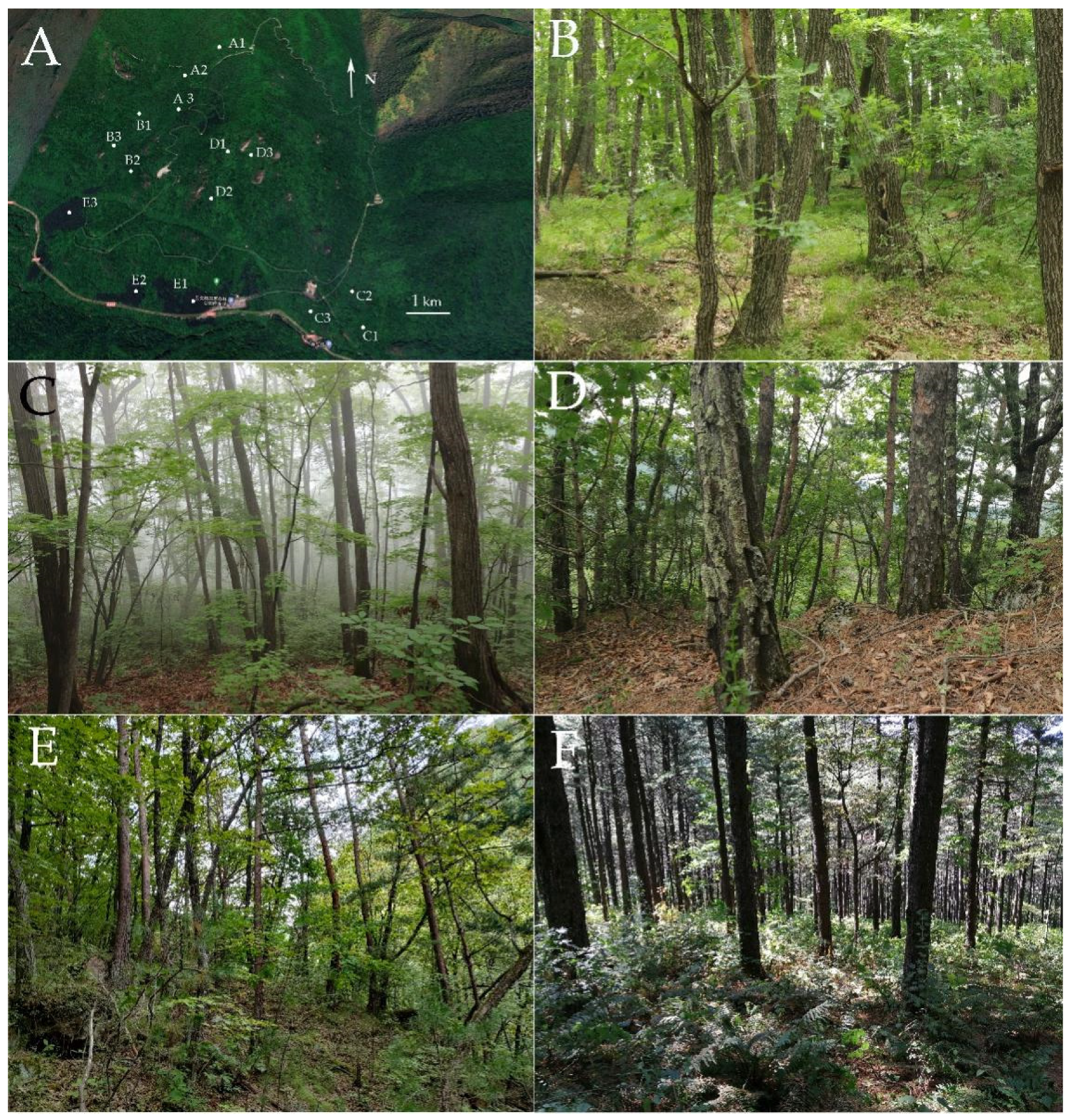
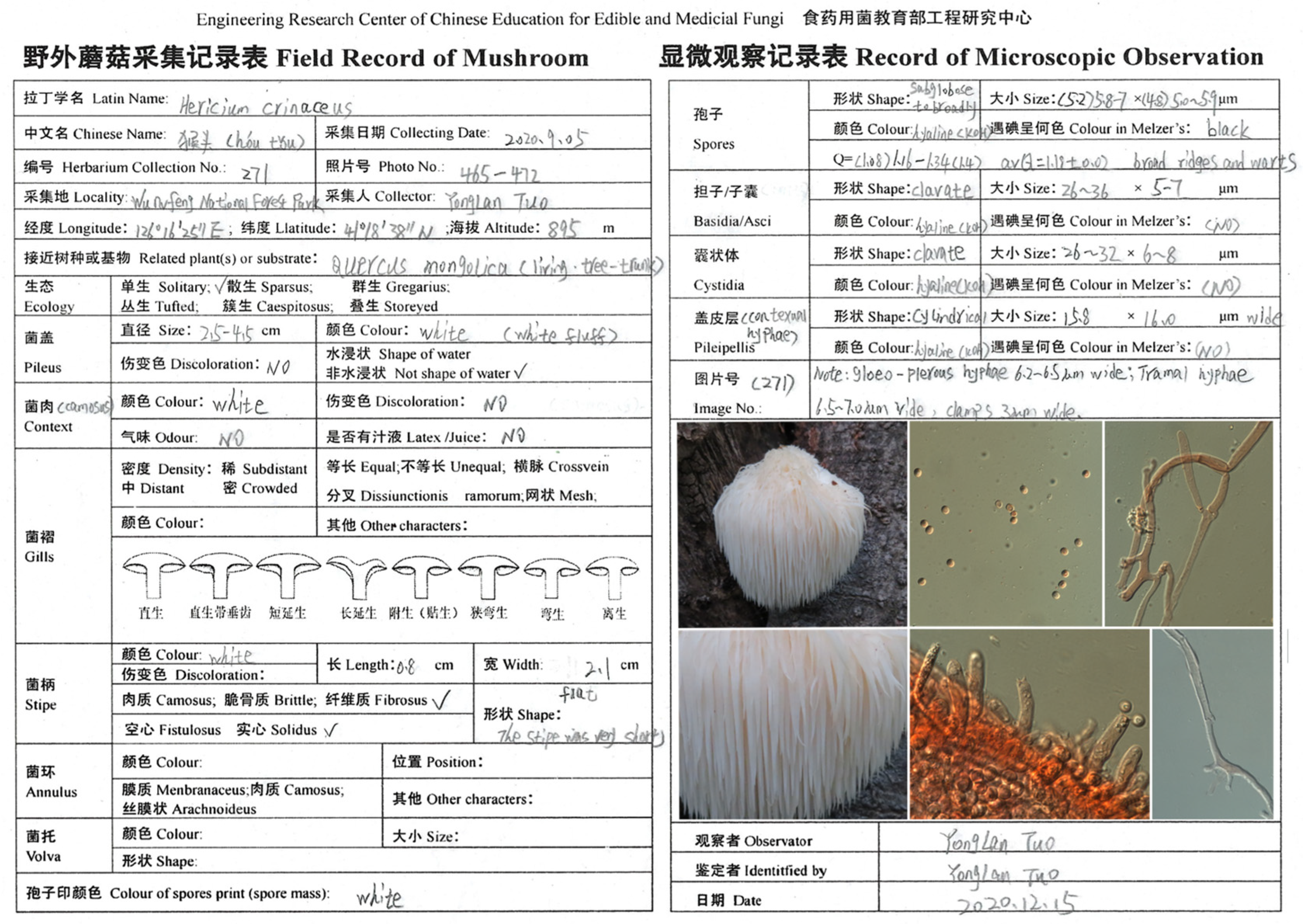



| Environment Parameters | Forest | ||||
|---|---|---|---|---|---|
| A | B | C | D | E | |
| N (mg/kg) | 68.2 a | 56.59 b | 44.07 c | 46.65 c | 47.94 c |
| P (mg/kg) | 20.99 b | 24.37 a | 18.33 b | 14.99 c | 20.49 b |
| K (mg/kg) | 408.9 a | 372.73 ab | 325.44 b | 267.35 c | 264.69 c |
| SOM (g/kg) | 37.1 a | 16.76 c | 25.03 b | 39.69 a | 28.64 b |
| Soil pH | 5.48 c | 5.96 a | 5.69 b | 5.34 c | 5.75 b |
| Temp1 (°C) | 24 a | 21.48 b | 22.12 b | 22.07 b | 22.07 b |
| Temp2 (°C) | 19.1 a | 18.93 a | 20.14 a | 19.99 a | 19.34 a |
| SWC (g/20 g) | 6 a | 5.2 a | 3.8 b | 5.6 a | 4.8 ab |
| RH | 0.82 a | 0.83 a | 0.83 a | 0.83 a | 0.86 a |
| QM | 275 a | 179 b | 42 c | 183 b | 0 d |
| Family | Number of Species | Percentage (%) |
|---|---|---|
| Russulaceae | 36 | 12.72% |
| Tricholomataceae | 21 | 7.42% |
| Boletaceae | 19 | 6.71% |
| Amanitaceae | 16 | 5.65% |
| Cortinariaceae | 14 | 4.95% |
| Hygrophoraceae | 11 | 3.89% |
| Agaricaceae | 10 | 3.53% |
| Hymenochaetaceae | 10 | 3.53% |
| Meruliaceae | 10 | 3.53% |
| Total | 147 | 51.94% |
| Genera | Number of Species | Percentage (%) |
|---|---|---|
| Lactarius | 18 | 6.36% |
| Amanita | 16 | 5.65% |
| Russula | 16 | 5.65% |
| Cortinarius | 12 | 4.24% |
| Tricholoma | 9 | 3.18% |
| Mycena | 8 | 2.83% |
| Suillus | 7 | 2.47% |
| Entoloma | 7 | 2.47% |
| Agaricus | 6 | 2.12% |
| Gymnopus | 6 | 2.12% |
| Hygrocybe | 6 | 2.12% |
| Pluteus | 6 | 2.12% |
| Clitocybe | 5 | 1.77% |
| Marasmius | 5 | 1.77% |
| Ramaria | 5 | 1.77% |
| total | 132 | 46.64% |
| Forest Type | Number of Species | Number of Collections | Richness Index | Diversity Index | Evenness Index |
|---|---|---|---|---|---|
| R | D | E | |||
| A | 142 | 368 | 7.4023 | 4.7296 | 0.9543 |
| B | 86 | 246 | 5.4832 | 4.207 | 0.9445 |
| C | 35 | 153 | 2.8296 | 3.2048 | 0.9014 |
| D | 49 | 111 | 4.6509 | 3.7074 | 0.9526 |
| E | 18 | 62 | 2.286 | 2.6146 | 0.9046 |
| Forest Type | Trophic Groups | |||||
|---|---|---|---|---|---|---|
| EM (133) | WS (57) | SS (52) | LS (38) | EI (2) | DS (1) | |
| A | 71 | 26 | 25 | 20 | 1 | 0 |
| B | 27 | 28 | 18 | 11 | 0 | 1 |
| C | 13 | 3 | 9 | 10 | 0 | 0 |
| D | 36 | 5 | 2 | 6 | 0 | 0 |
| E | 10 | 2 | 2 | 4 | 0 | 0 |
Publisher’s Note: MDPI stays neutral with regard to jurisdictional claims in published maps and institutional affiliations. |
© 2022 by the authors. Licensee MDPI, Basel, Switzerland. This article is an open access article distributed under the terms and conditions of the Creative Commons Attribution (CC BY) license (https://creativecommons.org/licenses/by/4.0/).
Share and Cite
Tuo, Y.; Rong, N.; Hu, J.; Zhao, G.; Wang, Y.; Zhang, Z.; Qi, Z.; Li, Y.; Zhang, B. Exploring the Relationships between Macrofungi Diversity and Major Environmental Factors in Wunvfeng National Forest Park in Northeast China. J. Fungi 2022, 8, 98. https://doi.org/10.3390/jof8020098
Tuo Y, Rong N, Hu J, Zhao G, Wang Y, Zhang Z, Qi Z, Li Y, Zhang B. Exploring the Relationships between Macrofungi Diversity and Major Environmental Factors in Wunvfeng National Forest Park in Northeast China. Journal of Fungi. 2022; 8(2):98. https://doi.org/10.3390/jof8020098
Chicago/Turabian StyleTuo, Yonglan, Na Rong, Jiajun Hu, Guiping Zhao, Yang Wang, Zhenhao Zhang, Zhenxiang Qi, Yu Li, and Bo Zhang. 2022. "Exploring the Relationships between Macrofungi Diversity and Major Environmental Factors in Wunvfeng National Forest Park in Northeast China" Journal of Fungi 8, no. 2: 98. https://doi.org/10.3390/jof8020098
APA StyleTuo, Y., Rong, N., Hu, J., Zhao, G., Wang, Y., Zhang, Z., Qi, Z., Li, Y., & Zhang, B. (2022). Exploring the Relationships between Macrofungi Diversity and Major Environmental Factors in Wunvfeng National Forest Park in Northeast China. Journal of Fungi, 8(2), 98. https://doi.org/10.3390/jof8020098