Antibacterial Activity of Guttation Droplets from Penicillium pimiteouiense and Penicillium menonorum Against Clinically Relevant Bacterial Pathogens
 , , ,
, , ,  and
and
Abstract
1. Introduction
2. Materials and Methods
2.1. Bacterial Strains, Medium and Reagents
2.2. Fungal Isolation and Macro and Micromorphological Identification
2.3. Taxonomic Identification
2.4. Guttation Collection
2.5. Reactivation Bacterial Strains
2.6. Antibacterial Evaluation Using the Agar Well Diffusion Method
2.7. Microbroth Dilution Assay for Determination of Minimum Inhibitory Volume (MIV) and Minimum Bactericidal Volume (MBV)
2.8. Determination of MIV and MBV
2.9. Classification of Bacteriostatic or Bactericidal Effect
2.10. Statistical Analysis
3. Results and Discussions
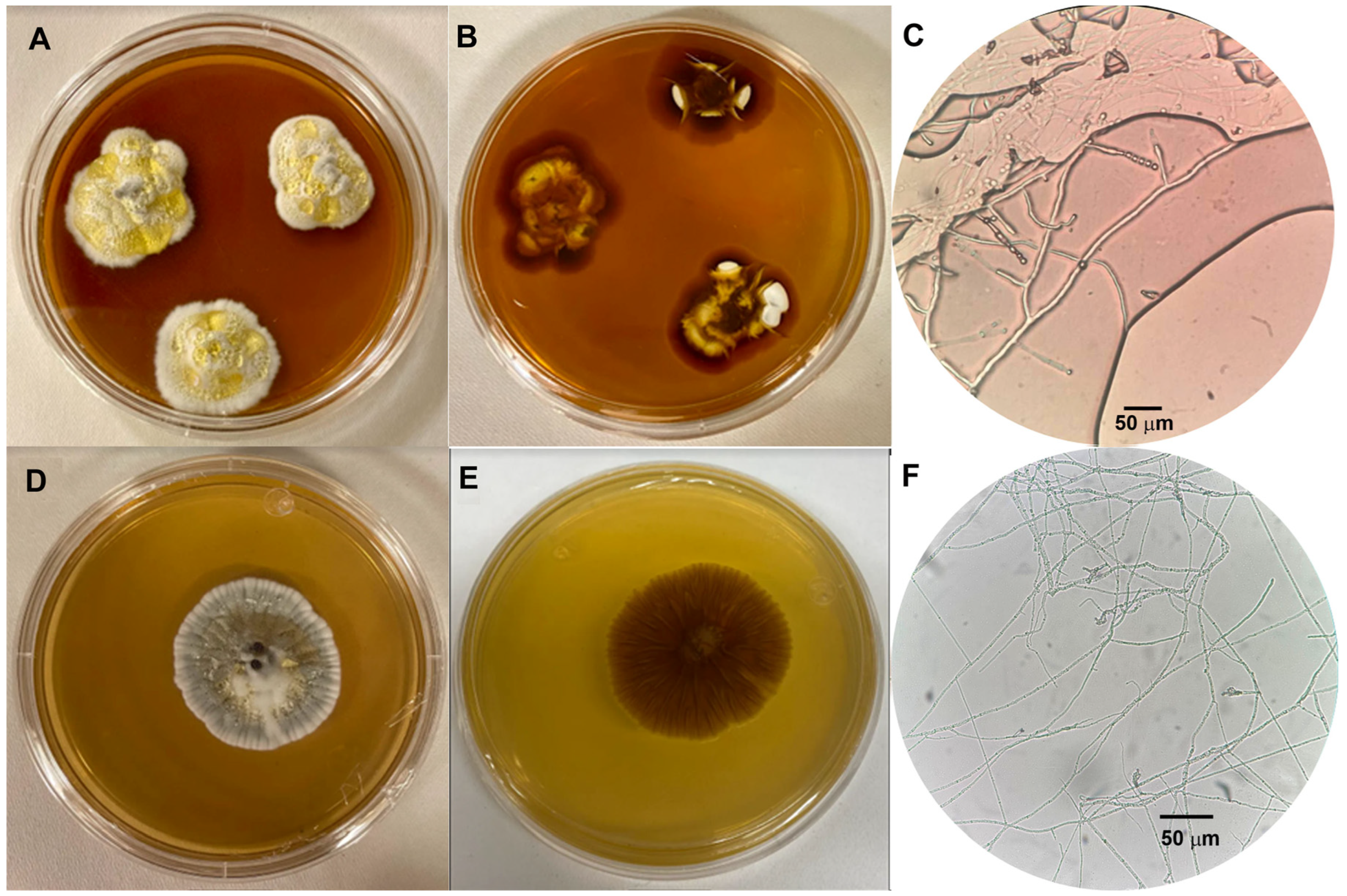
3.1. Morphological Description
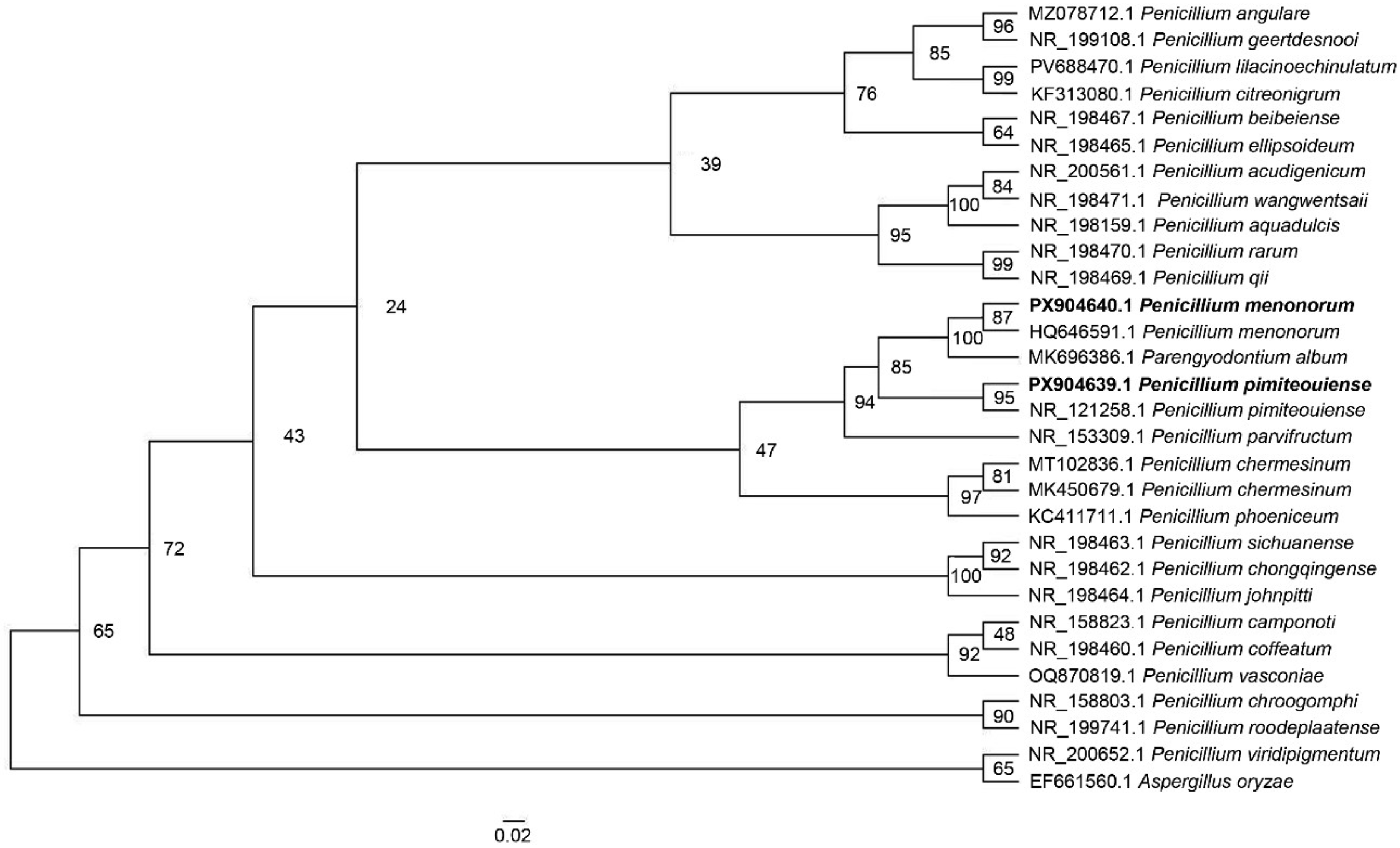
3.2. Taxonomic Identification
3.3. Antibacterial Activity
3.3.1. Agar Well Diffusion
3.3.2. Microbroth Dilution Assay (MIV/MBV)
3.3.3. Bacteriostatic vs. Bactericidal Classification
4. Conclusions
Supplementary Materials
Author Contributions
Funding
Institutional Review Board Statement
Informed Consent Statement
Data Availability Statement
Acknowledgments
Conflicts of Interest
References
- Velásquez-Mejía, L.; Vidal-Limon, A.; Flores-Vargas, G.; Ruiz-May, E.; Scavone, P.; de la Fuente-Nunez, C.; Zamora-Briseño, J.A. Reviewing the role of artificial intelligence in accelerating the development of novel antimicrobial peptides. J. Appl. Microbiol. 2026, 137, lxag036. [Google Scholar] [CrossRef] [PubMed]
- Naghavi, M.; Vollset, S.E.; Ikuta, K.S.; Swetschinski, L.R.; Gray, A.P.; Wool, E.E.; Robles Aguilar, G.; Mestrovic, T.; Smith, G.; Han, C.; et al. Global Burden of Bacterial Antimicrobial Resistance 1990–2021: A Systematic Analysis with Forecasts to 2050. Lancet 2024, 404, 1199–1226. [Google Scholar] [CrossRef] [PubMed]
- Kiggundu, R.; Waswa, J.P.; Mwanja, H.; Hope, M.; Kambugu, A.; Kakooza, F.; Byonanebye, D.M. Leveraging Disease Outbreak News to Strengthen the Global Response to Antimicrobial Resistance: A Call for Action. Front. Public Health 2026, 13, 1710596. [Google Scholar] [CrossRef] [PubMed]
- Sati, H.; Carrara, E.; Savoldi, A.; Hansen, P.; Garlasco, J.; Campagnaro, E.; Boccia, S.; Castillo-Polo, J.A.; Magrini, E.; Garcia-Vello, P.; et al. The WHO Bacterial Priority Pathogens List 2024: A Prioritisation Study to Guide Research, Development, and Public Health Strategies against Antimicrobial Resistance. Lancet Infect. Dis. 2025, 25, 1033–1043. [Google Scholar] [CrossRef]
- Krain, A.; Siupka, P. Fungal Guttation, a Source of Bioactive Compounds, and Its Ecological Role—A Review. Biomolecules 2021, 11, 1270. [Google Scholar] [CrossRef]
- De Matos, R.M.; Pereira, B.V.N.; Converti, A.; Duarte, C.d.A.L.; Marques, D.d.A.V. Bioactive Compounds of Filamentous Fungi with Biological Activity: A Systematic Review. Rev. Gestão Soc. Ambient. 2023, 17, e03423. [Google Scholar] [CrossRef]
- Gunawardena, S.N.; Damunupola, J.W.; Hettiarachchi, C.V.; Madawala, H.M.S.P. Screening Metabolites for Potential Biological Activities of Fungal Strains Isolated from a Grassland Ecosystem. Ceylon J. Sci. 2025, 54, 979–992. [Google Scholar] [CrossRef]
- Raslan, D.; Elsacker, E.; Debnath, K.B.; Dade-Robertson, M. The Role of Surface Interventions in Bio-Welding Mycelium Based-Composites. Sustain. Mater. Technol. 2025, 44, e01326. [Google Scholar] [CrossRef]
- Iacovelli, R.; He, T.; Allen, J.L.; Hackl, T.; Haslinger, K. Genome Sequencing and Molecular Networking Analysis of the Wild Fungus Anthostomella pinea Reveal Its Ability to Produce a Diverse Range of Secondary Metabolites. Fungal Biol. Biotechnol. 2024, 11, 1. [Google Scholar] [CrossRef]
- Graf, T.N.; Kao, D.; Rivera-Chávez, J.; Gallagher, J.M.; Raja, H.A.; Oberlies, N.H. Drug Leads from Endophytic Fungi: Lessons Learned via Scaled Production. Planta Med. 2020, 86, 988–996. [Google Scholar] [CrossRef]
- Haas, D.; Lesch, S.; Buzina, W.; Galler, H.; Gutschi, A.M.; Habib, J.; Pfeifer, B.; Luxner, J.; Reinthaler, F.F. Culturable Fungi in Potting Soils and Compost. Med. Mycol. 2016, 54, 825–834. [Google Scholar] [CrossRef] [PubMed]
- de Freitas Soares, F.E.; da Silva, A.T.; de Souza, D.C.; de Souza Castro, C.R.; Ferreira, C.B.; Genier, H.L.A.; Aguilar-Marcelino, L. Mycochemistry: Natural Products Obtained from Spent Mushroom Substrates in the Control of Agricultural Pests and Diseases. Stud. Nat. Prod. Chem. 2024, 82, 347–365. [Google Scholar] [CrossRef]
- Andersson, M.A.; Salo, J.; Kedves, O.; Kredics, L.; Druzhinina, I.; Kurnitski, J.; Salonen, H. Bioreactivity, Guttation and Agents Influencing Surface Tension of Water Emitted by Actively Growing Indoor Mould Isolates. Microorganisms 2020, 8, 1940. [Google Scholar] [CrossRef] [PubMed]
- Guo, H.; Kreuzenbeck, N.B.; Otani, S.; Garcia-Altares, M.; Dahse, H.-M.; Weigel, C.; Aanen, D.K.; Hertweck, C.; Poulsen, M.; Beemelmanns, C. Pseudoxylallemycins A–F, Cyclic Tetrapeptides with Rare Allenyl Modifications Isolated from Pseudoxylaria sp. X802: A Competitor of Fungus-Growing Termite Cultivars. Org. Lett. 2016, 18, 3338–3341. [Google Scholar] [CrossRef]
- Daly, S.M.; Elmore, B.O.; Kavanaugh, J.S.; Triplett, K.D.; Figueroa, M.; Raja, H.A.; El-Elimat, T.; Crosby, H.A.; Femling, J.K.; Cech, N.B.; et al. ω-Hydroxyemodin Limits Staphylococcus Aureus Quorum Sensing-Mediated Pathogenesis and Inflammation. Antimicrob. Agents Chemother. 2015, 59, 2223–2235. [Google Scholar] [CrossRef]
- Wang, X.; Sena Filho, J.G.; Hoover, A.R.; King, J.B.; Ellis, T.K.; Powell, D.R.; Cichewicz, R.H. Chemical Epigenetics Alters the Secondary Metabolite Composition of Guttate Excreted by an Atlantic-Forest-Soil-Derived Penicillium citreonigrum. J. Nat. Prod. 2010, 73, 942–948. [Google Scholar] [CrossRef]
- Seibold, M.; Wolschann, P.; Bodevin, S.; Olsen, O. Properties of the Bubble Protein, a Defensin and an Abundant Component of a Fungal Exudate. Peptides 2011, 32, 1989–1995. [Google Scholar] [CrossRef]
- Figueroa, M.; Jarmusch, A.K.; Raja, H.A.; El-Elimat, T.; Kavanaugh, J.S.; Horswill, A.R.; Cooks, R.G.; Cech, N.B.; Oberlies, N.H. Polyhydroxyanthraquinones as Quorum Sensing Inhibitors from the Guttates of Penicillium restrictum and Their Analysis by Desorption Electrospray Ionization Mass Spectrometry. J. Nat. Prod. 2014, 77, 1351–1358. [Google Scholar] [CrossRef]
- Auvin-Guette, C.; Rebuffat, S.; Bodo, B.; Prigent, Y. Trichogin A IV, an 11-Residue Lipopeptaibol from Trichoderma longibrachiatum. J. Am. Chem. Soc. 1992, 114, 2170–2174. [Google Scholar] [CrossRef]
- Duclohier, H. Antimicrobial Peptides and Peptaibols, Substitutes for Conventional Antibiotics. Curr. Pharm. Des. 2010, 16, 3212–3223. [Google Scholar] [CrossRef]
- Mier, T.; Toriello, C.; Ulloa, M.; Aguilar, S. Hongos Microscópicos Saprobios y Parásitos, 1st ed.; UNAM: Mexico City, Mexico, 2002; ISBN 970654609X. [Google Scholar]
- Riddell, R.W. Permanent Stained Mycological Preparations Obtained by Slide Culture. Mycologia 2018, 42, 265–270. [Google Scholar] [CrossRef]
- White, T.J.; Bruns, T.; Lee, S.; Taylor, J. Amplification and Direct Sequencing of Fungal Ribosomal Rna Genes for Phylogenetics. In PCR Protocols; Academic Press: New York, NY, USA, 1990; pp. 315–322. [Google Scholar]
- Deng, J.X.; Paul, N.C.; Sang, H.K.; Lee, J.H.; Hwang, Y.S.; Yu, S.H. First Report on Isolation of Penicillium adametzioides and Purpureocillium lilacinum from Decayed Fruit of Cheongsoo Grapes in Korea. Mycobiology 2012, 40, 66–70. [Google Scholar] [CrossRef] [PubMed]
- Visagie, C.M.; Houbraken, J.; Frisvad, J.C.; Hong, S.-B.; Klaassen, C.H.W.; Perrone, G.; Seifert, K.A.; Varga, J.; Yaguchi, T.; Samson, R.A. Identification and Nomenclature of the Genus Penicillium. Stud. Mycol. 2014, 78, 343–371. [Google Scholar] [CrossRef]
- Katoh, K.; Standley, D.M. MAFFT Multiple Sequence Alignment Software Version 7: Improvements in Performance and Usability. Mol. Biol. Evol. 2013, 30, 772–780. [Google Scholar] [CrossRef]
- Criscuolo, A.; Gribaldo, S. BMGE (Block Mapping and Gathering with Entropy): A New Software for Selection of Phylogenetic Informative Regions from Multiple Sequence Alignments. BMC Evol. Biol. 2010, 10, 210. [Google Scholar] [CrossRef]
- Lemoine, F.; Correia, D.; Lefort, V.; Doppelt-Azeroual, O.; Mareuil, F.; Cohen-Boulakia, S.; Gascuel, O. NGPhylogeny.Fr: New Generation Phylogenetic Services for Non-Specialists. Nucleic Acids Res. 2019, 47, W260–W265. [Google Scholar] [CrossRef]
- Minh, B.Q.; Schmidt, H.A.; Chernomor, O.; Schrempf, D.; Woodhams, M.D.; von Haeseler, A.; Lanfear, R. IQ-TREE 2: New Models and Efficient Methods for Phylogenetic Inference in the Genomic Era. Mol. Biol. Evol. 2020, 37, 1530–1534. [Google Scholar] [CrossRef]
- Gareis, M.; Gottschalk, C. Stachybotrys Spp. and the Guttation Phenomenon. Mycotoxin Res. 2014, 30, 151–159. [Google Scholar] [CrossRef]
- Rani, R.; Sharma, D.; Chaturvedi, M.; Parkash Yadav, J. Antibacterial Activity of Twenty Different Endophytic Fungi Isolated from Calotropis procera and Time Kill Assay. Clin. Microbiol. Open Access 2017, 6, 1000280. [Google Scholar] [CrossRef]
- Alarcón, T.; Urruzuno, P.; Martínez, M.J.; Domingo, D.; Llorca, L.; Correa, A.; López-Brea, M. Antimicrobial Susceptibility of 6 Antimicrobial Agents in Helicobacter pylori Clinical Isolates by Using EUCAST Breakpoints Compared with Previously Used Breakpoints. Enfermedades Infecc. Microbiol. Clin. (Engl. Ed.) 2017, 35, 278–282. [Google Scholar] [CrossRef]
- Clinical and Laboratory Standards Institute. CLSI M07-Ed11: Methods for Dilution Antimicrobial Susceptibility Tests for Bacteria That Grow Aerobically, 11th ed.; CLSI: Wayne, PA, USA, 2018. [Google Scholar]
- Clinical and Laboratory Standards Institute. CLSI M100-Ed33: Performance Standards for Antimicrobial Susceptibility Testing, 33rd ed.; CLSI: Wayne, PA, USA, 2023. [Google Scholar]
- Lewis, J.S. CLSI M100: Performance Standards for Antimicrobial Susceptibility Testing, 34th ed.; CLSI: Wayne, PA, USA, 2024. [Google Scholar]
- Barry, A.L.; Craig, W.A.; Nadler, H.; Reller, L.B.; Sanders, C.C.; Swenson, J.M. CLSI M26: Methods for Determining Bactericidal Activity of Antimicrobial Agents; CLSI: Wayne, PA, USA, 1999; Volume 1. [Google Scholar]
- Amina, Z.; Nouari, S.; Rasime, D.; Sabrina, B.; Daoud, H. Antibacterial Activity of Endophytic Fungus, Penicillium griseofulvum MPR1 Isolated from Medicinal Plant, Mentha pulegium L. Afr. J. Microbiol. Res. 2018, 12, 1056–1066. [Google Scholar] [CrossRef]
- Basavarajappa, D.S.; Niazi, S.K.; Bepari, A.; Assiri, R.A.; Hussain, S.A.; Muzaheed, M.; Nayaka, S.; Hiremath, H.; Rudrappa, M.; Chakraborty, B.; et al. Efficacy of Penicillium limosum Strain AK-7 Derived Bioactive Metabolites on Antimicrobial, Antioxidant, and Anticancer Activity against Human Ovarian Teratocarcinoma (PA-1) Cell Line. Microorganisms 2023, 11, 2480. [Google Scholar] [CrossRef] [PubMed]
- Chemmam, D.A.; Bourzama, G.; Sadrati, N.; Houhamdi, M. Metabolic Profiling of Antimicrobial Secondary Metabolites Produced by Penicillium bilaiae EWB-3 Isolated from Electronic Wastes in Algeria. Ital. J. Mycol. 2024, 53, 13–28. [Google Scholar] [CrossRef]
- Bubonja-Šonje, M.; Knežević, S.; Abram, M. Challenges to Antimicrobial Susceptibility Testing of Plant-Derived Polyphenolic Compounds. Arch. Ind. Hyg. Toxicol. 2020, 71, 300–311. [Google Scholar] [CrossRef]
- Kowalska-Krochmal, B.; Dudek-Wicher, R. The Minimum Inhibitory Concentration of Antibiotics: Methods, Interpretation, Clinical Relevance. Pathogens 2021, 10, 165. [Google Scholar] [CrossRef]
- Kadeřábková, N.; Mahmood, A.J.S.; Mavridou, D.A.I. Antibiotic Susceptibility Testing Using Minimum Inhibitory Concentration (MIC) Assays. npj Antimicrob. Resist. 2024, 2, 37. [Google Scholar] [CrossRef]
- Elhosseini, M.A.; El-Banna, T.E.; Sonbol, F.I.; El-Bouseary, M.M. Potential Antivirulence Activity of Sub-Inhibitory Concentrations of Ciprofloxacin against Proteus Mirabilis Isolates: An In-Vitro and In-Vivo Study. Ann. Clin. Microbiol. Antimicrob. 2024, 23, 48. [Google Scholar] [CrossRef]



| Strains | P. pimiteouiense (mm) | P. menonorum (mm) | Gentamicin (mm) |
|---|---|---|---|
| E. coli (ATCC 25922) | 22.7 ± 1.0 a | 14.4 ± 0.8 b | 21.7 ± 0.5 a |
| E. coli (ATCC 35218) | 19.2 ± 0.5 | 13.5 ± 0.5 | 22.1 ± 0.6 |
| S. Typhimurium (ATCC 14028) | 24.4 ± 0.2 a | 16.5 ± 0.3 c | 23.1 ± 0.3 b |
| K. pneumoniae (clinical isolate LRS) | 21.4 ± 0.1 a | 19.2 ± 0.1 b | 21.9 ± 0.5 a |
| S. marcescens (clinical isolate HVR) | 21.3 ± 0.1 a | 16.1 ± 0.3 b | 20.9 ± 0.5 a |
| P. mirabilis (clinical isolate MCV) | 16.7 ± 0.5 a | 16.5 ± 1.2 a | 17.9 ± 0.2 a |
| S. aureus (ATCC 25923) | 18.6 ± 0.6 b | 19.8 ± 1.0 b | 21.5 ± 0.3 a |
| E. faecalis (ATCC 29212) | 15.2 ± 0.4 | 11.4 ± 0.7 | 18.8 ± 0.4 |
| C. freundii (clinical isolate GAS) | 15.2 ± 1.0 b | 13.4 ± 0.8 b | 26.4 ± 0.5 a |
| Strains | Fungal Guttation Droplets | |||
|---|---|---|---|---|
| P. pimiteouiense | P. menonorum | |||
| MIV (µL/well) | MIV (% v/v) | MIV (µL/well) | MIV (% v/v) | |
| E. coli (ATCC 25922) | 40 | 20 | 20 | 10 |
| E. coli (ATCC 35218) | 60 | 30 | 60 | 30 |
| S. Typhimurium (ATCC 14028) | 40 | 20 | 60 | 30 |
| K. pneumoniae (clinical isolate LRS) | 40 | 20 | 40 | 20 |
| S. marcescens (clinical isolate HVR) | 80 | 40 | 20 | 10 |
| P. mirabilis (clinical isolate MCV) | >80 | - | 80 | 40 |
| S. aureus (ATCC 25923) | 20 | 10 | 40 | 20 |
| E. faecalis (ATCC 29212) | 80 | 40 | 80 | 40 |
| C. freundii (clinical isolate GAS) | 10 | 5 | 20 | 10 |
| Strains | Fungal Guttation Droplets | |||
|---|---|---|---|---|
| P. pimiteouiense | P. menonorum | |||
| MBV (µL/well) | MBV (% v/v) | MBV (µL/well) | MBV (% v/v) | |
| E. coli (ATCC 25922) | >80 | - | >80 | - |
| E. coli (ATCC 35218) | 80 | 40 | >80 | - |
| S. Typhimurium (ATCC 14028) | >80 | - | 80 | 40 |
| K. pneumoniae (clinical isolate LRS) | 80 | 40 | 60 | 30 |
| S. marcescens (clinical isolate HVR) | >80 | - | >80 | - |
| P. mirabilis (clinical isolate MCV) | >80 | - | >80 | - |
| S. aureus (ATCC 25923) | 80 | 40 | >80 | - |
| E. faecalis (ATCC 29212) | >80 | - | >80 | - |
| C. freundii (clinical isolate GAS) | 80 | 40 | 40 | 20 |
| Strain | Fungal Guttation Droplets | MBV (µL/well) | MIV (µL/well) | MBV/MIV | Classification |
|---|---|---|---|---|---|
| E. coli 25922 | 1 | 40 | >80 | - | Bacteriostatic |
| 2 | 20 | >80 | - | Bacteriostatic | |
| E. coli 35218 | 1 | 60 | 80 | 1.33 | Bactericidal |
| 2 | 60 | >80 | - | Bacteriostatic | |
| S. Typhimurium 14028 | 1 | 40 | >80 | - | Bacteriostatic |
| 2 | 60 | 80 | 1.33 | Bactericidal | |
| K. pneumoniae WT | 1 | 40 | 80 | 2 | Bactericidal |
| 2 | 40 | 60 | 1.5 | Bactericidal | |
| S. marcescens WT | 1 | 80 | >80 | - | Bacteriostatic |
| 2 | 20 | >80 | - | Bacteriostatic | |
| P. mirabilis | 1 | >80 | >80 | - | Bacteriostatic |
| 2 | 80 | >80 | - | Bacteriostatic | |
| S. aureus 25923 | 1 | 20 | 80 | 4 | Bactericidal |
| 2 | 40 | >80 | - | Bacteriostatic | |
| E. faecalis 29212 | 1, 2 | 80 | >80 | - | Bacteriostatic |
| C. freundii | 1 | 10 | 80 | 8 | Bacteriostatic |
| 2 | 20 | 40 | 2 | Bactericidal |
Disclaimer/Publisher’s Note: The statements, opinions and data contained in all publications are solely those of the individual author(s) and contributor(s) and not of MDPI and/or the editor(s). MDPI and/or the editor(s) disclaim responsibility for any injury to people or property resulting from any ideas, methods, instructions or products referred to in the content. |
© 2026 by the authors. Licensee MDPI, Basel, Switzerland. This article is an open access article distributed under the terms and conditions of the Creative Commons Attribution (CC BY) license.
Share and Cite
Barajas-Saucedo, C.E.; Torres-Cruz, M.; Sánchez-Rangel, J.C.; Vidal-Limon, A.; Jiménez-Vargas, J.M. Antibacterial Activity of Guttation Droplets from Penicillium pimiteouiense and Penicillium menonorum Against Clinically Relevant Bacterial Pathogens. J. Fungi 2026, 12, 262. https://doi.org/10.3390/jof12040262
Barajas-Saucedo CE, Torres-Cruz M, Sánchez-Rangel JC, Vidal-Limon A, Jiménez-Vargas JM. Antibacterial Activity of Guttation Droplets from Penicillium pimiteouiense and Penicillium menonorum Against Clinically Relevant Bacterial Pathogens. Journal of Fungi. 2026; 12(4):262. https://doi.org/10.3390/jof12040262
Chicago/Turabian StyleBarajas-Saucedo, Carlos Eduardo, Mariana Torres-Cruz, Juan Carlos Sánchez-Rangel, Abraham Vidal-Limon, and Juana María Jiménez-Vargas. 2026. "Antibacterial Activity of Guttation Droplets from Penicillium pimiteouiense and Penicillium menonorum Against Clinically Relevant Bacterial Pathogens" Journal of Fungi 12, no. 4: 262. https://doi.org/10.3390/jof12040262
APA StyleBarajas-Saucedo, C. E., Torres-Cruz, M., Sánchez-Rangel, J. C., Vidal-Limon, A., & Jiménez-Vargas, J. M. (2026). Antibacterial Activity of Guttation Droplets from Penicillium pimiteouiense and Penicillium menonorum Against Clinically Relevant Bacterial Pathogens. Journal of Fungi, 12(4), 262. https://doi.org/10.3390/jof12040262