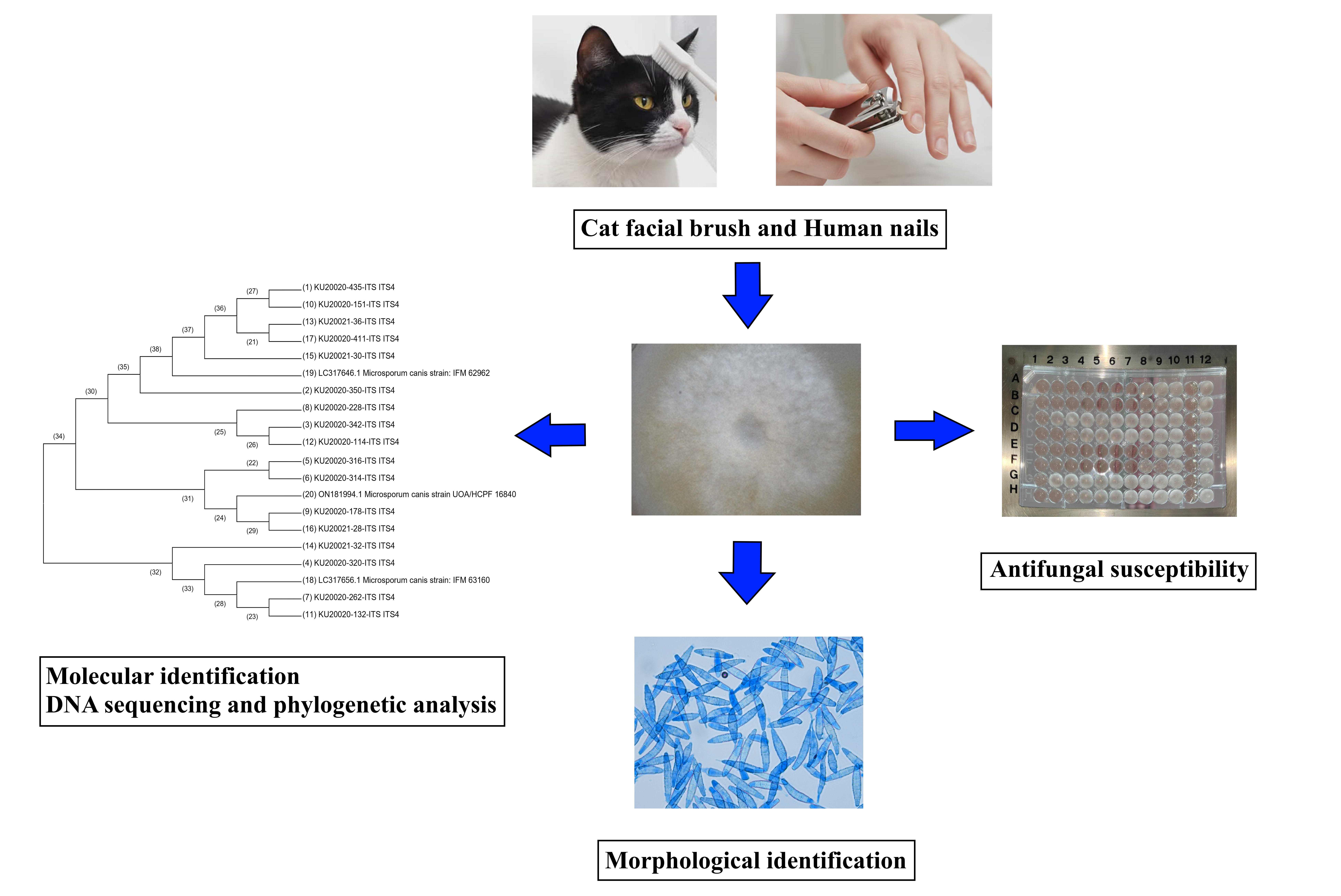


Mycological Survey of Fungal Carriage in Cats and Their Owners: Analysis of Species Diversity and Antifungal Susceptibility
 , ,
, ,  and
and
Abstract
1. Introduction
2. Materials and Methods
2.1. Ethical Considerations
2.2. Sample Collection
2.3. Identification of Fungal Isolates
2.4. Molecular Identification
2.5. In Vitro Antifungal Susceptibility Testing
2.6. Statistical and Data Analysis
3. Results
4. Discussion
5. Limitations
6. Conclusions
Supplementary Materials
Author Contributions
Funding
Institutional Review Board Statement
Informed Consent Statement
Data Availability Statement
Acknowledgments
Conflicts of Interest
References
- Farokhipor, S.; Ghiasian, S.A.; Nazeri, H.; Kord, M.; Didehdar, M. Characterizing the clinical isolates of dermatophytes in Hamadan city, Central west of Iran, using PCR-RLFP method. J. Mycol. Med. 2018, 28, 101–105. [Google Scholar] [CrossRef]
- de Hoog, G.S.; Dukik, K.; Monod, M.; Packeu, A.; Stubbe, D.; Hendrickx, M.; Kupsch, C.; Stielow, J.B.; Freeke, J.; Göker, M.; et al. Toward a Novel Multilocus Phylogenetic Taxonomy for the Dermatophytes. Mycopathologia 2017, 182, 5–31. [Google Scholar] [CrossRef]
- Moskaluk, A.; Darlington, L.; Kuhn, S.; Behzadi, E.; Gagne, R.B.; Kozakiewicz, C.P.; VandeWoude, S. Genetic Characterization of Microsporum canis Clinical Isolates in the United States. J. Fungi 2022, 8, 676. [Google Scholar] [CrossRef]
- Moriello, K. Feline dermatophytosis: Aspects pertinent to disease management in single and multiple cat situations. J. Feline Med. Surg. 2014, 16, 419–431. [Google Scholar] [CrossRef] [PubMed]
- Frymus, T.; Gruffydd-Jones, T.; Pennisi, M.G.; Addie, D.; Belák, S.; Boucraut-Baralon, C.; Egberink, H.; Hartmann, K.; Hosie, M.J.; Lloret, A.; et al. Dermatophytosis in cats: ABCD guidelines on prevention and management. J. Feline Med. Surg. 2013, 15, 598–604. [Google Scholar] [CrossRef] [PubMed]
- Chupia, V.; Ninsuwon, J.; Piyarungsri, K.; Sodarat, C.; Prachasilchai, W.; Suriyasathaporn, W.; Pikulkaew, S. Prevalence of Microsporum canis from Pet Cats in Small Animal Hospitals, Chiang Mai, Thailand. Vet. Sci. 2022, 9, 21. [Google Scholar] [CrossRef] [PubMed]
- Sattasathuchana, P.; Bumrungpun, C.; Thengchaisri, N. Comparison of subclinical dermatophyte infection in short- and long-haired cats. Vet. World 2020, 13, 2798–2805. [Google Scholar] [CrossRef]
- Janssens, M.; Janssens, E.; Eshuis, J.; Lataster, J.; Simons, M.; Reijnders, J.; Jacobs, N. Companion animals as buffer against the impact of stress on affect: An experience sampling study. Animals 2021, 11, 2171. [Google Scholar] [CrossRef]
- Gerhold, R.W.; Jessup, D.A. Zoonotic diseases associated with free-roaming cats. Zoonoses Public Health 2013, 60, 189–195. [Google Scholar] [CrossRef]
- Sanguansook, P.; Tuangpermsub, S.; Leelakarnsakul, B.; Phaisansomsuk, S.; Hunprasit, V.; Del Río, L.; Niyomtham, W.; Prapasarakul, N.; Sukhumavasi, W. Zoonotic Enteric Nematodes and Dermatophytes in Cat Cafés: An Investigation in the Bangkok Metropolitan Area, Thailand. Vet. Sci. 2024, 11, 358. [Google Scholar] [CrossRef]
- Lopes, R.; Garcês, A.; Silva, A.; Brilhante-Simões, P.; Martins, Â.; Cardoso, L.; Duarte, E.L.; Coelho, A.C. Dermatophytosis in Companion Animals in Portugal: A Comprehensive Epidemiological Retrospective Study of 12 Years (2012–2023). Microorganisms 2024, 12, 1727. [Google Scholar] [CrossRef] [PubMed]
- Zaki, F.; Airin, M.; Nururrozi, A.; Kaswarjono, Y.; Soedarmanto, I. A review: The prevalence of dermatophytosis on cats in Indonesia and Turkey. BIO Web Conf. 2021, 33, 06004. [Google Scholar] [CrossRef]
- Sacheli, R.; Hayette, M.P. Antifungal Resistance in Dermatophytes: Genetic Considerations, Clinical Presentations and Alternative Therapies. J. Fungi 2021, 7, 983. [Google Scholar] [CrossRef] [PubMed]
- Yurayart, C.; Niae, S.; Limsivilai, O.; Thengchaisri, N.; Sattasathuchana, P. Comparative analysis of the distribution and antifungal susceptibility of yeast species in cat facial hair and human nails. Sci. Rep. 2024, 14, 14726. [Google Scholar] [CrossRef]
- Irinyi, L.; Lackner, M.; de Hoog, G.S.; Meyer, W. DNA barcoding of fungi causing infections in humans and animals. Fungal Biol. 2016, 120, 125–136. [Google Scholar] [CrossRef]
- Ferreira, C.P.; Nery, J.A.; de Almeida, A.C.; Ferreira, L.C.; Corte-Real, S.; Conceição-Silva, F. Parinaud’s oculoglandular syndrome associated with Sporothrix schenckii. IDCases 2014, 1, 38–39. [Google Scholar] [CrossRef]
- CLSI Standard M38; Clinical and Laboratory Standards Institute (CLSI): Wayne, PA, USA, 2017.
- Santos, D.A.; Barros, M.E.; Hamdan, J.S. Establishing a method of inoculum preparation for susceptibility testing of Trichophyton rubrum and Trichophyton mentagrophytes. J. Clin. Microbiol. 2006, 44, 98–101. [Google Scholar] [CrossRef]
- Lass-Flörl, C.; Cuenca-Estrella, M.; Denning, D.W.; Rodriguez-Tudela, J.L. Antifungal susceptibility testing in Aspergillus spp. according to EUCAST methodology. Med. Mycol. 2006, 44, S319–S325. [Google Scholar] [CrossRef][Green Version]
- Espinel-Ingroff, A.; Cuenca-Estrella, M.; Fothergill, A.; Fuller, J.; Ghannoum, M.; Johnson, E.; Pelaez, T.; Pfaller, M.A.; Turnidge, J. Wild-type MIC distributions and epidemiological cutoff values for amphotericin B and Aspergillus spp. for the CLSI broth microdilution method (M38-A2 document). Antimicrob. Agents Chemother. 2011, 55, 5150–5154. [Google Scholar] [CrossRef]
- Pfaller, M.; Boyken, L.; Hollis, R.; Kroeger, J.; Messer, S.; Tendolkar, S.; Diekema, D. Use of epidemiological cutoff values to examine 9-year trends in susceptibility of Aspergillus species to the triazoles. J. Clin. Microbiol. 2011, 49, 586–590. [Google Scholar] [CrossRef]
- Piorunek, M.; Kubisiak-Rzepczyk, H.; Dańczak-Pazdrowska, A.; Trafas, T.; Walkowiak, J. Superficial Zoonotic Mycoses in Humans Associated with Cats. J. Fungi 2024, 10, 244. [Google Scholar] [CrossRef]
- Lima, S.R.; Silva, W.A.d.; Silveira, M.M.d.; Neves, R.d.C.d.S.M.; Dutra, V.; Sousa, V.R.F. Isolation of dermatophytes from 50 asymptomatic domestic cats treated at the Federal University of Mato Grosso Veterinary—Hospital in Cuiabá, MT. Semin. Ciênc. Agrár. 2016, 37, 2003–2008. [Google Scholar] [CrossRef]
- Debnath, C.; Mitra, T.; Kumar, A.; Samanta, I. Detection of dermatophytes in healthy companion dogs and cats in eastern India. Iran. J. Vet. Res. 2016, 17, 20–24. Available online: https://pmc.ncbi.nlm.nih.gov/articles/PMC4898015/ (accessed on 20 March 2026).
- Moriello, K.A.; Deboer, D.J. Fungal flora of the haircoat of cats with and without dermatophytosis. J. Med. Vet. Mycol. 1991, 29, 285–292. [Google Scholar] [CrossRef]
- Cafarchia, C.; Romito, D.; Capelli, G.; Guillot, J.; Otranto, D. Isolation of Microsporum canis from the hair coat of pet dogs and cats belonging to owners diagnosed with M. canis tinea corporis. Vet. Dermatol. 2006, 17, 327–331. [Google Scholar] [CrossRef] [PubMed]
- Jarjees, K.I.; Issa, N.A. First study on molecular epidemiology of dermatophytosis in cats, dogs, and their companions in the Kurdistan region of Iraq. Vet. World 2022, 15, 2971–2978. [Google Scholar] [CrossRef] [PubMed]
- Cafarchia, C.; Romito, D.; Sasanelli, M.; Lia, R.; Capelli, G.; Otranto, D. The epidemiology of canine and feline dermatophytoses in southern Italy. Mycoses 2004, 47, 508–513. [Google Scholar] [CrossRef] [PubMed]
- Ghodsi, S.; Nikaeen, M.; Aboutalebian, S.; Mohammadi, R.; Mirhendi, H. Prevalence of Fungi and Their Antifungal and Disinfectant Resistance in Hospital Environments: Insights into Combating Nosocomial Mycoses. Antimicrob. Resist. Infect. Control 2025, 14, 37. [Google Scholar] [CrossRef]
- Older, C.E.; Diesel, A.B.; Lawhon, S.D.; Queiroz, C.R.R.; Henker, L.C.; Rodrigues Hoffmann, A. The feline cutaneous and oral microbiota are influenced by breed and environment. PLoS ONE 2019, 14, e0220463. [Google Scholar] [CrossRef]
- Niae, S.; Yurayart, C.; Thengchaisri, N.; Sattasathuchana, P. Prevalence and in vitro antifungal susceptibility of commensal yeasts in the external ear canal of cats. BMC Vet. Res. 2021, 17, 288. [Google Scholar] [CrossRef]
- Aneke, C.I.; Otranto, D.; Cafarchia, C. Therapy and Antifungal Susceptibility Profile of Microsporum canis. J. Fungi 2018, 4, 107. [Google Scholar] [CrossRef]
- Liang, T.; Chen, X.; de Hoog, G.S.; Li, L.; Wang, L.; Wan, Z.; Yu, J.; Li, R.; Song, Y. Antifungal Resistance Patterns of Microsporum canis: A 27-Year MIC Study in Mainland China. Mycoses 2025, 68, e70020. [Google Scholar] [CrossRef]
- Aneke, C.I.; Rhimi, W.; Hubka, V.; Otranto, D.; Cafarchia, C. Virulence and Antifungal Susceptibility of Microsporum canis Strains from Animals and Humans. Antibiotics 2021, 10, 296. [Google Scholar] [CrossRef] [PubMed]
- Afshari, M.A.; Shams-Ghahfarokhi, M.; Razzaghi-Abyaneh, M. Antifungal susceptibility and virulence factors of clinically isolated dermatophytes in Tehran, Iran. Iran. J. Microbiol. 2016, 8, 36–46. [Google Scholar] [PubMed]
- Hofbauer, B.; Leitner, I.; Ryder, N.S. In vitro susceptibility of Microsporum canis and other dermatophyte isolates from veterinary infections during therapy with terbinafine or griseofulvin. Med. Mycol. 2002, 40, 179–183. [Google Scholar] [CrossRef] [PubMed]
- Moriello, K.A.; Coyner, K.; Paterson, S.; Mignon, B. Diagnosis and treatment of dermatophytosis in dogs and cats.: Clinical Consensus Guidelines of the World Association for Veterinary Dermatology. Vet. Dermatol. 2017, 28, 266-e68. [Google Scholar] [CrossRef]
- Hsiao, Y.H.; Chen, C.; Han, H.S.; Kano, R. The first report of terbinafine resistance Microsporum canis from a cat. J. Vet. Med. Sci. 2018, 80, 898–900. [Google Scholar] [CrossRef]
- Adimi, P.; Hashemi, S.J.; Mahmoudi, M.; Mirhendi, H.; Shidfar, M.R.; Emmami, M.; Rezaei-Matehkolaei, A.; Gramishoar, M.; Kordbacheh, P. In-vitro Activity of 10 Antifungal Agents against 320 Dermatophyte Strains Using Microdilution Method in Tehran. Iran. J. Pharm. Res. 2013, 12, 537–545. [Google Scholar]
- Yang, X.; Chen, W.; Liang, T.; Tan, J.; Liu, W.; Sun, Y.; Wang, Q.; Xu, H.; Li, L.; Zhou, Y.; et al. A 20-Year Antifungal Susceptibility Surveillance (From 1999 to 2019) for Aspergillus spp. and Proposed Epidemiological Cutoff Values for Aspergillus fumigatus and Aspergillus flavus: A Study in a Tertiary Hospital in China. Front. Microbiol. 2021, 12, 680884. [Google Scholar] [CrossRef]
- Moore, C.B.; Walls, C.M.; Denning, D.W. In vitro activities of terbinafine against Aspergillus species in comparison with those of itraconazole and amphotericin B. Antimicrob. Agents Chemother. 2001, 45, 1882–1885. [Google Scholar] [CrossRef]
- Fernández, M.S.; Rojas, F.D.; Cattana, M.E.; Sosa Mde, L.; Iovannitti, C.A.; Lass-Flörl, C.; Giusiano, G.E. In vitro activities of amphotericin B, terbinafine, and azole drugs against clinical and environmental isolates of Aspergillus terreus sensu stricto. Antimicrob. Agents Chemother. 2015, 59, 3619–3622. [Google Scholar] [CrossRef] [PubMed][Green Version]
- Blum, G.; Hörtnagl, C.; Jukic, E.; Erbeznik, T.; Pümpel, T.; Dietrich, H.; Nagl, M.; Speth, C.; Rambach, G.; Lass-Flörl, C. New insight into amphotericin B resistance in Aspergillus terreus. Antimicrob. Agents Chemother. 2013, 57, 1583–1588. [Google Scholar] [CrossRef] [PubMed]
- Vahedi Shahandashti, R.; Lass-Flörl, C. Antifungal resistance in Aspergillus terreus: A current scenario. Fungal Genet. Biol. 2019, 131, 103247. [Google Scholar] [CrossRef] [PubMed]
- De Francesco, M.A. Drug-Resistant Aspergillus spp.: A Literature Review of Its Resistance Mechanisms and Its Prevalence in Europe. Pathogens 2023, 12, 1305. [Google Scholar] [CrossRef]
- Seyedmousavi, S.; Guillot, J.; Tolooe, A.; Verweij, P.E.; de Hoog, G.S. Neglected fungal zoonoses: Hidden threats to man and animals. Clin. Microbiol. Infect. 2015, 21, 416–425. [Google Scholar] [CrossRef]
- Garcia-Bustos, V. Is Candida auris the first multidrug-resistant fungal zoonosis emerging from climate change? mBio 2024, 15, e00146-24. [Google Scholar] [CrossRef]
- Lima, R.; Ribeiro, F.C.; Colombo, A.L.; de Almeida, J.N. The emerging threat antifungal-resistant Candida tropicalis in humans, animals, and environment. Front. Fungal Biol. 2022, 3, 957021. [Google Scholar] [CrossRef]
- Kaya, Y.; Dokuzeylül, B.; Bakırel, U.; Or, M.E. Antifungal resistance and clinical significance in small animals. Ger. J. Vet. Res. 2022, 2, 28–36. [Google Scholar] [CrossRef]
- Kruithoff, C.; Gamal, A.; McCormick, T.S.; Ghannoum, M.A. Dermatophyte Infections Worldwide: Increase in Incidence and Associated Antifungal Resistance. Life 2024, 14, 1. [Google Scholar] [CrossRef]
- Matsui, E.C.; Hansel, N.N.; McCormack, M.C.; Rusher, R.; Breysse, P.N.; Diette, G.B. Asthma in the inner city and the indoor environment. Immunol. Allergy Clin. N. Am. 2008, 28, 665–686. [Google Scholar] [CrossRef][Green Version]



| Identified Mold Genus | Number of Cats (n = 59) | Number of Human Nails (n = 59) | ||
|---|---|---|---|---|
| Positive Culture | Prevalence (%; 95% CI) | Positive Culture | Prevalence (%; 95% CI) | |
| Aspergillus spp. | 39 | 66.10 (52.61–77.92) | 27 | 45.76 (32.72–59.24) |
| Hyaline septate fungi | 32 | 54.24 (40.75–67.28) | 21 | 35.59 (23.55–49.13) |
| Dematiaceous fungi | 26 | 44.07 (31.15–57.60) | 5 | 8.47 (2.81–18.68) |
| Microsporum canis | 17 | 28.81 (17.76–42.08) | 4 | 6.78 (1.88–16.46) |
| Penicillium spp. | 10 | 16.95 (8.44–28.97) | 2 | 3.39 (0.41–11.71) |
| Identified Mold Genus | Isolates from Cats | Isolates from Humans | p-Value | |
|---|---|---|---|---|
| Positive | Negative | |||
| Microsporum canis | positive | 4 | 13 | 0.010 |
| negative | 0 | 42 | ||
| Aspergillus flavus | positive | 6 | 17 | 1.000 |
| negative | 9 | 27 | ||
| Aspergillus niger | positive | 11 | 15 | 0.050 |
| negative | 6 | 27 | ||
| Aspergillus fumigatus | positive | 0 | 1 | 0.138 |
| negative | 1 | 57 | ||
| Aspergillus terreus | positive | 0 | 1 | 0.094 |
| negative | 0 | 58 | ||
| Lifestyle Factors | Number of Cats (%) | p-Value | |
|---|---|---|---|
| Positive Culture | Negative Culture | ||
| Hair length | |||
| Short-haired (≤3 cm) | 4 (23.53%) | 24 (57.14%) | 0.024 |
| Long-haired (>3 cm) | 13 (76.47%) | 18 (42.86%) | |
| Bathing frequency | |||
| ≤1 month | 7 (41.18%) | 8 (19.05%) | 0.103 |
| >1 month or never | 10 (58.82%) | 34 (80.95%) | |
| Sex | |||
| Male | 10 (58.82%) | 27 (64.29%) | 0.770 |
| Female | 7 (41.18%) | 15 (35.71%) | |
| Age group (n) | |||
| ≤6 years | 10 (58.82%) | 25 (59.52%) | 1.000 |
| >6 years | 7 (41.18%) | 17 (40.48%) | |
| Cat rearing (%; n) | |||
| Indoor only | 13 (76.47%) | 39 (92.86%) | 0.176 |
| Outdoor access | 4 (23.53%) | 3 (7.14%) | |
| Identified Mold Genus | Number of Positive Cats M. pachydermatis (n = 33) | Number of Negative cats M. pachydermatis (n = 26) | p-Value | ||
|---|---|---|---|---|---|
| Positive Culture | Prevalence (%; 95% CI) | Positive Culture | Prevalence (%; 95% CI) | ||
| Microsporum canis | 9 | 27.27 (13.30–45.52) | 8 | 30.77 (14.33–51.79) | 0.7684 |
| Aspergillus spp. | 24 | 72.73 (54.48–86.70) | 15 | 57.69 (36.92–76.65) | 0.2258 |
| Penicillium spp. | 6 | 18.18 (6.98–35.46) | 4 | 15.38 (4.36–34.87) | 0.7762 |
| Hyaline septate fungi | 18 | 54.54 (36.35–71.89) | 14 | 53.85 (33.37–73.41) | 0.9573 |
| Dematiaceous fungi | 17 | 51.52 (33.54–69.20) | 9 | 34.62 (17.21–55.67) | 0.1943 |
| Non-septate fungi | 3 | 9.09 (1.92–24.33) | 2 | 7.69 (0.94–25.13) | 0.8481 |
| Identified Mold Genus | Number of Humans Positive for M. furfur (n = 18) | Number of Humans Negative for M. furfur (n = 41) | p-Value | ||
|---|---|---|---|---|---|
| Positive Culture | Prevalence (%; 95% CI) | Positive Culture | Prevalence (%; 95% CI) | ||
| Microsporum canis. | 0 | 0 | 4 | 9.76 (2.72–23.13) | 0.1699 |
| Aspergillus spp. | 12 | 66.67 (40.99–86.66) | 15 | 36.58 (22.12–53.06) | 0.0327 |
| Penicillium spp. | 1 | 5.56 (0.14–27.29) | 1 | 2.43 (0.06–12.86) | 0.5425 |
| Hyaline septate fungi | 6 | 33.33 (13.34–59.01) | 15 | 36.58 (22.12–53.06) | 0.8102 |
| Dematiaceous fungi | 2 | 11.11 (1.38–34.71) | 3 | 7.32 (1.54–19.92) | 0.6299 |
| Antifungal Drugs | Test Fungi | Isolated from (n) | Minimum Inhibitory Concentration (µg/mL) | Susceptibility Phenotypes | ||||
|---|---|---|---|---|---|---|---|---|
| Range | MIC50 | MIC90 | GM ± SD | Wild Type | Non-Wild Type | |||
| Amphotericin B | Microsporum canis | Cat (17) | 0.5–4 | 1 | 4 | 1.4 ± 1.17 | ND | ND |
| Human (4) | 0.5–2 | 1 | 2 | 1.0 ± 0.63 | ND | ND | ||
| Aspergillus flavus | Cat (10) | 1–4 | 2 | 4 | 2.6 ± 1.18 | 10 | 0 | |
| Human (7) | 1–2 | 2 | 2 | 1.8 ± 0.38 | 7 | 0 | ||
| Aspergillus niger | Cat (14) | 0.125–1 | 0.5 | 1 | 0.6 ± 0.30 | 14 | 0 | |
| Human (11) | 0.125–1 | 0.5 | 1 | 0.5 ± 0.31 | 11 | 0 | ||
| Aspergillus fumigatus | Cat (1) | 1 | ND | ND | ND | 1 | 0 | |
| Human (1) | 1 | ND | ND | ND | 1 | 0 | ||
| Aspergillus terreus | Cat (1) | 16 | ND | ND | ND | 0 | 1 | |
| Human (0) | - | - | - | - | - | - | ||
| Itraconazole | Microsporum canis | Cat (17) | 0.0625–1 | 0.25 | 1 | 0.3 ± 0.33 | ND | ND |
| Human (4) | 0.0625–0.125 | 0.125 | 0.125 | 0.1 ± 0.03 | ND | ND | ||
| Aspergillus flavus | Cat (10) | 0.25–1 | 0.5 | 1 | 0.5 ± 0.24 | 10 | 0 | |
| Human (7) | 0.25–1 | 0.5 | 1 | 0.5 ± 0.22 | 7 | 0 | ||
| Aspergillus niger | Cat (14) | 0.25–8 | 2 | 8 | 2.8 ± 2.97 | 10 | 4 | |
| Human (11) | 2–8 | 4 | 8 | 3.5 ± 2.70 | 9 | 2 | ||
| Aspergillus fumigatus | Cat (1) | 1 | ND | ND | ND | 1 | 0 | |
| Human (1) | 2 | ND | ND | ND | 0 | 1 | ||
| Aspergillus terreus | Cat (1) | 1 | ND | ND | ND | 1 | 0 | |
| Human (0) | - | - | - | - | - | - | ||
| Terbinafine | Microsporum canis | Cat (17) | 0.25–1 | 0.25 | 1 | 0.3 ± 0.49 | ND | ND |
| Human (4) | 0.125–0.25 | 0.25 | 0.25 | 0.2 ± 0.06 | ND | ND | ||
| Aspergillus flavus | Cat (10) | 0.5–1 | 1 | 1 | 0.9 ± 0.24 | ND | ND | |
| Human (7) | 0.25–1 | 0.5 | 1 | 0.5 ± 0.25 | ND | ND | ||
| Aspergillus niger | Cat (14) | 0.5–4 | 2 | 4 | 1.5 ± 2.34 | ND | ND | |
| Human (11) | 0.5–8 | 4 | 8 | 2.9 ± 2.84 | ND | ND | ||
| Aspergillus fumigatus | Cat (1) | >8 | ND | ND | ND | ND | ND | |
| Human (1) | >8 | ND | ND | ND | ND | ND | ||
| Aspergillus terreus | Cat (1) | 8 | ND | ND | ND | ND | ND | |
| Human (0) | - | - | - | - | - | - | ||
| Ketoconazole | Microsporum canis | Cat (17) | 0.016–1 | 0.125 | 0.5 | 0.2 ± 0.26 | ND | ND |
| Human (4) | 0.016–0.25 | 0.063 | 0.25 | 0.1 ± 0.10 | ND | ND | ||
| Aspergillus flavus | Cat (10) | 0.25–2 | 0.5 | 1 | 0.9 ± 0.54 | ND | ND | |
| Human (7) | 0.5–2 | 1 | 2 | 0.9 ± 0.5 | ND | ND | ||
| Aspergillus niger | Cat (14) | 0.25–4 | 4 | 4 | 2.2 ± 3.26 | ND | ND | |
| Human (11) | 2–16 | 8 | 8 | 6.2 ± 1.93 | ND | ND | ||
| Aspergillus fumigatus | Cat (1) | 4 | ND | ND | ND | ND | ND | |
| Human (1) | 4 | ND | ND | ND | ND | ND | ||
| Aspergillus terreus | Cat (1) | 4 | ND | ND | ND | ND | ND | |
| Human (0) | - | - | - | - | - | - | ||
Disclaimer/Publisher’s Note: The statements, opinions and data contained in all publications are solely those of the individual author(s) and contributor(s) and not of MDPI and/or the editor(s). MDPI and/or the editor(s) disclaim responsibility for any injury to people or property resulting from any ideas, methods, instructions or products referred to in the content. |
© 2026 by the authors. Licensee MDPI, Basel, Switzerland. This article is an open access article distributed under the terms and conditions of the Creative Commons Attribution (CC BY) license.
Share and Cite
Siripit, K.; Thengchaisri, N.; Limsivilai, O.; Niae, S.; Sattasathuchana, P.; Yurayart, C. Mycological Survey of Fungal Carriage in Cats and Their Owners: Analysis of Species Diversity and Antifungal Susceptibility. J. Fungi 2026, 12, 245. https://doi.org/10.3390/jof12040245
Siripit K, Thengchaisri N, Limsivilai O, Niae S, Sattasathuchana P, Yurayart C. Mycological Survey of Fungal Carriage in Cats and Their Owners: Analysis of Species Diversity and Antifungal Susceptibility. Journal of Fungi. 2026; 12(4):245. https://doi.org/10.3390/jof12040245
Chicago/Turabian StyleSiripit, Kittima, Naris Thengchaisri, Orawan Limsivilai, Sara Niae, Panpicha Sattasathuchana, and Chompoonek Yurayart. 2026. "Mycological Survey of Fungal Carriage in Cats and Their Owners: Analysis of Species Diversity and Antifungal Susceptibility" Journal of Fungi 12, no. 4: 245. https://doi.org/10.3390/jof12040245
APA StyleSiripit, K., Thengchaisri, N., Limsivilai, O., Niae, S., Sattasathuchana, P., & Yurayart, C. (2026). Mycological Survey of Fungal Carriage in Cats and Their Owners: Analysis of Species Diversity and Antifungal Susceptibility. Journal of Fungi, 12(4), 245. https://doi.org/10.3390/jof12040245