
Unraveling the Signaling Networks: How Exogenous Substances Mitigate Heat Stress in Edible Fungi

 and
and
Abstract
1. Introduction
2. Responses of Edible Fungi to Heat Stress
2.1. Heat Signal Perception and Transduction
2.2. MAPK Signaling Pathways in Fungi Heat Stress
2.3. ROS Signaling and the Antioxidant Response
2.4. Role of Heat Shock Proteins in Alleviating Heat Stress in Edible Fungi
3. Alleviating Effects of Exogenous Substances on Heat Stress in Edible Fungi
3.1. Core Signaling Molecules as Exogenous Substances
3.2. Plant Growth Regulator-Type Exogenous Substances
3.3. Cell Protectant-Type Exogenous Substances
4. Mechanisms by Which Exogenous Substances Alleviate Heat Stress in Edible Fungi
4.1. Regulation of Antioxidant Systems
4.2. Preservation of Cell Wall and Membrane Structural Integrity
4.3. Modulation of Defense-Related Gene Expression
4.4. Regulation of Carbon Metabolic Flux
5. Conclusions
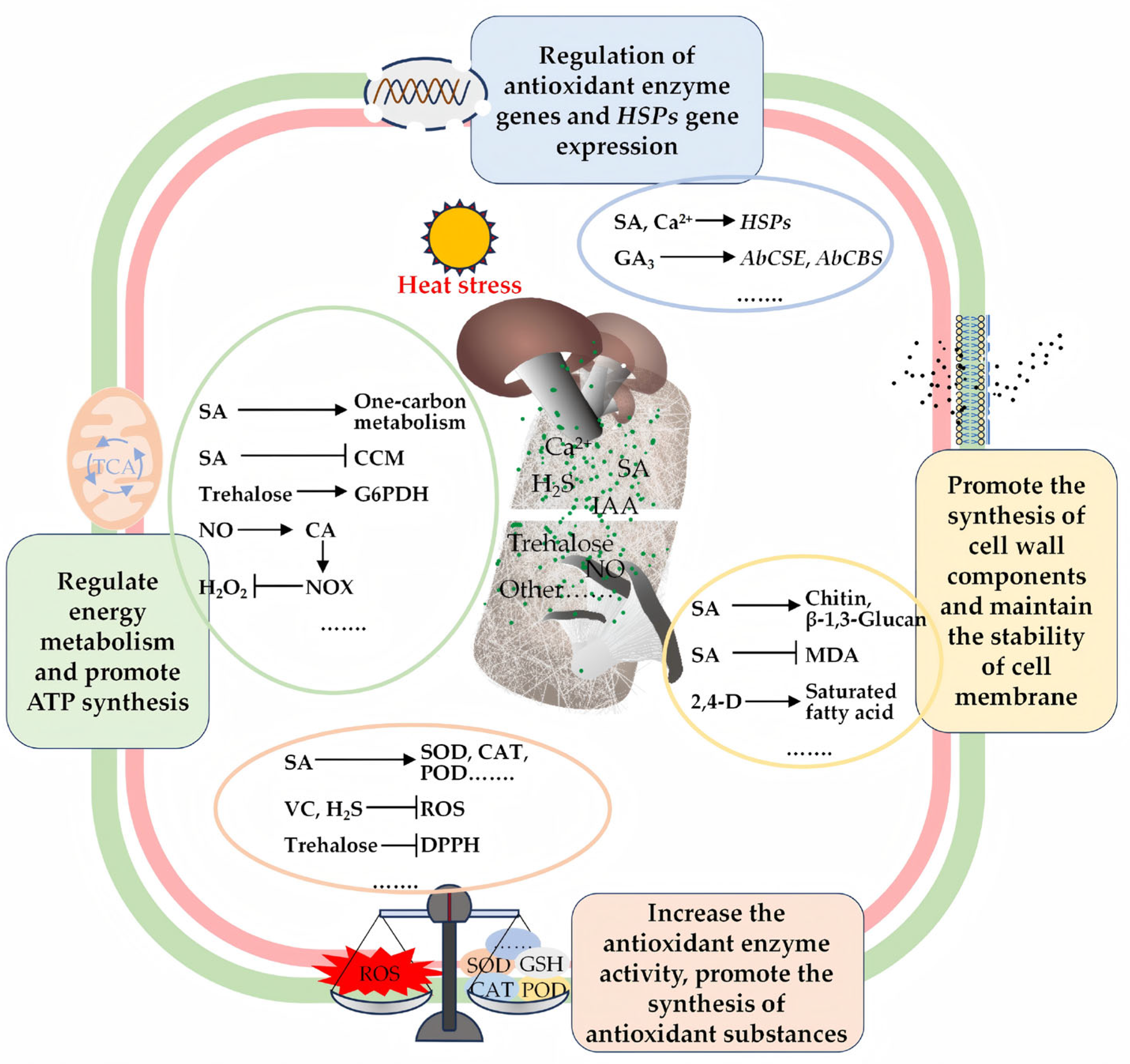
5.1. Mechanistic Model of Heat Stress Alleviation by Exogenous Substances in Edible Fungi
5.2. Major Challenges in Current Research
5.3. Future Perspectives
Author Contributions
Funding
Institutional Review Board Statement
Informed Consent Statement
Data Availability Statement
Acknowledgments
Conflicts of Interest
Abbreviations
| 2,4-D | 2,4-Dichlorophenoxyacetic acid |
| ABA | Abscisic acid |
| ACO | Aconitase |
| AOX | Alternative oxidase |
| APX | Ascorbate peroxidase |
| ATP | Adenosine triphosphate |
| CA | Citric acid |
| CAT | Catalase |
| CCM | Central carbon metabolism |
| CO | Carbon monoxide |
| CWI | Cell wall integrity |
| DHAR | Dehydroascorbate reductase |
| EHTDs | Extremely high-temperature days |
| EMP | Embden–Meyerhof–Parnas |
| ESs | Exogenous substances |
| G6PDH | Glucose-6-phosphate dehydrogenase |
| GA3 | Gibberellic acid |
| GAs | Ganoderic acids |
| GR | Glutathione reductase |
| GSH | Reduced glutathione |
| H2O2 | Hydrogen peroxide |
| H2S | Hydrogen sulfide |
| HOG | High-osmolarity glycerol |
| HS | Heat stress |
| HSFs | Heat shock transcription factors |
| HSPs | Heat shock proteins |
| IAA | Indole-3-acetic acid |
| JA | Jasmonic acid |
| L-NAME | L-NG-nitroarginine methyl ester |
| MAPK | Mitogen-activated protein kinase |
| MDA | Malondialdehyde |
| MDHAR | Monodehydroascorbate reductase |
| MeJA | Methyl Jasmonate |
| NAA | Naphthaleneacetic acid |
| NAC | N-acetylcysteine |
| NADPH | Nicotinamide adenine dinucleotide phosphate Hydrogen |
| NO | Nitric oxide |
| NOS | Nitric oxide synthase |
| NOX | NADPH oxidase |
| NR | Nitrate reductase |
| PA | Phosphatidic acid |
| PABA | Para-aminobenzoic acid |
| PLD | Phospholipase D |
| POD | Peroxidases |
| PPP | Pentose phosphate pathway |
| ROS | Reactive oxygen species |
| SA | Salicylic acid |
| SNP | Sodium nitroprusside |
| SOD | Superoxide dismutase |
| TBARS | Thiobarbituric acid reactive substance |
| TCA | Tricarboxylic acid |
| TFs | Transcription factors |
| tZ | Trans-zeatin |
| VC | Ascorbic acid |
References
- Sun, D.; Jiang, L.; Yang, X.; Mao, Y.; Zhang, Y.; Hao, J.; Liang, R. Research Progress on Nutritional Value, Functional Properties and Application of Edible Mushrooms in Meat Processing. Meat Res. 2025, 39, 67–75. [Google Scholar] [CrossRef]
- Zhang, Y.; Wang, D.; Chen, Y.; Liu, T.; Zhang, S.; Fan, H.; Liu, H.; Li, Y. Healthy function and high valued utilization of edible fungi. Food Sci. Hum. Wellness 2021, 10, 408–420. [Google Scholar] [CrossRef]
- Büntgen, U.; Kauserud, H.; Egli, S. Linking climate variability to mushroom productivity and phenology. Front. Ecol. Environ. 2012, 10, 14–19. [Google Scholar] [CrossRef]
- Guo, K.; Ji, Q.; Zhang, D. A dataset to measure global climate physical risk. Data Brief 2024, 54, 110502. [Google Scholar] [CrossRef]
- China Edible Fungi Association. Analysis on the results of the national statistical survey of edible fungi in 2023. Edible Fungi China 2025, 44, 120–129. [Google Scholar] [CrossRef]
- Yan, Z.; Zhao, M.; Wu, X.; Zhang, J. Metabolic Response of Pleurotus ostreatus to Continuous Heat Stress. Front. Microbiol. 2020, 10, 3148. [Google Scholar] [CrossRef]
- Hao, H.-B.; Huang, J.-C.; Wang, Q.; Juan, J.-X.; Xiao, T.-T.; Song, X.-X.; Chen, H.; Zhang, J.-J. Effects of heat stress on the differential expression of antioxidant enzymes and heat shock protein genes of Agaricus bisporus. Mycosystema 2021, 40, 616–625. [Google Scholar] [CrossRef]
- Qiu, Z.; Wu, X.; Zhang, J.; Huang, C. High temperature enhances the ability of Trichoderma asperellum to infect Pleurotus ostreatus mycelia. PLoS ONE 2017, 12, e187055. [Google Scholar] [CrossRef] [PubMed]
- Wang, L.; Shi, L.; Wang, H.; Han, Q.; Hu, Y.; Zheng, Q.; Dong, Z.; Liu, R.; Zhao, M.; Chen, H. GSK3 phosphorylates and activates trehalose-6-phosphate synthase to improve trehalose production and thermotolerance in Ganoderma lucidum. Commun. Biol. 2025, 8, 1762. [Google Scholar] [CrossRef] [PubMed]
- Zou, Y.; Zhang, M.; Qu, J.; Zhang, J. iTRAQ-Based Quantitative Proteomic Analysis Reveals Proteomic Changes in Mycelium of Pleurotus ostreatus in Response to Heat Stress and Subsequent Recovery. Front. Microbiol. 2018, 9, 2368. [Google Scholar] [CrossRef]
- Hu, Y.-R.; Wang, Y.; Chen, Y.-J.; Chai, Q.-Q.; Dong, H.-Z.; Shen, J.-W.; Qi, Y.-C.; Wang, F.-Q.; Wen, Q. Salicylic Acid Enhances Heat Stress Resistance of Pleurotus ostreatus (Jacq.) P. Kumm through Metabolic Rearrangement. Antioxidants 2022, 11, 968. [Google Scholar] [CrossRef] [PubMed]
- Yan, Z.-Y.; Zhao, M.-R.; Huang, C.-Y.; Zhang, L.-J.; Zhang, J.-X. Trehalose alleviates high-temperature stress in Pleurotus ostreatus by affecting central carbon metabolism. Microb. Cell Factories 2021, 20, 82. [Google Scholar] [CrossRef]
- Leonardi, P.; Iotti, M.; Donati Zeppa, S.; Lancellotti, E.; Amicucci, A.; Zambonelli, A. Morphological and functional changes in mycelium and mycorrhizas of Tuber borchii due to heat stress. Fungal Ecol. 2017, 29, 20–29. [Google Scholar] [CrossRef]
- Song, C.; Chen, Q.; Wu, X.; Zhang, J.; Huang, C. Heat stress induces apoptotic-like cell death in two Pleurotus species. Curr. Microbiol. 2014, 69, 611–616. [Google Scholar] [CrossRef]
- Wen, Q.; Zhao, J.; Li, P.; Hu, Y.; Shen, J.; Qi, Y.; Wang, F.; Liu, Q. Effects of five phytohormones on the mycelial growth of Pleurotus ostreatus cultivated under drought and high-temperature stress. Mycosystema 2025, 44, 118–129. [Google Scholar] [CrossRef]
- Hu, Y.; Chen, H.; Li, H.; Wang, Y.; Zheng, X.; Liu, Q.; Wen, Q.; Shen, X.; Wang, F.; Qi, Y.; et al. Exogenous Salicylic Acid Regulates Fruiting Body Development, Secondary Metabolite Accumulation, Cell Wall Integrity, and Endogenous Salicylic Acid Content under Heat Stress in Pleurotus ostreatus. J. Agric. Food Chem. 2024, 72, 25054–25065. [Google Scholar] [CrossRef] [PubMed]
- Li, Y.; Zhang, Y.; Wei, Y.; Xiang, Q.; Chen, Q.; Yu, X.; Zhang, L.; Peng, W.; Penttinen, P.; Gu, Y. Exogenous trehalose increased polysaccharide content and altered their properties and metabolism in Lentinula edodes mycelium. Int. J. Biol. Macromol. 2025, 310, 143387. [Google Scholar] [CrossRef] [PubMed]
- Liu, R.; Shi, L.; Zhu, T.; Yang, T.; Ren, A.; Zhu, J.; Zhao, M.-W. Cross Talk between Nitric Oxide and Calcium-Calmodulin Regulates Ganoderic Acid Biosynthesis in Ganoderma lucidum under Heat Stress. Appl. Environ. Microbol. 2018, 84, e18–e43. [Google Scholar] [CrossRef]
- Zhang, X.; Ren, A.; Li, M.J.; Cao, P.F.; Chen, T.X.; Zhang, G.; Shi, L.; Jiang, A.L.; Zhao, M.-W. Heat Stress Modulates Mycelium Growth, Heat Shock Protein Expression, Ganoderic Acid Biosynthesis, and Hyphal Branching of Ganoderma lucidum via Cytosolic Ca2+. Appl. Environ. Microbiol. 2016, 82, 4112–4125. [Google Scholar] [CrossRef]
- Luo, L.; Zhang, S.; Wu, J.; Sun, X.; Ma, A. Heat stress in macrofungi: Effects and response mechanisms. Appl. Microbiol. Biotechnol. 2021, 105, 7567–7576. [Google Scholar] [CrossRef]
- Philip, G.; Miles, S.C. Mushrooms: Cultivation, Nutritional Value, Medicinal Effect, and Environmental Impact, 2nd ed.; CRC press: Boca Raton, FL, USA, 2004; pp. 129–143. [Google Scholar] [CrossRef]
- An, X.; Zhong, B.; Chen, G.; An, W.; Xia, X.; Li, H.; Lai, F.; Zhang, Q. Evaluation of bioremediation and detoxification potentiality for papermaking black liquor by a new isolated thermophilic and alkali-tolerant Serratia sp. AXJ-M. J. Hazard. Mater. 2020, 406, 124285. [Google Scholar] [CrossRef] [PubMed]
- Guyot, S.; Gervais, P.; Young, M.; Winckler, P.; Dumont, J.; Davey, H.M. Surviving the heat: Heterogeneity of response in Saccharomyces cerevisiae provides insight into thermal damage to the membrane. Environ. Microbiol. 2015, 17, 2982–2992. [Google Scholar] [CrossRef]
- Zhu, J.-K. Abiotic Stress Signaling and Responses in Plants. Cell 2016, 167, 313–324. [Google Scholar] [CrossRef]
- Liu, Y.-N.; Zhang, T.-J.; Lu, X.-X.; Ma, B.-L.; Ren, A.; Shi, L.; Jiang, A.-L.; Yu, H.-S.; Zhao, M.-W. Membrane fluidity is involved in the regulation of heat stress induced secondary metabolism in Ganoderma lucidum. Environ. Microbiol. 2017, 19, 1653–1668. [Google Scholar] [CrossRef]
- Liu, Y.-N.; Lu, X.-X.; Chen, D.; Lu, Y.-P.; Ren, A.; Shi, L.; Zhu, J.; Jiang, A.-L.; Yu, H.-S.; Zhao, M.-W. Phospholipase D and phosphatidic acid mediate heat stress induced secondary metabolism in Ganoderma lucidum. Environ. Microbiol. 2017, 19, 4657–4669. [Google Scholar] [CrossRef]
- Han, X.; Wang, Z.; Shi, L.; Zhu, J.; Shi, L.; Ren, A.; Zhao, M. Phospholipase D and phosphatidic acid mediate regulation in the biosynthesis of spermidine and ganoderic acids by activating GlMyb in Ganoderma lucidum under heat stress. Environ. Microbiol. 2022, 24, 5345–5361. [Google Scholar] [CrossRef]
- Tian, J.-L.; Ren, A.; Wang, T.; Zhu, J.; Hu, Y.-R.; Shi, L.; Yu, H.-S.; Zhao, M.-W. Hydrogen sulfide, a novel small molecule signalling agent, participates in the regulation of ganoderic acids biosynthesis induced by heat stress in Ganoderma lucidum. Fungal Genet. Biol. 2019, 130, 19–30. [Google Scholar] [CrossRef] [PubMed]
- Wu, T.; Liu, X.; Wang, T.; Tian, L.; Qiu, H.; Ge, F.; Zhu, J.; Shi, L.; Jiang, A.; Yu, H.; et al. Heme Oxygenase/Carbon Monoxide Participates in the Regulation of Ganoderma lucidum Heat-Stress Response, Ganoderic Acid Biosynthesis, and Cell-Wall Integrity. Int. J. Mol. Sci. 2022, 23, 13147. [Google Scholar] [CrossRef] [PubMed]
- Hou, L.; Huang, C.; Wu, X.; Zhang, J.; Zhao, M. Nitric Oxide Negatively Regulates the Rapid Formation of Pleurotus ostreatus Primordia by Inhibiting the Mitochondrial aco Gene. J. Fungi 2022, 8, 1055. [Google Scholar] [CrossRef]
- Wang, G.; Zhou, S.; Luo, Y.; Ma, C.; Gong, Y.; Zhou, Y.; Gao, S.; Huang, Z.; Yan, L.; Hu, Y.; et al. The heat shock protein 40 LeDnaJ regulates stress resistance and indole-3-acetic acid biosynthesis in Lentinula edodes. Fungal Genet. Biol. 2018, 118, 37–44. [Google Scholar] [CrossRef]
- Alonso-Monge, R.; Román, E.; Arana, D.M.; Pla, J.; Nombela, C. Fungi sensing environmental stress. Clin. Microbiol. Infect. 2009, 15, 17–19. [Google Scholar] [CrossRef]
- Martin, H.; Flandez, M.; Nombela, C.; Molina, M. Protein phosphatases in MAPK signalling: We keep learning from yeast. Mol. Microbiol. 2005, 58, 6–16. [Google Scholar] [CrossRef]
- Li, H.; Liu, J.; Hou, Z.; Luo, X.; Lin, J.; Jiang, N.; Hou, L.; Ma, L.; Li, C.; Qu, S. Activation of mycelial defense mechanisms in the oyster mushroom Pleurotus ostreatus induced by Tyrophagus putrescentiae. Food Res. Int. 2022, 160, 111708. [Google Scholar] [CrossRef] [PubMed]
- Zhang, Y.; Mao, C.; Liu, X.; Guo, L.; Hu, C.; Li, X.; Xu, L.; Yu, H. Insights into the evolution and mechanisms of response to heat stress by whole genome sequencing and comparative proteomics analysis of the domesticated edible mushroom Lepista sordida. Mycology 2025, 16, 324–343. [Google Scholar] [CrossRef] [PubMed]
- Lei, M.; Wu, X.; Huang, C.; Qiu, Z.; Wang, L.; Zhang, R.; Zhang, J. Trehalose induced by reactive oxygen species relieved the radial growth defects of Pleurotus ostreatus under heat stress. Appl. Microbiol. Biotechnol. 2019, 103, 5379–5390. [Google Scholar] [CrossRef] [PubMed]
- Mittler, R.; Zandalinas, S.I.; Fichman, Y.; Van Breusegem, F. Reactive oxygen species signalling in plant stress responses. Nat. Rev. Mol. Cell Biol. 2022, 23, 663–679. [Google Scholar] [CrossRef]
- Quan, L.-J.; Zhang, B.; Shi, W.-W.; Li, H.-Y. Hydrogen Peroxide in Plants: A Versatile Molecule of the Reactive Oxygen Species Network. J. Integr. Plant Biol. 2008, 50, 2–18. [Google Scholar] [CrossRef]
- Karuppanapandian, T.; Moon, J.C.; Kim, C.; Manoharan, K.; Kim, W. Reactive Oxygen Species in Plants: Their Generation, Signal Transduction, and Scavenging Mechanisms. Aust. J. Crop Sci. 2011, 5, 709–725. [Google Scholar]
- Li, C.; Shi, L.; Chen, D.; Ren, A.; Gao, T.; Zhao, M. Functional analysis of the role of glutathione peroxidase (GPx) in the ROS signaling pathway, hyphal branching and the regulation of ganoderic acid biosynthesis in Ganoderma lucidum. Fungal Genet. Biol. 2015, 82, 168–180. [Google Scholar] [CrossRef]
- Holmström, K.M.; Finkel, T. Cellular mechanisms and physiological consequences of redox-dependent signalling. Nat. Rev. Mol. Cell Biol. 2014, 15, 411–421. [Google Scholar] [CrossRef]
- Kumar, A.; Sharma, S.; Chunduri, V.; Kaur, A.; Kaur, S.; Malhotra, N.; Kumar, A.; Kapoor, P.; Kumari, A.; Kaur, J.; et al. Genome-wide Identification and Characterization of Heat Shock Protein Family Reveals Role in Development and Stress Conditions in Triticum aestivum L. Sci. Rep. 2020, 10, 7858. [Google Scholar] [CrossRef]
- Wang, W.; Vinocur, B.; Shoseyov, O.; Altman, A. Role of plant heat-shock proteins and molecular chaperones in the abiotic stress response. Trends Plant Sci. 2004, 9, 244–252. [Google Scholar] [CrossRef]
- Roy, A.; Tamuli, R. Heat shock proteins and the calcineurin-crz1 signaling regulate stress responses in fungi. Arch. Microbiol. 2022, 204, 240. [Google Scholar] [CrossRef]
- Ling, Y.-Y.; Ling, Z.-L.; Zhao, R.-L. Construction of a heat-resistant strain of Lentinus edodes by fungal Hsp20 protein overexpression and genetic transformation. Front. Microbiol. 2022, 13, 1009885. [Google Scholar] [CrossRef]
- Lu, Z.; Kong, X.; Lu, Z.; Xiao, M.; Chen, M.; Zhu, L.; Shen, Y.; Hu, X.; Song, S. Para-aminobenzoic acid (PABA) synthase enhances thermotolerance of mushroom Agaricus bisporus. PLoS ONE 2014, 9, e91298. [Google Scholar] [CrossRef]
- Wang, L.; Liao, B.; Gong, L.; Xiao, S.; Huang, Z. Haploid Genome Analysis Reveals a Tandem Cluster of Four HSP20 Genes Involved in the High-Temperature Adaptation of Coriolopsis trogii. Microbiol. Spectr. 2021, 9, e28721. [Google Scholar] [CrossRef]
- Zhang, Y.; Wu, Y.; Yang, X.; Yang, E.; Xu, H.; Chen, Y.; Chagan, I.; Yan, J.; Cann, I. Alternative Splicing of Heat Shock Transcription Factor 2 Regulates Expression of the Laccase Gene Family in Response to Copper in Trametes trogii. Appl. Environ. Microbol. 2021, 87, 1. [Google Scholar] [CrossRef]
- Wang, G.; Luo, Y.; Wang, C.; Zhou, Y.; Mou, C.; Kang, H.; Xiao, Y.; Bian, Y.; Gong, Y.H. Hsp40 Protein LeDnaJ07 Enhances the Thermotolerance of Lentinula edodes and Regulates IAA Biosynthesis by Interacting LetrpE. Front. Microbiol. 2020, 11, 707. [Google Scholar] [CrossRef]
- Zhang, Q.; Feng, R.; Miao, R.; Lin, J.; Cao, L.; Ni, Y.; Li, W.; Zhao, X. Combined transcriptomics and metabolomics analysis reveals the molecular mechanism of heat tolerance of Le023M, a mutant in Lentinula edodes. Heliyon 2023, 9, e18360. [Google Scholar] [CrossRef]
- Takasaki, T.; Tomimoto, N.; Ikehata, T.; Satoh, R.; Sugiura, R. Distinct spatiotemporal distribution of Hsp90 under high-heat and mild-heat stress conditions in fission yeast. microPubl. Biol. 2021. [Google Scholar] [CrossRef]
- Feng, D.; Jia, X.; Yan, Z.; Li, J.; Gao, J.; Xiao, W.; Shen, X.; Sun, X. Underlying mechanisms of exogenous substances involved in alleviating plant heat stress. Plant Stress 2023, 10, 100288. [Google Scholar] [CrossRef]
- Hou, L.; Zhao, M.; Huang, C.; Wu, X.; Zhang, J. Nitric Oxide Improves the Tolerance of Pleurotus ostreatus to Heat Stress by Inhibiting Mitochondrial Aconitase. Appl. Environ. Microbol. 2020, 86, e02303-19. [Google Scholar] [CrossRef]
- Kong, W.; Huang, C.; Chen, Q.; Zou, Y.; Zhang, J. Nitric oxide alleviates heat stress-induced oxidative damage in Pleurotus eryngii var. tuoliensis. Fungal Genet. Biol. 2012, 49, 15–20. [Google Scholar] [CrossRef]
- Chen, C.; Li, Q.; Wang, Q.; Lu, D.; Zhang, H.; Wang, J.; Fu, R. Transcriptional profiling provides new insights into the role of nitric oxide in enhancing Ganoderma oregonense resistance to heat stress. Sci. Rep. 2017, 7, 15694. [Google Scholar] [CrossRef]
- Liu, R.; Zhu, T.; Yang, T.; Yang, Z.; Ren, A.; Shi, L.; Zhu, J.; Yu, H.; Zhao, M. Nitric oxide regulates ganoderic acid biosynthesis by the S-nitrosylation of aconitase under heat stress in Ganoderma lucidum. Environ. Microbiol. 2021, 23, 682–695. [Google Scholar] [CrossRef]
- Mei, Y.C. Alleviation of High Temperature Stress of Flammulina Velutipes by Exogenous Nitric oxide and Its Mechanisms. Master’s Thesis, Nanjing Agricultural University, Nanjing, China, 2015. [Google Scholar]
- Shangguan, J.; Wu, T.; Tian, L.; Liu, Y.; Zhu, L.; Liu, R.; Zhu, J.; Shi, L.; Zhao, M.; Ren, A. Hydrogen sulfide maintains mitochondrial homeostasis and regulates ganoderic acids biosynthesis by SQR under heat stress in Ganoderma lucidum. Redox Biol. 2024, 74, 103227. [Google Scholar] [CrossRef]
- Zhang, G.; Yan, P.; Leng, D.; Shang, L.; Zhang, C.; Wu, Z.; Wang, Z. Salicylic Acid Treatment Alleviates the Heat Stress Response by Reducing the Intracellular ROS Level and Increasing the Cytosolic Trehalose Content in Pleurotus ostreatus. Microbiol. Spectr. 2023, 11, e3113–e3122. [Google Scholar] [CrossRef]
- Wang, G.; Ma, C.; Luo, Y.; Zhou, S.; Zhou, Y.; Ma, X.; Cai, Y.; Yu, J.; Bian, Y.; Gong, Y. Proteome and Transcriptome Reveal Involvement of Heat Shock Proteins and Indoleacetic Acid Metabolism Process in Lentinula Edodes Thermotolerance. Cell. Physiol. Biochem. 2018, 50, 1617–1637. [Google Scholar] [CrossRef]
- Feng, A.-Q.; Peng, G.-G. Effects of exogenous salicylic acid on high and low temperature stress of Pleurotus eryngii. Agric. Technol. 2023, 43, 19–22. [Google Scholar] [CrossRef]
- Wang, G.; Chen, X.; Zhang, C.; Li, M.; Sun, C.; Zhan, N.; Huang, X.; Li, T.; Deng, W. Biosynthetic Pathway and the Potential Role of Melatonin at Different Abiotic Stressors and Developmental Stages in Tolypocladium guangdongense. Front. Microbiol. 2021, 12, 746141. [Google Scholar] [CrossRef]
- Liu, X.-M.; Wu, X.-L.; Gao, W.; Qu, J.-B.; Chen, Q.; Huang, C.-Y.; Zhang, J.-X. Protective roles of trehalose in Pleurotus pulmonarius during heat stress response. J. Integr. Agric. 2019, 18, 428–437. [Google Scholar] [CrossRef]
- Zhou, L.; Guo, S.; Yang, Z.; Yang, J.; Wang, H.; Nan, X.-J. Effect of Exogenous Trehalose on Growth of Agaricus bisporus Strain under High Temperature Stress and Screening of High Temperature Resistant Strains. Southwest China J. Agric. Sci. 2019, 32, 154–160. [Google Scholar] [CrossRef]
- Xia, J.-L.; Wu, C.-G.; Ren, A.; Hu, Y.-R.; Wang, S.-L.; Han, X.-F.; Shi, L.; Zhu, J.; Zhao, M.-W. Putrescine regulates nitric oxide accumulation in Ganoderma lucidum partly by influencing cellular glutamine levels under heat stress. Microbiol. Res. 2020, 239, 126521. [Google Scholar] [CrossRef]
- Liu, M.; Liang, Z.-H.; Wu, R.; Min, T.-H.; Lin, C.-Y. Effect of N-acetylcysteine on Reactive Oxygen Metabolism and Glycolysis of Lentinula edodes Mycelia under Heat Stress. J. Nucl. Agric. Sci. 2025, 39, 427–435. [Google Scholar] [CrossRef]
- Wen, Q.; Zhao, H.; Shao, Y.; Li, J.; Hu, Y.; Qi, Y.; Wang, F.; Shen, J. Heat stress and excessive maturity of fruiting bodies suppress GABA accumulation by modulating GABA metabolism in Pleurotus ostreatus (Jacq. ex Fr.) P. Kumm. Food Res. Int. 2023, 165, 112549. [Google Scholar] [CrossRef]
- Guo, L.; Li, T.; Zhang, B.; Yan, K.; Meng, J.; Chang, M.; Hou, L. Family Identification and Functional Study of Copper Transporter Genes in Pleurotus ostreatus. Int. J. Mol. Sci. 2024, 25, 12154. [Google Scholar] [CrossRef]
- Li, Q.; Huang, W.; Xiong, C.; Zhao, J. Transcriptome analysis reveals the role of nitric oxide in Pleurotus eryngii responses to Cd2+ stress. Chemosphere 2018, 201, 294–302. [Google Scholar] [CrossRef]
- Allagulova, C.R.; Lubyanova, A.R.; Avalbaev, A.M. Multiple Ways of Nitric Oxide Production in Plants and Its Functional Activity under Abiotic Stress Conditions. Int. J. Mol. Sci. 2023, 24, 11637. [Google Scholar] [CrossRef]
- Shi, L.; Yue, S.; Gao, T.; Zhu, J.; Ren, A.; Yu, H.; Wang, H.; Zhao, M. Nitrate reductase-dependent nitric oxide plays a key role on MeJA-induced ganoderic acid biosynthesis in Ganoderma lucidum. Appl. Microbiol. Biotechnol. 2020, 104, 10737–10753. [Google Scholar] [CrossRef]
- Perna, A.F.; Luciano, M.G.; Ingrosso, D.; Raiola, I.; Pulzella, P.; Sepe, I.; Lanza, D.; Violetti, E.; Capasso, R.; Lombardi, C.; et al. Hydrogen Sulfide, the Third Gaseous Signaling Molecule With Cardiovascular Properties, Is Decreased in Hemodialysis Patients. J. Ren. Nutr. 2010, 20, S11–S14. [Google Scholar] [CrossRef]
- Li, L.; Wang, Y.; Shen, W. Roles of hydrogen sulfide and nitric oxide in the alleviation of cadmium-induced oxidative damage in alfalfa seedling roots. Biometals 2012, 25, 617–631. [Google Scholar] [CrossRef]
- Li, Z.-G.; Gong, M.; Xie, H.; Yang, L.; Li, J. Hydrogen sulfide donor sodium hydrosulfide-induced heat tolerance in tobacco (Nicotiana tabacum L) suspension cultured cells and involvement of Ca2+ and calmodulin. Plant Sci. 2012, 185–186, 185–189. [Google Scholar] [CrossRef]
- Liang, X.; Zhou, Y.; Xu, W.; Liang, J. An intracellular CPK-ECA1 phosphoregulatory circuit couples calcium signatures to ABA homeostasis for plant osmosensivity. Sci. Adv. 2025, 11, z2428. [Google Scholar] [CrossRef]
- Dodd, A.N.; Kudla, J.; Sanders, D. The Language of Calcium Signaling. Annu. Rev. Plant Biol. 2010, 61, 593–620. [Google Scholar] [CrossRef]
- Reddy, A.S.N.; Ali, G.S.; Celesnik, H.; Day, I.S. Coping with Stresses: Roles of Calcium- and Calcium/Calmodulin-Regulated Gene Expression. Plant Cell 2011, 23, 2010–2032. [Google Scholar] [CrossRef]
- Godse, D.D.; Kumbhar, C.T.; Jadhav, A.C.; Shitole, L.S. Effect of Growth Regulators and Micronutrients on Growth and Yield of Pleurotus sajor-caju. Int. J. Curr. Microbiol. Appl. Sci. 2021, 10, 240–250. [Google Scholar] [CrossRef]
- Mukhopadhyay, R.; Chatterjee, S.; Chatterjee, B.P.; Guha, A.K. Enhancement of biomass production of edible mushroom Pleurotus sajor-caju grown in whey by plant growth hormones. Process Biochem. 2005, 40, 1241–1244. [Google Scholar] [CrossRef]
- Xu, R.; Zhou, S.; Song, J.; Zhong, H.; Zhu, T.; Gong, Y.; Zhou, Y.; Bian, Y. Comparative Transcriptome Analysis Provides Insights Into the Mechanism by Which 2,4-Dichlorophenoxyacetic Acid Improves Thermotolerance in Lentinula edodes. Front. Microbiol. 2022, 13, 910255. [Google Scholar] [CrossRef] [PubMed]
- Cui, M.; Zhao, Y.; Zhang, X.; Zhao, W. Abscisic acid-mediated cytosolic Ca2+ modulates triterpenoid accumulation of Ganoderma lucidum. J. Zhejiang Univ.-Sci. B 2023, 24, 1174–1179. [Google Scholar] [CrossRef] [PubMed]
- Bagautdinova, Z.Z.; Omelyanchuk, N.; Tyapkin, A.V.; Kovrizhnykh, V.V.; Lavrekha, V.V.; Zemlyanskaya, E.V. Salicylic Acid in Root Growth and Development. Int. J. Mol. Sci. 2022, 23, 2228. [Google Scholar] [CrossRef] [PubMed]
- Cao, Y.; Wang, Y.; Dai, B.; Wang, B.; Zhang, H.; Zhu, Z.; Xu, Y.; Cao, Y.; Jiang, Y.; Zhang, G.; et al. Trehalose Is an Important Mediator of Cap1p Oxidative Stress Response in Candida albicans. Biol. Pharm. Bull. 2008, 31, 421–425. [Google Scholar] [CrossRef] [PubMed]
- Elbein, A.D.; Pan, Y.T.; Pastuszak, I.; Carroll, D. New insights on trehalose: A multifunctional molecule. Glycobiology 2003, 13, 17R–27R. [Google Scholar] [CrossRef] [PubMed]
- Morano, K.A. Anhydrobiosis: Drying Out with Sugar. Curr. Biol. 2014, 24, R1121–R1123. [Google Scholar] [CrossRef]
- Aranda, J.S.; Salgado, E.; Taillandier, P. Trehalose accumulation in Saccharomyces cerevisiae cells: Experimental data and structured modeling. Biochem. Eng. J. 2004, 17, 129–140. [Google Scholar] [CrossRef]
- Aguirre, J.; Hansberg, W.; Navarro, R. Fungal responses to reactive oxygen species. Med. Mycol. 2006, 44, 101–107. [Google Scholar] [CrossRef]
- Heller, J.; Tudzynski, P. Reactive oxygen species in phytopathogenic fungi: Signaling, development, and disease. Annu. Rev. Phytopathol. 2011, 49, 369–390. [Google Scholar] [CrossRef]
- Takano-Rojas, H.; Zickler, D.; Peraza-Reyes, L. Peroxisome dynamics during development of the fungus Podospora anserina. Mycologia 2016, 108, 590–602. [Google Scholar] [CrossRef]
- Li, H.; Wang, H.; Du, J.; Du, G.; Zhan, J.; Huang, W. Trehalose protects wine yeast against oxidation under thermal stress. World J. Microbiol. Biotechnol. 2010, 26, 969–976. [Google Scholar] [CrossRef]
- Liu, Y.-N.; Lu, X.-X.; Ren, A.; Shi, L.; Zhu, J.; Jiang, A.-L.; Yu, H.-S.; Zhao, M.-W. Conversion of phosphatidylinositol (PI) to PI4-phosphate (PI4P) and then to PI (4,5) P2 is essential for the cytosolic Ca2+ concentration under heat stress in Ganoderma lucidum. Environ. Microbiol. 2018, 20, 2456–2468. [Google Scholar] [CrossRef]
- Dvořák, P.; Krasylenko, Y.; Zeiner, A.; Aamaj, J.; Takáč, T. Signaling Toward Reactive Oxygen Species-Scavenging Enzymes in Plants. Front. Plant Sci. 2021, 11, 618835. [Google Scholar] [CrossRef]
- Li, L.; Pischetsrieder, M.; St. Leger, R.J.; Wang, C. Associated links among mtDNA glycation, oxidative stress and colony sectorization in Metarhizium anisopliae. Fungal Genet. Biol. 2008, 45, 1300–1306. [Google Scholar] [CrossRef]
- Suzuki, N. Fine Tuning of ROS, Redox and Energy Regulatory Systems Associated with the Functions of Chloroplasts and Mitochondria in Plants under Heat Stress. Int. J. Mol. Sci. 2023, 24, 1356. [Google Scholar] [CrossRef]
- Balaban, R.S.; Nemoto, S.; Finkel, T. Mitochondria, Oxidants, and Aging. Cell 2005, 120, 483–495. [Google Scholar] [CrossRef]
- Zheng, W.; Miao, K.; Zhang, Y.; Pan, S.; Zhang, M.; Jiang, H. Nitric oxide mediates the fungal-elicitor-enhanced biosynthesis of antioxidant polyphenols in submerged cultures of Inonotus obliquus. Microbiology 2009, 155, 3440–3448. [Google Scholar] [CrossRef]
- Samtani, H.; Unni, G.; Khurana, P. Microbial Mechanisms of Heat Sensing. Indian J. Microbiol. 2022, 62, 175–186. [Google Scholar] [CrossRef] [PubMed]
- Shapiro, R.S.; Cowen, L.E. Thermal Control of Microbial Development and Virulence: Molecular Mechanisms of Microbial Temperature Sensing. mBio 2012, 3, e00238-12. [Google Scholar] [CrossRef] [PubMed]
- Hou, L.; Wang, J.; Li, T.; Zhang, B.; Yan, K.; Zhang, Z.; Geng, X.; Chang, M.; Meng, J. Transcriptome Analysis Revealed That Cell Wall Regulatory Pathways Are Involved in the Tolerance of Pleurotus ostreatus Mycelia to Different Heat Stresses. J. Fungi 2025, 11, 266. [Google Scholar] [CrossRef]
- Valiante, V. The Cell Wall Integrity Signaling Pathway and Its Involvement in Secondary Metabolite Production. J. Fungi 2017, 3, 68. [Google Scholar] [CrossRef] [PubMed]
- Hu, Y.-R.; Ding, J.-X.; Dong, H.-Z.; Chai, Q.-Q.; Qi, Y.-C.; Wen, Q.; Shen, J.-W. Effects of heat stress on resistance of Pleurotus ostreatus to mould infection. Mycosystema 2022, 41, 1080–1087. [Google Scholar] [CrossRef]
- Li, X.; Kong, Q.; Chen, Z.-J.; Huang, W.-J.; Wu, S.-W.; Chen, M.-Y.; Tan, S.-Y.; Wang, J.; Yan, S.-J. Comparative study on ultrastructural characteristics of Aspergillus flavus grown under different temperature. Mycosystema 2021, 40, 1648–1659. [Google Scholar] [CrossRef]
- Chao, X.-T.; Bian, Y.-B.; Xiao, X.-J.; Li, J.-S.; Wang, G.-Z. Effect of Heat Stress on Lentinula edodes Mycelial Growth Recovery and Resistance to Trichoderma harzianum. Acta Edulis fungi 2015, 22, 81–85. [Google Scholar] [CrossRef]
- Qiu, Z.; Wu, X.; Zhang, J.; Huang, C. High-Temperature Induced Changes of Extracellular Metabolites in Pleurotus ostreatus and Their Positive Effects on the Growth of Trichoderma asperellum. Front. Microbiol. 2018, 9, 10. [Google Scholar] [CrossRef] [PubMed]
- Qiu, Z.; Wu, X.; Gao, W.; Zhang, J.; Huang, C. High temperature induced disruption of the cell wall integrity and structure in Pleurotus ostreatus mycelia. Appl. Microbiol. Biotechnol. 2018, 102, 6627–6636. [Google Scholar] [CrossRef]
- Wang, T.; Li, X.; Zhang, C.; Xu, J. Transcriptome analysis of Ganoderma lingzhi (Agaricomycetes) response to Trichoderma hengshanicum infection. Front. Microbiol. 2023, 14, 1131599. [Google Scholar] [CrossRef] [PubMed]
- Wang, G.; Cao, X.; Ma, X.; Guo, M.; Liu, C.; Yan, L.; Bian, Y. Diversity and effect of Trichoderma spp. associated with green mold disease on Lentinula edodes in China. Microbiologyopen 2016, 5, 709–718. [Google Scholar] [CrossRef]
- Ruiz-Herrera, J.; Ortiz-Castellanos, L. Cell wall glucans of fungi. A review. Cell Surf. 2019, 5, 100022. [Google Scholar] [CrossRef]
- Hu, X.; Yang, P.; Chai, C.; Liu, J.; Sun, H.; Wu, Y.; Zhang, M.; Zhang, M.; Liu, X.; Yu, H. Structural and mechanistic insights into fungal β-1,3-glucan synthase FKS1. Nature 2023, 616, 190–198. [Google Scholar] [CrossRef]
- Gow, N.A.R. Fungal cell wall biogenesis: Structural complexity, regulation and inhibition. Fungal Genet. Biol. 2025, 179, 103991. [Google Scholar] [CrossRef]
- Gow, N.A.R.; Latge, J.; Munro, C.A. The Fungal Cell Wall: Structure, Biosynthesis, and Function. Microbiol. Spectr. 2017, 5, 3–5. [Google Scholar] [CrossRef]
- Chen, D.-D.; Shi, L.; Yue, S.-N.; Zhang, T.-J.; Wang, S.-L.; Liu, Y.-N.; Ren, A.; Zhu, J.; Yu, H.-S.; Zhao, M.-W. The Slt2-MAPK pathway is involved in the mechanism by which target of rapamycin regulates cell wall components in Ganoderma lucidum. Fungal Genet. Biol. 2019, 123, 70–77. [Google Scholar] [CrossRef]
- González-Rubio, G.; Martín, H.; Molina, M. The Mitogen-Activated Protein Kinase Slt2 Promotes Asymmetric Cell Cycle Arrest and Reduces TORC1-Sch9 Signaling in Yeast Lacking the Protein Phosphatase Ptc1. Microbiol. Spectr. 2023, 11, e5222–e5249. [Google Scholar] [CrossRef]
- Dutta, S.; Islam, Z.; Das, S.; Barman, A.; Chowdhury, M.; Mondal, B.P.; Ajnabi, J.; Manna, D. Harmonizing plant resilience: Unveiling the symphony of membrane lipid dynamics in response to abiotic stresses: A review. Discov. Plants 2025, 2, 61. [Google Scholar] [CrossRef]
- Hou, L.D. Nitric Oxide Regulates Energy Metabolism to Alleviate Heat Stress Damage of Pleurotus ostreatus. Ph.D. Dissertation, Chinese Academy of Agricultural Sciences, Beijing, China, 2021. [Google Scholar]
- Yao, X.-R.; Gao, W.; Zhang, J.-X.; Chang, M.-C.; Huang, C.-Y.; Wu, X.-L. The Regulation of Cytosolic Ca2+ on Gene Expression of Heat Shock Proteins in Pleurotus ostreatus under Heat Stress. Acta Edulis Fungi 2019, 26, 17–23. [Google Scholar] [CrossRef]
- Liu, R.; Zhang, X.; Ren, A.; Shi, D.-K.; Shi, L.; Zhu, J.; Yu, H.-S.; Zhao, M.-W. Heat stress-induced reactive oxygen species participate in the regulation of HSP expression, hyphal branching and ganoderic acid biosynthesis in Ganoderma lucidum. Microbiol. Res. 2018, 209, 43–54. [Google Scholar] [CrossRef]
- Wang, Q.; Zhu, J.; Wang, Y.; Yun, J.; Zhang, Y.; Zhao, F. Serine Rejuvenated Degenerated Volvariella volvacea by Enhancing ROS Scavenging Ability and Mitochondrial Function. J. Fungi 2024, 10, 540. [Google Scholar] [CrossRef]
- Chen, H.; Hao, H.; Han, C.; Wang, H.; Wang, Q.; Chen, M.; Juan, J.; Feng, Z.; Zhang, J. Exogenous L-ascorbic acid regulates the antioxidant system to increase the regeneration of damaged mycelia and induce the development of fruiting bodies in Hypsizygus marmoreus. Fungal Biol. 2020, 124, 551–561. [Google Scholar] [CrossRef]
- Zhu, D.; Wang, C.; Liu, Y.; Ding, Y.; Winters, E.; Li, W.; Cheng, F. Gibberellic acid maintains postharvest quality of Agaricus bisporus mushroom by enhancing antioxidative system and hydrogen sulfide synthesis. J. Food Biochem. 2021, 45, e13939. [Google Scholar] [CrossRef]
- Yang, Y.; Pian, Y.; Li, J.; Xu, L.; Lu, Z.; Dai, Y.; Li, Q. Integrative analysis of genome and transcriptome reveal the genetic basis of high temperature tolerance in pleurotus giganteus (Berk. Karun & Hyde). BMC Genom. 2023, 24, 552. [Google Scholar] [CrossRef] [PubMed]
- Lu, Z.; Ke, B.; Lin, H.; Yuan, B.; Ke, L.; Chen, M.; Lu, Y. Morphological and Transcriptomic Response Mediated by Heat Stress in Pleurotus Pulmonarius. Curr. Microbiol. 2025, 82, 397. [Google Scholar] [CrossRef]
- Xu, R.P. Analysis of Auxin Signal Pathway Under Heat Stress in Lentinula Edodes and Preliminary Exploration of CRISPR-Cas9 Gene Editing System. Ph.D. Dissertation, Huazhong Agricultural University, Wuhan, China, 2023. [Google Scholar]
- Nussbaum, I.; Weindling, E.; Jubran, R.; Cohen, A.; Bar-Nun, S. Deteriorated Stress Response in Stationary-Phase Yeast: Sir2 and Yap1 Are Essential for Hsf1 Activation by Heat Shock and Oxidative Stress, Respectively. PLoS ONE 2014, 9, e111505. [Google Scholar] [CrossRef]
- Wang, S.; Shi, L.; Hu, Y.; Liu, R.; Ren, A.; Zhu, J.; Zhao, M. Roles of the Skn7 response regulator in stress resistance, cell wall integrity and GA biosynthesis in Ganoderma lucidum. Fungal Genet. Biol. 2018, 114, 12–23. [Google Scholar] [CrossRef]
- Yan, K.; Guo, L.; Zhang, B.; Chang, M.; Meng, J.; Deng, B.; Liu, J.; Hou, L. MAC Family Transcription Factors Enhance the Tolerance of Mycelia to Heat Stress and Promote the Primordial Formation Rate of Pleurotus ostreatus. J. Fungi 2024, 10, 13. [Google Scholar] [CrossRef]
- Yuan, H.; Liu, Z.; Guo, L.; Hou, L.; Meng, J.; Chang, M. Function of Transcription Factors PoMYB12, PoMYB15, and PoMYB20 in Heat Stress and Growth of Pleurotus ostreatus. Int. J. Mol. Sci. 2023, 24, 13559. [Google Scholar] [CrossRef]
- Wang, L.; Gao, W.; Wu, X.; Zhao, M.; Qu, J.; Huang, C.; Zhang, J. Genome-Wide Characterization and Expression Analyses of Pleurotus ostreatus MYB Transcription Factors during Developmental Stages and under Heat Stress Based on de novo Sequenced Genome. Int. J. Mol. Sci. 2018, 19, 2052. [Google Scholar] [CrossRef]
- Zhou, Y.; Li, Z.; Xu, C.; Pan, J.; Li, H.; Zhou, Y.; Zou, Y. Genome-wide analysis of bZIP gene family members in Pleurotus ostreatus, and potential roles of PobZIP3 in development and the heat stress response. Microb. Biotechnol. 2024, 17, e14413. [Google Scholar] [CrossRef]
- Lian, L.; Qiao, J.; Guo, X.; Xing, Z.; Ren, A.; Zhao, M.; Zhu, J. The transcription factor GCN4 contributes to maintaining intracellular amino acid contents under nitrogen-limiting conditions in the mushroom Ganoderma lucidum. Microb. Cell Factories 2023, 22, 205. [Google Scholar] [CrossRef]
- Ding, Q.; Zhao, H.; Zhu, P.; Jiang, X.; Nie, F.; Li, G. Genome-wide identification and expression analyses of C2H2 zinc finger transcription factors in Pleurotus ostreatus. PeerJ 2022, 10, e12654. [Google Scholar] [CrossRef]
- Liu, R.; Sun, T.; Du, P.; Liu, Z.; Li, Y.; Tong, X.; Zou, L. Characterization and Expression Analysis of the bHLH Gene Family During Developmental Stages and Under Various Abiotic Stresses in Sanghuangporus baumii. Genes 2025, 16, 184. [Google Scholar] [CrossRef] [PubMed]
- Endo, S.; Kawauchi, M.; Otsuka, Y.; Han, J.; Tsuji, K.; Yoshimi, A.; Tanaka, C.; Yano, S.; Nakazawa, T.; Honda, Y. Putative transcription factor Nrg1 is involved in the hyphal branching and the cell wall structure formation in the filamentous fungus Pleurotus ostreatus. Fungal Genet. Biol. 2025, 181, 104026. [Google Scholar] [CrossRef] [PubMed]
- Wang, L.; Shi, L.; Zhang, S.; Ma, J.; Zhang, C.; Chen, H.; Zhao, M. The APSES transcription factor Swi6B upregulates CATALASE 1 transcription to enhance oxidative stress tolerance of Ganoderma lucidum. Appl. Environ. Microbol. 2025, 91, e625–e679. [Google Scholar] [CrossRef] [PubMed]
- Lyu, X.; Wang, Q.; Liu, A.; Liu, F.; Meng, L.; Wang, P.; Zhang, Y.; Wang, L.; Li, Z.; Wang, W. The transcription factor Ste12-like increases the mycelial abiotic stress tolerance and regulates the fruiting body development of Flammulina filiformis. Front. Microbiol. 2023, 14, 1139679. [Google Scholar] [CrossRef] [PubMed]
- Kojima, H.; Kawauchi, M.; Otsuka, Y.; Schiphof, K.; Tsuji, K.; Yoshimi, A.; Tanaka, C.; Yano, S.; Nakazawa, T.; Honda, Y. Putative APSES family transcription factor mbp1 plays an essential role in regulating cell wall synthesis in the agaricomycete Pleurotus ostreatus. Fungal Genet. Biol. 2024, 175, 103936. [Google Scholar] [CrossRef] [PubMed]
- Yan, Z.; Wu, X.; Zhao, M.; Zhang, J. Lactic acid accumulation under heat stress related to accelerated glycolysis and mitochondrial dysfunction inhibits the mycelial growth of Pleurotus ostreatus. Appl. Microbiol. Biotechnol. 2020, 104, 6767–6777. [Google Scholar] [CrossRef]
- Hu, Y.; Xu, W.; Hu, S.; Lian, L.; Zhu, J.; Ren, A.; Shi, L.; Zhao, M.W. Glsnf1-mediated metabolic rearrangement participates in coping with heat stress and influencing secondary metabolism in Ganoderma lucidum. Free Radic. Biol. Med. 2020, 147, 220–230. [Google Scholar] [CrossRef]
- Lin, H.; Li, P.; Ma, L.; Lai, S.; Sun, S.; Hu, K.; Zhang, L. Analysis and modification of central carbon metabolism in Hypsizygus marmoreus for improving mycelial growth performance and fruiting body yield. Front. Microbiol. 2023, 14, 1233512. [Google Scholar] [CrossRef]
- Ramachela, K.; Sihlangu, S.M. Effects of various hormonal treated plant substrates on development and yield of Pleurotus ostreatus. Cogent Food Agric. 2016, 2, 1276510. [Google Scholar] [CrossRef]
- Waltz, E. Gene-edited CRISPR mushroom escapes US regulation. Nature 2016, 532, 293. [Google Scholar] [CrossRef]
- Koshi, D.; Sugano, J.; Yamasaki, F.; Kawauchi, M.; Nakazawa, T.; Oh, M.; Honda, Y. Trans-nuclei CRISPR/Cas9: Safe approach for genome editing in the edible mushroom excluding foreign DNA sequences. Appl. Microbiol. Biotechnol. 2024, 108, 548. [Google Scholar] [CrossRef] [PubMed]
- Boontawon, T.; Nakazawa, T.; Inoue, C.; Osakabe, K.; Kawauchi, M.; Sakamoto, M.; Honda, Y. Efficient genome editing with CRISPR/Cas9 in Pleurotus ostreatus. AMB Express 2021, 11, 30. [Google Scholar] [CrossRef]
- Liu, X.; Dong, J.; Liao, J.; Tian, L.; Qiu, H.; Wu, T.; Ge, F.; Zhu, J.; Shi, L.; Jiang, A.; et al. Establishment of CRISPR/Cas9 Genome-Editing System Based on Dual sgRNAs in Flammulina filiformis. J. Fungi 2022, 8, 693. [Google Scholar] [CrossRef]
- Choi, Y.; Eom, H.; Nandre, R.; Kim, M.; Oh, Y.; Kim, S.; Ro, H. Simultaneous gene editing of both nuclei in a dikaryotic strain of Ganoderma lucidum using Cas9-gRNA ribonucleoprotein. J. Microbiol. 2025, 63, 2409006. [Google Scholar] [CrossRef] [PubMed]
- Lu, F.; Sun, X.; Dai, X.; Zhang, P.; Ma, Y.; Xu, Y.; Wang, L.; Zhang, J. Integrated Multi-Omics Analysis to Investigate the Molecular Mechanisms Underlying the Response of Auricularia heimuer to High-Temperature Stress. J. Fungi 2025, 11, 167. [Google Scholar] [CrossRef] [PubMed]
- Mahmud, S.A.; Hirasawa, T.; Furusawa, C.; Yoshikawa, K.; Shimizu, H. Understanding the mechanism of heat stress tolerance caused by high trehalose accumulation in Saccharomyces cerevisiae using DNA microarray. J. Biosci. Bioeng. 2012, 113, 526–528. [Google Scholar] [CrossRef] [PubMed]
- Grich, N.; Huynh, T.; Kisiala, A.; Palberg, D.; Emery, R.J.N. The biosynthesis and impacts of cytokinins on growth of the oyster mushroom, Pleurotus ostreatus. Mycologia 2025, 117, 76–94. [Google Scholar] [CrossRef]



| Types of ESs | ESs | Target Organism | Cultivation Temperature | Application Dose | Observed Effects | References |
|---|---|---|---|---|---|---|
| Core signaling molecules | Nitric oxide | P. ostreatus | 40 °C | 100 μM Sodium Nitroprusside (SNP) | Reduced HS-induced ROS content by 53%, alleviating oxidative damage | [53] |
| P. eryngii var. tuoliensis | 37 °C | 100 μM SNP | Decreased TBARS content by 51%, mitigating HS-induced membrane damage | [54] | ||
| G. oregonense | 32 °C | 100 μM SNP | Increased mycelial biomass by 21.92%, enhancing thermotolerance | [55] | ||
| G. lucidum | 42 °C | 500 μM SNP | Reduced mitochondrial ROS production by 60% | [56] | ||
| Flammulina velutipes | 37 °C | 200 μM SNP | Significantly increased mycelial biomass and reduced intracellular H2O2, alleviating membrane oxidative damage | [57] | ||
| H2S | G. lucidum | 42 °C | 90 μM NaHS | Increased oxygen consumption rate by 17.1% and ATP content by 29.6% | [58] | |
| Ca2+ | P. ostreatus | 40 °C | 5 mM | Significantly reduced HS-induced inhibition of mycelial growth and alleviated membrane damage | [59] | |
| Plant hormones | IAA/2,4-D | L. edodes | 40 °C | 0.01 mM | Accelerated recovery of heat-sensitive strains and enhanced thermotolerance | [60] |
| Salicylic acid | P. ostreatus | 40 °C | 0.01 and 0.05 mM | H2O2 reduced to 57.6–61.2% and malondialdehyde (MDA) to 52.7–62.5% of control; SOD, CAT, and POD activities increased | [11] | |
| P. eryngii | 20 °C | 50 mg/L | Soluble protein and sugar contents in fruiting bodies increased by 95.5% and 41.7%, respectively | [61] | ||
| Melatonin | Cordyceps guangdongensis | 30 °C | 10 μM | Promoted mycelial growth and enhanced HS tolerance | [62] | |
| Cytoprotective agents | Trehalose | P. pulmonarius | 40 °C | 15/20/30 g/L | Promoted recovery from heat injury and reduced intracellular TBARS content | [63] |
| P. ostreatus | 40 °C | 5/10/15 g/L | Alleviated HS-induced inhibition of mycelial growth and reduced MDA content | [36] | ||
| L. edodes | 25 °C | 5 g/L | Increased mycelial biomass and polysaccharide content; enhanced DPPH radical scavenging activity | [17] | ||
| Agaricus bisporus | 28 °C | 20 g/L | Enhanced mycelial thermotolerance | [64] | ||
| Oligomycin | P. ostreatus | 42 °C | 10 μM | Reduced intracellular ROS levels and nuclear condensation | [14] | |
| Putrescine | G. lucidum | 42 °C | 5 mM | Increased intracellular putrescine content and regulated GAs synthesis via NO under HS | [65] | |
| N-acetyl cysteine | P. ostreatus | 40 °C | 4 mM | Reduced intracellular H2O2 and alleviated membrane oxidative damage | [59] | |
| L. edodes | 37 °C | 0.1 mM | O2−, H2O2, and TBARS reduced by 40.94%, 41.97%, and 47.62%, respectively; SOD, CAT, and POD activities significantly increased | [66] | ||
| VC | P. ostreatus | 40 °C | 2 mM | Reduced intracellular H2O2 and alleviated membrane oxidative damage | [59] | |
| Gama-Aminobutyric Acid | P. ostreatus | 35/40 °C | 5–20 mM | Promoted primordium formation and development of fruiting bodies | [67] | |
| Para-Aminobenzoic Acid | A. bisporus | 33 °C | 10 mg/L | Reduced mycelial damage rate, increased CAT and SOD activities, and promoted HSP synthesis | [46] | |
| Cu2+ | P. ostreatus | 32 °C | 200/400/600 μM | Enhanced thermotolerance, promoted mycelial growth, and protected membrane integrity | [68] |
| ESs | Source Organism | Target Pathway/Mechanism | Key Effects | References |
|---|---|---|---|---|
| SA | P. ostreatus | Antioxidant system | Increased activity of SOD, CAT, APX, GR, and POD under HS | [11,59] |
| Central carbon metabolism | Increased serine synthesis and GSH production | [11] | ||
| Mitochondrial metabolism | Reduced ROS via complex III/IV modulation | |||
| PABA | A. bisporus | Antioxidant system | Increased activity of CAT and SOD under HS | [46] |
| NAC | A. bisporus | Antioxidant system | Increased activity of CAT, SOD, APX, and GPx under HS | [66] |
| Trehalose | P. ostreatus | Central carbon metabolism; antioxidant system | Elevated NADPH; promoted GSSG to GSH conversion | [12] |
| L. edodes | Antioxidant system | Increased DPPH radical scavenging | [17] | |
| NO | G. lucidum | Mitochondrial metabolism | Reduced mitochondrial ROS production under heat stress | [56] |
| F. velutipes | Antioxidant system | Increased CAT, SOD, APX, and GPx under HS | [57] | |
| H2S | G. lucidum | Mitochondrial metabolism | Reduced mitochondrial damage under HS | [58] |
| TFs (Family) | Source Organism | Research Technique | Primary Function | The Role/Potential Role in HS | References |
|---|---|---|---|---|---|
| Skn7 | G. Lucidum | RNAi; qPCR | Positively regulates the expression of antioxidant enzyme-related genes and promotes cell wall component synthesis | HS significantly upregulates GLSkn7 transcription, suggesting its involvement in HS signal transduction | [125] |
| MAC1 | P. ostreatus | Phylogenetic analysis; overexpression; RNAi; qPCR | Putatively regulates copper ion transport genes and activates the antioxidant system | Overexpression of PoMAC1a enhances mycelial thermotolerance and recovery from heat damage; PoMAC1b RNAi increases thermotolerance at 32 °C; PoMAC1a promotes primordium formation | [126] |
| MYB | P. ostreatus | Transcriptome analysis; overexpression, RNAi; RNA-Seq, qPCR | Putatively regulates HSPs, SOD, and CAT genes and participates in carbon metabolism | Overexpression of PoMYB12 and PoMYB20 and RNAi of PoMYB15 significantly enhance post-HS recovery; PoMYB12 and PoMYB20 promote growth and development, whereas PoMYB15 inhibits growth; PoMYB03/08/09/10 are highly expressed in spores and may be associated with spore thermotolerance | [127,128] |
| bZIP | P. ostreatus | Genome-wide identification; phylogenetic analysis; RNA-seq; RT-PCR; yeast two-hybrid assays; overexpression, RNAi | Regulates PoHSP100 by binding to G-box (CACGTG) and C-box (CACGTC) motifs; modulates antioxidant system; affects sugar metabolism and energy supply | PoBZIP3 overexpression markedly enhances tolerance and recovery at 40 °C; PoBZIP3 directly interacts with PoHSP100; overexpression accelerates primordium and fruiting body formation; RNAi strains are more heat-sensitive; PoBZIP3 participates in sugar metabolism, antioxidant defense, and sexual reproduction | [129] |
| GCN4 | G. lucidum | RNAi, qRT-PCR, Western blot | Reduces S6K phosphorylation and suppresses amino acid anabolism | Enhances the TCA cycle and glycolysis; suggested to participate in HS-induced metabolic reprogramming | [130] |
| C2H2-ZFPs | P. ostreatus | Genome-wide identification; phylogenetic analysis; qRT-PCR | Putatively induces HSPs or protective proteins; participates in antioxidant defense, cell wall integrity maintenance, and metabolic regulation | Different C2H2-ZFP members may act coordinately to confer HS adaptation in P. ostreatus | [131] |
| bHLH | Sanghuangporus baumii | Genome-wide identification and expression profiling; qRT-PCR; heterologous expression in yeast | Twelve SbbHLH genes show differential responses to abiotic stress, with SbbHLH3 being the most prominent | Most SbbHLH genes are upregulated under HS, particularly SbbHLH3, suggesting a role in thermotolerance regulation | [132] |
| Nrg1 | P. ostreatus | Phylogenetic analysis; homologous recombination knockout; qRT-PCR | Alleviates oxidative stress and promotes cell wall component synthesis | Plays key roles in maintaining cell wall integrity and responding to oxidative and environmental stresses; likely contributes to HS tolerance | [133] |
| Swi6B | G. lucidum | qRT-PCR; Western blot; ChIP-qPCR | Phosphorylated Swi6B shows enhanced binding to the CAT1 promoter, activating CAT1 expression | Overexpression enhances resistance to H2O2 and activates downstream CAT1, suggested to protect against HS-induced oxidative stress | [134] |
| Ste12-like | F. filiformis | Overexpression; qRT-PCR; phylogenetic analysis; conserved domain prediction | Overexpression enhances abiotic stress tolerance | As a downstream transcription factor of the MAPK pathway, it is suggested to respond to HS via pheromone signaling pathways | [135] |
| GlMyb | G. lucidum | Overexpression; RNAi; Biacore; yeast one-hybrid; EMSA | Directly binds to spds1 and spds2 promoters and activates transcription | Enhances thermotolerance by promoting spermidine and GA biosynthesis | [27] |
| Mbp1 | P. ostreatus | Phylogenetic analysis; homologous recombination knockout; qRT-PCR | Plays a key role in cell wall synthesis regulation, particularly in controlling the synthesis of β-glucan and chitin biosynthesis | Maintains CWI and oxidative stress responses; based on its role in CWI, Mbp1 is suggested to confer potential HS resistance | [136] |
Disclaimer/Publisher’s Note: The statements, opinions and data contained in all publications are solely those of the individual author(s) and contributor(s) and not of MDPI and/or the editor(s). MDPI and/or the editor(s) disclaim responsibility for any injury to people or property resulting from any ideas, methods, instructions or products referred to in the content. |
© 2026 by the authors. Licensee MDPI, Basel, Switzerland. This article is an open access article distributed under the terms and conditions of the Creative Commons Attribution (CC BY) license.
Share and Cite
Wen, J.; Jing, H.; Chen, B.; Wang, Z.; Wang, J.; Yan, P.; Zhang, C.; Zhang, G. Unraveling the Signaling Networks: How Exogenous Substances Mitigate Heat Stress in Edible Fungi. J. Fungi 2026, 12, 220. https://doi.org/10.3390/jof12030220
Wen J, Jing H, Chen B, Wang Z, Wang J, Yan P, Zhang C, Zhang G. Unraveling the Signaling Networks: How Exogenous Substances Mitigate Heat Stress in Edible Fungi. Journal of Fungi. 2026; 12(3):220. https://doi.org/10.3390/jof12030220
Chicago/Turabian StyleWen, Jinjin, Huilin Jing, Bin Chen, Zhenhe Wang, Jiajia Wang, Peng Yan, Chaohui Zhang, and Guang Zhang. 2026. "Unraveling the Signaling Networks: How Exogenous Substances Mitigate Heat Stress in Edible Fungi" Journal of Fungi 12, no. 3: 220. https://doi.org/10.3390/jof12030220
APA StyleWen, J., Jing, H., Chen, B., Wang, Z., Wang, J., Yan, P., Zhang, C., & Zhang, G. (2026). Unraveling the Signaling Networks: How Exogenous Substances Mitigate Heat Stress in Edible Fungi. Journal of Fungi, 12(3), 220. https://doi.org/10.3390/jof12030220