Article

Morphological Diversity and Preliminary DNA Barcoding of Xylaria (Xylariales) from Estación Científica San Francisco, Including Xylaria aenea as a New Record for Ecuador


1
Microbial Systems Ecology and Evolution Research Group, Department of Biological Sciences, Biology School, Universidad Técnica Particular de Loja, San Cayetano Alto s/n, Loja 110107, Ecuador
2
Instituto Nacional de Biodiversidad INABIO, Quito 170135, Ecuador
3
Research Group Recursos Hídricos (GIRH-UPS), Universidad Politécnica Salesiana, El Vecino Campus, Calle Vieja 12-30 y Elia Liut, Cuenca 010105, Ecuador
4
Institute of Ecology and Evolution, University of Oregon, 272 Onyx Bridge, 5289 University of Oregon, Eugene, OR 97403-5289, USA
*
Author to whom correspondence should be addressed.
J. Fungi 2026, 12(3), 211; https://doi.org/10.3390/jof12030211
Submission received: 28 January 2026 / Revised: 10 March 2026 / Accepted: 12 March 2026 / Published: 15 March 2026
(This article belongs to the Special Issue Fungal Diversity in the Americas)

Abstract

The genus Xylaria comprises numerous species, particularly prevalent in tropical ecosystems such as those of Ecuador. Despite its ecological importance, the taxonomy of the genus remains challenging, and much of its diversity in the Neotropics remains under-documented. This study provides a preliminary characterization of the Xylaria diversity at the Estación Científica San Francisco, an Andean biodiversity hotspot in Southern Ecuador. Through an integrated approach including detailed macro- and micro-morphological descriptions and nuclear ribosomal DNA (nrDNA ITS and LSU) phylogenetic analyses, 20 Xylaria specimens were examined. As a result, ten species were recognized: Xylaria adscendens, X. cf. anisopleura, X. apiculata, X. curta, X. enterogena, X. fissilis, X. globosa, X. aff. telfairii, X. tuberoides, and X. aenea, the latter representing a new record for Ecuador. The phylogenetic analysis presented here serves as a preliminary systematic positioning of these specimens within the genus rather than a comprehensive global reconstruction. While these ribosomal markers provided preliminary insights into species relationships, partial incongruence with morphospecies highlights the evolutionary complexity of certain lineages and underscores the need for future multilocus studies. Furthermore, four additional phylotypes found in their anamorphic state are documented, suggesting that local diversity exceeds current records. By providing detailed morphological documentation supported by preliminary barcode data from a poorly sampled region, this study contributes vital information to the global understanding of Xylaria and underscores the importance of Southern Ecuador as a reservoir of fungal diversity.

1. Introduction

Xylaria Hill ex Schrank is the largest genus within the family Xylariaceae Tul. & C. Tul., with 901 epithets deposited in Mycobank (accessed: 8 July 2024). Ecologically, species of Xylaria are recognized as decomposers of organic matter [1,2], particularly lignin- and cellulose-rich wood [3,4,5]. Morphologically, the genus is characterized by having perithecia embedded in sometimes branched stromata, which are commonly carbonaceous, cracked, and rough. In their immature stage, the stromata typically produce white conidia along their upper portions. In some species, such as those within the Xylaria polymorpha complex [6], including X. anisopleura, X. bulbosa, X. feejeensis, X. longipes, X. obovate, X. polymorpha, X. schweinitzii, and X. tuberiformis, these conidial structures may later be replaced by perithecia during stromatal maturation [6,7,8]. Microscopically, Xylaria have unitunicate and inoperculate cylindrical asci with an amyloid apical apparatus, generally with eight ascospores in each. The ascospores are typically pigmented, ranging from pale brown to black, ellipsoid-inequilateral in shape, and typically having a hyaline germ slit [7,8].
The genus exhibits a high degree of intraspecific variability and interspecific similarity, which makes it difficult to identify taxonomically informative characters [9]. This has contributed to significant confusion in historical taxonomy [10,11]. Due to this morphological complexity, species identification is most effectively achieved using integrated morphological and molecular datasets. In this approach, morphological data are validated through phylogenetic analysis using a combination of genetic markers. Essential markers include the barcode marker nrDNA ITS-5.8S and LSU [12,13,14,15,16,17,18]. Other useful markers include α-actin, β-tubulin, and RNA polymerase subunit II [19,20].
Species of Xylaria have a global distribution, often reported as saprotrophs in tropical and subtropical regions with varying levels of endemism [21,22,23]. This significant group of fungi remains understudied, particularly in South America. Notable studies are limited to a few countries, including Argentina [24,25,26], Colombia [27], Brazil [28,29,30], and Venezuela [31]. Although Ecuador is a mega-diverse country, there are few relevant studies on fungi across its different ecosystems [32,33,34].
To address this knowledge gap, we conducted a mycological survey of Xylaria species at the Estación Científica San Francisco, a site located within the Andean biodiversity hotspot [35]. Currently, mycorrhizal fungi are the only group of fungi from this site that have been studied in depth, using both molecular [36,37,38] and morphological methods [39]. No collection-based studies on macrofungi have been conducted at the Estación Científica San Francisco to date. Therefore, this study aims to provide an important contribution to the knowledge of fungal diversity in Ecuador by performing a morphological and molecular characterization of Xylaria specimens collected from this forest reserve in southern Ecuador.

2. Materials and Methods

2.1. Collecting and Site Description

Sampling of Xylaria specimens was carried out at Estación Científica San Francisco, a tropical mountain forest reserve bordering Podocarpus National Park (PNP) in Zamora Chinchipe province. Detailed information about the forest is given in [40]. The ascomata were collected between April 2014 and October 2015 from the paths named AT and T2, at elevations of approximately 1900 and 2500 m a.s.l. respectively. Vouchered specimens were deposited in the fungarium of Universidad Técnica Particular de Loja’s Herbarium [HUTPL(F)] with accession codes provided in Table 1.

2.2. Morphological Diagnosis

We recorded the observable characteristics of the ascomata, including color, texture, and measurements of stipe and stroma length and width. To examine internal structures, we made freehand horizontal and transversal sections of each stroma to observe the color of the perithecia and internal tissues. For microscopic analysis, fresh and dried samples of perithecial contents were stained with Melzer’s reagent to test for an amyloid reaction. Other reagents, such as 1% Phloxine, 1% Methyl blue, and 3% Potassium hydroxide (KOH), were also used as needed. All sections were examined at 1000x magnification using an Olympus BX51 light microscope (Olympus Corporation, Tokyo, Japan).
The length and width of various microscopic structures were measured using iWork EX image analysis software (version 2.0), which was integrated with a Lanoptik-MDX503 digital microscopy camera (Lanoptik Ltd., Fuzhou, China). We took at least 25 measurements for perithecia and asci, and at least 30 measurements for ascospores. Ascospore measurements are presented as a range (min–) with the mean (–max) and the Q-value (average spore length/width ratio) [41]. We classified ascospore shapes primarily according to [42].
Species were identified using scientific literature and standard taxonomic keys, which are cited in the corresponding species descriptions. The term “cf.” (confer) indicates that specimens are morphologically similar to a specific species but have an uncertain phylogenetic relationship at the species level. The term “aff.” (affinis) indicates that a described species resembles its holotype but is considered distinct and potentially undescribed.

2.3. PCR Amplification and Sequencing of DNA

PCR was performed using the Phire® Plant Direct PCR Kit (Thermo Scientific, Waltham, MA, USA) following the manufacturer’s instructions. A small piece of stroma, approximately 1 mm3 in size and containing perithecia when possible, was placed into 20 μL of Dilution Buffer. Of this solution, 2 μL were used as the PCR template. The total PCR reaction volume was 20 μL, including 0.4 μL (25 pmol) of each primer and 0.4 μL of bovine serum albumin (BSA 10%) as an additive. For amplification, we used a nested PCR approach. The first reaction utilized the universal primers ITS1-F [43] and LR5 [44]. A subsequent, nested PCR was then performed using the primers ITS1 [45] and NL4 [46]. The PCR conditions for both reactions were as follows: an initial denaturation at 98 °C for 5 s, followed by 40 cycles. Each cycle consisted of denaturation at 98 °C for 10 s, annealing at 55 °C for 20 s, and extension at 72 °C for 30 s. A final extension at 72 °C for 10 min was performed to complete the reaction. PCR products were visualized on a 1% (w/v) agarose gel stained with 1X GelRed™ Safe Nucleic Acid Gel Stain (Biotium, Hayward, CA, USA).
All positive PCR products (15–18 μL) were purified by adding an equal volume (1:1 ratio) of PEG (20% Polyethylene glycol 8000/2.5 M NaCl), followed by incubation at 37 °C for 15 min. The mixture was then centrifuged at 16,500 RCF for 15 min. The resulting pellets were rinsed with 80% cold ethanol and dried for 45 min at room temperature under a sterile flow hood. Finally, the dried pellets were re-suspended in 60 μL of deionized water. The purified PCR products, at a final concentration of 20–40 ng/μL, were sent to Macrogen (Seoul, Republic of Korea) for sequencing.

2.4. Phylogenetic Analyses

Sequence chromatograms were verified using Codon Code Aligner 5.1.4 (CodonCode Corporation, Centerville, MA, USA). The resulting sequences were aligned with reference sequences from the NCBI GenBank (https://www.ncbi.nlm.nih.gov) and UNITE (https://unite.ut.ee) databases (accessed: 10 January 2026). Sequences showing at least 95% similarity, as well as those containing taxonomic information such as type material or species names, were incorporated into the analysis (Table 2).
All nrITS-5.8S and LSU D1/D2 sequences were aligned using the G-INS-i strategy in MAFFT v.7 [47]. The ITS-5.8S region of the sequences was defined and extracted using ITSx v.1.0.11 [48], while the LSU D1/D2 region was empirically defined by its length within the alignment against sequences with known gene notation (e.g., AY373291, AJ313443, AY373294).
Phylogenetic trees were constructed separately for each region (ITS-5.8S and LSU D1/D2). Maximum Likelihood (ML) phylogenetic trees were built using MEGA 11 [49] with 1000 bootstrap replicates [50] and the GTR+G+I DNA substitution model [51]. Bayesian Posterior Probability (BPP) analysis was performed using the GTR+I+G substitution model [52]. Two independent runs of four Markov chains each were run for 4 million generations with random starting trees. Trees were sampled every 100 generations, and a 50% majority-rule consensus tree was generated from the final 24,000 trees. Convergence and effective sample sizes (ESS) were assessed with Tracer v1.5 [53].
The trees presented represent the best-scoring topologies inferred from the ML analysis. Node support values are indicated as ML bootstrap percentages (BS) and Bayesian posterior probabilities (BPP) from the MrBayes analysis. The sequences generated in this study are available in GenBank under accession numbers OR086091–OR086094 and OR088119–OR088134.
Table 2. Xylaria sequences included in the phylogenetic analysis, with accession numbers and associated published sources.
Fungarium or Strain CodeDeterminationITS-5.8S
(Accession Numbers)
SourceReferences
Strain 570 (HAST, JF)Xylaria adscedensGU300101From fruitbody[20]
Strain 1114Xylaria adscedensKP133298From fruitbody[33]
Strain 865 (JDR)Xylaria adscedensGU322432From fruitbody[20]
Strain PR7Xylaria globosaAY909007From fruitbody[13]
Strain INBio:261AXylaria adscedensKR534704Endophyte in Smilax panamensis[54]
Strain E63Xylaria multiplexJQ814313Endophyte in Hevea brasiliensis[55]
Strain MP748Xylaria brevipesKJ154952From fruitbodyVietnam
(Unpublished)
Voucher 15223Xylaria curtaJF908804Fruitbody[56]
Strain 938Xylaria anisopleuraKP133317From fruitbody[33]
Strain 1074Xylaria anisopleuraKP133318From fruitbody[33]
Strain 1089Xylaria apiculataKP133325From fruitbody[33]
Strain 1062Xylaria apiculataKP133335From fruitbody[33]
Strain 1090Xylaria apiculataKP133337From fruitbody[33]
Strain 94080508 (HAST)Xylaria venosulaEF026149From “twigs”[57]
Strain SCAU-F-161Xylaria apiculataKF881786Endophyte in Melia toosendan[58]
Strin 89041211 (HAST)Xylaria arbusculaGU300090From “bark”[20]
Strain 205 (WSP:205)Xylaria bambusicolaNR_153200From Holotype[20]
Strain 494 (HAST, JF)Xylaria curtaGU322444From fruitbody[20]
Strain 92092022 (HAST)Xylaria curtaGU322443From fruitbody[20]
QCAM4545Xylaria sp.MG768837Fruitbody[59]
Strain 897Xylaria curtaKP133352From fruitbody[33]
Strain R1Xylaria curtaKP133356From fruitbody[33]
Strain Vega421Xylariaceae sp.EU009999Endophyte in Coffea arabicaColombia
(Unpublished)
Strain C227Xylaria curtaMK304420Endophyte in Ageratina adenophora[60]
BCC 1067Xylaria sp.DQ139271Fruitbody[61]
Strain 1027Xylaria cuneataKP133351From fruitbody[33]
Strain 917Xylaria enterogenaKP133371From fruitbody[33]
Strain 1049Xylaria enterogenaKP133372From fruitbody[33]
Strain 785 (HAST, JF)Xylaria enterogenaGU324736From fruitbody[20]
Strain 987Xylaria enterogenaKP133368From fruitbody[33]
Strain 1053Xylaria aff. comosaKP133304From fruitbody[33]
Robert L. Gilbertson Mycological Herbarium 1371Xylaria sp.KT289542Endolichenic in Peltigera neopolydactyla[62]
Robert L. Gilbertson Mycological Herbarium 1364Xylaria sp.KT289541Endolichenic in Peltigera neopolydactyla[62]
E13415EXylaria sp.KF466899Endophyte in Costus laevisEcuador
(Unpublished)
Strain 367 (HAST, JF)Xylaria fissilisGU300073From fruitbody[20]
Strain 775 (HAST, JF)Xylaria globosaGU324735From fruitbody[20]
Strain 933Xylaria globosaKP133428From fruitbody[33]
Strain 979Xylaria globosaKP133429From fruitbody[33]
Strain 995Xylaria globosaKP133345From fruitbody[33]
Strain 976Xylaria globosaKP133426From fruitbody[33]
INBio:2303CXylaria schweinitziiKR534679Endophyte in plants[54]
UOC MINNP MK33bXylaria schweinitziiKT037020From fruitbodySri Lankan (Unpublished)
Strain 421 (HAST, JF)Xylaria telfairiiGU324737From fruitbody[20]
Strain 90081901 (HAST)Xylaria telfairiiGU324738From fruitbody[20]
TSJ845Xylaria telfairiiKF937370Fruitbody[63]
Strain 987Xylaria telfairiiKP133368From fruitbody[33]
GAB193Xylaria longipesKY250409FruitbodyGabon
(Unpublished)
Strain CBS 14873Xylaria longipesAY909013From fruitbody[13]
Strain R22Xylaria tuberoridesKP133545From fruitbody[33]
Strain 475 (HAST, JF)Xylaria tuberoridesGU300074From fruitbody[20]
Hao & Guo & Han 060203Xylaria xanthinovelutinaMH425284From fruitbodyChina
(Unpublished)
Strain 553 (HAST, JF) Xylaria ianthinovelutinaGU322441From fruitbody[20]
Strain 189 (JDR)Xylaria culleniaeGU322442From fruitbody[20]
Strain C24Xylaria ianthinovelutinaJQ936302 Endophyte in soybean[64]
Strain 945Xylaria aff. comosaKP133303From fruitbody[33]
Strain R0Xylaria aff. comosaKP133308From fruitbody[33]
Strain 901Xylaria aff. comosaKP133307From fruitbody[33]
Strain 860 (JDR)Xylaria cubensisGU991523From fruitbody[20]
NR-2006-D65Xylaria sp.DQ480358 Endophyte in Garcinia plants[65]
STRI:ICBG-Panama:TK985Fungal endophyteKF436104Endophyte in Saccharum sp.[66]
Strain F1124Xylariaceae sp.KU747729Endophyte in Campyloneurum serpentinum[67]
Strain ATCC 58729Parahypoxylon papillatumNR_155153 from epitype of Hypoxylon papillatum[68]
Strain CHTAE15Xylaria curtaJF773598Endophyte in Taxus globosa[69]
STRI:ICBG-Panama:TK985Fungal endophyteKF436104Endophyte in Saccharum sp.[66]
Strain CBS 385.35Xylaria maliMH867225From fruitbody[70]
Strain CBS 162 22Xylaria polymorphaMH866242From fruitbody[70]
Strain BCC 22966Xylaria papulisAB376811Endophyte on wood[71]
Strain DSM 110363Xylaria multiplexMN833802 Deciduous deadwood[72]
Strain C4015B2SNA2CC460Xylaria hypoxylonKP143687From marine sponge[73]
Strain FL0490Xylaria venustulaJQ760209 Endolichenic in Cladonia didyma[74]
Strain BCC 1085Xylaria coccophoraAB376688Endophyte/saprobe on wood[71]
Strain FL0512Xylaria sp.JQ760231Endophyte in Usnea mutabilis[74]
Strain 931Xylaria sp.KP133516From fruitbody[33]
Strain BCC 17352Xylaria anisopleuraAB376732Endophyte/saprobe on wood[71]
Strain 1m_VC1Xylaria cf. microcerasKT250979From fruitbody[62]
MFLUCC 11-0606Xylaria bambusicolaKU863148Fruitbody[67]
Strain BCC 1086Xylaria juruensisAB376689Endophyte/saprobe on wood[71]
Strain FL1283Xylaria arbusculaJQ760898Endolichenic in Cladonia leporina[74]
Strain CBS 126416Xylaria arbusculaMH875561From fruitbody[70]
Strain BCC 1083Xylaria juruensisAB376687Endophyte/saprobe on wood[71]
Strain B1A0816P30CC497Xylariaceae sp.KP306978From marine sponge[73]
STRI:ICBG-Panama:TK36Fungal endophyteKF435419Endophyte in Cordia lasiocalyx[66]
Strain BCC 1151Xylaria curtaAB376702Endophyte/saprobe on wood[71]
Strain BCC 1115Xylaria feejeensisAB376696Endophyte/saprobe on wood[71]
Strain CBS 128357Xylaria enteroleucaMH876349From fruitbody[70]
Strain CHTAR111Xylaria cubensisGU048579Endophyte in Taxus globosa[69]
Strain NC1163Xylaria cf. heliscusJQ761807Endophyte in Tsuga canadensis[74]
Strain FL1767 (ARIZ)Xylaria cf. heliscusKU683899Endophyte in Quercus inopina[67]
Strain FL1161Xylaria cf. heliscusJQ760778Endophyte in Parmotrema rampoddense[74]
Strain B1a0283EM2CC388Xylaria sp.KP306964From marine sponge[73]
TSJ845Xylaria telfairiiKJ130993FruitbodyUnpublished
Strain FL1777 (ARIZ)Xylaria sp.KU683903Endophyte in Quercus inopina[67]
Strain F1825Xylaria sp.KU747819Endophyte in fern frond[67]
Strain BCC 18361Xylaria tuberoridesAB376736Endophyte/saprobe on wood[71]
Strain FL0632 (ARIZ)Xylaria cubensisJQ760340 Endolichenic in Parmotrema tinctorum[74]
Strain NC1232Xylaria cubensisJQ761869Endophyte in Hypnum sp.[74]
Strain F0358Xylariaceae sp.KU747599Endophyte in Phlebodium pseudoaureum[67]
Strain ATCC 58729Parahypoxylon papillatumNG_066379 from epitype of Hypoxylon papillatum[68]

3. Results

3.1. Phylogeny

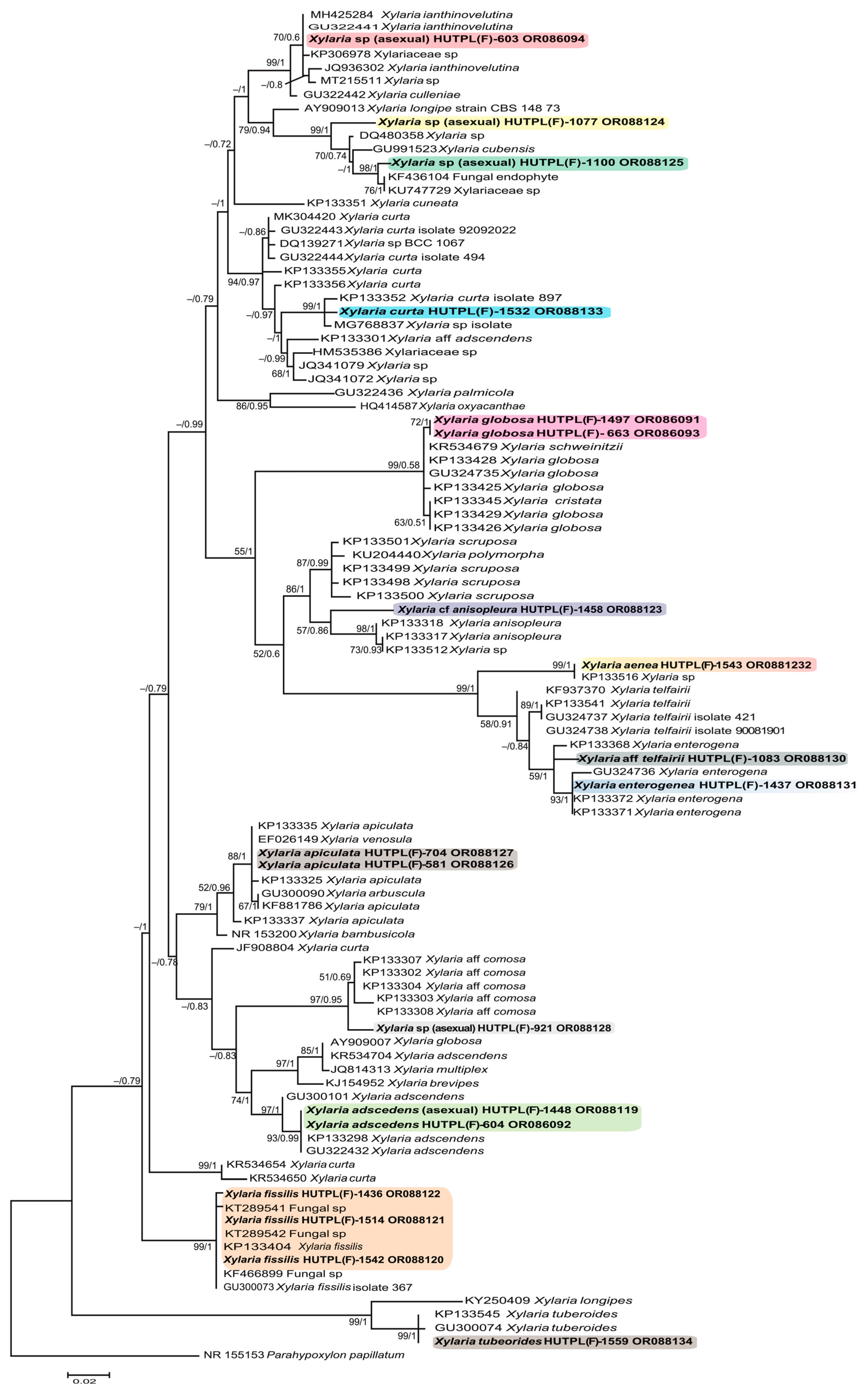
After DNA amplification, sequences for the ITS-5.8S region and the partial LSU D1/D2 region were obtained from 15 specimens. Four additional specimens yielded only the ITS-5.8S region, and one specimen, HUTPL(F)-1533, failed to amplify (Table 1).
The phylogenetic trees (Figure 1 and Figure S1) inferred using the ITS-5.8S and partial LSU DNA regions, showed partial agreement between some morphologically and phylogenetically defined species. This was evident in taxa like Xylaria cf. anisopleura and Xylaria aff. telfairii (Table 1; Figure 1 and Figure S1), which belong to species complexes with overlapping morphological traits [19].
The ITS-5.8S sequence for Xylaria adscendens showed high similarity to published sequences of the same species (GU322432; KP133298). However, the LSU sequence did not cluster with X. adscendens but instead grouped with a likely misidentified sequence of Xylaria curta (JF773598; Table 2, Figure S1), which was isolated as an endophyte from Taxus globosa.
The ITS-5.8S phylogenetic tree allowed the placement of sequences from several anamorphic specimens into species: HUTPL(F)-1448 as Xylaria adscedens; HUTPL(F)-704 as Xylaria apiculata; HUTPL(F)-1436 as Xylaria fissilis and HUTPL(F)-663 as Xylaria globosa. However, other sequences from anamorphic specimens were only closely related to species-level identifications [i.e., HUTPL(F)-603 related to Xylaria cuneata KP133351; HUTPL(F)-921 close together Xylaria aff. comosa KP133308; HUTPL(F)-1077 and HUTPL(F)-1100 related to Xylaria cubensis GU991523]. The remaining sequences from anamorphic specimens [HUTPL(F)-603, HUTPL(F)-921, HUTPL(F)-1077, HUTPL(F)-1100] clustered separately and are provisionally designated as Xylaria spp. Additionally, the sequence from the Xylaria aenea morphospecies did not cluster with any described species (Table 2, Figure 1 and Figure S1), supporting the notion that no reference sequences for this taxon are currently available.

3.2. Morphology

Among the 20 Xylaria collections analyzed, 11 teleomorph specimens were identified to species level using an integrative approach combining morphological and molecular analyses. These analyzed specimens corresponded to 10 species of Xylaria: Xylaria adscendens, X. aenea, X. cf. anisopleura, X. apiculata, X. curta, X. enterogena, X. fissilis, X. globosa, X. aff. telfairii, and X. tuberoides. Nine collections were found only in the anamorph state. Four [HUTPL(F)-1448, HUTPL(F)-604, HUTPL(F)-663, HUTPL(F)-1436] were assigned by molecular methods to species level (Table 1), and the other five [HUTPL(F)-603, HUTPL(F)-921, HUTPL(F)-1077, HUTPL(F)-1100, HUTPL(F)-1533] were not classified into any described species (Table 1).

3.3. Taxonomy

Xylaria adscendens Fr., Linnaea 5: 537 (1830)
MycoBank No: 190364
Synonymy: ≡Xylaria adscendens (Fr.) Fr., Nova Acta Regiae Societatis Scientiarum Upsaliensis 1: 128 (1851); ≡Xylosphaera adscendens (Fr.) Dennis, Kew Bulletin 13 (1): 102 (1958); ≡Xylosphaera hypoxylon subsp. adscendens (Fr.) Dennis, Bulletin du Jardin Botanique de l’État à Bruxelles 31: 124 (1961); ≡Xylaria hypoxylon subsp. adscendens (Fr.) D. Hawksw., Transactions of the British Mycological Society 61 (1): 199 (1973); Sensu Mycobank Database [3].
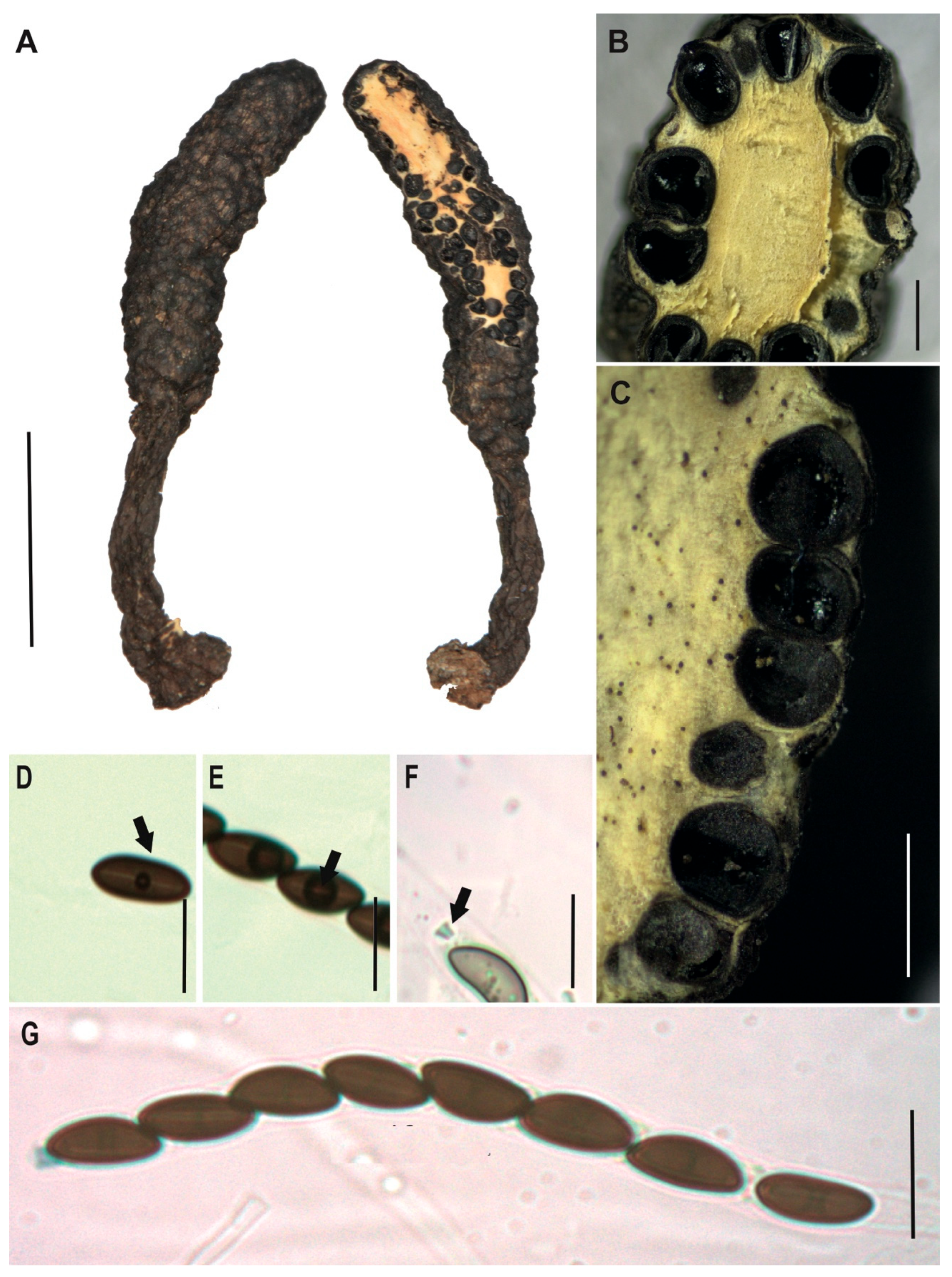
Description. Stromata usually solitary and occasionally forming small groups, cylindrical and slightly apiculate without branches, externally black, rough to cracked, and the entostromata white to cream, 32–50 × 3–5 mm with stipe of 8–22 × 1–2 mm. In the immature asexual state, the stromata exhibit a slightly creamy white coloration at the upper part. Perithecia totally immersed into the stromata, black with ostioles slightly papillate. Asci unitunicate, inoperculate, and cylindrical with eight ascopores, 75–84 × 4–5 μm.
Apical apparatus amyloid, 2–3 × 1–2 μm, tubular, parallel, and slightly flattened at the upper apical part. Ascospores uniseriate, guttulate, with a straight spore-length germ slit [(10–) 11 (–12) × (4–) 4.5 (–5) μm], elliptical and inequilateral or oblique with Q value 2.4 μm, dark brown colored. Paraphyses absent.
Examined specimens. SOUTH AMERICA: ECUADOR. Zamora Chinchipe, el Tambo, Estación Científica San Francisco, path AT (1900 m.a.s.l.), growing on decaying wood, 19 May 2015, A. Chamba EM-166, HUTPL(F)-1448; same locality, path AT (1900 m.a.s.l.), growing on decaying wood, 3 April 2014, D. Cruz IR-109, HUTPL(F)-604 (asexual state only).
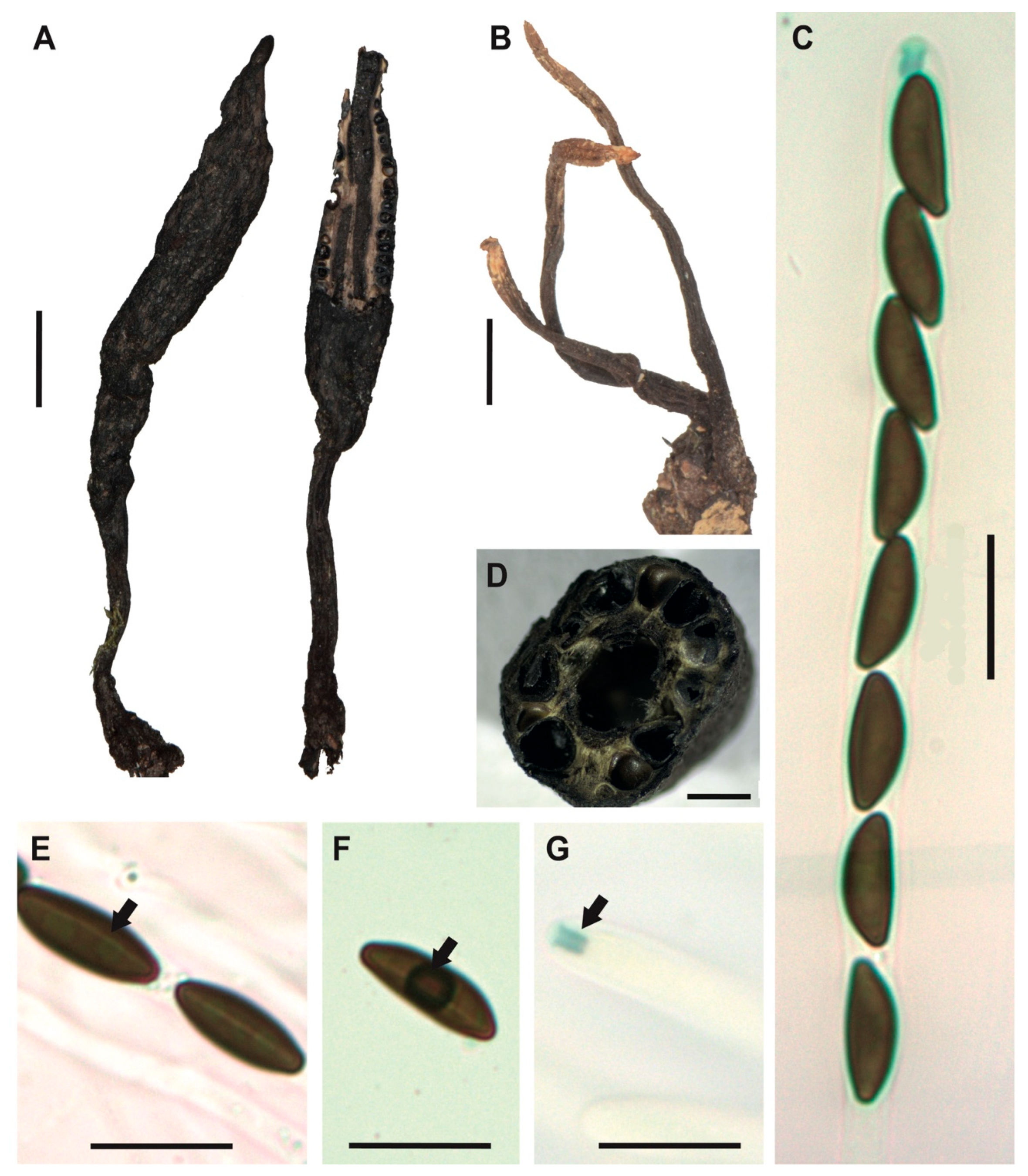
Remark. Our specimen HUTPL(F)-1448 (Figure 2), characterized by ellipsoid and inequilateral ascospores, exhibits a general morphological resemblance to several specimens identified as Xylaria adscendens. Notably, it aligns with descriptions from tropical South American forests, such as Brazilian collections with ascospores dimensions of 9–14 × 4–5 μm [75] or (9–)11–14.5(–15) × 3–5 μm [30]. Comparable measurements have also been reported from cloud forests in Mexico for ascospores of X. adscendens with (9–) 10.5–13(–14) × 4.5–5 μm [76], and Papua Nueva Guinea 11–14 × 4.5 μm [77,78].
The specimen HUTPL(F)-1448 described here is consistent with Xylaria adscendens, differing from the branched stromata of X. hypoxylon [75] and the massive, fused stromata of X. multiplex [76,77], while sharing the pointed apex and long, striped peeling layer characteristic of the X. hypoxylon aggregate [20]. Based on its morphology and phylogenetic placement with other ITS-5.8S sequences identified as X. adscendens from ascomata-derived strains, we retain the identification of specimen HUTPL(F)-1448 and HUTPL(F)-604 as Xylaria adscendens.
Xylaria aenea Mont., Annales des Sciences Naturelles Botanique 3: 100 (1855).
MycoBank No: 535638
Synonymy:Xylaria aenea Mont. (1855); ≡Xylosphaera aenea (Mont.) Dennis, Kew Bulletin 13 (1): 102 (1958); Sensu Mycobank Database (http://www.mycobank.org/).
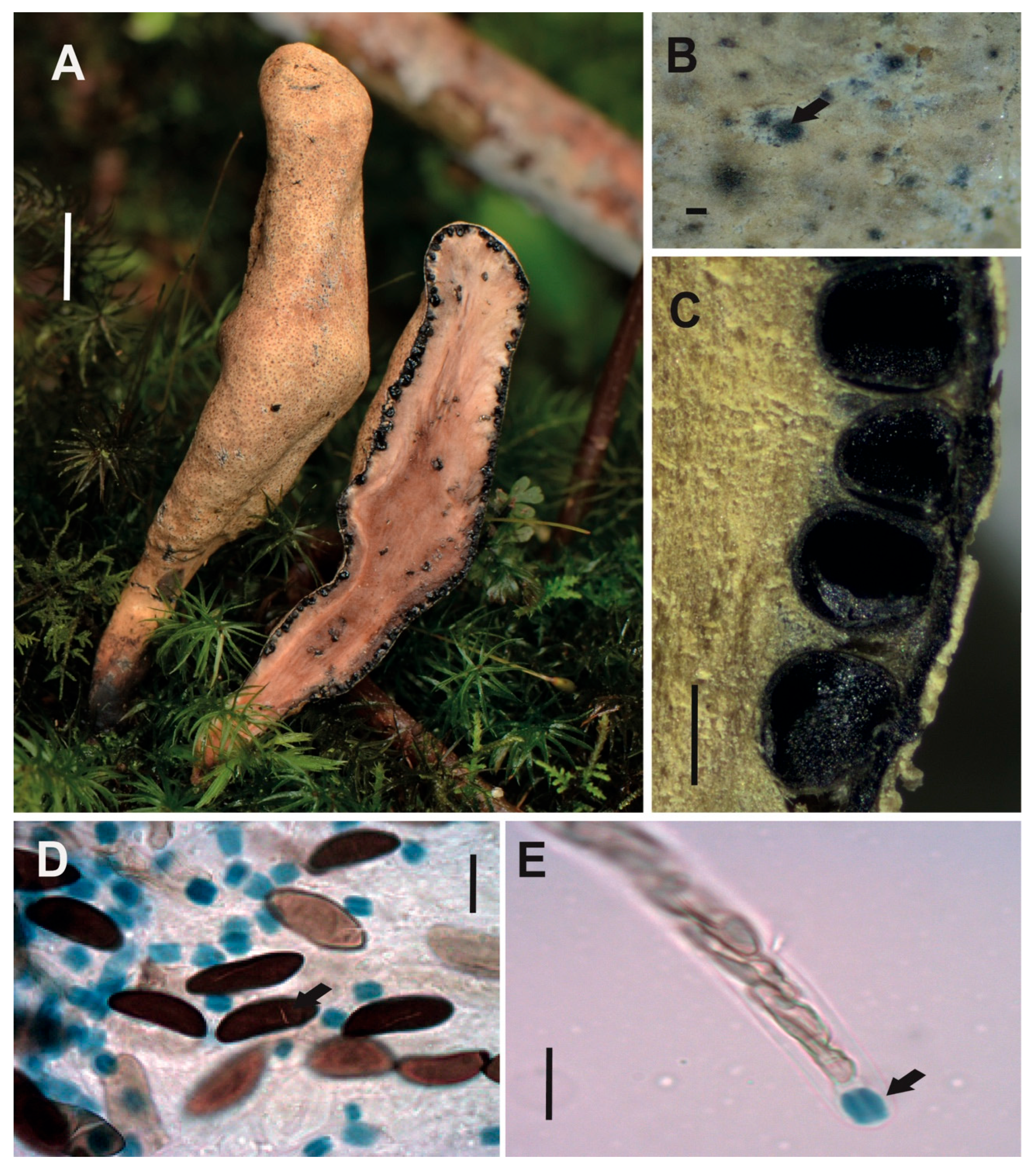
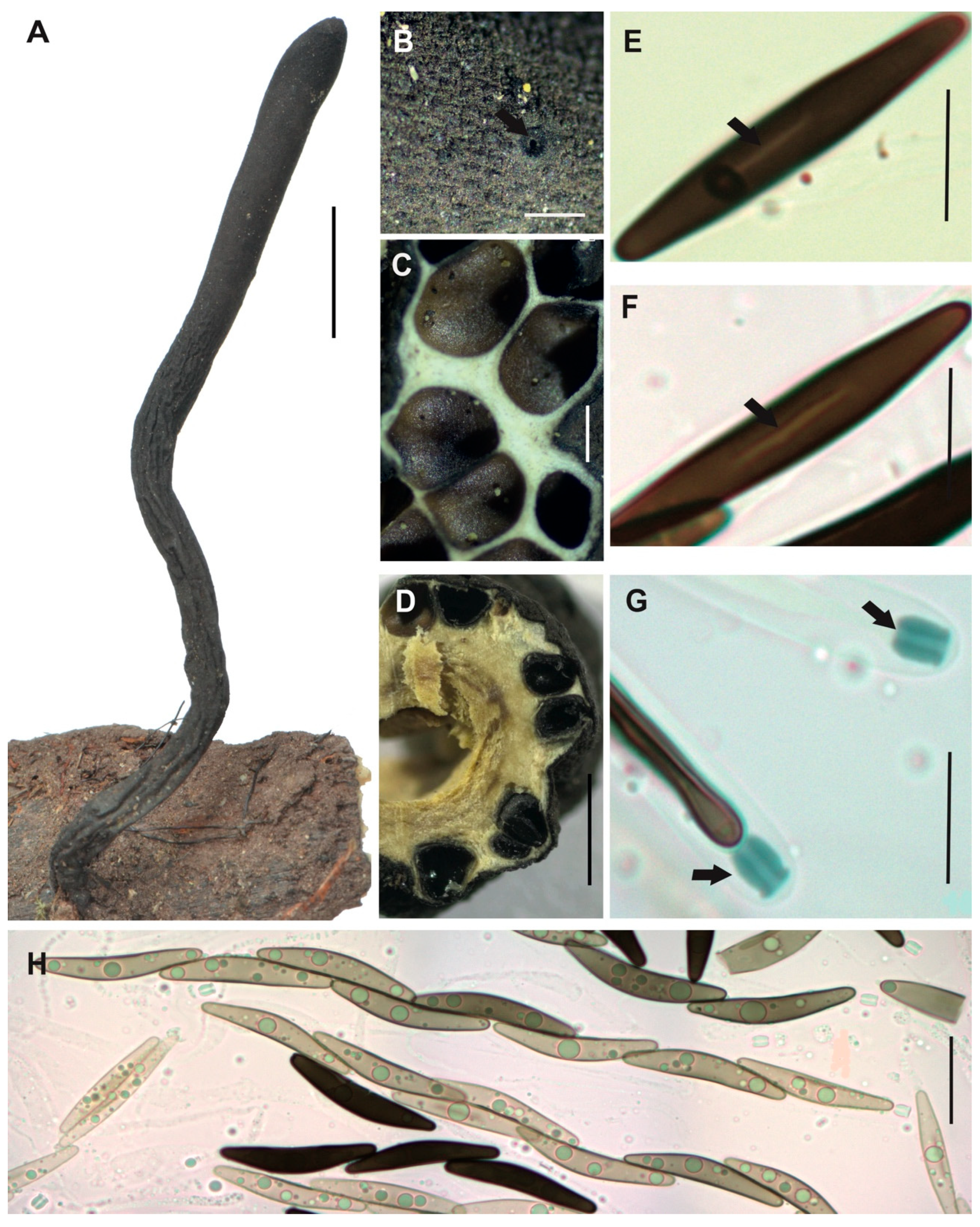
Description. Stromata solitary, unbranched, clavate and rounded at the top, with fluted or large wrinkled black surface, but white to cream internally, 99 × 8 mm with stipe of 47 × 4 mm. Perithecia totally immersed in the stromata, black with discoid ostioles slightly papillate. Asci with eight partially biseriate ascospores 133–169 × 5–11.5 μm. Apical apparatus amyloid to Melzer’s reaction, 4–5 × 3–4 μm, tubular, parallel, and slightly urn-shaped, with a narrow neck and a broad opening. Ascospores biseriate, with two to three internal oil drops, partial ventral germ slit [(30–)33.5(–37) × (5–)6(–7) μm], elliptical, inequilateral or partially falcate with Q value 5.6, and dark brown color. Paraphyses absent.
Examined specimens. SOUTH AMERICA: ECUADOR. Zamora Chinchipe, el Tambo, Estación Científica San Francisco, path T2 (2500 m.a.s.l.), growing on decaying wood, 25 August 2015, D. Cruz EM-593, HUTPL(F)-1543.
Remark.
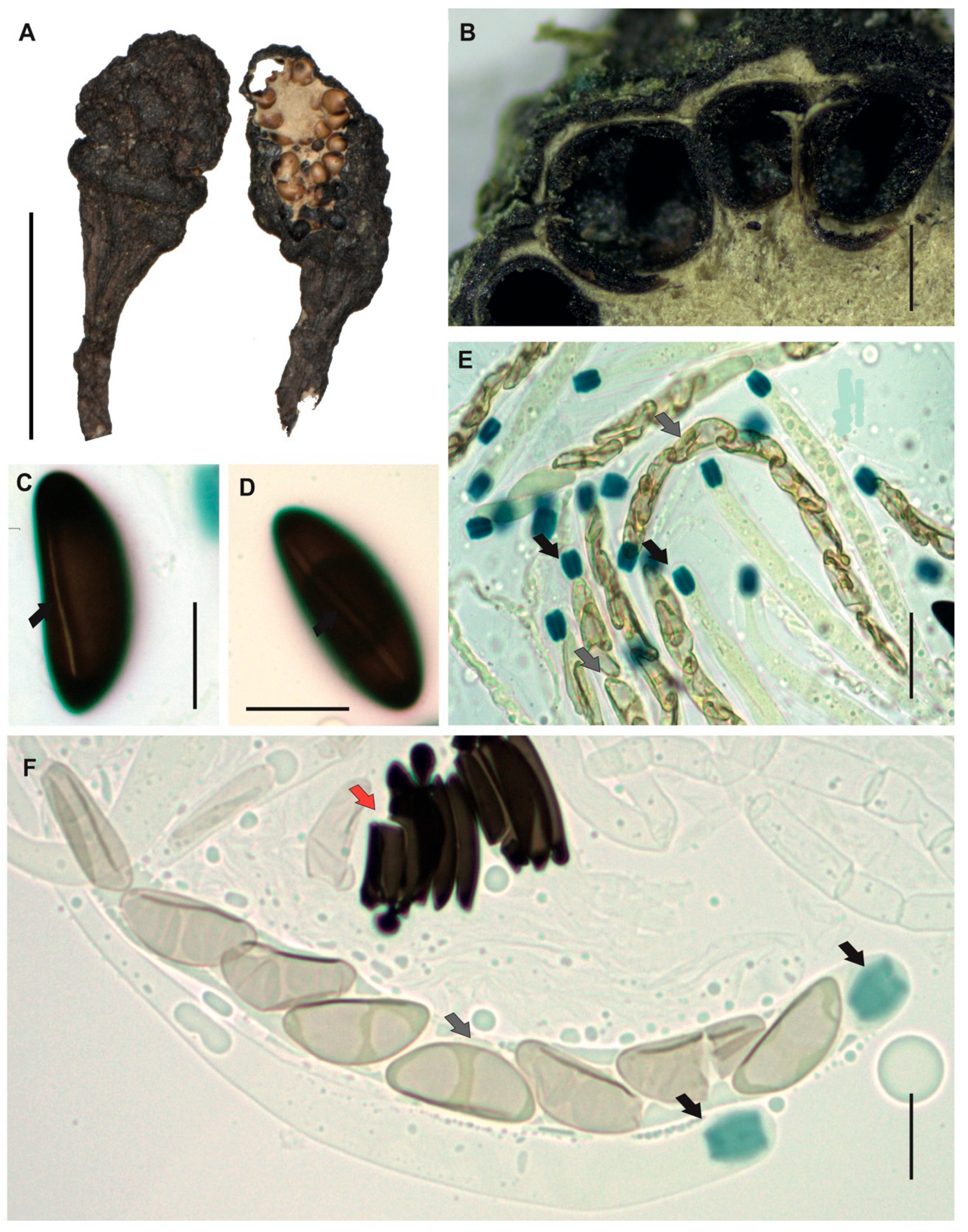
Our specimen HUTPL(F)-1543 (Figure 3) matches with Xylaria cf. aenea as interpreted by Rogers [31] and epitypified by Ju and Hsieh [79], particularly in the shape and size range of both stromata “cylindrical or clavate, unbranched, rounded and fertile at apex, on a short to long stipe, up to 7 cm in total length × 0.4–2.1 cm broad, 2.5–5.8 cm long at fertile parts, 0.7–5.0 cm long at stipes; surface lacking perithecial mounds” and ascospores “(26.5–)28.5–34(–37.5) × (4.5–)5–6(–8) µm brown to dark brown, unicellular, falcate, with broadly rounded ends, bearing a tiny cellular appendage on one end”. Rogers [31] examined and compared specimens originally described from Venezuela by Dennis [80], subsequently, Ju and Hsieh [79] studied the same material examined by Dennis and proposed an epitypification for Xylaria aenea (VENEZUELA. Aragua, Colonia Tovar, Fendler A. 253, as X. aenea by Dennis, R.W.G. [K(M) 169675 ex Berk. herb.] EPITYPE). The concept of Xylaria aenea based on the epitype aligns with our specimen in terms of ascospore shape and dimensions. However, it clearly differs in stromatal morphology, presenting shorter, more compact stromata with a finely cracked, bronze-colored surface. In contrast, our specimen develops larger stromata, reaching up to 99 mm in length and 8 mm in width, with a prominently fluted or wrinkled surface, whereas the epitype measures only 70 mm in length and 4–21 mm in width.
Based on the strong morphological correspondence in ascospore characteristics, we assign our specimen HUTPL(F)-1543 to Xylaria aenea. The observed differences in stromatal size and surface texture are interpreted as intraspecific variation, likely influenced by environmental conditions.
To date, no reference sequences for Xylaria aenea exist in GenBank or other databases. However, the ITS-5.8S sequence of our specimen matches the unidentified “Xylaria sp.” reported by Thomas [33], and shows close similarity to sequences of X. enterogenea, suggesting a possible genetic relationship.
Xylaria cf. anisopleura (Mont.) Fr., Sylloge generum specierumque plantarum cryptogamarum: 204 (1851)
MycoBank No: 190626
Synonymy:Hypoxylon anisopleuron Mont., Annales des Sciences Naturelles Botanique 13: 348 (1840); ≡Xylosphaera anisopleura (Mont.) Dennis, Kew Bulletin 13 (1): 102 (1958); Sensu Mycobank Database (http://www.mycobank.org/).
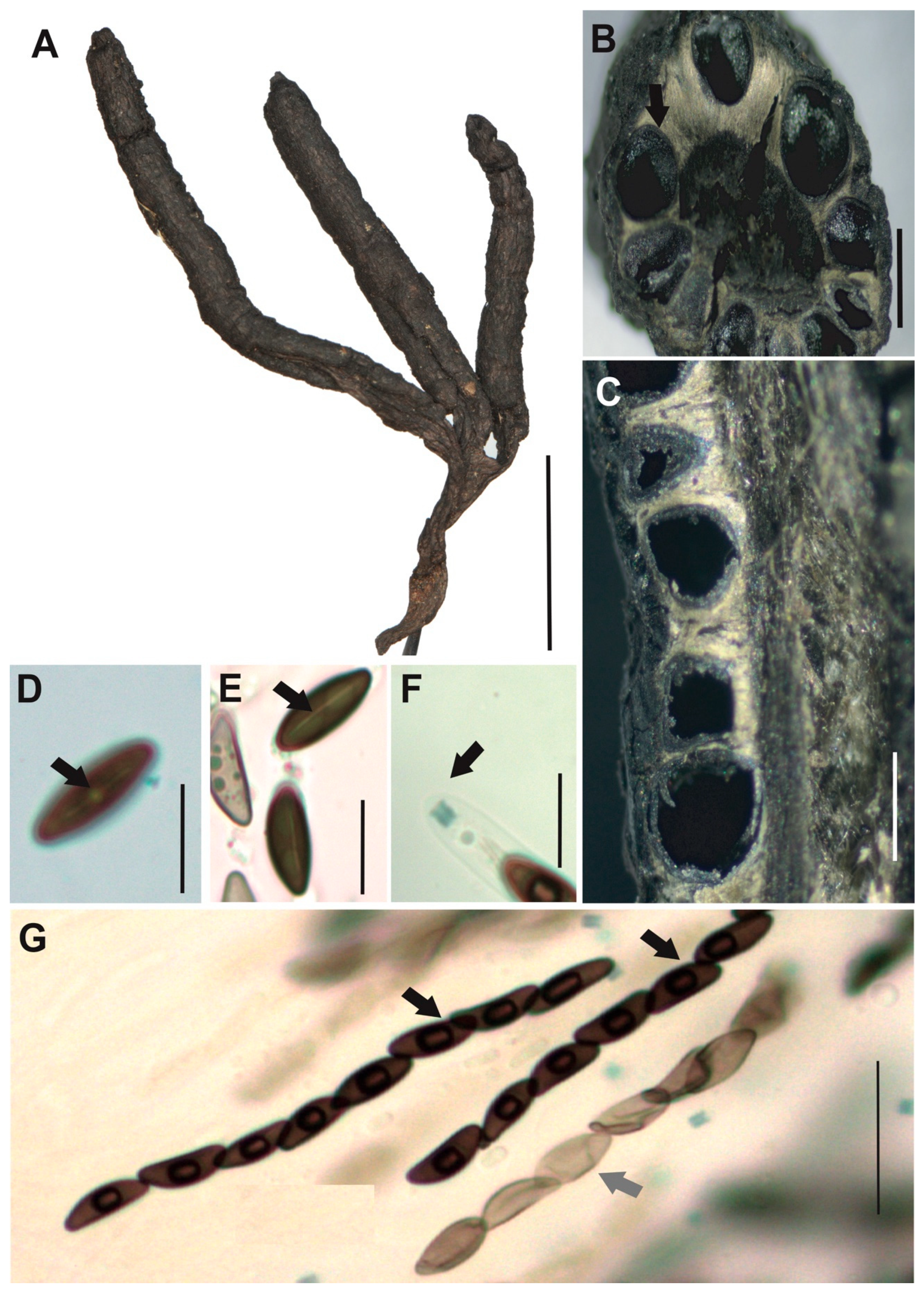
Description. Stromata gregarious, unbranched, subglobose to clavate, rounded and moriform surface to the top, commonly black to strong brown, with white entostromata limited at the stromata base by one black line, 9–12 × 3–4 mm with stipe of 2–4 × 0.7–1 mm. Perithecia totally immersed into the stromata, black with umbilicated ostioles. Asci cylindrical with eight ascospores, 142–164 × 9–12 μm. Apical apparatus amyloid to Melzer’s reaction, 4–5 × 3–4 μm, tubular slightly curved, parallel, with flattened at the upper apical part. Ascospores uniseriate, with one or two internal oil drops, partial spiral to oblique ventral germ slit [(19–)23(–28) × (7–)9(–13) μm], elliptical, inequilateral with Q value 2.5, and dark brown color. Paraphyses absent.
Examined specimens. SOUTH AMERICA: ECUADOR. Zamora Chinchipe, el Tambo, Estación Científica San Francisco, path T2 (2500 m.a.s.l.), growing on decaying wood, 02 June 2015, A. Chamba EM-506, HUTPL(F)-1458.
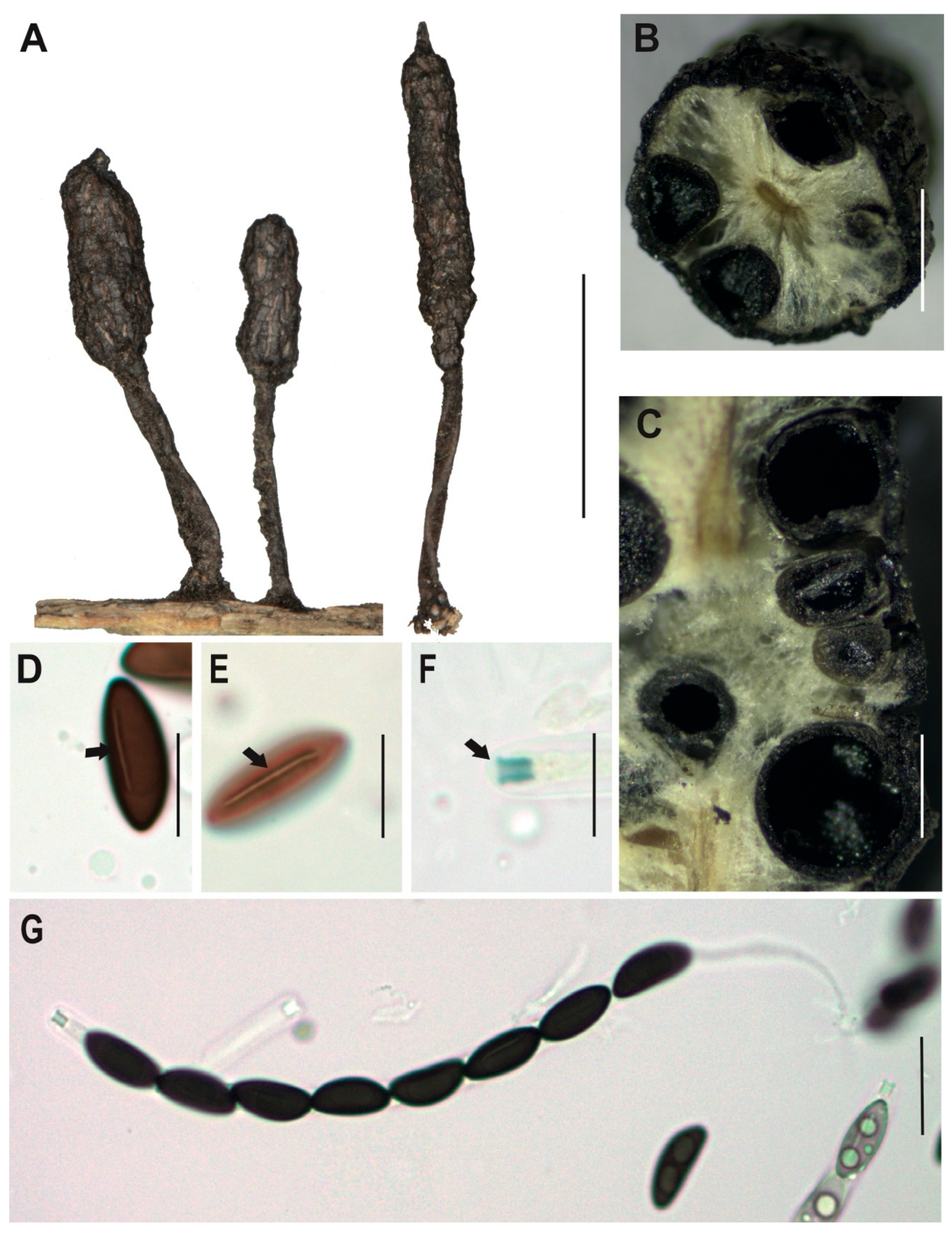
Remark. The specimen HUTPL(F)-1458 (Figure 4) with small and their partial spiral to oblique ventral germ slit in the ascospores correspond to Xylaria anisopleura applying the taxonomic keys [30,81]. Additionally, our specimen is morphologically like many descriptions of X. anisopleura from different tropical forest [30,75,78,81,82,83]. Our X. cf. anisopleura (HUTPL(F)-1458) is different to the specimen HUTPL(F)-1497 presented here as Xylaria globosa, specially by the shorter stromata and the partial spiral to oblique ventral germ slit.
However, Rogers [31] considered to X. anisopleura part of a complex group closely related to morphospecies such as X. globosa, which was later treated as synonym by Van der Gucht [75] and Hamme and Trinidad [29], as well as to X. polymorpha and X. scruposa according to Dennis [80] and Cruz [84]. Due to the high degree of morphological overlap between X. anisopleura and X. globosa, Fournier [85] also treated both taxa as synonymous.
However, Dennis [80] suggests Xylaria anisopleura differs from X. polymorpha mainly by its smaller stromata, and Cruz [84] suggest it differs from X. scruposa by its larger ascospores [13–21 × 4.5–7 µm in X. scruposa], and in its distinctly moriform stromata.
Xylaria apiculata Cooke, Grevillea 8 (46): 66 (1879)
MycoBank No: 190405
Synonymy:Xylosphaera apiculata (Cooke) Dennis, Kew Bulletin 13 (1): 102 (1958); Sensu Mycobank Database (http://www.mycobank.org/).
Description. Stromata grouped or solitary, unbranched, cylindrical, smooth when young and becoming vertically striping so called “zebra-stripping” coming splits with perithecial swelling, blackish color, with a sterile apex (without perithecia), and white to cream entostromata, 11–23 × 2–3 mm with stipe of 5–10 × 0.4–1 mm, slightly tomentose. Perithecia totally immersed into the stromata, present in the whole fertile area, black with umbilicated barely visible ostioles. Asci stipitate at the base and continue cylindrical with eight ascospores, 90–110 × 6–10 μm. Apical apparatus amyloid to Melzer’s reaction, 9–11 × 5–8 μm, tubular, parallel, and slightly flattened at the upper apical part. Ascospores uniseriate, with one or two internal oil drops, partial ventral germ slit [(14–)16(–18) × (6–)7(–8) μm], elliptical, inequilateral with Q value 2.3, and light brown to dark brown color. Paraphyses absent.
Examined specimens. SOUTH AMERICA: ECUADOR. Zamora Chinchipe, el Tambo, Estación Científica San Francisco, path AT (1900 m.a.s.l.), growing on decaying wood, 3 April 2014, A. Chamba IR-85, HUTPL(F)-581; same locality, path AT (1900 m.a.s.l.), growing on decaying wood, 3 July 2014, A. Chamba IR-211, HUTPL(F)-704.
Remark. Xylaria apiculata is distinguished by short stromata less than 3 mm and surface texture reassembling “zebra-stripping” typically in this species, as well as ascospores measurements. The ascospores of X. apiculata have been reported by other authors as measuring 16–18.5(19) × (4)5–6.5 μm [75] and 16–21 × 6–7.5 μm [80]. This species differs from closely related taxa such as Xylaria venosula, which has significantly larger ascospores measuring 21–25 × 7.5–8 μm [80] and has been considered a synonym of Xylaria xylaroides by Hladki and Romero [26].
Phylogenetically, the ITS-5.8S sequences from specimens HUTPL(F)-581 and HUTPL(F)-704 clustered with sequences identified as X. apiculata from the Ecuadorian cloud forest [33]. Interestingly, one sequence labeled as X. venosula also grouped within this clade, possibly due to misidentification, as the two species are morphologically distinct.
Additionally, LSU data show that our X. apiculata specimens are closely related to X. arbuscula. However, key morphological differences—particularly in stromatal architecture and ascospore dimensions support their distinction as separate species (see X. arbuscula description).
Xylaria curta Fr., Nova Acta Regiae Societatis Scientiarum Upsaliensis 1: 126 (1851)
MycoBank No: 179336
Synonymy:Xylosphaera curta (Fr.) Dennis, Kew Bulletin 13 (1): 103 (1958); Sensu Mycobank Database (http://www.mycobank.org/).
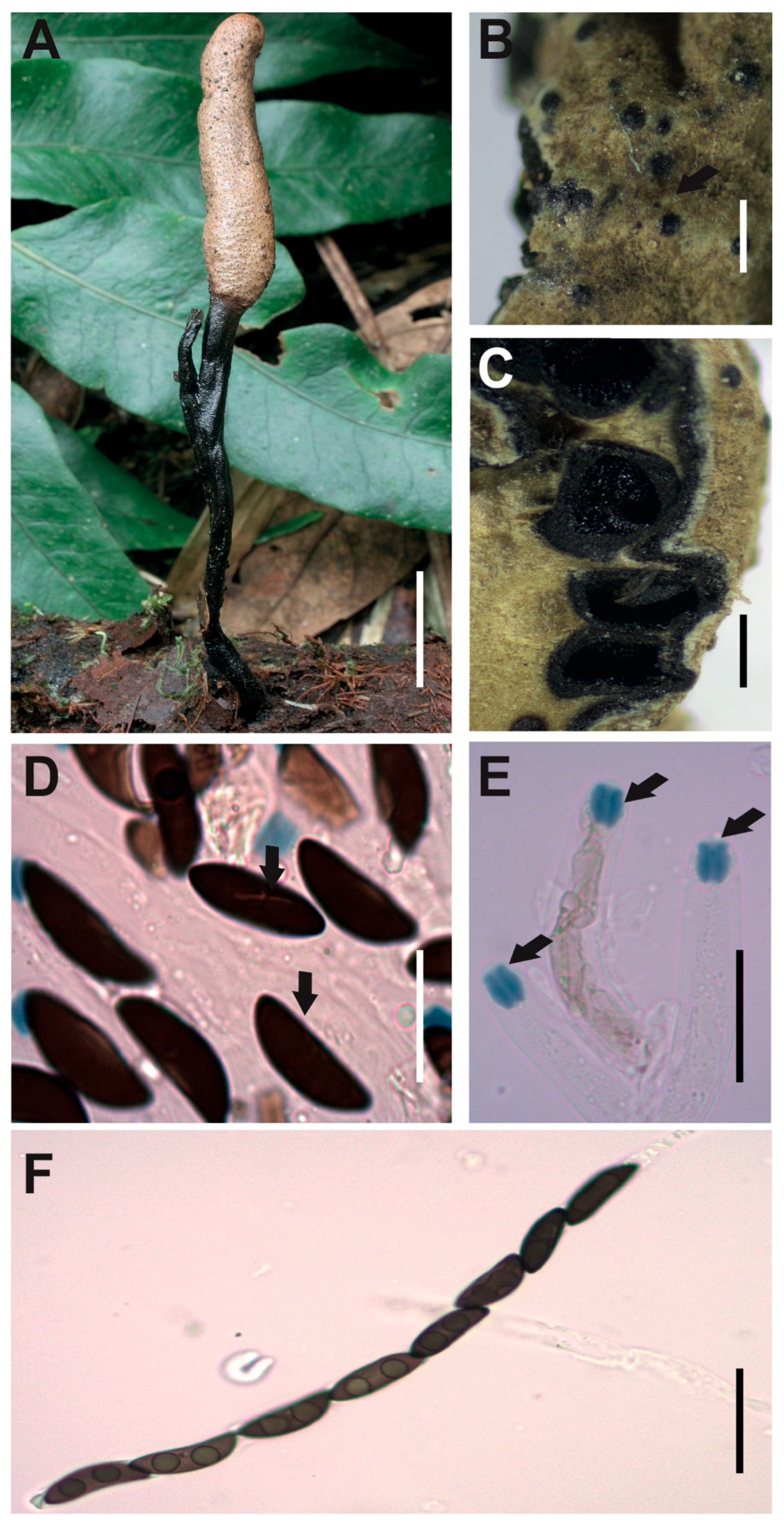
Description. Stromata 13–24 × 3–6 mm, with stipe of 8–11 × 1–3 mm, clustered in groups of two to six fruit bodies, cylindrical, rough, rounded to the apex, blackish in color, but sometimes with external scales conferring brownish color; white to cream entostromata. Perithecia globose, totally immersed in the stromata, black with papillate ostioles. Asci cylindrical with eight ascospores, 65–77 × 4–4.8 μm. Apical apparatus amyloid to Melzer’s reaction, 2–3 × 1–2 μm, tubular, parallel, and narrow at the base, becoming slightly flattened toward the apical portion. Ascospores uniseriate, guttulate central, with ventral straight germ slit commonly covering the whole spore (9–)10(–11) × (4–)4.5(–5) μm, elliptical, inequilateral with Q value 2.2, and brown color. Paraphyses absent.
Examined specimens. SOUTH AMERICA: ECUADOR. Zamora Chinchipe, el Tambo, Estación Científica San Francisco, path T2 (2500 m.a.s.l.), growing on decaying wood, 25 August 2016, D. Cruz EM-582, HUTPL(F)-1532.
Remark. The specimen [HUTPL(F)-1532] (Figure 6), based on its morphology, fits within the species Xylaria curta according to the taxonomic key provided by Dennis [80]. However, the size of the stroma appears to be highly variable (ranging from 1.8 cm to 5 cm), as also reported in specimens of X. curta from Mexico, Brazil, Costa Rica, France, and Venezuela [30,75,83].
Hsieh [20] placed Xylaria curta within the X. corniformis aggregate, which also includes X. feejeensis, X. montagnei, and X. plebeja, all characterized by similar stromatal textures finely cracked or wrinkled and small, ellipsoid ascospores. Our specimen of X. curta resembles X. feejeensis in ascospore size (8–12 × 4–5 µm), but differs by having stouter, often sessile and clustered stromata, with a white to cream immature surface that is distinctly cracked into persistent angular or rounded scales between the ostiolar papillae.
Phylogenetically, the ITS-5.8S and LSU sequences of specimen HUTPL(F)-1532 cluster with other X. curta sequences (AB376702, GU322444, KP133352, KP133356) derived from axenic cultures of ascomata, as reported by Thomas [33], Hsieh [20], and Okane [71]. These analyses indicate that X. curta forms a distinct clade, separate from closely related taxa, supporting its recognition as an independent species within the complex. Morphologically, our specimen differs from X. montagnei and X. feejeensis by its shorter stromata, and from X. plebeja by having broader ascospores.
Xylaria enterogena Mont., Syll. gen. sp. crypt. (Paris): 203 (1856)
MycoBank No: 250347
Description. Stromata solitary, unbranched, clavate with rounded apex, yellowish cream in color, 63 × 4–6 mm with stipe 16 × 3 mm, with a smooth and hard surface; entostromata wet and white when fresh, darkening and becoming hollow in age. Perithecia immersed into the stromata, with ostiolar black rings. Asci cylindrical with eight ascospores, 131–142 × 6–11 μm. Apical apparatus amyloid to Melzer’s reaction, 5–6 × 3–5 μm, tubular slightly curved, parallel, with flattened at the upper apical part. Ascospores uniseriate, with one or two guttules, partial ventral germ slit sometimes oblique to one apex (18–)21(–24) × (5–)7(–9) μm, elliptical, inequilateral with Q value 3, and brown color. Paraphyses absent (Figure 7).
Examined specimens. SOUTH AMERICA: ECUADOR. Zamora Chinchipe, el Tambo, Estación Científica San Francisco, path T2 (2500 m.a.s.l.), growing on decaying wood, 19 May 2016, A. Chamba EM-485, HUTPL(F)-1437.
Remark. Xylaria enterogena is usually confusing with Xylaria telfairii (Berk.) Sacc., specially by the ascospores shape and measurements. Rogers et al. (1988) [31] report to X. enterogena with ascospores (13–)17.5–25 × 6–7.5 μm and X. telfairii with ascospores (15–)16–21 × 6–7.5 μm. Based on similar ascospore dimensions, these species were suggested as conspecific by Dennis (1956) [80], who considered that X. enterogena to be a young state of X. telfairii.
The specimen HUTPL(F)-1437 (Figure 7) has characteristics close to the description of X. aff. enterogena (sensu [81]) from Mexico, which has 68 mm stromata length and ascospores measurements (19–)20–23(–25) × 8–9.5(–10). Here, the specimen HUTPL(F)-1437 differ to the specimen HUTPL(F)-1083 for the stromata 95 × 6–14 mm (fertile portion 38 mm length), with long brown, and smooth stipe 57 × 4 mm, but similar ascospores shape and measurements (18–)21(–25) × (5–)7(–9) μm, and molecular placement (Figure 7). Molecular data show a close relationship between our specimen HUTPL(F)-1437 Xylaria enterogenea and X. telfairii. This affinity is further supported by recent analyses by Forin [19], which include the sequence [HUTPL(F)-1437, OR088131] within a distinct clade referred to as the Xylaria enterogenea complex, positioned close to but separate from the X. telfairii clade.
Xylaria fissilis Ces. Atti dell’Accademia di Scienze Fisiche e Matematiche Napoli 8 (3): 16 (1879)
MycoBank No: 145665
Description. Stromata gregarious mostly with two lateral branches, cylindrical, black color, slightly cracked, flattened flabelliform, pointing towards the apex, with blackish entostromata, internal 17–18 × 1–4 mm, with stipe 3.5–11 × 1–2.5 mm. Perithecia mostly immersed into the stromata, black with papillate ostioles. Asci cylindrical with eight ascospores, 66–96 × 4–6 μm. Apical apparatus amyloid to Melzer’s reaction, 2–4 × 2–3 μm, tubular, parallel, and slightly flattened at the upper apical part. Ascospores uniseriate, with germ slit, almost full spore length (10–)13(–14) × 4(–6) μm, navicular to elliptical, inequilateral with Q value 3.2 and brown color. Paraphyses absent.
Examined specimens. SOUTH AMERICA: ECUADOR. Zamora Chinchipe, el Tambo, Estación Científica San Francisco, path AT (1900 m.a.s.l.), growing on decaying wood, 21 July 2016, A. Chamba EM-564, HUTPL(F)-1514; same locality, path T2 (2500 m.a.s.l.), growing on decaying wood, 25 August 2015, D. Cruz EM-592, HUTPL(F)-1542; same locality, path AT (1900 m.a.s.l.), growing on decaying wood, 19 May 2015, A. Chamba EM-484, HUTPL(F)-1436.
Remark. When follow the taxonomic key given by Hladki and Romero [24,26] for Xylaria spp. from Argentina our description for the specimens revised here fit into the Xylaria fissilis specially by the ascospores measurements 14.5–17.5 × 4–7 μm. Trierveiler Pereira [30] mention that X. nigromedullosa presents similar dark brown to black entostromata as described for X. fissilis and X. luxurians (Rehm) Lloyd. However, our specimens, identified as Xylaria fissilis, differs from X. luxurians Dennis [80] and X. nigromedullosa Trierveiler Pereira [30] in their stromatic features which are slightly cracked, flattened, and flabelliform with an apex-oriented growth as well as in ascospore size 21–24 × 8–9 and 7–9.5 × 4–5 µm respectively and the presence of a germ slit extending nearly the entire length of the ascospores.
Xylaria globosa (Spreng.) Mont. (1855)
MycoBank No: 292028
Synonymy:Hypoxylon globosum (Spreng. ex Fr.) Fr., Nova Acta Regiae Societatis Scientiarum Upsaliensis 1: 130 (1851); Sensu Mycobank Database (http://www.mycobank.org/).
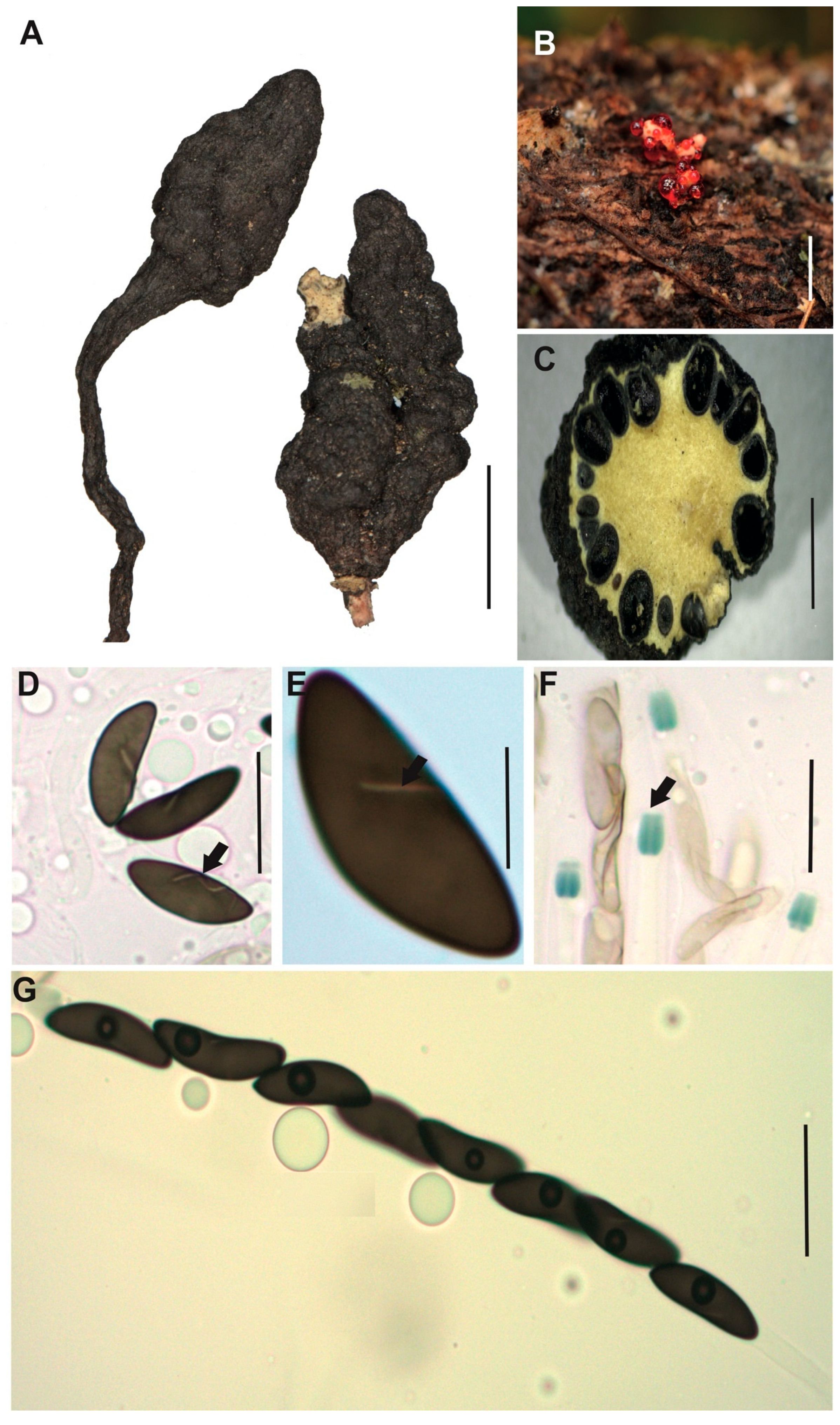
Description. Stromata usually solitary or sometimes grouped, cylindrical to obclavate, rounded to the apex, blackish color, roughly and slightly cracked, with white to cream entostromata, 16–29 × 4–8 mm with stipe sometimes difficult to distinguish from the stromata 5–14 × 1–2 mm. In asexual state present red exudates on young stromata. Perithecia totally immersed into the stromata, black with papillate ostioles. Asci cylindrical with eight ascospores, 146–210 × 8–14 μm. Apical apparatus amyloid to Melzer’s reaction, 7–10 × 5–7 μm, tubular slightly curved, parallel, with flattened at the upper apical part. Ascospores uniseriate, guttulate commonly with one to two oil drops, with partial spiral ventral germ slit [(25–)28(–33) × (8–)9(–11) μm], elliptical, inequilateral with Q value 3, and strong brown color. Paraphyses absent.
Examined specimens. SOUTH AMERICA: ECUADOR. Zamora Chinchipe, el Tambo, Estación Científica San Francisco, path T2 (2500 m.a.s.l.), growing on decaying wood, 7 July 2016, A. Chamba EM-545, HUTPL(F)-1497; same locality, path AT (1900 m.a.s.l.), growing on decaying wood, 5 June 2014, A. Chamba IR-170, HUTPL(F)-663 (asexual state).
Remark. Xylaria globosa is distinguished by its large elliptical ascospores, as observed in specimen HUTPL(F)-1497 (Figure 9). This specimen fit well within the concept of X. globosa when applying the taxonomic key for Xylaria species from Argentina proposed by Hladki and Romero [26] specially by the ascospores size 22–30 × 8–9.5 μm. The other specimen HUTPL(F)-663 is determined as X. globosa because their asexual state presents a red exudate, a morphological character typical for this species (Figure S1).
Phylogenetically, our ITS-5.8S sequences cluster with reference sequences of Xylaria globosa (e.g., GU324735, KP133429), forming a well-supported clade consistent with that reported by Forin [19], and clearly separated from the clade containing Xylaria cf. anisopleura [HUTPL(F)-1458]. Although X. globosa has been previously synonymized with X. anisopleura due to morphological variability, the ascospores of our specimens [(25–)28(–33) × (8–)9(–11) μm] closely match the measurements reported by Hladki and Romero [26], supporting their identification as X. globosa. Furthermore, Forin [19] identified Xylaria aurantiorubroguttata as the sister group to X. globosa, but distinguishable by morphological traits such as slightly shorter ascospores (~23.9 × 8 μm) with a non-sigmoid, oblique germ slit.
Xylaria aff. telfairii (Berk.) Sacc., Sylloge Fungorum 1: 320 (1882)
MycoBank No: 191825
Synonymy:Sphaeria telfairii Berk., Annals and Magazine of Natural History 3: 397 (1839) [MB#165107] ≡Xylosphaera telfairii (Berk.) Dennis, Kew Bulletin 13 (1): 106 (1958); Sensu Mycobank Database (http://www.mycobank.org/).
Description. Stromata solitary unbranched, cylindrical to slightly clavate, and rounded apex, cream to brownish, smooth and hard surface, with cream entostromata, without ventral hole, 95 × 6–14 mm (fertile portion 38 mm length), with long black smooth stipe 57 × 4 mm. Perithecia immersed into the stroma, black with umbilicate ostioles. Asci cylindrical and thin at the basal part with eight ascospores, (125–)142–153 × 6–11 μm. Apical apparatus amyloid to Melzer’s reaction, 5–6 × 3–5 μm, tubular slightly curved, parallel, with flattened at the upper apical part. Ascospores uniseriate, with one or two internal oil drops, partial ventral germ slit sometimes oblique to one apex (18–)21(–25) × (6–)7(–9) μm, elliptical, inequilateral with Q value 3, and brown color. Paraphyses absent.
Examined specimens. SOUTH AMERICA: ECUADOR. Zamora Chinchipe, el Tambo, Estación Científica of San Francisco, path T2 (2500 m.a.s.l.), growing on decaying wood, 05 March 2015, A. Chamba EM-166, HUTPL(F)-1083.
Remark. Morphologically, our specimen HUTPL(F)-1083 is closely related to Xylaria enterogena and X. telfairii by having cream to brownish stromata (Figure 10), and similar shape and measurements of ascospores. The ascospores measurements (18–)21(–25) × (5–)7(–9) μm in the specimen HUTPL(F)-1083 are into the range of the ascospores measurements found in X. enterogena (15–)16–21 × 6–7.5 μm [31], X. telfairii (13–)17.5–25 × 6–7.5 μm [31], and X. telfairii (15–)16–22(–25) × 6–8 μm [80]. However, the entostromata in the specimen HUTPL(F)-1083 was not hollow, probably due to the perithecia maturity state [80].
The specimens HUTPL(F)-1083 and the specimen HUTPL(F)-1437 are different in color, size (fertile portion 38 mm and stipe 57 mm length in HUTPL(F)-1083, against 49 mm and 16 mm in HUTPL(F)-1437 respectively), and shape of the stroma, but identical in shape of the ascospores (Figure 10).
Based on morphology (Figure 10) the specimen HUTPL(F)-1083 is considered similar most of the microscopical shapes and measurements of Xylaria telfairii available in Dennis [80], and Rogers [31].
The morphological and phylogenetic evidence is not conclusive to confidently identify the specimen HUTPL(F)-1083 as Xylaria telfairii. Therefore, we refer to it as Xylaria aff. telfairii. Although Forin [19] includes our sequence within the X. telfairii clade, it also shows a close relationship to the X. enterogenea clade, highlighting the need for further analysis.
Xylaria tuberoides Rehm, Hedwigia 40: 146 (1901)
MycoBank No: 181321
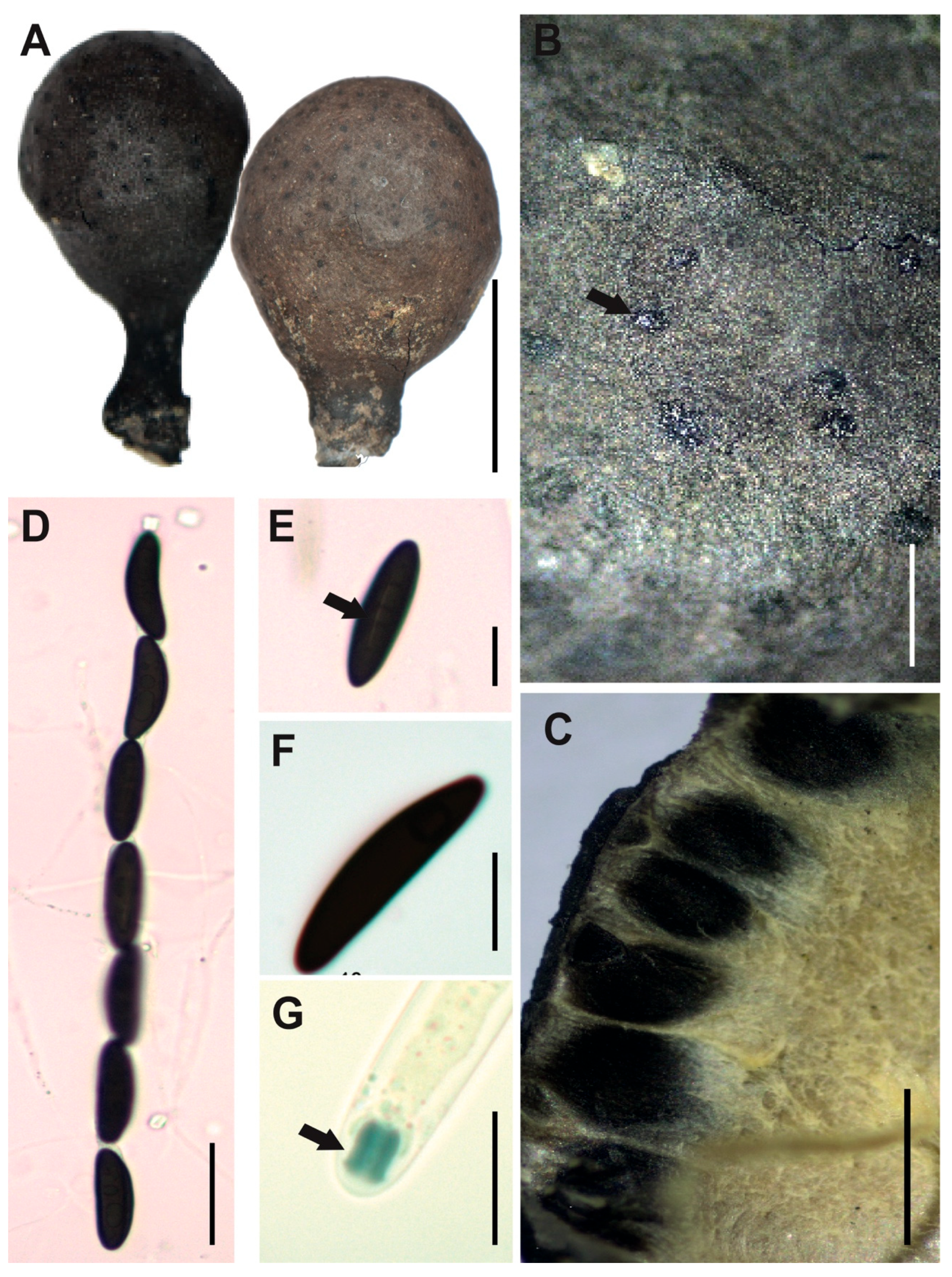
Description. Stromata solitary, globose to subglobose, black, and hard surface, with white to cream entostromata, 12–16 × 8–11 mm with stipe 3–4 × 2–4 mm. Perithecia immersed into the stromata, black with slightly papillate ostioles. Asci cylindrical with eight ascospores, 156–203 × 7–12 μm. Apical apparatus amyloid to Melzer’s reaction, 5–6 × 3–5 μm, tubular, parallel, and slightly urn-shaped, with a narrow neck and a broad opening. Ascospores uniseriate, with two or three internal oil drops, partial ventral germ slit slightly clear (24–)28(–32) × (6–)7(–11) μm, elliptical, inequilateral with Q value 3.9, and brown color. Paraphyses absent.
Examined specimens. SOUTH AMERICA: ECUADOR. Zamora Chinchipe, el Tambo, Estación Científica San Francisco, path T2 (2500 m.a.s.l.), growing on decaying wood, 3 September 2015, J.S. Eguiguren EM-609, HUTPL(F)-1559.
Remark. Xylaria tuberoides is morphologically described with globose and clavate stromata, close to our specimen [HUTPL(F)-1559] (Figure 11) which is globose to subglobose, however the morphological variability in the fruit bodies within the same species of Xylaria is common, especially in different development states. Regarding the microscopic structures, our specimen [HUTPL(F)-1559], with elliptical ascospores elliptical, inequilateral ascospores [(24–)28(–32) × (6–)7(–11) μm], is similar to the ascospores described for Xylaria tuberoides by Cruz (2015) [84] 24–29 × 7–9 μm, both featuring a partial ventral germ slit—slightly visible in our specimen (Figure 11) and inconspicuous in the original description. Additionally, both share a subglobose, stromatal shape.
Phylogenetically, the ITS-5.8S sequence of specimen HUTPL(F)-1559 (Xylaria tuberoides) forms a well-supported clade (Figure 1) together with other sequences identified as X. tuberoides, including KP133545 [33], GU300074 [20], and AB376736 partial LSU (Figure S1) [71]). Based on this phylogenetic congruence, we maintain the identification of our specimen as Xylaria tuberoides.

4. Discussion

Fungal species diversity is high in tropical forests, such as the Estación Científica San Francisco in the Andes, a recognized biodiversity hotspot [35,86]. It is likely that this tropical rainforest harbors thousands of fungal species, as has already been reported by molecular fungal diversity studies from orchid roots [87,88] including ascomycetes. This high richness is consistent with patterns observed in other megadiverse regions, such as the tropical and mixed forests of Guizhou, Yunnan, and Guangxi in China, where Xylariales exhibit high diversity and endemism while fulfilling key ecological roles as decomposers of decaying wood and fallen branches [89]. In this study, 15 of 20 xylaroid specimens (Table 1) were assigned to ten morphological distinct species Xylaria adscendens, X. cf. anisopleura, X. apiculata, X. curta, X. enterogena, X. fissilis, X. globosa, X. aff. telfairii, X. tuberoides, and X. aenea, the latter representing a new record for Ecuador. While the species X. cf. anisopleura, X. aff. telfairii, and X. aenea are partially supported by our molecular data, the phylogenetic analysis presented here (Figure 1 and Figure S1) serves as a preliminary systematic positioning of these specimens within the genus rather than a global reconstruction. This local approach complements broader multigene studies (e.g., [19,20,89]) by providing detailed morphological and molecular data from a Neotropical locality often underrepresented in international databases. Despite the scarcity of reference sequences for the LSU region (Figure S1) which precluded a more refined phylogeny, the ITS-5.8S marker proved more informative (Figure 1), as discussed below.
Correspondence between morphological and molecular data.
Xylaria adscendens [specimen HUTPL(F)-1448] matches well with several published descriptions of the species based on ascospores morphology and measurements [30,75,76,77,78]. Additionally, our ITS-5.8S sequences are cluster with published sequences (Table 2) GU322432 by Hsieh [20] and KP133298 from Ecuadorian cloud forest reported by Thomas [33], both identified as X. adscendens (Figure 1). However, our LSU sequence is cluster together with one sequence identified as Xylaria curta (JF773598; Figure S1), isolated as an endophyte from Taxus globosa [90] that probably represents a misnamed sequence, which is unfortunately common [91].
The Xylaria aenea [HUTPL(F)-1543] is proposed here as a new record for Ecuador, as no previous validated reports of this species have been found in the available literature. For example, Lodge [92] reported numerous Xylaria species for cloud and high montane forest in six Neotropical countries (Belize, Ecuador, the Guianas, Mexico, Puerto Rico, and Venezuela), but X. aenea was not included for Ecuador. Similarly, Thomas [33] did not describe X. aenea in their study, though their unidentified “Xylaria sp. strain 931” matches our specimen at the ITS locus (KP133516). Furthermore, our ITS-5.8S sequence for X. aenea (Figure 1 and Figure S1) did not cluster with any sequences of well-described species available in the GenBank database or in published studies (Table 2), suggesting that reference sequences for this species are currently lacking.
The continuous study of biodiversity hotspots is essential for uncovering global fungal richness. This is exemplified by recent research in Asia, where intensive surveys documented Xylaria frustulosa, X. glebulosa, and X. longissima as new records for the Chinese mainland, significantly expanding the known geographical distribution of these taxa [93]. Our discovery of X. aenea in the Andean foothills similarly contributes to bridging these distributional gaps in the Neotropics. However, molecular evidence indicates a close affinity with X. enterogenea. According to Ju and Hsieh [79], some specimens of X. enterogenea were probably misclassified as X. aenea because of overlapping morphological features.
Xylaria cf. anisopleura [specimen HUTPL(F)-1458] is closely related to the sequence KP133317, obtained from strain 938 (Ecuadorian cloud forest) identified as Xylaria anisopleura [33]. Comparisons based on the LSU D1/D2 region show that the specimen clusters with sequence AB376732, derived from an axenic culture of an ascocarp identified as X. anisopleura [71]. Given the inconclusive evidence—specifically, the morphology (Figure 4) and the ITS-5.8S and LSU D1/D2 sequences (Figure 1 and Figure S1)—specimen HUTPL(F)-1458 is tentatively identified as Xylaria cf. anisopleura. In a recent study by Forin [19], this clade is treated as part of the X. anisopleura complex.
The species Xylaria anisopleura and X. globosa based on their highly variable morphology are difficult to differentiate, as extensively discussed by Fournier [85]. However, our specimens HUTPL(F)-1497 and HUTPL(F)-663 are considered as X. globosa due to their asexual state exhibiting a red exudate, a typical morphological character for this species. Moreover, phylogenetic analysis of the ITS-5.8S region (Figure 1) shows that our sequences cluster with other identified as X. globosa (e.g., KP133429; [33]) and are genetically distinct from Xylaria cf. anisopleura [HUTPL(F)-1458]. These results are consistent with those reported by Forin [19], who recovered both species in separate clades based on ITS-5.8S and multilocus analyses (ITS, ACT, TUB2, and RPB2).
Specimens [HUTPL(F)-581 and HUTPL(F)-704] are proposed as Xylaria apiculata based on morphological characteristics (see remark) and the phylogenetic ITS-5.8 sequences placement (Figure 1). These specimens clustered with two sequences (accession number KP133325 and KP133335) from ascomata collected in the Ecuadorian cloud forest, previously identified as X. apiculata [33]. However, one ITS-5.8S sequence (EF026149) obtained from stroma identified as X. venosula and GU300090 identified as X. arbuscula also grouped within the same clade as X. apiculata. This suggests that the two species might be synonymous, as proposed by Dennis [80]. On the other hand, when compared to our X. apiculata LSU sequences (Figure S1), one sequence (JQ760898) identified as X. arbuscula by U’Ren [74] appears closely related. However, morphologically, X. arbuscula differs from X. apiculata primarily in its shorter, branched stromata and smaller ascospores (typically less than 16 × 6 μm), sensu Dennis [80]. These species appear to be genetically and morphologically related, as noted by Hsieh [20] who proposed the Xylaria arbuscula aggregate. This group includes X. arbuscula, X. arbuscula var. plenofissura, X. bambusicola, X. striata, and X. venosula, all sharing common characteristics such as a “pointed apex on cylindrical stromata and a striped, persistent peeling layer on the stromatal surface”.
Based on morphology (see remark) and phylogenetic placement (ITS-5.8S and LSU), specimen HUTPL(F)-1532 is identified as Xylaria curta. This identification is supported by the similarity of our specimen to other X. curta sequences, such as KP133352 and MG768837, obtained from axenic cultures in the Ecuadorian cloud forest by Thomas [33], as well as the fruitbody QCAM4545 reported by Guevara [59] (Table 2). In the LSU phylogeny, a closely related sequence identified as Xylaria feejeensis (AB376696) clusters within the X. curta clade, which may indicate a close genetic relationship or a possible misidentification. Both species are considered part of the X. corniformis aggregate and share morphological features such as a “finely cracked outer stromatal layer, wrinkled surface, and ascospores mostly 8–16 μm in length” [19].
In this study, we identified specimen HUTPL(F)-1437 as Xylaria enterogena based on morphological characteristics and ITS-5.8 sequence analysis. Our sequence clusters with other sequences (KP133370, KP133371, and KP133372) from strains isolated from ascomata collected in the Ecuadorian cloud forest and identified as X. enterogena by Thomas [33]. While X. enterogena HUTPL(F)-1437 shares similar ascospore shape and measurements with Xylaria aff. telfairii HUTPL(F)-1083, these two species are genetically distinct.
The specimen HUTPL(F)-1083 is suggested as Xylaria aff. telfairii due to their macro and microscopical similarity to Xylaria telfairii reported by Dennis [80], and Rogers [31]. Genetically, our sequence of Xylaria aff. telfairii is closely related to other sequences (KP133541, KP937370) identified as Xylaria telfairii from ascomata collected in the Ecuadorian cloud forest by Thomas [33]. However, the genetic difference among these sequences exceeds 3% based on pairwise distance of the ITS-5.8S region. This level of divergence is also evident in the ITS-5.8S phylogenetic tree presented by Forin [19], where the sequence from HUTPL(F)-1083 is nevertheless retained under the name Xylaria telfairii. Both species, Xylaria enterogena and X. telfairii had been discussed as related species that could overlap the shape and measurements of ascospores [31,80].
Specimens HUTPL(F)-1514, HUTPL(F)-1542, and HUTPL(F)-1436 are proposed as Xylaria fissilis based on morphological similarities and ITS-5.8S sequence clustering with KP133404, a sequence from an Xylaria fissilis isolate collected in the Ecuadorian cloud forest by Thomas [33].
Xylaria tuberoides, specimen HUTPL(F)-1559, is supported by the phylogeny (Figure 1). Sequences from HUTPL(F)-1559 cluster with KP133545 [isolated from ascomata in the Ecuadorian cloud forest by Thomas [33], GU300074 (from ascomata, Hsieh [20]), and AB376736 partial LSU (Figure S1) from axenic culture, by Okane [71].
This study provides a baseline of morpho-molecularly characterized species, contributing significantly to our understanding of fungal diversity and their ecological roles. All Xylaria spp. encountered in this study were saprotrophic on decaying wood, confirming their well-established role as decomposers of organic matter [1,2,94], thereby contributing to nutrient recycling in the forest.
It is likely that many Xylaria species represent cryptic lineages, a phenomenon increasingly documented across the fungal kingdom [95]. Consequently, further research on Xylaria species, including examination of herbarium and type specimens, is necessary to comprehend the diversity within this genus, as outlined by Chen [23]. Future studies should incorporate additional molecular markers, such as beta-tubulin [16,20] to analyze intra- and inter-specific variability in depth, thereby establishing a robust barcode gap for accurate species delineation.
In this study, the observed incongruence between morphology and nrDNA ITS-5.8S and LSU sequences likely reflects the high intragenomic polymorphism and paralogous copies characteristic of Xylaria [20]. As demonstrated in other groups such as Golovinomyces [96], these polymorphisms often lead to sequence overlaps between distinct species, complicating identification via ribosomal markers alone. This biological complexity explains the partial resolution of our nrDNA ITS-5.8S and LSU data and reinforces the necessity of adopting multi-locus frameworks in future research. By integrating these molecular findings with exhaustive morphological evidence, our results establish a taxonomic baseline that facilitates the inclusion of Neotropical specimens into broader evolutionary frameworks, connecting local inventories with global multigene phylogenies [19,20,89,93].
Adhering to the guidelines of the “Outline of Fungi and fungus-like taxa” [97], which seeks to stabilize fungal classification and prevent incorrect taxonomic inferences, our study places these species within the Xylariaceae (Xylariales). This family remains one of the most diverse within the Sordariomycetes, with Xylaria being a notably speciose genus that accounts for a significant portion of the order’s diversity, currently estimated to exceed 500 species globally [97]. The high diversity found in this preliminary survey—comprising 10 species and 4 additional phylotypes—reflects the global pattern of "speciose genera" where intensive local sampling continues to reveal hidden richness, especially in under-documented Neotropical regions. To date, scientific records from the Estación Científica San Francisco have been limited to specific groups, including approximately 75 mycorrhizal fungi [37] and three morphologically distinct Tulasnella species [39,98], making this contribution a vital expansion of the area’s known mycobiota.

Supplementary Materials

The following supporting information can be downloaded at: https://www.mdpi.com/article/10.3390/jof12030211/s1, Figure S1. Phylogenetic tree LSU partial region with new sequences (highlight in color) from Xylaria spp. from Southern Ecuador. Values at the nodes correspond to Maximum likelihood BS (left) and BPP (right), respectively. Only values > 50% and 0.5 are shown on nodes. Tree was rooted with Parahypoxylon papillatum (NG_066379).

Author Contributions

Conceptualization, D.C.; Methodology, D.C. and A.C.; Investigation, D.C. and A.C.; Data curation, D.C.; Visualization, L.E.; Writing original draft preparation, D.C.; Writing review and editing, D.C., A.C., P.D.-S., J.P.S., and R.V.; Supervision, J.P.S. and R.V. All authors have read and agreed to the published version of the manuscript.

Funding

This research was supported with 5000 $ by the UTPL project PY1759 “Efecto de la gradiente altitudinal en la diversidad de especies de macrohongos en el bosque montano tropical de la Estación Científica San Francisco”.

Institutional Review Board Statement

Not applicable.

Informed Consent Statement

Not applicable.

Data Availability Statement

The original contributions presented in this study are included in the article/Supplementary Material. Further inquiries can be directed to the corresponding author.

Acknowledgments

We also thank the Deutsche Forschungsgemeinschaft (DFG RU816) and Nature and Culture International (NCI) for providing research facilities at the Estación Científica San Francisco.

Conflicts of Interest

The authors declare no conflicts of interest.

References

  1. Fukasawa, Y.; Osono, T.; Takeda, H. Effects of attack of saprobic fungi on twig litter decomposition by endophytic fungi. Ecol. Res. 2009, 24, 1067–1073. [Google Scholar] [CrossRef]
  2. Osono, T.; To-Anun, C.; Hagiwara, Y.; Hirose, D. Decomposition of wood, petiole and leaf litter by Xylaria species from northern Thailand. Fungal Ecol. 2011, 4, 210–218. [Google Scholar] [CrossRef]
  3. Lyons, J.I.; Newell, S.Y.; Buchan, A.; Moran, M.A. Diversity of ascomycete laccase gene sequences in a southeastern US salt marsh. Microb. Ecol. 2003, 45, 270–281. [Google Scholar] [CrossRef] [PubMed]
  4. Oses, R.; Valenzuela, S.; Freer, J.; Sanfuentes, E.; Rodríguez, J. Fungal endophytes of healthy Chilean trees and their possible role in early wood decay. Fungal Divers. 2008, 33, 77–86. [Google Scholar]
  5. Rajtar, N.N.; Kielsmeier-Cook, J.C.; Held, B.W.; Toapanta-Alban, C.E.; Ordonez, M.E.; Barnes, C.W.; Blanchette, R.A. Diverse Xylaria in the Ecuadorian Amazon and their mode of wood degradation. Bot. Stud. 2023, 64, 30. [Google Scholar] [CrossRef]
  6. Rogers, J.D. Anamorphs of Xylaria: Taxonomic considerations. Sydowia 1985, 38, 255–262. [Google Scholar]
  7. Webster, J.; Weber, R. Introduction to Fungi; Cambridge University Press: Cambridge, UK, 2007. [Google Scholar]
  8. Piepenbring, M. Introducción a la Micología en los Trópicos; American Phytopathological Society: Frankfurt, Germany, 2015. [Google Scholar] [CrossRef]
  9. Lee, J.S.; Ko, K.S.; Jung, H.S. Phylogenetic analysis of Xylaria based on nuclear ribosomal ITS1-5.8S-ITS2 sequences. FEMS Microbiol. Lett. 2000, 187, 89–93. [Google Scholar] [CrossRef]
  10. Ju, Y.-M.; Hsieh, H.-M.; Dominick, S. The Xylaria names proposed by C. G. Lloyd. N. Am. Fungi 2016, 11, 1–31. [Google Scholar] [CrossRef]
  11. Ju, Y.-M.; Rogers, J.; Hsieh, H.-M. Xylaria species associated with fallen fruits and seeds. Mycologia 2018, 110, 726–749. [Google Scholar] [CrossRef]
  12. Duong, L.; Lumyong, S.; Hyde, K.; Jeewon, R. Emarcea castanopsidicola gen. et sp. nov. from Thailand, a new xylariaceous taxon based on morphology and DNA sequences. Stud. Mycol. 2004, 50, 253–260. [Google Scholar]
  13. Peláez, F.; Platas, G.; Sánchez-Ballesteros, J. Molecular phylogenetic studies within the Xylariaceae based on ribosomal DNA sequences. Fungal Divers. 2008, 31, 87–97. [Google Scholar]
  14. Schoch, C.L.; Sung, G.-H.; López-Giráldez, F.; Townsend, J.P.; Miadlikowska, J.; Hofstetter, V.; Robbertse, B.; Matheny, P.B.; Kauff, F.; Wang, Z.; et al. The Ascomycota tree of life: A phylum-wide phylogeny clarifies the origin and evolution of fundamental reproductive and ecological traits. Syst. Biol. 2009, 58, 224–239. [Google Scholar] [CrossRef]
  15. Schoch, C.L.; Seifert, K.A.; Huhndorf, S.; Robert, V.; Spouge, J.L.; Levesque, C.A.; Chen, W.; Bolchacova, E.; Fungal Barcoding Consortium; Fungal Barcoding Consortium Author List; et al. Nuclear ribosomal internal transcribed spacer (ITS) region as a universal DNA barcode marker for Fungi. Proc. Natl. Acad. Sci. USA 2012, 109, 6241–6246. [Google Scholar] [CrossRef] [PubMed]
  16. Fournier, J.; Flessa, F.; Peršoh, D.; Stadler, M. Three new Xylaria species from southwestern Europe. Mycol. Prog. 2011, 10, 33–52. [Google Scholar] [CrossRef]
  17. Kim, C.; Jo, J.; Kwag, Y.-N.; Oh, S.-O.; Lee, S.; Sung, G.-H.; Han, J.-G.; Oh, J.; Shrestha, B.; Kim, S.-Y.; et al. New records of Xylaria species in Korea: X. ripicola sp. nov. and X. tentaculata. Mycobiology 2016, 44, 21. [Google Scholar] [CrossRef]
  18. U’Ren, J.M.; Miadlikowska, J.; Zimmerman, N.B.; Lutzoni, F.; Stajich, J.E.; Arnold, A.E. Contributions of North American endophytes to the phylogeny, ecology, and taxonomy of Xylariaceae (Sordariomycetes, Ascomycota). Mol. Phylogenetics Evol. 2016, 98, 210–232. [Google Scholar] [CrossRef] [PubMed]
  19. Forin, N.; Vizzini, A.; Amalfi, M.; Voyron, S.; Ercole, E.; Marcolini, S.; Moschin, S.; Baldan, B. New insights on Xylaria species (Ascomycota, Xylariales) with bright-coloured exudates: Xylaria aurantiorubroguttata sp. nov. and revision of X. haemorrhoidalis and X. anisopleura type collections. IMA Fungus 2024, 15, 37. [Google Scholar] [CrossRef] [PubMed]
  20. Hsieh, H.M.; Lin, C.R.; Fang, M.J.; Rogers, J.D.; Fournier, J.; Lechat, C.; Ju, Y.M. Phylogenetic status of Xylaria subgenus Pseudoxylaria among taxa of the subfamily Xylarioideae (Xylariaceae) and phylogeny of the taxa involved in the subfamily. Mol. Phylogenetics Evol. 2010, 54, 957–969. [Google Scholar] [CrossRef]
  21. Arnold, A.; Maynard, Z.; Gilbert, G.; Coley, P.; Kursar, T. Are tropical fungal endophytes hyperdiverse? Ecol. Lett. 2000, 3, 267–274. [Google Scholar] [CrossRef]
  22. Sir, E.B.; Hladki, A.I.; Parrado, M.F.; Romero, A.I. Biodiversity of Xylariaceae (Ascomycota) and their hosts in protected areas from Tucuman (Argentina): Biodiversidad de la familia Xylariaceae (Ascomycota) y sus hospedantes en áreas protegidas de Tucumán (Argentina). Kurtziana 2012, 37, 35–48. [Google Scholar]
  23. Chen, J.; Zhang, L.-C.; Xing, Y.-M.; Wang, Y.-Q.; Xing, X.-K.; Zhang, D.-W.; Liang, H.-Q.; Guo, S.-X. Diversity and taxonomy of endophytic xylariaceous fungi from medicinal plants of Dendrobium (Orchidaceae). PLoS ONE 2013, 8, e58268. [Google Scholar] [CrossRef] [PubMed]
  24. Hladki, A.I.; Romero, A.I. Primeras citas del género Xylaria (Ascomycota, Xylariaceae) para la República Argentina. Darwiniana Nueva Ser. 2007, 45, 28–44. [Google Scholar]
  25. Hladki, A.I.; Romero, A.I. Xylaria berkeleyi (Xylariaceae, Ascomycota) Primera Cita Para la República Argentina. 2009. Available online: https://ri.conicet.gov.ar/handle/11336/27996 (accessed on 20 November 2025).
  26. Hladki, A.I.; Romero, A.I. A preliminary account of Xylaria in the Tucuman Province, Argentina, with a key to the known species from the Northern Provinces. Fungal Divers. 2010, 42, 79–96. [Google Scholar] [CrossRef]
  27. Soto, E.; Bolaños, A. Xylariaceae en un bosque de niebla del Valle del Cauca (Colombia). Rev. de la Acad. Colomb. de Cienc. Exactas Físicas y Nat. 2014, 37, 343. [Google Scholar] [CrossRef]
  28. Poroca, D.J.M. Revisao histórica das Xylariaceae do Brasil. Boletín Micológico 1986, 3, 41–53. [Google Scholar] [CrossRef]
  29. Hamme, M.; Trinidad, R. Contribuicao ao estudo biossistematico de especies do genero Xylaria (Xylariaceae-Ascomycota) para o Rio Grande do Sul, Brasil. Iheringia Série Botânica 2002, 57, 135–201. [Google Scholar]
  30. Trierveiler Pereira, L.; Romero, A.I.; Baltazar, J.M.; Loguercio Leite, C. Addition to the knowledge of Xylaria (Xylariaceae, Ascomycota) in Santa Catarina, Southern Brazil. Mycotaxon 2009, 107, 139–156. [Google Scholar] [CrossRef]
  31. Rogers, J.D.; Callan, B.E.; Rossman, A.Y.; Samuels, G.J. Xylaria (Sphaeriales, Xylariaceae) from Cerro de la Neblina, Venezuela. Mycotaxon 1988, 31, 103–153. [Google Scholar] [CrossRef]
  32. Læssøe, T. The Xylariaceae of Ecuador—An update. In Book of Abstracts, The 7th International Mycological Congress, Oslo, Norway, 11–17 August 2002; International Mycological Association: Birmensdorf, Switzerland, 2002. [Google Scholar]
  33. Thomas, D.C.; Vandegrift, R.; Ludden, A.; Carroll, G.C.; Roy, B.A. Spatial ecology of the fungal genus Xylaria in a tropical cloud forest. Biotropica 2016, 48, 381–393. [Google Scholar] [CrossRef]
  34. Vandegrift, R.; Newman, D.S.; Dentinger, B.T.M.; Batallas-Molina, R.; Dueñas, N.; Flores, J.; Goyes, P.; Jenkinson, T.S.; McAlpine, J.; Navas, D.; et al. Richer than gold: The fungal biodiversity of Reserva Los Cedros, a threatened Andean cloud forest. Bot. Stud. 2023, 64, 1–22. [Google Scholar] [CrossRef]
  35. Brehm, G.; Homeier, J.; Fiedler, K.; Kottke, I.; Illig, J.; Nöske, N.; Werner, F.; Breckle, S. Mountain rain forests in Southern Ecuador as a hotspot of biodiversity—Limited knowledge and diverging patterns. In Gradients in a Tropical Mountain Ecosystem of Ecuador; Beck, E., Bendix, J., Kottke, I., Makeschin, F., Mosandl, R., Eds.; Springer: Berlin, Germany, 2007; pp. 15–23. [Google Scholar] [CrossRef]
  36. Suárez, J.P.; Weiss, M.; Abele, A.; Garnica, S.; Oberwinkler, F.; Kottke, I. Diverse tulasnelloid fungi form mycorrhizas with epiphytic orchids in an Andean cloud forest. Mycol. Res. 2006, 110, 1257–1270. [Google Scholar] [CrossRef]
  37. Liede-Schumann, S.; Breckle, S.W. Provisional Checklists of Flora and Fauna of the San Francisco Valley and Its Surroundings (Reserva Biológica San Francisco, Prov. Zamora-Chinchipe, Southern Ecuador). 2008. Available online: https://www.researchgate.net/publication/262911336_LIEDE-SCHUMANNS_BRECKLES-W_eds_2008_Provisional_Checklists_of_Flora_and_Fauna_of_the_San_Francisco_valley_and_its_Surroundings_Reserva_Biologica_San_Francisco_Prov_Zamora-Chinchipe_Southern_Ecuador_Ec (accessed on 11 March 2026).
  38. Herrera, P.; Kottke, I.; Molina, M.C.; Méndez, M.; Suárez, J.P. Generalism in the interaction of Tulasnellaceae mycobionts with orchids characterizes a biodiversity hotspot in the tropical Andes of Southern Ecuador. Mycoscience 2018, 59, 38–48. [Google Scholar] [CrossRef]
  39. Cruz, D.; Suárez, J.; Piepenbring, M. Morphological revision of Tulasnellaceae, with two new species of Tulasnella and new records of Tulasnella spp. for Ecuador. Nova Hedwig 2016, 102, 279–338. [Google Scholar] [CrossRef]
  40. Beck, E.; Makeschin, F.; Haubrich, F.; Richter, M.; Bendix, J.; Valerezo, C. The ecosystem (Reserva Biológica San Francisco). In Gradients in a Tropical Mountain Ecosystem of Ecuador; Springer: Berlin, Germany, 2008; pp. 1–13. [Google Scholar] [CrossRef]
  41. Tulloss, R.; Lindgren, J. Amanita aprica—A new toxic species from western North America. Mycotaxon 2005, 91, 193–205. [Google Scholar] [CrossRef]
  42. Largent, D.L.; Johnson, D.; Stuntz, D.E.; Watling, R. How to Identify Mushrooms to Genus; Mad River Press: Eureka, CA, USA, 1977; p. 166. [Google Scholar]
  43. Gardes, M.; Bruns, T.D. ITS primers with enhanced specificity for basidiomycetes—Application to the identification of mycorrhizae and rusts. Mol. Ecol. 1993, 2, 113–118. [Google Scholar] [CrossRef]
  44. Vilgalys, R.; Hester, M. Rapid genetic identification and mapping of enzymatically amplified ribosomal DNA from several Cryptococcus species. J. Bacteriol. 1990, 172, 4238–4246. [Google Scholar] [CrossRef]
  45. White, T.J.; Bruns, T.; Lee, S.; Taylor, J.; Innis, M.A.; Gelfand, D.H.; Sninsky, J.J. Amplification and direct sequencing of fungal ribosomal RNA genes for phylogenetics. In PCR Protocols: A Guide to Methods and Applications; Academic Press: San Diego, CA, USA, 1990; pp. 315–322. [Google Scholar]
  46. O’Donnell, K. Mitotic, meiotic and pleomorphic speciation in fungal systematics. In Fusarium and Its Near Relatives; CAB International: Wallingford, UK, 1993; pp. 225–233. [Google Scholar]
  47. Katoh, K.; Standley, D.M. MAFFT multiple sequence alignment software version 7: Improvements in performance and usability. Mol. Biol. Evol. 2013, 30, 772–780. [Google Scholar] [CrossRef] [PubMed]
  48. Bengtsson-Palme, J.; Ryberg, M.; Hartmann, M.; Branco, S.; Wang, Z.; Godhe, A.; De Wit, P.; Sánchez-García, M.; Ebersberger, I.; De Sousa, F.; et al. Improved software detection and extraction of ITS1 and ITS2 from ribosomal ITS sequences of fungi and other eukaryotes for analysis of environmental sequencing data. Methods Ecol. Evol. 2013, 4, 914–919. [Google Scholar] [CrossRef]
  49. Tamura, K.; Stecher, G.; Kumar, S. MEGA11: Molecular evolutionary genetics analysis version 11. Mol. Biol. Evol. 2021, 38, 3022–3027. [Google Scholar] [CrossRef]
  50. Felsenstein, J. Confidence limits on phylogenies: An approach using the bootstrap. Evolution 1985, 39, 783–791. [Google Scholar] [CrossRef] [PubMed]
  51. Stamatakis, A. RAxML-VI-HPC: Maximum likelihood-based phylogenetic analyses with thousands of taxa and mixed models. Bioinformatics 2006, 22, 2688–2690. [Google Scholar] [CrossRef]
  52. Huelsenbeck, J.P.; Rannala, B. Frequentist properties of Bayesian posterior probabilities of phylogenetic trees under simple and complex substitution models. Syst. Biol. 2004, 53, 904–913. [Google Scholar] [CrossRef]
  53. Drummond, A.J.; Rambaut, A. BEAST: Bayesian evolutionary analysis by sampling trees. BMC Evol. Biol. 2007, 7, 214. [Google Scholar] [CrossRef] [PubMed]
  54. Rojas-Jiménez, K.; Hernández, M.; Blanco, J.; Vargas, L.D.; Acosta-Vargas, L.G.; Tamayo, G. Richness of cultivable endophytic fungi along an altitudinal gradient in wet forests of Costa Rica. Fungal Ecol. 2016, 20, 124–131. [Google Scholar] [CrossRef]
  55. Déon, M.; Scomparin, A.; Tixier, A.; Mattos, C.R.R.; Leroy, T.; Seguin, M.; Roeckel-Drevet, P.; Pujade-Renaud, V. First characterization of endophytic Corynespora cassiicola isolates with variant cassiicolin genes recovered from rubber trees in Brazil. Fungal Divers. 2012, 54, 87–99. [Google Scholar] [CrossRef]
  56. Osmundson, T.W.; Robert, V.A.; Schoch, C.L.; Baker, L.J.; Smith, A.; Robich, G.; Mizzan, L.; Garbelotto, M. Filling gaps in biodiversity knowledge for macrofungi: Contributions and assessment of an herbarium collection DNA barcode sequencing project. PLoS ONE 2013, 8, e62419. [Google Scholar] [CrossRef]
  57. Ju, Y.M.; Hsieh, H.M. Xylaria species associated with nests of Odontotermes formosanus in Taiwan. Mycologia 2007, 99, 936–957. [Google Scholar] [CrossRef]
  58. Yang, R.X.; Zhang, S.W.; Xue, D.; Xuan, J.H.; Zhang, Y.B.; Peng, B.B. Culturable endophytes diversity isolated from Paeonia ostii and the genetic basis for their bioactivity. Pol. J. Microbiol. 2018, 67, 441–454. [Google Scholar] [CrossRef]
  59. Guevara, M.F.; Mátyás, B.; Ordoñez, M.E. Xylariales: First results of mycological exploration in the Sangay and Llanganates National Parks, Ecuador. F1000Research 2018, 7, 222. [Google Scholar] [CrossRef]
  60. Wen, J.; Okyere, S.K.; Wang, J.; Huang, R.; Wang, Y.; Liu, L.; Nong, X.; Hu, Y. Endophytic fungi isolated from Ageratina adenophora exhibit potential antimicrobial activity against multidrug-resistant Staphylococcus aureus. Plants 2023, 12, 650. [Google Scholar] [CrossRef]
  61. Amnuaykanjanasin, A.; Punya, J.; Paungmoung, P.; Rungrod, A.; Tachaleat, A.; Pongpattanakitshote, S.; Cheevadhanarak, S.; Tanticharoen, M. Diversity of type I polyketide synthase genes in the wood-decay fungus Xylaria sp. BCC 1067. FEMS Microbiol. Lett. 2005, 251, 125–136. [Google Scholar] [CrossRef][Green Version]
  62. Arnold, A.E.; Miadlikowska, J.; Higgins, K.L.; Sarvate, S.D.; Gugger, P.; Way, A.; Hofstetter, V.; Kauff, F.; Lutzoni, F. A phylogenetic estimation of trophic transition networks for ascomycetous fungi: Are lichens cradles of symbiotrophic fungal diversification? Syst. Biol. 2009, 58, 283–297. [Google Scholar] [CrossRef]
  63. Gelardi, M.; Angelini, C.; Costanzo, F.; Ercole, E.; Ortiz-Santana, B.; Vizzini, A. Outstanding pinkish brown-spored neotropical boletes: Austroboletus subflavidus and Fistulinella gloeocarpa (Boletaceae, Boletales) from the Dominican Republic. Mycobiology 2021, 49, 24–45. [Google Scholar] [CrossRef]
  64. De Souza Leite, T.; Cnossen Fassoni, A.; Pereira, O.L.; Mizubuti, E.S.G.; de Araújo, E.F.; de Queiroz, M.V. Novel and highly diverse fungal endophytes in soybean revealed by the consortium of two different techniques. J. Microbiol. 2013, 51, 56–69. [Google Scholar] [CrossRef]
  65. Phongpaichit, S.; Rungjindamai, N.; Rukachaisirikul, V.; Sakayaroj, J. Antimicrobial activity in cultures of endophytic fungi isolated from Garcinia species. FEMS Immunol. Med. Microbiol. 2006, 48, 367–372. [Google Scholar] [CrossRef]
  66. Higginbotham, S.J.; Arnold, A.E.; Ibañez, A.; Spadafora, C.; Coley, P.D.; Kursar, T.A. Bioactivity of fungal endophytes as a function of endophyte taxonomy and the taxonomy and distribution of their host plants. PLoS ONE 2013, 8, e73192. [Google Scholar] [CrossRef]
  67. Del Olmo-Ruiz, M.; Arnold, A.E. Community structure of fern-affiliated endophytes in three neotropical forests. J. Trop. Ecol. 2017, 33, 60–73. [Google Scholar] [CrossRef]
  68. Kuhnert, E.; Fournier, J.; Peršoh, D.; Luangsa-ard, J.J.; Hyde, K.D.; Hladki, A.I.; Romero, A.I.; Stadler, M. New Hypoxylon species from Martinique and new evidence on the molecular phylogeny of Hypoxylon. Fungal Divers. 2014, 64, 181–203. [Google Scholar] [CrossRef]
  69. Rivera-Orduña, F.N.; Suarez-Sanchez, R.A.; Flores-Bustamante, Z.R.; Gracida-Rodríguez, J.N.; Muria-González, M.J.; Rodríguez-Sanoja, R.; Folch-Mallol, J. Diversity of endophytic fungi of Taxus globosa. Fungal Divers. 2011, 47, 65–74. [Google Scholar] [CrossRef]
  70. Vu, D.; Groenewald, M.; de Vries, M.; Gehrmann, T.; Stielow, B.; Eberhardt, U.; Al-Hatmi, A.; Groenewald, J.Z.; Cardinali, G.; Houbraken, J.; et al. Large-scale generation and analysis of filamentous fungal DNA barcodes boosts coverage for kingdom fungi. Stud. Mycol. 2019, 92, 135–154. [Google Scholar] [CrossRef]
  71. Okane, I.; Toyama, K.; Nakagiri, A.; Suzuki, K.; Srikitikulchai, P.; Sivichai, S.; Hywel-Jones, N.; Potacharoen, W.; Læssøe, T. Study of endophytic Xylariaceae in Thailand: Diversity and taxonomy inferred from rDNA sequence analyses. Mycoscience 2008, 49, 359–372. [Google Scholar] [CrossRef]
  72. Büttner, E.; Liers, C.; Richter, A.; Hofrichter, M.; Kellner, H. Draft genome sequence of the ascomycete Xylaria multiplex DSM 110363. Microbiol. Resour. Announc. 2020, 9, e00262-20. [Google Scholar] [CrossRef]
  73. Bolaños, J.; De León, L.F.; Ochoa, E.; Darias, J.; Raja, H.A.; Shearer, C.A.; Miller, A.N.; Vanderheyden, P.; Porras-Alfaro, A.; Caballero-George, C. Phylogenetic diversity of sponge-associated fungi from Panama. Mar. Biotechnol. 2015, 17, 533–564. [Google Scholar] [CrossRef]
  74. U’Ren, J.M.; Lutzoni, F.; Miadlikowska, J.; Laetsch, A.D.; Arnold, A.E. Host and geographic structure of endophytic and endolichenic fungi at a continental scale. Am. J. Bot. 2012, 99, 898–914. [Google Scholar] [CrossRef]
  75. Van der Gucht, K. Illustrations and descriptions of xylariaceous fungi collected in Papua New Guinea. Bull. Jard. Bot. Natl. Belg. 1995, 64, 219–403. [Google Scholar] [CrossRef]
  76. Medel, R.; Castillo, R.; Guzmán, G. Species of Xylaria (Ascomycota, Xylariaceae) known from Veracruz, Mexico and discussion of new records. Rev. Mex. Micol. 2008, 28, 101–118. [Google Scholar]
  77. Dennis, R.W.G. Further notes on tropical American Xylariaceae. Kew Bull. 1957, 12, 297–332. [Google Scholar] [CrossRef]
  78. Dennis, R.W.G. Xylariaceae from Papua and New Guinea. Bull. Mens. Soc. Linn. Lyon 1974, 43, 127–138. [Google Scholar]
  79. Ju, Y.M.; Hsieh, H.M. Clarification and typification for Xylaria aenea. Fungal Sci. 2014, 29, 42–47. [Google Scholar]
  80. Dennis, R.W.G. Some Xylarias of tropical America. Kew Bull. 1956, 11, 401–444. [Google Scholar] [CrossRef]
  81. San Martin Gonzalez, F.; Rogers, J.D. A preliminary account of Xylaria of Mexico. Mycotaxon 1989, 34, 283–373. [Google Scholar] [CrossRef]
  82. Carroll, G. Pyrenomycetes, mainly Xylariaceae, from some South Pacific islands. Bot. Tidskr. 1964, 59, 301–310. [Google Scholar]
  83. Ju, Y.M.; Rogers, J.D. The Xylariaceae of Taiwan (excluding Anthostomella). Mycotaxon 1999, 73, 343–440. [Google Scholar] [CrossRef]
  84. Cruz, K.S. Xylariaceae (Ascomycota) no Parque Estadual de São Camilo, Palotina, PR. Master’s Thesis, Universidade Federal do Paraná, Curitiba, Brazil, 2015. [Google Scholar]
  85. Fournier, J.; Lechat, C.; Courtecuisse, R. The genus Xylaria sensu lato (Xylariaceae) in Guadeloupe and Martinique (French West Indies) II. Taxa with robust upright stromata. Ascomycete.org 2019, 11, 77–115. [Google Scholar] [CrossRef]
  86. Myers, N.; Mittermeier, R.A.; Mittermeier, C.G.; da Fonseca, G.A.; Kent, J. Biodiversity hotspots for conservation priorities. Nature 2000, 403, 853–858. [Google Scholar] [CrossRef]
  87. Herrera, P.; Suárez, J.P.; Kottke, I. Orchids keep the ascomycetes outside: A highly diverse group of ascomycetes colonizing the velamen of epiphytic orchids from a tropical mountain rainforest in southern Ecuador. Mycology 2010, 1, 262–268. [Google Scholar] [CrossRef]
  88. Novotná, A.; Benítez Chavez, A.; Herrera, P.; Cruz, D.; Filipczyková, E.; Suárez, J. High diversity of root-associated fungi isolated from three epiphytic orchids in southern Ecuador. Mycoscience 2017, 59, 24–32. [Google Scholar] [CrossRef]
  89. Liu, L.L.; Ren, Y.L.; Habib, K.; Lu, C.T.; Wu, Y.P.; Long, S.H.; Lin, Y.; Zhang, X.; Kang, Y.Q.; Wijayawardene, N.N.; et al. New taxa of Xylariales from Karst Ecosystems in Southwestern China. Mycosphere 2025, 16, 1–78. [Google Scholar] [CrossRef]
  90. Soca-Chafre, G.; Rivera-Orduña, F.N.; Hidalgo-Lara, M.E.; Hernandez-Rodriguez, C.; Marsch, R.; Flores-Cotera, L.B. Molecular phylogeny and paclitaxel screening of fungal endophytes from Taxus globosa. Fungal Biol. 2011, 115, 143–156. [Google Scholar] [CrossRef]
  91. Hofstetter, V.; Buyck, B.; Eyssartier, G.; Schnee, S.; Gindro, K. The unbearable lightness of sequence-based identification. Fungal Divers. 2019, 96, 243–284. [Google Scholar] [CrossRef]
  92. Lodge, D.J.; Læssøe, T.; Aime, M.C.; Henkel, T.W. Montane and cloud forest specialists among neotropical Xylaria species. N. Am. Fungi 2008, 3, 193–213. [Google Scholar] [CrossRef]
  93. Li, Q.R.; Habib, K.; Long, S.H.; Wu, Y.P.; Zhang, X.; Hu, H.M.; Wu, Q.Z.; Liu, L.L.; Zhou, S.X.; Shen, X.C.; et al. Unveiling fungal diversity in China: New species and records within the Xylariaceae. Mycosphere 2024, 15, 275–364. [Google Scholar] [CrossRef]
  94. Osono, T. Decomposing ability of diverse litter-decomposer macrofungi in subtropical, temperate, and subalpine forests. J. For. Res. 2015, 20, 272–280. [Google Scholar] [CrossRef]
  95. Cruz, D.; Suárez, J.P.; Kottke, I.; Piepenbring, M. Cryptic species revealed by molecular phylogenetic analysis of sequences obtained from basidiomata of Tulasnella. Mycologia 2014, 106, 708–722. [Google Scholar] [CrossRef]
  96. Bradshaw, M.J.; Braun, U.; Pfister, D.H. Phylogeny and taxonomy of the genera of Erysiphaceae, part 1: Golovinomyces. Mycologia 2022, 114, 964–993. [Google Scholar] [CrossRef]
  97. Hyde, K.D.; Noorabadi, M.T.; Thiyagaraja, V.; He, M.Q.; Johnston, P.R.; Wijesinghe, S.N.; Armand, A.; Biketova, A.Y.; Chethana, K.W.T.; Erdoğdu, M.; et al. The 2024 Outline of Fungi and fungus-like taxa. Mycosphere 2024, 15, 5142–6239. [Google Scholar] [CrossRef]
  98. Cruz, D.; Suárez, J.P.; Kottke, I.; Piepenbring, M.; Oberwinkler, F. Defining species in Tulasnella by correlating morphology and nrDNA ITS-5.8S sequence data of basidiomata from a tropical Andean forest. Mycol. Prog. 2011, 10, 229–238. [Google Scholar] [CrossRef]
Figure 1. Phylogenetic tree ITS-5.8S regions with new sequences (highlighted in color) from Xylaria spp. from Southern Ecuador. Values at the nodes correspond to Maximum likelihood BS (left) and BPP (right), respectively. Only values > 50% and 0.5 are shown on nodes. Tree was rooted with Parahypoxylon papillatum (NR_155153).
Jof 12 00211 g001
Figure 2. Xylaria adscendens [HUTPL(F)-1448]. (A) external macroscopic characteristics of the ascocarp and stipe. (B) Asexual state of Xylaria adscendens [HUTPL(F)-604]. (C) Ascus with eight ascospores (brown) and amyloid apical apparatus to Melzer’s reagent. (D) Transversal section showing the black perithecia around the stroma and a central hollow in the ascocarp. (E,F) Ascospores showing the germ slit and one guttulate (black arrow). (G) Amyloid apical apparatus at the tip of the ascus (black arrow). Scale bars: 1 cm (A); 1 cm (B); 1 mm (C); 10 μm (DG).
Jof 12 00211 g002
Figure 3. Xylaria aenea [HUTPL(F)-1543]. (A) External macroscopic characteristics of the ascocarp. (B) Discoid open ostiole (black arrow). (C,D) Longitudinal and transversal section showing the brown to black perithecia totally immersed within stroma. (E,F) Ascospores showing the germ slit (black arrows). (G) Amyloid apical apparatus (black arrows) at the asci tip. (H) Asci with young ascospores with central guttule and biseriate arrangement (preparation in KOH). Scale bars: 2 cm (A); 0.4 mm (B); 0.5 mm (C); 1 mm (D); 10 μm (EG); 20 μm (H).
Jof 12 00211 g003
Figure 4. Xylaria cf. anisopleura [HUTPL(F)-1458]. (A) External macroscopic characteristics of the ascocarp. (B) Longitudinal and transversal section showing the black perithecia totally immersed into the stroma. (C,D) Ascospores, partial spiral to oblique ventral germ slit pore (black arrows). (E,F) Immature asci with uniseriate immature ascospores (grey arrows) with amyloid apical apparatus stained in blue at the asci tip (black arrows) with Melzer’s reagent, and mature collapsed ascospores (red arrow). Scale bars: 1 cm (A); 1 mm (B); 10 μm (C,D); 20 μm (E,F).
Jof 12 00211 g004
Figure 5. Xylaria apiculata [HUTPL(F)-581]. (A) External macroscopic characteristics of the ascocarp. (B,C) Longitudinal and transversal section showing the black perithecia totally immersed into the stroma. (D,E) Ascospores, partial ventral germ slit (black arrows). (F) Amyloid apical apparatus (black arrow) at the ascus tip. (G) Ascus with eight ascospores in KOH. Scale bars: 1 cm (A); 1 mm (B); 0.4 mm (C); 10 μm (DF); 20 μm (G).
Jof 12 00211 g005
Figure 6. Xylaria curta [HUTPL(F)-1532]. (A) Macroscopic characteristics of the claviform ascocarp. (B,C) Longitudinal and transversal section showing the black and swollen perithecia immersed into the stroma. (D,E) Ascospores, with ventral straight germ slit (black arrows). (F) amyloid apical apparatus (black arrow) at the immature ascus tip. (G) Ascus with eight ascospores stained with Melzer’s reagent producing amyloid apical apparatus (blue). Scale bars: 1 cm (A); 1 mm (B,C); 10 μm (DG).
Jof 12 00211 g006
Figure 7. Xylaria enterogenea [HUTPL(F)-1437]. (A) External macroscopic characteristics of fresh ascocarp. (B) Ostiolar surfaced black ring (black arrow). (C) Longitudinal section showing black and swollen perithecia immersed into the stroma. (D) Ascospores with partial ventral germ slit slightly oblique to one apex (black arrow), and amyloid apical apparatus (blue). (E) Amyloid apical apparatus (black arrow) at the immature ascus tip. Scale bars: 1 cm (A); 0.5 mm (B); 0.6 mm (C); 10 μm (D,E).
Jof 12 00211 g007
Figure 8. Xylaria fissilis [HUTPL(F)-1542]. (A) external macroscopic characteristics of the ascocarp and stipe. (B) Transversal section showing the black perithecia with papillate ostiole (black arrow) around the stroma and central black hollow in the ascocarp. (C) Longitudinal section showing the black perithecia totally immersed into the stroma. (D,E) Ascospores showing the germ slit (black arrows). (F) Amyloid apical apparatus at the tip of the ascus (black arrow). (G) Asci showing mature brown ascospores (black arrows), immature ascospores (grey arrow) and amyloid apical apparatus to Melzer’s reagent (Blue dots). Scale bars: 1 cm (A); 1.5 mm (B,C); 10 μm (DF); 20 μm (G).
Jof 12 00211 g008
Figure 9. Xylaria globosa [HUTPL(F)-1497]. (A) External macroscopic characteristics of the ascocarp. (B) Asexual state with red exudates on young stromata [HUTPL(F)-663]. (C) Transversal section showing black and swollen perithecia immersed into the stroma. (D,E) Ascospores, with partial spiral ventral germ slit (black arrow). (F) Amyloid apical apparatus (black arrow) at the immature asci tip. (G) Ascus with eight ascospores in Melzer’s reagent. Scale bars: 1 cm (A); 2 cm (B); 2 mm (C); 10 μm (DF); 20 μm (G).
Jof 12 00211 g009
Figure 10. Xylaria aff. telfairii. (A) External macroscopic characteristics of fresh ascocarp. (B) Ostiolar surface points (black arrow). (C) Transversal section showing black and swollen perithecia immersed into the stroma. (D) Ascospores with partial ventral germ slit slightly oblique to one apex (black arrow), and amyloid apical apparatus (blue). (E) Amyloid apical apparatus (black arrow) at the immature asci tip. (F) Ascus with eight ascospores guttulate (brown) in KOH. Scale bars: 2 cm (A); 0.5 mm (B); 0.4 mm (C); 10 μm (D,E), 20 μm (F).
Jof 12 00211 g010
Figure 11. Xylaria tuberoides HUTPL(F)-1559. (A) External macroscopic characteristics of dry ascoma. (B) Black dots of superficial perithecia with slightly papillate ostioles (black arrow). (C) Transversal section showing black perithecia immersed into the stroma. (D) Ascus with seven out of eight ascospores (brown) in KOH. (E,F) Ascospores with partial ventral germ slit (black arrow). (G) Amyloid apical apparatus (black arrow) in Meltzer reagent. Scale bars: 1 cm (A); 1 mm (B); 0.5 mm (C); 20 μm (D); 10 μm (EG).
Jof 12 00211 g011
Table 1. Specimens of Xylaria studied, and species defined by morphological and molecular data.
No.Fungarium CodeDeterminationITS-5.8S and LSU D1/D2 (Accession Numbers)
1HUTPL(F)-604Xylaria adscedens *OR086092 only ITS-5.8S
2HUTPL(F)-1448Xylaria adscedensOR088119
3HUTPL(F)-1543Xylaria aeneaOR088132
4HUTPL(F)-1458Xylaria cf. anisopleuraOR088123
5HUTPL(F)-581Xylaria apiculataOR088126
6HUTPL(F)-704Xylaria apiculataOR088127
7HUTPL(F)-1532Xylaria curtaOR088133
8HUTPL(F)-1437Xylaria enterogenaOR088131
9HUTPL(F)-1436Xylaria fissilisOR088122
10HUTPL(F)-1514Xylaria fissilisOR088121
11HUTPL(F)-1542Xylaria fissilisOR088120
12HUTPL(F)-663Xylaria globose *OR086093 only ITS-5.8S
13HUTPL(F)-1497Xylaria globosaOR086091 only ITS-5.8S
14HUTPL(F)-1083Xylaria aff. telfairiiOR088130
15HUTPL(F)-1559Xylaria tuberoridesOR088134
16HUTPL(F)-603Xylaria sp. *OR086094 only ITS-5.8S
17HUTPL(F)-921Xylaria sp. *OR088128
18HUTPL(F)-1077Xylaria sp. *OR088124
19HUTPL(F)-1100Xylaria sp. *OR088125
20HUTPL(F)-1533Xylaria sp. ^Sequence not available 
* Anamorph state; assigned to phylogenetic species based on molecular data derived from nrITS-5.8S and LSU D1/D2 sequences. ^ Anamorph state without DNA information.
Disclaimer/Publisher’s Note: The statements, opinions and data contained in all publications are solely those of the individual author(s) and contributor(s) and not of MDPI and/or the editor(s). MDPI and/or the editor(s) disclaim responsibility for any injury to people or property resulting from any ideas, methods, instructions or products referred to in the content.