
Discovery of Bacillamide–Acylhydrazone Hybrids as Novel Fungicide Lead Compounds



Simple Summary
Abstract
1. Introduction
2. Materials and Methods
2.1. General Information
2.2. Chemical Synthesis Procedures
2.2.1. Method for the Synthesis of Intermediate 1
2.2.2. Method for the Synthesis of Intermediate 2
2.2.3. Method for the Synthesis of Intermediate 3
2.2.4. General Method for the Synthesis of Target Compounds BAD-1 to BAD-33
2.3. Fungicidal Activity
2.4. Morphology Study of B. cinerea
2.5. Transcriptome Analyses
2.6. Statistical Analysis
3. Results and Discussion
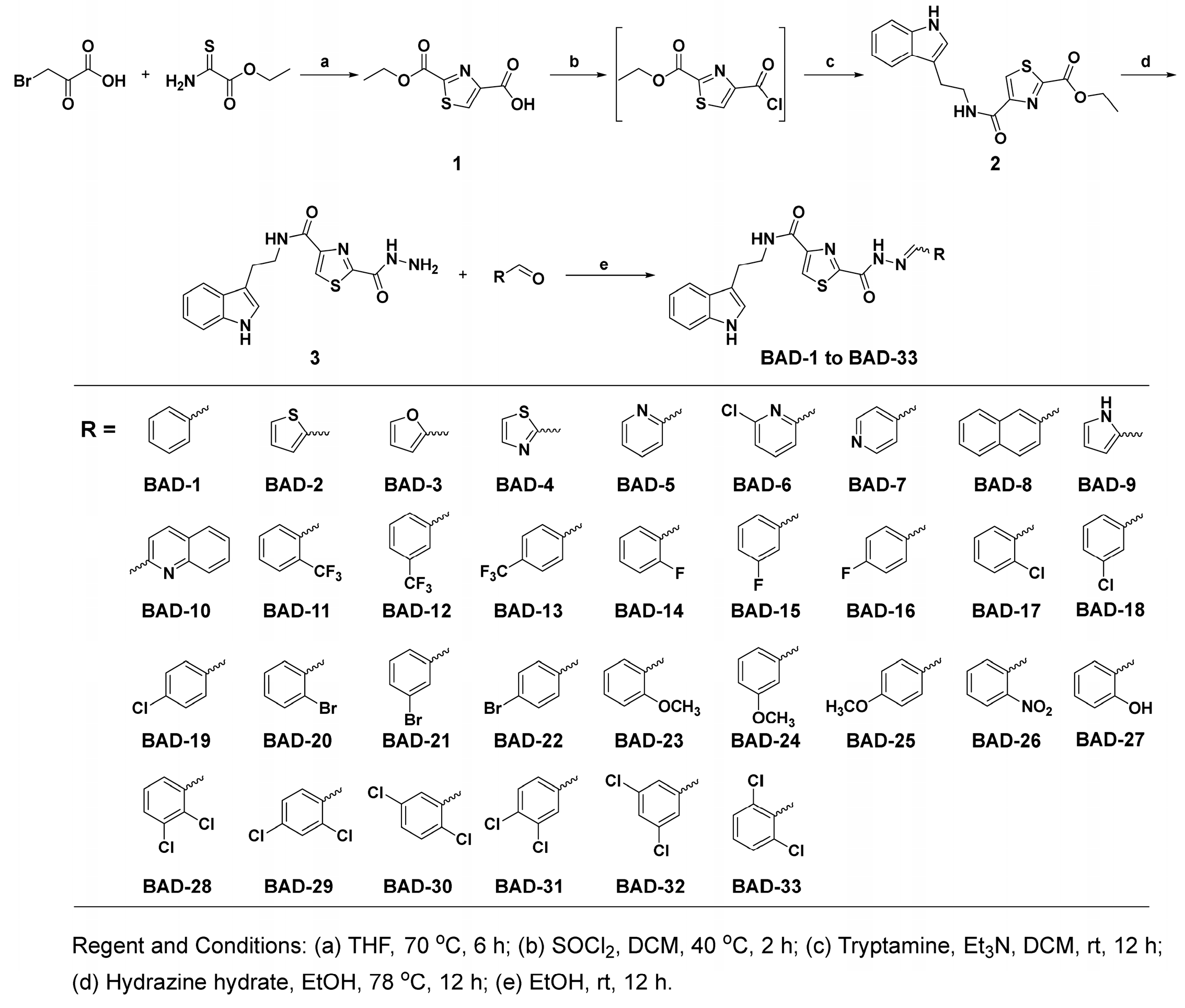
3.1. Chemistry
3.2. Fungicidal Activity and SAR
4. Conclusions
Supplementary Materials
Author Contributions
Funding
Institutional Review Board Statement
Informed Consent Statement
Data Availability Statement
Conflicts of Interest
References
- Fisher, M.C.; Henk, D.A.; Briggs, C.J.; Brownstein, J.S.; Madoff, L.C.; McCraw, S.L.; Gurr, S.J. Emerging fungal threats to animal, plant and ecosystem health. Nature 2012, 484, 186−194. [Google Scholar] [CrossRef]
- Stukenbrock, E.; Gurr, S. Address the growing urgency of fungal disease in crops. Nature 2023, 617, 31−34. [Google Scholar] [CrossRef] [PubMed]
- Savary, S.; Willocquet, L.; Pethybridge, S.J.; Esker, P.; McRoberts, N.; Nelson, A. The global burden of pathogens and pests on major food crops. Nat. Ecol. Evol. 2019, 3, 430−439. [Google Scholar] [CrossRef]
- Chang, J.; Liu, Y.; Zhang, T.C.; Chen, Z.F.; Fang, H.B.; Hua, X.W. A Comprehensive investigation of hydrazide and its derived structures in the Agricultural fungicidal field. J. Agric. Food Chem. 2023, 71, 8297−8316. [Google Scholar] [CrossRef]
- Wang, M.Y.; Wang, F.; Hao, G.F.; Yang, G.F. FungiPAD: A free web tool for compound property evaluation and fungicide-likeness analysis. J. Agric. Food Chem. 2019, 67, 1823−1830. [Google Scholar] [CrossRef]
- Roman, D.L.; Voiculescu, D.I.; Filip, M.; Ostafe, V.; Isvoran, A. Effects of triazole fungicides on soil microbiota and on the activities of enzymes found in soil: A review. Agriculture 2021, 11, 893. [Google Scholar] [CrossRef]
- Dorigan, A.F.; Moreira, S.I.; Guimarães, S.S.C.; Cruz-Magalhães, V.; Alves, E. Target and non-target site mechanisms of fungicide resistance and their implications for the management of crop pathogens. Pest Manag. Sci. 2023, 79, 4731–4753. [Google Scholar] [CrossRef] [PubMed]
- Zulak, K.G. Molecular monitoring of fungicide resistance in crop phytopathogens. Mol. Plant-Microbe Interact. 2025, 38, 160–172. [Google Scholar]
- Hu, M.J.; Chen, S.N. Non-target site mechanisms of fungicide resistance in crop pathogens: A review. Microorganisms 2021, 9, 502. [Google Scholar] [CrossRef] [PubMed]
- Fisher, M.C.; Hawkins, N.J.; Sanglard, D.; Gurr, S.J. Worldwide emergence of resistance to antifungal drugs challenges human health and food security. Science 2018, 360, 739−742. [Google Scholar] [CrossRef]
- Sparksa, T.C.; Bryant, R.J. Impact of natural products on discovery of, and innovation in, crop protection compounds. Pest Manag. Sci. 2022, 78, 399–408. [Google Scholar] [CrossRef]
- Hao, Y.N.; Wang, K.H.; Wang, Z.W.; Liu, Y.X.; Ma, D.J.; Wang, Q.M. Luotonin A and its derivatives as novel antiviral and antiphytopathogenic fungus agents. J. Agric. Food Chem. 2020, 68, 8764–8773. [Google Scholar] [CrossRef] [PubMed]
- Huang, X.B.; Shu, L.L.; Hao, N.; Wei, Z.Y.; Qian, L.; Tian, Y.E.; Cheng, Z.J.; Chen, G.Q.; S Liu, S.M.; Deng, S.Z.; et al. Synthesis and antifungal evaluation of cinnamic acid-geraniol hybrids as potential fungicides. Chem. Biodivers. 2024, 21, e202401348. [Google Scholar] [PubMed]
- Wilt, I.K.; Demeritte, A.R.; Kim, A.T.; Wang, W.W.; Wuest, W.M. Leveraging natural product-inspired antifungals to investigate the mechanism of action of Peniciaculin A. ChemMedChem 2024, 19, e202400500. [Google Scholar] [PubMed]
- Li, Y.; Luo, Z.F.; Zhou, A.K.; Liu, W.J.; Fan, J.D.; Miao, J.; Guo, B.; Tang, L.; Fan, L.L. Design and synthesis of novel benzoxazole/chromenephthalide scaffolds hybrids as potential natural products-based fungicide. Nat. Prod. Res. 2024, 38, 2441–2446. [Google Scholar] [CrossRef]
- Liu, X.Y.; Han, Z.H.; Duan, X.F.; Zhang, J.J.; Cai, Y.Y.; Gao, M.L.; Song, L.Y.; Huang, B.B.; Lin, R. Synthesis, bioevaluation and structure-activity relationships of novel N-aryl carbamate derivatives as potential fungicidal agents. Agronomy 2025, 15, 2741. [Google Scholar] [CrossRef]
- Deng, T.Y.; Xin, H.; Luo, X.P.; Zhou, Q.; Wang, Y.H.; Hu, C.M.; Fu, H.; Xue, W. Antifungal activity of chalcone derivatives containing 1,2,3,4-tetrahydroquinoline and studies on them as potential SDH inhibitors. Pest Manag. Sci. 2025, 81, 1251–1260. [Google Scholar]
- Churro, C.; Alverca, E.; Sam-Bento, F.; Paulino, S.; Figueira, V.C.; Bento, A.J.; Prabhakar, S.; Lobo, A.M.; Calado, A.J.; Pereira, P. Effects of bacillamide and newly synthesized derivatives on the growth of cyanobacteria and microalgae cultures. J. Appl. Phycol. 2009, 21, 429–442. [Google Scholar] [CrossRef]
- Jeong, S.Y.; Ishida, K.; Ito, Y.; Okada, S.; Murakami, M. Bacillamide, a novel algicide from the marine bacterium, Bacillus sp. SY-1, against the harmful dinoflagellate, Cochlodinium polykrikoides. Tetrahedron Lett. 2003, 44, 8005–8007. [Google Scholar] [CrossRef]
- Kumar, S.; Aggarwal, R.; Kumar, V.; Sadana, R.; Patel, B.; Kaushik, P.; Kaushik, D. Solvent-free synthesis of bacillamide analogues as novel cytotoxic and antiinflammatory agents. Eur. J. Med. Chem. 2016, 123, 718–726. [Google Scholar]
- Zou, X.W.; Liu, S.C.; Zheng, Z.H.; Zhang, H.; Chen, X.L.; Liu, X.Z.; Li, E.W. Two new imidazolone-containing alkaloids and further metabolites from the ascomycete fungus Tricladium sp. Chem. Biodivers. 2011, 8, 1914–1920. [Google Scholar] [CrossRef] [PubMed]
- Socea, L.I.; Barbuceanu, S.F.; Pahontu, E.M.; Dumitru, A.C.; Nitulescu, G.M.; Sfetea, R.C.; Apostol, T.V. Acylhydrazones and their biological activity: A review. Molecules 2022, 27, 8719. [Google Scholar] [CrossRef]
- Chen, Y.J.; Ma, K.Y.; Du, S.S.; Zhang, Z.J.; Wu, T.L.; Sun, Y.; Liu, Y.Q.; Yin, X.D.; Zhou, R.; Yan, Y.F.; et al. Antifungal exploration of quinoline derivatives against phytopathogenic fungi inspired by quinine alkaloids. J. Agric. Food Chem. 2021, 69, 12156−12170. [Google Scholar] [CrossRef]
- Fang, H.B.; Chen, Z.F.; Liu, Y.; Zhang, T.C.; Chang, J.; Li, Z.Z.; Zhang, L.X.; Sui, J.K.; Ru, J.; Gu, Y.C.; et al. Discovery of aryloxy-, arylthio-, and arylamino-containing acethydrazides as fungicidal agents. J. Agric. Food Chem. 2023, 71, 920−933. [Google Scholar] [CrossRef]
- Zhang, W.; Liu, J.; Qi, S.; Li, H.; Chen, Y.; Gong, Y.; Luo, X.; Wang, S.; Liu, F.; Gu, Y.C.; et al. Evaluation of quinazolin-4(3H)-one derivatives containing the bioactive acetohydrazide group as fungicidal candidates. Pestici. Biochem. Phys. 2025, 215, 106667. [Google Scholar] [CrossRef]
- Cui, Y.C.; Duan, W.G.; Lin, G.S.; Bi, Y.Q.; Meng, L.Q.; Deng, H.; Li, B.Y.; Li, H. Design, synthesis, and action mechanism of 3-carene-based acylhydrazone compounds as potential novel herbicidal candidates. J. Agric. Food Chem. 2025, 73, 15533–15542. [Google Scholar] [CrossRef]
- Šeršeň, F.; Gregáň, F.; Peško, M.; Dvoranová, D.; Kráľová, K.; Matkovičová, Z.; Gregáň, J.; Donovalová, J. Synthesis and herbicidal activity of new hydrazide and hydrazonoyl derivatives. Molecules 2015, 20, 14139–14154. [Google Scholar] [CrossRef]
- Li, Y.H.; Li, S.C.; Yin, X.; Liu, S.L. Design, synthesis and insecticidal activity of novel isoxazoline acylhydrazone compounds. Pest Manag. Sci. 2024, 80, 1654−1662. [Google Scholar] [CrossRef]
- Rohane, S.H.; Chauhan, A.J.; Fuloria, N.K.; Fuloria, S. Synthesis and in vitro antimycobacterial potential of novel hydrazones of eugenol. Arab. J. Chem. 2020, 13, 4495–4504. [Google Scholar] [CrossRef]
- Thota, S.; Rodrigues, D.A.; de Sena Murteira Pinheiro, P.; Lima, L.M.; Fraga, C.A.M.; Barreiro, E.J. N-Acylhydrazones as drugs. Bioorganic Med. Chem. Lett. 2018, 28, 2797–2806. [Google Scholar] [CrossRef] [PubMed]
- Aneja, B.; Khan, N.S.; Khan, P.; Queen, A.; Hussain, A.; Rehman, M.T.; Alajmi, M.F.; El-Seedi, H.R.; Ali, S.; Hassan, M.I.; et al. Design and development of Isatin-triazole hydrazones as potential inhibitors of microtubule affinity-regulating kinase 4 for the therapeutic management of cell proliferation and metastasis. Eur. J. Med. Chem. 2019, 163, 840–852. [Google Scholar] [CrossRef]
- Abdel-Aal, M.T.; El-Sayed, W.A.; El-Ashry, E.-S.H. Synthesis and antiviral evaluation of some sugar arylglycinoylhydrazones and their oxadiazoline derivatives. Arch. Pharm. 2006, 339, 656–663. [Google Scholar]
- Moraes, A.D.T.d.O.; de Miranda, M.D.S.; Jacob, Í.T.T.; Amorim, C.A.d.C.; de Moura, R.O.; da Silva, S.Â.S.; Soares, M.B.P.; de Almeida, S.M.V.; Souza, T.R.C.d.L.; de Oliveira, J.F.; et al. Synthesis, in vitro and in vivo biological evaluation, COX-1/2 inhibition and molecular docking study of indole-N-acylhydrazone derivatives. Bioorg. Med. Chem. 2018, 26, 5388–5396. [Google Scholar]
- Jacomini, A.P.; Silva, M.J.V.; Silva, R.G.M.; Gonçalves, D.S.; Volpato, H.; Basso, E.A.; Paula, F.R.; Nakamura, C.V.; Sarragiotto, M.H.; Rosa, F.A. Synthesis and evaluation against Leishmania amazonensis of novel pyrazolo [3,4-d]pyridazinone-N-acylhydrazone-(bi)thiophene hybrids. Eur. J. Med. Chem. 2016, 124, 340–349. [Google Scholar] [CrossRef] [PubMed]
- Peter, C.; Graham, J.; David Douglas, M.; Mark Allan, W. Indole Compounds and Their Use. WO2019099977A2, 2019. Available online: https://patents.google.com/patent/WO2019099977A2/en (accessed on 26 December 2025).
- Chen, K.; Deng, D.F.; Yin, Y.P.; Xi, D.M.; Park, P.; Gao, W.; Liu, R.; Lei, K. Discovery of 4,5,6,7-tetrahydrothieno [3,2-b] pyridine as novel fungicide lead scaffold. Microorganisms 2025, 13, 1588. [Google Scholar] [CrossRef] [PubMed]
- Zhang, Y.; Li, J.; Liu, X.Y.; Gao, W.; Song, S.S.; Rong, Y.P.; Tan, L.Y.; Glukhareva, T.V.; Bakulev, V.A.; Fan, Z.J. Exploration of fungicidal activity and mode of action of ferimzone analogs. J. Agric. Food Chem. 2023, 71, 3705–3718. [Google Scholar] [CrossRef] [PubMed]
- Wang, H.; Wang, J.; Li, L.; Hsiang, T.; Wang, M.; Shang, S.; Yu, Z. Metabolic activities of five botryticides against Botrytis cinerea examined using the Biolog FF MicroPlate. Sci. Rep. 2016, 6, 31025. [Google Scholar] [CrossRef]
- Ogawa, Y.; Tokunaga, E.; Kobayashi, O.; Hirai, K.; Shibata, N. Current contributions of organofluorine compounds to the agrochemical industry. iScience 2020, 23, 101467. [Google Scholar] [CrossRef]
- Ojima, I. Exploration of ffuorine chemistry at the multidisciplinary interface of chemistry and biology. J. Org. Chem. 2013, 78, 6358–6383. [Google Scholar] [CrossRef]
- Jeschke, P. The unique role of halogen substituents in the design of modern agrochemicals. Pest Manag. Sci. 2010, 66, 10–27. [Google Scholar]
- Wang, Y.X.; Zhou, M.Y.; Lan, J.; Hu, T.Y.; Wang, T.; Zuo, C.J. Copper homeostasis and its dysregulation in diseases: A focus on cuproptosis. Chem. Biol. Interact. 2026, 424, 111879. [Google Scholar]
- Tury, S.; Chauveau, L.; Lecante, A.; Courgnaud, V.; Battini, J.L. A co-opted endogenous retroviral envelope promotes cell survival by controlling CTR1-mediated copper transport and homeostasis. Cell Rep. 2023, 42, 113065. [Google Scholar]
- Ding, C.; Festa, R.A.; Sun, T.S.; Wang, Z.Y. Iron and copper as virulence modulators in human fungal pathogens. Mol. Microbiol. 2014, 93, 10–23. [Google Scholar] [CrossRef] [PubMed]
- Lutsenko, S. Human copper homeostasis: A network of interconnected pathways. Curr. Opin. Chem. Biol. 2010, 14, 211–217. [Google Scholar] [CrossRef]
- Nevitt, T.; Ohrvik, H.; Thiele, D.J. Charting the travels of copper in eukaryotes from yeast to mammals. Biochim. Biophys. Acta 2012, 1823, 1580–1593. [Google Scholar]
- Macomber, L.; Imlay, J.A. The iron-sulfur clusters of dehydratases are primary intracellular targets of copper toxicity. Proc. Natl. Acad. Sci. USA 2009, 106, 8344–8349. [Google Scholar] [CrossRef] [PubMed]
- Antsotegi-Uskola, M.; Markina-Iñarrairaegui, A.; Ugalde, U. New insights into copper homeostasis in filamentous fungi. Int. Microbiol. 2020, 23, 65–73. [Google Scholar] [PubMed]
- Zhang, Y.; Zhang, Y.; Yu, D.D.; Peng, Y.J.; Min, H.X.; Lai, Z.B. Copper ions are required for Cochliobolus heterostrophus in appressorium formation and virulence on maize. Phytopathology 2020, 110, 494–504. [Google Scholar]
- Gómez-Gallego, T.; Benabdellah, K.; Merlos, M.A.; Jiménez-Jiménez, A.M.; Alcon, C.; Berthomieu, P.; Ferrol, N. The Rhizophagus irregularis genome encodes two CTR copper transporters that mediate Cu import into the cytosol and a CTR-like protein likely involved in copper tolerance. Front. Plant Sci. 2019, 10, 604. [Google Scholar] [CrossRef]
- Kusuya, Y.; Hagiwara, D.; Sakai, K.; Yaguchi, T.; Gonoi, T.; Takahashi, H. Transcription factor Afmac1 controls copper import machinery in Aspergillus fumigatus. Curr. Genet. 2017, 63, 777–789. [Google Scholar] [CrossRef]
- Dialynaki, D.; Stavropoulou, A.; Laskou, M.; Alexandraki, D. The essential liaison of two copper proteins: The Cu-sensing transcription factor Mac1 and the Cu/Zn superoxide dismutase Sod1 in Saccharomyces cerevisiae. Curr. Genet. 2023, 69, 41–53. [Google Scholar]
- Broxton, C.N.; Culotta, V.C. An adaptation to low copper in Candida albicans involving SOD enzymes and the alternative oxidase. PLoS ONE 2016, 11, e0168400. [Google Scholar]
- Naz, S.; Gueguen-Minerbe, M.; Cretenet, M.; Vernoux, J.P. Aromatic amino acids as precursors of antimicrobial metabolites in Geotrichum candidum. FEMS Microbiol. Lett. 2013, 344, 39–47. [Google Scholar] [CrossRef] [PubMed]
- Zhao, Q.; Feng, Y.; Shao, Y.; Huang, J.L.; Chen, Z.L. Response mechanism of Cynodon dactylon to flooding stress based on integrating metabonomics and transcriptomics analysis. Environ. Exp. Bot. 2024, 225, 105846. [Google Scholar] [CrossRef]
- Law, S.R.; Chrobok, D.; Juvany, M.; Delhomme, N.; Lindén, P.; Brouwer, B.; Ahad, A.; Moritz, T.; Jansson, S.; Gardeström, P.; et al. Darkened leaves use different metabolic strategies for senescence and survival. Plant Physiol. 2018, 177, 132–150. [Google Scholar] [CrossRef]
- Tomita, H.; Yokooji, Y.; Ishibashi, T.; Imanaka, T.; Atomi, H. An archaeal glutamate decarboxylase homolog functions as an aspartate decarboxylase and is involved in β-Alanine and coenzyme A biosynthesis. J. Bacteriol. 2014, 196, 1222–1230. [Google Scholar] [CrossRef]
- Abby, S.S.; Kazemzadeh, K.; Vragniau, C.; Pelosi, L.; Pierrel, F. Advances in bacterial pathways for the biosynthesis of ubiquinone. BBA-Bioenergetics 2020, 1861, 148259. [Google Scholar]
- Ge, J.; Zhai, H.; Tang, L.; Zhang, S.; Lv, Y.; Ma, P.; Wei, S.; Zhou, Y.; Wu, X.; Lei, Y.; et al. FgUbiH is essential for vegetative development, energy metabolism, and antioxidant activity in Fusarium graminearum. Microorganisms 2024, 12, 2093. [Google Scholar] [CrossRef]
- Nowicka, B.; Trela-Makowej, A.; Latowski, D.; Strzalka, K.; Szymańska, R. Antioxidant and signaling role of plastid-derived isoprenoid quinones and chromanols. Int. J. Mol. Sci. 2021, 22, 2950. [Google Scholar] [CrossRef]
- Lin, H.; Peng, Y. Fatty acids in filamentous pathogenic fungi: Multidimensional regulation and pathogenic mechanisms. Virulence 2025, 16, 2561826. [Google Scholar] [CrossRef]
- Yan, C.; Wang, Y.K.; Xiong, Y.R.; Zhou, X.Q.; Fang, Y.C.; Nie, R.T.; Ye, C.; Zhang, K.; Zheng, D.Q. The roles of NHEJ and TLS pathways in genomic alterations and phenotypic evolution in the yeast Yarrowia lipolytica. Appl. Microbiol. Biotechnol. 2025, 109, 183. [Google Scholar] [CrossRef] [PubMed]



| Comp. | A. s 2 | B. c 2 | F. g 2 | P. p 2 | R. s 2 | F. v 2 | F. o 2 |
|---|---|---|---|---|---|---|---|
| BAD-1 | 22 ± 1 | 67 ± 0 | 36 ± 4 | 23 ± 1 | 2 ± 4 | 26 ± 2 | 16 ± 1 |
| BAD-2 | 2 ± 2 | 44 ± 2 | 40 ± 2 | 16 ± 2 | 9 ± 1 | 15 ± 3 | 3 ± 1 |
| BAD-3 | 0 | 48 ± 2 | 26 ± 2 | 24 ± 1 | 12 ± 4 | 22 ± 2 | 8 ± 3 |
| BAD-4 | 25 ± 2 | 28 ± 1 | 7 ± 4 | 7 ± 2 | 0 | 16 ± 3 | 14 ± 2 |
| BAD-5 | 19 ± 2 | 34 ± 2 | 45 ± 4 | 36 ± 2 | 7 ± 4 | 36 ± 2 | 28 ± 1 |
| BAD-6 | 16 ± 4 | 36 ± 4 | 2 ± 3 | 0 | 13 ± 4 | 8 ± 3 | 0 |
| BAD-7 | 14 ± 1 | 45 ± 1 | 17 ± 5 | 28 ± 2 | 0 | 28 ± 3 | 8 ± 1 |
| BAD-8 | 4 ± 4 | 36 ± 3 | 1 ± 2 | 0 | 1 ± 1 | 13 ± 1 | 13 ± 3 |
| BAD-9 | 4 ± 5 | 76 ± 1 | 22 ± 1 | 20 ± 2 | 2 ± 3 | 27 ± 1 | 20 ± 2 |
| BAD-10 | 59 ± 0 | 47 ± 1 | 38 ± 3 | 22 ± 2 | 0 | 1 ± 1 | 0 |
| BAD-11 | 10 ± 1 | 55 ± 3 | 21 ± 4 | 18 ± 0 | 2 ± 3 | 9 ± 4 | 23 ± 1 |
| BAD-12 | 8 ± 1 | 60 ± 3 | 37 ± 5 | 22 ± 1 | 4 ± 3 | 15 ± 3 | 21 ± 1 |
| BAD-13 | 15 ± 3 | 49 ± 1 | 21 ± 2 | 17 ± 1 | 9 ± 3 | 17 ± 4 | 24 ± 2 |
| BAD-14 | 9 ± 1 | 73 ± 2 | 18 ± 1 | 20 ± 1 | 10 ± 3 | 6 ± 4 | 12 ± 2 |
| BAD-15 | 12 ± 2 | 89 ± 1 | 29 ± 5 | 20 ± 0 | 1 ± 2 | 18 ± 3 | 20 ± 1 |
| BAD-16 | 11 ± 2 | 69 ± 2 | 19 ± 1 | 28 ± 1 | 8 ± 3 | 19 ± 2 | 8 ± 2 |
| BAD-17 | 12 ± 1 | 72 ± 2 | 17 ± 2 | 12 ± 0 | 2 ± 3 | 10 ± 4 | 0 |
| BAD-18 | 13 ± 2 | 80 ± 2 | 14 ± 6 | 15 ± 1 | 12 ± 3 | 11 ± 3 | 1 ± 1 |
| BAD-19 | 3 ± 1 | 65 ± 1 | 23 ± 3 | 20 ± 1 | 5 ± 4 | 13 ± 3 | 0 |
| BAD-20 | 8 ± 1 | 48 ± 2 | 13 ± 7 | 14 ± 1 | 13 ± 3 | 7 ± 4 | 0 |
| BAD-21 | 14 ± 2 | 56 ± 3 | 7 ± 3 | 11 ± 1 | 15 ± 4 | 9 ± 5 | 0 |
| BAD-22 | 15 ± 2 | 35 ± 3 | 20 ± 5 | 19 ± 1 | 21 ± 3 | 10 ± 4 | 0 |
| BAD-23 | 6 ± 1 | 16 ± 3 | 15 ± 6 | 8 ± 1 | 21 ± 4 | 3 ± 3 | 0 |
| BAD-24 | 13 ± 1 | 33 ± 2 | 18 ± 5 | 8 ± 1 | 3 ± 4 | 7 ± 4 | 0 |
| BAD-25 | 8 ± 1 | 26 ± 4 | 23 ± 6 | 24 ± 1 | 10 ± 3 | 15 ± 3 | 4 ± 3 |
| BAD-26 | 9 ± 1 | 12 ± 3 | 19 ± 7 | 0 | 10 ± 5 | 7 ± 4 | 0 |
| BAD-27 | 5 ± 2 | 15 ± 4 | 29 ± 5 | 6 ± 1 | 13 ± 4 | 5 ± 4 | 0 |
| BAD-28 | 1 ± 1 | 36 ± 1 | 1 ± 1 | 0 | 0 | 5 ± 2 | 10 ± 2 |
| BAD-29 | 6 ± 4 | 58 ± 2 | 1 ± 1 | 1 ± 1 | 0 | 17 ± 2 | 17 ± 3 |
| BAD-30 | 10 ± 4 | 33 ± 2 | 9 ± 1 | 0 | 12 ± 5 | 12 ± 1 | 9 ± 3 |
| BAD-31 | 10 ± 4 | 60 ± 3 | 15 ± 1 | 8 ± 2 | 1 ± 1 | 9 ± 2 | 9 ± 3 |
| BAD-32 | 1 ± 2 | 47 ± 1 | 13 ± 6 | 13 ± 1 | 21 ± 2 | 10 ± 3 | 3 ± 1 |
| BAD-33 | 8 ± 4 | 30 ± 1 | 14 ± 1 | 1 ± 1 | 2 ± 3 | 15 ± 2 | 7 ± 4 |
| Thifluzamide | 65 ± 1 | 37 ± 3 | 100 | 40 ± 3 | 19 ± 2 | 18 ± 1 | 11 ± 0 |
| Comp. | Regression Equation | R2 | EC50 (μg/mL) | 95% Confidence Interval (μg/mL) |
|---|---|---|---|---|
| BAD-1 | y = 1.284x + 5.468 | 0.9835 | 30.15 | 25.09–37.34 |
| BAD-9 | y = 1.582x + 4.184 | 0.9803 | 22.3 | 18.47–27.25 |
| BAD-14 | y = 1.145x + 20.18 | 0.9517 | 17.72 | 12.36–27.62 |
| BAD-15 | y = 1.352x + 30.13 | 0.9852 | 6.725 | 5.421–8.335 |
| BAD-16 | y = 1.162x + 13.43 | 0.9641 | 25.71 | 18.96–38.10 |
| BAD-17 | y = 0.675x + 21.63 | 0.9533 | 21.85 | 15.40–31.85 |
| BAD-18 | y = 1.318x + 22.33 | 0.9401 | 12.05 | 7.991–18.82 |
| BAD-19 | y = 1.046x + 14.39 | 0.9422 | 30.8 | 20.87–55.79 |
Disclaimer/Publisher’s Note: The statements, opinions and data contained in all publications are solely those of the individual author(s) and contributor(s) and not of MDPI and/or the editor(s). MDPI and/or the editor(s) disclaim responsibility for any injury to people or property resulting from any ideas, methods, instructions or products referred to in the content. |
© 2026 by the authors. Licensee MDPI, Basel, Switzerland. This article is an open access article distributed under the terms and conditions of the Creative Commons Attribution (CC BY) license.
Share and Cite
Feng, S.; Zhang, Y.; Shi, P.; Chen, K.; Lei, K. Discovery of Bacillamide–Acylhydrazone Hybrids as Novel Fungicide Lead Compounds. J. Fungi 2026, 12, 169. https://doi.org/10.3390/jof12030169
Feng S, Zhang Y, Shi P, Chen K, Lei K. Discovery of Bacillamide–Acylhydrazone Hybrids as Novel Fungicide Lead Compounds. Journal of Fungi. 2026; 12(3):169. https://doi.org/10.3390/jof12030169
Chicago/Turabian StyleFeng, Sijia, Yuxiao Zhang, Peipei Shi, Ke Chen, and Kang Lei. 2026. "Discovery of Bacillamide–Acylhydrazone Hybrids as Novel Fungicide Lead Compounds" Journal of Fungi 12, no. 3: 169. https://doi.org/10.3390/jof12030169
APA StyleFeng, S., Zhang, Y., Shi, P., Chen, K., & Lei, K. (2026). Discovery of Bacillamide–Acylhydrazone Hybrids as Novel Fungicide Lead Compounds. Journal of Fungi, 12(3), 169. https://doi.org/10.3390/jof12030169