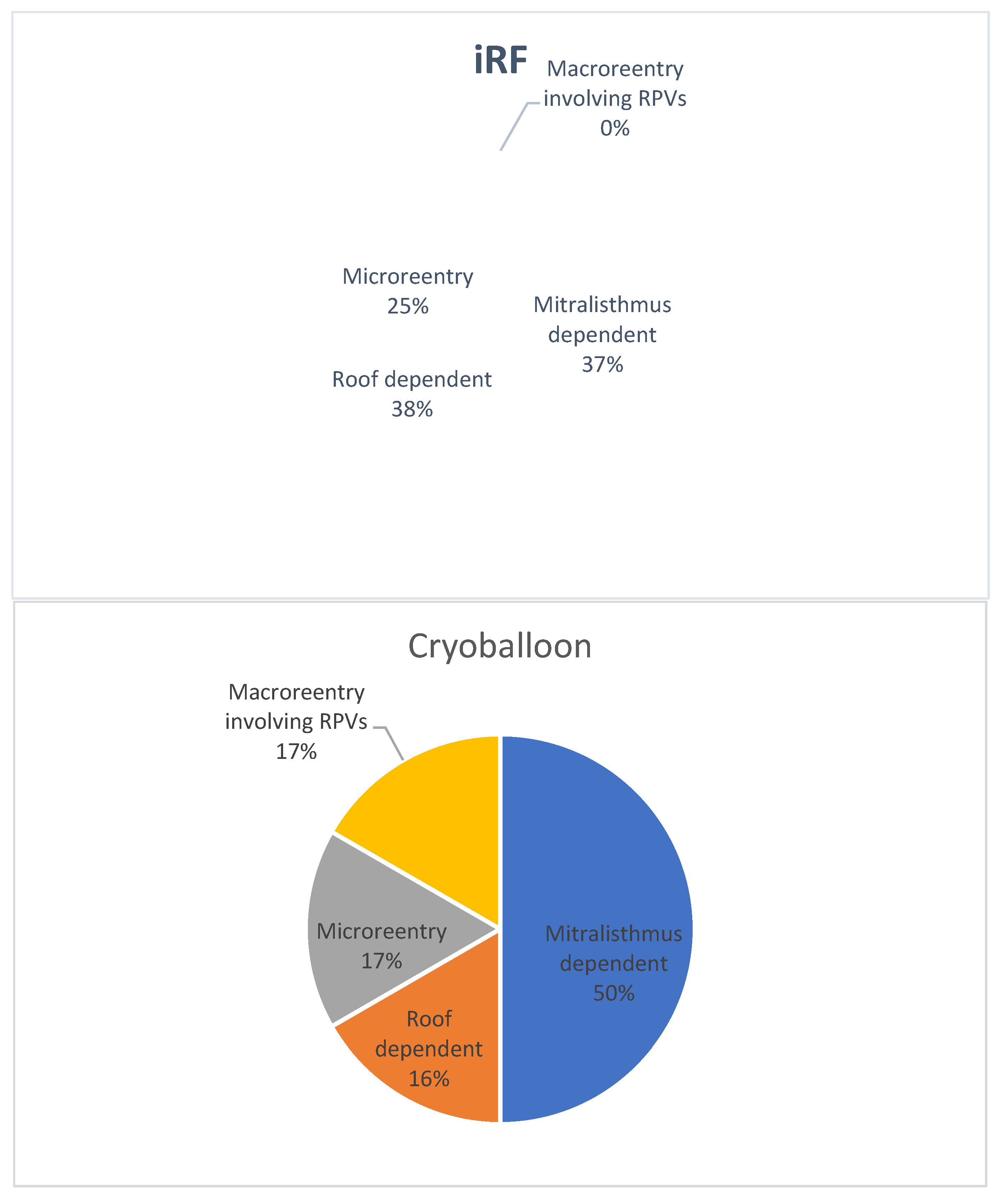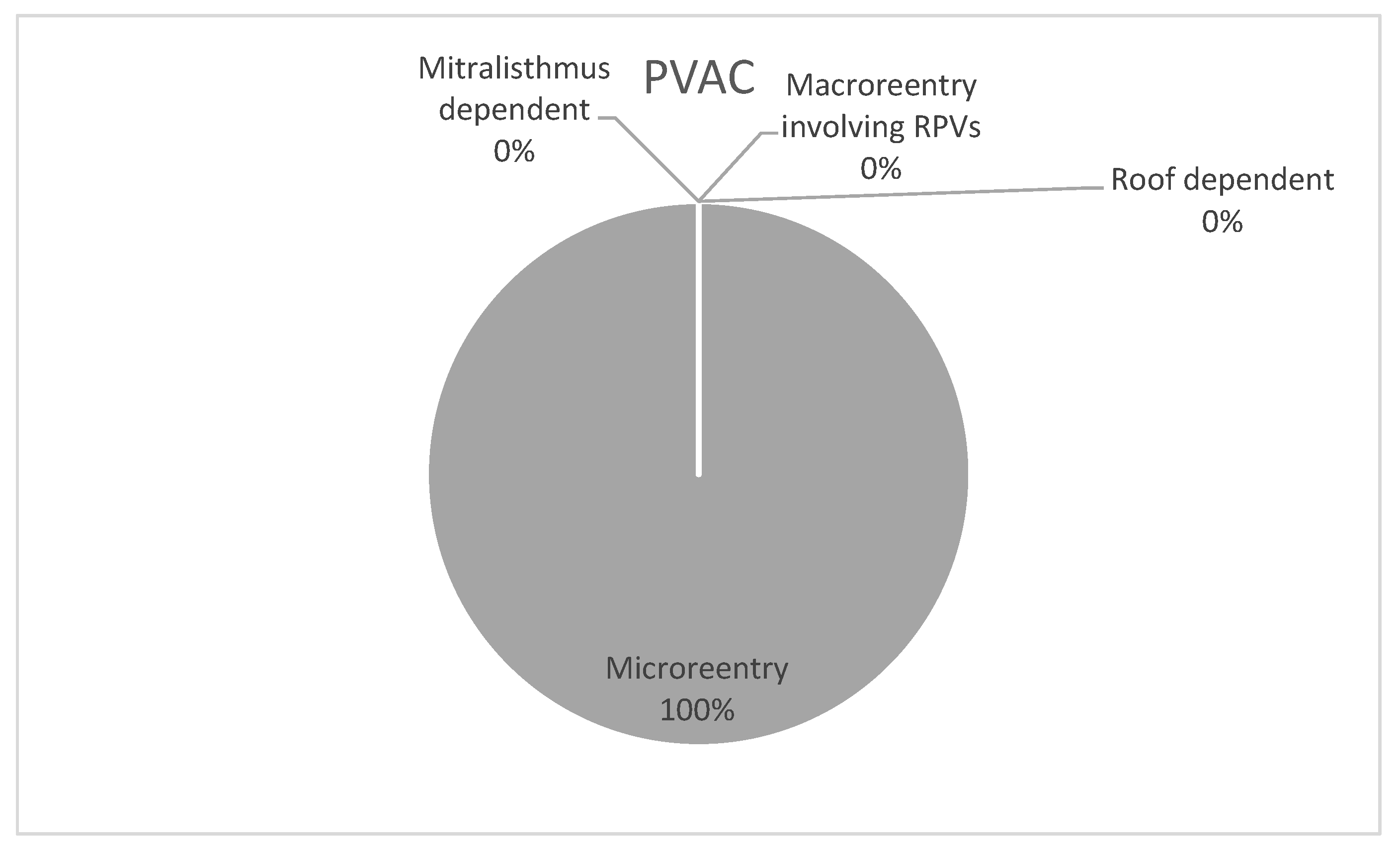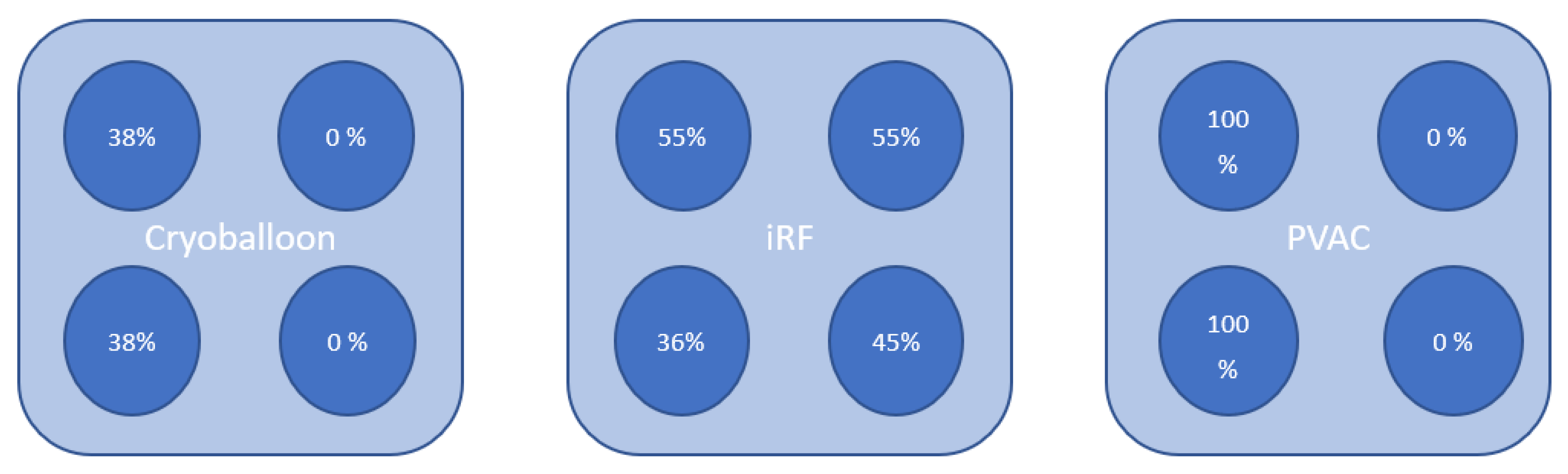

The Incidence, Electrophysiological Characteristics and Ablation Outcome of Left Atrial Tachycardias after Pulmonary Vein Isolation Using Three Different Ablation Technologies
 ,
,  and
and
Abstract
1. Introduction
2. Methods
2.1. Study Design and Patient Collective
2.2. Diagnosis of LAT
2.3. Index PVI
- (1)
- iRF group: iRF ablation was guided by the NAVX system (Ensite NavXVelocity; St. Jude Medical, Inc., Saint Paul, MN, USA). A 3D model was created with a circular mapping catheter (Inquiry Optima; St. Jude Medical Inc.), and the acquired geometry was fused with the 3D reconstruction of the LA from computed tomography (CT). Ablation was performed with a 4 mm open-tip irrigated catheter (IBI TherapyCoolpath Duo or CoolFlex; St. Jude Medical, Inc). Antral point-by-point circumferential ablation around ipsilateral PVs, with a distance from 0.5 to 1.0 cm from the ostia, was performed. The power was set to 30 W and the temperature was limited to 43 °C. In case of persistent PV conduction, especially at the anterior ridge border of the lateral PVs, we increased the power to 35 W, to close conduction gaps. Complete electrical isolation was monitored and confirmed by the circular mapping catheter during sinus rhythm and differential pacing maneuvers. Ablation lesions were limited to circumferential PVI.
- (2)
- PVAC group: Ablation with the PVAC system was performed using the second-generation catheter, the PVAC GOLD (Medtronic Inc., Minneapolis, MN, USA). The PVAC was connected to the GENius (Medtronic Inc.) RF generator. The target temperature was 60 °C, with a maximum power of 8 W. Duty-cycled energy delivery was exclusively delivered in a 4:1 ratio, and the impulse duration was 60 s. Electrode pairs with insufficient tissue contact were selectively deactivated. After RF applications, the PVAC was rotated around the PV ostium, looking for the earliest pulmonary vein potential (PVP) to completely isolate the vein. Finally, the catheter electrodes were advanced in the PV demonstrating the entrance block; the exit block was not routinely checked for. No other catheters were used for touch-up lesions. No further ablations were performed.
- (3)
- Cryoballoon group: All cryoballoon patients were treated with the second-generation 28 mm cryoballoon (Medtronic Arctic Front Advance, Medtronic Inc.). Occlusion of the PV was tested by a contrasting agent. In this cohort, 2 freezes were applied for 180 s per vein, irrespective of the achieved time to isolation (TTI). Additional freezes were applied if PVI was not achieved. Energy delivery was prematurely stopped in the case of inadequate temperature development, or if PVI could not be achieved within the first 90 s of the freeze. Ablation of the right PVs was performed under continuous stimulation of the phrenic nerve with a cycle length of 800 ms. Freezes were immediately stopped if temperatures fell below −60 °C, or if phrenic nerve capture was lost. Complete electrical isolation of the PVs was confirmed using the Achieve mapping catheter in sinus rhythm and during differential pacing maneuvers. At the end of the procedure, PVI was verified in sinus rhythm. No further linear ablations were performed and no supplementary ablation catheters were used.
2.4. Ablation Procedures of Post PVI Left Atrial Tachycardia
2.5. Statistical Analysis
3. Results
3.1. Population Characteristics and Antiarrhythmic Drug Treatment
3.2. Occurrence and Characteristics of LATs
3.3. Possible Predictors of LAT
4. Discussion
5. Limitations
6. Conclusions
Supplementary Materials
Author Contributions
Funding
Institutional Review Board Statement
Informed Consent Statement
Data Availability Statement
Conflicts of Interest
References
- Williams, B.A.; Honushefsky, A.M.; Berger, P.B. Temporal Trends in the Incidence, Prevalence, and Survival of Patients With Atrial Fibrillation From 2004 to 2016. Am. J. Cardiol. 2017, 120, 1961–1965. [Google Scholar] [CrossRef] [Scilit]
- Kamel, H.; Okin, P.M.; Elkind, M.S.V.; Iadecola, C. Atrial Fibrillation and Mechanisms of Stroke. Stroke 2016, 47, 895–900. [Google Scholar] [CrossRef] [Scilit] [PubMed]
- Wazni, O.M.; Dandamudi, G.; Sood, N.; Hoyt, R.; Tyler, J.; Durrani, S.; Niebauer, M.; Makati, K.; Halperin, B.; Gauri, A.; et al. Cryoballoon Ablation as Initial Therapy for Atrial Fibrillation. N. Engl. J. Med. 2021, 384, 316–324. [Google Scholar] [CrossRef] [Scilit] [PubMed]
- Kuck, K.-H.; Lebedev, D.S.; Mikhaylov, E.N.; Romanov, A.; Gellér, L.; Kalējs, O.; Neumann, T.; Davtyan, K.; On, Y.K.; Popov, S.; et al. Catheter ablation or medical therapy to delay progression of atrial fibrillation: The randomized controlled atrial fibrillation progression trial (ATTEST). EP Eur. 2021, 23, 362–369. [Google Scholar] [CrossRef] [Scilit]
- Kuck, K.-H.; Brugada, J.; Fürnkranz, A.; Metzner, A.; Ouyang, F.; Chun, K.J.; Elvan, A.; Arentz, T.; Bestehorn, K.; Pocock, S.J.; et al. Cryoballoon or Radiofrequency Ablation for Paroxysmal Atrial Fibrillation. N. Engl. J. Med. 2016, 374, 2235–2245. [Google Scholar] [CrossRef] [Scilit] [PubMed]
- Spitzer, S.G.; Leitz, P.; Langbein, A.; Karolyi, L.; Scharfe, F.; Weinmann, T.; Rämmler, C.; Pott, C.; Mönnig, G.; Eckardt, L. Circumferential pulmonary vein isolation with second-generation multipolar catheter in patients with paroxysmal or persistent atrial fibrillation: Procedural and one-year follow-up results. Int. J. Cardiol. 2017, 241, 212–217. [Google Scholar] [CrossRef] [Scilit] [PubMed]
- Bittner, A.; Mönnig, G.; Zellerhoff, S.; Pott, C.; Köbe, J.; Dechering, D.; Milberg, P.; Wasmer, K.; Eckardt, L. Randomized study comparing duty-cycled bipolar and unipolar radiofrequency with point-by-point ablation in pulmonary vein isolation. Heart Rhythm 2011, 8, 1383–1390. [Google Scholar] [CrossRef] [Scilit]
- Leitz, P.; Güner, F.; Wasmer, K.; Foraita, P.; Pott, C.; Dechering, D.G.; Zellerhoff, S.; Kochhäuser, S.; Lange, P.S.; Eckardt, L.; et al. Data on procedural handling and complications of pulmonary vein isolation using the pulmonary vein ablation catheter GOLD®. Europace 2015, 18, 696–701. [Google Scholar] [CrossRef] [Scilit] [PubMed]
- Wasmer, K.; Krüsemann, D.; Leitz, P.; Güner, F.; Pott, C.; Zellerhoff, S.; Dechering, D.; Köbe, J.; Lange, P.S.; Eckardt, L.; et al. Lower rate of left atrial tachycardia after pulmonary vein isolation with PVAC versus irrigated-tip circumferential antral ablation. Heart Rhythm 2016, 13, 1596–1601. [Google Scholar] [CrossRef] [Scilit]
- Leitz, P.; Mönnig, G.; Güner, F.; Dechering, D.G.; Wasmer, K.; Reinke, F.; Lange, P.S.; Eckardt, L.; Frommeyer, G. Comparing learning curves of two established “single-shot” devices for ablation of atrial fibrillation. J. Interv. Card. Electrophysiol. 2018, 53, 317–322. [Google Scholar] [CrossRef] [Scilit] [PubMed]
- Pathak, R.; Lau, D.H.; Mahajan, R.; Sanders, P. Structural and Functional Remodeling of the Left Atrium: Clinical and Therapeutic Implications for Atrial Fibrillation. J. Atr. Fibrillation 2013, 6, 986. [Google Scholar] [CrossRef] [Scilit] [PubMed]
- Hashimoto, K.; Watanabe, I.; Kofune, M.; Ashino, S.; Okumura, Y.; Ohkubo, K.; Shindo, A.; Sugimura, H.; Nakai, T.; Saito, S. Left Atrial Tachycardia After Pulmonary Vein Isolation for Atrial Fibrillation. J. Arrhythmia 2005, 21, 536–541. [Google Scholar] [CrossRef]
- Akerström, F.; Bastani, H.; Insulander, P.; Schwieler, J.; Arias, M.A.; Jensen-Urstad, M. Comparison of Regular Atrial Tachycardia Incidence After Circumferential Radiofrequency versus Cryoballoon Pulmonary Vein Isolation in Real-Life Practice. J. Cardiovasc. Electrophysiol. 2014, 25, 948–952. [Google Scholar] [CrossRef] [Scilit] [PubMed]
- Oral, H.; Knight, B.P.; Morady, F. Left atrial flutter after segmental ostial radiofrequency catheter ablation for pulmonary vein isolation. Pacing Clin. Electrophysiol. 2003, 26, 1417–1419. [Google Scholar] [CrossRef] [Scilit] [PubMed]
- Oral, H.; Knight, B.P.; Tada, H.; Özaydın, M.; Chugh, A.; Hassan, S.; Scharf, C.; Lai, S.W.; Greenstein, R.; Pelosi, F.; et al. Pulmonary Vein Isolation for Paroxysmal and Persistent Atrial Fibrillation. Circulation 2002, 105, 1077–1081. [Google Scholar] [CrossRef] [Scilit] [PubMed]
- Gerstenfeld, E.P.; Callans, D.J.; Dixit, S.; Russo, A.M.; Nayak, H.; Lin, D.; Pulliam, W.; Siddique, S.; Marchlinski, F. Mechanisms of Organized Left Atrial Tachycardias Occurring After Pulmonary Vein Isolation. Circulation 2004, 110, 1351–1357. [Google Scholar] [CrossRef] [Scilit] [PubMed]
- Lyan, E.; Yalin, K.; Abdin, A.; Sawan, N.; Liosis, S.; Lange, S.A.; Eitel, I.; Heeger, C.-H.; Meyer-Saraei, R.; Eitel, C.; et al. Mechanism, underlying substrate and predictors of atrial tachycardia following atrial fibrillation ablation using the second-generation cryoballoon. J. Cardiol. 2019, 73, 497–506. [Google Scholar] [CrossRef] [Scilit] [PubMed]
- Wasmer, K.; Mönnig, G.; Bittner, A.; Dechering, D.; Zellerhoff, S.; Milberg, P.; Köbe, J.; Eckardt, L. Incidence, characteristics, and outcome of left atrial tachycardias after circumferential antral ablation of atrial fibrillation. Heart Rhythm 2012, 9, 1660–1666. [Google Scholar] [CrossRef] [Scilit]
- Deisenhofer, I.; Estner, H.; Zrenner, B.; Schreieck, J.; Weyerbrock, S.; Hessling, G.; Scharf, K.; Karch, M.R.; Schmitt, C. Left atrial tachycardia after circumferential pulmonary vein ablation for atrial fibrillation: Incidence, electrophysiological characteristics, and results of radiofrequency ablation. Europace 2006, 8, 573–582. [Google Scholar] [CrossRef] [Scilit]
- Mikhaylov, E.N.; Bhagwandien, R.; Janse, P.A.; Theuns, D.A.; Szili-Torok, T. Regular atrial tachycardias developing after cryoballoon pulmonary vein isolation: Incidence, characteristics, and predictors. Europace 2013, 15, 1710–1717. [Google Scholar] [CrossRef] [Scilit] [PubMed]
- Kurose, J.; Kiuchi, K.; Fukuzawa, K.; Takami, M.; Mori, S.; Suehiro, H.; Nagamatsu, Y.; Akita, T.; Takemoto, M.; Yatomi, A.; et al. Lesion characteristics between cryoballoon ablation and radiofrequency ablation with a contact force-sensing catheter: Late-gadolinium enhancement magnetic resonance imaging assessment. J. Cardiovasc. Electrophysiol. 2020, 31, 2572–2581. [Google Scholar] [CrossRef] [Scilit]
- Kurose, J.; Kiuchi, K.; Fukuzawa, K.; Mori, S.; Ichibori, H.; Konishi, H.; Taniguchi, Y.; Hyogo, K.; Imada, H.; Suehiro, H.; et al. The lesion characteristics assessed by LGE-MRI after the cryoballoon ablation and conventional radiofrequency ablation. J. Arrhythmia 2018, 34, 158–166. [Google Scholar] [CrossRef] [Scilit]
- Hirao, T.; Nitta, J.; Adachi, A.; Takahashi, Y.; Goya, M.; Hirao, K. First confirmation of histologic changes in the human heart after cryoballoon ablation. HeartRhythm Case Rep. 2018, 5, 93–96. [Google Scholar] [CrossRef] [Scilit] [PubMed]
- Andrade, J.; Dubuc, M.; Guerra, P.G.; Landry, E.; Coulombe, N.; LeDuc, H.; Rivard, L.; Macle, L.; Thibault, B.; Talajic, M.; et al. Pulmonary Vein Isolation Using a Second-Generation Cryoballoon Catheter: A Randomized Comparison of Ablation Duration and Method of Deflation. J. Cardiovasc. Electrophysiol. 2013, 24, 692–698. [Google Scholar] [CrossRef] [Scilit] [PubMed]
- Hocini, M.; Condie, C.; Stewart, M.T.; Kirchhof, N.; Foell, J.D. Predictability of lesion durability for AF ablation using phased radiofrequency: Power, temperature, and duration impact creation of transmural lesions. Heart Rhythm 2016, 13, 1521–1526. [Google Scholar] [CrossRef] [Scilit] [PubMed]
- Wieczorek, M.; Sassani, K.; Hoeltgen, R. Comparison of pulmonary vein reconnection patterns after multielectrode phased radiofrequency- and cryoballoon ablation of atrial fibrillation. BMC Cardiovasc. Disord. 2020, 20, 1–9. [Google Scholar] [CrossRef] [Scilit] [PubMed]
- Leshem, E.; Zilberman, I.; Tschabrunn, C.M.; Barkagan, M.; Contreras-Valdes, F.M.; Govari, A.; Anter, E. High-Power and Short-Duration Ablation for Pulmonary Vein Isolation. JACC Clin. Electrophysiol. 2018, 4, 467–479. [Google Scholar] [CrossRef] [Scilit] [PubMed]
- Do, C.J.B.; Haines, D.E. Pulsed field ablation for pulmonary vein isolation in the treatment of atrial fibrillation. J. Cardiovasc. Electrophysiol. 2020, 31, 2136–2147. [Google Scholar] [CrossRef] [Scilit]
- Stewart, M.T.; Haines, D.E.; Miklavčič, D.; Kos, B.; Kirchhof, N.; Barka, N.; Mattison, L.; Martien, M.; Onal, B.; Howard, B.; et al. Safety and chronic lesion characterization of pulsed field ablation in a Porcine model. J. Cardiovasc. Electrophysiol. 2021, 32, 958–969. [Google Scholar] [CrossRef] [Scilit]



| iRF (n = 300) | Cryo (n = 200) | PVAC (n = 150) | p-Value | |
|---|---|---|---|---|
| Age at time of PVI (years) | 58.9 ± 11 | 60.9 ± 11 | 58.4 ± 12 | 0.2 |
| CHA2DS2-Vasc | 1.79 ± 1.5 | 1.83 ± 1.5 | 1.89 ± 1.3 | 0.5 |
| LVEF (%) | 52.6 ± 11 | 61 ± 9 | 54.5 ± 11 | 0.5 |
| Persistent AF (%) | 32 | 45.5 | 33.1 | 0.05 |
| Diabetes mellitus (%) | 27 | 17 | 14 | 0.1 |
| Arterial hypertension (%) | 63 | 54.5 | 66 | 0.7 |
| Male gender (%) | 62.7 | 69.5 | 63.7 | 0.25 |
| NICM (%) | 3 | 8 | 2.7 | 0.45 |
| Patient | PVI | EF | Gender | AF Type | LA Size | Flutter CL | PV | Mechanism of LAT |
|---|---|---|---|---|---|---|---|---|
| 1 | Cryo | 65% | male | paroxysmal | 53 mL/m2 | 280 ms | RSPV reconnected | Roof dependent |
| 2 | Cryo | 63% | female | persistent | 57 mL/m2 | 270 ms | N/A (No EP study) | N/A (No EP study) |
| 3 | Cryo | 67% | female | paroxysmal | 50 mL/m2 | 210 ms | RIPV reconnected | Microreentry RSPV |
| 4 | Cryo | 52% | male | persistent | 51 mL/m2 | 240 ms | N/A (No EP study) | N/A (No EP study) |
| 5 | Cryo | 65% | male | persistent | 19 mL/m2 | 220 ms | RSPV & RIPV reconnected | Mitralisthmus dependent |
| 6 | Cryo | 56% | male | persistent | 30 mL/m2 | 220 ms | N/A (No EP study) | N/A (No EP study) |
| 7 | Cryo | 55% | female | paroxysmal | 40 mL/m2 | 370 ms | No reconnection | Mitralisthmus dependent |
| 8 | Cryo | 44% | male | persistent | 36 mL/m2 | 240 ms | No reconnection | Macroreentry involving RPVs |
| 9 | PVAC | 59% | Male | paroxysmal | 40 mL/m2 | 250 ms | RSPV & RIPV reconnected | Mitralisthmus dependent |
| 10 | RF | 60% | male | paroxysmal | N/A | 245 ms | LSPV & LIPV reconnected | Mitralisthmus dependent |
| 11 | RF | 50% | female | paroxysmal | 25 mL/m2 | 270 ms | LSPV & RIPV reconnected | N/A (spontaneous LAT Termination) |
| 12 | RF | 65% | female | paroxysmal | 40 mL/m2 | 215 ms | LIPV & RSPV reconnected | Roof dependent |
| 13 | RF | 59% | male | paroxysmal | 29 mL/m2 | 280 ms | All 4 Veins reconnected | N/A (spontaneous LAT Termination) |
| 14 | RF | 56% | male | persistent | 36 mL/m2 | 250 ms | All 4 Veins reconnected | Microreentry posterior LSPV |
| 15 | RF | 49% | female | persistent | 34 mL/m2 | 240 ms | LSPV & LIPV reconnected | Roof dependent |
| 16 | RF | 64% | female | paroxysmal | 23 mL/m2 | 220 ms | No reconnection | Roof dependent |
| 17 | RF | 58% | male | persistent | 44 mL/m2 | 230 ms | LSPV& RSPV reconnected | Mitralisthmus dependent |
| 18 | RF | 64% | male | paroxysmal | 43 mL/m2 | 270 ms | RSPV reconnected | Multiple atrial tachycardia |
| 19 | RF | 61% | male | paroxysmal | 52 mL/m2 | 240 ms | No reconnection | Mitralisthmus dependent |
| 20 | RF | 60% | male | persistent | 58 mL/m2 | 280 ms | RSPV & RIPV reconnected | Microreentry posterior RSPV |
| Entire Population | Entire Population | Entire Population | Cryoballoon | Cryoballoon | Cryoballoon | iRF | iRF | iRF | PVAC | PVAC | PVAC | |
|---|---|---|---|---|---|---|---|---|---|---|---|---|
| LAT (n = 20) | No LAT (n = 630) | p-Value | LAT (n = 8) | No LAT (n = 192) | p-Value | LAT (n = 11) | No LAT (n = 289) | p-Value | LAT (n = 1) | No LAT (n = 149) | p-Value | |
| Age (years) | 60.1 ± 12.8 | 59.4 ± 11 | 0.76 | 62 ± 12 | 61 ± 10 | 0.63 | 59.95 ± 13.59 | 58.84 ± 10.75 | 0.49 | 48 | 58.54 ± 11.72 | 0.3 |
| Male Gender (n) | 16 | 408 | 0.90 | 6 | 133 | 0.73 | 9 | 182 | 0.53 | 1 | 93 | 0.44 |
| NICM (n) | 2 | 27 | 0.39 | 1 | 15 | 0.6 | 1 | 8 | 0.44 | 0 | 4 | 0.87 |
| ICM (n) | 5 | 87 | 0.43 | 1 | 20 | 0.8 | 4 | 41 | 0.25 | 0 | 26 | 0.65 |
| CHA2DS2-Vasc | 2.2 ± 1.5 | 1.8 ± 1.4 | 0.1 | 1.63 ± 0.91 | 1.75 ± 1.3 | 0.9 | 2.44 ± 0.43 | 1.75 ± 0.1 | 0.10 | 3 | 1.89 ± 0.11 | 0.29 |
| Ejection Fraction (%) | 58.5 ± 11 | 55.4 ± 11 | 0.44 | 56.5 ± 11 | 56.11 ± 11 | 0.3 | 55.73 ± 9.65 | 51.6 ± 10.07 | 0.1 | 56 | 52.9 ± 1.78 | 0.92 |
| Total RF Duration (min) | - | - | - | - | - | - | 56.91 ± 29.68 | 51.69 ± 24.31 | 0.5 | 17 | 24.2 ± 10.2 | 0.34 |
| Total Freeze Duration (s) | - | - | - | 1552 ± 167 | 1399 ± 400 | 0.83 | - | - | - | - | - | - |
| Total Number of Freezes | - | - | - | 8.88 ± 1.88 | 8.08 ± 1.72 | 0.3 | - | - | - | - | - | - |
| Mean of TTI LSPV (s) | - | - | - | 50 ± 14 | 49 ± 22 | 0.73 | - | - | - | - | - | - |
| Mean of TTI LIPV (s) | - | - | - | N.A. | 62 ± 45 | - | - | - | - | - | - | - |
| Mean of TTI RIPV (s) | - | - | - | 120 | 53 ± 25 | 0.09 | - | - | - | - | - | - |
| Mean of TTI RSPV (s) | - | - | - | 60 ± 37 | 43 ± 18 | 0.63 | - | - | - | - | - | - |
| Authors | Index PVI | FU Duration | LAT Rate |
|---|---|---|---|
| Ankerström et al. | iRF (n = 415) Cryoballoon (n = 215) | 38 ± 21 months | 4.8% 2.8% |
| Wasmer et al. | iRF (n = 839) | 31 ± 17 months | 4% |
| Deisenhofer et al. | iRF (n = 67) | NA | 31% |
| Gerstenfeld et al. | iRF (n = 341) | NA | 2.9% |
| Mikhaylov et al. | Cryoballoon (n = 181) | 16 ± 93 months | 8% |
Publisher’s Note: MDPI stays neutral with regard to jurisdictional claims in published maps and institutional affiliations. |
© 2022 by the authors. Licensee MDPI, Basel, Switzerland. This article is an open access article distributed under the terms and conditions of the Creative Commons Attribution (CC BY) license (https://creativecommons.org/licenses/by/4.0/).
Share and Cite
Leitz, P.; Wasmer, K.; Andresen, C.; Güner, F.; Köbe, J.; Rath, B.; Reinke, F.; Wolfes, J.; Lange, P.S.; Ellermann, C.; et al. The Incidence, Electrophysiological Characteristics and Ablation Outcome of Left Atrial Tachycardias after Pulmonary Vein Isolation Using Three Different Ablation Technologies. J. Cardiovasc. Dev. Dis. 2022, 9, 50. https://doi.org/10.3390/jcdd9020050
Leitz P, Wasmer K, Andresen C, Güner F, Köbe J, Rath B, Reinke F, Wolfes J, Lange PS, Ellermann C, et al. The Incidence, Electrophysiological Characteristics and Ablation Outcome of Left Atrial Tachycardias after Pulmonary Vein Isolation Using Three Different Ablation Technologies. Journal of Cardiovascular Development and Disease. 2022; 9(2):50. https://doi.org/10.3390/jcdd9020050
Chicago/Turabian StyleLeitz, Patrick, Kristina Wasmer, Christian Andresen, Fatih Güner, Julia Köbe, Benjamin Rath, Florian Reinke, Julian Wolfes, Philipp S. Lange, Christian Ellermann, and et al. 2022. "The Incidence, Electrophysiological Characteristics and Ablation Outcome of Left Atrial Tachycardias after Pulmonary Vein Isolation Using Three Different Ablation Technologies" Journal of Cardiovascular Development and Disease 9, no. 2: 50. https://doi.org/10.3390/jcdd9020050
APA StyleLeitz, P., Wasmer, K., Andresen, C., Güner, F., Köbe, J., Rath, B., Reinke, F., Wolfes, J., Lange, P. S., Ellermann, C., Frommeyer, G., & Eckardt, L. (2022). The Incidence, Electrophysiological Characteristics and Ablation Outcome of Left Atrial Tachycardias after Pulmonary Vein Isolation Using Three Different Ablation Technologies. Journal of Cardiovascular Development and Disease, 9(2), 50. https://doi.org/10.3390/jcdd9020050