
Preliminary Outcome of Transcatheter Aortic Valve Implantation at Centers Without On-Site Cardiac Surgery

 , , , , ,
  , , , and
Abstract
1. Introduction
2. Methods
3. Data Analysis and Outcome Endpoints
- -
- freedom from mortality;
- -
- successful access, delivery of the device, and retrieval of the delivery system;
- -
- correct positioning of a single prosthetic heart valve into the proper anatomical location;
- -
- freedom from surgery or intervention related to the device (excluding pacemaker implantation) or to a major vascular or access-related, or cardiac structural complication.
4. Results
5. Discussion
- in the run-in TAH cohort, patients at high or prohibitive surgical risk undergoing TAVI in carefully selected centers without on-site cardiac surgery experienced no deaths within 30 days.
- no significant differences were observed in terms of procedural technical success or complication rates compared with a matched population treated at a center with on-site cardiac surgery.
- no severe procedural complications requiring conversion to open cardiac surgery occurred during the study period.
6. Conclusions
Author Contributions
Funding
Institutional Review Board Statement
Informed Consent Statement
Data Availability Statement
Conflicts of Interest
References
- Iung, B.; Baron, G.; Butchart, E.G.; Delahaye, F.; Gohlke-Bärwolf, C.; Levang, O.W.; Tornos, P.; Vanoverschelde, J.L.; Vermeer, F.; Boersma, E.; et al. A prospective survey of patients with valvular heart disease in Europe: The Euro heart survey on valvular heart disease. Eur. Heart J. 2003, 24, 1231–1243. [Google Scholar] [CrossRef] [Scilit]
- Go, A.S.; Mozaffarian, D.; Roger, V.L.; Benjamin, E.J.; Berry, J.D.; Blaha, M.J.; Dai, S.; Ford, E.S.; Fox, C.S.; Franco, S.; et al. Heart disease and stroke statics—2014 update: A report from the American Heart Association. Circulation 2014, 129, e28–e292. [Google Scholar]
- Généreux, P.; Stone, G.W.; O’Gara, P.T.; Marquis-Gravel, G.; Redfors, B.; Giustino, G.; Pibarot, P.; Bax, J.J.; Bonow, R.O.; Leon, M.B. Natural history, diagnostic approaches, and therapeutic strategies for patients with asymptomatic severe aortic stenosis. J. Am. Coll. Cardiol. 2016, 67, 2263–2288. [Google Scholar] [CrossRef] [Scilit]
- Otto, C.M.; Nishimura, R.A.; Bonow, R.O.; Carabello, B.A.; Erwin, J.P., 3rd; Gentile, F.; Jneid, H.; Krieger, E.V.; Mack, M.; McLeod, C.; et al. 2020 ACC/AHA Guideline for the Management of Patients With Valvular Heart Disease: A Report of the American College of Cardiology/American Heart Association Joint Committee on Clinical Practice Guidelines. Circulation 2021, 143, e72–e227. [Google Scholar] [PubMed]
- Vahanian, A.; Beyersdorf, F.; Praz, F.; Milojevic, M.; Baldus, S.; Bauersachs, J.; Capodanno, D.; Conradi, L.; De Bonis, M.; De Paulis, R.; et al. 2021 ESC/EACTS Guidelines for the management of valvular heart disease. Eur. Heart J. 2022, 43, 561–632. [Google Scholar] [CrossRef] [Scilit] [PubMed]
- Holmes, D.R., Jr.; Mack, M.J.; Kaul, S.; Agnihotri, A.; Alexander, K.P.; Bailey, S.R.; Calhoon, J.H.; Carabello, B.A.; Desai, M.Y.; Edwards, F.H.; et al. 2012 ACCF/AATS/SCAI/STS Expert Consensus Document on Transcatheter Aortic Valve Replacement Developed in collaboration with the American Heart Association, American Society of Echocardiography, European Association for Cardio-Thoracic Surgery, Heart Failure Society of America, Mended Hearts, Society of Cardiovascular Anesthesiologists, Society of Cardiovascular Computed Tomography, and Society for Cardiovascular Magnetic Resonance. Ann. Thorac. Surg. 2012, 93, 1340–1395. [Google Scholar]
- Carrol, J.D.; Mack, M.J.; Vemulapalli, S.; Herrmann, H.C.; Gleason, T.G.; Hanzel, G.; Deeb, G.M.; Thourani, V.H.; Cohen, D.J.; Desai, N.; et al. STS-ACC TVT Registry of Transcatheter Aortic Valve Replacement. J. Am. Coll. Cardiol. 2020, 76, 2492–2516. [Google Scholar] [CrossRef] [Scilit] [PubMed]
- Bainey, K.R.; Natarajan, M.K.; Mercuri, M.; Lai, T.; Teoh, K.; Chu, V.; Whitlock, R.P.; Velianou, J.L. Treatment assignment of high-risk symptomatic severe aortic stenosis patients referred for transcatheter AorticValve implantation. Am. J. Cardiol. 2013, 112, 100–103. [Google Scholar] [CrossRef] [Scilit]
- Nuis, R.J.; Dager, A.E.; van der Boon, R.M.; Jaimes, M.C.; Caicedo, B.; Fonseca, J.; Van Mieghem, N.M.; Benitez, L.M.; Umana, J.P.; O’nEill, W.W.; et al. Patients with aortic stenosis referred for TAVI: Treatment decision, in-hospital outcome and determinants of survival. Neth. Heart J. 2012, 20, 16. [Google Scholar] [CrossRef] [Scilit]
- Elbaz-Greener, G.; Masih, S.; Fang, J.; Ko, D.T.; Lauck, S.B.; Webb, J.G.; Nallamothu, B.K.; Wijeysundera, H.C. Temporal Trends and Clinical Consequences of Wait Times for Transcatheter Aortic Valve Replacement: A Population-Based Study. Circulation 2018, 138, 483–493. [Google Scholar]
- Arnold, S.V.; Reynolds, M.R.; Lei, Y.; Magnuson, E.A.; Kirtane, A.J.; Kodali, S.K.; Zajarias, A.; Thourani, V.H.; Green, P.; Rodés-Cabau, J.; et al. Predictors of poor outcomes after transcatheter aortic valve replacement: Results from the PARTNER (Placement of Aortic Transcatheter Valve) trial. Circulation 2014, 129, 2682–2690. [Google Scholar] [CrossRef] [Scilit]
- Arnold, S.V.; Afilalo, J.; Spertus, J.A.; Tang, Y.; Baron, S.J.; Jones, P.G.; Reardon, M.J.; Yakubov, S.J.; Adams, D.H.; Cohen, D.J. Prediction of Poor Outcome After Transcatheter Aortic Valve Replacement. J. Am. Coll. Cardiol. 2016, 68, 1868–1877. [Google Scholar] [CrossRef] [Scilit]
- Arbel, Y.; Arbel, Y.; Zivkovic, N.; Mehta, D.; Radhakrishnan, S.; Fremes, S.E.; Rezaei, E.; Cheema, A.N.; Al-Nasser, S.; Finkelstein, A.; et al. Factors associated with length of stay following trans-catheter aortic valve replacement a multicenter study. BMC Cardiovasc. Disord. 2017, 17, 137. [Google Scholar] [CrossRef] [Scilit]
- Walther, T.; Hamm, C.W.; Schuler, G.; Berkowitsch, A.; Kötting, J.; Mangner, N.; Mudra, H.; Beckmann, A.; Cremer, J.; Welz, A.; et al. Perioperative Results and Complications in 15,964 Transcatheter Aortic Valve Replacements Prospective Data From the GARY registry. J. Am. Coll. Cardiol. 2015, 65, 2173–2280. [Google Scholar] [CrossRef] [Scilit] [PubMed]
- Eggebrecht, H.; Mehta, R.H.; Kahlert, P.; Schymik, G.; Lefèvre, T.; Lange, R.; Macaya, C.; Mandinov, L.; Wendler, O.; Thomas, M. Emergent cardiac surgery during transcatheter aortic valve implantation (TAVI): Insights from the Edwards SAPIEN Aortic Bioprosthesis European Outcome (SOURCE) registry. EuroIntervention 2014, 10, 975–981. [Google Scholar] [CrossRef] [Scilit] [PubMed]
- Wendler, O.; Schymik, G.; Treede, H.; Baumgartner, H.; Dumonteil, N.; Ihlberg, L.; Neumann, F.J.; Tarantini, G.; Zamarano, J.L.; Vahanian, A. SOURCE 3 Registry: Design and 30-Day Results of the European Postapproval Registry of the Latest Generation of the SAPIEN 3 Transcatheter Heart Valve. Circulation 2017, 135, 1123–1132. [Google Scholar] [CrossRef] [Scilit]
- Auffret, V.; Lefevre, T.; Van Belle, E.; Eltchaninoff, H.; Iung, B.; Koning, R.; Motreff, P.; Leprince, P.; Verhoye, J.P.; Manigold, T.; et al. Temporal Trends in Transcatheter Aortic Valve Replacement in France: FRANCE 2 to FRANCE TAVI. J. Am. Coll. Cardiol. 2017, 70, 42–55. [Google Scholar] [CrossRef] [Scilit] [PubMed]
- Eggebrecht, H.; Vaquerizo, B.; Moris, C.; Bossone, E.; Lämmer, J.; Czerny, M.; Zierer, A.; Schröfel, H.; Kim, W.K.; Walther, T.; et al. Incidence and outcomes of emergent cardiac surgery during transfemoral transcatheter aortic valve implantation (TAVI): Insights from the European Registry on Emergent Cardiac Surgery during TAVI (EuRECS-TAVI). Eur. Heart J. 2018, 39, 676–684. [Google Scholar] [CrossRef] [Scilit]
- Pineda, A.M.; Harrison, J.K.; Kleiman, N.S.; Rihal, C.S.; Kodali, S.K.; Kirtane, A.J.; Leon, M.B.; Sherwood, M.W.; Manandhar, P.; Vemulapalli, S.; et al. Incidence and outcomes of surgical bailout during TAVR: Insights from the STS/ACC TVT registry. JACC Cardiovasc. Interv. 2019, 12, 1751–1764. [Google Scholar] [CrossRef] [Scilit]
- Compagnone, M.; Dall’Ara, G.; Grotti, S.; Santarelli, A.; Balducelli, M.; Savini, C.; Tarantino, F.F.; Galvani, M. Transcatheter Aortic Valve Replacement Without On-Site Cardiac Surgery: Ready for Prime Time? JACC Cardiovasc. Interv. 2023, 16, 3026–3030. [Google Scholar] [CrossRef] [Scilit]
- Mack, M.J.; Brennan, J.M.; Brindis, R.; Carroll, J.; Edwards, F.; Grover, F.; Shahian, D.; Tuzcu, E.M.; Peterson, E.D.; Rumsfeld, J.S.; et al. Outcomes Following Transcatheter Aortic Valve Replacement in the United States. JAMA 2013, 310, 2069–2077. [Google Scholar] [CrossRef] [Scilit]
- Compagnone, M.; Dall’ara, G.; Grotti, S.; Mambelli, G.; Fabbri, E.; Savini, C.; Balducelli, M.; Santarelli, A.; Iorio, E.; Vaquerizo, B.; et al. Transfemoral Transcatheter Aortic Valve Implantation at Hospitals Without On-Site Cardiac Surgery (TAVI at Home): A Multicenter Prospective Interventional Study. J. Cardiovasc. Dev. Dis. 2025, 12, 63. [Google Scholar] [CrossRef] [Scilit]
- Kappetein, A.P.; Head, S.J.; Généreux, P.; Piazza, N.; van Mieghem, N.M.; Blackstone, E.H.; Brott, T.G.; Cohen, D.J.; Cutlip, D.E.; van Es, G.A.; et al. Updated standardized endpoint definitions for transcatheter aortic valve implantation: The Valve Academic Research Consortium-2 consensus document (VARC-2). Eur. J. Cardiothorac. Surg. 2012, 42, S45–S60. [Google Scholar] [CrossRef] [Scilit]
- Genereux, P.; Piazza, N.; Alu, M.C.; Nazif, T.; Hahn, R.T.; Pibarot, P.; Bax, J.J.; Leipsic, J.A.; Blanke, P.; Blackstone, E.H.; et al. Valve Academic Research Consortium 3: Updated Endpoint Definitions for Aortic Valve Clinical Research. J. Am. Coll. Cardiol. 2021, 77, 2717–2746. [Google Scholar] [CrossRef] [Scilit]
- Bavaria, J.E.; Tommaso, C.L.; Brindis, R.G.; Carroll, J.D.; Deeb, G.M.; Feldman, T.E.; Gleason, T.G.; Horlick, E.M.; Kavinsky, C.J.; Kumbhani, D.J.; et al. 2018 AATS/ACC/SCAI/STS Expert Consensus Systems of Care Document: Operator and Institutional Recommendations and Requirements for Transcatheter Aortic Valve Replacement: A Joint Report of the American Association for Thoracic Surgery, American College of Cardiology, Society for Cardiovascular Angiography and Interventions, and Society of Thoracic Surgeons. J. Am. Coll. Cardiol. 2019, 73, 340–374. [Google Scholar] [PubMed]
- Ali, N.; Faour, A.; Rawlins, J.; Dawkins, S.; Appleby, C.E.; MacCarthy, P.; Byrne, J.; Trivedi, U.; Curzen, N.; Banning, A.P.; et al. ‘Valve for Life’: Tackling the deficit in transcatheter treatment of heart valve disease in the UK. Open Heart 2021, 8, e001547. [Google Scholar] [CrossRef] [Scilit] [PubMed]
- Albassam, O.; Henning, K.A.; Qiu, F.; Cram, P.; Sheth, T.N.; Ko, D.T.; Woodward, G.; Austin, P.C.; Wijeysundera, H.C. Increasing Wait-Time Mortality for Severe Aortic Stenosis. Circ. Cardiovasc. Interv. 2020, 13, e009297. [Google Scholar] [CrossRef] [Scilit] [PubMed]
- Zamorano, J.L.; Appleby, C.; Benamer, H.; Frankenstein, L.; Musumeci, G.; Nombela-Franco, L. Improving access to transcatheter aortic valve implantation across Europe by restructuring cardiovascular services: An expert council consensus statement. Catheter. Cardiovasc. Interv. 2023, 102, 547–557. [Google Scholar] [CrossRef] [Scilit] [PubMed]
- Aarts, H.M.; van Nieuwkerk, A.C.; Hemelrijk, K.I.; Fernandez, J.S.; Tchétché, D.; de Brito, F.S.; Barbanti, M.; Kornowski, R.; Latib, A.; D’oNofrio, A.; et al. Surgical Bailout in Patients Undergoing Transfemoral Transcatheter Aortic Valve Replacement: Incidence, Trends, and Clinical Outcomes. JACC Cardiovasc. Interv. 2025, 18, 89–99. [Google Scholar] [CrossRef] [Scilit]
- Gafoor, S.; Sirotina, M.; Doss, M.; Franke, J.; Piayda, K.; Lam, S.; Bertog, S.; Vaskelyte, L.; Hofmann, I.; Sievert, H. Safety of transcatheter aortic valve implantation in a hospital with visiting on-site cardiac surgery. J. Interv. Cardiol. 2015, 28, 76–81. [Google Scholar] [CrossRef] [Scilit]
- Eggebrecht, H.; Mehta, R.H.; Haude, M.; Sack, S.; Mudra, H.; Hein, R.; Brachmann, J.; Gerckens, U.; Kuck, K.-H.; Zahn, R.; et al. Transcatheter aortic valve implantation (TAVI) by centres with and without an on-site cardiac surgery programme: Preliminary experience from the German TAVI registry. EuroIntervention J. 2014, 10, 602–608. [Google Scholar] [CrossRef] [Scilit]
- Eggebrecht, H.; Bestehorn, M.; Haude, M.; Schmermund, A.; Bestehorn, K.; Voigtländer, T.; Kuck, K.-H.; Mehta, R.H. Outcomes of transfemoral transcatheter aortic valve implantation at hospitals with and without on-site cardiac surgery department: Insights from the prospective German aortic valve replacement quality assurance registry (AQUA) in 17,919 patients. Eur. Heart J. 2016, 37, 2240–2248. [Google Scholar] [CrossRef] [Scilit] [PubMed]
- Egger, F.; Zweiker, D.; Freynhofer, M.K.; Löffler, V.; Rohla, M.; Geppert, A.; Farhan, S.; Vogel, B.; Falkensammer, J.; Kastner, J.; et al. Impact of On-Site Cardiac Surgery on Clinical Outcomes After Transfemoral Transcatheter Aortic Valve Replacement. JACC Cardiovasc. Interv. 2018, 11, 2160–2167. [Google Scholar] [CrossRef] [Scilit]
- Compagnone, M.; Windecker, S.; Dall’aRa, G.; Galvani, M.; Grotti, S.; Siepe, M.; Tarantino, F.F.; Tomii, D.; Urena, M.; Baumgartner, H. Great debate: Transcatheter aortic valve implantation should also be performed in non-surgical centres. Eur. Heart J. 2025, 46, 3154–3166. [Google Scholar] [CrossRef] [Scilit] [PubMed]
- Leon, M.B.; Smith, C.R.; Mack, M.; Miller, D.C.; Moses, J.W.; Svensson, L.G.; Tuzcu, E.M.; Webb, J.G.; Fontana, G.P.; Makkar, R.R.; et al. Transcatheter aortic-valve implantation for aortic stenosis in patients who cannot undergo surgery. N. Engl. J. Med. 2010, 363, 1597–1607. [Google Scholar] [CrossRef] [Scilit] [PubMed]


| Overall n = 61 | TAVI at HOME n = 20 | TAVI Registry n = 41 | p | |
|---|---|---|---|---|
| Age, years | 84.6 (81.1–89.1) | 86.9 (85.0–89.2) | 86.1 (79.0–89.1) | 0.181 |
| Male gender | 33 (54.1) | 13 (65.0) | 20 (48.8) | 0.233 |
| Hypertension | 51 (83.6) | 16 (80.0) | 35 (85.4) | 0.716 |
| Diabetes | 17 (27.9) | 5 (25.0) | 12 (29.3) | 0.727 |
| Body mass index, kg/m2 | 25.4 ± 5.2 | 24.5 ± 4.6 | 25.7 ± 5.40 | 0.897 |
| Atrial fibrillation | 13 (21.3) | 5 (25.0) | 8 (19.5) | 0.741 |
| Previous PCI | 19 (31.1) | 6 (30.0) | 13 (31.7) | 0.892 |
| Previous CABG | 11 (18.0) | 5 (25.0) | 6 (14.6) | 0.479 |
| Previous stroke | 7 (11.5) | 3 (15.0) | 4 (9.8) | 0.674 |
| Dialysis | 4 (6.6) | 1 (5.0) | 3 (7.3) | 1.000 |
| Severe COPD | 3 (4.9) | 2 (10.0) | 1 (2.4) | 0.248 |
| Active cancer | 9 (14.8) | 4 (20.0) | 5 (12.2) | 0.458 |
| Hemoglobin, g/dL | 11.7 ± 2.1 | 11.9 ± 1.4 | 11.5 ± 2.3 | 0.506 |
| Creatinine, mg/dL | 1.0 (1.0–2.0) | 1.0 (1.0–2.0) | 1.00 (1.0–2.0) | 0.747 |
| Echo data | ||||
| LVEF, % | 56.0 (45.0–60.0) | 55.5 (37.5–60.0) | 56.0 (45.0–60.0) | 0.975 |
| aortic valve area, cm2 | 0.82 ± 0.40 | 0.74 ± 0.21 | 0.74 ± 0.16 | 0.916 |
| mean gradient, mmHg | 43.0 (39.5–50.5) | 40.5 (38.3–46.8) | 44.0 (40.0–51.5) | 0.410 |
| PAP, mmHg | 30.0 (30.0–40.0) | 30.0 (26.3–40.0) | 30.0 (30.0–39.0) | 0.872 |
| High surgical risk * | 40 (65.6) | 13 (65.0) | 27 (65.9%) | 0.947 |
| STS score | 7.0 (5.0–9.0) | 8.5 (5.0–12.8) | 7.0 (3.5–8.0) | 0.087 |
| Euroscore II | 7.0 (5.0–9.0) | 7.0 (4.0–10.0) | 7.0 (4.0–8.0) | 0.737 |
| Prohibitive risk * | 40 (65.6) | 17 (85.0) | 23 (56.1) | 0.026 |
| porcelain aorta | 4 (20.0) | 4 (9.8) | ||
| frailty | 7 (35.0) | 6 (14.6) | ||
| CABG/hostile thorax | 5 (25.0) | 7 (17.1) | ||
| comorbidities | 1 (5.0) | 6 (14.6) | ||
| Urgent TAVI | 12 (19.7) | 5 (25.0) | 7 (17.1) | 0.505 |
| Prosthesis type | 0.628 | |||
| balloon-expandable | 24 (39.3) | 7 (35.0) | 17 (41.5) | |
| self-expanding | 37 (60.7) | 13 (65) | 24 (58.5) | |
| Technical success | 54 (88.5) | 19 (95.0) | 35 (85.4) | 0.409 |
| Conversion to open surgery | 0 (0.0) | 0 (0.0) | 0 (0.0) | n.a. |
| Vascular complications | 12 (19.7) | 2 (10) | 10 (24.4) | 0.305 |
| minor | 7 (11.5) | 1 (5.0) | 6 (14.6) | 0.409 |
| major | 5 (8.2) | 1 (5.0) | 4 (9.8) | 1.000 |
| Acute neurological events | 1 (1.6) | 1 (5.0) | 0 (0.0) | 0.328 |
| minor stroke | 1 (1.6) | 1 (5.0) | 0 (0.0) | 0.328 |
| stroke | 0 (0.0) | 0 (0.0) | 0 (0.0) | n.a. |
| Myocardial infarction | 2 (3.3) | 1 (5.0) | 1 (2.4) | 1.000 |
| Bleeding types (BARC) | 17 (27.9) | 6 (30.0) | 11 (26.8) | 0.795 |
| type 1–2 | 15 (24.6) | 5 (25.0) | 10 (24.4) | 1.000 |
| type 3–4 | 2 (3.3) | 1 (5.0) | 1 (2.4) | 1.000 |
| Permanent PM implantation | 16 (26.2) | 5 (25.0) | 11 (26.8) | 0.879 |
| Hospital stay, days | 7.0 (4.0–11.0) | 9.0 (6.5–11.3) | 25.0 (22.2–27.8) | 0.099 |
| Deaths at follow-up | ||||
| 30-day | 0 (0.0) | 0 (0.0) | 0 (0.0) | n.a. |
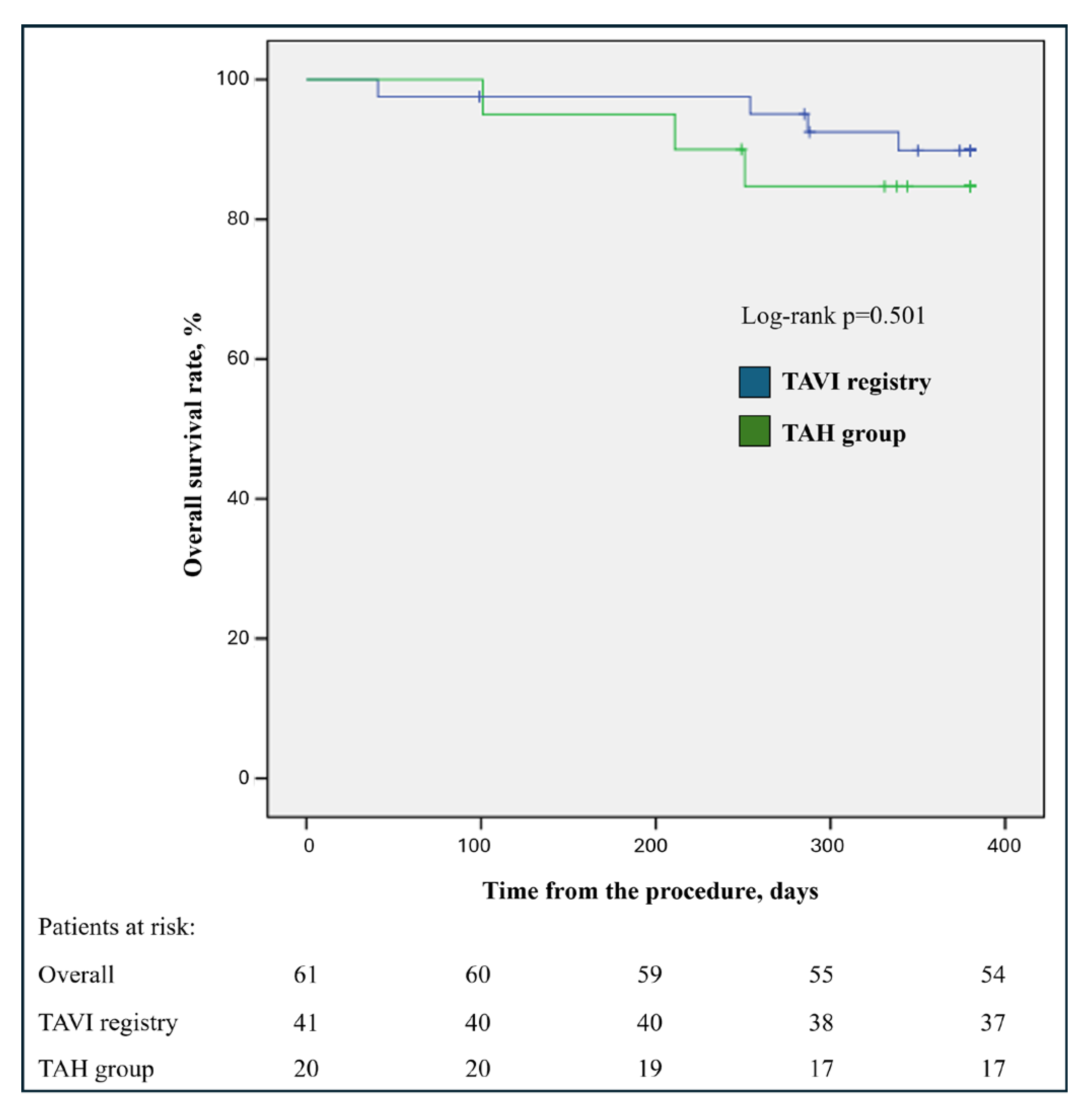
| 1-year | 6 (9.8) | 3 (15.0) | 3 (7.3) | 0.384 |
Disclaimer/Publisher’s Note: The statements, opinions and data contained in all publications are solely those of the individual author(s) and contributor(s) and not of MDPI and/or the editor(s). MDPI and/or the editor(s) disclaim responsibility for any injury to people or property resulting from any ideas, methods, instructions or products referred to in the content. |
© 2026 by the authors. Licensee MDPI, Basel, Switzerland. This article is an open access article distributed under the terms and conditions of the Creative Commons Attribution (CC BY) license.
Share and Cite
Dall’Ara, G.; Compagnone, M.; Grotti, S.; Santarelli, A.; Balducelli, M.; Cavazza, C.; Savini, C.; Moretti, C.; Ottani, F.; Rubboli, A.; et al. Preliminary Outcome of Transcatheter Aortic Valve Implantation at Centers Without On-Site Cardiac Surgery. J. Cardiovasc. Dev. Dis. 2026, 13, 226. https://doi.org/10.3390/jcdd13060226
Dall’Ara G, Compagnone M, Grotti S, Santarelli A, Balducelli M, Cavazza C, Savini C, Moretti C, Ottani F, Rubboli A, et al. Preliminary Outcome of Transcatheter Aortic Valve Implantation at Centers Without On-Site Cardiac Surgery. Journal of Cardiovascular Development and Disease. 2026; 13(6):226. https://doi.org/10.3390/jcdd13060226
Chicago/Turabian StyleDall’Ara, Gianni, Miriam Compagnone, Simone Grotti, Andrea Santarelli, Marco Balducelli, Caterina Cavazza, Carlo Savini, Carolina Moretti, Filippo Ottani, Andrea Rubboli, and et al. 2026. "Preliminary Outcome of Transcatheter Aortic Valve Implantation at Centers Without On-Site Cardiac Surgery" Journal of Cardiovascular Development and Disease 13, no. 6: 226. https://doi.org/10.3390/jcdd13060226
APA StyleDall’Ara, G., Compagnone, M., Grotti, S., Santarelli, A., Balducelli, M., Cavazza, C., Savini, C., Moretti, C., Ottani, F., Rubboli, A., Galvani, M., Pizzi, C., & Tarantino, F. F. (2026). Preliminary Outcome of Transcatheter Aortic Valve Implantation at Centers Without On-Site Cardiac Surgery. Journal of Cardiovascular Development and Disease, 13(6), 226. https://doi.org/10.3390/jcdd13060226